
Del Norte City Zoning Code
ARTICLE 11
Sign Regulations
Sec. 16-11-10.- Declaration of intent; findings and purposes.
(a)
Findings. The Town finds with respect to the display of signs:
(1)
That the time, place and manner in which signs are displayed on property within the Town's jurisdiction have a significant;eoc;
impact on the public health, safety and welfare.
(2)
That signs serve many important functions in the efficient operations and economic vitality of the Town, including communication, identification and direction.
(3)
That the number, location, size, relative scale, design and construction of signs for public display have a significant impact on the community's aesthetics and beauty.
(4)
That poorly designed, constructed, installed or maintained signs can present a significant danger to traffic and public safety and a harmful impact on the aesthetics and economic vitality of the Town.
(5)
That, because legitimate and necessary interests of each zone district are different, each district requires the application of different time, place and manner regulations to achieve the purposes furthered in this Article.
(6)
That the cumulative impacts that would accrue if every member of a residential neighborhood chose to display a sign could be harmful to the best interests of the Town and its residents.
(b)
Purpose. The purpose of this Article is to promote the public health, safety and welfare by providing uniform standards for the times, places and manners in which all signs within each zone in the Town shall be displayed. This Article advances the following legitimate and necessary public purposes:
(1)
Communication, identification and direction. To allow the reasonable display of signs for the purposes of communication, identification and direction, while protecting the public from the display of signs that are unsafe, unattractive, obsolete, out-of-scale or incompatible with surrounding property uses.
(2)
Transportation safety. To protect the public, including motorists, bicyclists and pedestrians, by prohibiting the display of signs in a manner that results in visual distractions, impaired visibility or other dangerous conditions that impair transportation safety.
(3)
Safety. To protect the public by prohibiting the display of signs that are designed, constructed, installed or maintained in a dangerous manner.
(4)
Aesthetics. To protect, enhance and preserve the visual beauty and aesthetic character of the Town by prohibiting the display of signs in a manner that detracts from the beauty and character of their particular location, adjacent buildings and uses and the surrounding neighborhood.
(5)
Economic vitality. To support the economic vitality of commercial enterprises and investments while providing uniform standards that allow equal opportunity in the competition to attract and inform customers.
(6)
Equal opportunity. To divide and allocate the cumulative benefits and impacts realized through the display of signs so that each member of the community possesses an equal opportunity to communicate, or not communicate, through the display of signs.
(7)
Privacy. To protect the privacy of the community members who do not wish to be overwhelmed by unsolicited communications displayed on signs visible to the public.
(Ord. No. 680, § 1, 7-7-2015)
Sec. 16-11-20. - Applicability.
This Article shall apply to all signs or attention-attracting devices located within the Town. Signs or attention-attracting devices shall only be allowed as permitted by this Article. The provisions of Section 16-11-60, Prohibited signs, and Section 16-11-110, Nonconforming signs, also apply to signs within the Town.
(Ord. No. 680, § 1, 7-7-2015)
Sec. 16-11-30. - Sign permits and administration.
(a)
Purpose. The purpose of the sign permit requirement is to assure compliance with this Article, prevent waste and provide for the orderly, fair and uniform application of this Article to all individuals and situations. This Section only addresses which signs require permits prior to installation.
(b)
Permit required. A sign permit is required prior to the installation of any sign or group of signs, whose total aggregate square footage equals more than nine square feet per property. In multiple-tenant nonresidential buildings or developments with an approved comprehensive sign plan, a separate permit shall be required for each business entity's signs. Any multiple-tenant nonresidential buildings or development existing at the time of adoption of this Code that do not have a comprehensive sign plan shall be required to create a comprehensive sign plan at the time of application pursuant to the requirements of Section 16-11-90 of this Article. Separate building and electrical permits may be required for signs and will be determined on a case-by-case basis.
(c)
Exempt signs. A sign permit is not required for the display of a sign or group of signs whose total square footage equals nine square feet or less per property.
(d)
Application forms. Application for sign permits shall be submitted on the forms provided by the Town, completed as required, with the required sign permit fee.
(e)
Application contents. Application for sign permit. The application for a sign permit shall include the following information:
(1)
Business name, address and phone number.
(2)
Business owner name, mailing address and phone number.
(3)
Site plan showing the location of the sign on the premises in relation to lot lines, buildings and public rights-of-way and street intersections within 300 feet of the proposed sign.
(4)
Description of the sign (or signs), including type, size, structural design and construction materials.
(5)
Drawing or photograph of the proposed sign, with specifications indicating height, perimeter, area of sign and/or area of copy, dimensions, type of lettering, means of support, method of illumination and any other distinguishing characteristics.
(6)
Certification by a structural engineer for any sign that has a structural component as part of its design.
(7)
Consent. A letter of consent from the owner of the building or property if the applicant is not the owner.
(8)
Form. Any other information required on the form provided by the Town Clerk/Administrator.
(9)
Nonrefundable permit fee.
(f)
Determination of sufficiency. After receiving the permit application, the Town Clerk/Administrator shall determine whether it is complete. If the application is not complete, the Town Clerk/Administrator shall notify the applicant within ten business days following receipt of the application and take no further action until the deficiencies are remedied.
(g)
Issuance of permit.
(1)
Compliance with standards. If the application is complete, the Town Clerk/Administrator shall determine whether the application complies with the standards of this Article. The Town Clerk/Administrator shall be authorized to issue the permit, issue the permit with conditions or deny the permit application.
(2)
Review of the application shall be completed and notice sent to the applicant within ten business days from the date the application was deemed complete.
(3)
Inspections generally. All signs shall be subject to inspection to determine that the sign is being installed and/or maintained in accordance with the terms of this Chapter.
(h)
Expiration. Whenever the construction of any sign has not been completed within 180 days after its approval, the permit shall expire and be of no further force of effect.
(Ord. No. 680, § 1, 7-7-2015)
Sec. 16-11-40. - Types of signs.
(a)
Awning sign. An awning sign is a type of wall sign that is painted, stitched, sewn or stained onto the surface of an awning. An awning is a shelter supported entirely from the exterior wall of a building and composed of non-rigid materials except for the supporting framework.
(b)
Canopy sign. A canopy sign is a type of wall sign that is permanently affixed to a roofed shelter attached to and supported by a building, by columns extending from the ground or by a combination of a building and columns.
(c)
Election sign. An election sign is a temporary sign displayed during the election season beginning 90 days prior to an election and ending 15 days following the election for the purpose of expressing opinions concerning candidates, ballot issues and ideological positions.
(d)
Externally illuminated sign. An externally illuminated sign is a sign that is lighted from an external source.
(e)
Ground sign. A ground sign is a freestanding sign where the entire bottom is in contact with the ground. Ground signs are also referred to as "monument signs."
(f)
Internally illuminated sign. An internally illuminated sign is a sign that is lighted from an internal source, including signs that are lighted from fixtures attached to the structure of the sign, such as light tubes or exposed neon tube lighting.
(g)
Mural. A mural is a painted image located on a building wall. A mural is a type of wall sign.
(h)
Neon sign. A neon sign is an internally illuminated sign that utilizes gas-filled tubes.
(i)
Nonconforming sign. A nonconforming sign is a sign that was lawfully established pursuant to the sign codes in effect at the time of its erection, but which does not conform to the standards of this Article.
(j)
Pole sign. A pole sign is a freestanding sign being supported by a pole or poles and otherwise separated from the ground by air. Pole signs shall be a minimum of eight feet above grade when located adjacent to or projecting over a pedestrian way.
(k)
Projecting sign. A projecting sign is any sign structurally supported by a building wall and projecting from the surface of the building or wall. Projecting signs shall not be higher than the eave line or parapet wall of the building, shall be a minimum of eight feet above grade when located adjacent to or projecting over a pedestrian way and shall not extend more than four feet six inches from the building wall. When two sign faces are placed back to back and are at no point more than two feet from each other, the area of the sign shall be counted as the area of a single face if both faces are of equal area, or the area of the larger face if the faces are not of equal area.
(l)
Sidewalk sign. A sidewalk sign is an advertising or business ground sign constructed in such a manner as to form an "A" or a tent-like shape, hinged or not hinged at the top; each angular face held at an appropriate distance by a supporting member. Sidewalk signs are also referred to as "sandwich board signs."
(m)
Temporary sign. A temporary sign is a sign, attention-attracting device or advertising display constructed of cloth, vinyl, canvas, fabric, plywood or other light material that is intended for display for less than 90 days per calendar year.
(n)
Wall sign. A wall sign is a permanent sign that is painted on, incorporated into, hanging from or affixed to the building wall, in such a manner that the wall becomes the supporting structure for, or forms the background surface of, the sign. Wall signs shall not be higher than the eave line or parapet wall of the building, and no sign part, including cut-out letters, shall project more than six inches from the building wall.
(o)
Window sign. A window sign is a sign that is painted on, applied or attached to a window that can be read through the window.
(Ord. No. 680, § 1, 7-7-2015)
Sec. 16-11-50. - Time, place and manner for display of signs.
(a)
Residential zones (R1, R2). Each dwelling unit on a lot with a nonresidential use in a residential zone may display up to the total sum of nine square feet of signs. The display of signs in residential zones is limited to pole or ground signs that do not exceed five feet in height, wall signs and window signs. Signs in residential zones may not be illuminated.
(b)
Residential uses in commercial zones. Each lot with a residential use in a commercial zone may display up to the total sum of nine square feet of sign area per dwelling unit. The display of signs related to residential uses shall be limited to pole, ground, wall and window signs.
(c)
Subdivisions and planned developments. Each subdivision or planned development may display one pole or ground sign not to exceed 16 square feet per street entrance. Each final plat of a subdivision or final plan of a planned development must have an approved comprehensive sign plan for the display of signs on property owned or utilized in common by the lot owners or tenants of the subdivision or planned development. Up to 32 square feet of sign area may be displayed at each entrance to a subdivision or planned development for no more than two years from the beginning of the physical development process for the purposes of advertising the development and advertising property sales.
(d)
Nonresidential uses in commercial zones. An owner or tenant of a lot used for nonresidential purposes in a commercial zone may display the following types of signs. No individual sign may exceed 100 square feet in area. In no event shall the total amount of sign area displayed exceed 250 square feet.
(1)
Wall, pole, ground or projecting signs. The owners or tenants of a lot used for nonresidential purposes in a commercial zone may display an aggregate sign area totaling no more than the larger of 25 square feet or one square foot of sign area for each linear foot of lot frontage on a street. If there is more than one floor of nonresidential uses, an additional one-half square foot of sign area for each linear foot of building frontage on a street is available for each additional floor above the first.
(2)
Sidewalk signs. The owners of businesses operating in a building in a CB or CH zone may display one sidewalk sign per building on the sidewalk adjacent to the public business entrance of the building. If the business entrance is not adjacent to a Town street, the sidewalk sign may be placed at the nearest sidewalk, but only with the express permission of the owner of the business that is adjacent to the location of the sidewalk sign. All sidewalk signs are limited in size to a maximum width of three feet and maximum height of five feet. No sidewalk sign shall be displayed that presents a danger to the public or impedes the reasonable flow of pedestrian traffic. Sidewalk signs may only be displayed while the business is open to the public and must be removed at all other times. Sidewalk signs do not require a sign permit and do not count towards total area allowed.
(3)
Temporary signs. The owners of businesses operating in a building in a commercial zone may display no more than one temporary sign at any given time. The total size of a temporary sign shall not exceed 16 square feet. The total number of days in which signs may be displayed shall not exceed 90 days per calendar year (January 1 to December 31). Temporary signs shall be of professional quality and displayed in a safe manner. Temporary signs may not be affixed to public property or infrastructure. Temporary signs do not require a sign permit and do not count towards total area allowed.
(4)
Window signs. Window signs do not require a permit and do not count towards total area allowed. Window signs must meet all other requirements and standards for the display of signs under this Article.
(e)
Election signs. During the political campaign period beginning 90 days prior to an election and ending 15 days following the election, each residential dwelling unit in any zone shall be allowed an additional nine square feet of sign area for the purpose of expressing opinions concerning candidates, ballot issues and ideological positions. The height of individual election signs shall be limited as established in Table 16-11B.
________
TABLE 16-11A
Time, Place and Manner for the Display of Signs
TABLE 16-11B
Illumination and Height of Signs
(Ord. No. 680, § 1, 7-7-2015)
________
Sec. 16-11-60. - Prohibited signs.
The following signs are inconsistent with the policy, purposes and standards in this Article and are prohibited in all zoning districts.
(1)
Off-premises signs. The right to display signs on a property is limited to the actual residents of the property where the sign is displayed or to commercial entities actually doing business on the property where the sign is displayed, with the exception that a nonresident owner may display signs on a property for the purpose of promoting the sale or lease of the property where the sign is displayed. The Board of Trustees may allow off-premises signs to be displayed following a finding that the proposed sign promotes a legitimate and necessary public interest in public safety, traffic safety, way-finding, location identification, public information or other economic vitality of a commercial district. The Board of Trustees shall review sign permit applications for off-premises signs and approval shall be by resolution. The Board of Trustees shall determine at that time whether the sign area requested would apply towards the square footage of sign area permitted on the site.
(2)
Signs on public property. Unless otherwise provided for in this Article, no sign shall be displayed on public property or within the right-of-way of any road or highway without the written approval of the Board of Trustees and following a finding that the proposed sign promotes a legitimate and necessary public interest in public safety, traffic safety, way-finding, location identification, public information or the economic vitality of a commercial district.
(3)
Moving signs. Flashing, rotating, blinking or moving signs, animated signs, signs with moving, rotating or flashing lights or signs that create the illusion of movement, except for time and temperature devices, are prohibited.
(4)
Hazardous signs. No sign shall be displayed that is erected in such a manner or location as to cause visual obstruction or interference with a motor vehicle, bicycle, pedestrian traffic or traffic-control devices, including any sign that obstructs clear vision in any direction from any street intersection or driveway.
(5)
Dangerous signs. No sign shall be displayed that poses a danger due to poor design, construction, installation or maintenance.
(6)
Decrepit signs. No sign shall be displayed that is in a state of disrepair, wear or ruin due to age or neglect. All signs, including signs exempt from these regulations with respect to permits and fees, shall be maintained in good condition and in compliance with all building and electrical codes.
(7)
Roof signs. A roof sign is a sign which is erected, placed or maintained, in whole or in part, upon, against or directly above the roof, or which projects above the eaves of a pitched roof or above the walls of a flat roof. Signs which are manufactured into the material of awnings shall not be considered roof signs.
(8)
Obsolete signs. An obsolete sign is a sign or sign structure, excluding murals, which advertises an activity, product or business which no longer occupies the premises on which the sign is located. Obsolete signs shall be removed by the legal owner of record of the property within a period of 90 days after the business, product or service is no longer located upon the premises where the sign is located. Obsolete signs that are an integral part of the facade or which are determined to be historically significant by the Town Clerk/Administrator, but which do not advertise a business or product on the site, are permitted.
(9)
Attention-attracting devices. Attention-attracting devices in general are prohibited unless otherwise approved under this Article.
(10)
Uncivil signs. There shall be no signs or pictures of an obscene, indecent or immoral character such as will offend morals or decency in accordance with constitutional standards.
(Ord. No. 680, § 1, 7-7-2015)
Sec. 16-11-70. - Sign measurement.
(a)
All signs counted. The aggregate area allowed for signs shall include all signs displayed on the site.
(b)
Sign surface area. Sign area shall be the area within the outer boundaries of standard geometrical shapes which encompasses the sign facing, including copy, insignia, background and borders.
(c)
Sign support. Supporting framework or bracing that is clearly incidental to the display itself shall not be computed as sign area.
(d)
Cut-out letter signs. The area of cut-out letter signs shall be considered to be that of a single rectangle or square encompassing all of the letters used to convey the message of the sign and shall include the open space between letters of words within that rectangle or square. The height of letters will be measured on the uppercase letters.
(e)
Multi-face signs. The sign area for a sign with more than one face shall be computed by adding together the area of all sign faces visible from a single point, unless otherwise specified in this Article. When two sign faces are placed back to back and are at no point more than two feet from each other, the area of the sign shall be counted as the area of a single face.
(f)
Sign height. The height of a sign shall be measured from the highest point of a sign to the ground surface beneath it. When berms are used in conjunction with signage, the height of the sign shall be measured from the mean elevation of the fronting street.
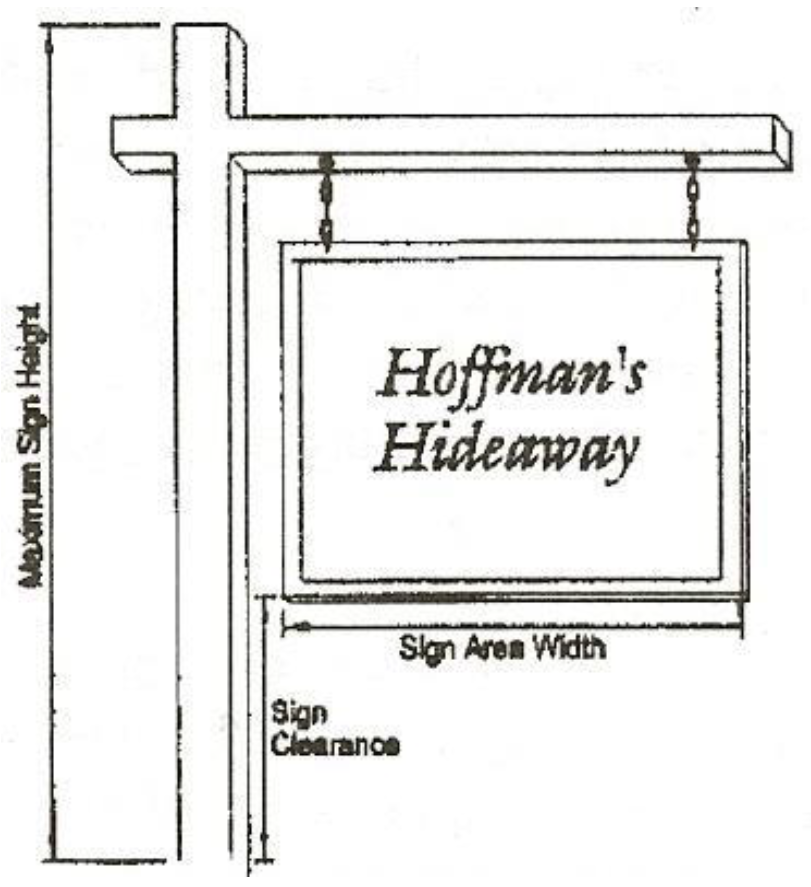
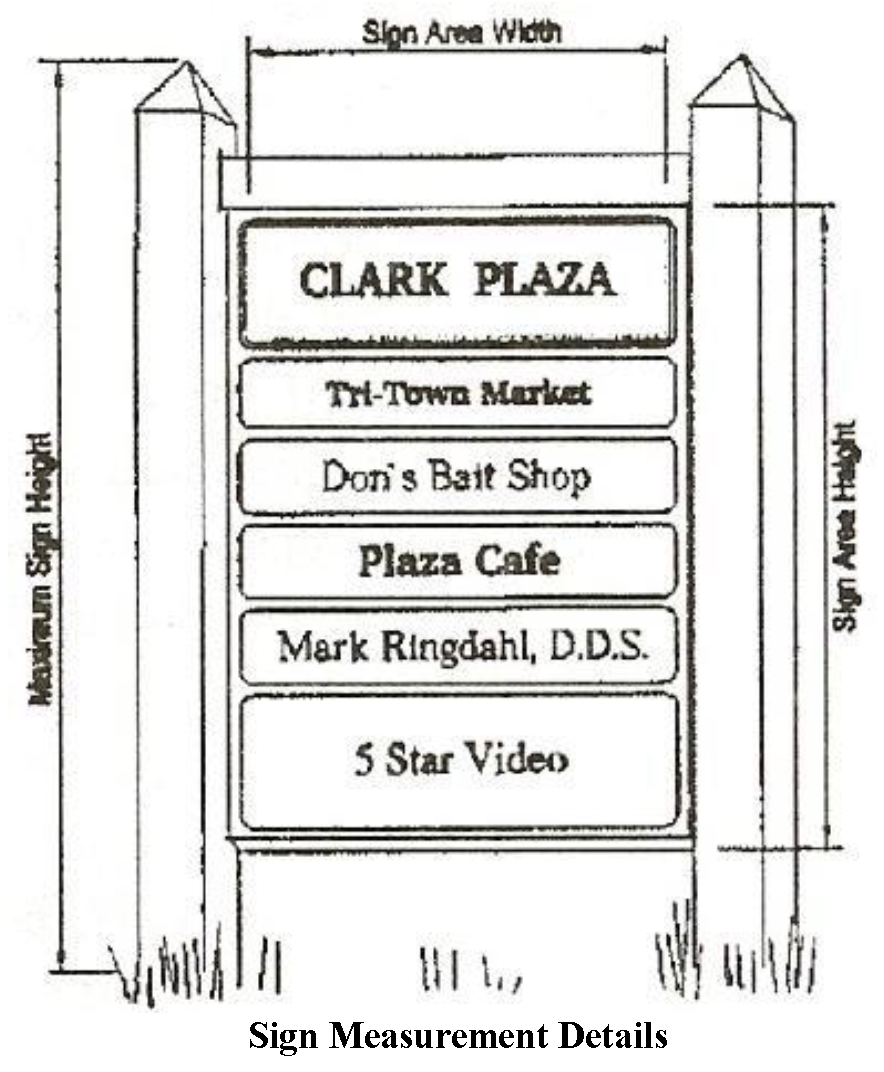
(Ord. No. 680, § 1, 7-7-2015)
Sec. 16-11-80. - Sign location and appearance standards.
(a)
Externally lit signs. Illumination of signs shall be arranged in such a manner as to be reflected away from residential properties and the vision of motorists, bicyclists or pedestrians. Lighting shall be placed so as to light downward onto a sign and be fully shielded. Fixtures used to illuminate signs shall be aimed so as not to project their light beyond the sign.
(b)
Internally lit signs. Illumination of signs shall be arranged in such a manner as to be reflected away from residential properties and the vision of motorists, bicyclists or pedestrians. To reduce glare and increase the ability to read signs at night, it is recommended that internally lit signs use white lettering against a dark background color.
(c)
Location of signs. The following setbacks for signs shall be met for street and driveway intersections: No sign shall be located within a "clear sight triangle" between the height of two and ten feet above the ground.
(d)
Architectural elements. Signs should not be placed so that they cover essential, character-defining architectural details of a building.
(e)
Construction. All signs shall be made by a commercial sign manufacturer or be of similar professional quality. All signs shall be completed and erected in a professional manner and in accordance with this Chapter.
(f)
Right-of-way. Any sign which projects over a right-of-way in such a manner that it may cause a danger to the public shall have supports, hangers or fasteners certified by a Colorado licensed structural engineer.
(Ord. No. 680, § 1, 7-7-2015)
Sec. 16-11-90. - Comprehensive sign plan.
(a)
Every multi-tenant building or coordinated development, such as office parks, civic uses, shopping centers and business parks, shall have a comprehensive sign plan approved. Any multiple-tenant nonresidential buildings or development existing at the time of adoption of this Code that do not have a comprehensive sign plan shall be required to create a comprehensive sign plan at the time of application for a new sign at the site. Where a comprehensive sign plan is required for an existing development with multiple owners, all such owners shall be given notice and have the opportunity to participate in development of the comprehensive sign plan or provide written approval of said plan. In the event any affected owner fails to participate in the development of the comprehensive sign plan or provide written approval therefor within 15 days of notice, that owner will be deemed to have consented to the plan's adoption. Planned developments shall include a comprehensive sign plan at the final development plan stage. Applications for a final subdivision plat shall include a comprehensive sign plan application.
(b)
Purpose. The general purpose of the comprehensive sign plan is to ensure proper business identification while enhancing the quality, harmony and consistency of a project by aesthetically integrating signage into the architecture of each building, as well as the development as a whole. The sign scheme must comply with the basic requirements for signs established for the project's uses by this Article. The comprehensive sign plan shall address the following topics and demonstrate the following characteristics:
(1)
Identification signs. Designation of the size and location of identification signage proposed for individual tenants. Specifications should anticipate minimum and maximum height. Sign locations should anticipate impact of pad buildings and landscaping, as well as the provision of adequate spacing between facade signs for effective readability.
(2)
Permitted area, height, illumination and number of signs. The permitted amount of sign area, height, illumination and similar restrictions should follow the total area permitted in Tables 16-11A and 16-11B of this Article for each site within the development. In planned developments, the permitted area, height and illumination should be proposed in relation to the types of uses in each portion of the development. The applicant shall designate how much sign area of the total permitted signage should be apportioned to each tenant space for both individual identification signs and common freestanding signs.
(3)
Appearance. Signs shall be durable, attractive and designed to complement and reinforce the design of the project buildings.
(4)
Consistency. Sign design within a development should be generally consistent between tenants and buildings so that the design continuity of the project is maintained. However, it is not necessary for every sign within a particular development to be identical.
(5)
Exempt signs. Signs not requiring a permit under this Article shall still be permitted in a development with a comprehensive sign plan unless stated otherwise in the comprehensive sign plan.
(c)
Approval of comprehensive sign plans. Proposed comprehensive sign plans shall be submitted on the forms or in the format prescribed by the Town Clerk/Administrator.
(d)
Submittal of application. The applicant shall submit a complete application to the Town Clerk/Administrator meeting the requirements of Subsection 16-11-30(e) for each project requiring comprehensive sign plan approval at the time of final development plan application, final plat application or prior to issuance of any certificate of occupancy if no final development plan or plat was required.
(Ord. No. 680, § 1, 7-7-2015)
Sec. 16-11-100. - Compliance with standards.
(a)
Determination of compliance. If the application is complete, the Town Clerk/Administrator shall determine whether the application complies with the standards of this Article. The Town Clerk/Administrator shall be authorized to issue the permit, issue the permit with conditions or deny the permit application.
(b)
Review. Review of the application shall be completed and notice sent to the applicant concurrent with the approval of a final development plan or building permit application.
(c)
Comprehensive sign plan modifications. Minor modifications to a sign scheme that are still within the overall concept and intent of the approved plan may be approved by the Town Clerk/Administrator. Major modifications or a new comprehensive sign plan will require a new application, including a plan to bring any existing signs in the development into conformance with the new plan. Permits shall be required for individual signs within the comprehensive sign plan. In multiple-tenant commercial buildings or developments with an approved comprehensive sign plan, a separate permit shall be required for each business entity's signs.
(Ord. No. 680, § 1, 7-7-2015)
Sec. 16-11-110. - Nonconforming signs.
A legally permitted permanent nonconforming sign may remain, provided that it is maintained in good repair, with the following provisions:
(1)
Modification. Nonconforming signs shall not be enlarged, extended, structurally reconstructed or altered in any manner unless the sign is modified to conform to these regulations.
(2)
Damage. A nonconforming sign or the structure supporting the sign which is damaged or destroyed to the extent of 50 percent or more shall not be altered, replaced or reinstalled unless it is in conformance with these regulations. If the damage or destruction is less than 50 percent, the sign must be under repair within 60 days and all repairs must be completed within six months.
(3)
Discontinuance. The property signage must be brought into conformance with these regulations within six months following a change in use.
(4)
Change in location. Nonconforming signs may not be moved to a new location.
(Ord. No. 680, § 1, 7-7-2015)
Sec. 16-11-120. - Permit procedures.
No sign, except as provided by Subsection 16-11-30(g) of this Article, shall be erected, displayed, altered, relocated or replaced until the Town has issued a sign permit.
(Ord. No. 680, § 1, 7-7-2015)
Sec. 16-11-130. - Authority to continue.
Any sign legally established on the effective date of this Chapter or any amendment thereto which does not conform with any provisions of this Chapter shall be allowed to remain and to be maintained in good repair, subject to the discontinuance provisions below:
(1)
Discontinuance. A legal nonconforming sign shall be removed if any one of the following conditions occurs. In all such cases of discontinuance, if a replacement sign is proposed, it shall be constructed in accordance with the provisions of this Chapter.
(2)
If a change of use occurs, regardless of ownership, such that the new use would be a different classification under Table 16-4A.
(3)
The principal use with which the sign is associated terminates for 90 days or longer.
(4)
The principal building with which the sign is associated is demolished or destroyed.
(5)
The nonconforming sign is destroyed or damaged as a result of either an intentional act of the owner (other than for maintenance, which shall not exceed two weeks), an unintentional act of another or an act of nature, the replacement sign shall be constructed in conformance with the provisions of this Article if the estimated cost of restoration to its condition before the occurrence exceeds 50 percent of the value of the sign structure prior to being damaged;
(6)
The Building Official determines that the sign is an immediate hazard to the public health, safety and welfare because of disrepair, unsafe mounting, imminent dislodging or other safety factors.
(Ord. No. 680, § 1, 7-7-2015)

