
Del Rey Oaks City Zoning Code
CHAPTER 17
90 - AFFORDABLE HOUSING OVERLAY ZONE
17.90.010 - Purpose and intent.
The purpose and intent of the Housing Element Implementation Overlay Zone is to facilitate housing opportunities within the community via implementation of required rezone programs pursuant to the City's adopted Housing Element where required for compliance with State Housing Element Law. This chapter contains requirements for overlay zones applicable to residential uses and affordable housing for residential areas. The purpose of this chapter is to establish standards and regulations and define specific areas appropriate for an affordable housing overlay zone to accommodate the City's RHNA.
(Ord. No. 315, § 2, 10-24-2023)
17.90.020 - Definition of Overlay Zone.
Overlay zone means an additional zoning district as shown on the zoning map that prescribes special regulations to a parcel in combination with the base zoning district.
(Ord. No. 315, § 2, 10-24-2023)
17.90.030 - Affordable Housing Overlay Zone (AH-OZ).
A.
Purpose. The purpose of the Affordable Housing Overlay Zone (AH-OZ) is to facilitate the provision of affordable housing units through the construction of new affordable units within land not currently zoned for residential uses. The AH-OZ overlay zone is intended to:
1.
Implement the goals and policies of the General Plan Housing Element and provide the opportunity and means for Del Rey Oaks to meet its regional fair share allotment of affordable units as established by State of California and Association of Monterey Bay Area Governments.
2.
Encourage the provision of affordable housing to meet the Regional Housing Needs Assessment through the AH-OZ overlay within an area that is deemed to be appropriate for such uses and is determined to be consistent with the City's Housing Element.
B.
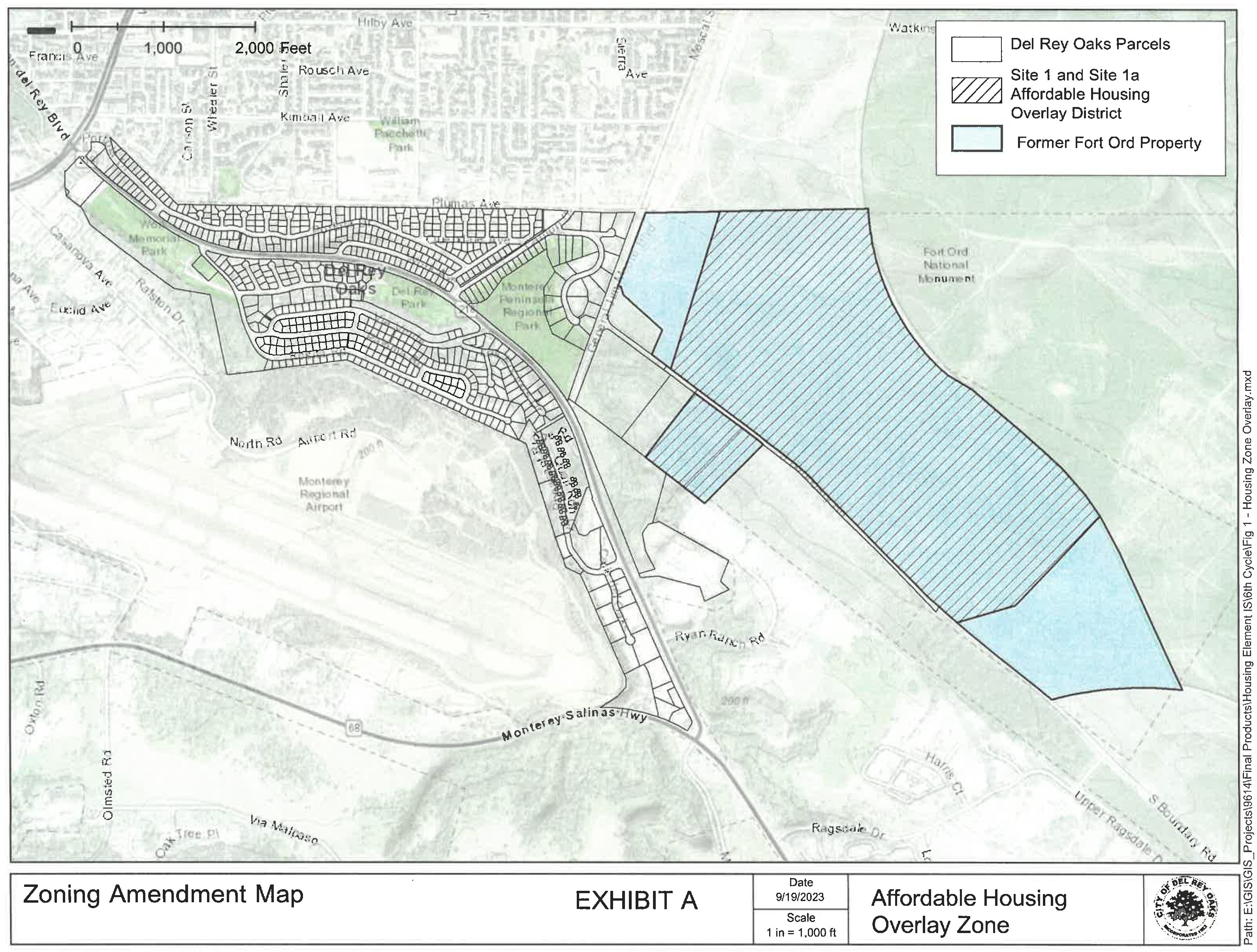
Applicability. The AH-OZ overlay zone is applied to a specific area. The overlay zone is applied to the parcels in the area of South Boundary Road, north and south of South Boundary Road and east of General Jim Moore Boulevard, specifically to the City-owned properties identified as Sites 1 and 1a of the former Fort Ord area, as depicted on Exhibit A.
C.
Definitions.
Affordable housing means housing capable of being purchased or rented by a household with "very low," "low," or "moderate" income levels at an "affordable housing cost" or "affordable rent," as those terms are defined by the state of California.
Affordable housing cost and affordable rent are defined in Sections 50052.5 and 50053, respectively, of the California Health and Safety Code, and in Subchapter 2 of Chapter 6.5 of Division 1 of Title 25 of the California Code of Regulations, commencing with Section 6900.
Affordable housing overlay district means a zoning district that applies in addition to existing zoning designations in areas where the City seeks to encourage the provision of affordable housing units as described in this Chapter.
The "very low," "low," and "moderate" income levels are defined by the state of California in Sections 50105, 50079.5, and 50093, respectively, of the California Health and Safety Code, and in Subchapter 2 of Chapter 6.5 of Division 1 of Title 25 of the California Code of Regulations, commencing with Section 6900. These income levels are:
a.
Very Low Income. Up to and including 50 percent of the Monterey County median income, adjusted for family size, as defined by the state law;
b.
Lower Income. 51 percent to 80 percent of Monterey County median income, adjusted for family size, as defined by the state law;
c.
Moderate Income. 81 percent to 120 percent of Monterey County median income, adjusted for family size, as defined by state law.
D.
Permits and Approvals Required.
1.
Affordable housing developments proposed under this Chapter require the execution of a development agreement by the City and the developer. The development agreement shall be prepared in accordance with the provisions of California Government Code Section 65864 et seq.
2.
Affordable housing developments proposed under this Chapter require approval of a design permit. All requirements in Chapter 17.56.020 (Design Review) related to approving body apply, except that the Planning Commission shall recommend design permit approval to the City Council. The City Council may take action on the design permit application concurrently with or subsequent to action on the development agreement.
3.
All approvals, procedures, conditions of approval, and decisions shall be made in a manner consistent with the requirements of the Housing Accountability Act (Government Code section 65589.5). Should requirements in Chapter 17.56 (Design Review) be inconsistent or contrary to the Housing Accountability Act, state law shall prevail.
E.
Permitted Residential Density and Designation.
1.
Affordable housing developments with minimum density of 20 units per acre are permitted in the AH-OZ overlay zone per the requirements of HCD.
2.
Designation. Sites 1 and 1a within the Affordable Housing Overlay Zoning District shall be indicated by the AH-OZ designation.
F.
Income Restrictions.
1.
The following categories shall be allowed under the required income restrictions:
a.
Moderate-income households;
b.
Low-income households;
c.
Very low-income households; or
d.
Extremely low-income households.
2.
At minimum, 50 percent of income-restricted affordable units (25 percent of the total project units) shall be affordable to low, very low, and extremely low-income households. A greater level of affordability will not allow a greater level of density.
G.
Design Review and Development Standards.
1.
Design review shall be required for any residential development proposed pursuant to this Chapter and shall be conducted as specified in Chapter Chapter 17.56.030 (Design Review), provided, however, that all procedures, conditions of approval, and decisions shall be made in a manner consistent with the requirements of the Housing Accountability Act (Government Code Section 65589.5).
2.
The following development standards are intended to govern residential development within the AH-OZ overlay zone:
3.
Building Height. Maximum building height shall be 35 feet with a maximum of three stories.
4.
Common Open Space.
a.
Common open space shall comprise the greater of:
i.
Ten percent of the total area of the site; or
ii.
One hundred fifty square feet for each dwelling unit.
b.
Areas occupied by buildings, streets, driveways, parking spaces, utility units, mailboxes, and trash enclosures may not be counted in satisfying the open space requirement.
c.
The following areas may be counted in satisfying the open space requirement:
i.
Landscaping and areas for passive and active recreation/open space with a minimum depth and width of eight feet.
ii.
Land occupied by natural open space areas.
5.
Streets.
a.
All public streets within or abutting the proposed development shall be improved to City specifications for the particular classification of street.
b.
All private streets shall meet fire code and access standards.
6.
Building Coverage. The maximum building coverage is 50 percent.
7.
Distance Between Buildings on Same Lot. The following requirements for distance between buildings, excerpted from City Zoning Code requirements for R-2 Districts, as identified in 17.12.090, are established:
a.
No main building shall be closer than 15 feet to any other main building on the same lot, except as hereinafter specified for dwelling groups, below.
b.
Dwelling groups shall conform to the following regulations as to their location upon the lot and distances between buildings:
i.
In any such front to back series of buildings, at least 15 feet between buildings and at least eight feet for the side yard providing access;
ii.
In any single row side to side series of buildings, at least eight feet between buildings, at least five feet for the side yard to the rear thereof and at least 16 feet for the side yard in front thereof;
iii.
In any multiple row side to side series of buildings, at least eight feet between buildings, at least five feet for the side yard to the rear thereof and at least 20 feet for the court between the rows;
iv.
No building or group of buildings to encroach on the front yard required for adjacent lots.
8.
Design Standards for Open Space. The intent of Design Standards related to distance between structures and open space requirement is to provide adequate distance and placement of buildings in the development to promote privacy for residents and neighbors and security.
9.
Massing Articulation. Multifamily and mixed-use projects shall be designed to reduce the perceived mass, scale, and form of the overall development through use of varying roof heights, setbacks, and wall plane. Methods to achieve this include recessed facades, offsets and articulations in the building mass; varied roof height, massing, color and/or materials to create variations between individual buildings. Buildings shall be designed to ensure placement of buildings are not aligned along a single plane that results in a large "wall" on any single side of the building. The following standards apply:
a.
No wall along a single plane shall extend beyond 40 feet without breaking up building mass. Specific standards are identified below:
i.
A minimum of two features such as balconies, cantilevers, dormers, bay windows, patios, individualized entries, and accent materials shall be incorporated into each project building.
ii.
A minimum one-foot offset is required for any wall plane that exceeds 40 feet in length.
b.
Three-story buildings shall have massing breaks along any street frontage, adjacent public park, publicly accessible outdoor space, or designated open space, through the use of varying setbacks and/or building entries.
H.
Assurance of Affordability.
1.
Affordable housing units developed under this section shall remain available to persons and families of very low, low, and moderate income, at an affordable housing cost or affordable rental cost, at those income and affordability levels as defined in subsection C. of this section (Definitions), for 55 years or the natural life of the unit, whichever is greater, unless a longer period is required by a construction or mortgage financing program, mortgage insurance program, state law, or housing grant, loan or subsidy program.
2.
The required period of affordability shall run concurrently with any period of affordability required by any other agency; provided, however, that the affordability period shall not be less than 55 years or the natural life of the unit, whichever is greater.
3.
The project developer shall be required to enter into an appropriate agreement with the City to ensure affordability is maintained for the required period.
I.
Pre-Application Consultation.
1.
Prior to submitting an application for an affordable housing development within the AH-OZ overlay zone, the applicant or prospective developer should request preliminary consultation meetings with the City to obtain information and guidance before incurring substantial expense in the preparation of plans, surveys and other data.
2.
Preliminary consultations with City staff should address potential local, state, and federal affordable housing funding availability, and program requirements in guaranteeing project consistency with the objectives and requirements of the AH-OZ overlay zone.
J.
Additional Application Requirements. An application for an affordable housing development within the affordable housing overlay zone shall be filed and reviewed in compliance with Chapter 17.04.040 (General Provisions, Administration and Enforcement) and shall also include the following materials and information:
1.
Breakdown of affordable and market rate units including unit number, unit size, affordable designation of each unit (very low, low, or moderate), and rental rate or sale price.
2.
The proposed means for assuring the continuing existence, maintenance and operation of the project as an affordable housing project.
3.
Site plan requirements as detailed in Chapter 7.56.040.A. and B. (Design Review Procedures).
K.
Development Incentives. Development standards shall apply to all projects governed under this Chapter. In certain cases, where the City Council determines that incentives may be applied as further described below, specified design standards may be relaxed if the findings can be made that the proposed development qualifies for development incentives.
1.
Purpose. In order to reduce costs associated with the development and construction of affordable housing, affordable housing developments within the AH-OZ overlay zone shall be eligible for specified development incentives. The City incentives may include reduced fees or fee waivers or incentives related to development regulations to facilitate and promote the development of affordable housing in the City. Incentives shall be targeted to address funding and affordability, so as to permit the City to meet its regional fair share allotment of affordable housing and the goals of the housing element of the general plan, or to address project design features to aid in development of affordable housing in the City.
2.
Fee Waivers. The City may reduce or waive fees, as an incentive for projects that comply with the affordability required in subsection G. of this section (Income Restrictions).
3.
Relaxed Development Standards. The City may consider the following relaxed development standards for projects that comply with the affordability required in subsection G. of this section (Income Restrictions):
a.
Density Averaging. Project density within the AH-OZ overlay zone may be calculatedby averaging the density on a project-wide basis so as to permit higher density levels in certain project portions in exchange for advantageous project design features as determined by the City through the design permit review process.
b.
Setbacks. The minimum setbacks from property lines and distance between buildings may be reduced, but in no case more than ten percent reduction from the standard and only as part of an overall project plan approved by the City Council through the design permit process.
c.
Building Coverage. The maximum building coverage is 50 percent unless the City determines a lower maximum building coverage for the proposed project through the design review process as part of a development incentive. At no time should the maximum building coverage be less than 45 percent.
d.
Minimum Building Site Area and Lot Area per Unit. There may be a reduced size of 1.5-acre minimum building area as development incentive. The building site area shall be designated on a site plan as approved by the City through the design permit review process.
3.
Additional Development Incentives. The City may choose to extend one or more additional development incentives depending on the quality, size, nature, and scope of the project being proposed.
L.
Zoning Map Amendment. The City of Del Rey Oaks Zoning Map shall be amended to apply the additional of the Affordable Housing Overlay Zoning District (designated as AF-OZ), as described in this Section 17.90.030, above, and depicted in Exhibit A.
M.
Findings. To approve or recommend approval of an affordable housing development, the review authority shall make the following findings, in addition to findings as required by Chapter in Chapter 17.56 (Design Review) and consistent with the requirements of the Housing Accountability Act (Government Code section 65589.5):
1.
The developer has agreed to enter into an agreement to maintain the affordability of the project specific to the requirements of the City and any funding sources with greater or longer affordability requirements.
2.
The affordable housing development project would not have a specific, adverse impact upon the public health or safety. As used in this paragraph, a "specific, adverse impact" means a significant, quantifiable, direct, and unavoidable impact, based on objective, identified written public health or safety standards, policies, or conditions as they existed on the date the application was deemed complete.
Exhibit A
(Ord. No. 315, § 2, 10-24-2023)

