
Deridder City Zoning Code
ARTICLE II
- DISTRICTS AND USES
Sec. 15-21. - General provisions.
(a)
Types of districts. For the purpose of this chapter the City of DeRidder is hereby divided into the following types of districts:
Residential districts
R-1 districts: Single-family residential
R-2 districts: Higher density single family residential
R-3 districts: Multiple-family residential
R-4 districts: Mobile home park
Commercial districts
B-1 districts: Transitional business
B-2 districts: Neighborhood business
B-3 districts: General business
B-4 district: SE redevelopment incentives business
B-5 district: Central/downtown business
Industrial districts
I-1 districts: Industrial
Undeveloped districts
O-L districts: Open land
(b)
Order of restriction. For the purpose of this chapter, these districts shall be ranked with respect to degree of restriction, in descending order of restriction as follows: O-L, R-1, R-2, R-3, R-4, B-5, B-1, B-2, B-3, B-4, B-5, and I-1.
(c)
Zoning map. The districts and the boundaries of such districts are shown upon the Zoning Map of the City of DeRidder, Louisiana, which map together with all information shown thereon, is hereby made a part of this chapter.
(d)
District boundaries.
(1)
District boundaries are lot lines, the center lines of streets, alleys, or highways or such lines extended, railway right-of-way lines; the municipal corporation lines as they exist at the time of enactment of this chapter or may exist in the future, or natural boundary lines such as streams.
(2)
Where uncertainties exist with respect to the boundaries of any of the districts as shown on the zoning map, the following rules shall apply:
a.
Boundaries indicated as approximately following the center lines of streets, highways or alleys, railroad lines, and water courses shall be construed to actually be following such center lines.
b.
Boundaries indicated as approximately following right-of-way lines, property lines, lot lines, city limit lines, and shorelines shall be construed to actually follow such shoreline; and, in event of change in the shoreline shall be construed as running with the actual line as changed.
c.
Boundaries indicated as parallel to or extensions of features indicated in subsections (a) and (b), above, shall be so construed.
(3)
Where street or property layout existing on the ground is at variance with that shown on the official zoning map, the city council shall interpret the district boundaries.
(e)
Utility lines. Water, electric transmission, sanitary sewer, telephone, and telegraph, storm water drainage, and natural gas lines, regardless of any other provision or regulation appearing in this chapter, shall not be deemed and shall not constitute "uses requiring planning approval" or "special exception uses" in any district insofar as their placement, erection, or construction on dedicated streets, alleys, and public ways is concerned, but on such streets, alleys and public ways, they shall constitute uses by right, and no permit, license or other document of approval for such use(s) shall be required under this chapter.
(Ord. No. 1429, 7-26-04)
Sec. 15-22. - Permitted uses in all districts.
In all districts, uses are categorized into three (3) groups: uses "by right", uses requiring "planning approval", and uses allowed only by "special exception". These allowed uses are delineated in the section outlining the requirements for each district.
(a)
Uses by right are permitted subject to the conditions specified.
(b)
Uses requiring planning approval are permitted upon approval of the location and site plan thereof by the planning commission as being appropriate with regard to transportation and access, water supply, water disposal, fire and police protection, and other public facilities, as not causing undue traffic hazard, and as being in harmony with the orderly and appropriate development of the district in which the use is located.
(c)
Special exception uses are subject to the same approval of location and site plan as uses requiring planning approval. In addition, these uses are declared to possess such characteristics of unique or special form that each specific use shall be considered an individual case and shall be also subject to approval of the city council in accordance with the provisions of section 15-183 governing special exceptions.
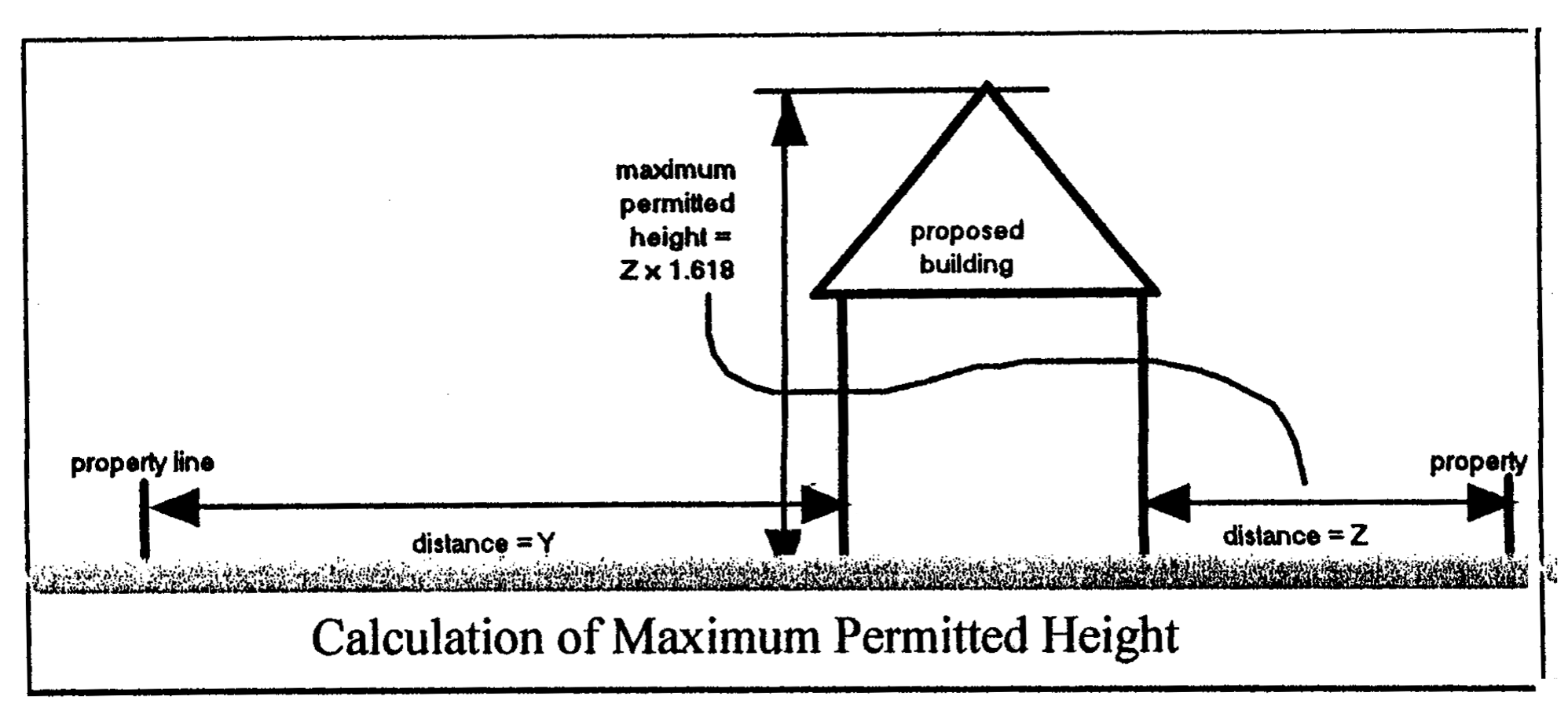
Calculation of Maximum Permitted Height
(Ord. No. 1429, 7-26-04)
Sec. 15-23. - Table of minimum and maximum sizes.
Except as otherwise provided in this article and in article III of this chapter, minimum and maximum building sites, floor areas, and structure heights are specifies as follows:
(Ord. No. 1429, 7-26-04)
Sec. 15-24. - R-1 districts; single-family residential districts.
These districts are composed mainly of areas containing single-family dwellings and open areas where similar residential development seems likely to occur; few two-family and multiple-family dwellings are found in these areas. The district regulations are designed to protect the residential character of the areas by prohibiting all commercial activities; to encourage a suitable neighborhood environment for family life by including among the permitted uses such facilities as schools and churches, and to preserve the openness of the areas by requiring certain minimum yard and area standards to be met. To insure that such districts, when created, are actually developed, the amendment creating the district may set a time limit for its development.
(a)
Permitted uses in R-1 districts. In R-1 districts, only the following uses are permitted:
(1)
Uses by right. The uses listed below are permitted subject to the conditions specified.
Accessory use
Dwelling, single-family
Gardening (need not be enclosed within structure)
Home occupation
Park or playground (public - need not be enclosed within structure)
(2)
Uses requiring planning approval. The uses listed below are permitted upon approval of the location and site plan thereof by the planning commission as being appropriate with regard to transportation and access, water supply, waste water disposal, fire and police protection, and other public facilities as not causing undue traffic hazard and as being in harmony with the orderly and appropriate development of the district in which the use is located.
Church, including parish house, community house, family life center, and educational buildings
Fire station
Golf course (not including commercial miniature courses or commercial driving ranges - need not be enclosed within structure)
Library, public
Pipeline or electric transmission line (need not be enclosed within structure)
Railroad right-of-way (not including shops, yards, team tracks - need not be enclosed within structure)
Telecommunication towers
Water storage pond or lake (not to be enclosed within structure)
(3)
Special exception uses. The uses listed below are subject to the same approval of location and site plan as uses requiring planning approval. In addition, these uses are declared to possess such characteristics of unique or special form that each specific use shall be considered an individual case and shall be subject to approval of the city council in accordance with the provisions of article VII governing special exceptions.
College or university
Convalescent home
Electric substation or gas regulator station, need not be enclosed within structure but must be enclosed with:
a.
A cyclone or similar type of protective fence sufficient in height and so constructed as to resist scaling by unauthorized persons and obstruct passage of persons or materials, along the entire length of which there shall be a screening material or planted evergreen shrubs or climbing vines adequate to obstruct view and present a pleasing and esthetic appearance, or
b.
A wall of brick, perforated brick, masonry or other similar material sufficient in height to obstruct view and passage of persons or materials; or
c.
With the approval of the planning commission a similarly satisfactory enclosure adequate to meet the above stated requirements for the obstruction of view and passage of persons or materials.
Institution for children or the aged
Nursery, day care, or kindergarten
Respite care facility
School, elementary and/or secondary, meeting all requirements of the compulsory education laws of the state
Telecommunication towers
Telephone exchange building
Water or sewage pumping station
Water storage facility
(b)
Building site area and building size limits. According to section 15-30 and article III of this chapter.
(c)
Yards required. Portions of lots not occupied by buildings or structures shall be considered yards as defined in section 15-64. Yards may be utilized for landscaping, parking, pedestrian walks, fountains, fences, accessory structures, etc.
(Ord. No. 1429, 7-26-04; Ord. No. 1447, 2-14-05)
Sec. 15-24.1. - R-1-A district; residential district.
(a)
Permitted uses in R-1-A districts. Uses permitted are townhouses and those uses allowed in the current R-1 district.
(b)
R-1-A district shall have a minimum lot size of six thousand (6,000) square feet and a minimum floor area of individual townhouse dwelling units of twelve hundred (1,200) square feet and a minimum floor area for principal structures not associated with townhouses of eighteen hundred (1,800) square feet.
(c)
Yard size requirements for the new R-1-A district shall be as follows:
Front yard ..... 20 Feet
Rear yard ..... 10 Feet
Side yard—Not abutting a street ..... 5 Feet
Side yard—Abutting a street ..... 20 Feet
(d)
Except as specifically provided hereinabove for the new R-1-A district, all other provisions of the current R-1 district set forth in chapter 15 of this Code, pertaining to zoning be, and the same are hereby, adopted and reiterated as applicable to the new R-1-A district.
(Ord. No. 1626, 8-11-08; Ord. No. O-2020-70, 10-26-20)
Sec. 15-25. - R-2 districts; higher density single family residential districts.
These districts are composed of areas containing mostly single-family detached, cluster, and townhouse residential developments. It is anticipated that they will be established to encourage innovative planned residential developments of a higher density than in R-1 zones, according to specifications in chapter 13 of this Code (the Subdivision regulations), while maintaining a suitable neighborhood environment for family life. To foster a suitable family environment, these districts require certain minimum yard and area standards, allow only very specific nonresidential uses such as parks and senior citizen facilities, and exclude all commercial uses. To ensure that such districts, when created, are actually developed, the amendment creating the district may set a time limit for its development.
(a)
Permitted uses in R-2 districts. In R-2 districts, only the following uses are permitted:
(1)
Uses by right. The uses listed below are permitted subject to the conditions specified:
Accessory use
Dwelling, single-family
Gardening (need not be enclosed within structure)
Home occupation
Park or playground (public - need not be enclosed within structure)
(2)
Uses requiring planning approval. The uses listed below are permitted upon approval of the location and site plan thereof by the planning commission as being appropriate with regard to transportation and access, water supply, waste water disposal, fire and police protection, and other public facilities as not causing undue traffic hazard and as being in harmony with the orderly and appropriate development of the district in which the use is located.
Church, including parish house, community house, family life center, and educational buildings
Dwelling, cluster (according to provisions of section 13-8 of the Code of Ordinances)
Dwelling, townhouse (according to provisions of section 13-8 of the Code of Ordinances)
Fire station
Golf course (not including commercial miniature courses or commercial driving ranges - need not be enclosed within structure)
Pipeline or electric transmission line (need not be enclosed within structure)
Railroad right-of-way (not including shops, yards, team tracks - need not be enclosed within structure)
Telecommunication towers
Water storage pond or lake (not to be enclosed within structure)
(3)
Special exception uses. The uses listed below are subject to the same approval of location and site plan as uses requiring planning approval. In addition, these uses are declared to possess such characteristics of unique or special form that each specific use shall be considered an individual case and shall be subject to approval of the city council in accordance with the provisions of article VII governing special exceptions.
College or university (legally accredited)
Convalescent home
Electric substation or gas regulator station, need not be enclosed within structure but must be enclosed with:
a.
A cyclone or similar type of protective fence sufficient in height and so constructed as to resist scaling by unauthorized persons and obstruct passage of persons or materials, along the entire length of which there shall be a screening material or planted evergreen shrubs or climbing vines adequate to obstruct view and present a pleasing and esthetic appearance; or
b.
A wall of brick, perforated brick, masonry or other similar material sufficient in height to obstruct view and passage of persons or materials; or
c.
With the approval of the planning commission a similarly satisfactory enclosure adequate to meet the above state requirements for the obstruction of view and passage of persons or materials.
Institution for children or the aged
Library, public
Nursery, day care, or kindergarten
Recreation center (publicly owned)
Respite care facility
School, elementary and/or secondary, meeting all requirements of the compulsory education laws of the state
Telecommunication towers
Telephone exchange building
Water or sewage pumping station
Water storage (need not be enclosed within structure)
(b)
Building site area and building size limits. According to section 15-30 and article III of this chapter
(c)
Yards required. Portions of lots not occupied by buildings or structures shall be considered yards as defined in section 15-64. Yards may be utilized for landscaping, parking, pedestrian walks, fountains, fences, accessory structures, etc.
(Ord. No. 1429, 7-26-04; Ord. No. 1447, 2-14-05; Ord. No. 1642, 10-27-08; Ord. No. O-2016-04, § I, 1-11-16)
Sec. 15-26. - R-3 districts; multiple-family residential districts.
These districts are composed mainly of areas containing a mixture of single-family, two-family, and multiple-family dwellings; in many of them there is evident a trend toward increased population density through conversion of large houses into duplexes or apartments and through use of remaining vacant land for apartment buildings. The district regulations are designed to protect the residential character of the areas by prohibiting all commercial activities; to encourage a suitable neighborhood environment for family life by including among the permitted uses such facilities as schools and churches; and to prevent overcrowding of the land by requiring certain minimum building site areas and floor area ratios.
(a)
Permitted uses in R-3 districts. In R-3 districts, only the following uses are permitted:
(1)
Uses by right. The uses listed below are permitted subject to the conditions specified:
Accessory use
Dwelling, condominium/single building
Dwelling, duplex/single building
Dwelling, multi-family/single building
Dwelling, single-family
Gardening (need not be enclosed within structure)
Home occupation
Park or playground (public - need not be enclosed within structure)
Recreation center (publicly owned)
(2)
Uses requiring planning approval. The uses listed below are permitted upon approval of the location and site plan thereof by the planning commission as being appropriate with regard to transportation and access, water supply, waste water disposal, fire and police protection, and other public facilities as not causing undue traffic hazard and as being in harmony with the orderly and appropriate development of the district in which the use is located.
Dwelling, cluster (according to provisions of section 13-8 of the Code of Ordinances)
Dwelling, condominium/multi-building (according to provisions of section 13-8 of the Code of Ordinances)
Dwelling, multi-family/multi-building (according to provisions of section 13-8 of the Code of Ordinances)
Dwelling, townhouse (according to provisions of section 13-8 of the Code of Ordinances)
Church, including parish house, community house, family life center, and educational buildings
Fire station
Golf course (not including commercial miniature courses or commercial driving ranges - need not be enclosed within structure)
Library, public
Mobile home, Class A only
Pipeline or electric transmission line (need not be enclosed within structure)
Railroad right-of-way (not including shops, yards, team tracks - need not be enclosed within structure)
Telecommunication towers
Water storage pond or lake (not to be enclosed within structure)
(3)
Special exception uses. The uses listed below are subject to the same approval of location and site plan as uses requiring planning approval. In addition, these uses are declared to possess such characteristics of unique or special form that each specific use shall be considered an individual case and shall be subject to approval of the city council in accordance with the provisions of article VII of this chapter governing special exceptions.
Barbershops
College or university
Convalescent home
Electric substation or gas regulator station, need not be enclosed within structure but must be enclosed with:
a.
A cyclone or similar type of protective fence sufficient in height and so constructed as to resist scaling by unauthorized persons and obstruct passage of persons or materials, along the entire length of which there shall be a screening material or planted evergreen shrubs or climbing vines adequate to obstruct view and present a pleasing and esthetic appearance; or
b.
A wall of brick, perforated brick, masonry or other similar material sufficient in height to obstruct view and passage of persons or materials; or
c.
With the approval of the planning commission a similarly satisfactory enclosure adequate to meet the above state requirements for the obstruction of view and passage of persons or materials.
Institution for children or the aged
Mobile homes, Class B only
Nursery, day care, or kindergarten
Respite care facility
School, elementary and/or secondary, meeting all requirements of the compulsory education laws of the state
Telecommunication towers
Telephone exchange building
Water or sewage pumping station
Water storage (need not be enclosed within structure)
(b)
Building site area and building size limits. According to section 15-30 and article III of this chapter.
(c)
Yards required. Portions of lots not occupied by buildings or structures shall be considered yards as defined in section 15-64. Yards may be utilized for landscaping, parking, pedestrian walks, fountains, fences, accessory structures, etc.
(Ord. No. 1429, 7-26-04; Ord. No. 1447, 2-14-05; Ord. No. 1543, 1-22-07)
Sec. 15-27. - R-4 districts: mobile home park districts.
These districts are composed of land and structures occupied by or suitable for occupancy by mobile home dwellings in association according to the provisions of chapter 16 of the Code of Ordinances regulating the placement and arrangement of multiple mobile homes in association.
(a)
Permitted uses in R-3 districts. In R-3 districts, only the following uses are permitted:
(1)
Uses by right. The uses listed below are permitted subject to the conditions specified.
Accessory use
Dwelling, condominium/single building
Dwelling, duplex/single building
Dwelling, multi-family/single building
Dwelling, single-family
Gardening (need not be enclosed within structure)
Home occupation
Park or playground (public - need not be enclosed within structure)
Recreation center (publicly owned)
(2)
Uses requiring planning approval. The uses listed below are permitted upon approval of the location and site plan thereof by the planning commission as being appropriate with regard to transportation and access, water supply, waste water disposal, fire and police protection, and other public facilities as not causing undue traffic hazard and as being in harmony with the orderly and appropriate development of the district in which the use is located.
Dwelling, cluster (according to provisions of section 13-8 of the Code of Ordinances)
Dwelling, condominium/multi-building (according to provisions of section 13-8 of the Code of Ordinances)
Dwelling, multi-family/multi-building (according to provisions of section 13-8 of the Code of Ordinances)
Dwelling, townhouse (according to provisions of section 13-8 of the Code of Ordinances)
Church, including parish house, community house, family life center, and educational buildings
Fire station
Golf course (not including commercial miniature courses or commercial driving ranges - need not be enclosed within structure)
Library, public
Mobile home, Class A only
Mobile home, Class B only
Mobile home park (according to provisions of chapter 16 of the Code of Ordinances)
Pipeline or electric transmission line (need not be enclosed within structure)
Railroad right-of-way (not including shops, yards, team tracks - need not be enclosed within structure)
Telecommunication towers
Water storage pond or lake (not to be enclosed within structure)
(3)
Special exception uses. The uses listed below are subject to the same approval of location and site plan as uses requiring planning approval. In addition, these uses are declared to possess such characteristics of unique or special form that each specific use shall be considered an individual case and shall be subject to approval of the city council in accordance with the provisions of article VII of this chapter governing special exceptions.
College or university
Convalescent home
Electric substation or gas regulatory station, need not be enclosed within structure but must be enclosed with:
a.
A cyclone or similar type of protective fence sufficient in height and so constructed as to resist scaling by unauthorized persons and obstruct passage of persons or materials, along the entire length of which there shall be a screening material or planted evergreen shrubs or climbing vines adequate to obstruct view and present a pleasing and esthetic appearance; or
b.
A wall of brick, perforated brick, masonry or other similar material sufficient in height to obstruct view and passage of persons or materials; or
c.
With the approval of the planning commission a similarly satisfactory enclosure adequate to meet the above state requirements for the obstruction of view and passage of persons or materials.
Institution for children or the aged
Nursery, day care, or kindergarten
Respite care facility
School, elementary and/or secondary, meeting all requirements of the compulsory education laws of the state
Telecommunication towers
Telephone exchange building
Water or sewage pumping station
Water storage (need not be enclosed within structure)
(b)
Building site area and building size limits. According to section 15-30 and article III of this chapter.
(c)
Yards required. Portions of lots not occupied by buildings or structures shall be considered yards as defined in section 15-64. Yards may be utilized for landscaping, parking, pedestrian walks, fountains, fences, accessory structures, etc.
(Ord. No. 1429, 7-26-04; Ord. No. 1447, 2-14-05)
Sec. 15-28. - B-1 district: transitional business districts.
These districts are composed of land and structures occupied by or suitable for such uses as dwellings, offices, studios, and personal services to satisfy some of the daily household needs of nearby residents. They are usually located between exclusively residential areas and the main business areas. The district regulations are designed to permit the development of the districts for these purposes and to protect nearby residences by requiring minimum yard and area standards to be met, standards that are comparable to those called for in the residential districts. The construction of new residences in these districts, while permitted, is not encouraged. To insure that such districts, when created, are actually developed, the amendment creating the district may set a time limit for its development.
(a)
Permitted uses in B-1 districts. In B-1 districts, only the following uses are permitted:
(1)
Uses by right. The uses listed below are permitted subject to the conditions specified:
Accessory use
Bank
Barber shop or beauty shop
Convalescent home
Clinic, dental and medical
Church, including parish house, community house, family life center, and educational buildings
Counseling center
Dwelling, condominium/single building
Dwelling, duplex/single building
Dwelling, multi-family/single building
Dwelling, single-family
Fire station
Gardening (need not be enclosed within structure)
Golf course (not including commercial miniature courses or commercial driving ranges - need not be enclosed within structure)
Home occupation
Institution for children or the aged
Library, public
Nail salon
Nursery, day care, or kindergarten
Office for professional services (e.g.: doctor, lawyer, realtor, CPA, insurance sales, etc.)
Park or playground (public - need not be enclosed within structure)
Recreation center (publicly owned)
Respite care facility
Tutoring center
(2)
Uses requiring planning approval. The uses listed below are permitted upon approval of the location and site plan thereof by the planning commission as being appropriate with regard to transportation and access, water supply, waste water disposal, fire and police protection, and other public facilities as not causing undue traffic hazard and as being in harmony with the orderly and appropriate development of the district in which the use is located.
College or university
Dwelling, cluster (according to provisions of section 13-8 of the Code of Ordinances)
Dwelling, condominium/multi-building (according to provisions of section 13-8 of the Code of Ordinances)
Dwelling, multi-family/multi-building (according to provisions of section 13-8 of the Code of Ordinances)
Dwelling, townhouse (according to provisions of section 13-8 of the Code of Ordinances)
Pipeline or electric transmission line (need not be enclosed within structure)
Railroad right-of-way (not including shops, yards, team tracks - need not be enclosed within structure)
School, elementary and/or secondary, meeting all requirements of the compulsory education laws of the state
Telecommunication towers
Water storage pond or lake (not to be enclosed within structure)
(3)
Special exception uses. The uses listed below are subject to the same approval of location and site plan as uses requiring planning approval. In addition, these uses are declared to possess such characteristics of unique or special form that each specific use shall be considered an individual case and shall be subject to approval of the city council in accordance with the provisions of article VII of this chapter governing special exceptions.
Electric substation or gas regulator station, need not be enclosed within structure but must be enclosed with:
a.
A cyclone or similar type of protective fence sufficient in height and so constructed as to resist scaling by unauthorized persons and obstruct passage of persons or materials, along the entire length of which there shall be a screening material or planted evergreen shrubs or climbing vines adequate to obstruct view and present a pleasing and esthetic appearance; or
b.
A wall of brick, perforated brick, masonry or other similar material sufficient in height to obstruct view and passage of persons or materials; or
c.
With the approval of the planning commission a similarly satisfactory enclosure adequate to meet the above state requirements for the obstruction of view and passage of persons or materials.
Telecommunication towers
Telephone exchange building
Water or sewage pumping station
Water storage (need not be enclosed within structure)
(b)
Building site area and building size limits. According to section 15-30 and article III of this chapter.
(c)
Yards required. Portions of lots not occupied by buildings or structures shall be considered yards as defined in section 15-64. Yards may be utilized for landscaping, parking, pedestrian walks, fountains, fences, accessory structures, etc.
(Ord. No. 1429, 7-26-04; Ord. No. 1447, 2-14-05; Ord. No. O-2016-04, § II, 1-11-16)
Sec. 15-29. - B-2 neighborhood business district.
These districts are similar to B-1 districts, in that they provide adequate open space and limit development density in order to protect nearby residential areas and in that their primary function is to serve the general commercial and service needs of nearby residents; however, it also prohibits the development of new residences and allows a broader array of commercial activities and services similar to B-3 general business districts.
(a)
Permitted uses in B-2 districts. In B-2 districts, only the following uses are permitted:
(1)
Uses by right. The uses listed below are permitted subject to the conditions specified:
Accessory use
Ambulance service
Antique store
Apparel and accessory store
Apothecary
Art gallery or museum
Automobile filling station, under the following limitations:
•
Its primary function is the retail sale of gasoline, oil, grease, tires, batteries and accessories
•
Services are limited to installation of items sold, washing, polishing and greasing
•
Vehicles in queue for service and fuel pumps need not be enclosed within structure.
Bakery, retail
Bank
Barber shop or beauty shop
Bicycle and/or lawn mower sales and repair
Book store
Camera and photographic supplies store
Candy, nut, and confectionery store
Convalescent home
Clinic, dental and medical
Church, including parish house, community house, family life center, and educational buildings
Counseling center
Delicatessen
Department store (limited to sale of products which may be sold by any other use permitted in this district)
Drug store
Dry cleaning/laundry pick-up station
Dry goods store
Fire station
Floral shop
Fruit and produce sales (retail)
Gardening (need not be enclosed within structure)
Gift shop
Grocery store
Hardware store
Hobby supplies store
Home occupation
Ice cream store
Institution for children or the aged
Interior decorating service
Jewelry store
Library, public
Loan company office
Locksmith
Nail salon
Nursery, day care, or kindergarten
Off-premises sign
Office for professional services (e.g.: doctor, lawyer, realtor, CPA, insurance sales, etc.)
Park or playground (public - need not be enclosed within structure)
Pet store
Plumbing shop
Recreation center (publicly owned)
Reducing salon/fitness center
Respite care facility
Shoe store, retail
Sporting goods store
Studio for professional work or teaching (fine arts, photography, music, drama, dance, etc.)
Toy store
Tutoring center
Videotape sales and rentals
(2)
Uses requiring planning approval. The uses listed below are permitted upon approval of the location and site plan thereof by the planning commission as being appropriate with regard to transportation and access, water supply, waste water disposal, fire and police protection, and other public facilities as not causing undue traffic hazard and as being in harmony with the orderly and appropriate development of the district in which the use is located.
Automobile laundry, under the following limitations:
•
The primary function is washing automobiles
•
Retail sale of accessories, tires, and batteries is a secondary function only
•
Services are limited to installation of items sold
•
Operations shall be conducted only within a completely enclosed structure
•
All wastes shall be discharged into the sewer
College or university
Pipeline or electric transmission line (need not be enclosed within structure)
Railroad right-of-way (not including shops, yards, team tracks - need not be enclosed within structure)
School, elementary and/or secondary, meeting all requirements of the compulsory education laws of the state
Telecommunication towers
Water storage pond or lake (not to be enclosed within structure)
(3)
Special exception uses. The uses listed below are subject to the same approval of location and site plan as uses requiring planning approval. In addition, these uses are declared to possess such characteristics of unique or special form that each specific use shall be considered an individual case and shall be subject to approval of the city council in accordance with the provisions of article VII of this chapter governing special exceptions.
Electric substation or gas regulator station, need not be enclosed within structure but must be enclosed with:
a.
A cyclone or similar type of protective fence sufficient in height and so constructed as to resist scaling by unauthorized persons and obstruct passage of persons or materials, along the entire length of which there shall be a screening material or planted evergreen shrubs or climbing vines adequate to obstruct view and present a pleasing and esthetic appearance; or
b.
A wall of brick, perforated brick, masonry or other similar material sufficient in height to obstruct view and passage of persons or materials; or
c.
With the approval of the planning commission a similarly satisfactory enclosure adequate to meet the above state requirements for the obstruction of view and passage of persons or materials.
Extermination service
Telecommunication towers
Telephone exchange building
Water or sewage pumping station
Water storage (need not be enclosed within structure)
(b)
Building site area and building size limits. According to section 15-30 and article III of this chapter
(c)
Yards required. Portions of lots not occupied by buildings or structures shall be considered yards as defined in section 15-64. Yards may be utilized for landscaping, parking, pedestrian walks, fountains, fences, accessory structures, etc.
(Ord. No. 1429, 7-26-04; Ord. No. 1447, 2-14-05)
Sec. 15-30. - B-3 general business district.
This district is composed of land and structures occupied by or suitable for furnishing the full range of retail goods and services required by the residents of the City of DeRidder and its greater trade area with particular attention to providing commercial outlets that will be attractive to travelers on the major highway and residents of nearby communities. The district regulations are designed to permit development along the highway subject to limitations designed to prevent congestion of the area that would result from over intensive development, to encourage development that is aesthetically pleasing, to serve the needs of DeRidder's residents, and to attract patrons from the entire region. To insure that such districts, when created, are actually developed, the amendment creating the district may set a time limit for its development.
(a)
Permitted uses in the B-3 district. In B-3 districts, only the following uses are permitted.
(1)
Uses by right. The uses listed below are permitted subject to the conditions specified:
Accessory use
Air conditioning sales and service
Ambulance service
Amusement, commercial
Golf driving range (need not be enclosed within structure)
Antique store
Apparel and accessory store
Appliance store
Apothecary (limited to the sale of pharmaceuticals and medical supplies)
Armory
Art gallery or museum
Auditorium
Automobile and truck sales, rentals and/or repair, as follows:
•
Not including commercial wrecking, dismantling, or auto salvage
•
Vehicle stock need not be enclosed within structure
Automobile filling station, under the following limitations:
•
Its primary function is the retail sale of gasoline, oil, grease, tires, batteries and accessories
•
Services are limited to installation of items sold, washing, polishing and greasing
•
Vehicles in queue for service and fuel pumps need not be enclosed within structure.
Automobile filling station and/or repair
•
Not including commercial wrecking, dismantling, or auto salvage
•
Vehicles in queue for repair need not be enclosed in a structure
Automobile laundry, under the following limitations:
•
The primary function is washing automobiles
•
Retail sale of accessories, tires, and batteries is a secondary function only
•
Services are limited to installation of items sold
•
Operations shall be conducted only within a completely enclosed structure
•
All wastes shall be discharged into the sewer
Automobile storage (commercial) (need not be enclosed within structure)
Bait store or sales (live bait) (need not be enclosed within structure)
Bakery, retail
Bakery, wholesale
Bank
Barber shop or beauty shop
Barber and beauty supplies and equipment sales
Beverage manufacture (not including alcoholic)
Bicycle and/or lawn mower sales and repair
Bingo parlor (state regulated)
Blueprinting and photostating
Boat body repair (nonmetal).
Book store
Building specialties store
Business machines store
Business college
Cabinet or carpenter shop
Camera and photographic supplies store
Candy, nut and confectionery store
Catering shop
City hall, police station, court house, federal building
Clinic, dental or medical
Club or lodge (private)
Cosmetic (compounding only)
Creamery
Dairy equipment sales
Dairy products sales
Delicatessen
Department store limited to sale of items which may be sold by any other use permitted in this district
Drug store
Dry cleaning with non inflammable cleaning agents only
Dry goods store
Dry goods, wholesale
Electric repair shop
Electric substation or gas regulator station, need not be enclosed within structure but must be enclosed with:
a.
A cyclone or similar type of protective fence sufficient in height and so constructed as to resist scaling by unauthorized persons and obstruct passage of persons or materials, along the entire length of which there shall be a screening material or planted evergreen shrubs or climbing vines adequate to obstruct view and present a pleasing and esthetic appearance; or
b.
A wall of brick or perforated brick, masonry or other similar material sufficient in height to obstruct view and passage of persons or materials; or
c.
With the approval of the planning commission a similarly satisfactory enclosure adequate to meet the above stated requirements for the obstruction of view and passage of persons or materials.
Exterminator
Farm equipment and supplies sales (need not be enclosed within structure)
Feed store
Fire station
Fix-it shop
Fixture sales
Floor covering sales
Floral shop
Food locker plant (renting only individual lockers for home customer storage of food, cutting and packaging of meats and game, but not including and slaughtering or eviscerating thereof)
Food products, wholesale storage and sales
Fruit and produce, wholesale
Fruit store
Funeral home, mortuary or undertaking establishment
Furniture repair and upholstering
Furniture store, retail
Fur dyeing, finishing and storage, no tanning
Garden supplies store, handling packaged fertilizer and no other types of fertilizer
Gift shop
Glass store
Grocery store, retail
Gymnasium, commercial
Hardware store, retail
Hardware, wholesale storage and sales
Hobby supply store
Hospital or sanitarium
Hotel, motel, tourist home (not more than ten (10) per cent of the gross floor area may be used for apartments for permanent occupancy)
Ice cream manufacture
Ice cream store
Institution for children or the aged
Interior decorating shop
Jewelry store
Laboratory, dental or medical
Landscape garden sales (need not be enclosed within structure)
Laundry
Laundry, linen or diaper service and/or uniform service
Leather or luggage store
Library or reading room
Loan office
Locksmith
Machinery, tools and construction equipment, sales and service (need not be enclosed within structure)
Marine store
Mini-warehouse development (as regulated in section 15-92 of this chapter, standards for mini-warehouse development)
Motorcycle sales and service
Music store
Miniature golf course
News stand
Nursery, day care or kindergarten
Off-premises sign
Office
Office equipment and supplies, retail
Optician
Outdoor general advertising structure (need not be enclosed within structure)
Paint and wallpaper store
Painting and decorating contractor
Paper supplies, wholesale
Passenger depot, railway or bus
Pawn shop
Pet store
Photographic studio and/or processing
Picture framing and/or mirror silvering
Plumbing shop
Police station
Post office
Printing, publishing and allied industries
Radio and television broadcasting studio
Radio and television store and repair shop
Recreation vehicle sales (need not be enclosed within structure)
Reducing salon
Restaurant
Restaurant, drive-in (need not be enclosed within structure)
Restaurant supplies sales
Rug cleaning
Seafood store, retail
Seed store
Shoe repair shop
Shoe store, retail
Shoe store, wholesale
Sign shop
Small animal clinic and kennels
Small engine repair
Sporting goods store, wholesale or retail
Stone monument sales, retail (need not be enclosed within structure)
Studio for professional work or teaching or any form of fine arts, photography, music, drama, dance
Surgical or dental supplies store
Tailor shop
Telephone exchanges (including shops and garages)
Theater, indoor
Tile shop
Tire store
Tobacco store
Tobacco, wholesale
Toy store
Mobile home sales (need not be enclosed within structure)
Variety store
Vegetable store
Vending machines operations
Venetian blind and metal awning fabrication and cleaning
Vulcanizing shop
Water distillation
Water storage (need not be enclosed within structure)
Water or sewage pumping station
YMCA, YWCA and similar institutions
(2)
Uses requiring planning approval. The uses listed below are permitted upon approval of location and site plan thereof by the planning commission as being appropriate with regard to transportation and access, water supply, waste disposal, fire and police protection, and other public facilities as not causing undue traffic congestion or creating a traffic hazard, and as being in harmony with the orderly and appropriate development of the district in which the use is located:
Church, including parish house, community house and educational buildings
Convalescent home
Pipe line or electric transmission line (need not be enclosed within structure)
Fair grounds
Railroad right-of-way, but not including shops, yards and team tracks (need not be enclosed within structure)
Revival church (temporary) as a temporary use on permit issued by the zoning administrator, such permit to be good for a period not exceeding one (1) week with renewal for not more than three (3) such periods.
Taxidermy, subject to the following conditions:
a.
All specimens and skins must be kept in a frozen state in a deep freeze or appropriate freezing unit until ready for mounting or skinning.
b.
All skins will be kept in a frozen state until mounting in an appropriate freezing unit or freezing locker.
c.
All carcasses will be placed in plastic bags and kept in a frozen state in a deep freeze or appropriate freezing state in a deep freeze or appropriate freezing unit until they are disposed of.
d.
All carcasses will be removed from the premises by the owner of the business and disposed of in the parish dump.
e.
No meal worms will be used to demote a carcass on the premises.
f.
Ant beds will not be utilized on the premises to demote the carcass.
g.
No open crock liquid tanning of skins will be allowed on premises.
h.
Formaldehyde liquids used to inject the wings of birds will be kept in closed containers.
i.
There will be no offensive odors allowed within the premises as would be emitted by deteriorating skins or carcasses.
j.
No combustible solution such as paint thinner will be kept except in an appropriate manner acceptable to the fire marshal.
k.
All waste products which would decompose or be offensive in odor will not be placed in the garbage cans or disposed of in any other unsanitary manner. Removal of these waste products would be the responsibility of the owner.
l.
Noise from tools such as drills, sanders or saws would be kept in an acceptable low level.
m.
Polyurethane forms or forms of similar types will be used as much as possible in mounting of animals.
n.
The business will be kept in a sanitary manner that is acceptable within a B-2 district.
Telecommunication towers
(3)
Special exception uses. The uses listed below are subject to the same approval of location and site plan as uses requiring planning approval; in addition, these uses are declared to possess such characteristics of unique or special form that each specific use shall be considered an individual case and shall be subject to approval of the city council in accordance with the provisions of article VII of this chapter governing special exceptions:
Automobile and truck body repair under the following limitations:
•
Not including commercial wrecking, dismantling, or auto salvage
•
Must be equipped with professionally manufactured paint rooms approved by the state fire marshal
•
Vehicles in queue for repair must be obscured from view by a solid fence
Boat body repair (metal and nonmetal)
Telecommunication towers
Telephone transmission tower
Truck stop (as defined by state law)
Truck sash
(b)
Building site area and building size limits. According to section 15-30 and article III of this chapter
(c)
Yards required. Portions of lots not occupied by buildings or structures shall be considered yards as defined in section 15-64. Yards may be utilized for landscaping, parking, pedestrian walks, fountains, fences, accessory structures, etc.
(Ord. No. 1429, 7-26-04; Ord. No. 1447, 2-14-05; Ord. No.1607, 4-28-08)
Sec. 15-31. - B-4 SE redevelopment district.
Like B-3 districts, this district is composed of land and structures occupied by or suitable for furnishing the full range of retail goods and services required by the residents of the City of DeRidder and its greater trade area with particular attention to providing commercial outlets that will be attractive to travelers on the major highway and residents of nearby communities. The district regulations are designed to permit higher density development along southeastern sections of Highway US-171 in order to encourage more development in this section of the city as opposed to the already congested northern sections of the city. Nevertheless, development is subject to limitations designed to control excessive congestion of the area, to encourage development that is aesthetically pleasing, to serve the needs of DeRidder's residents, and to attract patrons from the entire region. To insure that such districts, when created, are actually developed, the amendment creating the district may set a time limit for its development.
(a)
Permitted uses in the B-4 district. In the B-4 district, only the following uses are permitted.
(1)
Uses by right. The uses listed below are permitted subject to the conditions specified:
Accessory use
Air conditioning sales and service
Ambulance service
Dairy products sales
Delicatessen
Department store limited to sale of items which may be sold by any other use permitted in this district
Drug store
Dry cleaning with non inflammable cleaning agents only
Dry goods store
Dry goods, wholesale
Electric repair shop
Electric substation or gas regulator station, need not be enclosed within structure but must be enclosed with:
a.
A cyclone or similar type of protective fence sufficient in height and so constructed as to resist scaling by unauthorized persons and obstruct passage of persons or materials, along the entire length of which there shall be a screening material or planted evergreen shrubs or climbing vines adequate to obstruct view and present a pleasing and esthetic appearance; or
b.
A wall of brick or perforated brick, masonry or other similar material sufficient in height to obstruct view and passage of persons or materials; or
c.
With the approval of the planning commission a similarly satisfactory enclosure adequate to meet the above stated requirements for the obstruction of view and passage of persons or materials.
Exterminator
Farm equipment and supplies sales (need not be enclosed within structure)
Feed store
Fire station
Fix-it shop
Fixture sales
Floor covering sales
Floral shop
Food locker plant (renting only individual lockers for home customer storage of food, cutting and packaging of meats and game, but not including and slaughtering or eviscerating thereof)
Food products, wholesale storage and sales
Fruit and produce, wholesale
Fruit store
Funeral home, mortuary or undertaking establishment
Furniture repair and upholstering
Furniture store, retail
Fur dyeing, finishing and storage, no tanning
Garden supplies store, handling packaged fertilizer and no other types of fertilizer
Gift shop
Glass store
Grocery store, retail
Gymnasium, commercial
Hardware store, retail
Hardware, wholesale storage and sales
Hobby supply store
Hospital or sanitarium
Hotel, motel, tourist home (not more than ten (10) per cent of the gross floor area may be used for apartments for permanent occupancy)
Ice cream manufacture
Ice cream store
Institution for children or the aged
Interior decorating shop
Jewelry store
Laboratory, dental or medical
Landscape garden sales (need not be enclosed within structure)
Laundry
Laundry, linen or diaper service and/or uniform service
Leather or luggage store
Library or reading room
Loan office
Locksmith
Machinery, tools and construction equipment, sales and service (need not be enclosed within structure)
Marine store
Motorcycle sales and service
Music store
Miniature golf course
Mini-warehouses (as regulated in section 15-52 of this chapter)
News stand
Nursery, day care or kindergarten
Off-premises sign
Office
Office equipment and supplies, retail
Optician
Outdoor general advertising structure (need not be enclosed within structure)
Paint and wallpaper store
Painting and decorating contractor
Paper supplies, wholesale
Passenger depot, railway or bus
Pawn shop
Pet store
Photographic studio and/or processing
Picture framing and/or mirror silvering
Plumbing shop
Police station
Post office
Printing, publishing and allied industries
Radio and television broadcasting studio
Radio and television store and repair shop
Recreation vehicle sales (need not be enclosed within structure)
Reducing salon
Restaurant
Restaurant, drive-in (need not be enclosed within structure)
Restaurant supplies sales
Rug cleaning
Seafood store, retail
Seed store
Shoe repair shop
Shoe store, retail
Shoe store, wholesale
Sign shop
Small animal clinic and kennels
Small engine repair
Sporting goods store, wholesale or retail
Stone monument sales, retail (need not be enclosed within structure)
Studio for professional work or teaching or any form of fine arts, photography, music, drama, dance
Surgical or dental supplies store
Tailor shop
Telephone exchanges (including shops and garages)
Theater, indoor
Tile shop
Tire store
Tobacco store
Tobacco, wholesale
Toy store
Mobile home sales (need not be enclosed within structure)
Variety store
Vegetable store
Vending machines operations
Venetian blind and metal awning fabrication and cleaning
Vulcanizing shop
Water distillation
Water storage (need not be enclosed within structure)
Water or sewage pumping station
YMCA, YWCA and similar institutions
(2)
Uses requiring planning approval. The uses listed below are permitted upon approval of location and site plan thereof by the planning commission as being appropriate with regard to transportation and access, water supply, waste disposal, fire and police protection, and other public facilities as not causing undue traffic congestion or creating a traffic hazard, and as being in harmony with the orderly and appropriate development of the district in which the use is located:
Church, including parish house, community house and educational buildings
Convalescent home
Pipe line or electric transmission line (need not be enclosed within structure)
Fair grounds
Railroad right-of-way, but not including shops, yards and team tracks (need not be enclosed within structure)
Revival church (temporary) as a temporary use on permit issued by the zoning administrator, such permit to be good for a period not exceeding one (1) week with renewal for not more than three (3) such periods.
Taxidermy, subject to the following conditions:
1.
All specimens and skins must be kept in a frozen state in a deep freeze or appropriate freezing unit until ready for mounting or skinning.
2.
All skins will be kept in a frozen state until mounting in an appropriate freezing unit or freezing locker.
3.
All carcasses will be placed in plastic bags and kept in a frozen state in a deep freeze or appropriate freezing state in a deep freeze or appropriate freezing unit until they are disposed of.
4.
All carcasses will be removed from the premises by the owner of the business and disposed of in the parish dump.
5.
No meal worms will be used to demote a carcass on the premises.
6.
Ant beds will not be utilized on the premises to demote the carcass.
7.
No open crock liquid tanning of skins will be allowed on premises.
8.
Formaldehyde liquids used to inject the wings of birds will be kept in closed containers.
9.
There will be no offensive odors allowed within the premises as would be emitted by deteriorating skins or carcasses.
10.
No combustible solution such as paint thinner will be kept except in an appropriate manner acceptable to the fire marshal.
11.
All waste products which would decompose or be offensive in odor will not be placed in the garbage cans or disposed of in any other unsanitary manner. Removal of these waste products would be the responsibility of the owner.
12.
Noise from tools such as drills, sanders or saws would be kept in an acceptable low level.
13.
Polyurethane forms or forms of similar types will be used as much as possible in mounting of animals.
14.
The business will be kept in a sanitary manner that is acceptable within a B-2 district.
Telecommunication towers
(3)
Special exception uses. The uses listed below are subject to the same approval of location and site plan as uses requiring planning approval; in addition, these uses are declared to possess such characteristics of unique or special form that each specific use shall be considered an individual case and shall be subject to approval of the city council in accordance with the provisions of article VII of this chapter governing special exceptions:
Automobile and truck body repair under the following limitations:
•
Not including commercial wrecking, dismantling, or auto salvage
•
Must be equipped with professionally manufactured paint rooms approved by the state fire marshal
•
Vehicles in queue for repair must be obscured from view by a solid fence
Boat body repair (metal and nonmetal)
Telecommunication towers
Telephone transmission tower
Truck stop (as defined by state law)
Truck wash
(b)
Building site area and building size limits. According to section 15-30 and article III of this chapter
(c)
Yards required. Portions of lots not occupied by buildings or structures shall be considered yards as defined in section 15-64. Yards may be utilized for landscaping, parking, pedestrian walks, fountains, fences, accessory structures, etc.
(Ord. No. 1429, 7-26-04; Ord. No. 1447, 2-14-05)
Sec. 15-32. - B-5 central/downtown development district.
This district is composed of land and structures occupied by or suitable for furnishing a range of retail goods, entertainment, cultural, and personal services required by the residents of the City of DeRidder and its visitors. The regulations explicitly recognize the historical contexts within which the district's structures were designed and occupied, particularly during the era before the advent of the automobile, more modern circulation patterns, and construction techniques. The intent of the district's regulations is to encourage the close association of compatible and mutually beneficial uses and structures which:
•
Encourage preservation of the district's unique architectural character,
•
Promote pedestrian oriented traffic patterns,
•
Invite patrons from beyond the district's boundaries,
•
Discourage uses and structures deemed harmful to the overall prosperity of the district's residents and businesses, and
•
Otherwise seek to accomplish the goals of the comprehensive plan as adopted by the City of DeRidder, including any amendments to said plan as may be from time to time adopted.
(a)
Permitted uses in the downtown development district: In the downtown development district, only the following uses are permitted, subject to the limitations of subsections (b) and (c) of this section.
(1)
Uses by right. The uses listed below are permitted subject to the conditions specified.
a.
Higher-level pedestrian attractors:
Amusements, commercial (indoor)
Antique store
Apparel and accessory store
Appliance store
Apothecary (limited to the sale of pharmaceuticals and medical supplies)
Art gallery or museum
Bakery, retail
Barber shop or beauty shop
Book store
Camera and photographic supplies store
Candy, nut and confectionery store
Community center
City hall, court house, federal building, post office
Diary products sales (retail)
Delicatessen
Department store (limited to sale of items which may be sold by any other use permitted in this district)
Drug store
Dry goods store
Food vendor (on street, licensed)
Furniture store, retail
Gift shop
Grocery store, retail
Hardware store, retail
Health food store
Hobby supply store
Hotel or inn
Ice cream store
Jewelry store
Laundry and/or dry cleaning pick-up station
Museum
Music store
News stand
Office equipment and supplies, retail
Park or playground, public
Passenger depot, railway or bus
Pet store
Picture framing
Post office or parcel service
Radio and television store and repair shop
Record shop
Restaurant
Shoe store, retail
Sporting goods store (retail)
Theater, indoor
Tobacco store
Toy store
Variety store
b.
Lower-level pedestrian attractors:
Auditorium
Bank
Catering shop
Clinic, dental or medical
Club or lodge (private)
Day care facility for children
Dwelling, single-family
Dwelling, two-family
Dwelling, multiple-family
Dwelling, condominium
Floral shop
Home occupation
Interior decorating service
Library or reading room
Loan office
Office
Optician
Police substation
Printing, publishing and duplicating
Radio and television broadcasting studio
Recording studio
Reducing salon
Shoe repair shop
Studio for professional work or teaching of any form of fine arts, photography, music, drama, dance
Tailor shop
Telephone exchange but not including shops or garages
Water or sewage pumping station
YMCA, YWCA and similar institutions
(2)
Uses requiring planning approval. The uses listed below are permitted upon approval of location and site plan by the planning commission as being appropriate with regard to transportation and access, water supply, waste disposal, fire and police protection, and other public facilities, as not causing undue traffic congestion or creating a traffic hazard, and as being in harmony with the orderly and appropriate development of the district in which the use is located:
Church, including parish house, community house and educational buildings
Fee-charged parking lots (privately owned)
Pipe line or electric transmission line (need not be enclosed within structure)
Railroad right-of-way, but not including shops, yards and team tracks (need not be enclosed within structure)
Telecommunication towers
(3)
Special exception uses. The uses listed below are subject to the same approval of location and site plan as uses requiring planning approval; in addition, these uses are declared to possess unique or special characteristics that each specific use shall be considered an individual case and shall be subject to approval of the city council in accordance with the provisions of article VII of this chapter governing special exceptions:
Accessory use
Furniture refinishing, repair, upholstery
Recreational vehicle park
Small business development center
Telecommunication towers
(b)
Building and site area requirements.
(1)
Site: The minimum building site area shall be three thousand (3,000) square feet; the maximum building site area shall be fifteen thousand (15,000) square feet.
(2)
Height: Except as provided in article III of this chapter, no structure shall be erected or altered to exceed one hundred (100) feet in height.
(3)
Yards. Except as provided in subsection (d) of this section, no yards are required. [Fa ratio = 1:1]
(4)
Parking. The requirements of article V concerning off-street parking and loading are waived in the downtown development district.
(c)
District use regulations.
(1)
Purpose: The placement of high-level pedestrian attractors is encouraged to be situated on ground floor levels adjacent to pedestrian traffic areas to enhance the district as a healthy retail and personal service district.
(2)
Standards:
a.
Uses by right are encouraged in ground floor locations adjacent to sidewalks and other pedestrian traffic lanes.
b.
Uses shown as permitted by planning approval are encouraged to be situated in aboveground locations or other locations that are not immediately adjacent to high pedestrian traffic lanes as deemed appropriate by the planning commission.
(3)
Compliance: Notwithstanding the provisions of article VI of this chapter, the district use regulations in this section shall apply to all new construction, and to any re-establishment of any nonconforming use in any existing building if such nonconforming use has been abandoned or discontinued for any period of time, regardless of duration. Change of ownership alone shall not constitute abandonment or discontinuance.
(d)
District structural regulations.
(a)
Purpose.
a.
Blank walls on the ground floor level are limited:
i.
To encourage continuity of retail and consumer service uses;
ii.
To encourage retail and commercial activities at street level;
iii.
To provide a pleasant, rich, and diverse experience for pedestrians by visually connecting activities occurring within a structure to adjacent sidewalk areas;
iv.
To enhance crime prevention by increasing opportunities for surveillance of the street from the interiors of buildings and vice versa;
v.
To restrict unpleasant, blank wall facades at the street level; and
vi.
To avoid a monotonous environment.
b.
Building setbacks, shapes, and bulk are regulated to encourage a harmonious association of compatible buildings.
(2)
Standards.
a.
Transparency requirements.
i.
At least fifty (50) per cent of the length and at least twenty-five (25) per cent of the area of ground level exterior walls abutting sidewalks, plazas, or other public open spaces or rights-of-way must be devoted to windows affording views into retail, office, or lobby space, pedestrian entrances, or retail display windows.
ii.
This limitation on blank walls does not apply to sides of buildings having residential units located adjacent to the exterior ground floor wall.
iii.
Buildings having less than fifty (50) per cent of their ground level floor area in retail, office, or lobby use:
a.
Where a building contains other active uses found by the planning commission to be of visual interest to the pedestrian, windows affording views of that active use may be provided as an alternative to subsection (2)(a)(i), above. Examples of such uses are pressrooms, classrooms, kitchens, or manufacturing processes. Parking areas, truck loading areas, vehicular access ways, and storage areas are not to be considered active uses.
b.
Artwork such as murals or relief's may be substituted to meet the requirements of subsection (2)(a)(i), above, if the proposed artwork is found by the planning commission to meet the intent of this section. Artwork and displays relating to activities occurring within the building or historical subjects relating to the downtown area are encouraged.
b.
Building setback limitations.
i.
Along a street or pedestrian right-of-way, building walls must extend to the right-of-way line for at least seventy-five (75) per cent of said line.
ii.
As an alternative to (b)(i), walls may extend to within twelve (12) feet of said line with the remaining space between the building and line designed as an extension of the sidewalk and committed to active uses including but not limited to sidewalk cafes, vendors' stands, public art, or pedestrian rest areas with street furniture.
iii.
Alleys unusable by the public for pedestrian access may not be created between buildings.
c.
Exterior design compatibility (existing development).
i.
Every reasonable effort shall be made to provide a compatible use for an existing building which requires minimal alteration of the building, structure, or site and its intended purpose.
ii.
The distinguishing original qualities or character of a building, structure, or site and its environment shall not be destroyed. The removal or alteration of any historic material or distinctive architectural features should be avoided when possible.
iii.
All buildings, structures, and sites shall be recognized as products of their own time. Alterations that have no historical basis and that seek to create an earlier or later appearance shall be discouraged.
iv.
Changes that may have taken place in the course of time are evidence of the history and development of a building, structure, or site and its environment. These changes may have acquired significance in their own right, and this significance shall be recognized and respected.
v.
Distinctive stylistic features or examples of skilled craftsmanship which characterize a building, structure, or site shall be treated with sensitivity.
vi.
Deteriorated architectural features shall be repaired rather than replaced wherever possible. In the event replacement is necessary, the new material should match the material being replaced in composition, design, color, texture, and other visual qualities. Repair or replacement of missing architectural features should be based on accurate duplications of features, substantiated by historic, physical, or pictorial evidence, rather than on conjectural designs or the availability of different architectural elements from other buildings or structures.
vii.
The surface cleaning of structures shall be undertaken with the gentlest means possible. Sandblasting and other cleaning methods that will damage the historic building materials shall not be undertaken.
viii.
Every reasonable effort shall be made to protect and preserve archaeological resources affected by, or adjacent to, any project.
ix.
Contemporary design for alterations and additions to existing properties shall not be discouraged when such alterations and additions do not destroy significant historical, architectural, or cultural material, and such design is compatible with the size, scale, color, material, and character of the property, neighborhood, or environment.
x.
Wherever possible, new additions or alterations to structures shall be done in such a manner that, if such additions or alterations were to be removed in the future, the essential form and integrity of the structure would be unimpaired.
d.
New development or additions. Any new or existing building, structure, and appurtenances thereof, that is moved, reconstructed, materially altered, or expanded shall be visually compatible with buildings, public ways, and places to which it is visually related in terms of the following characteristics:
i.
Its height; the relationship of width to height of its elevation; the relationship of width to height of its windows; the number, frequency and intervals of its windows, doors, and other appurtenances; the relationship of solids to voids on its exterior facades;
ii.
Its relationship to any open space between it and adjoining buildings or structures; the relationship of its entrances and other projections to sidewalks, the relationships of the materials, textures, and colors of its facade;
iii.
The shape of its roof line; the bulk and arrangement of associated walls, fences, landscape masses, entry ways, signs, awnings, porches, and balconies; and
iv.
Its directional orientation, whether this be vertical, horizontal, or nondirec tional.
e.
Awnings. Except as provided in chapter 22 concerning signs, only cloth awnings or banners shall project into rights-of-way, alleys, or other public access ways.
(3)
Compliance.
a.
Notwithstanding the requirements of article VI of this chapter, district structural regulations in this section shall apply to all new construction and all major remodeling projects in the downtown development district.
b.
A major remodeling project is any remodeling or reconstruction where the building floor area is being increased by fifteen (15) per cent or more or when the cost of the remodeling is greater than fifty (50) per cent of the fair market value of the existing improvements on the site (fair market value for purposes of this provision being defined as that value used to calculate the assessed value of the site on the assessment rolls of the City of DeRidder for the most recent year).
c.
Multiple remodeling projects undertaken over a period of five (5) years or less where the cumulative effect is to accomplish a major remodeling shall be considered a major remodeling project for purposes of this section.
(Ord. No. 1429, 7-26-04; Ord. No. 1447, 2-14-05)
Sec. 15-33. - I-1 districts; industrial districts.
These districts are composed of land and structures used for manufacturing or wholesaling, or suitable for such uses, where the use and its operation do not directly adversely affect nearby residential and commercial uses. These districts are usually separated from residential areas by commercial areas or by natural barriers. The district regulations are designed to allow a wide range of industrial activities subject to limitations designed to protect nearby residential and commercial uses.
(a)
Permitted uses in I-1 districts. In I-1 districts. Only the following uses are permitted:
(1)
Uses by right. The uses listed below are permitted subject to the conditions specified:
Abrasive manufacture
Accessory use
Acetylene gas manufacture and/or storage
Air conditioning sales and service
Air products manufacture
Airport and/or dusting service (need not be enclosed within structure)
Ammonia bleaching powder and chlorine manufacture
Armory
Automobile and truck sales, rentals and/or repair, as follows:
•
Not including commercial wrecking, dismantling, or auto salvage
•
Vehicle stock need not be enclosed within structure
Automobile filling station, under the following limitations:
•
Its primary function is the retail sale of gasoline, oil, grease, tires, batteries and accessories
•
Services are limited to installation of items sold, washing, polishing and greasing
•
Vehicles in queue for service and fuel pumps need not be enclosed within structure.
Automobile filling station and/or repair
•
Not including commercial wrecking, dismantling, or auto salvage
•
Vehicles in queue for repair need not be enclosed in a structure
Automobile and truck laundry, under the following limitations:
•
The primary function is washing automobiles
•
Retail sale of accessories, tires, and batteries is a secondary function only
•
Services are limited to installation of items sold
•
Operations shall be conducted only within a completely enclosed structure
•
All wastes shall be discharged into the sewer
Automobile storage (commercial) (need not be enclosed within structure)
Automobile and truck body repair under the following limitations:
•
Not including commercial wrecking, dismantling, or auto salvage
•
Must be equipped with professionally manufactured paint rooms approved by the state fire marshal
Aviary (need not be enclosed within structure)
Bakery, wholesale
Battery manufacture
Beverage manufacture (not including alcoholic)
Boat body repair (metal and/or nonmetal).
Boiler or tank works
Brooms and brushes manufacture
Brewery
Business incubator
Canvas products manufacture
Carnival or circus, as a temporary use on permit issued by the zoning administrator, such permit to be good for a period not exceeding three (3) days and renewal for not more than three (3) periods; need not be enclosed within structure
Carting, express, crating, hauling and storage
Caustic soda manufacture
Celluloid manufacture
Clothing manufacture
Chemicals (heavy or industrial) manufacture and/or processing
Coffee roasting
Cold storage plant
Concrete and concrete products manufacture (need not be enclosed within structure)
Contractors, storage yard for vehicles, equipment, materials, and/or supplies (need not be enclosed within structure.
Cosmetics (compounding only)
Cotton compress
Cotton ginning and bailing
Creamery
Dairy equipment sales
Diesel engine repair
Detergents, soaps, and by-products using animal fat manufacture
Disinfectant, insecticide, or poison manufacture
Dog pound (need not be enclosed within structure)
Drug manufacture
Dry cleaning
Dry dock
Dry goods, wholesale
Dyestuff manufacture
Electric repair shop
Electric power generating station
Electric substation or gas regulator station, need not be enclosed within structure but must be enclosed with:
a.
A cyclone or similar type of protective fence sufficient in height and so constructed as to resist scaling by unauthorized persons and obstruct passage of persons and materials, along the entire length of which there shall be a screening material or planted evergreen shrubs or climbing vines adequate to obstruct view and present a pleasing and esthetic appearance; or
b.
A wall of brick, perforated brick, masonry or other similar material sufficient in height to obstruct view and passage of persons or materials; or
c.
With the approval of the planning commission a similarly satisfactory enclosure adequate to meet the above state requirements for the obstruction of view and passage of persons or materials.
Electroplating
Elevator maintenance service
Farm equipment and supplies sales (need not be enclosed within structure)
Felt manufacture
Feed store
Fire station
Fixture sales
Food locker plant renting only individual lockers for home customer storage of food; cutting and packaging of meats and game permitted but not including any slaughter or eviscerating thereof
Food products, manufacture
Food products, wholesale storage sales
Foundry
Freight depot, railway and/or truck
Frozen food plant
Fruit and produce wholesale
Fungicides manufacture
Fur dyeing, finishing and storage (no tanning)
Glass manufacture
Glass products manufacture (from glass stock)
Grain drying or feed manufacture from refuse, mash or grain
Grain milling, storage and elevators
Graphite manufacture
Hair products manufacture or processing
Hardware, wholesale storage and sales
Hardware manufacture
Hatchery
Hosiery mill
Ice cream manufacture
Ice manufacture
Incinerator
Insulation manufacture or fabrication
Laboratory
Laundry
Laundry, linen supply or diaper service
Linoleum manufacture
Livestock keeping, raising, or breeding
Lumber yard and building materials (need not be enclosed within structure)
Machine shop
Machinery, tools and construction equipment, sales and service (need not be enclosed within structure)
Mail order house
Mattress manufacturing and rebuilding
Metal sharpening
Metal products fabrication
Millinery manufacture
Millwork and similar wood products manufacture
Novelty and souvenir manufacture
Office
Office equipment and supplies manufacture
Oil well supplies and machinery (need not be enclosed within structure)
Oils and fats (animal and vegetable manufacture)
Off-premises sign
Outdoor general advertising structure (need not be enclosed within structure)
Packing and gasket manufacture
Painting and decorating contractor
Paints, pigments, enamels, japan dryer, lacquers, putty, varnishes, whiting, and wood filler manufacture or fabrication
Paper products manufacture
Paper, pulp, cellulose and rayon manufacture
Paper supplies, wholesale
Passenger depot, railway or bus
Pipe storage (need not be enclosed within structure)
Plastic fabrication
Plastic manufacture
Plumbing shop
Poultry (live) storage and/or dressing
Printing, publishing and allied industries
Printing inks manufacture and fabrication
Radio and television broadcasting transmitter
Railroad facilities, except shops (need not be enclosed within structure)
Restaurant supplies and sales
Revival church (temporary) as a temporary use on permit issued by the zoning administrator, such permit to be good for a period not exceeding one (1) week and renewal for not more than three (3) such periods.
Riding academy (need not be enclosed within structure)
Rock crusher
Roofing and gravel storage (need not be enclosed within structure)
Roofing and sheet metal shop
Rug cleaning
Sand and gravel storage yard (need not be enclosed within structure)
Sawmill and planing mill
Seed store
Sewage disposal plant
Shoe store, wholesale
Shoe manufacture
Sign shop
Small animal clinic and kennels
Small engine repair
Soda and washing compound manufacture
Sporting goods store, wholesale
Stone cutting
Sugars and starches manufacture
Syrup manufacture
Tar distillation or manufacture
Taxidermist
Telephone exchange (including shops and garages)
Telephone transmission tower
Toy manufacture
Tool manufacture
Trailer manufacture
Trailer sales (need not be enclosed within structure)
Transit vehicle storage and servicing (need not be enclosed within structure)
Trade school
Venetian blind and metal awning fabrication and cleaning
Water distillation
Water storage (need not be enclosed within structure)
Water or sewage pumping station
Welding shop
Well drilling company
Wholesale and warehousing
Wood preserving by creosote or other impregnation treatment (need not be enclosed within structure)
(2)
Uses requiring planning approval. The uses listed below are permitted upon approval of the location and site plan thereof by the planning commission as being appropriate with regard to transportation and access, water supply, waste disposal, fire and police protection, and other public facilities, as not causing undue traffic congestion or creating a traffic hazard, and as being in harmony with the orderly and appropriate development of the district in which the use is located:
Pipe line or electric transmission line (need not be enclosed within structure)
Telecommunication towers
(3)
Special exception uses. The uses listed below are subject to the same approval of location and site plan as uses requiring planning approval; in addition, these uses are declared to possess such characteristics of unique or special form that each specific use shall be considered an individual case and shall be subject to approval of the city council in accordance with the provision of article VII of this chapter governing special exceptions:
Acid manufacture (hydrochloric, nitric, picric, sulfuric, sulphanous, carbolic)
Animal reduction
Animal black, lamb black, or bone black manufacture
Automobile wrecking, dismantling or salvage as follows:
•
Must be enclosed within a fence at least seven (7) feet high and adequate to obstruct view, noise and passage of persons
•
Chain link or similar fence will be permitted if screen planting adequate to obstruct view is provided
Bones, distillation
Butane and other liquefied petroleum gas products storage and sales
Cement, lime, gypsum and plaster manufacture
Clay and clay products manufacture (need not be enclosed within structure)
Explosives, fireworks and gunpowder manufacture and/or storage
Fertilizers manufacture or processing
Garbage dumping (need not be enclosed within structure)
Glue, size or gelatin manufacture
Junk yard, including storage, baling or sale of rags, paper, iron, or junk as follows:
•
Must be enclosed within a fence at least seven (7) feet high and adequate to obstruct view, noise and passage of persons
•
Chain link or similar fence will be permitted if screen planting adequate to obstruct view is provided
Matches manufacturing
Meat slaughtering and/or packaging
Metal ingots, pigs, castings, sheets or bars manufacture
Petroleum and petroleum products manufacture, processing or storage
Rubber or gutta percha manufacture processing or reclaiming
Stockyards (need not be enclosed within structure)
Tannery, including curing of hides
Telecommunication towers
(b)
Building site area and building size limits. According to section 15-30 and article III of this chapter
(c)
Yards required. Portions of lots not occupied by buildings or structures shall be considered yards as defined in section 15-64. Yards may be utilized for landscaping, parking, pedestrian walks, fountains, fences, accessory structures, etc.
(Ord. No. 1429, 7-26-04; Ord. No. 1447, 2-14-05)
Sec. 15-34. - O-L districts; open land districts.
These districts are composed mainly of large open un-subdivided lands that are vacant or in agricultural or forestry uses. The regulations are designed to protect the essentially open character of the districts, until such time as plans for development are prepared by prohibiting the establishment of scattered residential, business, industrial and other uses that are unrelated to any general plan of development and that might inhibit the best future urban utilization of the land. It is intended that land in these districts will be reclassified to its appropriate residential, commercial or industrial category in accordance with the amendment procedures set forth herein whenever such land is subdivided into urban building sites.
(a)
Permitted uses in open land districts. In O-L districts, only the following uses are permitted.
(1)
Uses by right. The uses listed below are permitted subject to the conditions specified:
Accessory use
Fair grounds
Forestry, farming, and truck gardening (need not be enclosed within structure)
Golf course but not including commercial miniature courses (need not be enclosed within structure)
Livestock keeping, raising, or breeding (need not be enclosed within a structure provided that open spaces used by animals are more than one hundred fifty (150) feet from any dwelling, commercial establishment, or other use)
Park or playground (public) including recreation center (need not be enclosed within structure)
Riding academy (need not be enclosed within structure)
Skeet range and trap shooting range (need not be enclosed within structure)
Water storage (need not be enclosed within structure)
(2)
Uses requiring planning approval. The uses listed below are permitted upon approval of the location and site plan thereof by the planning commission as being appropriate with regard to transportation and access, water supply, waste disposal, fire and police protection, and other public facilities, as not causing undue traffic congestion or creating a traffic hazard, and as being in harmony with the orderly and appropriate development of the district in which the use is located:
Fire station
Outdoor general advertising structure (need not be enclosed within structure)
Pipe line or electric transmission line (need not be enclosed within structure)
Railroad right-of-way, but not including shops, yards and team tracks (need not be enclosed within structure)
Revival church (temporary) as a temporary use on permit issued by the zoning administrator, such permit to be good for a period not exceeding one (1) week and renewal for not more than three (3) such periods
Telecommunication towers
(3)
Special exception uses. The uses listed below are subject to the same approval of the location and site plan as uses requiring planning approval; in addition, these uses are declared to possess such characteristics of unique or special form that shall be subject to approval of the city council in accordance with the provisions of article VII governing special exceptions:
Airport and/or dusting service (need not be enclosed within structure)
Cemetery (need not be enclosed within structure)
Electric substation or gas regulator station, need not be enclosed within structure but must be enclosed within:
a.
A cyclone or similar type of protective fence sufficient in height and so constructed as to resist scaling by unauthorized persons and obstruct passage of persons or materials, along the entire length of which there shall be a screening material or planted evergreen shrubs or climbing vines adequate to obstruct view and present a pleasing and esthetic appearance; or
b.
A wall of brick, perforated brick, masonry or other similar material sufficient in height to obstruct view and passage of persons or materials; or
c.
With the approval of the planning commission a similarly satisfactory enclosure adequate to meet the above state requirements for the obstruction of view and passage of persons or materials
Radio and television broadcasting transmitter
Telecommunication towers
Telephone transmission tower
Water and sewage pumping station
(b)
Building site area and building size limits. According to section 15-30 and article III of this chapter
(c)
Yards required. Portions of lots not occupied by buildings or structures shall be considered yards as defined in section 15-64. Yards may be utilized for landscaping, parking, pedestrian walks, fountains, fences, accessory structures, etc.
(Ord. No. 1429, 7-26-04; Ord. No. 1447, 2-14-05)
Sec. 15-35. - Special flood hazard areas.
(a)
Areas defined. The areas of special flood hazard identified by the Federal Emergency Management Agency in a scientific and engineering report entitled, "The Flood Insurance Study for the City of DeRidder," dated October 15, 1992, with accompanying flood insurance rate maps and flood boundary-floodway maps (FIRM and FBFM) and any revisions thereto, are hereby adopted by reference and declared to be a part of this article.
(b)
Purposes of special development and use requirements in the special flood hazard areas.
(1)
Special development and use regulations apply in the special flood hazard area which, while permitting reasonable economic use of such property, will help to protect human life, prevent or minimize material losses, and reduce the cost to the public of rescue and relief efforts occasioned by the occupancy of such flood areas.
(2)
Special development and use regulations are intended to protect adjacent upstream and downstream private landowners from direct and substantial increased flood damages from increased flood heights and velocities due to:
•
Obstructions placed in floodways,
•
Debris and other materials which are carried by flood waters onto other lands, and
•
Flooding caused by the failure or over-topping of dikes or levees.
(3)
Special development and use regulations are intended to minimize unjustified indirect costs to governmental units caused by development in flood hazard areas which result in:
•
Construction and maintenance of extraordinary expensive public service facilities for the flood hazard area,
•
Construction of public works such as dams, reservoirs, channel strengthening and levees, and
•
Flood relief.
(4)
Special development and use regulations are further intended to:
•
Prevent fraud and victimization.
•
Reduce risks to the individual or his family or guests from threats to health or safety or economic loss due to flooding.
•
Promote the most appropriate use of land throughout the locality.
•
Protect, conserve, and promote the orderly and efficient development of water and land use resources.
•
Minimize dangers to public health and safety from malfunctioning water supply and waste disposal systems in flood hazard areas.
(c)
Specific development standards.
(1)
In the special flood hazard area, all new construction or substantial improvement shall have its lowest habitable floor, including basement and storage, elevated one (1) foot above the one hundred (100) year flood level.
(2)
Areas below the lowest floor may be utilized for vehicular parking or building access, but not for habitation or storage; however, all attached appurtenances or equipment must be impervious to water and anchored to prevent movement by hydrostatic flood forces.
(3)
Any structural elements below the lowest floor shall be designed to automatically equalize hydrostatic flood forces by allowing for both the entry and exit of flood waters.
(4)
A registered professional engineer, architect, or surveyor shall submit certification to the zoning administrator that the standards herein set forth are complied with.
(d)
Permitted uses. Provided that they are permitted as to location and site plan according to other sections of this chapter, the following open space activities may be permitted within special flood hazard areas:
(1)
Agricultural uses such as general farming, pasture, grazing, outdoor plant nurseries, horticulture, crop production, truck farming, forestry, sod farming, and wild crop harvesting;
(2)
Industrial/commercial activities such as loading areas, parking areas, airport landing strips, and storage yards for equipment or machinery easily moved or not subject to flood damage;
(3)
Public and private recreational uses not requiring permanent or temporary structures but designed for human access such as parks, swimming areas, golf courses, driving ranges, picnic grounds, wildlife and nature preserves, game farms, fish and duck ponds, shooting preserves, target ranges, trap and skeet ranges, and hunting, fishing and hiking areas;
(4)
Navigational and drainage aids such as channels, channel markers, buoys, safety signs, and other such devices.
(Ord. No. 1429, 7-26-04; Ord. No. 1448, 2-14-05)
Sec. 15-36. - Conditional rezoning.
The city council, upon the recommendation of the zoning commission, may provide for a conditional rezoning of property for a specified use, which conditional rezoning shall be effective only for so long as said property is continuously used, without interruption, for a period exceeding one (1) year in accordance with the plans, plat, use restrictions, and other criteria recommended by the zoning commission and adopted by the council.
(a)
In cases where a building or buildings exist and there is no proposed new construction, the applicant shall submit to the zoning commission an application stating the proposed use of the property.
(1)
The zoning commission may recommend a time limit within which the applicant shall apply for a certificate of occupancy in conformity with the proposed use, which time limit shall be not less than three (3) months nor more than six (6) months from the final decision of the council.
(2)
In the event that the applicant ceases to use the property for the specific purpose for which application has been made and such cessation of use continues for a consecutive one-year period, the property shall, without any action on the part of the council or any other governing authority, revert to its original zoning classification.
(b)
In cases where new construction is proposed, the council, upon the recommendation of the zoning commission, may, in addition to any of the requirements set forth herein, require that a plan of the site be approved by the commission and council and filed with the zoning administrator and codes division. All improvements to the site shall be constructed in conformity with the approved plan and completed before expiration of such time period as may be set by the council.
(1)
The time limit shall be no less than six (6) months nor more than eighteen (18) months, unless for good cause shown, the council elects to provide a longer period.
(2)
Any plan required by the council may include, but shall not be limited to, a floor plan, elevations, site plan, plot plan, and such other items as may be required by the council.
(3)
The council shall have the right to impose additional restrictions upon the use of the property, over and above the restriction that the property be used only for a specified use, including, but not limited to, restrictions relative to the site plan and any future modifications thereto, setback requirements, and such other restrictions as the council may feel appropriate in order to permit the conditional zoning.
(4)
If, at the end of the set period, construction is not complete, the time period may be extended by three (3) months if substantial progress is made as determined by the zoning administrator. Securing a permit for construction does not constitute substantial progress.
(5)
Use of the subject property shall be limited to that use for which the applicant has made application and, in the event of a cessation of such use for a consecutive period of one (1) year, the property shall, without any action on the part of the council or any other governing authority, revert to its original zoning classification.
(Ord. No. 30, 8-24-15)

