
Des Peres City Zoning Code
CHAPTER 407
- MANCHESTER ROAD ARCHITECTURAL DESIGN STANDARDS
[Section 407.005: - Intent]
In order to encourage site and building design that creates a sense of place and establishes an inviting identity for the Manchester Road corridor through the City of Des Peres, this section establishes architectural and site design standards for properties along the corridor.
(Ord. No. 3050, § 1(Exh. A), 3-10-25)
Section 407.010: - Purpose
A.
These regulations are intended to:
1.
Encourage creative land development design and building design,
2.
Promote development compatible with the City's Comprehensive Plan, and
3.
Promote architecture that enhances the image of the corridor.
B.
These regulations are not intended to establish an overall architectural theme or style for future development and redevelopment. They are intended to develop a higher quality of architecture and site design for the Manchester Road corridor where the buildings form a distinct, engaging environment and each structure has an interesting and attractive character.
C.
A building design that is itself a corporate logo is generally not permitted unless the standard building design can meet or be modified to meet the standards set forth herein.
(Ord. No. 3050, § 1(Exh. A), 3-10-25)
Section 407.015: - Manchester Road Design Standards—Applicability
A.
These regulations shall apply to new development, property redevelopment, and exterior renovation of existing improvements that equal or exceed fifty percent (50%) of the assessed value of the existing property improvements as determined by the most recent valuation of the St. Louis County Assessor and shall be applicable to all zoning districts along Manchester Road that allow commercial development ("C-1", "C-2", "PD-C", and "PD-MXD").
B.
Compliance with these standards shall be conducted as part of site plan review, Chapter 412 or Master Development Plan requirements as may be required by Chapter 404, Section 404.050.
(Ord. No. 3050, § 1(Exh. A), 3-10-25)
Section 407.020: - Manchester Road Design Standards—Review
A.
The Planning and Zoning Commission shall conduct an initial review of the proposed development for compliance with the applicable zoning site and/or Master Development Plan standards and the Design Standards as outlined below within a period not to exceed 30 days or the date of the Commission's next regularly scheduled meeting, following submission of the development plan to the City, whichever period is greater. The Director of Public Works shall also review the development proposal for compliance with related zoning regulations and provide a report to the Commission prior to the initial review meeting. At the initial meeting, the Commission will review the project with the applicant present and provide suggestions or requests for changes to the designs as may be dictated by the Design Standards.
B.
The applicant will have 30 days from the date of the Commission meeting to respond to the Commission's requests or suggestions. The applicant may request additional time to revise its submission and delay final review until the Commission's next regularly scheduled meeting date. Upon review of the applicant's revised plan, the Commission must approve or deny the application at this meeting and provide a report and recommendation to the Board of Aldermen. The Commission may, as part of its deliberations, make a recommendation to the Board that is conditioned on further changes to the plan which it regards as appropriate.
(Ord. No. 3050, § 1(Exh. A), 3-10-25)
Section 407.025: - Manchester Road Design Standards—Design Standards
The Design Standards as set forth below shall be applicable to development as stipulated in 407.065, A above. Various photo examples are provided in this section. They are intended to show the intent of the regulations and not a requirement or direction for the design elements referenced.
A.
Building Placement and Orientation.
1.
Buildings must be oriented with a main façade facing the principal street on which it has frontage.
a.
In situations such as multi-tenant structures where buildings have an "L" shape, any wall facing the principal street must have windows facing the street on at least 10% of the frontage.
b.
Any wall surface visible from the street must have façade treatment and materials that is equivalent to the primary façade area.
2.
Buildings on corner lots must be oriented with main facades presenting equal treatment to each street on which it has frontage.
3.
Where lot configuration can accommodate:
a.
Buildings should occupy a minimum of 80% of the primary frontage length.
b.
For corner lots, the building should occupy a minimum of 60% of the secondary frontage length.
4.
Except where larger lot configurations can accommodate site plans with multiple buildings of different sizes, building setback should generally follow that of adjacent structures along a given block frontage. Buildings, signage, and landscaping shall not interfere with vehicular visibility at curb cuts/driveways to the property, to adjacent properties, for traffic on Manchester Road, or sidewalk pedestrian traffic.
5.
Landscape buffers as required by Chapter 409, Sections [409.005] through 409.055 for the applicable zoning districts shall apply. Buffer depth may be varied with approval of the Board of Aldermen when an applicant can show that:
a.
The full required depth of the buffer cannot be included without compromising site design.
b.
Adequate screening for adjacent residential properties is included in lieu of the full required depth of the landscape buffer.
B.
Building Materials.
1.
Building materials shall be used and installed consistent with the chosen architectural style. Building material colors should be varied and complementary.
2.
Primary colors for building materials are not permitted whether in material color or applied after installation.
3.
Unless modified through site plan or Master Development Plan approval, at least seventy (70) percent of a façade (not including window and door openings) should be clad using primary materials.
4.
All Exterior Walls (Primary Materials):
a.
Primary materials include brick, stone, stucco, cast stone, glass fiber reinforced concrete, or fiber cement siding.
b.
Exterior Insulation and Finish Systems (EIFS), if allowed by the adopted building code, shall be allowed as a primary material, but shall not be permitted on the ground story, second, or third stories of buildings.
c.
Tilt-up concrete walls or panels are permitted when tinted, stained, or stamped with a pattern but cannot represent more than 20 percent of the wall surface.
5.
All Exterior Walls (Accent Materials):
a.
Accent materials include metal panels, decorative concrete masonry units, architectural cement block, textured concrete panels, glass block, fiber cement trim, or primary materials.
b.
Arches and Piers: Shall match or be compatible with wall materials.
c.
Columns and Posts: Shall be wood, metal, brick, stone, cast stone, glass fiber reinforced concrete, or fiber cement cladding.
6.
Fences, Trellis, Lattice:
a.
Shall be wood boards, composite, vinyl, ornamental iron or aluminum, decorative concrete, masonry, or a suitable combination of these materials. Chain-link fencing may be used to enclose loading areas or storage areas but may not be visible from any street, roadway, or highway.
b.
Bases or columns of brick or stone are encouraged.
7.
Accessory Structures: Subject to the provisions of Appendix C., Section 407.020, shall be clad with materials compatible with or matching the primary structure.
8.
Bollards shall only be used to protect building corners or entries from damage by vehicles or delivery trucks. Bollards visible from the street and located anywhere on the property frontage shall be decorative or disguised and complement the building design and materials.
9.
Unacceptable Materials: Vinyl or aluminum siding, plywood or particle board panels, polycarbonate or acrylic panels, mirrored glass, exposed concrete masonry units, or corrugated metal siding or roofing.
C.
Façade Articulation and Relief.
1.
Each building shall incorporate architectural features common for the chosen architectural style and appropriate for the function of the building. Design features should be used to enhance main facades particularly at building entries. Windows and openings shall relate to the overall design of the building and encourage a connection between the exterior and interior.
2.
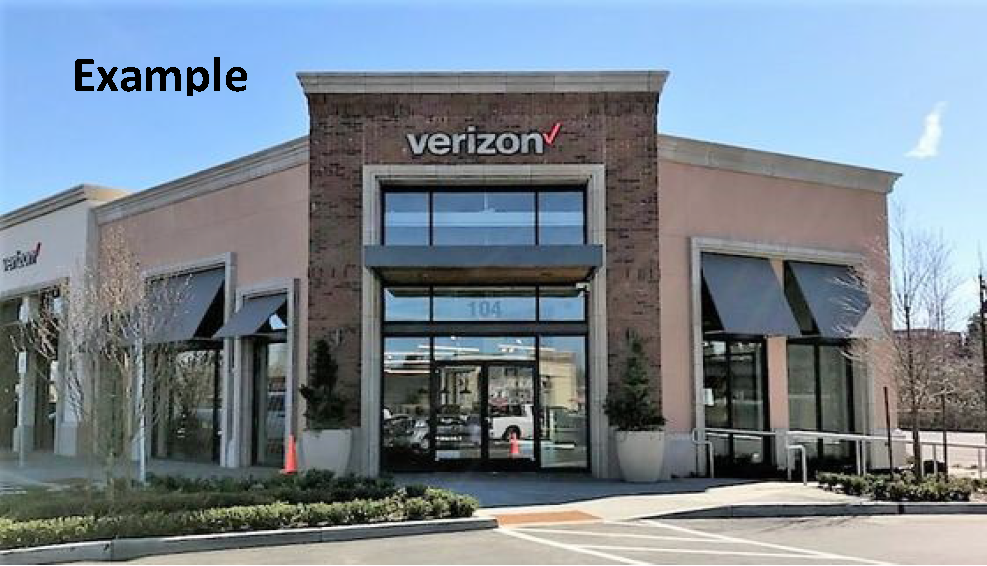
Entrance Design Requirements: Building entrances are required to be clearly delineated and indicate a clear transition from the exterior to the interior of the building. Every main entrance is required to have a special emphasis when compared to the other portions of the building. The building address shall be clearly displayed in a readable typeface of sufficient size for reading from a vehicle at a reasonable distance and oriented to the street or drive frontage recognized by the US Postal Service and the City's fire and police departments.
3.
Articulation Requirements:
a.
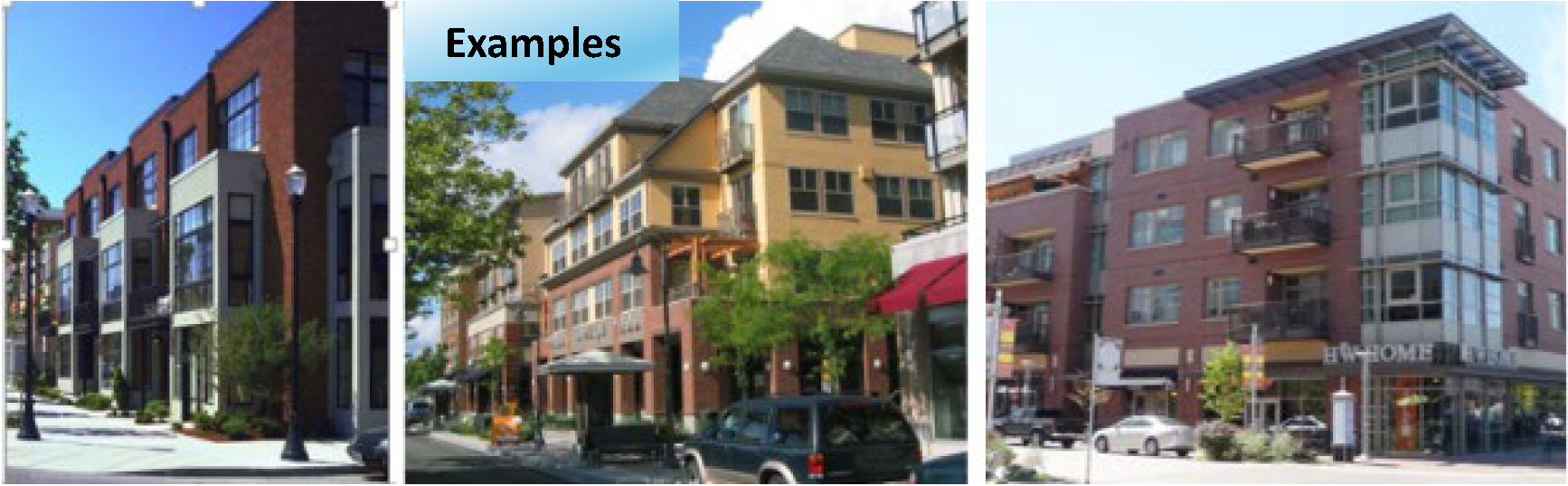
Buildings and parking structures of three (3) stories or less in height designed with completely flat facades and monotone color schemes are not permitted. Buildings and parking structures are required to have horizontal and vertical façade variations such as projections, bays, recesses, terracing, arches, banding, columns, or similar features. Buildings of more than three (3) stories may have a flat façade of uniform design above the third floor.
b.
The use of parapets to create relief from long walls, particularly for buildings with lower heights is encouraged. However, the use of parapets shall relate to the façade design and not appear to be an "afterthought" design element or be inordinately tall in relation to the upper line of the façade. The back of parapets should not be visible from Manchester Road or any primary access road within a larger development and must match the color and materials of the building.
4.
Window Requirements: At least 50% of the ground floor façade shall be window or door openings. Clear glass for storefronts, windows, and doors shall be used for retail type buildings.
5.
Corner Requirements: Corner lot buildings should include a prominent architectural feature of greater height than the rest of the roof, or emphasis at the corner where the two public streets meet.
6.
Façade Detail Examples: Pilasters, piers, columns, friezes, cornices, and window surrounds.
7.
Façade Relief Examples: Balconies of various depth, canopies, awnings, covered arcades, roof overhangs, recesses, and bay windows or similar projections.
8.
Building elements such as awnings, signs, doors, windows, and lighting must complement the architecture of the building façade and finishes.
D.
Heights and Rooflines.
1.
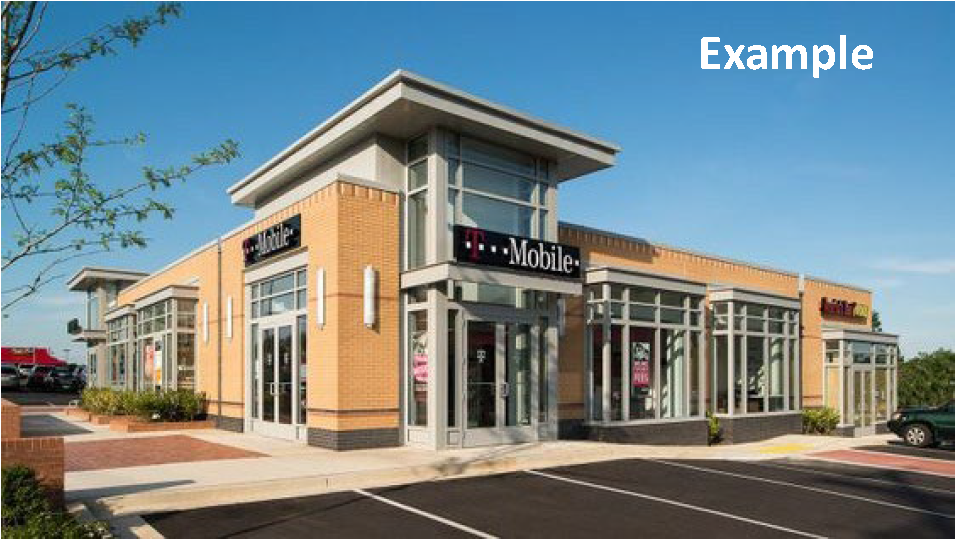
Buildings should have varying roofline elevations to provide architectural relief and avoid the appearance of long, monotonous roofline expanses.
2.
For flat roof designs, a variation such as a raised parapet or tower is required every fifty (50) feet of roofline.
E.
Amenity Areas.
1.
Outdoor seating and gathering areas should be provided for commercial developments.
2.
Patio and seating areas may be located in required setbacks but shall not encroach into required walkways. Such seating areas shall not be located adjacent to vehicle parking spaces unless there is a landscaped buffer of not less than five (5) feet from any vehicle parking space.
3.
Bicycle racks or bicycle parking areas should be provided (adjacent to entrances where practical). Centralized racks may be located to serve multiple businesses.
4.
Public art is encouraged to establish a cultural identity and image for the Manchester Road corridor.
F.
Sidewalks and Walkways.
1.
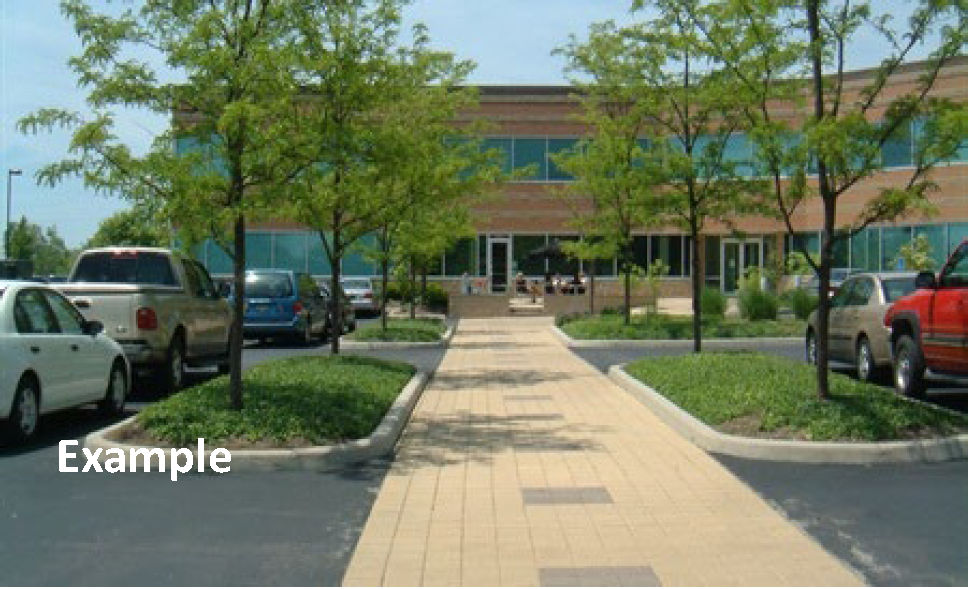
Sites and buildings shall be designed to accommodate pedestrian activities, bicycle access, and social interaction.
2.
Interior sidewalks and walkways shall be a minimum of six (6 feet in width.
G.
Right-of-Way and Streetscape.
If a tree lawn and sidewalk are not already located along an adjacent roadway, a tree lawn of at least five (5) feet in width and a sidewalk minimum of five (5) feet in width shall be constructed.
H.
Parking and Access.
1.
To achieve tree lawn and sidewalk dimensions as cited in 407.065.A Building Placement and Orientation, above, parking areas may be located along the side or rear of buildings.
2.
No direct pull-in/back-out parking spaces shall be permitted along roadways. Parallel parking is allowed within the site.
3.
Shared access (vehicle ingress/egress) points are required to reduce the number of curb cuts along Manchester Road.
4.
Uses with drive-through operations as defined in Chapter 402, Section 402.005 must comply with Chapter 408, Section 408.015A.4.
5.
Shared Off-Street Parking for Different Categories of Uses: To minimize stormwater runoff through minimizing paved surfaces, site designs in the Manchester Road corridor should encourage shared parking. Subject to site plan review by the Planning and Zoning Commission and written authorization of the Director of Public Works, business establishments constituting different categories of use whose hours of operation have minimal overlap may share parking as follows:
a.
Office use and retail sales and service use: The parking requirement for retail sales and service use may be reduced by 20 percent, provided that the reduction does not exceed the minimum parking requirement for the office use component.
b.
Residential use and retail sales and service use (other than eating and drinking establishments or entertainment uses): The parking requirement for residential use may be reduced by 30 percent, provided that the reduction does not exceed the minimum parking requirement for retail sales and service use.
c.
Office use and residential use: The parking requirement for residential use may be reduced by 50 percent, provided that the reduction does not exceed the minimum parking requirements for office use.
6.
Shared Off-Street Parking for Uses of the Same Type: Subject to site plan review by the Planning and Zoning Commission and written authorization of the Director of Public Works, business establishments constituting commercial uses of the same type having over-lapping operating hours may share parking to allow a reduction in the total minimum number of required parking spaces as follows:
a.
Up to a 20 percent reduction in the total minimum number of required parking spaces for four or more separate establishments.
b.
A 15 percent reduction in the total minimum number of required spaces for three separate establishments.
c.
A 10 percent reduction in the total minimum number of required spaces for two establishments.
d.
The establishments for which the shared parking application is being made shall be located within 800 feet of the parking facility. The parking facility shall be in a commercially zoned district.
e.
The reduction to parking quantities allowed through shared parking shall be determined as a percentage of the minimum parking requirement as stated in Chapter 410 of the City Code of Ordinances
7.
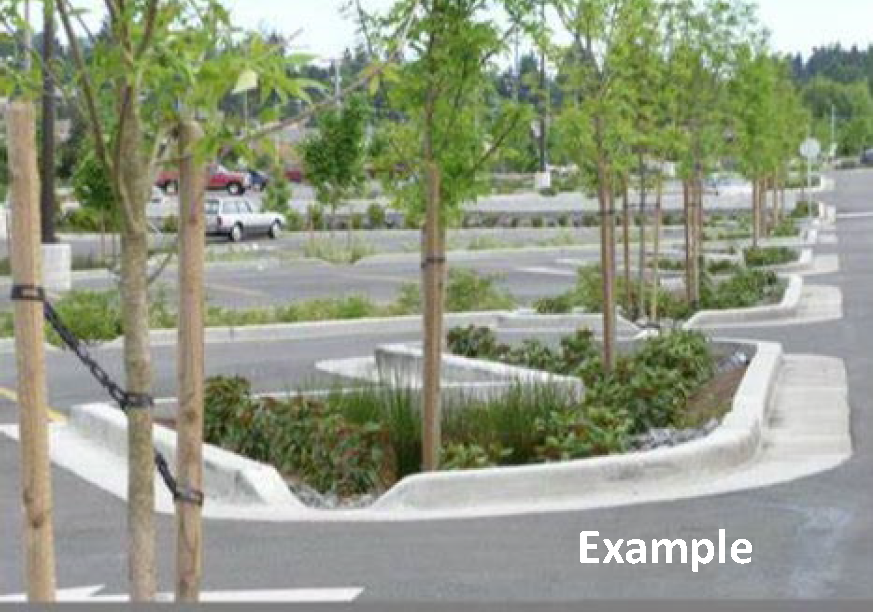
Parking areas shall be landscaped in accordance with the provisions of Chapter 409, Sections [409.005] through 409.055. There shall be clear pathways to building entries and circulation through the parking areas. Tree placement shall be located to prevent damage from vehicles and to minimize obstruction for opening of vehicle doors. Opportunities to use rain garden design to control storm water is encouraged.
I.
Screening of Equipment and Service Areas.
1.
Rooftop Equipment: Equipment installed on the roof of a structure in the district which is visible from grade level in residential areas or is visible from Manchester Road or any primary access road within a larger development shall be screened by a wall with a finish surface compatible in design and color to the building material finish.
2.
Loading and Service Areas: Loading and service areas including dumpsters shall be screened from view. Loading and service areas should be located away from residential uses to the maximum extent possible and buffered in accordance with the standards of Article IX, Landscaping and Screening.
a.
Solid fences or walls compatible in design and color to the building material and design shall be used.
b.
Use of chain-link (including cloth, canvas, or slat covered) and wire fencing for screening is prohibited except as provided for in subsection B.6.a herein.
J.
Lighting.
1.
Proper layout, height, fixture selection, and lighting level shall be incorporated as part of the site plan design requirements.
2.
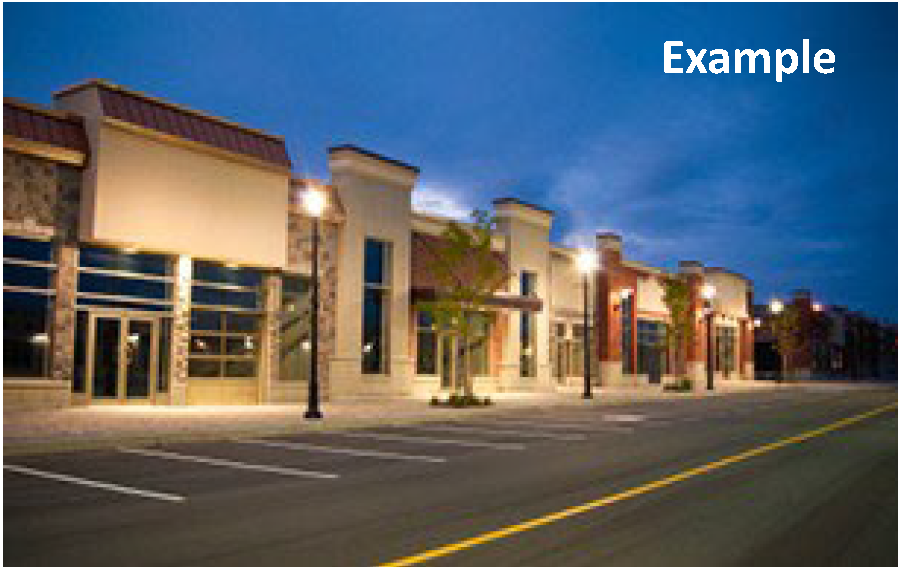
Site lighting shall use energy efficient light emitting diode (LED) directional source technology and shall have a color rendering index (CRI) of not less than 65 and a correlated color temperature (CCT) of approximately 4000 Kelvin (K) but not more than 4800K so as to most closely represent daylight, not distort colors, but avoid the blue portion of the spectrum common to some LED luminaries.
3.
Site lighting shall not spill over onto adjoining properties, highways, or interfere with the vision of oncoming motorists.
4.
Lighting fixtures shall be of a type capable of shielding the light source from direct view. The development plan or site plan must show the relationship of fixtures, and the light spread patterns to each other, to the project site, to the development, and the adjacent rights-of-way.
5.
Fixtures used to accent architectural features, signage, landscaping, flags, or art shall be located, aimed or shielded to minimize light spillover onto the surrounding environment.
6.
Architectural lighting shall be recessed under roof overhangs or generated from a concealed source, low-level light fixture(s). Roof lights, lighted roof panels, and other methods of illuminating buildings may be deemed inappropriate and may not be allowed.
7.
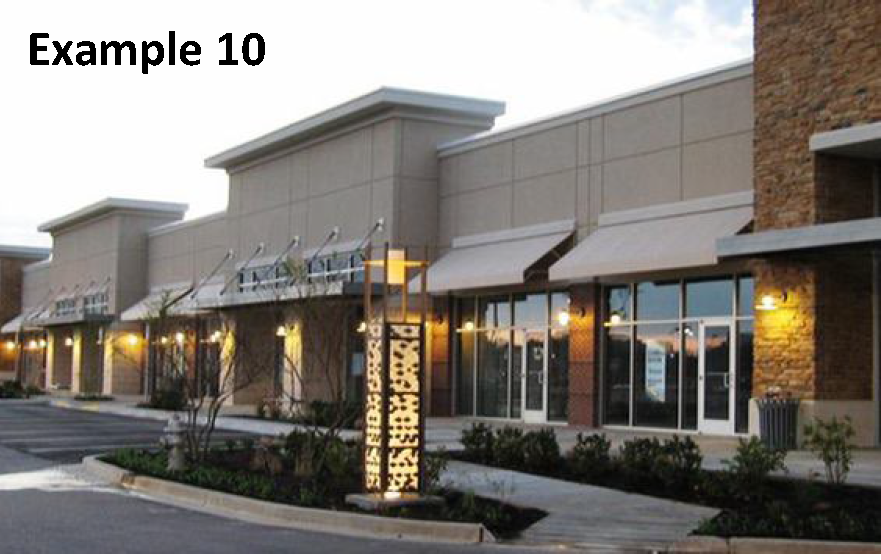
Decorative, low-level intensity, non-concealed source lighting that defines on-site vehicular and/or pedestrian ways are acceptable.
8.
The lighting plan shall be coordinated with the landscape plan, and the two shall be submitted simultaneously for review.
9.
Where developers are constructing public street improvements in conjunction with development projects, street lighting standards, luminary fixture colors and styles shall be as established by the City and approved by the City's Director of Public Works or its traffic engineer.
K.
Signage.
1.
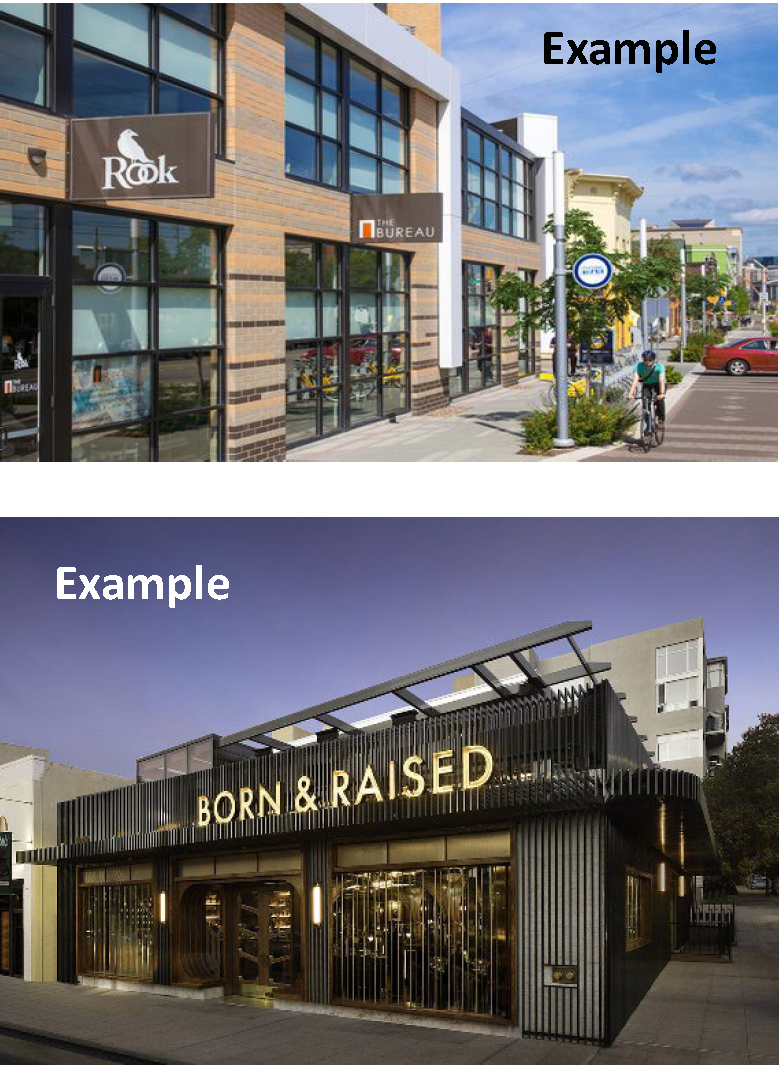
Signs may only be located on buildings or ground mounted monument signs (as may be permitted by Appendix A, Chapter 410) and shall be planned for as part of the building's overall design and should integrate similar or complementary materials as the building, be harmonious in color, with controlled lighting and must be approved in accordance with the provisions of Appendix A, Chapter 410 as applicable.
2.
Signage for buildings and building entrances within a larger development with its own larger identification shall be scaled for a more walkable environment and on-site recognition. Signage for larger buildings which need recognition from the street may need larger signage, However, the signage should not overpower the building face.
3.
Corporate logos are any letter, character or symbol used to represent a person, corporation or business enterprise and are considered graphics which are defined as signage. Corporate logos may be incorporated into a sign so long as the sign is compliant with the provisions of Appendix A, Chapter 410 and is an integrated element of the building design and façade.
(Ord. No. 3050, § 1(Exh. A), 3-10-25)

