
Diberville City Zoning Code
ARTICLE 12
ARCHITECTURAL STANDARDS
12.1 - SCOPE
This article is intended to set architectural guidelines defining the character and general composition of buildings for the construction of new buildings within the Commercial, Industrial, Interstate, Mixed Multifamily Residential, and French Market districts of the City of D'Iberville. Additionally, these provisions apply to two family and multifamily zoning districts.
12.2 - PURPOSE
12.2.1 The purpose of architectural standards is to make certain the exterior of all new construction and building additions are high quality, long-lasting, and sustainable within the City of D'Iberville and consistent with the architectural theme and character of the neighborhood. Architectural design and use of materials for the construction of any building shall be subject to the approval of the Development Review Committee (DRC).
12.2.2 These standards are intended to enhance the visual aspect and livability of the entire city. These standards will foster architectural diversity and interest, yet achieve and maintain a consistent, durable and pleasing aesthetic/visual quality.
12.2.3 All buildings shall be designed to achieve an appearance consistent with the publication titled "Architectural Guidelines for the City of D'Iberville".
A.
The "Architectural Guidelines for the City of D'Iberville" provides guidance in building disposition, building proportions, material placement, permitted materials, and other architectural elements used in designing buildings for construction in the City of D'Iberville.
B.
The correct application and/or interpretation of the "Architectural Guidelines for the City of D'Iberville" does not guarantee the approval or denial of any proposal within the City of D'Iberville.
12.3 - BUILDING PLANS
12.3.1 Building Plan Application.
A.
All applications shall conform with the requirements of Section 2.2 Permits and Certificates.
B.
All building plans submitted with an application for a building permit shall clearly indicate all of the proposed building materials and colors for each facade as described herein.
C.
The plans shall clearly show the location and calculate the amount/percentages of all building materials per facade.
D.
The plans submitted shall include elevations of all building sides that are visible from public streets.
12.3.2 Multiple Buildings. Groups of buildings on the same parcel of land may be reviewed and permitted as a single project rather than individual buildings. Grouping of similar buildings is encouraged to minimize the number of reviews required and to allow for originality and design flexibility.
12.4 - GENERAL REQUIREMENTS
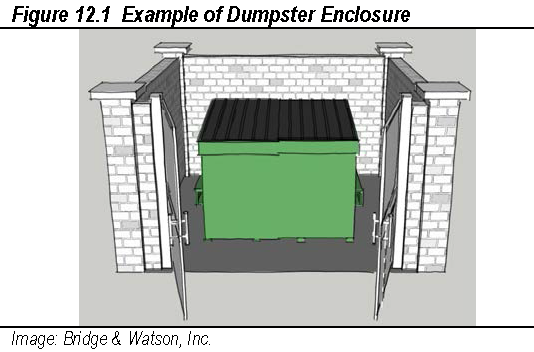
12.4.1 Dumpsters.
A.
All dumpsters shall be screened from sight by a fence or wall at least six inches taller than the tallest point on the dumpster. In no case shall said wall or fence exceed eight feet in height.
B.
The fence shall be constructed of an opaque material made of brick, stucco, split face block, or similar material to that of the principal building.
C.
Dumpsters shall be located in the rear yard behind the building they serve.
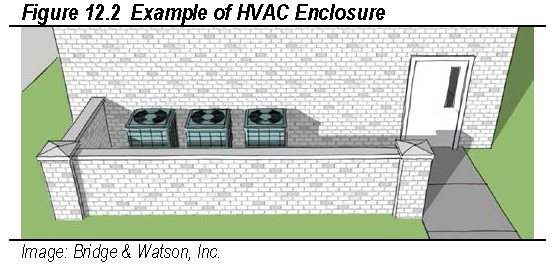
12.4.2 Mechanical systems (HVAC).
A.
All ground mounted mechanical, HVAC, and like systems shall be screened from public street view (within 300 feet) by an opaque wall or fence of similar material to that of the principal building or landscaping.
B.
All commercial and retail building roof mounted mechanical, HVAC, and like systems shall be screened from public street view (within 300 feet) on all sides.
12.4.3 Roof Requirements.
A.
Pitched Roofs.
i.
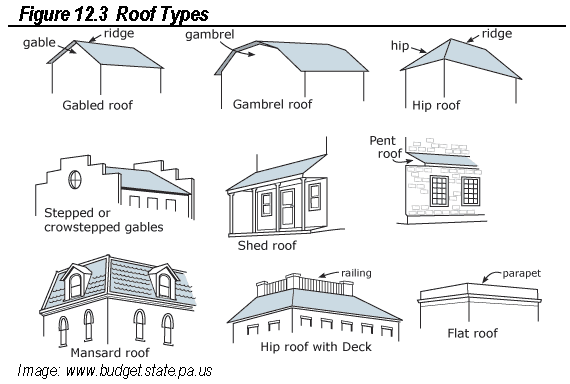
All one-story buildings less than ten-thousand (10,000) gross square feet must have a symmetrical pitched roof (between 5:12 and 12:12) as much as possible.
ii.
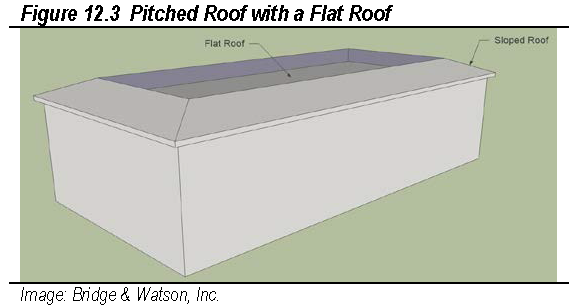
If a pitched roof is not possible, a combination of flat roof and pitched roof is required.
a.
Provide a pitched roof on front and side of the building to screen view of any flat roof.
iii.
Arcades, drive-under canopies, porches, and other features shall be created with a pitched roof.
iv.
Materials for pitched roofs shall be limited to architectural dimensional grade asphalt shingles, natural slate, natural terra cotta, natural wood shake, copper or factory finished sheet metal.
B.
Mansard Roofs. Mansard roofs shall have a maximum pitch of 12:12 with a minimum twelve-foot (12') vertical surface length.
C.
Flat Roofs.
i.
Flat roofs may be of any material that meets building codes.
ii.
Exposed metal flashing shall be copper or factory finished sheet metal.
iii.
If factory finished metal flashing is used, such as standing seam, the color must be subdued to blend with other materials or of a color to simulate weathered copper or bronze.
iv.
All buildings with flat roofs should include parapet articulation on the front facade(s) of such building.
v.
There shall be roof articulations/offsets at a minimum of one (1) per each one hundred twenty-five linear feet (125') of length by a change in the top line of the parapet.
vi.
Additional articulation may occur at any lesser distance.
vii.
If the front facade is less than one hundred twenty-five linear feet (125'), then a minimum of one (1) roof articulation must occur.
D.
Other. Drive under canopies for gasoline pumps may have flat roofs with vertical or factory formed facing of finished sheet metal.
12.5 - COMMERCIAL ZONING DISTRICTS
12.5.1 Building Design. Building design shall exhibit architectural control which seeks to be creative and which best utilizes building lines, shapes, and angles to maximize architectural integrity.
A.
Unadorned pre-stressed upright concrete panels, unfinished concrete block, metal siding (such as galvanized or unfinished steel, galvalume, or unfinished aluminum), and pole-type building materials are not permitted as primary exterior building materials.
B.
At least fifty (50) percent of all exterior wall finishes shall be comprised of any combination of at least two (2) of the following materials:
i.
Brick
ii.
Natural Stone
iii.
Glass
iv.
Stucco or stucco-like finishes
v.
Hardy Plank or other fiber cement board
vi.
Other comparable or superior material approved by the DRC.
vii.
Accent materials shall be used for cornices, sills, bases, lintels, banding, and decorative accent trims. Accent materials shall consist of materials that meet or exceed the quality of the primary exterior materials and shall be consistent with the building design.
C.
In the C-1 Neighborhood Commercial District, C-2 General Commercial District, and non-residential uses in residential districts, a minimum of thirty (30) percent of the façade facing the public right-of-way shall be glass.
D.
In the C-3 Interstate Commercial District, a minimum of twenty (20) percent of the facade facing the public right-of-way shall be glass.
E.
Any new building shall be constructed so that all exterior sides shall be surfaced equivalent to the front of the building. The rear elevation of a building shall be exempt from this requirement provided the rear of the building is not visible from public view.
12.6 - INDUSTRIAL ZONING DISTRICTS
12.6.1 Building Design. Building design shall exhibit architectural control which seeks to be creative and utilize building lines, shapes, and angles to maximize architectural integrity.
12.6.2 Located within 1,350 feet to Certain Roadways. Industrial properties which are located within 1,350 feet of the centerline of the right-of-way of a collector or arterial road shall meet the following architectural standards. Where only a portion of the parcel lies within 1,350 feet of the collector or arterial road centerline, the standards shall apply to the entire parcel:
A.
Unadorned pre-stressed upright concrete panels, unfinished concrete block, metal siding (such as galvanized or unfinished steel, galvalume, or unfinished aluminum), and pole-type building materials are not permitted as primary exterior building materials.
B.
Building exterior wall finishes shall be comprised of any combination of a least two (2) of the following materials:
i.
Brick
ii.
Natural Stone
iii.
Glass
iv.
Masonry stucco
v.
Hardy Plank
vi.
Other comparable or superior material approved by the DRC.
vii.
Accent materials shall be used for cornices, sills, bases, lintels, banding, and decorative accent trims and shall consist of materials comparable in grade and quality to the primary exterior materials.
C.
A minimum of twenty (20) percent of the facade facing the public right-of-way shall be glass.
D.
Any new building shall be constructed so that all exterior sides shall be surfaced equivalent to the front of the building
12.6.3 Not Located Within 1,350 to Certain Roadways. Industrial properties which are not located within 1,350 feet of the centerline of the right-of-way of a collector or arterial road shall meet the following architectural standards:
A.
Exterior wall surfaces of all buildings shall be faced with brick, stone, architecturally enhanced pre-cast and cast-in-place panel, architectural concrete in combination with other permitted materials or glass.
B.
Accent materials shall be used for cornices, sills, bases, lintels, banding, and decorative accent trims. Accent materials shall consist of materials comparable in grade and quality to the primary exterior materials.
C.
A minimum of twenty (20) percent of the facade facing the public right-of way shall be glass.
D.
Any new building shall be constructed so that all exterior sides shall be surfaced equivalent to the front of the building.
12.7 - TWO-FAMILY, MULTI-FAMILY, AND MIXED MULTI-FAMILY ZONING DISTRICTS
The exterior building finish of two-family and multi-family dwelling units shall include a variation in building materials which are to be distributed throughout the building facades and coordinated into the architectural design of the structure to create an architecturally balanced appearance. In addition, all buildings shall be designed in a manner consistent with the publication titled "Architectural Guidelines for the City of D'Iberville". Two-family, townhome, condominiums, and multi-family dwelling structures shall comply with the requirements provided below. Non residential buildings and structures shall comply with the requirements below as well as any applicable provisions contained within Section 12.5 et. seq.
12.7.1 Finish Material Composition.
A.
When multiple building wall materials are utilized, said materials may be combined on each Facade only horizontally, with the heavier material below the lighter and in accordance with the "Architectural Guidelines for the City of D'Iberville".
B.
A minimum of twenty-five (25) percent of the combined area of all building facades of a structure shall have an exterior finish of brick, stucco, hardy plank, and/or natural or artificial stone.
C.
Except for brick, stucco, hardy plank, and/or natural or artificial stone, no single building facade shall have more than seventy-five (75) percent of one type of exterior finish.
D.
For the purpose of this section, the area of the building facade shall not include area devoted to windows, entrance doors, garage doors, or roof areas.
E.
No more than three (3) buildings within 300 feet of each other shall consist of the same building facade.
F.
All openings, including porches, galleries, arcades, and windows, with the exception of storefronts, shall be square or vertical in proportion.
G.
Openings above the first Story shall not exceed 50% of the total building wall area, with each Facade being calculated independently.
H.
Openings below the second story shall not exceed 80% of the total wall area on the front facade and 50% of the wall area on all other facades, with each façade being calculated independently.
I.
Doors and windows that operate as sliders are prohibited along frontages.
J.
Balconies and porches shall be made of painted wood or metal, excluding galvanized tin.
K.
Notwithstanding the provisions of 9.12(I), fences provided at the first layer shall be painted or stained. Fences at other lot lines may be of wood board or chain link. Chain link fences must be screened from public view with hedge of a minimum of 3 feet in height. For the purposes of this provision, the "first layer" shall be that portion of the lot or parcel lying between the street right of way and the required building setback line.
L.
All structures required to be raised on the basis of FEMA standards must be screened at the ground floor with breakaway materials approved by the DRC in compliance with FEMA regulations.
12.8 - FRENCH MARKET DISTRICT
12.8.1 Building Design. For commercial uses in the French Market District the requirements of Section 12.5 shall apply. For all other uses within this district the following shall apply.
Building design shall exhibit architectural control which seeks to be creative and which best utilizes building lines, shapes, and angles to maximize architectural integrity.
A.
Building exterior wall finishes shall be comprised of any combination of at least two (2) of the following materials:
i.
Brick
ii.
Natural Stone
iii.
Glass
iv.
Masonry Stucco
v.
Hardy Plank
vi.
Other comparable or superior material approved by the DRC.
vii.
Accent materials shall be used for cornices, sills, bases, lintels, banding, and decorative accent trims and shall consist of materials comparable in grade and quality to the primary exterior materials.
B.
Multiple exterior wall materials shall be combined on each facade only horizontally, with the heavier material below the lighter and in accordance with the "Architectural Guidelines for the City of D'Iberville".
C.
All openings, including porches, galleries, arcades, and windows, with the exception of storefronts, shall be square or vertical in proportion.
i.
Openings above the first story shall not exceed 50% of the total building wall area, with each facade being calculated independently.
ii.
Openings below the second story shall not exceed 80% of the total wall area on the front facade and 50% of the wall area on all other facades, with each facade being calculated independently.
D.
Doors and windows that operate as sliders are prohibited along frontages.
E.
Balconies and porches shall be made of painted wood or metal, excluding galvanized tin.
F.
Buildings located within a FEMA designated flood hazard area that requires the building's finished floor elevation to be elevated above the base flood elevation must be screened from public view at the ground floor level with breakaway materials approved by the DRC in compliance with FEMA regulations.
G.
It is desirable, but not mandatory, that streetscreens be installed coplanar with facades in order to create a continuous frontage along streets. When installed, streetscreens shall conform to the following:
i.
Screening material should be between 3.5 feet and 8.0 feet in height and constructed of an opaque material made of brick, stucco, split face block, or similar material to that of the principal building.
ii.
Screening material may be replaced by a hedge with a minimum height of 3.0 feet at the time of planting.
iii.
Screening material at finished exterior grade shall have openings no larger than necessary to allow automobile and pedestrian access or a maximum width of 12.0 feet.
iv.
Screening material shall be located coplanar with the front building setback line.
12.9 - EXCEPTIONS
The DRC may approve materials and designs that differ from those required within this ordinance provided the following criteria are achieved:
A.
The proposed building maintains the quality and value intended by this section.
B.
The proposed building is compatible and in harmony with other structures designed by standards in this section within the district.
C.
The design exceeds the intent of the ordinance.
D.
Any building is subject to denial that does not meet architectural standards as determined by the Planning Commission and the Mayor and City Council.
12.10 - PLAN REVIEW
12.10.1 Plan Review Procedure.
A.
Plans for new construction, additions, and changes to existing buildings that involve 50% or more of the floor area or 50% or more of the value of the property shall be submitted to the DRC for approval.
B.
Each building design will be reviewed for at least the following considerations:
i.
Appropriate location of structures on the site with relationship to other amenities, restrictions, adjacent land usage, etc.
ii.
General massing, roof treatments, proportions and quantity of exterior openings.
iii.
Use of exterior materials as they relate to adjacent structures, and their impact on the quality and character of the immediate area.
iv.
Screening of mechanical equipment, tanks, loading decks, refuse handling, ancillary equipment, etc., whether on the roof or on the site.
12.10.2 Variance. Any request for a variance in the requirements of this article shall be submitted in accordance with Section 2.6 Variance Procedure.

