Dillon City Zoning Code
ARTICLE XI
Sign Regulations
Division 2 - General Sign Regulations[3]
Editor's note— Ord. No 03-23, §§ 8A. and 12, adopted Apr. 4, 2023, relocated the former Division 2, §§ 16-11-40—16-11-100 to Division 8 and enacted a new Division 2 as set out herein. The former Division 2 pertained to General Sign Criteria. The historical notation has been retained with the amended provisions for reference purposes.
Division 3 - Permanent Signs—General Limitations[4]
Editor's note— Ord. No. 03-23, §§ 9 and 13, adopted April 4, 2023, amended Division 3 in its entirety to read as herein set out. Former Division 3 pertained to general sign criteria, and derived from Ord. 14-13 §1.
Division 4 - Master and PUD Sign Plans[5]
Editor's note— Ord. No. 03-23, §§ 8B., 8E. and 14, adopted April 4, 2023, relocated the former Division 4, §§ 16-11-210—16-11-335 to Division 6. The former Division 4 pertained to permanent signs, and derived from Ord. 14-13 §1. Subsequently, former Division 7, §§ 16-11-480—16-11-520 were relocated to Division 4, renumbered and amended as §§ 16-11-150—16-11-190 as set out herein. The historical notation has been retained with the amended provisions for reference purposes.
Division 5 - Sign Permits[6]
Editor's note— Ord. No. 03-23, §§ 8A., C. and 14, adopted April 4, 2023, relocated the former Division 5, §§ 16-11-340—16-11-422 to Division 7. The former Division 5 pertained to Temporary Signs, and derived from Ord. 14-13 §1. Subsequently, former Division 2, §§ 16-11-30—16-11-200 were relocated to Division 5, renumbered and amended as §§ 16-11-200—16-11-240 amended as set out herein. The historical notation has been retained with the amended provisions for reference purposes.
Division 6 - Permanent Signs—Specific Limitations[7]
Editor's note— Ord. No. 03-23, §§ 8B., D. and 15—20, adopted April 4, 2023, relocated the former Division 6, §§ 16-11-450—16-11-470 to Division 8. The former Division 6 pertained to Design Standards and Maximum Sign Areas, and derived from Ord. 14-13 §1. Subsequently, former Division 4, §§ 16-11-210—16-11-335 were relocated to Division 6, renumbered and amended as §§ 16-11-250—16-11-390 as set out herein. The historical notation has been retained with the amended provisions for reference purposes.
Division 7 - Temporary Signs[8]
Editor's note— Ord. No. 03-23, §§ 8C., 8E. and 22, adopted April 4, 2023, relocated the former Division 7, §§ 16-11-480—16-11-520 to Division 4. The former Division 7 pertained to Master Sign Plans, and derived from Ord. 14-13 §1. Subsequently, former Division 5, §§ 16-11-340—16-11-422 were relocated to Division 7, repealed §§ 16-11-360—16-11-422, renumbered and amended §§ 16-11-340 and 16-11-350 as 16-11-400 and 16-11-410 as set out herein. The historical notation has been retained with the amended provisions for reference purposes.
Division 8 - Design Standards and Maximum Sign Areas[9]
Editor's note— Ord. No. 03-23, §§ 8D., 8F. and 23, adopted April 4, 2023, relocated the former Division 8, §§ 16-11-530—16-11-550 to Division 9. The former Division 8 pertained to Nonconforming Signs, and derived from Ord. 14-13 §1. Subsequently, former Division 6, §§ 16-11-450—16-11-470 were relocated to Division 8, renumbered and amended as §§ 16-11-420—16-11-440 as set out herein. The historical notation has been retained with the amended provisions for reference purposes.
Division 9 - Nonconforming Signs[10]
Editor's note— Ord. No. 03-23, §§ 8F., 8G. and 24, adopted April 4, 2023, relocated the former Division 9, §§ 16-11-560—16-11-630 to newly enacted Division 10. The former Division 9 pertained to Enforcement and Liens, and derived from Ord. 14-13 §1. Subsequently, former Division 8, §§ 16-11-530—16-11-550 were relocated to Division 9, renumbered and amended as §§ 16-11-450—16-11-470 as set out herein. The historical notation has been retained with the amended provisions for reference purposes.
Division 10 - Enforcement and Liens[11]
Editor's note— Ord. No 03-23, §§ 8G. and 25, adopted Apr. 4, 2023, relocated the former Division 9 §§ 16-11-560—16-11-630 to this newly enacted Division 10. Subsequently §§ 16-11-560—16-11-630 were renumbered and amended as §§ 16-11-480—16-11-550 as set out herein. The historical notation has been retained with the amended provisions for reference purposes.
Sec. 16-11-10. - Purpose.
(a)
It is the intent and purpose of this Article to:
(1)
Recognize that signs are a necessary means of useful communication for the convenience of the public.
(2)
Maximize the value of signage as a means of locating and identifying organizations, establishments, destinations, and landmarks within the Town.
(3)
Protect, preserve and enhance the unique aesthetic character, beauty and charm of the Town.
(4)
Ensure that signage does not obscure the architectural and natural features of the Town and is of a scale and proportion compatible with the aesthetic character of the Town.
(5)
Protect the public from hazardous conditions that can result from signs that are structurally unsafe, obscure the vision of motorists, create dangers to pedestrian traffic or compete or conflict with necessary traffic signals and warning signs.
(6)
Promote an overall visual effect which has a minimum of clutter.
(7)
Eliminate distracting lighting and excessive glare by reasonably limiting the illumination of signs to subdued, adequately shielded or concealed light sources.
(8)
Encourage the use of aesthetically pleasing materials that are compatible with the cultural and natural surroundings and with the buildings to which they are affixed.
(9)
To reserve Town-owned property and right-of-way to signs displaying government speech, except under very limited circumstances.
(10)
Impose reasonable time, place and manner restrictions upon signs while, at the same time, not unnecessarily or impermissibly interfering with the free exercise of rights granted under the First Amendment of the United States Constitution and Article II, Section 10 of the Colorado Constitution.
(11)
Ensure that signs are promptly removed once the business, service, event, or other activity advertised is no longer provided, or the sign is abandoned or improperly maintained.
(12)
Prohibit off-premises signs which do not identify a business, service, product or other activity engaged in or provided upon the premises where the sign is located.
(b)
No provision of this Chapter is intended, and shall not be interpreted by the Town, to restrict speech based on its content, viewpoint, or message. Should any provision of this Chapter have the unintended effect of restricting speech based on its content, viewpoint, or message, such provision shall not be enforced. No provision of this Chapter is intended, and shall not be interpreted, to favor commercial speech over noncommercial speech.
(Ord. 14-13 §1; Ord. 03-23 §3)
Sec. 16-11-20. - Definitions.
As used in this Article, the following words shall have the following meanings. Where terms are not defined, they shall have their ordinary accepted meanings within the context with which they are used.
Architectural feature means a prominent or characteristic part of a building, including but not limited to windows, columns, marquees or fascia.
Art means things that have form and beauty, including paintings, sculptures or drawings that do not advertise or promote a particular business, service or product.
Attention-getting device means any streamer; spinner; pennant; costumed character; light; balloon; continuous string of pennants, flags or fringe; or similar device or ornamentation intended to create visual attraction through movement that is visible by the general public from any public right-of-way.
Awning means a roof-like cover extending over or in front of an opening, such as a window or door, intended to provide shelter from the elements. An awning may be made of any material compatible with the design of the building, but for the purposes of this Article, no awning shall contain backlit signage other than an awning made of cloth or cloth-like materials.
Backlit sign means an indirect source of light which illuminates a sign by shining through a translucent surface of a sign, including plastic signs, lit from an internal light source.
Banner means any advertisement device affixed to poles, wires or ropes which is located outdoors and which is primarily intended to announce or promote a civic event, sale, event or which serves as a decoration for special holidays.
Building frontage means the width of a building facing a street, public accessway or Town right-of-way. In the case of a corner lot or lot bounded on more than two (2) sides by public rights-of-way, the building frontage may be either or any of the street frontages, but not more than one (1) frontage. Where more than one (1) side of a building faces a street, the side classified as the building frontage may be chosen by the property owner.
Building (project) identification sign means a wall sign, a freestanding sign or copy painted on a building which states the name of the building or project, but does not advertise any business within the building or project. Building identification signs are found within commercial, office, retail and other similar projects.
Business area directory sign means a monument sign designed to advertise two (2) or more businesses contained within the same nonresidential subdivision or planned unit development.
Bus bench sign means a sign drawn, painted, printed or otherwise affixed to a bench, such as at a bus stop.
Bus shelter sign means advertising signs mounted to bus shelters in the right-of-way or on private properties.
Calendar quarter means three-month periods of time during the year. January, February and March consist of the first calendar quarter; April, May and June, the second; July, August and September, the third; and October, November and December, the fourth.
Calendar year means a twelve-month period from January 1 to December 31.
Changeable copy sign (automatic) means a sign on which the copy changes automatically, such as electrical or electronic time and temperature units.
Changeable copy sign (manual) means a sign on which copy is changed manually in the field, such as reader boards with changeable letters.
Civic event means any type of race, parade, show, competition, entertainment, conventions or community activity to which the general public is invited, either expressly or by implication.
Civic event banner means a temporary banner displayed to advertise a community activity to which the general public is invited.
Class 1 sign application means an application for the types of permanent signs and sign plans listed in Section 16-11-200(A)(1).
Class 2 sign application means an application for the types of signs listed in Section 16-11-200(A)(2).
Community information board means a sign used to publicize community-wide events.
Copy means any graphic, letter, numeral, symbol, insignia, text, sample, model, device or combination thereof which is primarily intended to advertise, identify or notify.
Corner lot means a lot bounded on two (2) sides by streets which intersect with each other.
Digital Display means a sign face that may display changing content through still images on a fixed display composed of electronically illuminated segments and / or a series of grid lights, including cathode ray, light emitting diode (LED) display, plasma screen, liquid crystal display (LCD), fiber optic, or other electronic media or technology.
Directional sign means a temporary, nonilluminated sign used to provide assistance in locating a sale or event.
Directory sign means a sign that serves as a common or collective identification of two (2) or more uses on the same property and which may contain a directory to the uses as an integral part thereof, or may serve as a general identification for such developments as shopping centers, industrial parks and similar uses.
Directory way-finding sign means a Town-owned and -controlled master sign that serves as a holder for individual business signs and indicates which businesses are in the immediate vicinity.
Donation Program means a program developed by the Town and approved by the Town Manager, which allows individuals, groups, non-profits or businesses to donate money, real property, or personal property to the Town for a particular public purpose, in exchange for some type of signage to recognize the donation for a certain time period as defined in the Donation Program.
Donation Program Signage means signage associated with a Town managed Donation Program located on Town property. The quantity, size, materials, location, and duration of the display of the signs are set forth in the Donation Program approved in writing by the Town Manager. Signage may include plaques, pavers and other signs set forth in the Donation Program.
Flag means any fabric or other flexible material attached to or designed to be flown from a flagpole or similar device.
Flashing sign means a sign having lights or illumination which flashes, moves, rotates, scintillates, blinks, flickers, varies in intensity of color or uses intermittent electrical pulsations; provided, however, that seasonal lighting such as Christmas tree lights shall not be considered a flashing sign. Flashing signs shall include signs illuminated by LED, LCD, TV, neon or other means of illumination.
Freestanding sign means a sign that is supported by one (1) or more columns, upright poles or braces extended from the ground or from an object on the ground, or that is erected on the ground where no part of the sign is attached to any part of a building, structure or other sign; the term includes pole sign, pedestal sign, monument sign, public information sign and ground sign.
Garden level means the floor of a building located more than fifty percent (50%) below average grade with an exterior entry accessing such level.
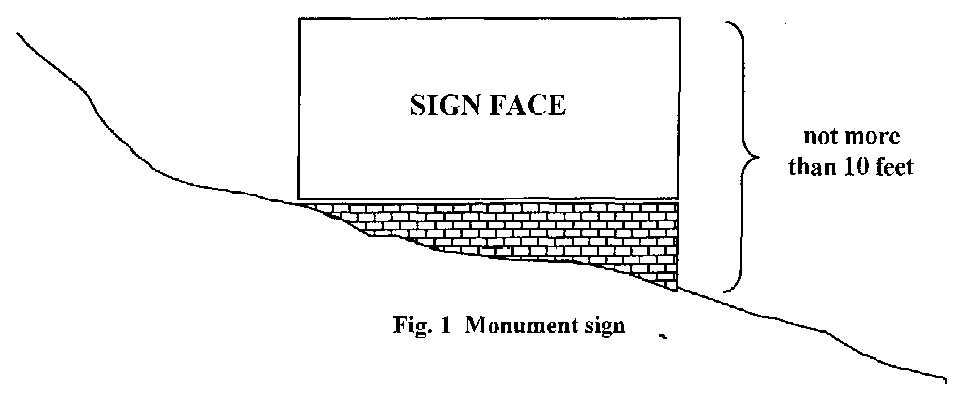
Height of sign means the vertical distance measured from the highest point of the sign to the natural surface grade beneath the sign. If the sign is a monument sign, the height shall be calculated using the highest point of the sign, regardless of slope.
Hotel and condominium sign means a building or project identification sign utilized to identify the name of multiple unit residential complexes.
Information sign means a sign used to indicate or provide information or direction with respect to permitted uses on the property, including but not limited to signs indicating the hours of operation and such signs as "No Smoking," "Open," "Closed," "Restrooms," "No Solicitors," "Deliveries in Rear," current credit card signs, trade association emblems and the like.
Kiosk means a freestanding structure which may have two (2) or more faces and upon which temporary information and/or posters, notices and announcements are posted.
Lighting, indirect means a light source separated from the sign surface which illuminates the sign surface by means of spotlights or similar lighting fixtures.
Lot means a portion or parcel of land, including a portion of a platted subdivision, occupied or intended to be occupied by a building or use and its accessories, that is an integral unit of land held under unified ownership in fee or cotenancy or under legal control tantamount to such ownership.
Master sign plan means the sign plan of any multiple use office or commercial building which includes the number, size, description and location of all signs located, or to be located, in or upon such property.
Menu display box means a freestanding or wall sign enclosed in glass for the express purpose of displaying menus. For purposes of this Article, it shall also mean menus displayed flat against the interior of a window.
Monument sign means a freestanding sign of not more than ten (10) feet in height that includes an architecturally designed base or column which is constructed of stone, brick, timbers or other similar material and is designed to be architecturally compatible with the design of the project. See Figure 1.
Moving sign means a sign which moves or simulates motion.
Neon sign means any sign that is illuminated by tubes filled with neon and related inert gases, including any display of neon lighting tubes which is in view of the general public from a public right-of-way or from any public area, regardless of the shape, size, design or configuration. Neon signs shall not exceed thirty milliamps (30 mA).
New business sign means a temporary sign advertising the opening of a new business or restructuring of an existing business.
Off-premises sign means a sign which does not advertise a business, merchandise, product, service or entertainment which is sold, produced, manufactured, furnished or available on the property where the sign is located.
Official Freestanding Sign means a freestanding sign owned and maintained by the Town that has been designated an Official Sign by a Resolution of the Town Council, and with the same meaning as a Freestanding Sign.
Official Monument Sign means a freestanding sign owned and maintained by the Town that has been designated an Official Sign by a Resolution of the Town Council, and with the same meaning as a Monument Sign, except that an Official Monument Sign may be eighteen (18) feet tall in both Sign Zone A and Sign Zone B.
Official Sign means a sign owned and maintained by the Town that has been designated an Official Sign by a Resolution of the Town Council.
Outline lighting means any arrangement or display of incandescent bulbs or lighting tubes used to outline or call attention to the features of a building, including the building's frame, shape, roof line or window dimensions. Outline lighting includes both temporary and permanent arrangements of bulbs or lighting tubing, whether located inside or outside of a building if such bulbs or tubing is visible to the public from a public right-of-way or from an outdoor public area.
Pennants or streamers means pieces of fabric or flexible material, often multicolored, hung either alone or in a series in order to attract attention to a particular business or event.
Plane geometric figure means a simple circle, rectangle or triangle.
Projecting (hanging) sign means a sign other than a wall sign, which projects six (6) inches or more from and is supported by a wall of a building or structure, or any sign supported by handrails or a deck.
Property management sign means a sign advertising the property management company representing a property. The sign shall include a contact name and telephone number.
Public information sign means a sign on property owned by a government entity and used to display information of general interest to the public.
Public place means any outdoor place to which the public or a substantial number of the public has legal access, including but not limited to highways, transportation facilities, parks, playgrounds and the outdoor public common areas and accessways owned by the Town.
PUD (planned unit development) sign plan means a master sign plan through which the applicant has requested and the Town has approved modifications to the requirements of this Article under the criteria set forth in Division 4.
Reflective surface means any material or device which has the effect of intensifying reflected light, including but not limited to Scotch lite, Day-Glo, glass beads and luminous paint.
Residential complex sign means all hotel, motel, condominium or multi-family project signs.
Residential nameplate means a type of sign allowed for the sole purpose of identifying the inhabitants of a residential structure, the house name or the address of the residence.
Roof sign means a sign painted on the roof of a building, supported by poles, uprights or braces extending from the roof of a building, or projecting above the roof of a building, but does not include a sign projecting from or attached to a wall.
Sandwich board sign means a portable A-frame-type sign with not more than two (2) advertising faces, each face measuring not more than thirty (30) inches in width and thirty-six (36) inches in height, erected on the ground, hinged at the apex and folded into a sandwich position when transported or stored; also commonly referred to as an A-board sign.
Separate frontage means a second building frontage, parallel and adjacent to a public right-of-way and on the opposite side of a building's primary frontage, which includes public entrances.
Sign means any medium, including its structure and component parts, including any sign illumination device which is used or intended to be used to attract attention to the subject matter and which is visible by the general public from any public right-of-way. Visible means capable of being seen, whether or not capable of being read, without visual aid by a person of normal acuity.
Sign area or surface area means the surface area of a sign, as determined by the Town, including its facing, copy, insignia, background and borders, which is described by a combination of plane geometric figures. The sign area of a wall sign which is composed of individual letters attached to a building or placed on a raceway attached to a building shall be the area obtained by measuring the perimeter of each word utilizing a series of straight line geometric figures which enclose the extreme limits of the word. The combined area of all individual words shall be considered the total sign area. See Figure 2.
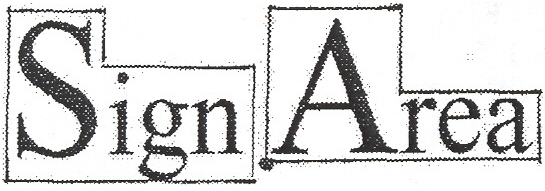
Fig. 2.
Using a combination of
plane geometric figures
Sign illumination device means any fixture or merchandise used to shine light onto a sign or to make a sign luminous.
Sign owner means the permittee with respect to any sign for which a sign permit has been issued; or, with respect to a sign for which no sign permit is required or for which no sign permit has been obtained, sign owner means the person entitled to possession of such sign, the owner, occupant and/or agent of the property where the sign is located.
Sign structure means any supports, uprights, braces or framework of a sign.
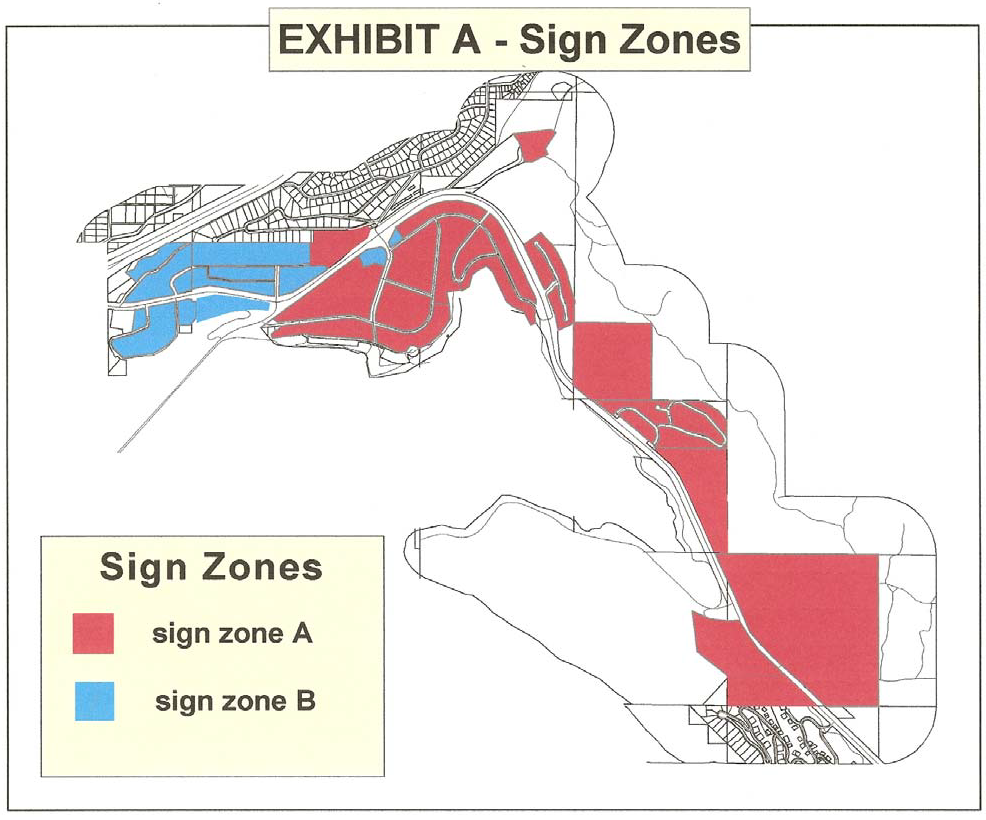
Sign Zone A means that portion of the Town which represents the downtown business center and residential areas and is shown on Exhibit A attached to the original ordinance codified herein, on file in the Town Clerk's office.
Sign Zone B means that portion of the Town which represents in general commercial areas and is shown on Exhibit A attached to the original ordinance codified herein, on file in the Town Clerk's office.
Silhouette lighting means an illuminated reverse channel letter so light from the letter is directed against the surface behind the letter, producing a halo lighting effect around the letter, also referred to as halo lighting or backlit lighting. The sign letters are opaque and appear as a silhouette against the lighted surface.
Snipe sign means a temporary sign or poster affixed to a light post, tree, fence or any other roadside object.
Sponsorship Signage means Temporary Signage by businesses, groups, non-profits and individuals who in part sponsor a Town sanctioned event located on Town Property, which has an approved special use permit for a specific event or for the amphitheater season. The quantity, size, materials, location, and duration of display of the signs are set forth in the Special Use Permit for the Event as approved in writing by the Town Manager.
Statuary sign means any sign which is a modeled or sculptured likeness of a living creature or inanimate object.
Still Digital Image means a digital display that does not vary in color or light intensity, and that does not contain any motion, animation, flashing, or scrolling.
Still Digital Image Display Period means a still digital image that instantaneously pixelates and then displays for a period of time not to be less than five (5) seconds.
Street means the entire width of every dedicated public way owned or controlled by the Town, including the traveled portion thereof known as the roadway, the portion used for sidewalks and the portion between the property line and roadway known as the parkway.
Structure means anything which is built or constructed with a fixed location, but does not include utility poles, lines, cable or other transmission or distribution facilities of public utilities.
Subdivision entrance sign means a sign used to identify the name and entryway to a subdivision.
Temporary banner means any advertisement device affixed to poles, wires or ropes which is located outdoors and which is primarily intended to announce or promote a sale or special event. Temporary banners must be professionally printed on a durable waterproof material and provided with grommets for connection to the building. Hand-drawn banners on bed sheets, fabric, canvas or poster board are not permitted.
Temporary feather banner means a freestanding temporary sign with a single support post and a single flag banner, which is intended for a definitive and limited period of display and which is not permanently affixed to a structure or sign structure. The definition shall include all styles and shapes of flag banners, including but not limited to feather flag banners, feather flag sails, teardrop banners, teardrop sails and vertical rectangular banners or sails.
Temporary feather banner holiday means Labor Day, Fourth of July or Memorial Day of each calendar year.
Temporary sign means a sign which is intended for a definite and limited period of display and which is not permanently affixed to a structure or sign structure. Temporary signs must be professionally printed on a durable waterproof material and provided with grommets for connection to the building. Hand-drawn banners on bed sheets, fabric, canvas or poster board are not permitted.
Verticalilluminated rotating cylindrical sign means a vertical, illuminated, rotating cylindrical sign in which the graphic is on the surface of the cylinder and nothing beyond the radius of the cylinder surface rotates, and whose rotating part does not exceed twelve (12) inches in diameter and thirty (30) inches in height (as a barbershop pole). No text copy shall be allowed on any vertical illuminated rotating cylindrical sign.
Walking sign means any sign, including sandwich board signs, or lettering on a costume, which is carried or worn by any person and which is visible from a public right-of-way, adjacent property or a public area.
Wall sign means any sign attached to, painted on or erected against the wall of a building or structure, with the exposed face of the sign in a plane parallel to the plane of said wall.
Window means any single window pane or a series of adjacent window panes separated by a mullion of twelve (12) inches or less. Adjacent window panes set at different angles shall constitute separate windows regardless of the width of their mullion separation.
Window sign means a sign that is painted on, applied to or attached to the interior side of a window, including neon signs, but excludes merchandise included in a window display. Window signs shall include signs located in the interior of a structure placed so that they serve to effectively display advertising for passersby on any public areas or public rights-of-way, and are located within thirty-six (36) inches of the interior of a window surface. Window signs include those signs which display product names, product logos, business names or promoting the ongoing nature of a business and the products sold on the premises.
Wood with relief sign means a carved sign constructed of wood (or other alternative material which, in the opinion of the Planning and Zoning Commission, simulates wood) with a three-dimensional textured surface that is integral to its design, such as extensively carved, routed and/or sandblasted signs. A wood sign with a simple raised or routed border shall not constitute a wood with relief sign.
Yard sign means a temporary sign staked into the yard of a commercial or residential property.
(Ord. 14-13 §1; Ord. 18-14 §3; Ord. 08-16 §1; Ord. 03-23 §§4—6)
Sec. 16-11-30. - Applicability.
Except as provided in Section 16-11-40, all temporary and permanent signs, whether a permit is required or not, shall be subject to the general limitations contained in this Division.
(Ord. 03-23 §§9, 12)
Editor's note— Ord. 03-23 §7, adopted April 4, 2023, repealed § 16-11-30, which pertained to violations and penalties and derived from Ord. 14-13 §1. A new section 16-11-30 was later added to Division 2 as set out herein.
Sec. 16-11-40. - Exemptions.
Subject to the hereinafter-specified conditions and limitations and provided that the following signs or sign devices are not prohibited by Section 16-11-80 below, the following signs, devices, and activities are exempted from the provisions of this Article:
(1)
Official notices. Official government notices and notices posted by federal, state or local government officers or employees in the performance of their official duties; and government signs to control traffic, identify streets, warn of danger or perform other regulatory purposes.
(2)
Flags; provided, however, that all flags are subject to the following limitations:
a.
Flags shall have a minimum clearance of eight (8) feet when they project over public sidewalks and fifteen (15) feet when projecting over streets or roads.
b.
The maximum height of a flagpole, when measured from the top of the flagpole to the average finished grade within the area of the diameter of the flagpole, shall be limited to (i) sixty percent (60%) of the maximum building height allowed in the applicable zone district, without regard to the eight (8) foot allowance for non-habitable architectural elements, or (ii) twenty (20) feet, whichever is greater.
c.
Flags shall be maintained in a clean and undamaged condition at all times.
(3)
Art. Works of art not used in connection with a commercial promotion or as an advertising device.
(4)
Warning signs. Temporary or permanent signs erected by the Town, public utility companies or construction companies to warn of danger or hazardous conditions, including signs indicating the presence of underground cables, gas lines or similar devices.
(5)
Merchandise. Merchandise or models of products or services which are incorporated as an integral part of an indoor window display. Merchandise includes photographic window displays of real estate available for sale, lease or rental from a licensed real estate broker.
(6)
Signs on vehicles. Signs displayed on motor vehicles or trailers which are being operated or stored in the normal course of business, such as signs indicating the name of the owner or business which are located on delivery trucks, trailers and the like; provided, however, that the primary purpose of such vehicles is not for the display of signs; and provided that such vehicles are parked or stored in areas appropriate to their use as vehicles.
(7)
Cornerstones. Cornerstones and the like, when carved into stone, concrete, bronze or other permanent material and made an integral part of a building or structure, when they do not exceed four (4) square feet in size.
(8)
Historic plaques. Historic plaques erected by the Town or historic agencies designating any areas of historical significance.
(9)
Change of copy. Changing of the copy on a permanent and permitted sign specifically designed to allow changes of the copy or message thereof.
(10)
Painting or repair of signs. Painting, repainting, repair or cleaning of a sign; provided, however, that this exemption shall not apply if the color scheme or design of an existing sign is altered or if such painting or repainting results in a different business being advertised by the sign.
(11)
Signs authorized or required by law. Signs required or specifically authorized for a public purpose by any law, statute or ordinance; provided, however, that no such sign shall be placed in a public right-of-way unless specifically required or authorized by law, statute or ordinance; and, except for warning signs or barricades of a temporary nature, such signs shall be permanently affixed to the ground, a building or other structure. Such signs shall not exceed the minimum number required to accomplish the purpose.
(12)
Information signs. Information signs must not exceed four (4) square feet in area. Each business is limited to a total of eight (8) square feet; except that, businesses having more than one (1) public entrance are allowed an additional four (4) square feet of sign area for the display of information signage at the secondary entrance.
(13)
Bumper stickers. Bumper stickers or decals affixed to motor vehicles.
(14)
Picket signs. Signs used by persons engaged in lawful picketing activities.
(15)
Seasonal decorations. Temporary, decorations or displays when such are clearly incidental to, and are customarily or commonly associated with a celebration; provided, however, that such decorations or displays are maintained in an attractive condition and do not constitute a fire hazard.
(16)
Residential nameplates.
(17)
Menu display boxes. Display boxes of up to four (4) square feet are allowed for restaurants, bars and lounges for the purpose of displaying menus. A permit shall be obtained for menu display boxes larger than four (4) square feet, and the square footage which exceeds four (4) square feet shall be counted against the total allowable sign area of the business.
(18)
Scoreboards on athletic fields (requires building permit).
(19)
Gravestones.
(20)
Commemorative plaques not exceeding four (4) square feet.
(21)
Holiday decorations utilized on a temporary basis.
(22)
Window signs not to exceed three (3) square feet for commercial businesses.
(23)
Donation Program Signage. Signage associated with a Town managed Donation Program may be displayed in accordance with the parameters of the Donation Program.
(24)
Sponsorship Signage. Signage associated with the sponsorship of a Town-sanctioned event.
(Ord. 03-23 §12)
Sec. 16-11-50. - Confusing or dangerous signs
No sign shall:
(1)
In any way obstruct the view of, or be prone to confusion with, an official traffic sign, signal or device or any other official sign.
(2)
Obstruct the view of motor vehicle operators entering a public roadway from any parking area, service drive, private driveway, alley or other thoroughfare.
(3)
Obstruct free ingress to or egress from required doors, windows, fire escapes or other required exits.
(4)
Be attached to utility poles or to trees.
(Ord. 03-23 §§9, 12)
Sec. 16-11-60. - Abandoned signs.
A sign shall be removed within fourteen (14) days after the event, activity, product, business, service or other use which is being advertised or promoted has ceased or vacated the premises. This provision shall not apply to signs officially designated as landmarks, or to permanent signs accessory to businesses which are open only on a seasonal basis, provided that there is clear intent to continue operation of the business. After fourteen (14) days and notice to the permit holder, a sign may be removed by the Town Manager and the costs of such action may be collected as provided in Division 10 of this Article.
(Ord. 03-23 §9, 12)
Sec. 16-11-70. - Public property.
Except as expressly provided herein, no signs shall be placed on or within any public right-of-way or public place without the approval of the Town Manager. Directory way-finding signs as allowed pursuant to Section 16-11-390 of this Article shall be allowed on public rights-of-way, streets and public property.
(Ord. 03-23 §§9, 12)
Sec. 16-11-80. - Prohibited signs.
It is unlawful for any person to erect, construct or maintain any of the following types of signs or devices:
(1)
Attention-getting devices.
(2)
Flashing signs.
(3)
Moving signs, including but not limited to signs affixed to boats, motor vehicles, airplanes and helicopters. Vertical illuminated rotating cylindrical signs shall not be considered to be moving signs as prohibited herein, provided that only one (1) such sign is located on a single property.
(4)
Off-premises signs, except as specifically permitted herein.
(5)
Signs with reflective surfaces, except when used for public information signs.
(6)
Roof signs, including mansard roofs, with the exception that signs may be allowed for false storefronts or fascia if the sign does not exceed the roofline over the primary walls of the building.
(7)
Statuary signs.
(8)
Temporary signs, including temporary banners, except as specifically authorized in Division 7 or as exempted pursuant to Section 16-11-40 above.
(9)
Search lights or beacons.
(10)
Parked vehicles, except as provided in Paragraph 16-11-40(6) above, including but not limited to automobiles, trucks, buses, semi-trucks (attached or detached), trailers, mobile homes, boats, vans and the like, shall not be used as signs or sign structures.
(11)
Any internally lit sign within the Town Center, whether permanent or temporary in nature.
(12)
Signs constituting a traffic or pedestrian hazard.
(13)
Signs which simulate, imitate or conflict with traffic signals or signs.
(14)
Abandoned signs.
(15)
Pennants and streamers.
(16)
Searchlights.
(17)
Snipe signs and handbills, including signs fastened to trees, fences, telephone poles, public benches, streetlights or placed on any public property or public right-of-way.
(18)
Bus bench or bus shelter signs.
(19)
Signs which contain animated or automatic changeable copy, unless specifically permitted by this Code.
(Ord. 03-23 §12)
Sec. 16-11-90. - Sign length.
Except for civic event banners, no sign shall exceed twenty (20) feet in length.
(Ord. 03-23 §§9, 12)
Sec. 16-11-100. - Applicability.
All permanent signs shall be subject to the general limitations contained in this Division.
Sec. 16-11-110. - Design.
(a)
A sign, including its supporting structure and components, if any, shall be architecturally compatible with any building to which the sign is to be attached and with the surrounding structures. Architectural compatibility includes features such as sign location, materials, letter style, colors or size.
(b)
All light fixtures, conduit and shielding shall be painted a flat, dark color or shall be painted to match either the building or the supporting structure that serves as the background of the sign.
(Ord. 03-23 §13)
Sec. 16-11-120. - Maintenance.
All signs shall be structurally sound, shall be maintained in good repair and shall not constitute a hazard to safety, health or public welfare by reason of inadequate maintenance, dilapidation or electrical shock. The display surfaces of all signs shall be kept neatly painted and maintained at all times. In addition to other remedies provided for in this Article, the Town Manager shall have the authority to order the painting, repainting, repair, maintenance or removal of any sign which has become dilapidated or in disrepair. If such a condition is determined by the Town Manager to exist, the Town Manager shall give notice thereof by certified mail, return receipt requested, to the owner of the sign at the address shown on the sign permit. If, within fifteen (15) days from service of the notice, the Town Manager's order is not complied with, the Town Manager may remove the sign or cause it to be removed and the cost of removal shall be charged against the sign owner and the sign owner's property as provided in Division 10 of this Article. If removed by the Town, the sign shall be returned to the owner within seventy-two (72) hours and it may not be erected until brought into compliance with this Article.
(Ord. 03-23 §13)
Sec. 16-11-130. - Building and electrical permits.
(a)
All signs for which a sign permit is required shall be subject to the provisions of the most currently adopted version of the building, electrical and mechanical codes.
(b)
Building permits will be required for all freestanding signs that exceed six (6) feet in height.
(c)
All signs containing electrical wiring shall be subject to the provisions of the Town's electrical code, and an electrical permit shall be required.
(Ord. 03-23 §13)
Sec. 16-11-140. - Adjustments to allowed sign area.
(a)
Double-faced signs. Only fifty percent (50%) of the surface area per sign face shall be counted against allowed sign area. The two (2) sides of a double- faced sign must be parallel back-to-back and no thicker than twelve (12) inches.
(b)
Wood with relief signs. Only eighty-five percent (85%) of the surface area of a wood relief sign within the Town Center shall be counted against the allowable sign area.
(Ord. 03-23 §13)
Sec. 16-11-150. - Approval required.
No individual permit shall be issued for a permanent sign associated with a multiple use office or commercial buildings containing two (2) or more separate businesses, unless the owner has first obtained approval of a master sign plan from the Planning and Commission, or a PUD sign plan from the Town Council pursuant to this Division. All individual signs erected or maintained on the site or within the structure shall conform at all times to the approved master sign plan or PUD sign plan. Any deviations from an approved master sign plan or PUD sign plan shall be unlawful unless and until the owner has received approval of a revised master sign plan or PUD sign plan, as applicable.
(Ord. 03-23 §§8E., 14)
Sec. 16-11-160. - Master and PUD sign plan applications.
An application for a master sign plan or PUD sign plan shall include at least the following information:
(a)
For master sign plans:
(1)
The total amount of allowable sign area for the structure;
(2)
The location, materials and maximum area for each sign that an individual business will be allowed to display. Directory signs, building identification signs, information signs and display boxes, if any, shall be included in the master sign plan;
(3)
Two (2) drawings showing the location and allowed sizes of all signs proposed for the project, including the building identification sign, directory sign and individual business signs;
(4)
A plot plan of the site indicating the location of any freestanding sign including business area directory signs;
(5)
An architectural elevation and photo depicting the proposed locations of all signs;
(6)
Any information related to the requirement that all signs within the project are consistent, including allowed sign sizes, colors, letter styles, materials or sign shapes;
(7)
Any other maps, drawings or materials needed to adequately describe the master sign proposal, including the total amount of allowable sign area for the structure and the location, materials and maximum area for each sign that an individual business will be allowed to display; and
(b)
For PUD sign plans:
(1)
All of the information required for master sign plans; and
(2)
A description of the modifications the applicant requests from the requirements of this Article.
(Ord. 03-23 §§8E., 14)
Sec. 16-11-170. - Nonconforming master or PUD sign plans.
A permit for a new master or PUD sign plan shall be obtained within ninety (90) days of receipt of notice from the Town Manager that an existing master or PUD sign plan for any structure does not contain all the information required by this Article, or if signs displayed in or upon the structure do not comply with the provisions of this Article.
(Ord. 03-23 §§8E., 14)
Sec. 16-11-180. - Criteria.
Approval of a master sign plan or PUD sign plan shall be based on general compatibility with the architectural character of the community and project. Individual signs within a master sign plan, including directory signs, building identification signs and individual business signs, should be consistent. It is encouraged that signs allowed by a master sign plan or PUD sign plan be of a coordinated design, with each of the individual signs sharing at least two (2) of the following design elements in common: size, shape, materials, letter style and color.
(Ord. 03-23 §§8E., 14)
Sec. 16-11-190. - Individual sign permits.
Individual sign permits are required for signs contained within an approved master sign plan or PUD sign plan. Permits shall be obtained through a Class 2 application.
(Ord. 03-23 §§8E., 14)
Sec. 16-11-200. - Permit required.
(a)
No person shall erect, construct, enlarge, alter, repair, display, maintain or use any of the following signs unless and until the same has been issued a permit of the applicable class:
(1)
Class 1:
a.
Awnings
b.
Business area directory sign
c.
Directory sign
d.
Freestanding sign
e.
Official sign
f.
Projecting or hanging sign
g.
Subdivision entrance sign
h.
Wall sign
i.
Residential complex sign
j.
Property management sign
k.
Directory way-finding sign
l.
Master sign plan
m.
PUD sign plan
(2)
Class 2:
a.
Each individual sign within an approved master sign plan or PUD sign plan.
b.
Menu display box larger than four (4) square feet in size.
c.
Civic event banners in Town-owned right-of-way, unless exempted pursuant to Section 16-11-40(24), or approved as part of a special event permit pursuant to Chapter 11, Article IX.
(b)
Each sign shall require a separate sign permit.
(c)
The mere application for a sign permit does not assure that a permit will be issued; therefore, it is advised that signs not be fabricated, constructed or purchased prior to issuance of a sign permit.
(d)
Sign permit application and fee requirements are set forth in Sections 16-11-210 and 16-11-220.
(Ord. 03-23 §§8A., 14)
Sec. 16-11-210. - Class 1 sign permits.
(a)
Application form. An application for a Class 1 sign permit shall be made in writing on forms furnished by the Town. The application shall contain the following information, and the application and all exhibits shall become the property of the Town:
(1)
Master sign plan. An application for master sign plan shall include all of the information set forth in Section 16-11-160(A).
(2)
PUD sign plan. An application for PUD sign plan shall include all of the information set forth in Section 16-11-160(B).
(3)
Individual signs.
a.
Two (2) drawings showing details of construction and foundation of the proposed sign if a freestanding sign.
b.
A scaled drawing showing the size, shape, design, colors, materials, lighting and letter styles of the proposed sign.
c.
A plot plan of the site indicating the sign location of any freestanding sign including business area directory signs.
d.
An architectural elevation or a photo depicting the proposed location of the sign on a building for each wall sign
e.
Any other maps, drawings or materials needed to adequately describe the sign proposal.
(b)
Preapplication conference. Unless waived by the Town Manager in writing, an applicant for a sign permit, master sign plan, or PUD sign plan shall attend a preapplication conference with a member of the Town's staff prior to the actual submission of the application to discuss the proposal and the relevant requirements of this Article.
(c)
Permit fee. At the time of submission of an application for a sign permit, master sign plan, or PUD sign plan, the applicant shall pay a fee in accordance with Chapter 19 of this Code. The fee is nonrefundable. Any variance requests must be accompanied by a nonrefundable fee in accordance with Chapter 19.
(d)
Sign permit and master sign plan review procedures. Applications for sign permits and master sign plans shall be processed in accordance with the following procedures:
(1)
Submission requirements. The applicant shall submit the application, all required application materials and the fee at least fourteen (14) days prior to the Planning Commission meeting. Within a reasonable period of time after the application has been filed, the Town Manager shall determine whether the application is complete and all required materials have been submitted. If the application is complete, it shall be so noted and scheduled for Planning Commission review. If the application is not complete, it shall be so noted, the applicant advised of the deficiencies and the application shall not be scheduled for review until all required materials have been received by the Town.
(2)
Planning Commission meetings. Not more than forty-five (45) days from the date a complete application has been filed, the Planning Commission shall hold a meeting and review the proposed master sign plan or individual sign permit application. If time and a quorum warrant, the Planning Commission shall have the right to hold additional meetings (between regularly scheduled Commission meetings) to review individual sign applications.
(3)
Decisions. The Planning Commission shall have fourteen (14) days after the conclusion of its review to make a decision, at which time the Commission may:
a.
Approve the application with or without conditions.
b.
Deny the application based on the policies and criteria established within this Article.
c.
Continue or table the application for up to forty-five (45) days if additional information or study is necessary to make a decision.
No decision of the Planning Commission shall be in conflict with the provisions of this Code unless a variance has been reviewed and approved in accordance with the provisions of this Article.
(e)
PUD sign plan review procedures. Applications for PUD sign plans shall be processed in accordance with the procedures set forth in Chapter 16, Article V for Planned Unit Developments, and must meet the following criteria for approval:
(1)
The PUD sign plan, if and when built out, would not have an adverse impact on the surrounding area.
(2)
The signage proposed in the PUD sign plan is compatible with the scale, intensity, and type of land uses located on adjacent property.
(3)
The proposed benefits of the PUD sign plan offset the proposed exceptions to this Article and such exceptions are in the best interest of the public health, safety and welfare.
(Ord. 03-23 §§8A., 14)
Sec. 16-11-220. - Class 2 sign permits.
(a)
Application form. An application for a Class 2 sign permit shall be made in writing on forms furnished by the Town. The application shall contain the following information, and the application and all exhibits shall become the property of the Town:
(1)
A scaled drawing showing the size, shape, design, colors, materials, lighting and letter styles of the proposed sign.
(2)
A plot plan of the site indicating the sign location of any freestanding sign.
(3)
Any other maps, drawings or materials needed to adequately describe the sign proposal.
(b)
Preapplication conference. Unless waived by the Town Manager in writing, an applicant for a Class 2 sign permit shall attend a preapplication conference with a member of the Town's staff prior to the actual submission of the application to discuss the proposal and the relevant requirements of this Article.
(c)
Permit fee. At the time of submission of an application for a Class 2 sign permit, the applicant shall pay a fee in accordance with Chapter 19 of this Code. The fee is nonrefundable.
(d)
Sign permit review procedures. Applications for Class 2 sign permits shall be processed in accordance with the following procedures.
(1)
Submission requirements. The applicant shall submit the application, all required application materials and the fee to the Town Manager, who shall determine whether the application is complete and all required materials have been submitted. If the application is complete, it shall be so noted and scheduled for review within ten (10) days. If the application is not complete, it shall be so noted, the applicant advised of the deficiencies and it shall not be scheduled for review until all required materials have been received by the Town.
(2)
Town review process. If the application is complete, the Town Manager shall review the application and determine whether it meets the standards and criteria of this Article. In making his or her determination, the Town Manager may require an onsite visit with the applicant to discuss the request in greater detail.
(3)
Decisions. The Town Manager shall have ten (10) days after submittal of the complete application to make a decision, at which time the Town Manager may:
a.
Approve the application with or without conditions.
b.
Deny the application based on the policies and criteria established within this Article.
c.
Continue or table the application for up to ten (10) additional days if additional information or study is necessary to make a decision.
No decision of the Town Manager shall be in conflict with the provisions of this Article.
(Ord. 03-23 §§8A., 14)
Sec. 16-11-230. - Permit duration; individual signs.
Signs for which approval has been granted shall be erected within ninety (90) days of the approval, with the exception that freestanding signs shall be erected within one hundred eighty (180) days of the approval of the sign. Failure to complete placement of a sign within such period shall cause the approval to expire and require the sign owner to obtain further approval before such sign may be erected.
(Ord. 03-23 §8A., 14)
Sec. 16-11-240. - Variances.
Variances from the literal application of the provisions of this Article may be granted in accordance with the provisions of Article X of this Chapter.
(Ord. 03-23 §§8A., 14)
Sec. 16-11-250. - Regulations.
The following regulations shall apply to the specific permanent signs as indicated. The total area of these signs shall be counted against the total allowable sign area provided in Division 8 of this Article.
(Ord. 14-13 §1; Ord. 03-23 §§8B., 15, 16)
Sec. 16-11-260. - Awnings.
Any portion of an awning containing the name of the business or other sign shall be counted as a sign. In addition, the following regulations shall apply to awnings:
(1)
No awning shall block the view of other signs or extend over the public right-of-way or public place without Town approval.
(2)
There shall be a minimum clearance of at least eight (8) feet between the bottom of the awning and the ground at grade.
(3)
All awning supports must be set back a minimum of one (1) foot from any Town right-of-way or public property unless specifically allowed by the Town Council.
(4)
No awning shall be placed in any manner where it would allow snow to shed onto any public walkway.
(Ord. 14-13 §1; Ord. 03-23 §§8B., 15)
Sec. 16-11-270. - Business area directory signs.
Business area directory signs must meet the following standards and criteria:
(1)
They must provide direction to a separate and distinct business area of the community which is composed of a nonresidential subdivision or planned unit development. The business area must have at least two (2) businesses and a minimum of two (2) platted lots.
(2)
They must be designed as a monument sign.
(3)
They must meet the height limitations set forth in Subsection 16-11-300(c) of this Article.
(4)
No individual business sign on the business area directory sign may exceed fifty (50) square feet, and the total size of the directory sign may not exceed one hundred (100) square feet. The signage allowed on a business area directory sign is considered additional signage and does not count against the allowable sign area established by this Article for each business.
(5)
The monument shall be a combination of materials, including stone or brick at the base and heavy timbers as the standards, or alternative materials as may be approved by the Planning and Zoning Commission or Town Manager, as applicable.
(6)
Unless otherwise authorized as part of an approved planned unit development, there may only be one (1) business area directory sign per nonresidential subdivision or planned unit development, and no individual business may have more than one (1) sign.
(7)
The area around the monument sign shall be landscaped in a manner that provides twice the landscaped area and landscaped materials as required for monument signs placed on site.
(8)
No two (2) business area directory signs may be within three hundred (300) feet of each other.
(9)
All businesses placed on the business area directory sign must be in compliance with all Town regulations concerning zoning and signage.
(10)
The sign shall be designed in a manner where signs may be replaced when businesses change within the area.
(11)
All individual signs, with the exception of the text on the sign, shall be of the same materials, colors, letter sizes, sign sizes, etc. Each individual insert or sign must be similar to all other individual signs on the business area directory sign.
(12)
The business area directory sign must be placed on one (1) of the lots contained within the nonresidential subdivision or planned unit development and shall count as the freestanding sign allowed for that lot.
(13)
The sign and landscaping must be maintained by the businesses which erect it.
(14)
The sign may not be placed on any public rights-of-way, nor may it be placed in a manner where it blocks proper sight line at intersections.
(Ord. 14-13 §1; Ord. 03-23 §§8B., 15, 17)
Sec. 16-11-280. - Cut-out or painted letters.
Cut-out letters mounted on a building surface and letters painted on a building constitute wall signs, and the aggregate area of such signs shall be counted against the allowable sign area established by this Article.
(Ord. 14-13 §1; Ord. 03-23 §§8B., 15)
Sec. 16-11-290. - Directory signs.
Directory signs may be wall-mounted or freestanding, and the aggregate area of such sign shall be counted against the allowable sign area established by this Article. The individual signs of a directory sign shall be of a coordinated design, with each of the individual signs sharing at least two (2) of the following as design elements in common: size, shape, materials, letter style or color.
(Ord. 14-13 §1; Ord. 03-23 §§8B., 15)
Sec. 16-11-300. - Freestanding signs.
(a)
There shall be no more than one (1) freestanding sign for each lot.
(b)
A landscaped area planted with a mixture of vegetation equal to two (2) square feet for each one (1) square foot of each side of a freestanding sign shall be maintained by the permit holder. Such area shall be kept in a neat and clean condition, free of trash, weeds and rubbish.
(c)
Permitted freestanding sign heights:
(1)
Sign Zone A freestanding signs shall have a maximum height of six (6) feet, except as follows:
a.
Directory way-finding signs as allowed pursuant to Section 16-11-390 of this Article may exceed six (6) feet in height with a maximum height of eighteen (18) feet.
b.
Freestanding signs located within twenty (20) feet of the Lake Dillon Drive right-of-way may exceed six (6) feet in height with a maximum permitted height of fifteen (15) feet.
c.
Official Signs as allowed pursuant to Section 16-11-310 of this Article may be eighteen (18) feet tall.
(2)
Sign Zone B freestanding signs shall have a maximum height of eighteen (18) feet.
(d)
No freestanding sign shall extend over or into a public right-of-way or public property, and all freestanding signs shall be placed at least five (5) feet to the interior of any property lines, except that directory way-finding signs as allowed pursuant to Section 16-11-390 of this Article may extend over or into a public right-of-way or public property and may be within five (5) feet of the property line.
(e)
The allowed square footage of a freestanding sign may be increased by up to ten percent (10%) by the Planning and Zoning Commission in those instances where the freestanding sign, including all structural elements, is twelve (12) feet in height or less, and fifteen percent (15%) when the sign is designed as a Monument Sign or an Official Monument Sign.
(f)
The square footage of the architectural elements of a monument sign shall not be counted against the allowed sign area in those instances where the architectural elements do not exceed the allowed square footage of the sign itself.
(Ord. 14-13 §1; Ord. 02-14 §1; Ord. 18-14 §5; Ord. 03-23 §§8B., 15, 18)
Sec. 16-11-310. - Official sign.
(a)
Official Signs shall be so designated by a Resolution of the Town Council of the Town of Dillon.
(b)
Only signs owned and maintained by the Town of Dillon may be designated as Official Signs.
(c)
Official Signs may have two (2) faces as part of one (1) sign, and sign faces may be at angles with each other so long as a portion of the sign structure is common to both sign faces. In the case of signs with two (2) faces, the sign area shall be considered as one (1) of the faces.
(d)
Maximum Sign Area: One hundred (100) square feet.
(e)
Maximum Sign Height: Eighteen (18) feet whether an Official Monument Sign or an Official Freestanding Sign.
(f)
Official Signs may have manual or automatic changeable copy. Automatic copy changes may be on Digital Displays or electronic message centers.
(g)
Official Signs may be used by the Town for the purposes of announcing events and activities in the Town, to provide public service information and emergency communications, and may be used by the Town to advertise goods and services provided to the general public by businesses operating within the limits of the Town of Dillon. Off premises displays of goods and services are permitted for Official Signs.
(h)
All images and information presented on the Official Signs shall be reviewed and approved by the Town Manager of the Town of Dillon, with the exception that emergency communications and public service information displays may be posted without said review and approval in the interest of rapid dissemination of pertinent information to the public.
(i)
Criteria for Digital Displays:
(1)
Content may change from Still Digital Image to Still Digital Image, but shall not be animated, have moving images, shall not scroll across the display, shall not have fluctuations in light intensity or color within a Still Digital Image Display Period, shall not fade, and shall not flash or strobe.
(2)
Message Transition: There shall be no transition animation permitted from Still Digital Image to Still Digital Image. Display shall transition from one (1) image to the next with instantaneous pixilation. A blank display between images is permitted.
(3)
Message Duration: Still Digital Image displays shall remain static for a time period not less than five (5) seconds.
(4)
Brightness of Digital Displays:
a.
Digital Displays shall employ an automatic light monitor that measures the ambient light, and shall automatically dim the display in response to lower ambient light conditions.
b.
Digital Displays shall dim to not less than fifty percent (50%) of the maximum permitted daytime brightness level at night.
c.
The maximum brightness levels for digital displays, luminance, shall not exceed two-tenths (0.2) foot-candles over ambient light levels measured within one hundred fifty (150) feet of the source as determined by the criteria established in this Article.
d.
Brightness of Digital Displays shall be measured as follows:
i.
At least thirty (30) minutes following sunset, a foot candle meter shall be used to obtain an ambient light reading for the location. This is done while the sign is off or displaying black copy. The reading shall be made with the meter aimed directly at the sign area, at a distance of one hundred fifty (150) feet at a height of five (5) feet above the ground.
ii.
The sign shall then be turned on to full white copy to take another reading with the meter at the same location.
iii.
If the difference between the readings is two-tenths (0.2) foot candles or less, the brightness is properly adjusted.
(5)
No display shall emit a sound as part of the display.
(6)
The following types of copy shall be prohibited from appearing on Official Signs:
a.
Advertising for Adult Entertainment, Adult Oriented Businesses, or Adult Entertainment Oriented Products.
b.
Advertising of Marijuana, Retail Marijuana Stores, Marijuana Infused Products, or Marijuana Accessories.
c.
Advertising for Tobacco, Tobacco Stores, or Tobacco Related Products or Accessories.
d.
Any copy that the Town Manager of the Town of Dillon deems inappropriate or not acceptable for display.
(Ord. 18-14 §1; Ord. 03-23 §§8B., 15)
Sec. 16-11-320. - Projecting or hanging signs.
(a)
Projecting or hanging signs may not extend above the second floor of any building.
(b)
Projecting signs shall not be located above the eave line or parapet wall of any building and shall be a minimum of eight (8) feet above grade when projecting over a public right-of-way.
(c)
No projecting sign shall extend more than four (4) feet from a building wall.
(d)
The two (2) sides of a projecting or hanging sign must be parallel back to back and shall not exceed twelve (12) inches in thickness.
(e)
The allowable size of any projecting or hanging sign shall not include the sign structure, but in no instance shall the sign structure exceed one-half (½) the square footage of the sign itself.
(Ord. 14-13 §1; Ord. 03-23 §§8B., 15)
Sec. 16-11-330. - Subdivision entrance signs.
(a)
Subdivision entrance signs shall not be greater than twenty (20) square feet in size, and there shall be no more than one (1) per subdivision entry.
(b)
One (1) subdivision entrance sign not exceeding twenty (20) square feet in size shall be permitted for each primary entrance to a subdivision containing ten (10) or more lots.
(c)
No portion of a subdivision entrance sign shall extend more than twelve (12) feet above grade.
(d)
For each subdivision entrance sign, there shall be a landscaped and maintained area at the base of each sign at least two (2) square feet in area for each square foot of each side of the sign and supporting structure, with a minimum landscaped area of twenty-four (24) feet. Such area shall be kept in a neat and clean condition and shall be kept free of rubbish, weeds and trash.
(Ord. 14-13 §1; Ord. 03-23 §§8B., 15)
Sec. 16-11-340. - Wall signs.
(a)
Wall signs shall not be mounted higher than the eave line or parapet wall of the principal building, shall be mounted a minimum of eight (8) feet above grade when projecting over a public walkway or right-of-way, and no portions of such wall signs, including cut-out letters, shall project more than twelve (12) inches from the building.
(b)
Wall signs above second floor shall not exceed twelve (12) square feet.
(Ord. 14-13 §1; Ord. 16-21 §1; Ord. 03-23 §§8B., 15)
Sec. 16-11-350. - Kiosks.
Kiosks may be placed at public facilities or within the right-of-way to provide information of facility events, rules or public announcements. A kiosk shall not exceed twenty (20) square feet in area or six (6) feet in height.
(Ord. 14-13 §1; Ord. 03-23 §§8B., 15, 19)
Sec. 16-11-360. - Window signs.
(a)
Each window located on the first two (2) stories of a building may contain no more than one (1) window sign. Window signs are not permitted above the second story of a structure.
(b)
A window sign shall not cover more than fifty percent (50%) of the area of each window, except that a window sign which is a neon sign or a nonflashing illuminated sign may cover the entire window or have a maximum size of six (6) square feet, whichever is less.
(c)
The quantities, size, content and placement of window signs shall not be regulated by a master sign plan.
(d)
Window signs advertising a business, products or brands that are not sold on the premises are not allowed. In a multi-tenant building, businesses may not use their unit's windows to advertise or promote another business within the same building.
(e)
Changeable copy signs, whether electronic or manual, are not allowed as window signs.
(Ord. 14-13 §1; Ord. 03-23 §§8B., 15, 20)
Sec. 16-11-370. - Residential complex signs.
Up to two (2) building or project identification signs shall be permitted for each hotel, condominium or multi-family project. Such signs shall not exceed seventy-five (75) square feet in total.
(Ord. 14-13 §1; Ord. 03-23 §§8B., 15)
Sec. 16-11-380. - Property management signs.
Each property management company holding a current business license with the Town may receive a permit for property management signs within a multi-family complex, provided that the signs meet the general requirements of the sign code and the following criteria:
(1)
Sign design and materials shall comply with the property's designated sign zone.
(2)
Property management signs shall not exceed two (2) square feet and shall be limited to not more than one (1) sign per building.
(3)
Signs shall be wall-mounted only; no freestanding signs.
(4)
Signs shall not be directed toward any public right-of-way, but rather toward the interior of the complex. Signs shall not face public streets.
(Ord. 14-13 §1; Ord. 03-23 §§8B., 15)
Sec. 16-11-390. - Directory way-finding signs.
Directory way-finding signs shall be allowed in all sign zones. The directory way-finding signs shall meet the following standards and criteria:
(1)
Directory way-finding signs shall be provided, owned and controlled by the Town.
(2)
Directory way-finding signs shall be no greater in height than eighteen (18) feet from existing or finished grade, whichever is greater.
(3)
Individual business signs displayed on the directory way-finding sign shall be selected by the Town and the size of the signs determined by the Town. Individual business signs displayed on the directory way-finding sign shall not require a separate permit, but shall be allowed as a part of the directory way-finding sign pursuant to the directory way-finding sign permit.
(4)
All directory way-finding signs shall be located in Town rights-of-way, streets or public property.
(5)
All businesses displaying individual business signs on the directory way-finding sign shall be in compliance with all Town regulations, including but not limited to zoning, signage and business licensing.
(Ord. 14-13 §1; Ord. 03-23 §§8B., 15)
Sec. 16-11-400. - Temporary banners and signs.
(a)
Except as specifically authorized in this Division and Section 16-11-40 of this Article, temporary signs are prohibited within the Town. Permitted temporary signs are not charged against the maximum allowable sign area as described in Division 8 of this Article. All temporary banners and signs shall be subject to the general limitations contained in this Division. Permitted temporary banners and signs are not charged against the maximum allowable sign area as described in Division 8.
(b)
Except as otherwise provided in this Division, temporary signs do not require a permit.
(c)
Illumination of temporary signs is prohibited.
(d)
Except for sandwich board signs, all temporary signs and banners must be professionally printed on a durable waterproof material. Signs or banners hand-drawn on bed sheets, fabric, canvas, cardboard, poster board, or any similar material are prohibited.
(e)
All temporary banners shall be securely anchored or attached so as to prevent dislocation, entanglement or encroachment onto adjacent properties or public streets, or undue hazard to motorists or pedestrians.
(f)
Any sign, including temporary signs that becomes discolored, ragged, shredded, detached, or otherwise in disrepair shall be removed or repaired.
(Ord. 03-23 §§8C., 21)
Sec. 16-11-410. - Temporary sign and banner restrictions.
Temporary signs must comply with all regulations and restrictions applicable to the type of sign as set forth in the following table:
TEMPORARY SIGNS AND BANNERS
1 Such signs shall not be electrical in any form and shall not display lights or contain moving parts.
2 Except as otherwise provided in this Article, temporary signs and banners are prohibited on Town-owned property and in public rights-of-way.
3 Cannot be freestanding.
4 Temporary structures must be approved in accordance with, and are subject to the requirements of, Section 16-4-20.
5 Feather banners shall be mounted at ground level and shall be installed utilizing a compatible weighted base component or shall be embedded in the ground to a sufficient depth in order to prevent the banner from blowing over. Tripod-type stand bases are not allowed unless they are integrated into a weighted base design. Utilizing sand bags, concrete blocks, big rocks and guy wires for weighting down the bases of these banners shall not be permitted, unless allowed in writing by the Town Manager.
6 Up to three (3) additional feather banner display periods are allowed for a temporary feather banner holiday which allows feather banners to be erected from the Friday before a temporary feather banner holiday through the Monday after a temporary feather banner holiday. This temporary feather banner holiday time period may be combined with a quarterly temporary feather banner period allowing a maximum of twenty-eight (28) days of display time. After the permitted display period, there shall be a minimum of a seven-consecutive-day break between permit periods.
7 Certain events require the submission and approval of an application for a Special Event Permit in accordance with Chapter 11, Article IX.
(Ord. 03-23 §§8C., 21)
Sec. 16-11-420. - Sign Zone A.
(a)
Sign design and materials.
(1)
It is encouraged that permanent signs, with the exception of window signs, be constructed predominantly of natural materials, including rough cedar, redwood, pine, stone, brass or other types of natural materials. Internally lit signs are prohibited within this sign district.
(2)
List of acceptable materials:
a.
Rough cedar.
b.
Redwood.
c.
Pine.
d.
Stone.
e.
Brass.
f.
Materials that simulate natural materials and create a 3-D effect, as approved by the Planning and Zoning Commission.
(b)
Lighting requirements.
(1)
Within the Sign Zone A area, no permanent building identification sign or business sign may be internally illuminated.
(2)
Shielded lighting. Light bulbs or lighting tubes used for illuminating a sign shall not be visible from the vehicular travel lanes of adjacent public rights-of-way. The use of adequate shielding, designed so that light from sign-illuminating devices does not shine directly into the eyes of passing motorists without first being reflected off the sign or its background, is required whenever exterior sign lighting is used.
(3)
Subdued lighting. The intensity of sign lighting shall not exceed that necessary to illuminate and make legible a sign from the adjacent travel way or closest municipal street, and the illumination of a sign shall not be noticeably brighter than other lighting in the vicinity.
(4)
Direction of lighting. Exterior sources of lighting for signs and other uses on the property should be directed downward and shall not be directed toward nearby residential properties.
(c)
Allowed signage. Within the Town Center, all buildings shall be allowed the signage set out in Subsections (d) through (g) below.
(d)
Single-tenant buildings. Each single-tenant building shall be allowed a total of fifty (50) square feet of signage to be used in one (1) or two (2) building identification signs, and one (1) additional sign which does not exceed eighteen (18) square feet in size.
(e)
Multi-tenant buildings. Each building containing more than one (1) business or tenant shall be allowed a total of fifty (50) square feet of signage to be used in one (1) or two (2) building identification signs or building directories, and two (2) signs per tenant which do not exceed eighteen (18) square feet each.
(f)
Multiple buildings. Where a project contains multiple buildings, the first building shall be allowed a total of fifty (50) square feet of building identification signage, and all subsequent buildings shall be allowed eighteen (18) square feet which may only be used to identify the second or subsequent building and may not be added to the signage allowed for the primary project sign or first building within the project.
(g)
Hotel and condominium (residential complex) signs.
(1)
Only one (1) building identification sign shall be permitted for each hotel, condominium or multi-family project. Such identification sign shall not exceed thirty-six (36) square feet in size.
(2)
Individual building identification signs shall be permitted for each building within a hotel, condominium or other multi-family complex, provided that only one (1) sign not exceeding four (4) square feet in size shall be allowed for each building.
(Ord. 14-13 §1; Ord. 03-23 §§8D., 23)
Sec. 16-11-430. - Sign Zone B.
(a)
Sign design and materials.
(1)
Permanent signs should be constructed predominantly of natural materials, such as rough cedar, redwood, pine or other types of wood. Plastic or other similar materials are not prohibited, but shall be designed in a manner that is compatible with the proposed development.
(2)
List of acceptable materials:
a.
Rough cedar.
b.
Redwood.
c.
Pine.
d.
Stone.
e.
Brass.
f.
MDO plywood.
g.
Materials that simulate natural materials and are approved by the Planning and Zoning Commission.
h.
Pan channel letters.
(b)
Lighting requirements.
(1)
Shielded lighting. Light bulbs or lighting tubes used for illuminating a sign shall not be visible from the vehicular travel lanes of adjacent public rights-of-way. The use of adequate shielding, designed so that light from sign-illuminating devices does not shine directly into the eyes of passing motorists without first being reflected off the sign or its background, is required whenever exterior sign lighting is used.
(2)
Subdued lighting. The intensity of sign lighting shall not exceed that necessary to illuminate and make legible a sign from the adjacent travel way or closest municipal street, and the illumination of a sign shall not be noticeably brighter than other lighting in the vicinity.
(3)
Direction of lighting. Exterior sources of lighting for signs and other uses on the property shall not be directed toward nearby residential properties.
(c)
Sign Zone B. Within the Sign Zone B area, all buildings shall be allowed the signage as set out in Subsections (d) through (f) below.
(d)
Single-tenant buildings. Each single-tenant building shall be allowed a total of seventy-five (75) feet of signage to be used in one (1) or two (2) building identification signs, and one (1) additional sign which does not exceed thirty (30) square feet in size.
(e)
Multi-tenant buildings. Each building containing more than one (1) business or tenant shall be allowed a total of seventy-five (75) square feet of signage to be used in one (1) or two (2) building identification signs or building directories and signage for tenants based on the following:
(1)
Where a project contains multiple buildings, the first building shall be allowed a total of seventy-five (75) square feet of building identification signage, and all subsequent buildings shall be allowed twenty-five (25) square feet, which may only be used to identify the second or subsequent building and may not be added to the signage allowed for the primary project sign or first building within the project.
(2)
Each business or tenant occupying less than two thousand five hundred (2,500) square feet of floor area shall be allowed a total of thirty (30) square feet of signage that may be used in one (1) or two (2) signs, plus an additional ten (10) square feet of signage that may be used as window signage, or, in those instances where a roof overhang or balcony exists over the entry, the Planning and Zoning Commission may allow this additional signage to be displayed under the overhang or balcony.
(3)
Each business or tenant occupying between two thousand five hundred (2,500) square feet and five thousand (5,000) square feet of floor area shall be allowed a total of forty (40) square feet of signage that may be used in one (1) or two (2) signs, plus an additional ten (10) square feet of signage that may be used as window signage, or, in those instances where a roof overhang or balcony exists over the entry, the Planning and Zoning Commission may allow this additional signage to be displayed under the overhang or balcony.
(4)
Each business or tenant occupying between five thousand (5,000) square feet and nine thousand nine hundred ninety-nine (9,999) square feet of floor area shall be allowed a total of forty-five (45) square feet of signage that may be used in one (1) or two (2) signs, plus an additional ten (10) square feet of signage that may be used as window signs, or, in those instances where a roof overhang or balcony exists over the entry, the Planning and Zoning Commission may allow this additional signage to be displayed under the overhang or balcony.
(5)
Each business or tenant occupying between ten thousand (10,000) square feet and fourteen thousand nine hundred ninety-nine (14,999) square feet of floor area shall be allowed a total of fifty (50) square feet of signage that may be used in one (1) or two (2) signs, plus an additional ten (10) square feet of signage that may be used as window signs, or, in those instances where a roof overhang or balcony exists over the entry, the Planning and Zoning Commission may allow this additional signage to be displayed under the overhang or balcony.
(6)
Each business or tenant occupying between fifteen thousand (15,000) square feet and nineteen thousand nine hundred ninety-nine (19,999) square feet of floor area shall be allowed a total of sixty (60) square feet of signage that may be used in one (1) or two (2) signs, plus an additional ten (10) square feet of signage that may be used as window signs, or, in those instances where a roof overhang or balcony exists over the entry, the Planning and Zoning Commission may allow this additional signage to be displayed under the overhang or balcony.
(7)
Each business or tenant occupying between twenty thousand (20,000) square feet and twenty-four thousand nine hundred ninety-nine (24,999) square feet of floor area shall be allowed a total of seventy (70) square feet of signage that may be used in one (1) or two (2) signs, plus an additional twenty (20) square feet of signage that may be used as window signs, or, in those instances where a roof overhang or balcony exists over the entry, the Planning and Zoning Commission may allow this additional signage to be displayed under the overhang or balcony.
(8)
Each business or tenant occupying between twenty-five thousand (25,000) square feet and twenty-nine thousand nine hundred ninety-nine (29,999) square feet of floor area shall be allowed a total of eighty (80) square feet of signage that may be used in one (1) or two (2) signs, plus an additional twenty (20) square feet of signage that may be used as window signs, or, in those instances where a roof overhang or balcony exists over the entry, the Planning and Zoning Commission may allow this additional signage to be displayed under the overhang or balcony.
(9)
Each business or tenant occupying greater than thirty thousand (30,000) square feet of floor area shall be allowed a total of ninety (90) square feet of signage that may be used in one (1) or two (2) signs, plus an additional twenty (20) square feet of signage that may be used as window signs, or, in those instances where a roof overhang or balcony exists over the entry, the Planning and Zoning Commission may allow this additional signage to be displayed under the overhang or balcony.
(Ord. 14-13 §1; Ord. 03-23 §§8D., 23)
Sec. 16-11-440. - Maximum sign area matrix.
The following limits apply to Sign Zone A and Sign Zone B, as indicated:
(Ord. 14-13 §1; Ord. 18-14 §4; Ord. 03-23 §§8D., 23)
Sec. 16-11-450. - Survey.
Upon adoption of the ordinance codified in this Article, the Town Manager may conduct a survey of all signs within the Town to identify those signs which are not in compliance with this Article.
(Ord. 05-14 §1; Ord. 03-23 §§8F., 24)
Sec. 16-11-460. - Legal nonconforming signs.
Permanent signs legally erected prior to the effective date of the ordinance codified in this Article which are not prohibited signs under Section 16-11-60 of this Article shall be deemed to be legal nonconforming signs. Such signs shall be maintained notwithstanding their noncompliance with this Article; provided, however, that such nonconforming signs shall not be:
(1)
Expanded;
(2)
Altered so as to change the copy of such sign;
(3)
Continued in use after cessation or change of the business to which the sign pertains; or
(4)
Reestablished after damage or destruction if the estimated cost of the reconstruction exceeds fifty percent (50%) of the estimated replacement cost as determined by the Planning and Zoning Commission.
(Ord. 05-14 §1; Ord. 03-23 §§8F., 24)
Sec. 16-11-470. - Illegal nonconforming signs.
Signs to be removed immediately. The following types of signs and devices shall be removed within ten (10) days after the effective date of the ordinance codified in this Article:
(1)
Attention-getting devices.
(2)
Statuary signs.
(3)
Temporary signs, including banners, except as specifically authorized in Division 5 of this Article or as exempted pursuant to Division 2 of this Article.
(4)
Walking signs, including costumed characters used for commercial advertising purposes which are visible from any public right-of-way, any adjacent building or any public area.
(Ord. 05-14 §1; Ord. 03-23 §§8F., 24)
Sec. 16-11-480. - Authority.
The Town Manager or Town Manager's designee is authorized and directed to enforce all provisions of this Article. For such purposes, the Town Manager or Town Manager's designee shall have the power of a law enforcement officer.
(Ord. 05-14 §1; Ord. 03-23 §§8G., 25)
Sec. 16-11-490. - Right of entry.
Whenever necessary to make an inspection to enforce any of the provisions of this Article, or whenever the Town Manager or Town Manager's designee has reasonable cause to believe that there exists in any building or upon any premises any condition or violation which makes such building or premises unsafe, dangerous or hazardous, the Town Manager or Town Manager's designee may enter such building or premises at all reasonable times to inspect the same or to perform any duty imposed upon the Town Manager or Town Manager's designee by this Article. However, if such building or premises is occupied, he or she shall first present proper credentials and request entry; and if such building or premises is unoccupied, he or she shall first make a reasonable effort to locate the owner or other persons having charge or control of the building or premises and request entry. If entry is refused, the Town Manager or Town Manager's designee shall have recourse to every remedy provided by law to secure entry. When the Town Manager or Town Manager's designee has first obtained a proper inspection warrant or other remedy provided by law to secure entry, no owner, occupant or any other person having charge, care or control of any building or premises shall fail or neglect, after proper request is made as herein provided, to promptly permit entry therein by the Town Manager or Town Manager's designee, for the purpose of inspection and examination pursuant to this Article.
(Ord. 05-14 §1; Ord. 03-23 §§8G., 25)
Sec. 16-11-500. - Enforcement procedures.
(a)
Permanent signs. If the Town Manager or Town Manager's designee finds that any sign is in violation of the provisions of this Article with the exception of issues related to maintenance addressed in Section 16-11-40 of this Article and temporary signs and/or off-premises signs addressed in Subsection (b) below, he or she shall give written notice to the sign owner. If such person fails to repair, alter or remove the sign so as to comply with this Article within twenty-four (24) hours after service of such notice, or within such other time as is specified in this Article or in such notice, The Town Manager or Town Manager's designee may institute proceedings to enforce this Article in a court of competent jurisdiction. In addition, the Town Manager or Town Manager's designee may cause any sign not brought in compliance with this Article after the service of the twenty-four-hour notice described above to be repaired, altered or removed at the expense of the sign owner and the property owner and shall, upon determination of such expense, certify the same to the Town Clerk.
(Ord. 05-14 §1; Ord. 03-23 §§8G., 25)
(b)
Temporary and off-premises signs. If the Town Manager or Town Manager's designee finds that a temporary sign or a sign located off-premises, including one located within a public right-of-way, is in violation of this Article, the Town Manager or Town Manager's designee may remove the sign immediately without notice. If a sign, either permanent or temporary, is removed by the Town, the Town shall notify the owner of the sign within seventy-two (72) hours and return the sign to the owner upon request and after payment of any charges or fees related to the removal of said sign.
(Ord. 05-14 §1; Ord. 03-23 §§8G., 25)
Sec. 16-11-510. - Lien collection.
The Town Clerk shall notify the sign owner of the total expenses incurred in the alteration or removal of the sign, and, if the person fails within thirty (30) days after the date of notification to pay the entire costs and expenses of such repair, alteration or removal, such expenses shall become a lien against and run with the property where the sign is located and the Town Clerk shall certify the same to the County Treasurer for collection in the same manner as delinquent charges, assessments or taxes are collected pursuant to Section 31-20-105, C.R.S.
(Ord. 05-14 §1; Ord. 03-23 §§8G., 25)
Sec. 16-11-520. - Amount of lien.
The amount certified by the Town Clerk to the County Treasurer for collection shall include the actual cost of repair, alteration or removal of the sign, plus twenty-five percent (25%) to cover administrative costs, penalties, collection costs and interest.
(Ord. 05-14 §1; Ord. 03-23 §§8G., 25)
Sec. 16-11-530. - Additional remedies.
The enforcement procedures established in this Division are not the exclusive method of enforcement of the provisions of this Article, but may be exercised concurrently with, or in addition to, the imposition of the penalties pursuant to this Division, or other civil remedies available to the Town pursuant to law.
(Ord. 05-14 §1; Ord. 03-23 §§8G., 25)
Sec. 16-11-540. - Violations and penalties.
(a)
General. Any person who violates any provision of this Article shall be punished as provided in Section 1-4-20 of this Code. Each such person shall be guilty of a separate offense for each and every day during any portion of which any violation of any of the provisions of this Article is committed, continued or permitted by such person, and he or she shall be punished accordingly.
(b)
Injunctive relief. The Town Attorney may, in the appropriate case, immediately upon a violation of this Article being called to his or her attention, institute injunctive abatement or other appropriate action to prevent, enjoin, abate or remove such violation.
(c)
Additional remedies. Any remedies provided for in this Article shall be cumulative and not exclusive, and shall be in addition to any other remedies provided by law.
(Ord. 05-14 §1; Ord. 03-23 §§8G., 25)
Sec. 16-11-550. - Disclaimer of liability.
(a)
Sign owner liability. The provisions of this Article shall not be construed as relieving or in any way diminishing or modifying the liability of any person for any damages arising from the ownership, maintenance, use, construction or placement of a sign.
(b)
Town liability. The provisions of this Article shall not create liability on the part of the Town or any officer or employee thereof, for any damages arising from the adoption or enforcement of this Article, or any administrative decision lawfully made thereunder.
(Ord. 05-14 §1; Ord. 03-23 §§8G., 25)