
Dripping Springs City Zoning Code
SECTION 1
- GENERAL PROVISIONS
1.1.- Title and purpose.
1.1.1.
This chapter shall be known and may be cited as the "Zoning Ordinance."
1.1.2.
As authorized by chapter 211 of the Texas Local Government Code, the zoning regulations and districts as established herein have been made in accordance with an adopted interim comprehensive plan for the purpose of promoting the public health, safety, morals and general welfare, and protecting and preserving places and areas of historical, cultural and/or architectural importance and significance within the City of Dripping Springs. These rules have been designed to lessen the congestion in the streets; secure safety from fire, panic and other dangers; ensure adequate light and air; prevent the overcrowding of land and thus avoid undue concentration of population; and facilitate the adequate provision of transportation, water, wastewater treatment, schools, parks and other public requirements. These rules have been made with reasonable consideration, among other things, for the character of each zoning district and its particular suitability for the uses specified; and with a view to conserving the value of buildings and attributes and to encouraging the most appropriate use of land throughout the city.
1.2. - Zoning district map.
1.2.1.
Division into zoning districts: The City of Dripping Springs is divided into zones, or districts, and the boundaries of zoning districts set out herein are delineated upon the zoning district map of the city, which may also be cited as the "Zoning Map," said map being adopted as a part of this chapter as fully as if the same were set forth herein in detail.
1.2.2.
One original of the zoning district map shall be filed in the office of the city secretary. In case of any question, this copy, together with amending ordinances, shall be controlling.
1.2.3.
A copy of the zoning district map shall be placed in city hall. The map copy shall be used for reference and shall be maintained up-to-date by posting thereon all subsequent amendments. Reproductions for informational purposes may only be made of the official zoning district map.
1.2.4.
Zoning map changes/amendments: Any changes/amendments made to the zoning district boundaries shall be made on the map copy promptly after the amendment has been approved by the city council.
1.3. - Zoning district boundary delineations.
The zoning district boundary lines shown on the zoning district map are usually along streets, alleys, property lines, or extensions thereof. Where uncertainty exists as to the boundaries of districts as shown on the zoning district map, the following rules shall apply:
1.3.1.
Boundaries indicated as approximately following the centerline of streets, highways or alleys shall be construed to follow such centerline.
1.3.2.
Boundaries indicated as approximately following platted lot lines shall be construed as following such lot lines.
1.3.3.
Boundaries indicated as approximately following city limits shall be construed as following city limits.
1.3.4.
Boundaries indicated as following railroad lines shall be construed to be midway between the right-of-way lines.
1.3.5.
Boundaries indicated as following the centerline of creeks, streams or drainageways shall be construed to follow such centerline, and in the event of change in the centerline shall be construed to move with such centerline.
1.3.6.
Boundaries indicated as parallel to or extensions of features indicated within subsections (a) through (e) [sections 1.3.1 through 1.3.5] above shall be so construed. Distances not specifically indicated on the zoning district map shall be determined by the scale of the map.
1.3.7.
Whenever any street, alley or other public way is vacated by official action of the city council or whenever such area is franchised for building purposes, the zoning district line adjoining each side of such street, alley or other public way shall be automatically extended to the centerline of such vacated street, alley or public way and all areas so involved shall then and henceforth be subject to all regulations of the extended districts.
1.3.8.
The zoning classification applied to a tract of land adjacent to a street shall extend to the centerline of the street unless, as a condition of zoning approval, it is stated that the zoning classification shall not apply to the street.
1.4. - Compliance required.
1.4.1.
Compliance hereafter. All land, buildings, structures or appurtenances thereon located within the City of Dripping Springs, Texas which are occupied, used, constructed, erected, removed, placed, demolished, or converted after the effective date of this chapter shall be occupied, used, erected, altered, removed, placed, demolished or converted in conformance with the zoning regulations prescribed for the zoning district in which such land or building is located, as hereinafter provided, or such shall be subject to penalties provided in this chapter. All of the standards and regulations prescribed herein shall be considered as the minimum requirement unless explicitly stated otherwise. No building shall hereafter be erected or altered:
(a)
To have more narrow or smaller front, side or rear yards than those required by this chapter;
(b)
To exceed the maximum height allowed by this chapter;
(c)
To occupy a greater percentage of lot area than allowed by this chapter; or
(d)
To accommodate or house a greater number of families than is specified within this chapter for the zoning district in which such building is located.
1.4.2.
Other regulations. No use(s) shall be allowed that is prohibited by state or federal law or that operates in excess of state or federal environmental, pollution or performance standards as determined by the U.S. Environmental Protection Agency (EPA), Texas State Department of Health (TSDH), Texas Commission on Environmental Quality (TCEQ), Federal Aviation Administration (FAA), Federal Communications Commission (FCC), U.S. Fish and Wildlife Service, U.S. Department of the Interior, or any other applicable state or federal agency, as the case may be.
1.4.3.
Setbacks, yards, and open spaces. No lot upon which a building has been erected shall later be so reduced in area that the setbacks, yards and/or open spaces shall be smaller than those required by this chapter, nor shall a part of a yard or other open space required by this chapter for any building or lot be included as a part of a yard or other open space similarly required for another building or lot.
1.4.4.
Zoning and platting. No preliminary or final plat applicable to land that is located within the city limits shall be submitted for approval until the area contained within the plat has been zoned for the proposed use of the property. The zoning request and plat can be considered for approval simultaneously.
1.4.5.
Existing uses. All existing uses that may be nonconforming after the effective date of this chapter shall comply with section 2 of this chapter.
1.4.6.
Characteristic of land. Zoning is considered to be a characteristic of the land rather than a characteristic of the landowner. Zoning cannot be bought or sold. The designated land use runs with the land, not the property owner.
1.5. - Zoning upon annexation.
1.5.1.
All territory hereafter annexed into the city shall be temporarily classified as agricultural (AG) use, pending subsequent action by the P&Z and council for rezoning.
1.5.2.
In an area temporarily classified as AG (interim), no permits for the construction of a building, site improvements or use of land other than uses allowed in said district under this chapter shall be issued by the city.
1.5.3.
As soon as practical following annexation, but in no event more than 120 days thereafter, the city council shall, on its own motion or by property owners of the annexed area, initiate proceedings to establish zoning on the newly annexed territory. The city shall commence public notification and other standard procedures for zoning amendments as set forth in this chapter. Said proceedings to establish zoning may be undertaken concurrently with annexation procedures. However, zoning approval and formal adoption of the ordinance establishing zoning must occur after annexation approval and adoption has occurred and as a separate and distinct action by the city council.
1.5.4.
The initial zoning of a land parcel after annexation, whether by initiation of the landowner or by initiation of the city, must meet the requirements for notification and public hearings as set forth in section 2 of this chapter and all other applicable state laws.
1.5.5.
The owner of land to be annexed may submit an application for zoning the property simultaneously with submission of the petition for annexation. No annexation application may be made conditioned upon the approval of any particular zoning classification.
1.6. - Definitions.
1.6.1.
General: For the purpose of these regulations, certain terms and words are to be used and interpreted as defined in this chapter. Words used in the present tense shall also include the future tense; words used in the masculine gender shall also include the feminine gender; words used in the singular number shall also include the plural number; and words in the plural number shall also include the singular number, except where the natural construction of the writing indicates otherwise. The word "shall" is mandatory and not directory. For any term or use not defined herein, Webster's Dictionary (latest edition) shall be used. It should be noted that there are other sections within this chapter that define terms that are specific to that section.
1.6.2.
Specific:
Accessory building (nonresidential): In the nonresidential districts, a subordinate building to the main building that does not exceed the height of the main building and does not exceed 50 percent of the floor area of the main building, and that is used for purposes accessory and incidental to the main use (see "Accessory use").
Accessory building (residential): In a residential district, a subordinate building that is attached or detached and is used for a purpose that is customarily incidental to the main structure but not involving the conduct of a business. The building area is less than that of the main structure as regulated herein. Examples may include, but are not limited to, the following: A private garage for automobile storage, tool shed, greenhouse as a hobby, home workshop, children's playhouse, storage building or garden shelter.
Accessory dwelling: An accessory dwelling space that is on-site with a primary living space and that may be contained within the space structure as the primary, or may be contained in a separate standalone structure. Except for accessory dwelling units in zoning district or districts that allow accessory dwelling units to be the primary living space. Also, an accessory dwelling unit can include an accessory dwelling space that is on-site with another use as specifically allowed within certain zoning districts.
Accessory use: A use that is customarily incidental, appropriate and subordinate to the principal use of land or building(s) and that is located upon the same lot therewith. The land and building area that is used for the accessory use must be significantly less than that used for the primary use, and the gross receipts that are derived from the accessory use must be significantly less than those derived from the primary use.
Airport: A place where aircraft can land and take off that is usually equipped with hangars, facilities for aircraft refueling and repair, and various accommodations for passengers.
Alley: A minor right-of-way that affords a secondary means of vehicular access to the back or side of properties otherwise abutting a street, and which may be used for public utility purposes.
Ambulance service: Provision of emergency transportation which may include mobile medical care, and which may include storage and maintenance of vehicles.
Amusement services (indoors): An enterprise that is wholly enclosed within a building that is treated acoustically so that noise generated by the enterprise is not perceptible at the bounding property line, and that provides activities, services and instruction for the entertainment of customers or members, but not including amusement arcades. Uses may include, but are not limited to, the following: Bowling alley, ice skating rink, martial arts club, racquetball or handball club, indoor tennis courts or club, indoor swimming pool or scuba diving facility, and other similar types of uses.
Amusement services (outdoors): An enterprise offering entertainment or games of skill to the general public for a fee wherein any portion of the activity takes place outdoors and including, but not limited to, a golf driving range, archery range, miniature golf course, batting cages, go-cart tracks, amusement parks, and other similar types of uses.
And: Where necessary to effectuate the intent of this chapter or to prevent an ambiguity, absurdity, or mistake, the words "and" and "or" shall be interchangeable.
Antique shop: A retail establishment engaged in the selling of works of art, furniture or other artifacts of an earlier period, with all sales and storage occurring inside a building.
Applicant: A person or entity who submits to the city an application for an approval required by this chapter. To be qualified as an applicant under this chapter, the person or entity must have sufficiently documented legal authority or proprietary interests in the land to commence and maintain proceedings under this chapter. The term shall be restricted to include only the property owner(s), tenant(s), or a duly authorized agent and representative of the property owner.
Arcade (also video arcade): Any building, room, place or establishment of any nature or kind, and by whatever name called, where more than ten percent of the public floor area is devoted to three or more amusement devices that are operated for a profit, whether the same is operated in conjunction with any other business or not, including but not limited to such amusement devices as coin-operated pinball machines, video games, electronic games, shuffleboards, pool tables or other similar amusement devices. However, the term "amusement device," as used herein, shall not include musical devices, billiard tables which are not coin-operated, machines that are designed exclusively for small children, and devices designed to train persons in athletic skills or golf, tennis, baseball, archery or other similar sports.
Art dealer/gallery: An institution for the collection, display or distribution of objects of art or science, and which is typically sponsored by a public or quasi-public agency and generally open to the public.
Arterial street: Arterial streets are designed to carry high volumes of through traffic. A principal traffic artery, carrying higher volumes of traffic, more or less continuously, which is intended to connect remote parts of the area adjacent thereto and to act as a principal connecting street with state highways.
Articulation: An interruption/differentiation of the building wall plane with either a recess (concavity) or an offset (convexity) that projects away from the building wall plane by at least three feet.
Artisans shop: A shop in which goods are custom produced in small quantities, often one of a kind. The use may include the sale or production of such goods or may be a place where a small number of persons are engaged in arts and crafts activities in a class or studio.
Artist studio: A work space for artists or artisans, including individuals practicing one of the fine arts or skilled in an applied art or craft.
Assisted living facility: A congregate residence facility for ten or more handicapped persons or persons over 55 years of age, regardless of legal relationship, who need limited assistance with daily living activities. A limited number of support services such as meals, laundry, housekeeping, transportation, social/recreational activities and hairdressing, may be provided or associated with the assisted living facility. Units may be attached or detached, single- or double-occupancy, and may include limited or full kitchen facilities. Full-time medical or nursing care is not typically provided by the facility, but may be privately arranged for by individual residents on a part-time or temporary basis.
Auto finance and leasing (indoor): Leasing of automobiles, motorcycles, and light load vehicles but no outside storage.
Auto laundry or carwash: Washing, waxing or cleaning of automobiles or light duty trucks.
Auto laundry or carwash (attended): The owner of the vehicle does not actually wash the vehicle. Instead, he either leaves the vehicle and comes back to retrieve it later, or he waits in a designated area while employees of the carwash facility vacuum, wash, dry, wax and/or detail the vehicle for a fee.
Auto laundry or carwash (unattended): The owner of the vehicle causes the vehicle to become washed. One type of unattended carwash facility utilizes automated self-service wash bays[,] an apparatus in which the vehicle owner inserts money or tokens into a machine, drives the vehicle into the wash bay, and waits in the vehicle while it is being washed. The other type of unattended facility is comprised of wand-type self-service wash bays in which the vehicle owner drives the vehicle into the wash bay, gets out of the vehicle, and hand washes the vehicle with a wand-type apparatus by depositing coins or tokens into a machine.
Automobile: A self-propelled mechanical vehicle designed for use on streets and highways for the conveyance of goods and people including but not limited to the following: passenger cars, light duty trucks and sport utility vehicles, vans and mini-vans, motor scooters and motorcycles.
Automobile accessory installation (minor): Minor installation of minor automobile accessories such as car alarms, radio and stereo equipment, window tinting, pin striping, cellular telephones and similar accessories.
Automobile repair garage: An establishment providing major or minor automobile repair services to all motor vehicles except heavy load vehicles.
Automobile repair, major: General repair or reconditioning of engines, air-conditioning systems and transmissions for motor vehicles; wrecker service; collision repair services including body, frame or fender straightening or repair; customizing; painting; vehicle steam cleaning; undercoating and rustproofing; those uses listed under "Automobile repair, minor"; and other similar uses.
Automobile repair, minor: Minor repair or replacement of parts, tires, tubes and batteries; diagnostic services; minor maintenance services such as grease, oil, spark plug and filter changing; tune-ups; emergency road service; replacement of starters, alternators, hoses and brake parts; automobile washing and polishing; performing state inspections and making minor repairs necessary to pass said inspection; normal servicing of air-conditioning systems; and other similar minor services for motor vehicles except heavy load vehicles, but not including any operation named under "Automobile repair, major" or any other similar use.
Automotive gasoline or motor fuel service station: Any building, land area or other premises, or portion thereof, used or intended to be used for the retail dispensing or sales of automotive fuels, lubricants and automobile accessories, including those operations listed under "Automobile repair, minor." Vehicles which are inoperative or are being repaired may not remain parked outside these facilities for a period greater than 48 hours.
Auto rental: Storage or renting of automobiles and light trucks.
Auto sales (new): Retail sales of new automobiles or light load vehicles, including, as a minor part of the business, the sales of used automobiles or light load vehicles and the service of new or used vehicles.
Auto sales (used): Retail sales, or offering for sale, used automobiles or light load vehicles.
Auto storage or auto auction: The storage or impoundment, on a lot or tract which is paved in accordance with parking lot paving requirements set forth in this chapter, of operable automobiles for the purpose of holding such vehicles for sale, distribution and/or storage. This definition shall not include the storage of wrecked or inoperable vehicles (see "Wrecking Yard").
Auto supply store for new and rebuilt parts: The use of any building or other premise for the primary inside display and sale of new or used parts for automobiles, panel trucks or vans, trailers, or recreation vehicles.
Bakery or confectionery (retail): A facility less than 1,500 square feet for the production or sale of baked goods.
Bakery or confectionery (wholesale or commercial): A manufacturing facility over 1,500 square feet for the production and distribution of baked goods and confectioneries to retail outlets.
Ballroom dancing: An establishment open to the general public for dancing. Any sales of alcoholic beverages for on-premise consumption shall be subject to requirements and use restrictions for private clubs — see definition for "Private club."
Bank, savings and loan, or credit union: An establishment for the custody, loan, exchange or issue of money, the extension of credit, or facilitating the transmission of funds.
Bar: Use of a site for retail sale of alcoholic beverages for consumption on the premises, including taverns, bars, cocktail lounges, and similar uses, that derive 75 percent or more of the establishment's gross revenue from the on-premise sale of alcoholic beverages.
Barn: A structure intended for the purpose of storing farming and ranching related equipment or housing livestock; such a structure shall be no more than 240 square feet in size, and shall conform to all construction and design standards of the district in which it is constructed.
Basement (or cellar): A portion of a building that is partly or wholly underground. For purposes of height measurement, a basement shall be counted as a story when more than one-half of its height is above the average level of the adjoining ground or when subdivided and used for commercial or dwelling purposes by other than a janitor employed on the premises.
Bed and breakfast inn or facility(s): A dwelling or grouping of dwellings at which breakfast is served and sleeping accommodations are provided/offered in not more than 15 rooms or unattached units (e.g., cabins) for transient guests for compensation.
Block: A piece or parcel of land entirely surrounded by public highways or streets, other than alleys. In cases where the platting is incomplete or disconnected, the city administrator shall determine the outline of the block.
Boarding or rooming house: A dwelling other than a hotel, where for compensation and by prearrangement for definite periods, lodging and meals are provided.
Board of adjustment: A board appointed by the city council that is authorized to make special exceptions to the zoning ordinance, and to hear and decide any appeals that allege error in an order, requirement, decision or determination made by an administrative Official in the enforcement of the zoning ordinance. Also referred to as the "BOA."
Building: Any structure intended for shelter, occupancy, housing or enclosure for persons, animals or chattel. When separated by dividing walls without openings, each portion of such structure so separated shall be deemed a separate building.
Building height: The vertical distance from the average line of the highest and lowest points of that portion of the lot covered by the building to the highest point of the building.
Building line: A line parallel, or approximately parallel, to any lot line at a specific distance therefrom, marking the minimum distance from the lot line that a building may be erected.
Building, main or primary: A building in which the principal use of the lot on which it is situated is conducted. In a residential district any dwelling shall be deemed to be a main building on the lot on which it is situated.
Building materials sales: Materials, tools, and/or hardware customarily used in the construction of buildings and other structures, including facilities for storage of materials for retail sales. Sometimes referenced as a "home improvement center."
Building site: See "Lot" definition.
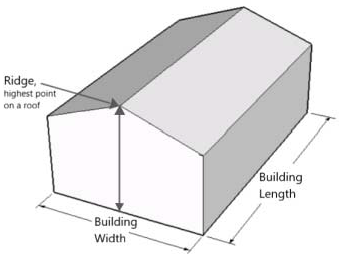
Building width (feet): Building width is measured at the base perpendicular to the ridge, highest point on a roof, represented by a horizontal line where two roof areas intersect.
Bus station or terminal: Any premises for the transient housing or parking of motor-driven buses and the loading and unloading of passengers.
Caretakers' or guards' residence: A residence located on a premises with a main residential or nonresidential use and occupied only by a caretaker or guard employed on the premises, such as a residence for guard in a private street development, residence for a guard or manager or caretaker for a self-storage facility or a restricted access business park.
Carnival, circus or tent service (temporary): Outdoor or indoor commercial amusement provided on a temporary basis.
Carport: A structure that is open on a minimum of two sides and designed or used to shelter not more than three vehicles and not to exceed 24 feet on its longest dimension. Also called "covered parking area."
Carwash, full-service or self-service: Any building or premises or portions thereof used for the washing of automobiles.
Cemetery, animal: Same as cemetery except only for the burial of dead animals.
Cemetery or Mausoleum: Land used or intended to be used for the burial of the human dead and dedicated for cemetery purposes, including columbariums, crematories, mausoleums, and mortuaries when operated in conjunction with and within the boundaries of such cemetery.
Certificate of occupancy: An official certificate issued by the city which indicates conformance with the zoning regulations and building codes and which authorizes legal use of the premises for which it is issued.
Child day care (business): A commercial institution or place designed for the care or training of seven to 12 unrelated children under 14 years of age for less than 24 hours a day.
Church/place of worship: A building for regular assembly for religious worship which is used primarily and designed for such purpose and those accessory activities which are customarily associated therewith, and the place of residence for ministers, priests, nuns or rabbis on the premises, that is tax exempt as defined by state law. For the purposes of this chapter, Bible study and other similar activities which occur in a person's primary residence shall not apply to this definition.
City administrator: The chief administrative office for the City of Dripping Springs, the deputy city administrator, or the city administrator's designee.
City council: The governing body of the City of Dripping Springs, Texas.
City of Dripping Springs: An incorporated municipality located in Hays County, Texas. Also referred to herein as the "city."
Civic/conference center: A building or complex of buildings that house municipal offices and services, and which may include cultural, recreational, athletic, food service, convention or entertainment facilities owned or operated by a municipality.
Cleaning plant (commercial/wholesale): An industrial facility where fabrics are cleaned with substantially nonaqueous organic solvents on a commercial or wholesale basis.
Collector street: A street or road providing for travel between local streets and the arterial street network, or serving multifamily development or neighborhood centers or services such as schools, parks, or fire stations.
College or university: An academic institution of higher learning, accredited or recognized by the state and covering a program or series of programs of academic study.
Commercial amusement (indoor): See "Amusement services (indoors)."
Commercial amusement (outdoor): See "Amusement Services (Outdoors)."
Commercial use: A type of nonresidential land use that has one or more of the following characteristics: (1) the use is service-oriented; (2) the use does not primarily sell retail items; (3) the use sells goods or products on a wholesale basis; or (4) the use has or has the need for open storage areas or warehouses its products. Such uses include motels, auto dealerships, welding shops, manufactured home sales, mini-warehouses, funeral homes, auto body repair shops, and air-conditioning and/or heating services.
Community center (municipal): A building or complex of buildings that house cultural, recreational, athletic, food service or entertainment facilities owned or operated by a governmental agency or private nonprofit agency.
Community home: A place where not more than six physically or mentally impaired or handicapped persons are provided room and board, as well as supervised care and rehabilitation by not more than two persons as licensed by the Texas Department of Mental Health and Mental Retardation (also see chapter 123 of the Texas Local Government Code [Human Resources Code]). The limitation on the number of persons with disabilities applies regardless of the legal relationship of those persons to one another.
Comprehensive plan: Document adopted by the city that consists of graphic and textual policies which govern the future development of the city and which consists of various components governing specific geographic areas and functions and services of the city.
Concrete or asphalt batching plant (permanent): A permanent manufacturing facility for the production of concrete or asphalt.
Concrete or asphalt batching plant (temporary): A temporary manufacturing facility for the production of concrete or asphalt during construction of a project, and to be removed when the project is completed.
Continuing care retirement community: A housing development designed to provide a full range of accommodations for adults of age 55 or more, including independent living, assisted living and skilled full-time nursing or medical care. Residents may move from one level to another as their needs change.
Contractor's office/sales (with outside storage): A building, part of a building, or land area for the construction or storage of materials, equipment, tools, products, and vehicles.
Convenience store with (or without) gasoline sales: Retail establishment selling food for off-premises consumption and a limited selection of groceries and sundries, including possibly gasoline, if pumps are provided. Does not include or offer any automobile repair services.
Country club (private): A land area and buildings which may include a golf course, clubhouse, dining room, swimming pool, tennis courts and similar recreational or service uses available only to members and their guests.
Court: An open, unobstructed space, bounded on more than two sides by the walls of a building. An inner court is entirely surrounded by the exterior walls of a building. An outer court has one side open to a street, alley, yard, or other permanent open space.
Coverage: The lot area covered by all buildings located thereon, including the area covered by all overhanging roofs.
Custom cabinet and woodworking: A manufacturing and retail sales enterprise where wooden cabinets, furnishings, and decor are crafted, refinished, and/or sold.
Custom personal service shop: Tailor, dressmaker, shoe shop, barbershop, beauty shop or similar shop offering custom service.
Day camp for children: A facility arranged and conducted for the organized recreation and instruction of children including outdoor activities on a daytime basis.
Density: The total number of residential buildings allowed upon a given tract of land usually expressed in total number of units per gross acre or net acre.
Dental office or doctor's office: Same as medical clinic.
Detached: Having no physical connection above the top of the floor line of the first floor with any other building or structure.
Developer: The legal or beneficial owner(s) of a lot or of any land included in a proposed development, including the holder of an option or contract to purchase or other persons having enforceable proprietary interests in such land.
Distribution center: Building or facility used for the storage and distribution of wholesale items/products.
Drapery, blind, or furniture upholstering shop: An establishment for the production, display and sale of draperies and soft coverings for furniture.
Dwelling: Any building or portion thereof, which is designed or used as living quarters for one or more families.
Dwelling, single-family attached (townhouse): See "Single-family dwelling (attached)."
Easement: A grant of one or more of the property rights by the property owner to or for the use by the public, a corporation or another person or entity.
Educational facilities: Public and private primary, secondary and post-secondary educational facilities offering instruction in the branches of learning and study required to be taught by the Texas Education Agency; and such federally funded educational programs for preschool children as the Head Start Program.
Electrical substation: A subsidiary station in which electric current is transformed.
Enclosed building: A structure which is floored, roofed and surrounded by outside walls, which contains no opening larger than 120 square feet in area normally open to the air and which contains no series of openings forming a divided opening larger than 120 square feet in area normally open to the air.
Extended stay hotels/motels (residence hotels): A multi-unit, extended stay lodging facility consisting of efficiency units or suites with complete kitchen facilities and which is suitable for long-term occupancy. Customary hotel services such as linens and housekeeping, telephones, and upkeep of furniture shall be provided. Meeting rooms, clubhouse, and recreational facilities intended for the use of residents and their guests are permitted. This definition shall not include other dwelling units as defined by this chapter.
Fairgrounds/exhibition area: An area or space either outside or within a building for the display of topic-specific goods or information.
Family: One or more persons related by blood, marriage, or adoption; or a group not to exceed four persons not all related by blood or marriage, adoption or guardianship, occupying a dwelling unit.
Family home (adult care in place of residence): A facility that regularly provides care in the caretaker's own residence for not more than six adults at any given time. No outside employment is allowed at the facility. This facility shall conform to chapter 42 of the Human Resources Code of the State of Texas, as amended, and in accordance with such standards as may be promulgated by the Texas Department of Human Resources.
Family home (child care in place of residence): A facility that regularly provides care in the caretaker's own residence for not more than six children under 14 years of age, excluding the caretaker's own children, and that provides care after school hours for not more than six additional elementary school siblings of the other children given care. However, the number of children, including the caretaker's own, provided care at such facility shall not exceed 12 at any given time. No outside employment is allowed at the facility. This facility shall conform to chapter 42 of the Human Resources Code of the State of Texas, as amended, and in accordance with such standards as may be promulgated by the Texas Department of Human Resources.
Farms, general (crops): An area used for growing usual farm products, vegetables, fruits, trees, and grain and including the necessary accessory uses for raising, treating, and storing products grown on the premises, but not including any type of agriculture specifically prohibited by ordinance or law.
Farms, general (livestock/ranch): An area used for the raising thereon of the usual farm animals such as horses, cattle, and sheep and including the necessary accessory uses for raising, treating, and storing animals on the premises, but not including the commercial feeding of offal or garbage to swine or other animals and not including any type of husbandry specifically prohibited by ordinance or law.
Feed and grain store: An establishment for the selling of corn, grain and other foodstuffs for animals and livestock, and including implements and goods related to agricultural processes, but not including farm machinery.
Fence: An artificially constructed structure of wood, masonry, stone, etc. (solid or otherwise), which is a barrier and used as a boundary or means of protection, confinement, or concealment.
Financial institutions: Banks, savings and loans, mortgage companies, investment firms, financial brokerages, check cashing establishments, and other commercial services.
Fire station, police station, or municipal building: Any public service building of the municipal government including a library or city municipal building, but excluding storage yards, utility shops and equipment centers.
Floodplain: An area of land subject to inundation by a 100-year frequency flood as determined using standard engineering practices and generally as shown on the FIRM Flood Insurance Rate Map of the City of Dripping Springs.
Floor area, gross: The total gross square feet of floor space within the outside dimensions of a building including each floor level, but excluding carports, porches, residential garages, and breezeways.
Floor area ratio (FAR): The floor area of a main building or buildings on a lot, divided by the lot area.
Florist shop: An establishment for the display and retail sale of flowers, small plants and accessories.
Food and beverage certificate holder: A business that serves alcoholic beverages and has applied for and received a food and beverage certificate from the Texas Alcoholic Beverage Commission because the business receives 60 percent or less of its revenue from the sale of alcoholic beverages.
Food or grocery store: A retail business establishment that displays and sells consumable goods that are not to be eaten on the premises. Prepared food may be sold only as a secondary or accessory use.
Food processing: A manufacturing or light industrial use that primarily deals with the processing and packaging of food, such as dairy or grain products that are intended for human consumption, but which are not typically sold in volume to end users on the premises. Incidental retail sales of food products, including bread and baked goods, [or] dairy products such as cheese, created and packaged on the premises may be allowed as an accessory use.
Footprint: The horizontal area as seen in plan view, measured from outside of all exterior walls and supporting columns; the amount of a structure that touches the ground surface.
Franchised private utility (not listed): A utility such as one distributing heat, chilled water, closed circuit television or similar service and requiring a franchise to operate in the City of Dripping Springs.
Fraternal organization, lodge, or union: An organized group having a restricted membership and specific purpose related to the welfare of the members such as Elks, Masons, Knights of Columbus, or a labor union.
Front yard: See "Yard, front."
Funeral home or mortuary: A place for the storage of human bodies prior to their burial or cremation, or a building used for the preparation of the deceased for burial and the display of the deceased and ceremonies connected therewith before burial or cremation.
Furniture, home furnishings or appliance stores: This group includes retail stores selling new goods for furnishing the home including, but not limited to furniture, floor coverings, draperies, glass and chinaware, domestic stoves, refrigerators, and other household electrical and gas appliances.
Furniture store, new and used (indoor): Same as above except sales may include used items.
Garage/accessory dwelling: A residential dwelling unit attached to or over a garage but not attached to the main residential structure.
Garage conversion: The alteration of an enclosed attached or detached accessory building, including a garage that meets the required parking standards for residential districts, to an air-conditioned living space with stationary fixed walls.
Garage, private: An accessory building enclosed on at least three sides, or a part of a main building, used for storage of automobiles and used solely by the occupants and their guests. Also called "enclosed parking space."
Garden shop (inside storage): A facility which is engaged in the selling of flowers, ornamental plants, shrubs, trees, seeds, garden and lawn supplies, and other materials used in planting and landscaping, but not including cultivation and propagation activities outside a building.
Gasoline service or filling station: See "Automotive gasoline or motor fuel service station."
General commercial plant: Establishments other than personal service shops for the treatment and/or processing of products as a service on a for-profit basis including, but not limited to, newspaper printing, laundry plant, or cleaning and dyeing plants.
General manufacturing: See "Industrial, manufacturing."
General retail stores: This major group includes retail stores which sell a number of lines of primarily new merchandise including but not limited to dry goods, apparel and accessories, furniture and home furnishings, small wares, small appliances, hardware, and food. The stores included in this group are known as department stores, variety stores, general merchandise stores, general stores, etc. (Also see "Retail shop.")
Golf course (public/private): An area of 20 acres or more improved with trees [tees], greens, fairways, hazards, and which may include clubhouses.
Group day-care home: A child-care facility that provides care for seven to 12 children under 14 years of age for less than 24 hours a day.
Gymnastic or dance studio: A building or portion of a building used as a place of work for a gymnast or dancer or for instructional classes in gymnastics or dance.
Hauling or storage company: See "Motor freight company."
Heavy load vehicle: A self-propelled vehicle having a manufacturer's recommended gross vehicle weight (GVW) of greater than 16,000 pounds (including trailers), such as large recreational vehicles (originally manufactured as RVs, not converted), tractor-trailers, buses, vans, and other similar vehicles. The term "truck" shall be construed to mean "heavy load vehicle" unless specifically stated otherwise.
Heavy machinery sales and storage: A building or open area used for the display, sale, rental or storage of heavy machinery, tractors or similar machines, or a group of machines which function together as a unit.
Height (of structures): As applied in this chapter, the height of a structure is the greatest vertical distance from any point on the established ground level under the structure to the highest attached component of the structure at that point. The established ground level shall be the lower of: a) the natural grade prior to disturbance of the site; or b) the newly established grade after construction.
Heliport: An area of land or water or a structural surface which is used, or intended for use, for the landing and taking off of helicopters, and any appurtenant areas which are used, or intended for use for heliport buildings and other heliport facilities.
Helistop: The same as a heliport, except that no refueling, maintenance, repairs or storage of helicopters is permitted.
Home for aged, residence: A home where elderly people are provided with lodging and meals without nursing care being a primary function.
Home occupation: An occupation carried on in a dwelling unit, or in an accessory building to a dwelling unit, by a resident of the premises, which occupation is clearly incidental and secondary to the use of the premises for residential purposes.
Hospital: An institution providing health services primarily for human inpatient medical or surgical care for the sick or injured and including related facilities such as laboratories, outpatient departments, training facilities, central services facilities, and staff offices which are an integral part of the facilities.
Hospital (acute care): An institution where sick or injured patients are given medical or surgical treatment intended to restore them to health and an active life, and which is licensed by the State of Texas.
Hospital (chronic care): An institution where those persons suffering from illness, injury, deformity or deficiencies pertaining to age are given care and treatment on a prolonged or permanent basis and which is licensed by the State of Texas.
Household appliance service and repair: The maintenance and rehabilitation of appliances that are customarily used in the home including, but not limited to, washing and drying machines, refrigerators, dishwashers, trash compactors, ovens and ranges, countertop kitchen appliances and vacuum cleaners, but not including appliances or equipment which have internal combustion engines.
Household care facility: A dwelling unit which provides residence and care to not more than nine persons, regardless of legal relationship, who are elderly; disabled; orphaned, abandoned, abused, or neglected children; victims of domestic violence; or rendered temporarily homeless due to fire, natural disaster or financial setbacks, living together with not more than two supervisory personnel as a single housekeeping unit. This definition is subject to Art. 4442c-4 (Personal Care Facility Licensing Act) V.A.C.S. (Tex.) and Art. 1011n (Community Homes for Disabled Persons Location Act) V.A.C.S. (Tex.) as they presently exist or may be amended in the future.
Household care institution: A facility which provides residence and care to ten or more persons, regardless of legal relationship, who are elderly; disabled; orphaned, abandoned, abused, or neglected children; victims of domestic violence; convalescing from illness; or temporarily homeless due to fire, natural disaster, or financial setback together with supervisory personnel.
HUD-Code manufactured home: A movable dwelling designed to be transported on the highway, either intact or in major sections, by a prime mover, which can be used as a residential dwelling either with or without a permanent foundation. A HUD-Code manufactured home is also defined as a movable manufactured home that was constructed after June 15, 1976.
Impervious cover: Buildings, parking areas, roads, and other impermeable man-made improvements covering the natural land surface that prevents infiltration. For purposes of compliance with this chapter, the term expressly excludes storage tanks for rainwater collection systems. The term includes outside storage. Impervious coverage shall be calculated as a percentage of the net site area and shall be the lesser of the percentage specified in the district description or the percentage of the average lot slope.
Incidental or accessory retail and service uses: Any use different from the primary use but which complements and/or supplements the primary use, such as a sundries shop that serves tenants of an office building or hospital. Incidental shall mean an area that constitutes not more than 15 percent of the main use.
Industrialized home (also called modular prefabricated structure or modular home): A structure or building module as defined under the jurisdiction and control of the Texas Department of Labor and Standards, that is transportable in one or more sections on a temporary chassis or other conveyance device, and that is designed to be installed and used by a consumer as a fixed residence on a permanent foundation system. The term includes the plumbing, heating, air-conditioning and electrical systems contained in the structure. The term does not include mobile homes or HUD-Code manufactured homes as defined in the Texas Manufactured Housing Standards Act (Article 5221f, V.A.C.S.). Industrialized homes must meet all applicable local codes and zoning regulations that pertain to construction of traditional site-constructed ("stick built") homes.
Industrial, manufacturing: Establishments engaged in the manufacturing or transformation of materials into new products. These establishments are usually described as plants and factories, and characteristically use power-driven machines and materials handling equipment. Manufacturing production is usually carried on for the wholesale market, rather than for direct sale to the domestic consumer.
Institution for alcoholic, narcotic or psychiatric patients: An institution offering outpatient treatment to alcoholic, narcotic or psychiatric patients.
Intensity (of land use): An assessment of the relative level of activity of land use, including, but not limited to, type of land use, floor area ratio, building coverage ratio, or percent of impervious coverage.
Kennels (indoor pens): An establishment with indoor pens in which more than four dogs or domesticated animals more than one year old are housed, groomed, bred, boarded, trained and/or sold for commercial purposes.
Kennels (outdoor pens): An establishment with outdoor pens in which more than four dogs or domesticated animals more than one year old are housed, groomed, bred, boarded, trained or sold for commercial purposes.
Kindergarten or nursery school (private): An establishment where more than three children are housed for care or training during the day or portion thereof.
Kiosk (providing a service): A small, freestanding, one-story accessory structure having a maximum floor area of 100 square feet and used for retail purposes, such as automatic teller machines or the posting of temporary information or posters, notices and announcements. If a kiosk is to be occupied, it shall have a minimum floor area of 50 square feet.
Kitchen, residential: Generally, that portion of a residential dwelling that is devoted to the preparation or cooking of food for the purpose of consumption by residents of the dwelling. A kitchen, as referred to within this chapter, generally indicates the presence of complete cooking facilities as differentiated from a "kitchenette" which provides limited cooking facilities limited to a single-burner hot plate, under-counter refrigerator and microwave oven.
Laboratory equipment manufacturing: A facility that makes or produces equipment or products used for research or testing.
Laboratory, scientific or research: An establishment that engages in research, testing or evaluation of materials or products, but not medical-related (see "Medical facilities and Medical laboratory").
Landscaping: Material such as, but not limited to, grass, ground covers, shrubs, vines, hedges, trees or palms, and non-living durable materials that are commonly used in landscaping such as, but not limited to, rocks, pebbles, sand, walls or fences, but excluding paving.
Laundromat (or self-serve washateria): A facility where patrons wash or dry clothing and other fabrics in machines that are operated by the patron.
Laundry/dry cleaning: A facility used for the purpose of receiving articles or goods of fabric to be subjected to the process of laundering, dry cleaning, or cleaning elsewhere, and for the pressing and distribution of any such articles or goods that have been subjected to any such process.
Light load vehicle: A self-propelled vehicle having a manufacturer's recommended gross vehicle weight (GVW) not greater than 16,000 pounds and having no more than two axles, such as pickup trucks, sport utility vehicles, vans and mini-vans, recreational vehicles (less than 32 feet in length), campers and other similar vehicles but not including automobiles and motorcycles.
Light manufacturing or industrial use: Manufacturing of finished products or parts, predominantly from previously prepared materials, including fabrication, assembly, and packaging of such products, and incidental storage, sales and distribution of such products, but excluding basic industrial processing.
Living quarters on-site with a business: A lot that is occupied or intended to be occupied by a dwelling unit (a residential use) and a nonresidential use, either within the same structure or separate structures. The residential use and the nonresidential use are equally considered to be the principal use of the lot.
Loading space: An off-street space or berth used for the delivery and loading or unloading of vehicles.
Local utility line: The facilities provided by a municipality or a franchised utility company for distribution or collection of gas, water, surface drainage water, sewage, electric power or telephone service, including pad- and pole-mounted transformers.
Lot: A platted parcel of land that is occupied or intended to be occupied by one main building, or a group of main buildings, and any accessory building(s), which includes such parking, landscaping and open space as are required by this chapter or other laws or ordinances, and also which has its principal frontage upon a public street.
Lot area: The total area, measured on a horizontal plane, included within lot lines.
Lot, corner: A lot which has at least two adjacent sides abutting for their full lengths upon a street, provided that the interior angle at the intersection of such two sides is less than 135 degrees.
Lot depth: The mean horizontal distance between the front and rear lot lines.
Lot, double frontage: A lot having frontage upon two non-intersecting streets, as distinguished from a corner lot.
Lot, flag: A lot having access to a street by means of a parcel of land generally having a depth greater than its frontage, but not less than 35 feet. Flag, or panhandle, lots are typically discouraged. This term does not include a shared-access driveway easement that joins more than one lot to a street.
Lot frontage: That dimension of a lot or portion of a lot abutting onto a street, excluding the side dimension of a corner lot.
Lot, interior: A lot other than a corner lot.
Lot, key: A corner lot whose exterior side is adjacent to the front yard of another lot.
Lot line, front: The narrower side of the lot abutting a street. Where two lot lines abutting streets are of equal length, the owner shall have a choice in designating which shall be the lot frontage. For a lot which has a boundary line which does not abut the front street line, is not a rear lot line, and lies along the same general directional orientation as the front and rear lot lines, said line shall be considered a front lot line in establishing minimum setback lines.
Lot line, rear: The lot line farthest from and most parallel to the front lot line. For triangular lots, the point opposite the front lot line shall be considered the rear lot line and have a value of zero.
Lot line, side: Any lot line not the front or rear lot line.
Lot lines or property lines: The lines bounding a lot as defined herein.
Lot of record: A lot that is part of a subdivision, the plat of which has been recorded in the office of the County Clerk of Hays County.
Lot width: The horizontal distance measured between side lot lines parallel to the front lot line, and measured from the point on the building line which is closest to the front lot line.
Main building: The building or buildings on a lot that are occupied by the primary use.
Manufactured home: A term that cumulatively refers to any one of three types of prefabricated housing products that are typically manufactured or assembled at a location other than the end user's premises, and which are regulated by the Texas Manufactured Housing Standards Act (articles 5221f and 5221f-1, V.A.C.S.). For the purpose of this chapter, there are three types of manufactured homes: (a) mobile homes; (b) HUD-Code manufactured homes; and (c) modular/industrialized homes. The term does not include recreational camper/travel trailers.
Manufactured home display or sales (new): The offering for sale, storage, or display of new manufactured housing units, including mobile homes or trailers, HUD-Code homes and industrialized homes, on a parcel of land, but excluding the use of such facilities as dwellings either on a temporary or permanent basis.
Manufactured home display or sales (used): The offering for sale, storage, or display of previously owned (used), movable manufactured housing units, including mobile homes or trailers, and HUD-Code homes on a parcel of land, but excluding the use of such facilities as dwellings either on a temporary or permanent basis.
Manufactured home subdivision: A parcel of land which is designed, platted, improved and intended for the long-term placement of individually owned mobile home units or HUD-Code manufactured homes on platted lots which can be purchased outright by the owners of the mobile home units. Facility may include a residence for the owner or manager of the premises, utility hook-ups, accessory structures, playgrounds and open space areas, fenced yard areas for pets, and other similar amenities.
Masonry construction: That form of construction comprised of brick, stone, granite, marble, concrete, hollow clay tile, concrete block or tile, brick veneer, exterior plasters, including stucco, or other similar building units or materials or combination of these materials laid up unit by unit and set in mortar.
Massage establishment: Any place of business in which massage therapy is practiced by a massage therapist, as defined and licensed by state law. "Massage therapy," as a health care service, means the manipulation of soft tissue for therapeutic purposes. The term includes, but is not limited to, effleurage, petrissage, tapotement, compression, vibration, friction, nerve strokes, and Swedish gymnastics, either by hand or with mechanical or electrical apparatus for the purpose of body message. Massage therapy may include the use of oil, salt glows, heat lamps, hot and cold packs, tub, shower or cabinet baths. Equivalent terms for "massage therapy" are massage, therapeutic massage. Massage and "therapeutic" do not include diagnosis, the treatment of illness or disease, or any service or procedure for which a license to practice medicine, chiropractic, physical therapy, or podiatry is required by law.
Medical clinic or office: A facility or group of offices for one or more physicians for the examination and treatment of ill and afflicted human outpatients provided that patients are not kept overnight except under emergency conditions.
Medical facilities: A building that contains establishments dispensing health services.
Medical laboratory: An indoor establishment that includes laboratories and/or experimental equipment for medical testing, prototype design and development, and product testing.
Mini-warehouse/self-storage: Small individual storage units for rent or lease, restricted solely to the storage of items. The conduct of sales, business or any other activity within the individual storage units, other than storage, shall be prohibited.
Minor medical emergency clinic: See "Medical clinic or office."
Mobile home: A movable dwelling designed to be transported on its own chassis on the highway (either intact or in major sections) by a prime mover, which is constructed with a base section so as to be independently self-supporting, and which does not require a permanent foundation for year-round living. A mobile home is also defined as any manufactured home that was constructed prior to June 15, 1976.
Mobile home park (also trailer park or RV park): A parcel of land not less than three acres nor greater than 35 acres which is designed, improved, or intended to be used for short- or long-term occupancy by mobile homes/trailers or recreational vehicles, including travel trailers, in designated spaces. The facility may include a residence for the owner or manager of the premises, utility hook-ups, accessory structures, playgrounds and open space areas, fenced yard areas for pets, and other similar amenities.
Mobile home space: A plot of ground within a mobile home park, trailer park, RV park, or mobile home subdivision that is designed for the accommodation of one mobile home, trailer or RV unit.
Model home: A dwelling in a developing subdivision, located on a legal lot of record, that is limited to temporary use as a sales office for the subdivision and to provide an example of the dwellings which have been built or which are proposed to be built within the same subdivision.
Modular home (also called modular prefabricated structure or industrialized home): A structure or building module as defined under the jurisdiction and control of the Texas Department of Labor and Standards, that is transportable in one or more sections on a temporary chassis or other conveyance device, and that is designed to be installed and used by a consumer as a fixed residence on a permanent foundation system. The term includes the plumbing, heating, air-conditioning and electrical systems contained in the structure. The term does not include mobile homes or HUD-Code manufactured homes as defined in the Texas Manufactured Housing Standards Act (Article 5221f, V.A.C.S.). Industrialized homes must meet all applicable local codes and zoning regulations that pertain to construction of traditional site-constructed ("stick built") homes.
Motel or hotel: A facility offering temporary lodging accommodations or guest rooms on a daily rate to the general public and providing additional services, such as restaurants, meeting rooms, housekeeping service and recreational facilities. A guest room shall be defined as a room designed for the overnight lodging of hotel guests for an established rate or fee.
Motorcycle: A usually two-wheeled, self-propelled vehicle having one or two saddles or seats, and which may have a sidecar attached. For purposes of this chapter, motorbikes, all-terrain vehicles (ATVs), motor scooters, mopeds and similar vehicles are classified as motorcycles.
Motorcycle sales and repair: The display, sale or servicing, including repair work, of motorcycles.
Motor freight company: A company using trucks or other heavy load vehicles to transport goods, equipment and similar products. This term includes companies that move residential or commercial belongings.
Motor vehicle: Any vehicle designed to carry one or more persons that is propelled or drawn by mechanical power, such as automobiles, vans, trucks, motorcycles and buses.
Multiple-family dwelling: Three or more dwelling units on a single lot designed to be occupied by three or more families living independently of one another, exclusive of hotels or motels. This term includes three-family units (triplex) and four-family units (quadriplex), as well as traditional apartments.
Municipal facility or use: Any area, land, building, structure or facility which is owned, used, leased or operated by the City of Dripping Springs, Texas.
Nonconforming use: A building, structure, or use of land lawfully occupied as of the effective date of this chapter or amendments thereto, but which does not conform to the use regulations of the district in which it is situated.
Nursery: An establishment, including a building, part of a building or open space, for the growth, display or sale of plants, shrubs, trees and other materials used in indoor or outdoor planting.
Nursing, convalescent or rest home: See "Skilled nursing facility."
Occupancy: The use or intended use of the land or buildings by proprietors or tenants.
Office center: A building or complex of buildings used primarily for conducting the affairs of a business, profession, service, industry, government or similar entity, that may include ancillary services for office workers such as a coffee shop, newspaper stand, sundries shop and hair or nail salon.
Office showroom: An establishment with no more than 25 percent of its total floor area devoted to storage and warehousing, but not accessible to the general public. The remaining area may include retail and wholesale sales areas, sales offices, and display areas for products sold and distributed from the storage and warehousing areas.
Offices, professional and general business: A room or group of rooms used for the provision of executive, management or administrative services. Typical uses include administrative offices and services including real estate, insurance, property management, investment, personnel, travel, secretarial services, telephone answering, and business offices of public utilities, organizations and associations, but excluding medical offices.
Office warehouse: An establishment with more than 25 percent of the total floor area devoted to storage and warehousing, but not generally accessible to the public.
Officially approved place of access: Access to a property, other than from a dedicated street, which is approved by the City of Dripping Springs.
Off-street parking incidental to main use: Off-street parking spaces provided in accordance with the requirements of this chapter, located on the lot or tract occupied by the main use or within 150 feet of such lot or tract, and located within the same zoning district as the main use or in an adjacent parking district.
On-site dwellings: A building, home or facility located on the lot that is the subject of the application for development.
Open storage: The keeping, displaying or storing, outside a building, of any goods, materials, merchandise or equipment on a lot or tract for more than 24 hours, including recreational vehicles, boats and trailers. Also referred to as outside storage. This term does not include storage within buildings that is visible from a public right-of-way via open doorways or windows.
Or: Where necessary to effectuate the intent of this chapter or to prevent an ambiguity, absurdity, or mistake, the words "and" and "or" shall be interchangeable.
Outside display: Outside temporary display of finished goods that are specifically intended for retail sale.
Paint shop: A commercial establishment where painting services are performed, but not automotive-related painting services, which would be included under "Automobile repair, major."
Parcel: Any unplatted tract of land, or any portion of an unplatted tract of land.
Park and/or playground (private): See "Private recreation facility or private park."
Park and/or playground (public): See "Public recreation."
Parking lot: An off-street ground level area, not on a public street or alley, paved in accordance with City of Dripping Springs parking lot standards, for the short- or long-term storage of motor vehicles.
Parking lot, commercial (auto): A parking lot that constitutes the principal use of the property and which is available to the public, generally for a fee, or which may be leased to individual persons or assigned to specific businesses or properties.
Parking structure, commercial (auto): A structure devoted to the parking or storage of automobiles for a fee which may include, a facility for servicing automobiles provided that such facility is an internal function for use only by automobiles occupying the structure and that such facility creates no special problems of ingress or egress.
Parking space: An off-street area, not on a public street or alley, paved in accordance with City of Dripping Springs parking lot standards, that is used for parking a vehicle, and that is accessed from a paved driveway which connects the parking space with a public street.
Patio home (zero-lot-line dwelling): A single-family dwelling on a separately platted lot which is designed such that one side yard is reduced to zero feet in order to maximize the width and usability of the other side yard, and which permits the construction of a detached single-family dwelling with one side of such dwelling placed on the side property line.
Pawnshop: An establishment where money is loaned on the security of personal property pledged in the keeping of the owners. The retail sale of primarily used items is also allowed, provided that the sale of such items complies with local, state and federal regulations.
Personal service shop or custom personal services: Establishments less than 2,000 square feet in gross floor area, primarily engaged in providing services generally involving the care of the person or his apparel and including, but not limited to, barber and beauty shops, dressmaking, shoe shining and repair, dry-cleaning and laundry pickup stations, tailor or seamstress services, and other similar types of uses, with no outside storage.
Pet and animal grooming shop: A retail establishment offering small animals, fish or birds for sale as pets, where such creatures are housed within the building, and which may include the grooming of dogs, cats and similar animals.
Petroleum distribution/storage/wholesale facility: A facility for the long-term storage and distribution of petroleum that may also involve wholesale sales, but not retail sales, of petroleum and petroleum-based products. No manufacturing or refining of petroleum or petroleum-based products occurs on the premises, only storage and/or distribution functions.
Photocopying/duplicating: An establishment which reproduces, in printed form, individual orders from a business, profession, service, industry or government organization and occupies less than 4,000 square feet.
Planned development district: Planned associations of uses developed as integral land use units, such as industrial parks or industrial districts, offices, commercial or service centers, shopping centers, residential developments of multiple or mixed housing, including attached single-family dwellings or any appropriate combination of uses which may be planned, developed or operated as integral land use units either by a single owner or by a combination of owners.
Planning and zoning commission: A board which is appointed by the city council as an advisory body, and which is authorized to recommend changes in the zoning of property and other planning functions as delegated by the city council. Also referred to as the "P&Z."
Plat: A plan showing the subdivision of land, creating building lots or tracts, showing all essential dimensions and other information in compliance with the subdivision standards of the City of Dripping Springs, and which is approved by the City of Dripping Springs and recorded in the plat records of Hays County.
Platted lot: See "Lot" and "Lot of record."
Playfield or stadium (public): An athletic field or stadium owned and operated by a political subdivision for the general public including a baseball field, soccer field, golf course, football field or stadium which may be lighted for nighttime play.
Playfield or stadium (private): An athletic field or stadium owned and operated by an agency other than a political subdivision.
Portable building sales (outdoor display): An establishment which displays and sells structures capable of being carried and transported to another location, but not including mobile homes.
Premises: Land together with any buildings or structures situated thereon.
Primary use: The principal or predominant use of any lot or building.
Principal building: See "Main building."
Private club: An establishment providing social or dining facilities which may provide alcoholic beverage service, to an association of persons, and otherwise falling within the definition of, and permitted under the provisions of, that portion of title 3, chapter 32, Vernon's Texas Codes Annotated, Alcoholic Beverage Code, as the same may be hereafter amended, and as it pertains to the operation of private clubs.
Private gaming club: An establishment providing facilities for card games, dominos, and other similar gaming activities and services, to an association of persons or members.
Private recreation facility or private park: A recreation facility, park or playground which is not owned by a political subdivision, and which is operated for the exclusive use of private residents or neighborhood groups and their guests and not for use by the general public.
Produce stand: A seasonal use for which the primary purpose and design is to sell fruit, nuts, vegetables and similar foods. No cooking or on-premises consumption of produce occurs on the site.
Professional service: Work performed which is commonly identified as a profession, and which may be licensed by the State of Texas.
Propane sales (retail): Retail sales of gaseous substances commonly used for household purposes such as propane or butane; does not include the storage, sale or distribution of other types of combustible substances or alternative fuels such as containerized natural gas, liquid propane, etc.
Public agency building, shop, yard or facility: Any building, land, area or facility, including maintenance and storage yards and shops, which is owned, leased, primarily used and occupied by any subdivision or agency of the following: The State of Texas, the United States, or other political subdivision. Any facility that is owned, leased, used or occupied by the City of Dripping Springs is defined as "Municipal facility or use."
Public health center: A facility primarily utilized by a health unit for providing public health services including related facilities such as laboratories, clinics and administrative offices operated in connection therewith.
Public recreation: Publicly owned and operated parks, recreation areas, playgrounds, swimming pools and open spaces that are available for use by the general public without membership or affiliation. This land use shall include special event type uses such as rodeos, concerts, festivals and other special events requiring special event permits, as set forth in the City of Dripping Springs's Code of Ordinances.
Public view: Public view means areas that can be seen from any public street.
Rear yard: See "Yard, rear."
Recreational vehicle (RV): A self-propelled, mobile living unit which is typically used for temporary human occupancy away from the users' permanent place of residence.
Recreational vehicle/camper sales and leasing: An establishment that sells, leases or rents new or used recreational vehicles, travel trailers, campers, boats and watercraft, and similar types of vehicles.
Recreational vehicle (RV) park: An area or commercial campground for users of recreational vehicles, travel trailers, and similar vehicles to reside, park, rent or lease on a temporary basis. (See also "Mobile home park.")
Recreation center: A place designed and equipped for the conduct of sports, leisure time activities, and other customary and usual recreational activities.
Recycling kiosk: A small uninhabited structure up to 120 square feet maximum, or temporary container, such as an "igloo" or dumpster-type container, which provides a self-service location for the depositing of recyclable materials such as aluminum cans, glass bottles, magazines and newspapers and metal or plastic containers. Recyclables are picked up periodically from the site. This definition does not include large trailers or manned collection centers.
Rehabilitation care facility (halfway house): A dwelling unit which provides residence and care to not more than nine persons regardless of legal relationship who have demonstrated a tendency towards alcoholism, drug abuse, mental illness, or antisocial or criminal conduct living together with not more than two supervisory personnel as a single housekeeping unit.
Rehabilitation care institution: A facility which provides residence and care to ten or more persons, regardless of legal relationship, who have demonstrated a tendency toward alcoholism, drug abuse, mental illness, or antisocial or criminal conduct together with supervisory personnel.
Residence: Same as a dwelling; also, when used with district, an area of residential regulations.
Residential district: District where the primary purpose is residential use.
Residential loft: A residential living space that is located on the second floor (or above) of a structure that has a nonresidential use, such as an office or retail shop, operating on the first floor. This definition includes a similarly located space within a structure that has been converted into a residential living area from some other originally intended use.
Restaurant (drive-in service): An eating establishment where food or drinks are primarily served to customers in motor vehicles, or where facilities are provided on the premises which encourage the serving and consumption of food in automobiles on or near the restaurant premises.
Restaurant (with drive-through service): An eating establishment where customers are primarily served at tables or are self-served, where food is consumed on the premises, and which may include a drive-through window(s).
Restaurant (with no drive-through service): An eating establishment where customers are primarily served at tables or are self-served, where food is consumed on the premises, and which do not have a drive-through window.
Retail or service, incidental: The rendering of incidental retailing or services incidental to the primary use. In the office district, for example, such uses may include a barber or beauty shop, smoke shop, news stand, candy counter, restaurant, pharmacy or other incidental activity secondary to the primary office occupancy. Incidental uses shall mean uses that occupy less than 15 percent of the main use.
Retail operations: Establishments engaged in selling goods, merchandise, services, or entertainment to the general public for personal or household consumption.
Retail shop (for apparel, gifts, accessories and similar items): An establishment engaged in the selling of goods and merchandise to the general public for personal or household consumption and rendering services incidental to the sale of such goods. (Also see "General retail stores.")
Retirement housing for the elderly (also independent living center or congregate housing): A development providing self-contained dwelling units specifically designed for the needs of the elderly. Units may be rented or owner-occupied. To qualify as retirement housing, a minimum of 80 percent of the total units shall have a household head 55 years of age or greater. No long-term or permanent skilled nursing care or related services are provided.
Room: A building or portion of a building which is arranged, occupied or intended to be occupied as living or sleeping quarters but not including toilet or cooking facilities.
Rooming house: See "Boarding house."
Salvage or reclamation of products (also see "wrecking yard"): The reclamation and storage of used products or materials.
Sand/gravel/stone sales (storage): The process of extracting and/or storing sand, gravel, stone, topsoil, compost or other products from the earth.
Sanitarium: An institution providing health facilities for inpatient medical treatment or treatment and recuperation making use of natural therapeutic agents.
School, business: A for-profit business that offers instruction and training in a profession, service or art such as a secretarial or court reporting school, barber or beauty college or commercial art school, but not including commercial trade schools.
School, commercial trade: A for-profit business that offers vocational instruction and training in trades such as welding, brick laying, machinery operation/repair, and similar trades.
School, private (primary or secondary): A school under the sponsorship of a private agency or corporation, other than a religious agency, which offers a curriculum that is generally equivalent to public elementary and/or secondary schools.
School, public or parochial: A school under the sponsorship of a public or religious agency which provides elementary or secondary curricula, but not including private business or commercial trade schools.
Scientific and industrial research laboratories: Facilities for research including laboratories, experimental equipment, and operations involving compounding or testing of materials or equipment.
Screened: Shielded, concealed, and effectively hidden from the view of a person standing at ground level on an abutting site, or outside the area or feature so screened, by a fence, wall, hedge, berm or similar architectural or landscape feature.
Seasonal uses: Seasonal uses include the sales of items such as Christmas trees, pumpkins, snow cones, fresh produce, and other items that are typically only available at certain times of the year.
Servant's quarters or guest house: An accessory dwelling in a residential district for the sole use and occupancy of a member of the immediate family or of a person or persons employed on the premises by the occupant on a full-time basis as domestic help such as a maid, nanny/governess, groundskeeper, chauffeur, cook or gardener, but not involving the rental of such facilities or the use of separate utility connections for such facilities.
Sexually oriented business: Refer to any applicable city regulations addressing sexually oriented businesses or adult entertainment facilities.
Shopping center: A group of primarily retail and service commercial establishments that is planned, constructed and managed as a total entity, and which provides customer and employee parking on-site, unloading or delivery areas which are separated from customer access, and aesthetically appropriate design and protection from the elements.
Side yard: See "Yard, side."
Single-family dwelling, attached (townhouse): A dwelling which is joined to another dwelling at one or more sides by a party wall, which is designed for occupancy by one family, and which is located on a separate lot delineated by front, side and rear lot lines.
Single-family dwelling, detached: A dwelling designed and constructed as a freestanding structure for occupancy by one family, and located on a lot or separate building tract having no physical connection to a building located on any other lot or tract.
Site: Any geographical area; a parcel of land or portion thereof with frontage on a street, devoted to or intended for a use or occupied by a structure or group of structures.
Skilled nursing facility (also termed nursing home, convalescent home or long-term care facility): A residence providing primarily inpatient health care, personal care, or rehabilitative services over a long period of time to persons who are chronically ill, aged or disabled and who need ongoing health supervision but not hospitalization.
Small engine repair shop: Shop for the repair of lawn mowers, chain saws, lawn equipment, and other machines with one-cylinder engines.
Special event facility: An establishment and/or premises whose primary use is the reservation by individuals or groups via appointment for limited engagement(s) to accommodate gatherings and functions, both private and public, including, but not limited to, banquets, weddings, anniversaries, receptions, conferences, markets, and other similar celebrations. Such a use is authorized but is not required to include: 1) kitchen facilities for the preparation or catering of food; 2) the sale of alcoholic beverages for on-premises consumption, only during scheduled events and not open to the general public; and 3) outdoor gardens or reception facilities. A special event facility does not include a business who occasionally hosts special events, but whose primary use is not as a special event facility as defined herein.
Special exception: A form of approval granted by the board of adjustment (BOA) waiving all or certain provisions of an ordinance. An adjustment in the application of the specific regulations of the zoning ordinance to a particular parcel of property which, because of special conditions or circumstances of hardship peculiar to the particular parcel, is necessary to prevent the property from being deprived of rights and privileges enjoyed by other parcels in the same vicinity and zoning district; a special exception is granted by the BOA.
Stable, commercial: A stable used for the rental of stall space or for the sale or rental of horses or mules; such a stable shall meet all provision[s] and requirements of the zoning district in which it is constructed.
Stable, private: An area used solely for the owner's private purposes for the keeping of horses, mules or ponies that are not kept for remuneration, hire or sale.
Storage or wholesale warehouse: A building used primarily for the storage of goods and materials.
Story: That portion of a building above grade, other than a basement, that is included between the surface of any floor and the surface of the next floor above it or, if there is no floor above it, then the space between the floor and the ceiling above it. The average height for a story shall be defined as 12 feet. The definition of a story does not include parapets, gables and other normal roof structures. In cases where the site has a significant slope, the number of stories of a building shall be measured from point representing the average slope from front to back, or side to side, of the building.
Story, half: A space under a sloping roof which has the line of intersection of roof decking and wall face not more than three feet above the top floor level, and in which space not more than two-thirds of the floor area is finished off for use. A half-story containing an independent apartment or self-contained living quarters shall be counted as a full story.
Street: Any dedicated public thoroughfare that affords the principal means of access to abutting property. A street is termed a major thoroughfare or arterial when the right-of-way is greater than 60 feet.
Street intersection: Any street that joins another street at an angle, whether or not it crosses the other.
Street yard: The area between the building front line and the front property line.
Structural alterations: Any change in the supporting members of a building, such as loadbearing walls or partitions, columns, beams or girders, or any substantial change in the roof or in the exterior walls.
Structure: Anything constructed or erected, the use of which requires location on the ground or which is attached to something having a location on the ground. (Also see "Building.")
Studio for radio and television (without tower): A building or portion of a building used as a place for radio or television broadcasting. As regulated within the use charts, this definition does not include a studio for radio and television with a tower.
Studio, health, reducing or fitness: Includes, but is not limited to, an establishment which provides facilities and equipment, such as gymnasiums, weight rooms, swimming pools or spas, exercise apparatus and instruction classes, which are intended to promote health, fitness, weight reduction and/or similar health-related activities. Such facilities may include such accessory uses as food service, sales of sundries and apparel, and child-care services, provided that such accessory uses are clearly incidental to the primary use and are for the use of studio patrons only. No outside signage may be used to advertise accessory uses.
Studio, tattoo or body piercing: A building or portion of a building used for selling or applying tattoos, by injecting dyes/inks into the skin, and/or for piercing the skin with needles, jewelry or other paraphernalia, primarily for the purpose of ornamentation of the human body.
Surgical outpatient facility: An establishment offering any type of surgical procedures and related care which, in the opinion of the attending physician, can be performed safely without requiring inpatient overnight hospital care and exclusive of such surgical and related care as licensed physicians ordinarily may elect to perform in their private offices.
Swimming instruction as a home occupation: The teaching of swimming in a private swimming pool. Within a residential district, this use is subject to the approval and issuance of a conditional use permit which may specify operating conditions and standards and which may limit the number of students and operating times.
Swimming pool, commercial: A swimming pool with accessory facilities which is not part of the municipal or public recreational system and which is not a private swim club, but where the facilities are available for use by the general public for a fee.
Swimming pool, private: A swimming pool constructed for the exclusive use of the residents of a one-family, two-family or multiple-family dwelling and located, fenced and built in accordance with the City of Dripping Springs Code of Ordinances. A private swimming pool shall not be operated as a business nor maintained in a manner to be hazardous or obnoxious to adjacent property owners, and shall be constructed below the average natural grade level.
Telemarketing center: An establishment that solicits business or the purchase of goods and/or services by telephone only. No sale of goods or services to the public occurs at or on the premises. No products are stored at or on the premises.
Telephone and exchange, switching/relay or transmitting station: A line for the transmission of telephone signals and a central office in which telephone lines are connected to permit communication but not including a business office, storage, whether inside or outside, or repair yards.
Temporary: Used or lasting for only a limited period of time; not permanent.
Temporary building: Any prefabricated structure which is not originally manufactured or constructed at its use site, and has been in existence on the same lot for more than six months.
Temporary field office or construction yard or office: A structure or shelter used in connection with a development or building project for housing on the site of temporary administrative and supervisory functions and for sheltering employees and equipment. Temporary permits for one year for a specific time and location as determined may be issued by the city and shall be subject to review and renewal for reasonable cause.
Tennis court (private, not lighted): A surface designed and constructed for playing the game of tennis along with all fencing, nets and related appurtenances but excluding lighting for nighttime play in residential areas except as may be otherwise provided or restricted by the conditional use permit.
Texas Commission on Environmental Quality (TCEQ): Formerly referred to as the Texas Natural Resource Conservation Commission (TNRCC), the name of which changed officially on September 1, 2002, or a successor agency.
Theater, drive-in (outdoor): An open lot with its appurtenant facilities devoted primarily to the showing of motion pictures or theatrical productions on a paid admission basis to patrons seated in automobiles.
Theater or playhouse (indoor): A building or part of a building devoted to the showing of motion pictures, or for dramatic, musical or live performances.
Tire dealer, with open storage: A retail establishment engaged in the sale or installation of tires for vehicles, with open storage.
Tire dealer, without open storage: A retail establishment engaged in the sale or installation of tires for vehicles, but without open storage.
Tool and machinery rental shop (indoor storage): A building or a portion of a building used for the display and rental of tools, machinery and instruments with no outside storage.
Tract: A single individual parcel or lot.
Tractor sales: See "Heavy machinery sales and storage."
Trade and Commercial Schools: See "School, Commercial Trade."
Trailer, hauling: A vehicle or device which is pulled behind an automobile or truck and which is designed for hauling animals, produce, goods or commodities, including boats.
Trailer home: See "Manufactured home, mobile home."
Trailer or mobile home space: See "Mobile home space."
Trailer park or court: See "Mobile home park."
Trailer rental: The display and offering for rent of trailers designed to be towed by automobiles and light load vehicles.
Trailer, travel or camping: A portable or mobile living unit which is used for temporary human occupancy away from the users' permanent place of residence, which does not constitute the users' principal place of residence, and which is designed to be towed behind another vehicle.
Transportation/utility structures and facilities: Permanent facilities and structures operated by companies engaged in providing transportation and utility services including but not limited to railroad track rights-of-way, sewage pumping stations, telephone exchanges, transit station turnarounds, water reservoirs and water pumping stations.
Truck: A light or heavy load vehicle (see definitions for "Light load vehicle" and "Heavy load vehicle").
Truck and bus leasing: The rental of new or used panel trucks, vans, trailers, recreational vehicles or motor-driven buses in operable condition and where no repair work or intensive cleaning operations are performed.
Truck and bus repair: An establishment providing major and minor automotive repair services to heavy load vehicles.
Truck sales (heavy trucks): The display, sale or rental of new or used heavy load vehicles in operable condition.
Truck stop: A facility for the parking, refueling or minor repair of heavy load tractor-trailer trucks. These facilities may also include retail sales of food or other items, restaurant(s), restroom/showers facilities, and/or temporary sleeping quarters.
Truck Terminal: An area and building where cargo is stored and where trucks, including tractor and trailer units, load and unload cargo on a regular basis. May include facilities for the temporary storage of loads prior to shipment.
Two-family dwelling (duplex): Two attached dwellings in one structure, each designed to be occupied by one family.
Usable open space: An open area or recreational facility that is designed and intended to be used for outdoor living or recreation purposes. An area of usable open space shall have a slope not exceeding ten percent, shall have no dimension of less than ten feet, and may include landscaping, walks, recreational facilities, water features and decorative objects such as artwork or fountains.
Use: The purpose for which land or buildings are or may be occupied in a zoning district.
Utility distribution/transmission lines: Facilities which serve to distribute and transmit electrical power, gas and water, including but not limited to electrical transmission lines, gas transmission lines, telephone lines and metering stations, whether operated by the city or private utility company.
Veterinarian clinic (indoor kennels): An establishment where animals and pets are admitted for examination and medical treatment. (Also see "Kennels.")
Wrecking yard (junkyard or auto salvage): Any lot upon which two or more motor vehicles of any kind, which are incapable of being operated due to condition or lack of license, have been placed for the purpose of obtaining parts for recycling or resale.
Yard: An open space at grade between a building and the adjoining lot lines, unoccupied and unobstructed by any portion of a structure from the ground upward, except where otherwise specifically provided in this chapter that the building or structure may be located in a portion of a yard required for a main building. In measuring a yard for the purpose of determining the width of the side yard, the depth of a front yard or the depth of a rear yard, the shortest horizontal distance between the lot line and the main building shall be used.
Yard, front: A yard located in front of the front elevation of a building and extending across a lot between the side yard lines and being the minimum horizontal distance between the front property line and the outside wall of the main building.
Yard, rear: The area extending across the rear of a lot measured between the lot lines and being the minimum horizontal distance between the rear lot line and the rear of the outside wall of the main building. On both corner lots and interior lots, the rear yard shall in all cases be at the opposite end of the lot from the front yard.
Yard, side: The area between the building and side line of the lot and extending from the front lot line to the rear lot line and being the minimum horizontal distance between a side lot line and the outside wall of the side of the main building.
Zero-lot-line dwelling: See "Patio home."
Zoning district: A classification applied to any certain land area within the city stipulating the limitations and requirements of land usage and development.
Zoning district map: The official map upon which the boundaries of the various zoning districts are drawn and which is an integral part of the zoning ordinance.
(Ordinance 1220.10, adopted 9/12/06; Ordinance 1220.97, adopted 10/14/14; Ordinance 1220.151, adopted 12/12/17; Ordinance 2020-15, adopted 5/12/20; Ordinance 2020-28, adopted 6/9/20; Ord. No. 2022-08, § 2, 4-5-2022; Ord. No. 2022-18, § 2, 6-7-2022)

