
East Liverpool City Zoning Code
TITLE SEVEN
Historical and Architectural Preservation
1185.01 ESTABLISHMENT.
In recognition of the need for the establishment of a public body that will provide for the furtherance of community and economic development through the protection and enhancement of the distinctive character of preservation districts hereinafter created and in other parts of the City, the Preservation and Design Review Regulations are hereby adopted with provisions for the establishment of a Design Review Board, creation of preservation districts and landmarks, and designation of the downtown area as a preservation district.
(Ord. 19, 1989. Passed 4-3-89.)
1185.02 PURPOSE.
Council, being mindful of the proud history of this community, the importance of beauty in the everyday lives of our residents and the need to further efforts to provide for sound community and economic development, hereby declares as a matter of public policy that the preservation, restoration, rehabilitation and overall aesthetic improvement of our community are matters of public necessity involving the health, safety, prosperity and welfare of the people. The purpose of this chapter is to:
(a) Contribute to the economic, recreational, cultural and educational development of the City by:
(1) Stabilizing and improving property values;
(2) Stimulating business and attracting industry by providing a sound economic climate;
(3) Protecting and enhancing attraction to residents, tourists and visitors;
(4) Improving the quality of life by enhancing the visual and aesthetic character, diversity and interest of the City;
(5) Fostering civic pride in the accomplishments of the past;
(6) Promoting the use of preservation of prehistoric and historic locations, architecturally significant structures and other notable objects, archaeological and historic sites for the education, enrichment and general welfare of the people of the City of East Liverpool, County of Columbiana and the State of Ohio.
(b) Provide for the establishment of procedures whereby certain areas, structures, objects and works of art of prehistoric, historic, architectural or cultural importance to the community shall be safeguarded and allowed that measure of protection afforded by a thorough study of alternatives to incompatible alterations or demolition before such acts are performed;
(c) Maintain and enhance the distinctive character of preservation districts by safeguarding the architectural integrity of the various period structures within them, and to prevent intrusions and alterations within the districts that would be incompatible with the established character.
(Ord. 19, 1989. Passed 4-3-89.)
1185.03 DEFINITIONS.
The following definitions shall apply only to the provisions of the Preservation and Design Review Regulations:
(a) "Alter" or "alteration" means any material changes in the external architectural features of any property which lies within a preservation district or has been listed under the provisions of this chapter, as a landmark, not including demolition, removal or construction, but including the landscaping of real property.
(b) "Applicant" means any owner, owners, person, persons, association, partnership or corporation who or which applies for a certificate of appropriateness in order to undertake any change in property subject to this chapter.
(c) "Certificate of appropriateness" means the official document issued by the Design Review Board approving and/or concurring in any application for a permit for the construction, erection, alteration, removal, moving or demolition of property, archaeological or historic site, or sign, in a preservation district or a landmark.
(d) "Change" means any alteration, demolition, removal or construction involving any property subject to the provisions of this chapter including signs, landscaping and tree removal. "Change" includes any new construction. "Change" shall not relate to ordinary maintenance or repair of any property, providing such work involves no change in material, design, texture, color or outer appearance.
(e) "Exterior architectural feature" means the architectural style and general arrangement of the exterior of the structure including the type and texture of building materials, all windows, doors, lights, signs and other fixtures appurtenant thereto.
(f) "Historical significance" means the attributes of a district, site or property that possess integrity of location, design, setting, materials, workmanship, feeling and association and:
(1) That are associated with events that have made a significant contribution to the broad patterns of our history; or
(2) That are associated with the lives of persons significant in our past; or
(3) That embody the distinctive characteristics of a type, period or method of construction or that represent a significant and distinguishable entity whose components may lack individual distinction; or
(4) That have yielded, or may be likely to yield, information important in prehistory or history.
(g) "Historic site" means the real property:
(1) On which property having historic significance is located; or
(2) On which there is no structure but which is itself of historic significance and has been designated as a landmark pursuant to the provisions of this chapter.
(h) "Landmark" means any property or site which has special character, archaeological, historical, aesthetic or architectural value as part of the heritage, development or cultural characteristics of the City, State or the United States designated as a "landmark" pursuant to the provisions of this chapter, and all property located in the City listed on the National Register of Historic Places.
(i) "Landscaping" means only such major landscaping work that is to be on open tracts of land, parking lots, streets, alleys and other large open areas, but not including the planting or arrangement of flowers and plants incidental to the enhancement of single properties.
(j) "Member" means any member of the Design Review Board.
(k) "Owner" means the owner or owners of record.
(l) "Preservation district" means any area so designated in accordance with the provisions of this chapter.
(m) "Property" means any place, building, structure, work of art, fixture or similar object, but shall not include real property unless expressly provided.
(n) "Review Board" means the Design Review Board established under the provisions of this Planning and Zoning Code.
(o) "Sign" means any object or device or part thereof situated outdoors which is used to advertise, identify, display, direct or attract attention to an object, person, institution, organization, business, product, service, event or location by any means including words, letters, figures, designs, symbols, fixtures, colors, motion illumination or projected images. "Sign types" are further defined in Section
1121.48
.
(p) "Site" means an archaeological or historic site.
(Ord. 19, 1989. Passed 4-3-89.)
1185.04 DESIGN REVIEW BOARD.
(a) The Design Review Board, hereinafter referred to as the "Review Board" shall consist of eight members. Members shall be appointed by the Mayor with the approval of Council. All members shall have a demonstrated interest in historic preservation together with a determination to work for the overall improvement of the quality of the City's physical environment. An effort should be made to appoint persons with special expertise that may be of assistance to the efficient operation of the Review Board.
(b) Membership shall include:
(1) One member of the City Planning Commission.
(2) At least one registered architect.
(3) One building contractor.
(4) The Director of the Planning Department.
(5) Professionals in the discipline of architectural history, history, archaeology, planning, real estate, design, building trades, landscape architecture, law or finance .
(6) The Mayor, who shall serve as an ex-officio member.
(Ord. 80, 1991. Passed 12-2-91.)
(c) All members shall have a City mailing address except for the member listed in subsection (b)(5) hereof, who may or may not be located within the City.
(d) Recommendations on members to the Design Review Board shall be solicited from the City Chamber of Commerce and the City Department of Community Development in the case of initial appointments and whenever vacancies on the Board occur.
(Ord. 19, 1989. Passed 4-3-89.)
(e) Each appointed member shall serve a term of two years and may be reappointed for terms of two years except that of the initial appointments that shall be staggered; three members shall be appointed for a one-year term and may be reappointed for terms of two years. Vacancies shall be filled for the unexpired term in the same manner as original appointments are made within sixty days.
(Ord. 7, 1990. Passed 2-5-90.)
(f) Members shall serve without compensation from the City.
(g) Any member of the Review Board shall be subject to removal for just cause by the Mayor.
(Ord. 19, 1989. Passed 4-3-89.)
1185.05 ORGANIZATION AND RULES OF THE REVIEW BOARD.
(a) As soon as convenient following their appointment to the Review Board, the members shall meet and organize elections of a chairman and secretary. The Review Board shall adopt its own rules of procedure and provide for regular and special meetings to accomplish the purposes of this chapter.
(b) A quorum shall consist of four members, but a lesser number may conduct public hearings or meetings at which the principal purpose is collection of information, provided that no action binding on the Review Board shall be taken at such hearings or meetings. All meetings and records of the Review Board shall be public. Decisions of the Review Board shall be made by a majority vote of those appointed members of the Review Board.
(c) A staff member of the City's Community Development Department shall be assigned to perform administrative functions for the Review Board.
(Ord. 19, 1989. Passed 4-3-89.)
1185.06 DUTIES OF THE REVIEW BOARD.
(a) The Review Board shall function to improve the quality of life in the City by striving to further and achieve the spirit and purpose of this chapter;
(b) The Review Board shall ensure the protection of property values in order to further the City's goals of sound economic and community development;
(c) The Review Board may make recommendations to the Planning Commission and Council for additions or revisions to the Planning and Zoning Code, or recommend legislation that would best serve to develop, preserve, restore and beautify the City.
(d) The Review Board shall review and act upon all applications for certificates of appropriateness as required in Section 1185.11.
(e) The Review Board shall conduct or cause to be conducted or assist in a continuing survey of all property, sites or areas or architectural, archaeological, historic and aesthetic interest in the City which the Board on the basis of information available or presented to it, has reason to believe are or will be eligible for designation as a landmark or preservation district.
(f) The Review Board shall work for the continuing education of the residents of the City with respect to the architectural and historic heritage of the City, its landmarks and preservation districts as designated under the provisions of this chapter, and shall make every effort to improve the overall design and the environmental awareness of the people. The Review Board shall keep current a register of all landmarks and preservation districts. All landmarks shall be given a number and a description accompanied by a photograph. The reasons for designating a landmark or for recommending the establishment of additional preservation districts shall be set forth in writing. This register shall be made available to Council, the City Planning Commission, the Board of Zoning Appeals, the Department of Community Development, the Department of Engineering, the Building Department and the public.
(Ord. 19, 1989. Passed 4-3-89.)
1185.07 THE DOWNTOWN EAST LIVERPOOL PRESERVATION DISTRICT.
The boundaries of the Downtown East Liverpool Preservation District shall be in keeping with the boundaries of the B-5 Central Business District as set forth in Chapter 1121.
(Ord. 19, 1989. Passed 4-3-89.)
1185.08 DESIGNATION CRITERIA FOR LANDMARKS AND OTHER PRESERVATION DISTRICTS.
In considering the designation of any area, property or site in the City as a preservation district or landmark, due to historical significance, the Review Board shall apply the following criteria:
(a) The character, interest or value of the area, property or site as part of the development, heritage or cultural characteristics of the City, State or the United States.
(Ord. 19, 1989. Passed 4-3-89.)
(b) The location as a site which has significance, prehistoric or historic, as defined by the Archeological Resource Protection Act of 1974, waiving the 100-year clause.
(Ord. 7, 1990. Passed 2-5-90.)
(c) The identification with a person or persons who significantly contributed to the culture and development of the City.
(d) The exemplification by the area, property or site of the cultural, economic, social or historic heritage of the City.
(e) The embodiment of distinguishing characteristics of an architectural type or specimen.
(f) Identification as the work of an architect or notable builder whose individual work has influenced the development of the City.
(g) The embodiment of elements or architectural design, detail, materials or craftsmanship which represent architecture of significant character, charm or grandeur.
(h) A unique location or singular physical characteristics representing an established and familiar visual feature of a neighborhood or of the City.
(i) The portrayal of the environment of a group of people in an era of history characterized by a distinctive architectural style.
(Ord. 19, 1989. Passed 4-3-89.)
1185.09 PROCEDURE FOR ESTABLISHING FUTURE PRESERVATION DISTRICTS AND LANDMARKS.
(a) When a proposal to establish a preservation district or to designate an individual property or site as a landmark for protection is received by or initiated by the Review Board, the owner or owners shall be notified by the Review Board with staff assistance from the City Department of Community Development, and the owner(s) written comments requested. A public hearing shall be held within ten days of the application.
(Ord. 7, 1990. Passed 2-5-90.)
(b) The Review Board shall consider the proposal in terms of the criteria provided in Section 1185.08 and make a recommendation to the City Planning Commission.
(Ord. 19, 1989. Passed 4-3-89.)
(c) The City Planning Commission shall, within ten days, review the proposal and the recommendation of the Review Board in terms of the critical provisions in Section 1185.08 of the effect of the designated area on the surrounding areas and the projected development of the community, and shall make a recommendation to Council as required by Chapter 1109.
(Ord. 7, 1990. Passed 2-5-90.)
(d) Council shall give due consideration to the findings and recommendations of the Review Board and the City Planning Commission in making its determination with respect to the proposed designation of an area, property or site as a landmark or an additional preservation district, and shall act in accordance with Chapter 1109.
(e) After a decision by Council, the Review Board shall notify any owner or any person having a legal or equitable interest in such property of the decision by Council. All affected City departments, boards and commissions shall be notified.
(f) The Review Board shall cause to be recorded in the office of the Columbiana County Recorder a copy of each ordinance designating a preservation district or landmark.
(Ord. 19, 1989. Passed 4-3-89.)
1185.10 LIMITATION ON ISSUANCE OF BUILDING, DEMOLITION AND SIGN PERMITS.
(a) No permit shall be issued by the Building Department or through otherwise established procedures for the alteration, demolition, removal or construction of any property or site within a preservation district or for any landmark, except in cases coming under Section 1185.15, unless the application for such permit is approved by the Review Board through the issuance of a certificate of appropriateness in the manner prescribed herein.
(b) No sign permit shall be issued for any sign to be erected or placed within a preservation district or for any sign to be attached to or erected upon any landmark unless a certificate of appropriateness has been issued for that sign in the manner prescribed herein.
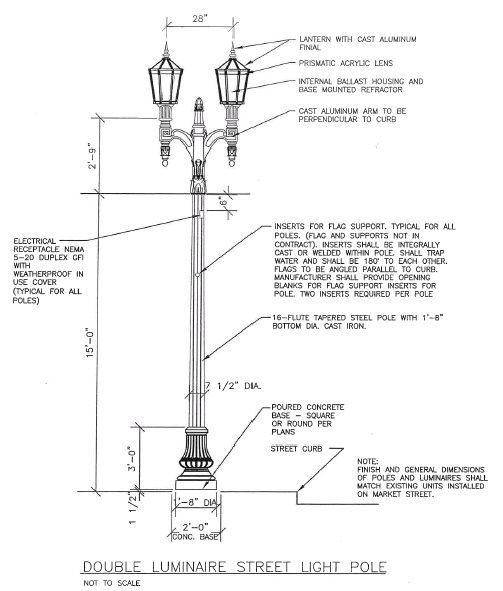
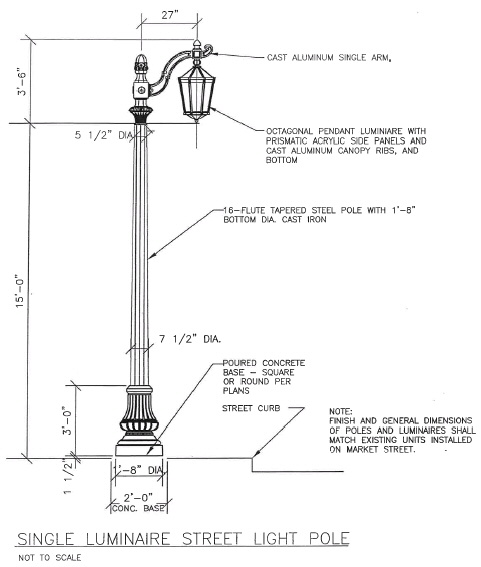
(c) No public street lights can be erected or placed within a preservation district unless the lighting fixture and pole conforms to the Double Luminaire Street Light pole or Single Luminaire Street Light pole drawings which follow.
 |
(Ord. 6, 2016. Passed 1-19-16.)
 |
(Ord. 6, 2016. Passed 1-19-16.)
1185.11 ISSUANCE OF CERTIFICATE OF APPROPRIATENESS.
(a) A certificate of appropriateness shall be obtained from the Review Board to make any change to a property within a preservation district or to a landmark, unless such property is exempted in accordance with the exclusions permitted in Section 1185.15 as determined by the Chief Building Inspector. A certificate of appropriateness shall also be obtained for proposed tree removal within a preservation district as prescribed herein, but shall not be required for removal of trees within street or alley right of way by the City.
(b) Applications for certificates of appropriateness shall be filed with the Chief Building Inspector in such form as may be prescribed by the Review Board prior to the issuance of any building, sign or demolition permit.
(c) Within thirty days after the filing of an application for a certificate of appropriateness, the Review Board shall decide whether the proposed change is appropriate. If the proposed change is in accordance with criteria and guidelines of the Review Board as provided for in this chapter, then the Review Board shall issue a certificate of appropriateness.
(d) In cases where the Review Board has disapproved certain work, the Review Board shall state the reasons for such disapproval in writing and transmit the written statement to the applicant and the Chief Building Inspector, together with any recommendations the Review Board may have made for appropriate changes before a certificate of appropriateness will be considered. The Chief Building Inspector shall not issue a building permit until a certificate of appropriateness is granted. The Review Board shall make every effort to work with the applicant for a period not to exceed sixty days to develop a proposal for such change that will be compatible with the terms of this chapter so as to permit a certificate of appropriateness to be issued.
(e) If the Review Board is unable to work out an alternative plan that conforms to the spirit and purpose of this chapter, and the applicant still desires to execute his proposal, the applicant shall make application to the Zoning Board of Appeals and the Zoning Board of Appeals, functioning under its own and otherwise prescribed rules of procedure, shall consider the positions of the applicant and the Review Board and may approve or deny the issuance of a certificate of appropriateness within thirty days of application to the Zoning Board of Appeals.
(Ord. 19, 1989. Passed 4-3-89.)
1185.12 CRITERIA FOR EVALUATING APPLICATIONS FOR CERTIFICATES OF APPROPRIATENESS.
(a) In considering the appropriateness of any change, the Review Board shall take into account, in addition to any other pertinent factors: the historical and architectural style and significance of the property; general design, arrangement, texture, material and color of the proposed change as they relate to the property in its present condition, and the relation thereof to the same or related factors in other properties, sites and areas in the immediate vicinity; and the enhancement of the community's economic enhancement through the protection of property values.
(b) Attention shall be taken to avoid the environmentally harmful effect often created by the clash of contemporary materials with those of older origin, such as aluminum or other metals, plastic, fiberglass and glass improperly used with brick, stone, masonry and wood.
(c) New developments within preservation districts shall be compatible with their surroundings.
(d) The Review Board shall refer to the criteria and guidelines for sign and design review established by the Review Board pursuant to the terms of this chapter. Guidelines shall promote the conservation, development and use of properties, sites and districts within the City and shall seek to preserve the special historic architectural, community or aesthetic integrity of the landmark or district. Guidelines shall guide applicants in making submittals and the Review Board in making its determination as to the appropriateness of the proposed change.
(e) The Review Board shall consider the advice of those consultants whose opinion is sought by the Review Board with respect to any application for a certificate of appropriateness.
(Ord. 19, 1989. Passed 4-3-89.)
1185.13 DEMOLITION.
(a) No person shall demolish any structure or exterior architectural feature until there has been filed with the Review Board an application for a certificate of appropriateness setting forth the intent to demolish such structure or exterior architectural feature together with a written statement that such structure or exterior architectural feature is not historically or architecturally significant or otherwise worthy of preservation. Upon determination by the Review Board that such property or exterior architectural feature is not historically or architecturally significant or otherwise worthy of preservation, due to projected development of the community, a certificate of appropriateness shall be issued. The applicant shall then apply for a permit to demolish the structure or exterior architectural feature.
(b) If the necessary demolition is questionable, the Review Board may delay determination of the application for a period of 180 days upon a finding that the structure is of such importance that alternatives to demolition may be feasible and should be actively pursued by both the applicant and the Review Board. In the event that action on an application is delayed as provided herein, the Review Board may take such steps as it deems necessary to preserve the property concerned, in accordance with the purposes of this chapter. Such steps may include but shall not be limited to, certification of a registered professional engineer that the structure of a building is unsound or would need major reinforcement to be brought under Building Code structural requirements, considering a use that the building would reasonably lend itself to; consultation with civic groups, public agencies and interested residents; recommendations for acquisition of property by public or private bodies or agencies; and exploration of the possibility to move one or more structures or other features.
(Ord. 19, 1989. Passed 4-3-89.)
1185.14 MINIMUM MAINTENANCE REQUIREMENT.
(a) The owner of an historic structure or any structure within an historic district shall provide sufficient maintenance and upkeep for such structure to ensure its perpetuation and to prevent its destruction by deterioration.
(Ord. 53, 1993. Passed 10-4-93.)
(b) The provisions of subsection (a) hereof shall be in addition to all other applicable provisions of the State Building Code.
(c) The Historic Conservation Board, on its own initiative, may file a petition with the Law Director of the City requesting that the Director proceed to take action against any owner which in the opinion of the Board is in violation of subsection (a) hereof.
(Ord. 7, 1990. Passed 2-5-90.)
1185.15 EXCLUSIONS.
Nothing in this chapter shall be construed to prevent the ordinary maintenance or repair of any property, within a preservation district or landmark under the provisions of this chapter, provided such work involves no change in material, design, texture, color or outer appearance; nor shall anything in this chapter be construed to prevent any change, including the construction, reconstruction, alteration or demolition of any building or feature which the Chief Building Inspector has designated as an unsafe building or feature pursuant to Part 13 of the Codified Ordinances as required for public safety being an unsafe or dangerous condition.
(Ord. 19, 1989. Passed 4-3-89.)
1185.99 PENALTY.
(a) Whoever constructs, reconstructs or alters any exterior architectural feature now or hereafter in the historic district in violation of this chapter shall be fined not less than fifty dollars ($50.00) nor more than five thousand dollars ($5,000).
(b) Whoever demolishes a substantial part or all of any building in the historic district in violation of this chapter shall be fined not less than ten thousand dollars ($10,000) nor more than twenty-five thousand dollars ($25,000).
(Ord. 7, 1990. Passed 2-5-90.)
CODIFIED ORDINANCES OF EAST LIVERPOOL

