
Eau Pleine Town Marathon County
City Zoning Code
City Zoning Code
Title 4
- GENERAL PROVISIONS
Sec. 17.401. - Accessory structures and fences.
17.401.01.
General standards applicable to all accessory structures.
A.
Principal Structure Required. In U-R, L-D-R, and R-R districts, accessory structures or buildings shall only be constructed or placed on a lot that contains a principal structure, unless a conditional use permit is obtained from the Board of Adjustment. The structure shall also adhere to any additional conditions placed on the permit by the Board of Adjustment. Refer to Table 3 for all permitted and conditional use options by zoning district.
B.
Materials/Appearance. To the extent possible, the exterior façade materials, appearance and architectural design of all accessory structures shall match the character of the use to which they are accessory, as well as the district of which they are located.
1.
Storage/shipping containers used as permanent accessory structures require a Conditional Use Permit in the U-R, L-D-R, R-R, R-E, and C-V/R-C zoning districts. Storage/Shipping Containers located in the U-R, L-D-R, R-R, R-E, and C-V/R-C zoning districts are subject to the following standards:
a.
The exterior shall be painted or sided in a manner to match the character of the use to which they are accessory, as well as the district of which they are located.
b.
Shall not be used for human habitation.
c.
Should interior plumbing be present structure shall conform to Marathon County General Code of Ordinances Chapter 15 - Private Sewage Code.
d.
Shall be located in the side or rear yard of the property.
2.
Storage/shipping containers used as permanent accessory structures, may be required to be screened from roads and/or adjacent properties in those districts in which they are allowed. Where applicable, screening may be manmade and/or vegetative and shall be approved by the Zoning Administrator prior to the issuance of a zoning permit. Only one permanent storage/shipping container is permitted on parcels five acres or less. See Table 3 for all permitted and conditionally approved uses designated by zoning district.
3.
Storage/shipping containers are prohibited in areas meeting the definition of a Major Subdivision as defined in Marathon County Chapter 18.
C.
Temporary Accessory Structures. Temporary buildings for uses incidental to construction work may be erected in any of the zone districts herein established, however, such temporary building or buildings shall be removed upon the completion or abandonment of the construction work. In residential districts, temporary accessory structures that do not require permanent attachment to the ground but have similar characteristics as an accessory structure and are intended to serve the same purpose as an accessory structure with permanent attachment, such as moveable carports, shall meet district yard setback requirements.
1.
All storage/shipping containers used on a temporary basis during construction, grading projects, or agricultural operations when utilized solely for the storage of supplies, solid waste, or equipment associated with construction, grading, or agricultural operations may be permitted in all zoning districts without the issuance of a zoning permit, yet shall not remain onsite for longer than 90 days in relation with an onsite project or until a permit associated with the onsite project expires or becomes void.
17.401.02.
Accessory buildings. The use of the accessory building must be secondary and incidental to the principal use.
A.
Attached Accessory Buildings. An accessory building which is attached to the main building by a common wall and roof shall comply with all the requirements and regulations that are applicable to the principal building.
B.
Detached Accessory Buildings. Detached accessory buildings shall not be used as a separate dwelling unit and shall comply with the requirements of the following Table 6.
C.
Accessory Structures Housing Livestock. Section 17.204.01.A.3.
D.
Accessory Structures within shoreland jurisdiction. Existing and new accessory buildings shall comply with all Marathon County shoreland regulations and provisions.
17.401.03.
Decks and landings.
A.
Setbacks.
1.
The outer perimeter of a deck shall not extend into a setback area.
2.
Decks and Landings in shoreland areas refer to General Code of Ordinances Chapter 22, Shoreland, Shoreland-Wetlands, and Floodplain and NR 115.
17.401.04.
Swimming pools. Public or private in-ground or above-ground swimming, wading or other pools containing over one and one-half feet of water depth shall be considered as structures for the purpose of permits, shall not be located in front yards but may be located in side and/or rear yards subject to location regulations pertaining to accessory structures. Pools may be constructed within 15 feet of a principal structure as long as there is adequate space for emergency services to access the rear yard. Such access shall be no less than 15 feet in width between the principal structure and any lot obstruction, including, but not limited to, accessory structure(s), utility boxes/lines, POWTS, wetlands, and steep slopes.
17.401.05.
Fences/wall regulations. Any fence or wall shall be well maintained, harmonious and appropriate in appearance with the existing character of the immediate area in which it is to be located, and shall not be hazardous or disturbing to existing or future neighboring uses.
A.
Residential Districts.
1.
Location in Front Yards. In residential districts, a fence, wall, hedge, or shrubbery may be erected, placed, maintained, or grown along a lot line on residentially zoned property or adjacent thereto to a height not exceeding six feet above the ground level, except that no fence, wall, hedge, or shrubbery which is located within the road setback, or corner side yard shall exceed a height of four feet. Additional considerations may be made at the discretion of the Zoning Administrator.
2.
Materials. Barbed wire and other similar hazardous materials are prohibited in residential districts, except for agricultural uses.
3.
Fences in shoreland areas refer to Chapter 22 Marathon County Shoreland, Shoreland-Wetland and Floodplain and NR 115.
B.
Nonresidential Districts.
1.
Location in Front Yards. In nonresidential districts and non-single-family lots in the U-R -District, fences and walls may be permitted in any front yard provided that the fence or wall does not exceed a maximum height of four feet.
2.
Location in Side and Rear Yards. Fences or walls may be permitted in any required side or rear yard to a maximum height of six feet. In the case of fences/walls required to screen outdoor storage areas, the fence/wall height shall be one foot higher than the material to be screened, or 12 feet, whichever is lower.
C.
General Requirements. All fences and walls shall comply with the following general requirements:
1.
Materials.
a.
In and Near Residential Districts. Materials used for fences and walls located in or within 200 feet of a residential district shall consist of treated wood or wood which is recognized and approved as a durable species, brick, masonry, vinyl, vinyl-coated chain link, metal bars not exceeding 1½ inches in diameter or other durable and weather- resistant materials which may be approved by the zoning official.
2.
Maintenance. Walls and fences shall be maintained in good condition. Rotten, crumbled, or broken components shall be replaced, repaired, or removed. It is encouraged to secure an access agreement with the adjacent property owner for the purpose of maintenance of said fence.
3.
Prohibited obstructions.
a.
Right-of-Way. Fences and walls shall not be erected within two feet of the public right-of-way.
b.
Corner Clear Vision Area. Any fence erected in a corner clear vision area (see Section 17.202.09) shall have a minimum of 50 percent of the area of the vertical surface open to light and air.
c.
Obstruction of Adjacent Uses Prohibited. No wall or fence may be erected where it will prevent or unreasonably obstruct the use of any adjacent parcel, nor shall a wall or fence be erected where it would prevent or unreasonably obstruct the safe use of an existing driveway or other means of access to any adjacent parcel. In enforcing this provision, the county may require a wall or fence to be set back a minimum distance from a driveway or property line.
4.
Orientation of finished side. Where a fence or wall has a single finished or decorative side, it shall be oriented to face outward toward adjacent parcels or street rights-of-way (away from the interior of the lot to which the fence is associated).
5.
Site drainage and utilities. Fences and walls shall not be erected in a manner that obstructs the free flow of surface water or causes damage to underground utilities. Any changes to existing grade shall require approval by the Zoning Administrator.
6.
Location. Fences and walls shall be located completely within the boundaries of the lot(s) to which they are associated.
(O-34-23; O-21-24)
Sec. 17.402. - General provisions.
17.402.01.
Conditions and safeguards.
A.
Conditions and Safeguards, Generally. The Zoning Administrator, Board of Adjustment, and/or Committee shall have the power to safeguard the intent and objectives of this Zoning Ordinance by imposing appropriate restrictions and safeguards as conditions of any approval it gives.
B.
Access Management. In the exercise of the power to impose safeguards and conditions, the Zoning Administrator, Board of Adjustment, and/or Committee may, including, but not limited to, SR 29, have the power to limit or reduce street ingress and egress accesses as well as to require owners and developers to grant easements to adjacent property owners in such locations as the Department of Transportation shall require and other requirements as specified in Section 17.303. These powers and conditions are exercised, in general, to assure public health, safety, welfare and convenience, to reduce the traffic impact along Marathon County's major thoroughfares and to permit traffic to flow safely from site to site along drives parallel to the state highways without having to cross multi-lane highways.
17.402.02.
Special costs. When the Committee or Board of Adjustment finds it necessary to maintain a strict record of public hearing procedures, or when either the Committee or Board deems it necessary to cause special studies to be made, then the applicant shall bear all direct and related costs.
17.402.03.
Relaxation of standards for persons with disabilities. The Zoning Administrator may issue a permit to relax dimensional standards of this Ordinance in order to provide reasonable accommodation of persons with disabilities as required by provisions of federal and state law. Such relaxation shall be consistent with federal guidelines for accommodation of persons with disabilities and shall, where practicable, be terminated when the facility is no longer in use by a disabled person. A person applying for a permit for construction under this section shall establish:
1.
That the facility or premises are routinely used by a disabled person;
2.
The nature and extent of the disability; and
3.
That the relaxation requested is the minimum necessary to provide reasonable use of the facility by the disabled person.
17.402.04.
Lot line policy.
A.
To ensure that the minimum setbacks will be met for proposed projects, the property owner shall clearly mark in the field the lot line(s) and property corners adjacent to where the activity will take place if:
1.
The proposed activity is to take place within ten feet of the minimum setback distance of the lot line(s).
B.
Furthermore, the administrator may require the lot line(s) to be surveyed by a professional land surveyor if:
1.
The location of the marked lot line(s) by the property owner is not consistent with the location of the lot line(s) shown in public records; and/or
2.
If there is a disagreement by any of the parties involved about the location of the lot line(s).
C.
If required, markings shall be clearly visible and accurate prior to, as well as at the time of inspection.
17.402.05.
Wetland boundary policy. All uses and activities established after the effective date of this Zoning Ordinance shall comply with the following standards:
A.
To ensure that a proposed project will not encroach into protected wetland areas, the applicant and/or agent shall have the wetland boundaries marked in the field if the proposed activity is to take place within 35 feet of a mapped wetland as shown on the Wisconsin DNR wetland inventory maps.
B.
Furthermore, the administrator may take into consideration all available information when determining whether the wetland boundaries shall be marked. This may include wetland indicators (such as soil types, slopes and elevations, vegetation types, hydrology), professional judgement, previous delineations conducted on the property, etc. With this information, markings may also be required for areas greater than 35 feet from a mapped wetland as shown on the Wisconsin DNR wetland inventory maps.
C.
If required, the markings of the wetland boundary shall be clearly visible and accurate prior to, as well as at the time of inspection. If there is a disagreement by any of the parties involved about the location of the marked wetland boundary, the administrator may require the wetland boundary to be confirmed by WI DNR and/or the Army Corps of Engineers.
D.
If the proposed project will encroach into the wetland area, the owner shall be responsible for meeting any and all standards required by other agencies, as well as securing any additional required permits from other agencies prior to approval of any permit(s) issued from CPZ.
(O-34-23)
Sec. 17.403. - Exterior lighting.
17.403.01.
Purpose. The purpose of this section is to preserve, protect, and enhance the lawful nighttime use and enjoyment of all properties in the county through the use of appropriate lighting practices and systems in the commercial and industrial districts. Exterior lighting shall be designed, installed and maintained to control glare and light trespass, minimize obtrusive light, conserve energy and resources, maintain safety, security and productivity, and prevent the degradation of the nighttime visual environment. It is the further intent of this section to encourage the use of innovative lighting designs and decorative light fixtures that enhance the character of the community while preserving the nighttime visual environment. The standards in this section are based on the recommendations of the Illuminating Engineering Society of North America's Lighting Handbook.
17.403.02.
Definitions. As used in this section, the following terms shall have the following meanings:
A.
Fixture. A complete lighting unit consisting of a lamp or lamps, together with any reflectors, refractors, diffusers, baffles, or other devices to distribute the light, and with parts to position and protect the lamp and to connect the lamps to the power supply; also called the luminaire.
B.
Footcandle. A unit of illumination. One footcandle equals one lumen of light flux distributed evenly on one square foot of surface.
C.
High Activity Area. Areas of frequent pedestrian activity or congregation. Examples include, but are not limited to, building entrances, ATMs, cluster mailboxes, transit shelters or stops, gas station canopies, and outdoor sales areas.
D.
Low Activity Area. Areas that are dedicated primarily to vehicle use, and where there is infrequent turnover of parking spaces or other pedestrian activity. Examples include, but are not limited to, office or industrial parking lots, and security lighting applications.
E.
Medium Activity Area. Areas of vehicle use where there is frequent turnover of parking spaces and where persons transition from vehicle to foot travel, or areas of infrequent pedestrian use. Examples include, but are not limited to, retail parking lots and dumpsters or trash disposal areas in residential areas.
F.
Uniformity Ratio. The ratio of average illumination to minimum illumination. More evenly illuminated areas are perceived to be safer, as more consistent illumination aids visual acuity of the human eye. EXAMPLE: A uniformity ratio of 4:1 means that, for a given area, the lowest level of illumination (1) should be no less than one-forth or "four times less" than the average (4) level of illumination.
G.
Visual Acuity. The ability to detect a different aspect of detail. Excessive brightness, insufficient light or drastic changes in illuminance levels in a small area can hinder visual acuity.
17.403.03.
Intensity. The following illumination requirements shall apply on all sites within the County:
A.
Horizontal Illuminance Requirements. The intensity of light within illuminated portions of a site shall comply with the requirements of the following Table 7. The reviewing authority shall determine which portions of the site are high, medium, or low activity areas. All footcandle illuminance measurements are taken at five feet above grade level.
B.
Maximum Intensity at Street Right-of-Way. The maximum light intensity permitted at a street right-of-way line shall be one footcandle, or the average light intensity generated by public street lighting at the property line (up to a limit of five-foot candles), whichever is greater.
C.
Maximum Intensity at Property Lines. The maximum light intensity permitted at any residential property line other than a street right-of-way shall prevent light trespass and obtrusive light (a maximum of 0.5 footcandles).
D.
Security Lighting. Areas requiring security lighting shall comply with the intensity requirements for a low activity area.
E.
Measurement. Light intensity shall be measured in footcandles on the horizontal plane at five feet above grade level within the site, and on the vertical plane at the property or street-right-of-way boundaries of the site at a height of five feet above grade level.
17.403.04.
General provisions. The design and illumination standards of this section shall apply to all exterior lighting sources and other light sources visible from the public right-of-way, road easement, or adjacent parcels, except where specifically exempted herein.
A.
Shielding. Exterior lighting shall be fully shielded and directed downward at a 90-degree angle. Oblique lenses (such as many wall-pack fixtures) are prohibited. All fixtures shall incorporate full cutoff housings, louvers, glare shields, optics, reflectors or other measures to prevent off-site glare and minimize light pollution. Only flat lenses are permitted on shoebox-style light fixtures; sag or protruding lenses are prohibited. See Figure 3 below:
Figure 3: LIGHT FIXTURE ORIENTATION AND SHIELDING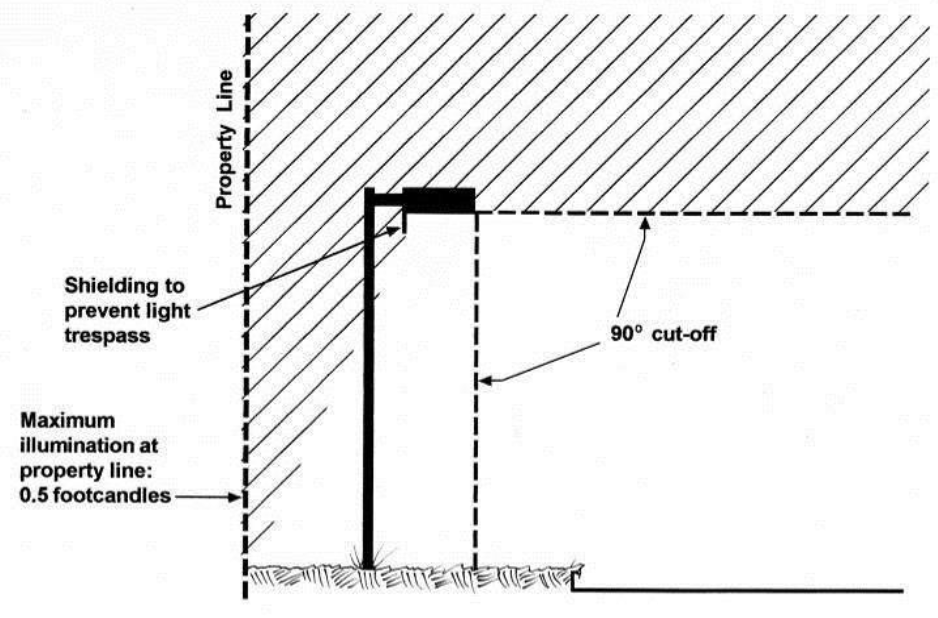
B.
Glare. Exterior lighting sources shall be designed, constructed, located and maintained in a manner that does not cause off-site glare on neighboring properties or street rights-of-way. The light emitting element of any light fixture shall not be directly visible from a neighboring property, as this is the primary cause of glare.
C.
Lamps.
1.
Wattage. Lamps with a maximum wattage of 250 watts (or LED equivalent) per fixture are permitted for use in the County to maintain a unified lighting standard and to minimize light pollution.
2.
LED Lighting. LED fixtures may be used for any outdoor lighting application. Any LED fixture used for parking lot or street lighting purposes shall comply with applicable Illuminating Engineering Society of North America standards.
D.
Animated lighting. Permanent exterior site lighting intended to illuminate outdoor areas shall not be of a flashing, moving, animated, or intermittent type.
17.403.05.
Standards by type of fixture.
A.
Freestanding pole and building mounted lighting. The maximum height of fixtures used for site lighting is 25 feet. Where a pole or building mounted fixture is located within 50 feet of a residentially zoned or used property, the maximum pole height shall be 15 feet.
17.403.06.
Exempt lighting. The following exterior lighting types are exempt from the requirements of this Chapter, except that the Zoning Administrator may take steps to minimize glare, light trespass or light pollution impacts where determined to be necessary to protect the health, safety and welfare of the public:
A.
Holiday Decorations when in season.
B.
Pedestrian Walkway Lighting.
C.
Building Up-Lighting. Provided that the light emitting element of the fixture is shielded from direct view from any vehicle or pedestrian travel or use area, and that the fixture is directed at a vertical building surface.
D.
Pre-Emption. Instances where federal or state laws, rules or regulations take precedence over the provisions of this Chapter.
E.
Temporary Emergency Lighting.
F.
Special Event Lighting for time periods of seven or fewer days provided that the lighting will not significantly impact residential areas.
17.403.07.
Exceptions. The County recognizes that there are certain uses or circumstances not otherwise addressed in this Chapter, such as:
A.
Sports stadiums.
B.
Street lighting.
C.
Lighting for monuments and flags that may have special exterior lighting requirements.
The use of lamps with greater than 250 watts may permit the use of lamps with wattages up to 400 watts if the applicant can demonstrate that the higher wattage fixture is necessary to provide adequate lighting on the site and that the light fixture is in compliance with all other requirements of this section. The exemption for higher wattage lamps shall not be granted if the same lighting effect can be reasonably accomplished on the site by incorporating additional 250 watt or lower fixtures into the site design.
D.
Decorative light fixtures. The Zoning Administrator and/or Board of Adjustment may approve decorative light fixtures that may be unshielded as an alternative to shielded fixtures, provided that such fixtures will enhance the aesthetics of the site and will not cause undue off-site glare or light pollution. Such fixtures may utilize LED, incandescent, tungsten-halogen, metal halide or other lamps with full-spectrum color rendering properties with a maximum equivalent wattage of 150 watts per fixture.
The reviewing authority for the application, to which the exception request is a party, may waive or modify specific provisions of this Chapter for a particular use or circumstance upon determining that all of the following conditions have been satisfied. The reviewing authority shall consider the following criteria in making its decision:
A.
The waiver or modification is necessary because of safety or design factors unique to the use, circumstance or site.
B.
The minimum possible light intensity is used that would be adequate for the intended purpose. Consideration shall be given to maximizing safety and energy conservation, and to minimizing light pollution, off-site glare and light trespass on to neighboring properties or street rights-of-way.
C.
For lighting related to streets or other vehicle access areas, a determination is made that the purpose of the lighting cannot be achieved by installation of reflective markers, lines, informational signs or other passive means.
Additional conditions or limitations may be imposed by the reviewing authority to protect the public health, safety or welfare, or to fulfill the purpose of this Chapter.
17.403.08.
Review. All lighting plans must be approved prior to installation.
A.
Site plans may be approved as part of the approval for the overall use.
1.
Administrative review for permitted uses per Section 17.802.03.
2.
Board of Adjustment for conditional uses per Section 17.803.02.
B.
If lighting plan is not approved within overall use a separate administrative review is required.
(O-34-23)
Sec. 17.404. - Wireless telecommunications facilities.
17.404.01.
Mobile tower siting.
A.
Mobile Tower Siting.
1.
Application. New Tower.
a.
A county zoning permit is required for the siting and construction of any new mobile service support structure and facilities in a county zoned town or within shoreland jurisdiction.
b.
A written permit application must be completed by any applicant and submitted to the Zoning Administrator. The application must contain the following information:
1)
The name and business address of, and the contact individual for, the applicant.
2)
The location of the proposed or affected support structure.
3)
The location of the proposed mobile service facility.
4)
Proof a site address has been issued for the tower and is in the E911 system.
5)
Copy of easement or agreement with landowner if the land is not owned by the company.
6)
Must be located outside of the airport height district (three-mile radius from Central Wisconsin Airport) or obtain an airport height zoning permit and Noise and Avigation Easement and Non-suit Covenant pursuant to the Marathon County General Code of Ordinances Section 17.305, Airport Approach Protection.
7)
A construction plan which describes the proposed mobile service support structure and the equipment and network components, including antennas, transmitters, receivers, base stations, power supplies, cabling, and related equipment to be placed on or around the new mobile service support structure.
8)
An explanation as to why the applicant chose the proposed location and why the applicant did not choose co-location, including a notarized sworn statement from an individual who has responsibility over the placement of the mobile service support structure attesting that co-location within a two-mile radius would not result in the same mobile service functionality, coverage, and capacity; is technically infeasible; or is economically burdensome to the mobile service provider.
c.
If an applicant submits to the county an application for a permit to engage in an activity described in this Ordinance, which contains all of the information required under this Ordinance, the county shall consider the application complete. If the county does not believe that the application is complete the county shall notify the applicant in writing, within ten calendar days of receiving the application, that the application is not complete. The written notification shall specify in detail the required information that was incomplete. An applicant may resubmit an application as often as necessary until it is complete.
d.
Within 90 calendar days of its receipt of a complete application, the county shall complete all of the following or the applicant may consider the application approved, except that the applicant and the county may agree in writing to an extension of the 90-calendar day period:
1)
Review the application to determine whether it complies with all applicable aspects of the political subdivision's building code and, subject to the limitations in this section, zoning ordinances.
2)
Make a final decision whether to approve or disapprove the application.
3)
Notify the applicant, in writing, of its final decision.
4)
If the decision is to disapprove the application, include with the written notification substantial evidence which supports the decision.
e.
The county may disapprove an application if an applicant refuses to evaluate the feasibility of co-location within the applicant's search ring of one-half mile and provide the sworn statement described under paragraph Section 17.404.01.A.1.b.8.
f.
For those mobile towers/telecommunication facilities proposed within the Farmland Preservation Zoning District, the applicant must identify how the proposal meets all the applicable standards identified in this section as well as those standards within Section 17.301.09.A.
2.
Application Process. Co-location of antennas without increasing height of the tower.
a.
A written and signed affidavit from an engineer submitted to the department stating the following:
1)
Number of antennas to be added and the total number of antennas.
2)
That the structure can support the amount of antennas and equipment.
3)
That the frequencies will not interfere with existing antennas on the tower.
3.
Application Process. Co-location of antennas increasing height of tower.
a.
A written and signed affidavit from an engineer submitted to the department stating the following:
1)
Number of antennas to be added and the total number of antennas.
2)
Total height of the structure.
3)
That the structure can support the amount of antennas and equipment.
4)
That the frequencies will not interfere with existing antennas on the tower.
b.
Tower is to be located outside of the airport height district (three-mile radius from Central Wisconsin Airport) or verify that the structure's height meets the terms of the Marathon County General Code of Ordinances Section 17.305, Airport Approach Protection Overlay District.
c.
If an airport height zoning permit and Noise and Avigation Easement and Non-suit Covenant are not on file they must be completed and filed pursuant to the Marathon County General Code of Ordinances Section 17.305, Airport Approach Protection Overlay District.
4.
Height, Yard, Area and Other Requirements.
a.
Height. Must meet the terms of the Marathon County General Code of Ordinances Section 17.305, Airport Approach Protection if within three miles of Central Wisconsin Airport.
b.
Side Yards. Minimum width of any side yard shall be 20 feet from the guy wires or tower whichever is closer to the lot line. If an applicant provides the county with an engineering certification showing that a mobile service support structure, or an existing structure, is designed to collapse within a smaller area than the setback or fall zone area required that shall be used unless the county provides the applicant with substantial evidence that the engineering certification is flawed.
c.
Rear Yard. Minimum depth of any rear yard shall be 35 feet from the guy wires or tower whichever is closer to the lot line. If an applicant provides the county with an engineering certification showing that a mobile service support structure, or an existing structure, is designed to collapse within a smaller area than the setback or fall zone area required that shall be used unless the county provides the applicant with substantial evidence that the engineering certification is flawed.
(O-34-23)
Sec. 17.405. - Wind energy systems (WES).
17.405.01.
Purpose. The purpose of this Chapter is to adopt and incorporate the requirements of § 66.0401, Wis. Stats., and Wis. Admin. Code PSC 128 as a local ordinance and to establish local regulations on the installation, siting, use, and decommissioning of wind energy systems that are authorized by, compliant with, and are no more restrictive than the rules promulgated by the Wisconsin Public Service Commission and that serve to preserve and protect the public health, safety, and welfare. For the purposes of this section Large Wind Energy Systems are systems that have a total installed nameplate capacity of 300 kilowatts or greater and consists of individual wind turbines that have an installed nameplate capacity of more than 100 kilowatts. Systems with a total installed nameplate capacity of greater than 100 Megawatts may not be regulated by this Ordinance. Small Wind Energy Systems are systems that have a total installed nameplate capacity of 300 kilowatts or less and that consists of individual wind turbines that have an installed nameplate capacity of not more than 100 kilowatts.
17.405.02.
Permit, application, and filing requirements.
A.
Permit Requirements and Fee(s).
1.
For Small Wind Energy Systems:
a.
The exemptions listed under PSC 128.60 and modifications under PSC 128.61 shall apply to an application that is submitted for a small Wind Energy System.
2.
For all Wind Energy Systems:
a.
Costs of review and processing: For all Wind Energy Systems the owner shall reimburse the department for the reasonable costs associated with permit review and processing, subject to the reimbursement requirements of PSC 128.32(5). In the event the county establishes a fee consistent with Wis. Stats., 59.69 and PSC 128.32(5), said fee will be charged in lieu of reimbursement.
b.
The established fee or reimbursement requirements consistent with PSC 128.32(5) shall include the requirement that the applicant shall pay all reasonable costs incurred by the county in connection with the review and processing of the application, including the cost for services provided by outside attorneys, engineers, environmental specialists, planners, and other consultants and experts that are actual and necessary costs of review. Source: PSC 128.32(5).
1)
The department is authorized to contract with one or more engineers, environmental specialists, planners, and other consultants and experts to perform necessary services in connection with this Ordinance.
2)
The corporation counsel is authorized to contract with outside legal counsel to perform services in connection with this Ordinance.
c.
The county shall make the applicant aware of any such reasonable and necessary costs prior to incurring such costs and, if the applicant decides not to pay the reasonable and necessary costs, the application shall be denied.
d.
The county may require the owner of a Wind Energy System to submit up to 50 percent of the total estimated amount of the fee or reimbursement for the wind energy system application under PSC 128.32(5)(a) before issuing a written decision consistent with PSC 128.32(3), if the county gives written notice to the owner of its intent to do so within ten days of the date the application is deemed complete and the notice contains an estimate of the amount of the fee and the relevant reimbursement requirements.
e.
The county shall invoice the applicant for the reasonable costs incurred pursuant to this section. The applicant will be provided 30 days from the date of the invoice to reimburse the county.
B.
Application Requirements.
1.
For Small Wind Energy Systems. An owner shall file an application with the department that, at a minimum, includes the following information:
a.
Wind Energy System description and maps showing the locations of all proposed wind energy facilities. (This may include the description and maps for alternative wind energy facility locations.)
b.
Technical description of wind turbines and wind turbine sites.
c.
Timeline and process for constructing the Wind Energy System.
d.
Information regarding anticipated impact of the Wind Energy Systems on local infrastructure.
e.
Information regarding noise anticipated to be attributable to the Wind Energy System.
f.
Information regarding shadow flicker anticipated to be attributable to the Wind Energy System, consistent with PSC 128.15, with the exception of PSC 128.15(1)(c), 3(b)—(e), and (5) which do not apply to Small Wind Energy Systems.
g.
Information regarding the anticipated effects of the Wind Energy System on existing land uses within one-half mile of adjacent to the Wind Energy System.
h.
Information regarding the anticipated effects of the Wind Energy System on airports and airspace
i.
Information regarding the anticipated effects of the Wind Energy System on line-of-sight communications, consistent with PSC 128.16, with the exception of PSC 128.16(2)—(4) which do not apply to Small Wind Energy Systems.
j.
A list of all state and federal permits required to construct and operate the Wind Energy System
k.
Information regarding the planned use and modification of roads during the construction, operation, and decommissioning of the Wind Energy System, including a process for assessing road damage caused by Wind Energy System activities and for conducting road repairs at the owner's expense.
l.
A representative copy of all notices issued consistent with PSC 128.105(1) and 128.30(5), except as provided by PSC 128.61.
2.
For Large Wind Energy Systems. An owner shall file an application with the department that, at a minimum, includes the following information:
a.
All information required under Section 17.405.02(B)(1)a.—f. and h.—l. of this section.
b.
Information regarding the anticipated effects of the Wind Energy System on existing land uses within 0.5 mile of the Wind Energy System. (For example, information may include the anticipated effects to applicable environmental conditions and/or development limitations within 0.5 miles).
c.
A representative copy of all notices issued under sub. PSC 128.105(1), 128.30(5), and 128.42(1), which are:
1)
Pre-application notice. At least 90 days before an owner files an application to construct a Wind Energy System, an owner shall use commercially reasonable methods to provide written notice of the planned wind energy system to all of the following:
a)
Landowners within one mile of the planned wind turbine host properties.
b)
Political subdivisions within which the Wind Energy System may be located.
c)
Emergency first responders and air ambulance service providers serving the political subdivisions within which the Wind Energy System may be located.
d)
The Wisconsin department of transportation.
e)
The Wisconsin public service commission.
f)
The Wisconsin department of natural resources.
g)
The Wisconsin department of agriculture, trade and consumer protection.
h)
The office of the deputy undersecretary of the U.S. department of defense.
2)
Notice of process for making complaints. Before construction of a Wind Energy System begins, an owner shall provide written notice of the process for making complaints and obtaining mitigation measures to all residents and landowners within one-half mile of any wind energy system facility. An owner shall include in the notice the requirements under PSC 128.40(1) for submitting a complaint to the owner, a petition for review to the political subdivision, and an appeal to the commission, and shall include a contact person and telephone number for the owner for receipt of complaints or concerns during construction, operation, maintenance and decommissioning.
3)
A copy of all emergency plans developed in collaboration with appropriate first responders under PSC 128.18(4)(b). An owner may file plans using confidential filing procedures as necessary.
4)
A decommissioning and site restoration plan providing reasonable financial assurance that the owner will be able to comply with PSC 128.19.
3.
For All Applications. Evidence shall be included for all applications to show that, on the same day an owner filed an application under this Ordinance, the owner used commercially reasonable methods to provide written notice of the filing of the application to property owners and residents located within one mile of the proposed location of any Wind Energy System facility. The notice shall include all of the following:
a.
A complete description of the Wind Energy System, including the number and size of the wind turbines.
b.
A map showing the location of all proposed Wind Energy System facilities.
c.
The proposed timeline for construction and operation of the Wind Energy System.
d.
Locations where the application is available for public review.
e.
Owner contact information (including the contact person(s), primary phone number, and email).
17.405.03.
Local regulations.
A.
Airport Approach Protection Overlay District. An owner may not construct any wind energy system that does not comply with the Marathon County Airport Zoning Ordinance which, in part, controls the height of structures within the Airport Approach Protection Overlay District (Section 17.305), which shall be no more restrictive than limitations referenced in PSC 128.13(2)(b).
B.
Farmland Preservation Zoning District. No conditional use permit or zoning permit application for a wind energy system shall be approved by the Marathon County Board of Adjustment or Zoning Administrator within the Farmland Preservation Zoning District, unless such application meets the applicable standards and conditions identified in § 91.46(4)(a)—(e), Wis. Stats., also listed in Section 17.301.09 of this Ordinance.
1.
The use and its location in the farmland preservation zoning district are consistent with the purposes of the farmland preservation zoning district.
2.
The use and its location in the farmland preservation zoning district are reasonable and appropriate, considering alternative locations, or are specifically approved under State or Federal Law, 66.04.
3.
The use is reasonably designed to minimize conversion of land at and around the site of the use, from agricultural use or open space use.
4.
The use does not substantially impair or limit the current or future agricultural use of surrounding parcels of land that are zoned for, or legally restricted to, agricultural use.
5.
Construction damage to land remaining in agricultural use is minimized and repaired, to the extent feasible.
C.
Abandonment and Decommissioning. Section 17.405.03.C.1.—3. below apply to both Large and Small Wind Energy Systems, whereas Section 17.405.03.C.4 applied solely to large Wind Energy Systems.
1.
A wind energy system that that is at the end of its useful life and/or does not generate electricity for a continuous period of 360 days will be deemed abandoned and the department may send a Notice of Abandonment to the owner. Exemptions under PSC 128.60 and modifications under PSC 128.61 apply to all Small Wind Energy Systems.
2.
If, within 30 days of receipt of a Notice of Abandonment, the owner provides the department with information showing to the department's satisfaction that the wind energy system has not been abandoned, the department will withdraw the Notice.
3.
Unless the department withdraws the Notice of Abandonment, a wind energy system tower must be decommissioned as prescribed by PSC 128.19. If the owner fails to remove a wind energy system and reclaim the site, the county may remove or cause the removal of the wind energy system and arrange for the reclamation of the site.
4.
For Large Wind Energy Systems.
a.
An owner with a nameplate capacity of one megawatt or larger shall provide the county with and maintain proof of financial assurance of the owner's ability to pay the actual and necessary cost to decommission the wind energy system before commencing major civil construction activities such as blasting or foundation construction at the wind energy system site. An owner may comply with this paragraph by choosing to provide a bond, deposit, escrow account, irrevocable letter of credit, or some combination of these financial assurances, that will ensure the availability of funds necessary for decommissioning throughout the expected life of the wind energy system and through to completion of the decommissioning activities, consistent with PSC 128.19(3).
1)
An owner shall provide the county with three estimates of the actual and necessary cost to decommission the wind energy system. The cost estimates shall be prepared by third parties agreeable to the owner and the county. The amount of financial assurance required by the county shall not exceed the average of the three estimates.
2)
An owner shall establish financial assurance that is acceptable to the county and that places the county in a secured position, subject to [Section] 17.405.03(C)(4)(a)(1). The financial assurance must provide that the secured funds may only be used for decommissioning the wind energy system until such time as the county determines that the wind energy system has been decommissioned, as provided for in PSC 128.30(5)(b), or the county otherwise approves the release of the funds, whichever occurs first.
3)
An owner shall establish financial assurance that allows the county to access funds for the purpose of decommissioning the wind energy system if the owner does not decommission the wind energy system when decommissioning is required. Source: PSC 128.19(3)(c)(4)
b.
The county may periodically request information from the owner regarding industry costs for decommissioning the wind energy system. If the county finds that the future anticipated cost to decommission the wind energy system is at least ten percent more or less than the amount of financial assurance provided under this section, the county may correspondingly increase or decrease the amount of financial assurance required, but shall not adjust the financial assurance required under this paragraph more often than once in a five-year period.
c.
The county may require an owner to submit a substitute financial assurance of the owner's choosing if an event occurs that raises material concern regarding the viability of the existing financial assurance.
d.
Except as provided below in Section 17.405.03(C)(4)(e), if a wind energy system was constructed on land owned by a person or persons other than the owner of the wind energy system, the owner of the wind energy system shall ensure that the property is restored to preconstruction condition, unless otherwise provided in a contract signed by an affected landowner, considering any modifications needed to comply with DNR requirements.
e.
If a wind energy system was constructed on a brownfield, as defined in § 238.13(1)(a), Wis. Stats., the owner shall restore the property to eliminate effects caused by the wind energy system, except for the effects of environmental remediation activities, as defined in § 238.13(1)(d), Wis. Stats.
5.
All abandonment and decommissioning is subject to review as provided in Section 17.405.08.
D.
Lighting Criteria. A wind energy wind system may be artificially lighted only if lighting is required by the Federal Aviation Administration. An owner shall use shielding or control systems approved by the Federal Aviation System to reduce visibility of light when viewed from the ground.
E.
Noise Criteria.
1.
For both Large and Small Wind Energy Systems.
a.
The noise generated by the operation of a wind energy system may not exceed 50 dB(A) during the daytime hours and 45 dB(A) during the nighttime hours as measured at the outside wall of a nonparticipating residence or occupied community building that existed when the owner gave notice pursuant to PSC 128.105(1) or for which complete publicly available plans for construction were on file with a political subdivision within 30 days of the date when the owner gave notice pursuant to PSC 128.105(1). Nighttime hours are the hours beginning at 10:00 p.m. and ending at 6:00 a.m. daily and daytime hours are the hours beginning at 6:00 a.m. and ending at 10:00 p.m. daily.
b.
The owner of an adjacent nonparticipating residence or adjacent occupied community building may relieve the owner of the wind energy system of the requirement to meet any of the noise limits in this section by written contract as provided in PSC 128.14(5) and (6).
c.
The owner shall provide the notice as prescribed by PSC 128.61(4).
d.
If an owner receives a complaint of a violation of the noise standards contained in PSC 128.14 and the owner has not provided the department with the results of an accurate test conducted within two years of the date of the complaint showing that the wind energy system is in compliance with the noise standard at the location relating to the complaint, the owner shall promptly conduct a noise study to evaluate compliance with the noise standards at that location using the most current version of the noise measurement protocol as described in PSC 128.50(2).
F.
Ownership Changes.
1.
For Small Wind Energy Systems. The owner shall provide the county with notice of any change in ownership of the wind energy system on or within 30 days of the effective date of the change.
2.
For Large Wind Energy Systems. The owner shall provide the county with notice of any change in ownership of the wind energy system on or within 30 days of the effective date of the change. Notwithstanding the timing of notice of change in ownership of the wind energy system set forth above, the notice shall include information showing that the financial responsibility specified under Section 17.405.03(C) of this Chapter was assumed by the new owner, upon the effective date of the change.
G.
Setbacks and Siting Criteria. An owner shall work with a political subdivision and owners of participating and nonparticipating properties to site wind turbines to minimize individual hardships. Source: PSC 128.13(1)(c)
1.
For Small Wind Energy Systems. Shall comply with the minimum setback distances shown in Table 2 to PSC 128.13 included in PSC 128.61, which are:
2.
For Large Wind Energy Systems. Shall comply with the minimum setback distances shown in Table 1 in PSC 128.13, which are:
H.
Notice of Federal or State Agency Consultation.
1.
For Large Wind Energy Systems. In the event the owner has consulted with and received any non-binding recommendations for constructing, operating, or decommissioning of the wind energy system from any state or federal agency. The owner shall provide the county with information about the consultation and whether the owner has incorporated such non-binding recommendations into the design of the wind energy system, within 30 days of receiving such recommendations. Source PSC 128.33(1).
17.405.04.
Local procedure.
A.
All applications regulated by this section may be subject to additional conditions and restrictions consistent with but no more restrictive than those in § 66.0401(1M), Wis. Stats., and authorized by, and consistent with, PSC 128, Wis. Admin. Code. Where such conditions are considered and applied on a case-by-case basis; as well as satisfy one of the following:
1.
Serves to preserve or protect the public health or safety.
2.
Does not significantly increase the cost of the system or significantly decrease its efficiency.
3.
Allows for an alternative system of comparable cost and efficiency.
B.
Small Wind Energy Systems shall be processed as a permitted use.
1.
This section does not apply to Small Wind Energy Systems subject to the conditional use permit standards and conditions within the farmland preservation zoning districts. See Section 17.405.03.B.
C.
Large Wind Energy Systems shall be processed as a conditional use.
1.
In addition to conditions established pursuant to Section 17.405.04.A, the Zoning Administrator or Board of Adjustment may require the owner of a Wind Energy Systems to offer monetary compensation to the owner of a non-participating residence consistent with PSC 128.33(3) and also may be subject to the monetary compensation requirements of PSC 128.33(3m).
D.
Application Processing.
1.
Within 45 days of receiving the application, the department shall notify the applicant whether the application is complete and, if it is not, what the applicant must do in order to make it complete.
a.
The applicant shall provide the additional information specified in the notice to the department within 60 days of the date of the notice.
b.
The owner may file a new application at a later date; there is no limit to the number of times that an owner may file an application.
c.
An application shall be deemed complete if it complies with the filing requirements of Section 17.405.02 of this Ordinance and of PSC 128.30(2) and 128.50(1).
2.
As soon as reasonably possible after receiving a complete application, the department shall publish a class 1 notice, under ch.985 Stats., stating that an application for approval has been filed with the county.
a.
For Small Wind Energy Systems. The department shall make the application available for public review consistent with PSC 128.30(6)(a) and shall accept written comments on the application for a minimum period of ten days following the date of the published notice. The county shall hold at least one public meeting to obtain comments on and to inform the public about the proposed wind energy system consistent with PSC 128.30(6).
1)
This section does not apply to Small Wind Energy Systems subject to the conditional use permit standards and conditions within the farmland preservation zoning districts. See Section 17.405.03.B.
b.
For Large Wind Energy Systems. The application will be forwarded to the Board of Adjustment for issuance of a conditional use permit under Chapter 17.803 of this Ordinance and reviewed under the criteria of this Section 17.405. Notwithstanding the provisions of Section 17.803, the application shall be determined to be complete if it meets the requirements under PSC 128.30(2) and 128.50(1).
3.
The county shall make a record of its decision making on an application, including a recording of any public hearing, copies of documents submitted at any public hearing, and copies of any other documents provided to the county in connection with the application for approval.
4.
The county shall base its decision on an application on written findings of fact that are supported by the evidence in the record.
a.
For Large Wind Energy Systems. For Wind Energy Systems with a nominal capacity of at least one megawatt, the county may deny an application for approval if the proposed site of the wind energy system is in an area primarily designated for future residential or commercial development, as shown in a map that is adopted, as part of a comprehensive plan, under § 66.1001(2)(b) and (f), Wis. Stats., before June 2, 2009, or as shown in such maps after December 31, 2015, as part of a comprehensive plan that is updated as required under § 66.1001(2)(i), Wis. Stats. This provision applies to Wind Energy Systems that have a nominal capacity of at least one megawatt under § 66.0401(4)(f)(2), Wis. Stats.
5.
The county shall approve or disapprove an application for approval no later than 90 days after the day on which it notifies the applicant that the application for approval is complete. The county may extend this time period in writing provided the extension is done during the initial 90-day period, except the total amount of time for all extensions granted may not exceed 90 days. Any combination of the following extensions may be granted:
a.
An extension of up to 45 days if the county needs additional information to determine whether to approve or deny the application.
b.
An extension of up to 90 days if the applicant makes a material modification to the application.
c.
An extension of up to 90 days for other good cause specified in writing by the county.
If the county fails to act within the initial 90 days, or within any extended time period, the application is considered approved.
6.
The decision made by the county to deny an application shall be made in writing to the applicant and must include the reasons for denial.
7.
The county shall provide a written decision to the applicant and the public service commission. Said decision shall contain findings of fact supported by evidence in the record.
17.405.05.
Modification to an approved system.
A.
Material Change.
1.
An owner may not make a material change in the approved design, location or construction of a wind energy system without the prior written approval of the administrator and/or Board of Adjustment. An owner shall submit an application for a material change for an approved wind energy system to the county. The county may not reopen the merits of the earlier approval but shall consider only those issues relevant to the proposed change.
2.
An application for material change is subject to PSC 128.35.
3.
At its discretion, the county may hold at least one public meeting to obtain comments on and to inform the public about a proposed material change to an approved wind energy system.
17.405.06.
Post construction filing requirements.
A.
The following post construction filing requirements apply only to Large Wind Energy Systems.
1.
Within 90 days of the date a wind energy system commences operation, the owner shall file with the department and the Wisconsin Public Service Commission an as-built description of the wind energy system, an accurate map of the wind energy system showing the location of all wind energy system facilities, geographic information system information showing the location of all wind energy system facilities, and current information identifying the owner of the wind energy system.
2.
An owner shall label each wind turbine location described in its filing and shown on the map of the wind energy system with a unique identifier consistent with the information posted at the wind turbine location under PSC 128.18(1).
17.405.07.
Compliance monitoring. The following compliance monitoring standards apply only to Large Wind Energy Systems, where all such systems are also subject to PSC 128.36.
A.
The department may contract with a third-party inspector to monitor and report to the department regarding the owner's compliance with permit requirements during construction. The inspector monitoring compliance under this section shall also report to a state permitting authority upon the state permitting authority's request. The inspector shall make monthly written reports to the department. The owner shall reimburse the county for the reasonable cost of the inspector.
B.
At any time, following completion of construction, the department may contract with consultants or experts it deems necessary to monitor compliance by the owner with conditions of the permit and to assess when wind energy system facilities are not maintained in good repair and operation.
1.
At a minimum, the owner shall provide the department an annual report regarding maintenance checks and any maintenance performed on each turbine within the approved wind energy system.
2.
The public shall have access to any reports or assessments produced pursuant to this section.
3.
The owner of the wind energy system shall reimburse the county for reasonable costs associated with monitoring and/or assessment.
17.405.08.
Decommissioning review.
A.
An owner shall file a notice of decommissioning completion with the county and any political subdivision within which its wind energy system facilities are located when a wind energy system approved by the county has been decommissioned and removed.
B.
The department shall conduct a decommissioning review to determine whether the owner has decommissioned and removed the wind energy system as required by PSC 128.19(1)(a) and, for Large Wind Energy Systems, whether the owner has complied with its site restoration obligations under PSC 128.19(4) when applicable.
C.
The owner shall cooperate with the county by participating in the decommissioning review process and, for Large Wind Energy Systems, ensure the obligations under PSC 128.19(3) are met.
17.405.09.
Appeals.
A.
A decision of the department to determine that an application is incomplete under Section 17.405.04, or to approve, disapprove a wind energy system under Section 17.405.02 or impose a restriction upon a wind energy system, or an action of a county to enforce a restriction on a wind energy system, may be appealed only as provided in this section.
B.
Any aggrieved person seeking to appeal a decision or enforcement action specified under Section 17.405.04 may begin the administrative appeal process as set forth in Section 17.804.
1.
If the person is still aggrieved after the administrative review is completed, the person may file an appeal with the Wisconsin Public Service Commission (WPSC). No appeal to the WPSC under this section may be filed later than 30 days after the county has completed its administrative review process. For purposes of this section, if the county fails to complete its administrative review process within 90 days after an aggrieved person begins the review process, the county is considered to have completed the process on the 90th day after the person began the process.
2.
Rather than beginning an administrative review under Section 17.405.09, an aggrieved person seeking to appeal a decision or enforcement action of the county specified in Section 17.405.04 may file an appeal directly with the WPSC. No appeal to the WPSC under this section may be filed later than 30 days after the decision or initiation of the enforcement action.
3.
An applicant whose application for approval is denied under Section 17.405.09 may appeal the denial to the WPSC. The WPSC may grant the appeal notwithstanding the inconsistency of the application for approval with the political subdivision's planned residential or commercial development if the WPSC determines that granting the appeal is consistent with the public interest.
17.405.10.
Complaints.
A.
Complaint Process for Wind Energy Systems. The owner of a Small Wind Energy System is exempt from the provisions of Section 17.405.10.A.4, 5, 6, and 8.
1.
An aggrieved person who has made a complaint to an owner in accordance with PSC 128.40 may petition the county for review of the complaint if it has not been resolved within 45 days of the day the owner received the original complaint.
2.
The petition for review must be filed with the department within 90 days of the date of the original complaint and shall contain the following:
a.
Name, address, and telephone number of the person filing the petition.
b.
Copy of the original complaint to the owner.
c.
Copy of the owner's original response.
d.
Statement describing the unresolved complaint.
e.
Statement describing the desired remedy.
f.
Any other information the complainant deems relevant to the complaint.
g.
Notarized signature of the person fling the petition.
3.
The department shall forward a copy of the petition to the owner by certified mail within ten days of the department receiving the petition.
4.
The owner shall file a written answer to the petition with the department and provide a copy of its answer to the complainant within 30 days of its receipt of the petition. The answer must include the following:
a.
Name, address, and telephone number of the person filing the answer.
b.
Statement describing the actions taken by the owner in response to the complaint.
c.
Statement of the reasons why the owner believes that the complaint has been resolved or why the complaint remains unresolved.
d.
Statement describing any additional action the owner plans or is willing to take to resolve the complaint.
e.
Any other information the owner deems relevant to the complaint.
f.
Notarized signature of the person filing the answer.
5.
The complainant and the owner may, within 30 days following the owner's filing of its answer, file such additional information with the department as each deems appropriate.
6.
The department may request such additional information from the complainant and the owner as it deems necessary to complete its review.
7.
The department may retain such consultants or experts as it deems necessary to complete its review.
8.
The department shall issue a written decision and may take such enforcement action as it deems appropriate with respect to the complaint.
9.
The decision of the department and enforcement action is subject to review under § 66.0401(5), Wis. Stats.
B.
Additional process for Large Wind Energy Systems.
1.
An owner shall comply with the notice requirements contained in PSC 128.42(1).
2.
An owner shall, before construction of a large wind energy system begins, provide the department with a copy of the notice issued pursuant to PSC 128.42(1), along with a list showing the name and address of each person to whom the notice was sent and a list showing the name and address of each political subdivision to which the notice was sent.
An owner shall, before construction of a large wind energy system begins, file with the department the name and telephone number of the owner's contact person for receipt of complaints or concerns during construction, operation, maintenance, and decommissioning. The owner shall keep the name and telephone number of the contact person on file with the department.
(O-34-23)
Sec. 17.406. - Traffic impact analysis.
17.406.01.
Study area. The base transportation impact study area shall include all major roadways (collectors, arterials, and interstates) within one mile of the site. The study area shall be expanded to include at least the intersection(s) of the major access roadway(s) with the first major or minor arterial roadway in each travel direction from the development if traffic generated by the proposed development would potentially affect levels of service at the intersection. The study area shall be verified by the department before the preparation of the transportation impact report.
17.406.02.
Contents. The transportation impact report shall contain the following for the specified impact study area:
A.
Road Network. A detailed description of the collector and arterial road network, including existing and programmed roadway lanes and lane right-of-way widths; existing and programmed traffic signal locations and signal phasing; existing and planned ingress and egress locations for development mutually served by major roadway facilities with the proposed development (including all access locations adjacent to and within 600 feet of the proposed development property lines); and existing and programmed public transportation services and facilities.
B.
Development Details. A description of development, including phasing and anticipated completion dates.
C.
Existing Conditions. A detailed description of the existing traffic conditions, including the average daily traffic.
D.
Capacity Analyses. Capacity analyses shall be conducted at the intersections of all major roadways in the impact area that are signalized or that warrant signalization.
E.
Level of Service Impact. Based on the capacity analyses described in sub-paragraph (D) above, a summary of existing levels of service on the impact area network shall be provided.
F.
Traffic Impacts. A detailed analysis of traffic impact of the proposed development, including the following components:
1.
Trip Generation. Indicate daily and peak hour trip generation data. Peak hour trip generation data should reflect the impact anticipated due the existing street peak hour. The analysis shall show in tabular form the land use components, the trip generation rates, and the total trips generated by land use type.
2.
Internal/External Split. Indicate the internal/external split and pass-by trips for daily and peak hour travel. The analysis shall indicate the basis for capturing internal and external trips.
3.
Trip Distribution. Indicate the basis for determining trip distribution for the proposed development and the resultant trip distribution by cardinal direction (north, south, east, and west).
4.
Trip Assignment. Identify the trip assignment (daily and peak hour) within the study area. Daily volumes shall be noted along roadway links. Peak hour volumes shall be reflected in turning movements at development entrances and major roadway intersections.
5.
Trip Generation. Daily and peak hour trip generation, as well as inbound/outbound direction split shall be based on the report entitled "Trip Generation (5th edition)" by the Institute of Transportation Engineers published in 1991, or its successors, except when special trip generation research conducted by a registered engineer practicing in the area of transportation engineering demonstrates alternative data to be more appropriate.
6.
Detailed Cumulative Transportation Impact Analysis. This analysis shall include existing traffic, traffic growth due to other approved development, and the impact of the proposed development. This analysis must identify projected average daily and peak hour volumes for all collector and arterial roadways and intersections and must identify the development impact separately from the cumulative traffic volume. For the purposes of these analyses, background traffic shall be identified as existing plus other approved development traffic. Other development traffic shall be identified by using actual traffic analyses for approved projects and historical growth trends on the subject roadways as appropriate.
Capacity analyses shall be conducted to identify levels of service resulting from the cumulative traffic demands, including the proposed development. When the combination of background traffic and the impact from the subject development will reduce the Level of Service (LOS) below acceptable LOS standards, analyses shall be conducted to identify those improvements required to maintain acceptable Level of Service standards, as determined by the Department or applicable agency/entity. These improvements shall be identified clearly.
17.406.03.
Traffic study and traffic data inventory and file. The Department shall keep a file of all traffic studies, including the capacity allocated for each approved project. In determining the projected demand in Section 17.406.02 above the impact analysis shall include trips already allocated in previous development approvals. The Department shall provide information when appropriate data already exists and is available in order to prevent duplication.
(O-34-23)
Sec. 17.407. - Performance standards.
17.407.01.
General performance standards. All uses and activities established after the effective date of this Zoning Ordinance shall comply with the following standards:
A.
Vibrations. No use shall cause earth vibrations or concussions detectable without the aid of instruments beyond its lot lines with the exception of vibration produced as a result of construction or demolition operations.
1.
Nonmetallic mining operations shall be regulated by the State of Wisconsin, Department of Safety and Professional Services, Chapter SPS 307.
B.
Dust, Fumes, Vapors and Gases.
1.
The emission of dust, dirt, fly ash, fumes, vapors or gases which can cause any damage to human health, animals, vegetation, or property, or which can cause any soiling or staining of persons or property at any point beyond the lot line of the use creating the emission, is prohibited.
C.
Heat. No use shall produce heat detectable without the aid of instruments beyond its lot lines.
D.
Glare. No use shall produce a strong, intense light or a reflection thereof beyond its lot lines.
E.
Storage and Waste Disposal in Industrial Districts.
1.
No highly flammable or explosive liquids, solids or gases shall be stored in bulk above the ground, except tanks or drums of fuel directly connected with energy devices or heating appliances located and operated on the same lot as the tanks or drums of fuel.
2.
All outdoor storage facilities for fuel, raw materials and products, and all fuel, raw materials and products stored outdoors, shall be enclosed by an approved safety fence.
3.
No materials or wastes shall be deposited upon a lot in such form or manner that they may be transported off the lot by natural causes or forces, nor shall any substance which can contaminate a stream or watercourse or otherwise render such stream or watercourse undesirable as a source of water supply or recreation, or which will destroy aquatic life, be allowed to enter any stream or watercourse.
17.407.02.
Prohibited uses. No use shall be permitted or authorized to be established which, is or may become hazardous, noxious or offensive due to the emission of odor, dust, smoke, cinders, gas, fumes, noise, vibration, electrical interference, refuse matter, or water carried wastes.
(O-34-23)
Sec. 17.408. - Solar energy systems (SES).
17.408.01.
Purpose and intent.
A.
The purpose of this Chapter is to adopt and incorporate the requirements and standards of §§ 66.0401 and 66.0403, Wis. Stats., to regulate Solar Energy Systems (SES) for the production of electricity and/or conversion of energy for uses on-site as well as those systems which produce electricity for off-site use and distribution. The regulations of this section have been established to ensure Solar Energy Systems are sited, constructed, maintained, and decommissioned in a manner that maximizes utilization of Marathon County's solar energy resources, while also balancing the need for clean renewable energy and protecting the public health, safety and welfare of the community.
B.
No SES shall be erected, enlarged or extended without conformance to the provisions of this section and other applicable regulations, as evident by the issuance of a zoning permit by the Zoning Administrator and/or where required, conditional use permit approval by the Board of Adjustment.
C.
All applications regulated by this section may be subject to additional conditions and restrictions consistent with but no more restrictive than those in § 66.0401(1M), Wis. Stats. Where such conditions are considered and applied on a case-by-case basis; as well as satisfy one of the following:
a.
Serves to preserve or protect the public health or safety.
b.
Does not significantly increase the cost of the system or significantly decrease its efficiency.
c.
Allows for an alternative system of comparable cost and efficiency.
17.408.02.
Private use: Permit, application, and filing requirements. Private use Solar Energy Systems shall be permitted in all zoning classifications as seen in Table 2 of this Ordinance, subject to the requirements, standards, and processes set forth in this Ordinance.
A.
Height. Solar energy systems must meet the following height requirements:
1.
Building- or roof-mounted solar energy systems shall not exceed the maximum allowed height in any zoning district, unless the system protrudes less than one foot from the surface from which it is directly attached.
2.
Ground- or pole-mounted solar energy systems shall not exceed 35 feet in height when oriented at maximum tilt.
B.
Setback(s). Ground-mounted solar energy systems (and systems located on accessory structures) shall meet the accessory structure setbacks for the zoning district on which the system is located. Whereas roof or building mounted solar energy systems located on a principal or accessory structure shall adhere to the applicable zoning district's setbacks.
1.
Roof- or Building-mounted Solar Energy Systems. In addition to the building setback, the collector surface and mounting devices for roof-mounted solar energy systems shall not extend beyond the exterior perimeter of the building on which the system is mounted or built, unless the collector and mounting system has been explicitly engineered to safely extend beyond the edge, and setback standards are not violated. Exterior piping for solar hot water systems shall be allowed to extend beyond the perimeter of the building on a side yard exposure. Solar collectors mounted on the sides of buildings and serving as awnings are considered to be building-integrated systems and are regulated as awnings.
2.
Ground-mounted Solar Energy Systems. Ground-mounted solar energy systems may not extend into the required setbacks when oriented at minimum design tilt.
C.
Visibility. Solar energy systems shall be designed to blend into the architecture of the building as described in subsection C.1.—3., below, to the extent such provisions do not diminish solar production or increase costs, consistent with § 66.0401, Wis. Stats.
1.
Building Integrated Photovoltaic Systems. Building integrated photovoltaic solar energy systems shall be permitted, provided the building component in which the system is integrated meets all required setbacks for the district in which the building is located, as well as UDC and performance standards.
2.
Roof Mounted Solar Energy Systems. Solar energy systems that are flush mounted on pitched roofs are blended with the building architecture. Non-flush mounted pitched roof systems shall not be higher than the roof peak, and the collector shall face the same direction as the roof on which it is mounted, to minimize wind loading and structural risks to the roof.
3.
Reflectors. All solar energy systems using a reflector to enhance solar production shall minimize reflected light from the reflector affecting adjacent or nearby properties. Measures to minimize reflected light include selective placement of the system, screening on the north side of the solar array, modifying the orientation of the system, reducing use of the reflector system, or other remedies that limit reflected light.
D.
Coverage. Roof or building mounted solar energy systems, excluding building-integrated systems, shall allow for adequate roof access for fire-fighting purposes to the south-facing or flat roof upon which the panels are mounted.
E.
Historic Buildings. Solar energy systems on buildings within designated historic districts or on locally designated historic buildings (exclusive of State or Federal historic designation) must receive approval of the community Heritage Preservation Commission, consistent with the standards for solar energy systems on historically designated buildings published by the U.S. Department of Interior.
F.
Plan Approval Required. All solar energy systems shall require approval by the Zoning Administrator.
1.
Plan Applications. Plan applications for solar energy systems shall be accompanied by to-scale horizontal and vertical (elevation) drawings. The drawings must show the location of the system on the building or on the property for a ground-mount system, including the property lines.
a.
Pitched Roof-Mounted Solar Energy Systems. For all roof-mounted systems other than a flat roof, the elevation drawing(s) must show the highest finished slope of the solar collector and the slope of the finished roof surface on which it is mounted.
b.
Flat Roof-Mounted Solar Energy Systems. For flat roof applications, a drawing shall be submitted showing the following in addition to all applicable requirements set forth in this Ordinance.
1)
The distance to the roof edge and any parapets on the building and shall identify the height of the building on the street frontage side.
2)
The proposed distance to property lines, rights-of-way, and/or easements.
3)
The highest finished height of the solar collector as well as the finished surface of the roof.
G.
Approved Solar Components. Electric solar energy system components must have an UL (Underwriters Laboratories) or equivalent listing and solar hot water systems must have an SRCC (Solar Rating and Certification Corporation) rating.
H.
Compliance with Building Code. All solar energy systems shall meet the approval of local building code officials, consistent with the State of Wisconsin Building Code or the Building Code adopted by the local jurisdiction, and solar thermal systems shall comply with HVAC-related requirements of the Energy Code. Compliance with State Electric Code - All photovoltaic systems shall comply with the Wisconsin State Electric Code.
1.
All building-mounted and/or integrated solar energy systems shall only be permitted if it determined the additional weight, infrastructure, and/or modifications will not compromise the structural integrity of the building.
I.
Compliance with State Plumbing Code. Solar thermal systems shall comply with applicable Wisconsin State Plumbing Code requirements.
J.
Utility Notification. All grid-intertie solar energy systems shall comply with the interconnection requirements of the electric utility. Off-grid systems are exempt from this requirement.
17.408.03.
Commercial use: Permit, application, and filing requirements. Marathon County encourages the development of commercial use solar energy systems where such systems present few land use conflicts with current and future development patterns. Ground-mounted solar energy systems that qualify as commercial use are subject to the conditional use permit process in those districts designated in Table 2 of this Ordinance.
A.
Commercial Use. Ground-mounted solar energy systems that are not an accessory use to existing parcels, structures, or uses, as well as are designed for providing energy to off-site uses and/or export to the wholesale market, are permitted under the following standards:
1.
Conditional Use Permit. Commercial use SES require a conditional use permit in all designated districts seen in Table 2.
a.
No conditional use permit for a commercial use SES shall be approved by the Board of Adjustment within the Farmland Preservation Zoning District unless such application proposal also meets the standards and conditions identified in § 91.46(4)(a—e), Wis. Stats., also listed in Section 17.301.09 of this Ordinance.
2.
Stormwater and NPDES. Commercial Use SES are subject to the Wisconsin DNR stormwater management, erosion, sediment control provisions as well as NPDES permit requirements.
3.
Ground cover and buffer areas. The following provisions shall be met related to the clearing of existing vegetation and establishment of vegetated ground cover. Additional requirements and standards may apply as required by the Zoning Administrator and/or Board of Adjustment.
a.
Large-scale removal of mature trees on the site is discouraged. Marathon County may set additional restrictions on tree clearing, or require mitigation for cleared trees.
b.
To the greatest extent possible, the topsoil shall not be removed during development, unless part of a remediation effort.
c.
Soils shall be planted and maintained for the duration of operation in perennial vegetation to prevent erosion, manage run off, and improve soil.
d.
Seeds should include a mix of grasses and wildflowers, exclusively native to the region of the project site that, which will result in a short stature prairie with a diversity of forbs or flowering plants that bloom throughout the growing season. Blooming shrubs may be used in buffer areas as appropriate for visual screening.
e.
Seed mixes and maintenance practices shall be consistent with those recommendations made by the department and/or Wisconsin DNR.
f.
Plant material must not have been treated with systemic insecticides, particularly neonicotinoids.
g.
The applicant shall submit a financial guarantee in the form of a letter of credit, cash deposit or bond in favor of the Community equal to 125 percent of the costs to meet the ground cover and buffer area standard. The financial guarantee shall remain in effect until vegetation is sufficiently established.
4.
Foundations. A qualified engineer shall certify that the foundation and design of the solar panels racking and support is within accepted professional standards, given local soil and climate conditions.
5.
Other standards and codes. All commercial use SES shall be in compliance with all applicable local, state and federal regulatory codes, including the State of Wisconsin Uniform Building Code, as amended; and the National Electric Code, as amended.
6.
Power and communication lines. Power and communication lines running between banks of solar panels and to nearby electric substations or interconnections with buildings shall be buried underground. Exemptions may be granted by Marathon County Conservation, Planning, and Zoning Department in instances where shallow bedrock, water courses, or other elements of the natural landscape interfere with the ability to bury lines, or distance makes undergrounding infeasible, at the discretion of the Zoning Administrator.
7.
Site Plan Required. A detailed site plan for both existing and proposed conditions must be submitted, showing location of all solar arrays, other structures, property lines, rights-of-way, service roads, floodplains, wetlands and other protected natural resources, topography, electric equipment, screening features, and all other characteristics requested by the Zoning Administrator. The site plan should also show all zoning districts, and overlay districts.
8.
Aviation Protection. For solar farms located within 1,000 feet of an airport or within approach zones of an airport, the applicant must complete and provide the results of the Solar Glare Hazard Analysis Tool (SGHAT) for the Airport Traffic Control Tower cab and final approach paths, consistent with the Interim Policy, FAA Review of Solar Energy Projects on Federally Obligated Airports, or most recent version adopted by the FAA.
9.
Agricultural Protection. Commercial use SES must comply with site assessment or soil identification standards that are intended to protect agricultural soils.
10.
Decommissioning. A decommissioning plan shall be required to ensure that facilities are properly removed after their useful life. Decommissioning of solar panels must occur in the event they are not in use for 12 consecutive months. The plan shall include provisions for removal of all structures and foundations, restoration of soil and vegetation, and a plan ensuring financial resources will be available to fully decommission the site. Structures and/or foundations shall be disposed of at a licensed solid waste disposal facility and/or otherwise in a manner consistent with federal, state, and local regulations. Marathon County Conservation, Planning, and Zoning Department may require the posting of a bond, letter of credit or the establishment of an escrow account to ensure proper decommissioning.
17.408.04.
Application approval and permit issuance.
A.
The Zoning Administrator and/or Board of Adjustment shall issue the required zoning or grant the conditional use permit(s) if it is determined the SES application and proposal conforms to the requirements of this Chapter, all applicable standards of this Ordinances, as well as meets or will meet any additional conditions placed on the permit(s) by the Zoning Administrator and/or Board of Adjustment.
1.
All Private Use SES are subject to administrative review and approval based on the standards and conditions of this section in all zoning districts.
a.
See Section 17.802 for additional zoning permit application requirements and review procedures.
2.
All Commercial Use SES are subject to administrative and Board of Adjustment review and approval as a conditional Use in all zoning districts designated in Table 2.
a.
See Section 17.803 for additional conditional use permit application standards, procedures, and review requirements.
(O-34-23)

