
Edgewood City Zoning Code
ARTICLE IV
- DISTRICT REGULATIONS
DIVISION 12. - EDGEWOOD CENTRAL DISTRICT[2]
Editor's note—Ord. No. 2018-09 set out provisions intended for use as Art. IV, Div. 11, §§ 134-456—134-464. To avoid duplication of section numbering, and with the concurrence of the city, these provisions have been included as Art. IV, Div. 12, §§ 134-466—134-474.
Sec. 134-218.- Intent and purpose.
The areas included within UE (urban estate), R-1-AAA, R-1-AA and R-1-A single-family dwelling districts are intended to be single-family residential areas with large lots and low population densities. Certain structures and uses required to serve educational, religious, utilities, and noncommercial recreational needs of such areas are permitted within the districts as special exceptions.
(Ord. No. 89-346, § 2(26-50), 3-21-1989; Ord. No. 1998-444, § 2, 6-16-1998)
Sec. 134-219. - Uses permitted.
Only the following uses shall be permitted in any UE (urban estate), R-1-AAA, R-1-AA or R-1-A single-family dwelling district:
(1)
Single-family dwellings and their customary accessory uses.
(2)
Boathouses and boat docks as accessory uses providing such is consistent with Code chapter 14, Boats, Docks and Waterways. No boathouse or boat dock may be used for residential purposes.
(Ord. No. 89-346, § 2(26-51), 3-21-1989; Ord. No. 1998-444, § 3, 6-16-1998; Ord. No. 2023-02, § 2, 3-21-2023)
Sec. 134-220. - Special exceptions.
(a)
The following uses may be permitted as a special exception provided that any review and hearing of an application for a special exception shall consider the character of the neighborhood in which the proposed use is to be located, its effect on the value of surrounding lands, and further, the areas of the site as it relates particularly to the required open spaces and off-street parking facilities.
(b)
In addition, for any application for foster care facilities or foster homes, the planning and zoning board and the city council shall consider the following criteria:
(1)
Compatibility of the proposed facility with the surrounding uses.
(2)
The size of the lot on which the proposed facility will be located.
(3)
The number of persons to be residing in the proposed facility.
(4)
The amount of traffic generated by the proposed facility.
(5)
The availability of adequate water and sewer facilities.
(6)
Whether the location of the proposed facility will maintain the stability of residential areas.
(7)
The general health, safety and welfare of the community.
(c)
Each application for a special exception shall be accompanied by a site plan incorporating the regulations established herein. The site plan shall be drawn to scale indicating property lines, rights-of-way, and the location of buildings, parking areas, curb cuts and driveways. Said site plan shall be submitted to and considered by the planning and zoning board and the city council as provided for in article II of this chapter prior to the granting of a building permit. Upon such approval, said site plan becomes a part of the building permit and may be amended only by action of the city council after recommendation by the planning and zoning board.
(1)
Schools, public, parochial and private, with conventional academic curriculums.
(2)
Churches with their attendant educational buildings and recreational facilities.
(3)
Parks and recreation areas owned and operated by nonprofit organizations.
(4)
Public utility and service structures.
(5)
Guest cottages.
(6)
Stadiums in conjunction with school facilities, provided the seating capacity does not exceed the student enrollment of the school to be served plus ten percent.
(7)
Golf courses with customary attendant clubhouse facilities and accessory buildings.
(8)
Foster care facilities with no more than six clients.
(9)
Foster homes.
(Ord. No. 89-346, § 2(26-52), 3-21-1989)
Sec. 134-221. - R-1AA-CA and R-1A-CA—Intent and purpose.
The R-1-AA-CA and R-1-A-CA single-family dwelling districts are exclusively for land that has been annexed from the county and developed under county site standards.
(Ord. No. 2022-01, § 2, 5-17-2022)
Sec. 134-222. - R-1AA-CA and R-1A-CA—Uses permitted.
The permitted uses within the R1AA-CA and R1A-CA districts shall be the same as the permitted uses set forth for R-1-AA and R-1-A zoning districts in section 134-219.
(Ord. No. 2022-01, § 2, 5-17-2022)
Sec. 134-223. - R-1AA-CA and R-1A-CA—Special exceptions.
The special exception uses within the R1AA-CA and R1A-CA districts shall be the same as the special exception uses set forth for R-1-AA and R-1-A zoning districts in section 134-220.
(Ord. No. 2022-01, § 2, 5-17-2022)
Sec. 134-224. - R-1AA-CA and R-1A-CA—Site standards.
1
The maximum impervious surface can be exceeded for a pool/patio construction application submitted subsequent to 10/17/2023 by city council approval. Such approval shall be based on a finding that the excess impervious surface will not adversely impact the health, safety, or public welfare.
(Ord. No. 2022-01, § 2, 5-17-2022; Ord. No. 2023-16, § 1, 11-26-2023)
Sec. 134-236.- Intent and purpose.
The areas included in R-1 single-family dwelling district are of the same general character as UE (urban estate), R-1-AAA, R-1-AA and R-1-A, but with smaller minimum lots and yards, and a corresponding increase in population density.
(Ord. No. 89-346, § 2(26-60), 3-21-1989; Ord. No. 1998-444, § 4, 6-16-1998)
Sec. 134-237. - Uses permitted.
Same as for the UE (urban estate), R-1-AAA, R-1-AA and R-1-A single-family dwelling districts including the customary accessory uses.
(Ord. No. 89-346, § 2(26-61), 3-21-1989; Ord. No. 1998-444, § 5, 6-16-1998)
Sec. 134-238. - Special exceptions.
(a)
The following uses may be permitted as a special exception provided that any review and hearing of an application for a special exception shall consider the character of the neighborhood in which the proposed use is to be located, its effect on the value of surrounding lands, and further, the areas of the site as it relates particularly to the required open spaces and off-street parking facilities.
(b)
In addition, for any application for foster care facilities or foster homes, the planning and zoning board and the city council shall consider the following criteria:
(1)
Compatibility of the proposed facility with the surrounding uses.
(2)
The size of the lot on which the proposed facility will be located.
(3)
The number of persons to be residing in the proposed facility.
(4)
The amount of traffic generated by the proposed facility.
(5)
The availability of adequate water and sewer facilities.
(6)
Whether the location of the proposed facility will maintain the stability of residential areas.
(7)
The general health, safety and welfare of the community.
(c)
Each application for a special exception shall be accompanied by a site plan incorporating the regulations established herein. The site plan shall be drawn to scale indicating property lines, rights-of-way, and the location of buildings, parking areas, curb cuts and driveways. Said site plan shall be submitted to and considered by the planning and zoning board and the city council as provided for in article II of this chapter prior to the granting of a building permit. Upon such approval, said site plan becomes a part of the building permit and may be amended only by action of the city council after recommendation by the planning and zoning board.
(1)
Same as for UE (urban estate), R-1-AAA, R-1-AA and R-1-A single-family dwelling districts.
(2)
Home occupations as provided for in section 134-518.
(Ord. No. 89-346, § 2(26-62), 3-21-1989; Ord. No. 1998-444, § 6, 6-16-1998)
Sec. 134-253.- Intent and purposes.
The intent and purposes of this district are as follows:
(1)
To provide for the development of single-family detached and attached dwelling units containing a maximum of four units per residential building within areas designated in adopted city development plans and policies for medium density residential development.
(2)
To encourage the development of attached dwelling units in a manner compatible with the detached dwellings permitted in single-family residential districts when and where adequate access and public services are available.
(3)
To establish standards for medium density residential development adequate to protect the public health, safety and general welfare.
(Ord. No. 89-346, § 2(26-70), 3-21-1989)
Sec. 134-254. - Definitions.
For the purposes of this district, the following words and terms are defined:
(1)
Efficiency dwelling unit. A dwelling unit with independent bathroom and kitchen facilities and a combined room used for living and sleeping.
(2)
Floor area. The total floor area of all dwelling units measured to the interior surfaces of exterior walls, but excluding exterior halls and stairways.
(3)
Lake level control elevation. The water elevation established by the primary water control board, and approved by the city council.
(4)
Landscaping. The planting of grass, trees, shrubs, vines, hedges, berms, and complementary structural landscape architectural features such as tree wells, decorative walls, and irrigation systems.
(5)
Net land area. That portion of a site committed to the explicit use of buildings, structures, and paved parking areas, or which contributes to the amenities of the development, including easements and areas held in common ownership, but excluding public rights-of-way and submerged lands.
(6)
Open space. The net land area of a site, including required yards and recreation space, but exclusive of buildings, vehicular accessways, and paved parking areas.
(7)
Recreation space. Open space improved for recreational use including, but not limited to, recreation buildings, swimming pools, tennis courts, tot lots, shuffleboard courts, playfields and ballfields.
(8)
Story. That portion of a building included between the surface of any floor and the surface of the floor directly overhead, or, if there is no floor directly above, then the space between such floor and the ceiling next above it.
(9)
Vehicular accessway. Any private driveway, local street or collector street, or any public local, collector, or arterial street or highway.
(Ord. No. 89-346, § 2(26-71), 3-21-1989)
Sec. 134-255. - Permitted uses.
Only the following principal and accessory uses and structures shall be permitted in any R-2 residential district:
(1)
Detached and attached dwellings, provided that not more than four dwelling units shall be contained in any combination of attached dwellings, and their customary accessory uses.
(2)
In conjunction with a single-family detached dwelling, a garage apartment with a minimum living area of 400 square feet.
(3)
Boathouses and boat docks, provided such is consistent with Code chapter 14, Boats, Docks and Waterways. No boathouse or boat dock may be used for residential purposes.
(4)
Duplexes which are designed, arranged and constructed for the ownership of each dwelling unit by a separate and different owner, provided:
a.
The duplex shall be located on a parcel as required in subsection 134-257(1).
b.
Each unit of the duplex shall be constructed at the same time, shall be located on a parcel of land having a minimum land area of 2,000 square feet, a minimum lot width of 20 feet, minimum front and rear yard setbacks of 25 feet and a side yard setback, for an end unit, of six feet.
c.
A portion of the common party wall serving the adjoining dwelling unit may be located on the adjoining parcel. Fences, swimming pools and accessory buildings may be permitted subject to recording in the public records, covenants, conditions, restrictions, agreements and grants to protect the interests of the individual property owners.
(Ord. No. 89-346, § 2(26-72), 3-21-1989; Ord. No. 2023-02, § 2, 3-21-2023)
Sec. 134-256. - Special exceptions.
(a)
The following uses may be permitted as a special exception, provided that any review and hearing of an application for a special exception shall consider the character of the neighborhood in which the proposed use is to be located, its effect on the value of surrounding lands, and further, the areas of the site as it relates particularly to the required open spaces and off-street parking facilities.
(b)
In addition, for any application for foster care facilities, foster homes or adult congregate living facilities, the planning and zoning board and the city council shall consider the following criteria:
(1)
Compatibility of the proposed facility with the surrounding uses.
(2)
The size of the lot on which the proposed facility will be located.
(3)
The number of persons to be residing in the proposed facility.
(4)
The amount of traffic generated by the proposed facility.
(5)
The availability of adequate water and sewer facilities.
(6)
Whether the location of the proposed facility will maintain the stability of residential areas.
(7)
The general health, safety and welfare of the community.
(c)
Each application for a special exception shall be accompanied by a site plan incorporating the regulations established herein. The site plan shall meet the standards of section 134-258. Said site plan shall be submitted to and considered by the planning and zoning board and the city council as provided for in article II of this chapter prior to the granting of a building permit. Upon such approval, said site plan becomes a part of the building permit and may be amended only by action of the city council after recommendation by the planning and zoning board.
(1)
School, public, parochial, and private, with conventional academic curriculums.
(2)
Churches with their attendant educational buildings and recreational facilities.
(3)
Parks and recreation areas owned and operated by nonprofit organizations.
(4)
Public utility and service structures.
(5)
Stadiums in conjunction with school facilities, provided the seating capacity does not exceed the student enrollment of the school to be served plus ten percent.
(6)
Golf courses, tennis clubs, and other recreational facilities which may be open to the general public with customary attendant clubhouse facilities and accessory buildings.
(7)
Dwelling units less than 500 square feet in floor area which exceed 25 percent of the dwelling units on the site.
(8)
Exclusive of two-story single-family and two-story two-family dwellings, buildings in excess of one story in height within 100 feet of the side and rear lot line of any existing single-family dwelling district.
(9)
Triplexes and quadraplexes which are designed, arranged and constructed for the ownership of each dwelling unit by a separate and different owner, provided:
a.
The triplex or quadraplex shall be located on a parcel as required in section 134-257(1).
b.
Each unit of the triplex or quadraplex shall be constructed at the same time, shall be located on a parcel of land having a minimum land area of 2,000 square feet, a minimum lot width of 20 feet, minimum front and rear yard setbacks of 25 feet, and a side yard setback, for an end unit, of six feet.
c.
A portion of the common party wall serving the adjoining dwelling unit may be located on the adjoining parcel. Fences, swimming pools and accessory buildings may be permitted subject to recording in the public records, covenants, conditions, restrictions, agreements and grants to protect the interests of the individual property owners.
(10)
Detached and attached dwellings of more than five dwelling units contained in any combination of attached dwellings and their customary accessory uses.
(11)
Foster care facilities with no more than 16 clients.
(12)
Adult congregate living facilities with no more than 16 residents.
(13)
Foster homes.
(Ord. No. 89-346, § 2(26-73), 3-21-1989)
Sec. 134-257. - Site development standards.
Site development standards are hereby established in order to ensure adequate levels of light, air, building space, lot coverage, and density; to maintain and enhance locally recognized values of community appearance and design; to encourage the combination of smaller parcels into functional sites; to accommodate multiple ownership of land and improvements within the development; to provide for collective ownership of common areas; to promote functional compatibility of uses; to promote the safe and efficient circulation of pedestrian and vehicular traffic; and to otherwise provide for orderly site development standards in order to protect the public health, safety, and general welfare.
(1)
Sites containing not more than four dwelling units shall meet the following standards:
a.
Net land area:
1.
Single-family dwelling, 5,000 square feet.
2.
Single-family dwelling with garage apartment, 7,500 square feet.
3.
Two-family dwelling, 7,500 square feet.
4.
Three-family dwelling, 11,250 square feet.
5.
Four-family dwelling, 15,000 square feet.
b.
Lot width:
1.
Single-family dwelling, 50 square feet.
2.
Single-family dwelling with garage apartment, 75 square feet.
3.
Two-family dwelling, 75 square feet.
4.
Three-family and four-family dwelling, 100 square feet.
c.
Yards:
1.
Front, 25 feet.
2.
Side, 6 feet.
3.
Rear, 25 feet.
d.
Setbacks from every natural surface water body shall be a minimum of 50 feet, measured from the normal high water elevation.
e.
Major street setbacks as provided in article V, division 4 of this chapter shall apply.
f.
The maximum height of any structure shall be two stories, or 35 feet, provided that no structure shall exceed one story in height within 100 feet of the side or rear lot line of any existing single-family residential district.
g.
Established minimum floor elevations shall be observed.
h.
The minimum floor area of any dwelling unit shall be:
1.
Single-family, two-family and three-family dwellings, 500 square feet.
2.
One-family garage apartment and one unit of a four-family dwelling, 400 square feet.
i.
Open space shall account for a minimum of 55 percent of the net area of the site. This provision shall not apply to single-family or two-family dwelling unit construction on parcels classified in the R-2 district on the effective date of this chapter.
j.
Three-family and four-family dwellings shall be provided with 1½ off-street parking spaces per unit.
k.
Landscaping shall be in accordance with the provisions of this Code.
(2)
Sites containing five or more dwelling units shall meet the following standards:
a.
The floor area of all residential buildings shall not exceed 20 percent of the net land area of the site, provided that the number of dwelling units shall not exceed ten units per acre of net land area.
b.
Dwelling units less than 500 square feet in floor area shall not exceed 25 percent of the units on any site.
c.
Site width: 100 feet.
d.
Yards shall be provided as follows:
1.
Front: 25 feet.
2.
Side: 7.5 feet, provided that where adjacent to a single-family district, a yard of 25 feet shall be required and where said setback of 25 feet is used for parking or vehicular accessways, an opaque wall or fence six feet in height and a buffer yard at least five feet in width containing a hedge or other landscaping shall be provided in accordance with the provisions of the landscaping provisions of this Code.
3.
Rear: 25 feet, provided that where adjacent to a single-family district and where said setback is used for parking or vehicular accessways, an opaque wall or fence six feet in height and a buffer yard at least five feet in width containing a hedge or other landscaping shall be provided in accordance with the provisions of the landscaping provisions of this city Code.
e.
A separation of 20 feet shall be provided between any two dwelling structures on the same site.
f.
Dwelling structures shall be set back 25 feet from vehicular accessways serving six or more dwelling units.
g.
Setbacks from every natural surface water body shall be a minimum of 50 feet, measured from the normal high water elevation.
h.
Major street setbacks as provided in article V, division 4 of this chapter shall apply.
i.
The maximum height of any structure shall be two stories, or 35 feet, provided that no structure shall exceed one story in height within 100 feet of the side or rear lot line of any existing single-family residential district.
j.
Established minimum floor elevations shall be observed.
k.
The minimum floor area for any dwelling unit shall be:
1.
Efficiency unit, 400 square feet.
2.
One bedroom, 500 square feet.
3.
More than one bedroom, 500 square feet, plus 150 square feet for the second and each additional bedroom.
l.
Open space shall account for a minimum of 55 percent of the net land area of the site.
m.
Recreation space shall be provided equal to at least five percent of the net land area of the site for eight or more dwelling units. Recreation space shall be designed to reduce any impact of night lighting or noise on nearby dwelling units. Said areas shall be developed in a neat and orderly condition in order to provide a safe, healthful, and attractive living environment within the development.
n.
Vehicular accessways shall be designed and improved as follows:
1.
Driveways shall be designed to carry traffic between parking areas and local streets, to discourage the movement of through traffic, and to serve a maximum of 58 dwelling units. Driveways shall be improved to 12 feet in width for a maximum of 11 dwelling units, 20 feet in width for 12 or more dwelling units, and designed to provide a stable base and surfacing for the anticipated traffic.
2.
Driveways serving 59 or more dwelling units shall be designed and improved in accordance with the construction standards in the subdivision regulations and the road construction specifications. Driveways serving 120 or more dwelling units shall be free of vehicular backing movements from adjoining parking areas.
o.
Off-street parking areas shall be improved in accordance with article V, division 5 of this chapter, regarding off-street parking and loading regulations. Each dwelling unit shall be provided with 1½ off-street parking spaces. Off-street parking areas shall be served by driveways; shall be designed to discourage through traffic; shall be improved as required by the landscaping provisions of this Code; shall be separated from buildings by a landscaped area a minimum of five feet in width, and shall be surfaced with a durable, dustless material.
p.
Exterior lighting shall be maintained in such a manner as to confine direct rays to the premises and prevent direct rays and glare onto neighboring properties and highways.
q.
A system of pedestrian ways shall be provided and improved.
r.
Screened refuse and solid waste disposal locations shall be provided where located outside completely enclosed buildings.
s.
Landscaping shall be provided as follows:
1.
Circulation system, recreation space, and open space should make the most advantageous use of topography and preserve mature trees and other natural physical features wherever possible. Undisturbed soils in areas with flood hazards and specimen tree growth should be preserved as natural greenbelt and flood water storage areas.
2.
Any portion of a site not covered by structures or impervious material shall be landscaped with shrubs, trees or other planting and be provided with a sprinkler system or a water outlet within 150 feet of any landscaped area requiring artificial water supply for survival.
t.
Central water systems, including water protection systems, central sewerage systems, water management and conservation systems, and utility lines shall be provided unless otherwise excepted by the city council, in order to safeguard public and private interests whether approved under single, multiple, or common ownership of land and improvements.
u.
All land proposed for common ownership shall be subject to deed restrictions which ensure the payment of taxes and the maintenance of areas and facilities in order to maintain a safe, healthful, and attractive living environment.
(Ord. No. 89-346, § 2(26-74), 3-21-1989)
Sec. 134-258. - Site plan.
(a)
Any application for a building permit shall be accompanied by a site plan incorporating the applicable regulations established herein. The site plan shall be drawn to scale indicating the following:
(1)
Legal description, property lines, lot size, total acreage of the site, and acreage of net land area.
(2)
Density of dwelling units, floor area of all residential buildings as a percentage of net land area, floor area of dwelling units, floor area by type of unit, number of units in each structure, and total number of units on site.
(3)
Location of buildings and structures, yards, and setbacks from property lines.
(4)
Minimum floor elevations, normal high water elevation, and height of buildings and structures.
(5)
Circulation plan showing the location of vehicular accessways, whether public or private, and including the location and square footage of driveways and parking areas, the number of parking spaces, and the location of access points to existing streets and highways.
(6)
Percentage of the net land area in open space and recreation space.
(7)
Location and screening of refuse storage areas.
(8)
Landscaping plan, including irrigation facilities.
(b)
The site plan shall be submitted to the city clerk and approved by authority and directive of the city council prior to the granting of a building permit. Where three or more dwelling units are proposed for development, the site plan and engineering plans shall be referred to the city engineer. The approved site plan shall become part of the land use and building permit.
(Ord. No. 89-346, § 2(26-75), 3-21-1989)
Sec. 134-280.- Intent and purpose.
The areas included in R-3 multiple-family dwelling districts are primarily residential in character. Residential uses are permitted at high population densities.
(Ord. No. 89-346, § 2(26-80), 3-21-1989)
Sec. 134-281. - Uses permitted.
Only the following uses shall be permitted within any R-3 multiple-family dwelling district:
(1)
Any use permitted in the R-2 one-family and two-family dwelling district.
(2)
Multiple-family dwellings.
(3)
Kindergarten and day nurseries.
(Ord. No. 89-346, § 2(26-81), 3-21-1989; Ord. No. 2000-07, § 2, 12-28-2000; Ord. No. 2001-02, § 2, 1-23-2001)
Sec. 134-282. - Special exceptions.
(a)
The following uses may be permitted as a special exception provided that any review and hearing of an application for a special exception shall consider the character of the neighborhood in which the proposed use is to be located, its effect on the value of surrounding lands, and further, the areas of the site as it relates particularly to the required open spaces and off-street parking facilities.
(b)
In addition, for any application for foster care facilities, foster homes or adult congregate living facilities, the planning and zoning board and the city council shall consider the following criteria:
(1)
Compatibility of the proposed facility with the surrounding uses.
(2)
The size of the lot on which the proposed facility will be located.
(3)
The number of persons to be residing in the proposed facility.
(4)
The amount of traffic generated by the proposed facility.
(5)
The availability of adequate water and sewer facilities.
(6)
Whether the location of the proposed facility will maintain the stability of residential areas.
(7)
The general health, safety and welfare of the community.
(c)
Each application for a special exception shall be accompanied by a site plan incorporating the regulations established herein. The site plan shall be drawn to scale indicating property lines, rights-of-way, and the location of buildings, parking areas, curb cuts and driveways. Said site plan shall be submitted to and considered by the planning and zoning board and the city council as provided for in article II of this chapter prior to the granting of a building permit. Upon such approval, said site plan becomes a part of the building permit and may be amended only by action of the city council after recommendation by the planning and zoning board.
(1)
Same as for R-1 single-family dwelling district.
(2)
Parking lots accessory to an adjacent commercial use provided such parking facilities do not materially interfere with nearby residential uses.
(3)
Buildings in excess of 35 feet in height.
(4)
Nursing homes.
(5)
Buildings in excess of one story in height within 100 feet of the side or rear lot line of any single-family residential district.
(6)
Guest and tourist homes.
(7)
Townhouse projects subject to standards established herein.
a.
Complete plans shall be submitted along with the application for the townhouse project. Such plans shall include a subdivision plan which satisfies all of the city's subdivision and platting requirements. Furthermore, a site plan shall be submitted indicating the location of buildings, parking spaces, driveways, streets, service areas, walkways, and areas which are to be retained in common ownership. The floor area of townhouse units, the number of parking spaces, the total area of the project, and other pertinent data shall be indicated on the plan.
b.
The townhouse project shall be in single ownership at the time the application is presented.
c.
The maximum density of each townhouse project shall be no greater than one dwelling unit for each 2,700 square feet of the total project area.
d.
The minimum yard requirements of the R-3 multiple-family dwelling district may not apply to each individual lot within the townhouse project. For the purpose of interpretation, the minimum yard requirements shall apply to the perimeter of the tract on which the townhouse project is located.
e.
Off-street parking shall be provided at the rate of two spaces per townhouse unit. Parking lots, driveways, and streets within the townhouse project shall be designed to discourage through traffic. Driveways shall be located at least ten feet from townhouse buildings.
f.
Townhouse buildings and units.
1.
Each townhouse building shall contain no less than two nor more than ten townhouse units. The maximum height of townhouse buildings shall be two stories. Each townhouse unit shall contain at least 500 square feet for one bedroom unit, 750 square feet for two-bedroom units, and 1,000 square feet for three bedroom units.
2.
Each townhouse unit shall be self-contained with respect to utilities, heating and air conditioning. Each unit shall have independent entrances, and common stairwells shall be prohibited. Townhouse units shall be separated by a two-hour firewall which extends to the roof.
g.
Swimming pools, tennis courts, playgrounds and other recreation uses may be permitted within townhouse projects, provided such uses are located in areas retained in common ownership. Adequate provisions shall be made to eliminate problems of noise and lights with respect to dwelling units within the project and with respect to adjacent property. All land within townhouse projects shall be developed and maintained in a neat and orderly condition.
h.
Deed covenants shall be developed to ensure the maintenance and upkeep of areas and facilities retained in common ownership in order to provide a safe, healthful and attractive living environment within townhouse projects and to prevent the occurrence of blight and deterioration of the individual townhouse units.
i.
The city council, after recommendation by the planning and zoning board, may waive the above standards or may impose additional requirements which, in its judgment, are required as a result of unique circumstances with respect to site, the district in which it is located, and the type of development proposed. Such conditions shall be in line with the intent and purpose of this chapter and the R-3 multiple-family dwelling district.
j.
The following are additional guides to assist the city in reviewing plans for townhouse projects:
1.
Minimum distance between buildings, front to front or rear to rear, 60 feet.
2.
Minimum distance between the side of townhouse buildings, 20 feet.
3.
Minimum width of townhouse units, 20 feet.
4.
Outside storage areas for boats, travel trailers, and similar equipment should be screened from view of the dwellings within the project and should be screened from adjacent property.
5.
When driveways and parking spaces are located adjacent to the perimeter of the project, consideration should be given to the provision of walls or other screening material to avoid the adverse affects of noise and light to adjacent property.
6.
Minimum size of townhouse project, 40,000 square feet.
(Ord. No. 89-346, § 2(26-82), 3-21-1989; Ord. No. 2000-07, § 1, 12-28-2000; Ord. No. 2001-02, § 2, 1-23-2001)
Sec. 134-283. - Site plan.
Each application for building permit shall be accompanied with a site plan incorporating the regulation established herein. The site plan shall be drawn to scale indicating property lines, rights-of-way, and the location of buildings, parking areas, curb cuts, driveways, and landscaping. Said plan shall be submitted to and approved by authority and directive of the city council after recommendation by the planning and zoning board prior to the granting of a building permit. Upon such approval, said site plan becomes a part of the building permit.
(Ord. No. 89-346, § 2(26-85), 3-21-1989)
Sec. 134-284. - R-3-CA—Intent and purpose.
The R-3-CA district is exclusively for land zoned R-3 at the time of annexation into the city.
(Ord. No. 2022-01, § 2, 5-17-2022)
Sec. 134-285. - R-3-CA—Uses permitted.
Only the following uses shall be permitted within any R-3-CA district:
(1)
Any use permitted in the R-2 district, pursuant to section 134-255, provided the density does not exceed that allowed by the property's comprehensive plan future land use designation.
(2)
Multiple-family dwellings, provided the density does not exceed that allowed by the property's comprehensive plan future land use designation.
(3)
Kindergarten and day nurseries.
(Ord. No. 2022-01, § 2, 5-17-2022)
Sec. 134-286. - R-3-CA—Special exceptions.
The special exception uses within the R-3-CA district shall be the same as the special exception uses set forth for in the R-3 district by section 134-282.
(Ord. No. 2022-01, § 2, 5-17-2022)
Sec. 134-287. - R3-CA—Site development standards.
Site development standards within the R3-CA district shall be the same as required for the R3 district set forth in section 134-579.
(Ord. No. 2022-01, § 2, 5-17-2022)
Sec. 134-315.- Intent and purposes.
The intent and purposes of the P-O district are:
(1)
To provide for and encourage development of a wide variety of high quality functional and attractive professional office centers in accordance with adopted city development plans and policies.
(2)
To establish standards which will promote high quality site development of individual office structures and larger office centers, both of which are properly oriented towards arterial roads and compatible with adjoining properties.
(3)
To encourage the provision of professional services at the neighborhood and community levels, and to provide sites large enough to permit landscaped open spaces and off-street parking facilities.
(Ord. No. 89-346, § 2(26-90), 3-21-1989)
Sec. 134-316. - Uses permitted.
Only the following uses and structures shall be permitted within any P-O professional office district:
(1)
Accountants' offices.
(2)
Architects' offices.
(3)
Attorneys' offices.
(4)
Engineers' offices.
(5)
Insurance offices.
(6)
Investment offices.
(7)
Medical and dental offices, and uses incidental thereto.
(8)
Mortgage finance offices.
(9)
Pharmacies.
(10)
Real estate offices.
(11)
Research services.
(12)
Tax consultants.
(13)
Abstract or title services.
(14)
Advertising agencies.
(15)
Airline ticket agencies.
(16)
Authors and composers.
(17)
Bookkeeping services.
(18)
Brokers (including, but not limited to, real estate brokers, mortgage loan brokers, stocks and bond sales, business investment counselors, escrow service agencies, insurance brokers and mutual fund companies.
(19)
Automatic data processing services.
(20)
Employment agencies, but expressly excluding any labor pool agencies.
(21)
Geologists.
(22)
Investment companies (including, but not limited to, investment counsels, securities and trust funds).
(23)
Lie detector services.
(24)
Manufacturers' representatives' offices.
(25)
Public relations councils.
(26)
Safety consultants.
(27)
Secretarial services.
(28)
Travel agencies.
(29)
Florida communications designers.
(30)
Marriage counselor, not a permitted use, unless psychologist or psychiatrist.
(31)
Drafting offices.
(32)
Estate planning and management.
(33)
Income tax services.
(34)
Nursing registries.
(35)
Planners.
(36)
Builders and general contractors (office use only).
(37)
Credit bureaus.
(38)
Other uses which are similar or compatible to the uses permitted herein, which would promote the intent and purpose of this district, and which are not specifically prohibited in section 134-317. Determination shall be made by authority and directive of the city council, which shall be determined after public notice and public hearing.
(Ord. No. 89-346, § 2(26-91), 3-21-1989; Ord. No. 2000-07, § 3, 12-28-2000; Ord. No. 2001-02, § 3, 1-23-2001; Ord. No. 2002-04, § 5, 5-7-2002)
Sec. 134-317. - Uses prohibited.
The following uses shall be prohibited in the P-O district:
(1)
Any business, except a medical or dental clinic or pharmacy, which displays merchandise for sale at retail or wholesale, or any business requiring the physical handling of merchandise to be sold at retail or wholesale on the premises.
(2)
Any use conducted either partially or totally outside a building or structure except for parking areas.
(3)
Veterinary establishments.
(4)
Medical marijuana dispensaries.
(5)
Non-medical marijuana sales.
(6)
Cannabis farm.
(7)
Other uses which are similar to those listed above, and which are not specifically permitted in this division and which the prohibition thereof would maintain the intent and authority and directive of the city council, which shall be determined after public notice and public hearing.
(8)
Pain management clinics.
(Ord. No. 89-346, § 2(26-92), 3-21-1989; Ord. No. 2000-07, § 3, 12-28-2000; Ord. No. 2012-10, § 2, 11-20-2012; Ord. No. 2014-04, § 1, 6-17-2014)
Sec. 134-318. - Special exceptions.
(a)
The following uses may be permitted as a special exception provided that any review and hearing of an application for a special exception shall consider the character of the neighborhood in which the proposed use is to be located, its effect on the value of surrounding lands, and further, the areas of the site as it relates particularly to the required open spaces and off-street parking facilities.
(b)
Each application for a special exception shall be accompanied by a site plan incorporating the regulations established herein. The site plan shall be drawn to scale indicating property lines, rights-of-way and the location of buildings, parking areas, curb cuts and driveways. Said site plan shall be submitted to and considered by the city council after recommendation by the planning and zoning board as provided for in article II of this chapter prior to the granting of a building permit. Upon such approval, said site plan becomes part of the building permit and may be amended only by the city council after recommendation by the planning and zoning board.
(1)
Where integrated within a primary use structure and oriented towards serving the individuals employed within or served by the primary use structure, the following uses may be permitted:
a.
Barbershops.
b.
Beauty shops.
c.
Restaurants.
d.
Tobacco, candy, newspapers and magazine counters.
(2)
Buildings in excess of 35 feet in height.
(3)
Buildings in excess of one story in height within 100 feet of the side and rear lot line of any single-family residential district.
(4)
Christmas tree lots.
(Ord. No. 89-346, § 2(26-93), 3-21-1989; Ord. No. 92-386, § 3, 12-15-1992)
Sec. 134-319. - Site development standards.
Site development standards are hereby established in order to ensure adequate levels of light, air, coverage and density; to maintain and enhance locally recognized values of community appearance and design particularly through the combination of smaller parcels into functional sites; to promote functional compatibility of uses; to promote the safe and efficient circulation of pedestrian and vehicular traffic; and to otherwise provide for orderly site development and protect the public health, safety and general welfare:
(1)
Minimum site size shall be 10,000 square feet.
(2)
Minimum site width shall be 85 feet.
(3)
Minimum front yard shall be 25 feet.
(4)
Minimum rear yard shall be 30 feet.
(5)
Minimum side yard shall be ten feet for one and two story buildings, plus two feet for each additional story.
(6)
Building setbacks from the normal high water elevation of every natural surface waterbody shall be a minimum of 50 feet.
(7)
Minimum floor area shall be 500 square feet.
(8)
Maximum building height shall be 35 feet.
(9)
Minimum open space shall be 35 percent.
(10)
Off-street parking shall be provided as required in article V, division 5 of this chapter.
(11)
Water control and water quality management devices shall be provided in accordance with adopted city policies.
(12)
Signs shall be permitted as allowed in chapter 122.
(13)
Lighting devices for the illumination of the ground, driveways, walkways, signs, parking areas and building exteriors or interiors shall be installed and maintained in such a manner as to confine direct rays to the premises and prevent direct rays and glare onto neighboring properties and highways. Flashing lights will not be permitted.
(14)
Landscaping requirements shall include:
a.
The preservation and utilization of the natural topography, where possible, through the careful location of improvements. Chapter 130 of this Code shall be followed with regard to all trees. Any portion of an improved lot or parcel not contained within a building or within paved parking and loading areas, aisles, drives or walkways shall be landscaped and shall be provided with irrigation availability.
b.
Boundary landscaping is required for a minimum depth of ten feet along all external property lines of the site abutting streets and which abut districts where residential uses are permitted, except where vehicular accessways and existing structures prohibit such landscaping or where traffic safety would be impaired.
c.
A minimum of five percent of all parking areas shall be landscaped within the interior of the parking lot.
d.
Where a P-O parcel abuts any residential district, a wall or solid fence shall be provided along the abutting lot lines. The wall or solid fence (e.g., cement brick, block, brick or concrete) shall be at least eight feet in height. No fence, wall or similar item shall be maintained near any corner, driveway, street or intersection where traffic safety would be impaired or create a traffic hazard.
e.
Refuse or solid waste disposal areas. Refuse or solid waste disposal areas shall be provided and shall not be located in any required front yard., or side or rear yard that fronts a public road, unless screened in accordance with this chapter, as it may be amended from time to time. Uses obtaining a certificate of occupancy prior to the effective date of the ordinance from which this section is derived shall have six months to come into compliance with these requirements.
f.
The open storage of equipment, materials or commodities shall be screened from view. The term "screened from view" shall mean not visible to an average person in the usual conduct of residing upon and otherwise utilizing the properties and streets adjacent thereto. For example, such phrases would not include the incidental sighting of the restricted objects (or activities) when being expeditiously moved or repaired (if indoor repair is impractical, and if an appropriate screen or other cover cannot be erected for any such activity which extends beyond one day). Also, they shall not prohibit momentary testing which is otherwise reasonable as to time, nature and duration. Likewise, these phrases shall not include the sighting of an object (or activities) made by the use of binoculars, microphones, observation towers, parting or standing within one foot of shrubbery or fencing, and similar invasive and unusual techniques of seeing, which an average person would not utilize in the course of routine daily living. (See also section 134-519 "Outdoor sales.")
(Ord. No. 89-346, § 2(26-90), 3-21-1989; Ord. No. 2000-07, § 3, 12-28-2000; Ord. No. 2001-02, § 3, 1-23-2001; Ord. No. 2001-13, § 7, 8-21-2001)
Sec. 134-320. - Site plan.
(a)
Building permit applications shall be accompanied by a site plan incorporating the regulations established herein. The site plan shall be drawn to scale indicating:
(1)
Lot size.
(2)
Location of public rights-of-way.
(3)
Property lines.
(4)
Setbacks from property lines.
(5)
Location and height of buildings, structures and signs.
(6)
Total floor area and gross floor area used for office.
(7)
Circulation plan including the location and square footage of drives and parking areas.
(8)
Location and type of exterior lighting facilities.
(9)
Percentage of the lot in open space.
(10)
Location and screening of refuse storage areas.
(11)
Landscaping plan and irrigation system.
(12)
Location, height and type of signs.
(13)
Location and type of water control and water quality management devices.
(b)
Said site plan shall be submitted to and approved by authority and directive of the city council prior to the granting of a building permit. Upon such approval, said site plan becomes part of the building permit and may be amended only by authority and directive of the city council.
(Ord. No. 89-346, § 2(26-95), 3-21-1989)
Sec. 134-344.- Intent and purpose.
The C-1 district is composed of lands and structures used primarily to provide for the retailing of commodities and the furnishing of selected services. The regulations in this division are intended to permit and encourage a full development of essential commercial uses, at the same time, however, protecting nearby residential properties from adverse effects of commercial activity.
(Ord. No. 89-346, § 2(26-100), 3-21-1989)
Sec. 134-345. - Uses permitted.
Only the following principal uses and structures shall be permitted within any C-1 retail commercial districts:
(1)
Shopping centers, comprised of uses consistent with those described herein.
(2)
Personal service establishments such as, barbershops, beauty parlors, dental offices, restaurants, bars, financial institutions, professional and other offices, traditional physician staffed medical offices, dry cleaning pickup stations, shoe repair, tailoring, watch and clock repair, locksmiths, printing (copy) shops and tailor and alteration establishments.
(3)
Retail businesses, such as drug, hardware stores, book, stationery, china and luggage shops, newsstands, photographic supplies and studios, ladies', men's and children's apparel stores, confectionery stores, but expressly excluding pawnshops, adult bookstores, motion picture theaters and dancing establishments or other similar uses which shall be prohibited in all commercial zoning categories.
(4)
Florist shops.
(5)
Grocery, fruit, vegetable and meat market stores.
(6)
Interior decorating, home furnishings and furniture stores.
(7)
Music conservatory, dancing schools and art studios.
(8)
Music, radio and television shops.
(9)
Retail paint and wallpaper stores.
(10)
Structures for public use, such as community centers, libraries and museums.
(11)
Funeral parlors.
(12)
Dry cleaning establishments using equipment which emits no smoke or escaping steam, and which use nonflammable synthetic cleaning agents (perchloroethylene, trichoroethylene, etc.) but expressly excluding coin laundries which shall be prohibited in all commercial zoning categories.
(13)
Bakeries, retail and wholesale, as long as at least 50 percent of the net proceeds are derived from the retail sale on the premises.
(14)
Nursing homes.
(15)
Other uses which are similar or compatible to the uses permitted herein, which would promote the intent and purposes of this district. Determination shall be made by authority and directive of city council which shall be without public notice or public hearing.
(Ord. No. 89-346, § 2(26-101), 3-21-1989; Ord. No. 1999-454, § 3, 10-5-1999; Ord. No. 2000-07, § 4, 12-28-2000; Ord. No. 2001-02, § 4, 1-23-2001; Ord. No. 2002-04, § 6, 5-7-2002; Ord. No. 2011-02, § 2, 10-18-2011; Ord. No. 2018-05, § 3, 4-17-2018)
Sec. 134-346. - Special exceptions.
(a)
The following uses may be permitted as a special exception in the C-1 district, provided that any review and hearing of an application for a special exception shall consider the character of the neighborhood in which the proposed use is to be located, its effect on the value of surrounding lands, and the area of the site as it relates to the required open spaces and off-street parking facilities.
(b)
In addition, for any application for a special exception, the planning and zoning board and the city council shall consider the following criteria:
(1)
Compatibility of the proposed facility with the surrounding uses.
(2)
The size of the lot on which the proposed facility will be located.
(3)
The number of persons to be residing in the proposed facility.
(4)
The amount of traffic generated by the proposed facility.
(5)
The availability of adequate water and sewer facilities.
(6)
Whether the location of the proposed facility will maintain the stability of residential areas.
(7)
The general health, safety and welfare of the community.
(c)
Each application for a special exception shall be accompanied by a site plan incorporating the regulations established herein. As part of the application, the site plan shall include a simple plan drawn to an appropriate scale, including legal description, lot area, site dimensions, right-of-way location and width, parking areas and number of parking spaces, proposed building location and setbacks from lot lines, total floor area proposed for any building, proposed points of access, location of signs, location of existing easements and a general plan of proposed landscaping. Said site plan shall be submitted to and considered by the city council after recommendation by the planning and zoning board as provided for in article II of this chapter prior to the granting of a building permit. Upon such approval, said site plan becomes part of the building permit and may be amended only by the city council after recommendation by the planning and zoning board. Development under the special exception shall comply with all applicable city codes and ordinances.
(1)
Hotel and motels.
(2)
Churches and schools.
(3)
Day nurseries, kindergartens, and other child care centers.
(4)
Hospitals, including veterinary hospitals.
(5)
Clinics.
(6)
Laundromats.
(7)
One single-family dwelling which is accessory and attached to a permitted principal building.
(8)
Open air fruit, vegetable and farmers markets.
(9)
Pet grooming establishments.
(10)
Bowling alley.
(11)
Civic clubs and fraternal lodges.
(12)
Thrift stores or other similar uses.
(13)
Christmas tree lots.
(14)
Theaters, except drive-in theaters which shall be prohibited.
(15)
Any retail commercial establishment occupying more than 50,000 square feet and less than 100,000 square feet.
(16)
Tattoo establishments.
(Ord. No. 89-346, § 2(26-102), 3-21-1989; Ord. No. 92-386, § 2, 12-15-1992; Ord. No. 1999-454, § 2, 10-5-1999; Ord. No. 2000-07, § 4, 12-28-2000; Ord. No. 2001-02, § 4, 1-23-2001; Ord. No. 2002-04, § 6, 5-7-2002; Ord. No. 2024-06, § 2, 9-17-2024)
Sec. 134-347. - Uses prohibited.
The following uses shall be prohibited in any C-1 retail commercial district:
(1)
Title loan stores.
(2)
Check cashing, payday advance stores, or other similar businesses.
(3)
Labor pool offices.
(4)
Bail bond offices.
(5)
Body piercing, massage parlors and fortunetelling shops.
(6)
Soup kitchens.
(7)
Runaway and related emergency shelters; homeless shelters.
(8)
Convalescent facilities.
(9)
Residential social service facilities; welfare, food stamp, and other social service offices and institutional facilities.
(10)
Treatment and recovery facilities.
(11)
New and used automobile and boat sales.
(12)
Medical marijuana dispensaries.
(13)
Non-medical marijuana sales.
(14)
Cannabis farm.
(15)
Other similar uses consistent with this section.
(16)
Any use or activity which is not in full compliance with all the requirements and standards set forth in this division.
(17)
Uses listed in section 134-403, except uses listed at subsection 134-403(1), or section 134-404 of the C-3, wholesale commercial district (article IV, division 9 of this chapter).
(18)
Pain management clinics.
(Ord. No. 2001-02, § 5(26-103), 1-23-2001; Ord. No. 2012-10, § 2, 11-20-2012; Ord. No. 2014-04, § 1, 6-17-2014; Ord. No. 2024-06, § 2, 9-17-2024)
Sec. 134-348. - Other requirements.
(a)
Fencing along abutting lot lines. Where a C-1 parcel abuts any residential district, a wall or solid fence shall be provided along the abutting lot lines. The wall or solid fence (e.g., cement brick, block, brick or concrete) shall be at least eight feet in height. No fence, wall or similar item shall be maintained near any corner, driveway, street or intersection where traffic safety would be impaired or create a traffic hazard.
(b)
Refuse or sold waste disposal areas. Refuse or solid waste disposal areas shall be provided and shall not be located in any required front yard or any side or rear yard that fronts a public road, unless screened in accordance with this chapter, as it may be amended and replaced from time to time. Uses obtaining a certificate of occupancy prior to the effective date of the ordinance from which this section is derived shall have six months to come into compliance with this section.
(c)
Outdoor storage. The open storage, whether temporary or permanent, of equipment, materials, commodities shall be screened from view, or other goods is prohibited, except where such equipment, materials commodities or goods are screened from view as defined herein. The term "screened from view" shall mean not visible to an average person in the usual conduct of residing upon and otherwise utilizing the any adjacent residential properties and streets adjacent thereto not visible from any adjacent named streets. For example, such phrases would not include the incidental sighting of the restricted objects (or activities) when being expeditiously moved or repaired (if indoor repair is impractical, and if an appropriate screen or other cover cannot be erected for any such activity which extends beyond one day). Also, they shall not prohibit momentary testing which is otherwise reasonable as to time, nature and duration. Likewise, these phrases shall not include the sighting of an object (or activities) made by the use of binoculars, microphones, observations towers, parting or standing within one foot of shrubbery or fencing, and similar invasive and unusual techniques of seeing, which an average person would not utilize in the course of routine daily living. (See also section 134-519, outdoor sales.) Commercially zoned properties shall not be required to screen outdoor storage from adjacent alleys, railroad, or other industrial or C-3 commercial properties.
(1)
Prohibited storage. Prohibited storage shall include temporary overnight open storage of equipment, materials, commodities, or other goods.
(2)
Compliance with screening requirements. With respect to subsection 134-406(11), all existing properties not in compliance with this section of the ordinance regarding screening of outdoor storage shall be considered a legal nonconforming use.
(d)
Driveways, etc.,entrance and exit to public streets. Driveways, streets and facilities for routing traffic shall be designed in such a manner that entrances and exits to public streets shall not be hazardous and that traffic congestion is minimized. Furthermore, no entrances or exists shall direct traffic into adjacent residential districts.
(e)
Setbacks. Setbacks shall be a minimum of 50 feet from the normal water elevation on every natural surface waterbody.
(Ord. No. 2000-07, §§ 3, 8, 12-28-2000; Ord. No. 2001-02, §§ 3, 5(26-106), 8, 1-23-2001)
Sec. 134-349. - Site plan.
Each application for a building permit shall be accompanied with a site plan incorporating the regulations established herein. The site plan shall be drawn to scale indicating property lines, rights-of-way and the location of building, parking areas, curb cuts, driveways and landscaping. Said site plan shall be submitted to and approved by authority and directive of the city council prior to the granting of a building permit. Upon such approval, said site plan becomes part of the building permit and may be amended only by authority and directive of the city council.
(Ord. No. 89-346, § 2(26-106), 3-21-1989; Ord. No. 2001-02, § 5(27-107), 1-23-2001)
Sec. 134-372.- Intent and purpose.
The intent and purpose of the C-2 district is as follows: This district is composed of certain lands and structures used to provide for the retailing of commodities and the furnishing of several major services, selected trade shops. This district will be encouraged at locations along minor arterials and major arterial roads where general commercial uses would be compatible with the surrounding neighborhood. Characteristically, this district occupies an area larger than that of the C-1 retail commercial district, serves a considerably greater population, and offers a wider range of services.
(Ord. No. 89-346, § 2(26-110), 3-21-1989)
Sec. 134-373. - Permitted uses.
(a)
Only the following principal uses and structures shall be permitted within any C-2 general commercial district:
(1)
Any use permitted in the C-1 retail commercial district.
(2)
Printing, bookbinding, lithography, and publishing plants.
(3)
Bowling alleys, skating rinks and billiard parlors, provided such activities and facilities are enclosed within a soundproof building.
(4)
Veterinary hospitals and kennels when confined within structure.
(5)
Frozen food lockers.
(6)
Washing and packaging of fruit when accessory to retain fruit sales on the premises.
(7)
Amusement and recreational facilities such as, but not limited to, miniature golf courses, go-cart tracks, golf driving ranges, baseball batting ranges and trampoline centers.
(8)
Enclosed mechanical garage, without paint and body and motor work unless incidental to dealer use.
(9)
Other uses which are similar to the uses permitted herein, which would promote the intent and purposes of directive of the city council after public notice and public hearing.
(b)
The following uses are hereby deemed not to be similar and compatible with those uses expressly authorized in this section:
(1)
Bail bond and similar bonding offices or agencies;
(2)
Check cashing or other similar businesses;
(3)
Soup kitchens, runaway and related emergency shelters, homeless shelters or convalescent facilities, similar social service, institutional and welfare use; and
(4)
Any individual, specific use which is contained within a shopping center which is not otherwise expressly permitted as an individual use pursuant to section 134-345, as it may be amended or replaced from time to time, or which is not expressly listed as a special exception pursuant to section 134-346, as it may be amended or replaced from time to time.
(Ord. No. 89-346, § 2(26-111), 3-21-1989; Ord. No. 2000-07, § 5, 12-28-2000)
Sec. 134-374. - Prohibited uses.
The following uses shall be prohibited in any C-2 general commercial district:
(1)
Any use prohibited in the C-1 district.
(2)
Title loan stores.
(3)
Check cashing, payday advance stores, or other similar businesses.
(4)
Labor pool offices.
(5)
Bail bond offices.
(6)
Body piercing, massage parlors and fortunetelling shops.
(7)
Soup kitchens.
(8)
Runaway and related emergency shelters; homeless shelters.
(9)
Convalescent facilities.
(10)
Residential social service facilities; welfare, food stamp, and other social service offices and institutional facilities.
(11)
Treatment and recovery facilities.
(12)
Other similar uses consistent with this section.
(13)
New and used automobile and boat sales.
(14)
Pain management clinics.
(Ord. No. 89-346, § 2(26-112), 3-21-1989; Ord. No. 2000-07, § 5, 12-28-2000; Ord. No. 2001-02, § 6, 1-23-2001; Ord. No. 2012-10, § 2, 11-20-2012; Ord. No. 2024-06, § 2, 9-17-2024)
Sec. 134-375. - Special exceptions.
(a)
The following uses may be permitted as a special exception, provided that any review and hearing of an application for a special exception shall consider the character of the neighborhood in which the proposed use is to be located, its effect on the value of surrounding lands, and the area of the site as it relates to the required open spaces and off-street parking facilities.
(b)
Each application for a special exception shall be accompanied by a site plan incorporating the regulations established herein. As a part of the application, the site plan shall include a simple plan drawn to an appropriate scale, including legal description, lot area, site dimensions, right-of-way location and width, parking areas and number of parking spaces, proposed building location and setbacks from lot lines, total floor area proposed for any building, proposed points of access, location of signs, location of existing easements, and a general plan of proposed landscaping. Said site plan shall be submitted to and considered by the city council after recommendation by the planning and zoning board as provided for in article II of this chapter prior to the granting of a building permit. Upon such approval, said site plan becomes part of the building permit and may be amended only by the city council after recommendation by the planning and zoning board. Development under the special exception shall comply with all applicable city codes and ordinances.
(1)
Miniwarehouses for dry storage only.
(2)
Open-air flea markets.
(3)
Auctions.
(4)
Living quarters in conjunction with a commercial use to be occupied by the owner of the business or an employee.
(5)
Institutional uses, public or private, such as churches, schools, hospitals, nursing homes, libraries, community centers and universities.
(6)
Zero lot line commercial developments.
(7)
Radio broadcasting and telecasting stations, studios and offices.
(8)
Car washes. (No fuel services provided.)
(9)
Christmas tree lots.
(10)
New car and boat sales and services.
(11)
Adult congregate living facilities.
(12)
Any general commercial establishment occupying more than 50,000 square feet and less than 100,000 square feet.
(13)
Tattoo establishments.
(Ord. No. 89-346, § 2(26-113), 3-21-1989; Ord. No. 92-386, § 9, 12-15-1992; Ord. No. 2000-07, § 5, 12-28-2000; Ord. No. 2001-02, § 6, 1-23-2001; Ord. No. 2024-06, § 2, 9-17-2024)
Sec. 134-376. - Site and building requirements.
Site and building requirements are hereby established in order to assure adequate levels of light, air, building space, lot coverage and density; to maintain and enhance locally recognized values of community appearance and design; to encourage the combination of smaller parcels into functional sites to accommodate multiple ownership of land and improvements within the development; to provide for collective ownership of common areas to promote functional compatibility of uses; to promote the safe and efficient circulation of pedestrian and vehicular traffic; and to otherwise provide for orderly site development standards in order to protect the public health, safety and general welfare. (Also see article V, division 3 of this chapter.)
(1)
Minimum lot size. Minimum lot size shall be 8,000 square feet.
(2)
Minimum lot width. Minimum lot width shall be 100 feet on major streets as identified in article V, division 4 of this chapter, 80 feet for all other streets. Corner lots shall be 125 feet on major streets as identified in article V, division 4 of this chapter, 100 feet for all other streets.
(3)
Minimum front yard. Minimum front yard shall be 25 feet, except on major streets as identified in article V, division 4 of this chapter.
(4)
Minimum side yard. Minimum side yard shall be five feet, 15 feet when abutting residential district, and 15 feet from a side street.
(5)
Minimum rear yard. Minimum rear yard shall be 15 feet, 20 feet when abutting a residential district.
(6)
Minimum floor area. Minimum floor area shall be 500 square feet.
(7)
Minimum open space. Minimum open space shall be 15 percent excluding retention areas, or 20 percent including retention areas.
(8)
Maximum building height. Maximum building height shall be 50 feet, 35 feet within 100 feet of all residential districts.
(9)
Screening provisions. Where a C-2 parcel abuts any residential district, a wall or solid fence shall be provided along the abutting lot lines. The wall or solid fence (e.g., cement brick, block, brick or concrete) shall be at least eight feet in height. No fence, wall or similar item shall be maintained near any corner, driveway, street or intersection where traffic safety would be impaired or create a traffic hazard.
(10)
Refuse or solid waste disposal areas. Refuse or solid waste disposal areas shall be provided and shall not be located in any required front yard, or any side or rear yard that fronts a public road, unless screened in accordance with subsection (11) of this section as it may be amended and replaced from time to time. Uses obtaining a certificate of occupancy prior to the effective date of the ordinance from which this section is derived shall have six months to come into compliance under this requirement.
(11)
Outdoor storage. The open storage, whether temporary or permanent, of equipment, materials, or other goods is prohibited, except where such equipment, materials, commodities or goods are screened from view as defined herein. The term "screened from view" shall mean not visible to an average person in the usual conduct of residing upon any adjacent residential properties and not visible from any adjacent named streets. For example, such phrases would not include the incidental sighting of the restricted objects (or activities) when being expeditiously moved or repaired (if indoor repair is impractical, and if an appropriate screen or other cover cannot be erected for any such activity which extends beyond one day). Also, they shall not prohibit momentary testing which is otherwise reasonable as to time, nature and duration. Likewise, these phrases shall not include the sighting of an object (or activities) made by the use of binoculars, microphones, observations towers, parting or standing within one foot of shrubbery or fencing, and similar invasive and unusual techniques of seeing, which an average person would not utilize in the course of routine daily living. (See also section 134-519 "Outdoor sales.") Commercially zoned properties shall not be required to screen outdoor storage from adjacent alleys, railroad, or other industrial or C-3 commercial properties.
a.
Prohibited storage. Prohibited storage shall include temporary overnight open storage of equipment, materials, commodities, or other goods.
b.
Compliance. With respect to subsection 134-406(11), all existing properties not in compliance with this section of the ordinance regarding screening of outdoor storage shall be considered a legal nonconforming use.
(12)
Parking lot landscaping. Refer to landscaping provisions in chapter 114.
(13)
Signs. Refer to sign regulations in chapter 122.
(14)
Open storage areas. Open storage areas shall have a minimum 15-foot setback from all property lines.
(15)
Traffic flow. No entrances or exits shall direct traffic into adjacent residential districts, nor shall they be designed in such a manner as to be hazardous or create traffic congestion.
(16)
Setbacks. Setbacks shall be a minimum of 50 feet from the normal high water elevation on every natural surface waterbody.
(Ord. No. 89-346, § 2(26-114), 3-21-1989; Ord. No. 2000-07, §§ 5, 8, 12-28-2000; Ord. No. 2001-02, §§ 6, 8, 1-23-2001)
Sec. 134-377. - Site plan.
Each application for a building permit shall be accompanied with a site plan incorporating the regulations established herein. The site plan shall be drawn to scale indicating property lines, rights-of-way and the location of building, parking areas, curb cuts, driveways and landscaping. Said site plan shall be submitted to and approved by authority and directive of the city council prior to the granting of a building permit. Upon such approval, said site plan becomes part of the building permit and may be amended only by authority and directive of the city council.
(Ord. No. 89-346, § 2(26-115), 3-21-1989)
Sec. 134-378. - Sketch plan.
Developers of existing parcels evaluated for rezoning or variances, that are less than the minimum frontage or area requirements, shall submit a sketch plan indicating how the lot will function in meeting other criteria established in this district.
(Ord. No. 89-346, § 2(26-116), 3-21-1989)
Sec. 134-379. - Off-street parking and loading regulations.
All requirements in article V, division 5 of this chapter shall be met, provided that a minimum of four spaces will be provided regardless of building size or use.
(Ord. No. 89-346, § 2(26-117), 3-21-1989)
Sec. 134-402.- Intent and purpose.
The C-3 district is composed of those lands and structures which, by their use and location, are especially adapted to the conduct of the business of the wholesale distribution, storage and indoor light manufacturing. Such lands are conveniently located to principal thoroughfares and/or railroads.
(Ord. No. 89-346, § 2(26-120), 3-21-1989; Ord. No. 2010-02, § 1, 4-20-2010)
Sec. 134-403. - Permitted uses.
Only the following principal uses and structures shall be permitted within any C-3 wholesale commercial district, provided that any permitted activities shall be conducted within a wholly enclosed building unless expressly stated otherwise herein:
(1)
Any use permitted in the C-1 retail commercial district or C-2 general commercial district.
(2)
Heating and air conditioning sales and service.
(3)
Bakeries (wholesale).
(4)
Soft drink bottling.
(5)
Testing of materials, equipment and products.
(6)
Machine shops.
(7)
Manufacture and assembly of scientific, electrical, optical and precision instruments or equipment.
(8)
Manufacture of novelties and souvenirs.
(9)
Storage and wholesale distribution warehouse, where not adjacent to a residential zoning district or property with a residential future land use designation, including those across a right-of-way.
(10)
Trade shops including tinsmith, cabinet maker, rug and carpet cleaning, upholstering, mattress renovation, electrical, roofing and plumbing shop.
(11)
Car washes. (No fuel services provided.)
(12)
Confectionery manufacture.
(13)
Furniture stripping.
(14)
Garment manufacturing.
(15)
Mechanical garage, including personal vehicle body shop and painting. (No fuel services provided.)
(16)
Milk bottling and distribution plants; ice cream manufacturing, citrus processing.
(17)
Sign manufacturing, installation, service and sales.
(18)
Welding shop.
(19)
New and off-site factory reconditioned automobile parts.
(20)
Other uses which are similar to the uses permitted herein, which are not specifically prohibited in section 134-404, which would promote the intent and purposes of these districts. Determination shall be made by authority and directive of the city council after public notice and hearing.
(Ord. No. 89-346, § 2(26-121), 3-21-1989; Ord. No. 2000-07, § 6, 12-28-2000; Ord. No. 2001-02, § 7, 1-23-2001; Ord. No. 2010-02, § 1, 4-20-2010)
Sec. 134-404. - Prohibited uses.
The following uses shall be prohibited in the C-3 wholesale commercial district:
(1)
Any use or activity which is not in full compliance with all the requirements and standards set forth in this article.
(2)
Animal slaughtering, or the confinement of animals for feeding, finishing and preparation for slaughter, including stockyards and feeding pens.
(3)
Asphalt manufacturing or refining, or any similar petroleum or petrochemical refining or manufacturing process.
(4)
Asphalt or concrete paving, mixing or batching plant.
(5)
Corrosive acid manufacture or bulk storage including, but not limited to, hydrochloric, nitric, sulphuric or similar acids.
(6)
Bone distillation or the reduction, rendering, incineration or storage of garbage, offal, animals or animal waste, fats, fish or similar materials or products.
(7)
Blast furnace, or similar heat or glare generating operations or incinerator or crematorium.
(8)
Cement, lime, gypsum or Plaster-of-Paris manufacture, or the open storage of raw materials or finished products related to such manufacture.
(9)
Glue, size or gelatin manufacture where the processes involve the refining or recovery of such products from fish, animal or refuse materials.
(10)
Tallow, grease, lard or vegetable oil refining.
(11)
Junkyard, salvage yard, recycling or wrecking yard or structure wherein motor vehicles, appliances or similar used equipment or material is stored, dismantled, or sorted for display, sale or packing.
(12)
New and used automobile and boat sales.
(13)
Mobile and modular homes.
(14)
Other uses which are similar to those listed above which are not specifically permitted in section 134-403, the prohibition of which would promote the intent and purposes of this district. Determination shall be made by authority and directive of the city council which shall be after public notice and public hearing.
(15)
Title loan stores; check cashing, payday advance stores, or other similar businesses; labor pool offices; bail bond offices; body piercing, massage parlors; fortunetelling shops; soup kitchens; runaway and related emergency shelters; homeless shelters; convalescent facilities; residential social service facilities; addiction treatment and recovery facilities; welfare, food stamp, and other social service offices and institutional facilities; other similar uses consistent with this subsection.
(16)
Any individual, specific use whether or not contained within a shopping center, which is not otherwise expressly permitted as an individual use pursuant to this section or sections 134-345, 134-373 and 134-403, as these sections may be amended or replaced from time to time, or which is not expressly listed as a special exception pursuant to sections 134-346, 134-375 or 134-405, as those sections may be amended or replaced from time to time.
(17)
Any commercial establishment occupying more than 100,000 square feet.
(18)
Any other use specifically prohibited in the C-1, C-2 or C-3 commercial districts.
(19)
Professional auction houses.
(20)
Dyeing, dry cleaning and laundering; this prohibition shall not include drop-off facilities where the dyeing, dry cleaning or laundering occurs at an off-site location.
(21)
Pain management clinics.
(Ord. No. 89-346, § 2(26-122), 3-21-1989; Ord. No. 2000-07, § 6, 12-28-2000; Ord. No. 2001-02, § 7, 1-23-2001; Ord. No. 2010-02, § 1, 4-20-2010; Ord. No. 2012-10, § 2, 11-20-2012; Ord. No. 2024-06, § 2, 9-17-2024)
Sec. 134-405. - Special exceptions.
(a)
The following uses may be permitted as a special exception, provided that any review and hearing of an application for a special exception shall consider the character of the neighborhood in which the proposed use is to be located, its effect on the value of surrounding lands, and the area of the site as it relates to the required open spaces and off-street parking facilities.
(b)
Each application for a special exception shall be accompanied by a site plan incorporating the regulations established herein. As a part of the application, the site plan shall include a simple plan drawn to an appropriate scale, including legal description, lot area, site dimensions, right-of-way location and width, parking areas and number of parking spaces, proposed building location and setbacks from lot lines, total floor area proposed for any building, proposed points of access, location of signs, location of existing easements and a general plan of proposed landscaping. Said site plan shall be submitted to and considered by the city council after recommendation by the planning and zoning board as provided for in article II of this chapter prior to the granting of a building permit. Upon such approval, said site plan becomes part of the building permit and may be amended only by the city council after recommendation by the planning and zoning board. Development under the special exception shall comply with all applicable city codes and ordinances.
(1)
Dwelling unit in conjunction with a commercial use to be occupied by the owner, operator or employee of the business.
(2)
Institutional uses, public or private, such as churches, schools, hospitals, nursing homes, libraries, community centers and universities.
(3)
Zero lot line commercial developments.
(4)
Bus, cab, light truck repair.
(5)
Meat storage, cutting and distribution.
(6)
Wholesale products distribution.
(7)
Christmas tree lots.
(8)
Any wholesale commercial establishment occupying more than 50,000 square feet and less than 100,000 square feet.
(9)
Machinery sales, rental and storage.
(10)
Outdoor storage of merchandise, parts or other equipment.
(11)
Building material storage and sales (new, no junk or used material).
(12)
Contractors' storage and equipment yards, including well drilling equipment and land clearing equipment.
(13)
Miniwarehouses.
(14)
Storage and wholesale distribution warehouse adjacent to a residential zoning district or property with a residential future land use designation, including those across a right-of-way.
(15)
Tattoo establishments.
(Ord. No. 89-346, § 2(26-123), 3-21-1989; Ord. No. 92-386, § 1, 12-15-1992; Ord. No. 2000-07, § 6, 12-28-2000; Ord. No. 2001-02, § 7, 1-23-2001; Ord. No. 2010-02, § 1, 4-20-2010; Ord. No. 2024-06, § 2, 9-17-2024)
Sec. 134-406. - Site and building requirements.
Site and building requirements are hereby established in order to ensure adequate levels of light, air, building space, lot coverage and density; to maintain and enhance locally recognized values of community appearance and design; to encourage the combination of smaller parcels into functional sites to accommodate multiple ownership of land and improvements within the development; to provide for collective ownership of common areas to promote functional compatibility of uses; to promote the safe and efficient circulation of pedestrian and vehicular traffic; and to otherwise provide for orderly site development standards in order to protect the public health, safety and general welfare. (Also see article V, division 3 of this chapter.)
(1)
Minimum lot size. Minimum lot size shall be 12,000 square feet.
(2)
Minimum lot width. Minimum lot width shall be 125 feet on major streets as identified in article V, division 4 of this chapter, 100 feet for all other streets. Corner lots shall be 150 feet on major streets as identified in article V, division 4 of this chapter, 125 feet for all other streets.
(3)
Minimum front yard. Minimum front yard shall be 25 feet, except on major streets as identified in article V, division 4 of this chapter.
(4)
Minimum side yard. Minimum side yard shall be five feet, 25 feet when abutting residential district, and 15 feet from a side street.
(5)
Minimum rear yard. Minimum rear yard shall be 15 feet, 30 feet when abutting a residential district.
(6)
Minimum floor area. Minimum floor area shall be 500 square feet.
(7)
Minimum open space. Minimum open space shall be 15 percent excluding retention areas, or 20 percent including retention areas.
(8)
Maximum building height. Maximum building height shall be 75 feet, 35 feet within 100 feet of all residential districts.
(9)
Location for manufacturing activity. All manufacturing work must be conducted within a completely enclosed building.
(10)
Screening provisions. Where a C-3 parcel abuts any residential district, a wall or solid fence shall be provided along the abutting lot lines. The wall or solid fence (e.g., cement brick, block, brick or concrete) shall be at least eight feet in height. No fence, wall or similar item shall be maintained near any corner, driveway, street or intersection where traffic safety would be impaired or create a traffic hazard, or any side or rear yard that fronts a public road, unless screened in accordance with subsection (11) of this section as it may be amended and replaced from time to time.
(11)
Refuse or solid waste disposal areas. Refuse or solid waste disposal areas shall be provided and shall not be located in any required front yard or any side or rear yard that fronts a public road, unless screened in accordance with subsection (11) of this section, as it may be amended and replaced from time to time. Uses obtaining a certificate of occupancy prior to the effective date of the ordinance from which this section is derived shall have six months to come into compliance with this requirement.
(12)
Outdoor storage. The open storage, whether temporary or permanent, of equipment, materials, or other goods is prohibited, except where such equipment, materials commodities or goods are screened from view as defined herein. The term "screened from view" shall mean not visible to an average person in the usual conduct of residing upon any adjacent residential properties and not visible from any adjacent named streets. For example, such phrases would not include the incidental sighting of the restricted objects (or activities) when being expeditiously moved or repaired (if indoor repair is impractical, and if an appropriate screen or other cover cannot be erected for any such activity which extends beyond one day). Also, they shall not prohibit momentary testing which is otherwise reasonable as to time, nature and duration. Likewise, these phrases shall not include the sighting of an object (or activities) made by the use of binoculars, microphones, observations towers, parting or standing within one foot of shrubbery or fencing, and similar invasive and unusual techniques of seeing, which an average person would not utilize in the course of routine daily living. (See also section 134-519 "Outdoor sales".) Commercially zoned properties shall not be required to screen outdoor storage from adjacent alleys, railroad, or other industrial or C-3 commercial properties.
a.
Prohibited storage. Prohibited storage shall include temporary overnight open storage of equipment, materials, commodities or other goods.
b.
Compliance. With respect to subsection (11) above, all existing properties not in compliance with this section regarding screening of outdoor storage shall be considered a legal nonconforming use.
(13)
Parking lot landscaping. Refer to the landscaping provisions of chapter 114.
(14)
Signs. Refer to sign regulations of chapter 122.
(15)
Open storage areas. Open storage areas shall have a minimum 15-foot setback from all property lines.
(16)
Traffic flow. No entrances or exits shall direct traffic into adjacent residential districts nor shall they be designed in such a manner as to be hazardous or create traffic congestion.
(17)
Setbacks. Setbacks shall be a minimum of 50 feet from the normal high water elevation on every natural surface waterbody.
(Ord. No. 89-346, § 2(26-124), 3-21-1989; Ord. No. 2000-07, §§ 6, 8, 12-28-2000; Ord. No. 2001-02, § 7, 8, 1-23-2001; Ord. No. 2010-02, § 1, 4-20-2010)
Sec. 134-407. - Site plan.
Each application for a land use and building permit shall be accompanied with a site plan incorporating the regulations established herein. The site plan shall be drawn to scale indicating property lines, rights-of-way and the location of buildings, parking areas, curb cuts, driveways and landscaping. Said site plan shall be submitted to and approved by authority and directive of the city council prior to the granting of a land use and building permit. Upon such approval, said site plan becomes part of the land use and building permit and may be amended only by authority and directive of the city council.
(Ord. No. 89-346, § 2(26-125), 3-21-1989; Ord. No. 2010-02, § 1, 4-20-2010)
Sec. 134-408. - Sketch plan.
Developers of existing parcels evaluated for rezoning or variances, that are less than the minimum frontage or area requirements, shall submit a sketch plan indicating how the lot will function in meeting other criteria established in this district.
(Ord. No. 89-346, § 2(26-126), 3-21-1989; Ord. No. 2010-02, § 1, 4-20-2010)
Sec. 134-409. - Off-street parking and loading regulations.
All requirements in article V, division 5 of this chapter shall be met, provided that a minimum of four spaces will be provided regardless of building size or use.
(Ord. No. 89-346, § 2(26-127), 3-21-1989; Ord. No. 2010-02, § 1, 4-20-2010)
Sec. 134-432.- Description of district.
The I industrial district is composed of lands so situated as to be well adapted to industrial development but where proximity to residential or commercial districts makes it desirable to limit the manner and extent of industrial operations. The purpose of this district is to permit the normal operation of industrial uses under such conditions of operation as will protect abutting residential and commercial uses.
(Ord. No. 89-346, § 2(26-130), 3-21-1989)
Sec. 134-433. - Uses permitted.
Within any I industrial district, no building, structure, land or water shall be used except for one or more of the following uses:
(1)
Any use permitted in the C-3 wholesale commercial district.
(2)
Any other use when, after a review of an application, the city council finds as a fact that the proposed use is consistent with the general zoning plan and with the public interest. Determination shall be after public notice and public hearing.
(Ord. No. 89-346, § 2(26-131), 3-21-1989; Ord. No. 2000-07, § 7, 12-28-2000)
Sec. 134-434. - Performance standards.
All uses in the I industrial district shall conform to the standards of performances described below in addition to those standards contained in article VII of this chapter and shall be so constructed, maintained and operated as not to be injurious or offensive to the occupants of adjacent premises by reason of the emission or creation of noise, vibration, smoke, dust or other particulate matter, toxic or noxious waste materials, odors, fire and explosive hazard or glare. Within 300 feet of a residential district, all processes and storage, except of passenger vehicles, shall be in completely closed buildings. Processes and storage located at a greater distance shall be effectively screened by a solid wall or fence at least eight feet in height, but in no case lower in height than the enclosed process or storage.
(1)
Fire and safety hazard. Each use shall be operated so as to minimize the danger from fire and explosion.
a.
All uses storing, processing or producing free or active burning material shall be located entirely within buildings or structures having exterior incombustible walls, and all such buildings shall be set back at least 250 feet from all lot lines.
b.
All materials or products which produce flammable or explosive vapors or gases under ordinary weather conditions shall not be permitted within 100 feet of any lot line.
c.
All buildings and structures containing explosives shall be set back from all property lines at least 100 feet.
(2)
Electrical disturbance and radioactivity. Each use shall be so operated as to prevent the emission of quantities of radioactive materials in excess of limits established as safe by the United States Bureau of Standards.
(Ord. No. 89-346, § 2(26-132), 3-21-1989)
Sec. 134-435. - Site and building requirements.
Site and building requirements in the I industrial district shall be the same as the C-3 wholesale commercial district except as specifically addressed herein.
(Ord. No. 89-346, § 2(26-134), 3-21-1989)
Sec. 134-436. - Building height regulations.
No building or structure in the I industrial district shall exceed 100 feet in height.
(Ord. No. 89-346, § 2(26-135), 3-21-1989)
Sec. 134-437. - Uses prohibitted.
The following uses shall be prohibited in any "I" industrial district:
(1)
Non-medical marijuana sales.
(2)
Cannabis farm.
(Ord. No. 2014-04, § 1, 6-17-2014)
Sec. 134-438. - Special exception uses.
Medical marijuana dispensaries. Medical marijuana dispensaries shall be allowed as a special exception use upon application, hearing and approval as provided in this Code of Ordinances. An application for special exception use for a medical marijuana dispensary may be denied, approved or approved with conditions. In considering an application for special exception pursuant to this section, planning and zoning board and the city council shall consider the following criteria:
(1)
Compatibility of the proposed facility with the surrounding uses.
(2)
The size of the lot on which the proposed facility will be located.
(3)
The maximum number of persons that can occupy the proposed facility.
(4)
The amount of traffic generated by the proposed facility.
(5)
The general health, safety and welfare of the community.
(6)
All safety measures to be implemented by the applicant to protect the property, employees and invitees during and outside of its operating hours.
In addition to all other requirements and conditions, the applicant shall comply with all the following conditions contained herein. No special exception for a medical marijuana dispensary shall be approved unless the applicant has shown by competent substantial evidence its ability to comply with each of the conditions contained herein:
(1)
Loitering. A medical marijuana dispensary shall provide adequate seating for its patients and business invitees and shall not allow patients or business invitee to stand, sit (including in a parked car), or gather or loiter outside of the building where the dispensary operates, including in any parking areas, sidewalks, right-of-way, or neighboring properties for any period of time longer than that reasonably required to arrive and depart. The medical marijuana dispensary shall post conspicuous signs on at least three sides of the building that no loitering is allowed on the property.
(2)
No drive-through service. No medical marijuana dispensary shall have a drive-through or drive-in service aisle. All dispensing, payment for and receipt of products shall occur from inside the Medical Marijuana Dispensary.
(3)
Alcoholic beverages. No consumption of alcoholic beverages shall be allowed on the premises on which a medical marijuana dispensary is located, including the parking areas and sidewalks.
(4)
Separation distances. No medical marijuana dispensary shall operate within 2,500 feet of any pre-existing school, church, day care facility, public park or another medical marijuana dispensary.
(5)
No delivery service. No medical marijuana dispensary shall conduct any form of off-site delivery service of medical marijuana.
(6)
No vending machines. No medical marijuana dispensary shall utilize any type of vending machines for the dispensing of medical marijuana.
(7)
Maximum copy area of freestanding signs. The maximum aggregate copy area for any freestanding signs utilized by a medical marijuana dispensary shall be 12 square feet.
(8)
Security. Every medical marijuana dispensary shall incorporate safety measures to protect its property, employees and invitees during and outside of the dispensary's business hours, which measures shall include at a minimum installation of a security system and/or security personnel.
(9)
Compliance with other laws. All medical marijuana dispensaries shall at all times be in compliance with all federal, state and local laws and regulations.
(10)
Revocation of permit. In the event any medical marijuana dispensary is found to have violated the provisions of this section or any other conditions of approval of the special exception three times within any 12-month period, the city shall as soon as reasonably practical schedule a hearing before the code enforcement special magistrate. Upon the city establishing by competent substantial evidence that the medical marijuana dispensary has violated the provisions of this section or any other conditions of approval of the special exception three times within any 12-month period, the code enforcement special magistrate shall order the special exception revoked. Any medical marijuana dispensary that has its special exception revoked pursuant to this paragraph shall not be eligible to reapply for a special exception for 12 months from the date of the revocation.
Each application for a special exception shall be accompanied by a site plan incorporating the regulations established herein. The site plan shall be drawn to scale indicating property lines, rights-of-way, and the location of buildings, parking areas, curb cuts and driveways. Said site plan shall be submitted to and considered by the planning and zoning board and the city council, as provided for in article II of this chapter, prior to the granting of a building permit. Upon such approval, said site plan becomes a part of the building permit and may be amended only by action of the city council after recommendation by the planning and zoning board.
(Ord. No. 2014-04, § 1, 6-17-2014)
Sec. 134-439. - IND-CA—Intent and purpose.
The IND-CA district is exclusively for land that has been annexed from the county and developed under county IND-3 site standards.
(Ord. No. 2022-01, § 2, 5-17-2022)
Sec. 134-440. - IND-CA—Uses permitted.
The following uses shall be permitted with the IND-CA district:
(1)
Any use permitted in the C-3 wholesale commercial district as set forth in section 134-403.
(2)
Any other use when, after a review of an application, the city council finds as a fact that the proposed use is consistent with the general zoning plan and with the public interest. Determination shall be after public notice and public hearing.
(Ord. No. 2022-01, § 2, 5-17-2022)
Sec. 134-441. - IND-CA—Uses prohibited.
The following uses are expressly prohibited in the IND-CA district:
(1)
Non-medical marijuana sales.
(2)
Cannabis farm.
(Ord. No. 2022-01, § 2, 5-17-2022)
Sec. 134-442. - IND-CA—Performance standards.
All uses in the IND-CA district shall conform to the standards of performances described below in addition to those standards contained in article VII of this chapter and shall be so constructed, maintained, and operated as not to be injurious or offensive to the occupants of adjacent premises by reason of the emission or creation of noise, vibration, smoke, dust or other particulate matter, toxic or noxious waste materials, odors, fire and explosive hazard or glare.
(1)
Floor area ratio (FAR) shall not exceed 0.75.
(2)
Front yards: Twenty-five feet.
(3)
Side yards: Fifteen feet.
(4)
Rear yards: Ten feet.
(5)
Rear yards and side yards may be reduced to zero when the rear or side property lines abut the boundary of a railroad right-of-way, but only in those cases where an adjacent wall or walls of a building or structure are provided with railroad loading and unloading capabilities; however, no trackage shall be located nearer than 300 feet from any residential district.
(6)
Setbacks shall be a minimum of 50 feet from the normal high water elevation on every natural surface water body.
(7)
Maximum building height: Fifty feet, except 35 feet within 100 feet of any residential use or district.
(8)
Driveways, streets, and facilities for routing traffic shall be designed in such a manner that entrances and exits to public streets are not hazardous and that traffic congestion is minimized. Furthermore, no entrances or exits shall direct traffic into adjacent residential districts.
(9)
The open storage of equipment, materials or commodities may be permitted, provided such storage shall not be located within any required front or buffer yard; shall be screened from all public streets; and, when located on a lot adjacent to a residential district, shall be screened from such residential district. Such screens may be in the form of walls, fences or landscaping; shall be at least six feet in height; and shall be at least 50 percent opaque as viewed from any point along the public street, right-of-way, or the residential district boundary. When landscaping is used for screening, the height and opacity requirements shall be attained within 18 months after open storage uses are established.
(10)
The parking of commercial vehicles, such as trucks, cargo trailers and tractors may be permitted on hard surface lots, provided such lots shall not be located in any required landscaped area/buffer yard or within the front 50 percent of any required front yard. Furthermore, such commercial vehicles, when located on a lot abutting a residential district, shall be screened from the residential district. Such screen may be in the form of walls, fences or landscaping; shall be at least six feet in height; and shall be at least 50 percent opaque as viewed from any point along the residential district boundary. When landscaping is used for screening, the height and opacity requirements shall be attained within 18 months after commercial parking lots are established.
(11)
The parking of passenger vehicles shall be permitted in any required yard except the front 50 percent of required front yards and portions of the landscaped areas/buffer yards as otherwise required by chapter 114.
(12)
An increased setback not less than 60 feet in width shall be provided along each I-CA industrial district boundary line which abuts any residential zoning district. Specific landscaping within the setback area shall be in accordance with chapter 114 of this Code. That portion of the setback area that is not required to be landscaped shall not be used for processing activities, buildings or structures other than fences, walls or off-street parking.
(13)
Within 300 feet of a residential district, all processes and storage, except of passenger vehicles, shall be in completely closed buildings. Processes and storage located at a greater distance shall be effectively screened by a solid wall or fence at least eight feet in height, but in no case lower in height than the enclosed process or storage.
(14)
Fire and safety hazard. Each use shall be operated so as to minimize the danger from fire and explosion.
a.
All uses storing, processing or producing free or active burning material shall be located entirely within buildings or structures having exterior incombustible walls, and all such buildings shall be set back at least 250 feet from all lot lines.
b.
All materials or products which produce flammable or explosive vapors or gases under ordinary weather conditions shall not be permitted within 100 feet of any lot line.
c.
All buildings and structures containing explosives shall be set back from all property lines at least 100 feet.
(15)
Electrical disturbance and radioactivity. Each use shall be so operated as to prevent the emission of quantities of radioactive materials in excess of limits established as safe by the United States Bureau of Standards.
(Ord. No. 2022-01, § 2, 5-17-2022)
Sec. 134-443. - Other IND-3-CA requirements.
(a)
Landscaping/buffer yards/open space. As set forth in the city Code, chapter 114 (Landscape and Buffer Regulations).
(b)
Parking. As set forth in the city Code, chapter 134, article V (Parking Standards).
(c)
Signage. As set forth in the city Code, chapter 122 (Sign Regulations).
(d)
Development permits. As set forth in the city Code, chapter 134, article II, division 4 (Site Plan Review).
(Ord. No. 2022-01, § 2, 5-17-2022)
Sec. 134-456.- Intent and purpose of PD district.
(a)
There is hereby created the planned development (PD) zoning district. All uses are permitted within the PD zoning district subject to the provisions of this division.
(b)
The intent and purposes of the PD district are as follows:
(1)
To provide for planned residential communities, containing a variety of residential structures and diversity of building arrangements, with complementary and compatible residential and nonresidential uses developed in accordance with an approved development plan.
(2)
To allow diversification of uses, structures, and open spaces in a manner compatible with existing and permitted land uses on abutting properties.
(3)
To reduce public facility and energy costs through a more efficient use of land design and smaller networks of utilities and streets than is possible through application of other conventional Euclidean zoning districts and subdivision requirements.
(4)
To ensure that development will occur according to limitations of use, design, density, coverage and phasing stipulated on an approved development plan.
(5)
To preserve the natural amenities and environmental assets of lands by encouraging the preservation and improvement of scenic and functional open areas.
(6)
To encourage an increase in the amount and use of open space areas by permitting a more economical and concentrated use of building areas than would be possible through conventional Euclidean zoning districts.
(7)
To provide maximum opportunity for application of innovative concepts of site planning in the creation of aesthetically pleasing living, shopping and working environments on properties of adequate size, shape and location.
(8)
To provide for the flexibility in site design and technical requirements that is not available in conventional Euclidean zoning districts.
(9)
To provide an appropriate balance between the intensity of development and the ability to provide adequate capacity with regard to the public services and facilities available or committed to be available as a binding development condition.
(c)
To the extent of any conflict with any other provision of this Code, the provisions of this division shall prevail except when specifically provided otherwise.
(Ord. No. 2002-04, § 8(2-136A), 5-7-2002)
Sec. 134-457. - Uses permitted.
(a)
Type of uses on certain properties. The following uses shall be permitted on properties assigned the planned development zoning district:
(1)
Planned residential communities. Complementary and compatible residential and nonresidential uses may be included if they are compatibly and harmoniously designed into the total residential community.
(2)
Planned commercial centers. Complementary and compatible residential and nonresidential uses may be included if they are compatibly and harmoniously designed into the total commercial center.
(3)
Other uses. Any other private, public or semipublic use complementary to, and compatible with, residential or commercial developments.
(b)
Development plan/order. All permitted uses shall be set forth in an approved planned development plan and a development order relating thereto.
(Ord. No. 2002-04, § 8(2-136B), 5-7-2002)
Sec. 134-458. - Approval procedure.
The procedure for obtaining approval of a planned development shall be as follows:
(1)
Preapplication conference. The applicant shall submit sufficient copies of the concept plan, as required by the city, to the city engineer or other city designee, with payment of a review fee, at least ten working days prior to a preapplication conference with city staff. The purpose of this meeting will be to acquaint the staff with the proposed project and to provide the prospective applicant with preliminary review comments to identify major concerns or the need for additional support data. Within five working days following the meeting, the city engineer or other city designee shall send a letter to the prospective applicant/consultants summarizing the major points of the meeting. The concept plan shall not be binding.
(2)
Land use plan.
a.
The applicant shall submit to the city clerk, after payment of all application fees, sufficient copies, as required by the city, of the proposed land use plan and support data. The city clerk shall schedule the project for review by the development review committee, which committee shall be created by the city council pursuant to resolution. The city clerk shall schedule the project for the next available regular meeting of the planning and zoning board for a review hearing.
b.
The development review committee (DRC) shall review the proposed land use plan, and issue a written recommendation to the planning and zoning board. A copy of the DRC recommendation shall be sent to the applicant at least five days prior to the planning and zoning board public hearing. The development review committee must complete its review at least 21 days prior to the date of the planning and zoning board public hearing in order for the proposed land use plan to be placed on the agenda. Upon receipt of the development review committee's written recommendation, the planning and zoning board shall hold a public hearing to review the application and shall submit its recommendation (which may include conditions of approval) to the city council. Public notice to consider the land use plan shall include a generalized list of the proposed land uses and shall indicate that the city council will hold a public hearing to consider the project. The public hearing before the city council shall be held at least ten days after the planning and zoning board hearing. Upon approval, an ordinance shall be enacted assigning the PD zoning district to the subject parcel and incorporating a planned development agreement detailing the matters set forth in the land use plan.
(3)
Development plan. The applicant shall submit to the city clerk, after payment of the application fee to the zoning department, sufficient copies of the development plan and all support materials as required by the city.
a.
The development plan may cover all or a portion of the approved land use plan. The city engineer or other city designee shall review the plan to determine if all appropriate data and information has been properly provided.
b.
The development plan shall be reviewed by the development review committee in order to determine that:
1.
It substantially complies with the land use plan;
2.
The phase of development can exist as a stable independent unit with all required public facilities and services; and
3.
Existing or proposed utility services and transportation systems are adequate for the uses proposed.
c.
The development review committee shall review the development plan and shall evaluate it for consistency with the land use plan and all applicable city ordinances, regulations and policies. The development review committee shall either recommend approval of the development plan (which may include technical conditions consistent with applicable city ordinances, regulations and policies) or recommend denial of the development plan based upon specific findings, which shall be stated in writing. The development review committee's recommendation shall be considered by the planning and zoning board at its next regularly scheduled meeting.
d.
If the developer or applicant proposes to create a subdivision, a preliminary subdivision plan should be processed concurrently with the development plan and shall be subject to approval by the city council.
(Ord. No. 2002-04, § 8(2-136C), 5-7-2002)
Sec. 134-459. - Concept plan requirements.
(a)
The concept plan shall consist of a generalized sketch which is drawn to scale (the proportion and locations of land uses may be generalized), and which shows or addresses (with supporting information) the following items and matters:
(1)
Boundary of the subject property, identified by a heavy line.
(2)
Major natural features such as lakes, streams and conservation areas.
(3)
Existing or proposed streets abutting the project and other major streets and intersections within 500 feet of access points to the subject property.
(4)
Generalized location map and legal description, including acreage.
(5)
Proposed land use types by percentage of land area and their locations (land use or building bubbles are acceptable).
(6)
Gross densities.
(7)
Approximate minimum lot size.
(8)
Approximate number of units.
(9)
Approximate floor area for commercial or industrial.
(10)
Adjacent zoning.
(11)
Anticipated internal major road network.
(12)
Anticipated maximum building height.
(13)
Anticipated phasing plan.
(14)
Proposed method of providing:
a.
Water service (including fire protection).
b.
Sewage disposal.
c.
Stormwater management.
d.
Parks/recreation facilities.
e.
Schools.
(b)
The concept plan shall include the best information available to the applicant at the time of submission. Review of the plan shall be based on the date submitted.
(c)
The concept plan shall serve as the basis for the land use plan.
(Ord. No. 2002-04, § 8(2-136D), 5-7-2002)
Sec. 134-460. - Land use plan requirements.
(a)
The land use plan, consisting of properly identified exhibits and support materials, shall clearly indicate the following:
(1)
The project name, legal description, total acreage and location map.
(2)
Existing topography at one-foot contours based on the county datum (or as approved by the city engineer) and other natural features including, but not limited to, lakes, watercourses and conservation areas.
(3)
On-site soil types (based on the soil conservation service classification system), flood hazard areas and generalized vegetation.
(4)
Existing and proposed land uses, with each phase of the total development identified.
a.
Residential. Maximum gross density, total number of units, type of unit where feasible or necessary, minimum net lot size, minimum net living floor area, building height, open space and recreation area.
b.
Nonresidential. Types of uses, gross floor area, floor area ratio, building height, setbacks and open space.
(5)
The phasing of development and the manner in which each phase of development can exist as an independent stable unit with all necessary public services and facilities.
(6)
The location of collector and arterial streets and roads proposed in the development, right-of-way widths, the location of access points to abutting streets and highways, and projected traffic generation based on established standards. A traffic study shall be provided if determined to be necessary by the city engineer.
(7)
Identification of existing major street setbacks and planned right-of-way lines.
(8)
Proposed method of providing the following services:
a.
Water service (including fire flows), plus gallons-per-day requirement.
b.
Sewage disposal, plus gallons per day generated.
c.
Stormwater management concept.
d.
School age population.
e.
Parks/recreation facilities.
(9)
Requested waivers from the subdivision regulations or the site development standards of the PD district shall be indicated on the land use plan or submitted in writing detailing the particular provisions of the Code requested to be waived and basis for the request.
(10)
All plans shall be drawn to scale, not to exceed one inch equals 200 feet, unless otherwise permitted.
(b)
The land use plan shall serve as the basis for the assignment of the PD zoning district to the subject property by means of enactment of an ordinance and an associated planned development agreement.
(Ord. No. 2002-04, § 8(2-136E), 5-7-2002)
Sec. 134-461. - Development plan.
(a)
The development plan for the entire project or any phase shall include the following:
(1)
Project name (indicate if different than approved land use plan).
(2)
Legal description and the gross acreage of the proposed development, including and identifying land and water bodies.
(3)
A location map identifying the relationship of the development plan to the approved land use plan.
(4)
Preliminary subdivision plans if the applicant proposes to subdivide the property involved in the proposed project.
(5)
Requested waivers from the subdivision regulations or site development standards of the PD district shall be indicated on the development plan or submitted in writing detailing the particular provisions of the Code to be waived and the basis for the request.
(6)
The development plan, drawn at an appropriate scale (one inch equals 100 feet) with all dimensions provided, shall identify:
a.
Certified topography drawn at one-foot contours using the county datum and showing natural features.
b.
Existing street intersections or rights-of-way within 500 feet of access points.
c.
Surface improvements of primary streets serving the project.
d.
Proposed uses.
e.
Number of dwelling units, density, minimum space footage of living area, minimum net lot area.
f.
Total square footage of commercial, industrial or office space and floor area ratio.
g.
Maximum building height (stories and feet).
h.
Maximum building coverage.
i.
Acreage, types and percentage of open space and recreation area.
j.
Pedestrian/bike path facilities.
k.
Stormwater management plans, including direction of surface drainage flow.
l.
On-site soils based upon the soil conservation service classification system (if muck soils exist, their depth and extent must be identified).
m.
On-site vegetation.
n.
Method of providing support utilities including water, sewer, fire flows and refuse storage areas.
o.
Existing and proposed easements.
p.
Parking spaces detailing location, size and whether handicap designated.
q.
Exterior lighting.
(7)
Recreation area plan.
(8)
Landscape, tree planting and screening concept plan.
(9)
Design elevations or renderings of structures.
(10)
Sign plan, including scaled plans of proposed signs.
(11)
Preliminary engineering plans for the provisions of road, water, sewer and stormwater management for each proposed phase and its relationship to the master stormwater concept or for the entire development if not phased. Preliminary engineering plans shall also include qualitative data showing impervious surface ratio of no more than 55 percent per residential lot and 70 percent per commercial lot.
(12)
Proposed covenants, conditions, restrictions, agreements and grants which govern the use, maintenance and continued protection of building structures, drainage systems and landscaping within the planned development.
(13)
Areas to be conveyed or dedicated and improved for roadways, parks, parkways, playgrounds, school sites, utilities, public buildings and other similar public facilities and public service uses.
(14)
Identification of owners, developers and the consultants involved in the development plan.
(b)
The development plan shall serve as the basis for a development order approving the plan.
(c)
Each development plan submitted for a P.D. zoning district shall conform to all provisions of the comprehensive plan.
(Ord. No. 2002-04, § 8(2-136F), 5-7-2002; Ord. No. 2005-09, § 4, 11-15-2005)
Sec. 134-462. - Amendments to the land use plan and development plan.
(a)
Amendments to the approved land use plan or development plan shall be classified as either substantial or nonsubstantial amendments.
(b)
A substantial amendment is an amendment that would result in any of the following:
(1)
A change which would include a land use not previously permitted under the approved planned development zoning.
(2)
A change which would alter a land use type adjacent to a property boundary, except when it is a reduction in the density, or a reduction of intensity of approved residential development, unless the reduction locates the residential use adjacent to an incompatible land use.
(3)
A change, which would require an amendment to the city's conditions of approval.
(4)
A change which would increase the land use intensity within any development phase without a corresponding decrease in some other portion of the overall planned development.
(5)
An amendment to the phasing which would propose a land use in advance of the development it was designed to support.
(6)
Any proposed change in the type, location or size (except reduction in the number of units) of a multifamily land use or student housing land use in the planned development.
(c)
The determination of a substantial or nonsubstantial amendment shall be made jointly by the city engineer and zoning official (or if none exists, by the planning and zoning board chairperson). If agreement is not reached or if either official elects, the determination shall be made by the development review committee and the matter shall be submitted to the development review committee.
(d)
Where the developer proposes to reduce the number of units or floor area in one phase of the project, a corresponding increase in the number of units or floor area in another phase may be administratively approved, if all other conditions of approval are not adversely affected, and no other change is proposed which would be considered a substantial amendment.
(e)
Substantial amendments must be reviewed by the development review committee in accordance with the requirements relating to land use plans including a public hearing for final action by the city council.
(f)
All nonsubstantial amendments (including plans and support data) shall be reviewed and approved jointly by the city engineer and zoning official (or, if none exists, by the planning and zoning board chairperson) and confirmed by the city council.
(g)
When partial amendments are requested to the land use plan, the overall project shall be evaluated in conjunction with the proposed amendment, to determine its compatibility with the remaining portion of the planned development. Amendments which the development review committee considers to be incompatible or conflict with the proposed plans or conditions of approval, will be required to update the land use plan or may be subject to an administrative rezoning public hearing.
(Ord. No. 2002-04, § 8(2-136G), 5-7-2002)
Sec. 134-463. - Control of development following approval.
(a)
Upon the approval of the development plan or any phase thereof, the use of land and the construction or modification of any buildings or structures within the planned development shall be in accordance with the approved development plan, rather than with the other provisions of this chapter. However, all other city codes, ordinances, policies and resolutions shall apply to the project.
(b)
The city engineer or other city designee shall be responsible for certifying that all aspects of the planned development, including conditions of approval (applicable to the subject portion of the project) have been satisfactorily completed prior to the issuance of a certificate of completion for the project or phase.
(c)
After certification, no changes may be made in the approved development plan except that:
(1)
Any structural extension, alteration or modification of existing building structures which are consistent with the approved development plan may be authorized by the city engineer or other city designee.
(2)
A building or structure that is 75 percent or more destroyed may be reconstructed only in compliance with the development plan unless an amendment to the development plan is approved under the provisions of this division.
(Ord. No. 2002-04, § 8(2-136H), 5-7-2002)
Sec. 134-464. - Other requirements.
(a)
Off-site improvements may be required in conjunction with the land use plan approval in order to offset the impacts to public facilities and services created by the proposed development.
(b)
All projects shall provide an adequate level of public facilities and services to accommodate the project as proposed in the development plan.
(c)
At the time of development, the planned development or any phase proposed for development shall comply with all regulations and ordinances in force at the time of engineering plan approval.
(d)
Those projects which have not been developed which the city council considers to be inconsistent with the provisions of this division may be required to update the land use plan or may be subject to administrative rezoning if the project is not vested under the applicable law.
(Ord. No. 2002-04, § 8(2-136I), 5-7-2002)
Sec. 134-465. - Enforcement and penalties.
In the event of a noncompliance with this article, the city council shall have the authority to suspend construction activity and revoke any building permit issued under this article, and to take all actions necessary to halt construction until such time as the provisions herein are complied with. In the event legal action is necessary, and professional fees and costs are incurred by the city enforcing compliance, these expenses shall be borne by the developer or parties violating the terms of this article. These penalties are in addition to any other penalties provided by law.
(Ord. No. 2005-09, § 5, 11-15-2005)
Sec. 134-466.- Intent and purpose.
(a)
The underlying purpose in creating the Edgewood Central District centers on the public health, safety and general welfare of the residents, business owners, and visitors to the city. In order to achieve the highest standard of public health, safety and general welfare, the city council intends to:
(1)
Provide a reliable development framework for public and private development decision making that will lead to the desired land use character and improve property values;
(2)
Encourage redevelopment or reuse of the underutilized or poorly maintained properties, recognizing Edgewood's advantage of accessibility to downtown Orlando, the airport, the tourist area, and existing infrastructure;
(3)
Create a sense of civic pride by establishing good order and appearance through establishing uniform landscape and building placement and design guidelines;
(4)
Recognize that the largest "open space" within the city is the SR 527 right-of-way and the need to make this open space compatible with humans in addition to vehicles;
(5)
Protect the stability of the existing residential neighborhoods through design guidelines and only allowing uses which are compatible with the intended neighborhood character;
(6)
Enliven the community by requiring development designed to the human scale;
(7)
Improve transportation efficiency in the city by encouraging alternative modes of transportation, the creation of new travel patterns and live/work/play communities, and the consolidation of vehicle access points along the major roads; and
(8)
Encourage a walkable community through the mix of uses and design to create interest in walking, protecting pedestrians through design guidelines.
(b)
The district is intended to establish a land use pattern that includes creation of activity nodes, where the primary focus is a high energy mix of live/work/play uses, around well-designed public spaces, connected by corridors of new employment and multi-unit residential buildings at an intensity less than the activity nodes. The parcel configuration along the SR 527 corridor is well suited for this land use pattern, with the current shopping centers (Fort Gatlin, Water's Edge, and Edgewood Isle) candidates for the activity nodes given that their depth and area is sufficient to accommodate a significant redevelopment effort, and the more shallow depth and individual ownership of parcels along the east and west sides of the corridor for the less intense uses. Assemblages of parcels on the west side of the corridor and a future commuter rail station location also have the potential for activity nodes.
(c)
The development standards for both the activity nodes and the business/residential corridor are intended to foster Edgewood's identity as a great "place." Making a "place" is not the same as constructing a building, designing a plaza, or developing a commercial zone. It is a cohesive plan designed to serve people, with development at a human scale, with attention to function as well as form.
(Ord. No. 2018-09, § 3, 8-21-2018)
Sec. 134-467. - Permitted uses within the Edgewood Central District.
(a)
The uses allowed within the Edgewood Central District shall be as follows (note, any use not specifically included herein as permitted or by special exception shall be prohibited):
Footnotes:
1 Specific design standards apply
(b)
Where there is doubt as to whether a particular use or class of uses not specifically identified in this chapter are of the same general character as those listed as permitted principal or special exception uses, the property owner, property owner's designee, or city staff may request in writing that the planning and zoning board make a determination and recommendation to the city council whether such use or class of uses is substantially similar and compatible to a permitted principal or special exception use specifically identified herein. Upon such request, the planning and zoning board shall conduct a hearing and make a recommendation to the city council as to whether such use or class of uses is substantially similar and compatible to a permitted principal or special exception use specifically identified herein. If the city council, after review and hearing on the planning and zoning board's recommendation, finds the use or class of uses is substantially similar and compatible to a permitted principal use provided herein, the proposed use shall be allowed as though specifically permitted. If the city council, after review and hearing on the planning and zoning board's recommendation, finds the use or class of uses is substantially similar and compatible to a special exception use, the property owner or property owner's designee may proceed with an application for special exception use. Additionally, if the city council finds that a proposed use or class of uses for which a substantially similar and compatible determination is sought is not so transient or unique as to make future requests for determination unlikely, the city council may direct city staff to prepare an ordinance to amend the list of uses to include such use or class of uses.
(c)
The review and hearing of an application for a special exception shall consider consistency with the ECD vision, the character and compatibility of the surrounding area in which the proposed use is to be located, its effect on the value of surrounding lands, availability of public services and facilities, and the area of the site as it relates to the required open spaces and off-street parking facilities. Each application for a special exception shall be accompanied by a site plan incorporating the regulations established herein. The site plan shall be drawn to an appropriate scale, and include the property's legal description, lot area, site dimensions, adjacent right-of-way location and width, existing and/or proposed parking areas and number of parking spaces, existing and/or proposed building location and setbacks from lot lines, total floor area existing and/or proposed for any building, proposed points of access, location of signs, location of existing easements and a proposed landscaping plan. A special exception shall not be recommended by the planning and zoning board (board) nor approved by the city council unless and until the board and city council make a finding that the granting of the special exception is consistent with the comprehensive plan and ECD vision, the use is similar and compatible with the surrounding area, and will not act as a detrimental intrusion into the surrounding area nor negatively impact the level of service of public services and facilities. Upon such approval, said site plan becomes part of the building permit and may be amended only by the city council after recommendation by the planning and zoning board. Development under the special exception shall comply with all applicable city codes and ordinances.
(Ord. No. 2018-09, § 3, 8-21-2018; Ord. No. 2023-03, § 2, 3-21-2023; Ord. No. 2024-06, § 2, 9-17-2024)
Sec. 134-468. - Site design.
(a)
The goals of these standards include:
(1)
Creation of a cohesive development pattern along the road;
(2)
Transformation of the SR 527 corridor into an "open space" designed for pedestrians and bicyclists in addition to vehicles;
(3)
Creation of a sense of place that has physical appeal and coordinated functionality and is safe for pedestrians in order to protect, promote, and improve public health, safety, comfort, order, convenience, prosperity and general welfare;
(4)
Improvement of mobility along the corridor for vehicles and pedestrians;
(5)
Ensuring connectivity of uses and travel paths;
(6)
Mitigation of the appearance of certain uses so as to ensure these uses/buildings are aesthetically integrated, harmonious, and compatible with the surrounding neighborhood and community; and
(7)
Creation of economic opportunities for redevelopment and assemblage of parcels.
(b)
For the purpose of design and review, the development site consists of two areas: the road view area and the rear area. The road view area shall consist of the front 100 feet of the property, and the rear area shall consist of the remainder of the property.
(c)
Minimum lot width.
(1)
Non-corner lots within the Edgewood Central District shall have a minimum lot width of 80 feet.
(2)
Corner lots within the Edgewood Central District shall have a minimum lot width of 100 feet.
(d)
Maximum allowed impervious surface ratio. Except as otherwise provided herein, the maximum allowed impervious surface ratio of any lot shall be 80 percent, except for development within activity nodes where the impervious surface maximum of 90 percent is allowed.
(e)
Maximum allowed floor area ratio and density. The city council finds that the Edgewood Central District promotes a mixed-use development pattern along SR 527, a "principal arterial." The maximum floor area ratio and density shall be determined by the property's future land use designation.
(f)
Minimum percentage of lot width occupied by building at the build line. Buildings located within the road view area shall meet the following building façade width to lot width ratio.
For the purpose of this standard, the following features shall be included in the calculation of building façade width:
(1)
Uncovered recessed courtyards between portions of the building, provided that the width of such courtyards shall not be more than 50 percent of the total building frontage and that the courtyard is paved and enhanced with landscaping;
(2)
Restaurant outdoor seating areas, provided that such seating areas are less than 30 percent of the actual building frontage;
(3)
Pedestrian access ways to rear parking areas, provided such pedestrian access ways are located between buildings and not adjacent to driveways; and
(4)
A gallery-type of building with the use of columns to create a covered arcade beneath the upper stories above the arcade provided a minimum 13-foot ground clearance in the arcade is provided.
(5)
Full height wall recesses up to four feet in depth and a maximum of 40 feet in length.
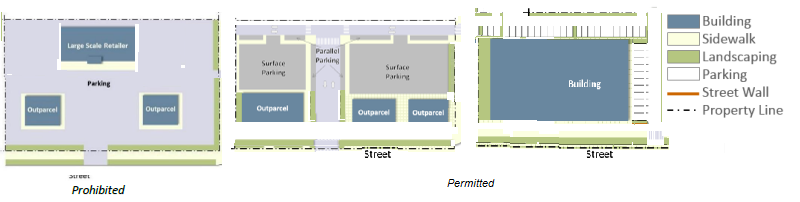
(g)
Building placement.
(1)
Building placement applicable to all development:
a.
Minimum rear yard/rear building setback width and use. Buildings shall be set back a minimum of 20 feet from the rear property line. Where EC District is adjacent to property with a low density residential future land use designation, a seven-foot high opaque brick wall, of colors normally found in manufactured fired brick, shall be constructed on or within five feet from the property line between the property with a low density residential future land use designation and the ECD zoned property.
The wall in proximity to any street or driveway intersection shall be designed to avoid a traffic safety hazard. In addition to the wall, broadleaf evergreen shade trees shall be planted within a planting area at least eight feet in depth from the wall at a rate where, at maturity, the canopies provide full screening, but in no case less than one tree/35 linear feet. Such trees shall be a minimum of ten feet tall, with a minimum two-inch caliper. Broadleaf evergreen understory trees, planted 15 feet on center, ten feet in height with five-foot spread at planting can be an alternative to the shade trees. A hedge may be substituted for the tree requirement, upon approval of city council, if the intended screening coverage can be provided.
b.
Minimum side yard/building setback width and use.
1.
The minimum side building setback is zero unless adjacent to property with a low density residential future land use designation or abutting a side street or natural surface water body. If zero setback is used, a plan for side building maintenance shall be presented with the development application and roof slopes shall be away from the zero setback property line to avoid a negative impact to the abutting property.
2.
The minimum side building setback for properties abutting property with a low density residential future land use designation shall be 25 feet. Where EC District is adjacent to property with a low density residential future land use designation, a seven-foot high opaque brick wall, of colors normally found in manufactured fired brick, shall be constructed on or within five feet from the property line between the property with a low density residential future land use designation and EC zoned property. The wall in proximity to any street or driveway intersection shall be designed to avoid a traffic safety hazard. In addition to the wall, broadleaf evergreen shade trees shall be planted within a planting area at least eight feet in depth from the wall at a rate where, at maturity, the canopies provide full screening, but in no case less than one tree/35 linear feet. A hedge may be substituted for the tree requirement, upon approval of city council, if the intended screening coverage can be provided.
3.
On lots abutting SR 527, Holden, Hoffner, or Gatlin Avenue, development within the side yard shall conform to the road view site standards and the standards of the People Space. Abutting other side streets, the minimum building setback shall be 25 feet and shall conform to the city's code for building perimeter landscaping.
4.
Buildings shall be setback from every natural surface water body a minimum of 50 feet, measured from the normal high water elevation.
(2)
Building placement in the road view area:
a.
The front elevation of all buildings located within the road view area shall be built at a build-to line, the build line, located 25 feet from the front property line.
b.
Provided that buildings consistent with the provisions of this division are constructed within the road view area, such buildings may extend into the rear area of the property and separate buildings complying with all other site standards and regulations may be constructed in the rear area of the property.
(3)
Rear building alternative. Site plan approval may be granted for development where all buildings are located outside of the road view area only when the followings standards are met:
a.
Lot depth must permit the buildings to be located entirely outside of the road view area and meet all required setbacks.
b.
The site plan application must show how the proposed development pattern satisfies the intent and purposes of the Edgewood Central District.
c.
Conformance with the standards of the People Space must be met.
(h)
People Space.
(1)
The People Space is defined as the area along the front property line of the property extending 25 feet inward toward the build line and the area within the adjacent road right-of-way that includes the public sidewalk and the minimum six feet of pervious area adjacent to the curb as identified as the pedestrian zone in subsection 134-470(f)(1).
(2)
Trees shall be provided in the People Space according to the following standards; provided, however, alternative species may be approved during the site plan review process when the proposed species of tree can fulfill the intended design intent, and at the same time achieve full growth and form. Alternating more than two species is strongly discouraged as it will detract from the goal of a recognizable, cohesive development pattern:
a.
Tree choice:
b.
Tree location:
(3)
Tree limbs must be maintained to hang no lower than 14.5 feet above any public street, alleyway, driveway, and no less than 8.5 feet over sidewalks. Trees shall be pruned to achieve this standard for street and sidewalk clearance in accordance with ANSI A300 Part I, most recent addition, Standard Pruning Practices. Pruning of the lower limbs of the trees shall be done under the direct supervision of an ISA certified arborist to ensure the intended configuration of limbs and branches for aesthetic look and structural integrity.
(4)
In addition to street trees, sidewalks and street furnishings, including, but not limited to, seating, lighting, light poles, and bike racks, may be allowed within the People Space subject to site plan approval.
(5)
All sidewalks in the People Space shall be ADA compliant and a minimum width of eight feet free of obstructions.
(6)
Where sidewalks are not located contiguous to the building façade, building perimeter landscaping shall be provided in accordance with the following standards:
a.
Have a minimum depth from the building of six feet.
b.
Shall contain at least a double row of shrubs, preferably of different species, planted parallel to the building. The shrubs shall be at least 24 inches high at planting of a species capable of growing to 36 inches in height within 18 months, and spaced to achieve a continuous hedge at maturity. The hedge height shall be maintained to not obstruct the full window view.
c.
Small/understory trees shall be planted at a rate of one tree/20 feet, or portion thereof, of the length of the landscaped area as measured along the building façade. Spacing of the trees shall be at the discretion of the owner, such that the trees may be aggregated to provide maximum aesthetic value. The required trees may be credited toward meeting the blank wall requirement if applicable.
(7)
All street furnishings shall be permanently fixed on concrete slabs or to the ground in landscaped areas through the use of concrete footings.
(8)
Unless specifically approved through the site plan review process, all street furnishing shall have a black finish.
(9)
Details for all furnishings, including specifications, installation, colors and material shall be provided as part of the site plan review process.
(10)
Any unpaved area in the People Space shall, at a minimum, be planted with a low-maintenance, drought-tolerant ground cover and/or turf. Both turf and groundcover shall be full sun and shade tolerant.
(11)
Ground signs shall be allowed to be placed within the People Space provided such signs comply with all other provisions of the city Code.
(12)
The following improvements shall also be allowed within the People Space:
a.
Building-mounted and/or cantilevered architectural building elements such as awnings and canopies meeting the following requirements:
1.
Hung 13 to 15 feet above the adjacent sidewalk grade;
2.
Extending two to eight feet from the wall;
3.
A clear height distance of at least 80 inches, as required by accessibility standards.
b.
Bay windows with a maximum width of eight feet not extending greater than 18 inches from the building wall;
c.
Articulated wall projections of a minimum depth of eight inches and maximum depth of 1.5 feet and maximum width of four feet in length; and
d.
Attached signs, as provided in chapter 122 of this Code of Ordinances.
(i)
Flexibility for certain lots with double frontage on S.R. 527. Flexibility is needed for lots with double frontage on S.R. 527 where the lots have a right-of-way to right-of-way (ROW to ROW) distance less than 350 feet and in cases where buildings with 100 feet of depth (east to west measurement) are proposed on the double frontage lots between 350 and 500 feet from S.R. 527 (ROW to ROW). On such properties, only the Hansel Avenue frontage will be required to meet the building placement standards of this section. The Orange Avenue frontage shall meet the following standards, which include three components: landscaped buffer and wall, vehicular use area, and back of building standards.
(1)
Landscaped buffer and wall.
a.
A minimum of 15 feet buffer area shall be provided along the S.R. 527 frontage not used as the primary frontage;
b.
A 4.5-foot high opaque brick wall shall be constructed parallel to the entire road frontage (excluding pedestrian and vehicular accessways);
c.
The brick wall shall be constructed seven feet from the property/right-of-way line within the buffer and shall comply with the requirements outlined below;
d.
Brick columns shall be used, at a minimum, where the wall ends at the property lines or access points;
e.
The wall shall have modulation at every 40 feet by incorporating recesses away from the street side. The recesses shall be 20 feet in length and a minimum of three feet in depth. If the wall exceeds 40 feet in length, columns will be required to be incorporated into the wall at a maximum of 20 feet on center;
f.
Columns shall not exceed five feet four inches in height;
g.
The wall (not columns) may be topped with a wrought iron type trim if not exceeding a total height of five feet four inches for the wall and trim;
h.
The wall shall break to provide for pedestrian entrance into the parcel. At least one "pedestrian entryway" wall break shall be provided per parcel. The number of pedestrian entryways to be provided is based on the placement of such and the requirement that the distance between the entryways or between the entryway and an endpoint of the parcel's SR 527 frontage does not exceed 300 feet (measured center to center/parcel endpoint). This pedestrian entryway shall be designed with architectural distinction (e.g., archway, pergola) with a minimum clearance of eight feet. The pedestrian entryway shall also contain a six-foot wide sidewalk that is connected to the public sidewalk. The sidewalk shall also be connected to a six-foot wide sidewalk interior to the vehicular use area that connects with a sidewalk to the building's primary public entrance. If the six-foot wide sidewalk is provided within a 12-foot wide area between rows of (head to head) parking and is lined with year-round shade trees planted at 50-foot intervals (on center), those rows of parking will not be limited to a maximum of ten spaces without a landscape break. These shade trees shall a minimum caliper of three inches and minimum 14 feet in height at planting;
i.
The buffer area on the road side of the wall shall be designed according to the following standards:
1.
One year-round green shade tree shall be planted in the area created by each wall recess; shade trees shall be a minimum caliper of five inches and minimum 14 feet in height at planting;
2.
At least two clustered understory/small trees shall be planted in front of the non-recessed portion of the wall. Understory/small trees shall be a minimum of seven feet in height and have at least a three-inch caliper at planting;
3.
At least a double row, multi-height hedge shall be planted parallel to the wall and the shrubs shall be at least 24 inches high at planting of a species capable of growing to 36 inches in height within 18 months and spaced to achieve a continuous hedge at maturity; the hedge height shall be maintained at the height no taller than the wall;
4.
Low-maintenance, drought-tolerant ground cover shall be used for areas without hedges and trees or pavement;
5.
Street furniture permanently fixed to the ground through mechanical fasteners or through the use of concrete footings shall be allowed; all street furnishings shall have a black finish unless specifically approved through the site plan review process.
j.
The buffer on the non-street side of the wall shall include a row of shrubs and understory trees as follows:
1.
The shrubs shall be planted parallel to the wall and be at least 24 inches high at planting of a species capable of growing to 36 inches in height within 18 months and spaced to achieve a continuous hedge at maturity; the hedge height shall be maintained at the height no taller than the wall.
2.
Understory trees shall be planted at a rate of one tree/20 linear feet of wall; understory/small trees shall be a minimum of seven feet in height, have at least a two-inch caliper.
(2)
Vehicular use areas. Vehicular use areas on the building side of the wall shall be consistent with the parking lot standards contained in section 134-470, except as follows:
a.
The maximum number of parking spaces in a row without a landscape break is ten except when using a head to head sidewalk/shade tree median option as described above. However, a landscaped break/end cap shall continue to be required at the ends of each row of parking spaces;
b.
Decorative lighting shall be provided at a pedestrian level (maximum ten feet in height) throughout the vehicular use area.
(3)
Back of building. Mechanical equipment shall be integrated into the overall mass of a building by screening it behind a wall or parapets or by recessing equipment into hips, gables, walls, or similar features.
(Ord. No. 2018-09, § 3, 8-21-2018; Ord. No. 2018-15, § 2, 12-18-2018; Ord. No. 2021-03, § 2(Exh. A), 7-20-2021; Ord. No. 2022-13, § 2, 1-17-2023)
Sec. 134-469. - Building design.
The intent of these design standards is to avoid long uninterrupted, monolithic appearance of façade planes, thus enhancing the visual appearance of development within the city and creating a human scale building, which in turn encourages pedestrian activity. The façade design is intended to give the appearance of a series of buildings having varied sizes and volumes vs. a single massive structure.
(1)
Design of buildings within the road view portion of the site.
a.
Primary entrance: The building façade facing the front property line shall include a primary entrance to the building. This entrance can be placed at an angle not more than 45 degrees to the road if oriented to a road intersection.
b.
First floor façade transparency: At least 60 percent of the width of the ground floor road frontage façade shall contain clear (transparent) or spectrally selective glazings (minimum VLT of 60 percent) considered as "non-reflective" glass. This requirement includes doors and windows affording views into the interior areas. Opaque, translucent or reflective glass cannot be counted towards the transparency ratio. Window placement shall be incorporated to create a horizontal and/or vertical rhythm. The windows are encouraged to be full height of the ground floor, but in no instance shall the sill be more than three feet above grade, with the window height extending to at least the top height of the primary entrance door. Windows shall be a minimum of two feet in width.
c.
Facade horizontal variation: Building façade design shall vary horizontally at least every 40 feet by incorporating two or more of the following techniques:
1.
Articulation (wall projections or recesses) of a minimum of eight inches in depth and maximum four feet in width, for the full height of the building. A wall projection less than or equal to 18 inches is allowed to extend into the People Space.
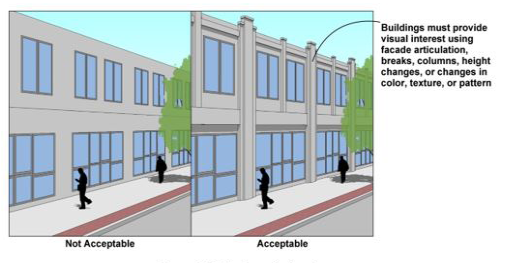
2.
A full height material change; e.g., stucco to brick with varying roof heights (paint color is not considered a material change).
3.
Full height wall recesses of up to four feet in depth, and maximum 40 feet in length with varying roof height.
4.
Non-continuous cantilevered window treatments no more than 40 feet wide, occupying 50—70 percent of the building's length, placed 13—15 feet above the adjacent sidewalk grade, with a minimum eight feet clear height.
5.
Uncovered recessed courtyards between portions of the building, provided that the width of such courtyards shall not be more than 50 percent of the total building frontage and that the courtyard is paved and enhanced with landscaping.
6.
Windows on the stories above the ground level floor shall match the vertical and horizontal character of ground level windows.
d.
Building height:
1.
Minimum building height: Seventy percent of the front façade of the air conditioned portion of a buildings shall be a minimum of 17 feet in height as measured from the entrance sidewalk grade to the top of the roof structure, including parapets and the required three-dimensional cornice on all flat (less than 3:12 pitch) or parapet roof portions. The remaining 30 percent of the front façade of the air conditioned portion shall be a minimum of 20 feet in height as measured from the entrance sidewalk grade to the top of the roof structure, including the required three-dimensional cornice on all flat (less than 3:12 pitch) or parapet roof portions. For sloped roofs (>= 3:12) the minimum height shall be measured to the top of the roof where it intersects the exterior side of the exterior façade wall.
For multi-story buildings, except for stand-alone residential uses, the finished first floor shall be a minimum of 13 feet in height and at least eight feet in height for every story above the first.
2.
Maximum building height shall be as follows:
i.
Outside an activity node: four stories/55 feet unless within 100 feet of property with a low density residential future land use designation, then three stories/45 feet.
ii.
Inside an activity node: six stories/75 feet; provided however, within 100 feet of property with a low density residential future land use designation, the building shall be designed and scaled for compatibility with adjacent single-family homes, taking into consideration shadows, privacy, and visual quality. Methods for achieving compatibility include ground screening, upper story building step-back, and building design.
3.
Façade vertical variation: A building height greater than 20 feet, regardless of the number of stories, shall include a three-dimensional horizontal change at least 12 inches in height across at least 75 percent of the building, placed between 13 to 15 feet above ground to ensure a human scale, e.g., a material or texture change, or a building offset (building step back or step forward). The use of banding (continuous horizontal stripes) across large areas of the façade is prohibited. An alternative to this standard is a building-mounted and/or cantilevered architectural building elements such as awnings and canopies meeting the following requirements:
i.
Hung 13 to 15 feet above the adjacent sidewalk grade.
ii.
Extending two to eight feet from the wall.
iii.
A clear height distance of at least 80 inches, as required by accessibility standards.
iv.
Occupying a total of 50—70 percent of the length of the building façade.
e.
Decorative elements: Decorative architectural appendages, embellishments and other architectural features are required. Subject to site plan approval, such architectural appendages, embellishments and other architectural features may extend up to eight feet beyond the maximum building height provided such appendages are no more than 50 percent of the building roof length and are compatible with adjacent development. Such appendages and architectural embellishments shall be strategically located to draw customers to the primary entrance of the building and or highlight pedestrian passages between buildings.
f.
Roof lines: Roof lines shall be varied with a minimum change in height of at least five feet at least every 80 linear feet in building length. A three-dimensional cornice, at least 2.5 feet in height or as needed to conceal mechanical equipment (whichever is taller), shall be used along all flat (less than 3:12 pitch) or parapet roof portions. Sloped building roofs shall have a minimum two-foot overhang and include a gutter/downspout system. This roof overhang is allowed to extend into the People Space.
g.
Blank wall design: Blank walls facing a street that are ten feet in length or greater shall incorporate one or more of the following design treatments so as to eliminate blank walls more than ten feet in length:
1.
Design treatment 1: Evergreen vine wall (trellis or wire/vine system) of at least five feet in width, contained within a three feet minimum width planting bed in front of the wall, at least 13 feet high, placed every ten feet on center along length of the blank wall surface, with each bed irrigated and planted with climbing vines sufficient to cover the trellis within three years;
2.
Design treatment 2: Small trees of at least 16 feet in height at maturity, planted at a rate of one tree for each 15 feet (or part thereof) of blank wall (minimum one tree), with tree height of at least five feet at planting, planted at least three feet away from the wall, within a planting bed of at least six feet in width; plus, a hedge of plants the length of the wall that creates a depth of at least five feet and maintained at a height at least three feet in height;
3.
Design treatment 3: Variety or decorative masonry pattern of at least two types of materials, color, texture, or architectural feature (such as accents and relief elements), of which the contiguous surface length equals at least 50 percent of the blank wall surface area; and
4.
Design treatment 4: Wall signage of at least six feet in length and four feet in height, limited by total sign area allowed by city Code.
In no case shall a blank wall with these treatments exceed 40 feet in length. A blank wall area means a portion of the exterior facade of the building that does not include windows or doors; or columns, pilasters or other articulation greater than 18 inches in depth. The blank wall standard applies to first and upper stories of street-facing facades.
h.
Exterior building colors: Day-glow colors, highly reflective colors, and similar colors are not permitted.
(2)
Design of buildings outside the road view portion of the site shall meet the same design standards for buildings in the road view portion of the site with the exception of façade transparency. At least 30 percent of the front façade of buildings located outside the road view portion of the site shall be devoted to transparent windows and/or glass doors affording some view into the interior areas. Blank walls are encouraged to be creatively designed to create an illusion of transparency.
(3)
Secondary façades. Facades not facing a road but within public view, shall be of finished quality, color, and materials that blend with the remainder of road frontage façade. Major architectural treatments on the road frontage building façade, such as cornices, window treatments, and repeating details, shall be continued around all sides of the building that will be visible to the public.
(Ord. No. 2018-09, § 3, 8-21-2018; Ord. No. 2018-15, § 2, 12-18-2018; Ord. No. 2021-03, § 2(Exh. A), 7-20-2021)
Sec. 134-470. - Other design standards.
(a)
Stormwater management. Developers are strongly encouraged to create/connect to a shared stormwater system rather than providing individual on-site facilities. Until such time as a shared system is available, development is subject to the following requirements:
(1)
Stormwater management shall be incorporated into the overall design of the project so as to be a creative feature/amenity of the development or incorporated into the landscape irrigation system.
(2)
Except if designed as an exfiltration system, stormwater management shall only be located behind the build line in the road view portion of the site or, if approved during site plan review, where aesthetically incorporated into the People Space.
(3)
Pond edges in the road view area shall be sloped so as to avoid the necessity of fencing. Outside the road view area, where slopes require fencing, only black, ornamental fencing will be allowed.
(4)
The use of innovative stormwater management methods is encouraged such as green roofs, bioretention areas such as the use of deep gardens and planters, infiltration, permeable paving in parking stalls, cisterns incorporated into the building architecture with the water reused for landscaping. Use of pervious pavers/pavement as part of the stormwater management system requires maintenance of the pervious pavers/pavement by the owner for continued viability and effectiveness over the life cycle of the development. An operation and maintenance guide to include a specific maintenance schedule shall be provided by the design professional engineer at the time of permitting of the pervious pavers/pavement. The owner shall engage a professional engineer to inspect and certify to the city on an annual basis that the constructed pervious pavers/pavement is being properly maintained and is functioning as per the approved design of the stormwater management system.
(5)
At a minimum, the stormwater management system shall comply with St. Johns River Water Management Standards.
(b)
Loading/service areas/mechanical equipment.
(1)
A trash/waste collection area shall be totally screened by masonry walls with an opaque low maintenance gate constructed of and finished with materials and colors which are similar to the materials and colors utilized in the principal building on site. In no case shall the trash collection area be located within 50 feet of a single-family residential lot, nor located forward of the rear façade of a road view building. To the extent possible, the trash collection area, shall be incorporated into the primary building design.
(2)
Loading areas, satellite dishes, truck parking, and other service support equipment shall be designed so that they cannot be seen from the street and any adjacent single-family properties. Masonry screen walls with landscaping material at the base of the wall may be utilized where necessary to screen such equipment or areas.
(3)
Mechanical equipment on buildings shall be integrated into the overall mass of a building by screening it behind parapets or by recessing equipment into hips, gables, parapets, or similar features.
(c)
Fences.
(1)
With the exception of decorative railings for outdoor cafes, fences shall not be allowed in the road view area of the property. Decorative railings for cafes shall not exceed three feet in height.
(2)
Fences shall not create a barrier to cross access easements nor the connection of cross access easements to public roads.
(3)
Maximum height of fences anywhere in the district shall be 48 inches.
(4)
Chain link fencing must be black vinyl-coated and shall not be visible from a public right-of-way.
(d)
Corner sight clearance. Intersection/corner sight clearance shall be consistent with requirements of the current Florida Greenbook.
(e)
Utility installation.
(1)
It is the intent of the city to improve the aesthetic appeal of the city and the reliability of utility service by requiring that utility lines such as electric, telephone, cable TV, fiber optics and other utilities be placed underground in conjunction with the construction of all new buildings, unless it is determined by the city council that soil, topographical or any other compelling conditions make the installation of such utility lines as prescribed herein unreasonable or impracticable. It shall be the developer's responsibility to make the necessary arrangements with each utility in accordance with the utility's established policies.
(2)
The underground installation of incidental appurtenances such as transformer boxes, pedestal-mounted terminal boxes for electricity, or similar service hardware necessary for the provision of electric and communication utilities shall not be required.
(3)
Below ground installation shall not normally be required for bulk electric power supply lines and communication major feeder lines. Nothing in this section shall be construed to prohibit any entity furnishing utility service within the city from collecting, as a condition precedent to the installation of service facilities, any fee, prepayment or contribution in aid of construction which may be required.
(4)
Existing utility service poles to a property shall be removed in compliance with this section for redevelopment or additions.
(f)
Exterior lighting.
(1)
Exterior lighting plan.
a.
An exterior lighting plan shall be part of the site plan application submittal and shall demonstrate that outdoor areas are safe, secure and comfortable for human activities, particularly in parking areas, all building entrances, and other areas of special security concern. The plan shall be prepared by a professional engineer, landscape architect or professional architect registered in Florida and prepared in a scale that is easily legible and shall include a photometric plan for the exterior lighting coverage; and pole, fixture, and lamp technical specifications. The plan shall demonstrate that adequate and appropriate light levels will be provided for each site condition, providing for consistent levels of illumination and avoiding pockets of very high or low levels of illumination. The minimum foot candle where pedestrians will be present is two.
b.
The exterior lighting plan shall be coordinated with the required parking area landscape plans and shall demonstrate no conflicts between the proposed lighting and landscaping will exist. Except for bollard type lights, light poles shall be set a minimum distance of 17.5 feet from trees.
(2)
Use of decorative lighting. All light fixtures/luminaires shall be decorative in nature and match or complement the architecture of the building. Decorative elements include, but are not limited to, accented bases, posts, finials, or lamps. The same type poles and fixtures should be used throughout the site. Decorative lighting fixtures mounted directly on structures may be allowed when utilized for walkways or plazas near buildings provided the level of illumination is of relatively low-intensity.
(3)
Height. The height of an outdoor lighting fixture (inclusive of the pole and light source/luminaire) shall be pedestrian in scale, a maximum height of 16 feet. Height shall be measured from the finished grade to the top of the light fixture. Deviation for heights of fixtures will be considered on a case by case basis where it is shown not to be detrimental to the purpose and intent of this division.
(4)
Lighting of landscaping. Illumination of landscaping, if used, shall utilize diffused or muted lighting, avoid glare, and minimize light trespass beyond landscaping onto neighboring properties, streets, or the night sky.
(5)
Prohibited lighting. Except as otherwise provided in this section, light strings or light strips, including LED strings or strips, visible from a public right-of-way, whether located on the interior or exterior of a structure are prohibited.
Each property subject to this provision shall be allowed to display light strings or light strips, including LED strings or strips, that frame or border windows of the property and which are visible from a public right-of-way one time per calendar year for a period of up to 30 days; provided, that such light strings or light strips do not flash, blink, change colors, or involve any motion or simulated motion and do not cause any glare that would interfere with the vision of drivers or pedestrians. Prior to displaying any such light strings or light strips, the owner or tenant of the property shall notify the city on a form to be provided by the city of the first and last date the lights strings or light strips shall be displayed and illuminated.
String lighting shall be allowed in outdoor seating areas of restaurants/bars.
(6)
Time controls. To reduce overall energy consumption and eliminate unneeded lighting, exterior lighting installations shall include timers, dimmers, sensors, and/or photocell controllers that turn the lights off during daylight hours or when lighting is not needed.
(7)
Avoid off-site nuisance. Lights for area lighting of outdoor areas shall not be located, operated, or maintained in any manner such that problems of a general nuisance nature are created on adjacent properties or such that traffic hazards result by reason of such illumination or glare. Exterior lighting should be arranged to reflect light away from adjoining properties thus maximizing illumination on the property on which it originates and minimizing illumination pervading other areas. Light heads for building-mounted fixtures, parking lots and display area light fixtures shall be full-cutoff as defined by the Illuminating Engineering Society of North America (IESNA), shall be directed straight-down, and shall not have bulbs or reflectors that project below the bottom rim of the fixture.
(8)
Violation. Any person found in violation of this section should be notified and said person shall be allowed 15 days to shield, adjust, alter, or remove the lighting such that the negative effect on adjoining areas is eliminated.
(g)
Signage. Signage shall be consistent with chapter 122, with the exception that the maximum total copy area per parcel for nonresidential shall be 1.5 square feet for each linear foot of building frontage or 100 square feet, whichever is less. Additional copy area for parcels abutting multiple rights-of-way, shall be allowed consistent with subsection 122-13(b)(2).
(Ord. No. 2018-09, § 3, 8-21-2018; Ord. No. 2018-15, § 2, 12-18-2018)
Sec. 134-471. - Access/parking design.
[Access/parking design provisions are as follows:]
(1)
Sidewalks.
a.
A goal of the ECD is to make Edgewood more pedestrian oriented. To this end, a minimum 14-foot pedestrian zone shall be provided adjacent to the back of curbs of SR 527, Hoffner, Holden, and Gatlin Avenues. The pedestrian zone shall include an unobstructed eight-foot wide, straight (not curvilinear) sidewalk separated from the curb by at least a six-foot wide grassed strip, as measure from the back (lotside) of curb. Connection to the sidewalk on the adjacent property shall be provided in a manner acceptable to the city's engineer.
b.
Where the existing right-of-way from the back of curb to the property line is less than 14 feet wide or where existing utility poles, mature trees, or other permanent structures, prohibit the ability to provide an eight feet unobstructed sidewalk width within the right-of-way, the owner shall dedicate an urban services easement to provide a pedestrian zone of sufficient width to accommodate the minimum six feet grassed strip and the eight feet wide unobstructed sidewalk width. Where the existing right-of-way (back of curb to property line) is wider than 14 feet, the sidewalk shall be placed adjacent to the property line.
c.
The sidewalks shall be built to FDOT standards.
d.
Modifications to the placement of the sidewalk and grassed strip may be required by FDOT and/or the city engineer; however, in no case shall the pedestrian zone be less than 14 feet from back-of-curb. Deviation in the required location and width of the sidewalk may be altered through the site development review process due to the existence of mature shade trees on-site.
e.
A minimum six feet wide sidewalk shall be constructed to directly connect the public sidewalk to the building's primary entrance. A minimum six-foot wide sidewalk shall also be constructed to connect the building's primary entrance to the parking areas. In other locations, pedestrian access shall be consistent with section 134-141 of the city Code. Where sidewalk width requirements differ, the ECD standard shall apply.
f.
Where a pedestrian must cross an on-site vehicular travel path for continuous pedestrian travel, retroreflective crosswalk markings or textures shall be installed to increase pedestrian safety.
(2)
Vehicular driveways/surface parking lots.
a.
Direct vehicular ingress and egress connections will be prohibited along S.R. 527 when the city determines that adequate access can be provided from another location, including a side street or an existing available shared driveway/cross access easement.
b.
Driveways shall be designed with the pedestrian in mind, incorporating connectivity with the People Space by use of landscaping and, where feasible, sidewalks connected to the public sidewalk along one or both sides of the driveway.
c.
Concrete curb and gutter shall be constructed along the edge of driveways. Parking lot perimeters and parking row landscaping breaks shall be constructed with concrete curbing. Bumper stops will be required in addition to the curbing where necessary to protect landscaping, pedestrian walkways and buildings.
d.
The preferred location for surface parking lots is behind all buildings located in the road view area in order to maximize the building's road frontage and pedestrian interest along the road corridor. Parking lots are allowed to be located on the side of a building, subject to the standards set forth in subsection 134-470(f)(6), provided the minimum building frontage percentage is maintained.
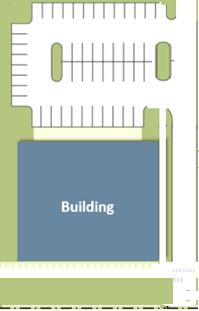 | 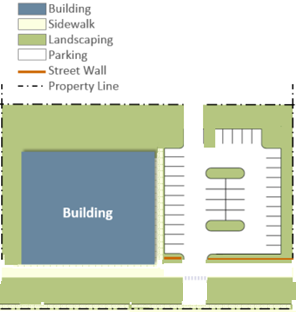 |
e.
If a parking lot is provided on the side of a building, the vehicular area shall be screened from the road by a street wall, which is intended to screen the vehicle use area and ensure that lights from parked vehicles do not shine into the right-of-way or adjacent pedestrian way. The street wall shall meet the following criteria:
1.
Height: The street wall shall be three feet in height above grade of the parking lot.
2.
Location: The street wall shall be placed at the build line. Location of street walls in proximity to intersections of roads and driveways shall meet the standards outlined in the most current FDOT Florida Green Book.
3.
Construction materials: Street walls shall be constructed of materials that complement the finish and or accent materials on the primary building. Chain link, wood, uniblock concrete, or PVC materials for street walls shall be prohibited as is a stucco wall without brick or cultured stone accent columns.
4.
Landscaping: The street wall shall be landscaped with at least one row of shrubs planted parallel to the wall. The shrubs shall be at least 24 inches high at planting of a species capable of growing to 36 inches in height within 18 months and spaced to achieve a continuous hedge at maturity. In addition to the hedge requirement, small/understory trees shall be planted at a rate of one tree/20 feet, or portion thereof, of the wall. The maximum height that the hedge shall be maintained is 36 inches. An alternative design for a continuous mass planting parallel to the wall that combines a mix of required trees and understory trees, shrubs, accent plants and groundcover may be approved by city council upon recommendation by the city's landscape architect.
5.
Use of columns: If the street wall exceeds 40 feet in length, columns will be required to be incorporated into the wall at a maximum of 20 feet on center. Regardless of wall length, columns shall anchor ends of the wall including at each side of a sidewalk break. Columns shall be 24 inches square, either brick or cultured stone-sided, with two-inch cast concrete or cast stone cap. The maximum height of the columns shall be 42 inches.
h.
At least ten percent of the interior of parking lots shall be landscaped in accordance with Code chapter 114, except a maximum of 14 continuous parking spaces shall be permitted without a landscape break. The landscape break shall be a minimum of 15 feet in width with the length equal to the adjacent parking space, and include one broadleaf evergreen shade tree of an acceptable species. Landscape breaks that are head-to-head shall require two shade trees. The shade tree shall be a minimum of 14 feet in height with a 2.5 inch caliper at planting. All required trees shall be maintained at a height of 13 feet from ground to canopy. A landscape island meeting the same requirements shall be provided at ends of parking rows. In addition to the tree, the tree area shall be planted with a full sun/shade tolerant turf grass or groundcover.
An alternative to the landscape breaks internal to the parking rows is a 20 feet wide strip in between rows of (head to head) parking. Broadleaf evergreen, shade trees, a minimum caliper of 2½ inches and minimum 14 feet in height at planting are to be planted at 35 feet on centered intervals. The remaining tree lawn area shall be planted with a full sun/shade tolerant turf grass or groundcover. The parking along the 20 feet wide strip shall not be limited to a maximum of spaces without a landscape break, but shall be anchored at both ends by a landscape island meeting the above requirements.
i.
Inclusion of the People Space is required between the surface parking and State Road 527, Gatlin Avenue, Hoffner Avenue, or Holden Avenue right-of-way. All surface parking lots along other rights-of-way shall be landscaped consistent with city Code standards; however the street wall meeting the above standards shall still be required where parking fronts these rights-of-way. All surface parking lots shall meet the interior landscape requirements of the city Code unless specifically stated otherwise herein.
(3)
Parking structures.
a.
Parking structures shall reflect the character, scale and massing of the principal structures they serve and shall not be located within 100 feet from any property with a low density residential future land use designation without a liner building containing businesses and/or residential uses, or a façade designed to resemble a building conforming to the building design standards of the district on the sides facing the residential area or a street used to enter into a single-family residential neighborhood. The liner buildings or a façade designed to resemble a building conforming to the building design standards of the district shall also be required if the parking structure fronts State Road 527, Gatlin Avenue, Hoffner Avenue, or Holden Avenue. The minimum liner building depth shall be 35 feet. Where located along the State Road 527, Gatlin Avenue, Hoffner Avenue, or Holden Avenue frontage, the People Space shall be provided. Along other rights-of-way, the parking structure shall be landscaped consistent with city Code standards, whether or not a liner building is used; however, the ground level shall include, at a minimum, the equivalent of a street wall and landscaping as is required for surface parking lots.
b.
In addition to the required liner buildings, where a parking structure will be within 100 feet of a property with a low density residential future land use designation, a seven-foot high opaque brick wall of colors normally found in manufactured fired brick shall be constructed on the property line and one broadleaf evergreen, shade tree shall be planted along the wall at 50-foot on center intervals. The chosen species of such trees shall be capable of reaching a minimum mature height of 50 feet, with a minimum mature spread of 40 feet. The minimum specifications at installation shall be 16—18 feet in height or four-inch caliper at planting. All internal elements such as plumbing pipes, fans, ducts and lighting, shall be screened from view from the street. Ramping shall be internalized. Exposed spandrels shall be prohibited.
c.
The design of structured parking should take into consideration a future where parking demand is reduced. Toward this future, the recommended design of the parking structures is for adequate space between floors to retrofit for level floors and HVAC infrastructure for conversion to living or working space.
(4)
Shared parking. When any land or building accommodates two or more categories of uses (e.g., residential and commercial), the minimum total number of required parking spaces for each use may be reduced through shared parking as allowed by section 134-607. Reduction in required parking spaces also may be approved if one of the following is met:
a.
A parking study is submitted as part of the site plan approval process justifying the requested reduction and accepted by city council. This could include provision rideshare/transportation network company drop-off zones. Drop-off zones shall not interfere with transit stops and any designated freight loading zones curbside.
b.
Developments within a one-quarter mile from a transit stop, as measured from the building to the transit stop along the most direct pedestrian path/sidewalk (which would include a crosswalk if across a road), are eligible for the following:
1.
The minimum number of parking spaces may be reduced by up to five percent for sites where the closest portion of the building on the requested parcel is no more than a one-fourth of a mile (1,320 linear feet) from a bus stop as measured along the public sidewalk from the bus stop to the primary entrance to the building.
2.
The minimum number of parking spaces may be reduced by up to 20 percent for sites in which the closest portion of the building on the requested parcel is no more than a one-fourth of a mile (1,320 linear feet) radius from a commuter rail or bus transfer station as measured along the public sidewalk from the bus stop to the primary entrance to the building.
(5)
On-street parking. On-street parking along newly created streets within the district or driveways that are directly connected to a public road may be allowed through the site development process. Only parallel on-street parking may be allowed. Angled or perpendicular parking adjacent to a public street or entrance driveway shall not be allowed. Broadleaf evergreen, large stature shade trees will be required to separate the parallel spaces into sets of no more than four. On-street parking, if provided, may be counted toward meeting minimum parking requirements. On-street accessibility parking shall be constructed consistent with the public right-of-way accessibility guidelines (PROWAG).
(6)
Bicycle parking. Bicycle parking shall be provided on-site consistent with the following standards:
a.
Required number of bicycle parking spaces:
1.
For developments that require up to ten vehicular parking spaces, two bicycle parking spaces shall be required.
2.
For developments that require ten or more vehicular parking spaces, two bicycle parking spaces shall be required, plus one additional bicycle parking space for each ten vehicular parking spaces above ten; provided that no more than eight bicycle parking spaces are required for any one tax parcel.
b.
Bicycle parking space design:
1.
All bicycle parking spaces shall comply with the following standards:
i.
Minimum aisle width: If more than one row of bicycle racks is installed to create the required bike parking area, the installation shall provide a minimum of 60 inches in an aisle in each row to allow for access and maneuvering between the rows of parked bicycles.
ii.
Minimum vertical clearance: 72 inches.
iii.
Accessible to users without climbing or descending stairs.
iv.
Separated from vehicle parking spaces by physical barriers, such as curbs, wheel stops, bollards or other similar features, to protect bicycles from damage.
v.
Consistent with the design, color and character of the buildings, street furniture and other features on the building site, but clearly discernible as bicycle parking.
2.
All standard bicycle racks shall comply with the following standards:
i.
Bicycle racks shall be an inverted "U"/hoop rack, campus rack, or similar device that accommodates two bicycle parking spaces per rack and enables users to lock the frame and both wheels with a cable and U-type locks.
ii.
Minimum tube diameter: 1.9 inches.
iii.
Maximum rack height: 36 inches.
iv.
Minimum depth for each row of parked bicycles: 72 inches.
v.
Minimum horizontal rows separation between racks: 48 inches on center to allow enough room for two bicycles to be secured to each rack element.
vi.
Minimum aisle separation between rows of parked bicycles: 60 inches.
Bike Parking Dimensional Standards
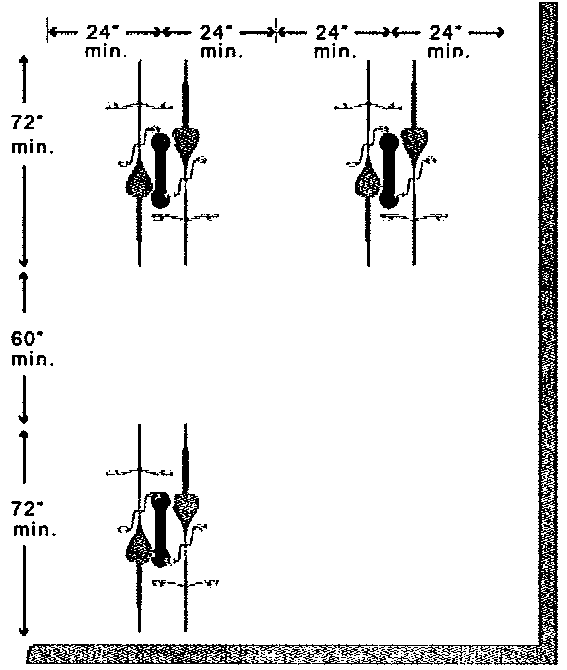
vii.
Designed to accommodate two bicycle parking spaces per rack.
viii.
Powder-coated, or other weather-proof surface, as approved through site plan review process.
ix.
Enable users to lock the frame and both wheels.
x.
Anchored so as not be easily removed.
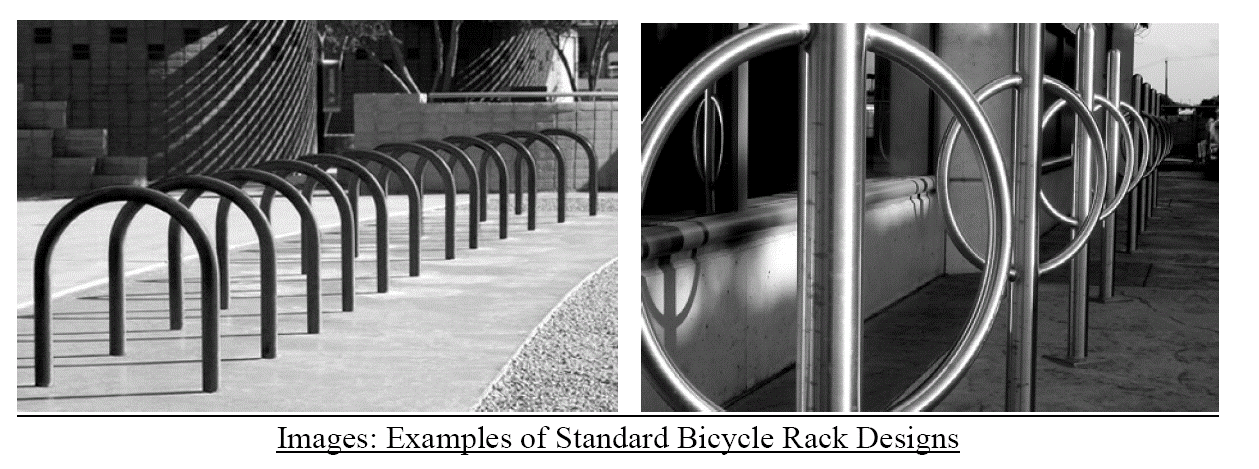
3.
Alternative bicycle rack design. Alternative bicycle parking rack designs may be approved, in compliance with the following standards:
i.
Size: Accepts multiple bicycle frame sizes and styles.
ii.
Compatibility: Accommodates the use of cable and U-type locks.
iii.
Function: Supports a bicycle frame at two points above the wheel hubs.
iv.
Purpose: Allows the frame and at least one wheel of the bicycle to be locked to the rack.
v.
Scale: Visible to pedestrians and the visually impaired, but consistent with the scale of the bicycle locked to the device.
vi.
Durability: Maintenance-free or fabricated from materials that weather in an aesthetically pleasing manner.
vii.
Simplicity: Easy to understand and operate, with no moving parts.
viii.
Operation: Usable without lifting the bicycle onto the device.
Example Alternative Bike Rack Design
4.
Bicycle lockers shall comply with the following minimum standards:
i.
Height: 49 inches.
ii.
Width: 30 inches.
iii.
Length: 74 inches.
iv.
Capacity: Accommodates one bicycle per locker.
v.
Durability: Maintenance-free or fabricated from materials that weather in an aesthetically pleasing manner.
c.
Bicycle parking location.
1.
Location for bike parking shall take into consideration both long-term parking and short-term parking. Long-term parking is meant to accommodate cyclists who are expected to park for longer than two hours, such as employees, students, residents, and commuters. Safety from theft and vandalism, protection from the elements and accessibility are key issues for long-term parking. A place to store accessories is also highly desired. Short-term parking is meant to accommodate visitors who are expected to depart within two hours. Short-term parking is typically found at retail shops and public buildings (libraries, clinics, etc.). Visibility and accessibility are key issues. The ratio of provision of short- vs long-term bicycle parking will be dependent on the proposed use on-site and will be analyzed during site plan review.
2.
The best type of parking facilities for long-term parking are either inside a building, office, guarded enclosure, or bicycle lockers. Bicycle lockers can be installed indoors or out. They are best provided on a user application or lease basis to ensure appropriate use.
3.
Short-term parking racks should support the bicycle at two or more points above and on either side of the bicycles center of gravity. The best types of parking facilities for short-term storage are simple inverted-U racks. The inverted "U" rack is a single piece of heavy gauge steel bent to form a U. Pipe ends are either installed in a concrete base or have welded mounting flanges bolted directly to a solid, flat surface. Each of these racks holds two bicycles.
4.
Bike racks shall be located as follows:
i.
The preferred location for bike racks is in close proximity to and visible from primary building entrances to enhance security of the stored bikes. A bike "corral" may be located within the vehicular parking area; however, the corral shall be separated from vehicle parking spaces by physical barriers, such as curbs, bollards or other similar features, to protect bicycles from being damaged by vehicles. If located within parking structures, the preferred location is in proximity to garage security at the front entrance.
ii.
A least 50 percent of the required bicycle parking shall be provided within the primary building (indoor bicycle parking) or within bicycle racks located no more than 100 feet from primary building entrances served, and preferably within 50 feet.
iii.
Bike parking may be located within the tree/furnishings sign area.
iv.
Bike parking shall not be located in any vehicle parking space required by city Code.
v.
Bike racks shall not be placed so that they block any building entrance or impede pedestrian flow in or out of the building, or result in a reduction of the minimum required sidewalk width caused by either the rack or the parking of the bicycles.
vi.
Bike racks shall not block transit or freight loading.
vii.
Preferred location for bicycle parking is situated such that the bicycles will be protected from the weather. Covered bicycle parking is encouraged wherever the design of the building or use being served by the bicycle parking facility includes a covered area that could accommodate such facilities.
viii.
Bike racks shall be situated a minimum distance of 24 inches from any building wall.
ix.
Bike parking shall be located in a clearly designated area and must be illuminated at night.
(Ord. No. 2018-09, § 3, 8-21-2018; Ord. No. 2018-15, § 2, 12-18-2018; Ord. No. 2021-03, § 2(Exh. A), 7-20-2021)
Editor's note— With the inclusion of Ord. No. 2021-03, new provisions were set out as § 134-471 and existing §§ 134-471 through 134-474 have been renumbered as §§ 134-473 through 134-475 as herein set out below.
Sec. 134-472. - Use specific design standards.
(a)
Car/automotive washing and detailing.
(1)
All washing, waxing, and detailing of automobiles shall be within an enclosed building, with the exception of tunnel entrance and exit doors. Detail bays are prohibited.
(2)
Tunnel entrance/exits shall not face SR 527, Holden Avenue, Gatlin Avenue, or Hoffner Avenue.
(3)
Vacuuming and drying of automobiles may be outside the building but shall not encroach upon any landscape buffer, setback for the principal structure, or the People Space and shall only be located on paved areas. Vacuuming equipment or other equipment may only be located on the side or rear of the subject property.
(4)
Vacuum stations and related equipment shall be completely screened from all streets or property with a low density residential future land use designation. To screen from a street, a wall may be used if such wall meets the façade standards in the building design section of this district. A seven-foot high opaque brick wall of colors normally found in manufactured fired brick shall be utilized along the rear or side property line to screen the use from property with a low density residential future land use designation.
(5)
There shall be no outside storage, nor outside display of goods offered for sale.
(6)
Sound from radios, stereos, or other sound amplification devices shall not be audible from anywhere off the site.
(7)
Before a permit will be issued, the property owner shall sign an affidavit documenting that the property owner understands conditions of operation.
(8)
When the business is closed, all portable equipment on the site shall be stored within a fully enclosed structure.
(9)
Any customer vehicles stored overnight shall meet the following standards:
a.
Shall be either within a completely enclosed building or parked within a designated parking space on a parking lot located behind the line created by the rear of the road view building. If only the rear portion of the lot is developed, the vehicles may be parked within a designated parking space within the parking area for that portion of the site (i.e., behind the street wall, and a minimum of 100 feet from the front property line).
b.
No vehicle parked overnight on the property shall be visible from the public right-of-way unless such vehicle is either:
1.
FHWA Class 2—Passenger cars. All sedans, coupes, and station wagons manufactured primarily for the purpose of carrying passengers; or
2.
FHWA Class 3—Other two-axle, four-tire single unit vehicles. All two-axle, four-tire vehicles, other than passenger cars. Included in this classification are pickups, panels, and vans. Campers, motor homes, ambulances, hearses, carryalls, and minibuses are not included in this class of vehicle.
c.
Any wrecked or inoperable vehicle shall not be stored/parked overnight, regardless of location.
(10)
In addition to standard commercial site plan requirements, the proposed site plan must be designed and demonstrate effective ingress/egress to the site, adequate stacking for five vehicles per queuing/stacking lane, realistic turning radiuses, and the accommodation of a by-pass lane(s). The site plan shall also include the proposed architectural building rendering. These plans will include the exterior elevations and landscaping, and location for any proposed outside activities.
(b)
Drive-up windows/facilities.
(1)
Drive-up windows shall be designed on the rear of the building.
(2)
The drive-up aisle shall not be located between the building and SR 527, Gatlin Avenue, Holden Avenue, or Hoffner Avenue.
(3)
The building façade facing SR 527, Hoffner Avenue, Gatlin Avenue, or Holden Avenue whether such elevation functions as the side or rear of the building, shall be architecturally designed to avoid a "back of building" appearance.
(4)
Drive-up aisles shall have adequate on-site queuing distance to accommodate six cars (120 feet) before the first stopping point (e.g., order window, teller window, atm machine).
(c)
Garden center, artisan manufacturing storage, building material storage or other ancillary storage areas, which are authorized as an ancillary use to a permitted use. Ancillary storage, as authorized herein is allowed if incorporated/integrated into the design and treatment of the primary building facade with the intent that all merchandise is shielded from view from adjacent properties at ground level and street rights-of-way.
(d)
Multi-dwelling residential buildings (stand-alone). In addition to the other design standards of the district, approval of a special exception to allow buildings used exclusively for residential purpose shall be based on a finding that the design of the proposed residential furthers the intent of the district, particularly for development to be human scale, encouraging alternative modes of transportation, and protecting the stability of existing residential neighborhoods through design. The building placement and design standards of the district shall apply.
(e)
Company and fleet vehicles. Parking of company or fleet vehicles shall be allowed on a parking lot located behind the line created by the rear of the road view building. If only the rear portion of the lot is developed, the company or fleet vehicles may be parked within the parking area for that portion of the site (i.e., behind the street wall, and a minimum of 100 feet from the front property line). In addition, no company or fleet vehicle that is parked overnight on the property shall be visible from the public right-of-way unless such vehicle is included in one of the following two classes of vehicle:
(1)
FHWA Class 2—Passenger cars. All sedans, coupes, and station wagons manufactured primarily for the purpose of carrying passengers.
(2)
FHWA Class 3—Other two-axle, four-tire single unit vehicles. All two-axle, four tire vehicles, other than passenger cars. Included in this classification are pickups, panels, and vans. Campers, motor homes, ambulances, hearses, carryalls, and minibuses are not included in this class of vehicle.
(f)
Passenger car rental, urban prototype.
(1)
Only rental of passenger vehicles, as defined by the Federal Highway Administration, shall be allowed.
(2)
Deliveries containing multiple vehicles from a truck are not permitted.
(3)
No vehicle maintenance and repair, including oil changes, shall occur on-site.
(4)
Wash and vacuum stations must comply with standards listed in subsection 134-471(a).
(5)
Detail bays shall not be permitted.
(6)
There shall be no outside storage, other than the rental vehicles, nor outdoor display of goods offered for sale.
(7)
The number of rental cars onsite shall be limited to 15.
(8)
All parking spaces shall be designed to meet code dimensions provided in section 134-608. Parking shall be provided for employees and customers in addition to the parking designated for rental display vehicles.
(g)
Micro-breweries, craft distilleries, micro-wineries.
(1)
No outdoor storage shall be permitted.
(2)
All malt, vinous or distilled liquor production shall be within completely enclosed structures.
(3)
By-products or waste from the production of the malt, vinous or distilled liquor shall be properly disposed of off the property.
(4)
Building square footage shall not exceed 15,000 gross square feet without approval of a special exception.
(5)
A minimum of 25 percent of the building floor area shall be used as a restaurant, tasting room, or retail operation (or any combination thereof).
(Ord. No. 2018-09, § 3, 8-21-2018; Ord. No. 2018-15, § 2, 12-18-2018; Ord. No. 2021-03, § 2(Exh. A), 7-20-2021)
Sec. 134-473. - Development bonuses.
The purpose of the development bonus system is to promote achievement of the goals and vision of the district that otherwise would not be economically feasible without a bonus in development intensity as well as provide opportunities for public/private partnerships. Development sites may receive more than one bonus. All costs associated with implementation of the bonus categories shall be the responsibility of the developer.
(1)
Creation of an activity node. Activity nodes shall be allowed an increase in the maximum impervious surface area ratio to 90 percent. Activity nodes shall be allowed an increase in the maximum building height to 75 feet/six stories. In order to achieve the activity node bonuses the following design standards must be met:
a.
Development sites must be at least 7.5 acres in size.
b.
Buildings shall be designed with the pedestrian in mind reflected by, but not limited to, scale and massing of buildings, walkable blocks, use of arcades and galleries, and emphasis on active first floor uses oriented to the street. Both residential and nonresidential uses are included. Building entryways and walkways will incorporate awnings and/or recessed entrances to provide weather protection for pedestrians. Such development will include unique architectural features and a comprehensive sign plan that promotes a cohesive design for the activity node. In addition, public amenities will be incorporated into the development to include public art, useable public gathering areas with seating and shade structures, water sculptures, fountains, or similar public amenities that are accessible to the public.
c.
Parking shall be located behind buildings or in parking structures consistent with all applicable regulations. On-street parallel parking is allowed; on-street angled parking shall not be allowed.
d.
Should on-street parking include provision of accessible parking spaces, such shall be consistent with the public right-of-way accessibility guidelines (PROWAG).
e.
Include a park/urban plaza meeting the following criteria:
1.
The minimum area shall comprise at least one-half of an acre and the maximum shall be two acres.
2.
The area is spatially defined by building frontages and at least 150 feet of frontage on a two-lane street; incorporation of the lake frontage is strongly encouraged.
3.
Building facades facing the plaza shall have at least 70 percent of their first floor's primary façade in transparent windows and/or public entrances and incorporate a People Space as described in this district.
4.
The area will consist of paved surfaces with planters and landscaped area consisting of paths, lawns, and shade trees, seating, and other furnishings, all formally arranged, and shall include a water feature/fountain as a focal point.
5.
The urban plaza or park shall be privately-owned and maintained, but open to the public. The applicant shall also be required to prepare a management plan for the maintenance and ownership of the site.
6.
Demonstration of compatibility with adjacent uses.
7.
Request for development approval must include elevations and colored renderings with materials identified in addition to development site plan.
(2)
Road connectivity improvement. Implementation of improved public road connectivity within the city, particularly the connection of Holden Avenue to Gatlin Avenue, will receive a transfer of development rights to other areas of the site at 1:1 land area ratio based on the maximum density/intensity allowed in the comprehensive plan. This bonus also includes a potential reduction in the People Space width along the new road if the intent to create an active pedestrian storefront zone is met. Cross access easements are not eligible for this bonus.
(3)
Consolidation of access points/use of joint driveways on major roads.
a.
Minimizing the number of driveway connections along the corridor is not only important for efficient through-traffic movements, but will improve pedestrian safety. Minimizing the number of driveways reduces the number of potential pedestrian/driver conflicts. Thus, the goal along the road corridor is consolidation of driveways.
b.
The use of a joint use/shared driveway by locating the driveway on a shared property line and a non-exclusive ingress/egress access easement recorded in Orange County official public records will be eligible for an impervious surface area bonus equal to the impervious surface of the shared driveway.
(4)
Other private/public partnerships such as provision of corridor-wide stormwater management, aesthetic improvements, and public parking initiatives.
(Ord. No. 2018-09, § 3, 8-21-2018; Ord. No. 2021-03, § 2(Exh. A), 7-20-2021)
Sec. 134-474. - Pre-existing uses and structures.
(a)
Generally. Legally conforming uses and structures that exist on a property shall continue to be considered legally conforming notwithstanding the rezoning of such property to the Edgewood Central District. A property on which a legally conforming use or structure existed immediately prior to the rezoning of such property to the Edgewood Central District (hereafter, a "property") shall continue to be governed by the standards applicable to the zoning district that applied to the property immediately before the rezoning, except as may be provided herein.
(b)
Change in use.
(1)
Consistency with ECD permitted uses required. For any change in principal use that occurs on the property, the proposed new principal use shall be consistent with section 134-467 (Permitted uses within the Edgewood Central District) unless the following four conditions are met:
a.
The proposed new principal use was not prohibited by the zoning district that applied to the property immediately before the rezoning but is prohibited in this Edgewood Central District;
b.
The proposed new principal use is included in and consistent with the list of principal uses set forth below;
c.
The proposed new principal use is consistent with all regulations in existence immediately before the rezoning, including parking, loading, and vehicular maneuvering; and
d.
Any company and fleet vehicle parking on the property, or, in the case of a multi-tenant property, any company and fleet vehicle parking associated with the space that is the subject of the change in use, complies with the company and fleet vehicle parking standards of subsection 134-471(e). In such event, the proposed change of use shall be permitted and considered legally conforming even if it is not consistent with section 134-467.
1.
Heating and air conditioning sales and service.
2.
Storage and wholesale distribution warehouse, where not adjacent to a residential zoning district or property with a residential future land use designation, including those across a right-of-way. Provided, however, a change in principal use to this category shall comply with the following standards:
i.
All loading bays on the property, or, in the event of a multi-tenant building, all loading bays associated with the space that is the subject of the proposed change in use, that are within 100 feet from the front property line shall face away from SR 527;
ii.
The property shall be brought into compliance with the tree/furnishings/sign/pedestrian area standards as set forth in subsection 134-468(h);
iii.
If the building associated with the change is located within one hundred feet from the front property line, then the front of such building shall be brought into compliance with the first floor façade transparency requirement as set forth in subsection 134-469(1)b and with the blank wall design standards as set forth in subsection 134-469(1)g, subject to any applicable credit as set forth in subsection 134-468(h)(7)c.; and
iv.
All parking for the property, or, in the event of a multi-tenant building, all parking associated with the space that is the subject of the proposed change in use, that is located within 100 feet from the front property line shall be configured so as to be located on the side or rear of the property only. If such parking is located on the side of the property, it must be screened from the road by a street wall that meets the standards set forth in subsection 134-470(f)(6).
3.
Cabinet makers, rug and carpet cleaning, upholstering, electrical, roofing and plumbing shops.
4.
Mechanical garage, including personal vehicle body shop and painting (no fuel services provided). For avoidance of doubt, automotive repair and services are included in this category to the extent the specific proposed use was included as a principal permitted use on the property prior to rezoning to the Edgewood Central District. Provided, however, a change in principal use to mechanical garage shall comply with the following standards:
i.
All garage bays on the property, or, in the event of a multi-tenant building, all garage bays associated with the space that is the subject of the proposed change in use, that are within 100 feet from the front property line shall face away from SR 527;
ii.
The property shall be brought into compliance with the People Space standards as set forth in subsection 134-468(h);
iii.
If the building associated with the change is located within one hundred feet from the front property line, then the front of such building, shall be brought into compliance with the first-floor façade transparency requirement as set forth in subsection 134-469(1)b and with the blank wall design standards as set forth in subsection 134-469(1)g, subject to any applicable credit as set forth in subsection 134-468(h)(7)c.; and
iv.
All parking for the property, or, in the event of a multi-tenant building, all parking associated with the space that is the subject of the proposed change in use, that is located within 100 feet from the front property line shall be configured so as to be located on the side or rear of the property only. If such parking is located on the side of the property, it must be screened from the road by a street wall that meets the standards set forth in subsection 134-470(f)(6).
5.
Miniwarehouses, provided, however, a change in principal use to miniwarehouses shall comply with the following standards:
i.
All storage units shall be located within a completely enclosed building with sole access to the units through the interior of the building;
ii.
The property shall be brought into compliance with the People Space standards as set forth in subsection 134-468(h);
iii.
If the building associated with the change is located within 100 feet from the front property line, then the front of such building shall be brought into compliance with the design of buildings within the road view portion of the site standards as set forth in subsection 134-469(1);
iv.
No vehicular building access shall face a road right-of-way;
v.
No outside storage shall be allowed; and
vi.
Such change of use to miniwarehouses shall only be allowed upon the approval of the city council after a recommendation by the planning and zoning board and a hearing in which the city council considers the character of the area in which the proposed use is to be located, its consistency with the comprehensive plan, its compatibility with surrounding uses and development, and its effect on the value of surrounding lands. Notice of such review shall be provided in the same manner as required for special exceptions as provided in section 134-105.
(2)
Incentive for adaptive reuse.
a.
Eligibility for approval consideration:
1.
Existing use is one of the following:
•
Machine shops;
•
Mechanical garage, including personal vehicle body shop and painting;
•
Vehicle services;
•
Warehouses.
2.
One hundred percent of the building(s) on site will be occupied by one or more of the following targeted uses:
•
Café
•
Restaurant;
•
Distillery or brewery with tasting rooms;
•
Bar serving food;
•
Specialty food retail market.
3.
Provision of aesthetically designed outdoor seating.
b.
Application submittals:
1.
Site plan submitted in accordance with Code subsection 134-135(b), unless specific code requirements are waived by staff in writing. In addition to Code requirements, the site plan shall demonstrate the following:
i.
Solid waste management/dumpster is provided and not located forward of the imaginary line extended from the building's façade facing a road. All dumpsters are set on a paved permanent surface of sufficient depth and size to accommodate the type of dumpster and screened on three sides by a solid opaque six—eight [foot] high enclosure constructed of brick, concrete, concrete block or other decorative masonry, and is consistent with the architectural character of the principal building or structure. The open end of the enclosure shall have a 100 percent solid opaque gate of other materials, other than wood that are not readily degradable due to sunlight, moisture, or wind, and with self-closing hinges. Dumpsters shall not be located within 50 feet of a residential zoned property unless waived by city council.
ii.
Cross access is provided to adjacent non-residential zoned property if possible, as determined by the city engineer.
iii.
Concealment and/or screening of mechanical equipment and appurtenances, unless approved by council.
iv.
Bike parking is provided consistent with Code section 134-470.
v.
Fences/walls comply with the following:
(A)
With the exception of decorative railings for outdoor cafes, fences are not allowed forward of the building on any street side. Decorative railings for cafes will not exceed three feet in height.
(B)
Fences/walls shall not create a barrier to cross access easements.
(C)
Maximum height of fences/wall will be 48 inches, except along the property lines shared with a residential lot, where the fence/wall can be a maximum of eight feet in height.
(D)
Chain link fencing, when allowed, must be black vinyl-coated and not be visible from a road public right-of-way.
2.
Façade improvement plan, submitted with the site plan, showing renderings, including colors, of all building sides that face a public right-of-way.
3.
Landscape plan providing landscaping to the maximum extent feasible. landscaping will be weighted equally with the provision of on-site parking particularly on the street sides of the property; i.e., landscaping along the street side is preferred.
4.
Parking reduction plan, if requested, to consist of the following:
i.
Justification: An applicant may request deviation of on-site parking requirements. The allowable reduction shall be based on a quantitative analysis demonstrating that the use(s) will be adequately served by the proposed parking; such analysis could include, but not necessarily be limited to:
(A)
Projected demand for short term parking spaces, e.g. for delivery or take-out, ride-share, and use of autonomous vehicles;
(B)
A description of other characteristics of the proposal or measures being undertaken that could result in reduced parking demand such as employer sponsored shuttles, employer required carpooling, or access to public transit; and
(C)
A description how the reduction in parking will not increase the demand for parking spaces upon private properties in the immediate vicinity of the proposed use, unless approved as shared parking in accordance with Code.
In all cases, at least 50 percent of the standard parking quantity shall be provided onsite, including all of the required accessible Americans with Disabilities Act parking spaces.
ii.
Parking layout: A site plan showing the following:
(A)
The accessible Americans with Disabilities Act parking spaces required based on the standard (non-reduced) required number of parking spaces per article V, division 5 of chapter 134 of the city Code.
(B)
Parking designed in compliance with all applicable development standards unless. Deviation for total number of parking spaces in a row without a landscaped break may be approved if consistency with current standard is impractical, as determined by city council.
(C)
Location of short-term parking spaces identified.
iii.
Affidavit for public safety and welfare: An affidavit from the property owner/leasee shall be provided stating that the city police department has the authority to tow vehicles that are not in an approved parking space and pose a threat to the public health, safety and welfare, or are on land set aside for landscaping on the approved site plan.
5.
Signage plan, submitted with the site plan. Ground signs shall be prohibited unless the People Space can be provided. Unless approved by city council, wall signage shall be limited to one wall sign on each building side facing a road with such each sign limited to 32 square feet.
(c)
Expansion of existing buildings. For purposes of this subsection 134-473(c), an "expansion" shall mean an increase in building square footage of physically connected to an existing building on a property; and the "historical adjusted square footage" of a building shall mean the total square footage of a building that existed on a property at the time it was rezoned to Edgewood Central District minus the total of building square footage, if any, removed from the building following its rezoning to Edgewood Central District pursuant to an intentional demolition as provided in subsection 134-473(e), calculated at the time of a proposed expansion. A building's square footage is defined as the air-conditioned area under the roof of a building enclosed by four walls and served by all of the following services: water, sewage disposal, and electricity. The area does not include the area beyond the structural supports of said building. Accessory structures, attached or detached, are not included in the building's square footage.
An expansion of an existing building onsite shall cause the property to be governed by the standards set forth in this Edgewood Central District unless the following conditions are met, in which case the property shall continue to be governed by the standards applicable to the zoning district that applied to the property immediately before the rezoning:
(1)
An expansion shall be subject to city site plan approval;
(2)
An expansion shall be allowed on a property so long as all company and fleet vehicle parking on the property complies with the company and fleet vehicle parking standards of subsection 134-471(e); and
(3)
the property complies with the People Space standards as set forth in subsection 134-468(h) as well as provision of a sidewalk from the public sidewalk to the primary entrance that is at least six feet wide;
(4)
If the size of a proposed expansion, when combined with all other expansions that have occurred to that building after it was rezoned to Edgewood Central District, exceeds 20 percent of that building's historical adjusted square footage, then such expansion shall only be allowed if the property complies with subsections (c)(2) and (3) above, the following is met.
a.
All parking is configured so as to be located either: 1) behind the imaginary line extended from the front façade of the building and a street wall, that meets the standards set forth in subsection 134-470(f)(6), including landscaping, is provided on the edge of the vehicular use area; or 2) behind the imaginary line extended from the rear of the building with landscaping screening the parking area from views from the road/sidewalk. Drive aisles may be retained between the People Space and the building if city council finds no practical alternative exists for onsite vehicular circulation; however, any remaining parking or drive aisle shall be screened from the street/sidewalk view with the use of street wall designed in accordance with subsection 134-470(f), with the wall placed two feet from the drive aisle, including the width of a vertical curb, on the building side of the People Space, but not within the required buffer width, thus retaining the full width of the People Space.
b.
Access management improvements shall be made, retrofitting existing driveway connections to modern commercial access standards (e.g., narrowing the width, elimination of a continuous drop curb, and elimination of multiple curb cuts), with the former driveway connections, aprons, and curbing removed and incorporated into the People Space.
c.
Concrete curbing shall be provided where any changes are made to existing or new pavement (e.g., saw cutting existing pavement to provide the tree, furnishing, sign area or narrowing of an existing or creation of new driveways/drive aisles).
d.
Bicycle parking is provided consistent with subsection 134-470(f)(11).
(5)
If the size of a proposed expansion, when combined with all other expansions that have occurred to that building after it was rezoned to Edgewood Central District, exceeds 30 percent, but is less than 40 percent or 1,000 square feet, whichever is more, of that building's historical adjusted square footage, then such expansion shall only be allowed if the property complies with subsections (c)(2), (3) and (4) above and all buildings located within 100 feet of the front property line comply with the following:
a.
The building design standards of section 134-469 subject to any applicable credit as set forth in subsection 134-468(h)(7)c;
b.
Either of the two following options:
1.
The minimum building façade width-to-lot-width ratio as set forth in subsection 134-468(f), or
2.
The majority of the expansion is toward the State Road 527 frontage; and
c.
Utility lines such as electric, telephone, cable TV, fiber optics and other utilities are placed underground, with existing utility service poles that are no longer utilized removed.
(6)
If the size of a proposed expansion, when combined with all other expansions that have occurred on the property after it was rezoned to Edgewood Central District, exceeds 40 percent of the historical adjusted square footage on the property, then such proposed expansion shall be prohibited.
(d)
Election. The owner of a property may elect at any time in writing to have its property be governed by the standards set forth in this Edgewood Central District in lieu of the standards applicable to the zoning district that applied to the property immediately before the rezoning. To be effective, such election must be in writing, signed by the owner of the property, properly notarized and addressed to the city planner.
(e)
Demolition. Demolition of more than 50 percent of the total building square footage on a property caused by the intentional act or agreement of the owner shall cause the property to be governed by the standards set forth in this Edgewood Central District. Building square footage removed by such demolition shall be considered in the calculation of historical adjusted square footage as provided in subsection 134-473(c).
(f)
Replacement of destroyed buildings. Repair or reconstruction of buildings damaged or destroyed by any act not caused by the intentional act or agreement of the owner shall not cause the property to be governed by this Edgewood Central District; provided that such repair or reconstruction occurs within the same building footprint that existed as of the date of rezoning or any expansion of such building footprint meets the standards of subsection (c), above, related to expansion of existing buildings.
(g)
Construction of new buildings. If a new building is constructed on the property, then such new building shall be governed by the standards set forth in the Edgewood Central District.
(Ord. No. 2018-09, § 3, 8-21-2018; Ord. No. 2018-15, § 2, 12-18-2018; Ord. No. 2021-03, § 2(Exh. A), 7-20-2021)
Sec. 134-475. - Waivers.
(a)
The city council may authorize waivers from the minimum standards set forth in this division when it finds, based upon substantial competent evidence presented to it, that strict application of such standards would create an illogical, impossible, impractical or unreasonable result on a landowner or other petitioner with the consent of the owner (hereinafter, the "applicant") or to save a historic or specimen tree. This waiver procedure is not available for purposes of changing a use that is otherwise prohibited (or limited to a special exception) herein to one that is permitted (or no longer limited to a special exception).
(b)
A request for a waiver shall be filed with the city clerk, including a non-refundable fee as set by resolution of the city council paid by the applicant to cover processing and advertising costs, and shall include a detailed explanation of the claim for waiver along with documentation of the current physical conditions on the site, alternatives from the applicable standards set forth in this division, cost estimates or other credible data required to support or justify the requested waiver.
(c)
A public hearing on any request for a waiver shall be held by the planning and zoning board at the first regular meeting of the planning and zoning board that occurs after the expiration of the period for publication of notice of the request for waiver. After consideration of the request, the planning and zoning board shall forward its recommendation on the request to the city council. A public hearing shall be held by the city council at its next regular meeting after receipt of the planning and zoning board's recommendation.
(d)
Notice of filing of a request for a waiver, and the date, time, and place of the hearings thereon shall be published once at least seven days prior to the hearing in a newspaper of general circulation within the city limits.
(e)
In reviewing an application for a waiver, the planning and zoning board and the city council shall consider the following non-exclusive factors:
(1)
The history of the subject property, including the date of purchase and the history of uses on the subject property;
(2)
The location of the subject property;
(3)
The configuration of the subject property;
(4)
The impact of the requested waivers on adjacent properties;
(5)
All measures proposed by the applicant to comply with the spirit or intent of the provisions from which waiver is sought; and
(6)
All measures proposed by the applicant to prevent, reduce, or offset any adverse impact the grant of the requested waiver would have on surrounding properties.
(f)
In order to grant any waiver pursuant to this section, the city council must find:
(1)
That the granting of the proposed waiver will not have the effect of nullifying the intent and purpose of the standard that is the subject of the requested waiver;
(2)
That the granting of the proposed waiver will serve the health, safety and welfare of the city;
(3)
That any waiver granted is the minimum waiver that will reasonably eliminate or reduce the illogical, impossible, impractical, or unreasonable result caused the applicable standard contained in this division; and
(4)
That any waivers granted will not adversely impact the use or property values of adjacent properties.
(g)
At the conclusion of the public hearing and after reviewing the recommendation of the planning and zoning board and the evidence and testimony placed before it, the city council shall act upon the request either to approve, approve with conditions, deny, or approve in part and deny in part the request made by the applicant.
(h)
Nothing contained in this section shall be interpreted to prevent an applicant from seeking relief through any other procedure allowed within the Code of Ordinances.
(Ord. No. 2018-09, § 3, 8-21-2018; Ord. No. 2018-15, § 2, 12-18-2018; Ord. No. 2021-03, § 2(Exh. A), 7-20-2021)
Sec. 134-476.- Intent and purpose of CP PD district.
(a)
There is hereby created the comprehensive plan planned development (CP PD) zoning district.
(b)
The intent and purpose of the CP PD district is to implement the site specific plan future land use designation of the city's comprehensive plan, establishing a process that will ensure a proposed development is compatible with adjacent land uses, protect environmentally sensitive areas, and is coordinated with available public services and facilities.
(c)
In the event of any conflict with any other provision of this Code, the provisions of this division shall prevail unless specifically provided otherwise.
(Ord. No. 2023-01, § 2, 4-18-2023)
Sec. 134-477. - Uses permitted and prohibited.
(a)
Uses permitted. The permitted uses allowed in the CP PD shall be consistent with the corresponding comprehensive plan policy adopted at the time the site specific plan (SSP) future land use designation was established for the subject property.
(b)
Uses prohibited. Any use prohibited in the C-1, C-2, C-3, I, ECD or Ind-CA district shall be prohibited in the CP PD district.
(c)
Development agreement. The specific permitted uses for property zoned CP PD shall be set forth in a development agreement approved as provided herein, which shall be recorded in the official public records of Orange County, Florida.
(Ord. No. 2023-01, § 2, 4-18-2023)
Sec. 134-478. - Approval procedure.
(a)
Application submittals.
(1)
Formal application and payment of fees for consideration of establishing a SSP future land use designation on the subject property; a corresponding comprehensive plan future land use element policy; and rezoning to CP PD. The application shall include the applicant's name and contact information, full legal description of the property, acreage, owner's name and contact information, and agent authorization if applicant is not the owner of the property.
(2)
Proposed future land use element policy identifying, at a minimum, the proposed permitted uses and densities/intensities, consistent with the requirements as specified within F.S. ch. 163, pt. II, with a narrative explaining:
a.
The need and justification for the change;
b.
The benefits the development will provide to the community;
c.
The compatibility of the proposed land use with surrounding properties; and
d.
How the proposed use is consistent with and/or furthers the goals, objectives and policies of the city's comprehensive plan.
(3)
An analysis of potential land use compatibility issues and the proposed mitigation. Land use compatibility is of premier importance of this district. Compatible means a development, building and/or land use is designed to be able to exist or occur without conflict with its surroundings in terms of its uses, scale, height, massing and location on its site, as well as is without negative impact to public services and facilities. Land use compatibility analysis shall address visual impact, on-site operational impact, and impact to public services and facilities.
a.
Visual impact; i.e., the three-dimensional scale of the structures on-site including height, bulk, width, and depth compared to adjacent uses. This not only includes the appearance of any structures, but also the effect of outdoor storage areas, as well as the long-term maintenance of buildings, landscaping, etc. on-site.
b.
Operational impact; i.e., operational by-products such as noise, odors, dust, vibration, light, heat, electrical interference etc. that will negatively impact adjacent uses.
c.
Impact to public services and facilities, including, but not limited to, the area road network; pedestrian and bike lane/path network; police and fire protection.
(4)
The site plan drawn to a scale of one inch equals 200 feet or larger, unless otherwise appropriate, and consisting of properly identified exhibits and support materials, clearly indicating the following:
a.
The project name, legal description, total acreage and location map.
b.
Signed and sealed boundary survey.
c.
Topographic survey at one-foot contours based on the county datum (or as approved by the city engineer) and other natural features including, but not limited to, lakes, watercourses, wetland, and conservation areas.
d.
On-site soil types (based on the soil conservation service classification system), flood hazard areas and generalized vegetation.
e.
Existing uses, easements, and demolition plan.
f.
Proposed land use.
1.
Proposed residential site plans shall include the total number of units; as well as number of units by type, i.e., within single-family and multi-family structures; the total residential land area, which is defined as the area, excluding natural water bodies and wetlands, to be occupied by residential use; density, calculated by total number of units divided by residential land area; minimum lot size; dimensions of irregular lots; impervious surface ratio maximum per lot; minimum air conditioned living floor area per unit; building height (in stories and feet); minimum building and accessory use setbacks; illustrated building setbacks of all irregular shaped lots; open space delineated in tracts with identified acreage in each tract; recreation areas delineated in tracts with acreage and type of recreation facilities identified for each tract.
2.
Proposed Nonresidential site plans shall include the specific types of uses in each building; gross building floor area(s); building floor area ratio (FAR) based on area to be used by nonresidential uses (excluding natural water bodies and wetlands); building height (in stories and feet); building setbacks from all sides; impervious surface per lot/tract; delineated areas where outdoor activities, including, but not limited to, outdoor storage areas and employee gathering areas, will take place with a listing of the type of outdoor activities proposed; and open space delineated in tracts with identified acreage in each tract.
g.
The phasing of development and the manner in which each phase of development can exist as an independent unit with all necessary public services and facilities.
h.
Adjacent streets and rights-of-way within 500 feet of proposed access points, any major street setbacks, and planned right-of-way lines.
i.
Utility Information: providers, method of connection, service demand/generation (gallons per day), with water service including fire flows.
j.
Stormwater management system plan, including direction of surface drainage flow and drainage calculations.
k.
Refuse storage areas locations.
l.
Proposed easements.
m.
Transportation facilities including proposed internal roads and offsite road and transit improvements, and pedestrian and bike facilities, including the proposed right-of-way, sidewalk and bike path widths.
n.
A traffic impact analysis, based on established professional standards, investigating the ability of the area road network and necessary improvements, both operational and physical, to accommodate projected traffic volumes from the proposed development.
o.
Vehicular and bicycle parking spaces detailing location and size.
p.
Exterior lighting plan prepared by a professional engineer, landscape architect or professional architect registered in Florida and prepared in a scale that is easily legible and shall include a photometric plan for the exterior lighting coverage that demonstrates that outdoor areas are safe and secure, particularly in vehicle and bicycle parking areas, all building entrances, and other areas of special security concern. The exterior lighting plan shall be coordinated with the landscape plan ensuring no conflicts between the proposed lighting and landscaping will exist. Except for bollard type lights, light poles shall be set a minimum distance of 17.5 feet from tree trunk edges. The plan shall provide pole, fixture, and lamp technical specifications. The minimum foot candle where pedestrians will be present is one.
q.
Open space plan demonstrating that at least 25 percent of the gross land area consists of open space as defined in Code section 114-31 and is designed and counted consistent with Code section 114-35, with the exception that 50 percent of that required open space, shall be "land use compatibility open space" used to enhance land use compatibility with adjacent uses. The enhancement buffer shall be provided parallel and adjacent to the boundaries shared with properties needing buffering due to compatibility issues. The width of such boundary buffers shall be such to sustain a substantial and continuous linear massing of evergreen trees to mitigate visual and operational impacts as determined by city council, but in no case shall be less than that cited in Code section 114-5. Reference to Code section 114-5 is based on the listed uses not the listed zoning districts. The evergreen tree massing shall be a minimum of two rows deep. Use of berms are strongly encouraged if noise abatement is necessary in addition to the evergreen tree mass planting. Pervious areas such as stormwater retention or detention ponds, parking lot islands or landscape planting areas around building foundations shall not be counted toward the land use compatibility open space.
r.
Existing tree protection/preservation plan with an effort toward site layout that conserves and protects on-site mature trees to enhance community appearance, assist in the natural control of solar heat, soil conservation and erosion, oxygen production, pollution, noise, and to provide a haven for community wildlife and meeting the following:
1.
Trees removed shall be replaced at rate equal to the 75 percent of the total caliper of the trees that will be removed as measured at the diameter at breast height (DBH - i.e., 4.5 feet from ground).
2.
The minimum replacement tree caliper shall be four inches DBH as measured per Florida Grades and Standards definition. In addition to the caliper minimum, the height of a replacement tree for any historic tree removed shall be a minimum of 20 feet in height and of a species from the approved list. The replacement trees may be used for other required trees, e.g., in buffers or parking lots.
3.
Where space is limited and it is shown with substantial and competent evidence that the total number of required replacement trees cannot fit on the site, payment into the tree fund will be an option. The payment to the tree fund shall be based on 2.75 times the current wholesale cost of a four-inch caliper DBH live oak.
s.
Landscape plan, to include species, quantity, and sizes, not only for land use compatibility mitigation, but also for the enjoyment of site users (employees and/or residents). The plan shall exceed the standards of chapter 114.
t.
Inclusion of compatibility mitigative measures identified in the development agreement.
u.
Design elevations/renderings of all proposed structures.
v.
Sign plan, including scaled plans of proposed signs.
w.
School age population (if applicable).
x.
Requested waivers from the subdivision regulations or other development standards; if any requested, written justification shall be presented as part of the application submittals detailing the particular provisions of the Code requested to be waived and basis for the request.
(5)
Subdivision plan. If the developer or applicant proposes to create a subdivision, a preliminary subdivision plan shall be processed concurrently with the site plan in accordance with chapter 126 and shall be subject to approval by the city council.
(6)
Letters from utility providers of the availability of facilities and services including potable water, wastewater, solid waste disposal, fire protection.
(7)
An environmental study if required by the city's engineer or planner analyzing the suitability of the proposed development given the soils, topography, wetlands, floodplains, native vegetation, and other environmentally sensitive areas on-site.
(8)
The draft development agreement. The document shall detail, at a minimum, covenants, conditions, restrictions, and agreements that govern the use, maintenance and continued protection of minimum standards established by the rezoning/comprehensive plan policy; the maintenance and protection of the building exterior quality, infrastructure, lighting, recreation areas, and landscaping; and a list of the measures that will be used to mitigate identified compatibility issues. Submission of the development agreement draft shall be submitted at least two weeks prior to the planning and zoning board's public hearing.
(9)
Statement from a certified appraiser relative to the effect on adjacent property values.
(10)
Any supporting data the applicant deems necessary to support the request.
(b)
Distribution for review. After determining the application is complete, the city clerk shall distribute the application to pertinent city staff for review. An incomplete application will not be forwarded to staff, resulting in the delay of processing.
(c)
Staff/applicant meeting/initial review comments. The city clerk will coordinate with the applicant and staff to schedule a meeting to discuss staffs initial review comments, as well as guide further refinement of the application if necessary. Additional staff/applicant meetings can be requested by the applicant or city staff.
(d)
Community meeting. Prior to the final staff report preparation, the applicant shall schedule and host a community meeting to provide an informal setting for the applicant to present the project and gain input from area residents/businesses. City staffs attendance will be in the form of monitoring rather than facilitation. The same public notice for the planning and zoning board hearing shall be used for public notice for the community meeting and be at the applicant's expense. A report prepared by the applicant summarizing the community meeting proceedings and any modifications to the proposal based on the input shall be submitted to the city clerk for staff distribution.
(e)
Staff report. Following the applicant's report on the community meeting, city staff shall prepare a report addressing the comprehensive plan amendments and the proposed development site plan with a recommendation for approval, approval with conditions, or denial, which will be sent to the applicant. Upon receipt of the staff report, the applicant shall either request an additional staff/applicant meeting to discuss the report or request the city clerk to schedule a public hearing before the planning and zoning board.
(f)
Planning and zoning board hearing.
(1)
The planning and zoning board hearing shall hold public hearings to consider the request for comprehensive plan amendments and rezoning. Such hearings shall not be scheduled within 21 days of the city clerk receiving the request from the applicant to proceed to public hearing unless the minimum time is waived by the city clerk.
(2)
In addition to the public notice specified in the state law and city Code, written public notice of the hearing's time and place shall be mailed at the applicant's expense to the following at least 15 days prior to the hearings:
a.
All owners of property within a subdivision that has a boundary located within 500 feet of a boundary of the subject property; and
b.
All owners of property that are not within subdivisions but are located within 500 feet of a boundary of the subject property.
(3)
The planning and zoning board shall recommend either approval with conditions that ensure land use compatibility, such as, but not limited to, limitations on building size and height, minimum setbacks, building design or use features, landscaping, vehicle access configuration, and/or hours of operation; denial; or submit such request with no recommendation to the city council in the case of a tie vote.
(g)
City council hearings—First public hearing for comprehensive plan amendments. At least ten days after the planning and zoning board hearing, unless the time is waived by the city clerk and advertising requirements have been met, the city council shall hold the first of two public hearings, in accordance with Florida law and city Code, to consider approval of the proposed comprehensive plan amendments. Unless the future land use amendment qualifies for a small scale amendment, council shall either vote to transmit the comprehensive plan amendments to the state land planning agency in accordance with state law or deny the request. If the amendment qualifies as a small-scale amendment, council shall vote to either deny or approve a second reading of the ordinance. An affirmative vote for a second reading shall include conditions that ensure adjacent land use compatibility.
(1)
First public hearing for rezoning. Following an affirmative vote for a second reading for the comprehensive plan amendments, council shall hold the first of two public hearings to consider approval of the rezoning. The council shall vote to consider a second reading of the rezoning ordinance. An affirmative vote for second reading shall include conditions that will ensure land use compatibility with adjacent land such as, but not limited to, limitations on building size and height, minimum setbacks, building design or use features, landscaping, vehicle access configuration, and/or hours of operation.
(2)
Second public hearings for comprehensive plan amendments and rezoning. The second public hearings for the proposed comprehensive plan amendments and rezoning will occur based on the timeline in Florida law and city Code. At the second public hearings, city council shall either approve; approve with additional conditions, or deny the requests. If the comprehensive plan amendments are denied by council, council shall the deny the proposed rezoning.
(3)
Rezoning effective date. Approval of the rezoning shall not become effective until after the effective date of the comprehensive plan amendments.
(4)
Advertising requirements. In addition to the public notice specified in the state law and city Code, written public notice of both council hearings' time and place shall be mailed at the applicant's expense to the following at least 15 days prior to the hearings:
a.
All owners of property within a subdivision that has a boundary located within 500 feet of a boundary of the subject property; and
b.
All owners of property that are not within subdivisions but are located within 500 feet of a boundary of the subject property.
(Ord. No. 2023-01, § 2, 4-18-2023)
Sec. 134-479. - Other development standards.
(a)
Maximum height shall be determined during CP PD review.
(b)
Parking quantity shall be consistent with Code standards unless competent and substantial evidence demonstrates a reduced quantity is appropriate.
(c)
Landscaping shall exceed the minimum Code standards of chapter 114 and shall be provided to mitigate compatibility issues as well as for aesthetics.
(d)
Where other site standards have not been specifically delineated, the Code requirements shall apply; however, consideration of waivers to these Code requirements can be considered during the CP PD process.
(e)
Off-site improvements may be required in conjunction with the CP PD approval in order to offset the impacts on public facilities and services created by the proposed development.
(f)
All projects shall provide an adequate level of public facilities and services to accommodate the project as proposed in the development plan.
(Ord. No. 2023-01, § 2, 4-18-2023)
Sec. 134-480. - Amendments to the CP PD.
(a)
Amendments to the approved CP PD shall be classified as either substantial or nonsubstantial amendments.
(b)
A substantial amendment is an amendment that would result in any of the following:
(1)
A change that would include a land use not previously permitted under the approved SSP policy applicable to the property and/or the CP PD zoning.
(2)
A change to a building design or location within 300 feet of a property boundary.
(3)
An amendment to the city's conditions of approval/development agreement.
(4)
A change that would increase the land use intensity and/or density.
(5)
An amendment to the phasing that would propose a land use in advance of the development it was designed to support.
(c)
The determination of a substantial or nonsubstantial amendment shall be made jointly by the city engineer and city planner. If an agreement is not reached, the determination shall be made by the city council.
(d)
Where the developer proposes to reduce the number of units or floor area in one phase of the project, a corresponding increase in the number of units or floor area in another phase may be administratively approved if all other conditions of approval are not adversely affected and no other change is proposed that would be considered a substantial amendment.
(e)
Substantial amendments must be approved at applicable public hearings and with the same public notice as listed for planning and zoning board and city council CP PD hearings, which could include amendment to the comprehensive plan.
(f)
A proposed amendment deemed nonsubstantial may be processed without public hearing.
(Ord. No. 2023-01, § 2, 4-18-2023)
Sec. 134-481. - Control of development following approval.
(a)
Construction of uses and infrastructure shall not commence until the city receives proof that the development agreement has been recorded in Orange County official records.
(b)
The approved CP PD approved site plan and development agreement shall take precedent over other provisions of this chapter. Where the CP PD site plan or development agreement is silent, city codes, ordinances, policies and resolutions in force at the time of CP PD approval shall apply to the project.
(c)
The city engineer and city planner shall be responsible for certifying that all aspects of the development, including conditions of approval have been satisfactorily completed prior to the issuance of a certificate of completion/certificate of occupancy.
(d)
After certification, no changes may be made to the approved development plan except that:
(1)
Any structural extension, alteration or modification of existing building structures that are consistent with the approved site plan may be authorized by the city engineer or other city designee.
(2)
A building or structure that is destroyed may be reconstructed only in compliance with the correlated comprehensive plan policy, the CP PD site plan, and development agreement unless an amendment to these documents is approved under the provisions of this division.
(e)
Property which has been rezoned to CP PD for which the development approvals have lapsed or otherwise expired shall be subject to administrative rezoning by the city to the zoning district that applied to the property prior to the rezoning to CP PD.
(Ord. No. 2023-01, § 2, 4-18-2023)
Sec. 134-481.1. - Enforcement and penalties.
In the event of a noncompliance with this article, the city council shall have the authority to suspend construction activity and revoke any building permit issued under this article, and to take all actions necessary to halt construction until such time as the provisions herein are complied with. In the event legal action is necessary and professional fees and costs are incurred by the city enforcing compliance, these expenses shall be borne by the developer or parties violating the terms of this article. These penalties are in addition to any other penalties provided by law.
(Ord. No. 2023-01, § 2, 4-18-2023)

