
Edina City Zoning Code
ARTICLE XII
SUPPLEMENTARY DISTRICT REGULATIONS
Sec. 36-1251. - General regulation and compliance.
No building or structure shall be erected, constructed or placed on any property in the city, and no building or structure or property in the city shall be used for any purpose, unless in full compliance with the restrictions and requirements of this chapter and other applicable provisions of this Code.
(Code 1970; Code 1992, § 850.07(1))
Sec. 36-1252. - Storage of refuse.
(a)
All properties except single dwelling unit and double dwelling unit buildings. All refuse, as defined in article III of chapter 20, or similar material shall be kept within closed containers designed for such purpose. The containers shall not be located in the front yard and shall be completely screened from view from all lot lines and streets.
(b)
All nonresidential properties within the 50th and France Commercial District. No nonresidential building within the 50th and France Planned Commercial District shall be:
(1)
Added to or enlarged in any manner; or
(2)
Subjected to an alteration whereby the use of any portion of a building is converted to a restaurant without first providing sufficient areas for the storage of refuse and servicing of refuse containers.
Areas for the storage of refuse and servicing of refuse containers which existed as of the effective date of the ordinance from which this Code is derived shall not be eliminated or reduced in size.
(c)
Single dwelling unit and double dwelling unit buildings. All refuse, as defined in article III of chapter 20, or similar materials shall be kept within closed containers designed for such purpose. Such containers shall not be located in the front yard and shall not be visible from the front lot line except as allowed by article III of chapter 20.
(Code 1970; Code 1992, § 850.07(2))
Sec. 36-1253. - Dwelling units prohibited in accessory buildings, temporary buildings, trailers and recreational vehicles.
No accessory building, temporary building, trailer or recreational vehicle in any district shall be used in whole or in part for a dwelling unit, except for accessory buildings which are specifically allowed for residential use by this chapter.
(Code 1970; Code 1992, § 850.07(3))
Sec. 36-1254. - Customary home occupations as an accessory use.
(a)
Customary home occupations which are permitted as an accessory use by this chapter shall comply with the following conditions:
(1)
Only the residents of the dwelling unit shall be employed on the lot or within the dwelling unit.
(2)
No exterior structural modifications shall be made to change the residential character and appearance of the lot or any buildings or structures on the lot.
(3)
No loading, unloading, outdoor storage of equipment or materials, or other outdoor activities, except parking of automobiles shall occur.
(4)
No signs of any kind shall be used to identify the use.
(5)
All parking demands generated by the use shall be accommodated within the accessory garage and the normal driveway area and shall not at any one time occupy more than two parking spaces in parking areas required for multiple residential buildings.
(6)
No more than ten automobile trips weekly by individuals other than the residents of the dwelling unit shall be generated to the dwelling unit as a result of the use.
(7)
No sale of products or merchandise shall occur on the lot or within any structures or buildings on the lot.
(b)
Permitted customary home occupations include the following and similar occupations if, and only during such times as, they comply with all of the conditions of subsection (a) of this section:
(1)
Dressmakers, tailors and seamstresses.
(2)
In single dwelling unit and double dwelling unit buildings only, music and dance teachers providing instruction to not more than five individuals at a time.
(3)
Artists, sculptors and authors.
(4)
Insurance agents, brokers, architects and similar professionals who typically conduct client meetings outside of the dwelling unit.
(5)
Ministers, rabbis and priests.
(6)
Photographers, providing service to one customer at a time.
(7)
Salespersons, provided that no stock in trade is maintained on the lot or in the building or structure on the lot.
(8)
In single dwelling unit and double dwelling unit buildings only, rental of rooms for residential occupancy to not more than two persons per dwelling unit in addition to the permanent residents of the dwelling unit.
(c)
The uses set forth in this subsection have a tendency to increase in size or intensity beyond the conditions imposed by this section for home occupations and thereby adversely affect residential properties. Therefore, the following shall specifically not be permitted as customary home occupations:
(1)
Barbershops and beauty parlors.
(2)
Repair services of all kinds, including, without limitation, auto repair and painting, appliance repair and small engine repair.
(3)
Music, dance or exercise instruction which provides instruction to groups of more than five individuals at a time.
(4)
Medical and dental offices.
(5)
Upholstering.
(6)
Mortuaries.
(7)
Commercial kennels, as defined by section 8-5.
(8)
Tourist homes, boardinghouses or roominghouses and other kinds of transient occupancies.
(9)
Commercial food preparation or catering.
(10)
Automobile and equipment sales.
(11)
Landscaping and lawn maintenance service where landscaping materials and equipment are stored or parked on the premises.
(d)
Permitted customary home occupations by residents who are physically unable to be employed full time outside their residence may be allowed as a temporary conditional use, with variances from the conditions of subsection (a) of this section pursuant to the provisions of article V of this chapter.
(Code 1970; Code 1992, § 850.07(4))
Sec. 36-1255. - Fences in the R-1 and R-2 districts.
Fences erected in the R-1 and R-2 districts shall conform to the following:
(1)
Fences exceeding four feet in height shall not be erected within a required front street setback or side street setback, pursuant to the provisions of section 36-439(1).
(2)
No fence shall exceed six feet in height.
(3)
Fences shall be installed with the finished side facing neighboring properties.
(4)
No fence shall be installed so as to obstruct a required clear view at street intersections as required by article VII of chapter 26.
(Code 1970; Code 1992, § 850.07(5))
Sec. 36-1256. - Exceptions to setback requirements.
The following shall not be considered as encroachments into required setbacks:
(1)
Overhanging eaves not supported by posts or pillars, which do not project more than three feet into the required setback and which are not within three feet of a lot line.
(2)
Sidewalks and driveways, but not patios.
(3)
Fences which do not exceed the height limitations imposed by division 2 of this article.
(4)
Awnings and canopies attached to the principal building and not supported by posts or pillars, which do not project more than three feet into the required setback and which are not within three feet of a lot line.
(5)
Flagpoles, light poles and fixtures.
(6)
Clotheslines and outdoor fireplaces in the rear yard only.
(7)
Bus shelters which have been approved by the city engineer.
(8)
Unenclosed steps or stoops not exceeding 50 square feet in area.
(9)
Fireplaces projecting not more than two feet into the required setback and not exceeding ten square feet in horizontal area.
(10)
Underground storage tanks, conduits and utilities.
(11)
Portions of principal and accessory buildings or structures which are located completely underground, which are not visible from the surface of the ground and which do not encroach more than one-half of the distance into that part of the required setback nearest the principal or accessory building.
(12)
Trees, shrubs and other vegetation.
(13)
Retaining walls.
(14)
Freestanding basketball posts, backboards and goals adjacent to a driveway.
(15)
Unenclosed overhanging eaves or porches supported by posts or columns not exceeding 80 square feet in area, that are not closer than 20 feet to a front property line, three feet to a side property line or ten feet to a side street.
(Code 1970; Code 1992, § 850.07(6))
Sec. 36-1257. - Retaining walls and site access.
(a)
Retaining walls. All retaining walls must be shown on a grading plan as part of a building permit application. Plans must demonstrate materials to be used for the retaining wall construction. Retaining walls taller than four feet must meet a three-foot setback.
(b)
Site access. In an R-1 or R-2 Zoning District, a residential maintenance access of at least three feet in width is required on one side of a single or two dwelling unit from the front yard to the rear yard.
(Code 1970; Code 1992, § 850.07(7); Ord. No. 2013-7, § 2, 8-5-2013; Ord. No. 2025-10, § 2, 10-7-2025)
Editor's note— Ord. No. 2025-10, § 2, adopted October 7, 2025, amended the title of § 36-1257 to read as herein set out. The former § 36-1257 title pertained to Drainage Retaining Walls and Site Access.
Sec. 36-1258. - Architectural control.
A building permit for the construction of a new nonresidential principal building or a new residential principal building containing three or more dwelling units shall not be issued unless the applicant's building plans, including the site plan, are certified by an architect registered in the state. The certification shall state that the design of the building and site has been prepared under the direct supervision of the architect.
(Code 1970; Code 1992, § 850.07(8))
Sec. 36-1259. - Stormwater plans required.
(a)
Purpose. The requirements of this section are intended to accomplish the following:
(1)
Limit the changing of drainage areas and properly control or divert flow when areas are changed.
(2)
Limit and manage the risk associated with the creation of new concentrations of drainage.
(3)
Protect and maintain existing flow paths and/or plan new flow paths that have no adverse impact to neighboring property.
(4)
Control and reduce the amount of runoff directed to landlocked areas.
(5)
Control and reduce the amount of runoff directed to Local Flood Areas in which existing principal structures including any dwelling unit have exposure to the base flood.
(6)
Apply stormwater control measures to mitigate volume and rate of flow from sites proposing additional impervious surface.
(7)
Ensure stormwater control measures are maintained long-term for optimal functionality.
(b)
Scope. The requirements of this section apply to construction activities that fall into one of the following categories:
(1)
Category 1.
a.
Disturb more than 2,500 square feet of soil, or
b.
Exceed more than ten cubic yards of cut or fill, and
c.
Do not meet the criteria for Category 2
(2)
Category 2.
a.
Construction of a new dwelling unit.
b.
Construction activities the city engineer determines presents a risk of adverse impact to neighboring private properties, public infrastructure or waterbodies; or
c.
Construction activities that include any of the following conditions:
1.
A change in grade that significantly affects a drainage area, by increasing or decreasing the square footage of land flowing to an existing drainage path
2.
The addition of over 400 square feet of new impervious surface with a drainage path that is directed to private property
3.
The addition of 600 square feet of new impervious surface in areas that drain to Local Flood Areas in which any existing principal structure including any dwelling unit has exposure to the base flood.
4.
Any fill or addition of impervious surface on sites that drain to a landlocked basin.
5.
Fill on any part of a property below base flood elevation.
6.
Any modification from the approved plans for an active grading permit.
7.
Any modification of a stormwater control measure.
8.
Construction activities that will result in a site having greater than 50 percent impervious surface.
(3)
The continuation, addition or modification of previously permitted activities from the last five years, that when reviewed as a whole would trigger category 1 or category 2 requirements.
(c)
Exemptions. The following are exempt from the requirements of this section:
(1)
Activities with approved development plans associated with a zoning action where stormwater plans already exist and are in force, if the proposed permit does not modify the stormwater plan.
(2)
Construction of new dwelling units created entirely within an existing building that does not otherwise meet the criteria for Category 1 or 2. For example, interior remodeling to convert a single-dwelling unit building into a double-dwelling unit building.
(d)
Requirements. Prior to the issuance of a permit, a stormwater management plan is required for construction activities meeting the criteria of Category 1 or Category 2 as follows:
(1)
Category 1. The following are the plan requirements for Category 1. These precautions may be described on a grading plan, site plan or any other plan that describes the work to be performed.
a.
Show or describe existing and proposed grades, areas of exposed soils, and existing and proposed impervious surfaces. Use sketches, notes, and or narrative. Include spot and relative elevations, flow arrows, or contours.
b.
Accurately depict current and proposed drainage.
c.
Include and perform the following site drainage precautions:
1.
Reduce soil compaction by limiting equipment access to specific construction paths, if applicable.
2.
Loosen compacted soils through raking, tinning, tilling, or other methods to a minimum depth of two inches.
3.
Place new, organic rich, topsoil to a minimum depth of four inches on areas of disturbance.
4.
Place sod or seed and mulch on exposed soils as soon as practical.
(2)
Category 2. The following are the plan requirements for Category 2. These precautions must be described on a separate stormwater management plan except that it may be combined with an erosion control plan when one is required.
a.
The plan must be prepared and signed by a licensed professional civil engineer in the State of Minnesota.
b.
The plan must provide for no increase in peak flow rate to private properties for ten-percent annual chance event provided in the City of Edina Interactive Water Resources Map.
c.
The plan must not add to existing nor create new flow paths which would concentrate or direct drainage to or near private structures
d.
For proposed drainage to landlocked basins, no increase in peak flood elevations for the critical storm event.
e.
For a proposed increase of over 600 square feet of impervious surface in areas that drain to Local Flood Areas in which existing principal structures including any dwelling unit have exposure to the base flood, a reduction of runoff volume is required equal to 1.1 inches multiplied by new contributing impervious surface area.
(3)
For either category 1 or category 2 plans, a stormwater plan must also include a maintenance plan outlining procedures to ensure continued optimal functionality including inspection schedules and procedures for cleaning out debris, repairing damaged infrastructure, and maintaining vegetation.
a.
As a condition of permit approval, the city may require the applicant to record a declaration or other recordable document that establishes ongoing maintenance obligations as necessary to ensure the effective operation of the stormwater control measures provided in the approved plan. The document must be approved by city staff and must include provisions that allow the city to enforce the requirements of the document.
(Ord. No. 2025-10, § 3, 10-7-2025)
Sec. 36-1260. - Lighting.
All exterior lighting and illuminating devices shall be provided with lenses, reflectors or shades so as to concentrate illumination on the property of the owner or operator of the lighting or illuminating devices. Rays of light or illumination shall not pass beyond the property lines of the premises utilizing the lights or illumination at an intensity greater than 0.5 footcandle measured at property lines abutting property zoned residential and one footcandle measured at property lines abutting streets or property zoned nonresidential. No light source, lamp or luminaire shall be directed beyond the boundaries of the lighted or illuminated premises.
(Code 1970; Code 1992, § 850.07(10); Ord. No. 2014-18, § 5, 11-18-2014)
Sec. 36-1261. - Frontage of lots on a street.
All lots shall have at least 30 feet of frontage on at least one street other than alleys or limited access roadways to which private access is prohibited. Private easements shall not be considered as frontage for purposes of this section. Notwithstanding the requirements of this section, lots in a townhouse plat need not front on a street, provided that the townhouse plat of which the lot is a part has at least 30 feet of frontage on at least one street.
(Code 1970; Code 1992, § 850.07(11))
Sec. 36-1262. - Certain sales prohibited.
(a)
Except as provided in article V of chapter 12, the sale of goods or merchandise from a motor vehicle, trailer, tent or other temporary or portable building is prohibited in all districts.
(b)
No property used for residential purposes shall be used for garage sales, estate sales or other sales of personal property for more than one period of 72 consecutive hours in any calendar year. The property offered for sale shall consist only of items owned by the resident or of the premises or by friends of such resident. None of the items offered for sale shall have been purchased for resale or received on consignment for purposes of resale.
(Code 1970; Code 1992, § 850.07(12))
Sec. 36-1263. - Platting requirement.
Any land proposed to be transferred from one zoning district to another shall be platted into lots and blocks pursuant to and in accordance with the requirements of chapter 32, subdivisions, in connection with, and at the time of the transfer. Any land which has been previously platted into lots and blocks shall be likewise replatted to provide new lots and blocks which are compatible in size, shape, location and arrangement with the property's intended use.
(Code 1970; Code 1992, § 850.07(13))
Sec. 36-1264. - Drive-through facility standards.
(a)
Number of stacking spaces in addition to the vehicle being served.
(1)
Financial institutions: three stacking spaces per bay.
(2)
Carwash: 25 stacking spaces per bay.
(3)
Accessory carwash: two stacking spaces per bay.
(4)
A restaurant in PCD-1 district: ten stacking spaces per bay.
(5)
All other uses: four stacking spaces per bay.
(b)
Location of stacking space.
(1)
No stacking space shall encroach into any drive aisle necessary for the circulation of vehicles.
(2)
All stacking spaces shall provide the same setbacks as are required by this chapter for parking spaces.
(3)
In the case of uses described in subsection (a)(4) of this section, if the drive-through bay is equipped with a facility for placing an order which is separated from the location at which the product or merchandise is received by the customer, not less than three of the required stacking spaces shall be provided at the ordering point.
(c)
Minimum size of stacking space. The minimum size of each stacking space shall be nine feet wide by 18 feet deep.
(d)
Accessory canopies and mechanical equipment. All canopies and equipment appurtenant to a drive-through facility shall provide the same setbacks as are required for principal buildings.
(e)
Facilities accessory to restaurants. Drive-through facilities accessory to restaurants shall be limited to two service windows and two audio systems and menu boards.
(f)
Restaurant in the PCD-1 district. The following requirements apply to restaurants in the PCD-1 district:
(1)
They may only sell coffee, nonalcoholic beverages, pastries and doughnuts from the drive-through window.
(2)
Hours of operation of the drive-through window shall be limited to 6:00 a.m. to 6:00 p.m.
(3)
Minimum lot size shall be one acre.
(4)
Levels of noise shall be measured at property lines and shall satisfy established state regulations.
(5)
No part of the public street or boulevard may be used for stacking of automobiles.
(6)
Drive-through facilities shall be limited to one service window and one audio system and menu board.
(g)
Menu board and audio systems. Menu board and audio system shall not be located on a side of a building that faces single-family residential homes or property zoned single-family residential.
(Code 1970; Code 1992, § 850.07(14))
Sec. 36-1265. - District limits.
For purposes of calculating the minimum site area, floor area ratio, building coverage, setbacks and all other requirements of this chapter, a district or subdistrict shall be deemed not to extend beyond the right-of-way lines of adjacent streets, alleys or highways which were dedicated, conveyed or acquired prior to the transfer of land to that district or subdistrict. Districts which are separated by public streets or highways shall be deemed to be separate and independent districts and all requirements and restrictions contained in this chapter must be met separately and independently by each district.
(Code 1970; Code 1992, § 850.07(15))
Sec. 36-1266. - Temporary buildings.
(a)
Improved single dwelling unit and double dwelling unit lots. No temporary or portable building or structure, including, without limitation, any shed, tent or shelter, which is not permanently attached to the ground shall be placed or stored within the required front street or side street setback for the principal building and shall maintain an interior side yard and rear yard setback of not less than five feet.
(b)
All other lots including unimproved single dwelling unit and vacant double dwelling unit lots. No temporary or portable building or structure, including, without limitation, any shed, tent or shelter, which is not permanently attached to the ground shall be placed or stored upon a lot except as accessory to, and during the construction of, permanent buildings or structures.
(Code 1970; Code 1992, § 850.07(16))
Sec. 36-1267. - Outdoor storage.
All materials, supplies, finished or semi-finished products, motor vehicles, trailers and all equipment shall be stored within a completely enclosed building except:
(1)
Materials and equipment used for the construction or repair of structures may be stored outdoors on the construction site during construction.
(2)
Motor vehicles, recreational vehicles and other vehicles may be parked or stored outdoors in accordance with article XI of chapter 26.
(3)
Outdoor storage or displays may take place on lots in the Planned Commercial District in accordance with section 36-617.
(Code 1970; Code 1992, § 850.07(17))
Sec. 36-1268. - Setbacks from naturally occurring lakes, ponds and streams.
Notwithstanding any other requirements of this chapter or other provisions of this Code, in cases where a portion of a lot or tract is located below the ordinary high-water elevation of a naturally occurring lake, pond or stream, the shoreline created by such an ordinary high-water elevation shall be deemed to be the rear lot line or side lot line, as the case may be, for setback purposes. All principal and accessory structures shall maintain a minimum setback of 50 feet from the ordinary high-water elevation, except that all principal and accessory structures shall maintain a minimum setback of 75 feet from the ordinary high-water elevation of Indianhead Lake, Arrowhead Lake, Mirror Lake and Lake Cornelia.
(Code 1970; Code 1992, § 850.07(18))
Sec. 36-1269. - Energy collection systems and as a permitted accessory use.
(a)
Wind energy. Facilities and equipment designed for the collection of wind energy shall maintain the same setbacks as are required for principal buildings or structures and shall not be located within the front yard.
(b)
Solar energy systems may generate energy in excess of the energy requirements of a property.
(c)
Carport solar energy systems are permitted as accessory uses in all districts excluding R-1 and R-2. Carport solar energy systems must have a 17-foot vehicle clearance and may not exceed 25 feet in height or the maximum building height requirements in the underlying zoning district.
(d)
Ground-mounted solar energy systems are permitted as accessory uses in all districts excluding R-1 and R-2. Ground-mounted solar energy systems shall not exceed 15 feet in height when oriented at maximum tilt. Appearance and operation of solar energy systems shall comply with the Chapter 20 Article VI of the City Code (property maintenance code). Ground-mounted solar energy systems are exempt from lot coverage and impervious surface requirements if the area under the system contains vegetative ground cover.
(e)
Roof-mounted solar energy systems are permitted accessory uses in all zoning districts. Residential roof-mounted solar energy systems cannot exceed two feet above the rooftop to which it is attached. Commercial, flat-roof-mounted solar energy systems cannot exceed four feet from the roof to which it is attached to.
(Code 1970; Code 1992, § 850.07(19); Ord. No. 2018-18, § 2, 12-18-2018; Ord. No. 2023-06, § 2, 6-20-2023)
Editor's note— Ord. No. 2018-18, § 2, adopted Dec. 18, 2018, changed the title of § 36-1269 from "Energy collection system setbacks" to read as herein set out.
Sec. 36-1270. - Nonconforming uses, buildings and lots.
(a)
Nonconforming buildings.
(1)
Alterations, additions and enlargements.
a.
A nonconforming building, other than a single dwelling unit building, shall not be added to or enlarged, in any manner, or subjected to an alteration involving 50 percent or more of the gross floor area of the building, or 50 percent or more of the exterior wall area of the building, unless such nonconforming building, including all additions, alterations and enlargements, shall conform to all of the restrictions of the district in which it is located. The percentage of the gross floor area or exterior wall area subjected to an alteration shall be the aggregate percentage for any consecutive three-year period.
b.
Alternate setbacks. An addition to a single dwelling unit building with a nonconforming setback, or an addition to a structure accessory to a single dwelling unit building with a nonconforming setback, may be constructed within the existing nonconforming setback, which is the shortest distance from the applicable lot line to the existing structure, subject to the following limitations:
1.
The addition shall not exceed the existing square footage encroachment into the nonconforming setback or 200 square feet, whichever is less; and
2.
The addition may only be constructed on the same floor as the existing encroachment into the nonconforming setback.
(2)
Nonconformities. Except as provided in article X of this chapter, any nonconformity, including the lawful use or occupation of land or premises existing at the time of the adoption of an additional control under the ordinance from which this chapter is derived, may be continued, including through repair, replacement, restoration, maintenance or improvement, but not including expansion, except as specifically provided in this chapter, unless:
a.
The nonconformity or occupancy is discontinued for a period of more than one year; or
b.
Any nonconforming use is destroyed by fire or other peril to the extent of greater than 50 percent of its market value and no building permit has been applied for within 180 days of when the property is damaged. In these cases, the city may impose reasonable conditions upon a building permit in order to mitigate any newly created impact on adjacent property. Any subsequent use or occupancy of the land or premises shall be a conforming use or occupancy.
(b)
Nonconforming lots. A nonconforming lot in the R-1 district used or intended for a single dwelling unit building shall be exempt from the width, depth, area and lot width to perimeter ratio requirements of this chapter, provided, that the lot:
(1)
Is not less than 50 feet in width;
(2)
Is not less than 100 feet in depth;
(3)
Has at least 30 feet frontage on a street; and
(4)
Has not been, at any time since October 22, 1951, held in common ownership with all or part of an adjoining or abutting lot or parcel which, together, complied with the minimum width, depth and area and lot width to perimeter ratio requirements imposed by this chapter. If such lot and adjoining or abutting lot or parcel has been held in such common ownership, then the property so held in common ownership shall be subject to the following:
a.
If a nonconforming lot or parcel is, or at any time since October 22, 1951, has been, held in common ownership with all or part of an adjoining or abutting parcel or lot which together comply with, or come close to complying with, the minimum width, depth, area, and lot width to perimeter ratio, requirements of this chapter, then such nonconforming lot or parcel and such adjoining or abutting parcel or lot shall be considered as one lot and shall not be decreased in size below such minimum requirements.
b.
If in a group of two or more adjoining or abutting lots or parcels owned or controlled by the same person, any single lot or parcel does not meet the full minimum depth, width, area or lot width to perimeter ratio requirements of this section, such single lot or parcel shall not be considered as a separate lot or parcel able to be conveyed and developed under this Code.
(c)
[Existing] nonconforming lots. An existing nonconforming lot in the R-2 district used or intended for a double dwelling unit building shall be exempt from the width, depth, area and lot width to perimeter ratio requirements of this chapter provided the lot is at least 50 feet in width and has at least 30 feet of frontage on a street.
(Code 1970; Code 1992, § 850.07(20); Ord. No. 2015-07, § 10, 5-19-2015)
State Law reference— Nonconformities, Minn. Stats. § 462.357, subd. 1e.
Sec. 36-1271. - Relocation of buildings and structures.
No building or structure shall be moved, in whole or in part, into or within the city, unless every portion of such building and structure, and its use, conforms to all of the restrictions of the district in which it is to be located. The moving or relocation of a building or structure shall be undertaken and done only in accordance with applicable provisions of article III of chapter 10 and state law.
(Code 1970; Code 1992, § 850.07(21))
Sec. 36-1272. - Signs.
Signs erected in accordance with article XIII of this chapter shall be a permitted accessory use in all districts.
(Code 1970; Code 1992, § 850.07(22))
Sec. 36-1273. - Utility buildings and structures.
(a)
Utility buildings and structures owned by the city. Utility buildings and structures owned by the city and used for rendering service to all or any part of the city (but excluding warehouses, maintenance buildings and storage yards) shall be a permitted principal or accessory use in all districts.
(b)
Other utility buildings and structures. Utility buildings and structures owned by private utility companies or governmental units other than the city, and used for rendering service to all or any part of the city (but excluding warehouses, maintenance buildings and storage yards) shall be a conditional use in all districts and shall only be constructed pursuant to a conditional use permit granted in accordance with article V of this chapter.
(c)
Utility poles and wires, water, gas, electric and mechanical equipment regulations.
(1)
If the footprint is 36 square feet in area or less, and six feet in height, utility and/or mechanical equipment shall be permitted at any location in a front, side or rear yard with no minimum setback from any property line. Electric Vehicle Supply Equipment (EVSE) height is allowable to eight feet. If utility or mechanical equipment is located within a city right-of-way, a permit is required.
(2)
If the footprint is larger than 36 square feet in area or six feet in height, utility and/or mechanical equipment shall be required to meet all setback requirements in the underlying zoning district. Utility and mechanical equipment that is grouped together, excluding electric vehicle supply equipment (EVSE) owned by electrical utilities with an active franchise agreement with the City, and in the aggregate exceeds 36 square feet in area shall also be required to meet all setback requirements in the underlying zoning district. EVSE with a height greater than eight feet must abide by these requirements.
(3)
Air conditioning units and privately owned mechanical equipment in the R- 1 and R-2 zoning districts shall comply with the setback requirements for accessory buildings and structures in accordance with the table in section 36-438(1).
(4)
All mechanical equipment accessory to any building, except single dwelling unit and double dwelling unit buildings, shall be screened from all lot lines and streets, excluding EVSE owned by electrical utilities with an active franchise agreement with the City, in accordance with section 36-1459.
(5)
Noise from mechanical equipment shall be subject to the City's noise regulations in accordance article II, division 5 of chapter 16.
(Code 1970; Code 1992, § 850.07(23); Ord. No. 2023-06, § 3, 6-20-2023)
Sec. 36-1274. - Sidewalks, trails and bicycle facilities.
(a)
In order to promote and provide safe and effective sidewalks and trails in the city and encourage the use of bicycles for recreation and transportation, the following improvements are required, as a condition of approval, on developments requiring the approval of a final development plan or the issuance of a conditional use permit pursuant to article V of this chapter:
(1)
It is the policy of the city to require the construction of sidewalks and trails wherever feasible so as to encourage pedestrian and bicycle connectivity throughout the city. Therefore, developments shall provide sidewalks and trails which adjoin the applicant's property:
a.
In locations shown on the city's sidewalk and trail plan; and
b.
In other locations where the council finds that the provision of such sidewalks and trails enhance public access to mass transit facilities or connections to other existing or planned sidewalks, trails or public facilities.
(2)
Developments shall provide sidewalks between building entrances and sidewalks or trails which exist or which will be constructed pursuant to this section.
(3)
Developments shall provide direct sidewalk and trail connections with adjoining properties where appropriate.
(4)
Developments must provide direct sidewalk and trail connections to transit stations or transit stops adjoining the property.
(5)
Design standards for sidewalks and trails shall be prescribed by the engineer.
(6)
Nonresidential developments having an off-street automobile parking requirement of 20 or more spaces must provide off-street bicycle parking spaces where bicycles may be parked and secured from theft by their owners. The minimum number of bicycle parking spaces required shall be five percent of the automobile parking space requirement. The design and placement of bicycle parking spaces and bicycle racks used to secure bicycles shall be subject to the approval of the city engineer. Whenever possible, bicycle parking spaces shall be located within 50 feet of a public entrance to a principal building.
(b)
The expense of the improvements set forth in subsection (a) of this section shall be borne by the applicant.
(Code 1970; Code 1992, § 850.07(24); Ord. No. 2011-07, § 1, 6-7-2011; Ord. No. 2018-04, § 4, 2-21-2018)
Sec. 36-1275. - Breweries, taprooms, wineries, distilleries, cocktail rooms and brewpubs.
(a)
Shall comply with all regulations within chapter 4 of the Edina City Code regarding alcoholic beverages.
(b)
Shall comply with all performance standards related to section 36-644(5), noise, vibration, dust, dirt, smoke, odor, glare, and liquid waste.
(c)
Parking shall comply with the standards in section 36-1311.
(d)
Hours of operation shall comply with section 4-8-6.
(e)
No outdoor storage is permitted on the site, including the mobile food unit, with the exception that waste handling (refuse and/or recycling) may occur in an enclosure that is fully screened from adjoining streets and residentially zoned property.
(f)
All exterior lighting shall be designed in such a way as to have no direction source of light visible from adjacent property, and shall comply with the requirements of section 36-1260.
(Ord. No. 2015-21, § 6, 11-4-2015)
Sec. 36-1276. - Setbacks in the Greater Southdale District.
(a)
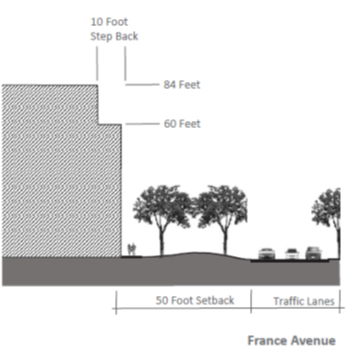
Front street setbacks on France Avenue between Highway 62 and Minnesota Drive and on York Avenue between 66th Street and 78th Street: A 50-foot setback is required from the face of the curb to the face of building. Above a building height of 60 feet the additional height must step back ten feet from the face of the building.
(b)
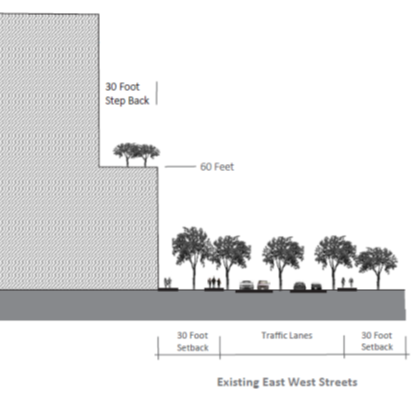
Front street setbacks on streets other than France Avenue and York Avenue: A 30-foot setback is required from the face of curb to the face of building. Above a building height of 60 feet the additional height must step back 30 feet from the face of the building to a maximum height of 105 feet. Any height above 105 feet must step back an additional ten feet from the face of the building.
(c)
All new front building façades in the district that face the public realm must have 75 percent transparency (ability to see inside the building) at the ground level.
(Ord. No. 2020-10, § 10, 8-18-2020; Ord. No. 2022-01, § 6, 1-19-2022)
Sec. 36-1380. - Definitions.
The following words, terms and phrases, when used in this division, shall have the meanings ascribed to them in this section, except where the context clearly indicates a different meaning:
Loading facility means and includes the dock to or from which the transport vehicle is being loaded or unloaded, the berth for the vehicle while it is being loaded or unloaded and the areas needed to maneuver the vehicle into or out of the berth.
(Code 1970; Code 1992, § 850.09(1))
Sec. 36-1381. - Location.
Off-street loading facilities shall be easily accessible from streets with a minimum of interference with other vehicle and pedestrian traffic. No loading berths shall be located on the side of a building which faces a residential district.
(Code 1970; Code 1992, § 850.09(2))
Sec. 36-1382. - Setbacks.
No loading facility shall be located within the required front street or side street setback for the principal building or within ten feet of an interior side lot line or a rear lot line.
(Code 1970; Code 1992, § 850.09(3))
Sec. 36-1383. - Design.
(a)
Berths. The following are the dimension regulations for loading facility berths:
(b)
Docks. All docks shall be located within the perimeter of the principal or accessory building and shall be completely enclosed except for the opening needed for access to a vehicle during the time it is standing in the berth.
(c)
Construction. All loading berths shall comply with the standards for the construction of parking areas as specified in this chapter.
(Code 1970; Code 1992, § 850.09(4))
Sec. 36-1384. - Minimum number of loading berths required.
(a)
Planned industrial district (except office buildings). One large berth per 50,000 square feet of gross floor area or major fraction.
(b)
All office buildings, mixed development district (office space only) and regional medical district.
(c)
Planned commercial district (except office buildings).
(Code 1970; Code 1992, § 850.09(5))
Sec. 36-1311. - Minimum number required.
(a)
Single dwelling units, double dwelling units and residential townhouses. One fully enclosed space per dwelling unit.
(b)
Apartment buildings.
(1)
At least 1.25 spaces per dwelling unit but no more than 1.75 spaces per dwelling unit. At least one fully enclosed space per unit required.
(c)
Senior citizen dwelling unit buildings. At least 0.75 spaces per unit, plus one space per employee on a maximum shift, plus one space per vehicle owned by the building's management.
(d)
Nursing, convalescent and rest homes. At least one space for every four patients or residents based on the maximum capacity of the building, plus one space per employee on the major shift, plus one space per vehicle owned by the building's management.
(e)
Day care, nurseries and preschools (principal use). At least one space per teacher or employee, plus one space per 20 individuals (or major fraction) receiving care.
(f)
Public or private senior high schools and seminaries. At least one space per classroom plus one space per ten students, or spaces equal in number to one-third the maximum seating capacity of the largest place of assembly, whichever is greater.
(g)
Public or private elementary or junior high schools. At least two spaces per classroom, or spaces equal in number to one-third the maximum seating capacity of the largest place of assembly, whichever is greater.
(h)
Community centers. At least as many spaces equal in number to one-third the maximum seating capacity of the largest place of assembly, or one space for each 250 square feet of gross floor area, whichever is greater.
(i)
Churches and other religious institutions. At least as many spaces equal in number to one-third the maximum seating capacity of the largest place of assembly, plus spaces for other church facilities which are used concurrently with the largest place of assembly, the number of which shall be determined by the council in connection with the granting of a conditional use permit.
(j)
Theaters (except within shopping centers), stadiums, auditoriums, arenas, lodge halls, mortuaries, and clubhouses. At least as many spaces equal in number to one-third the maximum seating capacity, plus one space for each employee on the major shift.
(k)
Governmental administration, public service, post office. At least the greater of one space:
(1)
Per employee on the major shift, plus one space per government-owned vehicle, plus ten visitor spaces; or
(2)
For each 250 square feet of gross floor area.
(l)
Libraries, art galleries. Ten spaces, plus one space for each 300 square feet of gross floor area.
(m)
Medical or dental offices, clinics and animal hospitals. At least one space for each 300 square feet of gross floor area, plus one space per physician, dentist or veterinarian.
(n)
Hospitals. At least one space for each two patient beds, plus one space per employee or volunteer on the major shift.
(o)
Athletic, health and weight reduction facilities.
(1)
At least four spaces per court for handball, racquetball, and tennis courts.
(2)
At least one space per 400 square feet of gross floor area for all other uses.
(p)
Restaurants (except within shopping centers). At least one space for each 100 square feet of indoor floor area, plus one space for each employee on the major shift and one space for each loading dock.
(q)
Carwashes. At least one space per employee on the major shift, plus five spaces for each wash lane, plus stacking spaces in accordance with section 36-1264.
(r)
Accessory carwashes. At least two parking spaces, plus stacking spaces in accordance with section 36-1264.
(s)
Gas stations. At least one space per employee on the major shift, plus one space for each 300 square feet of accessory retail uses exclusive of restrooms, storage areas and mechanical equipment.
(t)
Automobile service centers. At least three parking spaces per service bay, plus one space per employee on the major shift, plus one space for each 300 square feet of accessory retail uses in excess of 500 square feet exclusive of restrooms, storage areas and mechanical equipment.
(u)
Bowling alleys. At least five spaces per lane.
(v)
Offices, medical and dental laboratories, business or professional offices, financial institutions, employment agencies and travel bureaus. At least one space per 300 square feet plus one space for a loading zone dock minimum with a maximum of one space per 200 square feet.
(w)
Mixed Development District.
(1)
Residential. At least one space per dwelling unit but no more than 1.5 spaces per dwelling unit.
(2)
Nonresidential. Shall be regulated per section 36-1311 above.
(3)
Where a single building contains an office use and a restaurant use, up to 30 percent of the required office use parking may satisfy the restaurant parking requirement.
(4)
Where a single building contains an office use and a residential use, up to 40 percent of the required office use parking satisfy the residential use parking requirements, provided that the number of residential parking spaces never be less than one parking space per dwelling unit.
(5)
Where a single building contains an office use, a residential use, and a restaurant, up to 40 percent of the required office use parking satisfy the residential use parking requirements, provided that the number of spaces required for residential parking shall never be less than one parking space per dwelling unit, and up to 30 percent of the parking supplied to meet the requirement for the office use may also be used to meet the requirement for the commercial restaurant.
(x)
Multitenant industrial buildings. At least one space for each 500 square feet of gross floor area, or the sum of the component gross floor areas as follows, whichever is greater:
(1)
One space for each 300 square feet of office space.
(2)
One space for each 2,000 square feet of warehouse space.
(3)
One space for each 300 square feet of manufacturing, processing, packaging, treatment and assembly space.
(4)
One space for each 500 square feet of space containing machines and equipment for conducting scientific research, testing or experimentation.
(5)
One space for each 400 square feet of facilities for athletic, health and weight reduction purposes; six spaces per court for handball, racquetball or tennis.
(y)
Automobile and boat sales, new or used. At least one space per 250 square feet of gross floor area, including showrooms, sales space and offices, but excluding service areas, plus three spaces for each service bay. Required parking spaces shall not be used for the storage or display of vehicles, boats, or other products.
(z)
Furniture and major appliance sales.
(1)
Over 2,500 square feet of gross floor area. At least one space per 400 square feet of gross floor area.
(2)
Under 2,500 square feet of gross floor area. At least one space per 200 square feet of gross floor area.
(aa)
Hotels and motels. At least one space per guest unit, plus one space for each employee on the major shift.
(bb)
Taproom, cannabis lounge and cocktail room. At least one space per 100 square feet of gross floor area.
(cc)
Brewery, winery and distillery without on-site sales. At least one space per 1,000 square feet of gross floor area.
(dd)
Brewpub, brewery, winery and distillery with on-site sales. At least one space per 1,000 gross square feet of production floor area, and spaces equal in number to one-third the maximum seating capacity, plus one space for each employee on the major shift for the restaurant.
(ee)
Uses not specified. Where ambiguity exists in the application of off-street parking requirements, or where the parking requirements for a use are not specifically defined herein, the parking requirements for such use shall be determined by the city planner or the city planner's designee and such determination shall be based upon the requirements for the most comparable use specified in this chapter.
(Code 1970; Code 1992, § 850.08(1)A—AA; Ord. No. 2015-21, § 2, 11-4-2015; Ord. No. 2020-10, § 12, 8-18-2020; Ord. No. 2021-07, § 1, 8-16-2022; Ord. No. 2024-08, § 4, 11-19-2024)
Sec. 36-1312. - Planned Commercial District.
For uses allowed in the Planned Commercial District, except uses for which a parking quantity is otherwise specified, the following applies:
(1)
Planned Commercial District - 1 (PCD-1) (Areas include: 70th and Cahill, ValleyView/Wooddale, 44th and France)
Retail. At least one space per 250 square feet.
Multiresidential uses. At least one fully enclosed parking space for each dwelling unit but no more than 1.5 spaces per dwelling unit. Such parking spaces must be designed for the exclusive use of residents of the dwelling units and their guests. The council may require the provision of exposed parking spaces in addition to the required enclosed spaces as a condition to the issuance of a conditional use permit.
Office. At least one space per 350 square feet plus one space for a loading zone dock minimum with a maximum of one space per 200 square feet.
(2)
Planned Commercial District - 2 (PCD-2) (50th and France, area defined in the 50th and France small area plan)
Parking for uses in the 50th and France commercial node may rely on the City Parking Ramps with a floor area ratio up to 1.0 as defined in section 36-10. Uses exceeding 1.0 must provide additional off-street parking spaces for the square footage above 1.0.
Multiresidential uses. At least one fully enclosed parking space for each dwelling unit but no more than 1.5 spaces per dwelling unit. Such parking spaces must be designed for the exclusive use of residents of the dwelling units and their guests. The council may require the provision of exposed parking spaces in addition to the required enclosed spaces as a condition to the issuance of a conditional use permit.
(3)
Planned Commercial District - 2 (PCD-2) (Grandview, area defined in the Grandview Development Framework)
Retail. At least one space per 250 square feet.
Multiresidential uses. At least one fully enclosed parking space for each dwelling unit but no more than 1.5 spaces per dwelling unit. Such parking spaces must be designed for the exclusive use of residents of the dwelling units and their guests. The council may require the provision of exposed parking spaces in addition to the required enclosed spaces as a condition to the issuance of a conditional use permit.
Office. At least one space per 350 square feet plus one space for a loading zone dock, but no more than one space per 200 square feet.
(4)
Planned Commercial District - 3 (PCD-3) (Property zoned PCD-3 within the Greater Southdale area as defined in the Southdale District Plan)
Shopping centers (six+ businesses and at least 25,000 square feet.). At least one space per 350 square feet of gross floor area (including theaters and restaurants), plus one additional space for each ten seats in a restaurant, theater or other place of assembly. Atrium areas and mall areas, not used for retail sales purposes, shall be excluded from gross floor area calculations.
Multiresidential uses. At least one fully enclosed parking space for each dwelling unit but no more than 1.5 spaces per dwelling unit. Such parking spaces must be designed for the exclusive use of residents of the dwelling units and their guests. If a conditional use permit is required, the council may require the provision of exposed parking spaces in addition to the required enclosed spaces as a condition.
Retail. At least one space per 250 square feet.
(Code 1970; Code 1992, § 850.08(1)BB; Ord. No. 2021-07, § 2, 8-16-2022)
Sec. 36-1313. - Determination of parking requirements in places of assembly.
For the purpose of determining parking requirements in places of assembly, where persons occupy benches, pews and similar seating facilities, each 22 inches of the seating facilities shall be counted as one seat.
(Code 1970; Code 1992, § 850.08(1)BB)
Sec. 36-1314. - Use of public parking to meet off-street parking requirements.
(a)
Any principal use on property located within a redevelopment project approved by the council pursuant to Minn. Stats. ch. 462 or Minn. Stats. §§ 469.001 to 469.047, which principal use was in existence on the date the project was approved, and which project provides for public parking to serve the project area, may be reconstructed, or a new principal use constructed, on the same property without providing off-street parking additional to that provided for public parking. Provided, that the reconstructed or new principal use does not contain more gross floor area than the prior principal use, and is for uses which do not increase the number of required off-street parking spaces beyond those required for the uses in the prior principal use.
(b)
If any increase in the size, or changes in the uses, of such an existing principal use is made beyond the size or for other than the uses allowed in subsection (a) of this section, then additional off-street parking spaces shall be provided, pursuant to this chapter, but only for the additional spaces resulting from the increase in size or changes in uses.
(Code 1970; Code 1992, § 850.08(2))
Sec. 36-1315. - Location.
(a)
Nonresidential principal uses. The required number of off-street parking spaces shall be located on the same lot as the principal use or on an adjacent lot under the control of the owner of the principal use. For purposes hereof, control may be derived from ownership, or by a lease or easement continuing for a period of not less than 25 years. The required parking spaces shall not be separated from the principal use building by a street. Seventy-five percent of all required spaces shall be located within 500 feet of the entrances to the principal use building and 100 percent shall be within 1,000 feet.
(b)
Residential principal uses. The required number of off-street parking spaces shall be located on the same lot as is occupied by the principal use. The required parking spaces shall not be separated from the principal use building by a street.
(Code 1970; Code 1992, § 850.08(3))
Sec. 36-1316. - Setbacks not applicable to single dwelling unit buildings and double dwelling unit buildings.
(a)
No exposed parking spaces, required stacking spaces or drive aisles (except that portion of the driveway crossing the public right-of-way to give access to the street) shall be located within 20 feet of a public street right-of-way or within ten feet of an interior side lot line or a rear lot line. Interior side yard and rear yard setbacks shall be measured from the boundary of the tract. No parking space or drive aisle shall be located within ten feet of any principal use building.
(b)
Parking ramps shall comply with the requirements of section 36-1323.
(Code 1970; Code 1992, § 850.08(4))
Sec. 36-1317. - Design and construction.
The following are the dimensions for parking spaces for full- and compact-size cars:
(Code 1970; Code 1992, § 850.08(5)A)
Sec. 36-1318. - Compact parking spaces.
Within the Planned Office District, Regional Medical District and Planned Industrial District only, not more than 20 percent of all required parking spaces may be compact spaces. In all other districts, no compact spaces shall be counted as required parking. Compact spaces shall be clearly identified by signs mounted on sign posts in order that they are visible at all times. Signs which are painted on the pavement shall not be permitted for this purpose. Compact parking spaces shall be located in one contiguous area to the greatest possible extent and, where possible, limited to proposed employee parking areas. It is the purpose and intent to limit compact parking spaces to areas used for long-term employee parking rather than short-term visitor parking.
(Code 1970; Code 1992, § 850.08(5)B)
Sec. 36-1319. - Bumper overhangs.
The minimum parking space length as required may be decreased by 1.5 feet for full size parking spaces and one foot for compact spaces which allow the bumper of the automobile to project beyond the terminus of the parking space without obstructing other parking spaces or vehicle circulation areas.
(Code 1970; Code 1992, § 850.08(5)C)
Sec. 36-1320. - Joint parking facilities in the Planned Commercial District and Mixed Development District.
Parking spaces serving two or more buildings, lots or uses in the Planned Commercial District and the Mixed Development District may be located in the same off-street parking area, provided that:
(1)
The total number of spaces furnished shall not be less than the sum of the separate requirements for each use; and
(2)
All parking spaces shall comply with all requirements as to location and control as provided by section 36-1315(a).
(Code 1970; Code 1992, § 850.08(5)D)
Sec. 36-1321. - Nighttime uses.
(a)
Nighttime uses, as below defined, which share parking facilities with daytime uses may reduce their required number of parking spaces by 50 percent, provided that:
(1)
The total number of spaces normally required for nighttime uses is provided within the parking area in combination with parking spaces provided for daytime uses;
(2)
The total number of parking spaces normally required for nighttime use conforms to all requirements as to location and control as provided by section 36-1315(a); and
(3)
In the opinion of the planner, the peak hours of operation of the nighttime use will not coincide with the peak hours of other uses sharing the joint parking facility so as to cause a parking shortage.
(b)
For the purposes hereof, nighttime uses are limited to:
(1)
Theaters;
(2)
Facilities for athletic, health and weight control, including handball courts, racquet courts, tennis courts, reducing salons and aerobic dance studios;
(3)
Bowling alleys; and
(4)
Club and lodge assembly halls.
Provided, however, that uses which are located within a shopping center or Mixed Development District shall not be deemed nighttime uses and shall not be eligible for reduction of parking requirements due to nighttime uses.
(Code 1970; Code 1992, § 850.08(5)E)
Sec. 36-1322. - Construction.
Off-street parking spaces and circulation areas shall be surfaced and maintained with an all-weather, durable and dust-free surfacing material. Except for residential uses in the R-1 and R-2 districts, each parking space shall be clearly delineated by lines painted on or imbedded in the surface of the parking area.
(Code 1970; Code 1992, § 850.08(5)F)
Sec. 36-1323. - Parking ramps.
In addition to the general requirements described in division 2 of this article, the following special requirements shall apply to parking ramps:
(1)
The front street and side street setback shall be not less than 20 feet and the interior side yard and rear yard shall be not less than ten feet. The minimum setbacks shall be increased by one foot for every foot that the parking ramp exceeds 20 feet in height. No parking ramp or any part thereof, shall be located within 50 feet of the nearest lot line of any property in an R-1 district used for residential purposes.
(2)
The front street or side street setback for parking ramps and garages, and other structures, shall be increased to 50 feet when the ramp, garage or structure is located across the street from a property in an R-1 district used for residential purposes.
(3)
All exterior wall finishes of a parking ramp shall be of materials that architecturally complement the buildings that the parking ramp serves through the use of exterior materials, architectural elements and colors and shall be one or a combination of the following:
a.
Face brick.
b.
Natural stone.
c.
Specially designed precast concrete units, if the surfaces have been integrally treated with an applied decorative material or texture.
(4)
Parking ramps must include architectural elements that enhance the structure, reduce its perceived mass and complement the buildings that it serves. Architectural elements shall include decorative pilasters, banding, reveals, accents, wall plane articulation, facade treatments and ornamental grillwork, as appropriate.
(5)
Parking ramps must include screening or other appropriate design elements to screen the visibility of vehicle headlights from outside of the parking ramp.
(6)
The city encourages parking ramp designs that include ground floor retail, service and other uses, allowed by the zoning district in which the parking ramp is located. Such uses which are integrated into the parking ramp structure need not maintain front street and side street setbacks greater than that required for the parking ramp.
(Code 1970; Code 1992, § 850.08(5)G)
Sec. 36-1324. - Parking space reductions.
Reductions. The following off-street parking reductions may be utilized jointly or separately except as indicated otherwise:
(1)
Transit. The required number of spaces for a building may be reduced by ten percent if the building is located within one-quarter of a mile from a qualified transit stop; to qualify, the transit stop must be served by regular transit service on all days of the week and adequate pedestrian access must be available between the transit stop and the parcel. Information about transit routes and schedules should be posted in public spaces within the building to encourage the use of transit.
(2)
Car-share parking. A reduction of up to one space per reserved parking space for car share vehicles or five percent of the required parking spaces, whichever is greater, may be granted for any development that provides reserved parking for car-share vehicles. Reserved parking spaces for car-share vehicles may be provided in any required or non-required off-street parking space. Parking spaces for car-share vehicles shall be provided in convenient, accessible locations within 50 feet of a public entrance to a principal building.
(3)
A ten percent reduction in parking may be approved by the city planner or the city planner's designee provided that one of the following conditions are met:
a.
If a residential use: One covered, long-term bicycle parking space per three dwelling units.
b.
If a retail or service use: One covered, long-term bicycle parking space per 5,000 square feet of retail or service uses.
c.
1 short-term bike space per 5,000 s.f. of retail/services uses.
In order to qualify for this reduction, the long-term bicycle parking must:
a.
Be protected from weather and from access by unauthorized persons;
b.
Consist of bike racks or lockers anchored so that they cannot be easily removed; and
c.
Allow both the bicycle frame and the wheels to be locked with the bicycle in an upright position using a standard U-lock.
(4)
The area which would have been occupied by the eliminated parking spaces in subsections (1) to (3) above must be devoted to pervious surfaces, stormwater facilities, tree retention or native landscaping as directed by city planner or city planner's designee.
(Ord. No. 2021-07, § 3, 8-16-2022; Ord. No. 2023-06, § 4, 6-20-2023)
Sec. 36-1325. - Additional parking regulations.
(a)
Shared parking. The following criteria are guidelines for negotiating private agreements for shared parking. Applicants wishing to deviate from parking regulations must apply to the city for a variance from parking requirements. Situations not covered by section 36-1311(w) and (x), may apply to shared off-street parking facilities with other uses, even if the uses are in different structures, subject to the following criteria:
(1)
The applicant(s) must provide evidence that there is no substantial conflict in the principal operating hours of the buildings or uses for the proposed shared parking facilities. For purposes of this subsection, no substantial conflict shall mean either: (a) up to 75 percent of the required parking for daytime use may be provided in the parking facilities of a nighttime or weekend use; or (b) up to 75 percent of the required parking for a nighttime or weekend use may be provided in the parking facilities of a daytime use. The application must include a parking plan that address the hours, size, and mode of operation of the respective uses. Within the Planned Commercial District, an applicant shall document proposed shared parking proposals via the Urban Land Institute Shared Parking Model (ULI Shared Parking, Second Edition).
(2)
The minimum spaces required under a shared parking agreement shall be the number of spaces required for the use that requires the most parking.
(3)
A form agreement for shared parking facilities shall be developed by the city attorney. The agreement must run with the land. After the city council approves the agreement then it must be recorded within 60 days after council approval. A certified copy of the recorded document shall be provided to the city planner within 60 days of recording.
(4)
To qualify, the application must show that all parking addressed by the application is located within 300 feet of the benefitted structure's main entrance. Additionally, adequate pedestrian access must be available between the benefitted structure and all parking spaces.
(b)
Proof of parking measures. Applicants who do not utilize other parking reduction sections of this chapter may still receive a reduction of required parking spaces in one of two ways. The first is to demonstrate a lack of need for some spaces via a parking study. The second is to defer space that is set aside for the required amount of parking spaces which may be converted to parking later.
(1)
Parking study. The applicant must conduct a parking study as follows:
a.
The study must be conducted in accordance with city-approved methodologies.
b.
The study must be prepared by an independent traffic engineering professional under the supervision of the city and paid for by the applicant.
c.
In order to reduce the number of required spaces, the study must demonstrate that there is not a present need for the portion of parking for which the applicant is requesting proof of parking flexibility.
d.
The city planner or the city planner's designee shall review the parking study. Upon finding that the study sufficiently demonstrates a lack of demand the city shall approve of the reduced number of parking spaces.
(2)
Deferred spaces.
a.
The applicant must not assign deferred parking spaces to areas required for landscaping, required buffer zones, setbacks, fire lanes, drive aisles or areas that would otherwise be unsuitable for parking spaces because of the physical characteristics of the land or other requirements of this Code.
b.
The applicant may at any time request that the city approve a revised site plan to allow conversion of deferred spaces to operable parking spaces.
c.
The city planner or the city planner's designee may at any time determine that the deferred space be converted into operable parking spaces.
(c)
The placement of two abutting off-street parking facilities with continuous street frontage shall not be permitted.
(Ord. No. 2021-07, § 4, 8-16-2022)
Sec. 36-1326. - Electric vehicle supply equipment (evse) parking regulations.
(a)
Applicability.
(1)
These regulations shall apply to the following zoning districts:
a.
Automobile Parking District.
b.
Mixed Development District.
c.
Planned Commercial District.
d.
Planned Industrial District.
e.
Planned Office District.
f.
Planned Residence District.
g.
Planned Unit Development.
h.
Regional Medical District.
(2)
Any EVSE installed before the date of adoption of these regulations will be assumed to be legal, non-conforming structures.
(b)
Type of EVSE.
(1)
Level 1, Level 2, and Level 3 chargers are permitted as an accessory use in existing parking structures or parking lots in the abovementioned zoning districts.
(2)
An assembly of more than 24 EVSE adjacent to each other is prohibited on a single parcel.
(3)
The EVSE must incorporate a cord management system or method to eliminate potential for cable entanglement, user injury or connector damage from lying on the ground.
(c)
EV parking stall requirements.
(1)
Parking stalls with EVSE shall count towards off-street parking minimums required in the zoning code.
(d)
Location and accessibility.
(1)
EVSE may not obstruct a sidewalk or walkway and must minimize trip and safety hazards.
(2)
EVSE must not interfere with the right-of-way sight lines.
(3)
EVSE and parking stalls served by EVSE shall follow Americans with Disabilities Act (ADA) requirements.
(e)
Parking restrictions/requirements.
(1)
Parking stalls served by EVSE shall be reserved for EVs only. The developer or owner shall include signage and parking restrictions on the stalls to ensure availability and preference for EVs.
(f)
Design, installation, operations and maintenance.
(1)
EVSE shall be installed pursuant to manufacturer specification and shall comply with all applicable state building codes, state fire codes, state electrical codes, and relevant permitting processes.
(2)
EVSE shall be adequately maintained for safety and continual usage, following the property maintenance code. The area surrounding the EVSE shall be maintained appropriately to reduce hazards and allow access to EVSE, including snow removal around the equipment to allow for safety and access.
(3)
EVSE signage shall include a phone number to contact for regular maintenance issues and state to call 911 in case of an emergency.
(4)
EVSE signage may include wayfinding and usage instructions, but all other signage must meet the requirements of City Code Section 36-1655. Signs with a total area of over six square feet must follow the sign requirements of City Code Section 36-1655.
(g)
Definition of terms.
(1)
Electric vehicle (EV) means any vehicle that is licensed and registered for operation on public and private highways, roads, and streets; either partially or exclusively, on electrical energy from the grid, or an off-board source, that is stored on-board via a battery for motive purpose. "Electric vehicle" includes:
a.
a battery electric vehicle;
b.
a plug-in hybrid electric vehicle.
(2)
Electric vehicle supply equipment (EVSE) means provide electric power to the vehicle to recharge the vehicle's batteries. EVSE systems include the physical charger, software, and communications protocols that deliver energy efficiently and safely to the vehicle. EVSE does not include equipment located on the electric vehicles themselves. EVSE systems do not include mechanical or utility equipment related to delivering energy to the EVSE system and any connected EV, such as a transformer.
(3)
Charging levels means the standardized indicators of electrical force or voltage, at which an electric vehicle's battery is recharged. The terms 1,2, and 3 are the most common charging levels, and include the following specifications:
a.
Level-1 is considered slow charging. It is considered 120V single phase EVSE.
b.
Level-2 is considered medium charging. It is considered 208V/240V single phase AC EVSE.
c.
Level-3 or DC Fast Charging is considered fast or rapid charging. It is considered AC 208V or 480V, 3 phase supply.
(Ord. No. 2023-06, § 5, 6-20-2023)
Sec. 36-1345. - General requirements.
Vehicular traffic shall be channeled and controlled in a manner that will avoid congestion and traffic hazards on the lot or tract or on adjacent streets. Traffic generated by the use shall be directed so as to avoid excessive traffic through residential areas. No parking area, stacking area or circulation area, except for driveway ingresses and egresses, shall be located within a street, alley or highway.
(Code 1970; Code 1992, § 850.08(6)A)
Sec. 36-1346. - Review by engineer.
The adequacy of any proposed traffic circulation system on a lot or tract shall be subject to the review of the engineer who may require additional measures for traffic control to accomplish the orderly and safe movement of traffic including, but not limited to, the following:
(1)
Directional signalization.
(2)
Channelization.
(3)
Turn lanes.
(4)
Increased street width.
(5)
Warning lights.
(6)
Stacking lanes.
(7)
Location, number and width of curb cuts.
(Code 1970; Code 1992, § 850.08(6)B)
Sec. 36-1347. - Circulation within parking areas.
The following are circulation regulations within parking areas:
(1)
Unobstructed access to each parking space from a drive aisle shall be provided.
(2)
Traffic moving from one part of a parking area to another shall be capable of doing so without using a street.
(3)
Dead-end drive aisles shall not be permitted.
(4)
Parking spaces oriented at an angle of less than 90 degrees to the drive aisle shall be served only by way of one-way drive aisles.
(Code 1970; Code 1992, § 850.08(6)C)
Sec. 36-1348. - Driveway design.
Driveway width regulations are as follows:
(1)
In all zoning districts except R-1 and R-2 districts (back of curb to back of curb):
(2)
There are no minimum widths in the R-1 and R-2 zoning districts.
(3)
Maximum driveway width at street curb: 30 feet exclusive of returns as measured along the curb line of the street.
(4)
Minimum distance between driveways in all districts except R-1 and R-2: 20 feet between ends or returns as measured along the curb line of the street.
(5)
Minimum distance of driveway from street intersections: 50 feet between ends or returns of the driveway and the returns of the intersection as measured along the curb line of the street.
(6)
Minimum distance between end of the driveway return and side lot line in all districts except R-1 and R-2: ten feet.
(7)
A permit must be obtained for curb cuts pursuant to article IV, division 2 of chapter 24.
(Code 1970; Code 1992, § 850.08(6)D)
Sec. 36-1436. - Application of requirements.
All properties shall comply with the requirements of this subdivision except for single dwelling unit or double dwelling unit lots, public parks, playgrounds and athletic facilities, and public and private golf courses, except that clubhouses, parking areas and other structures accessory to the golf courses shall comply.
(Code 1970; Code 1992, § 850.10(1)A)
Sec. 36-1437. - Landscape plan requirements.
Landscape plans shall be prepared by a landscape architect or other qualified individual acceptable to the city planner. Landscape plans shall be drawn to a scale of not smaller than one inch equals 30 feet and shall include the following information:
(1)
Boundary lines of the property with accurate dimensions.
(2)
Locations of existing and proposed buildings, parking lots, roads and other improvements.
(3)
Proposed grading plan with two-foot contour intervals.
(4)
Location, approximate size and common name of existing trees and shrubs.
(5)
Planting schedule containing:
a.
Symbols;
b.
Quantities;
c.
Common names and botanical names;
d.
Size of plant materials;
e.
Root condition; and
f.
Special planting instructions.
(6)
Planting details illustrating proposed locations of all new plant material.
(7)
Locations and details of other landscape features, including berms, fences and planter boxes.
(8)
Details of restoration of disturbed areas, including areas to be sodded or seeded.
(9)
Location and details of irrigation systems.
(10)
Details and cross sections of all required screening.
(Code 1970; Code 1992, § 850.10(1)B)
Sec. 36-1438. - Minimum requirements.
All open areas of a lot which are not used and improved for required parking areas, drives or storage shall be landscaped with a combination of overstory trees, understory trees, shrubs, flowers and ground cover materials.
(1)
Minimum number of overstory trees. The number of overstory trees on the lot or tract shall be not less than the perimeter of the lot or tract as measured in feet divided by 40.
(2)
Understory trees and shrubs. In addition to the required number of overstory trees, a full complement of understory trees and shrubs shall be provided to complete a quality landscape treatment of the site.
(3)
Minimum size and root condition of required overstory trees.
MINIMUM AMOUNT OF REQUIRED TREES
Calculations to determine minimum number of trees are always rounded up. Tree size, as to deciduous, is the diameter of the tree measured six inches above the ground. Tree size, as to coniferous, is measured in height. All new overstory trees shall be balled and burlapped or moved from the growing site by tree spade.
(4)
Species.
a.
All required overstory trees shall be composed of species which are classified as overstory trees by the American Nurseryman's Association. Trees which are considered as half trees, shrubs, understory trees or ornamental trees shall not be included in the count of required overstory trees;
b.
Not more than 50 percent of the required number of overstory trees shall be composed of one species;
c.
No required overstory trees shall include:
1.
All species of the genus Ulmus (elm);
2.
Box elder;
3.
All species of the genus Populous (poplar); or
4.
Ginkgo, female only; and
d.
All plant materials shall be indigenous to the hardiness zone of the area in which the city is located.
(5)
Credit for existing trees. The total number of required new overstory trees may be offset by the retention of existing overstory trees on the lot provided that the trees satisfy the requirements of this division as to size and species. The planner shall determine the amount of the credit for existing trees based upon their location and distribution on the lot.
(6)
Ground cover. All unimproved portions of the lot or tract shall be sodded. Provided, however:
a.
Areas reserved for future approved building expansions may be seeded;
b.
Undisturbed areas containing existing viable natural vegetation which can be maintained free of weeds may be left undisturbed; and
c.
Slopes steeper than 3:1 ratio may be seeded.
(Code 1970; Code 1992, § 850.10(1)C)
Sec. 36-1439. - Landscaping inspection fee.
A landscaping inspection fee in the amount set out in section 2-724 shall be paid to the city at the time a building or other permit is issued for work to be done on the same property as the landscaping work, and as a condition to the issuance of the permit.
(Code 1970; Code 1992, § 850.10(1)D)
Sec. 36-1457. - Required.
The following uses shall be screened in accordance with the requirements of this subdivision with the exception of solar energy systems. Solar energy systems are exempt from screening requirements.
(1)
Nonresidential principal buildings or structures, and any building or structure accessory thereto, shall be screened from lots in the R-1 district which are used for single dwelling unit buildings and which are located within 200 feet of the nonresidential use. The distance shall be the shortest distance between the nonresidential building or structure to be screened and the nearest lot line of the R-1 district lot, but shall not extend across a street;
(2)
Principal buildings or structures, or any building or structure accessory thereto, located in the Planned Industrial District or Planned Commercial District shall be screened from lots used for any residential purpose which are located within 200 feet. The distance shall be the shortest distance between the PID or PCD building or structure to be screened and the nearest lot line of the residential lot, but shall not extend across a street;
(3)
Off-street parking facilities containing six or more spaces and all loading facilities shall be screened from streets located within 50 feet, and from lots which are used for any residential purpose which are located within 50 feet. Said distance shall be the shortest distance between the parking facility or loading facility and the nearest part of the street or the nearest lot line of the residential lot;
(4)
Trash storage facilities, including recycling storage facilities, shall be screened from all lot lines and public road rights-of-way; and
(5)
All mechanical equipment accessory to any building, except single dwelling unit and double dwelling unit buildings, shall be screened from all lot lines and streets, excluding EVSE owned by electrical utilities with an active franchise agreement with the City.
(Code 1970; Code 1992, § 850.10(2)A; Ord. No. 2018-18, § 3, 12-18-2018; Ord. No. 2023-06, § 6, 6-20-2023)
Sec. 36-1458. - Responsibility.
The owner of the principal or accessory building or structure to be screened shall install and maintain all screening required without cost to the city.
(Code 1970; Code 1992, § 850.10(2)B)
Sec. 36-1459. - Materials.
Required screening may be achieved with fences, walls, earth berms, hedges and other landscape materials. All walls and fences shall be architecturally harmonious with the principal building. Earth berms shall not be steeper than a 3:1 ratio. All materials, including landscaping, shall have a minimum opacity of 90 percent yearround.
(Code 1970; Code 1992, § 850.10(2)C)
Sec. 36-1460. - Location.
All required screening shall be located on the lot occupied by the use, building, facility or structure to be screened. No screening shall be located upon any public road right-of-way, or within 20 feet of the traveled portion of a street.
(Code 1970; Code 1992, § 850.10(2)D)
Sec. 36-1461. - Height.
The minimum height for screening required by this section is as follows:
(1)
Screening required by section 36-1457(1) and (2): ten feet above property line;
(2)
Screening required by section 36-1457(3): four feet above level of parking lot and ten feet above level of loading facility; and
(3)
Screening required by section 36-1457(4) and (5): high enough to completely screen from property lines, but not less than five feet or greater than ten feet in height.
(Code 1970; Code 1992, § 850.10(2)E)
Sec. 36-1462. - Maintenance.
(a)
Responsibility. The owner of the lot upon which the required landscaping or screening is located shall maintain all materials in a sightly and healthy growing condition without cost to the city.
(b)
Security. Security shall be filed with the planner in accordance with article II of chapter 10 to guarantee the installation and vigorous growing condition of all landscape elements and required screening. The security shall remain in effect for two full growing seasons. Lots provided with an irrigation system covering 100 percent of the area improved with landscaping need provide security for only one growing season. The growing season guarantee period for plant material installed after June 1 shall begin the following year.
(Code 1970; Code 1992, § 850.10(3))

