
El Paso County Unincorporated
City Zoning Code
City Zoning Code
APPENDIX D
LANDSCAPING AND PLANTING MANUAL1
BASIS FOR LANDSCAPING PLANS
Purpose of this Manual
This Landscaping and Planting Manual supplements the landscaping, buffering, and screening requirements established by the El Paso County Land Development Code (LDC). This Manual includes policies, explanations, examples and illustrations of methods that can be used to help an owner comply with the requirements of the LDC.
This Manual provides information concerning the development and maintenance of landscaping for both private property and public rights-of-way whether required by the LDC or otherwise proposed as part of a development. This Manual also provides information to help ensure appropriate buffering and screening is provided between differing land uses to enhance compatibility.
It is the intent of El Paso County that the information presented in this Manual will help ensure landscaping will:
•
have an increased survival rate;
•
require minimal maintenance;
•
provide the greatest benefit for the dollars spent;
•
work with and compliment the natural environment; and
•
encourage water conservation.
Applicability and Relationship to the LDC
This Manual supplements the requirements of the LDC and provides suggestions concerning the best practices to implement the provisions of the LDC. The LDC is the regulatory document that defines the minimum requirements for landscaping with respect to landscape area, size and types of plantings, number of plants, and location of landscape areas. The provisions of the LDC specifically applicable to landscaping have been included in Appendix A to assist the user of this Manual.
Property Rights and the Value of Landscaping
El Paso County recognizes that landscaping can be a significant expense to businesspeople and residents. At the same time, vegetation enhances property values, and attracts customers to businesses; provides a quality environment for tourists and residents; reduces stormwater runoff rates and volumes and mitigates water quality concerns in accordance with State and Federal requirements; and controls dust in support of Federal and local requirements. Landscaping also improves the livability of residential neighborhoods, improves the compatibility of adjacent uses, screens undesirable views, contributes to the image and appeal of the overall community, and can reduce noise pollution. Landscaping also supports ecological systems and helps to protect critical species (pollinators, etc.). Landscaping reduces pollution and serves to lessen the effects of urban heat sink effect in dense urban residential areas. The intent of this Manual is to achieve a reasonable balance between the right of individuals to develop and maintain their property in a manner they prefer and the rights of residents of the community to live, work, shop, and recreate in pleasant and attractive surroundings.
Water Resources and Landscaping
El Paso County is in a semi-arid, high plains and foothills environment, which dictates the use of water-conserving, hardy, or indigenous plants. Regardless of the type of plant materials used, nearly all landscaping in El Paso County requires supplemental water to survive, particularly while it is being established. However, the appropriate selection of plants can minimize the need for supplemental watering. It is even possible to install landscaping that can be maintained during times of drought, during watering restrictions, or where irrigation is not allowed. Drought resistant and drought-tolerant plants, plus other water, soil, and conservation techniques identified in this Manual, provide the opportunity for decreased development and maintenance costs, while achieving the intent of the County's landscape requirements.
Stormwater and Landscaping
This Manual encourages the use of required landscape areas to manage stormwater. New and innovative techniques to blend stormwater management and landscape areas are encouraged and could result in the approval of modifications in the placement of landscape materials.
Goals and Implementation
The goal of this Manual is to allow owners to take advantage of realistic and sensible design options in complying with the landscaping provisions of the LDC. In furtherance of this goal, this Manual provides flexibility in landscape design and establishes a program whereby an owner can get credit for:
•
the retention of existing vegetation;
•
habitat conservation in riparian areas or other native areas; and
•
paved pedestrian plazas that meet certain design criteria.
This Manual also recognizes the difficulties associated with landscaping industrial areas or small lots by allowing off-site landscaping.
Updates of this Manual
This Manual is maintained as a resource document by the Planning and Community Development Department (PCD). This Manual was endorsed by the Board of County Commissioners (BoCC) on_______. The BoCC in its endorsement has authorized the PCD to maintain, update and enhance the Manual from time to time to assist owners in preparing landscape plans that conform to the requirements of the LDC.
Additional Information
Additional information concerning these standards can be obtained by contacting the PCD. Additional information on xeriscape principals can be found at:
•
www.xratedgardening.com
•
www.denverwater.org
•
www.csu.org/xeriscape
•
www.xeriscape.org
When Landscaping is Required
The LDC identifies when, where, and how much landscaping is required in commercial, office, industrial, and residential projects. Appendix A includes the applicable landscape provisions of the LDC.
Engineering Criteria Manual Landscape Provisions
The Engineering Criteria Manual (ECM) contains construction and post-construction soil stabilization and water quality protection requirements that may be more prohibitive than the landscaping requirements contained in the LDC.
GENERAL GUIDELINES
The following general guidelines should be considered in all situations where landscaping is required by the LDC.
Vegetation
Mimic Nature
Plants that mimic and blend with the surrounding natural landscape should be used. For example, the Black Forest should emphasize conifers, while the High Plains should emphasize rolling landforms and shrubs.
Consider All 4 Seasons
4 season effectiveness (evergreens, persistent seed heads or berries, and dense forms) should be included in every landscape design.
Locate Plants with Similar Needs Together
Plants with similar water needs should be located next to each other.
Accommodate the Growth Habit of Each Plant
Plants should be placed in locations that are appropriate for their growth habit: shade vs. sun, height and spread vs. available space, etc.
Use Xeric Vegetation
Xeric vegetation should be used in order to conserve water, minimize maintenance costs, and enhance survival. Appendix B provides a list of suggested drought-tolerant and drought-resistant plants. Other species may be acceptable if they meet xeric principals and are proven to thrive in El Paso County's climate. High water use plants should be minimized or eliminated.
Whenever possible, group plants by water, soil, and sun needs.
Preserve Existing Vegetation
Native vegetation or other vegetation that generally conforms to the requirements of the LDC and the guidelines provided in this document should be preserved whenever possible, and may be used, in whole or part, to meet landscaping required by the LDC, depending on the effectiveness of the existing landscaping in achieving the County's landscape goals and its ability to be protected and maintained.
Avoid Clustering of Evergreens Under Certain Conditions
The clustering of evergreens may not be advisable in instances where their location (south side of a road) would cause unsafe conditions such as ice or snow build-up due to winter shading and lack of sun exposure. In this instance, the use of shrubs may be most appropriate.
Spacing of Trees
The minimum number of trees required in any circumstance is not meant to force specific plant spacing on an "on-center" basis. The owner has flexibility to group or cluster trees and is encouraged to vary the spacing and distance between trees and shrubs. Trees and tall shrubs should be clustered in locations where they can provide the greatest mitigation for land uses, enhance views, or create points of interest.
Wildflowers Discouraged as Groundcover
Wildflowers are not recommended as ground covering due to the relatively high chance of bare areas.
Native Grasses or Xeric Turfgrasses Encouraged for Rural Areas
Native grasses or xeric turfgrasses are encouraged in rural areas, rather than bluegrass sod.
Planting Space
All planting areas should be designed such that the plant species selected have adequate area for growth.
Conflicts with Sight Distance and Sight Triangles
The ECM provides standards for landscaping to maintain sight distances. Generally, landscaping within a sight distance triangle should not exceed 24 inches in height. Trees that are limbed up to 6 feet above the ground are also generally acceptable. Check with the Department of Public Works Development Services to propose shrubs or trees in a sight distance triangle.
Noxious or Invasive Species Not Allowed
Noxious or invasive species are not allowed. A list of noxious or invasive species is provided in Appendix C. An updated list is available from the Community Services Department, Environmental Division.
Species of Trees Limited In or Near ROW
The planting of Acer negundo, Salix sp., and most Populus sp. trees in or near rights-of-way should be limited because of their invasive roots which cause problems with utilities and roads; and due to their weak branches.
Clumps of Trees for Screening Encouraged
Clumps of trees are encouraged for screening purposes, instead of single-trunk trees. However, each clump will be counted as only 1 of the trees required by the LDC, unless determined otherwise by the PCD Director smaller caliper trees may be used for clumping purposes.
Avoid Interference with Utilities and Hydrants
Landscaping should not interfere with the general function, safety, or acceptability of any gas, electric, water, sewer, telephone, or other utility easement or conflict with criteria established or adopted by a fire department. Advice should be sought from the Fire Authority before installing landscaping adjacent to fire hydrants. Landscaping exceeding 8 inches in height within 3 feet of a hydrant is prohibited by the LDC.
Avoid Interference with Sidewalks and Roads
The location and spacing of trees and plant materials should allow for the growth characteristics of the plants without adversely affecting the maintenance of structures, walks, drives, or vehicular and pedestrian traffic.
Irrigation and Soil Preparation
Irrigation Systems
Irrigation systems should use the most current water-saving technology. Drip irrigation should be used whenever possible. Overspray from sprinkler systems onto paved surfaces should be avoided. Irrigation maintenance budgets should be prepared to ensure optimal water use for plant survival.
Soil Preparation
Soil should be amended to increase water retention and organic content for plant health and vigorous growth.
Retaining Walls and Slopes
Retaining walls higher than 4 feet may be appropriate in areas where special grading conditions exist. Retaining walls should be visually softened by the planting of trees and shrubs to avoid a continuous, monotonous effect and should also be "stepped" in 4-foot maximum height increments to slow water runoff and provide planting areas. Except where necessary to convey stormwater as part of an overall site design, slopes should not generally exceed 3:1. Appropriate safeguards and appropriate trees should be selected in order to prevent the undermining of the retaining walls. Root guards are required for trees.
Determining Project Area
In instances where an entire parcel or lot is not used for the proposed development, the project area may be determined to be less by the PCD Director. The minimum landscaping requirements may apply to just that project area; however, if additional landscaping (including buffering or screening) is necessary due to certain circumstances, the PCD Director may require that landscaping.
Buffering/Screening
Buffers to Reflect Character of Site
Buffer design should reflect the unique site and land use situation for each project. In any case, 4-season effectiveness should be achieved for all buffering and screening areas.
Required Opaque Structures
Any required opaque structure, including dumpster screening, should be integrated with the overall project architecture. For example, if the main building is stucco, the screening walls should be stucco to match.
Screening Fence Design
Fences should provide texture or design, such as offsets or changes in materials, to avoid a monotonous appearance. Fences should be soundly constructed and maintained.
ROADWAY LANDSCAPING
Purpose
Sites adjacent to roads are highly visible. Landscaping contributes to a positive image and the visual appeal of the County, provides noise and glare mitigation, summer cooling and shade, enhances water quality, and provides compatibility with adjacent properties. A strong emphasis should be placed on the landscape treatment along the road, especially emphasizing water conservation and surrounding landscape context, to afford pleasant visual experiences from these corridors.
Minimum Roadway Landscaping Areas
The minimum roadway landscaping areas are identified in the LDC. Urban grade-separated intersections, as identified on any adopted maps or plans including the MTCP (Powers Boulevard, Marksheffel Boulevard, etc.) should accommodate the required 25-foot roadway landscaping area beyond the area to be reserved for an urban interchange. The timing of the interchange is not a factor in determining the location/need for the roadway landscape area.
Roadway Landscaping Area Depths Vary Based on Roadway Classification
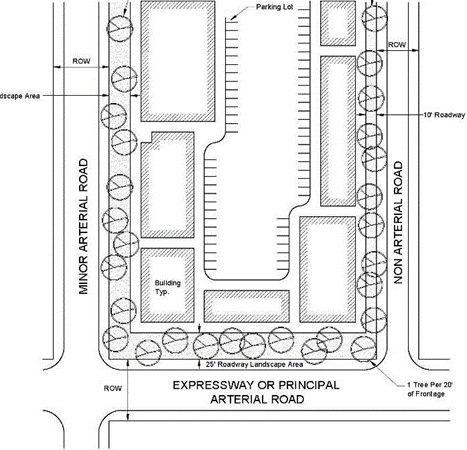
Roadway Landscaping Guidelines for Rural Areas
Tall Shrubs and Landforms as Opposed to Trees
Consider using tall shrubs and landforms for specific areas that require buffering (present or future) in rural areas. The LDC allows the replacement of trees with shrubs.
Bluegrass Discouraged
Bluegrass sod is discouraged in rural areas; native grasses or other xeric turfgrasses, including grasses listed on the Water Wise Planting List are more appropriate. See Water Wise Planting List for additional details.
Landscaping Options for Roadway Landscaping Area in Rural Areas
Berms and native shrubs in a design that creates visual interest are encouraged. A minimum of 75% of the length of the road should incorporate either berms (3' minimum height) or shrubs (3' mature height minimum), with 50% of the length having shrubs. Trees are recommended only as an accent.
Where the required minimum roadway landscape area is only 10' in width, the width may undulate to accommodate the use of berms and the maximum allowable 3:1 berm slope.
Location of Landscaping Materials within Roadway Landscaping Area
The required roadway landscape materials may be clustered along the frontage. Design should be determined by screening needs, preservation and enhancement of views, or project impacts.
Policies and Explanations
Meandering Sidewalks
Public sidewalks may be allowed to "meander" within a roadway landscape area provided they are approved by the ECM Administrator and an easement approved by the Office of the County Attorney is provided to El Paso County.
Landscaping in ROW
Landscaping shall be provided in the road right-of-way to the curb line. Landscaping shall be similar to the groundcover treatment within the required roadway landscape area.
PARKING AREA SCREENING AND LANDSCAPING REQUIREMENTS
Recommended Material Types
The lowest water use vegetation and durable materials are highly encouraged due to the harshness of parking area environments. Materials should be chosen that are contextually appropriate: boulders and conifers in mountainous areas; berms and conifers in the Black Forest; berms and native shrubs in the High Plains. A combination of low, decorative walls and street trees may be most appropriate in urban areas.
Design of Parking Area Landscaping
Parking areas should incorporate landscape features to break up and dilute the expanses of paving. Vegetation can also improve water quality, and parking area islands can serve as detention or water quality areas. Landscaping and buffering can be utilized to increase site aesthetics, property values, and attractiveness to customers; to visually decrease the scale of the parking areas; to provide shade for the pedestrian and parked vehicles; to reduce glare and heat; to separate and organize circulation systems; to provide openings in impervious surfaces for drainage and infiltration of ground water; to reduce glare from headlights; and to separate and screen uses.
Parking Area Islands
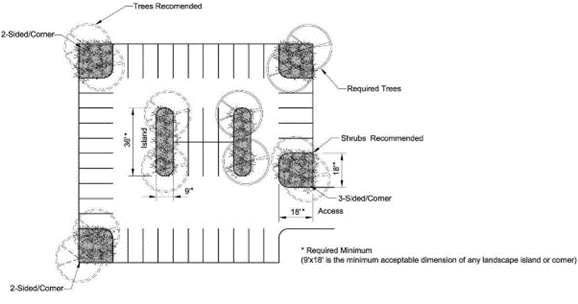
The following standards generally apply to the use, placement, and landscaping of parking area islands. Parking lot islands, corners, and fingers are all considered parking area islands:
•
1 parking area island shall be provided for every 15 parking spaces.
•
Each island should be a minimum of 2 parking spaces in size (18' x 18' or 9' x 36')
•
Each island should have a minimum of 2 low-water trees and 10 low-water shrubs less than 36" tall, plus mulch.
•
Appropriate mulch (e.g., bark or rock) should be used in areas not covered by living groundcover.
•
Large boulders (3' max. height x 4' minimum length) may be substituted for some of the recommended shrubs. (No more than 50% replacement allowed.)
•
Bluegrass sod or non-xeric turfgrasses are discouraged.
•
Tall (greater than 18") ornamental grasses that persist through winter are considered shrubs.
•
Parking area islands should be utilized at the end of parking rows both as a means to contain parking area trees and other landscape materials and to provide separation and delineation between drive aisles and parking stalls.
The figure below provides some recommendations concerning the use of islands and plantings. Islands and corners should be used to guide traffic, break up large expanses of paving, or control stormwater.
Typical Landscaping and Placement of Parking Area Islands
Depressed Parking Area Islands
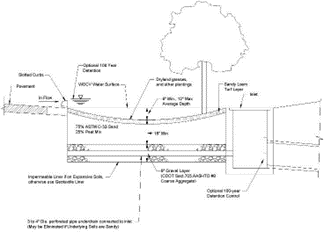
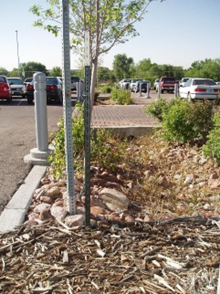
Depressed islands are encouraged and can be used as a tool to manage and improve stormwater quality and control peak discharges. The grade of the surface of the landscaping should be slightly below the adjacent pavement to allow runoff to flow into the landscaped area, as opposed to elevating the landscaping and surrounding it with a curb. The figure shows how a depressed island is designed to provide these benefits while meeting the requirements to provide parking area islands.
| Depressed Landscaped Parking Area Island | |
 |  |
Parking Area Screening
Parking area screening may incorporate a wide variety of techniques, including: earth forms/berms, built features/walls, and plant materials. Techniques may be combined to create unique and site-specific designs.
Rural Screening along Road Frontage
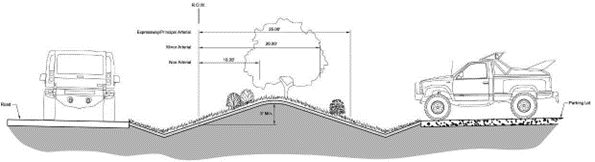
A variety of options are available to meet the parking area screening requirements of the LDC. The figure below presents the most typical scenario in rural areas. When combined with the roadway landscape area requirements, trees are generally required between the parking area and ROW line. However, in accordance with the LDC and this manual, shrubs are encouraged as a substitute for trees. In addition, parking area setbacks may be greater than anticipated due to the depth of the required roadway landscape area. The following diagram provides an example of how berms and plantings should be used to meet the requirements of both the roadway landscape area and parking area screening in a rural area. Some of the urban screening options presented in the next section may also be applicable in some rural areas.
Rural Parking Area Screening Using Berms to Achieve 3 Foot Screen
Urban Screening along Road Frontage
A variety of options are available to meet the parking area screening requirements of the LDC. The figures below present several combinations of landscaping, berms, and walls that could be applied in urban areas. The roadway landscape area covers the same area as the parking area screening. As a result, the roadway landscape area depth, and the requirement to provide trees exceed the minimum parking area screening requirements when a parking area is located adjacent to a road in most cases.
Urban Parking Area Screening Using Berms to Achieve 3 Foot Screen
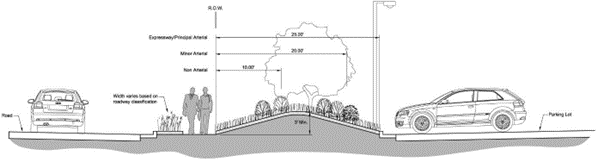
Urban Parking Area Screening Using Vegetation to Achieve 3-Foot-High Screen
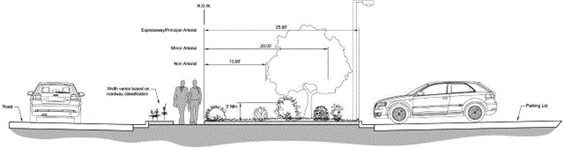
Urban Parking Area Screening Using Slope to Achieve 3-Foot-High Screen
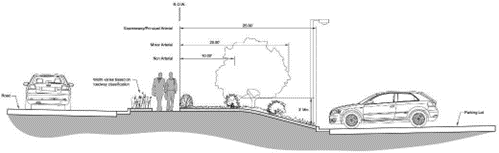
Urban Parking Area Screening Using Vegetation to Achieve 3-Foot-High Screen
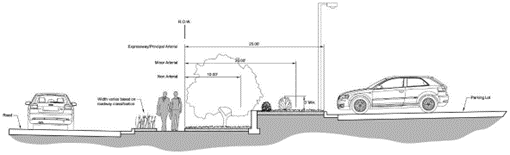
Urban Parking Area Screening Using Wall to Achieve 3-Foot-High Screen
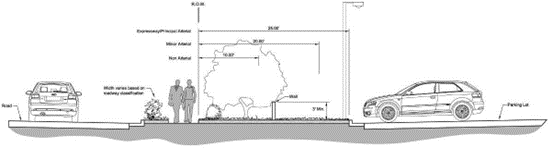
Parking Area Frontage
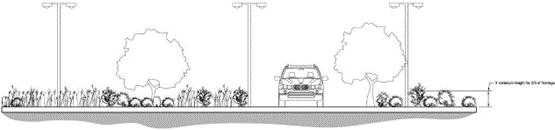
All parking areas shall be screened to a height of 3' by vegetation, walls, and berms for at least ⅔ the length as shown in the figure below. This means that some areas may not have any screening while all other areas will have a minimum of 3' tall screen.
Parking Area Screened to a Height of 3' for at Least ⅔ of the Length.
Parking Area Landscaping Policies and Explanations
Visual Character
The visual character of parking areas should be enhanced by planted islands, intensive shade trees or ornamental plantings. Large impervious areas are to be broken up with functional landscape medians and islands that can organize vehicular traffic and provide pedestrian pathways.
Other Plant Types
The PCD recognizes that other species in addition to those identified in Appendix B may be approved in a parking area if special conditions exist. For example:
•
The scale and overall design achieves the goals/intent.
•
Coniferous evergreen trees may be approved if such trees are planted in areas which exceed the minimum recommended planter size and if visibility is not a problem.
•
Existing vegetation may be used, regardless of species. Larger islands may be required to accommodate larger, established root systems.
Reference Elevation for Screen
In general, the reference elevation for the base of the required screen shall be the surface of the parking area space that is to be screened.
Screening Applies Where Parking Area is Visible
Parking area landscape requirements will apply to any type of parking area where it can be seen from a public or private road.
Reductions in Parking Area Screening or Islands
Reductions in the amount of parking area screening and islands can be considered where the parking area is located a considerable distance from the road (200—300 feet) or within the street perimeter buffer. The distance from the road and topography are primary considerations in allowing a reduction in the screening and island criteria, as well as the effectiveness of existing or proposed perimeter screening.
BUFFER AND SCREEN AREAS BETWEEN DIFFERING USES OR ZONE DISTRICTS
Purpose
Buffering and screening is used to block displeasing views; reduce noise, odors, glare, and dust; mitigate traffic; protect residential privacy; and reduce trespassing. Buffering and screening can also make uses more compatible, such as with Special Uses.
Between similar uses, buffering and screening (perimeter landscaping) can help identify parking areas and property boundaries.
Water Conservation
Water conservation can be incorporated into buffer and screen areas. Swales can be used to direct water to planted areas to minimize irrigation needs and detention pond volumes, the use of appropriate plant materials can conserve water and minimize maintenance costs, and the creative use of a variety of plants will provide 4-season interest and effectiveness.
Required Buffers/Screens
Circumstances for each site and use are unique, and additional buffering/screening may be required to accomplish appropriate design. Of special concern are sites adjacent to residential areas or environmentally sensitive areas, areas with significant view corridors, industrial uses, or uses that are visible from highly traveled roads.
Buffer/Screen Between Non-Residential and Residential Uses Separated by a Non- Arterial Road
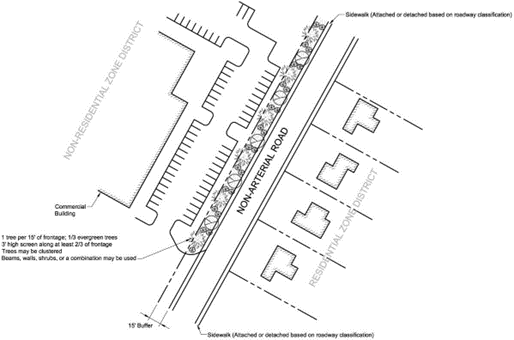
Along the roadside property line in any non-residential project in any zone district where the project is separated from a residential use by a non-arterial street, a buffer meeting the requirements of the LDC is required. Non-arterial streets are those not designated as arterial streets or above on the County's Functional Classification Map, as amended. Private streets and alleys are also considered non-arterial roads. The figures below provide 2 examples of how the standards can be met. Note that the parking area screening requirements result in more landscaping being required within the use buffer area when a parking area abuts the roadway.
Example of 15' Buffer Standard between Non-Residential Zone District and Residential Zone District
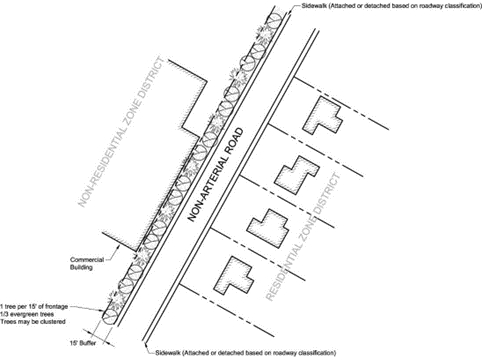
Example of 15' Buffer Standards between Non-Residential Zone District and Residential Zone District when Parking Area Abuts Road Frontage
Buffer/Screen Between: Adjacent Non-Residential and Residential Projects, and Adjacent Multifamily Residential and Single- Family/Two-Family Residential Projects
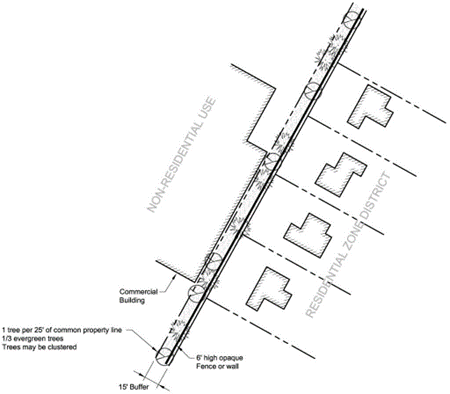
Along the common property line in any non-residential project in any zone district where the project is adjacent to any residential zone district and along the property line in any multifamily project where the project is adjacent to a one- family or two-family use, a buffer meeting the requirements of the LDC is required. The figure below provides an example of how the standards can be met.
Example of 15' Buffer Standards between Non-Residential Use and Residential Zone District
Trash Collection Areas
Refuse collection areas, including trash bins, are required to be screened from view from adjacent properties and roads by the use of an opaque wall or fence, other architectural elements, or dense evergreens. Walls/fences should be of a durable material, such as masonry, and should match the overall project architecture. Wood or chain link are discouraged. Gates should be metal.
Rural Areas
In rural areas, dense evergreen, or 4-season plantings with a minimum planting height of 6 feet or berms with dense plantings creating an opaque appearance with a minimum height of 6 feet are appropriate.
Policies and Explanations
Design for Effectiveness from Time of Installation
Buffers and screening shall be designed in a manner that appropriately provides the required effect at the time of installation, as well as in the future.
Restoration Efforts
Restoration/conservation/preservation efforts on portions of a site that are part of larger natural areas, such as wildlife habitat conservation areas, habitat corridors, or wildlife movement corridors, etc., may count toward the buffering/screening requirements, with approval from the PCD Director.
INTERNAL LANDSCAPING
Purpose
Internal landscaping requirements are intended to augment the streetscape, screening/buffer and parking area landscaping requirements, while conserving water resources. The purpose of internal landscaping is to visually soften the mass of buildings, enhance the visual appearance, and to visually separate building areas from parking areas, and create a welcoming appearance to building customers and users.
Minimum Area and Planting Requirements
The minimum internal landscaping area required by the LDC, and number of plantings shall be met by all projects.
Design Standards
Plantings Near Foundations
Lowest water usage plants are especially encouraged next to building foundations, where irrigation should be limited.
Low Water Use Plants Encouraged
As always, xeric and hardy species are strongly encouraged to minimize maintenance costs and enhance survival. Should bluegrass sod or other high-water use plants be desired for a certain look, it is encouraged to meet the following criteria:
•
No more than 20% of the internal landscape area should be allowed for high water use plants.
•
Each high water use area should be on a separate irrigation zone for customized watering.
•
Each high water use area should be confined to main building entrances.
Minimum Plant Material Sizes/Percentage of Live Material Ground Cover
Landscape Material Specifications
The minimum planting/installation size and characteristics of plant materials shall meet the requirements of the LDC.
Required Live Material Ground Cover
The minimum groundcover requirements of the LDC shall be met.
LANDSCAPING AND GRADING IN UTILITY EASEMENTS OR RIGHTS-OF-WAY
Utility providers, as a matter of general policy, will not normally permit use of their easements/rights-of-way by other parties. These criteria are general guidelines only and should not be construed as the complete and only conditions for such exceptions. Each case will be evaluated on an individual basis and must be approved by the utility provider.
•
Changes in grades and elevations along the rights-of-way shall not reduce safe ground clearances of overhead wires.
•
Safety clearance distances between overhead and underground wires and any improvements/structures should be maintained as applicable.
•
Working space clearances as applicable should be maintained around line structures.
•
Excavations shall not reduce support strength of overhead line structures.
•
Excavations shall not reduce the depth of burial of underground cables.
•
Low level landscaping, with a maximum height of 25 feet or less, may be allowed within the easement/right-of-way provided all other applicable requirements of this document are met and permission is expressly granted by the easement/ROW holder.
•
The party or owner installing and planting landscaping will be responsible for maintenance of the landscaping.
•
Future power line installations may necessitate the relocation of vegetation. The removal/relocation and replacement will be at the owner's expense if located in an easement or Right-of-Way.
MULCH
Mulch, organic or inorganic groundcover, prevents the growth of weeds, prevents erosion and dust, retains moisture in the soil, provides shade for plant roots, and presents an attractive and finished appearance for landscapes. Mulch is required on all landscaping projects, in areas other than turfgrass.
Specifications
Acceptable mulch materials include but are not limited to the following examples: bark and pole peelings, river rock, washed gravel of ⅜" diameter or greater (should be limited in areas prone to washout), or other similar materials that may be approved by PCD. Avoid very light or dark colors, as these can adversely affect soil and ambient temperatures. Non-water/low water using turf or plant species are encouraged (See Water Wise Planting List).
Mulch Installation
Mulch should be installed over breathable fabric underlayment, pinned at intervals of not less than 24".
Mulch Depth
Mulch should be installed at the following minimum depths:
•
Bark and pole peeling mulch shall be installed at a depth of not less than 4".
•
Rock mulch shall be installed at a depth of not less than 3".
Mulch shall be maintained in a manner so that the minimum required depths are achieved throughout the life of the project. In no case shall underlayment fabric be visible.
Steel Edging
Steel edging of at least ⅛" thickness and 6" depth should be used to define all mulch beds, unless a bed is defined by curbing or other constructed edge.
IRRIGATION
Recommended Conservation Techniques
Drip irrigation is highly recommended for all trees and shrubs in order to conserve water. Drip irrigation may be required for certain species to allow for establishment and/or maintenance. Sprinkler systems may be used but are discouraged. Additionally, moisture sensors are also recommended to avoid watering during or after rain. In areas where outdoor irrigation is not allowed due to well permit restrictions, plants that are most drought-tolerant should be installed.
Policies
Statements regarding the proposed type of irrigation or watering method should be similar to those outlined in the following table:
Types of Recommended Irrigation
DEFINITIONS
Words used in this manual have their dictionary meaning unless they are specifically defined in this manual, the LDC, or the ECM. Words defined within this manual shall have the specific meaning assigned unless the context clearly indicates another meaning.
Berm
A mound of soil, either natural or manmade, used to obstruct views, attenuate noise, or direct the flow of stormwater.
Buffering
The installation of plant materials, fencing, or landforms (or a combination of these measures), between 2 or more lots or parcels which inhibits visibility or mitigates the transmission of noise, dust, smoke, lights, and other nuisances from 1 lot or parcel to another or provides for future public improvements or additional open space.
Canopy
The upper vegetative cover of a tree or plant grouping; dripline of a tree or plant grouping.
Context
The surrounding environment or character of an environment; trees or landforms that naturally exist on a site or surrounding sites.
Coniferous
Evergreen plant: keeps its leaves/needles all year.
Deciduous
A plant with foliage that is shed annually.
Drought Tolerant
A plant that will survive in the typical or somewhat less than typical amount of rainfall in El Paso County.
High-Water Use Plants
Plants that require more than 1 inch of water per week to thrive, including bluegrass sod and many non-native species.
Indigenous
A plant naturally found in the El Paso County environment; the local, native plant community.
Irrigation System
A permanent, artificial watering system designed to transport and distribute water to landscape plants.
Landscape Plan
A plan drawn to scale that shows the layout of all landscape components and their specifications for a Site Development Plan.
Landscaping
Any combination of living plants, such as trees, shrubs, vines, ground covers, flowers, or grass; natural features such as rock, stone, bark chips or shavings; and structural features, including but not limited to, fountains, reflecting pools, outdoor artwork, screen walls, fences or benches.
Landscaping shall also include irrigation systems, mulches, topsoil use, soil preparation, revegetation or the preservation, protection, and replacement of existing trees.
Moisture Sensor
A device connected to an irrigation controller that over-rides scheduled irrigation when significant precipitation has been detected.
Mulch
Nonliving organic and synthetic materials customarily used in landscape design to reduce erosion and retain moisture, and that provide a protective covering around plants to reduce weed growth and to maintain even temperatures around plant roots.
Native Plant
A species that is indigenous within El Paso County and naturally occurring in 1 or more plant communities.
Ornamental Tree
A tree planted primarily for its decorative value, or for screening, and that typically does not exceed a height of 30' in El Paso County.
Parking Area
Parking areas and spaces designed, used, required, or intended to be used for the parking, storage, maintenance, service, repair, display or operation of motor vehicles, including driveways or access ways in and to these areas, but not including any outdoor storage area used principally as a recreational vehicle, boat or truck storage use, storage areas for landscaping and other bulk items or public roads and rights-of-way. The term parking area includes parking lots and parking structures.
Plant Community
A natural association of vegetation that is dominated by 1 or more prominent species, or a characteristic physical attribute; see also "context".
Right-of-Way
The entire dedicated tract or strip of land that is to be used by the public for various purposes or intended to be occupied by a road, crosswalk, railroad, electric transmission line, oil or gas pipeline, water main, sanitary or storm sewer main or for another similar use.
Roadway Landscape Area
A minimum required landscaping area on a private property which is adjacent to a lot or parcel boundary line common to a right-of-way or another lot or parcel. Driveways and sidewalks to afford limited access may be allowed to interrupt this required area; however, structures, buildings and parking are not allowed within the roadway landscape area.
Rural
For purposes of this Code, the zoning, use and development of land in zoning districts or areas which allow lot sizes that are 2.5 acres in size or greater, characterized by dispersed residential development, agricultural uses and activities, or vacant land.
Screening
A method of visually shielding or obscuring a structure or use from view by fencing, walls, trees, or densely planted vegetation. Screening provides a complete, opaque, year-round visual separation between differing land uses.
Semi-Arid Climate
A climate characterized by 10" to 20" of annual precipitation.
Shade Tree
A deciduous tree planted primarily for its high crown of foliage or overhead canopy. A major shade tree at maturity reaches a height of at least 50 feet.
Shrub
A self-supporting woody perennial plant of low to medium height characterized by multiple stems and branches continuous from the base, usually not more than 12' in height at its maturity. May be evergreen or deciduous.
Soil Amendment
Organic and inorganic materials added to soil to improve texture, nutrients, moisture holding capacity, and infiltration rates.
Substitute Landscape Plan
A landscape plan that does not meet the specific requirements of this Section. The PCD Director may approve a substitute landscape plan provided the proposed landscaping meets the purpose of this Section, promotes the concepts contained in the Landscape and Planting Manual, and provides an equivalent benefit to the community and environment as would otherwise be achieved by meeting the specific requirements of this Section. This authority shall not allow the PCD Director to eliminate the requirement for landscaping or to diminish the total landscaped area required by this Section (LDC 6.2.2(A)(4)).
Tree
A large, woody plant having 1 or several self-supporting stems or trunks and numerous branches.
Turfgrass
Continuous plant coverage consisting of hybridized grasses that, when regularly mowed, form a dense growth of leaf blades and roots.
Urban
Land development of higher density and intensity which is characteristically provided with services of an urban nature (i.e., central water and sewer, fire hydrants, paved roads often with curb and gutter, and shorter emergency service response times). This category of development ordinarily includes most commercial, office and industrial uses and residential uses with densities of more than 1 dwelling unit per 2.5 acres.
Vegetation
Plants in general or the sum total of plant life in an area.
Verge
The landscaped area between a sidewalk and the back of curb.
Xeric
Plants or landscapes that embody xeriscape principals.
Xeriscape
The use of water conserving, indigenous plants appropriate to the surrounding environment. The goal of xeriscaping is to conserve water, minimize maintenance efforts and costs, and ensure survivability.
Xeriscape Principals
Methods of professional landscaping that include: planning and design, soil analysis, efficient irrigation, appropriate plant selection, practical turf areas, use of mulches, and proper maintenance.
"Water Wise" Trees, Shrubs, & Grasses
*See also: Appendix B
Low Water, Native, Front Range Plantings Resource:
https://extension.colostate.edu/docs/pubs/native/FrontRange.pdf
Native Trees for Colorado Landscapes:
https://extension.colostate.edu/docs/pubs/garden/07421.pdf
Native Shrubs for Colorado Landscapes:
https://extension.colostate.edu/docs/pubs/garden/07422.pdf
Colorado Springs Utilities - Plant Selector
https://www.waterwiseplants.org/find-a-plant/
Sources:
Colorado Springs Utilities https://www.csu.org/Pages/default.aspx
Colorado State University Extension https://extension.colostate.edu/
Colorado Native Plant Society www.conps.org
APPENDIX A LDC LANDSCAPE REQUIREMENTS
This Appendix contains all applicable landscape provisions from the LDC. Please note that other setbacks, performance standards and design standards of the LDC could affect the placement and design of landscaping. The fence, wall and hedge provisions have been included since when required fencing and buffering requirements directly impact landscape design.
6.2. DEVELOPMENT STANDARDS FOR ANCILLARY FACILITIES AND ACTIVITIES
6.2.1. Fences, Walls, and Hedges
(A)
Applicability. This Section is applicable to any fence, wall, or hedge established after the date of adoption of this Section unless superseded by a specific development standard in a PUD zoning district or within a Rural Land Use Plan.
(B)
Exemptions. This Section is not applicable to agricultural fences, except as otherwise provided by this Section, or to the installation of noise barriers required by this Code, the ECM or constructed and installed in accordance with federal requirements.
(C)
General Standards Applicable to Fences, Walls, or Hedges. The following standards are applicable to fences, walls, or hedges, including agricultural fences.
(1)
100-Year Floodplain. Fences and walls within a 100-year floodplain shall comply with the requirements of the Floodplain Regulations.
(2)
No Obstruction of View of Vehicle Operators. No fence, wall, or hedge may obstruct the view of vehicle operators entering or leaving any parking area, service drive, driveway, road, alley, or other thoroughfare. Fences, walls and hedges are subject to the sight distance standards in Chapter 2 of the ECM.
(a)
Corrugated Metal Not Approved as Fencing Material. Corrugated metal is not considered an acceptable fencing material in perimeter fencing if visible from outside the fenced lot or parcel.
(3)
Measuring the Height of a Fence. The height of fences, walls, and hedges shall be measured from the final grade of the lot, parcel, or tract at the location of the fence, wall, or hedge to the top of the fence, wall, or hedge. The top of a fence, wall, or hedge is the highest component of the fence, wall, or hedge, not including columns or posts. The depth of drainage channels under a fence, wall, or hedge shall not be included in the height measurement. The height of a fence, wall, or hedge built on berms or retaining walls shall include the height of the berm or wall.
(4)
Fencing Maintained. Fences, walls or hedges shall be maintained in good structural or living condition. The owner is responsible for the repair or removal of a fence, wall or hedge, which constitutes a safety hazard, by reason of inadequate maintenance, dilapidation, obsolescence or abandonment, or which constitutes a zoning violation.
(D)
Height and Location Standards. The following requirements are applicable to all fences and walls except agricultural fences:
(1)
Building Permit Required for Fences and Walls Over 7 feet in Height. A fence or wall over 7 feet in height requires a building permit from the Building Department.
(2)
Fences and Walls 7 Feet in Height Considered Accessory Structure. A fence or wall over 7 feet in height is considered an accessory structure and shall meet the accessory structure setback requirements of this Code. If no accessory structure setbacks are established by this Code, the principal structure setbacks are applicable.
(3)
Fences and Walls Not to Disrupt Drainage. The fence and wall shall not be established where it would impede the drainage established by an approved drainage plan.
(4)
Fences and Walls Not to Disrupt Use of Easement. The fence or wall shall not be established within an easement in a manner where the use of the easement is unnecessarily impeded.
(E)
Specific Fence Standards for Residential Zoning Districts. The following requirements are applicable to fences within residential zoning districts.
(1)
Opaque Fence Height Limited in Front Yard Setback Area. Fences or walls more than 25% opaque shall not exceed 30 inches in height when located within any front setback area.
(2)
Corner Lots. Any side of a property from which driveway access from the road is gained shall be considered a front setback area.
(3)
Opaque Fence Height Limited in Sight Triangle. An opaque fence, wall or hedge shall not exceed 30 inches in height when located within a sight distance triangle or as otherwise limited by Chapter 2 of the ECM.
(F)
Specific Fence Standards for Non-Residential Zoning Districts. The following requirements are applicable to fences within non-residential zoning districts:
(1)
7 Feet High Fences Allowed. Fences not exceeding 7 feet in height may be placed anywhere on the lot or parcel except no fence, wall or hedge shall exceed 30 inches in height when located within a sight distance triangle or as otherwise limited by Chapter 2 of the ECM.
(2)
Security Fencing. Security fencing may include 3 strands of wire on top of the fence. The wires are not included in the height measurement.
(3)
Subject to Parking, Landscaping, and Screening Standards. Walls and fences shall conform to the parking, landscaping, and screening standards of this Code.
(G)
Noise Barrier Fencing or Walls. Noise barrier fencing or walls shall be constructed in accordance with the provisions for noise barrier fencing in Chapter 8 and the ECM. The Development Services Director may authorize the placement of noise barrier fencing, or walls that exceed 7 feet in height adjacent to expressways, arterials, or railroads, provided such fence or wall is facing and adjacent to the roadway for which the noise barrier is being provided.
(H)
Development Perimeter Fencing. If fencing is proposed around the perimeter of a subdivision or development, any fencing adjacent to a County Road or State or federal highway shall be compatible with the existing land uses, topography, and landscaping in the immediate vicinity. Subdivision perimeter fencing shall be consistent in design and materials when established along or adjacent to common boundaries where other perimeter fencing exists.
(I)
Retaining Wall Standards.
(1)
Building Permit Required for Retaining Walls Retaining Surcharge. A building permit is required for a retaining wall that retains a surcharge.
(2)
Building Permit Required for Retaining Walls Over 4 Feet High. A building permit is required for a retaining wall greater than 4 feet in height.
(3)
Retaining Walls 7 Feet High Considered Accessory Structure. A retaining wall over 7 feet in height is considered an accessory structure and shall meet the accessory structure setback requirements. If no accessory structure setbacks are established by this Code, the principal structure setbacks are applicable.
(4)
Established Prior to Principal use. A retaining wall, when necessary for development, may be established prior to the principal use.
6.2.2. Landscape Requirements
(A)
General.
(1)
Purpose. The landscape requirements are intended to provide uniform standards for the development and maintenance of the landscaping of private property and public rights-of-way to achieve a balance between the individual right to develop and the general benefit and welfare of the community. The benefits to be achieved and the overall purposes of the landscaping required by this Section are: (1) to create a positive image and visual appeal both along the road which is highly visible and internal properties which provide a working, shopping and living environment; (2) to decrease the scale of parking lots, provide shade, and reduce heat, glare and noise; (3) to separate circulation systems; to soften and reduce the mass of buildings; to screen and buffer lower intensity uses from higher intensity uses and protect residential privacy; and (4) to create an overall pleasant and attractive surrounding.
(2)
Applicability.
(a)
Applies to All Land Uses. The requirements of this Section shall apply to all uses. PUD's may have their requirements modified subject to the individual PUD.
(b)
New Use Established or Use Changed. Landscaping areas shall conform to this Section for a new building or use of previously vacant land, uses in an enlarged building, and all uses in a building when any use is changed that requires a change of occupancy to be approved by the Building Department or by the PCD.
(c)
Effect of Increase in Building Area. A single or cumulative building addition (floor area) which exceeds 50% of the existing building's gross floor area shall require the entire building landscaping to comply with this Section. The existing building shall be considered the building as it existed on the effective date of this Section.
(3)
Requirements of Section Supplemented by Manual. The requirements of this Section are supplemented by the Landscaping and Planting Manual.
(4)
Authority of Director to Approve Substitute Landscape Designs. The PCD Director may approve landscaping that does not meet the specific requirements of this Section provided the proposed landscaping meets the purpose of this Section, promotes the concepts contained in the Landscaping and Planting Manual, and provides an equivalent benefit to the community and environment as would otherwise be achieved by meeting the specific requirements of this Section. This authority shall not allow the PCD Director to eliminate the requirement for landscaping or to diminish the total landscaped area required by this Section.
(B)
Roadway Landscaping Requirements. Roadway landscaping areas are required. A roadway landscaping area is located along the lot, parcel or tract frontage between the road right-of-way, easement, or tract boundary lines and any building or use.
(1)
Minimum Depth of Roadway Landscaping Area. Table 6-1 lists the depth and number of trees required to be provided along any road in roadway landscaping area. Where the required setback is narrower than the depth of the required landscape area, the roadway landscaping area depth shall control. Unless otherwise approved by the ECM Administrator, the depth of roadway landscaping shall be measured from the property line. Where a roadway easement has been provided, the measurement shall be from the ROW or roadway easement. Where future ROW has been identified, the measurement should begin at the future ROW line in order avoid subsequent impairment of the landscaping.
Table 6-1. Roadway Landscaping Required by Roadway Classification
(2)
Location and Type of Trees in Roadway Landscaping Area.
(a)
Clustering Allowed. The roadway landscaping trees may be clustered along a road frontage. The clustering of evergreens may not be advisable in areas where the winter shade will cause unsafe conditions on an adjacent road. Clustering shall not be permitted when shade from clustering would be detrimental to adjacent road due to potential winter conditions as determined by the PCD Director or designee.
(b)
Type of Tree Limited. The types of roadway landscaping trees utilized shall be commonly known to grow in the Colorado Springs area and listed in the Landscape/Water Efficiency Manual and Water Wise Planting List.
(c)
Exceeding Minimum Depth of Roadway Landscaping. The roadway landscaping trees shall be located within 50 feet of the road right-of-way, easement or tract boundary line and any building or use.
(d)
Allowed in Right-of-Way if Approved. The roadway landscaping trees may be placed in a right-of-way if the right-of-way owner approves the placement and no conflicts exist, or will exist, with utility easements or any provider of utilities, establishment of landscaping along private roads must include appropriate maintenance agreement between parties. Generally, trees are not allowed to be placed within any County right-of-way. Placing of the required roadway landscaping trees within the right-of-way shall not negate the requirement for the required roadway landscape area. All landscaping placed within County Right-of-way shall install appropriate safeguards for roadway and/or sidewalks to include "Tree root guards" where appropriate. Permission must be granted for all landscaping within the County Right-of-way through the Department of Public Works.
(e)
Single-Family PUD Roadway Landscaping. Roadway landscaping along local residential roadways (non-arterials) within a residential PUD is subject to the individual PUD.
(3)
Walls and Fences in Roadway Landscape Area. Walls and fences which are 25% or more opaque shall not exceed 3 feet in height when located within a required roadway landscaping area. Opaque walls and fences higher than 3 feet (such as noise barriers) shall be located outside of the roadway landscaping area to maintain a landscaped appearance along the road.
(C)
Parking Lot Landscape Requirements.
(1)
Required Trees. A tree of a type suitable for parking lots shall be provided for every 15 parking spaces in parking lots with 15 or more parking spaces. The required trees may be clustered and shall be located in a manner which will divide and break up expanses of paving and long rows of parking and create a canopy effect over the parking lot. See Landscaping and Planting Manual for island details.
(2)
Parking Lot Islands. The most common method to satisfy the parking lot tree requirement is through the utilization of plant islands, fingers (areas open to the parking on 3 sides), and corners (open to the parking on 2 sides). Islands, fingers, and corners are required to be incorporated into all parking lots of 15 parking spaces or more in area. 1 island shall be provided for every 15 spaces. An island, finger or corner must be a minimum of 2 parking spaces in size (18' × 18' or 9' × 36' in order to qualify as a required island, finger, or corner. Parking lots containing fewer than 15 spaces shall not be required to provide islands but must include some other form such as a finger or corner plantings to satisfy the requirement.
Islands should be located at the end of center rows and at entry locations to direct traffic and minimize cutovers. Islands should generally be used and located to organize and enhance circulation, breakup continuous parking areas, and capture and direct stormwater. Islands protect vegetation from damage. See Landscaping and Planting Manual.
Small parking lots may utilize the perimeter area of the parking lot to satisfy the parking lot tree location requirement when there are not more than 2 rows of parking spaces and a single drive aisle. Where a parking lot is not required to be paved, no islands shall be required.
The tree types, minimum planter sizes and utilization of perimeter tree placement shall be consistent with the Landscaping and Planting Manual.
Parking lot island landscaping may also be counted towards Internal Landscape requirements provided any portion of the island is within 20 feet of a building elevation.
(3)
Protection of Trees from Damage. Parking lot trees shall be protected from vehicle damage by curbs, planters or other barriers.
(4)
Storm Drainage for Irrigation Encouraged. Parking lots designs that allow runoff to enter landscaped areas for irrigation and controlling non-point source pollution are encouraged.
(5)
Required Parking Lot Screening. Parking lots shall be screened from view from adjacent roads and properties with differing land uses. The minimum height of the screening shall be 3 feet and may be accomplished by using berms and plantings. A minimum of ⅔ of the road frontage or common lot, parcel, or tract boundary, not counting intersecting driveways, shall be provided with the required screening. The maximum spacing of plants to achieve an acceptable screen and the maximum acceptable grades for screening areas, such as grass berms and plantings beds, should be consistent with the Landscaping and Planting Manual.
Decorative walls or fences may be approved if the Director finds that:
•
The wall or fence avoids a blank and monotonous appearance by architectural articulation and the planting of vines, shrubs, or trees;
•
The total use of berms or plantings is not physically feasible; or
•
The wall or fence attractively compliments the use of berms or plantings.
(D)
Required Buffer and Screen Areas.
(1)
Buffer Between Non-Residential and Residential Districts Separated by a Non-Arterial Road or Public Alley.
(a)
Where Required. A buffer is required along the road-side lot, parcel, or tract line of any non-residential use where the use is separated from a residential zoning district by a non-arterial road or public alley.
(b)
Depth and Planting Standards. The required buffer shall be a minimum of 15 feet deep. The minimum number of trees in the buffer shall be 1 tree for every 15 feet of the road frontage. A minimum of ⅓ of the trees shall be evergreen trees.
(c)
Opaque Fence or Wall Required. An opaque fence or wall with a minimum height of 6 feet is required along the inside edge of the required buffer when the area immediately adjacent to the 15-foot buffer is used as a service corridor for loading, maneuvering or storage. If the area is used for parking, the required parking lot screening shall be applicable.
(d)
Minimum Ground Covering Required. The required buffer area shall require a ground cover at maturity with a minimum of 75% living plant materials. Bark, wood chips, rock, stone, or other natural landscape material shall be used as a non-living ground cover. Areas of a required buffer not covered in approved living ground cover material shall be covered in an approved non-living ground cover.
(2)
Buffer Between Non-Residential, Multifamily Residential and Single-Family/Duplex Uses.
(a)
Where Required. A buffer is required in the following situations:
(i)
Along the lot, parcel, or tract line on the non-residential use property between the non-residential use and a residential zoning district.
(ii)
Along the lot, parcel, or tract line on the multifamily use property between the multifamily use and a single-family or duplex zoning district.
(iii)
On the residential side of the project when use to use compatibility is a concern.
(b)
Depth and Planting Standards. The required buffer shall be a minimum of 15 feet deep. The minimum number of trees in the buffer shall be 1 tree for every 25 feet of common lot, parcel, or tract line. A minimum of ⅓ of the trees shall be evergreen trees.
(c)
Opaque Fencing or Wall Required. An opaque fence or wall with a minimum height of 6 feet is required along the lot, parcel, or tract line except where the adjacent single-family or duplex residential zoning district or use abuts a required roadway landscaping area.
(d)
Minimum Ground Covering Required. Bark, wood chips, rock, stone, or other natural/synthetic landscape material shall be used as a non-living ground cover. Areas of a required buffer not covered in approved non-living ground cover material shall be covered in a living plant material.
(E)
Internal Landscaping. The following internal landscaping is required:
(1)
Requirements for Multifamily Uses. The following internal landscaping is required for multifamily uses:
(a)
Minimum Required Internal Landscaped Area. A minimum of 15% of the lot or parcel shall be landscaped.
(b)
Minimum Number of Trees in Landscaped Area. A minimum of 1 tree shall be provided for every 500 square feet of required internal landscape area.
(c)
Trees Replaced by Shrubs. A maximum of ½ of the required trees may be substituted with shrubs. At least 10 shrubs with a minimum container size of 5 gallons shall be provided for each tree that is replaced.
(2)
Requirements for Non-Residential Uses. The following internal landscaping is required for non-residential uses.
(a)
Minimum Required Internal Landscaped Area. A minimum of 5% of the lot or parcel shall be landscaped.
(b)
Minimum Number of Trees in Landscaped Area. A minimum of 1 tree shall be provided for every 500 square feet of required internal landscape area.
(c)
Trees Replaced by Shrubs. A maximum of ½ of the required trees may be substituted with shrubs adjacent to retail store fronts where the view of wall signs may be obstructed. At least 10 shrubs with a minimum container size of 5 gallons shall be provided for each tree that is replaced.
(3)
Standards for Required Internal Landscape Area.
(a)
Intent of Internal Landscaping. The intent of the internal landscape area is to provide relief from structures and hard surfaces through the use of plantings.
(b)
Location of Internal Landscape Areas. The required internal landscape areas shall be located in accordance with the following standards:
(i)
Adjacent to those building elevations which form the major public views of the building from adjacent roads and properties and to the users of the project; or
(ii)
At all pedestrian entrances, except service-only entries; or
(iii)
Within a plaza or courtyard between buildings or portions of buildings, (plaza/courtyard is to have at least 1 side open); or
(iv)
In an area provided to separate building areas from parking areas; or
(v)
In a similar location which substantially conforms to the purpose of the required internal landscape area.
(c)
Area Calculation. The entire lot, parcel or tract area shall be used as the basis for calculating required the internal landscape area. In instances where an entire lot, parcel, or tract is not used for the proposed development, the area used to calculate the required internal landscape area may be reduced by the PCD Director based on the area of the lot, parcel or tract actually being developed or used. The minimum landscaping requirements may apply to just that project area determined by the PCD Director to be developed or used. However, even if reductions in the lot area are approved, the PCD Director may require that additional landscaping (including buffering or screening) is provided at the first stage of a larger project to mitigate environmental impacts or meet the intent of the landscaping provisions of the LDC.
(d)
Paved Areas within an Internal Landscaped Area. Sidewalks which provide basic pedestrian circulation shall not count toward meeting the internal landscape area requirement. Paved plazas may be credited to a maximum of 50% of required internal landscaping area if such plazas have trees and other pedestrian-only amenities (benches, sculpture, decorative paving, etc.), are not vehicular, and provide visual relief to those building elevations which form the major public views of the project.
(F)
Minimum Plant Sizes and Percentage of Live Ground Cover.
(1)
Landscape Material Specifications. Plant installation sizes and characteristics shall meet the following minimum requirements:
(a)
Deciduous Shade Trees. Deciduous shade trees shall be 1½ inch caliper measured 6 inches above ground, balled and burlapped.
(b)
Deciduous Ornamental Trees. Deciduous ornamental trees shall be 1 inch caliper measured 6 inches above ground, balled and burlapped.
(c)
Evergreen Trees. Evergreen trees shall be 6 feet in height above ground, balled and burlapped, except Pinon Pine and upright junipers which shall be a minimum 4 feet in height.
(d)
Evergreen and Deciduous Shrubs. Evergreen and deciduous shrubs, where required, shall be 5-gallon size.
(e)
Ground Cover and Vines. Ground cover and vines shall be 1 size.
(2)
Required Ground Cover. Unless utilizing the principles of xeriscaping, required landscape areas shall include a minimum of 30% ground cover by living or synthetic grass or other living plant materials at maturity. The remaining 70% of the required landscape area may be covered with bark, wood chips, rock, stone, or other landscape materials. No other areas within required landscape areas shall remain bare. The foliage crown of trees shall not be counted in meeting the ground cover requirement.
(G)
Other Required Landscape Areas.
(1)
Other Areas to be Landscaped or Screened.
(a)
Zoning District Boundary Trees. A minimum of 1 tree shall be provided for every 30 feet of lot, parcel, or tract line coincident with a zoning district boundary line except if otherwise required to meet the buffering requirements between a non-residential use or multifamily use and residential zoning district.
(b)
Refuse Areas Screened. Refuse collection areas, including trash bins, shall be screened from view from adjacent properties and roads by an opaque wall or fence, architectural elements, dense evergreen plantings with a minimum planting height of 6 feet, or berms with dense plantings creating an opaque appearance with a minimum height of 6 feet.
(c)
Loading Docks and Other Vehicle Areas Screened. Loading docks, vehicle repair bays, and vehicle fueling areas shall be screened from view from adjacent roads by the use of plantings, berms, walls, fences, or other architectural elements.
(d)
Landscaping Required Between Lot and Curb. Landscaping is required between the lot, parcel, or tract line and the required roadway landscaping area. Although this landscape area is located within the right-of-way, easement or tract, the adjacent lot, parcel or tract owner shall be responsible for maintenance. Xeric plantings shall be used in order to avoid the need to install an irrigation system within the right-of-way, easement or tract. Xeric plants may require supplemental irrigation to get them established or in times of extreme drought. Installation of an irrigation system requires approval of EPCDPW or owner or right-of-way, easement or tract. Installation of plant materials may also require approval of the EPCDPW or owner or right-of-way, easement or tract.
(e)
Water Storage Tank and Utility Facilities Landscape Requirements.
(i)
Site-Specific Landscaping Required. PCD Director approval of site-specific landscaping is required for a water storage tank and utility facilities. Installation of approved site-specific landscaping is required prior to putting a water storage tank or utility facility into operation. The site-specific landscaping is subject to the following standards:
•
Rural and Remote Areas: In rural and remote areas landscaping, screening and erosion control measures shall be tailored to the nature and character of the area and the type of facility or structure contemplated. Site-specific landscaping shall, at a minimum, include revegetation of disturbed areas with materials indigenous to the site or otherwise adaptable.
•
Urbanized and Developed Areas: In urbanized and developed areas, the site-specific landscaping shall address specific issues such as screening and visual impacts.
(f)
Outside Storage Area Landscaping Requirements.
(i)
Site-Specific Landscaping Required. PCD Director approval of site-specific landscaping is required for establishing an outside storage area. Installation of approved site-specific landscaping is required prior to utilizing an outside storage area.
(ii)
Site-Specific Landscaping Standards. The site-specific landscaping shall reflect a combination of berms, shrubs, trees, fences or walls which will provide, at maturity, a minimum 6 foot high, 100% opaque screening for the outside storage area.
(2)
Miscellaneous Requirements.
(a)
Flexibility in Design Allowed. The owner may select the types of and the planting spaces between the required trees. The types of trees selected shall be commonly known to grow in the Colorado Springs area and should be a type listed in the Landscaping and Planting Manual.
(b)
Minimum Cover of Internal Landscape Area. The internal landscape area shall consist of a minimum of 50% ground cover by living or synthetic (grass only) plant materials, xeriscape may be included for a reduction to 30%. The Landscaping and Planting Manual provides guidance for planting near foundations.
(c)
Plant Spacing. The planting spacing should accommodate the growth characteristics of the trees without adversely impacting structures, walks, or drives.
(d)
Minimum Planting Size of Trees. The minimum planting size of trees shall comply with this Section and should comply with any additional specifications established in the Landscaping and Planting Manual.
(e)
Existing Vegetation. Existing vegetation which meets the plant type requirements of the Landscaping and Planting Manual may be counted toward the internal landscape requirement.
(f)
Limitations on Landscape Placement.
(i)
No Conflicts with Traffic or Sight Distance. Landscaping shall not conflict with traffic. Sight distance shall be maintained in accordance with the requirements of Chapter 2 of the ECM.
(ii)
No Interference with Utilities and Fire Equipment. Landscaping shall not interfere with the general function, safety, or acceptability of any gas, electric, water, sewer, telephone, or other utility easement or conflict with criteria established or adopted by a fire department. Landscaping shall not exceed 8 inches in height within 3 feet of a fire hydrant or other applicable fire department criteria.
(g)
Limitations on Landscape Materials.
(i)
The use of artificial vines, turf, or groundcovers as landscape material may be allowed on a case-by-case basis where live landscaping materials may be at risk or inappropriate due to land use, water availability, or location.
(ii)
Prohibited/Noxious planting list is included in the Landscaping and Planting Manual.
(h)
Calculating the Required Number of Plants.
(i)
Fractional Numbers Rounded to Closest Whole Number. Where a requirement results in a fractional number, the applicable requirement shall be the closest whole number (5.0 to 5.49 = 5; 5.5 to 5.9 = 6).
(ii)
Greatest Landscape Standard Applies. Where more than 1 landscape requirement applies to the same use and landscape area, the greater requirements shall be met.
(iii)
Landscaping Only Fulfills 1 Requirement. Landscaping necessary to fulfill 1 requirement shall not be counted in fulfilling a different landscape requirement, unless otherwise stipulated in this Code.
(iv)
Clumping Forms of Trees Encouraged. Clumps of trees, such as Hawthorn (Craetagus sp.), are encouraged instead of single-trunk trees. Smaller caliper trees to meet the minimum caliper are accepted, however, a clump of 3 or fewer trees shall be credited as only 1 of the required trees.
(i)
Approval of Certificate of Occupancy or Use. All required landscaping shall be completed, and then inspected and approved by the PCD prior to the issuance of a Certificate of Occupancy by the Building Department or establishment of the use, except when financial assurance acceptable to the PCD Director guaranteeing the completion of the landscaping is provided. Plant substitutions require approval before issuance of a Certificate of Occupancy. Any request for a Certificate of Occupancy prior to the completion of the required landscaping shall include a written request explaining the circumstances why the landscaping cannot be installed, a cost estimate prepared by a qualified party, a landscape completion agreement signed by the owner, and financial assurance acceptable to the PCD Director. Inspection and certification by a landscape architect of compliance with this Section may be accepted at the discretion of the PCD Director.
(j)
Compliance with Plans. The completed landscaping shall comply with the approved landscape plan and shall include the quantities, locations, species and sizes of plants and other landscape materials as represented on the approved landscape plan. Seeded landscape areas shall have no bare areas larger than 6 square inches after germination.
(k)
Maintenance.
(i)
Owner Responsible. The owner is responsible for all regular and normal maintenance of required landscaping including weeding, irrigation, fertilizing, pruning, mowing, and replacement in the care of artificial turf.
(ii)
Replacement of Dead or Damaged Materials. Replacement of dead, diseased or substantially damaged plant materials shall occur within 6 months from when the plant material died, or when the inspection determined the plant material was dead or damaged. Replacement shall be of the same or similar type as originally approved. An alternative type of species shall require approval by the PCD Director.
(iii)
Maintenance Inspections. Maintenance inspections may be performed periodically. Failure to maintain the landscaping in compliance with the approval is considered a zoning violation.
APPENDIX B RECOMMENDED LANDSCAPING MATERIALS
Found within this Appendix are plant materials that are xeric and especially recommended for El Paso County's challenging climate. More water-intensive plants are not listed and are not encouraged. The utilization and thoughtful selection of drought-resistant/drought-tolerant plant materials are emphasized, along with appropriately designed irrigation systems, redirection of natural moisture, and reduced reliance on high-water-use turf in favor of other ground cover, for all areas of the County.
* This is not a complete list of appropriate plant materials. The PCD staff will consider approval of other species, based on proven or anticipated survival.
Recommended Trees for El Paso County
Recommended Shrubs and Grasses for El Paso County
Recommended Groundcovers for El Paso County
Recommended Parking Island Vegetation for El Paso County
Other Recommended Plants for El Paso County
Habitat Plants
•
Chokecherry, Plums, Cherries (Prunus sp.)
•
Chokeberry (Aronia sp.)
•
Current/Gooseberry (Ribes sp.)
•
Serviceberry (Amelanchier sp.)
•
Three leaf Sumac (Rhus trilobata)
•
Alder
•
Cottonwood (Populus grandidentatum)
•
Current (Ribes odoraturm "Crandall")
Turf Grasses
Non-Irrigated Areas
(Depends entirely on natural precipitation)
•
Crested Wheatgrass Agropyron cristatum
•
Buffalograss Buchloe dactyloides
•
Blue Gramma Bouteloua gracilis
Planting References
•
Colorado Nurserymen's Association, Colorado Nursery Plant Guide, 1982.
•
Kelly, George, Rocky Mountain Horticulture, 1967.
•
Sunset Books, New Western Garden Book, 1979.
•
Xeriscape Plan Guide, Denver Water, American Water Works Association, 1996.
•
www.xratedgardening.com
•
Sunset Western Garden Book, Kathleen Brenzel, Editor, 2001.
R, Andrew Hough, Douglas County Community Development
APPENDIX C Noxious Weeds
*Please see "Noxious Weeds and Control Methods" by EPC Community Services Department, Environmental Division
https://epc-assets.elpasoco.com/wp-content/uploads/sites/10/Environmental-Division-Picture/Noxious-Weeds/Noxious-Weed-Control-Book.pdf
Colorado Department of Agriculture (CDA) Classification of Noxious Weeds
Editor's note— Printed herein is the Landscaping and Planting Manual for El Paso County adopted by Res. No. 24-76, Feb. 8, 2024. This manual has been codified at the direction of the county. See Code section 6.2.2, Landscape Requirements.

