El Portal City Zoning Code
APPENDIX B
- FORM-BASED CODE1
Editor's note— Appendix B added by Ord. No. 2017-02, § 2, adopted April 25, 2017.
ARTICLE III. - USES
ARTICLE III. TABLE 1: SPECIFIC FUNCTION AND USE. A parcel or Building shall be occupied by only the land uses allowed by Table 1 within the zone applied to the site by the Zoning Map. The land uses listed in Table 1 are defined in Section 24-B.8. Definitions of Building Function: Uses.
■ BY RIGHT
□ BY SPECIAL EXCEPTION
(Ord. No. 2018-06, § 2, 11-27-2018)
ARTICLE X. - DEFINITIONS OF TERMS
This section provides definitions for terms in this Code that are technical in nature or that might not be otherwise reflect a common usage of the word. If a term is not defined in this Article, then the Village Manager or their designee shall determine the correct definition of the term.
Abutting: To reach or touch; to touch at the end or be contiguous with; join at a border or boundary; terminate on. Abutting properties include properties across a Street or Alley.
Accessory Structure: An Accessory Structure is a Structure customarily incidental and subordinate to the Principal Structure and, unless otherwise specifically provided, located on the same premises. "On the same premises" shall be construed as meaning on the same Lot or on a contiguous Lot in the same ownership. Where a Building is attached to the Principal Building, it shall be considered part thereof, and not an Accessory Structure.
Adult Daycare: A facility which provides limited supervision and basic services on a part-time basis by day or evening, but not over-night, to three (3) or more adults other than the family/employee occupying the premises. The term does not include community residential homes, nursing home facilities or institutions for the aged. Specific function & use table (Civil Support, Community Support Facility)
Alley: A Thoroughfare (not officially designated as a Street) designated by a recorded plat, deed, or legal instrument, to be a secondary means of vehicular access to the rear or side of properties otherwise Abutting a Street; an Alley may connect to a vehicular Driveway located to the rear of Lots providing access to Outbuildings, service areas and Parking, and containing utility Easements.
Apartment: a Residential unit sharing a Building and a Lot with other units and/or uses; may be for rent, or for sale as a condominium.
Arcade: See Frontage, Arcade.
Avenue (AV): A Thoroughfare of high vehicular capacity and low to moderate speed, acting as a short distance connector between urban centers, and usually equipped with a landscaped median.
Awning: A movable roof-like Structure, cantilevered or otherwise entirely supported from a Building, used to shade or screen windows or doors.
Backbuilding: A single-Story Structure with a maximum width of twelve (12) feet connecting a Principal Building to an Outbuilding.
Balcony: An unenclosed habitable Structure cantilevered from a Facade or Building Elevation.
Base Building Line: The officially mapped street lines. Lines so established may fall within the boundaries of Lots and shall be used instead of the Lot lines adjacent to the streets in determining the Layers and Setbacks.
Bicycle Lane (BL): A lane dedicated for bicycle use demarcated by striping or otherwise separated from vehicle lanes.
Bicycle Rack Space: Parking space for any two (2) wheel alternative mode of transportation including: Bicycle, scooter, motorcycle, Segway®, etc.
Bicycle Route (BR): A Thoroughfare suitable for the shared use of bicycles and automobiles moving at low speeds.
Bicycle Trail (BT): A bicycle way running independently of a vehicular Thoroughfare.
Block: The aggregate of private Lots, Passages, rear lanes and Alleys, the perimeter of which abuts Thoroughfares.
Block Face: The aggregate of all the Building Facades on one (1) side of a Block. The Block Face provides the context for establishing architectural harmony.
Boulevard (BV): A Thoroughfare designed for high vehicular capacity and moderate speed, traversing an Urbanized area. Boulevards are usually equipped with Slip Roads buffering Sidewalks and Buildings.
Brownfield: An area having been used primarily as an industrial or Commercial site with perceived or actual presence of environmentally hazardous substance.
Buffer: An area of land, including landscaping, berms, walls, Fences, and Building Setbacks, which is located between land Uses of different characters and is intended to mitigate negative impacts of the one (1) intense Use on a Residential or vacant parcel.
Buildable Area: The portion of a Lot remaining after required Setbacks have been provided. Buildings may be placed in any part of the Buildable Area, but limitations on percent of the Lot which may be covered by Buildings may require Open Space within the Buildable Area.
Building: Any Structure having a solid roof intended for shelter or enclosing of persons, animals, chattels, property, equipment or a process of any kind or nature, excluding freestanding tents, free-standing Awnings, and cabanas and screened enclosures. Building Function, Disposition, Configuration.
Building Capacity: See Floor Area.
Building Code: The State of Florida Building Code.
Building Configuration: The form of a Building, based on its massing, Private Frontage, and Height.
Building Disposition: The placement of a Building on its Lot.
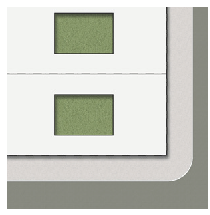
;adv=-4q;Building Disposition, Courtyard: Specific Types - patio House. A Building that occupies the boundaries of its Lot while internally defining one (1) or more private patios. This is the most urban of types, as it is able to shield the private realm from all sides while strongly defining the Public Thoroughfare. Because of its ability to accommodate incompatible activities, masking them from all sides, it is recommended for workshops, Lodging and schools. The high security provided by the continuous enclosure is useful for crime-prone areas.
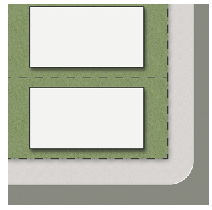
;adv=-4q;Building Disposition, Edgeyard: Specific Types - Single Family House, cottage, villa, estate House, urban villa. A Building that occupies the center of its Lot with Setbacks on all sides. This is the least urban of types as the front yard sets it back from the Frontage, while the side yards weaken the spatial definition of the Public Thoroughfare space. The front yard is intended to be visually continuous with the yards of adjacent buildings. The rear yard can be secured for privacy by Fences and a well-placed Back Building and/or Outbuilding.
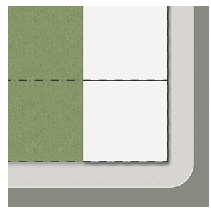
;adv=-4q;Building Disposition, Rearyard: Specific Types — Townhouse, Rowhouse, Live-Work unit, loft Building, Apartment House, Mixed Use Block, Flex Building, perimeter Block. A Building that occupies the full Frontage, leaving the rear of the Lot as the sole yard. This is a very urban type as the continuous Facade steadily defines the Public Thoroughfare. The rear Elevations may be articulated for functional purposes. In its Residential form, this type is the Rowhouse. For its Commercial form, the rear yard can accommodate substantial Parking.

;adv=-4q;Building Disposition, Sideyard: Specific Types — Charleston single House, double House, zero Lot line House, twin. A Building that occupies one (1) side of the Lot with the Setback to the other side. A shallow Frontage Setback defines a more urban condition. If the adjacent Building is similar with a blank side wall, the yard can be quite private. This type permits systematic climatic orientation in response to the sun or the breeze. If a Sideyard House abuts a neighboring Sideyard House, the type is known as a twin or double House. Energy costs, and sometimes noise, are reduced by sharing a party wall in this Disposition.
;adv=-4q;Building Disposition, Specialized: A Building that is not subject to categorization. Buildings dedicated to manufacturing and transportation are often distorted by the trajectories of machinery. Civic Buildings, which may express the aspirations of institutions, may be included.
Building Function: The Uses accommodated by a Building and its Lot.
Building Height: The vertical extent of a Building measured in Stories.
Building Permit: The permit required for new construction and additions pursuant to the Village Code.
By Right: A use allowed pursuant to zoning review and approval of a Building Permit or issuance of a Certificate of Use.
Canopy: A fixed-roofed Structure which provides shade or protection and is in whole or in part self-supporting with open sides.
Capacity: See Floor Area.
Carport: A portion of a Principal residential Building or a Building accessory to a residential Use designed to be used for shelter of motor vehicles, unenclosed at the vehicular entry side and for an area at least equal to twenty percent (20%) of the area of the outer surface of walls, which might otherwise be constructed along its entire remaining perimeter. Where enclosure exceeds this amount, the shelter shall be construed to be a garage.
Certificate of Occupancy: As defined by the Florida Building Code.
Certificate of Use: An official City document verifying that a particular Use is in compliance with applicable sections of this Code and the Village of El Portal Code of Ordinances.
Civic Building: A Building designed specifically for a Civic function.
Civic Space: A zone with mainly outdoor area dedicated for functioning for community purposes.
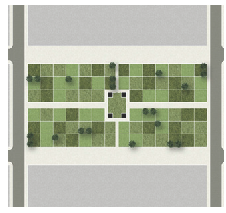
;adv=-4q;Civic Space, Community Garden: A grouping of garden plots available for small-scale cultivation, generally to residents of Apartments and other dwelling types without private gardens. Community gardens should accommodate individual storage sheds.
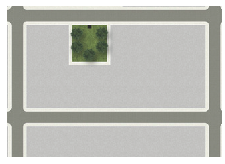
;adv=-4q;Civic Space, Courtyard/Garden: An Open Space spatially defined by Buildings and Street walls, and visually accessible on one (1) side to the Street.
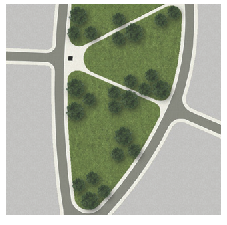
;adv=-4q;Civic Space, Green: An Open Space, available for unstructured recreation programs. A green may be spatially defined by landscaping rather than Building Frontages. Its landscape shall consist of lawn and trees, naturalistically disposed. The minimum size shall be one (1) acre and the maximum shall be four (4) acres.
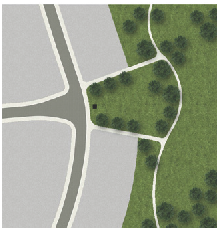
;adv=-4q;Civic Space, Park: A natural preserve available for unstructured and structured recreation programs. A Park may be independent of surrounding Building Frontages. Its landscape may be naturalistic and consist of Paths and trails, meadows, woodland, sports fields and open shelters. Parks may be conservation areas, preserving natural conditions and their size may vary.
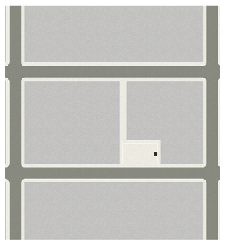
;adv=-4q;Civic Space, Paseo : An access way limited to pedestrian use connecting Streets, plazas, Alleys, garages and other existing and future Public spaces Abutting a property. A Paseo shall have a clear Path of a minimum ten (10) feet in width that is restricted to pedestrian use and lined with active uses having frequent doors and windows. A Paseo may be roofed above the first Story for one hundred percent (100%) of its length, but any roof portion of Paseo shall not be counted as Open Space.
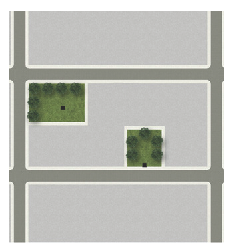
;adv=-4q;Civic Space, Playground: An Open Space designed and equipped for the recreation of children. A playground shall be Fenced and may include an open shelter. Playgrounds shall be interspersed within Residential areas and may be placed within a block. Playgrounds may be included within parks and greens. There shall be no minimum or maximum size.
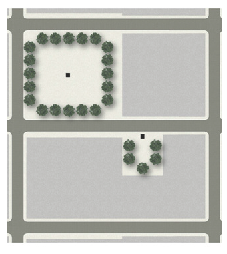
;adv=-4q;Civic Space, Plaza: An Open Space available for Civic purposes and programmed activities. A plaza shall be spatially defined by Building Frontages and may include Street Frontages. Its landscape shall consist primarily of pavement and trees. Plazas shall be located at the intersection of important Thoroughfares. The minimum size shall be one-eighth (⅛) acre and the maximum shall be two acres.
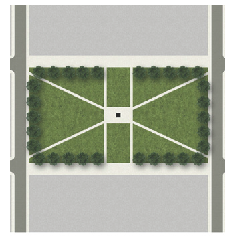
;adv=-4q;Civic Space, Square: An Open Space available for unstructured recreation programs and Civic purposes. A square is spatially defined by Building Frontages with Streets on at least one (1) Frontage. Its landscape shall consist of pavement, lawns and trees, formally disposed. Squares shall be located at the intersection of important Thoroughfares. The minimum size shall be one-third (⅓) acre and the maximum shall be two (2) acres.
Civic Zone: The Civic Zone consists of Civic Buildings and/or Civic Spaces appropriate to adjacent Transect Zones.
Code: The Village of El Portal Code. May also be referred to herein as this Code.
Commercial Use: Land Use functions of retail, service, entertainment or recreational establishments and supporting office.
Common Destination: An area of focused community activity, usually defining the approximate center of a Pedestrian Shed. It may include without limitation one (1) or more of the following: A Civic Space, a Civic Building, a Commercial center, or a transit station, and may act as the social center of a Neighborhood.
Common Lawn: See Frontage; Common Lawn.
Community Garden: A grouping of garden plots available for small-scale cultivation, generally to residents of apartments and other dwelling types without private gardens. Community gardens should accommodate individual storage sheds.
Comprehensive Plan: The Village of El Portal Comprehensive Neighborhood Plan.
Configuration: The form of a Building, based on its massing, Private Frontage, and Height.
Context: Surroundings made up of the particular combination of elements that create specific character in the area.
Corridor: A lineal geographic system incorporating transportation or Greenway.
Cottage: An Edgeyard Building type. A single-family dwelling, on a regular Lot, often shared with an Accessory Building in the back yard.
Courtyard: Open Space, partially defined by walls or Buildings as regulated by this Code.
Curb: The edge of the vehicular pavement detailed as a raised concrete or stone element, or flush with a swale.
Density: The number of Dwelling Units within a standard measure of land area, usually given as units per acre.
Design Speed: The velocity at which a Thoroughfare is designed for vehicular use.
Development: Development shall have the meaning given it in section 380.04, Florida Statutes.
Development Capacity: See Floor Area.
Disposition: The placement of a Building on its Lot.
Drive: A Thoroughfare along the boundary between an Urbanized and a natural condition, usually along a waterfront, Park, or promontory. One (1) side has the urban character of a Thoroughfare, with Sidewalk and Building, while the other has the qualities of a Road or parkway, with naturalistic planting and rural details.
Drive-through / Drive-in Facility: A place of business including drive-through banks or teller windows, drive-through eating and drinking establishments, drive-through windows at liquor or other stores, or at laundry and dry cleaning agencies, car washes, and similar facilities, but excludes automotive service stations.
Driveway: A vehicular lane within a Lot, usually leading to a garage or carport. A Driveway in the First Layer may be used for parking if it is less than the width allowed in the applicable transect, above which dimension it becomes subject to the constraints of a parking lot.
Dwelling Unit: Residence of a single housekeeping unit.
Easement: A legal instrument, in a form approved by the Village Attorney and recorded in the county records, that allows access through real property of the conveyor.
Effective Parking: The amount of Parking required for Mixed Use after adjustment by the Shared Parking Factor.
Effective Turning Radius: The measurement of the inside Turning Radius taking parked cars into account.
Elevation, Building: An exterior wall of a Building not along a Frontage Line (See Facade).
Elevation, Floor: Height of floor level.
Encroach: To break the plane of a vertical or horizontal regulatory limit with a structural element, so that it extends into a Setback, into the Public Frontage, or above a height limit.
Encroachment: Building element permissible within required Setback.
Enfront: To place an element along a Frontage Line, as in "Porches Enfront the Street."
Entrance, Principal: The main point of access of pedestrians into a Building.
Extension Line: A line prescribed at a certain level of a Building for the major part of the width of a Facade, regulating the maximum height for an Encroachment by an Arcade Frontage.
Facade: The exterior wall of a Building that is set along a Frontage Line. See Elevation, Building.
Family Care Home: A family care home is an occupied residence, registered and licensed by the State of Florida, where five (5) or fewer preschool children from more than one (1) unrelated family receive care on a regular part-time basis by day or by night and which receives a payment, fee, or grant for any of the children receiving care, whether or not operated for profit.
Fence: A permeable metal or wooden wall, independent of a Building, located along a Frontage line.
FEMA: Federal Emergency Management Agency.
Floor Area: The floor Area within the inside perimeter of the outside walls of the Building including hallways, stairs, closets, thickness of walls, columns and other features, and Parking and loading areas, and excluding only interior Atria and open air spaces such as exterior corridors, Porches, balconies and roof areas. Also means Building or Development Capacity.
Floor Lot Ratio (FLR): The multiplier applied to the Lot Area that determines the maximum Floor Area allowed above grade in a given Transect Zone.
Forecourt: See Frontage, Forecourt.
Frontage: The area between a Building Facade and the vehicular lanes of a Thoroughfare or the pavement of a Pedestrian Passage.
Frontage, Arcade: A frontage wherein the Facade includes a colonnade that overlaps the Sidewalk, while the Facade at Sidewalk level remains at the Frontage line. This type is conventional for Retail use. The arcade shall be no less than fifteen (15) feet wide and may overlap the whole width of the Sidewalk to within two (2) feet of the Curb.
Frontage, Common Lawn: A Frontage wherein the Facade is set back substantially from the Frontage line. The front yard created remains unfenced and is visually continuous with adjacent yards, supporting a common landscape. The Setback can be densely landscaped to Buffer from the higher speed Thoroughfares.
Frontage, Forecourt: A Frontage wherein a portion of the Facade is close to the Frontage line with a portion set back. The forecourt with a large tree offers visual and environmental variety to the urban Streetscape. The forecourt may accommodate a vehicular drop off.
Frontage, Gallery: A Frontage wherein the Facade is aligned close to the Frontage line with an attached cantilevered shed or a light-weight colonnade overlapping the Sidewalk. This type is conventional for Retail use. The gallery shall be no less than fifteen (15) feet wide and may overlap the Sidewalk to within two (2) feet of the Curb.
Frontage, Porch & Fence: A Frontage wherein the Facade is set back from the Frontage line with an attached porch permitted to Encroach. A Fence at the Frontage line maintains the demarcation of the yard while not blocking the view into the front yard.
Frontage, Shopfront: A Frontage wherein the Facade is aligned close to the Frontage line with the building entrance at Sidewalk grade. This type is conventional for Retail use. It has a substantial glazing at the Sidewalk level and an Awning that may overhang the Sidewalk.
Frontage, Stoop: A Frontage wherein the Facade is aligned close to the Frontage line with the first Story elevated from the Sidewalk sufficiently to secure privacy for the windows. The entrance is usually an exterior stair and landing. This type is recommended for ground-Story Residential use.
Frontage, Terrace or Light Court: A Frontage wherein the Facade is set back from the Frontage line by an elevated terrace or a sunken light court. This type Buffers Residential use from urban Sidewalks and removes the private yard from Public Encroachment. The raised terraces is suitable for outdoor cafes.
Frontage, Principal: That Frontage facing the Public space such as a Thoroughfare of higher pedestrian importance (i.e., traffic volume, number of lanes, etc.).
Frontage, Private: The Layer between the Frontage Line and the Principal Building Facade. The Structures and landscaping within the Private Frontage may be held to specific standards regarding the depth of the Setback and the combination of architectural elements such as Fences, Stoops, Porches and Galleries.
Frontage, Public: The area between the Curb of the vehicular lanes and the Frontage Line. Elements of the Public Frontage include the Curb, Sidewalk, Planter, Street tree, Streetlight, Street furniture, etc.
Frontage, Secondary: That Frontage facing the Public space such as a Thoroughfare that is of lesser pedestrian importance (i.e., traffic volume, number of lanes, etc.).
Frontage Line: Property Line or Base Building Line Abutting a Public space, such as a Plaza or Thoroughfare, whether at the front, rear, or side of a Lot. Facades parallel to Frontage Lines define the Public realm and are therefore more regulated than the Elevations that coincide with other Lot Lines.
Function: The land Use allowed on property according to this Code.
Gallery: See Frontage, Gallery.
Garden: See Civic Space, Courtyard/Garden.
General Commercial: See section 24-B.8, Definitions of Building Functions, (d) Commercial.
Green: See Civic Space, Green.
Green Corridor: See Greenway.
Greenfield: An area that consists of open or wooded land or farmland that has not been previously developed.
Greenway: An Open Space Corridor in largely natural condition which may include Paths for bicycles and pedestrians.
Greyfield: an area previously used primarily as a Parking Lot. Shopping centers and shopping malls are typical Greyfield sites. (Variant: Grayfield.)
Habitable Space: Building space which Use involves human presence with direct view of the enfronting streets or public or private Open Space, excluding Parking Garages, self-service storage facilities, warehouses, and display windows separated from retail activity.
Hardscape: The nonliving portions of a building's landscaping, such as roads, sidewalks, courtyards and parking lots.
Height: See Building Height.
Hospital: An institution having an appropriate license or certificate of need issued by the State of Florida and providing primary health, medical, or surgical care to persons suffering from illness, disease, injury, deformity or abnormal mental conditions; and may include related accessory facilities such as laboratories, outpatient or training facilities. See Section 24-B.8, Definitions of Building Functions, (f) Civil Support.
Hotel: See Section 24-B.8, Definitions of Building Functions,(b) Lodging.
Industrial Use: See Section 24-B.8, Definitions of Building Functions.
Infill: A development project within existing urban fabric, on a vacant site within a built-up area.
Infrastructure and Utilities: See Section 24-B.8, Definitions of Building Functions, (f) Civil Support.
Inn: See Section 24-B.8, Definitions of Building Functions, (b)Lodging.
Intensity: The magnitude of development measured by Floor Lot Ratio permitted in a Transect Zone.
Large Scale Commercial: A commercial business occupying more than twenty-five thousand (25,000) square feet of Floor Area with a regional market area, including but not limited to retail or wholesale sales, membership-warehouse clubs, discount stores and department stores.
Layer: A range of depth of a Lot within which certain elements are permitted as regulated in this Code.
Layer, First: The area of a Lot comprised of the distance between the Base Building Line and the required Setback including the Private Frontage.
Layer, Second: That portion of the Lot behind the First Layer which includes that portion of the Building which Enfronts the Thoroughfare.
Layer, Third: That portion of the Lot that is not within the First and Second Layer and is least visible from the Thoroughfare.
Learning Center: See Section 24-B.8, Definitions of Building Functions, (g) Educational.
LEED: Leadership in Energy and Environmental Design.
Linear Pedestrian Shed: A Pedestrian Shed that is elongated along an important Mixed Use Corridor such as a main Street. A Linear Pedestrian Shed extends approximately one-quarter (¼) mile from each side of the Corridor for the length of its Mixed Use portion. The resulting area is shaped like a lozenge. It may be used to structure a TND, RCD, Infill TND, or Infill RCD. (Syn: Elongated pedestrian shed.)
Liner: A Building or part of a Building with Habitable Space specifically designed to Enfront a Public space, masking a Function without capacity to monitor Public space, such as a Parking Lot, Parking Garage or storage facility.
Live-Work: See Section 24-B.8, Definitions of Building Functions, (a)Residential.
Loading Space: An area in which goods and products are moved on and off a vehicle, including the stall or berth and the apron or maneuvering room incidental thereto.
Lodging: See Section 24-B.8, Definitions of Building Functions, (b) Lodging.
Lodging Unit: See Section 24-B.8, Definitions of Building Functions. b. Lodging.
Lot: A Lot is any individual Lot, tract or parcel of land, intended as a single Building site or unit, having an assigned number or numbers, letter or letters, or other name through which it may be identified for development purposes. A Lot may also be any combination of Lots, tracts, parcels or other areas of land established by acceptable legal joinder, delineated by a closed boundary and assigned a number, letter or other name through which it may be identified, intended as a single unit for development purposes.
Lot Area: Lot area shall be the area within the Lot Property Lines, excluding any portions of Street rights-of-way or other required dedications.
Lot, Conforming: A parcel of land meeting the requirements of this Code as to dimensions (width, depth, or area) and access.
Lot, Corner: A Lot or parcel of land Abutting two (2) or more Thoroughfares at their intersection, or two (2) parts of the same Thoroughfare forming an interior angle of less than one hundred thirty-five (135) degrees.
Lot Coverage: The area of the Lot occupied by all Buildings, excluding Structures such as decks, pools, and trellises.
Lot, Interior: A Lot Abutting only one (1) Thoroughfare.
Lot, Nonconforming: A parcel of land with dimensions or access not meeting minimum requirements of this Code.
Lot, Through: A Lot other than a Corner Lot, and with Frontage on more than one (1) Thoroughfare; Alleys shall not be considered for purposes of this definition.
Lot Line: The boundary that legally and geometrically demarcates a Lot.
Lot Width: The length of the narrowest dimension Frontage Line of a Lot.
Major Facility: See Section 24-B.8, Definitions of Building Functions, (f) Civil Support.
Marijuana. Marijuana has the meaning given cannabis in section 893.02(3), Florida Statutes, as amended and in addition, "Low-THC cannabis" as defined in section 381.986(1)(e), Florida Statutes, as amended, shall also be included in the meaning of the term "marijuana."
Medical Marijuana Dispensary. See Section 24-B.8, Definitions of Building Functions, d., Commercial.
Medical Marijuana Treatment Center. See Section 24-B.8, Definitions of Building Functions, d., Commercial.
Meeting Hall: A building available for gatherings, including conferences, that accommodates at least one (1) room equivalent to a minimum of ten (10) square feet per projected Dwelling Unit within the Pedestrian Shed in which it is located.
Middle/ High School: See Section 24-B.8, Definitions of Building Functions, (g) Educational.
Mixed Use: Multiple Functions within the same building through superimposition or adjacency, or in multiple buildings by adjacency, or at a proximity determined by Special Exception.
Multi-family Housing: See Section 24-B.8, Definitions of Building Functions, (a) Residential.
Neighborhood: An urbanized area that is primarily Residential. A Neighborhood shall be based upon a partial or entire Standard Pedestrian Shed. The physical center of the Neighborhood should be located at an important traffic intersection associated with a Civic or Commercial use.
Nursing Home or Extended Care Facility: An institution which is licensed by the State of Florida to provide health care or medical supervision for twenty-four (24) or more consecutive hours for three (3) or more persons not related to the governing authority by blood, marriage or adoption. See Section 24-B.8, Definitions of Building Functions, (f) Civil Support.
Office: See Section 24-B.8, Definitions of Building Functions, (c) Office.
Open Air Retail: See Section 24-B.8, Definitions of Building Functions, (d) Commercial.
Open Space: Any parcel or area of land or water essentially unimproved by permanent Buildings and open to the sky; such space shall be reserved for Public or private Use. Open Spaces may include Parks, Greens, Squares, Courtyards, Gardens, Playgrounds, paseos (when designed predominantly for pedestrians), and pedestrian Paths or associated landscaped areas.
Outbuilding: A Building, usually located towards the rear of the same Lot as a Principal Building. It is sometimes connected to the Principal Building by a Back Building.
Park: A tract of land designated and used by the public for active and passive recreation. Also known as Public Park. See Civic Space, Park.
Parking Area: Any area designed and used for Parking motor vehicles including Parking Lots and garages, Driveways, garages serving Residential Uses, and Thoroughfares.
Parking Garage or Parking Structure: A Structure containing vehicular Parking, including mechanical Parking systems.
Parking, Off-site: Spaces provided for vehicles and located outside of the boundaries of the Lots to be served.
Parking, Off-Street: Any land area designed and used for Parking motor vehicles including Parking Lots and garages, Driveways and garages serving Residential uses, but excluding areas of Thoroughfares.
Parking, On-Street: Parking spaces within the Public Right-of-Way.
Parking, Tandem: The placement of vehicles one (1) behind the other as opposed to side by side.
Parking, Underground: Parking in which the ceiling or roof of the top level does not rise above an adjoining Public Sidewalk.
Parking with covenant: See Parking off-site.
Path: A pedestrian way traversing a Park or rural area, with landscape matching the contiguous Open Space, ideally connecting directly with the urban Sidewalk network.
Pedestrian Passage: A Public Open Space restricted to pedestrian Use and limited vehicular access that connects Streets, Plazas, Alleys, garages and other Public Use spaces.
Pedestrian Shed: An area, approximately circular, that is centered on a common destination. A Pedestrian Shed is applied to determine the approximate size of a Neighborhood. A Standard Pedestrian Shed is one-quarter (¼) mile radius, about the distance of a five-minute walk at a leisurely pace. A Linear Pedestrian Shed is elongated to follow a Commercial corridor, measuring one-quarter (¼) mile out from the center line of the corridor. It has been shown that provided with a pedestrian environment, most people will walk this distance rather than drive. The outline of the shed must be refined according to actual site conditions, particularly along Thoroughfares. The common destination should have the present or future capacity to accommodate Transect Zones successional in Density to its surroundings. A Long Pedestrian Shed is one-half (½) mile radius, and may be used for mapping a Transit Oriented Development (TOD) when transit is present or proposed.
Pervious Pavement System: A porous surface system with a stabilized base that allows water from precipitation and other sources to pass directly through, thereby reducing the runoff from a site, allowing groundwater recharge, and naturally cooling the surface through evaporation of water from pavement voids or from beneath.
Place of Assembly: See Section 24-B.8, Definitions of Building Functions, (d) Commercial.
Planter: The element of the Public Streetscape which accommodates Street trees. Planters may be continuous or individual and separated.
Playground: See Civic Space, Playground.
Plaza: See Civic Space, Plaza.
Porch: See Frontage, Porch and Fence.
Pre-School: See Section 24-B.8, Definitions of Building Functions, (g) Educational.
Principal Building: A Structure used to enclose or house the primary Use(s) located on a Lot; or the main Building on a Lot, usually located toward the front.
Principal Dwelling Unit: See Section 24-B.8, Definitions of Building Functions, (a) Residential, Single-Family Residence.
Principal Entrance: The main point of access for pedestrians into a building.
Property Line: Demarcation of private property ownership.
Public: Facilities or land owned or operated by a governmental organization.
Public Benefits Program: See Article VIII.
Public Parking: See Section 24-B.8, Definitions of Building Functions, (f) Civil Support.
Public Storage Facilities: An establishment containing separate, secured self-storage areas or lockersused for the temporary storage of household items and seasonal or recreational vehicles, small boats, trailers etc. These facilities cater primarily to the needs of nearby residents. See Section 24-B.8, Definitions of Building Functions. d. Commercial, General Commercial.
Recreational Establishment: See Section 24-B.8, Definitions of Building Functions. d. Commercial.
Recreational Facility: See Section 24-B.8, Definitions of Building Functions. e. Civic.
Regulating Plan: A Zoning Map or set of maps that shows the Transect Zones, Civic Zones, Special Districts if any, and Special Requirements if any, of areas subject to, or potentially subject to, regulation by this Code.
Residential Use: See Section 24-B.8, Definitions of Building Functions, (a) Residential.
Retail: Characterizing premises available for the sale of merchandise and food service.
Retail Frontage Line: Frontage Lines designated on a Special District Plan that require the ground level to be available for retail Use.
Right-of-Way, Public: That land held in trust by the Village/County/State between the base building lines, including the Sidewalk, swale and parkway area, and the roadway, Street and highway.
Road (RD): A local, rural and suburban Thoroughfare of low-to-moderate vehicular speed and capacity.
Rowhouse: A Dwelling Unit that shares a party wall with another Dwelling Unit of the same type.
Scale: The spatial relationship among Structures along a street or block front, including height, bulk and yard relationships. Scale also refers to the proportional relationship of the size of parts to one another and to the human figure.
Screening: Visually shielding or obscuring one (1) Structure or Use from another by a Liner Building, fencing, wall, or densely planted vegetation.
Secondary Frontage: See Frontage, Secondary.
Setback: The distance from the Base Building Line to the point where a Building may be constructed. This area must be maintained clear of permanent Structures with the exception of Encroachments described in each Zone.
Shared Parking Standards: An accounting for Parking spaces that are available to more than one (1) Function.
Shopfront: See Frontage, Shopfront.
Short Term Rental: a Residential property that is rented to a visitor for less than thirty (30) days. Short Term Rentals (STRs) are primarily offered by individuals. While some STRs are available for rent year round, others are rented only during a season or on specific occasions by short term visitors.
Sidewalk: The paved layer of the Public Frontage dedicated exclusively to pedestrian activity.
Single Family Residence: See Section 24-B.8, Definitions of Building Functions, (a) Residential.
Specialized Building: A building that is not subject to Residential, Commercial, or Lodging classification.
Special District Plan: See Article VII.
Special Exception: Refer to the Village of El Portal Code of Ordinances.
Special Flood Hazard Area: A designation by the Federal Emergency Management Agency (FEMA) that may include the V (Velocity) Zones and Coastal A Zones where building construction is forbidden, restricted, or contingent upon raising to the Base Flood Elevation.
Square: See Civic Space, Square.
Stall / Berth: The space where vehicles are placed for parking or loading or unloading operations.
Stoop: See Frontage, Stoop.
Stepback: A building Setback of a specified distance that occurs at a prescribed number of Stories above the ground.
Story: A Habitable level within a Building of a maximum fourteen (14) feet in Height from finished floor to finished floor. Basements are not considered Stories for the purposes of determining Building Height. A ground level Retail Story may exceed this limit up to a total height of twenty-five (25) feet. A single floor level exceeding fourteen (14) feet, or twenty-five (25) feet at ground level Retail, shall be counted as two (2) Stories. Where the first two stories are Retail, their total combined Height shall not exceed thirty-nine (39) feet and the first floor shall be a minimum of fourteen (14) feet in Height. Mezzanines may not exceed thirty-three percent (33%) of the Habitable Space Floor Area. The Height of a Parking Structure concealed by a Liner may be equal to the Height of the Liner; this may result in a Liner Story concealing more than one (1) level of Parking.
Street (ST): A local urban Thoroughfare of low speed and capacity.
Streetscape: The urban element that establishes the major part of the public realm. The Streetscape is composed of Thoroughfares (travel lanes for vehicles and bicycles, Parking lanes for cars, and Sidewalks or Paths for pedestrians) as well as the amenities of the Public Frontages (Street trees and plantings, benches, Streetlights, paving, Street furniture, etc.), and the visible Private Frontages (Building Facades and Building Elevations, Porches, yards, Fences, etc.).
Streetscreen: A freestanding wall built along the Frontage Line, or coplanar with the Facade. It may mask a Parking Lot from the Thoroughfare, provide privacy to a side yard, and/or strengthen the spatial definition of the Public realm.
Structure: A Structure is anything constructed or erected, the use of which requires fixed location on the ground or attachment to something having fixed location on the ground or on or below the surface of the ground or water.
Substantial Modification: Alteration to a building that is valued at more than fifty percent (50%) of the replacement cost of the entire building, if new.
Swale: A low or slightly depressed natural area for drainage.
Terminated Vista: A location at the axial conclusion of a Thoroughfare. A building located at a Terminated Vista designated on a Regulating Plan is required or recommended to be designed in response to the axis.
Terrace: See Frontage, Terrace or LightCourt.
Thoroughfare: A vehicular way incorporating moving lanes and Parking lanes within a right-of-way as part of an interconnected network for vehicular, pedestrian, and bicycle mobility.
Townhouse: See Rowhouse.
Traditional Neighborhood Development (TND): A Community Unit type structured by a Standard Pedestrian Shed oriented toward a Common Destination consisting of a Mixed Use center or Corridor, and in the form of a medium-sized settlement near a transportation route.
Transect: A system of ordering human habitats in a range from the most natural to the most urban. Transect Zones describe the physical character of place at any Scale, according to the Density and Intensity of land use and urbanism.
Transect Zone (Zone): One of several areas on a Zoning Map regulated by the Code. Transect Zones are administratively similar to the land use zones in conventional Codes, except that in addition to the usual building use, Density, height, and Setback requirements, other elements of the intended habitat are integrated, including those of the private Lot and building and Public Frontage. See Table 1.
Transit Oriented Development (TOD): TOD is created by an overlay on all or part of a TND or RCD, or by designation on a Regional Plan, permitting increased Density to support rail or Bus Rapid Transit (BRT).
Turning Radius: The curved edge of a Thoroughfare at an intersection, measured at the inside edge of the vehicular tracking. The smaller the Turning Radius, the smaller the pedestrian crossing distance and the more slowly the vehicle is forced to make the turn.
Two Family-Housing: See Section 24-B.8, Definitions of Building Functions, (a) Residential.
Type: A category determined by Function, disposition, and configuration, including size or extent, such as Thoroughfare types, Civic Space Types, etc.
Unity of Title: A written agreement executed by and between a property owner and the Village whereby the property owner for a specified consideration by the Village agrees that the Lots and or parcels of land constituting the Building site shall not be conveyed, mortgaged and or leased separate and apart from each other and that they shall be held together as one (1) tract. Such Unity of Title shall be recorded in the Public Records and shall run with the land and shall be binding upon the property owner(s), their successors and assigns.
Urban Design: Form, in terms of both beauty and function, of urban areas. Urban design is concerned with the location, mass, and design of various urban components and combines elements of urban planning, architecture, landscape architecture, and traffic engineering.
Urban Form: The spatial arrangement of a particular environment, as defined by the connectivity of built mass and form, the natural environment, and the movement of persons, goods and information within.
Use: The purpose or activity for which land, water or Buildings are designed, arranged, or intended, or for which land or Buildings are occupied or maintained.
Variance: Refer to the Village of El Portal Code of Ordinances.
Verge: The space between the Sidewalk and the Curb.
Zoning Map: The official map or maps that are part of the zoning ordinance and delineate the boundaries of individual zones and districts.
(Ord. No. 2018-06, § 2, 11-27-2018)
Sec. 24-B.1. - AUTHORITY.
(a)
The action of the Village of El Portal, Florida in the adoption of this Code is authorized under the Village of El Portal Code of Ordinances.
(b)
This Code was adopted as one of the instruments of implementation of the public purposes and objectives of the adopted Comprehensive Plan and El Portal Charrette Report of 2013.
(c)
This Code was adopted to promote the health, safety and general welfare of the citizens of the Village of El Portal, including protection of the environment, conservation of land, energy and natural resources, reduction in vehicular traffic congestion, more efficient use of Public funds, health benefits of a pedestrian environment, historic preservation, education and recreation, reduction in sprawl development, and improvement of the built environment.
(d)
This Code was adopted and may be amended by vote of the Village of El Portal Council.
Sec. 24-B.2. - APPLICABILITY.
(a)
Provisions of this Code are activated by "shall" when required; "should" when recommended; and "may" when optional.
(b)
The provisions of this Code, when in conflict, shall take precedence over those of other codes, ordinances, regulations and standards.
(c)
The existing Code of Ordinances of the Village of El Portal, Florida (the "Existing Local Codes") shall continue to be applicable to issues not covered by this Code except where the Existing Local Codes would be in conflict with Section 24-B.3. Intent.
(d)
Capitalized terms used throughout this Code may be defined in section 24-B.8. Definition of Building Function and Article × Definitions of Terms. Those terms not defined in Section 24-B.8 and Article × shall be accorded their commonly accepted meanings.
(e)
Diagrams and illustrations that accompany this Code should be considered guidelines.
(f)
Where cumulative requirements or limitations are to be computed for purposes of this Code, fractions shall be carried forward in the summation, and the total rounded upward to the nearest whole number, subject to existing minimum Lot sizes and maximum Densities or Intensities of development required by the regulations of this Code.
Sec. 24-B.3. - INTENT.
(a)
This Code is drafted to achieve the community vision based on the traditional forms of urbanism. This Code is designed to foster predictable built results, high-quality Public Streets and Open Spaces by using the physical form of Buildings. It is a Code that will create places where a blend of land uses and Open Spaces that situates shops, workplaces, residences, and Civic Buildings within walking distance of one another. This will incorporate Streets that are attractive to pedestrians and also conveniently and efficiently accommodate the needs of cyclists, transit and the automobile.
ARTICLE I. FIGURE 1: HOW TO USE THE FORM-BASED CODE
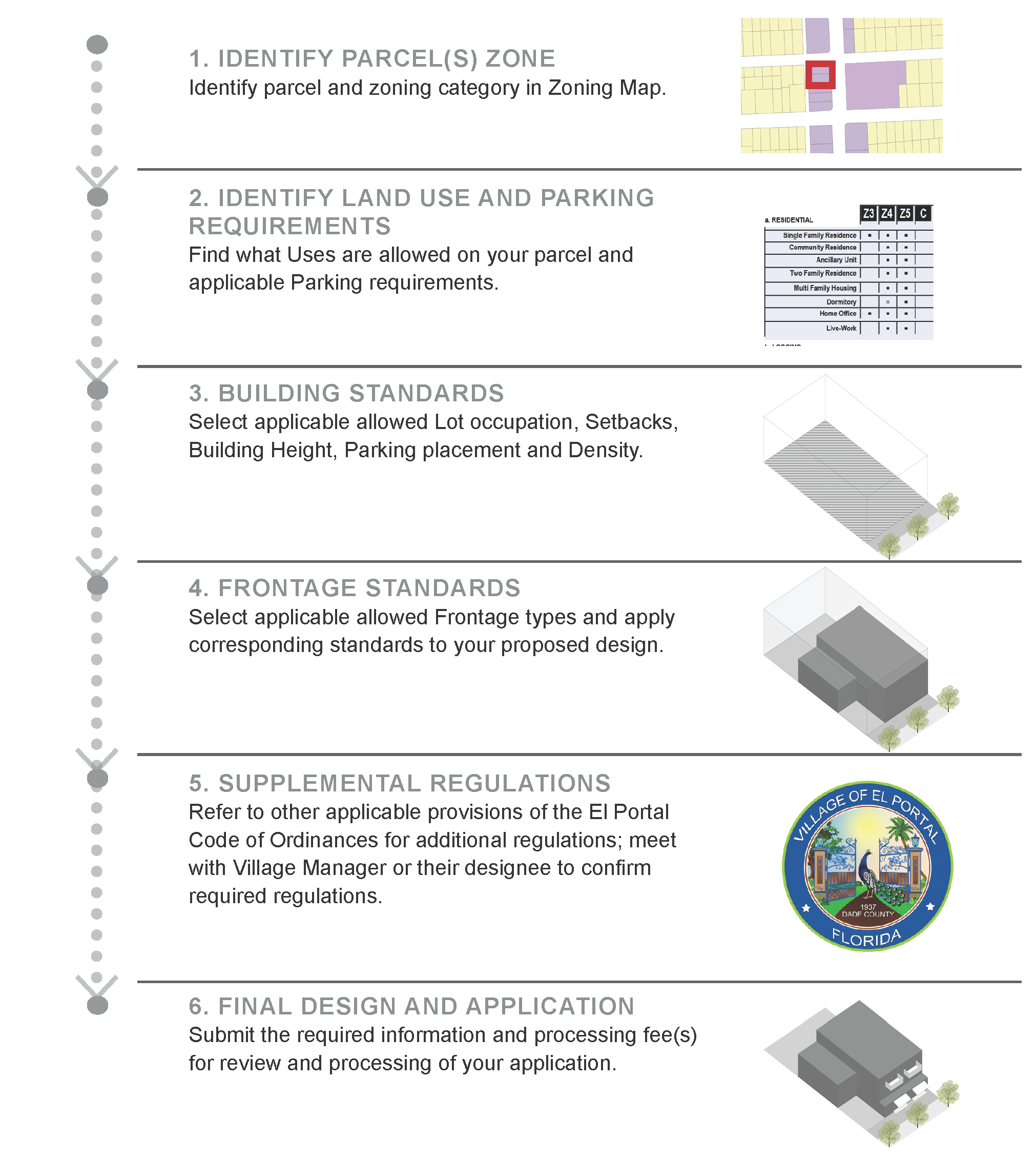
Sec. 24-B.4. - INTENT.
This Code is intended to encourage the evolution of a settlement pattern based on the organizational principles of the Transect. The Transect defines a series of zones that transition from low Density rural areas to the more dense urban core. The Village of El Portal includes Suburban (Z3), Main Street (Z4), Urban Center (Z5) and Civic Zone. The location of these zones is identified on the Zoning Map.
ARTICLE II. FIGURE 1: TRANSECT ZONE DESCRIPTIONS. This table provides a description of the character of each Zone.
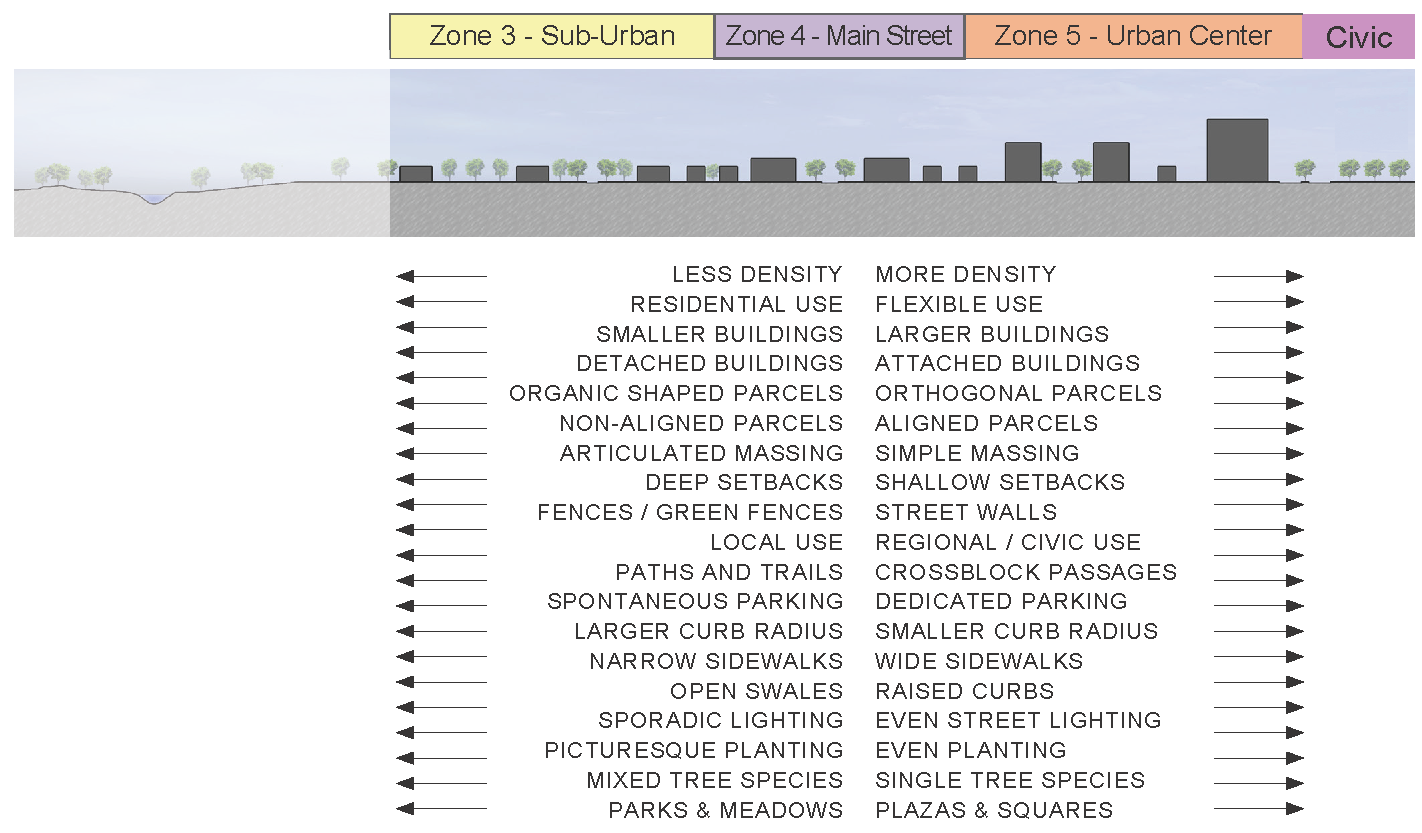
Sec. 24-B.5. - TRANSECT ZONE DESCRIPTIONS.
(a)
Zone 3 — Sub-Urban Zone.
Zone 3 consists of low Density Residential areas. Home occupations and Outbuildings are allowed. Planting is naturalistic and Setbacks are relatively deep. Blocks may be large and the Roads irregular to accommodate natural conditions.
(b)
Zone 4 — Main Street Zone.
The Urban Center Zone consists of small scale Mixed-Use urban fabric with a range of Building types including row-houses, small Apartment Buildings, and bungalow courts and Retail on the ground Story. Setbacks are short with an urban Streetscape of wide Sidewalks and trees in Planters. Thoroughfares typically define medium sized Blocks.
(c)
Zone 5 — Urban Center Zone.
The Urban Center Zone consists of higher Density Mixed-Use Building types that accommodate Retail and Office Uses, rowhouses and Apartments. A network of small Blocks has Thoroughfares with wide Sidewalks, steady Street tree planting and Buildings set close to the Frontages with frequent doors and windows.
(d)
C — Civic Zone.
The Civic Zone consists of Civic Buildings and/or Civic Spaces appropriate to adjacent Transect Zones.
ARTICLE II. FIGURE 2: ZONING MAP. The figure below is the Official Zoning Map of the Village of El Portal. Copies are available through the Office of the Village Clerk.
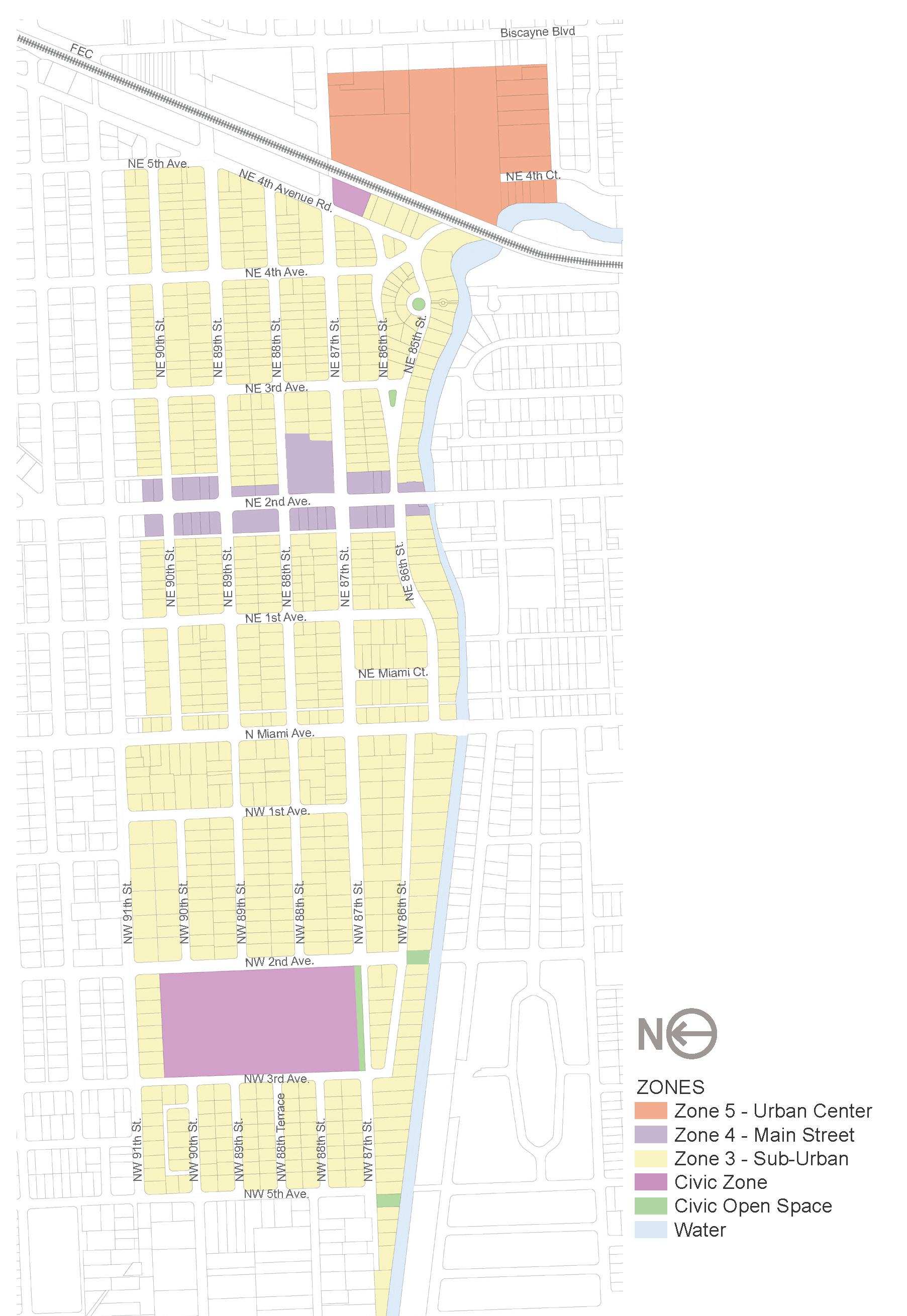
Sec. 24-B.6. - NON-CONFORMING USES AND BUILDINGS.
(a)
See Chapter 24 Article VII of the Village of El Portal Code of Ordinances.
Sec. 24-B.7. - ALCOHOL BEVERAGE SERVICE AND LIQUOR SELLING ESTABLISHMENTS.
(a)
See Chapter 3 of the Village of El Portal Code of Ordinances and State Law Reference - Alcoholic Beverages F.S. Chs. 561—565.
Sec. 24-B.8. - DEFINITIONS OF BUILDING FUNCTION: USES
(a)
RESIDENTIAL.
This category is intended to encompass land use functions predominantly of permanent housing.
(1)
Single-Family Residence: Detached Building used as permanent residence by a single housekeeping unit. The term is general, applying to all detached house types. Also known as Principal Dwelling Unit.
(2)
Community Residence:
A.
A Dwelling Unit of six (6) or fewer residents that meet the definition in section 419.001, Florida Statutes for a "community residential home" of such size; or
B.
A Dwelling Unit licensed to serve clients of the State Department of Children and Families, which provides a living environment for seven (7) to fourteen (14) unrelated residents who operate as the functional equivalent of family, including such supervision and care by supportive staff as may be necessary to meet the physical, emotional and social needs of the residents, as defined in section 419.001, Florida Statutes; or
C.
An adult family-care home as defined in section 429.65, Florida Statutes, which provides a full-time, family-type living arrangement, in a private home, under which a person who owns or rents the home provides room, board, and personal care on a 24-hour basis, for no more than five (5) disabled adults or frail elders who are not relatives.
D.
A "resident", for the purpose of a Community Residence, may include any persons as defined in the following statutes:
i.
A disabled adult or frail elder as defined in section 429.65(8) and (9), Florida Statutes.
ii.
A physically disabled or handicapped person as defined in section 760.22(7), Florida Statutes.
iii.
A developmentally disabled person as defined in section 393.063(9), Florida Statutes.
iv.
A non-dangerous mentally ill person as defined in section 394.455(18), Florida Statutes; or
v.
A child as defined in section 39.01(12), Florida Statutes.
(3)
Ancillary Unit: A Dwelling Unit sharing ownership and utility connections with a Principal Building and contained on the same Lot. An Ancillary Unit may be attached by a Backbuilding or detached from the Principal Building, and unit shall not count towards maximum Density calculations. Also known as an Accessory Unit or Ancillary Dwelling Unit.
(4)
Two Family-Housing: Two (2) Dwelling Units sharing a detached Building, each Dwelling Unit of which provides a residence for a single housekeeping unit. Also known as a duplex.
(5)
Multi-Family Housing: A Building or portion thereof, containing three (3) or more Dwelling Units where each unit has direct access to the outside or to a common hall. A multifamily Structure where Dwelling Units are available for lease or rent for less than one (1) month shall be considered Lodging.
(6)
Dormitory: A Building used principally for sleeping accommodations for students or staff related to an educational institution or place of employment.
(7)
Home Office: A space within a Dwelling Unit devoted to a non-retail business activity belonging to the resident thereof that is clearly secondary in Use to the residence, that does not alter the exterior of the property or affect the residential character of the Neighborhood, and that meets all legal requirements of the business.
(8)
Live-Work: A Dwelling Unit that contains a commercial or office component which is limited to a maximum fifty percent (50%) of the Dwelling Unit area.
(b)
LODGING.
This category is intended to encompass land Use functions predominantly of sleeping accommodations occupied on a rental basis for limited periods of time. These are measured in terms of lodging units: A lodging unit is a furnished room of a minimum two hundred (200) square feet that includes sanitary facilities, and that may include limited kitchen facilities.
(1)
Bed and Breakfast: A group of lodging units not to exceed five (5) units that may provide services for dining, meeting and recreation.
(2)
Inn: A group of lodging units not to exceed twelve (12) units that may provide services for dining, meeting and recreation.
(3)
Hotel: A group of lodging units exceeding twelve (12) units that may provide services for dining, meeting and recreation.
(c)
OFFICE.
This category is intended to encompass land Use functions predominantly related to business, professions, service or government.
(1)
Office: A Building or portion thereof used for conducting a business, profession, service, or government. Such facilities may include, but are not limited to, offices of attorneys, engineers, architects, physicians, dentists, accountants, financial institutions, real estate companies, insurance companies, financial planners, or corporate offices, and exclude manufacturing activities.
(d)
COMMERCIAL.
This category is intended to encompass land Use functions of retail, service, entertainment or recreational establishments and supporting office.
(1)
General Commercial: A place of business providing the sale and display of goods or sale of services directly to the consumer, with goods available for immediate purchase and removal from the premises by the purchaser. General commercial goods include, but are not limited to, clothing, food, furniture, pharmaceuticals, books, art objects and the like. General commercial services include, but are not limited to, barber shops; beauty salons; travel agencies; fortune tellers; retail dry cleaning; express delivery service; health spas and fitness studios; photo studios; Funeral Homes; Animal Clinics; repair service establishments, Employment Office; and the like. General Commercial services exclude: Auto-Related or Marine-Related Establishments; Public Storage Facilities, Commercial Storage Facilities, Pawn Shops, and the like.
(2)
Entertainment Establishment: A place of business serving the amusement and recreational needs of the community. Such facilities may include, but not limited to: Cinemas, billiard parlors, teen clubs, dance halls, or video arcades. Uses not included: Entertainment Establishment, adult.
(3)
Food Service Establishment: A place of business dedicated to the preparation and sale of food and beverage for immediate consumption on or off site.
(4)
Auto-Related Commercial Establishment: A place of business serving auto-related needs including, but not limited to: Car rental, car wash, gas station, mechanic offering minor repairs, retail sales such as auto parts, tire store, indoor car sales. Uses not included: Major mechanical work; body work; painting; steam cleaning; welding; outdoor car sales; storage of automobiles not in operating condition; commercial parking Lot or commercial garage; or any work involving undue noise, glare, fumes or smoke, all of which are considered auto-related industrial activities.
(5)
Open Air Retail: A retail sales establishment operated substantially in the open air including, but not limited to: Farmers market, Flea Markets, and the like. Uses not included are: Car sales, equipment sales, boats sales, and home and garden supplies and equipment.
(6)
Place of Assembly: A commercial facility for public assembly including, but not limited to: Arenas, auditoriums, conference facilities, convention centers, exhibition halls, major sports facilities, theaters and performing arts centers, and the like.
(7)
Alcohol Beverage Service Establishment: A place of business selling alcoholic beverages for consumption on the premises, and where the sale of food may be incidental to the sale of such beverages. This includes any establishment in receipt of a valid alcoholic beverage license from the state which permits the sale for consumption on the premises of alcoholic beverages as a Use. Alcohol beverage service establishments may include, but are not limited to: Bars, taverns, cocktail lounges, nightclubs or supper clubs.
(8)
Recreational Establishment: A place of business providing group leisure activities, often requiring equipment and open to the public with or without entry or activity fees. This may include, but is not limited to: Game courts, skating rinks, bowling alleys, commercial golf facility, gyms or sports rooms.
(9)
Public Storage Facility: An establishment containing separate, secured self-storage areas or lockers used for the temporary storage of household items and seasonal or recreational vehicles, small boats, trailers, etc. These facilities cater primarily to the needs of nearby residents.
(10)
Commercial Storage Facility: A facility providing for the storage of office furnishings, archive records, and general personal property of businesses, agencies and professionals. Such personal property is limited to furniture and other household goods and retail merchandise to be sold at nearby establishments. Storage of heavy equipment or any property that may be deemed hazardous, such as property which is inflammable, combustible, explosive or dangerous is prohibited.
(11)
Medical Marijuana Treatment Center means an entity that acquires, cultivates, possesses, processes (including development of related products such as food, tinctures, aerosols, oils, or ointments), transfers, transports, sells, distributes, dispenses, or administers marijuana, products containing marijuana, related supplies, or educational materials to qualifying patients or their personal caregivers and is registered by the Department of Health or its successor agency.
(12)
Medical Marijuana Dispensary means a business that sells or otherwise distributes marijuana through one (1) or more primary caregivers to six (6) or more patients for medical use, along with any cultivation of marijuana associated with such sale or distribution. The term "medical marijuana dispensary" shall not include any person or entity that distributes marijuana for medical use exclusively to five (5) or fewer patients, and shall not include the private possession and medical use of marijuana by an individual patient or caregiver to the extent permitted by any applicable state of Florida law or regulation.
(e)
CIVIC.
This category is intended to encompass land Use functions predominantly of community-oriented purposes or objectives including those of not-for-profit organizations dedicated to arts and culture, education, recreation, religion, government, and the like.
(1)
Community Facility: A non-commercial facility established primarily for the benefit and service of the general public of the community in which it is located. Such facilities include, but are not limited to: Community centers; Village Hall offices; and cultural facilities, such as libraries and museums.
(2)
Recreational Facility: A non-commercial facility, primarily an open space, serving the recreation needs of the general public. This may include but is not limited to: Golf courses, parks, camping facilities, playfields and playgrounds.
(3)
Religious Facility: A facility used for regular organized religious worship and related activities.
(f)
CIVIL SUPPORT.
This category is intended to encompass land uses predominantly supportive of other urban Uses and functions.
(1)
Community Support Facility: A facility providing basic services, for the benefit and service of the population of the community in which it is located. Such facilities may include but are not limited to: Police and Fire Stations, Extended Care Facilities, Nursing Homes, convalescent homes, Continuing Care Facility, and Assisted Living Facility or Adult Daycare Center as defined by Chapter 429, Florida Statutes.
(2)
Infrastructure and Utilities: A facility or Structure related to the provision of roads, water and sewer lines, electrical, telephone and cable transmission, and all other utilities and communication systems necessary to the functioning of a community.
(3)
Major Facility: A large facility of an institutional nature including but not limited to Hospitals, public health and social service facilities, research facilities, judicial Buildings, cemeteries, Ambulance Services or the like.
(4)
Public Parking: A parking facility available to the general public for parking motor vehicles, including parking lots or garages.
(5)
Transit Facility: A facility providing accommodations by public, private, or nonprofit entities for the conveyance of persons from one place to another by means of a transportation system, including but not limited to: bus terminal, railroad station, freight terminal, airport, helistop or seaport.
(g)
EDUCATIONAL.
This category is intended to encompass land Use functions connected with providing education, training, or care of children and students of all ages.
(1)
Childcare: A facility where six (6) or more children are cared for on a part-time basis by day or by night including after-school care. The term does not include community based residential facilities, Family Care Homes, foster homes, group homes, rehabilitation or detention centers, orphanages, or other places operating primarily for remedial care.
(2)
College/University: A facility for post-secondary education that grants associate, bachelor, master or doctoral degrees, and may include research functions or professional schools.
(3)
Elementary School: A facility offering instruction at the elementary school level.
(4)
Middle/High School: A facility offering instruction at the middle or high school level.
(5)
Pre-School: A facility offering care and instruction of children who are pre-elementary school age.
(6)
Learning Center: A facility offering to students training, tutoring or instruction in subjects such as languages, music, fine arts or dance. This may include provision of electronic testing and distance learning.
(7)
Schools: Any public, parochial, private, charitable or non-profit school, college or university, other than trade or business schools, which may include instructional and recreational uses, living quarters, dining rooms, restaurants, heating plants and other incidental facilities for students, teachers and employees, including the Educational Uses such as: Pre-school, elementary school, middle school, high school, college and university.
(Ord. No. 2018-06, § 2, 11-27-2018)
Sec. 24-B.9. - OFF-STREET PARKING AND LOADING STANDARDS.
(a)
Applicability.
(1)
Off-street Parking requirements for the individual Transect Zones shall be as set forth in Article IV, Table 1. Where required off-street parking is based on square footage of Use, the calculation shall only include Habitable Rooms and Habitable Space occupied by such Use.
[(2)
Reserved.]
(3)
Shared Parking Standards shall be as set forth in Article IV, Table 2.
(b)
General Performance Standards.
(1)
Parking shall be implemented so as to provide safe and convenient access to and from public Thoroughfares which include movement lanes and Public Frontages.
(2)
Vehicular access through Residential properties for nonresidential Uses shall be prohibited.
(3)
Off-street Parking spaces shall be located with sufficient room for safe and convenient parking without infringing on any public Thoroughfare or sidewalk.
(4)
Off-street Parking spaces whose locations require that cars back into movement lanes shall only be permissible in Z3 zone. Backing into Alleys shall be permissible in all Transect Zones.
(5)
Off-street Parking or loading area shall not be used for the sale, repair, or dismantling of any vehicle or equipment, or for storage of materials or supplies.
(6)
Parking or storage of commercial trucks, buses, vans, sign trailers; trailers or semi-trailers for freight, cargo; non-recreational watercraft; or the like shall not be permitted in any Z3, Z4 or Z5.
(7)
Specific areas may be set aside for Tandem Parking. Tandem Parking in all Transect Zones, except Z3 and Z4, shall be used only by a valet parking operator. Tandem Parking in Z5 shall be permitted only when assigned to a single residential unit.
(8)
Parking facilities on adjoining Lots may share access points, driveways and parking subject to a recorded covenant running with the property on which the facilities are located, by process of Administrative Adjustment.
(9)
Trucks and similar vehicles such as trailers, semitrailers, taxicabs or school buses shall not be parked on any public street, except while servicing, loading or unloading to any property. One (1) single truck not exceeding three-quarters (¾) ton net weight may be parked in a fully enclosed structure, on the Third Layer or behind the Setback of a Secondary Frontage.
(10)
No major repairs or overhaul work on vehicles shall be made or performed on the site or any other work performed thereon which would constitute a nuisance.
(11)
Boats, boat trailers, mobile homes, motor homes, campers or recreational vehicles designed for camping or to store any private property shall not park for a period of more than twenty-four (24) hours on any public street or way. Such equipment, provided it does not exceed nine (9) feet in height or twenty-six (26) feet in length may be parked, or stored in a fully enclosed structure, on the Third Layer or behind the Setback of a Secondary Frontage. Vehicles shall not be left visible to public view on concrete blocks, jacks, or any similar devices for periods exceding seventy-two (72) hours.
(12)
It shall further be unlawful to live, sleep or cook in any mobile home, motor home, camper or recreational vehicle that is parked or stored in the Village.
(13)
Derelict or junked equipment shall not be permitted.
(c)
Calculation of Off-street Parking Requirements Related to Number of Seats.
(1)
Where parking requirements relate to number of seats and seating is in the form of undivided pews, benches, or the like, twenty (20) lineal inches shall be construed to be equal to one (1) seat.
(2)
Where Parking requirements relate to movable seating in auditoriums and other assembly rooms, ten (10) square feet of Floor Area shall be construed to be equal to one (1) seat except where otherwise specified.
(3)
Net floor area shall be the actual area occupied by seating and related aisles, and shall not include accessory unoccupied areas or the thickness of walls.
(d)
Off-street Parking Reductions by Use.
(1)
Parking reductions for Elderly Housing. Off-street Parking space requirements in connection with Housing for the Elderly conforming to the requirements of state or federal programs may be reduced by Administrative Adjustment to a maximum of one (1) parking space per every two (2) dwelling units.
ARTICLE IV. TABLE 1: MINIMUM OFF-STREET PARKING REQUIREMENTS.
•
On Street Parking shall be counted towards the total Parking count within a development in Z4 and Zone Z5 only.
•
One (1) electrical vehicle charging station per twenty-five (25) Parking Spaces required.
•
Minimum one (1) bicycle rack space for every ten (10) Parking Spaces required.
•
Parking may be provided by ownership or lease offsite within 1000 feet by process of Administrative Adjustment in Z4 and Z5 only.
•
Parking requirements shall be rounded up to the nearest full parking space.
•
Standard stall: 8.5 ft. × 18 ft. minimum.
•
Handicapped parking stalls shall be provided in accordance with applicable federal and state standards.
ARTICLE IV. TABLE 2: SHARED PARKING STANDARDS.
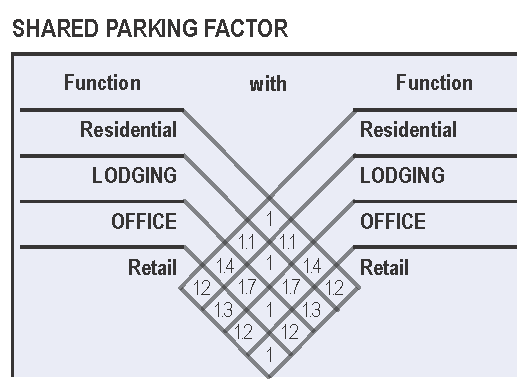
The Shared Parking Standards Table provides the method for calculating shared parking for buildings with more than one (1) Use type. It refers to the parking requirements that appear in Article IV, Table 1. The shared parking factor for two (20 functions, when divided into the sum of the two (2) amounts as listed in Table 1 above, produces the Effective Parking needed for each site involved in sharing. Conversely, if the Sharing Factor is used as a multiplier, it indicates the amount of Building allowed on each site given the Parking available.
Example: For a Building with a Residential Use requiring one hundred (100) spaces and a Commercial Use requiring twenty (20) spaces, the twenty (20) spaces divided by the sharing factor of 1.2 would reduce the total requirement to one hundred (100) plus seventeen (17) spaces. For uses not indicated in this chart on a Mixed Use Lot a sharing factor of 1.1 shall be allowed. Additional sharing is allowed by Variance.
ARTICLE IV. TABLE 3: LOADING BERTH STANDARDS FOR Z5.
Sec. 24-B.10. - Lots and frontage.
(a)
Lots assembled into one (1) ownership within one (1) Transect Zone may be developed as a single Lot. Lots assembled into one (1) ownership that encompass more than one (1) Transect Zone shall be developed according to the corresponding Transect regulation for each Lot. In such cases, there shall be no transfer of Density or Intensity of Development Capacity between Transect Zones. Where Lots are assembled into one (1) ownership, the side or rear Setbacks sharing the Property Line may be eliminated. Lot assembly shall require a Unity-of-Title acceptable to the Village Attorney.
(b)
In Transect Zones Z4, Z5 buildable sites shall Enfront a vehicular Thoroughfare or a Pedestrian Passage, with at least one (1) Principal Frontage.
(c)
Lots facing Thoroughfares on more than one (1) side shall have designated Principal Frontage(s) and may have Secondary Frontage(s). A Principal Frontage shall be that facing the Thoroughfare of higher pedestrian importance or intensity (i.e., traffic volume, number of lanes, etc.), as determined by the Planning Department upon request by the Zoning Administrator.
(1)
If two (2) Thoroughfares are of equal importance each Frontage shall be considered a Principal Frontage. Lots with two (2) or more Frontages may consider other non-fronting Property Lines as sides.
(2)
Where an existing Lot of record is located adjacent to a Thoroughfare in a manner that creates an irregular Frontage such that the side or rear yards cannot be determined as with a regular Lot, the Planning and Zoning Department shall determine the yard and Setbacks for the Lot as fits the circumstances of the case.
(d)
For the purposes of this Code, Lots are divided into Layers which control Development on the Lot.
Sec. 24-B.11. - DENSITY CALCULATIONS.
(a)
Lot Area, inclusive of any dedications, is used for purposes of Density calculation.
(b)
Density shall be expressed in terms of housing units per acre as specified for the area of each Transect Zone by Article 6: Specific to Zones. The inability to reach the maximum Density because of the necessity to conform to the other regulations of this Code shall not constitute hardship for purposes of a Variance.
(c)
Lodging Units shall be considered as equivalent to one-half (0.50) of a Dwelling Unit.
(d)
Ancillary Units shall not count towards maximum Density calculations.
Sec. 24-B.12. - MEASUREMENT OF HEIGHT.
(a)
Unless otherwise specified herein, the Height of Buildings shall be measured in Stories. The height of Fences and walls shall be measured in feet. The Height of Buildings, Fences and walls shall be measured from the Average Sidewalk Elevation or, where no sidewalk exists, the average of the record profile grade elevation of the street Abutting the Principal Frontage of the Building, as determined by the Public Works Department.
(b)
A Story is a Habitable level within a Building of a maximum fourteen (14) feet in Height from finished floor to finished floor. Basements are not considered Stories for the purposes of determining Building Height. A ground level retail Story may exceed this limit up to a total height of twenty-five (25) feet. A single floor level exceeding fourteen (14) feet, or twenty-five (25) feet at ground level retail, shall be counted as two (2) Stories. Where the first two (2) stories are retail, their total combined Height shall not exceed thirty-nine (39) feet and the first floor shall be a minimum of fourteen (14) feet in Height. Mezzanines may not exceed thirty-three (33) percent of the Habitable Space Floor Area. The Height of a Parking Structure concealed by a Liner may be equal to the Height of the Liner; this may result in a Liner Story concealing more than one (1) level of Parking.
(c)
Except as specifically provided herein, the Height limitations of this Code shall not apply to any roof Structures for housing elevators, stairways, tanks, ventilating fans, solar energy collectors, or similar equipment required to operate and maintain the Building (provided that such Structures shall not cover more than twenty percent (20%) of roof area for Z4 and Z5).
Sec. 24-B.14. - TEMPORARY STRUCTURES.
(a)
No temporary structure shall be erected, constructed or reconstructed, or moved on a lot, without a permit for a permanent structure, and as herein specified.
(b)
A temporary structure shall only be used as a storeroom and office in connection with the construction of a permanent building.
(c)
A temporary structure shall be removed within ninety (90) days of the date of the permit for the permanent structure.
(d)
No temporary structure shall be erected, constructed or reconstructed, or moved on a lot, closer than five (five) feet to a lot line, and shall not be placed within the right-of-way of a street or alley.
Sec. 24-B.15. - ZONE 3 (Z3) SUB-URBAN RESIDENCE.
(a)
BUILDING DISPOSITION (Z3).
(1)
Newly platted Lots shall be dimensioned according to Article VI, Figure 1: Z3 Standards.
(2)
Lot Coverage by Building shall not exceed that shown in Article VI, Figure 1: Z3 Standards.
(3)
A Building shall be disposed in relation to the boundaries of its Lot according to Article VI, Figure 1: Z3 Standards.
(4)
One (1) Principal Building consisting of one (1) Dwelling Unit at the Frontage and one (1) Outbuilding may be built on each Lot. The Out-building shall be separated from the Principal Building by a minimum of fifteen (15) feet. A Backbuilding may connect the Principal Building and the Outbuilding.
(5)
Setbacks for Principal Buildings shall be as shown in Article VI, Figure 1: Z3 Standards.
(6)
Setbacks and Rear Yard Area for Outbuildings shall be as shown in Article VI, Figure 1: Z3 Standards.
(7)
Facades shall be built parallel to a rectilinear Principal Frontage Line or to the tangent of a curved Principal Frontage Line.
(8)
Setbacks for Outbuildings, pools, tennis courts or other similar recreational facilities shall be as shown for Outbuildings in Article VI, Figure 1: Z3 Standards.
(b)
BUILDING CONFIGURATION (Z3).
(1)
Development within Private Frontages shall comply with Article VI, Figure 1: Z3 Standards and Definitions: Frontage Types.
(2)
Encroachments shall be allowed as follows: At the First Layer, stairs may encroach up to eight (8) feet of the depth of the Setback. Open Porches shall be at a minimum seven (7) feet deep and may encroach up to eight (8) feet of the depth of the Setback. At the First Layer, cantilevered portions of Awnings, balconies, bay windows and roofs shall be a maximum three (3) feet deep and may encroach up to three (3) feet of the depth of the Setback. Other cantilevered portions of the Building shall maintain the required Setback. At the Second and Third Layers, Awnings, balconies, bay windows, chimneys, roofs and stairs may encroach up to fifty percent (50%) of the depth of the Side Setback or three (3) feet, whichever is less. At the Third Layer, Awnings and canopies may encroach up to fifty percent (50%) percent of the depth of the Rear Setback.
(3)
All outdoor storage, electrical, plumbing, mechanical, and communications equipment and appurtenant enclosures, shall be located within the Second or Third Layer and concealed from view from any Frontage.
(4)
Building Heights shall be measured in Stories and shall conform to Figure 1, Table 4. The first-floor elevation of a Principal Building shall be a maximum of two and one-half (2.5) feet above grade, or as regulated by FEMA, whichever is higher. A flat roof shall be a maximum of two (2) Stories and twenty-five (25) feet. A pitched roof shall be a maximum of twenty-five (25) feet to the eave and shall not exceed ten (10) feet overall Height above the second Story.
(c)
BUILDING FUNCTION AND DENSITY (Z3).
(1)
Buildings in Z3 shall conform to the Functions, Densities, and Intensities described in Article VI, Figure 1: Z3 Standards.
(2)
An Outbuilding may [be] used as an Ancillary Unit subject to all of the following requirements:
A.
The property owner shall live in the Principal Building.
B.
A maximum of one (1) Ancillary Unit shall be permitted for each Z3 property.
C.
The Ancillary Unit shall be no more than twenty-five percent (25%) of the size of the Principal Building up to five hundred (500) square feet maximum.
(3)
Home Office shall be permitted for a maximum of twenty-five percent (25%) of the size of the Principal Building up to five hundred (500) square feet maximum. A Home Office shall be permitted within an Outbuilding.
(d)
PARKING STANDARDS (Z3).
(1)
Open Parking areas shall be located at the second and third Lot Layers, except that Driveways, drop-offs and unpaved Parking areas may be located at the first Lot Layer.
(2)
No Parking shall be permitted in the unpaved portion of the front yard of any private property.
(3)
Parking is prohibited in swales and Village rights-of-way, except that a Parking space for one (1) vehicle will be permitted in the swale, provided that a Variance is applied for and obtained. However, Parking is permitted in any paved Driveway approach which is otherwise permitted under this section, so long as it does not obstruct the Sidewalk or Street.
(4)
Off-Street Parking spaces for single-family residences and duplexes shall be located entirely on the subject property, and shall not extend into any Public right-of-way. Each off-Street Parking space shall be directly accessible to a Street by an improved Driveway leading to the Street.
(5)
Off-Street Parking spaces may be in garages, on improved Driveways, including circular, single, double, or ribbon drives, which shall be immediately adjacent to and parallel with existing or primary Driveways.
(6)
Off-Street Parking shall be placed and configured on each Lot or parcel of land in such a manner that the percentage of total front yard that is occupied by vehicular use for Parking spaces, aisles, Driveways and by other impervious surfaces such as walkways, shall not exceed one-third (⅓) or thirty-three (33) percent of the front yard.
(7)
No new Driveways or replacement Driveways shall be constructed in the Residential zoning districts of the Village unless the appropriate permit and Paving Application Supplement is submitted to the Village, and the driveway is constructed in accordance with the following provisions:
A.
The drive shall not damage, or cause removal of existing trees. Whenever possible, the drive shall be outside the dripline of existing trees.
B.
Each Residential Lot shall be permitted either one 12-foot maximum width Driveway approach or two 10-foot maximum width Parking Driveway approaches in the front or side yards of the lot, separated by at least fifty percent (50%) of the frontage width. In no case shall a Residential site be permitted more than two (2) approaches in the front or side yards of the Lot, except that corner Lots and Lots with Alley-way Frontage shall be allowed three (3) approaches, provided that they are not all entering on the same Street or Alley.
C.
All Driveway approaches constructed in the Residential zoning districts of the village shall only be constructed of asphalt, stamped concrete, broom- or plain-finished concrete, gravel, bricks, or pavers. Impervious materials are preferred.
D.
All Driveway entrances and exits shall be constructed so that vehicles may enter and exit without posing a danger to occupants, pedestrians, or other vehicles. Structures and landscaping shall not obscure vision above four (4) feet within the triangle beginning at the point of intersection of the Driveway and the Sidewalk and/or right-of-way and continuing for a distance of ten (10) feet along the Driveway and ten (10) feet along the Sidewalk and/or right-of-way.
E.
Circular drives are permitted in the front yard only and must meet all Setback requirements. No more than one-third (⅓) of a circular drive may be constructed in a swale.
(8)
The Village Council recognizes that lot size and configuration is not standard throughout the village. The Council further recognizes that some lots are very small, and the size of the lot will impact the spaces, setbacks, and other requirements of this section. The Village Council may grant Variances to the requirements of this section as it deems necessary and appropriate.
(e)
ARCHITECTURAL STANDARDS (Z3).
(1)
Only permanent Structures shall be allowed. Temporary Structures such as mobile homes, construction trailers, travel trailers, recreational vehicles, and other temporary Structures shall not be allowed.
(f)
LANDSCAPE STANDARDS (Z3).
(1)
The first Layer may not be paved, with the exception of Driveways.
(2)
A minimum of two (2) shade trees shall be planted within the first Layer for each fifty (50) feet of Frontage Line or portion thereof.
(3)
Trees may be of single or multiple native species.
(4)
Trees shall be naturalistically clustered.
(5)
Lawn shall be permitted.
(g)
WALLS, FENCES AND HEDGES STANDARDS (Z3).
(1)
Location:
A.
Front Yard and Side Yard. No wall, fence, hedge, or other obstruction shall be permitted within the Principal Front Setback or the Secondary Front Setback, with the exception of masonry or coral rock walls with a maximum height of four (4) feet, subject to approval by process of Variance.
B.
Wire Fences. Wire fences may be erected at the following locations on any premises:
i.
On lots that are not corner lots, wire fences may be erected anywhere along boundaries of a rear yard as defined in this chapter, or within such rear yard; or alongside lot lines from the rear lot line to the front line of building extended to the nearest point in the side lot line, provided that a masonry or coral rock wall connects such wire fence with the building if such wire fence extends forward beyond the rear corner of the building closest to the side lot line.
ii.
On lots that are corner lots, wire fences shall not be erected in any yard or in any yard areas where such areas abut upon a street intersection. Where the rear line of a corner lot abuts upon the side line of the adjoining lot no wire fence in the rear yard or along the rear line may extend closer to the street line than the front setback distance applicable to the lot abutting upon rear of such corner lot, and such front setback distance shall be construed as the required setback if the adjoining lot is unimproved, and the actual front setback of the adjoining lot is improved.
(2)
Height: The maximum height for walls, fences and hedges shall be six (6) feet from the established grade, or six (6) feet from actual ground level of such wall or fence, whichever is higher, with the following exceptions:
A.
No wall, fence, hedge, or other obstruction shall be permitted within the Principal Front Setback or the Secondary Front Setback, with the exception of masonry or coral rock walls with a maximum height of four (4) feet, subject to approval by process of Variance.
B.
No wire fence shall be permitted over five (5) feet high from the established grade, or over five (5) feet high from actual ground level of such fence, whichever is higher.
C.
Wing walls, hereby defined as a wall or walls which extend from a building to or toward the property line, parallel to and in line with the front of said building, may exceed six (6) feet in height but not more than roof line height, provided the design and height thereof shall first be approved by process of Variance.
D.
Concrete block, stuccoed or natural stone walls or chain link type wire fences may be erected to a maximum height of seven (7) feet upon property lines abutting professional or business property or abutting an alley and all lots facing or adjoining business or professional property by process of Variance, in cases where the Village finds that such walls or fences do not create a hazard to pedestrian or vehicular traffic.
(3)
Material: Except as may be otherwise provided herein, walls and/or fences may be constructed of coral rock, concrete block stuccoed on both sides with concrete cap, slump or adobe brick, precast concrete, wire, or wood.
A.
Wire Fences. All wire fences shall be of chain link, or single or double looped ornamental type, and shall be aluminum or galvanized steel, of not less than 11 gauge or equal; terminal posts shall be aluminum or galvanized steel pipe of not less than two (2) inches outside diameter or reinforced masonry columns not less than four (4) inches square; aluminum or galvanized steel angles may be used as intermediate supports; all terminal posts and intermediate supports shall be set in concrete, and all terminal posts shall be properly braced when installing any ornamental type fence; top rail, if used, shall be aluminum or galvanized steel pipe not less than one and three-eighths (1⅜) inches outside diameter; and where top rail is not used, terminal posts shall be properly braced with aluminum or galvanized steel pipe.
B.
Wood fences. Wood fences shall be permitted on residential lots subject to the following conditions:
i.
Such fence shall be of cedar, cypress, redwood or pressure-treated pine, with four-inch by four-inch terminal posts, two-inch by four-inch intermediate posts, wood rails and pickets one (1) inch thick. Pickets shall be placed so as to provide a space between of not less than one-half (0.50) the width of the picket.
ii.
All such fences shall be painted on each side with an appropriate and harmonious color, and shall be maintained and kept in repair by replacing all rotting wood. Construction and painting shall be completed within a reasonable time after issuance of permit therefore, to be determined by the building inspector.
iii.
Manager's administrative variance: An administrative variance may be granted at the manager's discretion when access to the adjacent property is denied, or existing landscaping or fence structure, or other facts make compliance with Section 24-B.15.(G)(3) i. and ii., above, not possible. The following requirements apply: The permit applicant shall provide documentation to building, planning and zoning director that good faith effort was made to obtain adjacent owner's approval to access adjacent property. In regards to existing fence structures, landscaping and other obstacles a code enforcement officer shall provide photo documentation of location in question and serve as a witness.
(4)
Height of seawalls. No seawall, headwall, bulkhead, retaining wall or like structure along the shores of the waters adjacent to the village shall be erected or constructed at an elevation higher than plus eight (8) eight feet elevation above mean low water, City of Miami datum.
(5)
Utility easement areas: Every permit for the erection of a wall or fence in the rear five (5) feet of any lot where a utility easement exists over such rear five (5) feet shall provide that it is subject to revocation. Each such wall or fence shall be constructed subject to the conditions that the wall or fence shall be removed by the owner at any time on request of a utility company requiring the use of the space for utility purposes, and that if the owner of such property fails to so remove such wall or fence after request and notice, the utility company or the city may remove such wall or fence at the property owner's expense.
* Refer to Section 24-B.15.(c) for additional requirements.
* Maximum number of Outbuildings allowed: 1 per property.
Outbuilding Setbacks:
from Main Building: 15 ft. min.
from Primary Frontage: 45 ft. min.
Lot coverage for Outbuilding: 30% max. of the rear yard area.
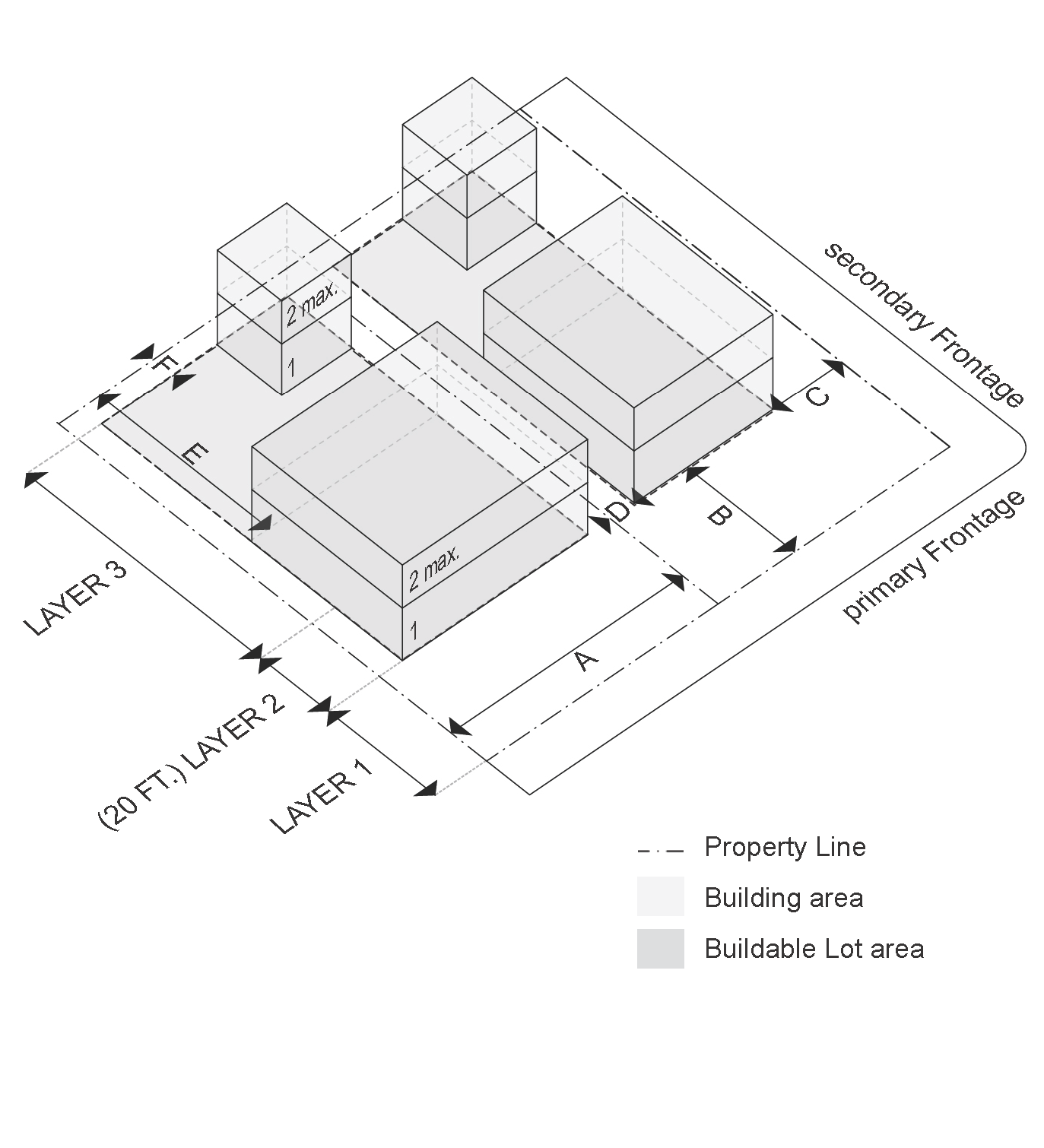
*1 No Parking shall be permitted in the unpaved portion of the Front Yard of any private property, however Parking is permitted in any paved Driveway approach, so long as it does not obstruct the Sidewalk or Street.
Layer 1: 33% maximum area.
Layer 2: no more than 30% of Facade width
Layer 3: Parking allowed
Sec. 24-B.16. - ZONE 4 (Z4) MAIN STREET.
(a)
BUILDING DISPOSITION (Z4).
(1)
Newly platted Lots shall be dimensioned according to Article VI, Figure 2: Z4 Standards.
(2)
Lot Coverage by Building shall not exceed that shown in Article VI, Figure 2: Z4 Standards.
(3)
Buildings shall be disposed in relation to the boundaries of its Lot according to Article VI, Figure 2: Z4 Standards.
(4)
Setbacks for Principal Buildings shall be as shown in Article VI, Figure 2: Z4 Standards.
(5)
Setbacks for Outbuildings, pools, tennis courts or other similar recreational facilities shall be as shown for Outbuildings in Illustration 2.
(6)
Facades shall be built parallel to a rectilinear Principal Frontage Line or to the tangent of a curved Principal Frontage Line, for a minimum 70 percent of its length.
(b)
BUILDING CONFIGURATION (Z4).
(1)
Development within Private Frontages shall comply with Article VI, Figure 2: Z4 Standards and Definitions: Frontage Types.
(2)
Encroachments shall be as follows: At the First Layer, cantilevered Awnings and entry canopies may encroach up to fifty percent (50%) of the depth of the Setback. Above the first Story, cantilevered balconies, bay windows, roofs and Facade components promoting energy efficiency such as shading and Screening devices that are non-accessible, may encroach a maximum of three (3) feet into the Setback. Other cantilevered portions of the Building shall maintain the required Setback. At the Second and Third Layers, no encroachments are permitted.
(3)
All outdoor storage, electrical, plumbing, mechanical, and communications equipment and appurtenant enclosures, shall be within the Second or Third Layer and concealed from view from any Frontage or sidewalk by liner buildings, walls, Streetscreens, or opaque gates.
(4)
Loading and service entries shall be at the Third Layer and shall be accessed from Alleys when available and otherwise from the Secondary Frontage. When a Lot has only Principal Frontages, vehicular entries, Loading Docks and service areas shall be at the Third Layer and shall be permitted on Principal Frontages only by process of Variance.
(5)
Building Heights shall be measured in Stories and shall conform to Article VI, Figure 2: Z4 Standards. The first-floor Elevation of a Principal Building shall be at average Sidewalk grade; a first-floor Residential or Lodging Function should be at a minimum Height of two (2) feet and a maximum Height of three and one-half (3½) feet for privacy reasons or as regulated by FEMA, whichever is higher. The height of the Principal Building shall be three (3) Stories maximum.
(6)
Mechanical equipment on a roof shall be enclosed by parapets of the minimum Height necessary to conceal it, and a maximum Height of five (5) feet. Other ornamental Building features may extend up to five (5) feet above the maximum Building Height.
(7)
Streetscreens shall be between three and one-half (3.5) and eight (8) feet in Height and constructed of a material matching the adjacent building Façade or of masonry, wrought iron or aluminum. The Streetscreen may be replaced by a hedge or fence. Streetscreens shall have openings no larger than necessary to allow automobile and pedestrian access. Streetscreens shall be located co-planar with the Building Facade Line. Wire fences shall not be permitted.
(8)
Within the Second and Third Layers, fences and walls shall not exceed a Height of eight (8) feet.
(c)
BUILDING FUNCTION AND DENSITY (Z4).
(1)
Buildings in Z4 shall conform to the Functions, Densities, and Intensities described in Article VI, Figure 2: Z4 Standards.
(d)
PARKING STANDARDS (Z4).
(1)
Vehicular parking shall be required as shown in Article IV. Parking.
(2)
On-street parking available along the Frontage Lines that correspond to each Lot shall be counted toward the parking requirement of the Building on the Lot.
(3)
Off-street parking shall be accessed by an Alley when available.
(4)
Surface parking lots, covered parking and garages shall be located within the Second and Third Layers as illustrated in Article VI, Figure 2: Z4 Standards. Surface parking lots, garages, Loading space and service areas shall be masked from the Frontage by a Liner Building or Streetscreen as illustrated in Article VI, Figure 2: Z4 Standards.
(5)
The maximum width at the Property Line of a driveway on a Frontage shall be twelve (12) feet. Shared driveway width combining ingress and egress shall be a maximum width of twenty (20) feet at the Property Line and may encroach into the setback.
(6)
Tandem Parking on site should be encouraged.
(7)
Shared Parking shall be calculated according to Article IV, Table 2.
(8)
In Z4 a minimum of one (1) bicycle rack space shall be provided for every 20 vehicular parking spaces and may be in the Private Frontage.
(e)
ARCHITECTURAL STANDARDS (Z4).
(1)
Only permanent Structures shall be permitted. Temporary Structures such as mobile homes, construction trailers, travel trailers, recreational vehicles, and other temporary Structures shall not be permitted.
(2)
The Facades on Retail Frontages shall be detailed as storefronts and glazed with clear glass no less than seventy (70) percent of the Sidewalk level Story. Security screens shall be seventy (70) percent open.
(f)
LANDSCAPE STANDARDS (Z4).
(1)
The First Layer shall be paved and landscaped to match and extend the enfronting Public Frontage.
(2)
Open Space shall be a minimum ten (10) percent of the Lot Area. Unpaved Green Space shall be a minimum five (5) percent of the Lot Area.
(3)
A minimum of one (1) shade tree shall be planted for every fifty (50) feet of Primary Frontage, either in the front setback area or as a street tree in the public right-of-way.
*1 Bed and Breakfasts and Inns permitted only.
*2 Commercial Uses limited to Ground Story only.
* The Rear Setback shall be defined as that portion of the property abutting a Z3 Transect Zone. For properties with a depth of less than one hundred (100) feet, the Principal Building Rear Setback may be reduced to ten (10) feet min. by process of Variance.
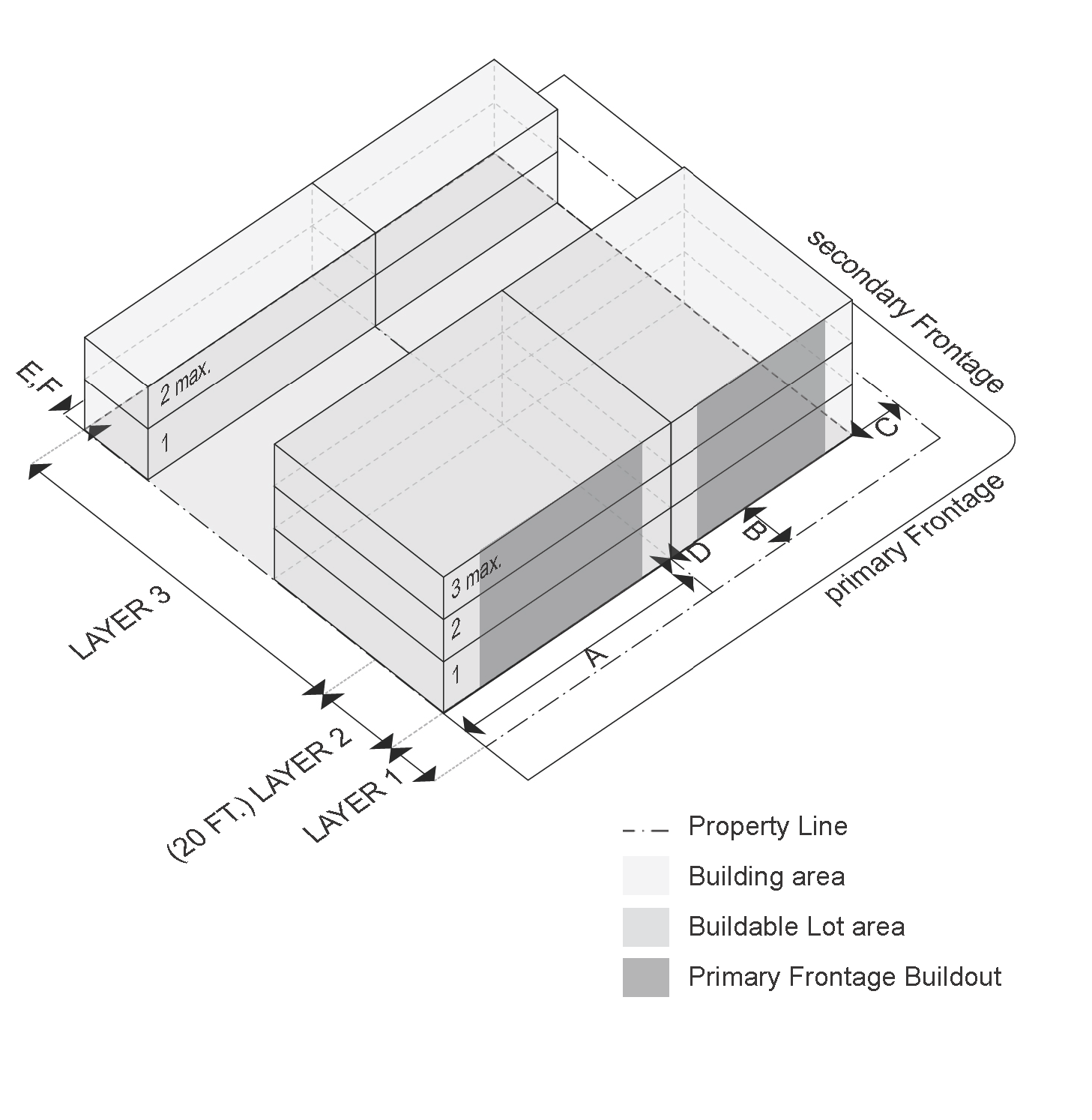
Layer 1: No Parking.
Layer 2: No Parking.
Layer 3: Parking allowed.
*1 Floor Lot Ratio includes all enclosed areas within the building such as structured parking garages, lobbies, stairwells, hallways, etc.
Sec. 24-B.17. - ZONE 5 (Z5) URBAN CENTER.
(a)
BUILDING DISPOSITION (Z5).
(1)
Newly platted Lots shall be dimensioned according to Article VI, Figure 3: Z5 Standards.
(2)
Lot Coverage by Building shall not exceed that shown in Article VI, Figure 3: Z5 Standards.
(3)
Buildings shall be disposed in relation to the boundaries of its Lot according to Article VI, Figure 3: Z5 Standards.
(4)
Buildings shall have their principal pedestrian entrances on a Frontage Line or from a Courtyard at the Second Layer.
(5)
For the minimum Height, facades shall be built parallel to the Principal Frontage Line along a minimum of eighty (80) percent of its length on the Setback Line as shown in Article VI, Figure 3: Z5 Standards. In the absence of a Building along the remainder of the Frontage Line, a Streetscreen shall be built co-planar with the Façade to conceal parking and service areas.
(6)
At the first Story, Façades along a Frontage Line shall have frequent doors and windows; pedestrian entrances shall occur at a maximum spacing of seventy-five (75) feet and vehicular entries shall occur at a minimum spacing of sixty (60) feet.
(b)
BUILDING CONFIGURATION (Z5).
(1)
Development within Private Frontages shall comply with Article VI, Figure 3: Z5 Standards and Definitions: Frontage Types.
(2)
Encroachments shall be as follows: At the First Layer, cantilevered Awnings and entry canopies may encroach up to one hundred percent (100%) of the depth of the Setback. Above the first Story, cantilevered balconies, bay windows, roofs and Facade components promoting energy efficiency such as shading and Screening devices that are non-accessible, may encroach a maximum of three (3) feet into the Setback. Other cantilevered portions of the Building shall maintain the required Setback. At the Second and Third Layers, no encroachments are permitted.
(3)
Galleries and Arcades shall be a minimum fifteen (15) feet deep and may encroach up to one hundred percent (100%) of the depth of the Setback.
(4)
Screen enclosures shall be located within the Second or Third Layer only.
(5)
Loading and service entries shall be at the Third Layer and shall be accessed from Alleys when available and otherwise from the Secondary Frontage. When a Lot has only Principal Frontages, vehicular entries, Loading Docks and service areas shall be at the Third Layer and shall be permitted on Principal Frontages only by process of Administrative Adjustment.
(6)
All outdoor storage, electrical, plumbing, mechanical, and communications equipment and appurtenant enclosures, shall be within the Second or Third Layer and concealed from view from any Frontage or sidewalk by liner buildings, walls, Streetscreens, or opaque gates.
(7)
Building Heights shall be measured in Stories and shall conform to Article VI, Figure 3: Z5 Standards. The first-floor Elevation of a Principal Building shall be at average Sidewalk grade; a first-floor Residential or Lodging Function should be at a minimum Height of two (2) feet and a maximum Height of three and one-half (3.5) feet.
(8)
Mechanical equipment on a roof shall be enclosed by parapets of the minimum Height necessary to conceal it, and a maximum Height of five (5) feet. Other ornamental Building features may extend up to five (5) feet above the maximum Building Height.
(9)
Streetscreens shall be between three and one-half (3.5) and eight (8) feet in Height and constructed of a material matching the adjacent building Façade or of masonry, wrought iron or aluminum. The Streetscreen may be replaced by a hedge or fence. Streetscreens shall have openings no larger than necessary to allow automobile and pedestrian access. Streetscreens shall be located co-planar with the Building Facade Line. Wire fences shall not be permitted.
(10)
Within the Second and Third Layers, fences and walls shall not exceed a Height of eight (8) feet.
(c)
BUILDING FUNCTION AND DENSITY (Z5).
(1)
Buildings in Z5 shall conform to the Functions, Densities, and Intensities described in Article VI, Figure 3: Z5 Standards.
(2)
No single use shall occupy more than fifty percent (50%) of the gross acreage of a mixed use development.
(3)
Public Storage Facility uses may be permitted by process of Special Exception in the 3rd Layer only, and shall be fully lined with habitable space on all Stories along the Primary Frontage and Secondary Frontage. No Public Storage Facility use shall be located closer than one thousand (1,000) feet from another Public Storage Facility use. The maximum building area of a Public Storage Facility shall be twenty-five thousand (25,000) square feet.
(4)
Public Parking shall be permitted in the 3rd Layer only, and shall be fully lined with habitable space on all Stories along the Primary Frontage and Secondary Frontage. Public Parking garages shall be considered a building, and shall conform to all requirements of Section 24-B.17 for buildings.
(d)
PARKING STANDARDS (Z5).
(1)
Vehicular parking shall be required as shown in Article IV. Parking.
(2)
On-street parking available along the Frontage Lines that correspond to each Lot shall be counted toward the parking requirement of the Building on the Lot.
(3)
Parking shall be accessed by an Alley when available.
(4)
All parking including drop-off drives and porte-cocheres, open parking areas, covered parking, garages, Loading space and service areas shall be located within the Third Layer and shall be masked from the Frontage by a Liner Building or Streetscreen.
(5)
Underground parking may extend into the Second and First Layers only if it is fully underground and does not require raising first-floor elevation of the First and Second Layers above that of the Sidewalk. Ramps to underground parking shall be only within the Second and Third Layers.
(6)
Ground Floor parking shall be setback a minimum of seventy (70) feet from the Primary Frontage. Ground Floor parking may extend into the Second Layer of the Secondary Frontage a maximum of twenty-five percent (25%) of the width of the Secondary Frontage, or a maximum width of fifty (50) feet, whichever is less.
(7)
Parking above the Ground Floor shall be located in the Third Layer only. Parking above the Ground Story may extend into the Second Layer of the Secondary Frontage a maximum of fifty percent (50%) of the width of the Secondary Frontage.
(8)
The vehicular entrance of a parking lot or garage on a Frontage shall be no wider than twenty-five (25) feet and the minimum distance between vehicular entrances shall be sixty (60) feet.
(9)
Buildings mixing Uses shall provide parking for each Use. Shared Parking shall be calculated according to Article IV, Table 2.
(10)
A minimum of one (1) bicycle rack space shall be provided for every twenty (20) vehicular parking spaces and may be in the Private Frontage.
(e)
ARCHITECTURAL STANDARDS (Z5).
(1)
Only permanent Structures shall be allowed. Temporary Structures such as mobile homes, construction trailers, travel trailers, recreational vehicles, and other temporary Structures shall not be allowed.
(2)
The Facades on Retail Frontages shall be detailed as storefronts and glazed with clear glass no less than seventy percent (70%) of the Sidewalk level Story. Security screens shall be seventy percent (70%) open.
(3)
The Facade of a parking garage that is not concealed behind a Habitable Liner shall be screened to conceal all internal elements such as plumbing pipes, fans, ducts and lighting. Ramping should be internalized wherever possible. The exposed top level of parking Structures shall be covered a maximum of sixty percent (60%) with a shade producing Structure such as, but not limited to, a vined pergola or retractable canvas shade Structure.
(f)
LANDSCAPE STANDARDS (Z5).
(1)
The First Layer shall be paved and landscaped to match and extend the enfronting Public Frontage.
(2)
Open Space shall be a minimum ten percent (10%) of the Lot Area.
(g)
SPECIAL REGULATIONS.
(1)
Design of Mixed-Use Developments. The design of mixed-use developments should conform to the principles of the Miami-Dade County Urban Design Manual in relation to Commercial Blocks. The development should include a series of internal blocks, providing transition to the adjacent neighborhood. A green paseo should act as a connecting element between business and residential areas within the development. The use of parking structures is encouraged to reduce the visual and spatial impact of surface parking. Retail and office uses should mask the parking structures, thereby encouraging pedestrian activity along the internal streets of the development. Provisions for the inclusion of multi-modal transportation options (i.e. pedestrian, bicycle, automobile and transit facilities) shall be incorporated into such design, as shall provisions to ensure connectivity between the mixed use development and the remainder of the village, particularly by way of bicycle and pedestrian connectivity along NE 87th Street.
(2)
Sewers. Construction of any new main building shall require a sewer tie-in capability and if the site plan review shows that any project will generate more than one thousand five hundred (1,500) gallons of sewage per day, the project shall be connected to a sanitary sewer line with land made available for a sewage lift station if needed.
(3)
Medical Marijuana Treatment Centers/Medical Marijuana Dispensaries. Permitted by process of special exception. When considering an application for medical marijuana dispensaries/medical marijuana treatment centers the approving body must consider the special exception criteria listed below, in addition to that criteria listed in Section 17-59, Requirements and procedures for site plan and special exceptions.
a.
Whether the request will cause damage, hazard, nuisance or other detrimental impacts to persons or property.
b.
Any parking demand created by a medical marijuana dispensary/medical marijuana treatment center shall not exceed the parking spaces located or allocated on site, as required by the Village's parking regulations. An applicant shall be required to demonstrate, with a current traffic and parking study prepared by a certified professional, that on-site traffic and parking attributable to the medical marijuana dispensary/medical marijuana treatment center will be sufficient to accommodate the traffic and parking demands generated by the medical marijuana dispensary/medical marijuana treatment center.
c.
No medical marijuana dispensary/medical marijuana treatment center shall be located closer than one thousand (1,000) feet of another medical marijuana dispensary/medical marijuana treatment center, whether it is located in the Village or in another jurisdiction; closer than one thousand (1,000) feet of an elementary, middle or secondary school, child day care facility, county or municipal park, or place of worship. Locations. Distances shall be measured by drawing a straight between the closest point of the medical marijuana dispensary/medical marijuana treatment center structure to the closest property line of edge of leased space, whichever is closer, of the school, day care center, place of worship, residentially zoned property, or other medical marijuana dispensary/medical marijuana treatment center.
d.
Medical marijuana dispensaries/medical marijuana treatment centers shall ensure that there is no queuing of vehicles in the rights-of-way.
e.
No medical marijuana dispensaries/medical marijuana treatment centers shall have a drive-through or drive service aisle.
f.
Medical marijuana dispensaries/medical marijuana treatment centers may be required to appear before the Village Council for annual progress reports prior to the issuance of business tax receipts and/or renewals.
g.
Medical marijuana dispensaries/medical marijuana treatment centers shall, at all times, be in compliance with federal and state regulations, Miami-Dade County Code of Ordinances, and the Village of El Portal Code of Ordinances, as may be amended.
(Ord. No. 2018-06, § 2, 11-27-2018)
*1
No single use shall occupy more than fifty percent (50%) of the gross acreage of a
development.
*2
All developments with a lot size greater than ten thousand (10,000) square feet shall
require a Special Exception and Site Plan.
*3
Commercial Uses limited to 1st floor only. Large Scale Commercial uses exceeding twenty-five
thousand (25,000) gross square feet shall not be permitted.
* For sites with a Lot width of 340 ft. or more a cross Block pedestrian Passage shall be provided.
* See Public Benefit Program in Article VIII. No Benefit Height shall be permitted within 250' of Z3.
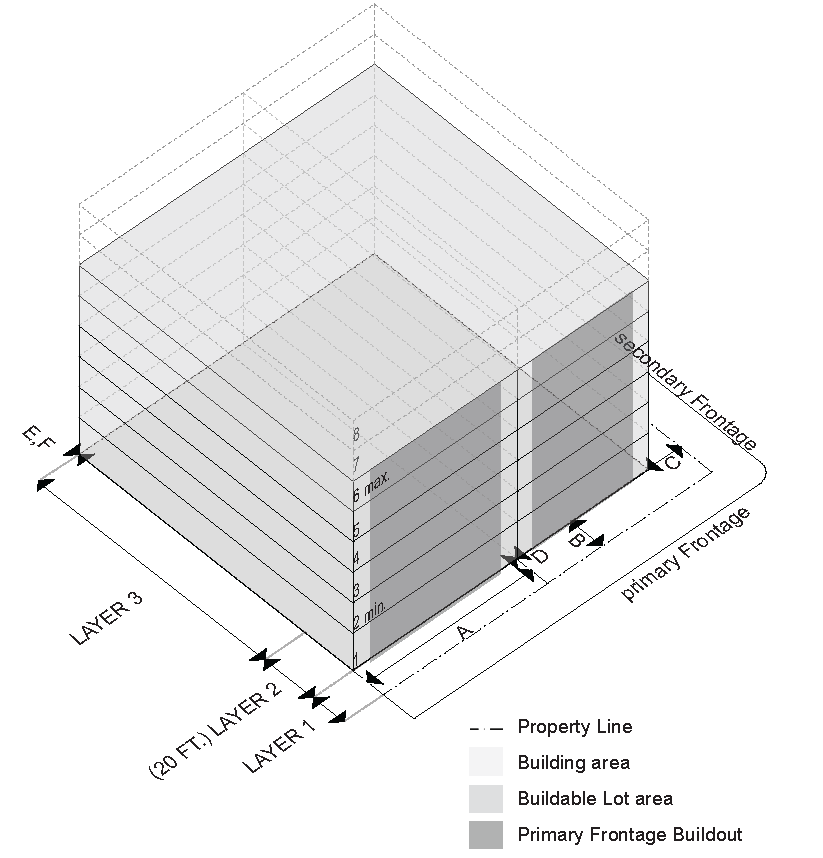
Layer 1: No parking permitted.
Layer 2: Limited parking permitted in accordance with Section 24-B.17.(d).
Layer 3: Parking permitted in accordance with Section 24-B.17.(d).
*1 Underground Parking can Encroach into Layer 1 only if it is fully underground and does not require raising the 1st floor Elevation above that of the Sidewalk.
*1 Floor Lot Ratio includes all enclosed areas within the building such as structured parking garages, lobbies, stairwells, hallways, etc.
Sec. 24-B.18. - CIVIC ZONE (C).
(a)
PARKING.
(1)
Parking provisions for Civic Zones shall be determined by Variance.
(b)
CIVIC SPACE.
(1)
Civic Spaces shall be generally designed as described Definitions: Civic Space, their type determined by the surrounding or adjacent Transect Zone in a process of Public consultation subject to the approval of the Village Council by process of Special Exception.
(c)
CIVIC BUILDING.
(1)
Civic Buildings may be permitted by process of Special Exception in Zone 5, Zone 4, or the Civic Zone, as shown in the adopted Zoning Map.
(2)
Civic Buildings shall be subject to the development standards of the most restrictive adjacent Transect Zone, and by the Intensity regulations in the Comprehensive Plan, or 0.5 FLR, whichever is less. The particulars of their design shall be determined through Special Exception Site Plan approval by the Village Council.
Sec. 24-B.19. - PURPOSE.
(a)
The purpose of a Special District Plan is to allow properties in the Z5 Transect Zone that are greater than seven (7) Abutting acres in size to be master planned so as to encourage innovative approaches to the design of community environments; to allow greater integration of public improvements and infrastructure, both public and private; and to provide greater flexibility in planning, design, and development so as to result in higher or specialized quality building and Streetscape design within the Special District Plan, all in order to further the intent of this Form-Based Code expressed in Article I.
(b)
This section establishes the standards for subdividing applicable sites in a manner that encourages small, walkable Blocks defined by an interconnected and human-scaled Street network lined by appropriately-scaled Buildings and Open Spaces, to enable Thoroughfare connectivity; to encourage a variety of Building Heights, massing, and Streetscape design, and to provide high quality design elements.
Sec. 24-B.20. - SPECIAL DISTRICT PLAN STANDARDS.
(a)
Application may be made for rezoning of Z5 property to a Special District Plan by the single or multiple owner(s) of Abutting properties in excess of seven (7) acres.
(b)
A Special District Plan shall be approved by the process of Rezoning as provided in the Village of El Portal Code of Ordinances. An accompanying Special Exception application and Site Plan shall be required as provided in the Village of El Portal Code of Ordinances.
(c)
A Special District Plan shall assign Thoroughfares, Transect Zones, and Civic Space, with appropriate transitions to Abutting areas. Adjustments to the guidelines for Thoroughfares and Public Frontages may be made according to the particular circumstances of the Special District Plan.
(d)
A Special District Plan shall include a map of the Thoroughfares and Transect Zones, and shall identify those standards that deviate from the requirements of this Form-Based Code and the Village of El Portal Code of Ordinances.
(e)
A Special District Plan shall assign at least twenty percent (20%) of its aggregated Lot Area to Civic Space Types. Civic Building sites are to be located within or adjacent to Civic Space Types or at the axial termination of significant Thoroughfares. The developer of the Special District Plan shall be responsible for constructing the public improvements within the Special District Plan, including Thoroughfares.
(f)
Development within the Special District Plan shall be pursuant to a recorded development agreement. The development agreement shall establish the allocation of Thoroughfares, Civic Space, and Building Area among the building sites, along with the creation and retention of Public benefits which may include the contribution of Public Parks and Open Space or Civic Buildings.
(g)
Unless a Building is specifically approved as part of a Special District Plan, any Building shall be reviewed by the Village Manager or their designee for conformance to the Special District Plan, prior to issuance of a building permit.
(h)
Block Requirements.
(1)
Blocks: Blocks shall be either orthogonal (rectilinear) consisting of square or rectangular designs or shall be trapezoidal and irregular in shape. See Article VII. Figure 1: Block Requirements.
(2)
Lots: Lot size requirements are provided in Article VI: Specific to Zones in order to insure that new Buildings (and the Setbacks between them) built on large lots are of a proper scale and character.
(i)
In addition to the documentation required for Rezoning, Special Exception, and Site Plan applications, Special District Plan Applications shall include but not be limited to:
(1)
Establishment of a Primary Grid and Secondary Grid for Thoroughfares. Buildings along the Primary Grid shall be held to the highest standard of this Form-Based Code in support of pedestrian activity. Buildings along the Secondary Grid may be more readily designed for automobile-oriented standards including surface parking lots and unlined parking decks.
(2)
Facades on Retail Frontage requiring that a Building provide a Commercial use at sidewalk level along a portion of the Frontage. The portion of the Building providing the Commercial Use shall be detailed as storefront and glazed with clear glass no less than seventy percent (70%) of the sidewalk-level Story and provide an awning or other cover overlapping the sidewalk. The first floor should be limited to Retail Use throughout the depth of the Second Layer.
(3)
Gallery or Arcade Frontage, requiring that a Building provide a permanent cover over the sidewalk that may be cantilevered or supported by columns. The Gallery or Arcade Frontage may be combined with Facades on Retail Frontage as specified in this Code and may apply towards Open Space requirements when located within the First Layer.
(4)
Building Disposition standards that may vary from Transect Zone requirements.
(5)
A Terminated Vista location, requiring that the Building be provided with architectural articulation of a Type and character that responds to the location.
(6)
Special District Plan Architectural Design Guidelines that include the architectural elements, style and materials that will be employed in the Special District Plan.
(7)
A tree survey prepared by licensed surveyor, landscape architect, or certified arborist; tree disposition plan, and tree mitigation plan.
(8)
A parking management plan that allows for shared parking among public and private uses.
(9)
Flexible allocation of development capacity and Height, excluding Density on individual sites within the Special District Plan shall be allowed so long as the Development Capacity or Height distribution does not result in development that is out of scale or character with the surrounding area, and provides for appropriate transitions.
(10)
All elements of the Special District Plan Application shall be subject to approval by the Village Council as part of the Rezoning and Special Exception process.
ARTICLE VII. FIGURE 1: Block Requirements.
| BLOCK REQUIREMENTS FOR SPECIAL DISTRICT PLANS | ||||
|---|---|---|---|---|
| Block Type | Block Length | Block Depth | ||
| Orthogonal: Square or Rectangular | Min | Max | Min | Max |
| 150 ft. | 500 ft. | 200 ft. | 400 ft. | |
| Trapezoidal: Irregular | Min | Max | Min | Max |
| 100 ft. |
500 ft. average for 2
longest sides | 100 ft. |
500 ft. average for 2
longest sides | |
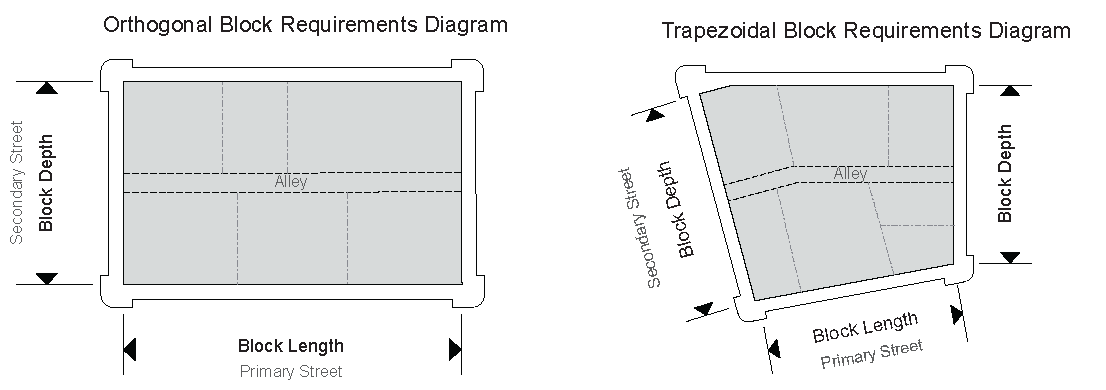 | ||||
Sec. 24-B.21. - PUBLIC BENEFITS PROGRAM.
(a)
Intent and Applicability. The intent of the Public Benefits Program established in this section is to allow bonus Building Height in Zone Z5 in exchange for the developer's contribution to specified programs that provide benefits to the Public.
(b)
Bonus Height. A Bonus Height of two (2) Stories shall be permitted if the proposed Development contributes toward the specified Public Benefits in the amount and in the manner as set forth herein. Upon providing a binding commitment for the specified Public Benefit, the proposed development project shall be allowed to build within the restrictions of the specific Transect Zone, up to the bonus Height as established in this Section. The only square footage allowed above the maximum Height is that achieved through the Public Benefits Program.
(c)
Public Benefit Programs. The proposed bonus Height shall be permitted in exchange for contribution to the Village for the following Public Benefits: Public Parks and Open Space, and Civic Space or Civil Support space and for such other lawful purposes, including, but not limited to, policing, water and sewer improvements, roadway and infrastructure improvements, as may be reasonably related to new residential development occurring within the Village boundaries and for such other lawful purposes, including, but not limited to, policing, water and sewer improvements, roadway and infrastructure improvements, as may be reasonably related to new residential development occurring within the Village boundaries. The Village Manager shall recommend the necessary cash contribution to the Village of El Portal Public Benefits Trust Fund under Section 24-B.21.5 - Public Benefits Trust Fund for the Mayor and Village Council's final approval.
(d)
Public Benefit Program Criteria.
(1)
Public Parks, Open Space, or Park Improvements. The development project in a Zone Z5 may provide any of the following or combination thereof:
A.
Public Park, or Open Space, provided through purchase and in an area of need identified by the Village Council.
i.
For each square foot of dedicated Public Park or Open Space provided, the development shall be allowed two (2) times the development Floor Area of provided land up to the bonus Height. The Open Space may be a Park, Green or Square, as more fully described in the Definitions of this Code.
ii.
Park improvements shall be valuated and for said value the development project shall be allowed additional Floor Area up to the bonus Height and shall for all applicable purposes be treated as a Trust Fund contribution.
iii.
Donations must meet all Villages requirements for design, equipment specifications, construction, warranties, etc. Park improvements are subject to review and approval by the Village Manager or designee.
B.
Public Open Space provided on-site within a development project, in a location and of a design to be approved by the Village Manager or designee. For each square foot of dedicated Public Park or Open Space provided, the development shall be allowed an equivalent amount of development Floor Area up to the bonus Height. The project shall maintain the Frontage requirements of the Transect Zone. The Open Space may be a Courtyard, Plaza, or Thoroughfare or Pedestrian Passage through the site connecting two (2) Thoroughfares.
(2)
Civic space and Civil Support space. For a development project in a Z5 zone that donates a Civic Space or Civil Support space on site to the Village of El Portal, an additional two (2) square feet of area for each square foot of donated space, up to the bonus Height, shall be allowed.
(3)
Other Lawful Related Improvements. A development project in a Zone Z5 may also contribute funds to be used for other lawful purposes, including, but not limited to, policing, water and sewer improvements, roadway and infrastructure improvements, as may be reasonably related to new residential development occurring within the Village boundaries.
(4)
Trust Fund Contribution. For a cash contribution to the Public Benefits Trust Fund, the development project shall be allowed additional Floor Area up to the bonus Height. The cash contribution shall be determined based on the market value of the per square foot price charged for units at similar projects within the market area where the proposed project is applying for the bonus Height is located within the Village.
(Ord. No. 2019-07, § 2, 4-28-2020; Ord. No. 2021-03, § 3, 5-25-2021)
Sec. 24-B.21.5. - PUBLIC BENEFITS TRUST FUND.
(a)
Public Benefits Trust Fund; intent.
(1)
It is intended that the "Village of El Portal Public Benefits Trust Fund" be established in order to collect cash contributions made according as established in Appendix B: - Form-Based Code Article VIII. Public Benefits Program, Section 24-B.21. - Public Benefits Program, as amended, the zoning ordinance of the Village, to support the acquisition of land for parks and open space, reinvestment in capital improvements to existing parks and open space, tree planting, and capital expenditures for landscaping within the Village boundaries and for such other lawful purposes, including, but not limited to, policing, water and sewer improvements, roadway and infrastructure improvements, as may be reasonably related to new residential development occurring within the Village boundaries.
(b)
Public Benefits Trust Fund; established.
(1)
There is hereby established a trust fund to be entitled the "Village of El Portal Public Benefits Trust Fund," into which funds shall be deposited pursuant to this Article.
(2)
Upon receipt of funds for any project within Zone 5-Urban Center of the Village of El Portal, the Village of El Portal Finance Department shall deposit such funds into the Village of El Portal Public Benefits Trust Fund.
(3)
Administration of and a financial report on trust fund receipts and expenditures shall be prepared annually at the close of the fiscal year by the Village Manager for review and approval by the Mayor and Village Council prior to filing with the Village Clerk.
(Ord. No. 2019-06, § 2, 4-28-2020; Ord. No. 2021-03, § 2, 5-25-2021)
Sec. 24-B.22. - INSTRUCTIONS.
(a)
Thoroughfares are intended for use by vehicular and pedestrian traffic and to provide access to Lots and Civic Spaces. Thoroughfares shall generally consist of Vehicular Lanes and Public Frontages.
(b)
Thoroughfares shall be designed in context with the physical form and desired design speed of the Transect Zones through which-they pass. The Public Frontages of Thoroughfares that pass from one (1) Transect Zone to another should be adjusted accordingly or, alternatively, the Transect Zone may follow the alignment of the Thoroughfare to the depth of one (10 Lot, retaining a single Public Frontage throughout its trajectory.
(c)
Within the zones (Z3 through Z5), pedestrian comfort shall be a primary consideration of the Thoroughfare. Design conflict between vehicular and pedestrian movement generally shall be decided in favor of the pedestrian.
(d)
All Thoroughfares shall terminate at other Thoroughfares, forming a network. Cul-de-sacs shall be subject to approval by Variance to accommodate specific site conditions only.
(e)
Each Lot shall Enfront a vehicular Thoroughfare, except that twenty percent (20%) of the Lots within each Transect Zone may Enfront a Passage.
(f)
Standards for Paths and Bicycle Trails shall be approved by Variance.
(g)
Standards for Thoroughfares within a Site Plan shall be determined through the Site Plan approval process.
Sec. 24-B.23. - VEHICULAR LANES.
(a)
General To All Zones Z3, Z4, Z5.
(1)
Thoroughfares may include vehicular lanes in a variety of widths for parked and for moving vehicles, including bicycles.
(2)
A bicycle network consisting of Bicycle Trails, Bicycle Routes and Bicycle Lanes should be provided throughout the community. The community bicycle network shall be connected to existing or proposed regional networks wherever possible.
Sec. 24-B.24. - PUBLIC FRONTAGES.
(a)
General To All Zones Z3, Z4, Z5.
(1)
The Public Frontage contributes to the character of the Transect Zone, and includes the types of Sidewalks, Curbs, Planters, Bikeways, and Street trees.
(2)
Public Frontages should be designed as shown in Article X. Definitions-Public Frontages and allocated within Transect Zones.
(b)
Specific To Zones Z3.
(1)
The Public Frontage shall include trees of various species, naturalistically clustered.
(2)
The introduced landscape shall consist primarily of native species requiring minimal irrigation, fertilization and maintenance.
(c)
Specific To Zone Z4.
(1)
The introduced landscape shall consist primarily of durable species tolerant of soil compaction.
(2)
The Public Frontage shall include trees planted in a regularly-spaced Allee pattern of single or alternated species with shade canopies of a height that, at maturity, clears at least one (1) Story.
(d)
Specific To Zone Z5.
(1)
The introduced landscape shall consist primarily of durable species tolerant of soil compaction.
(2)
The Public Frontage shall include trees planted in a regularly-spaced Allee pattern of single species with shade canopies of a height that, at maturity, clears at least one (1) Story. At Retail Frontages, the spacing of the trees may be irregular, to avoid visually obscuring the Shopfronts.
(3)
Streets with a Right-of-Way width of forty (40) feet or less shall be exempt from the tree requirement.
ARTICLE IX. FIGURE 1: THOROUGHFARE STANDARDS.
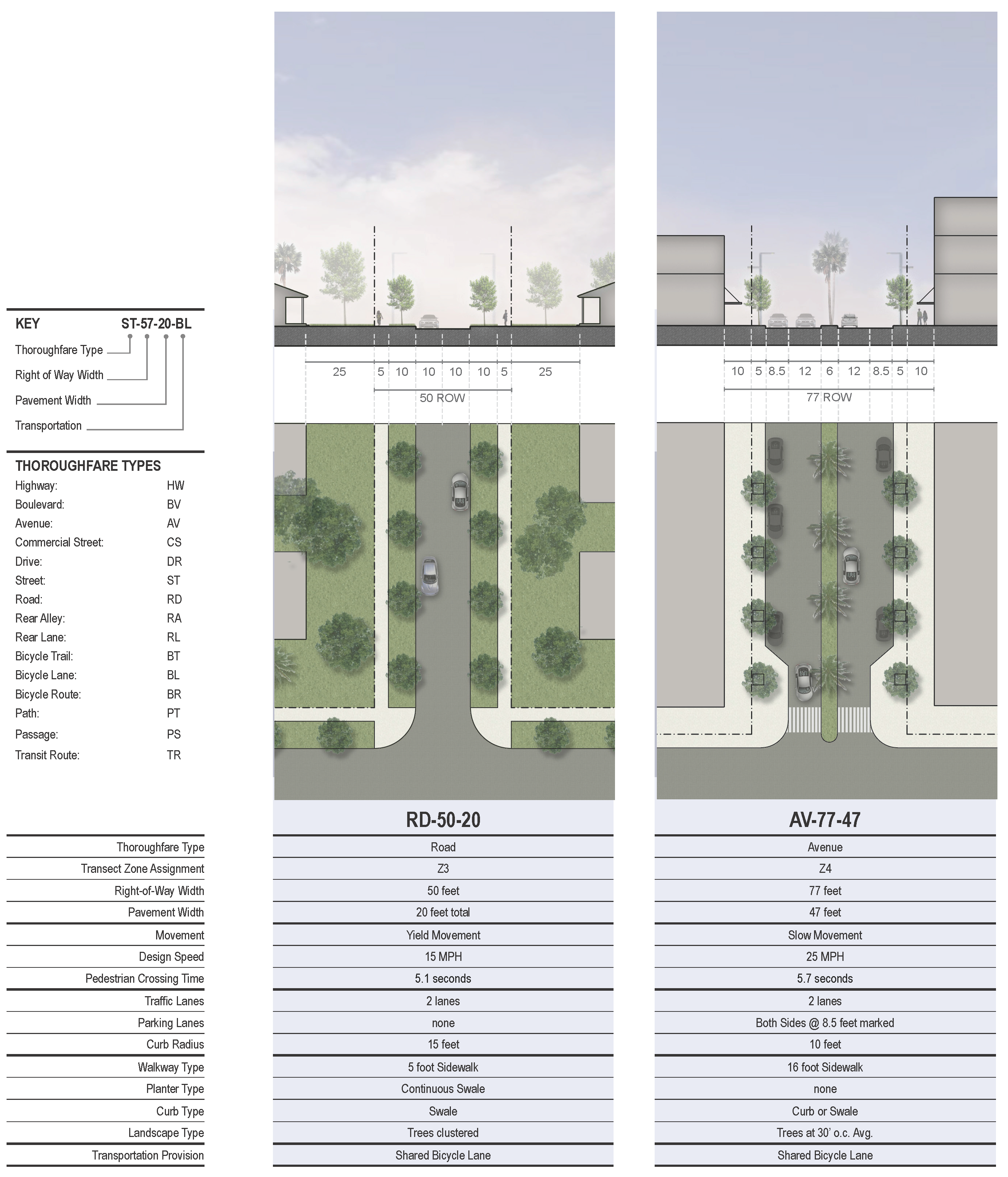
ARTICLE IX. FIGURE 2: THOROUGHFARE STANDARDS.