
Emerson City Zoning Code
ARTICLE VIII
SIGN REGULATIONS3
Editor's note— Ord. No. 2022-011, § 1, adopted Oct. 24, 2022, repealed the former Art. VIII, §§ 8.800—8.812, and enacted a new Art. VIII as set out herein. The former Art. VIII pertained to similar subject matter and derived from Ord. No. 2020-007, § 1, adopted July 27, 2020.
Sec. 8.800.- Findings.
The mayor and council has determined:
1.
Signs are a proper and necessary medium for the expression of speech, and the visibility of area businesses and organizations.
2.
Proper regulation of signs is a necessary prerequisite to a peaceable, orderly and safely designed business environment, and the protection of property values;
3.
An improperly regulated sign environment poses health and safety hazards to the public;
4.
The result of effective sign regulation will be to lessen hazardous conditions, confusion and visual clutter caused by the proliferation, improper placement, illumination and excessive height and size of signs which compete for the attention of pedestrian and vehicle traffic;
5.
Through proper regulation of signs, the attractiveness and economic well being of the city will be enhanced as a place to live, work, and conduct business;
6.
Some signage has a single targeted function and identification of signage by description is impossible without referring to its function. For instance, address numerals are used for the sole purpose of identifying addresses, which is a benefit to persons looking for those addresses and is essential to public safety personnel responding to emergencies. Signs at the entrances to neighborhoods and major developments favor a similar purpose in enabling both the traveling public and emergency personnel to quickly locate entrances for the purpose of either visitation or responding to emergency calls. While such signage may be referenced based upon the function it serves within the context of this article, the provisions of this article are unrelated to the content of the speech provided and allow maximum expressive potential to sign owners.
(Ord. No. 2022-011, § 1, 10-24-2022)
Sec. 8.801. - Purpose and intent.
A.
The purpose and intent of this article is to establish standards for the fabrication, erection, use, maintenance and alteration of signs within the city. These standards are designed to protect and promote the health, safety, and welfare of persons within the city by providing regulations which allow and encourage creativity, effectiveness, and flexibility in the design and use of such devices while promoting traffic safety and avoiding an environment that encourages visual blight.
B.
The standards established by this article are designed to maintain the economic viability of businesses in our community through the availability of appropriate signage as well as promote the efficient transfer of public and commercial information through sign management.
C.
It is also the purpose of this article to prohibit the future erection, placement, or location of portable and certain other types of signs determined to be detrimental to the aesthetic sense, historic character and public health, safety, and general welfare of the citizens of the city, both generally and as it particularly affects tourism.
D.
A determination has been made by the city council that the regulations contained in this article are the minimum amount of regulations necessary to achieve the purposes set out above.
(Ord. No. 2022-011, § 1, 10-24-2022)
Sec. 8.802. - Definitions.
The following words, terms and phrases, when used in this article, shall have the meanings ascribed to them in this section, except where the context clearly indicates a different meaning:
A-frame sign means a sidewalk sign, the support structure of which is not embedded in the ground, but that is constructed in such a manner that the sign stands on its own, yet is not permanently installed. A-frame signs are designed as two panels, hinged at the top, with the bottom edge of both panels spread so that the overall sign forms an "A" shape.
Advertising device. See "sign."
Aggregate sign area means the figures derived from adding the sign area of all signs of the designated category per entity, building or lot.
Animated sign means a sign that has moving parts or includes action, motion, or color changes, or the optical illusion of action, motion, or color changes, including signs using electronic ink, signs set in motion by movement of the atmosphere, and any sign utilizing electronic technology that fails to conform to the standards of this Article. Animated signs also include signs that emit sound, smoke or other special effects.
Area of sign face. See "sign area."
Awning means an architectural projection comprised of a lightweight, rigid skeleton structure over which a covering is attached, and applied to the façade of a building as a frontage element and which provides protection from the elements, including sun and rain.
Awning sign means a permanent sign that is painted, screen printed, or appliquéd on an awning.
Banner means a temporary sign, with or without characters, letters, illustrations, or ornamentations, applied to cloth, paper, plastic or fabric of any kind with only such material for a backing. Flags within the standards of section 8.816 shall not be considered banners.
Billboard means a freestanding sign for which the sign face exceeds 200 square feet.
Building inspector means a building inspector of the city.
Building sign means a permanent sign attached directly to a building or to a supporting structure attached to a building. Building signs include, without limitation, awning signs, canopy signs, mansard signs, marquee signs, suspended signs, parapet signs, projecting signs, under-canopy signs, wall signs, and window signs.
Canopy means a permanently roofed horizontal architectural projection applied to, and supported entirely from, the exterior wall of the building, supported from below by brackets or above by suspension cables, and providing protection from the elements, including sun and rain.
Canopy sign means a permanent sign attached to a canopy.
Changeable copy, electronic means all or a portion of a permanent sign that is capable of changing the position or format of word messages or other displays on all or part of the sign face or of changing the visible display of words, numbers, symbols and graphics by the use of a matrix of electric lamps, movable discs, movable panels, light apertures (in which the lighting source forms the message) or other methods, provided these changes are actuated on the face of the sign by electronic control mechanism. "Changeable copy, electronic" excludes billboards utilizing electronic technology oriented toward I-75 that meet the standards of state law for multiple-message signs.
Changeable copy, manual means a portion of a permanent sign meeting the standards of this article that is capable of changing the position or format of word messages or other displays on all or a portion of the sign face or of changing the visible display of words, numbers, symbols and graphics by the use of movable discs, movable panels, or other methods, provided these changes are manually made on the face of the sign and not created electronically.
Commercial means a term defining a work place, office, retail, service, public service and/or institutional use, collectively.
Commercial entity means, for the purpose of this article, a particular business, work place, office, retail establishment, service use, nonprofit use, service organization, institutional use or other non-residential use.
Directional sign means a sign consisting of a single or double sign pole that serves the purpose of guiding safe vehicular and pedestrian traffic movements onto, from, or on property, and without which there is an increased risk of incompatible traffic movements, conflict, or confusion. Examples include, but are not limited to, "no parking," "entrance," "loading zone," "drive thru," etc.
Double faced sign means a sign which has two display areas opposite each other or where their interior angle formed by the display area is 45 degrees or less, where one face is designed to be seen from one direction and the other face from another direction.
Façade, primary means the exterior wall or elevation of a building that is set along the frontage line facing the public street of highest pedestrian and vehicular importance (traffic volume, number of lanes).
Façade, secondary means, for corner lots, the exterior wall or elevation of the building that is set along the frontage line facing the public street of second most pedestrian and vehicular importance (traffic volume, number of lanes).
Feather flag means a sign composed of fabric, plastic or other pliable material oriented in a vertical direction and supported by a harpoon-style pole or staff driven into the ground as its primary means of support.
Festoon means a sign composed of a string of ribbons, tinsel, small flags, pennants, streamers, pinwheels or other devices or long narrow strips of fabric, plastic, or other pliable material designed to move in the wind.
Flag means an official sign consisting of any fabric containing distinctive colors, patterns, logos or symbols, used as a symbol of a government or any other entity, organization or person. The imprinting of a logo or other design with other elements is excluded from the definition of flag. Feather flags are excluded from the definition of flag.
Flashing sign means a sign, the illumination of which is not kept constant in intensity at all times when in use, and which exhibits marked changes in lighting effects. Flashing signs are considered animated signs.
Freestanding sign means a permanent sign which is attached to or part of a completely self supporting structure. The supporting structure shall be permanently and firmly set in or below the ground surface and be wholly independent of a building or structure utilized for other purposes for support. Freestanding signs include, without limitation, pole signs, monument signs, and those yard signs erected in yards as defined by this article.
Frontage means the distance for which property abuts one side of the street, road, highway, or other public way measured along the dividing line between the property and such road, highway, or other public way from one side property line to the other side property line.
Frontage, building means the area in square feet of the front exterior wall of a particular establishment.
Ground clearance means the vertical distance in feet from the ground, sidewalk or other surface to the lowest point of the sign face or sign structure, whichever is lower.
Height, sign means the vertical distance in feet from the ground, sidewalk or other surface to the highest point of the sign face or sign structure, whichever is higher. Where the ground is uneven, the average elevation is utilized to determine the starting point of the measurement.
Illuminated sign means a sign or portion thereof that is lighted by artificial light, either from an interior or exterior source, including outline, reflective or phosphorescent light, whether or not the source of light is directly affixed as part of the sign.
Illuminated sign, interior means a sign lighted by an internal light source.
Illuminated sign, exterior means a sign lighted by an external light source directed primarily toward such sign.
Inflatable sign means a sign that is intended to be expanded by air or other gas for its proper display or support.
Informational sign. See "standard informational sign."
Lot means a unit of land as defined in a single deed recorded in the Superior Court Deed Records of Bartow County, Georgia. The description as specified in each recorded deed shall constitute a lot for the purpose of this article. Provided further, that two or more adjoining lots in common ownership and which are physically unified by the existence of a common structure or development located thereon shall constitute and be considered as one lot for the purpose of this article.
Lot, corner means a lot at the intersection of two or more thoroughfares.
Manually changeable copy sign. See "changeable copy sign, manual."
Marquee means a permanently roofed architectural projection whose sides are either vertical or horizontal and are supported entirely from an exterior wall of a building.
Marquee sign means a sign mounted to or hung from a marquee that projects horizontally or vertically from the façade to express a figural design and message to motorists and pedestrians.
Monument sign means a permanent freestanding sign that forms a solid structure, the width of which is constant from the ground to the top of the sign, and contains a distinguishable base (foundation), middle (sign area) and optional top (cap).
Multi lane divided highway means a highway consisting of four or more lanes with two or more lanes running in each opposing direction separated by a grassed or barrier median.
Multi-tenant sign means a sign that contains individual panels arranged vertically or horizontally, or both, in rows, each panel utilized by a separate entity. Multi-tenant signs are designed to share signage among multiple tenants on a lot. Multi-tenant signs may be wall or freestanding signs.
New technology sign means any sign or portion thereof, the sign face of which uses light emitting diode technology or other similar semiconductor technology to directly produce an illuminated image, picture or message of any kind whether the picture, image or message is moving or stationary. This type of sign includes any sign, the sign face of which directly utilizes LED technology of any kind, whether conventional (using discrete LEDs), surface mounted (otherwise known as individually mounted LEDs), transmissive, organic light emitting diode (OLED), light emitted polymer (LEP), organic electro polymer (OEL), or any other similar technology and in which the lighting source forms the message. The definition of new technology sign specifically excludes those signs which use LED lighting for internal illumination but where the message viewable to the public is not formed by the lighting source, but is rather created by the sign surface and does not depend on the lighting source to form the message.
Non-conforming sign means a sign, legally existing at the time of its erection, but which does not conform to the provisions of this article.
Owner means the person who has the legal right or exclusive title to the sign.
Permittee means the person who owns a permit from the city to erect, install, attach or paint a sign.
Planned center means a group of two or more retail stores, service establishments, offices, industries, or any other commercial entities, which is in common ownership or condominium ownership.
Pole sign means a permanent freestanding sign that is mounted on a pole or other vertical support such that the bottom of the sign face is no less than six feet above the ground and there is no visual obstruction other than the vertical support between the ground and the bottom of the sign face. Pole signs may also be mounted between two poles or vertical supports, provided they otherwise meet the standards of this definition.
Project entrance sign means a permanent freestanding sign located at a discernible entrance into a multi-family development, or into a development containing multiple lots, such as, but not limited to, a particular residential or commercial subdivision, business center, office park or industrial park.
Projecting sign means any small, permanent, pedestrian-scaled sign that is mounted perpendicularly to the building's façade in a manner that allows for easy reading from both sides of the sign. Projecting signs may be hung by bracket, outside the reach of pedestrians, in a manner that permits them to swing slightly.
Roof means the exterior upper covering of a building or structure, including the supporting frame.
Roof sign means a sign mounted upon or above any portion of a roof of a building or structure including the upper and lower slopes of a gambrel or mansard roof or any variations of such roofs.
Shopping center. See "planned center."
Sign means any structure, display, or device that is used to advertise identify, direct or attract attention to a business, institution, organization, person, idea, product, service, event or location by any means, including words, letters, figures, design characteristics, symbols, logos, fixtures, colors, movement or illumination.
Sign area means the area, in square feet, within a continuous perimeter enclosing the limits of writing, representation, emblem, or any figure of similar character together with any material, color or open space forming an integral part of the display used to differentiate such sign from the background against which it is placed. The sign area is measured as more specifically provided by section 8.809.
Sign face means the part of the sign that is or can be used to communicate its message.
Sign height. See "height, sign."
Standard informational sign means a temporary sign with an area not greater than six square feet with a sign face for short-term use, containing no reflective elements, flags or projections and otherwise meeting the standards of section 8.815.
Suspended sign means a small, pedestrian scaled sign that mounts to the underside of a beam, porch ceiling, gallery, arcade, breezeway or similar covered area in a manner that allows for easy reading from both sides.
Temporary sign means a sign of a non-permanent nature.
Traffic control and directional sign. See "directional sign."
Tri-vision sign means a sign designed with a series of triangular slats that mechanically rotate in sequence with one another to show three different sign messages in rotation. For purposes of this article, a tri-vision sign is not a changeable copy sign.
Wall sign means a sign painted on, applied to or mounted to the wall or surface of a building or structure, the sign display surface of which does not project more than eight inches from the outside wall of such building or structure, provided that channel letters mounted to a raceway may not project more than 12 inches. Wall signs include signs composed of individually cut or painted letters and/or graphics that are applied directly to the façade of the building or applied to a signboard or base that is then attached to the façade of the building. Wall signs do not project above the top edge of the wall or below the front wall or beyond the edge or face of a wall.
Window sign means any sign placed inside or upon a window in such a manner as to be viewable and or readable from the exterior of the building. Window signs may be either permanent or temporary.
(Ord. No. 2022-011, § 1, 10-24-2022)
Sec. 8.803. - Permit requirements and procedures.
A.
Requirement. Unless specifically exempted from obtaining a permit under the provisions of this article, no person shall erect, construct, replace, relocate or structurally alter any sign within the city without first obtaining a sign permit from the city.
B.
Persons entitled to permits. Sign permits shall be issued only to the owner or tenant of the lot for which the sign is to be erected. For all signs, the sign face of which does not exceed 32 square feet and the height of which does not exceed six feet, permits may be issued to the owner or owner's agent without designation of a licensed contractor. Any sign exceeding those dimensional requirements, with the exception of wall signs painted on an exterior wall and banners, shall require designation of a licensed contractor to perform the sign fabrication and installation. The sign permit holder shall remain responsible at all times for the erection, maintenance and condition of the sign. Once signs have been erected pursuant to valid permits, the sign permits are transferable only to a new owner or tenant who succeeds to the legal interest of the former sign permit holder; no transfer of the sign permit shall be complete without application to and approval by the city.
C.
Applications. Applications for sign permits shall be made upon forms provided by the city. One application and permit may include multiple signs on the same lot. Each application shall have contained or attached thereto the following information:
1.
Name, address and telephone number of the applicant.
2.
Tax lot ID and address of building, structure or a lot to which or upon which the sign is to be attached or erected.
3.
An accurate drawing of the site, to scale, showing the proposed location of the sign, other signs on the site, driveways, parking areas, existing rights-of-way, easements, a site distance diagram and any other limiting site features (survey not required). Signage installed upon a building or structure shall include the height and width of the building façade for each façade that signage is to be installed upon.
4.
An accurate drawing, to scale, of the plans, specifications and method of construction and attachment of the sign to the building or ground. The drawing shall specifically include the size of the sign area, overall dimensions of the sign, height of the sign upon installation, location of the sign installation and any protective devices or landscaping around the base of the sign. Engineered structural drawings designed to applicable codes, such as the building or electrical code, may be required by the building official where such codes apply.
5.
Name, address, telephone number and sign contractor's license number of the person erecting the sign.
6.
Written consent of the owner of the lot to which or upon which the sign is to be erected if the application is made by the owner's agent.
7.
The value of the sign.
8.
Comprehensive photographs of the proposed site, including all existing buildings, structures, existing signage and driveways.
9.
For temporary signs, information as to all dates within the preceding 12 months when temporary signs were utilized by the applicant.
10.
Such other information as the city shall require to show full compliance with this and other ordinances of the city.
D.
Content neutrality. No review of the specific content of any proposed sign shall be made or required, it being the intent of the city that the provisions of this article do not regulate the message of a sign, regardless of whether the sign content is commercial or noncommercial.
E.
Multi-tenant signs. For multi-tenant signs the property owner shall secure a permit for the sign structure as well as for removal of individual sign panels reserved for uses which no longer exist within the building or buildings covered by the multi-tenant sign. In addition to the permit required for a multi-tenant sign structure, a separate permit shall be required for each panel of the multi-tenant sign.
F.
Fees. Permit fees shall be collected at the time of permit issuance. Fees for permits shall be as fixed in the City of Emerson Fee Schedule.
G.
Review of application; issuance of permit. Upon the filing of an application for a sign permit, the zoning administrator, shall review all information supplied, all plans and specifications submitted, and the premises upon which the sign is proposed to be erected. Such review shall be completed within 30 calendar days of submission of a sign application. If, based on review of the permit application and inspection of the site, the proposed sign is in compliance with the requirements of this article and all other laws and ordinances of the city, the zoning administrator shall issue a permit upon payment of all fees. Application packages submitted in an incomplete form shall be returned to the applicant with denial based upon incompleteness of the application. If no decision is made within 30 calendar days, the permit will be deemed approved, provided that any sign erected must comply with all size, height, location and other physical requirements of this article, and no vesting of rights for a sign in violation of the standards shall occur.
H.
Denial of permits; revocation. The city shall deny permits to applicants who submit applications for signs that do not comply with the provisions of this article, are incomplete, or contain any material or false statements. Violation of any provision of this article will be grounds for terminating a permit granted by the city for the erection of a sign. Should it be determined that a sign permit was issued pursuant to an incomplete application or an application containing a false material statement, or that the permit has been erroneously issued in violation of this article, the zoning administrator shall revoke the permit. Should the zoning administrator deny a permit, the reasons for denial shall be stated in writing and mailed by certified mail, return receipt requested, to the address on the permit application on or before the 30 th calendar day after the city received the application. Alternatively, the city may personally serve the sign applicant with a copy of the written notice of denial within 30 calendar days after the city's receipt of the application. Any application denied and later resubmitted shall be deemed to have been submitted on the date of resubmission, instead of on the date of original submission. Actions to revoke a permit shall be in writing, shall document the basis for the revocation, and shall be served in the same manner as a notice of denial.
I.
Expiration of permits. A sign permit shall become null and void if the sign for which the permit was issued has not been erected, installed or affixed within six months after the date of issuance; provided that one extension of 90 days may be granted where the applicant can demonstrate that fabrication of the sign was under contract entered into in a timely manner. No refunds will be made for a permit after the permit is issued. If later a sign is desired to be erected at the same location, a new application for the sign must be processed and another fee paid in accordance with the fee schedule applicable at such time.
J.
Appeals. An individual whose permit application has been denied or a permittee whose written permit has been revoked may appeal the decision to the planning and zoning commission, pursuant to the provisions of this ordinance providing for appeals to the planning commission.
K.
Further review by certiorari. In the event an applicant whose permit has been denied or a permit holder whose permit has been revoked is dissatisfied with the decision of the planning and zoning commission, such applicant or permit holder may petition to the Superior Court of Bartow County as provided by law.
(Ord. No. 2022-011, § 1, 10-24-2022; Ord. No. 2023-015, § 1K, 7-24-2023)
Sec. 8.804. - Signs exempt from permit requirements.
The permit requirements of this article shall not apply to the following, provided that signs erected or placed are located on property of the person who erects such signs, and provided further that all signs exempted from the permit requirements shall nevertheless be maintained in accordance with the other remaining provisions of this Code.
1.
Traffic control devices and other public safety signs on public streets and highways conforming to the Uniform Manual for Traffic Control Devices;
2.
Directional signs located on private property, limited to two per driveway, a maximum of four square feet in size and erected to a height of no more than two and one-half feet;
3.
Warning signs and no trespassing signs not exceeding four square feet in size;
4.
Standard informational signs meeting the standards of section 8.815.
5.
Signs not visible from public thoroughfares that would otherwise require a permit;
6.
Signs within enclosed businesses, offices, malls or other enclosed areas, not posted within 12 inches of a window or not readable from public right-of-way or from any sidewalk adjoining the premises within which the sign is posted;
7.
Signs painted on or applied to the window or door of the building and not obscuring more than 50 percent of the glazing of such window or door; window glazing shall be visibly transparent and not tinted, opaque, or blacked out;
8.
Stationary window signs erected in windows of commercial entities not exceeding three square feet in sign area;
9.
Flags, subject to the limitations of section 8.816.
10.
Address numerals not exceeding four inches in residential districts or eight inches in non-residential districts.
11.
Historical markers, monuments or signs as recognized by local, state or federal authorities.
(Ord. No. 2022-011, § 1, 10-24-2022)
Sec. 8.805. - Prohibited signs generally.
A.
The following types of signs are prohibited in all zoning districts of the city:
1.
Roof signs; provided that signs mounted on the lower slope of a gambrell or mansard roof existing on the date of adoption of this article may continue in existence in accordance with nonconforming use standards.
2.
Animated signs;
3.
Signs on public rights-of-way except signs erected by the jurisdiction controlling the right-of-way;
4.
Signs erected in a manner that obstruct free ingress to, or egress from a required door, window, fire escape or other required exit way;
5.
Signs placed in such a manner as to constitute a hazard to pedestrian or vehicular traffic, including but not limited to signs that obstruct sight distance along a public right-of-way, signs that tend, by location, color, illumination, or nature, to be confused with or obstruct the view of official traffic control signs and signals and/or the flashing lights of an emergency vehicle;
6.
Signs attached to or painted on any telephone pole, light pole, or telegraph pole, other than signs erected by the owners of such poles and required for identification or access;
7.
Signs attached to or painted on any tree, rock or other natural object,
8.
Signs containing obscenity or advertising any unlawful activity under federal or Georgia law.
9.
Any sign mounted, attached or painted on a trailer, boat or motor vehicle when parked, stored, or displayed conspicuously on a permanent or semi-permanent basis in a manner intended to attract attention of the public for the purpose of advertising or identifying a business premises. This provision excludes signs indicating the name of the owner or business that are permanently painted, wrapped or magnetically attached on the surface of the vehicle, so long as the vehicle is actively used in the daily conduct of the business, currently licensed and regularly driven as a motor vehicle. Such vehicles shall be parked in a lawful manner as far from the travel lanes of the nearest roadway as is practical.
10.
Feather flags.
11.
Tri-vision signs, except where permitted as billboards fronting I-75.
12.
Inflatable signs.
13.
Any temporary sign that exceeds the allowable standards of section 8.815.
14.
New technology signs, except where permitted as a portion of a freestanding sign not exceeding 33 percent of the sign face, or as permitted for billboards fronting I-75.
B.
Prohibited signs shall be removed in accordance with the notice of removal provided by section 8.819, provided that prohibited signs erected on public rights-of-way or other publicly owned property may be removed without prior notice.
(Ord. No. 2022-011, § 1, 10-24-2022)
Sec. 8.806. - False advertising on signs: nuisances.
A.
No person shall display false statements upon signs in such a manner as to mislead the public as to anything sold, services to be performed or information disseminated.
B.
No person shall display any sign in such a manner as to constitutes a nuisance as defined by O.C.G.A. § 41-1-1.
(Ord. No. 2022-011, § 1, 10-24-2022)
Sec. 8.807. - Occupation tax: contractor's license.
No person shall engage in the business of erecting, painting or maintaining signs within the city, unless and until such person shall have paid a city occupation tax and obtained an applicable contractor's license.
(Ord. No. 2022-011, § 1, 10-24-2022)
Sec. 8.808. - Illumination.
A.
Brightness limits. The brightness of an illuminated sign shall not exceed 30 foot-candles at any one point on the sign face.
B.
Shielding of illumination source. Any light from an illuminated sign, or flood or spot light used to illuminate the sign, shall be stationary, shielded, and directed so that the light intensity or brightness shall:
1.
Illuminate only the surface area of the sign;
2.
Not interfere with the safe vision of motorists or bicyclists;
3.
For spot-lit signs, the sign base and/or proposed landscaping shall be designed to conceal the base of the light fixture to the extent feasible.
C.
The use of colored lamps for external lighting of signage is not permitted;
D.
No sign that has exposed neon tubes or other exposed tubes containing luminescent gas shall be used outside a building.
E.
Fluctuations in lighting. No sign shall have blinking, flashing, scrolling, fading, or fluctuating lights or other illuminating devices that have a changing light intensity, brightness or color or form. No revolving or rotating beam or beacon of light, including but not limited to searchlights, shall be utilized and or permitted as part of any sign.
F.
Electrical wiring and equipment. Signs with internal electrical wiring or lighting equipment, and all external lighting equipment shall be inspected and approved by the city in accordance with existing and prevailing electrical codes. All wiring to electrical signs or to lighting equipment directed to ground signs shall be underground.
G.
Automatic dimming. New technology signs shall not operate at brightness levels of more than 0.30 footcandles above ambient light levels as measured from a distance of 200 feet. Each sign must have a light sensing device that will adjust the brightness of the display as the natural ambient light conditions change. The owner of the signs shall provide certification of the dimming technology at the time of installation and at yearly intervals thereafter. Additionally, the owner of the sign shall provide to the zoning administrator a 24-hour contact able to turn off the electronic sign promptly if a malfunction occurs until such time as repairs are completed and the brightness recertified.
(Ord. No. 2022-011, § 1, 10-24-2022)
Sec. 8.809. - Measurements and number of signs.
A.
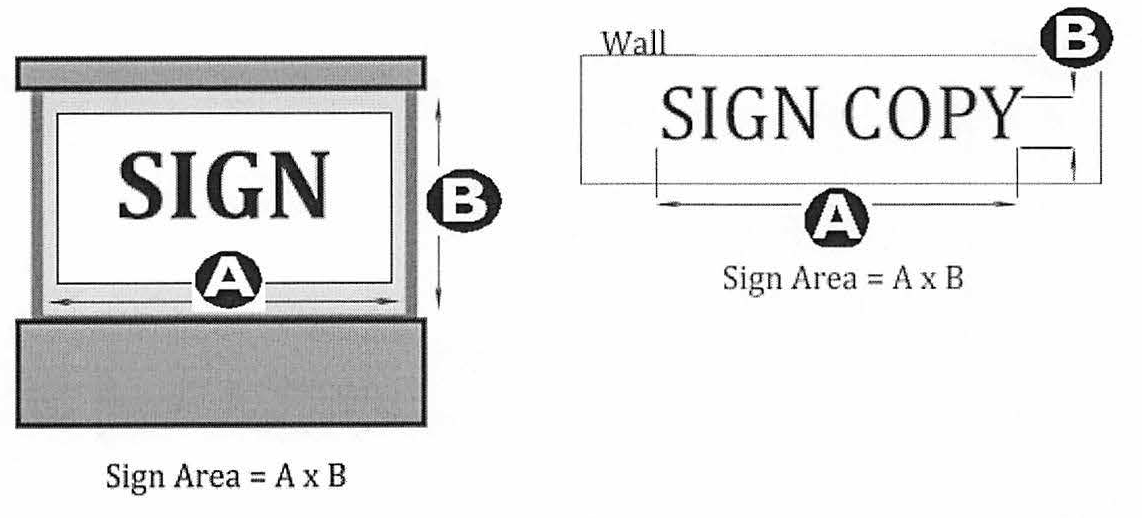
Measurement of sign area. Sign area for all sign types is measured as follows:
1.
Single-faced signs. Sign copy mounted, affixed or painted on a background panel or surface distinctively painted, textured, or constructed as a background for the sign copy, is measured as that area contained within the sum of the smallest rectangle(s) that will enclose both the sign copy and the background.
Sign copy mounted as individual letters or graphics against a wall, fascia, mansard, or parapet of a building or surface of another structure, that has not been painted, textured, or otherwise altered to provide a distinctive background for the sign copy, is measured as the sum of the smallest rectangle(s) that will enclose each word and each graphic in the total sign.
2.
Two face signs. If the interior angle between the two sign faces is 45 degrees or less, the sign area is of one sign face only.
If the angle between the two sign faces is greater than 45 degrees, the sign area is the sum of the areas of the two sign faces.
B.
Height measurement. Sign height is measured as the vertical distance in feet from the ground, sidewalk or other surface to the highest point of the sign face or sign structure, whichever is higher. Where the ground is uneven, the average elevation is utilized to determine the starting point of the measurement.
C.
Number of building signs. For all commercial entities with first floor space, the number of building signs permitted per commercial entity is limited to three sign per façade. By way of example, a store may utilize a wall sign, an awning sign and a suspended sign. Additional commercial entities located above the first floor shall share a multi-tenant wall sign mounted near the main entrance to the premises. Where only one business entity is located above the first floor, that entity may erect a suspended or projecting sign at the main entrance to the premises.
(Ord. No. 2022-011, § 1, 10-24-2022)
Sec. 8.810. - Standards for signs on lots with a single-family residential use.
A.
All lots in the city on which the primary use is single-family residential, including homes where a customary home occupation is practiced, shall be permitted to erect signs in accordance with the standards of this section. This standard applies to all single family uses, regardless of zoning district category. The following types of signs are permitted:
1.
Standard informational signs, subject to the standards of section 8.815.
2.
Warning signs and no trespassing signs, subject to the standards of section 8.804.
3.
Flags, subject to the standards of section 8.816.
4.
Address numerals, subject to the standards of 8.804.
5.
Historical markers, monuments or signs as recognized by local, state or federal authorities.
6.
In addition to any other signs authorized by this section, if a property is located at the entrance to any residential subdivision, then the property may contain no more than one project entrance sign per entrance, not exceeding 64 square feet, and seven feet in height, which may be indirectly lighted only.
7.
Banners may be mounted on the sides of walls up to three times per year for no more than 14 days or, alternatively one times per year for six consecutive weeks. No banners or signs shall be hung with string or mounted to poles or similar devices.
B.
The aggregate sign area of all signs on any lot occupied by a single family home shall not exceed 12 square feet, provided that during the period of time commencing with opening of qualifying for elections and concluding with the final determination of all contests and issues resolved by that election, an unlimited number of standard informational signs may be erected on such lots.
C.
No sign erected on a single-family residential lot used for private residence may be illuminated.
(Ord. No. 2022-011, § 1, 10-24-2022)
Sec. 8.811. - Standards for signs for non-residential uses in single-family residential zoning districts.
A.
In districts zoned R, RC. SLC, RM-6, RM-12, RC, or SLC and utilized for uses other than single-family residences, the following signs are permitted:
1.
All signs exempt from permit requirements by section 8.804; provided that no more than one standard informational sign may be posted at any one time.
2.
Monument signs meeting the standards of section 8.813.
3.
Banners meeting the standards of section 8.815.
B.
Permanent signage may be illuminated only externally in accordance with the standards of section 8.808.
(Ord. No. 2022-011, § 1, 10-24-2022)
Sec. 8.812. - Standards for signs on vacant, undeveloped property.
This section applies to all vacant, undeveloped property in the city, regardless of zoning district, unless adjacent to the right-of-way of I-75. The owner of vacant, undeveloped property is permitted one freestanding sign per street frontage, not to exceed 24 square feet of sign area. The sign may be erected to a height of no more than ten feet and shall be setback from the right-of-way by no less than five feet. No sign erected on vacant, undeveloped property may be illuminated. Previously platted lots fronting on I-75 that are undeveloped may be developed with billboards meeting the standards of this article and state law.
(Ord. No. 2022-011, § 1, 10-24-2022)
Sec. 8.813. - Standards for freestanding signs.
A.
Permitted districts. Freestanding signs are permitted in all commercial, industrial and mixed use districts, where use of the lot is not devoted to single-family residential use.
B.
Quantity per location. When a freestanding sign is used it shall be considered the primary sign for the lot. Only one freestanding sign is permitted per lot per frontage; provided that if the frontage exceeds 500 linear feet, one additional freestanding sign may be permitted. If the location is a planned center, then only one multi-tenant sign shall be used as the freestanding sign on the lot. All multi-tenant signs shall be owned and maintained by the owner of the property upon which the sign is erected. If the location has frontage on more than one street, an additional freestanding sign is permitted on the second frontage.
C.
Limitations on type. Both monument signs and pole signs are permitted for commercial uses in commercial, industrial and mixed use zoning districts; provided that multi-family projects and institutional uses are limited to monument signs.
D.
Maximum sign area (freestanding signs, except billboards):
E.
Height limits (freestanding signs, except billboards):
Clearance from ground to base of sign
Pole signs: Six feet minimum
F.
Other miscellaneous signage. In addition to the allowances of paragraphs (b) through (e) above, each commercial property in the city may contain up to two directional signs per driveway entrance, limited to no more than four square feet per sign at a height not to exceed two and one-half feet.
G.
Setbacks; vision clearance at intersections. All parts of freestanding signs shall be setback from public right-of-way a minimum of ten feet; provided further that no portion of a sign face, and no portion of a sign structure wider than 12 inches, between the heights of two and one-half feet and 12 feet shall be located within 20 feet of the intersection of the right-of-way lines of streets, roads, highways, or railroads, or within 20 feet of the intersection of a street right-of-way and either edge of a driveway.
H.
Billboards.
1.
Billboards shall not exceed 672 square feet of sign area. Billboard sign faces shall not exceed 14 feet in height nor 48 feet in length. Billboards shall not exceed 75 feet in height as measured from the base of the sign or crown of the adjacent roadway to which the sign is permitted, whichever is higher.
2.
Billboards shall only be located on parcels adjacent to and sharing a right-of-way boundary with I-75 and zoned commercial or industrial.
3.
All billboards shall be oriented toward the view of traffic on I-75.
4.
No billboard shall be located within 1,000 feet of another billboard.
5.
No billboard shall be located within 500 feet of a residential zoned parcel.
6.
No billboard shall be located within 500 feet in any direction of a public park, public playground, public recreation area, public forest, scenic area, or cemetery; provided, however, that such a sign may be located within 500 feet of a public park, public playground, public recreation area, public forest, scenic area, or cemetery when the sign is separated by buildings or other obstructions so that the sign located within the 500 feet zone is not visible from the public park, public playground, public recreation area, public forest, scenic area, or cemetery.
7.
No billboard shall be placed in or obstruct the view of a marshland area or an area of designated historic interest.
8.
Extrusions beyond the face of the sign, excluding aprons, are prohibited.
9.
No more than two sign faces may be visible from the same direction on any sign structure along I-75. Double faced, back-to-back and V type constructed signs shall, for the purpose of determining compliance with size and spacing limitations, be considered as one sign.
10.
Billboards shall be set back from the right-of-way line no less than ten feet and shall be designed in such a manner as to fall within a clearance zone free and clear of all structures in the event of sign defect or destruction.
11.
All billboards shall comply with this article as well as all standards of the Georgia Outdoor Advertising Act.
(Ord. No. 2022-011, § 1, 10-24-2022)
Sec. 8.814. - Standards for building signs.
A.
Combinations of building signs. A property not utilized for single-family residential use may use a combination of building signage, up to no more than three types of signs per commercial entity for first floor occupancies.
B.
Wall signs. Wall signs are allowable in the commercial, industrial and mixed use zones for all uses other than single-family residential properties. Wall signs may consist of individual cut or painted letters or graphics applied directly to the façade of the building, or applied to a sign board that is then attached flat against the façade of the building. Channel letters may also be attached directly to a raceway mounted on the outside of the building. Wall signs shall not protrude beyond the roofline or cornice of the building. Wall signs may be installed with zero setback from a property line, provided that no part of the sign overhangs the property line and that no part of the sign is within eight feet of electric power lines.
C.
Awning and canopy signs. Permitted in all commercial, industrial and mixed use zones for all uses other than single-family residential. Awning and canopy signs are limited to the first floor of buildings. All awnings and canopies must be constructed of fabric or metal. Vinyl and plastic awnings and canopies are prohibited.
D.
Marquee signs. Permitted in commercial and mixed use districts other than for single-family residential use. One marquee sign is allowed per commercial entity in lieu of a wall sign. Marquee signs may be oriented either horizontally or vertically or may be combined into a horizontal/vertical combination marquee sign.
E.
Projecting signs. Permitted in commercial and mixed use districts other than for single-family residential use. Projecting signs are intended to be small, pedestrian scale signs, easily read from both sides. Projecting signs shall be hung well out of reach of pedestrians. All exposed edges of the sign must be finished.
Upper story commercial entities may have either a projecting or suspended sign at first floor entrance, not both.
F.
Suspended signs. Permitted in commercial and mixed use districts other than for single-family residential use. Suspended signs must be hung well out of the reach of pedestrians. All exposed edges of the sign must be finished.
Extension of sign beyond the edge of the façade, frontage or overhang on which it is placed is not permitted.
Upper story commercial entities may have either a projecting or suspended sign at first floor entrance, not both.
G.
Window signs. Permitted in commercial and mixed use districts other than for single-family residential use. Window signs must not obscure more than 50 percent of the glazing of the window or door. The remaining window glazing shall be visibly transparent and not tinted, opaque or blacked out.
(Ord. No. 2022-011, § 1, 10-24-2022)
Sec. 8.815. - Standards for temporary signage.
A.
Temporary signage is limited to standard informational signs, banners, and a-frame signs.
B.
Standard informational signs.
1.
Standard informational signs are permitted on all properties within the city at all times. No permit is required for standard informational signs meeting the standards of this section.
2.
Standard informational signs are temporary signs designed for short term use and containing no reflective elements, flags or projections, and otherwise meeting all standards of this article.
3.
All standard informational signs shall be located entirely on private property. Any such sign erected on public right-of-way is subject to immediate removal without prior notice.
4.
The sign face of a standard informational sign shall not exceed six square feet. The aggregate sign area of all standard informational signs on a lot shall not exceed 12 square feet; provided that during the period of time commencing with opening of qualifying for elections and concluding with the final determination of all contests and issues resolved by that election, an unlimited number of standard informational signs may be erected on single-family residential occupied lots. No increase in the aggregate allowance of standard informational signs is made for other uses.
5.
No standard informational sign shall be illuminated.
6.
For single-family residential properties, standard informational signs shall stand at a height of not greater than three feet and shall be mounted in the yard on a wooden stake or metal frame with a thickness or diameter not greater than one and one-half inches.
7.
For properties with a primary use other than single-family residential, standard informational signs shall be mounted in the window or on the wall adjacent to the primary entrance.
C.
Banners as temporary signage.
1.
Banners are allowed in all zoning districts of the city. Every commercial entity located in the city shall be permitted to display one banner for a 14-day period, four times per year, or alternatively, one time per year for a period of eight consecutive weeks.
2.
The maximum size of any such banner shall be no more than 50 square feet.
3.
Each banner displayed shall be made from vinyl or canvas with a minimum weight of eight ounces. Each banner shall have metal grommets placed 15 inches on centers and in the corners for attachment. All edges of each banner shall be hemmed and reinforced by adding reinforcing material, such as rope or nylon tape, to the edges.
4.
Each banner shall be mounted on a building or similar solid structure. No banner displayed pursuant to this article shall be mounted on poles, wires or other such devices.
5.
Permits are required for each period of installation. Each time a banner is displayed pursuant to the provisions of this section, there shall be charged a permit fee as established on the City of Emerson Fee Schedule. Application for permit and payment of the permit fee shall be made to the office of the zoning administrator in the same manner and shall be handled as other sign permits, provided the zoning administrator may utilize a truncated application form for banner permits that includes only the information necessary to determine eligibility for the permit. No banner shall be displayed until the permit has been issued by the city and the permit fee has been paid.
6.
Within 48 hours after notification of a violation of this section, prohibited banners shall be removed.
D.
Banners as permanent streetscape improvements.
1.
Banners intended to be permanent installations as part of streetscape improvements as part of a development of 20 acres or more shall meet the following standards.
2.
Any such banner shall be attached to light poles by rigid frames on the top and bottom of the banner, precluding movement of the banner in the wind.
3.
The owner of the banners has a continuing duty to maintain all banners in good condition, free of tears and fading. Adjacent ground shall be mowed and trimmed. Specifically, no growth of grass or weeds around the base of the pole is permitted.
4.
At the time of development of the property, application shall be made to the city for approval of the streetscape system.
5.
The city may remove any banners that have become torn or faded, with their accompanying supports. Once removed, those banners shall not be reinstated. Should 50 percent of the banners in the streetscape system become unsightly or have been removed, the city may require removal of all banners and rescind its approval of that element of streetscape improvements.
E.
A-frame signs.
1.
A-frame signs are permitted in commercial and mixed use districts on properties other than those used for single-family residential use. A-frame signs constitute a form of signage that is granted by annual permit but which is utilized only during active hours for which the commercial entity is open. Where permitted in the downtown area, sidewalk signs are allowed on sidewalks in the public right-of-way. Where permitted elsewhere in the city, sidewalk signs shall be located entirely on public property.
2.
Sidewalk signs shall not be illuminated.
3.
Dry erase boards, or unfinished plywood are prohibited materials for sidewalk signs.
4.
Sidewalk signs shall be located on sidewalks in such manner that they do not encroach upon required accessible pedestrian paths.
5.
A commercial entity in the downtown may utilize one sidewalk sign.
6.
The base of an A-frame sign shall not be located more than 18 inches from the façade of the commercial entity responsible for the sign.
7.
A-frame signs may only be displayed during business hours and shall be removed when the commercial entity is closed.
8.
A-frame signs shall be composed of stained or painted wood or plastic with a sign face composed of wood or slate (chalk) board. Interchangeable signage may be placed on an A-frame sign, provided the final display is stable and contains no missing elements.
(Ord. No. 2022-011, § 1, 10-24-2022)
Sec. 8.816. - Flags.
Flags are allowed in all zoning districts and may be flown without permit in accordance with the following standards:
1.
No more than one flagpole shall be permitted per lot.
2.
A maximum of two flags shall be permitted per lot.
3.
No flag shall exceed 24 square feet in area on any lot used for single-family residential use or 60 square feet when flown on a lot with a primary use other than single-family residential.
4.
Flags shall not be flown from a pole, the top of which is higher than 25 feet on a single-family residential lot or 40 feet in height on lots with a primary use other than single-family residential.
5.
Any flag not meeting any one or more of these standards shall be considered a banner and shall be subject to being permitted as such.
(Ord. No. 2022-011, § 1, 10-24-2022)
Sec. 8.817. - Nonconforming signs.
A.
Signs that on the effective date of this article were approved and legally erected under previous sign restrictions and that became or have become non-conforming with respect to the requirements of this article, may continue in existence subject to the following provisions of this section.
1.
No increase in the size of a nonconforming sign shall be permitted.
2.
Existing signs that were legally created and which have become nonconforming and do not meet the setback requirements of this article due to road widening may be moved to meet the setback requirement of this article, but shall not be increased in size, shape or changed in any manner, except as to become conforming.
3.
In all zoning districts the following nonconforming signs shall be prohibited and shall be removed by the owner:
a)
Signs illegally erected or maintained with respect to prior ordinances.
b)
Signs made of paper, cloth or non-durable materials.
c)
Signs located in the public right-of-way (except as permitted by owners of those rights-of-way).
B.
Upon the failure to comply with any requirement of this section, the zoning administrator may cause the removal of such sign at the expense of the owner.
C.
Any attempt to add a LED or tri-vision sign face to a nonconforming sign shall negate its nonconforming status and require removal of the sign structure in its entirety.
D.
Minor repairs and maintenance of nonconforming signs, such as electrical repairs or lettering repairs, shall be allowed. However, no structural repairs or changes in the size or shape of the sign shall be permitted except to make the sign comply with the requirements of this article; provided that signs damaged by fire, vehicle accident or act of God may be restored to their original condition.
E.
The provisions of this section shall be enforced by the zoning administrator, with the aid of the police department and other city agencies.
F.
New signs related to legally established nonconforming uses of property may be erected, provided the signs comply with the applicable provisions of this article.
G.
No new sign shall be erected upon an old foundation that is located on a public right-of-way or which would cause any part of the sign to overhang a public right-of-way.
H.
If a nonconforming sign is installed on or overhangs any portion of a public right-of-way, the sign and its foundation shall be removed once the commercial entity to which the sign is attached ceases.
I.
For any sign on property annexed after the effective date of this article, applications for sign permits bringing all signage into conformance or certifying the sign as nonconforming shall be submitted within three months of the effective date of the annexation or within such period as may be established in the annexation agreement between the city and the landowner.
(Ord. No. 2022-011, § 1, 10-24-2022)
Sec. 8.818. - Maintenance; appearance and inspection of signs.
A.
All signs shall be maintained in good condition so as to present a neat and orderly appearance. The city shall periodically inspect each sign in an attempt to ascertain whether the same is secure or insecure and whether it is in compliance with the requirements of this article or in need of repair. Responsibility for the safety of signs and security of their attachment or erection remains at all times with the sign owner.
B.
In order to ensure that signs are erected and maintained in a safe and orderly manner, the following maintenance requirements shall be observed for all signs, and any deficiency shall be corrected within 30 working days of being detected:
1.
No sign shall have more than ten percent of its surface area covered with disfigured, cracked, ripped or peeling paint or poster paper;
2.
No sign shall stand with visible rust, bent or broken sign facings, broken supports, loose appendages or struts or be allowed to stand more than 15 degrees away from the perpendicular;
3.
No sign shall have weeds, trees, vines or other vegetation growing upon it or obscuring its view from the street from which it is to be viewed; and
4.
No interior illuminated sign shall stand with only partial illumination.
C.
When a commercial entity utilizing a sign is discontinued, all signs related to that entity shall be removed or neutralized within 30 days from the date of discontinuance of the use. Sign cabinets and structures to which another sign face may ultimately be attached can conform to this requirement by painting over the existing sign with a color that harmonizes with the building or by removing sign pan faces and replacing them with blank panels.
(Ord. No. 2022-011, § 1, 10-24-2022)
Sec. 8.819. - Enforcement; removal procedures.
A.
The provisions of this article shall be enforced by the city, utilizing such departments and personnel as deemed appropriate.
B.
The city shall have full authority to remove, without notice to the owners thereof, and impound for a period of five business days:
1.
Signs located on public rights-of-way except signs erected by the jurisdiction controlling the right-of-way;
2.
Signs located on city property that are attached to or painted on any telephone pole, light pole, telegraph pole, other than signs erected by the owners of such poles and required for identification or access;
3.
Signs attached to or painted on any tree, rock, or other natural object located on city-owned property.
C.
The city may institute removal procedures after due notice for any sign that shows gross neglect, becomes dilapidated, or is otherwise in violation of this article.
D.
The city shall cause to be removed any sign that endangers the public safety, such as abandoned, dangerous or materially, electrically or structurally defective signs or a sign for which no permit has been issued or which is otherwise in violation of this article.
E.
The city shall prepare a written notice which shall describe the sign and specify the violation involved and which shall state that if the sign is not removed or the violation corrected within a reasonable period of time specified in the notice, not to exceed 30 days, the sign shall be removed in accordance with the provisions of this section.
F.
All notices mailed by the city shall be sent by certified mail and first-class mail. Any time period provided in this section shall be deemed to commence on the date of the receipt of the certified mail or, if the first class mail is not returned, after three days of mailing. Alternatively, notice may be personally hand-delivered to the sign owner, and notice shall be effective on such date of hand delivery.
G.
The notice shall be mailed to the owner of the property on which the sign is located, the owner of the sign if different than the property owner, and the occupant of the property. If any of such persons is unknown or cannot be found, notice shall be mailed to such person's last known address, if any, and posted on the sign or on the premises.
H.
Any person having an interest in the sign or the property may appeal the determination of the city ordering removal or compliance by filing a written notice of appeal within ten business days after receipt of notice.
I.
Appeals of decisions by the zoning administrator, including but not limited to, orders to repair or demolish signs, or denials of administrative adjustments, shall be taken to the planning and zoning commission by filing a written notice of appeal within ten business days of the zoning administrator's decision. The appeal hearing shall be conducted in accordance with the procedures set out in section 8.803(J). Any subsequent appeal shall be taken as provided in section 8.803(K).
J.
In the event no appeal is filed, or appeal is filed and final determination has been made, all signs for which notice of removal or notice to take corrective action has been given shall be removed or brought into compliance within the original time period specified in the notice or within five business days after final determination, provided that where permanent signs are installed, the time period may be extended for up to two weeks where removal requires engagement of a sign contractor or other specialized expertise; and provided further that a sign that constitutes an imminent hazard to life may be removed by the city pursuant to subsection (L) without further delay.
K.
Any sign removed by the city pursuant to the provisions of this section shall become the property of the city and may be disposed of in any manner deemed appropriate by the city. The cost of removal of the sign by the city shall constitute a lien against the property and shall be recoverable in the same manner as city property taxes. The cost of removal shall include any and all incidental expenses incurred by the city in connection with the sign's removal.
L.
When it is determined by the city that the sign would cause imminent danger to the public safety, and contact cannot be made with the sign owner or property owner, no written notice will have to be served. In this emergency situation, the city shall document the imminent danger and its attempts to contact the sign owner and property owner, and may correct the danger, all costs being charged to the sign owner and property owner.
M.
If it is necessary for the city to remove the sign pursuant to the provisions of this section, and it should be practicable to sell or salvage any material derived in the removal, the city may sell the same at public or private sale at the best price obtainable, and shall keep an account of the proceeds thereof. Such proceeds, if any, shall be used to offset the cost of removal to be charged to the sign owner or property owner. Where the proceeds derived from such a sale are less than the cost of removal, such deficiency shall constitute a lien against the property on which the sign is located, such lien to be collectible in the same manner as city property taxes.
N.
In the event any sign regulated by this article is proposed to be erected, constructed, altered, converted or used in violation of any provision of this article, the city may, in addition to other remedies, and after due notice to the appropriate person, issue a citation for violation of this article, requiring the presence of the violator in the municipal court.
O.
The city may also institute action for injunctive relief or other appropriate action or proceeding to prevent such unlawfully erection, construction, alteration, conversion or use or to correct or abate such violation.
(Ord. No. 2022-011, § 1, 10-24-2022)
Sec. 8.820. - Variances.
A.
This section shall take priority over the general variance provisions of the zoning ordinance.
B.
Modifications to the size, height and distance standards of this article may be requested for administrative approval by the zoning administrator. No variance application shall be entertained that would permit the erection of a sign of a type otherwise prohibited at that location.
C.
Grant of a variance from the dimensional standards of this article are limited to the following:
1.
The topography of the lot on which the sign is to be erected differs so severely from the adjacent roadway (such as steeply dropping off from the roadway level) that the sign would not have the same visibility as signs posted on other properties without such topographical features; or
2.
Physical features of the lot, such as substantial rock outcroppings, the presence of historic trees or insufficient yard space make erection of signage within the dimensional standards of this article virtually impossible, and such physical features are not created by the applicant for variance.
D.
The zoning administrator shall consider the variance request under the same procedures and time frames as provided for permit applications in section 8.803.
E.
An applicant for administrative variance disappointed with a denial of variance by the zoning administrator may appeal such a decision to the planning and zoning commission by filing notice of appeal with the city clerk within ten business days of the zoning administrator's decision. All appeals shall be governed by the timeframes and processes for hearing permit appeals under section 8.803(J).
(Ord. No. 2022-011, § 1, 10-24-2022)
Sec. 8.821. - Severability.
In the event a court of competent jurisdiction finds that any section, sentence, clause or phrase of this article is void, such invalidity shall not affect the remaining sections, sentences, clauses or phrases of this article. The offending provisions shall be severed from the article and the remainder of the article shall continue in full force and effect.
(Ord. No. 2022-011, § 1, 10-24-2022)

