
Evans City Zoning Code
CHAPTER 18
09 - Signs10
Editor's note—Ord. 745-21, § 1, adopted July 6, 2021, repealed Ch. 18.09 in its entirety and enacted a new Ch. 18.09 to read as herein set out. Former Ch. 18.09, §§ 18.09.010—18.09.150, pertained to similar subject matter and derived from Ord. 698-19, adopted July 16, 2019.
18.09.010 - Intent.
The intent of the sign standards is to:
A.
Create an attractive aesthetic environment in the City.
B.
Enhance the quality and civic design of the community through the visual priority of buildings, streetscapes, open spaces, landscapes, and other investments in the public realm.
C.
Ensure that signs preserve and contribute to the unique character of distinct places and districts.
D.
Promote safety of pedestrians, motorists or other users of the public rights-of-way with proper location, construction, design, operation and maintenance of signs.
E.
Improve economic viability by assuring that the City is a visually pleasant place to visit, conduct business, and live.
F.
Provide effective identification and communication for businesses, institutions, and other community destinations without excessive competition for visual attention.
G.
Protect property values and investments by minimizing adverse effects of signs on adjacent property, such as obstructing views and access, glare, or visual clutter and blight.
H.
Ensure that the constitutionally guaranteed right of free speech is protected through appropriate standards for signs as a way of public communication.
(Ord. 745-21, § 1, 2021)
18.09.020 - Applicability.
A.
General applicability. The standards in this Chapter shall apply to all signs except:
1.
Legal non-conforming signs, subject to the provisions in 18.05.040.
2.
Signs exempt from standards, as specified in 18.09.040.
B.
Interpretation. Whenever two or more provisions of this Chapter cover the same subject matter, whichever is the most restrictive or imposes the higher standard or requirements shall govern.
C.
Permit required. A permit shall be required for all signs to ensure compliance with these sign standards except as provided in parts 1, 2 and 3 below. A permit application shall include plans and specifications demonstrating compliance with all applicable standards of the Land Development Code, Title 18. The property owner or the owner's authorized agent shall be required to sign the permit application. Specific sign types may require additional permits demonstrating compliance with other codes such as building codes or electrical codes to be determined by the Building Department. The sign permit application shall be reviewed and approved by the Community Development Director or their designee. The following activities do not require a sign permit:
1.
Signs exempt from a sign permit, as specified in 18.09.040.
2.
Ordinary maintenance, care or repair of existing signs meeting these standards without altering the size, materials, location or other essential design characteristics or construction elements of the sign.
3.
The change of copy or content, change of sign panels, or similar changes to an existing sign that conforms to these standards, provided there is no change in the size, materials, sign structure, or other essential design characteristics of the sign.
(Ord. 745-21, § 1, 2021)
18.09.030 - Definitions and interpretation.
A.
Definitions. The following terms shall have the specific meaning given below for interpreting this Chapter:
Accessory wall sign means a sign that has less importance and prominence than the main sign on the wall in size, location, and design emphasis.
Address sign means a permanent sign that gives the address or name of a building or residence, used for general reference or emergency purposes.
Building name plate sign means a permanent sign, tablet, cornerstone or plaque memorializing a person, event, structure or landmark, or otherwise emphasizing the permanence or importance of the building or site.
Changeable copy sign means a sign or portion of a sign that can be easily changed manually or electronically for the purpose of displaying frequently changing information incidental to the property use or activity.
Comprehensive sign plan means a graphic representation, including plans and elevations, showing all signage proposed for a multi-tenant building, multi-tenant center or subdivision.
Construction sign means a temporary sign associated with commercial or non-residential construction projects under a valid building permit.
Dilapidated sign means any sign, sign structure, or associated grounds with broken, cracked or discolored display panels, broken, bent, corroded or discolored support structure or frame, torn or discolored material or that is otherwise unreadable under normal viewing circumstances; any sign or portion thereof that exhibits visually obvious conditions of poor maintenance; faded, broken or missing panels or general deterioration; any sign or portion thereof that has been damaged by fire, earthquake, wind, flood or any other cause, to such an extent that the structural strength or stability thereof is materially less than it was before such cause.
Flag means a piece of cloth of distinctive color and design, used as a symbol, standard, signal or emblem, representative of an organization, government, institution or principle.
Foot-candle means a measure of illuminance, or amount of light projecting to a point at a distance from the light source, that is lumens per square foot.
Foot-lambert means a measure of luminance, or the brightness at the object creating a light source, that is candles per square foot.
Freestanding sign means a permanent, self-supporting sign attached to the ground, rather than to a structure, by means of one (1) or more columns, uprights, poles or braces in or upon the ground.
Frontage, building means the face of the building providing main vehicular and/or pedestrian access and/or the primary orientation of the building.
Frontage, street means the portion of a lot adjacent to the right-of-way, excluding alley frontage.
Gateway sign means a sign signifying an important entry or transition into a distinct area or otherwise identifying a significant destination in the community.
Illumination means a method of lighting signs at night or in other low-light conditions, which may be internal - where the light source is in the sign makes a translucent portion of the sign visible; external - where light source is outside of the sign and directed to the sign face; or direct - where the light source is a part of the sign.
Incidental sign means a permanent, on-site sign associated with the operation and use of the property and necessary or convenient for visitors, clients or customers entering a site.
Monument sign means an on-site sign attached to the ground by a structure with a wide base integral with the sign structure or otherwise attached to structures integrated into the landscape design.
Multi-tenant sign means a permanent, freestanding sign displaying the name of each occupant in a multi-tenant building or multi-tenant center.
Pedestrian sign means a sign with a design and scale to be legible to pedestrians in front of or immediately adjacent to the building, sidewalk or other areas of the site where people will be active. A pedestrian sign may be a freestanding (mounted on a support structure on the ground) wall sign (mounted on a wall, projecting from a wall, hanging from a canopy or mounted on an awning) or a window sign, (mounted in and visible from a window or door opening).
Permanent sign means a sign attached to a permanent structure or the ground and made of durable materials and intended to exist for the duration of the time that the business, product, service, event or activity is located on the lot.
Pole sign means a self-supporting, permanent sign mounted on one (1) or more freestanding poles, columns or similar support.
Sign means any device, display, figure, painting, drawing, message, placard, poster, billboard, structure or any other contrivance designed, intended or used to attract attention, convey a message, advertise or to give information in the nature of advertising, including all necessary supports, brackets, framework, structural components and similar equipment whether or not actual graphics are attached or in place, and that is visible from the travel way of any public right-of-way.
Sign face means the surface area upon which a message is displayed, including any perimeter frame used to support such surface area, but not including the support structure or base of a freestanding sign.
Temporary sign means a sign that is intended to be displayed for a limited period of time, a sign that is mobile and easily placed and removed, or a sign that is made out of materials that will not endure elements of weather or other ambient conditions, or any combination of these factors.
Wall means the exterior face of any building, including but not limited to mansards, parapets, doors and similar architectural features, excluding windows, that are nearly perpendicular to the surrounding grade, or at seventy-five-degree to one hundred ten-degree angles as measured from the surrounding grade, that have the capability of being seen from public right-of-way.
Wall area means the portion of a vertical plane of a building owned or leased by a business, including any windows or gables, but not including any roof area.
Wall sign means a sign with its backing affixed flush to an exterior wall of a building or mounted [on] any accessory element of a building such as an awning or canopy.
Window sign means a sign posted, painted, placed or affixed to the interior or within three (3) feet inside of an exterior window.
B.
Interpretation. The following shall be used in interpreting dimensional standards for signs:
1.
General area calculation. All applicants for a sign permit shall provide the surface area of the sign in square feet on the permit, providing methods and measurements for the calculation. Signs mounted on or displayed as a standard geometrical shape shall be measured by the standard mathematical formula for that shape. Signs mounted on or displayed as an irregular shape shall be measured by the smallest area of up to two (2) standard geometrical shapes that can encompass the entire sign mounting.
2.
Freestanding signs. The area of the sign shall be computed by the entire area of the face of the structure, cabinet or module enclosed by the border of the frame.
3.
Wall, window or other building-mounted signs. Any building mounted sign mounted on a background shall be measured by the area of the background. If mounted directly on the wall, the area shall be computed by means of the smallest single and continuous perimeter of up to two (2) standard geometric shapes that enclose the outer limits of the writing, emblem or other display. Gaps in writing, emblems or other display which are greater than two (2) times the height of the sign area, when using the same single continuous perimeter above, may be subtracted from the calculation of the sign area but shall be interpreted as two (2) signs. The area of the wall or window area for the purposes of determining an allowed percentage shall be the total surface of the wall or window visible in an elevation view.
4.
Decorative elements. Embellishments such as pole covers, framing, decorative roofing and support structures shall not be included in the area of the measurement if they contain no writing, emblem or other display.
5.
Double-faced signs. Where the sign faces of a double-faced sign are no more than three (3) feet apart at any location, only one (1) face will be measured in computing sign area. If the two (2) faces of a double-faced sign are of unequal area, the area of the sign will be the area of the larger face. In all other cases, the areas of all faces of a multi-faced sign or the surface area of objects will be added together to compute the area of the sign.
6.
Height. Sign height is measured from the existing lowest grade directly below the sign to the highest point on the sign or sign structure.
7.
Clearance. Sign clearance is measured from the highest point of the ground directly below the sign to the lowest point on the sign structure enclosing the sign face.
(Ord. 745-21, § 1, 2021)
18.09.040 - Exemptions.
The following signs are exempt from the sign permit process provided the sign meets all other applicable requirements of this Chapter. Unless specifically noted, exempt signs do not count towards the sign allowance specified for applicable the zoning district.
A.
Property identification signs. Signs clearly indicating the property address or building identification are encouraged to enhance the ability of public safety, emergency services personnel, and the general public to locate the property. Property identification signs shall be visible from the right-of-way and are subject to the following limitations:
1.
Address signs. Two (2) per address up to two (2) square feet each, only one (1) of which may be ground mounted. Address signs on buildings shall be between four (4) feet and twelve (12) feet high. Ground-mounted address signs shall be no more than thirty-six (36) inches high.
2.
Building name plate. Each building or site may have one (1) name plate sign per street front, up to nine (9) square feet. Building name plate signs shall be associated with the permanence or significance of the building or site, rather than a particular tenant, and include designs such as engraved stone, bronze plates or similar ornamental detail integrated with the architecture of the building or landscape of the site.
B.
Public safety, traffic control or public information. Signs designed and located to control traffic movement and safety of vehicles and pedestrians according to uniform traffic control device standards, signs required by the City's Building or Fire Code, or signs otherwise required to support any official action or legal obligation of a federal, state or local government, may be designed and located to meet the public purposes or requirements of other codes.
C.
Flags. Up to three (3) non-commercial flags may be permitted per lot. Flags shall be mounted to the building and below the building height or mounted on a permanent pole subject to the building height limit of the zoning district and setback from the property line a distance equal to the actual height of the flag pole. Total flag area per property shall not exceed eighty (80) square feet and no more than forty (40) square feet per flag for property zoned residential, and shall not exceed two hundred (200) square feet or one hundred (100) square feet per flag for property zoned non-residential.
D.
Window signs. Signs may be mounted to the interior of any first floor windows in non-residential districts, provided signs shall not exceed more than twenty-five percent (25%) of the area of all first floor windows, measured between two (2) feet and ten (10) feet above the first floor elevation, and provided at least fifty percent (50%) of the window the sign is mounted on remains clear of any visual obstructions including the sign area.
E.
Temporary signs. Temporary signs are exempt from the sign permit process, provided they are within the allowances specified for the zoning district in standards in 18.09.050 and 18.09.060.
F.
Incidental signs. Incidental signs for non-residential uses or multi-family complexes, which are intended to convey messages to guests, patrons, or other users of the lot, such as parking instructions, internal directions, building names or unit numbers, security warnings, or other similar minor signs that are accessory, are limited to:
1.
No more than ten (10) square feet total sign allowance per lot, or thirty (30) square feet per acre, whichever is greater.
2.
No single sign may be more than three (3) square feet, or nine (9) square feet for lots more than one (1) acre.
3.
Signs shall be no more than six (6) feet high if ground mounted or twelve (12) feet high if mounted on a building;
4.
Signs shall be setback at least ten (10) feet from all property lines; and
5.
Grouping or arranging accessory signs to have the effect of a larger permitted sign or to convey messages and increase visibility to the general public (as opposed to guests, patrons or other users of the site) makes all signs in the grouping ineligible for this exemption.
G.
Construction signs. Signs associated with a temporary non-residential or multi-family construction project under a valid permit such as approval for either a land use permit or a grading permit for example, are limited to:
1.
Up to eighty (80) square feet total sign allowance per public street frontage;
2.
No more than three (3) signs per street frontage;
3.
Signs shall be mounted on a trailer, building or fence, or if mounted on the ground it shall be limited to no more than ten (10) feet high; and
4.
The signs shall only be posted for the duration of a valid permit associated with the project.
Construction signs for single-family and two-family structures in the residential zoning districts are required to meet the applicable temporary sign standards for those districts.
H.
Interior signs. Any sign that is not visible from the right-of-way, from any point along the perimeter of the property or from adjacent property, or from publicly accessible common spaces intended to serve as an extension of public-streets and open spaces. Interior signs are exempt from permits and the standards of this Chapter, other than those applicable by building and fire codes or construction standards.
(Ord. 745-21, § 1, 2021)
18.09.050 - Residential signs.
A.
Sign types.
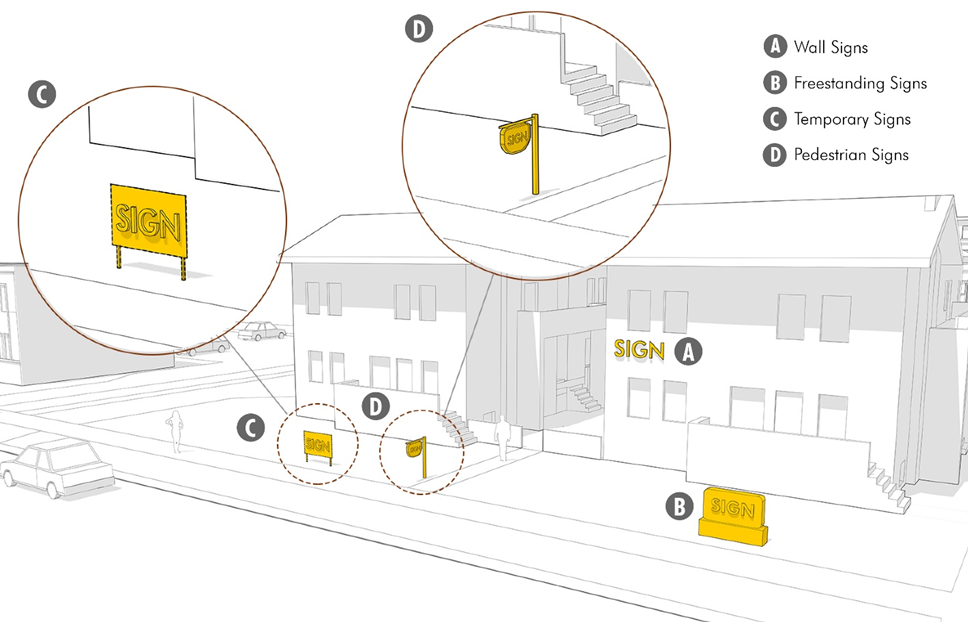
B.
Sign allowances. The following signs are permitted in the residential zoning districts (AG, R1E, R1, R2, R3, R, MFH, and RMH), and for any residential building or use, as permitted in a non-residential district. All Planned Unit Developments containing a residential component will also follow these standards.
(Ord. 745-21, § 1, 2021)
18.09.060 - Non-residential signs.
A.
Sign types.
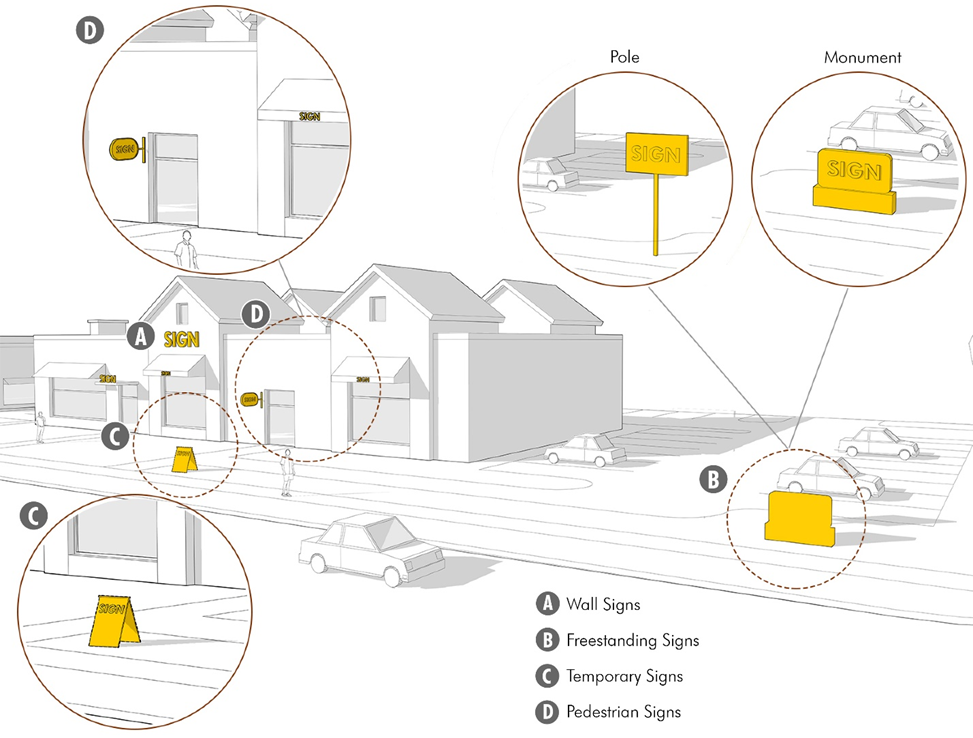
B.
Sign allowances. The following signs are permitted in the non-residential zoning districts (PF, C1, C2, C3, I1, I2, I3, 85-O, 85-RC-A, 85-RC-N, 85-RC-R). All Planned Unit Developments containing a non-residential component will also follow these standards.
(Ord. 745-21, § 1, 2021)
18.09.070 - General standards—All signs.
A.
Public health, safety and maintenance.
1.
All signs shall be designed, constructed, located and maintained in a manner that is compliant with all other building and fire codes, and in no way presents any potential risk to public safety in the judgment of the Building Official, Fire Chief or the Community Development Director, or their designee.
2.
No sign shall imitate or resemble government signs for traffic direction or any other public safety symbol.
3.
No sign shall be placed in any sight distance triangle applicable to public streets, internal access streets, or driveway access points using the sight distance provisions of Section 15.58 Sight Distance of the Municipal Code.
4.
No sign shall be placed within five (5) feet of a fire hydrant.
5.
Any sign projecting over a walkway or other active area in front of a building or other area where people may walk shall maintain at least seven (7) feet six (6) inches vertical clearance.
6.
All signs and any surrounding grounds or landscape, shall be maintained in good condition, free of any debris, weeds, disrepair or other unsightly conditions.
7.
No sign, sign structure, or associated grounds shall present any dilapidated state or condition, or present any other property maintenance issues that may impact the appearance of the property from the public right-of-way or from adjacent property.
B.
Specific designs prohibited.
1.
No sign shall be placed on any vehicle or trailer, when such vehicle or trailer is placed or parked visible from the right-of-way, and the sign deviates from the standards or criteria of this Chapter.
2.
No sign shall be attached to any public utility pole or shall be installed within the right-of-way of a public road or street, except as permitted by the City or where specifically exempt from the right-of-way prohibition by this Chapter.
3.
No sign shall include balloons, streamers, pennants or other air activated elements and animated elements, whether animated by mechanical, electrical, or environmental means.
4.
Any sign with a business message shall be located on the lot of the business activity, except gateway signs, which must be associated with the site and located in common areas controlled by the businesses or property owners associations.
5.
Changeable copy portions of signs shall not exceed thirty-two (32) square feet, and be limited to one (1) sign per business or institution. Except for Electronic Message Centers as provided in 18.09.080.E.
C.
Illumination.
1.
Any illumination shall be designed to eliminate negative impacts on surrounding rights-of-way and properties. In general, any direct source of light shall not be visible from the public street or adjacent residential property.
2.
External light sources shall be directed and shielded to limit direct illumination of any object other than the sign.
3.
Light from an illuminated sign shall not spill onto adjacent properties. The light reading at any point within ten (10) feet from and adjacent private property shall be less than one (1) foot-candle.
4.
No light source shall cause any glare, movement or other distraction to traffic.
5.
Exposed incandescent, neon or other tube lighting shall be limited to window signs mounted to the inside of the building, or as an accent of less than 10 percent (10%) of the sign area of other signs.
5.
Signs within one hundred (100) feet and visible from any property used for single-family or two-family residential shall not be internally or directly illuminated between the hours of 10:00 p.m. and 6:00 a.m.
(Ord. 745-21, § 1, 2021)
18.09.080 - Specific sign standards.
The standards in this sections are supplemental standards, in addition to the general standards in Tables 18.09-1 and 18.09-2 and applicable to specific sign types.
A.
Monument signs. Monument signs are subject to the following additional limitations:
1.
Monument signs shall be located within a landscape area at least three (3) feet in all directions from the base of the sign.
2.
Monument signs shall have a base at least seventy-five percent (75%) of the width of the widest part of the sign. The base shall not count as part of the sign area provided it contains no messages or other component of the sign and is otherwise integrated into the site as a landscape feature.
3.
All monument signs and bases shall be constructed with durable, quality materials that complement the building and other site elements in terms of material, colors, and ornamentation.
4.
All monument signs shall be accompanied by a landscape plan that integrates the sign area into the overall site, softens the view and appearance of the structural elements, and otherwise improves the view of the sign and property from the streetscape.
B.
Wall signs. Wall signs are subject to the following additional limitations:
1.
Signs attached to a building shall not extend vertically above the highest portion of the wall plane of the facade it is mounted on or the roofline, whichever is less. No portion of a building wall may be built above the roofline, that serves no other structural or architectural purpose, other than to mount a sign or expand the sign area allowance.
2.
Signs attached to a building shall not project more than twelve (12) inches off the surface it is mounted on unless specifically exempt from this limit by this Chapter.
3.
Wall signs may project from and be perpendicular to the wall provided:
a.
Only one (1) projecting sign is permitted per building
b.
The sign is no larger than sixteen (16) square feet.
c.
Each sign face counts to the wall sign allowance.
d.
The sign projects no more than five (5) feet from the wall and is at least eight (8) feet above grade.
C.
Temporary signs. Temporary signs are subject to the following additional limitations:
1.
Any temporary sign shall be placed with the permission of the property owner, and it is the responsibility of the person placing the sign and the property owner to ensure the sign meets all standards and is removed when the applicable display time limit has expired.
2.
Temporary signs shall not be illuminated or painted with a light-reflecting paint.
3.
Temporary signs shall be constructed of rigid material, designed to resist quick deterioration from the elements, and securely anchored so as not to pose a distraction or hazard to drivers. Non-rigid materials (such as banners) shall be secured by a support or frame to avoid distraction of flapping and set back at least twenty (20) feet from the pavement edge of the fronting roadway, or may be attached securely to a building or structure.
4.
No temporary sign shall be displayed for more than one hundred twenty (120) consecutive days, without thirty (30) days intervening.
5.
The period of time when a property has more than two (2) temporary signs displayed shall not be more than ninety (90) days in a calendar year.
6.
Relocation of a temporary sign, removal of the sign for a short period, or removal and replacement with a substantially similar sign does not expand the time period for the temporary sign.
7.
The Community Development Director, or their designee, shall be authorized to require the removal of any temporary sign that pertains to an expired event or refrain from enforcement any temporary sign related to an event that has been unexpectedly extended beyond the control of the owner.
D.
Multi-tenant buildings and sites.
1.
All signs for multi-tenant buildings or sites shall require Sign Plan and Permit approved by the Community Development Director or their designee according to these standards and criteria.
2.
The sign plan shall demonstrate coordination of all signs on the building, allow sufficient flexibility for the replacement of signs or new tenants without the need for a new sign plan, unless a completely new sign design concept is proposed for the entire building or site.
3.
The wall sign allowance may be apportioned to any tenant with a separate exterior entrance. In the case where all tenants share a common entrance the wall sign allowance may be apportioned to no more than two (2) signs per facade.
4.
The monument sign allowance for the building(s) and site shall meet the standards of 18.09.080.A, however the copy within the allowed sign may be apportioned to multiple tenants.
5.
The Community Development Director or their designee shall consider the intent of this Chapter and the objectives of the Design Guidelines in Section 18.09.100 in approving a Sign Plan and Permit. Deviations from the specific design guidelines or standards may be only approved through a Comprehensive Sign Plan specified in Section 18.09.090.
E.
Electronic message signs. Electronic message signs are subject to the following additional limitations:
1.
Limited to properties with nonresidential uses.
2.
Limited to one (1) per lot.
3.
The visible sign face shall be setback at least two hundred fifty (250) feet from any adjacent residentially zoned property.
4.
Electronic message signs are only permitted on monument signs.
5.
The electronic portion/digital display area shall be limited to no more than fifty percent (50%) of the allowable sign area for any individual sign, not to exceed thirty-two (32) square feet, whichever is less.
6.
There shall be a maximum of three (3) colors used on each digital display.
7.
Automatic dimming controls shall limit the illumination to no more than one hundred fifty (150) foot-lamberts at the sign surface at night or during low light times and at any point between sunset and sunrise, and no more than two thousand (2,000) foot-lamberts at the brightest daylight period.
8.
Only static display is permitted with at least eight (8) seconds between changes in display and no more than two (2) seconds for transitions. No scrolling, flashing or animated transitions shall occur.
F.
Gateway signs. Larger commercial properties and residential neighborhoods may be permitted gateway signs as provided in this section.
1.
Non-residential gateway signs. Non-residential projects, through a Comprehensive Sign Plan, may allocate the allowed freestanding sign allowance to a gateway sign subject to the following:
a.
Gateway signs shall meet the monument sign standards
b.
Maximum height shall be no more than sixteen (16) feet.
c.
Gateway signs shall be set back from the lot or parcel line at least ten (10) feet, or at least the same as its height, whichever is greater.
d.
Maximum area shall be no more than two hundred (200) square feet per sign
e.
No more than one (1) gateway sign per entrance and one (1) per street intersection.
f.
Gateways signs shall be located at least two hundred (200) feet from any other freestanding sign.
g.
Gateway signs shall be located on the site of the non-residential use, or in a common area owned and controlled by a property or business association of the non-residential uses, provided there is a business or property owner's association to ensure on-going maintenance of the sign and landscape.
2.
Residential gateway signs. Residential projects with more than twenty (20) lots or more than five (5) acres may be allowed a gateway sign subject to the following standards:
a.
All residential gateway signs shall be monument signs, no higher than six (6) feet
b.
Gateway signs shall be limited to no more than two (2) per entrance from a collector or arterial street, provided the entrances are separated by at least three hundred (300) feet.
c.
Gateway signs shall be limited to:
(1)
Twenty-four (24) square feet for entrances on a collector street;
(2)
Forty-eight (48) square feet for entrances on an arterial street.
d.
Gateway signs shall be set back from the lot or parcel line at least ten (10) feet, or at least the same as its height, whichever is greater.
e.
Gateway signs shall be located on the site of the residential use, or in a common area owned and controlled by a property or business association of the residential uses, provided there is a property manager or homeowner's association to ensure on-going maintenance of the sign and landscape.
G.
Portable pedestrian signs. Portable pedestrian signs ("A frame", "sandwich board" or "T-frame") may be placed in the public right-of-way, or areas a site associated with a service areas, for any permitted retail use provided:
1.
The sign is placed within twenty (20) feet of the main entrance of the building or service area of a business.
2.
The sign is no larger than eight (8) square feet and no taller than four (4) feet high, and otherwise subject to the Pedestrian Sign limitations for the use, building and site.
3.
The sign is placed on or near a sidewalk, and otherwise associated with pedestrian routes to and from the business. The sign shall maintain at least six (6) feet clear passage for pedestrians on the sidewalk, and is otherwise not put in any location that creates visual obstructions or safety hazards for users of the right-of-way.
4.
The sign is removed and brought inside during non-business hours.
5.
The sign is designed with durable materials and quality aesthetics for use on a recurring basis. Although changeable copy can be included as part of the design, such as chalkboards, signs designed as "temporary signs" are not eligible as a portable pedestrian signs, and the allowance for signs in the right-of-way specifically does not apply to any temporary sign.
6.
Any sign associated with mobile vendors or temporary structures shall only be placed in coordination with the standards of Section 18.05.030.D.5.
(Ord. 804-23, § 3, 2023; Ord. 745-21, § 1, 2021)
18.09.090 - Comprehensive sign plan.
Shopping centers, office parks or other multi-tenant non-residential projects with four (4) or more buildings or five (5) or more acres, or any PUD zoning, may propose a property specific sign plan. The sign package shall be based on the intent, types of signs, and standards of this Chapter, but the Planning Commission or City Council may approve deviations to these standards, associated with other land development approvals, where they find that the specific sign plan meets the following criteria:
A.
Promotes a unique character for the area, and improves the image and identity of the project as it relates to the surrounding community. In particular, the plan considers:
1.
Impacts and relationships to adjacent property not subject to the plan.
2.
Coordination with streetscapes, including pedestrian or traffic qualities of a particular street.
3.
Integration with the architecture of the buildings or other landscape and site design components of the site.
4.
Any deviations from these standards, and particularly those for the size, quantity, or location of signs, clearly meet the intent of this Chapter.
5.
Conformance with the Design Guidelines in Section 18.09.100.
B.
Presents uniform designs to coordinate multiple components of the project, and where there are distinctions in the type and design of the signs, they are well-coordinated in light of the overall plan.
C.
The plan has clear and explicit standards for the size, location, design and quality of the signs, and it anticipates future tenants or changes in tenants without requiring amendments to the plan.
D.
The property owner or landlord has authorized the plan, and any changes to the plan will require the property or landlord to submit a new application to be approved by the Planning Commission.
(Ord. 745-21, § 1, 2021)
18.09.100 - Design guidelines.
All permanent signs shall be designed to convey durability and a quality appearance. Signs should meet the following design guidelines, and where the Community Development Director or their designee determines that a sign presents a substantial deviation from these standards and could conflict with the intent of this Chapter, the Director may require that the sign permit application be reviewed by the City Council or Planning Commission, according to the procedures of the associated land development application. In addition, these guidelines should be used in evaluating Comprehensive Sign Plans per section 18.09.090, or any other requested deviations from the standards in this Chapter.
A.
Materials. Materials, particularly for the frames, casings or bases of signs, should be chosen to compliment the architecture of the building, and coordinate with other accent materials or architectural details of the building. In general, natural construction materials such as wood, metals, ceramic, and stone should be used for frames of all wall signs and for bases of monument signs. Synthetic materials should only be used if they are designed to resemble the recommended natural materials. Plastic or acrylic is discouraged as the primary component of signs, except when used for sign panels that are accompanied by frames or individual letter casings that add architectural details to compliment the building.
B.
Color. Simple two- and three-color contrasting colors schemes should be used between the color of the background, letters, and accents to ensure legibility and quality appearances. Symbols and logos may incorporate other colors. Colors or color combinations that interfere with the legibility of the sign copy should be avoided. Fluorescent colors should be limited to accents and typically less than ten percent (10%) of the sign area.
C.
Placement. The location of all permanent signs should be incorporated into the architectural design of the building. Placement of signs should be considered part of the overall facade design. Sign locations should be carefully considered, and align with major architectural features such as marquees, building name plates, storefront sign bands, cornices and parapets, entrance features, windows, canopies and other similar architectural features.
D.
Coordination of multiple signs. Buildings that have multiple wall or ground signs should coordinate all signs for the building or site. Coordination may be established by combinations of two (2) or more of the following:
1.
The same fonts, in terms of color, scale, and style. However, a primary and secondary font may be incorporated into signs.
2.
The same sign background in terms of material and color or coordinated colors.
3.
The same casing or framing in terms of materials and style, provided it is prominent enough to be a visible coordinating element across multiple signs.
4.
A consistent scale, orientation, shape or placement of signs. For example, all oval signs, or all signs located within a sign band across storefronts.
5.
Other elements specific to a proposed sign package.
6.
Limited deviations in the consistency are allowed for:
a.
Any one (1) sign may reserve up to thirty-three percent (33%) of the sign area for logos or icons that are unique to the tenant and deviate from the consistency elements.
b.
Any building with three (3) or more significant tenant spaces, or other similar large building or sites, may have one (1) gateway sign per facade that deviates from the consistency elements provided it is associated with a prominent point of entry or similar point of architectural emphasis.
c.
Pedestrian signs may deviate according to Section 18.09.100.E. below.
E.
Pedestrian signs. Pedestrian signs should help create architectural variety and unique business identities from establishment to establishment. In multi-tenant buildings, pedestrian signs should be used to create interest and variety of the tenants, while overall building and site signs should create consistency and identity of the place and building.
(Ord. 745-21, § 1, 2021)
18.09.110 - Design and construction standards for all signs.
The design and construction of signs in all zoning districts are subject to the following requirements:
A.
Design.
1.
Signs and sign structures shall be designed and constructed to resist wind and seismic forces as specified in this Section. Bracing systems shall be designed and constructed to transfer lateral forces to the foundations. For signs supported on buildings, the dead and lateral loads shall be transmitted to the ground in a manner so as to avoid over stressing the elements of the structural frame. The overturning moment produced by lateral forces shall not exceed two-thirds (⅔) of the dead-load resisting moment. Uplift due to overturning shall be resisted by proper anchorage to the ground or to the structural frame of the building. The weight of earth superimposed over footings may be used in determining the dead-load resisting moment. Such earth shall be carefully placed and thoroughly compacted.
2.
Wind loads. Signs and sign structures shall be designed and constructed to resist wind forces as specified in Chapter 16 of the building code.
3.
Seismic loads. Signs and sign structures shall be designed and constructed to resist seismic forces as specified in Chapter 16 of the building code.
4.
Combined loads. Wind and seismic loads need not be combined in the design of signs or sign structures; only the loading producing the larger stress need be used. Vertical design loads, except roof live loads, shall be assumed to be acting simultaneously with wind or seismic loads.
5.
Allowable stresses. The design of wood, concrete, steel or aluminum members shall conform to the requirements of Chapters 19, 20, 21 and 22 of the building code. Loads, both vertical and horizontal, exerted on the soil shall not produce stresses exceeding those specified in Chapter 18 of the building code. The working stresses of wire rope and its fastenings shall not exceed twenty-five percent (25%) of the ultimate strength of the rope or fasteners. Working stresses for wind or seismic loads combined with dead loads may be increased as specified in Chapters 16 and 18 of the building code.
B.
Construction.
1.
General. Supports for signs or sign structures shall be placed in or upon private property and shall be securely built, constructed and erected in conformance with the requirements of this Code.
2.
Materials. Materials utilized for signs and sign structures shall be of the quality and grade as specified for buildings in the building code. In signs and sign structures the materials and details of construction shall, in the absence of specified requirements, conform with the following:
a.
Secondary members in contact with or directly supporting the display surface may be formed of light gauge steel, provided such members are designed in accordance with the specifications of the design of cold-formed steel as specified in the International Building Code and, in addition, shall be galvanized. Secondary members, when formed integrally with the display surface, shall be not less than 0.024 inch thick. When not formed integrally with the display surface, the minimum thickness of hot rolled steel members furnishing structural support for signs shall be one-quarter (¼) inch, except that, if galvanized, such members shall be not less than one-eighth (⅛) inch thick. Steel pipes shall conform to the International Building Code. Steel members may be connected with not less than one (1) galvanized bolt, provided the connection is adequate to transfer the load to supporting members.
b.
Anchors and supports of wood embedded in the soil, or within six (6) inches of the soil, shall be all heartwood of a durable species or shall be pressure treated with an approved preservative. Such members shall be marked or branded by an approved agency.
3.
Restrictions on combustible materials. Freestanding or ground signs may be constructed of any material meeting the requirements of this Code. All other signs shall be constructed of noncombustible materials, except that nonelectric wall signs may be constructed of unprotected combustible materials on walls permitted to be of unprotected combustible construction. Combustible materials other than approved plastics shall not be used in the construction of electric signs.
4.
Nonstructural trim. Nonstructural trim and portable display surfaces may be of wood, metal, approved plastics or a combination thereof.
5.
Anchorage. Members supporting unbraced signs shall be so proportioned that the bearing loads imposed on the soil in either the horizontal or vertical directions, shall not exceed the safe values. Braced ground signs shall be anchored to resist specified wind or seismic load acting in any direction. Anchors and supports shall be designed for safe bearing loads on the soil and for an effective resistance to pullout amounting to a force twenty-five percent (25%) greater than the required resistance to overturning. Anchors and supports shall penetrate to a depth below ground greater than that of the frost line. Portable ground signs supported by frames or posts rigidly attached to the base shall be proportioned so that the weight and size of the base will be adequate to resist the wind loads specified in this Chapter. Signs attached to masonry, concrete or steel shall be safely and securely fastened by means of metal anchors, bolts or approved expansion screws of sufficient size and anchorage to safely support the loads applied. Wooden blocks or plugs or anchors with wood used in connection with screws or nails shall not be considered to provide anchorage, except for signs attached to wood framing. The anchorage or support of a sign shall not be connected to, or supported by, an unbraced parapet wall, unless the wall is designed in accordance with the requirements for parapet walls specified for seismic zones in the building code.
6.
Display surfaces. Display surfaces of signs may be made of metal, glass or approved plastics. Glass thickness and area limitations shall be as set forth in the following table:
• Sections of approved plastics on wall signs shall not exceed one hundred twenty-five (125) square feet in area.
• Sections of approved plastics on wall signs shall be separated three (3) feet laterally and six (6) feet vertically by required exterior wall construction.
• EXCEPTION: Sections of approved plastics on signs other than wall signs may not be required to be separated if approved by the Building Official.
7.
Approved plastics. Substantiating data shall be submitted to the Building Official to justify the proposed use of plastic materials. If it is determined that the evidence submitted is satisfactory for the use intended, the use may be approved.
C.
Projection clearance.
1.
General. Signs shall conform to the clearance and projection requirements of this Section.
2.
Clearance from high voltage power lines. Signs shall be located not less than six (6) feet horizontally or twelve (12) feet vertically from overhead electrical conductors which are energized in excess of seven hundred fifty (750) volts. The term "overhead conductors" as used in this Section means an electrical conductor, either bare or insulated, installed above the ground, except when conductors are enclosed in iron pipe or other approved material covering of equal strength.
3.
Clearance from fire escapes, exits or standpipes. Signs or sign structures shall not be erected in such a manner that a portion of their surface or supports will interfere with the free use of any fire escape, exit or standpipe.
4.
Obstruction of openings. Signs shall not obstruct openings to the extent that light or ventilation is reduced to a point below that required by the International Building Code. Signs erected within five (5) feet of an exterior wall in which there are openings within the area of the sign shall be constructed of noncombustible material or approved plastics.
5.
Projection over public rights-of-way and alleys. Signs or sign structures shall not project into public rights-of-way or alleys.
6.
Clearance from streets. Signs shall not project within two (2) feet of the curb line.
7.
Clearance above driveways, parking lots and pedestrian ways.
a.
Signs shall not project over driveways, parking lots or similar areas of vehicular travel below a height of fourteen (14) feet above grade.
b.
Signs shall not project over pedestrian ways below a height of eight (8) feet above grade.
D.
Electric signs.
1.
General. Electric signs shall be constructed of noncombustible material, except as provided in this Section.
a.
The enclosed shell of electric signs shall be watertight, except that service holes fitted with covers shall provide access into each compartment of the sign.
b.
Installation. Electrical signs and equipment used in connection with such signs shall be installed in accordance with local ordinances regulating electrical installations and the electrical components used shall bear the label of an approved agency.
c.
Erector's name. Electric signs shall have the name of the sign erector and date of erection included on the surface of the sign. The name and date shall be of sufficient size and contrast to be readable from a reasonable distance.
(Ord. 745-21, § 1, 2021)
18.09.120 - Violations.
A.
Violations of this Chapter are enforceable according to the provisions of Chapters 1.16 and 1.17 of the Evans Municipal Code.
B.
The responsible party or owner of any sign within the City that violates this Chapter shall remove such sign at the owner's own expense. Failure to perform such removal constitutes a violation of this Code and is subject to abatement by the City in accordance with Section 1.16.050.
(Ord. 745-21, § 1, 2021)

