
Everman City Zoning Code
ARTICLE 7
- DEVELOPMENT STANDARDS
Sec. 7.1. - Development and construction standards.
Section 7.1.1.
Exterior construction standards, generally.
The following design standards shall apply generally and by use type within the zoning district in which the development is proposed.
A.
Masonry construction. This term shall be construed to mean that form of construction composed of brick, stone, decorative concrete block or tile, or other similar building units or materials (or combination of these materials) laid up unit by unit and set mortar, and shall exclude wall area devoted to doors and windows. As applicable to meeting minimum requirements for the exterior construction of building within each zoning district, this term shall include the following materials:
1.
Hard fired brick. Kiln fired clay or slate material. Brick may include concrete brick if it is to the same ASTM standard for construction as typical hard fired clay brick. Brick shall be severe weather grades; minimum thickness of three (3) inches when applied as a veneer; and shall not include unfired or under fired clay, sand, or shale brick.
2.
Stone. Stone shall include naturally occurring granite, marble, limestone, slate, river rock, and other similar hard and durable all-weather stone that is customarily used in exterior building construction. Stone may also include cast-or manufactured-stone product, provided that such product yields a highly textured, stone-like appearance; its coloration is integral to the masonry materials and shall not be painted or sprayed on; and it is demonstrated to be highly durable and maintenance-free. Natural or man-made stone shall have a minimum thickness that meets industry standards.
3.
Decorative concrete block. Decorative concrete block shall include highly textured finish, such as split-face, indented, hammered, fluted, ribbed or similar architectural finish. Coloration shall be integral to the masonry material and shall not be painted or sprayed on. Decorative concrete block shall have a minimum thickness that meets industry standards when applied as a veneer and shall not include lightweight or featherweight concrete block or cinder block units. Decorative concrete block shall not be used as a material in single-family, duplex, multi-family, or single-family attached structures.
4.
Concrete pre-cast or tilt-wall panels. This material shall only be allowed if a highly textured architectural finish which appears texturally as face brick or stone. Concrete pre-cast or tilt-wall panels may be brick-like or stone-like in appearance. Coloration of the material shall be integral to the masonry material and shall not be painted on or sprayed on. This material shall not include smooth, un-textured or inadequately textured finishes. Concrete pre-cast or tilt-wall panels shall not be used as a material in single-family, duplex, multi-family, or single-family attached structures.
5.
Glass blocks or tiles. This material shall be of the type customarily used in exterior building construction. It shall not comprise more than thirty (30) percent of any exterior wall surface, nor more than twenty (20) of the building's total exterior on all wall surfaces combined. It shall not be highly reflective or contain a mirror-like finish.
B.
Prohibited materials. Unless specifically approved by the city council on an approved site plan for single-family, single-family attached, attached multi-family, institutional, office, retail, commercial, industrial, or other nonresidential structures, the following materials shall not qualify or be defined as "masonry construction" in meeting the minimum requirements for the exterior construction of buildings:
1.
Stucco, exterior plaster, adobe or mortar wash, surface materials;
2.
Exterior insulation and finish systems (EIFS), acrylic matrix, synthetic plaster, or other similar synthetic material;
3.
Cementitious fiber board siding (such as "Hardy Plank, Hardy Board, etc.);
4.
PVC or other plastic-based siding materials;
5.
Lightweight or featherweight concrete blocks, cinder blocks or other lightweight based masonry unit;
6.
Any other cementitious product not listed above.
Section 7.1.2.
Minimum design standards.
The standards and criteria contained within this subsection are deemed to be the minimum standards and shall apply to all new building construction or redevelopment occurring within the city unless otherwise stated in this ordinance.
A.
Single-Family and Two-Family Residential Zoning Districts.
1.
The design standards for all single-family and duplex residential structures within the Agricultural District (AG); Single-Family Districts (A-1, A-2) and Two-Family District (M-1) shall be as follows:
2.
All single-family and two-family (duplex) structures shall be of exterior fire-resistant construction, and shall have a minimum of eighty (80) percent masonry construction, more-or-less equally distributed around all sides of the structure, for the first story of the structure, and a minimum of fifty (50) percent masonry construction, more-or-less equally distributed around all sides, for any additional story above the first floor.
3.
Areas of a single-family or duplex structure's façade that are devoted to windows, doors, covered porches or patios that have a minimum size of four (4) feet deep and eight (8) feet wide (thirty-two (32) square feet), chimneys, breezeways, or courtyards shall not be counted as "wall surface" when calculating the masonry requirement.
4.
Prohibited materials. Concrete, concrete block, vinyl, plastic, or metal exterior construction is not permitted on any single-family or duplex residential structure.
5.
Roof materials. Roof materials for a single-family or two-family (duplex) structure shall be comprised of an architectural, laminated, dimensional composition shingle (thirty-year minimum); flat pan standing seam metal roofing, or architectural grade metal roofing products which are stamped to appear as wood shakes, dimensional shingles, wood shingles, slate or tile; or terra cotta or slate tile. If roof is not visible to the public, there is no pitch requirement (i.e. parapet roof); if roof is visible to the public a minimum 6:12 pitch is required.
6.
Chimney stacks. All chimney stacks for single-family or duplex structures shall be of one hundred (100) percent masonry construction.
7.
Elevation articulation. The elevation of a single-family or duplex structure, including garages facing the street shall contain at least one (1) section of at least twenty (20) percent of the total street elevation that is offset at least two (2) feet from the remainder of the street elevation.
8.
Nonresidential buildings. Any nonresidential building constructed within the AG, A-1, A-2, or M-1 Zoning Districts shall conform to the design standards of section 7.1.4 below.
9.
Newly constructed single-family dwelling required architectural features. All newly constructed single-family dwellings are required to comply with the following architectural features:
a)
Garage spaces for a minimum of two (2) vehicles shall be attached to the primary structure and shall be located behind the required building setback lines;
b)
Wood or stained fiberglass or metal simulated wood grain front door;
c)
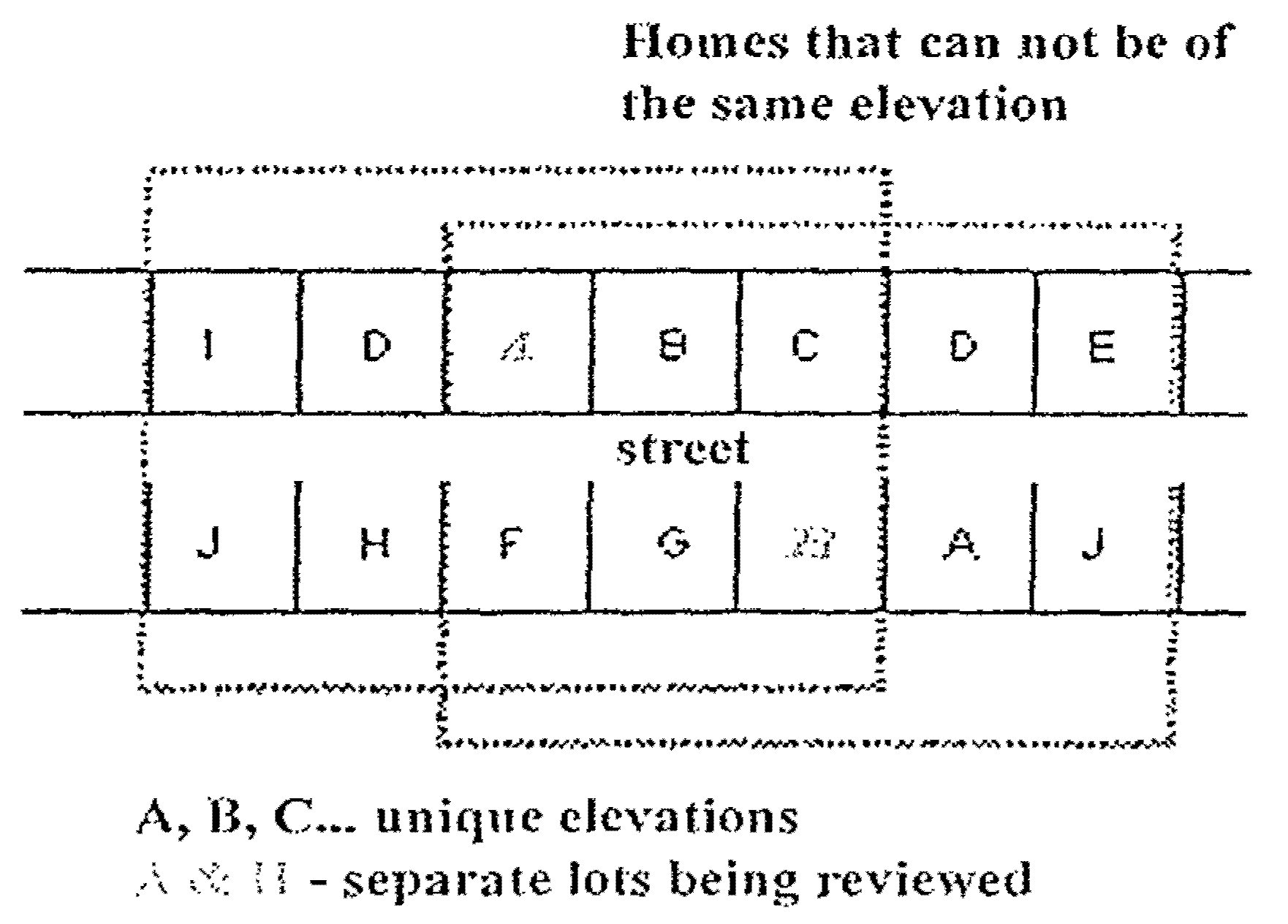
No façade may be repeated within any adjacent lots or across the street from those lots within groupings of five (5) homes;
d)
Concealed HVAC units, trash storage and utility meters;
e)
If brick is used, brick shall be properly detailed. Brick shall be coursed exactly to the top and bottom of all wall openings;
f)
Windows shall be single hung, double hung, triple hung, or casement;
g)
Flush mounted windows are prohibited;
h)
Windows are to be placed on each wall elevation with a wall to window ratio that meets the light and air requirements of the building code;
i)
If shutters are used, shutters shall be one-half (½) the width of, and the same height of the associated opening. All shutters shall be louvered, paneled, or constructed of boards as appropriate to the style of the building. Shutters do not need to be operable;
j)
Gutters shall be copper, galvanized steel, aluminum or painted if exposed;
k)
Dormers shall not use siding as window jamb material;
l)
The body of a single-window dormer shall be vertically proportioned or square;
m)
If chimneys are visible, they shall have a projecting cap;
n)
If chimneys are located on a street facing wall, they shall extend to the ground;
o)
If a porch is used, the porch column base shall not protrude beyond the bottom edge of the porch flooring.
B.
Additional newly constructed single-family dwelling architectural features. All newly constructed single-family dwellings shall contain at least four (4) of the following architectural features:
1.
Stoop and portico at the front door.
2.
Front porch.
3.
Front porch or front stoop steps and railing.
4.
Front porch roof.
5.
Decorative or architectural porch railing.
6.
Second story porch.
7.
If brick or stucco is used, a stone base below first floor window shall be installed.
8.
Trim at gable rake.
9.
Decorative roof finials or ornamentation.
10.
Decorative attic or gable feature greater than three (3) square feet in size.
11.
Trim at windows and doors of the street façade.
12.
Arched window head or heads (depending on architectural style) on street façade.
13.
Dormer with window.
14.
Window shutters on street façade.
15.
Divided light windows.
16.
Decorative concrete driveway.
Section 7.1.3.
Multi-Family Residential Zoning District standards.
A.
The design standards for all multi-family and single-family attached structures within the Multi-Family (M-2) Zoning District shall be as follows:
B.
All multi-family and single-family attached residential structures shall be of exterior fire-resistant construction and shall have a minimum of eighty (80) percent masonry construction, more-or-less equally distributed around all sides of the structure, for the first story of the structure, and a minimum of fifty (50) percent masonry construction, more-or-less equally distributed around all sides, for any additional story above the first floor.
C.
Areas of a multi-family and single-family attached residential structure's façade that are devoted to windows, doors, covered porches or patios that have a minimum size of four (4) feet deep and eight (8) feet wide (thirty-two (32) square feet), chimneys, breezeways, or courtyards shall not be counted as "wall surface" when calculating the masonry requirement.
D.
Prohibited materials. Concrete, concrete block, vinyl, plastic or metal exterior construction is not permitted on any multi-family or single-family attached structure.
E.
Roof materials. Roof materials for a multi-family and single-family attached residential structures shall be comprised of an architectural, laminated, dimensional composition shingle (thirty-year minimum); flat pan standing seam metal roofing, or architectural grade metal roofing products which are stamped to appear as wood shakes, dimensional shingles, wood shingles, slate or tile; or terra cotta or slate tile. If roof is not visible to the public, there is no pitch requirement (i.e. parapet roof); if roof is visible to the public a minimum 6:12 pitch is required
F.
Accessory structures. Accessory structures, regardless of size, within the multi-family (M-2) Zoning District shall conform to the minimum exterior construction standards for the main building on the lot, tract, site, and shall be architecturally compatible with the main building.
G.
Separation of multi-family buildings.
1.
Buildings two (2) stories or less in height with opposite walls that:
a)
Contain openings for windows, light and air ventilation shall be separated by fifteen(15) feet between building walls;
b)
Contain no openings shall be separated by ten (10) feet between buildings walls.
2.
Buildings more than two stories in height with opposite walls that:
a)
Contain openings for windows, light and air ventilation shall be separated by (20) feet between building walls;
b)
Contain no openings shall be separated by fifteen (15) feet between building walls.
Section 7.1.4.
Nonresidential Zoning District standards.
The design standards for all nonresidential and institutional structures within the Neighborhood Commercial (C-1), General Commercial (C-2), Light Industrial (D), and Heavy Industrial (E) Zoning Districts, shall be as follows:
A.
All nonresidential and institutional structures in any zoning district, shall have a minimum of seventy-five (75) percent masonry construction, more-or-less equally distributed around all sides of the building, for the first story defined as below the first floor ceiling plate, and a minimum of fifty (50) for any story above. Any façade that faces, or is visible from a public street, shall have a minimum of seventy-five (75) percent masonry construction, and all other façades shall be comprised of not less than fifty (50) percent masonry construction.
B.
Areas of a nonresidential or institutional structure's façade that are devoted to windows, doors, covered porches or stoops, breezeways or courtyards shall not be counted as "wall surface" when calculating the masonry requirement.
C.
Metal exterior material use. Metal exterior construction is prohibited on any nonresidential or institutional structure which is located within any zoning district, save and except the following:
1.
Structures located on a through lot that both fronts and backs onto a public street. The rear façade, which must be located equal to or more than one thousand (1,000) feet from the public street, may use metal exterior construction upon approval of the site plan by the city council; and
2.
Upon approval of the site plan by the city council, nonresidential and institutional structures within any the C-1, C-2, D, or E, zoning districts may use metal as an exterior material on up to twenty (20) percent of the façade as an architectural accent.
a)
The use of any type of metal for exterior building construction shall be clearly shown on the site plan and shall only be allowed with the site plan approval. The exterior finish of metal used in exterior construction shall be permanent, maintenance free nature such as a baked-on finish unless approved otherwise on the site plan. The use of corrugated, galvanized, aluminum-coated, zinc-coated unfinished, or similar metal surfaces shall be prohibited unless approved otherwise on the site plan.
D.
Roof materials. Any roof materials for a nonresidential or institutional structure that are visible from a public street shall be comprised of laminated, dimensional composition shingle (twenty-five-year minimum; flat pan standing seam metal roofing, or architectural grade metal roofing products which are stamped to appear as wood shakes, dimensional shingles, wood shingles, slate or tile; or terra cotta or slate tile. For nonresidential or institutional structures where the roof is not visible to the public, there is no pitch requirement (i.e. parapet roof); if roof is visible to the public a 6:12 pitch is required. Nonresidential or institutional structures with a flat-roof shall have highly articulated parapet that conceals the roof and any roof mounted mechanical equipment.
E.
Structural exceptions to masonry standards. The following structures are exempt from the masonry construction requirements.
1.
Barns located on the lots of four (4) acres or more provided that such barns are used solely for agricultural purposes (as distinguished from commercial purposes).
2.
Mobile homes and HUD-Code manufactured homes lawfully existing are not subjected to the masonry requirements.
3.
Temporary construction buildings, field offices, sales offices and temporary classrooms or storage buildings for the public school. The exception shall be only provided that such facilities are legally permitted by the city for a specific period of time, and provided that they are completely removed from the premises upon expiration of the permit or upon completion of construction, whichever occurs first.
4.
Residential and nonresidential structures legally in existence as of (date of this ordinance), and any additions to such structures that do not cumulatively exceed twenty (20) percent of the original building size (as it existed on date of this ordinance). Such additions shall be allowed to be constructed of the same exterior materials as the original building.
F.
Use of alternative exterior materials.
1.
All written requests for the use of alternative exterior building materials to include alternative roof material and/or roofing color and alternative roof pitch shall be clearly noted and described in detail on a color rendering of the structure's elevation that is submitted along with the site plan for approval. The use of alternative exterior building materials, roof pitch and roof materials and/or color may only be requested for multi-family, single-family attached and nonresidential structures. The city may require submissions of an actual sample(s) of the proposed exterior finish material(s) along with the elevation(s) and the site plan.
2.
The planning and zoning commission may recommend, and the city council may approve, all alternative exterior construction material(s), roof pitch and roof materials and/or color if it is determined to be equivalent or better than the exterior materials, roof pitch, or roof materials and/or colors otherwise required by this subsection and the city's building code as part of the site plan approval process.
G.
Consideration for exceptions to the above exterior construction requirements shall be based only upon the following:
1.
Architectural design, creativity and innovation;
2.
Compatibility with surrounding structures;
3.
Relative ease of maintenance of the material(s);
4.
Long term durability and weather-resistance of the materials(s); and
5.
Long-term stability in property value due to the high quality of the material(s).
Sec. 7.2. - Screening and fencing.
Section 7.2.1.
Screening elements and fences.
A.
General requirements.
1.
A permit shall be required for any new fence or screening wall construction or replacement of an existing fence or screening wall unless otherwise provided in this ordinance. No permit shall be required to repair a fence as long as the repair keeps the fence in the same location, at the same height, and utilizes the same materials.
2.
All fences and screening walls shall be kept in good repair and shall not create blight. Dilapidated fences or screening walls shall be repaired or replaced in accordance with provisions of this section. Fences may be painted, but no bright, unnatural colors are allowed. Wood fences shall be painted or stained with natural wood colors.
3.
No fence or screening wall shall exceed eight (8) feet in height, as measured from the grade of the property, unless otherwise approved by the city manager or his/her designee.
4.
Existing chain link fences may be replaced without a permit as long as the repair keeps the fence in the same location, at the same height, and utilizes the same materials.
5.
Temporary fencing used for construction purposes or special events shall be exempt from the requirements of this section provided that such fencing is approved as part of the applicable building permit or special events permit.
6.
Any variances to the requirements of this section shall be considered by the BOA unless otherwise provided in this ordinance.
B.
Fencing requirements for agricultural uses.
1.
The following standards apply to tracts of land with four (4) acres or more used for agricultural or animal husbandry purposes in accordance with this ordinance.
2.
Pipe fencing, split rail fencing, barbed wire, hog wire, chicken wire, chain link, cable, and other open style types of fencing traditionally used in agriculture and animal husbandry shall be allowed. Such fencing may be located up to the right-of-way line and shall not exceed eight (8) feet in height. Solid style types of fencing shall meet the fence height and setback requirements for residential uses. Open style fencing typically used in wildlife management may exceed eight (8) feet in height as necessary for the purposes of wildlife management.
3.
No permit is required for agricultural fencing.
C.
Electric fences.
1.
An electric fence is allowed in the Agricultural (AG) Zoning District or on other properties exceeding twenty (20) acres in other zoning districts, with proof submitted to the electrical inspector that the fence will be designed to retain animals, be inaccessible to the general public and not pose a hazard to life.
2.
An electric fence is allowed in association with a permitted nonresidential outdoor storage area in the Light and Heavy Industrial (D), (E) Zoning Districts subject to the following standards.
a)
Unless otherwise specified in this section, electric fences must be installed in conformance with the specifications set forth in the city's electrical code and the International Electroctechnical Commission Standard No. 60335-2-76. In addition, the electric fence controller must meet the requirements of Underwriters Laboratories Standard UL69, Electric-Fence Controller, and labeled as such.
b)
The electric fence controller and emergency entry key safe for the electric fence must be located in a single accessible location for the entire fence.
c)
The electric fence must be surrounded by a non-electrical fence or wall six (6) to eight (8) feet in height.
d)
The electric fence must be installed a minimum of one (1) foot from the surrounding non-electric fence or wall, except along the gate. Along the gate, the electric fence must be installed a minimum of three (3) inches from the surrounding non-electric fence or wall.
e)
The electric fence must be clearly identified with warning signs at intervals of not less than sixty (60) feet.
f)
The electric fence must only be energized during hours when the public does not have legal access to the protected property.
D.
Prohibited materials. Permits must not be issued for materials not manufactured specifically for fencing, such as fibrous masonry products, landscape timbers, railroad ties, latticework panels, plywood, or fiberglass panels. Other prohibited material include razor wire fencing.
E.
Fencing requirements for residential uses.
1.
Fences shall be constructed of wood, ornamental metal (i.e. wrought iron), tubular steel, masonry, or other materials traditionally used in private fence construction. New and innovative materials such as plastics, PVCs, metal panel or slat, cementitious fiberboard, and other similar materials may be approved for use by the city manager or his/her designee if the material is compatible in character with traditional residential fencing and proven to be sturdy, durable and relatively maintenance-free.
2.
The maximum height, as measured from the grade of the property, shall be as follows:
a)
Six (6) feet for front yard or in front of the main structure in all residential zoning districts. Fences located in the front yard shall be constructed of split rail, ornamental metal, tubular steel, r similar open face material and must have a minimum seventy-five (75%) percent visibility through the fence.
b)
Maximum eight (8) feet for side or rear yards.
3.
Fencing in the front yard of a residential lot shall be located no closer than three (3) feet (measured inside the residential lot) to the right-of-way line.
4.
Gates designed for vehicular access shall be set back from the right-of-way line a minimum of twenty-four (24) feet.
5.
The height of a fence adjacent or perpendicular to a screening wall shall not exceed the height of the subdivision's screening wall or any other fence constructed by the developer at the time of initial development.
6.
All fences adjacent to parks, trails, or designated open spaces shall be constructed of split rail, ornamental metal, tubular steel, masonry columns, or similar open face material and not exceed a height of six (6) feet. No wood fencing shall be allowed behind the required open space. Solid fencing constructed of Cedar (with metal posts and Cedar top and bottom caps and stained with wood sealant) or masonry material may be allowed if adjacent to a park or open space area that is used actively such as a public swimming pool, sport facility, etc.
7.
Allowable wood fences adjacent to streets, schools, parks, open spaces or other public spaces shall have the finished side facing the public space. All fence posts and structural components shall be placed on the interior of the lot.
8.
All fence posts and structural components shall be placed on the interior of the lot.
9.
The location of fences for double frontage lots or corner lots adjacent to a street shall be in accordance with the building setback line as shown on the final plat. If a property is not platted or if no building line is shown on the recorded plat, the location of fences shall comply with the building setback requirements of the zoning district that the property is located in.
10.
If a corner lot is adjacent to a subdivision's screening wall, a fence may be placed outside the required setback line to connect with the screening wall.
11.
Fences for nonresidential uses allowed in residential zoning districts such as schools or churches shall meet the fencing standards for Nonresidential Districts.
F.
Fencing requirements for swimming pools.
1.
Swimming pools shall have a fence that shall conform to the requirements of the International Building Code.
G.
Fencing and requirements for multi-family and nonresidential uses.
1.
Fencing shall not exceed six (6) feet in height.
2.
Fencing shall be constructed of wrought iron, tubular steel, masonry, live screening, or a combination thereof unless adjacent to single-family dwellings, or two-family dwellings, in which a screening wall shall be constructed and shall be made of masonry materials with masonry columns placed a minimum of thirty-two (32) foot on center. Wood, barbed wire, and chain link fencing is prohibited.
3.
All fencing and screening walls for multi-family and nonresidential developments shall be identified on the site plan for the development and approved as part of the site plan approval.
4.
The city council may approve variances to any of these requirements as a part of the site plan approval.
H.
Screening wall requirements.
1.
Screening walls shall be constructed of masonry material such as brick, stone, concrete panels, or similar materials consistent in material, finish, and color with the primary buildings within the development or adjacent buildings in the area. The wall finish shall be consistent on both sides.
2.
Screening walls shall be a minimum of six (6) feet in height and a maximum of eight (8) feet in height.
3.
Any dense evergreen hedge or plant material suitable for providing a visual barrier, for which such material shall be maintained in a healthy growing condition if approved by the city manager or his/her designee.
4.
Landscaped earth berms may, when appropriate in scale, be considered and used as a screening element in lieu of a fence, wall, hedge or other dense planting material if approved by the city manager or his/her designee.
5.
Screening wall plans shall be submitted to the city for review and permitting and shall be signed and sealed by a structural or civil engineer licensed by the State of Texas.
(Ord. No. 679, § 1(Exh. A), 11-11-14)
Sec. 7.3. - Landscaping.
A.
Applicability. This section shall apply to all development within the city with the exception of single-family residential development in the Agricultural (AG) District and any tracts of land with two (2) acres or more used for agricultural purposes in accordance with this ordinance.
B.
Purpose. The purpose of this section is to encourage low maintenance landscaping, water conservation and tree preservation while providing guidelines for minimum landscaping for new development throughout the city, preserving the natural, open character of the rural residential areas, and not prohibiting the normal use of properties for agricultural purposes.
C.
Nonresidential and multi-family landscaping. These standards apply to new nonresidential developments. These standards may be met either by saving existing trees on the site, or planting new trees from the recommended list.
1.
A twenty-foot linear landscape strip shall be provided adjacent to all major thoroughfares. The landscape strip shall include a minimum of one (1) shade tree (two and one-half-inch caliper minimum) for every fifty (50) linear feet of street frontage.
2.
Where parking lots and drives abut the landscape strip along a street right-of-way, a continuous hedge of evergreen shrubs shall be provided to screen those areas from the street. The shrubs must be a minimum of a ten-gallon size at planting with a minimum mature height of three (3) feet. Shrubs shall be planted according to the spacing recommended for their species. The screening shall extend along the entire street frontage of the parking lot, exclusive of driveways and visibility clips. A landscape berm may be provided in lieu of the screening hedge. The berm must be a minimum of thirty-six (36) inches above the average grade of the street and parking lot curbs with a slope not to exceed 3:1.
3.
Landscaping shall also be provided for the interior parking areas. Trees shall be planted in each parking lot to attain a minimum average density of one (1) shade tree (two and one-half-inch caliper minimum) for each ten (10) parking spaces provided, or any fraction thereof. The planting area per tree shall be a minimum of nine (9) feet wide and twenty (20) feet deep.
a)
Interior parking lot landscaping shall include a minimum eight (8) percent open space. To calculate the total parking area and the subsequent percentage of required interior lot landscaping, total the square footage of parking spaces, planting islands, curbed areas and all interior driveways and aisles. Landscaped areas located contiguous to and within five (5) feet of the parking lot may be used to meet the interior landscaping requirement. Landscaped areas located greater than five (5) feet away from the parking lot may not be used to meet the interior landscaping requirement.
b)
The required landscaping for parking lots shall be more or less evenly distributed throughout the parking lot, although adjustments may be approved by the city manager or his/her designee where the shape or size of the parking lot, the location of existing trees or other natural constraints reasonably prevent such distribution.
c)
Except for customer and employee parking, parking lot landscape requirements do not apply to storage or standing parking spaces incidental to uses, such as sales and rental of motor vehicles, mobile homes, boats, trailers or other similar uses.
d)
All landscaped areas, including the permeable areas and drip lines around trees and planting beds used for visual screening which abut any parking lot or vehicular travel area, shall be protected with curbs sufficient to protect them from vehicular intrusion.
4.
Foundation plantings. Exposed sections of building walls that are in high-use or high-visibility areas of the building exterior shall have planting beds at least five (5) feet wide placed directly along at least fifty (50) percent of such walls.
5.
An automatic irrigation system is required for all landscaping. Irrigation systems shall be designed and installed with rain sensors and low gallonage, low angle nozzles in such a way as to avoid water overflow into the street. A freeze sensor shall be placed in each controller to prevent the irrigation system from activating to create unsafe spillage on roads and/or sidewalks.
D.
Nonresidential area treatment.
1.
Landscape areas shall include all areas on the site that are not covered by buildings, structures, paving or impervious surface. Landscape areas shall consist only of landscaping. The selection and location of turf, ground cover (including shrubs, grasses, perennials, flowerbeds and slope retention), and pedestrian paving and other landscaping elements shall be used to prevent erosion and meet the functional and visual purposes such as defining spaces, accommodating and directing circulation patterns, managing visibility, attracting attention to building entrances and other focal points, and visually integrating buildings with the landscape area and with each other.
a)
Turf grass. High-use areas shall be planted with irrigated turf grass. Nonirrigated shortgrass prairie grasses or other adapted grasses that have been certified as Xeriscape landscaping may be established in remote, low-use, low visibility areas.
b)
Planting beds. Shrub and ground cover planting beds shall be separated from turf grass with edging and shall have open surface areas covered with mulch.
c)
Slopes. Retaining walls, slope revetment or other acceptable devices integrated with plantings shall be used to stabilize slopes that are steeper than 3:1. If soil tests performed on the subject soils indicate steeper slopes are stable without the above required protection, then the maximum slope allowed without the above required protection may be increased to the maximum stated in the soils report or 2:1, whichever is less steep.
d)
Agricultural use. If outdoor space is maintained in active agricultural use, the landscape surfaces and ground cover standards above shall not apply.
E.
Water conservation.
1.
All landscaping plans shall be designed to incorporate water conservation materials and techniques through application of Xeriscape landscaping principles. Xeriscape landscaping principles do not include or allow artificial turf or plants, mulched (including gravel) beds or areas without landscape plant material, paving of areas not required for walkways, plazas or parking lots, bare ground, weed covered or infested surfaces or any landscaping that does not comply with the standards of this section. Xeriscape landscaping principles shall be:
a)
Grouping plants with similar water requirements together on the same irrigation zones;
b)
Limiting high-irrigation turf and plantings to appropriate high-use areas with high visibility and functional needs;
c)
Use of low-water demanding plants and turf where practicable;
d)
Use of efficient irrigation systems;
e)
Incorporation of soil improvements;
f)
Use of mulches;
g)
Provision of regular and attentive maintenance.
F.
Plant materials.
(Ord. No. 679, § 1(Exh. A), 11-11-14)

