
Fayette County Unincorporated
City Zoning Code
City Zoning Code
ARTICLE III
GENERAL PROVISIONS
Sec. 110-60.- Conflicting requirements.
The harmonious, orderly, and progressive development of land is further facilitated by recognizing a hierarchy among the regulations and ordinances which govern the development of land. To that end it is understood there may be conflicting requirements between the Fayette County Zoning Ordinance and the subdivision regulations and/or the development regulations. Should any requirements of the subdivision regulations and/or development regulations conflict with this chapter, the subdivision regulations and/or development regulations shall control. Should any requirements conflict within this chapter, the most restrictive shall apply.
(Code 1992, § 20-5-1; Ord. No. 2012-09, § 3, 5-24-2012; Ord. No. 2020-02, § 1, 5-28-2020)
Sec. 110-61. - Use.
No land, building, or structure shall be used in any manner or for any purpose that is inconsistent with this chapter, or amendment thereto, except as otherwise provided herein. In addition, no building or structure shall be erected, moved, altered, or enlarged in any manner that is inconsistent with this chapter, or amendment thereto, except as otherwise provided herein.
(Code 1992, § 20-5-2; Ord. No. 2012-09, § 3, 5-24-2012)
Sec. 110-62. - Use prohibited.
If either a use or class of uses is not specifically indicated as being permitted in a zoning district, either as a matter of right or as a conditional use, then such use, class of uses, or structures for such uses shall be prohibited in such zoning district, except as otherwise provided herein.
(Code 1992, § 20-5-3; Ord. No. 2012-09, § 3, 5-24-2012)
Sec. 110-63. - Principal structure or use.
In all residential or agricultural-residential zoning districts, no more than one principal structure or use shall be located on a lot, except as otherwise provided herein. In all nonresidential zoning districts, no more than one principal use shall be located on a lot. The principal use on a non-residentially-zoned lot shall either be either nonresidential or residential, but not both, except as otherwise provided herein.
(Code 1992, § 20-5-4; Ord. No. 2012-09, § 3, 5-24-2012)
Sec. 110-64. - Use on a lot.
Construction of buildings, structures, and establishment of uses shall occur only upon a lot as required herein.
(Code 1992, § 20-5-5; Ord. No. 2012-09, § 3, 5-24-2012)
Sec. 110-65. - Reduction of lot area.
No lot shall be reduced in size so that the lot size, width, depth, setback, or any other requirement of this chapter is not maintained. This restriction shall not apply when a portion of a lot is acquired for a public purpose.
(Code 1992, § 20-5-6; Ord. No. 2012-09, § 3, 5-24-2012; Ord. No. 2018-03, § 2, 9-22-2018)
Sec. 110-66. - Height and density.
No building or other structure shall hereafter be erected or altered so as to:
(1)
Exceed the height limit; or
(2)
Accommodate or house a greater number of families per lot than allowed.
(Code 1992, § 20-7; Ord. No. 2012-09, § 3, 5-24-2012)
Sec. 110-67. - Street frontage for access.
(a)
For access purposes, all residential or nonresidential lots shall have frontage on a street and/or a cul-de-sac that is either:
(1)
A public street; or
(2)
A private street built to county standards and deeded to the property owners' association or the homeowners' association through a recorded warranty deed which the owner of any lot within the subdivision is required to join.
(b)
All residential lots shall have at least 100 feet of immediate frontage on a street. This 100 foot width shall be maintained from the lot's frontage on the street to the body of the lot where the minimum lot width is met. This requirement shall be met unless:
(1)
The lot is "Landlocked Property" as provided in article V of this chapter; or
(2)
The lot fronts only the turn-around portion of a cul-de-sac. Each lot which fully fronts the turn-around portion of a cul-de-sac shall have a minimum of 50 feet of street frontage and this provision shall be limited to a maximum of four lots.
(c)
All nonresidential lots shall have at least 125 feet of frontage on a street. This 125 foot width shall be maintained from the lot's frontage on the street to the body of the lot where the minimum lot width is met. This requirement shall be met unless:
(1)
The lot is "Landlocked Property" as provided in article V of this chapter; or
(2)
The lot fronts only the turn-around portion of a cul-de-sac. Each lot which fully fronts the turn-around portion of a cul-de-sac shall have a minimum of 50 feet of street frontage and this provision is limited to a maximum of four lots.
(Code 1992, § 20-5-8; Ord. of 8-25-2011; Ord. No. 2012-09, § 3, 5-24-2012)
Sec. 110-68. - Encroachment on public rights-of-way.
No building, structure (including prohibited mailbox supports as described in article V of this chapter), wall or fence, service area or required off-street parking and loading facilities, except driveways and associated headwalls, shall be permitted to encroach on public rights-of-way.
(Code 1992, § 20-5-9; Ord. No. 2012-09, § 3, 5-24-2012)
Sec. 110-69. - Requirements for moving a building.
No dwelling unit or other permanent structure shall be relocated in the county unless, when relocated, it meets all requirements herein and other applicable requirements of this Code.
(Code 1992, § 20-5-10; Ord. No. 2012-09, § 3, 5-24-2012)
Sec. 110-70. - Buildings under construction.
Nothing in this chapter shall require any change in the construction or intended use of a building which is legally under construction or for which a building permit has been issued as of the effective date of November 13, 1980, including amendments, and the construction of which shall be diligently pursued until completion.
(Code 1992, § 20-5-11; Ord. No. 2012-09, § 3, 5-24-2012)
Sec. 110-71. - Setback not to be encroached upon.
No setback shall be encroached upon or reduced in any manner except in conformity with the setback, off-street parking spaces, and such other regulations required for the zoning district in which such building is located. Landscaping, driveways, vehicle parking areas, multi-use path connections, walkways and associated steps, boat docks and bridges, retaining walls, walls and fences, curbs, and planted buffer strips shall not be construed to be encroachments.
(Code 1992, § 20-5-12; Ord. No. 2012-09, § 3, 5-24-2012; Ord. No. 2018-03, § 3, 9-22-2018)
Sec. 110-72. - Permitted encroachments of setbacks.
Architectural features connected to a structure such as cornices, eaves, steps, landings, ramps, gutters, and fire escapes may project not more than three feet beyond any required setback line, except where such projections would obstruct driveways. One flagpole per lot shall also be allowed to encroach into the front yard setback, provided it is not located within 15 feet of the right-of-way. Flagpoles which encroach the front yard setback shall be required to have a signed and sealed affidavit from an architect or engineer registered in the state with the actual location and setback of the flagpole and inspection approval of the footing to be submitted to the planning and zoning department prior to placement of the flagpole.
(Code 1992, § 20-5-13; Ord. No. 2012-09, § 3, 5-24-2012; Ord. No. 2018-03, § 4, 9-22-2018)
Sec. 110-73. - Reserved.
Editor's note— Ord. No. 2018-03, § 5, adopted Sept. 22, 2018, repealed § 110-73, which pertained to Yard service, required open space to one building and derived from Code 1992, § 20-5-14; Ord. No. 2012-09, § 3, 5-24-2012.
Sec. 110-74. - Side and rear setbacks and buffers not required next to railroad.
Within any nonresidential zoning district, side setbacks, rear setbacks, and buffers shall not be required adjacent to railroad rights-of-way.
(Code 1992, § 20-5-15; Ord. No. 2012-09, § 3, 5-24-2012; Ord. No. 2018-03, § 6, 9-22-2018)
Sec. 110-75. - Structures permitted above the height limit.
The height limit shall not apply to the following structures and architectural features: a cathedral or vaulted ceiling on a church or other place of worship, spire, steeple, belfry, cupola, dome, monument, water tower, observation tower, chimney, smoke stack, conveyer, mast or aerial, heating, ventilation, and air conditioning (HVAC) equipment, elevator equipment, roof mounted solar panels, roof mounted satellite/telecommunications equipment, and a parapet wall not extending more than four feet above the roof line of the building. A freestanding flagpole is also permitted above the height limit, provided the total height does not exceed 70 feet. Total height shall be measured from the finished grade at the location of the flagpole to the highest point.
(Code 1992, § 20-5-16; Ord. No. 2012-09, § 3, 5-24-2012; Ord. No. 2013-06, § 1, 7-25-2013)
Sec. 110-76. - Front yard setback and common area.
The front yard setback shall be measured from the street right-of-way (existing or required, whichever is greater). Street right-of-way is based on the classification of the street (see chapter 104, development regulations, and the county thoroughfare plan). When a common area, open space, or conservation area is located between a lot and the street, the setback on the lot shall be measured from the right-of-way as a front yard setback or from the common area as a side or rear setback and whichever is greater shall apply as enacted October 1, 2008.
(Code 1992, § 20-5-17; Ord. No. 2012-09, § 3, 5-24-2012)
Sec. 110-77. - Lot width.
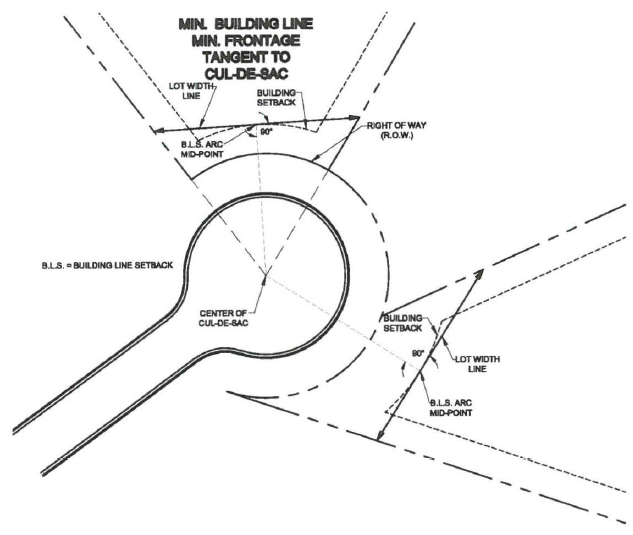
The lot width shall be met at the required setback and shall be maintained for a depth of 80 feet. On a lot where the lot width is not met at the required setback, the setback will then be where the lot width is met and said lot width shall be maintained for a depth of 80 feet. Lot width shall be determined as the distance between lot lines either measured in a straight line parallel to the adjoining street right-of-way or tangent and perpendicular to the mid-point of the right-of-way in the case of the turnaround portion of a cul-de-sac along the front minimum building line (see graphic). The principal structure shall be constructed within this area. Residential accessory structures and farm outbuildings, horse stables, auxiliary structures and greenhouses allowed in the A-R zoning district do not have to comply with the lot width at the building line; however, they shall comply with applicable setbacks and location requirements.
(Code 1992, § 20-5-18; Ord. No. 2012-09, § 3, 5-24-2012; Ord. No. 2018-03, § 7, 9-22-2018)
Sec. 110-78. - Additions to a single family structure.
(a)
Additions. All additions to a single-family dwelling shall be attached to the primary structure, via either a heated corridor that shall be attached to the primary residence at a location that is currently heated and that has minimum interior dimensions of six feet in width and eight feet in height, or by a direct access common wall.
(b)
Porte cochere. A porte cochere shall be attached at an entrance of a single-family dwelling and shall meet the following standards:
(1)
Shall consist of a singular roof line that is consistent with the single-family dwelling roof design, and supported by posts/columns and shall remain open on the remaining three sides;
(2)
Shall be consistent with the architectural character/facade of the single-family dwelling; and
(3)
A porte cochere shall not be utilized as a carport, garage, storage building, open storage, or living area.
(Code 1992, § 20-5-19; Ord. No. 2012-09, § 3, 5-24-2012)
Sec. 110-79. - Residential accessory structures and their uses.
(a)
The following residential accessory structures are permitted in A-R, all residential zoning districts and properties regulated under section 110-169, pertaining to "Conditional use approval—Single-family residence and residential accessory structures and/or uses."
(1)
Well/pump house;
(2)
Guesthouse;
(3)
Greenhouse, permanent or temporary (see (n) temporary greenhouse);
(4)
Swimming pool, hot tub, pool deck, pool equipment enclosure structure, and pool screen enclosure;
(5)
Garage;
(6)
Recreational court;
(7)
Gazebo;
(8)
Cabana/pool house, boat house, detached covered patio, and detached covered deck;
(9)
Storage building;
(10)
Carport;
(11)
Solar panel (ground-mounted);
(12)
Wind turbine/windmill (ground-mounted);
(13)
Aircraft hangar, detached (see article V of this chapter);
(14)
Dog house and dog pen/run;
(15)
Playhouse/treehouse;
(16)
Outdoor kitchen and/or fireplace;
(17)
Patio; and
(18)
Underground storm shelter.
These regulations shall not apply to farm outbuildings, including horse stables, auxiliary structures, and commercial greenhouses as regulated under section 110-125, pertaining to "A-R, Agricultural-Residential District," and section 110-169, pertaining to "Conditional use approval," of this chapter. A semi-trailer/box truck utilized as a farm outbuilding as regulated under section 110-125, pertaining to "A-R, Agricultural-Residential District," and horse quarters, as regulated under section 110-169, pertaining to "Conditional use approval." These regulations shall not apply to structures associated with nonresidential uses allowed in A-R and residential zoning districts.
(b)
Structure limitations. Construction of a residential accessory structure shall occur concurrently with or after the construction of the principal structure. Residential accessory structures shall not be used as dwelling units or for lodging purposes, except a guesthouse.
(c)
Number and size. The number and size of residential accessory structures shall conform to the requirements described herein.
(1)
Residential accessory structures shall be limited to one of the following options:
a.
Two residential accessory structures, per individual lot, that shall not exceed a combined total footprint of 1,800 square feet or three residential accessory structures, per individual lot, that shall not exceed a combined total footprint of 3,600 square feet on a lot with a minimum of five acres. One of these residential accessory structures may include up to 700 square feet of heated and finished floor area to be utilized as a guesthouse. A residential accessory structure combined with a guesthouse, under this option, shall be deemed as one residential accessory structure;
b.
One residential accessory structure, per individual lot, footprint not to exceed 1,800 square feet. This residential accessory structure may include up to 700 square feet of heated and finished floor area to be utilized as a guesthouse. A residential accessory structure combined with a guesthouse, under this option, shall be deemed as one residential accessory structure; or
c.
One residential accessory structure, per individual lot with a minimum of five acres, footprint not to exceed 3,600 square feet. This residential accessory structure may include up to 700 square feet of heated and finished floor area to be utilized as a guesthouse. A residential accessory structure combined with a guesthouse, under this option, shall be deemed as one residential accessory structure.
(2)
At least 50 percent of the square footage of a residential accessory structure building shall be fully enclosed, except as otherwise provided herein. Said enclosed area shall be surrounded by connecting adjacent walls constructed of solid materials attached to the foundation and roof.
(3)
A well/pump house, pool equipment enclosure structure, dog house, or playhouse/treehouse consisting of 70 square feet or less; dog pen/run; swimming pool, hot tub, or recreational court; aircraft hangar, farm outbuilding, greenhouse, horse stable, or auxiliary structure or one semi-trailer/box truck (as regulated under section 110-125, pertaining to "A-R, Agricultural-Residential District," and section 110-169, pertaining to "Conditional use approval"); ground/pole-mounted solar panel consisting of less than 200 square feet or ground-mounted wind turbine/windmill; uncovered outdoor kitchen, fireplace; patio; underground storm shelter; horse quarters (as regulated under section 110-169, pertaining to "Conditional use approval"), temporary greenhouse (see (o) below), or beehive shall not be included in determining the number of residential accessory structures provided herein.
(d)
Location on lot. Residential accessory structures shall conform to the dimensional requirements within each zoning district. A well/pump house of 70 square feet or less may be located within the setbacks.
(e)
Residential accessory structures located in a front yard. On a single frontage lot, the area between the street and the front building line shall be treated as a front yard with regard to the location of residential accessory structures. On a corner lot, the area between the streets and the front building lines shall be treated as a primary front yard or secondary front yard(s) with regard to the location of residential accessory structures. On a through lot, only the area between the street from which the lot is accessed and the front building line shall be treated as a front yard with regard to the location of residential accessory structures.
No residential accessory structure shall be located in a front yard except: a well/pump house consisting of 70 square feet or less; a detached garage on a single frontage lot, a through lot or in the primary front yard of a corner lot (see subsection (1) of this section for requirements); a residential accessory structure in a secondary front yard of a corner lot (see subsection (2) of this section for requirements); or a residential accessory structure on a lot in the A-R zoning district which consists of five or more acres.
(1)
Detached garage located in the front yard of a single frontage lot, a through lot, or a primary front yard on a corner lot. Said detached garage shall meet the following requirements:
a.
The detached garage shall not be located more than 35 feet from the principal structure.
b.
The design of the detached garage shall match with the general residential architectural style inherent in the existing principal structure, including, but not limited, to: roof pitch, roof facade, facade, residential windows, and residential doors. Elevation drawings denoting compliance with these requirements shall be submitted as part of the building permit application.
c.
The detached garage shall have at least one opening for vehicular access.
d.
The detached garage shall be connected to the principal structure by at least one of the following, and elevation drawings denoting compliance with the following requirements shall be submitted as part of the building permit application:
1.
An attached or detached breezeway. Said breezeway shall be a minimum of six feet in width and a minimum of eight feet in height (interior measurement). A detached breezeway shall be constructed within six inches of the principal structure and the detached garage;
2.
An attached raised deck. Said attached raised deck shall be a minimum height of 15 inches. The deck shall have a minimum width of six feet. Said deck shall have guard rails measuring a minimum of three feet in height; or
3.
An attached or detached pergola. Said pergola shall consist of parallel colonnades supporting an open roof of beams and crossing rafters, shall be a minimum of six feet in width and a minimum of eight feet in height (interior measurement). A detached pergola shall be constructed within six inches of the principal structure and the detached garage.
(2)
Residential accessory structure located in the secondary front yard of a corner lot. When a residential accessory structure is located in a secondary front yard adjacent to a street that is designated as an Internal Local the required setback shall be increased by 20 feet.
(f)
Guesthouses. Only one guesthouse is allowed per individual lot (see also subparagraph w. of section 110-169(2)). Any living area included in a residential accessory structure is a guesthouse. A guesthouse shall not be used as tenant space. A guesthouse shall not exceed 700 square feet of heated and finished floor area.
(g)
Reserved.
(h)
Temporary accessory storage. Portable on-demand storage units are only allowed on a temporary basis and only in conjunction with an ongoing a renovation project for the purpose of storage of household items for a period not to exceed one year. Portable on-demand storage units are defined as any container, storage unit, or other portable structure, other than a residential accessory structure, complying with this Section, used to store household items. Only two portable on-demand storage units are allowed per lot.
(i)
Carport. The carport shall be used to house motor vehicles and trailers only. Carports shall be constructed of the same material or types of material as the principal structure on the property, or of metal.
(j)
Cabana/pool house, boat house, detached covered patio, and detached covered deck. The cabana, detached covered patio, and detached covered deck may contain an outdoor kitchen, fireplace, spa/hot tub, bathroom/changing room, and/or pool pump/filter but shall not be utilized as a carport, garage, storage building, open storage, or living area. Said structures shall, at a minimum, consist of a roof with supporting posts/columns, not to exceed one story, and comply with the architectural standards for a residential accessory structure of 200 square feet or greater.
(k)
Swimming pool, pool deck, pool equipment enclosure, and pool screened enclosure. The pool deck, pool equipment enclosure, and pool screened enclosure shall comply with the required setbacks. A pool screen enclosure shall be constructed with insect screening commonly made of plastic, aluminum, or similar lightweight material and shall be exempt from the architectural requirements herein.
(l)
Solar panels (ground-mounted). Ground-mounted solar panels shall be limited to three per lot, the total cumulative square footage of ground-mounted solar panels shall not exceed 900 square feet, shall not exceed ten feet in height, shall comply with the required setbacks, and shall comply with the location of an accessory structure/use. Ground-mounted solar panels consisting of 200 cumulative square feet or less shall not count toward the number of accessory structures/uses. Ground-mounted solar panels consisting of more than 200 cumulative square feet up to a maximum of 900 cumulative square feet shall be counted as one accessory structure/use.
(m)
Wind turbines/windmill (ground-mounted). Wind turbines/windmills shall not exceed 70 feet in height. The setbacks shall be equal to the height of the wind turbine, including the blades, or the applicable zoning district setbacks, whichever are greater. Each lot is limited to one ground-mounted wind turbine/windmill. The ground-mounted wind turbine/windmill shall not count toward the number of accessory structures/uses. All anchors for guyed towers shall meet the setbacks for the applicable zoning districts.
(n)
Nonconformance. All residential accessory structures or uses which had a building permit issued prior to January 24, 2008, are legally nonconforming and shall be allowed to be maintained and rebuilt to current size and in the existing location. All residential accessory structures or uses permitted after January 24, 2008, shall comply with the current requirements.
(o)
Temporary greenhouse. Temporary greenhouses shall not exceed ten feet in height. Each lot is limited to one temporary greenhouse. The side yard setback shall be a minimum of 30 feet or the minimum side yard setback of the applicable zoning district, whichever is greater, and the rear yard setback shall be a minimum of 50 feet or the minimum rear yard setback of the applicable zoning district, whichever is greater. The maximum square footage for temporary greenhouses shall be as follows:
Temporary greenhouses shall be maintained in good condition and the covering shall not be torn and tattered. Temporary greenhouses shall only be used for the purpose of growing or storing plants. Temporary greenhouses shall be exempt from subsections (c)(2) and subsection (g) of this section. Greenhouses built in the A-R zoning district as regulated under article V of this chapter shall be exempt from these requirements.
A temporary greenhouse permit will be required for all temporary greenhouses prior to construction. Scaled drawings shall be submitted to the planning and zoning department which shall include, but not be limited to: temporary greenhouse elevations including height and total square footage and location on the lot including the distance from the property lines.
(Code 1992, § 20-5-20; Ord. No. 2012-09, § 3, 5-24-2012; Ord. No. 2012-13, § 3, 12-13-2012; Ord. No. 2013-07, § 1, 7-25-2013; Ord. No. 2014-19, §§ 2—5, 12-11-2014; Ord. No. 2017-16, §§ 2—4, 10-26-2017; Ord. No. 2018-03, § 8, 9-22-2018; Ord. No. 2020-02, § 2, 5-28-2020; Ord. No. 2023-03, § 1, 5-25-2023)
Sec. 110-80. - Pavilion.
A pavilion is an accessory structure which is allowed in nonresidential zoning districts, except as otherwise provided herein.
(Code 1992, § 20-5-22; Ord. No. 2012-09, § 3, 5-24-2012)
Sec. 110-81. - Walls, fences, and entrance structures located in a front yard in A-R and all residential zoning districts and residential and nonresidential subdivision entrance walls and fences.
(a)
All walls and fences shall comply with the following:
(1)
No wall or fence shall be constructed in a public right-of-way, and such wall or fence shall not be constructed any closer than three feet from any fire hydrant. Walls and fences in the right-of-way shall be removed.
(2)
Any vehicular driveway shall have a minimum clearance of 14 feet in width and 14 feet in height to allow for the passage of emergency vehicles.
(3)
All walls and fences shall be maintained and repaired as required in the International Property Maintenance Code.
(4)
A zoning compliance certificate will be required for all walls and fences located in a front yard prior to construction. A scaled drawing shall be submitted to the planning and zoning department which shall include, but not be limited to: wall and/or fence elevations, location, height of wall/fence, posts/columns, and ornamental statues, figurines, and light fixtures, visibility, spacing over the entire linear footage of wall/fence, changes in grade, building materials, and other requirements of this chapter.
(b)
Walls and fences not exceeding four feet in height shall comply with the following:
(1)
A wall or fence shall be constructed of brick/brick veneer, stucco, synthetic stucco, rock, stone, cast-stone, wood, wrought iron, chainlink or other similar wire materials, or other architecturally engineered facades which match these materials. Barbed wire and electric fences are prohibited, except as otherwise provided herein (see subsection (e) of this section).
(2)
Posts or columns, light fixtures, ornamental statues, and figurines shall not be included in the measurement of the four foot wall height.
(c)
Walls and fences exceeding four feet in height shall comply with the following:
(1)
A wall and/or fence shall be constructed of brick/brick veneer, stucco, synthetic stucco, rock, stone, cast-stone, wood, wrought iron, or other architecturally engineered facades which match these materials. Barbed wire and electric fences are prohibited, except as otherwise provided herein (see subsection (e) of this section).
(2)
A solid wall and/or fence shall not exceed four feet in height and any portion of a wall and/or fence higher than four feet shall have a minimum visibility of 50 percent which shall be uniformly spaced over the entire linear footage of the wall and/or fence. Columns and posts shall not be included in this calculation.
(3)
A vehicular entry structure shall not be subject to the four foot wall and fence requirement or the minimum visibility of 50 percent within 35 feet of either side of the driveway.
(d)
Walls and fences that cannot meet height requirements due to changes in grade shall make adjustments to each section (as created by the columns or posts) of the wall or fence to meet the requirements to the greatest degree possible. In some cases, this will result in a stair-step pattern as the wall or fence moves along the grade.
(e)
Exemptions. The following shall be exempt from the above requirements:
(1)
In any residential zoning district where horses are kept in accordance with article V of this chapter, a wall or fence made of chainlink or other wire materials, including barbed wire and electric fences, is exempt from the four-foot maximum height requirement and shall not exceed a maximum of five feet in height in a front yard.
(2)
Where the use of the property is for farming in an A-R zoning district, including the raising and selling of crops and/or livestock, the property is exempt from the four-foot maximum height requirement, and exempt from the construction requirements of brick/brick veneer, stucco, synthetic stucco, rock, stone, cast-stone, wood, wrought iron, or other architecturally engineered facades which match these materials.
(3)
Walls and fences in any residential or A-R zoning district.
a.
On a corner lot, in order to reduce road noise, a solid wall and/or fence along a street which is classified as an arterial or collector per the county thoroughfare plan shall be exempt from the four foot maximum height requirement and the 50 percent visibility requirement. However, this exemption shall not apply to the street which the front door of the residence is facing.
b.
Where a temporary fence is used in conjunction with a construction site, said fence is exempt from the requirements of this section.
c.
A fence required for a telecommunication tower site shall comply with the requirements of article V of this chapter and shall be exempt from the requirements of this section.
d.
A wall or fence used in conjunction with a storm water facility shall be exempt from the requirements of this section.
e.
A wall or fence used in conjunction with any nonresidential permitted use or conditional use, including but not limited to: an animal hospital, kennel, cemetery and mausoleum, church or other place of worship. Colleges and universities, day care facility, private school, telephone, and electric or gas sub-station or other public utility facilities shall be exempt from the requirements of this section.
f.
With regard to the location of a wall or fence, a through lot shall be exempt from the four foot maximum height requirement and the minimum 50 percent visibility requirement, except for the area between the street from which the lot is accessed and the front building line, which shall be treated as a front yard.
(f)
Residential and nonresidential subdivision entrance walls and fences. Subdivision entrance walls and fences shall be placed on common property under the ownership of the homeowners' association (HOA) or the property owners' association (POA). Common property shall be shown on the preliminary plat and/or final plat and/or minor subdivision plat. Said walls and fences shall not be subject to the four-foot height or 50 percent visibility requirements, but shall be constructed of brick/brick veneer, stucco, synthetic stucco, rock, stone, cast-stone, wood, wrought iron, or other architecturally engineered facades which match these materials. (Note: Check with the building permits and inspections department for any permitting requirements for walls/fences/subdivision entrances.)
(g)
Nonconformance. All walls and fences which were lawfully built and existing on October 1, 2008, and which do not conform with the provisions of this article, shall be allowed to remain in place and shall be considered to be a legally existing nonconforming wall or fence. Additionally, any walls or fences built prior to October 1, 2008, that were in compliance with all codes and ordinances when it was built except for the height of the wall or fence, and which do not conform with the provisions of this article, shall be considered a legally existing nonconforming wall or fence and shall be allowed to remain in place. All walls and fences built after October 1, 2008, shall comply with this article.
(Code 1992, § 20-5-23; Ord. No. 2012-09, § 3, 5-24-2012; Ord. No. 2020-02, § 3, 5-28-2020)
Sec. 110-82. - Sales, garage/yard.
A maximum of three garage/yard sales consisting of a maximum of three days each within a 12-month period shall be allowed per residential lot.
(Code 1992, § 20-5-23; Ord. No. 2012-09, § 3, 5-24-2012)
Sec. 110-83. - Architectural yard features.
Architectural yard features shall not be located within the right-of-way, shall not be required to comply with the setback requirements, and shall include, but not be limited to:
(1)
Landscaping features such as planters, arbors, and trellises;
(2)
Water features shall include, but not be limited to: fountains, waterfalls, and decorative man-made ponds such as koi ponds; and/or
(3)
Sculptures. All associated mechanical and electrical equipment shall be screened with vegetation or housed in an equipment cabinet not to exceed 70 square feet. Landscaping features, such as arbors or trellises, shall not exceed ten feet in height as measured at the highest point. Landscaping planters shall not exceed four feet in height at the highest point. Sculptures shall not exceed 20 feet in height or the highest point of the roof of the principle structure, whichever is less. (Note: Check with the building permits and inspections department for any permitting requirements.)
(Code 1992, § 20-5-24; Ord. No. 2012-09, § 3, 5-24-2012)
Sec. 110-84. - Parking of business vehicles.
(a)
In any residential district, except A-R on lots of ten acres or larger, no business vehicle exceeding 8,000 pounds (curb weight) shall be allowed to park either on lots so zoned or on streets abutting such lots except during daylight hours and only for the purpose of making deliveries, making pickups, and providing services.
(b)
Business vehicles weighing less than 8,000 pounds shall not be parked on streets abutting such lots. This provision shall not be construed as restricting in any way the normal business vehicle activity associated with development and construction. School buses shall be exempt (see this article). This provision shall not be allowed in conjunction with a home occupation (see article V of this chapter).
(Code 1992, § 20-5-25; Ord. No. 2012-09, § 3, 5-24-2012)
Sec. 110-85. - Access to thoroughfares.
Lots containing nonresidential uses shall be provided with a convenient vehicle turn-around which shall be of adequate design to permit vehicles to enter streets in a forward manner.
(Code 1992, § 20-5-26; Ord. No. 2012-09, § 3, 5-24-2012)
Sec. 110-86. - Raising and keeping of horses in residential districts.
The raising and keeping of no more than one horse on a lot consisting of a minimum of three acres and one additional horse for each additional acre shall be allowed on any lot for which single-family residential is a permitted use (EST, R-85, R-80, R-78, R-75, R-72, R-70, R-55, R-50, R-45, R-40, R-20, PUD-PRD, and C-S). An accessory structure related to the shelter of horses shall be allowed as a conditional use per section 110-169, pertaining to "Conditional use approval, Horse quarters." The boarding of horses and commercial riding lessons shall be prohibited.
(Code 1992, § 20-5-27; Ord. No. 2012-09, § 3, 5-24-2012; Ord. No. 2018-03, § 8, 9-22-2018)
Sec. 110-87. - Keeping of animals in residential and agricultural-residential districts.
The number of animals allowed per principal dwelling unit is limited to three in the following zoning districts: EST, C-S, R-85, R-80, R-78, R-75, R-72, R-70, R-55, R-50, R-45, R-40, R-20, DR-15, RMF, MHP, PUD-PRD, PUD-PRL, PUD-PEF, O-I, C-C, C-H, L-C, M-1, M-2, and BTP. One litter of animals of not more than six months of age shall not count toward this limit. The number of animals allowed in the A-R zoning district kept for personal use or hobby breeding is unlimited. A dog house and dog pen/run as regulated in this article and similar open air animal enclosures are allowed in side and rear yards only and shall meet the setbacks of the applicable zoning district.
(Code 1992, § 20-5-28; Ord. No. 2012-13, § 3, 12-13-2012)
Sec. 110-88. - Beekeeping.
Beekeeping shall be allowed on any lot for which single-family residence is a Permitted Use (C-S, EST, R-85, R-80, R-78, R-75, R-72, R-70, R-55, R-50, R-45, R-40, R-20, and PUD-PRD) under the following conditions:
(1)
All beehives shall meet the setbacks for the applicable zoning district.
(2)
The beekeeper shall have 30 days from the time of a complaint to bring the beehives into compliance.
(3)
The on-premises sale of honey produced on the premises shall be allowed. Approval of a home occupation shall not be required.
(Code 1992, § 20-5-29; Ord. of 7-28-2011; Ord. No. 2012-09, § 3, 5-24-2012; Ord. No. 2012-13, § 3, 12-13-2012)
Sec. 110-89. - Wild animals.
All wild animals categorized as inherently dangerous that require a license or permit and liability insurance per O.C.G.A. title 27, ch. 5 (O.C.G.A. § 27-5-1 et seq.) shall be prohibited in all residential and A-R zoning districts.
(Code 1992, § 20-5-30; Ord. No. 2012-09, § 3, 5-24-2012; Ord. No. 2012-13, § 3, 12-13-2012)
Sec. 110-89.5 - Keeping of chickens in conjunction with residential use.
The number of chickens allowed per principal dwelling unit is limited to six and, starting with a base lot size of one acre, three additional chickens for each additional acre to a maximum of 12 chickens shall be allowed in the following zoning districts: EST, C-S, R-85, R-80, R-78, R-75, R-72, R-70, R-55, R-50, R-45, R-40, R-20, DR-15, RMF, MHP, PUD-PRD, PUD-PRL, PUD-PEF, O-I, C-C, C-H, L-C, M-1, M-2, and BTP. No roosters are allowed. Chicken houses/coops are allowed in side and rear yards only and shall be set back from all property lines a minimum of 50 feet. Chickens shall be contained on the lot. The containment area shall be in side and rear yards only and shall be limited to no more than 40 percent of the lot.
(Ord. No. 2016-14, § 1, 7-28-2016)
Sec. 110-90. - Mailbox supports.
The use of massive supports that, when struck, could damage vehicles and cause serious injury to vehicle occupants, are prohibited. Concrete posts, brick bases, iron pipes and similar miscellaneous items, such as farm equipment or supports filled with concrete cannot be used for mailbox supports. This restriction shall not apply on streets with a classification of internal local (see the county thoroughfare plan).
(Code 1992, § 20-5-31; Ord. No. 2012-09, § 3, 5-24-2012; Ord. No. 2012-13, § 3, 12-13-2012)
Sec. 110-91. - Recreational vehicles and boats.
Camping trailers, travel trailers, camper pick-up coaches, motorized homes, boat trailers and boats shall not be parked on any residential or A-R lot that has not been improved with a dwelling nor any nonresidential lot that has not been improved with a dwelling nor any nonresidential lot that has not been improved with a principal building except in conjunction with the construction of a principal building for which a building permit has been issued. Application for a permit for the parking of such recreational vehicles shall be made to the zoning administrator. Such a permit shall be issued for a period not to exceed six months and shall not be renewable when associated with the construction of a dwelling. This provision shall not be interpreted as precluding the parking of such recreational vehicles for a period not to exceed 14 days. One recreational vehicle, when utilized for temporary occupancy, shall be allowed to be parked in any zoning district on a lot which contains a single-family dwelling or in A-R or any residential zoning district. The duration shall not exceed 14 days and said duration shall be allowed two times per year. Recreational vehicles shall include camping trailers and travel trailers in addition to self-propelled vehicles which do not exceed 8½ feet in width, when in travel mode, and 45 feet in length, not including the towing vehicle.
(Code 1992, § 20-5-32; Ord. No. 2012-09, § 3, 5-24-2012; Ord. No. 2012-13, § 3, 12-13-2012; Ord. No. 2016-12, § 2, 7-28-2016)
Sec. 110-92. - Site plan requirement.
All proposed nonresidential development shall be depicted on a site plan consistent with the requirements listed in chapter 104, development regulations.
(Code 1992, § 20-5-33; Ord. No. 2012-09, § 3, 5-24-2012; Ord. No. 2012-13, § 3, 12-13-2012)
Sec. 110-93. - Septic tank and septic drain field line setbacks.
Septic tanks shall be set back a minimum of ten feet from the property line. Septic drain field lines shall be set back a minimum of five feet from the property line. In the case where a buffer is required, septic tanks and septic drain field lines shall be set back a minimum of 25 feet from the property line (see section 110-94).
(Code 1992, § 20-5-34; Ord. No. 2012-09, § 3, 5-24-2012; Ord. No. 2012-13, § 3, 12-13-2012; Ord. No. 2016-22, § 1, 12-8-2016)
Sec. 110-94. - Buffer.
A buffer shall provide a separation of uses from abutting properties and a visual screen through the use of natural vegetation or other means, including, replanting or supplemental plantings (see chapter 104, development regulations, for planting requirements). Other visual screening elements or noise attenuation devices, such as walls or berms, may be utilized in addition to the vegetation in the buffer. Stormwater retention and detention facilities may be located in a buffer but shall be set back a minimum of 25 feet from the property line. Said 25 feet, as measured from the property line, shall be for the aforementioned required natural vegetation, landscape plantings, and other visual screening elements or noise attenuation devices only. Multi-use path connections and utilities (including underground stormwater piping) may be located anywhere within the buffer (see section 110-93). A buffer shall not be required along the common boundary where the side or rear yard abuts property owned by the board of commissioners, the board of education, a municipality, the state or federal government that is in a residential or A-R zoning district. This provision shall apply to all buffers required by the zoning.
(Code 1992, § 20-5-35; Ord. No. 2012-09, § 3, 5-24-2012; Ord. No. 2012-13, § 3, 12-13-2012)
Sec. 110-95. - Landscaping and buffer requirements.
A nonresidential structure/use allowed in a residential zoning district shall comply with the planting requirements for the buffer and landscape areas of chapter 104, development regulations.
(Code 1992, § 20-5-36; Ord. No. 2012-09, § 3, 5-24-2012; Ord. No. 2012-13, § 3, 12-13-2012)
Sec. 110-96. - Roadside sales.
Sales of goods or services from a temporary location along a public right-of-way where business is transacted outside of an approved permanent structure are prohibited. Mobile ice cream vendors, mobile food venders which serve building sites, and vendors located at special events shall be exempt.
(Code 1992, § 20-5-37; Ord. No. 2012-09, § 3, 5-24-2012; Ord. No. 2012-13, § 3, 12-13-2012)
Sec. 110-97. - Nonresidential screening required.
Any outside service area, refuse/dumpster area, storage area, or outside equipment area shall be screened from view in accordance with this article.
(Code 1992, § 20-5-39; Ord. No. 2012-09, § 3, 5-24-2012; Ord. No. 2012-13, § 3, 12-13-2012)
Sec. 110-98. - Refuse/dumpster area.
The refuse/dumpster area used in conjunction with nonresidential uses shall only be located to the side or rear of the principal structure, comply with the setbacks and/or buffer requirements, and be screened per this article.
(Code 1992, § 20-5-39; Ord. No. 2012-09, § 3, 5-24-2012; Ord. No. 2012-13, § 3, 12-13-2012)
Sec. 110-99. - Screening standards.
Walls and fences or combinations thereof shall achieve 100 percent screening prior to the issuance of any applicable planning and zoning department approval and/or certificate of occupancy. Walls and fences required for screening purposes shall be limited to wood, brick, stone, concrete or concrete block (with architectural treatment), or any such wall or fence combined with vegetative screening materials which shall be compatible with or enhance the appearance of adjoining properties. Chain-link fences with slat inserts may be utilized to establish a screen in the M-1 and M-2 zoning districts.
(Code 1992, § 20-5-40; Ord. No. 2012-09, § 3, 5-24-2012; Ord. No. 2012-13, § 3, 12-13-2012)
Sec. 110-100. - Outside storage.
Outside storage of merchandise, equipment, and parts shall be allowed in the side and rear yards subject to such requirements to the extent indicated below, as long as, such storage is screened in accordance with this article. Storage contained in a structure which is not enclosed by walls shall be deemed outside storage. Outside storage is allowed only within the M-1, M-2, C-C, and C-H, G-B, BTP, PUD-PIP, and PUD-PSBC zoning districts.
(Code 1992, § 20-5-41; Ord. No. 2012-09, § 3, 5-24-2012; Ord. No. 2012-13, § 3, 12-13-2012; Ord. No. 2012-14, § 2, 12-13-2012)
Sec. 110-101. - Outside display exempt from screening.
Outside display of vehicles, for lease or sale, including, but not limited to: motorcycles, boats, recreational vehicles, farm equipment, utility trailers, heavy equipment, manufactured homes, and landscape plants shall be exempt from the setback and screening requirements of this chapter, subject to the minimum landscape and buffer requirements. Merchandise which is moved inside on a daily basis shall be exempt from the setback and screening requirements; however, such display shall comply with all minimum landscape and buffer requirements. Outside sales display shall be exempt from screening; however, the outside sales display shall comply with the required setbacks, buffers, and landscape requirements. The outside installation and display of products shall be limited to those items generally utilized outside, including, but not limited to: swimming pools, spas/hot tubs, patios and patio accessories, and/or children's play equipment.
(Code 1992, § 20-5-42; Ord. No. 2012-09, § 3, 5-24-2012; Ord. No. 2012-13, § 3, 12-13-2012)
Sec. 110-102. - Office trailer.
The temporary use of a trailer for an office during a development and/or construction period shall require a permit to be issued by the zoning administrator prior to locating the trailer on a site. Said permit shall require a fee as established by the board of commissioners of the county and shall specify the precise location of the trailer meeting all applicable setbacks. Said permit shall be issued for a six-month period. Renewals of additional six-month periods are available, so long as there is a current land disturbance permit, preliminary plat, final plat, minor subdivision plat, site plan, or building permit for the property.
(Code 1992, § 20-5-43; Ord. No. 2012-09, § 3, 5-24-2012; Ord. No. 2012-13, § 3, 12-13-2012)
Sec. 110-103. - Temporary classrooms.
(a)
Permit required. The temporary use of a trailer for classrooms shall require a permit issued by the zoning administrator. Said permit shall require a fee established by the board of commissioners. It shall be demonstrated on a site plan that such a use will comply with all zoning requirements. Required on-site parking for temporary classrooms shall be provided prior to the issuance of any temporary classroom permit. Each trailer shall be approved for occupancy by the fire marshal. Site is defined, for the purpose of this section, to be the entire area indicated on an approved overall site plan.
(b)
Initial placement of temporary classrooms. Upon the issuance of a building permit for the principal structure on site, a maximum of four temporary classroom permits may be issued for a period not to exceed two years, or 30 days after the issuance of any type of certificate of occupancy on-site should that occur prior to the two year deadline.
(c)
Subsequent placement of temporary classrooms. Upon issuance of a building permit for an expansion on site, additional temporary classroom permits may be issued, the number of which shall be based on the following: one temporary classroom per 2,000 square feet of proposed addition devoted to classroom use, with a maximum of four temporary classrooms. Subsequent temporary classroom permits may be issued for the expansion period and shall expire in one year, and may be renewed for a six-month period due to documented construction delays, with no further extensions.
(Code 1992, § 20-5-44; Ord. No. 2012-09, § 3, 5-24-2012; Ord. No. 2012-13, § 3, 12-13-2012)
Sec. 110-104. - Manufactured home.
The placement of a manufactured home in a zoning district which allows a single-family dwelling as a permitted or conditional use, other than MHP, shall comply with the following:
(1)
The manufactured home shall comply with all applicable zoning requirements, including, but not limited to: minimum heated square footage.
(2)
The manufactured home shall be placed on a permanent foundation.
(3)
The tongue and axles shall be removed.
(4)
All applicable requirements shall be met within 90 calendar days and prior to the issuance of a certificate of occupancy.
(Code 1992, § 20-5-44; Ord. No. 2012-14, § 3, 12-13-2012)
Sec. 110-105. - Standards for telecommunications antennas and towers.
(a)
Purpose and intent. The purpose of this chapter is to establish minimum development standards for the regulation of commercial telecommunications transmission towers, including, but not limited to: cellular and personal communications systems (PCS) towers, broadcasting towers, two-way radio towers, fixed-point microwave dishes, commercial satellites and receiving dishes, and related equipment cabinets and/or buildings. The intent of this chapter is:
(1)
To implement the provisions of the Telecommunications Act of 1996, on a local level;
(2)
To control placement of towers and antennas in a way that minimizes the adverse visual impact to nearby properties by locating towers and antennas in nonresidential areas or in areas where the adverse impact on the community is minimal; and
(3)
To advocate the shared use of existing and planned tower sites through co-location, thereby discouraging the proliferation of towers throughout the county.
(b)
Authority. Only the board of commissioners has the authority to reduce or waive the requirements under this section through the public hearing procedure.
(c)
Applicability.
(1)
District height limitations. Height limits specified for each zoning district shall not apply to towers and antennas. The requirements set forth herein shall govern the height of towers and antennas.
(2)
Governmentally owned property. These requirements shall not apply to any governmentally owned property, including: properties owned by the board of commissioners, board of education, or a municipality, as well as, the state or federal government, that are used for the location of any tower facility.
(3)
Amateur radio antennas. This chapter shall not govern any amateur radio tower, or the installation of any antenna, that is less than 70 feet in height and is owned and operated by a federally licensed amateur radio station operator.
(4)
Pre-existing towers and antennas.
a.
Any tower or antenna which existed prior to May 24, 2012, that does not comply with the requirements herein shall be deemed legally nonconforming. Any enlargement of a pre-existing tower or tower facility, shall meet the requirements herein. Co-location of an antenna which does not increase the height of the tower or placement of additional equipment cabinets or buildings within the existing tower facility shall be allowed under the provisions of site plan requirements.
b.
Replacement of a pre-existing legally nonconforming tower structure is permitted provided that all of the following apply:
1.
The replacement tower is constructed within 25 feet of the existing tower and is not greater in height than the existing tower;
2.
The lower being replaced is removed from site within 90 calendar days from the issuance of the certificate of occupancy for the replacement tower;
3.
Additional co-location opportunities on the new tower are made available with the minimum users required based on tower height; and
4.
A site plan indicating the location of the replacement tower shall be required.
(d)
General requirements.
(1)
Towers and tower facilities shall be on a lot which meets the minimum requirements for the zoning district in which it is located. Towers and tower facilities may be located on a lot containing another use. Towers and tower facilities may occupy a leased area being a portion of the lot.
(2)
Internal setbacks for towers, tower facilities, and anchors shall be measured to the boundaries of the lot, not the boundaries of the leased area. Setbacks for towers shall be measured from the base of the tower.
a.
All towers shall be set back from all adjoining properties zoned residential or A-R a distance equal to the height of the tower (excluding any lightning rod) plus ten feet.
b.
All towers shall be set back from all adjoining properties zoned nonresidential a distance of 100 feet.
c.
All towers shall be set back from the street right-of-way (existing or required, whichever is greater) a distance equal to the height of the tower (excluding any lightning rod). Street right-of-way is based on the classification of the street (see chapter 104, development regulations).
d.
Any tower facility and anchors for guyed towers shall comply with the minimum required setbacks and/or buffers of the applicable zoning district.
(3)
Towers located on the same lot as a private school or day care center shall be set back a distance equal to the height of the tower (excluding any lightning rod) from all facilities, excluding parking areas. This provision shall not apply to an alternative tower structure which is allowed in conjunction with a private school conditional use.
(4)
All towers, excluding alternative tower structures, shall be structurally designed to accommodate the following minimum numbers of carriers based on height of the tower:
a.
Up to 70 feet: one carrier;
b.
Greater than 70 up to 120 feet: two carriers;
c.
Greater than 120 feet up to 150 feet; three carriers;
d.
Greater than 150 feet up to 180 feet: four carriers;
e.
Greater than 180 feet up to 250 feet: five carriers; and
f.
Greater than 250 feet: six carriers.
(5)
All tower facilities, excluding tower facilities associated with alternative tower structures, shall be enclosed by a steel chain-link fence not less than eight feet in height, with slat inserts for screening. Access to the telecommunication tower shall be through a locking gate. In addition, a minimum of three strands of barbed wire shall be used along the top of the fence to prevent unauthorized access to the tower.
(6)
A landscaped strip ten feet in width surrounding the perimeter of the tower facility shall be required. Landscaping shall be staggered double rows of evergreen trees a minimum of six feet in height when planted and spaced every ten feet on center. Landscaping shall be installed on the outside of the required security fence. Existing mature tree growth and natural land forms on the site shall be preserved to the maximum extent possible. In some cases, such as towers sited on large wooded lots, the zoning administrator may determine that natural growth around the property perimeter may be sufficient in lieu of the required landscaping. If existing vegetation is to remain and requested to count toward the landscaping requirements, all such information, including location, size, and type of vegetation shall be indicated on the site/landscape plan. These requirements shall not apply to a tower facility associated with an alternative tower structure.
(7)
Maximum height for all towers and antennas is 500 feet. Tower height shall be measured from the natural grade of the ground at the location of the tower to the highest point of the tower, including any antenna, but excluding any lightning rod. If minimal grading (elevation of one to two feet above natural grade) is required to level the ground for the tower base, tower height shall be measured from the finished grade approved by the county engineer.
(8)
No signage, other than required safety signage, shall be placed on a tower structure or antenna.
(9)
Aesthetics and lighting requirements. The following compatibility standards shall govern the aesthetics and lighting of any tower facility, including the installation of antennas on towers:
a.
Towers shall either maintain a galvanized steel finish or, subject to any applicable standards of the FAA, be painted a neutral color, so as to reduce visual obtrusiveness.
b.
If an antenna is installed on a structure other than a tower, the antenna and equipment cabinets shall be architecturally compatible with, the color and texture of the supporting structure. Roof-mounted equipment cabinets shall be screened so as to make the equipment visually unobtrusive.
c.
Towers shall not be artificially lighted, unless required by the FAA or other applicable authority.
(10)
Removal of abandoned antennas and towers. Prior to the abandonment of any tower or antenna, a copy of the notice of intent to abandon required by the FCC shall also be submitted to the county planning and zoning department. Any antenna or tower, including pre-existing towers and antennas, that is not in use for a continuous period of 12 months shall be considered abandoned, and the owner of such antenna or tower shall remove same within 90 days of receipt of notice from the governing authority notifying the owner of such abandonment. If there are two or more users of a single tower, then this provision shall not become effective until all users cease using the tower.
(11)
Performance bond required. Prior to the issuance of a certificate of occupancy for a new tower structure, every applicant shall be required to deposit a performance bond with the county. The amount of the bond shall be equal to ten percent of the total construction cost or a minimum of $5,000.00, whichever is greater. Such bond shall be required upon compliance with all aspects of this section and shall be applicable to any assignee and owner of any permit granted hereunder, or any employee, contractor, subcontractor, or other party performing services in connection with any certificate of zoning compliance issued by the planning and zoning department. The required performance bond shall be released only upon demolition of the tower and restoration of the site to the pre-development conditions. The approved format of the bond is available in the planning and zoning department.
(e)
Supplemental requirements. In addition to the general requirements above, the following supplemental requirements shall apply as specified below:
(1)
Highway corridor. Locating towers along the following highway corridors is permitted as an overlay zone provided all the following requirements are met:
a.
The state and county highways included within the highway corridor are SR 54, SR 85, SR 92, SR 74, SR 314, SR 279, SR 138, and 85 Connector.
b.
The highway corridor tower overlay zone permits towers in any zoning district when located within 1,000 feet of the right-of-way on either side of the aforementioned roads in unincorporated areas of the county.
c.
Towers in excess of 250 feet in height in the highway corridor shall require public hearings before the planning commission and board of commissioners.
d.
All new towers, excluding alternative tower structures, located within the highway corridor that are 70 feet or greater in height shall not be located within one statute mile from any existing or planned towers (within any local government jurisdiction) that are 70 feet or greater in height. This minimum distance requirement shall not apply from existing governmentally owned towers where co-location is not permitted or from alternative tower structures.
(2)
Outside of the highway corridor.
a.
Outside of the highway corridor, a tower may be located only in the following zoning districts:
1.
Manufacturing and heavy industrial district (M-2);
2.
Light Industrial District (M-1);
3.
Highway Commercial District (C-H);
4.
Community Commercial District (C-C);
5.
Planned Unit Development (PUD) excluding PUD-PRD;
6.
Agricultural-Residential (A-R); and
7.
R-70 Single-Family Residential District.
b.
Towers in excess of 180 feet in height outside of the highway corridor shall require public hearings before the planning commission and board of commissioners.
c.
All new towers, excluding alternative tower structures, located outside of the highway corridor that are 70 feet or greater in height shall not be located within 1½ statute miles from any existing or planned towers (within any local government jurisdiction) that are 70 feet or greater in height. This minimum distance requirement shall not apply from existing government-owned towers where co-location is not permitted or from alternative tower structures.
(3)
Alternative tower structures.
a.
The purpose of an alternative tower structure is to diminish, camouflage, or conceal the appearance of towers and antennas to reduce the visual impact on surrounding properties and streets. Depending on the nature of the site, the proposed alternative tower structure shall be appropriate and in character with its surroundings. For example, the use of a monopine is more fitting on a site with stands of mature trees; whereas, the use of a flag pole or light pole alternative tower structure is more suitable for the developed portion of a site.
b.
Alternative tower structures shall comply with the general requirements herein with the exception of security fencing requirements, landscape requirements, and tower separation requirements of both the highway corridor and outside of the highway corridor. Alternative tower structures shall be allowed in the highway corridor, outside of the highway corridor in the zoning districts listed herein, and in conjunction with the following existing conditional uses:
1.
Church or other place of worship;
2.
Developed residential recreational/amenity areas;
3.
Private school; and
4.
Telephone, electric, or gas sub-station or other public utility facilities.
c.
Alternative tower structures, in conjunction with the above listed conditional uses, shall meet the setbacks established in the general requirements or the conditional use setbacks, whichever is greater.
d.
An alternative tower in excess of 120 feet in height shall require public hearings before the planning commission and board of commissioners.
e.
A maximum of one alternative tower structure shall be allowed per lot.
f.
The alternative tower structure shall match the visual simulation depiction and engineering detail and specification drawings from the manufacturer/supplier of the alternative tower structure specifically proposed for the site.
g.
Design review and approval process: alternative tower structures shall go through a design review and approval process before the planning commission. The purpose of this design review and approval process is to determine that the alternative tower structure type is appropriate for the site and surrounding area and set requirements for the alternative tower structure type, placement on the site, equipment structures, fencing and landscaping. The design review and approval process application shall include the following:
1.
An analysis of the nature and character of the site and how the alternative tower structure is appropriate in context to the site and the view from surrounding properties and streets;
2.
A visual simulation consisting of color photographs of the proposed site with the existing view and with a depiction of the proposed tower, from a minimum of four distinct quadrants (generally north, cast, south, and west), to demonstrate the visual impact on surrounding properties and streets; and
3.
Engineering detail and specification drawings from the manufacturer/supplier of the alternative tower structure specifically proposed for the site which shall indicate all applicable requirements herein.
h.
Monopine towers.
1.
Monopine towers shall maintain the natural conical appearance of a loblolly pine tree. Antennas shall be placed a minimum of five feet below the top of the tower, as measured from the highest point of the antenna to maintain said appearance.
2.
Foliage shall be green in color and the tower shall be brown in color. The antennas shall be green to blend with the foliage and the foliage shall extend a minimum of one foot beyond the antennas. The foliage shall be UV resistant to reduce degradation and fading and constructed to withstand winds of 110 mph, certification of such shall be supplied with the application. Foliage shall be placed on the tower down to the height of the foliage of surrounding trees. The structure shall have sufficient limbs at the time of initial installation so that there is no gap between the existing canopy and the lower most limbs of the monopine.
3.
The installation of the foliage on the monopine shall be installed prior to final inspections. Foliage on the monopine shall be maintained and/or replaced to the specifications established by the engineering detail and specification drawings from the manufacturer/supplier of the alternative tower structure specifically proposed for the site to retain the screening of the antennas. Upon notice from the county that the foliage is in need of maintenance and/or replacement, the tower owner shall have 90 days to make such repairs.
i.
Flag pole and light pole alternative tower structures shall utilize internal antennas and slick stick design. Flag poles utilized as an alternative tower structure shall be exempt from article V, General provisions, structures permitted above the height limit.
(f)
Public hearings required to reduce or waive requirements.
(1)
Public hearings before the planning commission and board of commissioners are necessary to reduce or waive requirements for a proposed tower, antenna, or equipment cabinet or building that cannot comply with the general requirements, and/or supplemental requirements. The procedure for said public hearings shall follow the procedure for rezoning (see article VII of this chapter). Applicants shall apply for public hearings through the planning and zoning department. The application with deadline submittal and public hearing dates is available in the planning and zoning department. The application shall include the following:
a.
A scaled concept plan, drawn on the signed/sealed survey, graphically indicating the lot and leased area, total tower height including antennas, type and design of the tower structure, the boundary of the tower facility, all applicable setbacks, ingress/egress, landscaping areas, and zoning of the subject property and adjacent property;
b.
Inventory of existing or planned tower sites. When a proposed tower cannot meet the separation requirements between towers, an inventory of existing or planned tower sites shall be required to sufficiently demonstrate that no existing or planned tower can accommodate the proposed antenna. Each applicant for a new tower shall contact the owners of all existing and planned tower sites, including those located within all adjacent municipalities and counties that are within the search area of the applicant's proposed tower location. The inventory shall be prepared by a radio frequency engineer. The inventory shall include the following information:
1.
All tower owners and the number of carriers for each tower site;
2.
The site location, total height, and design type of each tower;
3.
Details of all existing and planned towers or structures located within the search area and the ability of such to meet the applicant's engineering requirements, including, but not limited to: sufficient height, structural support strength, and electromagnetic interference with antennas on the existing towers or structures;
4.
Other limiting factors that render existing towers and structures unsuitable; and
5.
Letters of rejection for requests to co-locate on all existing and planned towers within the search area of the proposed tower.
The county will engage an independent expert review of the inventory of existing and planned tower sites. If the actual cost to the county for independent expert review of the document is greater than the application fee, the applicant shall be billed for the difference and payment shall be made prior to the hearing before the board of commissioners. An inventory of existing and planned tower sites which is lacking of the information above, as determined by the independent expert, shall require a resubmittal of the lacking information and postpone the tower application to the next scheduled cycle of public hearings. The inventories of existing or planned tower sites are available as an information source to assist other applicants applying for approval under this chapter, provided; however, that the planning and zoning department is not, by sharing such information, in any way representing or warranting that such sites are available or suitable.
c.
A balloon test shall be conducted prior to the public hearings. The balloon shall be flown for a minimum of four daylight hours from the location of the proposed tower, at the requested height. The application shall include the date and time of the balloon test and an alternative date, in case of inclement weather. The initial balloon test shall be held on a Saturday and the alternative date may be held on any day of the week. A sign announcing the dates of the balloon test shall be posted on the property by the county a minimum of five calendar days prior to the initial balloon test; and
d.
The applicant shall submit a visual simulation, based on the balloon test, a minimum of seven calendar days prior to the planning commission public hearing. Failure to meet this deadline will postpone the tower application to the next scheduled cycle of public hearings. The visual simulation shall consist of color photographs of the proposed site with the existing view and with a depiction of the proposed tower, from a minimum of four distinct quadrants (generally north, east, south, and west), to demonstrate the visual impact on surrounding properties and streets. An affidavit certifying that the correct location and height of the tower were utilized in the balloon test shall be submitted with the visual simulation photographs.
(2)
Factors considered in public hearing applications. The following factors shall be considered when evaluating a tower application:
a.
Height of the proposed tower;
b.
Distance of the tower to residential structures and residential zoning district boundaries;
c.
Nature of uses on adjacent and nearby properties;
d.
Topography of the site and its effect on the efficiency of the tower in terms of coverage;
e.
Surrounding tree coverage and foliage and its effect on the efficiency of the tower in terms of coverage, as well as, its effect on the visual impact of the tower on surrounding properties and streets;
f.
Design of the tower, with particular reference to design characteristics that have the effect of reducing or eliminating visual obtrusiveness;
g.
Proposed ingress and egress; and
h.
The degree of the tower's compliance with the one statute mile separation (inside the highway corridor) or 1½ statute mile separation (outside the highway corridor).
In granting its approval to waive or reduce requirements, the county, through the board of commissioners or its designee, may impose conditions that are necessary to minimize the adverse effect of a proposed tower or antenna on adjoining property. A site application shall be submitted within 60 days of the date of approval by the board of commissioners or the proposed tower will no longer be deemed a planned tower.
(g)
Site application requirements. All applicants for new tower construction shall include the following:
(1)
Completed application forms signed and notarized;
(2)
Proof of ownership of the parent tract (latest recorded warranty deed);
(3)
Site plan prepared by an engineer, architect, or landscape architect registered by the state;
(4)
Landscape plans (see general requirements);
(5)
Provide number of carriers based on maximum height of tower;
(6)
A lease agreement with a minimum of one carrier.
(7)
Site plan requirements. All tower applicants for new towers shall be required to submit a scaled site plan which complies with all applicable requirements of chapter 104, development regulations. Additional information indicated on the site plan shall include:
a.
A signed/sealed survey by a land surveyor registered in the state of the parent tract, leased area, and ingress/egress easement, indicating the metes and bounds for each;
b.
Total tower height including antennas;
c.
Type and design of any tower facility, including location of equipment buildings or cabinets;
d.
Fencing and gate details;
e.
All applicable setbacks for the tower, tower facility, and anchors for guyed tower, as applicable;
f.
Distance from existing and planned towers;
g.
Zoning and acreage of parent tract;
h.
Zoning of adjacent property; and
i.
Other information necessary to assess compliance with this chapter.
Any information of an engineering nature that the applicant submits, whether civil, mechanical, or electrical, shall be certified by a licensed professional engineer. Site plan submittal shall include completion of a tower application, signed and notarized by both the property owner and the tower company representative/agent.
(h)
Revision to a site plan for the relocation of an existing tower. The relocation of an existing tower shall require the following:
(1)
The relocation site shall be within the same lot as the existing tower.
(2)
Submittal of a site plan that meets the specifications of subsection (g) of this section.
(3)
Letters from all carriers on the existing tower agreeing to the relocation of the tower.
(4)
The existing tower being replaced shall be removed from the site within 120 calendar days from the date of the issuance of the certificate of occupancy for the relocated tower.
(i)
Installing an antenna on an existing structure or co-locating or replacing an antenna on an existing tower. The following scenarios shall not require submittal of a site application or site plan:
(1)
Installing an antenna on an existing structure, so long as said installation adds no more than 20 feet to the height of said existing structure (including buildings, light/utility poles, water towers, or other freestanding nonresidential structures excluding signs and towers).
(2)
Co-locating or replacing an antenna on any existing tower, so long as, said installation does not increase the height of the tower and/or exceed the maximum height of administrative tower approval for that location and complies with all applicable conditions of approval associated with the tower site.
(3)
Enlargement of an existing equipment building, or placement of additional equipment cabinets or buildings at a tower site which does not require an enlargement of the existing tower facility. Prior to the co-location or replacement of any antenna on an existing tower, enlargement of an existing equipment building, or placement of additional equipment cabinets or buildings at a tower site, the applicant shall provide written notice to the zoning administrator. The notice shall include a depiction of the location, size, and configuration of such antenna on the existing tower and equipment location within the existing tower facility in reference to an existing site plan and a copy of the FCC license. A certificate of zoning compliance shall be issued by the zoning administrator upon satisfaction of all applicable requirements, and any applicable building permits/inspections shall be required subsequent to the issuance of the certificate of zoning compliance.
(j)
Site application timeframes. An application shall not be accepted for review unless, at minimum, it includes completed application forms (signed and notarized), proof of ownership of the parent tract (latest recorded warranty deed) and site plan prepared (sealed and signed) by an engineer, architect or landscape architect registered by the state. The zoning administrator has 30 days to determine if an application is complete. Upon notice that an application is incomplete, the applicant has 30 days to submit all necessary information to complete the application. Failure to complete the application in this timeframe shall result in an automatic withdrawal of the application and the proposed tower will no longer be deemed a planned tower and a site application shall not be submitted for the same property for 60 days. The county shall act on applications for co-locations within 90 days and all other applications within 150 days. If the zoning administrator requests additional information within the 30-day review period as mentioned above, the time it takes the applicant to respond will not count towards the 90- or 150-day timeframe limits.
(k)
FAA determination. Prior to the approval and issuance of the certificate of zoning compliance, a copy of a FAA determination including "Does Not Exceed," "Exceeds But Okay," or "Determination of No Hazard" shall be submitted within the 90- or 150-day timeframe limits, as applicable. Failure to submit the determination in these timeframes shall result in an automatic withdrawal of the application, and the proposed tower will no longer be deemed a planned tower, and a site application shall not be submitted for the same property for 60 days. Any tower that receives a "Determination of Hazard" shall be denied.
(l)
FCC license. Prior to the approval and issuance of the certificate of zoning compliance, a copy of the FCC license shall be submitted within the 90- or 150-day timeframe limits, as applicable. Failure to submit the copy of FCC license in these timeframes shall result in an automatic withdrawal of the application, and the proposed tower will no longer be deemed a planned tower, and a site application shall not be submitted for the same property for 60 days.
(m)
Private airport or heliport zone. A one statute mile zone is established around any private airport or heliport that is registered with the FAA to prevent a hazard to aviation operations. Since the FAA does not make a determination for a private airport or heliport, a supplemental Federal Aviation Regulations Part 77/FAA Form 7460 study and a "No Hazard" letter prepared by a firm on the GDOT prequalified 1.08 Airport Master Planning list shall be submitted within the 90- or 150-day timeframe limits for an antenna or a tower that is proposed within this zone, as applicable. Any tower that creates a hazard for a private airport or heliport shall be denied.
(n)
Tower approval expiration. Approval of a site application by the applicable departments for a tower shall expire 12 months from the date of approval and will no longer be deemed a planned tower, unless a certificate of occupancy has been issued for the tower or the building permit remains active.
(Code 1992, § 20-5-45; Ord. No. 2012-09, § 3, 5-24-2012; Ord. No. 2012-13, § 3, 12-13-2012; Ord. No. 2013-20, § 2, 11-14-2013; Ord. No. 2020-02, § 4, 5-28-2020; Ord. No. 2021-02, §§ 1—4, 1-28-2021)
Sec. 110-106. - Yards on a flag lot or a nonconforming landlocked lot.
Due to the various development patterns of flag lots in the past and their irregular shapes, and that nonconforming land locked lots have no road frontage, flag lots and nonconforming land locked lots shall not have a designated front, side or rear yard. All setbacks will be the distance of the side setback per the zoning district of the property or the required front setback per the zoning district of the property as measured from the closest right-of-way and whichever is greater shall apply. Minor subdivision plats and final plats containing flag lots which were recorded prior to the effective date of this section shall be required to be revised for this section to apply.
(Ord. No. 2018-03, § 10, 9-22-2018)
Sec. 110-107. - Mail cluster box units (CBUS).
CBUs and associated shelter structures shall be prohibited within the public right-of-way and shall not be placed on private property within a subdivision. CBUs shall be placed on a lot (see section 110-170(c)) under the ownership of the homeowners' association (HOA) in a residential subdivision, or a property owner's association (POA) or developer/property management entity in a nonresidential subdivision. Any shelter structure shall fit within the aforementioned lot. Mail CBUs do not have to meet setbacks.
(Ord. No. 2020-02, § 5, 5-28-2020)

