
Florence City Zoning Code
CHAPTER 17
64 - SUPPLEMENTARY PROVISIONS
17.64.010 - Access.
All lots, parcels, and tracts of land shall border a dedicated public street for a length of at least twenty-five (25) feet.
(Ord. 3-96 (part), 1996).
17.64.015 - Accessory buildings and structures.
A.
General Provisions. All accessory structures shall comply with the following general conditions:
1.
Be clearly incidental and customarily used in connection with the principal use;
2.
Be located on the same parcel as the principal use and structure;
3.
Except as specifically provided, no accessory structure shall be built or placed within any required front, side or rear yard setback;
4.
No accessory structure shall be placed upon land within any recorded easement, including all deeded and dedicated easements, or be permitted to encroach into any public right-of-way;
5.
All roofed or covered accessory structures shall be subject to lot coverage maximums in combination to the principal structure of the zone district in which the accessory structure is located;
6.
No accessory structure shall be built or placed on any lot before the principal structure to which it is an accessory has been completed and issued a certificate of occupancy or equivalent approval from the city building department unless the principal structure and accessory structure are being constructed at the same time; and
7.
No accessory structure shall allow residential occupancy except as specifically authorized in other sections.
B.
Attached accessory structures, including but not limited to private garages, carports, porches and decks, built as an integral part of the principal structure shall not be subject to size limitations provided it is smaller than the habitable portion of the principal structure. Attached accessory structures shall be attached to and architecturally compatible with the principal structure, and shall not exceed the height of the principal structure.
C.
Unless otherwise specified, all detached accessory structures shall comply with the following:
1.
No detached accessory structure or combination of structures shall exceed twenty-five (25) percent of the lot area, up to a maximum of one thousand (1,000) square feet, or one hundred (100) percent of the foot print of the principal structure, whichever is smaller.
2.
Only two (2) detached accessory structures larger than one hundred sixty (160) square feet shall be permitted for each principal structure on the lot.
3.
Only one-story detached accessory structures sixteen (16) feet or lower in height may be placed as close as five (5) feet to the rear or side property lines. The Planning Director with concurrence of the City Public Works, may allow a detached accessory structure to be placed up to two and one-half (2.5) feet from a deeded or dedicated alley at the rear property line if the prevailing development pattern of the neighborhood historically allowed for the placement of similar accessory structures.
4.
Any detached accessory structure more than one-story or higher than sixteen (16) feet shall comply with the minimum setback requirements of the zone district.
5.
Any detached accessory structure larger than two hundred (200) square feet or higher than seven (7) feet at the highest point shall be architecturally compatible with the principal structure. For the purposes of this section, compatibility shall mean construction of similar material and details and shall specifically exclude prefabricated metal structures and open pole barns, or the use of corrugated metal panels as a siding material. The Zoning Board of Appeals may grant exceptions to this architectural compatibility requirement for agricultural buildings on conforming agriculturally zoned lots as a use by review as provided in Chapter 17.
6.
More than the allowed two (2) detached accessory structures may be located on conforming lots within the R-E zone district as a use by review as provided in Chapter 17.
D.
Exceptions from accessory building and structure provisions:
1.
Uncovered accessory structures such as patios and decks fewer than thirty (30) inches in height from adjacent finished grade.
2.
Swimming pools are not subject to the size limitations in this chapter provided no part of the structure is placed in front of the building setback established by the principal structure.
3.
Removable playhouses and children's play equipment lower than eight (8) feet in height.
4.
Detached accessory structures are allowed in side and rear yards provided:
a.
The projected roof area of the structure does not exceed seventy-five (75) square feet;
b.
The maximum height of the structure at the highest point does not exceed seven (7) feet;
c.
The structure is not placed on a permanent aggregate foundation; and
d.
No part of the structure may be placed in front of the building setback established by the location of the principal structure.
e.
All accessory structures, regardless of size, must provide for drainage of runoff other than onto a neighboring property.
5.
Prefabricated metal carports will be allowed on a single-family residential lot provided the following conditions are met:
a.
The property contains a single-family residence that does not have an attached or detached garage, carport, carriage house or similar parking structure;
b.
The lot is located in a subdivision created before February 1, 1972;
c.
The structure is maintained in a manner that does not detract from the aesthetics of the neighborhood;
d.
The carport is built behind the principal structure and not in any setbacks; and
e.
If the property owner later applies for a building permit to construct any garage or parking accessory structure, the prefabricated metal carport shall be removed from the property before such permit is issued. Owners may erect a second non parking structure such as a shop, in addition to the existing prefabricated carport.
E.
Appeal Procedures; Variances. To obtain a variance from the requirements of this section, the property owner must prove a variance is needed to avoid unnecessary hardship and will not undermine the purpose and intent of the zoning ordinances. The alleged hardship cannot be self-imposed and must be of a type unique to the property owner, that is, a hardship not generally shared by other property owners in the zone district. The Board of Zoning Appeals shall not have the authority to grant variances for accessory structures larger than the area requirements established in this section.
(Ord. No. 10-16-2017A, § 1, 11-6-2017).
17.64.020 - Animals.
A.
The housing, keeping or sheltering of any animal or livestock (excluding household pets) shall be allowed in the A-T and R-E residential districts, provided that:
1.
Cattle, horses, mules, goats, fowl and other livestock shall not be kept on lots having an area of less than one (1) acre, exclusive of the residence or other buildings located on the lot and under no circumstances shall they be kept for a commercial use. Animals kept for 4-H projects or similar education-related purposes are deemed noncommercial use.
2.
For agricultural purposes (commercial) excluding animal kennels, clinics, hospitals, or any similar use, cattle, horses, mules, goats, fowl and other livestock shall not be kept on lots having an area of less than five (5) acres.
3.
Fencing of the lot wherein the animals are located must be constructed and maintained so that the animals shall be kept twenty-five (25) feet from a residence building located on a lot adjoining the lot where the animals are located.
4.
Fencing must be so constructed and maintained as to prevent the animals from damaging any crop, flower, vegetable, grass, structure, or object located on any lot adjoining the lot where the animals are located.
5.
No structure or building or any part thereof used for the shelter of an animal shall be located thirty-five (35) feet from any property line.
B.
The keeping or sheltering of any animal or livestock (including household pets) in a C commercial district at clinics and/or hospitals is permitted. However, these types of uses must always be located six hundred sixty (660) feet or further from any residential district. The use of a guard dog at a business within a C commercial district or I industrial district shall be allowed only through compliance with the City dog ordinance.
C.
Number of Animals Allowed.
1.
The term "animal unit" shall mean a term and number used to establish an equivalency for various species of livestock (e.g., one (1) cow is equivalent to twenty-five (25) rabbits). All livestock shall have the following bulk requirements:
Offspring for a cow, horse, llama, swine, ostrich, emu, alpaca, sheep and goats will not count against the number of permitted animal units for a period of time not to exceed one (1) year; all others six (6) months.
2.
There shall be fifteen thousand (15,000) square feet for each such animal unit of permitted livestock on the premises. A minimum of fifteen thousand (15,000) square feet required for first animal unit; thereafter, every portion of land which calculates into more than one-half (½) animal unit allowed on the property, will be considered as one (1) for determining total number of animals.
(Ord. 13-98, 1998; Ord. 3-96 (part), 1996).
17.64.021 - Backyard poultry.
The keeping or sheltering of female chickens and ducks shall be permitted in the rear or side yard of a single-family dwelling in any zone district under the following conditions:
A.
A license issued by the City Manager is required to keep or shelter chickens and ducks within the City of Florence. The backyard poultry license shall be valid for a specific property indefinitely, unless revoked for cause, and shall be non-transferable. The application for license shall be submitted on the form provided, including any supporting information required. The following requirements must be met for each license:
1.
No more than eight (8) female chickens and/or ducks combined are permitted at each single-family dwelling.
2.
No rooster or drake may be kept.
3.
There must be at least sixteen (16) square feet of permeable land area available for each chicken or duck, plus adequate enclosed shelter space for all chickens and ducks.
4.
Adequate shelter must be provided to protect the chickens and ducks from the elements, and to prevent wildlife or other predators from gaining entry.
5.
Adequate fencing shall be provided to prevent the chickens and ducks from escaping when not in their shelters. Confirmed reports of escaped chickens or ducks from the licensed property on two (2) or more occasions will be a cause for revocation of the license.
6.
The enclosed shelter space for the chickens and ducks shall be located in the rear yard or side yard of the parcel.
7.
Feed shall be kept within the residence or fully enclosed accessory building so that it can be secured from rodents and other wildlife.
8.
No slaughtering of chickens or ducks may occur outside of the residence or fully enclosed accessory structure.
9.
Enclosures and areas for keeping and sheltering chickens and ducks shall be maintained in a clean fashion to prevent odors, and manure shall be removed as needed and composted, stored in closed containers, or removed from the property.
B.
A fee, set by resolution of the Florence City Council, shall be charged for each new license.
C.
A backyard poultry licenses may be revoked at any time by the City Manager, should he received verification that the use is not being operated in a safe and clean manner, or is not in compliance with the Florence Municipal Code.
(Ord. No. 8-2012, § 2, 9-17-2012)
17.64.030 - Bed and breakfast performance standards.
A.
Administration. Any person wishing to operate a bed and breakfast home shall, upon a form provided by the City, give the following information to the City Manager:
1.
Proof of ownership;
2.
Building layout showing locations of guest bedrooms, common areas, and owner/resident's living quarters;
3.
Proposed parking;
4.
Proof of compliance with all applicable state and City health, building, and fire codes;
5.
Special use review application fee.
B.
Regulations.
1.
Bed and breakfast homes shall be allowed pending the issuance of a special use permit in the R-1 and R-2 zone districts. The special use permit may be reviewed by the City Council within twelve (12) months of approval at the discretion of the Council. The permit may later be reviewed by the Council on a complaint basis as determined by the City Manager.
2.
The operator shall provide and maintain a guest register. Such register shall be available for inspection by the City Manager and law enforcement authorities.
3.
The owner of a bed and breakfast home shall provide one (1) on-site paved parking space for each guest unit in addition to the required parking for the zone district in which the home is located. Such parking shall preserve the residential character of the property and surrounding neighborhood. The City Traffic Engineer shall review and approve the parking layout submitted with the application.
4.
A bed and breakfast home shall be restricted to two (2) nonilluminated signs limited to no more than four (4) square feet for each sign. The sign(s) shall be limited to the name, address, and telephone number of the bed and breakfast home. The location and design of any sign must be approved by the City Manager.
5.
The bed and breakfast home shall be in compliance with all applicable health, fire, building, and safety regulations, as determined by the proper authorities.
6.
No cooking shall be permitted in guest rooms.
7.
The bed and breakfast home shall acquire and maintain a valid sales tax license.
C.
Restrictions. All bed and breakfast homes shall:
1.
Be owner occupied in a detached, single-family residence with at least one thousand six hundred (1,600) square feet of net usable floor area;
2.
Have no more than three (3) guest units in the principal structure only;
3.
Have no exterior alterations to accommodate its use, such as additions or additional entries;
4.
Have no other commercial functions allowed such as meetings, receptions, and similar functions. Home occupations shall not be permitted;
5.
Have only a breakfast meal served only to registered guests and their immediate guests. Dining and other facilities shall not be open to the public;
6.
Shall have a refuse area screened from the view of persons from adjacent properties and public rights-of-way.
D.
Other Factors and Consideration for Planning Commission Recommendation and Approval by the City Council. All bed and breakfast homes:
1.
Shall not constitute an annoyance or nuisance to surrounding residents by reason of noise, smoke, odor, electrical disturbance, night lighting, or the creation of unreasonable traffic to the premises;
2.
Shall not create an adverse impact on the residential character of the surrounding neighborhood;
3.
Shall be compatible and harmonious with surrounding land uses.
(Ord. 3-96 (part), 1996).
17.64.040 - Building on the same lot.
Generally, only one (1) principal building shall be permitted on any lot unless approved as part of a planned unit development under Chapter 17.56. A property owner may have up to two (2) primary structures on a single lot, provided that:
1.
The parcel meets the minimum zone district standards;
2.
The parcel is at least twice the minimum lot size required for the district; and
3.
The parcel could be divided into two (2) separate conforming lots; and
4.
Before any subsequent sale of either primary structure, the lot be subdivided into separate lots so that each primary structure has its own conforming lot.
(Ord. No. 03-05-2018B, § 1, 3-19-2018; Ord. 3-96 (part), 1996).
17.64.050 - Drive-in facilities.
Any use permitted in a zoning district which intends to conduct a portion or all of its business with persons desiring to remain in their automobiles or which allows products to be consumed on the premises outside the principal building, and which is not subject to the special review provisions of Chapter 17.60 or is not a part of a planned unit development under Chapter 17.56, must submit a site plan including screening to be reviewed and approved by the Planning Commission, which must be satisfied that the traffic circulation on and adjacent to the site conforms to the following criteria:
A.
Arranged so that internal pedestrian and vehicular movements are compatible and traffic hazards are minimized;
B.
Arranged to avoid hazardous or adverse effects on adjacent sites and streets.
(Ord. 3-96 (part), 1996).
17.64.060 - Exceptions to yard requirements.
If there are dwellings on both abutting lots with front yards of less than the required depth for the district, the front yard for the lot need not exceed the average front yard of the abutting dwelling. If there is a dwelling on one (1) abutting lot with a front yard of less than the required depth for the district, the front yard for the lot need not exceed a depth one-half (½) way between the depth of the abutting lot and required front yard depth.
(Ord. 3-96 (part), 1996).
17.64.070 - Fences, walls, and hedges.
Fences, walls and hedges may be permitted in any required yard, or along the edge of any yard, provided that within any required front yard no fence, wall or hedge over three (3) feet in height shall be closer than fifteen (15) feet from a public right-of-way. The only exception to the foregoing shall be that fences of a woven wire type or at least eighty (80) percent open may be erected to forty-two (42) inches in height closer than fifteen (15) feet to any property line parallel or perpendicular to a public right-of-way. Fences, walls and hedges on corner lots at the intersection of public alleys and streets must also meet the vision clearance area as defined herein.
(Ord. 4-2002 § 5(part), 2002; Ord. 3-96 (part), 1996).
17.64.080 - General exception to building height limitations.
Chimneys, tanks, church spires, belfries, domes, monuments, fire and hose towers, observation towers, transmission towers, flagpoles, radio and television towers, masts, aerials, cooling towers, elevator shafts, ranch and farm accessory uses, and other similar vertical projections, are not subject to the building height limitations of this title.
(Ord. 3-96 (part), 1996).
17.64.090 - Group residences.
In districts where permitted, the densities for the following uses shall be computed as follows:
A.
Accommodations for two (2) occupants in any roominghouse or dormitory shall be considered to be one (1) dwelling unit.
B.
Three (3) rooming units in any hotel or motel shall be considered to be one (1) dwelling unit.
C.
Six (6) occupants in any residential institution such as a nursing home, retirement home, convalescent home, or children's home shall be considered to be one (1) dwelling unit.
(Ord. 3-96 (part), 1996).
17.64.100 - Home occupations.
Within residentially zoned districts, home occupations shall be allowed as a permitted accessory use governed by the following regulations and limitations:
A.
"Home occupation" means an occupation carried on in the dwelling or accessory building by members of the family occupying the dwelling with no servant, employee, or other person being engaged, provided the residential character of the building is maintained and the occupation is conducted in such a manner as not to give an outward appearance nor manifest any characteristic of a business in the ordinary meaning of the term nor infringe upon the right of neighboring residents to enjoy a peaceful occupancy of their homes.
B.
Home occupations must be clearly secondary to the use of the building and shall not occupy more than twenty (20) percent of the total floor area of the main building or if located in an accessory building, shall not occupy more than ten (10) percent of the total lot area.
C.
Home occupations shall be operated entirely from an enclosed structure with no exterior storage of materials, equipment, or products.
D.
The only evidence of a home occupation shall be an unlighted sign (maximum two (2) square feet area) installed flat against the wall of the principal or the accessory building, but not on both buildings.
E.
The operation shall not generate objectionable traffic in area and off-street parking must be provided to accommodate all needs created by the home occupation.
F.
The operation shall not be objectionable due to odor, dust, smoke, noise, vibration, or other similar causes.
(Ord. 3-96 (part), 1996).
17.64.110 - Maintenance of minimum space and setback requirements.
A.
No lot area, yard or other open space, or required off-street parking or loading area existing on or after the effective date of the ordinance codified in this title shall be reduced in area, dimension, or size below the minimum required by this title.
B.
No amendment changing the zoning classification of any lot, parcel or tract of land shall be adopted unless such lot, parcel, or tract can meet the minimum frontage and lot area requirements for the requested zoning district; or unless it abuts on a lot, parcel, or tract of land that has the same zoning classification as that which is proposed for the property which is subject to the proposed amendment.
(Ord. 3-96 (part), 1996).
17.64.120 - Mineral and natural resource extraction operations.
A.
General Requirements.
1.
A mineral and natural resource extraction operation shall only be allowed in those zone districts where such use is permitted by special use review.
2.
A special use application for approval of a mineral and natural resource extraction operation shall not be accepted for review and processing unless it includes copies of the complete documentation required by all appropriate state agencies as part of their permitting processes, and copies of supplemental reports and plans specified in this section are provided to the City.
If required by state law, the applicant shall also provide written notice to the City of the filing of an application for a reclamation permit to the appropriate state agency concurrent with the filing of a copy of such application or renewal for public inspection at the office of the Fremont County Clerk and Recorder.
The applicant shall provide copies of proof of notice of publication as required by state law.
3.
Any special use approval of a mineral and natural resource extraction operation by the City Council is conditioned upon the issuance of valid permits by all appropriate state agencies.
4.
The public hearing required on an application for special use review as required under this section shall be conducted in accordance with Chapter 17.60. The applicant shall meet the requirements of both Chapter 17.60 and this section before a special use review permit issues.
B.
Additional Standards. The applicant for a proposed special use of a mineral and natural resource extraction operation shall demonstrate the following to the satisfaction of the City Council:
1.
The use is consistent with the goals, policies, and procedures of the comprehensive plan.
2.
The use will not have an adverse long-term visual impact from either adjacent and adjoining properties or from major transportation corridors.
3.
The site can be reclaimed to a use and character compatible with surrounding uses and zoning.
4.
The operation will result in an efficient use of the mineral deposit.
5.
The use will not substantially disturb uniquely sensitive environmental features including wetlands, riparian habitats, other critical wildlife habitats, and rare or unusual natural features.
6.
The use will not substantially disturb identified historical, archaeological, and paleontological sites.
7.
The site and associated special use operations will be adequately buffered from surrounding properties and uses, in accordance with Section 17.64.150, Screening.
8.
Adequate water supplies will be available for drinking, dust control, landscaping, general operations, and reclamation.
9.
Adverse impacts to adjacent properties, motorists, and pedestrians from vibration, noise, glare, blowing or flowing materials, or odors will be minimal.
10.
Site security and safety plans are adequate.
11.
Hours of operation will be compatible with neighboring uses, traffic volumes, affected transportation corridors and school bus operations. Compatibility should be projected over the lifetime of the operation. The City shall have the right to impose time restrictions on the operation.
12.
Reclamation of adverse and other environmental impacts will take place within a specified time frame, in accordance with state regulations.
C.
Report Guidelines.
1.
Visual impact analysis including, but not limited to:
a.
Graphic depiction of all off-site properties which will be visually impacted during each of the proposed phases and upon completion of the operation,
b.
Depiction of the approximate number of existing and anticipated future residences, businesses, and institutions which will be visually impacted,
c.
Identification of major transportation corridors from which any part of the proposed operation will be visible,
d.
Temporal aspects of the visual impact,
e.
Night lighting and glare,
f.
Textual and graphic description of measures proposed to mitigate visual impacts;
2.
Mining Operations Plan, which may be referenced from applicant's state permit application.
a.
Complete legal description of the permit area and pertinent mineral rights supplemented by geographic descriptions of the location of separate phasing areas, haul roads, utilities, buffer areas, improvements, and major equipment within the permit area,
b.
Description of the overall operation to include all relevant aspects including, but not limited to, site preparation, excavation methods, nature of crushing or screening activities, stockpiling, hauling plan and dust suppression activities, and grading plan for completed mining activity,
c.
Description of the overall period of operation,
d.
Description of seasons, days, and times of operation supplemented with additional limitations for specified activities such as blasting, hauling, crushing, or screening,
e.
Description of maximum number of employees and/or contractors and independent haulers who will be on site during various phases of operations,
f.
Description of available water and sanitation facilities,
g.
Description of emergency services facilities and plans to include fire and police protection, available emergency medical facilities, and an emergency response plan,
h.
Plans for site security and safety,
i.
List of all major equipment and location of equipment to be used on site,
j.
Description of environmental monitoring which will be conducted on or off the site,
k.
Descriptions of procedures to log and address complaints related to the operation,
l.
Modifications to the reclamation plan which may be made to satisfy City of Florence special use standards,
m.
Drainage, erosion, and sedimentation control plans acceptable to responsible local regulatory agencies,
n.
Copy of any required air or water quality permits;
3.
Traffic impact analysis including, but not limited to:
a.
Description and depiction of functional classification, capacity, condition and maintenance responsibility of all roadways connecting the proposed operation to the regional roadway network,
b.
Traffic generation described and depicted by average and maximum hourly, daily, and monthly vehicle mix by specific vehicle type,
c.
Proposed distribution of traffic generated as a result of the operation, with an evaluation of alternatives, if appropriate,
d.
Specific consideration of traffic, noise, or dust related impacts,
e.
Description of plans to mitigate vehicular and pedestrian traffic impacts;
4.
Analysis of impacts to sensitive or significant features, including:
a.
Identification of historic, archaeological, or paleontological resources which might be impacted by the proposed activity,
b.
Identification of sensitive or hazardous environmental features which might impact or be impacted by the proposed activity. These features may include wetlands, floodplains, geologic hazards, wildlife habitat, and vegetation,
c.
Means proposed to mitigate these impacts;
5.
Analysis of other potential impacts, including:
a.
Description of off-site impacts generated as a result of the operation, including light or glare, noise, vibration, blowing material from the site, trucks or haul roads, dust and other air and water quality impacts,
b.
Means proposed to mitigate these impacts;
6.
Geologic report, including:
a.
Description of the overall geology of the site, including identification of soil types, deposits, and rock units which will be exposed during the life of the activity,
b.
Identification of natural or man-made geological hazards before, during, and after mining;
7.
Ultimate land use analysis, including:
a.
A description and depiction of the ultimate land use for the property following the completion of the mining operation, which will reflect and be consistent with the reclamation plan prepared in accordance with CRS § 34-32-116(1)(j),
b.
The review by the City Council of applicant's proposed ultimate land use will not ensure that the land use will be permitted at the time that mining is completed.
D.
The City Council retains the discretion to deny mineral and natural resource extraction operations if, after consideration of the requirements of this section, the City Council deems that the effects of the location of such operations threaten the public health, safety or welfare.
(Ord. 3-96 (part), 1996).
(Ord. No. 12-2009, §§ 2—8, 7-6-2009)
17.64.130 - Minimum dwelling unit requirements.
Each dwelling unit hereafter erected, shall have a minimum gross floor area as follows:
(Ord. 4-2002 §6(part), 2002; Ord. 3-96(part), 1996).
(Ord. No. 09-20-2021A, Exh. A, 10-4-2021)
17.64.140 - Projections from buildings.
Cornices, eaves, canopies, sunshades, gutters, chimneys, flues, belt courses, leaders, sills, pilasters, lintels, ornamental features, and other similar architectural features may not project more than three (3) feet into a required yard or into required open space as established by other requirements of this title, whether attached or freestanding.
(Ord. 3-96 (part), 1996).
17.64.150 - Landscaping and screening.
Prior to initiating use or changing use of any vacant area larger than two hundred (200) square feet, or obtaining any building permit for new construction or any structural addition that increases the ground floor area of any existing structure by more than twenty-five (25) percent in any zone district in the City of Florence, the property owner and permit applicant shall obtain written approval from the City Manager of a landscaping and screening proposal demonstrating compliance with this section. The landscaping and screening proposal may be included with the sidewalk and parking plan required under Section 17.68.030 of this title.
Industrial Site Screening—All storage and industrial activities, outside of fully enclosed buildings, and located on properties within the I-1 light industrial zone district or I-2 heavy industrial zone district shall be screened by means of evergreen plant materials, earth mounds, walls, or opaque fencing to provide a continuous unpierced visual and aural separation between such activities and adjacent properties, alleys, and streets, unless a variance is granted by the Board of Zoning Adjustments. Minimum height of the screen at time of installation or planting shall be six (6) feet.
Multifamily and Manufactured Home Park Screening—The perimeter boundary of all multifamily housing projects and manufactured home parks within the R-3 high density residential zone district and MHP manufactured home zone district shall be screened by means of evergreen plant materials, earth mounds, walls, or opaque fencing to provide a continuous unpierced visual and aural separation between such activities and adjacent properties, alleys, and streets, unless a variance is granted by the Board of Zoning Adjustments. Minimum height of the continuous screen at time of installation or planting shall be six (6) feet.
Commercial Screening—Except for vehicle and equipment sales lots, temporary parking lots sales, sidewalk sales, or seasonal retail sales, all storage and commercial activities, outside of fully enclosed buildings, and located on properties within the C general commercial, CB central business, CHB central historic business, or BP business professional zone districts shall be screened by means of evergreen plant materials, earth mounds, walls, or opaque fencing to provide a continuous unpierced visual and aural separation between such activities and adjacent properties, alleys, and streets, unless a variance is granted by the Board of Zoning Adjustments. Minimum height of the continuous screen at time of installation or planting shall be six (6) feet.
In addition to the screening described in this section, landscaping shall be provided around all buildings and in any perimeter area between the screening and the property lines to control dust and to provide a visually pleasant buffer zone at the property lines. Such landscaping shall consist of, but not be limited to, shrubs, vines, trees, lawn areas, fences, walls and nonliving materials such as wood chips, gravel, brick, rock, pavement, and ornamental features. Xeriscaping is encouraged as a water conservation measure.
All landscaping shall be installed according to sound horticultural practices in a manner designed to encourage quick establishment and healthy growth. All landscaping in any site development phase shall either be installed, or the installation shall be secured with a letter of credit, escrow or performance bond for one hundred twenty-five (125) percent of the value of the landscaping prior to the issuance of a certificate of occupancy for any building in such phase.
Trees and vegetation, irrigation systems, fences, walls and other landscape elements shall be considered as elements of the project in the same manner as parking, building materials and other site details. The applicant, landowner or successors in interest shall be jointly and severally responsible for the regular maintenance of all landscaping elements in good condition. All landscaping shall be maintained free from disease, pests, weeds and litter, and all landscape structures such as fences and walls shall be repaired and replaced periodically to maintain a structurally sound condition.
Any landscape element that dies, or is otherwise removed, shall be promptly replaced based on the requirements of this section.
Healthy, mature trees that are removed by the property owner or by anyone acting on behalf of or with the approval of the property owner shall be replaced with not less than one (1) replacement tree sufficient to mitigate the loss of landscape value of the removed tree. This tree replacement policy shall apply to all properties in all zone districts in the City of Florence except the A-T agricultural transitional, R-E residential estates, R-1 low density residential, or R-2 low medium density residential zone districts.
(Ord. 29-2006 §1, 2006; Ord. 7-2005 §1, 2005).
17.64.155 - Side yard setbacks.
Side yard setback requirements shall be calculated by measuring from the farthest extension of the exterior wall of a structure to either the interior lot line or right-of-way line of a street, whichever is applicable.
(Ord. 3-96 (part), 1996).
17.64.160 - Storage and parking of commercial vehicles and mobile homes.
A.
Commercial vehicles shall not be parked or stored on any lot occupied by a dwelling or on any lot in any residential district, except in accordance with the following provisions:
1.
Not more than one commercial vehicle, not to exceed one and one-half (1.5) tons rated capacity for each family living on the premises shall be permitted, and
2.
In no case shall a commercial vehicle used for hauling explosives, gasoline or liquefied petroleum products be permitted.
B.
Mobile homes as defined in Section 17.08.015 shall not be parked or stored on any lot in the City of Florence, except in accordance with the following provisions:
1.
A mobile home may be placed and used in a mobile home park within the manufactured home district in compliance with the mobile home provisions of Chapter 17.32;
2.
A mobile home may be placed and used as a temporary, on-site construction office only in commercial or industrial zone districts, and only after compliance and approval as a special use under the provision of Chapter 17.60, Special Use Review, and
3.
No mobile home may be placed and used on any lot in the City of Florence as an accessory structure, including, but not limited to, a shed, shop, storage building, or office.
(Ord. 16-2000 § 3, 2001).
17.64.170 - Swimming pools.
A swimming pool may be permitted in any district as an accessory use provided:
A.
No swimming pool may be located in a setback zone.
B.
Every swimming pool must be completely surrounded by a fence or wall not less than five (5) feet in height with no openings large enough to permit children to pass through other than gates or doors that can be fastened to protect against entry. A dwelling house or accessory building may be used as part of such required enclosure.
C.
All gates or doors opening through such enclosures must be equipped with a self-closing and self-latching device for keeping the gate or door securely closed at all times when not in actual use.
(Ord. 3-96 (part), 1996).
17.64.180 - Vision clearances.
Vision clearance areas shall be provided with the following distance establishing the size of the vision clearance area:
A.
In a residential district, the minimum distance shall be twenty-five (25) feet, or at the intersection of a street and an alley, ten (10) feet.
B.
In all other districts, the minimum distance shall be fifteen (15) feet; or at the intersection of a street and an alley, ten (10) feet, except when the angle of intersection between streets is less than sixty (60) degrees, the distance shall be twenty-five (25) feet.
C.
The planting, trimming, spraying, removal or destruction of street trees shall be in accordance with Chapter 8.40, Hazardous Trees.
(Ord. 3-96 (part), 1996).
17.64.190 - The Florence sign code.
Editor's note— Ord. No. 09-08-2020, § 1(Exh. A), adopted Sept. 8, 2020, set out provisions intended for use as §§ 17.64.181—17.64.181.13. To preserve the style of this Code, and at the editor's discretion, these provisions have been included as §§ 17.64.190—17.64.190.12.
17.64.190.01 - Declaration of intent; findings and purposes.
A.
Findings. The City finds with respect to the display of signs:
1.
That the time, place and manner in which signs are displayed on property within the City's jurisdiction has a significant impact on the public health, safety and welfare.
2.
That signs serve many important functions in the efficient operations and economic vitality of the City, including communication, identification and direction.
3.
That the number, location, size, relative scale, design and construction of signs for public display has a significant impact on the community's aesthetics and beauty.
4.
That poorly designed, constructed, installed or maintained signs can present a significant danger to traffic and public safety and a harmful impact on the aesthetics and economic vitality of the City.
5.
That, because legitimate and necessary interests of each zone district are different, each district requires the application of different time, place and manner regulations to achieve the purposes furthered in the sign code.
6.
That the cumulative impacts that would accrue if every member of a residential neighborhood chose to display a sign could be harmful to the best interests of the City and its residents.
7.
That the reasonable regulation of signs can protect the aesthetic appeal of the national register historic district which gives Florence a sense of character and place.
B.
Purpose. The purpose of this chapter is to promote the public health, safety and welfare, by providing uniform standards for the times, places, and manners in which all signs within each zone in the City shall be displayed. This chapter advances the following legitimate and necessary public purposes:
1.
Communication, Identification and Direction. To allow the reasonable display of signs for the purposes of communication, identification and direction, while protecting the public from the display of signs that are unsafe, unattractive, obsolete, out-of-scale or incompatible with surrounding property uses.
2.
Transportation Safety. To protect the public, including motorists, bicyclists and pedestrians, by prohibiting the display of signs in a manner that results in visual distractions, impaired visibility or other dangerous conditions that impair transportation safety.
3.
Safety. To protect the public by prohibiting the display of signs that are designed, constructed, installed or maintained in a dangerous manner.
4.
Aesthetics. To protect, enhance and preserve the visual beauty and aesthetic character of the City by prohibiting the display of signs in a manner that detracts from the beauty and character of their particular location, adjacent buildings and uses and the surrounding neighborhood.
5.
Economic Vitality. To support the economic vitality of commercial enterprises and investments while providing uniform standards that allow equal opportunity in the competition to attract and inform customers.
6.
Equal Opportunity. To divide and allocate the cumulative benefits and impacts realized through the display of signs so that each member of the community possesses an equal opportunity to communicate, or not communicate, through the display of signs.
7.
Privacy. To protect the privacy of the community members who do not wish to be overwhelmed by unsolicited communications displayed on signs visible to the public.
8.
Historic Preservation. The preservation of the historic downtown shopping district and National Register of Historic Places section of Florence is an area of concern to City Council and preserving the unique character and historic architecture of downtown was ranked as overriding objective in the 2016 Master Plan update by citizens.
(Ord. No. 2014-05, 5-6-2014; Ord. No. 09-08-2020, § 1(Exh. A), 9-8-2020)
17.64.190.02 - Applicability.
This chapter shall apply to all signs or attention-attracting devices located within the City. Signs or attention-attracting devices shall only be allowed as permitted by this chapter. The provisions of Section 17.64.190.11, nonconforming signs, also apply to signs within the City.
(Ord. No. 2014-05, 5-6-2014; Ord. No. 09-08-2020, § 1(Exh. A), 9-8-2020)
17.64.190.03 - Sign permits and administration.
A.
Purpose. The purpose of the sign permit requirement is to assure compliance with the sign code, prevent waste and provide for the orderly, fair and uniform application of the sign code to all individuals and situations. This section only addresses which signs require permits prior to installation.
B.
Permit Required. A sign permit is required prior to the installation of any sign or group of signs, whose total aggregate square footage equals more than nine (9) square feet per property. In multiple-tenant nonresidential buildings or developments with an approved comprehensive sign plan, a separate permit shall be required for each business entity's signs. Any multiple-tenant nonresidential buildings or development existing at the time of adoption of this code that do not have a comprehensive sign plan shall be required to create a comprehensive sign plan at the time of application pursuant to the requirements of Section 17.64.190.10 [sic] of this chapter. Separate building and electrical permits may be required for signs and will be determined on a case-by-case basis.
C.
Additional permits may be require for signs located along state highways. The applicant is solely responsible for obtaining those additional permits and provided proof of approval to City staff.
D.
Exempt Signs. A sign permit is not required for the display of a sign or group of signs, whose total square footage equals nine (9) square feet or less per property.
E.
Application for Sign Permit. The application for a sign permit shall include the following information:
1.
Applicant's name, mailing address and phone number.
2.
Location of the property where the sign will be installed.
3.
Sign Type. Identification of the type of signs proposed.
4.
Sketch. A sketch showing the proposed sign, including dimensions and any other information needed to calculate permitted sign area, sign height and type of illumination. A certification by a structural engineer may be required for a pole sign or projecting sign.
5.
Location. A site plan which identifies the proposed location of the sign on the property, and the location and size of all other existing signs on the building or parcel.
6.
Consent. A letter of consent from the owner of the building or property, if the applicant is not the owner.
7.
Form. Any other information required on the form provided by the Administrator.
8.
Nonrefundable permit fee.
F.
Determination of Sufficiency. After receiving the permit application, the Administrator shall determine whether it is complete. If the application is not complete, the Administrator shall notify the applicant within three (3) business days following receipt of the application and take no further action until the deficiencies are remedied.
G.
Issuance of Permit.
1.
Compliance with Standards. If the application is complete, the Administrator shall determine whether the application complies with the standards of this chapter. The Administrator shall be authorized to issue the permit, issue the permit with conditions or deny the permit application.
2.
Review. Review of the application shall be completed and notice sent to the applicant within ten (10) business days from the date the application was deemed complete.
3.
Inspections Generally. All signs shall be subject to inspection to determine that the sign is being installed and/or maintained in accordance with the terms of this chapter.
H.
Expiration. Whenever the construction of any sign has not been completed within one hundred eighty (180) days after its approval, the permit shall expire and be of no further force of effect.
(Ord. No. 09-08-2020, § 1(Exh. A), 9-8-2020)
17.64.190.04 - Types of signs.
A.
Awning Sign. An awning sign is a type of wall sign that is painted, stitched, sewn or stained onto the surface of an awning. An awning is a shelter supported entirely from the exterior wall of a building and composed of nonrigid materials except for the supporting framework.
B.
Canopy Sign. A canopy sign is a type of wall sign that is permanently affixed to a roofed shelter attached to and supported by a building, by columns extending from the ground or by a combination of a building and columns.
C.
Externally Illuminated Sign. An externally illuminated sign is a sign that is lighted from an external source.
D.
Electronic Variable Message Signs (EVMs) EVMs are signs that use electronic methods to display sign content.
E.
Ghost Signs. These are painted signs representing a previous historic tenant of the building or product not generally sold at the property location anymore. Nothing in this code shall prohibit owners or organizations to restoring and repainting the existing dimension of the previous ghost signs.
F.
Ground Sign. A ground sign is a freestanding sign where the entire bottom is in contact with the ground. Ground signs are also referred to as "monument signs."
G.
Internally Illuminated Sign. An internally illuminated sign is a sign that is lighted from an internal source, including signs that are lighted from fixtures attached to the structure of the sign such as light tubes or exposed neon tube lighting. Signs in commercial districts shall be illuminated no longer than 11:00 p.m. Signs on property that is adjacent to residential uses shall be turned off by 10:00 p.m.
H.
Mural. A mural is a painted image located on a building wall. Murals that have a commercial message are allowed although the logo or message counts toward wall signage allowance, other area of the mural does not. In no case may murals or signs be painted over unpainted brick or stone on any contributing building in the Florence Downtown National Register of Historic Places Historic District.
I.
Neon Sign. A neon sign is an internally illuminated sign that utilizes gas-filled tubes.
J.
Nonconforming Sign. A nonconforming sign is a sign that was lawfully established pursuant to the sign codes in effect at the time of its erection, but which does not conform to the standards of this chapter.
K.
Pole Sign. A pole sign is a freestanding sign being supported by a pole or poles and otherwise separated from the ground by air. Pole signs shall be a minimum of eight (8) feet above grade when located adjacent to or projecting over a pedestrian way.
L.
Projecting Sign. A projecting sign is any sign structurally supported by a building wall and projecting from the surface of the building or wall. Projecting signs shall not be higher than the eave line or parapet wall of the building, shall be a minimum of eight (8) feet above grade when located adjacent to or projecting over a pedestrian way and shall not extend more than four (4) feet six (6) inches from the building wall. When two (2) sign faces are placed back to back and are at no point more that two (2) feet from each other, the area of the sign shall be counted as the area of a single face if both faces are of equal area, or the area of the larger face if the faces are not of equal area.
M.
Sidewalk Sign. A sidewalk sign is an advertising or business ground sign constructed in such a manner as to form an "A" or a tent-like shape, hinged or not hinged at the top; each angular face held at an appropriate distance by a supporting member. Sidewalk signs are also referred to as "sandwich board signs."
N.
Temporary Sign. A temporary sign is a sign, attention-attracting device or advertising display constructed of cloth, vinyl, canvas, fabric, plywood or other light material that is intended for display for less than ninety (90) days per calendar year.
O.
Window Sign. A window sign is a sign that is painted on, applied or attached to a window that can be read through the window.
P.
Wall Sign. A wall sign is a permanent sign that is painted on, incorporated into, hanging from or affixed to the building wall, in such a manner that the wall becomes the supporting structure for, or forms the background surface of, the sign. Wall signs shall not be higher than the eave line or parapet wall of the building, and no sign part, including cut-out letters, shall project more than six (6) inches from the building wall.
(Ord. No. 09-08-2020, § 1(Exh. A), 9-8-2020)
17.64.190.05 - Time, place and manner for display of signs.
A.
Residential Zones (R-1, R-2, R-3). Each dwelling unit on a lot with a nonresidential use in a residential zone may display up to the total sum of nine (9) square feet of signs. The display of signs in residential zones is limited to pole or ground signs that do not exceed five (5) feet in height, wall signs and window signs. Signs in residential zones may not be illuminated, except special nonresidential uses such as churches which may have illuminated signs as special use permits. Multiunit buildings in residential zones follow section [sic]:
B.
Residential Uses in Commercial Zones. Each lot with a residential use in a commercial zone may display up to the total sum of nine (9) square feet of sign area per dwelling unit. The display of signs related to residential uses shall be limited to a wall signs.
C.
Subdivisions and Planned Developments. Each subdivision or planned development may display one (1) pole or ground sign not to exceed sixteen (16) square feet per street entrance. Each final plat of a subdivision or final plan of a planned development must have an approved comprehensive sign plan for the display of signs on property owned or utilized in common by the lot owners or tenants of the subdivision or planned development. Up to thirty-two (32) square feet of sign area may be displayed at each entrance to a subdivision or planned development for no more than two (2) years from the beginning of the physical development process for the purposes of advertising the development and advertising property sales.
D.
Nonresidential Uses in Commercial Zones. An owner or tenant of a lot used for nonresidential purposes in a commercial zone may display the following types of signs. No individual sign may exceed one hundred (100) square feet in area. In no event shall the total amount of sign area displayed exceed two hundred fifty (200) [sic] square feet.
1.
Wall, Pole, Ground or Projecting Signs. The owners or tenants of a lot used for nonresidential purposes in a commercial zone may display an aggregate sign area totaling no more than the larger of thirty-two (32) square feet or one (1) square foot of sign area for each linear foot of lot frontage on a street. If there is more than one (1) floor of nonresidential use, an additional one-half (0.5) square foot of sign area for each linear foot of building frontage on a street is available for each additional floor above the first.
2.
Sidewalk Signs. As regulated in Section 12.04.050 [sic].
3.
Temporary Signs. The owners of businesses operating in a building in a commercial zone may display no more than one (1) temporary sign at any given time. The total size of a temporary sign shall not exceed sixteen (16) square feet. The total number of days in which signs may be displayed shall be seven (7) days before and after special events and sales; in no case shall temporary signs be displayed for more than sixty (60) days in a calendar year. Temporary signs shall be of professional quality and displayed in a safe manner. Temporary signs may not be affixed to public property or infrastructure. Temporary signs do not require a sign permit and do not count toward total area allowed.
4.
Window Signs. Window signs do not require a permit and do not count toward total area allowed. Window signs must meet all other requirements and standards for the display of signs under this code.
TABLE 1
Time, Place and Manner for the Display of Signs
Notes:
Every planned development, subdivision, multi-tenant building or coordinated development shall have a comprehensive sign plan approved by City staff or as part of any special use or other permitting process.
TABLE 2
Illumination and Height of Signs
Electronic Variable Message Signs: 40 sq. ft. allowed in C and I zones, 60 sq. ft. along Highway 50, special use permit required in all other zones.
(Ord. No. 09-08-2020, § 1(Exh. A), 9-8-2020)
17.64.190.06 - Prohibited signs.
The following signs are inconsistent with the policy, purposes and standards in this chapter and are prohibited in all zoning districts.
1.
Off-Premises Signs. The right to display signs on a property is limited to the actual residents of the property where the sign is displayed or to commercial entities actually doing business on the property where the sign is displayed, with the exception that a nonresident owner may display signs on a property for the purpose of promoting the sale or lease of the property where the sign is displayed limited to forty (40) square feet. The City Council may allow off-premises signs to be displayed following a finding that the proposed sign promotes a legitimate and necessary public interest in public safety, traffic safety, wayfinding, location identification, public information or other economic vitality of a commercial district. The City Council shall review sign permit applications for off-premises signs and approval shall be by resolution. The City Council shall determine at that time whether the sign area requested would apply toward the square footage of sign area permitted on the site. Applicants requesting off premise signage shall fill out application forms and pay all fees as designated by City Council, City Manager and the Planning Director.
2.
Signs on Public Property. Unless otherwise provided for in the code, no sign shall be displayed on public property or within the right-of-way of any road or highway without the written approval of the City Council and following a finding that the proposed sign promotes a legitimate and necessary public interest in public safety, traffic safety, wayfinding, location identification, public information, cultural/civic celebration, or the economic vitality of a commercial district.
3.
Moving Signs. Flashing, rotating, blinking or moving signs, animated signs, signs with moving, rotating or flashing lights or signs that create the illusion of movement, except for time and temperature devices, are prohibited.
4.
Hazardous Signs. No sign shall be displayed that is erected in such a manner or location as to cause visual obstruction or interference with a motor vehicle, bicycle, pedestrian traffic or traffic-control devices, including any sign that obstructs clear vision in any direction from any street intersection or driveway.
5.
Dangerous Signs. No sign shall be displayed that poses a danger due to poor design, construction, installation or maintenance.
6.
Decrepit Signs. No sign shall be displayed that is in a state of disrepair, wear or ruin due to age or neglect. All signs, including signs exempt from these regulations with respect to permits and fees, shall be maintained in good condition and in compliance with all building and electrical codes.
7.
Roof Signs. A roof sign is a sign which is erected, placed or maintained, in whole or in part, upon, against or directly above the roof, or which projects above the eaves of a pitched roof or above the walls of a flat roof. Signs which are manufactured into the material of awnings shall not be considered roof signs.
8.
Obsolete Signs. An obsolete sign is a sign or sign structure, excluding murals, which advertises an activity, product or business, which no longer occupies the premises on which the sign is located. Obsolete signs shall be removed by the legal owner of record of the property within a period of ninety (30) [sic] days after the business, product or service is no longer located upon the premises where the sign is located. Obsolete signs that are an integral part of the façade or which are determined to be historically significant by the Administrator but which do not advertise a business or product on the site, are permitted. Owners can request in writing to the City Manager extensions to remove obsolete signs. The City Manager may grant thirty (30) days extension in writing citing the reason for the delay.
9.
Attention-Attracting Devices. Attention-attracting devices in general are prohibited, unless otherwise approved under this chapter.
10.
Uncivil Signs. There shall be no signs or pictures of an obscene, indecent or immoral character such as will offend morals or decency in accordance with constitutional standards.
(Ord. No. 09-08-2020, § 1(Exh. A), 9-8-2020)
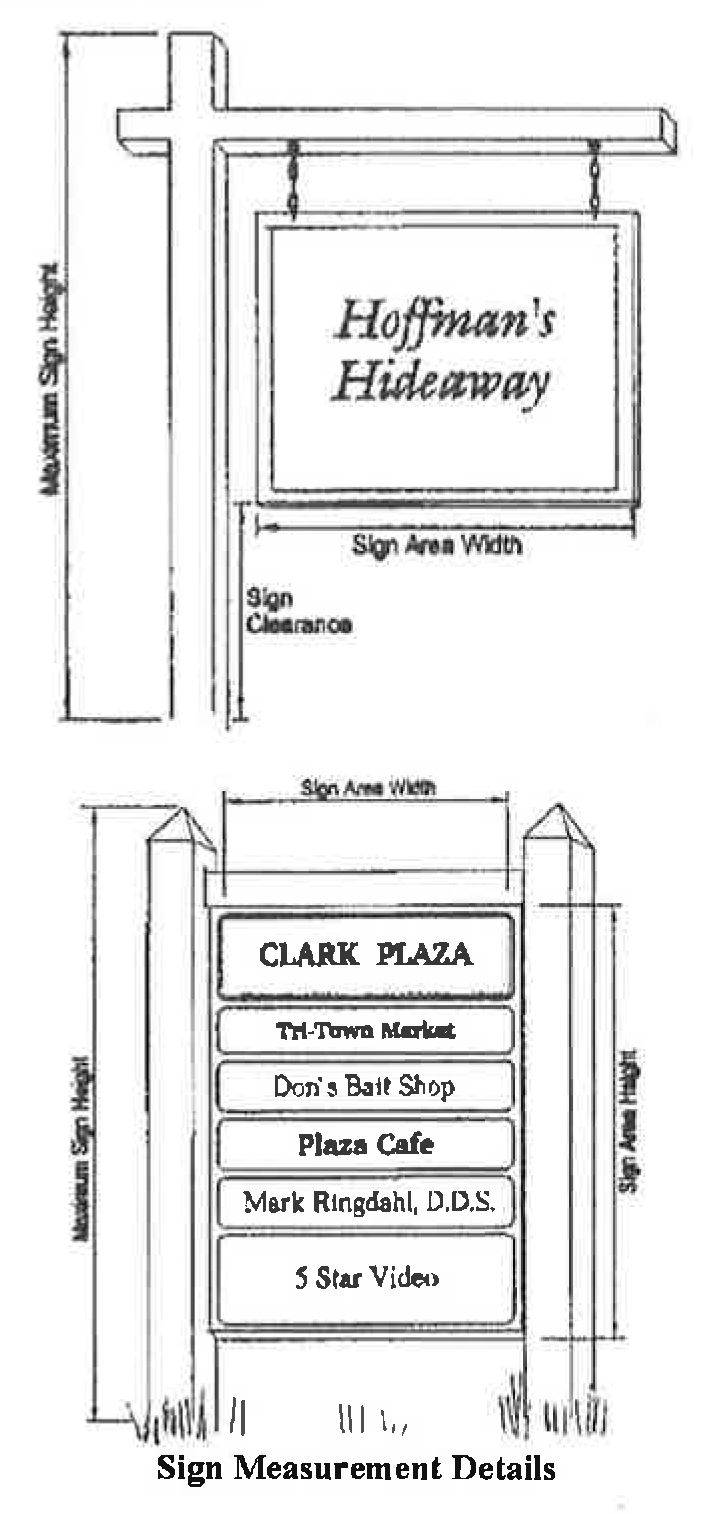
17.64.190.07 - Sign measurement.
A.
All Signs Counted. The aggregate area allowed for signs shall include all signs displayed on the site.
B.
Sign Surface Area. Sign area shall be the area within the outer boundaries of standard geometrical shapes which encompasses the sign facing, including copy, insignia, background and borders.
C.
Sign Support. Supporting framework or bracing that is clearly incidental to the display itself shall not be computed as sign area.
D.
Cut-Out Letter Signs. The area of cut-out letter signs shall be considered to be that of a single rectangle or square encompassing all of the letters used to convey the message of the sign and shall include the open space between letters of words within that rectangle or square. The height of letters will be measured on the uppercase letters.
E.
Multi-Face Signs. The sign area for a sign with more than one (1) face shall be computed by adding together the area of all sign faces visible from a single point, unless otherwise specified in this chapter. When two (2) sign faces are placed back to back and are at no point more than two (2) feet from each other, the area of the sign shall be counted as the area of a single face.
F.
Sign Height. The height of a sign shall be measured from the highest point of a sign to the ground surface beneath it. When berms are used in conjunction with signage, the height of the sign shall be measured from the mean elevation of the fronting street.
(Ord. No. 09-08-2020, § 1(Exh. A), 9-8-2020)
17.64.190.08 - Sign location and appearance standards.
A.
Creative Design. Creative designs are encouraged. Signs shall make a positive contribution to the general appearance of the street and commercial area in which they are located. A well-designed sign can be a major asset to a building. The City encourages imaginative and innovative sign design. The creative sign application procedure (Section 17.64.190.09 [sic] below) is specifically designed for artistic and unusual signs that might not fit the standard sign regulations and categories.
B.
Externally Lit Signs. Illumination of signs shall be arranged in such a manner as to be reflected away from residential properties and the vision of motorists, bicyclists or pedestrians. Lighting shall be placed so as to light downward onto a sign and be fully shielded. Fixtures used to illuminate signs shall be aimed so as not to project their light beyond the sign.
C.
Internally Lit Signs. Illumination of signs shall be arranged in such a manner as to be reflected away from residential properties and the vision of motorists, bicyclists or pedestrians. To reduce glare and increase the ability to read signs at night, it is recommended that internally lit signs use white lettering against a dark background color.
D.
Location of Signs. The following setbacks for signs shall be met for street and driveway intersections: No sign shall be located within a "clear sight triangle" between the height of two (2) and ten (10) feet above the ground.
E.
Architectural Elements. Signs should not be placed so that they cover essential, character-defining architectural details of a building.
F.
Construction. All signs shall be made by a commercial sign manufacturer or be of similar professional quality. All signs shall be completed and erected in a professional manner and in accordance with this chapter.
G.
Right-of-Way. Any sign which projects over a right-of-way in such a manner that it may cause a danger to the public shall have supports, hangers or fasteners certified by a Colorado-licensed structural engineer.
(Ord. No. 09-08-2020, § 1(Exh. A), 9-8-2020)
17-64-190.09 - Creative signs.
A.
Policy and Purpose. It is the policy of the City to encourage the use of creative signs that exhibit a high degree of thoughtfulness, imagination and inventiveness. The purpose of the creative sign process is to establish standards and procedures for the design review and approval of creative signs which, due to their unique design and construction, will make a significant contribution to the aesthetic beauty, historic character and cultural identity of the community, yet due to their creative qualities or site constraints would not be otherwise allowed under this code.
B.
Applicability. An applicant may only request the approval of a sign permit under the creative sign section for a sign that employs design standards that differ from the provisions of Sections 16.10.50 [sic] and 16.10.60 [sic] above, and otherwise comply with all other provisions of the sign code.
C.
Approval Authority. A sign permit application for a creative sign shall be subject to approval by the Planning Commission.
D.
Procedure.
1.
Submittal of Application. The applicant shall submit a complete application including all of the materials required in Subsection 16.10.30(d) [sic] above.
2.
Staff Review. The Administrator shall review the application to determine whether it is complete. The Administrator shall forward a report to the Planning Commission, which summarizes the application's compliance with the review standards contained in subsection E. below and other applicable provisions of this chapter. The technical comments and professional recommendations of other agencies, organizations and consultants may be solicited in drafting the report.
3.
Public Notice. Public notice that the Planning Commission will conduct a public hearing to consider the application for a creative sign shall be provided as specified in Section 16.2.30 [sic] of this chapter.
4.
Public Action by Planning Commission. The Planning Commission shall conduct a public hearing to review the conformance of the application with all applicable provisions of this chapter. The Planning Commission shall approve, approve with conditions or deny the application, or remand it to the applicant with instructions for modification or additional information or action.
E.
Review Standards.
1.
Impact Review Standards. No sign shall be approved under the creative sign process that the Planning Commission finds:
a.
Will have a significant adverse impact on adjacent properties. The sign shall not adversely affect neighboring property owners, businesses or residents and should be compatible with the uses, character and identity of the area in which it is displayed;
b.
Creates a dangerous condition. Granting the creative sign permit will not adversely affect public safety. The use of signs or attention-attracting devices should not significantly distract traffic on adjacent streets; or
c.
Distracts from the important architectural, natural or historic features of the building or neighborhood in which the sign is displayed.
2.
Design Review Standards. In addition to the impact review standards, to approve a sign under the creative sign process, the Planning Commission must find that the unique and creative design of the sign will meet Standards a., b. and c. or Standard d.:
a.
Constitute a substantial aesthetic improvement to the site and have a positive visual impact on the surrounding area that justifies departure from the parameters of Section 16.10.50 [sic] and/or 16.10.60 [sic] above.
b.
Utilize and/or enhance the architectural or historic elements of the building or location where it is displayed in an historic, unique and/or creative manner that justifies departure from the parameters of Section 16.10.50 [sic] and/or 16.10.60 [sic] above.
c.
Provide strong artistic character through the imaginative use of design, graphics, color, texture, quality of materials, scale and proportion uses, character and identity of the area in which it is displayed.
d.
A creative sign may be appropriate to provide reasonable visibility of a business's main sign in some rare situations where topography, landscaping, existing buildings or unusual building design may substantially block visibility of the applicant's existing or proposed signs from multiple directions. Despite the possibility of a creative sign permit, visibility of a sign or attention-attracting device may not be possible.
(Ord. No. 09-08-2020, § 1(Exh. A), 9-8-2020)
17.64.190.10 - Comprehensive sign plan.
Every multi-tenant building or coordinated development, such as office parks, recreational vehicle park, civic uses, shopping centers and business parks, shall have a comprehensive sign plan approved. Any multiple-tenant nonresidential buildings or development existing at the time of adoption of this code that do not have a comprehensive sign plan shall be required to create a comprehensive sign plan at the time of application for a new sign at the site. Where a comprehensive sign plan is required for an existing development with multiple owners, all such owners shall be given notice and have the opportunity to participate in development of the comprehensive sign plan or provide written approval of said plan. In the event any affected owner fails to participate in the development of the comprehensive sign plan or provide written approval therefor within fifteen (15) days of notice, that owner will be deemed to have consented to the plan's adoption. Planned developments shall include a comprehensive sign plan at the final development plan stage. Applications for final subdivision plat shall include a comprehensive sign plan application.
(1)
Purpose. The general purpose of the comprehensive sign plan is to ensure proper business identification while enhancing the quality, harmony and consistency of a project by aesthetically integrating signage into the architecture of each building as well as the development as a whole. The sign scheme must comply with the basic requirements for signs established for the project's uses by this chapter. The comprehensive sign plan shall address the following topics and demonstrate the following characteristics:
a.
Identification Signs. Designation of the size and location of identification signage proposed for individual tenants. Specifications should anticipate minimum and maximum height. Sign locations should anticipate impact of pad buildings and landscaping, as well as the provision of adequate spacing between façade signs for effective readability.
b.
Permitted Area, Height, Illumination and Number of Signs. The permitted amount of sign area, height, illumination and similar restrictions should follow the total area permitted in Tables 16-K [sic] and 16-L [sic] of this chapter for each site within the development. In planned developments, the permitted area, height and illumination should be proposed in relation to the types of uses in each portion of the development. The applicant shall designate how much sign area of the total permitted signage should be apportioned to each tenant space for both individual identification signs and common freestanding signs.
c.
Appearance. Signs shall be durable, attractive and designed to complement and reinforce the design of the project buildings.
d.
Consistency. Sign design within a development should be generally consistent between tenants and buildings so that the design continuity of the project is maintained. However, it is not necessary for every sign within a particular development to be identical.
e.
Exempt Signs. Signs not requiring a permit under this chapter shall still be permitted in a development with a comprehensive sign plan unless stated otherwise in the comprehensive sign plan.
(2)
Approval of Comprehensive Sign Plans. Proposed comprehensive sign plans shall be submitted on the forms or in the format prescribed by the Administrator.
a.
Submittal of Application. The applicant shall submit a complete application to the Administrator meeting the requirements of Subsection 16.10.30(d) [sic] for each project requiring comprehensive sign plan approval at the time of final development plan application, final plat application or prior to issuance of any certificate of occupancy if no final development plan or plat was required.
b.
Compliance with Standards. If the application is complete, the Administrator shall determine whether the application complies with the standards of this chapter. The Administrator shall be authorized to issue the permit, issue the permit with conditions or deny the permit application.
c.
Review. Review of the application shall be completed and notice sent to the applicant concurrent with the approval of a final development plan or building permit application.
(3)
Comprehensive Sign Plan Modifications. Minor modifications to a sign scheme that are still within the overall concept and intent of the approved plan may be approved by the Administrator. Major modifications or a new comprehensive sign plan will require a new application, including a plan to bring any existing signs in the development into conformance with the new plan.
(4)
Permits Required for Individual Signs Within the Comprehensive Sign Plan. In multiple-tenant commercial buildings or developments with an approved comprehensive sign plan, a separate permit shall be required for each business entity's signs.
(Ord. No. 09-08-2020, § 1(Exh. A), 9-8-2020)
17.64.190.11 - Nonconforming signs.
A.
Authority to Continue. Any sign legally established on the effective date of this sign code or any amendment thereto which does not conform with any provisions of the land use code shall be allowed to remain and to be maintained in good repair, subject to the discontinuance provisions below.
B.
Discontinuance. A legal nonconforming sign shall be removed if any one (1) of the following conditions occurs. In all such cases of discontinuance, if a replacement sign is proposed it shall be constructed in accordance with the provisions of this land use code.
1.
If a change of use occurs, regardless of ownership, such that the new use would be a different classification under Table 16D [sic];
2.
The principal use with which the sign is associated terminates for ninety (90) days or longer;
3.
The principal building with which the sign is associated is demolished or destroyed;
4.
The nonconforming sign is destroyed or damaged as a result of either an intentional act of the owner (other than for maintenance which shall not exceed two (2) weeks), an unintentional act of another or an act of nature, the replacement sign shall be constructed in conformance with the provisions of this land use code if the estimated cost of restoration to its condition before the occurrence exceeds fifty (50) percent of the value of the sign structure prior to being damaged;
5.
The building official determines that the sign is an immediate hazard to the public health, safety and welfare because of disrepair, unsafe mounting, imminent dislodging or other safety factors.
(Ord. No. 09-08-2020, § 1(Exh. A), 9-8-2020)
17.64.190.12 - Historic nonconforming signs.
Any historic sign thirty (30) years or older that does not meet the dimensional characteristic of this code and is located on any listed or eligible for the national, state or local historic register, building in the City of Florence may continue use or be repaired or be returned to use (with pictorial evidence) with a certificate of appropriateness (COA) by the Florence Historic Preservation Commission or City Council.
(Ord. No. 09-08-2020, § 1(Exh. A), 9-8-2020)

