
French Island Village
City Zoning Code
City Zoning Code
ARTICLE V
- HIGHWAY SETBACKS
Sec. 40-143. - Structures prohibited within setback lines.
No new building, new sign or other new structure or part thereof shall be placed between the setback lines established by this article and the highway except as provided by this article, and no building, sign or structure or part thereof existing within such setback lines on September 20, 1979, shall be altered, enlarged or added to in any way that increases or prolongs the permanency thereof, or be reconstructed in its original existing location after having been destroyed by fire, storm or other catastrophe to the extent of 60 percent or more of its last assessed value.
Sec. 40-144. - Structures permitted within the front lot line setback.
The following kinds of structures may be placed between the setback lines and the street or highway right-of-way line:
(1)
Open fences not to exceed four feet above the ground surface.
(2)
Telephone, telegraph and power transmission poles.
(3)
Underground structures not capable of being used as foundations for future prohibited overground structures.
(4)
Access or service highways constructed according to plans as approved by the town board and/or the county highway committee as may be applicable. In giving such approval, the town board and the county highway committee shall give due consideration to highway safety and maximum sight distances.
(5)
This section shall not be interpreted so as to prohibit the planting and harvesting of shrubbery or trees; provided, however, that no building or structure, trees or shrubbery shall be so located, maintained or permitted to grow so that the view across the required vision clearance triangle shall not be obstructed.
(6)
Flag poles.
(7)
Temporary property sale signs as provided for in chapter 26.
Sec. 40-145. - Setback distances.
(a)
Setback lines established. In order to promote the public safety, general welfare and convenience, it is necessary that highway setback lines be established in the county outside the limits of incorporated cities and villages.
(1)
Setback lines are hereby established along all public highways, at the intersections of highways with highways and highways with railways as hereafter provided.
(2)
Where a highway is located on a city or village boundary, this section is not intended to be effective on the side within the city or village.
(3)
Where a highway is located along the boundary with another county, this section is not intended to be effective on the side within the adjacent county.
(b)
Classes of highways.
(1)
Class 1 highway. Improved or unimproved town roads or other public roads not identified as a Class 2 or 3 highway.
(2)
Class 2 highway. Improved or unimproved county roads.
(3)
Class 3 highway. Improved or unimproved state or federal roads.
(c)
Delineation and enforcement of setback distances.
(1)
Whenever a highway is improved to a classification requiring a greater setback distance than what is required by this section prior to such improvement, the setback distance of the latter classification shall be applicable.
(2)
Recorded subdivision plats or right-of-way plans may require a different setback than what is listed in this section. The setback lines established by such plat or plan will be enforced even if such setback is less restrictive than this section.
(3)
In cases where the provisions of this section may be interpreted to provide for different setback distances, the greater setback distance shall be enforced.
(4)
The setback distances for the respective highway classes shall be as follows:
a.
Class 1 highway: Not less than 25 feet from the highway right-of-way line.
b.
Class 2 and 3 highway: 80 feet from the centerline but not less than 50 feet from the highway right-of-way line.
c.
Other: For a parcel which does not abut a Class 1, 2, or 3 highway, a 25-foot front yard setback shall apply.
(d)
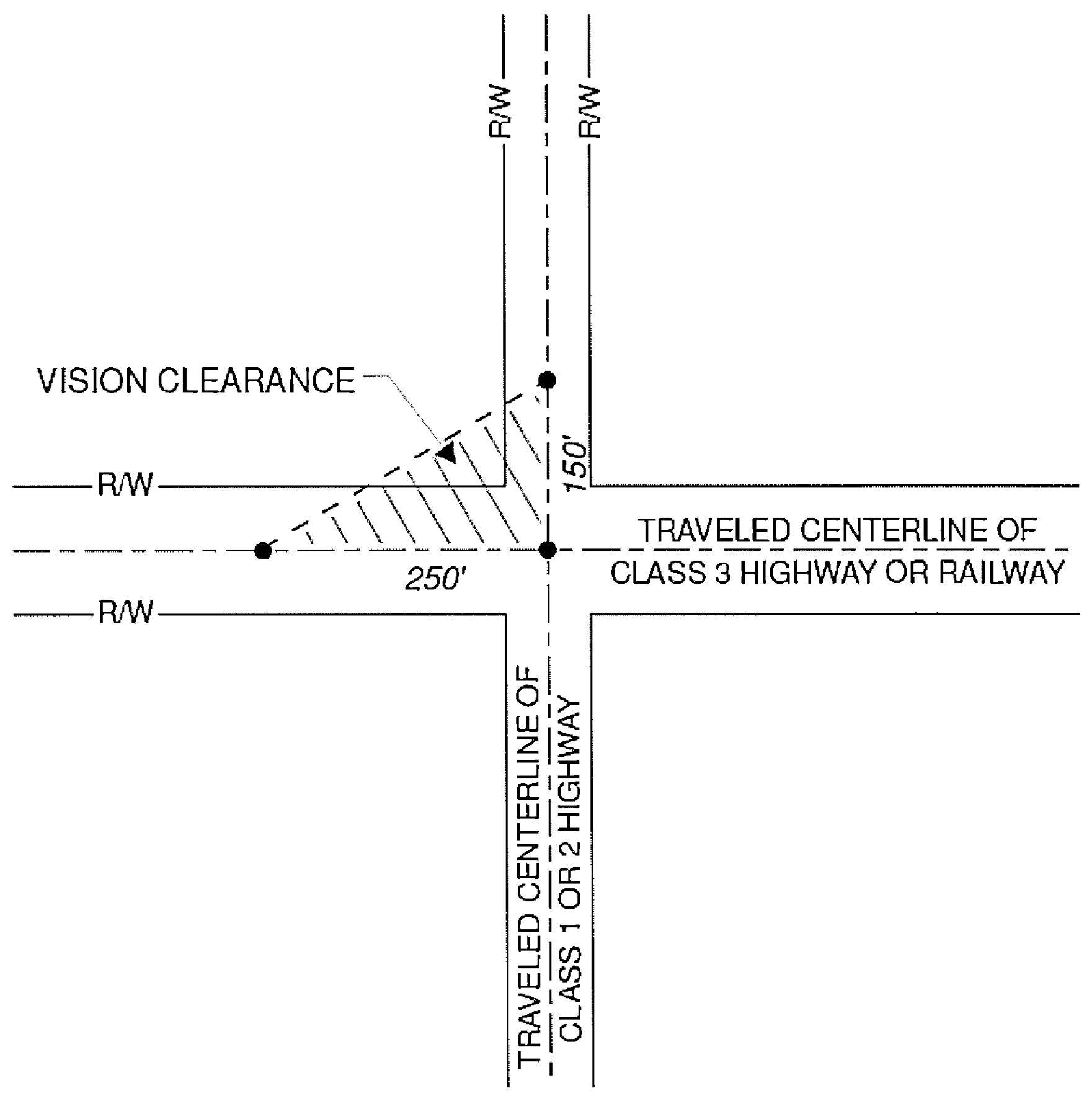
Vision clearance. There shall be an area of vision clearance at all highway and railway intersections. The vision clearance shall be an area calculated by connecting the endpoints of line segments which begin at the vertex of an intersection thence along the traveled centerlines away from the vertex for a measured distance of:
(1)
150 feet along the traveled centerline of a Class 1 and 2 highway.
(2)
250 feet along the traveled centerline of a Class 3 highway and the centerline of a railway.
(3)
Typical vision clearance diagram:
(Code 1988, § 17.63; Ord. of 1-27-2013; Ord. No. 2020-4, 9-8-2020)

