
Gainesville City Zoning Code
ARTICLE III
- USE OF LAND OR PREMISES
Sec. 3.1. - General provisions.
Land or premises in each of the following classified districts in the City of Gainesville shall be used for the following purposes only. Any other use of such land or premises shall be unlawful and in violation of this Ordinance.
3.1.01 [Additional Land Use Requirements.]
Unless specifically stated all land uses shall also meet the following additional provisions of this Ordinance:
A.
Section 3.4 Accessory Uses and Structures.
B.
Section 3.5 Screening Walls and Fences.
C.
Section 3.6 Landscaping and Tree Preservation.
D.
Section 3.7 Parking and Loading Requirements.
E.
Section 3.8 Outdoor Lighting.
F.
Section 3.9 Supplemental Provisions.
3.1.02 [Lot Visibility.]
A.
Corner Lot Visibility. On a corner lot in any district, nothing shall be erected, placed, planted, or allowed to grow in such a manner as to materially impede vision between a height of two and one half (2½) feet and ten (10) feet above the centerline grades of the intersecting streets in the area bounded by the street lines of such corner lots and a line joining points along said street lines fifteen (15) feet from the point of the intersection.
B.
Interior Lot Visibility. On an interior lot in any district, nothing shall be erected, placed, planted, or allowed to grow in such a manner as to materially impede the vision or in any way create a traffic hazard to motorists entering or exiting any public highway, street, alley, or private street or driveway from or to adjacent private property.
C.
There shall be no allowable existing nonconforming relief related to lot visibility, except for those involving the principal structure.
3.1.03 [A Agriculture District Defined.]
A.
Purpose. The A Agriculture District is established to maintain an area of agriculture or rural use within the City of Gainesville. The application of this district will ensure that the ranching, farming, forest, environmental, and scenic values of these areas are protected from incompatible development that may result in the degradation of their values.
B.
Land Use. Any agricultural use, including, but not limited to:
(1)
Single-Family Dwellings.
(2)
Barns.
(3)
Maintenance/Storage Buildings for personal use only.
(4)
Churches.
(5)
Public Schools.
(6)
Dwellings necessary for maintenance of the principal use.
(7)
Municipal Buildings.
(8)
Public Utilities.
(9)
Public Parks.
C.
Bulk Regulations. The minimum area, setbacks, density and maximum height shall be as prescribed in Table 3.1.03.B1:
TABLE 3.1.03.B1
AGRICULTURAL DISTRICT (A) BULK REGULATIONS
(in feet, unless noted otherwise)

3.1.04 [SF-1 Single-Family One District Defined.]
A.
Purpose. The SF-1 Single-Family One Residential District is established to provide for areas requiring minimum lot sizes of five thousand (5,000) square feet for medium population densities within neighborhoods. This district is intended to allow zero lot line dwellings, and shall allow for a maximum unit density of eight (8) units per acre.
B.
Land Use.
(1)
Single-family dwellings.
(2)
Patio Home Subdivisions.
(3)
Town Homes.
(4)
Churches.
(5)
Public Schools.
(6)
Municipal Buildings.
(7)
Public Utilities.
(8)
Public Parks.
C.
Site Plan Required. A site plan must be approved by the City Manager or his/her designee in accordance with Section 3.11.02 [Site Plans].
D.
Bulk Regulations. The minimum area, setbacks, density and maximum height shall be as prescribed in Table 3.1.04.B1.
E.
Setbacks Explained.
(1)
The dwelling unit in an SF-1 Zoning District may be placed on one interior side property line.
(2)
The minimum setback of a remaining interior yard shall be a minimum of ten (10) feet from the other property line, excluding the connecting element such as fences, walls and trellises.
(3)
The minimum setback of a remaining street yard shall be a minimum of twenty-five (25) feet from the other property line, excluding the connecting element such as fences, walls and trellises.
F.
Only patios, garden features, and other similar elements shall be permitted within the ten (10) or twenty-five-foot setback, subject to an easement requirement set forth herein.
G.
Each Dwelling Unit in an SF-1 Zoning District shall be located on its own individual platted lot with any zero lot line and all easements clearly and accurately identified.
H.
In SF-1 Zoning Districts there shall be provided a perpetual maintenance, eave overhang, and drainage easement of at least five (5) feet wide meeting the following criteria:
(1)
Easement must be adjacent to the zero lot line property line that, with the exception of walls and/or fences, must be kept clear of obstructions.
(2)
Easement shall be clearly and accurately shown on the plat and incorporated into each deed transferring title to the property.
(3)
All walls that are located on the property line shall be maintained in its original color and/or treatment unless otherwise agreed to in writing by the two affected lot owners.
(4)
Eaves, but no other part of the structure, may protrude across a side lot line, and such protrusion shall not exceed eighteen inches (18"). Water runoff from the dwelling placed on the lot is limited to the easement area.
I.
Opening prohibited on the Zero Lot Line Side. Except when such a wall abuts a permanent open space or public right-of-way, and in order to maintain privacy, there shall be no;
(1)
Doors;
(2)
Windows;
(3)
Air conditioning units; or
(4)
Other openings.
J.
Atriums shall be permitted along the zero lot lines under the following conditions;
(1)
Any atrium must be enclosed by at least three walls of the dwelling unit.
(2)
A solid wall of at least eight (8) feet in height is constructed along the zero lot line.
(3)
Such solid wall is constructed of the same material as the exterior wall of the unit.
K.
Accessory buildings in the SF-1 Zoning District shall meet the following requirements:
(1)
They shall not exceed eighty (80) square feet of floor area.
(2)
They shall not exceed eight (8) feet in height.
(3)
They shall observe the same setback requirements of the main structure.
(4)
Maximum limit of one accessory building per lot.
TABLE 3.1.04.B1
SINGLE-FAMILY ONE DISTRICT (SF-1) BULK REGULATIONS
(in feet, unless noted otherwise)

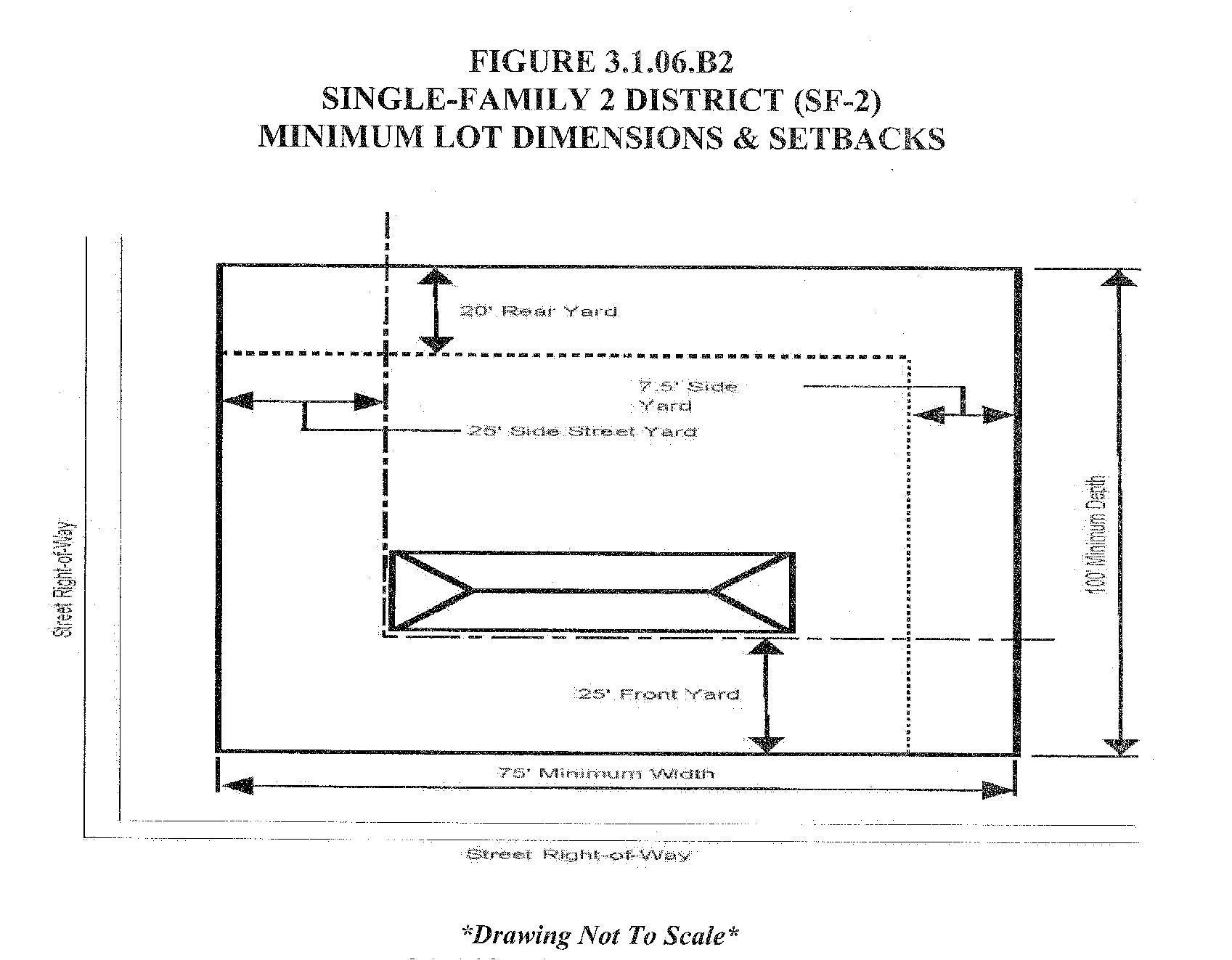
3.1.05 [SF-2 Single-Family Two District Defined.]
A.
Purpose. The SF-2 Single-Family Two Residential District is established to provide for areas requiring minimum lot sizes of seven thousand five hundred (7,500) square feet for low population densities within neighborhoods, to preserve and protect existing neighborhoods and ensure that any new development is compatible with existing land uses, patterns, and design standards.
B.
Land Use. All uses permitted in the SF-1 single-family district with the exception of patio or zero lot line homes.
C.
Bulk Regulations. The minimum area, setbacks, density and maximum height shall be as prescribed in Table 3.1.05.B1.
TABLE 3.1.05.B1
SINGLE-FAMILY TWO DISTRICT (SF-2) BULK REGULATIONS
(in feet, unless noted otherwise)
3.1.06 [MF-1 Moderate Density Multifamily Residential District Defined.]
A.
Purpose. The MF-1 Moderate Density Multifamily Residential Density District is established to accommodate and encourage multifamily residential development, which is compatible with surrounding developments. This district may be used as a buffer between high density multifamily, commercial or industrial areas and other residential developments. MF-1 development shall be located upon principle collector streets and accessible community facilities appropriate for such development.
B.
Land Use.
(1)
Two-family dwelling.
(2)
Four-family dwelling.
(3)
Public Schools.
(4)
Municipal Buildings.
(5)
Public Utilities.
(6)
Public Parks.
C.
Bulk Regulations. The minimum area, setbacks, density and maximum height shall be as prescribed in Table 3.1.06.B1.
TABLE 3.1.06.B1
MODERATE DENSITY MULTFAMILY RESIDENTIAL DISTRICT (MF-1)
BULK REGULATIONS FOR TWO AND FOUR FAMILY STRUCTURES
(in feet, unless noted otherwise)
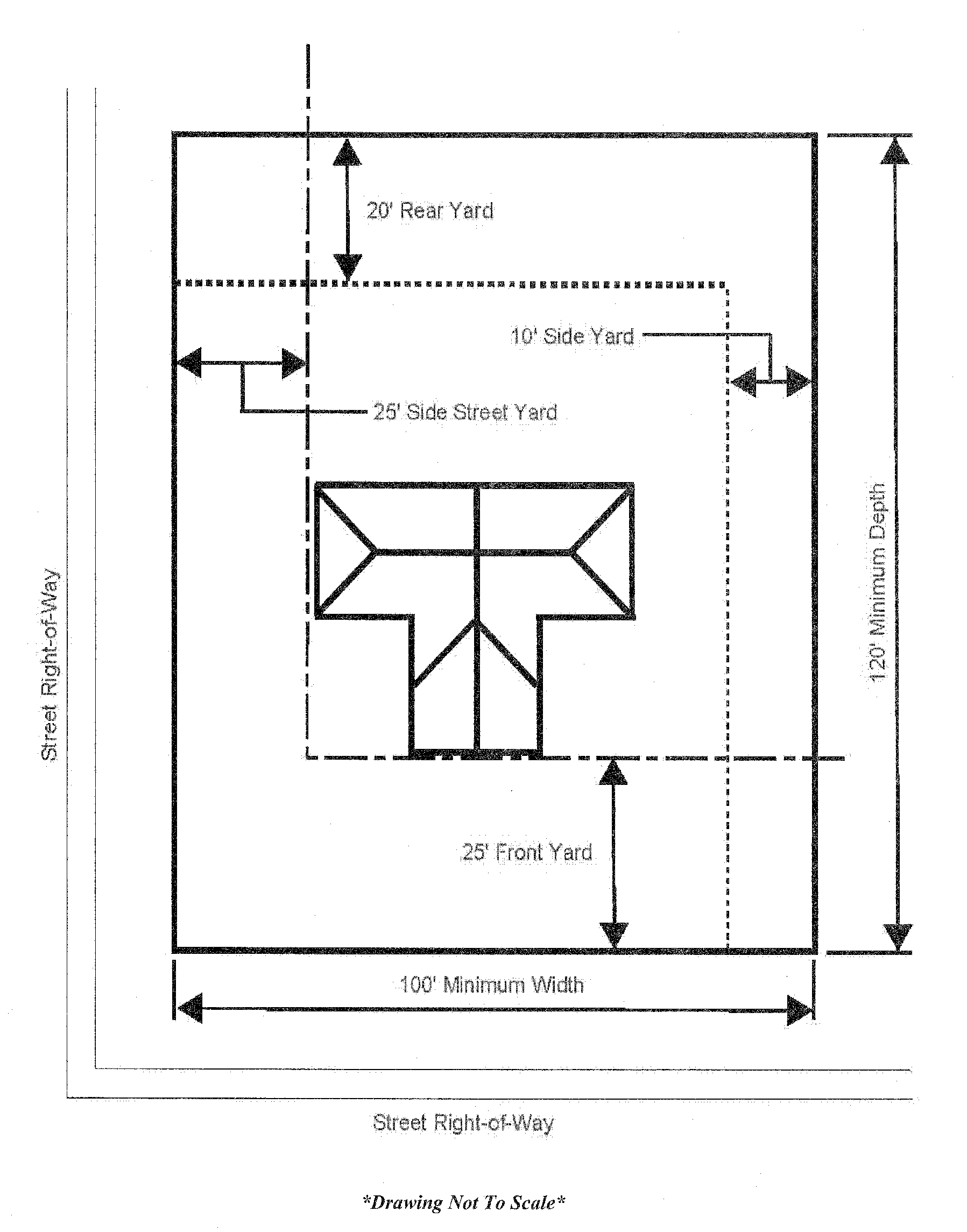
FIGURE 3.1.06.B2
MODERATE DENSITY MULTIFAMILY RESIDENTIAL DISTRICT (MF-1)
MINIMUM LOT DIMENSIONS AND SETBACKS
3.1.07 [MF-2 High Density Multifamily Residential District Defined.]
A.
Purpose. The MF-2 High Density Multifamily Residential District is established to accommodate and encourage high density multifamily residential development which is compatible with surrounding residential development, in areas within the City which are generally suitable for such development, while maintaining both their value and aesthetic characteristics. MF-2 development shall be located upon, or have direct access to, principle arterial roadways and have adequate access to community facilities appropriate for such development.
B.
Land Use.
(1)
Apartment complexes of five (5) units or more.
(2)
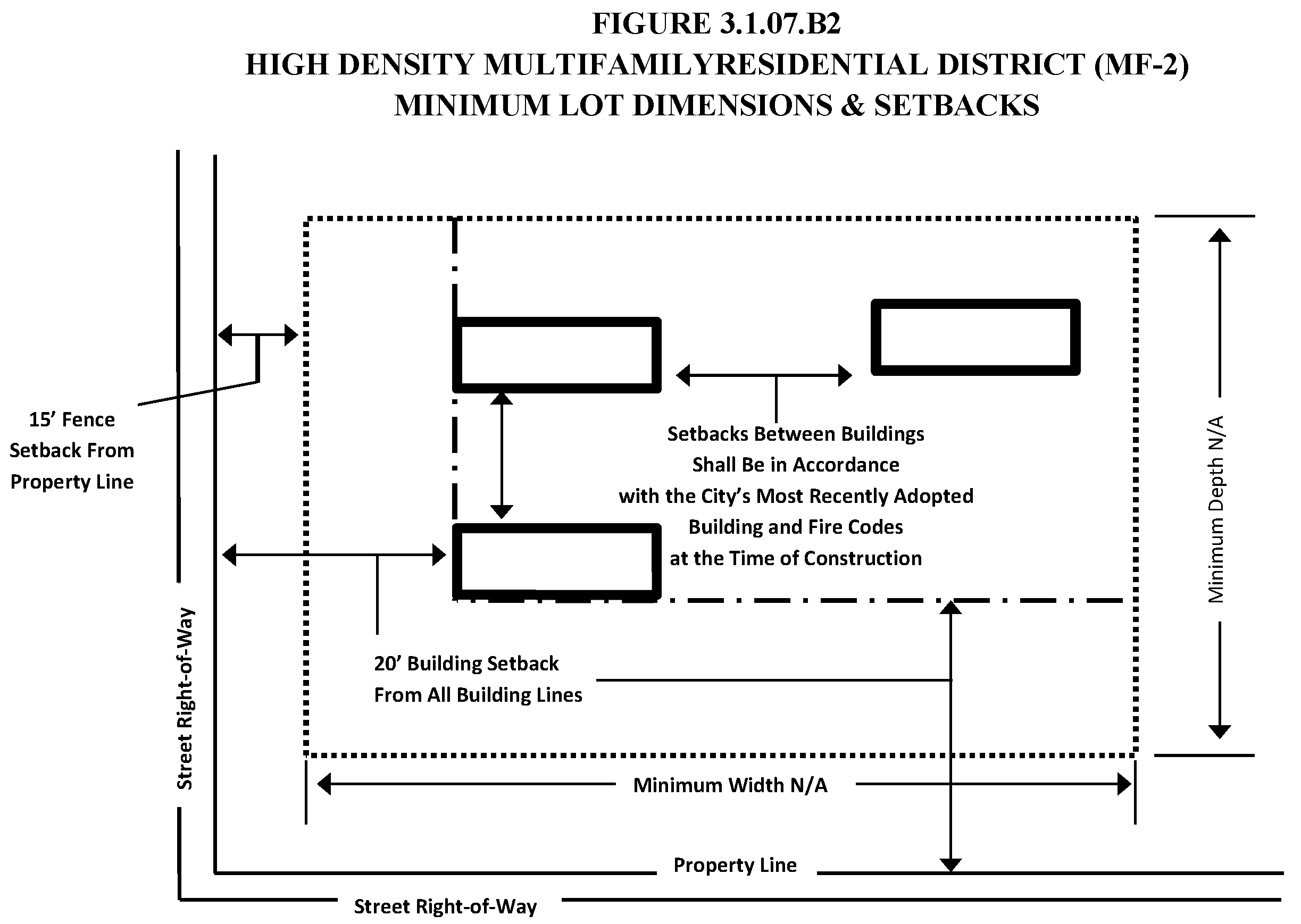
Bulk Regulations. The minimum area, setbacks, density and maximum height shall be as prescribed in Table 3.1.07.B1, except that setbacks between all buildings shall be in accordance with the City's most recently adopted Building and Fire Codes at the time of construction.
C.
Minimum Living Area. Measurements shall be factored using the Building Owners and Management Association (BOMA) methodology. The minimum net living area per unit shall be:
(1)
Six hundred twenty-five (625) square feet for a one-bedroom unit.
(2)
Nine hundred (900) square feet for a two-bedroom unit.
(3)
One thousand fifty (1,050) square feet for a three-bedroom unit.
(4)
An additional one hundred (100) square feet for each bedroom over three (3).
D.
Site Plan Required. A site plan must be approved by the City Manager or his/her designee in accordance with Section 3.11.02 [Site Plans].
E.
Refuse Facilities. There shall be available at all times a minimum of six (6) cubic yards of refuse container per fifty (50) multifamily dwelling units. For complexes with between forty-nine (49) and thirty (30) units, no less than six (6) cubic yards of refuse containers shall be provided. For complexes with less than thirty (30), no less than four (4) cubic yards of refuse containers shall be provided. Each refuse facility shall be gated and screened from view on all sides from persons standing at ground level on the site or immediately adjoining property, by an opaque fence or wall of wood or masonry not less than six (6) feet, nor more than eight (8) feet in height. Refuse containers shall be provided and maintained in a manner to satisfy City public health and sanitary regulations. Each refuse facility shall be located so as to provide safe and convenient pickup by refuse collection agencies, and be in compliance with all other City ordinances related to solid waste disposal and collection.
F.
Fences Required. All MF-2 developments, excluding nursing homes and assisted living facilities shall be enclosed by a fence. The following provisions apply:
(1)
Buildings may be incorporated as part of the fencing structure to maintain limited access to the property. The leasing office is the only building that is not required to be enclosed or incorporated as part of the fencing structure.
(2)
Fences located adjacent to any street shall be at a minimum of fifteen (15) feet inside the property line.
(3)
All fences and screening shall comply with the regulations governing visibility at intersections and interior lots as prescribed in the Code of Ordinances.
G.
Gated Entrances. All multifamily development, excluding nursing homes and assisted living facilities, shall be gated with private drives. Landscaping and entrance features shall be provided in addition to security mechanisms that may, or may not include manned facilities. All gated entries shall have at minimum:
(1)
Knox Boxes, which contain a code or key for opening the gate, at each point of entry into the development;
(2)
Adequate width and height clearance for all emergency apparatus; and
(3)
Gates shall be at a minimum of twenty (20) feet inside any property line that is adjacent to any street.
H.
Accessory Structures. All accessory structures, except carports and awnings, shall match the principal structure in architectural style and materials.
I.
Parking. In fulfillment of parking requirements outlined in section 3.7, twenty percent (20%) of the units shall be provided with covered parking spaces.
TABLE 3.1.07.B1
HIGH DENSITY MULTIFAMILY RESIDENTIAL DISTRICT (MF-2)
ZONE BULK REGULATIONS
(in feet, unless noted otherwise)
3.1.08 [MH Manufactured Home Residential District Defined.]
A.
The MH manufactured Home Residential District is established to provide minimum standards and requirements for manufactured home subdivisions within the City. This district is not intended to provide for temporary or long-term storage areas for mobile, manufactured or factory built homes.
B.
Land Use.
(1)
HUD-Code manufactured home subdivisions.
(2)
Churches.
(3)
Public Schools.
(4)
Municipal Buildings.
(5)
Public Utilities.
(6)
Public Parks.
C.
Bulk Regulations. The minimum area, setbacks, density and maximum height shall be as prescribed in Table 3.1.08.B1.
D.
Land within the "MH" district will be developed as a Manufactured Home subdivision. Lots within the "MH" districts will be sold to private individuals in strict conformance with the terms and conditions under which the subdivision was approved by the City Council.
E.
All roadways within a manufactured home subdivision shall be dedicated to the public.
F.
All private interior drives must be approved by the City Manager or his/her designee.
G.
Land zoned "MH" which is not developed as manufactured home subdivision may be developed in accordance with SF-2 Zoning Regulations.
H.
In the "MH" district, no building or land shall be used and no building constructed, reconstructed, altered, or enlarged, unless otherwise provided in this Ordinance.
I.
Additional Mobile Home Definitions.
(1)
HUD-Code Manufactured Home. A structure constructed on or after June 15, 1976, according to the rules of the United States Department of Housing and Urban Development, transportable in one or more sections, which in the traveling mode is eight (8) body feet or more in width, or forty (40) body feet in length excluding tongue, or when erected on-site is three hundred and twenty (320) or more square feet, and which is built on a permanent foundation when connected to the required utilities and includes the plumbing, heating, air conditioning and electrical systems.
(2)
Mobile Home. A structure constructed before June 15, 1976, transportable in one or more sections, which in the traveling mode is eight (8) body feet or more in width or forty (40) body feet in length excluding tongue, or when erected on site is three hundred twenty (320) or more square feet, and which is built on a permanent chassis and designed to be used as a dwelling, with or without a permanent foundation, when connected to the required utilities and includes the plumbing, heating, air conditioning and electrical systems.
(3)
Recreational Vehicle (RV). A vehicle which is built on a single chassis, four hundred (400) square feet or less when measured at the largest horizontal projections, self-propelled or permanently towable by a light-duty truck, and designed primarily not for use as a permanent dwelling but as temporary living quarters for recreational, camping, travel, or seasonal use. This term shall also include travel trailer, camping trailer, pickup camper or coach and motor home.
(4)
Skirting or Underpinning. Shall be opaque material consisting of weather-resistant material commonly sold for this application. There shall not be allowed any use of corrugated material such as tin or fiberglass panels. This skirting shall completely secure the underside of the structure and shall not be used for the containment of animals.
(5)
Space. A plot of ground within a Manufactured Housing park designed for the accommodation of one mobile home or HUD-code manufactured home unit. This term shall also include the terms "lot", "stands" and "stall".
J.
Any Property developed within the "MH" district manufactured housing subdivision shall meet the following requirements:
(1)
HUD-Code Manufactured Homes shall have the axles, wheels, and tow bar or tongue removed and shall be secured to a permanent foundation, all in accordance with manufacturer's specifications and applicable state and federal standards.
(2)
HUD-Code Manufactured Homes must have a minimum of an eighteen-inch crawl space under all homes.
(3)
A concrete surface with good drainage shall cover the area where a home is to be sited.
(4)
Each HUD-Code Manufactured Home site shall have a slab or patio not less than twenty feet in length and nine feet in width, comprised of concrete, flagstone, or similar substance installed adjacent to each site.
(5)
HUD-Code Manufactured Homes shall have steps with a permanent foundation installed at all exits.
(6)
Skirting shall be securely attached between the HUD-Code Manufactured home and the ground on all sides within thirty (30) days of home installation. Skirting materials shall consist of materials that are compatible with the design of the home and enhance its appearance. Unpainted or untreated corrugated metal or wood, screen or wire, fiberglass, or lattice-type skirting is prohibited. Additionally, no Certificate of Occupancy shall be issued until unit is completely skirted per these guidelines.
(7)
Construction, setting, and installation of the homes shall be in conformance with applicable federal, state, and local codes and standards, and each manufactured home shall have affixed a seal of the appropriate federal or state department.
(8)
Sanitation, fire protection, and underground utility services shall be provided to each lot in accordance with all City ordinances and regulations.
(9)
Driveways shall be constructed according to all adopted City regulations and codes pertaining to driveway construction and parking surfaces.
(10)
Drainage and garbage collection right-of-way, fire lanes, and utility easements shall be provided as required by the City.
(11)
Soil conditions, groundwater level, drainage, flooding, and topography shall not create hazards to the developed portion of the property or the health and safety of the residents.
(12)
HUD-Code Manufactured Home subdivisions shall be developed at densities comparable to adjacent residential uses or shall have adequate landscape buffering or open space to provide transition of uses.
(13)
Any structural alteration or modification of a HUD-Code manufactured home after it is placed on the site is prohibited.
(14)
Each space is required to have it's own water and sewer connection.
K.
Underground Utilities. All utility lateral and service lines located within the "MH" district shall be installed underground.
L.
Open Space Area Required. Open space designated for the use and enjoyment of all residents shall be provided within a HUD-Code Manufactured Home subdivision at the ratio of five hundred (500) square feet for each of the first twenty (20) units, and two hundred (200) square feet for each additional unit in excess of twenty (20). Designated open space shall be developed and maintained for recreational and leisure activities and shall be located within the subdivision being developed.
M.
Screening. A solid opaque screening wall or fence of not less than eight (8) feet in height, measured at the highest finished grade, shall be provided along all perimeter property lines of a HUD-Code Manufactured Home subdivision which do not abut a dedicated street. Said screening wall or fence shall be masonry and of a decorative construction. This requirement can be waived or modified if natural or manmade physical features create an adequate separation or buffer from adjacent uses, as determined by the City. However, any request to waive this requirement shall be presented as an element of the site plan and shall be subject to approval at that time only.
N.
Preservation of Site Assets. When developing a HUD-Code Manufactured Home Subdivision, the following steps shall be taken to preserve on-site assets:
(1)
Suitable available topsoil and desirable existing trees;
(2)
Shrubs and ground cover shall be preserved and protected where practicable;
(3)
Topsoil, which is suitable and needed for later use in finished grading, shall be stripped from areas to be occupied by structures, parking areas, streets and driveways, and from areas to be regraded or disturbed. This topsoil shall be collected and stored on the site in convenient places for future use and shall be free of debris during construction, and removed at the end of construction. No subdivision shall be accepted by the City prior to the removal of all excess topsoil from the premises.
O.
Drainage. Engineering plans for drainage shall be submitted for review by the City at the time of site plan approval. All applicable requirements of the City shall be met.
P.
HUD-Code Manufactured Home Sales. HUD-Code Manufactured Home subdivisions shall be for residential purposes only. Sales of these homes shall be limited to those which become available on the market on an individual basis. Commercial sales and promotion are not permitted.
TABLE 3.1.08.B1
MANUFACTURED HOME DISTRICT (MH) BULK REGULATIONS
(in feet, unless noted otherwise)
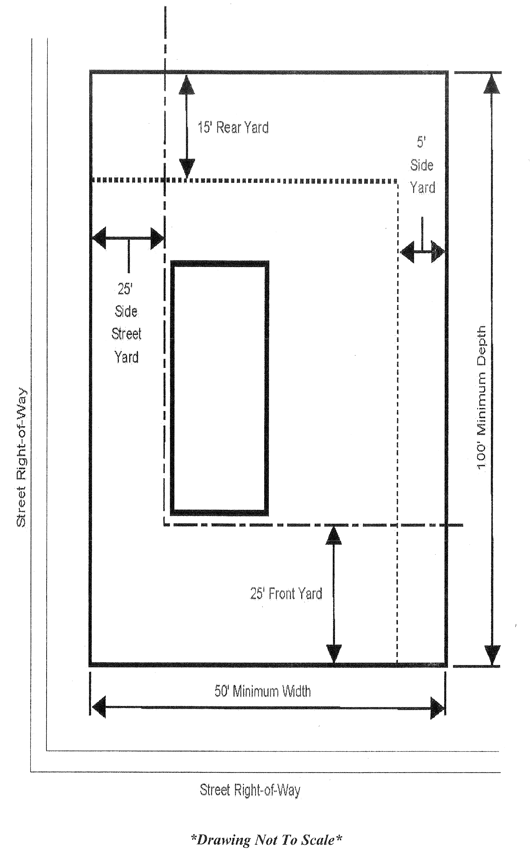
FIGURE 3.1.08.B2
MANUFACTURED HOME DISTRICT (MH)
MINIMUM LOT DIMENSIONS & SETBACKS
3.1.09 [CA Central Area District Defined.]
A.
Purpose. The CA Central Area District is established to encourage mixed-use development within the downtown district of the City, while maintaining the unique historic character currently found within the district. This district is a pedestrian-friendly district.
B.
Land Use.
(1)
Barber and beauty shops.
(2)
Business/Professional offices.
(3)
Churches.
(4)
Municipal Buildings.
(5)
Public/Private Schools.
(6)
Public Utilities.
(7)
Public Parks.
(8)
Restaurants and eateries.
(9)
Retail Shops/Boutiques.
(10)
Spas.
(11)
Single-family residential loft or studio apartment.
(12)
Snow Cone Stands may operate from April 1 st through September 30 th . A Snow Cone Stand is defined as a temporary facility that serves shaved or crushed ice with flavored syrup and other prepackaged foods and drinks. In no case, shall a snow cone stand serve cooked or heated food.
C.
Bulk Regulations. The minimum area, setbacks, density and maximum height shall be as prescribed in Table 3.1.09.B.1.
D.
Outdoor Activities or Uses. No commercial products may be displayed in the public rights-of-way on the sidewalk except under the following conditions:
(1)
A minimum of thirty-six (36) inches of clear space is provided for pedestrians.
(2)
Any outside display must be cleared from the public right-of-way each day after business hours.
(3)
Outdoor display can take place four (4) times per year, for a period of seven (7) or less consecutive calendar days, and allowing not less than sixty (60) calendar days between the block dates of said outdoor displays, unless display is associated with an approved public festival which will not count against block dates.
(4)
Displays in the right-of-way shall not be placed within the sight visibility triangle, nor shall they in any way obstruct or prohibit vehicular traffic.
E.
Outdoor Seating. Business establishments may provide outdoor seating in public right-of-way on the sidewalks adjacent to their property upon a site plan approved by City Council indicating all proposed outdoor seating areas in relationship to the primary building.
F.
Refuse Facilities. All refuse containers of four (4) cubic yards or larger shall be gated and screened from view on all sides from all public rights-of-way and persons standing at ground level on the site or immediately adjoining property, by an opaque fence or wall of wood or masonry not less than six (6) feet nor more than eight (8) feet in height. Additionally refuse containers and collection areas are to be maintained in a manner to satisfy city public health and sanitary regulations. Each refuse facility and/or container shall be located so as to provide safe and convenient pickup by refuse collection agencies, and be in compliance with all other city ordinances related to solid waste disposal and collection.
G.
Metal buildings are strictly prohibited.
H.
Eighty (80) percent of all sides, excluding all windows and doors, shall be covered in masonry.
I.
Conversion of Residential Structures. All residential structures located within the CA district may be converted to a commercial use in accordance with the following conditions, providing that any and all signage be either monument or nameplate style signs.
J.
Concurrent use of Commercial and Residential Structures. All commercial structures may contain residential uses concurrent with the commercial use, providing that all residential uses shall be located on or above the second floor, from ground level, of the commercial structure.
K.
Existing Residential Uses. All legal and valid residential uses existing on the effective date of this Ordinance within the Central Area District shall have legal conforming status. The owners of the property where such uses are located shall be permitted, if necessary or desired, to rebuild, expand, or remodel. All expansions or remodels shall comply with the provisions of this Ordinance.
L.
Existing Zero Lot Line Uses. All legal and valid zero lot line uses existing on the effective date of this Ordinance within the Central Area District shall have legal conforming status. The owners of the property where such uses are located shall be permitted, if necessary or desired, to rebuild, expand or remodel. All expansions or remodels shall comply with the provisions of this Ordinance.
M.
Cargo Containers. No cargo containers are allowed within the CA district.
TABLE 3.1.09.B.1
CENTRAL AREA DISTRICT (CA) BULK REGULATIONS
(in feet, unless noted otherwise)
*Existing zero lot line structures are addressed in Section 3.109.K
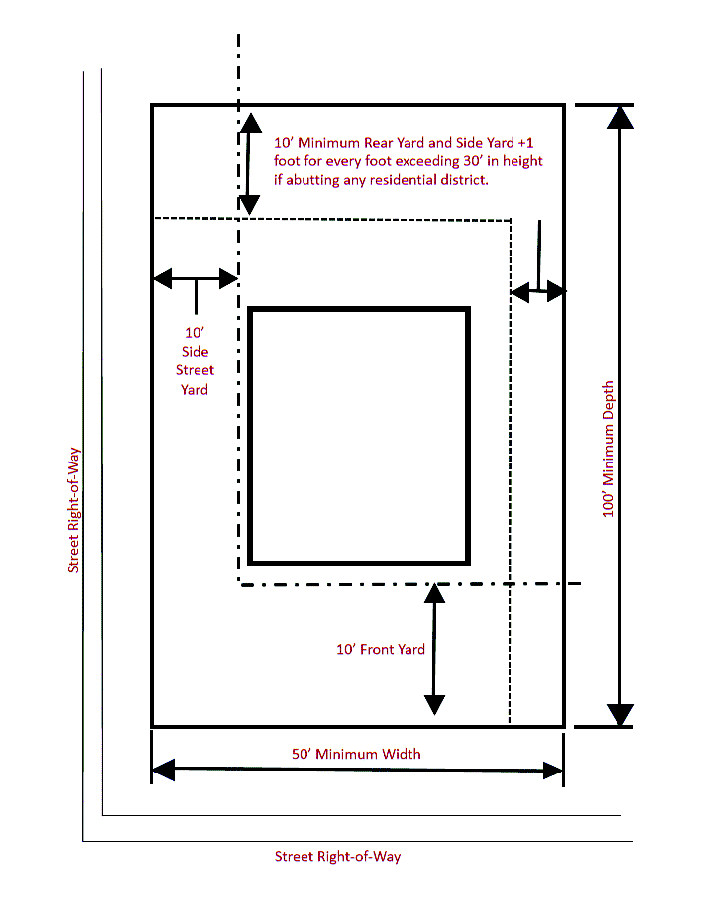
FIGURE 3.1.09.B.2
CENTRAL AREA DISTRICT (CA)
MINIMUM LOT DIMENSIONS & SETBACKS
3.1.10 [C1 Restricted Commercial District Defined.]
A.
Purpose. The C1 Restricted Commercial District is established to provide the necessary shopping, services, recreation, employment, and institutional facilities that are required and supported by the surrounding community, while maintaining the integrity of the district by restricting outdoor display and sales of merchandise.
B.
Land Use.
(1)
Animal Clinic, Small.
(2)
Barber and beauty shops.
(3)
Spas.
(4)
Business/Professional offices.
(5)
Churches.
(6)
Convalescent or rest homes.
(7)
Dressmaking, tailor shops, shoe repair shops and similar shops.
(9)
Fraternal uses.
(9)
Laundries.
(10)
Nurseries, retail only.
(11)
Restaurants and eateries.
(12)
Religious, educational and philanthropic institutions, but not animal care.
(13)
Retail sales, excluding automobiles, trucks, motorcycles, farm machinery and equipment, building materials and agricultural and farm supplies, and subject to the following conditions:
a.
That all uses or activities be conducted wholly within an enclosed building.
b.
That yards not be used for display, sale, or for storage of vehicles, equipment, containers or waste materials, with the exception of approved city dumpsters and receptacles.
c.
That such use not be objectionable because of odor, excessive light, vapor, dust, steam or other airborne material, pollutants, presence of vermin or rodents, or similar nuisances.
d.
Any and all businesses requiring a license issued by the Texas Commission on Environmental Quality (TCEQ) are strictly prohibited.
(14)
Studies [studios] of artist and photographers.
(15)
Telephone exchange.
(16)
Snow Cone Stands may operate from April 1 through September 30. A Snow Cone Stand is defined as a temporary facility that serves shaved or crushed ice with flavored syrup and other prepackaged foods and drinks. In no case, shall a snow cone stand serve cooked or heated food.
C.
Bulk Regulations. The minimum area, setbacks, density and maximum height shall be as prescribed in Table 3.1.10.B1.
D.
Outdoor Activities or Uses. No outdoor activity or uses shall be permitted within this zoning district except under the following conditions:
(1)
A minimum of thirty-six (36) inches of clear space is provided for pedestrians.
(2)
Any outside display must be cleared from the public right-of-way each day after business hours.
(3)
Outdoor display can take place four (4) times per year, for a period of seven (7) or less consecutive calendar days, and allowing not less than sixty (60) calendar days between the block dates of said outdoor displays, unless display is associated with an approved public festival which will not count against block dates.
(4)
Displays in the right-of-way shall not be placed within the sight visibility triangle, nor shall they in any way obstruct or prohibit vehicular traffic.
E.
No Structure or part of structure shall have in excess of twenty (20) percent of the floor area of the structure used for storage or warehousing; all articles, merchandise, or commodities stored upon a premises shall be sold at retail or fabricated upon the premises.
F.
Refuse Facilities. All refuse containers over four (4) cubic yards shall be gated and screened from view on all sides from all public rights-of-way and persons standing at ground level on the site or immediately adjoining property, by an opaque fence or wall of wood or masonry not less than six (6) feet, nor more than eight (8) feet in height. Additionally refuse containers and collection areas are to be maintained in a manner to satisfy city public health and sanitary regulations. Each refuse facility and/or container shall be located so as to provide safe and convenient pickup by refuse collection agencies, and be in compliance with all other City ordinances related to solid waste disposal and collection.
G.
Metal and steel buildings are prohibited.
H.
Eighty (80) percent of all sides, excluding all windows and doors, shall be covered in masonry.
I.
Existing Residential Uses. All legal and valid residential uses existing on the effective date of this Ordinance within the Restricted Commercial District shall have legal conforming status. The owners of the property where such uses are located shall be permitted, if necessary or desired, to rebuild, expand or remodel. All expansions or remodels shall comply with the provisions of this Ordinance.
J.
Existing Zero Lot Line Commercial Uses. All legal and valid zero lot line commercial uses existing on the effective date of this Ordinance within the Restricted Commercial District shall have legal conforming status. The owners of the property where such uses are located shall be permitted, if necessary or desired, to rebuild, expand, or remodel. All expansions or remodels shall comply with the provisions of this Ordinance.
K.
Cargo Containers. No cargo containers are allowed within the C1 district.
TABLE 3.1.10.B1
RESTRICTED COMMERCIAL DISTRICT (C1)
BULK REGULATIONS
(in feet, unless noted otherwise)
* Existing zero lot line structures are addressed in Section 3.110.P
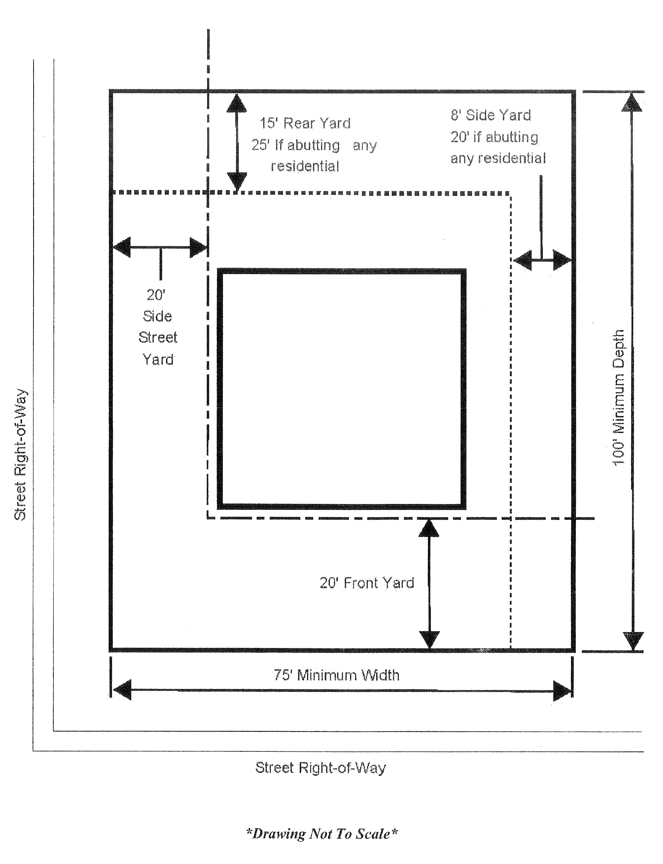
FIGURE 3.1.10.B2
RESTRICTED COMMERCIAL DISTRICT (C1)
DIMENSIONS & SETBACKS
3.1.11 [C2 General Commercial District Defined.]
A.
Purpose. The C2 General Commercial District is established to provide the necessary shopping, services, recreation, employment, and institutional facilities that are required and supported by the surrounding community, and allowing for moderate outdoor display and sales of merchandise.
B.
Land Use.
(1)
Any use permitted in the C1 District.
(2)
Assisted Living Facilities/Convalescent Homes.
(3)
Auction rooms.
(4)
Auto body operations.
(5)
Automobile accessory stores.
(6)
Automobile service facilities.
(7)
Automobile washes.
(8)
Automobile rental services.
(9)
Bus terminals.
(10)
Catering establishments.
(11)
Cleaning and dyeing facilities.
(12)
Commercial recreation uses.
(13)
Department stores.
(14)
Drive-in eating establishments.
(15)
Employment agencies.
(16)
Existing residential dwelling units and lodging uses as such on the effective date of this Ordinance.
(17)
Exterminating shops.
(18)
Floor covering sales and installation.
(19)
Furniture shops.
(20)
Health club.
(21)
Home improvement stores.
(22)
Hospitals other than veterinary.
(23)
Hotels/Motels.
(24)
Household appliance shop.
(25)
Interior decorating shops.
(26)
Laboratories for research, development, and testing.
(27)
Locksmith shops.
(28)
Meat markets.
(29)
Mortuaries.
(30)
Musical stores.
(31)
Office supply stores.
(32)
Medical appliance and supply stores.
(33)
Other retail and wholesale sales, rental and service uses which are similar in character to those enumerated in this subsection, and which will not be dangerous or otherwise detrimental to persons residing or working in the vicinity thereof, or to the public welfare, and will not impair the use, enjoyment, or value of any property, but not including any of the following uses:
a.
Any use permitted only in the I Industrial District.
b.
Any use which is objectionable by reason of emission of odor, dust, smoke, gas, vibration or noise, or which may impose hazard to health or property.
(34)
Painters and plumbers shops.
(35)
Physical culture and health services and reducing salons.
(36)
Printer.
(37)
Repair garages except that vehicles or equipment shall not be parked within the public right-of-way, and must be behind a screening fence.
(38)
Schools for music, dance, business or trade.
(39)
Taxidermist.
(40)
Theaters, lodges, assembly halls, auditoriums, and clubs.
(41)
Tire repair shops.
(42)
Travel bureaus and transportation ticket offices.
(43)
Upholstery shops.
(44)
The assembly of goods from previously processed or fabricated materials and the warehousing of these goods. Such uses shall be in conjunction with permitted commercial sales and service uses, shall be conducted wholly within a building, and there shall be no storage of hazardous materials. Such uses shall not emit any vibration, noise, dust, glare, heat, smoke or odor that is detectable beyond the lot on which the use is located.
(45)
Sanitariums.
C.
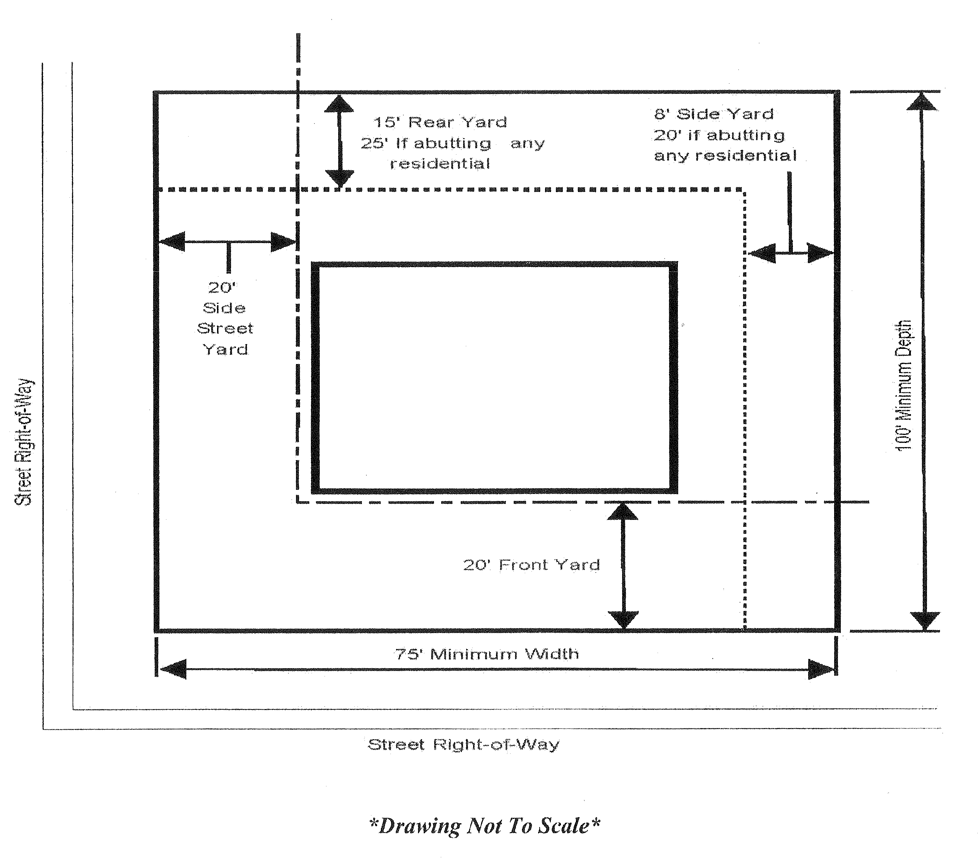
Bulk Regulations. The minimum area, setbacks, density and maximum height shall be as prescribed in Table 3.1.11.B1.
D.
All businesses, servicing or processing, except for off-street parking, off-street loading and automobile service station operation, shall be conducted within completely enclosed buildings except as otherwise provided. No inoperative motor vehicle shall be permitted outside the business building unless:
(1)
Located in rear yard; and
(2)
Screened by a fence at least six (6) feet in height and at least eighty (80) percent opaque.
E.
No use hereunder shall be permitted if said use entails storage or display of items for sale not enclosed by a building except for incidental display of sale or seasonal retail items and such incidental display shall be permitted only if it occupies no more than five (5) percent of the total lot area. Additionally, such displays shall not be placed within required parking or in handicap accessible routes of travel.
F.
All buildings shall meet the following minimum requirements:
(1)
Eighty (80) percent of all sides, excluding all windows and doors, shall be covered in masonry. This restriction applies only to principle and accessory structures occupied by the business and not to accessory structures marketed and sold by the commercial business.
(2)
The building shall comply with all zoning and construction codes of the City.
TABLE 3.1.11.B1
GENERAL COMMERCIAL DISTRICT (C2)
BULK REGULATIONS
(in feet, unless noted otherwise)
3.1.12 [C3 Outdoor Commercial District Defined.]
A.
Purpose. The C3 Outdoor Commercial District is established to provide the necessary shopping, services, recreation, employment, and institutional facilities that are required and supported by the surrounding community, and allowing for outdoor display and sales of merchandise.
B.
Land Use.
(1)
All uses permitted in C1 and C2 Districts.
(2)
Uses that entail outdoor facilities or display or sale of items for sale outside of a building, in excess of five (5) percent of the total lot area.
(3)
Itinerate Vendors occupying or using mobile facilities are allowed to conduct business only in the C3 District, and shall do so under the following provisions:
a.
Vendors are allowed one (1), three-foot wide by four-foot tall sandwich board sign, or one (1) banner not to exceed three (3) feet by five (5) feet. Such signs shall meet all requirements of the most currently adopted codes and ordinances regulating signage.
b.
Only one (1) vendor may occupy a single lot, or group of contiguous lots under common ownership.
(4)
Animal Clinic, Large.
(5)
Kennel.
(6)
Mini-storage facilities.
(7)
Nurseries, wholesale.
(8)
Pawnshops.
(9)
Storage of rental trucks and trailers, except that vehicles or equipment shall not be parked within the public right-of-way, and must be behind a screening fence.
C.
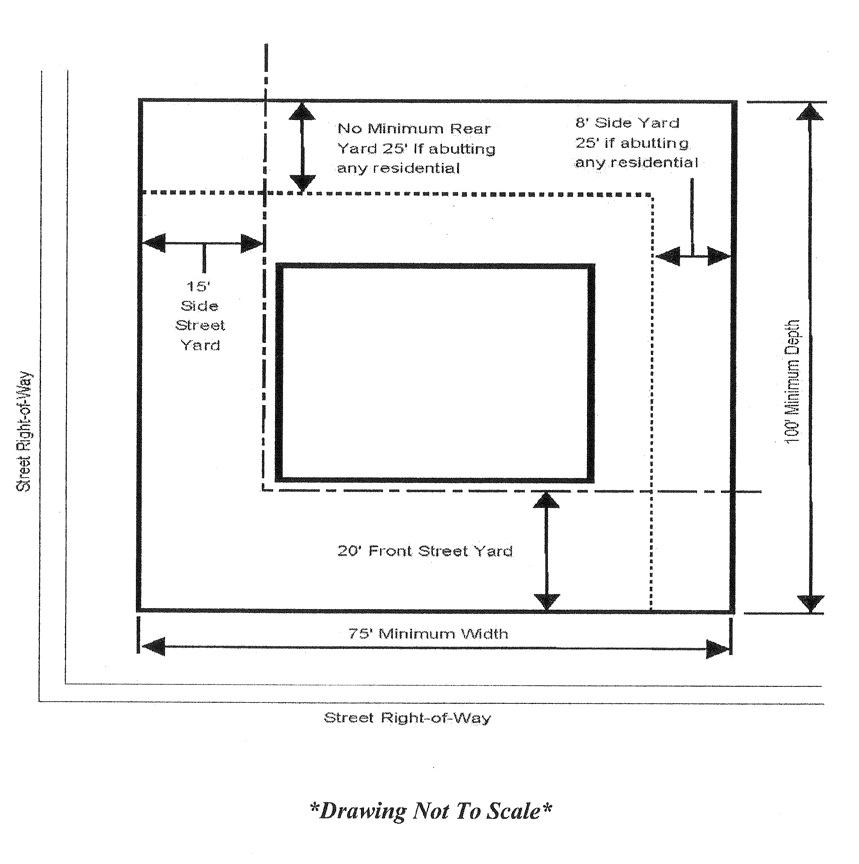
Bulk Regulations. The minimum area, setbacks, density and maximum height shall be as prescribed in Table 3.1.12.B1.
D.
Additional Off-Street Parking and Loading Requirements. In addition to paved parking and driving areas, any parking or storage spaces for inoperable equipment or vehicles adjacent to an exterior yard or visible from an exterior yard shall be screened by a solid wall or fence not less than six (6) feet in height at the building line.
E.
Additional Landscaping Requirements. At least ten (10) percent of the lot, in front of the building line shall be maintained in landscaped open area. If all of a portion of the parkway is maintained in landscaped open area, such landscaped portion will reduce the amount of landscaped area on the lot at a rate of two (2) square feet of landscaped parkway area for each required one (1) square foot of landscaping on the lot.
F.
All buildings shall meet the following minimum requirements:
(1)
Fifty (50) percent of all sides, excluding windows and doors, shall be covered in masonry. This restriction applies only to principle and accessory structures occupied by the business and not to accessory structures marketed and sold by the commercial business.
(2)
The building shall comply with all zoning and construction codes of the city.
TABLE 3.1.12.B1
OUTDOOR COMMERCIAL DISTRICT (C3)
BULK REGULATIONS
(in feet, unless noted otherwise)
3.1.13 [I Industrial District Defined.]
A.
Purpose. The I Industrial District is established to provide locations for a variety of work processes and employment such as manufacturing, warehousing, distribution, indoor and outdoor storage, and a wide range of commercial and industrial operations.
B.
Land Use.
(1)
Any use permitted in C2 or C3 Districts, excluding the following:
a.
Those uses specifically stated as C1.
b.
Assisted Living/Convalescent Centers.
c.
Itinerate Vendors.
(2)
Assembly and miscellaneous processing of goods.
(3)
Crematoriums.
(4)
Display rooms.
(5)
Beverage canning, bottling, manufacturing or processing.
(6)
Garage: public, private or repair.
(7)
Manufacturing, fabricating.
(8)
Mini-storage.
(9)
Public buildings.
(10)
Terminal: truck or bus.
(11)
Warehouses.
(12)
Wholesale distributors and retail sales of products made on the premises, or items incidental or related to those products.
C.
Prohibited Industrial Uses.
(1)
Any manufacturing or industrial use that is obnoxious or offensive by reason of emission of odor, dust (excluding dust generated by the normal use of parking lots and drives), smoke, gas, noise or pollutants to the air, water, or land, or which will be dangerous or otherwise detrimental to persons residing or working in the vicinity thereof, or to the public welfare.
(2)
Distillation of bones.
(3)
Explosive manufacturing or storage.
(4)
Fat rendering.
(5)
Garbage, offal, reduction or dumping.
(6)
Junkyards.
(7)
Petroleum refinery.
(8)
Animal slaughter and dressing.
(9)
Commercial Stables.
D.
Council Authorization Required for Certain Industrial Uses. The following industrial uses are not permitted except by authorization of the City Council following the submission of a Site Plan in accordance with guidelines of Section 3.11.02 [Site Plans]:
(1)
Animal incineration.
(2)
Automobile wrecking yards or towing service facilities.
(3)
Drilling or mining geologic resources.
(4)
Feed and grain elevators and processing.
(5)
Food canning, manufacturing or processing.
(6)
Fertilizer plants.
(7)
Foundries.
(8)
Livestock yards.
(9)
Wholesale storage of gasoline or other petroleum products above ground in carload lots or more.
E.
Bulk Regulations. The minimum area, setbacks, density shall be as prescribed in Table 3.1.13.B1.
F.
Additional Off-Street Parking and Loading Requirements. No inoperative equipment or vehicle shall be stored or parked in a required yard. Any parking or storage spaces for such equipment or vehicles adjacent to an exterior yard or visible from an exterior yard shall be screened by a solid wall or fence not less than six (6) feet in height that is eighty (80) percent opaque.
G.
When abutting a residential district, or a site with a primary residential use, a site plan shall be required.
H.
Eighty (80) percent of all sides, excluding all windows and doors, of principal and accessory structures shall be covered in masonry or metal.
I.
All accessory buildings and structures constructed within an Industrial District shall be subject to the requirements and provisions found within this section, and are expressly exempted from the requirements found in Section 3.4.02.
TABLE 3.1.13.B1
INDUSTRIAL DISTRICT (I)
BULK REGULATIONS FOR TWO FAMILY STRUCTURES
(in feet, unless noted otherwise)
FIGURE 3.1.13.B2
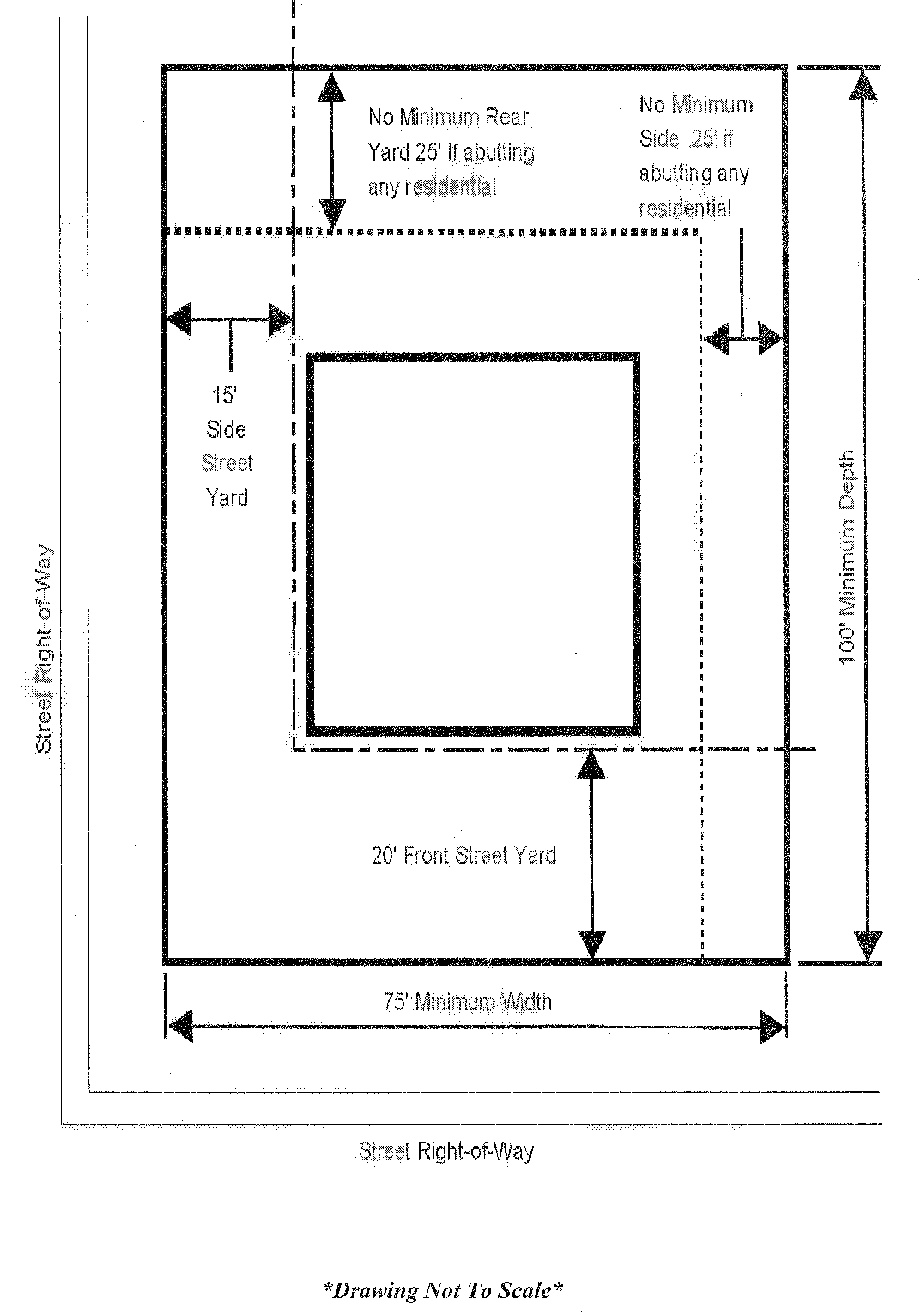
INDUSTRIAL DISTRICT (I)
MINIMUM LOT DIMENSIONS & SETBACKS
3.1.14 [PD Planned Development District Defined.]
A.
General Purpose and Description. The Planned Development District "PD" is intended to provide for combining and mixing of uses allowed in various districts with appropriate regulations, and to permit flexibility in the use and design of land and buildings in situations where modifications of specific provisions of this Ordinance is not contradictory to its intent and purpose or significantly inconsistent with the planning on which it is based and will not be harmful to the community. A PD district may be used to permit new and innovative concepts in land utilization. While great flexibility is given to provide special restrictions that will allow development not otherwise permitted, procedures are established herein to insure against misuse of the increased flexibility.
B.
Land Use. Any use specified in the adopted ordinance granting a Planned Development District shall be permitted in that district. The size, location, appearance and method of operation may be specified to the extent necessary to insure compliance with the purpose of this Ordinance.
C.
General Regulations.
(1)
Area Requirements. The PD district shall have at least three (3) acres for any mixed-use nonresidential purposes, or a minimum of five (5) acres if the mixed-use is to include residential uses.
(2)
Maximum Coverage. Unless limited to a lower percentage by the base district or the site plan adopted by ordinance, no more than fifty (50) percent of the total area shall be covered by primary or accessory buildings.
(3)
Yard Requirements. In PD districts combined with residential districts, the applicable yard requirements for the residential districts apply only to the total site, or to the platted blocks within a mixed-use site, zoned for residential use.
(4)
Height Limitations. No building in the PD district shall exceed forty-five (45) feet in height unless a higher limit is approved by the City Council. If Council adopts a higher limit it must be stated within the ordinance approving the site plan.
(5)
Utilities. All utility services shall be underground.
D.
Site Plan Requirements. A site plan approved by the council shall be a prerequisite to issuance of building permits and certificates of occupancy for any property in the district. A site plan approval request shall be heard concurrent with a zoning change request.
(1)
Conceptual Site Plan. Prior to consideration of any site plan of a part of a larger tract under the same ownership which has been previously designated PD planned development, a conceptual site drawing shall also accompany any request for PD zoning not accompanied by a final site plan. The conceptual site drawing, as may be amended and approved by the council, shall become a part of such zone change and subsequent site plans shall conform thereto. Such conceptual site drawing shall contain at least the following:
a.
A scaled drawing in which not less than one inch is one hundred (100) feet, showing dimensional boundaries of the property, the location and widths of streets and highways adjacent to and on the property, and any other easements thereon or adjacent thereto;
b.
Elevation contours of at least ten-foot intervals;
c.
General location and description of existing utility services, including size of water and sewer mains;
d.
Existing improvements proposed to be retained when the property is developed;
e.
Undimensioned location and approximate size of proposed buildings;
f.
Undimensioned drawings showing proposed access points, general location of parking and points of access;
g.
All proposed uses and their location on the drawing;
h.
Identifiable watercourses and low areas;
i.
Proposed maximum height of buildings;
j.
Proposed landscaped areas;
k.
Height and elevation of all buildings.
(2)
Site Plan Approval. A request for a site plan approval shall be processed in accordance with the same review and hearing procedure as a proposal for a zoning district change.
(3)
Modification of Site Plan. The commission may recommend and the council may require such modification of a conceptual site plan or a site plan as will permit the proposed project to exist harmoniously with existing and anticipated development of surrounding areas.
(4)
Amendments. All site plans approved hereunder may be amended pursuant to the same procedure and subject to the same limitations and requirements as any other site plan would require for original approval.
E.
Site Plan Information. Every application for approval of a site plan under the terms of this district shall contain sufficient information delineating the characteristics of the site, changes in those characteristics as may be proposed by the development, how the development will relate to public services and facilities, and what protection features are included to ensure that the development will be compatible with existing and allowable development on adjacent property. The site plan shall show at least the following items of information:
(1)
The land area included with the site, the land area of all abutting sites and the zoning classification thereof, all public and private rights-of-way and easements bounding and intersecting the site and the abutting sites which are proposed to be continued, created, relocated and/or abandoned;
(2)
The proposed finished grade of the site, shown to contour intervals of not to exceed two (2) feet;
(3)
A description of the proposed site and the boundaries thereof;
(4)
The location of each existing and each proposed structure on the site, the general category of use or uses to be contained therein, the number of stories, gross floor area, and the location of entrances and exits to buildings;
(5)
The location of all on-site facilities for liquid and solid waste disposal;
(6)
The location and width of all curb cuts and driving lanes;
(7)
The dimensions and capacities of parking areas and loading areas, and the character and location of illumination facilities for same;
(8)
All pedestrian walks, malls and open areas for use by tenants or the public;
(9)
The location and height of all walls, fences and screen planting, and landscaping;
(10)
The location, size, height and orientation of all signs;
(11)
The types of surfacing, such as paving, turf, or gravel, to be used at the various locations;
(12)
The location of fire hydrants;
(13)
Drainage plans and information as may be available to show that the development will not be adversely affected by flooding action;
(14)
Front building elevation sketch.
F.
Public hearings required.
(1)
The planning and zoning commission shall conduct a public hearing, study and investigate the plan, and shall submit their recommendation to the council thereon within the forty-five (45) days after the submission of such plan to the planning and zoning commission.
(2)
The planning and zoning commission shall make a report and recommendation on the following:
a.
Whether or not the plan complies with the regulations of this Ordinance and all amendments thereto.
b.
Whether or not the plan is in the best interest of the City.
(3)
The City Council, after reviewing the report and recommendations of the Planning and Zoning Commission shall hold a public hearing following the procedures outlined in Article 1, Section 1.12.01 of this Ordinance. After the public hearing, the council may approve the plan with modifications if any or may reject the plan in its entirety. If the application and plans are approved with modifications and only upon receipt of the applicant's written consent to such modifications shall the plans be deemed approved.
(4)
Buildings may be erected and occupied and land may be used only in accordance with approved plans.
(5)
If the plans are disapproved, they may be revised and resubmitted following the same procedure as outlined for new plans.
(6)
The council may revoke its approval of the PD plan and may adopt a new zoning classification for the area of the Planned Development if substantial construction has not been started within one (1) year of its approval.
(7)
The applicant may request an extension of the approval time by following the same procedure as outlined for amendments to the zoning ordinance.
(8)
Any application for approval of plans, amendments to plans, or extension of approval time shall be accompanied by the current Site Plan fee that has been adopted by the City Council.
G.
Written Report May be Required. When a PD is being considered, a written report may be requested of the applicant discussing the impact on planning, engineering, water utilities, electric, sanitation, building inspection, tax, police, fire, and traffic. Written comments from the applicable public school district and from private utilities may be submitted to the City Council.
H.
Planned Development to be Recorded. All Planned Development Districts approved in accordance with the provisions of this Ordinance in its original form, or by subsequent amendment thereto, shall be referenced on the Zoning District Map, and a list of such Planned Development Districts, together with the category of uses permitted therein, shall be maintained in an appendix of this Ordinance.
(Ord. No. 1219-12-2008, 12-16-08; Ord. No. 1249-06-2010, §§ 3—6, 6-15-10; Ord. No. 1297-05-2012, § 2, 5-15-12; Ord. No. 1320-06-2013, §§ 3—6, 6-18-13; Ord. No. 1380-12-2015, §§ 2—7, 12-15-15; Ord. No. 1414-07-2017, §§ 1—4, 7-18-17; Ord. No. 1453-03-2019, § 2, 3-19-19; Ord. No. 1570-07-2024, § 1, 7-2-24)
Sec. 3.2. - Overlay districts.
The City Council by ordinance may, after public hearings and notifications in accordance with Section 1.12.01 of this Ordinance, establish Overlay Districts. Overlay districts may provide for preservation of structures, establish architectural guidelines, landscaping guidelines, site details, or define appropriate uses within the Overlay District.
3.2.01 [HP Heritage Preservation Overlay District.]
The City Council hereby finds and declares as a matter of public policy that the protection, enhancement and use of districts within the City that exhibit the character of the City's early heritage is a public necessity and is required in the interest of the culture, prosperity, education and welfare of the people, and thereby creates the HP Heritage Preservation Overlay District.
A.
The Heritage Preservation Overlay District. Shall currently cover all property located within the CA Central Area Zoning District.
B.
Heritage Preservation Design Standards. Any development, construction, reconstruction or rehabilitation that results in the modification of the exterior of any structure in any Heritage Preservation Overlay District shall be subject to any City of Gainesville regulations that govern Heritage Preservation Overlay Districts including any Heritage Preservation Design Standards.
C.
The review, installation, or repair of signage and awnings shall be exempt from subsection A of this section and governed by the city's most recently adopted sign code.
D.
District Regulations and Requirements. The regulations as established in districts underlying the Heritage Preservation Overlay District shall apply unless otherwise modified in these district regulations or other regulations governing the Heritage Preservation Overlay District.
3.2.02 Major Corridor Overlay District.
A.
Purpose. The purpose of the Major Corridor Overlay District is to protect and enhance the appearance of the corridor area, protect and enhance property values within the corridor, and to prevent the establishment of incompatible types of development within the corridor. The requirements of the Major Corridor Overlay District shall be in addition to the underlying base zoning district requirements.
B.
District Boundary. The boundaries of the Major Corridor Overlay District are as follows:
(1)
One thousand (1,000) feet from the rights-of-way of the roads listed below:
a.
Interstate 35 within the city limits; and.
b.
Highway 82 within the city limits.
(2)
Five hundred (500) feet from the rights-of-way of the roads listed below:
a.
FM 3092, also known as Radio Hill Road, from Highway 82 south to the city limits;
b.
FM 372, also known as Grand Avenue, from Interstate 35 south to Anthony Street;
c.
Highway 51, also known as California Street, within the city limits;
d.
Broadway Street, also known as FM 678 from I-35 frontage road east to the city limits;
e.
FM 1200 from FM 1201 northwest to the city limits;
f.
FM 1201 from Highway 82 north to the city limits;
g.
FM 1202 within the city limits; and
h.
FM 1306 from Highway 51 south to the city limits.
If any portion of a lot, tract, or parcel is located within the boundary, then the entire limits of the property shall be considered to be located within the Major Corridor Overlay District.
C.
Special Requirements.
(1)
Prohibited Uses: The following uses are prohibited in the Major Corridor Overlay District: mini-storage facilities, recreational vehicle (RV) storage facilities, trailer storage facilities, wind turbines, and solar farms.
(2)
Exemption: Exemptions to the prohibitions in subsection C(1) immediately above are as follows: This does not prevent any uses that are allowed in the SF-1 (Single-Family One) or SF-2 (Single-Family Two) zoning districts.
D.
Nonconforming Use/Building Exception.
(1)
Notwithstanding any other provision of this Ordinance, any existing building use deemed by the City to be legally nonconforming in the Major Corridor Overlay District may be expanded if:
a.
the nonconforming building use was in existence prior to April 16, 2024; and
b.
the expansion includes only the development of building(s) that are for the substantially same use as the existing legally nonconforming building uses; and
c.
the expansion is completed and in use no later than December 31, 2029.
(2)
The City Manager is required to approve in writing the nonconforming expansions allowed under this subsection.
(3)
Nothing in this Section D shall be construed to allow the expansion of a legally nonconforming use or building that is deemed to be abandoned, for any reason, for a period of more than six (6) months, nor shall it be construed to allow the rebuilding of any existing nonconforming building destroyed by any means to an extent of more than fifty (50) percent of its replacement costs at the time of destruction or fifty (50) percent of the area of the structure, unless such rebuilding is approved by the Board of Adjustment in accordance with the provisions of this Ordinance.
3.2.03 [Loft Overlay Zoning District.]
An overlay district named the "Loft Overlay Zoning District" has been created. The district is along California Street and Grand Avenue currently zoned General Commercial (C-2) and Restricted Commercial (C-1) and contained in an area starting at Oneal Street, south on Ritchey Street and including the C-2 parcel that goes to Cunningham Street at California Street, west on Truelove Street, north on Morris Street, west on Main Street, north along the railroad tracks, east on Broadway Street, and north on Morris Street to Oneal Street. The area inside these boundaries permits buildings with two (2) or more stories to have loft apartments.
3.2.04 [Gateway Industrial Park Building Height Overlay District.]
An overlay district named the "Gateway Industrial Park Building Height Overlay District" has been created that permits building heights of eighty (80) feet and allows appurtenances, such as silos and vents to reach heights up to one-hundred fifty (150) feet tall. City Council may approve building heights over eighty (80) feet and appurtenance heights over one-hundred fifty (150) on a case-by-case basis. All buildings will be required to comply with the Federal Aviation Administration's regulations including height requirements related to flight paths for the Gainesville Municipal Airport. The boundaries of the district is for plus or minus one hundred forty-seven (147) acres, legally described as Gateway Industrial Park Addition, as more clearly described in the metes and bounds description included in "Exhibit A" of [the ordinance from which this section is derived].
(Ord. No. 1219-12-2008, 12-16-08; Ord. No. 1249-06-2010, § 7, 6-15-10; Ord. No. 1403-01-2017, § 1, 1-17-17; Ord. No. 1508-02-2022, § 1, 2-15-22; Ord. No. 1562-04-2024, § 2, 4-16-24)
Sec. 3.3. - Special use permits.
3.3.01 [Purpose.]
Certain land uses, because of their nature and location, are not appropriate for categorizing into installations. To provide for the proper handling and location of such specific uses, provision is made for amending this chapter to grant a permit for a specific use in a specific location. Uses listed in section 3.3.03 may locate in certain zones under certain conditions by a special permit granted by the City Council after a report and recommendation by the Planning and Zoning Commission. After receiving an application for permit, the Planning and Zoning Commission shall hold a public hearing to determine the effect of such proposed use upon the neighborhood character, traffic, public utilities, public health, public safety and general welfare. Such public hearing shall be substantially the same and notices shall be given in accordance with state statutes and City ordinances regulating the rezoning of property. After receiving the report and recommendation of the Planning and Zoning Commission, the City Council shall also hold a public hearing to be substantially the same required by state statute and City ordinance regulating the rezoning of property.
3.3.02 [Permit Required.]
No special use shall be erected, used, altered, occupied, nor shall any person convert any land, building or structure to such a use unless a specific use permit has been issued by the City Council. The granting of a specific use permit shall be done in accordance with the provisions for amendment of this Zoning Ordinance.
3.3.03 [Allowable Special Uses and Conditions.]
A.
Allowable special uses and conditions shall be prescribed in Table 3.3.03.A.
TABLE 3.03.03.A
Allowable Special Uses and Conditions
B.
Recreational Vehicle Parks. The following conditions must be met for all RV parks allowed by a special use permit.
(1)
Motor homes, travel trailers, and fifth wheel trailers. A motor home, travel trailer, or fifth wheel trailer may be placed in an RV park licensed by the city as such for a period of time not to exceed fourteen (14) within any consecutive three (3) month period, and may be used for sleeping and living purposes during the time that it is so placed in the park provided it is self-contained, and further provided it is connected to, and receiving electric and water services provided by the RV park.
(2)
Utility services within the park must be placed underground.
(3)
Each lot at a minimum must be provided with water, sanitary sewer, and electrical service.
C.
Short Term Rentals. In addition to those conditions related to parking, guest rooms, and garbage dumpsters as shown in Tables 3.3.03.B-D, the following conditions must be met for all Short Term Rentals (STRs) within the City of Gainesville:
(1)
STR of any duration shall register with the City of Gainesville Community Services Department.
(2)
STR renting 30 days or more each calendar year shall first obtain a Special Use Permit and a Certificate of Occupancy.
(3)
STR owners shall submit an annual report by January 31 st each year accounting for the number of nights the STR was rented.
(4)
The maximum number of overnight guests per bedroom is two people per bedroom.
(5)
The maximum people permitted to attend an event held at any STR qualifying under the Fire Code shall be indicated on the SUP and the Certificate of Occupancy.
(6)
An STR may be rented to the same person for no more than 30 consecutive days.
(7)
An STR may not rent to overnight guests more than 180 days in any calendar year.
TABLE 3.03.03.B
Conditions for Owner Occupied Short Term Rentals
TABLE 3.03.03.C
Conditions for Short Term Rentals Not Occupied by Owner,
Owner Lives Within One Mile of STR
TABLE 3.03.03.D
Conditions for Short Term Rentals Not Occupied by Owner, Owner Lives Further Than
One Mile of STR
3.3.04 [Application Procedure.]
An application for a special permit shall be filed with the administrative official on a form provided by the City. The application shall be accompanied by the following:
A.
A completed application form signed by the property owner;
B.
An application fee as established by the City's latest adopted schedule of fees;
C.
A certificate stating that all City and school taxes have been paid to date;
D.
A property description of the area where the specific use permit is proposed to apply;
E.
A site plan complying with the requirements stated in this section which will become a part of the specific use permit, if approved; and
F.
Any other material and/or information as may be required by the Planning and Zoning Commission, the City Council or the administrative official to fulfill the purpose of this subsection and to ensure that the application is in compliance with the ordinances of the City.
3.3.05 [Site Plan Required.]
A site plan shall contain, at a minimum the following information, as provided in section 3.11.02 [Site Plans].
3.3.06 [Additional Requirements.]
The following additional information may also be required if deemed appropriate by staff, the Planning and Zoning Commission or City Council:
A.
Copies of studies or analyses upon which have been based projections for need or demand for the proposed facility.
B.
Description of the present use, assessed value and actual value of the land affected by the proposed facility.
C.
Description of the proposed use, anticipated assessed value and supporting documentation.
D.
A description of any long-term plans or master plan for the future use or development of the property.
E.
A description of the applicant's ability to obtain needed easements to serve the proposed use.
F.
A description of any special construction requirements that may be necessary for any construction or development on the subject property.
G.
A traffic impact analysis prepared by a qualified professional in the field of traffic evaluation and forecasting may be required.
3.3.07 [Conditions of Approval.]
A special use permit shall not be recommended for approval by the Planning and Zoning Commission unless the Commission finds that all of the following conditions have been found to exist:
A.
The proposed use complies with all the requirements of the zoning district in which the property is located.
B.
The proposed use as located and configured will contribute to or promote the general welfare and convenience of the City.
C.
The benefits that the City gains from the proposed use outweigh the loss of or damage to any homes, business, natural resources, agricultural lands, historical or cultural landmarks or sites, wildlife habitats, parks, or natural, scenic, or historical features of significance, and outweigh the personal and economic cost of any disruption to the lives, business and property of individuals affected by the proposed use.
D.
Adequate utilities, road access, drainage, and other necessary supporting facilities have been or shall be provided.
E.
The design, location and arrangement of all public and private streets, driveways, parking spaces, entrances and exits shall provide for a safe and convenient movement of vehicular and pedestrian traffic without adversely affecting the general public or adjacent developments.
F.
The issuance of the Special Use Permit does not impede the normal and orderly development and improvement of neighboring vacant property.
G.
The location, nature and height of buildings, structures, walls, and fences are not out of scale with the neighborhood. This does not include communication towers.
H.
The proposed use will be compatible with and not injurious to the use and enjoyment of neighboring property, nor significantly diminish or impair property values within the vicinity.
I.
Adequate nuisance prevention measures have been or shall be taken to prevent or control offensive odors, fumes, dust, noise, vibration and visual blight.
J.
Sufficient on-site lighting is provided for adequate safety of patrons, employees and property, and such lighting is adequately shielded or directed so as not to disturb or adversely affect neighboring properties.
K.
There is sufficient landscaping and screening to ensure harmony and compatibility with adjacent properties.
L.
The proposed operation is consistent with the applicant's submitted plans, master plans, projections, or, where inconsistencies exist, the benefits to the community outweigh the costs.
M.
The proposed use is in accordance with the City of Gainesville Comprehensive Land Use Plan.
3.3.08 [Council Action.]
The City Council may grant such a Special Use Permit only upon finding that the information submitted is sufficient to determine that the proposed building, use, structure, development or activity will have an insubstantial impact on the surrounding area.
3.3.09 [Additional Conditions.]
In authorizing a Special Use Permit, the Planning and Zoning Commission may recommend, and the City Council may impose, additional reasonable conditions necessary to protect the public interest and the welfare of the community.
3.3.10 [Expiration.]
Special use permits shall expire at such time as prescribed by the City Council, at anytime conditions change, or upon staff recommendation.
3.3.11 [Time Limit.]
A Special Use Permit issued under this division shall become null and void unless construction or use is substantially underway within six (6) months of the granting of the permit, unless an extension of time is approved by the City Council.
3.3.12 [Revocation of Permit.]
Special Use Permit may be revoked or modified, after notice and hearing, for either of the following reasons:
A.
The permit was obtained or extended by fraud or deception.
B.
One (1) or more of the conditions imposed by the permit has not been met or has been violated.
3.3.13 [Amendments to Special Use Permits.]
The procedure for amending a Special Use Permit shall be the same as for a new application, provided the administrative official may approve minor variations from the original permit which do not increase density, change traffic patterns, or result in an increase in external impacts on adjacent properties or neighborhoods.
(Ord. No. 1219-12-2008, 12-16-08; Ord. No. 1249-06-2010, § 8, 6-15-10; Ord. No. 1360-02-2015, § 2, 2-3-15; Ord. No. 1369-08-2015, § 2, 8-4-15; Ord. No. 1429-03-2018, § 7, 3-20-18; Ord. No. 1485-03-2021, § 2, 3-16-21; Ord. No. 1492-06-2021, § 2, 6-1-21; Ord. No. 1497-07-2021, § 2(Att. A), 7-6-21)
Sec. 3.4. - Accessory uses and structures.
3.4.01 [Accessory Buildings and Structures Are Regulated.]
No accessory building or structure, temporary or permanent, may be constructed or placed within the City of Gainesville without first obtaining a permit allowing for such construction or placement from the City. Application for said permit shall be filed on a form provided by the City, a plot plan per Section 3.11.01 [Plot Plans], shall be attached, and all fees shall be paid in full prior to the review and issuance of such permit.
3.4.02 [General Provisions for all Districts.]
Any accessory building or structure constructed or placed within any zoning district of the City of Gainesville shall meet the following criteria:
A.
Shall meet setback requirements as specified within the zoning districts, except as provided in Subsection F below. In no case shall an accessory building be closer to the front property line than the main building.
B.
Shall not be established on any lot before the establishment of the principal use.
C.
Shall comply with all City codes, including, but not limited to, electrical, plumbing, health, and sanitation.
D.
Shall not create any condition that is hazardous to the health and welfare of the public.
E.
No accessory building shall exceed thirty-five (35) feet.
F.
An accessory building more than five (5) feet from the main building may be erected within three (3) feet of a side or rear lot line, but must be located at least sixty (60) feet from the front right-of-way, and shall not encroach onto any recorded easements.
H.
Temporary buildings for construction offices are only permitted in any district during construction.
I.
In-ground swimming pools and spas must be located at least five (5) feet from any structure or accessory structure unless the pool structural plans are stamped by a state of Texas certified structural engineer and approved by the building official.
J.
Exception: In cases that this section conflicts with an overlay zone, the overlay zone shall control.
3.4.03 [Residential Provisions.]
In addition to the provisions stated in Section 3.4.02, all accessory buildings or structures constructed or placed within Residential Zoning District shall meet the following additional requirements:
A.
The following accessory uses are permitted within residential districts; all others are strictly prohibited:
(1)
Detached private garage.
(2)
Nonpaying guesthouse or rooms for guests within an accessory building, provided such facilities are used only for the occasional and gratuitous housing of guests of the occupant of principal building for a period not exceeding fourteen (14) days, and not for permanent occupancy by others as a dwelling unit.
(3)
Sheds or tool rooms.
(4)
Children's playhouses.
(5)
Private greenhouses.
(6)
Private tennis courts.
(7)
Private swimming pools and pool houses.
(8)
Storm shelters.
B.
Residential accessory buildings may not occupy more than thirty (30) percent of the rear yard.
C.
No accessory building shall be erected within ten (10) feet of any other building, except detached residential garages and storm shelters may be located within five (5) feet of the main dwelling.
D.
All accessory buildings shall be built in the rear yard, except residential garages, which may be built in the side yard. All garages in the side yard are required to respect the building setback.
E.
No detached residential garage or carport shall be erected or placed closer to any street or alley right-of-way line than the minimum yard requirements (building setback line) governing the district in which such garage or carport is located.
3.4.04 [Commercial Provisions.]
In addition to the provisions stated in Section 3.4.02, all accessory buildings or structures constructed or placed within Commercial Zoning Districts shall meet the following additional requirements:
A.
Shall have express written permission of the property owner if the property is not owned by permit applicant;
B.
All accessory buildings, portable commercial trailer, garages, and carports exceeding one hundred (100) square feet of floor area must mimic the architectural style of the principle structure including rooflines, pitch, construction materials and colors.
3.4.04.01 [Industrial Provisions.]
In addition to the provisions in Section 3.4.02, any accessory structure that is a portable commercial trailer located in an Industrial Zoning District shall also meet the following additional requirements:
A.
Provide a site plan showing the principal structure and the proposed location of the portable commercial trailer.
B.
Provide a scaled drawing illustrating how the structure shall be secured to prevent wind uplift. This may be accomplished with trailer tie-downs or by attaching the structure to a foundation or piers.
C.
Submit an illustration or photograph indicating how the base of the structure will be skirted in a manner that compliments the architecture of the principal building as well as the trailer and screens the undercarriage of the structure.
D.
Obtain a certificate of occupancy.
3.4.05 [Temporary Uses.]
A.
In C2, C3 and I districts there may be any temporary commercial use authorized herein:
(1)
Shall obtain a building permit from the City of Gainesville prior to locating on any property. Permit shall be for ninety (90) days with allowance for one (1), ninety-day renewal within a twelve-month period. Permit fee shall be established by the City Council for first ninety-day permit and no fee shall be charged for the renewal permit.
(2)
Shall have the express written permission of the property owner if the property is not owned by permit applicant.
(3)
Shall meet setback requirements as specified within the zoning districts or if the principal building is a nonconforming use, as to setbacks, the temporary commercial building shall not encroach into the required yard(s) any more than the existing principal building.
(4)
Shall not be established on any lot prior to the establishment of a principal use.
(5)
Shall comply with all City codes including, but not limited to, electrical, plumbing, health, and sanitation, or shall provide for proper electrical and water service, disposal of solid waste and sewage meeting City approval.
(6)
Shall not create any conditions that are hazardous to the health and welfare of the public.
(7)
Nonprofit, charitable, and uses not exceeding seventy-two (72) hours shall be exempt from subsections (1), (3), and (4) of this subsection A, and may be granted one (1) additional seventy-two-hour period for operation, by the City Manager or his/her designee.
3.4.06 [Cargo Containers.]
A.
It is recognized that uncontrolled storage and placement of cargo containers may detract from the value of adjacent property, discourage commerce, and negatively impact the aesthetic quality of nonresidential property and adjacent residential property. The purpose of this section is to provide for regulations that protect the value of property and enhance the appearance, health, safety, and welfare of the City.
B.
There shall be no existing nonconforming status applied to cargo containers. All uses made nonconforming by the passage of this Ordinance must be brought into compliance, or removed, no more than ninety (90) days after this Ordinance's adoption.
C.
General Regulations.
(1)
Cargo containers shall not be placed on public streets, nor shall they be placed within twenty (20) feet of any public street or right-of-way.
(2)
Cargo containers in residential districts may be permitted for a period of thirty (30) days under the following conditions:
a.
A permit must be issued for the container.
b.
A container may be placed on-site only once per year, unless there is a change of ownership.
(3)
Only one (1) cargo container shall be permitted on any site in the SF-1, SF-2, and MH districts.
(4)
Cargo containers located in all zoning districts shall be located on an improved gravel surface, concrete, concrete pavers or asphalt.
(5)
Cargo containers located in the SF-1, SF-2, MF-1 and MH zoning districts shall not exceed sixteen (16) feet in length, eight (8) feet in width, and eight and one-half (8.5) feet in height.
(6)
Cargo containers shall not be stacked in any zoning district with the exception of the I-Industrial zoning district and at such time shall not be stacked higher than two (2) containers.
(7)
Cargo containers shall not occupy any required off-street parking spaces, vehicular access, pedestrian facilities, or landscape areas for the site.
(8)
Cargo containers shall be placed in a location that minimizes visual impact from surrounding streets and properties. For any site containing more than four (4) cargo containers, a location plan shall be submitted and approved by the City manager or his/her designee prior to locating the cargo containers on-site. At such time all cargo containers shall be subject to the location plan.
(9)
Any cargo container located within one hundred (100) feet of a residential zoning district shall be no greater in size than eight (8) feet in width, sixteen (16) feet in depth, and eight and one-half (8.5) feet in height. No cargo container may be stacked within one hundred (100) feet of a residential district.
(10)
Cargo containers shall not be used for a primary use.
(11)
Cargo containers located in any nonresidential zoning district shall not exceed a size of ten (10) feet in height, ten (10) feet in width, and forty (40) feet in length, unless approved by City Council upon recommendation of the Planning and Zoning Commission.
(12)
Areas utilized by permanent cargo containers shall be included in the square foot requirement as a storage use and shall be used when calculating required number of parking spaces as set forth in Section 3.7 [Parking and Loading Requirements].
(13)
The quantity of cargo containers located in the C3 and I zoning districts, shall be determined by the total aggregate square foot of principal buildings according to the following rate:
a.
One container for 0 to 35,000 sq. ft. of principle building.
b.
Two containers for 35,001 sq. ft. — 70,000 sq. ft. of principle building.
c.
Three containers for 70,001 sq. ft. — 105,000 sq. ft. of principle building.
d.
Four containers for 105,001 sq. ft. — 140,000 sq. ft. of principle building.
e.
Five containers for 140,001 sq. ft. — 175,000 sq. ft. of principle building.
f.
Six containers for 175,501 sq. ft. — 210,000 sq. ft. of principle building.
g.
Over 210,100 sq. ft. of principle building, one additional container for every 40,000 sq. ft. of principle building.
(14)
Cargo containers located within I zoning district may exceed the above-listed quantities, upon approval of a detailed site plan showing the proposed location and quantity of cargo containers.
(15)
Semi-truck trailers shall not be used in lieu of cargo containers.
(16)
Cargo containers shall not be used as signage; furthermore, no signage may be attached to a cargo container.
(Ord. No. 1219-12-2008, 12-16-08; Ord. No. 1249-06-2010, §§ 9, 10, 6-15-10; Ord. No. 1297-05-2012, §§ 3, 4, 5-15-12; Ord. No. 1320-06-2013, § 7, 6-18-13; Ord. No. 1335-03-2014, § 2, 3-4-14; Ord. No. 1336-03-2014, § 2, 3-4-14; Ord. No. 1475-04-2020, §§ 2, 3, 4-21-20; Ord. No. 1560-03-2024, § 1, 3-5-24; Ord. No. 1594-10-2025, § 2, 10-7-2)
Sec. 3.5. - Screening walls and fences.
3.5.01 [Screening Walls and Fences.]
A.
Permit Required. No fence shall be erected without a fence permit.
B.
Plot Plan Required. A plot plan, per Section 3.11.01 [Plot Plan], is required for the construction of any new fence.
C.
Screening Fence Required. A permanent screening fence of not less than six (6) feet, nor more than eight (8) feet in height, shall be required between property zoned commercial or industrial which abuts any property zoned residential.
(1)
If a rezoning request creates a situation wherein residential and commercial or industrial-zoned properties abut, the rezoning applicant and successors shall be required to construct and permanently and adequately maintain the fence.
(2)
If commercial or industrial construction is to occur on property that abuts undeveloped property, the screening fence shall be constructed and permanently and adequately maintained by the owner of the commercial or industrial-zoned property.
(3)
If construction is to occur on property that abuts previously developed property, the screening fence shall be constructed and permanently and adequately maintained by the applicant then requesting a building permit.
(4)
Such screening fence shall be erected along the entire length of the common line between such property, or on the property required to erect screening, but shall in no case obstruct Lot Visibility as defined and explained in Section 3.1.02 [Lot Visibility].
(5)
No fence shall be required for schools, churches or public buildings.
(6)
The entire area occupied by a junkyard or salvage yard shall be surrounded by a continuous screening wall or fence. Furthermore, there shall be no nonconforming relief for salvage yard screening and all uses made nonconforming by the passage of this Ordinance must be brought into compliance no more than ninety (90) days after this Ordinance's adoption.
D.
Safety. No wall or fence shall be constructed or maintained in such a manner as would endanger the health or safety of the general public. Fences constructed of barbed wire, razor wire, and walls topped with broken glass or surfaced with like material shall be prohibited except for fences surrounding public facilities/utilities and security fences of not less than six (6) feet in height in C3 and I zones which may be topped by barbed wire. No electric fence shall be permitted except where provided for the actual enclosure of farm animals in any district zoned Agriculture. Such fence shall be posted at least once along each boundary line and at intervals of not more than one hundred (100) feet warning persons of the existence of said electric fence. Furthermore, there shall be no nonconforming relief for razor wire and all uses made nonconforming by the passage of this Ordinance must be brought into compliance no more than ninety (90) days after this Ordinance's adoption.
E.
Construction.
(1)
Unless otherwise provided for herein, a screening wall or fence required under the provisions of this section shall be constructed of the following materials:
a.
A permanent, solid masonry material.
b.
Treated, or decay-resistant wood fencing material.
c.
Vinyl fencing material.
d.
Aluminum/Metal Solid Panels. Industrial (I) Zoning Districts only.
(2)
Fences that are not required as a screening under the provisions of this Ordinance shall be constructed of the following materials:
a.
A permanent, solid masonry material.
b.
Treated or decay-resistant wood fencing material.
c.
Vinyl fencing material.
d.
Decorative rail aluminum, tubular, or wrought iron.
e.
Chain-Link. Agriculture (A), Single-Family One (SF1), Single-Family Two (SF2), Outdoor Commercial (C3) and Industrial (I) Zoning Districts only.
f.
Aluminum/Metal Solid Panels. Industrial (I) Zoning Districts only.
(3)
Such wall or fence shall not contain openings constituting more than forty (40) square inches in each one (1) square foot of wall, or fence surface, and the surface of such wall or fence shall constitute a visual barrier.
(4)
All wall or fence openings shall be equipped with gates compatible in height and screening characteristics to the wall or fence.
(5)
Decorative fence and/or landscape screening shall be used in cases where the Planning and Zoning Commission finds this requirement to be better for the location. In such case, the City Manager or his/her designee must approve a landscape plan prior to any construction. The plan is required to provide a schematic drawing with a one-inch to twenty (20) feet scale. A list of plants, mature height and width of plants, and minimum recommended spacing for each plant that will be used to meet the minimum standards for screening shall be provided with the permit application. The landscape screening shall contain at minimum:
a.
Evergreen trees with a minimum diameter of two (2) inches and a minimum height of ten (10) feet from the ground to the top of the tree (after planting) shall be planted at a minimum of every forty (40) feet. Trees must be from a species that have a mature height of at least twenty (20) feet tall.
b.
Evergreen shrubs with a minimum height of two (2) feet (after planting) must be planted between the required trees starting with a maximum spacing of five (5) feet from the trees and then spaced at the minimum spacing requirement for that species of plant. Shrubs must be from a species that has a mature height of at least four (4) feet.
(6)
Decorative fence and/or landscape screening shall be used in cases where the City Manager or his/her designee finds this requirement to be better for the location. In such case, the City Manager or his/her designee must approve a landscape plan prior to any construction. The plan is required to provide a schematic drawing with a one-inch to twenty (20) feet scale. A list of plants, mature height and width of plants, and minimum recommended spacing for each plant that will be used to meet the minimum standards for screening shall be provided with the permit application. The landscape screening shall contain at minimum:
a.
Evergreen trees with a minimum diameter of two (2) inches and a minimum height of ten (10) feet from the ground to the top of the tree (after planting) shall be planted at a minimum of every forty (40) feet. Trees must be from a species that have a mature height of at least twenty (20) feet tall.
b.
Evergreen shrubs with a minimum height of two (2) feet (after planting) must be planted between the required trees starting with a maximum spacing of five (5) feet from the trees and then spaced at the minimum spacing requirement for that species of plant. Shrubs must be from a species that has a mature height of at least four (4) feet.
F.
Residential Walls and Fences. Walls and fences hereafter constructed on property used for or restricted to residential uses shall be no greater than four (4) feet in height for chain-link fencing and not greater than eight (8) feet in height for other allowed fencing material, subject to the following limitations:
(1)
The height of a wall or fence shall be the vertical distance between the ground and the top of the fence. In terrain where ground slopes at a grade of ten (10) percent or more, the fence or wall may be built in ten-foot horizontal stair-step sections; the average height of each such section shall comply with the height regulations set forth herein.
(2)
No wall or fence shall be located in a required front exterior yard other than a decorative fence that shall have a height of no more than four (4) feet. Multifamily developments are exempt from this requirement.
(3)
No wall or fence located on a corner lot shall have a height in conflict with the regulations governing visibility at intersections as prescribed within this Ordinance.
(4)
Retaining walls shall be permitted for the purpose of protecting property against sliding earth or accidental injury to human life. The height of a retaining wall shall be determined according to accepted engineering principles, and the design shall be approved by the City Manager or his/her designee. A fence erected on top of a retaining wall shall be subject to the height limitations above, measured from the high side of the wall.
(5)
When two (2) adjoining corner lots are situated so that their lot fronts face parallel streets and the side exterior yard of one is a continuation of the side exterior yard of the other, such side exterior yards on both lots may be enclosed by a wall or fence having a maximum height above grade of six (6) feet to the rear of the side exterior yard on each lot. Such fence shall be located no closer than five (5) feet from the right-of-way of adjacent street.
(6)
When a corner lot is so situated that its rear interior lot line is common to a side interior lot line of an adjoining lot which fronts on the side street of the corner lot, fence or wall heights and location for the rear lot line shall be the same as applicable regulations for the adjoining lot.
(7)
Chain-link fencing shall be limited to the cyclone style, while the color is limited to galvanized or black.
G.
No screening element of solid construction such as brick, masonry, concrete, or solid metal shall be erected or placed which would interfere with the installation or maintenance of any public utility line, service, or drainage-way within easements reserved therefore.
H.
No privacy/security enclosure may be erected to encroach upon any visibility triangle, right-of-way, access or drainage easements or floodway.
(Ord. No. 1219-12-2008, 12-16-08; Ord. No. 1320-06-2013, § 8, 6-18-13; Ord. No. 1375-10-2015, § 4, 10-20-15; Ord. No. 1441-10-2018, § 1, 10-2-18)
Sec. 3.6. - Landscaping and tree preservation.
3.6.01 [Landscaping.]
A.
Purpose. It is the purpose of this subsection to establish certain regulations pertaining to landscaping within the City. These regulations provide standards and criteria for new landscaping and the retention of existing trees which are intended to:
(1)
Promote the value of property, enhance the welfare and improve the physical appearance of the City;
(2)
Reduce the negative effects of glare, noise, erosion and sedimentation caused by expanses of impervious and unvegetated surfaces within the urban environment; and
(3)
Preserve and improve the natural and urban environment by recognizing that the use of landscaping elements and retention of existing trees can contribute to air purification, oxygen regeneration, groundwater recharge, abatement of noise, reduction of heat, provision of habitats for wildlife, and enhance the overall beauty of the City.
B.
These landscape regulations establish requirements in the MF-2, C1, C2, C3 and I, zoning districts:
(1)
All new residential development shall conform only to the requirements set forth in subsection E, Residential Uses, of this Section.
(2)
Nonresidential uses located within the A, SF-1, SF-2, MF-1 and MH zoning districts, which consist of principle structures, parking areas, and signage, shall be required to comply with the requirements contained in this section.
(3)
For new construction completed in December, January or February, landscaping may be completed within ninety (90) days of construction without penalty.
C.
Events Causing Compliance. Land uses not previously subject to landscaping requirements may be required to comply with this section upon the occurrence of one of the following events:
(1)
A change in zoning;
(2)
Requirement of landscaping as conditions of a Special Use Permit;
(3)
Issuance of a building permit; or
(4)
Loss of legal nonconforming status.
D.
Landscape installation required.
(1)
Landscaping which consists of grass only will require twenty (20) percent of the total area to be landscaped.
(2)
Landscaping which includes the planting of new and the retention of existing shrubs, trees, and flowering plants, in addition to grass, may require that only fifteen (15) percent of the total lot area be landscaped with approval of the City Manager or his/her designee.
(3)
Where the construction is to be a single phase of a multi-phase development, only the area being constructed in the current phase need be subject to the landscape regulations. However, each phase will be required to meet the landscaping requirements as they are being developed.
E.
New residential development shall be required to locate a minimum of two (2) trees on the developed lot of which at least one (1) tree must be placed in the front yard. The size of such trees shall be a minimum of two (2) inches in caliper. For new construction completed in December, January or February, landscaping may be completed within ninety (90) days of construction without penalty.
F.
Landscape Plan Required. A landscape plan for all new development must meet the following criteria:
(1)
The landscape plan may be prepared by the applicant, or his/her designee. The landscape plan is not required to be prepared by a registered or certified professional.
(2)
A landscaping plan shall be submitted to the City for approval. The landscape plan may be submitted as a part of the site plan or as a separate submittal. However, a landscape plan meeting the requirements of this Ordinance shall be provided and approved prior to the issuance of a building permit.
(3)
The landscape plan shall contain the following information:
a.
Drawn to scale; Minimum scale of one-inch equal fifty (50) feet;
b.
Location of all trees to be preserved, method of preservation during the construction phase of development;
c.
Location of all plants and landscaping material to be used including paving, benches, screens, fountains, statues, or other landscape features;
d.
Species of all plant material to be used;
e.
Size of all plant material to be used;
f.
Spacing of plant material where appropriate;
g.
Layout and description of irrigation, sprinkler or water system, including placement of water sources;
h.
Description of maintenance provisions of the landscape plan;
i.
Persons responsible for the preparation of the landscape plan.
G.
Location Criteria.
(1)
Not less than forty (40) percent of the total landscaping shall be located in the designated front yard.
(2)
In the I zoning district the rear and side yard landscape requirements may be waived upon submittal of a landscape plan showing required landscaping requirement has been met on the lot.
(3)
All landscape material shall comply with visibility requirements of this Ordinance.
H.
Any xeriscaped area shall be clearly located and detailed on the site plan. In addition, the xeriscape methodology shall be detailed on the site plan.
I.
A flowering bed is any area where the soil has been specifically prepared for the planting of flowering plants. In addition in order to be considered for credit calculations, at least eighty (80) percent of the prepared area must be covered with flowering plant material at the time of peak growth.
J.
Caliper of trees is to be measured at a point twelve (12) inches above top of ground.
K.
Installation and Maintenance. All live landscaping required by this Code shall be properly maintained. All dead or dying landscaping shall be replaced immediately and all sodden areas mowed, fertilized and irrigated on a regular basis.
3.6.02 [Tree Preservation.]
A.
The purpose of this subsection is the preservation of mature trees and natural areas. It is intended to protect trees during construction, development, and redevelopment, to control the removal of protected trees when necessary. It also establishes rules for replacement and replanting of trees that had been necessarily removed during construction. This article shall protect any property from indiscriminate clearing and maintain and enhance a positive image as well as attract new business enterprises to the City. The terms and provisions of this article apply to all real property as follows:
(1)
All new subdivisions of land at the time of preliminary and/or final platting;
(2)
All replatting of undeveloped land;
(3)
All unplatted and undeveloped tracts of land greater than five (5) acres;
(4)
All nonresidential parcels of land at the time of site plan approval.
B.
The following trees are to be considered protected within the municipal boundaries of the City of Gainesville:
(1)
All species of Pecan.
(2)
All Species of Oak.
(3)
Any tree which has a diameter of eighteen (18) inches or greater measured twelve (12) inches above ground. The diameter of a multi-trunk tree shall be determined by adding the total diameter of the largest trunk to one-half the diameter of each additional trunk.
(4)
All species of Hackberry, Bois d'arc and Mimosa are exempt from this subsection and shall not be considered protected regardless of diameter.
C.
Tree Removal Permit Required. No person, directly or indirectly, shall cut down, destroy, remove or move, or effectively destroy through damaging any protected tree that is located on a property regulated by this article without first obtaining a tree removal permit unless otherwise specified in this article.
(1)
New Development: All developments which have not submitted final plats as of the effective date of this article shall be subject to the requirements for tree protection and replacement specified herein.
(2)
Residential Subdivisions: All area within public right-of-way, utility easements, or drainage easements as shown on an approved final plat, and areas designed as cut/fill on the master drainage construction plan approved by the City's engineer shall be exempt from the tree protection and replacement requirements specified herein. All other areas shall be subject to the requirements and shall indicate how protected trees may be saved.
(3)
Nonresidential Developments: All area within public right-of-way, public utility or drainage easements as shown on an approved final plat, fire lanes, and parking areas shall be exempt from the tree protection and replacement requirements specified herein. All other areas shall be subject to these requirements.
(4)
Agricultural: Property zoned "A", agricultural, and being actively used for agricultural purposes shall be exempt from the requirements specified herein.
(5)
Homeowners: The owner of a residence who uses the residence as his/her homestead shall be exempt from the tree protection and replacement requirements of this article as it pertains to that residential property.
(6)
Building/Contractors: All builders who have not submitted a request for a building permit as of the effective date of this article are subject to the requirements herein. All areas within the driveway, sidewalks, patios, septic tank and lateral lines, parking area, pool, and associated deck area and area within twelve (12) inches of the building foundation as shown on an approved plot plan shall be exempt from the tree protection and replacement requirements of this article. All other areas of the lot shall be subject to these requirements.
(7)
Additional Exemptions: A tree removal permit and tree protection and replacement requirements shall not be required if the following conditions exist:
a.
Damaged/Diseased Trees: The tree is dead, diseased, damaged beyond the point of recovery or in danger of falling.
b.
Public Safety: The tree creates unsafe vision clearance or conflicts with other ordinances or regulations or the tree is determined to be in a hazardous or dangerous condition so as to endanger the public health, safety or welfare.
c.
Utility Service Interruption: The tree has disrupted a public utility service. Removal shall be limited to the part of the tree that is found necessary to be removed to re-establish and maintain the utility service.
D.
Tree Mitigation. In the event that it is necessary to remove protected tree(s) outside the buildable area, the developer, as a condition to issuance of a tree removal permit, shall be required to replace, somewhere on the property, the tree(s) being removed with comparable trees. The mitigation of the trees shall be 1:1 with said replacement trees being at least one (1) inch in caliper when planted.
E.
Tree Protection During Construction.
(1)
Tree Protection: During any construction or land development, the developer shall clearly mark those trees to be protected and may be required to erect some protective device to ensure protection of said trees. The protective barrier must be maintained during all construction until the project is finished.
(2)
Material and Equipment Storage: The developer shall not store any material or equipment within the critical root zone of the protected tree. During the construction stage of the development, no cleaning or storage of equipment or material shall be allowed within the drip line of the trees or under the canopy of the tree. Materials include but are not limited to oils, paint, solvents, mortar, asphalt and concrete.
(3)
Signs: No signs, wires, or other attachments except protective barriers shall be attached to the protected trees.
(4)
Traffic: No vehicular traffic, construction equipment traffic, or parking shall take place within the critical root zone of the protected tree other than on an existing street pavement. This restriction does not apply to single incident access for purposes of clearing underbrush, establishing the building pad and associated lot grading, vehicular traffic necessary for routine utility maintenance or emergency restoration of utility service or routine moving operations.
(5)
Grade: No grade change in excess of four (4) inches shall be allowed within the limits of the critical root zone of any protected tree unless adequate construction methods are approved beforehand.
F.
Tree Planting Restrictions.
(1)
Overhead Lines: Any required replacement shall not be planted within an area such that the mature canopy of the tree will interfere with overhead utility lines.
(2)
Underground Lines: Any required replacement trees shall not be planted within an area such that the mature root zone of the tree will interfere with underground public utility lines.
(3)
No tree shall be planted within ten (10) feet of a fire hydrant.
G.
This article shall not prohibit the City of Gainesville the right to remove or order the removal of any trees or limbs extending into the right-of-way that are obstructing signs, interfering with municipal or utility services, interfering with traffic flow, or causing hazardous conditions to pedestrians and vehicles.
(Ord. No. 1219-12-2008, 12-16-08; Ord. No. 1249-06-2010, § 11, 6-15-10)
Sec. 3.7. - Parking and loading requirements.
3.7.01 [Off-Street Parking Required.]
A.
The following off-street parking shall be provided in compliance with this section of this Ordinance, whenever any building is erected, altered, enlarged, converted or increased in size or capacity:
(1)
For single-family dwellings, two (2) spaces. These spaces shall not be tandem parking spaces.
(2)
For low density multifamily (MF-1 Zone) dwellings, two (2) spaces per dwelling unit. One (1) additional parking space is required for each additional bedroom over three (3) bedrooms. These parking spaces shall not be tandem parking spaces.
(3)
For high density multifamily (MF-2 Zone) dwellings and apartment hotels:
One bedroom = 1.5 spaces;
Two bedroom = 1.75 spaces; and
Three bedroom = 2 spaces.
(4)
For hotels and motels, one (1) space for each guestroom or suite of the first twenty (20) individual guestrooms or suites, one (1) additional parking space for each two (2) guestrooms or suites in excess of twenty (20) and not exceeding forty (40); one (1) additional space for each four (4) guestrooms or suites in excess of forty (40); plus one (1) additional space for each four (4) patron seats in rooms open to the nonresident public; plus one (1) space for each two hundred (200) square feet of display area or ballroom.
(5)
For churches erected on new sites, one (1) parking space on the lot for each three (3) seats in the main auditorium.
(6)
For elementary and junior high schools, public, parochial and private, two (2) spaces for each classroom.
(7)
For colleges, senior high schools, public, parochial and private, seven (7) spaces for each classroom.
(8)
For hospitals, one (1) space for each hospital bed.
(9)
For institutions, clubs, lodges, and public buildings, one (1) space for each one hundred fifty (150) square feet of floor area.
(10)
For retail and wholesale commercial uses, one (1) space for each two hundred (200) square feet of floor area.
(11)
For warehouses, one (1) space for each employee or maximum number employed and on duty at any one (1) time, minimum four (4).
(12)
For recreational area, gymnasium, or building (other than listed), private or commercial, one (1) space for every four (4) persons normally accommodated in the establishment.
(13)
For restaurants or cafeterias, one (1) space for every three (3) seats under maximum seating arrangements.
(14)
For golf courses, public or private, minimum of thirty (30) spaces.
(15)
For libraries or museums, ten (10) spaces, plus one (1) space for each three hundred (300) feet of floor area.
(16)
For industrial uses whichever is larger, one (1) space per every five hundred (500) square feet or one (1) space for each employee per shift at maximum hiring capacity.
(17)
For theaters, meeting rooms and places of public assembly, one (1) space for every three (3) seats.
(18)
Employee parking spaces shall be in addition to required customer spaces.
B.
Combination of Uses. Where there is a combination of uses on a lot, the required number of parking spaces shall be the sum of that found for each use.
C.
Location of Lot. The parking spaces required by this Code shall be provided on same lot as the use or where the exclusive use of such is provided on another lot not more than a five hundred (500) feet from the subject lot, measured in a radius, within the same or less restrictive zoning district.
D.
Accessible Spaces. Accessible parking spaces and passenger loading zones shall be provided in accordance with the State of Texas Accessibility Standards. Shopping Centers and commercial uses over twenty thousand (20,000) square feet shall provide twice the number of accessible spaces required by law.
E.
Parking spaces may be provided in the front yard in all commercial and industrial districts only if the main building is set back a minimum of fifty (50) feet from the right-of-way.
F.
All driveways and off-street parking shall meet requirements of most recently adopted standing, stopping and parking regulations and ordinances.
G.
Design of Parking Facilities. The design of parking facilities shall be in accordance with the following provisions of this Ordinance:
(1)
Driveway Width. Every parking facility shall be provided with one or more access driveways, the width of which shall be the following:
a.
Private driveways shall be nine (9) feet wide minimum.
b.
Commercial driveways shall be twenty-four (24) feet minimum.
H.
Driveway and Ramp Slopes. The maximum slope of any driveway or ramp shall not exceed twenty (20) percent. Transitional slopes in driveways and ramps shall be provided in accordance with the standards set by the City Manager or his/her designee and the City's engineer.
I.
Screening. A three-foot high screening buffer of treated wood, masonry or vegetation shall be placed on the perimeter of all parking areas of ten (10) or more vehicles.
J.
Lighting. All lights illuminating a parking area shall be designed and located so as to reflect away from any street and adjacent property.
K.
Existing buildings not complying with off-street parking requirements may be remodeled, repaired and structurally altered, but any enlargement must provide the parking spaces as required by the enlargement.
3.7.02 [Nonresidential Off-Street Loading Requirements.]
A.
Loading spaces shall be provided on the same lot for every building in the Commercial or Industrial districts. No loading space is required if prevented by an existing lawful building.
B.
To facilitate the movement of traffic on the public streets, all retail, office and service buildings shall provide and maintain off-street facilities for the loading and unloading of merchandise and goods within the building or on the lot adjacent to a public alley or private service drive.
C.
Individual loading space dimensions shall be per most recently adopted Regulations and Codes of the City of Gainesville.
D.
The number of off-street loading spaces shall be placed according to the following:
(1)
For 0 to 10,000 square feet of gross floor area no space or berth is required.
(2)
For 10,000 to 50,000 square feet of gross floor area one (1) space or berth is required.
(3)
For 50,000 to 100,000 square feet of gross floor area two (2) spaces or berths are required.
(4)
For 100,000 to 200,000 square feet of gross floor area three (3) spaces or berths are required.
(5)
For each additional 200,000 square feet of gross floor area one (1) additional space or berth is required.
3.7.03 [Stacking Requirements for Drive-Through Facilities.]
A.
A stacking space shall be an area on a site measuring nine (9) feet by twenty (20) feet with direct forward access to a service window or station of a drive-through facility which does not constitute space for any other circulation driveway, parking space or maneuvering area.
B.
For financial institutions with drive-through facilities, each teller window or station, human or mechanical, shall be provided with a minimum of five (5) stacking spaces (from the right-of-way line).
C.
For each service window of a drive-through restaurant, a minimum of seven (7) stacking spaces (from the right-of-way line) shall be provided.
D.
For kiosks, a minimum of two (2) stacking spaces (from the right-of-way) for each service window shall be provided.
E.
For drive-in cleaners, a minimum of three (3) stacking spaces for each drive-in window.
(Ord. No. 1219-12-2008, 12-16-08; Ord. No. 1380-12-2015, § 8, 12-15-15)
Sec. 3.8. - Outdoor lighting.
3.8.01 [Outdoor Lighting.]
A.
All outdoor electrically powered illuminating devices shall be installed in conformance with the provisions of this section, the Building Code and the Electrical Code of the City of Gainesville as applicable and under appropriate permit and inspection. These lighting standards shall apply to all nonresidential uses in the City of Gainesville. Unless otherwise stated, this Ordinance does not regulate lighting in public road rights-of-way.
B.
An Outdoor Lighting Plan must be submitted separately from any required site plan or landscape plan on all public or private properties, including rights-of-way, public easements, franchises, and utility easements for approval by the City Manager or his/her designee. An Outdoor Lighting Plan shall be submitted prior to issuing a building permit. Plans shall include the following:
(1)
A layout of the proposed fixture locations.
(2)
The light source.
(3)
The luminous area for each proposed light source with proposed foot-candle measurements.
(4)
The type and height of the light fixture or of the light source above grade.
(5)
The type of illumination.
(Ord. No. 1219-12-2008, 12-16-08)
Sec. 3.9. - Supplemental provisions.
3.9.01 [Approval for and Availability of Essential Services.]
A.
All projects that require the additional use of new facilities or essential services, such as sewers, storm drains, fire hydrants, potable water, public streets, street lighting, and similar services shall obtain approval as required by the agency providing the service prior to approval.
B.
Nonavailability of essential services shall be permitted to be grounds for denying permits for additional development until such services are available.
C.
The City of Gainesville is not obligated to extend or supply essential services if capacity is not available.
D.
If the capacity is available, the extension of services shall be by and at the cost of the developer. This provision shall not exclude the developer from seeking relief from the Gainesville Economic Development Corporation for the cost of said extensions.
E.
All service extensions shall be designed and installed in full compliance with the City of Gainesville's standards for such service, and shall be subject to review, permit and inspection as required by other policies or ordinances of the City of Gainesville.
(Ord. No. 1219-12-2008, 12-16-08)
Sec. 3.10. - Special provisions.
3.10.01 [Home Business Occupations.]
A.
General. Home Business Occupations shall be permitted only in the SF-1 single-family one district and the SF-2 single-family two (2) district. The home occupation must be clearly and obviously subordinate to the main use or dwelling unit for residential purposes. Home occupations shall be conducted wholly within the primary structure on the premises.
B.
Conditions of Use.
(1)
The home business occupation shall not exceed fifteen (15) percent of the floor area of the primary structure.
(2)
Other than those related by blood, marriage or adoption, no one outside the home shall be employed in the home occupation.
(3)
Inventory and supplies shall not occupy more than fifty (50) percent of the area permitted for use as a home occupation.
(4)
There shall be no exterior display or storage of goods on said premises.
(5)
All business must be conducted inside of the home.
(6)
No equipment may be used in the business that would not normally be found inside a residential dwelling.
(7)
Sales and services to patrons shall be arranged by appointment and scheduled so that not more than one (1) patron vehicle is on the premises at the same time.
(8)
Two (2) additional parking spaces shall be provided on premises, however only one (1) need be provided if the home occupation does not have an outside the home employee. Said parking shall comply with the most recently adopted rules and ordinances for stopping, standing and parking.
(9)
No signage may be utilized.
(10)
The care of ten (10) or fewer children requires a Special Use Permit issued in accordance with Section 3.3 of this Ordinance.
(11)
The following uses are prohibited and shall not be considered home occupation:
(1)
Auto service or accessory centers of any type.
(2)
Barber and beauty shops.
(3)
The care of more than ten (10) children.
(4)
Sexually oriented business.
C.
All home occupations must comply with all City ordinances related to health and safety.
D.
The City Council at its sole discretion may revoke a home business occupation use by ordinance.
3.10.02 [Sexually Oriented Businesses.]
A.
General Provisions.
B.
No adult business shall be permitted within one thousand (1,000) feet of a park, school, day care center, library or religious or cultural activity.
C.
No sexually oriented business shall be located within five hundred (500) feet of any other sexually oriented business or any agricultural or residential zone boundary.
D.
Such distances shall be measured from the perimeter of the property lines, in a straight line, and without regard to intervening structures, topography and zoning.
E.
Said business shall be located only within I zone, and shall not be permitted as a home business occupation.
3.10.03 [Alcoholic Beverage Sales.]
A.
General. The sale of beer, wine and mixed beverages shall be allowable in all commercial and industrial zoning districts within the City of Gainesville.
B.
License Required. The City of Gainesville requires an alcohol license be issued prior to the sale of alcohol under the following:
(1)
Applicant shall file application form provided by the City of Gainesville for review.
(2)
Applicant shall provide city with a single copy of their completed and approved state application for filing before the license will be issued.
(3)
All fees are nonrefundable and shall be payable at filing of application.
a.
The required fee for any alcohol license shall be one-half of the state fee for same such license or permit.
b.
A mixed beverage permit is exempt during the three-year period immediately following the issuance of the state permit.
(4)
The alcohol license issued by the City of Gainesville must be renewed annually on the anniversary date of original issuance.
(5)
No license shall be issued prior to the consent of the City Manager or his/her designee, the Chief of Police, and the City Secretary.
(6)
No license shall be issued prior to the verification of the state application.
(7)
The City maintains the right to revoke any license due to the following:
a.
Danger to public health.
b.
Danger to public safety.
c.
Public nuisance.
d.
Sales or service to minors.
C.
Provisions.
(1)
No alcoholic beverages may be sold within three hundred (300) feet of a church, public or private school, or public or private hospital.
(2)
The sale of alcoholic beverages may be prohibited within one thousand (1,000) feet of such private school if the City Council receives a request for such a prohibition from the governing body of the private school. All measurements shall be made in compliance with the Texas Alcoholic Beverage Code.
(3)
Business hours shall comply with those prescribed in V.T.C.A., Alcoholic Beverage Code §§ 105.1—105.06.
(4)
Business must comply with all City codes and ordinances.
D.
Possession or consumption of alcohol is expressly prohibited in parks and public areas unless approved by City Council.
(Ord. No. 1249-06-2010, § 12, 6-15-10)
Sec. 3.11. - Plot plans and site plans.
3.11.01 [Plot Plans.]
A.
Whenever a plot plan is required by this Ordinance, such plan must conform to the requirements of this section. Unless otherwise specified in this Ordinance, all plot plans must be approved by the City Manager or his/her designee prior to the issuance of any permit.
(1)
The minimum plot plan size that will be accepted is 8.5" × 11".
(2)
Plot plan may be done by property owner or resident, but shall be to scale using a straight edge.
B.
Elements of a Plot Plan. Unless otherwise stated in this Ordinance all plot plans must contain the following drawn to a scale of 1"-20' or 1"-100':
(1)
Property dimension and shape.
(2)
Location of roads.
(3)
The relationship and precise location of manmade features on the property, e.g. buildings, structures, driveways.
(4)
Natural water features. e.g., creeks, rivers, lakes.
(5)
Known utilities and easements.
(6)
Any physical changes to be made on-site pertaining to permit application.
C.
Plot Plans are required for the issuance of the following permits:
(1)
Residential Buildings.
(2)
Accessory Buildings.
(3)
Decks, porches, gazebos and awnings.
(4)
Garages (attached and detached).
(5)
Pole Barns.
(6)
Fences.
3.11.02 [Site Plans.]
A.
Whenever a site plan is required by this Ordinance, such site plan must conform to the requirements of this section. Unless otherwise specified in this Ordinance, shall be approved by the City Manager or his/her designee. The site plan submitted in support of an application shall satisfy the requirements for site plan submittals as set forth by the City staff. Site plans shall be reviewed by the City staff and comments shall be returned after the review by the City staff. The submittal date of the site plan shall be the date upon which the site plan is found to be in compliance with the provisions of the site plan application by the City staff.
B.
When required by this Ordinance, a site plan must be approved prior to the issuance of a building permit by the City.
C.
Changes to a Site Plan.
(1)
Changes to the site plan shall be processed in the same manner as the original approved site plan.
(2)
Except as otherwise provided in paragraph (3) below, any site plan that is amended shall require approval of the City Manager or his/her designee.
(3)
Changes to the site plan which will affect the use of the land may require either an amendment to a Planned Development or a rezoning of property, whichever applies.
(4)
Changes of details within a site plan which do not alter the basic physical relationship of the property to adjacent properties; do not alter the use permitted; and do not increase the density, floor area, height, or reduce the yards provided at the boundary of the site as indicated on the approved site plan, may be authorized by the City Manager his/her designee.
D.
The site plan shall contain the information listed below, and any or all of the required features may be incorporated on a single drawing if the drawing is clear and capable of evaluation by the City Manager and the staff personnel required to enforce and interpret this Ordinance:
(1)
The boundary lines and dimensions of the property, existing subdivision lots, available utilities, fire hydrants, easements, roadways, sidewalks, emergency access easements and public rights-of-way.
(2)
Topography of the property proposed for development in contours of not less than two (2) feet, together with any proposed grade elevations, if different from existing elevations.
(3)
Floodplains, watercourses, marshes, drainage areas, and other significant environmental features including, but not limited to, rock outcroppings and major tree groupings.
(4)
The location and use of all existing and proposed buildings or structures, including all refuse storage areas, and the minimum distance between buildings. Where building complexes are proposed, the location of each building and the minimum distances between buildings, and between buildings and the property line, street line and/or alley.
(5)
Total number, location and arrangement of off-street parking and loading spaces, where required.
(6)
All points of vehicular ingress, egress, and circulation within the property and all special traffic regulation facilities proposed or required to assure the safe function of the circulation plan.
(7)
Setbacks, lot coverage, and when relevant, the relationship of the setbacks provided and the height of any existing or proposed building or structure.
(8)
The location, size and arrangement of all outdoor signs, exterior auditory speakers and lighting.
(9)
The type, location and quantity of all plant material used for landscaping, and the type, location and height of fences or screening.
(10)
If multiple types of land uses are proposed, a delineation of the specific areas to be devoted to various land uses.
(11)
Vicinity map, north point, scale, name of development, name of owner, name of planner, total acreage of project, and street address, or common description of the property.
(12)
Current land uses and zoning district of the property, and current land uses and zoning districts of contiguous properties.
(13)
Buildings on the exterior of the site and within twenty-five (25) feet of all property lines.
(14)
The location and size of existing and proposed surface and subsurface drainage facilities, including culverts, drains and detention ponds, showing size and direction of flow.
(15)
The number of square feet of the property after construction, which will constitute impervious area or impervious surface and vegetated areas.
(16)
Architectural drawings, such as elevations, concept sketches or renderings depicting building types and other significant proposed improvements including the treatment and use of open spaces, etc., where the submission of such drawings would more clearly portray the nature and character of the applicant's land use and development proposals.
(17)
Legal description of the total site area proposed for rezoning, development or specific use permit.
(18)
Signature, title and date of the applicant, at the conclusion of the written documents certifying the information presented in the plans, and supporting documents reflect a reasonably accurate portrayal of the general nature and character of the applicant's proposals.
(19)
A development timetable if development is to be in phases.
(20)
The percentage of the site that will be covered by building and structures.
(Ord. No. 1219-12-2008, 12-16-08)
Sec. 3.12. - Enforcement.
The provisions of this Ordinance shall be administered and enforced by the City of Gainesville or persons designated by the City Manager. All applications for building permits shall be accompanied by a plot plan in duplicate, drawn to scale, showing the actual dimensions of the lot to be built upon, the size of the building to be erected, the use of the property, and such other information as may be necessary to provide for the enforcement of these regulations. A careful record of such applications and plot plans shall be kept in the office of the City of Gainesville.
(Ord. No. 1219-12-2008, 12-16-08)
Sec. 3.13. - Legal status provisions.
3.13.01 [Repealing Clause.]
In addition to the repeal of Ordinance No. 25-2-71 and all amendments to said ordinance the City of Gainesville repeals the following ordinances in there entirety; Ordinance No. 309-11-86 Site Plan Review and Ordinance No. 429-11-89 IH-35 Site Plan Review Ordinance.
3.13.02 [Conflicts.]
Any ordinance or portions of ordinances in conflict with the provisions of this Ordinance are hereby repealed to the extent of such conflict only.
3.13.03 [Preserving Rights in Pending Litigation and Violations Under Existing Ordinances.]
By the passage of this Ordinance, no presently illegal use should be deemed to have been legalized unless [such use] specifically falls within a use district where the actual use is a conforming use. Otherwise, such uses shall remain nonconforming uses where recognized, unless otherwise stated within this Ordinance, or an illegal use, as the case may be. It is further the intent and declared purpose of this Ordinance that no offense committed, and no liability, penalty or forfeiture, either civil or criminal, incurred prior to the time the zoning ordinance was repealed and the present zoning ordinance adopted, shall be discharged or affected by such ordinance repeal; but prosecutions and suits for such offenses, liabilities, penalties, or forfeitures may be instituted or causes presently pending proceeded within all respects as if such prior ordinance had not been repealed.
3.13.04 [Penalty for Violation.]
Any person or corporation who shall violate any of the provisions of this Ordinance or fail to comply therewith or with any of the requirements thereof, or who shall build or alter any building or use in violation of any detailed statement or plan submitted and approved hereunder shall be guilty of a misdemeanor and shall be liable to a fine of not more than two thousand dollars ($2,000.00), and each day such violation shall be permitted to exist shall constitute a separate offense. The owner or owners of any building or premises or part thereof, where anything in violation of this Ordinance shall be placed, or shall exist, and any architect, builder, contractor, agent, person, or corporation employed of any such violation shall be guilty of a separate offense; and upon conviction shall be fined as herein provided.
3.13.05 [Savings Clause.]
If any section, paragraph, subdivision, clause, phrase or provision of this Ordinance shall be adjudged invalid or held unconstitutional, the same shall not affect the validity of this Ordinance as a whole or any part or provision thereof other than the part so declared to be invalid or unconstitutional.
(Ord. No. 1219-12-2008, 12-16-08)

