
Glencoe City Zoning Code
ARTICLE II
- DEFINITIONS
Sec. 2.01. - General interpretative guidelines.
(a)
In general, when addressing zoning the immediate consideration will be laws and regulations; however, to ignore the real substance of the regulations, which is real estate, the authority to zone will fail the individual and the community. Without recognizing the importance of land in defining regulations and laws and how it affects the community results in poor regulations and laws along with issues of enforcement. Within this ordinance real estate will be emphasized, which, after all, is the very substance upon which zoning applies. The ordinance recognizes that there are four land classifications: agricultural, commercial, residential, and industrial.
(b)
Except as otherwise provided herein, all words shall have the customary dictionary meaning or as defined in the Dictionary of Real Estate Appraisal, fifth edition, by the Appraisal Institute, if related to real estate. The word "person" includes a firm, corporation, association, organization, trust, LLC, sole proprietor, or partnership. In instances where there are references to homes and basements, those areas shall be defined as in ANSI Standard Z765-2003. In other instances related to real estate, the meanings or uses as defined in The Appraisal of Real Estate, 14th edition, by the Appraisal Institute, may apply. The introduction of real estate terms in the ordinance is intended to be precise in terms utilized, as with real estate common terms may have more than one meaning to individuals.
(c)
Where any word specifically defined in the Glencoe Subdivision Regulations is used within these regulations, but is not specifically defined herein, then the specific definition contained in the Glencoe Subdivision Regulations shall apply. If a word used and defined in the Glencoe Subdivision Regulations bears a different or conflicting definition within this zoning ordinance, then the word shall be used and interpreted within each section in accordance with the specific definition contained therein.
(d)
Any words specifically defined in a subsequent section or article of this ordinance shall carry that meaning within the context of the specific section or article within which it is defined.
(e)
Any lingering confusion or questions regarding the definition of a term used in these regulations shall be decided by the City Council of the City of Glencoe.
Sec. 2.02. - Specific definitions.
When used in these regulations, the following words and phrases shall have the meaning given in this section, unless specifically defined in a subsequent section or article:
2.02.01.
Accessory structure or use. A detached structure that, by its nature, is incidental and subordinate to the principal structure on the site.
2.02.02.
Acre. A unit of measure of a quantity of land, 43,560 square feet.
2.02.03.
Alabama Power flood easement. A portion of land adjacent to a Lake that was acquired by Alabama Power for the purpose of water storage in the event of large rain events. In most instances a permit is required for any activity to be conducted in that area.
2.02.04.
Alley. A street or roadway which affords a secondary means of access to the rear or side of abutting property and is not intended for general traffic circulation.
2.02.05.
Alteration and altered. The word "alteration" shall include any of the following:
A.
Any addition to the height, width, or length of an existing structure;
B.
Any change in the location of any of the exterior walls of an existing structure;
C.
Any change in the position or placement of an existing structure on a site;
D.
Any change in the interior of a structure;
2.02.06.
Appraisal Institute. The Institute is the world's largest publisher of real estate valuation literature and education.
2.02.07.
Automobile garage. A type of business which conducts routine and incidental maintenance, inspection, tires, parts, and repair services for motor vehicles along with the sale of parts, motor fuels, lubricants or fluids.
2.02.08.
Bar (tavern or lounge). A commercial enterprise whose primary activity is the sale of alcoholic beverages to be consumed on the premises. Bars include taverns, night clubs, private clubs, bottle (BYOB) clubs, and similar facilities serving alcoholic beverages.
2.02.09.
Basement. An area of a house or building that is partially or fully below grade as defined by ANSI Standard Z765-2003.
2.02.10.
Bed and breakfast inn. A lodging facility having the exterior appearance of a single unit house which provides short-term rental sleeping accommodations and food. Such structure shall contain at least two, but not more than 12, bedrooms for rent. Kitchen facilities must be accessed through a hallway, lobby, foyer, or office. The facility shall also contain the primary living facilities for the resident manager/owner.
2.02.11.
Board of adjustment. The Zoning Board of Adjustment of the City of Glencoe.
2.02.12.
Boarding or rooming house. A building other than a hotel or motel where lodging and meals are available for rent for periods of time. Occupants should be non-institutionalized persons, meaning persons capable of independent living. The structure shall contain at least two, but not more than 12, private rooms and shall provide either shared or common kitchen facilities and/or shared bathroom facilities. Individual lodging rooms within the building must be accessed through a central internal lobby or office. The rooms contained within the structure shall not constitute independent dwelling units.
2.02.13.
Body shop. An automotive repair facility with a concentration on restoring the exterior and interior appearance of automobiles in addition to minor and major vehicle repairs, including, but not limited to, full vehicle restoration work, body painting or repainting, whole engine replacement, and other similar major vehicle body and restoration work or overhauls, but not including the on-site storage and salvaging of inoperable motor vehicles.
2.02.14.
Buffer. A densely planted strip of evergreen shrubs or trees, or solid fencing, earthen berm, a natural drainage way, or a similar condition, or any combination thereof intended to serve as a physical and visual divider between different uses or lots. No buffer shall be less than 15 feet in width at any point. Each buffer shall be improved to provide an effective year-round visual screen between adjoining uses.
2.02.15.
Building. Any structure having a roof and intended for the shelter, housing, or protection of persons, animals, or property.
2.02.16.
Building area or envelope. The interior portion of a lot located inside the required front, rear, and side yard setbacks within which the main structure, including porches, carports, and accessory buildings, may be constructed.
2.02.17.
Building inspector or enforcement officer. Within this ordinance, the terms are interchangeable.
2.02.18.
Building height. The vertical distance measured from the lowest elevation of the proposed or actual finished grade at the front of the building to the highest point of the roof for pitched roofs or, for buildings with flat roofs, to the average height level between eaves and ridges for gable, hip and gambrel roofs, and to the deck line of mansard roofs. The highest point of the roof shall include a cupola or other decorative extension of the roof, except chimneys, weathervanes, flagpoles, and antennas.
2.02.19.
Building setback line. A line establishing the minimum allowable distance between the nearest portion of any structure and the fronting right-of-way line of the abutting street. For purposes of measuring the building setback line, the exterior of the structure shall include porches, landings, bay windows, and decks, but not steps, gutters, flagpoles, awnings, and similar protruding fixtures on a building. Canopies with a greater height than 14 feet have a minimum set back of four feet distance from adjoining streets or roadways.
2.02.20.
Business, retail. A business establishment that generally sells finished products or personal services in varying quantities directly to the final consumer. These commodities or services are primarily for direct use or consumption by the purchaser.
2.02.21.
Business, wholesale. A business establishment that primarily sells commodities or services in large quantities or by piece to retailers, contractors, or manufacturing establishments. These commodities are mainly for resale, for use in the fabrication of a product, or for use by a retail or personal service business.
2.02.22.
Campground. A group of buildings or structures on a site of ten or more acres, planned as a whole for seasonal recreation or vacation uses, including tent campsites, travel trailer or recreational vehicle sites, vacation cottages, recreational facilities, eating facilities, bathrooms, and sale of personal care items and gifts.
2.02.23.
Child care center. Any nonresidential center, agency, or place, however styled, where children not related to the operator are received for custodial care, apart from their parents during the day and in full compliance with all applicable state requirements and/or certifications. The name also includes and encompasses the term "day care center."
2.02.24.
Child care center, in-home. A custodial care business, conducted as a home occupation in a residential dwelling, where not more than six children, not related to the operator, are received for temporary care during the day in full compliance with all applicable state requirements and/or certifications.
2.02.25.
Church. A place of worship.
2.02.26.
Comprehensive plan. The most current adopted land use plan.
2.02.27.
. A multi-unit residential structure where it is possible to acquire exclusive legal ownership of a unit without title to the land on which it is located or with the purchase of a partial or shared interest in the land on which it is located.
2.02.28.
Construction. The progress of creating an improvement to the land or improvement to be placed on the land.
2.02.29.
Convenience store. A retail business that may or may not sell motor vehicle fuels in combination or conjunction with general grocery and sundry goods.
2.02.30.
Cottage industry. An incidental accessory business use or activity which is conducted within a building accessory to the permanent dwelling unit of the occupant or within the dwelling unit. All cottage industries shall comply with the relevant standards contained in article IV, section 4 [section 4.04] of this ordinance.
2.02.31.
Developable land area. That portion of a site that is suitable for development.
2.02.32.
Development. The creation of improvements on land for the purpose of residential, industrial or commercial activity or for some agricultural activity.
2.02.33.
Dwelling. A conventional built or modular home structure designed, arranged, or used principally for residential occupancy. A single-family home.
2.02.34.
Duplex and multifamily. A building containing two or more functionally independent residential dwelling units accessed exclusively by independent exterior entrances or through a shared foyer or stairwell on a commonly shared lot, such as a duplex or apartment.
2.02.35.
Dwelling, single-family (unit). A dwelling designed for and occupied by not more than one family or household but not including manufactured homes. Such unit may be attached or detached.
2.02.36.
Family. One or more related persons occupying a dwelling or manufactured home, who live and function as a single housekeeping unit.
2.02.37.
Flood. An overflow of water onto lands not normally covered by water.
2.02.38.
Flood hazard area. The area designated on the FEMA flood hazard rate map as a shaded area.
2.02.39.
Floodplain. The area adjacent to a creek, stream, or river that by terrain is subject to being inundated during periods of significant rainfall.
2.02.40.
Floodway. The channel of a river or other watercourse and the adjacent land areas required to discharge the base flood without cumulatively increasing the water surface elevation more than a designated height.
2.02.41.
Floor area, gross or total. The total area contained within the interior of a building as measured by the cumulative total of the outside dimensions of the building at the base of each story, not to include attic space, areas providing headroom of less than seven feet, crawl space, fire escapes, porches, decks, or patios.
2.02.42.
Gross living area. The heated and cooled area of a dwelling above grade, as defined by ANSI Standard Z765-2003.
2.02.43.
Group home. A dwelling that houses individuals who are not necessarily related by blood or marriage and who live and function as a single housekeeping unit under the supervision of one or more resident manager or resident manager teams. Group homes shall comply with the relevant standards contained in article IV, section 3 [section 4.03] of this ordinance.
2.02.44.
Hazardous material. Any explosive, corrosive, flammable, toxic, or carcinogenic material, chemical, or substance that poses a threat to human health or welfare. Such substances do not include common household products and cleansers which may, by their nature, include or constitute hazardous materials, as long as they are used exclusively for their intended purpose and are not stored in quantities that are excessive for common residential use.
2.02.45.
Hazardous waste. Any discarded or disused material, chemical, or substance which, because of its quantity, concentration, or physical, chemical, or infectious characteristics, may:
A.
Cause, or significantly contribute to, an increase in mortality or an increase in serious irreversible or incapacitating reversible illness; or
B.
Pose a substantial present or potential hazard to human health or the environment when improperly treated, stored, transported, disposed, or otherwise managed.
2.02.46.
Home occupation. A business activity for gain or support incidental to the use of the premises for residential purposes, conducted by family members and no more than one nonfamily member. All home occupations shall comply with the relevant standards contained in article IV, section 4 [section 4.04] of this ordinance.
2.02.47.
Hotel. A commercial lodging facility offering sleeping accommodations to the public. Such facilities shall contain not less than ten bedrooms. Individual lodging rooms within a hotel may or may not contain full kitchen facilities, accessed through a central internal lobby or office which is supervised at all times. Accessory uses permitted within a hotel building may include a restaurant, conference facility, laundry facilities, meeting rooms, banquet rooms, gift shops, and recreational and exercise facilities.
2.02.48.
Household. One or more related persons occupying a dwelling or manufactured home, who live and function as a single housekeeping unit.
2.02.49.
Impervious surface. Any exposed bedrock or improvement to land that substantially reduces or prevents the natural infiltration of water into the underlying soil layers.
2.02.50.
Junkyard. Any lot or tract of land upon which discarded or nonfunctional articles, products, and materials are kept, compacted, burned, stored, cannibalized, bought, or sold, but not actively repaired or used for their original purposes or as originally manufactured units. Such articles shall include, but may not be limited to, household appliances, scrap metal (ferrous or nonferrous), demolition materials or debris, worn or used rags, used furniture, scrap paper or glass, used or flat tires, and inoperable automobile bodies and parts. Any location containing, for a period exceeding 30 consecutive days, two or more motor vehicles that are unregistered or are incapable of fully operating (start and move) under their own power shall constitute minimum prima facie evidence of a junkyard.
2.02.51.
Lake home. A dwelling constructed on a site which borders a body of water, the dwelling being in close proximity to the body of water.
2.02.52.
Landscaping. For the purpose of this ordinance, this refers to any ground cover, vegetation, plant materials, trees, shrubs, perennials, annuals or rocks, walls, fences or water designed to enhance the appearance of a lot or site.
2.02.53.
License. An instrument issued by the City of Glencoe for permission to operate a commercial, industrial or other activity under the terms set forth in this ordinance.
2.02.54.
Loading space, off-street. A designated space outside a public right-of-way that is designed and used as a convenient temporary parking location for motor vehicles upon which bulk goods or materials are to be placed for shipping or from which bulk goods or materials are to be removed for delivery.
2.02.55.
Lot. An unsubdivided parcel or portion of land or legal lot of record occupied or intended to be occupied by a building or group of buildings, uses, and open spaces belonging to the same. The establishment of lease or rental lines shall not define separate lots for purposes of this ordinance.
2.02.56.
Lot, corner. A lot adjoining an intersection of two street rights-of-way such that it possesses frontage along the right-of-way lines of both intersecting streets. A lot located along a curved street shall be considered a corner lot if street frontage opposes both the rear and one side yard of the lot and the interior angle formed by the intersecting front street line and the side street line is less than 135 degrees.
2.02.57.
Lot depth. The longest distance between any point along the frontage line of a lot and the opposing rear property line.
2.02.58.
Lot, double frontage. A lot possessing frontage on two or more streets that do not intersect at any point along the subject lot boundaries.
2.02.59.
Lot frontage. The distance along the boundary line of a lot which coincides with the public or approved private street right-of-way that provides primary vehicular access to the lot.
2.02.60.
Lot, interior. A lot other than a corner lot possessing frontage on only one street.
2.02.61.
Lot width. The longest distance between any point along the sideline of a lot and the opposing side property line.
2.02.62.
Manufactured home. A dwelling that does not require a perimeter foundation for support, made in a manufacturing facility, transportable by a set of wheels designed as part of the dwelling and includes plumbing, heating, air conditioning, and electrical systems all contained therein. All manufactured homes shall comply with the relevant and applicable standards contained in article IV, section 5 of this ordinance [section 4.05] and HUD building standards.
Manufactured home, Class A, means a new multi-wide manufactured home certified as meeting or exceeding the construction and safety standards promulgated by the U.S. Department of Housing and Urban Development and the "acceptable similarity" appearance standards in accordance with sections 2.02.62 and 4.05.
Manufactured home, Class B, means a new manufactured home certified as meeting or exceeding the construction and safety standards promulgated by the U.S. Department of Housing and Urban Development but does not satisfy the "acceptable similarity" appearance standards in accordance with sections 2.02.62 and 4.05.
Manufactured home, Class C, means a used manufactured home certified as meeting the construction and safety standards promulgated by the U.S. Department of Housing and Urban Development which upon inspection is found to be in good condition and safe and fit for human occupancy.
Manufactured home, Class D, means used manufactured homes whether or not certified as meeting the U.S. Department of Housing and Urban Development construction and safety standards or prior codes, found on inspection to be in poor condition and unsafe and/or unfit for residential occupancy.
2.02.63.
Manufactured home park. A tract of land having multiple spaces for lease which are used or designed to accommodate manufactured homes on a long-term basis.
2.02.64.
Marina. A facility for storing, servicing, fueling, berthing, and securing and launching of private pleasure craft that may include the sale of fuel and incidental supplies for boat owners, crews, and guests, servicing and repair of boats, and sale and charter of boats. Dry boat storage may also be provided. A yacht club shall be considered a marina, but a hotel or similar use, where docking of boats and provision of services thereto is incidental to other activities, shall not be considered a marina, nor shall boat docks accessory to a multifamily structure where no boat related services are rendered.
2.02.65.
Mini-warehouse. A commercial building divided into individual, small, self-contained units leased primarily for the storage of personal household belongings, office equipment, or office furniture. The storage of hazardous materials, solid waste, live animals, or materials normally associated with manufacturing uses shall not be permitted within a mini-warehouse facility. The term "mini-warehouse" shall be interpreted to include and encompass "personal storage facility" and "self-storage facility."
2.02.66.
Mobile home. A structure which complies with the definition of "manufactured home" but which was manufactured prior to June 15, 1976.
2.02.67.
Modular home. A dwelling, that requires a perimeter foundation, produced in a manufacturing facility, transported in pre-manufactured sections or components to the construction site and assembled in accordance with a national building code and bearing an insignia issued by the Alabama Manufactured Housing Commission verifying compliance of the structure's components with all applicable requirements of the 1975 Code of Alabama, as amended.
2.02.68.
Monastery. A place of worship, building, structure, or compound occupied by monks residing and worshiping within the structure under religious vows and in seclusion. The term "monastery" shall also include convents.
2.02.69.
Motel. A commercial lodging facility offering sleeping accommodations to the public. Such facilities shall contain not less than ten bedrooms. Individual lodging rooms within a motel may be accessed directly from the outdoors and may contain partial kitchen facilities. Accessory uses permitted within a motel building may include a restaurant, laundry facilities, meeting rooms, gift shops, and recreational and exercise facilities.
2.02.70.
Net area. The total area of a site minus any setback areas.
2.02.71.
Nonconformity. A lot, structure, use of a lot or structure, or combination thereof, that legally existed at the time of enactment of this ordinance or of subsequent amendment to this ordinance, but which no longer conforms to all applicable provisions of the district in which it is located.
2.02.72.
Office. A building or portion of a building dedicated to professional, administrative, clerical, or similar uses.
2.02.73.
Open space. Space which is not occupied by a building or structure and is maintained in a natural state or has been developed to support outdoor recreational uses.
2.02.74.
Parking space, off-street. A designated space outside a public right-of-way that is designed and used for temporary parking of motor vehicles that complies with all applicable requirements of this ordinance.
2.02.75.
Parsonage. An attached or detached dwelling used as a domicile for a church clergyman and his/her family. A parsonage also may be used as a temporary housing facility for visiting clergy. A parsonage may be an accessory structure on a church property or a principal use on an adjoining lot to a church.
2.02.76.
Permanent foundation. A solid masonry or wood wall which provides a load-bearing support for any structure possessing sufficient strength and thickness to resist all lateral pressures from the structure it is designed to support.
2.02.77.
Planning commission or commission. The city zoning and planning commission of the City of Glencoe, Alabama.
2.02.78.
Place of worship. A reference to any site or improvement for which used exclusively for religious worship, education, or other related ceremonies or practices.
2.02.79.
Public land use. A land use operated by or through a unit or level of government, either through lease or ownership.
2.02.80.
Real estate. The term as applied in this ordinance to real property. Property consisting of land and buildings along with those things attached to the land. Personal property would apply to those things that can be moved.
2.02.81.
Recreational vehicle. A motorized or non-motorized vehicle designed for traveling that may include sleeping, dining, or other accommodations. This includes park models as they are constructed to RV standards.
2.02.82.
Recreational vehicle park. A tract of land having multiple spaces for lease which are used or designed to accommodate recreational vehicles on a long-term basis.
2.02.83.
Regular zoning district. A zoning district which is delineated on the base zoning map.
2.02.84.
Restaurant. A commercial dining facility serving food prepared or cooked on the premises to patrons who will consume the prepared food on or off the premises or within the dining facility. Under the terms of this definition, a restaurant shall include delis, cafés, and ice cream parlors. Alcoholic beverages may or may not be offered for sale to accompany the meal.
2.02.85.
Shopping center. A retail business development consisting of a group of commercial establishments designed as a unit and having shared parking and driveway facilities.
2.02.86.
Single-family home. A conventional type of construction or modular built for residential use by a family unit.
2.02.87.
Solid waste. Any non-liquid or non-gaseous refuse materials or products generated by residential, commercial, industrial, or institutional uses for disposal.
2.02.88.
Solid waste facility. Any land or structure used for the long-term disposal, storage, transfer, collection, treatment, utilization, processing, incineration, or any combination thereof, of solid waste.
2.02.89.
Special zoning district. A zoning district that encompasses one or more regular zoning district identified on the zoning map or a zone that may encompass characteristics of several zoning districts.
2.02.90.
Story. That portion of a building included between the surface of any floor and the surface of the floor immediately above or, if there be no floor above it, then the space between such floor and the ceiling above it.
2.02.91.
Street. A linear right-of-way within which an improved surface has been constructed to sup- port vehicular traffic and which affords the principal means of access to abutting property. A public street is a street that has been dedicated for public use as a public right-of-way. A private street is a street that has been dedicated for public use but has not been accepted by the city as a public street. A private street may also be a street within a tract of land that may be part of an easement to adjacent properties, not built to city standards or accepted by the city nor maintained by the city. Improvements on private streets are not subject to set back requirements or similar regulations.
2.02.92.
Street, arterial. A street that provides a major transportation linkage.
2.02.93.
Street centerline. A line formed by the midpoint between the inside edges of the curbs or the drainage ditches along the roadway within a street right-of-way.
2.02.94.
Street, collector. A minor street that provides access to an arterial or other streets.
2.02.95.
Structure. Any improvement which may be built or constructed.
2.02.96.
Substantial improvement. Any repair, reconstruction, or improvement of a structure, the cost of which equals or exceeds 50 percent of the market value or the assessed value of the structure either before the improvement or repair is started or, if the structure has been damaged and is being restored, before the damage occurred.
2.02.97.
Tiny home. A prefabricated modular or site-built single-family detached dwelling under 600 square feet in habitable area (excluding loft space) designed and constructed for residential occupancy in accordance with the city building code.
2.02.98.
Townhouse. Buildings containing only one or two dwelling units, with three or more buildings attached to each other by party walls without openings. Side yards shall be required only at the end of rows of attached dwellings.
2.02.99.
Use. The purpose or activity for which land or a building or other structure is designed, arranged, or intended, or the purpose or activity for which land is or may be occupied or maintained.
2.02.100.
Yard. A space on the same lot with a principal building, open, and unoccupied and unobstructed by buildings or structures from ground to sky.
2.02.101.
Yard, front. A space extending the full width of the lot and situated between the right-of-way line of the abutting street and the nearest point of the principal building. Typically, the area between the front of the improvement and the street.
2.02.102.
Yard, rear. A space extending the full width of the lot from the rear of the lot to the nearest point of the improvement.
2.02.103.
Yard, side. A space situated between the nearest point of the principal building and any sideline of the lot, generally extending from the rear line of the front yard to the front line of the rear yard.
2.02.104.
Zoning district. A section of the City of Glencoe for which the zoning regulations are uniform, as delineated on the zoning map.
2.02.105.
Zoning map. The "Official Zoning Map of the City of Glencoe" which includes a base map or maps of the regular zoning districts and an overlay or overlays of the special zoning districts.
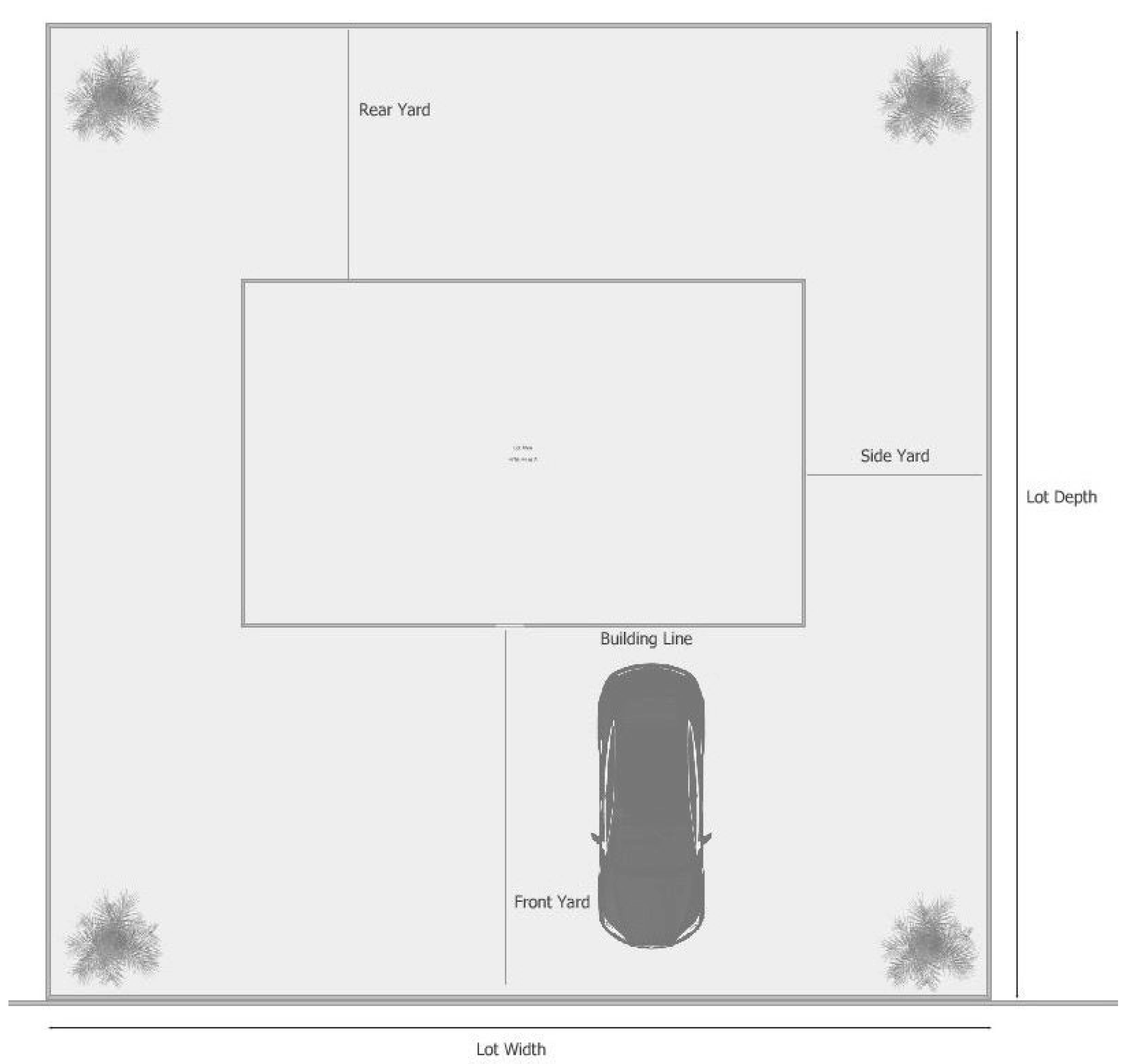
Illustration of Setbacks

