
Glendale City Zoning Code
PLANNED DEVELOPMENT
OVERLAY DISTRICT
§ 154.81 PURPOSE.
The purpose of the Planned Development Overlay District, hereafter referred to as the PDO District, is to:
(A) Protect the health, safety, and general welfare of the residents and property owners of the village;
(B) Allow for flexibility in the zoning requirements where the result will be a higher quality development;
(C) Encourage the development of mixed use areas that reflect the historic development patterns and form of the village;
(D) Provide for and locate suitable public areas, recreational facilities, greenspace, and other common facilities, while preserving the existing character of the village to the greatest extent possible;
(E) Allow for reasonable development opportunities when such development will incorporate historic characteristics of the village without being detrimental to those existing historic characteristics;
(F) Encourage sound planning principles in the arrangement of buildings, the preservation of greenspace, and the utilization of topography and other site features;
(G) Obtain creative and coordinated designs in harmony with surrounding uses;
(H) Ensure the provision of adequate public facilities and services including, but not limited to, water, sewer, roads, police and fire protection, stormwater management, and traffic management; and
(I) Allow for creative development that conforms to goals, objectives, and strategies of the Village Plan.
(Ord. 2006-12, passed 5-1-06)
§ 154.82 APPLICABILITY.
An application for a PDO District may be initiated for any parcel, or assemblage of contiguous parcels, that exceeds ten acres in size.
(Ord. 2006-12, passed 5-1-06; Am. Ord. 2014-48, passed 12-1-14)
§ 154.83 AUTHORITY TO INITIATE.
(A) Property owners or an agent representing the property owners may initiate an application for a PDO district in accordance with this section. Each application shall be signed by all of the subject property owners acknowledging consent to rezone, or the owners’ authorized agent (demonstrated by written authorization to rezone) of the property within the area proposed to be reclassified, attesting to the truth and correctness of all facts and information presented within the application.
(B) The village may initiate a zoning map amendment to create a PDO District on any applicable property. The signature of property owners shall not be required if the village initiates the zoning map amendment.
(Ord. 2006-12, passed 5-1-06)
§ 154.84 APPLICANT INITIATED PDO.
Establishing a PDO District shall require a zoning map amendment pursuant to § 154.66 that shall be reviewed pursuant to the following procedure:
(A) Step 1: Preapplication Conference.
(1) The applicant shall meet with the GPHPC to discuss the initial concepts of the planned development and general compliance with applicable provisions of this section prior to the submission of the application.
(2) During this time, the applicant is strongly encouraged to contact neighboring property owners regarding the applicant’s plans and to solicit input from those property owners.
(3) Discussions that occur during a preapplication conference or a preliminary meeting with administration or the GPHPC are not binding on the village and do not constitute official assurances or representations by the village or its officials regarding any aspects of the plan(s) or application(s) discussed.
(B) Step 2: Application.
(1) Following the preapplication conference with the GPHPC, the applicant may submit an application for a zoning map amendment to the Village Administrator.
(2) The application shall include all such forms, maps, and information, as may be prescribed for that purpose by the GPHPC to assure the fullest practicable presentation of the facts for the permanent record. A list of minimum requirements may be adopted by the GPHPC.
(3) All applications shall be submitted with the required fees as established in this section.
(4) The applicant shall also submit the preliminary development plan simultaneously with the application for a zoning map amendment.
(C) Step 3: Submission of the Preliminary Development Plan.
(1) The preliminary development plan submission shall be in a form and in quantities as prescribed by this section and by the GPHPC. A list of minimum submittal requirements may be adopted by the GPHPC.
(2) Preliminary development plans should generally include the following:
(a) Approximate areas and arrangement of the proposed uses and the relationship of abutting land uses and zone districts;
(b) The proposed general location of vehicular circulation and method of access to the surrounding roadways;
(c) The proposed treatment of existing topography, drainage ways and tree cover;
(d) The location of schools, parks, greenspace, community amenities or facilities, if any;
(e) Required impact studies and certification of adequate public facilities and services as required in § 154.93(D);
(f) Anticipated time schedule of projected development, if the total landholding is to be developed in stages, or if construction is to extend beyond a two year time period;
(g) For residential uses, the preliminary development plan shall also include the proposed type of unit, density level, and proposed area setbacks of each residential area, and the type, general location and approximate acreage of the common greenspace. All other miscellaneous and accessory uses shall also be included;
(h) In the case of nonresidential uses, the preliminary development plan shall identify the principal and accessory types of uses that are to be included in the proposed development, including their approximate location, size, and intensity. The proposed type, general location and approximate acreage of common greenspace shall also be included; and
(i) Any other information required by the GPHPC.
(D) Step 4: Public Hearing with the GPHPC.
(1) Upon the filing of an application and preliminary development plan for a PDO District amendment (Steps 2 and 3), the GPHPC shall set a date, within 60 days of the application, for a public hearing regarding the proposed amendment application and preliminary development plan.
(2) If additional information is deemed necessary to complete its review and recommendation of the proposed preliminary development plan, the GPHPC may, by majority vote of its membership, continue the hearing to a date and time established in the motion to continue the hearing. The public hearing to consider a preliminary development plan shall be concluded within 90 days of the date when such hearing was first held.
(3) Notwithstanding the requirements established in division (D)(2) of this section, the application for a preliminary development plan may be tabled or continued for any set period of time upon the mutual agreement of the applicant and the village.
(4) Within 90 days of the conclusion of GPHPC’s public hearing, the GPHPC shall recommend the approval, approval with modifications, or denial of the proposed amendment application and preliminary development plan, and submit such recommendation together with such application and preliminary development plan to the Village Council.
(5) Failure of the GPHPC to act on an application and preliminary development plan within 90 days of the conclusion of GPHPC’s public hearing to consider such plan shall constitute approval of the application.
(E) Step 5: Public Hearing with the Village Council.
(1) Upon receipt of the recommendation from the GPHPC (Step 4), the Village Council shall set a time for a public hearing, within 60 days of the GPHPC’s recommendations, on such proposed amendment application and preliminary development plan.
(2) If additional information is deemed necessary to complete its review of GPHPC’s recommendation of the proposed preliminary development plan, the Village Council may, by majority vote of its membership, continue the hearing to a date and time established in the motion to continue the hearing. The public hearing to consider a preliminary development plan shall be concluded within 90 days of the date when such hearing was first held.
(3) Notwithstanding the requirements established in paragraph 2 of this section, the application for a preliminary development plan may be tabled or continued for any set period of time upon the mutual agreement of the applicant and the village.
(4) Within 90 days of the conclusion of the public hearing, the Village Council shall:
(a) Adopt the recommendation of the GPHPC as presented by the GPHPC by village ordinance with the concurrence of at least a majority of its membership;
(b) Reject the recommendation of the GPHPC as presented by the GPHPC due to the failure of the village ordinance to pass due to the lack of a concurrence of a majority of its membership for its passage;
(c) Adopt a modification of the recommendation of the GPHPC, including the approval of an amendment application rejected by the GPHPC recommendation, by village ordinance with the concurrence of not less than three fourths of its membership.
(5) If the amendment application is denied, the applicant may appeal the decision to the Court of Common Pleas.
(6) Approval of the preliminary development plan shall include density, intensities, nonresidential building sizes, land uses and their interrelationship, design standards, and building location. Location of buildings (if applicable) and uses may be altered slightly due to engineering feasibility which is to be determined in the subsequent preparation of the detailed final development plans.
(7) The decision by the Village Council is subject to the same effective date and referendum provisions as set forth in R.C. §§ 731.29 to 731.41. Following approval of the PDO District map amendment application and preliminary development plan, and after the subsequent referendum period has ended, the Official Zoning Map shall be changed to reflect this amendment.
(F) Step 6: Submission of a Final Development Plan.
(1) Once the PDO District and preliminary development plan has been approved by the Village Council, the applicant shall proceed with the preparation of the detailed final development plan(s) in whole or in phases.
(2) The final development plan submission shall be in a form and in quantities as prescribed by the GPHPC. A list of minimum submittal requirements may be adopted by the GPHPC.
(3) The detailed final development plan shall be consistent with the contents of the approved preliminary development plan, and be prepared by a licensed or certified professional planner, engineer, architect or landscape architect.
(4) A final development plan shall include all necessary legal documentation relating to the incorporation of a Homeowner's Association for the purpose of maintaining the specified common greenspace within the planned development.
(G) Step 7: Public Meeting and Recommendation by the GPHPC.
(1) Within 60 days of receipt of the detailed final development plan(s) and recommendations of staff, the GPHPC shall hold a public meeting to study, review, and make a recommendation on the detailed final development plan(s) on the basis that all requirements have been satisfied, and the conditions specified in this section have been met.
(2) If additional information is deemed necessary to complete its review and recommendation of the proposed final development plan, the GPHPC may, by majority vote of its membership, continue the meeting to a date and time established in the motion to continue the meeting. The public meeting to consider a final development plan shall be concluded within 90 days of the date when such meeting was first held.
(3) Notwithstanding the requirements established in division (G)(2) of this section, the application for a final development plan may be tabled or continued for any set period of time upon the mutual agreement of the applicant and the village.
(4) Within 45 days of the conclusion of GPHPC’s public meeting, the GPHPC shall make a recommendation to the Village Council to approve, approve with modifications, or deny the final development plan(s).
(5) Failure of the GPHPC to act on a final development plan within 45 days of the conclusion of GPHPC’s public meeting to consider such plan shall constitute approval of the application.
(H) Step 8 – Public Meeting and Decision by the Village Council.
(1) Within 60 days of receipt of the recommendation from the GPHPC (Step 7), the Village Council shall review the final development plan as it relates to this ordinance at a public meeting.
(2) If additional information is deemed necessary to complete its review of GPHPC’s recommendation of the proposed final development plan, the Village Council may, by majority vote of its membership, continue the meeting to a date and time established in the motion to continue the meeting. The public meeting to consider a final development plan shall be concluded within 90 days of the date when such meeting was first held.
(3) Notwithstanding the requirements established in division (H)(2) of this section, the application for a final development plan may be tabled or continued for any set period of time upon the mutual agreement of the applicant and the village.
(4) Within 45 days after the conclusion of the public meeting, the Village Council shall:
(a) Adopt the recommendation of the GPHPC as presented by the GPHPC by village ordinance with the concurrence of at least a majority of its membership;
(b) Reject the recommendation of the GPHPC as presented by the GPHPC due to the failure of the village ordinance to pass due to a lack of a concurrence of a majority of its membership for its passage;
(c) Adopt a modification of the recommendation of the GPHPC, including the approval of an application rejected by the GPHPC recommendation, by village ordinance with the concurrence of not less than three fourths of its membership.
(Ord. 2006-12, passed 5-1-06; Am. Ord. 2016-46, passed 11-7-16)
§ 154.85 VILLAGE INITIATED PDO.
(A) If the village initiates a zoning map amendment to create a PDO District, the village shall not be responsible for preparing and submitting a preliminary or final development plan for review.
(B) The village shall establish the PDO District pursuant to the zoning map amendment process established in this subchapter.
(C) Once the village has rezoned the property to the PDO District, it will be the responsibility of the property owner or their representative to submit a preliminary and final development plan pursuant to the review procedure of § 154.84(C) through (H) above in order to obtain building permits for the site.
(Ord. 2006-12, passed 5-1-06)
§ 154.86 SUBMITTAL REQUIREMENTS.
All applications shall include the basic data package described in § 154.61 and any other requirements as may be established by the GPHPC.
(Ord. 2006-12, passed 5-1-06)
§ 154.87 PUBLIC NOTICE.
(A) The village shall notify the public of any public hearing in conformance with Section 713.12 of the Ohio Revised Code.
(B) The village shall also mail a written notice of the public hearing to all property owners within 1,000 feet of the subject property at least 20 days prior to the hearing.
(C) Minor defects in any notice shall not impair the notice or invalidate proceedings pursuant to the notice if a bona fide attempt has been made to comply with applicable notice requirements. Minor defects in notice shall be limited to errors in a legal description, typographical or grammatical errors, or errors of actual acreage that do not impede communication of the notice to affected parties. Failure of a party to receive written notice shall not invalidate subsequent action. In all cases, however, the requirements for the timing of the notice and for specifying the time, date, and place of a hearing shall be strictly construed. If questions arise at the hearing regarding the adequacy of notice, the decision-making body shall direct the agency having responsibility for notification to make a formal finding as to whether there was substantial compliance with the notice requirements of this subchapter, and such finding shall be made available to the decisionmaking body prior to final action on the request.
(D) When the records of the village document the publication, mailing, and posting of notices as required by this section, it shall be presumed that notice of a public hearing was given as required by this section.
(Ord. 2006-12, passed 5-1-06)
§ 154.88 APPROVAL CRITERIA.
(A) Approval Criteria for a Preliminary Development Plan. The following criteria shall serve as conditions that should generally be satisfied before the approval of the preliminary development plan:
(1) The PD District and preliminary development plan is consistent with the adopted Village Plan;
(2) The use(s) proposed will not be detrimental to present and potential surrounding uses, but will have a beneficial effect which could not be achieved as well under other zoning districts;
(3) The internal streets and primary and secondary roads that are proposed properly interconnect with the surrounding existing road network.
(4) The site will be safely accessible from public roads that are generally adequate to carry the traffic that will be imposed upon them by the proposed development and the streets and driveways on the site will be adequate to serve the residents or occupants of the proposed development;
(5) The minimum common greenspace area(s) have been designated and shall be duly transferred to a legally established Homeowner's Association or has been dedicated to the village or another public or quasi-public agency.
(6) The preliminary development plan is consistent with the intent and purpose of this subchapter.
(7) The preliminary development plan has been transmitted to all other agencies and departments charged with responsibility of review.
(B) Approval Criteria for a Final Development Plan. The following criteria shall serve as conditions that should generally be satisfied before the approval of the final development plan:
(1) Appropriate arrangements with the applicant have been made which will ensure the reservation of common greenspace as indicated on the preliminary development plan and final development plan. If deemed necessary by the Village Council during the preliminary development plan process, the Village Council may require the applicant to hold bond to ensure the successful and proper reservation of greenspace;
(2) Appropriate agreements with the applicant have been made to ensure the proper completion of public improvements in compliance with Chapter 153: Subdivision Regulations;
(3) The proposed detailed final development plan(s) for the individual section(s) of the overall PD District is consistent in contents (building location, land uses, densities and intensities, yard requirements, and area and frontage requirements) with the approved preliminary development plan and the Glendale Village Plan;
(4) Each individual phase of the development can exist as an independent unit that is capable of creating an environment of sustained desirability and stability, or that adequate assurance will be provided that such objective can be obtained;
(5) That any part of the planned development not used for structures, parking and loading areas, or streets, shall be landscaped or otherwise improved; or if approved by the GPHPC, left in its natural state;
(6) That any exception from the design standards provided in the PD District is warranted by the design and amenities incorporated in the detailed final development plan;
(7) That the internal streets and thoroughfares proposed are suitable and adequate to accommodate the anticipated traffic within and through the development;
(8) That the detailed final development plan is consistent with the intent and purpose of this section and to promote the public health, safety and general welfare of the residents of Glendale; and
(9) The final development plan has been transmitted to all other agencies and departments charged with responsibility of review.
(Ord. 2006-12, passed 5-1-06)
§ 154.89 TIME LIMITS.
(A) The final development plan(s) shall be submitted within one year of approval of the preliminary development plan or the approval of the preliminary development plan will expire and the plan will be deemed null and void.
(B) Upon expiration of the preliminary development plan, the property shall still be zoned as a planned development with a voided preliminary development plan. The property owner or agent may submit an application and new preliminary development plan for consideration pursuant to § 154.84.
(C) Upon the expiration of the preliminary development plan, the GPHPC or Village Council may initiate hearings to remove the planned development district.
(D) The GPHPC may authorize an extension of these time limits if good cause is shown for the delay of the final development plan submission.
(E) For phased developments, the GPHPC and Village Council may approve a phased final development plan schedule as part of the preliminary development plan approval. In such case, the approved time frames shall establish when the approved preliminary plan shall expire.
(Ord. 2006-12, passed 5-1-06)
§ 154.90 EFFECT OF A FINAL DEVELOPMENT PLAN.
(A) The approved final development plan shall be kept on record in the Village Administration Offices together with all ordinances, applications, plats, plans, and other information regarding the development.
(B) The ordinances prepared by the GPHPC and Village Council serve as the official record for the permitted uses and activities which are approved for the planned development landholding.
(C) The use of the planned development landholding or the location, erection, construction, reconstruction, enlargement, or change of any building or structure in a manner which is not consistent with the final development plan shall be considered a violation of this subchapter and subject to the procedures and penalties specified in §§ 154.95 and 154.99.
(Ord. 2006-12, passed 5-1-06)
§ 154.91 REQUIRED CONDITIONS FOR THE ISSUANCE OF A BUILDING PERMIT.
(A) No building permit shall be issued for any property in a PDO District and no construction shall begin until a valid final development plan is in effect for that phase or property.
(B) Preliminary excavation may be permitted provided the proposed excavation is approved as part of the preliminary development plan approval.
(C) The final development plan becomes valid upon approval of a resolution by the GPHPC and Village Council.
(Ord. 2006-12, passed 5-1-06)
§ 154.92 MODIFICATIONS TO PLANNED DEVELOPMENTS.
(A) If an applicant or the village, in the case of village-initiated PDO, proposes to modify an approved preliminary development plan or final development plan, the applicant or the village shall submit the proposed modifications to the Village Administrator.
(B) The Village Administrator shall forward all applications for a modification to the GPHPC for review to determine if the proposed modification is a major change or a minor change and forward the proposed modifications in accordance with the following subsections.
(C) Major changes.
(1) Major changes shall include:
(a) An increase in density or intensity;
(b) Changes to the property or project boundaries of the entire PD District;
(c) Significant modification of the type, location or amount of land designated for a specific land use or greenspace;
(d) Modifications in the internal street and thoroughfare locations or alignments which significantly impact traffic patterns or safety considerations; or
(e) A change of use that is not otherwise permitted pursuant to § 154.93.
(2) Major changes shall be subject to review and approval of the GPHPC and Village Council.
(3) Major changes to an existing planned development, modifications from the preliminary development plan, or revisions to a final development plan for a tract of land in which development has not already begun or is completed, in light of technical or engineering considerations, shall be subject to reconsideration and approval by the village and shall be required in accordance with the procedures specified in § 154.84.
(D) Minor changes.
(1) Minor changes shall be subject to review and approval by the GPHPC only.
(2) The GPHPC shall consider the purpose of this section and the review criteria in making their decision on minor changes.
(Ord. 2006-12, passed 5-1-06; Am. Ord. 2014-47, passed 12-1-14)
§ 154.93 DESIGN STANDARDS.
(A) Permitted uses.
(1) The following shall be principal uses that may be permitted by the village provided the uses meet all other applicable standards of this section and are approved by the village in the preliminary development plan:
(a) Attached multiple residential dwellings shall each have a separate external entrance, except a dwelling that is part of a mixed-use building. The number of such dwellings, regardless of whether they are part of a mixed-use building, shall not result in a net density that exceeds the limits of division (B)(4) below;
(b) Bars or taverns;
(c) Detached single-family dwellings;
(d) Financial institutions with or without attached drive-through facilities;
(e) Government facilities and other public uses;
(f) Hospitals;
(g) [This division intentionally left blank]
(h) Medical or dental clinics;
(i) Mixed use buildings with commercial uses on the first floor and office or residential uses on the second floor;
(j) Nursing homes, assisted living facilities, and other convalescent housing;
(k) Offices;
(l) Parks, greenspace, and playgrounds;
(m) Public or private educational facilities;
(n) Religious places of worship;
(o) Restaurants; and
(p) Retail or service commercial uses.
(2) Drive-through facilities shall be prohibited unless specifically permitted in the above list of uses.
(3) The following shall be accessory uses that may be permitted by the village as part of a PDO District:
(a) Accessory uses permitted in the “AA-1”, “AA-2”, “A”, “B”, or “C” Districts when accessory to a residential principal use;
(b) Parking structures provided they are located in a rear yard or otherwise screened from residential uses; and
(c) Other uses which are typical accessory and incidental to nonresidential uses.
(B) Land use ratios and intensities.
(1) A minimum of 30% of the project area shall be dedicated to residential uses, provided that, in implementing this requirement, the GPHPC and Council shall have the discretion of considering the “project area” to be:
(a) The entirety of the property covered by the PDO;
(b) Each separate and distinct section of the property covered by the PDO that is presented for development; or
(c) Any combination of adjacent separate and distinct sections of the property covered by the PDO that are presented for development.
(2) A minimum 20% of the gross project area of each separate and distinct section of the property covered by a PDO that is presented for development shall be dedicated to greenspace, provided that the greenspace meets the requirements of division (C).
(3) The remaining area of the project area may be used for residential uses, greenspace, or other uses as permitted in division (A) and as authorized in the preliminary development plan process.
(4) The maximum net density of residential uses shall be six units per acre, except for residential uses that are part of a development that includes a nursing home, assisted living facility or other convalescent home (collectively “care facility”) and the services of the care facility are available to the residents at their option.
(5) The maximum impervious surface ratio of any lot shall be 70%.
(C) Minimum greenspace requirements.
(1) The following land shall not count toward the minimum greenspace requirement of division (B) above:
(a) Detention or retention ponds or other stormwater areas, unless otherwise approved as part of the preliminary development plan;
(b) Land that is privately owned (not held or maintained as common open/greenspace) may be considered as meeting a portion of the greenspace requirement provided it approved by the village during the preliminary development plan review process;
(c) Land that is part of a required setback, buffer, or landscape area as established in this subchapter shall not be counted toward the minimum greenspace requirement; and
(d) Land that is used or dedicated for use as a cemetery.
(2) All greenspaces shall either be dedicated to the village or protected and maintained by a homeowners’ association. The village shall not be required to accept any greenspace.
(3) All documents of incorporation and initial bylaws of a homeowners’ association are subject to review by the village to ensure that all greenspace areas will be adequately maintained.
(4) A minimum of 50% of the required greenspace set aside shall be improved greenspace as approved by the village. The remainder of the set aside may be left in its natural state, but shall still be part of a common area accessible by the public.
(5) Improved areas may include:
(a) Playgrounds and improved parks;
(b) Community centers;
(c) Swimming pools;
(d) Improved ponds;
(e) Retention ponds that are improved so as to be an amenity to the site and as approved by the GPHPC;
(f) Picnic facilities;
(g) Public plazas that may serve as gathering places for residents;
(h) Other improved areas that may be used by the public as approved by the GPHPC.
(D) Public facilities.
(1) Purpose. The purpose of this section is to establish minimum standards that ensure that public facilities and services needed to support a development are available concurrently with the impacts of such development.
(2) Impact study required.
(a) The applicant shall be required to prepare a fiscal and services impact study to illustrate the impact the proposed development will have on services including, but not limited to, police, fire,
and schools.
(b) This impact study may incorporate the requirements of divisions (3) and (4) below.
(c) The fiscal impact study shall provide an estimate of the amount of tax revenue that may be generated by the development, the distribution of such taxes, and any deficiencies the development
may create between the taxes generated and the demand for services.
(3) Water, wastewater, and stormwater.
(a) The applicant shall demonstrate that there is adequate, or will be, adequate water and wastewater service at the time of occupancy. The availability of such services shall be certified by the applicable public service provider.
(b) The applicant shall be required to demonstrate that the new development will meet all stormwater standards of the county as well as all state and federal Environmental Protection Agency (EPA) regulations.
(c) If adequate service is not available, the applicant shall be responsible for the costs required to extend or provide service to the subject area.
(4) Transportation.
(a) A traffic impact study shall be required for all development in a PDO District. Such study shall be completed by an independent consultant pursuant to § 154.94(B).
(b) All developments shall demonstrate compliance with the following transportation level of service standards.
1. Existing levels of service at peak hour are maintained on all arterial and collector roads and at all intersections within 1/4-mile of the primary access to the site, or the level of service shall not fall below a Level of Service (LOS) “D” as defined by the Transportation Research Board, Highway Capacity Manual, Special Report 209 (Washington D.C.: National Research Council, 1998), as amended.
2. However, if the LOS on streets adjacent to the site or within 1/4 mile thereof is currently below LOS “D”, then the applicant shall demonstrate that the LOS will not fall below the current level.
(c) All development shall provide an overall access management plan that demonstrates free-flowing access to the site and avoids unsafe congestion conditions on adjacent public roads and streets.
(d) The applicant shall be responsible for the costs required to make the necessary improvements that will, at a minimum, maintain the LOS “D” or other, pre-existing LOS.
(e) Impact studies and certification required. The fiscal and services impact study, the traffic impact study, and certification of adequate public facilities shall be provided with the application and prior to the review and a decision on the preliminary development plan.
(E) General design guidelines. The following guidelines shall apply to all uses unless otherwise noted:
(1) All development shall be in compliance with other applicable provisions of Chapter 154 of the Glendale Land Usage Regulations unless otherwise authorized by this PDO.
(2) Where applicable, applications shall be subject to historic preservation review in compliance with the Glendale Historic Preservation Guidelines.
(3) All applications for a PDO shall automatically be required to comply with § 154.52: Large Scale Development Compatibility unless otherwise authorized by this PDO. Applications for a Certificate of Architectural Conformance shall be reviewed as part of the preliminary development plan review.
(4) Unless specified otherwise, yard, setback, and lot requirements shall be established during the preliminary development plan review and shall be evaluated in relation to the purpose of this section.
(5) All utilities shall be located underground to the maximum extent feasible as determined by the GPHPC or by the Village Engineer.
(6) All dumpsters, mechanical equipment, service entrances, loading areas, and/or outdoor storage shall be:
(a) Located in the rear yard to the maximum extent feasible. The village may permit such use in the side yard if the applicant can demonstrate that it cannot be located in the rear yard and that there is adequate screening.
(b) Screened by a decorative wall or fence that is architecturally compatible with the principal building.
(c) Designed so that there is adequate access to water for cleaning and proper maintenance.
(7) Outdoor sales, display, and storage of products, beyond that permitted in division (E)(5) above, shall be prohibited.
(8) Chain link, barbed wire, and similar fencing shall be prohibited.
(9) Multiple primary buildings on the same site shall be designed to create a cohesive visual relationship between the buildings.
(10) Building materials shall be restricted to brick, wood, stone, stucco, or natural looking materials. Concrete block or slick materials such as plastic or metal are prohibited. Other materials may be approved on an individual basis by the GPHPC.
(11) The use of neon lights or bright colors for building materials shall be prohibited. The applicant may be required to submit a color palette for review by the GPHPC.
(12) Sidewalks.
(a) Sidewalks shall be required on both sides of all streets with a minimum width of five feet in residential areas and six feet in mixed-use or nonresidential areas.
(b) Trails and bikeways located within greenspace or common areas shall be encouraged.
(F) Residential building and site design.
(1) Each dwelling unit shall have a separate exterior entrance unless the attached dwelling is part of a mixed-use building.
(2) Attached dwelling units shall be attached only through common walls unless the attached dwelling is part of a mixed-use building.
(3) Garages shall be either flush with the front facade or shall be setback so as not to be the predominant feature of the dwelling. Rear entry garages with access from an alley are strongly encouraged.
(4) The maximum overall height of residential buildings shall be 35 feet.
(G) Mixed-use or nonresidential building and site design.
(1) No building shall have a footprint that exceeds 25,000 square feet in size.
(2) There shall be a minimum separation of 30 feet between all buildings within the PDO boundary and 100 feet from all existing structures outside of the PDO boundary.
(3) The maximum overall height of nonresidential buildings shall be 48 feet.
(4) Nonresidential buildings shall be setback a minimum of 100 feet from all residential dwelling units.
(5) Buffering.
(a) A 30-foot landscape buffer shall be provided between any PDO development and adjacent, existing residential properties. The buffer shall include a six-foot fence, wall or earthen berm along with three evergreen trees plus three deciduous trees and three shrubs for every 60 lineal feet of bufferyard.
(b) A natural buffer consisting of 10 evergreen trees, planted in an offset manner as to create a solid buffer, plus 12 shrubs for every 75 lineal feet of bufferyard may be provided as an alternative to (G)(5) above. The landscape buffer may be located within required setbacks.
(c) Divisions (a) and (b) above represent the minimum buffer that shall be required between residential and mixed-use or nonresidential developments. Where it finds that such buffering will not be sufficient to reduce visual and noise impacts to levels reasonable for residential uses, the village may require a developer to supply buffering in addition to that required in divisions (a) and (b) above between any existing or proposed residential development and adjacent public streets or nonresidential zoning or development in the village or neighboring municipalities.
(d) Responsibility for the buffering required under divisions (a), (b) or (c) above shall rest primarily with the developer of the mixed-use or nonresidential development involved, unless said development is pre-existing or outside the borders of the village or it is otherwise infeasible for the developer of said uses to be required to provide the buffering, in which case the responsibility for buffering shall rest with the developer of the residential use that abuts the mixed-use or nonresidential development.
(e) The applicant shall have the ability to utilize an alternative approach to buffering, other than the requirements of this section, if applicant can demonstrate to the satisfaction of the village that the proposed alternative approach meets or exceeds the efficacy of the buffering provided by said requirements.
(6) All elevations of a building are subject to review. A front facade shall be architecturally emphasized although all sides of a building shall be architecturally consistent with the front facade.
(7) No more than 60% of a façade may be constructed of glass or other transparent materials.
(8) Flat rooflines are permitted with the use of cornices, parapets, or some form of architectural emphasis along the roofline.
(9) Long or continuous wall planes shall be avoided with a maximum uninterrupted single wall plane of 30 feet.
(10) Color schemes should be kept simple with no more than one or two trim colors on any given building. The chosen color scheme should help tie all of the parts of the building together.
(11) All vents, gutters, downspouts, flashing, electrical conduits, etc., shall be painted to match the color of the adjacent surface, unless being used expressly as a trim or accent element.
(12) The construction materials and colors of walls and fences on nonresidential properties shall be uniform and compatible with the architectural style, color, and building materials of the principal building and its surroundings.
(H) Outdoor lighting.
(1) Outdoor lighting shall be subject to § 154.28.
(2) Outdoor lighting shall be designed so there is no light spillage from the site onto existing residences and shall be demonstrated through the preparation of a photometric lighting plan.
(I) Landscaping and buffering.
(1) The applicant shall be required to submit a landscape plan as part of the final development plan to demonstrate compliance with these requirements.
(2) Plant materials shall be chosen which are indigenous, moderately fast growing, and require minimal maintenance. The landscape design shall incorporate the entire site and consist of a palette of plants with year round appeal, which might include annuals, perennials, shrubs, and trees.
(3) Street trees shall be required on both sides of the street and shall be located in a tree lawn between the sidewalk and street. The tree lawn shall have a minimum width of five feet unless otherwise approved by the GPHPC.
(4) Wooded areas shall be preserved, to the maximum extent feasible, as determined by the GPHPC, the Village Engineer, or an independent specialist selected by the village pursuant to § 154.94(B).
(5) Landscaping areas shall be provided around every ground-mounted or pole-mounted sign. The landscaped area shall be of a size equal to or exceeding the total area of the sign face.
(6) Plant materials.
(a) Plant materials used in conformance with these provisions shall conform to the American Association of Nurserymen and shall have passed any inspection required under state regulations. Trees shall be balled and burlapped or in containers. Shrubs, vines, and ground covers can be plants as bare root as well as balled and burlapped or from containers.
(b) Deciduous trees shall have a minimum caliper of at least 2.5 inches DBH conforming to acceptable nursery industry procedures at the time of planting. If deciduous trees are to be used for screening purposes, additional materials listed in this section shall be used to create a dense buffer.
(c) Evergreen trees shall be a minimum of six feet in height at the time of planting. Evergreen plantings shall be planted at a maximum distance of 15 feet on center to provide an effective buffer.
(d) Ornamental trees shall have a minimum height of five feet or a minimum caliper of at least 2.5 inches DBH conforming to acceptable nursery industry procedures at the time of planting.
(e) Street Tree Standards.
1. Street trees shall be of a species approved by a landscape architect or arborist for use as a street tree. Street trees shall be of a size and species suitable for location in tree lawns in close proximity to streets.
2. Choose only small-scale trees when planting underneath power lines.
(f) Shrubs and hedges shall be at least 36 inches in height at the time of planting. All shrubs and hedges shall be designed to provide an effective buffer of at least five feet within a period of four years after planting.
(g) Grass shall be planted in species normally grown in permanent lawns in the county. In swales or other areas subject to erosion, solid sod shall be sown for immediate protection until complete coverage otherwise is achieved. Grass sod shall be clean and free of weeds and noxious pests or diseases. Ground cover shall be planted at a maximum spacing of one foot on center to provide 75% complete coverage after two growing seasons.
(h) Once the minimum landscape requirements have been met, any size plant may be installed on a lot to supplement the minimum requirements.
(7) Tree canopy coverage.
(a) Trees shall be provided within the limits of construction to the extent that at 20 years from the date of planting, tree canopies or covers will provide at least a coverage of 20% for residential areas or 10% for mixed-use and nonresidential areas. Such coverage shall be certified by a landscape architect or certified arborist.
(b) Existing trees or wooded areas which are to be preserved, at the applicants option may be included to meet all or part of the canopy requirements, provided the site plan identifies such trees and the trees meet the standards of size, health, placement, etc. set out in this section. The village may enlist the services of a landscape architect or certified arborist to evaluate use of existing trees to ensure they have adequate health and strength to allow such use.
(c) Existing trees designated to be included as part of these requirements shall be protected during construction by fencing placed at a distance in feet equal to or greater than the caliper of the tree in inches at the height of four feet.
(d) The extent of canopy at maturity shall be based on published reference texts generally accepted by landscape architects, nurserymen, and arborists.
(8) Vehicular use area landscaping.
(a) Parking areas and driveways shall be landscaped with shrubs, trees, or tree groupings.
(b) A minimum of 10% of the total interior parking lot area of parking lots with more than five spaces shall be landscaped with planted islands. A minimum of one tree and two shrubs shall be planted in interior islands for every 2,500 square feet of parking lot.
(c) Parking islands shall be located so there shall be no more than 15 parking spaces located between parking islands.
(d) Landscaped medians extending the full length of the parking area shall be constructed between every four rows of parking.
(e) Planted islands shall be at least 170 square feet in size with the smallest dimension of pervious surface being ten feet to allow for adequate root aeration and expansion.
(f) Where landscaping is used as screening, it shall be opaque year round and shall have a minimum height of eight feet at time of installation.
(g) Landscape screening shall be of a height and density so that it provides the full desired effect within three growing seasons.
(9) Maintenance.
(a) Street tree bonding.
1. Prior to final approval of the final development plan, the applicant shall enter into an agreement with the village to provide completed street tree plantings and shall post an irrevocable letter of credit, bond, or other surety with the Village Council.
2. If all the street tree plantings are not completed within two years of approval or if the approved landscape plan is not followed, regarding street trees, the surety or bond shall be forfeited and shall be used to complete the landscape plan as approved.
3. The bond or other surety shall be held for a period of 18 months after installation of plantings to assure proper maintenance and growth. Failure to maintain the vegetation and to replace dead plants or trees shall result in a forfeiture of the posted bond or other surety.
4. Prior to the, release of the bond, the site shall be inspected by the village upon notification by the applicant to assure proper maintenance and installation.
(b) All landscaping materials shall be installed and maintained according to accepted nursery industry procedures. The owner of the property shall be responsible for the continued property maintenance of all landscaping materials and shall keep them in a proper, neat, and orderly appearance free from refuse and debris at all times.
(c) Unhealthy and dead plants that are required as part of these requirements shall be replaced within one-year, or by the next planting season, whichever comes first.
(d) Violation of these maintenance practices shall be a violation of this subchapter.
(J) Parking.
(1) Required parking spaces. Table 1 shall establish the minimum parking spaces required for permitted uses.
Table 1: Required Parking
| |
Use | Required Parking Spaces |
Dwelling units (attached or detached) | 2 spaces per dwelling unit |
Bars or taverns | 15 spaces per 1,000 square feet |
Financial institutions | 4 spaces per 1,000 square feet |
Government facilities and other public uses | As approved by the GPHPC |
Hospitals | 1 space for every 2 patient beds (not bassinets) plus 4 spaces for 1,000 square feet of outpatient clinics, laboratories, pharmacies and other similar uses |
Table 1: Required Parking (Cont’d) | |
Use | Required Parking Spaces |
Table 1: Required Parking (Cont’d) | |
Use | Required Parking Spaces |
Hotels | 1 space per room or suite |
Medical or dental clinics | 4 spaces per 1,000 square feet |
Mixed-use buildings | Parking shall equal the sum of the parking requirements of the separate uses. |
Nursing homes, assisted living facilities, and other convalescent housing | 1 space per 2 beds |
Offices | 3 spaces per 1,000 square feet |
Parks or playgrounds | 1 space per 5,000 square feet of park or playground area |
Educational facilities | 1 space per 3 students (maximum capacity) for senior high schools and 1 space per 5 students (maximum capacity) for elementary and junior schools. |
Religious places of worship | 1 space per 3 fixed seats in the main assembly room or 1 space per 3 persons of maximum occupancy, whichever is greater |
Restaurants | 10 spaces per 1,000 square feet or 1 space for each 4 seats, whichever is greater |
Retail or service commercial uses | 1 space per 250 square feet |
Unlisted uses | Upon receiving an application for a use not specifically listed in the parking schedule above, the GPHPC shall apply the parking standard specified for the listed use that is deemed most similar to the proposed use in regards to use, size and intensity of use. If the GPHPC determines that there is no listed use similar to the proposed use, intensity, or size, they may refer to the estimates of parking demand based on recommendations of the Institute of Traffic Engineers (ITE). |
(2) In no case shall more than 100% of the parking required in Table 1 above be provided on surface parking lots. Any parking over 100% of that required by Table 1 shall be provided in a parking structure (underground or above ground parking garages).
(3) All above ground parking structure shall be architecturally compatible with adjacent buildings.
(4) Off-street parking areas for all mixed-use buildings shall be located in the side or rear yard.
(5) Parking in the front yard of any nonresidential building shall be limited to one access drive and two bays of parking stalls (See Figure 1).
Figure 1: Parking Around Nonresidential Uses

(6) Continuous curbs shall be required to surround parking areas in all business districts for parking lots with 20 or more parking spaces.
(7) Shared parking arrangements between uses are encouraged provided they meet the following requirements:
(a) A sufficient number of spaces is provided to meet the highest demand of the participating uses;
(b) The uses are located adjacent to each other;
(c) Evidence has been submitted by the parties operating the shared parking facility, to the satisfaction of the GPHPC, documenting the nature of uses and the times when the individual uses will operate so as to demonstrate the lack of potential conflict between them.
(d) Shared parking spaces not located within a parking structure shall not be located in excess of 300 feet from the uses they are intended to serve;
(e) A legal shared parking agreement is submitted and approved by the Village Attorney that provides for the rights of the respective parties to use the shared parking areas in a manner adequate to accommodate multiple users or that parking spaces will be shared at specific times of the day (i.e., one activity uses the spaces during daytime hours and another activity use the spaces during evening hours). This agreement shall include provisions, evidence of deed restrictions or other recorded covenants that ensure that the spaces will be properly maintained during the life of the development.
(f) The approved shared parking agreement shall be filed with the application for a building permit and shall be filed with the County Recorder and recorded in a manners as to encumber all properties involved in the shared parking agreement.
(g) No building permit will be issued until proof of recordation of the agreement is provided to the Village Administrator.
(h) Shared parking shall not account for more than 50% of the required parking spaces as established in Table 1 above.
(K) Sound.
(1) No activity on private property shall emit noise or sound levels that create a nuisance to surrounding properties.
(2) For development in the vicinity of Interstate 75, the buildings and buffers should be designed so as to not funnel sounds from the interstate toward existing housing.
(L) Signs.
(1) Residential signs. Residential signs shall be permitted in accordance with § 154.27.
(2) Nonresidential signs.
(a) One ground-mounted sign may be permitted for each parcel. Such sign shall not exceed eight feet in height.
(b) The maximum sign area for ground-mounted signs shall be 40 square feet per face with a maximum number of two sign faces.
(c) Ground mounted signs shall be designed and constructed of the same materials as the main building.
(d) Wall signs may be permitted provided there is a maximum sign area of one square foot per lineal foot of building frontage. The building owner or manager shall be responsible for determining the sign allotment for individual tenant space.
(e) No ground or wall sign shall be internally illuminated. External lighting of a sign may be permitted if the lighting is designed to shield the light source in accordance with § 154.28 (Outdoor Lighting).
(f) Free-standing pole signs shall only be permitted along Interstate 75 as part of a PDO District. Such sign shall have a maximum height of 20 feet and a maximum sign area of 100 square feet per face with a maximum number of two sign faces.
(M) Construction site maintenance standards. The applicant shall be responsible for maintaining a clean and organized work site so as to eliminate any detrimental effects on neighboring properties during the construction phase. At a minimum, applicants shall be responsible for complying with land erosion standards, cleaning debris and mud from access roadways during construction, storage of building materials, use of side streets by construction vehicles during construction, and regularly scheduled disposal of building refuse and debris.
(Ord. 2006-12, passed 5-1-06; Am. Ord. 2014-47, passed 12-1-14)
§ 154.94 DEVELOPMENT REVIEW FEES AND INDEPENDENT REVIEW.
(A) Review fees.
(1) The applicant shall be responsible for the expenses incurred by the village in reviewing the proposed plans or any modifications to the plan. Such expenses may include items such as the cost of professional services including expenses and legal fees in connection therewith, and any other reasonable expenses directly attributable thereto.
(2) At the time of submitting the preliminary development plan along with the appropriate application, the applicant shall make a deposit in the office of the Village Administrator for $3,000.
(3) The village shall use the fee to pay for the stated expenses. Once the fund is reduced by two-thirds, the applicant shall be required to deposit another $3,000.
(4) Any funds not used following the approval of the final development plan shall be returned to the applicant in a timely manner without interest.
(B) Independent studies or review. The village may require that an independent consultant be hired by the village to perform required traffic impact studies, landscaping and/or buffer studies, fiscal and services impact studies, sound studies, and/or stormwater impact studies or to review all or part of a study prepared by the applicant's consultants. The Village Administrator is authorized to administer the contracts for such consultants.
(1) The Village Administrator shall determine the scope of services to be performed by the independent consultant and receive a cost estimate of such services.
(2) Prior to the village making a commitment for work to be done under this division, the applicant shall provide an amount equal to the estimate for such work to the Village Administrator, who will deposit the amount in an escrow or special account set up for this purpose. Any funds not used for the independent consultant shall be returned to the applicant in a timely manner without interest.
(3) The Village Administrator may require additional fees for the independent review if: the GPHPC or Village Council expands the scope of the required review; the applicant substantially amends the application; additional meetings involving the consultants are requested by the applicant; the consultant's appearance is requested at GPHPC or Village Council meetings beyond what was initially
anticipated; or the consultant's attendance is required at meetings with regional, state, or federal agencies or boards which were not anticipated in the earlier scope of services.
(C) Failure to pay.
(1) If the applicant fails to deposit the appropriate funds, the village shall send one invoice to the applicant who shall have 30 days to pay any outstanding fees. If such invoice is not paid in full, the review of the applicant shall cease.
(2) If the invoice is not paid in full within 90 days, the application shall be deemed void and the applicant shall be required to submit a new application pursuant to § 154.84.
(Ord. 2006-12, passed 5-1-06; Am. Ord. 2014-47, passed 12-1-14)
§ 154.95 VIOLATION.
No building shall be located, erected, constructed, reconstructed, enlarged, changed, maintained, or used, and no land shall be used in violation of this section, or amendment or supplement to it adopted by the Village Council. Each day's continuation of a violation of this section may be deemed a separate offense.
(Ord. 2006-12, passed 5-1-06)
§ 154.96 RULES OF CONSTRUCTION AND DEFINITIONS.
(A) Rules of construction and interpretation.
(1) Intent. All provisions, terms, phrases, and expressions contained in this section shall be construed according to this subchapter’s stated purpose and intent.
(2) Lists and examples. Unless otherwise specifically indicated, lists of items or examples that use terms such as including, such as, or similar language are intended to provide examples, not to be exhaustive lists of all possibilities.
(3) Computation of time. Unless the terms of a specific provision state otherwise (e.g., some provisions specify “business days”), periods of time defined by a number of days shall mean a number of consecutive calendar days, including all weekend days, holidays, and other non-business/working days; however, if the last day is a Saturday, Sunday, or legal holiday, that day shall be excluded.
(4) References to other regulations, publications and documents. Whenever reference is made to a ordinance, statute, regulation, or document, that reference shall be construed as referring to the most recent edition of such regulation (as amended), resolution, statute, regulation, or document or to the relevant successor document, unless otherwise expressly stated.
(5) Public officials and agencies. All public officials, bodies, and agencies to which references are made are those of the village, unless otherwise expressly stated.
(6) Technical words. Technical words and phrases not otherwise defined in this subchapter that may have acquired a peculiar and appropriate meaning in law shall be construed and understood according to such meaning.
(7) Mandatory and discretionary terms. The word shall is always mandatory, and the words may or should are always permissive.
(8) Conjunctions. Unless the context clearly suggests the contrary, conjunctions shall be interpreted as follows:
(a) “And” indicates that all connected items, conditions, provisions, or events shall apply; and
(b) “Or” indicates that one or more of the connected items, conditions, provisions, or events shall apply.
(9) Tense and usage. Words used in one tense (past, present, or future) include all other tenses, unless the context clearly indicates the contrary. The singular shall include the plural, and the plural shall include the singular.
(10) Meaning. For the purpose of this subchapter, words and phrases shall have the meanings set forth in this section.
(11) Other terms not defined. Words and phrases not otherwise defined in this ordinance shall be construed according to the common and approved usage of American English.
(B) Definitions.
ATTACHED DWELLINGS. A building or portion thereof designed for or used exclusively for residential purposes by two or more families or housekeeping units. Multi-family dwelling shall include apartment buildings, condominiums, elderly housing, and buildings where two or more dwellings are attached by common walls within a single structure. Attached dwelling shall also include dwellings attached to nonresidential uses.
BARS or TAVERNS. An establishment provided or dispensing, for on-site consumption, any fermented malt beverage, malt beverage, special malt, vinous, or spirituous liquors. The sale of food products including, but not limited to, sandwiches and light snacks may be a secondary use to the service of the aforementioned drinks.
CONTIGUOUS. Lots that share property lines but that are not separated by streets or public right-of-ways.
DBH. Diameter-at-breast-height and is used to measure the caliper of a tree trunk at the specific height of 4.5 feet above the ground.
DETACHED SINGLE-FAMILY DWELLINGS. A building designed for or used exclusively for residential purposes by one family or housekeeping unit that is not attached to any other dwelling unit.
DRIVE-THROUGH FACILITIES. An establishment that encourages or permits customers to receive services, obtain goods, or be entertained while remaining in their motor vehicles.
FINANCIAL INSTITUTIONS. Establishments engaged in deposit banking. Financial institutions may include, but are not limited to, commercial banks, loan or mortgage companies, stockbrokers, savings institutions, credit unions, and other similar uses.
FREE-STANDING SIGN. A sign that is mounted on a freestanding pole or other support so that the bottom of the sign copy area is five feet or more above grade.
GOVERNMENT FACILITIES. A building or land used and/or controlled exclusively for governmental or public purposes by any department or branch of government including village, state, county, or other recognized public entity. Such use may include, but is not limited to, Village offices, public works, libraries, post offices, and other uses not defined separately within this subchapter. Government and public use shall not include schools or other educational facilities as defined elsewhere in this subchapter.
GPHPC. The Glendale Planning and Historic Preservation Commission.
GROUND-MOUNTED SIGN. Any sign placed upon or supported by the ground independent of any other structure.
HOSPITALS. A facility providing physical or mental health services, inpatient or over-night accommodations, and medical or surgical care of the sick or injured.
HOTELS. A building in which lodging, with or without meals, is offered for compensation and in which there are more than five sleeping rooms.
MEDICAL OR DENTAL CLINICS. Facilities providing medical, dental, psychiatric, surgical, or related services for persons exclusively on an out-patient basis, including emergency treatment, diagnostic services, training, administration, and services to outpatients, employees, or visitors.
NET DENSITY. The number of residential uses per acre of land in a development, not including minimum required greenspace, cemeteries, detention and retention ponds, required buffering, and streets, roads and other paved surfaces, including parking, which are situated and designed for common vehicular use, as opposed to use by a specific residence.
NURSING HOMES, ASSISTED LIVING FACILITIES, AND OTHER CONVALESCENT HOUSING. Housing for the elderly or infirm in which three or more unrelated individuals may live on a short-term or long-term basis and where both food and care are provided for compensation. Such term shall not include hospitals, medical offices/clinics, or similar institutions devoted primarily to the diagnosis and treatment of the sick or injured.
OFFICE. Establishments providing executive, management, administrative, or professional services including, but not limited to, real estate, architecture, legal, travel, medical, dental, employment, advertising, design, engineering, accounting, and similar uses.
PARKING STRUCTURES. Parking garages or other physical structures designed and built to accommodate the parking of vehicles.
PARKS, GREENSPACE, and PLAYGROUNDS. Any park or recreational facility that requires grading of the land, the construction of facilities, lighting, or is developed for ball fields. This term shall also include passive recreational uses such as walking trails, greenspace, natural areas, and the like.
PUBLIC or PRIVATE EDUCATIONAL FACILITIES. Buildings or structures used to teach students. Educational facilities may include primary schools, elementary schools, middle schools, high schools. Educational facilities shall not include colleges, vocational schools, and other similar uses.
RELIGIOUS PLACES OF WORSHIP. An institution that congregations of people regularly attend to participate in or hold religious services, meetings, and other activities, including buildings in which the religious services of any denomination are held.
RESTAURANTS. An establishment whose principal business is the selling of food and beverages to the customer in a ready to consume state, in individual servings.
RETAIL COMMERCIAL USES. Establishments primarily engaged in the sale of goods and materials to the general public. RETAIL COMMERCIAL USES may include, but are not limited to, bookstores, antique stores, convenience stores, bakeries, grocery stores, and other similar uses.
SERVICE COMMERCIAL USES. Establishments that primarily engage in rendering services to businesses including, but not limited to, printers, equipment rental, protective services, mailing, photo
finishing, and other similar uses. SERVICE COMMERCIAL USES do not include warehousing, self-storage facilities, or other similar storage or industrial uses or any other service use that requires outside storage of equipment or materials.
VILLAGE PLAN. The most recently adopted Glendale Village Plan or any amendment thereto.
VILLAGE ADMINISTRATOR. The Administrator of the Village of Glendale or their designee.
WALL SIGN. A sign fastened to or painted on the wall of a building or structure in such a manner that the wall becomes the supporting structure for, or forms the background surface of the sign
and which does not project more than 12 inches from such building or structure.
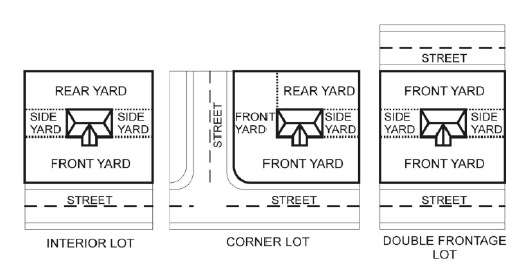
YARD. An open space on the same lot with a building, unoccupied and unobstructed by any portion of a structure from the ground upward, except as otherwise provided herein. In measuring a yard for the purpose of determining the width of a side yard, the depth of a front yard or the depth of a rear yard, the minimum horizontal distance between the lot line and the nearest portion of the main building shall be used. For the purposes of this section, front yard, side yard, and rear yard shall be defined below and are illustrated in Figure 2 as they relate to different lot configurations.
(a) YARD, FRONT. A yard extending across the front of a lot between the side lot lines and being the minimum horizontal distance between the street line and the main building or any projection thereof, other than the projection of the usual steps or entranceway.
(b) YARD, REAR. A yard extending across the rear of a lot between the side lot lines and being the minimum horizontal distance between the rear lot line and the main building or any projection thereof, other than steps, unenclosed balconies or unenclosed porches.
(c) YARD, SIDE. A yard between the main building and the side lot line of the lot extending from the front yard to the rear yard.
Figure 2: Location of Yards on an Interior, Corner, and Double Frontage Lot
(Ord. 2006-12, passed 5-1-06; Am. Ord. 2014-47, passed 12-1-14)
§ 154.99 PENALTY.
(A) Whoever violates any provision of this chapter for which no penalty is otherwise provided, is guilty of a minor misdemeanor on a first offense; on a second offense within one year after the first offense; the person is guilty of a misdemeanor of the fourth degree; on each subsequent offense within one year after the first offense, the person is guilty of a misdemeanor of the third degree.
(B) Whoever is convicted of or pleads guilty to a misdemeanor other than a minor misdemeanor shall be imprisoned for a definite term, or fined, or both, which term of imprisonment and fine shall be fixed by the court as provided below.
(1) Terms of imprisonment for misdemeanors shall be imposed as follows.
(a) For a misdemeanor of the third degree, not more than 60 days.
(b) For a misdemeanor of the fourth degree, not more than 30 days.
(2) Fines for a misdemeanor shall be imposed as follows.
(a) For a misdemeanor of the third degree, not more than $500.
(b) For a misdemeanor of the fourth degree, not more than $250.
(3) Whoever is convicted of or pleads guilty to a minor misdemeanor shall be fined not more than $100.
(R.C. § 2929.21)
(C) Any person, firm or corporation violating any regulation, provision, amendment or supplement to §§ 154.81 through 154.96, or failing to obey any lawful order of the Village Administrator issued in pursuance thereof, shall be deemed guilty of a misdemeanor and, upon conviction thereof, shall be fined not more than $500 or as otherwise provided by the Ohio Revised Code. Each and every day during which such illegal location, erection, construction, reconstruction, enlargement, change, maintenance or use continues may be deemed a separate offence.
(Ord. 2006-12, passed 5-1-06)

