
Glenview City Zoning Code
ARTICLE III
ZONING DISTRICTS
Sec. 98-81. - Established.
The Village is hereby divided into the following generally described districts:
(1)
R-1 residential district (see section 98-101). A district designed for single-family dwellings at a density not exceeding one dwelling unit per acre.
(2)
R-1.3 residential district (see section 98-109). A district designed for single-family dwellings at a density not exceeding 1.33 dwelling units per acre, specifically not less than 32,670 square feet per dwelling unit.
(3)
R-2 residential district (see section 98-102). A district designed for single-family dwellings at a density not exceeding two dwelling units per acre, specifically not less than 21,780 square feet per dwelling unit.
(4)
R-3 residential district (see section 98-103). A district designed for single-family dwellings at a density not exceeding three dwelling units per acre, specifically not less than 14,520 square feet per dwelling unit.
(5)
R-4 residential district (see section 98-104). A district designed for single-family dwellings at an approximate density of four dwelling units per acre, specifically not less than 10,000 square feet per dwelling unit.
(6)
R-5 residential district (see section 98-105). A district designed for single-family dwellings at a density not exceeding five dwelling units per acre, specifically not less than 8,712 square feet per dwelling unit.
(7)
R-6 residential district (see section 98-110). A district designed for single-family dwellings at a density not exceeding approximately six dwelling units per acre, specifically not less than 7,500 feet per dwelling unit.
(8)
R-18 residential district (see section 98-106). A district designed for multiple-family dwellings at a density not exceeding 18 dwelling units per acre, specifically not less than 2,400 square feet per dwelling unit.
(9)
RT-8 residential district (see section 98-107). A district designated for multiple-family dwellings, wherein the area is considered transitional at a density commensurate with the amount of area being developed in accordance with section 98-107(b)(2).
(10)
R-E residential district (see section 98-108). A district designed for single-family dwellings at a density not exceeding one dwelling unit per two acres, specifically not less than 87,120 square feet per dwelling unit, and intended for use within environmentally significant areas.
(11)
B-1 limited business district (see section 98-131). A district designed to permit only those commercial uses which are compatible with the residential uses and neighborhoods existing in close proximity to such district.
(12)
B-2 general business district (see section 98-132). A district designed to permit commercial uses of a type compatible with the existing commercial character of a major arterial highway, such as Waukegan Road.
(13)
B-3 general service district (see section 98-133). A district designed primarily to supplement areas served by the limited and general business district, with a variety of necessary services and goods incompatible with the uses permitted in the B-1 limited business district and not allowed therein, and not normally compatible in the B-2 general business district and thereby permitted in that district only by conditional use and after a public hearing.
(14)
H-1 hospital and medical district (see section 98-134). A district designed to permit the orderly development of an area which will provide the people of the Village with a hospital and ancillary medical treatment facilities and provide an area in which related activities can be located and operated with a minimum amount of inconvenience to surrounding areas.
(15)
D-D downtown development district (see section 98-135). This Code focuses on the creation of mixed-use, walkable neighborhoods, and emphasizes building "form," "public realm," and high-quality site and building design. It is intended to set the foundation for a vital, attractive downtown by encouraging streets, blocks, and buildings that are pedestrian-oriented, have a mix of uses, contain architectural diversity, and offer additional opportunities to live, work, and shop in the Village.
(16)
I-1 limited commercial district (see section 98-161). A district designed to permit limited types of administrative, research, public utility service and business organizations which do not detract from the predominantly residential character of the Village.
(17)
I-2 light industrial district (see section 98-162). A district designed to permit industrial uses which meet the strict performance standards of this chapter.
(18)
MURC mixed use retail center district (see section 98-136).
a.
The MURC district is an important commercial center having a traditional town center character that promotes its unique geographic location and setting, adjacent amenities and transportation linkages. Such district will consist of smaller scale facilities (as compared to the S/L/E district) for sports, recreation, wellness, entertainment, retail and cultural activities, with a variety of supporting professional office and residential uses. Such district will have a pedestrian-oriented character, with buildings located near the front property line and with building fronts oriented to the street. Development within the MURC district will include uses that supplement ground-floor sports, leisure, retail, service and entertainment uses, with retail, office, residential and other program uses for the remaining floors. Parking may be shared, where possible.
b.
Development shall focus on the provision of active ground-floor uses, day and evening activities, and allow safe and convenient pedestrian and vehicular circulation. Window display areas are strongly recommended at the ground level of all business establishments to maintain customer interest. To emphasize the pedestrian orientation of the district, drive-through uses have been prohibited.
(19)
S/L/E sports/leisure/entertainment district (see section 98-137). The S/L/E district is intended as a location for the generally larger scale sports, recreation, wellness, entertainment and cultural activities, with ancillary office and retail services. Such facilities may have supporting retail only when accessory to another permitted use. Such district is envisioned to be predominantly vehicular, yet should include pedestrian and bicycle accommodations that promote circulation through and beyond the S/L/E district. Development may range from large, subregional uses to small scale uses programmed for day and evening activities and accommodating related visitors and traffic. Shared parking shall be encouraged where uses are complementary.
(20)
P-1 public lands district (see section 98-98-181). A district designed to recognize existing or planned public/governmental use of land or the use of land to provide public utilities. Such district is also contemplated to provide, in the event of present or proposed use for other than such purposes, a reasonable means of reevaluating the proper zoning of these areas.
(21)
PD planned development district (see section 98-492). A district applicable only to property as set forth in Sec. 98-499 designed to permit the most advantageous development, in the public interest, of large tracts of land in harmony with the comprehensive plan of the Village. On and after August 16, 2022, no property may be rezoned to PD planned development district.
(Code 1959, § 24.3.1; Ord. No. 4512, 4-15-2003; Ord. No. 5351, § 21, 6-15-2010; Ord. No. 6466, § 3, 1-18-2022; Ord. No. 6494, § 3, 9-6-2022; Ord. No. 6495, § 2, 9-6-2022)
Sec. 98-82. - Zoning map.
(a)
The boundaries of the districts listed in section 98-81 are as indicated on the zoning map of the Village, a copy of which is on file in the office of the village clerk in the Village Hall and is identified on its face as a part of this chapter, and such zoning map, with all notations, references and other matters thereon, is as much a part of this chapter as if such notations, references and other matters were specifically set forth in this section.
(b)
It is the intent of the board of trustees that the entire area of the Village, including all land and water areas, rivers, streets, alleys, railroads and other rights-of-way, be included in the districts established by this article. Any area not shown on the Village zoning map as being included in any district shall be deemed to be in the P-1 public lands district.
(Code 1959, § 24.3.2; Ord. No. 4512, 4-15-2003)
Sec. 98-83. - Boundaries.
If uncertainties exist with respect to the intended boundaries of the various districts as shown on the zoning map, the following rules shall apply:
(1)
The district boundaries are the centerlines of streets or alleys unless otherwise indicated, and where the designation of a boundary line on the zoning map coincides with the location of a street or alley, the centerline of such street or alley shall be construed to be the boundary of such district.
(2)
Where the district boundaries do not coincide with the location of streets or alleys, but do coincide with lot lines, such lot lines shall be construed to be the boundary of such district.
(3)
Where the district boundaries do not coincide with the location of streets, alleys or lot lines, the district boundaries shall be as indicated on the zoning map.
(Code 1959, § 24.3.3; Ord. No. 4512, 4-15-2003)
Sec. 98-84. - Use table.
A list of permitted, conditional, and accessory uses in the Glenview Municipal Code is set forth in the table in this section. Uses marked "P" are permitted uses. Uses marked "C" are conditional uses. Blank cells within the table indicate that the use is not permitted within the District.
This table shall supersede existing use definitions and existing alternate permitted and conditional use zoning classifications included within the chapter 98, article III and article XII.
(Ord. No. 5651, § 2, 3-19-2013; Ord. No. 5715, § 2, 11-5-2013; Ord. No. 5716, § 3, 11-5-2013; Ord. No. 5757, § 3, 1-21-2014; Ord. No. 5886, §§ 4, 5, 1-6-2015; Ord. No. 6200, § 2, 11-8-2018; Ord. No. 6228, § 3, 12-4-2018; Ord. No. 6279, § 7, 9-3-2019; Ord. No. 6285, § 3, 11-21-2019; Ord. No. 6326, § 3, 1-21-2020; Ord. No. 6471, § 2, 3-1-2022; Ord. No. 6488, § 2, 7-19-2022; Ord. No. 6494, § 4, 9-6-2022; Ord. No. 6495, § 3, 9-6-2022; Ord. No. 6533, § 2, 1-5-2023; Ord. No. 6616, § 3, 6-18-2024; Ord. No. 6458, § 3, 1-4-2022)
Sec. 98-101. - R-1 residential district regulations.
(a)
Permitted uses. The following uses are permitted in the R-1 residential district:
(1)
Single-family dwellings.
(2)
Parks and forest preserves not operated for profit.
(3)
Private country clubs which include the operation of a regulation 18-hole golf course on the premises.
(4)
Family community residences, provided, an application for occupancy is filed with the village manager or his designee. An occupancy permit will be granted, provided, the following conditions are met:
a.
The sponsoring agency is certified and licensed by the State under the Community Living Facilities Licensing Act, 210 ILCS 35/1 et seq., and the Community-Integrated Living Arrangements Licensure and Certification Act, 210 ILCS 135/1 et seq., or other similar statutes as may be required.
b.
The family community residence is not located closer than 600 feet to another licensed family community residence or group community residence.
c.
All other applicable codes and ordinances are met.
(b)
Bulk regulations. Bulk regulations in the R-1 district are as follows:
(1)
Maximum building and eave height. Maximum building and eave heights are based on lawfully established side yard setbacks, or, in the case of existing residences, the actual side yard setbacks as included in the following table:
(2)
Minimum lot size. Minimum lot size shall be as follows:
a.
Buildings devoted to residences, one acre (43,560 square feet).
b.
All other buildings and structures, two acres (87,120 square feet).
(3)
Maximum lot coverage.
a.
Maximum lot coverage for single-family uses shall be governed by the following:
b.
Impervious lot coverage shall include all impervious surfaces on a given lot, except that the water surface of an in-ground swimming pool and/or a wood deck with semi-permeable membrane beneath it shall not contribute to impervious lot coverage. Detention/retention areas located on a lot shall be used when calculating lot size and impervious surfaces.
c.
The maximum lot coverage requirements set forth in subsection (b)(3)a. of this section shall not be applicable on lots containing nonresidential buildings. However, a maximum building coverage (area of lot covered by a building) of 33⅓ percent shall be applicable on all lots containing nonresidential buildings. Maximum lot coverage (total impervious lot coverage) for nonresidential buildings in residential districts shall be established, on a case by case basis, through the site plan review process established under chapter 18, article VII.
(4)
Minimum lot width. Minimum lot width shall be 100 feet.
(5)
Minimum front yard setback. Minimum front yard depth shall be 30 feet; provided, however, that if there are improved lots on the block which include more than 50 percent of the total lineal footage along the block, there shall be a minimum front yard setback equal to the average front yard setback on the block or 15 feet, whichever is greater, provided that if improved lots are on both sides of and contiguous to the lot in question, the minimum front yard setback of such lot shall be the average of that of the two improved lots, or in the case of a corner lot contiguous to an improved lot, the minimum front yard setback shall be that of the improved lot, provided further, that in no event need the front yard setback be more than 50 percent of the lot depth.
(6)
Minimum side yard setback. Minimum side yard width shall be 15 feet, provided that if a side yard adjoins a public street, there shall be a minimum side yard width and setback of 30 feet, except that if there are no more than two lots in the block facing the side street, the minimum side yard width and setback shall be 15 feet.
(7)
Minimum rear yard setback. Minimum rear yard depth shall be 25 feet.
(8)
Maximum building size. Maximum building size shall be calculated using the following table:
(9)
Garages. On infill lots 60 feet wide or less, the front wall of an attached garage shall not extend more than ten feet beyond the front wall of the residence.
(10)
Depth of residence. On infill lots, excluding corner lots, the depth of a residence shall be no greater than two times the width of the front elevation of the residence.
(c)
Standards. All of the property located in the R-1 district is subject to the general standards and regulations of this chapter. To conserve space, such standards and regulations have not been reprinted in the regulations for each district. Special attention should be given to the standards and regulations set forth in article IV pertaining to accessory uses and home occupations, article V pertaining to nonconformities, article VI pertaining to off-street parking and loading, article VII pertaining to signs and article VIII pertaining to performance standards.
(d)
Conditional uses. In addition to the uses permitted by subsection (a) of this section, the following uses may be permitted as a conditional use in this R-1 residential district, subject to any and all conditions or restrictions upon the construction, location and operation of a conditional use as may be recommended by the hearing body under authority granted in section 98-50, subject to action by the board of trustees as specified in section 98-50(f). Furthermore, any addition to existing structures occupied by or constituting a conditional use, and any expansion or change in location of an established conditional use shall be authorized only in accordance with the same procedures as those required by this chapter for a new conditional use, excluding a conditional use for a planned development, which shall be governed in accordance with the provisions of section 98-498.
(1)
Buildings primarily devoted to religious worship.
(2)
Family community residences which do not meet the regulations applicable to such uses as a permitted use.
(3)
Group community residences, subject to the following requirements:
a.
The sponsoring agency for such group community residence is certified and licensed by the State under the Community Living Facilities Licensing Act, 210 ILCS 35/1 et seq., and the Community-Integrated Living Arrangements Licensure and Certification Act, 210 ILCS 135/1 et seq., or other similar statutes;
b.
The group community residence is not located closer than 600 feet to another licensed family community residence or group community residence; and
c.
The group community residence complies with the conditional use standards set forth in section 98-50.
(4)
Off-street parking lots as a principal use in accordance with the requirements of sections 98-50(a) and 98-50(d).
(5)
Public or private schools, including those determined to include day care or nursery schools or centers, without dormitory accommodations.
(6)
A planned development allowed as a conditional use in accordance with section 98-50, section 98-84, and article X. Planned developments, of this chapter of the Code.
(Code 1959, § 24.4.1; Ord. No. 4512, 4-15-2003; Ord. No. 5351, § 22, 6-15-2010; Ord. No. 5704, § 3, 9-17-2013; Ord. No. 5780, § 2, 4-1-2014; Ord. No. 6398, § 9, 2-16-2021; Ord. No. 6494, § 5, 9-6-2022)
Sec. 98-102. - R-2 residential district regulations.
(a)
Permitted uses. The following uses are permitted in the R-2 residential district:
(1)
Single-family dwellings.
(2)
Parks and forest preserves not operated for profit.
(3)
Family community residences, provided an application for occupancy is filed with the village manager or his designee. An occupancy permit will be granted, provided, the following conditions are met:
a.
The sponsoring agency is certified and licensed by the State under the Community Living Facilities Licensing Act, 210 ILCS 35/1 et seq., and the Community-Integrated Living Arrangements Licensure and Certification Act, 210 ILCS 135/1 et seq., or other similar statutes as may be required.
b.
The family community residence is not located closer than 600 feet to another licensed family community residence or group community residence.
c.
All other applicable codes and ordinances are met.
(b)
Bulk regulations. Bulk regulations in the R-2 district are as follows:
(1)
Maximum building and eave height. Maximum building and eave heights are as set forth in section 98-101(b)(1).
(2)
Minimum lot size. Minimum lot size shall be as follows:
a.
Buildings devoted to residences, one-half acre (21,780 square feet).
b.
All other buildings and structures, two acres (87,120 square feet).
(3)
Maximum lot coverage. Maximum lot coverage is as set forth in section 98-101(b)(3).
(4)
Minimum lot width. Minimum lot width shall be 80 feet.
(5)
Minimum front yard setback. Minimum front yard depth shall be 30 feet; provided, however, that if there are improved lots on the block which include more than 50 percent of the total lineal footage along the block, there shall be a minimum front yard setback equal to the average front yard setback on the block or 15 feet, whichever is greater, provided that if improved lots are on both sides of and contiguous to the lot in question, the minimum front yard setback of such lot shall be the average of that of the two improved lots, or in the case of a corner lot contiguous to an improved lot, the minimum front yard setback shall be that of the improved lot, provided further, that in no event need the front yard setback be more than 50 percent of the lot depth.
(6)
Minimum side yard setback. Minimum side yard width shall be 15 feet, provided that if a side yard adjoins a public street, there shall be a minimum side yard width and setback of 30 feet, except that if there are no more than two lots in the block facing the side street, the minimum side yard width and setback shall be 15 feet.
(7)
Minimum rear yard setback. Minimum rear yard depth shall be 25 feet.
(8)
Maximum building size. Maximum building size shall be as set forth in section 98-101(b)(8).
(9)
Garages. Requirements governing the permissible extension of an attached garage in front of the main wall of a residence on an infill lot shall be as set forth in section 98-101(b)(9).
(10)
Depth of residence. Requirements governing the allowable depth of a residence on an infill lot shall be as set forth in section 98-101(b)(10).
(c)
Standards. All of the property located in the R-2 district is subject to the general standards and regulations of this chapter. To conserve space, such standards and regulations have not been reprinted in the regulations for each district. Special attention should be given to the standards and regulations set forth in article IV pertaining to accessory uses and home occupations, article V pertaining to nonconformities, article VI pertaining to off-street parking and loading, article VII pertaining to signs and article VIII pertaining to performance standards.
(d)
Conditional uses. In addition to the uses permitted in the R-2 district, the following uses may be permitted as a conditional use in the R-2 residential district, subject to any and all conditions or restrictions upon the construction, location and operation of a conditional use as may be recommended by the hearing body under authority granted in section 98-50, subject to action by the board of trustees as specified in section 98-50(f). Furthermore, any addition to existing structures occupied by or constituting a conditional use, and any expansion or change in location of an established conditional use shall be authorized only in accordance with the same procedures as those required by this chapter for a new conditional use, excluding a conditional use for a planned development, which shall be governed in accordance with the provisions of section 98-498.
(1)
Buildings primarily devoted to religious worship.
(2)
Family community residences which do not meet the regulations applicable to such uses as a permitted use.
(3)
Group community residences, subject to the following requirements:
a.
The sponsoring agency for such group community residence is certified and licensed by the State under the Community Living Facilities Licensing Act, 210 ILCS 35/1 et seq., and the Community-Integrated Living Arrangements Licensure and Certification Act, 210 ILCS 135/1 et seq., or other similar statutes;
b.
The group community residence is not located closer than 600 feet to another licensed family community residence or group community residence; and
c.
The group community residence complies with the conditional use standards set forth in section 98-50.
(4)
Off-street parking lots as a principal use in accordance with the requirements of sections 98-50(a) and 98-50(d).
(5)
Public or private schools, including those determined to include day care or nursery schools or centers, without dormitory accommodations.
(6)
A planned development allowed as a conditional use in accordance with section 98-50, section 98-84, and article X, planned developments, of this chapter of the Code.
(Code 1959, § 24.4.2; Ord. No. 4512, 4-15-2003; Ord. No. 5351, § 23, 6-15-2010; Ord. No. 6398, § 9, 2-16-2021; Ord. No. 6494, § 6, 9-6-2022)
Sec. 98-103. - R-3 residential district regulations.
(a)
Permitted uses. The following uses are permitted in the R-3 residential district:
(1)
Single-family dwellings.
(2)
Parks and forest preserves not operated for profit.
(3)
Family community residences, provided an application for occupancy is filed with the village manager or his designee. An occupancy permit will be granted, provided, the following conditions are met:
a.
The sponsoring agency is certified and licensed by the State under the Community Living Facilities Licensing Act, 210 ILCS 35/1 et seq., and the Community-Integrated Living Arrangements Licensure and Certification Act, 210 ILCS 135/1 et seq., or other similar statutes as may be required.
b.
The family community residence is not located closer than 600 feet to another licensed family community residence or group community residence.
c.
All other applicable codes and ordinances are met.
(b)
Bulk regulations. Bulk regulations in the R-3 district are as follows:
(1)
Maximum building and eave height. Maximum building and eave heights are as set forth in section 98-101(b)(1).
(2)
Minimum lot size. Minimum lot size shall be as follows:
a.
Buildings devoted to residences, one-third acre (14,520 square feet).
b.
All other buildings and structures, two acres (87,120 square feet).
(3)
Maximum lot coverage. Maximum lot coverage is as set forth in section 98-101(b)(3).
(4)
Minimum lot width. Minimum lot width shall be 70 feet.
(5)
Minimum front yard setback. Minimum front yard depth shall be 30 feet; provided, however, that if there are improved lots on the block which include more than 50 percent of the total lineal footage along the block, there shall be a minimum front yard setback equal to the average front yard setback on the block or 15 feet, whichever is greater, provided that if improved lots are on both sides of and contiguous to the lot in question, the minimum front yard setback of such lot shall be the average of that of the two improved lots, or in the case of a corner lot contiguous to an improved lot, the minimum front yard setback shall be that of the improved lot, provided further, that in no event need the front yard setback be more than 50 percent of the lot depth.
(6)
Minimum side yard setback. Minimum side yard width shall be 12 feet, provided that if a side yard adjoins a public street, there shall be a minimum side yard width and setback of 30 feet, except that if there are no more than two lots in the block facing the side street, the minimum side yard width and setback shall be 12 feet.
(7)
Minimum rear yard setback. Minimum rear yard depth shall be 25 feet.
(8)
Maximum building size. Maximum building size shall be as set forth in section 98-101(b)(8).
(9)
Garages. Requirements governing the permissible extension of an attached garage in front of the main wall of a residence on an infill lot shall be as set forth in section 98-101(b)(9).
(10)
Depth of residence. Requirements governing the allowable depth of a residence on an infill lot shall be as set forth in section 98-101(b)(10).
(c)
Standards. All of the property located in the R-3 district is subject to the general standards and regulations of this chapter. To conserve space, such standards and regulations have not been reprinted in the regulations for each district. Special attention should be given to the standards and regulations set forth in article IV pertaining to accessory uses and home occupations, article V pertaining to nonconformities, article VI pertaining to off-street parking and loading, article VII pertaining to signs and article VIII pertaining to performance standards.
(d)
Conditional uses. In addition to the uses permitted in the R-3 district, the following uses may be permitted as a conditional use in the R-3 residential district, subject to any and all conditions or restrictions upon the construction, location and operation of a conditional use as may be recommended by the hearing body under authority granted in section 98-50, subject to action by the board of trustees as specified in section 98-50(f). Furthermore, any addition to existing structures occupied by or constituting a conditional use, and any expansion or change in location of an established conditional use shall be authorized only in accordance with the same procedures as those required by this chapter for a new conditional use, excluding a conditional use for a planned development, which shall be governed in accordance with the provisions of section 98-498.
(1)
Buildings primarily devoted to religious worship.
(2)
Family community residences which do not meet the regulations applicable to such uses as a permitted use.
(3)
Group community residences, subject to the following requirements:
a.
The sponsoring agency for such group community residence is certified and licensed by the State under the Community Living Facilities Licensing Act, 210 ILCS 35/1 et seq., and the Community-Integrated Living Arrangements Licensure and Certification Act, 210 ILCS 135/1 et seq., or other similar statutes;
b.
The group community residence is not located closer than 600 feet to another licensed family community residence or group community residence; and
c.
The group community residence complies with the conditional use standards set forth in section 98-50.
(4)
Off-street parking lots as a principal use in accordance with the requirements of sections 98-50(a) and 98-50(d).
(5)
Public or private schools, including those determined to include day care or nursery schools or centers, without dormitory accommodations.
(6)
A planned development allowed as a conditional use in accordance with section 98-50, section 98-84, and article X, planned developments, of this chapter of the Code.
(Code 1959, § 24.4.3; Ord. No. 4512, 4-15-2003; Ord. No. 5351, § 24, 6-15-2010; Ord. No. 6398, § 9, 2-16-2021; Ord. No. 6494, § 7, 9-6-2022)
Sec. 98-104. - R-4 residential district regulations.
(a)
Permitted uses. The following uses are permitted in the R-4 residential district:
(1)
Single-family dwellings.
(2)
Parks and forest preserves not operated for profit.
(3)
Family community residences, provided an application for occupancy is filed with the village manager or his designee. An occupancy permit will be granted, provided, the following conditions are met:
a.
The sponsoring agency is certified and licensed by the State under the Community Living Facilities Licensing Act, 210 ILCS 35/1 et seq., and the Community-Integrated Living Arrangements Licensure and Certification Act, 210 ILCS 135/1 et seq., or other similar statutes as may be required.
b.
The family community residence is not located closer than 600 feet to another licensed family community residence or group community residence.
c.
All other applicable codes and ordinances are met.
(b)
Bulk regulations. Bulk regulations in the R-4 district are as follows:
(1)
Maximum building and eave height. Maximum building and eave heights are as set forth in section 98-101(b)(1).
(2)
Minimum lot size. Minimum lot size shall be as follows:
a.
Buildings devoted to residences, 10,000 square feet.
b.
All other buildings and structures, two acres (87,120 square feet).
(3)
Maximum lot coverage. Maximum lot coverage is as set forth in section 98-101(b)(3).
(4)
Minimum lot width. Minimum lot width shall be 60 feet.
(5)
Minimum front yard setback. Minimum front yard depth shall be 30 feet; provided, however, that if there are improved lots on the block which include more than 50 percent of the total lineal footage along the block, there shall be a minimum front yard setback equal to the average front yard setback on the block or 15 feet, whichever is greater, provided that if improved lots are on both sides of and contiguous to the lot in question, the minimum front yard setback of such lot shall be the average of that of the two improved lots, or in the case of a corner lot contiguous to an improved lot, the minimum front yard setback shall be that of the improved lot, provided further, that in no event need the front yard setback be more than 50 percent of the lot depth.
(6)
Minimum side yard setback. Minimum side yard width shall be ten feet, provided that if a side yard adjoins a public street, there shall be a minimum side yard width and setback of 30 feet, except that if there are no more than two lots in the block facing the side street, the minimum side yard width and setback shall be ten feet.
(7)
Minimum rear yard setback. Minimum rear yard depth shall be 25 feet.
(8)
Maximum building size. Maximum building size shall be as set forth in section 98-101(b)(8).
(9)
Front yard setbacks for undeveloped infill lots, etc. In the case of an undeveloped infill lot or when an existing principal residence is demolished and a new residence is proposed on the lot, the front wall of the new residence shall be located at a setback equal to the front yard setback that is the average setback of the residences located on the two adjacent lots. In the case of a corner lot, the front yard setback shall be equal to that of the residence on the adjacent lot.
(10)
Garages. Requirements governing the permissible extension of an attached garage in front of the main wall of a residence on an infill lot shall be as set forth in section 98-101(b)(9).
(11)
Depth of residence. Requirements governing the allowable depth of a residence on an infill lot shall be as set forth in section 98-101(b)(10).
(c)
Standards. All of the property located in the R-4 district is subject to the general standards and regulations of this chapter. To conserve space, such standards and regulations have not been reprinted in the regulations for each district. Special attention should be given to the standards and regulations set forth in article IV pertaining to accessory uses and home occupations, article V pertaining to nonconformities, article VI pertaining to off-street parking and loading, article VII pertaining to signs and article VIII pertaining to performance standards.
(d)
Conditional uses. In addition to the uses permitted in the R-4 district, the following uses may be permitted as a conditional use in the R-4 residential district, subject to any and all conditions or restrictions upon the construction, location and operation of a conditional use as may be recommended by the hearing body under authority granted in section 98-50, subject to action by the board of trustees as specified in section 98-50(f). Furthermore, any addition to existing structures occupied by or constituting a conditional use, and any expansion or change in location of an established conditional use shall be authorized only in accordance with the same procedures as those required by this chapter for a new conditional use, excluding a conditional use for a planned development, with shall be governed in accordance with the provisions of section 98-498.
(1)
Buildings primarily devoted to religious worship.
(2)
Family community residences which do not meet the regulations applicable to such uses as a permitted use.
(3)
Group community residences, subject to the following requirements:
a.
The sponsoring agency for such group community residence is certified and licensed by the State under the Community Living Facilities Licensing Act, 210 ILCS 35/1 et seq., and the Community-Integrated Living Arrangements Licensure and Certification Act, 210 ILCS 135/1 et seq., or other similar statutes;
b.
The group community residence is not located closer than 600 feet to another licensed family community residence or group community residence; and
c.
The group community residence complies with the conditional use standards set forth in section 98-50.
(4)
Off-street parking lots as a principal use in accordance with the requirements of sections 98-50(a) and 98-50(d).
(5)
Public or private schools, including those determined to include day care or nursery schools or centers, without dormitory accommodations.
(6)
A planned development allowed as a conditional use in accordance with section 98-50, section 98-84, and article X, planned developments, of this chapter of the Code.
(Code 1959, § 24.4.4; Ord. No. 4512, 4-15-2003; Ord. No. 5351, § 25, 6-15-2010; Ord. No. 6398, § 9, 2-16-2021; Ord. No. 6494, § 8, 9-6-2022)
Sec. 98-105. - R-5 residential district regulations.
(a)
Permitted uses. The following uses are permitted in the R-5 residential district:
(1)
Single-family dwellings.
(2)
Parks and forest preserves not operated for profit.
(3)
Family community residences, provided an application for occupancy is filed with the village manager or his designee. An occupancy permit will be granted, provided, the following conditions are met:
a.
The sponsoring agency is certified and licensed by the State under the Community Living Facilities Licensing Act, 210 ILCS 35/1 et seq., and the Community-Integrated Living Arrangements Licensure and Certification Act, 210 ILCS 135/1 et seq., or other similar statutes as may be required.
b.
The family community residence is not located closer than 600 feet to another licensed family community residence or group community residence.
c.
All other applicable codes and ordinances are met.
(b)
Bulk regulations. Bulk regulations in the R-5 district are as follows:
(1)
Maximum building and eave height. Maximum building and eave heights are as set forth in section 98-101(b)(1).
(2)
Minimum lot size. Minimum lot size shall be as follows:
a.
Buildings devoted to residences, one-fifth acre (8,712 square feet).
b.
All other buildings and structures, two acres (87,120 square feet).
(3)
Maximum lot coverage. Maximum lot coverage is as set forth in section 98-101(b)(3).
(4)
Minimum lot width. Minimum lot width shall be 60 feet.
(5)
Minimum front yard setback. Minimum front yard depth shall be 30 feet; provided, however, that if there are improved lots on the block which include more than 50 percent of the total lineal footage along the block, there shall be a minimum front yard setback equal to the average front yard setback on the block or 15 feet, whichever is greater, provided that if improved lots are on both sides of and contiguous to the lot in question, the minimum front yard setback of such lot shall be the average of that of the two improved lots, or in the case of a corner lot contiguous to an improved lot, the minimum front yard setback shall be that of the improved lot, provided further, that in no event need the front yard setback be more than 50 percent of the lot depth.
(6)
Minimum side yard setback. Minimum side yard width shall be 7.2 feet, provided that if a side yard adjoins a public street, there shall be a minimum side yard width and setback of 30 feet, except that if there are no more than two lots in the block facing the side street, the minimum side yard width and setback shall be ten feet.
(7)
Minimum rear yard setback. Minimum rear yard depth shall be 20 feet.
(8)
Maximum building size. Maximum building size shall be as set forth in section 98-101(b)(8).
(9)
Front yard setbacks for undeveloped infill lots, etc. In the case of an undeveloped infill lot or when an existing principal residence is demolished and a new residence is proposed on the lot, the front wall of the new residence shall be located at a setback equal to the front yard setback that is the average setback of the residences located on the two adjacent lots. In the case of a corner lot, the front yard setback shall be equal to that of the residence on the adjacent lot.
(10)
Garages. Requirements governing the permissible extension of an attached garage in front of the main wall of a residence on an infill lot shall be as set forth in section 98-101(b)(9).
(11)
Depth of residence. Requirements governing the allowable depth of a residence on an infill lot shall be as set forth in section 98-101(b)(10).
(c)
Standards. All of the property located in the R-5 district is subject to the general standards and regulations of this chapter. To conserve space, such standards and regulations have not been reprinted in the regulations for each district. Special attention should be given to the standards and regulations set forth in article IV pertaining to accessory uses and home occupations, article V pertaining to nonconformities, article VI pertaining to off-street parking and loading, article VII pertaining to signs and article VIII pertaining to performance standards.
(d)
Conditional uses. In addition to the uses permitted in the R-5 district, the following uses may be permitted as a conditional use in the R-5 residential district, subject to any and all conditions or restrictions upon the construction, location and operation of a conditional use as may be recommended by the hearing body under authority granted in section 98-50, subject to action by the board of trustees as specified in section 98-50(f). Furthermore, any addition to existing structures occupied by or constituting a conditional use, and any expansion or change in location of an established conditional use shall be authorized only in accordance with the same procedures as those required by this chapter for a new conditional use, excluding a conditional use for a planned development, which shall be governed in accordance with the provisions of section 98-498.
(1)
Buildings primarily devoted to religious worship.
(2)
Family community residences which do not meet the regulations applicable to such uses as a permitted use.
(3)
Group community residences, subject to the following requirements:
a.
The sponsoring agency for such group community residence is certified and licensed by the State under the Community Living Facilities Licensing Act, 210 ILCS 35/1 et seq., and the Community-Integrated Living Arrangements Licensure and Certification Act, 210 ILCS 135/1 et seq., or other similar statutes;
b.
The group community residence is not located closer than 600 feet to another licensed family community residence or group community residence; and
c.
The group community residence complies with the conditional use standards set forth in section 98-50.
(4)
Off-street parking lots as a principal use in accordance with the requirements of sections 98-50(a) and 98-50(d).
(5)
Public or private schools, including those determined to include day care or nursery schools or centers, without dormitory accommodations.
(6)
A planned development allowed as a conditional use in accordance with section 98-50, section 98-84, and article X, planned developments, of this chapter of the Code.
(Code 1959, § 24.4.5; Ord. No. 4512, 4-15-2003; Ord. No. 5351, § 26, 6-15-2010; Ord. No. 6398, § 9, 2-16-2021; Ord. No. 6494, § 9, 9-6-2022)
Sec. 98-106. - R-18 residential district regulations.
(a)
Permitted uses. The following uses are permitted in the R-18 residential district:
(1)
Single-family dwellings.
(2)
Multiple-family dwellings under single ownership.
(3)
Parks and forest preserves not operated for profit.
(4)
Private clubs.
(5)
Nursing homes.
(6)
Family community residences, provided an application for occupancy is filed with the Village manager or his designee. An occupancy permit will be granted, provided, the following conditions are met:
a.
The sponsoring agency is certified and licensed by the State under the Community Living Facilities Licensing Act, 210 ILCS 35/1 et seq., and the Community-Integrated Living Arrangements Licensure and Certification Act, 210 ILCS 135/1 et seq., or other similar statutes as may be required.
b.
The family community residence is not located closer than 600 feet to another licensed family community residence or group community residence.
(b)
Bulk regulations. Bulk regulations in the R-18 district are as follows:
(1)
Maximum building height. The maximum height for buildings and other structures is 35 feet.
(2)
Lot size. Lot size shall be as follows:
a.
Minimum.
1.
Buildings devoted to residences, 2,400 square feet per dwelling unit, with a minimum of 6,250 square feet per lot.
2.
Nursing homes, 871.2 square feet per bed, with a minimum of two acres (87,120 square feet) per lot.
3.
All other buildings and structures, two acres (87,120 square feet).
b.
Maximum. Any residential use permissible in the R-18 residential district, two acres (87,120 square feet).
(3)
Maximum impervious lot coverage. There shall be a maximum impervious lot coverage for residential uses of 50 percent, except that for all property located in the R-18 district and located in the downtown frame neighborhood, such permitted impervious lot coverage may be increased to a maximum of 62 percent, except such maximum impervious lot coverage requirements shall not be applicable to lots containing nonresidential buildings. However, a maximum building coverage (area of lot covered by a building) of 40 percent shall be applicable to all lots containing nonresidential buildings. Maximum lot coverage (total impervious lot coverage) for nonresidential buildings in residential districts shall be established, on a case by case basis, through the site plan review process established under chapter 18, article VII.
(4)
Minimum lot width. Minimum lot width shall be as follows:
a.
Buildings devoted to multifamily residences shall have a minimum lot width of 80 feet, except multifamily buildings may be placed on lots with less than the 80-foot minimum width otherwise required only through the planned development process. Compliance with the standards applicable to other planned developments is not required, provided, the applicant demonstrates that an additional adjacent lot width is not reasonably available, and, provided further, that the proposed development is designed to maximize its compatibility with surrounding development. In evaluating the reasonable availability of adjacent lot width, the hearing body shall not consider economic hardship, but shall, instead, consider the physical availability of contiguous vacant land and the age, use and condition of any existing structure on adjacent property. In evaluating the compatibility of the proposed planned development with surrounding development, the hearing body shall consider current or anticipated traffic flows, density, building arrangement, building orientation, building location, location of access drives, location and amount of open space, including available detention, and landscaping.
b.
Buildings containing all other uses shall have a minimum lot width of 50 feet.
(5)
Minimum front yard setback. Minimum front yard depth shall be 30 feet; provided, however, that if there are improved lots on the block which include more than 50 percent of the total lineal footage along the block, there shall be a minimum front yard setback equal to the average front yard setback on the block or 15 feet, whichever is greater, provided that if improved lots are on both sides of and contiguous to the lot in question, the minimum front yard setback of such lot shall be the average of that of the two improved lots, or in the case of a corner lot contiguous to an improved lot, the minimum front yard setback shall be that of the improved lot, provided further, that in no event need the front yard setback be more than 50 percent of the lot depth.
(6)
Minimum side yard setback. Minimum side yard width on each side of the lot shall be as follows:
a.
Lots 110 feet wide or wider, 12 feet.
b.
Lots between 50—110 feet in width, six feet, plus one-tenth of a foot for each foot by which the lot width exceeds 50 feet, for example:
Provided, however, that if a side yard adjoins a public street, there shall be a minimum side yard width and setback of 30 feet, except that if there are no more than two lots in the block facing the side street, the minimum side yard width and setback shall be 12 feet.
(7)
Minimum rear yard setback. Minimum rear yard depth shall be 25 feet.
(8)
Maximum floor area ratio. There shall be a maximum floor area ratio of 0.5, except that for all property located in the R-18 district and located in the downtown frame neighborhood, the floor area ratio may be increased to a maximum of 0.65.
(c)
Standards. All of the property located in the R-18 district is subject to the general standards and regulations of this chapter. To conserve space, such standards and regulations have not been reprinted in the regulations for each district. Special attention should be given to the standards and regulations set forth in article IV pertaining to accessory uses and home occupations, article V pertaining to nonconformities, article VI pertaining to off-street parking and loading, article VII pertaining to signs and article VIII pertaining to performance standards.
(d)
Conditional uses. In addition to the uses permitted in the R-18 district, the following uses may be permitted as a conditional use in the R-18 residential district, subject to any and all conditions or restrictions upon the construction, location and operation of a conditional use as may be recommended by the hearing body under authority granted in section 98-50, subject to action by the board of trustees as specified in section 98-50(f). Furthermore, any addition to existing structures occupied by or constituting a conditional use, and any expansion or change in location of an established conditional use shall be authorized only in accordance with the same procedures as those required by this chapter for a new conditional use, excluding a conditional use for a planned development, which shall be governed in accordance with the provisions of section 98-498.
(1)
Training schools.
(2)
Buildings primarily devoted to religious worship.
(3)
Family community residences which do not meet the regulations applicable to such uses as a permitted use.
(4)
Group community residences, subject to the following requirements:
a.
The sponsoring agency for such group community residence is certified and licensed by the State under the Community Living Facilities Licensing Act, 210 ILCS 35/1 et seq., and the Community-Integrated Living Arrangements Licensure and Certification Act, 210 ILCS 135/1 et seq., or other similar statutes;
b.
The group community residence is not located closer than 300 feet to another licensed family community residence or group community residence; and
c.
The group community residence complies with the conditional use standards set forth in section 98-50.
(5)
Off-street parking lots as a principal use in accordance with the requirements of sections 98-50(a) and 98-50(d).
(6)
Public or private schools, including those determined to include day care or nursery schools or centers, without dormitory accommodations.
(7)
A planned development allowed as a conditional use in accordance with section 98-50, section 98-84, and article X, planned developments, of this chapter of the Code.
(Code 1959, § 24.4.6; Ord. No. 4512, 4-15-2003; Ord. No. 5351, § 27, 6-15-2010; Ord. No. 6398, § 9, 2-16-2021; Ord. No. 6494, § 10, 9-6-2022)
Sec. 98-107. - RT-8 residential district regulations.
(a)
Permitted uses. The following uses are permitted in the RT-8 residential district:
(1)
Single-family dwellings.
(2)
Multiple-family dwellings under single ownership.
(3)
Parks and forest preserves not operated for profit.
(4)
Private clubs.
(5)
Nursing homes.
(6)
Hospitals.
(7)
Family community residences, provided an application for occupancy is filed with the village manager or his designee. An occupancy permit will be granted, provided, the following conditions are met:
a.
The sponsoring agency is certified and licensed by the State under the Community Living Facilities Licensing Act, 210 ILCS 35/1 et seq., and the Community-Integrated Living Arrangements Licensure and Certification Act, 210 ILCS 135/1 et seq., or other similar statutes as may be required.
b.
The family community residence is not located closer than 600 feet to another licensed family community residence or group community residence.
c.
All other applicable codes and ordinances are met.
(b)
Bulk regulations. Bulk regulations in the RT-8 district are as follows:
(1)
Maximum building height. The maximum height for buildings and other structures is 35 feet.
(2)
Minimum lot size. Lot size shall be as follows:
a.
For buildings devoted to residences, the following densities per lot of record will apply:
1.
Where a one acre or less lot of record will be proposed for improvement, 5,445 square feet per residential unit.
2.
More than one and not more than two acres, 4,356 square feet per residential unit.
3.
More than two and not more than four acres, 3,630 square feet per residential unit.
4.
Over four acres, 3,100 square feet per residential unit.
b.
Nursing homes, 871.2 square feet per bed, with a minimum of two acres (87,120 square feet) per lot.
c.
All other buildings and structures, two acres (87,120 square feet).
(3)
Maximum impervious lot coverage. There shall be a maximum impervious lot coverage for residential uses of 50 percent, except that for all property located in the RT-8 district and located in the downtown frame neighborhood, such permitted impervious lot coverage may be increased to a maximum of 62 percent, except such maximum impervious lot coverage requirements shall not be applicable to lots containing nonresidential buildings. However, a maximum building coverage (area of lot covered by a building) of 40 percent shall be applicable to all lots containing nonresidential buildings. Maximum lot coverage (total impervious lot coverage) for nonresidential buildings in residential districts shall be established, on a case by case basis, through the site plan review process established under chapter 18, article VII.
(4)
Minimum lot width. Minimum lot width shall be 50 feet.
(5)
Minimum front yard setback. Minimum front yard depth shall be 30 feet; provided, however, that if there are improved lots on the block which include more than 50 percent of the total lineal footage along the block, there shall be a minimum front yard setback equal to the average front yard setback on the block or 15 feet, whichever is greater, provided that if improved lots are on both sides of and contiguous to the lot in question, the minimum front yard setback of such lot shall be the average of that of the two improved lots, or in the case of a corner lot contiguous to an improved lot, the minimum front yard setback shall be that of the improved lot, provided further, that in no event need the front yard setback be more than 50 percent of the lot depth.
(6)
Minimum side yard setback. Minimum side yard width on each side of the lot shall be as follows:
a.
Lots 110 feet wide or wider, 12 feet.
b.
Lots between 50—110 feet in width, six feet, plus one-tenth of a foot for each foot by which the lot width exceeds 50 feet, for example:
Provided, however, that if a side yard adjoins a public street, there shall be a minimum side yard width and setback of 30 feet, except that if there are no more than two lots in the block facing the side street, the minimum side yard width and setback shall be 12 feet.
(7)
Minimum rear yard setback. Minimum rear yard depth shall be 25 feet.
(8)
Maximum floor area ratio. There shall be a maximum floor area ratio of 0.5, except that for all property located in the RT-8 district and located in the downtown frame neighborhood, the floor area ratio may be increased to a maximum of 0.65.
(c)
Standards. All of the property located in the RT-8 district is subject to the general standards and regulations of this chapter. To conserve space, such standards and regulations have not been reprinted in the regulations for each district. Special attention should be given to the standards and regulations set forth in article IV pertaining to accessory uses and home occupations, article V pertaining to nonconformities, article VI pertaining to off-street parking and loading, article VII pertaining to signs and article VIII pertaining to performance standards.
(d)
Conditional uses. In addition to the uses permitted in the RT-8 district, the following uses may be permitted as a conditional use in the RT-8 residential district, subject to any and all conditions or restrictions upon the construction, location and operation of a conditional use as may be recommended by the hearing body under authority granted in section 98-50, subject to action by the board of trustees as specified in section 98-50(f). Furthermore, any addition to existing structures occupied by or constituting a conditional use, and any expansion or change in location of an established conditional use shall be authorized only in accordance with the same procedures as those required by this chapter for a new conditional use, excluding a conditional use for a planned development, which shall be governed in accordance with the provisions of section 98-498.
(1)
Buildings primarily devoted to religious worship.
(2)
Family community residences which do not meet the regulations applicable to such uses as a permitted use.
(3)
Group community residences, subject to the following requirements:
a.
The sponsoring agency for such group community residence is certified and licensed by the State under the Community Living Facilities Licensing Act, 210 ILCS 35/1 et seq., and the Community-Integrated Living Arrangements Licensure and Certification Act, 210 ILCS 135/1 et seq., or other similar statutes;
b.
The group community residence is not located closer than 300 feet to another licensed family community residence or group community residence; and
c.
The group community residence complies with the conditional use standards set forth in section 98-50.
(4)
Off-street parking lots as a principal use in accordance with the requirements of sections 98-50(a) and 98-50(d).
(5)
Public or private schools, including those determined to include day care or nursery schools or centers, without dormitory accommodations.
(6)
A planned development allowed as a conditional use in accordance with section 98-50, section 98-84, and article X, planned developments, of this chapter of the Code.
(Code 1959, § 24.4.7; Ord. No. 4512, 4-15-2003; Ord. No. 5351, § 28, 6-15-2010; Ord. No. 6398, § 9, 2-16-2021; Ord. No. 6494, § 11, 9-6-2022)
Sec. 98-108. - R-E residential district regulations.
(a)
Permitted uses. The following uses are permitted in the R-E residential district:
(1)
Single-family dwellings.
(2)
Parks and forest preserves.
(3)
Monasteries, convents or retreat houses.
(4)
Open space consisting entirely of vegetative cover which is accessory to a permitted use located outside the R-E zone.
(5)
Family community residences, provided an application for occupancy is filed with the village manager or his designee. An occupancy permit will be granted, provided, the following conditions are met:
a.
The sponsoring agency is certified and licensed by the State under the Community Living Facilities Licensing Act, 210 ILCS 35/1 et seq., and the Community-Integrated Living Arrangements Licensure and Certification Act, 210 ILCS 135/1 et seq., or other similar statutes as may be required.
b.
The family community residence is not located closer than 600 feet to another licensed family community residence or group community residence.
c.
All other applicable codes and ordinances are met.
(b)
Bulk regulations. Bulk regulations in the R-E district are as follows:
(1)
Maximum building height. The maximum height for buildings and other structures is 35 feet or 2½ stories, whichever is less.
(2)
Minimum lot size. Minimum lot size shall be as follows:
a.
Buildings devoted to residences, two acres (87,120 square feet).
b.
Monasteries, convents or retreat houses, three acres (130,680 square feet).
(3)
Maximum total site coverage of environmentally significant areas. See section 98-101(b)(3) for maximum lot coverage requirements.
(4)
Maximum total site coverage of primary areas. Within a primary area, there shall be a maximum total site coverage of 12.5 percent, including all structures, roadways, driveways, parking areas and other impervious surfaces. Any ponds or other existing wetlands on the site shall be excluded from the computation of site coverage, except that wetlands created and/or restored by approved development activity shall be included in such computation.
(5)
Minimum lot width. There shall be a minimum lot width of 150 feet.
(6)
Minimum front yard setback. There shall be a minimum front yard depth and setback of 50 feet, as measured from the nearest public or private right-of-way.
(7)
Minimum side yard setback. There shall be a minimum side yard on each side of the lot of 25 feet.
(8)
Minimum rear yard setback. There shall be a minimum rear yard depth of 50 feet.
(9)
Maximum building size. See section 98-101(b)(8) for maximum building size requirements.
(10)
Garages. See section 98-101(b)(9) for requirements governing the permissible extension of an attached garage in front of the main wall of the residence on an infill lot.
(11)
Residence setback on infill lots. See section 98-101(b)(10) for requirements governing the allowable depth of a residence on infill lots.
(c)
Standards. All of the property located in the R-E district is subject to the general standards and regulations of this chapter. To conserve space, such standards and regulations have not been reprinted in the regulations for each district. Special attention should be given to the standards and regulations set forth in article IV pertaining to accessory uses and home occupations, article V pertaining to nonconformities, article VI pertaining to off-street parking and loading, article VII pertaining to signs, article VIII pertaining to performance standards, article IX pertaining to soil erosion and sedimentation control, article IX pertaining to environmentally significant areas and chapter 66, article IV, division 2 pertaining to floodplains. In addition, the following standards shall apply:
(1)
Before any new development takes place on any property which is zoned R-E and is located within an environmentally significant area, all development shall be subject to the regulations provided in article IX.
(2)
All single-family residences which are in an area zoned R-E shall be considered to be surrounded by a use envelope, the outer perimeter of which shall be defined as a line 25 feet from the outer walls of the principal structure or the lot line, whichever is the lesser distance. At the time building permits are issued for new single-family residences in an R-E zone, a use envelope shall be depicted on the site plat for the purpose of these provisions. Within the envelope, the following changes below may be made without submission of any plans to the Village above and beyond what is normally required for issuance of a construction permit:
a.
Room additions which do not increase the size of the principal structure to more than the bulk requirements of this section.
b.
Demolition of existing structures.
c.
Accessory uses as allowed in accordance with sections 98-213(a) and 98-213(b) only when within the specified building use envelope and additionally in compliance with the bulk regulations of section 98-214, or as provided in accordance with section 98-456(4).
(3)
Construction activity shall be limited to a structural envelope and access way as defined in the development plans. The envelope and access way shall be located and staked out on the ground before any clearing or construction takes place. The structural envelope and access way shall be the minimum area necessary for the construction and use of the proposed improvements. This subsection shall apply to all site improvements, including all structures, parking and loading areas, driveways, pedestrian paths, and street and utility rights-of-way.
(4)
In cases where strict adherence to the bulk regulations set forth in this section or to the provisions of chapter 66 would result in environmental damage, variations to such provisions may be granted in accordance with the provisions of article IX.
(d)
Conditional uses. In addition to the uses permitted by subsection (a) of this section, the following uses may be permitted as a conditional use in the R-E residential district, subject to any and all conditions or restrictions upon the construction, location and operation of a conditional use as may be recommended by the hearing body under authority granted in section 98-50, subject to action by the board of trustees as specified in section 98-50(f). Furthermore, any addition to existing structures occupied by or constituting a conditional use, and any expansion or change in location of an established conditional use shall be authorized only in accordance with the same procedures as those required by this chapter for a new conditional use, excluding a conditional use for a planned development, which shall be governed in accordance with the provisions of section 98-498.
(1)
Buildings primarily devoted to religious worship; provided, however, that any lawfully established building primarily devoted to religious worship which existed on the effective date of the ordinance from which this chapter is derived shall be considered as a lawful conditional use, but shall be governed by the requirements of section 98-50(d).
(2)
Family community residences which do not meet the regulations applicable to such use as a permitted use.
(3)
Group community residences, subject to the following requirements:
a.
The sponsoring agency for such group community residence is certified and licensed by the State under the Community Living Facilities Licensing Act, 210 ILCS 35/1 et seq., and the Community-Integrated Living Arrangements Licensure and Certification Act, 210 ILCS 135/1 et seq., or other similar statutes;
b.
The group community residence is not located closer than 600 feet to another licensed family community residence or group community residence; and
c.
The group community residence complies with the conditional use standards set forth in section 98-50.
(4)
A planned development allowed as a conditional use in accordance with section 98-50, section 98-84, and article X, planned developments, of this chapter of the Code.
(Code 1959, § 24.4.8; Ord. No. 4512, 4-15-2003; Ord. No. 5351, § 29, 6-15-2010; Ord. No. 6159, § 3, 5-1-2018; Ord. No. 6398, § 9, 2-16-2021; Ord. No. 6494, § 12, 9-6-2022)
Sec. 98-109. - R-1.3 residential district regulations.
(a)
Permitted uses. The following uses are permitted in the R-1.3 residential district:
(1)
Single-family dwellings.
(2)
Parks and forest preserves not operated for profit.
(3)
Family community residences, provided an application for occupancy is filed with the village manager or his designee. An occupancy permit will be granted, provided, the following conditions are met:
a.
The sponsoring agency is certified and licensed by the State under the Community Living Facilities Licensing Act, 210 ILCS 35/1 et seq., and the Community-Integrated Living Arrangements Licensure and Certification Act, 210 ILCS 135/1 et seq., or other similar statutes as may be required.
b.
The family community residence is not located closer than 600 feet to another licensed family community residence or group community residence.
c.
All other applicable codes and ordinances are met.
(b)
Bulk regulations. Bulk regulations in the R-1.3 district are as follows:
(1)
Maximum building and eave heights. See section 98-101(b)(1) for maximum building and eave heights.
(2)
Minimum lot size. Minimum lot size shall be as follows:
a.
Buildings devoted to residences, three-quarters of an acre (32,670 square feet).
b.
All other buildings and structures, two acres (87,120 square feet).
(3)
Maximum lot coverage. See section 98-101(b)(3) for maximum lot coverage requirements.
(4)
Minimum lot width. Minimum lot width shall be 90 feet.
(5)
Minimum front yard setback. There shall be a minimum front yard depth of 30 feet; provided, however, that if there are improved lots on the block which include more than 50 percent of the total lineal footage along the block, there shall be a minimum front yard setback equal to the average front yard setback on the block or 15 feet, whichever is greater, provided that if improved lots are on both sides of and contiguous to the lot in question, the minimum front yard setback of such lot shall be the average of that of the two improved lots, or in the case of a corner lot contiguous to an improved lot, the minimum front yard setback shall be that of the improved lot, provided further, that in no event need the front yard setback be more than 50 percent of the lot depth.
(6)
Minimum side yard setback. There shall be a minimum side yard width of 15 feet, provided that if a side yard adjoins a public street, there shall be a minimum side yard width and setback of 30 feet, except that if there are no more than two lots in the block facing the side street, the minimum side yard width and setback shall be 15 feet.
(7)
Minimum rear yard setback. There shall be a minimum rear yard depth of 25 feet.
(8)
Maximum building size. See section 98-101(b)(8) for maximum building size requirements.
(9)
Garages. See section 98-101(b)(9) for requirements governing the permissible extension of an attached garage in front of the main wall of a residence on an infill lot.
(10)
Residence depth. See section 98-101(b)(10) for requirements governing the allowable depth of a residence on an infill lot.
(c)
Standards. All of the property located in the R-1.3 district is subject to the general standards and regulations of this chapter. To conserve space, such standards and regulations have not been reprinted in the regulations for each district. Special attention should be given to the standards and regulations set forth in article IV pertaining to accessory uses and home occupations, article V pertaining to nonconformities, article VI pertaining to off-street parking and loading, article VII pertaining to signs and article VIII pertaining to performance standards.
(d)
Conditional uses. In addition to the uses permitted in the R-1.3 district, the following uses may be permitted as a conditional use in the R-1.3 district, subject to any and all conditions or restrictions upon the construction, location and operation of a conditional use as may be recommended by the hearing body under authority granted in section 98-50, subject to action by the board of trustees as specified in section 98-50(f). Furthermore, any addition to existing structures occupied by or constituting a conditional use, and any expansion or change in location of an established conditional use shall be authorized only in accordance with the same procedures as those required by this chapter for a new conditional use, excluding a conditional use for a planned development, which shall be governed in accordance with the provisions of section 98-498.
(1)
Buildings primarily devoted to religious worship.
(2)
Family community residences which do not meet the regulations applicable to such uses as a permitted use.
(3)
Group community residences, subject to the following requirements:
a.
The sponsoring agency for such group community residence is certified and licensed by the State under the Community Living Facilities Licensing Act, 210 ILCS 35/1 et seq., and the Community-Integrated Living Arrangements Licensure and Certification Act, 210 ILCS 135/1 et seq., or other similar statutes;
b.
The group community residence is not located closer than 600 feet to another licensed family community residence or group community residence; and
c.
The group community residence complies with the conditional use standards set forth in section 98-50.
(4)
Off-street parking lots as a principal use in accordance with the requirements of sections 98-50(a) and 98-50(d).
(5)
Public or private schools, including those determined to include day care or nursery schools or centers, without dormitory accommodations.
(6)
A planned development allowed as a conditional use in accordance with section 98-50, section 98-84, and article X, planned developments, of this chapter of the Code.
(Code 1959, § 24.4.9; Ord. No. 4512, 4-15-2003; Ord. No. 5351, § 30, 6-15-2010; Ord. No. 6398, § 9, 2-16-2021; Ord. No. 6494, § 13, 9-6-2022)
Sec. 98-110. - R-6 residential district regulations.
(a)
Permitted uses. The following uses are permitted in the R-6 residential district:
(1)
Single-family dwellings.
(2)
Parks and forest preserves not operated for profit.
(3)
Family community residences, provided an application for occupancy is filed with the village manager or his designee. An occupancy permit will be granted, provided, the following conditions are met:
a.
The sponsoring agency is certified and licensed by the State under the Community Living Facilities Licensing Act, 210 ILCS 35/1 et seq., and the Community-Integrated Living Arrangements Licensure and Certification Act, 210 ILCS 135/1 et seq., or other similar statutes as may be required.
b.
The family community residence is not located closer than 600 feet to another licensed family community residence or group community residence.
c.
All other applicable codes and ordinances are met.
(b)
Bulk regulations. Bulk regulations in the R-6 district are as follows:
(1)
Maximum building and eave heights. See section 98-101(b)(10) for maximum building and eave heights.
(2)
Minimum lot size. Minimum lot size shall be as follows:
a.
Buildings devoted to residences, 7,500 square feet.
b.
All other buildings and structures, two acres (87,120 square feet).
(3)
Maximum lot coverage. See section 98-101(b)(3) for maximum lot coverage requirements.
(4)
Minimum lot width. Minimum lot width shall be 50 feet.
(5)
Minimum front yard setback. There shall be a minimum front yard depth of 30 feet; provided, however, that if there are improved lots on the block which include more than 50 percent of the total lineal footage along the block, there shall be a minimum front yard setback equal to the average front yard setback on the block or 15 feet, whichever is greater, provided that if improved lots are on both sides of and contiguous to the lot in question, the minimum front yard setback of such lot shall be the average of that of the two improved lots, or in the case of a corner lot contiguous to an improved lot, the minimum front yard setback shall be that of the improved lot, provided further, that in no event need the front yard setback be more than 50 percent of the lot depth.
(6)
Minimum side yard setback. There shall be a minimum side yard width of six feet, provided that if a side yard adjoins a public street, there shall be a minimum side yard width and setback of 30 feet, except that if there are no more than two lots in the block facing the side street, the minimum side yard width and setback shall be ten feet.
(7)
Minimum rear yard setback. There shall be a minimum rear yard depth of 20 feet.
(8)
Maximum building size. See section 98-101(b)(8) for maximum building size requirements.
(9)
Front yard setback for undeveloped infill lots, etc. In the case of an undeveloped infill lot or when an existing principal residence is demolished and a new residence is proposed on the lot, the front wall of the new residence shall be located at a setback equal to the front yard setback that is the average setback of the residences located on the two adjacent lots. In the case of a corner lot, the front yard setback shall be equal to that of the residence on the adjacent lot.
(10)
Garages. See section 98-101(b)(9) for requirements governing the permissible extension of an attached garage in front of the main wall of a residence on an infill lot.
(11)
Residence depth. See section 98-101(b)(10) for requirements governing the allowable depth of a residence on an infill lot.
(c)
Standards. All of the property located in the R-6 district is subject to the general standards and regulations of this chapter. To conserve space, such standards and regulations have not been reprinted in the regulations for each district. Special attention should be given to the standards and regulations set forth in article IV pertaining to accessory uses and home occupations, article V pertaining to nonconformities, article VI pertaining to off-street parking and loading, article VII pertaining to signs and article VIII pertaining to performance standards.
(d)
Conditional uses. In addition to the uses permitted in the R-6 district, the following uses may be permitted as a conditional use in the R-6 district, subject to any and all conditions or restrictions upon the construction, location and operation of a conditional use as may be recommended by the hearing body under authority granted in section 98-50, subject to action by the board of trustees as specified in section 98-50(f). Furthermore, any addition to existing structures occupied by or constituting a conditional use, and any expansion or change in location of an established conditional use shall be authorized only in accordance with the same procedures as those required by this chapter for a new conditional use, excluding a conditional use for a planned development, which shall be governed in accordance with the provisions of section 98-498.
(1)
Buildings primarily devoted to religious worship.
(2)
Family community residences which do not meet the regulations applicable to such uses as a permitted use.
(3)
Group community residences, subject to the following requirements:
a.
The sponsoring agency for such group community residence is certified and licensed by the State under the Community Living Facilities Licensing Act, 210 ILCS 35/1 et seq., and the Community-Integrated Living Arrangements Licensure and Certification Act, 210 ILCS 135/1 et seq., or other similar statutes;
b.
The group community residence is not located closer than 600 feet to another licensed family community residence or group community residence; and
c.
The group community residence complies with the conditional use standards set forth in section 98-50.
(4)
Off-street parking lots as a principal use in accordance with the requirements of sections 98-50(a) and 98-50(d).
(5)
Public or private schools, including those determined to include day care or nursery schools or centers, without dormitory accommodations.
(6)
A planned development allowed as a conditional use in accordance with section 98-50, section 98-84, and article X, planned developments, of this chapter of the Code.
(Code 1959, § 24.4.10; Ord. No. 4512, 4-15-2003; Ord. No. 5351, § 31, 6-15-2010; Ord. No. 6398, § 9, 2-16-2021; Ord. No. 6494, § 14, 9-6-2022)
Sec. 98-131. - B-1 limited business district regulations.
(a)
Permitted uses, main floor. Main floor permitted uses in the B-1 limited business district shall include the following:
(1)
Reserved.
(2)
Reserved.
(3)
Reserved.
(b)
Reserved.
(c)
Bulk regulations. Bulk regulations in the B-1 district are as follows:
(1)
Maximum building height. There shall be a maximum height of 40 feet for buildings or other structures.
(2)
Minimum lot size. There shall be a minimum lot size of 6,250 square feet.
(3)
Minimum rear yard setback. There shall be a minimum rear yard of 20 feet, or ten feet if the rear yard is adjacent to a publicly dedicated alley. No rear yard shall be required where the lot coverage does not exceed 25 percent, where no building on the lot exceeds one story in height and where off-street space for parking and loading is provided elsewhere on the lot, except that if the rear yard of such a lot adjoins a residential district, a minimum rear yard of ten feet shall be required.
(4)
Side yard setback. Side yards are not required, except on the side of a lot adjoining a residential district, in which case there shall be a minimum side yard of ten feet unless separated by a public alley or street. If a side yard is provided, even though not required, it shall be at least three feet wide.
(5)
Setback from public right-of-way. No building or other structure shall be closer than 40 feet from the centerline of the public right-of-way, except that if the lot adjoins Central Road west of Harlem Avenue, Glenview Road, Golf Road, Greenwood Road, Harlem Avenue, Harms Road, Lake Avenue, Lehigh Avenue, Pfingsten Road, Shermer Road, Sunset Ridge Road, Waukegan Road, Willow Road, Chestnut Avenue, Dearlove Road, Milwaukee Road, Landwehr Road, Sanders Road, Wagner Road, Winnetka Road or Washington Road, the building or other structure shall be at least 50 feet from the centerline of the public right-of-way.
(6)
Outdoor storage. Outdoor storage meeting the following requirements may be permitted as an accessory use:
a.
Screening shall be provided so as to ensure that the maximum obscuring effect of the outdoor storage will be achieved on a yearround basis, and so that the stored materials are not visible from the adjacent property.
b.
Outdoor storage shall not exceed ten percent of the floor area of the principal building.
c.
Outdoor storage shall not be located closer than 20 feet from a side or rear lot line which adjoins a residential district.
d.
The location and construction of outdoor storage shall comply with all codes and ordinances of the Village.
e.
Outdoor storage adjoining a public right-of-way shall be located a distance from the centerline of such right-of-way not less than 1½ times the minimum distance from such centerline required for a building or other structure and in no instance shall such outdoor storage be located in any portion of the outdoor area between the building and the right-of-way for the entire length of the right-of-way adjoining the lot.
(d)
Standards. All of the property located in the B-1 district is subject to the general standards and regulations of this chapter. To conserve space, such standards and regulations have not been reprinted in the regulations for each district. Special attention should be given to the standards and regulations set forth in article V pertaining to nonconformities, article VI pertaining to off-street parking and loading, article VII pertaining to signs and article VIII pertaining to performance standards. Property located in the B-1 district is also subject to the following additional standards:
(1)
All business, servicing and display of goods, except for off-street parking and loading, shall be conducted within completely enclosed buildings, except as otherwise permitted by this Code.
(2)
No business establishment, other than a bank or financial institution, may offer services or make sales directly to customers in automobiles.
(3)
All businesses shall be primarily of a retail character, selling or performing services directly to the public. Wholesaling or jobbing shall be permitted only where retailing is the primary use of the premises.
(4)
The manufacturing, processing, packaging, repair or treatment of goods shall be prohibited, except as incidental or accessory to the performance of services or the sale of goods to the public on the premises.
(5)
If the lot adjoins a residential district, screening shall be provided at the lot line sufficient to protect, on a yearround basis, the privacy of adjoining residential uses.
(6)
Screening on a yearround basis shall be provided to substantially maintain the privacy of the presence of refuse and junk which, without such screening, would be visible to members of the public, including those on public streets and improvements, and premises where the public is invited.
(7)
Temporary outdoor display of goods may be permitted pursuant to the provisions of section 98-217.
(8)
Outdoor storage may be permitted pursuant to the provisions of subsection (c)(6) of this section.
(e)
Reserved.
(Code 1959, § 24.5.1; Ord. No. 4512, 4-15-2003; Ord. No. 4891, § 2, 7-18-2006; Ord. No. 5351, § 32, 6-15-2010; Ord. No. 5420, § 4, 1-18-2011; Ord. No. 5651, § 3, 3-19-2013; Ord. No. 5716, § 5, 11-5-2013; Ord. No. 5748, § 4, 12-10-2013; Ord. No. 6495, § 4, 9-6-2022)
Cross reference— Businesses, ch. 22.
Sec. 98-132. - B-2 general business district regulations.
(a)
Reserved.
(b)
Bulk regulations. The bulk regulations applicable to the B-1 limited business district as set forth in section 98-131(c) shall also be applicable to the B-2 district.
(c)
Standards. All of the property located in the B-2 district is subject to the general standards and regulations of this chapter. To conserve space, such standards and regulations have not been reprinted in the regulations for each district. Special attention should be given to the standards and regulations set forth in article V pertaining to nonconformities, article VI pertaining to off-street parking and loading, article VII pertaining to signs and article VIII pertaining to performance standards. Property located in the B-2 district is also subject to the following additional standards:
(1)
No part of any building shall be used for residential purposes.
(2)
If the lot adjoins a residential district, screening shall be provided at the lot line sufficient to protect, on a yearround basis, the privacy of the adjoining residential uses.
(3)
All sales or display of merchandise sold or offered for sale through coin-operated vending machines occupying more than ten square feet of ground area shall be conducted within completely enclosed buildings.
(4)
Screening, on a yearround basis, shall be provided to substantially maintain the privacy of the presence of refuse and junk which, without such screening, would be visible to members of the public, including those on public streets and improvements, and premises where the public is invited.
(5)
All business, servicing and display of goods, except off-street parking and loading shall be conducted within completely enclosed buildings, except for conditional uses permitted under section 98-256 or section 98-50 or as otherwise permitted by this Code.
(6)
No business establishment, other than a bank or financial institution, may offer services or make sales directly to customers in automobiles, except for conditional uses permitted under section 98-256 or section 98-50.
(7)
Temporary outdoor display of goods may be permitted pursuant to the provisions of section 98-217.
(8)
Outdoor storage may be permitted pursuant to the provisions of section 98-131(c)(6).
(d)
Reserved.
(Code 1959, § 24.5.2; Ord. No. 3947, § 2, 2-17-1998; Ord. No. 4512, 4-15-2003; Ord. No. 4588, § 2, 11-4-2003; Ord. No. 5351, § 33, 6-15-2010; Ord. No. 5651, § 3, 3-19-2013; Ord. No. 6495, § 5, 9-6-2022)
Cross reference— Businesses, ch. 22.
Sec. 98-133. - B-3 general service district regulations.
(a)
Reserved.
(b)
Bulk regulations. The bulk regulations applicable to the B-1 limited business district and B-2 general business district shall also be applicable to the B-3 general service district.
(c)
Standards. All of the property located in the B-3 district is subject to the general standards and regulations of this chapter. To conserve space, such standards and regulations have not been reprinted in the regulations for each district. Special attention should be given to the standards and regulations set forth in article V pertaining to nonconformities, article VI pertaining to off-street parking and loading, article VII pertaining to signs and article VIII pertaining to performance standards. Property located in the B-3 district is also subject to the following additional standards:
(1)
No part of any building shall be used for residential purposes.
(2)
If the lot adjoins a residential district, screening shall be provided at the lot line sufficient to protect, on a yearround basis, the privacy of the adjoining residential uses.
(3)
All sales or display of merchandise sold or offered for sale through coin-operated vending machines occupying more than ten square feet of ground area shall be conducted within completely enclosed buildings.
(4)
Screening, on a yearround basis, shall be provided to substantially maintain the privacy of the presence of refuse and junk which, without such screening, would be visible to members of the public, including those on public streets and improvements, and premises where the public is invited.
(d)
Reserved.
(Code 1959, § 24.5.3; Ord. No. 4512, 4-15-2003; Ord. No. 5351, § 34, 6-15-2010; Ord. No. 5651, § 3, 3-19-2013; Ord. No. 5748, § 3, 12-10-2013)
Cross reference— Businesses, ch. 22.
Sec. 98-134. - H-1 hospital and medical district regulations.
(a)
Reserved.
(b)
Bulk regulations. Bulk regulations in the H-1 district are as follows:
(1)
Maximum building height. There shall be a maximum height of 35 feet for buildings and other structures; provided, however, that if the building or other structure is located more than 100 feet from the nearest lot line, the maximum height may exceed 35 feet by one foot for each 7½ feet by which the distance between the building or structure and the nearest lot line exceeds 50 feet; provided, however, that in no case shall the maximum height of the building or structure exceed 70 feet.
(2)
Minimum front yard setback. There shall be a minimum front yard depth and setback of 100 feet. Nothing in this chapter or any amendment thereof shall operate to prevent the construction and maintenance of gatehouses, gates, gate posts and fences reasonably required for security purposes.
(3)
Minimum side yard setback. There shall be a minimum side yard width and setback of 50 feet.
(4)
Minimum rear yard setback. There shall be a minimum rear yard depth of 50 feet.
(5)
Maximum lot coverage. There shall be a maximum lot coverage of 33⅓ percent.
(6)
Minimum lot size. There shall be a minimum lot size of 15 acres.
(c)
Standards. All of the property located in the H-1 district is subject to the general standards and regulations of this chapter. To conserve space, such standards and regulations have not been reprinted in the regulations for each district. Special attention should be given to the standards and regulations set forth in article V pertaining to nonconformities, article VI pertaining to off-street parking and loading, article VII pertaining to signs and article VIII pertaining to performance standards. Property located in the H-1 district is also subject to the following additional standards:
(1)
No retail sales or services shall be permitted, except as incidental or accessory to a permitted use.
(2)
All premises shall be furnished with all-weather, hard surface walks and, except for parking areas, the grounds shall be planted and landscaped.
(3)
If the lot adjoins a residential district, screening shall be provided at the lot line sufficient to protect, on a yearround basis, the privacy of the adjoining residential uses. All parking lots adjacent to residential areas shall be screened from such areas at the perimeter of the parking lots.
(d)
Reserved.
(Code 1959, § 24.5.4; Ord. No. 4512, 4-15-2003; Ord. No. 5182, § 3, 1-8-2009; Ord. No. 5351, § 35, 6-15-2010; Ord. No. 5651, § 3, 3-19-2013)
Cross reference— Businesses, ch. 22.
Sec. 98-135. - D-D downtown development district regulations.
(a)
Introduction.
(1)
Code Components.
• Subsection (b): General provisions: This section describes the purpose, intent, and applicability of the Downtown Development Code in the Village of Glenview.
• Subsection (c): Regulating framework: This section defines the community's vision for downtown as determined by the village's extensive public planning process. It provides regulations on land uses, building heights, and parking based on the Downtown Revitalization Plan and 2021 Downtown Strategic Plan's recommendations.
• Subsection (d): Street frontages: This section categorizes downtown streets according to the desired physical character recommended by the Downtown Plan and 2021 Downtown Strategic Plan's recommendations. It addresses optimal building setbacks, step-backs, and types; site access; and parking placement.
• Subsection (e): Design standards: This section contains standards that define building, streetscape, landscape, and site design.
• Subsection (f): Administration: This section presents the application and review process for downtown development.
• Subsection (g): Definitions: This section is a glossary of technical terms. Except where terms are undefined, the definitions in this section shall supersede the definitions of section 98-4 of this Code.
• Index
(b)
General provisions.
(1)
Title. This section shall be known as the "Downtown Development Code" for the Village of Glenview or the "Code."
(2)
Applicability. The regulations of this code shall apply to all development, public or private, within the Downtown Development District, or "district," as designated on the attached zoning map, unless otherwise expressly exempted or provided in this Downtown Development Code (see areas shaded in gray in Figure b-1 and Figure d-1).
The district generally encompasses Glenview Road from Washington Street to Waukegan Road, Waukegan Road from Lake Avenue to Henley Street, Railroad Avenue from Dewes Street to just north of Grove Street, Dewes Street from Washington to Waukegan, and portions of Pine, Grove, Church, Prairie, Harlem, McLean, and Maplewood that are side streets for the major roads in Downtown.
(3)
Effective date. This section was adopted via Ordinance No. 6466 and became effective on January 18, 2022.
Figure b-1: Downtown Development Code Street Frontages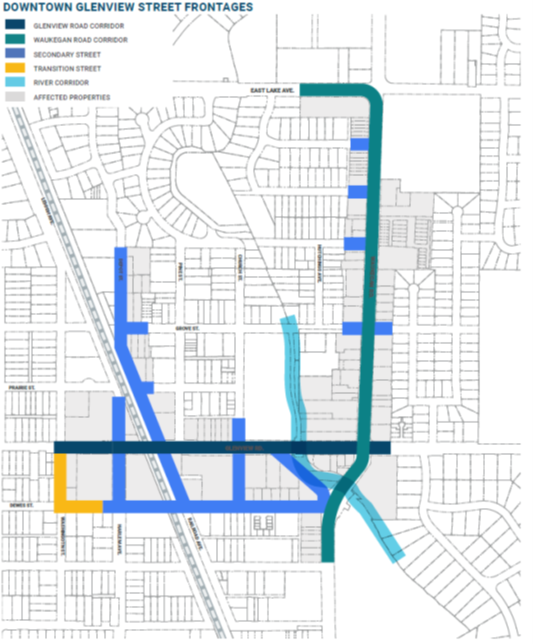
(4)
Purpose and authority. This code is adopted pursuant to the Home Rule powers of the Village of Glenview under the 1970 constitution of the State of Illinois. This code is adopted for the purpose of:
a.
Promoting the public health, safety, and general welfare;
b.
Improving the village's quality of life for residents and visitors by enhancing downtown's "sense of place;"
c.
Implementing the policies and goals contained within the Village's Downtown Revitalization Plan and 2021 Downtown Strategic Plan;
d.
Maintaining orderly and compatible land-use and development patterns;
e.
Enhancing and expanding downtown's retail environment by clustering shopping opportunities;
f.
Expanding residential opportunities, both to improve housing choice and increase foot traffic and vitality;
g.
Promoting rehabilitation and reuse of older buildings;
h.
Accommodating office uses in the right locations;
i.
Ensuring adequate light, air, privacy, and access to property;
j.
Providing for adequate storm water drainage;
k.
Enhancing pedestrian access and circulation;
l.
Providing efficient parking and transportation facilities; and
m.
Accommodating growth and development that complies with the preceding stated purposes.
(5)
Intent.
a.
The intent of this Downtown Development Code is to implement the Downtown Revitalization Plan adopted by the Village Board of Trustees on August 15, 2006 and the 2021 Downtown Strategic Plan adopted by the Village Board of Trustees on August 3, 2021.
b.
This section focuses on the creation of mixed-use, walkable neighborhoods, and emphasizes building "form," "public realm," and high-quality site and building design. It is intended to set the foundation for a vital, attractive downtown by encouraging streets, blocks, and buildings that are pedestrian- oriented, have a mix of uses, contain architectural diversity, and offer additional opportunities to live, work, and shop in the village. Downtown Plan implementation is intended to:
1.
Create a sense of place that has uses desired and needed by the community;
2.
Enhance the aesthetic appeal of the downtown;
3.
Provide desirable amenities such as parking, open space and streetscape improvements; and
4.
Address the needs of the downtown merchants, while attracting additional high-quality establishments.
More specific statements of intent are found within each major section of this Downtown Development Code.
(6)
Adopted plans. The following plans have been adopted by the village board of trustees and should be considered in any decisions under this Downtown Development Code in the D-D Downtown Development District:
a.
Downtown Strategic Plan (2021).
b.
Comprehensive Plan (2017).
c.
Downtown Revitalization Plan (2006).
(7)
Minimum requirements. The provisions of this Downtown Development Code are the minimum requirements deemed necessary to carry out its stated purposes and intent.
(8)
Conflicting provisions. Conflict with private agreements and covenants:
This Downtown Development Code is not intended to interfere with, abrogate or annul any easement, covenant, deed restriction or other agreement between private parties. The village does not enforce or maintain a record of private agreements.
(9)
Severability. Should any section, paragraph, sentence, clause, phrase, or word in this Downtown Development Code be declared invalid or unconstitutional by a court of competent jurisdiction, such invalidity or unconstitutionality shall not affect any of the remaining words, phrases, clauses, sentences, paragraphs or sections of this Downtown Development Code, since they would have been enacted by the president and board of trustees without the incorporation in this Downtown Development Code of any such invalid or unconstitutional word, phrase, clause, sentence, paragraph, or section.
(c)
Regulating framework.
(1)
Purpose. The regulating framework defines the desired physical form for Downtown Glenview and sets development parameters such as land use, street type, building height, siting and setbacks, and parking placement. The Development Code incorporates the recommendations of the Downtown Strategic Plan and Downtown Revitalization Plan but also applies to, and regulates, parcels not specifically referenced in these plans.
(2)
Permitted uses. The following is a general description of land uses allowed in the D-D Downtown Development District (see figure c-1 for the location of each use by block). For a list of specific permitted and conditional uses, see section 98-84.
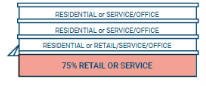
a.
Full ground-floor retail. These buildings are required to have uses in accordance with those listed in the use table located in section 98-84 on the ground floor. On the ground floor, service uses may only occupy up to 25 percent of the floor area within the frontage (as measured 30 feet from the building line). Service and office uses are allowed on upper floors along these blocks. Upper-floor residential uses are also allowed.
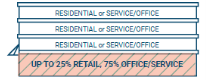
b.
Partial to full ground-floor retail. Uses in accordance with those listed in the use table located in section 98-84 are required on the ground floor along these blocks. On the ground floor, service and office uses may only occupy up to 75 percent of the floor area within the frontage (as measured 30 feet from the building line). Upper-floor residential and service/office uses are allowed.
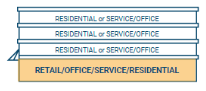
c.
Ground-floor retail/office/service. Uses in accordance with those listed in the use table located in section 98-84 are encouraged if feasible on the ground floor along blocks with this designation. Residential, service, and office uses are allowed on upper floors. All-residential buildings also are allowed.
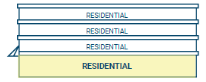
d.
Residential uses only. Only residential uses are allowed along blocks with this designation.
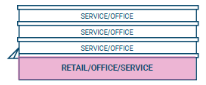
e.
Retail/office/service uses only. Only uses in accordance with those listed in the use table located in section 98-84 are allowed.

f.
Institutional uses. Civic or institutional uses such as libraries, churches, and schools are allowed.
Figure c-1: Downtown Uses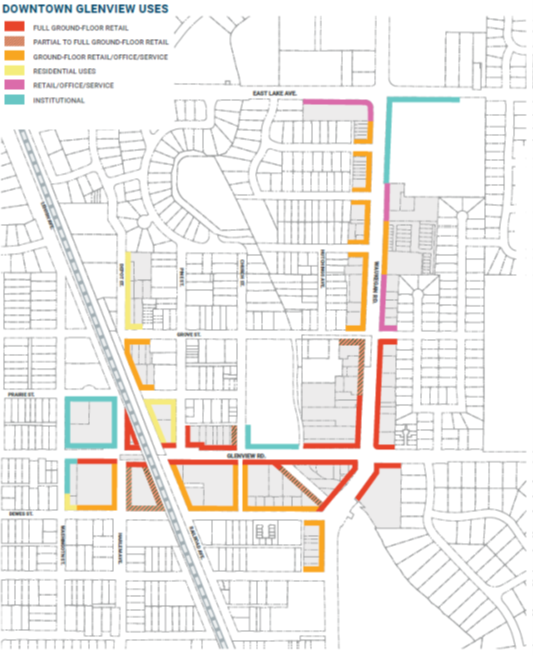
g.
Below-ground uses. Ancillary commercial, ancillary residential, parking, storage, and mechanical uses are allowed in a basement or below grade floors. If commercial uses are permitted on the ground floor, such uses are also permitted in the basement level as long as access to commercial space is separate from access to upper story residential units.
h.
Depths of use. Depths of use requirements shown in Figure c-1 extend 30 feet from the Building Line.
i.
Transition of use around corners. Street Frontages along Glenview and Waukegan Road shall transition around the first 30 feet of the street frontage of the intersecting street.
(3)
Minimum commercial depth. Commercial uses must have a minimum depth (from the front building line to the rear of the retail floor area) of 30 feet.
(4)
Uses on the same floor.
a.
While uses can be "mixed" within buildings by floor as noted above, residential and commercial (retail, service, or office) uses cannot be mixed on the same floor in a building above the ground floor. Residential can be mixed with commercial uses on the ground floor but not on the same street frontage. Residential lobbies, leasing office, amenity space, or building entrances are exempt from this standard.
b.
When transitioning between commercial and residential uses around corners, building elements such as secondary entrances, plazas/paseos/walkways, parking access, or other features shall be used to separate uses.
c.
A residential lobby/elevator is required on the ground floor in all buildings with residential uses on upper floors. Commercial uses on the first floor may have a secondary entrance from this lobby as long as their primary commercial entrance is from the sidewalk on the street.
d.
Parking is allowed on the ground floor behind commercial uses in buildings with retail, service, or office uses on the ground floor.
e.
In addition to the use information noted above by location, see subsection (d), Street frontages, for more specific regulations on allowed uses.
(5)
Building heights. Figure c-2 depicts the maximum number of stories allowed in specific areas of the D-D Downtown Development District.
Table c-1, Table c-2, and Table c-3 provide the maximum allowable height in stories and feet. All dimensions are measured from top of finished floor to top of finished floor/roof deck. The zero-foot elevation is measured on a horizontal plane at the average of the four existing grades (prior to commencement of demolition/construction) measured at the four corners of the proposed building or structure located nearest the most distant lot corners.
a.
Floor heights by story for multi-story commercial or mixed-use buildings: The ground floor shall be at least 15 and no more than 17 feet tall, with the upper residential or office floors being at least ten and no more than 12 feet tall.
b.
Floor heights by story for multi-family residential buildings: All floors shall be at least ten and no more than 12 feet tall.
c.
Floor heights for Waukegan Road north of Grove Street and 155 feet south of Lake Avenue ROW (up to existing corner lot) on the west side of Waukegan: For mixed-use buildings, the ground floor shall be 15 feet, with upper residential floors being at least ten and no more than 11 feet tall.
d.
All building heights are inclusive of pitched roofs, building parapets, and mechanical screening. Buildings are encouraged to include varied roof heights and forms and discouraged from large areas of flat roof planes.
e.
Elevator penthouses are exempt from the building height requirements listed in Table c-1, Table c-2, and Table c-3 provided they are located at least 30 feet behind the primary building facade and serve accessible roof decks or terraces. In these cases, elevator penthouses can extend up to 15 feet above the top of the roof deck provided the maximum area of such penthouse(s) cannot exceed 250 square feet per elevator.
f.
Decks/terraces: Use of terraces created by building step-backs are permitted and encouraged. Decks or terraces are not permitted on rooftops, except within 50 feet of the Glenview Road street frontage.
Figure c-2: Maximum Building Heights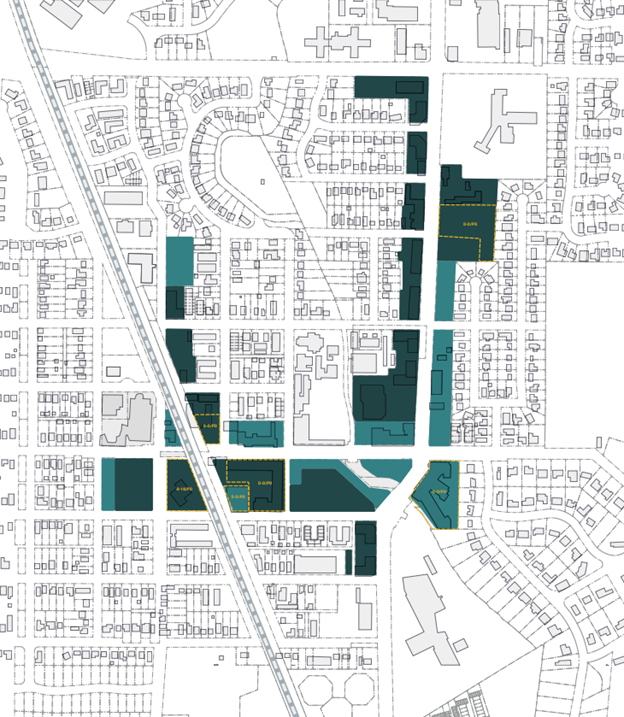
Table c-1: Maximum Height—Commercial/Residential Mixed-Use
Table c-2: Maximum Height—Multi-family Residential
Table c-3: Maximum Height—Commercial/Residential Mixed-Use, Waukegan Rd.
* Only if allowed in accordance with the quantity of stories permissible in accordance with Figure c-2.
(6)
Parking. A minimum quantity of off-street parking stalls shall be provided for each use according to the following ratios:
a.
Minimum parking by use.
1.
Townhomes/rowhomes. Two spaces per unit.
2.
Multi-family. One space per bedroom for one- and two-bedroom units, 0.75 spaces per bedroom for each bedroom over two. Seventy-five percent of all parking spaces shall be located indoors.
3.
Retail/service. One space per 300 gross square feet (except in the Glenview Road Corridor Frontage).
4.
Office. One space per 300 gross square feet (except in the Glenview Road Corridor Frontage).
5.
Restaurant. One space per 160 gross square feet.
b.
Exemptions from minimum parking by use. For any new development project, the first 2,000 square feet of retail, office, or service use shall be exempt from the calculation for required parking spaces. The exemption shall be applied to the least generating use on the ground floor. Only one exemption shall be allowed per building.
c.
Minimum parking—Glenview Road street frontage. For any new development project, the first 2,000 square feet of retail, office, or service use shall be exempt from the calculation for required parking spaces. The exemption shall be applied to the least generating use on the ground floor. Only one exemption shall be allowed per building.
1.
Retail, office, and service uses in this frontage are required to provide one space per 500 gross square feet of floor area due to the availability of street parking and commuter parking along the tracks.
2.
Restaurants and residential uses shall provide parking according to the ratios listed in section 98-135(c)(6)a.5.
3.
In the Glenview Road Corridor frontage, when a new use occupies a building existing as of May 21, 1996, additional off- street spaces are not required, provided that parking serving the building was not eliminated or reduced after May 21, 1996.
d.
Shared parking.
1.
Collective provisions. Shared parking should be considered to minimize the visual impact of land devoted to parking and to provide more efficient parking.
2.
Location. All required parking spaces shall be on the same lot as the building or use being served or within 500 feet of the property line (see Figure c-4), provided that no off-street parking for a business use shall be in a residential district.
3.
Mixed-use shared parking. New buildings or developments can use Table c-4 to calculate shared parking provided they include more than one use listed in the table, and are located within the same block or parcel. To use the table, apply the use percentages to the maximum parking demand required per section 98-135(c)(6)a. and add all of the shared parking totals for each column. The largest number of the four columns is the maximum parking demand and is the required parking for new development. All shared parking plans will require a parking management plan to show maximum parking demand by use, proposed shared parking reductions, number of publicly accessible spaces, and designated/reserved spaces (if applicable).
4.
Waiver. The director of community development may waive the number of spaces required in part or entirely if shared parking is deemed sufficient based on the location of the proposed use, anticipated hours of peak parking demand, shared parking, and availability of alternative parking. An executed written agreement covering such collective use shall be filed with the director of community development or their designee.
Figure c-3: Shared Parking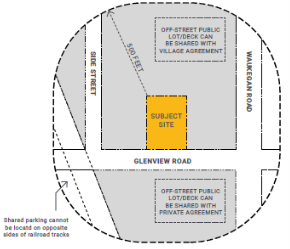
Table c-4: Shared Parking Table
(d)
Street frontages.
(1)
Purpose and intent. Each downtown street has been assigned a street frontage designation to define an optimal "building envelope" and "public realm" using setbacks, sidewalk and street widths, and other design parameters.
Along with subsection (e), Design standards, the required street, sidewalk and building relationships are intended to foster new development that enhances and expands the traditional "Main Street" scale of downtown.
Figure d-1 assigns designations to all street frontages in downtown and establishes a building line for each frontage.
(2)
Building line.
a.
Building line. The building line is a "build-to" line that will help establish consistent "streetwalls," sidewalk widths, and streetscape zones (see Figure d-1).
b.
Relationship of building line to right-of-way or property line. The building line may differ from the current location of a right-of-way or property line. In these cases, because the building line must be "built to," the right-of-way (ROW)/property lines will need to be adjusted through dedication of property between the property owner and village. More specifically, the property owner may need to dedicate property to the public ROW to create the desirable street and streetscape width, or the village may transfer ROW to the buildable development site.
1.
For Glenview Road, the building line is intended to eventually bring all buildings more in line with an 18-foot sidewalk width east of the river and a common 15-foot sidewalk width west of the river.
2.
For Waukegan Road, the building line is intended to eventually eliminate parking lots in front of buildings and bring buildings closer to the sidewalk to better frame the street, reduce its perceived width and scale, and establish this roadway as a physical part of the traditional downtown starting at Lake Avenue. The code also incorporates foundation landscaping in front of all-residential buildings and a landscaped median in the center of Waukegan Road to provide a "green," attractive entrance to the downtown.
3.
For residential buildings along Waukegan Road, the building line provides room for a consistent sidewalk/streetscape space that will accommodate foundation landscaping in front of buildings.
c.
Where the building line designated in this section differs from the Subdivision Code, chapter 66, section 66-165, the provisions of the Downtown Development Code shall apply.
(3)
Street standards.
a.
Purpose and intent. The street standards defined for each street frontage delineate street and sidewalk conditions that will establish a more attractive, pedestrian-oriented shopping environment.
1.
Over time, desired or common sidewalk widths will be established to create a more regular walking experience from block to block that incorporates a minimum five-foot "free zone" walking area and additional space for street trees, plantings in raised planters, or parkways.
2.
Developers are required to install village-approved streetscape elements for new developments.
b.
Required. All developments within the D-D Downtown Development District must comply with the Code's street standards.
(4)
Street frontages.
Glenview Road Corridor: Downtown's primary pedestrian-oriented shopping street.
Waukegan Road Corridor: An auto-oriented corridor where the Downtown Revitalization Plan seeks to encourage a more pedestrian-oriented character similar to Glenview Road, especially south of Grove.
Secondary street: Secondary street frontages are also intended to provide a walking shopping/office/service environment while allowing all-residential buildings and respecting adjacent residential uses.
Transition Street: This frontage provides a transition between commercial and residential areas (along Washington and parts of Glenview and Dewes.)
River corridor: This corridor defines regulations to protect the Chicago River, increase its visibility, promote public access to the waterfront, and establish a central open space as delineated in the Downtown Revitalization Plan.
Where street frontage designations change along a street, either designation can be applied for a maximum of 75 feet in either direction along that frontage. Developments on corner lots should use standards for the building's primary street and standards for the "side street" frontage.
Figure d-1: Street Frontages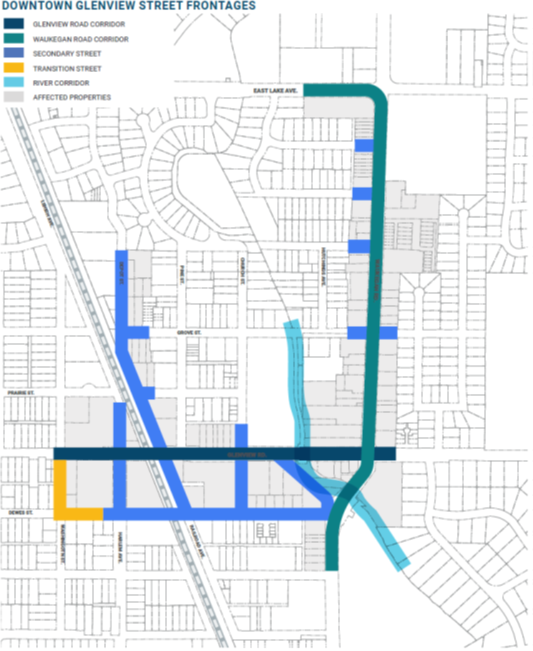
Figure d-2: Setbacks - River Drive Vacated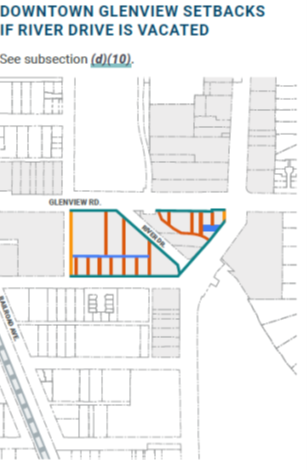
Figure d-3: Setbacks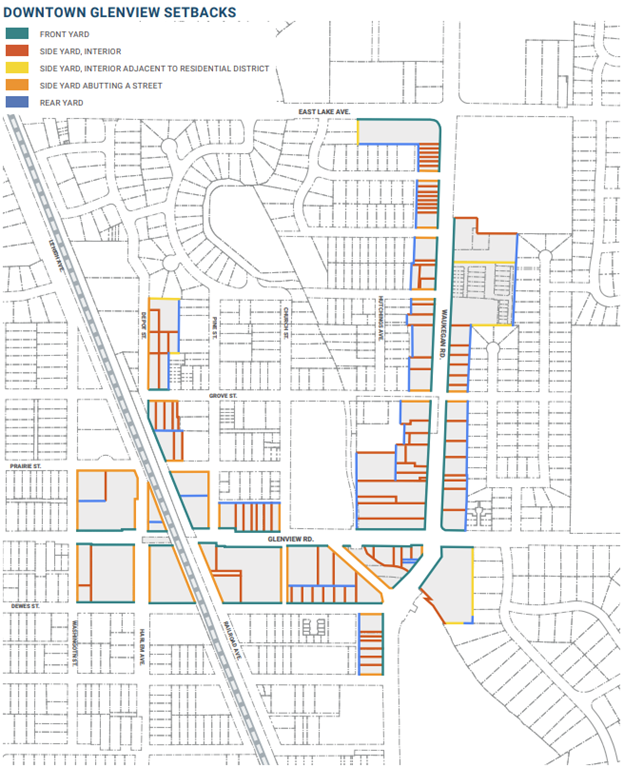
(5)
Street setbacks. See subsections (d)(6) through (d)(9) for more specific details on the dimensions of setbacks within each frontage zone.
(6)
Glenview Road Corridor.
a.
Purpose and intent. The Glenview Road Corridor is applied to Downtown Glenview's traditional shopping street. This stretch of Glenview Road has a pedestrian-oriented, "Main Street" character, and the Downtown Revitalization Plan and Development Code seek to enhance this character by providing a consistent building "streetwall," and a streetscape/sidewalk zone that allows ample room for walking, shopping, outdoor dining, and landscaping.
b.
Street/sidewalk standards.
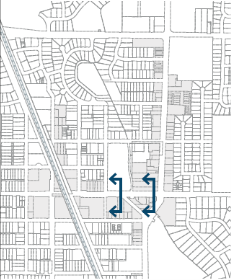 | 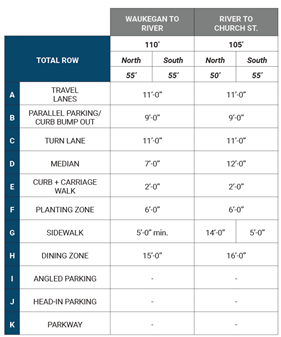 |
| These tables represent typical conditions. Final dimensions may vary depending on existing conditions and will be reviewed on a case by case basis as part of the Development Review and Engineering Review processes. | |
Figure d-4: Glenview Road: Waukegan to River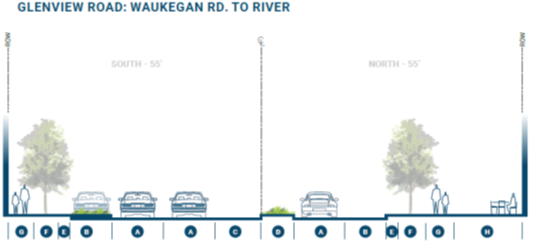
Figure d-5: Glenview Road: River to Church St.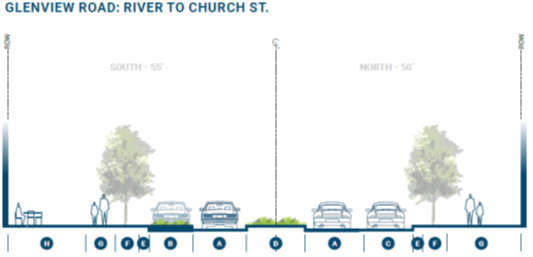
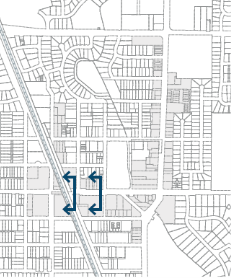 | 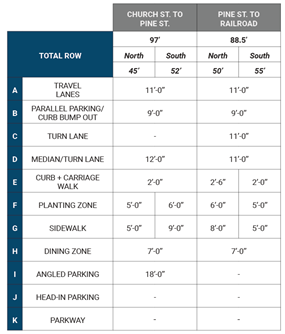 |
| These tables represent typical conditions. Final dimensions may vary depending on existing conditions and will be reviewed on a case by case basis as part of the Development Review and Engineering Review processes. | |
Figures d-6: Glenview Road: Church St. to Pine St.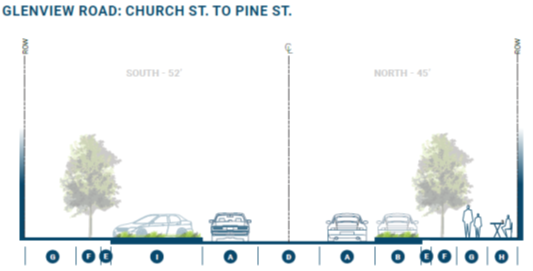
Figure d-7: Glenview Road: Pine St. to Railroad ROW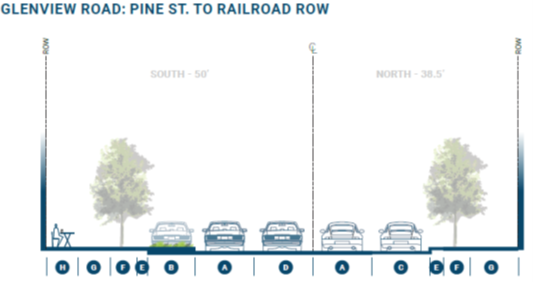
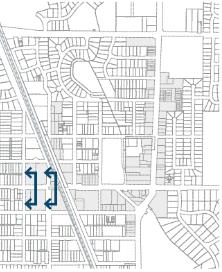 | 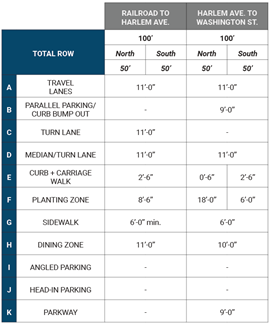 |
| These tables represent typical conditions. Final dimensions may vary depending on existing conditions and will be reviewed on a case by case basis as part of the Development Review and Engineering Review processes. | |
Figure d-8: Glenview Road: Railroad ROW to Harlem Ave.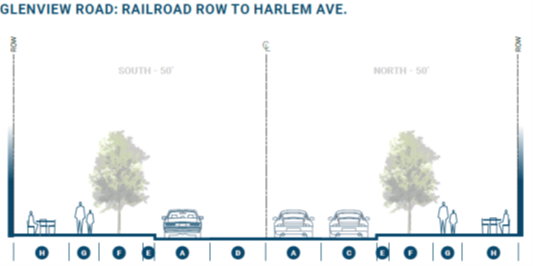
Figure d-9: Glenview Road: Harlem Ave. to Washington St.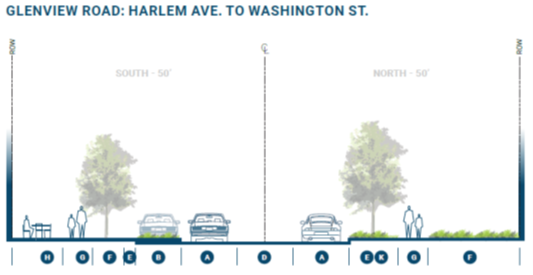
c.
Building setbacks.
1.
Front yard. Zero. At least 75 percent of the ground-floor front façade must be built to within 30 inches of the building line, and ground-floor façades must be built to within 30 inches of the building line at each side property line. Within the 25 percent of the ground-floor façade not built to the building line, elements such as pocket parks, plazas, outdoor dining, areas to preserve mature trees, and landscape areas should be included. Where the façade above a recessed building entrance maintains the "street wall" at a distance within 30 inches of the building line, the frontage of the recessed entrance at the ground level shall be considered to be on the building line.
2.
Side yard, interior. Zero, at ground level. A ten-foot pedestrian pass-through is allowed if necessary to access a rear parking lot.
3.
Side yard, interior adjacent to residential district (including transitional street frontage). Twenty feet minimum
4.
Side yard, corner lot on side street. At least 60 percent of the ground-floor side façade must be built to within 30 inches of the building line.
5.
Rear yard. Five feet minimum.
Figure d-10: Glenview Rd.—Building Setbacks
This diagram represents typical conditions; existing conditions at individual sites
may vary.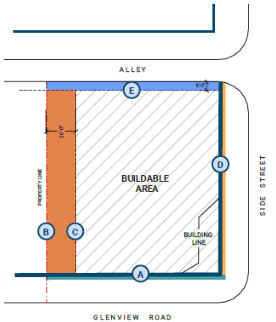
d.
Building step-backs.
1.
Front: Starting with the fourth floor, ten feet from the building line, except for corner elements within 50 feet of the corner of the building.
2.
Side, interior: Starting with the second floor, ten feet from property line to allow air and light to windows.
3.
Side, corner lot: Starting with the fourth floor, ten feet.
4.
Building step-backs can include terrace step-backs, wedding cake step-backs, or corner terraces. See subsection (e)(7)b., Building massing strategies, for more detail.
e.
Parking placement. The following standards are for off-street, surface parking lots. In addition, parking may be contained within buildings or underground.
1.
Off-street, surface parking lots and parking decks must be placed behind a building.
2.
Five feet from the side yard. If a side alley or access drive is present, parking is permitted within the five-foot setback if the spaces are perpendicular to the alley. (Adjacent commercial parking lots must be connected.)
3.
Ten feet minimum from the rear of the lot if not adjacent to an alley.
4.
Five feet minimum from the rear of the lot if adjacent to an alley.
5.
Five feet from the building line on the side yard of a corner lot.
i.
Standards for underground parking. Underground parking must meet the building setbacks for the front and side yards at ground level specified in subsection (d)(6)c and the parking placement standards for the rear yard specified in subsection (d)(6)e.
Figure d-11: Glenview Rd. - Parking Placement
This diagram represents typical conditions; existing conditions at individual sites
may vary.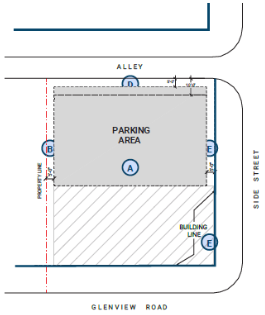
f.
Access.
1.
Mid-block curb cuts and access drives are not allowed in the Glenview Road Corridor. Loading, if provided, and parking access must be from the alley or side street.
2.
If no alley exists at the time of development, the developer is required to dedicate an alley ROW, construct the alley pursuant to Village requirements, maintain it by keeping it clear of stored materials and vehicles, and provide landscaping adjacent to the alley. Alley ROW width must be 20 feet with five feet remaining in the setback for foundation landscaping.
g.
Use. Land uses shall be in accordance with section 98-135(c)(6). For a list of specific permitted and conditional uses, see section 98-84.
h.
Building types. Building types allowed in the Glenview Road Corridor shall be retail/office and mixed-use as defined in subsection (e), Design Standards.
(7)
Waukegan Road Corridor.
a.
Purpose and intent. The Waukegan Road Corridor is currently an auto-oriented roadway that provides an entrance into Downtown Glenview's main shopping area. South of Grove Street, this corridor is envisioned as an extension of the pedestrian-oriented shopping environment found on Glenview Road. North of Grove Street, this corridor should provide an attractive, mixed-use gateway into the downtown retail core.
The Development Code seeks to both accommodate auto traffic and enhance the pedestrian environment along Waukegan Road. Establishing a consistent "streetwall" with an ample sidewalk/streetscape is the main priority for this frontage. Following a common building line and prohibiting off-street parking in front of buildings will allow Waukegan Road to be "framed" over time with building "streetwalls": (See Figure d-1.)
b.
Street/sidewalk standards.
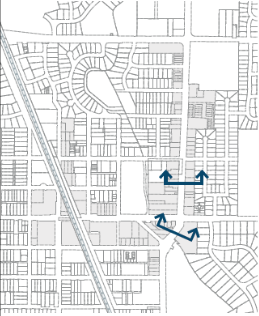 | 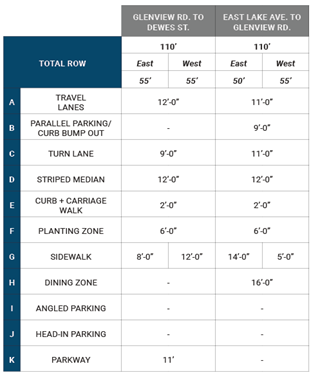 |
| This table represents typical conditions. Final dimensions may vary depending on existing conditions and will be reviewed on a case by case basis as part of the Development Review and Engineering Review processes. | |
Figure d-12: Waukegan Road: Glenview Rd. to Dewes St.
Figure represents conditions near Glenview Road while conditions reverse near Dewes
St.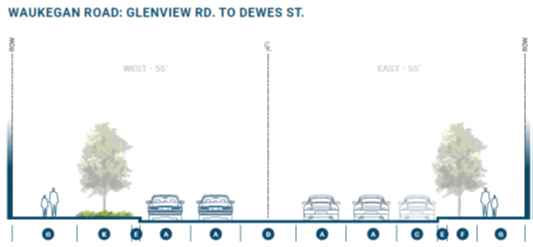
Figure d-13: Waukegan Road: East Lake Ave. to Glenview Rd.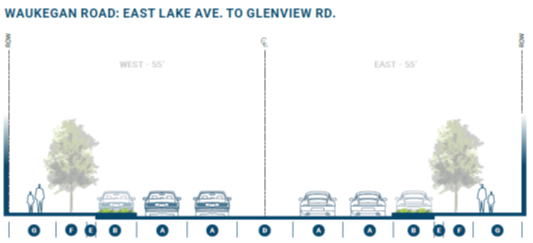
c.
Building setbacks.
1.
Front yard: Zero. At least 60 percent of the ground-floor front façade must be built to within 30 inches of the building line, and ground-floor façades must be built to within 30 inches of the building line at each side yard property line (unless an access drive is to be built adjacent to the interior side property line). An additional ten-foot plus 30 inches landscape setback is allowed for residential buildings. Within the 40 percent of the ground-floor façade not built to the building line, elements such as pocket parks, plazas, areas to preserve mature trees, and landscape areas should be included. Recessed building entries that maintain the "street wall" above do not count against building line calculations.
2.
Side yard, interior: Zero, at ground level. A ten-foot pedestrian pass-through is allowed if necessary to access a rear ROW lot.
3.
Side yard, adjacent to an access drive within property: Ten feet minimum where there is no alley requirement, zero in all other locations.
4.
Side yard, corner lot on the side street: At least 60 percent of the ground-floor side façade must be built to within 30 inches of the building line.
5.
Rear yard, adjacent to an alley: Five feet minimum.
6.
Rear yard, not adjacent to an alley: Twenty-five feet minimum.
Figure d-14: Waukegan Rd. - Building Setbacks
This diagram represents typical conditions; existing conditions at individual sites
may vary.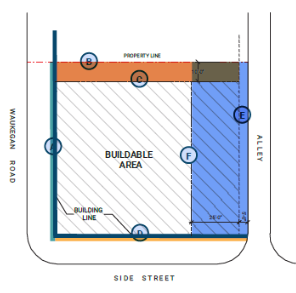
d.
Building step-backs.
1.
Side, interior: Starting with the second floor, ten feet from property line to allow air and light to windows.
2.
Side, corner lot: Starting with the fourth floor, ten feet.
3.
Rear: Starting with the fourth floor, ten feet.
4.
Building step-backs can include step-backs, wedding cake step-backs, or corner terraces. See subsection (e)(7)b, Building massing strategies, for more detail.
e.
Parking placement. The following standards are for off-street, surface parking lots. In addition, parking may be contained within buildings or underground.
1.
All residential buildings.
A.
Off-street, surface parking must be placed in the rear 50 percent of the lot depth (from the front building line to the rear property line) except on the west side of Waukegan between the river and Dewes St.
B.
Five feet from the interior side yard (adjacent parking lots must be connected when sharing access drive).
C.
Ten feet minimum from the rear of the lot if not adjacent to an alley.
D.
Five feet minimum from the rear of a lot if adjacent to an alley.
E.
Five feet from the building line on the side yard of a corner lot.
2.
Retail/mixed-use buildings less than 30,000 square feet on ground floor.
A.
Off-street, surface parking is encouraged to be placed in the rear of the building, and at least 75 percent of the spaces must be placed in the rear 75 percent of the lot depth (from the front building line to the rear property line).
B.
Five feet from the building line for the remaining 25 percent of spaces. The parking area may not occupy more than 50 percent of the frontage.
C.
Five feet from the interior side yard (adjacent commercial parking lots must be connected).
D.
Five feet minimum from the rear if adjacent to an alley.
E.
Ten feet minimum from rear if not adjacent to an alley, or if adjacent to properties along a transition street or other residential zone.
F.
Five feet from the building line on side streets.
3.
Retail/mixed-use buildings greater than 30,000 square feet on ground floor.
A.
Five feet minimum from the front building line, although a portion of the off-street parking is encouraged to be placed to the side or rear of the building.
B.
Five feet from an adjacent rear alley.
C.
Fifteen feet from the rear setback if no rear alley exists, or if adjacent to a residential zone.
4.
Standards for parking enclosures: Sites without alleys are permitted to have an enclosed parking within the rear yard building setback. The parking enclosure must be setback ten feet from the rear lot line and the structure cannot be more than ten feet in height. Covered commercial parking is encouraged to be open and not enclosed with walls.
5.
Standards for underground parking: Underground parking must meet the building setbacks for the front and side yards at ground level specified in subsection (d)(7)c and the parking placement standards for the rear yard specified in subsection (d)(7)e.
Figure d-15: Waukegan Rd.—Residential Surface Parking Placement
This diagram represents typical conditions; existing conditions at individual sites
may vary.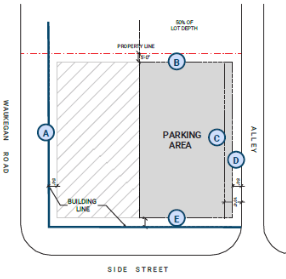
Figure d-16: Waukegan Rd. - Residential Surface Parking Placement, Retail/Mixed-Use
less than 30,000 SF
This diagram represents typical conditions; existing conditions at individual sites
may vary.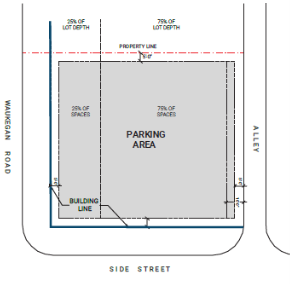
Figure d-17: Waukegan Rd. - Surface Parking Placement, Retail/Mixed-Use greater than
30,000 SF
This diagram represents typical conditions; existing conditions at individual sites
may vary.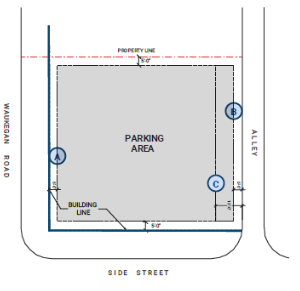
f.
Access.
1.
Mid-block curb cuts and access drives are not allowed in the Waukegan Road Corridor north of Grove Street and south of Lake Street on the west side of Waukegan Road. Loading, if provided, and parking access must be from the alley or side street.
If no alley exists at the time of development, the developer is required to dedicate an alley ROW, construct the alley pursuant to Village requirements, maintain it by keeping it clear of stored materials and vehicles, and provide landscaping adjacent to the alley. Sufficient ROW should be dedicated to provide a minimum alley width of 20 feet, with five feet remaining in the setback for foundation landscaping. Access to alley from single-family lots on west side is prohibited. Property under common ownership bisected by alley ROW can be used for parking purposes. (See Figure d-18 and Figure d-19)
Figure d-18: Rear Step-back with Alley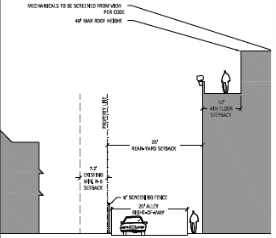
Figure d-19: Future Alley North of Grove Street and South of Maplewood Lane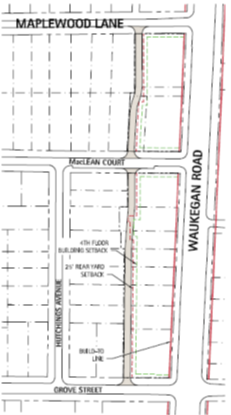
Any mid-block developer is required to build the alley up-front in anticipation of future links. The site plan must show how parking could be connected to the alley in the future and how a temporary Waukegan Road driveway would be disconnected and greened when the alley becomes active.
Because the mid-block access drive is a temporary condition until a continuous rear alley is established, upper stories are permitted to be built to the side lot line over the access drive.
2.
Curb cuts and access drives are allowed on all other Waukegan Road blocks and shall be shared where feasible. Adjacent surface parking lots utilized by commercial uses must be connected.
3.
Curb cuts along Waukegan Road must be at least 100 feet from any intersection with a side street, such as Stevens, Maplewood, MacLean, Grove, and Glenview.
4.
Direct access to indoor parking, such as a parking deck or indoor parking within a residential or mixed-use development, is not allowed directly off of Waukegan Road. Access must be from a side street or access drive, alley, or parking area. Temporary access can be permitted from Waukegan Road until alley is improved to nearest adjacent street.
5.
Access drives must be shared with other mid-block developments on the same block.
6.
If a driveway is to be used to access commercial or residential rear parking lots on Waukegan Road, it must be shared with future developments on adjacent properties via easements if the future development cannot be accessed from an alley or side street.
7.
Access driveways to indoor parking as well as surface parking lots from side streets must be at least 25 feet from Waukegan Road.
g.
Use. Land uses shall be in accordance with section 98-135(c)(6). For a list of specific permitted and conditional uses, see section 98-84.
h.
Building types. Building types allowed in the Waukegan Road Corridor shall be retail/office, mixed-use and apartment/condominium as defined in subsection (e), Design standards.
i.
Development scenarios. The following 3-D massing diagrams show potential development scenarios on a sample block along the Waukegan Road Corridor.
Figure d-20 shows two infill developments that comply with the Downtown Development Code and fit in among existing buildings. Figure d-21 shows how the block could develop over time with four buildings. In all cases, developments should feature high- quality architecture with appropriate articulation and fenestration as discussed in subsection (e), Design standards.
Figure d-20: Infill Redevelopment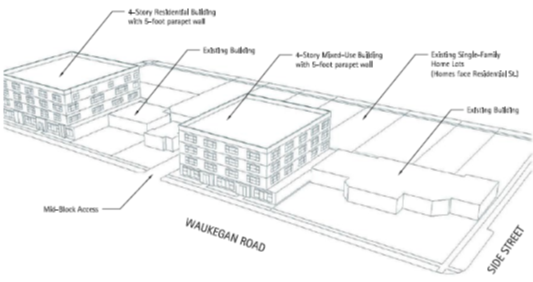
Figure d-21: Infill Redevelopment—Quarter-block Segments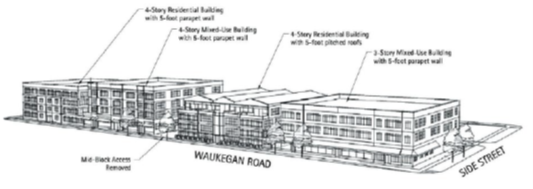
(8)
Secondary street.
a.
Purpose and intent. Dewes Street, Railroad Avenue, and Harlem Avenue as well as side streets that intersect with Glenview and Waukegan Roads are considered secondary streets within downtown. These streets are intended to have a mixed-use character that is supportive of the pedestrian-oriented shopping environment along the Glenview Road and Waukegan Road Corridors. The secondary street frontage also seeks to provide appropriate transitions from the shopping blocks to adjacent residential neighborhoods.
The Downtown Revitalization Plan and Development Code encourage a consistent "streetwall" of buildings and ample sidewalk/streetscape space. Limited curb cuts are allowed to provide shared access drives to new developments within a block. (See Figure d-1, as well as figures throughout this subsection).
b.
Street/sidewalk standards.
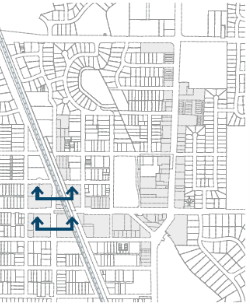 | 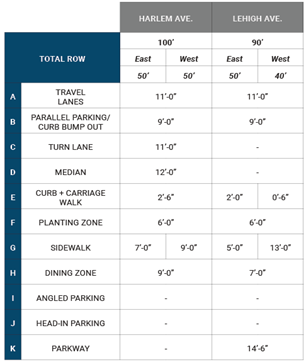 |
| This table represents typical conditions. Final dimensions may vary depending on existing conditions and will be reviewed on a case by case basis as part of the Development Review and Engineering Review processes. | |
Figure d-22: Secondary Street: Harlem Ave.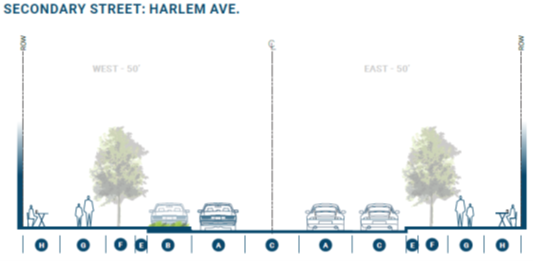
Figure d-23: Secondary Street: Lehigh Ave.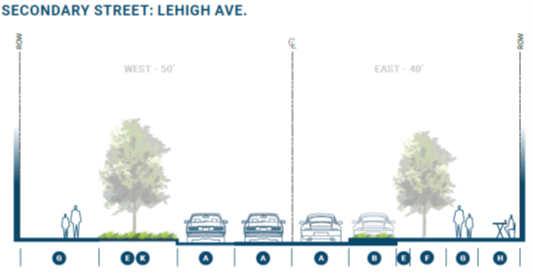
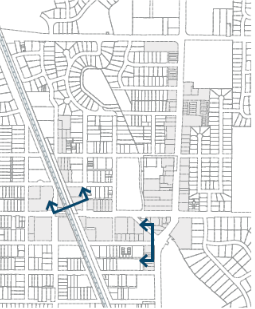 | 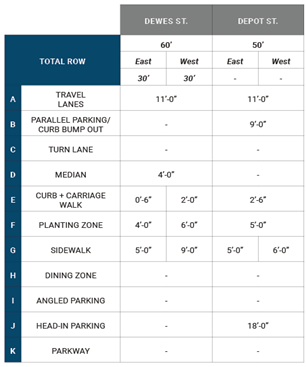 |
| This table represents typical conditions. Final dimensions may vary depending on existing conditions and will be reviewed on a case by case basis as part of the Development Review and Engineering Review processes. | |
Figure d-24: Secondary Street: Dewes St.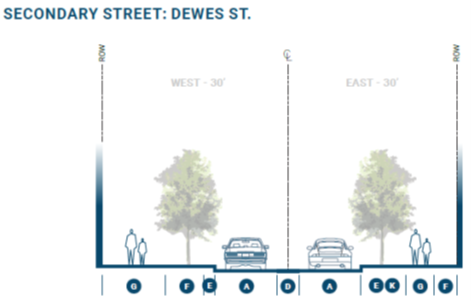
Figure d-25: Secondary Street: Depot St.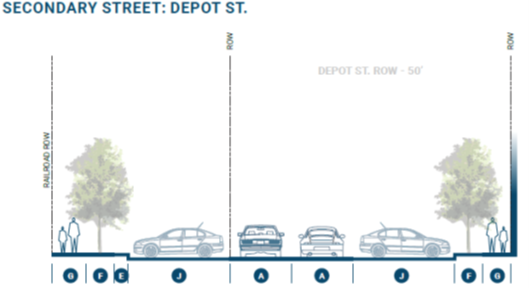
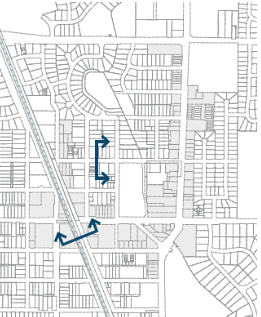 | 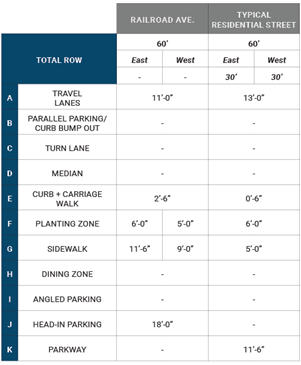 |
| This table represents typical conditions. Final dimensions may vary depending on existing conditions and will be reviewed on a case by case basis as part of the Development Review and Engineering Review processes. | |
Figure d-26: Secondary Street: Railroad Ave.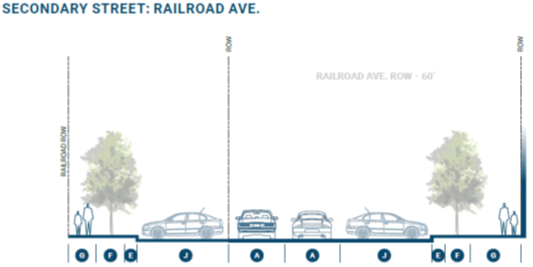
Figure d-27: Secondary Street: Typical Residential Street.
On-street parking typically allowed on one side of the street of the street within
the 26' travel lane section.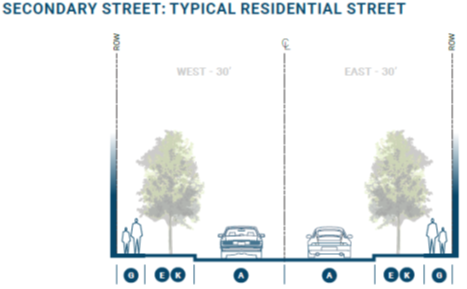
c.
Building setbacks.
1.
Front yard: Zero. At least 60 percent of the ground-floor front façade must be built to within 30 inches of the building line, and ground-floor façades must be built to within 30 inches of the building line at each side yard property line. An additional ten-foot landscape setback is allowed for residential buildings. Within the 40 percent of the ground-floor façade not built to the building line, elements such as pocket parks, plazas, areas to preserve mature trees, and landscape areas should be included. Recessed building entries that maintain the "street wall" above do not count against building line calculations.
2.
Side yard, interior: Zero, at ground level. A ten-foot pedestrian pass-through is allowed if necessary to access a rear parking lot.
3.
Side yard, adjacent to an access drive: Ten feet.
4.
Side yard, interior adjacent to residential district (including transitional street frontage): Twenty feet minimum.
5.
Side yard, corner lot on side street: At least 60 percent of the ground-floor side façade must be built to within 30 inches of the building line.
6.
Rear yard, adjacent to an alley: Five feet minimum.
7.
Rear yard, not adjacent to an alley: Ten feet minimum. If a ten-foot rear step-back is included above the third floor, only a ten-foot minimum rear setback is required.
Figure d-28: Secondary St. - Building Setbacks
This diagram represents typical conditions; existing conditions at individual sites
may vary.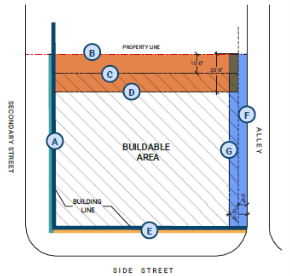
d.
Building step-backs.
1.
Front: Starting with the fourth floor, ten feet from the building line.
2.
Side, interior: Starting with the second floor, ten feet from property line must be included to allow air and light to windows. (See Figure d-28.)
3.
Side, corner lot: Starting with the fourth floor, ten feet.
4.
Building step-backs can include step-backs, wedding cake step-backs, or corner terraces. See subsection (e)(7)b, Building massing strategies, for more detail.
e.
Parking placement. The following standards are for off-street, surface parking lots. In addition, parking may be contained within buildings or underground.
1.
Off-street, surface parking not contained within the building or underground must be placed in the rear 75 percent of the lot depth (from the front building line to the rear property line).
2.
Five feet from the interior side yard (adjacent commercial parking lots must be connected).
3.
Five feet from the rear if adjacent to a rear alley.
Ten feet from the rear if not adjacent to an alley or if adjacent to properties along a transition street frontage or adjacent to other residential districts.
Five feet from building line on the side yard of a corner lot.
i.
Standards for underground parking: Underground parking must meet the building setbacks for the front and side yards at ground level specified in subsection (d)(8)c and the parking placement standards for the rear yard specified in subsection (d)(8)e.
Figure d-29: Secondary St. - Parking Placement
This diagram represents typical conditions; existing conditions at individual sites
may vary.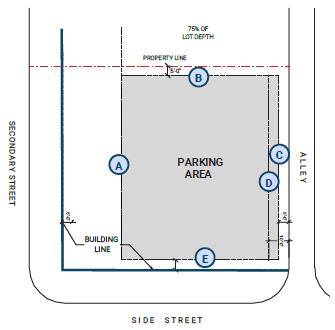
f.
Access.
1.
Curb cuts are allowed on secondary street frontages but must be spaced at least 85 feet apart.
2.
Curb cuts and access drives shall be shared where feasible, and adjacent commercial surface parking lots must be connected.
3.
Curb cuts must be at least 25 feet from any intersecting street.
g.
Use. Land uses shall be in accordance with section 98-135(c)(6). For a list of specific permitted and conditional uses, see section 98-84.
h.
Building types. Building types allowed on the secondary street shall be retail/office, mixed-use, condominium/apartment as defined in subsection (e), Design standards.
(9)
Transition street.
a.
Purpose and intent. The transition street frontage provides a residential zone that fits the downtown character of its location and provides a transition to residential neighborhoods to the south and west.
b.
Street/sidewalk standards. The building line in the transition street corridor frontage provides a larger sidewalk to allow for increased landscape and buffering across from established residential uses. The optimal ROW is 86 feet.
c.
Building setbacks.
1.
Front yard: Zero. At least 75 percent of the front façade must be built to within 30 inches of the building line. An additional ten-foot landscape setback is allowed for residential buildings.
2.
Side yard, interior: Ten feet minimum from a lot line or access driveway.
3.
Side yard, corner lot on side street: At least 60 percent of the ground-floor side façade must be built to within 30 inches of the building line.
4.
Rear yard: Ten feet minimum.
d.
Parking placement. Townhomes and rowhomes must have two indoor parking spaces per unit (within unit or in a garage). Minimum setbacks for any additional surface parking are:
1.
Twenty-five feet from the front building line.
2.
Five feet from the side street building line.
3.
Fifteen feet from an interior side yard lot line or access drive.
4.
Five feet from the alley or rear lot line.
5.
Standards for underground parking: Underground parking must meet the building setbacks for the front and side yards at ground level specified in subsection (d)(9)c. and the parking placement standards for the rear yard specified in subsection (d)(9)d.
e.
Access.
1.
Curb cuts are allowed on transition street frontages but must be spaced at least 85 feet apart.
2.
Curb cuts and access drives shall be shared where feasible.
3.
Curb cuts must be at least 25 feet from any intersecting street.
4.
Parking and services shall be accessed from an alley or garage. Rowhomes and townhomes are not allowed on a lot without an alley.
5.
Garages on corner lots shall face the alleys.
f.
Use. Land uses shall be in accordance with section 98-135(c)(6). For a list of specific permitted and conditional uses, see section 98-84.
g.
Building types. Building types allowed on transition street shall be townhomes and rowhomes as defined in subsection (e), Design standards.
(10)
River Corridor.
a.
Purpose and intent. In addition to a green edge along the West Fork of the North Branch of the Chicago River, the Downtown Revitalization Plan envisions a central open space framed by mixed-use buildings south of Glenview Road. The River Corridor Frontage requirements provide appropriate setbacks from the river to create an attractive, landscaped open space along its edge.
b.
Requirements.
1.
Buildings and parking must be at least 35 feet from the edge of the river, which is measured from the established high-water elevations - in most cases the channel bank.
2.
Property owners shall accommodate public access to the river through paths, plazas, gardens, or other forms of open space.
3.
Natural landscaping should be provided within the 35-foot setback.
4.
Developments at this location should comply with the standards for the street onto which they front and should also review the standards for the adjacent street frontage.
5.
If in accordance with the vision presented in the 2021 Strategic Plan, River Drive, south of Glenview Road, is vacated by the Village and a park is added between the river and new development, the building line for any new development west of the park will be located 10 feet away from the new property line. The size and location of the park (if any) has not been determined but Figure d-30 and Figure d-31 reflect a range of possible outcomes as determined by the 2021 Downtown Strategic Plan. Within the ten-foot setback of a new building line from the property line, elements such as pocket parks, plazas, areas to preserve mature trees, and landscape areas should be included. These features should complement the adjacent park if it has been designed or installed.
Figure d-30: Balanced Park Option A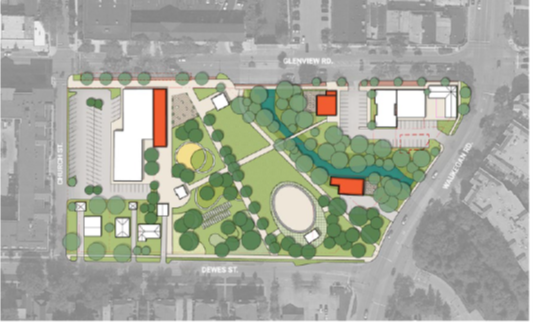
Figure d-31: Balanced Park Option D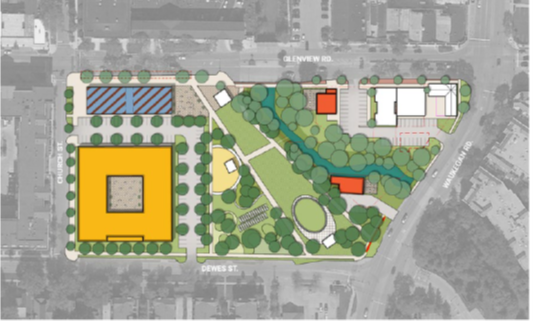
The Park scenarios presented in this document only reflect a range of possible outcomes as determined by the 2021 Downtown Strategic Plan.
(e)
Design standards.
(1)
Purpose and intent. The following design standards were created to complement the development regulations in the Downtown Development Code. The Standards should be used by landowners, businesses, developers, planners, architects, landscape architects, and engineers as guiding principles for developments proposed in Downtown Glenview. The design standards are intended to maintain and enhance the physical character of downtown by encouraging development proposals that strive for high-quality design.
(2)
Village character. Although these standards do not mandate or endorse one particular style of architecture, they do recognize the value of Downtown Glenview's traditional historic revival architecture and its identity as an upscale, North Shore commuter railway village. The standards encourage development that respects the village's history, "fits in" with high-quality adjacent structures, and enhances downtown's overall architectural character.
In light of Glenview's extensive and popular public land holdings, the community's history of preserving, creating, and supporting unique natural areas, and the village's award-winning professional natural resources staff, the preservation of existing and installation of new trees and green infrastructure in the downtown will require forethought, strategy, and employing available technologies from the scientific fields of arboriculture and urban forestry.
(3)
Objectives. Site and building design should enhance downtown's eclectic character by:
• Fostering a "built over time" appearance with variations in façades, building height, and rooflines.
• Articulating buildings with detailed fenestration, high-quality materials, signage, and lighting.
• Incorporating attractive, year-round streetscape/landscape elements.
• Incorporating environmentally sensitive, sustainable design where feasible.
Using forethought, strategy, science, and technology, we strive to create, maintain, and foster a mature tree canopy in the downtown for the benefit of businesses, residents, and visitors for generations to come.
(4)
Context. The design of each development, whether it consists of one or multiple buildings, will be reviewed by Village boards and commissions for its suitability for a given site, compatibility with adjacent development, and consistency with the goal of improving the design quality of Glenview's built environment. In addition, other plans and development regulations affect development in Downtown Glenview.
The Comprehensive Plan provides goals and objectives and a land-use direction for the entire Village.
The 2006 Downtown Revitalization Plan and 2021 Downtown Strategic Plan sets a new direction for the improvement and development of the area. The Downtown Development Code and its design standards seek to implement the Revitalization Plan by providing development regulations and design direction.
The Glenview Municipal Code provides a variety of other related development regulations, as noted in the introduction and administration sections.
(5)
Organization.Section 98-135(e)(6) lists the standards specific to certain building types in the downtown and includes "wireframe" diagrams that provide guidance regarding appropriate scale and massing. This section also provides photographs of buildings that feature high-quality design.
Subsection (e)(7) provides design standards applicable to all downtown buildings on properties covered by the code.
Subsections (e)(8) through (e)(10) provide standards for building materials, lighting, and outdoor cafés.
Subsection (e)(11) provides parking standards.
Subsection (e)(12) includes standards for downtown streetscape and landscape.
(6)
Building types. The following building types are allowed in Downtown:
• Mixed-use
• Retail/office
• Multi-family
• Rowhome/townhome
Each building type must comply with the regulating framework and street frontages sections and follow the design standards in this section.
The photos and graphics that follow show images for each building type. They provide additional direction for building siting, massing, and design. The 3-D "wireframe" diagrams are intended to show massing, scale, and fenestration but are not intended to show detailed architecture and articulation or indicate a preference for one architectural style for downtown.
Photographs included in these design standards are intended to show high-quality design and architecture but may not comply with every provision of the Downtown Development Code.
a.
Mixed-Use.
1.
Mixed-use building on corner lot.
Figure e-1: Mixed-Use Building on Corner Lot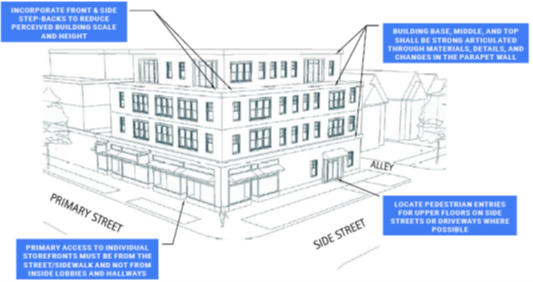
2.
Mixed-use building, mid-block with access drive.
Figure e-2: Mixed-Use Building with Access Drive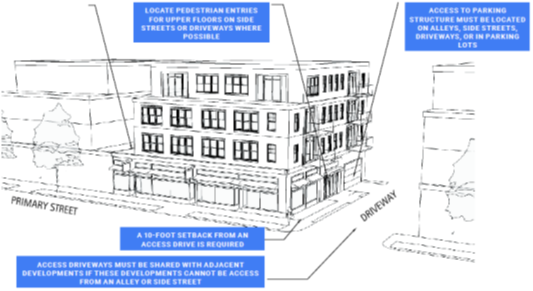
3.
Mixed-use building, mid-block without access drive.
Figure e-3: Mixed-Use Building, Mid-block without Access Drive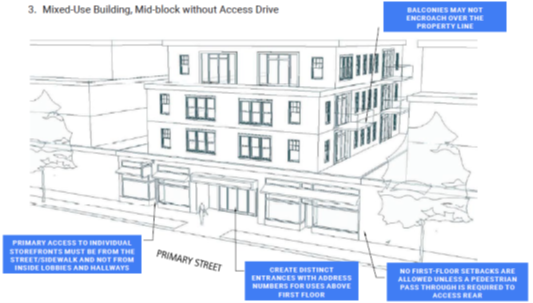
4.
Mixed-use building incorporating varied roof features.
Figure e-4: Mixed-Use Building Incorporating Varied Roof Features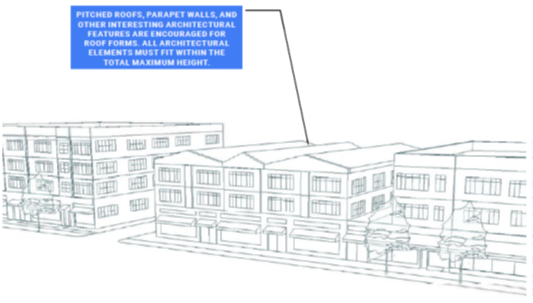
b.
Retail/office.
Figure e-5: Retail/Office-only Building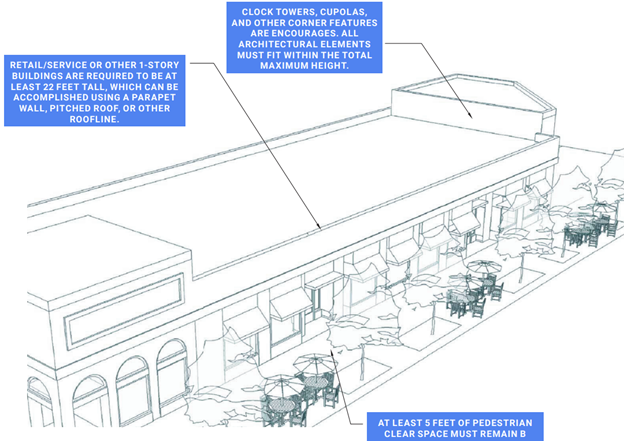
c.
Multi-family.
Figure e-6: Condominium/Apartment Building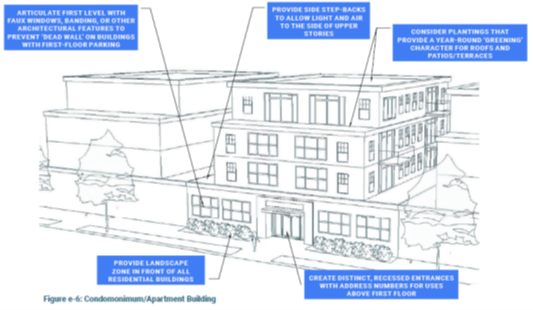
d.
Rowhome/townhome.
Figure e-7: Rowhome/Townhome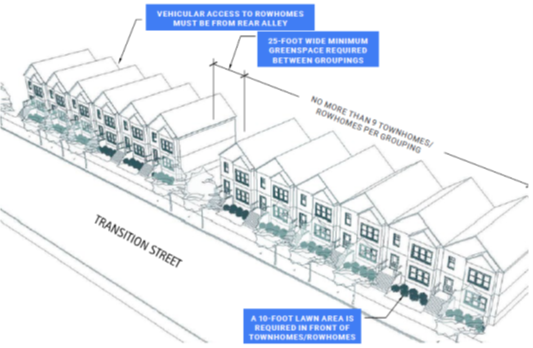
1.
The main entrance to each dwelling must face the street.
2.
Buildings on corner lots shall be designed with two front façades.
3.
Service, equipment, and trash areas must be located in and accessed from the alley where feasible.
4.
The design of garages, including materials, should be compatible with the design of the rowhomes/ townhomes.
(7)
Building design.
a.
General.
1.
To maintain an active pedestrian environment, buildings shall be oriented toward streets, sidewalks, and/or public plazas.
2.
Façades shall be proportioned to respect the human scale.
3.
Façade elements shall provide a change in plane, creating interest in light and shadow.
4.
Standardized, formulaic, non-regional architecture and architectural features used primarily for advertising purposes are not allowed.
5.
Developers should consider creative, adaptive reuse of high-quality existing buildings.
b.
Building massing strategies. The following building massing strategies are intended to reduce the visual mass of building façades, reduce the "canyon effect" on streets, while maintaining a "street wall" that is crucial to creating a pedestrian-oriented environment. Any building up to two floors with a façade over 120 feet long, and all buildings over two floors shall utilize façade articulation (see subsection (e)(7)b1. and all buildings over three stories shall require at least one other building massing strategy. This is in additional to specific requirements for street frontages specified in subsection (d), Street frontages.
1.
Façade articulation. Façade articulation is a strategy for creating rhythm and visual interest on a building façade or expressing a corner element, and can be used in conjunction with other building massing strategies. Articulated façades shall not be set back less than 30 inches from the primary building façade. façade articulation is required based on a 40-foot average, minimum. For example, a building that is 160 feet long would require four articulation points that could be more than six feet wide each on the façade.
Articulated façades are not required to be expressed on the ground level of a mixed-use building along a commercial tenant space, as the recessed tenant space entry serves this function. The articulation setback areas will be calculated according to the building line standards described in each frontage zone building setbacks subsection. See Figure e-8.
Figure e-8: Façade Articulation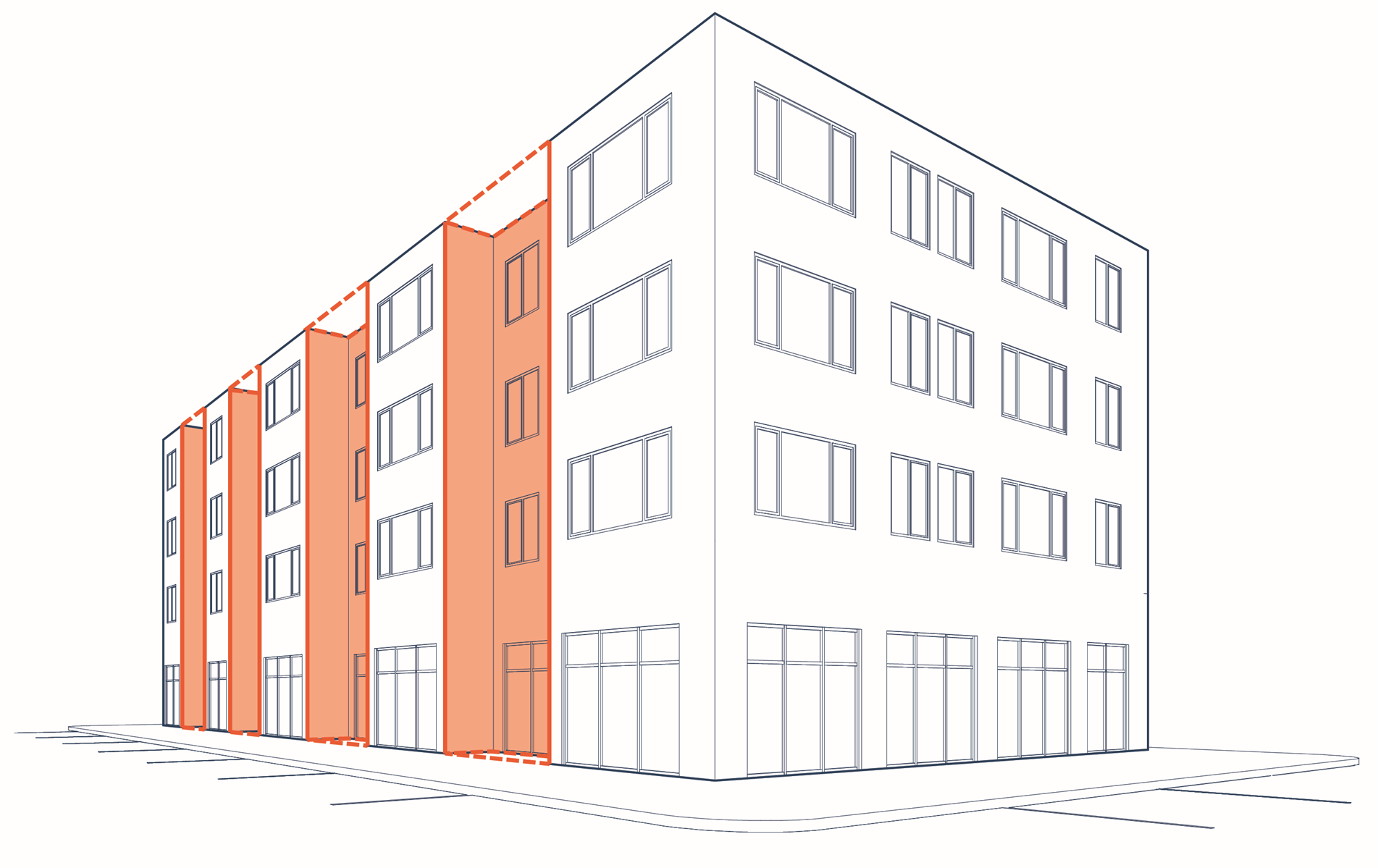
2.
Wedding cake step-back. A wedding cake step-back is similar to a terrace step-back, except the step-back occurs on the upper floor rather than the second. This strategy should be considered to reduce the visual impact of buildings on the street and adjacent properties. Typically wedding cake step-backs are utilized on front or side façades but could also be used on rear façades to minimize the visual impact of buildings on adjacent properties. All step-back areas are encouraged to be utilized as public or private terraces and shall be set back no less than ten feet and no greater than 15 feet from the ground level façade. 75 percent of a building's upper floor façade must be stepped back to be considered a wedding cake step-back. See Figure e-9.
Figure e-9: Wedding Cake Step-back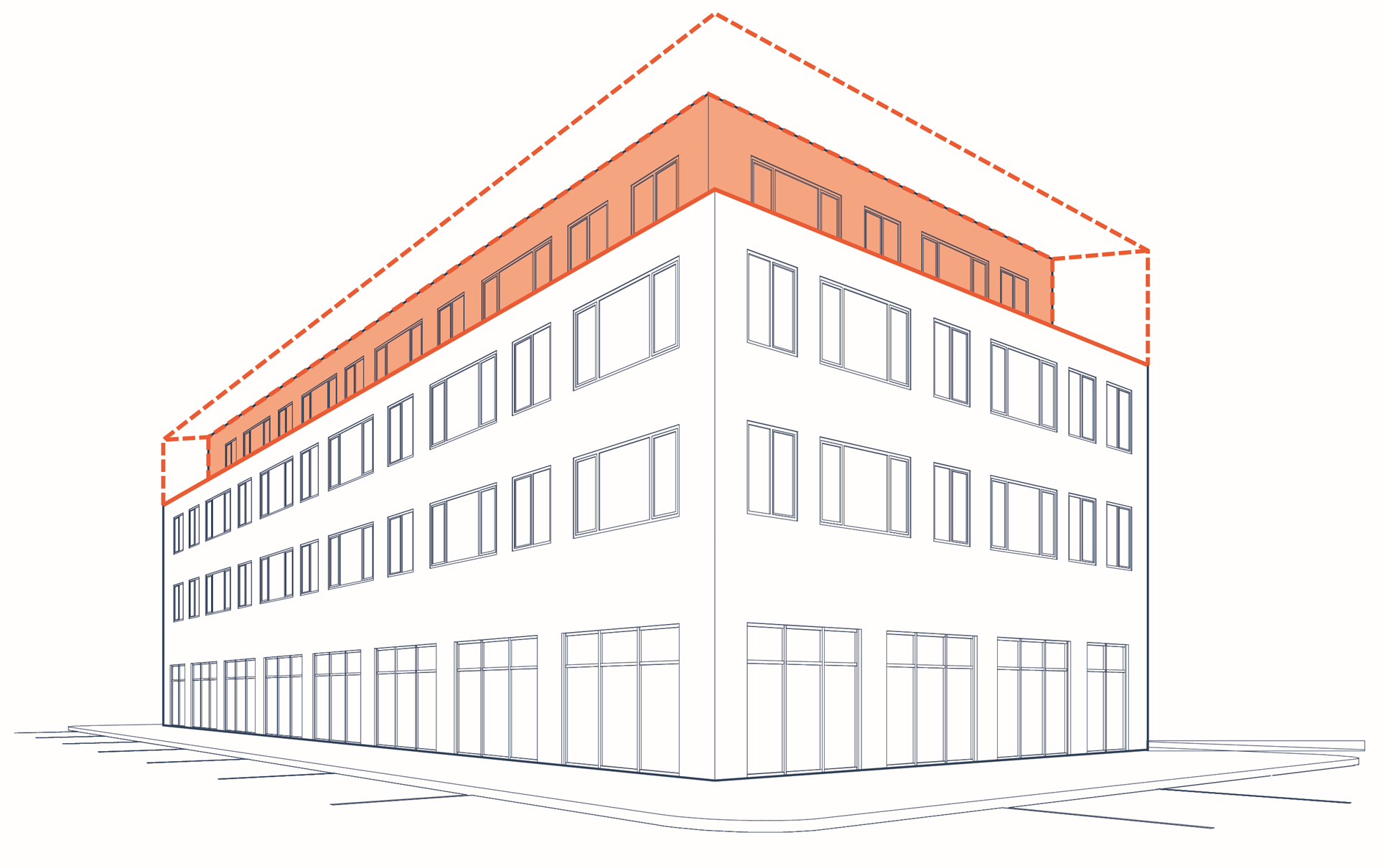
3.
Corner terrace. A Corner Terrace is a public or private terrace located at a building corner. They are typically located above the first floor and serve as an amenity space for residential or office or outdoor dining terraces. Corner terraces shall be a minimum of 400 square feet and no larger than 25 percent of the ground floor building footprint. See Figure e-10.
Figure e-10: Corner Terrace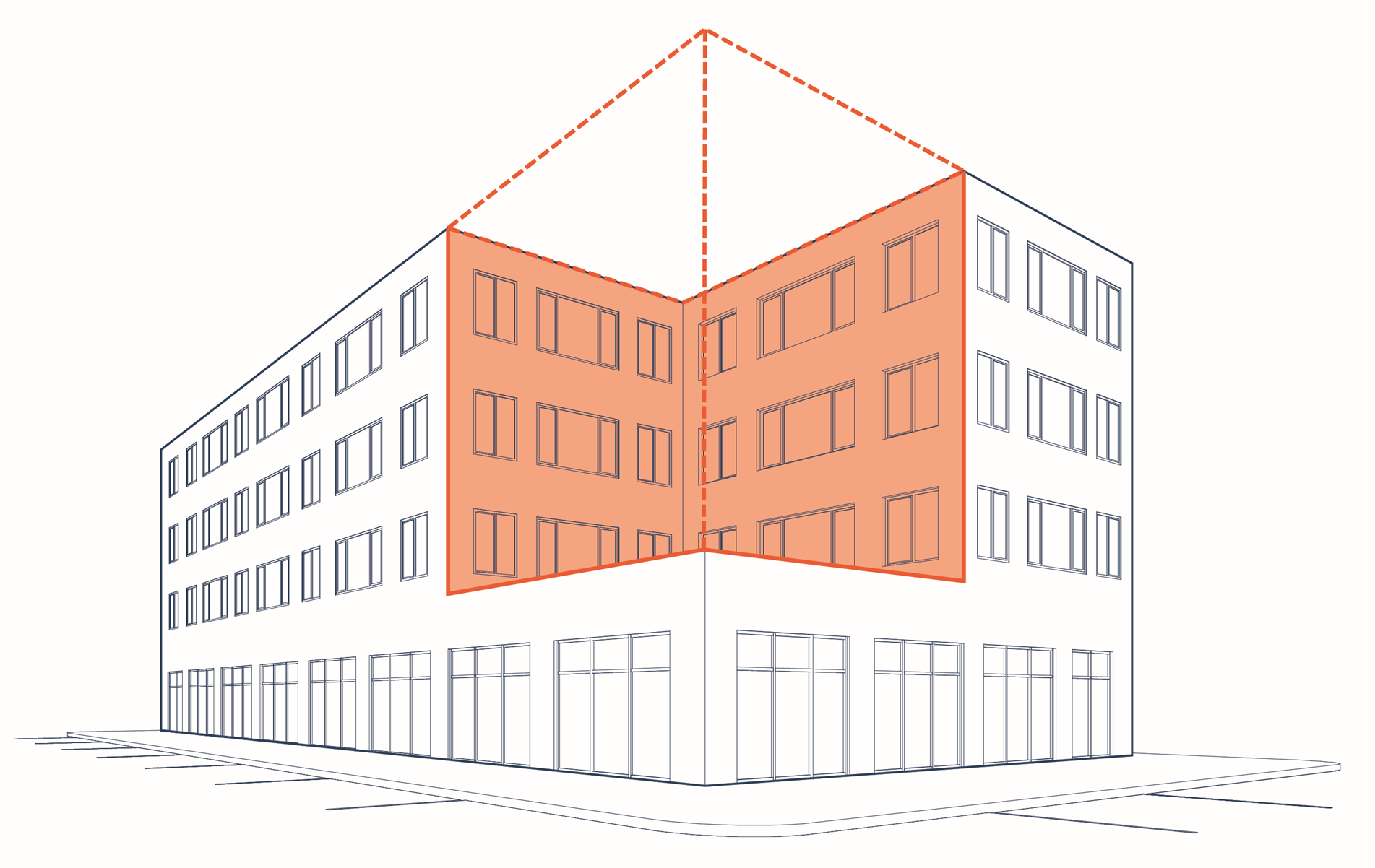
4.
Terrace step-back. A terrace step-back is defined as a setback of the building façade above the first floor. Typically terrace step-backs are utilized on front or side façades but could also be used on rear façades to minimize the visual impact of buildings on adjacent properties. All step-back areas are encouraged to be utilized as public or private terraces and shall be set back no less than ten feet and no greater than 15 feet from the ground level façade. 75 percent of a building's upper level façade must be stepped back to be considered a terrace step-back. See Figure e-11.
Figure e-11: Terrace Step-back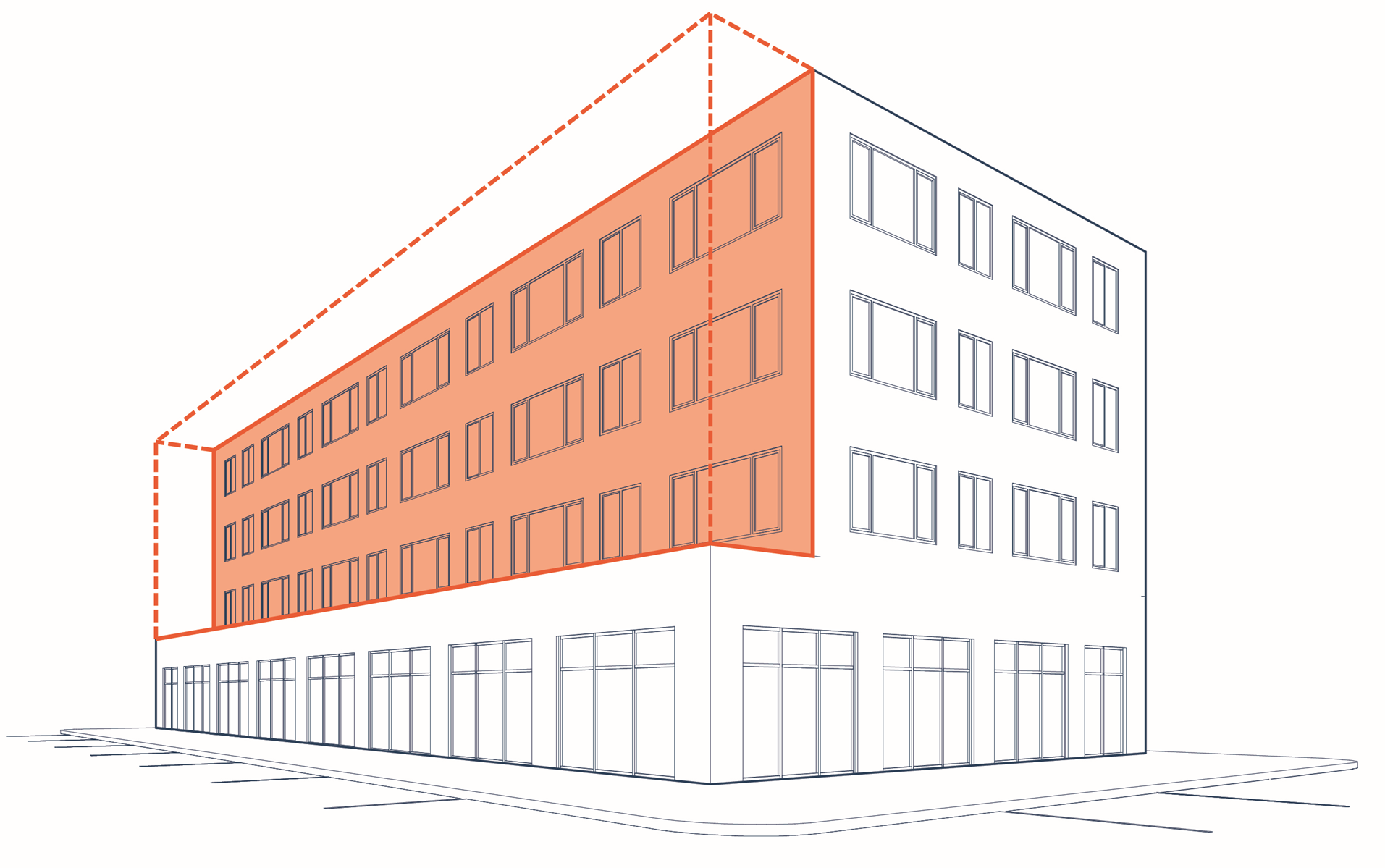
c.
Articulation.
1.
Plane/material changes.
i.
A building base, middle, and top shall be strongly articulated through materials, details, and changes in the plane of the wall, including step-backs and patios on upper floors.
ii.
Pitched roofs may project into space where upper story floors have been step-backed.
iii.
Mixed-use buildings must have a distinct ground-floor base with easily identifiable, traditional storefronts with clear glass and kneewalls.
iv.
Façades shall be articulated to express vertical rhythm related to structural columns and bays.
v.
Building design should feature a balance of vertical and horizontal elements.
vi.
Unarticulated, flat-front, all-glass, or all-metal buildings are prohibited.
vii.
To prevent a "dead wall" on buildings with first-floor parking, articulate the ground floor with faux windows, banding, or other architectural features.
2.
Visual interest.
i.
Building orientation and design elements shall encourage overall visual continuity between developments.
ii.
To avoid a look of monotony of materials or design, buildings should be articulated, such as with projections, recesses, material changes, parapets, cornices, and varying roof heights.
iii.
Commercial, multi-family, and mixed-use buildings over 150 feet long should be "broken up" with articulation and contribute to a "built over time" appearance. Changes in materials, colors, rooflines, variations of window patterns or modules, architectural styles, or architectural features such as railings, columns, or cornices should also be considered.
iv.
Because of the prominence and visibility of corner buildings, features such as a cupola, rotunda, atrium, clock tower, pilasters, roofline balustrades, and/or varying rooflines should be considered to add visual interest to downtown.
d.
Entries.
1.
Building entries should be clearly defined and articulated.
2.
Primary store entrances shall be located along the primary street frontage, with secondary entrances located behind the building or along a side street.
3.
Primary access to individual commercial storefronts, including restaurants, must be from the street/sidewalk and not from inside lobbies and hallways.
4.
On mixed-use commercial buildings, residential or office entrances/ lobbies should be distinguished from storefronts and located on side streets and away from intersections wherever possible.
5.
Recessed entries for retail and service uses are encouraged to provide cover from the elements and to allow easier opening of doors. Non-recessed doors should not encroach into the five-foot pedestrian clear zone when opened. Primary building entrances shall not be recessed more than ten feet, secondary entrances and storefronts should not be recessed more than five feet. Recessed entries will not count as a portion of the façade built to the building line if the façade above the entry respects the building line. See subsection (d), Street frontages, for more detail regarding setbacks and building line lines.
e.
Roofs.
1.
Roofs can be pitched or flat.
2.
Pitched roofs shall utilize a minimum pitch of 4:12 and overhanging eaves shall be incorporated into the design of the building.
3.
Flat roofs or pitches below the minimum ratio shall be concealed with a parapet that extends around all sides of the building and shall screen all rooftop mechanical from public view.
4.
Varied roof pitches, planes, and heights shall be used to break up the massing of roofs visible from the public ROW. Roofs over 120 feet in length shall incorporate roof variation into the design.
5.
The roof design should be incorporated into the overall design of the building, working harmoniously with selected massing strategies specified in subsection (e)(7)b., Building massing strategies.
f.
Fenestration.
1.
Location.
i.
Ground-level retail or office space shall include large, clear-glass windows that allow views into building interiors to reinforce an active shopping and business environment.
ii.
Blank walls exceeding 20 feet in length are not allowed facing Glenview or Waukegan Roads.
2.
Amount.
i.
At least 50 percent of ground-floor retail, service, and office façades facing street frontages or public plazas shall be fenestrated with clear, non-tinted windows.
ii.
At least 25 percent of every upper-floor façade shall be fenestrated.
iii.
At least 25 percent of ground-floor façades facing rear parking areas or alleys shall be fenestrated.
iv.
A kneewall of at least ten inches and not more than 18 inches is required on commercial storefronts.
3.
Materials.
i.
Fenestration must be either windows or doors that allow views into the shops, working areas, lobbies, or pedestrian entrances or window displays.
ii.
Dark-tinted, spandrel, frosted, or smoked glass shall be used sparingly and for decorative or accent purposes or on solid walls necessary to the function of the building only (such as storage areas, kitchens, and bathrooms). Reflective glass is prohibited.
iii.
Solid walls necessary to the function of a building shall incorporate features such as awnings, display windows, material and color variations, arches, piers, columns, high-quality graphics, spandrel glass, landscaping, and other elements to reduce perceived building scale and add visual interest.
g.
Service areas.
1.
Design and materials.
i.
Service areas, pipes, utility boxes, and utility doors should be placed out of view where feasible (see Figure e-12).
ii.
Accessory service areas behind buildings that are visible from streets and sidewalks shall be designed in a manner consistent with the building front or side.
iii.
Loading, trash, and utility areas shall be designed to accommodate snow removal by eliminating unnecessary obstacles and providing storage locations where feasible.
iv.
When parking is located behind buildings, rear building entrances and façades shall be designed in a manner consistent with the front and side façades.
v.
Access to rear parking lots should be clearly defined and visible from the street.
vi.
Screening materials should complement the building and adjacent buildings in materials and color and be effective in every season, such as fencing, shrubs, or evergreens. Screening must be at least seven feet in height.
vii.
For all development that abuts a residential property at the rear, an eight-foot-high solid screen fence is required along the property line. If alley condition is present, fence to be installed within alley ROW adjacent to residential property. Fence to be maintained by property owner.
viii.
Service areas can be used to access underground storm water detention for maintenance, as long as access to driveways or parking areas are maintained.
Figure e-12: Rear Façade Service Area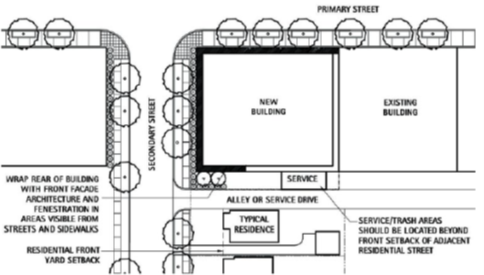
2.
Location and maintenance.
i.
Separate areas for loading, trash, and utilities for individual businesses are discouraged. Shared service areas between businesses should be considered for ease of maintenance and improved aesthetics.
ii.
Rear façades visible from streets and sidewalks should be treated with similar articulated architecture and fenestration as the front and sides of the building. Architecture and fenestration on the rear façade should extend at least 40 feet from the curb on a side street (see Figure e-13).
iii.
Loading, trash, and utility areas (including pipes, conduit, utility boxes, and utility doors) shall be located out of view wherever possible and in all cases screened from street and sidewalk views. Roof top mechanicals shall be located in the middle of the roof and shielded by a screening wall similar in design and materials to the building. These areas should be incorporated into site plans and building designs.
Figure e-13: Rear Façade Massing
Treat visible rear facades with similar articulated architecture and fenestration
as front and sides.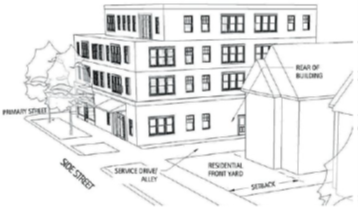
h.
Building projections.
1.
Retail/mixed-use/multi-family. Eaves and bay or box windows may encroach past the building line, with the following limits (see Figure e-14). For regulations on blade signs and awnings, consult the Village's Zoning Ordinance.
i.
Eaves: Three feet maximum.
ii.
Bay/Box windows: Five feet maximum (allowed only on upper stories).
Figure e-14: Projections—Retail, Mixed-Use & Condominiums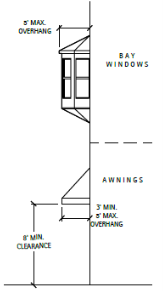
2.
Rowhomes/Townhomes. Eaves, bay windows, and porches or stoops may encroach past the Building Line, with the following limits (see Figure e-15):
i.
Eaves: Three feet maximum.
ii.
Bay/Box windows: Five feet maximum.
iii.
Porches: Five feet maximum.
Figure e-15: Projections—Residential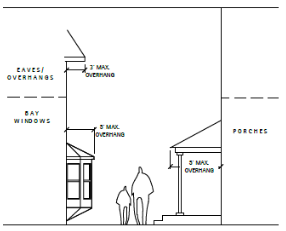
3.
Balconies.
i.
Balconies, decks, or terraces must not cross the building line.
ii.
Inset or recessed balconies, decks, or terraces are allowed on the front of buildings.
iii.
Balconies, decks, or terraces are allowed to encroach into areas where the building has been stepped back from the building or property line.
i.
Building colors.
1.
Building color shall be compatible with the area's character and enhance the building's visual appeal.
2.
Primary, bright, or excessively brilliant colors are discouraged unless used sparingly for subtle trim accents.
Table e-1: Preferred/Prohibited Materials
(8)
Building materials.
a.
Overall.
1.
Wood, brick, stone, and glass are the preferred primary building materials for all structures in the downtown. New building construction and rehabilitations should be primarily constructed of these high-quality materials (see Table e-1).
2.
Concrete block (smooth or decorative split-face), stucco (smooth or textured synthetic), plywood, sheet pressboard, unfinished pre-cast concrete, poured- in-place concrete, synthetic stone, smooth/textured synthetic stucco or plaster, and metal/decorative metal shall not be used as primary materials on façades or walls that are visible from streets, driveways, sidewalks, and/or parking areas. They shall be used only for decorative accent purposes and limited in their use on building façades and visible walls (see Table e-1).
3.
The primary building material used on front façade shall be continued as the primary material on the side and rear façades, except where the side of a building directly abuts the side of an existing building.
4.
The number of materials on an exterior building face should be limited (no more than five) to prevent clutter and visual overload.
b.
Fencing.
1.
Brick, stone, or decorative metal shall be used for fencing. Decorative or non-screening fence height shall be 30 to 42 inches. Railings along terraces can be solid walls or open fencing but may not be clear glass or plastic.
2.
Chain link fencing is not allowed.
3.
Fences shall be considered an extension of building architecture and shall make an attractive transition between the building mass, the natural forms of a site, and the "public realm" or streetscape.
c.
Awnings. Refer to the Village's Awning Appearance Code and Design Guidelines. In addition, the following guidelines will apply:
1.
Building awning design and colors should be consistent and complementary in color, style, and size with the overall building façade and adjacent buildings.
2.
Awnings shall be constructed of high- quality fabric or metal. Plastic or vinyl awnings are not allowed. Internally lighted awnings are not allowed.
3.
The bottom of awnings shall be placed a minimum of eight feet above the sidewalk.
(9)
Lighting. Refer to the Municipal Code's performance standards on lighting. In addition, the following requirements will apply:
a.
Site lighting shall incorporate principles to limit "light pollution" and preserve the nighttime environment, such as incorporating down-lighting and shields.
b.
Lighting shall provide a sense of safety without having a negative effect on neighboring properties and shall be located, aimed, or shielded to minimize glare, sky glow, and stray light trespassing across property lines, especially along alleys.
c.
Exterior lighting for signage shall be directed downward.
(10)
Outdoor cafés.
a.
Outdoor cafés/seating areas are encouraged to make downtown more active and enhance its overall pedestrian character, especially in blocks identified as key commercial/retail/restaurant locations.
b.
Outdoor cafés shall maintain at least five feet of clear space for movement of pedestrians along the sidewalk.
c.
Tables, chairs, and other equipment should be kept out of the pedestrian zone. The pedestrian zone also should be clear of street trees, tree grates, and other landscaping.
d.
Second-story terraces for outdoor dining are encouraged where sidewalk space is limited. Second-story terraces shall be integrated into the design of restaurants and the overall building.
e.
A temporary or seasonal barrier or edge is encouraged to define outdoor café spaces and ensure the pedestrian clear zone. The barrier should be a simple decorative railing, fence, planters, or similar element. The design of the barrier should reflect the style of the building and coordinate with the downtown streetscape, and shall be reviewed and approved by the village's designated hearing body.
(11)
Parking. Refer to subsection (c), Regulating framework, and the Municipal Code and Parking Lot Landscaping and Design Guidelines for additional information on parking standards. In addition, the following requirements will apply:
a.
Design.
1.
Off-street parking spaces may be open or enclosed in a building.
2.
Parking areas shall be screened with fencing and landscaping at street and sidewalk edges and adjacent to residential buildings. Fencing, walls, and landscaping shall be a maximum of 30 to 42 inches in height and shall preserve sight lines at entrances/exits to reduce conflicts between pedestrians and motorists.
3.
All exposed/visible walls on freestanding parking structures, as well as on parking structures in buildings, should be screened and articulated with architectural treatment.
4.
Designated parking spaces, except those within townhomes/rowhomes, shall be marked with permanent marking materials and maintained in a clearly visible condition.
5.
Parking area lighting shall be designed to Village standards and minimize impact on surrounding properties.
6.
Parking areas shall be designed to accommodate snow removal, such as by eliminating unnecessary obstacles and providing for temporary snow storage where feasible.
7.
Off-street parking spaces shall have a vertical clearance of at least seven feet if provided within a building.
b.
Location.
1.
Parking areas in front of buildings are prohibited unless otherwise specified in the Code.
2.
Mid-block parking lots should be limited to avoid breaking up the shopping streetwall.
3.
Business owners, employees, and residents should park in the rear of parking lots or on the upper floors of parking structures rather than occupy spaces on streets or prime parking locations for shoppers, visitors, and restaurant patrons.
4.
Bicycle parking shall be considered and placed in locations that are safe and convenient to high-traffic destinations in such a manner as to not impede pedestrian circulation.
c.
Sharing.
1.
Adjacent commercial parking lots must be connected, where feasible, if access to the two lots is not available via an alley, to facilitate trips between commercial uses.
2.
If a driveway is needed to access rear parking lots, it must be shared with future development on adjacent properties via easements if the future development cannot be accessed from the alley or side street.
Figure e-16: Parking Layout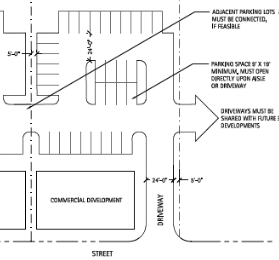
(12)
Streetscape/landscape. An attractive and effective streetscape will provide visual continuity from block to block and continue to define downtown as a special place. Developers should incorporate the Village's streetscape design into development, including standards for street trees, street furniture, pavers, and other streetscape elements. This will help visually unify the district.
a.
Design.
1.
The current streetscape design installed along Glenview Road should be enhanced and continued throughout downtown, with modifications to match different road and sidewalk widths.
2.
Landscape and hardscape for large corner bump-outs should be treated on an individual basis because of particular needs and situations in each area. Individual elements should follow the overall downtown streetscape design theme.
3.
The developer is responsible for installing Village-approved streetscape elements within all new developments.
4.
Developments are encouraged, where feasible, to include "greening" elements such as planter boxes, gardens on terraces or patios, landscaping, and other environmentally attractive and beneficial features.
b.
Plazas and open spaces.
1.
Plazas and open spaces shall be considered within new developments where feasible.
2.
Plazas and pocket parks shall be adjacent to a public ROW and be open to the public at all times. Edges of a plaza or pocket park internal to the site (not adjacent to the ROW) should be defined with active use on the ground floor. If a plaza or pocket park is adjacent to surface parking, landscape screening and/or fencing should be used to buffer views into parking.
3.
Plazas and pocket parks should include benches, trash receptacles, and bicycle racks consistent with Glenview Road streetscape standards.
4.
Plazas and pocket parks shall be no smaller than 900 square feet and will not be calculated as part of a building's building line requirements (see subsection (d), Street frontages), and are required for all developments over one and one-half acres.
5.
Decorative paving such as brick, clay pavers, stone, decorative pre-cast concrete pavers, or stamped concrete shall be considered when designing the hardscape for new plazas, open spaces, and bump-outs.
6.
Existing and future open spaces should incorporate special features such as fountains, artwork, plantings, and other elements.
7.
Where pedestrian paths or pass-throughs are used to access parking, they shall incorporate decorative fencing, arches, lighting, paving, and signage. When pass-throughs are located between buildings, outdoor dining areas (where applicable), active storefronts (where applicable), overhead low-voltage cable lighting is encouraged. Pass-throughs between buildings shall be a minimum of 15 feet wide.
8.
Plaza and pocket parks can be used to access underground storm water detention for maintenance.
c.
Street furniture.
1.
Decorative metal benches, trash receptacles, and bike racks shall be provided at high-activity pedestrian areas including pocket parks and plazas.
2.
Decorative planters shall be placed in pocket parks, plazas, and along pedestrian paths and sidewalks where they will not impede safe flow of pedestrians.
d.
Food trucks.
1.
Food trucks are a permitted use in downtown with a valid permit or license approved by the Village. Additionally, food trucks are allowed to operate on Glenview Road within the ROW in designated areas, with approval by the Village or in designated areas within parks, if the Village chooses to create such areas. Food trucks may operate in surface parking lots that are visible from a public ROW at the discretion of the owner. It is encouraged that food trucks be located near high traffic areas and during downtown festivals or events.
2.
Food trucks are not allowed to park overnight without prior approval by the Village and only during multi-day events in downtown.
3.
Food trucks shall maintain a five-foot pedestrian clear zone on the sidewalk and not interrupt or encroach on traffic lanes or transit.
e.
Art displays.
1.
Art displays installed on private property is encouraged to be added with new development. Art displays can be permanent or temporary displays and includes, but is not limited to sculpture, murals, or interactive elements as is appropriate for outdoor application.
2.
Art displays shall not block the five-foot pedestrian clear zone on sidewalks or automobile traffic and is subject to approval by the Village.
3.
The art display will be installed and maintained at the owner's expense.
4.
The property owner is responsible for adequate property insurance for the artwork.
5.
Art displays cannot include the name of commercial businesses. Trademarked logos, or explicit content.
f.
Parklets.
1.
A parklet is a small seating area or green space located alongside a sidewalk, typically located in on-street parking spaces. Parklets are encouraged to be located adjacent to high traffic areas and near shops and restaurants.
2.
A parklet cannot take up more than two parking spaces or 20 linear feet.
3.
Parklets are allowed on public property in downtown with a valid permit approved by the Village, insurance, and in compliance with all other applicable requirements.
4.
If a parklet is located on private property, the owner must show that any parking spaces removed for the parklet have been replaced on the adjacent property with the equivalent spaces that are available for public use at all times, free, and accessible. Temporary or seasonal parklets are exempt from this requirement with a valid permit approved by the Village.
g.
Pop-up retail.
1.
Pop-up or temporary retail is allowed in parklets, vacant storefronts, or in designated areas within parks (during festivals and events only), if the Village chooses to create such areas, subject to approval by the Village.
2.
Pop-up retailers are allowed to utilize temporary shelters and shading devices as long as they do not block the five-foot pedestrian clear zone, encroach on drive lanes, or create visual barriers to drivers.
3.
Pop-up retail cannot keep or store shade structures, tables, or other equipment overnight without approval by the village.
4.
Retailer goods and services shall comply with the requirements of chapters 6, 22, 38, and 46 of the Municipal Code.
(13)
Pattern book. The pattern book is meant to highlight a range of architectural styles, details, and intentions that reflect the preferred look and feel of new development in Downtown Glenview. These images are reflective of multiple community visual preference exercises and other means of garnering community input over an 18-month process. The pattern book is not meant to be a definitive or exhaustive review of design styles or details, rather it is intended as a guide for future development direction.
The pattern book categories include:
• Architectural style
• Façades
• Recesses/projections
• Overhangs/awnings
• Entryways
• Tower elements
• Roofs
• Materials
• Windows/fenestration
• Expression of base, middle, and top
• Architectural details
Architectural style.
Intent: While no specific architectural style(s) have been chosen for downtown, building designs should complement the historic nature of the area, support a look of being "built over time", and reflect an expression of high-quality, timeless materials and design details.
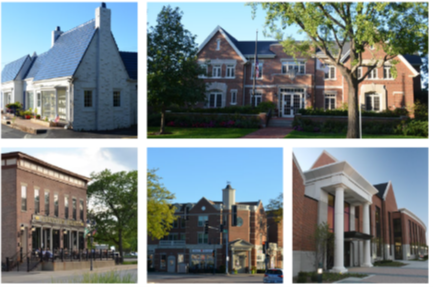
Façades.
Intent: Façades play a very important role in creating the "character" of downtown. Façades evoke immediate impressions about the quality of the development. Articulation of façades can provide visual interest to the building and highlight important areas such as entries, display windows, and outdoor dining while positively impacting the visual scale of buildings.
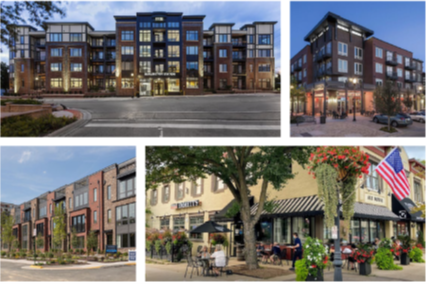
Recesses/projections.
Intent: Recesses or projections in the building facade provide an opportunity to reduce the scale of long building façades, articulate important architectural features, and provide visual interest to the buildings. Highlighting areas such as entries, important displays, outdoor gathering/dining areas, or structural repetition with recesses or projections help to organize and unify buildings within downtown.
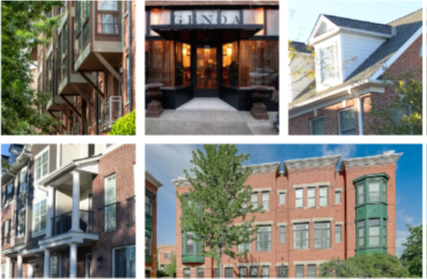
Overhangs/awnings.
Intent: Overhangs and awnings can be used to emphasize building entries, provide protection from rain, create signage opportunities for tenants, and reduce the visual mass of buildings at the sidewalk. Awnings can be structural or fabric.

Entryways.
Intent: Entryways should be recessed to provide visual interest to the ground plane, rain protection, and to reduce conflicts of doors opening directly onto the sidewalk. Entries can be combined with awnings/canopies, signage, display windows and/or plantings to creating a welcoming entrance into a building or shopfront. If a building includes multiple entries, visual consistency between the entries is important to create a unified streetscape.
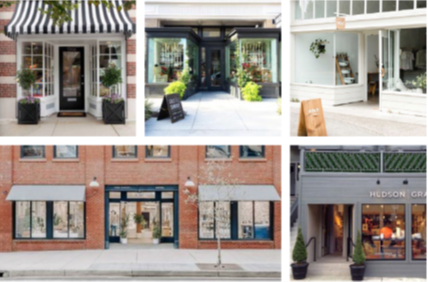
Tower elements.
Intent: Tower elements can be used to add visual interest to a building and mark important intersections or gateways in downtown. As shown in the images below, tower elements need not project higher than the primary roof height to be effective.
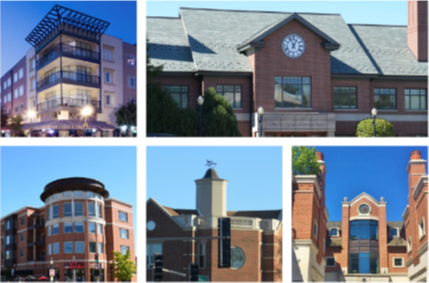
Roofs.
Intent: Roofs create visual interest in buildings, and screen roof top mechanical equipment. Used properly, roofs can create a sense of rhythm and hierarchy in buildings with long façades. Variations in roof forms can be used to mark building entries, or frame important gateways in downtown.
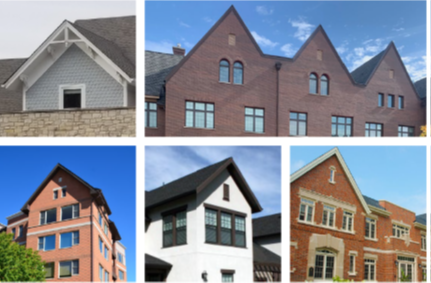
Materials.
Intent: Building materials should be muted, natural, and evoke high-quality, timeless architecture. Brick, stone, and/or other masonry products should be considered for primary building materials, while wood, metal or stucco should be used sparingly as accent materials.
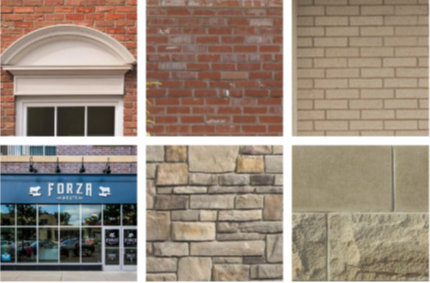
Windows/fenestrations.
Intent: Windows should be organized on the building facade to best serve the intended use of the buildings and to also provide structure, rhythm, and repetition to the building facade. In ground floor retail applications, windows (along with entrances) are the most visible aspect of the building and should be designed to provide a harmonious "base" to a building.
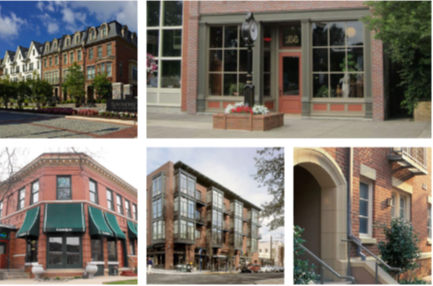
Expression of base, middle, and top.
Intent: All multi-story buildings should express the base, middle, and top through step-backs, architectural details, and/or material changes to form a unified building facade that include proportionality that is consistent throughout downtown.
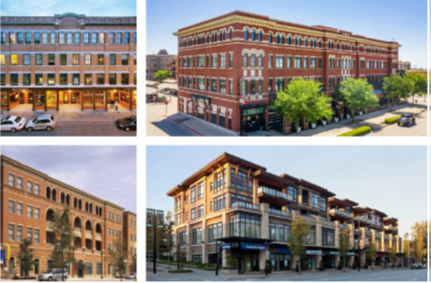
Architectural details.
Intent: Architectural details such as brick or masonry details, inset windows, metal work, etc. provide visual interest to buildings and support the "built over time" look and feel that is appropriate for downtown.
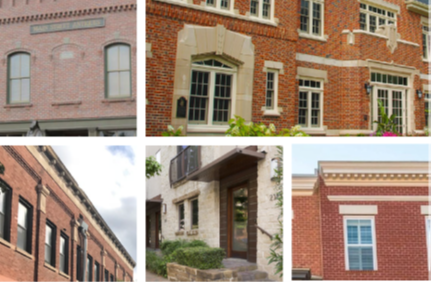
(f)
Administration.
(1)
Project review. All redevelopment projects within the district are subject to the regulatory review process as described below.
(2)
Site plan review. All redevelopment projects within the district shall be subject to site plan review approval as set forth in chapter 54, article IV, of the Municipal Code.
(3)
Appearance review. All redevelopment projects within the district shall be subject to the Appearance Code as set forth in chapter 54, article III, and the design standards in section 98-135(e) of this chapter of the Municipal Code.
(4)
Conditional uses. Land uses specified as conditional uses by section 98-84 shall be heard by the designated hearing body and the board of trustees pursuant to chapter 98, section 98-43(c)(2), subject to the standards set forth in section 98-50 of this chapter.
(5)
Variations. Variations from the regulations of this Downtown Development Code, except for section 98-135(e), Design standards, shall be considered by the designated hearing body as set forth in chapter 98, section 98-47, of the Municipal Code. Exceptions from the regulations of section 98-135(e) shall be considered by the designated Hearing Body as set forth in chapter 54, article III, of the Municipal Code.
a.
Authorized variations. Variations from the regulations of this Downtown Development Code shall be recommended by the board only in accordance with the standards set forth in chapter 98, section 98-47(c), and may be granted only to vary any of the regulations relating to:
1.
Regulating framework, section 98-135(c).
i.
Use.
ii.
Height.
iii.
Building location.
iv.
Parking.
2.
Street frontages, section 98-135(d).
i.
Street and sidewalk standards.
ii.
Building setbacks.
iii.
Building step-backs.
iv.
Parking placement.
v.
Access.
(6)
Non-conformities. Except as otherwise provided by the provisions of this chapter, the provisions of chapter 98, article V, section 98-251 et seq., Non-conformities, shall apply to existing land uses and structures.
(7)
Planned developments. Separately from the requirements of this chapter, redevelopment projects can be proposed in accordance with the provisions of chapter 98, article X, Planned Developments. Redevelopments pursued in accordance with a planned development shall generally correspond to the requirements of the underlying zoning district.
(g)
Definitions. The following words, terms and phrases, when used in this Downtown Development Code, shall have the meanings ascribed to them in chapter 98, section 98-4, or this section, except where the context clearly indicates a different meaning.
Access drive. Dedicated public right-of-way, other than a street, that affords access from a street from the front of a lot.
Alley. Dedicated public right-of-way, other than a street, that affords a secondary means of access to abutting property, generally at the rear of the lots.
Apartment. Multi-family residential development with for-rent units.
Awning. A metal tubular structure over a storefront or entrance that provides a framework for a canvas covering and that provides protection from sun and inclement weather for patrons walking below.
Balcony. Platform that is cantilevered from a building wall and is enclosed by a parapet or railing.
Bay/box windows. Generally, a U-shaped enclosure that extends the building's interior space beyond the plane of the exterior wall and/or the building line.
Building line. A line/plane indicated on the regulating plan defining the street frontage which extends vertically and at which the building façade shall be placed. The required building line for each site is shown in the street frontage section.
Bump-out. A curb improvement common at intersections or adjacent to on-street parking stalls used in lieu of pavement striping to provide additional vehicle protection, pedestrian refuge area, or landscape beds.
Commercial. Retail, service, restaurant, and office uses.
Condominium. Multi-family residential development with for-sale units.
Development Code. The Downtown Development Code.
Development project. Any use in the Downtown Development District that results in the construction of a new building or structure, major modifications to the interior dimensions of an existing building or structure (including building additions), alteration in area to a paved parking lot or the addition of or change to a curb cut.
District. The Downtown Development District.
Downtown Development District. Includes:
• Glenview Road from Washington Street to one block east of Waukegan Road;
• Waukegan Road from Lake Avenue to Henley Street;
• Railroad Avenue from Dewes Street to just north of Grove Street;
• Dewes Street from Washington Street to Waukegan Road;
• Portions of Pine, Grove, Church, Prairie, Harlem, McLean, and Maplewood that are side streets for the major roads listed above;
• All as designated on the zoning map, unless otherwise expressly exempted or provided in this Downtown Development Code.
Downtown Revitalization Plan. The plan approved by the village board of trustees in November 2006, which serves as the guiding framework for this Downtown Development Code.
Eave. Edge of a roof that projects beyond the vertical building facade.
Floor. The space within a building and above grade that is between the midpoint of the floorplate and the midpoint of the floorplate for the floor above. Of, if there is no floor above, the ceiling or roof above. See also Ground floor.
Floor area. The area, measured at floor level, contained between the exterior wall surfaces of a building or other structure or, in the case of rooms, between the exterior wall surface of the building and the center of the enclosing partitions, or between the centerlines of partitions where no exterior wall is affected. For the purpose of determining off-street parking and loading requirements, the term "floor area" shall be defined to be the sum of the gross horizontal areas of the several floors of a building, or portion thereof, devoted to a use requiring off-street parking or loading as provided in this article. Such area shall include accessory storage areas located within selling or working space devoted to retailing activities, the production or processing of goods, or business or professional offices. However, the term "floor area" shall not include floor space devoted primarily to the housing of mechanical or electrical equipment, or storage purposes, except as otherwise noted in the Municipal Code, nor floor space and ramps, aisles and maneuvering space devoted to off- street parking or loading facilities, nor basement floor space, other than the area devoted to merchandising activities, the production or processing of goods, business or professional offices, or dwelling uses.
Front yard. A yard extending along the full length of a front lot line and back to a line drawn parallel to the front lot line at a distance there from equal to the depth of the required front yard. When a lot fronts onto two non-intersecting streets (through lot), the front yard shall be determined to be on the street to which all of the houses along that block are oriented, and the opposite yard shall be treated as a rear yard.
Ground floor. The first level of a building at or above grade. The floor height of the ground floor is measured from the grade to the midpoint of the floorplate of the floor above (or, if there is no floor above, the ceiling or roof above.)
Institutional. A building that provides municipal services and is owned by the village. (Examples include the Village Hall, fire stations, and police departments.)
Interior side yard. A yard extending along a side lot line that is not adjacent to a street and back to a line drawn parallel to the side lot line at a distance there from equal to the width of the required minimum side yard, but excluding any area encompassed within a front yard or rear yard. Dimensions of side yards specified in the district regulations of this chapter refer to the required width of each side yard, rather than to the total width of both side yards, unless otherwise specified.
Mixed-use. A building that includes two or more complementary uses, such as residential, retail, office, and service.
Multi-family building. Residential development with dwelling units that share common walls with units that are laterally and vertically adjacent.
Office use. Establishments engaged in the provision of goods and services in an office setting, usually by professionals. This includes business, government, professional, medical, or financial services and includes such occupations as accountants, economic consultants, doctors, dentists, architects, software developers, researchers, and designers.
Parapet. A low protective wall or barrier at the edge of a balcony or roof.
Porch. A covered but otherwise open platform that provides a transition between the interior of a building and the public space of the street.
Primary street. The street that abuts the property and includes the building's primary entrance and front facade. See also side street.
Rear yard. A yard extending along the full length of the rear lot line, except as qualified in the definition in this section of the term yard, side, and back to a line drawn parallel to the rear lot line at a distance there from equal to the depth of the required rear yard.
Regulating framework. Establishes the desired physical form for the downtown development district and sets development parameters such as permitted land uses, street types, building height, siting, and setbacks.
Residential. A building or part of a building containing dwelling units.
Retail use. Businesses that provide goods/ merchandise to the general public for personal or household consumption and render services incidental to the sale of those goods. Also, restaurants.
Service use. Businesses that provide services (as opposed to goods) to the general public. (Examples include hotels, finance, real estate, insurance, travel agencies, health and educational services, and galleries.)
Setback. The distance between a reference line, which shall be a public or private right-of-way or easement, whichever shall be applicable, and a building, or portion thereof, on the lot in question. In the case of a lot adjoining a public or private street right-of-way, the setback shall be the difference between such right-of-way line and the building closest to the right-of-way on the lot. In the case of an unrecorded easement, the director of community development shall determine the setback in a manner which will provide a reasonably consistent setback.
Side street. For buildings on corner lots, the street that abuts the property but does not include the building's primary entrance (except those with corner entrances) and front facade. See also primary street.
Side yard, corner lot of side street. A yard extending along a side lot line that is adjacent to a street and back to a line drawn parallel to the side lot line at a distance there from equal to the width of the required minimum side yard, but excluding any area encompassed within a front yard or rear yard. Dimensions of side yards specified in the district regulations of this chapter refer to the required width of each side yard, rather than to the total width of both side yards, unless otherwise specified.
Step-back. The minimum distance a building's upper-floor facade must be placed from the facade of the floor or floors below.
Stoop. A staircase on the facade of a building that leads either to a small, unwalled entrance platform or directly to the main door.
Townhouse/rowhouse. Single-family attached homes that share walls with units laterally adjacent to them.
(Ord. No. 6466, § 4, 1-18-2022; Ord. No. 6669, § 2, 5-6-2025)
Sec. 98-136. - MURC mixed use retail center district regulations.
(a)
Permitted uses. The following uses are permitted in the MURC mixed use retail center district, provided that none of the individual uses shall contain seating exceeding 2,500 seats:
(1)
Reserved.
(2)
Reserved.
(3)
Reserved.
(4)
Reserved.
(5)
Any use not specifically listed as a permitted, conditional or prohibited use may be authorized by the building and zoning director upon the affirmative finding that such proposed use is compatible with the intent and purpose of the MURC district as set forth in section 98-81(18).
(6)
Residential dwelling units, above the ground floor only, up to a maximum density of 36 dwelling units per acre (1,210 square feet of lot area per dwelling unit) and subject to the underlying bulk requirements of the MURC district; provided, however, the maximum residential dwelling unit density shall not exceed 24 dwelling units per acre (1,815 square feet of lot area per dwelling unit) for all property in the MURC district located less than 200 feet from the perimeter of the MURC district.
(b)
Bulk regulations. Bulk regulations in the MURC district are as follows:
(1)
Maximum building height. The maximum height for buildings and other structures is 45 feet or three stories, whichever is less.
(2)
Front yard setback. A front yard depth of five feet shall be required; provided, however, that an additional five feet of front yard depth may be required by the hearing body and Village Board through the site plan review process as set forth in chapter 18, article IX.
(3)
Minimum rear yard setback. No minimum rear yard is required.
(4)
Minimum side yard setback. No minimum side yard is required; provided, however, that a side yard may be required by the hearing body and Village Board through the site plan review process as set forth in chapter 18, article IX.
(5)
Landscaped setback zone. A ten-foot landscaped setback zone shall be provided on the edge of a surface parking lot that abuts a street.
(6)
Service and loading areas. Service and loading activities must occur at the rear or side yard of retail buildings, and must be screened from public view on a yearround basis. Service areas should be located behind or to the side of commercial buildings, away from the front or addressing street.
(c)
Standards. All of the property located in the MURC district is subject to the general standards and regulations of this chapter. To conserve space, these standards and regulations have not been reprinted in the regulations for each district. Special attention should be given to the standards and regulations in article V pertaining to nonconformities, article VI pertaining to off-street parking and loading, article VII pertaining to signs and article VIII pertaining to performance standards. Property located in the MURC district is also subject to the following additional standards:
(1)
At least half of the ground floor facade of commercial buildings facing the front or addressing street at the town center should be devoted to entrances and store front windows.
(2)
Notwithstanding the regulations governing the number of required off-street parking spaces as set forth in article VI, the parking requirements for uses encompassed within the permitted and conditional use classes delineated in the MURC district may be increased by the hearing body and Village Board through the site plan review process established in chapter 18, article IX.
(Code 1959, § 24.5.6; Ord. No. 4512, 4-15-2003; Ord. No. 4588, § 4, 11-4-2003; Ord. No. 4891, § 4, 7-18-2006; Ord. No. 5351, § 36, 6-15-2010; Ord. No. 5651, § 3, 3-19-2013; Ord. No. 6398, § 9, 2-16-2021)
Cross reference— Businesses, ch. 22.
Sec. 98-137. - S/L/E general sports/leisure/entertainment district regulations.
(a)
Permitted uses. The following uses are permitted in the S/L/E general sports/leisure/entertainment district, provided that none of the individual uses shall contain seating exceeding 7,000 seats:
(1)
Reserved.
(2)
Reserved.
(3)
Reserved.
(4)
When a proposed use is not specifically listed as permitted, conditional or prohibited, the building and zoning director shall determine whether or not the new use is compatible with the intent and purpose of the S/L/E district as described in section 98-81(19).
(5)
Other retail uses will be allowed when accessory to another use.
(b)
Bulk regulations. Bulk regulations in the S/L/E district are as follows:
(1)
Maximum building height. A maximum height of 55 feet is allowed for buildings and other structures.
(2)
Minimum front yard setback. There shall be a minimum front yard depth and setback of 50 feet. Nothing in this chapter or any amendment thereof shall operate to prevent the construction and maintenance of gatehouses, gates, gate posts and fences reasonably required for security purposes.
(3)
Minimum side yard setback. There shall be a minimum side yard width of 25 feet, provided that, if a side yard adjoins a residential district or a public street, there shall be a minimum side yard width and setback of 50 feet.
(4)
Minimum rear yard setback. There shall be a minimum rear yard depth of 25 feet.
(5)
Landscaped setback zone. A ten-foot landscaped setback zone on the edge of a surface parking lot that abuts a street shall be provided.
(6)
Service and loading areas. Service and loading activities must occur at the rear or side yard of retail buildings, and must be screened from public view on a yearround basis. Service areas should be located behind or to the side of commercial buildings, away from the front or addressing street.
(c)
Standards. All of the property located in the S/L/E district is subject to the general standards and regulations of this chapter. To conserve space, these standards and regulations have not been reprinted in the regulations for each district. Special attention should be given to the standards and regulations in article V pertaining to nonconformities, article VI pertaining to off-street parking and loading, article VII pertaining to signs and article VIII pertaining to performance standards. Property located in the S/L/E district is also subject to the following additional standards:
(1)
Notwithstanding the requirements governing the number of off-street parking spaces required by the provisions of article VI, the parking requirements for uses encompassed within the permitted and conditional use classes delineated in the S/L/E district may be established through the site plan review process established in chapter 18, article IX.
(2)
When a parking requirement is established through the site plan review process, the number of spaces otherwise required by article VI may be waived in part or entirely, or increased by the hearing body and Village Board. In establishing such parking requirements, the hearing body and Village Board shall consider the location of the proposed use, its anticipated hours of operation and the availability of alternate parking.
(Code 1959, § 24.5.7; Ord. No. 4512, 4-15-2003; Ord. No. 4588, § 5, 11-4-2003; Ord. No. 4891, § 5, 7-18-2006; Ord. No. 5351, § 37, 6-15-2010; Ord. No. 5651, § 3, 3-19-2013; Ord. No. 6398, § 9, 2-16-2021)
Cross reference— Businesses, ch. 22.
Sec. 98-161. - I-1 limited commercial district regulations.
(a)
Reserved.
(b)
Bulk regulations. Bulk regulations in the I-1 district are as follows:
(1)
Lots having an area of ten acres or more not sharing a common parcel boundary with a parcel improved with a residence.
a.
Minimum front yard setback. There shall be a minimum front yard depth and setback of 100 feet. Nothing in this chapter or any amendment thereof shall operate to prevent the construction and maintenance of gatehouses, gates, gate posts or fences reasonably required for security purposes.
b.
Minimum side yard setback. There shall be a minimum side yard width and setback of 50 feet.
c.
Minimum rear yard setback. There shall be a minimum rear yard depth of 50 feet.
d.
Maximum lot coverage. There shall be a maximum lot coverage of 33⅓ percent.
e.
Maximum building height. There shall be a maximum building height of 35 feet; provided, however, that if the building is located more than 100 feet from the nearest lot line of a public lands or hospital and medical district, the maximum height may exceed 35 feet by one foot for each ten feet by which the distance between the building and the nearest lot line of a public lands or hospital and medical district exceeds 50 feet; provided, however, that in no case shall the maximum height of any building exceed 70 feet.
(2)
Lots having an area of less than ten acres not sharing a common parcel boundary with a parcel improved with a residence.
a.
Minimum lot size. Minimum lot size shall be one acre.
b.
Minimum front yard setback. There shall be a minimum front yard depth and setback, in feet, of ten times the lot size, in acres; provided, however, that in no case shall the front yard depth and setback be less than 50 feet. Nothing in this chapter or any amendment thereof shall operate to prevent the construction and maintenance of gatehouses, gates, gate posts or fences reasonably required for security purposes.
c.
Minimum side yard setback. There shall be a minimum side yard width and setback, in feet, of five times the lot size, in acres; provided, however, that in no case shall the side yard width and setback be less than 25 feet. If a side yard adjoins a public lands, or hospital and medical district, or a public street, the side yard width and setback shall not be less than 50 feet.
d.
Minimum rear yard setback. There shall be a minimum rear yard depth, in feet, of five times the lot size, in acres; provided, however, that in no case shall the rear yard depth be less than 25 feet. If a rear yard adjoins a public lands or hospital and medical district, or a public street, the rear yard depth shall not be less than 50 feet.
e.
Maximum lot coverage. There shall be a maximum lot coverage of 33⅓ percent.
f.
Maximum building height. There shall be a maximum building height of 35 feet; provided, however, that if the building is located more than 100 feet from the nearest lot line of a public lands or hospital and medical district, the maximum height may exceed 35 feet by one foot for each ten feet by which the distance between the building and the nearest lot line of a public lands or hospital and medical district exceeds 50 feet; provided, however, that in no case shall the maximum height of any building exceed 70 feet.
(3)
Lots sharing a common parcel boundary with a parcel improved with a residence.
a.
Minimum front yard setback. There shall be a minimum front yard depth and setback, in feet, of ten times the lot size, in acres; provided, however, that in no case shall the front yard depth and minimum setback be less than 50 feet or more than 100 feet. Nothing in this chapter or any amendment thereof shall operate to prevent the construction and maintenance of gatehouses, gates, gate posts, or fences reasonably required for security purposes.
b.
Minimum side yard setback. There shall be a minimum side yard width and setback of 50 feet. If a side yard adjoins a residential, public lands, or hospital and medical district, or a public street, the side yard depth shall not be less than 60 feet.
c.
Minimum rear yard setback. There shall be a minimum rear yard depth of 50 feet. If a rear yard adjoins a residential, public lands, or hospital and medical district, or a public street, the rear yard depth shall not be less than 60 feet.
d.
Maximum lot coverage. There shall be a maximum lot coverage of 33⅓ percent.
e.
Maximum building height. There shall be a maximum building height of 35 feet; provided, however, that if the building is located more than 100 feet from the nearest lot line of a public lands or hospital and medical district, the maximum height may exceed 35 feet by one foot for each ten feet by which the distance between the building and the nearest lot line of a public lands or hospital and medical district exceeds 50 feet; provided, however, that in no case shall the maximum height of any building exceed 70 feet.
(4)
Subdivisions. In no case shall parcels of three or more acres be subdivided to create lots of less than three acres, nor shall parcels of less than three acres be divided to create smaller lots.
(c)
Standards. All of the property located in the I-1 district is subject to the general standards and regulations of this chapter. To conserve space, these standards and regulations have not been reprinted in the regulations for each district. Special attention should be given to the standards and regulations in article V pertaining to nonconformities, article VI pertaining to off-street parking and loading, article VII pertaining to signs and article VIII pertaining to performance standards. Property located in the I-1 district is also subject to the following additional standards:
(1)
All operations, activities and storage shall be conducted wholly inside a building, except that storage may be maintained outside a building in side yards or rear yards if no part of the storage is less than 15 feet from any lot line of the lot on which the use is located and if such storage area is separated from other property (except property located in an I-1 or 1-2 district) and public streets by screening with a minimum height of eight feet comprised of fencing, earthen berms, and/or landscaping in a manner determined by the designated hearing body in accordance with their consideration of final site plan review, preliminary landscaping, and final landscaping.
(2)
No retail sales or services shall be permitted, except as incidental or accessory to a permitted use.
(3)
Dispensing of gasoline from underground storage tanks on a premises shall be limited to the requirements of vehicles necessary to the conduct of a permitted use.
(4)
Service and maintenance of vehicles shall be permitted only as is necessary to the conduct of a permitted use.
(5)
All premises shall be furnished with all-weather, hard surface walks and, except for parking areas, the grounds shall be planted and landscaped.
(6)
If the lot adjoins a residential district, screening shall be provided at the lot line sufficient to protect, on a year-round basis, the privacy of the adjoining residential uses.
(d)
Reserved.
(Code 1959, § 24.6.1; Ord. No. 4512, 4-15-2003; Ord. No. 4817, § 2, 12-6-2005; Ord. No. 5351, § 38, 6-15-2010; Ord. No. 5651, § 3, 3-19-2013; Ord. No. 6458, § 4, 1-4-2022)
Cross reference— Businesses, ch. 22.
Sec. 98-162. - I-2 light industrial district regulations.
(a)
Reserved.
(b)
Bulk regulations. Bulk regulations in the I-2 district are as follows:
(1)
Lots not sharing a common parcel boundary with a parcel improved with a residence.
a.
Maximum building height. There shall be a maximum height of 35 feet; provided, however, that if the building is located more than 100 feet from the nearest lot line, the maximum height may exceed 35 feet by one foot for each ten feet by which the distance between the building and the nearest lot line exceeds 50 feet; provided, however, that in no case shall the maximum height of the building exceed 70 feet.
b.
Minimum front yard setback. There shall be a minimum front yard depth and setback of 50 feet. Nothing in this chapter or any amendment thereof shall operate to prevent the construction and maintenance of gatehouses, gates, gate posts and fences reasonably required for security purposes.
c.
Minimum side yard setback. There shall be a minimum side yard width of 25 feet, provided that, if a side yard adjoins a residential district or a public street, there shall be a minimum side yard width and set back of 50 feet.
d.
Minimum rear yard setback. There shall be a minimum rear yard depth of 25 feet.
e.
Maximum lot coverage. There shall be a maximum lot coverage of 60 percent.
f.
Operation, activities and storage. All operation, activities and storage shall be conducted wholly inside a building, except that storage may be maintained outside a building in side yards or rear yards if no part of the storage is less than 15 feet from any lot line of the lot on which the use is located and if such storage area is separated from other property (except property located in an I-1 or 1-2 district) and public streets by screening with a minimum height of eight feet comprised of fencing, earthen berms, and/or landscaping in a manner determined by the designated hearing body in accordance with their consideration of final site plan review, preliminary landscaping, and final landscaping.
(2)
Lots sharing a common parcel boundary with a parcel improved with a residence.
a.
Maximum building height. There shall be a maximum height of 35 feet; provided, however, that if the building is located more than 100 feet from the nearest lot line, the maximum height may exceed 35 feet by one foot for each ten feet by which the distance between the building and the nearest lot line exceeds 50 feet; provided, however, that in no case shall the maximum height of the building exceed 70 feet.
b.
Minimum front yard setback. There shall be a minimum front yard depth and setback of 50 feet. Nothing in this chapter or any amendment thereof shall operate to prevent the construction and maintenance of gatehouses, gates, gate posts and fences reasonably required for security purposes.
c.
Minimum side yard setback. There shall be a minimum side yard width of 25 feet, provided that, if a side yard adjoins a property improved with a residence, or a public lands, hospital and medical district, or a public street, there shall be a minimum side yard width and setback of 60 feet.
d.
Minimum rear yard setback. There shall be a minimum rear yard depth of 25 feet provided that, if a rear yard adjoins a property improved with a residence, or a public lands, hospital and medical district, or a public street, there shall be a minimum rear yard width and setback of 60 feet.
e.
Maximum lot coverage. There shall be a maximum lot coverage of 60 percent.
f.
Operation, activities and storage. All operation, activities and storage shall be conducted wholly inside a building, except that storage may be maintained outside a building in side yards or rear yards if no part of the storage is less than 15 feet from any lot line of the lot on which the use is located and if such storage area is separated from other property (except property located in an I-1 or 1-2 district) and public streets by year-round screening with a minimum height of eight feet comprised of fencing, earthen berms, and/or landscaping in a manner determined by the designated hearing body in accordance with their consideration of final site plan review, preliminary landscaping, and final landscaping.
(c)
Standards. All of the property located in the I-2 district is subject to the general standards and regulations of this chapter. To conserve space, these standards and regulations have not been reprinted in the regulations for each district. Special attention should be given to the standards and regulations in article V pertaining to nonconformities, article VI pertaining to off-street parking and loading, article VII pertaining to signs and article VIII pertaining to performance standards.
(d)
Reserved.
(Code 1959, § 24.6.2; Ord. No. 4512, 4-15-2003; Ord. No. 5182, § 5, 1-8-2009; Ord. No. 5351, § 39, 6-15-2010; Ord. No. 5651, § 3, 3-19-2013; Ord. No. 6458, § 5, 1-4-2022)
Cross reference— Businesses, ch. 22.
Sec. 98-181. - P-1 public lands district regulations.
(a)
Uses. New land uses, expansions, or increases in intensity of existing land uses in the P-1 district shall comply with the procedural requirements for conditional uses set forth in section 98-50.
(b)
Bulk regulations. Setbacks for new buildings, building expansions, and other structures in the P-1 district shall comply with the procedural requirements for conditional uses set forth in section 98-50.
(c)
Standards. All of the property located in the P-1 district is subject to the general standards and regulations of this chapter. To conserve space, these standards and regulations have not been reprinted in the regulations for each district. Special attention should be given to the standards and regulations set forth in article IV pertaining to accessory uses and home occupations, article V pertaining to nonconformities, article VI pertaining to off-street parking and loading, article VII pertaining to signs and article VIII pertaining to performance standards.
(Code 1959, § 24.7.1; Ord. No. 4512, 4-15-2003; Ord. No. 5651, § 3, 3-19-2013; Ord. No. 6159, § 4, 5-1-2018)
Sec. 98-184. - Animal kennels.
Animal kennels shall be permitted in such zoning districts as set forth in the use table in section 98-84. The following shall be the minimum standards for animal kennels:
(1)
The area of the lot on which such use is conducted shall not be less than one and one-half acres;
(2)
The principal portion of the boarding kennel structure must be located not less than 30 feet from the adjoining property lines;
(3)
All outdoor exercise runs must be located not less than 15 feet from adjoining property lines;
(4)
The lot does not adjoin any lot zoned under any of the residential districts under this chapter.
(Ord. No. 5748, § 8, 12-10-2013)
Sec. 98-185. - Automotive sales, online.
Automotive sales, online, as defined in section 98-4, shall be permitted in such zoning districts as set forth in the use table in section 98-84. The following shall be the minimum standards for automotive sales, online:
(1)
Hours of operation shall be restricted to 7:00 a.m. to 7:00 p.m, daily;
(2)
Deliveries shall occur only during the hours of operation;
(3)
All overhead door shall remain closed when not in use for ingress/egress from the building;
(4)
No parking of vehicles shall be permissible in any required fire lanes;
(5)
No vehicles for sale, auto parts or other equipment shall be displayed or stored outside on the premises; and
(6)
There shall be no outdoor displays or attention-getting devices on the premises.
(Ord. No. 6616, § 4, 6-18-2024)
Sec. 98-187. - Automotive sales and leasing dealerships.
(a)
[Sale or lease.] Automotive sales and leasing dealerships means the sale or leasing of new and used automobiles and other motor vehicles in operating condition, including the storage of automobiles and other vehicles in operating condition and the repair and servicing of such vehicles. For purposes of this section, the sale or lease of motorcycles, recreational vehicles, watercraft, ATVs, cargo and trailers, or other similar dealerships shall be treated the same as automotive sales and leasing dealerships.
(b)
[Permitted districts.] Automotive sales and leasing dealerships shall be permitted in such zoning districts as shown in the use table in section 98-84.
(c)
Parking.
(1)
Number of off-street parking spaces. Adequate off-street parking facilities shall be provided to accommodate all the motor vehicles of employees, visitors and customers, but in no case shall the number of off-street parking spaces provided be less than the following:
a.
Automotive sales offices and showroom, one space for every 300 square feet plus one per sales employee.
b.
Automotive service facilities, two spaces per bay plus one per service employee.
c.
Automotive parts sales, one space per every 300 square feet.
d.
Car wash associated with an automotive sales and leasing dealership operation, one space per car wash employee.
(2)
Area. Parking spaces in employee and customer parking areas shall meet section 98-294(b), off-street parking standards.
(3)
Access. All drive aisles through automotive sales and leasing dealerships including those adjacent to vehicle inventory areas, if provided, shall be accessible for emergency vehicles and shall be kept clear at all times.
(4)
Marking.
a.
Parking spaces in employee and customer service parking areas shall be marked on the surface of the parking area with paint or permanent marking materials and maintained in a clearly visible condition.
b.
The extents of vehicle inventory areas shall be clearly delineated by a solid white line.
(5)
Surfacing. Any surface intended for driving and/or parking shall be graded and paved or otherwise improved with the paving standards as specified in the Village of Glenview Engineering Standards Manual.
(6)
Repair and service. No motor vehicle repair work or service of any kind, except emergency repairs, shall be permitted outside of any structure on the site.
(7)
Parking lot maintenance. Parking lot landscaping shall be maintained in accordance with the maintenance section of the Appearance Code Design Guidelines.
(d)
Landscaping. Landscaping for automotive sales and leasing dealerships shall include no fewer than one tree per 2,000 square feet of lot area. Landscape plans for automotive sales and leasing dealerships shall be reviewed in accordance with chapter 54, appearance plan and additionally comply with the following.
(1)
Perimeter landscaping
a.
Automotive sales and leasing dealerships shall provide a minimum perimeter buffer yard of 5.0 feet, which shall be increased to 7.0 feet if adjacent to a parking lot with stall depths of 17 feet to allow for vehicular overhangs. The perimeter of the lot shall incorporate 50—75 percent of the required trees per subsection (d).
b.
Perimeter yards adjacent to a public right-of-way shall be subject to the requirements of subsection (d)(1)a. however these areas shall not be required to feature perimeter trees. Perimeter yards adjacent to a public right-of-way shall feature landscaping with year round landscape interest. All plantings must be located solely on private property and allow for a clear sight triangle for drivers.
(2)
Employee and customer parking area landscaping.
a.
Employee and customer parking areas shall incorporate 25—50 percent of the parking lot trees required per subsection (d). If trees are included in the employee and customer parking areas, a parking island shall be required at intervals not to exceed 15 parking spaces.
b.
The end of every parking aisle shall have a landscaped island.
c.
The minimum size of a parking island shall be nine feet by 19 feet to insure proper growth and protection of the landscaping materials planted herein. Minimum size of an island can be nine feet by 17 feet to correspond with a nine-foot by 17-foot parking space if parking space overhangs exist.
(3)
Vehicle inventory area landscaping. Vehicle inventory areas upon any automotive sales and leasing dealership shall be exempt from landscaping requirement of this section but these areas shall be included in the calculation of lot area as required per subsection (d).
(e)
Signs.
(1)
Wall identification signs. Buildings upon automobile sales and leasing dealerships used primarily for the purpose of sales, service, or leasing shall be permitted wall identification signage in accordance with the following provisions:
a.
Front wall signs.
1.
Single brand dealership. Each elevation of a single brand automotive sales or leasing dealership facing a public or private street shall be permitted wall signage comprised of up to eight percent of the area of the entire façade facing said street, including the areas of doors and windows, provided that the total cumulative sign area of all wall identification signs on a front building elevation including blade signs and awnings shall not exceed 200 square feet.
2.
Multi-brand dealership. Each elevation of a multi-brand automotive sales or leasing dealership facing a public or private street shall be permitted an unlimited number of wall signs comprised of up to 325.0 square feet facing said street, including the areas of doors and windows.
3.
No individual wall identification sign shall exceed 125 square feet.
b.
Side wall sign.
1.
One identification sign may be permitted on any side wall.
2.
The total area of such side wall sign shall not exceed eight percent of the entire façade, which includes doors and windows of the principal building, provided that the total area of such sign shall not exceed 125 square feet. The total permitted sign area of all wall signs also includes blade signs and awnings.
c.
Rear wall sign.
1.
One sign may be permitted on rear walls facing private streets or public rights-of-way where there are no primary wall identification signs in the same line of sight.
2.
The total area of such rear wall sign shall not exceed 50 percent of the allowed front wall signage area, provided that the total area of such sign shall not exceed 72.5 square feet.
3.
Rear wall signs may be illuminated subject to review by the hearing body to prevent lighting from being directed onto surrounding property.
4.
Rear wall signs on automotive sales and leasing dealership properties facing adjacent residential properties shall not be illuminated.
d.
Design features for wall signs.
1.
Signs shall be surrounded by negative space (the space around the sign) to provide for a balanced design on the building.
2.
Signs constructed of metal and illuminated by any means requiring internal wiring or electrically wired accessory fixtures attached to a metal sign shall maintain a free clearance to grade of nine feet. If a metal sign structure or accessory fixture described in this subsection is grounded by the use of a grounding conductor run with the circuit conductors and such structure or fixture is also grounded by being bonded to a grounding electrode at the sign site, no clearance to grade shall be mandatory.
3.
Accessory lighting fixtures attached to a nonmetal frame sign shall maintain a clearance of nine feet to the ground.
4.
Interior illuminated box (panel) signs with translucent acrylic faces shall not be permitted. Box signs with metal or completely opaque material backgrounds shall be permitted. Letterforms or logo type shall be stencil cut through the surface and filled with back-up or push-thru acrylic forms with an interior diffuser (acrylic forms shall not be transparent).
5.
In the instance of sign replacements, the wall surface shall be restored when the old sign is removed and the new sign (letters, logos, base, raceway, graphics, etc.) is attached to remove evidence of prior signage, such as nail holes, rust stains, discoloration from weathering, or shadowing of the old sign.
6.
Disconnect switches for wall signs shall not be visible, in accordance with the adopted provisions of this Code.
(2)
Ground identification signs.
a.
Automotive sales and leasing dealerships shall be permitted one identification sign per public street frontage, single-faced or double-faced, and shall comply with the following:
1.
Setback. The sign must be outside of the sight triangle and may not project more than 12 inches beyond the minimum setback.
2.
Area. The area of such identification sign shall not exceed 120 square feet on either side, provided that, on a lot with a frontage greater than 120 lineal feet, the sign area in square feet may be as great as the lineal feet of frontage, but in no event greater than 180 square feet on either side.
3.
Height. 15 feet.
b.
Design features for ground signs.
1.
The sign shall be constructed of similar or compatible architectural elements as the building(s).
2.
Background panels shall be opaque surfaces, incorporating harmonious fonts.
3.
The ground sign(s) shall prominently display the building address (with numerals) with a minimum height of six inches.
4.
Signs shall incorporate negative space (the space around the text and graphics) to provide for a balanced design on the sign.
5.
No metal ground sign shall be located within eight feet vertically and four feet horizontally of electric wires or conductors in free air carrying more than 48 volts, whether or not such wires or conductors are insulated or otherwise protected.
(3)
Directional and informational signs.
a.
Directional signs may be erected to designate entrances or exit points as well as key traffic flow points on site as determined by the automotive sales or leasing dealership. Such signs shall be no more than two square feet. Such signs are exempt from minimum setback requirements, but shall be located at least one-foot behind the lot line. Maximum height of a directional sign in a sight triangle shall be 30.0 inches.
b.
Wall signs that serve informational purposes, such as signs designating the entrance to a service area, may not feature advertising or commercial copy. The location, size, and quantity of such signs must be approved by the hearing body. Such signage will not be included in the maximum permissible identification sign area applied to front, side, and read identification signs.
c.
Corporate logos shall not be incorporated into directional or informational signage. Corporate colors may be utilized.
(4)
Window signs. Window signs are exempt from the permit requirement, however the following regulations apply:
a.
Non-illuminated window signs. The total window sign area shall not exceed 25 percent of the window area, for each front, side or rear wall, provided that the cumulative area of such sign or signs shall not exceed 100 square feet per wall. For the purposes of this subsection, the term "wall" shall include any doors or other fenestrations.
b.
Illuminated window signs. The allowable window sign area as defined herein may be illuminated, but shall not exceed 20 percent of the window area for each front, side or rear wall, provided that the total area of such sign or signs shall not exceed 20 square feet per wall.
c.
Any message or identification (e.g., The name of the establishment or the services offered) may not be displayed more than once within the permitted total window sign area per each front, side or rear wall.
d.
The listing of directional information (e.g., "parking in rear" or "use other door") shall be exempt from these regulations provided that the area of such a sign is no greater than three square feet.
e.
The listing of an "open" sign, either illuminated or non-illuminated, shall be exempt from these regulations provided that the area of such a sign is not greater than three square feet.
f.
The use of window framing (e.g. A continuous light source illuminating the perimeter of an individual window pane or a group of window panes) is prohibited.
g.
The doors to a business establishment shall be limited to the following types of window signage;
1.
Business name;
2.
Hours of operation;
3.
Phone number;
4.
Building or tenant address; and
5.
World wide web address or social media links.
h.
The use of fluorescent colors or materials that are specifically designed to increase their light reflective abilities in a window sign are prohibited.
i.
The use of dark, opaque background panels for interior illuminated sign faces or letter faces is required in order to reduce the glare or glow of such signs.
j.
For the purposes of this section, a consistently colored or opaque covering of an entire wall or window, that does not meet the definition of a window sign, shall be considered to be part of the wall of the building and shall be regulated as such by the Appearance Code.
(5)
Nonconforming signs. The provisions of this chapter regarding non-conforming signs, shall remain in full force and effect, with respect to signs associated with automotive sales and leasing dealerships.
(f)
Noise. At no point on or beyond the boundary of any lot shall the sound pressure level resulting from any use or activity not specifically exempted in subsection (b) of this section, whether open or enclosed, exceed the maximum permitted decibel levels for the designated octave band set forth in the following tables. Sound levels shall be measured with a sound level meter and associated octave band analyzer manufactured according to standards prescribed by the American Standards Association. The flat network slow meter response of the sound level meter shall be used. Impulsive type noises shall be measured with an impact noise analyzer, and the peak values so measured shall not exceed the sound pressure levels in the appropriate table by more than three decibels. The reference level for the decibel is 0.0002 micro bar.
(g)
Lighting.
(1)
Nonconformities.
a.
Existing nonconforming lighting that was installed prior to the date of adoption of the ordinance from which this section is derived which does not conform to the provisions shall be exempt. Previously approved photometric plans are not required to change until more than 50 percent of the lighting poles or other standards are changed.
b.
If an addition to an existing site is proposed, only new lighting within the site plan addition or site plan change is required to meet the new ordinance.
c.
Lighting that creates a public nuisance or hazard can be ordered removed or altered by the director of development.
(2)
Design requirements.
a.
Cutoff style lighting fixtures shall be installed and maintained to be horizontal to the ground so that the cutoff characteristics of the fixture are maintained.
b.
Lighting installations shall be maintained in good repair in accordance with the most recent Property Maintenance Code in order to meet the provisions of this section on an on-going basis.
c.
Building mounted wall packs are required to be fully shielded.
d.
The light source of landscaping lighting shall be recessed and/or shielded to avoid adversely affecting the vision of motorists and/or pedestrians in adjacent areas. Line of sight to a light source shall not be permitted five feet or more beyond the edge of the public right-of-way or property line in a residential district by an observer viewing from a position that is level with or higher than the ground below the fixture.
e.
All parking lot pole fixtures are required to be cutoff type with recessed lenses to limit glare and light trespass. Fixtures shall be directed below the horizontal rather than above the horizontal.
f.
Within one hour after business hours conclude, parking lot lights shall be turned off, or the number of illuminated bulbs reduced by half, or the overall lighting intensity reduced by at least 50 percent, with the exception of automotive dealerships as specified in Table D-2.
g.
Parking lot floodlights for area illumination are prohibited.
h.
Light source locations shall be chosen to minimize the hazards of glare.
(3)
Lighting standards.
(Ord. No. 5748, § 8, 12-10-2013; Ord. No. 6398, § 9, 2-16-2021)
Sec. 98-191. - Cannabis business establishments.
No adult-use cannabis business establishment shall be permitted to be located in the village, and the village will not accept or consider any application for the operation of any adult-use cannabis business establishment in the village. For purposes of this section, "adult-use cannabis business establishments" includes adult-use cannabis craft growers, adult-use cannabis cultivation centers, adult-use cannabis dispensing organizations or dispensaries, adult-use cannabis infuser organizations or infusers, adult-use cannabis on-premises cannabis consumption establishments, adult-use cannabis processing organizations or processors, adult-use cannabis transporting organizations or transporters, and such other adult-use cannabis business establishments that may be authorized by the Cannabis Regulation and Tax Act but shall not include "cultivation centers" and "medical cannabis dispensing organizations" to the extent such uses are permitted under this code.
(Ord. No. 6285, § 4, 11-21-2019)
Sec. 98-195. - Continuing care retirement communities.
(a)
Definitions. The following words, terms and phrases, when used in this article, shall have the meanings ascribed to them in this section, except where the context clearly indicates a different meaning:
Continuing care retirement community (CCRC) shall be defined in accordance with the provisions of section 98-4.
(b)
License required; transferability; issuance restricted. It shall be unlawful for any person to own, conduct, maintain or operate any CCRC without having first obtained a license from the Village. Such license shall be renewed annually and shall be effective from January 1—December 31. Any license issued under the terms of this article shall be nontransferable. Such license shall be issued only to a specified individual, partnership, corporation or association, and shall be issued to a specified location.
(c)
License application; inspection.
(1)
An application for a license under this article shall be made in conformity with the general requirements of this chapter relating to license applications. In addition, any person, acting individually or jointly with other persons, who proposes to build, own, establish or operate a CCRC shall receive a zoning approval from the Village Board of trustees as provided in this chapter. No license to operate a CCRC or annual renewal thereof shall be issued until an inspection of the facility has been conducted and certificates of approval have been issued by the development, fire, and police departments.
(2)
All applicants for a license to operate a CCRC shall specify on the application the business structure under which it shall operate (e.g., rental, endowment lifecare, condominium, etc.). In the event of a material change in the business structure under which the CCRC is operated, the licensee will submit a new license application reflecting the change. The new license application shall be subject to review and approval or denial by the Board of Trustees in accordance with the licensing and relicensing provisions of this chapter.
(d)
License denial, revocation, suspension or nonrenewal.
(1)
Any application for a license may be denied, revoked, suspended or not renewed for any one or all of the following reasons:
a.
Failure to comply with any provision of this article;
b.
Failure to comply with sections 22-1 et seq.; or
c.
Conviction of the applicant, or if the applicant is a firm, partnership or association, any of its officers, directors, principals and/or general partners, or if the applicant is a corporation, any of its officers or directors, or the individual designated to manage or supervise the licensed premises, of a felony or two or more misdemeanors involving moral turpitude.
(2)
No proceeding to deny, refuse to renew, suspend or revoke a CCRC license shall be commenced on the basis of a violation of this article or a violation of any other applicable law, ordinance, rule or regulation referred to in section this chapter, unless the Village gives written notice of such proceeding to the licensee, specifying the violations relied upon and the time, place and date that the proceedings are scheduled to commence. Notice of the violation as referred to in this subsection shall be given to the licensee or his authorized representative by personal delivery or certified mail, return receipt requested, postage prepaid, to the address shown on the licensee's most current license. The licensee shall have 30 days to remedy such violation from the date of delivery of such notice. If the notice is given by personal delivery, the date of delivery of the notice shall commence the 30-day remedy period. If notice is given by certified mail, the date of delivery for purposes of commencement of the 30-day remedy period shall be deemed to have commenced within two days after the notice has been posted in the U.S. mail. However, if such violation is such that it cannot be corrected within such 30-day remedy period, the Village shall not make a decision as to whether it will deny, refuse to renew, suspend or revoke a CCRC license if corrective action has been instituted by the licensee within such period and due proof of such corrective action is furnished to the Village and in good faith diligently pursued.
(3)
Notwithstanding subsection (b), if the violation is one that endangers the health and safety of any person, then and in that event, the Village shall have the right to immediately abate the violation and/or suspend the operation of the CCRC, as the case may be, and to immediately thereafter notify the licensee of such abatement and/or suspension, and provide the licensee with a due process hearing as to the abatement and/or suspension as set forth in subsection (b) within five days after written request for such hearing shall have been served upon the office of the Village manager by the licensee.
(e)
Minimum conditions and requirements. All CCRCs shall provide, adhere to or meet the following conditions and requirements:
(1)
CCRCs shall not discriminate on the basis of race, religion, sex or national origin.
(2)
There shall be one individual designated as the general manager, who is ultimately responsible for the day-to-day operation of the facility and for delivery of programs to residents. Such person shall be qualified by education and experience.
(3)
A services program shall be offered, including, but not limited to, the provision of hot meals, housekeeping, laundry services, social, recreational or educational programs, and minimal security measures, such as limited points of entry into the facility. One or more individuals, who may be employees, independent contractors or residents of the CCRC, shall assume responsibility for any social, recreational or educational programs offered at the CCRC and shall staff such position for at least 20 hours per week.
(4)
Where the CCRC contains 400 units or more, excluding the licensed nursing care facility, the staffing shall include a certified social worker for a minimum of 20 hours per week. Where a CCRC contains less than 400 units, the staffing shall include a social worker for a minimum of ten hours per week.
(5)
There must be at least two staff members on the premises 24 hours a day, seven days a week, who are qualified and assigned to:
a.
Assist with the emergency call system;
b.
Administer and be certified for cardio-pulmonary resuscitation (CPR); and
c.
Summon appropriate services for quick, reliable repairs to the facility.
(6)
Each employee, within ten days before or after the first day of employment, shall provide satisfactory evidence to the provider that he is free from communicable disease, except to the extent that denial of employment would be a violation of State or federal law. Such evidence shall include documentation of a tuberculin skin test or chest X-ray within one-year prior to employment.
(7)
Not less than once each six months, CCRCs shall verify that residents are residing in the appropriate component of the CCRC, and written records shall be maintained regarding such findings.
(8)
All menus and recipes served by the licensee must be approved by a registered dietitian.
(9)
There must be table space sufficient and suitable for 50 percent of the residents of the independent living component of the community to eat at the same time.
(10)
The following shall be required for safety and convenience:
a.
Emergency call system outlets shall be located in the bedrooms and bathrooms of each dwelling unit, with a 24-hour monitored system in a central location on the site, approved by the fire marshal, which system may be substituted by another form of emergency call system, with the approval of the fire marshal.
b.
All public areas, as well as five percent of the apartments, shall be planned and designed in accordance with state and federal accessibility standards.
c.
One bathroom per unit must be equipped with:
1.
A shower or a shower/tub unit, adaptable to handheld usage. If the bathroom contains a shower alone, it shall be equipped with a seat.
2.
Bathrooms, including shower stalls or shower/tub units, shall be constructed so as to accommodate the installation of safety bars.
d.
Heating and cooling controls in each dwelling unit shall meet the current housing maintenance and occupancy code requirements and be easily accessible.
e.
Counter space for food preparation shall be provided with adequate illumination.
f.
No gas appliances shall be permitted in the assisted living units.
g.
The bathroom door can swing in only if it can swing out for emergencies.
h.
A sufficient number of elevators shall be of a size to accommodate an ambulance cot that is 24 inches (610 millimeters (mm)) by 76 inches (1,930 mm) in its horizontal, open position, as approved by the fire marshal.
i.
Electrical outlets shall be located no less than 18 inches above the floor.
j.
Doors shall be light weight, easy open, and equipped with levers instead of door knobs.
k.
A written emergency plan that meets the requirements of the fire marshal shall be filed with the Village.
(11)
The licensee shall provide or arrange for regularly scheduled transportation for all residents, with access for the handicapped, to local stores, offices, and community and recreational facilities.
(12)
Regular meetings, at least quarterly, shall be scheduled with residents. A resident advisory committee shall be established to discuss issues of concern between the residents and the provider.
(13)
A wellness program that comports with the needs of the residents shall be provided.
(14)
A CCRC licensee shall not implement a change in the business structure of the community unless the following conditions are satisfied:
a.
The Board of Trustees approves the change; and
b.
All then current residents are provided notice of the contemplated change and notice of the time, date and place that the Board of Trustees schedules a meeting to consider the licensee's application for approval of a change in business structure.
(15)
If the Board of Trustees approves a change in the business structure of the community, all residents who are entitled to notice under subsection (14)b. shall have the following options:
a.
Exercise a right of first refusal to remain within the community under the new business structure;
b.
Remain in the community under the business structure and form of contract that existed at the time of entry into the community until such time as the resident, in his sole discretion, determines that he desires to leave the community; provided, however, that the resident continues to meet all of the terms, conditions and requirements of his current contract and any reasonable modifications with regard to subsequent contracts which may be negotiated between the resident and the licensee; or
c.
Remain in the community under the terms, conditions and requirements of his current contract for at least nine months from the date of receipt of notice as indicated under subsection (14)b.
(f)
Disclosure.
(1)
At the time of or prior to the execution of a contract to provide continuing care, the continuing care provider shall deliver a disclosure statement to the person with whom the contract is to be entered into, which shall contain all of the following information:
a.
The name and business address of the provider and a statement of whether the provider is a partnership, corporation or other type of legal entity.
b.
The names and business addresses of the officers, directors, trustees, managing or general partners and persons having a ten percent or greater equity or beneficial interest in the provider and a description of such persons' interest in the provider.
c.
The location and description of the physical property of the facility, existing or proposed, and, to the extent proposed, the estimated completion date, whether or not construction has begun.
d.
The criteria for eligibility in the community.
e.
The mechanism by which residents may provide comments regarding the operation of the facility.
f.
A statement of the provider's operating principles.
g.
The services provided or proposed to be provided under contracts for continuing care at the facility. The disclosure statement shall clearly state which services are included in basic contracts for continuing care and which services are made available at or by the facility at an extra charge.
h.
A description of all fees required of residents. The description shall include the manner by which the provider may adjust periodic charges or other recurring fees and the limitations on such adjustments, if any.
i.
Certified financial statements of the provider, including:
1.
A balance sheet as of the end of the two most recent fiscal years, or such shorter period of time as the provider shall have been in existence.
2.
Income statements of the provider for the two most recent fiscal years, or such shorter period of time as the provider shall have been in existence.
j.
If operation of the facility has not yet commenced, a statement of the anticipated source and application of the funds used or to be used in the purchase or construction of the facility.
k.
Such other material information concerning the facility or the provider as the provider wishes to include.
l.
A copy of the standard form of contract for continuing care used by the provider shall be attached as an exhibit to each disclosure statement.
(2)
The provider shall file with the Village, within four months following the end of the provider's fiscal year, an annual disclosure statement, which shall contain the information required by this section for the initial disclosure statement.
(3)
In addition to filing the annual disclosure statement, the provider may amend its currently filed disclosure statement of any other time if, in the opinion of the provider, an amendment is deemed necessary.
(4)
The continuing care contract with the resident shall contain the following:
a.
A procedural mechanism for transfer of the resident by the provider from an independent living or assisted living unit to a different level of care. The transfer procedure shall consist of, at a minimum, the following steps:
1.
Except in cases of emergency or where the safety of the resident or others is endangered, the provider shall consult with the resident, the resident's designee, if any, the resident's personal physician, if any, and the community's medical director, if appropriate, before making a final decision to transfer the resident. The provider shall notify the resident or the resident's designee, in writing, of a decision to transfer (referred to in this section as the "provider notice"). Such provider notice shall be transmitted via personal delivery or certified mail.
2.
If the resident or resident's designee disagrees with the provider's decision to transfer him from independent or assisted living to a different level of care, the following appeal procedure shall be available:
i.
Within ten days of receipt of the provider notice, the resident or resident's designee shall notify the provider, in writing, of his disagreement with the decision to transfer (referred to in this section as the "resident notice"). Such notice shall be transmitted via personal delivery or certified mail.
ii.
Within seven days of receipt of the resident notice, the provider shall notify the resident's personal physician, whose decision shall be final.
b.
A provision describing the arrangements available to temporarily incapacitated independent living residents. To the extent practicable, such arrangements shall attempt to maintain residents in their independent living units. For the purposes of this subsection, the term "temporarily incapacitated" means impairment of the ability to live independently, due to a disability of a duration of 60 days or less.
(g)
Violations; penalties.
(1)
Any person violating the provisions of this article shall be fined $500.00 for the first violation, plus costs of prosecution, including attorney's fees; $1,000.00 for the second violation, plus costs of prosecution, including attorney's fees; $2,000.00 for the third violation, plus costs of prosecution, including attorney's fees; and $4,000.00 for the fourth and each subsequent violation, plus costs of prosecution, including attorney's fees.
(2)
No fine shall be imposed until such time as a hearing is conducted under the notice and hearing provisions of this section that a violation has been committed. A violation shall be deemed to have been committed each day that such violation shall have occurred or has continued from the initial date of such violation. All remedies provided for under this section, whether by fine, license violation proceeding or any other remedy provided for under this Code, are cumulative and mutually exclusive.
(Ord. No. 5748, § 8, 12-10-2013)
Sec. 98-196. - Extended stay hotels.
(a)
No more than ten percent of the units shall be utilized at any time for more than an 180-day period.
(b)
No building constructed under this subsection (f) may be converted to or used as apartments or condominiums.
(c)
Density shall not exceed one room for each 1,000 square feet of lot area devoted to the use.
(d)
No vehicle storage or permanent parking of equipment or vehicles shall be permitted, except hotel owned vehicles.
(e)
No building may be placed within 300 feet of any residentially zoned property, inclusive of the required buffer.
(f)
Maximum unit occupancy shall be as set forth in section 404.4.1 of the 1998 International Property Maintenance Code, which the Village has adopted, which states: "Area for sleeping purposes: one person (min. 70 sq. ft.). More than one person per room (additional 50 sq. ft. per person)."
(g)
No permanent business license shall be issued for the conduct of any business from any guest room of the facility.
(h)
Each guest room having a stovetop unit or other type burner unit shall be required to also include a maximum 60-minute automatic power off timer for each such unit.
(i)
Either an indoor and/or fenced outdoor active recreation area shall be provided. The size of each recreation area shall be calculated at a ratio of five square feet per room, with a minimum provision of 750 square feet. If pets are allowed to remain with the occupant in the extended stay hotel, the facility must provide a pet run that complies with this chapter.
(Ord. No. 6494, § 15, 9-6-2022)
Sec. 98-198. - Hotel and motel restrictions.
Hotels and motels in accordance with the following restrictions:
(1)
No building constructed under this subsection may be converted to or used as apartments or condominiums.
(2)
No vehicle storage or permanent parking of equipment or vehicles shall be permitted, except motel/hotel owned vehicles.
(3)
No building may be placed within 300 feet of any residentially zoned property, inclusive of the required buffer.
(4)
If pets are allowed to remain with the occupant in the motel/hotel, the facility must provide a pet run that complies with this chapter.
(Ord. No. 6494, § 15, 9-6-2022)
Sec. 98-200. - Open space developments.
(a)
Statement of purpose.
(1)
The intent of this subsection is to permit one-family residential development in certain selected and restricted areas that, through design innovation, will encourage creative development alternatives that will benefit the total community by preserving desirable open space, wetlands, woodlands and other natural assets, in conjunction with the development of clustered one-family attached and detached residential dwellings, and provide improved design alternatives other than conventional subdivision development for difficult sites. The proposed open space development must meet the letter and spirit of this chapter, and the use will be compatible with already existing uses in the area, not interfere with the orderly development of the area and not be detrimental to the area.
(2)
The purpose of an open space development is to provide a method of development for land that permits variation in lot sizes without an increase in the overall density (numbers of dwelling units per acre) of population or development. This allows developments of varying lot sizes so as to provide home buyers a choice of lot sizes according to their needs and preserves open space, tree cover, scenic vistas, natural drainageways and outstanding natural topography. Such measures prevent soil erosion by permitting development according to the nature of the terrain; provides larger open areas with greater utility for rest and recreation; and encourages the development of more attractive and economic site design.
(3)
Open space developments are permitted only as planned developments in accordance with the provisions of section 98-50, section 98-84, and article X, planned developments, of this chapter of the Code. In order to be eligible for consideration as an open space development, the subject property shall exhibit one or more of the following conditions:
a.
The property is of such a depth and/or width so as to make traditional single-family subdivision platting difficult.
b.
The parcel is shaped in such a way that it contains acute angles which would make a traditional development difficult to achieve.
c.
The parcel contains a floodplain or poor soil conditions which results in a substantial portion of the total area of the parcel being unbuildable. Soil test borings, floodplain maps or other documented evidence must be submitted to the hearing body in order to substantiate the parcel's qualification for open space development.
d.
The parcel contains natural assets which could be preserved through the use of open space development. Such assets may include the natural stands of large trees, land which serves as a natural habitat for wildlife, unusual topographic features or other natural assets which should be preserved.
e.
The parcel contains natural land forms which are arranged so that the change of elevation within the site includes slopes in excess of ten percent between the elevations. The elevation changes and slopes shall appear as the typical feature of the site, rather than the exceptional or infrequent features of the site. The topography is such that achieving road grades of less than that permitted by the Village would be impossible unless the site were mass graded.
f.
The site plan creates the additional open space required under this subsection (p) as a site amenity.
g.
In addition to one or more of the conditions set forth in subsections (1)c.1.—6. of this section, the site shall contain at least one of the following characteristics:
1.
The parcel has at least one lot line which abuts a non-single-family residential zoning district, a permanent non-residential use or major thoroughfare; or
2.
The parcel is situated so that the open space development option will allow flexibility in design and placement of open space for increased insulation and protection for the residential units from an adjacent expressway or other major thoroughfare.
(b)
Total project dwelling units per acre. The number of dwelling units per acre of the proposed open space development shall not exceed that permitted in the underlying zoning district. In calculating the dwelling units per acre of the proposed open space development, the total site area shall exclude public or private rights-of-way, paved parking lots and any school and/or park sites. In calculating the permissible numbers of dwelling units per acre in the underlying zoning district, the following shall be used:
(1)
R-E, one dwelling unit per two acres.
(2)
R-1, one dwelling unit per acre.
(3)
R-1.3, 1.33 dwelling units per acre.
(4)
R-2, two dwelling units per acre.
(5)
R-3, three dwelling units per acre.
(6)
R-4, four dwelling units per acre.
(7)
R-5, five dwelling units per acre.
(8)
RT-8, eight dwelling units per acre.
(9)
R-18, 18 dwelling units per acre.
(c)
Minimum parcel size. No open space development shall be permitted unless the development contains a total site area of not less than five acres.
(d)
Permitted uses. Single-family detached dwelling units, attached dwelling units (townhomes) and related accessory structures shall be permitted uses in open space developments.
(e)
Bulk requirements.
(1)
The following bulk standards shall be applicable to open space developments, notwithstanding the bulk standards applicable to other types of planned developments:
a.
Minimum lot area. No minimum lot area is required.
b.
Minimum lot width. No minimum lot width is required.
c.
Buildings per lot. No more than one building is permitted per lot.
d.
Maximum building height. Maximum building height is 35 feet.
e.
Minimum setbacks.
1.
Front setbacks. Front setbacks shall be a minimum of 20 feet from the right-of-way.
2.
Interior side setbacks.
Single-family detached dwellings shall be set back a minimum of ten feet between buildings.
Single-family attached dwellings shall be set back a minimum of 20 feet between buildings.
3.
Interior side to rear setbacks.
Single-family detached dwellings shall be set back a minimum of 15 feet between buildings.
Single-family attached dwellings shall be set back a minimum of 30 feet between buildings.
4.
Exterior side setbacks (adjoining a street). Exterior side setbacks (adjoining a street) shall be set back a minimum of 20 feet to the right-of-way.
5.
Interior rear setbacks. Interior rear setbacks shall be a minimum of 40 feet between buildings.
f.
Maximum site coverage. Maximum site coverage shall be 40 percent of the net area of the site. For purposes of this subsection, the term "net site area" shall mean the total site area exclusive of any site area devoted to public or private rights-of-way. However, at the discretion of the hearing body and/or Village Board, such percentage may be adjusted as deemed appropriate or desirable with respect to the proposed development.
g.
Minimum site perimeter yard. A yard shall be provided around the perimeter of the site of no less depth or width than that required by the underlying zoning or the corresponding minimum yard required on the property adjacent to the site, whichever is greater. If the property abuts a right-of-way, the perimeter yard shall be that established on the approved site plan.
(2)
Notwithstanding the provisions of subsection (5)a. of this section, the hearing body and/or Village Board shall have the right to impose such requirements or adjust and/or increase any such requirements as set forth in this section.
(f)
Minimum total parking. A minimum of two parking spaces shall be provided per unit, with additional parking spaces to be provided and located commensurate with anticipated need as established by Institute of Traffic Engineers (ITE) or other similar standards.
(g)
Additional application requirements. In addition to the submission requirements applicable to other planned developments, any application for an open space development shall also include:
(1)
A statement setting forth the total area of the tract;
(2)
The available developable acreage;
(3)
The maximum number of lots allowable for the site by the underlying zoning under conventional zoning requirements;
(4)
The number and size of lots in the proposed open space development; and
(5)
The total area of the open space system.
(h)
Additional approval standards. The following standards are applicable to open space developments and supplement the other planned development approval standards set forth in this section:
(1)
An open space development shall include substantially more open space than might be expected with more traditional development patterns.
(2)
Each dwelling unit shall be provided with an adequate private area adjacent to each such unit for the benefit of the resident.
(3)
Each dwelling unit within the development shall be provided with linkages and/or vistas or shall otherwise benefit from the open space areas proposed as part of the development.
(4)
Street and right-of-way widths within the development shall be designed and installed to the minimum width necessary to provide minimum emergency vehicle access, preserve the benefits of concentrating development on the site and foster a sense of immediacy and community.
(5)
Design techniques shall be incorporated into the design of the street system to reduce traffic volume and speed.
(6)
Through streets shall be minimized and the use of cul-de-sac and other design features shall be encouraged to reinforce the desired development pattern of small groupings of residences surrounded by open space.
(7)
Adequate alternative utility easements shall be provided elsewhere on the site in order to accommodate public utility needs appropriate to the minimal widths of public rights-of-way.
(8)
Sidewalks might not be required in an open space development if alternative pedestrian paths are provided that may include carriage walks to accommodate and encourage pedestrian circulation. In instances where no sidewalks are provided, linkages to circulation systems and public areas on adjacent properties shall be required.
(9)
The size of dwelling units within the open space development shall be consistent with needs of anticipated residents.
(10)
Common areas shall be protected from future development by conservancy or other easements that shall also assign ongoing maintenance obligations for such areas.
(11)
Common design guidelines shall be adopted to stipulate overall design themes that promote a diversity of building designs and a variety of building locations, while ensuring a harmonious and compatible development design.
(Ord. No. 6494, § 15, 9-6-2022)
Sec. 98-202. - Outdoor dining.
Outdoor dining accessory to a permitted restaurant, including a carryout restaurant, is authorized either on public or private property, subject to a license that may be issued by the village manager or their designee and subject to the following requirements:
(1)
Outdoor dining uses.
a.
Except as required by section 98-202(2)d., annual outdoor dining licenses shall be valid from either January 1 or the date of issuance, whichever is later, until December 31 of the year of issuance.
b.
Outdoor dining operations may commence only after approval of an outdoor dining inspection by the Village Manager or their designee.
c.
The permissible hours of operation shall be 7:00 a.m.—11:00 p.m. Sunday through Thursday and 7:00 a.m.—midnight Friday and Saturday.
d.
Tables, chairs and other equipment used in conjunction with outdoor dining shall not interfere with pedestrian or vehicular flow or access to the building. Driveways, drive aisles, drive-thrus or other means for traffic circulation may not be impeded or blocked without written authorization from the Village Manager or their designee. Temporary barriers to safely delineate the seating area from an existing parking area do not require additional permitting provided the temporary barriers do not pose a safety hazard to occupants or traffic and the locations are depicted on the site plan approved in accordance with the license issued by the Village Manager or their designee.
e.
A partial waiver from minimum parking requirements of section 98-293 of the Code to allow outdoor dining in required off-street parking spaces may be granted upon written authorization from the Village Manager or their designee, however accessible parking spaces are required and access to/from those spaces shall not be impeded and adequate off-street parking facilities shall be provided to accommodate all the motor vehicles of employees, visitors and customers, and the vehicles used in the conduct of any business or enterprise. The village may require, at its sole discretion, removal of temporary outdoor dining areas at any time, or any portion thereof, so that required parking sufficient for the demands of the business can be re-established.
f.
The Village Manager or their designee may administratively approve the appearance of outdoor dining furniture and equipment which complies with the applicable guidelines of the Glenview Design Guidebook. Administrative denials relating to the appearance of outdoor dining furniture and equipment may be appealed through the development adjustments commission in accordance with the standards set forth in section 98-202(3).
g.
The use of outdoor speakers and/or amplifiers, outdoor live music, televisions, or similar uses is not permitted without a special event permit.
h.
Permanent plumbing, electrical, and lighting fixtures shall not be installed except upon private property. All fixtures shall comply with requirements of all applicable codes.
i.
No attention getting devices should be utilized including, without limitation, pennants, pinwheels, balloons, inflatable devices, spotlights, or similar apparatus.
j.
Temporary static string lighting is allowed provided individual fixtures do not exceed 1,000 lumens. The light element of any exterior light fixture which exceeds 1,000 lumens shall be required to be recessed and/or 100 percent fully cut-off from view. Any temporary lighting shall be directed in a manner to not impair visibility on nearby streets and not shine toward nearby residences.
k.
Temporary outdoor structures, including tents, pods, parklets, or similar structures, are allowed on private property or upon the public right-of-way subject to compliance with the following regulations. In addition, structures located on public property must also comply with the provisions of section 98-202(2).
1.
Plans for the temporary outdoor structure including location(s) and construction designs shall be approved in accordance with the license issued by the Village Manager or their designee.
2.
Temporary structures must be weighted/ballasted, anchored, or secured to the ground but cannot be anchored with any method that requires screwing, cutting, staking, or drilling into the public right-of-way or public sidewalks. The weight of any ballast shall be noted on the plans.
3.
All structural materials shall have a fire-resistant certification or flame certification showing material is fire-rated or non-combustible in accordance with applicable Code requirements.
4.
Accumulated snow must be removed before occupancy of the structure.
5.
All enclosed structures are required to have a minimum of two exits on opposing ends of the structure. If the structure can hold more than 200 people, a minimum of three exits are required. Exits are required to be a minimum of 36.0 inches wide. If the exits are not open the covering is required to be a flame resistant curtain or doors that swing out and away from the tent. Exits must be clearly marked and illuminated with a minimum of one foot-candle.
6.
Additional lighting within an enclosed structure may be required by the Village Manager or their designee if they so determine that such lighting is reasonably necessary to protect the safety of patrons and/or staff. Lighting fixtures and elements within dining and food preparation areas shall be shatterproof.
l.
The use of any electric generator shall be permitted as a primary source of electric power supply only during outage periods when electrical power supply is unavailable from a primary electrical service provider. During such outage periods, electric generators shall not be used outside of permissible hours of operation stipulated in subsection (1)a.
m.
Extension and power cords are allowed but must meet the following operational regulations:
1.
The location of extension and power cords shall be included on the site plan approved in accordance with the license issued by the Village Manager or their designee.
2.
Extension and power cords shall be maintained in good condition, be rated for the environment, not exceed 100 feet in length, and not be rated less than the ampacity of the portable appliance connected.
3.
Extension and power cords shall be a grounding type plugged directly into an approved GFCI receptacle, power tap, or multi-plug adapter, and shall serve only one portable appliance.
4.
Extension and power cords shall be routed as to not present a trip or safety hazard and if run overhead shall be carried by a messenger wire or other approved method.
5.
All cords and wiring must comply with all applicable codes.
n.
Heating devices are allowed, but must meet the following operational regulations:
1.
The locations of heating equipment must be shown on site plans submitted with the license application.
2.
Within any structure/tent/canopy/membrane structure, only portable electric space heaters which are listed and labeled by a nationally recognized testing laboratory (NRTL) shall be used. Portable electric space heaters shall be plugged directly into an approved receptacle and shall not use an extension cord. Heaters shall also maintain proper clearances per the manufacturer. If a heating device requires new electrical wiring, the device it must be installed by a licensed electrical contractor who will first obtain an electrical permit from the Village. If an approved receptacle is not available extension cords may be reviewed on a case-by-case basis by the Village Manager or their designee.
3.
Portable outdoor gas-fired heating appliances are prohibited inside of a structure/tent/canopy/membrane structure or within ten feet of a building or structure, including, without limitation, an overhang, awning, umbrella, trellis, pergola, or any other combustible structure. The appliance shall not be located within ten feet of an exit or exit discharge.
4.
Heating appliances shall be installed and maintained per manufacturer's instructions. The heating element or combustion chamber shall be permanently guarded to prevent accidental contact by persons or materials.
5.
Heating equipment should be unplugged or disconnected for overnight storage, stored ten feet or greater away from all buildings and structures, and employees should be trained in proper installation of fuel tanks and in detecting leaks (if applicable).
6.
The applicant shall maintain clearances between heaters and all other objects, including tent sides. Required minimum clearance distance depends on heating device; at least ten feet is recommended if a greater clearance is not specified.
7.
No open or exposed flames are permitted.
8.
Enclosed areas with heating devices must have clearly marked entrances and exits in accordance with all applicable codes.
o.
Businesses must have sufficient fire extinguishers to cover all indoor and outdoor spaces in accordance with all applicable codes.
p.
Outdoor dining service should be suspended in advance of and during severe weather events. Before resuming occupancy or use of any outdoor dining structure authorized by subsection h. after incurring damage subsequent to a severe weather event, the owner or operator shall obtain the Village's inspection and approval of the outdoor dining structure to ensure the structure can be safely occupied.
q.
The annual license fee shall be as required per section 30-1.
r.
Outdoor dining that does not conform to the requirements of this subsection shall require approval through the conditional use process in accordance with section 98-50. The appearance requirements, annual license fee, hold harmless agreement, and liability insurance shall apply in all circumstances.
(2)
Outdoor dining on a public sidewalk or on-street parking stall/parklet.
a.
The owner and operator shall comply with the outdoor dining uses requirements in subsections (1)a.—r.
b.
The permissible location for outdoor dining shall be between the lot lines of the restaurant's building or leased premises as if such lot lines were continued to the adjacent street or alley, including wraparound corners, provided however, that no outdoor dining shall be located within ten feet of a fire hydrant, pedestrian crosswalk, corner, bus stop, or taxi stand. Minimum sidewalk clearance shall be five unobstructed feet in width, measured on a continuous path from sidewalk tables, benches, and chairs, to any other physical obstructions. Unless closed to vehicular traffic by written authorization from the village manager or their designee, streets may not be utilized for outdoor dining.
c.
The license applicant shall execute an agreement, in a form acceptable to the Village Attorney, setting forth the terms governing outdoor dining on public property including, without limitation, indemnifying and holding the Village harmless from any cause of action which may arise as a result of an injury to a person or property resulting from the use of an outdoor dining facility on the village right-of-way.
d.
Between the dates of December 1 and February 28, outdoor dining must be removed from public property and stored in an indoor location not within public view approved by the Village Manager or their designee.
e.
The license applicant must provide a policy of insurance that names the Village as an additional insured in a primary and non-contributory status, with minimum liability limits of $1,000,000.00 for each occurrence and $3,000,000.00 for the general aggregate.
(3)
Appeals.
a.
Scope and commencement. An appeal from a decision of the Village Manager or their designee relative to the interpretation of the appearance of outdoor dining furniture and equipment may be taken to the development adjustments commission by any person, firm or corporation, or entity affected by such decision. Such appeal shall be taken within such time as shall be prescribed by the development adjustments commission by general rule, by filing with the Village Manager or their designee a notice of appeal, specifying the grounds thereof. The Village Manager or their designee shall forthwith transmit to the development adjustments commission all of the papers constituting the record upon which the decision appealed from was made.
b.
Action.
1.
An appeal to the development adjustments commission shall stop the outdoor dining process until a decision regarding the appeal is made.
2.
The development adjustments commission shall select a reasonable time and place for the hearing of the appeal and shall render a written decision on the appeal without unreasonable delay.
3.
With the concurring vote of a majority of the development adjustments commission, the development adjustments commission may affirm or reverse, wholly or in part, or modify the decision from which the appeal was taken, and to that end, the development adjustments commission shall have all the powers of the Village Manager or their designee with respect to such decisions relating to the appearance of outdoor dining furniture and equipment.
4.
The Village Manager or their designee shall maintain complete records of all actions of the development adjustments commission relative to appeals, and shall keep the board of trustees informed, on a current basis, of the disposition of each case.
(4)
License requirements. Failure of the licensee to comply with the requirements referenced herein may result in termination of the aforesaid license. The Village may terminate the aforesaid license at any time upon violation by the licensee of any Village ordinance. Upon such termination, at the sole option of the Village but at the sole cost and expense of the licensee, within ten days of the receipt of written notice from the Village to do so the licensee shall remove the outdoor dining equipment and cease the use granted thereby; and upon the failure of the licensee to remove same, the Village may undertake or cause the removal of said outdoor dining furniture and equipment and charge the cost of such removal to the licensee.
(Ord. No. 5748, § 8, 12-10-2013; Ord. No. 6398, § 9, 2-16-2021; Ord. No. 6471, § 3, 3-1-2022)
Sec. 98-206. - Sale of tobacco, electronic cigarettes, and/or alternative nicotine products.
Any land uses classified by the definition provided in section 98-4 of the Code as the sale of tobacco, electronic cigarettes, and/or alternative nicotine products shall be permitted in such zoning districts as set forth in the land use table in section 98-84. In addition to the other provisions of this chapter, the following shall be additional minimum standards for the sale of tobacco, electronic cigarettes, and/or alternative nicotine products:
(1)
Any such land use existing prior to the effective date of this ordinance provision shall be considered a legal nonconforming land use and shall be permitted to persist subject to compliance with the terms and conditions of section 98-255, Nonconforming uses of structures and land.
(2)
It shall be unlawful for any person to sell, offer for sale, give away or deliver tobacco, electronic cigarettes, and/or alternative nicotine products within 1,000 feet of any pre-existing public or private preschool or elementary or secondary school or junior college or university, or day care center or day care home, or group day care home or part day child care facility, or playground, or public library, or other building used for educational or recreational programs for persons under the age of 21 years.
(Ord. No. 6279, § 8, 9-3-2019)
Sec. 98-208. - Use of tobacco, electronic cigarettes, and/or alternative nicotine products.
Any land uses classified by the definition provided in section 98-4 of the Code as the use of tobacco, electronic cigarettes, and/or alternative nicotine products shall be permitted in such zoning districts as set forth in the land use table in section 98-84. In addition to the other provisions of this chapter, the following shall be additional minimum standards for the use of tobacco, electronic cigarettes, and/or alternative nicotine products:
(1)
Any such land use existing prior to the effective date of this ordinance provision shall be considered a legal nonconforming land use and shall be permitted to persist subject to compliance with the terms and conditions of section 98-255, Nonconforming uses of structures and land.
(2)
It shall be unlawful for any person to sell, offer for sale, give away or deliver tobacco, electronic cigarettes, and/or alternative nicotine products within 1,000 feet of any pre-existing public or private preschool or elementary or secondary school or junior college or university, or day care center or day care home, or group day care home or part day child care facility, or playground, or public library, or other building used for educational or recreational programs for persons under the age of 21 years.
(Ord. No. 6279, § 9, 9-3-2019)

