
Golden Beach City Zoning Code
ARTICLE IV
SUPPLEMENTARY DISTRICT REGULATIONS3
Cross reference— Code enforcement, § 2-196 et seq.; restrictions on the number of Animals permitted in the Town, § 6-1; Environment, ch. 14; noise regulations, § 14-76 et seq.; noises regarding residential and business activities, § 14-85; underground installation of utility service required, § 42-1; certain boats prohibited in the Town, § 46-51; seawalls and docks, § 46-76 et seq.; Flood regulations for residential construction, § 62-67.
DIVISION 2. - ELEVATIONS[4]
Cross reference— Code enforcement, § 2-196 et seq.; Flood regulations regarding elevating buildings, § 62-67.
DIVISION 3. - DRAINAGE[5]
Editor's note— Ord. No. 571.16, § 5, adopted November 15, 2016, amended division 3 in its entirety to read as herein set out. Formerly, division 3, §§ 66-116—66-123, pertained to swale regulations, and derived from the Code of 1989, §§ 13.11(A)—(I).
Cross reference— Code enforcement, § 2-196 et seq.
DIVISION 4. - DESIGN STANDARDS[6]
Editor's note— Ord. No. 573.17, § 2, adopted May 16, 2017, amended the division 4 title, repealed §§ 66-136—66-139, and added §§ 66-136—66-138, as herein set out. Formerly, division 4, §§ 66-136—66-139 pertained to Setback and lot line restrictions, and derived from the Code of 1989, §§ 13.12(A)—(D); Ord. No. 431.98, § 1, adopted Jan. 20, 1998; Ord. No. 524.07, § 2, adopted Aug. 21, 2007; Ord. No. 551.11, § 2, adopted Nov. 15, 2011; Ord. No. 562.14, § 4, adopted Jan. 20, 2015.
Cross reference— Code enforcement, § 2-196 et seq.
DIVISION 5. - SOLAR COLLECTORS AND SATELLITE DISH ANTENNAS[7]
Cross reference— Code enforcement, § 2-196 et seq.; buildings and building regulations, ch. 50.
DIVISION 6. - RESERVED[8]
Editor's note— Ord. No. 571.16, § 5, adopted November 15, 2016, repealed the former division 6, §§ 66-171—66-175 in its entirety, which pertained to landscaping, and derived from the Code of 1989, §§ 13.13(A)—(E), and Ord. No. 451.2000, §§ 1—8, adopted January 4, 2000.
DIVISION 7. - WALLS AND FENCES[9]
Editor's note— Ord. No. 571.16, § 5, adopted November 15, 2016, changed the title of division 7 from "Walls, fences and hedges" to "Walls and fences."
Cross reference— Code enforcement, § 2-196 et seq.
DIVISION 8. - GARAGES[10]
Cross reference— Code enforcement, § 2-196 et seq.
DIVISION 9. - DRIVEWAYS AND ACCESSWAYS[11]
Cross reference— Code enforcement, § 2-196 et seq.
DIVISION 10. - SWIMMING POOLS, HOT TUBS AND SPAS[12]
Cross reference— Code enforcement, § 2-196 et seq.; buildings and building regulations, ch. 50.
DIVISION 11. - ACCESSORY BUILDINGS AND USES[13]
Cross reference— Code enforcement, § 2-196 et seq.
Sec. 66-91. - Transient use of a residential dwelling prohibited.
(a)
Definitions.
Transient Living Accommodations or Transient Lodging means any unit, group of units, dwelling or structure, which is rented for a period of less than six consecutive calendar months.
(b)
Intent. The Town of Golden Beach intends by these regulations to establish the uniform definition of transient living accommodations, and to halt the use of residences for transient purposes in order to preserve the residential character of neighborhoods.
(c)
Residential transient use—Exception. Owners of real property who intend to enter into a verbal or written lease, rental agreement or otherwise allow occupancy of real property located in the residential zoning districts of the Town of Golden Beach shall not permit such occupancy for less than six consecutive months.
No transient use of residential dwellings shall be permitted after 30 days from the effective date of this section provided, however, that properties currently subject to Transient Living Accommodations Or Transient Lodging may continue such transient use until the expiration of the current agreement between the tenant and the real property owner.
(d)
Application. The owners of real property who intend to enter into a verbal or written lease, or rental agreement, or otherwise allow occupancy of real property located in the residential zoning districts within the Town of Golden Beach must provide or comply with the following information for each rental after the effective date of this section:
(1)
The complete street address and legal description of the property.
(2)
Proof of ownership, including the name, address and phone number of each Person or entity with an ownership interest in the property.
(3)
The gross square footage of the property, including the number of rooms, bedrooms, kitchens and the names, Social Security number, driver's license and vehicle description, tag and registration of each occupant.
(4)
A valid and current federal employer tax identification number (or social security number) for the owner(s) of the property.
(5)
The name, address and 24-hour phone number of the Person who will be responsible for the property.
(6)
The application shall bear the printed name, address, phone number and signatures of all owners, authorized agents and authorized property managers.
(7)
A copy of each rental agreement, which agreement shall contain a notice advising tenants of their responsibility to comply with all regulations of the Town of Golden Beach.
(e)
General regulations. Nothing in this section is intended to exclude the application of any ordinance of the Town of Golden Beach.
(f)
Fees; Application schedule. A Person or entity who holds a rental occupational license shall pay an inspection and enforcement fee as established by resolution of the Town Council. The fee is based upon a calendar year.
(g)
Enforcement; penalties. A violation of this section shall be punishable as a municipal code violation as set forth in section 1-16. General penalty; continuing violations of the Code of Ordinances of the Town of Golden Beach. The law enforcement officers and Code Enforcement officers of the Town of Golden Beach may also enforce the terms of this section by bringing a case to the Code Enforcement Board pursuant to its authority under law and Ordinance. In addition, any license or permission granted hereunder may be revoked for cause, upon notice and opportunity to be heard, by the Town Council. In addition to any other remedy available to the Town of Golden Beach, the Town or any adversely affected party may enforce the terms of this section in law or equity. Any citizen of the Town of Golden Beach may seek injunctive relief in a court of competent jurisdiction to prevent a violation of this section. The Town, by and through its Code Enforcement Officers, may apply for an administrative search warrant to enter upon the premises of any resident subject to this section.
(Ord. No. 476.2003, § 1, 11-19-02; Ord. No. 564.15, § 2, 4-21-15)
Sec. 66-92. - Permanent Electric Standby Generators.
(a)
Permitted zoning districts. Permanent Electric Standby Generators shall be permitted to be located in all residential zoning districts, subject to the regulations set forth in this section.
(b)
Location. The hierarchy of the location, from most to least preferred, shall be as follows:
(1)
Roof and terrace top;
(2)
Front yards;
(3)
Rear yards; and
(4)
Side yards.
(c)
Setbacks. The following setback requirements shall apply when placing a Permanent Electric Standby Generator in the following locations:
(1)
Front yard. When located in the front yard, a Permanent Electric Standby Generator shall be set back a minimum of 20 feet from the public right-of-way and five feet from the adjacent Side Property Line.
(2)
Side yard. When located in a side yard, a Permanent Electric Standby Generator shall be located within five feet of the principal building.
(3)
Rear yard. When located in a rear yard, a Permanent Electric Standby Generator shall be located within five feet of the rear of the principal building and set back a minimum of ten feet from the adjacent Side Property Line.
(d)
Visual screening. All Permanent Electric Standby Generators shall be completely screened on all sides by the use of walls, fences, landscaping, or other material approved by the Town Building Official.
(e)
Sound. A Permanent Electric Standby Generator shall not emanate noise greater than 100 decibels as measured from the nearest adjacent property line with a calibrated Sound Level Meter.
(f)
Fuel source. The fuel source for all Permanent Electric Standby Generators shall be limited to natural or propane gas.
(1)
Natural gas. If natural gas is used as the fuel source for the Permanent Electric Standby Generator, the natural gas shall be provided through an underground line connected to a supply at or within the public right-of-way.
(2)
Propane gas. Propane gas shall be stored in propane gas storage tank(s). Propane gas storage tank(s) shall be limited to 500 gallons or less if placed above ground and 1,000 gallons or less if buried underground. Such tank(s) shall be installed in accordance with NFPA 58, as amended. When located in the front yard, propane gas storage tank(s) shall only be permitted to be located below ground. When located above ground in the rear or side yard, such tank(s) shall be installed on structural slabs with the necessary wind uplift connections, screened from view in accordance with subsection (d) above, and located a minimum of five feet from the adjacent Side Property Line.
(Ord. No. 523.07, § 3, 8-21-07)
Sec. 66-93. - Recreational facilities.
Tennis courts, basketball courts, or similar outdoor recreational facilities may be constructed in any Residential District provided:
(a)
The entire recreational facility is set back a minimum of 25 feet from front and rear lot lines, and a minimum of ten feet from any side lot line.
(b)
The perimeter of the recreation facility area is fenced with a minimum ten-foot high black or green vinyl clad fence, and otherwise obscured from views of adjacent properties or the right-of-way by hedges and landscape material.
(c)
Recreational facilities may be lit provided a photometric study establishes to the Building Official's satisfaction that no light will spill onto adjacent properties or the right-of-way. The position of the lights shall be adjusted immediately upon request of the Building Official to ensure that light does not impact adjacent properties or the right-of-way. Lights may not be operated between the hours of 11:00 p.m. and 7:00 a.m.
(Ord. No. 551.11, § 2, 11-15-11)
Sec. 66-94. - Hurricane shutters.
Hurricane shutters of any type allowed by the Florida Building Code may be used to temporarily secure property subject to the following limitations:
(a)
Upon the earliest warning or watch declared by the National Weather Service prior to a storm event, such as a tropical depression, tropical storm, or hurricane, and for up to 45 days after such declared storm event.
(b)
At any other time, for a period not to exceed ten consecutive calendar days.
(c)
On or before the lapse of such time period, the hurricane shutters shall be removed and remain off of the structure for at least ten consecutive calendar days unless a storm event is declared during that time period.
(Ord. No. 551.11, § 2, 11-15-11)
Sec. 66-101. - Elevation of house and garage floors.
(a)
The First Finished Floor of residences shall be as follows:
(1)
Zone One. The top of the First Finished Floor of residences to be constructed on lots in Zone One shall be constructed at the minimum permitted elevation, established by the Florida Building Code, plus two (2) feet. That minimum elevation may be increased as follows:
a.
For lots with less than 100 feet of street frontage. the First Finished Floor may be constructed up to 3.4 feet over the minimum.
b.
For lots with 100 feet or greater of street frontage, the First Finished Floor may be constructed up to 4.4 feet above the minimum.
(2)
Zones Two and Three. The top of the First Finished Floor of residences to be constructed on lots in Zone Two and Zone Three shall be at a height of nine (9) feet NAVD (North American Vertical Datum of 1988).
(3)
A survey sealed by a registered surveyor shall be submitted to the Building Official showing the finished floor elevation and the location of structures on the property. This survey shall be presented prior to tie beam inspection of the first inspection for roof structure in one story structures or first inspection for second floor framing in two or more story structures.
(b)
Garage floor levels shall be at a minimum of 12 inches above the maximum elevation of the crown of the street fronting the property or at least at elevation 6 the National Geodetic Vertical Datum (N.G.V.D.), whichever is the higher, except Zone 1 which shall meet the requirements of the Florida State Bureau of Beach and Coastal Systems of the Department of Environmental Protection or Federal Emergency Management Agency (FEMA), or as required by the Florida Building Code, whichever is the higher.
(c)
A garage shall not be converted to a living space of the structure, unless the elevation of the garage floor complies or is made to comply with or conform to flood plan criteria and regulatory codes as set forth by Miami-Dade County, the State of Florida, and the Program, the Florida Building Code, this chapter, the Coastal Construction Code, and all other applicable provisions of this Code of Ordinances.
(Code 1989, § 13.09; Ord. No. 427.97, § 1, 7-15-97; Ord. No. 431.98, § 1, 1-20-98; Ord. No. 549.11, § 2, 11-15-11; Ord. No. 551.11, § 2, 11-15-11; Ord. No. 587.19, § 2(Exh. A), 4-16-19; Ord. No. 602.22, § 2, 8-30-22)
Sec. 66-102. - Minimum lot and swale elevations; grade.
(a)
The finished grade of any lot shall not exceed an elevation of 24 inches above the crown of the road adjacent to the lot and in no event shall exceed an elevation of six feet N.G.V.D. except for lots abutting Ocean Boulevard where the minimum elevation shall be 12 inches above the crown of the road, and the maximum elevation shall not exceed an elevation of 11 feet N.G.V.D. Exterior slabs and walkways shall not exceed an elevation of 36 inches above the crown of the road adjacent to the lot.
(b)
All property Owners are required to maintain an elevation of the Swale Area adjoining their property at a minimum elevation of one foot below the elevation of the edge of the Street pavement fronting the property.
(c)
Driveways shall be maintained at an elevation necessary to eliminate any standing water and graded to promote drainage by sloping them toward the pervious area or to any drainage structure built within the property. Effective with this ordinance; all new construction and existing driveways within Town that are to be replaced will be required to install an adequate drainage system, acceptable to the Town, that will accommodate and capture storm water generated from the property, both on site and to the adjoining roadway swale area. The system shall collect, treat and discharge storm water from the property.
(d)
Any lot Owner cited by the Code Enforcement Officer for violation of this chapter shall correct the violation within 30 days and provide the Building and Zoning Department a surveyor's certificate, certifying that his property is in compliance with this chapter.
(Code 1989, § 13.10; Ord. No. 418.96, § 1, 6-18-96; Ord. No. 427.97, § 1, 7-15-97; Ord. No. 431.98, § 1, 1-20-98; Ord. No. 512.06, § 2, 10-17-06; Ord. No. 587.19, § 2(Exh. A), 4-16-19)
Cross reference— Streets, sidewalks and certain other public places, ch. 30.
Sec. 66-116. - Drainage requirements.
All Properties must provide adequate drainage facilities and drainage fields and all well and drainage locations must be shown on a site plan in accordance with all applicable regulations. At a minimum:
(1)
All stormwater runoff shall be retained on-site.
(2)
All properties shall be graded and maintained so as to prevent ponding or any collection of standing or stagnant water.
(3)
Depressions, excavations or any other condition wherein water may accumulate and stand in such manner or fashion as to make possible the propagation of mosquitoes therein are prohibited.
(4)
A paving and drainage plan which conforms to this Division shall be provided including all areas of hardscape, and includes engineering calculations confirming that all stormwater runoff will be retained on-site and that the proposed development will not create flooding issues on adjacent properties.
(Ord. No. 571.16, § 5, 11-15-16)
Sec. 66-126. - Vacating of rights-of-way.
No right-of-way currently existing within the Town limits shall be vacated or abandoned so as to cause a reduction of its current width. The use of any right-of-way is limited to roadways, sanitary sewer and Potable Water lines, telephone and cable television cables, gas lines, other franchise utilities, sidewalks and bicycle paths as approved by the Town, and landscaping.
(Ord. No. 573.17, § 2, 5-16-17)
Sec. 66-136. - Reserved.
Editor's note— Ord. No. 575.17, § 2, adopted Oct. 17, 2017, repealed § 66-136, which pertained to design of driveways and derived from Ord. No. 573.17, § 2, adopted May 16, 2017.
Sec. 66-137. - Paint colors review process.
(a)
Paint colors. No exterior of any Structure may be painted, stained, or otherwise colorized with a color(s) other than a color(s) that is the same or substantially similar to a color within a paint palette established and approved by the Town Council. All colors, including accent colors, must be complimentary and harmonious with other materials and components, including roof tiles incorporated into the Structure. Any variation from this standard shall be subject to zoning review, or the Town's Building Regulation Advisory Board's approval on appeal of the zoning review decision.
(b)
Paint color review process. Any person wishing to paint the exterior of a structure shall submit the proposed paint color sample(s), together with a form prepared by the Town intended to provide information as to the site location, property owner, painting contractor (if any), and proposed areas where the paint is intended to be applied (illustrations/photos), to the Building Department who shall review the proposal and verify the proposed color(s) are the same as or substantially similar to the Town's approved color palette. Failure to utilize color(s) verified by the Building Department, in the manner proposed during the review, shall be a violation of this section. If the requested colors are not consistent with the Town's approved color palette, new color(s) shall be selected and reviewed.
(Ord. No. 573.17, § 2, 5-16-17; Ord. No. 578.18, § 2, 2-20-18)
Sec. 66-138. - Mailboxes.
(a)
Selection and location. Each Owner of a residence within Zones Two and Three (as defined in section 66-66 of the Town Code) of the Town shall be required to maintain a mailbox and supporting post that has been selected by the Town Council. The mailbox and supporting post shall be installed near the paved portion of the road surface fronting each residence in a location, height, and manner determined by the Town Manager or his designee.
(b)
Cost. The Town shall pay for the initial purchase and cost of installing a mailbox and supporting post for residences located within Zones Two and Three. After such initial installation, in the event a new mailbox or supporting post is requested or otherwise required, the real property Owner shall be responsible for all costs of such replacement and installation by the Town.
(c)
Maintenance. Each real property Owner (in all zones of the Town) shall maintain his or her mailbox and supporting post, if any, in good working condition, order and appearance. Failure to comply with this section shall subject the Owner to penalties set forth in section 2-211 of this Code.
(Ord. No. 573.17, § 2, 5-16-17)
Sec. 66-139. - Reserved.
Note— See editor's note at division 4.
Sec. 66-140. - Setback areas—Generally.
(a)
The term mechanical equipment includes, but is not limited to, all ground-level or elevated exterior-mounted equipment or structures that are customarily associated with residential uses of land such as air conditioning equipment, cable television boxes, compressors, condensers, electrical panels, electrical meters, exhaust fans, gas meters, heating equipment, irrigation pumps (including rust prevention and fertilization systems), pool heaters, pool pumps, roof-access ladders, telephone boxes, transfer switches, venting equipment, water heaters, and water softeners.
(b)
No structure, the height of which shall exceed 36 inches above the crown of the road adjacent to the lot shall be constructed in any Setback, with the exception of mechanical equipment, that can be constructed in such a way that its bottom is located at or above the required base flood elevation as established by the Flood Insurance Rate Map (FIRM), and any subsequent revised map adopted by the National Flood Insurance Program. A maximum of four distinct pieces of mechanical equipment grouped together, including pool pumps and related pool heater equipment,may be installed.
(1)
Setbacks.
a.
All Zones—Minimum of ten feet from any side or rear property line.
b.
Zones Two and Three—No mechanical equipment shall be installed in a front yard or street-side (corner lot) setback.
c.
Zone One—Mechanical equipment for any accessory garage/guest quarters may be installed in the main 60-foot front yard setback on the east or on an internal side of the structure (not in exterior side yard or front 20-foot setback).
d.
Existing mechanical equipment that was previously permitted may be replaced in the same location subject to the provision of screening.
(2)
Screening. All mechanical equipment shall be appropriately and aesthetically screened and landscaped to minimize poor aesthetic appearance and maximize noise abatement to limit transmission of sound; to accomplish, this the following measures are required:
a.
Screening required. For new homes, all ground-mounted mechanical equipment shall be fully screened on all four sides, with an approved material that is at least two feet longer and one foot taller than the equipment at time of planting, provided, that the primary structure may be used for screening purposes. For existing homes, mechanical equipment shall be appropriately and aesthetically screened and landscaped to minimize poor aesthetic appearance and maximize noise abatement to limit transmission of sound.
b.
Screening materials. Permitted materials include concrete block, decorative concrete block, metal louvers, lattice, wood fencing, or another material as deemed appropriate by the Building Review and Advisory Board. Landscaping alone is not an approved screening material but is required as per subsection (c) below.
c.
Supplemental Landscaping. In addition to the main noise/visual abatement screening requirements in subsection above, a supplemental hedge shall be planted adjoining the fence, wall or other approved screening method that is at least half the height of the screening structure at the time of planting and maintained to the height of the screening material.
d.
For all homes all wall-mounted mechanical equipment shall also be screened. All such related accessory features, including conduits, plumbing, and pipes shall be enclosed and painted the same color as the adjacent main structure.
(Code 1989, § 13.12(E)(1); Ord. No. 392.93, § 1, 3-16-93; Ord. No. 510.06, § 2, 8-22-06; Ord. No. 551.11, § 2, 11-15-11; Ord. No. 586.19, § 2(Exh. A), 2-27-19)
Sec. 66-141. - Same—Projections.
(a)
Chimneys may project into Setback areas a distance not to exceed 24 inches. The width of the projecting chimney shall not exceed six feet in width.
(b)
Balconies and rooftops designed to support habitable activities consistent with section 66-261, and stairs leading to balconies or such rooftops shall not extend into side Setbacks and shall not extend more than four feet into rear or front yard Setback areas.
(c)
In Zone One no walkways, patios, steps, terraces, or platforms shall be constructed closer than 36 inches to the adjacent side lot lines. In Zone One no such accessory structure shall be permitted east of the established bulkhead line. In Zones Two and Three no walkways, patios, steps, terraces, or platforms shall be constructed closer than 36 inches to the adjacent side or rear lot lines. In all Zones a walkway with or without steps extending from a driveway or directly from an adjoining street to the front door not exceeding 8 feet in width shall be permitted in front yards or street-side (corner lots) yards. No steps or platforms over 36 inches in height above the average lot grade shall extend into minimum side, rear or front yard Setback areas.
(d)
Eaves. The lower border of a roof that meets or overhangs a building wall may project up to four feet into any Setback area.
(e)
Eyebrows. A permanent, independent cantilevered projection over an existing window or door, which provides cover/protection from weather, including sun and rain, shall be permitted to extend up to four feet into the ten-foot side yard setback. In the case of an undersized lot (less than 75 feet in width), eyebrows may project 1.5 feet into a 7.5-foot setback.
(f)
Architectural features such as awnings, canopies, planting bins, decorative non-accessible balconies, oriel windows, cornices, decorative bands, architectural artwork, plaques, and other similar features may project into setback areas which abut interior lot lines not more than 1.5 feet and into setback areas which abut on streets or waterways not to exceed two feet for full-size lots; however, not more than 1.5 feet which abut side lot lines for undersized lots.
(g)
Retractable awnings may be installed on a principal structure, cabana, gazebo, trellis, or pergola and may encroach only into a rear yard setback when they are installed to be opened over a compliant patio or deck.
(Code 1989, § 13.12(E)(2)—(5); Ord. No. 562.14, § 4, 1-20-15; Ord. No. 585.19, § 2(Exh. A), 2-27-19)
Sec. 66-142. - Outdoor site lighting requirements.
(a)
Purpose and intent. The purpose and intent of this section is to ensure that outdoor lighting positively enhances the visual impact of a building or structure, a property and the Town as a whole, while limiting negative lighting impacts on adjacent properties and providing security for Persons and land. Outdoor lighting should accentuate key architectural elements of the building and highlight or otherwise emphasize landscape features.
(b)
Applicability. It is the express intent that these regulations shall apply to all existing and future residential land in the Town and to all structures on residential properties. Existing properties shall be brought into compliance with the requirements of this section no later than August 1, 2018.
(c)
Definitions. The following definitions apply to this section.
Glare. Intense or blinding light, or the sensation produced by a brightness within the visual field that is sufficiently greater than the intensity of light to which human eyes are accustomed or adapted, thereby causing annoyance, discomfort, visual impairment, or loss or reduction of visibility.
Hot Spot. An area of very high illumination above normal foot-candle levels, typically found in an area underneath a luminaire, making normal foot-candle levels appear relatively dark.
Light Pollution. Any adverse effect of manmade light, often used to denote a brightness of the night sky, commonly known as urban sky glow.
Lumen. A quantitative unit measuring the amount of light emitted by a lamp or luminaire.
Obtrusive Light. Light which causes annoyance, discomfort, visual impairment, or loss or reduction of visibility.
Security Lighting. Lighting necessary for security or emergency purposes which shall be the minimum amount of exterior lighting necessary to illuminate possible points of entry or exit into a structure and to illuminate exterior walkways.
(d)
Design. Outdoor lighting shall be designed, operated, and installed to provide safe, convenient and efficient lighting, and to avoid the creation of Hot Spots, Glare, Obtrusive Light, Light Pollution, light trespass, and visual nuisance.
(e)
Illumination direction and shielding.
(1)
Upwardly-directed lighting used to illuminate all or part of a structure or building facade shall use low-wattage architectural or decorative lighting so that direct light emissions are contained by the structure or facade and not visible above the building roof line.
(2)
Light fixtures used to illuminate flags, landscaping, statues, or other objects mounted on a pole, pedestal, or platform shall use a narrow cone beam of light that does not extend beyond the illuminated object and shall not be obtrusive or cause Glare.
(3)
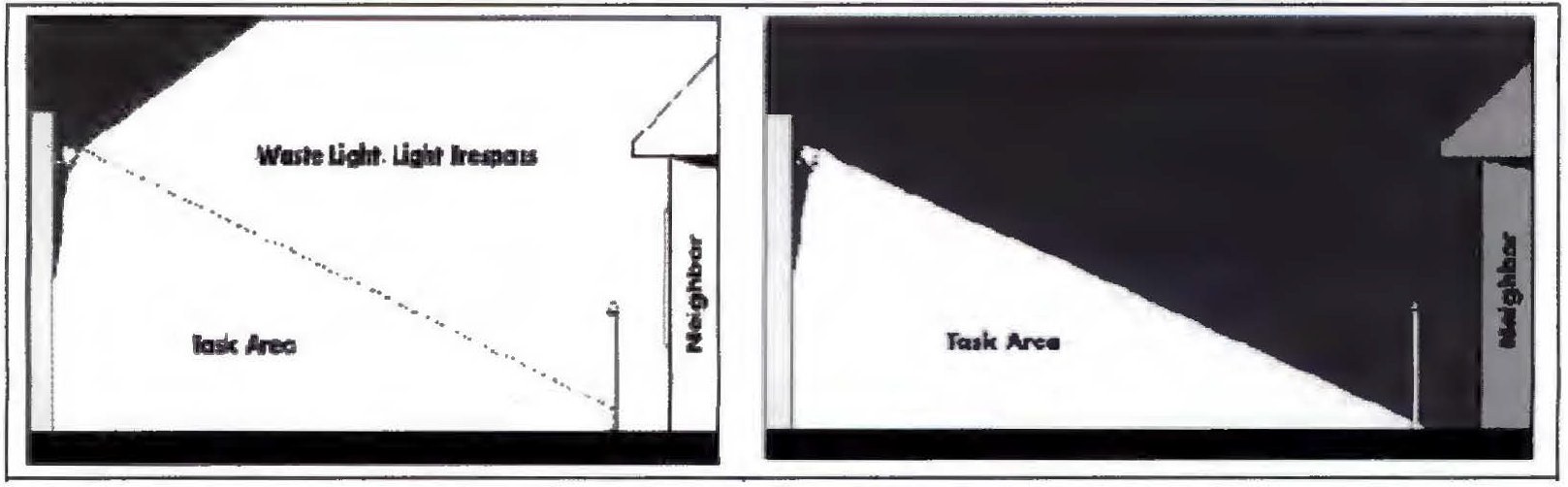
Any light source or lamp that emits more than 900 Lumens shall be concealed or shielded with full cut-off style fixture with an angle not exceeding 90 degrees to minimize Glare and unnecessary light diffusion onto adjacent properties and Streets. No light source or lamp may produce more than 1,800 Lumens. (See Figure 66-142(e) Shielding of light source to avoid light diffusion onto adjacent property below.)
(f)
Security Lighting installations. All Security Lighting installations shall include timers, dimmers, and/or sensors to reduce the overall energy consumption and eliminate unneeded lighting.
(g)
Flickering or flashing lights. No flickering or flashing exterior lights shall be allowed except for temporary decorative seasonal lighting during the period of time that colored lighting is permitted.
(h)
Maximum illumination. Maximum illumination shall not exceed 1.0 foot-candles, measured five feet above ground level at a property line.
(i)
Right-of-way. No private lighting may be installed in the Town's swale or right-of-way.
(j)
Color lighting. Colored lights are prohibited except during the period of time from the Friday before the last full week in November until the second Sunday in January (holidays).
(k)
Landscape lighting. All landscape lighting designs shall be reviewed and approved by the Town's Landscape Architect.
(Ord. No. 582.18, § 2(Exh. A), 5-15-18)
Cross reference— Lighting regulations for marine turtle protection, Ch. 58, Art. III.
Sec. 66-151. - Definitions.
The following words, terms and phrases, when used in this division, shall have the meanings ascribed to them in this section, except where the context clearly indicates a different meaning:
Antenna or Collector for Electromagnetic and Solar Radiation means any device intended for the purpose of receiving or concentrating photons including cosmic, gamma, and X-rays; ultraviolet, visible, and infrared light; microwaves and radar; and radio waves of any length; whether such devices are of planar, parabolic, parabolic-cylindrical or any other configuration.
Height means the distance measured vertically from the bottom of the base which supports the Antenna to its highest point when positioned for operation.
(Code 1989, § 2.06)
Cross reference— Definitions generally, § 1-2.
Sec. 66-152. - Exceptions.
The following Electromagnetic Radiation Antennas and Solar Collectors are exempt from the terms and requirements of this division, provided that they comply with the provision of all other applicable ordinances, to wit:
(1)
Antennas installed prior to November 2, 1989, with or without rotors, whose height and/or width does not exceed meters, 78 inches, in any direction.
(2)
Flat plate solar radiation heat collectors for the purpose of direct heating of hot water by solar radiation.
(Code 1989, § 9.08(I))
Sec. 66-153. - Use restricted.
All Antennas erected in the Town shall be erected solely for the use of its Owners, and not used for commercial purposes or commercial gain. The Antenna may not be used for the purpose of obtaining revenue nor may the Owners thereof charge for its use in any manner, notwithstanding its location.
(Code 1989, § 9.08(A))
Sec. 66-154. - Location.
Electromagnetic or Solar Radiation Collectors or Antennas may be permitted in the Town, provided:
(1)
They are located in the rear yard but not within any building Setback area or are mounted on the main residence structure.
(2)
They are placed no closer to any property boundary line than a distance equal to their Height as measured from ground level to the top of the Antenna or other device but in no event closer than five feet to such boundary lines.
(3)
They do not encroach on any of the required front, side or rear Setbacks.
(Code 1989, § 9.08(B))
Sec. 66-155. - Dimensions.
Ground-mounted Collectors shall be no more than ten feet in width, length and/or diameter. They shall be no more than 11 feet in Height measured vertically from the bottom of the base. Structure-mounted Collectors shall not extend over 0.75 meters (30 inches) beyond vertical walls or 0.75 meters (30 inches) above flat or pitched roofs except for dipole type Antenna on a mast for very high frequency and ultrahigh frequency television signals and/or frequency-modulation radio signals, in which case they may be up to 1.5 meters (60 inches) in width or length and extend up to two meters (78 inches) above the roof. If structure (roof) mounted the structure must be inspected by a registered engineer and a sealed statement must accompany the application.
(Code 1989, § 9.08(C))
Sec. 66-156. - Screening.
All Antennas or Collectors larger than 24 inches in width, length and/or diameter shall be screened from view from persons outside the property line by an opaque boundary fence constructed on the lot line in accordance with this Code of Ordinances. In addition thereto, landscape screening shall be maintained along the side and rear lot lines in such location, size and type as to obscure the Antenna dish or other device from the view from any opening, window or porch on the ground level from a home existing on any abutting lot. The boundary fence shall be constructed in such a manner as to meet the requirements of the building code of the Town, not less than the maximum height permitted by the building code. Landscaping shall consist of trees and/or shrubs of such height and density, placed in such locations and in such proximity to the Antenna as to obscure visibility of the Antenna as required in this division. The Antenna shall be located within the area permitted in such manner as not to prevent or interfere with reception.
(Code 1989, § 9.08(D))
Sec. 66-157. - Number allowed.
Only one noncommercial ground-mounted Collector or other device and one structure-mounted mast with a dipole type VHF/UHF/FM Antenna shall be allowed per Single-Family home.
(Code 1989, § 9.08(E))
Sec. 66-158. - Anchorage.
Electromagnetic and Solar Radiation Collectors shall be anchored securely to the ground or a concrete pad or the structure in conformance with requirements of the Florida Building Code relative to structures, and bear the seal of a registered engineer. Ground-mounted Collectors shall be installed on a piling unless a registered engineer certifies that the piling is not necessary to prevent the Collectors from becoming a hazard during a storm event. The owner of the Collector shall hold the Town harmless.
(Code 1989, § 9.08(F); Ord. No. 549.11, § 2, 11-15-11)
Sec. 66-159. - Permit.
(a)
Anyone wishing to erect an Electromagnetic or Solar Radiation Collector must first submit the location plan together with a lot survey showing the location of the fence and landscaping (designating the height and type of trees and/or shrubs) and a deposit of $250.00 to defray the cost of investigation by the Town. The applicant shall also submit a scale drawing of abutting lots, structures thereon and the location of windows, porches and openings on the ground level thereof which are to be screened from view from the Antenna or Collector. In addition, the applicant shall submit a certificate from a State certified testing laboratory or a registered professional engineer that the installation will withstand the maximum winds of a category 3 hurricane (210 kilometers per hour, 130 miles per hour).
(b)
Upon approval, a permit will be issued after deducting from the deposit, the costs of investigation.
(b)
Upon revocation of the permit, the Collector or Antenna shall be removed within ten days by the property Owner. Failure to remove the Antenna or Collector renders the Antenna or Collector a public nuisance which may be abated in the manner permitted by this Code of Ordinances.
(Code 1989, § 9.08(G); Ord. No. 547.11, § 2, 11-15-11)
Sec. 66-160. - Maintenance.
Once installed, Electromagnetic Radiation Antennas and Solar Collectors and related appurtenances shall be maintained in good and operable condition. Surrounding landscaping shall also be maintained as designated on the fence and landscape plan.
(Code 1989, § 9.08(H))
Sec. 66-186. - Height restrictions.
(a)
In Zone One no wall or fence between estates or lots shall be constructed or altered to exceed in height the following: Parallel to the side property line within 60 feet of the west property line, a height of six feet; thence easterly along the main house structure and rear yard patios, including pool patio decks to height of six feet; thence easterly for 30 feet, a height of four feet; thence easterly to the ocean front, a height of two feet. No wall or fence higher than two feet may be erected on the east (Ocean Front) property line. No wall or fence higher than six feet above the crown of the road may be erected on the (Ocean Boulevard) property line.
(b)
In Zones Two, no wall or fence between estates or lots shall be constructed or altered to exceed a height of six feet.
(c)
In Zone Three, no wall or fence between estates or lots shall be constructed or-altered to exceed a height of six feet.
(d)
No walls or fences higher than, two feet may be erected along the waterways, except that open metal or chain link fences may be four feet high.
(e)
No walls or fences higher than, four feet may be erected on the Street property line, nor erected in such manner so as to block the view of a driver of a vehicle or bicycle operating on any road within the Town as provided by subsection 52-10(e).
(f)
Throughout Zones One, Two and Three, any wall or fence constructed within a Setback area other than on a property line shall not exceed the height permitted for Construction of walls, or fences allowed on the nearest property line within the zones. In no event shall walls, or fences within building Construction areas exceed six feet in height.
(g)
All heights stated in this section are measured from the finished grade of the site where the fence is to be built. For fences abutting a street, the maximum level of the top of the fence shall be four feet above the finished site elevation without any berming or six feet above the maximum elevation of the crown of the road adjacent to the property whichever is the highest. Pilasters may exceed the maximum fence height by up to one foot, and operable gates may exceed the maximum fence height by three feet. Ornamental features, such as lights or decorative castings, a maximum 24 inches in height may be erected on top of a maximum of four pilasters. No berm shall be permitted in the street right-of-way. Fences erected along the right-of-way must be fully screened with landscaping including hedges or vines screening their full height.
(h)
Vacant lots.
(1)
Throughout Zones One, vacant lots shall be secured on all four sides. A white vinyl picket fence at least four feet in height shall be placed along the perimeter of the property adjacent to a right-of-way. Along the right-of-way frontage, the yard area outside the fence shall be planted with accent plant material and/or sod and watered and maintained so as to prevent browning, disease, weeds, overgrowth or dead spots.
(2)
Throughout Zone Two, along the right-of-way frontage of vacant lots, the yard area shall be planted with accent plant material and/or sod and watered and maintained so as to prevent browning, disease, weeds, overgrowth or dead spots.
(3)
Throughout Zone Three, vacant lots shall be secured on either the water side or the street side from side property line to side property line with a white vinyl picket fence at least four feet in height. Along the right-of-way frontage of vacant lots, the yard shall be planted with accent plant material and/or sod and watered and maintained so as to prevent browning, disease, weeds, overgrowth or dead spots.
(Code 1989, § 13.14(A)—(E), (G); Ord. No. 427.97, § 1, 7-15-97; Ord. No. 431.98, § 1, 1-20-98; Ord. No. 551.11, § 2, 11-15-11; Ord. No. 571.16, § 5, 11-15-16; Ord. No. 608.25, § 2, 4-23-25)
Sec. 66-187. - Construction materials.
Throughout Zones One, and on the east side of Zone Two (Golden Beach Drive) and Zone Three, live Hedges may be grown in lieu of masonry built walls or fences, in Zone Two (the West Side of Ocean Boulevard) all properties improved or unimproved shall be required to have fencing in the side and rear yard areas, effective October 17, 2017, subject to the same height restrictions applicable in the zone. Walls and fences of plywood, composition materials, simulated-wood, or sheet metal are prohibited. However, a rail type open fence may be permitted if the wood rails are set between piers not less than 21 inches square built of brick or stone or in the alternative wooden uprights of a minimum size of six inches by six inches and spaced not more than 12 feet apart. Rails may not be smaller than four inches by four inches. Chain-link wire fence, including framing Members, are covered in green or black vinyl. Alternatively, rear and side yards may be enclosed by white vinyl picket or solid panel fencing. Where chain-link, picket, or solid panel fencing are used, such fencing shall be fully screened by hedge plant material for the full height of the fence. Zones Two and Three, piling shall be required under all piers, pilasters and walls for fences and for flower boxes which may not be cantilevered from beams, except that wooden uprights as referenced above, shall not need pilings, but shall penetrate into the ground a minimum of three feet and be encased in a concrete footing with a minimum thickness of one foot measured from the edge of the wooden upright. All fences shall be finished or constructed in such manner as to have the same appearance, design and finish on each side.
(Code 1989, § 13.14(F); Ord. No. 400.95, § 1, 1-10-95; Ord. No. 551.11, § 2, 11-15-11; Ord. No. 571.16, § 5, 11-15-16; Ord. No. 574.17, § 2, 10-17-17)
Sec. 66-188. - Maintenance.
All walls and fences shall be maintained in accordance with the landscaping plan or permitted Construction plan approved by the Building Regulation Advisory Board.
(Code 1989, § 13.14(H); Ord. No. 571.16, § 5, 11-15-16)
Sec. 66-201. - Required.
Set forth below are the requirements pertaining to the minimum number of garages required for homes located within the Town:
(1)
Lots with less than 100 feet of Frontage: Each home in the Town with a lot Frontage of less than 100 feet must contain at least a one-car garage;
(2)
Lots with a Frontage of 100-feet or more: Each house in the Town with a lot Frontage of 100 feet or more must contain a minimum of a two-car garage, except as specifically provided in section 66-205.
(Code 1989, § 13.15(A); Ord. No. 529.07, § 2, 9-18-07)
Sec. 66-202. - Attachment to structure.
(a)
In Zone One, garages may be attached to or separate from the main house.
(b)
In Zones Two and Three, garages shall be attached to the house proper.
(Code 1989, § 13.15(B), (C); Ord. No. 551.11, § 2, 11-15-11)
Sec. 66-203. - Carports prohibited.
No carport shall be permitted to be erected, built or constructed in the Town.
(Code 1989, § 13.15(D))
Sec. 66-204. - Parking awnings.
(a)
Prohibition. Parking awnings shall not be permitted within the Single-Family Residential District of the Town.
(b)
Continuation of Certain Non-Conforming Parking Awnings. Any parking awning, lawfully existing prior to the effective date of the ordinance from which this section derives (September 18, 2007), may continue to be used and maintained so long as it is watertight and structurally sound and may be replaced only if it is lost or substantially damaged by casualty and was installed after August 1, 2002.
(Code 1989, § 13.15(F) ; Ord. No. 526.07, § 2, 9-18-07)
Sec. 66-205. - Conversion.
Any Owner of an existing home with a minimum of a two-car garage and who has obtained a Certificate of Occupancy on or before September 18, 2007 may obtain a building permit to convert existing garage(s) to be a part of the Living Area, subject to the condition that at least one garage with minimum interior dimensions of 11 by 22 feet must remain after conversion. Issuance of a building permit for a garage conversion shall also be subject to compliance with the following conditions:
(1)
A building permit shall be issued to the property Owner upon presentation to the Town of properly engineered building plans, which plans shall set forth the following:
a.
The floor level of the garage to be enclosed shall be in compliance with the Florida Building Code and this Code.
b.
Light and ventilation for the garage to be enclosed shall be provided as set forth in subsection 303.1 of the Florida Building Code.
c.
The minimum room dimension and ceiling height for the garage structure to be enclosed shall be as set forth in section 304 of the Florida Building Code.
d.
An external rendering of the structure to be enclosed shall be presented to the Building Regulation Advisory Board, which rendering shall show the garage structure as it will look after completion of enclosure.
e.
The property Owner shall provide off-Street parking for a minimum of two cars upon the property on which the garage to be enclosed is located.
(2)
The property Owner, as a condition of obtaining a building permit, shall provide for the elimination of the drive in front of the converted garage, which area shall be covered by landscaping or planters.
(Code 1989, § 13.15(G) ; Ord. No. 529.07, § 3, 9-18-07; Ord. No. 575.17, § 2, 10-17-17)
Sec. 66-206. - Submission of plans.
All renderings and building plans shall be presented to the Building Regulation Advisory Board before approval of any building permit pursuant to this division.
(Code 1989, § 13.15(I))
Sec. 66-207. - Variances.
The Building Regulation Advisory Board shall have the power, upon proper application and showing by the property Owner, of hardship or inability to fully comply with the terms of this division, which is not self-imposed, to submit to the Council, a request for a Variance from the terms hereof.
(Code 1989, § 13.15(J))
Sec. 66-221. - Compliance required.
(a)
Driveway construction. In order to prevent the surface of roads within the Town from deterioration as a result of punctures or holes in surface covering caused by small rocks and debris some of which may originate from driveways consisting of gravel or loose stones, and to prevent loose stones, rocks and colloidal materials from washing into drains, resulting in clogging, all vehicle ingress and egress driveways between private property and a public Street shall comply with the plans and specifications approved by the Building Regulation Advisory Board and shall be constructed of materials required by this Code of Ordinances and in accordance with the driveway permit issued by the Town Building Official.
(b)
Required residential parking. In addition to the garage requirement of sections 66-201 through 66-207, and design of driveways as set forth in sections 66-221 through 66-225, each residence shall be required to provide at least two parking spaces on-site. The driveway leading to the garage may be utilized for this purpose. Each such parking space shall be a minimum of nine feet in width and 20 feet in length.
(c)
Permit requirement. All building permit applications for new or widened driveways abutting State Road Number A1A shall be required to receive a permit from Florida Department of Transportation District Number 6 offices prior to receiving a permit for same from the Town.
(Code 1989, § 13.16(A); Ord. No. 575.17, § 2, 10-17-17)
Sec. 66-222. - Materials permitted.
All driveways shall be paved with decorative concrete impregnated with color, stamped concrete, concrete blocks, paving bricks, decorative concrete slabs separated by grass (natural or artificial), or other permanently fixed material (no loose rocks, stones, gravel, or sand) approved by the Building Regulation Advisory Board. Unfinished gravel driveways are not permitted. No new asphalt driveways shall not be permitted after November 15, 2011. Asphalt driveways existing after the above date may remain in such state until such time as they are subject to be replaced, repaired or renewed, when they shall be reconstructed as provided in this division. Unfinished gravel driveways are not permitted. All existing loose Chattahoochee stone driveways may remain in such state until such time as they are subject to be replaced, repaired or renewed, when they shall be reconstructed as provided in this division.
(Code 1989, § 13.16(B); Ord. No. 551.11, § 2, 11-15-11; Ord. No. 575.17, § 2, 10-17-17)
Sec. 66-223. - Plan, approval.
A drawing or plan showing construction standards, specifications and location of the driveway shall be submitted to the Town and shall be approved by the Building Regulation Advisory Board after a public hearing. Each driveway shall be reviewed, located and constructed according to safety, traffic conditions and public and governmental requirements necessitated by the condition existing at each location or according to known future conditions as determined by the Town Building Official and Building Regulation Advisory Board.
(Code 1989, § 13.16(C))
Sec. 66-224. - Dangerous locations.
No driveway or accessway shall be permitted at any location which shall constitute or cause a danger to vehicles, or create a potential danger to the public or interfere with traffic control, or governmental or utility use of easements, roads, Streets or ways.
(Code 1989, § 13.16(D))
Sec. 66-225. - Closure.
All private accessways or driveways shall be closed and the use thereof discontinued if the abutting Street is required to be used for traffic control or governmental use.
(Code 1989, § 13.16(E))
Sec. 66-226. - Driveway design standards.
(a)
Location of driveways. No portion of a driveway at a residence in the Town may be installed closer than five feet to the side and to any front (Street) yard lot line, except at the driveway connection to the roadway. For circular driveways, the landscape strip dimension may taper at the property line. Further no portion of such driveway shall be installed in the side yard setback beyond the imaginary extension of a line extended from the front wall of the residence to the side yard lot line.
(b)
Driveway setback from structures. No portion of a driveway at a residence in the Town may be installed closer than two feet to a wall of a structure. Notwithstanding the above, the two-foot setback requirement is not required at garage door openings. If an existing garage is to be enclosed, a setback of two feet must be provided between the enclosed garage and any driveway surface. Within the two-foot setback area, landscape materials of a design and quantity as deemed necessary by the Building Regulation Advisory Board, shall be required.
(c)
Intersection with Streets. Driveways for residences shall not encroach into the Street corner radius of two intersecting Streets, or be closer than 25 feet to the intersection of extended right-of-way lines.
(d)
Vehicular stacking adjacent to A1A. Any inbound security gate for property accessing A1A shall be set back a minimum of 18 feet from the Street curb line to the face of the security gate to accommodate at least one inbound vehicle inside the Street curb line to ensure inbound vehicles waiting to enter a site do not block traffic on State Road A1A.
(e)
Size of driveways.
(1)
Straight driveway configuration. Unless otherwise approved by the Building Regulation Advisory Board, based on architectural and aesthetic characteristics of a particular location, the minimum width of any straight driveway for a single-family residence in the Town shall be 18 feet and the maximum 20 feet. Notwithstanding the above, the minimum width of straight driveways may be reduced to 12 feet for a single lane driveway, provided there are two separate individual driveways for the residence.
(2)
Circular driveway configuration. Unless otherwise approved by the Building Regulation Advisory Board, based on architectural and aesthetic characteristics of a particular location, the minimum width of any circular driveway for a single-family residence in the Town shall be 12 feet, and the maximum width shall be 20 feet, and further provided that no portion of the driveway may be wider than 20 feet at the right-of-way line.
(Ord. No. 575.17, § 2, 10-17-17)
Sec. 66-236. - Safety barrier required.
Any Swimming Pool, Hot Tub or Spa constructed in the Town shall be protected by a safety barrier approved by the Building Official.
(Code 1989, § 13.17(A); Ord. No. 580.18, § 2(Exh. A), 5-15-18)
Sec. 66-237. - Setback areas.
(a)
In Zones One, Two and Three, no screened-in or enclosed structures will be permitted in Setback areas, except for Cabanas in Zone One in accordance with section 66-251.
(b)
Swimming Pools, Hot Tubs and Spas may be built in rear or side Setback areas providing they are not less than ten feet from waterways or Property Lines. No Swimming Pool, Hot Tub or Spa shall be placed in a front or street-side (corner lot) Setback area.
(c)
In-ground Swimming Pools, Hot Tubs and Spas shall not exceed two feet above a grade level Swimming Pool Deck, Patio, or Terrace.
(d)
Swimming Pool equipment must comply with the requirements for Setbacks and quantity listed in subsection 66-140.
(e)
The construction of any Swimming Pool, Hot Tub, Spa or Swimming Pool Deck shall be subject to approval by the Building Regulation Advisory Board. Plans showing the location of the aforementioned new or replacement facilities shall be provided to the building department prior to the issuance of a permit. A sample of the decking material will be required when submitting an application.
(f)
No portion of a Swimming Pool Deck shall be placed closer than five feet to a side or rear lot line. No portion of a Swimming Pool Deck shall be placed in the front yard Setback area.
(Code 1989, § 13.17(B), (C); Ord. No. 580.18, § 2(Exh. A), 5-15-18)
Sec. 66-238. - Construction on piles.
In Zones One, Two and Three, pools shall be built on piles.
(Code 1989, § 13.17(D))
Sec. 66-251. - Cabanas/Gazebos/Pergolas.
(a)
In Zone One, one Cabana, Gazebo or Pergola separate from the main house structure may be permitted to be erected and only within the rear yard. The covered area of such structure, whether covered with roofing, trellis or open rafters, shall not exceed two percent of the net lot area up to a maximum floor area of 500 square feet. The roofed area measurement shall not include eaves or overhangs.
(b)
In Zones Two and Three, one Pergola or Gazebo separate from the main house structure may be permitted to be erected and only within the rear yard. The roofed area of such structure shall not exceed two percent of the lot area up to a maximum floor area of 500 square feet. The roofed area measurement shall not include eaves or overhangs. Cabanas are not permitted.
(c)
Within Zone One, no part thereof shall be east of a line joining the corners of the nearest existing similar structures nor shall any part be within 50 feet of the Mean High Water Line. Setbacks for such structures are not required on the side lot line.
(d)
In Zone Two the structure must be placed at least ten feet from the side lot line and ten feet from the rear lot line.
(e)
In Zone Three the structure must be placed at least ten feet from the side lot line and 15 feet from the rear lot line.
(f)
No structure permitted under this section shall exceed one story or a height of 15 feet above BFE.
(g)
Structures, other than Pergolas, under this section must contain matching roof slopes and detailing similar to the principal structure.
(h)
The roof of the structure shall not be used as a solarium or for any similar purposes.
(Code 1989, § 13.19(A); Ord. No. 431.98, § 1, 1-20-98; Ord. No. 527.07, § 3, 9-18-07; Ord. No. 551.11, § 2, 11-15-11; Ord. No. 571.16, § 5, 11-15-16; Ord. No. 579.18, § 2, 5-15-18)
Sec. 66-252. - Accessory buildings, boathouses, etc.
(a)
No out building or enclosed boathouse is permitted to be built within any lot in Zones Two and Three on the waterside of lots on the east coast waterways and channels tributary thereto.
(b)
Boat slips within the area described in subsection (a) of this section may be constructed on lots with water Frontage of 100 feet and over, providing such slips are built with walls of like Construction as the seawalls. Enclosures around and over such slips are not permitted. Size of such slips may not be larger than 15 feet wide by 35 feet deep (length).
(c)
Docks may be constructed, but no canopy over them shall be erected.
(Code 1989, § 13.19(B); Ord. No. 579.18, § 2, 5-15-18)
Sec. 66-260. - Rooftop mechanical equipment.
Rooftop mechanical equipment may be placed on flat roofs only and shall be maintained a minimum of ten feet from the roof perimeter. Such mechanical equipment may extend a maximum of 48 inches in height above the roof elevation. Where the mechanical equipment extends greater than 42 inches above the roof elevation, screen material 54 inches in height above the roof elevation shall be required to screen the mechanical equipment from view of adjacent properties and public rights-of-way.
(Ord. No. 551.11, § 2, 11-15-11)
Sec. 66-261. - Rooftop activities.
(a)
Except as specified below in this section, the use of the roof of a residential structure for passive leisure activities, including, but not limited to, entertainment and other leisure and recreational activities, is prohibited.
(b)
Within Zone One, the roof of the highest roofed structure may be used for passive leisure activities, including entertainment and other passive recreational/leisure uses subject to the following limitations:
(1)
The lot must be at least 7,500 square feet in area.
(2)
The usable area of the roof must be set back a minimum of ten feet from the edge of the roof in all directions except from the rear (ocean front), where no setback is required; however, for lots of less than 64 feet in width, the useable area may be reduced to seven and one half feet from the edge of the roof in all directions except the rear (ocean front), where no setback is required.
(3)
The rooftop area shall not be improved with any permanent structures or the placement of any temporary or permanent fixtures or equipment except a safety railing up to 48 inches in height. Outdoor furniture such as chairs, sofas, and tables, and pots and planters are permitted. Additionally, within the approval of the Building Regulation Advisory Board, a hot tub/spa may be placed on the rooftop.
(4)
No amplified or live music shall be permitted on the roof.
(5)
An elevator and any covered elevator vestibule serving the rooftop shall be limited to an area of no more than 110 square feet. Any elevator and any covered elevator vestibule, if permitted, shall be placed near the center of the rooftop, but not less than seven and one half feet from the edge of the roof on lots less than 75 feet in width, or less than ten feet from the edge of the roof on lots 75 feet or more in width.
(6)
Staircases may extend from lower floors or the ground level to the rooftop, but must comply with the setback and yard projection provisions set forth in section 66-141(b). Safety railings up to 48 inches in height for staircases are allowed, provided they meet the above setback and yard projections. Once at the rooftop railings must terminate at or connect directly to any railings surrounding the usable passive leisure activity area set forth in subsection (2) above. Any portion of a staircase railing constructed above the rooftop shall be designed with an open appearance (no walls).
(Ord. No. 551.11, § 2, 11-15-11; Ord. No. 599.14, § 3, 3-18-14; Ord. No. 562.14, § 2, 1-20-15; Ord. No. 577.18, § 2, 2-20-18; Ord. No. 588.19, § 2, 9-17-19)
Sec. 66-262. - Balconies.
(a)
For the purposes of this section, "balcony" means an unenclosed platform that projects from an opening in the wall of a home and has a parapet or railing. The flat roof of a residential structure (except the highest roof where there are multiple roofs) may serve as the floor of a balcony.
(b)
Balconies are permitted in Zones One, Two, and Three subject to the following criteria:
(1)
Balconies located on the front or rear façade of a building may not extend more than four feet into the yard beyond the respective setback.
(2)
Balconies located on a side façade of a building may not extend beyond the face of the exterior wall of the structure from which they project.
(3)
Balconies must be accessed from the interior of the structure from which they project, and may additionally be accessed from an exterior staircase.
(Ord. No. 562.14, § 3, 1-20-15)

