
Goodlettsville City Zoning Code
CHAPTER 2
- ZONING ORDINANCE
Sec. 14-201. - Provisions relating to construction of language and definitions.
(1)
Intent and purpose. This title is enacted pursuant to T.C.A. tit. 13 for the following purposes:
(a)
To promote and protect the public health, safety, morals, comfort, convenience, and general welfare of the people;
(b)
To divide the city into zones and districts restricting and regulating therein the location, construction, reconstruction, alteration, and use of buildings, structures, and land for residence, business, commercial, manufacturing, and other specified uses;
(c)
To protect the character and maintain the stability of residential, business, commercial, and manufacturing areas within the city, and to promote the orderly and beneficial development of such areas;
(d)
To provide adequate light, air, privacy, and convenience of access to property;
(e)
To regulate the intensity of open spaces surrounding buildings that is necessary to provide adequate light and air and protect the public health;
(f)
To establish building lines and the location of buildings designated for residential, business, commercial, manufacturing, or other uses within such lines;
(g)
To fix reasonable standards to which buildings or structures shall conform;
(h)
To prohibit uses, buildings or structures which are incompatible with the character of development or the permitted uses within specified zoning districts;
(i)
To prevent such additions to, and alterations or remodeling of, existing buildings or structures as would not comply with the restrictions and limitations imposed hereunder;
(j)
To limit congestion in the public streets and so protect the public health, safety, convenience, and general welfare by providing for the off-street parking of motor vehicles and for the loading and unloading of commercial vehicles;
(k)
To provide protection against fire, explosion, noxious fumes, and other hazards in the interest of the public health, safety, comfort, and general welfare;
(l)
To prevent overcrowding of land and undue concentration of structures so far as is possible and appropriate in each district by regulating the use and the bulk of buildings in relation to the land surrounding them;
(m)
To conserve the taxable value of land and the buildings thereon throughout the city;
(n)
To provide for the gradual elimination of those uses of land, buildings and structures which do not conform to the standards of the districts in which they are respectively located and which are adversely affecting the development and taxable value of property in each district;
(o)
To provide for condemnation of such nonconforming buildings and structures and of land as the board of commissioners shall determine is necessary or appropriate for the rehabilitation of the area blighted by such buildings or structures;
(p)
To define and limit the powers and duties of the administrative officers and bodies as provided herein; and
(q)
To include in the general purposes additionally the specific purposes stated in the various chapters throughout this title.
(2)
Rules for construction of language. In the construction of this title, the rules and definitions contained in this section shall be observed and applied, except when the context clearly indicates otherwise:
(a)
The particular shall control the general;
(b)
The word "shall" is always mandatory and not discretionary;
(c)
The word "may" is permissive;
(d)
The word "lot" shall include the words "piece" or "parcel";
(e)
The word "structure" includes all other structures, or parts thereof, of every kind regardless of similarity to buildings; and the phrase "used for" shall include the phrases "arranged for," "designed for," "intended for," "maintained for," and "occupied for";
(f)
In the case of any difference of meaning or implication between the text of this title and any caption, illustration or table the text shall control;
(g)
The word "permitted" or words "permitted as of right," means permitted without meeting the requirements for a conditional use permit;
(h)
The words "conditionally permitted" or "permitted by conditional use permit" mean permitted subject to the requirements for a conditional use by special permit pursuant to section 14-213 of this title, and all other applicable provisions;
(i)
Words used in the present tense shall include the future, and words used in the singular include the plural, and the plural the singular, unless the context clearly indicates the contrary;
(j)
Unless the context clearly indicates to the contrary, conjunctions shall be interpreted as follows:
(i)
"And" indicates that all connected items, conditions, provisions or events shall apply;
(ii)
"Or" indicates that any of the connected items, conditions, provisions, or events shall apply;
(iii)
"Either…or" indicates that the connected items, conditions, provisions or events shall apply single but not in combination; and
(k)
All public officials, bodies, and agencies to which reference is made are those of the City of Goodlettsville, Tennessee.
(3)
Definitions. Except where definitions are specifically included in various sections of this title words in the text or tables of this title shall be interpreted in accordance with the provisions set forth in this section. Where words have not been defined, the standard dictionary definition shall prevail.
Accessory means an activity or structure that is customarily associated with and is appropriately incidental and subordinate to a principal activity and/or structure and located on the same zone lot, except as provided for under the provisions of accessory off street parking.
Activity means the performance of a function or operation, which constitutes the use of land.
Adult entertainment means any exhibition of any adult-oriented motion picture, live performance, display or dance of any type, which has a significant or substantial portion of such performance, any actual or simulated performance of specified sexual activities, including removal of articles of clothing or appearing unclothed.
Adult-oriented establishment means, but is not limited to, an adult arcade, adult bookstore, adult novelty store, adult video store, adult cabaret, adult motion picture theater, adult theater, nude model studio, sexual encounter center, massage parlor, or sauna, and further means any premises to which patrons or members of the public are invited or admitted and which are so physically arranged as to provide booths, cubicles, rooms, compartments or stalls separate from the common areas of the premises for the purpose of viewing adult entertainment, which such is held, conducted, operated or maintained for a profit, direct or indirect.
(a)
Adult bookstore, adult novelty store, or adult video store means a commercial establishment which, as one of its principal purposes, offers for sale or rental for any form of consideration any one or more of the following:
(i)
Books, magazines, periodicals or other printed matter, or photographs, films, motion pictures, video cassettes or video reproductions, slides, computer software or other visual representations which are characterized by the depiction or description of "specified sexual activities" or "specified anatomical areas;" or
(ii)
Instruments, devices or paraphernalia which are designed for use in connection with specified sexual activities means a commercial establishment may have other principal business purposes that do not involve the offering for sale or rental of material depicting or describing "specified sexual activities" or "specified anatomical areas" and still be categorized as an adult bookstore, adult novelty store or adult video store. Such other business purposes will not serve to exempt such commercial establishments from being categorized as an adult bookstore, adult novelty store or adult video store so long as one of the principal business purposes is the offering for sale or rental for consideration the specified materials which are categorized by the depiction or description of "specified sexual activities" or "specified anatomical areas."
(b)
Adult theater means a theater, concert hall, auditorium or similar commercial establishment which regularly features persons who appear in a state of nudity or semi-nude, or live performances which are characterized by the exposure or "specified anatomical areas" or by "specified sexual activities."
(c)
Adult peep shows includes all adult show, exhibitions, performances or presentations which contain acts of depictions of specified sexual activities.
(d)
Specified sexual activities means activities, services or performances that include the following sexual activities and/or the exhibition of the following anatomical areas:
(i)
Human genitals in a state of sexual stimulation or arousal;
(ii)
Acts of human masturbation, sexual intercourse, sodomy, cunnilingus, fellatio or any excretory function, or representation thereof; or
(iii)
Fondling or erotic touching of human genitals, pubic region, buttocks or female breasts.
(e)
Sexually-oriented material means any book, article, magazine, publication or written matter of any kind, drawing, etching, painting, photograph, motion picture film or sound recording, which depicts sexual activity, actual or simulated, involving human beings or human beings and animals, or which exhibit uncovered human genitals or pubic region in a lewd or lascivious manner or which depicts human male genitals in a discernibly turgid state, even if completely covered.
(f)
Adult arcade means any place to which the public is permitted or invited wherein coin-operated, slug-operated, or for any form of consideration, electronically, electrically, or mechanically controlled still or motion picture machines, projectors, video or laser disc players, or other image-producing devices are maintained to show images to five or fewer persons at any one time, and where the images so displayed are distinguished or characterized by the depicting or describing of "specified sexual activities" or "specified anatomical areas."
(g)
Adult cabaret means a nightclub, bar, restaurant or similar establishment which regularly features:
(i)
Persons who appear in a state of nudity or semi-nude; or
(ii)
Live performances which are characterized by "specified sexual activities" or by the exposure of any of the "specified anatomical areas," even if partially covered by opaque material or partially or completely covered by translucent material, including swim suits, lingerie, or latex covering; or
(iii)
Films, motion pictures, video cassettes, slides or other photographic reproductions which are characterized by the depiction or description or "specified sexual activities" or "specified anatomical areas."
(h)
Adult motion picture theater means a commercial establishment where, as one of its principal purposes, and for any form of consideration, films, motion pictures, video cassettes, slides or similar photographic reproductions are regularly shown which are characterized by the depiction or description of "specified sexual activities" or "specified anatomical areas."
(i)
Massage parlor means an establishment or place primarily in the business of providing massage or tanning services for purposes of sexual stimulation or where one or more of the employees exposes to public view of the patrons within said establishment, at any time, "specified anatomical areas."
(j)
Nude model studio means a commercial establishment where a person appears semi-nude or in a state of nudity, or displays "specified anatomical areas," and is provided to be observed, sketched, drawn, painted, sculptured, photographed or similarly depicted by other persons who pay money or any form of consideration. Nude model studio as defined herein shall not include a proprietary school licensed by the State of Tennessee or a college, junior college or university supported entirely or in part by public taxation; a private college or university which maintains and operates educational programs in which credits are transferable to a college, junior college or university supported entirely or partly by taxation; or a structure:
(i)
That has no sign visible from the exterior of the structure and no other advertising that indicates a nude or semi-nude person is available for viewing; and
(ii)
Where in order to participate in a class, a student must enroll at least three days in advance of the class; and
(iii)
Where no more than one nude or semi-nude model is on the premises at any one time.
(k)
Sauna means an establishment or place primarily in the business of providing, for purposes of sexual stimulation:
(i)
A steam bath or dry heat sauna; or
(ii)
Massage services.
(l)
Sexual encounter center means any establishment, business, commercial enterprise including any event rental spaces that, as one of its principal business purposes, offers for any form of consideration:
(i)
Physical contact in the form of wrestling or tumbling between persons of the opposite sex; or
(ii)
For purposes of sexual stimulation and/or mental or physical gratification, activities between male and female persons and/or persons of the same sex when one or more of the persons is in a state of nudity or semi-nude; or
(iii)
Sexual encounter clubs.
Sexual encounter club means any establishment, business, commercial enterprise including any event rental spaces that allows members, patrons, guests members to engage in specified sexual activities or the exposure of specified anatomical areas, and which contains either rooms for couples or other adult-themed rooms or both for the use of members.
Sexual encounter clubs shall be prohibited from all of the following:
a.
Admitting any new adult member without the affirmative vote of a majority of the other members;
b.
Accepting applications for membership without a current member's written recommendation; and
c.
Granting membership within 24 hours from the time a membership application is filed.
Alley means a public way intended to provide only secondary vehicular access to abutting properties.
Attached means joined together by party wall(s).
Bar means a place of business where alcoholic beverages are sold to be consumed on the premises and where meals are served as well as drinks.
Basement means a story where the floor is more than 12 inches, but not more than one-half of its story height, below the average level of the adjoining ground (as distinguished from a "cellar" which is a story more than one-half below such level).
Bed and breakfast homestay, based on the definition of T.C.A. § 68-14-502(1)(B), means a building, private home, inn or other unique residential facility offering bed and breakfast accommodations and one daily meal and having less than four guest rooms furnished for pay, with guests staying not more than 14 days, and where the owner resides on the premises or property. Guest rooms shall be established and maintained distinct and separate from the owner's quarters. Such building shall be considered as a one-family detached dwelling or an extension of the one-family dwelling with detached accessory quest buildings and shall be permitted only through a conditional use permit issued by the board of appeals.
Building means a structure permanently affixed to the ground, with a roof, and intended for the shelter or enclosure of persons or property. Where roofed structures are separated from each other by party walls having no openings for passage, each portion so separated shall be considered a separate building.
Brew pub means a restaurant at which beer is brewed on site in small batches for on-premise consumption.
Bulk describes the size of buildings or other structures, and their relationship to each other and to open areas and lot lines, and therefore includes:
(a)
The size (including height and floor area) of buildings or other structures;
(b)
The area of the zoning lot upon which a residential building is located, and the number of dwelling units within such buildings in relation to the area of the zoning lot;
(c)
The location of exterior walls of buildings or structures in relation to lot lines, to other walls of the same building, to legally required windows, or to other structures; and
(d)
All open areas relating to buildings or other structures and their relationship thereto.
Cellar. See basement.
Common open space means a parcel or parcels of land and/or an area of water within the site designated as a planned unit development to be permanently preserved and designed and intended for use or enjoyment of the occupants of said development or set aside as permanent undeveloped open space. The open space this may contain such complementary structures and improvements as necessary and appropriate for the benefit and enjoyment of the occupants of such development and may be developed as a golf course with appropriate ancillary uses.
Commercial community gardening facility means an individual or group of individuals growing and harvesting food crops and/or non-food, ornamental crops, such as flowers, for commercial sale or for personal or group use, consumption, or donation. Commercial community gardens may be divided into separate plots for cultivation by one or more individuals or may be farmed collectively by members of the group and may include common areas maintained and used by group members.
Completely enclosed refers to a building or other structure having a roof, and separated on all sides from the adjacent open area or from other buildings or other structures, by exterior walls or party walls, pierced only by windows or entrance and exit doors normally provided for persons, goods or vehicles.
Conditional use means a conditional use is a use that would not be appropriate generally or without restriction throughout the zoning division or districts but which, if controlled as to number, area, location, or relation to the neighborhood, would promote the public health, safety, welfare, morals, order, comfort, convenience, appearance, prosperity, or general welfare. Such uses may be permitted in such zoning division or district as conditional uses, if specific provisions for such use are made in this title. For the purposes of this title, conditional uses shall be construed as synonymous with special exceptions as authorized by T.C.A. § 13-7-206.
Court means an open, unoccupied space other than a yard, on the same lot with a building or group of buildings and which is bounded on two or more sides by such building or buildings.
Curb level means the mean of the elevations of the side lot lines extended to the street line.
Day care home shall mean a childcare facility operated in a residential dwelling unit for the purpose of providing care, protection, and guidance to four but not more than eight children who are unrelated by blood or adoption to the resident of the dwelling unit providing such care during only part of a 24-hour day.
Development area per dwelling unit means the net amount of land area of a single zone lot required for each dwelling unit to be placed on the zone lot. (May also be referred to as density).
Duplex. See dwelling, two-family detached.
Dwelling means a building, or portion thereof, designed or used exclusively for residential occupancy, but not including transient occupancy.
Dwelling, attached means a building containing three or more one-family dwelling units on individual lots with each dwelling unit being separated from the others by a party wall.
Dwelling detached means a building located on a single zone lot containing not more than two dwelling units surrounded by yards or open area on the same zone lot.
Dwelling, mobile home means a one section manufactured home on a single chassis designed to be occupied as a single living unit.
Dwelling, multi-family means a building containing three or more dwelling units. The term includes cooperative apartments, condominiums and the like.
Dwelling, one-family means a building containing only one dwelling unit. The term is general, including such specialized forms as one-family detached, one-family semi-detached and one-family attached houses. For regulatory purposes, the term is not to include mobile homes, travel trailers, housing mounted on self-propelled or drawn vehicles, tents, or other forms of portable or temporary housing.
Dwelling, one-family detached means a building containing one dwelling unit located on an individual lot. This shall include multi-sectional manufactured homes, provided that such homes shall have the same general appearance as site built homes in the area, including a roof with a minimum pitch of 5/12, an enclosed foundation, and base foundation landscaping. Such foundation shall not include exposed concrete block.
Dwelling, semi-detached means a building containing not more than two dwelling units, attached at a side to not more than one other building containing not more than two dwelling units by a party wall without openings with each building having a separate lot with dimensions meeting regulations for the district.
Dwelling, two-family detached means a detached residential building containing two dwelling units, designed for occupancy by not more than two families, also known as a duplex.
Dwelling unit means a room or rooms connected together constituting a separate independent living facility for one family only, including permanent living, sleeping, eating, cooking, bathing and sanitary facilities.
Extended stay hotel or motel means a hotel or motel as defined in which the guest rooms have separate sleeping and living areas and may include limited kitchen facilities.
Family means one person, or two or more persons occupying a single dwelling unit, provided that unless all members are related by blood or marriage, no such dwelling unit shall contain over five persons, further provided that domestic servants and temporary nonpaying guests may be accommodated. Family shall not be construed to include a fraternity, sorority, club, or institutional group. Provided that family shall include eight or fewer unrelated persons with disabilities and up to three persons acting as support staff or guardians, who need not be related to each other or to any of the persons with disabilities residing in a single-family residence dwelling unit, pursuant to T.C.A. § 13-24-102. The family definition does not include residences where persons with disabilities reside that are operated on a commercial basis. As used in this definition, "disabilities" does not include persons who are mentally ill and, because of such mental illness, pose a substantial likelihood of serious harm as defined in T.C.A. § 33-6-501, or who have been convicted of serious criminal conduct related to such mental illness.
Floor area means the total of the gross horizontal areas of all floors, including usable basements and cellars, below the roof and within the outer surface of the main walls of principal or accessory buildings or the center lines of party walls separating such buildings or portions thereof, or within lines drawn parallel to and two feet within the roof line of any building or portion thereof without walls, but excluding the following:
(a)
Areas used for off-street parking spaces or loading berths and driveways and maneuvering aisles relating thereto where required in this title; and
(b)
In the case of non-residential facilities: arcades, porticoes, and similar open areas which are located at or near street level, which are accessible to the general public, and which are not designed or used as sales, display, storage, service, or production areas.
Floor area ratio means the total floor area on a zone lot, divided by the lot area of that zone lot. (For example, a building containing 20,000 square feet of floor area on a zone lot of 10,000 square feet has a floor area ratio of 2.0.)
Food truck means a vehicle from which edible food products are cooked, prepared or assembled with the intent to sell such items to the general public, provided further that food trucks may also sell other edible food products and beverages that have been prepared or assembled elsewhere.
Garage, one car means a building or indoor area including four enclosing walls and exterior vehicle access door for parking or storing a motor vehicle with the minimum interior area dimensions of 12 feet wide by 22 feet deep.
Garage, two car means a building or indoor area including four enclosing walls and exterior vehicle access door(s) for parking or storing two motor vehicles with the minimum interior area dimensions of 12 feet wide by 22 feet deep.
Gross area means an area of land which is inclusive of all land uses and streets, and other public areas located within the development.
Hazardous occupancy means the use of a building or any part thereof, that involves the manufacture, use, or storage of highly combustible, flammable, or explosive materials or materials that constitute a high fire hazard and further defined as a type "H" occupancy in the ICC International Building Code, 2006 edition chapter 3, section 307.
Height means the vertical distance measured from the highest point of a structure (but excluding HVAC systems on roofs) to the average finished grade across the front of the structure, except with pitched roofs the height is measured at the average height of the pitched roof section only when the total height at the peak of the pitched roof does not exceed 45 feet in height.
Home occupations means an accessory activity of a non-residential nature which is performed within the dwelling unit or an accessory structure thereto and which is incidental to the residential use of the property and subject further to the supplemental provisions contained in section 14-208.
Hotel means an establishment providing transient lodging which includes a 24 hour front desk attendant, restaurant, food service, room service, laundry and dry cleaning service, meeting rooms, health club or swimming pool, and concierge/guest services and in which the guest rooms are accessible from an indoor corridor.
Incidental alterations means:
(a)
Changes or replacements in the nonstructural parts of a building or other structure without limitations to the following examples:
(i)
Alterations of interior partitions to improve livability in a nonconforming residential building, provided that no additional dwelling units are created;
(ii)
A minor addition to the exterior of a residential building, such as an open porch;
(iii)
Alterations of interior non-load-bearing partitions in all other types of buildings or other structures;
(iv)
Replacement of, minor change in, capacity of utility pipes, ducts or conduits; or
(b)
Changes or replacements in the structural parts of a buildings or other structure, limited to the following examples or others of similar character or extent:
(i)
Making windows or doors in exterior walls;
(ii)
Replacement of building facades having non-load-bearing capacity
(iii)
Strengthening the floor load-bearing capacity, in not more than ten percent of the total floor area, to permit the accommodation of specialized machinery or equipment.
Land with incidental improvements means a tract of land which contains improvements including buildings or other structures having a total assessed valuation of $4,000.00 or less.
Landowner means the legal or beneficial owner or owners of all the land proposed to be included in a planned unit development. The holder of an option or contract to purchase, a lessee having a remaining term of not less than 50 years in duration, or other person having an enforceable proprietary interest may be considered a "landowner" for the purpose of this title.
Landscaping means the planting and maintenance of trees, shrubs, lawns, and other vegetative ground cover or materials, provided that terraces, fountains, retaining walls, street furniture, sculptures, or other art objects, and similar accessory features may be included as landscaping if integrally designed.
Lot, for purposes of this title, means a parcel of land of at least sufficient size to meet minimum zoning requirements for use, coverage, and area, and to provide such yards and other open spaces as are herein required. Such lot shall have frontage on an improved public street, or on an approved private street.
Lot area means the entire area of a zone lot.
Lot area per dwelling unit means that portion of the lot area required for each dwelling unit located on a zone lot. This may also be known as the development area per dwelling unit.
Lot coverage means that portion of a zone lot which when viewed directly from above, could be covered by a building or any part of a building.
Lot frontage means the front of a lot shall be construed to be the portion nearest the street. For the purposes of determining yard requirements on corner lots and through lots, all sides of a lot adjacent to streets shall be considered frontage, and yards shall be provided as indicated under yards.
Lot line means a boundary of a zone lot.
Lot measurements means:
(a)
Depth of a lot shall be considered to be the distance from the midpoint of the front lot line to the midpoint of the rear lot line.
(b)
Width of a lot shall be considered to be the distance along a straight line connecting the side lots lines measured across the lot at the point of the required front yard setback.
Lot of record means a lot which is part of a subdivision recorded in the office of the county recorder, or a lot or parcel described by metes and bounds, the description of which has been so recorded.
Lot types means the diagram (figure 1) which follows illustrates terminology used in this title with reference to corner lots, interior lots, reversed frontage lots and through lots;
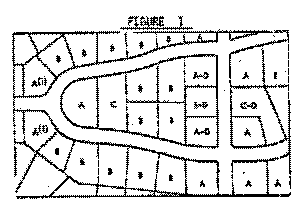
In the diagram:
A = Corner lot, defined as a lot located at the intersection of two or more streets. A lot abutting on a curved street or streets shall be considered a corner lot if straight lines drawn from the foremost points of the side lot lines to the foremost point of the lot meet at an interior angle of less than 135 degrees. See lots marked (1) in the diagram.
B = Interior lot, defined as a lot other than a corner lot with only one frontage of a street.
C = Through lot, defined as a lot other than a corner lot with frontage on more than one street. Through lots abutting two streets may be referred to as double frontage lots.
D = Reversed frontage lot, defined as a lot on which the frontage is at right angles or approximately right angles (interior angle less than 135 degrees) to the general pattern in the area. A reversed frontage lot may also be a corner lot (A-D in the diagram), an interior lot (B-D) or through lot (C-D).
Master plan, used within the context of the planned unit development provisions, refers to either a preliminary plan, which may be approved by the Goodlettsville Municipal/Regional Planning Commission, or a final plan, which may be approved by the Goodlettsville Municipal/Regional Planning Commission. The "master plan" shall mean the proposal for the development of a planned unit development including, but not limiting to, the requirements for a preliminary plan as stipulated in this title and those for a final plan as stipulated in this title.
Mobile food service vehicle means a food truck, canteen truck or ice cream truck and includes any portable unit that is attached to a motorized vehicle and intended for use in the operation of a food truck, canteen truck or ice cream truck.
Mobile home. See dwelling, mobile home.
Mobile home park means a development which is designed and constructed to accommodate mobile homes.
Mobile home space means a designated area within a mobile home park for the exclusive use of the occupants of a single home.
Mobile home stand means that part of an individual mobile home space which has been reserved for the placement of the mobile home.
Motel means an establishment providing transient lodging which includes a 24 hour front desk attendant, room service, may or may not include restaurants but no in-room food preparation and in which the guest rooms are accessible from outdoor parking areas or walkways and are rented on a less than monthly basis.
Non-complying means:
(a)
Any lawful building or other structure which does not comply with any one or more of the applicable bulk regulations, or
(b)
Any lawful use other than a nonconforming use, which does not comply with any part of any one or more of the applicable regulations pertinent to:
(i)
Location along district boundary;
(ii)
Signs; or
(iii)
Accessory off-street parking and loading; either on the effective date of this title or as a result of any subsequent amendment.
(c)
Any lot of record which, at the time of adoption of this title, does not contain sufficient lot area to meet the area requirements for the district in which it is located.
Non-conforming use means a use of a building or other structure or of a tract of land which does not conform to any one or more of the applicable use regulations of the district in which it is located, either on the effective date of this title or as a result of any subsequent amendment.
Overall density means the dwelling units per gross acre of the total area within a residential development.
Party wall means a wall on an interior lot line separating two individual dwelling units which are attached at that wall and which is constructed as a fire wall extending from the footings through the roof without openings and would prohibit the spread of fire from one dwelling unit to another.
Person means an individual, firm, partnership, corporation, company, association, joint stock association, or body politic, and includes a trustee, receiver, assignee, administrator, executor, guardian, or other representative.
Planned unit development means a development of land under unified control to be planned and developed as a whole in a single development operation or a definitely programmed series of phases. A planned unit development (PUD) includes all principal and accessory structures and uses related to the character of the development and is built according to general and detailed plans for all buildings, streets, utilities, drainage facilities, lots, building locations and landscaping. The development may include areas, facilities and improvements for common use and enjoyment that are and will continue to be privately-owned and maintained.
Principal activity means an activity which fulfills a primary function of an establishment, institution, household, or other entity.
Required yard means that portion of a zone lot that is required by the specific district regulations to be open from the ground to the sky and may contain only explicitly listed obstructions.
Residence means a building or part of a building containing one or more dwelling units or rooming units, including one-family or two-family houses, multiple dwellings, boarding or rooming houses, or apartment hotels. However, residences do not include:
(a)
Such transient accommodations as transient hotels, motels, tourist homes, or similar establishments, or
(b)
Dormitories, fraternity or sorority houses, monasteries, or convents, or similar establishments containing group living or sleeping accommodations, or
(c)
Nurses' residences, sanitariums, nursing homes, convalescent homes, rest homes, or other sleeping or living accommodations in community facility buildings or portions of buildings used for community facilities, or
(d)
In a mixed building, that part of the buildings used for a non-residential uses, except uses accessory to residential use.
Rooming unit means a unit of occupancy of semi-permanent residential activity.
Semi-permanent residential establishment means an establishment where lodging is provided for compensation partly on a monthly or longer basis and partly for a shorter time period, but excluding institutional living arrangements involving the provision of a specific kind of forced residence, such as nursing homes, orphanages, half-way houses, asylums and prisons.
Setback line means a line running parallel to the street which establishes the minimum distance the principal building must be setback from the street line.
Short term rental property (STRP) is defined as a residential dwelling unit, containing not more than five sleeping rooms, that are used and/or advertised for transient occupancy.
Single ownership means a proprietary interest of a landowner as defined herein.
Single room occupancy (SRO) residential facility means an establishment providing multiple single room rental units with or without cooking facilities on a monthly or longer basis. These facilities shall be considered to be transient habitation for use; provided however, that due to the duration of stay of the rentals, for zoning purposes an SRO shall be classified as a residential activity.
Story means a portion of a building between the surface of any floor and the surface of the floor next above it, or, if there is no floor above it, the space between such floor and the ceiling next above it, provided that the following shall not be deemed a story:
(a)
A basement or cellar if the finished floor level directly above is not more than six feet above the average adjoining elevation of finished grade; or
(b)
An attic or similar space under a gable, hip, or gambrel roof, where the wall plates of any exterior walls are not more than two feet above the floor of such space; and further provided, that a story shall not exceed 14 feet between floors.
Street means a publicly maintained right-of-way, other than an alley, which affords a primary means of access to abutting property.
Street line means a lot line dividing a lot from an abutting street.
Structure means an object constructed or installed by man, including but not limited to buildings, signs, towers, smokestacks, and overhead transmission lines.
Tourist oriented limited manufacturing means a limited scale manufacturing activities including the processing, assembling, packaging, treatment, or fabrication of beverage and food products, clothes, furniture, furnishings, and similar uses oriented toward tourist retail sales and services and the facility shall include on-site retail sales and services of the products manufactured at the facility.
Transient means any person who exercises occupancy or is entitled to occupancy of any rooms, lodgings or accommodations for a period of less than 30 continuous days.
Use means the performance of a function or operation which constitutes the use of land.
Use and occupancy permit means a written permit issued by the codes administrator required before occupying or commencing to use any building or other structure or any zone lot.
Yard means that part of a zone lot extending open and unobstructed from the lowest level to the sky along the entire length of a lot line, and from a lot line equivalent from a depth or width set forth in the applicable regulations.
Yard, diagram means the following "yard diagram" (figure 2) shall be used in clarifying the usage of the "line" and "yard" definitions of this title:
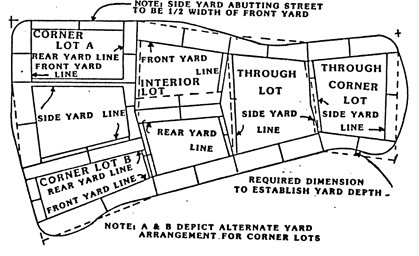
Yard, front means extending along the full length of a front lot line. In the case of a corner lot, a yard of at least full depth required for a front yard in these regulations, and extending along the full length of a street line shall also be established. Each lot shall have a designated front yard.
Yard, rear means an open space, except for permitted accessory structures, extending for the full length of a rear lot line.
Yard, side means an open unoccupied space extending along a side lot line from the required front yard to the required rear yard. In the case of a corner lot, any yard which abuts a street line and which is not designated a front yard shall be considered a side yard and shall meet the same requirements as a front yard. In the case of a through lot, side yards shall extend between the required front yards, except when such corner lots are required by these regulations specifically to have more than one front yard.
Zone or zoning lot means a parcel of contiguous land which is or may be developed or utilized under one ownership as a site for a use or group of uses and which is of at least sufficient size to meet minimum zoning requirements for use, coverage, and area, and to provide such yards and other open spaces as are herein required. Such lot shall have minimum frontage on an improved, dedicated and accepted public street, or on an approved private street, and may consist of:
(a)
A lot of record, a portion of a lot of record, a combination of lots of records; or a parcel described by metes and bounds;
(b)
A tract of land, either un-subdivided or consisting of two or more contiguous lots of record, located within a single block, which on the effective date of this title or any subsequent amendment was in single ownership, or
(c)
A tract of land within a single block, which at the time of filing for a zoning permit (or, if no zoning permit is required, at the time of filing for a use and occupancy permit) is designated by its owner or developer as a tract all of which is to be used, developed, or built upon as a unit under single ownership.
For the purpose of this definition, the ownership of a zone lot shall be deemed to include a lease of not less than 50 years duration as defined under "landowner."
Zoning permit means a written permit issued by the codes administrator that is required before commencing any construction, reconstruction, or alteration of any building or structure or before establishing, extending, or changing any activity or use on any zone lot and may be construed the same as a building permit required by the building code.
(Ord. #06-674, June 2006, modified, as amended by Ord. #14-817, May 2014, Ord. 16-869, July 2016, Ord. #17-886, Jan 2017, Ord. #17-905, July 2017, Ord. #18-915, April 2018, Ord. #18-928, Jan. 2019 Ch4_1-23-20, and Ord. #19-954, Oct. 2019 Ch4_1-23-20, Ord. #21-985, Feb. 2021 Ch5_02-10-22, Ord. #21-994, May 2021 Ch5_02-10-22, and Ord. #21-1008, Sept. 2021 Ch5_02-10-22; Ord. No. 22-1042, § 1(Exh. A), 8-11-2022; Ord. No. 22-1056, § 1(Exh. A), 1-12-2023; Ord. No. 25-1115, § 1, 6-12-2025)
Sec. 14-202. - Use classification.
(1)
General classification rules. The provisions of this chapter shall be known as the use classifications. The purpose of these provisions is to classify land uses into a number of specifically defined types on the basis of common functional characteristics and similar compatibility with other uses, thereby with criteria which are directly relevant to the public interest. These provisions shall apply throughout the zoning regulations. Where there is a question concerning the appropriate activity classification for any use not listed herein, the board of appeals shall make the determination based upon the characteristics of the unlisted use.
(2)
Listing of activity classifications. All activities are hereby classified into the following activity types:
(a)
Residential activities:
Permanent:
(i)
Dwelling, attached.
(ii)
Dwelling, one-family detached.
(iii)
Dwelling, semi-attached.
(iv)
Dwelling, two-family detached.
(v)
Dwelling, mobile home.
(vi)
Dwelling, multi-family.
(vii)
Mobile home park.
Semi-permanent:
(i)
Apartment hotel.
(ii)
Boarding or rooming houses.
(iii)
Residential hotel.
(b)
Community facility activities:
(i)
Administrative.
(ii)
Community assembly.
(iii)
Community education.
(iv)
Cultural and recreation services.
(v)
Essential service.
(vi)
Extensive impact.
(vii)
Health care.
(viii)
Institutional care.
(ix)
Intermediate impact.
(x)
Personal and group care facilities.
(xi)
Religious facilities.
(c)
Commercial activities:
(i)
Animal care and veterinarian services.
(ii)
Automotive parking.
(iii)
Automotive repair and cleaning.
(iv)
Automotive servicing.
(v)
Building materials and farm equipment.
(vi)
Consumer repair services.
(vii)
Construction sales and services.
(viii)
Convenience commercial.
(ix)
Entertainment and amusement services.
(x)
Financial, consulting, and administrative.
(xi)
Food and beverage service.
(xii)
Food service drive-in and drive-thru.
(xiii)
General business and communication services.
(xiv)
General personal service.
(xv)
General retail trade.
(xvi)
Group assembly.
(xvii)
Medical and professional services.
(xviii)
Scrap operations.
(xix)
Transient habitation.
(xx)
Transport and warehousing.
(xxi)
Undertaking services.
(xxii)
Vehicular, craft, and related equipment sales, retail and delivery.
(xxiii)
Wholesale sales.
(d)
Manufacturing activities:
(i)
Limited.
(ii)
Intermediate.
(iii)
Extensive.
(e)
Agricultural, resource production, and extractive activities:
(i)
Agricultural services.
(ii)
Crop and animal raising.
(iii)
Mining and quarrying.
(iv)
Plant and forest nurseries.
(v)
Confined animal feeding operations.
(3)
Accessory uses. In addition to the principal activities expressed above, each activity type shall be deemed to include activities customarily associated with, and appropriate, incidental, and subordinate to the principal activity. Such accessory activities shall be controlled in the same manner as principal activities except as otherwise expressly provided in this title.
Such accessory activities may include, but are not limited to, the activities indicated below:
(a)
Off-street parking and loading serving a principal activity, whether located on the same zone lot or on a different zone lot, but only if the facilities involved are reserved for the residents, employees, patrons or other persons participating in the principal activity.
(b)
Home occupations accessory to a residential activity shall be carried on within a dwelling unit, or rooming unit, or by one or more occupants of the dwelling unit or rooming unit subject to further restrictions contained in subsection 14-208(1)(o). Home occupation shall not include the manufacture and repair of transportation, equipment, a barbershop, a beauty shop, parlor or salon, or any similar type of operation where clientele or patrons are served on the premises.
(c)
Child care for four or less pre-teenage children. The dwelling unit in which this activity occurs shall meet all applicable state and local regulations.
(d)
Child care for pre-teenage children when operated by a health care, commercial or industrial activity where the care is provided solely for the children of their employees. The facility shall be located on the same zone lot as the principal activity and meet all applicable state and local regulations for a day care center for children.
(e)
Residential occupancy in connection with a principal non-residential activity on the same zone lot.
(f)
Operation of a cafeteria for employees, residents, patrons or other participating in the principal activity by an organization engaged in a community facility activity on the same zone lot. Where the principal activity is permitted by conditional use only, an accessory cafeteria must be approved as a part of the action granting said permit.
(g)
Sale of goods on the same zone lot as a principal community facility activity, but only if such goods are available only to persons participating in the principal activity.
(h)
Production of goods for sale by a firm engaged in a principal commercial activity on the same zone lot, but only if:
(i)
All goods so produced are sold at retail by the same firm either on the same or other zone lots;
(ii)
Such production does not occupy more than 49 percent of the total floor area and open sales, display, storage and service area occupied by such firm on the zone lot;
(iii)
Such production does not in any case occupy more than 2,000 square feet of such floor area; and
(iv)
Such production only be permitted in an enclosed building.
(i)
Storage of goods sold by a principal commercial activity engaged in by the same firm on the same zone lot, and such storage does not occupy more than 49 percent of the total floor area.
(j)
Operation of an administrative office of a firm engaged in a principal manufacturing or commercial activity on the same zone lot, but only if such office does not occupy more than 49 percent of the total floor area and open sales, display, storage, production, and service area occupied by the same firm on the same zone lot.
(k)
Temporary construction, grading, and demolition activities which are necessary and incidental to the development of facilities on the same zone lot, or on another of several zone lots being developed at the same time.
(l)
Temporary conduct of a real estate sales office which is necessary and incidental to, and located on the site of, a subdivision being developed into ten or more zone lots.
(m)
Storage of flammable and combustible liquids and gases, provided that:
(i)
The provisions of this section regulate the above ground storage of flammable and combustible liquids and gases when such storage is an accessory to another principal, residential or commercial activity on the same zone lot. The provisions which regulate the storage of flammable and combustible liquids and gases as a matter of right in CG districts are contained in the performance standards for commercial districts. The provisions which regulate the storage of flammable and combustible liquids and gases in industrial districts are contained in the performance standards for industrial districts.
(ii)
In agricultural districts, no more than 1,000 gallons of gasoline or diesel fuel, as an accessory activity, may be stored above ground on a single zone lot.
(iii)
In all zoning districts, no more than 500 gallons of home heating oil or liquefied petroleum gas (LPG) per dwelling unit, up to a total of 5,000 gallons on a single zone lot, may be stored above ground as an accessory activity to a residential activity.
(iv)
In all zoning districts other than the agricultural districts above, no more than 25 gallons or water gallon equivalents of any other flammable or combustible liquid or gas may be stored above ground on a single zone lot as an accessory activity to a residential activity.
(v)
In all zoning districts where the sale of fuel for motor vehicle occurs as an accessory use to convenience sales and service or to automotive servicing, no more than 5,000 gallons of gasoline, diesel fuel or liquefied petroleum gas (LPG) may be stored above ground on the same zone lot as a part of such accessory sales.
(vi)
In any and all zoning districts where retail sales are permitted, flammable and combustible liquids and gases may be stored, displayed and conveyed in the amounts and containers customarily associated with such sales.
(vii)
In any and all zoning districts, up to 5,000 gallons of heating oil or liquefied petroleum gas (LPG) may be stored above ground for heating non-residential buildings.
(viii)
In any and all zoning districts, no above-ground storage tank, container or vessel in which flammable or combustible liquids or gases are kept may be located in any required front, rear or side yard. Further, the location, construction and installation of all such tanks, containers or vessels must meet the provisions of the International Building Code and the most current NFPA standard.
(4)
Classification of combinations of principal activities. The following rules shall apply where a single zone lot contains activities which resemble two or more different activity types and which are not classified as accessory activities.
(a)
Separate classification of each establishment. The principal activities on a single zone lot by each individual establishment, management, or institution shall be classified separately.
(b)
Separate classification of different classes of activities conducted by a single establishment. If the principal activities conducted by a single establishment, management, or institution resemble two or more different classes of activities, the principal activities of each class shall be classified separately.
(c)
Classification of different activities within the same class, conducted by a single establishment. If principal activities conducted on a single zone lot by a single establishment, management, or institution resemble two or more activity types within the same class of activities, all such principal activities shall be classified in the activity type within said class the description of which type most closely portrays the overall nature of such activities.
(5)
Residential activities.
(a)
Permanent residential. The occupancy of living accommodations on a monthly or longer basis with none of the living units under the same ownership or management on the same zone lot being occupied on a less-than-monthly basis. This shall not include institutional living arrangements involving the provision of any kind of special care or forced residence such as nursing homes, orphanages, asylums, half-way houses or prisons, except as provided by general law of the state. The following dwelling types as defined by this title are permanent residential activities, however, only those dwelling types as indicated by individual district regulations may be permitted therein.
(i)
Dwelling, attached.
(ii)
Dwelling, one-family detached.
(iii)
Dwelling, two-family detached.
(iv)
Dwelling, semi-detached.
(v)
Dwelling, mobile home.
(vi)
Dwelling, multi-family.
(vii)
Mobile home park.
(b)
Semi-permanent residential. The occupancy of living accommodations partly on a monthly or longer basis and partly for a shorter time period, but with less than 30 percent of the living units under the same ownership or management on the same zone lot being occupied on a less-than-monthly basis. This shall not include institutional living arrangements involving the provision of a special kind of care or forced residence, such as nursing homes, orphanages, asylums, half-way houses, and prisons, except as provided by general law of the state, nor any type dormitory, fraternity or sorority houses, or similar group living or sleeping accommodations. The following dwelling or rooming unit types as defined by this title are considered as semi-permanent residential activities, however, only those dwelling or rooming unit types as indicated by individual district regulations may be permitted therein.
(i)
Apartment hotel.
(ii)
Boarding or rooming house.
(iii)
Residential hotel.
(6)
Community facility activities.
(a)
Administrative services include the activities typically performed by public administrative offices. These activities would include:
(i)
City, county, state, and federal offices.
(ii)
Civil defense facilities.
(iii)
Court buildings.
(iv)
Fire department facilities.
(v)
Police department facilities.
(vi)
Post offices.
(b)
Community assembly includes the activities typically performed by or at institutions and installations for various social, athletic, and recreational purposes. These activities do not include facilities primarily utilized for profit. They would include:
(i)
Civic, social, fraternal, and philanthropic associations.
(ii)
Private (nonprofit) clubs, lodges, meeting halls, and recreation centers.
(iii)
Temporary nonprofit festivals.
(c)
Community education includes the activities of an educational nature typically performed by the following institutions:
(i)
Public and private nursery schools.
(ii)
Kindergarten, primary, and secondary schools.
This does not include special training and schooling services offered by private individuals for profit nor technical schools, colleges, or universities.
(d)
Cultural and recreational services includes the activities of a cultural or recreational nature which are either owned by, or operated for the use and enjoyment of, the general public. This does not embrace such facilities which are privately-owned and operated for profit. These activities would include:
(i)
Art galleries.
(ii)
Libraries.
(iii)
Museums.
(iv)
Parks, playgrounds, and playfields.
(v)
Planetariums and aquariums.
(vi)
Recreational centers and gymnasiums.
(vii)
Swimming pools and beaches.
(viii)
Zoological and botanical gardens.
(e)
Essential services includes the maintenance and operation of the following installations:
(i)
Electrical and gas substations.
(ii)
Pumping facilities for water and sewer systems.
(iii)
Telephone switching facilities.
(f)
Extensive impact facilities includes the activities that have a high degree of impact upon surrounding land use due to their hazards or nuisance characteristics, as well as traffic generation, parking, and land requirements and typically performed by, or the maintenance and operation of, the following institutions and installations:
(i)
Airports, air cargo terminals, heliports, or other aeronautical devices.
(ii)
Correction and detention institutions.
(iii)
Electricity generating facilities and transmission lines.
(iv)
Garbage incineration plants including co-generation facilities.
(v)
Major fuel transmission lines and facilities.
(vi)
Major mail processing centers.
(vii)
Military installations.
(viii)
Public and private utility corporations
(ix)
Truck yards, including storage yards.
(x)
Radio and television transmission facilities.
(xi)
Railroad, bus, and transit terminals.
(xii)
Railroad yards and other transportation equipment.
(xiii)
Marshaling and storage yards.
(xiv)
Sanitary landfill.
(xv)
Sewage treatment plants.
(xvi)
Stadiums, sports arenas, auditoriums, and bandstands.
(xvii)
Water treatment plants.
(g)
Health care facilities includes the activities typically performed by the following institutions but not including the offices, clinics, etc., of private physicians or other health care professionals:
(i)
Centers for observation or rehabilitation.
(ii)
Convalescent homes.
(iii)
Hospitals.
(iv)
Medical clinics.
(h)
Institutional care facilities includes activities providing residential services to unrelated individuals who are delinquent minors, psychotic, or paroled from detention institutions. These activities would include:
(i)
Group living arrangements.
(ii)
Halfway houses.
(i)
Intermediate impact facilities includes the activities that have a significant effect upon surrounding land uses due to their traffic generation characteristics, parking requirements, land requirements, or potential nuisances and typically performed by, or the maintenance and operation of, the following institutions or installations:
(i)
Cemeteries, columbariums, and mausoleums.
(ii)
Colleges, junior colleges, and universities, but excluding profit-making business schools.
(iii)
Golf.
(iv)
Water storage facilities.
(j)
Personal and group care facilities includes the activities and facilities to provide for the care of pre-teenage children, excluding living accommodations for the clientele, the elderly and/or disabled and handicapped persons needing special care or supervision but excluding facilities oriented toward medical care and also excluding facilities for delinquent, criminally dangerous, or psychotic people. These activities would include:
(i)
Associations for physically or mentally handicapped persons.
(ii)
Child care facilities.
(iii)
Group home for physically or mentally handicapped persons.
(iv)
Nursing homes.
(v)
Retirement or rest homes (without health care).
(k)
Religious facilities includes the activities or facilities utilized by various religious organizations for worship functions but excluding any facility the primary function of which is to produce products or printed matter for sale or general distribution, any retail sales or commercial overnight accommodations. The activities include:
(i)
Chapels.
(ii)
Churches.
(iii)
Convents or monasteries.
(iv)
Sanctuaries.
(v)
Synagogues.
(vi)
Temples.
(6)
Commercial activities.
(a)
Animal care and veterinarian services includes the provision of animal care, treatment, and boarding services.
(i)
Pet day care.
(ii)
Pet grooming and cleaning.
(iii)
Veterinarian clinics and kennels.
(b)
Automotive parking includes the parking and/or storage of motor vehicles but excluding junk or scrap vehicles.
(c)
Automotive repair and cleaning includes establishments primarily engaged in furnishing auto repair services to the general public. The activities include:
(i)
Auto cleaning and detailing services.
(ii)
Auto engine repair and replacement shops.
(iii)
Auto glass repair and replacement shops.
(iv)
Auto inspection and diagnostic services.
(v)
Auto paint shops.
(vi)
Auto towing services.
(vii)
Auto transmission repair shops.
(viii)
Car washes.
(ix)
Radiator and muffler shops.
(x)
Tire retreading and repair shops.
(d)
Automotive servicing includes the sale, from the premises, of goods and the provision of services which are generally required for the operation and maintenance of motor vehicles and fulfilling motorist's needs. Activities include:
(i)
Gasoline service stations, excluding fuel services for trucks over 10,000 pounds in gross vehicle weight.
(ii)
Sale and installation of tires, batteries, accessories, and replacement items.
(iii)
Lubricating services.
(iv)
Performance of minor repairs (brakes, tune-up and similar service).
(v)
Wheel alignment.
(e)
Building materials and farm equipment includes the retail and wholesale sales and storage of materials used in the construction of buildings and other structures as well as the retail and wholesale sale and storage of implements, equipment, feed and seed used in agricultural pursuits.
(i)
Farm equipment and supplies.
(ii)
Feed milling and sales.
(iii)
Heating, plumbing, and electrical supplies.
(iv)
Lumber and other building materials dealers.
(v)
Seed storage and sales.
(f)
Consumer repair services includes the servicing and repair of appliances, furniture, and equipment generally used or owned by individuals.
(i)
Electrical repair shops.
(ii)
Furniture repair, upholstery and refinishing shops.
(iii)
Gunsmith shops.
(iv)
Instrument repair shops.
(v)
Lawn mower repair shops.
(vi)
Locksmith shops.
(vii)
Office equipment cleaning and repair.
(viii)
Refrigeration and air conditioning repair.
(ix)
Saddlery repair shops.
(g)
Construction sales and services includes the offices, buildings, and shops of various types of contractors as well as incidental on-site construction and storage.
(i)
Builder's hardware.
(ii)
Carpentering contractors.
(iii)
Concrete contractors.
(iv)
Excavation contractors.
(v)
General building contractors.
(vi)
Glazing contractors.
(vii)
Highway and street construction contractors.
(viii)
Masonry, stonework, tile setting and plastering contractors.
(ix)
Painting and paper hanging.
(x)
Plumbing, heating and electrical contractors.
(xi)
Roofing and sheet metal contractors.
(h)
Convenience commercial includes the retail sale, from the premises, of groceries, drugs and other frequently needed personal convenience items, as well as the provision of personal convenience services that are typically needed frequently or recurrently; provided that no establishment shall exceed 5,000 square feet of gross floor area unless noted below.
(i)
Bakeries.
(ii)
Barber shops.
(iii)
Beauty shops.
(iv)
Drug stores.
(v)
Grocery stores.
(vi)
Hardware stores (no outside storage).
(vii)
Laundry and dry cleaning pick-up stations.
(viii)
Newsstands (excluding adult bookstores as defined).
(ix)
Self-service gasoline pumps, excluding fuel services for trucks over 10,000 pounds in gross vehicle weight.
(x)
Shoe repair services.
(xi)
Automated car washes for passenger vehicles in the CPUD zoning districts. The non-customer services areas are excluded from the square footage limitation.
(i)
Entertainment and amusement services includes the provision of cultural, entertainment, educational and athletic services, other than those classified as community facility activities, to assembled groups of spectators or participants.
(i)
Art galleries (commercial).
(ii)
Batting and golf driving ranges.
(iii)
Bowling alleys and billiard parlors.
(iv)
Coin operated amusement arcades.
(v)
Exhibition halls and auditoriums.
(vi)
Motion picture theaters (excluding adult entertainment as defined).
(vii)
Skating rinks.
(viii)
Theaters—Legitimate.
(ix)
Theatrical producers, bands, orchestras and entertainers.
(j)
Financial, consultative and administrative services includes the provision of financial, insurance, real estate brokerage and general business offices, as well as advice, designs, information or consultations of a professional nature (other than those classified as community facility activities, medical service, or business and communication services).
(i)
Accounting, auditing, and bookkeeping services.
(ii)
Agricultural credit institution.
(iii)
Artists' studios (excluding commercial artists).
(iv)
Attorneys and law offices.
(v)
Banking and bank-related functions.
(vi)
Consulting scientists.
(vii)
Credit unions.
(viii)
Educational and scientific research services.
(ix)
Engineering, architectural, and planning services.
(x)
Holding and investment organizations.
(xi)
Insurance carriers, agents, brokers, and service.
(xii)
Money management and investment offices.
(xiii)
Real estate brokers, managers and appraisers.
(xiv)
Rediscount and financing institutions for credit agencies other than banks.
(xv)
Savings and loan associations.
(xvi)
Securities commodities, brokers, dealers, and exchanges.
(xvii)
Songwriters, music arrangers, writers and lecturers.
(xviii)
Title offices.
(k)
Food and beverage service includes the retail sale of prepared food or beverages for primarily on-premises consumption within the principal structure on the zone lot.
(i)
Bars.
(ii)
Brew pubs.
(iii)
Restaurants.
(l)
Food service drive-in and drive-thru includes the retail sale of prepared food or beverages for either home or on premises consumption either within the principal structure or within a parked car on the same zone lot or with the principal structure having a pick-up window with a drive-thru lane.
(i)
Drive-in restaurants.
(ii)
Restaurants with drive-thru service.
(m)
General business and communication services includes the provision of services of a clerical, goods brokerage, and communications of a minor processing nature, copying and blueprinting services, custom printing (except books) but exclude the sale and/or storage of goods and chattel unless otherwise permitted by this title.
(i)
Advertising agencies and services.
(ii)
Commercial cleaning services.
(iii)
Commercial testing laboratories.
(iv)
Communications services.
(v)
Radio and television broadcasting studios.
(vi)
Telegraph offices and message centers.
(vii)
Telephone exchanges and relay towers.
(viii)
Television and recording production studios.
(ix)
Computer and data processing services.
(x)
Credit reporting, adjustment, and collection agencies.
(xi)
Detective agencies and protective services.
(xii)
Drafting services.
(xiii)
Employment, personnel, and temporary help services.
(xiv)
Exterminating services.
(xv)
Interior decorator and consulting services.
(xvi)
Mailing, reproduction, and commercial art services.
(xvii)
Management, consulting, and public relations services.
(xviii)
Membership organizations.
(xix)
Automobile clubs.
(xx)
Better business bureaus.
(xxi)
Chamber of commerce.
(xxii)
Labor unions.
(xxiii)
Political organizations.
(xxiv)
Professional associations.
(xxv)
News syndicates.
(xxvi)
Photo-finishing services.
(xxvii)
Research and development laboratories.
(xxviii)
Trading stamp services.
(n)
General personal services includes the provision to individuals of informational and instructional services as well as the provision of care and maintenance for personal items. These activities do not include the storage or sale of goods or chattel unless otherwise permitted herein.
(i)
Automatic teller machines (ATM).
(ii)
Barber shops.
(iii)
Beauty shops and salons.
(iv)
Decorating services.
(v)
Laundry, cleaning, and garment services.
(vi)
Mini warehouses (included by conditional use only).
(vii)
Miscellaneous personal services.
(viii)
Clothing rental agencies.
(ix)
Health spas.
(x)
Photographic studios.
(xi)
Shoe repair shops.
(xii)
Special training and schooling services.
(xiii)
Art and music schools.
(xiv)
Barber and beauty schools.
(xv)
Business schools.
(xvi)
Dancing schools/exercise studios.
(xvii)
Driving schools.
(xviii)
Watch, clock and jewelry repair.
(o)
General retail trade includes the retail sales or rental from the premises, primarily for personal or household use, of goods and/or services but excluding goods and services listed in the other classifications herein.
(i)
Antique and second hand merchandise stores.
(ii)
Automotive parts (no exterior storage).
(iii)
Bakeries.
(iv)
Book and stationery stores (excluding adult bookstores).
(v)
Camera stores.
(vi)
Candy, nut and confectionery stores.
(vii)
Children's and infant's stores.
(viii)
Convenience markets including gasoline and diesel fuel sales for cars and trucks.
(ix)
Dairy products stores.
(x)
Department stores.
(xi)
Drapery, curtain, and upholstery stores.
(xii)
Drug stores and proprietary stores.
(xiii)
Family clothing stores.
(xiv)
Floor covering stores.
(xv)
Florists.
(xvi)
Fruit stores and vegetable markets.
(xvii)
Furniture stores.
(xviii)
Furriers and fur shops.
(xix)
Gift shops.
(xx)
Grocery stores.
(xxi)
Hardware store.
(xxii)
Hobby, toy, and game stores.
(xxiii)
Household appliance stores.
(xiv)
Jewelry stores
(xxv)
Lawn and garden supplies, retail nurseries
(xxvi)
Liquor stores.
(xxvii)
Luggage shops.
(xxviii)
Meat and seafood markets.
(xxix)
Men's and boy's clothing and furnishing stores.
(xxx)
Miscellaneous apparel and accessory stores.
(xxi)
Bathing suit stores.
(xxii)
Custom tailors.
(xxiii)
Shirt shops.
(xxiv)
Sports apparel stores.
(xxv)
Uniform stores.
(xxvi)
Miscellaneous general merchandise stores.
(xxvii)
Direct selling organizations.
(xxviii)
Mail order houses.
(xxix)
Miscellaneous home furnishings stores.
(xxx)
Bedding and linen stores.
(xxxi)
Cookware stores.
(xxxii)
Cutlery stores.
(xxxiii)
Glassware and china shops.
(xxxiv)
Lamp and shade shops.
(xxxv)
Paint and wallpaper stores.
(xxxvi)
Music stores.
(xxxvii)
News stands.
(xxxviii)
Radio and television stores.
(xxxix)
Retail bakeries.
(xl)
Sewing and piece goods stores.
(xli)
Shoe stores.
(xlii)
Sporting goods stores.
(xliii)
Specialty smoke and vape shops and similar materials.
(xliv)
Variety stores.
(xlv)
Women's accessory and specialty stores.
(xlvi)
Women's ready-to-wear store.
(p)
Group assembly includes the provision of cultural, entertainment, educational, and athletic services, other than those classified as community facilities, to large groups of assembled spectators and/or participants 150 or more) or that have a substantial potential impact upon adjoining property.
(i)
Amusement parks.
(ii)
Commercial camp grounds.
(iii)
Commercial (recreational) resorts.
(iv)
Commercial sports arenas and playing fields.
(v)
Drag strips.
(vi)
Race tracks (auto, motorcycle, dog, and horse).
(q)
Medical services includes the provision of therapeutic, preventive, or corrective personal treatment services by physicians, dentists, and other practitioners, as well as testing and analysis services of which is provided in an office environment.
(i)
Chiropractors offices.
(ii)
Consulting scientists.
(iii)
Dental offices and laboratories.
(iv)
Optometrists.
(v)
Physicians' offices and clinics (outpatient services only).
(vi)
Psychologists and psychotherapists.
(r)
Scrap operations includes firms engaged in the storage and/or sale, from the premises, of used or waste material or other items except when such activities are incidental to a manufacturing activity.
(i)
Automobile junk yards.
(ii)
Salvage operations.
(s)
Transient habitation includes the provision of lodging services for transient guests. The term shall include five different types of activities as defined in subsection 14-203(3).
(i)
Hotel.
(ii)
Motel.
(iii)
Extended stay hotel/motel.
(iv)
Single room occupancy residential facility (SRO).
(v)
Short-term rental property (STRP).
Bed and breakfast homestay is considered an accessory used to a permanent residential use and approved only by conditional use in the defined residential zoning district.
(t)
Transport and warehousing includes the provision of warehousing, storage, freight handling, shipping, and trucking services.
(i)
Bus and truck maintenance and repair.
(ii)
Food lockers.
(iii)
General warehousing.
(iv)
Household goods storage.
(v)
Packing and crating services.
(vi)
Refrigerated warehousing.
(vii)
Truck stops with facilities for fueling, parking and washing.
(viii)
Truck terminals and freight handling services.
(ix)
Wrecker services.
(u)
Undertaking services includes the provision of undertaking and funeral services involving the care and preparation of the human deceased prior to burial.
(i)
Cemeteries.
(ii)
Funeral homes.
(iii)
Undertakers.
(v)
Vehicular, craft, and related equipment includes the retail or wholesale sale or rental from the premises of watercraft, vehicular and related equipment with incidental maintenance.
(i)
Boat and motor dealers.
(ii)
Mobile home dealers.
(iii)
Motor vehicle dealers.
(iv)
Motorcycle dealers.
(v)
Motor vehicle leasing.
(vi)
Recreational vehicles, including all-terrain vehicles (ATV) and utility trailer dealers.
(w)
Wholesale sales includes the storage and sale from the premises of goods to other firms for resale, as well as the storage of goods and their transfer to retail outlets; but exclude sale or storage of motor vehicles, except for parts and accessories. These would include such uses as:
(i)
Apparel, piece goods, and notions.
(ii)
Automotive parts and supplies.
(iii)
Beer, wine, and distilled alcoholic beverages.
(iv)
Chemicals and allied products.
(v)
Drugs, drug proprietary, and sundries.
(vi)
Electrical goods and appliances.
(vii)
Farm products raw materials.
(viii)
Farm supplies.
(ix)
Furniture and home furnishings.
(x)
Groceries and related products.
(xi)
Hardware, plumbing, and heating equipment and supplies.
(xii)
Lumber and other construction materials.
(xiii)
Machinery, equipment, and supplies.
(xiv)
Metals and minerals.
(xv)
Paints, varnishes, and supplies.
(xvi)
Petroleum and petroleum products.
(xvii)
Sporting, recreational, photographic, and hobby goods.
(xviii)
Tobacco and tobacco products.
(xix)
Toys and supplies.
(8)
Manufacturing activities. Manufacturing activities include the on-site production of:
(a)
Limited manufacturing activities includes the following operations:
(i)
The manufacture, compounding, processing, assembling, packaging, treatment, or fabrication of the following products if all such operations are carried out within completely enclosed buildings:
(A)
Apparel and apparel accessories.
(B)
Art objects.
(C)
Bakery goods.
(D)
Beverages (nonalcoholic).
(E)
Dairy products.
(F)
Instruments for medical, dental, engineering, scientific, and other professional purposes.
(G)
Optical instruments and lens.
(H)
Printed matter.
(I)
Signs.
(ii)
Activities and operations which includes the following:
(A)
Book binding.
(B)
Cabinets and similar products.
(C)
Data processing service.
(D)
Photocopying.
(E)
Photoengraving.
(F)
Precision machining of dies, jigs, and fixtures.
(G)
Printing.
(H)
Publishing.
(I)
Record pressing.
(J)
Schools for instruction of industrial processes such as welding, HVAC, etc.
(K)
Upholstering.
(L)
Welding.
(b)
Intermediate manufacturing activities includes the following:
(i)
The manufacture, compounding, assembling, packaging, treatment or fabrication of products except for the following:
(A)
Cotton seed oil.
(B)
Explosives.
(C)
Fireworks.
(D)
Organic fertilizers.
(ii)
Other activities and operations except for the following:
(A)
Abrasive, asbestos, and non-metallic mineral processing.
(B)
Arsenals.
(C)
Asphaltic cement plants.
(D)
Atomic reactors.
(E)
Automobile wrecking yards, scrap and waste materials.
(F)
Cement and/or concrete plants.
(G)
Chemical manufacturing in excess of one ton per day.
(H)
Cotton ginning.
(I)
Fat rendering.
(J)
Foundries.
(K)
Grain milling.
(L)
Offal processing.
(M)
Ore reduction.
(N)
Paper mills.
(O)
Petroleum defining.
(P)
Pulp manufacturing.
(Q)
Radioactive materials waste handling.
(R)
Rolling and finishing of ferrous materials.
(S)
Slaughtering of animals.
(T)
Smelting and refining of metals and alloys.
(U)
Steel works (other than those listed).
(V)
Tanning.
(W)
Waste disposal by compacting or incineration, as a principal use.
(c)
Extensive manufacturing activities includes all of the exceptions listed above under intermediate manufacturing except for the following:
(i)
Arsenals.
(ii)
Atomic reactors.
(iii)
Explosives manufacturing and storage.
(iv)
Fireworks manufacturing.
(v)
Hazardous wastes storage and/or transfer.
(vi)
Radioactive waste handling.
(d)
High technology manufacturing, assembly and processing. Manufacturing, assembly and/or processing subject to the following standards:
(i)
All noise and vibration shall be limited to the interior of the structure;
(ii)
The use emits no odors, dust, gas, radiation, broadcast interference, glare, or hazard; and
(iii)
The nature of the business is such that products developed require employees with technical knowledge of the process and product.
(9)
Agricultural, resource production, and extractive activities.
(a)
Agricultural services includes various activities designed to provide needed services for agricultural activities and are appropriately located in close proximity thereto.
(i)
Crop drying, storage, and processing.
(ii)
Crop planting, cultivating, and protection services.
(iii)
Horticultural services.
(iv)
Soil preparation services.
(v)
Veterinary services for large animals.
(b)
Confined animal feeding operations includes facilities and operations involved in the storage and feeding (other than pasture grazing) of animals for resale or slaughter within confined fenced spaces (also known as a feed lot) or within buildings.
(c)
Crop and animal raising includes the raising of tree, vine, field, forage, and other plant crops intended to provide food or fiber, as well as keeping, grazing, or feeding animals for animal products, animal increase, or value increase, but specifically excluding confined animal feeding operations and facilities for the processing, packaging, or treatment of agricultural products.
(i)
Dairies.
(ii)
Farms.
(iii)
Raising of plants, animals, and fish.
(iv)
Truck gardens.
(d)
Mining, drilling, and quarrying includes operations and facilities either utilized by, or in support of the extraction of minerals, ores, petroleum, and natural gas or in the quarrying and collection of stone, gravel, sand, clay, and other non-metallic minerals (i.e., phosphate rock).
(i)
Chemical fertilizer and non-metallic mineral mining.
(ii)
Clay, ceramic, and refractory minerals.
(iii)
Coal mining.
(iv)
Crude petroleum and natural gas production.
(v)
Metal ore and mineral mining.
(vi)
Sand and gravel quarrying.
(vii)
Stone quarrying.
(e)
Plant and forest nurseries includes the cultivation for sale of horticultural specialties, such as flowers, shrubs, and trees, intended for ornamental, landscaping, or tree planting purposes.
(i)
Forest nursery.
(ii)
Plant nursery.
(Ord. #06-674, June 2006, as amended by Ord. #12-784, Aug. 2012, and Ord. #19-954, Oct. 2019 Ch4_1-23-20, and Ord. #21-1019, Dec. 2021 Ch5_02-10-22; Ord. No. 24-1100, § 1(Exh. A), 1-9-2025)
Sec. 14-203. - Application of regulations.
(1)
Application. No structure shall be constructed, erected, placed or maintained and no land use commenced or continued within the City of Goodlettsville, Tennessee, except as specifically or by necessary implication, authorized by this title. Conditional uses are allowed only on permits granted by the board of zoning appeals upon finding that the specified conditions exist. Where a lot is devoted to a permitted principal use, customary accessory uses and structures are authorized except as prohibited specifically or by necessary implication.
(2)
Scope of regulations.
(a)
New uses, lots, buildings, or other structures. Any new building or other structure or any tract of land shall be used, constructed, or developed only in accordance with the use, bulk, and all other applicable provisions of this title.
(b)
Existing uses, lots, building, or other structures.
(i)
Any existing use legally established prior to the effective date of the ordinance enacting this title, which does not comply with the provisions of the title shall be subject to the nonconforming use provisions in section 14-212 of this title.
(ii)
Any existing lot, parcel, building, or other structure legally established prior to the effective date of the ordinance enacting this title, which does not comply with its provisions, other than use provisions, shall be subject to the non-complying regulations in section 14-212 of this title.
(b)
Alteration of existing buildings and other structures.
(i)
All structural alterations or relocations of existing buildings or structures occurring after the effective date of this title and all enlargements of or additions to existing uses occurring hereafter shall be subject to all regulations of this title which are applicable to the zoning districts in which such building, uses, or land shall be located.
(ii)
Whenever an existing building is expanded or remodeled by more than 33⅓ percent of its square footage within a 24-month period, the entire site shall be brought into compliance with site improvements required by this title including required parking spaces, design and paving of parking lots and driveways, access points to a public street, landscaping and drainage.
(3)
Exceptions, variances and conditional uses. Whenever the zoning ordinance in effect at the time of adoption of the ordinance enacting this title has authorized any use which is not permitted as of right by issuing a variance, exception, or permit to locate in a district, such authorization may be continued, changed, extended, enlarged, or structurally altered only as set forth in section 14-212.
(4)
Renewals of uses where exceptions, variances or conditional uses granted. Where no limitation of the use was imposed at the time of authorization, such use may be continued. Where such use was authorized subject to a term of years, such use may be continued until the expiration of the term, and thereafter, the agency or similar constituted agency which originally authorized such use may, in appropriate cases, extend the period of continuance for one or more terms of not more than five years each. The agency may prescribe appropriate conditions and safeguards to minimize adverse effects of such use on the character of the neighborhood.
(5)
Change of uses where exceptions, variances, or conditional uses granted. In no event shall any use which was granted upon exception, variance, or condition, be changed, and no agency shall be empowered to permit such use to be changed, except to a conforming use or nonconforming use as provided for in section 14-212. For the purposes of this section a change of use is a change to another use either under the same activity type or any other activity type or major class of activity; however, a change in occupancy or ownership shall not, by itself, constitute a change in use.
(6)
Legislative intent of administrative application of zoning regulation. Whenever, in the course of administration and enforcement of this title, it is necessary or desirable to make any administrative decisions, then, unless other standards are provided in this title, the decision shall be made so that the result will not be contrary to the spirit and purpose of this title or injurious to the surrounding neighborhood.
(Ord. #06-674, June 2006)
Sec. 14-204. - Establishment of districts and provisions for official zoning map.
(1)
Establishment of districts.
(a)
Regular districts. In order to implement all purposes and provisions of this title, the following districts are hereby established:
(i)
Residential districts:
A—Agricultural district
R-40—Low density residential district
R-25—Low density residential district
R-15—Medium density residential district
R-10—Medium density residential district
R-7—High density residential district
Mobile home park district
(ii)
Commercial districts:
CC—Commercial core district
CG—Commercial general district
CS—Commercial service district
CSL—Commercial service limited district
INT—Interchange overlay district
OP—Office professional
(iii)
Industrial districts:
IC—Industrial commercial district
IG—Industrial general district
(b)
Special districts. The following are hereby established as special districts subject to further provisions as set forth in this title.
(i)
Floodplain district
(ii)
Planned unit development districts
(iii)
Commercial core overlay
(2)
Provisions for official zoning maps.[2]
(a)
Incorporation of maps. The boundaries of districts established by this title are shown on the official zoning maps, which are hereby incorporated into the provisions of this title. The zoning maps in their entirety, including all amendments shall be as much as part of this title as if fully set forth and described herein.
(b)
Identification and alteration of the official zoning map. The official zoning map shall be identified by the signature of the mayor attested by the city recorder, and bearing the seal of the city under the following words: "This is to certify that this is the official zoning map referred to in chapter 5 of Ordinance No. 06-674 of the City of Goodlettsville, Tennessee," together with the date of the adoption of this title.
If, in accordance with the provisions of this title and T.C.A. § 13-7-204, changes are made in district boundaries or other matter portrayed on the official zoning maps, such changes shall be entered on the official zoning map promptly after the amendment has been approved by the city commission.
No amendment to this title, which involves matter portrayed on the official zoning map, shall become effective until after such change and entry has been made on said map.
Regardless of the existence of purported copies of the official zoning map, which may from time to time be made or published, the official zoning map, which shall be located in the office of the city recorder, shall be the final authority as to the current zoning status of land and water areas, buildings, and other structures in the city.
(c)
Replacement of official zoning map. In the event that the official zoning map becomes damaged, destroyed, lost, or difficult to interpret because of the nature or number of changes and additions, the city commission may by resolution adopt a new official zoning map which shall supersede the prior official zoning map. The new official zoning map may correct drafting or other errors or omissions in the prior official zoning map, but no such correction shall have the effect of amending the original official zoning map or any subsequent amendment thereof. The new official zoning map shall be identified by the signature of the mayor attested by the city recorder, and bearing the seal of the city under the following words:
"This is to certify that the official zoning map supersedes and replaces the official zoning map adopted June 22, 2006 as part of Ordinance No. 06-674 of the City of Goodlettsville, Tennessee."
All prior official zoning maps or any significant parts thereof shall be preserved, together with all available records pertaining to their adoption or amendment.
(Ord. #06-674, June 2006, as amended by Ord. #13-806, Dec. 2013, and Ord. #22-1028, Feb. 2022 Ch5_02-10-22)
Editor's note— The official zoning map for the City of Goodlettsville and all amendments thereto are of record in the office of the city recorder.
Sec. 14-205. - Residential district regulations.
(1)
Statement of purpose. The residential districts established in this title are designed to promote and protect the health, safety, morals, convenience, order, prosperity, and other aspects of the general welfare. These general goals include, among others, the following more specific purposes:
(a)
To provide sufficient space in appropriate locations for residential developments to adequately meet the housing needs of the present and expected future population of the urban area, with due allowance for the need for a variety of choices in site selections;
(b)
To permit improved movement on the public ways and effectively utilize existing public ways, and as far as possible, to mitigate the effects of heavy traffic and more particularly all through traffic, in residential areas;
(c)
To protect residential areas against flood, fire, explosions, toxic and noxious matter, radiation, and other dangers, and against offensive matter, heat, glare, humidity, and other objectionable influences;
(d)
To protect residential areas against undue congestion, as far as possible, by regulating the density of population, the intensity of activity, and the bulk of buildings in relation to the surrounding land and to one another, and by providing for off-street parking spaces for automotive vehicles;
(e)
To provide for access for light and air to windows and for privacy, as far as possible, by controls over the height of buildings and structures;
(f)
To provide appropriate space for public and private educational, religious, recreational, and similar facilities and public utilities which serve the needs of nearby residents, which generally perform their own activities more effectively in a residential environment, and which do not create objectionable influences; and to coordinate the intensity of residential land use with the appropriate community facilities;
(g)
To promote the most desirable use of land and direction of building development in accordance with a well-considered general plan to promote stability of residential development, to protect the character of the district and its peculiar suitability for particular uses, to conserve the value of land and buildings, and to protect the community's tax revenues;
(h)
To exclude from these districts all buildings and other structures and uses having commercial characteristics whether operated for profit or otherwise, except that conditional uses and home occupations specifically provided for in these regulations for these districts shall be considered as not having such characteristics if they otherwise conform to the provisions of this title.
(2)
Purposes of residential districts. Each residential district has specific purposes as indicated below:
(a)
A—Agricultural districts. These districts are designed to provide permissible areas for the growing of crops, animal husbandry, dairying, forestry and other similar activities, which generally occur and characterize rural rather than urban areas. These districts are designed, furthermore, to provide for very low density residential development where public sanitary service is least practical. In addition, these districts may include areas and lands not suited by reason of soil, geologic, topographic, or other limitations for development. These districts also include community facilities, public utilities, and major recreational facilities, which require large land areas and are appropriately located away from intense urban development.
(b)
R40—Low density residential districts. These districts are designed to provide suitable areas for low density residential development characterized by an open appearance. The residential development will consist of single family detached dwellings and accessory structures. These districts also include community facilities, public utilities, and open uses which serve specifically the residents of these districts, or which are benefitted by an open residential environment without creating objectionable or undesirable influences upon residential developments.
(c)
R25—Low density residential districts. These districts are designed to provide suitable areas for low density residential development characterized by an open appearance. Generally, the residential development will consist of single family detached dwellings and accessory structures. These districts also include community facilities, public utilities, and open uses which serve specifically the residents of these districts, or which are benefitted by an open residential environment without creating objectionable or undesirable influences upon residential developments.
(d)
R15—Medium density residential districts. These districts are designed to provide suitable areas for medium density residential development where sufficient urban services and facilities are provided or where such services can be facilitated prior to development. Generally, the residential development will consist of single family and two-family detached dwellings and accessory structures. These districts also include community facilities, public utilities, and open uses which serve specifically the residents of these districts, or which are benefitted by an open residential environment without creating objectionable or undesirable influences upon residential activities.
(e)
R10—Medium density residential districts. These districts are designed to provide suitable areas for medium density residential development where sufficient urban services and facilities are provided or where such services can be facilitated prior to development. Generally, the residential development will consist of single family and two-family detached and semi-detached dwellings and accessory structures. This class of district is intended also to permit community facility and public utility installations which are necessary to service and to serve specifically the residents of these districts, or which installations are benefitted by and compatible with a residential environment.
(f)
R7—High density residential districts. These districts are designed to provide suitable areas for high density development where sufficient urban facilities are available or where such facilities will be available prior to development. This class of district is intended also to permit community facilities and public utility installations which are necessary to service specifically the residents of the district, or which installations are benefitted by and compatible with a residential environment.
(g)
Mobile home park districts. These districts are designed to provide a high quality environment for individual mobile homes, either owned or leased, in a planned development of mobile homes as defined.
(3)
Use and structure provisions. The uses and structures indicated herein may be permitted within the various residential districts only in the manner and subject to any specific design criteria that apply.
(a)
Uses permitted:
(i)
Principal permitted uses. Principal permitted uses for all residential districts are listed in table I, the land use activity matrix, as presented in appendix A.
(ii)
Permitted accessory uses. In addition to the principal permitted uses, each activity type may include accessory activities customarily associated with, and appropriate, incidental, and subordinate to the principal activity located on the same zone lot. These include:
(A)
Private garages and parking areas;
(B)
Recreation facilities exclusively for the use of the residents;
(C)
Home occupations as defined and subject to further regulations contained in subsection 14-208(1)(o);
(D)
Signs in compliance with the regulations set forth in the Goodlettsville Sign Ordinance;
(E)
Within the a districts, private barns, stables, sheds, and other farm buildings.
Within the A and R-40 districts, chicken coops provided, however, that no commercial chicken coops shall be allowed. Chicken coops shall be located at least 100 feet from any neighboring dwelling and shall be no more than 100 square feet in size.
(b)
Conditional uses. Conditional uses permitted for consideration of the board of zoning appeals are listed in table I.
(c)
Prohibited uses. Any use or structure not specifically permitted by right or conditional use as presented in table I is prohibited.
(4)
Bulk, yard, and density regulations. The regulations appearing below apply to zone lots and buildings or other structures located on any zone lot or portion of a zone lot including all new developments, enlargements, extensions, or conversions; provided, however, that all barns, sheds, silos, or other buildings used exclusively for agricultural purposes shall be exempt from these regulations when located in the agricultural districts. Existing buildings or other structures which do not comply with one or more of the applicable bulk regulations are classified as noncomplying and are subject to the provisions of section 14-212.
(a)
Minimum lot size. Within all residential districts, the minimum size lot and width of lot (measured at the building line) used for residential purposes shall be as established in table II as presented in appendix A.
(b)
Maximum lot coverage. Within all residential districts, the maximum lot coverage by all buildings shall not exceed the percentage of lot area as established in table II as presented in appendix A.
(c)
Maximum floor area ratio. Within all residential districts, the maximum permitted floor area ratio shall be as established in table II as presented in appendix A.
(d)
Maximum permitted height. No building shall exceed the height requirements as established in table II as presented in appendix A.
(e)
Density regulations. The maximum residential density permitted on any zone lot shall be controlled by the development area per dwelling or rooming unit as established in table II as presented in appendix A.
(f)
Yard regulations. Within all residential districts, the minimum yard regulations established in table II as presented in appendix A shall apply.
(g)
Minimum lot area coverage. Within the residential districts, the principal building shall meet the minimum lot area coverage as indicated:
(Ord. #06-674, June 2006, as amended by Ord. #10-747, Sept. 2010)
Sec. 14-206. - Commercial district regulations.
(1)
Statement of purpose. The commercial districts established in this title are designed to promote and protect the health, safety, morals, convenience, order, prosperity, and other aspects of the general welfare. These general goals include, among others, the following:
(a)
To provide sufficient space, in appropriate locations in proximity to established residential areas, for local retail and service trades catering specifically to the recurring shopping needs of the occupants of nearby residences.
(b)
To protect both retail and service developments and nearby residences against fire, explosions, toxic and noxious matter, radiation, and other hazards, and against offensive noise, vibration, smoke, dust and other particulate matter, odorous matter, heat, humidity, glare, and other objectionable influences.
(c)
To protect both retail and service developments and nearby residences against undue congestion, by regulating the intensity of retail and service developments consistent with their marketing functions, by restricting those types of establishments which generate heavy traffic, and by providing for off-street parking and loading facilities.
(d)
To provide sufficient and appropriate space, and in particular sufficient area, to meet the area's expected future need for modern, planned commercial floor space, including the need for off-street parking space in areas where a large proportion of customers come by automobile, and to encourage the tendency of commercial establishments to concentrate in integrated planned developments, to the mutual advantage of both consumers and merchants.
(e)
To provide sufficient space in appropriate locations for commercial districts to satisfy specific functional needs of the area.
(f)
To provide appropriate locations for transitional uses intervening between commercial developments and residential areas, and thereby alleviate the frictions inherent between dissimilar activities.
(g)
To provide sufficient space in appropriate locations for all types of commercial and miscellaneous service activities.
(h)
To prevent indiscriminate mixtures of commercial activity within commercial areas and the scattering of commercial activity along highways and within residential areas.
(i)
To promote the most desirable use of land and direction of building development in accord with a well-considered plan, to promote stability of commercial development, to strengthen the economic base of the area, to protect the character of the districts and their peculiar suitability for particular uses, to conserve the value of land and buildings.
(2)
Purposes of commercial districts. Each commercial district has specific purposes as indicated below:
(a)
CC—Core commercial. This class of district is designed to provide for a wide variety of activities in the central and oldest commercially developed areas of the city and to recognize the intense development pattern.
(b)
CG—Commercial general. This class of district is designed to provide sufficient space in appropriate locations for activities engaged in wholesale trade, the warehousing of products with no objectionable characteristics, limited industrial uses, and compatible services. Other commercial uses are also permitted. These districts should be well separated from residential districts.
(c)
CS—Commercial service. This class of district is designed to provide for a wide range of commercial uses concerned with retail trade and consumer services; amusement and entertainment establishments; automotive and vehicular service establishments; transient sleeping accommodations; eating and drinking places; financial institutions; and offices. The uses in this district service a wide market area and, therefore, ease of automotive access is a requirement. However, it is not intended that this district permit uses which generate large volumes of truck traffic. Appropriate open space between commercial and residential areas is required.
(d)
CSL—Commercial service limited. This class of district is designed to provide for a wide range of commercial uses concerned with retail trade and consumer services; however, certain commercial activities which have lower performance characteristics are excluded. Less building bulk is permitted and more open space is required.
(e)
OP—Office professional. This class of district is designed to provide a low intensity commercial area for appropriate locations and a transitional zone between residential and intense commercial areas. Permitted uses are those which tend to attract small numbers of people and generate lower volumes of traffic. Less building bulk is permitted and more open space is required.
(f)
CCO—Commercial core overlay district. This class of district is designed to create a mixed use area with buildings located close to the street in order to establish a walkable storefront streetscape. The district is an overlay for the base zone districts.
(g)
INT—Interchange overlay district. This class of district is designed to provide for uses which are compatible only with highway travel and the accommodation of all-night and rest-stop services. The purpose of the district is not the establishment or encouragement of local or regional shopping areas which would inhibit the use of the interchange for its primary purpose of access between several highways or between highways and local roads. The interchange overlay district is an overlay for the base zone districts.
(3)
Use and structure provisions. The uses and structures indicated herein may be permitted within the various commercial districts only in the manner and subject to any specific design criteria that apply. All uses shall take place within permanently constructed structures that meet all building code requirements except for temporary uses as authorized.
(a)
Uses permitted:
(i)
Principal permitted uses. Principal permitted uses for all commercial districts are established in table I as presented in appendix A.
(ii)
Permitted accessory uses. In addition to the principal permitted uses, each activity type may include accessory activities customarily associated with, and appropriate, incidental, and subordinate to the principal activity located on the same zone lot. These include, but are not necessarily limited to the following:
(A)
Off-street parking and loading serving a principal activity, whether located on the same zone lot or on a different zone lot, but only if the facilities involved are reserved for the residents, employees, patrons or other persons participating in the principal activity.
(B)
Childcare for pre-teenage children when operated by a health care, commercial or industrial activity where the care is provided solely for the children of their employees. The facility shall be located on the same zone lot as the principal activity and meet all applicable state and local regulations for a day care center for children.
(C)
Residential occupancy in connection with a principal non-residential activity on the same zone lot, but only if:
(1)
No more than one dwelling or rooming unit is permitted,
(2)
The unit is occupied by person(s) employed in the principal non-residential activity located upon the zone lot, and
(3)
The non-residential activity does not constitute a hazardous occupancy.
(D)
Operation of a cafeteria for employees, residents, patrons or others participating in the principal activity by an organization engaged in a community facility activity on the same zone lot. Where the principal activity is permitted by conditional use only, an accessory cafeteria must be approved as a part of the action granting said permit.
(E)
Production of goods for sale by a firm engaged in a principal commercial activity on the same zone lot but only if in the CG or CS districts:
(1)
All goods so produced are sold at retail by the same firm either on the same zone lot;
(2)
Such production does not occupy more than 49 percent of the total floor area and open sales, display, storage and service area occupied by such firm on the zone lot;
(3)
Such production does not in any case occupy more than 2,000 square feet of such floor area; and
(4)
Such production may only be permitted in an enclosed building.
(F)
Storage of goods sold by a principal commercial activity engaged in by the same firm on the same zone lot and in the same principal building, and such storage does not occupy more than 49 percent of the total floor area.
(G)
Operation of an administrative office of a firm engaged in a principal manufacturing or commercial activity on the same zone lot, but only if such office does not occupy more than 49 percent of the total floor area and open sales, display, storage, production, and service area occupied by the same firm on the same zone lot.
(H)
Signs permitted in accordance with the Goodlettsville Sign Ordinance.
(b)
Conditional uses. Conditional uses permitted for consideration of the board of zoning appeals are established in table I as presented in appendix A.
(c)
Prohibited uses. Any use or structure not specifically permitted by right or conditional use established in table I as presented in appendix A is prohibited. The use of a mobile home or similar structure as an office, storage space, retail space, or in any manner is expressly prohibited. Additionally, adult-orientated establishments as defined in title 14, chapter 2, section 14-201 are expressly prohibited.
(4)
Bulk, lot, and open space requirements. The regulations appearing below apply to zone lots and buildings or other structures located on any zone lot or portion of a zone lot including all new development, enlargements, extensions, or conversions.
(a)
Minimum lot size. Within all commercial districts, the minimum size lot and width of lot (measured at the building line) used for commercial purposes shall be as established in table III as presented in appendix A.
(b)
Maximum lot coverage. Within all commercial districts, the maximum lot coverage by all buildings shall not exceed the percentage of lot area as established in table III as presented in appendix A.
(c)
Maximum floor area ratio. Within all commercial districts, the maximum permitted floor area ratio shall be as established in table III as presented in appendix A.
(d)
Maximum permitted height. No building shall exceed the height requirements as established in table III as presented in appendix A.
(e)
Yard regulations. Within all commercial districts, the minimum yard regulations established in table III as presented in appendix A shall apply. The minimum lot width may be reduced 25 feet for lots in the CS, CSL, CG zoning districts when the lot includes adjacent access easements with the dimension of the easement located on and split between the two adjacent lots.
(5)
Other regulations. The following regulations are supplementary and apply as indicated.
(a)
Special provisions applying to required yards and building setbacks along district boundaries coincident with side and rear lot line of zone lot in any residential district.
In all commercial districts, along such portion of the boundary of a commercial district which coincides with a lot line of a zone lot in any residential district the following yard provisions shall apply.
(i)
Special front setback. Regardless of the front yard provisions established for any commercial district, no building located on any zone lot adjacent to any residential district with frontage on the same street shall extend closer to the street than the average of the distances of the buildings located within 100 feet of the lot whereon the commercial activity is located; provided that no building shall be required to setback more than twice the minimum front yard applicable within the commercial district.
(ii)
Special side and rear yards. Along all portions of the boundary of any commercial zone lot where such lot abuts or is contiguous to a side or rear yard of any residential zone lot the minimum yards within the commercial district shall generally conform to the respective yard requirements for the adjoining residential district. However, in no instance shall any rear or side yard required herein have a minimum width or depth of less than ten feet.
(iii)
Buffer yards. Along all portions of the boundary of any commercial zone lot where such lot abuts or is contiguous to any residential zone lot without an intervening public street, an open area, unobstructed from the ground to the sky, shall be provided within the commercial district in accordance with the buffer yard standards contained in subsection 14-205(5)(o).
(iv)
Screening along residential district boundaries. To assist in the prevention of the transmission of light and noise from within any commercial district into any abutting residential district, screening shall be required where such district abuts or is contiguous to any residential district, without an intervening street, alley, or other public way. Such screening shall be provided within the commercial district, but not within a public street or alley, along the entire contiguity of said districts. Screening shall be provided in accordance with the provisions of subsection 14-208(5)(o).
(b)
Special height provisions applicable to commercial zoned properties including commercial planned unit developments within the defined interstate sign districts.
The planning commission may approve increased building height not exceeding seven stories for properties within the defined interstate sign districts and the planning commission may extend the increased building story height to any properties adjacent to the properties within the interstate sign district that are adjacent to 165 or SR 386. The planning commission's review shall include a site plan design proposal including sufficient information to determine that the water utility fire flows and water pressure availabilities and roadway and site design can support fire protection systems and equipment needed for the increased building story heights. The planning commission's review shall also include the visible impact of any adjacent one family detached residential zoned properties and subdivisions. All building proposals exceeding the maximum story height permitted in the commercial zoning district shall include information detailing that the proposed building design will not negatively reduce sun light and air flow onto adjacent properties and public rights-of-way including roadways, sidewalks, and walkways and the building design for portions of building exceeding the maximum story height permitted in the commercial zoning district include building design to support sun light and air flow onto adjacent properties and public rights-of-way including roadways, sidewalks, and walkways.
(c)
Use of required yard areas.
(i)
Within the CC district, the required front yard may be landscaped or used for sidewalk or street furniture locations and may be crossed by driveways. No parking areas shall be permitted. If side yard areas are provided, a minimum of ten feet shall be used for landscaping along the side lot line. Rear yards may be used for parking subject to the provisions of subsection 14-206(a) above.
(ii)
Within the CG districts, the required front yard shall be landscaped but may be crossed by driveways and sidewalks. All other required yard areas may be used for walkways, driveways, or parking subject to the provisions of subsection 14-206(a) above.
(iii)
Within the CS, CSL, and OP districts, all required yard areas shall be landscaped provided than a driveway may penetrate not more than one-half of any such side or rear required yard and subject to the provisions of subsection 14-206(a) above. The front yard may be crossed by driveways or sidewalks but shall not be used for parking.
(iv)
Within all commercial districts in which gasoline sales are permitted, an overhead canopy that is open on all sides may encroach into the required building setback to within 25 feet of the street right-of-way.
(d)
Exterior storage.
(i)
Within the CG and CS districts, exterior storage of goods, materials, or chattel is permitted only in the rear of the principal building provided that vehicular, craft, and related equipment sales may be permitted to display such in the front or side subject to required yard provisions. Waste disposal receptacles shall be located in the rear of the principal building within an enclosure that is constructed of materials similar to the principal building. Such enclosure shall be screened from public view.
(ii)
Within the CC, CSL, and OP districts, exterior storage of goods, materials, or chattel is prohibited. Waste disposal receptacles shall he located in the rear of the principal buildings within an enclosure that is constructed of materials similar to the principal building. Such enclosure shall be screened from public view.
(iii)
All exterior storage areas shall be surfaced to provide a durable, dust-free surface. All areas shall be graded and drained so as to dispose of all surface water accumulated within the area.
(iv)
Except for vehicular, craft, and related equipment sales activities, all exterior storage areas shall be screened from public view by a suitable fence, wall, or plant material screen. Fences and walls shall not exceed 15 feet in height, and metal materials shall be prohibited. All stored materials shall be kept at least one foot below the top of such wall, fence, or screen.
(e)
Special regulations applying to transient habitation.
(i)
Hotels shall have a minimum of 120 rooms and shall provide all of the services and amenities as defined. Rooms shall not be rented to the same person(s) for periods of time exceeding one month.
(ii)
Motels shall have a minimum of 150 rooms and shall provide all of the services and amenities as defined. Rooms shall not be rented to the same person(s) for periods of time exceeding one month.
(iii)
All existing SROs are classified as non-conforming uses and are subject to the non-conforming use provisions contained in section 14-212. Any conversion of an existing motel or hotel to an SRO shall be prohibited.
(iv)
Short term rental property (STRP) shall have no more than five (sleeping rooms) and shall only be permitted within the following zoning classifications: Commercial services limited (CSL), commercial core overlay (CCO), commercial services (CS), commercial general (CG) and core commercial (CC).
(f)
Utilities. All utility service connections shall be underground with utility lines commencing underground at the property line of the site unless otherwise approved by the Goodlettsville Regional/Municipal Planning Commission. All lighting plans must meet Nashville Electric Services street lighting design manual standards and any subsequent amendments to such manual and be approved by the Goodlettsville Municipal/Regional Planning Commission.
(g)
Other regulations.
(i)
Alternative financial service facilities shall include, but not be limited to, uses such as "cash advance" "check cashing," "pawnshop" and "title loan" establishments and shall be permitted in all districts that currently permit financial, consultative and administrative services identified at subsection 14-202(7)(j).
(ii)
No cash advance, check cashing, pawnshop or title loan establishment shall be located less than 2,640 linear feet from the property line of another property upon which another cash advance, check cashing, pawnshop or title loan office is located.
(iii)
Cash advance, check cashing, pawnshop or title loan offices shall be limited to free-standing buildings of 2,500 square feet of gross floor area per establishment.
(h)
Mobile food service vehicles subject to provisions of the City of Goodlettsville Municipal Code section 9-506. Except for special events, mobile food service vehicles that are located on private properties are permitted in commercial and industrial zoning districts where food and beverage service uses are permitted on properties located west of I-65 and shall not be within 200 feet of an existing building with a permanent food and beverage service facility.
(6)
Commercial core overlay district. This district is intended to establish an urban core with an identifiable city center and to implement the Goodlettsville streetscape plan. The design features and standards included in this district are not only to create a memorable and positive impression upon entering the core area, but also to establish an image and character that is uniquely Goodlettsville.
(a)
Application. The standards of the CCO shall be applied to those parcels and lots within the commercial base zoning and PUD districts as indicated as being within the CCO on the official zoning map and shall supersede any requirements that are in conflict herewith.
(b)
Use provisions. In addition to the permitted uses of the zone districts, residential uses are permitted in the second or third stories of buildings with a commercial use on the first floor at a density not to exceed 40 dwelling unit(s) per acre. Minimum size requirements shall be as follows:
(c)
Bulk, lot and open space requirements.
(d)
Parking lot design. Parking lots are encouraged to be located in the rear of the principal building. The parking requirements of any use may be reduced by a proportional number of spaces if such spaces are permanently available in either shared or public parking lots located within 250 feet of the affected lot.
A minimum open area of five feet shall be maintained between the paved area of the lot and any side or rear property line. Such area shall be landscaped as specified below. Wherever a parking lot faces the street frontage, such frontage shall be screened.
The use of common driveways providing access to more than one lot is encouraged.
(e)
Site planning. Buildings shall be located such that the main entrance shall, with the exception of recessed entryways, directly face the street. Pedestrians shall have direct access to first floor uses from the street. A pattern of small-scale shops and uses should be encouraged by requiring 25- foot or 50-foot building or storefronts within larger buildings that face the street.
On corner lots, front setback and building requirements should apply on both frontages, with either public or private streets. However, the corner of the building shall be recessed up to a maximum of ten feet in order to create:
(i)
Pedestrian entrances with plazas or prominent entrances;
(ii)
Increased site distances;
(iii)
Enhanced designs for the entrance; and
(iv)
More architecturally-interesting buildings.
(f)
Building facades. Building facades shall be designed with windows, doors, walls and other elements that proportionately fit together and are humanly scaled. Recessed doorways should be used, and where the door is not recessed, door canopies or awnings should be incorporated into the design.
Transparent windows shall make up a minimum of 60 percent of the length of the first floor facade facing the street. Opaque and reflective windows tints and glazes are prohibited.
Corner buildings shall be designed with special architectural features including corner entries at ground level and projecting windows, towers, turrets and cupolas on the corners of the upper floors.
(g)
Materials and colors. A minimum of 50 percent of the exterior building material placed on any building shall be varying shades of red brick. Other acceptable building materials include stone accents, painted stucco (Drivit), and painted or stained wood. Prohibited materials shall be as specified in subsection 14-208(4)(c).
(h)
Signs. All building type signs shall be either wall signs or projecting signs and are subject to the requirements of the Goodlettsville Sign Ordinance, section 14-305 of this title, "permitted signs in commercial and industrial districts" by sign zone (this sign restriction shall not apply to properties fronting on Long Hollow Pike or Rivergate Parkway).
Ground signs subject to the requirements of the Goodlettsville Sign Ordinance, section 14-305 of this title, "permitted signs in commercial and industrial districts" by sign zone and ground signs not fronting on Long Hollow Pike or Rivergate Parkway shall not exceed seven feet in height and 36 square feet in area. Ground signs shall be installed meeting the following minimum setback from the property line as listed:
(i)
Landscaping. The requirements of subsection 14-208(5), landscaping, buffering and screening shall generally not be applied within the CCO except as specifically referenced. The following sections shall apply:
Subsection 14-208(5)(h)(i)—Parking areas—Islands.
Subsection 14-208(5)(h)(iii)(B)—Parking areas—Street fronts (this section shall also apply to any required open area between paved areas and side or rear lot lines).
Subsection 14-208(5)(i)(i)—Turf/groundcover.
Subsection 14-208(5)(p)(2)(D)—Transitional screening requirements—Type 4 buffer yard.
(j)
Lighting. Exterior lighting fixtures, standards and exposed accessory lighting shall be compatible with the building design and shall be designed to direct the light downward unless decorative standards are utilized. However, "shoe box" type fixtures may be used. The maximum height of a fixture shall be 20 feet.
(k)
Utilities. All new distribution utility lines shall be underground.
(l)
Sidewalks. The development of each site shall include a sidewalk along the street frontage with a minimum width of eight feet.
(m)
Town center. Properties listed in the designated town center area shall be under the above provisions but flexibility regarding building design and site planning are permitted to encourage mixed use multi-story buildings oriented toward the street. The planning commission during the site plan review process with recommendation from city planner and city engineer may waive the minimum building setbacks, maximum lot coverage, and maximum floor area ratio per this section to comply with the city's defined streetscape design. Buildings are required to comply with the requirements of this section except that brick and stone masonry is permitted as the primary building material with flexibly in primary building colors to promote creative and interesting quality building design. Development to be consistent with and compliment the city's defined streetscape design.
(n)
Cultural and arts district. The CCO district shall be designated as a cultural arts district. The district designation is for the encouragement of events and tourism through placemaking, unique building and site designs characteristics, and artistic expression and displays. The planning commission may review unique and artistic building and site development designs and building painting schemes incorporated into existing and new developments and buildings as alternatives to the building and site development requirements of this subsection and the design guidelines within the CCO.
(7)
Interchange overlay district. This district is intended to provide for uses which are compatible only with highway travel and the accommodation of all-night and rest-stop services.
(a)
Application. The use provisions of the interchange overlay district shall be applied to those parcels and lots within the commercial base zoning and PUD districts as indicated as being within the INT on the official zoning map and shall control the use of property within the interchange overlay district.
(b)
Use provisions. Within the interchange overlay district, only the following uses shall be permitted:
(i)
Fuel and service stations.
(ii)
Hotels and motels.
(iii)
Restaurants and drive-in restaurants.
(iv)
Wireless communications facilities.
Within the Exit 98 Louisville Highway Interchange Overlay Area the above listed uses (i)—(iv) are permitted in addition to the following additional uses:
1.
Convenience commercial.
2.
Personal services.
3.
Financial, consultative and administrative services.
4.
General retail trade.
(8)
North Main Street overlay district. This district is intended to define the northern boundary of a mixed-use development corridor from the city center and the CCO, commercial core overlay and town center area to implement the use provisions of the Goodlettsville streetscape plan. The design features and standards included are to establish mixed use development types including defined residential uses.
(a)
Application. The standards of the North Main Street overlay shall be applied to those parcels with property frontage to N. Main Street and within a commercial base zoning district. The overlay area is defined along N. Main Street from the Myers Street and Moncrief Street intersections to the N. Main Street/Fannin Drive intersection. The North Main Street overlay on the official zoning map shall supersede any requirements that are in conflict with the commercial base zoning district of the properties within the overlay.
(b)
Use provisions. In addition to the permitted uses of the commercial base zone districts, permanent residential uses are permitted above a non-residential/commercial use ground floor story per the maximum story height of the commercial base zoning district. The entire ground floor building area (except for access to the upper levels) is only for the non-residential/commercial use. The residential density is permitted at a maximum density of 15 residential units per acre. The permitted residential use shall only be within a principal building including a ground floor non-residential/commercial use. The minimum square footage of a residential unit shall be 600 square feet. The non-residential/commercial use area of the building or buildings including residential units shall be a minimum of 25 percent of the total building or buildings area. The calculation shall not include any access areas to the upper levels.
(c)
Parking lot design. Parking lots are encouraged to be located along the side or rear of the principal building. The minimum required number of parking spaces for the residential use shall be provided on-site and shall be separate from the minimum required number of parking spaces and loading and service areas for the non-residential use. The residential parking area shall be designed, constructed, and maintained to be available only for the residential use. The parking lot shall include lighting per city standards designed for each section of the parking area. Exterior lighting fixtures, standards and exposed accessory lighting shall be compatible with the building design and shall be designed to direct the light downward unless decorative standards are utilized.
(d)
Sidewalks. The development of each site shall include a sidewalk along the public street frontage with connection to internal building pedestrian walks and building access points.
(e)
Utilities. All new utility services shall be underground.
(9)
Specialty smoke and vape shops and similar materials. Specialty shops as defined in this section include smoke, vaping, and head shops that stock and sell tobacco, vaping, edibles, concentrates, cannabis, cannabidiol oil, kratom and similar materials and accessories. Specialty shops are defined as any retail shop that includes more than 25 percent of the shop's public customer sales floor area dedicated to the stock and sale of the defined product materials and accessories defined in this section. The remaining public customer sales floor area shall be stocked for the sale of other retail product materials not including the product materials defined in this section. One specialty shop as defined is this section will be permitted per each 5,000 population of the City of Goodlettsville, Tennessee. The population is determined by the latest completed United States Decennial Census. The specialty shops as defined in this section shall not be located within a minimum 2,640 feet of another specialty shop as defined in this section within the Goodlettsville City Limits to prevent the collective location of the specialty shops in one area or on one street of the City. The 2,640 feet minimum separation shall be measured in a straight line between the closest proximity of a specialty shop building corner or section or tenant space building corner to the closest proximity of another specialty shop building or section or tenant space building corner. The specialty shops shall also not be located within 500 feet of a public or private school, day care, public park property as measured in a straight line between the closest proximity of the specialty shop building corner or section or tenant space building corner to the closest proximity property corner of a property containing a public or private school, day care, public park.
(Ord. #06-674, June 2006, as amended by Ord. #13-806, Dec. 2013, Ord. #14-817, May 2014, Ord. #14-819, Aug. 2014, #15-843, April 2015, Ord. #15- 837, June 2015, Ord. #16-873, Aug. 2016, Ord. #17-905, July 2017, Ord. #17-907, Sept. 2017, Ord. #18-928, Jan. 2019 Ch4_1-23-20 and Ord. #19-957, Nov. 2019 Ch4_1-23-20; Ord. No. 22-1032, § 1(Exh. A), 3-24-2022; Ord. No. 22-1037, § 1(Exh. A), 5-12-2022; Ord. No. 24-1083, § 1(Exh. A), 5-9-2024; Ord. No. 24-1092, § 1(Exh. A), 8-8-2024; Ord. No. 24-1100, § 1(Exh. A), 1-9-2025; Ord. No. 24-1101, § 1(Exh. A), 1-9-2025; Ord. No. 24-1102, § 1(Exh. A), 1-9-2025)
Sec. 14-207. - Industrial district regulations.
(1)
Statement of purpose. The industrial districts established by this title are designed to provide sufficient space, in appropriate locations, to meet the needs for industrial expansion within the city; to encourage industrial development which is free from hazards to the public health and from other objectionable influences; to protect industrial activities against congestion, encroachment, and other adverse characteristics; to protect adjacent residential and commercial areas from offensive influences; and to promote the most efficient and desirable use of land. Within each industrial district, all uses are subject to the performance standards established in section 14-211 of this chapter.
(2)
Purposes of industrial districts. Each industrial district has specific purposes as indicated below:
(a)
Restrictive industrial district. This class of district is intended to provide space for a range of industrial and related uses which conform to a high level of performance standards and have the least objectionable characteristics. It is required that all operations of such establishments be carried on within completely enclosed buildings thus providing a standard of development which removes most adverse characteristics that affect neighboring properties. These districts may provide a buffer between other districts and other industrial activities which have more objectionable influences. New residential activities are excluded, and community facilities and commercial establishments which provide needed services for industry and are complementary thereto are permitted.
(b)
General industrial district. This class of district is intended to provide space for the types of industrial activities which by reason of volume of raw materials or freight, scale of operations, type of structures required, or other similar characteristics require locations relatively well separated from non-industrial uses and a defined commercial use that is typically located in close proximity to an interstate corridor and due to the possible negative impacts associated with the defined commercial use onto adjacent interchange commercial and residential areas. Performance standards must still be met to an interstate corridor and due to the possible negative impacts associated with the defined commercial use onto to adjacent interchange commercial and residential areas. New residential activities are excluded, and commercial establishments and community facilities which provide needed services for industry and are complementary thereto are permitted.
(c)
Industrial commercial district. This class of districts is intended to provide very specific spaces while promoting a well-planned mixed-use environment with industrial, commercial, and office components. The district is intended to be designated in areas adjacent to commercial zoning uses with defined access to main arterial routes to support traffic. Industrial performance standards shall be met.
(3)
Use and structure provisions. The uses and structures indicated herein may be permitted within the various commercial districts only in manner and subject to any specific design criteria that apply.
(a)
Uses permitted.
(i)
Principal permitted uses. Principal permitted uses for both industrial districts are listed in table I as presented in appendix A. Additionally, adult-oriented establishments as defined in subsection 14-201(3) are permitted in the IG, general industrial zoning district as defined per subsection 14-207(3)(d).
(ii)
Permitted accessory uses. In addition to the principal permitted uses, each activity type may include accessory activities or structures customarily associated with, and appropriate, incidental, and subordinate to the principal activity located on the same zone lot. These include, but are not necessarily limited to the following:
(A)
Off-street parking and loading serving a principal activity, whether located on the same zone lot or on a different zone lot, but only if the facilities involved are reserved for the residents, employees, patrons or other persons participating in the principal activity.
(B)
Child care for pre-teenage children when operated by a health care, commercial or industrial activity where the care is provided solely for the children of their employees. The facility shall be located on the same zone lot as the principal activity and meet all applicable state and local regulations for a day care center for children.
(C)
Residential occupancy in connection with a principal non-residential activity on the same zone lot, but only if:
(1)
No more than one dwelling or rooming unit is permitted,
(2)
The unit is occupied by person(s) employed in the principal non-residential activity located upon the zone lot, and
(3)
The non-residential activity does not constitute a hazardous occupancy.
(4)
Operation of a cafeteria for employees, residents, patrons or others participating in the principal activity by an organization engaged in a community facility activity on the same zone lot. Where the principal activity is permitted by conditional use only, an accessory cafeteria must be approved as a part of the action granting said permit.
(5)
Signs permitted in accordance with the Goodlettsville Sign Ordinance.
(b)
Conditional uses. Conditional uses permitted for consideration of the board of zoning appeals as established in table I.
(c)
Prohibited uses. Any use or structure not specifically permitted by right or conditional use as presented in table I is prohibited. Additionally, adult-oriented establishments as defined in subsection 14-201(3) are prohibited in the IR, industrial restrictive.
(d)
An adult oriented establishment shall be permitted only within the IG, general industrial zoning district and per the provisions of T.C.A. § 7-51-1407 shall not be permitted on any property which is within 1,000 feet of:
(i)
A church, synagogue, mosque, temple or building which is used primarily for religious worship and related religious activities;
(ii)
A public or private educational or child care facility, including but not limited to day care facilities, nursery schools, preschools, kindergartens, elementary schools, private schools, intermediate schools, junior high schools, middle schools, high schools, vocational schools, secondary schools, continuation schools, special education schools, junior colleges and universities, and the school grounds of any such facility, provided that this requirement shall not apply to facilities used primarily for another purpose and only incidentally as a school;
(iii)
A boundary of any residential zoning district or the property line of a lot devoted to a residential use, including single-family detached and attached dwellings, nursing homes and assisted living facilities;
(iv)
A public park or recreational area which has been designated for park or recreational activities, including but not limited to a park, playground, nature trails, swimming pool, athletic field, basketball or tennis courts, pedestrian/bicycle paths, wilderness areas or other similar public land which is under the control, operation or management of any government park and recreation authority;
(v)
An entertainment business which is oriented primarily towards entertainment for children or families, including but not limited to any business featuring skating, go-carts, miniature golf, game rooms which include games intended primarily for children, or other similar recreation or entertainment; or a funeral parlor, mausoleum or cemetery.
For the purpose of this section, measurement shall be made in a straight line, without regard to intervening structures or objects, from the nearest portion of the building or structure used as the part of the premises where an adult oriented establishment is conducted, to the nearest property line of the premises of a listed use. The presence of a city boundary shall be irrelevant for purposes of calculating and applying the distance requirements of this section.
No adult oriented establishment may be established or operated within 250 feet of another adult oriented establishment. For the purpose of this subsection, the distance between any two adult oriented establishments shall be measured in a straight line, without regard to the intervening structures or objects or political boundaries, from the nearest portion of the building or structure used as the part of the premises where the adult oriented business is conducted, to the nearest property line of the premises proposed for the location of an adult oriented establishment. No structure or parcel that contains an adult oriented establishment shall contain any other kind of adult oriented establishment.
No adult oriented establishment may be enlarged so as to violate the provisions of this section.
(4)
Bulk, lot, and open space requirements. The regulations appearing below apply to zone lots and buildings or other structures, located on any zone lot or portion of a zone lot including all new developments, enlargements, extensions, or conversions.
(a)
Minimum lot size. Within all industrial districts, the minimum size lot and width of lot (measured at the street line) used for permitted purposes shall be as established in table IV as presented in appendix A.
(b)
Maximum lot coverage. Within all industrial districts, the maximum lot coverage by all buildings shall not exceed the percentage of lot area as established in table IV as presented in appendix A.
(c)
Maximum floor area ratio. Within all industrial districts, the maximum permitted floor area ratio shall be as established in table IV as presented in appendix A.
(d)
Maximum permitted height. No building shall exceed the height requirements as established in table IV as presented in appendix A.
(e)
Yard regulations. Within all industrial districts, the minimum yard regulations established in table IV as presented in appendix A shall apply.
(5)
Other regulations. The following regulations are supplementary and apply as indicated:
(a)
Special provisions applying to required yards and building setbacks along district boundaries coincident with side or rear lot line of zone lot in any residential district.
In all industrial districts, along such portion of the boundary of an industrial district which coincides with a lot line of a zone lot in any residential district or in a PUD, OP, or CSL district, the following yard provisions shall apply:
(i)
Special front setback. Regardless of the front yard provisions established for any industrial district, no building located on any zone lot adjacent to any residential, PUD, OP, or CSL district with frontage on the same street shall extend closer to the street than the average of the distances of the buildings located within 100 feet of the lot whereon the industrial activity is located; provided that no building shall be required to setback more than twice the minimum front yard applicable within the commercial district.
(ii)
Special side and rear yards. Along all portions of the boundary of any industrial zoned lot were such lot abuts or is contiguous to a side or rear yard of any residential, PUD, OP. or CSL, zone lot, the minimum yards within the industrial district shall generally conform to the respective yard requirements for the adjoining other district. However, in no instance shall any rear or side yard required herein have a minimum width or depth of less than ten feet.
(iii)
Buffer yards. Along all portions of the boundary of any industrial zone lot where such lot abuts or is contiguous to any other use as specified in the transitional screening matrix contained in subsection 14-208(5)(p), a buffer yard shall be provided in accordance with the matrix.
(iv)
Screening along residential district boundaries. To assist in the prevention of the transmission of light and noise from within any industrial district into any abutting residential district, screening shall be required where such district abuts or is contiguous to any residential district, without an intervening street, alley, or other public way. Such screening shall be provided within the industrial district, but not within a public street or alley, along the entire contiguity of said districts. Screening shall be provided in accordance with the provisions of subsection 14-208(5)(p).
(b)
Use of required yard areas.
(i)
Within the IR and IC districts, all required yards shall be landscaped provided that a driveway or parking area may penetrate not more than one-half of any required side or rear yard subject to the provisions of subsection 14-207(5)(a) above. The front yard may be crossed by driveways or sidewalks but shall not be used for parking.
(ii)
Within the IG districts, the front yard shall be landscaped but may be crossed by driveways or sidewalks. All other required yard areas may be used for walkways, driveways, or parking areas.
(iii)
Within all industrial districts in which gasoline sales are permitted, an overhead canopy that is open on all sides may encroach into the required building setback to within 25 feet of the street right-of-way.
(c)
Exterior storage.
(i)
Within the IG districts, exterior storage of goods, materials, or chattel is permitted only in the rear of the principal building provided that vehicular, craft, and related equipment sales may be permitted to display such in the front or side subject to required yard provisions. Waste disposal receptacles shall be located in the rear of the principal building and shall be appropriately screened from public view.
(ii)
Within the IR district, exterior storage of goods, materials, or chattel is prohibited. Per approved site plan by the planning commission within the IC district, the following exterior storage rules shall apply: Goods, materials, and equipment is permitted behind the principal buildings and vehicular, craft, and related equipment sales may be permitted to display in the front or side subject to required yard provisions. All defined material and equipment storage areas per approved site plan by the planning commission are only permitted behind principal buildings and shall be screened and outside of required yard areas.
(iii)
All exterior storage areas shall be surfaced to provide a durable, dust-free surface. All areas shall be graded and drained so as to dispose of all surface water accumulated within the area.
(iv)
Except for vehicular, craft, and related equipment sales activities, all exterior storage areas shall be screened from public view by a suitable fence, wall, or plant material screen. Fences and walls shall not exceed 15 feet in height, and metal materials shall be prohibited. All stored materials shall be kept at least one foot below the top of such wall, fence, or screen.
(v)
Utilities. All utility services connections shall be underground and shall commence at the property line unless otherwise approved by the Goodlettsville Municipal/Regional Planning Commission. All lighting plans must meet Nashville Electric Services street lighting design manual standards and any subsequent amendments to such manual and be approved by the Goodlettsville Planning Commission.
(Ord. #06-674, June 2006, as amended by Ord. #21-994, May 2021 Ch5_02-10-22, and Ord. #22-1028, Feb. 2022 Ch5_02-10-22)
Sec. 14-208. - Supplementary district regulations.
(1)
Regulations applicable to all districts.
(a)
Visibility at intersections. On a corner lot in any district nothing shall be erected, placed, planted, or allowed to be grown in such a manner as materially to impede vision between a height of two and one-half and ten feet above the center line grades of the intersecting streets in the area bounded by the street lines of such corner lots and a line joining points along said street lines 50 feet from the point of the intersection.
(b)
Fences, walls, and hedges. Notwithstanding other provisions of this title, fences, walls, and hedges may be permitted in any required yard, or along the edge of any yard except as prohibited in subsection 14-208(1)(a) above.
In any residential district, no fence or wall shall exceed eight feet in height and shall not extend past the front of the principal building. Between the front of the principal building and the street right-of-way, no open type fence shall exceed six feet in height and solid type fence, or wall are limited to four feet in height.
In commercial or industrial districts, no fence or wall shall exceed 15 feet in height and shall not extend past the front of the principal building. Between the front of the principal building and the street right-of-way, no fence or wall shall exceed six feet in height.
The height of such fences and walls shall be measured from the finished grade to top of the individual sections. Such sections may be measured separately and averaged. When applicable, fences shall be constructed in compliance with the design guidelines. Fences shall be constructed of materials listed below:
- Woven wire chain link - excluding any barb wire type fencing.
- Wrought iron or similar aluminum design.
- Wood, vinyl, steel, or aluminum slats of no more than one inch by six inches in width when hung vertically, horizontally, or diagonally between steel, wood or vinyl posts. Unfinished fence materials and the framing members of all fences shall not be directly visible from the street on which it is located. Placement of the framing members of board fences on the outside face of the fence directly visible from the street may be approved by the planning department if it is determined that it enhances the architectural character of the fence. NOTE: There is no requirement to face framing members of board fences between adjoining properties that are not directly visible from the street.
- Masonry consisting of brick, concrete block, split-face block, dry-stack stones, or stones and mortar.
- Wire fencing that is secondary in nature and located on the interior side of the fence may be allowed in combination with any fence that would otherwise meet the above material requirements.
- Any other combination of materials listed above or other materials which the planning department determines to be equivalent to the above in terms of quality and appearance.
- Property line and agricultural type fencing including woven wire, single wire fence, and barb wire are only permitted in existing non-conforming installations and on properties zoned agricultural or five acres or larger as permitted by the provisions of the zoning ordinance. The planning department may review a property line single wire fence not including barb wire on vacant properties less than five acres to define property lines. Woven wire chain link fences including barb wire at the top of a fence constructed to meet the above material requirements may be approved by the planning department in industrial zoned properties when the installation is not located along a public street.
(c)
In all residential districts, except for residential planned unit development districts, no lots shall have erected thereon more than one principal building. Principal buildings and additions as well as additions in residential districts consisting of wall, roof, floor, and foundation connections shall meet the requirements of the applicable zoning district. Permitted limited connection additions in residential districts and accessory buildings in all districts shall meet the following requirements in items (d) and (e) and the requirements of the applicable zoning district.
To ensure order in site developments including building and lot bulk standards and the compatibility of buildings constructed on-site, all buildings and structures, additions and accessory buildings or structures in residential districts which exceed 504 square footage shall be constructed of roof and exterior wall materials consistent with the primary roof and exterior wall materials of the principal building or structure.
One accessory building or structure is permitted less than the 504 square footage requirements not meeting the primary building material consistency requirements of this section. Accessory buildings or structures permitted or installed per city requirements prior to the adoption of the material consistency requirement per Ordinance 15-844 (September 10, 2015) would not be used in calculating the square footage permitted less than the 504 square footage permitted per property. On primary roof and exterior wall materials of the principal large acreage agricultural and R-40 zoned properties consisting of five or more acres, accessory building(s) or structure are not required to be constructed of consistent materials of the primary building if the accessory building(s) or structure is constructed entirely behind and separate from the primary building and is constructed per the building setbacks of the zoning district. The primary exterior wall and roof materials of the principal building shall be extended on all sides of the exterior walls and roof of additions or accessory buildings or structures. In the case of principal buildings or structures with multiple exterior wall materials, the addition and accessory building or structure may be constructed of materials at the same ratio of the principal building or structure. Alternative designs for large acreage properties as referenced above and alternative designs that exceed the purpose and intention of the items referenced above with single family and duplex residential building and structures may be approved by planning and development services staff. Staff's decision on alternative designs may be appealed to the planning commission for review. All other building and structures shall meet site and architectural design standards and the Goodlettsville Design Guidelines.
(d)
Residential limited connection addition. No limited connection building or structure shall be erected between a front lot line and a front wall of the principal building or structure. In addition limited connection addition buildings or structure shall:
(i)
Be customarily incidental to the principal building or structure.
(ii)
Be subordinate to and serve such principal use.
(iii)
Be subordinate in area, intent and purpose to such principal use and shall not exceed 70 percent of the primary building square footage.
(iv)
Contribute to the comfort, convenience, or necessity of users of such principal use.
(v)
Not exceed the height of the principal building or structure.
(vi)
Be constructed on a concrete foundation with solid floor system with the foundation, floor system, and roof system connected to the principal building or structure.
(e)
Accessory buildings. No accessory building or structure shall be erected between a front lot line and a front wall of the principal building or structure. In addition accessory buildings or structures shall:
(i)
Be customarily incidental to the principal use established on the same lot.
(ii)
Be subordinate to and serve such principal use.
(iii)
Be subordinate in area, intent, and purpose to such principal use.
(iv)
Contribute to the comfort, convenience, or necessity of users of such principal use.
(v)
Building or structure shall not exceed the height of the principal structure.
(vi)
No accessory use or building and structure shall be constructed or established on any lot prior to the time of construction of the principal structure to which it is accessory. This section shall not be construed to govern the sequencing or phasing of a construction project in which both the principal and accessory structures are to be built simultaneously.
(vii)
In residential districts, total area of accessory building(s) or structure(s) with a roof shall not exceed 70 percent of the area of the principal building. The maximum square footage for accessory and principal buildings are also subject to the defined maximum building lot coverage requirements and maximum floor area ratios defined by the ordinance.
(viii)
In residential districts, the building or structure shall not exceed the height of the principal building or structure and in no case exceed 18 feet in height from the highest point of the building or structure to the finished floor.
(f)
Minimum spacing of buildings on a single zone lot. In districts where permitted, the minimum distance between any two buildings on any single zone lot shall be as provided in this section, except that these provisions do not apply to space between a building enclosing a principal permitted use and a garage or other unoccupied building accessory thereto.
(i)
Minimum distance between buildings. Within the districts as permitted, two or more buildings may be constructed on a single zone lot if parking spaces and usable open space are and will continue to be available in the same proportion to all occupants of the buildings on the lot. The minimum distance between such buildings shall vary according to the height and length of a building combined with the amount of glassed area of the walls. Such minimum distance shall be either 25 feet or the distance required under the following standards, whichever is greater:
(A)
Where two opposing walls contain no glassed area, required or other, separation shall be as required by fire regulations;
(B)
Where a wall contains 25 percent or more of the glassed area, the building separation shall be ten feet plus two feet for each story in height plus one foot for each 15 feet of building length;
(C)
Where a wall contains some, but less than 25 percent of the glassed area of any building, the building separation shall be five feet plus one foot for each 15 feet of building length.
This section shall not apply to any situation which would permit a mobile home to be moved onto a lot occupied by a house.
(ii)
Minimum required yard area. Regardless of the orientation of buildings, no less than the minimum yards required by the district regulations in which such development is located shall be maintained along the outer boundaries of the zone lot.
(iii)
Minimum distance between windows and side or rear lot lines for buildings greater than three stories in height other than detached dwellings. In all districts, as applicable, any window contained within a building designed for residential occupancy and having more than three stories shall be a minimum of 30 feet from any side or rear lot line. Said distance shall be measured in a horizontal plane at the windowsill level and perpendicular to such window.
(iv)
Subdivision of zone lot after development. In all districts, after any portion of a zone lot has been developed under the provisions of this section, such zone lot may be subdivided into smaller zone lots only if each resulting zone lot and building or buildings thereon comply with all of the appropriate regulations pertaining to bulk, yards, open space, and parking and loading requirements of the district in which they are located.
(g)
Exception to height regulations. The height limitation contained in the district regulations do not apply to spires, belfries, cupolas, antennas, water tanks, ventilators, chimneys, or other appurtenances usually required to be placed above the roof level and not intended for human occupancy.
(h)
Structures to have access. No building shall be erected on a lot which does not abut at least one public street for at least 50 feet. This section shall not apply to properties abutting a cul-de-sac, which shall abut the street for at least 40 feet; or to properties whose access is provided by a private easement; provided, however, that when a permanent easement to a public street is used as access to a lot or tract of land having been or being separated by deed or plat from other property, such easement shall be at least 50 feet in width from and after the time of adoption of this title and shall not be used to provide access to more than one lot or tract of land. This section shall not be construed to prohibit the development of buildings on lots or tracts with permanent access provided by private streets provided such development is in the form of condominium ownership of such private improvements which has been approved by the Goodlettsville Municipal/Regional Planning Commission and will be in private ownership and control in perpetuity.
(i)
Rear yard abutting a public street. When the rear yard of a lot abuts a public street, all structures built in that rear yard shall observe the same setback from the street line, center line of the street, or property line, as required for adjacent properties which front on that street. In addition, any structure located within 25 feet of that setback line shall be no closer to any side property line than the distance required for side yards on adjoining properties fronting on that street.
(j)
Corner lots. The side yard setback requirements for corner lots shall be the same as the front setback requirements for the next adjacent lot fronting on the street that the side yard of the corner lot faces.
(k)
Future street lines. For the purpose of providing adequate space for the future widening of streets, required setbacks, or front yards shall be determined by the rights-of-way as shown in the most current official major thoroughfare plan.
(l)
Reduction in lot area prohibited. No zone lot, even though it may consist of one or more adjacent lots of record, shall be reduced in area so that yards, lot area per family, lot width, building area, or other requirements of this title are not maintained. This section shall not apply when a portion of a lot is acquired for a public purpose.
(m)
Parking, storage, or use of major recreation equipment. For purpose of these regulations, major recreational equipment is defined as including boats and boat trailers, travel trailers, tent trailers, pick-up campers or coaches (designed to be mounted on automotive vehicles), motorized dwellings, and the like, and cases or boxes used for transporting recreational equipment, whether occupied by such equipment or not. No major recreational equipment shall be parked or stored on any lot in a residential district in any front yard; provided, however, that such equipment may park anywhere on residential premises not to exceed 24 hours during loading or unloading. No such equipment shall be used for living, sleeping, or housekeeping purposes when parked or stored on a residential lot, or in any location not approved for such use.
(n)
Special provisions for the continuance and extension of public streets and utilities through development sites remaining in single ownership.
(i)
Purpose. It is held to be in the public interest to protect the health, safety, and welfare of residents of developments, which by reason of ownership or method of development places numerous dwellings on a single parcel of ground in which the ownership remains undivided, and the general public by providing for the orderly continuance of street patterns and the extension of utilities service, drainage ways, etc., through such developments. It is the purpose and intent of these provisions to protect that interest by enabling the extension of these facilities by the dedication of easements, rights-of-way, etc., through such sites.
(ii)
Requirement for site plan and plat. Within such developments as described above the following shall apply:
(A)
A site plan meeting the provisions of subsection 14-208(4) shall be submitted and approved.
(B)
In any instance where a portion of the site or any facilities or utilities located on the site are to be dedicated for public use, a plat meeting the requirements set forth below shall be prepared, submitted for approval, and upon approval, filed with the county register.
(iii)
Contents of required plat. The following information shall appear on all plats prepared in accordance with the provisions contained within this section:
(A)
A boundary survey of the site indicating the location and dimensions of all boundary lines of the property expressed in feet and decimals of a foot;
(B)
The location and width of all streets, easements, rights-of-way, or other properties located within the site which are to be dedicated to the public. The purpose and restrictions concerning all easements shall be noted;
(C)
The size and location of all utility lines and necessary valves, connections and other appurtenances which comprise utilities to be dedicated to the public;
(D)
The distance and bearing from one point along the boundary of the development to an established survey monument;
(E)
Certificate of accuracy, dedication, and acceptance as may be necessary to establish transfer of all dedicated properties and facilities (format of certificates may be taken from the subdivision regulations).
(o)
Standards for specific temporary uses. Temporary uses include special events which by their nature continue for the limited period of time provided in this title. Temporary uses may occur indoors or outdoors, on improved or unimproved property, and should be consistent with the zoning for that property and its uses. Such temporary uses require regulation because they may result in street closures, traffic and parking needs, temporary buildings, electrical connections, portable restrooms, the use of flammable materials. Temporary uses may be classified as major or minor. The board of zoning and sign appeals shall review all major uses in residential zoning districts and when located in a non-residential zoning district when proposed to be operated within 500 feet of a residential zoning district. Major temporary uses require a temporary use permit including temporary use permit fee. Minor temporary use requires a temporary use permit excluding fee. The planning director shall review all minor temporary use permits. The temporary use time limits apply to both property and applicant use. The one-year period referenced per the temporary use ordinance shall be 365 days between temporary use applications submittals.
(i)
Charitable activities and outside meetings. Maximum 30 days per year permitted in all zoning districts. Such use must be sponsored by a public agency, religious institution, civic group, school, or other charitable non-profit organization. Such uses must be located on the site of the sponsor organization. (Minor.)
(ii)
Carnival, circus, fair, festival. Maximum seven operating days within a 14 day period once a year in the CC, CG, CS, CSL, CPUD, IR zoning districts. The hours of operation for such uses shall be limited to between 9:00 a.m. and 11:00 p.m. Items to address lighting, noise, and traffic plans must be submitted as part of the temporary use permit. No use permitted within 500 feet of a low or medium density residential zoning district. (Major.)
(iii)
Outdoor displays, sales of foods or merchandise. Maximum 14 days per year in CC, CG, CS, CSL, CPUD, CPUDL and industrial zoning districts. The temporary use permit may be issued for outdoor displays and sales conducted either as a part of an existing business or as a free-standing use in any commercial or industrial district provided that adequate parking and traffic circulation is available and any existing business operations will not be disrupted. Food trucks regulated by subsection 14-206(5)(h) and section 9-506. Maximum 60 days per year in the agricultural zoning district for products grown on the property. (Major.)
(iv)
Construction or sales office or other structures associated with the development of property. Permitted for length of construction period in all zoning districts. Construction offices, and all other structures associated with the development of the property, shall be removed upon completion of construction project.
Such uses must be located on the same site as the development/construction with which they are associated. Such structures shall meet the required setbacks for the applicable zoning district to extent practicable given the location of existing buildings and improvements on the site and the location of permitted construction areas.
Such structures may not be regularly occupied by anyone except construction or sales personnel. (Minor.)
(v)
Temporary dwelling unit in cases of special hardship. In any residential district, a temporary use permit may be issued to place a mobile or modular home temporarily on a lot in which the principal structure was destroyed by fire, explosion, or natural phenomena. The purpose of such placement temporarily shall be to provide shelter for only the residents of the principal structure during the period of reconstruction and to prevent exceptional hardship on the same. Water supply and appropriate sewage disposal must be available. Such permit may be initially issued for nine months, with one extension for up to six months may be granted only in case with an on-going reconstruction project. (Minor.)
(vi)
Outdoor performances. Maximum three day outdoor plays or musical performances in all commercial or industrial district as a part of an existing business or as a freestanding use provided that adequate parking and traffic circulation is available and any existing business operations will not be disrupted, provided further, that in the event amplified sound systems are used, such sound shall not be a public nuisance nor be conducted later than 11:00 p.m. A temporary use permit may be issued for outdoor plays or musical performances in any residential or agricultural district provided that any traffic generated by the temporary use shall not use minor residential or neighborhood streets and can be accommodated on major thoroughfares or collector streets, and provided further, that in the event amplified sound systems are used, such sound shall not be a public nuisance nor be conducted later than 9:00 p.m. Such permits in residential and agricultural district are limited to two days no more than three times per year. (Major.)
(vii)
Christmas tree/holiday merchandise sale. Maximum 60 days in any zoning district for the display and/or sale of Christmas trees/Holiday merchandise and not regulated as a special lighting exhibit and holiday lighting display. (Major.)
(viii)
Commercial special lighting exhibits and holiday lighting displays. Maximum 60 days in any commercial and industrial zoning district as a part of an existing business or as a free-standing use provided that adequate parking and traffic circulation is available and any existing business operations will not be disrupted, provided further, that in the event amplified sound systems are used, such sound shall not be a public nuisance nor be conducted later than 11:00 p.m. A temporary use permit may be issued in any residential or agricultural district provided that any traffic generated by the temporary use shall not use minor residential or neighborhood streets and can be accommodated on major thoroughfares or collector streets, and provided further, that in the event amplified sound systems are used, such sound shall not be a public nuisance nor be conducted later than 9:00 p.m. (Major.)
(ix)
Exempt uses. City, state, federal, school district, community college district, or other public agencies' event(s) when conducted wholly on that agency's public property or with the consent of another public property owner and which will not require public road closures or significantly impact on traffic on adjacent public streets; and
(x)
Other temporary uses. For temporary uses that are not listed in this chapter, the planning director may determine whether such use should be regulated as a minor or major use and the request be reviewed by the board of zoning and sign appeals. This determination shall be based upon the similarities and differences with the above listed uses and an assessment of the proposed temporary use's compatibility with the zoning district and surrounding land uses. Garage and yard sales not to exceed three sales a year per property with only normal household items permitted to be sold. Garage and yard sale permits available in the customer service center. On-site auction and estates sales not to exceed three days.
(xi)
Procedures for issuance of permit application and fee. Applications for a temporary use permit shall be made to the community development department on forms provided for that purpose. Forms shall include the name and address of the applicant, the location of the proposed use (including an APN number), a detailed description of the proposed use including use of buildings and other areas, and a description of how the applicant will meet the requirements for issuance of the permit. The application will not be processed until the planning director deems it complete and all applicable fees have been paid. The applicant is responsible for the submission of all information necessary to make a determination regarding the temporary use permit.
(A)
Time of application. The application should be submitted at least 60 days in advance of the first date of the proposed use.
(B)
Planning director review and approval. A minor or a major temporary use may be approved, conditionally approved, or denied administratively without notice or hearing. Notwithstanding, the planning director may refer such application to the board of zoning and sign appeals for a noticed public hearing.
(C)
Board of zoning and sign appeals review and approval. A major temporary use which impacts surrounding land uses or which requires a negative declaration or mitigated negative declaration shall be approved conditionally approved or denied by the board of zoning and sign appeals after a noticed public hearing. Notice shall be given as set out in the City of Goodlettsville Board of Zoning and Sign Appeals requirements.
(D)
Appeal. Decisions of the planning director may be appealed to the board of zoning and sign appeals and decisions of the board of zoning and sign appeals may be reviewed to the city commission as a zoning ordinance amendment request.
(E)
Extension. An extension of a temporary use permit cannot be granted; a new use for different time frames requires a new application.
(F)
Transfer. No permit shall be transferable to another location or to another permittee.
(G)
Suspension and/or revocation. The permit may be suspended effective immediately by the planning director pending revocation in the same manner as granted in the event that the permit was obtained by fraud or misrepresentation; the permittee fails or refuses to comply with the conditions of the permit or violates any applicable state law or regulation; circumstances have changed so that the findings required may not be made.
(H)
Posting. The permit (along with any other required permits) shall be posted on the premises where the event is conducted and/or a copy of the permit must be in the possession of the person responsible for the event at all times while it is occurring.
(xii)
Findings required for issuance of permit. In order to approve or conditionally approve a temporary use permit, all of the following findings shall be made:
(A)
The proposed temporary use is compatible with the zoning, nature, character and use of the surrounding area; and
(B)
The temporary use will not adversely affect the adjacent uses, buildings, or structures (with or without mitigation); and
(C)
The nature of the proposed temporary use is not detrimental to the public health, safety, or welfare of the community.
(xiii)
Requirements for permit issuance. No minor or major temporary use permit shall be issued unless the use meets the following criteria:
(A)
Activities shall not block, restrict, or impair any of the following:
(1)
The public's complete view of another business or activity;
(2)
The view or visibility of the operator of any motor vehicle;
(3)
The movement of any pedestrian or motor vehicle; and
(4)
The points of ingress and egress to a site.
(B)
No activity (including parking), event, structure or signage may be located in the public right-of-way unless an encroachment permit specifically is granted by the City of Goodlettsville.
(C)
Signage/banners shall be limited as follows per temporary sign ordinance section 14-306.
(D)
No open flames except for campfires when specifically permitted for historical, camping, or similar events with the appropriate permit for of clearance by the fire department; covered barbeques only for cooking.
(E)
Canopies shall meet building code requirements.
(F)
There shall be no balloons of any kind or size used for advertising of any kind. Balloons regarding the event shall be allowed only if they are normal sized and intended to be sold or given away. Balloons must meet applicable standards for helium and ambient balloons.
(G)
Tents may be allowed when specifically permitted for meeting fire code requirements and be under a separate permit review process by the Goodlettsville Fire Marshal and codes department.
(H)
The use shall meet all applicable provisions of local, state, or federal laws and regulations, as well as city codes and policies, including but not limited to city business licensing.
(I)
If the holder of the permit is not the owner of the property to be used, the holder of the permit shall have a written agreement from the owner of the property for such use and consent to the request and/or the application must also be signed by the property owner.
(J)
The holder of the permit shall have all necessary regulatory licenses or permits (i.e., food handling may only be allowed subject to the requirements of the Davidson County or Sumner County Environmental Health Department).
(K)
The event shall not be scheduled at a location and/or time that conflicts with another already scheduled event for the same place and time.
(xiv)
Conditions of approval. In approving an application for a temporary use permit (or for amendment of a temporary use permit), whether major or minor, the planning director or board of zoning and sign appeals may impose restrictions determined to be necessary to mitigate the impacts of the use and meet the requirements of this chapter or of applicable local, state, or federal laws or regulations.
Such conditions will vary with the size and nature of the proposed use and may include but are not limited to:
(A)
Location and timing of the use (i.e., outdoors versus in an enclosed building); and
(B)
Provision for temporary parking facilities, including vehicular ingress and egress; and
(C)
Regulation of nuisance factors such as, but not limited to, prevention of glare or direct illumination on adjacent properties, noise, vibration, smoke, dust, din, odors, vapors, and heat; and
(D)
Regulation of temporary structures and facilities, including placement, height and size, location of equipment and open spaces, including buffer areas and other yards; and
(E)
Provision for restroom and related sanitary facilities as well as medical facilities and emergency medical services; and
(F)
Provision for solid waste collection and disposal, dust control; and
(G)
Provision for security and safety measures including review by the City of Goodlettsville Police Department when determine necessary; and
(H)
Regulation of canopies, and on-site signs; and
(I)
Regulation of the number and length operating hours and days, including limitation of the duration of the temporary use; and
(J)
Regulation of number, type, location and duration of cooking facilities, open flames, barbeques, food services and temporary inflatables or similar child entertainment devices; and
(K)
Submission of a performance bond or other surety devices, to ensure that any temporary facilities or structures used will be removed from the site within a reasonable time following the event and that the property will be restored to its former condition; and
(L)
If overnight habitation is required, adequate security or other personnel as well as sanitary facilities are provided; and
(M)
If city property is damaged or destroyed as a result of the use, the permittee will reimburse the city for the actual cost of repair or replacement and the city may require a deposit therefor if such damage reasonably may be anticipated; and
(N)
Deposit for traffic control and/or clean up fees unless already provided with an encroachment permit; and
(O)
A requirement that the approval of the requested temporary use permit is contingent upon compliance with applicable provisions of the municipal code and city's adopted building and fire codes.
(P)
Any other conditions which will ensure the operation of the proposed temporary use in an orderly and efficient manner and in accordance with the intent and purpose of this section.
(xv)
Enforcement. The requirement for a temporary use permit may be enforced by the city through any legally available means, including but not limited to an administrative citation where a use is in violation of the provisions of this chapter. Where necessary to protect public health and safety, the planning director may issue a written suspension of a temporary use permit for its violation pending revocation of the permit pursuant to the provisions of this chapter for approval of such permit.
(p)
Requirements for home occupations. Any home occupation shall meet the following requirements:
(i)
No person other than members of the family residing on the premises shall be engaged in such occupation;
(ii)
The use of the dwelling unit for the home occupation shall be clearly incidental and subordinate to its use for residential purposes by the occupants, and not more than 25 percent of the floor area of the dwelling unit shall be used in the conduct of the home occupation;
(iii)
There shall be no change in the outside appearance of the building or premises, or other visible evidence of the conduct of such home occupation other than one sign, not to exceed one square foot in area, non-illuminated, and mounted flat against the wall of the principal building;
(iv)
No home occupation shall be conducted in any accessory building;
(v)
There shall be no sales on the premises in connection with such home occupation;
(vi)
No traffic shall be generated by such home occupation in greater volumes than would normally be expected in a residential neighborhood, and any need for parking generated by the conduct of such home occupation shall be met off the street and other than in a required front yard;
(vii)
No equipment or process shall be used in such home occupation which creates noise, vibration, glare, fumes, odors, or electrical interference detectable to the normal senses off the lot;
(viii)
The home occupation shall not involve the storage of commercial vehicles nor the use of such vehicles for delivery of goods or materials to and from the premises;
(ix)
No home occupation shall require internal or external alterations, construction features, or the use of any equipment that would change the fire rating of the structure;
(x)
No outdoor display of goods or outside storage of equipment, parts, or materials of any kind used in the home occupation shall be permitted; and
(xi)
The following are specifically prohibited as home occupations:
(A)
The repair of motor vehicles.
(B)
A barber or beauty shop or any similar activity where clientele or patrons are served on the premises.
(q)
Permitted obstructions in required yards. In all districts, the following shall not be considered obstructions when located within a required yard except these items shall comply with subsections 14-208(1)(a) and (b).
(i)
In any yard:
(A)
Arbors and trellises.
(B)
Awnings or canopies projecting from a building wall over a required yard not more than six feet and having no supports other than provided by the wall or its integral parts.
(C)
Chimneys projecting not more than three feet into and not exceeding two percent of the area of the required yard.
(D)
Eaves, gutters, or downspouts projecting into or over required yards not more than 24 inches or 20 percent of the width of such yard, whichever is the lesser distance.
(E)
Fire escapes or staircase, the riser of which shall be at least 50 percent open and whose vertical projection downward into a required yard does not project more than three feet into, and not exceeding ten percent of the area of the required yard.
(F)
Flag poles having only one structural ground member.
(G)
Fountains.
(H)
Mail boxes.
(I)
Open terraces, including natural plant landscaping.
(J)
Retaining walls.
(K)
Signs as permitted by the Goodlettsville Sign Ordinance.
(M)
Sculpture or other similar objects of art.
(N)
Street furniture such as, but not limited to, benches, drinking fountains, trash receptacles, ash trays, light standards, and directional signs.
(ii)
In any rear or side yard and located behind the principal structure:
(A)
Clothes poles or clothes lines.
(B)
Recreation equipment.
(C)
Garages and storage buildings provided that a five foot setback from the property line is observed.
(r)
Portable building regulations. A portable building is defined as any structure enclosed by walls and a roof designed to be transported on its own wheels or on a flatbed truck or trailer and delivered to a site ready for occupancy or use. This definition shall not include mobile homes as defined elsewhere herein or factory manufactured modular units which comply with the International Code Council (ICC).
(i)
In any residential zone, a portable building shall be an accessory use and used only for storage of materials commonly incidental to the occupancy of the principal residential use. Such portable buildings shall meet all requirements for setbacks and building coverage. The use of a movable trailer or a metal storage structure brought into an area by truck shall not be allowed as an accessory portable building included in this section. Such movable trailers or metal storage structures may be utilized for temporary storage during remodeling or for household moves but shall be located on the premises no longer than 60 days.
(ii)
In all other districts, no portable building may be used for any kind of human occupancy. Such buildings may be used for storage in zoning districts that permit outside storage as otherwise permitted herein provided all site planning and architectural review standards are met.
(iii)
Mobile homes as defined may be used only for residential occupancy and may be located only in approved or existing mobile home parks.
(iv)
In the event of damage or destruction of an existing building caused by fire, explosion or natural disaster that results in the building being unusable, the codes director may issue a temporary building permit for a portable building to be used as emergency quarters while the permanent building is being reconstructed. Such permit shall expire and the portable building removed when reconstruction is complete.
(v)
In any district, the codes administrator may issue a temporary building permit for a contractor's temporary office and equipment sheds which are incidental to a construction project. Such buildings or sheds shall be removed at the time of completion of the project.
(vi)
Donation bin.
(A)
Location: A donation bin is a permitted accessory uses of commercial and industrial uses and properties containing high density residential developments.
The donation bin shall be located a minimum 20 feet from the front property line or the minimum front building setback lines when less than 20 feet.
The donation bin shall be located on a developed site and located so access to the bin and storage of the bin are on an asphalt or concrete surface and are not located in a parking space required to meet the minimum zoning requirements for the property land use and are not located in an area that limits or conflicts with the site vehicular and pedestrian access.
(B)
Number: No more than one donation bin shall be located on a property or per development in the case of high density residential developments. The designated donation bin area shall not exceed 25 square feet.
(C)
Application process: Applicant to submit a written request including contact information for the applicant and property owner, maintenance and collection schedule of the donation bin, and a drawing showing location of donation bin and existing site developments. Planning director or codes administrator staff shall review and approve or deny application within ten working days. Failure to notify the applicant of approval or denial will result in automatic approval of the application.
(D)
Maintenance and violation: Applicant to comply with maintenance and collection schedule and violations shall subject applicant to the violation and penalties section of the zoning ordinance. The approval may be voided after formal notice to applicant due to repeated violations.
(s)
Critical lot. Any land with slopes exceeding 20 percent, problematic soils, wetlands, streams and creeks, sink holes, and FEMA, Federal Emergency Management Agency designated floodplain/floodways.
An engineering design plan completed by a State of Tennessee licensed engineer is required with any land disturbance, driveway, and building permit applications including site improvements impacting critical lot areas which includes removal of trees and vegetation providing stabilization of the critical lot areas. The design plan to include all proposed site improvements in the critical lot areas with existing and proposed grading, slope protection and stabilization design, erosion control design, tree preservation areas, complete retaining wall designs, positive drainage around building foundations, any pipe or ditch designs, and protection of adjacent properties from erosion and any tree damage.
The engineering design plan would not be required for projects associated with planning commission approved site plans or development plans unless specified with these plan approvals, limited alterations less than 1,000 square feet to critical lot defined areas that are not within designated flood plains and floodways or stream, creek, and wetland protection buffers. Developments proposals located on the land containing designated floodplains and flood zones but not including any alterations of these flood areas only need to include a State of Tennessee licensed surveyor prepared plot plan with applicable permit applications. This section does not alter any applicable provisions of the city's storm water construction ordinance and flood zone requirements.
(2)
Off-street parking and loading requirements. The following regulations are adopted in order to provide needed space off the streets for parking or loading and unloading vehicles, to lessen congestion in the streets, to improve traffic safety, to provide for a higher standard of development, and thus, to promote and protect the public health, safety, and welfare.
The provisions of this section apply to all activities as set forth in this title.
(a)
General provisions. In all districts, accessory off-street parking, open or enclosed, shall be provided in conformity with the requirements set forth in this section for all uses. In addition, all other applicable requirements of this section shall apply as a condition precedent to the use of such development.
A parking space is required for a portion of a unit of measure one-half or more of the amount set forth herein. For an enlargement or modification resulting in a net increase in the floor area or other applicable unit of measurement specified herein, the same requirements shall apply to such net increase in the floor area or other specified unit of measurement.
In the case of uses where the board of appeals is required to prescribe the number of parking spaces, it shall base its determination on recommendations from the Goodlettsville Municipal/Regional Planning Commission and such other factors as the traffic generation of the facilities, the time of operation of such facilities, their location, and other such factors as affect the need for off-street parking as required under the conditional use provisions.
(b)
Residential activities:
(i)
Permanent:
(A)
One family detached, two family detached dwellings, attached, and semi-detached: Two spaces per dwelling unit with no more than two bedrooms and four spaces per unit with three or more bedrooms units.
(B)
Multi-family dwelling (three dwelling units or more): One and one-half spaces for each dwelling unit with one bedroom; two spaces for each dwelling unit with two or more bedrooms.
(C)
Mobile homes: Two spaces per mobile home.
(D)
Where occupancy is to be primarily elderly persons over the age of 60, the number of developed spaces may be reduced to one space per unit. There must be room on the lot to provide one and one-half spaces in the future.
(ii)
Semi-permanent:
(A)
Boarding or rooming house, apartment hotel: One space for each dwelling or rooming unit.
(c)
Community facility activities. Accessory off-street parking shall be provided for the specified number of square feet of gross floor area of seating capacity or other specified unit of measurement (or fraction of one-half or more thereof for the following activity types):
(d)
Commercial activities. One accessory off-street parking space shall be provided for the specified number of square feet of gross floor area (or fraction thereof) or other measures as noted for the following activities:
(e)
Manufacturing activities. One space for each 1,500 square feet of gross floor area or one space for each three employees during the largest shift, whichever is greater.
(f)
Agricultural, resource production, or extractive activities.
(g)
Combination of required parking space. The required parking space for any number of separate uses may be combined in one lot, but the required space assigned to one use may not be assigned to another use, except that the parking space required for churches, theaters, or assembly halls whose peak attendance will be at night or on Sundays may be assigned to a use which will be closed at night or on Sunday.
(h)
Off-site parking requirements. Off-street parking space accessory to any permitted use may be located on a zone lot other than the same zone lot as such use to which the spaces are accessory, provided that:
(i)
Such spaces are not located within a residential or agricultural district;
(ii)
There is no way to arrange such spaces on the same zone lot as such use;
(iii)
Such spaces are located to draw a minimum of vehicular traffic to and through streets having predominantly residential frontage;
(iv)
Such spaces are located no further than 200 feet from the nearest boundary of the zone lot to which they are accessory;
(v)
Such spaces are in the same ownership as the use to which they are accessory and necessary instruments are executed to ensure the required number of spaces will remain available throughout the life of such use; and
(vi)
Such spaces conform to all applicable district regulations of the district in which they are located.
ILLUSTRATION
Design Details for Handicapped Spaces
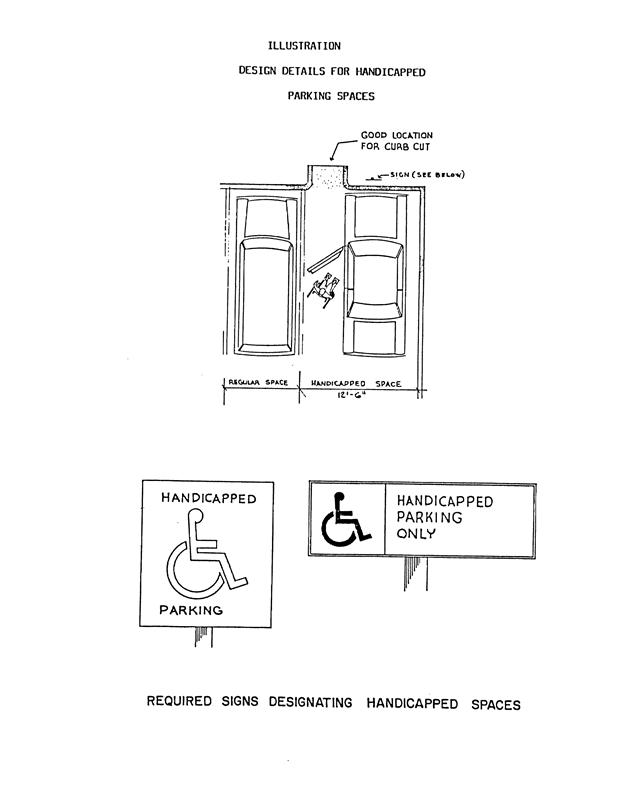
(i)
Special provisions for handicapped parking. The following provisions shall apply to all uses and structures for which handicapped parking spaces are required.
(i)
Number of spaces required.
(ii)
Dimensions and location of spaces. Handicapped parking spaces shall be sized according to the above table and be located on the shortest accessible route of travel to an accessible entrance. An accessible route shall be provided from the accessible parking to the accessible entrance. Such route shall be a minimum of three feet wide, have stable, slip resistant surface and shall have a slope no greater than 1:12.
(iii)
Signage. All handicapped parking places shall have signage meeting ADA requirements.
(j)
Off-street loading and unloading requirements. Every building or structure hereafter constructed and used for industry, business, or trade involving the receiving or distribution of vehicles, materials, or merchandise shall provide space for the loading and unloading of vehicles off the street or public alley. Such spaces shall have access to a public or private alley, or if there is no alley, to a public street. The minimum required spaces for this provision shall be based on the total usable floor area of each principal building according to the following table:
The board of appeals may reduce or increase this requirement in the interest of safety where unusual or special conditions are due considerations.
All such loading and unloading areas shall be surfaced with asphalt, concrete, or other durable dust-free surface.
(3)
Development and operational standards for mobile home park. The following standards and requirements shall apply to all mobile home parks permitted by the mobile home park district.
(a)
Permit.
(i)
Application for permits. The construction or extension of a mobile home park may not commence within the area of jurisdiction of this chapter until a zoning permit has been issued by the codes director. A zoning permit may be issued for a mobile home parking only upon approval the required zoning district and approval by the Goodlettsville Municipal/Regional Planning Commission of the site plan.
Where conditions are attached by the Goodlettsville Municipal/Regional Planning Commission they shall be included as part of the zoning compliance certificate.
(ii)
Site plan required. A zoning permit may only be issued for the construction or extension of a mobile home park upon submission and approval by the Goodlettsville Municipal/Regional Planning Commission of a site development plan meeting the minimum requirements of subsection 14-213(6)(b).
(iii)
Inspection fee. An inspection fee shall be required for approval of a mobile home park which shall be made upon submission of a plan for approval. After completion of construction, a final inspection shall be made at no additional charge.
(A)
The inspection fee shall be $10.00 per year plus $2.00 per space. The fee is nonrefundable.
(B)
The inspection fee shall be paid annually upon inspection of the mobile home park by the codes director.
(b)
Development standards.
(i)
General.
(A)
No part of the park shall be used for nonresidential purposes, except such uses as are required for the direct servicing and well-being of park residents and for the management and maintenance of the park. Nothing contained in this section shall be deemed as prohibiting the sale of a mobile home located on a mobile home stand and connected to the pertinent utilities.
(B)
Conditions of soil, ground water level, drainage and topography shall not create hazards to the property or the health or safety of the occupants. The site shall not be exposed to objectionable smoke, dust, noise, odors or other adverse influences, and no portion subject to flooding or erosion and shall be used for any purpose, which would expose persons or property to hazards.
(ii)
Minimum development size. No mobile home park shall be approved which contains less than three acres in area or has less than 15 mobile home spaces.
(iii)
Density. The number of mobile homes permitted within any mobile home park shall not exceed seven units per acre. Along the entire periphery of a mobile home park, yards shall be provided as follows:
(iv)
Yards. Along the entire periphery of a mobile home park, yards meeting the district regulations shall be provided. Within the interior portions of a mobile home park, no yards, except as required to meet other provisions set forth in this section, are required.
(v)
Spacing of mobile homes and site coverage.
(A)
Mobile homes shall be so harbored on each space that there shall be at least a 25 feet clearance between mobile homes; for mobile homes parked end-to-end, the end-to-end clearance may be less than 25 feet but not less than 15 feet.
(B)
There shall be a minimum distance of ten feet between the nearest edge of any mobile home and an abutting street within the park.
(C)
Mobile home stands shall not occupy an area in excess of 25 percent of the respective lot area. The total area occupied by the mobile home and its accessory structures shall not exceed 50 percent of the respective lot area.
(iv)
The mobile home lot.
(A)
General. The limits of each mobile home lot shall be marked on the ground by suitable means. Location of lot limits on the ground shall be the same as shown on approved plans. No lot shall be smaller than 5,000 square feet.
(B)
Mobile home stands. The mobile home stands shall be improved to provide adequate support for the placement and tie-down of the mobile home. The stand shall not heave, shift, or settle unevenly under the weight of the mobile home due to frost action, inadequate drainage, vibration, wind or other forces acting on the structure. In addition, such stand shall comply with the FHA minimum requirements. Permanent foundations shall meet the requirements of the HUD publication Permanent Foundations for Manufactured Housing, September 1996.
(C)
Outdoor living area. Each mobile home lot shall be provided with an outdoor living and service area. Such area should be improved as necessary to assure reasonable privacy and comfort. The minimum area should be not less than 300 square feet with a least dimension of 15 feet.
(c)
Utilities and other services.
(i)
Water supply and distribution system. An accessible, adequate, safe and potable supply of water shall be provided in each mobile home development on trunk lines not less than six inches. Where a public supply of water of satisfactory quantity, quality and pressure is available at the site or at the boundary of the site, connection shall be made thereto and its supply used exclusively.
(ii)
Sewage disposal. Each mobile home park shall be served by public sewer, with service provided each trailer site.
(iii)
Solid waste disposal system. Solid waste collection stands shall be provided for waste containers for each mobile home. Such stands shall be so designed as to prevent containers from being tipped, to minimize spillage and container deterioration, and to facilitate cleaning around them. Any central waste container shall be screened from view with access appropriately provided.
(iv)
Service buildings. Service buildings housing sanitation and laundry facilities shall be permanent structures complying with all applicable ordinances and statutes, regulations, buildings, electrical installations, and plumbing and sanitation systems.
(v)
Fire protection. Each mobile home park shall be equipped with fire hydrants spaced no more than 500 feet apart, no mobile home shall be farther than 300 feet from a fire hydrant. The water system shall be capable of providing a required fire flow of 500 gallons per minute for one hour duration.
(vi)
Insect and rodent control. Each mobile home park shall be maintained free of litter and accumulation of any kind of debris which may provide rodent harborage or breeding places for flies, mosquitoes, or other pests.
(d)
Streets.
(i)
General. All mobile home developments shall be provided with safe and convenient vehicular access from abutting public streets or roads to each mobile home lot. Such access shall be provided by streets, driveways or other means. All internal streets shall be private.
(ii)
Entrance streets. Entrances to mobile home developments shall have direct connections to a public street and shall be designed to allow free movement of traffic on such adjacent public streets. No parking shall be permitted on the entrance street for a distance of 100 feet from its point of beginning.
(iii)
Circulation. The street system should provide convenient circulation by means of minor streets and properly located collector streets. Dead-end streets shall be limited in length to 500 feet and their closed end shall be provided with an adequate turnaround. (60 feet diameter cul-de-sac).
(iv)
Pavement widths. Pavement widths shall be as follows:
Collector street with no parking .....20 feet
With on-street parking .....36 feet
Minor street with no parking .....18 feet
With on-street parking .....34 feet
One-way minor street with no parking .....12 feet
With on-street parking .....28 feet
(v)
Construction.
Subgrade—The subgrade shall be well-drained, uniformly graded, and compacted.
Base—The base shall consist of crushed stone or gravel, six inches in depth, compacted.
Surface—The surface shall be paved with asphaltic concrete plant mix, one and one-half inches thick, compacted.
(e)
Walks.
(i)
General requirements. All mobile home developments shall be provided with safe, convenient, all season pedestrian walks of adequate width for intended use, durable and convenient to maintain. Sudden changes in alignment and gradient shall be avoided.
(ii)
Common walk system. A common walk system shall be provided and maintained between locations where pedestrian traffic is concentrated. Such common walks shall have a minimum width of four feet.
(iii)
Individual walks. All mobile home stands shall be connected to common walks, streets, driveways and parking spaces by individual walks. Such individual walks shall have a minimum width of two feet.
(f)
Recreation area. Adequate recreation facilities for the residents of the project shall be provided in locations easily accessible to the living units and where they do not impair the view and privacy of living units. Attractive outdoor sitting areas shall be provided, appropriate in size, type and number to the needs of the residents.
Well-equipped playgrounds of adequate size and number shall be provided where it is anticipated that children will occupy the premises.
(g)
Buffer and screening. A landscape buffer shall be provided along the perimeter of the site boundaries not less than 15 feet in width, except that a minimum buffer area from any public street shall be no less than 20 feet.
Within the landscaped buffer, a continuous fence six to eight feet high or landscaped screen shall be provided. Such fence shall be opaque and such screening shall be a year-round evergreen ten feet width and at least four feet high at the time of planting and expected to achieve a height of six feet within three years. Such plants or trees shall be planted in two rows and ten feet apart with the plants or trees staggered. No landscaped screen or fence shall be provided within 15 feet of any vehicular entrance and/or exit to the park.
(h)
Site design. The appearance and character of the site shall be preserved an enhanced by retaining and protecting existing trees and other site features; and additional new plant material shall be added for privacy, shade, beauty of buildings and grounds and to screen out objectionable features. A landscape plan shall be submitted with the site development plan.
Existing trees, shrubs, evergreens and ground cover shall be retained to the extent that they enhance the project, are effective as a screen planting or are useful in protecting slopes.
(i)
Parking. Parking shall be provided in accordance with subsection 14-208(2).
(i)
Off-street parking. Off-street parking spaces shall be located on each mobile home lot.
(j)
Responsibilities of park management.
(i)
The permittee shall operate the mobile home park in compliance with this title and shall provide adequate supervision to maintain the park, its facilities and equipment in good repair and in a clean and sanitary condition.
(ii)
The permittee shall notify park occupants of all applicable provisions of this title and inform them of their duties and responsibilities under this title.
(iii)
The permittee shall supervise the placement of each mobile home on its mobile home stand to the satisfaction of the codes director which includes securing its stability to anchor pins and installing all utility connections.
(iv)
The permittee shall maintain a register containing the following information:
(A)
The name and address of each mobile home occupant;
(B)
The name and address of the owner of each mobile home and motor vehicle by which it was towed;
(C)
The make, model, year, and license number of each mobile home and motor vehicle;
(D)
The date of arrival and of departure of each mobile home.
(v)
The mobile home park shall keep the register record available for inspection at all times by law enforcement officers, public health officials and other officials whose duties necessitate acquisition of the information contained in the register.
(vi)
The register record shall not be destroyed for a period of three years following the date of departure of the registrant from the park.
(vii)
The permittee shall notify the health authority immediately of any suspected communicable or contagious disease within the park.
(viii)
The permit to operate shall be conspicuously posted in the mobile home park office at all times.
(ix)
The permittee shall be answerable for the violation of any provision of this section.
(k)
Responsibilities of park occupants.
(i)
The park occupant shall comply with all applicable requirements of this title and shall maintain his/her mobile home lot, its facilities and equipment in good repair and in a clean and sanitary condition.
(ii)
The park occupant shall be responsible for proper placement of the mobile home on its mobile home stand and proper installation of all utility connections and anchoring in accordance with the instruction of the park management.
(iii)
Skirtings, awnings, and other additions shall be installed only if permitted and approved by the park management. When installed, they shall be maintained in good repair. The space immediately underneath each mobile home shall be used for storage only if permitted by the park management. If permitted, the following conditions shall be satisfied:
(A)
The storage area shall be provided with a base of impervious material.
(B)
Stored items shall be located so as not to interfere with the underneath inspection of the mobile home.
(C)
The storage area shall be enclosed by skirting.
(iv)
The park occupant shall store and dispose of all rubbish and garbage in a clean, sanitary and safe manner. The garbage container shall be rodent proof, insect proof, and watertight.
(v)
Fire extinguishers for class B and C fires shall be kept at the premises and maintained in working condition.
(vi)
All park occupants shall be required to register their pets (dogs and cats) with the park management.
(vii)
All park occupants shall be required to have their pets (dogs and cats) on a leash and shall not be allowed to roam free and unleashed.
(viii)
Park occupants shall not be allowed to construct or place pens for animals on the park premises.
(l)
Inspections.
(i)
The codes director is hereby authorized and directed to make annual inspections to determine the conditions of mobile home parks, in order to ensure the health and safety of occupants of mobile home parks and of the general public.
(ii)
The codes director shall have the power to enter upon any private and public property for the purpose of inspecting and investigating conditions relating to the annual inspection as it is related to the enforcement of this section.
(m)
Non-complying regulations.
(i)
Within one year from the effective date of this title any existing mobile home park located within the city shall comply with those sections of this title listed below. Any provision that is not feasible to comply with shall be so noted in a written statement to the codes director. Such statement shall specifically address itself to reasons with which this title cannot be complied and shall be accompanied by any supporting information and data which the codes director may request.
Non-complying provisions are as follows:
Subsection 14-208(3)
Subsection 14-208(3)(b)(vi)(B)
Subsection 14-208(3)(c)(iii)
Subsection 14-208(3)(j)
Subsection 14-208(3)(k)
(n)
Penalties.
(i)
Any person violating any provisions of this section shall be guilty of a misdemeanor and upon conviction shall be fined not less than $5.00 nor more than $50.00 for each offense.
(ii)
Each day that a violation is permitted to exist shall constitute a separate offense.
(iii)
Any extension of an existing mobile home park is considered a non-complying use and is hereby prohibited unless said park is brought up to the standard herein stated.
(o)
Revocation of permits. The board may revoke any permit to maintain and operate a park when the permitee has been found guilty by a court of competent jurisdiction of violating any provisions of this section. After such conviction, the permit may be reissued if the circumstances leading to conviction have been remedied and the park is being operated and maintained in full compliance with this section.
(p)
Miscellaneous requirements. No inoperative automobiles, junk or non-contained trash shall be allowed within the park.
(q)
Replacement of mobile homes. In any mobile home park, when a mobile home is relocated to a different pad within the park or is moved out of the park for any reason, it may be replaced only with another mobile home which has been certified under the national housing construction and safety standards act of 1974 (42 USC § 5401, et seq.) prior to any such replacement, the owner/operator of the mobile home park shall first obtain a building permit. After the replacement mobile home has been moved into the park and connected to all utilities but prior to any occupancy, such mobile home shall be inspected to determine its compliance with the above standard and the adopted NFPA 101 Life Safety Code.
(4)
Site and architectural design standards.
(a)
Purpose and application. The standards and regulations of this section apply to all districts except as specifically exempted and are intended to compliment the guidelines of the Goodlettsville Design Review Manual. The purposes of the this section are as follows:
(i)
To recognize the interdependence of land values and aesthetics and to provide a method by which the city may encourage builders to develop land so that its value and attractiveness will endure;
(ii)
To encourage development of private property in harmony with the desired character of the community or area in conformance with the adopted design standards and the Goodlettsville Design Review Manual.
(iii)
To avoid and prevent community deterioration and to encourage the preservation and enhancement of property values and the visual character of the community and the natural environment;
(iv)
To improve the general standards of orderly and stable development in the city through review of the design of individual buildings, structures and their setting;
(v)
To establish standards and policies that will promote, preserve and enhance building design, proper site development and preserve natural environmental aspects in the city.
(b)
Site plan required for zoning permits. All applications for zoning permits shall be accompanied by a site plan meeting the requirements herein and with sufficient copies to provide for staff and Goodlettsville Municipal/Regional Planning Commission distribution; provided however, that a site plan is not required when an existing building is converted from one permitted use to another permitted use and no additional construction is required and that no additional impervious surfaces are added to the site. With the exception of single and two-family dwellings, and limited development site plans listed below, the site plan for all buildings or for new parking lots which require paving shall be approved by the Goodlettsville Municipal/Regional Planning Commission prior to the issuance of the zoning permit. The approval of any site plan shall lapse at the end of six months if construction has not been initiated, and a new submission will be required meeting all zoning requirements including any amendments since the original approval. If the site plan approval is denied, within one year of the date of denial, a subsequent application shall not be reviewed or heard unless there is substantial new evidence available, or if a significant mistake of law or of fact affected the prior denial. Such subsequent application shall include a detailed statement of the grounds justifying its consideration.
The following items are limited development site plans that may be reviewed and approved by planning/development services staff:
(i)
Building additions not to exceed 25 percent of the existing size of the building up to 2,500 square feet but shall not include additional dwelling units for high density residential developments.
(ii)
Parking lot expansion not to exceed 25 percent of the existing parking area up to 7,500 square feet of parking area.
(iii)
New accessory buildings or uses which do not change the use of the property and do not exceed 2,500 square feet.
(iv)
Minor exterior building renovations.
Applicants may appeal the planning/development services department review and decision to the planning commission or to the board of zoning and sign appeals based on the provisions of this title and the design guidelines.
All site plans shall be prepared and stamped by registrants of the State of Tennessee who are licensed to practice the particular discipline being prepared (e.g., site layout and drainage by civil engineers, boundary surveyors, landscape plans for landscape architects).
(i)
Residential buildings or accessory structures or commercial buildings or additions of 1,000 square feet or less.
The site plan of any residential building or accessory structures containing one or two dwelling units and any commercial building or an addition to a commercial structure of 1,000 square feet or less shall indicate:
(A)
The actual shape, location and dimensions of the lot;
(B)
The shape, size and location of all buildings or other structures to be erected, altered or moved, and of any building or other structure already on the lot;
(C)
The existing and intended use of the lot and of all such buildings or other structures upon it, including the number of dwelling units the building is intended to accommodate;
(D)
Such other information concerning the lot or adjoining lots as may be essential for the determining whether the provisions of this title are being observed.
(ii)
All other buildings, structures and activities.
(A)
The actual shape, location, bearings, and dimensions of the lot;
(B)
The shape, size, and location of all buildings or other structures to be erected, altered or moved, and of any building or other structure already on the lot;
(C)
The existing and intended use of the lot and of all such building or other structures upon it, including the number of dwelling units the building is intended to accommodate;
(D)
Topographic features (contours not greater than five feet intervals);
(E)
Location of all driveways and entrances;
(F)
Location of all accessory off-street parking areas to include a plot plan showing design and layout of such parking facilities,
(G)
Location of all accessory off-street loading berths;
(H)
Location of open space;
(I)
proposed ground coverage, floor area, and building heights;
(J)
Position of fences and walls (materials specified);
(K)
Detailed landscaping plans which shall include trees, shrubs and flowering plants with species, quantities and sizes clearly indicated;
(L)
Location of utilities (sanitary sewers, storm sewers, water mains and sizes, and fire hydrants;
(M)
Type, and size of proposed signs;
(N)
Proposed means of surface drainage;
(O)
Location of all easements and rights-of-way;
(P)
For any site subject to flooding, the limits of floodway and fringe areas, the regulatory flood elevation and regulatory flood protection elevation, and the minimum first floor elevation;
(Q)
The stamp and name of the registered engineer, architect, landscape architect, or surveyor preparing the plan;
(R)
Where subsoil sewage disposal is anticipated, certification from the county health department approving the lot for such use.
(c)
All new non-residential developments including commercial, industrial, community facility activities in residential zoning districts, planned unit development districts, multiple family residential, and any entrance to a non-residential development are subject to design review and shall comply with the standards of the Goodlettsville Design Guidelines. In the event of damage or destruction to a building exceeding 50 percent of its total floor area or value, any repairs or reconstruction shall also be made in conformity with the Goodlettsville Design Guidelines architecture section.
In all commercial, industrial or planned unit development districts no temporary building or structure of any kind may be used for any activity except for temporary uses specifically permitted by action of the board of zoning appeals or special sales or promotions authorized by the planning and codes department through the issuance of a temporary building permit for a specified period of time not to exceed two weeks. This prohibition shall include tents, trailers, mobile buildings, storage buildings or similar structures that are not permanent buildings constructed on a legally established lot.
(i)
The following building materials are acceptable for exterior walls:
(A)
Brick;
(B)
Natural stone;
(C)
Exterior insulation and finish system (trade name Dryvit) or similar material, if used in combination with brick or stone;
(D)
Wood;
(E)
Glass but excluding opaque or reflective window tints and glazes;
(F)
Split face block;
(G)
Similar materials as approved by the Goodlettsville Municipal/Regional Planning Commission.
Metal roofs are acceptable and decorative metal wall materials are also acceptable when used as accents to create interest are permitted but shall not exceed 15 percent of building walls.
The planning commission shall review requests for alternative designs and request for waivers of the building material requirements of this section. The planning commission in reviewing a request may consider the proposed building design and property conditions associated with the proposal and the character of adjacent properties and area to determine if the intent of the building design requirements are met with any requested waivers or alternative designs. Per T.C.A. § 6-54-133, all appeals of the planning commission's decision to be reviewed by the city commission.
(ii)
The maximum uninterrupted length of any facade shall be 100 feet. Any such wall in excess of 100 feet shall be integrated with windows, awnings, projections, recesses, arcades or similar measures.
(iii)
Each principal building shall have a clearly defined, highly visible customer entrance with distinguishing features such as canopies or porticos.
(iv)
Facade colors shall be of low reflectance, subtle, neutral or earth tone colors. The use of high-intensity or metallic colors shall be prohibited except for accents. Colors shall not be used as a form of advertising even though such color may be a trademark.
(v)
National "standard" or "trademark" designs shall be adapted to be compatible with these standards.
(vi)
In the event of damage or destruction to a building exceeding 50 percent of its total floor area or value, any repairs or reconstruction shall be made in conformity with the standards contained herein.
In all commercial, industrial or planned unit development districts no temporary building or structure of any kind may be used for any activity except for temporary uses specifically permitted by action of the board of zoning appeals or special sales or promotions authorized by the planning and codes department through the issuance of a temporary building permit for a specified period of time not to exceed two weeks. This prohibition shall include tents, trailers, mobile buildings, storage buildings or similar structures that are not permanent buildings constructed on a legally established lot.
(d)
Off-street parking lot design standards.
(i)
Design objectives. Parking areas shall be designed with careful regard given to orderly arrangement, topography, amenity of view, ease of access, and as an integral part of the overall site design. All parking areas shall be landscaped in accord with the requirements contained in subsection 14-208(5).
For reasons of use and appearance, it is desirable that parking areas be level or on terraces formed with the slope of the land. Changes in level between such terraces should be formed by retaining walls or landscaped banks.
(ii)
Submission of site plan. Any application for a zoning permit, or for a conditional use permit where no zoning permit is necessary, that requires three or more accessory off-street parking spaces to be provided on a zone lot, shall include a site plan, drawn to scale and fully dimensioned, and be attached to said application showing the location, design and layout of such parking facilities and approved by the Goodlettsville Municipal/Regional Planning Commission. A site plan drawn to meet the requirements of subsection 14-208(4)(b) will comply.
(iii)
Access control. In order to promote the safety of the motorist and pedestrian and to minimize traffic congestion and conflict by reducing the points of contact, the following regulations shall apply. These regulations are shown on the following illustrations.
(A)
Maximum number of driveways:
(1)
Residential use: Two driveways are permitted for a residential use property for the first 100 feet of property street frontage except only one driveway on a designated collector or arterial routes may be permitted to limit access points where necessary to protect traffic flow and safe access. Where permitted, additional driveways may be permitted for each additional 100 feet for property frontage on minor streets and 200 feet on designated collector and arterial designated arterial streets.
(2)
Non-residential use: One driveway is permitted for a non-residential use property for the first 100 feet of property street frontage. Where permitted, one additional driveway may be permitted for the next additional 100 feet of property street frontage where necessary for site deliveries and large truck access. Where permitted, additional driveways may be permitted for each additional 100 feet of property street frontage minor streets, 200 feet on collector streets, and 300 feet on arterial streets.
(3)
Where feasible, all new driveways shall be placed to align with driveways on the opposite side of the street to enhance traffic flow and public safety.
(4)
Additional entrances necessary for public safety site access may be permitted.
(B)
Maximum width of driveway openings at the property line:
(1)
Residential uses: 25 feet.
(2)
Gasoline service stations, freight and truck terminals, or other commercial and industrial uses customarily having a large volume of tractor trailer vehicle traffic: 40 feet.
(3)
All other non-residential uses: 35 feet.
(C)
Minimum distances: Adjoining interior lot line and a driveway opening at the street right-of-way line:
(1)
Residential uses: Five feet.
(2)
Nonresidential uses: Ten feet.
(3)
Shared driveways located on property lines are exempt from this requirement.
(D)
Driveway from street intersection as measured from the nearest intersecting right-of-way line:
(1)
Residential uses: 25 feet from limited minor streets, 50 feet from minor streets, 100 feet from designated collector streets and 200 feet from designated arterial streets.
(2)
Nonresidential uses: 50 feet from minor streets, 200 feet from designated collector street and 300 feet from designated arterial streets and interchange ramps.
(3)
These dimensions maybe be increased to prevent conflict with existing or planned traffic signals.
(4)
On designated collector and arterial routes, the dimension shall be from planned right-of-way lines of nearest intersection.
(E)
Multiple driveways: Where permitted, separation between two driveways measures along the right-of-way line serving the same property which provide access to the same street shall be:
(1)
Residential uses: 25 feet on limited minor streets, 50 feet on minor streets, 100 feet on designated collector streets and arterial streets.
(2)
Non-residential uses: 100 feet on minor streets, 150 feet on designated collector streets, and 200 feet on designated arterial streets.
(F)
Radius of return: The radius of return curve connecting the edge of the traffic lane and access driveway shall meet the following requirements:
(1)
Residential uses on roadway with posted speed limit less than 30 miles per hour: Five foot minimum.
(2)
Residential uses on roadways with posted speed limit 30 miles per hour or more: 15 foot minimum.
(3)
Non-residential use on roadways with posted speed limit less than 30 mph: 15 foot minimum.
(4)
Non-residential use of roadways with posted speed is less than 40 miles per hour: 25 foot minimum.
(5)
Non-Residential use of roadways with posted speed limit is 40 miles per hour or more: Driveway design sit all include engineering design and the planning commission based on recommendation from city planner and city engineer may require deceleration and acceleration lanes and left turn storage lanes or increased storage lane capacity, if applicable based on roadway traffic counts, roadway speed, and roadway and driveway access visibility but in no case shall the radius of return be less than 30 feet.
(G)
Arterial and collector route access: To protect driveway access safety and traffic flow on collector and arterial routes, limited access design may be required by planning commission based on recommendation from city planner and city engineer/or site development design proposals, including but not limited to, right turn only access, limiting comer lot access onto secondary streets with planned or existing signalized intersections, shared driveway access, cross access corridors with recorded access easements, and designing access to avoid conflicts in center left turns.
(H)
Entrance angle: The centerline of every non-residential driveway shall intersect the centerline of the public way at an angle between 75 and 90 degrees.
(I)
Traffic study: All non-residential developments containing commercial developments and warehouse and transport uses exceeding 20,000 square feet in area and residential developments exceeding 75 lots or units, or other developments expected to generate 1,000 vehicle trips or more per day or 100 or more peak hour trips as determined by city planner and city engineer shall include an engineering traffic study with the development plan submittal to review safe design of driveway access points and capacity and any necessary requirements for on-site or off-site roadway improvements.
(J)
Minimum off-street parking set back distance: Parking maneuvers within a parking lot shall not restrict entering vehicles from safely and efficiently entering the driveway from the public street. The minimum parking setback distance for non-residential driveways is 30 feet from the right-of-way but may be increased based on traffic study requirements. All non-residential off-street parking areas must include on-site maneuvering areas to permit users to enter and exit the site in forward drive. Where permitted, residential driveways fronting designated collector or arterial routes must include on-site maneuvering areas to permit users to enter and exit the site in forward drive.
(K)
Drainage: All driveways shall be constructed with property drainpipes sized for the amount of water each should carry. Such pipes may be of concrete or ADS N 12 or equivalent and headwalls and endwalls shall be constructed.
(L)
Driveway slope, profile, and sight distance: The maximum slope of driveways shall be ten percent. The driveway location and approach area shall provide the user of the driveway access adequate sight distance in both directions along the street/or proper and safe movements. Minimum driveway sight distance measured at a point four and one-half feet above the surface of the driveway surface to a point four inches above the center line of the street surface shall be:
(M)
Driveway materials, pavement markings, and signing: All non-residential driveways shall be permanently paved with concrete or asphalt. All residential driveways shall be permanently paved with concrete or asphalt for the first ten feet of the driveway for the width of the driveway. Driveways with more than one ingress or egress lane or driveways including limited or restricted access shall have pavement surface marked with center lines, lane lines, stop lines, and symbol arrows and signage installed per engineering traffic control standards.
(N)
Alternative approval: The dimensions listed in this section may be increased or amended by the planning commission during site plan review process. Planning director and city engineer shall make recommendation as deemed necessary for safe and efficient street operations.
(iv)
Surfacing and border barriers. All off street parking areas containing three spaces or more shall be surfaced with asphalt, concrete, or other hard surfaced dustless material and so constructed to provide for adequate drainage for both on and off site and to prevent the release of dust. In no case shall drainage be allowed to cross sidewalks. An off-street parking area containing three or more parking spaces shall be provided with a rail, curb, fence, wall, earth berm, or other continuous barrier of a height sufficient to retain all cars completely within the property together with appropriate landscaping except at access driveways.
(v)
Lighting. Any lighting used to illuminate off street parking areas shall be directed away from property in any residential district in such a way as not to create a nuisance, and such lighting shall not exceed one-half foot candle at or above any residential district boundary or commercial district boundary where residences are located and permitted.
(vi)
Parking stalls. The size of each parking space shall be as shown on the sample layout illustration according to the angle of parking and appropriately marked with painted lines or curbs. The minimum parking space dimensions for perpendicular residential spaces shall be measured from the property line or back of sidewalk whichever dimension is more restrictive.
(vii)
Maneuvering space. Minimum width of driveways providing maneuvering space within a parking lot for ingress to and egress from parking stalls shall be as indicated on the illustration for parking lot design details.
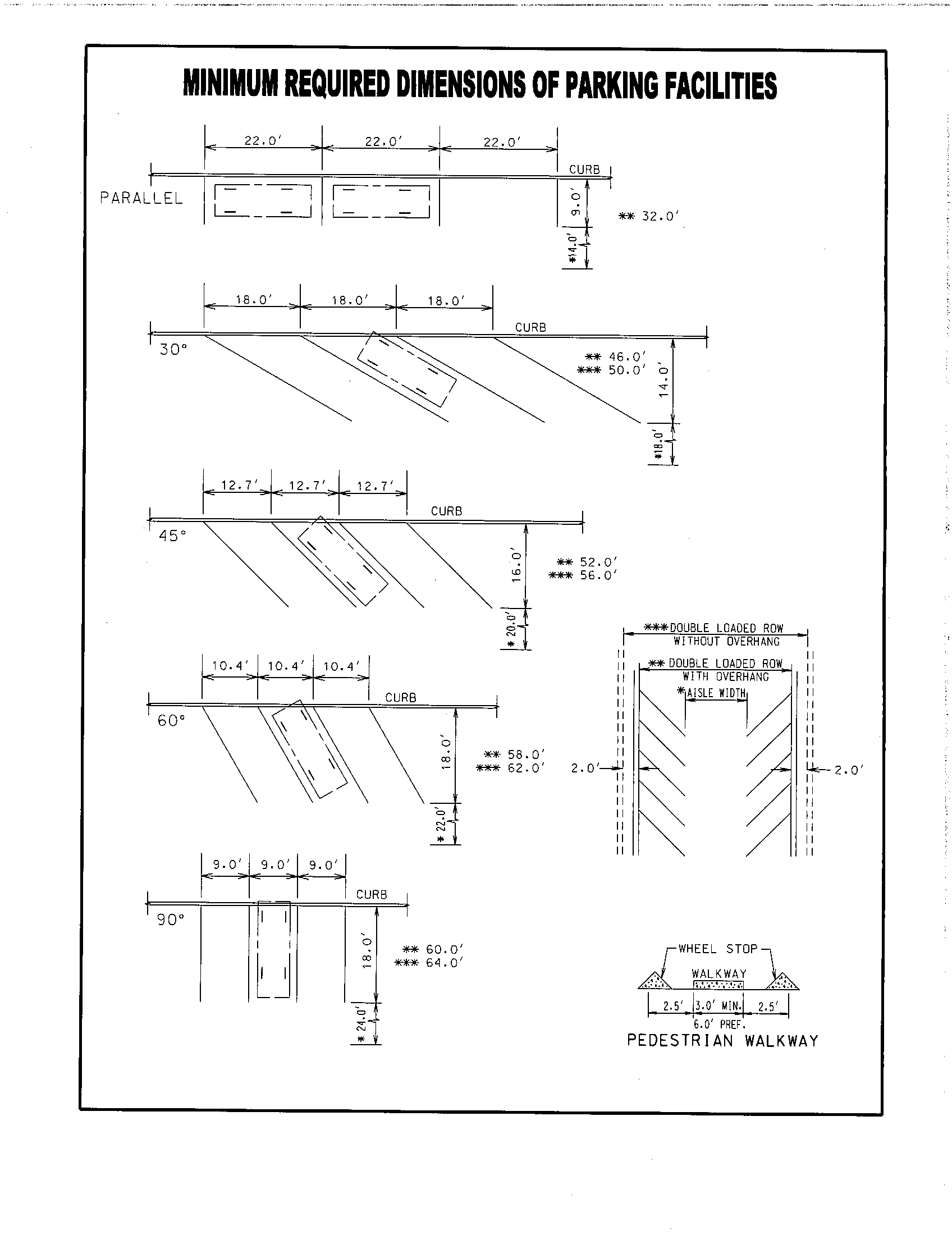
(viii)
Slope in parking areas. The maximum slope within the area of the parking stalls shall be five percent. The maximum slope of driveways shall be ten percent.
(e)
Residential design requirements. The intent of this section is to guide the development of residential neighborhoods that are compatible throughout the development and that complement existing development and the natural environment. Architectural elevations are required as a part of a planned unit development master plan.
(i)
Design criteria for two-family detached dwellings.
(A)
Purpose. The provisions set forth herein are intended to apply to all two-family detached dwellings as defined by this title except within planned unit developments. It is the express purpose of these provisions to establish design criteria and to provide for implementation of these provisions by the planning director in the review of the site plan required for all developments.
(B)
Design criteria.
(1)
All two-family detached units (duplexes) constructed on individual lots shall be designed to closely resemble the other housing units on the same street in appearance.
(2)
Exterior building materials shall be of the same type and quality as the other dwelling units in the neighborhood or on adjoining lots.
(3)
Each dwelling unit shall be provided with reasonable visual and acoustical privacy. Fences, walks and landscaping shall be provided for the protection and aesthetic enhancement of each unit of the building and privacy of the occupants, screening of objectionable views or uses and the reduction of noise.
(4)
The appearance and character of the site shall be preserved, as appropriate, and enhanced by retaining and protecting existing trees and other site features. A landscaping plan shall be submitted as a part of the site plan.
(5)
Driveways and parking areas shall be paved with either asphalt or concrete where a majority of the other housing units on the same street are so paved.
(C)
Lots. The minimum lot size required for any such dwelling unit shall be as stipulated by the development area per dwelling unit as provided in each respective district.
(D)
Parking.
(1)
Two off-street parking spaces shall be provided for each dwelling unit including no more than two bedrooms and four spaces for units including three or more bedrooms.
(2)
All off-street parking areas shall be located in the rear or to the side of the principal building. The required front yard shall be kept open and unobstructed.
(3)
Driveways and parking areas shall be paved with either asphalt or concrete in areas where a majority of the other housing units are so paved.
(f)
The location and design shall meet the requirements of the US Postal Service and Local Postmaster and shall be in one or multiple central locations with access from an interconnected sidewalk system and designated parking and parking design to prevent blocking streets and shall be privately maintained.
(5)
Landscaping, screening and buffering.
(a)
Purpose and intent. The purpose and intent of this title is to establish a set of landscape requirements and guidelines that will be utilized as a minimum standard required of all developed or disturbed site within the City of Goodlettsville. The requirements and guidelines set forth in this section were developed in order to promote the health, safety and welfare of the general public; to improve the overall appearance of the community; to reduce stormwater run-off, noise, heat and chemical pollution through the preservation and installation of canopy trees; and to reduce the impact of incompatible land uses through requirements for buffer yards along zoning boundaries which will minimize potential harmful effects of one use on another.
(b)
Applicability. The provisions of this section shall apply to developments which require a site plan to be filed in accordance with subsection 14-213(6)(b) or which require a master development plan to be filed in accordance with subsection 14-210(3)(a). The provisions of this section, which pertain to screening and buffering, shall apply along all zoning district boundaries and along all boundaries separating a conditional use from permitted uses.
(c)
Landscaping plan.
(i)
Prior to the issuance of any permits (foundation, grading and/or building) for any site proposing any new or additional development, a landscape plan being part of the site development plan, meeting the requirements of this section, shall be submitted to and approved by the City of Goodlettsville Municipal/Regional Planning Commission. All landscape plans are to be prepared by and sealed by a registered landscape architect licensed in the State of Tennessee. A landscape plan shall also accompany any bulk grading and/or site clearing plan.
(ii)
No landscape plans are to be drawn at a scale greater than one inch equals 50 feet. All landscape plans shall include the following:
(A)
Boundary of proposed site;
(B)
Proposed site improvements;
(C)
Existing and proposed utility lines and easements;
(D)
North arrow;
(E)
Scale and scale bar;
(F)
Location of all existing trees eight inch caliper and greater with any forested area containing such trees being separately delineated with the species mixture indicated;
(G)
Location of all proposed plant material;
(H)
A landscape schedule (providing the quantity, the botanical and common names, the height, the width and the caliper inches of all proposed plant material at the time of planting);
(I)
A data table showing the landscape requirements for the site and the landscape provided to meet these requirements;
(J)
Details and notes explaining the installation and maintenance of proposed and/or protected plant material;
(K)
The name, address and phone number of the landscape architect approving said plans;
(L)
Proposed means of slope stabilization, if applicable.
(d)
Bonding.
(i)
All proposed landscaping shall be secured by a landscape performance bond to guarantee the quality and longevity of the plant material installed. Bond amounts will be determined by the Goodlettsville Municipal/Regional Planning Commission and will vary depending on the quantity of landscape material proposed. The bond will be released upon installation of the required landscaping and inspection and approval by the city. If the required landscaping has not been installed within one year of the approval of the plan, said bond shall be reviewed to determine if the amount is still adequate and if not, may be increased.
(ii)
Prior to the release of the performance bond, a landscape maintenance bond shall be posted in order to assure the longevity and livelihood of the plant material. Said bond will be held for a period of one year. At the completion of the year, these bonds will be reviewed to determine whether or not they are to be released, reduced, or held for an additional year. The amount of the bond shall be determined by the Goodlettsville Municipal/Regional Planning Commission and will vary depending on the quantity of landscape material installed.
(iii)
In order to obtain a bond release, a bond release form must be signed by the owner and by the registered landscape architect that prepared the plan and inspected and approved the quality, size, type, quantity, and livelihood of the installed landscape. Once this form has been submitted to the planning department, the city will inspect the installed landscape of question to determine whether to award a full release, a reduction, or another year held of said bond.
(e)
Standards.
(i)
All proposed plant material for a given site are to be appropriately specified in order to tolerate the climate conditions of the Middle Tennessee area.
(ii)
All proposed plant material for a given site are to meet the requirements of the American Standard for Nursery Stock established by the American National Standards Institute, Inc., issued in 1997.
(f)
General landscape requirements. The following requirements shall apply to all developments. All landscaping plantings are encouraged to be automatically irrigated.
(g)
Required trees.
(i)
Each newly developed site shall be required to have a minimum acquired caliper inch (ACI or caliper inch) of 70 caliper inches of proposed trees per acre.
(ii)
Seventy-five percent of required trees shall be native to the southeastern United States.
(iii)
Fifty percent of required trees shall be a minimum three caliper inches in size.
(iv)
No proposed canopy tree planted at a size less than two caliper inches will be accepted as a required tree. No proposed understory/ornamental tree shall be less than two caliper inches in size.
(v)
A minimum of 20 percent and maximum of 50 percent of required trees shall be understory and/or ornamental trees.
(vi)
Existing trees to be protected and retained (see figure F-1) shall count 50 percent of their size towards the 70 inch/acre requirements but not count towards parking area requirements. In the event that the existing tree credit creates a condition where no new tree plantings are required under the formula, a minimum of 35 caliper inches/acre of proposed trees shall be provided.
(h)
Parking areas.
(i)
Islands.
(A)
One landscape island with a minimum size of nine feet by eighteen feet (see figure F-2) shall be placed at a minimum of every 15 spaces in any proposed row of parking.
(B)
A minimum of one three-inch caliper or larger canopy tree is to be placed in each proposed island. Said canopy trees can be used toward the overall tree requirements but not toward any existing tree replacement.
(C)
Said islands are to be free of all asphaltic, constructions and/or trash materials (see figure F-3). The following note is to be placed on all site plans. "All parking islands are to be inspected and approved by the City of Goodlettsville Planning Department prior to the installation of any plant material or soil."
(ii)
Adjacent parcels.
(A)
A minimum open space area of one-half of the required side yard shall be placed between any proposed paved area and the adjacent parcel(s) to the site under development. If the required open space contains any drainage, utility or access easement, an additional five feet of open space shall be provided.
(B)
The open space area shall be landscaped at the designer's discretion in order to accommodate the general landscape requirements but shall be maintained as permanent open space.
(C)
The open space area may be crossed by driveways or sidewalks where an access agreement between the adjacent property owners is in place.
(iii)
Street fronts.
(A)
A minimum open space area of ten feet shall be placed between any proposed paved area and the right-of-way of the public street providing frontage to the site. If the required open space contains any drainage, utility or access easement, an additional five feet of open space shall be provided. Said open space area shall be landscaped in accordance with (B) below in addition to any required trees.
(B)
One shrub at a size no less than 24 inches high and 24 inches wide is required for every two linear feet of parking/driveway area that parallels any street front. Spacing of shrubs to be in keeping with species and design configuration. Said shrubs are to be installed between the street front and the proposed parking areas in a manner that will help screen and/or soften the visual effects of the proposed parking areas from its street front. Any area between the right-of-way and a curb or street pavement shall be included in the landscape plan and provided with appropriate cover. Street trees shall also be included in the street front landscaping. Canopy trees with a minimum caliper inch size of three inches shall be planted on 40 foot centers. When overhead power lines are encountered, understory ornamental trees with a minimum caliper inch size of two inchesshall be planted on 30 foot centers.
(C)
The landscape plan shall include foundation planting at the front of the building and along any side which parallels a public street. Such foundation planting shall include shrubs, flowering plants and ornamental trees.
(i)
Turf/ground cover.
(i)
All areas that have been disturbed by a particular site's development and are not within a planted area shall be seeded and strawed or sodded in order to achieve a well-established lawn.
(ii)
All disturbed areas that exceed a 3:1 slope shall receive a jute erosion control mesh (or equivalent) and be planted with the appropriate turf or ground cover that will provide a fast growth habit and rapid establishment.
(iii)
All disturbed natural areas that exceed a 3:1 slope and are located along a street front are to receive sod.
(iv)
All storm drainage ditch bottoms are to receive sod unless a concrete flume has been proposed.
(j)
Landscaping for residential developments and subdivisions.
(i)
Single family subdivisions that are not planned unit developments. Street trees are required on each lot at a spacing of 50 feet on center along both sides of new public streets not including R40 and Agricultural zoning district subdivisions. The two inch minimum caliper street trees shall include a variety of canopy tree plantings meeting the tree list of appendix B of this title. The tree locations are to be located between ten feet to 25 feet from the back of the sidewalk or street edge and off the right-of-way. Any utility easement and street lighting locations shall be determined when locating such tree. Every final subdivision plat shall include a drawing of a typical lot compliance with these landscape requirements.
(ii)
Residential planned unit developments. In addition to applicable parking lot and transitional screening requirements, street trees are required on each single family detached lot at a spacing of 50 feet on center along both sides of new public and private streets. The two inch minimum caliper street trees shall include a variety of canopy tree plantings meeting the tree list of appendix B of this title. The tree locations are to be located between ten feet to 25 feet from the back of the sidewalk off the right-of-way. Per project master plan based on building streetscape design, the street yard planting may be reviewed within a privately maintained planting strip between a street side curb and sidewalk including a minimum dimension of ten feet or in roadway medians designs with tree types and planting improvement methods to protect adjacent sidewalk and street surface roots. All other residential dwelling development types shall include along new public and private streets a street tree within a planting strip between a street side curb and sidewalk including a minimum dimension of ten feet or in roadway medians designs with tree types and planting improvement methods to protect adjacent sidewalk and streets from surface roots. Any utility easement and street lighting locations shall be determined when locating such tree. Alternative street tree planting, including but not limited to location of plantings, may be reviewed with project master plans equaling the total caliper inches of street trees required.
(k)
Replacement of existing trees. The requirements of this section shall be in addition to the general landscape requirements as presented in section (f) and, therefore, cannot be applied towards meeting the "general landscape requirements."
(i)
A tree removal permit must be obtained prior to the removal of any existing trees which are eight caliper inches or larger from a site proposed for development or for general clearing purposes. In order to obtain such permit, the applicant must demonstrate the intent of the tree removal for the site in questions and pay a fee of $25.00 to the city. Final granting of the permit will be determined by the Goodlettsville Planning Department. Any variance from this procedure shall first be considered by the Goodlettsville Municipal/Regional Planning Commission.
(ii)
All existing trees that are to be removed from a site to be developed (this also includes sites that are to be cleared of their existing trees in order to increase their market value as a future development) shall be replaced at a rate of 50 percent of their size. When the replacement of existing trees results in an acquired caliper inch calculation in excess of 150 percent of the requirement for the site, the requirement shall be capped at 150 percent of the required 70 caliper inches per acre.
For example: If a 24 caliper inch existing tree is removed then 12 caliper inches of new trees must be proposed to replace this tree. (Note: This only applies to the removal of trees at a size of eight caliper inches and up.)
(iii)
Any canopy tree 18 caliper inches or over in size shall be identified as a specimen tree. Extraordinary efforts to protect such trees shall be taken, and any removal of a specimen tree shall be specifically approved as a part of the landscape plan. The replacement of such trees shall be on a one inch to one inch basis.
(l)
Screening.
(i)
Heating and cooling units on all nonsingle-family residential developments shall be screened from all street fronts and adjacent parcels. Said screen shall be either a permanent opaque fencing and/or a thick massing of evergreen plant materials installed a height and spread no less than 24 inch spaced so that an immediate screen is created at the time of planting.
(ii)
Dumpster and service/loading areas are to be screened from all fronts and adjacent parcels. Said screen is to be either a permanent opaque fencing or a thick massing of evergreen plant materials installed at a minimum height of three feet and minimum spread of four feet.
(iii)
If a retention/detention pond area is to be enclosed with chain-link fencing, the fencing shall be black or dark green vinyl coated fencing. The pond area shall also be screened with a thick massing of evergreen plant material at a minimum height of three feet and a minimum spread of three feet from all fronts and adjacent parcels.
(m)
Sight distance requirements for landscape materials. At any public or private street intersection and at the access point for private driveways to public or private streets, a clear zone for sight distance shall be maintained. No landscape material that exceeds the height of 18 inches at maturity or branches lower than six feet shall be planted in any sight distance clear zone as indicated in figure F-4.
(n)
Coordination with transitional screening requirements.
(i)
The requirements for transitional screening and barriers contained in subsection (p) hereafter shall be in addition to the requirements for landscaping in subsections (f) and (k) above. All site and master PUD plans shall observe all such requirements.
(ii)
No application for a zoning change shall be recommended by the Goodlettsville Regional/Municipal Planning Commission unless such application demonstrates that the provisions of subsection (p) can be met.
(iii)
The Goodlettsville Regional/Municipal Planning Commission and the board of appeals shall not approve any conditional use permit unless such request demonstrates that the provisions of subsection (p) can be met.
(o)
Waiver.
(i)
In extreme cases certain sites and/or proposed land uses may be in a position of legitimate hardship in meeting the requirements of this title. Should this occur, the owner/developer may appeal to the Goodlettsville Municipal/Regional Planning Commission to request a reduction in the landscape requirements based upon the physical conditions of the site. Self-imposed or financial hardships only shall not constitute a basis for approval of the request.
(ii)
If an appeal is granted to a particular site and the total caliper inches of required trees to be planted on site is reduced, then the remaining caliper inches are to be paid for to the City of Goodlettsville's public lands landscape maintenance and tree bank fund at a rate of $150.00/caliper inch, or may provide the required number of caliper inches in trees to be planted on public lands as designated by the city manager or his designee. If a developer chooses to plant off-site, the species and location must be approved by the Goodlettsville Regional/Municipal Planning Commission and covered by the certificate of compliance, bonding procedure and insured as are other plants on-site.
For example: A two acre site is required a total of 140 caliper inches of newly planted trees. The Goodlettsville Regional/Municipal Planning Commission grants a 75 percent reduction requiring only 35 caliper inches of newly planted trees to be planted on site. The remaining 105 required caliper inches must therefore be paid to the landscape maintenance and tree bank at a cost of $150.00/caliper inch or $15,750.00.
(p)
Transitional screening.
(i)
General requirements. The following general provisions shall apply to transitional screening:
(A)
Transitional screening shall be provided in accordance with the transitional screening matrix and type of buffer yard presented at the end of this section.
(B)
Transitional screening shall be provided within the zoning district and on the lot of the "burdened use or district" (see matrix), along all points where such use or district is contiguous or across the street from land used by or zoned for the "benefitted use or district."
(C)
In any instance where a structure is to involve more than one use as presented in the matrix, the more stringent requirements shall apply.
(D)
All plant materials utilized in the transitional screening buffer yards shall meet the size requirements of subsection 14-208(5)(f). A minimum of 50 percent of the materials shall be evergreen.
(ii)
Transitional screening requirements. Transitional screening in the form of a buffer yard shall be located along the outer perimeter of a lot or parcel, and shall extend to the lot or parcel boundary line. The required minimum yard may be utilized to provide transitional screening. There shall be four different buffer yard types as identified in the matrix, which shall be provided as follows:
(A)
Type 1 buffer yard. Shall consist of an unbroken strip of open space that complies with one of the following alternatives:
(1)
A strip a minimum of 25 feet wide planted with six canopy or large evergreen trees, four understory trees and 20 shrubs for each 100 linear feet of open space.
(2)
A strip a minimum of 15 feet wide incorporating a six foot brick, natural stone or an approved decorative masonry wall and planted with three canopy or evergreen trees and two understory trees for each 100 linear feet of open space. The plant materials shall be located between the wall and the property line.
(B)
Type 2 buffer yard. Shall consist of an unbroken strip of open space that complies with one of the following alternatives:
(1)
A strip a minimum of 35 feet wide and planted with eight canopy or large evergreen trees, six understory trees and 28 shrubs for each 100 linear feet of open space.
(2)
A strip a minimum of 25 feet wide incorporating a six feet brick, natural stone or an approved decorative masonry wall and planted with four canopy or evergreen trees and three under story trees for ACH 100 linear feet of open space. The plant materials shall be located between the wall and the property line.
(C)
Type 3 buffer yard. Shall consist of an unbroken strip of open space that complies with one of the following alternatives:
(1)
A strip a minimum of 50 feet wide and planted with 12 canopy or large evergreen trees, eight understory trees and 40 shrubs for each 100 linear feet of open space.
(2)
A strip a minimum of 40 feet wide incorporating a six foot brick, natural stone or an approved decorative masonry wall and planted with six canopy or evergreen trees and four understory trees for each 100 linear feet of open space. The plant materials shall be located between the wall and the property line.
(D)
Type 4 buffer yard shall consist of an unbroken strip of open space a minimum of ten feetwide including a six foot brick wall and planted with three canopy or large evergreen trees, one understory tree and ten shrubs for each 100 linear feet of the open space. This type buffer yard is only available within the CCO district and shall be applied along the side and rear property lines of the zoning district that adjoins residential property.
(iii)
Requirements within landscape buffer yards. Sidewalks or trails may occur within a buffer yard provided the effect of the yard is not compromised. In no event shall the following uses be allowed in the buffer yards: playgrounds or playfields, stables, swimming pools, tennis courts or other recreational facilities; parking areas or other vehicular use areas; dumpsters, equipment storage and other open storage; buildings or overhangs; stormwater retention/detention facilities; and utilities or utility easements.
Buffer yards shall be continuous and unbroken except for driveways or sidewalks required to access parking areas or streets. Driveway/sidewalk penetrations shall cross buffer yards as close to perpendicular as possible and shall not exceed 25 percent of the entire buffer yard area, with no single penetration to exceed 35 feet in width.
(iv)
Variations. The buffer yards are normally calculated as being parallel to the property line. However, design variations, especially when used to incorporate existing native vegetation into the buffer yard area, shall be considered. The edges of the buffer yard may meander, including the permitted walls, provided that:
(A)
The total area of the buffer yard is equal to or greater than the total area of the required buffer yard; and
(B)
The buffer yard measures no less than the minimum width required by the applicable buffer yard standard at all points along the perimeter of the property line.
Buffer yard requirements may be waived by the Goodlettsville Regional/Municipal Planning Commission with a demonstration of unusual site grade conditions that would clearly negate the effects of the required buffer yard. The applicant shall supply section or profiles (drawn to scale) through the property line along the buffer yard proposed for the waiver. These drawings shall show the existing and proposed grades on both sides of the property line, as well as the principal structures on both properties. The sections or profiles shall show the line of sight for a pedestrian or a motorist, as applicable, from principal entrances, sidewalks or streets and from the highest point of the site to be buffered. Such sections or profiles shall clearly demonstrate that effect of the change in grade would negate the effect of a mature landscaped buffer yard 30 feet in height.
(v)
Exemptions. No buffer yard shall be required in the following situations:
(A)
When a zoning district boundary falls along a public street containing four or more travel lanes; or along an elevated railroad bed, utility line easement 50 or more feet wide, or along a creek or waterway that is 50 or more feet wide.
Transitional Screening Matrix
(q)
Modifications and waivers. Transitional screening and barriers may be waived or modified by the Goodlettsville Regional/Municipal Planning Commission in any of the following circumstances. The Goodlettsville Regional/Municipal Planning Commission may attach conditions to any waiver or modification which would assure that the results of the waiver or modification would be in accordance with the purpose and intent of this chapter.
(i)
Transitional screening and barriers may not be required between uses that are to be developed under a common development plan or series of development plans within a PUD district or a common site plan.
(ii)
Where the strict provisions of this section would reduce the usable area of a lot due to lot configuration or size to a point which would preclude a reasonable use of the lot, transitional screening and/or barriers may be waived or modified by the Goodlettsville Regional/Municipal Planning Commission where the side of a building, a barrier and/or the land between that building and the property line has been specifically designed to minimize adverse impact through a combination of architectural and landscaping techniques.
(iii)
Transitional screening may be modified where the building, a barrier and/or the land between that building and the property line has been specifically designed to minimize adverse impact through a combination of architectural and landscaping techniques.
(iv)
The transitional screening and width and planting requirements may be reduced as much as two-thirds where the developer chooses to construct a seven foot brick or architectural block wall instead of the lesser barrier indicated by the matrix. This wall may be reduced to a height of six feet where the Goodlettsville Regional/Municipal Planning Commission deems such a height will satisfy the purposes and intent of this chapter.
(v)
Transitional screening and barriers may be waived or modified where the adjacent property is zoned to allow a use similar to that of the parcel under site plan.
(vi)
Transitional screening and barriers may be waived or modified where the adjoining property is used for any public purpose other than a school or hospital.
(vii)
Transitional screening and barriers may be waived or modified where adjacent property is zoned for residential usage and is used for any use permitted as a conditional use by the zoning board of appeals except day care centers, educational facilities and special personal and group care facilities.
(viii)
Transitional screening may be modified or waived where the subject property abuts a railroad or limited access highway right-of-way.
(ix)
The Goodlettsville Regional/Municipal Planning Commission may waive or modify the barrier requirements where the topography of the lot providing the transitional screening and the lot being protected is such that a barrier would not be effective.
(x)
Transitional screening and barriers may be waived or modified for any public use when such use has been specifically designed to minimize adverse impact on adjacent properties.
(xi)
In certain unusual circumstances of topography, or to alleviate certain specific problems, i.e., the blocking of glare, muting of noise, etc., the Goodlettsville Regional/Municipal Planning Commission may require the use of an earth berm or more specialized fence material in lieu of, or in combination with, any of the barrier types set forth in subsection 14-208(5)(p).
(r)
Landscaping maintenance. The owner, or his agent, shall be responsible for the maintenance, repair and replacement of all landscaping materials and barriers as may be required by the provisions of this section. All plant material shall be tended and maintained in a healthy growing condition, replaced when necessary and kept tree of refuse and debris. Fences and walls shall be maintained in good repair. The practice of "topping" trees shall not be permitted as a normal practice of maintenance of trees. Topping is defined as the excessive and arbitrary removal of limbs with no regard to the structure of the tree. Excessive removal of limbs is removal of more than 20 to 25 percent of the limbs as stated in the ANSI standards for pruning. Trees severely damaged by storms or other causes may be exempted from this requirement at the determination of the planning director.
(s)
Bond requirements. No landscape plan required by this title shall be approved until the applicant has posted a bond or other surety acceptable to the city conditioned upon satisfactory installation of the landscaping and barriers proposed in his landscaping plan, in a sum sufficient to cover the cost of said landscaping and barriers.
(t)
Monetary compensation for trees. A developer may choose to provide the City of Goodlettsville with monetary compensation for trees. If this alternative for the development is chosen, then the following criteria shall be observed:
(i)
Provide tree density calculations on the tree preservation and/or tree replacement plan. Show the total amount of tree density units that cannot be met on-site.
(ii)
Multiply the tree density units that cannot be met on-site by the monetary compensation value. The product of those two numbers shall be provided on the tree preservation and/or tree replacement plan. Contact the director of planning and community development for the current monetary compensation value.
(iii)
The monies collected for the tree bank may be used by the department of planning and community development, public services, and/or support services for the planting of trees at parks, greenways, fire stations, and libraries. Alternate planting locations may be approved by the director of planning and community development with the concurrence of the city manager.
(u)
Standards for administering this alternative compliance method. The director must review and approve all requests for alternative compliance. In no instance shall the alternative compliance options be used to comply with any other ordinance requirement than the tree density or specimen tree requirement. The site development permit shall be issued after the director has approved the request for either compliance option and received the necessary documentation and funds.
(v)
Exclusions. Trees used to meet requirements for parking lots, landscape strips, street frontage buffers, or buffer replanting must be planted on site and are excluded from the tree bank procedures. Trees that are required to meet minimum tree density units and/or recompense requirements can be; contributed toward the tree bank in accordance with this alternative measure.
(6)
Lighting requirements. All utility services connections shall be underground and shall commence at the property line unless otherwise approved by the Goodlettsville Municipal/Regional Planning Commission. All lighting plans must meet Nashville Electric Services Street Lighting Design Manual Standards and any subsequent amendments to such manual and be approved by the Goodlettsville Municipal/Regional Planning Commission.
(7)
Wireless telecommunications towers and antennas. Ordinance No. 98-571 is available under separate cover.
(8)
Wind turbine facilities.
(a)
Purpose. The purpose of this subsection is to establish general guidelines for the siting of wind turbine facilities in Goodlettsville. The goals of this subsection are to:
(i)
Protect residential areas and land uses from potential adverse impacts of wind turbine facilities;
(ii)
Encourage users of wind turbine facilities to configure them in a way that minimizes the adverse visual impact of the wind turbine facilities through careful design, siting and landscape screening;
(iii)
Consider the public health and safety of wind turbine facilities; and
(iv)
Avoid potential damage to adjacent properties from wind turbine facility failure through engineering and careful siting of wind turbine structures.
(b)
Definitions. The following definitions related to wind energy facilities shall apply:
Blade glint means the intermittent reflection of the sun off the surface of the blades of a single or multiple wind turbine(s).
Distance means a measurement made in a straight line, without regard to intervening structures or objects, from the wind turbine's center toward the specified distance required by this title.
Height means the vertical distance from pre-development grade to the tip of the wind turbine blade at its highest point, or blade-tip height, whichever is higher.
Nacelle body means the structure at the top of the wind turbine that is separate from the blades and comprises the rotor shaft, gearbox, and generator.
Occupied building means a residence, church, hospital, school, day-care, community education facility, or library.
Shadow flicker means the effect when the blades of an operating wind turbine pass between the sun and an observer, casting a readily observable, moving shadow on the observer and his/her immediate environment.
Wind energy facility means a wind turbine and all associated equipment, machinery and structures utilized to convert wind to electricity. This includes, but is not limited to, towers, transmission, storage, collection and supply equipment, substations, transformers, and service and access roads.
Wind energy facility (small) means a wind energy facility consisting of one tower, one turbine, and having rated capacity of not more than 100 kW.
Wind energy facility (utility) means a wind energy facility consisting of two or more towers with turbines, or having a rated capacity of 100 kW or more, and where the primary use of the facility is electrical generation to be sold to the wholesale electricity markets.
Wind turbine means a device that converts kinetic wind energy into rotational energy to drive an electrical generator. A wind turbine typically consists of a tower, nacelle body, and a rotor with two or more blades.
(c)
"Wind energy facility (small)" shall be a conditional use permitted in all zoning districts and "wind energy facility (utility)" shall be a conditional use permitted only within commercial and industrial districts.
(d)
Wind energy facility.
(i)
Applicability. The wind energy facility shall comply with the standards of this subsection and the Goodlettsville Zoning Ordinance. The conditional use permit request shall be accompanied by a written document that identifies and describes the facility's compliance with the standards. Where compliance is not possible, the document will detail why the standards cannot be met, and what alternative standards are proposed by the applicant.
(ii)
Height. The height of any facility, whether building or tower-mounted, shall not exceed 15 feet above the maximum building height allowed for the principal use in the subject zoning district.
(iii)
Setbacks. The facility shall not be sited within:
(A)
A distance equal to the height of the facility from any occupied buildings, or private ways that are not part of the wind energy facility; or
(B)
One and five-tenths times the facility's height from the nearest property line, whichever is greater.
(iv)
Location. Wind energy facilities shall be permitted only in the rear yard of any lot.
(v)
Guy wires. No guy wire anchors shall extend closer than five feet to the property line. All outer and innermost guy wires must be marked and clearly visible to a height of six feet above the guy wire anchors.
(vi)
Signs and advertising. An information sign identifying the facility owner, facility manufacturer, and a 24-hour emergency contact phone number, along with warning sign(s) shall be required on the facility. In addition, an educational sign may be provided about the facility and the benefits of renewable energy. All such signs shall comply with the base zoning district's sign regulations for a non-residential use. No other advertising signs shall be allowed on or around the facility.
(vii)
Lighting. No lighting of the facility shall be permitted, except warning lights as required by state or federal law.
(viii)
Appearance. All components of the facility shall be in a neutral, non-reflective exterior color designed to blend with the surrounding environment.
(ix)
Noise. The facility shall not generate noise in excess of 60 decibels (dBA) measured at the closest neighboring occupied building, except during short-term events such as utility outages and severe windstorms.
(x)
Shadow, blade glint, and flicker. The facility shall be sited to minimize shadow, blae glint, and flicker impacts on any property within a minimum distance of 600 feet of the site property line.
(xi)
Utility notification plan. No wind energy facility shall be installed until the Nashville Electrical Service approves the applicant's site plan.
(xii)
Emergency plan. The facility shall have an automatic braking, governing, or feathering system to prevent uncontrolled rotation, over speeding and excessive pressure on the tower structure, rotor blades and turbine components.
(xiii)
Abandonment. The applicant or property owner shall provide proof of the establishment of a financially secure and legally enforceable method of removing a wind energy facility when it ceases to be used for a period of 12 consecutive months. This financial assurance can be provided through a sinking fund, a lien upon land which has a greater unencumbered appraised value than the cost of removal of the wind energy facility, a removal bond, a letter of credit or any alternative financial arrangement which is approved by the City of Goodlettsville. If the applicant or landowner owns more than one wind energy facility, a blanket removal bond or alternative financial assurance may cover multiple sites.
(xiv)
Site plan. No wind energy facility shall be erected, constructed, installed or modified as provided in this section without first undergoing site plan review and obtaining a building permit. All plans and maps shall be prepared, stamped and signed by a professional engineer licensed to practice in Tennessee as a mechanical, structural, or civil engineer. The required site plan shall show, identify, display, dimension, and/or demonstrate the following:
(A)
All property lines and existing buildings/structures on site and within 600 feet of the site. For buildings/structures, the purpose of each will be labeled on the plan as well as the distance of each from the facility.
(B)
Location of the proposed tower, foundations, guy anchors, access roads, and associated equipment on the site parcel and within 600 feet of its boundary.
(C)
Any existing overhead utility lines;
(D)
Existing areas of tree cover, including average height of trees, on the site parcel and any adjacent parcels within a distance, measured from the wind turbine foundation, of one and five-tenths times the height of the wind turbine;
(E)
Location of each existing wind energy facility, regardless of size or operational condition that are within 2,000 feet of the proposed facility;
(F)
Proposed changes to the landscape of the site, grading, screening, vegetation clearing and planting, and any required FAA lights;
(G)
Tower foundation blueprints or drawings signed by a professional engineer licensed to practice in the State of Tennessee as a mechanical, structural, or civil engineer demonstrating the facility is designed to meet the most stringent wind requirements;
(H)
A statement by an engineer licensed in the State of Tennessee certifying that the proposed wind turbine will meet the noise standard established by this section. The engineer shall be certified by the Institute of the Noise Control Engineering of the USA (INCE/USA).
(I)
One or three line electrical diagram detailing wind turbine, associated components, and electrical interconnection methods, with all National Electrical Code compliant disconnects and overcurrent devices;
(J)
Documentation of the wind energy facility's manufacturer and model, rotor diameter, tower height, tower type (freestanding or guyed), and foundation type/dimensions;
(K)
Photo visualizations of the facility pre- and post-construction shall be provided by the applicant in color showing how the facility will look, once installed. The visualizations will be from a minimum of three sight lines, including the nearest occupied building with a view of the wind facility, excluding buildings owned by the applicant or property owner.
(L)
An operation and maintenance plan shall be submitted for the facility.
(Ord. #06-674, June 2006, as amended by Ord. #11-765, Dec. 2011, Ord. #13-800, Aug. 2013, Ord. #15-844, Sept 2015, Ord. #15-849, Oct. 2015, Ord. #16-857, Feb 2016, Ord. #16-867, July 2016, Ord. #16-868, July 2016, Ord. #16-871, Aug. 2016, Ord. #17-884, Jan 2017, Ord. #17-886, Jan 2017, Ord. #17-893, April 2017, Ord. #19-962, Jan. 2020 Ch4_1-23-20, Ord. #21-992, April 2021 Ch4_1-23-20, Ord. #21-998, July 2021 Ch4_1-23-20, Ord. #21-1007, Sept. 2021 Ch4_1-23-20, Ord. #21-1021, Dec. 2021 Ch5_02-10-22; Ord. No. 22-1035, § 1(Exh. A(1—6)), 4-28-2022; Ord. #23-1063, § 1(Exh.A), 5-11-2023; Ord. No. 23-1077, § 1(Exh. A), 1-11-2024)
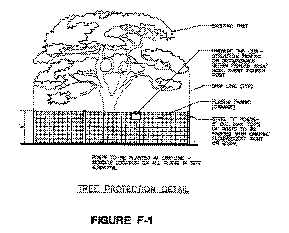
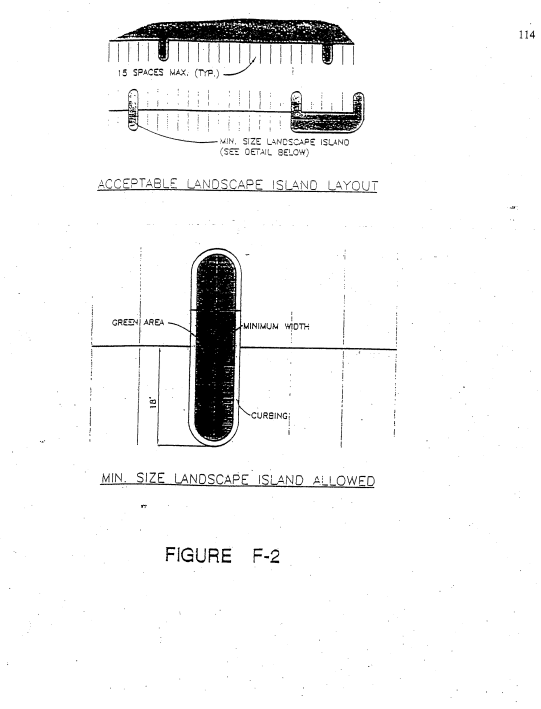
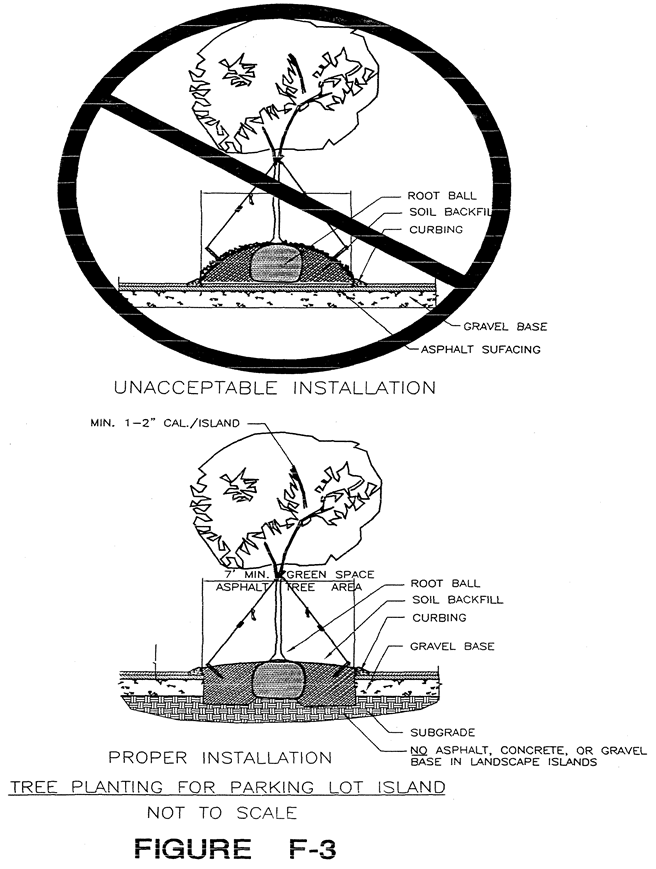
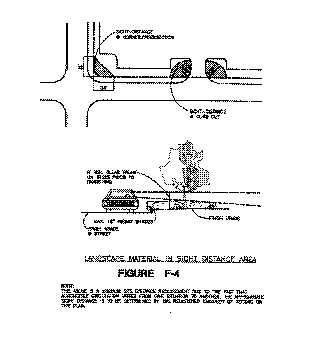
Sec. 14-209. - Floodplain districts.
(1)
Statutory authorization, findings of fact, purpose and objectives.
(a)
Statutory Authorization. The Legislature of the State of Tennessee has in T.C.A §§ 13-7-201 through 13-7-210, delegated the responsibility to local governmental units to adopt regulations designed to promote the public health, safety, and general welfare of its citizenry. Therefore, the City of Goodlettsville, Tennessee, Mayor and the Goodlettsville City Commission, do ordain as follows:
(b)
Findings of Fact.
(i)
The City of Goodlettsville, Tennessee, Mayor and the Goodlettsville City Commission wishes to maintain eligibility in the National Flood Insurance Program (NFIP) and in order to do so must meet the NFIP regulations found in Title 44 of the Code of Federal Regulations (CFR), Ch. 1, Section 60.3.
(ii)
Areas of the City of Goodlettsville, Tennessee are subject to periodic inundation which could result in loss of life and property, health and safety hazards, disruption of commerce and governmental services, extraordinary public expenditures for flood protection and relief, and impairment of the tax base, all of which adversely affect the public health, safety and general welfare.
(iii)
Flood losses are caused by the cumulative effect of obstructions in floodplains, causing increases in flood heights and velocities; by uses in flood hazard areas which are vulnerable to floods; or construction which is inadequately elevated, floodproofed, or otherwise unprotected from flood damages.
(c)
Statement of purpose. It is the purpose of this section to promote the public health, safety and general welfare and to minimize public and private losses due to flood conditions in specific areas. This section is designed to:
(i)
Restrict or prohibit uses which are vulnerable to flooding or erosion hazards, or which result in damaging increases in erosion, flood heights, or velocities;
(ii)
Require that uses vulnerable to floods, including community facilities, be protected against flood damage at the time of initial construction;
(iii)
Control the alteration of natural floodplains, stream channels, and natural protective barriers which are involved in the accommodation of floodwaters;
(iv)
Control filling, grading, dredging and other development which may increase flood damage or erosion;
(v)
Prevent or regulate the construction of flood barriers which will unnaturally divert flood waters or which may increase flood hazards to other lands.
(d)
Objectives. The objectives of this section are:
(i)
To protect human life, health, safety and property;
(ii)
To minimize expenditure of public funds for costly flood control projects;
(iii)
To minimize the need for rescue and relief efforts associated with flooding and generally undertaken at the expense of the general public;
(iv)
To minimize prolonged business interruptions;
(v)
To minimize damage to public facilities and utilities such as water and gas mains, electric, telephone and sewer lines, streets and bridges located in floodprone areas;
(vi)
To help maintain a stable tax base by providing for the sound use and development of floodprone areas to minimize blight in flood areas;
(vii)
To ensure that potential homebuyers are notified that property is in a floodprone area;
(viii)
To maintain eligibility for participation in the NFIP.
(2)
Definitions. Unless specifically defined below, words or phrases used in this section shall be interpreted as to give them the meaning they have in common usage and to give this section its most reasonable application given its stated purpose and objectives.
Accessory structure means a subordinate structure to the principal structure on the same lot and, for the purpose of this section, shall conform to the following:
(a)
Accessory structures shall only be used for parking of vehicles and storage.
(b)
Accessory structures shall be designed to have low flood damage potential.
(c)
Accessory structures shall be constructed and placed on the building site so as to offer the minimum resistance to the flow of floodwaters.
(d)
Accessory structures shall be firmly anchored to prevent flotation, collapse, and lateral movement, which otherwise may result in damage to other structures.
(e)
Utilities and service facilities such as electrical and heating equipment shall be elevated or otherwise protected from intrusion of floodwaters.
Addition (to an existing building) means any walled and roofed expansion to the perimeter or height of a building.
Appeal means a request for a review of the local enforcement officer's interpretation of any provision of this section or a request for a variance.
Area of shallow flooding means a designated AO or AH zone on a community's Flood Insurance Rate Map (FIRM) with one percent or greater annual chance of flooding to an average depth of one to three feet where a clearly defined channel does not exist, where the path of flooding is unpredictable and indeterminate; and where velocity flow may be evident. Such flooding is characterized by ponding or sheet flow.
Area of special flood-related erosion hazard means the land within a community which is most likely to be subject to severe flood-related erosion losses. The area may be designated as zone E on the Flood Hazard Boundary Map (FHBM). After the detailed evaluation of the special flood-related erosion hazard area in preparation for publication of the FIRM, zone E may be further refined.
Area of special flood hazard see "special flood hazard area".
Base flood means the flood having a one percent chance of being equaled or exceeded in any given year. This term is also referred to as the 100-year flood or the one percent annual chance flood.
Basement means any portion of a building having its floor subgrade (below ground level) on all sides.
Building see "structure".
Development means any man-made change to improved or unimproved real estate, including, but not limited to, buildings or other structures, mining, dredging, filling, grading, paving, excavating, drilling operations, or storage of equipment or materials.
Elevated building means a non-basement building built to have the lowest floor of the lowest enclosed area elevated above the ground level by means of solid foundation perimeter walls with openings sufficient to facilitate the unimpeded movement of floodwater, pilings, columns, piers, or shear walls adequately anchored so as not to impair the structural integrity of the building during a base flood event.
Emergency flood insurance program or emergency program means the program as implemented on an emergency basis in accordance with Section 1336 of the Act. It is intended as a program to provide a first layer amount of insurance on all insurable structures before the effective date of the initial FIRM.
Erosion means the process of the gradual wearing away of land masses. This peril is not "per se" covered under the program.
Exception means a waiver from the provisions of this section which relieves the applicant from the requirements of a rule, regulation, order or other determination made or issued pursuant to this section.
Existing Construction means any structure for which the "start of construction'' commenced before the effective date of the initial floodplain management code or ordinance adopted by the community as a basis for that community's participation in the NFIP.
Existing manufactured home park or subdivision means a manufactured home park or subdivision for which the construction of facilities for servicing the lots on which the manufactured homes are to be affixed (including, at a minimum, the installation of utilities, the construction of streets, final site grading or the pouring of concrete pads) is completed before the effective date of the first floodplain management code or ordinance adopted by the community as a basis for that community's participation in the NFIP.
Existing structures see "existing construction".
Expansion to an existing manufactured home park or subdivision means the preparation of additional sites by the construction of facilities for servicing the lots on which the manufactured homes are to be affixed (including the installation of utilities, the construction of streets, and either final site grading or the pouring of concrete pads).
Flood or flooding [means:]
(a)
A general and temporary condition of partial or complete inundation of normally dry land areas from:
(i)
The overflow of inland or tidal waters.
(ii)
The unusual and rapid accumulation or runoff of surface waters from any source.
(iii)
Mudslides (i.e., mudflows) which are proximately caused by flooding as defined in subsection (a)(ii) of this definition and are akin to a river of liquid and flowing mud on the surfaces of normally dry land areas, as when earth is carried by a current of water and deposited along the path of the current.
(b)
The collapse or subsidence of land along the shore of a lake or other body of water as a result of erosion or undermining caused by waves or currents of water exceeding anticipated cyclical levels or suddenly caused by an unusually high water level in a natural body of water, accompanied by a severe storm, or by an unanticipated force of nature, such as flash flood or an abnormal tidal surge, or by some similarly unusual and unforeseeable event which results in flooding as defined in subsection (a)(i) of this definition.
Flood elevation determination means a determination by the Federal Emergency Management Agency (FEMA) of the water surface elevations of the base flood, that is, the flood level that has a one percent or greater chance of occurrence in any given year.
Flood elevation study means an examination, evaluation and determination of flood hazards and, if appropriate, corresponding water surface elevations, or an examination, evaluation and determination of mudslide (i.e., mudflow) or flood-related erosion hazards.
Flood hazard boundary map (FHBM) means an official map of a community, issued by FEMA, where the boundaries of areas of special flood hazard have been designated as zone A.
Flood insurance rate map (FIRM) means an official map of a community, issued by FEMA, delineating the areas of special flood hazard or the risk premium zones applicable to the community.
Flood insurance study means the official report provided by FEMA, evaluating flood hazards and containing flood profiles and water surface elevation of the base flood.
Floodplain or floodprone area means any land area susceptible to being inundated by water from any source (see definition of "flooding").
Floodplain management means the operation of an overall program of corrective and preventive measures for reducing flood damage, including but not limited to emergency preparedness plans, flood control works and floodplain management regulations.
Flood protection system means those physical structural works for which funds have been authorized, appropriated, and expended and which have been constructed specifically to modify flooding in order to reduce the extent of the area within a community subject to a "special flood hazard" and the extent of the depths of associated flooding. Such a system typically includes hurricane tidal barriers, dams, reservoirs, levees or dikes. These specialized flood modifying works are those constructed in conformance with sound engineering standards.
Flood proofing means any combination of structural and nonstructural additions, changes, or adjustments to structures which reduce or eliminate flood damage to real estate or improved real property, water and sanitary facilities and structures and their contents.
Flood-related erosion means the collapse or subsidence of land along the shore of a lake or other body of water as a result of undermining caused by waves or currents of water exceeding anticipated cyclical levels or suddenly caused by an unusually high water level in a natural body of water, accompanied by a severe storm, or by an unanticipated force of nature, such as a flash flood, or by some similarly unusual and unforeseeable event which results in flooding.
Flood-related erosion area or flood-related erosion prone area means a land area adjoining the shore of a lake or other body of water, which due to the composition of the shoreline or bank and high water levels or wind-driven currents, is likely to suffer flood-related erosion damage.
Flood-related erosion area management means the operation of an overall program of corrective and preventive measures for reducing flood-related erosion damage, including but not limited to emergency preparedness plans, flood-related erosion control works and floodplain management regulations.
Floodway means the channel of a river or other watercourse and the adjacent land areas that must be reserved in order to discharge the base flood without cumulatively increasing the water surface elevation more than a designated height.
Freeboard means a factor of safety usually expressed in feet above a flood level for purposes of floodplain management. "Freeboard" tends to compensate for the many unknown factors that could contribute to flood heights greater than the height calculated for a selected size flood and floodway conditions, such as wave action, blockage of bridge or culvert openings, and the hydrological effect of urbanization of the watershed.
Functionally dependent use means a use which cannot perform its intended purpose unless it is located or carried out in close proximity to water. The term includes only docking facilities, port facilities that are necessary for the loading and unloading of cargo or passengers, and ship building and ship repair facilities, but does not include long-term storage or related manufacturing facilities.
Highest adjacent grade means the highest natural elevation of the ground surface, prior to construction, adjacent to the proposed walls of a structure.
Historic structure means any structure that is:
(a)
Listed individually in the National Register of Historic Places (a listing maintained by the U.S. Department of interior) or preliminarily determined by the Secretary of the Interior as meeting the requirements for individual listing on the National Register;
(b)
Certified or preliminarily determined by the Secretary of the Interior as contributing to the historical significance of a registered historic district or a district preliminarily determined by the Secretary to qualify as a registered historic district;
(c)
Individually listed on the Tennessee inventory of historic places and determined as eligible by states with historic preservation programs which have been approved by the Secretary of the Interior; or
(d)
Individually listed on the City of Goodlettsville, Tennessee inventory of historic places and determined as eligible by communities with historic preservation programs that have been certified either:
(i)
By the approved Tennessee program as determined by the Secretary of the Interior; or
(ii)
Directly by the Secretary of the Interior.
Letter of map change (LOMC) means an official FEMA determination, by letter, that amends or revises an effective flood insurance rate map or flood insurance study. Letters of map change include:
Conditional letter of map revision (CLOMR) A formal review and comment as to whether a proposed flood protection project or other project complies with the minimum NFIP requirements for such projects with respect to delineation of special flood hazard areas. A CLOMR does not revise the effective flood insurance rate map or flood insurance study; upon submission and approval of certified as-built documentation, a letter of map revision may be issued by FEMA, to revise the effective FIRM.
Conditional letter of map revision based on fill (CLOMR-F) A determination that a parcel of land or proposed structure that will be elevated by fill would not be inundated by the base flood if fill is placed on the parcel as proposed or the structure is built as proposed.
Letter of map amendment (LOMA) An amendment based on technical data showing that a property was incorrectly included in a designated special flood hazard area. A LOMA amends the current effective flood insurance rate map and establishes that a specific property or structure is not located in a special flood hazard area.
Letter of map revision (LOMR) A letter of map revisions are generally based on the implementation of physical measures that affect the hydrologic or hydraulic characteristics of a flooding source and thus result in the modification of the existing regulatory floodway, the effective base flood elevations (BFEs), or the special flood hazard area (SFHA). The LOMR officially revises the flood insurance rate map (FIRM) or flood boundary and floodway map (FBFM), and sometimes the flood insurance study (FIS) report, and when appropriate, includes a description of the modifications. The LOMR is generally accompanied by an annotated copy of the affected portions of the FIRM, FBFM, or FIS report.
Letter of map revision based on fill (LOMR-F) A determination that a structure or parcel of land has been elevated by fill above the base flood elevation and is, therefore, no longer exposed to flooding associated with the base flood. In order to qualify for this determination, the fill must have been permitted and placed in accordance with the community's floodplain management regulations.
Levee means a man-made structure, usually an earthen embankment, designed and constructed in accordance with sound engineering practices to contain, control or divert the flow of water so as to provide protection from temporary flooding.
Levee system means a flood protection system which consists of a levee, or levees, and associated structures, such as closure and drainage devices, which are constructed and operated in accordance with sound engineering practices.
Lowest floor means the lowest floor of the lowest enclosed area, including a basement. An unfinished or flood resistant enclosure used solely for parking of vehicles, building access or storage in an area other than a basement area is not considered a building's lowest floor; provided, that such enclosure is not built so as to render the structure in violation of the applicable non-elevation design requirements of this section.
Manufactured home means a structure, transportable in one or more sections, which is built on a permanent chassis and designed for use with or without a permanent foundation when attached to the required utilities. The term "manufactured home" does not include a "recreational vehicle".
Manufactured home park or subdivision means a parcel (or contiguous parcels) of land divided into two or more manufactured home lots for rent or sale.
Map means the flood hazard boundary map (FHBM) or the flood insurance rate map (FIRM) for a community issued by FEMA.
Mean sea level means the average height of the sea for all stages of the tide. It is used as a reference for establishing various elevations within the floodplain. For the purposes of this section, the term is synonymous with the National Geodetic Vertical Datum (NGVD) of 1929, the North American Vertical Datum (NAVD) of 1988, or other datum, to which base flood elevations shown on a community's flood insurance rate map are referenced.
National Geodetic Vertical Datum (NGVD) means, as corrected in 1929, a vertical control used as a reference for establishing varying elevations within the floodplain.
New construction means any structure for which the "start of construction" commenced on or after the effective date of the initial floodplain management ordinance and includes any subsequent improvements to such structure.
New manufactured home park or subdivision means a manufactured home park or subdivision for which the construction of facilities for servicing the lots on which the manufactured homes are to be affixed (including at a minimum, the installation of utilities, the construction of streets, and either final site grading or the pouring of concrete pads) is completed on or after the effective date of this section or the effective date of the initial floodplain management ordinance and includes any subsequent improvements to such structure.
North American Vertical Datum (NAVD) means, as corrected in 1988, a vertical control used as a reference for establishing varying elevations within the floodplain.
100-year flood see "base flood".
Person means and includes any individual or group of individuals, corporation, partnership, association, or any other entity, including state and local governments and agencies.
Reasonably safe from flooding means base flood waters will not inundate the land or damage structures to be removed from the special flood hazard area and that any subsurface waters related to the base flood will not damage existing or proposed structures.
Recreational vehicle means a vehicle which is:
(a)
Built on a single chassis;
(b)
400 square feet or less when measured at the largest horizontal projection;
(c)
Designed to be self-propelled or permanently towable by a light duty truck;
(d)
Designed primarily not for use as a permanent dwelling but as temporary living quarters for recreational, camping, travel, or seasonal use.
Regulatory floodway means the channel of a river or other watercourse and the adjacent land areas that must be reserved in order to discharge the base flood without cumulatively increasing the water surface elevation more than a designated height.
Regulatory flood protection elevation means the "base flood elevation" plus the "freeboard." In "special flood hazard areas" where base flood elevations (BFEs) have been determined, this elevation shall be the BFE plus two feet. In "special flood hazard areas" where no BFE has been established, this elevation shall be at least three feet above the highest adjacent grade.
Riverine means relating to, formed by, or resembling a river (including tributaries), stream, brook, etc.
Special flood hazard area means is the land in the floodplain within a community subject to a one percent or greater chance of flooding in any given year. The area may be designated as zone A on the FHBM. After detailed ratemaking has been completed in preparation for publication of the FIRM, zone A usually is refined into zones A, AO, AH, Al-30, AE or A99.
Special hazard area means an area having special flood, mudslide (i.e., mudflow) and/or flood-related erosion hazards, and shown on an FHBM or FIRM as zone A, AO, Al-30, AE, A99, or AH.
Start of construction includes substantial improvement, and means the date the building permit was issued, provided the actual start of construction, repair, reconstruction, rehabilitation, addition, placement, or other improvement was within 180 days of the permit date. The actual start means either the first placement of permanent construction of a structure (including a manufactured home) on a site, such as the pouring of slabs or footings, the installation of piles, the construction of columns, or any work beyond the stage of excavation; and includes the placement of a manufactured home on a foundation. Permanent construction does not include initial land preparation, such as clearing, grading and filling; nor does it include the installation of streets and/or walkways; nor does it include excavation for a basement, footings, piers, or foundations or the erection of temporary forms; nor does it include the installation on the property of accessory buildings, such as garages or sheds, not occupied as dwelling units or not part of the main structure. For a substantial improvement, the actual start of construction means the first alteration of any wall, ceiling, floor, or other structural part of a building, whether or not that alteration affects the external dimensions of the building.
State coordinating agency means the Tennessee Emergency Management Agency, State NFIP Office, as designated by the Governor of the State of Tennessee at the request of FEMA to assist in the implementation of the NFIP for the state.
Structure for purposes of this section, means a walled and roofed building, including a gas or liquid storage tank, that is principally above ground, as well as a manufactured home.
Substantial damage means damage of any origin sustained by a structure whereby the cost of restoring the structure to its before damaged condition would equal or exceed 50 percent of the market value of the structure before the damage occurred.
Substantial improvement means any reconstruction, rehabilitation, addition, alteration or other improvement of a structure in which the cost equals or exceeds 50 percent of the market value of the structure before the "start of construction" of the initial improvement. This term includes structures which have incurred "substantial damage", regardless of the actual repair work performed. The market value of the structure should be:
(a)
The appraised value of the structure prior to the start of the initial improvement; or
(b)
In the case of substantial damage, the value of the structure prior to the damage occurring.
The term does not, however, include either:
(a)
Any project for improvement of a structure to correct existing violations of State or local health, sanitary, or safety code specifications which have been pre-identified by the local code enforcement official and which are the minimum necessary to assure safe living conditions and not solely triggered by an improvement or repair project or;
(b)
Any alteration of a "historic structure", provided that the alteration will not preclude the structure's continued designation as a "historic structure."
Substantially improved existing manufactured home parks or subdivisions means where the repair, reconstruction, rehabilitation or improvement of the streets, utilities and pads equals or exceeds 50 percent of the value of the streets, utilities and pads before the repair, reconstruction or improvement commenced.
Variance means a grant of relief from the requirements of this section.
Violation means the failure of a structure or other development to be fully compliant with the community's floodplain management regulations. A structure or other development without the elevation certificate, other certification, or other evidence of compliance required in this section is presumed to be in violation until such time as that documentation is provided.
Water surface elevation means the height, in relation to the National Geodetic Vertical Datum (NGVD) of 1929, the North American Vertical Datum (NAVD) of 1988, or other datum, where specified, of floods of various magnitudes and frequencies in the floodplains of riverine areas.
(3)
General provisions.
(a)
Application. This section shall apply to all areas within the incorporated area of the City of Goodlettsville, Tennessee.
(b)
Basis for establishing the areas of special flood hazard. The areas of special flood hazard identified on the City of Goodlettsville, Tennessee, as identified by FEMA, and in its flood insurance study (FIS) and flood insurance rate map (FIRM), Community Panel Number(s) 47165CIND0E, 47165C0264H, 47165C0270H, 47165C0376H, 47165C0377H, 47165C0378H, 47165C0379H, 47165C0381H, and 47165C0383H dated February 26, 2021, Panel Number(s) 47037CIND0C, 47037C0126J, 47037C0128J, and 47037C0129J dated February 25, 2022, and Panel Numbers 47037CIND0D, 47037C0136J and 47037C0137K dated June 20, 2024, along with all supporting technical data, are adopted by reference and declared to be a part of this section.
(c)
Requirement for development permit. A development permit shall be required in conformity with this section prior to the commencement of any development activities.
(d)
Compliance. No land, structure or use shall hereafter be located, extended, converted or structurally altered without full compliance with the terms of this section and other applicable regulations.
(e)
Abrogation and greater restrictions. This section is not intended to repeal, abrogate, or impair any existing easements, covenants or deed restrictions. However, where this section conflicts or overlaps with another regulatory instrument, whichever imposes the more stringent restrictions shall prevail.
(f)
Interpretation. In the interpretation and application of this section, all provisions shall be:
(i)
Considered as minimum requirements;
(ii)
Liberally construed in favor of the governing body and;
(iii)
Deemed neither to limit nor repeal any other powers granted under Tennessee statutes.
(g)
Warning and disclaimer of liability. The degree of flood protection required by this section is considered reasonable for regulatory purposes and is based on scientific and engineering considerations. Larger floods can and will occur on rare occasions. Flood heights may be increased by man-made or natural causes. This section does not imply that land outside the areas of special flood hazard or uses permitted within such areas will be free from flooding or flood damages. This section shall not create liability on the part of the City of Goodlettsville, Tennessee or by any officer or employee thereof for any flood damages that result from reliance on this section or any administrative decision lawfully made hereunder.
(h)
Penalties for violation. Violation of the provisions of this section or failure to comply with any of its requirements, including violation of conditions and safeguards established in connection with grants of variance shall constitute a misdemeanor punishable as other misdemeanors as provided by law. Any person who violates this section or fails to comply with any of its requirements shall, upon adjudication, therefore, be fined as prescribed by Tennessee statutes, and in addition, shall pay all costs and expenses involved in the case. Each day such violation continues shall be considered a separate offense. Nothing herein contained shall prevent the City of Goodlettsville, Tennessee from taking such other lawful actions to prevent or remedy any violation.
(4)
Administration.
(a)
Designation of ordinance administrator. The planning director is hereby appointed as the administrator to implement the provisions of this section.
(b)
Permit procedures. means application for a development permit shall be made to the administrator on forms furnished by the community prior to any development activities. The development permit may include, but is not limited to the following: plans in duplicate drawn to scale and showing the nature, location, dimensions, and elevations of the area in question; existing or proposed structures, earthen fill placement, storage of materials or equipment, and drainage facilities. Specifically, the following information is required:
(i)
Application stage.
(A)
Elevation in relation to mean sea level of the proposed lowest floor, including basement, of all buildings where base flood elevations are available, or to certain height above the highest adjacent grade when applicable under this section.
(B)
Elevation in relation to mean sea level to which any non-residential building will be floodproofed where base flood elevations are available, or to certain height above the highest adjacent grade when applicable under this section.
(C)
A FEMA floodproofing certificate from a Tennessee registered professional engineer or architect that the proposed non-residential floodproofed building will meet the floodproofing criteria in subsection (5)(a) and (b).
(D)
Description of the extent to which any watercourse will be altered or relocated as a result of proposed development.
(E)
In order to determine if improvements or damage meet the substantial improvement or substantial damage criteria, the applicant shall provide to the floodplain administrator a detailed cost to repair all damages and/or cost of improvements which includes the complete costs associated with all types of work necessary to completely repair or improve a building. These include the costs of all materials, labor, and other items necessary to perform the proposed work. These must be in the form of:
(1)
An itemized costs of materials, and labor, or estimates of materials and labor that are prepared by licensed contractors or professional construction cost estimators.
(2)
Building valuation tables published by building code organizations and cost-estimating manuals and tools available from professional building cost-estimating services.
(3)
A qualified estimate of costs that is prepared by the local official using professional judgement and knowledge of local and regional construction costs.
(4)
A detailed cost estimate provided and prepared by the building owner. This must include as much supporting documentation as possible (such as pricing information from lumber companies, plumbing and electrical suppliers, etc.). In addition, the estimate must include the value of labor, including the value of the owner's labor.
(ii)
Construction Stage. Within AE zones, where base flood elevation data is available, any lowest floor certification made relative to mean sea level shall be prepared by or under the direct supervision of, a Tennessee registered land surveyor and certified by same. The administrator shall record the elevation of the lowest floor on the development permit. When floodproofing is utilized for a non-residential building, said certification shall be prepared by, or under the direct supervision of, a Tennessee registered professional engineer or architect and certified by same.
Within approximate A zones, where base flood elevation data is not available, the elevation of the lowest floor shall be determined as the measurement of the lowest floor of the building relative to the highest adjacent grade. The administrator shall record the elevation of the lowest floor on the development permit. When floodproofing is utilized for a non-residential building, said certification shall be prepared by, or under the direct supervision of, a Tennessee registered professional engineer or architect and certified by same.
For all new construction and substantial improvements, the permit holder shall provide to the administrator an as-built certification of the lowest floor elevation or floodproofing level upon the completion of the lowest floor or floodproofing.
Any work undertaken prior to submission of the certification shall be at the permit holder's risk. The administrator shall review the above-referenced certification data. Deficiencies detected by such review shall be corrected by the permit holder immediately and prior to further work being allowed to proceed. Failure to submit the certification or failure to make said corrections required hereby, shall be cause to issue a stop-work order for the project.
(iii)
Finished construction stage. A final finished construction elevation certificate is required after construction is completed and prior to certificate of compliance/occupancy issuance. It shall be the duty of the permit holder to submit to the floodplain administrator a certification of final as-built construction of the elevation of the reference level and all attendant utilities. The administrator will keep the certificate on file in perpetuity.
(c)
Duties and responsibilities of the administrator. Duties of the administrator shall include, but not be limited to, the following:
(i)
Review all development permits to assure that the permit requirements of this section have been satisfied, and that proposed building sites will be reasonably safe from flooding.
(ii)
Review proposed development to assure that all necessary permits have been received from those governmental agencies from which approval is required by Federal or State law, including Section 404 of the Federal Water Pollution Control Act Amendments of 1972, 33 U.S.C. 1334.
(iii)
Notify adjacent communities and the Tennessee Emergency Management Agency, State NFIP Office, prior to any alteration or relocation of a watercourse and submit evidence of such notification to FEMA.
(iv)
For any altered or relocated watercourse, submit engineering data/analysis within six months to FEMA to ensure accuracy of community FIRM's through the letter of map revision process.
(v)
Assure that the flood carrying capacity within an altered or relocated portion of any watercourse is maintained.
(vi)
Record the elevation, in relation to mean sea level or the highest adjacent grade, where applicable, of the lowest floor (including basement) of all new and substantially improved buildings, in accordance with subsection (4)(b).
(vii)
Record the actual elevation, in relation to mean sea level or the highest adjacent grade, where applicable to which the new and substantially improved buildings have been floodproofed, in accordance with subsection (4)(b).
(viii)
When floodproofing is utilized for a nonresidential structure, obtain certification of design criteria from a Tennessee registered professional engineer or architect, in accordance with subsection (4)(b).
(ix)
Where interpretation is needed as to the exact location of boundaries of the areas of special flood hazard (for example, where there appears to be a conflict between a mapped boundary and actual field conditions), make the necessary interpretation. Any person contesting the location of the boundary shall be given a reasonable opportunity to appeal the interpretation as provided in this section.
(x)
When base flood elevation data and floodway data have not been provided by FEMA, obtain, review, and reasonably utilize any base flood elevation and floodway data available from a federal, state, or other sources, including data developed as a result of these regulations, as criteria for requiring that new construction, substantial improvements, or other development in zone A on the City of Goodlettsville, Tennessee FIRM meet the requirements of this section.
(xi)
Maintain all records pertaining to the provisions of this section in the office of the administrator and shall be open for public inspection. Permits issued under the provisions of this section shall be maintained in a separate file or marked for expedited retrieval within combined files.
(xii)
A final finished construction elevation certificate (FEMA Form FF-206-FY-22- 152, formerly 086-0-33) is required after construction is completed and prior to certificate of compliance/occupancy issuance. It shall be the duty of the permit holder to submit to the floodplain administrator a certification of final as-built construction of the elevation of the reference level and all attendant utilities. The floodplain administrator shall review the certificate data submitted. Deficiencies detected by such review shall be corrected by the permit holder immediately and prior to certificate of compliance/occupancy issuance. In some instances, another certification may be required to certify corrected as-built construction. Failure to submit the certification or failure to make required corrections shall be cause to withhold the issuance of a certificate of compliance/occupancy. The finished construction elevation certificate certifier shall provide at, least two photographs showing the front and rear of the building taken within 90 days from the date of certification. The photographs must be taken with views confirming the building description and diagram number provided in Section A. To the extent possible, these photographs should show the entire building including foundation. If the building has split-level or multi-level areas, provide at least two additional photographs showing side views of the building. In addition, when applicable, provide a photograph of the foundation showing a representative example of the flood openings or vents. All photographs must be in color and measure at least 3" × 3". Digital photographs are acceptable.
(5)
Provisions for flood hazard reduction.
(a)
General standards. In all areas of special flood hazard, the following provisions are required:
(i)
New construction and substantial improvements shall be anchored to prevent flotation, collapse and lateral movement of the structure;
(ii)
Manufactured homes shall be installed using methods and practices that minimize flood damage. They must be elevated and anchored to prevent flotation, collapse and lateral movement. Methods of anchoring may include, but are not limited to, use of over-the-top or frame ties to ground anchors. This requirement is in addition to applicable State of Tennessee and local anchoring requirements for resisting wind forces.
(iii)
New construction and substantial improvements shall be constructed with materials and utility equipment resistant to flood damage;
(iv)
New construction and substantial improvements shall be constructed by methods and practices that minimize flood damage;
(v)
All electrical, heating, ventilation, plumbing, air conditioning equipment, and other service facilities shall be designed and/or located so as to prevent water from entering or accumulating within the components during conditions of flooding;
(vi)
New and replacement water supply systems shall be designed to minimize or eliminate infiltration of flood waters into the system;
(vii)
New and replacement sanitary sewage systems shall be designed to minimize or eliminate infiltration of flood waters into the systems and discharges from the systems into flood waters;
(viii)
On-site waste disposal systems shall be located and constructed to avoid impairment to them or contamination from them during flooding;
(ix)
Any alteration, repair, reconstruction or improvements to a building that is in compliance with the provisions of this section, shall meet the requirements of "new construction" as contained in this section;
(x)
Any alteration, repair, reconstruction or improvements to a building that is not in compliance with the provision of this section, shall be undertaken only if said non-conformity is not further extended or replaced;
(xi)
All new construction and substantial improvement proposals shall provide copies of all necessary federal and state permits, including section 404 of the Federal Water Pollution Control Act amendments of 1972, 33 U.S.C. 1334;
(xii)
All subdivision proposals and other proposed new development proposals shall meet the standards of subsection (5)(b);
(xiii)
When proposed new construction and substantial improvements are partially located in an area of special flood hazard, the entire structure shall meet the standards for new construction;
(xiv)
When proposed new construction and substantial improvements are located in multiple flood hazard risk zones or in a flood hazard risk zone with multiple base flood elevations, the entire structure shall meet the standards for the most hazardous flood hazard risk zone and the highest base flood elevation.
(b)
Specific standards. In all areas of special flood hazard, the following provisions, in addition to those set forth in subsection (5)(a), are required:
(i)
Residential structures. In AE zones where base flood elevation data is available, new construction and substantial improvement of any residential building (or manufactured home) shall have the lowest floor, including basement, elevated to no lower than two feet above the base flood elevation. Should solid foundation perimeter walls be used to elevate a structure, openings sufficient to facilitate equalization of flood hydrostatic forces on both sides of exterior walls shall be provided in accordance with the standards of this section: "Enclosures".
Within approximate A zones where base flood elevations have not been established and where alternative data is not available, the administrator shall require the lowest floor of a building to be elevated to a level of at least three feet above the highest adjacent grade (as defined in section (2)). Should solid foundation perimeter walls be used to elevate a structure, openings sufficient to facilitate equalization of flood hydrostatic forces on both sides of exterior walls shall be provided in accordance with the standards of this section: "Enclosures"
(ii)
Non-residential structures. In AE zones, where base flood elevation data is available, new construction and substantial improvement of any commercial, industrial, or non-residential building, shall have the lowest floor, including basement, elevated or floodproofed to no lower than one (1) foot above the level of the base flood elevation. Should solid foundation perimeter walls be used to elevate a structure, openings sufficient to facilitate equalization of flood hydrostatic forces on both sides of exterior walls shall be provided in accordance with the standards of this section: "Enclosures"
In approximate A zones, where base flood elevations have not been established and where alternative data is not available, new construction and substantial improvement of any commercial, industrial, or non-residential building, shall have the lowest floor, including basement, elevated or floodproofed to no lower than three feet above the highest adjacent grade (as defined in section (2)). Should solid foundation perimeter walls be used to elevate a structure, openings sufficient to facilitate equalization of flood hydrostatic forces on both sides of exterior walls shall be provided in accordance with the standards of this section: "Enclosures"
Non-residential buildings located in all A zones may be floodproofed, in lieu of being elevated, provided that all areas of the building below the required elevation are watertight, with walls substantially impermeable to the passage of water, and are built with structural components having the capability of resisting hydrostatic and hydrodynamic loads and the effects of buoyancy. A Tennessee registered professional engineer or architect shall certify that the design and methods of construction are in accordance with accepted standards of practice for meeting the provisions above, and shall provide such certification to the Administrator as set forth in subsection (4)(b).
(iii)
Enclosures. All new construction and substantial improvements that include fully enclosed areas formed by foundation and other exterior walls below the lowest floor that are subject to flooding, shall be designed to preclude finished living space and designed to allow for the entry and exit of flood waters to automatically equalize hydrostatic flood forces on exterior walls.
A.
Designs for complying with this requirement must either be certified by a Tennessee professional engineer or architect or meet or exceed the following minimum criteria.
(1)
Provide a minimum of two openings having a total net area of not less than one square inch for every square foot of enclosed area subject to flooding;
(2)
The bottom of all openings shall be no higher than one foot above the finished grade;
(3)
Openings may be equipped with screens, louvers, valves or other coverings or devices provided they permit the automatic flow of floodwaters in both directions.
B.
The enclosed area shall be the minimum necessary to allow for parking of vehicles, storage or building access.
C.
The interior portion of such enclosed area shall not be finished or partitioned into separate rooms in such a way as to impede the movement of floodwaters and all such partitions shall comply with the provisions of subsection (5)(b).
(iv)
Standards for manufactured homes and recreational vehicles.
(A)
All manufactured homes placed, or substantially improved, on:
(1)
Individual lots or parcels,
(2)
In expansions to existing manufactured home parks or subdivisions, or
(3)
In new or substantially improved manufactured home parks or subdivisions, must meet all the requirements of new construction.
(B)
All manufactured homes placed or substantially improved in an existing manufactured home park or subdivision must be elevated so that either:
(1)
In AE zones, with base flood elevations, the lowest floor of the manufactured home is elevated on a permanent foundation to no lower than one foot above the level of the base flood elevation; or
(2)
In approximate A zones, without base flood elevations, the manufactured home chassis is elevated and supported by reinforced piers (or other foundation elements of at least equivalent strength) that are at least three feet in height above the highest adjacent grade (as defined in section (2)).
(C)
Any manufactured home, which has incurred "substantial damage" as the result of a flood, must meet the standards of section (5)(a) and (b).
(D)
All manufactured homes must be securely anchored to an adequately anchored foundation system to resist flotation, collapse and lateral movement.
(E)
All recreational vehicles placed in an identified special flood hazard area must either:
(1)
Be on the site for fewer than 180 consecutive days;
(2)
Be fully licensed and ready for highway use (a recreational vehicle is ready for highway use if it is licensed, on its wheels or jacking system, attached to the site only by quick disconnect type utilities and security devices, and has no permanently attached structures or additions), or;
(3)
The recreational vehicle must meet all the requirements for new construction.
(v)
Standards for subdivisions and other proposed new development proposals. Subdivisions and other proposed new developments, including manufactured home parks, shall be reviewed to determine whether such proposals will be reasonably safe from flooding.
(A)
All subdivision and other proposed new development proposals shall be consistent with the need to minimize flood damage.
(B)
All subdivision and other proposed new development proposals shall have public utilities and facilities such as sewer, gas, electrical and water systems located and constructed to minimize or eliminate flood damage.
(C)
All subdivision and other proposed new development proposals shall have adequate drainage provided to reduce exposure to flood hazards.
(D)
In all approximate A zones require that all new subdivision proposals and other proposed developments (including proposals for manufactured home parks and subdivisions) greater than 50 lots or five acres, whichever is the lesser, include within such proposals base flood elevation data (see section (5)(e)).
(c)
Standards for special flood hazard areas with established base flood elevations and with floodways designated. Located within the special flood hazard areas established in section (3)(b), are areas designated as floodways. A floodway may be an extremely hazardous area due to the velocity of floodwaters, debris or erosion potential. In addition, the area must remain free of encroachment in order to allow for the discharge of the base flood without increased flood heights and velocities. Therefore, the following provisions shall apply:
(i)
Encroachments are prohibited, including fill, new construction, substantial improvements or other development within the adopted regulatory floodway. Development may be permitted however, provided it is demonstrated through hydrologic and hydraulic analyses performed in accordance with standard engineering practice that the encroachment shall not result in any increase in flood levels or floodway widths during a base flood discharge. A registered professional engineer must provide supporting technical data and certification thereof;
(ii)
A community may permit encroachments within the adopted regulatory floodway that would result in an increase in base flood elevations, floodway width or base flood discharge provided that the applicant first applies for a conditional letter of map revision (CLOMR) from FEMA prior to the start of construction. Upon completion of the project, the applicant shall apply for a letter of map revision (LOMR) from FEMA. Submittal requirements and fees shall be the responsibility of the applicant as established under the provisions of section 65.12.
(iii)
Only if section (5)(c), provisions (i) [and] (ii) are satisfied, then any new construction or substantial improvement shall comply with all other applicable flood hazard reduction provisions of section (5)(a) and (b).
(d)
Standards for areas of special flood hazard zones AE with established base flood elevations but without floodways designated. Located within the special flood hazard areas established in section (3)(b), where streams exist with base flood data provided but where no floodways have been designated (zones AE), the following provisions apply:
(i)
Require until a regulatory floodway is designated, that no new construction, substantial, or other development, including fill shall be permitted within zone AE on the community's FIRM, unless it is demonstrated through hydrologic and hydraulic analyses performed that the cumulative effect of the proposed development, when combined with all other existing and anticipated development, will not increase the water surface elevation of the base flood more than one foot at any point within the community.
(ii)
A community may permit encroachments within zones AE on the community's FIRM, that would result in an increase in the water surface elevation of the base flood, provided that the applicant first applies for a conditional letter of map revision (CLOMR) from FEMA prior to the start of construction. Upon completion of the project, the applicant shall apply for a letter of map revision (LOMR) from FEMA. Submittal requirements and fees shall be the responsibility of the applicant as established under the provisions of section 65.12.
(iii)
Only if section (5)(d), provisions (i) [and] (ii) are satisfied, then any new construction or substantial improvement shall comply with all other applicable flood hazard reduction provisions of section (5)(a) and (b).
(e)
Standards for streams without established base flood elevations and floodways (A zones). Located within the special flood hazard areas established in section (3)(b), where streams exist, but no base flood data has been provided and where a floodway has not been delineated, the following provisions shall apply:
(i)
The administrator shall obtain, review, and reasonably utilize any base flood elevation and floodway data available from any federal, state, or other sources, including data developed as a result of these regulations (see (ii) below), as criteria for requiring that new construction, substantial improvements, or other development in approximate A zones meet the requirements of section (5)(a) and (b).
(ii)
Require that all new subdivision proposals and other proposed developments (including proposals for manufactured home parks and subdivisions) greater than fifty lots or five acres, whichever is the lesser, include within such proposals base flood elevation data.
(iii)
Within approximate A zones, where base flood elevations have not been established and where such data is not available from other sources, require the lowest floor of a building to be elevated or floodproofed to a level of at least three feet above the highest adjacent grade (as defined in section (2)). All applicable data including elevations or floodproofing certifications shall be recorded as set forth in section (6)(b). Openings sufficient to facilitate automatic equalization of hydrostatic flood forces on exterior walls shall be provided in accordance with the standards of section (5)(b).
(iv)
Within approximate A zones, where base flood elevations have not been established and where such data is not available from other sources, no encroachments, including structures or fill material, shall be located within an area equal to the width of the stream or 20 feet, whichever is greater, measured from the top of the stream bank, unless certification by a Tennessee registered professional engineer is provided demonstrating that the cumulative effect of the proposed development, when combined with all other existing and anticipated development, will not increase the water surface elevation of the base flood more than one foot at any point within the City of Goodlettsville, Tennessee. The engineering certification should be supported by technical data that conforms to standard hydraulic engineering principles.
(v)
New construction and substantial improvements of buildings, where permitted, shall comply with all applicable flood hazard reduction provisions of section (5)(a) and (b). Within approximate A zones, require that those subsections of section (5)(b) dealing with the alteration or relocation of a watercourse, assuring watercourse carrying capacities are maintained and manufactured homes provisions are complied with as required.
(f)
Standards for areas of shallow flooding (zone AO). Located within the special flood hazard areas established in section (3)(b), are areas designated as shallow flooding areas. These areas have special flood hazards associated with base flood depths of one to three feet where a clearly defined channel does not exist and where the path of flooding is unpredictable and indeterminate. In addition to section (5)(a) and (b), all new construction and substantial improvements shall meet the following requirements:
(i)
The lowest floor (including basement) shall be elevated at least as high as the depth number specified on the flood insurance rate map (FIRM), in feet, plus a freeboard of one foot above the highest adjacent grade; or at least three feet above the highest adjacent grade, if no depth number is specified.
(ii)
Non-residential structures may, in lieu of elevation, be floodproofed to the same level as required in section (5)(f)(i) so that the structure, together with attendant utility and sanitary facilities, below that level shall be watertight with walls substantially impermeable to the passage of water and with structural components having the capability of resisting hydrostatic and hydrodynamic loads and effects of buoyancy. Certification is required in accordance with section (4)(b)(i)(C) and section (5)(b)(ii).
(iii)
Adequate drainage paths shall be provided around structures on slopes, to guide floodwaters around and away from proposed structures.
(g)
Standards for areas of shallow flooding (zone AID). Located within the special flood hazard areas established in section (3)(b), are areas designated as shallow flooding areas. These areas are subject to inundation by one-percent-annual-chance shallow flooding (usually areas of ponding) where average depths are one to three feet. Base flood elevations are derived from detailed hydraulic analyses are shown in this zone. In addition to meeting the requirements of section (5)(a)and (b), all new construction and substantial improvements shall meet the following requirements:
(i)
Adequate drainage paths shall be provided around structures on slopes, to guide floodwaters around and away from proposed structures.
(h)
Standards for areas protected by flood protection system (A-99 zones). Located within the areas of special flood hazard established in section (3)(b), are areas of the 100-year floodplain protected by a flood protection system but where base flood elevations have not been determined. Within these areas (A-99 zones) all provisions of sections (4) and (5) shall apply.
(i)
Standards for unmapped streams. Located within the City of Goodlettsville, Tenn-
essee, are unmapped streams where areas of special flood hazard are neither indicated
nor identified. Adjacent to such streams, the following provisions shall apply:
i.
No encroachments including fill material or other development including structures shall be located within an area of at least equal to twice the width of the stream, measured from the top of each stream bank, unless certification by a Tennessee registered professional engineer is provided demonstrating that the cumulative effect of the proposed development, when combined with all other existing and anticipated development, will not increase the water surface elevation of the base flood more than one foot at any point within the locality.
ii.
When a new flood hazard risk zone, and base flood elevation and floodway data is available, new construction and substantial improvements shall meet the standards established in accordance with sections (4) and (5).
iii.
Only if section (5)(i), provisions i. and ii. are satisfied, then any new construction or substantial improvement shall comply with all other applicable flood hazard reduction provisions of section (5)(a) and (b).
(6)
Variance procedures.
(a)
Municipal board of zoning appeals.
(i)
Authority. The City of Goodlettsville, Tennessee Municipal Board of Zoning Appeals shall hear and decide appeals and requests for variances from the requirements of this section.
(ii)
Procedure. Meetings of the municipal board of zoning appeals shall be held at such times, as the board shall determine. All meetings of the municipal board of zoning appeals shall be open to the public. The municipal board of zoning appeals shall adopt rules of procedure and shall keep records of applications and actions thereof, which shall be a public record. Compensation of the members of the municipal board of zoning appeals shall be set by the City of Goodlettsville.
(iii)
Appeals: How taken. An appeal to the municipal board of zoning appeals may be taken by any person, firm or corporation aggrieved or by any governmental officer, department, or bureau affected by any decision of the administrator based in whole or in part upon the provisions of this section. Such appeal shall be taken by filing with the municipal board of zoning appeals a notice of appeal, specifying the grounds thereof. In all cases where an appeal is made by a property owner or other interested party, a fee of $200.00 for the cost of publishing a notice of such hearings shall be paid by the appellant. The administrator shall transmit to the municipal board of zoning appeals all papers constituting the record upon which the appeal action was taken. The municipal board of zoning appeals shall fix a reasonable time for the hearing of the appeal, give public notice thereof, as well as due notice to parties in interest and decide the same within a reasonable time which shall not be more than 30 days from the date of the hearing. At the hearing, any person or party may appear and be heard in person or by agent or by attorney.
(iv)
Powers. The municipal board of zoning appeals shall have the following powers:
(A)
Administrative review. To hear and decide appeals where it is alleged by the applicant that there is error in any order, requirement, permit, decision, determination, or refusal made by the administrator or other administrative official in carrying out or enforcement of any provisions of this section.
(B)
Variance procedures. In the case of a request for a variance the following shall apply:
(1)
The City of Goodlettsville, Tennessee Municipal Board of Zoning Appeals shall hear and decide appeals and requests for variances from the requirements of this section.
(2)
Variances may be issued for the repair or rehabilitation of historic structures as defined, herein, upon a determination that the proposed repair or rehabilitation will not preclude the structure's continued designation as a historic structure and the variance is the minimum necessary deviation from the requirements of this section to preserve the historic character and design of the structure.
(3)
In passing upon such applications, the municipal board of zoning appeals shall consider all technical evaluations, all relevant factors, all standards specified in other sections of this section, and:
(a)
The danger that materials may be swept onto other property to the injury of others;
(b)
The danger to life and property due to flooding or erosion;
(c)
The susceptibility of the proposed facility and its contents to flood damage;
(d)
The importance of the services provided by the proposed facility to the community;
(e)
The necessity of the facility to a waterfront location, in the case of a functionally dependent use;
(f)
The availability of alternative locations, not subject to flooding or erosion damage, for the proposed use;
(g)
The relationship of the proposed use to the comprehensive plan and floodplain management program for that area;
(h)
The safety of access to the property in times of flood for ordinary and emergency vehicles;
(i)
The expected heights, velocity, duration, rate of rise and sediment transport of the flood waters and the effects of wave action, if applicable, expected at the site;
(j)
The costs of providing governmental services during and after flood conditions including maintenance and repair of public utilities and facilities such as sewer, gas, electrical, water systems, and streets and bridges.
(4)
Upon consideration of the factors listed above, and the purposes of this section, the municipal board of zoning appeals may attach such conditions to the granting of variances, as it deems necessary to effectuate the purposes of this section.
(5)
Variances shall not be issued within any designated floodway if any increase in flood levels during the base flood discharge would result.
(b)
Conditions for variances.
(i)
Variances shall be issued upon a determination that the variance is the minimum relief necessary, considering the flood hazard and the factors listed in section (6)(a).
(ii)
Variances shall only be issued upon: a showing of good and sufficient cause, a determination that failure to grant the variance would result in exceptional hardship; or a determination that the granting of a variance will not result in increased flood heights, additional threats to public safety, extraordinary public expense, create nuisance, cause fraud on or victimization of the public, or conflict with existing local laws or ordinances.
(iii)
Any applicant to whom a variance is granted shall be given written notice that the issuance of a variance to construct a structure below the base flood elevation will result in increased premium rates for flood insurance (as high as $25.00 for $100.00) coverage, and that such construction below the base flood elevation increases risks to life and property.
(iv)
The administrator shall maintain the records of all appeal actions and report any variances to FEMA upon request.
(7)
Legal status provisions.
(a)
Conflict with other ordinances. In case of conflict between this section or any part thereof, and the whole or part of any existing or future ordinance of the City of Goodlettsville, Tennessee, the most restrictive shall in all cases apply.
(b)
Severability. If any section, clause, provision, or portion of this section shall be held to be invalid or unconstitutional by any court of competent jurisdiction, such holding shall not affect any other section, clause, provision, or portion of this section which is not of itself invalid or unconstitutional.
(c)
Effective date. This section shall become effective on June 20, 2024, in accordance with the Charter of the City of Goodlettsville, Tennessee, and the public welfare demanding it. Approved and adopted by the City of Goodlettsville, Tennessee, Mayor and the Goodlettsville City Commission.
(Ord. #08-720, Dec. 2008, as amended by Ord. #12-777, April 2012, and Ord. #16-880, Dec. 2016, and replaced by Ord. #20-980, Nov. 2020 Ch5_02-10-22 and Ord. #21-1020, Dec. 2021 Ch5_02-10-22; Ord. No. 24-1088, 6-6-2024)
Sec. 14-210. - Planned unit development district regulations.
(1)
Purpose. These districts are designed to promote flexibility in design and permit planned diversification in the location of structures; to promote efficient use of land that will facilitate a more economic arrangement of buildings; circulation systems, land use, and utilities; to preserve as much as possible existing landscape features and utilize them in a harmonious fashion; to encourage the total planning of tracts of land; and to provide a mechanism for the ownership of land, utilities, streets, and facilities in common as well as the maintenance and disposition thereof.
(2)
General provisions.
(a)
Master plan required. No application for a planned unit development (PUD) district shall be considered unless a master plan meeting the requirements outlined in subsection 14-210(3)(a) is submitted therewith. Such application shall indicate that the services of one or more design professionals were utilized in the preparation of the plan. In the review and approval of a master plan the Goodlettsville Municipal/Regional Planning Commission is authorized to exercise architectural review of the buildings in order to assure quality of development, compatibility within the community and compatibility with the adjacent and neighborhood properties. Deviations from the approved master plan shall be considered to be violations of the zoning ordinance and shall be punishable as provided by law. Final certificates of occupancy may be withheld pending correction of the violations.
(b)
Ownership and division of land. No tract of land may be considered for or approved as a planned development unless such tract is under single ownership. The holder(s) of a written option to purchase, any governmental agency, or a redeveloper under contract with any governmental agency shall be considered landowners for purposes of this section. Unless otherwise provided as a condition of approval of a PUD, the landowner of an adopted PUD may divide and transfer parts of such development. The transferee shall complete each such unit, and use and maintain it in strict conformance with the adopted final master plan. Prior to the transfer of any section, a subdivision plat shall be filed with the Goodlettsville Municipal/Regional Planning Commission.
(c)
Relationship to subdivision regulations. The uniqueness of each proposal for a planned unit development may require that specifications for the width and surfacing of streets, public ways, public utility rights-of-way, curbs, and other standards may be subject to modification from the specifications established in the subdivision regulations adopted by the Goodlettsville Municipal/Regional Planning Commission.
Modifications may be incorporated only with the approval of the Goodlettsville Municipal/Regional Planning Commission as a part of its review of the master plan for a PUD and granted as a variance in the preliminary approval of the subdivision, which must be concurrent with the final approval by the Goodlettsville Municipal/Regional Planning Commission of the master plan.
(d)
Combination of separate types of planned unit developments. The Goodlettsville Municipal/Regional Planning Commission and city commission may consider separate types of planned unit developments (residential and commercial) within a consolidated master plan as a single administrative procedure provided the total tract is in single ownership as defined and the land area is sufficient to meet the separate type requirements.
(e)
Development period, staging schedule. The expeditious construction of any PUD shall be undertaken to assist in the assurance of the full completion of the development in accord with the approved master plan.
Within three years after the date of approval of the preliminary master plan, the final master plan shall have been submitted and actual construction shall have commenced in such development. In the event that construction has not been started, such approval shall lapse and be of no effect. The Goodlettsville Municipal/Regional Planning Commission may conduct a hearing on the project and review the zoning and feasibility of the PUD and may act to extend approval of the master plan depending upon the circumstances of each case.
The Goodlettsville Municipal/Regional Planning Commission may permit the development to be constructed in stages so that completion is achieved in a logical manner. The following provisions shall govern the staging schedule:
(i)
Each stage shall be so planned and so related to existing surroundings and available facilities and services that failure to proceed to the subsequent stages will not have an adverse impact on the planned unit development or its surroundings at any stage of the development.
(ii)
Each stage of the master plan, whether preliminary or final, may be considered as an independent unit for purposes of construction of the stage or of cancellation or extension of any approval, and no vested rights shall be attached to any stage by virtue of construction on a previous stage.
(f)
Common open space and facilities. Any common open space or public or private facilities shall be subject to the following provisions:
(i)
The location, shape, size, and character of the common open space shall be reviewed in detail, and it must be used for amenity or recreational purposes. The uses authorized for the common open space must be appropriate to the scale and character of the planned development considering its size, density, expected population, topography, and the number and type of dwellings or structures to be provided.
(ii)
Common open space must be suitable for its intended uses but common open space containing natural features worthy of preservation may be left unimproved. Any such common open space shall be available and usable by residents of the development. The intent for "usable" open space shall be 25 percent of common open space. The buildings, structures, and improvements, which are permitted in the common space must be appropriate to the uses which are authorized for the common open space and must conserve and enhance the amenities of the common open space with regard to its topography and unimproved condition.
(iii)
The Goodlettsville Municipal/Regional Planning Commission shall require that the landowner provide for and establish an organization for the ownership and maintenance of any common open space and facilities and such organization shall not be dissolved nor shall it dispose of any common open space, by sale or otherwise (except to an organization conceived and established to own and maintain the common open space), without first offering to dedicate the same to an appropriate public agency and said dedication be approved by the Goodlettsville Municipal/Regional Planning Commission. However, the conditions of any transfer shall conform to the adopted final master plan.
(iv)
In the event that the organization established to own and maintain common open space, or any successor organization, shall at any time after the establishment of the planned unit development fail to maintain the common open space in reasonable order and condition in accordance with the adopted master plan, the codes director may serve written notice upon such organization and/or the owners or residents of the planned unit development common open space for a period of one year. When the codes director determines that the organization is not prepared for the maintenance for the common open space such agency shall continue maintenance for yearly periods.
(v)
The cost of such maintenance by such agency shall be assessed proportionally against the properties within the planned unit development that have a right of enjoyment of the common open space, and shall become a lien on said properties.
(vi)
If the common open space is deeded to a homeowners association, the developer shall file a declaration of covenants and restrictions that will govern the association, to be submitted with the application for final approval. The provisions shall include, but not be limited to the following:
(A)
The homeowners association must be set up before the homes are sold.
(B)
Membership must be mandatory for each home buyer and any successive buyer.
(C)
The open space restrictions must be permanent, not just for a period of years.
(D)
The association must be responsible for liability insurance, local taxes, and the maintenance of recreational and other facilities.
(E)
Homeowners must pay their pro rata share of the cost, and the assessment the association can become a lien on the property.
(F)
The association must be able to adjust the assessment to meeting changing needs.
(g)
Dedication of public facilities. The Goodlettsville Municipal/Regional Planning Commission and city commission may require that suitable areas for streets, utilities, public rights-of-way, schools, parks, and public areas be set aside and/or dedicated to the city.
(h)
Waiver of board of zoning appeals action. No action of the board of zoning appeals shall be required in the approval of a PUD including those activities which would otherwise require conditional use permits under other chapters of this title. In the process of master plan approval for a PUD the Goodlettsville Municipal/Regional Planning Commission shall function as the board of zoning appeals. The action of the Goodlettsville Municipal/Regional Planning Commission and city commission shall be final.
(3)
Administrative procedure. The provisions of this section govern the procedure for review and approval for all planned unit developments as provided herein. Any landowner or developer, as defined, may apply for PUD zoning in any area subject to these provisions. The city commission may, within its legislative power, impose PUD zoning upon any land area, and after such action, the landowner shall follow the remaining procedures before any zoning permits can be issued and the land developed.
(a)
Steps of approval process.
(i)
The applicant may request a pre-application conference with city staff to evaluate the proposal and to determine and clarify any issues that may arise.
(ii)
The applicant shall submit a preliminary master plan and rezoning request to the planning director for Goodlettsville Municipal/Regional Planning Commission consideration along with the required fees.
(iii)
The Goodlettsville Municipal/Regional Planning Commission may approve or reject the request. If approved, the Goodlettsville Municipal/Regional Planning Commission shall recommend the necessary PUD zoning to the city commission. If rejected, the applicant may appeal the decision to the city commission.
(iv)
After approval of the preliminary plan and amendment of the zoning map, preparation of the final master plan may begin.
(v)
Within three years after approval of the preliminary master plan, the applicant shall submit a final master plan to the planning director for Goodlettsville Municipal/Regional Planning Commission for consideration. If any part of the PUD is to be subdivided, a subdivision plat shall also be submitted.
(vi)
Prior to the sale or transfer of any property, the applicant shall submit and have approved and recorded a final subdivision plat.
(vii)
Both the preliminary and final master plans shall be prepared and stamped by registrants of the State of Tennessee who are licensed to practice the particular discipline being prepared (e.g., site layout and drainage by civil engineers, boundary surveys by surveyors, landscape plans by landscape architects).
(viii)
If the application is incomplete, the planning director shall hold in abeyance the formal review by the Goodlettsville Municipal/Regional Planning Commission until such time as complete information is submitted.
(b)
Application for approval of the preliminary master plan and zoning request. Application for approval of the preliminary master plan shall be made by the landowner of the affected property or his authorized agent to the planning director in accordance with such written general rules regarding general procedure, form of application, and required information as the Goodlettsville Municipal/Regional Planning Commission may determine, provided they are not inconsistent herewith. The application for preliminary approval shall consist of the following:
(i)
The preliminary master plan for the proposed planned unit development shall be a general concept plan which shall include such items as the Goodlettsville Municipal/Regional Planning Commission by general rule shall specify in order to disclose;
(A)
The location and size of the area involved,
(B)
Transportation routes including streets, driveways, sidewalks, and pedestrian ways, and off-street parking and loading areas,
(C)
Location and approximate dimensions of structures including approximate height and bulk and the utilization of structures including activities and the number of living units and exterior building and roof design and materials,
(D)
Location and extent of required landscape buffer yards and a generalized plan to indicate how the landscaping regulations will be met,
(E)
Estimated population and density and extent of activities to be allocated to parts of the project,
(F)
Reservations for public uses including schools, parks and other open spaces,
(G)
Availability commitments from the appropriate water and sewer provider,
(H)
Major landscaping features including topography,
(I)
The general means of the disposition of sanitary wastes and storm water, and
(J)
North arrow, graphic scale, and location map showing relationship to existing street system and adjoining properties.
(ii)
A tabulation of the land area to be devoted to various uses and activities and overall densities.
(iii)
The nature of the landowner's interest in the land proposed to be developed and a written statement or concurrence from all parties having a beneficial interest in the affected property.
(iv)
The general substance of covenants, grants of easements or other restrictions to be imposed upon the use of the land, buildings and structures including proposed easements for public utilities.
(v)
A development schedule, setting forth when the landowner intends to commence construction and an estimated completion period.
(vi)
When it is proposed that the final master development plan will be submitted in stages, a schedule of submission thereof.
(vii)
A filing and review fee in an amount determined according to the standard fee schedule as approved by the city commission.
(viii)
A general summary explaining the character, intent, and financing of the PUD.
(c)
Application for approval of the final master plan. The action of the city commission on the zoning request and the preliminary master plan shall authorize and form the basis for the Goodlettsville Municipal/Regional Planning Commission approval of a final master plan.
(i)
Application for final approval. After zoning to a planned unit development district, the landowner may make application to the Goodlettsville Municipal/Regional Planning Commission for approval of a final master development plan, provided that the proposed master development plan and other elements associated with the planned unit development are in substantial compliance with the substance of the preliminary approval of the Goodlettsville Municipal/Regional Planning Commission. The application shall include all aspects of the preliminary application, the proposed final master development plan, other required drawings, specifications, covenants, easements, and conditions and forms of bonds as were set forth by the Goodlettsville Municipal/Regional Planning Commission preliminary approval. Copies of all legal documents required for dedication or reservation of group or common open space and/or for the creation of a non-profit association shall also be submitted. When appropriate, this application shall contain the stage development schedule.
(ii)
Final approval of stages. The application for final approval and the final approval by the Goodlettsville Municipal/Regional Planning Commission may be limited to each stage as appropriate in a large planned unit development.
(iii)
Final master development plan. The final master plan of a planned unit development, or as submitted in stages if so authorized, shall be substantially consistent with the approved preliminary master plan and must in addition show the following:
(A)
Detailed building plans showing front, rear and side elevations including materials proposed to be used and the percentage of each material used upon each elevation,
(B)
Detailed landscaping plans which shall include trees, shrubs and flowering plants with species, quantities and sizes clearly indicated,
(C)
Elevations as necessary,
(D)
Location of gas, water, sewerage, and drainage facilities,
(E)
Details and locations of signs,
(F)
Plans for street and parking lot improvements,
(G)
Location and use of all common open space area,
(H)
Grading plans showing existing and proposed topography,
(I)
Additional information as determined by the Goodlettsville Municipal/Regional Planning Commission to indicate fully the ultimate operation and appearance of the PUD.
(d)
Amendments to the PUD. The terms, conditions, and the final master plan of a PUD may be changed from time to time by official action of the Goodlettsville Municipal/Regional Planning Commission. Any such amendments must remain in compliance with the appropriate zoning regulations and comply with the following.
The landowner, the residents and/or owners of or in the PUD may apply to the Goodlettsville Municipal/Regional Planning Commission for an amendment to the master plan. The Goodlettsville Municipal/Regional Planning Commission may approve such amendment so long as the original intent is not abrogated and the change does not in any way damage any part of the PUD nor any adjoining properties. Minor changes in the location, size and height of buildings may be authorized by the Goodlettsville Municipal/Regional Planning Commission if required by engineering or other circumstances of the location not foreseen at the time of final approval. Other changes in use, rearrangement of lots, blocks, or building tracts, provisions for open space, or any other desired change must be justified by changes in conditions or markets since the final plan was approved.
(e)
Extension of an adopted planned unit development. The Goodlettsville Municipal/Regional Planning Commission may act to extend approval of any master plan in accordance with subsection 14-210(2)(e) or upon the request of the landowner.
(f)
Zoning permits and use and occupancy permits. A zoning permit shall be issued for structures, buildings, activities, or uses as a part of a finally adopted planned unit development only in strict compliance with the master development plan of the particular planned unit development including the conditions of approval and only after the administrative procedure outlined in this section has been strictly adhered to. No zoning permit shall be issued for the area included in a preliminary planned unit development unit a final master development plan has been approved and adopted.
(g)
Use and occupancy permit. A use and occupancy permit shall be issued only when the codes director determines that the structure, building, activity, or use conforms to the final master development plan as approved by the Goodlettsville Municipal/Regional Planning Commission.
(4)
Residential planned unit developments.
(a)
Type of developments. There are hereby created three types of residential PUDs as follows:
Low density residential PUD: LDRPUD.
Medium density residential PUD: MDRPUD.
High density residential PUD: HDRPUD.
Residential Limited Scale PUD: RLSPUD.
(b)
Purpose. The purpose of a LDRPUD and a MDRPUD is to permit development of land, which by reason of topography or floodable land contains some areas unsuitable for development and to permit the clustering of lots in order to leave the unsuitable land as permanent open space. The preservation of land in open space for amenity value, recreation, wildlife habitat or forest protection is also a suitable purpose for PUD zoning.
The purpose of a HDRPUD is to permit a variety of housing types within a totally planned environment.
(c)
Minimum size. The minimum size of any residential PUD shall be five acres.
(d)
Permitted activities in a residential PUD. The activities listed in table I in the appendix may be permitted only when deemed appropriate by the Goodlettsville Municipal/Regional Planning Commission and City Commission as approved with the preliminary master plan. Those listed as not permitted may not be approved by the Goodlettsville Municipal/Regional Planning Commission. Other activities not listed below are prohibited except as determined by city commission with property zoning.
(e)
The planning commission and city commission may review proposed commercial activities or require commercial activities as a component of a residential planned unit development along arterial routes including Dickerson Road/Main Street, Springfield Highway, Louisville Hwy 31W, Conference Drive, Rivergate Parkway, and Long Hollow Pike. The size and location, timing of improvement, and permitted and non-permitted commercial activities shall be defined on the project master plans.
(f)
Density, bulk, and open space regulations.
(i)
Low density residential planned unit development. The maximum overall density shall be 1.7 dwelling units per gross acre. The minimum lot size shall be 15,000 square feet. The remaining area shall be left as common open space and used for the designated purposes. The minimum yard requirements for each lot are as follows:
Minimum front yard 30 feet.
Minimum side yard ten feet.
Minimum rear yard 20 feet.
Minimum open space ten percent.
The Goodlettsville Municipal/Regional Planning Commission may consider a request to vary the minimum lot size, and side yard requirements based upon characteristics of the lot, type of house and building footprint with the minimum separation between buildings shall be 15 feet.
(ii)
Medium density residential planned unit development. The maximum overall density shall be three dwelling units per acre. The minimum lot size and setbacks shall be established by the preliminary and final master plans based on the purpose and characteristics of the PUD and the area in which it is proposed to be located. Minimum open space 15 percent with a minimum separation between buildings of 15 feet.
(iii)
High density residential planned unit development.
(A)
The maximum overall densities shall be in terms of the number of dwelling units per gross acre of all the area within said development.
(B)
The maximum floor area shall be in terms of a ratio of total floor area per total area within said development, as provided herein.
(C)
Yard requirements are waived and the following minimum controls shall be applied: Maximum density 7/acre and minimum open space 25 percent. Maximum building height three stories.
(D)
The Goodlettsville Municipal/Regional Planning Commission and City Commission may authorize a high density residential planned unit development to be increased in density up to 15 units per acre for projects in commercial center mixed use areas with infrastructure to support the increased density and along major roadway routes including pedestrian connections to the mixed-use commercial center areas. Maximum floor area ratio 1.0, maximum building height four stories but may be increased to be consistent with the adjacent commercial developments in commercial center mixed uses areas. The minimum open space 25 percent and minimum size of site may be reduced in size as determined by planning commission and city commission during preliminary master plan review.
(iv)
Special high rise projects. The Goodlettsville Municipal/Regional Planning Commission and City Commission may authorize a PUD to be a high rise project if said project is specifically designed for the use and occupancy of persons 60 years old or older. The following requirements shall apply:
The minimum size of site may be reduced to three acres.
(v)
Residential limited scale planned unit development.
(A)
The purpose of the district is to provide flexible and efficient small scale residential designs for in-fill type developments in defined areas of the city currently designated as R7, High Density and R-10, Medium Density zoning districts. The master plan-based zoning would permit the city to review and include certain defined consistency requirements with adjacent properties. The Goodlettsville Planning Commission and city commission with the preliminary master plan review may permit the zoning designation in other areas of the city depending on the proposed project design and scale.
(B)
Project site and building designs except as defined in this section to meet the requirements of the residential planned unit development standards.
(C)
Maximum density is seven units per acre with a minimum area of dedicated open space of 15 percent. Dedicated open space per this section does not include individual decks/patios, garages, or parking.
(D)
Permitted activities including detached, attached, semi-attached residential units may be permitted when deemed appropriate by the Goodlettsville Planning Commission and city commission as approved with the preliminary master plan. The preliminary master plan review may include depending on the project design area characteristics and setting limited scale retail/service oriented commercial uses.
(E)
Property perimeter minimum building setbacks to be a minimum 15 feet. The perimeter area to include dedicated open space either on an individual or common lot/property. The amount of required dedicated open space in the perimeter buffer may be reduced to permit parking, decks/patios based on the project scale and design and area characteristics with landscaping, solid fence or wall, or a combination design.
(F)
Residential units may be located on a single lot, individual lots, or other ownership methods including private maintenance provided by a property owners association.
(G)
The maximum building height shall be 35 feet, but the planning commission and city commission may require building designs limited to a two story design based on the project design and scale and adjacent area characteristics and settings.
(H)
Each residential unit to include a dedicated one car garage on the property and the garage designs to meet the requirements of the residential planned unit development standards. Alternative designs may be reviewed by the planning commission and city commission with the preliminary master plan based on the project design and scale and area characteristics and settings.
(g)
Limitation on density. The Goodlettsville Municipal/Regional Planning Commission and City Commission may, within their discretion, limit the density to a figure lower than the maximum permitted above. This type of limitation shall be exercised only if the character of the adjoining neighborhood is inappropriate for the proposed development or if the development would place an excessive burden on the existing street and utility system.
(h)
Development standards.
(i)
Perimeter requirements. Along the perimeter of the PUD, buildings shall be designed to harmonize in scale, setbacks, and mass with existing adjacent areas. Perimeter landscaping shall also be required. The minimum building setback along the perimeter of the site shall be 35 feet. The minimum building setback along the perimeter of a PUD development including attached dwellings and multi-family dwelling and an adjacent low-density residential zoning district shall be increased to a minimum of 50 feet.
(ii)
Landscaping requirements. Every PUD shall be attractively landscaped. The perimeter and parking lot landscaping requirements of section 14-202 shall apply. In addition to applicable parking lot and transitional screening requirements, street trees are required on each single family detached lot at a spacing of 50 feet on center along both sides of new public and private streets. The two inch minimum caliper street trees shall include a variety of canopy tree plantings meeting the tree list of appendix B of this title. The tree locations are to be located between ten feet to 25 feet from the back of the sidewalk off the right-of-way. Per project master plan based on building streetscape design, the street yard planting may be reviewed within a privately maintained planting strip between a street side curb and sidewalk including a minimum dimension of ten feet or in roadway medians designs with tree types and planting improvement methods to protect adjacent sidewalk and street surface roots. All other residential dwelling development types shall include along new public and private streets a street tree within a planting strip between a street side curb and sidewalk including a minimum dimension of ten feet. Any utility easement and street lighting locations shall be determined when locating such tree. Alternative street tree planting, including but not limited to location of plantings, may be reviewed with project master plans equaling the total caliper inches of street trees required.
(iii)
Off-street parking. The off-street parking space requirements contained in section 14-208 shall apply as applicable. Visitor parking shall be in one or multiple central locations with access from an interconnected sidewalk system and a designated parking area. In addition to the required number of parking spaces per residential unit, a minimum of one parking space shall be provided per five residential units.
(iv)
Signs. The sign provisions of the Goodlettsville Sign Ordinance shall apply. All sign locations and designs shall be shown on or as a separate element of the final master plan.
(v)
Street improvements. Within any PUD, collector and minor streets may be public or private. All one-way and alleyway streets, and any parking perpendicular to streets and within center medians shall be private. Collector and minor streets in a low-density PUD shall be public. If the developer requests that the streets and sidewalks be dedicated to the public, specifications and procedures of the subdivision regulations and city's street standards shall apply. Streets may be constructed to be private streets to be maintained either by the landowner/developer or deeded to the homeowners association and shall be subject to the city's subdivision regulations and street standards regarding roadway and storm water design and construction and maximum length and size of dead-end streets and turnarounds.
Pavement widths not including curbs or dedicated on-street parking shall be as follows:
Collector street: 24 feet,
Minor streets: 22 feet,
Alley ways and one-way streets: 16 feet.
Dead-end streets shall be provided with adequate turn-around space for emergency services, delivery, and trash service vehicles.
(vi)
Utilities. All utility services connections shall be underground and shall commence at the property line unless otherwise approved by the Goodlettsville Municipal/Regional Planning Commission. All lighting plans must meet Nashville Electric Services Street Lighting Design Manual standards and any subsequent amendments to such manual and be approved by the Goodlettsville Municipal/Regional Planning Commission. The development shall be serviced with public sanitary sewerage systems. The water systems shall be capable of providing needed fire flows for the development as well as domestic water supply. Fire hydrants shall be installed a maximum of 500 feet apart except for areas of detached dwellings where the fire hydrants may be spaced so that no dwelling is farther than 500 feet away from such hydrant.
(vii)
Waste disposal. If any central waste disposal containers are provided, they shall be completely enclosed with the covering materials to be similar to those used on the buildings and screened from view with landscaping materials.
(viii)
Development standards for multi-family projects.
(A)
The spacing of all buildings contained in multi-family dwellings shall be as set forth in section 14-208.
(B)
Each dwelling unit shall be provided with reasonable visual and acoustical privacy. Fences, walks, and landscaping shall be provided for the protection and aesthetic enhancement of the development and privacy of the occupants, screening of objectionable views or uses and the reduction of noise.
(C)
Street sidewalks and on-site walks shall be provided for convenient and safe access to all living units from streets, driveways, parking courts or garages and for convenient circulation and access to all facilities.
(D)
The appearance and character of the site shall be preserved and enhanced by retaining and protecting existing trees and other site features; and additional new plant material shall be added for privacy, shade, beauty of buildings and grounds and the screen out objectionable features. The planting plan shall be submitted with the site development plan. Existing trees, shrubs, evergreens and ground cover shall be retained to the extent that they enhance the project, are effective as a screen planting or are useful in protecting slopes.
(E)
Adequate recreation facilities for the residents of the project shall be provided in locations easily accessible to the living units and where they do not impair the view and privacy of living units.
Attractive outdoor sitting areas shall be provided, appropriate in size, type and number to the needs of the residents.
Well-equipped playgrounds of adequate size and number shall be provided, where it is anticipated that children will occupy the premises.
(F)
Access and circulation shall adequately provide for firefighting equipment, service deliveries, furniture moving vans and refuse collection.
(G)
Off-street parking may be grouped in bays, either adjacent to streets or in the interior of blocks. Such parking areas shall generally be located in close proximity to the dwelling units they are designed to serve. At least one parking space per dwelling unit shall be located so as to provide a maximum walking distance of 200 feet from the nearest entrance of the dwelling unit the space is to serve. Where appropriate, common driveways, parking areas, walks and steps shall be provided, maintained and lighted for night use. Screening of parking and service areas shall be in accordance with the landscape requirements of section 14-208.
(ix)
Development standards for attached dwellings.
(A)
The minimum lot required for any individual attached dwelling shall be as required to meet other provisions of these regulations. Individual attached dwellings may exceed the maximum lot coverage provisions established for the area in which such site is located. However, in no instance shall the aggregate site coverage of all dwellings, attached or otherwise, exceed the coverage provisions established for the PUD district in which such site is located.
(B)
Not more than six contiguous town houses shall be built in a row with the same or approximately the same front line, and not more than 12 town houses shall be contiguous.
(C)
The spacing of buildings containing attached dwellings shall be as required by section 14-208.
(D)
Yards.
(1) For units located along the periphery of a site containing attached dwellings, the yard provisions established for the district adjacent to the perimeter shall apply subject to a maximum front yard for the attached dwellings of 30 feet.
(2) For units located entirely within a site, no side or rear yard as such is required in connection with any attached dwelling located entirely within a site containing attached dwellings but each such unit shall on its own lot have one yard containing not less than 250 square feet. This yard shall be reasonably secluded from view from streets or from neighboring property and shall not be used for off-street parking or for any accessory building.
(E)
No attached dwelling shall exceed two stories in height.
(F)
Parking shall be provided as required in section 14-208. However, the attached dwellings required parking and the other required spaces constructed are permitted in privately maintained bays either adjacent to the streets or in the interior of blocks. Such spaces shall be located within 200 feet of each unit to be served. Where appropriate, common driveways, parking areas, walks and steps shall be provided, maintained and lighted for night use. Screening of parking and service areas shall be encouraged through ample use of trees, shrubs, hedges, and screening walls.
(G)
Each dwelling unit shall be provided with reasonable visual and acoustical privacy. Fences, walks, and landscaping shall be provided for the protection and aesthetic enhancement of the development and privacy of the occupants, screening of objectionable views or uses, and the reduction of noise.
(H)
Streets sidewalks and on-site walks shall be provided for convenient and safe access to all living units from streets, driveways, parking courts, or garages and for convenient circulation and access to all facilities.
(x)
Quality and improvement of common open space. No open area may be accepted as common open space under the provisions of this section unless the location, shape, size and character of the common open space is appropriate to the scale and character of the development considering its size, density, expected population, topography, and the number and type of dwellings to be provided.
Common open space must be suitably improved for its intended use, but common open space containing natural features worthy of preservation, steep slopes, or floodplains may be left unimproved. Any buildings, structures, and improvements which are permitted in the common open space must be appropriate to the uses which are authorized for the common open space having regard to its topography and unimproved condition.
If the master plan provides for buildings, structures, and improvements, in the common open space of value in excess of $10,000.00, the developer must provide a bond or other adequate assurance that the buildings, structures, and improvements will be completed. The Goodlettsville Municipal/Regional Planning Commission shall release the bond or other assurance when the buildings, structures, or improvements have been completed according to the development plan.
(xi)
Residential design requirements. The intent of this subsection is to guide the development of residential neighborhoods that are compatible throughout the development and that complement existing development and the natural environment. Architectural elevations are required with each development with an architectural theme for all buildings including a variety in building roof pitches and building wall and roof designs and materials, building colors, building accent designs and designs preventing blank walls fronting streets. Plans shall include the garages or covered parking frontage locations and orientation with off-street parking. Plans shall include building designs connected to the project streetscape design. Garage or covered parking design for residential planned unit developments shall include a design or variety of designs that prevent more than 33 percent of the total unit number of front-loaded garages doors or open parking openings that are level with or in front of the front line of the residential structure. Front-loaded garages or covered open parking include garages and covered parking with the garage door or covered parking opening exceeding 25 percent of the front building elevation total width dimension. Except for parking structures for development shared parking, attached parking in garages are in addition to the required parking space requirement for each residential unit. The project master plans to include the following garage or covered parking designs, or other alternative designs may be reviewed with the master plan process.
(A)
Side loaded garages or covered parking.
(B)
Alley loaded or secondary roadway loaded garages or covered parking with the sidewalk connecting each unit to be located at the front of the residential structure fronting the primary street.
(C)
Recessed front loaded garages or covered parking 10 feet or more behind the front line of the house.
(D)
Courtyard side loaded garages at the front of the structure.
(E)
Front loaded garages with the garage door(s) less than 25 percent of the front building elevation width dimension.
All buildings within a residential planned unit development shall meet the provisions of the city's design guidelines and the following. All façades and exterior building walls shall include a minimum 50 percent masonry brick and/or stone. The remaining 50 percent on one and two family attached and attached dwellings may be split face block, cement fiber board, wood siding, EIFS, and glass. A limited percentage of metal and vinyl siding may be permitted for accents and decorative features. All exposed portions of building foundations shall be masonry brick or stone. The planning commission may review other proposed materials as a variance with the preliminary and final master plan review process variance.
(5)
Commercial planned unit developments.
(a)
Type of developments. There are hereby created four types of commercial planned unit developments as follows:
Commercial planned unit development: CPUD.
Commercial planned unit development limited: CPUDL.
General office planned unit development: GOPUD.
Restricted office planned unit development: ROPUD.
(b)
Purpose. The general purpose of commercial PUD districts is to provide for a wide range of activities developed for high quality and under controlled conditions.
(c)
Feasibility study. The Goodlettsville Municipal/Regional Planning Commission or the city commission may require a feasibility study/market analysis for any proposed commercial planned unit development. The study will be utilized, among other things, to determine the impact of the proposed development on the long-range development of the commercial land use in the city, the timing of any proposed development to ascertain the effects of a proposed development upon lands used or zoned for commercial purposes, to form a basis for evaluating the estimated effects on traffic, the financial capability of the developer, and other purposes which assist in an understanding of the public interest pertinent in the evaluation of a proposed development. The study, if required, shall be provided by the landowner and the landowner shall provide any other economic data or analysis as may be reasonably requested by the Goodlettsville Municipal/Regional Planning Commission and/or city commission.
(d)
Minimum size. The minimum size for each type commercial PUD shall be as follows:
CPUD: Five acres
CPUDL: No minimum
GOPUD: Five acres
ROPUD: One acre
(e)
Permitted activities. The activities listed in table I in appendix A may be permitted as a part of PUD only when such activities are approved as a part of the final master plan and deemed appropriate by the Goodlettsville Municipal/Regional Planning Commission. A change in use may be granted by the codes director only when the change is to a similar use or activity. Activities not listed are prohibited. Hotels/motels are included under limitations as defined in section 14-206(5)(e).
(f)
Bulk regulations for commercial PUDs. The building intensity, height, and open space requirements shall be as follows:
(i)
Maximum floor area ratio and lot coverage.
CPUD: 1.0
CPUDL: 0.3
GOPUD: 0.75
ROPUD: 0.15
The maximum lot coverage for all buildings shall be 40 percent in all cases.
(ii)
Maximum building height.
CPUD: Seven stories
CPUDL: Four stories
GOPUD: Seven stories
ROPUD: Four stories
Any building in excess of 35 feet in height shall be provided with a complete sprinkler system furnished with an adequate water supply.
(iii)
Setback requirements. The following building setback requirements shall be observed. Front setbacks shall be required from any public street. Side and rear setbacks shall be required from any exterior property line. Setbacks from private streets or interior property lines shall be established by the approval of the master plan.
Front
CPUD: 60 feet
CPUDL: 40 feet
GOPUD: 50 feet
ROPUD: 40 feet
Side and Rear
CPUD: 30 feet
CPUDL: 20 feet
GOPUD: 15 feet
ROPUD: 15 feet
For a building in excess of two stories, the side and rear yard requirement shall be increased five feet per story in excess of two,
Provided further that permanent open, landscaped area meeting the requirements of section 14-208 shall be maintained. No buildings or parking areas shall be permitted in any required permanent open space.
(g)
Off-street parking. Loading, and vehicular access.
(i)
Off-street parking and loading space shall be provided in accordance with the provisions for off-street parking contained in section 14-208. Parking lot landscaping shall be provided in accordance with the landscaping provisions of section 14-208.
(ii)
Vehicular access locations shall be provided so that vehicles entering or departing a planned unit development site shall do so only at such locations. Elsewhere along the property lines of said planned unit development site a physical separation between the said site and public rights-of-way shall be provided. A vehicular access location shall consist of such entrance and exit driveway openings so designed and located so as to minimize hazardous vehicular turning movements and traffic congestion. Such design and location shall be subject to the approval of the city engineer working in conjunction with the Goodlettsville Municipal/Regional Planning Commission.
(A)
No vehicular access location serving a planned unit development site shall be:
(1)
Within 25 feet of the intersection of street right-of-way lines, bounding, in part, the same planned unit development site, and
(2)
Within 150 feet of any interchange ramp. Such distance shall be measured from a point where the centerline of the ramp intersects with the edge of the pavement of the travelway of the intersecting street.
(h)
Permitted signs. Signs may be permitted in accordance with the provisions of the Goodlettsville Sign Ordinance. Sign locations and character shall be approved as a part of the final master plan.
(i)
Other regulations.
(A)
If an area is reclassified to any commercial PUD and such area contains existing houses, then such house may not be converted into use as an office or commercial building, the intent being to encourage new construction and the aggregation of small parcels into larger tracts.
(6)
Regional center planned unit development.
(a)
Type of developments. There are two types of regional center planned unit developments as follows: RC1 high intensity and RC2 low intensity.
(b)
General purpose. The general purpose of the regional center planned unit developments is to provide for mixed use commercial and residential uses at a higher density and intensity of development associated with an urban center. The regional center design includes pedestrian and streetscape-oriented design with regulations permitting flexibility for design oriented planned unit developments.
(c)
Feasibility study. The Goodlettsville Municipal Planning Commission or the city commission may require a feasibility study/market analysis for any proposed planned unit development. The study will be utilized, among other things, to determine the impact of the proposed development on the long-range development of the residential and commercial land use in the city, the timing of any proposed development to ascertain the effects of a proposed development upon lands used or zoned for commercial purposes, to form a basis for evaluating the estimated effects on traffic, the financial capability of the developer, and other purposes which assist in an understanding of the public interest pertinent in the evaluation of a proposed development. The study, if required, shall be provided by the landowner and the landowner.
(d)
Permitted activities. The activities listed in table I in appendix A may be permitted as a part of planned unit development only when such activities are approved as a part of the master plans and deemed appropriate by the Goodlettsville Municipal Planning Commission. A change in use may be granted by the codes director only when the change is to a similar use or activity. Activities not listed are prohibited. Hotels/motels are included under limitations as defined in section 14-206(5)(e).
(e)
Building and property dimension and design requirements.
(i)
RC1: Ten stories maximum subject to available fire protection equipment, water supply, and emergency vehicle site access. Minimum building two stories or similar height building height design.
(ii)
RC2: Seven stories maximum subject to available fire protection equipment, water supply, and emergency vehicle site access. Minimum building height of two stories or 25 feet, or similar height building height design. RC1 and RC2 transition zones—Planned unit developments along the perimeter of the regional center comprehensive land use plan designated area to include reduced building heights, mass, and scale to step down for consistency with developed areas outside the regional center designated area.
(iii)
RC1 limited to a residential density of 40 units per acre.
(iv)
RC2 limited to a residential density of 25 units per acre.
(v)
RC1 to include minimum ground floor non-residential uses along Rivergate Parkway and within 500 feet of the center points of Rivergate Parkway and secondary street intersections with the primary ground square footage limited to non-residential uses. Residential uses include the residential units and offices and accessory uses of the residential use.
(vi)
RC2 to include minimum ground floor non-residential uses along Rivergate Parkway with the primary ground square footage limited to non-residential uses. Residential uses include residential units and offices and accessory uses of the residential use.
(vii)
RC2 to include minimum ground floor non-residential uses on all properties and portions of properties within 500 feet of the center points of Rivergate Parkway and secondary street intersections with the primary ground square footage limited to non-residential uses. Residential uses include the residential units and offices and accessory uses of the residential use.
(viii)
RC2 to include minimum ground floor non-residential use on all properties and portions of properties within a 300 feet radius measured from the center point of the Blue Bird Drive and Meadowlark Drive intersection with the primary ground square footage limited to non-residential uses. Residential uses include the residential units and offices and accessory uses of the residential use.
(ix)
RC1 minimum lot area 30,000 square feet and minimum street frontage 100 feet.
(x)
RC2 minimum lot area 15,000 square feet and minimum street frontage 75 feet.
(xi)
RC1 and RC2 minimum building and parking lot open space setbacks are to be minimum of five feet unless planning commission authorizes setbacks less than five feet for streetscape and zero-lot line designs subject to available fire protection equipment, water supply, and emergency vehicle site access.
(xii)
RC1 and RC2 building designs to meet the provisions of the design guidelines with ground floor designs to include pedestrian oriented street scape designs with glass store fronts when including non-residential uses and pedestrian and outdoor use designs. Building designs to include reduced mass and scale along streetscapes and at transitional building height zones. Building designs exceeding five stories to include building step back or similar design features to allow sun light to reach adjacent sidewalks and designated open spaces.
(f)
Street and site design.
(i)
All new streets and sidewalks adjacent to street to be public with interconnected street grid system with multiple connections and pedestrian oriented streetscape design with a minimum clear pedestrian sidewalk width of eight feet along both sides of existing and new streets.
(ii)
Additional pedestrian connections to adjacent developments and public use areas within designated public right-of-way or public access easements.
(iii)
All new utilities to be underground including main and service lines planning commission may review relocation of existing lines with developments at the back or service area of the project.
(iv)
Minimum parking requirements can be met on-site or in a collective off-site shared private or public parking area except that all required residential use parking shall be met on-site only. A parking needs study may be submitted with the preliminary master plan for proposed reduced parking needs due to the intention of the regional center pedestrian oriented mixed-use design.
(v)
All building loading and trash service areas to be located at the rear of the project with buildings constructed along streets for the intended street scape design.
(vi)
Storm water quality and quantity designs may be on-site or in shared collective off-site public or private facilities within designated public utility and drainage easements.
(vii)
Site landscaping limited to screening along the perimeter of parking areas, interior parking lot planting breaks, streetscape plantings including street trees per the landscaping requirements of the zoning ordinance. Buffer designs along the perimeter of the project property to be per the requirements of this section. The transitional buffers along the perimeter of the regional center comprehensive land use plan area to be a minimum 15 feet in width with solid wall or fence design with dense evergreen screen along the perimeter of the wall or fence. Planning commission may review landscaping only screens when the available clear buffer width exceeds the minimum width. The minimum height of the wall, fence, evergreen planting screen height to be a minimum of eight feet and maximum height of 12 feet. Project buffers along property boundaries within the regional center comprehensive land use plan area to be determined based on the master plan design and adjacent property use and zoning. Designated buffer areas less than ten feet in width to include a solid fence or masonry wall. Fence designs to include masonry column and base designs.
(viii)
Development signage limited to building wall, awning, and projecting signs. Ground signs limited to seven feet in height and 50 square feet expect pole signs per the provisions of the city's sign ordinance section of zoning ordinance are permitted along Rivergate Parkway.
The planning commission during the master plan phase may approve alternative designs meeting the intention of the provision above due to property or adjacent property dimensions and conditions and right-of-way and easement limitations.
(Ord. #06-674, June 2006, as amended by Ord. #14-817, May 2014, Ord. #17-909, Dec. 2017, and Ord. #21-1017, Dec. 2021 Ch5_02-10-22; Ord. No. 22-1035, § 1(Exh. A(7—20)), 4-28-2022; Ord. No. 24-1083, § 1(Exh. A), 5-9-2024; Ord. No. 24-1091, § 1(Exh. A), 8-8-2024)
Sec. 14-211. - Performance standards.
(1)
Purpose and intent. The purpose of this section is to establish regulations and standards for the installation and operation of industrial, commercial, community facility uses, based upon consideration of the objectionable characteristics of such uses and the districts in which they are permitted.
In all districts, as indicated in each respective district, any permitted use or any conditional use and every building or structure or tract of land that is established, developed, or constructed shall comply with each and every performance standard contained herein.
When any use or building or other structure is extended, enlarged, or reconstructed after the effective date of this title, the applicable performance standards shall apply to such extended, enlarged, or reconstructed portion or portions of such use of building or other structure.
The provisions of this chapter shall apply notwithstanding the issuance after the effective date of this title of any zoning permit or use and occupancy permit.
Performance standards are not applicable to the temporary construction, excavation, grading and demolition activities which are necessary and incidental to the development of facilities on the same zone lot, on another of several zone lots being developed at the time, or on the public right-of-way or easement for a community facility activity.
In the case of any conflict between the activity type and the performance standards, the latter shall control. In the case of any conflict between the performance standards set forth herein and any rules and regulations adopted by other governmental agencies, the more restrictive shall apply.
(2)
Performance of standard regulations. The following performance standard regulations shall apply to all uses of property as indicated in each respective district:
(a)
Prohibition of dangerous or objectionable elements. No land or building in any district shall be used or occupied in any manner so as to create any dangerous, injurious, noxious, or otherwise objectionable fire, explosive, or other hazard; noise or vibration, smoke, dust, odor, or other form of air pollution; heat, cold, dampness, electrical, or other disturbance; glare; liquid or solid refuse or wastes; or other substance, condition, or element in such a manner or in such amount as to adversely affect the surrounding area of adjoining premises (referred to herein as "dangerous or objectionable elements"); provided, that any use permitted or not expressly prohibited by this title may be undertaken and maintained if it conforms to the regulations of this section limiting dangerous and objectionable elements at the point of the determination of their existence.
(b)
Performance standards regulating noise.
(i)
Definitions. For the purpose of this section, the following terms shall apply:
ANSI: American National Standards Institute or its successor bodies.
A-weighted sound pressure level: The sound pressure level as measured with a sound level meter using the A-weighting network. The symbol for this standard is dB(A).
Decibel: a unit of intensity of sound pressure. The decibel scale is a logarithmic scale of ratios of pressure with respect to a reference pressure. It is abbreviated as dB.
Impact sound: A sound produced by two or more objects (or parts of a machine) striking each other, so as to be heard as separate district noises.
Noise: A subjective description of an undesirable or unwanted sound.
Sound level: In decibels, a weighted sound pressure level, determined by the use of metering characteristics and frequency weightings specified in ANSI S1.4-1971 "specifications for sound level meters."
Sound level meter: An instrument, including a microphone, amplifier, EMS detector and integrator, time average, output-meter and/or visual display and weighting net- works, that is sensitive to pressure fluctuations. The instrument reads sound pressure level when properly calibrated and is of type I or better as specified in ANSI publication S1.4-1971 or its successor publication.
Steady state: A noise or vibration, which is continuous such as from a fan or compressor.
(ii)
Method of measurement. For the purpose of measuring the intensity of noise, the sound level meter as defined above shall be used. Noise levels shall be measured using an A-weighted sound pressure level scale. Impact noises shall be measured using the fast response of the sound level meter, and other noises using the slow response. For purposes of this section, impact noises shall be considered to be those noises whose peak values are more than three decibels higher that the values indicated on the sound level meter.
(iii)
Maximum permitted sound levels. The maximum permitted sound pressure levels in decibels across zone lot lines and district boundaries shall be in accordance with the following table. This table shall be used to determine the maximum noise level, measured in A-weighted decibels, which shall be permitted at the property line of the closest use in each of the following categories.
Table of maximum permitted sound levels
(iv)
Exemptions. The standards set forth in this section shall not apply to emergency warning devices, lawn care equipment used during daylight hours and equipment used in construction during daylight hours.
(c)
Performance standards regulating vibration. No vibration other than from a temporary construction operation or a transportation facility shall be permitted which is discernible without instruments at the zone lot line of the zone lot on which the vibration source is situated.
For purposes of this section, vibration shall include the type of vibration which is a reciprocating movement transmitted through the earth and impact vibration produced by two or more objects (or parts of a machine) striking each other.
(d)
Performance standards regulating smoke, gases, dust, and particulate matter. In the Davidson County section of Goodlettsville "all uses and activities" shall comply with the air pollution regulations of the metropolitan health department, pollution control division. In the Sumner County section of Goodlettsville all uses and activities shall comply with the air pollution regulations of the department of environment and conservation, division of air pollution control. Such regulations shall be enforced by each respective agency.
(e)
Performance standards regulating odors.
(i)
Definitions.
(A)
Odorous matter: Solid, liquid, or gaseous material, which produces an olfactory response in a human being.
(B)
Odor threshold concentration: The lowest concentration of odorous matter, which will produce an olfactory response in a human being.
(ii)
Emission of odorous matter. Within the IR and IG districts, odorous matter released from any operation or activity shall not exceed the odor threshold concentration beyond the district boundary of any residential, commercial or agricultural district.
Within all other districts, odorous matter released from any operation or activity shall not exceed the odor threshold concentration beyond the zone lot line.
As a guide to classification of odor, it shall be deemed that strong odors of putrefaction and fermentation tend to be obnoxious and that such odors as associated with baking or the roasting of nuts or coffee shall not normally be considered obnoxious within the meaning of this section.
(f)
Performance standards regulating toxic matter and fire and explosive hazards. The use and/or storage of any toxic, detonable, or explosive materials and any fire hazard solids, liquids or gases shall be in strict accordance with the current NFPA code as adopted by the city. Adequate precautions shall be taken to protect against any negative off-site impacts of any hazardous or toxic materials release, using best available technology. Any such release shall be a violation of this title punishable as provided by law.
(g)
Performance standards regulating glare and electromagnetic interference.
(i)
Definition.
Foot candle: a unit of illumination. Technically the illumination at all points one foot distance from a uniform point source of one candlepower.
(ii)
Limitation of glare. In all districts, any operation or activity producing glare shall be conducted so that direct and indirect light from the source shall not cause illumination in excess of one-half feet candles when measured at a residential district boundary or at the street right-of-way line.
All site lighting shall be shielded so that substantially all directly emitted light falls within the property line of the lot emitting the light. No illumination shall produce direct, incident or reflected light that interferes with the safe operation of motor vehicles on public streets. Lighting prohibited by this provision shall include, but not be limited to any light that may be confused with or construed as a traffic-control device.
(iii)
Electromagnetic interference. In all districts, no operations or activities shall be conducted which cause electrical disturbances to be transmitted across zone lot lines.
(h)
Performance standards regulating radioactive materials. The manufacture, storage, and utilization of radioactive materials shall be prohibited except for use as a part of medical practice and facilities and such use shall be in accordance with the state regulations.
(i)
Nonconforming uses by reason of performance standards. Any use existing on the effective date of this title, or subsequent amendment as applicable, and permitted by right that does not meet the requirements of one or more of the performance standards established explicitly in this section or by reference shall be subject to the nonconforming use provisions of section 14-212.
(Ord. #06-674, June 2006)
Sec. 14-212. - Provisions governing nonconforming uses and noncomplying buildings or other structures.
(1)
Nonconforming uses. The provisions of this section are applicable to all uses which are not permitted within the districts in which they are located.
(a)
Continuation of nonconforming use. Any nonconforming use which existed at the time of enactment of this title and which remains nonconforming, or any use which shall become nonconforming upon enactment of this title, or any subsequent amendments thereto may be continued subject to the provisions, contained in this section. Provided however, that nothing herein shall be construed to authorize the continuation of any illegal or nonconforming use which was illegal prior to the adoption of this title.
(b)
Repairs and alterations. Nothing in this section shall prevent the strengthening or restoring to a safe condition of any part of any building or structure declared unsafe by proper authority.
(i)
Incidental alterations. Incidental alterations as defined by this title may be made to a building or other structure occupied by a nonconforming use, or in connection with a permitted change of a nonconforming use.
(ii)
Alterations other than incidental alterations. No alterations other than incidental alterations shall be made to a building or other structure occupied by a nonconforming use, except as provided below or when made:
(A)
In order to comply with requirements of law regarding fire protection, safety of the structure, etc., or
(B)
In order to conform to the applicable district regulations or performance standards.
(iii)
Alteration of commercial and industrial uses. Any commercial or industrial use subject to the provisions of this section shall be allowed to continue in operation and to make such alterations as may prove necessary for the continuation of said use. However, no alteration may be made which would result in a change from one nonconforming use to another and further provided that any such alteration permitted hereunder shall take place only upon the zone lot(s) on which said use was operating as of the effective date of this title.
(c)
Expansion. The nonconforming use or part of a building or structure, all or substantially all of which is designed or intended for a use not permitted in the district in which it is located, may be extended throughout the building or structure in which said use is presently located, but no changes or structural alterations which increase the bulk of the building or structure shall be made unless such changes or structural alterations and the use thereof conform to all the regulations of the district in which the building or structure is located.
(i)
Expansion of commercial and industrial uses. Any commercial or industrial use subject to the provisions of this section shall be allowed to continue in operation and to expand provided that no expansion permitted under this section:
(A)
Shall result in a change of one nonconforming use to another nonconforming use which increases the degree of nonconformity;
(B)
Shall infringe, or increase the extent of any infringement existing at the time of adoption of this title, upon any open space required by this title;
(C)
Shall take place beyond the zone lot(s) on which said use was operating as of the effective date of this title.
(d)
Change of use. For the purpose of this section, a change in use is a change to another use either under the same activity type or any other activity type that constitutes a reduction in the degree of nonconformity; however, a change in ownership shall not, by itself, constitute a change of use.
A nonconforming use may be changed to any conforming use, and the applicable bulk regulations and accessory off-street parking requirements shall apply to such change of use or to alterations made in order to accommodate such conforming use.
A nonconforming use may be changed to another nonconforming use provided that:
(i)
Any structural alterations or enlargements can be accomplished in accordance with all applicable bulk regulations;
(ii)
The degree of nonconformity or noncompliance is not increased;
(iii)
The nonconforming use to which such change is made will be less detrimental to the neighborhood than the existing nonconforming use.
(e)
Damage or destruction. Any commercial, industrial, or single-family residential use subject to the provisions of this section shall be allowed to reconstruct new facilities necessary to the conduct of such operation, provided that no destruction or rebuilding;
(i)
Shall result in a change of one nonconforming use to another nonconforming use which increases the degree of nonconformity;
(ii)
Shall infringe upon, or increase the extent of any infringement existing at the time of this title, upon any open space, bulk and lot requirements established by this title.
(iii)
Shall take place only upon the zone lot(s) on which said use was operating as of the effective date of this title, and shall be reconstructed within one year.
(f)
Discontinuance. When a nonconforming use in any building or other structure or tract of land is discontinued for a period of two and one-half years, then the land or building or other structure shall thereafter be used only for a conforming use. Intent to resume a nonconforming use shall not affect the foregoing provisions.
(g)
Special provisions governing nonconforming buildings within floodplain districts.
(i)
General provisions. In all districts or portions thereof which extend into the floodplain districts as established by section 14-209, any building or other structure or use which is not permitted in the floodplain district provisions shall become nonconforming upon the effective date of this title, or subsequent amendment as applicable.
(ii)
Enlargements of buildings within the floodplain. A building or other structure which is nonconforming by reason of location within the floodplain shall not be enlarged or expanded but may be altered, or repaired as set forth in subsection (b) above, or as may be expressly authorized by the board of appeals in order to incorporate floodproofing measures provided that such alteration will not increase the level of the 100-year flood or extend the normal life of such nonconforming building or structure.
(iii)
Special provisions governing reconstruction of buildings or structures located within the floodway portion of FP floodplain districts. Within any designated floodway, any building or structure in existence prior to the effective date of this title that is hereafter destroyed or substantially damaged by any means may be reconstructed and used as before only if the following requirements are met.
(A)
The reconstruction does not exceed the volume and external dimensions of the original structure or does not offer any greater obstruction to the flow of floodwaters than did the original structure.
(B)
Non-residential structures may be reconstructed only if the lowest floor (including basement) elevation is at least one foot above the level of the 100-year flood or the structure is floodproofed to a height of at least one foot above the level of the 100-year flood.
(C)
Residential structures may be reconstructed only if the lowest floor (including basement) of the structure is elevated to a point at least one foot above the level of the 100-year flood.
(D)
The level of the 100-year flood shall not be increased above that shown.
(2)
Noncomplying buildings or other structures. The provisions of this section shall control buildings and other structures, including signs, which do not meet the bulk or any other provisions applicable in the districts in which they are located except those provisions which pertain to activity or use.
(a)
Continuation of use. The use of a noncomplying building or other structure or parcel may be continued, except as otherwise provided by this section.
(b)
Repairs and alterations. Repairs, incidental alterations, or structural alterations may be made in noncomplying buildings or other structures subject to the provisions contained herein.
(c)
Enlargements or conversions. A noncomplying building or other structure may be enlarged or converted, provided that no enlargement or conversion may be made which would either create a new noncompliance or increase the degree of noncompliance of a building or other structure or parcel of any portion thereof.
(d)
Damage or destruction. In all districts, when a noncomplying building or other structure is damaged by any involuntary means to the extent of 50 percent or more of its total floor area, such building or other structure may be reconstructed only in accordance with the applicable bulk regulations and other provisions of this title. Provided however, that any residential development which was approved and completed with valid certificates of occupancy having been issued prior to the adoption of Ordinance No. 99-589 under provisions then in effect may be permitted to reconstruct the same number of buildings and dwelling units that existed prior to the damage or destruction.
(3)
Noncomplying lots of record. A noncomplying lot of record may be used for building purposes provided that a variance for the noncompliance may be granted by the board of appeals. Such variance shall be the minimum variance required to provide for use of the lot.
(Ord. #06-674, June 2006)
Sec. 14-213. - Administration and enforcement.
(1)
Organization and purpose. The administration and enforcement of this title is hereby vested in the following offices of the government of the City of Goodlettsville:
(a)
The office of the codes administrator.
(b)
The office of the planning director.
(c)
The board of zoning appeals.
It is the purpose of this chapter to set out the authority of each of these offices and then describe the procedures and substantive standards with respect to the following administrative functions:
(a)
Issuance of permits.
(b)
Issuance of use an occupancy permits.
(c)
Performance standards.
(d)
Variances.
(e)
Conditional use permits.
(f)
Amendments.
(2)
Duties of the codes administrator. The codes administrator shall enforce the terms of this title and in addition thereto and in furtherance of said authority he shall:
(a)
Issue all zoning permits, and make and maintain records thereof;
(b)
Issue all use and occupancy permits, and make and maintain all records thereof;
(c)
Conduct inspections of buildings, structures, and use of land to determine compliance with the provisions of this title;
(d)
Provide information to the public on provisions of this title as requested.
(3)
Duties of the planning director. The planning director shall:
(a)
Maintain permanent and current records of this title, and subsequent amendments, including, but not limited to, all maps, amendments, conditional uses, variations, appeals and applications therefore;
(b)
Initiate, direct and review, from time to time, a study of the provisions of this title, and make reports of the recommendations to the Goodlettsville Municipal/Regional Planning Commission;
(c)
Analyze and report on all requests for amendments to the Goodlettsville Municipal/Regional Planning Commission and City Commission;
(d)
Make analyses and recommendations to the board of appeals on all requests for variances and conditional use permits; and
(e)
Receive, file and forward to all necessary agencies all applications for conditional uses;
(f)
Receive, file and forward to the board of zoning appeals all applications for variances or other matters, on which the board is required to pass under the provisions of this title.
(4)
Powers of the codes administrator regarding the issuance of permits. The codes administrator shall have the power to grant zoning permits and use and occupancy permits, and make inspections of buildings or premises necessary to carry out his duties in the enforcement of this title. It shall be unlawful for the codes administrator to approve any plan or issue any permits as certificates of occupancy for any excavation or construction until he has inspected such plans in detail and found them to conform to this title.
Under no circumstances is the codes administrator permitted to make changes in this title nor to vary its terms and provisions in carrying out his duties.
The codes administrator shall not refuse to issue a permit when conditions imposed by this title are complied with by the applicant despite the violations of contracts such as covenants or private agreements which may occur upon the granting of said permit.
(5)
Powers of the codes administrator to enforce performance standards. The codes administrator shall enforce performance standards in accordance with the procedure set forth below.
(a)
Procedure. Before issuing a zoning permit for a use in any commercial or industrial district, the codes administrator shall be given information by the applicant as needed sufficient to ensure that all performance standards and site development standards set forth in this title can and will be complied with at all times.
The codes administrator, in order to determine whether or not the applicant will meet such standards, may require the submission of all information and evidence submitted in applications to indicate conformity with the performance standards set forth herein, which shall constitute a certification and an agreement on the part of the applicant that the proposed use can and will conform to such standards at all times.
Where in the opinion of the codes administrator or other designated inspector there is a probable violation of any provision of this title, he is empowered to have a qualified technician perform such investigations, measurements, and analysis as may be necessary to determine whether or not there is in fact a violation of this title. Upon confirmation of a violation, the offending industry or activity shall bear the cost incurred by the city in retaining the qualified technician.
(b)
Power to make measurement of manufacturing or other uses in districts where performance standards apply. Notwithstanding the foregoing provisions, in any district where performance standards apply, the codes administrator may cause to have made, within available appropriations therefore, scientific tests of any use to determine its performance characteristics, whether or not a violation exists.
(c)
Right of entry upon land. The codes administrator or persons engaged by him to perform tests or any other duties may enter upon any land within the jurisdiction of the city for the purpose of performing tests, making examinations, or surveys, and placing or removing public notices as may be required by this title.
(d)
Conflict with state or federal enforcement. Where any of the performance standards contained herein are enforced by appropriate state or federal authorities, the codes administrator shall be exempted from such enforcement. However, this shall not be construed as preventing the city from adopting and enforcing stricter standards than federal or state if the city so desires.
(6)
Zoning permits and use and occupancy permits.
(a)
Zoning permits required. No building or other structure shall be erected, moved, added to or structurally altered without a zoning permit issued by the codes administrator.
Prior to the issuance of any zoning permit for any building except single and two-family dwellings, a letter of credit, bond or cash deposit shall be posted to cover the cost of installing all landscape materials. Said bond, letter of credit or cash deposit shall be released upon completion of the improvements, final inspection and issuance of the use and occupancy permit.
Except as hereinafter provided, no permit pertaining to the use of land or buildings shall be issued by any office, department, or employee of the city unless the application for such permit has been examined by the codes administrator indicating that the proposed building or structure complies with all the provisions of this title. Any zoning permit or use and occupancy permit issued in conflict with the provisions of this title shall be null and void.
(b)
Site plan required for zoning permits. All applications for zoning permits shall be accompanied by a site plan meeting the requirements specified in subsection 14-208(4).
(c)
Use and occupancy permit required. No building or addition thereto, constructed after the effective date of this title, and no addition to a previously existing building shall be occupied, and no land shall be used for any purpose, until a use and occupancy permit has been issued by the office of the codes administrator. No change in a use other than that of a permitted use shall be made until a use and occupancy permit has been issued by the codes administrator.
(d)
Application for use and occupancy permit. Every application for a zoning permit shall be deemed to be an application for a use and occupancy permit. Every application for a use and occupancy permit for a new use of land where no zoning permit is required shall be made directly to the office of the codes administrator.
(e)
Issuance of use and occupancy permit. The following shall apply in the issuance of any use an occupancy permit.
(i)
Permits not to be issued. No use and occupancy permit shall be issued for any building, structure or part thereof, or for the use of any land, which is not in accordance with the provisions of this title.
(ii)
Permits for new use of land. No land heretofore vacant shall hereafter be used or an existing use of land be hereafter changed to a use or activity of a different class or type, unless a use and occupancy permit is first obtained for the new or different use.
(iii)
Uses and occupancy permits for existing buildings. Use and occupancy permits may be issued for existing buildings, structures or parts thereof, or existing uses of land, if, after inspection, it is found that such buildings, structures or parts thereof, or such use of land, are in conformity with the provisions of this title.
(iv)
Temporary use and occupancy permits. Nothing in this title shall prevent the issuance of a temporary use and occupancy permit for a portion of a building or structure in process of erection or alternation, provided that such temporary permit shall not be effective for a time period in excess of six months, and provided further that such portion of the building, structure, or premises is in conformity with the provisions of this title.
(v)
Permits for dwelling accessory buildings. Buildings accessory to dwellings shall not require separate use and occupancy permits but may be included in the use and occupancy permits for the dwelling when shown on the plot plan and when completed at the same time as such dwelling.
(f)
Final inspection. No use and occupancy permit for a building, structure or an addition thereto, constructed after the effective date of this amendment, shall be issued until construction of the building and on-site improvements have been completed and inspected by codes administrator, planning director and director of public works as appropriate.
Additionally, the licensed professional that prepared the plan shall certify to the planning director that the final construction including all site improvements is in conformity with the plans and specifications which were approved and upon which the zoning permit was based.
(7)
The board of zoning appeals.[3]
(a)
Creation of board of zoning appeals. The board of zoning appeals as created by Ordinance No. 61-26 and amended by Ordinance No. 77-225 shall continue in effect as appointed.
(b)
Vacancies and removal. Vacancies of said board shall be filled for the unexpired term of those members whose position has become vacant by appointment of the mayor with confirmation by the city commission. A member may be removed from such board for continued absences or just cause by action of the mayor and city commission and after proper hearing.
(c)
Advisory opinions. The Goodlettsville Municipal/Regional Planning Department and/or the planning director may submit an advisory opinion to the board on any matter which may come before said board. Such opinion shall be made a part of the official record of the board.
(d)
Powers of the board. The board is hereby vested with the powers to:
(i)
Hear and decide appeals from any order, requirement, decision, or determination made by the codes administrator in carrying out the enforcement of this title, whereby it is alleged in writing that the codes administrator is in error or has acted in an arbitrary manner;
(ii)
Hear and act upon application for variances in accordance with subsection 14-213(8) of this chapter to alleviate hardships by virtue of the inability of the landowner to comply strictly with the provisions of this title by reasons of unique shape, topography, or physical features of the zone lot;
(iii)
Hear and act upon applications for conditional use permits in the manner and subject to the standards set out in subsection 14-213(9) of this chapter;
(iv)
Hear and decide all matters referred to it on which it is required to act under this title.
(e)
Election of officers. The board shall elect from its members its own chairman, vice-chairman, who shall serve for one year and may upon election serve succeeding terms.
The board shall elect a secretary who may be a member or such other person from city staff as the board and city manager shall approve. It shall be the duty of the secretary to keep all records, conduct official correspondence, and supervise the clerical work of the board. The city manager may provide such other assistance as is necessary.
(f)
Conflict of interest. Any member of the board who shall have direct or an indirect interest in any property which is the subject matter of or affected by, a decision of the board shall be disqualified from participating in the discussion, decision, and proceedings of the board in connection therewith. The burden for revealing any such conflict rests with individual members of the board. Failure to reveal any such conflict shall constitute grounds for immediate removal from the board for cause.
(g)
Meetings of the board. Meetings shall be held at the call of the chairman and at such other times as the board may determine. The chairman, or in his absence the vice-chairman, may administer oaths and compel the attendance of witnesses. All meetings shall be open to the public and proper public notice of such meetings shall be given.
(h)
Rules and proceedings of the board. The board shall adopt rules for the conduct of its meetings. Such rules shall at the minimum require that:
(i)
The presence of three members of the board shall constitute a quorum. The concurring vote of at least three members shall be necessary to deny or grant any application before the board;
(ii)
No action shall be taken by the board on any case until after a public hearing and notice thereof. Said notice of public hearing shall be a legal notice published in a newspaper of general circulation at least ten days before the date set for a public hearing and written notice to the applicant and to directly affected property owners at least five days prior to the meeting at which the action is to be heard. No appeal shall be considered and heard by the board unless such appeal shall have been filed at least 15 days prior to the meeting at which it is to be heard;
(iii)
The board may call upon any other office or agency of the city government for information in the performance of its duties and it shall be the duty of such other agencies to render such information to the board as may be reasonably required;
(iv)
Any officer, agency, or department of the city or other aggrieved party may appeal any decision of the board to a court of competent jurisdiction as provided for by state law;
(v)
In any decision made by the board on a variance the board shall:
(A)
Indicate the specific section of this title under which the variance is being considered, and shall state its findings beyond such generalities as "in the interest of public health, safety and general welfare."
(B)
In cases pertaining to hardship, specifically identify the hardship warranting such action by the board.
(C)
Any decision made by the board on a conditional use permit shall indicate the specific section of this title under which the permit is being considered and shall state its findings beyond such generalities as "in the interest of public health, safety and general welfare," and shall state clearly the specific conditions imposed in granting such permit.
(D)
Appeals will be assigned for hearing in the order in which they appear on the calendar thereof, except that appeals may be advanced for hearing by order of the board, good and sufficient cause being shown.
(E)
At the public hearing of the case before the board, the appellant shall appear in his own behalf or be represented by counsel or agent. The appellant's side of the case shall be heard first and those in objection shall follow. To maintain orderly procedure, each side shall proceed without interruption from the other.
(vi)
Rehearings may be granted by a majority vote of the board when it is alleged that there was error or mistake in the original facts or upon introduction of new information not available at the original hearing. A vote of the board shall not be reversed on the same set of facts.
(i)
Stay of proceedings. An appeal shall stay all proceedings in furtherance of the action appealed from, unless the codes administrator certifies to the board, after such notice of appeal shall have been filed, that by reason of facts stated in the certificate such stay would cause imminent peril to life or property. In such instance the proceedings shall not be stayed otherwise than by a restraining order, which may be granted by the board or by a court of competent jurisdiction on application, on notice to the codes administrator, and on due cause shown.
(j)
Liability of board members, codes administrator and employees. Any board member, codes administrator, or other employee charged with the enforcement of this title, acting for the city in the discharge of his duties, shall not thereby render himself liable personally, and he is hereby relieved from all personal liability and shall be held harmless by the city of any damage that may accrue to persons or property as the result of any act required or permitted in the proper discharge of their duties. Any suit brought against any board member, codes administrator or employee charged with the enforcement of any provision of this title shall be defended by legal representative furnished by the city until the final termination of such proceedings.
(k)
Right to entry upon land. The board, its members, and employees, in the performance of its work, may enter upon any land within its jurisdiction and make examinations and surveys and place or remove public notices as required by this title.
(l)
Fee. Any application for a hearing before the board shall be accompanied by a nonrefundable fee of $200.00 to partially defray the cost of processing. Said fee shall be waived for a government agency.
(8)
Zoning variances. The board of zoning appeals may grant variances where it makes findings of fact based upon the standards prescribed in this section.
(a)
Application for variances, notice of hearing, fee. A written application for a variance shall be filed with the board by the property owner or his designated agent on forms provided by the board or by letter, and the application shall contain information and exhibits as may be required under subsection 14-213(6)(b) of this chapter. No more than 60 days after the filing of the application, a hearing shall be held on the application, unless otherwise withdrawn or postponed by written request by the applicant. Notice of hearing shall be in accordance with subsection 14-213(7)(h)(ii) of this chapter.
(b)
Notice to affected property owners. It shall be the general rule of the board that reasonable efforts shall be made to contact and notify interested parties, who in the opinion of the board, may be affected by any matter brought before the board. In all cases all owners of record of adjoining property, including those separated by a public way from the premises in question shall be notified.
(c)
Standards for variances. The board shall not grant a variance unless it makes findings based upon evidence presented to it as follows:
(i)
The particular physical surroundings, shape, topographic conditions of the specific property involved that would result in a particular hardship upon the owner as distinguished from a mere inconvenience, if the strict application of this title were carried out must be stated;
(ii)
The conditions upon which the petition for a variance is based would not be applicable, generally, to other property within the same district;
(iii)
The variance will not authorize activities in a zone district other than those permitted by this title;
(iv)
Financial returns only shall not be considered as a basis for granting a variance;
(v)
The alleged difficulty or hardship has not been created by any person having an interest in the property after the effective date of the ordinance from which this title is derived;
(vi)
That granting the variance requested will not confer on the applicant any special privilege that is denied by this title to other lands, structures, or buildings in the same districts;
(vii)
The variance is the minimum variance that will make possible the reasonable use of the land, building, or structure;
(viii)
The granting of the variance will not be detrimental to the public welfare or injurious to other property or improvements in the area in which the property is located; and
(ix)
The proposed variance will not impair an adequate supply of light and air to adjacent property, substantially increase the congestion in the public streets, increase the danger of fire, endanger the public safety, or substantially diminish or impair property values within the area.
(d)
Non-conformity does not constitute grounds for granting of a variance. No non-conforming use of neighboring lands, structures, or buildings in the same district, and no permitted or nonconforming use of lands, structures, or buildings in other districts shall be considered grounds for the issuance of a variance.
(e)
Prohibition of use variances. Under no circumstances shall the board of appeals grant a variance to allow a use not permissible under the terms of this title in the district involved, or any use expressly or by implication prohibited by the terms of this title in said district.
(f)
Conditions and restrictions by the board. The board may impose such conditions and restrictions upon the premises benefitted by a variance as may be necessary to comply with the provisions set out in subsection 14-213(8)(c) above to reduce or minimize the injurious effect to such variation upon surrounding property and better carry out the general intent of this title. The board may establish expiration dates as a condition or as a part of the variances.
(g)
Board has powers of administrative official on appeals; reversing decision of administrative official. In exercising its powers, the board of appeals may, so long as such action is in conformity with the terms of this title, reverse or affirm, wholly or partly, or may modify the order, requirement, decision, or determination as ought to be made, and to that end shall have the powers of the administrative official from whom the appeal is taken.
(h)
Variance appeals. Any person including any agency of the city government aggrieved by a decision of the board on a variance may appeal by certiorari to a court of competent jurisdiction. The judgment and findings of the board on all questions of fact that may be involved in any appeal, cause, hearing or proceeding under this chapter shall be final and subject to review only for illegality or want of jurisdiction.
(9)
Conditional use permits.
(a)
Conditional uses. The board of appeals may hear and decide, in accordance with the provisions of this title, requests for conditional use permits. For the purposes of administration of this title, conditional uses shall be construed as synonymous with special exceptions, as controlled by T.C.A. § 13-7-207.
(b)
Application for conditional use permit, notice of public hearing. The application for a conditional use permit shall be made by the property owner or his designated agent and filed in writing with the board and shall contain information and exhibits as may be required under subsection 14-213(6)(b) of this chapter or in the case of buildings or other structures or uses to be located within floodplain districts, as may be required by section 14-209. Not more than 60 days after filing such application, a hearing shall be held on the application, unless otherwise withdrawn or postponed upon written request by the applicant. Notice of hearing shall be held in accordance with subsection 14-213(7)(h)(ii) of this chapter.
(c)
Requirements for conditional use permit. General requirements are hereby established which shall apply to all applications for conditional use permits, and specific standards listed shall apply to the issuance of a conditional use permit as appropriate. The board may impose such other conditions and restrictions upon the premises benefitted by a conditional use permit as may be necessary to comply with the provisions set out hereafter in this section in order to reduce or minimize the injurious effect of such conditional use upon and ensure compatibility with surrounding property and to better carry out the general intent of this title. The board may establish expiration dates for the expiration of any conditional use permit as a condition of approval. A permit may not be transferred to another owner or type of use without a rehearing before the board.
(d)
General requirements. A conditional use permit shall only be granted provided the board makes specific findings that it:
(i)
Is so designed, located, and proposed to be operated so that the public health, safety and welfare will be protected;
(ii)
Will not adversely affect other property in the area in which it is located;
(iii)
Is within the provisions of "conditional uses" as set forth in this title; and
(iv)
Conforms to all applicable provisions of this title for the district in which it is to be located and is necessary for public convenience in that location and meets the specific standards below.
(e)
Specific standards for community facility activities. In addition to the requirements of the applicable district and the general requirements set forth above, a conditional use permit shall be granted for the community facility activities specified below only when the standards established are met as part of the condition for issuing the permit in the applicable zone districts.
(i)
Special conditions for administrative services.
(A)
There must be a demonstrated need for such activities to serve the neighborhood or the total community.
(B)
All lot, yard, and bulk regulations of the zone district shall apply.
(C)
Appropriate off-street parking requirements shall apply.
(D)
Fencing, screening, and landscaping shall be provided as appropriate to protect surrounding properties and reduce any potential adverse impact.
(E)
The site and architectural plans shall be approved by the Goodlettsville Municipal/Regional Planning Commission.
(ii)
Special conditions for personal and group care facilities (day care). For purposes of this title, day care facilities are classified into two types as defined below:
(A)
Day care home—Include day care in an occupied residence of four to not more than eight children not including children living in the home.
(B)
Day care center—Includes day care for more than eight pre-teenage children in any kind of building.
(1)
Day care home.
(a)
The required lot size, yard, and bulk regulations of the district shall apply. No variances shall be permitted for lots on which such use is to be located.
(b)
All public utilities and sanitary sewers shall be available and connected to the site unless the site is over one acre in size and sewer is not available. The fire department shall approve the facility for safety.
(c)
All requirements of the State of Tennessee that pertain to the use shall be met.
(d)
An outdoor play area of at least 200 square feet per child in size shall be available and shall be fenced.
(e)
The facility shall be located so as to be compatible with the surrounding area and provide safety to those using the facility.
(f)
Fencing, screening, and landscaping shall be provided as appropriate to protect the surrounding area.
(g)
A site plan shall be submitted in conjunction with the application for a conditional use permit.
(2)
Day care center.
(i)
No such facility shall be permitted on a zone lot in a residential district unless such lot contains twice the lot area requirements of the district.
(ii)
No such facility shall be located on a minor residential street. Locations shall be limited to collector or arterial streets specified on the official major thoroughfare plan.
(iii)
In commercial districts the side and rear yard requirements of the adjoining residential district, which has the highest standards shall apply.
(iv)
A fenced outdoor play area shall be provided of at least 200 square feet per child or 2,000 square feet whichever is greater.
(v)
All bulk and space regulations of the district shall be met.
(vi)
Special passenger loading and unloading facilities shall be provided on the same zone lot for vehicles to pick-up or deliver children. Such facilities shall provide for driveways that do not require any back-up vehicle movements to enter or exit the zone lot.
(vii)
All public utilities and sanitary sewers shall be available at the site and connected.
(viii)
All regulations of the State of Tennessee that pertain to the use shall be met.
(ix)
The facility shall be located so as to be compatible with the surrounding area and provide safety to those using such facilities.
(x)
Fencing, screening, and landscaping shall be provided as appropriate to protect the surrounding area as well as the facility.
(xi)
A site plan shall be submitted in conjunction with the application for a conditional use permit.
(iii)
Special conditions for all other personal and group care activities.
(A)
No such facility shall be permitted on a zone lot unless it contains a minimum of 10,000 square feet, or twice the lot area requirements of the zone district whichever is greater.
(B)
All bulk regulations of the district shall be met.
(C)
The requirements of the accessory off-street parking regulations of this title shall apply.
(D)
All regulations of the State of Tennessee shall be met.
(E)
All public utilities and sewage disposal shall be available and connected to the site, and the site and architectural plans for such a facility shall be approved by the Goodlettsville Municipal/Regional Planning Commission taking into account the above conditions as well as any other pertinent factors.
(iv)
Special conditions for community assembly.
(A)
No such facility shall be permitted on a zone lot unless it contains twice the lot area requirements of the districts; provided, however, that if such community assembly includes outdoor activities the minimum lot area shall be four acres.
(B)
All bulk regulations of the zone district shall apply.
(C)
Off-street parking:
(1)
For non-profit clubs, lodges, meeting halls and recreation centers, one space for each four seats in an assembly area within the facility, or one space for each 75 square feet of gross floor area, whichever is greater, shall be provided.
(2)
For temporary non-profit festivals, the required number of off-street parking spaces shall be determined by the board, taking into account the traffic generation of such facility, the hours of other such factors as affect the need for off-street parking.
(D)
Except for temporary non-profit festivals, fencing, screening and landscaping shall be provided as appropriate for such facility, except that no landscaped screen shall be located closer than 15 feet of any vehicular entrance or exit to the property.
(E)
The location and operation of such community assembly facility shall be in keeping with the character of the surrounding area and shall not adversely affect the properties within the surrounding area.
(F)
All public utilities and sewage disposal shall be available to the site and connected.
(G)
Except for temporary non-profit festivals, the site and/or architectural plans shall be approved by the Goodlettsville Municipal/Regional Planning Commission taking into account the above conditions.
(v)
Special conditions for cultural and recreational services.
(A)
No such activity shall be permitted on a zone lot unless it contains twice the lot area requirements of the zone district.
(B)
All bulk regulations of the zone district shall apply.
(C)
The off-street parking requirements of this title shall apply.
(D)
Fencing, screening, landscaping shall be provided as appropriate to protect the surrounding area and shall not have an adverse effect on properties within the surrounding area.
(E)
The location and operation of such facility shall be in keeping with the character of the surrounding area and shall not have an adverse effect the properties within the surrounding area.
(F)
The site and architectural plans shall be approved by the Goodlettsville Municipal/Regional Planning Commission taking into account the above conditions.
(vi)
Special conditions for community education.
(A)
No such facility shall be permitted on a zone lot unless such lot contains the lot acreage recommended for such facilities by the appropriate state agency.
(B)
The traffic generated by such facility shall be safely accommodated along the streets which will provide access to the site.
(C)
The location and design of such facilities shall not have an adverse effect upon surrounding properties.
(D)
The off-street parking requirements of this title shall apply.
(vii)
Special conditions for essential services. When an application for an essential service includes an electrical or gas substation, a sewer or water pump station or a water storage tank, the following conditions shall apply:
(A)
All such facilities shall have a minimum 50 feet setback line from any public street or residential lot line.
(B)
Buffer yard 2 shall be provided around the perimeter of the site on which the facility is proposed to be located.
(viii)
Special conditions for health care.
(A)
Minimum lot area.
(1)
No health clinic shall be permitted on a zone lot unless it contains 10,000 square feet, or twice the lot area requirements of the district, whichever is greater.
(2)
No hospitals, or centers for observation or rehabilitation shall be permitted on a zone lot unless it contains a minimum of five acres.
(B)
Hospitals, centers for observation or rehabilitation. The minimum side and rear yards for hospitals and centers for observation or rehabilitation shall be 50 feet for a one- or two- story building, increased by five feet for each story above two.
(C)
All other regulations of the zone district shall apply.
(D)
There shall be provided along the entire site boundaries fencing, screening, and landscaping as appropriate to protect the surrounding residential area.
(E)
The location and operation of such facility shall be in keeping with the character of the surrounding area and shall not have an adverse effect the properties within the surrounding area.
(F)
All public utilities and sewage disposal shall be available to the site and connected.
(G)
The site and/or architectural plans shall be approved by the Goodlettsville Municipal/Regional Planning Commission taking into account the above conditions.
(H)
The following activity classes and types may be permitted accessory to the health care activities provided they appropriately complement the health care activity, will not impose an adverse impact on the surrounding land use, and be subject to all other provisions of the zoning district:
(1)
Community facility activities.
(2)
Commercial activities.
(3)
Convenience sales and services.
(4)
Automotive parking.
(5)
Food service.
(6)
Medical service.
(ix)
Special conditions for intermediate and extensive impact.
(A)
The location, size, and design of such facilities shall be such that the proposed development shall be as compatible as possible with the development within the surrounding area, thus reducing the impact upon the surrounding area.
(B)
The traffic generated by such facility shall be safely accommodated along major streets without traversing local minor streets.
(C)
The proposed facility shall provide a basic community function or essential service necessary for a convenient and functional living environment in order to be located on the proposed site.
(D)
The off-street parking requirements shall be determined by the board taking into account characteristics of the use.
(E)
The site plan for such facilities shall be approved by the Goodlettsville Municipal/Regional Planning Commission taking into account the above conditions as well as any other pertinent factors related to the use and operation of such facility.
(x)
Special conditions for religious facilities in residential districts.
(A)
No such facility shall be permitted on a zone lot unless it contains a minimum of five acres.
(B)
The location, size, and design of such facilities shall be situated so that the proposed facility shall be compatible with the development within the surrounding area thus reducing the impact upon such area.
(C)
Such facilities shall be located only on major or collector streets as shown on the official major thoroughfare plan.
(D)
All bulk regulations of the district shall be met.
(E)
The off-street parking requirements of this title shall apply.
(xi)
Special conditions for religious facilities in commercial and industrial districts.
(A)
All bulk, parking and landscaping regulations of the district shall be met.
(B)
Traffic from such facilities shall be directed so as to avoid residential streets.
(C)
Uses on adjoining properties shall be considered in determining if a particular site is appropriate for such use.
(xii)
Commercial community garden facilities. Conditional use requests for commercial community gardening facilities shall include the following items to ensure a limited community scale and determine compatibility and to reduce the negative effects of the use:
(A)
Location. The board shall consider proposed traffic generation and scale of the garden to determine compatibility with adjacent commercial zoning district and the facility may be a primary or accessory use.
(B)
Property. The board shall consider the scale of the garden but to ensure a limited scale facility, the maximum area of the community garden facility, not including off-street parking facilities shall not exceed one acre, larger sections of property may be reviewed only if the scale of the facility is compatible with the adjacent commercial district.
(C)
Landscape buffer yard. The board shall have the authority to require landscape buffering for properties abutting a residentially zoned property.
(D)
On-site storage and use of compost and organic matter. All compost and/or organic matter on the site:
(1)
Shall not cover more than ten percent of the total area of the property;
(2)
Compost piles abutting adjacent properties must not be visible from adjacent property (shielded from view by shrubbery or an enclosure).
(3)
Shall be managed to prevent the harborage of rodents and pests.
(4)
Shall be maintained to prevent odors.
(5)
Shall be located to prevent leachate (the water that has come in contact with the compost) from flowing onto adjacent property or into natural or human-made channels.
(E)
Drainage. The site shall be designed and maintained to prevent water from irrigation and/or other activities and/or fertilizer from draining onto adjacent property. The board shall also review potential impacts onto adjacent storm water facilities.
(F)
Refuse storage and disposal. Trash areas shall be provided and screened on at least three sides from public view by an opaque impact-resistant fence of sufficient height to screen the dumpster(s).
(G)
Parking. Off-street parking areas shall be provided meeting the requirements of the zoning ordinance but the board may permit temporary parking facilities.
(H)
Maintenance. Plan to be provided to detail maintenance schedule during and after growing seasons.
(f)
Specific standards for commercial activities. A conditional use permit shall not be granted for the commercial activities specified below unless the standards established therein are met as a part of the conditions for issuing such permit in the applicable districts. Prior to the appeals board review, the planning commission shall first review the request and submit an advisory opinion regarding compliance with the conditional use provisions listed above.
(i)
Special conditions for consumer repair.
(A)
The operation of any such repair or servicing activity shall be done within completely enclosed buildings, and no outside storage shall be permitted.
(B)
The operation of the activity shall not include the storage or use of flammable, explosive, or toxic materials or liquids.
(ii)
Special conditions for entertainment and amusement services.
(A)
When entertainment and amusement services are proposed to be located in the CSL and OP districts, the following types of activities shall be excluded:
(1)
Batting and golf driving ranges.
(2)
Special conditions for mini-warehouses. Mini-warehouse, as defined, may be included as a general personal service subject to the following standards:
(a)
The location, size, and design of such facility shall be compatible with development in the surrounding area;
(b)
There shall be provided along the entire site boundaries fencing, screening, and landscaping in accordance with subsection 14-208(4);
(c)
The use of buildings in which the exterior facade is of 100 percent metal construction shall be prohibited with the buildings, which face a street having a minimum of 50 percent brick or stone;
(d)
All parking areas and driveways shall be paved;
(e)
All buildings shall be separated by a minimum of 20 feet;
(f)
The setback for such activities shall be a minimum of 65 feet;
(g)
An apartment on site may be permitted for security purposes;
(h)
The maximum size of an individual storage unit shall be 500 square feet;
(i)
The facilities shall be designed to prohibit the use by and generation of heavy or semi-truck vehicles.
(iii)
Special conditions for group assembly activities.
(A)
The location, size, and design of such facilities shall be situated so that the proposed development shall be compatible with the development within the surrounding area, thus reducing the impact upon the surrounding area.
(B)
The traffic generated by such facility shall be safely accommodated along major streets without traversing local minor streets.
(C)
The off-street parking requirements shall be based on the type of use and the needs of the use to adequately accommodate the expected groups of people.
(D)
The site plan for such facilities shall be approved by the Goodlettsville Municipal/Regional Planning Commission taking into account the above conditions as well as any other pertinent factors related to the use and operation of such facilities. When an application for a group assembly permit includes amusement parks, sports arenas, fairgrounds, racetracks, and similar recreational pursuits, the following requirements shall be observed:
(1)
The minimum size site shall be 25 acres;
(2)
The minimum setback of all structures from all public roads shall be 100 feet;
(3)
Such facility shall be situated so that no residential use is located closer than 500 feet from building entrance of the principal use at the time of approval;
(4)
Access to such facility shall be by a paved public road and such road shall be either a major arterial or major collector. Traffic shall not be directed through residential subdivisions or on minor residential streets;
(5)
Off-street parking shall be provided at a minimum of one space for each four patrons or seats. For those facilities which are not utilized on a regular and frequent basis, parking may be provided on adjacent parcels of land provided further that any parcel so used is located no more than 500 feet from the lot boundary;
(6)
Any lighting provided at such facilities shall be designed so that no direct light falls on adjacent residential property;
(7)
Accessory uses may be permitted in conjunction with the principal use of the property provided that such uses are physically designed as a part of or within the principal structure. Such uses may include food sales, gift or souvenir shops, and similar activities;
(8)
Accessory structures may be permitted which are incidental and sub-ordinate to the principal structure. Such structures may not be located within any required setback or buffer area.
(iv)
When an application for a group assembly permit includes a private campground, the following standards shall be met:
(A)
Such campground shall have on-site management;
(B)
The campground may include convenience commercial establishments such as camp stores, laundry facilities, and personal services; provided that such convenience establishments are subordinate to the recreational character of the campground; are located, designed, and intended to serve exclusively the patrons staying in the campground; and such establishments and their parking areas shall not occupy more than ten percent of the area of the park or one acre whichever is smaller;
(C)
Such campground shall meet the following standards:
(1)
Minimum size: Ten acres.
(2)
Maximum density: Ten campsites per gross acre.
(3)
Sanitary facilities, including flush toilets and showers: Within 300 feet walking distance of each campsite.
(4)
Portable water supply: One spigot for each four campsites.
(5)
Trash receptacle: One for each two campsites.
(6)
Parking: One space per campsite.
(7)
Picnic table: One per campsite.
(8)
Fireplace or grill: One per campsite.
(9)
Administration or safety building: Open at all times wherein a portable fire extinguisher in operable condition and first aid kit is available, and a telephone is available for public use.
(D)
Such campground shall meet the following design requirements:
(1)
A vegetation screen or ornamental fence which will substantially screen the campsites from view of public rights-of-way and neighboring properties shall be provided around or near the perimeter or that part of the campground containing campsites. Such vegetation or fence shall be maintained in good condition at all times.
(2)
Each campground shall reserve at least 25 percent of its total area as natural open space excluding perimeter screening. Such open space may include recreation and water areas, but may not include utility areas, administration buildings, commercial areas or similar activities.
(3)
Each campsite shall have a minimum setback of 25 feet from any exterior boundary line.
(4)
Each campsite and all other buildings shall have a minimum setback from any public road of 50 feet.
(5)
Each separate campsite shall contain a minimum of 3,200 square feet. (A campsite shall be considered to consist of trailer or tent space, parking space, picnic table, fireplace, and one-half the road-way providing access.)
(6)
Each campsite shall be directly accessible by an interior road.
(7)
All interior roads shall be a minimum of ten feet wide for one way traffic and 18 feet wide for two way traffic.
(8)
All interior roads shall meet the following curve requirements:
Minimum radius for a 90 degrees turn: 40 feet
Minimum radius for a 60 degrees turn: 50 feet
Minimum radius for a 45 degrees turn: 68 feet
(9)
No camping vehicle or camping equipment shall be used for human habitation for a period exceeding 30 consecutive days.
(10)
Each campground shall provide a trailer dump station for the disposal of holding tank sewage.
(v)
Special conditions for extended stay hotels or motels. An extended stay hotel or motel shall comply with the following conditions:
(A)
Such facility shall not exceed three stories in height and shall have no more than 20 rooms for each acre of land.
(B)
Such facility shall include a 24 hour daily attendant at the front desk.
(C)
Each room must have daily housekeeping service.
(D)
Guest rooms shall be limited to two persons per room.
(E)
Each guest room shall have a minimum of 325 square feet per room.
(F)
The maximum length of stay per guest room shall be one month.
(vi)
Special conditions for tourist oriented limited manufacturing activities. Tourist oriented limited manufacturing activities: The use would include limited alcohol and beverage manufacturing, food products, clothes, furniture, furnishings, and similar uses that include on-site retail sales and services associated with a tourist oriented business. The intention is for a limited scale facility to reduce impacts onto adjacent non-industrial zoned properties. The following specific conditional uses standards are to be reviewed with all conditional use requests:
(A)
Applicant to provide documentation of business process including a preliminary site sketch with application including buildings and site improvements proposed including interior building layout, storage areas, and any specific traffic needs regarding shipping, delivery, and tour buses to determine impacts on adjacent properties.
(B)
Applicant to provide list of the city's building and fire code requirements for the board to determine the level of fire risk associated with the business to determine any impacts onto adjacent properties.
(C)
Applicant to provide information regarding the manufacturing process to determine any odor, dust, vapor, and noise associated with the process that would create a nuisance or negative impact onto adjacent non-industrial zoning districts to determine use compatibility with adjacent uses and compliance with the performance standards of the zoning ordinance.
(D)
The use shall include a minimum 25 percent on-site retail customer sales and service area to meet the intention of a tourist oriented use. The board may review variations due to unique site, building, or business conditions.
(E)
The use shall not exceed a total building area of 10,000 square feet to meet intention for a limited scale use. The board may review variations due variations due to unique site, building, or business conditions. The manufacturing process shall take place indoors.
Applicant is required to obtain all additional required local and state permits and licenses.
(g)
Specific standards for agricultural and extractive activities. A conditional use permit shall not be granted for the agricultural and extractive activity specified below unless the standards established therein are met as a part of the conditions for issuing such permit in the applicable zone districts.
(i)
Special conditions for crop and animal raising.
(A)
This shall apply to the keeping of farm animals only, provided however, that hog pens and game roosters and/or fighting roosters shall be prohibited.
(B)
Minimum lot size shall be five acres for keeping, raising, or grazing horses, cattle, goats, sheep, or chickens.
(C)
This shall not be construed to include any kind of feed lot operation.
(ii)
Special conditions for plant and forest nurseries.
(A)
The minimum lot size shall be twice the district requirement.
(B)
Any buildings shall be appropriately screened from adjoining residential property.
(C)
Off-street parking shall be provided adequate for the size of the operation.
(D)
Complete plans for the facility including a site plan shall be approved by the Goodlettsville Municipal/Regional Planning Commission.
(h)
Specific standards for residential activities. A conditional use permit shall not be granted for the residential activities specified below unless the standards established therein are met as a part of the conditions for issuing such permit in the applicable zone districts.
(i)
Special conditions for semi-permanent residential.
(A)
The lot size shall be twice the district requirements, and the minimum development area per unit shall be 5,000 square feet.
(B)
Off-street parking shall be provided in the amount of one space for each rooming unit plus two spaces for the use.
(C)
Fencing, screening, and landscaping may be required to protect adjoining uses.
(D)
All public utilities and public sewer service shall be available.
(E)
The building shall be first approved for such use by the Goodlettsville Fire Department.
(F)
The site plan for such activity shall be approved by the Goodlettsville Municipal/Regional Planning Commission.
(ii)
Bed and breakfast homestay.
(A)
A property proposed for a bed and breakfast homestay shall include public street frontage and shall either contain a minimum of five acres or shall be located on property that contains a structure of historical significance. A historical significant structure is listed on the National Register of Historic Places, or is determined by the state historical commission to be eligible to be placed on the National Register of Historic Places, or is a structure that is within an area designated by the local governing body as a historical or conservation district;
(B)
The owner of the property must reside permanently in the home. If there is more than one owner, the owner with the largest share of the ownership shall reside permanently in the home. If two or more owners own equal shares, at least one of the owners shall reside permanently in the home.
(C)
A maximum of one off-street parking space shall be provided for each guest room. The design of the parking spaces and their number and location shall also take into account the owner's parking spaces. Fencing, screening and landscaping shall be required to buffer and protect adjoining properties. Large expanses of paved area shall be avoided. No more than two such spaces shall be located in the front yard.
(D)
A maximum of three guest rooms shall be available for rent, and such rooms shall not occupy more than 50 percent of the total habitable floor area. A guest register shall be maintained and made available to the codes administrator or other enforcing officer.
(E)
Meal service shall be limited to breakfast and shall be restricted to overnight guests only. No cooking facilities shall be available in any guest room. Application shall be in compliance with county health department requirements and applicable inspections.
(F)
No exterior structural or architectural alterations or expansions exceeding 20 percent of the building square footage including those necessary to ensure the safety of the building, shall be made to the building for the purpose of providing a bed and breakfast homestay.
(G)
The maximum length of stay for any guest(s) shall be 14 consecutive days.
(H)
The building shall comply with the city's adopted building and residential code standards and shall be inspected prior to occupancy by the codes administrator and the fire chief or other enforcement officials. In the event the home is a registered historic building the board may consider the varying the strict application of the code requirements as long as the safety of the guests is not compromised.
(I)
One incidental sign may be permitted in accordance with the Goodlettsville Sign Ordinance.
(J)
Detached accessory guest building alternative bed and breakfast homestay use to meet the provisions of subsection (9)(h)(ii), bed and breakfast homestay, items (9)(h)(ii)(A) through (9)(h)(ii)(I) but the application may also be reviewed through the conditional use process defined by the zoning ordinance including the following additional sections:
(1)
Detached accessory building quest buildings shall only be permitted for properties five acres or larger; and
(2)
Existing accessory residential dwellings unit buildings constructed prior to the effective date of the ordinance from which this subsection is derived may be reviewed in current condition; and
(3)
Detached accessory building quest buildings shall only be permitted on the property of the primary single family dwelling unit; and
(4)
The total number three guest units shall apply to the entire property and guest accessory buildings shall not contain any kitchen or cooking facilities; and
(5)
The accessory guest buildings units shall be constructed per the requirements of the zoning ordinance accessory building requirements regarding location, maximum floor area ratio and lot coverage, maximum building height; and
(6)
The accessory guest buildings units shall be constructed to be consistent with the wall and roof materials of the primary single family dwelling unit; and
(7)
The accessory quest buildings units shall be constructed to meet the minimum side and rear setbacks of the residential zoning district; and
(8)
The accessory buildings shall be permanent buildings meeting the requirements of the city's adopted building and residential code standards and shall not include any portable structures; and
(9)
The accessory guest buildings shall be connected to the primary single family. The connection shall be either a vehicular or pedestrian connections and the accessory quest buildings shall be accessible for emergency services. A scaled site plan shall be submitted to the board of zoning and sign appeals as part of the conditional use application process to ensure the compliance with this item.
(iii)
Limited principal dwelling unit. The following restrictions are to permit a principal dwelling unit to provide a functional use of the property and reduce the potential negative aspects of a principal residential unit in a commercial zoning district. The following provisions shall apply:
(A)
Principal residential use to be limited to a one family dwelling unit.
(B)
Except for building and site signage, all commercial site and building improvements including parking, lighting, landscaping, access upgrades shall be maintained to allow conversion to a permitted commercial use and maintain the commercial appearance of the property and building.
(C)
All outdoor storage, except for licensed and operable motor vehicles on asphalt or concrete parking areas, shall be limited to indoor facilities
(D)
All proposed building and site improvements shall meet commercial development standards.
(E)
The board of zoning appeals shall conduct a hearing with prior notice to the property owner and may act to cancel the conditional use in the case of two or more property maintenance or municipal code violations with the residential dwelling unit.
(F)
Conditional use approval to expire with a change of use to a permitted use in the zoning district. A permit may not be transferred to another owner or type of use without a rehearing before the board.
(G)
Detached accessory guest building alternative bed and breakfast homestay use to meet the provisions of subsection (9)(h)(ii), bed and breakfast homestay items, (9)(h)(ii)(A) through (9)(h)(ii)(I) but the application may also be reviewed through the conditional use process defined by the zoning ordinance including the following additional sections:
(1)
Detached accessory building and guest buildings shall only be permitted for properties five acres or larger; and
(2)
Existing accessory residential dwellings unit buildings constructed prior to the effective date of the ordinance from which this subsection is derived may be reviewed in current condition; and
(3)
Detached accessory building guest buildings shall only be permitted on the property of the primary single family dwelling unit; and
(4)
The total number of guest units four shall apply to the entire property and guest accessory buildings shall not contain any kitchen or cooking facilities; and
(5)
The accessory guest buildings units shall be constructed per the requirements of the zoning ordinance accessory building requirements regarding location, maximum floor area ratio and lot coverage, maximum building height; and
(6)
The accessory guest buildings units shall be constructed to be consistent with the wall and roof materials of the primary single family dwelling unit; and
(7)
The accessory guest buildings units shall be constructed to meet the minimum side and rear setbacks of the residential zoning district; and
(8)
The accessory buildings shall be permanent buildings meeting the requirements of the International Residential Building Code and shall not include any portable structures; and
(9)
The accessory guest buildings shall be connected to the primary single family residence building where a meal is provided to overnight guests only. The connections shall be either a vehicular or pedestrian connections and the accessory guest buildings shall be accessible for emergency services. A scaled site plan shall be submitted to the board of zoning and sign appeals as part of the conditional use application process to ensure the compliance with this item; and
(10)
The accessory guest building shall not be constructed in a FEMA flood insurance rate map designed floodplain or floodway zone; and
(11)
Accessory guest buildings shall not be used as permitted residential dwellings units and property owner to provide notarized statement that accessory guest buildings are not permitted permanent dwelling units.
(i)
Specific standards for floodway and flood-fringe districts. A conditional use permit shall not be granted for any use requiring such a permit until the board of appeals has: 1) Reviewed the contents of the plan required by subsection 14-209(2)(a)(ii)(A); 2) Made such determinations as required by subsection 14-209(4)(b)(iv) where necessary; 3) Considered all relevant factors specified below; and 4) Attached such conditions as it deems necessary for the protection of the public health, safety and welfare.
(i)
Factors upon which the decision of the board shall be based. In its review of any conditional use proposed for location within any area subject to flood, the board shall consider all relevant factors specified in section 14-209 of this title, and;
(A)
The danger to life and property due to increased flood heights or velocities caused by encroachments.
(B)
The danger that materials may be swept on to other lands or downstream to the injury of others.
(C)
The proposed water supply and sanitation systems and the ability of these systems to prevent disease, contamination, and unsanitary conditions.
(D)
The susceptibility of the proposed facility and its contents to flood damage and the effect of such damage on the individual owners.
(E)
The importance of the services provided by the proposed facility to the community.
(F)
The requirements of the facility for a waterfront location.
(G)
The availability of alternative locations not subject to flooding for the proposed use.
(H)
The compatibility of the proposed use with existing development and development anticipated in the foreseeable future.
(I)
The relationship of the proposed use to the comprehensive plan and floodplain management program for the area.
(J)
The safety of access to the property in times of flood for ordinary and emergency vehicles.
(K)
The expected heights, velocity, duration, rate of rise, and sediment transport of the flood-water expected at the site.
(L)
Such other factors which are relevant to the purposes of this title.
(ii)
Conditions attached to conditional uses. Upon consideration of any conditional use proposed for location within any area subject to flood, the board may attach such conditions to the granting of such use as it deems necessary to further the purposes of this title. Among such conditions, without limitations because of specific enumeration, may be included:
(A)
Modification of waste disposal and water supply facilities.
(B)
Limitations of periods of use and operation.
(C)
Imposition of operations controls, sureties, and deed restrictions.
(D)
Requirements for construction of channel modifications, dikes, levees, and other protective measures.
(E)
Floodproofing measures such as those set forth in section 14-209 of this title.
(j)
Conditional use permit appeals. Any person or agency of the city government may appeal to a court of competent jurisdiction from the board's decision as provided under statutes of the State of Tennessee. The judgment and findings of the board on all questions of fact that may be involved in any appeal, cause, hearing or proceeding under this chapter shall be final, and subject to review only for illegality or want of jurisdiction.
(10)
Amendments.
(a)
General. The board of commissioners may, from time to time, amend this title by changing the boundaries of districts or by changing any other provisions whenever they find the public necessity, convenience, and general welfare require such amendment.
(b)
Initiation of amendment. Amendments may be initiated by the city commission, Goodlettsville Municipal/Regional Planning Commission or by an application of one or more owners of property affected by the proposed amendment.
(c)
Application for amendment fee. An application by an individual for an amendment shall be accompanied by a fee of $200.00 without legal description or $400.00 with a required legal description payable to the city, and shall also be accompanied by maps, drawings, and data necessary to demonstrate that the proposed amendment is in general conformance with the general plan of the area and that public necessity, convenience, and general welfare, require the adoption of the proposed amendment. An accurate legal description and scale drawing of the land and existing buildings shall be submitted with application.
(d)
Review and recommendations by the Goodlettsville Municipal/Regional Planning Commission. The Goodlettsville Municipal/Regional Planning Commission shall review and make recommendations to the board of commissioners on all proposed amendments to this title. The review and recommendations of the Goodlettsville Municipal/Regional Planning Commission shall be based upon the land use or general plan for the area as adopted and such other considerations as the Goodlettsville Municipal/Regional Planning Commission finds to be applicable to the case.
(e)
Public hearing and notice of hearing. A public hearing shall be held on all proposed amendments to this title prior to second reading by the city commission. Notice of such hearing shall be displayed as follows: The city manager shall give notice in a newspaper of general circulation within the city at least 15 days prior to the public hearing. This notice shall specify the location, current and proposed zoning classification, and it may contain a graphic illustration of the area.
(f)
Amendments affecting zoning map. Upon enactment of an amendment to the zoning map which is part of this title, the planning director shall cause such amendment to be placed upon the zoning map noting thereon the ordinance number.
(g)
Effect of denial of application. Whenever an application for an amendment to the text of this title or for change in the zoning classification of any property is denied, the application for such amendment shall not be eligible for reconsideration for one year following such denial, except in the following cases:
(i)
Upon initiation by the board of commissioners or Goodlettsville Regional/Municipal Planning Commission.
(ii)
When the new application, although involving all or a portion of the same property, is for a different zoning district than that for which the original application was made;
(iii)
When the previous application was denied for the reason that the proposed zoning would not conform with the general plan, and the general plan has subsequently been amended in a manner which will allow the proposed zoning.
(11)
Remedies and enforcement.
(a)
Complaints regarding violations. Whenever a violation of this title occurs, or is alleged to have occurred, any person may file a written complaint. Such complaint stating fully the cause and basis thereof shall be filed with the code administrator. The code administrator shall record properly such complaint, immediately investigate, and take action thereon as provided in this title.
(b)
Penalties for violation. Violation of the provisions of this title or failure to comply with any of its requirements (including violations of conditions and safeguards established in connection with grants of variances or conditional uses) shall be punishable as provided for by law. Each day such violation exists shall be deemed a separate offense.
The owner or tenant of any building, structure, premises, or part thereof, and any architect, builder, contractor, agent, or other person who commits, participated in, assists in, or maintains such violation may each be found guilty of a separate offense and suffer the penalties herein provided.
(c)
Remedies. In case any building or other structure is proposed to be erected, constructed, reconstructed, altered, extended or converted, or any building or other structure or land is or is proposed to be used in violation of this title, the building inspector or other appropriate authority of the city government or any adjacent or neighboring property owner who would be especially damaged by such violation may, in addition to other remedies, institute injunction, mandamus or other appropriate action or proceeding to prevent such unlawful erection, conversion or use, to correct or abate such violation, or to prevent the occupancy of such building or other structure or land. Where a violation of these regulations exists with respect to a building or other structure or land, the codes administrator may, in addition to other remedies, notify all public utilities and municipal service departments of such violation and request that initial or re-establishment of service be withheld there from until such time as the building or other structure or premises are no longer in violation of these regulations, and each such utility or department shall comply with such request.
(Ord. #06-674, June 2006, as amended by Ord. #10-747, Sept. 2010, Ord. #15-850, Nov. 2015, Ord. #16-869, July 2016, Ord. #17-883, Jan. 2017, Ord. #17-886, Jan. 2017, Ord. #18-915, April 2018, and Ord. #19-954, Oct. 2019 Ch4_1-23-20; Ord. No. 22-1056, § 1(Exh. A), 1-12-2023)
Editor's note— The board of zoning appeals shall also serve as the board of construction appeals.
Sec. 14-214. - Legal status provisions.
(1)
Interpretation. In their interpretation and application, the provisions of this section shall be held to the minimum requirements for the promotion of the public health, safety, morals, and welfare.
(2)
Relationships to other laws and private restrictions.
(a)
Where the conditions imposed by any provisions of this title upon the use of land or buildings or other structures or upon the height or bulk of buildings or other structures are either more restrictive or less restrictive than comparable conditions imposed by any other provision of this title or any other law, or ordinance, of any kind, the provisions which are most restrictive shall apply.
(b)
This title is not intended to abrogate any easement, covenant, or any other private agreement provided that where the regulations of this section are more restrictive (or impose higher standards or requirements) than such easements, covenants, or other restrictive agreements, the requirements of this title to the extent that they are more restrictive shall govern.
(c)
Provisions do not constitute permit. Nothing contained in this title shall be deemed to be a consent, license or permit: to use any property; or locate, construct, or maintain any building, structure, or facility; or to carry on any trade, industry, occupation or activity.
(3)
Provisions are cumulative. The provisions of this title are cumulative with any additional limitations imposed by all other laws and ordinances heretofore passed or which may be passed hereafter governing any subject matter appearing in this title.
(4)
Severability. It is hereby declared to be the intention of the board of commissioners that the several provisions of this title are separable in accordance with the following:
(a)
If any court of competent jurisdiction shall adjudge any provision of this title invalid, such judgment shall not affect any other provision of this title not specifically included in said judgment.
(b)
If any court competent jurisdiction shall adjudge invalid the application of any provision of this title to a particular property, building, or other structure, such judgment shall not affect the application of said provisions to any other property, building, or structure not specifically included in said judgment.
(5)
Effective date. This title shall be in force and effect from and after its passage and adoption, the public welfare requiring it.
(Ord. #06-674, June 2006)
Appendix A - Zoning Tables
TABLE I
P - PERMITTED USE
C - PERMIITTED ONLY BY CONDITIONAL USE
N - NOT A PERMITTED USE
LAND USE ACTIVITY MATRIX
NOTES:
*Mobile Home Park
**All such facilities are prohibited with the exception of Day Care Homes which shall be permitted by conditional use
***May be considered only when the HDRPUD, High Density Residential Planned Unit Development contains 200 dwelling units or more.
**** Interchange Overlay District limitation of uses per Ordinance 13-806/Zoning Ordinance Section 14-206 (7)
***** Tourist Oriented Limited Manufacturing: Limited manufacturing permitted in CG and IR zoning districts and conditional use would only apply for alcoholic beverages. High Technology Manufacturing, Assembly, and Processings per Ordinance# 12-784
****** Automated Car Wash only permitted in CPUD, Commercial Planned Unit Development
*******Adult Oriented Establishment only permitted in IG, Industrial General per location/separtions per Ordinance 21-994
1 Minimum number of rooms - hotel 120/motel 150
INFORMATION EFFECTIVE ON 1-18-2024 Check for any Zoning Ordinance Amendments or Updates after this date.
(as amended by Ord. #12-784, Aug. 2012, Ord. #15-850, Nov, 2015, Ord. #16-856, Feb. 2016, Ord. #16-869, July 2016, Ord. #17-883, Jan. 2017, Ord. #17-886, Jan. 2017, Ord. #20-975, Sept. 2020 Ch5_02-10-22, Ord. #21-1017, Dec. 2021 Ch5_02-10-22, Ord. #21-2019, Dec. 2021 Ch5_02-10-22, and Ord. #22-1028, Feb. 2022 Ch5_02-10-22; Ord. No. 24-1083, § 1(Exh. A), 5-9-2024)
Table II
Bulk, Yard and Density Regulations
Residential Districts
*
Lot width shall be measured at the minimum front setback line as specified above.
**
May also be used as "density" for calculating dwelling units per acre. Planned unit
development requirements are contained in section 14-210.
Table III
Bulk Lot and Open Space Requirements
Commercial Districts
*
For each story above two, the side and rear setbacks shall increase five feet in the
CG, CS, CSL, and OP zones.
Note: The requirements of the commercial core overlay zone supersede all other requirements.
Planned unit development requirements are contained in chapter 11.
(as amended by Ord. #14-817, May 2014, Ord. #14-827, Jan, 2015, and Ord. #15-836, June 2015)
Table IV
Bulk, Lot and Open Space Requirements
Industrial Districts
(as replaced by Ord. #22-1028, Feb. 2022 Ch5_02-10-22)
Appendix B - Prohibited and Recommended Plant Lists
The following listed plants shall not be used in any landscape plan required by this title nor in any supplemental planting on any site.
SEVERE THREAT
SIGNIFICANT THREAT
Recommended Tree and Shrub List
The following trees and shrubs have been identified as species that are suitable in this geographic region and are acceptable by the City of Goodlettsville.
Canopy trees—A tree that normally achieves an overall height at maturity of 30 feet or more.
Understory trees—Trees that normally achieve an overall height at maturity of 15 to 30 feet, and can grow under canopy trees.
Shrubs—A woody plant with multiple stems capable of growing to a height of no more than 15 feet.
Shrubs for buffer yards: One-half of required shrubs should reach a height of five feet within five years of planting. One-half of shrubs must be evergreen species.
Shrubs for perimeter: Evergreen shrubs should be maintained at two and one-half feet.
Appendix C - Land Use Cross References
The following cross index lists many types of land uses and references the activity classification in which the use is located for regulatory purposes and which is further detailed in section 14-202. The index does not necessarily include all possible land uses. Some uses may fall into more than one classification depending upon the use characteristics.

