
Grand Island City Zoning Code
ARTICLE 36
VII Supplemental Regulations
36-96 Off-Street Parking Requirements
- Purposes.
- It is the intent of this section that all buildings and uses shall provide off-street parking and loading facilities in a minimum amount as required herein to meet the needs of such buildings and uses on private property and under the same ownership as such buildings or uses. The accommodations may consist of lots, garages, or other buildings, and accessories; they may be surface facilities or facilities above or under the ground.
- It is the further intent of this section that all off-street parking and loading spaces and facilities shall be sited and built according to the requirements contained in this section, and shall require an application for and issuance of a building permit pursuant to §8-22.
- Application. Each building or use hereafter constructed, and each addition to or altered building or use shall be provided with off-street parking and loading spaces as required herein. Each off-street parking space or loading facility and space hereafter constructed, upon proper application and permit being granted shall be sited and constructed pursuant to the requirements of this section. No application for a building permit for such building, addition, alteration, or use shall be approved unless accompanied by a plot plan showing the location and amount of off-street parking and loading spaces as required herein for the existing or proposed building or use and including all such additions or alterations. No occupancy or use permit shall be issued unless the required parking and loading facilities shall have been provided in accordance with the approved plot plan. Requirements shall be applicable to all zones and districts but not to include the following business districts or tracts of land as identified below:
- Central Business District. Beginning at the intersection of Sycamore Street and First Street; thence westerly on First Street to Pine Street; thence southerly on Pine Street to the southerly boundary of Courthouse Addition; thence westerly along the southerly boundary of Courthouse Addition to Locust Street; thence westerly on Division Street to Walnut Street; thence northerly on Walnut Street to the alley between Division Street and First Street; thence westerly on said alley to Cedar Street; thence northerly on Cedar Street to the alley between Second Street and Third Street; thence westerly on said alley to Elm Street; thence northerly on Elm Street to a point 40 feet north of the southerly right-of-way line of the Union Pacific Railroad; thence easterly parallel to and 40 feet from said right-of-way line to Walnut Street; thence northerly on Walnut Street to a point 100 feet north of the northerly right-of-way line of South Front Street; thence easterly parallel to and 100 feet from said right-of-way line to Kimball Avenue extended; thence southerly on Kimball Avenue extended and Kimball Avenue to the alley between Third Street and Second Street; thence southerly on Sycamore Street to the point of beginning.
- Fourth Street Business District. Beginning at the intersection of Eddy Street and the alley in the block between Fourth and Fifth Streets; thence easterly on the alley to the intersection of the alley with Sycamore Street; thence southerly on Sycamore Street to 100 feet south of the south right-of-way line of North Front Street; thence westerly on the aforesaid line to its intersection with Eddy Street; thence northerly on Eddy Street to the point of beginning.
- Tracts of land ten acres or more used for seasonal events (one event every three months) of not more than fourteen consecutive days in duration and a minimum of fourteen days between events.
- Area and Computation. An off-street parking space shall be of appropriate dimensions of not less than 180 square feet exclusive of access or maneuvering area, ramps, columns, etc., and shall have a vertical clearance of not less than seven feet. An off-street loading space shall be of appropriate dimensions of not less than 360 square feet exclusive of access or maneuvering area, ramps, columns, etc., and shall have a vertical clearance of not less than fourteen feet. When determination of the number of off-street parking or loading spaces required by this chapter results in a requirement of a fractional space, any fraction of one-half or less may be disregarded while a fraction in excess of one-half shall be counted as one parking space.
- Location. All off-street parking spaces shall be on the same lot as the building or within 300 feet of the lot. Permanent off-street parking spaces shall not be permitted within the required front yard setback, provided, however, that for a building containing three dwelling units or less, one space per unit may be placed within the front yard setback if such space is not directly in front of the building excluding garages or carports.
- Collective Facilities. Off-street parking facilities for separate or mixed buildings or uses may be provided collectively so long as the total number of spaces is not less than the sum of the separate required spaces except as provided below, and provided further, that the requirement concerning location of such facility with respect to distance from the building or use served shall be complied with. In order to eliminate a multiplicity of entrances and exits and diminish traffic hazards to conserve space where space is at a premium and to promote orderly development generally, the city council is hereby authorized to plan and group parking facilities collectively for a number of businesses in a given area, and especially in the central business district, in such a manner as to obtain a maximum of efficiency and capacity in parking and traffic movement.
EXCEPTIONS:
The total number of commercial parking spaces in a collective lot may be reduced by 25% at the time of construction if the following qualifications are met:
The overall development is planned for at least 20 acres and the commercial property is primarily intended to serve the neighborhood and occupies no more than 25% of the development not to exceed 10 acres.
All spaces required for residential units must be provided at the time of occupancy.
Provisions are made in the development for hike/bike trails through the development with connections to the commercial node.
Adequate property exists to within the parking area to add the required spaces if it is determined that they are needed in the future. - Employee Parking. Parking spaces required on an employee basis shall be based on the maximum number of employees on duty on the premises at any one time.
- Design Standards. All off-street parking and loading facilities shall be designed with appropriate means of vehicular access to a street or alley and contain adequate and safe maneuvering areas. Detailed plans shall be submitted to the public works director for approval of all curb cuts or driveway openings before a permit may be obtained therefor. No signs shall be displayed except such signs as required for the orderly use of the facilities. All facilities shall be provided with a permanent type, dust-free surface meaning asphaltic cement concrete, Portland cement concrete, or paving brick.
All parking lots containing five or more parking spaces, which are within 30 feet of property occupied by a residential use in a Large Lot Residential Zoning District or of property within a Suburban Residential Zoning District, Low Density Residential Zoning District, Medium Density Residential Zoning District, High Density Residential Zoning District or Residential Development Zoning District, shall provide a sight-obscuring fence or screen not less than six feet nor more than eight feet in height along the boundary of the parking lot adjacent to such districts. No fence or screen shall be required between abutting parking lots or adjacent to an alley. The height of any fence or screen shall be subject to other restrictions provided by the City Code. - Maintenance. The parking and loading facilities required by this section shall be provided and maintained so long as the use exists which the facilities are designed to serve. Reasonable precautions must be taken by the owners of particular uses to assure the use of the parking facilities only by the employees or the social or business visitors of the premises for which the facilities are provided. The facilities must be so designed and maintained as not to constitute a nuisance at any time and must not be used in such a manner as to constitute a hazard or unreasonable impediment to traffic.
- Reduction of Number of Spaces. Off-street parking or loading facilities shall not be reduced in total extent, after their provision required hereunder, except upon the approval of the Board of Adjustment, and then only after proof that the parking or loading spaces are no longer required by reason of a change in use of the premises of which the facilities are adjunct.
- Requirement for Uses Not Listed. For any use not listed, the Board of Adjustment shall determine the proper requirement by classifying the proposed use among the uses specified herein so as to assure equal treatment.
- Administration and Enforcement. The off-street parking and loading provisions of this section shall be administered by the zoning official and enforced by the chief building official, who shall also serve in advisory capacity to the city council on matters relative to any phase of such provisions.
- Penalty for Violation. The provisions of parking and loading facilities as required by this section shall be a continuing obligation of the owner or sponsor of a given building or use so long as the building or use is in existence and so long as parking and loading facilities are required hereunder in connection therewith, and it shall be unlawful to discontinue, change, or dispense with such facilities without establishing alternate facilities that meet the requirements herein. Penalty provisions applicable to this chapter as a whole shall apply to the violations of these provisions. In addition, at such time as the facilities required hereunder shall fail to continue to be available for the purpose, the building permit for the structures to which the facilities are adjunct and the use or occupancy permits issued for the premises shall be canceled and become null and void.
(Amended by Ordinance No. 8976, effective 06-08-2005) (Amended by Ordinance No. 9151, effective 12-18-2007) (Amended by Ordinance No. 9229, effective 09-09-2009) (Amended by Ordinance No. 9574, effective 03-15-2016) (Amended by Ordinance No. 9689, effective 06-12-2018) (Amended by Ordinance No. 9720, effective 02-06-2019) (Amended by Ordinance No. 9797, effective 11-11-2020) (Amended by Ordinance No. 9871, effective 02-09-2022)
36-97 Schedule Of Minimum Off-Street Parking And Loading Requirements
Uses | Parking Requirements | Loading Requirements |
Adult entertainment establishments | One (1) space per 2 persons of capacity | None required |
Bowling Alleys | Four (4) spaces per alley | One (1) space per establishment |
Churches, Synagogues, and Temples | One (1) space per 4 seats in main worship area | None required |
Clubs, including fraternal organizations | One (1) space per 500 s.f. of net floor area | None required |
College/University | One (1) spaces per every two (2) students of occupancy plus one (1) per employee. | Two (2) spaces per structure |
Commercial Uses | ||
Agricultural Sales / Service | One (1) space per 500 s.f. of net floor area | One (1) per establishment |
Automotive Rental / Sales | One (1) space per 500 s.f. of net floor area | One (1) per establishment |
Automotive Servicing | Three (3) spaces per repair stall | None required |
Bars, Taverns, Nightclubs | Parking equal to 30% of licensed capacity | Two (2) spaces per establishment |
Body Repair | Four (4) spaces per repair stall | None required |
Equipment Rental / Sales | One (1) space per 500 s.f. of net floor area | One (1) Space |
Campground | One (1) space per camping unit | None required |
Commercial Recreation | One (1) space per 4 persons of licensed capacity | One (1) per establishment |
Communication Services | One (1) space per 500 s.f. of net floor area | One (1) per establishment |
Construction Sales / Service | One (1) space per 500 s.f. of net floor area | One (1) per establishment |
Food Sales (limited) | One (1) space per 300 s.f. of net floor area | One (1) per establishment |
Food Sales (general) | One (1) space per 200 s.f. of net floor area | Two (2) per establishment |
Furniture Sales | One (1) space per 500 s.f. of net floor area | Two (2) per establishment |
General Retail Sales establishments | One (1) space per 200 s.f. of net floor area | One (1) per establishment |
Laundry Services | One (1) space per 200 s.f. of net floor area | None required |
Restaurants (General) | Parking equal to 2 of every 5 seats | Two (2) spaces per establishment |
Convalescent and Nursing Home Services | One (1) space per 3 beds plus 1 per employee on the largest shift | Two (2) space per structure |
Day Care | One (1) space per employee plus 1 space or loading stall per each 10 persons of licensed capacity | None required |
Educational Uses, Primary facilities | Two (2) spaces per classroom | Two (2) spaces per structure |
Educational Uses, Secondary facilities | Eight (8) spaces per classroom plus 1 space per employee on largest shift | Two (2) spaces per structure |
Funeral Homes and Chapels | Eight (8) spaces per reposing room | Two (2) spaces per establishment |
Group Care Facility | One (1) space per 4 persons of licensed capacity | Two (2) space per structure |
Group Home | One (1) space per 4 persons of licensed capacity | Two (2) space per structure |
Guidance Services | One (1) space per 300 s.f. of net floor area | None required |
Hospitals | One and one-half (1 1/2) spaces per 2 licensed beds; plus, .75 times the maximum number of employees during the largest shift. | Three (3) spaces per structure |
Hotels and Motels | One (1) space per rental unit | One (1) space per establishment |
Housing | ||
Assisted-living facilities | One (1) space per two dwelling unit plus 1 space per employee on the largest shift | One (1) per structure |
Duplex | Two (2) spaces per dwelling unit | None required |
Independent (restricted) facilities | One (1) space per dwelling unit | None required |
Multi-family / Apartments | Two (2) spaces per dwelling unit | None required |
Single-family, attached & detached | Two (2) spaces per dwelling unit | None required |
Industrial Uses | .75 times the maximum number of employees during the largest shift | Two (2) spaces per establishment |
Libraries | One (1) space 500 s.f. of net floor area | One (1) per structure |
Boarding Houses / Bed and Breakfasts | One (1) space per rental units | None required |
Medical Clinics | Five (5) spaces per staff doctor, dentist, chiropractor | None required |
Manufactured Home Park | Two (2) per dwelling unit | None required |
Offices and Office Buildings | One (1) space per 200 s.f. of net floor area | None required |
Roadside stands | Four (4) spaces per establishment | None required |
Service Oriented Establishments | One (1) space per 200 s.f. of net floor area | One (1) per establishment |
Theaters, Auditoriums, and Places of Assembly | One (1) space per 4 persons of licensed capacity | One (1) space per establishment |
Veterinary Establishments | Three (3) spaces per staff doctor | None required |
Wholesaling / Distribution Operations | One (1) space per 2 employees on the largest shift | Two (2) spaces per establishment |
(Amended by Ordinance No. 8947, effective 1-5-2005) (Amended by Ordinance No. 8976, effective 6-8-2005)
36-98 Off-Street Parking Design Criteria
- Standard parking stall dimensions shall not be less than 9 feet by 20 feet or 10 feet by 18 feet, plus the necessary space for maneuvering into and out of the space. Where the end of the parking space abuts a curbed area at least 5 feet in width (with landscaping and sidewalk), an overhang may be permitted which would reduce the length of the parking space by 2 feet. Such overhang shall be measured from the face of the curb. For standard parking lots, minimum dimensions shall be as follows:
Parking Configuration
90-degree
60-degree
45-degree
Aisle Width (A)
One-way traffic
-----
18 feet
14 feet
Two-way traffic
24 feet
20 feet
20 feet
End Parking Bay Width (B)
Without overhang
18 feet
20 feet
19 feet
With overhang
16 feet
18 feet
17 feet
Center Parking Bay Width (C)
18 feet
18 feet
16 feet
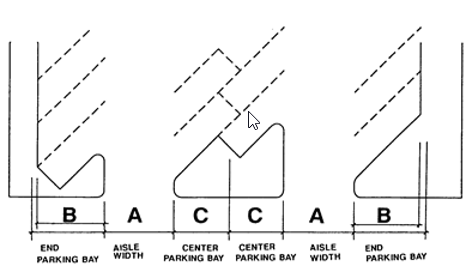
- Minimum dimensions for a parallel parking space shall be 9 feet by 23 feet
- Minimum parking dimensions for other configurations or for parking lots with compact car spaces shall be determined by the Planning Commission and City Council upon recommendation of the City Engineer.
36-99 Home Occupations
The following are the minimum standards required for a Home Occupation:
- There shall be no external or externally visible evidence of the home occupation, business or profession whatsoever. There shall be no signage or advertising, linking the residential property with the home occupation.
- No more than 25% of the floor area of any one story can be used for the home occupation.
- There shall be no machinery other than that normally found in a home.
There shall be no contact at the premises with customers or clients other than by telephone or mail, except that music lessons may be given to one pupil at a time, and cultural, art, or dance instruction may be given to four pupils at one time and children may be dropped off at an In Home Daycare.
No one other than the resident(s) can work from that site except that up to two non-resident employees may be present on the site for In Home Daycare operations as permitted and defined by the State of Nebraska.
- No retail sales are permitted from the site other than incidental sales related to services provided.
- No exterior storage (including storage within detached buildings/garage) is permitted.
- No offensive noise, vibration, smoke, odor, heat or glare shall be noticeable at or beyond the property line.
- The above listed characteristics of a home occupation shall not be construed to restrict the sale of garden produce grown on the premises, provided, this exception shall not extend to allow the operation of a commercial greenhouse or nursery, or the existence of stands or booths for display of said produce.
All businesses related to Child Care Homes and Child Care Centers shall be in accordance with Neb. R.R.S. 1943, Sec. §71-1902.
(Amended by Ordinance No. 8947, effective 1-5-2005)
Amended by Ord. 9923 on 3/28/2023
36-100 Fences And Hedges; Corner Visibility
- There shall be no fences, hedges, or other continuous foliage higher than 36 inches above roadway surface except that trees of a greater height may be permitted if all foliage is removed to a height of five feet above the base of such tree within the sight triangle.
- Fences and Hedges; Other Visibility. On portions of a lot not covered by the corner visibility restriction, the height of fences, hedges, and foliage, continuous five feet or more, shall be limited in the following manner:
- Maximum front yard fence height of thirty-six (36) inches for solid fences (including picket, palisade, fabric weave chain link, "good neighbor", solid planking fencing styles).
- Maximum front yard fence height of forty-eight (48) inches for open fences (including chain link, split rail, or wrought iron, where spacing/thickness of fence construction materials allows for an essentially unobstructed view.
- Maximum front yard hedge/foliage height of thirty-six (36) inches.
- On all other portions of lot lines, fences, hedges and other foliage, barriers may not exceed a height of ninety-six (96) inches.
- Fences and Hedges; Height. Fences, hedges, and other continuous foliage erected within the building portions of a zoning lot may conform with the height limits of such buildings but shall be subject to any building code provisions which may be applicable for buildings.
- Fences and Hedges; Measurement. Height of fences, hedges or other continuous foliage shall be measured from the nearest top of roadway surface or the official established grade thereof, whichever is the higher.
- Fences and Hedges; Exceptions. The city council may direct as a condition for granting a conditional use that fences, hedges, or other continuous foliage of a height and location in excess of these regulations be placed; provided, that no such approval shall have the effect of reducing corner visibility as provided for herein.
(Amended by Ordinance No. 8947, effective 1-5-2005)
36-101 Performance Standards For Industrial Uses
The following standards shall be met unless there are greater standards required by the United States Environmental Protection Agency or the Nebraska Department of Environmental Quality.
- Physical Appearance. All operations shall be carried on within an enclosed building except that new materials or equipment in operable condition may be stored in the open. Normal daily wastes of an inorganic nature may be stored in containers not in a building when such containers are not readily visible from a street. The provisions of this section shall not be construed to prohibit the display of merchandise or vehicles for sale or the storage of vehicles, boats, farm machinery, trailers, manufactured homes, or similar equipment when in operable condition.
- Fire Hazard. No operation shall involve the use of highly flammable gasses, acid, liquids, grinding processes, or other inherent fire hazards. This provision shall not be construed to prohibit the use of normal heating fuels, motor fuels and welding gasses when handled in accordance with other regulations of the City of Grand Island.
- Noise. No operation shall be carried on which involves noise in excess of the normal traffic noise of the adjacent street at the time of the daily peak hour of traffic volume. Noise shall be measured at the property line and when the level of such noise cannot be determined by observation with the natural senses, a suitable instrument may be used and measurement may include breakdowns into a reasonable number of frequency ranges.
- Sewage and Liquid Wastes. No operation shall be carried on which involves the discharge into a sewer, water course, or the ground, liquid waste of any radioactive or poisonous nature or chemical waste which are detrimental to normal sewage plant operation or corrosive and damaging to sewer pipes and installations.
- Air Contaminants.
- Air Contaminants and smoke shall be less dark than designated Number One on the Ringleman Chart as published by the United States Bureau of Mines, except that smoke of a density designated as Number One shall be permitted for one four minute period in each one-half hour. Light colored contaminants of such a capacity as to obscure an observer's view to a degree equal to or greater than the aforesaid shall not be permitted.
- Particulate matter of dust as measured at the point of emission by any generally accepted method shall not be emitted in excess of two tenths (0.2) grains per cubic foot as corrected to a temperature of 500 degrees Fahrenheit, except for a period of four minutes in any one-half hour, at which time it may equal but not exceed six tenths (0.6) grains per cubic foot as corrected to a temperature of 500 degrees Fahrenheit.
- Due to the fact that the possibilities of air contamination cannot reasonably be comprehensively covered in this section, there shall be applied the general rule that there shall not be discharged from any sources whatsoever such quantities of air contaminants or other material in such quantity as to cause injury, detriment, nuisance, or annoyance to any considerable number of persons or to the public in general; or to endanger the comfort, repose, health, or safety of any such considerable number of persons or to the public in general, or to cause, or have a natural tendency to cause injury or damage to business, vegetation, or property.
- Odor. The emission of odors that are generally agreed to be obnoxious to any considerable numbers of persons, shall be prohibited. Observations of odor shall be made at the property line of the establishment causing the odor. As a guide to classification of odor it shall be deemed that strong odors of putrefaction and fermentation tend to be obnoxious and that such odors as associated with baking or the roasting of nuts and coffee shall not normally be considered obnoxious within the meaning of this regulation.
- Gasses. The gasses sulphur dioxide and hydrogen sulphide shall not exceed five (5) parts per million, carbon monoxide shall not exceed five (5) parts per million. All measurements shall be taken at the zoning lot line.
- Vibration. All machines including punch presses and stamping machines shall be so mounted as to minimize vibration and in no case shall such vibration exceed a displacement of three thousands (0.003) of an inch measured at the zoning lot line. The use of steam or broad hammers shall not be permitted in this zone.
- Glare and heat. All glare, such as welding arcs and open furnaces shall be shielded so that they shall not be visible from the zoning lot line. No heat from furnaces or processing equipment shall be sensed at the zoning lot line to the extent of raising the temperature of air or materials more than five (5) degrees Fahrenheit.
- Physical Appearance. Salvage yards and other similar operations shall be effectively enclosed or shielded from adjacent properties on all sides by means of a sight-obscuring fence at least eight (8) feet in height, in good repair, and constructed of conventional fence building materials and techniques as approved by the chief building official. No inventory or salvage materials of any nature may be stacked within fifty (50.0) feet of the fence to a height greater than said fence.
(Amended by Ordinance No. 9151, effective 12-18-2007)
36-102 Landscaping Requirements
- Purpose. The landscaping and screening regulations are intended to improve the physical appearance of the community; to improve the environmental performance of new development by contributing to the abatement of heat, noise, glare, wind and dust; to promote natural percolation of storm water and improvement of air quality; to buffer potentially incompatible uses from one another; and, to protect and enhance the value of property and neighborhoods within the city.
- Applicability.
- The provisions of this section shall apply to the following zones: Medium Density Residential Zone, Medium Density Small Lot Residential Zone, High Density Residential Zone, Residential Office Zone, Light Business Zone, General Business Zone, Arterial Commercial Overlay Zone, Heavy Business Zone, Industrial Estates Zone, Light Manufacturing Zone, Heavy Manufacturing Zone, Commercial Development Zone, Residential Development Zone and Travel Development Zone. Landscaping of lands within districts such as the Central Business District and Fourth Street Business District, as defined elsewhere in this code and/or below, shall be exempt from this section. Properties subject to Streetscape Improvement Projects supported by Business Improvement Districts created for the purpose of establishing and/or maintaining district wide landscaping plans shall be exempt from this section as long as the Business Improvement District is in effect.
- Old Potash Highway District: COMMENCING AT THE SOUTHEAST CORNER OF SECTION 13, TOWNSHIP 11 NORTH, RANGE 10 WEST OF THE 6TH P.M., CITY OF GRAND ISLAND, HALL COUNTY, NEBRASKA, SAID POINT ALSO BEING THE POINT OF BEGINNING; THENCE NORTHERLY ALONG THE EAST OF THE SOUTHWEST QUARTER OF SAID SECTION 13; THENCE EASTERLY ALONG A LINE BEING 100' NORTH OF AND PARALLEL TO THE SOUTH LINE OF SAID SECTION 13 TO A POINT ON THE EAST LINE OF SAID SECTION 13; THENCE SOUTHERLY ALONG SAID EAST LINE TO THE SOUTHEAST CORNER OF SAID SECTION 13; THENCE SOUTHERLY ALONG THE EAST LINE OF SECTION 24, TOWNSHIP 11 NORTH, RANGE 10 WEST OF THE 6TH P.M., CITY OF GRAND ISLAND, HALL COUNTY, NEBRASKA; THENCE WESTERLY ALONG A LINE BEING 100' SOUTH OF AND PARALLEL TO THE NORTH LINE OF SAID SECTION 24 TO A POINT ON THE WEST LINE OF WESTGATE INDUSTRIAL PARK SUBDIVISION IN THE CITY GRAND ISLAND, HALL COUNTY, NEBRASKA; THENCE NORTHERLY ALONG SAID WEST LINE TO THE NORTHWEST CORNER OF SAID SUBDIVISION, SAID POINT ALSO BEING ON THE NORTH LINE OF SAID SECTION 24; THENCE EASTERLY ALONG SAID NORTH LINE TO THE POINT OF BEGINNING.
- The provisions of this section shall apply to the Airport Overlay Zone with the exception that three shrubs may be substituted for each required shade or ornamental tree to conform to standards of wildlife management required near an airport.
- The provisions of this section shall apply to all new development, including surface parking, on each lot or site upon application for a building permit, except as follows:
- Reconstruction or replacement of a lawfully existing use or structure.
- Remodeling, rehabilitation or improvements to existing uses or structures which do not substantially change the location or building footprint of existing structures, or the location and design of parking facilities or other site improvements. However, additions or enlargements of existing uses or structures, which increase floor area or impervious coverage by more than 25% adjacent to the existing street frontage, shall be subject to the provisions of this section, which shall only apply to that portion of the lot or site where the new development or use occurs.
- Residential structures containing three dwelling units on a single lot, or less shall be exempt from the requirements of this section.
- Landscaping which exists on any property shall not be altered or reduced below the minimum requirements of this section, unless suitable substitutions are made which meet the requirements of this section, pursuant to a site plan approved by the city.
- Any conflict between this section and another section of this chapter shall be resolved in favor of the more restrictive provision.
- The provisions of this section shall apply to the following zones: Medium Density Residential Zone, Medium Density Small Lot Residential Zone, High Density Residential Zone, Residential Office Zone, Light Business Zone, General Business Zone, Arterial Commercial Overlay Zone, Heavy Business Zone, Industrial Estates Zone, Light Manufacturing Zone, Heavy Manufacturing Zone, Commercial Development Zone, Residential Development Zone and Travel Development Zone. Landscaping of lands within districts such as the Central Business District and Fourth Street Business District, as defined elsewhere in this code and/or below, shall be exempt from this section. Properties subject to Streetscape Improvement Projects supported by Business Improvement Districts created for the purpose of establishing and/or maintaining district wide landscaping plans shall be exempt from this section as long as the Business Improvement District is in effect.
- Nonconforming Status. Any property or use of property, which as of August 1, 2004 or any amendment hereto is lawfully nonconforming only as to the regulations relating to landscaping, may be continued in the same manner as if the landscaping were conforming.
- Definitions. The following definitions shall be used for terms contained within this section:
Buffer yard. A landscaped area provided to separate and significantly obstruct the view of two adjacent land uses or properties from one another.
Canopy tree. A deciduous tree having a minimum mature height of 30 feet and a minimum caliper of 1 inch at the time of planting. One canopy tree equals two understory/ornamental or evergreen trees.
Evergreen tree. An evergreen or conifer tree having a minimum mature height of 20 feet and a minimum 2 gallon container size or bare root/ball equivalent at the time of planting.
Landscaped area. That area within the boundaries of a given lot consisting primarily of plant material, including but not limited to grass, trees, shrubs, flowers, vines, groundcover and other organic plant materials (this does not include plant materials typically used as a cash crop). Tall varieties of native and ornamental grasses may be planted and left in their natural state in selective and limited locations, deemed appropriate by the city. Inorganic materials such as brick, stones, aggregate, ponds or fountains may be used within landscaped areas, provided that such materials comprise no more than 35 percent of the required landscaped area. Flat concrete or asphalt, other than walkways five feet or less in width, may not be used within a required landscaped area.
Minimum equivalent street landscaping. The minimum landscaped area which must be provided in a street yard, expressed as a percent of the total area contained within that street yard.
Shrub. A deciduous or evergreen plant having a minimum height of 18 inches at the time of planting, with a maximum mature height of less than 10 feet.
Street yard.- The area of a lot or parcel which lies between any street property line and the fronting walls of any building or buildings on the parcel. The street yard shall follow all irregularities or indentations in the front wall of the building, excluding minor projections or indentations such as steps or unenclosed porches. For the purposes of defining the street yard area, the front wall shall be extended from the outermost corners of the building, parallel with the fronting street, until intersecting with the side property line [see Attachment B hereto]. Street yard depth shall not exceed 100 feet for the purposes of calculating the minimum equivalent street landscaping area requirement.
- On lots or parcels with multiple buildings, the street yard area shall be defined by all building front walls having direct, visual frontage onto the street. Any space between buildings equal to 15 percent of the length of such frontage, but in no case more than 100 feet, shall be considered an extension of the continuous building front wall for the purpose of delineating the street yard.
- Street Yard Landscaping Standards.
- Street yard landscaping shall be provided adjacent to each street property line and within street yards, as set forth below, in accordance with an approved site landscaping plan.
- Minimum equivalent street landscaping area: *Unless otherwise established in an approved Streetscape Improvement Project. **As determined by approved plan
Minimum Equivalent Street Landscaping Area
Zoning District
Percent of Street Yard
(%)
Minimum Landscaping Depth
of Street Yard*** (ft.)
R3SL
65
20
R3
65
20
R4
60
10
RO
30
10
B1
25
10
B2
20*
10*
AC
20
20*
B3
0
0
ME
20
20
M1
20
20
M2
20
10
M3
20
10
TD
30
30
CD
**
30
RD
**
10 or 30
- When a lot contains more than one street frontage, the area of all street yards and the proposed street yard landscaped areas may be combined for the purposes of determining compliance with this section.
- Any required street yard landscaping shall include the following minimum shrub and tree plantings (or an appropriate equivalent as determined by the city) for every 100 feet (any fraction of .5 or less rounded to the next lowest number; any fraction exceeding .5 rounded to the next highest number) of property line adjacent to a public street right-of-way: 1 canopy tree; 1 understory/ornamental or evergreen tree; 3 shrubs. Existing trees or shrubs approved for preservation shall be counted toward satisfaction of this provision.
- Buffer Yard and Parking Landscaping Screening Standards.
- Buffer yard landscaping shall be installed and maintained adjacent to the affected common side or rear property line(s), when a use is established in a more intensive zoning district located adjacent to a less intensive zoning district, as set forth below: *When an alley, street or railroad R.O.W. separates adjacent districts requiring a buffer yard, the buffer yard width shall be halved.
More Intensive Zoning District Required Buffer Yard Width (ft.)* Less Intensive Zoning District RO, B1, B2, AC, CD, TD 10 TA, LLR, R1, R2, R3, R3SL, R4, RD ME, M1, M2, M3 20 TA, LLR, R1, R2, R3, R3SL, R4, RO, RD, CD, TD, B1, B2, B2, AC, B3 - Buffer yard landscaping is intended to provide screening of loading docks, refuse collection points, truck/equipment parking, sources of noise, glare, light, dust, or other negative impacts. Buffer yard landscaping shall include hedges or screens of evergreen or approved deciduous plant material, capable of providing a substantial opaque barrier, and attaining a minimum height of 6 feet within three years of planting. Opaque fencing may also supplement the vegetative plantings, but shall be installed no closer to the property line than the width of the required buffer yard.
- Buffer yard landscaping and parking landscaping screening strips shall not be placed on an easement.
- A parking landscaping screening strip, having a Minimum Landscaping Depth of Street Yard as identified above, shall be installed along any parking area adjacent to a public street right-of-way. No parking area shall contain more than 100 spaces except as allowed within these regulations. If a greater number of parking spaces is required, separate parking areas shall be provided, and shall be separated from other parking areas by landscaped dividing strips, having a minimum width of 6 feet. These strips shall include trees, shrubs, grasses and other vegetative coverings for a creative aesthetic appearance. A parking landscaping screening strip shall also count towards meeting any requirements associated with minimum equivalent street or buffer yard landscaping.
Alternate plans for parking lots with more than 500 spaces may submitted for approval by a committee comprised of the Planning Director, Building Department Director and Public Works Director with recommendations from other appropriate city staff. The Committee shall establish criteria for the review and approval of larger parking lots based on but not limited to the following areas of concern: overall area and types of landscaping provided shall not be less than would be required under the conventional regulations, provision for storm water management and filtering using best available practices, provisions for adequate lighting, fire protection and security throughout the lot, provisions for pedestrian access through and around the lot, and provisions for pedestrian access to the site requiring said parking lot. - A development may continue to comply with the buffer yard landscaping requirements in effect at the time of issuance of its initial building permit, regardless of whether an adjacent lot or property is rezoned to a less restrictive zoning district which requires additional buffer yard landscaping.
- Buffer yard landscaping shall be installed and maintained adjacent to the affected common side or rear property line(s), when a use is established in a more intensive zoning district located adjacent to a less intensive zoning district, as set forth below:
- Site Plan Requirements.
- A site plan showing the required street yard, buffer yard and/or parking screening landscaping shall be submitted to the city for review and approval as part of the application for a building permit. The plan shall include, but not be limited to the following:
- Location of proposed landscaping drawn to scale.
- Location, size, type and condition of proposed plant and non-plant landscaping materials including fences, walks, ponds, fountains, benches, lighting and irrigation systems.
- Estimated date of completion of the installation of all plantings and finishing materials.
- A site plan showing the required street yard, buffer yard and/or parking screening landscaping shall be submitted to the city for review and approval as part of the application for a building permit. The plan shall include, but not be limited to the following:
- Installation and Maintenance Requirements.
- Required landscaping areas shall be installed and maintained in a neat, clean, orderly and healthful condition. Maintenance shall include proper pruning of trees and shrubs, mowing of lawn and grass areas, weeding, removal of litter, fertilizing, replacement of plants consistent with this section when necessary, and the regular watering of all plantings.
- The installation of landscaping shall be completed prior to the issuance of any occupancy permit for buildings on the property, or commencement of the intended use of the property.
- If, at the time of commencement of the intended use of the property or application for a certificate of occupancy, any required landscaping has not been installed or completed due to seasonal or climatic conditions or plant material being unavailable, the developer or owner of the property shall submit the following to the Building Department:
- A request for extension of the proposed completion date for installation of the required landscaping, stating the reason for the request, the property owner's current mailing address, and a commitment to complete the installation of the landscaping by a date certain, not to exceed six months from the building completion date.
- A drawing showing the plan and layout of the landscaping areas.
- A cost estimate for the installation of the landscaping area.
- A bond, certificate of deposit, letter of credit, cash or other financial surety as may be approved by the City Attorney guaranteeing faithful performance of the owner or developer's commitment to complete installation of the required landscaping and payable to the City of Grand Island in the event that the developer fails to carry out the commitments described in sub-paragraph (H)(3)(a) above.
- If the owner or developer has not installed the required landscaping with the commitments made pursuant to sub-paragraph (H)(3)(a) above, the owner or developer shall be deemed to have granted the City or its officers, employees, agents or representatives permission to enter upon the property to install the required landscaping in accordance with the plan submitted pursuant to sub-paragraph (H)(3)(c) above using the surety or security filed by the owner or developer as payment for said installation. The Building Department shall send the owner or developer written notice of default and intention to enter onto the property to install required landscaping by certified mail, return receipt requested, and ordinary first class mail sent to the last known address of said owner or developer at least five (5) business days prior to making such entry.
(Amended by Ordinance No. 9256, effective 04-07-2010) (Amended by Ordinance No. 9419, effective 02-15-2013) (Amended by Ordinance No. 9422, effective 04-02-2013) (Amended by Ordinance No. 9738, effective 07-10-2019) (Amended by Ordinance No. 9766, effective 04-08-2020)
36-103 Wind Energy Conversion Systems
- Definitions. The following are defined for the specific use of this section.
- Aggregate Project shall mean projects that are developed and operated in a coordinated fashion, but which have multiple entities separately owning one or more of the individual WECS within the larger project. Associated infrastructure such as power lines and transformers that service the facility may be owned by a separate entity but are also part of the aggregated project.
- Commercial WECS shall mean a wind energy conversion system of equal to or greater than 100 kW in total name plate generating capacity.
- Connector Line shall mean any power conductor that carries electrical power from one or more wind turbines to the point of interconnection with the distribution system.
- Hub Height shall mean the distance from ground level as measured to the centerline of the rotor.
- Meteorological Tower shall mean, for purposes of this regulation, a tower which is erected primarily to measure wind speed and directions plus other data relevant to siting a Wind Energy Conversion System. Meteorological towers do not include towers and equipment used by airports, the Nebraska Department of Roads, or other applications to monitor weather conditions.
- Micro Wind Energy Conversion System (MWECS) shall mean a wind energy conversion system consisting of a wind turbine, a tower, and associated control or conversion electronics, which has a rated capacity of not more than 5 kW and which is intended to primarily reduce on-site consumption of utility power. Rotor Diameter shall not exceed 7 feet.
- Property Line shall mean the boundary line of the area over which the entity applying for a Wind Energy Conversion System permit has legal control for the purpose of installing, maintaining and operating a Wind Energy Conversion System.
- Public Conservation lands shall mean land owned in fee title by State or Federal agencies and managed specifically for conservation purposes, including but not limited to State Wildlife Management Areas, State Parks, federal Wildlife Refuges and Waterfowl Production Areas. For purposes of this regulation, public conservation lands will also include lands owned in fee title by non-profit conservation organizations, Public conservation lands will also include private lands upon which conservation easements have been sold to public agencies or non-profit conservation organizations.
- Rotor Diameter shall mean the diameter of the circle described by the moving rotor blades.
- Small Wind Energy Conversion System (SWECS) shall mean a wind energy conversion system consisting of a wind turbine, a tower, and associated control or conversion electronics, which has a rated capacity not less than 5 kW and not more than 100 kW or has a rated capacity of not more than 5 kW and a rotor diameter of greater than 7 feet and which is intended to primarily reduce on-site consumption of utility power.
- Substations shall mean any electrical facility to convert electricity produced by wind turbines to a higher or lower voltage for interconnection with transmission lines.
- Total Height shall mean the highest point, above ground level, reached by a rotor tip or any other part of the Wind Energy Conversion System.
- Tower shall mean the vertical structures, including the foundation that supports the electrical generator, rotor blades, or meteorological equipment.
- Tower Height (Ground Mounted) shall mean the total height of the Wind Energy Conversion System, between the ground level at the base of the tower and the top of the tower, exclusive of the rotor blades.
- Tower Height (Roof Mounted) shall mean the total height of the Wind Energy Conversion System, between the roof level at the base of the tower and the top of the tower, exclusive of the rotor blades.
- Transmission Line shall mean the electrical power lines that carry voltages of at least 69,000 volts (69 KV) and are primarily used to carry electric energy over medium to long distances rather than directly interconnecting and supplying electric energy to retail customers.
- Wind Energy Conversion System (WECS) shall mean an electrical generating facility comprised of one or more wind turbines and accessory facilities, including but not limited to: power lines, transformers, substations and meteorological towers that operate by converting the kinetic energy of wind into electrical energy, which may be used on-site or distributed into the electrical grid.
- Wind Turbines shall mean any piece of electrical generating equipment that converts the kinetic energy of blowing wind into electrical energy using airfoils or similar devices to capture the wind.
- Vertical Axis Wind Turbine. A wind energy conversion system design where the rotating shaft is perpendicular to the ground and the cups or blades rotate parallel to the ground.
- Micro Wind Energy Conversion Systems.
Purpose. It is the purpose of this wind energy regulation to; promote the safe, effective and efficient use of wind energy and to encourage the development of residential scale generation systems as they become affordable as determined by the residents of Grand Island and Hall County.
Requirements. Residential wind energy conversion systems shall be permitted as an Accessory Use within any zoning district. Certain requirements as set forth below shall be met:- Tower Height.
- Shall be limited by the size of the property. Tower height shall not exceed the fall zone for the property.
- Minimum Lot Size.
- Towers shall be permitted on all lots or parcels with a permitted principal use.
- Fall Zone.
- Fall Zone is the total height and any underlying setbacks for ground mounted MWCES.
- Fall Zone is the 125% of the tower height and any underlying setbacks for roof mounted MWCES.
- Setbacks.
- No part of the wind system structure, including guy-wire anchors, may extend closer than 10 feet to the property lines of the installation site; tower must meet required underlying setbacks.
- Noise.
- MWCES shall not exceed 60 dBA, as measured at the closet neighboring inhabited dwelling unit.
- The noise level may be exceeded during short term events such as utility outages and/or severe wind storms, wind speeds of greater than 50 miles per hour.
- Approved Wind Turbines.
- MWCES must have been approved under the Emerging Technologies program of the California Energy Commission or any other small certification program recognized by the American Wind Energy Association.
- Compliance with Building and Zoning Codes.
- Applications for MWCES shall be accomplished by standard drawings of the wind turbine structure, including the tower base, and footings.
- An engineering analysis of the tower showing compliance with official building code of the governing body and/or the State of Nebraska and certified by a licensed professional engineer shall also be submitted.
- Compliance with FAA Regulations.
- MWCES must comply with applicable FAA regulations, including any necessary approvals for installations within the airport approach zone.
- No MWCES shall be installed within the regulated airport approach zone until evidence has been given that the Central Nebraska Regional Airport has been informed of the applicant’s intent to install a MWECS. A copy of a certified letter (with mailing receipt) to the Central Nebraska Regional Airport informing them of the owners’ intent to install the MWCES must be submitted with the building permit application.
- Compliance with National Electrical Code.
- Permit applications for small wind energy systems shall be accompanied by a line drawing of the electrical components in sufficient detail to allow for a determination that the manner of installation conforms to the National Electrical Code and the National Electric Safety Code.
- Utility Notification.
- No small wind energy system shall be installed until evidence has been given that the utility company has been informed of the customer’s intent to install an interconnected customer-owned generator.
- Off-grid systems shall be exempt from this requirement.
- Tower Height.
- Small Wind Energy Conversion Systems.
Purpose. It is the purpose of this regulation to promote the safe, effective and efficient use of small wind energy systems installed to reduce the on-site consumption of utility supplied electricity.
Requirements. Small wind energy conversion systems shall be permitted as an Accessory Use within any district. Certain requirements as set forth below shall be met:- Tower Height.
- Shall be limited by the size of the property. Tower height shall not exceed the fall zone for the property.
- Minimum Lot Size.
- Towers shall be permitted on all lots or parcels with a permitted principal use.
- Fall Zone.
- Fall Zone is the total height and any underlying setbacks for ground mounted SWCES.
- Fall Zone is the 150% of the tower height and any underlying setbacks for roof mounted SWCES.
- Setbacks.
- No part of the wind system structure, including guy-wire anchors, may extend closer than 10 feet to the property lines of the installation site; tower must meet required underlying setbacks.
- Noise.
- SWCES shall not exceed 60 dBA, as measured at the closet neighboring inhabited dwelling unit.
- The noise level may be exceeded during short term events such as utility outages and/or severe wind storms, wind speeds of greater than 50 miles per hour.
- Approved Wind Turbines.
- SWCES must have been approved under the Emerging Technologies program of the California Energy Commission or any other small certification program recognized by the American Wind Energy Association.
- Compliance with Building and Zoning Codes.
- Applications for SWCES shall be accomplished by standard drawings of the wind turbine structure, including the tower base, and footings.
- An engineering analysis of the tower showing compliance with official building code of the governing body and/or the State of Nebraska and certified by a licensed professional engineer shall also be submitted.
- Compliance with FAA Regulations.
- Small wind energy conversion systems must comply with applicable FAA regulations, including any necessary approvals for installations within the airport approach zones.
- No SWCES shall be installed within the regulated airport approach zone until evidence has been given that the Central Nebraska Regional Airport has been informed of the applicant’s intent to install a SWECS. A copy of a certified letter (with mailing receipt) to the Central Nebraska Regional Airport informing them of the owners’ intent to install the SWCES must be submitted with the building permit application.
- Compliance with National Electrical Code.
- Permit applications for small wind energy systems shall be accompanied by a line drawing of the electrical components in sufficient detail to allow for a determination that the manner of installation conforms to the National Electrical Code and the National Electric Safety Code.
- Utility Notification.
- No small wind energy system shall be installed until evidence has been given that the utility company has been informed of the customer’s intent to install an interconnected customer-owned generator.
- Off-grid systems shall be exempt from this requirement.
- Tower Height.
- Commercial/Utility Grade Wind Energy Conversion Systems.
Purpose. It is the purpose of this regulation to promote the safe, effective and efficient use of commercial/utility grade wind energy conversion systems within the City of Grand Island and its Extraterritorial Zoning Jurisdiction.
Requirements. Commercial/Utility Grade wind energy systems shall be a Conditional Use within the AG-2 Secondary Agricultural District, the TA Transitional Agriculture District, the AG-SI Special Agriculture/Industrial Zone, AG-SE Special Agriculture District/Events Zone, and the AG-SC Special Agriculture District/Conservation Zone. The following requirements and information shall be met and supplied:- The name(s) of project applicant.
- The name of the project owner.
- The legal description and address of the project.
- A description of the project including: Number, type, name plate generating capacity, tower height, rotor diameter, and total height of all wind turbines and means of interconnecting with the electrical grid.
- Site layout, including the location of property lines, wind turbines, feeder lines, and all related accessory structures. This site layout shall include distances and be drawn to scale.
- Certification by an Engineer competent in disciplines of WEC’s.
- Documentation of land ownership or legal control of the property.
- The latitude and longitude of individual wind turbines; included with this shall be an area or zone in close proximity that meets all setbacks; where actual WEC will be considered.
- A USGS topographical map, or map with similar data, of the property and surrounding area, including any other Wind Energy Conversion System, within 10 rotor distances of the proposed Wind Energy Conversion System not owned by the applicant.
- Location of migratory waterfowl flyways, wetlands, scenic, and natural areas within 1,320 feet of the proposed Wind Energy Conversion System.
- An Acoustical Analysis that certifies that the noise requirements within this regulation can be met
- The applicant shall supply the emergency management agency and/or fire departments with a basic emergency response plan.
- FAA and FCC permit, if necessary.
- Commercial/Utility Grade wind energy conversion systems must comply with applicable FAA regulations, including any necessary approvals for installations within the airport zone.
- No WEC shall be installed within the regulated airport approach zone until evidence has been given that the Central Nebraska Regional Airport has been informed of the applicant’s intent to install a SWECS. A copy of a certified letter (with mailing receipt) to the Central Nebraska Regional Airport informing them of the owners intent to install the SWCES must be submitted with the building permit application.
- Evidence that there will be no inference with any commercial and/or public safety communication towers.
- Decommissioning Plan as required by this regulation.
Setbacks. All towers shall adhere to the setbacks established in the following table:* The setback shall be measured from any future Rights-of-Way if a planned change or expanded Right-of-Way is known.Wind Turbine-
Commercial/Utility WECS
Meteorological Towers
Property Lines
150 feet from property lines; however, the setback may be less when two adjoining property owners are within the aggregate project.
One times the tower height.
Neighboring Dwelling Units
1,000 feet
One times the tower height.
Road Rights-of-Way*
One-half the rotor diameter.
One times the tower height.
Other Rights-of-Way
NA
NA
Wildlife Management Areas and State Recreational Areas
600 feet
600 feet
Wetlands, USFW Types III, IV, and V
600 feet
600 feet
Other structures and cemeteries adjacent to the applicant's sites
One-half the rotor diameter.
One times the tower height.
Other existing WECS not owned by the applicant.
NA
NA
- Special Safety and Design Standards. All towers shall adhere to the following safety and design standards:
- Clearance of rotor blades or airfoils must maintain a minimum of 12 feet of clearance between their lowest point and the ground.
- All Commercial/Utility WECS shall have a sign or signs posted on the tower, transformer and substation, warning of high voltage. Other signs shall be posted on the tower base or perimeter fencing with emergency contact information.
- All wind turbines, which are a part of a commercial/utility WECS, shall be installed with a tubular, monopole type tower.
- Consideration shall be given to painted aviation warnings on all towers less than 200 feet.
- Color and finish. All wind turbines and towers that are part of a commercial/utility WECS shall be white, grey, or another non-obtrusive color. Blades may be black in order to facilitate deicing. Finishes shall be matte or non-reflective.
- Lighting. Lighting, including lighting intensity and frequency of strobe, shall adhere to but not exceed requirements established by the FAA permits and regulations. Red strobe lights shall be used during nighttime illumination to reduce impacts on neighboring uses and migratory birds. Red pulsating incandescent lights should be avoided.
- Other signage. All other signage shall comply with the sign regulations found in the City Code.
- Feeder Lines. All communications and connector lines associated with the project distribution system installed as part of a WECS shall be buried. Where obstacles to the buried lines create a need to go above ground, these lines may be placed above ground only to miss the obstacle.
- Waste Disposal. Solid and Hazardous wastes, including but not limited to crates, packaging materials, damaged or worn parts, as well as used oils and lubricants, shall be removed from the site promptly and disposed of in accordance with all applicable local, state and federal regulations.
- Discontinuation and Decommissioning. A WECS shall be considered a discontinued use after one year without energy production, unless a plan is developed and submitted to the Zoning Administrator outlining the steps and schedule for returning the WECS to service. All WECS and accessory facilities shall be completely removed to twelve feet below ground level within 180 days of the discontinuation of use. The 180 days may be extended if proof of weather delays is provided.
Each Commercial/Utility WECS shall have a Decommissioning plan outlining the anticipated means and cost of removing WECS at the end of their serviceable life or upon use being discontinued. The cost estimates shall be made by a competent party; such as a Professional Engineer, a contractor capable of decommissioning or a person with suitable expertise or experience with decommissioning. The plan shall also identify the financial resources that will be available to pay for decommissioning and removal of the WECS and accessory facilities. The initial plan shall be submitted with the application. An updated plan shall be filed with the City every 5 years. - Noise. No Commercial/Utility WECS shall exceed 50 dBA at the nearest structure or use occupied by humans.
- Interference. The applicant shall not cause interference with power quality of area utility feeder circuits and shall not introduce noise to the connected electric distribution system. WECS shall not cause interference with any commercial or public safety electromagnetic communications, such as radio, telephone, microwaves, or television signals. The applicant shall notify all electric utilities and communication tower operators within five miles of the proposed WECS location upon application for permits.
- Environmental Permits. The developer shall present evidence the project meets the environmental permitting requirements of all applicable state and federal agencies if such permits are required.
- Drainage System. The applicant shall be responsible for immediate repair of damage to public drainage systems stemming from construction, operation or maintenance of the WECS.
(Amended by Ordinance No. 9210, effective 04-08-2009)
(Amended by Ordinance No. 9261, effective 06-09-2010)
36-104 Vehicle Sales And Rental Businesses In Existence On December 15, 2002; Minimum Improvements Requirement
Improvements Requirement. All businesses engaged in automotive/truck/recreational vehicle sales and/or rentals on or after December 15, 2002 shall have the following minimum improvements and equipment:
- All areas on which vehicles are displayed and offered for sale and/or rental shall be provided with a permanent type, dust-free surface such as asphaltic cement concrete, Portland cement concrete, or paving brick. The Grand Island City Council may, upon application for and approval of a conditional use permit, waive this requirement for businesses that were operating at the same location prior to March 9, 1999.
- Any business engaged in vehicle sales and/or rentals shall have a principal building which complies with the Grand Island City Code and all applicable building, electrical, plumbing and fire codes.
- Any business engaged in vehicle sales and/or rentals shall have space within the principal building or an accessory building for storage of all vehicle parts, new or used. All such parts must be stored within said space.
- All hazardous materials, regulated waste and used vehicle fluids shall be stored and disposed of in accordance with state and federal laws and the rules and regulations of the U.S. Environmental Protection Agency and the Nebraska Department of Environmental Quality. Tank storage of fluids and wastes must be situated within a suitable overflow enclosure.
36-105 Vehicle Sales And Rental Businesses; New Businesses And Businesses Relocating Or Expanding; Minimum Improvement Requirements
Beginning December 15, 2002, all new, relocating or expanding businesses engaged in automotive/truck/recreational vehicle sales and/or rentals shall have the following minimum improvements and equipment:
- All areas on which vehicles are displayed and offered for sale and/or rental shall be provided with a permanent type, dust-free surface such as asphaltic cement concrete, Portland cement concrete, or paving brick.
- Any business engaged in vehicle sales and/or rentals shall have a principal building which complies with the Grand Island City Code and all applicable building, electrical, plumbing and fire codes.
- Any business engaged in vehicle sales and/or rentals shall have space within the principal building or an accessory building for storage of all vehicle parts, new or used. All such parts must be stored within said space.
- All hazardous materials, regulated waste and used vehicle fluids shall be stored and disposed of in accordance with state and federal laws and the rules and regulations of the U.S. Environmental Protection Agency and the Nebraska Department of Environmental Quality. Tank storage of fluids and wastes must be situated within a suitable overflow enclosure.
- Any business engaged in vehicle sales and/or rentals shall comply with the Grand Island City Code landscaping and screening regulations and minimum off-street parking and loading space requirements prior to commencing operations.
36-106 Conditional Uses; Salvage Yards
All salvage yards shall be subject to the following conditions as part of their permitted conditional use:
- In addition to the information required pursuant to §36-88, an application for a conditional use for a salvage yard shall include a site plan for the premises showing the layout of the proposed operation, building and infrastructure locations, property dimensions, drainage and landscaping.
- All structures located or constructed on the salvage yard premises shall comply with the Grand Island City Code and all applicable building, electrical, plumbing and fire codes.
- All hazardous materials and regulated waste shall be received, stored, and disposed of in accordance with state and federal laws and the rules and regulations of the U.S. Environmental Protection Agency and the Nebraska Department of Environmental Quality.
- All operations of a salvage yard, including those which are ancillary and indirectly related to the salvage yard such as administration, parking, equipment and/or container storage shall be conducted on the premises subject to the permitted conditional use.
- All premises on a salvage yard shall be kept and maintained in a clean and orderly manner, using the best practices of the industry, with no loose garbage, litter, refuse or waste materials on the premises except those kept in short term storage for processing. The persons operating the salvage yard shall on a regular and routine basis inspect all areas adjacent to the salvage yard and clean up any materials which originated from the salvage yard.
- Physical Appearance. Salvage yards and other similar operations shall be effectively enclosed or shielded from adjacent properties on all sides by means of a sight-obscuring fence at least eight (8) feet in height, in good repair, and constructed of conventional fence building materials and techniques as approved by the chief building official. No inventory or salvage materials of any nature may be stacked within fifty (50.0) feet of the fence to a height greater than said fence.
(Amended by Ordinance No. 9151, effective 12-18-2007)
36-107 Public Facilities
Unless specifically prohibited, public facilities (eg. schools, fire stations, police stations, government offices) owned and operated by a government entity are permitted in all zoning districts subject to the setbacks and rules for that district.
(Amended by Ordinance No. 9720, effective 02-06-2019)

