
Grant County Unincorporated
City Zoning Code
City Zoning Code
CHAPTER 23
08 - PERFORMANCE AND USE STANDARDS
23.08.010 - General Provisions
(a)
The performance and use-specific standards provided in this Chapter are those specific requirements that shall be met prior to approval of a proposed development or use within a particular zoning district.
(b)
Proposed developments and uses may be subject to multiple performance and use-specific standards. Where the development is subject to the jurisdiction of the Shoreline Master Program, additional regulations and standards may apply, and additional permits may be required.
(c)
Proposed developments and uses are also subject to the development standards specified in GCC § 23.12.
(d)
Proposed developments and uses shall comply with the general purposes and intent of the underlying zoning district regulations and any subarea plans.
23.08.020 - Accessory Uses and Structures
(a)
Accessory uses are customarily incidental and subordinate to the principal use of a structure or site. Accessory structures are permitted under the following provisions:
(1)
Accessory uses/structures not exceeding one thousand five hundred (1,500) square feet shall be permitted prior to the construction of a primary use. These structures are not intended for residential occupancy, business or industrial use;
(2)
Consistent with the purpose of the zoning district; and
(3)
In compliance with the provisions of GCC Title 23. The land use category of an accessory use shall be the same as that of the principal use(s) as listed in Tables 3, 4 and 5, unless otherwise specified.
(b)
Limitations on Accessory Uses and Structures: Accessory uses and structures are permitted in any zoning district, except as limited or prohibited in this section, in Tables 3, 4 and 5 or in the sections covering the various zoning districts in GCC § 23.04.
(c)
Accessory Dwelling Unit (ADU). Accessory dwelling units are intended to increase the supply of affordable and independent housing for a variety of households. Accessory dwelling units are permitted as accessory to an existing single-family dwelling provided that the following requirements are met:
(1)
Accessory Dwelling Unit (ADU): A residential dwelling unit located on the same lot as a single-family dwelling unit, either within the same building as the single-family dwelling unit, attached to the single-family dwelling unit, or in a detached building used as a permanent residence.
(A)
Accessory Dwelling Units within UGAs, located in all zoning districts that allow for single-family homes, are allowed two (2) ADUs in the following configurations:
(i)
One (1) attached ADU and one (1) detached ADU;
(ii)
Two (2) attached ADUs;
(iii)
Two (2) detached ADUs, which may be comprised of either one (1) or two (2) detached structures.
(B)
Accessory Dwelling Units within unincorporated areas of Grant County, located in all zoning districts that allow for single-family homes, are allowed ADUs in the following configurations:
(i)
One (1) ADU within the existing single-family dwelling and one (1) detached ADU;
(ii)
One (1) detached ADU.
(C)
All Accessory Dwelling Units shall be occupied as permanent residences and may not be used, rented, or leased as transient short-term rentals (less than thirty (30) consecutive days).
(2)
Farmworker Housing: Farmworker housing accessory to a farm residence to accommodate agricultural workers and their families employed on the premises may be an accessory use on parcels greater than five (5) acres in certain zoning districts as specified in Tables 3, 4 and 5 of GCC § 23.04; as provided below:
(A)
For legal lots larger than five (5) acres and less than twenty (20) acres, one (1) farm housing unit is allowed;
(B)
For legal lots larger than twenty (20) acres and less than forty (40) acres, two (2) farm housing units are allowed;
(C)
For legal lots larger than forty (40) acres and less than sixty (60) acres, three (3) farm housing units are allowed;
(D)
For legal lots larger than sixty (60) acres and less than eighty (80) acres, four (4) farm housing units are allowed;
(E)
For legal lots larger than eighty (80) acres, four (4) farm housing units are allowed; provided that additional farmworker accommodations may be allowed pursuant to GCC § 23.08.190.
(F)
Farm housing units may only be leased, sold or subdivided subject to the density provisions of the underlying zoning district.
(G)
Sewage disposal and water supply shall be in accordance with GCC § 23.12.050 and—23.12.060.
(3)
Caretaker Residence: Caretaker residences shall be only for caretaker, groundskeeper, or security capacity to the primary operation. The number of caretaker residences required to provide care and security shall be reasonable and customary for the associated industry, as determined by the Administrative Official.
(4)
Subdivision: Accessory dwelling units shall not be subdivided or otherwise segregated in ownership from the principal unit of the single-family dwelling, unless allowed by the zoning.
(5)
Size and Scale: Density (lot coverage), building setbacks, and building height of ADUs shall comply with all of the requirements of the primary dwelling in accordance with GCC § 23.12, Tables 1,2 and 3.
(6)
Building Permit: The owner occupant shall apply for a Grant County building permit for an accessory dwelling unit. The application must demonstrate that all requirements of this section are met.
(7)
Construction: Structures shall be subject to all applicable building and constructions provisions of the GCC. Manufactured Homes, Tiny Homes, Park Model RVs, and other Factory-Assembled Structures are allowed to be used as accessory dwelling units.
(8)
Location: The accessory dwelling unit may be attached to, included within the principal unit of the single-family dwelling, or located in a detached structure.
(9)
Conversions: The conversion of existing structures, such as detached garages, into accessory dwelling units shall comply with all ADU requirements, except that non-conforming structures regarding setbacks and/or lot coverage are allowed to be converted to ADUs and retain their non-conformity.
(10)
Parking: The number of parking spaces shall be as specified in GCC § 23.12, Table 5. All parking spaces shall meet the standards of GCC § 23.12.130. Parking requirements for accessory dwelling units within a UGA shall be as follows:
(A)
No additional off-street parking is required if the parcel is located one-half (½) mile or less from a major transit stop;
(B)
Only one (1) additional off-street parking space is required for lots smaller than six thousand (6,000) square feet;
(C)
Two (2) off-street parking spaces are required where the lot exceeds six thousand (6,000) square feet and two (2) ADUs are proposed as detached structures.
(d)
Outdoor Residential Storage: This subsection shall apply only to outdoor storage accessory to residential uses. Outdoor storage other than accessory uses subordinate to a primary residential use may be permitted only in those zoning districts where specified as an Permitted Use in Tables 3, 4 and 5 in GCC § 23.04, and shall meet the requirements of GCC § 23.08.280.
(1)
Outdoor residential storage shall be maintained in an orderly manner and shall create no fire, safety, health or sanitary hazard;
(2)
Required front yards shall not be used for outdoor storage, except for firewood;
(3)
Not more than two (2) unlicensed or inoperable vehicles, except for agriculturally related equipment, shall be stored on any lot; such vehicles shall be screened from view of neighboring dwellings and rights-of-way. Such screening shall meet all applicable performance and development standards specific to the zoning district in which the storage is kept, and shall be in keeping with the character of the area. Screening shall meet the requirements of GCC § 23.12.180. Storage of more than two (2) unlicensed or inoperable vehicles is prohibited except in those zoning districts where specified as an Permitted Use in Tables 3, 4 and 5 in GCC § 23.04, and such storage shall meet the requirements of GCC § 23.08.090;
(4)
Temporary placement of a trailer, mobile home, manufactured home, or recreational vehicle or buildings moved from other sites may only be stored on a parcel subject to obtaining a temporary use permit in accordance with the requirements of GCC § 23.04.120.
(e)
Antenna Structures and Satellite Dishes: Antenna structures and satellite dishes shall not be located within ten (10) feet of any property line.
(f)
Fences, walls, hedges, and similar Enclosures:
(1)
Residential uses shall meet the following standards for fences:
(A)
Front yard: Fences not exceeding four (4) feet in height are permitted within the front yard setback (see Figure 2).
(B)
Rear and side yard: Fences not exceeding seven (7) feet in height are permitted in side and rear yards, but shall not extend into the front yard setback.
(C)
Any fence constructed outside of a setback area may exceed seven (7) feet in height with an approved Building Permit.
(2)
Commercial and industrial uses shall meet the following standards for fences:
(A)
A maximum fence height of seven (7) feet shall be observed within any required setback area except when adjacent to residential zoning districts, in which a setback of ten (10) feet is required to accommodate landscaping and visual screening;
(B)
Any fence constructed outside of a setback area may exceed seven (7) feet in height with an approved Building Permit.
(3)
General Standards for fences:
(A)
Fence height relating to residential uses shall include the fence and all attachments, including items such as posts and lattice installed at the top of the fence.
(B)
The maximum height for fences accessory to commercial or industrial uses is seven (7) feet, however, up to an additional eighteen (18) inches of ancillary material on top of the fence (i.e. stranded wire) is allowed.
(C)
Fences may be constructed of wood, masonry, wire or similar materials employed by standard building practice. Fences may also be formed of dense landscaping. Fences shall not be made of tires or similar salvage materials not originally designed as structural components of fences or buildings.
(D)
Fences shall not conflict with requirements for Vision Clearance Triangle in Chapter 23.12.110 (see Figure 1). For public safety reasons, no variances from these provisions shall be applied for or permitted.
(E)
Fences within two hundred (200)-ft. of a shoreline shall comply with the applicable provisions of the Grant County Shoreline Master Program (Ch. 24.12).
(F)
Fences for marijuana production operations shall be consistent with GCC 23.08.245.
(G)
Fences shall always be required to be built on private property and never in the public right-of-way. Private property lines may be a considerable distance back from actual street surfaces or curb lines.
(H)
It shall be the property owner's responsibility and obligation to identify his/her property line when proposing to construct a fence on said property line. A property survey may be required.
(I)
Fences greater than seven (7) feet in height may be permitted for agricultural buffering or required site screening as a variance in accordance with the requirements of GCC § 25.08.
Figure 1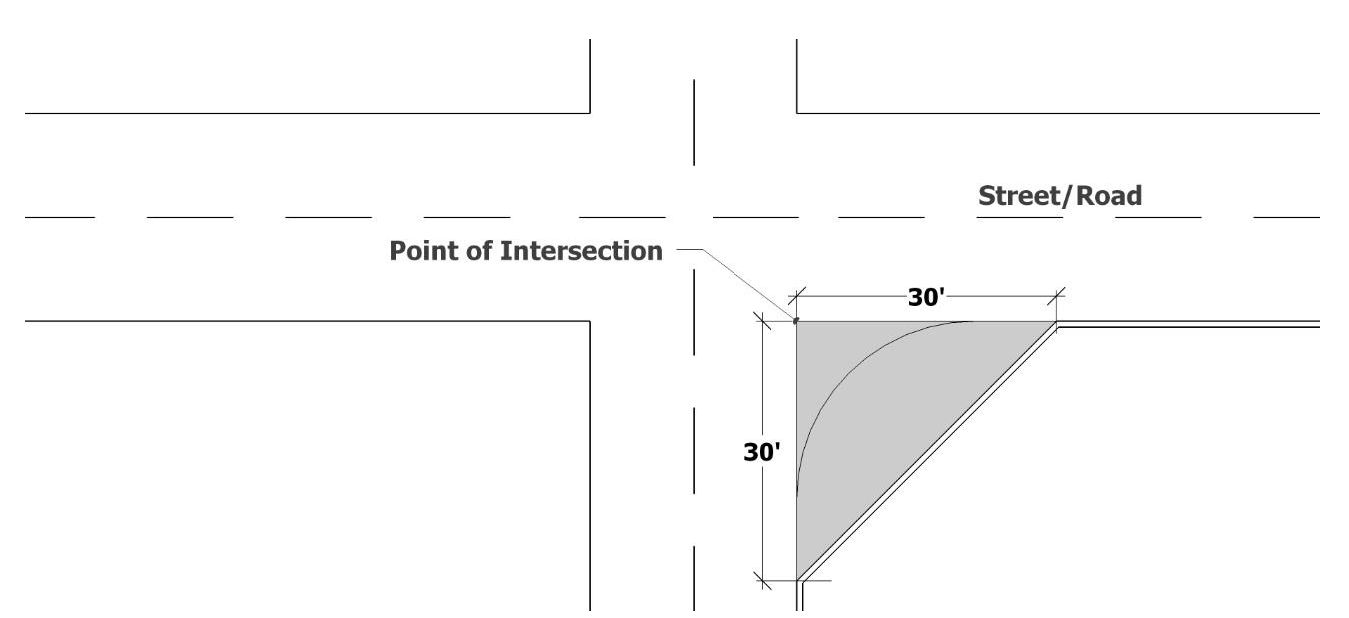
Figure 2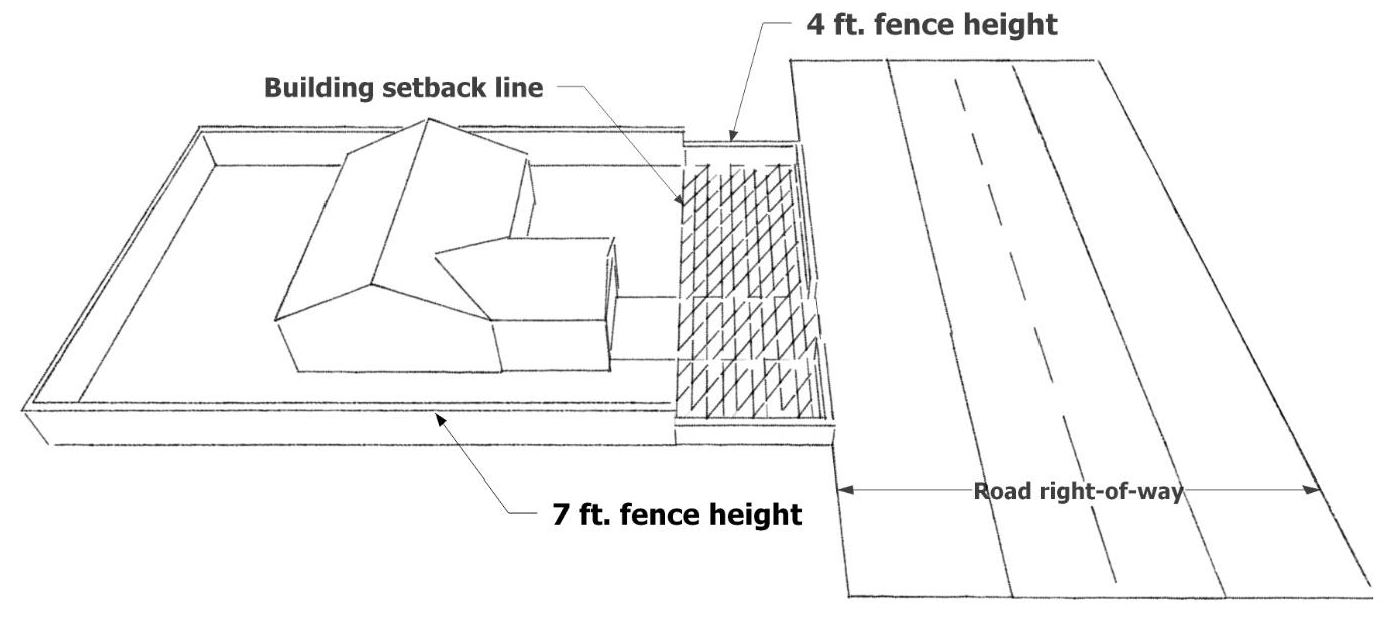
(g)
Barbed Wire Fences: Barbed wire fences are prohibited in urban residential (UR1, UR2, UR3, UR4) zoning districts and rural activity center residential zoning districts (RVR, RC, SD1, SD2, SD3, SD4, RD), except as permitted accessory uses to agricultural operations of one (1) acre or more.
(h)
Domestic Animal Maintenance: In addition to livestock maintenance allowed in certain zoning districts, as specified in Tables 3, 4 and 5 of GCC § 23.04, the following animals may be maintained:
(1)
Not more than fifteen (15) fowl, other than roosters, quacking ducks, geese, guinea fowl, or pea fowl and not more than fifteen (15) rabbits or guinea pigs for each five thousand (5,000) square feet of area of the parcel of land upon which such fowl, rabbits or guinea pigs are kept; provided that no such animals shall be maintained closer than twenty (20) feet of any dwelling now existing or hereafter erected.
(2)
Not more than one (1) horse, mule or cow and not more than three (3) goats for each twenty thousand (20,000) square feet of area of the parcel of land upon which such horse, mule, cow or goats are kept; provided that no such animals shall be maintained in a building or corral closer than one hundred (100) feet of any dwelling now existing or hereafter erected.
(3)
Not more than three (3) dogs, cats or similar household pets, exclusive of animals under six (6) months of age, for each five thousand (5,000) square feet of area of the parcel of land upon which such dogs, cats or similar household pets are kept.
(4)
Maintenance of animals other than those identified herein (including hogs) or in numbers greater than those specified herein shall be considered Livestock Maintenance. Livestock maintenance may be permitted only in those zoning districts specifying livestock maintenance as a Permitted Use, and shall comply with the requirements of GCC § 23.08.240.
(i)
Parking and Storage of Major Recreational Equipment: Parking or storage of major recreational equipment, including, but not limited to, travel trailers, boats, boat trailers, motorized dwellings, recreational vehicles, tent trailers, houseboats, and horse trailers and similar recreational equipment shall be subject to the following requirements:
(1)
Such equipment shall not be used for living, sleeping, or other occupancy associated with residential uses when parked or stored on a residential lot or in any other location not approved and permitted for such use; except for temporary uses permitted in accordance with GCC § 23.04.120;
(2)
Such equipment over six (6) feet in average height, when not parked in a garage, carport or other similar structure, shall not be located in any required front or side yard reserved for building setback, except for driveways;
(3)
Such equipment shall not be hooked up to utilities, sewage or septic, or water facilities unless located in a permitted recreational vehicle park; except that an electrical power connection may be made to provide heat necessary to prevent damage from freezing;
(4)
Such equipment shall not be attached to other structures such as, but not limited to, decks, porches, roofs, room additions, foundations, carports, storage units, accessory structures, walls or fences, or other buildings; and
(5)
Travel trailers, motorized dwellings, and recreational vehicles may be temporarily occupied for six (6) months only when located in a permitted recreational vehicle park and hooked up to utilities, sewage or septic, and water facilities.
(j)
Junk Yards: Junk yards, scrap heaps or refuse piles shall be prohibited, except where permitted as specified in Tables 3, 4 and 5 of GCC § 23.04 and in accordance with the requirements of GCC § 23.08.090.
(k)
Minor Public Facility Accessory Structures: Minor accessory additions to existing public facilities will be considered as accessory uses not requiring discretionary use review or conditional use permit. Such minor accessory structures include, for example, a water tower or small shed at a fire station, or construction of a cover over an existing playfield at a school or park, but not, for example, construction of a new wing to a public building or construction of a major new building or structure on the site.
(l)
Onsite Hazardous Waste Treatment and Storage Facilities: Allowed subject to a discretionary use review in certain zoning districts as specified in Tables 3, 4 and 5; provided that (1) such facilities are subject to the state siting criteria adopted pursuant to the requirements of RCW Chapter 70.105.210 and (2) that such facilities are accessory uses pursuant to GCC § 23.04.110 to a primary use which is a generator of hazardous waste.
(m)
Greenhouses: Allowed as an accessory structure in certain zoning districts as specified in Tables 3, 4 and 5; provided that they are for personal use only and do not include any sales room or other buildings used primarily for the sale of products thereof.
(n)
Residential Accessory Uses and Structures: In addition to those accessory uses specified above, the following accessory uses to a residential use are permitted in all zoning districts:
(1)
Fallout/bomb shelters;
(2)
Private pools, docks, boathouses, boat launches and piers;
(3)
Storage of yard maintenance equipment;
(4)
Miscellaneous residential support buildings, such as storage sheds, workshops, garages, and barns.
(Ord. 2001-179-CC, 11/01; Ord. 02-192-CC, (part) 12/02; Ord. 23-137-CC (part) 11/23)
23.08.030 - Airports
(a)
General: All development shall comply with the Federal Aviation Regulations (FAR) Part 77, relating to heights of structures and land uses proximate to airports and protection of airspace's critical to airport operations.
(b)
Height Limitations: A building, structure, communication tower, use or tree that penetrates any of the Airport Imaginary Surfaces constitutes an obstruction within the ASO overlay zoning district. Therefore, the allowable height of any building, communication tower, use or tree within the ASO shall conform to the following:
(1)
The ground level elevation above mean sea level plus the height of any building, structure, communication tower, use or tree at its proposed location shall not penetrate any FAR, Part 77 designated Airport Imaginary Surfaces.
(2)
However, structures thirty-five (35) feet in height may penetrate the Airport Imaginary Surfaces when the Administrative Official, in consultation with the Washington State Department of Transportation (WSDOT) Aviation Division, the FAA, and/or the airport manager, can determine that the structure is not likely to constitute an airspace hazard.
(3)
The Administrative Official may require lights or markers as a warning to aircraft on the building, structure, communication tower, use or tree(s), or to top tree(s) to reduce its height when recommended by the FAA, WSDOT Aviation Division or the airport manager. Lights and markers shall meet FAA specifications.
(4)
Notwithstanding any other provision of this section, the Administrative Official shall not approve any building, structure, communication tower, use or tree when the FAA has designated it a hazard to air navigation.
Whenever the height limitations of this section differ from those of any other section of this ordinance, or adopted by another local ordinance or regulation, the more restrictive limitation shall apply.
(c)
Airport Hazards: No use may be made of land or water within any zoning district in such a manner as to create electrical interference with navigational signals or radio communication between the airport and aircraft, make it difficult for pilots to distinguish between airport lights and others, result in glare in the eyes of pilots using the airport, impair visibility in the vicinity of the airport, create bird strike hazards, or otherwise in any way endanger or interfere with the landing, takeoff, or maneuvering of aircraft intending to use the airport.
(d)
Distances of Rights-of-Way from Primary Surface: All private and public road rights-of-way shall either 1) be set back a minimum of two hundred (200) feet from the end of the primary surface as measured parallel to the extended runway centerline or 2) shall allow a minimum of ten-feet clearance between the road right-of-way and approach surface. In addition, road rights-of-way shall be set back a minimum of two hundred (200) feet from the extended runway centerline, as measured perpendicular thereto.
(e)
Public Assemblies: Any land use that causes or encourages people to assemble in large numbers, including medium- and high-density residential uses (greater than one (1) dwelling unit per two (2) acres), commercial uses requiring more than ten (10) parking spaces or an equivalent degree of traffic generation, and campgrounds (having more than three (3) campsites per acre), is prohibited in the approach and transitional zones designated by an Airport Safety Overlay.
(f)
Noise: Any land use that requires a low background noise level or which would be adversely affected by a noise impact greater than the noise exposure forecast level projected for the airport vicinity for the year of application, including auditoriums, schools, churches, hospitals, and concert halls is prohibited in the approach and transitional zones designated by an Airport District Overlay.
(g)
Interior Noise Levels Established: Interior Day-Night Average Sound Level (Ldn) with windows closed, attributable to exterior sources, shall not exceed the levels described in this Section. For uses not specifically identified, the Administrative Official shall make a determination of the applicable standards using this Section as the basis for that decision. The applicant bears the responsibility of demonstrating compliance through documentation from a qualified professional.
(1)
Residential Uses:
(A)
Single-, Two- or Multi-Family 45 Ldn
(B)
Mobile/Manufactured Homes 50 Ldn
(2)
Commercial/Industrial Uses:
(A)
Offices 60 Ldn
(B)
Retail/Restaurant 60 Ldn
(C)
Other uses 60 Ldn
(3)
Institutional Uses:
(A)
Schools, Churches, Libraries 45 Ldn
(B)
Hospitals, Nursing Homes 45 Ldn
Field-testing may be required by the Administrative Official or by an individual with vested interest in the structure(s). Where a complaint as to noncompliance with this Section requires a field test to resolve the complaint, the complainant shall post a bond or adequate funds in escrow for the cost of such testing. Such cost shall be chargeable to the complainant when such field tests show that compliance with these regulations is in fact present. If such tests show noncompliance, then such testing costs shall be borne by the owner or builder. Actions shall be taken by the owner or builder to comply with the sound attenuation provisions of this Section. Interior noise measurements shall be taken under conditions of typical maximum exterior noise levels.
(h)
Marking and Lighting: The owner of any existing nonconforming structure or tree is hereby required to permit the removal, or installation, operation and maintenance thereon of such markers and lights as shall be deemed necessary by the FAA or airport manager to indicate to the operators of aircraft in the vicinity of the airport the presence of such airport obstruction. Such markers and lights shall be installed, operated and maintained at the expense of the airport served.
23.08.040 - Airfields and Airstrips
(a)
General Standards: General standards for airfields and airstrips shall be as follows:
(1)
The owner of an airfield may allow commercial carriers to land on a regular basis for the purpose of delivering mail or freight and may allow non-scheduled charter flights to land.
(2)
In any application for a new or expanded airfield or airstrip, the applicant is required to demonstrate that:
(A)
The safety of persons or property on the ground will be assured:
(B)
In order to minimize noise and safety impacts on nearby properties, a non-standard traffic pattern and /or landing and take off procedures may be established.
(C)
Drainage will be controlled so that pollutants and sediments will not be carried into water bodies or onto adjacent properties. (See GCC 23.12.080).
(3)
Signs may be required in order to post noise control requirements for departures.
(b)
Standards for Nonconforming Airfields and Airstrips: The following standards apply to all airfields and airstrips made nonconforming by the adoption of this UDC:
(1)
Nonconforming airfields and airstrips are deemed abandoned if aircraft operations cease for any period of thirty-six (36) consecutive months.
(c)
Standards for the alteration or expansion of Airfields and Airstrips: new commercial operations at airfields constitute and expanded use and are subject to the use regulations for the applicable zoning district (see GCC 23.04, Table 3,4, and 5.)
(1)
Owners of an airstrip applying for airfield status must meet all the requirements listed in paragraph 2. (Above)
(2)
For other minor, low impact changes, the Administrative Official may apply conditions appropriate to ensure that such uses have minimal adverse impacts.
(d)
Compliance With Washington State Airport Land Use Compatibility Program:
(1)
Permits, Variance and re-zoning requests: Due diligence concerns with regards to zoning regulations, permits, and variance as referenced in RCW 14.12.110 shall be paramount in their determination. Factual data rather than anecdotal with regards to airfield/airstrip operations, proposed operations, adjacent land use, re-zone or conditional use considerations, shall be the basis for decision making during the review process.
(Ord. 02-66-CC, 04/02)
23.08.050 - Animal Kennels, Training Schools and Shelters
(a)
Animal Facilities, Clinics, Hospitals, Kennels, Training Schools and Shelters are subject to the following standards:
(1)
Animals shall be sheltered in suitable, clean structures. Structures and animal runs associated with a kennel shall be located at least one hundred (100) feet from any property line;
(2)
Animal facilities located adjacent to urban residential (UR1, UR2, UR3, UR4) or Rural Village Residential (RVR1, RVR2) zoning districts shall be indoor facilities only;
(3)
Animals kept on the premises shall be allowed outside only between the hours of 7:00 a.m. and 7:00 p.m.; and
(4)
No use shall be made of equipment or material which produces unreasonable vibration, noise, dust, smoke, odor, electrical interference to the detriment of adjoining property.
23.08.060 - Asphalt and Concrete Batch Plants
(a)
Both permanent and temporary asphalt and concrete batch plants shall meet the requirements of GCC § 23.08.230, Industrial Uses—Standards for Site Development.
(b)
If necessary to meet the requirements specified in GCC § 23.08.230, all receiving, mixing, and preparation activities related to asphalt and concrete batch plants shall occur in an enclosed space that includes an air filtration exhaust system.
23.08.070 - Assembly Facilities
(a)
The following standards apply to all assembly facilities:
(1)
Operators of assembly facilities such as meeting halls, community centers, homeowners associations, private club, fraternal organizations, and churches, if served by a shared private, non-paved road shall mitigate the dust and road maintenance problems associated with the increased road use;
(2)
The storage of buses or vans over 10,000 pounds gross vehicle weight is permitted on-site only, subject to the following requirements:
(A)
The location of the parking areas for these vehicles is as indicated on an approved site plan;
(B)
No more than two (2) large vehicles may be stored on-site at a given period of time;
(C)
Vehicles and vehicle parking shall not intrude into public rights-of-way or obstruct sight visibility form any driveway;
(D)
Landscaping and visual screening shall be required to preserve the appearance of the residential character of the neighborhood and to screen vehicles and other activities from adjacent properties and rights-of-way; and
(E)
All parking spaces shall meet the standards of GCC § 23.12.130;
(3)
Dwelling Units: Any dwelling allowed in conjunction with assembly facilities shall comply with the provisions governing residential uses for the district where it is located;
(4)
Screening: Visual screening shall be provided along the perimeter of any parking lot that is adjacent to or across a road from residential land uses; and
(5)
Associated Uses: Uses sponsored by a community club or organization such as day schools, auditoriums used for social and sports activities, health centers, convents, pre-school facilities, or convalescent homes, shall be considered separated uses subject to the provisions of this chapter for the zoning district in which they are located. This does not apply to uses sponsored by a religious organization. See also Section 23.08.150 which provides for day care facilities.
23.08.080 - Automotive Fuel, Service and Repair Stations
(a)
Automobile fuel, service, and repair stations shall conform to the following restrictions and standards:
(1)
Ingress and egress shall be by means of driveways approved by the County Engineer;
(2)
All driveways shall be at least thirty-five (35) feet from street intersections;
(3)
Driveways shall be not less than forty (40) feet apart and not less than fifteen (15) feet from interior property lines;
(4)
Service stations shall have a minimum of one hundred-fifty (150) feet of frontage on at least one (1) street from which there is access;
(5)
No outdoor storage is allowed;
(6)
Automobile service station lighting shall be adequate to permit safe night-time operation, but shall be of direct cutoff design, shielded, or placed to avoid glare or nuisance to nearby residential property and passing street traffic;
(7)
Any vehicle stored for more than thirty (30) days shall be screened in accordance with GCC § 23.12.180; and
(8)
Visual screening shall be provided along all road frontages as specified in GCC § 23.12.180;
(9)
No use shall be made of equipment or material which produces unreasonable vibration, noise, dust, smoke, odor, electrical interference to the detriment of adjoining property.
(b)
All automobile service and repair, except fueling, shall be conducted entirely within a building in the following zoning districts:
(1)
Rural Freeway Commercial (RFC).
23.08.090 - Automobile Wrecking Yards and Salvage Yards
(a)
Auto wrecking yards and junk (or salvage) yards are subject to the following standards:
(1)
Total use area shall not exceed five (5) acres;
(2)
Minimum street frontage shall be one hundred (100) feet;
(3)
Minimum lot depth shall be one hundred twenty-five (125) feet;
(4)
Minimum building setback distance from property lines shall be thirty (30) feet on all sides;
(5)
All operations shall be entirely enclosed by a solid fence or wall, at least eight (8) feet high and shall be structurally sound, or a totally sight-obscuring natural screen, with access only through visually-screened gates. Such fence, wall or screen shall be maintained in good repair and of a uniform color;
(6)
All outdoor storage shall be within the screened area;
(7)
At no time shall any items be piled higher than the screening;
(8)
Scrap tires shall not be stored outside for a period exceeding thirty (30) days or as otherwise limited by federal, state or local law;
(9)
Provision shall be made for control, treatment and disposal of surface water runoff;
(10)
Notwithstanding the above regulations, all auto wrecking yards and junkyards shall comply with all state regulations pertaining to this type of use; and
(11)
No use shall be made of equipment or material which produces unreasonable vibration, noise, dust, smoke, odor, electrical interference to the detriment of adjoining property.
23.08.100 - Cemeteries
(a)
The following standards shall apply to all cemeteries:
(1)
Access to roads shall be at least two hundred (200) feet from any intersection. Points of ingress and egress shall be approved in writing by the County Engineer. A turning lane shall be provided if required by the County Engineer;
(2)
A protective fence and/or landscaped strip of trees or shrubs shall be installed on all common property boundary lines within any urban, rural or rural activity center residential district; and
(3)
No structure shall be located on the cemetery within fifty (50) feet from any property line, provided however, that accessory buildings may be located within ten (10) feet of the side and rear property line.
23.08.110 - Colleges and Technical Schools
(a)
College or technical schools shall comply with the requirements of GCC § 23.08.230, Industrial Uses—Standards for Site Development.
23.08.120 - Commercial Communication Facilities
(a)
Definition: Commercial communication facilities (CCFs) are communication facilities, including support structures, dishes, or antennas established for the sending or receiving of signals, intended for commercial or governmental use, except those facilities defined as Wireless Communication Facilities pursuant to GCC § 23.08.450.
(b)
Applicability: The requirements of this section apply to all commercial communication facilities, except as follows:
(1)
Pre-Existing CCFs: CCFs for which a permit has been issued prior to the effective date of this chapter shall not be required to meet the requirements of this section.
(2)
Exclusion for Amateur Radio Facilities: This section shall not govern the installation of any amateur radio facility that is owned and operated by a federally licensed amateur radio station operator or is used exclusively for receive-only antennas.
(c)
Permitted Use: CCFs shall be an allowed use, subject to discretionary review or a conditional use permit, in certain zoning districts as specified in Tables 3, 4 and 5 of GCC § 23.04. The following are permitted as a matter of right (that is, they are exempt from any land use approval process), provided that they meet the requirements of GCC § 23.08.020:
(1)
Any satellite dish smaller than one (1) meter in diameter in any zoning district; and
(2)
Any satellite dish smaller than two (2) meters in diameter when associated with a business or industry and located in one (1) of the following zoning districts:
(A)
Urban Commercial 1 (UC1);
(B)
Urban Commercial 2 (UC2);
(C)
Urban Light Industrial (ULI);
(D)
Urban Heavy Industrial (UHI);
(E)
Public Facility (PF).
(F)
Rural Village Commercial (RVC);
(G)
Rural Village Industrial (RVI);
(H)
Rural Community (RC);
(I)
Agricultural Service Center (ASC);
(J)
Rural General Commercial (RGC);
(K)
Rural Neighborhood Commercial (RNC);
(L)
Freeway Commercial (FC);
(M)
Rural Recreational Commercial (RRC);
(N)
Rural Light Industrial (RLI);
(O)
Rural Heavy Industrial (RHI); and
(P)
Master Planned Industrial (MPI).
(d)
CCFs and CCF sites are subject to the following standards:
(1)
No CCF shall be allowed in violation of GCC § 23.04.640—Airport Safety Overlay (ASO) and the standards of Sections 23.08.030 and 23.08.040;
(2)
The entire facility shall be aesthetically and architecturally compatible with its environment. In no case will metal exteriors be allowed for accessory buildings in residential zones;
(3)
Facilities shall be located on the lot so that the distance from the base of the facility to any adjoining property line or supporting structure of another facility is at least one hundred percent (100%) of the proposed facility height. Facilities that cannot satisfy this one hundred percent (100%) setback may be approved provided that the applicant presents a certification from a licensed structural engineer that the structure is designed for a basic wind speed of ninety (90) mph in accordance with the currently adopted edition of the ANSI-EIA/TIA-222E;
(4)
CCFs and CCF sites located in the following zoning districts may not include offices, long-term vehicle storage, other outdoor storage, broadcast studios (except for emergency purposes), or other uses that are not needed to send or receive transmissions:
(A)
Open Space/Recreation (OSR);
(B)
Urban Reserve (UR);
(C)
Rural Residential 1 (RR1);
(D)
Rural Remote (RRem);
(E)
Rural Urban Reserve ( RUR).
(F)
Recreational Development (RD);
(G)
Rural Neighborhood Commercial (RNC);
(H)
Rural Recreational Commercial (RRC);
(I)
Open Space Conservation (OSC);
(J)
Master Planned Resort (MPR);
(5)
When lighting is required and permitted by the FAA or other federal or state authority, it shall be oriented upward and outward so as not to project onto surrounding residential property. Strobe lighting on commercial communication facilities is prohibited;
(6)
Proposals and permit applications for commercial communication facilities shall include justification for the height of support structure requested; and
(7)
CCFs shall comply with Federal Communications Commission (FCC) Guidelines regarding regulation of Radio Frequency (RF) emissions.
(e)
Co-location Encouraged: In order to minimize facility proliferation, CCFs shall be required, to the greatest extent practicable, to be co-located. applicants shall design, orient, construct and operate CCFs so as to facilitate sharing facilities with other utilities, to co-locate with other existing CCFs, and to accommodating the co-location of future CCFs, where technically, practically, and economically feasible. Co-location will be a condition of any land use permit or other development approval unless an applicant provides data that supports, to the satisfaction of the Decision Maker, the conclusion that sharing space on existing facilities is not feasible or possible based on one (1) or more of the following factors:
(1)
Available space on existing facilities;
(2)
The facility owner's ability to lease space;
(3)
The facility's structural capacity;
(4)
Radio frequency interference;
(5)
Geographic service area requirements;
(6)
Mechanical or electrical incompatibilities;
(7)
The comparative costs of co-location and new construction; or
(8)
Any FCC limitation on facility or structural support sharing.
23.08.130 - Convenience Stores and Car Washes
(a)
Convenience stores of general merchandise and car washes shall be subject to the provisions of GCC § 23.08.130(b) and the following standards:
(1)
Emphasis shall be given to maintaining and enhancing the scenic values of Interstate and State Highways and County arterial roads;
(2)
Access, traffic turning movement, off-street parking and public service needs shall be provided in a safe, convenient, and efficient manner; and
(3)
Accessory fuel dispensing service may be provided but not motor vehicle repair or sales.
23.08.140 - Cottage Industry
(a)
Purpose: To provide for small-scale commercial or light industrial activities on residential parcels, subordinate to the primary residential use, if the Administrative Official finds that such activities can be conducted without substantial adverse impact on the residential environment and rural character in the vicinity. The scale and intensity of cottage industries are typically greater than could be accommodated as a Home Occupation, but less than would require a zoning district of Commercial or Industrial.
(b)
The following list of uses allowable as Cottage Industries include, but are not necessarily limited to:
(1)
Antique and gift shops;
(2)
Art or photography studios;
(3)
Automobile repair;
(4)
Ironworking or blacksmith shop;
(5)
Construction office;
(6)
Furniture repair or refinishing;
(7)
Pottery shop;
(8)
Real estate sales office;
(9)
Woodworking shop;
(10)
Riding or boarding stable housing up to ten (10) horses, subject to standards regarding animal facilities specified in GCC § 23.08.050;
(11)
Veterinary clinic or hospital, when located in Agricultural zoning district.
(c)
In addition to the standards applicable in the zoning district in which located, all cottage industries shall be subject to the following standards:
(1)
The cottage industry shall be owned and operated by at least one (1) full-time, bona fide resident in a single-family residence of the parcel on which the proposed use is being requested;
(2)
The cottage industry may not employ more than four (4) persons on the site at any one (1) time who reside off the subject property, except cottage industries located in Rural Remote, Rural Urban Reserve, and Agriculture zones may have one (1) employee per five hundred (500) square feet of structure used for said cottage industry as allowable in section (4) below;
(3)
Only those buildings or areas as specifically approved by the Decision Maker may be utilized in the conduct of business;
(4)
Any new structure constructed to accommodate the cottage industry shall be limited in scale so that it is in character with neighboring properties. In all zoning districts, a cottage industry may occupy a structure of two thousand (2000) square feet, unless prohibited by lot coverage and building coverage requirements. In the Rural Remote, Rural Urban Reserve, and Agriculture zones, a cottage industry may increase the structure size at a rate of one percent (1%) of the parcel size on which the cottage industry is located to a maximum of twelve thousand (12,000) square feet. In no case shall the size of the structure associated with the cottage industry exceed one percent (1%) of the parcel in the zoning districts identified.
(5)
No exterior display of goods for sale shall be allowed;
(6)
Any business requiring customers to visit the site shall provide the minimum number of parking spaces specified in GCC § 23.12, Table 5. All parking spaces shall meet the standards of GCC § 23.12.130;
(7)
All activity related to the cottage industry shall be conducted within an enclosed structure, except that vehicles used in the business may be stored openly;
(8)
All structures and outside activities shall be so located or screened from adjacent properties to avoid disturbance through glare, shading, noise, dirt or other nuisances or hazards;
(9)
No petroleum pumps or above-ground petroleum storage shall be closer than 30 feet from any street right-of-way;
(10)
Outdoor storage areas exceeding five hundred (500) square feet shall not be visible from adjacent properties or right-of-way;
(11)
The cottage industry is an accessory use to the residential use of a dwelling unit, and the residential function of the buildings and property shall be maintained;
(12)
No more than one (1) sign is allowed. No sign may be larger than two (2) square feet, be internally illuminated, or be of reflective material. No off site signage is permitted;
(13)
Direct access shall be from a road meeting County standards;
(14)
Sales and service incidental to the principally permitted use are allowed;
(15)
No use shall be made of equipment or material which produces unreasonable vibration, noise, dust, smoke, odor, electrical interference to the detriment of adjoining property; and
(16)
Hours of operation shall be within the hours of 7:00 a.m. and 7:00 p.m.
(d)
The Administrative Official may attach additional conditions or requirements or may make modifications to the site plan where necessary to protect the health, safety and welfare of the public.
(e)
The granting of the proposed cottage industry use shall not constitute a rezone.
23.08.150 - Day Care Facilities
(a)
The following standards apply to all day care facilities:
(1)
Day care facilities shall demonstrate compliance with state licensing requirements;
(2)
Equipment used in the day care operations shall comply with all building setback requirements for the zoning district in which the facility is located;
(3)
Day Care Facilities as an Accessory Use:
(A)
A day care facility shall be considered an accessory use if it is sited on the premises of a community service use, such as a private or public school, grange, community center, library, church, or similar adult gathering place, and is operated in association with that activity; and
(B)
Day care facilities for the exclusive use of employees of a business, government office, or public facility shall also be allowed as an accessory use of the business or facility;
(4)
No structural or decorative alteration is allowed which would alter the residential character of an existing residential structure used as a day care facility unless visual screening is provided in accordance with GCC § 23.12.180; and
(5)
Parking spaces shall be provided as follows:
(A)
An off-street area shall be provided for vehicles to drop off and pick up children commensurate with the number of children served by the facility so that the neighborhood will not be adversely impacted or children endangered;
(B)
If the day care facility also serves as a private residence, a minimum of two (2) off-street parking spaces shall be provided for the residents; and
(C)
The minimum number of parking spaces shall be as specified in GCC § 23.12, Table 5. All parking spaces shall meet the standards of GCC § 23.12.130.
23.08.160 - Detention Facilities
(a)
Detention facilities include jails, juvenile detention centers, prison and pre-release facilities, and work release facilities.
(b)
Permitted Use: Detention facilities shall be an allowed use, subject to a conditional use permit, in those zoning districts specified in Tables 3, 4 and 5 of GCC § 23.04.
(c)
General Requirements: Detention facilities shall meet the following general requirements:
(1)
Detention facilities shall comply with the Washington Administrative Code and all local, state and federal laws;
(2)
Adequate sewage disposal facilities and water supply shall be provided without diminishing the level of service for system users or others dependent upon the resource;
(3)
Work release facilities shall be accessible by public transportation.
(d)
Locational Restrictions: Detention facilities shall be subject to the following locational restrictions:
(1)
Detention facilities shall not be located closer to the boundary of a zoning district in which the use is not allowed as a conditional use in accordance with the following:
(A)
Jails: five hundred (500) feet;
(B)
Juvenile detention centers: two hundred (200) feet;
(C)
Prison and pre-release facilities: two (2) miles; and
(D)
Work release facilities: five hundred (500) feet.
(2)
Detention facilities, except for prison and pre-release facilities, shall not be located closer than one (1) mile from any public or private school and any site for which a conditional use permit application for such school has been submitted to the Department. Prison and pre-release facilities shall not be located closer than two (2) miles from any public or private school and any site for which a conditional use permit application for such school has been submitted to the Department.
(3)
Detention facilities accommodating persons convicted of violent crimes shall not be located closer than one (1) mile from residential zoning districts with an allowable density of one (1) dwelling unit per two (2) acres or greater;
(4)
Detention facilities shall be located such that law enforcement officers can respond to a call for assistance within five (5) minutes under average, normal conditions;
(5)
Detention facilities shall be located such that advance life support service, as defined in RCW 18.73.030(19), shall be available within five (5) minutes under average, typical conditions; and
(6)
The Decision Maker may reduce the locational restrictions of subparagraphs (1), (2) and (3) under subsection (d), above, if, in his/her opinion, a water body, freeway, or other barrier provides separation as effective as the standards.
(e)
Security: An applicant for a conditional use permit shall submit a proposed security plan which, at a minimum, is consistent with applicable WAC security standards. The plan shall identify staffing levels and scheduling, building and site security, an escape search plan, and provisions for immediate public notification procedures for the event of escape. For juvenile detention facilities proposed by Grant County, the security plan shall be reviewed by the Sheriff. For work release facilities, the plan shall also include monitoring programs to verify the presence of the program participants at assigned jobs and training programs, policies for unescorted absences, and policies and penalties for violation of rules and procedures.
(f)
Standards: Detention facilities shall meet the following standards:
(1)
Setbacks from public rights-of-way and property lines shall be as follows:
(A)
Jails: seventy-five (75) feet;
(B)
Juvenile detention centers: seventy-five (75) feet;
(C)
Prison and pre-release facilities:
(i)
Capacity up to two hundred (200) inmates; one hundred twenty-five (125) feet;
(ii)
Capacity between two hundred (200) and six hundred (600) inmates; two hundred (200) feet;
(iii)
Capacity greater than six hundred (600) inmates; two hundred seventy-five (275) feet; and
(D)
Work release facilities: seventy-five (75) feet.
(2)
Juvenile detention facilities shall be operated in compliance with Juvenile Rehabilitation Administration standards and applicable state and local regulations;
(3)
Landscaping: Landscaping shall provide at least a twenty-five (25) foot buffer along rights-of-way and property lines;
(4)
Fencing: A minimum eight (8) foot high fence shall be constructed along all property lines;
(5)
Outdoor activity areas: Outdoor activity areas located in residential zoning districts shall not be visible from public rights-of-way or adjacent properties;
(6)
Noise: Noise impacts shall be mitigated such that maximum permissible noise levels of WAC 173-60 are not exceeded;
(7)
Lighting: Site lighting shall not produce levels of illumination or glare that would pose a nuisance or hazard for motorists on public rights-of-way or constitute a nuisance for occupants of adjacent properties; and
(8)
Access: Detention facilities shall have direct access to an arterial or collector road, unless the Decision Maker determines that access via a lesser classification of street would not be detrimental to neighborhood character and would not increase public safety risks.
(g)
Site Plan Review: Detention facilities shall be subject to the requirements of GCC § 23.04.140.
23.08.170 - Equestrian Stables, Clubs and Riding Academies
(a)
The following standards shall apply to all equestrian stables, clubs and riding academies, but not limited to:
(1)
A lot area of not less than ten (10) acres shall be required;
(2)
Visual screening, increased setback, increased lot size, and other conditions may be required taking into account safety, noise, and odor factors; and
(3)
If the facility is to contain food service facilities or is intended to be used for exhibitions or shows, additional parking shall be provided as required.
(b)
Minor campgrounds may also be provided, provided that they are secondary to the primary use.
23.08.180 - Expansion of Camping Facilities
(a)
Permitted Use: Alteration, modification, or expansion of existing camps and similar small scale recreation and tourism facilities shall be allowed outright; provided that such alteration, modification, or expansion does not expand the current scope, scale or intensity of use or facilities. Where such alteration, modification, or expansion would expand the scope of services (e.g., adding meal service or new recreational facilities, adding new convention, hotel, or marina facilities), increase the scale or intensity of use or facilities, the proposal shall be subject to the procedures for conditional uses pursuant to GCC § 23.04.040 and Chapter 25.08. The Administrative Official may attach reasonable performance standards and/or conditions to ensure that alteration and expansion of such uses have minimal adverse impacts on surrounding areas and uses.
(b)
Alteration, modification, or expansion of existing camps and similar small scale recreation and tourism facilities that would add on-site residential housing may only be permitted in a Master Planned Resort (MPR) zoning district, subject to a legislative action to amend the Comprehensive Plan pursuant to GCC § 25.12.
23.08.190 - Farm Worker Accommodations
(a)
Applicability: The requirements of this section apply to farmworker housing in excess of four (4) dwelling units associated with agricultural activities, except for farm housing as an accessory dwelling unit pursuant to GCC § 23.08.020 and temporary farm housing pursuant to GCC § 23.04.120.
(b)
Permitted Use: Farmworker accommodations shall be an allowed use, subject to a conditional use permit, in those zoning districts specified in Tables 3, 4 and 5 of GCC § 23.04.
(c)
Standards: The following standards shall apply to farmworker accommodations subject to this section, whether located on the farm parcel(s) or offsite:
(1)
Accommodations shall be provided only to persons who are directly involved in agricultural activities and employed, contracted or paid by the farm operator;
(2)
Accommodations shall be clearly subordinate to agricultural activities on site or in the affected agricultural area and shall not detract from the rural environment and agricultural activities;
(3)
If accommodations are located on the farm parcel, they shall be located so as to minimize the amount of agricultural land loss;
(4)
Accommodations shall not require the extension of public sewer and water services: on-site sewage disposal systems and water supplies shall be adequate to support the facility;
(5)
The applicant shall demonstrate that the number of requested units are necessary for the efficient operation of the farm; and
(6)
The farmworker accommodations shall be located in a manner that will not negatively impact the viability of agricultural practices on the property and neighboring farms.
(d)
Site Plan Review: Farmworker accommodations shall be subject to the requirements of GCC § 23.04.140.
23.08.200 - Feedlots, Commercial
(a)
The following standards shall apply to all commercial feedlots, including hog ranches maintaining more than twenty (20) mature head of hogs:
(1)
Minimum lot area shall be ten (10) acres; and
(2)
Feedlot shall not be closer than five hundred (500) yards of any existing dwelling other than the dwelling of the owner of the feedlot.
23.08.210 - Home Occupations
(a)
Home occupations are subordinate to the primary residential use and are permitted in any dwelling unit and include, but are not necessarily limited to:
(1)
Artists and sculptors;
(2)
Authors and composers;
(3)
Dressmakers, seamstresses and tailors;
(4)
Home crafts, such as model making, rug weaving, lapidary work, woodworking and ceramics.
(5)
Office facility of a minister, rabbi, priest or other similar person associated with a religious organization;
(6)
Office facility of a salesman, sales representative or manufacturer's representative, architect, artist, broker, dentist, physician, engineer, planner, landscape architect, public relations practitioner, instructor in arts and crafts, insurance agent, land surveyor, lawyer, musician, real estate agent or typist;
(7)
Classes or specialized instruction;
(8)
Barbershops and beauty parlors;
(9)
Kennels housing five (5) to ten (10) dogs, subject to standards regarding animal facilities specified in GCC § 23.08.050; and
(10)
Riding or boarding stable housing up to ten (10) horses, subject to standards regarding animal facilities specified in GCC § 23.08.050.
(b)
Permitted home occupations do not include the following:
(1)
Funeral chapel or funeral home;
(2)
Medical or dental clinic or hospital; and
(3)
Veterinary clinic or hospital, except when located in Agricultural zoning district.
(c)
Home occupations operating under the following circumstances are permitted as a matter of right (that is, they are exempt from an approval process), provided all of the other standards of this chapter are met:
(1)
No employees;
(2)
No sign;
(3)
All work is done inside the dwelling, not in any accessory buildings; and
(4)
No materials or equipment used in the home occupation is stored, altered or repaired outdoors.
(d)
In addition to the standards applicable in the zoning district in which located, all home occupations shall be subject to the following standards:
(1)
A home occupation shall be conducted within a dwelling which is the bona fide residence of at least one (1) of the persons employed in the occupation or in an accessory building thereto which is normally associated with a residential use;
(2)
No alteration to the exterior of the buildings as permitted in above shall be made which changes the character and appearance as a residential use;
(3)
No outside storage of equipment or materials shall be permitted unless screened or fenced so as to not be visible from streets and neighboring properties. Up to four (4) cords of wood may be stored outdoors in case of persons engaged in a home occupation of selling the wood;
(4)
No more than two (2) persons at any one time other than a member of the immediate family occupying such dwelling shall be employed;
(5)
No special use may generate noise at the property line in excess of twenty (20) continuous minutes for a maximum total of one (1) hour per day if the noise is so loud as to be annoying;
(6)
If the occupation is the type in which classes are held or instruction given, there shall be no more than four (4) students allowed in any one (1) class or instruction period;
(7)
Only those buildings or areas as specifically approved by the Decision Maker may be utilized in the conduct of business;
(8)
Any new construction to house the home occupation shall be limited in scale so that it is in character with neighboring properties. In no case shall more than one thousand (1,000) square feet of total building area on the property be devoted to the home occupation;
(9)
All activity related to the conduct of the business shall be constructed with in an enclosed structure except that vehicles used in the business may be stored openly as approved on the site plan;
(10)
Direct access shall be from a road meeting County standards;
(11)
No off site signage is permitted; and
(12)
Any business requiring customers to visit the site shall provide the minimum number of parking spaces specified in GCC § 23.12, Table 5. All parking spaces shall meet the standards of GCC § 23.12.130.
(e)
The Administrative Official may attach additional conditions or requirements or may make modifications to the site plan where necessary to protect the health, safety and welfare of the public.
(f)
The granting of the proposed home occupation use shall not constitute a rezone.
23.08.220 - Hospitality Commercial Establishments
(a)
Bed and Breakfast Inns: The following standards apply to all bed and breakfast inns:
(1)
Neither more than five (5) guest rooms nor more than ten (10) guests shall be accommodated at any one time. Bed and Breakfast Inns shall be equipped with a fire sprinkler system per the WA State Code.
(2)
If a building is on a federal, state, or local register of historic structures, then the owner may apply for a bed and breakfast inn for up to ten (10) rooms. A conditional use permit may be granted if the historic character and fabric of the building are preserved, if there are no new structures or additions to the existing structure(s), and if all other bed and breakfast inn standards and restriction are met;
(3)
Bed and breakfast inns served by non-paved County roads for more than 500 feet shall be limited to three (3) guest rooms;
(4)
Bed and breakfast inns are not allowed if access is by means of shared private non-surfaced access roads;
(5)
No meals other than breakfast served before noon shall be provided in bed and breakfast inns. Meals may only be served to overnight guests;
(6)
Kitchen facilities are prohibited in guest rooms;
(7)
Bed and breakfast inns shall be restricted to proprietor-occupied single-family residences;
(8)
Guest occupancies shall be limited to no more than thirty (30) consecutive days;
(9)
The exterior of the building shall retain a residential appearance;
(10)
The bed and breakfast inn shall be operated in a way that will prevent unreasonable disturbance to area residents;
(11)
The minimum number of parking spaces shall be as specified in GCC § 23.12, Table 5. All parking spaces shall meet the standards of GCC § 23.12.130;
(12)
Approval shall be conditional upon compliance with all applicable building code requirements, state liquor laws, and state sanitation requirements;
(13)
Hours of operation shall be within the hours of 7:00 a.m. and 10:00 p.m., except for New Years Eve; and
(14)
No more than one (1) sign is allowed. No sign may be internally illuminated or of reflective materials, or be larger than two (2) square feet. It may contain only name of the business and the hours of operation.
(b)
Bed and Breakfast Residence: The following standards apply to all bed and breakfast residences:
(1)
Bed and breakfast residences shall be restricted to owner-occupied single-family residences. A bed and breakfast residence shall not occur in the same building with any other type of transient accommodation;
(2)
No more than three (3) sleeping rooms shall be available for the accommodation of bed and breakfast residence guests. Bed and Breakfast Residences that exceed two (2) guestrooms shall be equipped with a fire sprinkler system per the WA State Residential Code.
(3)
No more than nine (9) guests shall be accommodated at any one time;
(4)
Bed and breakfast residences shall be limited to a maximum of three (3) guests when located on a private non-surfaced road and when the residence is more than five hundred (500) feet along such non-surfaced road;
(5)
Guest occupancies shall be limited to no more than thirty (30) consecutive days;
(6)
No meals other than breakfast served before noon shall be provided in bed and breakfast residences. Meals may only be served to guests;
(7)
The bed and breakfast residence shall be operated in a way that will prevent unreasonable disturbance to area residents;
(8)
Off-street parking shall be provided as specified in GCC § 23.12, Table 5. All parking spaces shall meet the standards of GCC § 23.12.130;
(9)
Approval shall be conditional upon compliance with all applicable building code requirements, state liquor laws, and state sanitation requirements;
(10)
Hours of operation shall be within the hours of 7:00 a.m. and 10:00 p.m., except for New Years Eve; and
(11)
No more than one (1) sign is allowed. No sign may be internally illuminated or of reflective materials, or be larger than two (2) square feet. It may contain only name of the business and the hours of operation.
(c)
Transient Residence, aka "Short-term rental": The following standards apply to all short-term (less than thirty (30) days) transient rentals of single-family residential units:
(1)
Transient Residences are commercial uses and shall be equipped throughout with a fire sprinkler system per the WA State Building Code;
(2)
Transient Residences shall be subject to the requirements of the Grant County Code (GCC) Chapter 15.03;
(3)
Transient Residences shall be subject to taxes per RCW 64.37.020;
(4)
Transient Residences shall be subject to the consumer safety requirements of RCW 64.37.030;
(5)
Transient Residences shall hold and maintain liability insurance coverage per RCW 64.37.050;
(6)
The transient residence shall be operated in a way that will prevent unreasonable disturbance to area residents;
(7)
At least one (1) additional, ADA accessible off-street parking space shall be provided for the transient residence in addition to the parking required for the primary residence. All parking spaces shall meet the standards of GCC § 23.12.130;
(8)
No outdoor advertising signs are allowed;
23.08.230 - Industrial Uses—Standards for Site Development
(a)
All Industrial Uses: The following standards apply to all industrial uses as listed in GCC § 23.04 Tables 3, 4 and 5 and to those other uses determined by the Administrative Official to be industrial uses:
(1)
The use of chemicals, industrial solvents, or other noxious or hazardous substances shall comply with all federal, state, and county safety, fire, structural, storage, and disposal standards;
(2)
Water supplies, wastewater, and sewage disposal facilities adequate to serve the proposed use shall be provided as specified in GCC § 23.12;
(3)
Retail sales and services incidental to a principally permitted use are allowable, provided:
(A)
The operations are contained within the main structure which houses the primary use;
(B)
Retail sales occupy no more than fifteen percent (15%) of the total building square footage;
(C)
No retail sales or display of merchandise occurs outside the structure; and
(D)
All products offered for retail sales on the site are manufactured, warehoused, or assembled on the premises;
(4)
Electrical Disturbance. No activity shall emit electrical disturbance adversely affecting the operation of equipment or appliances at any point beyond the boundaries of the location site of the use creating such disturbance.
(5)
Noise. On-site sound levels shall not exceed levels established by noise control regulations of the Department of Labor and Industries. Maximum permissible environmental noise levels shall be determined in accordance with WAC 173-60, Maximum Environmental Noise Levels. Noise levels emitted to adjacent properties shall not exceed levels of the environmental designations for noise abatement (EDNA) as established by the State of Washington, Department of Ecology as now exist, or hereafter amended. Provided that EDNA classifications will conform to certain zone designations based on classification of use as established under this UDC as follows:
(A)
Class A EDNA: Residential Uses;
(B)
Class B EDNA: Commercial Uses, Institutional Uses, Recreational Uses; and
(C)
Class C EDNA: Industrial Uses, Utility Uses, Transportation Uses, Agricultural Uses.
(6)
Vibration: Every use shall be so operated that the ground vibration inherently and/or recurrently generated from use and/or equipment other than vehicles is not perceptible without instruments at any point on or beyond any zoning district boundary in which the use is located.
(7)
Smoke and Particulate Matter: Air emissions shall comply with the requirements of the Washington State Department of Ecology or local air control authority requirements;
(8)
Odors: The emission of gases or matter that are odorous at any point beyond the property line of the use emitting the odor shall be controlled to the greatest extent practicable, as may be usual and customary for the specific use or industry;
(9)
Heat, Glare and Steam: Except for exterior lighting, uses producing heat and glare shall be conducted entirely within an enclosed building. Any activity producing steam, heat or glare shall be carried on in such a manner that the steam, heat or glare shall not create a nuisance beyond the boundary lines of the zoning district within which the use is located. Building materials with high light reflective qualities shall not be used in construction of buildings where reflected sunlight would throw intense glare on adjacent areas. Artificial lighting shall use full cut-off fixtures so that direct light from high intensity lamps will not result in glare. Lighting shall be directed away from adjoining properties to the greatest extent practicable. Exterior lighting shall meet the requirements of GCC § 23.12.190;
(10)
Erosion: Property owners must take all reasonable steps to prevent erosion by either wind or water that will carry objectionable substances into or through neighboring properties.
(11)
Use of a County access road or private road for access to new industrial development shall be permitted only if the application demonstrates that public health, safety and welfare will be protection, and if traffic and maintenance impacts to the private road are minimized by conditions on the permit; and
(12)
Development standards, including parking, visual screening and landscaping requirements, shall be as specified in GCC § 23.12.
(b)
On-site performance standards:
(1)
Landscaping Installation: All required landscaping shall be installed prior to occupancy. In lieu of such installation, security may be given assuring the installation of the landscaping in an amount and form approved by the Administrative Official, provided that the security may not be for a period exceeding nine (9) months from the issuance of an occupancy permit, at which time installation shall have occurred.
(2)
Maintenance: The owner, lessee or user shall be responsible for maintaining an orderly appearance of all properties and shall be responsible for the care and maintenance of all installed landscaped areas and any natural growth retained on the site. All required yards, parking areas, storage areas, operation yards and other open uses on the site shall be maintained at all times in a neat and orderly manner, appropriate for the zoning district.
(3)
Outside Storage: Outside storage is permitted; however, sight-obscuring screening shall be required. Stored materials shall not exceed the height of the screening.
(4)
Hazardous Materials and Bulk Petroleum Products: Plans for the handling, storage, disposal and spill control of hazardous materials, hazardous wastes, and bulk petroleum products shall be approved prior to the issuance of any building permit.
(c)
As a condition approval of any use authorized under this section, the Administrative Official may from time to time require the parcel owner to provide information and data documenting compliance with the requirements of this section and any other terms and conditions of approval.
23.08.240 - Livestock Maintenance
(a)
Livestock maintenance may be permitted as specified in Tables 3, 4 and 5 on GCC § 23.04; provided that:
(1)
Animal runways or buildings are not less than two hundred (200) feet from the nearest existing dwellings other than a dwelling located on the same premises;
(2)
Farm oriented feed lots shall be located a distance of not less than five hundred (500) feet from any dwelling, other than a dwelling located on the same premises;
(3)
Feed racks, bunks, or troughs shall be located not less than ten (10) feet from the right-of-way of any public road or highway; and
(4)
No more than twenty (20) mature head of hogs may be kept; more than twenty (20) mature head shall be deemed to constitute a hog ranch. A hog ranch may be permitted only in the Agriculture (AG) zoning district, and is subject to a conditional use permit and the performance standards specified in GCC § 23.08.200.
23.08.245 - Marijuana Production, Processing and Retail
(a)
Marijuana production and processing and retail may be permitted as specified in Tables 3, 4, and 5 of GCC 23.04; provided that:
(1)
Marijuana production and processing and retail operations are subject to the requirements of Site Plan Review found in GCC 23.04.140 regardless of the zoning district in which they are located.
(2)
Marijuana producers, processors and retailers shall be subject to the development standards of the underlying zoning district, the Grant County Code, and all other local and state laws except as modified in this chapter.
(3)
No marijuana producer, processor, or retailer shall be permitted within a dwelling unit or within a building physically attached to a dwelling unit.
(4)
Marijuana production, processing and retail sales in all zones, where allowed, shall be within an entirely enclosed building or rigid greenhouse(reference WAC 314-55-075(1)(b)), except that outdoor production may be permitted in the Agriculture, Rural Remote and Urban Heavy Industrial zoning districts subject to the following buffers (measured from property lines of outdoor marijuana production site):
(A)
At least five hundred (500) yards from the following: any urban growth area boundary, the property lines of any off-premises residence (excluding residences owned or controlled by the producer/processor or the underlying land owner), any residential zoning district, any shoreline development district, the Rural Community zoning district, the Recreational Development zoning district, as well as the park facilities listed in GCC 23.08.245(6). The buffer in this section does not apply to outdoor production operations in the Urban Heavy Industrial Zone.
(B)
The enclosure in which the outdoor production operation is located shall be at least one hundred (100) feet from any property line of the parcel on which the marijuana production or processing use is located. This requirement does not apply to the Urban Heavy Industrial Zone.
(C)
Non-rigid greenhouses shall be considered outdoor production operations.
(5)
In addition to the siting requirements in WAC 314-55-050, all production, processing and retail operations shall be located no less than one-thousand (1,000) feet from a parcel containing public park owned and/or operated by a city, county, special purpose or utility district, state agency or federal agency. The distance shall be measured as the shortest straight line distance from the property line of parcel of the proposed production, processing, retail operation to the property line of the public park.
(6)
Lighting for marijuana production, processing and retail operations, including any required security lighting, shall be designed, installed, and maintained so as to eliminate light directly projecting across property lines. Indoor production operations shall limit total building façade and roof fenestration to no more than ten percent (10%). The fenestration requirement does not apply to the Urban Heavy Industrial Zone.
(7)
Land Use and/or Building permits for structures/properties to be used in marijuana production, processing, and retail sales must be accompanied by documentation that defines the legal source of water for the operation.
(8)
Fences, when ancillary to an indoor marijuana production, processing, or retail operation, must comply with applicable setback requirements of the underlying zoning designation.
(b)
Existing indoor and out outdoor production operations, processing operations, and retail operations lawfully established and operating prior to March 7, 2017 may continue as is, where is within the terms of any previous approvals granted. Existing fencing and security infrastructure that does not meet the requirements of this or any other applicable provision of the UDC may be maintained with ordinary care. Any expansion of an existing marijuana operation must comply with all applicable UDC provisions.
(c)
A Washington State Liquor and Cannabis Board (LCB) license does not vest marijuana producer, processor, or retailer to the provisions of the Grant County Unified Development Code. Marijuana producers, processor, and retailers can apply for Site Plan Review at any time during their licensing process with the LCB.
23.08.250 - Mobile/Manufactured Home Parks and Subdivisions
(a)
The following standards apply to all non-transient mobile/manufactured home parks and subdivisions, except for temporary placement to provide temporary housing as specified in GCC § 23.04.120:
(1)
Park density shall not exceed the underlying density standard of that of the zoning district in which it is proposed;
(2)
Mobile/manufactured homes shall:
(A)
Have permanent steps or inclined planes affixed to all entrances;
(B)
Maintain a minimum of eighteen (18) inch crawl space under the entire unit;
(C)
Have permanent skirting, sidewalls or decks installed to enclose all areas between the lower edge of the outside walls and the ground and to obscure chassis prior to occupancy;
(D)
Be placed and anchored in accordance with the manufacturer's installation instructions or the design of a Professional Engineer or architect licensed in the State of Washington; and
(E)
Have the tow tongue and axles removed.
(3)
Mobile/manufactured home parks placed within flood hazard zones shall comply with the requirements of GCC § 24.16.180 and 24.16.190;
(4)
At least twenty percent (20%) of the total area of a mobile/manufactured home trailer park shall be developed for recreation or maintained in open space;
(5)
Mobile/manufactured homes shall be separated by a minimum of ten (10) feet;
(6)
Mobile/manufactured home parks shall be site-screened with a six-foot high, view-obscuring fence;
(7)
To enhance appearance and provide open space, a ten (10) foot wide landscape strip shall be provided on all sides and rear yards surrounding the mobile/manufactured home park or subdivision and shall consist of a combination of shrubs, trees and ground cover.
(8)
A common storage area shall be provided at a ratio of fifty (50) square feet per dwelling unit;
(9)
To the greatest extent practicable, units shall be oriented in a manner that avoids repetitive siting, encourages privacy, and is compatible with the site layout and topography;
(10)
A mobile/manufactured home park may include storage area for recreational vehicles owned by residents of the park, provided that the storage area contains no utility hook-ups and that no recreational vehicle within the storage area shall be used as living quarters;
(11)
A carport or garage may be attached to a mobile/manufactured home as an accessory use; and
(12)
Accessory structures shall be located no closer than ten (10) feet to mobile/manufactured homes on adjacent spaces.
23.08.260 - Mining, Mineral Extraction, and Reclamation
(a)
Permitted Use: Mining, mineral extraction, and reclamation of mining sites shall be permitted uses, subject to a conditional use permit, in MRO zoning districts as specified in GCC § 23.04.630.
(b)
Review Procedures: Applications for mining, mineral extraction, and reclamation of mining sites shall be reviewed pursuant to GCC § 23.04.040, GCC Chapter 25.04—Permit Application Review Procedures, and GCC Chapter 25.08—Conditional Uses and Variances.
(c)
Pre-Application Review Conference: Prior to submitting a permit application, the applicant may request a pre-application review conference as specified in GCC § 25.04.130. Such pre-application review is not mandatory.
(d)
Application Requirements: An applicant shall submit three (3) copies of all application materials, which at a minimum shall include the following:
(1)
Those documents and accompanying data specified in GCC § 25.04.140, including:
(A)
Completed application on forms provided by the Department;
(B)
A verified statement by the applicant that the property affected by the application is in the exclusive ownership of the applicant or that the applicant has submitted the application with the consent of all owners of the affected property;
(C)
Identification of a single contact person or entity to receive determinations and notices required by this chapter;
(D)
A property and/or legal description of the site, including Assessor account number and property identification number;
(E)
A list of the names and addresses of all persons owning real property located within five hundred (500) feet from and parallel to the boundaries of the proposed activities and such contiguous area under the legal control of the applicant; and
(F)
The applicable fee(s).
(2)
A vicinity map with a north arrow indicating the area on which the extraction operation is proposed including a legal description, showing access roads to the proposed site from the nearest community and any roads proposed on the site, and showing adjacent properties and land uses within five (5) miles of the area proposed for mineral extraction and related activities;
(3)
An existing (pre-mining) topographic map drawn to scale with an appropriate scale bar showing the permit area and buffers, elevations and contours, natural slopes and other drainage patterns, boundaries of municipalities, boundaries of property ownership, names and addresses of adjacent property owners, locations of nearby mines, locations of all railroads, bridges, utility lines or other rights-of-way, locations and names of any streams and natural or artificial drainways on or adjacent to the site, locations of parks and other significant features;
(4)
Copy of the surface mining permit for the site from the Washington State Department of Natural Resources;
(5)
Identification and description of those critical areas designated and regulated by GCC § 24.08, together with any critical areas assessments that may be required by GCC § 24.08;
(6)
Identification of any possible Cultural Resource Sites that may be located on the proposed site pursuant to GCC § 24.08 Article VIII;
(7)
Site Plan: A scaled site plan showing the location, point of reference, type, height and horizontal location (coordinates) of the proposed structures, existing buildings, on-site land uses and zoning, adjacent land uses and zoning, adjacent roadway rights-of-way, parking areas if applicable, proposed means of access, setbacks from property lines and the approximate distance between the proposed structures and the property lines;
(8)
Reclamation Plan: A reclamation sequence map drawn to scale with an appropriate scale bar covering the same area as the pre-mining map showing the permit area border and buffers, excavation areas, location of all proposed access roads to be built, location of types of setbacks and berms, numbered segments and the direction of the sequence of mining, soil storage areas and sequence of stripping, storing and replacement of mined segments, overburden storage areas and sequence of stripping, storing and replacement of overburden on mined segments, waste rock piles and how they will be reclaimed and stabilized, operation plant and processing areas, measures to be taken to adjacent surface area to prevent slumping or landslides on adjacent lands, location and description of storm-water and erosion control systems including drainage facilities and settling ponds and estimated runoff served by individual facilities;
(9)
Final Closure Plan: A final reclamation map drawn to scale with an appropriate scale bar covering the same area as the pre-mining map permit area and buffers, final elevations and contours, adjacent natural ground slopes, reclaimed drainage patterns, general topography, locations and names of any roads, utility lines, rights-of-way, streams, bridges, lakes, springs, wetlands, location and depth of topsoil to be replaced after seedbed preparation, permanent drainage and water control systems, area to be re-vegetated and proposed species, 2 cross-sections (at right angles) with horizontal and vertical scales the same that show the original and final topography;
(10)
The estimated quantities of all materials to be extracted;
(11)
An on-site study to determine appropriate mitigation requirements for noise, vibration and dust levels. The study should specify what levels the applicant deems satisfactory to mitigate off-site disturbances;
(12)
An operations proposal detailing estimated frequency of blasting, estimated truck loads per day, what provisions for screening and fencing are proposed, and estimated hours of operation;
(13)
A completed SEPA environmental checklist;
(14)
A review from the County Engineer and/or Washington State Department of Transportation demonstrating that roads or bridges are capable of sustaining the necessary traffic for the proposed mineral extraction operation, and that the proposed operation meets level-of-service, safety, and other standards as outlined in the Grant County Comprehensive Plan.
(e)
Application Review: Applications shall be processed as a conditional use as specified in GCC § 25.04.080 and defined in GCC § 25.04.070 and as specified in GCC Chapter 25.08. When the Administrative Official determines that the permit application is technically complete, as defined in GCC § 25.04.160, the application shall be processed as specified in GCC § 25.04.260.
(f)
Approval Criteria: A conditional use permit shall be approved by the Decision Maker if the record contains clear and convincing evidence that the permit application:
(1)
Meets the criteria for approval for a conditional use permit specified in GCC § 25.08.060;
(2)
Meets the standards of this section, or can comply with the standards through the imposition of special conditions of approval; and
(3)
Complies with the Comprehensive Plan, the Shoreline Master Program, the zoning code and other land use regulations, and SEPA.
(g)
Mitigation of Impacts: When reviewing an application for mining operations conditional use permit:
(1)
The Decision Maker should recognize that surface mining is an essential economic activity and that it is not possible to extract minerals without producing some environmental impacts. The Decision Maker shall consider all relevant evidence and conditions that will mitigate detrimental impacts to the environment and conditions that protect the general welfare, health and safety. The permit shall be granted if the impacts are mitigatable. The burden of proof shall be on the applicant. Mitigating conditions shall be performance based, objective standards that:
(A)
Are directly and proportionately related to limiting surface mining impacts;
(B)
Are reasonable, practicable and generally capable of being achieved by the mine operator; and
(C)
Take into consideration existing and available technologies applicable to mining operations;
(2)
The Decision Maker shall consider the requirements of this section as minimum standards based on unique site-specific factors or conditions as appropriate to protect public health, safety, and the environment;
(3)
Appropriate site specific conditions shall be required to mitigate existing and potential incompatibilities between the mineral extraction operation and adjacent parcels. Such limitations should reflect the differences in potential impacts based on the mineral extraction operation's location in resource, rural or urban growth areas and recognize that the purpose of designating mineral resource lands is to conserve mineral resource lands, allow continued operation of existing legally established mining operations, and assure that use of adjacent lands does not interfere with the extraction of minerals. The Decision Maker shall take into consideration the January, 1996 publication Best Management Practices for Reclaiming Surface Mines in Washington and Oregon, published jointly by the Oregon Department of Geology and Mineral Industries and the Washington State Department of Natural Resources, Chapter 3, Operation and Reclamation Strategies, in determining appropriate mitigation requirements for operational impacts;
(4)
Appropriate site-specific conditions should be required to mitigate storm water runoff and erosion impact. The Decision Maker shall take into consideration the January, 1996 publication Best Management Practices for Reclaiming Surface Mines in Washington and Oregon, published jointly by the Oregon Department of Geology and Mineral Industries and the Washington State Department of Natural Resources, Chapter 2, Storm Water and Erosion Control, and the National Pollutant Discharge Elimination System (NPDES) Surface Water Protection requirements in determining appropriate conditions for mitigating storm water and erosion impacts; and
(5)
The Decision Maker shall consider public interests such as fishing, boating, hiking and camping when reviewing a mining operations special use permit, and may impose mitigating measures as necessary and appropriate.
(h)
Performance Standards: Mining operations and sites are subject to the following performance standards:
(1)
Mineral extraction and processing activities shall comply with the RCW 78.44, Surface Mining Act, RCW 90.48, the Water Pollution Control Act, and all other applicable laws and regulations.
(2)
Site area and width: When the activity includes both extraction and on-site mineral crushing or mineral processing, including asphalt or concrete batching and asphalt or concrete recycling, the site area shall be a minimum of twenty (20) acres. There shall be a minimum lot width of five hundred (500) feet for crushing or processing activities. Operations that are limited to extraction and transportation shall comply with dimensional standards of the underlying zoning district.
(3)
Setback: A minimum 100-foot setback shall be required between on-site crushing, processing, or recycling activities and adjacent properties for the site as a condition for the issuance of a mining operations special use permit. Adjacent properties are required to maintain a 100-foot buffer from the mineral resource designated land or sign a nuisance waiver to reduce the buffer. In the case of a pre-existing structure located in the buffer of adjacent property, the required buffer shall be established on the mineral resource designated land.
(4)
Maximum permissible noise levels: Maximum permissible noise levels shall be according to the provisions of the WAC 173-60, Maximum Environmental Noise Levels.
(5)
Blasting: Blasting shall be restricted to daylight hours when the mineral extraction operation is within one-fourth (¼) mile of a residential area with a greater density than one (1) dwelling unit per ten (10) acres. The Decision Maker may otherwise set blasting hours and conditions based on site-specific circumstances.
(6)
Surface Water Protection: All mineral and aggregate sites shall meet the minimum requirements of GCC § 23.12.080 as well as all pertinent requirements of the Washington State Department of Ecology, the Department of Natural Resources, Department of Fish & Wildlife and other state and federal regulations regarding surface water protection. Storage pond systems for holding processing waters shall be designed to preclude untreated discharge to natural streams or surface waters, unless the discharges are otherwise regulated and allowed by a state or federal government agency. The flow of natural runoff from extraction sites shall be dispersed or regulated such that soil erosion on receiving lands is prevented.
(7)
Bench/Terrace: Benches shall be back-sloped and shall be established at not more than 40-foot intervals to control surface drainage and debris. Swales or ditches on benches shall have a maximum gradient of five percent (5%).
(8)
Reclamation: Reclamation of surface mining sites shall be in accordance with the requirements of the State Department of Natural Resources. Reclamation activities shall not allow landfilling unless sites comply with WAC-304, WAC 173-351, Shoreline Master Program, and other relevant state and federal regulations.
(9)
Hours of Operation: Hours of operation shall vary according to the location of the site as stated below:
(A)
Within Agriculture (AG) zoning districts, the hours of operation may be unlimited;
(B)
Within rural land zoning districts, the hours of operation shall be from dawn to dusk;
(C)
Within urban growth areas and rural activity centers, the hours of operation shall be from 7:00 a.m. to 7:00 p.m., Monday through Saturday; and
(D)
During emergencies, restrictions on hours of operation may be suspended.
(10)
Chemical Leach Mining: Chemical leach mining shall not be allowed.
(11)
Responsibility: The landowner(s) and operator(s) shall be held jointly responsible for the operation of a mineral extraction site.
(12)
Metals mining shall be regulated by RCW 78.56, Metals Mining and Milling Act.
23.08.270 - Outdoor Commercial Amusement Facilities
(a)
The following standards shall apply to all outdoor commercial amusement facilities:
(1)
Outdoor commercial amusement facilities shall be located so as to protect adjacent properties from adverse impacts. Where the proposed use can reasonably be expected to have adverse impacts on adjacent properties, and where existing ground cover, such as trees or shrubs, will not provide an adequate buffer between the use and adjoining properties, screening or fencing shall be required;
(2)
Access to such uses shall be only from full width roads, which shall be paved or surfaced in accordance with the County Engineer's specifications.
(3)
Parking shall be provided as specified in GCC § 23.12.130;
(4)
Safe access from parking areas to amusement areas shall be provided by means of walkways or other suitable facilities; and
(5)
No use shall be made of equipment or material which produces unreasonable vibration, noise, dust, smoke, odor, or electrical interference to the detriment of adjoining property.
23.08.280 - Outdoor Storage Yards
(a)
All outdoor storage for vehicles, equipment, materials or products used in production, for sale on premises, awaiting shipment, or otherwise in conjunction with agricultural production, commercial or industrial use, shall be conducted so as to ensure public safety, health, and welfare and to minimize detrimental visual impact upon neighboring property and public rights-of-way.
(b)
Every reasonable effort shall be made by persons operating a commercial or industrial business to store vehicles, equipment, materials and products within an enclosed building, except:
(1)
Where such enclosed storage is not practical or desirable for reasons related to health, fire or safety requirements;
(2)
Where outside storage of merchandise, manufactured products, or raw materials is normal and standard practice, such as in the sale of automotive equipment, farm machinery, lumber, gardening materials, nursery stock, manufactured homes, and similar products, or on the site of construction projects; or
(3)
When materials or products are temporarily stored outside incidental to shipping, delivery, loading or unloading thereof.
(c)
Materials and products may be stored to height limitations specified and permitted in the particular zoning district subject to the provisions of these performance standards and applicable development standards specified in GCC § 23.12, but shall be effectively screened from neighboring properties and public rights-of-way. Screening shall meet the requirements of GCC § 23.12.180.
23.08.290 - Outdoor Recreation Developments
(a)
Definition: Outdoor recreation developments include:
(1)
Community Parks;
(2)
Golf Courses;
(3)
Outdoor Shooting and Archery Ranges;
(4)
Recreational Race tracks;
(5)
Major Campgrounds;
(6)
Water ski lakes;
(7)
Motorized, off-road vehicle (ORV), and all-terrain vehicle (ATV) parks and recreational areas; and
(8)
Similar outdoor developments.
(b)
Applicability: The requirements of this section apply to all outdoor recreation developments.
(c)
Permitted Use: Outdoor recreation developments shall be a permitted use in those zoning districts specified in Tables 3, 4 and 5 of GCC § 23.04. Uses may be allowed outright, or require discretionary use review or a conditional use permit, as specified in Tables 3, 4 and 5.
(d)
Additional Use Requirements: The following additional use requirements shall apply to outdoor recreation developments:
(1)
Parks and campgrounds in which individual lots or spaces are to be leased, sold or otherwise transferred are prohibited;
(2)
Motorized, off-road vehicle (ORV), and all-terrain vehicle (ATV) parks and recreational areas shall only be permitted in Rural Recreational Commercial (RRC) zoning districts, subject to a conditional use permit;
(3)
Recreational race tracks shall be permitted only in Urban Commercial 2 (UC2), Rural Heavy Industrial (RHI), and Rural Recreational Commercial (RRC) zoning districts, subject to a conditional use permit;
(4)
Outdoor shooting and archery ranges shall only be permitted in Rural Remote (RRem), Urban Heavy Industrial (UHI), Urban Light Industrial (ULI), and Agriculture (AG) zoning districts, subject to a conditional use permit;
(5)
Golf courses shall only be permitted in Open Space/Recreation (OSR), Urban Residential 1 (UR1), Public Facility (PF), Recreational Development (RD), Rural Residential 1 (RR1), Rural Remote (RRem), and Rural Recreational Commercial (RRC) zoning districts, subject to a conditional use permit; and
(6)
Golf courses and other recreational developments that propose to include on-site residential housing may only be permitted in a:
(A)
Master Planned Resort (MPR) zoning district (See GCC § 23.04.650), subject to a legislative action to amend the Comprehensive Plan pursuant to GCC § 25.12; or
(B)
Planned Unit Development (PUD) (See GCC § 23.04 Article VIII).
Golf courses proposed as an element of an MPR or PUD shall be reviewed under the pertinent provisions of GCC § 23.04.
(7)
Water ski lakes shall not be permitted in the Agricultural (AG) zoning district.
(8)
Access shall be only from full width roads, which shall be paved or surfaced in accordance with the County Engineer's specifications.
(e)
Standards: The following standards shall apply to all outdoor recreation developments; additional standards follow that apply to specific types of outdoor recreation development:
(1)
Outdoor recreation developments shall be located so as to protect adjacent properties from adverse impacts. Where the proposed recreational use can reasonably be expected to have adverse impacts on adjacent properties, and where existing ground cover, such as trees or shrubs, will not provide an adequate buffer between the recreational area and adjoining properties, screening or fencing shall be required;
(2)
Parking shall be provided as specified in GCC § 23.12.130;
(3)
Parking areas associated with outdoor recreation developments shall be located inland away from water and beaches and shall be designed to control surface runoff and prevent the pollution of nearby water bodies. Safe access from parking areas to recreation areas shall be provided by means of walkways or other suitable facilities;
(4)
Parks in the Open Space Conservation (OSC) and Public Open Space (POS) zoning districts shall not be designed, created, or operated in a manner which would reduce, limit, or degrade the purpose and intent of the zoning district;
(5)
Community Parks shall meet the following standards:
(A)
Hours of operation shall be limited to the period of sunrise to 10:00 p.m.;
(B)
Any lighting shall be of direct cutoff design and not extend beyond the property boundaries;
(C)
Any trash or garbage receptacles shall be screened from view from surrounding properties; and
(D)
Any restroom facilities shall be screened from view from surrounding properties and the entrance shall be fully visible from the public areas;
(6)
No use shall be made of equipment or material which produces unreasonable vibration, noise, dust, smoke, odor, electrical interference to the detriment of adjoining property;
(7)
Outdoor recreation developments which are also commercial enterprises designed primarily as tourist attractions shall not exceed a gross use area of five thousand (5,000) square feet;
(f)
Outdoor Shooting Ranges: Outdoor shooting ranges include rifle, pistol and archery ranges and gun clubs. The following standards shall apply to outdoor shooting ranges:
(1)
Outdoor shooting and archery ranges shall be located, designed, constructed and operated to prevent the likelihood of discharge of ammunition beyond the boundaries of the parcel where they occur. It is recommended that the National Rifle Association's "Range Manual" be consulted and used in the development and operation of ranges; Articles 1, 2, and 3 of the safety recommendations for outdoor shooting ranges shall be used as guidelines in the design and construction of shooting ranges.
(2)
The minimum lot size requirement for an outdoor rifle trap or skeet shooting or pistol range used by an organization shall be ten (10) acres. For an outdoor archery range used by an organization, minimum lot size shall be two (2) acres.
(3)
No structure or shooting areas associated with a shooting or firing range shall be located closer than one hundred (100) feet to any lot line.
(4)
A minimum location of five hundred (500) feet is required from any occupied dwelling other than the dwelling of the owner.
(5)
All shooting areas shall be completely fenced.
(6)
The shooting areas shall be surrounded by an eight (8) foot high noise barrier in the form of an earth berm or wall, or be located in a minimal eight (8) foot deep depression.
(7)
In the consideration of an application for a permit, the Approval Authority shall take into account both safety and noise factors, and may prescribe additional conditions with respect thereto.
(g)
Golf Courses: The following standards shall apply to golf courses:
(1)
Sewage disposal and water supply shall be in accordance with GCC § 23.12.050 and—23.12.060. Adequate water supply shall be provided without diminishing the level of service for system users;
(2)
Accessory uses, such as eating or drinking establishments, pro shops, and clubhouses, shall only be allowed in RRC and MPR zoning districts; except that a single structure not to exceed twenty-five hundred (2,500) square feet of gross floor area may be allowed, subject to a conditional use permit, to provide such functions in OSR, RR1, and RRem zoning districts and in PUDs.
(h)
Major Campgrounds: The following standards shall apply to Major Campgrounds, including Destination Campgrounds, Developed Campgrounds having more than fifty (50) camping sites, Institutional Campgrounds, and temporary or permanent Festival Campgrounds:
(1)
No structure or camp site shall be located closer than ten (10) feet to any lot line;
(2)
Visual screening, increased setback, increased lot size, and other conditions may be required taking into account safety, noise, and odor factors;
(3)
If the facility is to contain food service facilities or is intended to be used for exhibitions, shows, or Temporary Outdoor Festivals, additional parking shall be provided as required;
(4)
Allowable accessory improvements may include facilities for:
(A)
Picnicking;
(B)
Showering or Bathing;
(C)
Sports and recreational activities; and
(D)
Convenience stores having a gross area of less than five hundred (500) square feet and not providing vehicle fueling.
23.08.300 - Recreational Vehicle Parks and Travel Trailer Parks
(a)
Applicability: The requirements of this section apply to recreational vehicle parks, travel trailer parks, and commercial campgrounds.
(b)
Permitted Use: recreational vehicle parks, travel trailer parks, and commercial campgrounds shall be a permitted use in those zoning districts, subject to a conditional use permit, as specified in Tables 3, 4 and 5 of GCC § 23.04. Such uses shall be designed for temporary occupancy not to exceed six (6) months.
(c)
Standards: The following standards shall apply to recreational vehicle parks, travel trailer parks, and campgrounds:
(1)
No structure or camp site shall be located closer than ten (10) feet to any lot line; and
(2)
Allowable accessory improvements may include facilities for:
(A)
Picnicking;
(B)
Boating;
(C)
Fishing;
(D)
Swimming;
(E)
Outdoor games;
(F)
Miniature golf courses;
(G)
Mechanical amusements; and
(H)
Other sports and activities.
(d)
Site Plan Review: New and expansions of recreational vehicle parks, travel trailer parks, and campgrounds shall be subject to the requirements of GCC § 23.04.140. Proposed improvements and facilities, including accessory improvements, shall be clearly shown on the site plan.
23.08.310 - Recycling Collection Facilities and Recycling Centers
(a)
Recycling Collection Facilities: Recycling collection facilities provide a neighborhood drop-off point for temporary storage or recyclables but without processing thereof. The following standards apply to all recycling collection facilities:
(1)
Weather protection of recyclable items shall be ensured by using weatherproof containers or by providing a roof over the storage area;
(2)
Only recyclable materials shall be collected and stored at such collection points. Except for initial sorting and bailing of recyclable items by users, all other processing of such materials shall be conducted off-site; and
(3)
All deposited material shall be contained wholly within the recycling box or facility. No litter shall be allowed to accumulate outside the recycling box or facility. The recycling box or facility shall be kept clean and free of odors or pests.
(b)
Recycling Centers: An area, with or without buildings, upon which used materials and recyclables are separated and processed for shipment. The following standards apply to all recycling centers:
(1)
Those standards above that apply to recycling collection facilities;
(2)
Direct access to the center shall be from a collector or arterial road;
(3)
Processing operations shall be conducted within a building;
(4)
The operation shall be effectively screened from view from neighboring properties and rights-of-way in accordance with the requirements of GCC § 23.12.180;
(5)
The operation shall meet all federal, state and local requirements for noise and air quality control; and
(6)
The operation shall obtain and maintain a solid waste handling permit from the Grant County Department of Health.
23.08.320 - Residential Care Facilities and Health Care Facilities
(a)
The following apply to all residential care facilities:
(1)
Residential care facilities housing five (5) or fewer residents, other than staff, are permitted outright in all residential districts. All other residential care facilities are conditional uses subject to the requirements of this chapter and GCC § 23.12;
(2)
Conditional use approval is contingent upon obtaining and maintaining state licensing for operation of the facility. Conditional use approval terminates when the state license is no longer in effect. Furthermore, any increase in the number or change in the class of residents authorized by the state license terminates approval unless a new conditional use authorization is obtained for the new class or number of residents;
(3)
The maximum number of residents permitted in a facility is twenty (20), exclusive of staff;
(4)
Minimum Lot Size: For up to ten (10) residents, exclusive of owners/operators and/or staff, minimum lot size will be twelve thousand five hundred (12,500) square feet or the minimum lot size of the underlying zone, whichever is greater. For facilities with more than ten (10) residents, the minimum lot size shall be twelve thousand (12,500) square feet plus one thousand (1,000) square feet per additional resident, or minimum lot size allowed in the underlying zone, whichever is greater; and
(5)
Minimum Off Street Parking: the minimum number of parking spaces shall be as specified in GCC § 23.12, Table 5. All parking spaces shall meet the standards of GCC § 23.12.130.
(b)
The following standards apply to all health care facilities:
(1)
The provider shall demonstrate compliance with state licensing requirements.
23.08.330 - Mini Storage Facilities
(a)
The following standards apply to all residential (mini) storage facilities:
(1)
The site shall be contiguous to a designated urban arterial or rural collector road, although access may or may not be directly onto such arterial or collector, as determined through the review process;
(2)
A strip of land twenty (20) feet in width, landscaped with any harmonious combination of lawn, flowers, trees, shrubs and ground cover, shall be provided along all street frontages. Xeriscapes and natural features may be included in the design and plan. All other property lines and outdoor storage areas shall be visually screened in accordance with GCC § 23.12.180;
(3)
Signing shall be limited to on-premises signage and shall meet the standards of GCC § 23.12.150;
(4)
Building height shall not exceed eighteen (18) feet;
(5)
Exterior lighting shall meet the standards of GCC § 23.12.190;
(6)
The Decision Maker may require exterior modifications of structures, including use of architectural features or details, materials for siding and roofing, reduction of building mass and number of units when necessary to assure compatibility with adjoining residential zoning districts; and
(7)
Use of the facility shall be limited to the storage of excess personal property. No garage sales, servicing or repair of vehicles or appliances, commercial business or other similar activities shall be conducted on the premises (except Moving Equipment Rental Facilities approved as an accessory to a residential mini storage facility).
(b)
The following standards apply to residential (mini) storage facilities in Urban zones:
(1)
All access, travel surfaces, loading areas, and building aprons shall be surfaced with asphalt, concrete, or other similar hard surface pavement as approved by the Administrative Official.
(c)
The following standards apply to residential (mini) storage facilities in rural zones and rural activity center zones:
(1)
All access, travel surfaces, and loading areas may be surfaced with gravel. Buildings shall be surrounded by a paved apron a minimum of three (3) feet wide. Concrete, asphalt, or other hard surface paving approved by the Administrative Office will be acceptable.
(2)
Visual screening shall only apply when a residence is present within 100 feet of any property line, excluding road frontages, and excluding any residences owned or controlled by the mini storage operator and/or property owner.
23.08.340 - Seasonal and Permanent Roadside Stands
(a)
The following standards apply to all seasonal and permanent roadside stands:
(1)
The stand shall be not more than three hundred (300) square feet in size;
(2)
Sales are limited to products produced in Grant County and at least a portion of the agricultural products must be grown onsite;
(3)
No flags, lights, or banners shall be allowed; one non-illuminated, on-premises sign no larger than twenty (20) square feet is permitted; and
(4)
Off-street parking shall be required, and shall have a sufficient area to allow automobiles to park safely off the road right-of-way and to re-enter the traffic in a forward direction. All parking spaces shall meet the standards of GCC § 23.12.130.
23.08.350 - Slaughter, Packing and Rendering Facilities
(a)
The following standards shall apply to all slaughter, packing and rendering facilities:
(1)
A minimum lot area of two (2) acres is required;
(2)
Shall be located a minimum distance of one hundred (100) feet from any property line; and
(3)
Shall be located a minimum distance of one thousand (1,000) feet from any occupied dwelling unit other than the dwelling of the owner.
23.08.355 - Small Scale Recreation and Tourism
(a)
Definition: Small scale recreation and tourism uses make available opportunities to diversify the economy of rural Grant County by utilizing, in an environmentally sensitive manner, the County's abundant recreational opportunities and scenic and natural amenities. They rely on a rural location and setting to provide recreational or tourist uses, including commercial facilities to serve those uses, but do not include new residential development. They include:
(1)
Minor Campgrounds;
(2)
Open Space Parks;
(3)
Passive recreation;
(4)
Trails or educational enterprises designed to offer special access to natural resource-based and recreational opportunities on lakes, creeks, streams, river corridors, shorelines, and areas with prominent views; and
(5)
Historic sites open to the public;
(6)
Cultural and interpretive facilities; provided that they are limited to those designed for the purpose of conserving or interpreting the natural or cultural history of the property or for the education of visitors about its natural or cultural resources. Any such facility shall be small in scale, shall leave the majority of the site undisturbed, and shall have no more than a minimal impact of the character or value of the conservation area;
(7)
Cabins and other forms of overnight lodging that are rural in scale. New residential development shall not be permitted. New residential development includes the subdivision or sale of land for year-round or second-home residential housing that is owner-occupied or rented. Lodging operators may not allow any person to occupy overnight lodging on the premises for more than four (4) months in any year;
(8)
Commercial boathouses;
(9)
Commercial facilities, such as restaurants and small retail shops, if they serve the primary recreational or tourist use;
(10)
Display gardens;
(11)
Outdoor recreational equipment rental and/or guide services; and
(12)
Animal preserves and wildlife management areas.
(b)
Applicability: The requirements of this section apply to all small scale recreation and tourism developments.
(c)
Permitted Use: Small scale recreation and tourism developments shall be a permitted use in those zoning districts specified in Tables 3, 4 and 5 of GCC § 23.04. Uses may be allowed outright, or require discretionary use review or a conditional use permit, as specified in Tables 3, 4 and 5.
(d)
Additional Use Requirements: The following additional use requirements shall apply to small scale recreation and tourism developments:
(1)
Parks and campgrounds in which individual lots or spaces are to be leased, sold or otherwise transferred are prohibited;
(2)
Cabins and other forms of overnight lodging shall be permitted only in Rural Remote (RRem), Rural Residential 1 (RR1), Agriculture (AG), Master Planned Resort (MPR), and Rural Recreational Commercial (RRC) zoning districts, subject to a conditional use permit;
(3)
Open Space Parks, passive recreation, trails, historic sites, and cultural and interpretive facilities shall be the only type of small scale recreation and tourism development allowed in the rural Open Space Conservation Overlay (OSC) and Public Open Space Overlay (POS) zoning districts, subject to a conditional use permit;
(4)
Large-scale tourist attractions such as casinos, golf courses, and theme parks are prohibited.
(e)
Standards: The following standards shall apply to all small scale recreation and tourism developments:
(1)
Small scale recreation and tourism developments shall be located so as to protect adjacent properties from adverse impacts;
(2)
Small scale recreation and tourism developments located in rural lands or resource lands shall not adversely impact the natural resource production in the area and shall not require extension of urban water and sewer services;
(3)
Parking shall be provided as specified in GCC § 23.12.130;
(4)
Parking areas associated with small scale recreation and tourism developments shall be located inland away from water and beaches and shall be designed to control surface runoff and prevent the pollution of nearby water bodies. Safe access from parking areas to recreation areas shall be provided by means of walkways or other suitable facilities;
(5)
Parks in the Open Space Conservation (OSC) and Public Open Space (POS) zoning districts shall not be designed, created, or operated in a manner which would reduce, limit, or degrade the purpose and intent of the zoning district;
(6)
Facilities shall meet the following standards:
(A)
Hours of operation shall be limited to the period of sunrise to 10:00 p.m.;
(B)
Any lighting shall be of direct cutoff design and not extend beyond the property boundaries;
(C)
Any trash or garbage receptacles shall be screened from view from surrounding properties; and
(D)
Any restroom facilities shall be screened from view from surrounding properties and the entrance shall be fully visible from the public areas;
(7)
No use shall be made of equipment or material which produces unreasonable vibration, noise, dust, smoke, odor, electrical interference to the detriment of adjoining property; and
(8)
Small scale recreation and tourism developments which are also commercial enterprises designed primarily as tourist attractions shall not exceed a gross use area of five thousand (5,000) square feet.
23.08.357 - Solar Energy Facility
(a)
Solar Energy Facilities shall not be allowed on properties zoned Agriculture with a Comprehensive Plan designation of Irrigated Agriculture.
(b)
Solar Energy Facilities are allowed on properties zoned Agriculture with a Comprehensive Plan designation of Dryland or Rangeland consistent with Table 4 of GCC 23.04. Conversion of dryland and rangeland properties must be consistent with GCC 23.04.560(e) regardless of whether or not the soils are identified as Prime Farmlands pursuant to the NRCS Soil Survey.
(c)
Solar Energy Facilities shall not be allowed on sites or portions of sites with an existing average slope greater than seven percent (7%). Each solar energy facility submitted for permit consideration shall include a full topographic survey of the site with 2-foot contour intervals. The topographic survey shall delineate all portions of the site greater than 7-percent slope.
(d)
Maximum structure height for the solar array shall be 20-feet as measured from the highest existing native grade below each panel.
(e)
Setbacks for solar energy facilities shall comply with the standard setbacks of the underlying zoning classification. Additionally, in no case shall any component of a solar energy facility be constructed within 100-feet of any off-site residence.
(f)
Solar Energy Facilities shall incorporate glare reducing materials. Glare reducing materials shall be maintained over the life of the solar energy facility project. In all instances, no fugitive glare shall be permitted to emit onto adjacent properties and/or rights-of-way. Additional glare analyses may be required when a solar energy facility may have the potential to affect flight paths of military operations. These requests will typically, although not exclusively, be made by the United States Department of Defense.
(g)
Any lighting incorporated into the design of a solar energy facility shall be designed to provide full cutoff shielding and shall not emit off-site glare.
(h)
All solar energy facilities must comply with any applicable critical area standards found in GCC 24.08. Additionally, solar energy facilities that will impact fish and wildlife habitat areas including, but not limited to, priority habitat areas, must comply with the protection and mitigation requirements found in the Washington Department of Fish and Wildlife Wind Power Guidelines, published in April 2009 or as amended hereafter.
(1)
In the event a solar energy facility proponent chooses to utilize the fee-in-lieu option offered by the WDFW Wind Power Guidelines, a qualifying entity must be identified as the recipient of the funds. The qualifying recipient must be a bona fide and verifiable conservation organization with a specialization or focus on land and habitat conservation. A binding agreement executed by the solar energy facility proponent and the recipient shall be presented to Grant County Development Services in advance of any land use application hearing demonstrating that the requirements in the WDFW Wind Power Guidelines have been satisfied.
(2)
WDFW shall provide a written approval of the terms and conditions of the fee-in-lieu agreement prior to any public hearings required for the solar energy facility.
(i)
The applicant for any solar energy facility is required to enter into a Development Agreement with Grant County pursuant to GCC 25.28 concurrently with the land use applications for the solar energy facility. The purpose of the development agreement is to ensure that the decommissioning/reclamation of the site is adequately addressed pursuant to the following:
(1)
A decommissioning and reclamation plan shall be prepared and submitted with the initial application for a new solar energy facility.
(2)
Decommissioning/reclamation of a solar energy facility shall be completed within three (3) years of the date that power production is deemed to have ceased or after the facility has ceased to produce power for a period of twelve (12) consecutive months at any time during the life of the facility.
(3)
All non-utility owned equipment, conduits, structures, fencing, and foundations to a depth of at least three (3) feet below grade shall be removed.
(4)
All fences, graveled areas and access roads shall be removed unless landowner agreement to retain is presented, in writing, in which the property owner agrees for these elements to remain.
(5)
The property shall be restored to a condition reasonably similar to its condition prior to development of the solar energy facility. Restoration/reclamation conditions must comply with the Stormwater Management Manual for Eastern Washington in effect at the time of reclamation.
(6)
The developer or owner of the solar energy facility is responsible for the decommissioning, the development agreement shall transfer to any future operator or owner of the site.
(7)
Decommissioning/reclamation cost estimates, which shall be updated every five (5) years from the establishment and submittal of the Security, shall include all costs associated with the dismantlement, recycling, and safe disposal of facility components and site reclamation activities, including the following elements:
(A)
All labor, equipment, transportation, and disposal costs associated with the removal of all facility components from the facility site;
(B)
All costs associated with full reclamation of the facility site, including removal of non-native soils, fences, and constructed access roads;
(C)
All costs associated with reclamation of any primary agricultural soils at the facility site to ensure each area of direct impact shall be materially similar to the condition it was before construction;
(D)
All decommissioning/reclamation activity management, site supervision, site safety costs;
(E)
Any other costs, including administrative costs, associated with the decommissioning and reclamation of the facility site; and
(F)
The estimated date of submission of the Security to Grant County.
(8)
Prior to issuance of any grading or building permits, an irrevocable standby letter of credit, bond, or alternate form of Security in an amount sufficient to fund the estimated decommissioning/reclamation costs required by this Code. The Security shall:
(A)
Name the Board of County Commissioners of Grant County as the sole beneficiary of the letter of credit;
(B)
Be issued by an A-rated financial institution based upon a rating provided by S&P, Moody's, Fitch, AM Best, or other rating agency with similar credentials.
(C)
Include an automatic extension provision or "evergreen clause"; and
(D)
Be "bankruptcy remote," meaning the Security will be unaffected by the bankruptcy of the solar energy facility operator.
(E)
Grant County, in its sole discretion, may approve alternative forms of Security such as, but not limited to: bonds, letters of credit, or other securities, if it finds that such alternative forms will provide an assurance of the availability of financial resources for decommissioning/reclamation that equals or exceeds that provided by the form required herein.
(F)
Grant County, at its sole discretion, may also approve modified terms and timing of the bond amounts based on the lifecycle stage of the solar energy facility.
(9)
The developer or owner of the solar energy facility will include in the Development Agreement the plan for disposal of any damaged or decommissioned components. Various Solar Energy Facility components are considered a form of toxic, hazardous electronic of "e-waste," therefore disposal of solar energy facility components will not be acceptable within Grant County.
(j)
Damaged and Repair: Any Solar Energy Facility that is damaged by the elements or vandalism shall be required to submit applicable building permit applications (if any required) within one (1) year of the date the damage was first observed. Damage and repair do not qualify as decommissioned or abandoned unless the duration of the cessation of power production meets the requirements of GCC 23.08.357(H) above.
23.08.360 - Solid Waste Handling and Disposal Facilities
(a)
The following types of solid waste handling and disposal facilities include:
(1)
Sanitary landfills;
(2)
Transfer stations; and
(3)
Construction, demolition and land clearing (CDL) facilities.
(b)
Solid waste handling and disposal facilities may be allowed subject to the following conditions in those zoning districts specified in Tables 3, 4 and 5 of GCC § 23.04:
(1)
Obtaining a conditional use permit pursuant to the requirements of GCC § 25.08;
(2)
Obtaining a solid waste handling permit from the Grant County Health Department; and
(3)
Obtaining an access permit from the County Engineer.
23.08.370 - Storage and Sale of Fertilizer, Pesticides, Herbicides, Soil Sterilants and Fumigants
(a)
The following standards shall apply to all facilities that are used for the storage and sale of fertilizer, pesticides, herbicides, soil sterilants and fumigants:
(1)
A minimum lot area of ten (10) acres is required, except that smaller lot areas may be permissible if the applicant can demonstrate that the nature and quantity of the materials present at the site as well as the proposed site plan will comply with all applicable building code, fire code and zoning code requirements. In no case shall the site be less than 5 acres in size;
(2)
Shall have a minimum setback of fifty (50) feet on all property lines; additional setback may be required by state or federal law;
(3)
All such facilities shall be designed and located with full consideration of their proximity to adjacent uses, their effect upon adjacent property, and to the reduction of nuisance factors;
(4)
The owner or operator of such a use shall furnish evidence that the obnoxious characteristics of the process or activity has been or shall be eliminated sufficiently as not to constitute a nuisance or be detrimental to the health, safety, comfort or general welfare of persons residing or working in or passing through the area; and
(5)
The owner or operator of such a use shall have continuous obligation to prevent the creation of a nuisance or hazard.
23.08.375 - Storage and Treatment of Sewage Sludge and Septage
(a)
Storage and treatment of sewage sludge and septage at any facility other than an approved sewerage system plant, and development of storage or treatment facilities, are industrial uses for the purposes of this UDC and are subject to the site standards for industrial uses in GCC § 23.08.230 and to approval by the Grant County Health Officer.
(b)
The importation of sewage sludge or septage from outside the county is subject to approval by the Grant County Board of Health.
(c)
The application of sewage sludge and septage to land for disposal or for fertilization is subject to approval by the Grant County Board of Health.
23.08.380 - Sugar Refinery Accessory Uses
(a)
The following standards shall apply to all sugar refineries:
(1)
Sugar refinery accessory uses ancillary to the primary agriculture processing facility which is located in an industrial zone and which are a necessary and incidental part of the agriculture processing facility provided: that such uses meet all current federal, state and local standards including, but not limited to, noise, odor, dust, glare, air emissions, EMF, humidity, industrial waste discharge and handling, electrical interference, fire and explosive hazard, and environmental health; that the accessory uses are not detrimental to uses which are permitted in an agriculture zone; that the property is developed as a single unit under common ownership; that more than fifty (50) percent of the use lies on that portion of the property with the least restrictive zone classification; and, that all accessory uses which may be permitted pursuant to this section shall not have any substantial adverse effect on property which borders the most restrictive zone and shall be in compliance with all applicable local, state and federal requirements and regulations.
23.08.390 - Tank Farm (Bulk Fuel Storage) Facilities
(a)
The following standards apply to all tank farm (bulk fueling storage) facilities:
(1)
Water supplies and sewage disposal facilities adequate to serve the proposed use shall be provided in accordance with the requirements of GCC § 23.12. Occupancy shall not be permitted before water supplies and sewage disposal facilities are approved and installed;
(2)
All tank farm facilities shall meet the site standards of GCC § 23.08.230, Industrial Uses—Standards for Site Development;
(3)
Visual screening shall be provided in accordance with GCC § 23.12.180; and
(4)
All tank farm facilities shall comply with applicable local, state and federal standards.
23.08.400 - Temporary Outdoor Events
(a)
Temporary Outdoor Event: A temporary outdoor event is generally defined as any musical, cultural, or social outdoors event which occurs less than four (4) weeks, cumulatively, out of any 12-month period and which attracts two hundred fifty (250) or more people in any one (1) day. For the purposes of this section, each week during which the temporary festival operates for two (2) or more days shall be considered a full week.
(b)
The following temporary outdoor events are permitted as a matter of right and are exempt from an approval process provided that the requirements below are met:
(1)
Garage or yard sales conducted on the premises of a residential dwelling;
(2)
Rummage sales, outdoor sales and other fund-raising activities sponsored by schools, places of worship or other nonprofit organizations. Such uses shall not occur on a site for more than thirty (30) days in any one (1) calendar year;
(3)
Outdoor arts and crafts shows and exhibits on public park and/or school property;
(4)
Neighborhood association meetings or picnics on property owned by the association or its members;
(5)
One (1) sales office for the purpose of selling lots or home within a subdivision constructed on the site of a subdivision prior to final plat approval and may operate until all of the lots have been developed and sold;
(6)
Properties rented or used for personal social events, such as wedding receptions, private parties, or similar activities, not more than four (4) times during any one (1) calendar year;
(7)
Estate sales held on the property of the deceased;
(8)
Christmas tree sales limited to no more than thirty (30) days of site occupation and operation in only one (1) year period. Merchandise displays may only occupy parking stalls which are in excess of parking requirements;
(9)
Temporary stands for the sale of fireworks may require state, local, or federal permits, and shall be subject to rules and regulations administered by the Fire District and/or Fire Marshal;
(10)
Running, walking and biking events associated with charitable or community events;
(11)
Hay rides, corn mazes, square dances, pony rides, barrel riding, and harvest social gatherings; and
(12)
Similar uses as determined by the Administrative Official pursuant to GCC § 23.04.040.
(c)
The following temporary outdoor events are allowed in certain zoning districts specified in Tables 3, 4 and 5 in GCC § 23.04, subject to a discretionary use review:
(1)
Outdoor art craft shows and exhibits not exceeding three (3) days and not located on public park and/or school property;
(2)
Circuses, carnivals, street fairs and similar transient amusement enterprises, limited to not more than thirty (30) days of site occupation and operation in any one (1) calendar year;
(3)
Rummage and other outdoor sales sponsored by schools, places of worship or other nonprofit organizations occurring more than thirty (30) days in any one (1) calendar year;
(4)
Charitable or community events, not exceeding seven (7) days in duration and not more than four (4) times in any one (1) calendar year;
(5)
Overflow off-site parking, not exceeding seven (7) days in duration and not more than four (4) times in any one (1) calendar year;
(6)
Auctions, not exceeding three (3) days and not located on public park and/or school property; and
(7)
Similar uses as determined by the Administrative Official pursuant to GCC § 23.04.040.
(d)
The following temporary outdoor events are allowed in certain zoning districts specified in Tables 3, 4 and 5 in GCC § 23.04, subject to a conditional use permit:
(1)
Outdoor art craft shows and exhibits exceeding three (3) days and not located on public park and/or school property;
(2)
Circuses, carnivals, street fairs and similar transient amusement enterprises, more than thirty (30) days of site occupation and operation in any one (1) calendar year;
(3)
Charitable or community events exceeding seven (7) days in duration or occurring more than four (4) times per year for any single property;
(4)
Properties rented or used for personal social events, such as wedding receptions, private parties, or similar activities, more than four (4) times during any one (1) calendar year;
(5)
Overflow off-site parking, exceeding seven (7) days in duration or more than four (4) times in any one (1) calendar year;
(6)
Auctions, exceeding three (3) days or held more than four (4) times in any one (1) calendar year on the site of any legally established nonresidential use; and
(7)
Similar uses as determined by the Administrative Official pursuant to GCC § 23.04.040.
(e)
Temporary outdoor events are subject to the following regulations:
(1)
No temporary outdoor events shall be permitted on public rights-of-way, unless right-of-way obstruction permit is authorized by the County Engineer;
(2)
Approval of temporary outdoor events is subject to written permission of the property owner on which the use is to be located;
(3)
The applicable Approval Authority may apply additional conditions to any conditional use permit for a temporary outdoor event in order to:
(A)
Ensure compliance with the intent of the Zoning Code;
(B)
Ensure that such outdoor event is not detrimental to neighboring properties and the community as a whole; and
(C)
Ensure compliance with the Uniform Building Code and Uniform Fire Code;
(4)
Within three (3) days after termination of the conditional use permit for any temporary outdoor events, such event shall be abated and all structures, signs and evidence of such use removed. The Administrative Official may require a cash bond be posted by the applicant upon application to defray the cost of cleanup and repair of the property should the applicant fail to do so; and
(5)
Temporary outdoor event permits not exercised within one hundred eighty (180) days of issuance shall be null and void.
(f)
Violations: In addition to any other remedy provided by this chapter, at any time when such temporary outdoor event is operated in violation of required conditions of this section or a conditional use permit, or otherwise found to constitute a nuisance, the County may revoke the conditional or discretionary use permit. The permittee shall be given notice of and an opportunity to contest the revocation prior to a final determination. If, in the opinion of the Administrative Official, the violation poses a life, health, or safety threat, the use permit may be revoked immediately, and the permittee shall be given the opportunity to request reconsideration and/or appeal.
23.08.410 - Temporary Festivals
(a)
Temporary Festival: A temporary festival is generally defined as any musical, cultural, or social event conducted at an indoor or outdoor site or facility that is of a duration of more than four (4) weeks cumulatively out of any 12-month period, and attracts two hundred fifty (250) or more people in any one (1) day. For the purposes of this section, each week during which the temporary festival operates for two (2) or more days shall be considered a full week.
(b)
The temporary festivals are allowed in certain zoning districts specified in Tables 3, 4 and 5 in GCC § 23.04, subject to a conditional use permit.
(c)
Temporary festivals are subject to the following regulations:
(1)
Those regulations specified above for temporary outdoor events;
(2)
Operators of temporary festivals shall submit as part of the application for conditional use permit written plans of operation describing those means and methods to be employed to minimize impacts to neighboring parcels resulting from the temporary festival, including traffic, litter, trespass, vandalism, property damage and sanitation.
(d)
Violations: In addition to any other remedy provided by this chapter, at any time when such temporary festival is operated in violation of required conditions of this section or a conditional use permit, or otherwise found to constitute a nuisance, the County may revoke the conditional use permit. The permittee shall be given notice of and an opportunity to contest the revocation prior to a final determination. If, in the opinion of the Administrative Official, the violation poses a life, health, or safety threat, the use permit may be revoked immediately, and the permittee shall be given the opportunity to request reconsideration and/or appeal.
(e)
Festival Campgrounds associated with Temporary Festivals may also be provided in certain zoning districts and subject to the land use review procedure (allowed outright, discretionary, or conditional use review) specified in Tables 3, 4 and 5 in GCC § 23.04. Temporary Festival Campgrounds may also be provided, provided that they are secondary to the primary use, and shall be subject to a conditional use permit. A conditional use permit for a temporary Festival Campground associated with a Temporary Festival may be issued to the operator of the Temporary Festival not more than once per year for a single event and for a duration not to exceed seven (7) consecutive days. Festival Campgrounds shall be subject to the performance standards specified in GCC § 23.08.290.
23.08.420 - Utility Developments, Minor
(a)
Minor Utility Developments: Minor utility developments include utility developments designed to serve a small local community, are not manned and would be considered normal utility services for the area, including, but not limited to:
(1)
Electrical generating facilities less than ten (10) megawatts in output (excluding solar energy facilities—See GCC 12.08.357);
(2)
Electrical substations;
(3)
Water and sewer pipelines;
(4)
Pipelines for petroleum or petroleum products with an inside diameter less than six (6) inches or less than five (5) miles in length;
(5)
Pipelines for natural gas, synthetic natural gas, or liquid propane gas with an inside diameter less than twelve (12) inches or less than five (5) miles in length;
(6)
Refineries with capacity less than twenty-five thousand (25,000) barrels per day;
(7)
Liquid natural gas ports less than 100x106 standard cubic feet per day;
(8)
Petroleum and liquid propane gas ports less than 50x103 barrels per day; and
(9)
Underground gas storage facilities with capacity less than 100x106 standard cubic feet per day.
(b)
The following standards apply to all minor utility developments:
(1)
Utility developments shall comply with the goals and policies of the Comprehensive Plan and the requirements of the Shoreline Master Program;
(2)
Environmental impacts resulting from installation or maintenance of utilities and utility facilities shall be avoided or minimized. Where no feasible alternative to the impact exists, and mitigation is not feasible, appropriate compensating measures should be developed;
(3)
Utilities and transportation facilities shall be installed in the same rights-of-way when the effect will be to reduce the adverse impacts on the physical environment;
(4)
Extension of community sewerage system lines outside of activity centers shall be allowed only if:
(A)
The extension is demonstrated to be necessary to remedy existing or potential groundwater contamination problems or to correct existing or impending health hazards, as determined by the County Health Official; or
(B)
The extension is to provide sewage collection and treatment service to a public elementary or secondary school; and
(5)
Routine maintenance and replacement of wired utility transmission and distribution lines and poles within existing rights-of-way, where critical areas are not present and where exempt from SEPA and Shoreline Master Program review, are authorized without further permit application and development approval, provide that such construction and activities shall comply with applicable performance and development standards of GCC § 23.08 and—23.12, respectively.
23.08.430 - Utility Developments, Major
(a)
Major Utility Developments: Major utility developments include utility developments designed to serve a broader community or regional area, or are manned, including, but not limited to:
(1)
Electrical generating facilities greater than ten (10) megawatts in output (excluding solar energy facilities—See GCC 23.08.357);
(2)
Pipelines for petroleum or petroleum products with an inside diameter of six (6) inches or greater and exceeding five (5) miles in length;
(3)
Pipelines for natural gas, synthetic natural gas, or liquid propane gas with an inside diameter of twelve (12) inches or greater and exceeding five (5) miles in length;
(4)
Refineries with capacity exceeding twenty-five thousand (25,000) barrels per day;
(5)
Liquid natural gas ports exceeding 100x106 standard cubic feet per day;
(6)
Petroleum and liquid propane gas ports exceeding 50x103 barrels per day;
(7)
Underground gas storage facilities with capacity exceeding 100x106 standard cubic feet per day; and
(8)
Other similar utility or energy facilities not meeting the definition of a minor utility development.
(b)
The following standards apply to all major utility developments:
(1)
The need for the particular location proposed shall be demonstrated by the applicant to the satisfaction of the Decision Maker, including a full accounting of alternative locations and sites;
(2)
The physical and economic impacts of such facilities shall be evaluated, and measures to mitigate these impacts provided and implemented;
(3)
Development shall comply with all Federal Energy Regulatory Commission (FERC) and EFSEC requirements; and
(4)
Development shall comply with the requirements of Section 23.08.230, Industrial Uses—Standards for Site Development.
23.08.440 - Veterinary Clinics or Hospitals
(a)
Veterinary Clinics or Hospitals: Veterinary Clinics or Hospitals may be allowed in those zoning districts, as an allowed outright use or subject to a conditional use permit, as specified in Tables 3, 4 and 5 of GCC § 23.04.
(b)
Veterinary Clinics or Hospitals are subject to the following standards:
(1)
Current construction, maintenance and operation standards of the American Animal Hospital Association shall apply at all times;
(2)
Boarding and grooming of animals, other than that incidental to medical and surgical care, shall be prohibited; and
(3)
Development shall comply with the requirements of Section 23.08.230, Industrial Uses—Standards for Site Development; including requirements for off-street parking, visual screening and landscaping.
23.08.450 - Wireless Communication Facilities
(a)
Definition: A Wireless Communication Facility (WCF) is any unstaffed facility for the transmission and/or reception of wireless communications services, including support structures, transmission cables, equipment facility, and antenna arrays. Other communication facilities not intended for wireless communications services are defined as Commercial Communication Facilities pursuant to GCC § 23.08.120.
"Wireless Communications Services" means any personal wireless services as defined in the Federal Telecommunications Act of 1996 which includes FCC licensed commercial wireless telecommunications services including cellular, personal communications services (PCS), specialized mobile radio (SMR), enhanced specialized mobile radio (ESMR), paging, radio, television and similar services that currently exist or that may in the future may be developed.
(b)
Purpose and Goals: The purpose of this section is to further the development of enhanced wireless telecommunications services throughout the county while protecting the public health, safety and welfare, protect property values and minimize visual impact in compliance with the Federal Telecommunications Act of 1996. The goals of this section are to:
(1)
Accommodate an increased need for WCFs to serve the wireless communication needs of county residents;
(2)
Minimize adverse visual impacts of WCFs through careful design, siting, landscaping, screening and innovative camouflaging techniques;
(3)
Protect residential areas and land uses from adverse impacts of WCFs;
(4)
Promote and encourage co-location of WCFs on existing and new structures, where feasible, rather than construction of additional single-use structures and to reduce the number of such structures needed in the future in order to minimize the total number of support structures throughout the county;
(5)
Facilitate the use of public property and structures for WCFs; and
(6)
Facilitate the provision of wireless communication services quickly, effectively and efficiently.
(c)
Intent: The intent of this section is to provide specific regulations for the placement, construction and modification of WCFs. The provisions of this section are not intended to and shall not be interpreted to prohibit or to have the effect of prohibiting the provision of wireless communication services, nor shall the provisions of this section be applied in such a manner as to unreasonably discriminate between providers of functionally equivalent wireless communication services.
(d)
Applicability: The requirements of this section apply to all wireless communication facilities, except as follows:
(1)
Pre-Existing WCFs: WCFs for which a permit has been issued prior to the effective date of this chapter shall not be required to meet the requirements of this section.
(2)
Exclusion for Amateur Radio Facilities: This section shall not govern the installation of any amateur radio facility that is owned and operated by a federally licensed amateur radio station operator or is used exclusively for receive-only antennas.
(e)
Permitted Use: WCFs shall be an allowed use, subject to discretionary review or a conditional use permit, in certain zoning districts as specified in Tables 3, 4 and 5 of GCC § 23.04. As specified in Tables 3, 4 and 5 of GCC § 23.04, Attached WCFs may be reviewed as a discretionary use in certain zoning districts, while WCFs requiring support structures in the may require conditional use permits in the same zoning district.
(f)
Co-location Encouraged: In order to minimize facility proliferation, WCFs shall be required, to the greatest extent practicable, to be co-located. Applicants shall design, orient, construct and operate WCFs so as to facilitate sharing facilities with other utilities, to co-locate with other existing WCFs, and to accommodating the co-location of future WCFs, where technically, practically, and economically feasible. Co-location will be a condition of any land use permit or other development approval unless an applicant submits a demonstration that supports, to the satisfaction of the Decision Maker, the conclusion that sharing space on existing facilities is not feasible or possible based on one (1) or more of the following factors:
(1)
Available space on existing facilities;
(2)
The facility owner's ability to lease space;
(3)
The facility's structural capacity;
(4)
Radio frequency interference;
(5)
Geographic service area requirements;
(6)
Mechanical or electrical incompatibilities;
(7)
The comparative costs of co-location and new construction; or
(8)
Any FCC limitation on facility or structural support sharing.
(g)
Cooperation: No wireless communication services provider, lessee, or agent thereof shall act to exclude or attempt to exclude any other wireless services provider from using the same support structure or location. Wireless services providers, lessees, or agents thereof shall cooperate in good faith to achieve co-location of WCFs and equipment with other wireless services providers. If a dispute arises regarding the feasibility of co-locating, the County may require a third party technical study at the expense of either or both parties to resolve the dispute prior to issuing any development permit or approval. The Decision Maker may impose permit conditions based on the results of any third party review.
(h)
Guidelines for Third Party Review: Wireless communication services providers use various methodologies and analysis tools including geographically based computer software to determine the specific technical parameters of wireless communication services, such as expected coverage area, antenna configuration and topographic constraints that affect signal paths. In certain instances there may be a need for expert review by a third party of the technical data submitted by the wireless communication services provider. The County may require such technical review to be paid for by the applicant for the WCF. The selection of the third party expert shall be by mutual agreement between the applicant and the County or at the discretion of the County. The expert review is intended to be a site-specific review of technical aspects of the WCF and not a subjective review of the site selection. Such a review should address the accuracy and completeness of the technical data, possible interference problems and whether the analysis techniques and methodologies are legitimate. A determination on the validity of the applicant's conclusions, and any specific technical issues outlined by the County or other interested parties shall be made. Based on the results of the third party review, the County may require changes to the application for the WCF that comply with the recommendations of the expert.
(i)
Temporary Use: WCFs proposed for a term not to exceed ninety (90) days are allowed outright as a temporary use in any zoning district in which WCFs are specified in Tables 3, 4 and 5 of GCC § 23.04 as an Permitted Use (A, D or C use). Upon approval of the Administrative Official, such temporary use permits may be extended one (1) time for up to an additional ninety (90) days.
(j)
Review Procedures: Applications for WCFs shall be reviewed pursuant to GCC § 23.04.040, GCC Chapter 25.04—Permit Application Review Procedures, and GCC Chapter 25.08—Conditional Uses and Variances. WCFs that are proposed as part of a preliminary subdivision, planned unit development (PUD), binding site plan, or other coordinated development approval shall be reviewed and approved through those processes.
(k)
Pre-Application Review Conference: Prior to submitting a permit application for a WCF, the applicant may request a pre-application review conference as specified in GCC § 25.04.130. Such pre-application review is not mandatory.
(l)
Application Requirements: An applicant shall submit three (3) copies of all application materials, which at a minimum shall include the following:
(1)
Those documents and accompanying data specified in GCC § 25.04.140, including:
(A)
Completed application on forms provided by the Department;
(B)
A verified statement by the applicant that the property affected by the application is in the exclusive ownership of the applicant or that the applicant has submitted the application with the consent of all owners of the affected property;
(C)
Identification of a single contact person or entity to receive determinations and notices required by this chapter;
(D)
A property and/or legal description of the site, including Assessor account number and property identification number;
(E)
A list of the names and addresses of all persons owning real property located within three hundred (300) feet from and parallel to the boundaries of the proposed activities and such contiguous area under the legal control of the applicant;
(F)
Any SEPA documents, as applicable; and
(G)
The applicable fee(s).
(2)
Site Plan: A scaled site plan showing the location, point of reference, type, height and horizontal location (coordinates) of the proposed support structures and antennas, existing buildings, on-site land uses and zoning, adjacent land uses and zoning, adjacent roadway rights-of-way, parking areas if applicable, proposed means of access, setbacks from property lines and the approximate distance between the proposed support structures and the property lines. The method of fencing and, if applicable, the method of camouflage, noise screening, and illumination shall be indicated. The application shall also include elevation drawings of the proposed support structure and any other proposed structures;
(3)
Landscaping Plan: A landscaping plan shall be prepared indicating the specific placement of the WCF on the site. Trees and other significant site features, the type and location of plant materials used to screen the facility and the proposed color(s) of the facility shall also be indicated;
(4)
Service Area Map: A current map showing the location of the proposed support structure, the locations and service areas of other WCFs operated by the applicant and those proposed by the applicant that are close enough to impact service within the County;
(5)
Co-location Demonstration pursuant to subsection (f) of this section;
(6)
Co-location Statements: A statement by the applicant as to whether construction of the support structure will accommodate co-location of additional antenna(s) for future users. If so, a signed statement shall be included indicating that: (i) the applicant and landowner agree they will diligently negotiate in good faith to facilitate co-location of additional WCFs by other providers on the applicant's structure or within the same site location; and (ii) the applicant and/or landowner agree to remove the facility within ninety (90) days after abandonment;
(7)
Co-location Attempt: A statement that the applicant has made a diligent attempt to mount the facilities on an existing support structure or structure that is within a two thousand five hundred (2,500) foot radius of the chosen site;
(8)
Environmental Documentation: Copies of any environmental documents if required by any federal or state agency;
(9)
Compliance Letter: A letter signed by the applicant stating the support structure and antenna will comply with all applicable federal, state and local laws and regulations, EIA standards and this section;
(10)
Interference Certification: Certification that the antenna usage will not interfere with other adjacent or neighboring transmission or reception functions of other communications facilities;
(11)
Licenses: Copies of any FCC licenses required under FCC regulations for the provision of service within the County;
(12)
Lease Agreements: Proof of lease agreements with an FCC-licensed wireless communication services provider if such provider is required to be licensed by FCC regulations;
(13)
Use of Private Roads: In cases where WCFs are to be accessed by private roads which are also used to access adjoining properties, permittee shall repair and maintain roads back to original (pre-facility) conditions, unless all parties of interest agree to a different standard;
(14)
E911 Compliance: All providers shall attest to and demonstrate compliance with FCC and Washington State laws relating to Emergency 911 regulations;
(15)
Financial Security: The application for any support structure shall be accompanied by a letter of credit, performance bond or other security in an amount to be determined by the County which may be drawn upon by the County as necessary to cover the costs of removal of the facility;
(16)
County Recommendation: If the applicant proposes to use County-owned property, a letter of recommendation from the Board of County Commissioners, Public Works Department or other applicable official.
(m)
Application Review: Applications for WCFs shall be processed as specified in GCC § 25.04.080 and defined in GCC § 25.04.070 based on the land use classification (D or C). When the Administrative Official determines that the permit application is technically complete, as defined in GCC § 25.04.160, the application shall be processed as specified in GCC § 25.04.260.
(n)
Approval Criteria: A conditional use permit or discretionary review shall be approved by the Decision Maker if the record contains clear and convincing evidence that the permit application:
(1)
Meets the criteria for approval for a conditional use permit specified in GCC § 25.08.060;
(2)
Meets the purpose and goals of this section, or can comply with the purpose and goals through the imposition of special conditions of approval;
(3)
Complies with the Comprehensive Plan, the Shoreline Master Program, the zoning code and other land use regulations, and SEPA;
(4)
Meets all requirements of this section, including the performance standards of subsection (t) of this section;
(o)
Conditional Approval: For conditional use permit applications, the Decision Maker may impose special conditions of approval to ensure that the criteria listed in subsection (n) of this section are met; provided that the Decision Maker has made findings that:
(1)
The WCF would result in probable significant adverse visual impacts on nearby residences; and
(2)
The conditions are based upon the purpose and goals of this section or other adopted policies or regulations of the jurisdiction; and
(3)
The conditions are reasonable and capable of being accomplished.
(p)
Variances: A variance from any of the performance standards of subsection (t) of this section may be granted by the Decision Maker pursuant to GCC § 25.08.
(q)
Appeals: Decisions may be appealed in accordance with the procedures specified in GCC § 25.04 Article X.
(r)
Siting Requirements: WCF sites are subject to the following siting requirements:
(1)
An applicant proposing to site a WCF shall demonstrate by a propagation map that the WCF must be located at the site to satisfy its function in the applicant's grid system;
(2)
Further, the applicant must demonstrate by a propagation map that the height requested is the minimum height necessary to fulfill the site's function within the applicant's grid system. An analysis by a Professional Engineer documenting these demonstrations shall accompany the propagation maps; and
(3)
WCFs shall be located and designed to minimize adverse impact on residential property values. WCFs shall be placed in locations where the existing topography, vegetation, buildings or other structures provide the greatest amount of screening.
(s)
Requirements for Siting on County Property: The Board of County Commissioners reserves the right to deny the use of any or all County-owned property by any or all applicants as sites for WCFs. Minimum requirements for siting of WCFs on property that is owned or otherwise controlled by the County by rent, lease, rights-of-way, easement, or similar mechanism shall be as follows:
(1)
The WCF shall not interfere with the purpose for which the property is intended;
(2)
The WCF shall not interfere with other users of the property, including:
(A)
Grant County;
(B)
Public safety agencies including law enforcement, fire, and ambulance services which are not part of Grant County and private entities with a public safety agreement with Grant County;
(C)
Other governmental agencies for uses which are not related to public safety; and
(D)
Other entities providing or using wireless communication services;
(3)
The applicant shall obtain adequate liability insurance and commit to a lease agreement that includes equitable compensation for the County;
(4)
The applicant shall submit a letter of credit, performance bond or other security acceptable to the county to cover the costs of removing the WCF;
(5)
The applicant shall reimburse the County for any related costs that the County incurs because of the presence of the applicant's WCFs; and
(6)
The applicant must obtain all necessary land use approvals.
(t)
Performance Standards: WCFs and WCF sites are subject to the following performance standards:
(1)
No CCF shall be allowed in violation of GCC § 23.04.645—Airport Safety Overlay (ASO) and the standards of Sections 23.08.030 and 23.08.040;
(2)
The entire facility shall be aesthetically and architecturally compatible with its environment. In no case will metal exteriors be allowed for accessory buildings in residential zones;
(3)
Facilities shall be located on the lot so that the distance from the base of the facility to any adjoining property line or supporting structure of another facility is at least one hundred percent (100%) of the proposed facility height. Facilities that cannot satisfy this one hundred percent (100%) setback may be approved provided that the applicant presents a certification from a licensed structural engineer that the structure is designed for a basic wind speed of ninety (90) mph in accordance with the currently adopted edition of the ANSI-EIA/TIA-222E;
(4)
WCFs and WCF sites located in the following zoning districts may not include offices, long-term vehicle storage, other outdoor storage, broadcast studios (except for emergency purposes), or other uses that are not needed to send or receive transmissions:
(A)
Open Space/Recreation (OSR);
(B)
Urban Reserve (UR);
(C)
Rural Residential 1 (RR1);
(D)
Rural Remote (RRem);
(E)
Rural Urban Reserve (RUR);
(F)
Recreational Development (RD);
(G)
Rural Neighborhood Commercial (RNC);
(H)
Rural Recreational Commercial (RRC);
(I)
Open Space Conservation (OSC);
(J)
Master Planned Resort (MPR);
(5)
When lighting is required and permitted by the FAA or other federal or state authority, it shall be oriented upward and outward so as not to project onto surrounding residential property. Strobe lighting on wireless communication facilities is prohibited;
(6)
WCFs shall comply with Federal Communications Commission (FCC) Guidelines regarding regulation of Radio Frequency (RF) emissions.
(7)
All WCFs shall meet or exceed current standards and regulations of the FAA, the FCC and any other agency of the federal government with the authority to regulate such facilities. If such standards and regulations are changed, then the wireless communication services providers governed by this section shall bring such facilities into compliance within the timelines provided by the revised standards and regulations. The revised standards and regulations shall not be retroactively applicable to existing WCFs unless otherwise provided or permitted by federal law. Failure to bring WCFs into compliance with such revised standards and regulations shall constitute grounds for the County to remove the WCFs at the provider's expense.
(u)
Development Standards: Development standards shall be as specified in GCC § 23.12.210.
(v)
Non-Use, Abandonment and Removal of WCFs: Any WCF that is not operated for a continuous period of twelve (12) months shall be considered abandoned, and the owner of such a WCF shall remove same within ninety (90) days of notice to the governing authority that the WCF is abandoned. If such WCF is not removed within said ninety (90) days, the governing authority may remove such WCF at the owner's sole expense. The permit shall be reviewed one (1) year after the date of issuance to make sure the permitted use is still the actual use of the land (i.e. to make sure the WCF is still an active tower). If there are two (2) or more users of a single WCF, then this provision shall not become effective until all users cease using the WCF.
(w)
Nonconforming WCFs: WCFs in existence on the date of the adoption of this section that do not comply with the requirements of this section (non-conforming WCFs) may:
(1)
Continue in use for the purpose now used, but may not be expanded without complying with this section, except as further provided in subsection (w) of this section;
(2)
Add additional antennas (belonging to the same carrier or other carriers) subject to discretionary review pursuant to GCC § 23.04.040;
(3)
Be repaired and restored to their former use, location and physical dimensions if damaged or destroyed due to any reason or cause, subject to obtaining a building permit therefore, but without otherwise complying with this section;
(4)
Be replaced, repaired, rebuilt and/or expanded in order to improve the structural integrity of the WCF support structure, to allow the facility to accommodate co-located antennas or facilities, or to upgrade the facilities to current engineering, technological or communication standards, without having to conform to the provisions of this section, so long as such facilities are not increased in height or setbacks are not decreased.
(x)
Modifications to Existing Facilities Meeting the Requirements of this Section: Existing WCFs permitted under this section many be modified as follows:
(1)
Minor Modifications: Minor modifications shall be allowed outright. Minor modifications include:
(A)
Addition of antenna arrays, antennas, microwave dishes and other similar equipment, provided that the addition adds no more than twenty (20) feet in height to the WCF and does not decrease the setback by more than one (1) foot; and
(B)
Co-location.
(2)
Major Modifications: Major modifications may be approved subject to the underlying land use permit requirement for a WCF in the applicable zoning district. Major modifications are any modifications that exceed the definition of minor modifications.
23.08.460 - Oil and Gas Operations Standards
(a)
Purpose: This section establishes standards for oil and gas operations to protect public health, safety and welfare. This section is not intended to duplicate or contradict the regulatory review and permitting of oil and gas operations conducted by any other local, state or federal agency or jurisdiction, including without limitation the Washington Department of Natural Resources ("DNR").
(b)
Exempt Activities: Oil and gas testing, including geophysical tests and operations and the drilling of test bores which are not regulated by Chapter 78.52 RCW (the Oil and Gas Conservation Act) shall be exempt from review and regulation under this Chapter.
(c)
SEPA Review: Oil and Gas Operations shall comply with UDC Chapter 24.04 SEPA.
(d)
Application Requirements:
(1)
Those documents and accompanying data specified in GCC § 25.04.140,
(A)
Completed application on forms provided by the Department;
(B)
Identification of a single contact person or entity to receive determinations and notices required by this chapter;
(C)
A property and/or legal description of the site, including Assessor account number and property identification number;
(D)
The applicable fee(s).
(2)
A vicinity map with a north arrow indicating the area on which the drilling site is proposed including a legal description, showing access roads to the proposed site and any roads proposed on the site, and showing adjacent land uses;
(3)
Copy of the drilling permit application for the site filed with the Washington State Department of Natural Resources.
(4)
Identification and description of those critical areas designated and regulated by GCC § 24.08, together with any critical areas assessments that may be required by GCC § 24.08;
(5)
Identification of any possible Cultural Resource Sites that may be located on the proposed site pursuant to GCC § 24.08 Article VIII;
(6)
Site Plan: A scaled site plan showing the location of the proposed structures, existing buildings, on-site land uses, adjacent roadway rights-of-way, parking areas if applicable, proposed means of access, setbacks from property lines and the approximate distance between the proposed structures and the property lines;
(7)
A completed SEPA environmental checklist (and SEPA Determination if applicable).
(8)
A copy of the Agreement between the surface property owner and the applicant or oil and gas rights owner regarding access, area of surface use, and provisions for correcting or compensating for damages. In the event the applicant or the oil and gas rights owner is unable to reach such an agreement with the surface property owner, this requirement shall be deemed satisfied upon the applicant providing the County with an Order issued by a court with jurisdiction, demonstrating that the applicant has provided a bond as security to address these issues.
(e)
General Standards
(1)
Offensive or noxious odors, fluids, gases, and dust shall be confined to the subject parcel or the leasehold premises to the extent practicable and shall not impact any occupied structures or dwellings.
(2)
Junk, refuse, trash or abandoned material shall not be disposed of on-site.
(3)
Any hazardous or toxic material shall be securely contained, stored and removed in accordance with applicable state or federal regulations. On-site disposal is prohibited.
(4)
Operations shall be in accordance with the Washington Oil and Gas Conservation Act, Chapter 78.52 RCW, or as amended, and all pursuant rules, regulations and procedures.
(5)
Operations approved under this Section shall not commence until the applicant has provided the County with a copy of the DNR drilling permit applicable to the operation.
(6)
The County shall rely upon the verification of ownership or contractual rights to drill for oil and gas as determined by DNR through the issuance of the DNR drilling permit.
(7)
All drilling and production operations (not including any gathering systems or other pipelines), including derricks, retaining pits, vacuum pumps, storage tanks, vehicle parking, structures, machinery and ancillary equipment shall be located at least six hundred (600) feet from any dwelling or from any structure used for public assembly, including schools and churches, where the owners of such structures are not a party to the oil and gas lease or other real property transaction enabling the operations.
(8)
All drilling and production operations (not including any gathering systems or other pipelines) shall be located at least one hundred (100) feet from public roadways.
(9)
The owner(s) and operator(s) shall be responsible for prevention and prompt removal of spills involving waste materials, oil and toxic or hazardous materials.
(f)
Visual
(1)
The drill site, production site and access roads shall be located, designed and constructed to minimize the removal of trees and shrubs and the amount of surface disturbance, to the extent practicable.
(2)
Glare from site lighting or gas flaring (other than short-term or periodic flaring) shall be located, designed and constructed to minimize impacts on nearby residences, excepting those whose, owners are a party to the oil/gas lease or other property transaction enabling the operation.
(g)
Air and Water Quality and Noise
(1)
Operators shall conform to all current local, state, and federal regulations and standards concerning air quality, water quality, and noise.
(h)
Wildlife, Critical Areas, and Cultural Resources
(1)
Oil and Gas Operations shall comply with Grant County Code Chapter 24.08, "Critical Areas and Cultural Resources" as may be amended.
(2)
For all activities proposed in an area known to contain archaeological artifacts, as identified in Grant County Code Chapter 24.08, the proponent shall provide for the preservation of the resource or provide for the completion of necessary study and monitoring work as may be specified by the Chapter 24.08 before any drilling or excavation work begins. Should a cultural resource be discovered during operations, those operations shall be suspended pending recommendation of the Washington Department of Community Development, Office of Archeology and Historical Preservation.
(i)
Hazards
(1)
Structures and fill proposed within a floodplain shall be carried out in a manner that does not increase flood hazards upstream or downstream, nor reduces the efficiency with which flood waters are carried through the site.
(2)
Oil and Gas Operations shall comply with Grant County Code Chapter 24.16 "Flood Damage Prevention".
(3)
All operations shall provide a fire protection plan.
(j)
Access
(1)
Ingress and egress points shall be located and improved (if needed) in order to:
(A)
Assure adequate capacity for existing and projected traffic volumes; and
(B)
Provide efficient movement of traffic.
(2)
All applicable governmental permits or approvals shall have been obtained, including:
(A)
Access or driveway permits to state or county roads (if needed);
(B)
Construction within state or county highways; and
(C)
Overweight or oversize loads.
(3)
All weather access roads (including graveled roads), suitable to handle emergency equipment, shall be provided to within one hundred fifty (150) feet of any built structure or surface activity area.
(k)
Reclamation
(1)
Reclamation shall be carried out in accordance with Chapter 78.52 RCW.
(2)
Final land forms shall be stable.
(3)
Minimize disturbance of soil cover, to the extent practicable.
(4)
Maintain an abandoned site until reclamation has been completed and revegetation permanently established.
(5)
Reclamation shall be initiated as soon as weather and growing conditions permit after the installation of any underground facilities and after abandonment or shut-in of the well or installation of production equipment: All reclamation shall be completed no more than one (1) year after the completion of such activities.
(l)
Drainage and Infiltration
(1)
Stream boundaries and alignment should be preserved in a natural undisturbed state whenever possible. Any activities potentially impacting streams shall be in accordance with the Critical Areas and Cultural Resources Ordinance, Chapter 24.08, as may be amended.
(2)
Roads or other improvements obstructing drainages shall provide for culverts sized for storm flows as determined by the County Engineer.
(3)
Stormwater shall be retained onsite to the maximum extent possible, and natural drainage patterns shall not be altered in a manner which would channel or intensify pre-existing flows onto adjacent properties.

