
Greene County Unincorporated
City Zoning Code
City Zoning Code
ARTICLE VI
GENERAL CONDITIONS
Sec 6.1 Nonconforming Buildings And Uses
The elimination of existing buildings and structures or uses that do not conform to this Ordinance is as much a subject of health, safety and general welfare as is the prevention of the establishment of new uses that would violate the provisions of this Ordinance. It is also the intent of this Ordinance to administer the elimination of non-conforming uses, buildings, and structures so as to avoid any unreasonable invasion of established private property rights.
Any structure or use of land lawfully existing at the time of the enactment of this Ordinance and its amendments, but not in conformity with its provisions is "grand-fathered" and may be continued subject to the following provisions.
6.1.1 Unsafe structures. Any structure or portion thereof declared unsafe by an appropriate governing authority may be restored to a safe condition, provided the requirements of Section 6.1 are met.
6.1.2 Alterations. Any change in a lawfully existing non-conforming building, use, building site or yard area is subject to the following:
6.1.2.1 No lawfully existing nonconforming building, can be structurally altered, except repairs on the building or other installations of plumbing fixtures required by law, the changing of interior partitions, and interior remodeling. Restorations and remodeling of existing non-conforming agricultural buildings is permitted.
6.1.2.2 No lawfully existing nonconforming building or lands, except those residential dwellings needing repairs on the building or other installations as required by law, can be substantially added to, moved, or extended in any manner unless such building or use is changed to conform to the provisions of this Ordinance.
6.1.2.3 If a lawfully existing nonconforming building is moved, all non-conforming minimum yard requirements, as defined in Article VIII or elsewhere in this Ordinance, must be eliminated.
6.1.2.4 Whenever an owner of a lawfully existing residential dwelling must make repairs on or installation of plumbing fixtures which will force the location of the future addition of the dwelling nearer the lot line, the addition to the dwelling shall be allowed to extend to the existing building line but no nearer the property line than any existing portion of the dwelling.
6.1.3 Extension. A lawfully existing nonconforming use is restricted to the lot occupied by such use as of the effective date of this Ordinance. A non-conforming use must not be extended to include either additional building or land, except as permitted in § 6.1.2.4, or unless the owner applies for and is granted a variance.
6.1.4 Restoration of damaged buildings. Unless otherwise specified, a lawfully existing nonconforming structure that is destroyed (damage equals or exceeds 50 per cent of the structures' replacement value at the time of destruction, as determined by the County Building Official), through no intent of the owner, may not be reconstructed or restored to the same nonconforming use except upon approval of the County Building Inspector. This does not apply to damage due to wind storms, i.e., tornados.
6.1.5 Discontinuance. A lawfully existing non-conforming use that has been discontinued for a continuous period of, six (6) months shall not be reestablished and any future use shall be in conformance with this Ordinance. Where government action impedes access to land, the time of any resulting discontinuance of a non-conforming use shall not be counted towards the time periods of this section.
(Ord. of 12-8-2020, § 1(Exh. A))
Sec 6.2 Off-Street Automobile Parking
No portion of this Ordinance shall serve to interfere with state and/or federal requirements related to handicapped parking.
Off-street automobile storage or parking space shall be provided on every lot on which any permitted or conditional use is established in accordance with this Ordinance.
6.2.1 General requirements. For the purpose of this Ordinance the following general requirements are specified:
The term "Parking Space" means a designated space for parking vehicles.
6.2.1.0 Parking spaces shall comply with the following minimum dimensional requirements:
Parking Dimensions
A | B | C | D | E | F |
Angle | Stall Width | Stall to Curb | Aisle Width | Curb Length | Overhang (See Note) |
0;deg; | 8' | 8' | 12' | 22' | 0' |
30;deg; | 9' | 17.7' | 14' | 20' | 1' |
45;deg; | 9' | 19.8' | 14' | 14.1' | 1.5' |
60;deg; | 9' | 20.6' | 18' | 11.5' | 1.5' |
90;deg; | 9' | 18' | 24' | 10' | 1.5' |
Note: Overhang (Dimension "F") may be utilized to reduce parking length if a solid curb is installed and the overhang is landscaped with plant material that does not exceed 12 inches mature height. If an attached sidewalk and curb are proposed as a wheel stop, the sidewalk must be a minimum of 4' wide plus the overhang width.
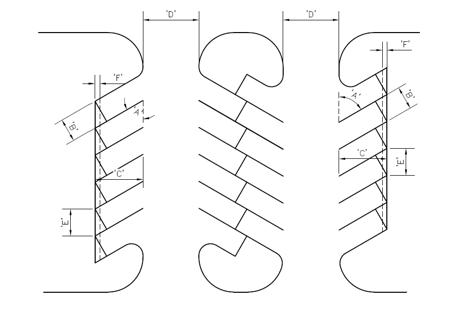 6.2.1.1 Credit for "Off-street Parking Space" requirements may be given in the following zoning districts; PUD, CPUD, LR2 and RM. The amount of off-street parking required shall be reduced by one off-street parking space for every on-street parking space directly abutting and on the same side of the street as the development. On-street parking spaces, where public health, safety, and welfare is protected and the proposal meets the purpose and intent of this ordinance, that are not directly abutting the development site may be counted towards the minimum parking space requirements only if specifically authorized by the Zoning Administrator. The following constitutes an on-street parking space;
- On-street parking spaces are located outside of the road travel lanes.
- On-street parking spaces credited for a non-residential use may not be used exclusively by that use, but shall be available for general public use at all times.
- On-street parking shall follow the established configuration of existing on-street parking within the block. 90-degree (perpendicular parking) on-street parking is only permitted on local streets. 45-degree diagonal parking may be allowed with the approval of the Zoning Administrator, where the public health, safety, and welfare is protected and the proposal meets the purpose and intent of this Ordinance, taking into account traffic flows and street design.
6.2.1.2 Tandem parking for off-street parking - where one vehicle is parking in front of another and effectively blocked from moving without first moving the other - is permissible only for residential uses.
Subject to the approval of the Zoning Administrator, where the public health, safety, and welfare is protected and the purpose and intent of this Ordinance is preserved, tandem parking is permissible for non-residential uses where valet parking, or fleet parking or other similar attended parking use is provided. If approved, it shall be a continuing condition of the permit authorizing development on such lot that should the valet parking discontinue, then the permit-holder is obligated to provide the required "off-street" parking.
6.2.1.3 If an off-street parking space cannot be reasonably provided on the same lot on which the principal use is conducted, the public health, safety, and welfare is protected, and the purpose and intent of this Ordinance is preserved, the Zoning Administrator may permit such space to be provided on other off-street property, provided such space lies within 600 feet of the property line of the principal use. The parking space shall be associated with the permitted use and shall not thereafter be reduced or encroached upon in any manner.
6.2.1.4 The required number of parking spaces for any number of separate uses may be combined in one lot, but the required space assigned to one use may not be assigned to another use at the same time.
6.2.1.5 Area reserved for off-street parking in accordance with the requirements of this Ordinance shall not be reduced in area or changed to any other use unless the permitted use which it serves is discontinued or modified, and unless equivalent parking space is provided to the satisfaction of the Zoning Administrator.
Off-Street parking existing at the effective date of this Ordinance in connection with the operation of an existing building or use shall not be reduced to an amount less than hereinafter required for a similar new building or use.
6.2.2 Parking space requirements for all districts.
6.2.2.1 Without limiting the generality of the foregoing, the Zoning Administrator may allow deviations from the parking requirements above when it finds;
- A residential development is irrevocably oriented toward the elderly or other demographic group that, due to the driving characteristics of the group, requires fewer or more parking stalls than the general populace, or
- A sole business (not part of a larger mall) is primarily oriented to walk-in trade.
6.2.2.2 Off-street automobile storage or parking space shall be provided with vehicular access to a street or alley, and shall be equal to the minimum requirements for the specific land use set forth in the following table:
| Land Use | Parking Requirements |
1. | One- and Two-Family Dwellings | 2 spaces for each dwelling unit. |
2. | Multi-family Dwellings | 1 1/2 space per dwelling unit except for efficiency apartments for which one space per dwelling unit shall be provided. |
3. | Hotels/Motels | 1 space for each lodging accommodation plus 1 additional space for each 5 employees on the largest work shift, plus 50 percent of the spaces otherwise required for accessory uses (e.g. restaurants and bars.) |
4. | Recreational Vehicle Parks | 1 space for each recreational vehicle that can be accommodated in the park, plus 1 additional space for a resident manager or owner. |
5. | Boarding and Rooming Houses, Bed and Breakfast, and Dormitories | 1 space for each guest bedroom plus 1 space for every 3 employees on the largest work shift. |
Public Assembly | ||
1. | Religious institutions and other Places of Worship | 1 space for each five (5) persons based on occupancy load calculated pursuant to the Building Code. |
2. | Community Center | 1 space for each five (5) persons based on occupancy load calculated pursuant to the Building Code. |
3. | Theaters, Auditoriums Stadiums and similar Places of Assembly | 1 space for each 4 seats. |
4. | Libraries, Museums | 1 space for each 500 square feet of gross floor area. |
5. | Schools, including Kindergarten, Play Schools and Day Care Centers | 1 space for each 2 seats in assembly hall, or 1 space for each employee, including teachers and administrators, whichever is greater, plus 5 spaces per classroom for high school and colleges. |
6. | Skating Rinks, Dance Halls, Pool Rooms and Other Places of Amusement or Assembly without Fixed Seating Arrangements | 1 space for each 4 persons based on occupancy load calculated by the Building Code. |
7. | Bowling Alleys | 4 spaces for each alley or lane. |
Health Facilities | ||
1. | Hospitals, Sanitariums, Nursing Homes, Homes for the Aged and Similar Institutional Uses | 1 space for each 4 beds (not including bassinets), plus 1 space for each staff or visiting doctor, plus 1 space for each 2 employees, including nurses, plus 1 space for each hospital vehicle. |
2. | Kennels and Animal Hospitals | A parking area equal to 25 percent of the total enclosed or cover area. |
3. | Medical, Dental and Health Offices and Clinics | 1 space for each 200 square feet of floor area used for offices and similar purposes. |
4. | Mortuaries and Funeral Parlors | 5 spaces per parlor or chapel unit, or 1 space per 2 seats, whichever is greater. |
Businesses | ||
1. | Automobile Repair Garage | 1 space for each regular employee plus 1 space for each 250 square feet of floor area. |
2. | Food Stores (including convenience and grocery store) | 1 space for each 200 square feet of floor area designated for retail sales only. |
3. | Restaurants, including Bars, Grills, Diners, Cafes, Taverns, Night Clubs, Lunch Counters and similar Dining and/or Drinking Establishments | 1 space for each 4 seats provided for patron use, plus 1 space for each 75 square feet of floor area provided for patron use but not containing seats. |
4. | Office Buildings, including Banks, Business, Commercial and Professional Offices and Buildings but excluding Medical, Dental and Health Offices and Clinics | 1 space for each 350 square feet of ground floor area, plus 1 for each 500 square feet of upper floor area. |
5. | General Business, Commercial or Personal Service Establishment Catering to the Retail Trade, but Excluding Food stores | 1 space for each 350 square feet of floor area designated for retail sales only. |
6. | Shopping Centers | 3 spaces for each 1,000 square feet of floor area designated for retail sales only. |
7. | Furniture Stores | 1 for each 1,000 square feet of gross floor area. |
8. | Automobile Sales Lot, new and used | 1 space per 600 sq. ft. of enclosed floor space, plus 1 space for each 3,000 sq. ft. of outside display area. |
9. | Public Utilities, such as Telephone Exchanges and Substations, Radio and floor area in the building TV Stations, and Electric Power and Gas Substations | A parking area equal to 25 percent of the gross floor area. |
Industries | ||
1. | Commercial, Manufacturing and Industrial Establishment, not Catering to the Retail Trade | 1 space for each 2 employees on the maximum working shift, plus 1 for each company vehicle on the premises. |
2. | Wholesale Establishments | 1 space for every 50 square feet of customer service area, plus 2 spaces for each 3 employees on the maximum working shift plus 1 space for each company vehicle operating from the premises. |
For specific buildings or uses not scheduled above, the Zoning Administrator shall apply the unit of measurement set forth in the above schedule which is deemed to be the most similar to the proposed building or use, or approve site specific parking based on developer submitted data (subject to Zoning Administrator approval), or apply an appropriate standard from an accepted reference manual.
6.2.3 Shared parking. Two or more uses may share parking facilities without providing the minimum number of on-site required spaces for each use, provided the following conditions are met:
6.2.3.1 The minimum required number of parking spaces for the combined uses may be reduced by 20 percent where hours of operation overlap with approval of the Zoning Administrator where the public health, safety, and welfare is protected and based on satisfaction of the purpose of intent of this Ordinance.
6.2.3.2 Off-site spaces being shared shall be within 600 feet of the property line of the principal use. If the pedestrian access is to cross an arterial street, appropriate safety measures must be present to help the pedestrian cross the street. In any event, safe and convenient pedestrian access, such as a sidewalk or path, must exist or be provided from the structure or use to the parking lot.
6.2.3.3 The parking facility to be shared must contain at least the minimum required spaces of the largest individual use sharing the lot and shall be developed to the extent of at least being paved and striped according to the standards of this Ordinance.
6.2.3.4 The parking facility to be shared must be owned by the owner of one of the uses or through a permanent easement by the owner of the uses being served.
6.2.3.5 No changes shall be made to the shared parking facility which would reduce the parking provided for the uses, unless the owner of one of the uses makes other arrangements to provide parking. No such changes shall be made without approval of the Zoning Administrator to confirm the requirements have been met.
6.2.3.6 Parking spaces to be shared must not be reserved for a specific person, individual, or use.
6.2.3.7 Handicap parking spaces cannot be shared.
6.2.3.8 Loading space shall not be used for general parking.
6.2.3.9 Any proposed change in the use of a structure that shares a parking facility will require proof that adequate parking is available.
6.2.3.10 Off-site and shared parking may be used in combination to develop parking facilities, provided all the requirements of this section are met.
6.2.4 Stacking space for drive-through facilities.
6.2.4.1 Stacking spaces shall be provided for any use having a drive-through facility or areas having drop-off and pick-up areas. The following general standards shall apply to all stacking spaces and drive-through facilities:
- Stacking spaces and lanes for drive-through stations shall not impede on and off site traffic movements, shall not cross or pass through off-street parking areas, and shall not create a potentially unsafe condition where crossed by pedestrian access to a public entrance of a building.
- Drive through lanes shall be separated from off-street parking areas. Individual lanes shall be striped, marked or otherwise distinctly delineated.
- Approach lanes for drive-through facilities shall have the following minimum widths:
- One lane, feet per lane 12 feet
- Two or more lanes, feet per lane 10 feet
- One lane, feet per lane 12 feet
- All drive-through facilities shall be provided with a bypass lane with a minimum width of 10 feet.
- Alleys or driveways in residentially zoned areas adjacent to drive-through facilities shall not be used for circulation of customer traffic.
- Each stacking space shall be a minimum of 10 feet by 20 feet.
6.2.4.2 The number of stacking spaces shall be provided as follows:
- Financial institutions with drive-through windows: 2 stacking spaces for each window.
- Drive-in or Fast Food Restaurant: 6 stacking spaces per drive-through window measured from the order board or station.
- All other uses: 3 stacking spaces for each window.
6.2.5 Parking area site requirements.
6.2.5.1 All off-street parking for B1, B2, C3, L1, OI, PUD, and CPUD shall be laid out, constructed, and maintained according to the requirements of this Section 6.2.5. This requirement shall not apply to property annexed into a PUD or CPUD unless the development of that property is integrated into the PUD or CPUD master plan after annexation. Off-street parking includes parking spaces or lots for customers and employees.
6.2.5.2 All required parking areas shall be hard surfaces with concrete or plant mix material.
6.2.5.3 Parking lots of more than four (4) parking spaces shall have adequate turn-around areas so that vehicles for which the parking lot is designed may enter the street in a forward manner.
6.2.5.4 Parking lots shall be designed so that sanitation, emergency, and other public service vehicles can serve such developments without dangerous or hazardous turning movements.
6.2.5.5 Required parking shall not be encroached upon by refuse containers, signs or other structures, nor used for parking of equipment or outdoor storage of goods for sale or storage. Required parking spaces shall be provided with vehicular access to a public street or alley.
6.2.5.6 Lighting facilities, if provided in the parking areas, shall be in accordance with § 6.7.5, Site Lighting.
6.2.5.7 The parking area drainage shall be designed by a licensed design professional to ensure adequate drainage and compliance with state and local law.
6.2.5.8 No sign shall be placed within the public right-of-way. Signs and planting strips shall not obstruct the visibility of drivers or pedestrians.
6.2.5.9 All parking lots must be maintained in a clean, litter free condition.
6.2.6 Landscape standards for parking lots.
Parking lots shall be effectively landscaped with trees and shrubs to reduce the visual impact of glare, headlights, and parking lot lights from the public right-of-way and from adjoining properties. In addition, parking lots shall be adequately shaded to reduce the amount of reflected heat.
6.2.6.1 When a lot is located adjacent to a public right-of-way, a minimum 10 foot wide landscaped strip must be provided between the right-of-way and the parking lot to reduce the visual impact of the parking lot. The landscaping site plan must be approved by the Zoning Administrator to confirm compliance with this Section.
6.2.6.2 Every parking lot must provide a ten-foot wide landscaped strip around the perimeter of the lot, to be planted with shade trees and low shrubs to reduce its visual impact. A minimum of one shade tree per every 40 feet of lot perimeter must be included in the perimeter landscape strip. However, this does not mean that shade trees must be located 40 feet on center. Additional shade trees may be required to effectively shade the parking lot. Shade trees may be used as a substitute for a fence in conjunction with sufficient landscaping to accomplish the visual impact reduction otherwise provided by a fence.
6.2.6.3 For the purpose of calculating off-street parking lot square footage, all areas within the lot's perimeter are counted, including the planting islands, curbed areas, corner lots, parking spaces, and all interior driveways and aisles except those with no parking spaces located on either side. Landscaped areas outside the parking lot may not be used to meet the interior planting requirement. Landscape provisions only apply to parking areas for customers or employees. The amount of landscaping required is based on the following sliding scale:
| Total Area of Parking Lot (S.F.) | Percent of the Total Area (S.F.) of Parking Lot that must be an Interior Planting Area |
| 0—15,000 | 5.0% |
| 15,001—29,999 | 7.5% |
| 30,000 or greater | 10.0% |
In order to break up the visual expansiveness of lots and to reduce glare and heat, a minimum of 1 overstory or 2 understory trees must be planted per 200 square feet of required interior planting area. The trees shall be the following criteria:
- Overstory trees shall be a minimum of 2 1/2 inches caliper. Overstory trees include, but are not limited to, oaks, pines, and maples.
- Understory trees shall be a minimum of 1 inch caliper at time of planting. Understory trees include, but are not limited to, dogwoods, crepe myrtles, and redbuds.
- No more than one-third of the trees can be understory trees.
- No more than 50 percent of the trees can be of a single variety.
- A minimum of half of the burlap and metal wire must be removed from the root ball before planting.
To achieve these objectives, the following alternatives should be considered:- Provide a continuous landscape strip between every four rows of parking. This should be a minimum of eight feet in width to accommodate a low hedge and overstory trees.
- Create large planting islands (over 600 square feet) to be located throughout the lot and planted with shade trees, low shrubs, and/or ground over. These should preferably be located at the ends of parking rows.
- Provide planting islands (a minimum of nine feet wide) between every 10 to 15 spaces to avoid long rows of parked cars. Each of these planting islands should provide at least one shade tree having a clear trunk height of at least six feet.
6.2.6.4 Within the interior of the parking lot, landscaping shall be used to delineate vehicular and pedestrian circulation patterns. Clear and legible signs, different color and texture paving materials, raised areas, and other techniques should be used to further direct the flow of both vehicular and pedestrian traffic within the lot.
6.2.6.5 The general guidelines listed below shall be followed for all parking lots.
- Use shade trees with ground cover of low shrubs as the primary landscape material within parking lots. Avoid tall shrubs or low branching trees that will restrict visibility.
- For planting islands that are parallel to spaces, islands shall be a minimum of nine feet wide to allow car doors to open.
- For planting islands that are perpendicular to spaces, islands shall be a minimum of eight feet wide to allow for overhang of parked cars. If parking is only on one side of the island, an eight-foot width is still required.
- Screening of mechanical equipment, trash, and loading areas shall be provided. This can be achieved using walls or fences with doors, and/or landscaping.
- Where appropriate, the use of porous pavement and/or specially designed brick or block shall be considered to increase on site water retention for plant material and groundwater supplies and to reduce problems associated with runoff.
6.2.7 Maintenance of perimeter and interior parking lot landscaping. The owner, tenant, and their agent, if any, are jointly and severally responsible for the maintenance of all parking landscaping in good condition so as to present a healthy, neat, and orderly appearance and shall be kept free from refuse and debris. All landscaped areas must be watered via an underground sprinkler systems or be provided with a readily available water supply with at least one (1) outlet located within one hundred fifty (150) feet of all plant material to be maintained.
6.2.7.1 All plant growth in landscaped areas must be controlled by pruning, trimming, or other suitable methods so that plant materials do not interfere with public utilities, restrict pedestrian or vehicular access, or otherwise constitute a traffic hazard.
6.2.7.2 All planted areas must be maintained in a relatively weed free condition and clear of undergrowth.
6.2.7.3 All planting must be fertilized and irrigated at such intervals as necessary to promote optimum growth.
6.2.7.4 All required trees, shrubs, ground cover, and other plant materials must be replaced during the next suitable planting period if they die or become unhealthy because of accidents, drainage problems, disease, or other causes.
6.2.7.5 Required replacement plants must conform to all standards that govern the original installation of plantings.
(Ord. of 12-8-2020, § 1(Exh. A))
Amended by Res. 2023.7.11(a) on 7/11/2023
Sec 6.3 Off-Street Loading And Unloading Space
Off street loading and unloading spaces shall be provided as hereinafter required by this Ordinance.
6.3.1 Size of off street loading spaces. Each off-street loading space shall have minimum dimensions of 14 feet in height, 12 feet in width, and 55 feet in length.
6.3.2 Connection to street or alley. Each required off street loading space shall have direct access to a street or alley or have a driveway that offers satisfactory ingress and egress for trucks.
6.3.3 Floor area over 10,000 square feet. Sufficient space for off-street loading and unloading must be provided for each hospital, institution, hotel, commercial or industrial building or similar use requiring the receipt or distribution of materials or merchandise, and having a floor area of more than 10,000 square feet. Such space must be located so as not to hinder the free movement of pedestrians and vehicles over a sidewalk, street or alley.
6.3.4 Floor area no more than 10,000 square feet. Sufficient off street loading space (not necessarily a full space if shared by adjacent establishments) must be provided for each commercial or industrial building or similar use requiring the receipt or distribution of materials for merchandise and having a floor area of no more than 10,000 square feet. The space must be located so as not to hinder the free movement of pedestrians and vehicles over a sidewalk, street or alley.
6.3.5 Bus and trucking terminals. There shall be provided sufficient space to accommodate the maximum number of busses or trucks to be stored or loaded at the terminal at any one time.
6.3.6 Location of off street loading spaces. All required off street loading spaces shall be located on the same lot as the building which they are intended to serve, or on an adjacent lot when the loading spaces are shared with the use occupying said adjacent lot.
6.3.7 Permanent reservation. Area reserved for off-street loading in accordance with this Ordinance must not be reduced or changed to any other use unless the permitted use that the off-street loading serves is discontinued or modified.
(Ord. of 12-8-2020, § 1(Exh. A))
Sec 6.4 Control Of Curb Cuts And Vision Clearance
The requirements for controlling curb cuts and maintaining vision clearance shall be as follows, to the extent state Department of Transportation requirements do not take precedence:
6.4.1 Curb cuts. No curb cut shall be less than 9 feet nor exceed 30 feet in length unless the property will primarily serve tractor-trailer traffic. Except in residential districts, no curb cut shall be closer than 100 feet to another curb cut or access point. At street intersections, no curb cut or other access point shall be located closer to the intersection than is necessary to serve the property but in no case shall be closer than 50 feet from the intersecting point of the two street rights-of-way or property lines involved (or such lines extended in case of a rounded corner), whichever is the least restrictive.
A permit must be obtained from the Georgia Department of Transportation before curb cuts or any other point of access is authorized onto state owned highway rights-of-way from abutting property. Individuals requesting a development permit for property that abut a state owned highway must contact the District Traffic Engineer for consultation and DOT permit issuance before a local permit will be issued.
6.4.2 Vision clearance. In all use districts, no fence, wall, shrubbery, sign, marquee or other obstruction to vision between the heights of 2 1/2 and 10 feet from the ground level is permitted within 50 feet of the intersection of the right-of-way lines of two streets or railroad lines, of a street intersection with a railroad line, or of curb cuts or driveways.
(Ord. of 12-8-2020, § 1(Exh. A))
Sec 6.5 Classification Of Streets
All streets in Greene County, Georgia, shall conform to the Greene County Subdivision Regulations.
(Ord. of 12-8-2020, § 1(Exh. A))
Sec 6.6 Storage And Parking Of Recreational Vehicles, Trailers, And Other Vehicles
Commercial vehicles and trailers of all types, including travel, boat, camping and hauling, shall not be parked or stored on any lot or parcel in any residential zoning district except in accordance with the following requirements:
6.6.1 No commercial vehicle used for hauling explosives, gasoline or liquefied petroleum products is permitted in any residential district.
6.6.2 Recreational vehicles, hauling trailers, or boat trailers are permitted if parked or stored behind the front yard building line in residential districts.
6.6.3 A recreational vehicle shall not be occupied overnight either temporarily or permanently while it is parked or stored in any area except in a recreational vehicle park authorized under this Ordinance, or as otherwise stated in this Ordinance.
6.6.4 No automobile, recreation vehicle, trailer, or other vehicle for sale shall be parked in the right-of-way.
(Ord. of 12-8-2020, § 1(Exh. A))
Sec 6.7 Buffer Areas, Landscaping, And Lighting
6.7.1 Applicability
6.7.1.1 New Construction - Any new building or site improvement must comply with the requirements of this Section.
6.7.1.2 Maintenance and Repair - An existing building or site may be repaired or maintained without providing additional landscaping or screening, provided there is no increase in gross floor area or disturbed site area greater than 25%.
6.7.1.3 Additions and Modifications
1. When an existing building is increased in gross floor area or disturbed site area by up to 25% cumulatively over the past 3 years, landscaping and screening is required for the additional floor or site area only. 2. When an existing building is increased in gross floor area or disturbed site area by 25% or more cumulatively over the past 3 years, both the existing building and the additional floor or site area must conform to the landscaping and screening requirements of this Division.
6.7.1.4 Change in Use - A change in use triggers the application of these requirements, when there is a specific use standard requiring landscaping or screening for the new use.
6.7.2 General Landscape Requirements
6.7.2.1 In any business (B1, B2, C3, CPUD, OI) or industrial (LI and HI) district, any operation not conducted within a building, including, but not limited to, outdoor recreation, outdoor storage of materials, and outdoor servicing activities, shall provide a ten (10) foot vegetated landscaped buffer area on the front property line. Twenty per cent (20%) of the total buffer area shall consist of landscape materials of not less than two (2) feet tall or a decorative fence of not less than two (2) feet in height. The Zoning Administrator shall, based on the character of the area, determine whether the applicant must install the landscape material and/or the decorative fence. All non-operating inventory must be stored behind the landscaped area or the decorative fence. 6.7.2.2 In any district not subject to the requirements of § 6.7.2.1 but requiring screening of a specified operation, said screening shall be in accordance with a solid wall, solid fence, or tight evergreen hedge not less than eight (8) feet in height in accordance with § 6.8, Screening. The tight evergreen hedge shall grow to at least eight (8') feet in height within five (5) years. There shall be a perimeter landscape strip at least ten (10) feet wide, unless otherwise required by § 6.7.4 or specified by the Zoning Administrator as a condition of approval. All buffer area requirements are in addition to the area, yard, and height requirements for that district (Article VIII). 6.7.2.3 A manufactured home park shall be screened from public view from any adjacent property by a tight evergreen hedge or suitable landscaping and contain a perimeter landscape strip at least thirty (30) feet wide, unless otherwise required by the Zoning Administrator as a condition of approval. All perimeter landscape strip requirements are in addition to the area, yard, and height requirements for that district (see Article VIII). Prior to any site construction or grading, the Zoning Administrator must approve a landscaping plan to insure compliance. 6.7.2.4 Visibility at Intersections: Landscaping must not interfere with visibility at intersections and driveways as defined in Greene County Subdivision Regulations, Sight Triangle at Intersections. 6.7.2.5 Plant Material.
1. Plant materials must be hardy in accordance with the U.S. Department of Agriculture's Plant Hardiness Zone Map. 2. Unless provided with an irrigation system, plant materials must be able to survive on natural rainfall once established with no loss of health. 3. All plants shall be installed to allow for proper plant growth and maintenance. 4. Tree height is measured from the top of the root ball to the tip of the main stem. 5. No more than 50 percent of the required interior trees can be of a single variety. 6. Required shrubs shall be at least two feet in height above ground level. 7. No artificial plants, trees, or other vegetation may be installed as required landscaping and screening. 8. No plant materials listed as Category 1 or Category 1 Alert on the Georgia EPPC Invasive Plant List are permitted in required landscaping. Property owners are encouraged to avoid the entire list of invasive species when making decisions about plant materials for required or non-required landscaping.
6.7.2.6 Maintenance of Landscaping
1. The property owner, tenant, and their agent, if any, are jointly and severally responsible for maintaining all required landscaping and screening in good health and condition. 2. Any dead, unhealthy, damaged, or missing required landscaping and screening must be replaced with landscaping and screening that conforms to this Section within 90 days. 3. Landscaped areas must be kept free of weeds and trash. 4. All required trees, shrubs, ground cover, and other plant materials must be replaced during the next suitable planting period if they die or become unhealthy because of accidents, drainage problems, disease, or other causes. 5. Required replacement plants must conform to all standards that govern the original installation of plantings. 6. All plant growth in landscaped areas must be controlled by pruning, trimming, or other suitable methods so that plant materials do not interfere with public utilities, restrict pedestrian or vehicular access, or otherwise constitute a traffic hazard.
6.7.2.7 Pruning and Trimming
1. All required landscaping must be maintained at no less than the required size. 2. To prevent long-term harm to the health of required landscaping, all pruning of shrubs and trees must be done in accordance with the International Society of Arboriculture Standards entitled '"ANSI A300 Standards." 3. "Topping," defined as removal of more than 1/3 of the leaves and branches of a tree as measured from the lowest branch on the trunk of the tree to the top of the tree, is prohibited except where necessary to maintain public overhead utilities. 4. Trees adjacent to rights-of-ways must maintain a vertical clearance of at least 80 inches.
6.7.3 Parking Lot Landscaping
6.7.3.1 Applicability.
1. Parking lots shall be effectively landscaped with trees and shrubs to reduce the visual impact of glare, headlights, and parking lot lights from the public right-of-way and from adjoining properties. In addition, parking lots shall be adequately shaded to reduce the amount of reflected heat. 2. All off-street parking for B1, B2, C3, L1, OI, PUD, CPUD, and automobile paved parking greater than 18 parking spaces shall be laid out, constructed, and maintained according to the requirements of this Section 6.2.5. This requirement shall not apply to property annexed into a PUD or CPUD unless the development of that property is integrated into the PUD or CPUD master plan after annexation. Off-street parking includes parking spaces or lots for customers and employees.
6.7.3.2 General Requirements.
1. The parking area landscape plan shall be approved by the Zoning administrator. 2. Use shade trees with low shrubs as the primary landscape material within parking lots. Avoid tall shrubs or low branching trees that will restrict visibility. 3. Planting islands that are parallel to spaces shall be a minimum of nine feet wide to allow car doors to open. 4. Planting islands that are perpendicular to spaces shall be a minimum of eight feet wide to allow for overhang of parked cars. If parking is only on one side of the island, a minimum of eight-foot wide is still required. 5. Screening of mechanical equipment, trash enclosures, and loading areas shall be provided. This can be achieved using walls or fences with doors, and/or landscaping. 6. A minimum of half of the burlap and metal wire must be removed from the root ball before planting. 7. Trees that are required to be planted beneath overhead utility lines shall only be species with a mature height no greater than 20 feet. 8. All landscaped areas must be (1) watered via an underground sprinkler system, (2) be provided with a readily available water supply with at least one (1) outlet located within one hundred fifty (150) feet of all plant material to be maintained, or (3) have plant materials capable of surviving on natural rainfall once established with no loss of health.
6.7.3.3 Perimeter Landscaping: Every parking lot must provide a minimum of a ten-foot-wide landscaped strip around the perimeter of the lot, to reduce its visual impact. Unless the adjacent perimeter is part of a transitional buffer as required by § 6.7.4, Transitional Buffers, the perimeter plantings shall be as follows:
1. A minimum of one shade tree per every 40 feet of lot perimeter must be included in the perimeter landscape strip. However, this does not mean that shade trees must be located 40 feet on center. 2. Trees preserved along the perimeter of the parking lot may count toward the required perimeter trees provided that the existing tree is a minimum of 6” DBH (diameter at breast height – 4.5 feet) overstory tree or 2” DBH understory tree, and within adjacent landscape perimeter on the property. 3. When adjacent to a public right-of-way, a minimum screen of thirty-six (36) inches in height shall be provided. The screen may include landscape features such as berming, fencing, walls, or plantings, but must provide sufficient density to provide a dense screen thirty-six (36) inches in height as measured from the adjacent sidewalk, curb, or parking surface, whichever is the highest elevation, within five years of date of substantial completion of the project. Fences and walls shall be no taller than forty-eight inches in height. The sufficiency of the proposed screening shall be determined by the Zoning Administrator.
6.7.3.4 Interior Landscape Islands.
1. Interior landscape island shall be provided in automobile parking lots to break up the visual expansiveness of lots and to reduce glare and heat. 2. To calculate off-street parking lot square footage, all areas within the lot's perimeter are counted, including the planting islands, curbed areas, corner lots, parking spaces, and all interior driveways and aisles except those with no parking spaces located on either side. Landscaped areas outside the parking lot may not be used to meet the interior planting requirement. Landscape provisions only apply to parking areas for customers and employees. The amount of landscaping required is based on the following sliding scale:
Total Area of
Parking Lot | Minimum Percent
of the Total Area (Sq. Ft.) of Parking Lot that must be an Interior Planting Area |
| 0—5,000 | 0.0% |
5,000-15,000 | 5.0% |
15,001—29,999 | 7.5% |
30,000 or greater | 10.0% |
3. To achieve these objectives, the following alternatives should be considered:
a. Provide a continuous landscape strip between every four rows of parking. This should be a minimum of eight feet in width to accommodate a low hedge and overstory trees. b. Create large planting islands (over 600 square feet) to be located throughout the lot and planted with shade trees, low shrubs, and/or ground cover. These should preferably be located at the ends of parking rows. c. Provide planting islands (a minimum of nine feet wide) between every 10 to 15 spaces to avoid long rows of parked cars. Each of these planting islands should provide at least one shade tree.
4. The required interior trees shall be a minimum of 1 tree for each 400 square feet of the required interior planting area. The trees shall meet the following criteria:
a. An overstory or large canopy tree has a mature canopy greater than 35 feet and includes (e.g., oaks, maples, and pines). Overstory shade trees shall be a minimum of 2 inches in caliper. Pines shall be a minimum of 1 inch in caliper. All trees shall be a minimum of 1-foot height. b. An understory or small tree (e.g., dogwoods, crepe myrtles, and redbuds) has a mature canopy less than 35 feet. Understory trees shall be a minimum of 1 inch in caliper at time of planting. c. There shall be at least one (1) tree per island. d. No more than one-third of the required interior trees can be understory trees. e. Trees preserved inside proposed parking islands may count toward the required interior planting requirements provided that the existing tree is a minimum of 6” DBH (diameter at breast height – 4.5 feet) overstory tree or 2” DBH understory tree.
6.7.4 Transitional Buffers
6.7.4.1 Purpose and Intent
1. A transitional buffer is a strip of land, established to protect one type of land use from another with which it is not compatible. 2. The purpose of buffer standards in this Section is to spatially separate major subdivision developments from adjacent existing major subdivision developments with aesthetically pleasing natural or landscaped buffers. Such buffers are intended to help mitigate potential adverse impacts (e.g., visual, noise, odor, fumes) from existing land uses, allow the location of certain dissimilar land uses adjacent to one another by mitigating potential negative effects between the uses, and provide space for landscaping that can help improve air and water quality and be used to reduce stormwater runoff. 3. A transitional buffer, as specified in this section, shall be required when a proposed development abuts a dissimilar zoning district, unless the adjoining zone district is already developed with uses compatible with the proposed uses. If a conflict occurs with buffer requirements elsewhere in this ordinance, the greater of the buffer requirements will be rule. 4. The requirements of this section apply to all developments in the County. For CPUD and PUD Residential Districts, buffer standards shall apply only along those lot lines adjoining the exterior boundaries of one major subdivision development from another major subdivision development not controlled by the same entity or public rights-of-way. 5. The Zoning Administrator may waive the requirement for an adjoining use buffer for non-single-family properties upon determining that the proposed development and the adjoining development function as a single development. The criteria to determine if the properties will function as a single development may include the recording of a cross-access easement agreement between the two properties. 6. The requirements of this section shall not apply to lot lines adjoining with the Georgia Power Lake Oconee property lines. Instead, buffering and landscape requirements will be in accordance with Georgia Power requirements and community covenants and restrictions.
6.7.4.2 Buffer Requirements
1. Buffers must be located inside the property line and along the outer perimeter of the lot. 2. Buffers shall not occupy any portion of an existing, dedicated, or reserved public or private street, or right‐of‐way. 3. Landscape Plan Required - Applications for development where a buffer is required shall include a landscape plan in addition to standard submittal requirements. 4. The Zoning Administrator may determine an alternate location for a required wall or fence within the buffer based on existing natural vegetation and site topography. 5. Any grading, improvement, or construction adjacent to the buffer must not disturb or encroach on the buffer area, except for berming or minor grading for installation of walls and fences for the purposes of providing screening and preventing or controlling erosion, as approved by Zoning Administrator. 6. In situations where the required buffer width is partially or completely contained within an existing easement (e.g., power or natural gas transmission. etc.), the screening requirements of this article shall be provided outside of the easement area. 7. Buffers are required to be created at the time of construction of any infrastructure or new development of a building or site. No building permit shall be issued for any lot or parcel development requiring a buffer until such time as that buffer, as specified herein, shall be substantially in place or until acceptable surety for the cost of the buffer installation shall be provided to the Zoning Administrator. 8. Buffers are required to be created at the time of construction of any infrastructure or new development of a building or site. 9. Depending on adjoining existing uses and existing site conditions, the Board of Commissioners may stipulate additional buffer requirements as a condition for zoning, preliminary, or final plat approval. 10. Width of buffer. Unless expressly exempted or modified in this subsection, development shall provide a buffer along common property lines with adjoining properties that is of the type designated in Table 6.7.4.2, Buffer Requirements, for the proposed use and the classification of the use of the adjacent property (or zoning of a vacant adjacent property). Descriptions and width and screening requirements for the various buffer types are set out in § 6.7.4.3, Buffer Types. Buffers shall incorporate optimal placement of the components described in Table 6.7.4.2, Buffer Requirements on the property and in relationship to the adjoining property to provide the most effective barrier described above. This shall include consideration to the vertical relationship, lines of sight and resulting view angles between differing land uses and adjoining properties and may involve the grading design, building heights, architectural styles, and placement of design elements on the property being developed.
| TABLE 6.7.4.2: TRANSITIONAL BUFFER REQUIREMENTS1 | ||||
| PROPOSED USE2 | REQUIRED BUFFER TYPE2 | |||
| USE OF ADJACENT DEVELOPED PROPERTY | ||||
| SINGLE- FAMILY DWELLING | ALL OTHER RESIDENTIAL USES; RECREATION | PUBLIC, CIVIC, INSTITUTIONAL, AND EDUCATION; RESORT ACCOMMODATIONS; OFFICES; COMMERCIAL SERVICES; AGRICULTURAL USES | INDUSTRIAL USES | |
| ZONING OF ADJACENT VACANT PROPERTY | ||||
| R1, R2, LR1, LR2, PUD, A1, A2 | RM, LP | B1, B2, C3, LC, CPUD | LI, AP | |
| • Major Single-Family subdivision development | A | B | C | E |
• Attached single-family residential • Multi-family • Commercial Recreation | n/a B | n/a | B | E |
• Public, Civic, Institutional, and Education • Resort Accommodations • Offices • Commercial Services | C | B | n/a | D |
| • Industrial Uses | E | E | D | n/a |
NOTES: n/a = not applicable 1. Descriptions and width and screening requirements for the various buffer types are set out in § 6.7.4.3, Buffer Types. 2. When a shared access easement is located along a common property line, any required buffer shall be provided to the interior of the access easement. An adjacent use buffer from an easement line is not required for non-single-family properties. | ||||
6.7.4.3 Buffer Types
Table 6.7.4.3, Buffer Types, describes the five different buffer types in terms of their function, opacity, width, and planting requirements. The planting requirements should be used as a guide to achieve an aesthetically pleasing landscaped buffer and only apply if the existing buffer does not meet the intent of the prescribed buffer. Either of the options under a specific buffer type may be used at the option of the developer.
| TABLE 6.7.4.3:
BUFFER TYPES | |||||
| MINIMUM BUFFER
WIDTH AND SCREENING REQUIREMENTS1,2,3,4,5,6,7 | |||||
Option | Minimum width (feet) | Overstory Trees per 100 feet | Understory Trees per 100 feet | Structural | Evergreen Shrubs per 100 feet |
TYPE A BUFFER: This buffer includes low-density screening designed to partially block visual contact and create spatial separation between adjacent uses or between development and adjacent local streets along rear or side property lines. | |||||
| Option 1 | 25 | 2 | 3 | n/a | 8 |
Option 2 | 15 | 2 | 4 | n/a | 10 |
TYPE B BUFFER: This buffer includes low- to medium-density screening designed to create the impression of spatial separation without significantly interfering with visual contact between adjacent uses or between development and adjacent major and minor collectors along rear or side property lines. | |||||
Option 1 | 25 | 3 | 6 | n/a | 10 |
Option 2 | 15 | 4 | 8 | n/a | 12 |
TYPE C BUFFER: This buffer includes medium-density screening designed to eliminate visual contact at lower levels and create spatial separation between adjacent uses. | |||||
| Option 1 | 35 | 5 | 6 | n/a | 25 (at least 4 feet high at maturity) |
Option 2 | 3 | 5 | 4 feet high solid wall/fence or 4 feet high or 3 feet wide solid evergreen hedge | ||
Option 3 | 15 (50% must be evergreen) | 4 | 6 | 4 feet high solid wall/fence or 4 feet high or 3 feet wide solid evergreen hedge | |
TYPE D BUFFER: The buffer includes high-density screening designed to eliminate visual contact up to a height of six feet and create a strong spatial separation between adjacent uses. | |||||
Option 1 | 30 (50% must be evergreen) | 5 | 6 | 6 feet high solid wall/fence or 6 feet high or 3 feet wide solid evergreen hedge | |
Option 2 | 20 (50% must be evergreen) | 6 | 8 | 6 feet high solid wall/fence or 6 feet high or 3 feet wide solid evergreen hedge | |
TYPE E BUFFER: This buffer provides greater spacing and medium-density screening designed to define "green" corridors along major arterials. | |||||
Option 1 | 50 | 4 | 5 | n/a | 25 (at least 4 feet high at maturity) |
Option 2 | 30 | 5 | 7 | n/a | 25 (at least 4 feet high at maturity) |
| NOTES:
| |||||
6.7.4.4 Existing Vegetation
1. If a buffer area has existing trees, they shall be preserved and be used as part of the buffer to comply with the buffer standards of this section. Where groupings of native shrubs are present, their preservation with minimal disturbance is required. Any clearing or other work in buffers must have the prior approval of the Zoning Administrator. 2. Existing trees that are minimum of 6” DBH (diameter at breast height – 4.5 feet) overstory tree or 2” DBH understory tree 3. Natural buffers may contain deciduous, evergreen or perennial vegetation, but shall contain shrubs and trees suitable to local growing conditions that will provide an opaque visual screen during all seasons of the year. To protect existing natural buffers, retaining walls may be installed to maintain the natural grade for the health of these trees and shrubs. 4. Existing vegetation that is preserved shall not be limbed up from the ground more than five feet to the lowest branches, except:
a. Vegetation at intersections may be limbed up to a greater height to ensure compliance with Greene County Subdivision Regulations, Sight Triangle at intersections; and b. If understory planting is proposed, the Zoning Administrator may allow existing vegetation to be limbed up to a height that will provide adequate sunlight to plants.
5. The removal of invasive species as required by the Zoning Administrator.
6.7.4.5 Supplemental Vegetation
1. Transitional Buffers in which existing vegetation is nonexistent or is inadequate to meet the screening requirements of this Section shall be planted with supplemental plantings to provide a year-round effective visual screen. The buffers shall be composed of healthy plants with growth characteristics to produce a dense, compact visual screen not less than six (6) feet in height. Natural buffers may contain deciduous or perennial vegetation but shall contain existing or planted evergreen shrubs and trees suitable to local growing conditions that will provide an opaque visual screen during all seasons of the year. 2. Supplemental plantings and replanting shall consist of naturalizing trees, shrubs, or combination thereof, native or adaptable to the region. 3. All trees planted shall be a minimum of six feet in height at time of planting and shall be a species which will achieve a height of at least 20 feet at maturity. 4. All shrubs planted shall be of a large growing species, shall be a minimum of three feet in height at time of planting and shall be a species which will achieve a height of at least ten feet at maturity.
a. 80% of required shrubs must be evergreen and as much as 20% of required shrubs may be deciduous. b. Required shrubs must have a minimum installation height of 3 feet. c. The density of the planting is to be determined by the natural growth pattern of the different species. d. Shrubs shall be staggered to create a 6 feet tall opaque visual screen within 3 years of planting.
5. All supplemental plants shall be installed to allow for proper plant growth and maintenance. 6. A buffer/landscape plan shall be submitted to the Zoning Administrator for approval, delineating the type, size, and location of all supplemental plantings as well as any nonvegetative screening mechanism proposed for use, in accordance with the terms of this Section.
6.7.4.6 Structural Buffer.
1. Structural buffers utilized to satisfy the screening requirements of this Section, in addition to the use of existing vegetation and/or supplemental plantings, may consist of walls, fences, earthen berms or any combination thereof. 2. Structural buffers shall be minimum height specified in Table 6.7.4.3, Buffer Types. Berms may be used to reduce the required height of walls and fences. 3. Structural buffers shall be within the minimum area required for the buffer including around any fences, walls and upon any earthen berms. This vegetation may include ground covers, grasses, shrubs and/or trees. 4. If structural buffers are to be utilized, their placement and installation shall cause minimal disturbance of existing vegetation and be located to provide an effective visual screen. 5. Walls and fences shall be constructed in accordance with § 6.9, Fences and Walls.
a. Fences and walls shall be located not closer to the property line than two (2) feet, as measured from the footing. Shrubs, ground covers, or other vegetation shall be provided between the fence or wall and the property line to provide a decorative effect, following professional landscaping standards for spacing, location, and design. b. Where the property line side of the fence or wall is not easily accessible from streets or other rights-of-way or easements, access shall be provided through gates or openings in the wall or fence.
6. Berms
a. All earthen berms shall have a maximum side slope of 50 percent (one foot of vertical rise to two feet of horizontal run). b. Earthen berms shall not be constructed within the drip line, measured 1-foot per 1” DBH (diameter at breast height – 4.5 feet) of any existing trees that will remain on the property. New trees that overhang the berm shall be planted after the berm is constructed.
c. Berms may be tapered and offset to create a visual aesthetic. In the gaps created, a vegetative screening shall be required to create a visual screen as required by Table 6.7.4.3, Buffer Types. d. Berms are required to be vegetated throughout.
6.7.4.7 Activities Permitted Within Required Buffers. The following activities may occur in required buffers, unless expressly prohibited elsewhere in this section.
1. Service and utility lines and minor facilities (e.g., water, sanitary sewer, electrical, telephone, natural gas, cable, storm drainage lines, utility boxes and pedestals), subject to the following standards:
a. Such lines shall run approximately perpendicular to/from the adjacent street right-of-way or common property line. b. If they must be installed approximately parallel to the street right-of-way or property line, the easement for the lines may be included as part of a required buffer if the easement allows the vegetation or structures necessary to meet buffer screening requirements and provides the requisite visual separation in a manner that is aesthetically acceptable; otherwise, additional buffer width shall be required to provide the space needed for the required buffer screening.
2. Supplemental plantings or re-plantings of vegetation, or authorized nonvegetative screening devices shall be authorized to encroach into a buffer provided there is minimal disturbance of any significant existing vegetation. 3. Land disturbance is authorized in areas of a buffer that are devoid of significant vegetation provided that the final grade and replanting of vegetation meet the screening requirements contained herein. 4. Limited thinning of a natural buffer where the vegetation is too dense to permit normal growth or removal of dying, decayed, diseased, misshapen, or dangerous trees may be accomplished. Vegetation thus removed shall be replaced where necessary to meet the screening requirements contained herein. Any contemplated disturbance within a natural buffer shall be brought to the attention of the Zoning Administrator. Written approval by the Zoning Administrator shall be secured prior to initiating any activity within a natural buffer. No hardwood tree having a diameter of 24 inches or greater as measured four and one-half feet above the adjacent grade shall be removed from the buffer unless approved in writing by the Zoning Administrator. 5. Street or driveway access, provided it runs approximately perpendicular to or from the adjacent street right-of-way or common property line. 6. Walkways, pathways, trails, benches, bike racks, and other elements associated with passive recreation or the provision of continuous pedestrian and bicycle connections between adjoining properties, provided all landscaping required by § 6.7.4.3, Buffer Types, is provided and the Zoning Administrator determines that installation or maintenance of such elements will minimize impacts on to required vegetation to the maximum extent practicable. 7. Fences and walls, to the extent permitted by § 6.7.4.6, Structural Buffers and § 6.9, Fences and Walls. 8. Signage, to the extent permitted by Article X, Signs. 9. Clearing for sight distances at permitted entrances and exits to any development as required to provide for reasonable traffic safety. 10. Fountains, plazas, sculptures, and similar features that are part of publicly owned facilities, where approved by the Zoning Administrator. 11. Lighting fixtures, to the extent permitted by § 6.7.5, Site Lighting. 12. Maintenance of walls, fences, lights, and other site improvements permitted but the Zoning Administrator and § 6.7.4, Transitional Buffers. 13. Emergency work necessary to preserve life or property. However, when emergency work is performed under this section, the person performing it shall report such work to the Zoning Administrator on the next business day after commencement of the work. Within ten days thereafter, the person shall apply for a permit and perform such work within such time period as may be determined by the Zoning Administrator to be reasonably necessary to correct any impairment such emergency work may have caused to the water conveyance or screening capacity of the buffer area. 14. Forestry and silviculture activities on land that is zoned for forestry, silvicultural or agricultural uses and are not incidental to other land development activity. If such activity results in land disturbance in the buffer that would otherwise be prohibited, then no other land disturbing activity other than normal forest management practices will be allowed on the entire property for three (3) years after the end of the activities that intruded on the buffer.
6.7.4.8 Protection During Land Disturbing Activities.
1. During authorized land disturbing activities, buffers shall be clearly demarcated and protected prior to commencement of, and during, construction. 2. The method of demarcation and protection shall at a minimum be a continuous single row of four (4) feet tall orange vinyl (or other high visibility color) tree protection fence or shall be protected as required by the Zoning Administrator.
6.7.4.9 Ownership of Transitional Buffers.
1. Transitional Buffers shall be shown on plats. 2. Transitional Buffers may remain in the ownership of the original owner/developer (and assigns) of a developing property. Transitional Buffers may be subjected to deed restrictions and subsequently be freely conveyed. They may be transferred to any consenting grantees, such as owners’ associations, adjoining land owners, a park district, or any conservation group, provided that any such conveyance adequately guarantees the protection of the transitional buffers for the purposes of this Section.
6.7.5 Site Lighting.
6.7.5.1 Applicability
1. The purpose of these Section is to create standards for outdoor lighting which will provide nighttime safety, security, and utility, while reducing light pollution and light trespass, and increase conservation of energy. 2. These regulations do not apply to:
a. These regulations do not apply to lighting in the public right-of-way. b. Decorative seasonal lighting for festivals and holidays with a power rating of seventy-five (75) watts or less. c. Temporary emergency lighting used by police, firefighters, or other emergency services. d. Hazard warning luminaires or safety or security lighting required by regulatory agencies or state or federal law. e. Airport lighting.
6.7.5.2 General Requirements
1. Outdoor lighting shall be designed to provide the minimum lighting necessary to ensure adequate safety, night vision and comfort and shall not create nor cause excessive glare upon adjacent properties or public streets or rights-of-way. 2. All light sources shall be located, designed, fitted, aimed, shielded, installed, and maintained to limit illumination only to the target area and shall minimize light shining onto adjacent properties. Light sources shall not at any time be directed or angled such that the light emitted from the fixture is focused to a point off the property of the owner of such light fixture. 3. Site lighting shall minimize light pollution into the dark night sky. 4. Lighting Controls. Where practical, exterior lighting installations shall include timers, dimmers, sensors, or photocell controllers that turn the lights off during daylight hours or hours when lighting is not needed, to reduce overall energy consumption and eliminate unneeded lighting. 5. Uniformity. Exterior lighting installations shall be designed to avoid harsh contrasts in lighting levels. 6. Fixtures and lighting systems used for safety and security shall be in good working order and shall be maintained in a manner that serves the original design intent of the system. 7. Mounting: All pole mounted fixtures shall be mounted parallel to the ground. Building mounted floodlights shall be direct cutoff type and set parallel to the ground. Pole lighting shall be installed such that the lamp (light-emitting device) is not protruding from the bottom of the fixture.
6.7.5.3 Parking Lot Lighting (does not include lights in road rights-of-way)
1. Any lighting used to illuminate parking areas, access drives or loading areas shall be of such a design or level of illumination to minimize the amount of ambient lighting perceptible from adjacent properties. 2. Lights shall be designed to provide uniform lighting throughout the facility with no dark patches or pockets. 3. Parking lot lighting shall be designed to provide a minimum value of lighting necessary for the safety and identification of features. 4. Light fixtures.
a. Light fixtures shall be full-cutoff type and installed so that the light produced is emitted downward. b. Lights shall be installed such that the lamp (light-emitting device) is not protruding from the bottom of the fixture. c. Lamps. For parking lot and site lighting, the same type of lamp must be used for the same or similar type of lighting on any one site or development.
5. Light fixture height.
a. Mounting height shall be measured as the vertical distance between the parking surface and the bottom of the lighting fixture. b. Pole lights in residential areas shall not exceed 16 feet height. c. Lighting for industrial, truck, or bus parking may use floodlights for these areas. The height of the luminaires shall not be greater than 35 feet in height. d. Pole lights for all other areas shall not exceed 25 feet in height.
6. Light levels.
a. The average level is not to exceed the specified limit in Table 6.7.5.3, Lighting Levels by more than twenty (20) percent and is derived using only the area of the site included to receive illumination. b. Points of measure shall not include the area of the building or areas which do not lend themselves to pedestrian traffic. c. Average level in the front of a building should not be affected by additional lighting in the back of the same building. d. The parking lot lighting levels for the activity levels used on Table 6.7.5.3, Lighting Levels are defined as follows:
HIGH LEVEL OF ACTIVITY
• Regional shopping centers containing retail space of 300,000 square feet or greater • Fast food facilities with customer seating of 40 or greater • Entertainment theaters, assembly, sports venues (except playfields) • Major cultural or civic events • Truck or bus parking • Industrial areas • Automotive dealerships MEDIUM LEVEL OF ACTIVITY • Community shopping centers containing retail space of 75,000 square feet • Cultural, civic or recreational events • Office parks • Hotels and motels • Hospital parking • Fueling stations, except drive-under canopies and pump islands • Fast Food restaurants • Transportation parking (airports, commuter lots, etc.) • Residential complex parking LOW LEVEL OF ACTIVITY • Neighborhood shopping centers containing retail space of less than 5,000 square feet Industrial employee parking • Restaurants other than fast food • Educational facility parking • Parking at houses of religious assembly • All other levels of activity than high and medium
e. Illumination levels for required parking areas are as follows:
| Table 6.7.5.3, Lighting Levels | |||
Level of Activity | Min. Level (fc) | Max. Level (fc) | Uniformity (Avg. to Min.)(fc) |
HIGH | 1 | 15.0 | 3:1 |
MEDIUM | 0.6 | 10.0 | 3:1 |
LOW | 0.3 | 10.0 | 4:1 |
6.7.5.4 Security Lighting
1. Wall packs shall be used for security lighting along the side and rear of the buildings only and all light emitted shall be focused downward.
6.7.5.5 Sign Lighting: Lighting shall be in accordance with Article X, Signs.
6.7.5.6 Lighting Standards within 50 feet of Residential Zones.
1. Lighting for uses adjacent to residentially zoned property shall be designed and maintained such that illumination levels do not exceed 1.0 foot-candles along property lines.
2. For exterior lighting installations and fixtures within 50 feet of residential zones, the following requirements shall apply:
a. Lighting fixtures shall be no higher than 16 feet above grade. b. Fixtures should be of a type or adequately shielded to prevent glare from normal viewing angles.
6.7.5.7 Lighting of Outdoor Performance, Sport, and Recreation Facilities and Playfields
1. Where playing fields or other special activity areas are to be illuminated, lighting fixtures shall be mounted, aimed, and shielded so that their beams fall within the primary playing area and immediate surroundings, and so that no direct illumination is directed off the site. 2. No outdoor recreational facility shall be illuminated after 11:00 P. M. except to conclude a scheduled recreational or sporting event in progress prior to 11:00 P. M. The luminaires shall be extinguished after outdoor recreational events are completed and the site has been vacated. 3. Lighting levels for outdoor performance areas, sport and recreation facilities, and playfields shall not exceed by more than five percent the Illuminating Engineering Society of North America (IESNA) published standards for the proposed activity.
6.7.5.8 Architectural Accent Lighting
1. Accent lighting for building facades and other vertical structures shall be directed solely onto the building or structure and not toward the sky or onto adjacent properties. Direct light emissions shall not be visible above the roofline or beyond the building's edge. Shielding shall be provided to restrict light to the structure being accented. 2. Fixtures used to accent architectural features, materials, colors, style of buildings, or art shall be located, aimed, and shielded so that light is directed only on those features. Such fixtures shall be aimed or shielded to minimize light spill into the dark night sky. 3. Lighting on buildings for aesthetic purposes shall be directed downward from the top. Exception: selected portions of a building may be illuminated from below if the portions illuminated total less than half of the vertical face. The average illuminance shall not exceed ten (10) footcandles. 4. The maximum illumination of any vertical surface or angular roof surface in dark surroundings shall not exceed three (3) footcandles. 5. The maximum illumination of any vertical surface or angular roof surface in light surroundings shall not exceed five (5) footcandles. 6. Luminaires used to illuminate statues, steeples, monuments, and other tall narrow objects shall be illuminated with the type of luminaire that directs the narrowest beam capable of illuminating the object. Illuminance at the level of the illuminated object shall not exceed ten (10) footcandles. 7. Lighting fixtures shall not generate excessive light levels, cause glare, or direct light beyond the facade onto neighboring property, streets, or the night sky. 8. Flags may be illuminated from below provided such lighting is focused primarily on the individual flag or flags to limit light trespass and spill into the dark night sky.
6.7.5.9 Building Façade and Landscape Lighting
1. Illumination of landscaping shall utilize diffused or muted lighting, avoid glare, and minimize light escaping beyond landscaping onto neighboring property, streets, or the night sky.
6.7.5.10 Lighting Under Building Canopies. Light fixtures for canopies covering fueling stations and at individual drive-through facilities shall be mounted such that the lens cover is recessed or flush with the bottom surface of the canopy and/or shielded by the fixture or the edge of the canopy.
6.7.5.11 Strings of Lights. No person shall use a string of lights on property with nonresidential uses except as follows:
1. Strings of lights may only be used if they are approved by the Zoning Administrator as part of an outdoor lighting plan or landscape plan. The plan must comply with all of the standards of this subsection. The purpose of such lighting is intended to create pleasing pedestrian spaces, such as outdoor dining or patio areas, utilizing low lighting levels. 2. Strings of lights permitted under this subsection shall be displayed in compliance with the following standards:
a. The string of lights contains only low wattage bulbs that are not greater than fifty lumens per bulb (equivalent to a seven-watt C7 incandescent bulb); b. The string of lights shall be located within a pedestrian way, plaza, patio, outdoor dining area, or the primary entry into a building; c. The string of lights is not placed in any required landscape setback adjacent to a street; d. The string of lights shall be displayed on a building, wall, fence, trees, and shrubs; and e. The string of lights shall not suspend horizontally between any buildings, walls, fences, trees, or shrubs (for the purposes of this paragraph, horizontally means any portion of the suspended string which dips less than forty-five degrees below the horizontal).
6.7.5.12 Tower Lighting. Tower lighting shall be in accordance with Federal Aviation Administration requirements.
6.7.5.13 Prohibited Lighting
1. Promotional beacons, search lights (not including airport lighting), laser source lights, neon lighting, strobe lights, or any similar high-intensity light. 2. Series, lines, or rows of lights, whether supported by cables or other physical means, within 50 feet of a roadway. 3. Lighting used for causing sky glow to attract attention, more than the lighting used to provide safety, security, and utility. 4. Any light source that does not meet the requirements of this chapter. 5. Lighting from remote operated drones. 6. Except as otherwise allowed by this section, any lighting that is flashing, blinking, rotating, chasing, or rapidly changing in color or intensity is prohibited.
Amended by Res. 2023.7.11(a) replaced original section entirely on 7/11/2023
Sec 6.8 Screening
6.8.1 Service Areas
6.8.1.1 Trash collection, trash compaction, recycling collection and other similar service areas shall be located to the side or rear of buildings, unless otherwise approved by Zoning Administrator due to unusual site constraints, and shall be screened from view from adjacent property or street.
6.8.1.2 Service areas that are fully integrated into a building shall be screened with a roll down door or other opaque screen.
6.8.1.3 Service areas that are not integrated into a building shall be screened from three sides by a wall at least 6 feet in height. The fourth side shall have a solid gate at least 6 feet in height, unless views into the service yard are obscured by other means. The gate and wall shall be maintained in good working order and must remain closed except when trash pick-up or deliveries occurs. The wall and gate must meet the design standards of Section 6.9.
6.8.2 Mechanical Equipment
6.8.2.1 Exemptions. Free-standing or roof-mounted sustainable energy systems such as solar panels are exempt from these screening requirements.
6.8.2.2 Roof-Mounted Equipment
1. Roof-mounted equipment shall be screened from ground level view from adjacent property or adjacent street. 2. New buildings shall provide a parapet wall or other architectural element that screens roof-mounted equipment from view.
6.8.2.3 Wall-Mounted Equipment
1. Wall-mounted equipment should not be located on any surface that directly faces a street. 2. If wall-mounted equipment is located on any surface that is visible from a street, it shall be fully screened by landscaping or an opaque screen compatible with the principal building in terms of texture, quality, material and color.
6.8.2.4 Ground-Mounted Equipment
1. Ground-mounted equipment screening must be as high as the highest point of the equipment being screened but shall not exceed 8 feet. 2. Screening shall consist of landscaping or an opaque screen compatible with the principal building in terms of texture, quality, material and color.
6.8.3 Utility Service Areas
6.8.3.1 Utility service areas located outside of the right-of-way that exceed 42 inches in height and 42 inches in any other dimension must be screened from the street.
6.8.3.2 Screening shall consist of landscaping, wall, fence, or combination. Walls and fences shall be compatible with the principal building in terms of texture, quality, material and color.
6.8.3.3 Utility service areas must be located an adequate distance from the street to allow for any required screening to be installed without encroaching into the public right-of-way.
6.8.3.4 Screening is not required for utility service areas located more than 50 feet from a street.
Amended by Res. 2023.7.11(a) new section on 7/11/2023
Sec 6.9 Fences And Walls
6.9.1 Height
6.9.1.1 Residential fences and walls located between the primary street and the front wall plane of the house may contain a solid or opaque fence or wall no more than 4 feet in height. A fence may exceed 4 feet in height where designed with a spaced picket design approved by the Zoning Administrator. The gap between pickets must be a minimum of 2 inches. The picket to opening ratio must be at least 2:1 for vertical pickets and 1:1 for horizontal elements.
6.9.1.2 All other fences and walls, including side and rear yard residential fences and walls, may contain a solid or opaque fence or wall provided they do not exceed a height of 8 feet above grade.
6.9.1.3 Height is measured from the finished grade to the highest point of the fence or wall between columns or posts.
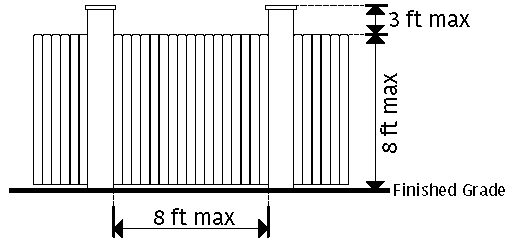
6.9.1.4 Column and ornament heights are permitted to exceed the maximum height by no more than 3 feet.
6.9.2 Placement
6.9.2.1 Fence and wall footings must be entirely contained within the property and cannot encroach onto a property line.
6.9.2.2 For walls or fences to be constructed near a property line, a surveyor shall be utilized to establish the property line prior to construction.
6.9.2.3 Fences, walls, hedges and other vegetation must not obstruct the minimum sight distance requirements and must not:
a) Prohibit proper lines of sight for public safety and law enforcement; b) Impede the flow of water; or c) Impair or block the vision of vehicle drivers so as to constitute a safety hazard.
6.9.3 Design Standards
6.9.3.1 Materials
1) General Provisions
i. Fences or walls must be constructed of wood, masonry, stacked stone, stucco, ornamental metal or other durable material approved by the zoning administrator in all zoning districts. Chain-linked or woven-wire fencing is allowed only in side and rear yards (provided they are not parallel to a street), and must be vinyl-coated.
ii. In zoning districts allowing horses and livestock to be kept, a fence made of chain link or other wire materials is exempt from the four (4) foot maximum height requirement and shall not exceed a maximum of five (5) feet in height in a front yard.
iii. Vinyl is prohibited, except that existing vinyl fences may be replaced in kind.
iv. Barbed wire, razor wire and concertina wire are prohibited. Exception: Public and private utility facilities, governmental owned and operated public facilities and agricultural uses in A1, A2, and Homestead Farms in Major-PUD districts.
v. Walls and fences must be constructed with the finished side facing towards the street and adjoining properties, away from the improvement it is meant to screen.
6.9.3.2 Only black, white or earth tones are permitted. Primary and neon colors are prohibited.
6.9.3.3 Any fence that includes electrical equipment requires an electric (building) permit.
6.9.4 Gates
6.9.4.1 Gates must follow all design standards of this section.
6.9.4.2 Gates may be up to 3 feet taller in height than the fence or wall it is attached to.
6.9.4.3 Public streets cannot be gated.
6.9.4.4 Vehicular Gate Emergency Access:
1) Emergency access through vehicular gates for driveways leading to a dwelling, gated facility, or community shall be in accordance with the following requirements.
2) To allow for the passage of emergency vehicles, any vehicular gate shall have a minimum clearance of 14 feet in width for one-way traffic or driveways and 20 feet in width for two-way traffic. Clearance height through the gate shall maintain 14 feet clearance.
3) Prior to the installation or replacement of a security gate or barrier, the developer or owner shall obtain a security gate or barrier permit. A permit shall only be issued for a security gate or barrier meeting the requirements of this section.
4) Gates must be located a minimum of 30 feet from the adjacent edge of pavement of the road servicing the gate.
5) Prior to any changes, alterations or blocking of private streets or driveways leading to a dwelling, plans detailing the change accompanied by drawings, shall be submitted for approval. A county building inspector shall inspect all such installations.
6) All security gates or barriers shall be equipped with a siren or radio operated receiver/controller capable of receiving signals from a sheriff’s department, fire department, and emergency responders’ siren or radio transceivers that allow emergency responders and other necessary on-duty employees to open the security gate or barrier by use of the equipment.
7) The equipment shall be furnished, installed and maintained by the entity that is served by the equipment.
8) The maintenance and upkeep of any security gate or barrier shall be the sole responsibility of the developer, owner or any duly incorporated and active association having jurisdiction of the gate.
9) Inoperative security gates or barriers shall be repaired immediately. Inoperative gates shall be locked in the open position until repairs are made. Abandoned gates shall be permanently locked in the open position.
10) The party or parties controlling the operation and maintenance of the security gate or barrier shall be liable for any damages caused by the improper operation of the security gate or barrier.
6.9.5 Maintenance
6.9.5.1 Fences shall be maintained in good condition and be structurally sound at all times. No advertising will be permitted thereon.
6.9.5.2 Property located between the fence and any property lines shall also be regularly maintained.
Amended by Res. 2023.7.11(a) new section on 7/11/2023

