
Greene Township Beaver County
City Zoning Code
City Zoning Code
OIL AND
GAS
§ 153.280 PURPOSE.
The purpose of this subchapter is to provide for the health, safety and welfare of the residents of the township, through zoning and flood plain management provisions, for the reasonable development of land for oil and gas drilling while providing adequate health, safety and general welfare protections of the township's residents. Oil and gas exploration, drilling and extraction operations involve activities that are economically important and will impact the township. Accordingly, it is necessary and appropriate to adopt reasonable requirements for oil and gas resource development so that these resources can be obtained in a manner that is economically remunerative, preserves the character of all zoning districts, encourages beneficial and compatible land uses and that minimizes the potential impact on the residents of the township.
(Ord. 3-2011, passed 2-6-2012)
§ 153.281 DEFINITIONS.
For the purpose of this subchapter, the following definitions shall apply unless the context clearly indicates or requires a different meaning.
APPLICANT. Any person, owner, operator, partnership, company, corporation and its subcontractors and agents who has an interest in real estate for the purpose of exploring or drilling for, producing, or transporting oil or gas.
BUILDING. An occupied structure with walls and roof within which persons live or customarily work. The term shall not include a barn, shed or other storage building.
COLLECTOR STREET. A public street or road which, in addition to providing access to abutting lots, intercepts other collector streets or state roads and provides a route for carrying volumes of local traffic to community facilities and arterial streets.
COMPRESSOR. A device used alone or in series to raise the pressure of natural gas and/or byproducts to create a pressure differential to move or compress a liquid, vapor or gas.
COMPRESSOR STATION. A facility designed and constructed to compress natural gas and/or oil that originates from a single well site or a collection of such well sites, operating as a midstream facility for delivery of gas and/or oil to a transmission pipeline, distribution pipeline, processing plant or underground storage field, including one or more natural gas and/or oil compressors, associated buildings, pipes, valves, tanks and other equipment.
DEPARTMENT. The Pennsylvania Department of Environmental Protection.
DERRICK. Any portable framework, tower mast and/or structure which is required or used in connection with drilling or re-working a well for the production of oil or gas.
DRILLING. Any digging or boring of a new well or re-working of an existing well to explore, develop or produce oil, gas or other hydrocarbons or to inject gas, water or any other fluids or substances into the earth.
DRILLING EQUIPMENT. The derrick, all parts and appurtenances to such structure and every piece of apparatus, machinery or equipment used, erected or maintained in connection with oil and gas drilling, as defined herein.
DRILLING PAD. The area of surface operations surrounding the surface location of a well or wells extending only to the heel of the pad. Such area shall not include an access road to the drilling pad.
EFFECTIVE DATE. The date upon which this subchapter is approved by the Township Board of Supervisors.
HYDRAULIC FRACTURING (FRACKING). The process of injecting water, customized fracking fluid, steam, or gas into an oil or gas well under pressure to break apart rock layers in order to release gas and improve recovery of gas.
LOCAL STREET. A public street or road designed to provide access to abutting lots and to discourage through traffic.
NATURAL GAS PROCESSING FACILITY. A facility that is not a compressor station that receives natural gas and associated hydrocarbons from a gathering line system serving one or more well sites that compresses, condenses, pressurizes or otherwise treats natural gas and which removes water and water vapor and/or separates materials such as ethane, propane, butane and other constituents or similar naturally occurring substances from natural gas to allow such natural gas to be of such quality as is required or appropriate for transmission or distribution to commercial markets, including, but not limited to: cooling facilities, storage tanks and related equipment and facilities.
OIL AND GAS. Crude oil, natural gas, methane gas, coal bed methane gas, propane, butane and/or any other constituents or similar substances that are produced by drilling an oil or gas well of any depth into, through and below the surface of the earth.
OIL AND GAS DEVELOPMENT or DEVELOPMENT. The well site preparation, construction, drilling, redrilling, hydraulic fracturing, and/or site restoration associated with an oil or gas well of any depth; water and other fluid storage, impoundment and transportation used for such activities; and the installation and use of all associated equipment, including tanks, meters, and other equipment and structures whether permanent or temporary; and the site preparation, construction, installation, maintenance and repair of oil and gas pipelines and associated equipment and other equipment and activities associated with the exploration for, production and transportation of oil and gas. This definition does not include gathering, transmission and distribution pipelines or compressor stations or natural gas processing plants or facilities performing the equivalent functions.
OIL AND GAS DRILLING. The removal of oil and gas resources from the ground by means of drilling, as defined herein, in accordance with a valid permit issued by the Pennsylvania Department of Environmental Protection (PA DEP) under the provisions of the PA Oil and Gas Act (58 P.S. §§ 601.101 to 601.605), as now or hereafter amended.
OIL AND GAS DRILLING DEEP WELL. Oil and gas drilling, as defined herein, drilled to depths deeper than the base of the Elk Sandstone or its stratigraphic equivalent for the sole purpose of exploring the Marcellus Shale.
OIL AND GAS DRILLING SHALLOW WELL. Oil and gas drilling, as defined herein, drilled to depths shallower than the base of the Elk Sandstone or its stratigraphic equivalent and any well site that proposes drilling of a single well for no more than seven consecutive days total in any calendar year.
OIL AND GAS DRILLING SUBSURFACE FACILITIES. Activities performed under the surface of the ground that are part of the operation of oil and gas drilling, as defined herein, located on properties within the unit for a particular well site, but that are not included in the well site, including, but not limited to: horizontal drilling and hydraulic fracturing zones, underground gathering and transmission pipelines established in accordance with Public Utility Commission (PUC) guidelines, water distribution lines and similar underground facilities incidental to oil and gas drilling.
OIL or GAS WELL or WELL HEAD. A pierced or bored hole drilled or being drilled in the ground for the purpose of, or to be used for, producing, extracting or injecting gas, oil, petroleum or another liquid related to oil or gas production or storage including the structure that is placed over the opening upon completion of drilling and that is maintained during production.
OPERATOR. Any person, partnership, company or corporation and its subcontractors and agents who have an interest in real estate for the purpose of exploring or drilling for, producing or transporting oil or gas.
OWNER. A person, who owns, manages, leases, controls or possesses an oil or gas well site.
PROTECTED STRUCTURE. Any occupied residence, business, school, church or public building located within 1,000 feet of an oil or gas well, as defined herein, that may be adversely affected by noise generated from the drilling or hydraulic fracturing at the well site, as defined herein, excluding any structure owned by an oil or gas lessor who has signed a lease with the operator granting surface rights to drill the subject well or whose owner or occupants have signed a waiver relieving the operator from complying with the noise abatement provisions of this subchapter.
STORAGE WELL. A well used for and in connection with the underground storage of natural gas, including injection into or withdrawal from an underground storage reservoir for monitoring or observation of reservoir pressure.
TOWNSHIP. Township of Greene.
TOWNSHIP STAFF. Township of Greene Board of Supervisors, or other designated agent of the township.
WATER IMPOUNDMENT. An open, earthen receptacle in the ground intended to store fresh water or wastewater to supply one or more oil and gas drilling well sites.
WELL SITE. All of the area occupied by the drilling equipment, as defined herein, and all surface facilities, structures, water and other fluid storage impoundments and storage tanks and associated equipment including tanks, meters and other permanent or temporary structures and equipment incidental to oil and gas drilling, as defined herein, including facilities and equipment necessary for site exploration, preparation, site construction, drilling, hydraulic fracturing, site restoration, production and operation of the well upon completion of drilling.
WORKOVER OPERATIONS. The work performed in a well after its completion in an effort to secure production where there has been none, restore production that has ceased, or increase production.
(Ord. 3-2011, passed 2-6-2012)
§ 153.282 ZONING CLASSIFICATION.
(A) An oil or gas well site, or a compressor station, or a natural gas processing facility, or any similar facilities performing the equivalent functions shall be permitted as a conditional use within the Agricultural (A-l), Light Commercial (C-l), Highway Commercial (C-2) And Industrial (I) Zoning Districts only by the process of submitting a conditional use application.
(B) The Applicant shall have the duty and the burden to prove compliance with the specific conditions set forth herein and by way of this subchapter. Applicant shall bear the burden of persuasion to demonstrate that the proposed conditional use will not have detrimental effects on the health, safety and welfare of township residents relative to any additional conditions.
(C) The proposed conditional use will be harmonious with and in accordance with the general objectives or with any specific objective of the township's comprehensive plan; will be designed, constructed, operated, and maintained in a commercially reasonable manner so as to be harmonious and appropriate in appearance with the existing or intended character of the general vicinity; will not be hazardous to existing neighboring uses; will be served adequately by essential facilities and services such as highways, streets, police and fire protection, drainage structures, refuse disposal, water and sewer, and schools; or the persons or agencies responsible for the establishment of the proposed use shall be able to adequately provide any such services; will not involve uses, activities, processes, materials, equipment and conditions of operation that will be detrimental to any persons, property, or the general welfare by reason of excessive production of traffic, noise, smoke, fumes, glare or odors; will have vehicular approaches to the property which shall be designed so as not to create undue interference with traffic on surrounding public thoroughfares; will not result in the destruction, loss or damage of a natural, scenic, or historic feature of significant importance.
(D) A zoning permit shall not be required for oil and gas drilling subsurface facilities which are authorized as a permitted use by right in all zoning districts. Permits for crossing or disturbance of any state or township street shall be required.
(E) Conditional use approval shall be required for each well site; however, if multiple well heads are proposed to be located at the well site, separate approval is not required for each well head if the original conditional use application indicates that multiple well heads are proposed.
(Ord. 3-2011, passed 2-6-2012)
§ 153.283 APPLICABILITY.
(A) This subchapter applies to all oil or gas well sites, compressor stations, and natural gas processing facilities that will be permitted or constructed after the effective date of the subchapter. No oil or gas well or exploration of same of any type or nature shall be dug or drilled, nor shall any work in preparation therefore be commenced within the boundaries of township unless and until the owner or operator of such operation makes conditional use application in conformity with this subchapter.
(B) Oil or gas well sites, compressor stations, and natural gas processing facilities that were permitted or constructed prior to the adoption of this ordinance shall not be required to meet the requirements of this subchapter; provided that any modification to an existing or permitted oil or gas well site that occurs after the effective date of this ordinance and materially alters the size, type, location, number of wells and other accessory equipment or structures, or any physical modifications to an existing compressor station or natural gas processing facility shall require compliance with and approval under this subchapter.
(C) Certain federal and/or state laws or regulations preempt oil and gas ordinance requirements that conflict with same. The township acknowledges that it is pre-empted from regulating the operational methods of the oil and gas industry and may only regulate land uses in accordance with Pennsylvania law.
(D) All activities conducted in association with, and as a part of oil or gas well sites shall be in accordance with the Commonwealth of Pennsylvania Oil and Gas Act (Act 1984-223), as amended, and any other applicable federal, state, county and local laws.
(Ord. 3-2011, passed 2-6-2012)
§ 153.284 CONDITIONAL USE PERMIT REQUIREMENT.
(A) No oil or gas well site, compressor station, or natural gas processing facility or any addition thereto shall be constructed or located within the township unless a conditional use approval has been issued by the township to the owner or operator approving the construction or preparation of the site for oil or gas development or construction of natural gas compressor stations or natural gas processing facilities.
(B) The permit application, or amended permit application, shall be accompanied by a fee in the amount of $1,000 which may, from time to time, be amended by resolution. The applicant shall promptly pay any additional fees or costs incurred by the township that exceed this fee as allowable under the Pennsylvania Municipalities Planning Code.
(C) Any modification to an existing and permitted oil or gas well site that materially alters the size, location, number of wells or accessory equipment or structures, or any modification to an existing compressor station or natural gas processing facility shall require a modification of the permit under this subchapter. Like-kind replacements shall not require a permit modification.
(Ord. 3-2011, passed 2-6-2012)
§ 153.285 PRE-APPLICATION CONFERENCES.
(A) Purpose. Before submitting a conditional use application the applicant is strongly encouraged to meet with the township staff to determine the requirements of and the procedural steps and timing of the application. The intent of this process is for the applicant to obtain necessary information and guidance from the township staff before entering into any commitments or incurring substantial expenses with regard to the site and plan preparation. In addition, a preliminary determination will be made regarding the need for land development plan review by the Planning Commission.
(B) Process. A pre-application conference is voluntary on the part of the applicant and shall not be deemed the beginning of the time period for review as prescribed by law. The pre-application conferences are intended for the benefit of the applicant in order to address the required permit submittals and are advisory only, and shall not bind the township to approve any application for a permit or to act within any time limit relative to the date of such conference.
(Ord. 3-2011, passed 2-6-2012)
§ 153.286 CONDITIONAL USE PERMIT APPLICATION.
(A) The applicant shall provide to the township at the time of application:
(1) A narrative describing an overview of the project including the number of acres to be involved, the number of wells to be drilled, location, number and description of equipment and structures to be involved.
(2) A narrative describing an overview of the project as it relates to compressor stations or natural gas processing facilities, if applicable.
(3) The address of the oil or gas well site, compressor station or natural gas processing facility as determined by the township or county for information of emergency responders. A 9-1-1 address or GPS coordinates should be assigned to the location.
(4) The contact information of the individual or individuals responsible for the operation and activities at the oil or gas well site shall be provided to the township and all appropriate emergency responders. Such information shall include a phone number where such individual or individuals can be contacted 24 hours per day, 365 days a year. Annually, or upon any change of relevant circumstances, the applicant shall update such information and provide it to the township and all appropriate emergency responders.
(5) A location map of the oil or gas well site showing the approximate location of derricks, drilling rigs, well heads, water impoundments equipment and structures and all permanent improvements to the site and any post construction surface disturbance in relation to natural and other surroundings. Included in this map shall be an area within the development site for the location and parking of vehicles and equipment used in the transportation of personnel and/or development and use of the site. Such location shall be configured to allow the normal flow of traffic on local streets shall be undisturbed.
(6) A location map of any proposed compressor stations or natural gas processing facilities including any equipment and structures and all permanent improvements to the site.
(7) A narrative and map describing the manner and routes for the transportation and delivery of equipment, machinery, water, chemicals and other materials used in the siting, exploration, drilling, construction, development, maintenance and operation of the oil or gas well site.
(8) A certification or evidence satisfactory to the township that, prior to the commencement of any activity at the oil or gas well site, the applicant shall have accepted and complied with any applicable bonding and permitting requirements and shall have entered into a roadway maintenance agreement with the township, in a form acceptable to the Township Solicitor, regarding the maintenance and repair of the township streets that are to be used by vehicles for site exploration, construction, drilling activities and site operations. A road bond if necessary and in an amount determined by the Township Engineer shall be posted by the applicant prior to commencement of any oil or gas development activities. Compliance with posted weight limits must be maintained.
(a) The operator shall show the proposed township routes of all vehicles to be utilized for hauling and the estimated weights of those vehicles. The operator shall show evidence of compliance with designated weight limits on township roads, unless a bond and a maintenance agreement has been entered into to assure road damage repair. The operator shall design the hauling routes for the oil and gas development operation to minimize the use of and impact upon township roads wherever feasible.
(b) The operator shall show evidence satisfactory to the Township Engineer that intersections along proposed hauling routes provide a sufficient turning radius for vehicles to be utilized for hauling, such that all turns can be safely made without damage to vehicles, sidewalks or curbs.
(c) The Township Engineer shall review the proposed routes provided by the operator, and reasonably determine whether preventive measures, such as shoring of bridges or putting protective mats over utility lines, should be taken to prevent damage to township roads, bridges or utilities. If such preventive measures are recommended, the operator shall install such protective measures as directed by the Township Engineer prior to beginning operations.
(9) A description of, and commitment to maintain, safeguards that shall be taken by the applicant to ensure that township streets utilized by the applicant shall remain free of dirt, mud and debris resulting from site development activities; and the applicant's assurance that such streets will be promptly swept or cleaned if dirt, mud and debris occur as a result of applicant's usage.
(10) Verification that a copy of the operation's preparedness, prevention and contingency plan (PPCP), as established by the appropriate state and /or federal regulatory agency, has been provided to the township and all emergency responders.
(11) Emergency responders are to be held harmless and indemnified by the applicant when acting in accordance with the PPCP or emergency response plan. The applicant is responsible to reimburse all costs associated with emergency responders.
(12) A statement that the applicant, upon changes occurring to the operation's preparedness, prevention and contingency plan, will provide to the township and all appropriate emergency responders the dated revised copy of the preparedness, prevention and contingency plan while drilling activities are taking place at the oil or gas well site.
(13) Assurance that, at least 30 days prior to drilling and annually thereafter if requested by the township, the applicant shall provide an appropriate site orientation and training course of the preparedness, prevention and contingency plan for all appropriate emergency responders. The cost and expense of the orientation and training shall be sole responsibility of the applicant. The applicant shall not be required to hold more than one site orientation and training course annually under this section.
(14) A copy of the documents submitted to the department, or other applicable regulatory agencies or if none, a narrative describing any environmental impacts of the proposed development on the site and surrounding land and measures proposed to protect or mitigate such impacts.
(15) A soil erosion and sedimentation control plan, in conformance with the requirements of the Beaver County Conservation District, must be submitted along with obtaining a grading and excavating permit from the township as well as the execution of a stormwater best management practices agreement between the applicant and the township in accordance with township ordinances.
(16) Recorded easements must be supplied for any gathering, transmission and distribution pipelines serving the site or proposed to serve the site.
(17) Proposed rehabilitation/reclamation plan for the site (excluding compressor stations and/or processing facilities) containing the following information:
(a) An engineering drawing showing ownership, existing and future topography, streams, existing roads, buildings, boundaries, and metes and bounds description of the tract.
(b) A drawing showing the location and/or proposed relocation of land, trees, buildings, structures, public roads, streams, drainage facilities and utility lines on the tract or adjacent tracts as may require protection, repairs, clearance, demolition, restoration, either during or following completion of the operations proposed.
(c) A plan for reuse of the land after completion of the operations which shall permit the carrying out of the purpose of this chapter and appropriately provide for any rehabilitation, restoration, reclamation, reforestation or other correction work deemed necessary and commercially reasonable.
(B) Within 30 business days after receipt of a permit application and the required fee, the township will determine whether the application is complete and adequate and advise the applicant accordingly.
(C) If the application is complete, the township shall schedule a conditional use hearing in accordance with the Pennsylvania Municipalities Planning Code and shall, following hearing, render a decision on the application in accordance with this subchapter.
(D) If the application is incomplete and/or inadequate the township will promptly notify the applicant of the missing or inadequate material, in no event longer than 30 days from submittal of the application, and, upon receiving said material, shall schedule a conditional use hearing in accordance with the Pennsylvania Municipalities Planning Code and shall, following hearing, render a decision on the application in accordance with this subchapter.
(E) All Commonwealth and federal requirements associated with oil and gas well development must be followed at all times and, upon request, permits associated with those requirements shall be supplied to the township. Conditional use approval shall be indefinitely conditioned upon the applicant maintaining valid Commonwealth and federal operating permits. Applicant shall immediately notify the township of the suspension, modification or revocation of any such permits.
(Ord. 3-2011, passed 2-6-2012)
§ 153.287 DESIGN AND INSTALLATION.
(A) Access.
(1) No oil or gas well site shall have access solely through a private road. Whenever possible, access roads to the oil or gas well site should be from a local or collector street. There shall be adequate area on the development site for staging trucks waiting to make deliveries or service to the site that does not unreasonably disrupt the normal flow of traffic on the public street.
(2) Accepted professional and/or PennDOT standards pertaining to minimum traffic sight distances for all access points shall be followed.
(3) The access road to the well site shall be required to be improved and maintained before entering township or state roads in such a manner that no excess water, sediment or debris will be carried onto any public streets or roadways.
(4) Any newly established private easements/roadways constructed on the parcel containing the well site shall be located at least 25 fee from any property line unless consent is obtained from the adjoining property owner. Existing easements/roadways shall be exempt from the requirement to obtain consent from adjoining property owner, provided however that the township may permit a permanent easement/roadway to be located closer than 25 feet from any property line upon showing by the applicant that the location of such easement/roadway cannot be constructed as required due to topographical or environmental constraints.
(5) Approved compliance with the Commonwealth's ESCGP-1 permitting process shall satisfy the requirements of this section.
(B) Structure height.
(1) Permanent structures associated with an oil and gas well site, both principal and accessory, shall comply with the respective height regulations for the Agricultural (A-l), Light Commercial (C-l), Highway Commercial (C-2) And Industrial (I) Zoning Districts in which the oil or gas well site is located.
(2) Permanent structures associated with compressor stations or natural gas processing facilities shall comply with the respective height regulations for the Agricultural (A-l), Light Commercial (C-l), Highway Commercial (C-2) and Industrial (I) Zoning Districts in which same are located.
(3) There shall be an exemption to the height restrictions contained in this section for the temporary placement of drilling rigs, drying tanks, and other accessory uses necessary for the actual drilling or redrilling of an oil or gas well.
(a) The duration of such exemption shall not exceed the actual time period of active drilling or redrilling of an oil or gas well.
(b) The time period of such drilling and exemption shall not exceed six months unless extended in writing as necessary and reasonable upon request of the applicant.
(c) The operator shall give the township prior written notice of the beginning date for its exercise of the exemption.
(C) Setbacks. To be measured from the well head as a center point.
(1) Drilling equipment shall be located a minimum setback distance of 200 feet from any building not related to the development.
(2) The drilling pad for the oil or gas well site shall comply with all setback and buffer requirements of the respective Agricultural (A-l), Light Commercial (C-l), Highway Commercial (C-2) And Industrial (I) Zoning Districts in which the oil or gas well site is located.
(3) Compressor stations and natural gas processing facilities shall comply with all respective setback and buffer requirements of the Agricultural (A-l), Light Commercial (C-l), Highway Commercial (C-2) And Industrial (I) Zoning Districts in which they are located.
(4) Exemption from the standards established in this subsection may be granted by the township upon a showing by the applicant that it is not feasible to meet the setback requirements from surface tract property lines and that adequate safeguards have or will be provided to justify the exemption.
(5) Drilling pads, compressor stations and natural gas processing facilities shall be set back 500 feet from buildings or sites registered or eligible for registration on the National Register of Historic Places or the Pennsylvania Register of Historic Places.
(6) Well heads shall be set back 200 feet from any existing water wells.
(7) Drilling pads, compressor stations and natural gas processing facilities shall be set back 200 feet from all property boundaries, property lines, properties designated as landfills, properties containing hazardous substances, public streets or private streets not servicing the site.
(8) If there is a reasonable likelihood of disturbance to endangered species or crucial habitations, sufficient setbacks shall be met to ensure the preservation of threatened or endangered species or crucial habitations such that there shall be minimal to no habitat disturbance as determined by the Department of Conservation and Natural Resources.
(D) Fencing, signage, screening.
(1) Security fencing shall not be required at oil or gas well sites during the initial drilling, or redrilling operations, as long as manned 24-hour on-site supervision and security are being provided.
(2) Upon completion of drilling or redrilling, security fencing consisting of a permanent chain link fence shall be promptly installed at the oil or gas well site to secure well heads, storage tanks, separation facilities, water or liquid impoundment areas, and other mechanical and production equipment and structures on the oil or gas well site. Fencing is not required as long as 24-hour on-site supervision and security are being provided.
(3) Security fencing shall be constructed in accordance with existing zoning ordinance provisions.
(4) Warning signs shall be placed on the fencing surrounding the oil or gas well site providing notice of the potential dangers and the contact information in the event of an emergency.
(5) In construction of oil or gas well sites the natural surroundings should be considered and measures taken to preserve existing trees and other native vegetation to promote and utilize natural screening.
(6) Water impoundments containing wastewater shall be fenced and covered with protective bird netting to ensure the safety of animal and bird species.
(E) Lighting.
(1) Lighting at the oil or gas well site, or other facilities associated with oil and gas drilling development, either temporary or permanent, shall be directed downward and inward toward the activity, to the extent practicable, so as to minimize the glare on public roads and nearby buildings within 300 feet of the oil or gas well development.
(2) Lighting at a compressor stations or a natural gas processing facilities shall, when practicable, be limited to security lighting.
(F) Noise. Township recognizes and acknowledges that oil and gas development is accompanied by inherent noise. However, the operator shall take the following steps to minimize, to the extent practicable, the noise resulting from the development:
(1) Prior to the conditional use application submittal, the operator shall establish a continuous 72-hour ambient noise level at the nearest protected structure property line or 100 feet from the nearest protected structure (as measured to the closest exterior point of the building), whichever is closer to the protected structure. The sound level meter used in conducting any evaluation shall meet the American National Standard Institute's standard for sound meters or an instrument and the associated recording and analyzing equipment which will provide equivalent data.
(2) The operator shall provide documentation of any established, 72-hour evaluation, relied upon to establish an ambient noise level to the Township's Zoning Officer within three business days of such a request from the Zoning Officer and at the conditional use hearing.
(3) If it is determined that any residents, regardless of their status of residing or working in a protected structure may be adversely affected by the noise at the site, township may require that noise abatement measures be implemented including, but not limited to, the erection of sound walls around the site.
(4) If a complaint is received by the township from any person, whether a resident or otherwise using the protected structure as defined herein for any lawful purpose, regarding noise generated during drilling or hydraulic fracturing activities, the operator shall, within 24 hours of receipt of the complaint from the Township, continuously monitor for a 48-hour period at a point which is the closer to the complainant's building of:
(a) The complainant's protected structure property line nearest to the wellsite or equipment generating the noise; or
(b) One hundred feet from the protected structure.
(5) If the operator engages in any noise testing as required by this subchapter, it will provide preliminary data to the township no later than ten business days following completion of the noise testing. Once the monitoring is complete, operator will meet with township representatives and affected residents to discuss whether additional abatement measures are warranted.
(G) Prohibitions and precautions.
(1) No drilling shall be allowed in the floodway designated as such in the flood insurance study (FIS) and shown on the Federal Emergency Management Agency (FEMA) maps.
(2) Oil and gas drilling in the 100-year floodplain is discouraged but may be permitted by the township in its sole discretion if the following provisions are met.
(a) The applicant must provide conclusive documentation that no other location allows access to the oil or gas deposit other then a location within the floodplain.
(b) An adequate emergency evacuation plan shall have been produced by the applicant and filed with the township.
(c) No storage of chemicals shall be permitted within the floodplain. An exemption from this requirement may be granted by the township if the applicant can show that such storage will not potentially cause any harm to property, persons or the environment in the case of a 100-year flood; and further provides security to the township assuring the applicant's ability to remedy any damage or injury that may occur.
(d) Only necessary and needed structures will be permitted within the floodplain.
(e) All structures within the flood zone shall be designed to withstand a 100-year storm event.
(f) An engineer registered in Pennsylvania and qualified to present such documentation that structures will not cause additional flooding on adjacent, upstream and/or downstream properties shall provide such documentation to the township.
(3) (a) Oil and gas operations shall not create dust or pollute the air in violation of the Clean Air Act or any other local, state or federal regulation regarding air cleanliness or nuisances. Owners and operators shall take the necessary safeguards to ensure appropriate dust control measures are in place. Exhaust from any internal combustion engine or compressor used in connection with the drilling of any well or for use on any production equipment or used in development shall not be discharged into the open air unless equipped with (i) an exhaust muffler or (ii) an exhaust box. The exhaust muffler or exhaust box shall be constructed of non-combustible materials designed and installed to suppress noise and disruptive vibrations. Moreover, all such equipment with an exhaust muffler or exhaust box shall be maintained in good operating condition according to manufacturer's specifications.
(b) The emissions of dust, smoke, refuse matter, odor, gas, fumes or similar substances or conditions which can endanger the health, safety or general welfare or which can cause any soiling or staining of persons or property at any point beyond the property line of the use creating the emission is prohibited. Dust control measures shall be used to stabilize soil from wind erosion and to reduce dust generated from drilling or site activities, including:
1. Stabilize exposed soils using vegetation, mulching, spray-on adhesives, calcium chloride, sprinkling, and stone and gravel layering.
2. Stabilize unpaved haul roads, parking and staging areas within the site.
3. Minimize the impact of dust by anticipating the direction of prevailing winds.
4. Direct construction and commercial vehicle traffic to stabilized roadways within the site.
5. Pave, vegetate, or chemically stabilize access points where unpaved traffic surfaces adjoin paved public streets.
6. Provide for wet suppression or chemical stabilization of exposed soils.
7. Provide for rapid clean-up of sediments deposited on paved roads.
8. Furnish vehicle wash down areas.
9. Reduce speed to 15 mph or less and reduce trips on unpaved roads on site.
10. Implement dust control measures for material stockpiles.
11. Stabilize abandoned construction/staging areas on site using vegetation or chemical stabilization methods.
(4) A dust control plan shall be submitted with the site plan, demonstrating compliance with this subdivision.
(5) A worker, agent, contractor or employee connected with an oil or gas operation shall be prohibited from residing and living on the site for more than two consecutive weeks at a time during active drilling operations. Once active drilling has ceased no person shall be permitted to reside on the site.
(6) Water impoundments shall only be permitted on sites approved for deep well drilling and only on the same site serviced by said impoundment. Sediment and hydraulic fracturing wastewater may be disposed of only in approved landfill sites and shall not be disposed of on the same site as the oil and gas development unless treated and approved for disposal by the department and/or the EPA. All water impoundments must be completely enclosed with fencing in accordance with township standards. Proposed water impoundments must be included in the conditional use application for review and approval by the township.
(7) Owners or operators shall take all necessary precautions to minimize odors during the drilling or hydraulic fracturing process. If odors resulting from the drilling or hydraulic fracturing process or odors emanating from the well sites result in nuisance complaints being lodged by township residents, the owner or operator shall meet with the township and any affected residents to implement, where warranted and required by the township, effective odor control measures.
(8) Owners or operators shall take all necessary precautions to ensure the safety of persons in areas established for road crossing and/or adjacent to roadways, i.e. persons waiting for public or school transportation, crosswalks, etc. Where necessary and permitted, during periods of anticipated heavy or frequent truck traffic associated with the development, owners or operators will provide flagmen to ensure the safety of children at or near schools or school bus stops and include adequate signs and/or other warning measures for truck traffic and vehicular traffic. In the alternative, owners or operators, with the township's consent and agreement, will reimburse the township to provide such required safety measures. Operator will coordinate its efforts with the school district so as to minimize heavy truck traffic during the hours when school buses are picking up or dropping off children.
(9) Owners or operators shall not clear brush or trees by way of burning and shall chip, grind or remove all tree stumps and limbs from properties it clears for development purposes unless done so in conformity with township ordinances.
(10) Any workover operations, as defined herein, shall be subject to all applicable criteria of this subchapter. Workover operations shall not commence until the operator provides written notice to the Township Zoning Officer at least 60 days in advance. The Township Zoning Officer may authorize the workover operations provided all conditions attached to the original conditional use approval for the well site and all applicable criteria of this subchapter are met. The Zoning Officer has the discretion to refer the operator's request to the Board of Supervisors for an amended conditional use approval. The Board of Supervisors may conduct a public hearing and may refer the request to the Township Planning Commission before acting on an amendment to the original conditional use application.
(11) Prior to commencement of drilling activities at the site, the operator, township, representatives of the school district and public safety officials may hold a safety conference to address any of the requirements set forth in this subchapter.
(12) Hours of construction during site grading, preparation of installation of roads, drilling pads, water impoundments, noise barriers and related facilities shall be 7:00 a.m. to 7:00 p.m. There is no limit on hours of operation during active drilling and fracking as long as compliance with the other provisions of this subchapter is maintained.
(13) The township may require the operator to conduct an informational meeting for residents within 1,000 feet of the well site at least 30 days prior to beginning construction on the site. Information to be provided to the residents should include a survey of the well site, a general description of the proposed facilities, the equipment to be used during site development, explanation of drilling and "fracking" and contact information for the operator and the site supervisor.
(14) There shall be no seismic testing unless specifically requested by the owner or operator and approved by the township.
(15) If a spill, fire or other reportable violation of any federal, state or local law occurs at the drill site or in the township by operator or its subcontractors, operator will notify the township immediately, in all circumstances not later than 24 hours after the incident occurred or, if the incident is ongoing, not later than 24 hours after it began.
(16) Coal bed methane and conventional oil and gas well drilling and completion activities, i.e. those wells drilled to depths shallower than the base of the Elk Sandstone or its stratigraphic equivalent, and such oil and gas wells that are planned to involve drilling of a single well on a well site for no more than seven consecutive days total in any calendar year can request a waiver from the township from any condition set forth herein, if in the sole discretion of the township, the conditions are not necessary to protect the health, safety and welfare of the residents.
(Ord. 3-2011, passed 2-6-2012)
§ 153.999 PENALTY.
(A) Any person, partnership or corporation, who or which has violated or permitted the violation of the provisions of this chapter, shall, upon being found liable therefor in a civil enforcement proceeding commenced by the township, pay a judgment of not more than $500 plus all court costs, including reasonable attorney’s fees incurred by the township as a result thereof. No judgment shall commence or be imposed, levied or payable until the date of the determination of violation by the District Justice. If the defendant neither pays nor timely appeals the judgment, the township may enforce the judgment pursuant to the applicable rules of civil procedure. Each day that a violation continues shall constitute a separate violation, unless the District Justice determining that there has been a violation further determines that there was a good faith basis for the person, partnership or corporation violating the chapter to have believed that there was no such violation, in which event there shall be deemed to have been only one such violation until the fifth day following the date of the determination of a violation by the District Justice, and thereafter each day that a violation continues shall constitute a separate violation. All judgments, costs and reasonable attorney’s fees collected for the violation of this chapter shall be paid over to the township.
(2003 Code, § 170-82)
(B) Any person who violates or permits a violation of § 153.075(B)(1)(n) upon being found liable therefore in a civil enforcement proceeding before a Magisterial District Judge, shall pay to the township a fine of not more than $500, plus all court costs, including, but not limited to, reasonable attorney’s fees incurred by the township on account of such violation. No penalty or cost shall be imposed until the date the determination of the violation by the Magisterial District Judge becomes final. If the defendant neither pays nor timely appeals the judgment, the township may enforce the judgment as provided by law. Each day a violation exists after final judgment shall constitute a separate offense. The amount of the fine imposed shall be multiplied by the number of such days and may be charged and collected as a judgment by the township without further judicial proceedings. Further, the appropriate officers or agents of the township are hereby authorized, to issue a cease and desist notice and/or to seek equitable relief, including injunction, to enforce compliance herewith. No bond shall be required of the township if the township seeks injunctive relief.
(C) Any applicant, owner, operator or other person who violates or permits a violation of § 153.077(D) upon being found liable therefore in a civil enforcement proceeding before a Magisterial District Judge, shall pay to the township a fine of not more than $500, plus all court costs, including, but not limited to, reasonable attorney’s fees incurred by the township on account of such violation. No penalty or cost shall be imposed until the date the determination of the violation by the Magisterial District Judge becomes final. If the defendant neither pays nor timely appeals the judgment, the township may enforce the judgment as provided by law. Each day a violation exists after final judgment shall constitute a separate offense. The amount of the fine imposed shall be multiplied by the number of such days and may be charged and collected as a judgment by the township without further judicial proceedings. Further, the appropriate officers or agents of the township are hereby authorized, to issue a cease and desist notice and/or to seek equitable relief, including injunction, to enforce compliance herewith. No bond shall be required of the township if the township seeks injunctive relief.
(D) Any person who violates or permits a violation of §§ 153.090(B)(2)(i), 153.135(B)(1)(j), 153.150(B)(1)(p) and 153.165(B)(1)(d), upon being found liable therefore in a civil enforcement proceeding before a Magisterial District Judge, shall pay to the township a fine of not more than $500, plus all court costs, including, but not limited to, reasonable attorney’s fees incurred by the township on account of such violation. No penalty or cost shall be imposed until the date the determination of the violation by the Magisterial District Judge becomes final. If the defendant neither pays nor timely appeals the judgment, the township may enforce the judgment as provided by law. Each day a violation exists after final judgment shall constitute a separate offense. The amount of the fine imposed shall be multiplied by the number of such days and may be charged and collected as a judgment by the township without further judicial proceedings. Further, the appropriate officers or agents of the township are hereby authorized, to issue a cease and desist notice and/or to seek equitable relief, including injunction, to enforce compliance herewith. No bond shall be required of the township if the township seeks injunctive relief.
(E) Any owner, operator, or other person who violates or permits a violation of §§ 153.280 to 153.287 upon being found liable therefore in a civil enforcement proceeding before a Magisterial District Judge, shall pay to the township a fine of not more than $500, plus all court costs, including, but not limited to, reasonable attorney's fees incurred by the township on account of such violation. No penalty or cost shall be imposed until the date the determination of the violation by the Magisterial District Judge becomes final. If the defendant neither pays nor timely appeals the judgment, the township may enforce the judgment as provided by law. Each day a violation exists after final judgment shall constitute a separate offense. The amount of the fine imposed shall be multiplied by the number of such days and may be charged and collected as a judgment by the township without further judicial proceedings. Further, the appropriate officers or agents of the township are hereby authorized, to issue a cease and desist notice and/or to seek equitable relief, including injunction, to enforce compliance herewith. No bond shall be required of the township if the township seeks injunctive relief.
(Ord. 2-93, passed 5-4-1993; Ord. 01-2013, passed 2-4-2013; Ord. 7-2016, passed 9-6-2016; Ord. 8-2016, passed 9-6-2016; Ord. 3-2011, passed 2-6-2012)
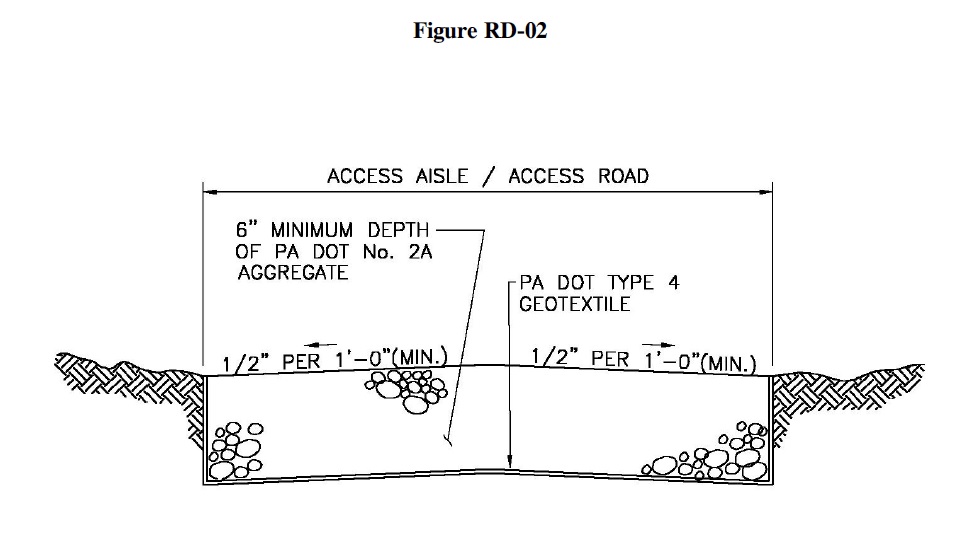
APPENDIX A: RECYCLING AND MATERIAL SALVAGE ACCESS ROAD/AISLE LAYOUT
Figure RD-01
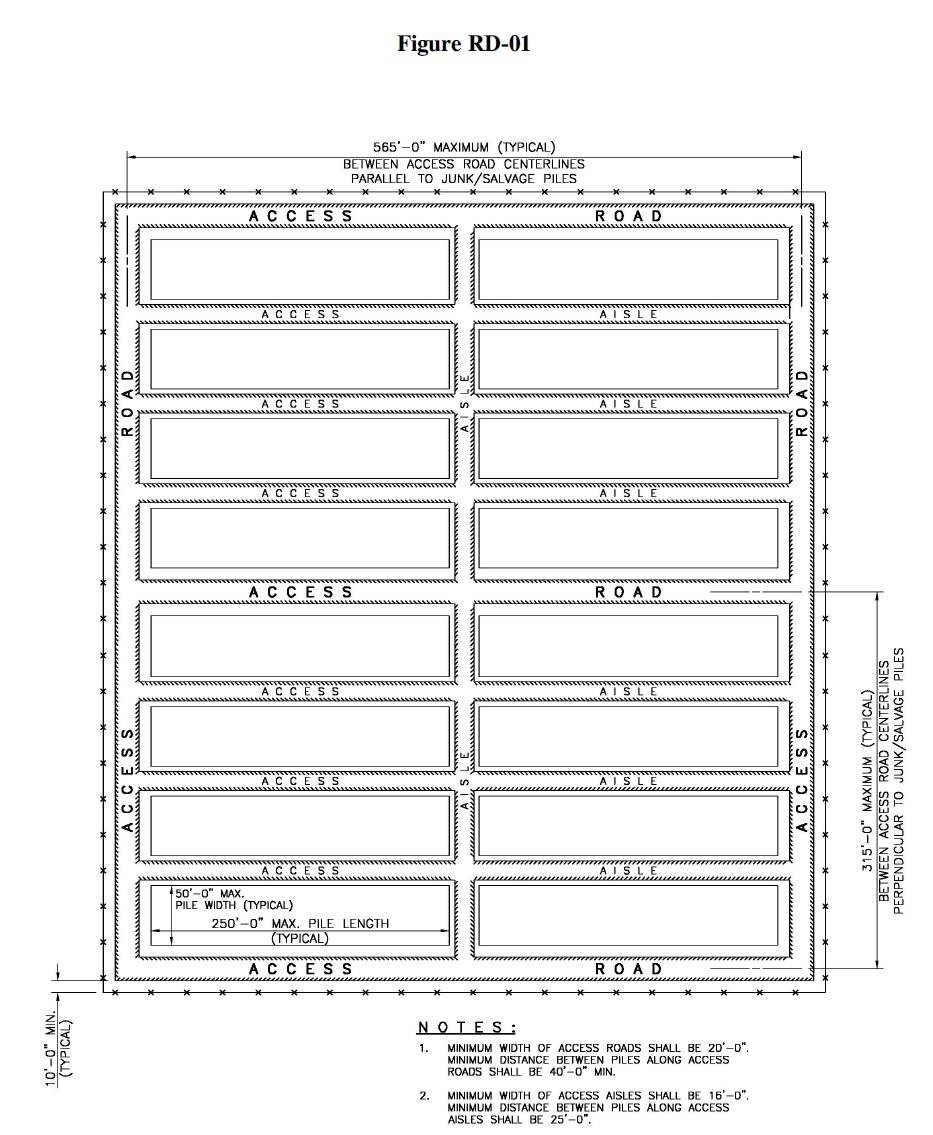
Figure RD-02
(2003 Code, Ch. 170)

