
Greenwood City Zoning Code
ARTICLE D
- DISTRICT REGULATIONS
Sec. 6-3-31.- AG-1 agricultural district.
(a)
Purpose. The purpose of this district is to provide for a full range of agricultural activities. The district also provides for spacious residential development for those who choose this environment and prevents untimely scattering of more dense urban uses which should be confined to areas planned for efficient extension of public services.
(b)
Permitted uses.
(1)
Airport.
(2)
Agriculture, including general farming, truck gardens, cultivation of field crops, orchards, groves or similar activities, dairy farming, and keeping or raising for sale animals, fish, birds or poultry, and including structures for processing and sale of products raised on the premises; provided the commercial slaughtering and processing of cattle, cows, hogs and similar size animals shall not be conducted on the premises.
(3)
Automobile service station.
(4)
Cemetery.
(5)
Church.
(6)
Community center, public or nonprofit.
(7)
Dairy.
(8)
Day care facilities, including family day care home, group day care home, day care center and child care center, as defined by this chapter.
(9)
Dwelling, single-family detached and duplex.
(10)
Golf course, miniature course or driving range.
(11)
Government office buildings, including parking lots for such buildings.
(12)
Greenhouse or plant nursery.
(13)
Home occupation.
(14)
Hospital, nursing home and educational, religious and eleemosynary institutions.
(15)
Lake.
(16)
Marina.
(17)
Mining, including the extraction, processing and removal of sand, gravel or stone.
(18)
Mini-warehousing and self-storage facilities, subject to the following standards:
a.
All structures, including the accessory manager's office/apartment, must be set back a minimum of 25 feet from the right-of-way or the district minimum setback, whichever is greater.
b.
Where projects abut lots with residential land uses, buffering standards shall apply in accordance with a type E buffer as found within article E.
c.
Where sites abut residentially zoned properties, buildings adjacent to the perimeter must face inward with their doors away from such areas.
d.
To ensure ease of access for emergency vehicles, no building shall exceed 300 feet in length. Spaces between ends of buildings shall be at least 30 feet.
e.
One accessory manager's office/apartment shall be permitted.
f.
Fencing or walls shall be required around the open perimeter of the project. Such fence or wall shall be a minimum of six feet in height.
g.
Off-street parking shall be required as follows:
1.
One space for each ten storage cubicles;
2.
Two spaces for the manager's quarters; and
3.
One space for every 50 storage cubicles to be located at the project office for the use of prospective clients.
h.
On-site driveway widths shall be required as follows:
1.
All one-way driveways shall provide for one ten-foot parking lane and one 15-foot travel lane. Traffic direction and parking shall be designated by signing or painting;
2.
All two-way driveways shall provide for one ten-foot parking lane and two 12-foot travel lanes;
3.
The parking lanes may be eliminated when the driveway does not serve storage cubicles; and
4.
All driveways must be paved.
i.
Retail or wholesale uses and storage of hazardous materials shall be prohibited in mini-warehouses and notice of prohibition shall be given to customers by a conspicuous sign posted at the entrance of the property or by provisions in the lease agreement or both.
j.
The minimum lot size shall be one acre.
k.
The property must conform with the performance standards as set forth in section 6-3-113(9).
(19)
Mobile homes, provided:
a.
Such uses shall be occupied as permanent residences;
b.
Such uses shall be placed and anchored on mobile home stands constructed of reinforced concrete or other suitable building materials capable of supporting the expected load. The stand shall provide an adequate foundation and anchoring facilities to serve the mobile home against accidental movement. It shall be so constructed as to completely conceal the area, including the ground. The stand shall be inspected and approved by the building inspector; and
c.
No more than two mobile homes or one mobile home and one single-family detached dwelling shall be on a single lot.
(20)
Mobile home courts or parks, provided:
a.
The minimum area for a mobile home park or court shall be ten acres.
b.
The maximum number of mobile homes per acre shall not exceed eight.
c.
Sanitary sewage, storm drainage, water and refuse disposal facilities are prerequisite to development of a mobile home court or park.
d.
Parking spaces shall be paved, properly marked and lighted.
e.
Concrete curbs or other appropriate car stops shall be installed at the end of all head-in parking bays which are not drive-through type.
f.
Roadways, which are not to be dedicated as public streets, shall have a minimum travel width of 20 feet, exclusive of parking.
g.
All roadways shall be paved with cement or asphalt.
h.
No access roadway to a mobile home park shall be located closer than 150 feet to any public street intersection.
i.
The number of entrances and exits shall not exceed the ratio of one per 150 feet of park frontage. Parks with less than 150 feet of frontage are only allowed one combination ingress and egress road.
j.
Roadway intersections within the mobile home park shall be at least 150 feet apart and no greater than 1,000 feet apart.
k.
All roadway intersections shall be provided with a streetlight.
(21)
Outdoor recreation facility, publicly or privately operated, including riding stable, swimming pool, tennis court and similar activities.
(22)
Park or forest preserve.
(23)
Railroad facilities.
(24)
Retail store for sale of groceries, hardware, or dry goods or general merchandise.
(25)
Roadside stand for the display and sale of agricultural products.
(26)
Sanitary landfill.
(27)
Sawmill.
(28)
Schools and administrative buildings for such schools.
(29)
Utilities and utility structures.
(30)
Accessory uses and structures customarily incidental to permitted uses.
(31)
Signs, in accord with subsection (c) of this section, pertaining to sign regulations.
(c)
Sign regulations. The following types of signs, together with the conditions attached thereto, are permitted in the AG-1 district:
(1)
Permanent signs for which a permit is not required: Signs of duly constituted governmental bodies, name and address signs on mailboxes, street numbers, and private directional or warning signs, provided they do not exceed two square feet in area and are nonilluminated.
(2)
Temporary signs for which a permit is not required: Real estate and development signs, construction signs, for sale or lease signs, and notices of public events, provided such signs are nonilluminated, are securely anchored, are removed within one week after their reason for being has ceased to exist, and do not exceed 12 square feet in area.
(3)
Permanent signs for which a permit is required: One business identification or general advertising sign per lot or per 1,000 feet of public right-of-way frontage, provided the sign:
a.
Does not exceed 350 square feet in total area;
b.
Is nonilluminated or indirectly illuminated; and
c.
Is placed no closer than five feet to any property line.
(d)
Area regulations.
(1)
For lots on an approved sewer system:
a.
Minimum area: 7,500 square feet.
b.
Minimum width: 60 feet.
c.
Minimum depth: 125 feet.
(2)
For lots on septic tanks, the minimum requirements of the county health department shall apply.
(e)
Yard regulations.
(1)
Minimum front yard: 30 feet.
(2)
Minimum side yard: ten feet.
(3)
Minimum back yard: 40 feet.
(f)
Height regulations.
(1)
Maximum building height permitted: 45 feet.
(2)
Maximum height of sign permitted: 35 feet.
(g)
Offstreet parking and loading regulations. See article H of this chapter.
(h)
Bufferyard provisions. Minimum bufferyard requirements for and between permitted uses in this district and adjacent uses are set forth in article E of this chapter, pertaining to bufferyards.
(Ord. No. 13-86, § IV.A, 12-2-86; Ord. No. 9-97, § I, 3-4-97)
Sec. 6-3-32. - AG-2 agricultural district.
(a)
Purpose. The purpose of this district is to provide for a full range of agricultural activities. The district also provides for low density residential development in a rural environment and prevents untimely scattering of more dense urban uses which should be confined to areas planned for efficient extension of public services.
(b)
Permitted uses.
(1)
Airport.
(2)
Agriculture, including general farming, truck gardens, cultivation of field crops, orchards, groves or similar activities, dairy farming, keeping or raising for sale animals, fish, birds or poultry, and including structures for processing and sale of products raised on the premises; provided the commercial slaughtering and processing of cattle, cows, hogs and similar size animals shall not be conducted on the premises.
(3)
Cemetery.
(4)
Church.
(5)
Community center, public or nonprofit.
(6)
Dairy.
(7)
Family day care facilities as a home occupation.
(8)
Dwelling, single-family detached and duplex.
(9)
Golf course, miniature course or driving range.
(10)
Public and semipublic facilities such as utility substations.
(11)
Greenhouse or plant nursery.
(12)
Hospital, nursing home and educational, religious and eleemosynary institutions.
(13)
Lake.
(14)
Marina.
(15)
Mining, including the extraction, processing and removal of sand, gravel or stone.
(16)
Mini-warehousing and self-storage facilities, subject to the following standards:
a.
All structures, including the accessory manager's office/apartment, must be set back a minimum of 25 feet from the right-of-way or the district minimum setback, whichever is greater.
b.
Where projects abut lots with residential land uses, buffering standards shall apply in accordance with a type E buffer as found within article E.
c.
Where sites abut residentially zoned properties, buildings adjacent to the perimeter must face inward with their doors away from such areas.
d.
To ensure ease of access for emergency vehicles, no building shall exceed 300 feet in length. Spaces between ends of buildings shall be at least 30 feet.
e.
One accessory manager's office/apartment shall be permitted.
f.
Fencing or walls shall be required around the open perimeter of the project. Such fence or wall shall be a minimum of six feet in height.
g.
Off-street parking shall be required as follows:
1.
One space for each ten storage cubicles;
2.
Two spaces for the manager's quarters; and
3.
One space for every 50 storage cubicles to be located at the project office for the use of prospective clients.
h.
On-site driveway widths shall be required as follows:
1.
All one-way driveways shall provide for one ten-foot parking lane and one 15-foot travel lane. Traffic direction and parking shall be designated by signing or painting;
2.
All two-way driveways shall provide for one ten-foot parking lane and two 12-foot travel lanes;
3.
The parking lanes may be eliminated when the driveway does not serve storage cubicles; and
4.
All driveways must be paved.
i.
Retail or wholesale uses and storage of hazardous materials shall be prohibited in mini-warehouses and notice of prohibition shall be given to customers by a conspicuous sign posted at the entrance of the property or by provisions in the lease agreement or both.
j.
The minimum lot size shall be one acre.
k.
The property must conform with the performance standards as set forth in section 6-3-113(9).
(17)
Outdoor recreation facility, publicly or privately operated, including riding stable, swimming pool, tennis court and similar activities.
(18)
Park or forest preserve.
(19)
Railroad facilities.
(20)
Roadside stand for the display and sale of agricultural products.
(21)
Sawmill.
(22)
Schools and administrative buildings for such schools.
(23)
Accessory uses and structures customarily incidental to permitted uses.
(24)
Signs in accord with subsection (c) of this section, pertaining to sign regulations.
(c)
Sign regulations. The following types of signs, together with the conditions attached thereto, are permitted in the AG-2 district:
(1)
Permanent signs for which a permit is not required: Signs of duly constituted governmental bodies, name and address signs on mailboxes, street numbers, and private directional or warning signs, provided they do not exceed two square feet in area and are nonilluminated.
(2)
Temporary signs for which a permit is not required: Real estate and development signs, construction signs, for sale or lease signs, and notices of public events, provided such signs are nonilluminated, are securely anchored, are removed within one week after their reason for being has ceased to exist, and do not exceed 12 square feet in area.
(3)
Permanent signs for which a permit is required: One business identification or general advertising sign per lot or per 1,200 feet of public right-of-way frontage, provided the sign:
a.
Does not exceed 350 square feet in total area;
b.
Is nonilluminated or indirectly illuminated; and
c.
Is placed no closer than five feet to any property line.
(d)
Area regulations.
(1)
For lots on an approved sewer system:
a.
Minimum area: 43,560 square feet (one acre).
b.
Minimum width: 100 feet.
(2)
For lots on septic tanks, the minimum requirements of the county health department shall apply.
(e)
Yard regulations.
(1)
Minimum front yard: 40 feet.
(2)
Minimum side yard: ten feet.
(3)
Minimum back yard: 40 feet.
(f)
Height regulations.
(1)
Maximum building height permitted: 45 feet.
(2)
Maximum height of sign permitted: 35 feet.
(g)
Offstreet parking and loading regulations. See article H of this chapter.
(h)
Bufferyard provisions. Minimum bufferyard requirements for and between permitted uses in this district and adjacent uses are set forth in article E of this chapter, pertaining to bufferyards.
(Ord. No. 13-92, § II, 6-23-92; Ord. No. 5-97, § I, 2-4-97)
Sec. 6-3-32.5. - AG-3 agricultural district.
(a)
Purpose. The purpose of this district is to provide for a full range of agricultural activities. The district also provides for spacious, low density, residential development for those who choose this environment and prevents untimely scattering of more dense urban uses which should be confined to areas served by adequate public services and utilities.
(b)
Permitted uses.
(1)
Airport.
(2)
Agriculture including general farming, truck gardens, cultivation of field crops, orchards, groves, dairy farming or similar activities, and including structures for processing and sale of products raised on the premises; provided, the commercial slaughtering and processing of animals shall not be conducted on the premises. The keeping or raising for sale of animals, fish, birds, or poultry is not a permitted use, but rather is a conditional use and shall only be allowed if the conditions provided in subsection (f) are met.
(3)
Cemetery.
(4)
Church.
(5)
Community center, public or non-profit.
(6)
Dairy.
(7)
Day care facilities, including family day care home, group day care home, day care center and child care center, as defined by this section.
(8)
Dwelling, single-family detached.
(9)
Government office buildings, including parking lots for said buildings.
(10)
Greenhouse or plant nursery.
(11)
Home occupation.
(12)
Hospital, nursing home and educational, religious and eleemosynary institutions.
(13)
Marina.
(14)
Mining including the extraction, processing and removal of sand, gravel or stone.
(15)
Manufactured or mobile home(s), provided such uses shall be occupied as permanent residences. No more than two mobile homes or one mobile home and one single-family detached dwelling shall be on a single tract of land. The minimum area requirement of one acre per dwelling shall be met prior to placement of the second dwelling. There shall be at any given point a minimum distance of 25 feet between structures and/or mobile homes and each dwelling shall be installed on site that meets the minimum one acre area requirement in this district. It shall be subject to supplemental development standards for manufactured home set-up, section 6-3-117.
(16)
Outdoor recreation facility, public or privately operated, including swimming pool, tennis court and similar activities.
(17)
Railroad facilities.
(18)
Sanitary landfill.
(19)
Schools and administrative buildings for such schools.
(20)
Utilities and utility structures.
(21)
Barber and/or beauty shop.
(22)
Accessory uses and structures customarily incidental to permitted uses.
(23)
Signs, in accord with subsection (d) of this section, sign regulations.
(c)
Conditional uses.
(1)
Drugstore, bookstore, florist, newsstand, tack/feed, antique, convenience, craft and similar small scale retail establishments, but not including grocery store, hardware stores, video arcades or game room, provided:
a.
Such uses shall be limited to 1,200 square feet in gross floor space.
b.
Such uses shall have direct access onto an arterial or collector street/road.
c.
All driveway access points (curbcuts) must be a minimum 150 feet from existing or proposed cuts/intersections in a radial measurement from its centerline unless they are directly aligned with opposing curb cuts.
d.
A convenience store must be situated on a minimum of two acres.
e.
The hours of operation for such uses shall be limited to 7:00 a.m. to 11:00 p.m.
f.
Approval shall not be given at sites where it is determined that proposed operation will have a detrimental impact upon existing traffic flow and/or patterns. Proposals to mitigate the impacts of traffic conditions may be reviewed and approved by the zoning administrator.
g.
Maximum impervious surface (area covered by buildings or other nonporous surfaces such as asphalt or concrete) shall be no more than 21,780 square feet (one-half acre).
h.
A lighting plan shall be required for review and approval by the zoning administrator. All area lighting shall be installed and maintained so as to comply with the performance standards contained in the supplemental development standards section of this chapter.
(2)
Veterinary office, animal hospital, boarding facility, clinic.
a.
Must maintain a 100-foot buffer along all property lines that adjoin a residential use or zone for kennel runs and outdoor storage areas for animals.
(3)
Produce stand/shelter.
a.
If housed in a building (temporary and/or permanent sales building) it shall not exceed 600 square feet in size; and
b.
Temporary buildings must meet building code.
c.
The hours of operation shall be limited to daylight hours only.
(4)
Animal and livestock keeping.
a.
Requires a minimum of five acres.
b.
Must be fenced.
c.
Electrified fences must be marked.
(5)
Riding stables, instruction, and boarding.
a.
Requires a minimum of five acres.
b.
A lighting plan shall be required for review and approval by the zoning administrator. All area lighting shall be installed and maintained so as to comply with the performance standards contained in the supplemental development standards section of this chapter.
(6)
Golf courses and driving ranges.
a.
A lighting plan shall be required for review and approval by the zoning administrator. All area lighting shall be installed and maintained so as to comply with the performance standards contained in the supplemental development standards section of this chapter.
b.
Buffer/screen shall be installed and maintained along perimeter of driving range to prevent damage from golf balls on adjacent property.
(7)
Automotive repair.
a.
Requires a minimum of two acres.
b.
Maximum impervious surface shall not exceed 21,780 square feet.
c.
No open storage of vehicles, parts, salvage items and junk/debris. All vehicles shall be stored behind a six-foot wooden stockade fence screening view to the storage area from all adjacent properties and roads. (Operation of a junk/salvage yard is not a permissible activity in this district).
d.
Hours of operation shall be limited to 7:00 a.m. to 7:00 p.m.
e.
All performance standards contained in the supplemental development standards shall be met.
f.
Submission of a plan for collection and disposal of oil and other fluids shall be provided and approved by the zoning administrator.
g.
Type C bufferyard shall be established and maintained for all properties where a residential dwelling is located within 500 feet of the common property line.
(8)
Deer processing facilities.
a.
Minimum of two acres.
b.
Submission of a plan for collection and disposal of animal by-products for approval by zoning administrator.
c.
Type C buffer shall be established and maintained on all properties abutting.
(d)
Sign regulations. The following types of signs, together with the conditions attached hereto, are permitted in the AG-3 district:
(1)
Permanent signs for which a permit is not required: Signs of duly constituted governmental bodies; name/address signs on mail boxes; street numbers; and private directional or warning signs, provided they do not exceed two square feet in area and are non-illuminated.
(2)
Temporary signs for which a permit is not required: Real estate and development signs; construction signs; for sale or lease signs; and notices of public events, provided such signs are non-illuminated, are securely anchored, are removed within one week after their reason for being has ceased to exist, and not exceed 12 square feet in area.
(3)
Permanent signs for which a permit is required: One business identification or general advertising sign per lot or per 1,000 feet of public right-of-way frontage; provided the sign:
a.
Does not exceed 150 square feet in total area;
b.
Is non-illuminated or indirectly illuminated; and
c.
Is placed no closer than five feet from any property line.
(e)
Area regulations.
(1)
For lots on an approved sewerage system:
a.
Minimum area: 43,560 square feet (one acre).
b.
Minimum width: 100 feet.
c.
Minimum depth: 125 feet.
(2)
For lots on septic tanks: Minimum requirements of county health department, but not less than one acre.
(f)
Yard regulations.
(1)
Minimum front yard: 40 feet.
(2)
Minimum side yard: ten feet.
(3)
Minimum rear yard: 40 feet.
(g)
Height regulations.
(1)
Maximum building height permitted: 35 feet.
(2)
Maximum height of sign permitted: 35 feet.
(h)
Offstreet parking and loading regulations. See article H of this chapter.
(i)
Bufferyard provisions. Minimum bufferyard requirements for and between permitted uses in this district and adjacent uses are set forth in article E of this chapter, bufferyards.
(Ord. No. 26-98, § II, 11-2-98)
Sec. 6-3-33. - R-1 single-family residential district.
(a)
Purpose. The purpose of this district is to accommodate urban single-family residential development on relatively large lots. The minimum district requirements provide for spacious low density residential type development and related community facilities in outlying urban areas.
(b)
Permitted uses.
Administrative offices.
Athletic field, indoor.
Baseball/softball/soccer park.
Basketball court, outdoor.
Botanical garden.
Church, temple or synagogue.
Community center.
Community/neighborhood recreation.
Convent or monastery.
Dwelling, single-family detached.
Family child/adult day care home.
Field crops.
Golf course, including clubhouse.
Government/public utility office.
Greenhouse, private.
Other recreation.
Outdoor recreation facility.
Outdoor religious events.
Police, fire and EMS station.
Post office.
Primary/secondary school.
Private recreation area.
Public assembly hall.
Public park and/or playground.
Riding stable.
Swimming pool, public.
(c)
Conditional uses.
(1)
Cemetery, pet cemetery and mausoleum, provided that such uses:
a.
Consist of a site of at least five acres;
b.
Have a ten-foot planted buffer strip around their entire perimeter which is kept free of any use except access; and
c.
Include no crematorium or dwelling unit other than for a caretaker.
(2)
Communications tower, public utility, radio/television station mast, utility substation/station, and water treatment/storage, provided that a landscaped outer strip of not less than ten feet in width is provided and suitably maintained contiguous to residential property lines.
(3)
Animal/livestock keeping and dairy farming/cattle farming, provided the use is on a tract of at least three acres.
(d)
Development standards. Development standards are as follows:
(e)
Sign regulations. The following types of signs, together with the conditions attached thereto, are permitted in the R-1 district:
(1)
Permanent signs for which a permit is not required, limited to: Signs of duly constituted governmental bodies, name and address signs on mailboxes, street numbers, and private directional or warning signs, provided they do not exceed two square feet in area and are nonilluminated.
(2)
Temporary signs for which a permit is not required, limited to: Real estate and development signs, construction signs, for sale or lease signs, and notices of public events, provided such signs are nonilluminated, are removed within one week after their reason for being has ceased to exist, and do not exceed 12 square feet in area.
(3)
Permanent signs for which a permit is required:
a.
Residential uses. One business identification sign for each dwelling in which there is conducted a permitted home occupation, provided the sign is nonilluminated and does not exceed four square feet in area.
b.
Subdivisions, multi-family developments. Two subdivision entrance signs per entrance are allowed. Such signs may designate the subdivision by name, symbol, and the name of the developer or development company only. Such signs shall not exceed 64 square feet per sign face. The sign structure shall not exceed a height of ten feet. If a double-faced sign is used without the entrance walls, only one such sign is allowed per entrance. All sign areas for subdivision signs shall be calculated as the sign area only. The sign may be mounted on a wall, fence or other structure with a height restriction as noted.
c.
Churches. One identification sign for each permitted use, provided the sign is non-illuminated or indirectly illuminated, does not exceed 20 square feet in area, and is placed no closer than five feet to the nearest property line.
d.
Other permitted uses. One identification sign for each permitted use, provided the sign is non-illuminated or indirectly illuminated, does not exceed 20 square feet in area, the height of the sign does not exceed 35 feet and is placed no closer than five feet to the nearest property line.
(f)
Offstreet parking and loading regulations. See article H of this chapter.
(g)
Bufferyard requirements. Minimum bufferyard requirements for and between permitted uses in this district and adjacent uses are set forth in article E of this chapter, pertaining to bufferyards.
(Ord. No. 13-86, § IV.B, 12-2-86; Ord. No. 3-92, § I, 3-3-92; Ord. No. 22-95, § I, 12-19-95; Ord. No. 06-04, 3-16-04; Ord. No. 2014-27 , § I, 12-16-14)
Sec. 6-3-34. - R-2 single-family residential district.
(a)
Purpose. The purpose of this district is to provide for existing single-family residential areas of moderate lot sizes. District regulations are designed to prevent encroachment by incompatible uses and thereby assist in sustaining the character of existing high-quality development.
(b)
Permitted uses.
Administrative offices.
Athletic field, indoor.
Baseball/softball/soccer park.
Basketball court, outdoor.
Botanical garden.
Church, temple or synagogue.
Community center.
Community/neighborhood recreation.
Convent or monastery.
Dwelling, single-family detached.
Family child/adult day care home.
Field crops.
Golf course, including clubhouse.
Government/public utility office.
Greenhouse, private.
Other recreation.
Outdoor recreation facility.
Outdoor religious events.
Police, fire and EMS station.
Post office.
Primary/secondary school.
Private recreation area.
Public assembly hall.
Public park and/or playground.
Riding stable.
Swimming pool, public.
(c)
Conditional uses.
(1)
Cemetery, pet cemetery and mausoleum, provided that such uses:
a.
Consist of a site of at least five acres;
b.
Have a ten-foot planted buffer strip around their entire perimeter which is kept free of any use except access; and
c.
Include no crematorium or dwelling unit other than for a caretaker.
(2)
Communications tower, public utility, radio/television station mast, utility substation/station, and water treatment/storage, provided that a landscaped outer strip of not less than ten feet in width is provided and suitably maintained contiguous to residential property lines.
(3)
Animal/livestock keeping and dairy farming/cattle farming, provided the use is on a tract of at least three acres.
(d)
Development standards. Development standards are as follows:
(e)
Sign regulations. The following types of signs, together with the conditions attached thereto, are permitted in the R-2 district:
(1)
Permanent signs for which a permit is not required, limited to: Signs of duly constituted governmental bodies, name and address signs on mailboxes, street numbers, and private directional or warning signs, provided they do not exceed two square feet in area and are nonilluminated.
(2)
Temporary signs for which a permit is not required, limited to: Real estate and development signs, construction signs, for sale or lease signs, and notices of public events, provided such signs are nonilluminated, are removed within one week after their reason for being has ceased to exist, and do not exceed 12 square feet in area.
(3)
Permanent signs for which a permit is required:
a.
Residential uses. One business identification sign for each dwelling in which there is conducted a permitted home occupation, provided the sign is nonilluminated and does not exceed four square feet in area.
b.
Subdivisions, multi-family developments. Two subdivision entrance signs per entrance are allowed. Such signs may designate the subdivision by name, symbol, and the name of the developer or development company only. Such signs shall not exceed 64 square feet per sign face. The sign structure shall not exceed a height of ten feet. If a double-faced sign is used without the entrance walls, only one such sign is allowed per entrance. All sign areas for subdivision signs shall be calculated as the sign area only. The sign may be mounted on a wall, fence or other structure with a height restriction as noted.
c.
Churches. One identification sign for each permitted use, provided the sign is non-illuminated or indirectly illuminated, does not exceed 20 square feet in area, and is placed no closer than five feet to the nearest property line.
d.
Other permitted uses. One identification sign for each permitted use, provided the sign is non-illuminated or indirectly illuminated, does not exceed 20 square feet in area, the height of the sign does not exceed 35 feet and is placed no closer than five feet to the nearest property line.
(f)
Offstreet parking and loading regulations. See article H of this chapter.
(g)
Bufferyard requirements. Minimum bufferyard requirements for and between permitted uses in this district and adjacent uses are set forth in article E of this chapter, pertaining to bufferyards.
(Ord. No. 13-86, § IV.C, 12-2-86; Ord. No. 2014-27 , § I, 12-16-14)
Sec. 6-3-35. - R-3 single-family residential district.
(a)
Purpose. The purpose of this district is to provide for a variety of single-family housing projects and subdivisions to meet site characteristics and changing market conditions. These district regulations are designed to provide for smaller single-family lots or dwellings without a zoning change so long as the overall intensity is balanced by common open space.
(b)
Permitted uses.
Administrative offices.
Athletic field, indoor.
Baseball/softball/soccer park.
Basketball court, outdoor.
Botanical garden.
Church, temple or synagogue.
Community center.
Community/neighborhood recreation.
Convent or monastery.
Dwelling, patio home.
Dwelling, single-family detached.
Dwelling, zero lot line.
Family child/adult day care home.
Field crops.
Golf course, including clubhouse.
Government/public utility office.
Greenhouse, private.
Other recreation.
Outdoor recreation facility.
Outdoor religious events.
Police, fire and EMS station.
Post office.
Primary/secondary school.
Private recreation area.
Public assembly hall.
Public park and/or playground.
Riding stable.
Swimming pool, public.
(c)
Conditional uses.
(1)
Cemetery, pet cemetery and mausoleum, provided that such uses:
a.
Consist of a site of at least five acres;
b.
Have a ten-foot planted buffer strip around their entire perimeter which is kept free of any use except access; and
c.
Include no crematorium or dwelling unit other than for a caretaker.
(2)
Communications tower, public utility, radio/television station mast, utility substation/station, and water treatment/storage, provided that a landscaped outer strip of not less than ten feet in width is provided and suitably maintained contiguous to residential property lines.
(3)
Animal/livestock keeping and dairy farming/cattle farming, provided the use is on a tract of at least three acres.
(d)
Development standards. Development standards are as follows:
* Zero between units; ten feet between end structure and side property line.
(e)
Sign regulations. The following types of signs, together with the conditions attached thereto, are permitted in the R-3 district:
(1)
Permanent signs for which a permit is not required, limited to: Signs of duly constituted governmental bodies, name and address signs on mailboxes, street numbers, and private directional or warning signs, provided they do not exceed two square feet in area and are nonilluminated.
(2)
Temporary signs for which a permit is not required, limited to: Real estate and development signs, construction signs, for sale or lease signs, and notices of public events, provided such signs are nonilluminated, are removed within one week after their reason for being has ceased to exist, and do not exceed 12 square feet in area.
(3)
Permanent signs for which a permit is required:
a.
Residential uses. One business identification sign for each dwelling in which there is conducted a permitted home occupation, provided the sign is nonilluminated and does not exceed four square feet in area.
b.
Subdivisions, multi-family developments. Two subdivision entrance signs per entrance are allowed. Such signs may designate the subdivision by name, symbol, and the name of the developer or development company only. Such signs shall not exceed 64 square feet per sign face. The sign structure shall not exceed a height of ten feet. If a double-faced sign is used without the entrance walls, only one such sign is allowed per entrance. All sign areas for subdivision signs shall be calculated as the sign area only. The sign may be mounted on a wall, fence or other structure with a height restriction as noted.
c.
Churches. One identification sign for each permitted use, provided the sign is non-illuminated or indirectly illuminated, does not exceed 20 square feet in area, and is placed no closer than five feet to the nearest property line.
d.
Other permitted uses. One identification sign for each permitted use, provided the sign is non-illuminated or indirectly illuminated, does not exceed 20 square feet in area, the height of the sign does not exceed 35 feet and is placed no closer than five feet to the nearest property line.
(f)
Offstreet parking and loading regulations. See article H of this chapter.
(g)
Bufferyard requirements. Minimum bufferyard requirements for and between permitted uses in this district and adjacent uses are set forth in article E of this chapter, pertaining to bufferyards.
(Ord. No. 13-86, § IV.D, 12-2-86; Ord. No. 2014-27 , § I, 12-16-14)
Sec. 6-3-35.1. - R-4 two-family residential district.
(a)
Purpose. The purpose of this district is to permit the development of low-rise multifamily structures in harmony with single- and two-family dwellings. This district is applicable to land generally in outlying or suburban areas.
(b)
Permitted uses.
Administrative offices.
Athletic field, indoor.
Baseball/softball/soccer park.
Basketball court, outdoor.
Bed and breakfast.
Botanical garden.
Church, temple or synagogue.
Community center.
Community/neighborhood recreation.
Convent or monastery.
Dwelling, duplex.
Dwelling, patio home.
Dwelling, single-family detached.
Dwelling, zero lot line.
Family child/adult day care home.
Field crops.
Golf course, including clubhouse.
Government/public utility office.
Greenhouse, private.
Other recreation.
Outdoor recreation facility.
Outdoor religious events.
Police, fire and EMS station.
Post office.
Primary/secondary school.
Private recreation area.
Public assembly hall.
Public park and/or playground.
Riding stable.
Rooming/boarding house.
Swimming pool, public.
(c)
Conditional uses.
(1)
Cemetery, pet cemetery and mausoleum, provided that such uses:
a.
Consist of a site of at least five acres;
b.
Have a ten-foot planted buffer strip around their entire perimeter which is kept free of any use except access; and
c.
Include no crematorium or dwelling unit other than for a caretaker.
(2)
Communications tower, public utility, radio/television station mast, utility substation/station, and water treatment/storage, provided that a landscaped outer strip of not less than ten feet in width is provided and suitably maintained contiguous to residential property lines.
(3)
Animal/livestock keeping and dairy farming/cattle farming, provided the use is on a tract of at least three acres.
(d)
Development standards. Development standards are as follows:
* Zero between units; eight feet between end structure and side property line.
** Minimum side and rear yard setbacks default to single-family detached residence standards along the property line adjoining single-family residences.
(e)
Sign regulations. The following types of signs, together with the conditions attached thereto, are permitted in the R-4 district:
(1)
Permanent signs for which a permit is not required, limited to: Signs of duly constituted governmental bodies, name and address signs on mailboxes, street numbers, and private directional or warning signs, provided they do not exceed two square feet in area and are nonilluminated.
(2)
Temporary signs for which a permit is not required, limited to: Real estate and development signs, construction signs, for sale or lease signs, and notices of public events, provided such signs are nonilluminated, are removed within one week after their reason for being has ceased to exist, and do not exceed 12 square feet in area.
(3)
Permanent signs for which a permit is required:
a.
Residential uses. One business identification sign for each dwelling in which there is conducted a permitted home occupation, provided the sign is nonilluminated and does not exceed four square feet in area.
b.
Subdivisions, multi-family developments. Two subdivision entrance signs per entrance are allowed. Such signs may designate the subdivision by name, symbol, and the name of the developer or development company only. Such signs shall not exceed 64 square feet per sign face. The sign structure shall not exceed a height of ten feet. If a double-faced sign is used without the entrance walls, only one such sign is allowed per entrance. All sign areas for subdivision signs shall be calculated as the sign area only. The sign may be mounted on a wall, fence or other structure with a height restriction as noted.
c.
Churches. One identification sign for each permitted use, provided the sign is non-illuminated or indirectly illuminated, does not exceed 20 square feet in area, and is placed no closer than five feet to the nearest property line.
d.
Other permitted uses. One identification sign for each permitted use, provided the sign is non-illuminated or indirectly illuminated, does not exceed 20 square feet in area, the height of the sign does not exceed 35 feet and is placed no closer than five feet to the nearest property line.
(f)
Offstreet parking and loading regulations. See article H of this chapter.
(g)
Bufferyard requirements. Minimum bufferyard requirements for and between permitted uses in this district and adjacent uses are set forth in article E of this chapter, pertaining to bufferyards.
( Ord. No. 2014-27 , § I, 12-16-14)
Sec. 6-3-36. - R-5 multi-family residential district.
(a)
Purpose. The purpose of this district is to permit the development of low-rise multifamily structures in harmony with single- and two-family dwellings. This district is applicable to land generally in outlying or suburban areas.
(b)
Permitted uses.
Administrative offices.
Athletic field, indoor.
Baseball/softball/soccer park.
Basketball court, outdoor.
Bed and breakfast.
Botanical garden.
Child/adult care center.
Child/adult care home.
Church, temple or synagogue.
Community center.
Community/neighborhood recreation.
Convent or monastery.
Dwelling, duplex.
Dwelling, patio home.
Dwelling, single-family detached.
Dwelling, townhouse.
Dwelling, zero lot line.
Family child/adult day care home.
Field crops.
Golf course, including clubhouse.
Government/public utility office.
Greenhouse, private.
Group child/adult day care home.
Multi-family dwellings.
Nursing/convalescent home.
Other recreation.
Outdoor recreation facility.
Outdoor religious events.
Police, fire and EMS station.
Post office.
Primary/secondary school.
Private recreation area.
Public assembly hall.
Public park and/or playground.
Riding stable.
Rooming/boarding house.
Swimming pool, public.
(c)
Conditional uses.
(1)
Cemetery, pet cemetery and mausoleum, provided that such uses:
a.
Consist of a site of at least five acres;
b.
Have a ten-foot planted buffer strip around their entire perimeter which is kept free of any use except access; and
c.
Include no crematorium or dwelling unit other than for a caretaker.
(2)
Communications tower, public utility, radio/television station mast, utility substation/station, and water treatment/storage, provided that a landscaped outer strip of not less than ten feet in width is provided and suitably maintained contiguous to residential property lines.
(3)
Animal/livestock keeping and dairy farming/cattle farming, provided the use is on a tract of at least three acres.
(d)
Development standards. Development standards are as follows:
* Zero between units; eight feet/20 feet between end structure and side property line.
** Minimum side and rear yard setbacks default to single-family detached residence standards along the property line adjoining single-family residences.
(e)
Sign regulations. The following types of signs, together with the conditions attached thereto, are permitted in the R-5 district:
(1)
Permanent signs for which a permit is not required, limited to: Signs of duly constituted governmental bodies, name and address signs on mailboxes, street numbers, and private directional or warning signs, provided they do not exceed two square feet in area and are nonilluminated.
(2)
Temporary signs for which a permit is not required, limited to: Real estate and development signs, construction signs, for sale or lease signs, and notices of public events, provided such signs are nonilluminated, are removed within one week after their reason for being has ceased to exist, and do not exceed 12 square feet in area.
(3)
Permanent signs for which a permit is required:
a.
Residential uses. One business identification sign for each dwelling in which there is conducted a permitted home occupation, provided the sign is nonilluminated and does not exceed four square feet in area.
b.
Subdivisions, multi-family developments. Two subdivision entrance signs per entrance are allowed. Such signs may designate the subdivision by name, symbol, and the name of the developer or development company only. Such signs shall not exceed 64 square feet per sign face. The sign structure shall not exceed a height of ten feet. If a double-faced sign is used without the entrance walls, only one such sign is allowed per entrance. All sign areas for subdivision signs shall be calculated as the sign area only. The sign may be mounted on a wall, fence or other structure with a height restriction as noted.
c.
Churches. One identification sign for each permitted use, provided the sign is non-illuminated or indirectly illuminated, does not exceed 20 square feet in area, and is placed no closer than five feet to the nearest property line.
d.
Other permitted uses. One identification sign for each permitted use, provided the sign is non-illuminated or indirectly illuminated, does not exceed 20 square feet in area, the height of the sign does not exceed 35 feet and is placed no closer than five feet to the nearest property line.
(f)
Offstreet parking and loading regulations. See article H of this chapter.
(g)
Bufferyard requirements. Minimum bufferyard requirements for and between permitted uses in this district and adjacent uses are set forth in article E of this chapter, pertaining to bufferyards.
(Ord. No. 13-86, § IV.E, 12-2-86; Ord. No. 2014-27 , § I, 12-16-14)
Sec. 6-3-37. - R-6 multi-family residential district.
(a)
Purpose. The purpose of this district is to provide for medium to high density housing types in areas close to the central city. The location of this district is generally in proximity to transportation facilities and employment opportunities. Area and height regulations provide for high-rise type apartment and multifamily development.
(b)
Permitted uses.
Administrative offices.
Athletic field, indoor.
Baseball/softball/soccer park.
Basketball court, outdoor.
Bed and breakfast.
Botanical garden.
Child/adult care center.
Child/adult care home.
Church, temple or synagogue.
Community center.
Community/neighborhood recreation.
Convent or monastery.
Dwelling, duplex.
Dwelling, patio home.
Dwelling, single-family detached.
Dwelling, townhouse.
Dwelling, zero lot line.
Family child/adult day care home.
Field crops.
Golf course, including clubhouse.
Government/public utility office.
Greenhouse, private.
Group child/adult day care home.
Multi-family dwellings.
Nursing/convalescent home.
Other recreation.
Outdoor recreation facility.
Outdoor religious events.
Police, fire and EMS station.
Post office.
Primary/secondary school.
Private recreation area.
Public assembly hall.
Public park and/or playground.
Riding stable.
Rooming/boarding house.
Swimming pool, public.
(c)
Conditional uses.
(1)
Cemetery, pet cemetery and mausoleum, provided that such uses:
a.
Consist of a site of at least five acres;
b.
Have a ten-foot planted buffer strip around their entire perimeter which is kept free of any use except access; and
c.
Include no crematorium or dwelling unit other than for a caretaker.
(2)
Communications tower, public utility, radio/television station mast, utility substation/station, and water treatment/storage, provided that a landscaped outer strip of not less than ten feet in width is provided and suitably maintained contiguous to residential property lines.
(3)
Animal/livestock keeping and dairy farming/cattle farming, provided the use is on a tract of at least three acres.
(d)
Development standards.
* Zero between units; eight feet/20 feet between end structure and side property line.
** Minimum side and rear yard setbacks default to single-family detached residence standards along the property line adjoining single-family residences.
*** One-half the height of the building, but no less than ten feet.
(e)
Sign regulations. The following types of signs, together with the conditions attached thereto, are permitted in the R-6 district:
(1)
Permanent signs for which a permit is not required, limited to: Signs of duly constituted governmental bodies, name and address signs on mailboxes, street numbers, and private directional or warning signs, provided they do not exceed two square feet in area and are nonilluminated.
(2)
Temporary signs for which a permit is not required, limited to: Real estate and development signs, construction signs, for sale or lease signs, and notices of public events, provided such signs are nonilluminated, are removed within one week after their reason for being has ceased to exist, and do not exceed 12 square feet in area.
(3)
Permanent signs for which a permit is required:
a.
Residential uses. One business identification sign for each dwelling in which there is conducted a permitted home occupation, provided the sign is nonilluminated and does not exceed four square feet in area.
b.
Subdivisions, multi-family developments. Two subdivision entrance signs per entrance are allowed. Such signs may designate the subdivision by name, symbol, and the name of the developer or development company only. Such signs shall not exceed 64 square feet per sign face. The sign structure shall not exceed a height of ten feet. If a double-faced sign is used without the entrance walls, only one such sign is allowed per entrance. All sign areas for subdivision signs shall be calculated as the sign area only. The sign may be mounted on a wall, fence or other structure with a height restriction as noted.
c.
Churches. One identification sign for each permitted use, provided the sign is non-illuminated or indirectly illuminated, does not exceed 20 square feet in area, and is placed no closer than five feet to the nearest property line.
d.
Other permitted uses. One identification sign for each permitted use, provided the sign is non-illuminated or indirectly illuminated, does not exceed 20 square feet in area, the height of the sign does not exceed 35 feet and is placed no closer than five feet to the nearest property line.
(f)
Offstreet parking and loading regulations. See article H of this chapter.
(g)
Bufferyard requirements. Minimum bufferyard requirements for and between permitted uses in this district and adjacent uses are set forth in article E of this chapter, pertaining to bufferyards.
(Ord. No. 13-86, § IV.F, 12-2-86; Ord. No. 2014-27 , § I, 12-16-14)
Sec. 6-3-38. - R-7 mobile home residential district.
(a)
Purpose. The purpose of this district is to provide for areas within the community where a wide range of residential development may occur, recognizing the need in some areas both for conventional residential development and mobile home development, to allow duplexes, single-family dwellings and mobile homes to develop in concert.
(b)
Permitted uses.
Administrative offices.
Athletic field, indoor.
Baseball/softball/soccer park.
Basketball court, outdoor.
Botanical garden.
Child/adult care center.
Child/adult care home.
Church, temple or synagogue.
Community center.
Community/neighborhood recreation.
Convent or monastery.
Dwelling, duplex.
Dwelling, single-family detached.
Family child/adult day care home.
Field crops.
Golf course, including clubhouse.
Government/public utility office.
Greenhouse, private.
Group child/adult day care home.
Nursing/convalescent home.
Other recreation.
Outdoor recreation facility.
Outdoor religious events.
Police, fire and EMS station.
Post office.
Primary/secondary school.
Private recreation area.
Public assembly hall.
Public park and/or playground.
Riding stable.
Swimming pool, public.
(c)
Conditional uses.
(1)
Cemetery, pet cemetery and mausoleum, provided that such uses:
a.
Consist of a site of at least five acres;
b.
Have a ten-foot planted buffer strip around their entire perimeter which is kept free of any use except access; and
c.
Include no crematorium or dwelling unit other than for a caretaker.
(2)
Communications tower, public utility, radio/television station mast, utility substation/station, and water treatment/storage, provided that a landscaped outer strip of not less than ten feet in width is provided and suitably maintained contiguous to residential property lines.
(3)
Animal/livestock keeping and dairy farming/cattle farming, provided the use is on a tract of at least three acres.
(4)
Manufactured home, provided that such uses:
a.
Such uses shall be occupied as permanent residences;
b.
Such uses are placed and anchored on mobile home stands constructed of reinforced concrete or other suitable building materials capable of supporting the expected load. The stand shall provide an adequate foundation and anchoring facilities to serve the mobile home against accidental movement. It shall be so constructed as to completely conceal the area, including the ground. The stand shall be inspected and approved by the building inspector; and
c.
No more than two mobile homes or one mobile home and one single-family detached dwelling shall be on a single lot.
(5)
Manufactured home park, provided that such uses meet the standards of section 6-3-117(m).
(6)
Mobile home, provided that such uses:
a.
Such uses shall be occupied as permanent residences;
b.
Such uses are placed and anchored on mobile home stands constructed of reinforced concrete or other suitable building materials capable of supporting the expected load. The stand shall provide an adequate foundation and anchoring facilities to serve the mobile home against accidental movement. It shall be so constructed as to completely conceal the area, including the ground. The stand shall be inspected and approved by the building inspector; and
c.
No more than two mobile homes or one mobile home and one single-family detached dwelling shall be on a single lot.
(d)
Development standards. Development standards are as follows:
(e)
Sign regulations. The following types of signs, together with the conditions attached thereto, are permitted in the R-7 district:
(1)
Permanent signs for which a permit is not required, limited to: Signs of duly constituted governmental bodies, name and address signs on mailboxes, street numbers, and private directional or warning signs, provided they do not exceed two square feet in area and are nonilluminated.
(2)
Temporary signs for which a permit is not required, limited to: Real estate and development signs, construction signs, for sale or lease signs, and notices of public events, provided such signs are nonilluminated, are removed within one week after their reason for being has ceased to exist, and do not exceed 12 square feet in area.
(3)
Permanent signs for which a permit is required:
a.
Residential uses. One business identification sign for each dwelling in which there is conducted a permitted home occupation, provided the sign is nonilluminated and does not exceed four square feet in area.
b.
Subdivisions, multi-family developments. Two subdivision entrance signs per entrance are allowed. Such signs may designate the subdivision by name, symbol, and the name of the developer or development company only. Such signs shall not exceed 64 square feet per sign face. The sign structure shall not exceed a height of ten feet. If a double-faced sign is used without the entrance walls, only one such sign is allowed per entrance. All sign areas for subdivision signs shall be calculated as the sign area only. The sign may be mounted on a wall, fence or other structure with a height restriction as noted.
c.
Churches. One identification sign for each permitted use, provided the sign is non-illuminated or indirectly illuminated, does not exceed 20 square feet in area, and is placed no closer than five feet to the nearest property line.
d.
Other permitted uses. One identification sign for each permitted use, provided the sign is non-illuminated or indirectly illuminated, does not exceed 20 square feet in area, the height of the sign does not exceed 35 feet and is placed no closer than five feet to the nearest property line.
(f)
Offstreet parking and loading regulations. See article H of this chapter.
(g)
Bufferyard requirements. Minimum bufferyard requirements for and between permitted uses in this district and adjacent uses are set forth in article E of this chapter, pertaining to bufferyards.
(Ord. No. 13-86, § IV.G, 12-2-86; Ord. No. 21-90, § VII, 8-7-90; Ord. No. 2014-27 , § I, 12-16-14)
Sec. 6-3-39. - Reserved.
Editor's note— Ord. No. 2014-05 , § I, adopted Feb. 4, 2014, repealed § 6-3-39, which pertained to RI-1 institutional district and derived from Ord. No. 13-86, § IV.H, adopted Dec. 2, 1986; Ord. No. 14-99, § IV, adopted April 20, 1999; and Ord. No. 02-00, adopted Jan. 18, 2000.
Sec. 6-3-40. - C-1 neighborhood commercial district.
(a)
Purpose. The purpose of this district is to provide for limited types and sizes of commercial uses normally needed as a convenience to abutting neighborhoods in locations which are readily accessible from such neighborhoods. Limitations on the type and size of uses provide for compatibility with abutting neighborhoods.
(b)
Permitted uses.
Accountant.
Administrative offices.
Animal grooming.
Antique shop.
Architect/engineer office.
Art store.
Assisted living.
Athletic field, indoor.
Bakery/candy store.
Bank.
Bank, drive-thru.
Barber/beauty shop.
Baseball/softball/soccer park.
Basketball court, outdoor.
Biotechnology center.
Book store.
Botanical garden.
Brokerage house.
Business office.
Business services, general.
Camera shop.
Cemetery.
Cemetery, pet.
Child/adult care center.
Church, temple or synagogue.
Clothing/apparel store.
Community/neighborhood recreation.
Community center.
Computer electronics sales and service.
Contractor, general.
Convent or monastery.
Dry cleaning/laundry establishment.
Duplex.
Dwelling, townhouse.
Financial institution.
Flower/gift/card shop.
Furniture/appliance retail store.
Golf course, including clubhouse.
Golf course, par 3.
Government/public utility office.
Internet service provider.
Laundromat.
Law office.
Locksmith.
Mail/fax services.
Mausoleum.
Medical/dentist/doctor office.
Medical clinic.
Multi-family dwelling.
Newspaper/magazine stand.
Optician.
Other governmental services.
Other offices.
Other personal services.
Other recreation.
Outdoor recreation facility.
Outdoor religious events.
Outdoor retail sales, temporary non-seasonal.
Outdoor retail sales, temporary seasonal.
Parking garage.
Parking lot, commercial.
Pharmacy/drug store.
Photography studio.
Printing/copying business.
Private recreation area.
Public assembly hall.
Public park and/or playground.
Police, fire and EMS station.
Post office.
Real estate office.
Restaurant, drive-thru.
Restaurant, no drive-thru.
Riding stable.
Sales/leasing offices.
Sewing machine/vacuum cleaner repair/sales.
Shoe store.
Swimming pool, public.
Tailor/shoe repair.
Therapeutic massage.
Travel agent.
Veterinary clinic/office.
(c)
Conditional uses.
(1)
Bar/nightclub, private, provided that:
a.
The building housing the club shall not exceed 1,500 square feet in size.
b.
The hours of operation shall be limited from 4:00 p.m. to 10:00 p.m. each day.
c.
No outdoor sound system shall be allowed outside of the private club.
d.
There shall be no outdoor activity of any kind; provided, however, that patrons shall be allowed to occupy an outside back deck while smoking.
e.
Vehicles of employees, members and guests may only be parked on the premises of the club in designated parking spaces. There shall be no parking on neighboring parcels of land or within the right-of-way of any road.
(2)
Communications tower, provided that the use meets the standards of section 6-3-121.
(d)
Sign regulations. The following types of signs, together with the conditions attached thereto, are permitted in the C-1 district:
(1)
Permanent signs for which a permit is not required, limited to: Signs of duly constituted governmental bodies, name and address signs on mailboxes, street numbers, and private directional or warning signs, provided they do not exceed two square feet in area and are nonilluminated.
(2)
Temporary signs for which a permit is not required: Real estate and development signs, construction signs, for sale or lease signs, and notices of public events, provided such signs are nonilluminated, are securely anchored, are removed within one week after their reason for being has ceased to exist, and do not exceed 12 square feet in area.
(3)
Permanent signs for which a permit is required: One freestanding business identification sign per lot, plus one additional freestanding sign for each 100 feet or fraction thereof of street frontage over 200 feet; provided such signs shall:
a.
Not exceed 75 square feet in area;
b.
Not exceed a maximum height of ten feet;
c.
Be placed at not less than 100-foot intervals;
d.
Be located no closer than five feet to the nearest property line; and
e.
Be located on the property to which they refer.
Flat, wall or surface signs are permitted on each structure in the C-1 district, provided they do not exceed 20 percent of the face of the structure on which they are placed.
(4)
Temporary or portable signs for which a permit is required:
a.
One temporary or portable sign per tax parcel; provided however, in the case of a multiple business constituting a shopping or business center, one temporary or portable sign per 100 feet of road frontage is permitted. Such sign shall:
1.
Not exceed 60 square feet in area;
2.
Be located no closer than ten feet to the nearest property line;
3.
Not have flashing lights or blinking lights; and
4.
Meet all code and safety requirements of the governing authority.
b.
A permit verifying compliance with the specifications set forth in subsection (d)(4)a. of this section shall be obtained from the building official. It shall be unlawful for any person to use or allow to be used on his property a temporary or portable sign for which a valid permit has not been obtained or which does not otherwise comply with the requirements for such signs.
c.
Upon the payment of a permit fee of $20.00, permits shall be issued for a period of three months. Permits may be renewed for successive three-month periods upon the payment of an additional fee of $20.00 for each period. A holder of a signed permit shall have a seven-day grace period within which to renew his permit. However, the renewed permit shall run from the date the previous permit expired.
d.
Any person convicted in magistrate's court or municipal court for violating any provision of this subsection (4) shall be ineligible to receive a new permit or to renew an existing permit for a period of six months commencing on the date the person first received notice of violation. In addition, any current permit issued for the sign which is being displayed in violation of this chapter shall be immediately revoked. The penalty imposed in this subsection shall be in addition to any other penalties imposed by this chapter.
e.
Subsections (d)(4)a. through d. of this section shall not apply to political signs, except as provided by Ordinance No. 24-90 (section 9-1-1 et seq.) pertaining to political signs.
f.
Any nonprofit association wishing to advertise a special event shall be granted permits for temporary signs without paying the required permit fees. The permits shall be restricted so as to allow the signs to be displayed for not more than one week prior to the event and to require the signs to be removed by no later than two days after the event is held. Any sign displayed pursuant to a permit issued under this subsection shall:
1.
Not exceed 60 square feet in area;
2.
Be located no closer than ten feet to the nearest property line;
3.
Not have flashing lights or blinking lights; and
4.
Meet all code and safety requirements of the governing authority.
(e)
Development standards.
(1)
Residential uses. Development standards are as follows:
* Minimum side and rear yard setbacks for single-family detached residences shall be observed along the property line separating such uses.
** Zero between units; 20 feet between end structure and side property line.
(2)
Commercial and nonresidential uses. Development standards are as follows:
(f)
Offstreet parking and loading regulations. See article H of this chapter.
(g)
Bufferyard requirements. Minimum bufferyard requirements for and between permitted uses in this district and adjacent uses are prescribed in article E of this chapter, pertaining to bufferyards.
(Ord. No. 13-86, § IV.I, 12-2-86; Ord. No. 9-87, § I, 4-21-87; Ord. No. 23-90, § I, 12-4-90; Ord. No. 15-94, § I, 9-6-94; Ord. No. 24-99, 7-6-99; Ord. No. 2011-03 , § 2, 1-18-11; Ord. No. 2013-03 , § I, 3-5-13; Ord. No. 2015-04 , 3-17-15)
Sec. 6-3-41. - C-2 general commercial district.
(a)
Purpose. The purpose of this district is to provide for commercial uses of the general type located along thoroughfares in all sectors of the city and county. Included within the provisions of the district regulations are the regional type commercial uses generally located on accessible sites with large service areas and parking.
(b)
Permitted uses.
ABC package store.
Accountant.
Administrative offices.
Amusement center.
Animal grooming.
Animal shelter.
Appliance service.
Arts and crafts.
Assisted living.
Athletic field, indoor.
Auditorium/arena.
Architect/engineer office.
Antique store.
Art store.
Automatic teller machine.
Automobile detailing.
Automobile rental.
Automobile/truck/motorcycle/boat repair/service.
Automobile/truck/motorcycle/boat sales.
Automotive parts.
Bait shop.
Bakery/candy store.
Bank.
Bank, drive-thru.
Bar/lounge/nightclub.
Barber/beauty shop.
Baseball/softball/soccer park.
Basketball court, outdoor.
Batting cages, commercial.
Bicycle sales and service.
Bingo parlor.
Biotechnological center.
Body shop.
Book store.
Botanical garden.
Bowling alley.
Brokerage house.
Building/plumbing supplies.
Business machine sales and service.
Business office.
Business services, general.
Camera shop.
Camp.
Car wash, full service.
Car wash, self service.
Carnivals, fairs and other major public gatherings.
Carpet/wallpaper/window treatment sales.
Catering establishment, no on-site sales.
Ceramic shop.
Child/adult care center.
Church, temple or synagogue.
Civic club/lodge.
Clothing/apparel store.
Commercial/trade school.
Community center.
Community/neighborhood recreation.
Computer electronics sales and service.
Concerts and stage shows.
Contractor, general.
Contractor, shop/yard.
Convenience store, gasoline.
Convent or monastery.
Corporate headquarters.
Cultural arts center.
Dairy product sales.
Dancing/stage entertainment.
Department store.
Driving range.
Dry cleaning/laundry establishments.
Dwelling, duplex.
Dwelling, townhouse.
Employment agency.
Fairground.
Farm equipment sales and service.
Feed and seed store.
Financial institution.
Flea market.
Flower/gift/card shop.
Funeral home.
Furniture/appliance retail store.
Garage sales/auctions.
Gas station, full service.
Gas station, self service.
General business service.
General merchandise.
Golf course, including clubhouse.
Golf course, par 3.
Government/public utility office.
Grocery store/supermarket.
Gun sales and service.
Gymnasium.
Hardware/paint/fixture store.
Health club.
Hotel/motel.
HVAC service.
Interior decorating shop.
Internet service provider.
Janitorial service.
Jewelry store.
Kennel operations/care.
Laboratory/research facility.
Laundromat.
Law office.
Lawn mower repair.
Library.
Locksmith.
Mail/fax services.
Manufactured home sales.
Marina.
Mechanical/repair shop.
Medical clinic.
Medical/dentist/doctor office.
Military armory.
Miniature golf course.
Monument and tombstone sales.
Movie theater.
Multi-family dwelling.
Museum/art gallery.
Music studio.
Newspaper/publishing.
Newspaper/magazine stand.
Office building.
Oil change service.
Optician.
Other government services.
Other offices.
Other personal service.
Other recreation.
Other retail.
Other service organization.
Outdoor recreation facility.
Outdoor religious events.
Outdoor retail sales, temporary non-seasonal.
Outdoor retail sales, temporary seasonal.
Parking garage.
Parking lot, commercial.
Pawn shop.
Pest/insect control business.
Pet shop/pet supplies.
Pharmacy/drug store.
Photography studio.
Police, fire and EMS station.
Pool/billiard/video game.
Post office.
Printing/copying business.
Private recreation area.
Public assembly hall.
Public park and/or playground.
Racquet/tennis facility, indoor.
Real estate office.
Rental center.
Rescue mission.
Restaurant, drive-thru.
Restaurant, no drive-thru.
Retail, extensive.
Riding stable.
Sales/leasing offices.
Sewing machine/vacuum cleaner repair/sales.
Shoe store.
Shopping center.
Skating rink.
Sporting goods.
Stadium.
Swimming pool, public.
Tailor/shoe repair.
Tattoo parlor.
Taxi business.
Tennis club.
Theater, indoor.
Theater, outdoor.
Therapeutic massage.
Tire recapping.
Tourist welcome center.
Toy store.
Travel agent.
Veterinary clinic/office.
Video rental.
(c)
Conditional uses.
(1)
Adult use, provided that the use meets the standards of section 6-1-117.
(2)
Communications tower, provided that the use meets the standards of section 6-3-121.
(3)
Mini-warehouse storage, provided that the use meets the standards of section 6-3-117.
(4)
Multi-family—Mixed use, provided that residential uses and commercial uses are allowed within the same building only under the following conditions:
a.
No residential use can be located on the ground floor (street level).
b.
No residential use can be located on the same floor or level on which a commercial use is located. No commercial use can be located on the same floor or level on which a residential use is located.
c.
Those portions of the building used for residential uses must have an entrance which is separate and distinct from the entrance to those portions used for commercial uses.
d.
In addition to compliance with applicable parking regulations, parking areas for those portions of the building used for residential uses must be separate and distinct from parking areas for those portions used for commercial uses.
e.
The density of the residential uses cannot exceed eight units per acre.
(5)
Pistol/rifle firing range, commercial, provided that the use meets the standards of section 6-3-117.
(6)
Racetracks, provided that the use meets the standards of section 6-3-117.
(d)
Sign regulations.
(1)
Permanent signs for which a permit is not required, limited to: Signs of duly constituted governmental bodies, name and address signs on mailboxes, street numbers, and private directional or warning signs, provided they do not exceed two square feet in area and are nonilluminated.
(2)
Temporary signs for which a permit is not required: Real estate and development signs, construction signs, for sale or lease signs, and notices of public events, provided such signs are nonilluminated, are securely anchored, are removed within one week after their reason for being has ceased to exist, and do not exceed 12 square feet in area.
(3)
Permanent on-premises identification signs for which a permit is required: One freestanding identification sign per lot for each 100 feet or fraction thereof of street frontage over 200 feet, provided such signs shall:
a.
Not exceed 350 square feet in area;
b.
Be placed at not less than 100-foot intervals;
c.
Have a maximum height of 40 feet; and
d.
Be located no closer than five feet to the nearest property line.
(4)
Flat, wall or surface signs are permitted on each structure in the C-2 district, provided they do not exceed 20 percent of the face of the structure on which they are placed.
(5)
Temporary or portable signs for which a permit is required:
a.
One temporary or portable sign per tax parcel; provided, however, in the case of a multiple business constituting a shopping or business center, one temporary or portable sign per 100 feet of road frontage is permitted. Such sign shall:
1.
Not exceed 60 square feet in area;
2.
Be located no closer than ten feet to the nearest property line;
3.
Not have flashing lights or blinking lights; and
4.
Meet all code and safety requirements of the governing authority.
b.
A permit verifying compliance with the specifications set forth in subsection (d)(5)a. of this section shall be obtained from the building official. It shall be unlawful for any person to use or allow to be used on his property a temporary or portable sign for which a valid permit has not been obtained, or which does not otherwise comply with the requirements for such signs.
c.
Upon the payment of a permit fee of $20.00, permits shall be issued for a period of three months. Permits may be renewed for successive three-month periods upon the payment of an additional fee of $20.00 for each period. A holder of a signed permit shall have a seven-day grace period within which to renew his permit. However, the renewed permit shall run from the date the previous permit expired.
d.
Any person convicted in magistrate's court or municipal court for violating any provision of this subsection (5) shall be ineligible to receive a new permit or to renew an existing permit for a period of six months commencing on the date the person first received notice of violation. In addition, any current permit issued for the sign which is being displayed in violation of this chapter shall be immediately revoked. The penalty imposed in this subsection shall be in addition to any other penalties imposed by this chapter.
e.
Subsections (d)(5)a. through d. of this section shall not apply to political signs, except as provided by Ordinance No. 25-90 (section 9-1-1 et seq.) pertaining to political signs.
f.
Any nonprofit association wishing to advertise a special event shall be granted [permits for temporary signs without paying the required permit fees. The permits shall be] restricted so as to allow the signs to be displayed for not more than one week prior to the event and to require the signs to be removed by no later than two days after the event is held. Any sign displayed pursuant to a permit issued under this subsection shall:
1.
Not exceed 60 square feet in area;
2.
Be located no closer than ten feet to the nearest property line;
3.
Not have flashing lights or blinking lights; and
4.
Meet all code and safety requirements of the governing authority.
g.
No temporary or portable sign shall be allowed for any location with a permitted automatic changeable copy board.
(6)
Billboards shall comply with the following conditions:
a.
No portion of a billboard may be located closer than 500 radial feet from any site for which a permit for the erection of a billboard has been issued by the county building official, so long as that permit is valid.
b.
The display area of a billboard shall not have a total surface area in excess of 300 square feet nor may the height of the display area exceed 12 feet nor may the length of the display area exceed 25 feet.
c.
No portion of a billboard may extend higher than 25 feet above the surface of the closest road, extended horizontally along an imaginary plane to the site where the billboard is to be installed.
d.
No portion of a billboard may be located closer than five feet to any property line or right-of-way, extended upward in an imaginary plane from the ground.
(e)
Development standards.
(1)
Residential uses. Development standards are as follows:
* Minimum side and rear yard setbacks for single-family detached residences shall be observed along the property line separating such uses.
** Zero between units; 20 feet between end structure and side property line.
*** One-half the height of building, a minimum of ten feet.
(2)
Commercial and other nonresidential uses. Development standards are as follows:
(f)
Offstreet parking and loading regulations. See article H of this chapter.
(g)
Bufferyard requirements. Minimum bufferyard requirements for and between permitted uses in this district and adjacent uses are set forth in article E of this chapter, pertaining to bufferyards.
(Ord. No. 13-86, § IV.J, 12-2-86; Ord. No. 9-87, § I, 4-21-87; Ord. No. 23-90, § I, 12-4-90; Ord. No. 3-91, 3-19-91; Ord. No. 24-99, 7-6-99; Ord. No. 22-01, § I, 12-4-01; Ord. No. 11-04, § 1, 5-4-04; Ord. No. 20-04, § 1, 9-21-04; Ord. No. 09-05 , § 1, 5-17-05; Ord. No. 2008-08 , § I, 7-15-08; Ord. No. 2015-04 , 3-17-15)
Sec. 6-3-42. - Reserved.
Editor's note— Ord. No. 2014-05 , § II, adopted Feb. 4, 2014, repealed § 6-3-42, which pertained to C-3 central commercial district and derived from Ord. No. 13-86, § IV.K, adopted Dec. 2, 1986.
Sec. 6-3-43. - I-1 light industrial district.
(a)
Purpose. The purpose of this district is to provide for certain types of business and manufacturing, relatively free from offense, in modern landscaped buildings, and to provide opportunities for employment closer to places of residence with corresponding reduction of travel time from home and work. Commercial uses are permitted for service to employees in the district. Typical development in the district would be that which is commonly known as an industrial park.
(b)
Permitted uses.
ABC package store.
Administrative offices.
Agricultural sales and service.
Airport facility.
Airport terminal.
Amusement center.
Amusement park.
Animal grooming.
Animal production/breeding.
Animal shelter.
Animal/livestock keeping.
Antique shop.
Apparel/clothing manufacturing.
Appliance service.
Art store.
Arts and crafts.
Assisted living.
Athletic field, indoor.
Auditorium/arena.
Automatic teller machine.
Automobile detailing.
Automobile rental.
Automobile/boat manufacturing.
Automobile/truck/motorcycle/boat repair/service.
Automobile/truck/motorcycle/boat sales.
Automotive parts.
Bait shop.
Bakery/candy store.
Bank.
Bank, drive-thru.
Baseball/softball/soccer park.
Basketball court, outdoor.
Bar/lounge/nightclub.
Barber/beauty shop.
Batting cages, commercial.
Beverage distribution.
Bicycle sales and service.
Bingo parlor.
Blacksmith.
Body shop.
Botanical garden.
Bottling works.
Bowling alley.
Building/plumbing supplies.
Bus terminal.
Business machine sales and service.
Business services, general.
Camera and photographic supply
manufacturing.
Camera shop.
Camp.
Car wash, full service.
Car wash, self service.
Carnivals, fairs and other major public gatherings.
Carpet/wallpaper/window treatment sales.
Cartage, express and parcel delivery.
Catering establishment.
Ceramic shop.
Child/adult care center.
Christmas tree sales.
Church, temple, or synagogue.
Clothing/apparel store.
Commercial/trade school.
Community center.
Community/neighborhood recreation.
Computer chip manufacturing.
Computer/electronics sales and service.
Computer product manufacturing.
Concerts and stage shows.
Contractor, shop/yard.
Convenience store, gasoline sales.
Convent or monastery.
Crop storage and sales.
Cultural arts center.
Dairy farming/cattle farming.
Dairy product processing.
Dairy product sales.
Dancing/stage entertainment.
Department store.
Distribution center.
Driving range.
Dry cleaning/laundry establishment.
Dwelling, duplex.
Dwelling, townhouse.
Employment agency.
Fairground.
Farm equipment sales and service.
Farmer's market/truck farm.
Feed and seed store.
Field crops.
Financial institution.
Fish oil manufacturing.
Flea market.
Flower/gift/card shop.
Forest management area.
Funeral home.
Furniture/appliance retail store.
Furniture and fixture manufacturing.
Games/toys manufacturing.
Game farm.
Garage sales/auctions.
Gas station, full service.
Gas station, self service.
General business service.
General merchandise.
Glass, stone and clay product manufacturing.
Golf course, including clubhouse.
Golf course, par 3.
Government/public utility office.
Greenhouse, private.
Greenhouse/nursery, commercial.
Grocery store/supermarket.
Grove/orchard/vineyard.
Gun sales and service.
Gymnasium.
Hardware/paint/fixture store.
Hatchery operation.
Health club.
Heliport.
Helistop.
Hotel/motel.
Hunting club/preserve.
HVAC service.
Ice manufacturing.
Interior decorating shop.
Internet service provider.
Janitorial service.
Jewelry store.
Kennel operations/care.
Laundromat.
Law office.
Lawn mower repair.
Library.
Locksmith.
Mail/fax services.
Manufactured home sales.
Marina.
Meat curing/smoking/packing.
Mechanical/repair shop.
Medical clinic.
Medical/dentist/doctor office.
Metal industries.
Military armory.
Monument and tombstone sales.
Movie theater.
Mulch sales/landscaping.
Multi-family dwelling.
Museum/art gallery.
Music studio.
Musical instrument manufacturing.
Newspaper/magazine stand.
Newspaper/publishing.
Office building.
Office machine manufacturing.
Oil change service.
Optician.
Other agricultural.
Other governmental services.
Other infrastructure/transportation.
Other light industrial.
Other offices.
Other personal services.
Other recreation.
Other retail.
Other warehouse/distribution.
Outdoor recreation facility.
Outdoor religious events.
Outdoor retail sales, temporary seasonal.
Outdoor retail sales, temporary non-seasonal.
Paper and allied products manufacturing.
Park/forest reserve.
Parking garage.
Parking lot, commercial.
Pawn shop.
Pest/insect control business.
Pet shop/pet supplies.
Pharmaceutical manufacturing.
Pharmacy/drug store.
Photography studio.
Plastic products manufacturing.
Police, fire and EMS station.
Pool/billiard/video game.
Post office.
Precision instrumentation.
Printing/copying business.
Printing, publishing and allied industries.
Private air strip.
Private recreation area.
Produce stand/shelter.
Public assembly hall.
Public park and/or playground.
Public utility.
Pulp manufacturing.
Racquet/tennis facility, indoor.
Radio/television station.
Radio/television station mast.
Radio/television studio.
Railroad facility/switching.
Railroad terminal.
Real estate office.
Rental center.
Rescue mission.
Restaurant, drive-thru.
Restaurant, no drive-thru.
Retail, extensive.
Riding stable.
Sales/leasing offices.
Saw mill/chipping mill.
Scrap metal processors.
Scrap operation.
Sewage treatment facility.
Sewing machine/vacuum cleaner repair/sales.
Shoe store.
Shopping center.
Sign manufacturing.
Silverware manufacturing.
Skating rink.
Sporting goods.
Stadium.
Storage yard.
Swimming pool, public.
Surplus materials, heavy.
Tailor/shoe repair.
Tattoo parlor.
Taxi business.
Tennis club.
Textile manufacturing.
Theater, indoor.
Theater, outdoor.
Therapeutic massage.
Tire recapping.
Tobacco storage and processing.
Tourist welcome center.
Toy store.
Travel agent.
Trucking/shipping terminal.
Utility substation/station.
Veterinary clinic/office.
Video rental.
Warehouse.
Water treatment/storage.
Welding shop.
Wildlife refuge.
Wood products.
(c)
Conditional uses.
(1)
Adult use, provided that the use meets the standards of section 6-1-117.
(2)
Animal processing/sales, provided that the use meets the standards of section 6-3-117.
(3)
Communications tower, provided that the use meets the standards of section 6-3-121.
(4)
Junk/salvage operations, provided that the use meets the standards of section 6-3-117.
(5)
Livestock auction house, provided that the use meets the standards of section 6-3-117.
(6)
Mini-warehouse storage, provided that the use meets the standards of section 6-3-117.
(7)
Multi-family—Mixed use, provided that residential uses and commercial uses are allowed within the same building only under the following conditions:
a.
No residential use can be located on the ground floor (street level).
b.
No residential use can be located on the same floor or level on which a commercial use is located. No commercial use can be located on the same floor or level on which a residential use is located.
c.
Those portions of the building used for residential uses must have an entrance which is separate and distinct from the entrance to those portions used for commercial uses.
d.
In addition to compliance with applicable parking regulations, parking areas for those portions of the building used for residential uses must be separate and distinct from parking areas for those portions used for commercial uses.
e.
The density of the residential uses cannot exceed eight units per acre.
(8)
Pistol/rifle firing range, commercial, provided that the use meets the standards of section 6-3-117.
(9)
Poultry house, provided that the use meets the standards of section 6-3-117.
(10)
Racetracks, provided that the use meets the standards of section 6-3-117.
(11)
Sanitary landfill, provided that the use meets the standards of section 6-3-117.
(12)
Slaughterhouse, provided that the use meets the standards of section 6-3-117.
(13)
Solid waste convenience/recycling center, provided that the use meets the standards of section 6-3-117.
(14)
Stockyard, provided that the use meets the standards of section 6-3-117.
(15)
Transfer station, provided that the use meets the standards of section 6-3-117.
(16)
Solar farm, provided the following conditions are met:
a.
Where a series of ground mounted solar panels (minimum of three) are placed in an area for the purpose of generating photovoltaic power for resale purposes.
b.
The use is setback a minimum of 100 feet from abutting residential property and 50 feet from roadways.
c.
A buffer at least 100 feet in depth along all sides of the development shall be provided. In instances where the site abuts an existing public right-of-way or existing residential use, the buffer depth may be reduced to 50 feet but must consist of plantings as follows placed within ten feet of the property line:
1.
On-site mature vegetation existing at a minimum height of ten feet between any exterior fencing and adjacent property including rights-of-way; or
2.
A single row of evergreens in combination with mature vegetation, installed at a height of five feet achieving opaqueness and a minimum height of ten feet in five years; or
3.
A double row of off-set evergreens absent mature vegetation, installed at a height of five feet achieving opaqueness and a minimum height of ten feet in five years; or
4.
A berm combined with evergreen vegetation installed at a height of five feet achieving opaqueness and a minimum height of ten feet in five years.
Where visibility of the solar farm is increased due to topography, the landscape buffer shall be planted on-site in an area that lessens the view of the solar farm. Where visibility of the solar farm is decreased due to topography, the landscape buffer may be reduced. The buffer may be reduced along property boundaries where the applicable adjoining owner(s) agree to lessen such distance by executing a signed written waiver of this requirement of no less than 25 feet.
d.
Solar panels are to be located and situated so glare is not a hazard to traffic or residences; a statement from a qualified engineer must be submitted with the application. Compliance with this condition shall satisfy the performance standard regarding glare as set forth in section 6-3-113(9) of this chapter.
e.
Except for poles, lines, and other equipment necessary to connect the solar farm to the electrical utility grid, no structure shall achieve a height of greater than 20 feet.
f.
Access to the site must be controlled by a chain-link fence of at least six feet in height.
g.
Prior to issuance of the zoning compliance, the applicant must include a decommissioning plan that describes the anticipated life of the solar farm, the estimated decommissioning costs in current dollars, the method for ensuring that funds will be available for decommissioning and restoration, and the anticipated manner in which the solar farm project will be decommissioned and the site restored. Following a continuous six-month period in which no electricity is generated or sold, the permit holder will have six months to complete decommissioning of the solar farm. Decommissioning includes removal of solar panels, buildings, cabling, electrical components, and any other associated facilities below grade as described in the decommissioning plan. Prior to issuance of the certificate of zoning compliance, the applicant must provide the county with a performance guarantee (surety or performance bond, certified check or irrevocable letter of credit) in the amount of 125 percent of the estimated decommission cost minus the salvageable value or $50,000.00, whichever is greater. Estimates shall be determined by an engineer licensed to practice in South Carolina.
h.
The site shall adhere to the applicable sections of the International Building Code at time of construction and throughout the operation of the site.
i.
Power inverters and other sound producing equipment shall be no less than 100 feet from any existing dwelling unit at the time of construction or installation of the solar farm.
j.
Upon submission of a proposed development plan for a particular site, the planning department staff shall mail notification to abutting property owners of record. This notification shall serve as general communication that a solar farm development is being proposed for a particular site.
(d)
Sign regulations.
(1)
Permanent signs for which a permit is not required, limited to: Signs of duly constituted governmental bodies, name and address signs on mailboxes, street numbers, and private directional or warning signs, provided they do not exceed two square feet in area and are nonilluminated.
(2)
Temporary signs for which a permit is not required: Real estate and development signs, construction signs, for sale or lease signs, and notices of public events, provided such signs are nonilluminated, are securely anchored, are removed within one week after their reason for being has ceased to exist, and do not exceed 12 square feet in area.
(3)
Permanent on-premises identification signs for which a permit is required: One freestanding identification sign per lot for each 100 feet or fraction thereof of street frontage over 200 feet, provided such signs shall:
a.
Not exceed 350 square feet in area;
b.
Be placed at not less than 100-foot intervals;
c.
Have a maximum height of 50 feet; and
d.
Be located no closer than five feet to the nearest property line.
(4)
Flat, wall or surface signs are permitted on each structure in the I-1 district, provided they do not exceed 20 percent of the face of the structure on which they are placed.
(5)
Temporary or portable signs for which a permit is required:
a.
One temporary or portable sign per tax parcel; provided, however, in the case of a multiple business constituting a shopping or business center, one temporary or portable sign per 100 feet of road frontage is permitted. Such sign shall:
1.
Not exceed 60 square feet in area;
2.
Be located no closer than ten feet to the nearest property line;
3.
Not have flashing lights or blinking lights; and
4.
Meet all code and safety requirements of the governing authority.
b.
A permit verifying compliance with the specifications set forth in subsection (d)(5)a. of this section shall be obtained from the building official. It shall be unlawful for any person to use or allow to be used on his property a temporary or portable sign for which a valid permit has not been obtained, or which does not otherwise comply with the requirements for such signs.
c.
Upon the payment of a permit fee of $20.00, permits shall be issued for a period of three months. Permits may be renewed for successive three-month periods upon the payment of an additional fee of $20.00 for each period. A holder of a signed permit shall have a seven-day grace period within which to renew his permit. However, the renewed permit shall run from the date the previous permit expired.
d.
Any person convicted in magistrate's court or municipal court for violating any provision of this subsection (5) shall be ineligible to receive a new permit or to renew an existing permit for a period of six months commencing on the date the person first received notice of violation. In addition, any current permit issued for the sign which is being displayed in violation of this chapter shall be immediately revoked. The penalty imposed in this subsection shall be in addition to any other penalties imposed by this chapter.
e.
Subsections (d)(5)a. through d. of this section shall not apply to political signs, except as provided by Ordinance No. 25-90 (section 9-1-1 et seq.) pertaining to political signs.
f.
Any nonprofit association wishing to advertise a special event shall be granted [permits for temporary signs without paying the required permit fees. The permits shall be] restricted so as to allow the signs to be displayed for not more than one week prior to the event and to require the signs to be removed by no later than two days after the event is held. Any sign displayed pursuant to a permit issued under this subsection shall:
1.
Not exceed 60 square feet in area;
2.
Be located no closer than ten feet to the nearest property line;
3.
Not have flashing lights or blinking lights; and
4.
Meet all code and safety requirements of the governing authority.
g.
No temporary or portable sign shall be allowed for any location with a permitted automatic changeable copy board.
(6)
Billboards shall comply with the following conditions:
a.
No portion of a billboard may be located closer than 500 radial feet from any site for which a permit for the erection of a billboard has been issued by the county building official, so long as that permit is valid.
b.
The display area of a billboard shall not have a total surface area in excess of 300 square feet nor may the height of the display area exceed 12 feet nor may the length of the display area exceed 25 feet.
c.
No portion of a billboard may extend higher than 25 feet above the surface of the closest road, extended horizontally along an imaginary plane to the site where the billboard is to be installed.
d.
No portion of a billboard may be located closer than five feet to any property line or right-of-way, extended upward in an imaginary plane from the ground.
(e)
Development standards. Development standards are as follows:
(f)
Offstreet parking and loading regulations. See article H of this chapter.
(g)
Bufferyard requirements. Minimum bufferyard requirements for and between permitted uses in this district and adjacent uses are set forth in article E of this chapter, pertaining to bufferyards.
(Ord. No. 13-86, § IV.L, 12-2-86; Ord. No. 8-98, § I, 2-17-98; Ord. No. 14-99, § VIII, 4-20-99; Ord. No. 2015-04 , 3-17-15; Ord. No. 2015-10 , § I, 8-18-15; Ord. No. 2016-08 , § I, 7-5-16)
Sec. 6-3-44. - I-2 heavy industrial district.
(a)
Purpose. The purpose of this district is to provide for a variety of industrial operations, but to restrict or prohibit those industries which have characteristics likely to produce serious adverse effects within or beyond the limits of the district.
(b)
Permitted uses.
ABC package store.
Acid manufacturing.
Administrative offices.
Agricultural sales and service.
Airport facility.
Airport terminal.
Amusement center.
Amusement park.
Animal grooming.
Animal/livestock keeping.
Animal production/breeding.
Animal shelter.
Antique shop.
Apparel/clothing manufacturing.
Appliance service.
Art store.
Arts and crafts.
Asphalt/petroleum refining.
Athletic field, indoor.
Auditorium/arena.
Automatic teller machine.
Automobile/boat manufacturing.
Automobile detailing.
Automobile rental.
Automobile/truck/motorcycle/boat repair/service.
Automobile/truck/motorcycle/boat sales.
Automotive parts.
Bait shop.
Bakery/candy store.
Bank.
Bank, drive-thru.
Bar/lounge/nightclub.
Barber/beauty shop.
Baseball/softball/soccer park.
Basketball court, outdoor.
Batting cages, commercial.
Beverage distribution.
Bicycle sales and service.
Bingo parlor.
Blacksmith.
Body shop.
Botanical garden.
Bottling works.
Bowling alley.
Building/plumbing supplies.
Bus terminal.
Business machine sales and service.
Business services, general.
Camera and photographic supply manufacturing.
Camera shop.
Camp.
Car wash, full service.
Car wash, self service.
Carnivals, fairs and other major public gatherings.
Carpet/wallpaper/window treatment sales.
Cartage, express and parcel delivery.
Catering establishment.
Ceramic shop.
Chemical and allied products manufacturing.
Child/adult care center.
Christmas tree sales.
Church, temple, or synagogue.
Clothing/apparel store.
Community center.
Community/neighborhood recreation.
Computer chip manufacturing.
Computer/electronics sales and service.
Computer product manufacturing.
Concerts and stage shows.
Contractor, shop/yard.
Convenience store, gasoline sales.
Convent or monastery.
Crop storage and sales.
Cultural arts center.
Dairy farming/cattle farming.
Dairy product processing.
Dairy product sales.
Dancing/stage entertainment.
Department store.
Driving range.
Dry cleaning/laundry establishment.
Employment agency.
Explosives manufacturing and/or storage.
Fabricating/assembling.
Fairground.
Farm equipment sales and service.
Farmer's market/truck farm.
Feed and seed store.
Fertilizer manufacturing.
Financial institution.
Field crops.
Fish oil manufacturing.
Flea market.
Flower/gift/card shop.
Forest management area.
Funeral home.
Furniture and fixture manufacturing.
Furniture/appliance retail store.
Game farm.
Games/toys manufacturing.
Garage sales/auctions.
Gas station, full service.
Gas station, self service.
General business service.
General merchandise.
Glass, stone and clay product manufacturing.
Golf course, including clubhouse.
Golf course, par 3.
Greenhouse, private.
Greenhouse/nursery, commercial.
Grocery store/supermarket.
Grove/orchard/vineyard.
Government/public utility office.
Gun sales and service.
Gymnasium.
Hardware/paint/fixture store.
Hatchery operation.
Health club.
Heliport.
Helistop.
Hunting club/preserve.
HVAC service.
Ice manufacturing.
Interior decorating shop.
Internet service provider.
Janitorial service.
Jewelry store.
Kennel operations/care.
Laundromat.
Law office.
Lawn mower repair.
Library.
Locksmith.
Mail/fax services.
Manufactured home sales.
Marina.
Meat curing/smoking/packing.
Mechanical/repair shop.
Medical/dentist/doctor office.
Metal industries.
Metallic smelting.
Military armory.
Monument and tombstone sales.
Movie theater.
Mulch sales/landscaping.
Museum/art gallery.
Music studio.
Musical instrument manufacturing.
Newspaper/magazine stand.
Newspaper/publishing.
Office building.
Office machine manufacturing.
Oil change service.
Optician.
Other agricultural.
Other governmental services.
Other heavy industrial.
Other infrastructure/transportation.
Other light industrial.
Other offices.
Other personal services.
Other recreation.
Other retail.
Other warehouse/distribution.
Outdoor recreation facility.
Outdoor religious events.
Outdoor retail sales, temporary seasonal.
Outdoor retail sales, temporary non-seasonal.
Paper and allied products manufacturing.
Park/forest reserve.
Parking garage.
Parking lot, commercial.
Pawn shop.
Pest/insect control business.
Pet shop/pet supplies.
Pharmaceutical manufacturing.
Pharmacy/drug store.
Photography studio.
Plastic products manufacturing.
Police, fire and EMS station.
Pool/billiard/video game.
Post office.
Precision instrumentation.
Printing/copying business.
Printing, publishing and allied industries.
Private air strip.
Private recreation area.
Produce stand/shelter.
Public assembly hall.
Public park and/or playground.
Public utility.
Pulp manufacturing.
Racquet/tennis facility, indoor.
Radio/television station.
Radio/television station mast.
Radio/television studio.
Railroad facility/switching.
Railroad terminal.
Real estate office.
Rental center.
Rescue mission.
Restaurant, drive-thru.
Restaurant, no drive-thru.
Retail, extensive.
Riding stable.
Sales/leasing offices.
Saw mill/chipping mill.
Scrap metal processors.
Scrap operation.
Sewage treatment facility.
Sewing machine/vacuum cleaner repair/sales.
Shoe store.
Shopping center.
Sign manufacturing.
Silverware manufacturing.
Skating rink.
Sporting goods.
Stadium.
Storage yard.
Surplus materials, heavy.
Swimming pool, public.
Tailor/shoe repair.
Tattoo parlor.
Taxi business.
Tennis club.
Textile manufacturing.
Theater, indoor.
Theater, outdoor.
Therapeutic massage.
Tire recapping.
Tobacco storage and processing.
Tourist welcome center.
Toy store.
Travel agent.
Trucking/shipping terminal.
Utility substation/station.
Veterinary clinic/office.
Video rental.
Warehouse.
Water treatment/storage.
Welding shop.
Wildlife refuge.
Wood products.
(c)
Conditional uses.
(1)
Adult use, provided that the use meets the standards of section 6-1-117.
(2)
Animal processing/sales, provided that the use meets the standards of section 6-3-117.
(3)
Communications tower, provided that the use meets the standards of section 6-3-121.
(4)
Junk/salvage operations, provided that the use meets the standards of section 6-3-117.
(5)
Livestock auction house, provided that the use meets the standards of section 6-3-117.
(6)
Mini-warehouse storage, provided that the use meets the standards of section 6-3-117.
(7)
Mining, provided that the use meets the standards of section 6-3-117.
(8)
Multi-family—Mixed use, provided that residential uses and commercial uses are allowed within the same building only under the following conditions:
a.
No residential use can be located on the ground floor (street level).
b.
No residential use can be located on the same floor or level on which a commercial use is located. No commercial use can be located on the same floor or level on which a residential use is located.
c.
Those portions of the building used for residential uses must have an entrance which is separate and distinct from the entrance to those portions used for commercial uses.
d.
In addition to compliance with applicable parking regulations, parking areas for those portions of the building used for residential uses must be separate and distinct from parking areas for those portions used for commercial uses.
e.
The density of the residential uses cannot exceed eight units per acre.
(9)
Pistol/rifle firing range, commercial, provided that the use meets the standards of section 6-3-117.
(10)
Poultry house, provided that the use meets the standards of section 6-3-117.
(11)
Racetracks, provided that the use meets the standards of section 6-3-117.
(12)
Sanitary landfill, provided that the use meets the standards of section 6-3-117.
(13)
Slaughterhouse, provided that the use meets the standards of section 6-3-117.
(14)
Solar farm, provided the following conditions are met:
a.
Where a series of ground mounted solar panels (minimum of three) are placed in an area for the purpose of generating photovoltaic power for resale purposes.
b.
The use is setback a minimum of 100 feet from abutting residential property and 50 feet from roadways.
c.
A buffer at least 100 feet in depth along all sides of the development shall be provided. In instances where the site abuts an existing public right-of-way or existing residential use, the buffer depth may be reduced to 50 feet but must consist of plantings as follows placed within ten feet of the property line:
1.
On-site mature vegetation existing at a minimum height of ten feet between any exterior fencing and adjacent property including rights-of-way; or
2.
A single row of evergreens in combination with mature vegetation, installed at a height of five feet achieving opaqueness and a minimum height of ten feet in five years; or
3.
A double row of off-set evergreens absent mature vegetation, installed at a height of five feet achieving opaqueness and a minimum height of ten feet in five years; or
4.
A berm combined with evergreen vegetation installed at a height of five feet achieving opaqueness and a minimum height of ten feet in five years.
Where visibility of the solar farm is increased due to topography, the landscape buffer shall be planted on-site in an area that lessens the view of the solar farm. Where visibility of the solar farm is decreased due to topography, the landscape buffer may be reduced. The buffer may be reduced along property boundaries where the applicable adjoining owner(s) agree to lessen such distance by executing a signed written waiver of this requirement of no less than 25 feet.
d.
Solar panels are to be located and situated so glare is not a hazard to traffic or residences; a statement from a qualified engineer must be submitted with the application. Compliance with this condition shall satisfy the performance standard regarding glare as set forth in section 6-3-113(9) of this chapter.
e.
Except for poles, lines, and other equipment necessary to connect the solar farm to the electrical utility grid, no structure shall achieve a height of greater than 20 feet.
f.
Access to the site must be controlled by a chain-link fence of at least six feet in height.
g.
Prior to issuance of the zoning compliance, the applicant must include a decommissioning plan that describes the anticipated life of the solar farm, the estimated decommissioning costs in current dollars, the method for ensuring that funds will be available for decommissioning and restoration, and the anticipated manner in which the solar farm project will be decommissioned and the site restored. Following a continuous six-month period in which no electricity is generated or sold, the permit holder will have six months to complete decommissioning of the solar farm. Decommissioning includes removal of solar panels, buildings, cabling, electrical components, and any other associated facilities below grade as described in the decommissioning plan. Prior to issuance of the certificate of zoning compliance, the applicant must provide the county with a performance guarantee (surety or performance bond, certified check or irrevocable letter of credit) in the amount of 125 percent of the estimated decommission cost minus the salvageable value or $50,000.00, whichever is greater. Estimates shall be determined by an engineer licensed to practice in South Carolina.
h.
The site shall adhere to the applicable sections of the International Building Code at time of construction and throughout the operation of the site.
i.
Power inverters and other sound producing equipment shall be no less than 100 feet from any existing dwelling unit at the time of construction or installation of the solar farm.
j.
Upon submission of a proposed development plan for a particular site, the planning department staff shall mail notification to abutting property owners of record. This notification shall serve as general communication that a solar farm development is being proposed for a particular site.
(15)
Solid waste convenience/recycling center, provided that the use meets the standards of section 6-3-117.
(16)
Stockyard, provided that the use meets the standards of section 6-3-117.
(17)
Transfer station, provided that the use meets the standards of section 6-3-117.
(d)
Sign regulations.
(1)
Permanent signs for which a permit is not required, limited to: Signs of duly constituted governmental bodies, name and address signs on mailboxes, street numbers, and private directional or warning signs, provided they do not exceed two square feet in area and are nonilluminated.
(2)
Temporary signs for which a permit is not required: Real estate and development signs, construction signs, for sale or lease signs, and notices of public events, provided such signs are nonilluminated, are securely anchored, are removed within one week after their reason for being has ceased to exist, and do not exceed 12 square feet in area.
(3)
Permanent on-premises identification signs for which a permit is required: One freestanding identification sign per lot for each 100 feet or fraction thereof of street frontage over 200 feet, provided such signs shall:
a.
Not exceed 350 square feet in area;
b.
Be placed at not less than 100-foot intervals;
c.
Have a maximum height of 50 feet; and
d.
Be located no closer than five feet to the nearest property line.
(4)
Flat, wall or surface signs are permitted on each structure in the I-2 district, provided they do not exceed 20 percent of the face of the structure on which they are placed.
(5)
Temporary or portable signs for which a permit is required:
a.
One temporary or portable sign per tax parcel; provided, however, in the case of a multiple business constituting a shopping or business center, one temporary or portable sign per 100 feet of road frontage is permitted. Such sign shall:
1.
Not exceed 60 square feet in area;
2.
Be located no closer than ten feet to the nearest property line;
3.
Not have flashing lights or blinking lights; and
4.
Meet all code and safety requirements of the governing authority.
b.
A permit verifying compliance with the specifications set forth in subsection (d)(5)a. of this section shall be obtained from the building official. It shall be unlawful for any person to use or allow to be used on his property a temporary or portable sign for which a valid permit has not been obtained, or which does not otherwise comply with the requirements for such signs.
c.
Upon the payment of a permit fee of $20.00, permits shall be issued for a period of three months. Permits may be renewed for successive three-month periods upon the payment of an additional fee of $20.00 for each period. A holder of a signed permit shall have a seven-day grace period within which to renew his permit. However, the renewed permit shall run from the date the previous permit expired.
d.
Any person convicted in magistrate's court or municipal court for violating any provision of this subsection (5) shall be ineligible to receive a new permit or to renew an existing permit for a period of six months commencing on the date the person first received notice of violation. In addition, any current permit issued for the sign which is being displayed in violation of this chapter shall be immediately revoked. The penalty imposed in this subsection shall be in addition to any other penalties imposed by this chapter.
e.
Subsections (d)(5)a. through d. of this section shall not apply to political signs, except as provided by Ordinance No. 25-90 (section 9-1-1 et seq.) pertaining to political signs.
f.
Any nonprofit association wishing to advertise a special event shall be granted [permits for temporary signs without paying the required permit fees. The permits shall be] restricted so as to allow the signs to be displayed for not more than one week prior to the event and to require the signs to be removed by no later than two days after the event is held. Any sign displayed pursuant to a permit issued under this subsection shall:
1.
Not exceed 60 square feet in area;
2.
Be located no closer than ten feet to the nearest property line;
3.
Not have flashing lights or blinking lights; and
4.
Meet all code and safety requirements of the governing authority.
g.
No temporary or portable sign shall be allowed for any location with a permitted automatic changeable copy board.
(6)
Billboards shall comply with the following conditions:
a.
No portion of a billboard may be located closer than 500 radial feet from any site for which a permit for the erection of a billboard has been issued by the county building official, so long as that permit is valid.
b.
The display area of a billboard shall not have a total surface area in excess of 300 square feet nor may the height of the display area exceed 12 feet nor may the length of the display area exceed 25 feet.
c.
No portion of a billboard may extend higher than 25 feet above the surface of the closest road, extended horizontally along an imaginary plane to the site where the billboard is to be installed.
d.
No portion of a billboard may be located closer than five feet to any property line or right-of-way, extended upward in an imaginary plane from the ground.
(e)
Development standards. Development standards are as follows:
(f)
Offstreet parking and loading regulations. See article H of this chapter.
(g)
Bufferyard requirements. Minimum bufferyard requirements for and between permitted uses in this district and adjacent uses are set forth in article E of this chapter, pertaining to bufferyards.
(Ord. No. 13-86, § IV.M, 12-2-86; Ord. No. 14-99, § IX, 4-20-99; Ord. No. 2015-04 , 3-17-15; Ord. No. 2015-10 , § I, 8-18-15; Ord. No. 2016-08 , § I, 7-5-16)
Sec. 6-3-45. - H-1 historic resources district.[2]
(a)
Purpose. The purposes of this district are declared to be the promotion and preservation of the general welfare of the inhabitants of the county, including but not limited to the promotion and preservation of its educational, cultural and economic interests, opportunities and advantages, through:
(1)
The preservation, protection and maintenance of sites, structures and objects of historic interest.
(2)
The preservation, protection and maintenance of such sites, structures and objects as landmarks in the history of the county commemorative of the events, circumstances and architecture associated therewith, and as tangible reminders of the historical evolution of the county throughout its development and settlement.
(3)
The preservation, development and maintenance of an environment of historical integrity containing within it such historical sites, structures and objects.
(b)
Permitted uses.
(1)
Any permitted uses of the R-1 district.
(2)
Business, professional and governmental offices not including sale of goods on the premises or the practice of veterinary medicine.
(3)
Stores and shops for the retail sale of items of historical significance related to site structures and objects of the districts, including, by way of illustration and not in limitation, books, gifts, replicas and souvenirs.
(4)
Tourist welcome centers and community centers conducted by a governmental entity or agency, historical commission or nonprofit corporation, association or entity, or on a nonprofit basis.
(c)
Sign regulations. No more than one sign intended to be read off the premises shall be displayed in connection with any such use. The total area of no one sign shall exceed six square feet and the total area of all signs used shall not exceed ten square feet. All signs shall be nonilluminated and shall be mounted flat against the main building. In addition, two temporary type signs identifying the sale or lease of the property as provided for in the R-1 district may be displayed.
(d)
Development standards, offstreet parking and loading and bufferyards.
(1)
Residential uses: Same as the R-1 district.
(2)
All other uses: Same as the C-1 district.
(Ord. No. 13-86, § IV.N, 12-2-86; Ord. No. 14-99, § X, 4-20-99)
Sec. 6-3-46. - PDD planned development district.
(a)
Purpose.
(1)
The purpose of this district is to permit development for specialized purposes where tracts suitable in location, area, and character are to be planned and developed on a unified basis. Through the use of this district, the overall objectives of the county comprehensive plan can be achieved and flexibility in development allowed that will result in improved design, character, and quality of new development and preservation of the natural and scenic features of open spaces.
(2)
Planned development districts shall be so related to the general development pattern and the objectives of the land use plan update as to provide for comfort and convenience of occupants, facilitate protection of the character of surrounding neighborhoods, and reduce traffic congestion by a reasonably close relationship (in distance or in time) between origins and destinations of persons living, working or visiting in such development. Housing, commercial and service facilities and principal places of employment shall be so related by physical proximity, or by major street networks, or by mass transit, as to promote these objectives.
(3)
Within PD districts, regulations adapted to such unified planning and development are intended to accomplish the purposes of zoning and other applicable regulations to an equivalent or higher degree than where such regulations are designed to regulate development on individual lots, and to promote and protect the public health, safety, and general welfare.
(4)
In view of the substantial public advantages of planned development, it is the intent of these regulations to promote, and encourage or require, development in this form where appropriate in location, character and timing.
(b)
Relation of PD regulations to general zoning, subdivision or other regulations. The planned development regulations that follow shall apply generally to the initiation and regulation of all planned development districts. Where there are conflicts between the special PD regulations herein and general zoning, subdivision, or other regulations or requirements, these regulations shall apply in PD districts unless the appropriate governing authority shall find, in the particular case, that provisions herein do not serve public purposes to a degree at least equivalent to such general zoning, subdivision, or other regulations or requirements. All specific site plan review and approval for planned development districts will be done by the joint county planning commission, pursuant to S.C. Code 1976, tit. 6, ch. 29, art. 7.
(c)
Permitted planned developments.
(1)
Where the symbol "(PD)" is established on the official zoning district map, planned development is permitted as an alternative to the applicable zoning classification, provided it is planned and developed on a unified basis, in accord with the provisions of this section.
(2)
Where the symbol "(PD)" is not established on the official zoning district map, a planned development district (PDD) may nonetheless be established by amendment where tracts suitable in location and character for the uses and structures proposed are to be planned and developed on a unified basis, in accord with the provisions of this section.
(3)
Planned development districts requiring amendment to the official zoning map shall be appropriately located with respect to intended functions, to the pattern and timing of development existing or proposed in the land use plan update, and to public and private facilities existing or clearly to be available by the time the development reaches the stage where they will be needed. All requirements specified in article K of this chapter shall be met, and an application for amendment shall be accompanied by a preliminary development concept plan and text presenting the following information:
a.
Proposed land uses, the location of various dwelling types, and dwelling unit densities.
b.
Proposed primary circulation pattern.
c.
Proposed parks, playgrounds and other common open space areas.
d.
(Reserved.)
e.
Delineation of the units or phases to be constructed in progression.
f.
Proposed means of dedication of common open space areas and organizational arrangements for the ownership, maintenance and preservation of common open space, and relation to land uses in surrounding areas and the land use plan update for Greenwood.
(d)
Permitted uses. Only the following uses or combinations of uses shall be permitted in the planned development zoning district:
(1)
Residential, single-family, two-family and multifamily.
(2)
Mobile homes, courts, parks and subdivisions.
(3)
Commercial, limited to the following:
a.
Business and professional offices providing monetary and specialized professional knowledge to the community, such as offices of lawyers, accountants, engineers, architects, advertising agencies, real estate, credit and finance, business consultants and banks.
b.
Establishments providing certain convenience items and services to the public, such as barbershops and beauty shops, flower shops, laundromats and dry cleaning pickup stations, beverage stores, confectioneries, delicatessens, news and magazine stands, bakeries where products are sold exclusively at retail and on the premises, gift shops, photographic studios, and convenience food and sundry stores.
c.
Establishments of a business character providing services of a specialized nature to individual or other businesses, such as duplicating, mimeographing and multilithing shops, addressing and mailing services, stenographic and letter writing services, and blueprinting, photostating and film development establishments.
d.
Certain communication facilities, limited to newspaper offices, broadcasting studios, telephone or telegraph offices and post offices.
e.
Social, cultural and health facilities, such as schools, specialized training schools, libraries, museums, religious facilities, public recreational facilities, social or health care facilities, and medical establishments.
f.
Establishments providing for visitor accommodations, such as hotels, motels and tourist homes.
g.
Establishments selling commodities in small quantities to the consumer, usually low-bulk comparison items, including department stores and stores selling general and variety merchandise.
h.
Establishments selling primarily one-stop shopping items, but limited to hardware, paint, wallpaper, light fixtures and general merchandise.
i.
Commercial recreation facilities, but limited to theaters, billiards, bowling alleys and skating rinks.
j.
Eating establishments, but not including drive-ins.
(4)
Light industrial, limited to the following:
a.
Fabricating shops, completely enclosed.
b.
Warehouses and wholesale operations, but not open storage.
(e)
Development standards.
(1)
Applicability under this chapter. The development standards for planned development districts under this chapter shall be considered to address design and development issues from a conceptual standpoint, as they relate to the planned development as an amendment to this zoning ordinance, pursuant to S.C. Code 1976, tit. 6, ch. 29, art. 5. Specific design requirements for planned development districts will be addressed through the land development review process established in the land development ordinance (subdivision ordinance) for the county, pursuant to S.C. Code 1976, tit. 6, ch. 29, art. 7.
(2)
External relationships. Site planning within a planned development shall provide protection from potentially adverse surrounding influences, and protection of surrounding areas from potentially adverse influences within the development. In particular:
a.
Principal vehicular access points shall be designed to encourage smooth traffic flow with controlled turning movements and minimize hazards to vehicular or pedestrian traffic. Merging and turning lanes or traffic dividers shall be required where existing or anticipated heavy flows indicate need. Minor streets shall not be directly connected with streets outside the district in such a way as to encourage use of such minor streets by substantial amounts of through traffic.
b.
Access for pedestrians and cyclists entering or leaving the district shall be by safe and convenient routes. Such access need not be adjacent to, or limited to the vicinity of, access points for automotive vehicles. Where there are crossings of pedestrian ways and vehicular routes at edges of planned developments, such crossings shall be safely located, marked and controlled. Where such ways are exposed to substantial automotive traffic at edges of districts, safeguards, including fencing, may be required to prevent crossings except at designated points. Bicycle or bridle paths, if provided, shall be so related to the pedestrian system that street crossings are combined.
c.
Where a planned development district adjoins an R-1 zoning district without intervening permanent open space at least 120 feet in width serving as a separation between buildable areas, the portion of the perimeter of the planned development so adjoining shall be planned and developed only for uses permitted in the adjoining residential district and in accordance with all other requirements for such district; provided, however, that, in lieu of building construction, common open space for the planned development district to a depth of 100 feet from the district boundary may be provided. No intensive recreational use or offstreet parking shall be permitted within 75 feet of the district boundary in such cases.
d.
Yards, fences, walls or vegetative screening shall be provided at edges of planned development districts where needed to protect residents from undesirable views, lighting, noise or other offsite influences, or to protect residential occupants of other districts from similar adverse influences within the planned development district. In particular, extensive offstreet parking areas, service areas for loading and unloading vehicles other than passenger vehicles, and areas for storage and collection of refuse and garbage shall be screened by a planting, fence or wall at least six feet in height above the finished grade.
(3)
Internal relationships. The site plan shall provide for safe, efficient, convenient and harmonious groupings of structures, uses and facilities for appropriate relation of space inside and outside buildings to intended uses and structural features; and for preservation of desirable natural or historic features and minimum disturbance of natural topography. In particular:
a.
Streets, drives and parking and service areas shall provide safe and convenient access to dwelling units and general facilities, and for service and emergency vehicles. Streets shall not be so laid out as to encourage outside traffic to traverse the development on minor streets, or occupy more land than is required to provide access as indicated, or create unnecessary fragmentation of the development into small blocks. In general, block size shall be the maximum consistent with use and shape of the site and the convenience and safety of occupants.
b.
Vehicular access to other streets or portions of streets from offstreet parking and service areas shall be so combined, limited, located, designed and controlled as to channel traffic from and to such areas conveniently, safely, and in a manner that minimizes marginal traffic friction and promotes free flow of traffic on streets without excessive interruption.
c.
Walkways shall form a logical, safe and convenient system for pedestrian access along major streets to schools or other high-volume pedestrian destinations.
(4)
Common open space.
a.
General requirements.
1.
Common open space, for purposes of this section, shall mean a parcel of land or an area of water, or a combination of both land and water, within the site, designed and intended for use and enjoyment principally by residents of the proposed planned development. Common open space shall be substantially free of structures, but may contain such improvements as are in the plan as finally approved and are appropriate for the benefit of residents.
2.
A minimum total area of ten percent of the gross residential area for multifamily dwelling projects shall be set aside as common open space. Of this ten percent, a maximum of 50 percent may be covered by water. Common open space is not required for one-family detached dwellings, mobile homes, or commercial or industrial uses.
3.
Up to five percent of the area designated for common open space may be covered by structures clearly auxiliary to the recreational use of the area.
4.
The location, shape and character of common open space shall be suitable for the proposed development. Common open space shall be used only for amenity or recreational (active or passive) purposes of a nonprofit nature. However, this does not preclude a monetary charge for certain recreational purposes, such as golf. The uses authorized for the common open space must be appropriate to the scale and character of the development, considering its size, density, expected population and topography, and the number and type of dwellings to be served.
5.
Common open space must be suitably improved for its intended use, but common open space containing natural features clearly worthy of preservation may be left unimproved. The buildings, structures and improvements which are permitted in common open space must be appropriate to the uses which are authorized and must conserve and enhance the amenities of the area having regard to topography and environmental conditions.
6.
The development schedule for a planned development shall coordinate the provision and improvement of common open space with the construction of residential dwellings so that at no time will dwelling density per acre exceed pro rata requirements of common open space.
b.
Conveyance and maintenance. Upon completion of any required improvements of common open space, as shown by the final plan, it shall be conveyed under one of two options:
1.
Dedicated and deeded in fee simple to the City of Greenwood or the county, depending on location, if agreeable to the affected government; or
2.
Held in corporate ownership by landowners within the planned development and such others as the corporation membership may choose. In such cases, a perpetual, undivided, proportionate and beneficial interest in the open space shall be included in the deeds to owners of lots in the planned development, and appropriate assurance to the appropriate local government shall be made that such corporate open space shall be maintained perpetually. Any subsequent sale or exchange of such open space by the corporation or its use for other than open space or recreational purposes shall require the written consent of 75 percent of the corporation membership and the approval of the local governing body after a public hearing.
(5)
Dimensional requirements.
a.
Minimum area requirement of PDD: Five acres.
b.
Minimum lot area requirements for residential dwellings located in PDD:
1.
Single-family detached dwellings and mobile home subdivisions: 6,000 square feet.
2.
Multifamily attached dwellings: 1,800 square feet, except that a density bonus not to exceed 25 percent of the number of dwelling units may be approved by the appropriate governing authority in accordance with the following ratio of residential area to common open space area. Tentative application of the density bonus shall be included in the preliminary concept development plan for review and approval.
DENSITY BONUS SCALE
c.
Minimum lot yard requirements:
1.
Front yards, all uses: 40 feet.
2.
Side yards:
i.
Single-family detached dwellings and mobile homes: 15 feet.
ii.
Other residential uses: 30 feet where contiguous to single-family dwellings; none required elsewhere.
iii.
Commercial uses: 30 feet where contiguous to residential uses; none required elsewhere.
d.
Maximum buildable lot area:
1.
Residential uses: 40 percent.
2.
Commercial and industrial uses: 80 percent, provided there is sufficient space to meet minimum applicable requirements of article H of this chapter for offstreet parking and minimum applicable requirements of article H of this chapter for offstreet loading space.
e.
Offstreet parking requirements for a planned development shall be in accord with article H of this chapter.
f.
Sign regulations shall be the same as for the C-1 district.
(6)
Special regulations for commercial, office and industrial uses when included with residential development. Commercial, office and industrial facilities, when included in a planned development with residential uses, shall be developed in accordance with the following standards:
a.
Such uses shall be planned as an integral part of the PDD.
b.
Such uses shall be so located and designed as to provide direct access to primary, secondary or collector streets without creating traffic hazards or congestion on access streets.
c.
The layout of parking areas, service areas, entrances, exits, yards, courts and landscaping, and control of sign, lighting, noise or other potentially adverse influences, shall be such as to protect the residential character within and adjacent to the planned development.
d.
Such uses shall not, by reason of their location, construction, manner of timing or operation, signs, lighting, parking arrangements or other characteristics, adversely affect residential uses within or adjoining the district, or create traffic congestion or hazards to vehicular traffic.
(7)
Special regulations for mobile home parks and courts. Mobile home parks and courts shall observe the following minimum special development regulations:
a.
The minimum area for a mobile home park or court shall be ten acres.
b.
The maximum number of mobile homes per acre shall not exceed eight.
c.
Sanitary sewage, storm drainage, water and refuse disposal facilities are prerequisite to development of a mobile home court or park.
d.
Parking spaces shall be paved, properly marked and lighted.
e.
Concrete curbs or other appropriate car stops shall be installed at the end of all head-in parking bays which are not drive-through type.
f.
Roadways, which are not to be dedicated as public streets, shall have a minimum travel width of 20 feet, exclusive of parking.
g.
All roadways shall be paved with cement or asphalt.
h.
No access roadway to a mobile home park shall be located closer than 150 feet to any public street intersection.
i.
The number of entrances or exits shall not exceed the ratio of 150 feet of park frontage. Parks with less than 150 feet frontage are only allowed one combination ingress and egress road.
j.
Roadway intersections within the mobile home park shall be at least 150 feet apart and no greater than 1,000 feet apart.
k.
All roadway intersections shall be provided with a streetlight.
(8)
Special regulations for mobile home subdivisions. Mobile home subdivisions shall observe the following minimum special development regulations:
a.
The minimum area for a mobile home subdivision shall be ten acres.
b.
No more than one mobile home shall be located on a given lot.
c.
Mobile homes shall be occupied as permanent residences.
d.
Mobile homes shall be placed and anchored on mobile home stands constructed of reinforced concrete or other suitable building materials capable of supporting the expected load. The stand shall provide an adequate foundation and anchoring facilities to serve the mobile home against accidental movement. It shall be so constructed as to completely conceal the area between the base of the mobile home and the ground. The stand shall be inspected and approved by the building inspector prior to the location of the mobile home.
e.
Each mobile home shall be provided with facilities for water supply, sanitary sewers, storm drainage and refuse disposal.
(f)
Review of planned developments.
(1)
A preliminary development concept plan for a planned development (PD) project shall first be submitted to the joint county planning commission to determine conformity with the land use element of the county comprehensive plan, zoning, the county land development ordinance (subdivision ordinance), and other regulations applicable in the case.
(2)
Following such study, unless complete conformity is found, the applicant shall be notified in writing of the discrepancies, and of the willingness of the planning commission and other appropriate officials to confer for the purpose of bringing the material submitted as nearly as possible into conformity with requirements and/or to define specific modifications of regulations or of the land use element of the county comprehensive plan that seem justified in view of equivalent service of public purposes by the proposal.
(3)
In the course of such preliminary conferences, any recommendations, for changes shall be recorded in writing, with reasons therefor, and shall become part of the record in the case. Applicants shall indicate, in writing, their agreement to such recommendations, or their disagreement and reasons therefore; and such response by applicants shall also be included in the record.
(4)
At the conclusion of the preliminary review, the planning commission shall recommend to the appropriate governing authority approval of the PDD amendment as proposed, approval conditioned on specific stated modifications, or disapproval, with recorded reasons therefor.
(g)
Actions by appropriate governing authority.
(1)
Actions by the council shall be considered to be amendments to the county zoning ordinance. Council may grant the application in accord with PD and other regulations applicable, may include specific modifications of PD or other applicable regulations, or may deny the application. If amendment of the land use element of the comprehensive plan for the county is involved, council shall not proceed on the PD amendment until it has first acted on amendment to the land use element.
(2)
Once a PD district is established on the official zoning district map, no building permit shall be issued therein unless approved final plans and reports for the development as a whole or stages or portions thereof are deemed satisfactory in relation to the total development, and in compliance with the land development regulations for the county.
(3)
Approval of final plans and reports shall be based on substantial compliance with the concept plan, with any modifications applying at the time the land was zoned to PDD.
(4)
Upon approval of final plans and reports, building permits shall be issued in the same manner as for building permits generally, provided that any requirements concerning the order and location in which building permits are to be issued in the particular PD district shall be observed. Except as provided below, final plans and reports approved shall be binding on the applicants and any successors in title so long as PD zoning is applicable.
(5)
Except as provided in this section, approved PDD plans shall be binding on the owner and any successor in title. All proposed changes shall be made in writing to the planning department. Minor changes such as location and siting of buildings can be authorized by the planning director without a public hearing of the entire process. The planning director may allow minor changes that do not cause any of the following:
a.
A ten percent or greater increase in the overall site coverage by the structures.
b.
An increase in the intensity of use. For example, an increase in density resulting from changing single-family residential to multi-family residential.
c.
A ten percent or greater increase in external traffic generation.
d.
A ten percent or greater increase in the demand for public utilities.
e.
A five percent or greater reduction in the proposed open space.
f.
A ten percent or greater reduction in the number of parking spaces.
g.
A change of an approved use.
h.
An increase in the height of buildings.
Any modifications that are in excess of the above standards shall be considered a major change to the approved PDD and shall require a public hearing and approval by the appropriate governing body.
(h)
Expiration of time limits established in amendments. If actions required in any amendment establishing a planned development district are not taken within any time limits set in connection with such amendment, the joint planning commission shall review the circumstances and prepare a written report specifying the circumstances and recommending that:
(1)
Planned development zoning for the entire area be continued with revised time limits;
(2)
Planned development zoning be continued for part of the area, with or without revised time limits, and the remainder be rezoned to an appropriate category;
(3)
The entire district be rezoned from planned development to an appropriate category; or
(4)
Other appropriate amendments be made or actions taken.
Such recommendations shall include proposals for appropriate action in respect to any legal instruments in the case. Such recommendations shall be transmitted to the council processed in the same manner as other proposals for amendment.
(Ord. No. 13-86, § IV.O, 12-2-86; Ord. No. 1-99, § 8, 1-5-99; Ord. No. 14-99, §§ XI—XVIII, 4-20-99; Ord. No. 25-05 , § I, 10-4-05)
Sec. 6-3-47. - RDD rural development district.
(a)
Purpose. The purpose of this district is not to restrict the use of land, but to regulate the manner in which land is developed in an effort to:
(1)
Protect land values through good and responsible development;
(2)
Conserve and ensure access to the county's natural and scenic resources for future generations to enjoy;
(3)
Secure the safety of residents from the hazards of improper development;
(4)
Enhance the outcome of development, and improve the siting of development in relation to its surroundings;
(5)
Protect and conserve the character of existing neighborhoods and subdivisions; and
(6)
Implement to the extent practical and feasible the county's land use plan in previously unzoned rural areas of the county.
This district is designed to maximize the development options available to a property owner or developer, providing a full range of residential as well as commercial, institutional and industrial uses. In so doing, emphasis is placed on performance and development standards to ameliorate the impact of such uses and eliminate the negative aspects of juxtaposing varied and dissimilar uses.
(b)
Permitted uses. Within the RDD rural development district, a building or premises may be used for any purpose, unless elsewhere prohibited by this chapter; provided such use shall meet all applicable performance and development standards contained in this chapter.
(1)
Solar farm, provided the following conditions are met:
a.
Where a series of ground mounted solar panels (minimum of three) are placed in an area for the purpose of generating photovoltaic power for resale purposes.
b.
The use is setback a minimum of 100 feet from abutting residential property and 50 feet from roadways.
c.
A buffer at least 100 feet in depth along all sides of the development shall be provided. In instances where the site abuts an existing public right-of-way or existing residential use, the buffer depth may be reduced to 50 feet but must consist of plantings as follows placed within ten feet of the property line:
1.
On-site mature vegetation existing at a minimum height of ten feet between any exterior fencing and adjacent property including rights-of-way; or
2.
A single row of evergreens in combination with mature vegetation, installed at a height of five feet achieving opaqueness and a minimum height of ten feet in five years; or
3.
A double row of off-set evergreens absent mature vegetation, installed at a height of five feet achieving opaqueness and a minimum height of ten feet in five years; or
4.
A berm combined with evergreen vegetation installed at a height of five feet achieving opaqueness and a minimum height of ten feet in five years.
Where visibility of the solar farm is increased due to topography, the landscape buffer shall be planted on-site in an area that lessens the view of the solar farm. Where visibility of the solar farm is decreased due to topography, the landscape buffer may be reduced. The buffer may be reduced along property boundaries where the applicable adjoining owner(s) agree to lessen such distance by executing a signed written waiver of this requirement of no less than 25 feet.
d.
Solar panels are to be located and situated so glare is not a hazard to traffic or residences; a statement from a qualified engineer must be submitted with the application. Compliance with this condition shall satisfy the performance standard regarding glare as set forth in section 6-3-113(9) of this chapter.
e.
Except for poles, lines, and other equipment necessary to connect the solar farm to the electrical utility grid, no structure shall achieve a height of greater than 20 feet.
f.
Access to the site must be controlled by a chain-link fence of at least six feet in height.
g.
Prior to issuance of the zoning compliance, the applicant must include a decommissioning plan that describes the anticipated life of the solar farm, the estimated decommissioning costs in current dollars, the method for ensuring that funds will be available for decommissioning and restoration, and the anticipated manner in which the solar farm project will be decommissioned and the site restored. Following a continuous six-month period in which no electricity is generated or sold, the permit holder will have six months to complete decommissioning of the solar farm. Decommissioning includes removal of solar panels, buildings, cabling, electrical components, and any other associated facilities below grade as described in the decommissioning plan. Prior to issuance of the certificate of zoning compliance, the applicant must provide the county with a performance guarantee (surety or performance bond, certified check or irrevocable letter of credit) in the amount of 125 percent of the estimated decommission cost minus the salvageable value or $50,000.00, whichever is greater. Estimates shall be determined by an engineer licensed to practice in South Carolina.
h.
The site shall adhere to the applicable sections of the International Building Code at time of construction and throughout the operation of the site.
i.
Power inverters and other sound producing equipment shall be no less than 100 feet from any existing dwelling unit at the time of construction or installation of the solar farm.
j.
Upon submission of a proposed development plan for a particular site, the planning department staff shall mail notification to abutting property owners of record. This notification shall serve as general communication that a solar farm development is being proposed for a particular site.
(c)
Development standards. The following development standards are applicable as specified to all buildings, structures and land uses in the RDD district. They are designed to address the development process as it impacts and relates to the following:
(1)
Sites and soils.
a.
Purpose. Proper development begins with an analysis of the natural and environmental features of a site. These factors include land forms, freshwater wetlands, soils, slopes, floodplains, etc., and they differ from site to site. Each is critical to and must be addressed by the development process. The purpose of this subsection, therefore, is to mitigate the potential impact of development where it might adversely disturb or be adversely affected by these natural features.
b.
Natural features inventory. As part of the required site analysis, each site shall include an identification of any and all of the following natural features: floodplains, soils with severe limitations to development, and freshwater wetlands. Where such features are identified, sound engineering solutions shall be required to reduce or eliminate the impact of the proposed development, or such features shall remain undisturbed.
c.
Floodplain requirements. Where floodplains are identified by the analysis, and shown on the flood hazard boundary maps for the county, latest edition, all development shall comply with the county's floodplain management ordinance, Ordinance No. 7-87 (chapter 6 of this title).
d.
Soils analysis requirements.
1.
Soils may pose significant constraints to development. However, these constraints often can be overcome by sound engineering solutions making use of such soils possible. Steps to overcome such conditions might include the removal of these soils from construction areas, use of additional fill dirt, use of extra-thick subbase, pilings, elevated first floor or other measures.
2.
The following soils are identified in a soil survey prepared for the county by the USDA Soil Conservation Service as presenting severe limitations to some types of development: Cartecay, Chewacla, Cataula, Enon, Goldston, Helena, Iredell, Mecklenburg, Kirksey, Louisburg, Nason, Tatum, Wehadkee, Wiles and Worsham.
3.
Where such soils have been identified on a site proposed for other than single-family or agricultural use, a soils report shall be submitted together with the preliminary plat or site plan. The report shall identify the soils and indicate how the limitations are to be overcome. The proposed method of dealing with the soils shall be approved by the county engineer prior to the issuance of a building permit.
e.
Freshwater wetlands requirements. Where freshwater wetlands are identified by the analysis, the applicant shall contact the U.S. Corps of Engineers to determine if such wetlands are jurisdictional wetlands, and, if so, to secure the necessary permits or clearance before a building or use permit shall be issued by the county.
(2)
Landscaping and common open space.
a.
Purpose. The purposes of landscaping and open space standards are to improve the appearance of vehicular use areas and property abutting public rights-of-way; to protect, preserve and promote the aesthetic appeal, scenic beauty, character and value of land in the county; to promote public health and safety through the reduction of noise pollution, stormwater runoff, air pollution, visual pollution and artificial light glare; and to provide as part of all high density residential projects sufficient open space and recreational areas for the inhabitants of such projects.
b.
Required landscaping. The following uses and projects shall provide open space or landscaping in the amounts prescribed:
1.
New sites. No new development, building, structure or vehicular use area in connection with the uses listed in this subsection shall hereafter be created or used unless open space or landscaping is provided in accord with the provisions of this section.
2.
Existing sites. No existing building, structure or vehicular use area in connection with the uses listed in this subsection shall be expanded or enlarged unless the minimum landscaping or open space required by the provisions of this section is provided to the extent of the alteration or expansion.
c.
Common open space or landscaping plan. Where required by subsection (c)(2)b. of this section, an open space or landscaping plan shall be submitted as part of the application for a building permit. The plan shall:
1.
Designate areas to be reserved as open space or for landscaping. The specific design of open space or landscaping shall be sensitive to the physical and design characteristics of the site.
2.
Designate the type of open space which will be provided, and indicate the location of plant materials, decorative features, recreational facilities, etc.
3.
Specify the manner in which common open space shall be perpetuated, maintained and administered.
d.
Types of common open space and landscaping; maintenance. The types of common open space which may be provided to satisfy the requirements of this section, together with the maintenance required for each, are as follows:
1.
For residential uses only:
i.
Natural areas. These are areas of undisturbed vegetation or areas replanted with vegetation after construction. Woodlands are specific types of natural areas. Maintenance is limited to removal of litter, dead trees, plant materials and brush. Natural watercourses, considered to be open spaces, are to be maintained as free-flowing and devoid of debris.
ii.
Recreational areas. These areas are designed for specific active recreational uses such as tot lots, tennis courts, swimming pools, ballfields and similar uses. Recreational areas shall be accessible to all residents of the development. Maintenance is limited to ensuring that there exist no hazards, nuisances or unhealthy conditions.
iii.
Greenways. These are linear greenbelts linking residential areas with other open space areas. Greenways may contain bicycle paths, footpaths and bridle paths. Connecting greenways between residences and recreational areas are encouraged. Maintenance is limited to ensuring that there exist no hazards, nuisances or unhealthy conditions.
iv.
Landscaped areas and lawns. This includes creative landscaped areas with gravel and tile, so long as the tile does not occupy more than five percent of the required open space. Lawns shall be mowed regularly to ensure neatness, and landscaped areas shall be trimmed, cleaned and weeded regularly.
2.
For nonresidential uses only, required landscaping shall be provided as follows:
i.
Along the outer perimeter of a use, landscaping shall be provided where required by the bufferyard provisions of this chapter to separate incompatible land uses.
ii.
Within the interior, peninsula or island type landscaped areas shall be provided for any open vehicular use area containing more than 30 parking spaces. Landscaped areas shall be located in such a manner as to divide and break up the expanse of paving and at strategic points to guide travel flow and direction. Elsewhere, landscaped areas shall be designed to soften and complement the building site. Maintenance shall be provided by the landowner.
iii.
Along the exterior walls of all structures, exclusive of paved pedestrian ways or loading areas, a landscaped strip at least five feet wide shall be required.
e.
Preservation of common open space. Common open space shall be preserved in accord with the provisions of section 6-3-112(c).
(3)
Land use intensity.
a.
Purpose. The purposes of this subsection are to:
1.
Relate land use intensity to the design function and carrying capacity of the county road network;
2.
Reduce the cost of road repair and maintenance by regulating development to prevent overload and deterioration of county roads;
3.
Promote the safety and convenience of vehicular traffic;
4.
Protect the residential quality of neighborhoods by limiting nonresidential traffic; and
5.
Promote compatibility in the use of land and roadways.
b.
Road classification. In order to carry out the purposes set out in subsection (c)(3)a. of this section, all streets and roads in the county are hereby classified on the basis of their traffic-carrying capabilities and their general function in the circulation system. The classification system is based on concepts and criteria contained in the Highway Functional Classification Manual, Concepts, Criteria, and Procedures, U.S. Department of Transportation, Federal Highway Administration, July 1974. The manual classifies streets and roads into one of three functional categories: (1) local, (2) collector, and (3) arterial. Local streets are separated from other types because they carry significant volumes of foot and bicycle traffic and are used by children. Therefore, traffic volumes must remain relatively low for the safety of adjoining residents. Collector streets generally form barriers between subdivisions and neighborhoods. Their traffic volumes and design speeds are correspondingly greater since their function is to connect local streets to major traffic routes. Arterial roads constitute the highway network upon which most traffic must flow. The efficiency of the system requires that these roads accommodate traffic at high speeds over considerable distances. For purposes of this section, these functional categories are refined to form a four-street classification system, characterized as follows:
1.
Minor local (access) street. A minor local street is one designed primarily to access abutting properties. This street normally terminates in a cul-de-sac, loop or other turnaround, and has no more than two access points.
2.
Major local (access) street. A major local street is one designed primarily to access abutting properties. This street is characterized as one having two or more access points, and receiving traffic from minor local streets.
3.
Collector street. A collector street is a street that connects local access streets to the highway system's major and high-speed arterial roads. The collector street provides for both land access and traffic collection within residential subdivisions and commercial and industrial areas. Collector roads form barriers between subdivisions and are designed for higher speeds and traffic volumes than local streets.
4.
Arterial street. An arterial street is a street designed: (1) to carry through traffic, and (2) to carry intra-county traffic. Arterials are characterized as having access control, channelized intersections, restricted parking and signalization. The concept of service to abutting land is subordinate to the provision of travel service.
c.
Service level classification. The level of service for streets and roads is defined, according to the 1985 Highway Capacity Manual, in terms of vehicular delay. Delay is a measure of driver discomfort, frustration, fuel consumption and lost travel time. Varied and complex factors contributing to delay include intersection geometry, frequency of curb cuts, traffic volumes, signalization and cycle length, etc. The various levels of service are classified A through F, depending on the delay factor and traffic flow conditions, as follows:
Level of service A:
Free flow conditions.
Low volumes.
Little or no delays.
Uninterrupted flow.
No restriction on maneuverability.
Drivers maintain desired speed.
Level of service B:
Stable flow conditions.
Operating speeds beginning to be restricted.
Level of service C:
Stable flow, but speed and maneuverability restricted by higher traffic volumes.
Satisfactory operating speed for urban conditions.
Some delays at signals.
Level of service D:
High density, but stable flow.
Restricted speeds.
Noticeable delays at signals.
Little freedom to maneuver.
Level of service E:
Low, but relatively uniform, operating speeds.
Volumes at or near capacity.
Approaching unacceptable delays at signals.
Level of service F:
Forced flow conditions.
Stop and go operation.
Volumes below capacity may be zero.
Average vehicle delay at signals is greater than one minute.
d.
Standards. The following design capacity standards and service level designations shall govern the intensity of development along streets and roads in the county:
*ADT = Average daily traffic (trips)
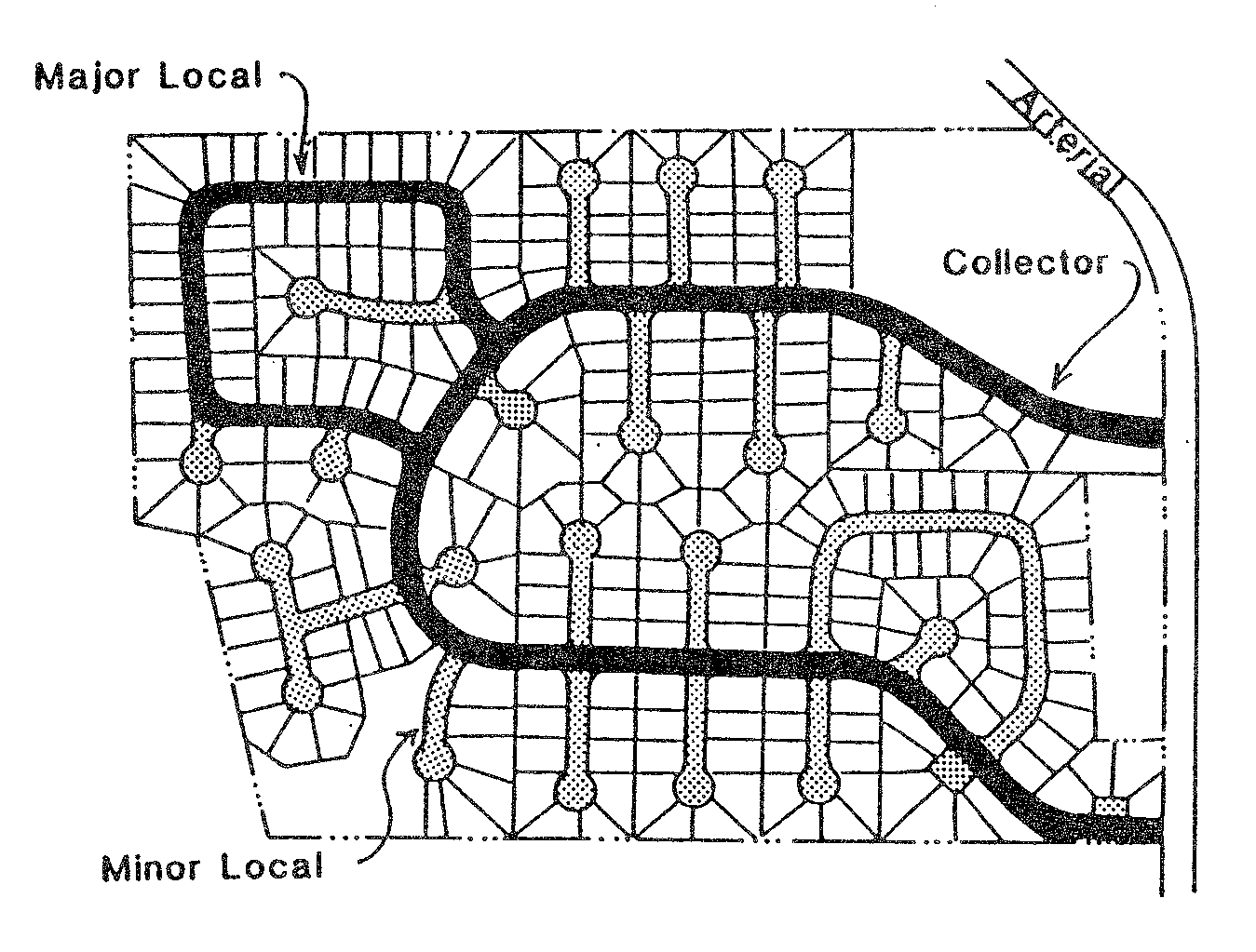
e.
Calculations.
1.
Determination of impact on ADT standards. The following table of traffic generation standards shall be used in computing the number of trips to be generated by a given use. Also, traffic generated by existing uses on the impacted street shall be calculated by the table to determine aggregate daily traffic volumes and the capacity of the street to accommodate the proposed new use.
TRAFFIC GENERATION STANDARDS
2.
Determination of impact on service level designations. The required calculation to determine the impact on service level designation shall be made by a qualified traffic engineer representing the applicant. All data, including the recommendations of the engineer, shall be made available to the zoning administrator, who in turn may request review, comments and verification from the state department of highways and public transportation, regional transportation officials and county traffic engineers.
f.
Application of standards in project review.
1.
Except for single-family dwellings and mobile homes with a minimum street frontage of 100 feet, all proposed projects and land uses shall be evaluated by the zoning administrator on the basis of their traffic generating capacity and their impact on designated street service levels. Where the administrator determines that a proposed use will generate ADT (average daily traffic) in excess of the limits established by subsection (c)(3)d. of this section or create a lower level of service than designated by subsection (c)(3)d. of this section for streets and roads in the county, the use shall be referred to the joint board of zoning appeals for review.
2.
In its review of the project application, the joint board of zoning appeals may consult the state department of highways and public transportation, and other city, county and regional agencies involved in matters of transportation.
3.
The review may result in:
i.
Required modifications to the proposed use,
ii.
Required modifications to the internal or external road net serving and impacted by the proposed use,
iii.
A variance to the standards contained in subsection d. of this subsection,
iv.
Mitigation,
v.
Required offsite improvements,
vi.
Limitations on frontage and access, or
vii.
Denial.
4.
Joint board of zoning appeals approval shall be prerequisite to the issuance of a building permit for those projects referred by the zoning administrator to the board. The zoning administrator may approve projects determined not to exceed the standards of subsection (c)(3)d.
(4)
Impervious surfaces.
a.
Purpose. On-site infiltration of stormwater into the ground is one of the most effective ways to reduce the quantity of stormwater runoff. Limiting the proportion of the site covered by impervious surfaces helps to ensure on-site filtration. Impervious surfaces, such as parking lots, not only increase the amount of runoff from a site, but they also produce runoff that contains petroleum, heavy metals and other pollutants. By requiring on-site permeable areas, lot line to lot line blacktopping is declared by this section to be an unacceptable practice.
b.
Standards. The following uses shall be limited in the amount of on-site impervious surface areas to the prescribed ratios:
(5)
Yards and setbacks.
a.
Purpose. The purposes of the setback regulations set out in this subsection are to:
1.
Ensure the provision of light and open space between structures;
2.
Accommodate future street widenings at the lowest possible cost; and
3.
Prevent the crowding of development.
b.
Standards. All buildings and structures, including the expansion of existing buildings and structures, shall meet or exceed the following minimum setback requirements. However, fences and walls shall be allowed along the property line, unless otherwise specified by applicable bufferyard or site clearance requirements.
YARDS AND SETBACKS FOR RDD DISTRICT
Table notes:
(1)
Front yard setbacks for the above listed uses shall apply to accessory uses as well, except that freestanding sign structures and offstreet parking spaces may be located in the required front yard setback area; provided such use or structure shall be no closer than five feet to any property or street right-of-way line and shall occupy no required bufferyard.
(2)
For cluster housing subdivisions, patio and zero lot line houses, an eight-foot setback shall be required on one side, and a six-foot maintenance easement on the side abutting the property line. Where houses are set back from the property line on both sides, a minimum distance of six feet shall be required for both sides.
(3)
For townhouses, there shall be no minimum between units, but a 20-foot setback shall be required between the end unit and the external property line. No more than six units may be attached.
(4)
Minimum distance shall be 20 feet, plus one foot for each additional foot in height over 20 feet of the principal building or structure.
(5)
Commercial condominium projects are allowed to share interior property lines; provided that a 20-foot setback shall be required on the end units; further provided that such projects (buildings) shall not exceed 600 feet in length, parallel to the street providing principal access. Where buildings are grouped on the same lot, forming a shopping or business center, a 20-foot side yard setback shall be required on each end of the project.
(6)
Outparcels and other unattached principal buildings or structures shall be spaced no less than the minimum distance required for emergency vehicles to pass between such buildings or in such a manner as not to impair visual clearance of on-site traffic or otherwise create a traffic hazard.
(7)
Minimum distance to the property line shall be 50 feet, plus five feet for each additional 5,000 square feet of gross floor area over 20,000 feet. Open storage shall be located no closer than 25 feet to the side property line.
(6)
Signs.
a.
Permanent signs for which a permit is not required: Same as C-1 district.
b.
Temporary signs for which a permit is not required: Same as C-1 district.
c.
Permanent signs for which a permit is required: Same as C-1 district.
d.
Billboards shall comply with the following conditions:
1.
Sign structures shall be a minimum of 300 feet apart.
2.
The sign shall not exceed 672 square feet in area with a display area of 48 feet in height by 60 feet in length.
3.
Signs may be placed on property with an active commercial or industrial use on the site and be located no closer than 300 feet from a residential use or residentially-zoned property.
(7)
Offstreet parking and loading. See article H of this chapter.
(8)
Bufferyards. Minimum bufferyard requirements for and between proposed uses in this district and adjacent uses are set forth in article E of this chapter, pertaining to bufferyards.
(9)
Minimum lot size. Within the RDD rural development district, a minimum lot size of one acre shall be required for residential (single-family, duplex, mobile home, mobile home park, cluster housing, townhouse, multifamily) [uses]. A minimum lot size of two acres shall be required for commercial, warehousing, and office or institutional uses. A minimum lot size of ten acres shall be required for industrial uses.
(Ord. No. 21-90, § I, 8-7-90; Ord. No. 11-97, § I, 3-18-97; Ord. No. 14-99, §§ II, XIX, 4-20-99; Ord. No. 11-04, § 1, 5-4-04; Ord. No. 20-04, § 2, 9-21-04; Ord. No. 2007-34 , § I, 12-18-07; Ord. No. 2015-10 , § I, 8-18-15; Ord. No. 2016-08 , § I, 7-5-16)
Sec. 6-3-48. - OP-1 office/professional district.
(a)
Purpose. It is the intent of the office/professional district to provide areas for the development of administrative and professional office space in locations served by primary access, yet inappropriate for commercial development because of close proximity to residential areas.
(b)
Permitted uses.
(1)
Professional and administrative offices.
(2)
Medical and dental offices.
(3)
Dwellings, single-family detached and duplex.
(4)
Accessory uses and structures customarily incidental to permitted uses.
(5)
Signs.
(c)
Conditional uses.
(1)
Drugstore, medical supplies, bookstore, florist, newsstand, antique, craft and similar small scale retail establishments, but not including convenience [stores], grocery stores, hardware stores, video arcades or game rooms, provided:
a.
Such uses shall be limited to 1,200 square feet in gross floor space;
b.
Such uses shall have direct access onto an arterial or collector street/road;
c.
Parking for such uses shall be located in the side or rear yards only, clear of all required bufferyard areas;
d.
All driveway access points (curbcuts) must be a minimum 150 feet from existing or proposed cuts/intersections in a radial measurement from its centerline unless they are directly aligned with opposing curb cuts;
e.
The hours of operation for such uses shall be limited to 7:00 a.m. to 9:00 p.m.;
f.
Approval will not be given at sites where it is determined by the zoning administrator that the existing road surface is structurally inadequate to handle additional traffic and/or there exists identifiable problems with sight distances, sight lines and/or other recognized traffic hazards. If it is determined that a proposed operation will have a detrimental impact upon existing traffic flow and/or patterns, a proposal must be provided by the applicant that will mitigate that impact. The city/county engineer will review and approve such mitigation proposals.
(2)
Churches and other places of worship, provided:
a.
Such uses are housed in permanent structures;
b.
Such uses are located on lots containing not less than one and one-half acres in area;
c.
Minimum lot width shall be 200 feet;
d.
No structure on the lot is closer than 30 feet to any abutting residential property line;
e.
An on-premises private kindergarten, preschool nursery, school or day care center shall be considered an accessory use;
f.
Parking for such uses shall be located in the side or rear yards only, clear of all bufferyard areas;
g.
All driveway access points (curbcuts) shall be a minimum 150 feet from existing or proposed curbcuts or intersections measured radially from the centerline of the curbcut, unless they are directly aligned with opposing curbcuts/intersections.
h.
Approval will not be given at sites where it is determined by the zoning administrator that the existing road surface is structurally inadequate to handle additional traffic and/or there exists identifiable problems with sight distances, sight lines and/or other recognized traffic hazards. If it is determined that a proposed operation will have a detrimental impact upon existing traffic flow and/or patterns, a proposal must be provided by the applicant that will mitigate that impact. The city/county engineer will review and approve such mitigation proposals.
(3)
Bed and breakfast inn, provided:
a.
[Such facility] cannot exceed 14 occupants or seven guest quarters;
b.
Such use shall have direct access onto an arterial or collector street/road;
c.
Parking for such uses shall be located in the side or rear yards only, clear of all required bufferyard areas;
d.
Kitchen/dining facilities [shall be] for use of registered guests only;
e.
Rooms cannot be rented more than once in any 12-hour period;
f.
[Such use] must meet all applicable city, county, state and federal standards;
g.
All driveway access points (curbcuts) must be a minimum 150 feet from existing or proposed cuts/intersections in a radial measurement from its centerline, unless they are directly aligned with opposing curbcuts;
h.
Approval will not be given at sites where it is determined by the zoning administrator that the existing road surface is structurally inadequate to handle additional traffic and/or there exists identifiable problems with sight distances, sight lines and/or other recognized traffic hazards. If it is determined that a proposed operation will have a detrimental impact upon existing traffic flow and/or patterns, a proposal must be provided by the applicant that will mitigate that impact. The city/county engineer will review and approve such mitigation proposals.
(4)
Social and cultural uses, including music and dance studios or schools, arts and crafts schools, and photography studios, but not including dance halls or other similar amusement, commercial establishments, provided:
a.
Such uses shall have direct access to an arterial or collector street/road;
b.
Parking for such uses shall be located in the side or rear yards only, clear of all required bufferyard areas;
c.
No use shall, as a part of its operation, have recitals, pageants, performances or exhibitions at the subject property;
d.
All driveway access points (curbcuts) must be a minimum 150 feet from existing or proposed cuts/intersections in a radial measurement from [its] centerline, unless they directly align with opposing curbcuts;
e.
Approval will not be given at sites where it is determined by the zoning administrator that the existing road surface is structurally inadequate to handle additional traffic and/or there exists identifiable problems with sight distances, sight lines and/or other recognized traffic hazards. If it is determined that a proposed operation will have a detrimental impact upon existing traffic flow and/or patterns, a proposal must be provided by the applicant that will mitigate that impact. The city/county engineer will review and approve such mitigation proposals.
(5)
Museums and art galleries, provided:
a.
Such use shall have direct access to an arterial or collector street/road;
b.
Parking for such uses shall be located in the side or rear yards only, clear of all required bufferyard areas;
c.
Meeting or conference areas shall be restricted to a maximum seating capacity of 25 and will be required to provide additional parking to accommodate this use;
d.
All driveway access points (curbcuts) must be a minimum 150 feet from existing or proposed cuts/intersections in a radial measurement from [its] centerline, unless they are directly aligned with opposing curbcuts;
e.
Such uses shall be located on sites containing a minimum of one acre of land;
f.
Approval will not be given at sites where it is determined by the zoning administrator that the existing road surface is structurally inadequate to handle additional traffic and/or there exists identifiable problems with sight distances, sight lines and/or other recognized traffic hazards. If it is determined that a proposed operation will have a detrimental impact upon existing traffic flow and/or patterns, a proposal must be provided by the applicant that will mitigate that impact. The city/county engineer will review and approve such mitigation proposals.
(6)
Accessory apartment, provided:
a.
The accessory apartment must be located in a permanent structure, a portion of which is used in compliance with uses and standards of this district;
b.
No more than one accessory apartment shall be permitted per lot or tract of land;
c.
Two parking spaces shall be required for the accessory apartment in addition to parking otherwise required for other use(s); all parking shall be located in the side or rear yards only, clear of all required bufferyard areas;
d.
A separate entrance into the accessory apartment shall be provided apart from the entrance to any other use in the building;
e.
The use must comply with all other applicable city, county, state, and federal standards;
f.
Approval will not be given at sites where it is determined by the zoning administrator that the existing road surface is structurally inadequate to handle additional traffic and/or there exists identifiable problems with sight distances, sight lines and/or other recognized traffic hazards. If it is determined that a proposed operation will have a detrimental impact upon existing traffic flow and/or patterns, a proposal must be provided by the applicant that will mitigate that impact. The city/county engineer will review and approve such mitigation proposals.
(7)
Veterinary clinics or offices, provided:
a.
Such uses shall not provide on-site animal boarding kennels beyond those provided for housing animals receiving medical treatment requiring them to be kept under the care/supervision of the veterinarian;
b.
Such uses shall have direct access onto an arterial or collector street/road;
c.
Parking for such uses shall be located in the side or rear yards only, clear of all required bufferyard areas;
d.
All driveway access points (curbcuts) must be a minimum 150 feet from existing or proposed cuts/intersections in a radial measurement from its centerline, unless they are directly aligned with opposing curbcuts;
e.
Approval will not be given at sites where it is determined by the zoning administrator that the existing road surface is structurally inadequate to handle additional traffic and/or there exists identifiable problems with sight distances, sight lines and/or other recognized traffic hazards. If it is determined that a proposed operation will have a detrimental impact upon existing traffic flow and/or patterns, a proposal must be provided by the applicant that will mitigate that impact. The city/county engineer will review and approve such mitigation proposals.
(8)
Day care and child care centers (including adult day care).
a.
Centers must meet the minimum standards set forth by the department of social services and other licensing agencies unless higher standards are required herein. A letter of approval from the department of social services shall be required prior to zoning approval;
b.
Centers shall conform to all applicable standards of any ordinance in effect within Greenwood County, City [of Greenwood], Town of Ninety Six, or Ware Shoals. The zoning administrator shall ensure that all standards are met prior to issuing certificates of zoning compliance;
c.
No other business enterprise shall be allowed on the same lot with a child care center unless the center is operated for the primary use of the employees of that business enterprise;
d.
Entrances, exits, and parking areas shall be located off collector and residential streets rather than arterial streets unless such access is not available;
e.
In commercial areas, passenger loading and unloading areas shall not abut primary commercial streets or highways and shall provide one-way drive-through service areas where traffic congestion may occur. All centers shall provide parking lots with one parking space for each employee and one parking space per six children cared for in the facility. Parking for such uses shall be located in the side or rear yards only, clear of all required bufferyard areas;
f.
Approval will not be given at sites where it is determined by the zoning administrator that the existing road surface is structurally inadequate to handle additional traffic and/or there exists identifiable problems with sight distances, sight lines and/or other recognized traffic hazards. If it is determined that a proposed operation will have a detrimental impact upon existing traffic flow and/or patterns, a proposal must be provided by the applicant that will mitigate that impact. The city/county engineer will review and approve such mitigation proposals;
g.
Each center shall provide a minimum of 75 square feet of usable, unpaved outdoor play area per child. This area shall not abut any commercial street or highway. "Play area" is defined as a usable, pervious area not covered by gravel, paving, buildings or required parking lots;
h.
Outdoor areas must be enclosed with a four-foot high fence. The zoning administrator shall require a privacy or screening fence to reduce noise and/or block objectionable views when the site is adjacent to a more intense land use that has the potential to produce smoke, dust, fumes, noise, or other potentially hazardous emissions;
i.
All outdoor lighting shall be directed away from residential properties;
j.
A detailed site plan must be submitted for review and approved by the zoning administrator;
k.
Any day care center (13+ children) that is adjacent to a single-family use or zone must comply with the bufferyard requirements of article E;
l.
All facilities must be operated and housed in a permanent structure. All such structures shall meet requisite fire codes and the required site plan shall be approved by the Greenwood City Fire Marshal and/or state fire marshal prior to receiving permission to operate the facility;
m.
All proposed child care centers must be physically inspected for compliance with all of the above requirements prior to granting permission to operate;
n.
Adult day care centers will be required to comply with the above standards.
(d)
Sign regulations. The following types of signs, together with the conditions attached thereto, are permitted in the OP-1 district:
(1)
Permanent signs for which a permit is not required: Signs of duly constituted governmental bodies, name/address signs on mail boxes, street numbers, and private directional or warning signs, provided they do not exceed two square feet in area and are not illuminated;
(2)
Temporary signs for which a permit is not required: Real estate and development signs, construction signs, for sale or lease signs, and notices of political and/or public events, provided such signs are not illuminated, are securely anchored (but shall not be secured or anchored to any utility pole or other public apparatus), are removed within one week after their reason for being has ceased to exist, and do not exceed 12 square feet in area.
(3)
Permanent signs for which a permit is required: One freestanding business identification sign per lot, plus one additional freestanding sign for each 100 feet or fraction thereof of street frontage over 200 feet, provided such signs shall:
a.
Not exceed 30 square feet of sign area for the entire tract;
b.
Be placed at not less than 100-foot intervals;
c.
Be located no closer than five feet from the nearest property line; and
d.
Be located on the property to which they refer.
Flat, wall, or surface signs are permitted on each structure in the OP-1 district, provided they do not exceed 20 square feet.
(4)
Temporary or portable signs for which a permit is required: One temporary or portable sign per property, provided such sign shall:
a.
Not exceed 60 square feet in area;
b.
Be located on the property to which it refers;
c.
Be limited to a minimum of three months between permits for a particular location;
d.
Not have flashing lights or blinking lights; and
e.
Meet all code requirements of the governing authority.
(e)
Development standards.
(1)
Office/professional uses:
a.
Minimum lot area: 10,000 square feet.
b.
Minimum yards:
1.
Front: 20 feet.
2.
Side: Ten to 20 feet. []*
3.
Rear: 15 to 30 feet.*
c.
Maximum impervious surface ratio: 65 percent.
d.
Maximum height of buildings: 35 feet.
e.
Maximum height of signs: 15 feet.
(2)
Residential uses: See development standards for R-4 district.
(f)
Off-street parking and loading regulations. See article H. In addition, the required parking spaces for all permitted uses shall be located in the side or rear yards only, clear of all bufferyard areas unless otherwise noted.
(g)
Bufferyard requirements. Minimum bufferyard requirements for and between permitted uses in this district and adjacent uses are prescribed in article E, Bufferyards.
In addition to the standards required therein, where a proposed building site abuts any residential district or use, a solid wooden fence or masonry wall at least six feet in height shall be placed along the property line/zoning line in compliance with article E, section 6-3-69 as soon as all site preparation is completed and prior to a building permit being issued for the primary structure.
(Ord. No. 18-94, § I, 10-4-94; Ord. No. 16-95, § I, 10-3-95; Ord. No. 14-99, §§ V—VII, 4-20-99)
Sec. 6-3-49. - FA forest agricultural district.
(a)
Purpose. The forest agriculture zoning district is primarily designed to accommodate most agriculture uses and small-scale development in areas with limited or unavailable public infrastructure.
The following sections list permitted uses, conditional uses, special exceptions, and accessory uses that are unique to the FA zoning district.
(b)
Regulations applied. The following sections contain all permitted uses, conditional uses, special exceptions, and accessory uses that apply to the FA zoning district.
(c)
Permitted uses.
Agricultural sales and service.
Animal processing/sales.
Bait shop.
Barber/beauty shop.
Bed and breakfast.
Blacksmith.
Botanical garden.
Cemetery.
Cemetery, pet.
Ceramic shop.
Christmas tree sales.
Church, temple, or synagogue.
Civic clubs/lodge.
Community center.
Community/neighborhood recreation.
Crop storage and sales.
Dairy product processing.
Driving range.
Fairground.
Feed and seed store.
Field crops.
Flower/gift/card shop.
Forest management area.
Game farm.
Glass, stone and clay products.
Golf course, including clubhouse.
Greenhouse/nursery commercial.
Greenhouse private.
Grove/orchard/vineyard.
Hatchery operation.
Houseboat.
Hunting club/preserve.
Lawn mower repair.
Marina.
Monument and tombstone sales.
Mulch sales/landscaping products.
Other agricultural.
Other recreation.
Outdoor recreation facility.
Park/forest reserve.
Police, fire and EMS stations.
Post office.
Private air strip.
Private recreation area.
Produce stand/shelter.
Public park and playground.
Public utility.
Pulp manufacturing.
Radio/television station mast.
Railroad facility/switching yard.
Saw mill/chipping mill.
Single-family detached.
Swimming pool, public indoor.
Swimming pool, public outdoor.
Tobacco storage and processing.
Truck farm/farmer's market.
Utility substation/station.
Veterinary clinic/office.
Wildlife refuge.
Wood products.
Zoo or wildlife park.
(d)
Conditional uses. The following uses are permitted in the FA districts, provided that the following conditions are met:
(1)
Animal production/breeding facility, provided any structure must be at least 100 feet from a residential use.
(2)
Animals/livestock keeping, provided the lot contains no less than five acres and structures for the care, raising and handling of livestock shall be located at least 100 feet from adjacent residential uses.
(3)
Arts and crafts sales/exhibition, provided the temporary zoning permit is issued for arts and crafts sales and exhibitions as an accessory use to an approved principal use (such as an off-street parking lot). The maximum term for such permit shall not exceed five days, and no more than four such permits may be issued per property, per calendar year.
(4)
Automobile repair and body shop, general maintenance and machine shop, and welding shop, provided that:
a.
All lighting is shielded or directed away from adjoining residential properties.
b.
Outdoor storage/service areas with more than five vehicles/machines/repair items shall be completely and opaquely screened from adjacent road rights-of way and property lines.
(5)
Baseball/softball/soccer park, provided any swimming pool, playground, ball field or game court is located no closer than 50 feet of any adjacent residential property line, including lighting for such uses. All lighting shall be shielded to prevent direct illumination of adjacent residential properties.
(6)
Business and professional offices, provided they do not exceed 5,000 square feet in size and that all lighting is shielded to prevent direct illumination of adjacent residential properties. This type development must be located within 1,000 feet from the intersection of two or more state or federal numbered highways.
(7)
Carnivals, fairs and other major public gatherings, provided zoning permits for temporary public assembly use and events of public interest such as carnivals, fairs and other major public gatherings and parking for such events are issued for periods not to exceed five consecutive days. No more than five such permits may be issued per property, per calendar year. Temporary permits shall be issued only if adequate parking and sanitary facilities are provided to serve the proposed use or activity.
(8)
Child day care, provided a detailed site plan shall be submitted, noting all of the following applicable information:
a.
The facility meets the minimum standards set forth by DSS and other applicable licensing agencies, unless this chapter provides higher standards. A letter of approval from DSS will be required for zoning approval.
b.
The facility must conform to all applicable standards of any ordinance in effect within the county.
c.
No other business enterprise shall be allowed to operate on the same property as the facility.
d.
Vehicular entrances, exits and other parking areas shall be located off collector and residential streets rather than arterial roads unless access is not available.
e.
One parking space for each employee and one parking space per six children cared for in the facility is provided.
f.
An on-site drop-off for children is provided.
g.
A minimum of 75 square feet of usable, non-paved outdoor play area per child must be provided. Outdoor areas must be enclosed with a fence that is no lower than four feet in height. All outdoor lighting related to outdoor play areas shall be shielded to prevent direct illumination of adjacent residential properties.
h.
The facility must be operated and housed in a permanent structure, which complies with applicable fire codes.
i.
The zoning official will conduct an on-site inspection of the facility prior to the granting of the conditional use permit to ensure compliance with the requirements listed above.
(9)
Communications tower, a freestanding tower with height not exceeding 300 feet, may be permitted as a conditional use, provided that the following documents are submitted upon application for such use. Any increase in the maximum height may be granted by the board of zoning appeals via a special exception. Please see section 6-3-121 for details.
a.
One copy of typical specifications for proposed structures and antennae including description of design characteristics and material.
b.
A site plan drawn to scale showing property boundaries, tower location, tower height, guy wires and anchors, existing structures, photographs or elevation drawings depicting typical design of proposed structures, parking, fences, landscape plan, and existing land uses on adjacent property (site plan not required if antennae is to be mounted on an approved existing structure).
c.
A current map, or update for an existing map on file, showing locations of applicant's antennae, facilities, existing towers, and proposed towers which are reflected in public records, serving within the city.
d.
A report from a structural engineer registered in the state showing the tower antennae capacity by type and number, and a certification that the tower is designed to withstand winds in accordance with ANSI/EIA/TIA 222 (latest revision) standards.
e.
Identification of the owners of all antennae and equipment to be located on the site.
f.
Written authorization from the site owner for the application.
g.
Evidence that a valid FCC license for the proposed activity has been issued.
h.
A line of sight analysis showing the potential visual and aesthetic impacts on adjacent residential districts.
i.
A written agreement to remove the tower and/or antennae within 180 days after cessation of use. In the event of bankruptcy, it will remain the sole responsibility of the tower's owner to remove the tower along with all appendages.
j.
Evidence that applicable conditions in the following section are met.
k.
Additional information required by the zoning official for determination that all applicable zoning regulations are met.
l.
A letter of approval from the FAA.
Additionally, the applicant must show that all of the following applicable conditions are met:
a.
The proposed communications tower, antenna or accessory structure will be placed in a reasonably available location which will minimize the visual impact on the surrounding area and allow the facility to function in accordance with minimum standards imposed by applicable communications regulations and applicant's technical design requirements. The structure must be painted green or black.
b.
Applicant must show that a proposed antennae and equipment cannot be accommodated and function as required by applicable regulations and applicant's technical design requirements without unreasonable modifications on any existing structure or tower under the control of the applicant.
c.
Prior to consideration of a permit for location on private property which must be acquired, applicant must show that available publicly owned sites, and available privately owned sites occupied by a compatible use, are unsuitable for operation of the facility under applicable communications regulations and applicant's technical design requirements.
d.
Applicant must show that a new tower is designed to accommodate additional antennae equal in number to applicant's present and future requirements.
e.
Applicant must show that all applicable health, nuisance, noise, fire, building and safety code requirements are met.
f.
A communications tower must not be painted or illuminated unless otherwise provided by state or federal regulations.
g.
A permit for a proposed tower site within one mile of an existing tower shall not be issued unless the applicant certifies that the existing tower does not meet applicant's structural specifications and applicant's technical design requirements, or that a collocation agreement could not be obtained.
h.
Applicant must show by certificate from a registered engineer that the proposed facility will contain only equipment meeting FCC rules, and must file with the zoning official a written indemnification of the jurisdiction and proof of liability insurance or financial ability to respond to claims up to $1,000,000.00 in the aggregate which may arise from operation of the facility during its life, at no cost to the county or other affected municipality, in form approved by the attorney for the affected jurisdiction.
i.
Land development regulations, visibility, fencing, screening, landscaping, parking, access, lot size, exterior illumination, sign, storage, and all other general zoning district regulations except setback and height, shall apply to the use. Setback and height conditions in this chapter apply.
j.
A tower must be a minimum distance equal to one-half the height of the tower from property designated historic or architecturally significant, and must be set back from all lot lines distances equal to the district setback requirements of 25 percent of the tower height, whichever is greater.
(10)
Construction/storage office provided a temporary zoning permit is issued by the zoning official for appropriate periods of time not to exceed 12-month increments for a nonconforming structure or use incidental to building construction or land development. The structure or use must be removed upon expiration of the permit. The structure must be located on the same site as the permitted project, and must be removed within 15 days after the completion of the project. Structure may be manufactured or modular.
(11)
Contractor, general, provided all outdoor storage of materials is completely and opaquely screened from adjacent road rights-of-way and properties.
(12)
Convenience store gasoline sales, provided:
a.
Lighting shall be shielded to prevent direct illumination of adjacent residential properties.
b.
Located along a state or federal numbered highway.
(13)
Dairy farming/cattle farming, provided the lot contains no less than five acres and structures for the care, raising and handling of livestock shall be located at least 100 feet from adjacent residential uses. Structures do not include fenced area for grazing.
(14)
Family adult day care home, provided:
a.
A detailed site plan shall be submitted, noting all of the following applicable information.
b.
The facility meets the minimum standards set forth by the DSS and other applicable licensing agencies, unless this chapter provides higher standards. A letter of approval from DSS will be required for zoning approval.
c.
The facility must conform to all applicable standards of any ordinance in effect within the county.
d.
No other business enterprise shall be allowed to operate on the same property as a family day care home.
e.
The family day care function must be clearly incidental and secondary to the residential use of the building, and there shall be no advertising of the family day care function on the site or structure.
f.
Family day care duties shall be conducted only by persons residing on the premises.
g.
Entrances, exits and other parking areas shall be located off collector and residential streets rather than arterial roads unless such access is not available.
h.
One parking space for each employee and one parking space per six children cared for in the facility is provided.
i.
An on-site drop-off for children is provided.
j.
A minimum of 75 square feet of usable, non-paved outdoor play area per child must be provided. Outdoor areas must be enclosed with a fence that is no lower than four feet in height. All outdoor lighting related to outdoor play areas shall be shielded to prevent direct illumination of adjacent residential properties.
k.
The family day care operation does not generate any parking or traffic congestion, and any parking spaces needed or required are located in the rear or side yard and in compliance with applicable buffer setback requirements as listed in subsection (h) of this section. Proposals to mitigate negative traffic impacts may be submitted and reviewed by the BZA as part of the consideration of the application for a special exception.
l.
The facility must be operated and housed in a permanent structure, which complies with applicable fire codes.
m.
The zoning official will conduct an on-site inspection of the facility prior to the granting of the special exception to ensure compliance with the requirements listed above.
n.
No more than six adults may be cared for on the site.
(15)
Farm equipment sales and service, provided that:
a.
All lighting is shielded or directed away from adjoining residential properties.
b.
All outdoor service areas (storage of inoperable or worked on vehicles) must be opaquely screened to obstruct the view from road rights-of-way and adjacent properties.
(16)
Garage sales/auctions, provided garage sales or auctions of second-hand merchandise which has been used on the premises are conducted on a property as a temporary use. Such sales may be conducted only twice in a calendar year from the same property. Please note that this does not include the auctioning of goods from other sites including but not limited to automobiles, heavy equipment, etc.
(17)
Gas station, full service, provided outdoor storage of more than five automobiles shall be completely and opaquely screened from adjacent road rights-of-way and shall be located along a state or federal numbered highway.
(18)
Gas station, self service, provided they are located along a state or federal numbered highway.
(19)
General merchandise, provided the structure does not exceed 2,500 square feet of gross floor area and is located on a state or federal numbered highway.
(20)
Group home, limited, provided such use meets the requirements of applicable state legislation.
(21)
Manufactured home, provided a single-family dwelling built according to the Federal Manufactured Housing Construction and Safety Standards (24 CFR 3280) HUD code, provided the structure meets or exceeds the following criteria:
a.
The pitch of the roof has a minimum nominal 3/12 pitch and has a type of shingle commonly used in standard residential construction.
b.
The exterior siding consists of vinyl or aluminum lap siding, wood, Masonite, or other materials similar to the exterior siding commonly used in standard residential construction.
c.
All towing devices, wheels, axles, and hitches must be removed.
d.
The manufactured home shall be placed on the lot in such a manner that is compatible with and reasonably similar in orientation to the site-built housing in adjacent or nearby locations.
e.
The home must be placed upon a foundation consisting of footings and piers which meet the requirement of the Manufacturer's Installation Manual. In the event that the Manufacturer's Installation Manual is not provided, the home, by law, must be installed according to Section 19-425.39, Manufactured Home Minimum Installation, as promulgated by the South Carolina Manufactured Housing Board. Foundation and anchoring must comply with all applicable requirements of the building code adopted by the local jurisdiction at the time the manufactured home is placed on-site. At a minimum, the following standards shall apply:
1.
All piers shall have a minimum dimension of no less than 16 inches by 16 inches.
2.
The base of all piers shall have a minimum of a four-inch solid block consisting of two four-inch by eight-inch by 16-inch concrete blocks.
3.
If the manufactured home is placed on a poured concrete footing, the solid four-inch base shall not be required.
4.
The spacing of piers along the I-beam of the home shall not exceed a distance of eight feet. Should the mobile homeowners manual require spacing of piers closer, the HUD guidelines of the manual shall be followed.
5.
Perimeter blocking and marriage wall blocking on all manufactured homes shall be done in accordance with the HUD guidelines in the setup manual.
6.
Piers shall not have more than two-inch thickness of wood or wood shims between the top of the pier and the I-beam.
f.
Permanent landing and steps with handrails are required at each exterior doorway. The structure must include steps which lead to the ground level. All exterior exits of the home shall have a landing of no less than three feet by three feet in size with 36-inch guardrails.
g.
Skirting or a curtain wall, unpierced except for required ventilation and access door must be installed and may consist of brick, masonry, vinyl, block, stone, or similar materials designed and manufactured for permanent outdoor installation. The minimum ventilation requirement shall be one square foot of ventilation per 150 square feet of crawl space. All skirting shall be able to withstand the 80 miles-per-hour wind zone standard set forth in the Standard Building Code. The requirements of this subsection shall be complied with on or before final inspection for this unit is made.
h.
All manufactured homes must be connected to a water and sewer system or well and septic tank, whichever is applicable, approved by the county health department. All fresh water lines to the manufactured home must be installed with a gate valve or stop valve in order to cut off water supply at the home, as necessary. All drain lines shall be connected in accordance with the setup manual. If no setup manual is available, drain lines must be connected with proper elevation and fall, as described in the Standard Building Code guidelines. All lines must be properly supported and strapped to prevent sagging and insure drainage. A minimum three-inch cleanout "T" shall be located on the main line leaving the home and located within three feet of the perimeter of the home. The electrical system to the home shall be required to meet the standards set forth in the National Electrical Code.
(22)
Mining, provided:
a.
The hours of operation are limited to daylight hours.
b.
Located along a state or federal highway.
c.
All structures located at least 100 feet from any residential use.
d.
No noise, odors, dust, fumes or vibrations onto adjacent properties.
(23)
Mobile home as defined by this chapter, provided it was legally permitted and occupied as a residence located within the county on the effective date of this section. A mobile home not legally permitted and/or occupied as described above shall not be relocated to a new site after the effective date of this section. In addition, no mobile home shall be moved into the county after the effective date of this section. Mobile homes shall be subject to the following set-up requirements:
a.
All mobile homes shall be placed on their sites in such a manner that they are compatible with and reasonably similar in orientation to the site-built housing in adjacent or nearby locations.
b.
The home must be placed upon a foundation consisting of footings and piers which meet the requirements of the Manufacturer's Installation Manual. In the event that the Manufacturer's Installation Manual is not provided, the home, by law, must be installed according to Section 19-425.39, Manufactured Home Minimum Installation, as promulgated by the South Carolina Manufactured Housing Board. Foundation and anchoring must comply with all applicable requirements of the Building Code adopted by the local jurisdiction at the time the mobile home is placed on-site. At a minimum, the following standards shall apply:
1.
All piers shall have a minimum dimension of no less than 16 inches by 16 inches.
2.
The base of all piers shall have a minimum of a four-inch solid block consisting of two four-inch by eight-inch by 16-inch concrete block.
3.
If the mobile home is placed on a poured concrete footing, the solid four-inch base shall not be required.
4.
The spacing of piers along the I-beam of the home shall not exceed a distance of eight feet. Should the mobile homeowners manual require spacing of piers closer, the HUD guidelines of the manual shall be followed.
5.
Perimeter blocking and marriage wall blocking on all mobile homes shall be done in accordance with the HUD guidelines in the setup manual.
6.
Piers shall not have more than two-inch thickness of wood or wood shims between the top of the pier and the I-beam.
c.
Permanent landing and steps with handrails are required at each exterior doorway. The structure must include steps which lead to the ground level. All exterior exits of the home shall have a landing of no less than three feet by three feet in size with 36-inch guardrails.
d.
Skirting or a curtain wall, unpierced except for required ventilation and access door, must be installed and may consist of brick masonry, vinyl, block, stone, or similar materials designed and manufactured for permanent outdoor installation. The minimum ventilation requirement shall be one square foot of ventilation per 150 square feet of crawl space. All skirting shall be able to withstand the 80 miles-per-hour wind zone standard set forth in the Standard Building Code. The requirements of this subsection shall be complied with on or before final inspection for this unit is made.
e.
All mobile home sites must have individual utility services, including accommodations for on-site water and waste disposal, as stated below:
1.
All mobile homes must be connected to the water and sewer system or well and septic tank, whichever is applicable, approved by the county health department.
2.
All fresh water lines to the mobile home must be installed with a gate valve or stop valve in order to cut off water supply at the home, as necessary.
3.
All drain lines shall be connected in accordance with the setup manual. If no setup manual is available, drain lines must be connected with proper elevation and fall, as described in the standard plumbing code guidelines, or latest applicable code adopted by the jurisdiction.
4.
All lines must be properly supported and strapped to prevent sagging and insure drainage.
5.
A minimum three-inch clean-out "T" shall be located on the main line leaving the home and located within three feet of the perimeter of the home.
6.
The electrical system to the home shall be required to meet the standards set forth in the National Electrical Code.
f.
All mobile homes shall have a minimum of one anchor on each side of the home per every 15 linear feet. All single-wide homes are required to have a minimum of two overhead straps if the length is less than 60 feet. All single-wide homes in excess of 60 feet must have three overhead straps. Sectional homes may be anchored by frame ties. For single-wide homes, all built-in, over-the-top tiedown straps shall be located within two feet of each end of the home and at intervals in between as recommended by the home manufacturer, placed at stud and rafter locations. Frame ties must always be used with over-the-top ties. Each strap should be attached to the nearest I-beam that runs the length of the mobile home (never the cross member). The strap should be wrapped around the beam and secured with the buckle or other clamping device. Ties made of galvanized steel strapping shall have a minimum breaking strength of 4,750 pounds or galvanized steel cable with a breaking strength of at least 4,800 pounds. Ties shall have a device that permits ties to be tightened.
(24)
Library, provided that a primary or secondary school is located on the same property or a contiguous property as the library.
(25)
Outdoor religious events, provided a temporary zoning permits for outdoor religious events such as church revivals, outdoor concerts and parking for such events is issued for periods not to exceed five consecutive days, and no more than five such permits may be issued per property, per calendar year. Temporary permits shall be issued only if adequate parking and sanitary facilities are provided to serve the proposed use or activity.
(26)
Outdoor retail sales (non-seasonal), provided that the hours of operation do not extend past 11:00 p.m. and all lighting is shielded or directed away from adjoining residential properties. Temporary outdoor sales of merchandise shall be permitted as a temporary, accessory use to an approved principal use (such as an off-street parking lot), provided that the maximum term for such permit shall not exceed five days, and no more than four such permits may be issued per lot, per calendar year.
(27)
Outdoor retail sales (seasonal), provided that the hours of operation do not extend past 11:00 p.m. and all lighting is shielded or directed away from adjoining residential properties. The sale of Christmas trees and wreaths, fireworks, turkey shoots, and pumpkin sales are authorized where permitted as an temporary use and shall not exceed a total time period of 60 days during a one-year period. This time period shall commence from the first date that such uses, individually or collectively, are approved or established, whichever is first.
(28)
Pistol/rifle firing range (commercial), provided:
a.
No such use shall be located within one mile from any residential use (measured in a straight line).
b.
The use shall be oriented away from habitable areas.
c.
That appropriate berms or other barriers are constructed to keep projectiles within 20 feet of the targets.
d.
That the hours of operation do not extend after 9:00 p.m. or before 8:00 a.m.
(29)
Primary/secondary school, provided all structures must be placed not less than 100 feet from any adjacent residential property line.
(30)
Recreational vehicle park which consist of more than five campers are required to meet the following conditions:
a.
Location and access.
1.
Recreational vehicle parks shall be located adjacent to an existing public recreational vehicle park, or with direct access to a state or federally numbered highway.
2.
No entrance or exit from a recreational vehicle park shall be through a residential or commercial zoning district.
b.
Site conditions. Condition of soil, groundwater level, drainage and topography shall not create hazards to the property or the health or safety of the occupants. No portion of the site that is subject to unpredictable and/or sudden flooding, subsistence, or erosion shall be used for any purpose which would expose persons or property to hazards.
c.
Spaces for occupancy, uses permitted, and lengths of stay. Spaces in recreational vehicle parks may be used by recreational vehicles; as defined herein. Spaces shall be rented by the day or week only, and no recreational vehicle shall remain in the park more than 30 consecutive days.
d.
Site planning and required improvements. Site planning and required improvements shall provide for:
1.
Facilities and amenities appropriate to the needs of the occupants.
2.
Safe, comfortable, convenient and sanitary use by occupants under all weather conditions to be expected during periods of occupancy.
3.
Protection of occupants from adverse environmental influences such as flood and wind.
e.
Relation of spaces to public streets. No space shall be located so that any part intended for occupancy for sleeping purposes shall be within 50 feet of the right-of-way line of any major thoroughfare or collector street, or within 25 feet of the right-of-way line of any other street.
(31)
Riding stable, provided all structures are located 100 feet from a residential use.
(32)
Sales/leasing offices, provided a temporary zoning permit is issued by the zoning official for appropriate periods of time not to exceed 12-month increments for a nonconforming structure or use incidental to building construction or land development. The structure or use must be removed upon expiration of the permit. The structure must be located on the same site as the permitted project.
(33)
Solid waste convenience/recycling center, provided:
a.
The lot is a minimum of one acre in size.
b.
Such center is not located within 500 feet of any existing residential use.
c.
Setbacks comply with those for the appropriate zoning district.
d.
All local, state and federal permits for such use are obtained and copies provided to the zoning official prior to any site work.
e.
A drainage and sedimentation plan that shows all off-site runoff is submitted with the zoning request.
f.
The proposed facility has direct access off of a collector or arterial street.
g.
Any waste material capable of becoming airborne must remain covered and secured at the end of the workday.
h.
Prior to beginning any site work, all local, state and federal permits required for such use must be obtained and copies of these permits provided to the zoning administrator.
i.
All convenience center sites shall comply with the bufferyard requirements for a general commercial use.
(34)
Stockyards, slaughter houses, poultry houses and livestock auction houses, provided:
a.
The use shall not be located within 1,000 feet of a residential use.
b.
No incineration of animals or animal refuse shall be permitted.
c.
The use shall meet the bufferyard requirements for light industrial use.
d.
Noise directly related to an auction shall be contained on the premises.
e.
The use shall meet all DHEC standards in regards to odors and sanitation.
(35)
Tennis club, provided:
a.
The club shall be at least 100 feet from adjacent residential properties.
b.
Lighting for tennis courts shall be shielded to minimize light and glare from spilling over onto adjacent properties, shall be set for operational hours.
c.
All tennis courts shall close on or before 11:00 p.m.
d.
All fences around courts shall be at least ten, but no more than 12 feet high.
(36)
Ultra-light flight park, provided:
a.
The total area of the lot is five acres or more.
b.
The landing area is located within the epicenter of the property.
c.
The hours of operation are limited to daylight hours.
d.
This use must be in connection to and on the same parcel as an existing airport or private airstrip.
(37)
Family subdivision. The purpose of a family subdivision is to allow for the traditional clustering of single-family dwellings (including manufactured homes) on a rural tract of land owned by members of the same family while keeping the remainder of the family property available for other uses allowed in the FA district.
a.
An owner of property who desires to create a family subdivision must notify the Greenwood County Planning Department, in writing, that he is submitting his tract of land to the provisions of this section.
1.
For a period of five years thereafter, no portion of the property may be conveyed to a person who is not related to the owner, or to a present or former spouse of the owner, as either a parent, grandparent, child, grandchild, aunt, uncle, first cousin, nephew, or niece.
2.
No owner may cut more than five lots from a single tract of land. A single tract of land is defined as any parcel existing on the Greenwood County tax records on the date the ordinance from which this section is derived is enacted.
b.
Every lot in a family subdivision must comply with the following standards:
1.
All lots created under the provision of this section shall be subject to all setback, height and building space requirements of the zoning district.
2.
Each lot created must have an approved septic system or connection to a public sewer service.
3.
All lots must be accessible by a public road or private right-of-way with minimum street frontage of 100 feet. No flag lots shall be allowed.
4.
Every lot must have a minimum size of at least one acre.
(e)
Special exceptions. The following uses are allowed in FA zoning districts, if they are permitted by special exception by the joint board of zoning appeals (BZA) using the criteria listed:
(1)
Communications tower, a tower, pole, or antenna over 300 feet in height, may be permitted by special exception granted by the joint board of zoning appeals after public hearing and findings of fact based upon the following criteria:
a.
All application requirements and conditions imposed by this section for conditional uses are met except height limitations and setbacks.
b.
If additional tower height is requested, total tower height will not exceed 150 percent of the maximum height permitted in the district as a conditional use.
c.
Applicant has demonstrated that additional height above that permitted by conditional use regulations is necessary for service to occupants of an area within the municipality.
d.
Setback requirements and such additional conditions are established by the board as it deems necessary to remove danger to health and safety, and to protect adjacent property.
e.
The Telecommunications Act of 1996 requires that a denial of a permit be supported by substantial evidence.
f.
The board may grant a variance from general zoning district regulations and setback requirements, but may not grant a variance from any other standards imposed for a communications tower or antenna in connection with granting a special exception.
(2)
Temporary manufactured home medical hardship in the event of a family medical hardship, a manufactured home may be located on a site as a temporary use by special exception. In making this decision, the board shall consider, at a minimum, the following information:
a.
Statement from a licensed physician stating the nature of the medical condition for which the hardship manufactured home is being requested.
b.
Statement of the exact nature of the family relationship and the reasons why the temporary manufactured home is needed.
c.
A site plan showing the location of the proposed manufactured home and all other structures. The manufactured home must be sited on the same lot as the principle structure and must comply with all dimensional requirements of the district. The manufactured home, when possible, shall be placed behind the principal structure to obstruct the view from road rights-of-way and adjacent land owners.
d.
Certification that the manufactured home can be served by an approved sanitary water and sewer system subject to the requirements of the county health department.
The BZA shall permit hardship manufactured homes for medical reasons. The board shall instruct the zoning official to review the status of the dwelling's occupancy once every six months so as to verify that the occupant of the dwelling is the individual for whom the permit was issued and that it is not being used as a rental dwelling. If the illness ceases or the situation changes whereby the hardship no longer exists, the applicant shall move the manufactured home to an appropriate zoning district.
(3)
Temporary manufactured home loss of shelter when a single family structure is damaged or destroyed by fire or other natural disaster, a permit may be issued for a temporary manufactured home permit to be used as a temporary dwelling while the house is being repaired or rebuilt. The BZA shall consider, at a minimum, the following information:
a.
Documentation that the single-family structure is not otherwise habitable due to the extent damage caused by the fire or other disaster.
b.
The nature of the event that damaged or destroyed the structure.
c.
Certification that the manufactured home can be served to the requirements of the county health department.
d.
A site plan showing the location of the proposed manufactured home and all other structures. The manufactured home must be sited on the same lot as the principle structure and must comply with all dimensional requirements of the district.
The BZA shall permit hardship manufactured homes as temporary dwellings. The board shall instruct the zoning official to review the status of the dwelling's occupancy once every six months so as to verify that the occupant of the dwelling is the individual for whom the permit was issued and that it is not being used as a rental dwelling. The temporary permit shall become void 30 days after the issuance of a certificate of occupancy by the building department or one year, whichever is less. At that time the unit shall be moved to an appropriately zoned area and the site restored to its original state.
(f)
Accessory uses. The following accessory structures and uses may be located in FA districts, provided the location meets with all applicable requirements. With the exception of fences or walls, no accessory use shall be located within any required buffer area.
(1)
Accessory building or structure, provided that the use is commonly associated with residential use, including, but not limited to: detached, private garages; private kennels; disaster shelters and storage sheds. Such building or structure may be located in rear and side yards only, no closer than ten feet to the rear property line and ten feet to the side property line. Structures shall not be placed within the side or rear setback if the side or rear property lines are adjacent to a street. More than one accessory structure may be added to a property provided that such structures shall not exceed:
a.
Thirty-five feet in height or the height of the primary structure, whichever is less.
b.
Nine hundred square feet in gross floor area or 30 percent of the required yard if located within the designated side or rear setback, whichever is greater.
(2)
Barn, provided the structure is at least 100 feet from the closest residential use.
(3)
Boat house, boat dock, or boat lift, provided that the structure is no closer than ten feet from the side property lines. The county engineer must approve construction drawings for these structures if located along Lake Greenwood.
(4)
Convent or monastery, provided it is on the same piece of property as the church or house of worship. All applicable setbacks, height restrictions and parking requirements for multifamily must be met. The density for this accessory use shall not exceed four per acre.
(5)
Farm labor housing dormitories as an accessory use to agricultural activities, provided that the following conditions are met:
a.
Such use shall be setback 100 feet from road rights-of-way and property lines bordering undeveloped parcels. A minimum 200-foot setback shall be required from property lines abutting developed parcels.
b.
A minimum 50-foot buffer shall be maintained and planted within the setback area along all interior property lines.
c.
Farm labor housing shall be used on a seasonal basis only. It shall not serve as year-round housing.
d.
Density shall not exceed one unit per five acres with total units not to exceed 20.
(6)
Fences or walls, provided that the fence or wall is located no closer than 18 inches to a street or road right-of-way and does not impede visibility as outlined in section 6-3-110.
(7)
Garage or yard sales, provided that such sales be limited to two during each 12-month period for each residence, for a maximum duration of two days per sale.
(8)
Private tennis courts, outdoor recreation and picnic facilities provided light is shielded from adjacent properties and applicable parking requirements are met.
(9)
Satellite dishes, ham radio towers, and group supported TV antennas, provided the structure, which includes the guide wires, is located in the rear yard, no closer than ten feet to all property lines. The height of a ham radio tower shall not exceed 140 feet.
(10)
Swimming pool, private including deck, bath house or cabana, provided the pool is located in the rear or side yard, and that the pool is no closer than ten feet from the nearest property line. Pools shall have all lighting shielded or directed away from adjoining residences.
(11)
Other accessory uses appropriate to agricultural and rural uses, as determined by the zoning official.
(g)
Home occupation. A home occupation, as defined in this chapter, may be deemed an accessory use to a residential use, provided that:
(1)
A home occupation permit is obtained from the zoning official, and must be renewed if a change in use occurs.
(2)
The home occupation is conducted entirely within the principal dwelling unit or accessory building on the property.
(3)
The home occupation is clearly incidental and secondary to the principal use of the building.
(4)
Does not necessitate or cause the exterior appearance of any structure to be other than residential and is not disruptive of the residential character of the neighborhood.
(5)
No more than 25 percent of the total floor area or 500 square feet, whichever is less, shall be used for the home occupation.
(6)
The home occupation is conducted only by persons residing on the premises (nonresident employees are not permitted).
(7)
There is no outdoor storage of any kind related to the home occupation.
(8)
The home occupation or related activities does not create any disturbing or offensive noise, vibration, glare, smoke, heat, odor, fumes, dust, electrical or communication interference in any radio or television receiver, or unhealthy or unsightly condition.
(9)
The home occupation does not generate any parking or traffic congestion, and any parking spaces needed or required are located in the rear or side yard.
(10)
No display, rental or sale of wholesale or retail goods or other commodity other than those prepared on the premises shall be allowed on the premises.
(11)
There is no advertising of the home occupation on the site or structures, except for one non-illuminated sign no larger than one square foot in area, flush mounted against the principal dwelling unit or attached to the mailbox.
(h)
Design and performance standards.
(1)
Purpose. The purpose of this section is to establish design and performance standards for all land, land uses and improvements in the county. The standards promote good planning and design and encourage compatibility between land uses.
(2)
Lot size, density, setback, height and building spacing. The following table contains dimensional and density requirements for lots and height and spacing requirements for buildings. It is hereby recognized that much of the zoning on the land currently zoned forest/agricultural (FA) was previously zoned rural development district (RDD). It is further recognized that the RDD district allowed multiple structures on one tract of land with lot sizes as small as one acre for residential developments. It is further recognized that commercial developments were required to provide a minimum of two acres. It is further recognized that many residents in the former RDD district utilized this standard, and placed multiple structures on individual tracts of land.
Therefore, it is hereby permitted that a tract of land containing multiple single-family houses or mobile homes legally placed on the tract prior to the adoption of the forest/agricultural (FA) zoning district may be subdivided into lots of one acre or greater. Said lot must contain one of the pre-existing mobile homes or houses. Any new lot not containing a pre-existing, legally placed structure must comply with the minimum lot size required in the FA zone. (A tract of land containing a commercial structure and a single-family house or mobile home can not be subdivided unless two acres of land is subdivided for the commercial establishment and one acre for the residential structure. Further, a tract may not be subdivided in such a way that it leaves a parcel of land less than one acre in size.)
Legally placed is defined as a mobile home or house that was permitted by the building inspection department and/or inspected prior to occupancy. For structures placed prior to the adoption of building codes legally placed is hereby defined as an occupied structure that was connected to power prior to the adoption of the FA zoning district. Proof of power connection must be provided by the local utility provider in order to claim this exemption.
DEVELOPMENT STANDARDS
(i)
Sign regulations. All sign requirements for the FA shall conform to the RDD zoning district.
(Ord. No. 31-00, § I, 10-3-00; Ord. No. 15-02, § I, 7-16-02; Ord. No. 2007-07 , § 1, 4-17-07; Ord. No. 2016-02 , § I, 5-3-16)
Sec. 6-3-50. - WD waterfront development district.
(a)
Purpose. The waterfront development zoning district is primarily designed to promote responsible mixed-use development in conformance with the natural surroundings near the beauty of the river and lake.
The following sections list permitted uses, conditional uses, special exceptions, and accessory uses that are unique to the WD zoning district.
(b)
Regulations applied. The following sections contain all permitted uses, conditional uses, special exceptions, and accessory uses that apply to the WD zoning district.
(c)
Permitted uses.
Bed and breakfast.
Botanical garden.
Church, temple, or synagogue.
Civic club/lodge.
Golf course, including clubhouse.
Government/public utility office.
Houseboat.
Marina.
Other government services.
Other recreation.
Private air strip.
Public park and/or playground.
Public utility.
Radio/television station mast.
Single-family detached.
Utility substation/station.
Zoo or wildlife park.
(d)
Conditional uses. The following uses are permitted in the WD districts, provided that the following conditions are met:
(1)
Animal shelter, provided all outdoor runs are at least 100 feet from a residential property line.
(2)
Automatic teller machine, provided the use is located on a property abutting a designated image corridor.
(3)
Automobile/truck/motorcycle/boat repair/service, provided that:
a.
The hours of operation are limited to daylight hours.
b.
All lighting is shielded or directed away from adjoining residential properties.
c.
Outdoor storage/service areas with more than five vehicles/machines/repair items shall be completely and opaquely screened from adjacent road rights-of-way and property lines.
d.
The use is located on a property abutting a designated image corridor.
(4)
Automobile/truck/motorcycle/boat sales, provided:
a.
The hours of operation are limited to daylight hours.
b.
All lighting is shielded or directed away from adjoining residential properties.
c.
A 50 percent opacity screen to be in place within two years from date of permit.
d.
Outdoor storage is fenced and obstructed from view.
e.
The use is located on a property abutting a designated image corridor.
(5)
Bait shop, provided the use is located on a property abutting a designated image corridor.
(6)
Bakery/candy store, provided the use is located on a property abutting a designated image corridor.
(7)
Barber/beauty shop, provided the use is located on a property abutting a designated image corridor.
(8)
Baseball/softball/soccer park, provided any swimming pool, playground, ball field or game court is located no closer than 50 feet from any residential property line, including lighting for such uses. All lighting shall be shielded to prevent direct illumination of adjacent residential properties.
(9)
Bicycle sales and service, provided the use is located on a property abutting a designated image corridor.
(10)
Business office, provided the structure does not exceed 5,000 square feet in size and that all lighting is shielded to prevent direct illumination of adjacent residential properties. This type development must be located within 1,000 feet from the intersection of two or more vision corridors.
(11)
Car wash, self service, provided the use is located on a property abutting a designated image corridor.
(12)
Cemetery, provided the total area of the lot is five acres or greater, and that a crematorium is not included.
(13)
Child/adult care center, provided:
a.
The facility meets the minimum standards set forth by DSS/DHEC and other applicable licensing agencies, unless this section provides higher standards. A letter of approval from DSS/DHEC shall be required for zoning approval.
b.
The facility shall conform to all applicable standards of any ordinance in effect within Greenwood County.
c.
No other business enterprise shall be allowed to operate on the same property as the facility.
d.
Vehicular entrances, exits and other parking areas shall be located off collector and residential streets rather than arterial roads unless access is not available.
e.
One parking space for each employee and one parking space per six children/adults cared for in the facility shall be provided.
f.
A minimum of 75 square feet of usable, non-paved outdoor play area per child/adult must be provided. Outdoor areas must be enclosed with a fence that is at least four feet in height. All outdoor lighting related to outdoor play areas shall be shielded to prevent direct illumination of adjacent residential properties.
g.
The facility shall be operated and housed in a permanent structure, which complies with applicable fire codes.
h.
The zoning official shall conduct an on-site inspection of the facility prior to the granting of the conditional use permit to ensure compliance with the requirements listed above.
(14)
Community center, provided any swimming pool, playground, ball field, or game court is located no closer than 100 feet from any adjacent property line, including lighting for such uses. All lighting shall be shielded to prevent direct illumination of adjacent residential properties. In addition, no commercial activities shall be permitted in conjunction with recreational uses in residential areas except for charges and fees for the use of the facilities and other appropriate activities not in conflict with the residential nature of the district, as determined by the zoning official.
(15)
Community/neighborhood recreation, provided any swimming pool, playground, ball field, or game court is located no closer than 100 feet from any adjacent property line, including lighting for such uses. All lighting shall be shielded to prevent direct illumination of adjacent residential properties. In addition, no commercial activities shall be permitted in conjunction with recreational uses in residential areas except for charges and fees for the use of the facilities and other appropriate activities not in conflict with the residential nature of the district, as determined by the zoning official.
(16)
Construction/storage office, provided a temporary zoning permit is issued by the zoning official for appropriate periods of time not to exceed 12-month increments for a nonconforming structure or use incidental to building construction or land development. The structure or use must be removed upon expiration of the permit. The structure must be located on the same site as the permitted project, and must be removed within 15 days after the completion of the project. The structure may be a manufactured or modular dwelling.
(17)
Convenience store, gasoline sales, provided:
a.
Lighting shall be shielded to prevent direct illumination of adjacent residential properties.
b.
Located on a property abutting a designated image corridor.
(18)
Driving range, provided the use is located on a property abutting a designated image corridor.
(19)
Flower/gift/card shop, provided the use is located on a property abutting a designated image corridor.
(20)
Gas station, full service, provided outdoor storage of more than five automobiles shall be completely and opaquely screened from adjacent road rights-of-way and shall be located on a property abutting a designated image corridor.
(21)
Gas station, self service, provided the use is located on a property abutting a designated image corridor.
(22)
Group home, limited, provided such use meets the requirements of applicable state legislation.
(23)
Kennel operations/care, provided the use is located on a property abutting a designated image corridor.
(24)
Multi-family dwellings, provided the use is separate from other single-family residential dwellings by use of access and buffering.
(25)
Outdoor recreation facility, provided any swimming pool, playground, ball field, or game court is located no closer than 100 feet from any adjacent property line, including lighting for such uses. All lighting shall be shielded to prevent direct illumination of adjacent residential properties. In addition, no commercial activities shall be permitted in conjunction with recreational uses in residential areas except for charges and fees for the use of the facilities and other appropriate activities not in conflict with the residential nature of the district, as determined by the zoning official.
(26)
Outdoor religious events, provided a temporary zoning permit for outdoor religious events such as church revivals, outdoor concerts and parking for such events is issued for periods not to exceed 14 consecutive days, and no more than three such permits may be issued per property, per calendar year. Temporary permits shall be issued only if adequate parking and sanitary facilities are provided to serve the proposed use or activity.
(27)
Police, fire and EMS station, provided the use is located on a property abutting a designated image corridor.
(28)
Post office, provided the use is located on a property abutting a designated image corridor.
(29)
Primary/secondary school, provided all structures must be placed not less than 100 feet from any adjacent residential property line.
(30)
Private recreation area, provided a temporary zoning permit for outdoor religious events such as church revivals, outdoor concerts and parking for such events is issued for periods not to exceed 14 consecutive days, and no more than three such permits may be issued per property, per calendar year. Temporary permits shall be issued only if adequate parking and sanitary facilities are provided to serve the proposed use or activity.
(31)
Restaurant, no drive-thru, provided the use is located on a property abutting a designated image corridor.
(32)
Riding stable, provided all structures are located greater than 100 feet from a residential use.
(33)
Sales/leasing offices, provided a temporary zoning permit is issued by the zoning official for appropriate periods of time not to exceed 12-month increments for a nonconforming structure of use incidental to building construction or land development. The structure or use must be removed upon expiration of the permit. The structure must be located on the same site as the permitted project. The structure may be a manufactured or modular dwelling.
(34)
Single-family attached (three or more units), provided:
a.
The front of the structure shall not form long, unbroken lines of row housing, but shall be staggered at the front building line.
b.
Not more than six contiguous housing units nor fewer than three shall be built in a row.
c.
No portion of a housing unit or accessory structure in or related to one group of contiguous housing units shall be closer than 20 feet to any portion of a housing unit or accessory structure related to another group, or to any building outside the development.
(35)
Swimming pool, public, provided the use is located on a property abutting a designated image corridor.
(36)
Tennis club, provided:
a.
The club shall be at least 100 feet from adjacent residential properties.
b.
Lighting for tennis courts shall be shielded to minimize light and glare from spilling over onto adjacent properties, and shall be set for operational hours.
c.
All tennis courts shall close on or before 11:00 p.m.
d.
All fences around courts shall be at least ten, but no more than 12 feet high.
(37)
Tourist welcome center, provided the use is located on a property abutting a designated image corridor.
(38)
Veterinary clinic/office, provided the use is located on a property abutting a designated image corridor.
(39)
Video rental, provided the use is located on a property abutting a designated image corridor.
(e)
Special exceptions. The following uses are allowed in WD zoning districts, if they are permitted by special exception by the joint board of zoning appeals (BZA) using the following criteria listed:
(1)
Communications tower, a freestanding tower with height not exceeding 300 feet may be permitted as a conditional use, provided the following documents are submitted upon application for such use. Any increase in the maximum height may be granted by the board of zoning appeals via a special exception.
a.
One copy of typical specifications for proposed structures and antennae including description of design characteristics and material.
b.
A site plan drawn to scale showing property boundaries, tower location, tower height, guy wires and anchors, existing structures, photographs or elevation drawings depicting typical design of proposed structures, parking, fences, landscape plan, and existing land uses on adjacent property. A site plan shall not be required if the antennae is to be mounted on an approved existing structure.
c.
A current map, or update for an existing map on file, showing locations of applicant's antennae, facilities, existing towers, and proposed towers which are reflected in public records.
d.
A report from a structural engineer registered in South Carolina showing the tower antennae capacity by type and number, and a certification that the tower is designed to withstand winds in accordance with ANSI/EIA/TIA 222 (latest version) standards.
e.
Identification of the owners of all antennae and equipment to be located on the site.
f.
Written authorization from the site owner for the application.
g.
Evidence that a valid FCC license for the proposed activity has been issued.
h.
A line of sight analysis showing the potential visual and aesthetic impacts on adjacent residential districts.
i.
A written agreement to remove the tower and/or antennae within 180 days after cessation of use. In the event of bankruptcy, it will remain the sole responsibility of the tower's owner to remove the tower along with all appendages.
j.
Evidence that applicable conditions in the following section are met.
k.
Additional information required by the zoning official for determination that all applicable zoning regulations are met.
l.
A letter of approval from FAA.
m.
In order to provide a setback, all communication towers shall be set back from all property lines, a distance equal to the height of the communication tower minus 20 feet, except as modified below:
1.
A communication tower with a center point closer than 1,000 feet from the nearest property line of any platted subdivision, as defined herein, containing 25 or more lots, shall observe a setback from the nearest property line in the subdivision as set forth below. Communication towers that have a total of 50 dwelling units, as defined herein, within a 1,000-foot radius from the center point of the communications tower shall observe a setback from the nearest residential structure, but not include residential structures on the subject property upon [which] the communication tower is to be constructed, as set forth below:
i.
For a communication tower, which is less than 200 feet in height from the ground on which it rests, the setback shall be two times the height of the communications tower from the nearest residential structure.
ii.
For a communication tower, which is 200 feet or more in height from the ground on which it rests, the setback shall be three times the height of the communication tower.
iii.
For the purpose of measuring the applicable setback, distance measurements on monopole and guyed communication towers will be made from the center point of the communication tower. Distance measurements on lattice communication towers will be made from the legs of the lattice communication tower.
iv.
The height of the communication tower shall be the distance from the base of the communication tower to the top of the lower structure.
Additionally, the applicant must show that all of the following applicable conditions are met:
n.
The proposed communications tower, antenna or accessory structure will be placed in a reasonably available location which will minimize the visual impact on the surrounding area and allow the facility to function in accordance with minimum standards imposed by applicable communications regulations and the applicant's technical design requirements. The structure must be painted black or green.
o.
The applicant must show that a proposed antennae and equipment cannot be accommodated and function as required by applicable regulations and applicant's technical design requirements without unreasonable modifications on any existing structure or tower under the control of the applicant.
p.
Prior to consideration of a permit for location on private property which must be acquired, the applicant must show that available publicly owned sites, and available privately owned sites occupied by a compatible use, are unsuitable for operation of the facility under applicable communications regulations and the applicant's technical design requirements.
q.
The applicant must show that a new tower is designed to accommodate additional antennae equal in number to applicant's present and future requirements.
r.
The applicant must show that all applicable health, nuisance, noise, fire, building and safety code requirements are met.
s.
A communications tower must not be painted or illuminated unless otherwise provided by state or federal regulations.
t.
A permit for a proposed tower site within one mile of an existing tower shall not be issued unless the applicant certifies that the existing tower does not meet applicant's structural specifications and applicant's technical design requirements, or that a collocation agreement could not be obtained.
u.
The applicant must show a certificate from a registered engineer that the proposed facility will contain only equipment meeting FCC rules, and must file with the zoning official a written indemnification of the jurisdiction and proof of liability insurance or financial ability to respond to claims up to $1,000,000.00 in the aggregate which may arise from operation of the facility during its life, at no cost to Greenwood County, in form approved by the county attorney.
v.
Land development regulations, visibility, fencing, screening, landscaping, parking, access, lot size, exterior illumination, sign, storage, and all other general zoning district regulations except setback and height, shall apply to the use. Setback and height conditions in this chapter apply.
w.
A tower must be a minimum distance equal to one-half the height of the tower from designated historic or architecturally significant [structures], and must be set back from all lot lines distances equal to the district setback requirements of 25 percent of the tower height, whichever is greater.
(f)
Accessory uses. The following accessory structures and uses may be located in WD districts, provided the location meets with all applicable requirements. With the exception of fences and walls, no accessory use shall be located within any required buffer area.
(1)
Accessory building or structure, provided that the use is commonly associated with residential use, including, but not limited to: detached private garages; private kennels; disaster shelters and storage sheds. Such building or structure may be located in rear and side yards only, no closer than ten feet to the rear property line. Structures shall not be placed within the side or rear setback if the side or rear property lines are adjacent to a street. Structures may be placed in the front, side, or rear setback if the lot is adjacent to Lake Greenwood or the Saluda River. More than one accessory structure may be added to a property provided that such structures shall not exceed:
a.
Thirty-five feet in height or the height of the primary structure, whichever is less.
b.
Nine hundred square feet in gross floor area or 30 percent of the required yard if located within the designated side or rear setback, whichever is greater.
(2)
Barn, provided the structure is at least 100 feet from the closest residential use.
(3)
Boat house, boat dock, or boat lift, provided that the structure is no closer than ten feet from the side property lines. The county engineer must approve construction drawings for these structures if located along Lake Greenwood.
(4)
Convent or monastery, provided it is on the same piece of property as the church or house of worship. All applicable setbacks, height restrictions and parking requirements for multifamily must be met. The density for this accessory use shall not exceed four per acre.
(5)
Fences or walls, provided that the fence or wall is located no closer than 18 inches to a street or road right-of-way and does not impede visibility as outlined in section 6-3-110.
(6)
Garage/yard sales and auctions, provided that such sales be limited to two during each 12-month period for each residence, for a maximum duration of two days per sale.
(7)
Private tennis courts, outdoor recreation and picnic facilities, provided light is shielded from adjacent properties and applicable parking requirements are met.
(8)
Satellite dishes, ham radio towers, and group supported TV antennas, provided the structure, which includes the guide wires, is located in the rear yard, no closer than ten feet to all property lines. The height of a ham radio tower shall not exceed 140 feet.
(9)
Swimming pool, private, including deck, bath house or cabana, provided the pool is located in the rear or side yard, and that the pool is no closer than ten feet from the nearest property line. Pools shall have all lighting shielded or directed away from adjoining residences.
(10)
Other accessory uses as determined by the zoning official.
(g)
Home occupation. A home occupation, as defined in this chapter, may be deemed an accessory use to a residential use, provided that:
(1)
A home occupation permit is obtained from the zoning official, and must be renewed if a change in use occurs.
(2)
The home occupation is conducted entirely within the principal dwelling unit or accessory building on the property.
(3)
The home occupation is clearly incidental and secondary to the principal use of the building.
(4)
Does not necessitate or cause the exterior appearance of any structure to be other than residential and is not disruptive of the residential character of the neighborhood.
(5)
No more than 25 percent of the total floor area or 500 square feet, whichever is less, shall be used for the home occupation.
(6)
The home occupation is conducted only by persons residing on the premises (nonresident employees are not permitted).
(7)
There is no outdoor storage of any kind related to the home occupation.
(8)
The home occupation or related activities does not create any disturbing or offensive noise, vibration, glare, smoke, heat, odor, fumes, dust, electrical or communication interference in any radio or television receiver, or unhealthy or unsightly condition.
(9)
The home occupation does not generate any parking or traffic congestion, and any parking spaces needed or required are located in the rear or side yard.
(10)
No display, rental or sale of wholesale or retail goods or other commodity other than those prepared on the premises shall be allowed on the premises.
(11)
There is no advertising of the home occupation on the site or structures, except for one non-illuminated sign no larger than one square foot in area, flush mounted against the principal dwelling unit or attached to the mailbox.
(h)
Design and performance standards.
(1)
Purpose. The purpose of this section is to establish design and performance standards for all land, land uses and improvements in the county. The standards promote good planning and design and encourage compatibility between land uses.
(2)
Lot size, density, setback, height, and building spacing. The following table contains dimensional and density requirements for lots and height and spacing requirements for buildings.
DEVELOPMENT STANDARDS
* Single-family attached dwellings do not require side yards between units, and eight feet is required between units in zero lot line or patio home developments.
(i)
Sign regulations. Sign regulations for non-commercial uses shall conform to the sign regulations of the R-1 zoning district. Sign regulations for commercial and industrial uses shall conform to the sign regulations of the C-1 zoning district.
( Ord. No. 03-06 , § I, 1-17-06; Ord. No. 36-06 , § II, 11-21-06)
Sec. 6-3-51. - NPD neighborhood preservation districts.
(a)
Purpose. The purpose of this district is to preserve the character of those neighborhoods and subdivisions in which at least 75 percent of the lots have been developed in a harmonious manner, as determined by the county council. The minimum district requirements shall be crafted to require that future developments and uses be consistent with the established development and uses of the neighborhood or subdivision.
(b)
The ordinance creating each neighborhood preservation district shall contain provisions to guide future development within the district in a manner that is consistent with the existing development.
(1)
If restrictive covenants for the neighborhood or subdivision exist, and if the development within the neighborhood or subdivision of the lots has been in keeping with the restrictive covenants, relevant provisions from the restrictive covenants may be given consideration in the ordinance.
(2)
In addition, the ordinance may contain provisions, consistent with the existing character of the neighborhood or subdivision, [to] promote public health, safety, morals, convenience, order, appearance, prosperity and general welfare.
( Ord. No. 2009-19 , § 1, 11-3-09)
Sec. 6-3-52. - NRD neighborhood revitalization districts.
(a)
Purpose. The purpose of this district is to minimize the impact which vacant, neglected, overgrown, dilapidated, physically declining and underperforming properties have on surrounding properties by requiring the remediation of those conditions.
(b)
The ordinance creating each NRD shall contain provisions to address abandoned, neglected or dilapidated structures which are unfit for human habitation, lots which are so overgrown or neglected that they pose a threat to the public health, and any other matters which are detrimental to the public health, safety, morals, convenience, order, appearance, prosperity and general welfare of the district.
(c)
Existing uses.
(1)
Any nonconforming aspect of a structure, which exists on the date the NRD ordinance becomes effective, shall be allowed to continue for a period of 90 days only.
(2)
Any nonconforming aspect of a lot, which exists on the date the NRD ordinance becomes effective, shall be allowed to continue for a period of two weeks only.
(3)
An owner of a nonconforming structure or lot who believes that the time period for terminating the nonconformity: (a) does not allow for the recovery or amortization of the owner's investment in the nonconformity, or (b) does not allow sufficient time to perform the work needed to remedy the nonconformity, may seek an extension of time from the county manager, and if the county manager believes that the request is reasonable, he may extend the time by which the nonconformity must be terminated. For purposes of appeals, the county manager is the "administrative official" referred to in S.C. Code 1976, § 6-29-800.
( Ord. No. 2009-22 , § 1, 12-15-09)

