
Haralson City Zoning Code
ARTICLE 3
DEFINITIONS
3.1 - Interpretations.
When used in this ordinance, the following words and phrases have the meaning as defined in this article. Words not defined here have the same meaning as found in most dictionaries, where consistent with the context.
•
The words "must" "will" and "shall" are mandatory in nature, indicating that an action has to be done.
•
The word "may" is permissive and allows discretion regarding an action.
•
When consistent with the context, words used in the singular number include the plural and those used in the plural number include the singular. Words used in the present tense include the future.
•
The word "Council" shall mean "City Council" for the purposes of this ordinance.
•
The word "district" shall mean "Zoning District" for the purposes of this ordinance.
•
The word "map" or "zoning map" shall mean "Official Zoning Map of the City of Haralson" for the purposes of this Ordinance.
•
The word "person" includes a firm, company, partnership, association, public or private authority or corporation.
•
The word "building" includes the term "structure" (all buildings are structures, but not all structures are buildings).
•
The word "lot" includes the words "lot", "plot" or "parcel."
•
The word "used" or "occupied" as applied to any land or building shall be considered to also include "designated, arranged, occupied, intended or designed to be used or occupied."
3.2 - Definitions.
1)
Accessory Structure: A structure detached from the principal building on the same lot and customarily incidental and subordinate to the principal building.
2)
Accessory Use: A use of land or of a building or portion thereof customarily incidental and subordinate to the principal use of the land or building and located on the same lot with the principal use.
3)
Addition: To an existing building any walled or roofed expansion to the perimeter of a building in which the addition is connected by a common load bearing wall other than a fire wall. Any walled and roofed addition which is connected by a fire wall or is separated by an independent perimeter load bearing wall is new construction.
4)
Administrator, Zoning: The person, officer, or official and his duly authorized representative, whom the Council has designated as its agent for the administration of this ordinance. If the Council fails to designate a Zoning Administrator, the Council shall act as the Zoning Administrator.
5)
Adult Day Care Facility: A building or portion of a building where non-medical care and supervision is provided to adults away from their place of residence for less than twenty-four hours per day on a regular basis for compensation.
a)
Adult Day Care, Home: A customary home occupation which provides for six (6) or less adults who are not residents of the premises; non-medical care and supervision by a State of Georgia registered resident adult for less than twenty four (24) hours per day on a regular basis for compensation.
b)
Adult Day Care, Group: An Adult Day Care Facility which serves seven (7) to eighteen (18) adults and is licensed by the State of Georgia.
c)
Adult Day Care Center: An Adult Day Care Facility which serves 19 or more adults and is licensed by the State of Georgia.
6)
Alley: A minor street which is used primarily as a service way providing a secondary means of public access to abutting property and not intended for general traffic circulation.
7)
Alteration: Any change in the supporting members of a building or structure such as bearing walls, columns, and girders, except such emergency change as may be required for safety purposes; any addition to a building; any change in use from one district classification to another; or, any movement of a building from one location to another.
8)
Amenity area: The area(s) set-aside for active and passive recreation for the residents inside the development or for the general public. Recreation areas may include active and passive areas.
9)
Animal Hospital: Facility for the temporary boarding and treatment of domestic animals operated under the supervision of a licensed veterinarian.
10)
Apartment: See Dwelling, Multi-Family.
11)
Automotive: All self-propelled vehicles, including automobiles, trucks, boats, motorcycles and motor homes; also accessory trailers.
12)
Awning: A roof-like cover that projects from the wall of a building for the purpose of shielding a doorway, walkway, or window from the elements. Awnings are often made of metal, fabric or flexible plastic supported by a rigid frame, and may be retracted into the face of the building.
13)
Basement: The area below the first floor level in a building and having not more than one-half (½) of its height above grade.
14)
Beacon: Any light with one or more beams directed into the atmosphere or directed at one or more points not on the same zoned lot as the light source; also, any light with one or more beams that rotate or move.
15)
Bed and Breakfast: A building, not necessarily owner occupied, which offers transient lodging accommodations and breakfast for four (4) or more guest rooms for compensation provided:
•
Compliance with the same licensing, inspection and taxation requirements as hotels motels, and restaurant.
•
If within a residential district, the building shall be residential in character.
•
Breakfast is the only meal served and only to overnight guests.
•
The owners may have employees.
•
The owner shall provide one (1) off street parking space for each rental room and one (1) space for each employee.
16)
Berm: A mound of earth or the act of pushing earth into a mound. A berm is usually two to six feet high and is used to shield, screen, and buffer undesirable views or to separate incompatible land uses. In traffic work, berm refers to the raised area between the curb line and right of way line.
17)
Brick: A durable fired clay product having nominal dimensions of no less or greater than 2¼ inches by 3½ inches by 8 inches used as a permanent exterior finish material in building construction.
18)
Buffer: An area of natural vegetation or man-made construction which is intended to provide a visual and dimensional separation between dissimilar land uses.
a)
Natural Buffer: A visual screen created by vegetation of such density so as to present an opaque visual separation when viewed from one side to the other throughout the year.
b)
Structural Buffer: A visual screen created through construction of a solid wooden fence, decorative masonry wall, earthen berm, or combination so as to present an opaque visual separation when viewed from one side to the other throughout the year.
19)
Building: Any structure having a roof supported by columns or walls designed or built for the support, enclosure, shelter, or protection of persons, animals, or property of any kind.
20)
Building, Alteration of: Any change or rearrangement in the supporting (such as bearing walls, beams, columns, or girders) of a building, any addition to a building, or movement of a building from one location to another.
21)
Building, Floor Area: The sum of the gross horizontal areas of the several floors of a dwelling unit, exclusive of porches, balconies, garages, basements and cellars, measured from the exterior faces of the exterior walls or from the center lines of walls or partitions separating dwelling units. For uses other than residential, the floor area shall be measured from the exterior faces of the exterior walls or from the center lines of walls or partitions separating such uses, and shall include all floors, lofts, balconies, mezzanines, cellars, basements and similar areas devoted to such uses.
22)
Building Line: A line parallel to the street right-of-way line at a distance from the right-of-way line equal to the depth of the required front yard for the zoning district in which the lot is located.
23)
Building Official: The Building Official of the City of Haralson or his or her designee.
24)
Building Site: The portion of a "lot", as defined elsewhere in this ordinance, which shall meet or exceed the minimum area and other requirements specified herein for placement of a principal building and/or any necessary on-site septic tanks and drainfields, and/or wells for water supply.
Such building site shall meet the minimum area requirements as specified for the zoning district in which it is located, exclusive of any land area located within the 100 year flood plain, and such "building site" shall meet all requirements as established by the Coweta County Health Department.
25)
Business premises: A building, suite, office or other unit used for nonresidential purposes. In the case of businesses licensed by the City, the area occupied by a single business license holder shall be deemed as one (1) business premises. In the case of professionals paying individual taxes to the City, each professional corporation, partnership or other entity in which the professional participates shall be considered the occupant and all area occupied by that occupant shall be the business premises. For the purpose of this Ordinance, business premises shall include nonresidential space occupied by charitable organizations, political organizations, institutions or other noncommercial entities.
26)
Caliper: The diameter of a tree (usually nursery stock) measured at the point 6 inches above the ground or top of root ball for up to and including 4-inch caliper trees, and at a point 12 inches above the ground or top of root ball for larger sizes.
27)
Canopy: A roof-like structure supported by columns or projecting from a building and open on at least three sides.
28)
Centerline of Street: That survey and monument line by the survey of the City of Haralson or Coweta County shall be the centerline of the street, or if such a centerline has not been surveyed, it shall be that line running midway between the outside curbs or ditches of street, or the middle of the traveled roadway of the street.
29)
Cemetery, Private: Any plot of ground, building, mausoleum, or other enclosure used for the burial of persons of one collateral line of descent.
30)
Cemetery, Public: Any plot of ground, building, mausoleum, or other enclosure not located on property owned by or adjacent to a religious institution but used for the burial of deceased persons.
31)
Cemetery, Religious Institution: A plot of ground, building, mausoleum, or other enclosure owned by or adjacent to a religious institution but used for the burial of persons who are generally members of that religious institution.
32)
Chapter: An "ordinance" and "article" as this ordinance may be codified.
33)
Child Care Facility: A building or portion of a building where care and supervision is provided to children away from their place of residence for less than twenty-four hours per day on a regular basis for compensation. The outdoor play area shall be enclosed by a fence of not less than four (4) feet in height and shall be located only in the rear yard of the lot. For the purpose of this Ordinance, the term "child care" shall include but not be limited to the terms "Day Care", "Nursery School", "Early Learning Center", "Pre-Kindergarten", "Private Kindergarten", "Play School" and "Pre-School".
a)
Child Care, Home: A customary home occupation which provides for five (5) or less children who are not residents of the premises; care and supervision by a State of Georgia registered resident adult for less than twenty four (24) hours per day on a regular basis for compensation.
b)
Child Care, Group: A Child Care Facility which serves six (6) to eighteen (18) children and is licensed by the State of Georgia.
c)
Child Care Center: A Child Care Facility which serves nineteen (19) or more persons and is licensed by the State of Georgia.
34)
Church: A building or structure, or groups of buildings or structures, which by design and construction are primarily intended for conducting organized religious services and associated accessory uses.
35)
Clinic: An establishment where patients are admitted for examination and treatment on an outpatient basis by one or more physicians, dentists, other medical personnel, psychologists, or social workers and where patients are not lodged overnight.
36)
Club, Private: An establishment or premises owned or operated by a corporation, association, person or persons for a social, educational or recreational purpose but not primarily for profit or to render a service which is customarily carried on as a for profit business.
37)
Code Enforcement Officer: The Code Enforcement Officer of the City of Haralson or his or her designee.
38)
Commercial Message: Any sign wording, logo, or other representation that, directly or indirectly, names, advertises, or calls attention to a business, product, service, or other commercial activity
39)
Commercial Parking Garage: A building designed and used for the temporary storage or parking of motor vehicles which is operated as a business enterprise with a service charge or fee being paid to the owner or operator for the storage or parking of privately owned vehicles.
40)
Commercial Parking Lot: A tract of land designed and used for the temporary storage or parking of motor vehicles which is operated as a business enterprise with a service charge or fee being paid to the owner or operator for the storage or parking of privately owned vehicles.
41)
Comprehensive Plan: Any plan adopted by the Council, or portion of such plan or plans. This definition shall be construed liberally to include the major thoroughfare plan, master parks and recreation plan, or any other study, document, or written recommendation pertaining to subjects normally within the subject matter of a Comprehensive Plan as provided by the Georgia Planning Act of 1989, if formally adopted by the local governing body.
42)
Condominium: A multi-family dwelling, office or commercial building in which each owner enjoys exclusive fee-simple title and ownership in an individual unit while retaining an undivided interest in the common facilities and areas of the building and grounds which are used by all the owners or tenants of the condominium.
43)
Cornice: In classical architecture, the ornamental molding at the top of a wall, typically under the eaves, is divided into three parts: the architrave below, the frieze in the middle and the cornice above. Informally, the term cornice is used to describe all three of these moldings.
44)
Crown Dripline: A vertical line extending from the outer surface of a tree branch tips to the ground.
45)
Cul-de-sac: A dead-end street that terminates in a permanent turnaround and not intended for future extension.
46)
Development: Subdividing a tract of land into two or more lots whether for sale or rental; construction, erection or expansion of a structure, filling, grading, excavation or land disturbing activities affecting more than ¼ acre (10,890 square feet); recording a plat in the office of the Clerk of Superior Court; or location of a facility.
47)
Development Permit: The authorization necessary to initiate and conduct a land-disturbing activity and to carry out the planned development of land and structures.
48)
Development Site: That portion of a tract of land that will be dedicated to a proposed development, including the land containing trees that will be counted toward satisfying the requirements of these provisions.
49)
Diameter Breast Height (DBH): The diameter of an existing tree trunk measured at the height of 4½ feet above the ground. If a tree splits into multiple trunks below 4½ feet, the trunk is measured at its most narrow point beneath the split.
50)
District: A delineated section or sections of the City of Haralson for which the zoning regulations governing the use of buildings and premises, the height of buildings, the size of yards, and the intensity of use are uniform.
51)
Dripline Area: The total area underneath a tree, which encompasses all crown driplines.
52)
Dwelling: A building which is designed or used exclusively for residential purposes, including single-family, multi-family residential buildings, rooming and boarding houses, manufactured homes and industrialized homes but not including hotels and motels.
a)
Single Family Detached House: A residential building, whether site-built or a manufactured home designed for occupancy by one family.
b)
Single Family Attached House (Duplex): A residential building designed exclusively for occupancy by two families in separate dwelling units living independently of each other.
c)
Multi-Family: A residential building designed exclusively for occupancy by three or more families in separate dwelling units living independently of each other.
d)
Multi-Family Attached: A multi-family dwelling in which the dwelling units may adjoin one another only at the vertical walls.
e)
Apartment Building: A multi-family dwelling in which a dwelling unit may be located above another, such as in a garden apartment building.
53)
Dwelling Unit: One or more rooms connected together and constituting a separate, independent housekeeping establishment with complete provisions for cooking, eating, sleeping, bathing and personal hygiene, and physically set apart from any other dwelling unit in the same structure.
54)
Easement: The right, grant or privilege of using another's property for purposes such as constructing and maintaining sanitary sewers, water mains, electric lines, telephone lines, storm sewers, gas lines, bicycle paths, multi-use paths or other purposes requiring encroachment onto another's property.
55)
Façade: That portion of any exterior elevation on a building extending from grade to the top of a parapet wall, or eaves and comprising the entire width of the building elevation.
56)
Family: A person, or group of persons, immediately related by blood, marriage, or adoption living and cooking together as a single housekeeping unit, exclusive of household servants; also, a group of not more than three (3) persons, or a group of not more than eight (8) disabled persons not necessarily related by blood, marriage, or adoption, living and cooking together as a single housekeeping unit.
57)
Fence: An artificially constructed barrier of wood, wire, wire mesh, or decorative metal erected to enclose, screen or separate portions of a lot.
58)
Fill: A portion of land surface to which soil or other solid material, either organic or inorganic, on a natural ground surface or excavation.
59)
Finished Grade: The final elevation and contour of the ground after cutting or filling and conforming to the proposed design.
60)
Flag: Any fabric, banner, or bunting containing distinctive colors, patterns, or symbols used as a symbol of government, political subdivision, or other entity.
61)
Flea Market: A market, indoors or out of doors, where new or used items are sold from individual locations, with each location being operated independently from the other locations. Items sold include but are not limited to household items, antiques, rare items, decorations, used books and used magazines.
62)
Flood: A rise in stream flow or stage that results in temporary inundation of the areas adjacent to the channel.
63)
Floor: The top surface of an enclosed area in a building, including basement, (i.e. top of slab in concrete slab construction or top of wood flooring in wood frame construction).
64)
Floor Area, Gross: The gross heated areas of all floors, measured from the exterior faces of the exterior walls of the building.
65)
Frontage or street frontage: The width in linear feet of a lot where it abuts the right-of-way of any street from which access may be directly gained.
66)
Fronts or fronting on a street: A business "fronts" on a street when the lot line on the property on which the business is located also forms the line marking the edge of a publicly dedicated right-of-way.
67)
Garage, Private: An accessory building designed or used for the storage of motor-driven vehicles owned and used by the occupants of the buildings to which it is an accessory.
68)
Grade: The average level of the finished ground surface adjacent to the exterior walls of the building.
69)
Greenspace: A plot of undeveloped land separating or surrounding areas of intensive residential or industrial use that is maintained for recreational enjoyment. A natural area that does not comprise any portion of a required yard and is intended to afford an amenity to the public and contains no structures other than incidental pedestrian furnishings.
70)
Gross Floor Area: The total area of all heated floors of a building, measured from the outside planes of the exterior walls.
71)
Group Home: A residence composed of non-related individuals with one or more surrogate parents that function as a singular house-keeping unit. All group homes shall be approved and licensed by the State of Georgia Department of Human Resources or the applicable agency of the State of Georgia that licenses group homes.
72)
Ground Cover: A low growing plant of less than 3 feet in height, other than turf grass, which forms a continuous cover over the ground surface.
73)
Groundwater Recharge Area: The land area where the water that eventually seeps down into an aquifer first enters the ground.
74)
Handicapped Parking Space: A space laid out and designated by signage in accordance with the requirements of the federal American with Disabilities Act.
75)
Hardship: An unusual situation present which affects an individual property owner and will not permit the owner to enjoy the full utilization of the property which is given to others in the community. A hardship exists only when it is not owner-created, or when it is not economic in nature.
76)
Health Department: The Coweta County Health Department.
77)
Height, Building and Structure: The vertical distance measured from the highest grade adjacent to the highest point of roof surface of a flat roof, to the deck line of a mansard roof, or to the average height between eaves and ridges of a gable, hip or gambrel roof. (Except for communication antenna and towers which are otherwise provided for in this ordinance.)
78)
Home Occupation: Any activity carried out for profit by the resident and conducted as an accessory use in the resident's dwelling unit.
a)
Home Office: A home occupation that is limited to an office use and does not involve visits or access by the public, suppliers or customers, and does not involve the receipt, maintenance, repair, storage or transfer of merchandise at the home.
b)
Home Business: A home occupation that is limited to the use of a practicing professional, an artist, homemaker production (such as sewing or baking), or instruction in the fine arts, and may involve very limited visits or access by clients or pupils, but does not involve the maintenance, repair, storage or transfer of merchandise received at the home.
79)
Hotel: A facility offering transient lodging on a daily rate to the general public and typically providing additional services, such as restaurants, meeting rooms, and recreational facilities. No cooking is allowed in any individual room or suites (except for coffee machines and microwaves).
80)
Household: An individual living alone or a group of individuals living together in a single dwelling unit, sharing common use of and access to all living and eating areas, bathrooms, and food preparation areas, who mutually combine their efforts and share responsibilities for domestic chores such as child rearing, cleaning and cooking in a permanent and long term relationship, as contrasted to one in a transient relationship who pays for lodging such as a boarder.
81)
Impervious Surface: A surface that rainwater cannot penetrate or be absorbed by, such as a paved or gravel parking lot, paved road or building.
82)
Industrialized Home: Any structure or component thereof which is wholly or in substantial part made, fabricated, formed, or assembled in manufacturing facilities for installation on a building site and has been manufactured in such a manner that all parts or processes cannot be inspected at the installation site without disassembly, damage to, or destruction thereof. Industrialized buildings are constructed and regulated in accordance with the "Industrialized Building Act" Title 8, Chapter 2, Article 2, Part 1 of the Georgia Code Annotated.
83)
Infill Development: The subdivision of, development of or construction on a parcel of land that is adjacent to developed land on two or more sides.
84)
Interparcel Access: A private, vehicular way adequate to convey vehicular traffic from the subject property to adjacent properties in an unimpeded manner.
85)
Junk: The term "junk" as used by this ordinance means any used article of commerce which is composed principally of iron, steel, brass, copper, or zinc, or their alloys, or any other base metal, and which is commonly bought for the purpose of resale and refabrication, either or both (See O.C.G.A. § 43-22-1); provided further, the term "junk" as used by this ordinance means worn out and discarded material that may be returned to some use, especially old rope, chain, iron, copper, parts or machinery, electrical and electronics equipment, and bottles gathered or brought up by trade persons called junk dealers; hence, rubbish of any kind; odds and ends provided further, the term "junk" as used by this ordinance does not include scrap or steel recovered from automobiles, etc., being cut to size with or without being baled to meet specifications of steel mills and foundries for remelting.
86)
Junk Business/Yard: All "junk business" is strictly prohibited in the [City] of Haralson, except in those areas zoned for junk business/yards and as permitted by the city. For the purposes of this ordinance, the term "junk business/yard" is the pursuit, for profit, of purchasing old iron, brass, bottles etc., and selling them again in the condition in which they were purchased by said dealer.
87)
Junk Dealer: Junk Dealers and Junk Dealing are strictly prohibited activities within the [City] of Haralson, except for those areas zoned for junk business/yards and as permitted by the city. A "junk dealer" is any person, firm or corporation having a fixed place of business, or officer, agent and employee of any person, firm or corporation who engages in the purchase of used articles of commerce principally composed of iron, steel, brass, copper, or zinc, or their alloys, or any other base metals, and which is commonly bought for the purpose of resale and re-fabrication, either or both (See O.C.G.A. § 43-22-1).
88)
Junk Yard: Lot or part thereof, whether enclosed or not, used for the collection, storage, keeping, sale, abandonment, or resale of junk including scrap metal, rags, paper and other scrap materials and equipment, or for the dismantling, demolition or abandonment of three (3) or more disabled automobiles, not bearing current auto tags/decals, or other machinery, appliances or parts thereof.
89)
Kennel, Commercial: Any location or facility where breeding, raising, boarding, caring for, and the keeping of more than five (5) dogs or cats or other small animals or a combination thereof (except litters of animals not more than six (6) months of age) is carried on for commercial purposes.
90)
Kennel, Private: Any location or facility where breeding, raising, boarding, caring for, and the keeping of five (5) or less dogs or cats or other small animals or a combination thereof (except litters of animals not more than six (6) months of age) is carried on for non-commercial purposes.
91)
Land Disturbing Activity: Any grading, scraping, excavating, or filling of land, clearing of vegetation; and any construction, rebuilding, or alteration of a structure. Land disturbing activity shall not include activities such as ordinary maintenance and landscaping operations, individual home gardens, yard and grounds upkeep, repairs, additions, or minor modifications to a single family dwelling, and the cutting of firewood for personal use.
92)
Land Disturbance Permit: A permit issued to authorize the disturbance of land and vegetation.
93)
Livestock: The term "livestock" as used herein shall mean and include cattle, horses, goats, sheep, swine, rabbits, poultry, ducks, geese, and other fowl customarily bred or raised in captivity.
94)
Loading Area: Space logically and conveniently located for pickup and delivery service, scaled to the vehicles expected to be used and accessible to such vehicles at all times.
95)
Lot: A lot of record, or any combination of lots of record, held in a single ownership by one person or in common ownership by more than one person, which has both lot area and lot dimensions equal to or greater than the lot width and lot area requirements established by this ordinance for the zoning district in which such tract of land is located and for the use proposed for the tract of land.
a)
Lot, corner: A lot having frontage at the intersection of two or more public streets.
b)
Lot depth: The mean horizontal distance between the front and rear building setback lines (lot lines), measured in the general direction of the side building setbacks (lot lines).
c)
Lot line: A boundary of record that divides one lot from another or from a public or private street or any other space.
d)
Lot, nonconforming: A lot that has less than the minimum area or minimum dimensions required in the zone in which the lot is located.
e)
Lot, through: A lot that fronts upon two parallel streets or that fronts upon two streets that do not intersect at the boundaries of the lot.
f)
Lot width: The distance between side lot lines measured at the front building setback.
g)
Lot of record: A lot that exists as shown or described on a plat or deed in the records of the Office of the Clerk of the Superior Court of Coweta County prior the date of adoption or subsequent amendment of this Ordinance.
96)
Manufactured Home: A building or dwelling unit fabricated in an off-site facility for installation or assembly at the building site, bearing a label certifying it is constructed in compliance with the Federal Manufactured Home and Standards Act, 42 U.S.C. §§ 5401-5445 (the HUD Code, which became effective on June 15, 1976). A structure defined by and constructed in accordance with the National Manufactured Housing Construction and Safety Standards Act of 1974 as amended, 42 U.S.C. 5401, et seq.
•
A manufactured home is a single family detached dwelling and its placement in a residential district must meet or exceed the Standards as provided in Article 5 of this ordinance.
97)
Marquee: Any permanent, roof-like structure projecting beyond a building or extending along and projecting beyond the wall of the building, generally designed and constructed to provide protection from the weather.
98)
Minimum front setback: The Principal Setback Line required on the front of a lot by the zoning district.
99)
Mobile Home: See Manufactured Home.
100)
Motel: A permanent building or group of permanent buildings in which overnight sleeping accommodations are provided for travelers and having a parking space near or adjacent to the entrance of the room. Such use has eighty (80) percent of the rooms occupied by a different registered guest every five (5) days, provides patrons with daily maid service, twenty-four (24) hour desk/counter clerk service, and a telephone service to receive incoming and outgoing messages, and shall comply with the applicable requirements of the Coweta County Health Department and O.C.G.A. Section 31-28-1 et seq., and may provide additional services such as restaurants, retail gift shops, meeting rooms, swimming pools and exercise facilities. No cooking in any individual room or suites (except coffee machines and microwaves).
101)
Non-Commercial Message: Any sign wording, logo or other representation promoting an activity or idea other than a commercial activity or idea.
102)
Non-Conforming Use: The use of any building or land which was lawful at the time of passage of this ordinance, or amendment thereto, but which use does not conform, after the passage of this ordinance or amendment thereto, with the regulations of the district in which it is situated.
103)
One-Hundred-Year Flood: A 100-year frequency flood that has the probability of occurring once every 100 years and thus has a 1 percent chance of occurring in any given year.
104)
One-Hundred-Year Flood Plain: Those areas of the City of Haralson having a one percent chance or greater of being partially or completely inundated by flood waters, either from a defined river, creek or stream or from the unusual and rapid accumulation of runoff or surface water from any sources. For purposes of this ordinance, the One-Hundred-Year flood plain shall be as shown on flood hazard boundary maps, published by the Federal Emergency Management Agency or as determined from formal flood hazard studies prepared by or for the City of Haralson.
105)
Open Space: An area of land or water that is permanently set aside through dedication, designation or reservation to remain in a natural and unimproved state or that may be improved only for active or passive recreation or enjoyment.
a)
Common Open Space: Privately-owned land or water areas within a development project that are available to or benefit all occupants of the development on a continuing and permanent basis, such as walking trails, community centers or clubhouses, golf courses and other recreation areas, protected flood plains or wetlands, and fishing or boating lakes. Common open space does not include any streets or public rights-of-way, or yard areas or landscape areas located on private property.
b)
Public Open Space: Land reserved for preservation, leisure or recreational use but dedicated in fee simple to a governing body or agency to be responsible for operation and maintenance. Public open space may not be reserved for or dedicated to the exclusive use of the residents of a particular development.
106)
Overlay: A zoning tool that is established by ordinance to prescribe regulations that supplement, and are to be applied in combination with, those of the original, underlying zoning.
107)
Parapet: That portion of a wall that extends above the roofline.
108)
Parking Lot: An open area used exclusively for the temporary parking of vehicles and bicycles and which no gasoline or vehicular accessories are sold or no other business is conducted.
109)
Parking Lot Island: A landscaping strip located in a parking lot. Such islands must be sized to allow the plants and trees located within it to grow to their mature size.
110)
Parking Space: A space, enclosed or unenclosed, having an area of not less than 162 square feet (9' x 18') exclusive of access, permanently reserved for the temporary storage of one vehicle and having access to the street.
111)
Pennant: Any lightweight plastic, fabric, or material, whether or not containing a message of any kind, suspended from a rope, wire, or string, usually in series, designed to move in the wind as a means of attracting attention.
112)
Permit: Any written authorization for building, construction, alteration, development, occupancy, or other matter required by this Ordinance to be approved by a designated commission, board, official or employee. The person to whom such permit is issued shall be known as the "permittee."
113)
Permitted Use: Any use allowed in a zoning district and subject to the restrictions applicable to that zoning district.
114)
Person: Any association, company, corporation, firm, organization, or partnership, singular or plural, of any kind.
115)
Personal Care Home: A building or group of buildings, a facility or place in which is provided two or more beds and other facilities and services, including room, meals and personal care, for non-family ambulatory adults. For the purpose of these rules, Personal Care Homes shall be classified as: Family Personal Care Home, Group Personal Care Home, or Congregate Personal Care Home. This term does not include buildings which are devoted to independent living units which include kitchen facilities where residents have the option of preparing and serving some or all of their own meals or boarding facilities which do not provide personal care.
a)
Family Personal Care Home: A home for adults in a family type residence, non-institutional in character, which offers care for two to six persons.
b)
Group Personal Care Home: A home for adult persons in a residence or other type building(s), non-institutional in character, which offers care for seven to fifteen persons.
c)
Congregate Personal Care Home: A home for adults which offers care to sixteen or more persons.
116)
Planning Commission: The Planning Commission for the City of Haralson as may be established by the Council.
117)
Plat: A map, plan or layout of a county, City, lot, section, subdivision or development indicating the location and boundaries of properties.
118)
Pond: A body of standing water less than one acre in surface area, created either by a natural dam, or other means of water impoundment.
119)
Portico: A colonnade or covered entrance, especially in classical styles of architecture; usually, a covered entrance of the building that is supported by columns.
120)
Primary Façade: The building elevation that faces an arterial or collector street or a street providing principal access to the lot.
121)
Principal Building: A building where the main or principal use of the lot is conducted.
122)
Principal Building Setback Line: A line delineating the minimum allowable distance between a property line or the right-of-way line of an abutting street and a principal building on a lot.
a)
Front Building Setback: The minimum allowable distance between the right-of-way line of any abutting street and any part of a principal building on a lot. The front set-back distance is applied along the full length of the right-of-way and is parallel to it.
b)
Rear Building Setback: The minimum allowable distance between a rear lot line and any part of a principal building on a lot. The rear building setback extends along and parallel to the full length of the rear lot line.
c)
Side Building Setback: The minimum allowable distance between a side lot line and any part of a principal building on a lot. The side building setback extends along and parallel to the side lot line between the front building setback and a rear building setback (if any).
123)
Principal Use: The specific, primary purpose for which land or a building is used.
124)
Protection Area: All lands that fall outside the buildable area of a lot or parcel of land, all areas of the parcel required to remain in open space, the drip line areas beneath a tree or clusters of trees to be retained, and all areas required to remain landscape strips or buffers, and other areas as may be established by conditions of zoning approval.
125)
Restaurant, Custom Service: An establishment where food and drink are individually ordered and served at the table, and consumed primarily within the principal building or in established outdoor dining areas, as contrasted to a fast food restaurant.
126)
Restaurant, Fast Food: Any establishment, building or structure where food or drink are served for consumption either on or off the premises, by order from or service to persons either over an interior counter, outside the structure or from an outdoor service window or automobile service window, or by delivery. This definition shall not include otherwise permitted restaurants where outdoor table service is provided to customers in established outdoor dining areas or where drive-through or take-out service is provided incidental to a Custom Service Restaurant.
127)
Retirement Community: An age-restricted residential development that offers significant services and facilities for the elderly, including social and recreational activities, personal care services, or health facilities limited to use by the development's residents. At least 80% of the units must be occupied by residents 62 years old or older, and the remaining units must be occupied by at least one resident 55 years old or older.
128)
Rooming or Boarding House: A dwelling within which a resident family or manager offers lodging or lodging and meals to two or more persons not under the resident's parental or protective care in exchange for monetary compensation or other consideration.
129)
Scale of Development: The relationship of a particular project or development, in terms of size, height, bulk, intensity and aesthetics.
130)
Setback: The distance from the property line to the nearest part of the applicable building, structure or sign, measured from the property line to that portion of the building, structure or sign which is most proximate to such line.
131)
Setback Line: The line which is the required minimum distance from any lot line and that established the area within which the principal structure must be erected or placed.
132)
Setback Minimum: The shortest distance allowed between a street right-of-way or any other lot line and the nearest point on principal or accessory building on a lot. Minimum setback requirements for buildings are associated with the type of lot line from which the setback is taken; for instance, a "side yard setback" is measured from a side lot line.
133)
Shrub: A self-supporting woody plant that normally reaches a height of more than 2 but less than 12 feet.
134)
Sign: Any structure, display, or device that is used to advertise, identify, direct, or attract attention to a business, institution, organization, person, idea, product, service, event or location by any means, including words, letters, figures, design characteristics, symbols, logos, fixtures, colors, movement or illumination. Individual signs shall be defined as follows:
a)
A-frame or easel sign: A portable sign consisting of two sign faces placed back-to back and hinged together at the top in such a manner that each sign face leans toward the other, connecting at the top and forming a self-supporting structure which is not permanently affixed to the ground.
b)
Animated sign: Any sign or attention-getting device, including spinners, which involves motion or rotation of any part by any means, or which is illuminated by flashing, intermittent, or color changing light or lighting, or which uses movement or change of lighting to depict action or create a special effect or scene.
c)
Awning sign: A sign imposed or painted upon an awning (prohibited).
d)
Banner sign: Any sign of lightweight fabric or similar material that is mounted to a building or structure. National flags, state or municipal flags, or the official flag of any institution or business shall not be considered banners.
e)
Blade sign: A sign affixed to a wall and extending more than four inches (4") from the surface of such wall and perpendicular to the wall surface.
f)
Building sign: A sign that in any manner is fastened to, projects from, or is placed upon the exterior wall, window or door of a building.
g)
Changeable copy sign: A sign panel that allows the display of words, numbers, symbols and/ or graphics on a temporary basis by the use of interchangeable letters or graphics manually mounted to the sign face.
h)
Directional sign: A sign used to give direction or specific instruction to the public, such as, but not limited to, "enter," "exit," "no parking," "drive through," "rest room," etc. Such signs shall contain only instructional information, and shall not contain any logos, trademarks, or other commercial message.
i)
Directory sign: A sign used to identify the location of structures or a single structure.
j)
Externally-illuminated sign: Any sign that is partially or completely illuminated at any time by an artificial light source that directly or indirectly illuminates the face of the sign from outside the sign structure.
k)
Internally-illuminated sign: Any sign that is illuminated by an artificial light source from within the sign structure over any or all of its sign face (prohibited).
l)
Marquee sign: Any sign attached to, in any manner, or made a part of a marquee (prohibited).
m)
Monument sign: Any sign supported by structures or supports that are placed on, or anchored in, the ground and that are independent from any building or other structure. A monument sign may include individual letters, numbers, figures mounted on a surface composed of stone, brick or other permanent structures. The supporting structure must rest on the ground.
n)
Political Sign: A temporary sign erected for the purpose of soliciting votes or support for or in opposition to any candidate or issue in an election or any political party under whose designation any candidate is seeking nomination or election or any public question on a ballot in an election held under the laws of the State of Georgia.
o)
Portable sign: Any sign not permanently attached to the ground or other permanent structure, or sign designed to be transported, including, but not limited to, signs designed to be transported by means of wheels; signs converted to A- or T-frames; menu and sandwich board signs; balloons used as signs; umbrellas used for advertising; and signs attached to or painted on vehicles parked and visible from the public right-of-way, unless said vehicle is used in the normal, day-to-day operations of the business, then the vehicle shall be parked in a designated parking space at the location of the business and furthest from the right-of-way at the location of the business.
p)
Residential sign: Any sign located in a district zoned for residential uses that contains no commercial message.
q)
Roof sign: A sign erected upon and above a roof structure and wholly supported by the roof structure or a structure placed upon the roof. Roof signs shall also constitute any signage placed upon sloped building fascia intended to appear as or actually be roof elements of the building (prohibited).
r)
Shared sign: A sign that serves as common or collective use for a group of persons or businesses operating on the same lot such as, but not limited to, a shopping center or business park. Ownership of and responsibility for a shared sign shall remain with the owner of the building or buildings served by the sign.
s)
Sign face: That portion of the surface of a sign structure where words, letters, figures, symbols, logos, fixtures, colors, or other design elements are or may be located in order to convey the message, idea, or intent for which the sign has been erected or placed. The sign face may be composed of two or more modules on the same surface that are separated or surrounded by portions of a sign structure not intended to contain any advertising message or idea and are purely structural or decorative in nature.
t)
Special event sign: A temporary sign utilized in conjunction with and for the same time period as a valid special event permit issued by the City.
u)
Spectacular sign or device: Spectacular sign or device includes, but is not limited to:
•
Any piece or strip of cloth, paper, canvas, plastic or similar material, including banners, but excluding flags, on which a message, slogan or emblem is painted, drawn or otherwise projected, colored or shaped for the purpose of advertising or drawing public attention;
•
Any advertising display, sign or copy that is animated;
•
Balloons, air and gas filled devices;
•
Streamers;
•
Other attention-getting devices.
v)
Subdivision sign: A sign located at the main entrances to and used for identifying the name of a residential, commercial or industrial subdivision.
w)
Suspended sign: A sign that is suspended from the underside of a horizontal plane surface and is supported by such surface.
x)
Temporary sign: Any sign that is used only temporarily and is not permanently mounted or affixed to the ground.
y)
Wall sign: A sign that is fastened directly to the exterior wall of a building and extends from the surface of the wall no more than fifteen inches (15").
z)
Window sign: Any type of sign that is located on the interior of a business premises and is either attached to or is located within 48" of an exterior window, and is intended primarily to be viewed from the exterior of the premises. Glass doors are to be considered windows for the purposes of administration of this Article. Merchandise located within a window shall not be considered a window sign, as long as there are no commercial messages attached to or associated with the display of merchandise.
135)
Special Uses: A use not ordinarily permitted but which may be permitted with imposition of conditions related to the promotion of the public health, safety, morals, or general welfare and designed to minimize the negative impact on surrounding lands. Such conditions may include, but are not limited to, restriction on land use; height, setback and other non-use requirements; physical improvements, including infrastructure, to the property.
136)
State Waters: Any and all rivers, streams, creeks, branches, lakes, reservoirs, ponds, drainage systems, springs, wells and other bodies of surface or subsurface water, natural or artificial, lying within or forming a part of the boundaries of the State which are not entirely confined and retained completely upon the property of a single individual, partnership or corporation.
137)
Stormwater Detention Facility: A facility that provides storage and controlled release of stormwater runoff during and after a flood or storm.
138)
Story: The portion of a building included between the surface of any floor and the surface of the floor above it: or if there is no floor above it, the space between any floor and the ceiling above it.
139)
Stream: A natural body of running water flowing continuously or intermittently in a channel on or below the surface of the ground.
140)
Street: A right-of-way, whether designated as an avenue, boulevard, road, highway, expressway, lane or other way, generally intended for the movement of vehicular and pedestrian traffic and which serves as point of access to abutting property.
141)
Street, classification: As described herein:
a)
Alley: A minor street which is used primarily as a service way providing a secondary means of public access to abutting property and not intended for general traffic circulation.
b)
Arterial: A street with signals at important intersections and stop signs on the side streets and collects and distributes traffic to and from collector streets. Arterials connect activity centers and carry large volumes of traffic at moderate speeds. Georgia Highway 85, Gordon Road and Line Creek Road are arterial streets within the City of Haralson.
c)
Collector Streets: Streets that provide access to activity centers from residential areas. Their purpose is to collect traffic from streets in residential and commercial areas and distribute the traffic to the arterial system.
d)
Local Streets: Streets designed to provide vehicular access to abutting property and to discharge through traffic onto a collector or arterial street.
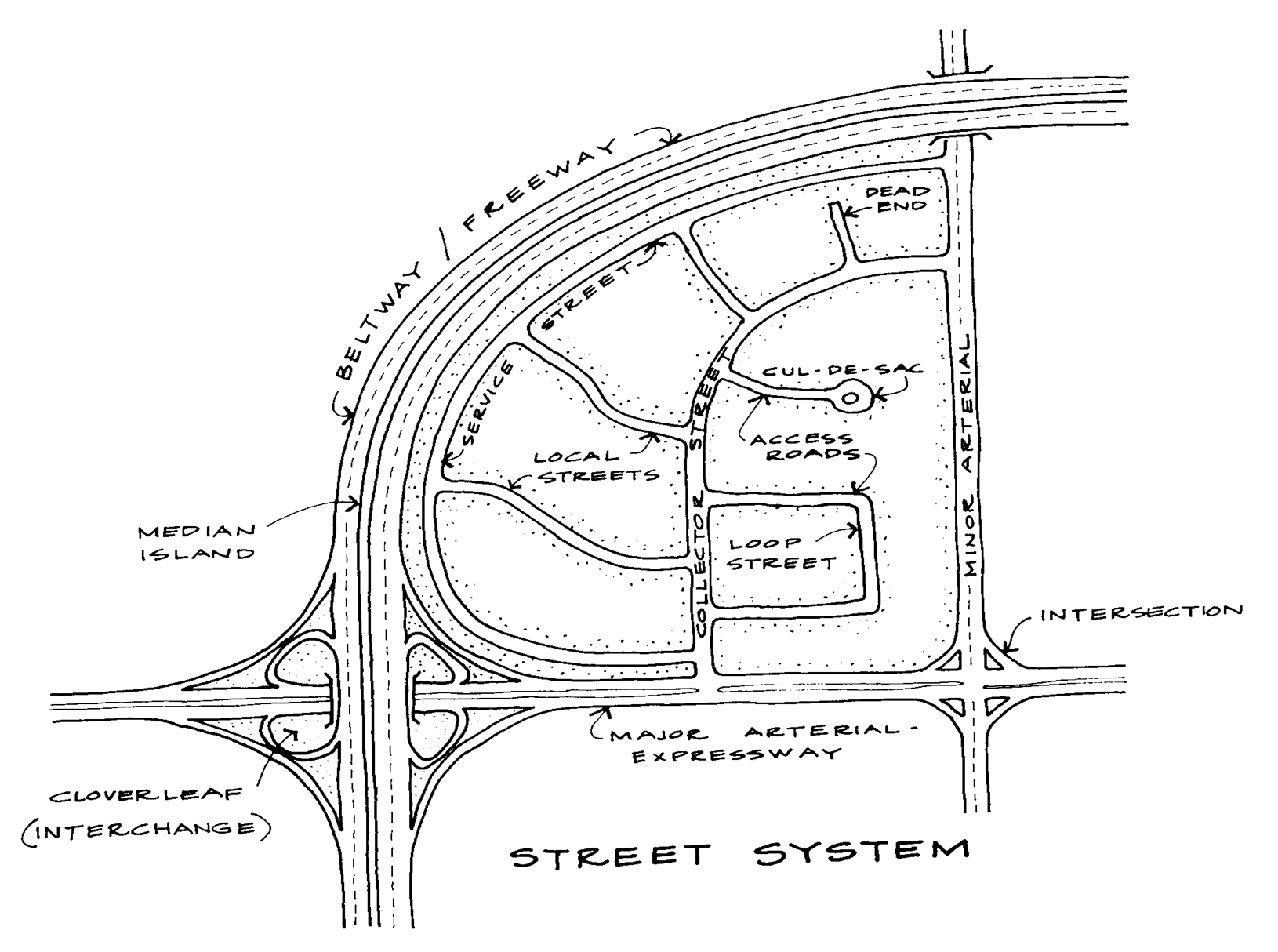
Figure 1: Street Types
142)
Street frontage: The length of any property line of a zoned lot, which property line abuts a legally accessible street right-of-way. For the purposes of determining yard requirements on corner lots, all sides of a lot adjacent to streets shall be considered frontage, and yards shall be provided as indicated under the zoning definition for yards.
143)
Structure: Anything constructed or erected on the ground or attached to something on the ground. A fence or a wall is not a structure.
144)
Temporary Structure: A structure without any foundation or footings and which is removed when the designated time period, activity or use for which the temporary structure was erected has ceased.
145)
Tenant: A natural person, business or other entity that occupies land or buildings by title, under a lease, or through payment of rent: an occupant, inhabitant, or dweller of a place.
146)
City: The City of Haralson, Georgia.
147)
City Clerk: The City Clerk of the City of Haralson or his or her designee.
148)
City Council: The Mayor and City Council of the City of Haralson. The governing body of the City of Haralson.
149)
Tree: Any living, self-supporting woody perennial plant which normally obtains a trunk diameter of at least 2 inches and a height of at least 12 feet and typically has one main stem or trunk and many branches.
a)
Canopy Tree: Any tree of greater or equal height and crown spread than surrounding trees; canopy trees typically reach a mature height of greater than 40 feet. Examples include beech, hickory, maple, oak, pecan, pine and sycamore.
b)
Deciduous Tree: Any tree that drops its leaves at the end of a growing season.
c)
Evergreen Tree: Any tree that retains its foliage throughout the year.
d)
Flowering Tree: Ornamental trees that are known for their blooms and generally mature at a height of less than 40 feet.
e)
Specimen Tree or Stand: Any tree or grouping of trees that has been determined to be of high value because of its species, size, historic significance, age or location. General criteria for the determination of specimen trees or stands are as follows:
•
Any deciduous tree who's DBH exceeds 30 inches.
•
Any evergreen tree who's DBH exceeds 24 inches.
•
Any understory tree who's DBH exceeds 10 inches.
•
Any tree that has historic value and can be documented through historical records or otherwise.
f)
Understory Tree: Any tree or woody plant of lesser height and crown spread than surrounding trees. Understory species generally reach a mature height of less than 40 feet. Examples include cherry, crab apple, dogwood, magnolia, pear, redbud, holly, sassafras, and red cedar.
150)
Turf: Ground cover composed of one or more species of perennial grass that is grown as a permanent lawn.
151)
Use: The purpose for which land or a building or other structure is designed or arranged, or for which it is occupied.
152)
Variance: Permission to depart from the literal requirements of a zoning ordinance.
153)
Vegetation: All plant growth, such as trees, shrubs, mosses and grasses.
154)
Vernacular: Vernacular architecture is historic architecture unique to a region, of or being an indigenous building style using local materials and traditional methods of construction and ornament, especially as distinguished from academic or historical architectural styles. This includes architectural styles circa early 1800's to 1920's within a radius of 500 miles of the City. Styles may include Georgian, Classic Revival, Colonial Adam, Victorian Stick, Victorian Folk, Victorian Shingle and Victorian Craftsman.
155)
Visual Screen: Natural vegetation or a decorative structure that creates an opaque visual block or obscures an unattractive view. Screening may consist of any combination of the following, as approved by the Zoning Administrator:
•
Fencing constructed of cedar, redwood, treated wood, or other suitable all-weather material.
•
Masonry walls.
•
Plant materials or natural vegetation.
•
Earthen berms.
For the purpose of this ordinance, a screen is opaque to a height of 6 feet above the ground surface.
156)
Yard: An open space that lies between the principal building or buildings and the nearest lot line. The minimum required yard as set forth in the ordinance is unoccupied and unobstructed from the ground upward except as may be specifically provided in the zoning ordinance.
157)
Yard, Front: A space extending the full width of the lot between any building and the front lot line and measured perpendicular to the building at the closest point to the front lot line.
158)
Yard, Rear: A space extending across the full width of the lot between the principal building and the rear lot line and measured perpendicular to the building to the closest point of the rear lot line.
159)
Wetlands, Protected: Those wetlands identified on the National Wetlands Inventory maps prepared by the U.S. Fish and Wildlife Service, or otherwise approved by the U.S. Army Corps of Engineers as jurisdictional wetlands based on competent studies prepared by a registered and qualified professional engineer.
160)
Window: An opening made in the wall of a building to admit light and air, and/or to furnish a view; provided, however, that as such term is used herein, the term "window" shall not include the framework for such opening, but shall only include the glass or translucent portion of such opening.
161)
Zoned lot: A parcel of land in single ownership that is of sufficient size to meet minimum zoning requirements for area, coverage, and use, and that can provide such yards and other open spaces as required by the zoning regulations
162)
Zoning: The power of local governments to provide within their respective boundaries for the zoning or districting of property for various uses and the prohibition of other or different uses within such zones or districts and for the regulation of development and the improvement of real estate within such zones or districts in accordance with the uses of property for which such zones or districts were established.
163)
Zoning decision: Final legislative action by the Council which results with:
•
The adoption of a zoning ordinance;
•
The adoption of an amendment to this ordinance which changes the text of this ordinance;
•
The adoption of an amendment to this ordinance which rezones property from one zoning classification to another;
•
The adoption of an amendment to this ordinance which zones property to be annexed into the City; or
•
The grant of a permit relating to a special use of property.
164)
Zoning District: A section of the City of Haralson, Georgia, as designated on the Official Zoning Map within which zoning regulations are uniform and compatible.
165)
Zoning Ordinance: An ordinance establishing procedures and zones or districts within the respective territorial boundaries of the City of Haralson, Georgia, which regulate the uses and development standards of property within such zones or districts. The term also includes the map adopted in conjunction with the textual ordinance which shows the zones or districts classifying property depicted thereon.

