
Harrison City Zoning Code
ARTICLE I
GENERAL PROVISIONS
17-1 - TITLE
The short form by which this Chapter may be known shall be the "Land Development Ordinance of the Town of Harrison."
(Ord. 987 § 1 (part), 1998)
17-2 - STATUTORY AUTHORITY; PURPOSE
This Chapter is adopted pursuant to the Municipal Land Use Law (MLUL), (N.J.S.A. 40:55D-1 et seq.), in order to promote and protect the public health, safety, morals and general welfare. The purposes of this Chapter are as follows:
A.
To plan and guide the appropriate use or development of all land in a manner which will promote the public health, safety, morals and general welfare by means including the following:
(1)
By regulating the location of buildings and establishing standards of development; establishing setback lines of buildings designed for residential, commercial, industrial, office or other uses and by fixing reasonable standards to which buildings or structures shall conform.
(2)
By prohibiting incompatible uses; and prohibiting uses, buildings or structures which are incompatible with the character of development of the permitted uses within specified zoning districts and surrounding areas.
(3)
By regulating alterations of existing buildings; and preventing such additions to and alterations or remodeling of existing buildings or structures as would not comply with the restrictions and limitations imposed hereunder.
(4)
By conserving the value of land and buildings throughout the Town.
B.
To secure safety from fire, flood, panic and other natural and man-made disasters.
C.
To provide adequate light, air and open space.
D.
To ensure that land development does not conflict with the development and general welfare of neighboring municipalities, the county and the state as a whole.
E.
To promote the establishment of appropriate population densities and concentrations that will contribute to the well-being of persons, maintenance of the character of the neighborhoods, preservation of the environment and quality of life.
F.
To encourage the appropriate and efficient expenditure of public funds by the coordination of public development with land use policies.
G.
To provide sufficient space in appropriate locations for a variety of residential, recreational, commercial and industrial uses and open space, both public and private, according to their respective environmental requirements.
H.
To encourage the location and design of transportation routes which will promote the free flow of traffic while discouraging the location of such facilities and routes which will result in congestion or blight.
I.
To promote a desirable visual environment through creative development techniques and good civic design and arrangements.
J.
To promote the conservation of open space and valuable natural resources and to prevent urban sprawl and degradation of the environment through improper land use.
K.
To encourage coordination of various public and private procedures and activities shaping land development with a view of lessening the cost of such development and to the more efficient use of land.
L.
To provide, within the community's resources, for the future housing needs of the citizens of the Town of Harrison.
M.
To encourage senior citizen community housing construction.
N.
To promote utilization of renewable energy sources.
O.
To promote the maximum practicable recovery and recycling of recyclable materials from municipal solid waste through the use of planning practices designed to incorporate the State Recycling Plan goals and to compliment municipal recycling programs.
(Ord. 987 § 1 (part), 1998)
17-3 - INTERPRETATION OF PROVISIONS
A.
Where the provisions of this Chapter impose greater restrictions than those imposed by any other law, ordinance, regulation or resolution, the provisions of this Chapter shall control. Where the provisions of any other law, ordinance, regulation or resolution impose a greater restriction than this Chapter, the provisions of such other law, ordinance, regulation or resolution shall control.
B.
Matters not regulated herein shall be governed by applicable provisions of the MLUL. In the event of any conflict between the provisions of this ordinance and the MLUL, the MLUL shall control.
C.
The requirements of this Chapter shall be held paramount to any less restrictive provisions or requirements established by deed restriction, private covenant or agreement. Without limiting the foregoing, where this Chapter imposes a greater restriction or limitation upon the use of buildings or premises or upon the height of buildings or lot coverage, or requires greater lot areas or larger yards, courts or other open spaces than are required by covenants or restrictions imposed by deed or private agreement, the provisions of this Chapter shall control.
(Ord. 987 § 1 (part), 1998)
17-4 - PROHIBITED USES
Following the effective date of this Chapter, the establishment of any use not expressly permitted by this Chapter shall be prohibited.
(Ord. 987 § 1 (part), 1998)
17-5 - WORD USAGE
For the purposes of this Chapter:
A.
The present tense shall include the future.
B.
The singular number shall include the plural and the plural the singular.
C.
The word "shall" is always mandatory; the word "may" is discretionary.
D.
The words "zone" and "district" are synonymous, and whenever the term "structure" is used, it shall be construed to mean and include the term "building."
(Ord. 987 § 1 (part), 1998)
17-6 - DEFINITIONS
Definitions And Usages. Unless otherwise expressly stated, the following terms shall, for the purpose of this Chapter, have the meanings herein defined. Whenever a term is used in this Chapter which is defined in the MLUL, such term shall have the same meaning as the MLUL. Any word or term not defined below or in the MLUL, shall be used with a meaning as defined in Webster's Third New International Dictionary of the English Language, unabridged (or the latest edition).
ABUTTING COUNTY ROAD — Any existing or proposed county road shown on the adopted County Master Plan or Official Map which adjoins or lies within a lot or parcel of land submitted for subdivision or site plan approval.
ACCELERATION OR DECELERATION LANE — An added roadway lane which permits integration and merging of slower-moving vehicles into the main vehicular stream or slowing down of vehicles. See Figure 1.
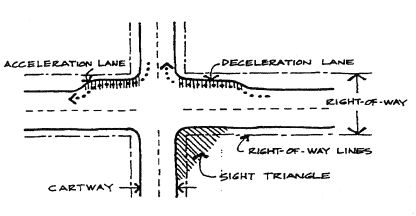
Figure 1
ACCESS — A physical entrance to property.
ACCESSORY BUILDING OR STRUCTURE — A building or structure, the use of which is customarily incidental and subordinate to that of the principal building located on the same lot. When an accessory building is attached in a substantial manner by a wall or roof to a principal building or structure, it shall be considered a part thereof.
ACCESSORY USE — A use of land or of a building or structure or portion thereof customarily incidental and subordinate to the principal use of the land or building and located on the same lot as the principal use.
ADDITION — A structure added to the original structure at some time after the completion of the original structure.
ADMINISTRATIVE OFFICER — The Zoning Officer of the Town of Harrison.
ADULT EDUCATIONAL FACILITIES/SCHOOL — Any building or part thereof which is designed, constructed or used for education of adult students (i.e. students over eighteen (18) years of age) that is not part of a licensed State of New Jersey facility, or under the jurisdiction of the Harrison Board of Education.
ADVERSE EFFECT — The results of development creating, imposing, aggravating or leading to inadequate, impractical, unsafe or unsatisfactory conditions on a site proposed for development or on off-tract property or facilities. Such conditions may relate to circulation, drainage, erosion, potable water, sewage collection and treatment or those factors specifically set forth in Article V.
ADVERSE ENVIRONMENTAL IMPACT ELEMENT — Any environmental pollutant such as smoke, odors, liquid wastes, radiation, noise, vibrations, glare, trespass lighting or heat.
AFFORDABLE HOUSING — means housing restricted to occupancies in accordance with COAH's Regional Income Limits for the production of low and moderate income housing and satisfying all requirements of COAH for credits toward meting the town of Harrison's statutorily defined Fair Share Affordable Housing obligation.
AISLE — The traveled way by which cars enter and depart parking spaces.
ALTERATION — Any change or rearrangement in the supporting members of an existing building such as bearing walls, columns, beams, girders or interior partitions, as well as any change in doors or windows or any enlargement or diminution of a building or structure. "Alteration" shall also mean and include any conversion of a building or a part thereof from one use to another or the moving of a building or structure from one location to another. Alteration shall not be construed to mean any necessary repairs of an existing structure solely for the purpose of maintenance.
APARTMENT — See DWELLING, GARDEN APARTMENT.
APPLICANT — A developer submitting an application for development.
APPLICATION FOR DEVELOPMENT — The application form and all accompanying documents required by ordinance for approval of a subdivision plan, site plan, planned development, conditional use, zoning variance or direction of the issuance of a permit pursuant to this Chapter.
APPROVED PLAN — A plan which has been granted final approval by the Planning Board or Board of Adjustment of the Town of Harrison.
ASSISTED LIVING RESIDENCE — A facility which is licensed by the State Department of Health to provide apartment style housing and congregate dining and to assure that assisted living services are available when needed for four or more adult persons unrelated to the proprietor. Apartment units offer, at a minimum, one unfurnished room, a private bathroom, a kitchenette and a lockable door on the unit entrance. A coordinated array of supportive personal and health services available 24 hours a day are usually provided.
ASSOCIATION — The entity responsible for the administration of a condominium, which entity may be incorporated or unincorporated.
ATTIC — The open non-habitable space between the ceiling beams of the top habitable story and the roof rafters in any building.
AUTOMOBILE SALES — A lot or building used for the sale or hire of automobiles and including any vehicle preparation or repair work conducted as an accessory use. This shall be interpreted to include new and used car dealerships and auto accessory salesrooms, but not the sale of junked automotive equipment, parts or inoperable motor vehicles.
BASE FLOOD ELEVATION — The highest elevation, expressed in feet above sea level, of the level of floodwaters occurring in the regulatory base flood.
BASEMENT — A space partially below grade level having one-half (½) or more of its floor- to-ceiling height above the average level of the adjoining ground and with a floor-to- ceiling height of not less than six and one-half (6½) feet.
BERM — A mound of earth or the act of pushing earth into a mound.
BICYCLE LANE — A lane at the edge of a roadway reserved and marked for the exclusive use of bicycles.
BICYCLE PATH — A pathway, often paved and separated from streets and sidewalks, designed to be used by bicycles.
BILLBOARD — A sign advertising an occupant, product or service on a lot other than the lot upon which the billboard is located.
BOARD — The Town of Harrison Planning Board when acting within its scope of jurisdiction under this Chapter and/or the MLUL, Zoning Board of Adjustment, or Town Council.
BOARD ENGINEER — A New Jersey licensed professional engineer retained to provide technical advice to the Board.
BOARDER — A person other than a member of a family occupying a part of any dwelling unit who, for a consideration, is furnished sleeping accommodations in such dwelling unit and may be furnished meals as part of this consideration..
BRIDGE — A structure designed to convey vehicles and/or pedestrians over a watercourse, railroad, street or any depression.
BUFFER — A strip of land containing natural woodlands, earth mounds, or other planted screening materials used to physically separate or screen one use or property from another so as to minimize adverse impacts. No building, parking area, driveway (except to provide access to the property and which is perpendicular to the buffer area) street, sign (except directional sign) or storage of materials shall be permitted in such buffer.
BUILDING — A combination of materials to form a construction adapted to permanent, temporary or continuous occupancy and having a roof.
BUILDING COVERAGE — The ratio of the horizontal area of all principal and accessory buildings measured from the exterior surface of the exterior walls of the ground floor on a lot to the total lot area. See Figure 2.
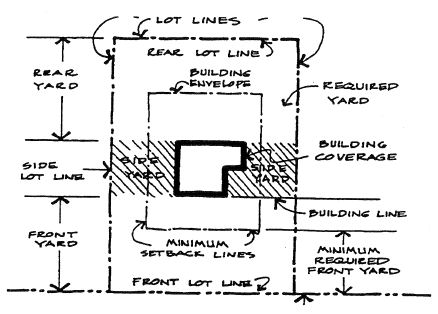
Figure 2
BUILDING ENVELOPE — The two-dimensional space within which a principal structure is permitted to be built on a lot and which is defined by minimum yard setbacks.
BUILDING HEIGHT — See HEIGHT OF BUILDING.
BUILDING LINE — A line parallel to the street line or other lot line which touches that part of a building closest to the street line or other lot line. In the case of a cantilevered section of a building, the building line will coincide with the most projected surface. See Figure 2.
CABLE VISION COMPANY — A cable television company as defined pursuit to Section 3 of P.L. 1972, c. 186 (C. 48:5A3).
CALIPER — The diameter of a tree trunk measured in inches a distance of six (6) inches off the ground.
CANNABIS — All parts of the plant Cannabis sativa L., whether growing or not, the seeds thereof, and every compound, manufacture, salt, derivative, mixture, or preparation of the plant or its seeds, except those containing resin extracted from the plant, which are cultivated and, when applicable, manufactured in accordance with P.L.2021, c.16 (C.24:6I-31 et al.) for use in cannabis products, but shall not include the weight of any other ingredient combined with cannabis to prepare topical or oral administrations, food, drink, or other product.
CANNABIS BUSINESS — Any person or entity that holds any of the six Classes of licenses established under P.L. 2021, c. 16, the "New Jersey Cannabis Regulatory, Enforcement Assistance, and Marketplace Modernization Act."
CANNABIS CULTIVATOR — Any licensed person or entity that grows, cultivates, or produces cannabis, and sells, and may transport, this cannabis to other cannabis cultivators, or usable cannabis to cannabis manufacturers, cannabis wholesalers, or cannabis retailers, but not to consumers. This person or entity shall hold a Class 1 Cannabis Cultivator license.
CANNABIS DELIVERY SERVICE — Any licensed person or entity that provides courier services for consumer purchases of cannabis items and related supplies fulfilled by a cannabis retailer in order to make deliveries of the cannabis items and related supplies to that consumer, and which services include the ability of a consumer to purchase the cannabis items directly through the cannabis delivery service, which after presenting the purchase order to the cannabis retailer for fulfillment, is delivered to that consumer. This person or entity shall hold a Class 6 Cannabis Delivery license.
CANNABIS DISTRIBUTOR — Any licensed person or entity that transports cannabis in bulk intrastate from one licensed cannabis cultivator to another licensed cannabis cultivator, or transports cannabis items in bulk intrastate from any one class of licensed cannabis establishment to another class of licensed cannabis establishment, and may engage in the temporary storage of cannabis or cannabis items as necessary to carry out transportation activities. This person or entity shall hold a Class 4 Cannabis Distributor license.
CANNABIS ESTABLISHMENT — A cannabis cultivator, a cannabis manufacturer, a cannabis wholesaler, or a cannabis retailer.
CANNABIS MANUFACTURER — Any licensed person or entity that processes cannabis items in this State by purchasing or otherwise obtaining usable cannabis, manufacturing, preparing, and packaging cannabis items, and selling, and optionally transporting, these items to other cannabis manufacturers, cannabis wholesalers, or cannabis retailers, but not to consumers. This person or entity shall hold a Class 2 Cannabis Manufacturer license.
CANNABIS PRODUCT — A product containing usable cannabis, cannabis extract, or any other cannabis resin and other ingredients intended for human consumption or use, including a product intended to be applied to the skin or hair, edible cannabis products, ointments, and tinctures. "Cannabis product" does not include: (1) usable cannabis by itself; or (2) cannabis extract by itself; or (3) any other cannabis resin by itself.
CANNABIS RETAILER — Any licensed person or entity that purchases or otherwise obtains usable cannabis from cannabis cultivators and cannabis items from cannabis manufacturers or cannabis wholesalers, and sells these to consumers from a retail store, and may use a cannabis delivery service or a certified cannabis handler for the off-premises delivery of cannabis items and related supplies to consumers. A cannabis retailer shall also accept consumer purchases to be fulfilled from its retail store that are presented by a cannabis delivery service which will be delivered by the cannabis delivery service to that consumer. This person or entity shall hold a Class 5 Cannabis Retailer license.
CANNABIS TESTING FACILITY — An independent, third-party entity meeting accreditation requirements established by the Cannabis Regulatory Commission that is licensed to analyze and certify cannabis items and medical cannabis for compliance with applicable health, safety, and potency standards.
CANNABIS WHOLESALER — Any licensed person or entity that purchases or otherwise obtains, stores, sells or otherwise transfers, and may transport, cannabis items for the purpose of resale or other transfer to either another cannabis wholesaler or to a cannabis retailer, but not to consumers. This person or entity shall hold a Class 3 Cannabis Wholesaler license.
CANOPY — A self-supporting roof-like shelter or marquee without sides, pendently affixed to the wall of a building and providing overhead protection from the weather at an entrance to said building, which shall be construed to be a part of the building to which it is affixed.
CAPITAL IMPROVEMENT PROGRAM —A timetable or schedule of all future capital improvements to be carried out during a specific period and listed in order of priority, and may also include cost estimates and the anticipated means of financing each project.
CAR WASH, AUTOMATIC — A building or place of business where the washing of motor vehicles is carried on with the use of a chain or conveyor, blower and water and/or steam cleaning device.
CARPOOL — A single-vehicle, share-the-expense method of transportation for two (2) or more individuals who regularly travel together to a common destination.
CARPORT — A roofed structure providing space for the parking or storage of motor vehicles and enclosed on not more than three (3) sides.
CARTWAY — The hard or paved area of a street between the curbs, including travel lanes and parking areas but not including curbs, sidewalks or swales. Where there are no curbs, the "cartway" is that portion between the edges of the paved width.
CELLAR — A space with less than one-half (½) of its floor to ceiling height above the average finished grade of the adjoining ground or with a floor-to-ceiling height of less than six and one-half (6½) feet.
CELLULAR COMMUNICATIONS ANTENNAS — Antennas used for the transmission and/or reception of wave frequencies for the purposes of telephone, radio, paging and/or television communication. This definition does not include antennas manufactured and intended for personal or individual use such as antennas affixed to motor vehicles. Cellular antennas are not to be construed or defined as "essential services."
CERTIFICATE OF OCCUPANCY (CO) — A document issued by the Construction Official allowing the occupancy or use of a building and certifying that the structure or use has been constructed and/or renovated according to, and in compliance with all the applicable state codes and municipal ordinances and resolutions.
CHANGE OF USE — Any use which substantially differs from the previous use of a building or land.
CHANNEL — A watercourse with a definite bed and banks which confine and conduct the normal continuous or intermittent flow of water.
CHILD CARE CENTER — An establishment providing for the care, supervision, and protection of children that is licensed by the State of New Jersey pursuant to P.L. 1983, c. 492 (C. 30:5B-1 et seq.).
CIRCULATION — Systems, structures and physical improvements for the movement of people, goods, water, air, sewage or power by such means as streets, highways, railways, pipes and conduits, and the handling of people and goods by such means as terminals, stations, warehouses and other storage buildings or transshipment points.
COMMON OPEN SPACE — An open space area within or related to a site designated as a development, and designed and intended for the use or enjoyment of residents and owners of the development. Common open space may contain such complementary structures and improvements as are necessary and appropriate for the use or enjoyment of residents and owners of the development.
COMMON OWNERSHIP — Ownership of two (2) or more contiguous parcels of real property by one (1) person or legal entity. Joint and/or common owners shall be deemed to be one legal entity.
COMMON WATER/SEWERAGE — Water supply and/or sewage disposal systems, whether privately or publicly owned and operated, that serve two (2) or more dwellings or other buildings.
COMMUNITY RESIDENCE FOR THE DEVELOPMENTALLY DISABLED — Any community residential facility licensed pursuant to P.L. 1977, c. 448 (C. 30:11B-1 et seq.) providing food, shelter, and personal guidance, under such supervision as required, to not more than 15 developmentally disabled or mentally ill persons, who require assistance, temporarily or permanently, in order to live in the community, and shall include, but not be limited to: group homes, half-way houses, intermediate care facilities, supervised apartment living arrangements, and hostels. Such a residence shall not be considered a health care facility within the meaning of the "Health Care Facilities Planning Act" (P.L. 1971, c. 136; c. 26:2H-1 et seq.). In the case of such community residence housing mentally ill persons, such residence shall have been approved for a purchase of service contract or an affiliation agreement pursuant to such procedures as shall be established by regulation of the Division of Mental Health and Hospitals of the Department of Human Services.
COMMUNITY RESIDENCE FOR PERSONS WITH HEAD INJURIES — A community residential facility licensed pursuant to P.L. 1977, c. 448 providing food, shelter and personal guidance, under such supervision as required, to not more than fifteen (15) persons with head injuries, who require assistance, temporarily or permanently, in order to live in the community, and shall include, but not be limited to, group homes, halfway houses, supervised apartment living arrangements and hostels. Such a residence shall not be considered a health care facility within the meaning of the "Health Care Facilities Planning Act," 1971, c. 136.
COMMUNITY RESIDENCE FOR THE TERMINALLY ILL — Any community residential facility operated as a hospice program providing food, shelter, personal guidance and health care services, under such supervision as required, for not more than fifteen (15) terminally ill persons.
COMMUNITY SHELTER FOR VICTIMS OF DOMESTIC VIOLENCE — Any shelter approved for a purchase of service contract and certified pursuant to standards and procedures established by regulation of the department of human services pursuant to P.L. 1979, c. 337 (C. 30:14-1 et seq.) providing food, shelter, medical care, legal assistance, personal guidance, and other services to not more than fifteen (15) persons who have been victims of domestic violence, including any children of such victims, who temporarily require shelter and assistance in order to protect their physical or psychological welfare.
CONDITIONAL USE — A use permitted in a particular zoning district only upon showing that such use in a specified location will comply with the conditions and standards for the location and operation of such use as contained in the zoning ordinance and upon the issuance of an authorization therefor by the planning board.
CONDOMINIUM — The form of ownership of real property under a master deed pursuant to N.J.S.A. 46:8B-1 et seq.
CONFERENCE CENTER — A facility used for conferences and seminars, which may include accommodations for sleeping, food preparation and eating, recreation, resource facilities and meeting rooms.
CONSTRUCTION OFFICIAL — The construction official of the town of Harrison.
CONSTRUCTION PERMIT — Legal authorization for the erection, alteration or extension of a structure.
CONTIGUOUS PARCELS — Tracts of land which share one or more common boundaries.
CONVENIENCE STORE — A retail establishment containing up to but not more than five thousand (5,000) square feet of floor area and selling primarily food products, household items, newspapers and magazines, candy, beverages, and a limited amount of freshly prepared food such as sandwiches and salads for off-premises consumption.
COUNCIL ON AFFORDABLE HOUSING (COAH) — means the New Jersey Council on Affordable Housing established under the Fair Housing Act which has primary jurisdiction for the administration of housing obligations in accordance with sound regional planning considerations in the state.
COUNTY MASTER PLAN — A composite of the plan elements for the physical development of Hudson County, with the accompanying maps, plats, charts and descriptive and explanatory matter adopted by the county planning board.
COUNTY PLANNING BOARD — The Hudson County Planning Board.
COURT — Any open space, unobstructed from the ground to the sky, that is bounded on two or more sides by the walls of a building.
CUL-DE-SAC — The turnaround at the end of a dead-end street.
CULVERT — A structure under a driveway, road, railroad or pedestrian walk, not incorporated in a closed drainage system.
CURB CUT (Drop Curb) — The opening along the curb line at which point vehicles may enter or leave the roadway.
CUT — A portion of land surface or area from which earth has been removed or will be removed by excavation; the depth below original ground surface or excavated surface.
DAYS — Calendar days.
DEAD-END STREET — A street or portion of a street which is accessible by a single means of ingress or egress.
DEDICATION FOR STREET PURPOSES — A dedication of land for construction, reconstruction, widening, repairing, maintaining, using or improving a street, public or private, and for the construction, reconstruction or alteration of facilities related to the safety, convenience or carrying capacity of said street, including, but not limited to, curbing, pedestrian walkways, drainage facilities, traffic control devices and utilities in or along road rights-of-way.
DENSITY — The permitted number of dwelling units per gross area of land to be developed.
DETENTION BASIN — See Stormwater Detention.
DEVELOPER — The legal or beneficial owner or owners of a lot or of any land included in a proposed development, including the holder of an option or contract to purchase or other person having an enforceable proprietary interest in such land.
DEVELOPMENT — The division of a parcel of land into two (2) or more parcels; the construction, reconstruction, conversion, structural alteration, relocation or enlargement of any building or other structure; any mining, excavation, landfill or land disturbances and any use, change in use or extension of use of land for which permission may be required, without limiting the foregoing. The term "development" shall include any alteration or reconstruction of any building facade within any NC zone district.
DEVELOPMENT, CONVENTIONAL — Development other than planned development or cluster development.
DEVELOPMENT REGULATION — Zoning, subdivision, site plan, official map or other municipal regulation of the use and development of land or amendment thereto adopted and filed pursuant to the Municipal Land Use Law.
DIVERSION CHANNEL — A drainage channel constructed across or at the bottom of a slope to divert water.
DRAINAGE — The removal of surface water or groundwater from land by drains, grading or other means and includes controls of runoff during and after construction, or development to minimize erosion and sedimentation, to assure the adequacy of existing and proposed culverts and bridges, to induce water recharge into the ground where practical, to lessen non-point pollution, to maintain the integrity of stream channels for their biological functions as well as for drainage, and the means necessary for water supply preservation or prevention or alleviation of flooding.
DRIVEWAY — A paved or unpaved area used for ingress or egress of vehicles and allowing access from a street to a lot, building or other structure or facility.
DRY WELL (Seepage Pit) — A covered pit with an open jointed lining into which water is piped or directed from roofs, basement floors, other impervious surfaces or swales or pipes to seep or percolate into the surrounding soil.
DWELLING — A structure or portion thereof that is used exclusively for human habitation. "Dwellings" may include but are not limited to the following types:
A.
DETACHED SINGLE-FAMILY — A dwelling for one family that is not attached to any other dwelling by any means.
B.
ATTACHED SINGLE FAMILY/TOWNHOUSE — A one-family dwelling in a row of at least three such attached dwellings in which each dwelling has its own front and rear access to the outside, no dwelling is located over another dwelling and each dwelling is separated from all other attached dwellings by one or more vertical common fire-resistant walls.
C.
TWO-FAMILY/DUPLEX — A building on a single lot containing two (2) dwelling units, each of which is separated from the other by an unpierced wall extending from ground to roof or an unpierced ceiling and floor extending from exterior wall to exterior wall, except for a common stairwell exterior to both dwelling units.
D.
THREE-FAMILY — A building on a single lot containing three (3) dwelling units.
E.
GARDEN APARTMENT — Three (3) or more dwellings located within a single building, with an entrance to each dwelling by direct access from the outside or through a common hall. "Garden apartments" may include buildings in cooperative or condominium ownership. Also see "dwelling, multi-family."
F.
MOBILE — A structure constructed as a vehicle, containing living quarters with accommodations for sleeping, and which may or may not have built-in sanitary and cooking facilities. It may either move from place to place under its own power or be towed by any other vehicle. It may also be immobilized without changing its character. This term includes habitable trailers, camping trailers and similar habitable devices.
G.
MULTI-FAMILY — A building containing three (3) or more dwelling units that share common horizontal separations, including garden apartments.
DWELLING UNIT — One (1) or more rooms designed, occupied or intended for occupancy as separate living quarters with cooking, sleeping and sanitary facilities provided within the dwelling unit for the exclusive use of a single family maintaining a household.
EMBANKMENT — A man-made or natural deposit of soil, rock or other materials.
ENCROACHMENT, FLOOD PLAIN — Any obstruction within a delineated flood plain.
ENVIRONMENTAL IMPACT ASSESSMENT — A study to determine the potential direct and indirect effects of a proposed development on the environment.
EXCAVATION — Removal or recovery by any means whatsoever of minerals, mineral substances or organic substances, other than vegetation, from the water, land surface or beneath the land surface, whether exposed or submerged.
EXISTING GRADE — The vertical location of the ground surface prior to excavating or filling.
FAMILY — A group of individuals not necessarily related by blood, marriage, adoption, or guardianship living together in a dwelling unit as a single housekeeping unit under a common housekeeping management plan based on an intentionally structured relationship providing organization and stability.
FAMILY DAY CARE HOME — Any private residence approved by the Division of Youth and Family Services or an organization with which the division contracts for family day care in which child care services are regularly provided to no less than three (3) and no more than five (5) children for no less than fifteen (15) hours per week. A child being cared for under the following circumstances is not included in the total number of children receiving child care services:
A.
The child being cared for is legally related to the provider; or
B.
The child is being cared for as part of a cooperative agreement between parents for the care of their children by one (1) or more of the parents, where no payment for the care is being provided.
FENCE — A structure made of posts or stakes, joined together by boards, wire or rails, serving as an enclosure, a barrier or as a boundary.
FINAL APPROVAL — The official action of the Planning Board taken on a preliminary approved major subdivision or site plan after all conditions, engineering plans and other requirements have been completed or fulfilled and the required improvements have been installed or guarantees properly posted for their completion, or approval conditioned upon the posting of such guarantees.
FINANCIAL INSTITUTION — Any structure wherein business of primarily a monetary nature is transacted, such as banks, savings and loans associations, mortgage companies and similar institutions.
FLOOD OR FLOODING — A general and temporary condition of partial or complete inundation of normally dry land areas from the overflow of inland or tidal waters and/or the unusual and rapid accumulation or runoff of surface waters from any source.
FLOOD DAMAGE POTENTIAL — The susceptibility of a specific land use at a particular location to damage by flooding and the potential of the specific land use to increase off-site flooding or flood-related damages.
FLOOD FRINGE AREA — That portion of the flood hazard area outside the floodway, based on the total area inundated during the regulatory base flood plus 25 percent of the regulatory base flood discharge. See Figure 3.
FLOOD HAZARD AREA — The flood plain consisting of the floodway and the flood fringe area. See Figure 3.
FLOOD HAZARD DESIGN ELEVATION — The highest elevation, expressed in feet above sea level, of the level of floodwaters which delineates the flood fringe area.
FLOOD INSURANCE RATE MAP (FIRM) — The official map on which the Federal Insurance Administration has delineated both the areas of special flood hazards and the risk premium zones applicable to the community.
FLOOD OF RECORD — The greatest flood in the Town for which accurate records are available.
FLOOD PLAIN — The same as the "flood hazard area".
FLOOD, REGULATORY BASE — Flood having a one (1) percent chance of being equaled or exceeded in any given year.
FLOODWAY — The channel of a natural stream or river and portions of the flood plain adjoining the channel which are reasonably required to carry and discharge the floodwater or flood flow of any natural stream or river. See Figure 3.
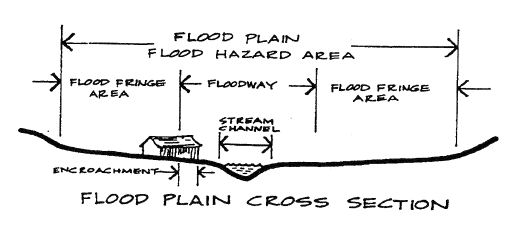
Figure 3
FLOODWAY, REGULATORY — The channel and the adjacent land areas that must be reserved in order to discharge the regulatory base flood without cumulatively increasing the water surface elevation more than two-tenths (0.2) of one (1) foot.
FLOOR AREA, NONRESIDENTIAL — The sum of the area of all floors of buildings measured to the dimensions of the outside walls of the buildings, excluding (1) attic, basement and cellar floor area used solely for storage or utilities; (2) parking garages; (3) open porches, patios, terraces, breezeways, arcades, utility, mechanical and emergency power equipment areas; (4) guard houses; and (5) any open area above the ground floor within an open atrium space.
FLOOR AREA, RESIDENTIAL — The sum of the gross horizontal areas (including enclosed porches) of the several floors of a building or group of buildings on a lot, measured from the exterior faces of exterior walls or from the center line of a wall separating two (2) buildings, but excluding the following:
1.
Cellars.
2.
Any floors or portions thereof contained on terraces or balconies projecting beyond the exterior face of the building.
3.
Decks.
4.
Attics.
5.
Private garages of less than five hundred (500) square feet (either attached or detached).
FLOOR AREA RATIO (FAR) — The sum of the floor area of all floors of buildings or structures compared to the total area of the site.
FLY ASH — Particles of airborne matter, not including process material, arising from the combustion of fuel, such as coal, wood or oil.
FOOD ESTABLISHMENT — An establishment primarily engaged in the retail sale of food which is processed or otherwise prepared for eventual consumption but not consumed on the premises. Such uses include but are not limited to the following: bakeries, delicatessens, ice cream parlors, and bagel shops. Where such uses have tables, such uses shall be deemed restaurants.
FRONTAGE — See LOT, FRONTAGE.
FUNERAL HOME — A building used for the preparation of the deceased for burial and the display of the deceased and rituals connected therewith before burial or cremation.
GARAGE, PARKING — A building intended for the parking of motor vehicles.
GARAGE, PRIVATE — A detached accessory building or a portion of the main building used primarily for the storage of a passenger vehicle or vehicles and not more than one (1) commercial vehicle of a rated capacity not exceeding three-quarter (¾) tons, which commercial vehicle is owned or used by the occupant of the building to which the garage is accessory.
GARAGE, PUBLIC — An enclosed building intended for the storage, servicing, or repair of motor vehicles as a business or any facility that is a part of an agency dealing in new or used motor vehicles. A public garage shall not include a car wash or auto detailing facility.
GASOLINE SERVICE STATION — A place where gasoline or other motor fuel is offered for sale to the public and deliveries are made directly into motor vehicles and which may provide for minor repairs but shall not include auto body work, welding or painting, nor any repair work outside of the enclosed building.
GOVERNING BODY — The Town Council of the Town of Harrison.
GOVERNMENT AGENCY — Any department, commission, independent agency or instrumentality of the United States, the State of New Jersey, and/or any county, municipal or other governmental unit.
GRADE, FINISHED — The final grade or elevation of the ground surface conforming to the proposed design.
GRADING — Any operation that modifies the existing topography such as cutting, stripping, filling, stockpiling or any combination thereof.
GROUND FLOOR — The first floor of a building other than a cellar or basement.
HAZARDOUS MATERIALS — Such elements or compounds which, when discharged in any quantity into the environs of air, water or soil, present potential danger to the public health or welfare and vegetation or any forms of wildlife.
HEIGHT OF BUILDING — The vertical distance from the average finished ground elevation on any side around the foundation of a building or structure to the level of the highest point of the roof surface. HOME OCCUPATION — An occupation or activity carried out for gain by a resident and conducted as a customary, incidental and accessory use in the resident's dwelling unit or other structure located on the lot.
HOMEOWNERS' ASSOCIATION — A community association, other than a condominium association, that is organized in a development in which individual owners share common interests and responsibilities for costs and upkeep of common open space or facilities.
HOTEL, MOTOR HOTEL OR MOTEL — A facility offering transient lodging accommodations to the general public and may provide additional services such as restaurants, meeting rooms, entertainment and recreation facilities.
HOUSE OF WORSHIP — A building or structure, or groups of buildings or structures, that by design and construction are primarily intended for conducting organized religious services and associated accessory uses.
HOUSEHOLD — A family living together in a single dwelling unit, with common access to and common use of all living and eating areas and all areas and facilities for the preparation and serving of food within the dwelling unit.
IMPERVIOUS COVERAGE — Any material which generally reduces or prevents absorption of stormwater into the ground, including but not limited to buildings, parking areas, driveways, sidewalks, paving and patios, but not swimming pools. All required parking areas which are permitted to remain unimproved and all gravel areas shall be considered as impervious surfaces.
IMPROVED LOT — A lot upon which exists a structure or building.
INCLUSIONARY ZONING — means zoning that requires development of affordable housing units in conjunction with market-rate units. This term includes, but is not limited to: new construction, the conversion of a non-residential structure to residential, the creation of new affordable housing units through the reconstruction of vacant structures.
INSTITUTIONAL AND PUBLIC USES — Non-profit public or quasi-public institutions and uses, such as public and private schools, libraries and municipally-owned or operated buildings, structures or land used for public purposes, not including houses of worship.
INTERESTED PARTY:
A.
In a criminal or quasi-criminal proceeding, any citizen of the State of New Jersey.
B.
In the case of a civil proceeding in any court or in an administrative proceeding before a municipal agency, any person, whether residing within or without the Town, whose right to use, acquire, or enjoy property is or may be affected by any action taken under this act, or whose rights to use, acquire, or enjoy property under this act, or under any other law of this State or of the United States have been denied, violated or infringed by an action or a failure to act under this act.
LAND - Including improvements and fixtures on, above or below the surface.
LAND DISTURBANCE — Any activity involving the clearing, cutting, excavating, filling, grading and any other activity which causes land to be exposed to the danger of erosion.
LOCAL UTILITY — Any sewerage authority created pursuant to the "Sewerage Authorities Law," P.L. 1946, c. 138 (C. 40:14A-1 et seq.); any utilities authority created pursuant to the "municipal and county utilities authority law," P.L. 1957, c. 183 (C. 40:14B-1 et seq.); or any utility, authority, commission, special district or other corporate entity not regulated by the Board of Regulatory Commissioners under Title 48 of the Revised Statutes that provides gas, electricity, heat, power, water or sewer service to a municipality or the residents thereof.
LONG TERM CARE FACILITY/NURSING FACILITY/NURSING HOME — A facility that is licensed by the Department of Health to provide health care under medical supervision and continuous nursing care for 24 or more consecutive hours to two (2) or more patients who do not require the degree of care and treatment which a hospital provides and who, because of their physical or mental condition, require continuous nursing care and services above the level of room and board.
LOT — A designated parcel, tract or area of land established by plat, or otherwise as permitted by law, and to be used, developed or built upon as a unit.
LOT AREA — The total area within the lot lines of a lot but not including any street rights-of-way.
LOT, CORNER — A parcel of land, either at the junction of and abutting on two (2) or more intersecting streets, or abutting a single street at the point where the road tangents deflect by more than forty-five (45) degrees. The greater frontage of a corner lot is its depth and the lesser frontage is its width.
LOT, COVERAGE — That part of one (1) lot or more than one (1) lot which is improved or is proposed to be improved with buildings and/or other structures, including but not limited to driveways, parking lots, pedestrian walkways and other man-made improvements on the ground surface which are more impervious than the natural surface.
LOT DEPTH — The minimum distance between its mean front lot line and its mean rear lot line.
LOT DISTURBANCE — All areas disturbed for the purpose of the construction of buildings or other structures on an individual fee simple lot. This total shall include all disturbance including but not limited to building and structure areas, lawns and areas of tree removal.
LOT FRONTAGE — The shortest distance between the intersection points of the side lines of a lot with the front street right-of-way line. In the case of corner lots, the frontage shall be measured along the lesser frontage.
LOT, INTERIOR — A lot other than a corner lot.
LOT, THROUGH — A lot that fronts upon two (2) parallel streets or that fronts upon two streets that do not intersect at the boundaries of the lot.
LOT LINE — A line of record bounding a lot that divides one lot from another lot or from a public or private street or any other public space.
LOT LINE, FRONT — The lot line separating a lot from a street right-of-way, also referred to as a "street line." In the case of corner lots, the front lot line shall street line with lesser frontage. In the case of through lots, the front lot line shall be the line on which the primary entrance of the principal building faces. See Figure 2.
LOT LINE, REAR — The lot line opposite and most distant from the front lot line, or the point at which the side lot lines meet.
LOT LINE, SIDE — Any lot line other than a front or rear lot line. See Figure 2.
LOT WIDTH — The distance between the side lot lines measured at the front setback line. On corner lots, lot width shall be measured at the front setback line parallel to the lesser frontage.
MAINTENANCE GUARANTEE — Any security which may be accepted by a municipality for the maintenance of any improvements required by the Municipal Land Use Law, including but not limited to surety bonds and letters of credit under the circumstances specified in Section 16 of P.L. 1991, c. 256 (C. 40:55D-53.5), and cash.
MAJOR SUBDIVISION — Any subdivision not classified as a minor subdivision.
MARQUEE — Any hood, canopy, awning or permanent construction that projects from the wall of a building, usually above an entrance.
MASTER PLAN — A composite of one (1) or more written or graphic proposals for the development of the Town of Harrison as set forth in and adopted pursuant to N.J.S.A. 40:55D-28 et seq.
MAYOR — The chief executive of the Town.
MINOR SITE PLAN — A minor site plan means a development:
A.
In compliance with all zoning and land development requirements and not requiring variances or design waivers, and
B.
Not involving adverse development impacts upon surrounding properties or streets, planned development, any new street or the extension of any off-tract improvement, and
C.
Involving (a) a building addition or accessory structures with a gross floor area not exceeding ten (10) percent of the gross floor area of the existing principal building or 1,000 square feet, whichever is less, and/or (b) a site improvement requiring an area of disturbance of one thousand (1,000) square feet or less, and/or (c) the addition of parking spaces not exceeding ten (10) percent of the number of existing spaces, or five (5) new parking spaces, whichever is less.
MINOR SUBDIVISION — Any subdivision containing not more than three (3) lots and which does not involve: a planned development; any new street; or the extension of any off-tract improvement, the cost of which is to be prorated pursuant to N.J.S.A. 40:55D-42. Any lot or remaining land approved as a minor subdivision shall not be submitted as a minor subdivision within five (5) years from the date of approval as a minor subdivision. Such lot or tract may be submitted as a major subdivision.
MLUL — The Municipal Land Use Law, N.J.S.A. 40:55D-1 et seq.
MUNICIPAL AGENCY — The Planning Board, Board of Adjustment or the Town Council when acting pursuant to the Municipal Land Use Law.
MUNICIPAL LAND USE LAW — N.J.S.A. 40:55D-1 through 55D-92, as amended.
MUNICIPAL USE — Any governmental use made by the Town of Harrison of property owned or leased by it or legally under its control by easement, license or otherwise.
NATURAL GROUND SURFACE — The ground surface in its original state before any grading, excavation or filling.
NONCONFORMING LOT — A lot, the area, dimension or location of which was lawful prior to the adoption, revision or amendment of a zoning ordinance, but fails to conform to the requirements of the zoning district in which it is located by reason of such adoption, revision or amendment.
NONCONFORMING SIGN — Any sign lawfully existing on the effective date of an ordinance or any amendment thereto, that renders such sign nonconforming because it does not conform to all the standards and regulations of such ordinance.
NONCONFORMING STRUCTURE — A structure the size, dimension or location of which was lawful prior to the adoption, revision or amendment to a zoning ordinance, but which fails to conform to the requirements of the zoning district in which it is located by reasons of such adoption, revision or amendment.
NONCONFORMING USE — A use or activity which was lawful prior to the adoption, revision or amendment of a zoning ordinance, but which fails to conform to the requirements of the zoning district in which it is located by reasons of such adoption, revision or amendment.
NURSING FACILITY/NURSING HOME — See Long Term Care Facility.
OBLIGOR — Any individual, firm, association, corporation or any other legal entity and shall include the owner or subdivider, or both, as may be required by the Town. The "obligor" shall be responsible for posting and executing any required performance guaranty.
OFFICIAL MAP — A map adapted by ordinance pursuant to Article 5 of P.L. 1975, c. 291 (C. 40:55D-32).
OFF-SITE — Located outside the lot lines of the lot in question but within the property (of which the lot is a part) which is the subject of a development application or a contiguous portion of a street or right-of-way.
OFF-TRACT — Not located on the property which is the subject of a development application nor on a contiguous portion of a street or right-of-way.
ON-SITE — Located on the lot in question.
ON-TRACT — Located on the property which is the subject of a development application or on a contiguous portion of a street or right-of-way.
OPEN SPACE — Any parcel or area of land or water essentially unimproved and set aside, dedicated, designated or reserved for public or private use or enjoyment or for the use and enjoyment of owners and occupants of land adjoining or neighboring such open space; provided that such areas may be improved with only those buildings, structures, streets and off-street parking and other improvements that are designed to be incidental to the natural openness of the land.
PARKING AREA, PRIVATE — Any open area, including parking spaces and aisles, providing direct access thereto, used for the temporary storage of automobiles and other permitted vehicles for the private use of the owners or occupants of the lot on which the area is located.
PARKING AREA, PUBLIC — Any open area, other than a street or other public way, including parking spaces and access aisles, providing direct access thereto, used for the temporary storage of automobiles and other permitted vehicles and available to the public, with or without compensation, or as an accommodation for clients, customers and employees.
PARKING FACILITY — Any public or private parking area or garage.
PARKING SPACE — A space for the off-street parking of one (1) operable, licensed motor vehicle within a public or private parking area.
PARTY IMMEDIATELY CONCERNED — For purposes of notice, any applicant for development, the owners of the subject property and all owners of property and government agencies entitled to notice under Section 17-12.3B below.
PATIO — A level, surfaced area directly adjacent to a principal building at or within one and one-half (1½) feet of the finished grade, not covered by a permanent roof.
PERFORMANCE GUARANTEE — Any security which may be accepted by the town, including cash, provided that a municipality shall not require more than ten (10) percent of the total performance guarantee in cash.
PERFORMANCE STANDARDS — Standards (1) adopted by ordinance pursuant to N.J.S.A. 40:55D-65d regulating noise levels, glare, skyglow, earthborn or sonic vibrations, heat, radiation, television or radio waves, noxious odors, toxic materials, explosive and inflammable materials, smoke and airborne particles, waste discharge, screening of unsightly objects or conditions and such other similar matters as may be reasonably required by the town or (2) required by applicable federal or state laws or municipal ordinances.
PERMIT — A certificate issued to perform work under this chapter.
PERSON — A corporation, company, association, society, firm, partnership or joint-stock company, as well as an individual, the state and all political subdivisions of the state or any agency or instrumentality thereof.
PERSONAL SERVICES — Establishments primarily engaged in providing services involving the care of a person or his or her personal goods or apparel.
PLACE OF GROUP INSTRUCTION — An establishment intended to provide groups of five or more individuals with instruction or learning in matters pertaining to art, business, computer training, vocational or technical training, language, sports, self-defense, recreation, or other skills or subjects, but not offering the full curriculum of academic instruction provided by a high school, college or university.
PLAT — A map or maps of a subdivision or site plan.
PLAT, FINAL — The final map of all or a portion of a subdivision or site plan which is presented to the Planning Board for final approval in accordance with this chapter.
PLAT, PRELIMINARY — The preliminary map indicating the proposed layout of the subdivision or site plan which is submitted to the planning board for consideration and preliminary approval.
PORCH — A roofed open area, which may be screened, usually attached to or part of and having direct access to and from a building.
PRELIMINARY APPROVAL — The conferral of certain rights, pursuant to Section 17-68, prior to final approval after specific elements of a development plan have been agreed upon by the Planning Board and the applicant.
PRELIMINARY FLOOR PLANS AND ELEVATIONS — Architectural drawings prepared during early and introductory stages of the design of a project illustrating in a schematic form, its scope, scale and relationship to its site and immediate environs.
PRINCIPAL BUILDING — A building in which is conducted the main use of the lot.
PUBLIC AND QUASI-PUBLIC — designation is applied to land with structures or uses, such as public and private schools, churches, parks, community buildings, cemeteries, utility facilities and similar uses. Lands currently owned by public agencies, or held in reserve for future development of community facilities owned or operated by a governmental entity or its designee, also receive this designation.
PUBLIC DRAINAGE WAY — The land reserved or dedicated for the installation of stormwater sewers or drainage ditches, or required along a natural stream or watercourse for preserving the biological as well as drainage function of the channel and providing for the flow of water to safeguard the public against flood damage, sedimentation and erosion and to assure the adequacy of existing and proposed culverts and bridges, to induce water recharge into the ground where practical, and to lessen non-point pollution.
PUBLIC OPEN SPACE — An open space area conveyed or otherwise dedicated to a municipality, municipal agency, board of education, state or county agency, or other public body for recreational or conservational uses.
PUBLIC UTILITY FACILITIES — Telephone and electric lines, poles, equipment and structures, water or gas pipes, hydrants, valves, mains or structures or sewer pipes, together with accessories and appurtenances, maintained, operated and conducted for the service, convenience, necessity, health and welfare of the public.
QUORUM — A majority of the full authorized membership of a municipal agency.
RECREATION FACILITY — A place where sports, leisure time activities and customary and usual recreational activities are carried out.
RECREATION FACILITY, PERSONAL — An accessory use located on the same lot as the principal permitted use and designed to be used primarily for the occupants of the principal use and their guests.
RECREATION FACILITY, PRIVATE — Facilities operated by a private organization and open only to bona fide members and guests of such organization.
RECREATION FACILITY, PUBLIC — Facilities operated by the town, county or other governmental agency.
RECREATIONAL VEHICLE — A vehicle without permanent foundation that can be towed, hauled or driven and primarily designed as temporary living accommodation for recreational, camping and travel use.
RESEARCH LABORATORY — A facility limited to laboratories engaged in scientific investigation, testing or the production of factual information for industrial, commercial or institutional clients.
RESIDENTIAL CLUSTER — A contiguous or non-contiguous area to be developed as a single entity according to a plan containing residential housing units which have a common or public open space area as an appurtenance.
RESIDENTIAL DENSITY — The number of dwelling units per gross acre of residential land area, including streets, easements and open space portions of a development.
RESTAURANT — An establishment where food and drink are prepared and/or served and consumed at tables within the principal building without facilities for drive-thru order and for drive-thru pick up.
RESTAURANT, TAKE-OUT — An establishment where food and/or beverages are sold in a form ready for consumption and where all or a significant portion of the consumption takes place outside the confines of the restaurant.
RESUBDIVISION — The further division or relocation of lot lines of any lot or lots within a subdivision previously made and approved or recorded according to law; or the alteration of any streets or the establishment of any new streets within any subdivision previously made and approved or recorded according to law, but does not include conveyances made so as to combine existing lots by deed or other instrument.
SATELLITE EARTH STATION — An apparatus capable of transmitting and/or receiving signals from geo stationary orbital satellites.
SCHOOL — Any building or part thereof which is designed, constructed or used for education of students up to and through the secondary level and licensed by the State of New Jersey, Board of Education.
SELF STORAGE FACILITIES — A building or group of buildings containing separate, individual, and private storage spaces of varying sizes available for lease or rent for varying periods of time.
SENIOR CITIZEN — A head of a household who is sixty-two (62) years of age or older.
SENIOR HOUSING — Housing that is located and designed to meet the special needs and accommodate the changing living arrangements of an elderly population.
SETBACK LINE — That line to which a building must be set back from the property line.
SIGHT TRIANGLE — A triangular shaped portion of land established at intersections in accordance with the requirements of this Chapter in which nothing shall be erected, placed, planted or allowed to grow in such a manner as to limit or obstruct sight distance of motorists entering or leaving the intersection.
SIGN — Any device, fixture, placard or structure that uses color, form, picture, display, graphic, illumination, symbol or writing to advertise, attract attention to, announce the purpose of, or identify a person, entity or thing, or to communicate any information to the public.
SIGN, ADVERTISING — A sign maintained which advertises or otherwise directs attention to a use, business, products, commodity, service, activity or entertainment manufactured, conducted, sold or offered elsewhere than on the premises where such sign is located.
SIGN, BUILDING — Any sign attached below the roof line to any part of a building, as contrasted to a freestanding sign. Building signs include wall signs, window signs, and canopy signs.
SIGN, CANOPY — Any sign on, or attached to, an awning, marquee, or canopy, fixed or movable, projecting from a building.
SIGN, FREESTANDING — Any sign supported by structures or supports that are placed on, or anchored in, the ground and that are independent from any building or other structure.
SIGN, WALL — Any sign attached parallel to, but within six (6) inches of, a wall, painted on the wall surface of, or erected and confined within the limits of an outside wall of any building or structure, which is supported by such wall or building, and which displays only one (1) sign surface.
SIGN, WINDOW — Any sign that is placed within a window or upon the window panes or glass and is visible from the exterior of the window.
SIGN, WINDOW, PERMANENT — Any window sign that is painted directly on the window glass with permanent paint, or that is mounted by bolts or screw, or otherwise in a permanent fashion, on a permanent structure.
SIGN, WINDOW, TEMPORARY — Any window sign that is not a permanent window sign.
SITE — Any plot or parcel of land or combination of contiguous lots or parcels of land.
SITE PLAN — A development plan of one (1) or more lots on which is shown:
A.
The existing and proposed conditions of the lot, including but not necessarily limited to topography, vegetation, drainage, flood plains, marshes and waterways.
B.
The location of all existing and proposed buildings, drives, parking spaces, walkways, means of ingress and egress, drainage facilities, utility services, landscaping, structures and signs, lighting, screening devices;
C.
Any other information that may be reasonably required in order to make an informed determination pursuant to an ordinance requiring review and approval of site plans by the Planning Board.
SOIL — All unconsolidated mineral and organic material of whatever origin that overlies bedrock and which can be readily excavated.
SOIL CONSERVATION DISTRICT — The Hudson-Essex-Passaic Soil Conservation District.
SOIL EROSION AND SEDIMENT CONTROL PLAN — A plan which indicates necessary land treatment measures, including a schedule for installation, which will effectively minimize soil erosion and sedimentation. Such measures shall be at least equivalent to the standards and specifications as adopted by the Hudson-Essex-Passaic Soil Conservation District.
STAFFING AND EMPLOYMENT AGENCIES — are those businesses dedicated to assisting clients choosing and finding temporary and/or permanent jobs. Such job placement may include, but is not limited to, administrative and executive assistants, receptionists, word processors, secretaries, data entry, customer service representatives as well as day laborers and other skilled labor job placement.
STORAGE — The keeping or placing of goods, wares, materials, merchandise or equipment in a warehouse or other structure or in any open space.
STORAGE SHED — An accessory building used for the storage of items such as, but not limited to, tools, lawn and garden equipment and furniture, and similar items of personal property belonging to the occupant of the principal structure.
STORMWATER DETENTION — Any storm drainage technique which retards or detains runoff, such as a detention or retention basin, parking lot storage, rooftop storage, porous pavement, dry wells or any combination thereof.
STORMWATER RETENTION — Collection and storage of stormwater runoff with release being through infiltration and evaporation.
STORY — That portion of a building included between the surface of any floor and the surface of the floor next above it, or if there is no floor above it, then the space between the floor and the ceiling next above it.
STORY, HALF — A space under a sloping roof that has the line of intersection of the roof decking and wall face not more than three feet above the top floor level and in which space the possible floor area with a headroom of five feet or less occupies at least 40 percent of the total floor area of the story directly beneath.
STREAM — A watercourse having a source, terminus, banks and channel through which waters flow at least periodically.
STREET — A street, avenue, boulevard, road, parkway, viaduct, drive or other way:
A.
Which is an existing state, county or municipal roadway; or
B.
Which is shown upon a plat heretofore approved pursuant to law; or
C.
Which is approved by official action as provided by this Chapter; or
D.
Which is shown on a plat duly filed and recorded in the office of the county recording officer prior to the appointment of a planning board and the grant to such board of the power to review plats; and includes the land between the street lines, whether improved or unimproved, and may comprise pavement, shoulders, gutters, curbs, sidewalks, parking areas and other areas within the street lines. For the purpose of this Chapter, "street" shall be classified as follows:
STREET, COLLECTOR — A street that collects traffic from local streets and connects with major and minor arterials and so designated in the duly adopted Town Master Plan. See Figure 5.
STREET, CUL-DE-SAC — A street with a single common ingress and egress with a turnaround at the end. See Figure 5.
STREET, LOCAL — A street intended primarily for access to individual properties and designed for local traffic and so designated in the duly adopted Town Master Plan. See Figure 5.
STREET, MAJOR ARTERIAL — Any street or road intended to carry large traffic volumes at steady speeds through the Town and so designated in the duly adopted Town Master Plan. See Figure 5.
STREET, SERVICE — A street running parallel to a freeway or major arterial and serving abutting properties, See Figure 5.
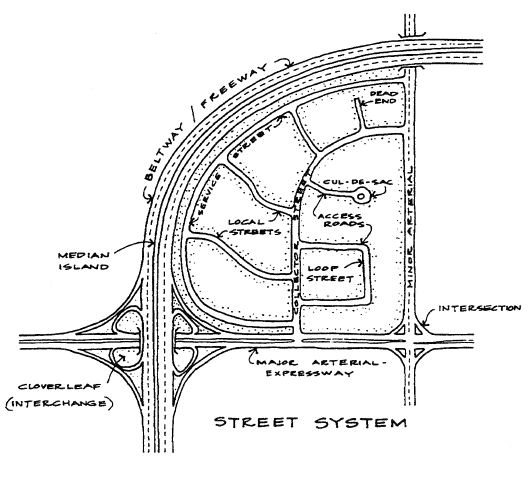
Figure 5
STRUCTURE — A combination of materials to form a construction for occupancy, use or ornamentation, whether installed on, above or below the surface of a parcel of land.
SUBDIVISION — The division of a lot, tract or parcel of land into two or more lots, tracts, parcels or other divisions of land for sale or development. The following shall not be considered subdivisions within the meaning of this Chapter, if no new streets are created:
A.
Divisions of land found by the Planning Board to be for agricultural purposes where all resulting parcels are 5 acres or larger in size.
B.
Divisions of property by testamentary or intestate provisions.
C.
Divisions of property upon court order, including but not limited to judgments of foreclosure.
D.
Consolidation of existing lots by deed or other recorded instrument.
E.
The conveyance of one (1) or more adjoining lots, tracts or parcels of land, owned by the same person or persons, and all of which are found and certified by the administrative officer to conform to the requirements of the Municipal Development regulations and are shown and designated as separate lots, tracts or parcels on the Tax Map or Atlas of the Town.
The term "subdivision" shall also include the term "resubdivision."
SUBSTANTIAL IMPROVEMENT — Any repair, reconstruction or improvement of a structure, the cost of which equals or exceeds fifty (50) percent of the market value of the structure either before the improvement or repair is started or, if the structure has been damaged and is being restored, before the damage occurred. For the purposes of this definition, "substantial improvement" is considered to occur when the first alteration of any wall, ceiling, floor or other structural part of the building commences, whether or not that alteration affects the external dimensions of the structure. The term does not, however, include either any project for improvement of a structure to comply with existing state or local health, sanitary or safety code specifications which are solely necessary to assure safe living conditions or any alteration of a structure listed on the National Register of Historic Places or a State Inventory of Historic Places.
SWIMMING POOL, PRIVATE — An artificial basin or other structure for the holding of water, constructed on residential premises for the sole use of the occupant of the premises, his family and guests, for wading, swimming, diving or other aquatic sports and recreation. The term "swimming pool" shall not include any plastic, canvas, rubber or other small receptacle temporarily erected on the ground and which holds less than five hundred (500) gallons of water.
TOPSOIL — The surface soil and soil material to a depth of six (6) inches tillage, its equivalent in cultivated soil or the original or present "A" horizon plus "B" horizon [if in top six (6) inches], as defined by the National Cooperative Soil Survey of the United States Department of Agriculture, before its removal or displacements for any purposes whatsoever. "Topsoil" shall be capable of supporting vegetation indigenous to the area.
TOWN ENGINEER — That person appointed to the position by Town Council.
TRACT — Property which is the subject of a development application.
TRACT DISTURBANCE — All tract disturbance not associated with individual lots including areas disturbed for roadways and drainage systems.
TRAILER — Every vehicle with or without motive power, other than a pole trailer, designed for carrying persons or property and for being drawn by a motor vehicle.
TRESPASS LIGHTING — Any form of artificial illumination emanating from a light fixture or illuminated sign that penetrates other property.
USE — The purpose or activity for which land or buildings are arranged, designed or intended or for which land or buildings are occupied or maintained.
USE, PRINCIPAL — The main or primary activity of any lot or parcel.
VARIANCE — Permission to depart from the literal requirements of the zoning ordinance.
VEGETATIVE PROTECTION — Stabilization of erosive or sediment-producing areas by covering the soil with permanent or short-term seeding, mulching or sodding.
VEHICULAR SALES AREA — An open area, other than a right-of-way or public parking area, used for display, sale or rental of new or used vehicles in operable condition and where no repair work is done.
WALL — A solid, vertical structure of wood, masonry or other material serving to enclose, divide or protect an area.
WATER BODIES — Any natural or artificial collection of water, whether permanent or temporary.
WATER-CARRYING CAPACITY — Ability of a channel or floodway to transport flow as determined by its shape, cross-sectional area, bed slope and coefficient of hydraulic friction.
WATERCOURSE — Any natural or artificial watercourse, stream, river, creek, ditch, channel, canal, conduit, culvert, drain, waterway, gully, ravine or wash in which water flows in a definite direction or course, either continuously or intermittently, and which has a definite channel, bed and banks, and shall include any area adjacent thereto subject to inundation by reason of overflow or floodwater.
WHOLESALE SALES AND SERVICES — Establishments or places of business primarily engaged in selling merchandise to retailers; industrial, commercial, institutional or professional business users; other wholesalers; or acting as agents or brokers and buying merchandise for, or selling merchandise to, such individuals or companies.
YARD — An open space that lies between the principal building or buildings and the nearest lot line. The minimum required yard as set forth in the ordinance shall be unoccupied and unobstructed from the ground upward except as may be specifically provided in the zoning ordinance.
YARD, FRONT — A space extending the full width of the lot between any building and the front lot line and measured perpendicular to the building at its closest point to the front lot line. Said "front yard" shall be unoccupied and unobstructed from the ground upward, except as may be permitted elsewhere in this Chapter. See Figure 2.
YARD, REAR — A space extending across the full width of the lot between the principal building and the rear lot line and measured perpendicular to the building at its closest point to the rear lot line. Said "rear yard" shall be unoccupied and unobstructed from the ground upward, except as may be permitted elsewhere in this Chapter. See Figure 2.
YARD, SIDE — A space extending from the front yard to the rear yard between the principal building and the side lot line. See Figure 2.
ZONING PERMIT — A document signed by the Zoning Officer:
A.
Which is required by ordinance as a condition precedent to the commencement of a use or the erection, construction, reconstruction, alteration, conversion or installation of a structure or building.
B.
Which acknowledges that such use, structure or building complies with the provision of the Town Zoning Ordinance or variance therefrom duly authorized by the appropriate agency of the Town pursuant to N.J.S.A. 40:55D-60 and 40:55D-70.
(Ord. 1192 § 1, 2008; Ord. 1155 § 1, 2006; Ord. 987 § 1 (part), 1998)
(Ord. No. 1445, 8-3-21; Ord. No. 1469, 10-4-22)

