
Hialeah Gardens City Zoning Code
ARTICLE V
- DEVELOPMENT AND DESIGN STANDARDS
Sec. 78-80. - Purpose
The purpose of this article is to provide development and design standards applicable to all development activity within the city.
(Ord. of 9-25-06)
Sec. 78-81. - Responsibility for improvements.
All improvements required by this article shall be designed, installed, and paid for by the developer.
(Ord. of 9-25-06)
Sec. 78-82. - Principles of development design.
The provisions of this article are intended to ensure functional and attractive development. All development shall be designed to provide adequate living space, open space and pervious area for drainage; to provide adequate access to lots and sites; and to avoid adverse effects of shadow, glare, noise, odor, traffic, drainage, and utilities on surrounding properties.
(Ord. of 9-25-06)
Sec. 78-83. - Lot, yard and bulk requirements.
(a)
Lot, yard and bulk requirements. The lot and setback areas, lot coverage and maximum building heights shall apply as enumerated in the individual zoning district sections of this article.
(b)
General lot regulations.
(1)
A single-family structure may be constructed on any nonconforming lot in any single-family residential district if the lot is less than the minimum area required for building lots in the residential district in which it is located, provided the following conditions exist or are met:
a.
No structure shall be constructed on any nonconforming lot if the owner of the lot owns any adjoining vacant land which would create a conforming lot if the vacant land were combined with the lot deficient in area.
b.
No structure shall be constructed on a nonconforming lot unless it shall have a minimum side yard of ten percent of front yard lot width, seven and one-half feet minimum, or a minimum side yard of 15 feet where adjacent to any street.
c.
No structure shall be constructed on a nonconforming lot unless it shall have front and rear yards conforming to the minimums required for the residential district in which the lot is located.
(2)
The minimum lot width of any lot shall be measured along the minimum building setback line as required for the district in which it is located.
(3)
The minimum lot depth of any lot shall be measured by a straight line from the midpoint of the front lot line and perpendicular thereto, to its intersection with the rear lot line.
(4)
Every lot in every district shall have the required frontage on a public or approved private street.
(5)
No person shall strip, excavate, or otherwise remove soil, sand, shale, or gravel for sale or use and thereby create a borrow pit except in connection with the construction or alteration of a building permitted by the issuance of a building permit on the premises and excavation or grading incidental thereto.
(6)
At all street intersections no obstruction to vision, other than an existing building, post, column, or tree, exceeding 30 inches in height above the established grade of the street at the property line shall be erected or maintained on any lot within the triangle formed by the street lot lines of the lot and a line drawn between the points along the street lot lines 30 feet distant from their point of intersection.
(7)
The area or dimension of any lot, yard, parking area, or other space shall not be reduced to less than the minimum required by this chapter. If already less than the minimum required by this chapter, the area or dimension may be continued but shall not be further reduced.
(c)
Minimum lot area requirements. All development shall have a total land area sufficient to meet all development standards in this chapter.
(d)
Maximum building lot coverage. Land coverage by principal and accessory buildings or structures on each lot shall not be greater than is permitted in the zoning district.
(e)
Building setback requirements.
(1)
Minimum front, side, side street and rear yard setbacks. Setbacks shall be as permitted in the applicable zoning district.
a.
Corner lots shall have a side yard equal in width to the minimum front yard setback of any adjoining lot fronting on the side street. The minimum shall not in any case be less than 15 feet on the street side.
b.
Where a residential district abuts a nonresidential district, there shall be a setback provided in the nonresidential district that is equal in depth to that required in the residential district for not less than 100 feet. If the parcel is less than 100 feet in width the entire parcel shall meet the abutting residential lot depth.
(2)
Minimum setbacks between buildings. If required by the zoning district, the minimum distance between adjacent buildings shall be ten feet, excluding roof overhang (eave).
(3)
Minimum setbacks for buildings exceeding 25 feet in height. When a building exceeds 25 feet in height, the minimum distance from an adjacent building or property line shall be increased by two feet for each story above two.
(f)
Height regulations.
(1)
No building or structure shall have a greater number of stories, nor have an aggregate height of a greater number of feet than is permitted in the district in which the building is located.
(2)
Chimneys, cooling towers, elevators, bulkheads, fire towers, gas tanks, steeples, water towers, ornamental towers or spires, communications, radio or television towers, or necessary mechanical appurtenances, may be erected in accordance with applicable ordinances of the city. No tower, other than a church spire or tower, or a public building, shall exceed the height regulations by more than 40 percent. No tower shall be used as a place of habitation or for tenant purposes. No sign, nameplate, display, or advertising device of any kind whatsoever shall be inscribed upon or attached to any chimney, tower, tank, or other structure which extends above the height limitations.
(g)
Specific requirements for the north district. All proposed development in areas of the north district that will not be served by central water and central sewer shall have the following minimum lot areas:
_____
Pursuant to section 32-78 of the Code of Miami-Dade County, Florida, "Connection to public water supply and public sewer disposal in abutting streets and easements required", any property which abuts a water or sewer main shall be connected to the said water and/or sewer main in such manner as to meet the requirements of the Florida Building Code and the Miami-Dade County Public Works Manual.
(Ord. of 9-25-06)
Sec. 78-84. - Required residential roof materials.
This section shall pertain to all residential districts.
(1)
Pitched roofs shall be tile or metal ("standing seam" or "s-shape").
(2)
A roof shall be considered pitched if it has a slope greater than 2½ inches in 12 inches.
(3)
A roof shall be excepted from the provisions of this section if:
a.
The slope is equal or less than 2½ inches in 12 inches.
b.
On existing homes as of June 1988.
c.
On additions or auxiliary buildings to existing homes with existing pitched roofs covered with materials which were approved at the time of original construction.
(4)
Flat roofs are permitted on additions to existing pitched roof structures in residential districts providing:
a.
The structure is located in the rear of the building and shall be situated so that it is between the prolongations of the sidelines thereof.
b.
Flat metal roofs are permitted to cover porches in residential districts and fabric roofs are permitted to cover patios in residential districts, providing that the area covered by the metal or fabric roof shall not exceed the permitted impervious area.
(5)
Flat roofs are permitted on additions to existing pitched roof structures providing:
a.
The structure is located in the rear of the building and shall be situated so that it is between the prolongations of the sidelines thereof.
b.
Metal or fabric roofs are permitted to cover porches, patios, in residential districts, providing:
1.
The area covered by the metal or fabric roof shall not exceed the permitted impervious area.
(Ord. of 9-25-06; Ord. No. 2010-09, § 1, 6-15-10; Ord. No. 2018-09, § 1, 8-21-18; Ord. No. 2021-07, § 1, 3-16-21)
Sec. 78-85. - Impervious surface coverage.
(a)
Generally. Impervious surface on a development site shall not exceed the ratios provided in each zoning district. The establishment of an impervious surface ratio provides a control of the intensity of development of land, by controlling the amount of the land which may be covered by any type of impervious surface.
(b)
Ratio calculation. The impervious surface ratio is calculated by dividing the total impervious surface by the gross site area. Water bodies are considered impervious.
(c)
Treatment of cluster development. Because the impervious surface ratio is calculated for the gross site, cluster development or other site design alternatives may result in individual lots within a development project exceeding the impervious surface ratio, while other lots may be devoted entirely to open space. The planning and zoning board may require, as a condition of approval, deed restrictions or covenants that guarantee the maintenance of such open space in perpetuity.
(d)
Alternative paving materials. If porous paving materials (such as grasscrete, gravel or other like materials) are used in accordance with the Florida Building Code, then only 20 percent of the area covered with porous paving materials shall be counted as impervious surface.
(e)
Pavers. If pavers are used in accordance with the Florida Building Code, then only 35 percent of the area covered with pavers shall be counted as impervious surface.
(f)
Impervious surface ratios. The maximum impervious surface ratio is given for each zoning district in this article.
(Ord. of 9-25-06)
Sec. 78-86. - Buffer and screening requirements.
(a)
Where any nonresidential use directly abuts a residential use district, or where a multifamily residential use abuts a lower density residential use district, or where any land use abuts a mobile home/trailer park use district, it shall be screened from the adjoining residential use or mobile home park in both of the following ways:
(1)
By a finished block wall, stucco on block, painted, six feet in height, as measured from the final grade adjacent to the property wherein the wall is being constructed. The wall shall be located completely within the limits of the nonresidential lot, and shall have equal architectural treatment on both sides. A maintenance easement shall be provided.
(2)
By landscaping, a solid hedge at least six feet in height within the limits of the eight-foot greenbelt zone and trees at least eight feet in height and ten feet on center (See Article VII, Landscaping Requirements).
Following the expiration of the guaranteed period for upkeep, each individual property owner shall be responsible for the maintenance of their individual side of wall or landscaping.
(b)
Where any service station requires screening, it shall be screened by a fence or wall at least four feet but not more than eight feet in height of at least 60 percent opacity. The fence or wall shall be located completely within the limits of the nonresidential lot and shall have equal architectural treatment on both sides.
(c)
As required, plans and design for the installation of required buffers, greenbelts and screens shall be reviewed prior to the issuance of a building permit for such uses as required by this chapter.
(d)
Any required buffers, greenbelts or screening shall be maintained in good order to achieve the objectives of this section. Failure to do so shall be considered a violation of this chapter.
(Ord. of 9-25-06)
Sec. 78-87. - Stormwater management.
(a)
Relationship to other stormwater management requirements. In addition to meeting the requirements of this chapter, the design and performance of all stormwater management systems shall comply with applicable state regulations (Chapter 17-25, Florida Administrative Code) or as applicable, Chapter 24, Code of Miami-Dade County. In all cases the strictest of the applicable standards shall apply.
(b)
Exemptions. The following development activities are exempt from the stormwater management requirements of this section, except that steps to control erosion and sedimentation must be taken for all development.
(1)
The construction of a single-family or two-family (duplex) residential dwelling unit and accessory structures on a single parcel of land.
(2)
Any development within a subdivision if each of the following conditions have been met:
a.
Stormwater management provisions for the subdivision were previously approved and remain valid as part of a final plat or development plan; and
b.
The development is conducted in accordance with the stormwater management provisions submitted with the final plat or development plan.
(c)
In zero lot line developments, a perpetual four-foot-wide maintenance easement shall be provided on the rear and side of the property as well as the lot adjacent to the zero lot line, which, with the exception of walls or fences, shall be kept clear of structures or concrete surfaces. Runoff water shall be retained on the site. There shall also be an easement of two feet on the front side property line along the zero lot line of the property to serve as additional drainage for the property.
(Ord. of 9-25-06)
Sec. 78-88. - Utilities.
(a)
Requirements for all developments.
(1)
Generally. The following basic utilities are required for all developments subject to the criteria set forth in this section.
(2)
Electricity. Every principal use and every lot within a subdivision shall have available to it a source of electric power adequate to accommodate the reasonable needs of such use and every lot within such subdivision.
(3)
Water and sewer. Every principal use and every lot within a subdivision shall have central potable water and wastewater hookups whenever required by the comprehensive plan.
(4)
Telephone. Every principal use and every lot within a subdivision shall have available to it a telephone service cable adequate to accommodate the reasonable needs of such use and every lot within such subdivision.
(5)
Illumination. All streets, driveways, sidewalks, bikeways, parking lots and other common areas and facilities in developments of three lots or more shall provide illumination, except that the development technical review committee may waive the requirements for streetlights if the benefits derived are not consistent with the costs thereof.
(6)
Fire hydrants. All developments served by a central water system shall include a system of fire hydrants.
(7)
Cable TV installations. Every principal use and every lot within a subdivision shall have available to it a television cable service adequate to accommodate the reasonable needs of such use and every lot within such subdivision.
(b)
Design standards.
(1)
Compliance with the Florida Building Code. All utilities required by these land use regulations shall meet or exceed the minimum standards contained in the Florida Building Code and the level of service (LOS) standards given in the comprehensive plan.
(2)
Placement of utilities underground.
a.
All electric, telephone, cable television, and other communication lines (exclusive of transformers or enclosures containing electrical equipment including, but not limited to, switches, meters, or capacitors which may be pad mounted), and gas distribution lines shall be placed underground within easements or dedicated public rights-of-way.
b.
Screening of any utility apparatus placed aboveground shall be required.
(c)
Utility easements. When a developer installs or causes the installation of water, sewer, electrical power, telephone, or cable television facilities and intends that such facilities shall be owned, operated, or maintained by a public utility or any entity other than the developer, the developer shall transfer to such utility or entity the necessary ownership or easement rights to enable the utility or entity to operate and maintain such facilities.
(Ord. of 9-25-06)
Cross reference— Utilities, ch. 54.
Sec. 78-90. - General standards and requirements.
(a)
Accessory structures. Any number of different accessory structures may be located on a parcel, provided that the following requirements are met:
(1)
A legally permitted main use building shall be on the parcel.
(2)
All accessory structures shall comply with standards pertaining to the principal use, unless exempted or superseded elsewhere in these land use regulations.
(3)
Accessory structures shall comply with front yard requirements for the principal structure to which they are accessory and shall not be closer to any side or rear property line than five feet, except that in zero lot line developments the minimum setback may be four feet.
(4)
Accessory buildings and structures shall observe setback requirements as otherwise provided in these land use regulations, plus only mesh screen material shall be allowed on an enclosure, except that commercially manufactured utility storage sheds may be enclosed with aluminum or metal material.
(5)
Accessory structures shall not be located in a required buffer, landscape area.
(6)
Accessory structures shall be included in all calculations of impervious surface and stormwater runoff.
(7)
Accessory structures shall be shown on any concept development plan with full supporting documentation as required by these land use regulations.
(Ord. of 9-25-06)
Sec. 78-91. - Satellite dish antennas.
(a)
Standards. All satellite dish antenna installations shall meet the following requirements:
(1)
The satellite dish antenna shall require a building permit to be issued prior to installation shall be maintained in compliance with all applicable building and electrical codes.
(2)
The satellite dish antenna installation and any part thereof shall maintain vertical and horizontal clearances from any electric lines and shall conform to the National Electrical Safety Code.
(3)
The satellite dish antenna installation shall meet all FCC and manufacturers' specifications, rules and requirements.
(4)
The satellite dish antenna shall be of a nonreflective surface material.
(5)
The installer of any satellite dish antenna, prior to installation, shall submit detailed blueprints/drawings of the proposed satellite dish antenna installation and foundation, which shall be certified by the manufacturer or a professional engineer.
(6)
The satellite dish antenna installation shall not be permitted to be placed in front of the main dwelling or commercial structure.
(7)
In residential districts, the satellite dish antenna shall, to the maximum extent possible, be screened from view from a public right-of-way.
(b)
Standards for installation in residential developments.
(1)
A satellite dish antenna shall be considered an accessory structure and shall not constitute the principal use of the property.
(2)
The satellite dish antenna installed pursuant to this subsection (b) shall not be used for any commercial purposes. It shall only provide service to the main dwelling structure.
(3)
Satellite dish antenna installations shall be limited to one installation per residential lot.
(4)
The maximum size of the satellite dish antenna, whether ground-mounted or pole-mounted, shall be six feet in diameter.
(5)
The maximum height of a ground-mounted satellite dish antenna installation shall be eight feet.
(6)
The maximum height of a pole-mounted satellite dish antenna installation shall be five feet above the eaves of the roof.
(7)
A satellite dish antenna shall not be permitted to be installed on the roof of any main dwelling structure.
(8)
The satellite dish antenna installation, whether ground-mounted or pole-mounted, shall be mounted at a fixed point and shall not be portable.
(Ord. of 9-25-06)
Sec. 78-92. - Storage buildings, utility buildings, sheds, stables, carports, gazebos and greenhouses.
(a)
No accessory buildings used for industrial storage of hazardous, incendiary or noxious materials shall be located nearer than 50 feet from any property line.
(b)
Storage buildings, or other buildings regulated by this section, and the like shall be permitted only in compliance with standards for distance between buildings, and setbacks, if any, from property lines.
(c)
Storage or other buildings regulated by this section shall be permitted only in side and rear yards, and shall not encroach into any required building setback from an abutting right-of-way.
(d)
Storage or other buildings regulated by this section shall be included in calculations for impervious surface, floor area ratio, or any other site design requirements applying to the principal use of the lot.
(e)
Vehicles, including manufactured housing and mobile homes, shall not be used as storage buildings, utility buildings, or other such uses.
(Ord. of 9-25-06)
Sec. 78-93. - Swimming pools, enclosures, hot tubs, and similar structures.
(a)
Swimming pools shall be permitted only in side and rear yards.
(b)
Enclosures for swimming pools shall not be considered a part of the principal structure.
(c)
All swimming pools shall be completely enclosed with an approved wall, fence or other substantial structure not less than five feet in height. The enclosure shall completely surround the pool and shall be of sufficient density to prohibit unrestrained admittance to the enclosed area through the use of self-closing and self-latching doors.
(d)
No overhead electric power lines shall pass over any swimming pool unless enclosed in conduit and rigidly supported, nor shall any power line be nearer than ten feet horizontally or vertically from the pool's water's edge.
(e)
Excavations for swimming pools to be installed for existing principal buildings shall not exceed a two-to-one slope from the foundation of buildings, unless a trench wall is provided.
(f)
Swimming pools, which are not to be enclosed by a structure other than fences or screening as required or permitted by the city, may be constructed within the rear and side yard areas but not the front, street side or street rear yards as prescribed by this chapter. However, no part of the pool structure may protrude more than 12 inches above finished grade level and the pool walls shall be at least ten feet from the lot lines. In determining the percentage of building lot coverage of a lot by buildings, swimming pools shall not be counted in the computation. Any pool deck shall be setback a minimum of five feet from the property lines.
(Ord. of 9-25-06)
Sec. 78-94. - Tennis courts, shuffleboard courts, and similar structures.
(a)
Tennis courts, shuffleboard courts, and similar uses of a recreational nature which are not covered by a structure may be constructed within yard areas except the required front yard, required street side yard, or required street rear yard as prescribed by this chapter. In determining the percentage of coverage of a lot by buildings, tennis courts, shuffleboard courts, and similar uses shall not be counted in the computation. Private recreational facilities within a structure shall conform with all pertinent yard requirements as set forth in this chapter, pertaining to lot area, lot coverage, setbacks, and yards.
(Ord. of 9-25-06)
Sec. 78-95. - Walls and fences.
(a)
All garden walls and fences located in residential zoning districts or constructed within the required yard areas shall conform to the following regulations, except where special requirements are set forth for specific buffering or screening purpose elsewhere in this chapter:
(1)
All garden walls or fences located within the required front yard shall not exceed four feet in height, measured from the final grade, and six feet for side or rear yards, except for a required street side yard or required street rear yard of a corner lot which shall be limited to four feet. In the E-1 district front walls may be increased by an additional two feet if architectural design features such as columns or wrought iron or other grillwork are added.
(2)
The garden wall or fence shall in addition conform with the lot regulations set out in Article IV of this chapter.
(3)
Where any concrete wall directly abuts another property, it shall conform to the following standards:
a.
It will consist of a finished block wall, stucco block and painted, six feet in height, as measured from the final grade adjacent to the property wherein the wall is being constructed.
b.
The wall shall be located completely within the limits of the residential lot and shall have equal architectural treatment of both sides.
(4)
In areas where the property faces two roads or is located in any other area construed to be a corner lot, no wall or fence shall be located in the vision triangle.
(5)
Any wall or fence located adjacent to a public right-of-way or private road shall be placed with the finished side facing that right-of-way.
(6)
No wall or fence shall be constructed or installed in such a manner as to interfere with drainage on the site.
(7)
Any encroachment of a wall into a utility easement shall be supported by a letter from the respective utility authorizing such encroachment, prior to obtaining the building permit.
(b)
The height limitation for walls and fences in business, commercial and industrial areas shall be eight feet in height from the final grade, except where there is a conflict with sight distance triangle requirements or the city's design guidelines.
In all cases, the final grade in the areas served by septic tanks shall be determined to be no more than 1.75 feet above the highest elevation of the crown of the road. The minimum crown of the road is determined to be six feet above mean sea level.
(Ord. of 9-25-06)
Sec. 78-96. - Entrance features.
Entrance features are any combination of decorative structures and landscape elements located at the entrance to a development, which identifies or draws attention to the development.
Notwithstanding any other provision of this chapter, entrance features in compliance with each of the standards enumerated below shall be permitted:
(1)
Entrance features that are placed on private property shall be continually and properly maintained by the owners. To assure the proper maintenance of entrance features:
a.
An executed covenant, stating that all structures shall be maintained in good condition and repair and that all landscaping shall likewise be so maintained, shall be delivered to the zoning department for review and, upon approval, shall be duly recorded prior to the issuance of any permits.
(2)
Entrance features may be placed within public rights-of-way provided:
a.
Prior approval is granted by the Miami-Dade County Public Works Department and City of Hialeah Gardens Zoning and Public Works Departments; and
b.
A bond is submitted to the city in an amount to cover the removal of said features if deemed necessary at a later date by the city's public works department. The bond shall have an initial ten-year life and shall be renewed for five-year periods thereafter; and
c.
An executed covenant, stating that all structures shall be maintained in good condition and repair and that all landscaping shall likewise be so maintained, shall be delivered to the city for review and, upon approval, shall be duly recorded prior to the issuance of any permits. The city shall forward copies of all approvals to the Miami-Dade County Public Works Department.
(3)
Entrance features shall be placed so as not to encroach upon utility lines or traffic control devices whether overhead or underground; and where a conflict is encountered, the developer or designated property owner shall be responsible for the removal or relocation of said features or any parts thereof.
(4)
Entrance features shall be placed so as not to cause a visual obstruction which would create a traffic hazard, and should any illumination be incorporated it shall be placed so as to be unobtrusive to moving traffic lanes or adjacent properties.
(5)
The character and scale of entrance features shall be designed to be complementary to the identified development and compatible with the immediate neighborhood.
(6)
All structures within entrance features shall meet all standards of the Florida Building Code and any other applicable standards.
(7)
Applications for permits for entrance features shall be made by the fee owner of the property in question and shall be submitted to the zoning department. Applications shall include an accurately dimensioned plot plan identifying all structures and landscaping incorporated in said features and identifying all setbacks and elevations of the same.
(8)
Upon receipt of all necessary information, the city shall review the same, and in turn, render a decision either approving, modifying, or denying the request.
(9)
The applicant, or any aggrieved property owner in the area, may appeal the decision of the zoning department to the city council, in the manner provided for appeals.
(Ord. of 9-25-06)
Sec. 78-97. - Accessory uses generally.
Accessory uses shall be clearly supplementary and incidental to the principal use of the lot and shall be located on the same lot as the principal use to which it is subordinate.
(Ord. of 9-25-06)
Sec. 78-98. - Home occupations and professional offices.
(a)
A home occupation or professional office shall be allowed in a bona fide dwelling unit, subject to the following requirements:
(1)
Members of the family residing on the premises shall be engaged in such use, with not more than one other person engaged in the use.
(2)
The use of the dwelling unit for such accessory use shall be clearly incidental and subordinate to its use for residential purposes by its occupants, and shall under no circumstances change the residential character of the structure.
(3)
There shall be no change in the outside appearance of the building or premises, or other visible evidence of the conduct of such home occupation, other than one sign not exceeding two square feet in area, non-illuminated, mounted flat against the wall of the principal building or in a window.
(4)
No home occupation or professional office shall occupy more than 15 percent of the first floor area of the residence. No accessory building, freestanding or attached, shall be used for such accessory use.
(5)
No traffic shall be generated by such occupation in greater volumes than would normally be expected in a residential neighborhood, and any need for parking generated by the conduct of such accessory use shall be met off the street and other than in a front yard required pursuant to this chapter.
(6)
No equipment, tools, or process shall be used in such accessory use which creates interference to neighboring properties due to noise, vibration, glare, fumes, odors, or electrical interference. In the case of electrical interference, no equipment or process shall be used which creates visual or audible interference in any radio, telephone, or television receivers off the premises or causes fluctuations in line voltage off the premises.
(7)
Permitted uses include not more than one of the following secondary uses: arts and crafts, dressmaking, tailoring, artist or musician including giving instruction to one person at a time, professional office.
(8)
Outdoor storage of materials shall not be permitted.
(9)
The following shall not be considered home occupations: beauty shops, barbershops, band instrument or dance instructors, swimming instructor, studio for group instruction, public dining facility or tea room, antique or gift shops, fortunetelling or similar activity, outdoor repair, food processing, retail sales, nursery school, or kindergarten.
(10)
A home occupation or professional office shall be subject to all applicable City occupational licensing requirements, fees, and other business taxes.
(Ord. of 9-25-06)
Sec. 78-99. - Dining facilities, recreation centers, and other amenities.
(a)
Residential and nonresidential development projects may provide amenities for the exclusive use of the employees and/or residents of the project. Such amenities shall be allowed as provided in this section.
(1)
Dining facilities. A development may provide a central dining facility, cafeteria, or snack shop to serve the employees and/or residents of the project, subject to the following restrictions:
a.
The facility shall not be open to the general public.
b.
There shall be no off-site signs advertising the presence of the facility.
(2)
Community centers, recreation centers. Residential projects may provide a central facility to provide a meeting place and indoor recreation opportunities for residents subject to the following restrictions:
a.
Such facilities shall not include health clubs, gyms, and the like offering services to the general public.
b.
Parking to serve the building shall be provided as required by this chapter.
c.
There shall be no identification signs, other than directional signs pursuant to this chapter.
(3)
Employee fitness centers. Nonresidential development projects may provide a fitness or exercise center for the use of employees subject to the following restrictions:
a.
Such facilities shall not be open to the general public.
b.
There shall be no signs, other than directional or occupant signs, identifying the facility.
(Ord. of 9-25-06)
Sec. 78-100. - Incidental services.
Incidental services used in connection with either motels or hotels, including news or candy stands, restaurants and lounges, personal service shops, and similar uses, may be permitted provided the following conditions are met:
(1)
At least 25 dwelling units shall be contained within the building group.
(2)
Not more than ten percent of the total floor area within the buildings shall be so used.
(3)
All incidental services shall be situated within the principal building.
(Ord. of 9-25-06)
Sec. 78-101. - Storage of boats, recreational and commercial vehicles.
(a)
Purpose. The purpose for regulating the storage methods of recreational vehicles, boats as well commercial vehicles is to enhance the visual ambiance of the community.
(b)
Definitions.
(1)
Recreational vehicle: A recreational vehicle is defined as a motored or non-motored vehicle bearing two or more axles and primarily used for recreational purposes such as camping or lodging.
(2)
Boat: A small vessel for travel on water up to 35 feet in length.
(3)
Boat trailer: A non-automotive vehicle designed to be hauled by road as a vehicle for the transportation of boats.
(4)
Commercial vehicle: A motor vehicle with two axles or more used for the purchase, sale or transportation of commodities including but not limited to motor or non-motored vehicles displaying the name(s) of commercial entities.
(c)
Recreational vehicles, boats and boat trailers. Recreational vehicles, whether non-powered or self propelled, boat trailers or combination of boat/trailer shall be permitted to be parked within any residential zoning district as long as the following requirements are met:
(1)
Residents of the E-1 residential zoning district shall be allowed to store one recreational vehicle, boat trailer or combination of boat/trailer up to 35 feet in length in side and rear yards as long as the vehicle is not stored within any existing front setbacks.
(2)
Residents of the R-1 and R-2 residential zoning districts shall be allowed to store one recreational vehicle, boat trailer or combination of boat/trailer up to 22 feet in length in side and rear yards as long as the vehicle is not stored within any existing front setbacks. And each property owner shall be limited to the storage of only one category; recreational vehicle, boat trailer or combination of boat/trailer.
(3)
Residents of the R1Z and R-1P residential zoning districts shall be allowed to store one recreational vehicle or one boat trailer or one combination of boat/trailer up to 22 feet in length in the front and street side yards of the property as long as the recreational vehicle or boat trailer or the combination of boat/trailer is confined within the boundaries of the property.
(4)
Residents of the R-TH and R-M1 residential zoning districts or private developments shall be allowed to store one recreational vehicle or one boat trailer or one combination of boat/trailer up to 22 feet in length in the front and street side yards as long as the recreational vehicles or boat trailer or the combination of boat/trailer is confined within the boundaries of the property. In the case of private developments where no individual lots exist, a designated parking area for rec
reational vehicles, boat trailers or combination of boat/trailer shall be part of the development's site plan.
(5)
Residents of the R-M2 residential zoning districts that reside in areas known as condominiums or planned unit developments shall be allowed to store one recreational vehicle or one boat trailer or a combination of boat/trailer up to 22 feet in length as long as the recreational vehicles, boat trailers or combination of boat/trailer are confined to a designated parking area that is part of the development's site plan.
(d)
Commercial vehicles. Commercial vehicles will be divided into three categories:
(1)
The first category shall include passenger vans, pick-up trucks or lunch trucks with commercial lettering. These vehicles classified as type I trucks may be parked in any residential district subject only to the same restrictions applicable to automobiles.
(2)
The second category shall include vans, pick-up trucks and utility trucks which openly display commercial equipment and supplies such as ladders, pipes, etc. These vehicles classified as type II trucks may be parked in any residential district provided that:
a.
The residential property has a principal building;
b.
The truck is owned or leased by the property owner or tenant or has been assigned to the property owner or tenant by their employer;
c.
The owner or tenant shall only maintain one vehicle on his or her property;
d.
The vehicle is parked behind the front and side street building lines and at least ten feet from the rear or side setback of the property line. The vehicle shall be screened from public view from the street and adjacent properties by a wood fence, wall or landscape; and
e.
No mechanical repair shall be permitted.
(3)
The third category includes but is not limited to, vehicles that are primarily larger than passenger vans and pick-up trucks which have been designed for a special purpose associated with the conduct of a business enterprise or are used in business or for personal purposes for the transportation of cargo, equipment, supplies or vehicles. Examples of type III trucks are buses, tow trucks, semi-tractor trailers, step vans, ice cream trucks, etc. Type III trucks shall not be permitted in any residential district, including on adjacent right-of-ways, unless engaged in loading or unloading material or actively performing repairs or services on the property where the vehicle is parked or unless approved via a special exception process.
It shall be unlawful to have commercial vehicles of more than one-ton carrying capacity, parked for more than one hour within any residential district, including on adjacent right-of-ways unless engaged in the practice of loading or unloading material or actively performing repairs or services in front of the property where the vehicle is parked.
(e)
Special exception uses. Any resident of the city, who is adversely affected by the provisions of this section shall have the right to appeal to the city council. The council in all such cases shall consider hardship if any and grant relief hereunder should such hardship exist.
(Ord. of 9-25-06)
Sec. 78-102. - Electrical generators required for automobile gas and/or service stations.
Automobile gas and/or service stations that sell gasoline at retail to consumers shall have an alternative energy source, such as a generator that is capable of providing electrical service during an interruption of the normal electrical supply, of sufficient wattage to power some or all the gasoline pumps.
(Ord. of 9-25-06)
Sec. 78-103. - Temporary outdoor events.
(a)
Requirement for permit. All temporary outdoor events require a special temporary outdoor event permit to be issued by the city specifically for the planned activity. Applicants wishing to hold a temporary outdoor event must submit a completed application to the planning and zoning department, including but not limited to a site plan, fees, deposits, at least 14 days prior to the date of the scheduled event. The chief zoning official or building official will determine specific requirements for the permit; city departments will determine minimum staffing levels for the event consistent with this section. Temporary outdoor events shall be limited to once every six months per location and for no longer than seven consecutive days per event. Events longer than seven consecutive days shall require city council approval. This permit requirement shall not eliminate the need for a separate building permit for a temporary structure if such a structure is to be constructed or used in connection with the temporary outdoor event.
(b)
Enforcement. Permits shall be posted in a conspicuous location at the site on which the temporary outdoor event occurs. Upon request of any police officer or code compliance officer of the city, the owner, lessee of the property or the other representative of the temporary outdoor event shall produce such permit for inspection.
(c)
Immediate cease and desist order. Any temporary outdoor event which takes place without compliance with this section may be subject to the issuance of an immediate cease and desist order to be issued either by a code compliance officer or the Hialeah Gardens Police Department. In addition, violation of this section shall subject the violator to fines and other penalties as set forth in this Code for violations. For an applicant who has previously violated this provision, the building official or designee may decline to issue a temporary outdoor event to such person or entity for one year following the violation or such period as the building official deems appropriate.
(Ord. No. 2008-15, § 3, 12-16-08)
Sec. 78-105. - Estates one-family residential (E-1) district.
See next page for typical site plan.
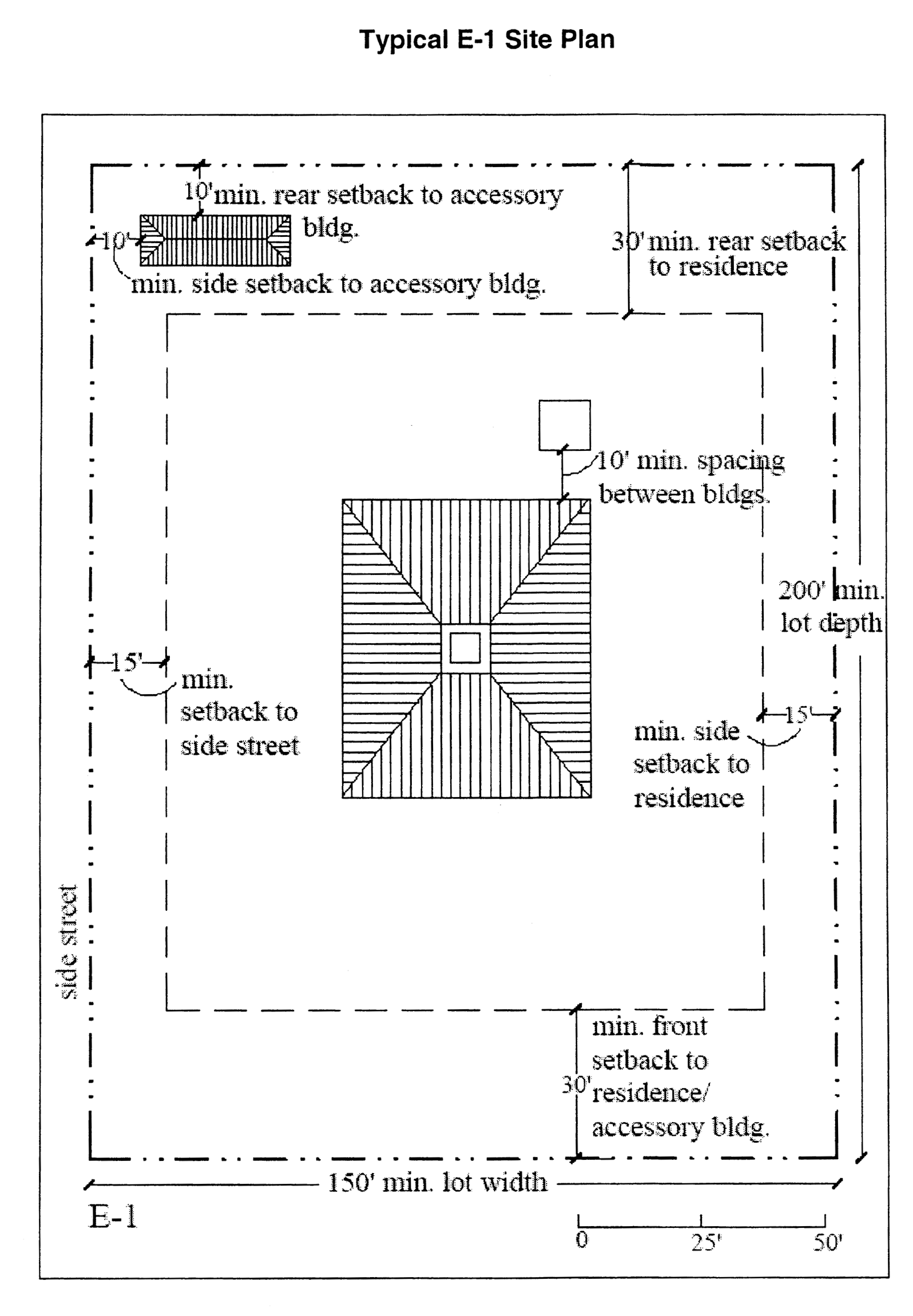
Figure 1. Typical E-1 Site Plan
(Ord. of 9-25-06)
Sec. 78-106. - Single-family residential (R-1) district.
See next page for typical site plan.
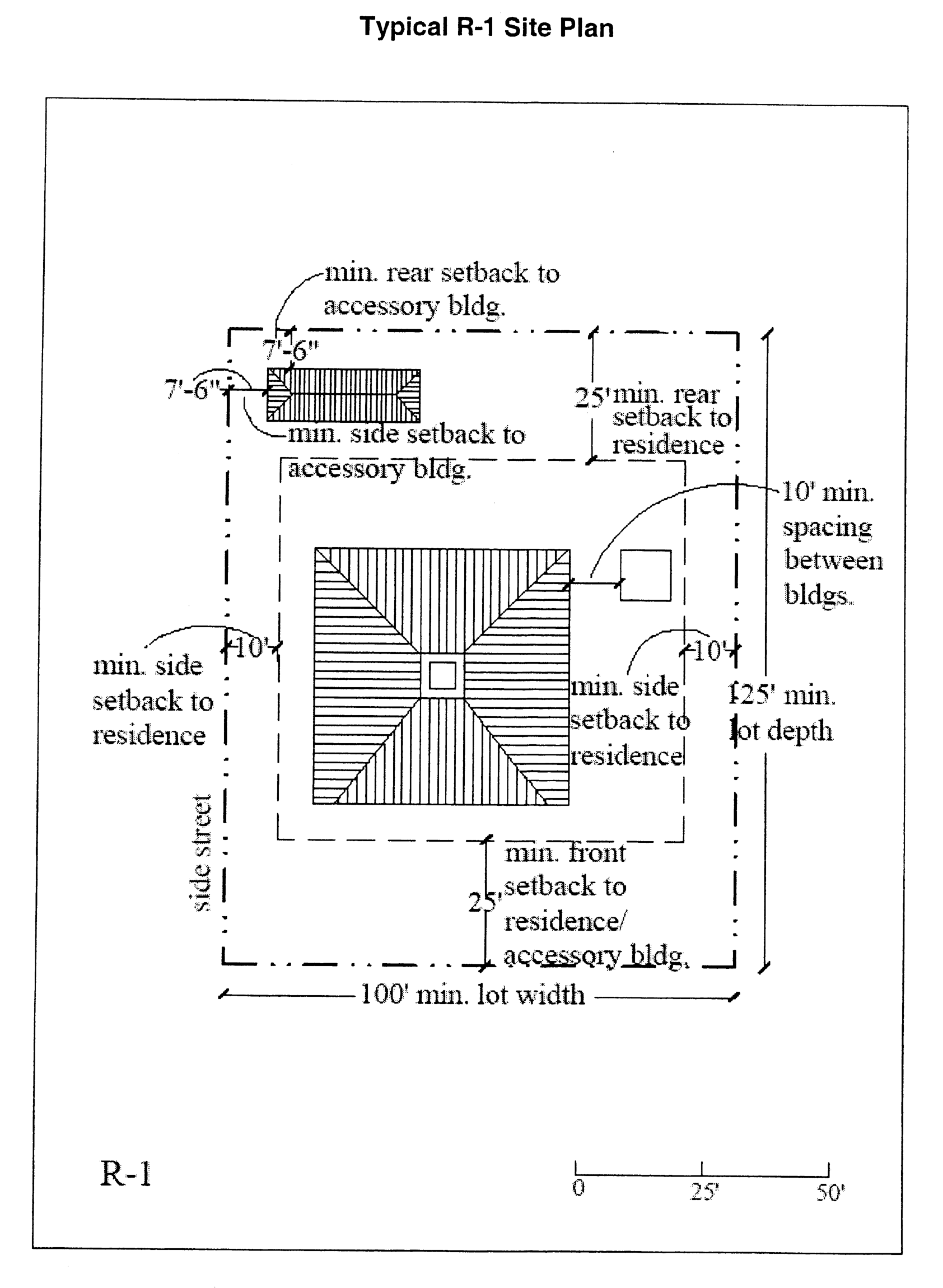
Figure 2. Typical R-1 Site Plan
(Ord. of 9-25-06)
Sec. 78-107. - One- and two-family residential (R-2) district.
See next page for typical site plan.
Note: Two-family homes are allowed along the north side of NW 129th Street between
NW 102nd and 104th Avenues.
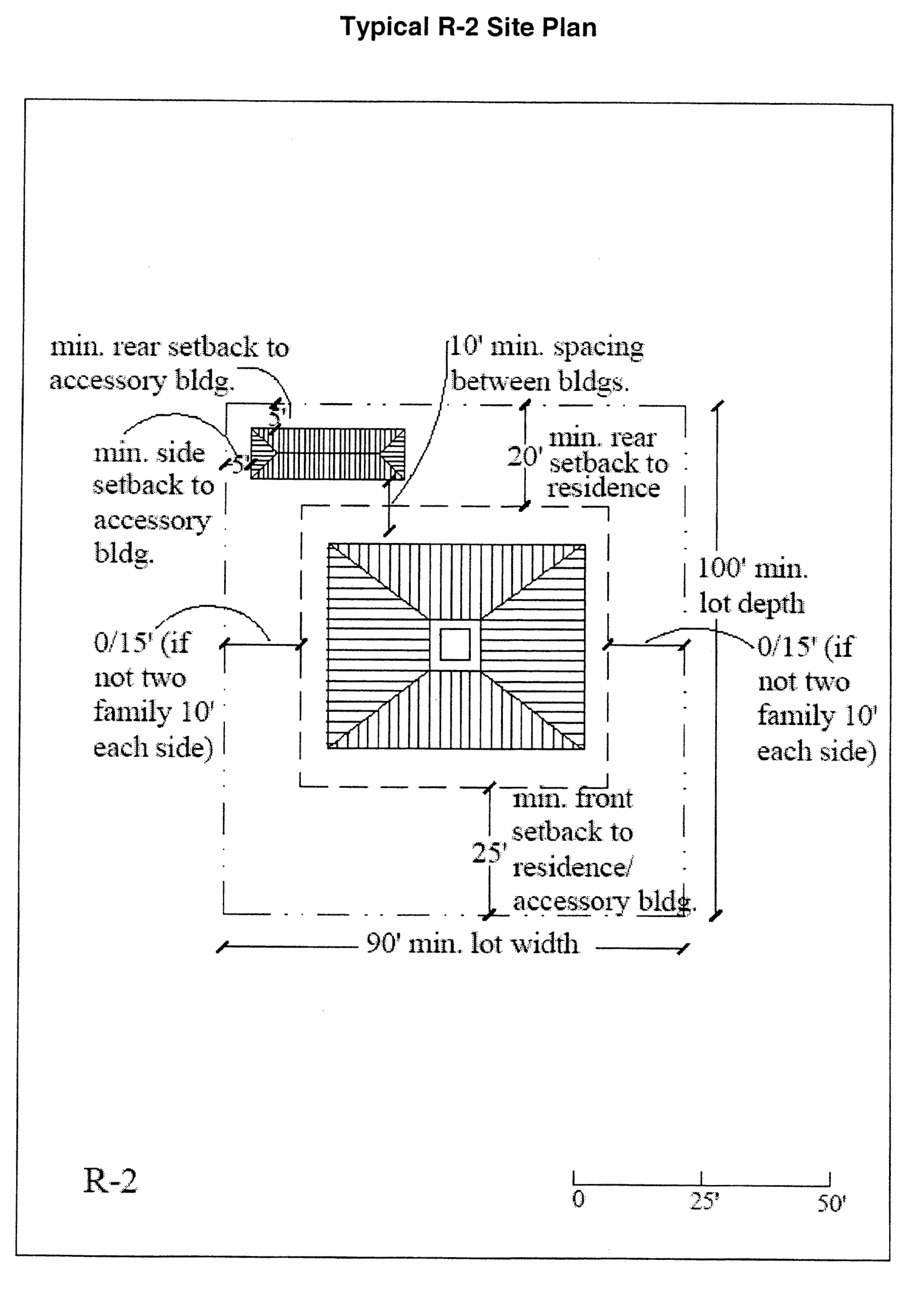
Figure 3. Typical R-2 Site Plan
(Ord. of 9-25-06)
Sec. 78-108. - Single-family residential zero-lot-line (R-1Z) district.
See next page for typical site plan.
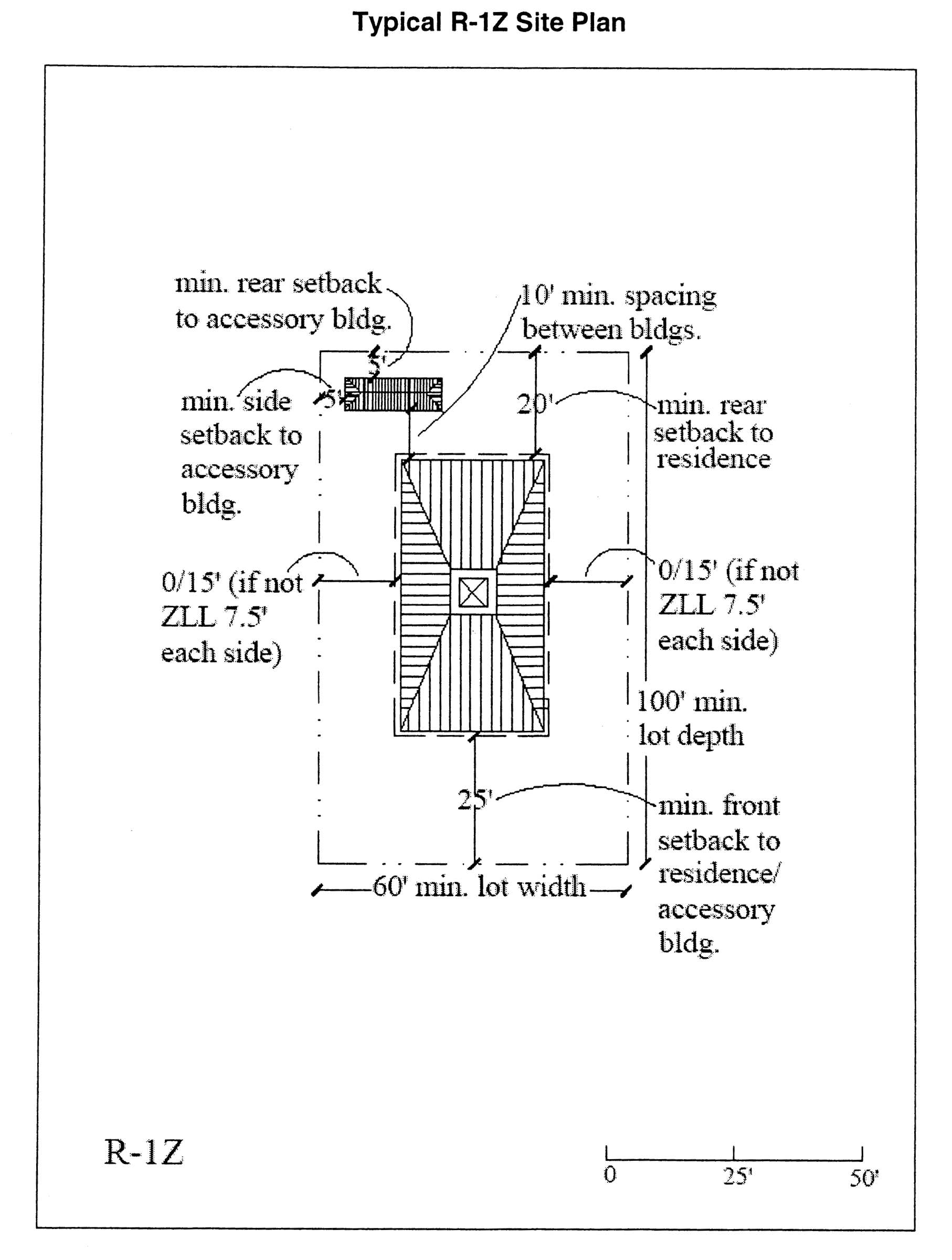
Figure 4. Typical R-1Z Site Plan
(a)
Zero lot line units are single-family dwellings that:
(1)
Make more efficient use of land;
(2)
Are designed to integrate and relate internal-external living areas resulting in more pleasant and enjoyable living;
(3)
Permit outdoor space to be utilized to its maximum capacity by placing the dwelling against one of the property lines.
(b)
Generally.
(1)
Each dwelling unit shall be on individually platted lot fronting on a public street.
(2)
Any adjustment to the front and/or are setback shall be subject to site plan approval by the city council and a developer's agreement.
(3)
Patios, garden features, and other similar elements shall be permitted within the 12-foot setback area; provided, however, no structure, with the exception of fences or walls, shall be placed within any easements required by this section.
(4)
For zero lot line units built prior to August 15, 2006 the following development parameters shall apply:
a.
Minimum lot sizes. The minimum lot size in the north district shall be a minimum width of 55 feet by a minimum depth of 90 feet and a minimum lot area of 4,950 square feet. The minimum lot size in the central district shall be a minimum width of 55 feet by a minimum depth of 82 feet and a minimum lot area of 4,510 square feet. This shall not include any credit for streets, recreation areas, common open space, or water bodies.
b.
Dwelling unit setback.
1.
Interior side yard. The dwelling unit shall be placed on one interior side of the property line with a zero setback. The dwelling unit setback on the other interior side of the property line shall be a minimum of 12 feet, excluding the connecting elements such as fences, walls and trellises. Provided, however, that units are not required to be on the zero lot line of the property line when the units fall at the end of a sequential row of units and where the units cannot be placed on a separate zero lot line without attaching the unit to an adjacent unit. Additionally, ten percent of the total number of units on any individual site plan may be developed without being placed on the zero lot line property line if such development is approved with a site plan approval. Patios, garden features, and other similar elements shall be permitted within the 12-foot setback area; provided, however, no structure, with the exception of fences or walls, shall be placed within easements.
2.
Front setback. All dwelling structures shall be set back a minimum of 25 feet, adjustable to 22 feet, from the front property line (right-of-way line for public streets).
3.
Rear setback. The rear setback for the dwelling unit shall be a minimum setback of 12.5 feet, adjustable to 15.5 feet, except that patios, garden features, and other similar elements shall be permitted within the 12.5-foot setback areas. A four-foot rear setback shall be maintained as a minimum for permitted accessory uses and slabs including pools.
4.
Front and rear setback adjustment. Front and rear setbacks may be adjusted as follows:
i.
Front setback may be adjusted from 25 feet to 22 feet or any portion in between.
ii.
Rear setback may be adjusted from 12.5 feet to 15.5 feet or any portion in between.
The adjustment to the front setback and rear setback may be made in any combination, consistent with this section, which totals 37.5 feet total combined front and rear setback area; provided, however, that any adjustment from less than 25 feet front setback shall be subject to site plan approval by the city council and a developer's agreement.
5.
Side street setback. The side street setback for any dwelling shall be a minimum of 15 feet from the side street property line. Side street setback shall be in compliance with the clear visibility triangle.
6.
Accessory buildings and structures. Accessory buildings and structures shall observe setback requirements as otherwise provided in these land use regulations, and only mesh screen material shall be allowed on an enclosure, except that commercially manufactured utility storage sheds may be enclosed with aluminum or metal material and shall be allowed in the rear setback area consistent with subsection 3. above provided a minimum four-foot side setback is maintained.
c.
Maximum permitted lot coverage.
1.
The total lot coverage permitted for all buildings on the site shall not exceed 50 percent of the lot area. In addition to the 50 percent lot area coverage, there shall be permitted not more than five percent of the total lot coverage as used for outside storage or structures (with outdoor access only), which shall include all buildings, permitted accessory uses, concrete slabs, walkways and driveways.
2.
Permit applications which render greater than 55 percent total lot coverage shall be submitted with an accompanying drainage plan, acceptable to the city, to assure adequate on-site retention drainage of the applicant's property and the property benefited by easement.
3.
Total lot coverage shall not exceed 75 percent of the property.
4.
Permit applications rendering greater than 50 percent total lot coverage require verification of continued compliance with originally required landscaping, prior to permit issuance.
d.
Building heights. The maximum building height shall not exceed two stories or 35 feet in height.
e.
Penetrable openings. The amount of penetrable opening shall be determined by multiplying 0.018 times the interior floor area, excluding garages and utility rooms, up to a maximum of 1,000 square feet on the ground floor of a dwelling unit. Penetrable openings shall be provided to exterior patio court areas and shall be totally visually and physically passable. The amount of penetrable opening for units greater than 1,000 square feet shall be calculated on a basis of 0.014 times the square feet of the ground floor area. In all cases, the final linear dimension shall be calculated to the nearest even foot.
f.
Minimum dwelling size. No residential unit shall be smaller than 1,500 square feet of living space in the north district and 1,350 square feet of living space in the central district.
(c)
Penetrable openings. The amount of penetrable opening for units shall be calculated on a basis of 0.014 times the square feet of the ground floor area (excluding garages and utility rooms). In all cases, the final linear dimension shall be calculated to the nearest even foot.
(d)
Openings in zero lot line side. The wall of the dwelling located on the lot line shall have no windows, doors, air conditioning units, or any other type of opening, except the following:
(1)
Atriums or courts shall be permitted on the zero lot line side when the court or atrium is enclosed by three walls of the dwelling unit and a solid wall of at least eight feet in height is provided on the zero lot line. The wall shall be constructed of the same material as the exterior walls of the unit.
(2)
Windows shall be permitted on the zero lot line side provided the windows are placed at a minimum height of five feet above the finished floor level of any floor and which do not protrude in any way on the adjoining landowner's property.
(e)
Maintenance and drainage easements.
(1)
A perpetual four-foot-wide maintenance easement shall be provided on the lot adjacent to the zero lot line property line, which, with the exception of walls or fences, shall be kept clear of structures or concrete slabs and walkways. This easement shall be noted on the plat and incorporated into each deed transferring title to the property. The zero lot line wall shall be maintained in its original color and treatment unless otherwise agreed to in writing by the two affected lot owners.
(2)
Roof overhangs may penetrate the easement on the adjacent lot a maximum of 12 inches, but the roof shall be so designed that water runoff from the dwelling placed on the lot line is limited to the easement area.
(f)
Common open space and maintenance of facilities. If common open space is provided the subdivider or developer shall provide a covenant that the common open space will be maintained in perpetuity by a property owners' association or by some other mechanism. Additionally, a dormant special taxing district shall be established in the event that the property owners' association fails to maintain private open space or is disbanded. The instruments incorporating such provisions shall be approved by the city attorney, as to form and legal sufficiency, submitted to the city council and be recorded in the public records of the county, if satisfactory to the city council.
(Ord. of 9-25-06)
Sec. 78-109. - Single-family residential patio detached (R-1P) district.
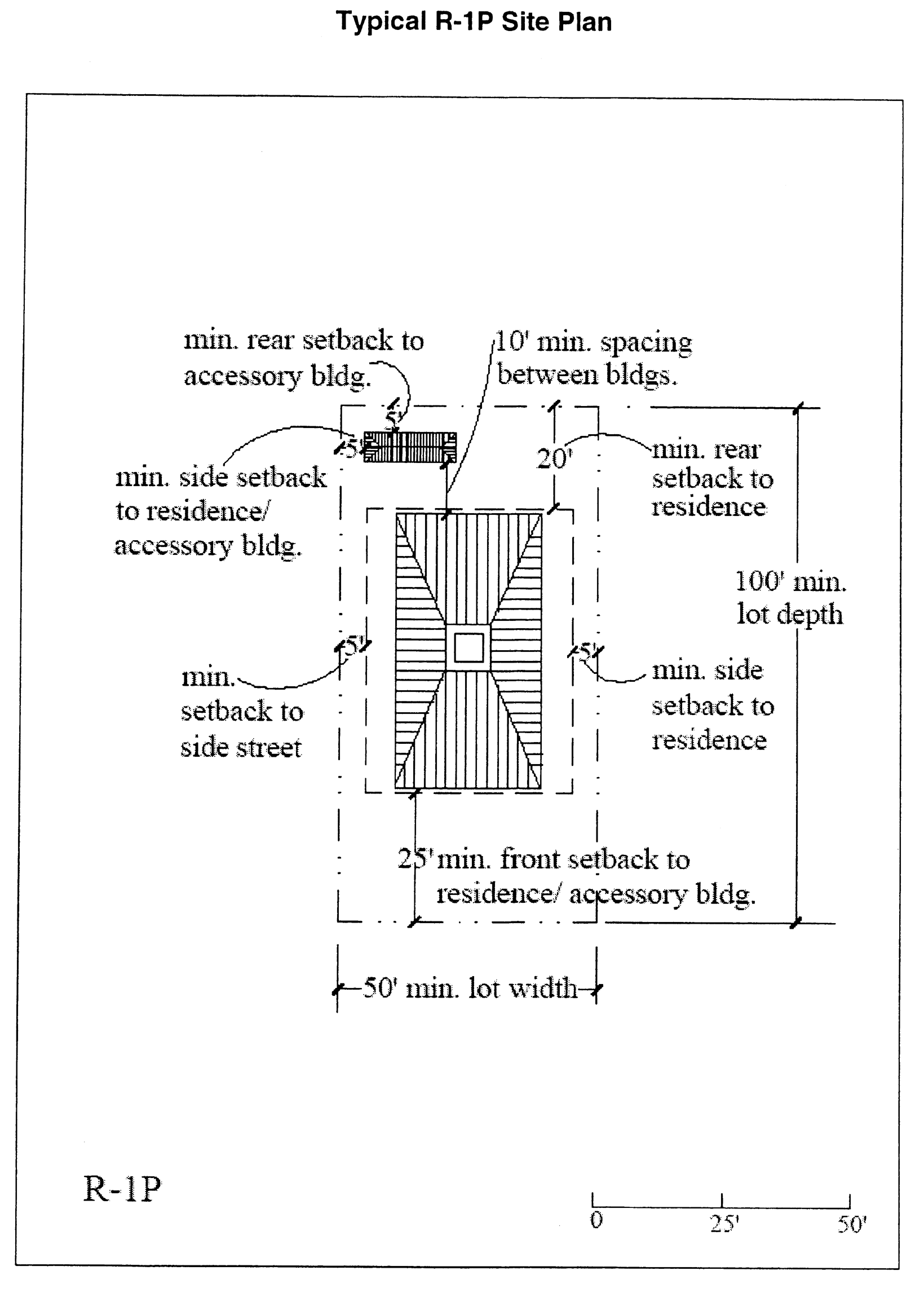
Figure 5. Typical R-1P Site Plan
(Ord. of 9-25-06)
Sec. 78-110. - Townhouse residential (R-TH) district.
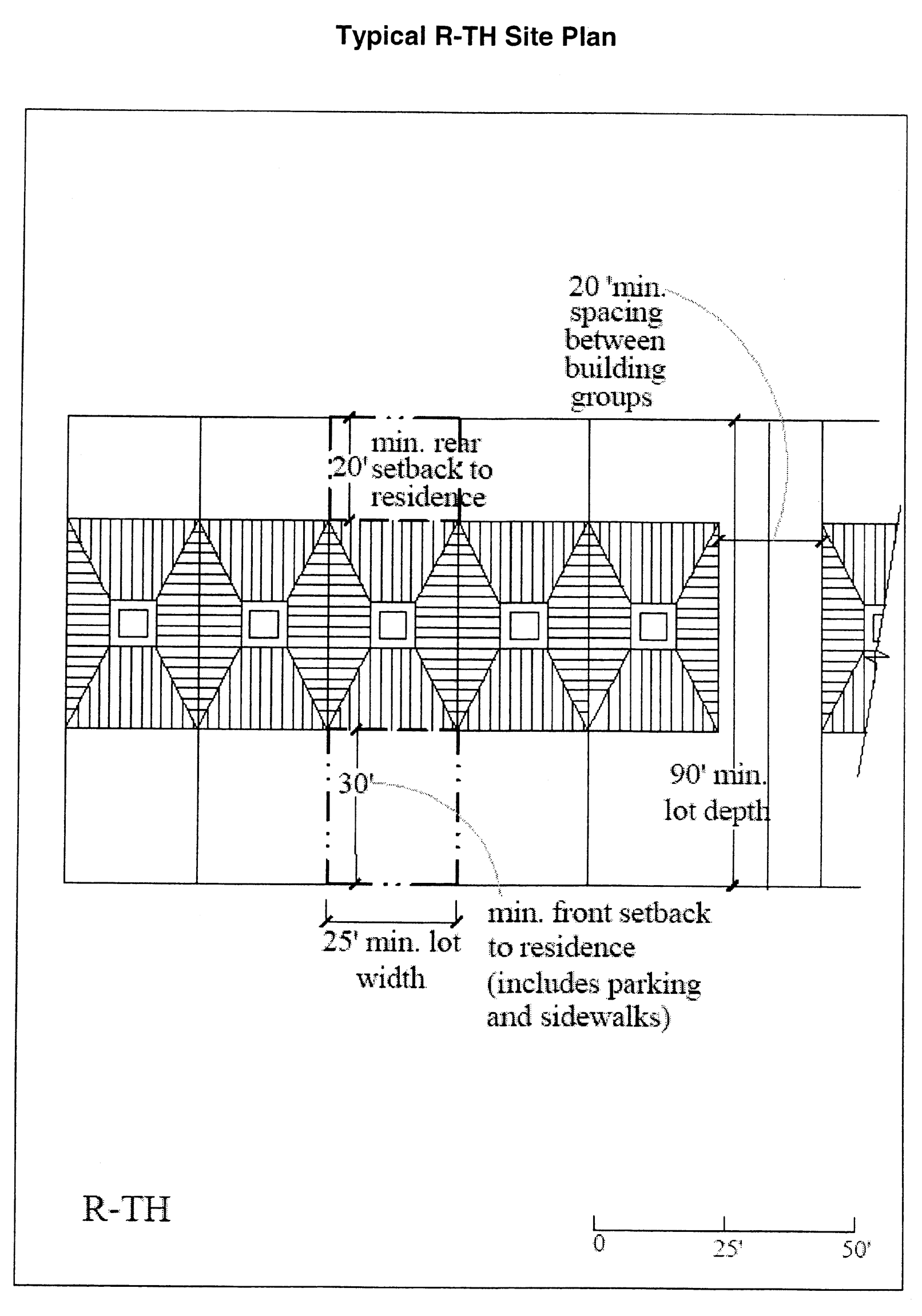
Figure 6. Typical R-TH Site Plan
(a)
Generally. Townhouses are single-family dwelling units separated by a common fire wall which extends at least to the roof line and serviced by separate utilities.
(1)
Access for garbage and waste collection, firefighting and utility services shall be provided and be proper and adequate for said purposes.
(2)
Easements for access shall be dedicated as required and/or necessary and shall not be fenced.
(3)
At least ten feet of the rear setback must remain landscaped area.
(4)
Roofed terraces may not encroach more than ten feet into the rear setback.
(b)
Ownership. In addition to complying with all applicable sections of this chapter, townhouse developments shall comply with one of the following methods of land transfer of ownership:
(1)
The subdivision of the whole tract into individual parcels in accordance with this chapter, together with the platting of property for record in accordance with the state plat law and applicable ordinances of the city.
(2)
Providing for the development of the entire tract in accordance with this chapter, retaining, however, title to all of the lands in the name of the condominium corporation and providing for all usual condominium documents and procedures.
(3)
Providing for the development of the entire tract in accordance with this chapter, retaining, however, title to all of the lands in single ownership by recording a duly executed unity of title in the office of the clerk of the circuit court of the Miami-Dade county, thereby stipulating that the tract shall not be eligible for further subdivision.
(Ord. of 9-25-06)
Sec. 78-111. - Multi-family residential (R-M1) district.
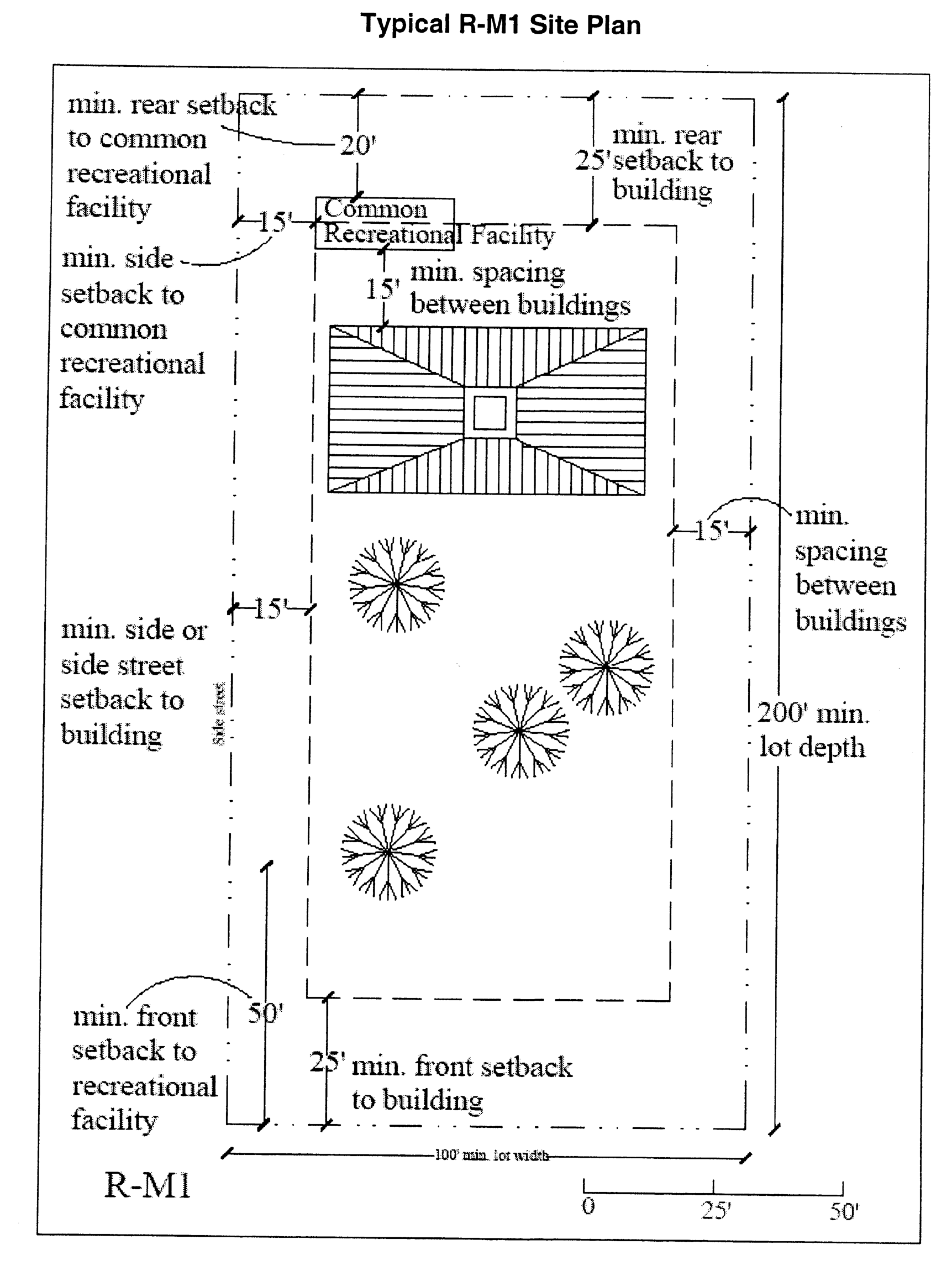
Figure 7. Typical R-M1 Site Plan
(Ord. of 9-25-06)
Sec. 78-112. - Multi-family residential (R-M2) district.
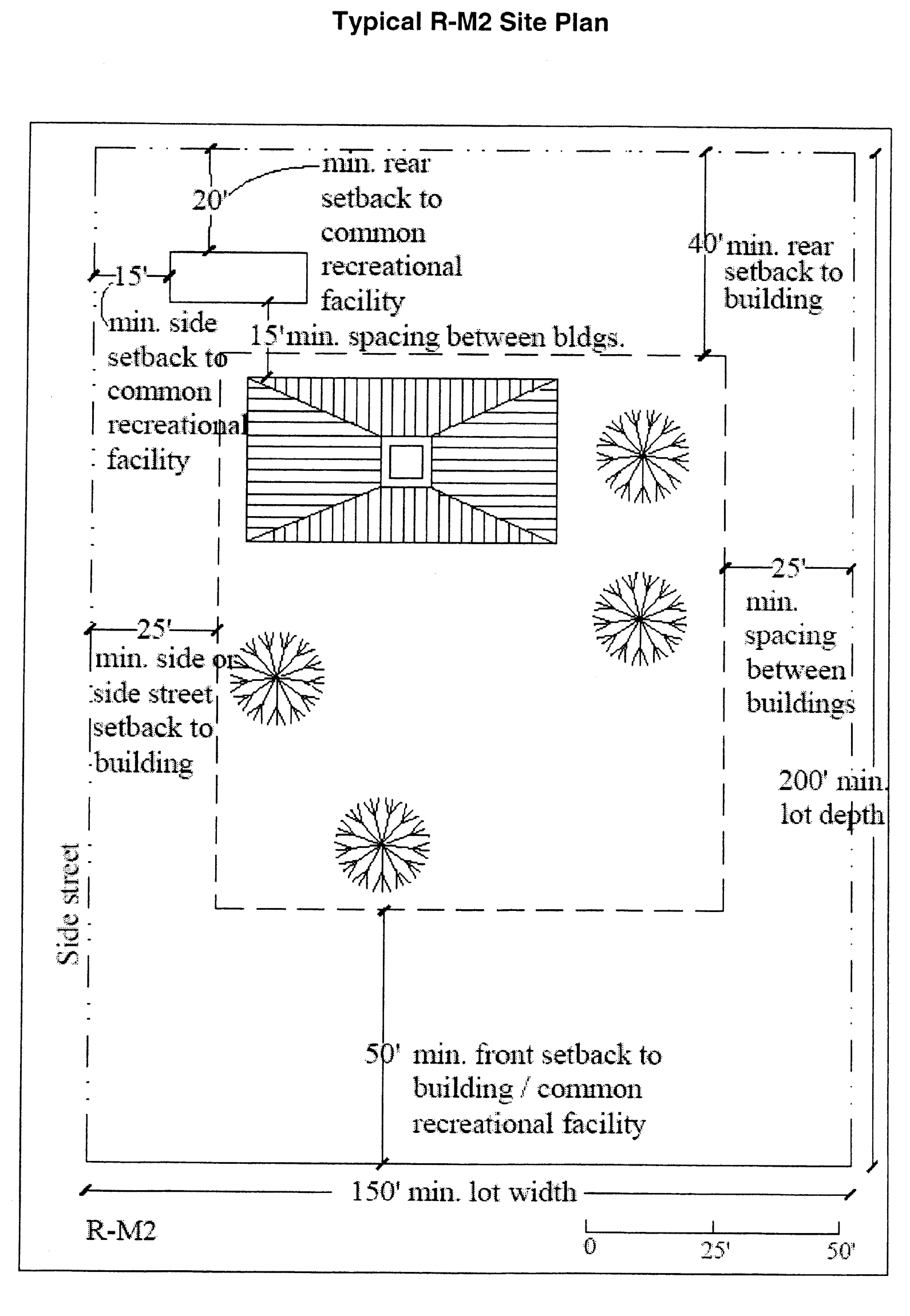
Figure 8. Typical R-M2 Site Plan
(Ord. of 9-25-06)
Sec. 78-115. - Neighborhood business (B-1) district.
See next page for typical site plan.
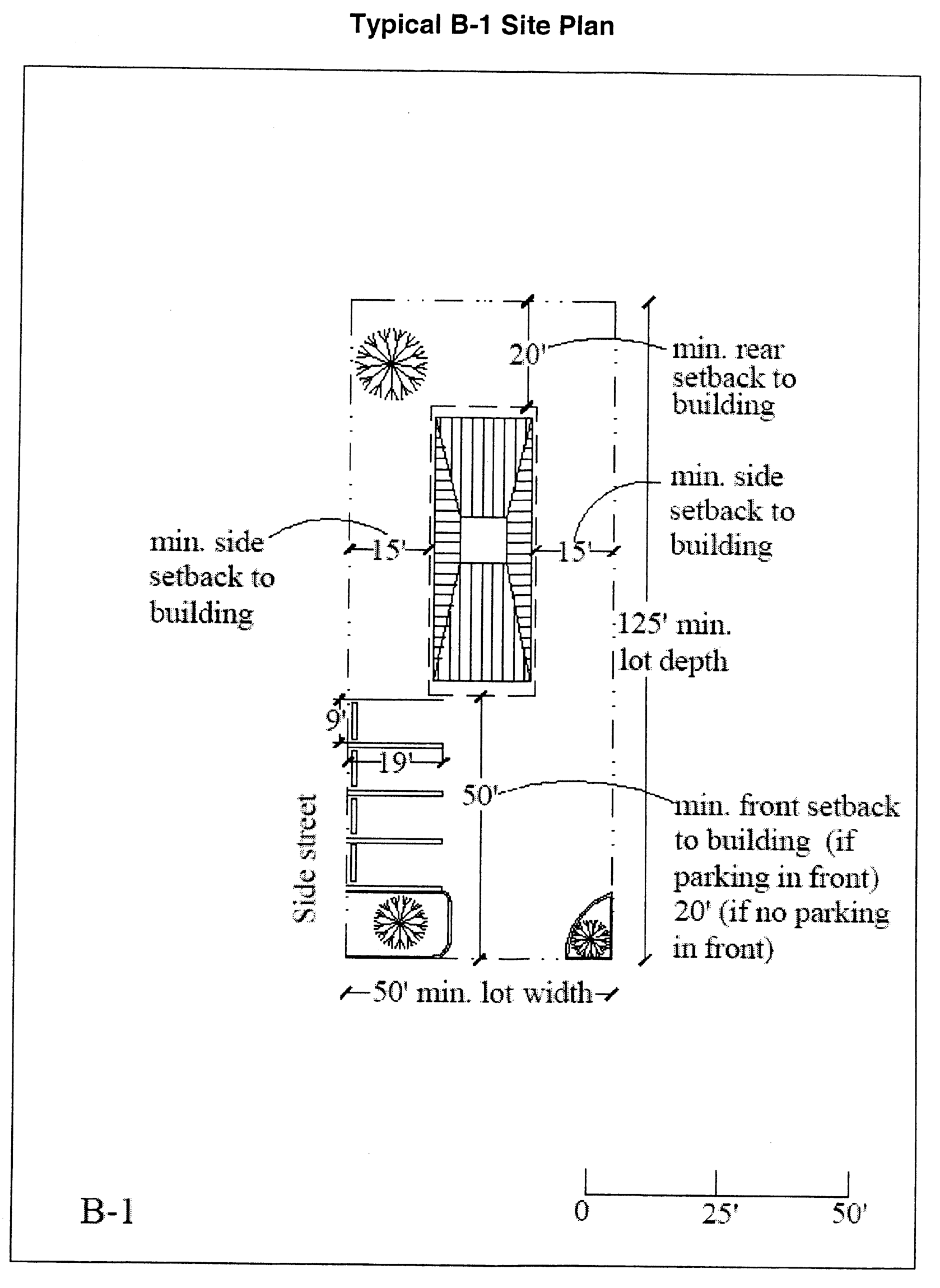
Figure 9. Typical B-1 Site Plan
(Ord. of 9-25-06)
Sec. 78-116. - General business (B-2) district.
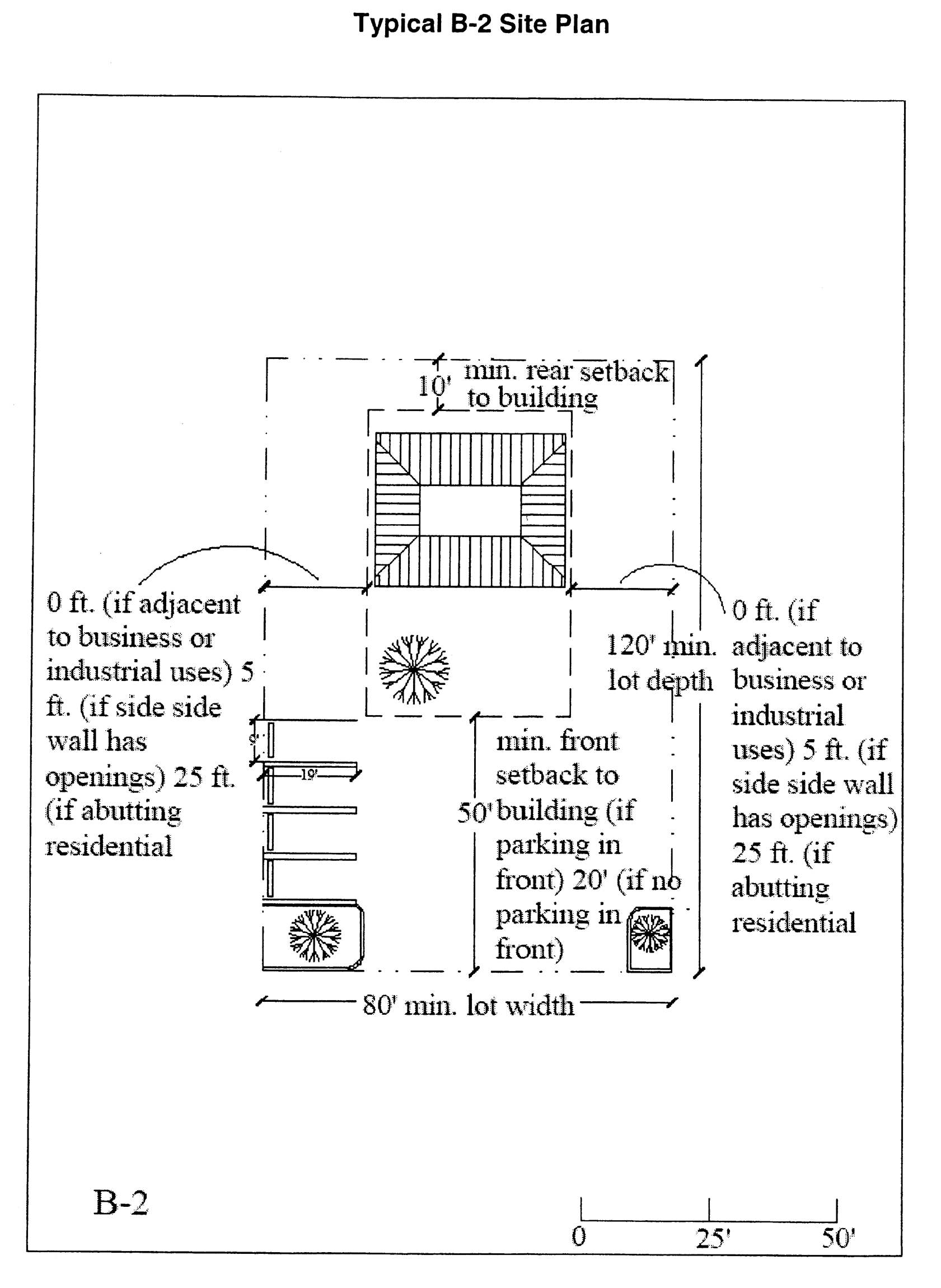
Figure 10. Typical B-2 Site Plan
(Ord. of 9-25-06)
Sec. 78-117. - Commercial business (B-3) district.
See next page for typical site plan.
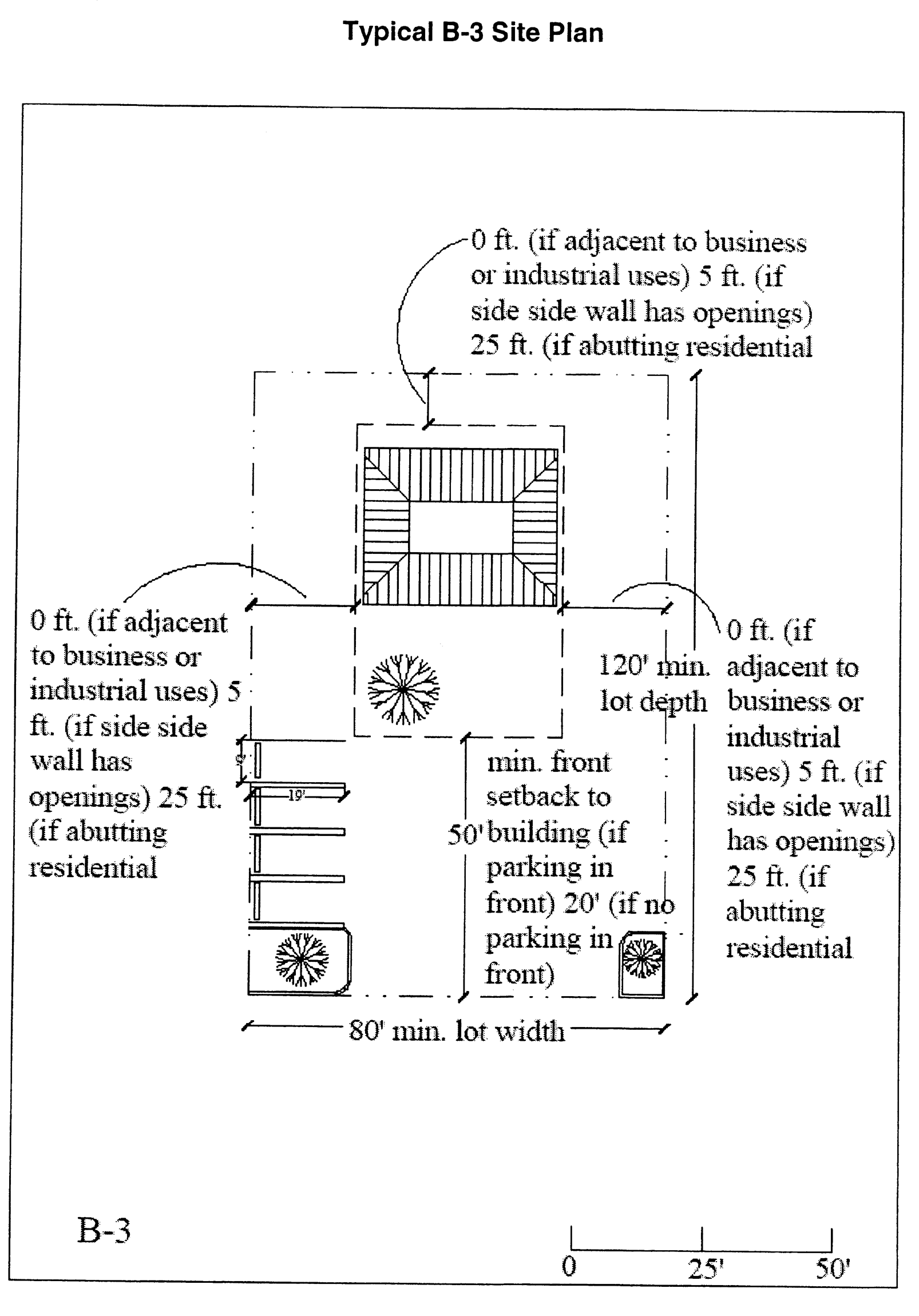
Figure 11. Typical B-3 Site Plan
(Ord. of 9-25-06)
Sec. 78-118. - Light industrial (IN-1) district.
See next page for typical site plan.
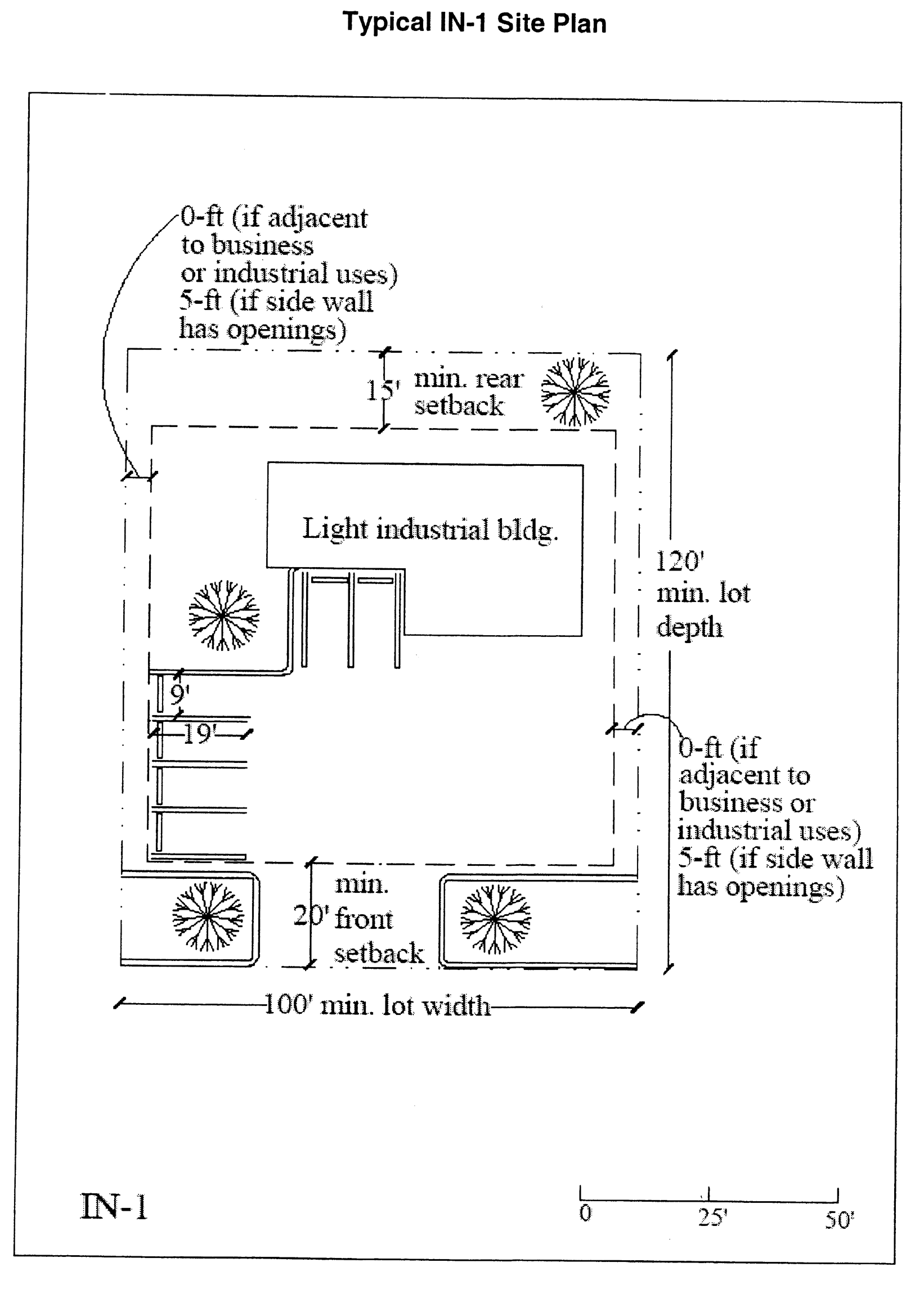
Figure 12. Typical IN-1 Site Plan
(Ord. of 9-25-06; Ord. No. 2020-08, § 1, 3-3-20)
Sec. 78-119. - Heavy industrial (IN-2) district.
See next page for typical site plan.
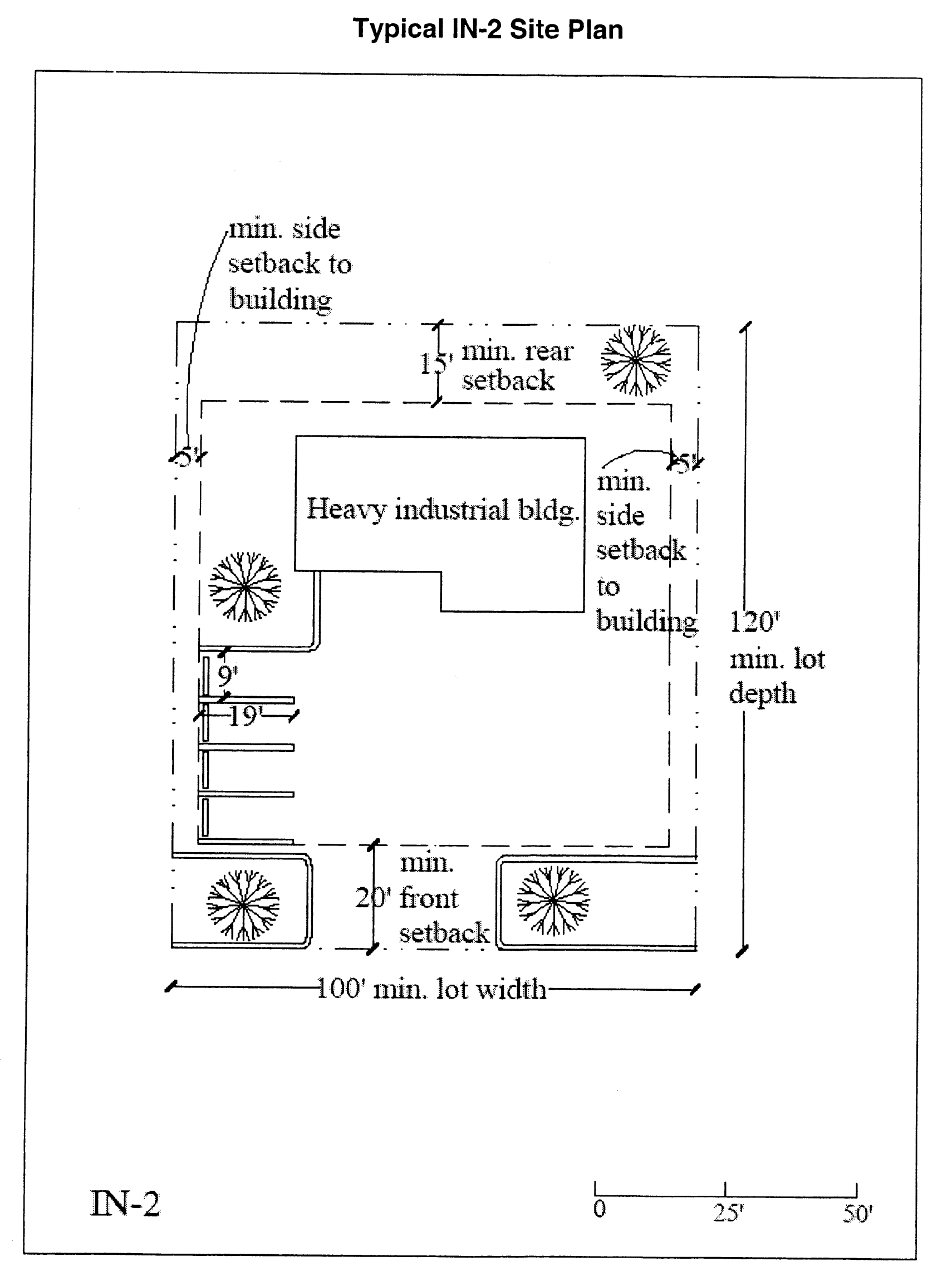
Figure 13. Typical IN-2 Site Plan
(Ord. of 9-25-06; Ord. No. 2020-08, § 1, 3-3-20)
Sec. 78-120. - Controlled industrial (IN-C) district.
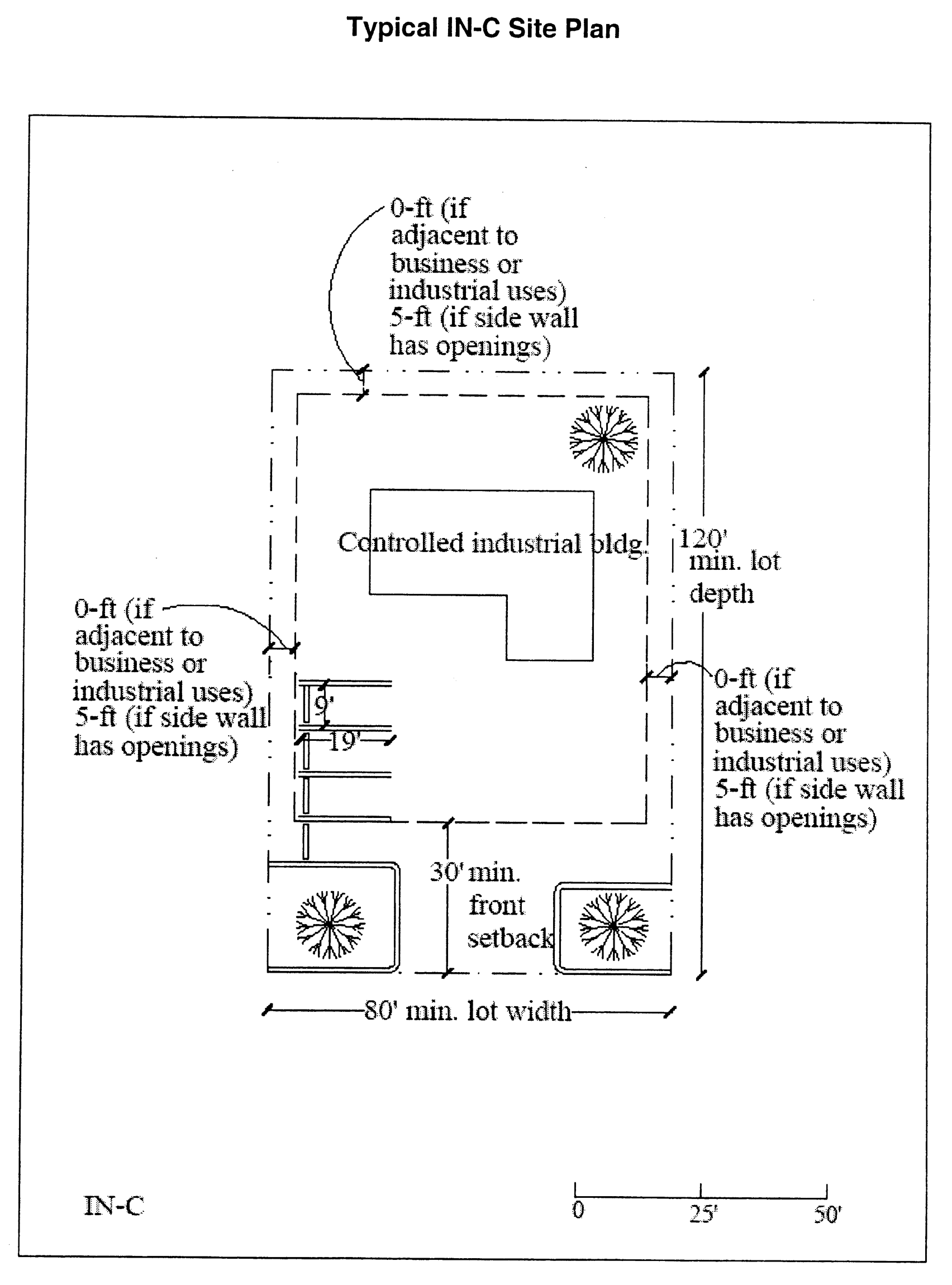
Figure 14. Typical IN-C Site Plan
(Ord. of 9-25-06; Ord. No. 2020-08, § 1, 3-3-20)
Sec. 78-125. - Community facilities (CF) district.
Typical site plan CF—N/A
No parking areas shall be located within 15 feet of residentially zoned property or within 5 feet of non-residentially zoned property.
(Ord. of 9-25-06)
Sec. 78-126. - Parks and open space and water (POS) district.
Typical site plan CF—N/A
No parking areas shall be located within 15 feet of residentially zoned property or within 5 feet of non-residentially zoned property.
(Ord. of 9-25-06)
Sec. 78-127. - Planned unit development (PUD) district.
Planned unit developments are single unified developments built according to specific and detailed plans which allow a mix of uses but which are substantially related, compatible or complementary. PUD plans include not only streets, utilities, lots and building location and the like, but also site plans for all buildings as are intended to be located, constructed, used, and related to each other, and plans for other uses and improvements on the land as related to the buildings. A PUD includes a program for the provision, operation, and maintenance of such areas, facilities, and improvements as will be for common use by some or all of the occupants of the PUD district, but which will not be provided, operated, or maintained at general public expense.
See section 78-54, "Planned unit development district (PUD) uses", for all permitted, permitted similar, accessory and special exception uses for this district.
Land use category: All except for estate and low density single-family residential uses and within industrial the heavy industrial (IN-2) district.
Standards: Development standards shall be dictated by the proposed underlying land uses and applicable zoning districts.
Minimum size of development: 5 acres
Typical site plan PUD—N/A
(Ord. of 9-25-06)
Sec. 78-128. - Mixed use residential commercial district (MU) and mixed use entertainment (MU-E) district.
Mixed use developments are unified developments, built according to specific and detailed plans which allow a mix of uses but which are substantially related, compatible or complementary. Mixed use developments shall emphasize pedestrian use and accessibility through urban design principals as referenced in the City of Hialeah Gardens Design Guidelines Ordinance, and as may be amended from time to time. Additionally, all buildings shall be of a cohesive design.
See section 78-55, mixed use residential commercial district (MU) and mixed use entertainment district (MU-E) uses for all permitted, permitted similar, accessory and special exception uses for this district.
Land use category: MU—medium (R-TH only) and high density residential, neighborhood retail and general business; MU-E—neighborhood, general and commercial business and industrial.
The MU district shall be allowed only on parcels contiguous to section line and other major access roads, including frontage roadways, and shall promote connectivity to the surrounding roadway network.
Standards:
For the MU district, any residential component shall be no greater than 75 percent or less than 40 percent of the gross floor area of the development. Commercial components shall be no greater than 60 percent or less than 25 percent of the gross floor area.
The maximum number of units allowed shall be based on the density of the residential units proposed X the net acreage of the parcel X the percentage of the residential component as enumerated above.
Residential uses may be located on any floor while commercial uses shall be restricted to the ground floor of a multi-story building.
For the MU-E district, specific entertainment, restaurant or retail uses shall be allowed that are deemed appropriate by the chief zoning official.
Commercial loading areas and trash enclosures shall be located way from residential units and be substantially screened.
Parking, landscaping and signage requirements shall be regulated by the respective articles of this chapter.
Recreation and open space shall be provided as required based on the type of residential unit being proposed.
Parking areas shall not be located within 15 feet of residentially zoned property or within five feet of non-residentially zoned property. Parking garages shall be substantially screened.
Typical site plan MU and MU-E—N/A
(Ord. of 9-25-06)
Sec. 78-130. - Specific use requirements.
Adult day care centers:
a.
Shall additionally be regulated by F.S. ch. 400, "Nursing Homes and Related Health Care Facilities", Part V, "Adult Day Care Centers" (§§ 400.55 — 400.564).
Adult living facilities:
a.
Shall additionally be regulated by F.S. ch. 400, "Nursing Homes and Related Health Care Facilities", Part III, "Assisted Living Facilities" (§§ 400.401—400.454).
Attendant or hand car wash (non-commercial vehicles only):
a.
The facility must have a working oil/sand interceptor to which all drainage from the car wash must flow.
b.
The hours of operation may be no longer than the principal use.
c.
All unused supplies shall be screened from the public.
d.
The facility shall provide at least two waiting spaces per service position, separated from access drives and internal drive aisles. In addition, there shall be one parking space per attendant.
e.
The facility shall not exceed 600 square feet.
f.
The facility shall not exceed ten feet in height.
g.
The applicant must provide written consent from the property owner to the city.
Automatic car wash:
a.
The facility shall not be located closer than 50 feet to any residential zoning district.
b.
The facility shall be located on a public street and shall provide ingress and egress so as to minimize traffic congestion.
c.
The facility shall provide at least five off-street waiting spaces on the lot in the moving lane to the automatic car wash building entrance so as to prevent blocking any public streets.
d.
The facility shall be located either to the side or rear of the principal building or be incorporated into the principal building.
e.
The facility must have a working oil/sand interceptor to which all drainage from the car wash must flow.
f.
The hours of operation may be no longer than the principal use.
Automobile gas and/or service stations:
a.
Entrances and exits for vehicles shall not be closer than 30 feet to any intersection.
b.
Lots shall not be less than 10,000 square feet with a minimum frontage of 100 feet.
c.
All oil drainage pits and hydraulic lifts shall be located within an enclosed structure.
d.
All permitted mechanical repair work shall be conducted within an enclosed structure.
e.
Service stations shall have their gasoline pumps set back at least 30 feet from any property or street line.
f.
The following restrictions shall apply to storage of vehicles:
1.
Not more than one unlicensed vehicle shall be stored on the premises.
2.
Not more than ten licensed vehicles shall be stacked or parked for immediate servicing or fueling. Other licensed vehicles may be stored provided that they are parked in the side or rear yard and screened from view from the public right-of-way in accordance with section 78-86, pertaining to buffer and screening requirements.
g.
In any instance where this use adjoins a residential zoning district, screening shall be provided in accordance with section 78-86, pertaining to buffer and screening requirements.
Auto and truck repairs and paint and body shops:
a.
This use shall be permitted in the B-3 and IN-1 zoning districts.
b.
The minimum floor area shall be 650 square feet in the South and Central Districts and 1,000 square feet on the Northwest District.
c.
This use shall only be conducted in a completely enclosed structure aside from the normal ingress-egress accessibility.
d.
No vehicles for repair shall be parked along streets, in vacant lots, visitor parking areas or in driveways.
e.
A minimum of three parking spaces for visitors and employees shall be provided.
f.
Permits must be obtained, as applicable, from the (DERM) Department of Environmental Resource Management, Miami-Dade Fire-Rescue Department and City of Hialeah Gardens Building Department prior to a City of Hialeah Gardens Local Business Tax Receipt being issued or renewed.
g.
It shall be unlawful to deposit, store, keep or maintain junk or trash or junk yards, salvage facilities, or wrecking yards in any vacant lot or parcel, along streets, or in visitor parking areas or along driveways.
h.
All materials and products associated with this use shall be stored within the building, in a walled, completely enclosed area.
i.
Spray painting shall only be permitted within an enclosed building which is equipped with an approved spray booth.
Automobile and truck sales for new and/or used vehicles including as ancillary uses automobile and truck rentals, wholesale distribution, parts sales, body work and painting and automobile repairs:
a.
This use shall be permitted in the B-3 and IN-1 zoning districts.
b.
The minimum floor area shall be 1,300 square feet in the Central and South Districts and 3,000 square feet in the Northwest District. Additionally, the minimum lot size shall be 10,000 square feet in the B-3 and 12,000 square feet in the IN-1 zoning districts.
c.
No more than 20 percent of the total gross building area shall be devoted to repair/service bays.
d.
A continuous, densely planted greenbelt of not less than 15 feet in width, penetrated only at points approved by the chief zoning official and public works department for ingress and egress to the property, shall be provided along all property lines abutting public rights-of-way or residential zoning districts. Said greenbelt shall have shade trees planted at a maximum spacing of 30 feet on center. In addition, a hedge with a minimum of three feet in height and spaced 24 inches on center shall be planted.
e.
A minimum of 20 percent of the net lot area of the site shall be developed as landscaped open space.
f.
This use shall be located only on major access roads, including major roadways (three or more lanes) and frontage roadways serving limited access highways and expressways.
g.
No vehicles for sale, rental or repair shall be parked on streets, in vacant lots, or in visitor parking spaces.
h.
Outdoor paging or speaker systems are prohibited.
i.
Outdoor lighting shall be designed to avoid light spilling beyond the site boundaries.
j.
Vehicular test drives shall be prohibited on local residential streets.
k.
All repair work must be conducted indoors.
l.
Attention attracting devices, such as blinking or flashing lights, streamer lights, pennants, banners, streamers and all fluttering, spinning advertising devices (either mobile or stationary) are prohibited, except as permitted under point of sale sign regulations.
m.
The applicant for this use must first obtain a certificate of use, which shall be automatically renewable yearly only upon compliance with all terms and conditions contained herein. All dealers with repair and/or body shops shall obtain a separate local business tax receipt.
n.
All DERM approvals shall be obtained prior to the issuance of the local business tax receipt.
o.
The applicant shall provide the city with proof of business registration from the Florida Department of Highway Safety and Motor Vehicles.
Cabinet working and carpentry shops:
a.
Minimum size requirement is two bays or 1,000 square feet for the Northwest district only.
Child day care family homes or centers:
a.
Shall additionally be regulated by either F.S. § 402.302(2) or (7), based on the number of children requested.
Collection, recycling and processing facilities:
a.
Definitions:
1.
Processing: the preparation of material for efficient shipment or to an end-user's specifications by such means as baling, compacting, flattening, crushing, mechanical sorting, shredding, or cleaning.
2.
Recycling unit: a machine providing automatic compensation to the customer engaged in the collection and processing of recyclable or reusable material, including but not limited to metals, glass, plastic and paper, which are intended for reuse, remanufacture or reconstruction. Recyclable material does not include refuse or hazardous materials.
b.
General requirements:
1.
Typical uses for a recycling unit include paper salvage or aluminum can recycling operations, but do not include the collection and sale of used clothing.
2.
All recyclable materials collected shall be stored within an enclosed structure.
3.
Recyclable material shall not be displayed for sale outside the recycling unit, regardless of the particular regulations of the applicable zoning district.
4.
Only three recycling units will be permitted in the city at any one time based upon city council approval.
c.
Location: Recycling units shall be located a minimum of 1,000 feet from any residential zoning district, as measured from the unit to the edge of the residential property, and a minimum of 1,000 feet from another recycling unit.
d.
Parking. Recycling units shall provide one parking space for loading and an additional one for employees. In no event shall required off-street parking be utilized for the recycling unit.
Cross reference— Solid waste, ch. 42.
Educational facilities (charter and/or private):
a.
Shall be additionally regulated by the Miami-Dade County School Board and/or Miami-Dade County Chapter 33 XA "Educational and Child Care Facilities, Nonpublic."
Heavy equipment repair and sales:
a.
This use shall permitted in the B-3 and IN-1 zoning districts.
b.
The minimum floor area shall be 1,300 square feet in the South and Central Districts and 3,000 square feet on the Northwest District. Additionally, the minimum lot size shall be 10,000 square feet in the B-3 and 12,000 square feet in the IN-1 zoning districts.
c.
This use shall only be conducted in a completely enclosed structure aside from the normal ingress-egress accessibility.
d.
No heavy equipment shall be parked or new or used parts stored alongside streets, on vacant lots without first obtaining site plan approval or in visitor 7 parking areas.
e.
A minimum of three parking spaces for visitors and employees shall be provided.
f.
Permits must be obtained from the Department of Environmental Resource Management (DERM), Miami-Dade County Fire-Rescue Department, Florida Department of Agriculture and Consumer Services and the City of Hialeah Gardens' Building Department prior to the City of Hialeah Gardens' Local Business Tax Receipt being issued or renewed.
g.
Spray painting shall only be permitted within an enclosed building which is equipped with an approved spray booth.
h.
All materials and products associated with this use shall be stored within the building, in a walled, completely enclosed area.
Cross reference— Location of sexually oriented businesses in the business, BU-1 District, § 18-96.
Hospital use:
a.
Any structured parking shall not count as part of the floor area, but shall be counted in computing building height and number of stories.
b.
Enclosed or non-enclosed mall areas shall not count as part of the floor area or as part of the lot coverage for building computation purposes.
c.
Such uses shall be located on sites having frontage on a major access road, including major roadways (three (3) or more lanes), section or half section line roads, and/or frontage roadways serving limited access highways and expressways.
Hotel and motel use:
a.
Accessory uses for hotel and motel use:
1.
Business or commercial establishments of the B-1 type, bars and cabarets shall be permitted in hotels provided they are located within the principal building.
Such business or commercial establishments and bars in this district shall be entered only through the lobby except when the entrance opens into a courtyard or patio (away from the street side) which is enclosed and not visible from the street. However, a fire door or emergency exit shall be permitted.
2.
Hotels and motels with 150 or more guest rooms may have liquor package service on the premises for the accommodation and use of their guests only, provided the operation housing such use is entered only through the lobby and does not have the appearance of commercial activity as viewed from the highway or street. No advertisement of the use is permitted which can be seen from the outside of the building.
Houses of worship:
a.
Applications for houses of worship shall contain documentation for a site plan review, including a site development plan showing all structures, roadways, pathwalks, parking areas, recreation areas, utility and exterior lighting installations, and landscaping on the site, all existing structures and uses within 200 feet of the site boundaries, and any other elements as may be deemed essential by the city. The following regulations shall be utilized as guidelines in reviewing the proposed development:
1.
Site size. A minimum site size of 60,000 square feet with a minimum lot width of 150 feet for stand alone structures.
2.
Lot, yard and bulk requirements. The development should not exceed two stories or 25 feet in height, a maximum lot coverage of 30 percent, or violate the least restrictive yard regulations for the district in which it is located. However, the city may permit a variance of height for a spire or unusual roof structure form in excess of the height requirements for the district in which it is located.
Nursing homes:
a.
Applications for nursing homes shall be additionally regulated pursuant to F.S. ch. 400, "Nursing Homes and Related Health Care Facilities", Part II, "Nursing Homes".
Pharmaceutical storage:
a.
That the applicant secure a license from the State of Florida Department of Health for such pharmaceutical storage.
b.
That the pharmaceutical storage area be air conditioned to continuously control temperature and humidity as required by the State of Florida Department of Health for pharmaceutical products.
c.
That the premises be secured with a security system.
Private clubs:
a.
Applications for private clubs shall contain documentation for a site plan review, including a site development plan showing all structures, roadways, pathwalks, parking areas, recreation areas, utility and exterior lighting installations, and landscaping on the site, all existing structures and uses within 200 feet of the site boundaries, and any other elements as may be deemed essential by the city. The following regulations shall be utilized as guidelines in reviewing the proposed development:
1.
Site size. A minimum site size of 60,000 square feet with a minimum lot width of 150 feet for stand alone structures.
2.
Lot, yard and bulk requirements. The development should not exceed two stories or 25 feet in height, a maximum lot coverage of 30 percent, or violate the least restrictive yard regulations for the district in which it is located.
Salesrooms and storage showroom-wholesale:
a.
Salesrooms and showrooms, subject to the prohibitions and limitations in subsection b. in this section, incorporated as a part of a permitted industrial use upon compliance with the following conditions:
1.
Any industrial use and its related retail sales/showroom uses in different units or bays within the same building must be under one certificate of use and occupancy, and must be connected by communicating doors between units or bays.
2.
Only merchandise, which is warehoused, stored, manufactured or assembled on the premises, can be sold on a retail basis.
3.
The size of retail sales/showroom floor area must be less than 40 percent of the total floor area of the subject premises under a single certificate of use and occupancy. Outside storage areas are to be excluded from consideration in determining the percentage of uses.
4.
A solid wall shall separate retail sales/showroom area from the balance of the industrial area to prevent public access to the industrial portion of the building. The industrial use area shall not be accessible to the general public.
5.
A declaration of use in a form to be approved by the city's chief zoning official shall be submitted prior to the issuance of a certificate of use and occupancy specifying compliance with the foregoing conditions. Said declaration of use shall include a floor plan for the intended use as required by the planning and zoning department.
b.
Subsection (a) above is intended to permit retail salesrooms and showrooms in recognition of the compatibility and reasonableness of incorporating certain retail uses into the other uses permitted in this district. To assure said compatibility and reasonableness, the retail uses enumerated, in the B-1 zoning district and uses similar thereto, shall be permitted.
Telecommunications hubs:
a.
At least 85 percent of the gross floor area of a telecommunications hub building shall be designated for equipment or machinery; no more than 15 percent of the gross floor area shall be designated for employees and support personnel.
b.
A declaration of use in a form meeting with the approval of the city's chief zoning official specifying compliance with the conditions set forth above, shall be submitted and approved by the department prior to the issuance of a building permit. Said declaration of use shall include a floor plan and site plan for the intended use.
Upholstery and furniture repair:
a.
Minimum size requirement is two bays or 1,000 square feet for the Northwest District only.
Warehouse for sale of merchandise to membership or home improvement center:
a.
The area of such occupancy shall contain no less than 80,000 square feet of gross floor area.
b.
The subject use shall be located on a major or minor roadway as depicted on the adopted land use plan map and shall be within one-quarter mile of that roadway's intersection with another major or minor roadway.
(Ord. of 9-25-06; Ord. No. 2008-06, § 3, 9-16-09; Ord. No. 2022-28, § 1, 11-15-22; Ord. No. 2023-07, § 1, 1-17-23)
Sec. 78-131. - Unity of title or covenant in lieu thereof required in business and industrial zoning districts for multiple buildings on one parcel.
(a)
Unity of title; covenant in lieu thereof. In the B-1, B-2, B-3, IN-1, IN-2, and IN-C districts, all applications for building permits where multiple buildings are proposed for a single site shall be accompanied by one of the following documents as specified by the chief zoning official:
(1)
A unity of title document approved for legal form and sufficiency by the city attorney, which shall be recorded and run with the land and be binding upon the heirs, successors, personal representatives and assigns, and upon all mortgagees or lessees and others presently or in the future having any interest in the property; or
(2)
A declaration of restrictive covenants, approved for legal form and sufficiency by the city attorney, which shall be recorded and run with the land and be binding upon the heirs, successors, personal representatives, and assigns, and upon all mortgagees and lessees and others presently or in the future having any interest in the property. The declaration shall contain the following necessary elements:
a.
That the subject site will be developed in substantial accordance with the approved site plan. That no modification shall be effectuated without the written consent of the owner of the phase or portion of the property for which modification is sought, and the chief zoning official; provided the official finds that the modification would not generate excessive noise or traffic, tend to create a fire or other equally or greater dangerous hazard, or provoke excessive overcrowding of people, or tend to provoke a nuisance, or be incompatible with the area concerned, when considering the necessity and reasonableness of the modification in relation to the present and future development of the area concerned. Should the chief zoning official withhold such approval, the then owner of the phase or portion of the property for which modification is sought shall be permitted to seek such modification by application to modify the plan or covenant at public hearing before the city council.
b.
That if the subject property is to be developed in phases, then each phase will be developed in substantial accordance with the site plan.
c.
That in the event of multiple ownerships of the property subsequent to site plan approval, each of the owners is bound by the terms, provisions, and conditions of the declaration of restrictive covenants. The owner shall further agree that he or she will not convey portions of the subject property to such other parties unless and until the owner and such other party (parties) shall have executed and mutually delivered, in recordable form, an instrument to be known as an "easement and operating agreement" which shall contain, among other things:
1.
Easements in the common area of each parcel for ingress and egress from the other parcels;
2.
Easements in the common area of each parcel for the passage and parking of vehicles;
3.
Easements in the common area of each parcel for the passage and accommodation of pedestrians;
4.
Easements for access roads across the common area of each parcel to public and private roadways;
5.
Easements for the installation, use, operation, maintenance, repair, replacement, relocation, and removal of utility facilities in appropriate areas in each such parcel;
6.
Easements of each such parcel for construction of buildings and improvements in favor of each such other parcel;
7.
Easements upon each such parcel in favor of each adjoining parcel for the installation, use, maintenance, repair, replacement, and removal of common construction improvements such as footings, supports, and foundations;
8.
Easements on each parcel for attachment of buildings;
9.
Easements on each parcel for building overhangs and other overhangs and projections encroaching upon such parcel from adjoining parcel such as, by way of example, marquees, canopies, lights, lighting devices, awnings, wing walls and the like;
10.
Appropriate reservation of rights to grant easements to utility companies;
11.
Appropriate reservation of rights to road right-of-ways and curb cuts;
12.
Easements in favor of each such parcel for pedestrian and vehicular traffic over dedicated private ring roads and access roads; and
13.
Appropriate agreements between the owners of the several parcels as to the obligation to maintain and repair all private roadways, parking facilities, common areas and common facilities and the like.
These provisions or portions thereof may be waived by the chief zoning official if they are not applicable to the subject property. In addition, such easement and operating agreement shall contain such other provisions with respect to the operation, maintenance and development of the property as to which the parties thereto may agree, all to the end that although the property may have several owners, it will be constructed, conveyed, maintained and operated in accordance with the approved site plan.
d.
The declaration of restrictive covenants shall be in effect for a period of 30 years from the date the documents are recorded in the public records of Miami Dade County, Florida, after which time they shall be extended automatically for successive periods of ten years unless released in writing by the owners and the chief zoning official, acting for and on behalf of the city upon the demonstration and affirmative finding that the same is no longer necessary to preserve and protect the property for the purposes herein intended.
(Ord. of 9-25-06)
Sec. 78-133. - Definitions.
The following words, terms and phrases, when used in this chapter, unless otherwise provided, shall have the meanings ascribed to them in this section, except where the context clearly indicates a different meaning:
Certified contractor means a person who has received training and certification by the Florida Department of Environmental Protection to install, inspect and maintain erosion and sediment control practices.
Clearing means any activity that removes the vegetative surface cover.
Control plan means a plan indicating the specific measures and sequencing to be used to control sediment and erosion on a development site during and after construction.
Drainage way means any channel that conveys surface runoff throughout the site.
Erosion and sediment means a set of plans prepared by or under the direction of a licensed professional engineer.
Erosion control means a measure that prevents erosion.
Grading means excavation or fill of material, including the resulting conditions thereof.
Perimeter control means a barrier that prevents sediment from leaving a site by filtering sediment-laden runoff or diverting it to a sediment trap or basin.
Permit means improvements and structures for the control of erosion, runoff, and grading.
Phasing means clearing a parcel of land in distinct phases, with the stabilization of each phase completed before the clearing of the next.
Sediment control means measures that prevent eroded sediment from leaving the site.
Site means a parcel of land or a contiguous combination thereof, where grading work is performed as a single unified operation.
Site development means a permit issued by the municipality for the construction or alteration of ground
Stabilization means the use of practices that prevent exposed soil from eroding.
Start of construction means the first land-disturbing activity associated with a development, including land preparation such as clearing, grading, and filling; installation of streets and walkways; excavation for basements, footings, piers, or foundations; erection of temporary forms; and installation of accessory buildings such as garages.
Watercourse means any body of water, including, but not limited to lakes, ponds, rivers, streams, and bodies of water delineated by the city.
Waterway means a channel that directs surface runoff to a watercourse or to the public storm drain.
(Ord. No. 2022-07, § 2, 6-21-22)
Sec. 78-134. - Permits.
(a)
No person shall be granted a site development permit for land disturbing activity that would require the uncovering of one acre or more without the approval of an erosion and sediment control plan by the city.
(b)
No site development permit is required for the following activities:
(1)
Any emergency activity that is immediately necessary for the protection of life, property, or natural resources.
(2)
Existing nursery and agricultural operations conducted as a permitted main or accessory use.
(c)
Each application shall bear the name(s) and address(es) of the owner or developer of the site, and of any consulting firm retained by the applicant together with the name of the applicant's principal contact at such firm and shall be accompanied by a filing fee.
(d)
Each application shall include a statement that any land clearing, construction, or development involving the movement of earth shall be in accordance with the erosion and sediment control plan and that a certified contractor shall be on site on all days when construction or grading activity takes place.
(Ord. No. 2022-07, § 3, 6-21-22)
Sec. 78-135. - Review and approval.
(a)
The city will review each application for a site development permit to determine its conformance with the provisions of this regulation. Within 30 days after receiving an application, the city shall, in writing:
(1)
Approve the permit application;
(2)
Approve the permit application subject to such reasonable conditions as may be necessary to secure substantially the objectives of this regulation, and issue the permit subject to these conditions; or
(3)
Disapprove the permit application, indicating the reason(s) and procedure for submitting a revised application and/or submission.
(Ord. No. 2022-07, § 4, 6-21-22)
Sec. 78-136. - Erosion and sediment control plan.
(a)
The erosion and sediment control plan shall include the following:
(1)
A natural resources map identifying soils, forest cover, and resources protected under other chapters of this Code.
(2)
A sequence of construction of the development site, including stripping and clearing; rough grading; construction of utilities, infrastructure, and buildings; and final grading and landscaping. Sequencing shall identify the expected date on which clearing will begin, the estimated duration of exposure of cleared areas, areas of clearing, installation of temporary erosion and sediment control measures, and establishment of permanent vegetation.
(3)
All erosion and sediment control measures necessary to meet the objectives of this local regulation throughout all phases of construction and after completion of development of the site. Depending upon the complexity of the project, the drafting of intermediate plans may be required at the close of each season.
(4)
Seeding mixtures and rates, types of sod, method of seedbed preparation, expected seeding dates, type and rate of lime and fertilizer application, and kind and quantity of mulching for both temporary and permanent vegetative control measures.
5)
Provisions for maintenance of control facilities, including easements and estimates of the cost of maintenance.
(b)
Modifications to the plan shall be processed and approved or disapproved in the same manner as section 78-135 of this division, may be authorized by the city by written authorization to the permittee, and shall include:
(1)
Major amendments of the erosion and sediment control plan submitted to the city.
(2)
Field modifications of a minor nature.
(Ord. No. 2022-07, § 5, 6-21-22)
Sec. 78-137. - Design requirements.
(a)
Grading, erosion control practices, sediment control practices, and waterway crossings shall meet the design criteria set forth in the most recent version of the Florida Department of Environmental Protection, Florida Stormwater Erosion and Sedimentation Control Manual, herein after referred to as the ESC Manual, and shall be adequate to prevent transportation of sediment from the site to the satisfaction of the city. Cut and fill slopes shall be no greater than 2:1, except as approved by the city to meet other community or environmental objectives.
(b)
Clearing and grading of natural resources, such as forests and wetlands, shall not be permitted, except when in compliance with all other chapters of this Code. Clearing techniques that retain natural vegetation and drainage patterns, as described in the ESC Manual, shall be used to the satisfaction of the city.
(c)
Clearing, except that necessary to establish sediment control devices, shall not begin until all sediment control devices have been installed and have been stabilized.
(d)
Phasing may be required on sites disturbing greater than 30 acres, with the size of each phase to be established at plan review and as approved by the city.
(e)
Erosion control requirements shall include the following:
(1)
Slope stabilization shall be completed within seven days of clearing or inactivity in construction.
(2)
If seeding or another vegetative erosion control method is used, it shall become established within four weeks, or the city may require the site to be reseeded or a nonvegetative option employed.
(3)
Special techniques that meet the design criteria outlined in the ESC Manual on steep slopes or in drainage ways shall be used to ensure stabilization.
a.
Techniques shall be employed to prevent the blowing of dust or sediment from the site.
b.
Techniques that divert upland runoff past disturbed slopes shall be employed.
(f)
Sediment controls requirements shall include:
(1)
Settling basins, sediment traps, or tanks and perimeter controls.
(2)
Settling basins that are designed in a manner that allows adaptation to provide long term stormwater management, if required by the city.
(3)
Protection for adjacent properties by the use of a vegetated buffer strip in combination with perimeter controls.
(g)
Waterway and watercourse protection requirements shall include:
(1)
Stabilization of the watercourse channel before, during, and after any in-channel work;
(2)
All on-site stormwater conveyance channels be designed according to the criteria outlined in the ESC Manual;
(3)
Stabilization adequate to prevent erosion located at the outlets of all pipes and paved channels;
(h)
Construction site access requirements shall include:
(1)
A temporary access road provided at all sites;
(2)
Other measures required by the city in order to ensure that sediment is not tracked onto public streets by construction vehicles or washed into storm drains.
(Ord. No. 2022-07, § 6, 6-21-22)
Sec. 78-138. - Inspection.
(a)
The city or designated agent shall make inspections as hereinafter required and either shall approve that portion of the work completed or shall notify the permittee wherein the work fails to comply with the erosion and sediment control plan as approved. Plans for grading, stripping, excavating, and filling work bearing the stamp of approval of the city shall be maintained at the site during the progress of the work. To obtain inspections, the permittee shall notify the city at least two working days before the following:
(1)
Start of construction.
(2)
Installation of sediment and erosion measures.
(3)
Completion of site clearing.
(4)
Completion of rough grading.
(5)
Completion of final grading.
(6)
Close of the construction season.
(7)
Completion of final landscaping.
(b)
The city or its designated agent shall enter the property of the applicant as deemed necessary to make regular inspections to ensure the validity of the reports filed under Section B.
(Ord. No. 2022-07, § 7, 6-21-22)
Sec. 78-139. - Enforcement.
(a)
Stop-work order; revocation of permit. In the event that any person holding a site development permit pursuant to this division violates the terms of the permit or implements site development in such a manner as to materially adversely affect the health, welfare, or safety of persons residing or working in the neighborhood or development site so as to be materially detrimental to the public welfare or injurious to property or improvements in the neighborhood, the city may suspend or revoke the site development permit.
(b)
Violation and penalties. No person shall construct, enlarge, alter, repair, or maintain any grading, excavation, or fill, or cause the same to be done, contrary to or in violation of any terms of this division. Any person violating any of the provisions of this division shall be deemed guilty of a misdemeanor and each day during which any violation of any of the provisions of this division is committed, continued, or permitted, shall constitute a separate offense. Upon conviction of any such violation, such person, partnership, or corporation shall be punished by a fine of not more than $100.00 for each offense. In addition to any other penalty authorized by this section, any person, partnership, or corporation convicted of violating any of the provisions of this division shall be required to bear the expense of such restoration.
(Ord. No. 2022-07, § 8, 6-21-22)

