
Highland Beach City Zoning Code
ARTICLE IV
- ZONING DISTRICTS
Sec. 30-61. - Application of district regulations.
The regulations set by this chapter within each district shall be minimum or maximum limitations, as appropriate, and shall apply uniformly to each class or kind of structure or land.
(Ord. No. 684, Art. IV, § 1, 7-25-00)
Sec. 30-62. - Zoning districts established.
For the purposes of this Code, the zoning districts listed below are established for the Town of Highland Beach:
(a)
Residential Single-Family Estate Zoning District (RE)—Purpose. It is the purpose of this district to provide for areas of the town that shall be exclusively used for single-family homes.
(b)
Residential Single-Family Zoning District (RS)—Purpose. It is the purpose of this district to provide for areas of the town that shall be exclusively used for single-family homes.
(c)
Residential Multiple-Family Low-Density Zoning District (RML)—Purpose. It is the purpose of this residential zoning district to encourage alternative housing styles, such as townhouses and patio house, at low densities and to allow compatible special exception uses.
(d)
Residential Multiple-Family Medium-Density Zoning District (RMM)—Purpose. It is the purpose of this residential district to promote the development of multiple-family structures to medium densities and to allow compatible special exception uses.
(e)
Residential Multiple-Family High-Density Zoning District (RMH)—Purpose. It is the purpose of this residential district to promote the development of multiple-family structures at high densities and to allow compatible special exception uses.
(f)
Government Service Zoning District (GSD)—Purpose. It is the purpose of this zoning district to provide for public service areas and to protect the special nature of public services and activities.
(Ord. No. 684, Art. IV, § 2, 7-25-00)
Sec. 30-63. - Conformance with zoning code and zoning district regulations.
Buildings, structures, or land shall not be used or occupied except in conformity with the regulations specified for the zoning district in which located. A building, structure, improvement, or part thereof shall not be erected, constructed, reconstructed, moved, or structurally altered except in conformity with the regulations specified for the zoning district in which located.
(Ord. No. 684, Art. IV, § 13, 7-25-00)
Sec. 30-64. - Property development regulations.
Dimensional requirements for all zoning districts, including standards for lots, setbacks, building height, building width, building length, and maximum lot coverage are established in Table 30-2.
(a)
Compliance. All buildings and structures shall comply with the requirements of Table 30-2.
TABLE 30-2.
Property Development Regulations
NOTES.
> means greater than.
N/A means not applicable.
TBD means to be determined by town commission.
(1) Ocean setback to be determined by DEP pursuant to coastal construction control line requirements.
(2) Maximum building height does not include permitted area for nonusable space permitted below finished floor elevation.
(3) Water towers and related structures shall not exceed one hundred fifty (150) feet.
(b)
Variance from requirements. Any variance from the requirements of Table 30-2 may occur only upon approval of the board of adjustment and appeals or the town commission, as applicable.
(Ord. No. 684, Art. IV, § 4, 7-25-00; Ord. No. 10-002, Exh. A, 6-1-10; Ord. No. 18-008, § 7, 10-2-18; Ord. No. 19-008, § 7, 11-5-19; Ord. No. 2021-007, § 2, 6-1-21)
Sec. 30-65. - Other minimum development standards.
Other minimum development standards, including minimum floor space per dwelling unit, and minimum ceiling height are established in Table 30-3. All dwelling units shall comply with the requirements of this Section unless reduction is size is granted by the board of adjustment and appeals pursuant to section 30-40.
Table 30-3.
Other Minimum Dwelling Unit Standards Standard
NOTE.
(1) Ceiling height may be reduced by drop ceilings or other installations necessary for utilities.
(Ord. No. 684, Art. IV, § 5, 7-25-00)
Sec. 30-66. - Other requirements.
(a)
High-rise setbacks:
(1)
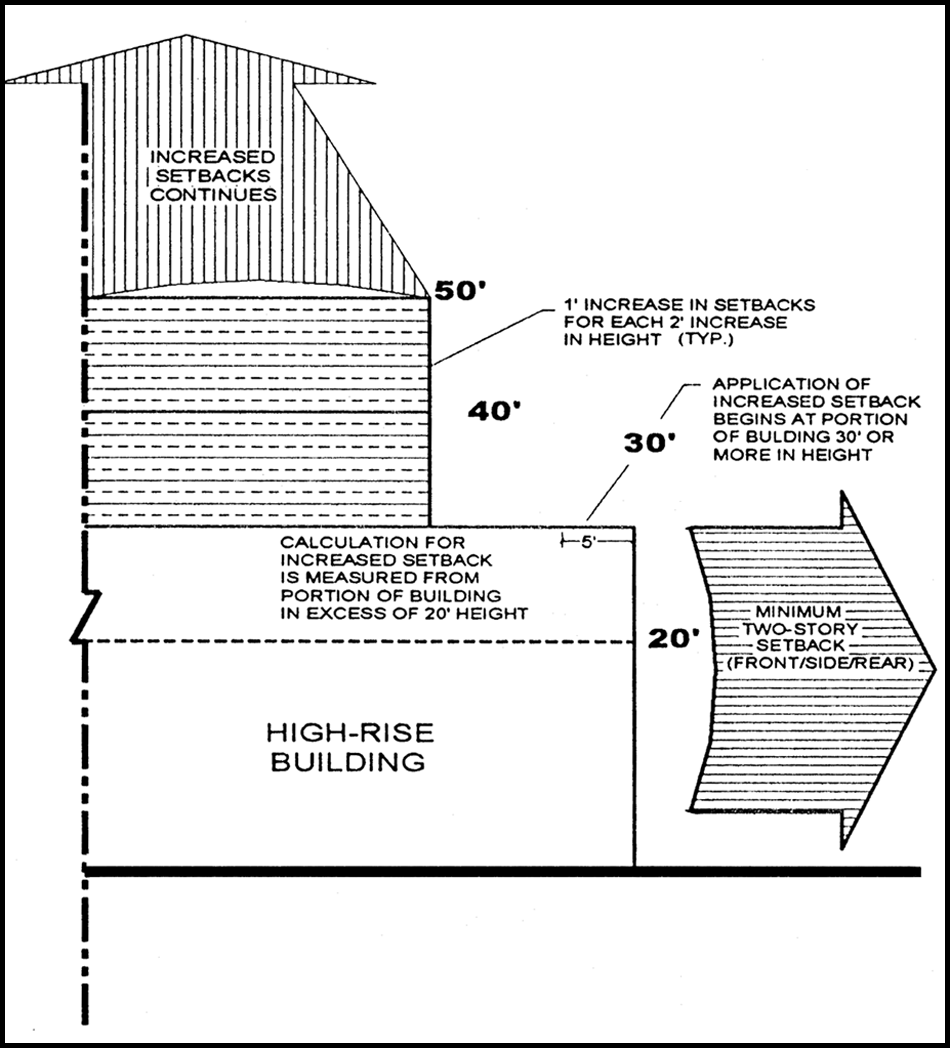
High-rise setbacks in the RMM and RMH zoning districts are established below and illustrated in Figure 30-1.
High-Rise Setback
(2)
Buildings. All portions of a high-rise building less than thirty (30) feet in height shall comply with the front, side, and rear setbacks as provided in Table 30-2.
(3)
All portions of a high-rise building thirty (30) feet or more in height, in addition to the setbacks required above, shall provide additional front, side and rear setbacks. The additional setback shall be provided as follows: one additional foot of setback for each additional two (2) feet in height above twenty (20) feet.
(4)
If applicable, the required rear setback provided herein shall be pre-empted by the setback established by the coastal construction line, pursuant to applicable state law. Additional setback may be required by the town to provided protection to natural resources, preserve dune vegetation, and preserve a uniform building line.
(5)
Garage structures shall comply with the required setbacks for a two-story building.
(6)
Any fractional portion of a foot shall require the additional setback provided herein.
(b)
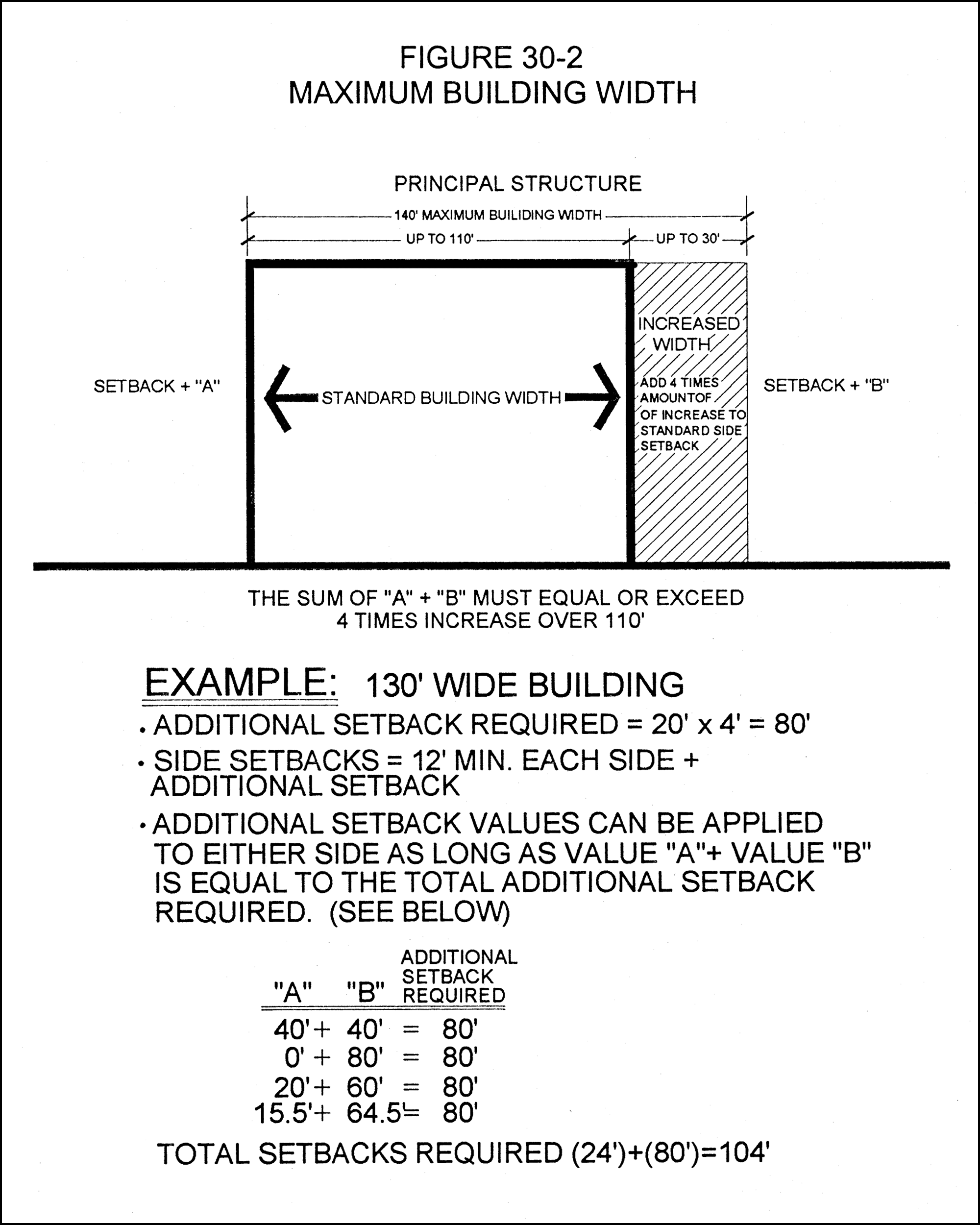
Maximum building width. The maximum building width in the RMM and RMH zoning districts is established below and as indicated in Figure 30-2. Maximum building width must conform to required side setbacks.
(1)
The maximum building width is one hundred ten (110) feet, unless otherwise provided herein.
(2)
The maximum building width may be increased to one hundred forty (140) feet. However, building widths in excess of one hundred ten (110) shall provide additional side yard setbacks. The additional setback shall be provided as follows: for each additional foot of building width the side setback shall be increased four (4) feet. The additional setback may be applied on either or both sides of the building.
(3)
The maximum width shall not apply to parking garages or other attached accessory buildings less than twenty-five (25) feet in height.
(4)
Any fractional portion of a foot shall require the additional setback provided herein.
(5)
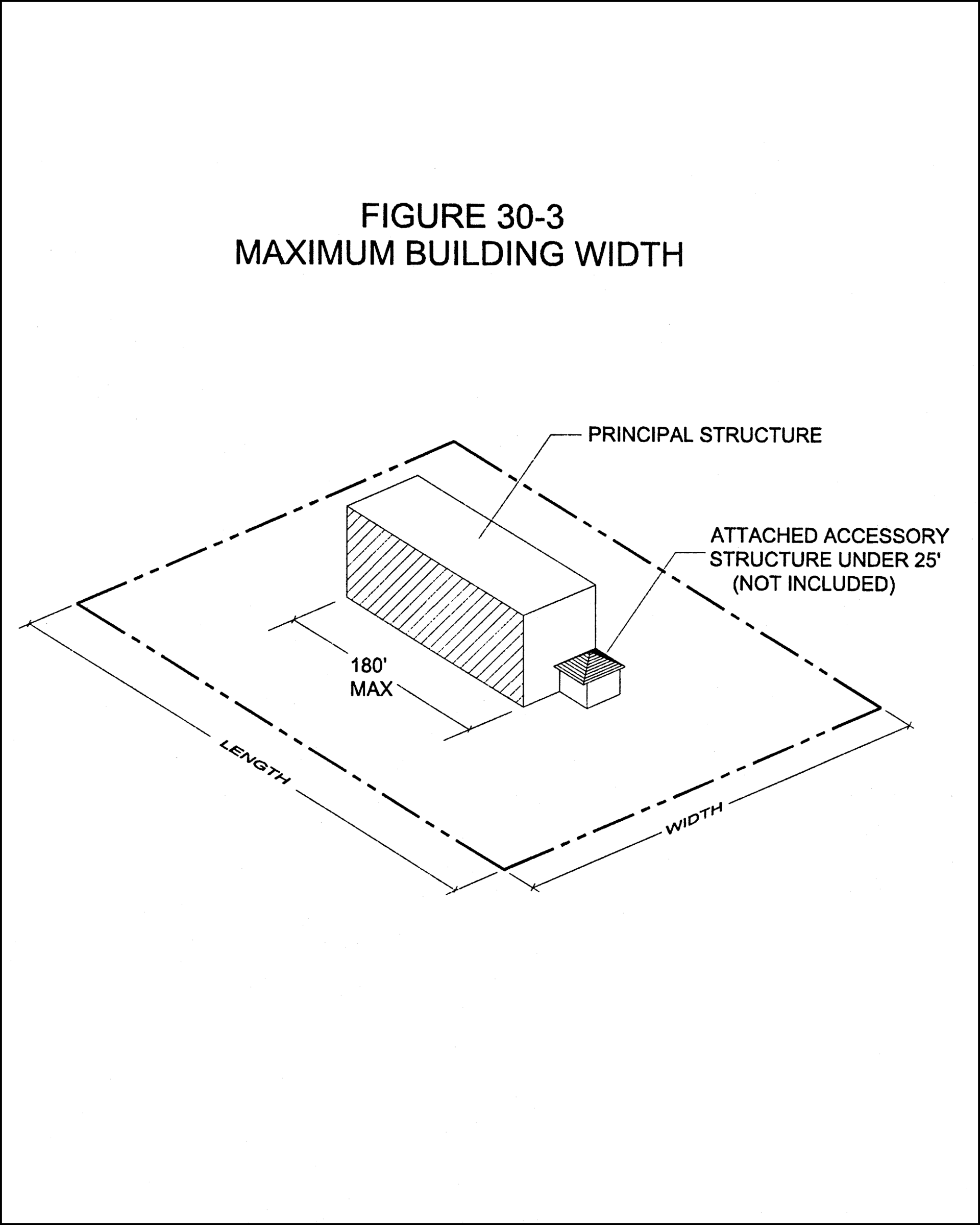
The maximum building length in the RMM and RMH zoning districts shall not exceed one hundred eighty (180) feet (see Figure 30-3). The maximum length shall not apply to parking garages and attached accessory structures less that twenty-five (25) feet in height.
(c)
Encroachments into setbacks in the RE, RS, RML, RMM and RMH zoning districts:
(1)
Unless otherwise provided in the Code, the following structures are allowed in the side or rear required setbacks as set forth herein.
a.
Walkways, patios and other hard surfaces for walking, gathering, and sitting shall be constructed of porous/pervious based materials, no closer than four (4) feet to the closest property line provided the height of the areas does not extend more than four (4) inches above the finished grade. Notwithstanding the foregoing, when such walkways, patios and other hard surfaces abut a waterway, canal or lake, such hard surfaces may be constructed of nonporous/nonpervious based materials (although porous/pervious based materials are encouraged) and may encroach up to the property line or seawall abutting the water, whichever is further landward, so long as adequate onsite drainage, as prepared by a registered design professional, is provided for such hard surfaces.
b.
Overhangs, pursuant to section 30-68(p).
c.
Air conditioner condensers, pool heaters, pool equipment or heat pumps, not to exceed five (5) feet in height, from the finished grade, unless otherwise approved by the building official due to flood elevation requirements, shall not extend any closer than seven (7) feet to the closest property line.
d.
Steps/stairways for the principal building shall not extend any closer than seven (7) feet to the closest property line.
e.
Electric meters, fuse boxes, generator control boxes and tankless hot water heaters shall be allowed to be mounted on a wall or structure, provided such attachments do not horizontally extend beyond the roof overhang or two (2) feet from the exterior face of the wall, whichever is less. Hose bibs shall be allowed to extend no further than two (2) feet horizontally from the exterior face of the wall.
f.
If the rear property line borders a body of water, screen enclosures may extend to not less than five (5) feet from the right-of-way line or bulkhead line, whichever is further landward.
(2)
Unless otherwise provided in the Code, the following structures are allowed in front, side or rear required setbacks as set forth herein.
a.
All fences, walls, and hedges may be erected or maintained along or adjacent to a lot line, and shall comply with the requirements of subsection 30-68(e).
b.
Permanently installed generators shall not extend any closer than seven (7) feet to the closest property line.
c.
Buried propane tanks, where the fillable portion of the tank is at or below the adjacent natural grade shall not extend any closer than seven (7) feet to the closest property line.
(3)
Equipment allowed in setbacks that emit noise, odors or fumes shall be fully shielded or screened via landscaping in such a way to minimize such noise, odor or fumes as required by the building official prior to the issuance of a permit.
(4)
Repair and maintenance of existing equipment and structures within the setback areas is allowed. Replacement is also permitted so long as the equipment is being replaced in the same location and the replacement equipment does not result in any additional encroachment into the required setback.
(Ord. No. 684, Art. IV, § 6, 7-25-00; Ord. No. 19-006, § 2, 9-19-19; Ord. No. 2021-006, § 2, 6-1-21)
Maximum Building Width—Setbacks
Maximum Building Width
Sec. 30-67. - Uses permitted, special exception, and prohibited uses.
(a)
Permitted, special exception, and prohibited uses. Uses permitted, uses permitted as special exceptions, or uses prohibited within the Town of Highland Beach are indicated in Table 30-4. Additional standards applicable to certain uses are established in Table 30-4.
(1)
Permitted uses may be established as indicated in Table 30-4, subject to the requirements of this Code.
(2)
Uses permitted as special exceptions as indicated in Table 30-4, may be allowed subject to the requirements of article III.
(3)
Uses permitted subject to site plan review as indicated in Table 30-4 may be allowed subject to the requirements of article III.
(4)
Uses prohibited shall not be established in the Town of Highland Beach.
(b)
Uses not listed. Unless otherwise provided by this chapter, uses not listed in Table 30-4 are prohibited in the Town of Highland Beach.
Table 30-4.
PERMITTED USES
Legend
NOTES. ADDITIONAL STANDARDS
(1)
Zero lot line dwelling. Zero lot line dwellings shall comply with the standards listed below.
a.
Applications for development order approval of zero lot line homes shall be approved as a special exception, and subject to all standards applicable to a special exception request.
b.
At least fifty (50) percent of the length of the side of the dwelling shall be located along the zero setback line.
c.
Openings such as windows and doors shall not be located on the side of the dwelling which is located on the zero setback line. However, glass block or similar translucent material may be allowed, subject to the following:
1.
Such material does not exceed ten (10) percent of total wall area;
2.
Such material complies with all applicable building and safety codes;
3.
Use is limited only to new construction; and
4.
Such material permits not more than sixty (60) percent transmission of exterior light.
d.
Residential developments containing zero lot line dwellings shall be subdivided and platted pursuant to the requirements of this Code, this chapter, and F.S. ch. 177.
e.
A maintenance easement of not less than two (2) feet shall be provided along the side of the structure constructed on the property line.
f.
Roof eaves and foundations located along the zero setback side of a dwelling may encroach not more than eighteen (18) inches into the abutting lot or property.
g.
The side of the dwelling not located [on a] zero setback side shall conform to the side setback requirements of the underlying zoning district.
h.
The size of lots for a zero lot line development shall conform to the requirements of the underlying zoning district.
i.
Excluding the side located along the zero setback, a zero lot line dwelling shall comply with all setbacks required in the underlying zoning district.
j.
An opaque masonry privacy wall or solid translucent privacy wall shall be installed along the zero setback side, extending to the rear at least ten (10) feet from the end of the dwelling. The first ten (10) feet of privacy wall shall be not less that six (6) or not more than eight (8) feet in height. Any portion of the privacy wall extending more than ten (10) feet shall be not more than six (6) feet in height. The town commission may require additional length to provide privacy between zero lot line units or other dwelling units.
k.
Screen enclosures for pools, patios, or yards may be installed along the rear portion of a zero setback side of a dwelling unit. The town commission may require an opaque masonry wall to provide privacy between adjacent zero lot line units or other dwelling units.
l.
A residential development project may contain zero lot line homes and other forms of attached or detached residential dwellings. However, the inclusion of zero lot line homes within such project shall require the entire project to be considered for approval as a special exception.
m.
Gutters shall be placed along all portions of the wall located on the side of the structure without a building setback.
n.
Zero lot line dwellings shall not share common fences and walls attached to more than one dwelling.
(2)
Accessory dwelling. A second structure, either attached to, detached from, or located within a principal and providing habitable area for one or more persons. Accessory dwellings shall comply with the requirements listed below:
a.
The dwelling shall not be for rent.
b.
The dwelling shall be utilized by guests or domestic employees of the owners or residents of the principal dwelling.
c.
If detached from the principal structure, the accessory structure shall be located within all required setbacks.
d.
The structure shall not exceed one thousand (1,000) gross square feet of living area, excluding non-air conditioned spaces such as covered or screened porches and garages.
(3)
Guardhouse, accessory:
a.
Shall be limited to a maximum of one hundred (150) square feet.
b.
Shall be used only for security purposes and shall not be used for any other function.
c.
The town commission shall require adequate stacking depth for each guardhouse.
d.
The town commission may require installation of dedicated turn lanes to ensure the safe flow of traffic.
e.
Sanitary facilities may be provided within guardhouses.
f.
Guardhouses existing on the effective date of this chapter shall be considered legal, conforming accessory structures. As legal, conforming structures, such guardhouses may be repaired, maintained, or otherwise expanded consistent with the requirements of this Code.
g.
Guardhouses may be constructed in association with residential development projects containing two (2) or more dwelling units.
(4)
Home-based businesses. A business that operates from a residential property is permitted. A business is considered a home-based business if it operates, in whole or in part, from a residential property and meets the following standards:
a.
Employees of the business who work at the residential dwelling must also reside in the residential dwelling, except that up to a total of two (2) employees or independent contractors who do not reside at the residential dwelling may work at the business. The business may have additional remote employees who do not work at the residential dwelling.
b.
Parking for the home-based business must comply with the provisions of article IV, chapter 30 of this Code. Additionally, the need for parking generated by the business may not be greater in volume than would normally be expected at a similar residence where no business is conducted, and vehicles and trailers used in connection with the business must be parked in legal parking spaces that are not located within the right-of-way, on or over a sidewalk, or on any unimproved surfaces at the residence.
c.
Parking or storage of heavy equipment at the home-based business shall not be visible from the street or neighboring property. For the purposes of this subsection, "heavy equipment means commercial, industrial, or agricultural vehicles, equipment, or machinery.
d.
External modifications made to a residential dwelling to accommodate a homebased business must conform to the residential character and architectural aesthetics of the neighborhood. As viewed from the street, the use of the residential dwelling shall be consistent with the uses of the residential areas that surround the property.
e.
The home-based business may not conduct retail transactions at a structure other than the residential dwelling; however, incidental business uses and activities may be conducted at the residential property.
f.
The activities of the home-based business shall be secondary to the property's use as a residential dwelling.
g.
To that extent not inconsistent with the requirements of this section, all business uses and activities must comply with all Town Code standards and requirements, including the applicable noise regulations, and with the standards for permitted uses and structures for the zoning district in which the home-based business exists. All signs shall comply with the regulations applicable to residential properties set forth in chapter 23 of this Code.
h.
All business activities shall comply with any relevant local, state, and federal regulations with respect to the use, storage, or disposal of any corrosive, combustible, or other hazardous or flammable materials or liquids.
i.
Transient accommodations are not permitted as a home-based business except as expressly provided elsewhere in this Code.
(5)
Change of nonconforming use. A change from one nonconforming use to another nonconforming use may be permitted as a special exception, subject to the standards listed below:
a.
Structural alterations to the existing structure which would expand the area or size of the nonconforming use are prohibited.
b.
The proposed use is equally or more appropriate in the location than the existing nonconforming use, based on such factors as:
1.
Reduction in hours of operation;
2.
Reduction in the amount of traffic generated;
3.
Reduction in demand for water and sewer services;
4.
Increase in buffering, screening, and landscaping to protect adjacent property owners;
5.
Reduction in overall impact of the proposed new use on adjacent properties; and
6.
Increase in conformity with applicable provisions of this Code, including but not limited to landscaping, off-street parking, and signage.
(6)
Boat basins. See section 30-67 of this article regarding accessory marine facilities.
(7)
Boat lifting and mooring devices. See subsection 30-68(g) of this article regarding accessory marine facilities.
(8)
Perpendicular docking of boats. See subsection 30-68(g)(7) of this article regarding perpendicular docking of boats.
(9)
Public recreation facilities. Public recreation facilities established as a principal use shall comply with the requirements listed below:
a.
The facilities, structure, site, and all principal or accessory uses shall be owned and operated by a public agency.
b.
The site shall possess a governmental service district (GSD) zoning designation.
c.
The facility shall be approved as a special exception.
d.
Evidence of adequate parking to accommodate expected demand at the facility shall be provided as part of the development order application.
e.
At a minimum, park facilities shall be closed at sunset and shall not reopen until sunrise.
f.
Park facilities shall be gated, and gates shall be closed between sunset and sunrise.
g.
Security lighting shall not spill over onto adjacent properties.
h.
Special exception approval, if granted, may require an interlocal agreement between the town and the owner of the site regarding the provision of public safety services to the site.
i.
Unless otherwise approved by the town commission, only parking and open-air fresh water rinsing facilities shall be located on the west side of SR A1A. Bathroom, picnic, play ground, and related equipment shall be located on the east side of SR A1A.
j.
A landscape strip, with a minimum width of fifteen (15) feet, shall be provided along the perimeter of the entire property abutting a residential zoning district.
k.
A minimum of twenty-five (25) percent of environmentally sensitive land shall be retained on site.
l.
To the maximum extent possible, existing native vegetation shall be retained on site.
m.
The town commission may require an opaque fence, berming, fencing, landscaping, or any combination thereof, to screen and buffer residential uses immediately abutting the site. Screening and buffering shall be at least six (6) feet in height, unless otherwise reduced by the town commission.
n.
Native, salt tolerant vegetation shall be utilized in all areas where landscaping is installed.
o.
Landscaping located in parking areas and other public use areas shall be irrigated, unless the requirement is waived by the town commission.
p.
All exotic vegetation shall be removed from the park prior to issuance of a certificate of occupancy.
q.
The use of dumpsters in the park for trash and debris prohibited, unless otherwise permitted by the town commission.
r.
All receptacles for waste collection and disposal shall be consistent with the overall design, materials, and colors of the park, and shall be designed and installed to compatible with other facilities.
s.
Waste collection shall occur in a manner established by the town or as provided by agreement with the firm or organization providing waste collection services.
(10)
Temporary structures. Temporary structures shall undergo site plan review as set forth in subsection 30-68(m) of this article.
(c)
Medical marijuana treatment center dispensing facilities. Pursuant to F.S. § 381.986(11)(b)1, medical marijuana treatment center dispensing facilities are prohibited from being located anywhere within the boundaries of the town.
(Ord. No. 684, Art. IV, § 7, 7-25-00; Ord. No. 14-004, § 2, 5-6-14; Ord. No. 14-008, § 2, 10-7-14; Ord. No. 17-002, § 2, 9-5-17; Ord. No. 20-001, § 5, 2-4-20; Ord. No. 2025-001, § 2, 1-21-25)
Sec. 30-68. - Supplemental district regulations.
(a)
Applicability. Unless provided elsewhere in this chapter, the provisions of this section shall apply throughout the Town of Highland Beach. In the event of a conflict between the requirements of this section and the requirements of another section, the more stringent shall prevail.
(b)
Principal structures. In any zoning district, more than one structure housing a permitted or permissible principal use may be erected on a single lot. However, each structure must comply with all property development and other applicable regulations of this chapter.
(c)
Accessory uses. Accessory uses and structures shall be located on the same lot as the principal use or structure or on a contiguous lot under the same ownership or on a noncontiguous lot that is under the same ownership that is not more than one thousand (1,000) feet from the lot with the principal structure, measured from closest boundary points. However, if lots or portions of lots under the same ownership are divided by a street, but are no more than one thousand (1,000) feet from one another, measured from closest boundary points, the town commission may permit accessory uses or structures on such noncontiguous lots or portions of lots. The use of noncontiguous lots for accessory structures or uses must be subject to a unity of title and be approved as a special exception, pursuant to section 30-36.
(1)
Separation. A freestanding accessory structure shall not be located within five (5) feet of any other principal or accessory building.
(2)
Encroachments. Fences, walls, vegetation, poles, and other customary yard accessories, pool decks, ornaments, and furniture may be permitted in any yard subject to height limitations and visibility requirements.
(3)
Unity of title. A unity of title for all lots or portions of lots divided by a street shall be reviewed by the town attorney, approved by the town commission, and recorded prior to issuance of a building permit. The unity of title shall be consistent with the requirements of section 30-67 of this article.
(d)
Creation of conforming lots. A conforming lot shall be created as follows:
(1)
A single lot of record, duly platted, approved, and filed with the Palm Beach County Clerk of the Circuit Court; or
(2)
A combination of complete lots of record, duly bound by an approved unity of title.
(e)
Fences, walls, and hedges. All fences, walls, and hedges shall comply with the requirements of this section.
(1)
Height limits. Fences and walls in residential zoning districts shall not exceed six (6) feet in height. Hedges are not subject to the height requirements established herein. Hedges shall be maintained in a manner consistent with good horticultural practices and the requirements of chapter 28 of the Town Code.
a.
The height of a fence or wall shall be measured from the lowest elevation adjoining either side of the structure or landscape material.
b.
When installed on the west side of SR A1A, a fence, wall, or hedge shall be located at least two and one-half (2½) feet from the westerly portion of the pedestrian/bicycle path, either side.
c.
Pilasters, columns, gate supports, and similar features may exceed the six-foot height limit, provided such features are of an appropriate scale and style with the architectural design and appearance of such wall, and do not result in a fence or wall with the overall appearance of a height in excess of six (6) feet.
(2)
Visibility triangle. A fence, wall, or hedge shall not encroach into the visibility triangle as defined by section 30-68 of this article.
(3)
Prohibited fences. Chainlink fences without vinyl coating are prohibited, unless screened by a living hedge which substantially screens the fence. Unscreened black or dark green vinyl-coated chain link fences are permitted. The barbs of all chainlink fences shall be crimped or otherwise turned down.
(4)
Tennis court fences. Tennis court fences shall not exceed ten (10) feet in height, and be concealed from public view. Such fences shall be at least ten (10) feet from the front property line. Landscaping to screen tennis fences shall be planted five (5) feet from front property line.
(5)
Coastal construction control line. Fences and walls constructed east of SR A1A shall comply with the requirements of F.S. ch. 161.
(f)
Swimming pools:
(1)
Required setbacks. Swimming pools, as measured from the edge of the pool, shall meet the setbacks established below.
a.
Swimming pools must be set back at least twenty-five (25) feet from the front property line and ten (10) feet from rear or side lot lines.
b.
Swimming pool decks must be set back at least twenty (20) feet from the front property line and at least four (4) feet from rear or side lot lines.
c.
Alternate setbacks and clearances for pool decks or decks are permitted, subject to approval of the building official and the planning board. The building official is permitted to require an investigation and recommendation of a registered design professional to demonstrate that the intent of this section and the code has been satisfied. Such an investigation shall include consideration of material, height of slope, slope gradient, load intensity and erosion characteristic of the slope material.
(2)
Buffering. Swimming pools in front yards shall be concealed from the view of the public rights-of-way.
(3)
Cabanas. Cabanas associated with swimming pools, or ocean bathing, shall comply with the following limitations:
a.
Single story;
b.
Not to exceed one hundred fifty (150) square feet;
c.
Facilities for independent living, cooking, eating, or sleeping are prohibited; and
d.
Water, electricity, and facilities for sanitation are permitted.
(4)
Prohibited swimming pools. Swimming pools not installed in the ground as a permanent structure or installed above ground as part of a multifamily dwelling are prohibited. Pools with a capacity of two hundred (200) gallons or less are excluded.
(5)
Protection of swimming pools. Swimming pools shall have the required state approved barriers installed as per Florida Building Code, as updated.
(g)
Accessory marine facilities.
(1)
Accessory use. Accessory marine facilities, including docks, piers, launching facilities, boat basins, freestanding pilings and lifting and mooring devices, are permitted as accessory uses in all residential zoning districts. Accessory marine facilities shall be reviewed as special exceptions by the planning board which shall be the final authority on all applications unless the accessory marine facility is part of a site plan submittal or other application requiring town commission approval as provided for in section 30-36.
a.
Accessory marine facilities shall not be used for commercial purposes.
b.
Accessory marine facilities shall be used only by residents or their guests, and shall not be rented or leased to nonresidents or any other person other than owners or residents of the principal dwelling or dwellings. For the purpose of this section, the term guest shall mean a person or persons residing in a dwelling unit for a limited period of time, not to exceed a period of sixty (60) days within one calendar year, at the invitation of the owner or resident of the dwelling.
c.
Accessory marine facilities shall not be a hazard to navigation.
(2)
Boat basins. Boat basins are allowed in all zoning districts and reviewed by a special exception, subject to the additional standards listed below:
a.
The edge of any improvements associated with a boat basin shall be located at least twenty-five (25) feet from side property lines.
b.
The total length of improvements associated with a boat basin shall not exceed one-third (33.3%) of the length of the property line in which the basin is located.
c.
Not more than twenty-five (25) percent of any boat moored in a boat basin may extend waterward of property line in which the basin is located.
d.
The town, at the expense of the applicant, may utilize appropriate marine, engineering, construction, and related professionals to review all aspects of such application. Such professionals shall be utilized to ensure compliance with the requirements herein, to ensure a proposed basin will not be a hazard to navigation, and to ensure a proposed boat basin will not pose a potential hazard, via erosion or other action, to the stability of neighboring properties.
(3)
Lifting devices. The installation of lifting devices or other means of securing boats (but not a boat dock) is allowed in all zoning districts. The maximum height for lifting devices shall be at base flood elevation (BFE), as provided by the FEMA FIRM maps, plus eight (8) feet. Lifting device height shall be measured to the top of the lift structure including mechanical equipment. In addition to the requirements for a special exception, the planning board must also find that the lifting device will provide adequate protection of neighboring property and that there is no infringement of standard navigational practices.
(4)
Boats and setbacks. When moored, any portion of a boat shall not extend beyond any property line, as extended waterward.
(5)
Enclosures. Accessory marine facilities shall not be enclosed with walls, roofs, or any other structures or improvements.
(6)
Installation. Accessory marine facilities shall comply with the installation standards listed below:
a.
In waterways regulated by the U.S. Army Corps of Engineers or other governmental regulatory agency, docks and mooring facilities shall not extend into the water more than twenty-five (25) feet or twenty-five percent (25%) of the waterway width, whichever is less (excludes docks and mooring facilities located along the Intracoastal Waterway), measured from the wet face of the seawall or bulkhead.
b.
The maximum combined seawall cap and dock width shall not exceed eight (8) feet.
c.
Measurement of the width or length of a dock, as applicable, shall be made from the property line.
d.
Marine facilities shall comply with the side yard setbacks listed below.
1.
Single-family zoning districts: Twenty-five (25) feet; provided, however, the side yard setback shall be fifteen (15) feet for any single-family lot with a lot width of fifty (50) feet or more but less than seventy (70) feet. For those lots with less than fifty (50) feet abutting the water, the planning board may grant a special exception for the installation of a seawall mounted davit type lifting device (but not a dock structure) after being satisfied as to the protection of neighboring property and no infringement of standard navigation practices.
2.
Multifamily zoning districts: Five (5) feet, measured from the perimeter property lines. In multifamily residential zoning districts, marine facilities shall be exempt from side yard setback requirements for all interior lot lines.
(7)
Perpendicular docking. Unless otherwise provided herein, boats shall not be moored or docked perpendicular to the property at which they are located.
a.
A boat moored at the landward end of a canal constructed for boat docking purposes may be moored perpendicular to the property line, provided such mooring does not impede the navigation of adjacent property owners.
b.
A boat moored in the Intracoastal Waterway may be moored perpendicular to the property line, subject to approval by the U.S. Army Corps of Engineers.
c.
A request for perpendicular docking of a boat in a canal shall be considered as a special exception by the planning board. Applications for development order approval of perpendicular docking of boats shall be subject to all standards applicable to a special exception request, and the additional criteria contained herein:
1.
Location of docks, docked boats, and relation to side setbacks shall be established by the waterward extension of property lines.
2.
Perpendicular docking of boats shall not interfere with navigation of other boats within the affected canal, and will not be a hazard to navigation.
3.
Perpendicular docking of boats shall comply with all setbacks required for accessory marine facilities.
4.
Docks or accessory mooring facilities approved by the planning board for perpendicular docking of boats may exceed the maximum extension into a waterway allowed for accessory marine facilities.
5.
The building official or designee, or planning board may request evidence, prepared by a recognized marine expert, demonstrating the following:
i.
Proposed perpendicular docking and related accessory marine facilities will not reasonably deny or otherwise limit the ability of abutting or adjacent property owners to construct accessory marine facilities;
ii.
Proposed perpendicular docking and related accessory marine facilities will not reasonably deny or otherwise limit the normal ability of abutting or adjacent property owners to moor, maneuver, use or otherwise move a boat; and
iii.
Proposed perpendicular docking and related accessory marine facilities will not deny reasonable visual access of abutting property owners to public waterways.
(8)
Ladders are permitted on docks, seawalls, finger piers or other mooring facilities.
(h)
Dolphins, freestanding pilings, boat lifts, docks, and moorings.
(1)
Installation. In order to be installed, dolphins, freestanding pilings, boat lifts, docks, and moorings (collectively "mooring facilities") shall comply with all standards listed below:
a.
The installation shall be subject to special exception approval by the planning board at an advertised public hearing.
b.
The mooring facilities will be located in a canal or waterway at least eighty (80) feet in width.
c.
The mooring facilities will not create a hazardous interference with navigation, endanger life or property, or deny the public reasonable visual access to public waterways.
d.
Construction of all mooring facilities shall require a building permit.
(2)
Public notice. In addition to the requirements of section 30-46, written notice must be provided by first class mail to owners of property abutting the canal and located within five hundred (500) feet, as measured from both property lines along the canal bank, of the property in question.
(3)
Documentation. The building official or designee, or planning board may, in the exercise of their discretion, request evidence, prepared by a recognized marine expert, demonstrating the proposed mooring facilities will not be a hazard to navigation and will not deny reasonable visual access to public waterways.
(4)
Adjacent property. Installation of the mooring facilities shall not cause a hazardous interference with navigation, endanger life or property, or deny the adjacent property owners or public reasonable visual access to the public waterway.
(5)
Navigation. Installation of such mooring facilities shall not infringe upon standard navigational practices that are or may be used by abutting property owners.
(6)
Floating docks. Floating docks are permitted, subject to conformance with all zoning code requirements herein and compliance with all applicable building codes.
(i)
Dune walkover structures:
(1)
Compliance with state requirements. Dune walkover structures shall conform to structural requirements adopted by the Department of Environment Protection or successor agency and shall receive all necessary state permits and approvals prior to construction.
(2)
Planning board approval. Dune walkover structures shall require planning board approval prior to issuance of a building permit.
(3)
Compliance with setbacks. A dune walkover structure shall comply with the setbacks of the zoning district in which located. However, this requirement may be waived by the building official if one of the following applies:
a.
A beach access easement or similar easement exists which would allow for construction of such structure; or
b.
An alternative location, as determined by DEP, results in less damage to affected coastal dune and vegetation.
(j)
Vehicular access to public and private rights-of-way:
(1)
Access required. All lots or parcels shall have appropriate access to a public or private right-of-way. Such means of access shall conform to applicable county and state requirements when such requirements are more restrictive than the requirements set forth in this section or chapter.
(2)
Minimum requirements for vehicular access and circulation. All lots, structures, and buildings shall provide access to a public or private right-of-way as provided below:
a.
At least thirty-two (32) feet wide for all nonresidential uses and all residential uses consisting of two (2) or more dwellings; or
b.
At least twenty-five (25) feet wide for all single-family residential dwellings.
(3)
Location of structures. All structures shall be so located on lots as to provide safe, convenient access from a public or private right-of-way for delivery and collection of public services, fire protection, and required off-street parking.
(k)
Essential services:
(1)
Essential services permitted. Facilities necessary to provide essential services to town residents may be located within any zoning district. For the purposes of this section, essential public services include minor structures and uses necessary to provide natural gas, water, electricity, TV cable, sewerage, and telephone service.
(2)
Essential services excluded. This section shall not be deemed to permit the establishment of prohibited uses such as electric or gas generating plants, sewage treatment plants, liquid petroleum gas storage facilities, and similar facilities of an industrial nature.
(3)
Related commercial activities excluded. This section shall not be deemed to allow the establishment of structures for commercial activities such as sales or the collection of bills in zoning districts in which such activities are prohibited.
(4)
Essential services structures. If the installation of essential services requires permanent structures of other than a minor nature, such structures shall be subject to special exception review. An application of this nature shall comply with the standards of section 30-33. In addition, to the extent possible, the structure shall provide architectural design and landscaping that is compatible with the character of the zoning district in which it is located.
(l)
Underground utilities. With the exception of services boxes, fire hydrants, check valves, and related items, electric, telephone, cable television, natural gas, and similar facilities located on private property shall be installed below ground.
(m)
Temporary structures:
(1)
Temporary structures. Temporary structures may be erected in any district in connection with land development or construction projects, including real estate offices for original sales of dwelling units and construction trailers. Temporary structure shall not be used as dwelling or lodging units.
(2)
Installation. A temporary structure shall not be installed without site plan review and approval and the issuance of a building permit for the temporary structure. The planning board shall have the final authority to approve a site plan for a temporary structure visible from a public right-of-way, and the building official shall have final authority to approve a site plan for a temporary structure not visible from a public right-of-way and for all temporary trailers or storage containers to be located on construction sites. Approval for a temporary structure shall be subject to the standards listed below.
a.
The approved site plan and building permit for the temporary structure shall specify the location, type of construction, maintenance requirements, and the period for which the temporary structure shall be required.
b.
Any building permit issued for a temporary structure shall expire after a period of six (6) months, unless renewed by the building official for one or more additional periods of six (6) months.
c.
A temporary structure, whether it is visible from the public right-of-way or not, shall not be allowed for more than two (2) years, including any renewal periods, unless approved by the town commission.
d.
A certificate of occupancy shall be issued before the structure is occupied.
e.
Land development or construction activities on the site must commence within one year after the building permit for the temporary structure is issued. If land development or construction activities do not commence within the required time period, the building official may initiate code enforcement proceedings and/or any other lawful action to require removal of the temporary structure from the site.
(3)
Dune walkovers and gazebos. Dune walkovers and gazebos are considered expendable structures, and are not subject to the time limits established above. Dune walkovers and gazebos are considered structures, and a building permit is required prior to construction.
(4)
Tents. Tents proposed to be installed for temporary purposes shall require a building permit. Temporary purposes, for the purpose of this section, shall mean events such as festivals, weddings, craft sales, and outdoor ceremonies.
a.
The building official may approve installation of a tent for not more than five (5) consecutive days.
b.
Any request for installation of a tent for more than five (5) consecutive days shall require approval by the town commission. The decision of the town commission shall be based upon the location, duration, and potential impact of the event on adjacent properties.
c.
Notwithstanding the foregoing, if no portion of the tent is visible from a public right-of-way, the building official may approve installation of a tent for a period of not more than twenty (20) consecutive days.
(n)
Developments divided by public or private road rights-of-way. Property owners may not combine properties on opposite sides of any public or private road right-of-way. Density transfers between divided lots and properties are prohibited. Divided properties are to be developed in accordance with regulations applicable to each separate lot. A unity of title for all lots or portions of lots divided by a public or private right-of-way shall be provided as required in section 30-67 of this article.
(o)
Visibility triangles:
(1)
Requirements for visibility triangles. The regulations and restrictions set forth herein are intended to assure adequate visibility as a means of ensuring safe conditions for vehicles and pedestrians at street intersections, and the intersection of access driveways and street rights-of-way.
(2)
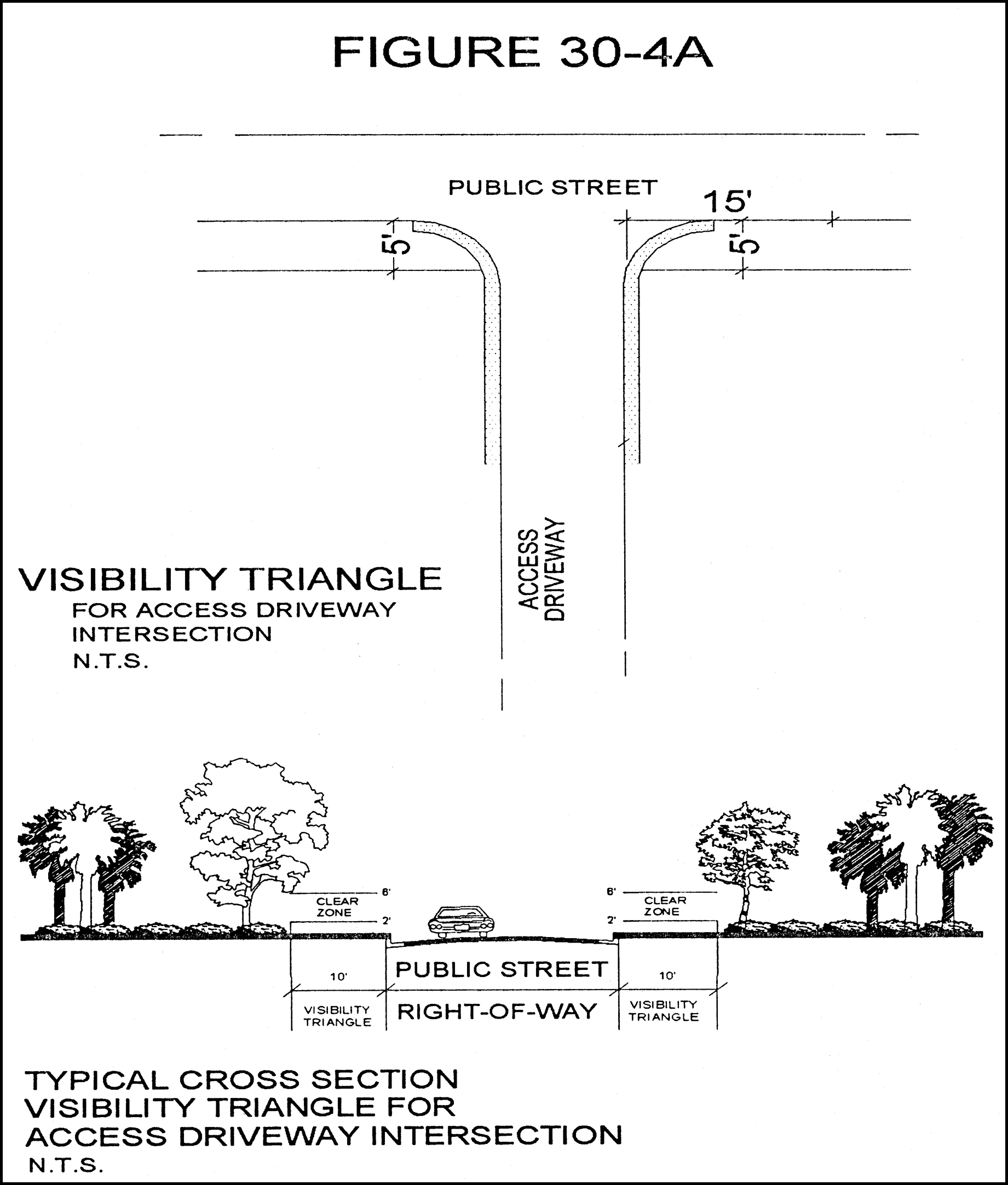
Access driveways. When an access driveway intersects with a public or private street right-of-way, visibility triangles shall be created along both sides of the access driveway. Two (2) sides of the visibility triangle shall extend not less than ten (10) feet each way from the point of intersection of the driveway pavement and the public right-of-way. The third side of the triangle shall be a line connecting the ends of the other two (2) sides as shown in Figure 30-4A.
(3)
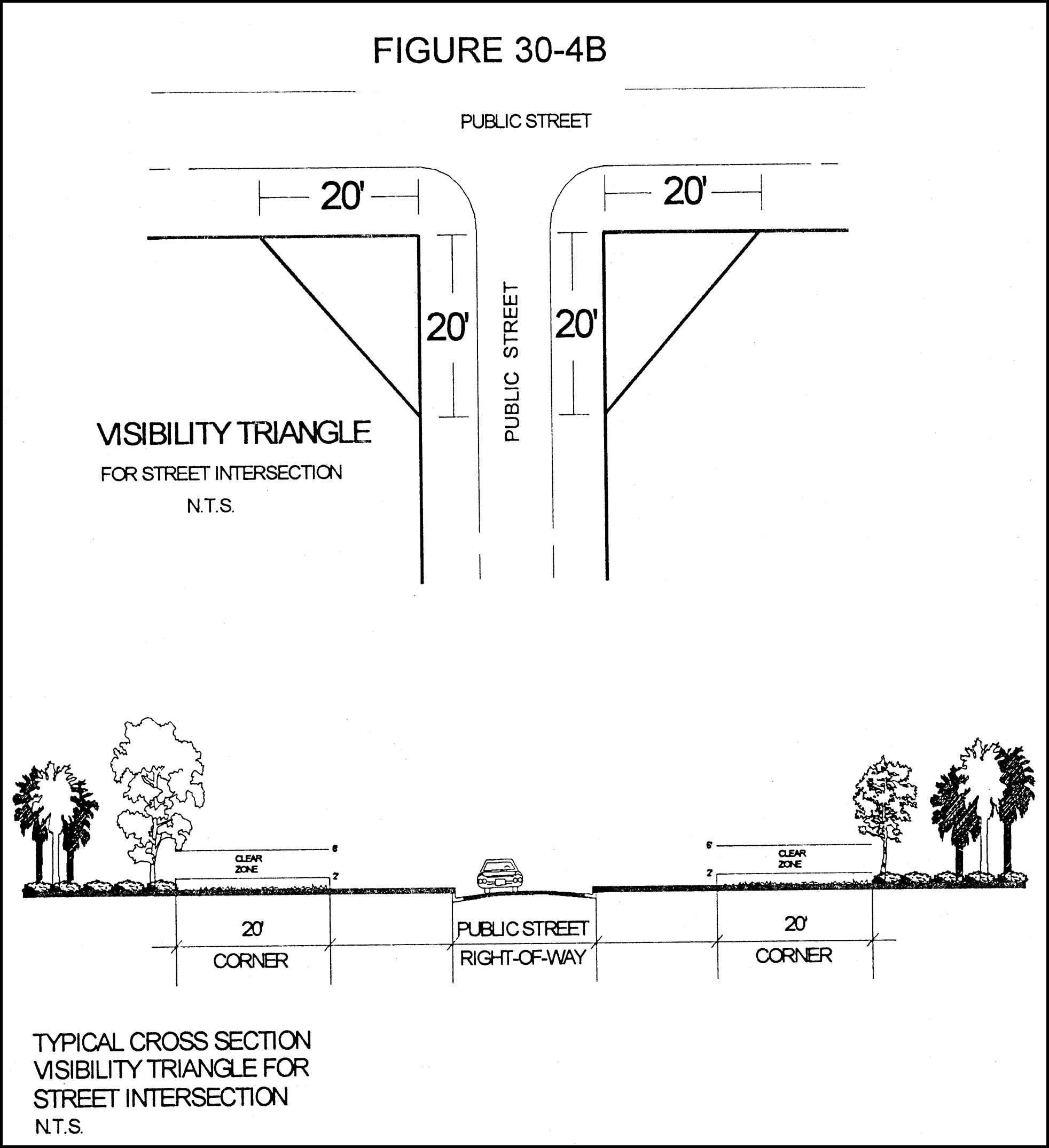
Right-of-way intersections. When two (2) public or private rights-of-way intersect, visibility triangles shall be created. Two (2) sides of the visibility triangle shall extend not less than twenty-five (25) feet along the abutting rights-of-way lines, measured from the point of intersection. The third side of the triangle shall be a line connecting the ends of the other two (2) sides as shown in Figure 30-4B.
(4)
Alternative visibility triangles. Alternative visibility triangles to ensure adequate traffic safety may be required in individual cases when deemed necessary by the building official. If alternative visibility triangle configurations are required due to unusual site conditions, the alternative shall result in traffic safety that is equivalent or superior to the minimum standards required herein.
(5)
Obstructions. Obstructions within visibility triangles are prohibited. The restrictions listed below shall apply to landscaping, bus shelters, benches, newspaper racks, signs, and other structures or appurtenances within any visibility triangle.
a.
As indicated in Figure 30-4A and Figure 30-4B, signs, walls, or landscaping, excluding ground cover, shall not be located within three (3) feet of either side of an access driveway located within twenty (20) feet of the edge of a pavement of the public street.
b.
Within a visibility triangle, structures, plantings, or foliage shall not be permitted within the clear zone established between the heights of two (2) feet and eight (8) feet above ground level. The clear zone shall be measured from the crown of the abutting roadway, or in the case of an intersection, from the crown of the roadway with the lower elevation. However, clear tree trunks and supports for street signs, traffic control signs and traffic signals which meet state and county standards shall be permitted. Limbs and foliage of trees and shrubs planted outside the area of a visibility triangle shall not extend into said triangle or clear zone.
c.
Parking or vehicular use areas shall not be permitted within a visibility triangle.
(p)
Overhangs:
(1)
Permitted Roof Overhangs. Roof overhangs, not exceeding four (4) feet, shall be permitted to encroach into front, side, or rear setbacks.
(2)
Other Features. Overhangs for bay windows, canopies, awnings, chimneys, and similar features may not project more than three (3) feet into reguired setbacks or yards. Bay windows and chimneys shall not exceed a length along the wall parallel to the property line more than ten (10) percent of the cumulative length of one or more walls along the same property line on which the feature is located.
(3)
Canopies. Permanent and retractable canopies fabricated of metal, canvas, or other material consistent with applicable building codes, may be installed. All canopies must comply with required front, side, and rear setbacks, and shall comply with the standards listed below.
a.
A canopy shall be attached only to a principal structure.
b.
A building permit is required for installation of a permanent or retractable canopy.
(4)
Balconies. Balconies at the second floor level or above shall not project more than three (3) feet into the required setback or yard and shall not exceed a length along the wall parallel to the property line more than twenty (20) percent of the cumulative length of one or more walls along the same property line.
(q)
Unity of title:
(1)
Unity of title declaration. Prior to the issuance of a development order or building permit the town may require a property owner to record a unity of title. The purpose of the unity of title is to ensure the combination of lots or parcels complies with all applicable property development regulations and standards of this chapter. Any properties affected by a unity of title shall comply with the density requirements of the comprehensive plan and this chapter.
(2)
Form and content. The unity of title shall be prepared in a manner acceptable to the town attorney. At a minimum, the unity of title shall contain the provisions listed below:
a.
The combination of separate lots, plots, parcels, acreage, or portions thereof, shall be regarded as unified under one title as an indivisible building site.
b.
The property shall be considered as one parcel of land, and no portion thereof shall be sold, assigned, transferred, or conveyed separately.
c.
Any sale, assignment, transfer, or conveyance of the property shall be in its entirety as one parcel of land.
d.
The unity of title declaration shall constitute a covenant to run with the land in perpetuity.
e.
The unity of title shall be binding upon the declarer, heirs, successors, and assigns, until such time as the unity of title declaration may be released with the approval of the town commission.
(3)
Town attorney. All unities of title applicable to property within the town shall be reviewed by the town attorney, approved by the town commission and recorded prior to issuance of a building permit, or as otherwise required by a development order approved by the town.
(r)
Stormwater management:
(1)
Stormwater management. Stormwater management shall be required for all land development activities, including single-family residential dwellings, within the town in order to control runoff, ensure maintenance of appropriate water qualify standards, protect groundwater resources, and prevent erosion. Stormwater management systems shall be designed by an engineer registered in the State of Florida.
(2)
Applicable regulations. The stormwater management regulations applicable within the town shall be those administered by the South Florida Water Management District set forth in chapter 40E, Florida Administrative Code, as amended.
(3)
Additional standards. All development activities within the town shall comply with the additional standards listed below:
a.
Completed construction and improvements shall not impede the flow of stormwater runoff to points of collection, retention, or detention.
b.
Completed construction and improvements shall retain onsite the first one inch of stormwater runoff generated by a three-year storm event.
(s)
Open space and recreation:
(1)
Purpose and intent. It is the intent of this section to provide land or funds or both to be used by the town commission to provide additional open space and recreational land necessary to meet demands created by new residential development.
(2)
Land dedication requirements. For development of multifamily developments, the property owner shall dedicate to the town a parcel of land of suitable size, dimension, topography, and general character to meet the town's open space and recreational land needs created by the development. Land dedication requirements are listed below:
a.
The total amount of land to be dedicated for the development site shall equal or exceed a ratio of one acre of land for every one hundred (100) residents of the development.
b.
For purposes of this section, two (2) persons per unit shall be deemed to reside in a proposed multifamily development. The dedication of land shall be made prior to the issuance of any building permit for the development.
c.
The following formula shall be used for calculating the amount of open space and recreational land to be dedicated:
2.0 × Total Units × 0.01 = Amount of Acres
of Land to Be Dedicated
(3)
"In lieu" payments. If the town commission determines a multifamily development is too small or it is not feasible and advisable to dedicate open space land or land for recreation purposes, the property owner shall make an in lieu payment to the town in the amount of one thousand dollars ($1,000.00) for each dwelling unit.
a.
The in lieu payment shall be paid prior to the issuance of any building permit for the development.
b.
The in lieu payment shall be deposited into a separate nonlapsing open space land and recreational land fund established and maintained by the town.
(4)
Single-family units. For a single-family unit, an in lieu payment for each unit shall be required.
a.
For a single-family unit which is constructed on a vacant lot, an in lieu payment of one thousand dollars ($1,000.00) shall be required.
b.
The in lieu payment shall be paid prior to the issuance of any building permit for the dwelling unit.
c.
The in lieu payment shall be deposited into a separate nonlapsing open space land and recreational land fund established and maintained by the town.
(5)
Limitation on use of land and fees. The land and fees received under this section shall be used for the purpose of providing open space land and recreational facilities.
a.
The town shall establish a separate non-lapsing open space land and recreational land fund into which in lieu payments shall be deposited.
b.
The money in this account shall be expended by the town only for the acquisition of open land and recreational lands, improvement to lands consistent with these open space land and recreational purposes, and providing equipment and personal property incidental thereto.
(6)
Requirements of deed. Any land required to be dedicated under this section shall be granted via warranty deed with marketable title free and clear of all encumbrances. The dedication shall occur prior to the issuance of the first building permit for the development. The deed shall be provided in a form acceptable to the town attorney.
(7)
Program for acquisition of lands. The town commission may establish a program for the acquisition of lands for development as recreational facilities and open space areas in order to meet the existing need for municipal recreational and open space areas. The program also be established to meet, as it occurs, the need for municipal recreational facilities and open space areas created by further residential developments constructed after the effective date of this section.
a.
The annual budget and capital improvement program of the town shall provide for appropriation of funds as may be necessary to carry out the program for the acquisition of land for municipal recreational facilities and open space areas.
b.
The funds necessary to acquire lands to meet the existing needs for municipal residential facilities and open space must be provided from a source of revenue other than from amounts deposited in the open space land and recreational land fund.
c.
Amounts deposited in the fund shall be expended within a reasonable period of time for the purpose of acquiring and developing land necessary to meet the need for municipal recreational facilities and open space areas created by new development in order to ensure that such recreational facilities or open space areas will be available to and substantially benefit residents of new developments.
(t)
Parking or storage of major recreational equipment andvehicles. Major recreational equipment shall not be used for temporary or permanent residential purposes. Parking or storage of major recreational equipment within the town is prohibited, unless the equipment is parked entirely within an enclosed garage.
(u)
Exceptions to building height.
(1)
The following exceptions to building height limits for single-family and multi-family units containing up to four (4) dwelling unit dwellings shall be permitted.
a.
Exceptions. Exceptions to building heights shall include such functional and nonfunctional architectural features as chimneys, cupolas, towers, dormers, parapet walls, domes, and spires. Mechanical features are considered exceptions to height limitations include heating, ventilating, and air conditioning equipment, and flagpoles and radio or television antennae, satellite receivers, digital transmitters, and telecommunication eguipment.
b.
Measurement. Height exceptions shall be measured from that point of a flat or pitched roof utilized to determine building height.
c.
Limitations. Height exceptions shall comply with the limitations listed below:
1.
Not more than two (2) height exceptions, including elevator housings, shall be allowed on any defined roof line.
2.
The size of each architectural height exception, unless otherwise provided herein, shall be limited to a total of four feet by four feet by four feet (4′ × 4′ × 4′) and a maximum volume of sixty-four (64) cubic feet.
3.
The size of height exceptions or architectural features shall not exceed four (4) feet above that point of a flat or pitched roof utilized to determine building height, except as may be required to comply with building codes for functional chimneys or similar features.
4.
Parapet walls shall not exceed four (4) feet in height.
5.
For single-family dwellings, heating, ventilating, air conditioning, and exhaust equipment, and radio or television antenna shall not exceed the height of a parapet wall. In the absence of a parapet wall, such equipment shall be screened in a manner consistent with the architectural style, colors, and materials of the principal structure.
6.
The height of flag poles shall not extend more than four (4) feet beyond that point of a flat or pitched roof utilized to determine building height.
7.
All height exceptions shall be constructed in a manner consistent with the architectural style, colors, and materials of the principal structure.
d.
Elevators. Elevator housings for single-family dwellings may exceed the height exception limits as provided herein, provided the structures are consistent with the standards listed below.
1.
The exterior measurements of the housing or elevator structure shall not exceed six feet by six feet by ten feet (6′ × 6′ × 10′) and a maximum volume of three hundred sixty (360) cubic feet.
2.
One externally visible elevator housing per single-family residential structure is allowed.
3.
A canopy or other weather protection for an elevator door may be provided in a scale consistent with the intended function.
4.
The elevator housing shall be constructed in a manner consistent with the architectural style, colors, and materials of the principal structure.
e.
Observation decks and widow's walks. Observation decks and widow's walks shall be permitted subject to the standards listed below:
1.
The observation area shall not exceed two hundred twenty-five (225) square feet, and habitable area shall not be provided.
2.
The walks or decks shall be open air features and shall not be walled, roofed, or otherwise enclosed.
3.
Electricity, water, and similar services shall not be installed, unless determined necessary by the building official to meet requirements of the building code.
4.
The surface of walks or decks shall not exceed the overall building height limit.
5.
Not more than one deck or walk per principal structure or dwelling shall be installed.
6.
Access to a deck or walk may be provided by an elevator or an unenclosed stairway, with such secondary access as may be required by the building official.
7.
Swimming pools, spas, jacuzzis, and hot tubs, but not other recreational facilities, shall be allowed on a roof top of a single-family dwelling. Recreational facilities of this nature may be permitted on the roof of a multiple-family dwelling if approved by the town commission.
8.
Safety railings shall be provided to meet building or safety codes, provided such railings shall not be opaque.
9.
The decks, walks, and safety railings shall be constructed in a manner consistent with the architectural style, colors, and materials of the principal structure.
(v)
Formerly developed vacant lots.
(1)
Applicability. This subsection shall apply to all lots within the town where the principal structure has been demolished and no principal use currently exists on the property.
(2)
Ground treatment. Vacant lots regulated by this subsection shall be cleared of construction material and debris, shall be properly graded and shall be covered with sufficient ground treatment. Existing ground treatment may be used to meet the requirements of this section.
a.
Ground treatment may consist of any combination of living plants, such as grass, ground cover, shrubs, vines, hedges or trees and non-living landscape material such as rocks, pebbles, sand, mulch and decorative paving materials. Non-living landscape material shall be limited to a maximum of twenty (20) percent of the total lot area.
b.
Property owners are encouraged to adhere to xeriscape landscaping principles as set forth in section 28-6 of this Code and "Florida Friendly" (as promulgated by the Florida Yards and Neighborhood Program) landscaping principles and utilize low-maintenance, drought-tolerant landscaping materials and practices.
c.
The clearing and planting must be completed within thirty (30) days of the completion of the demolition of the principal structure. While the property owner may irrigate the lot utilizing an irrigation system, electrical services to vacant lots shall be prohibited.
d.
The property owner shall ensure that the property adequately drains so as to alleviate standing water.
(3)
Foundations, driveways and accessory structures. Slab foundations and other structural features remaining from demolished structures must be removed from the lot. All accessory structures (including swimming pools), parking areas and driveways shall be removed from vacant lots, with the exception of seawalls, driveway aprons located within adjacent rights-of-way and irrigation systems. Seawalls shall be structurally sound and comply with all applicable code requirements and any seawall in need of repair or otherwise determined by the town to be injurious to the health, safety or welfare of the neighborhood or community shall be subject to the abatement procedure set forth in section 6-132 of this Code. Swimming pools shall be removed or filled in accordance with all applicable building code requirements and state and local health department regulations.
(4)
Existing trees and vegetation. All existing native and non-invasive trees and palms shall be preserved to the maximum extent possible and lot owners shall comply with chapter 20, article IV, division 2 of this Code ("Tree and Understory Preservation"). All existing non-native and exotic species, as listed in the most current edition of the Florida Exotic Pest Plant Council's List of Invasive Plant Species (categories I and II), shall be removed from the lot.
(5)
Planting plan. Simultaneously with the application for a demolition permit, the lot owner shall submit a planting plan for review and approval by the building department indicating the method of ground treatment and identifying existing trees and palms to be preserved and non-native and exotic species to be removed. The building department shall not issue the demolition permit until the planting plan has been submitted and approved.
(6)
Maintenance. The lot shall be maintained in accordance with all applicable property maintenance requirements. Maintenance shall terminate upon the commencement of active construction activities in accordance with a valid and active building permit. If construction activities cease for more than thirty (30) days or the building permit expires, a new planting plan shall be submitted and implemented.
(7)
Exemption.
a.
A lot owner shall be exempt from submitting a planting plan and demolishing the existing driveways, parking areas and accessory structures if the property will be redeveloped within one hundred twenty (120) days of demolition, as evidenced by the submittal of an application for a building permit or other development approval at the time of demolition. The lot owner shall certify that the existing driveways, parking areas and accessory structures will be incorporated into the new construction plan or are necessary to facilitate future construction activities, whichever is applicable. Lot owners shall limit access to swimming pools remaining on vacant lots in accordance with the applicable building code requirements for new construction.
b.
The exemption shall remain in place for so long as the permit or approval remains active, provided that active construction activities commence within the one hundred twenty-day period. In order to qualify for the exemption, the lot owner shall submit an affidavit stating that the above requirements shall be met at the time the application for the demolition permit is submitted.
c.
A property owner may apply for one extension of the exemption period for a period of time not to exceed sixty (60) days.
d.
In the event: (i) construction activities do not commence within the one hundred twenty-day period; (ii) the permits or other approvals facilitating redevelopment of the property expire; or (iii) construction activities commence and then cease for a period of more than thirty (30) days, the property owner shall comply with all requirements of subsections (2) through (6) above within thirty (30) days.
(8)
Existing docks or piers. An existing dock or pier adjacent to a formerly developed vacant lot may remain subject to the following conditions:
a.
The use of the dock or pier shall be limited to one vessel;
b.
Prior to the issuance of a demolition permit, the building official certifies, after inspection, that the dock or pier is structurally sound and compliant with all applicable provisions of this article;
c.
The dock or pier shall only be used for the personal enjoyment of the lot owner and shall not be rented or leased to any third party or used for any commercial purpose;
d.
No sewer or electrical services to the dock or pier shall be permitted;
e.
No live aboard vessels shall be permitted;
f.
The upland portion of the lot shall not be used for storage, parking or any other accessory use or structure until the principal use or primary structure is completed; and
g.
Access to the dock or pier may be restricted through the construction of a non-opaque galvanized metal, wrought iron or vinyl-coated chain link fence no greater than four (4) feet in height constructed within five (5) feet of the seawall or bulkhead to restrict access to the waterbody from the vacant lot.
(Ord. No. 684, Art. IV, § 8, 7-25-00; Ord. No. 10-002, Exh. A, 6-1-10; Ord. No. 14-002, § 2, 3-4-14; Ord. No. 14-003, § 2, 3-6-14; Ord. No. 14-004, § 3, 5-6-14; Ord. No. 14-008, § 3, 10-7-14; Ord. No. 16-006, § 3, 3-1-16; Ord. No. 19-004, § 2, 9-19-19; Ord. No. 19-005, § 2, 9-19-19; Ord. No. 20-001, § 6, 2-4-20; Ord. No. 20-003, § 2, 6-16-20; Ord. No. 2021-001, § 2, 1-5-21; Ord. No. 2021-006, § 2, 6-1-21; Ord. No. 2021-007, § 2, 6-1-21; Ord. No. 2025-002, § 3, 1-21-25)
Sec. 30-69. - Off-street parking, loading, and vehicular circulation.
(a)
General provisions.
(1)
Generally. Off-street parking, loading, and vehicular circulation facilities shall be provided as required by this section.
(2)
Purpose and intent. The purpose of this section is to create an efficient, safe, and balanced system of off-street parking, loading, and vehicular circulation accommodating vehicles and pedestrians. Design and construction of all parking facilities as well as on-site traffic circulation shall conform with the requirements of this section and are referred to herein as vehicular use areas.
(b)
Off-street parking. Off-street parking shall be provided as required herein.
(1)
Required parking spaces. Required parking spaces shall be provided as indicated in Table 30-5.
Table 30-5.
Required Off-Street Parking Spaces
NOTE.
N/A = Not Applicable
(2)
Parking study. The town may request a parking demand study for any multifamily residential development which proposes to construct dwelling units larger than three thousand (3,000) square feet. If the need for additional parking is demonstrated by the parking demand study, the town commission may require installation of such additional parking.
(3)
Existing buildings and uses. Additional off-street parking and loading facilities for existing buildings and uses shall be provided as required below:
a.
An existing building may be modernized, altered, or repaired without providing additional off-street parking or off-street loading facilities, providing there is no increase in floor area or capacity.
b.
Any building or use that is expanded in floor area, number of units, or a similar increase shall provide off-street parking and loading facilities for the expansion.
c.
Where change in use of a building or land requires additional parking or loading spaces, such spaces shall be provided in addition to the number existing for the prior use.
d.
Where the change in use decreases requirements, only the number required for the new use need be maintained.
(4)
Alteration of nonconforming uses. Where major repairs, alterations, or extension of uses are to made in a building occupied by a nonconforming use, no such repairs, alterations, or extensions shall be permitted unless and until the off-street parking requirements for a nonconforming use of the type involved in the district in which such use is first permitted are applied to the existing use and full provision of off-street parking facilities is made.
(5)
Garages and driveways. Parking spaces for single-family and two-family dwellings may be located within an accessory garage or a driveway. Driveways for single-family and two-family dwellings shall be a minimum of twenty (20) feet in length.
(6)
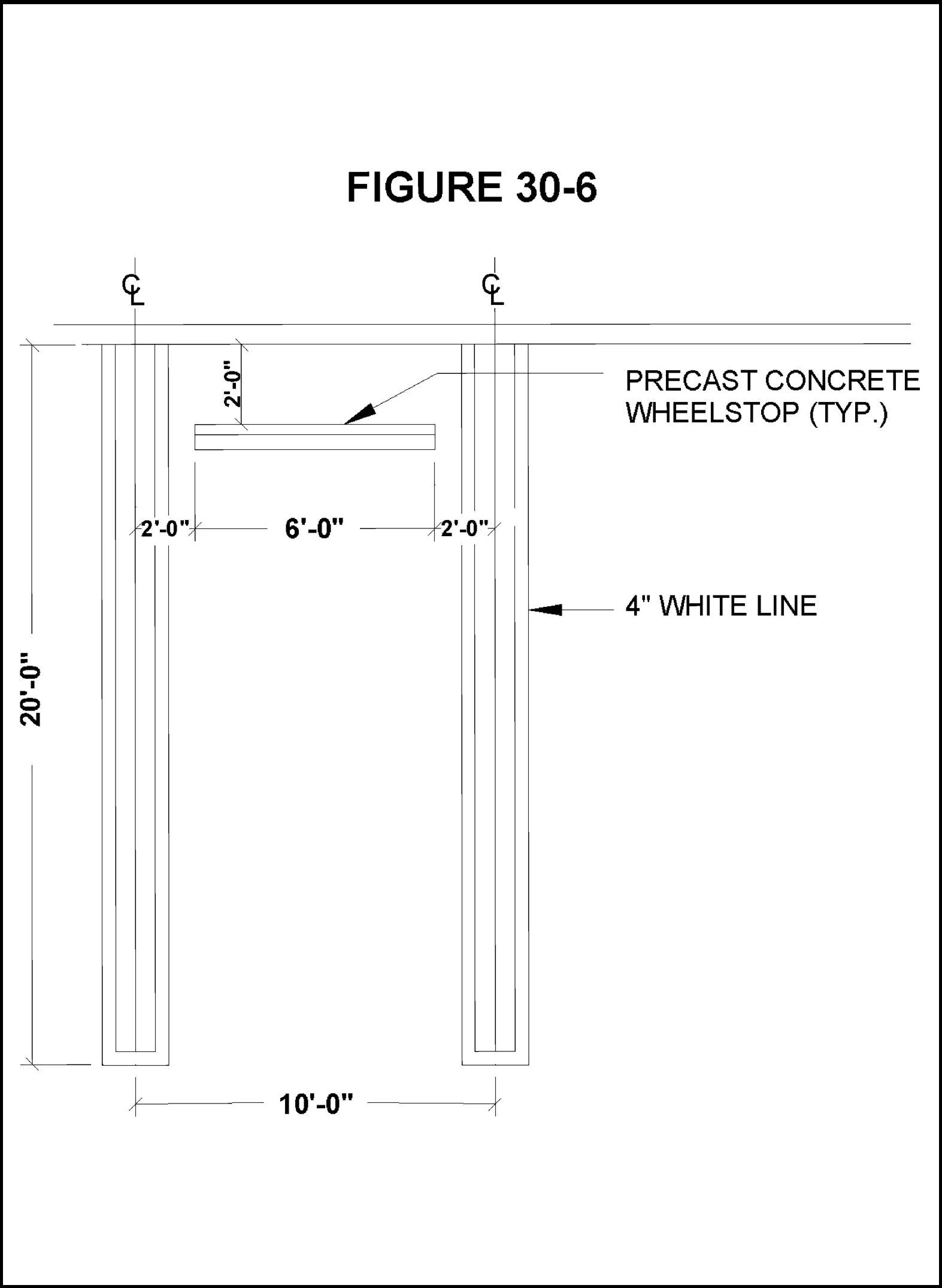
Dimensions and striping. Excluding single-family and duplex dwelling unit, each off-street parking space shall have a length of twenty (20) and a minimum width of ten (10) feet, as indicated in Figure 30-6. Parking spaces shall be striped as indicated in Figure 30-6.
(7)
Handicap parking. Handicap spaces shall be provided, located, and designed in accordance with the requirements F.S. § 553.5041, or as required by other applicable federal or state statute.
(8)
Guest parking. Required guest parking for multifamily residences shall be considered public parking spaces for purposes of determining required handicap parking spaces.
(9)
Location of required off-street parking:
a.
Uses which require three or more off-street parking spaces shall provide individual spaces. Individual spaces shall be located in such manner that maneuvering incidental to parking shall not occur on any public street right-of-way, sidewalk, or pedestrian path.
b.
In zoning all districts, parking is limited to front or side yards, and other approved structures such as garages or multilevel parking structures.
(10)
Permanent parking surfaces. Permanent parking surfaces shall be paved with asphalt, concrete, brick, or other materials acceptable to the building official. Use of unpaved parking surfaces is prohibited.
Parking Space Detail N.T.S.
(11)
Double-loaded parking. Excluding single-family and two-family dwellings, double loaded parking is prohibited.
(12)
Landscaping and buffering requirements. To the maximum extent possible, vehicular use areas for multifamily and nonresidential buildings shall be screened from public rights-of-way through the use of parking structures, other buildings, fences or walls, or vegetative screening. All landscaping proposed for perimeter areas, interior parking areas, and vehicular use areas shall conform with chapter 28 of this Code.
(c)
Parking lots and vehicular use areas:
(1)
Maintenance of vehicular use areas. Off-street parking and vehicular use areas shall be maintained as provided below:
a.
All areas shall be maintained so as to function as proposed, and to present a neat and clean appearance, including the following:
1.
Free of potholes and cracked or broken pavement;
2.
Possessing a functional drainage system, especially with respect to protection of adjacent properties;
3.
Avoidance of dust and dirt affecting adjacent properties;
4.
Free of dirt, debris, and weeds;
5.
Free of broken curbs and broken wheel stops;
6.
Well-maintained landscaping;
7.
Possessing all required landscaping;
8.
Clearly striped; and
9.
All lighting in working condition.
b.
All landscaping shall be installed and maintained in accordance with the requirements of chapter 28 of this Code, and any additional requirements associated with approval of a development order.
(2)
Access driveways. Each property, unless otherwise approved as provided herein, shall be limited to two (2) access driveways for each abutting public or private right-of-way.
a.
A corner lot shall be limited to one access driveway to each public or private right-of-way, unless other driveways are granted as part of a development order approval.
b.
Additional access driveways may be permitted by the building official. The building official shall consider the following standards to determine if additional access driveways may be installed:
1.
Traffic generation;
2.
Number of proposed access driveways;
3.
Location of proposed access driveways;
4.
Distance between access driveways; and
5.
Relationships to adjacent land uses and access driveways.
(3)
Location of multifamily and nonresidential access driveways. As measured from the closest edge of pavement to the centerline of the nearest intersection, the minimum separation distances between access driveways and intersections are established:
a.
Local right-of-way: One hundred fifty (150) feet; and
b.
Arterial right-of-way: Three hundred (300) feet. Compliance with this requirement may be achieved through the use of interconnecting parking lots which abut an arterial roadway. Alternative designs may be approved by the building official if natural features or property ownership patterns cause this requirement to be impracticable.
(4)
Separation. The centerlines of access driveways shall be separated by a minimum distance of sixty (60) feet.
(5)
Common access driveways. Adjacent developments may share a common access driveway, provided that appropriate access easements are granted between or among adjacent property owners in a form acceptable to the town attorney.
(6)
Width of access driveways. Excluding single-family and duplex dwellings, minimum and maximum widths for access driveways are established below. The width shall be measured along the right-of-way line at the inner point of curvature, or as otherwise provided by the town engineer.
(7)
Design standards for vehicular use areas. Vehicular use areas shall be designed as provided below and in Figure 30-7.
a.
Each parking area and loading area shall be designed so as to reflect the type of use, hours of operation, number of cars to be accommodated, uses and size of parking area, surrounding street pattern, adjacent buildings and other improvements in the general neighborhood.
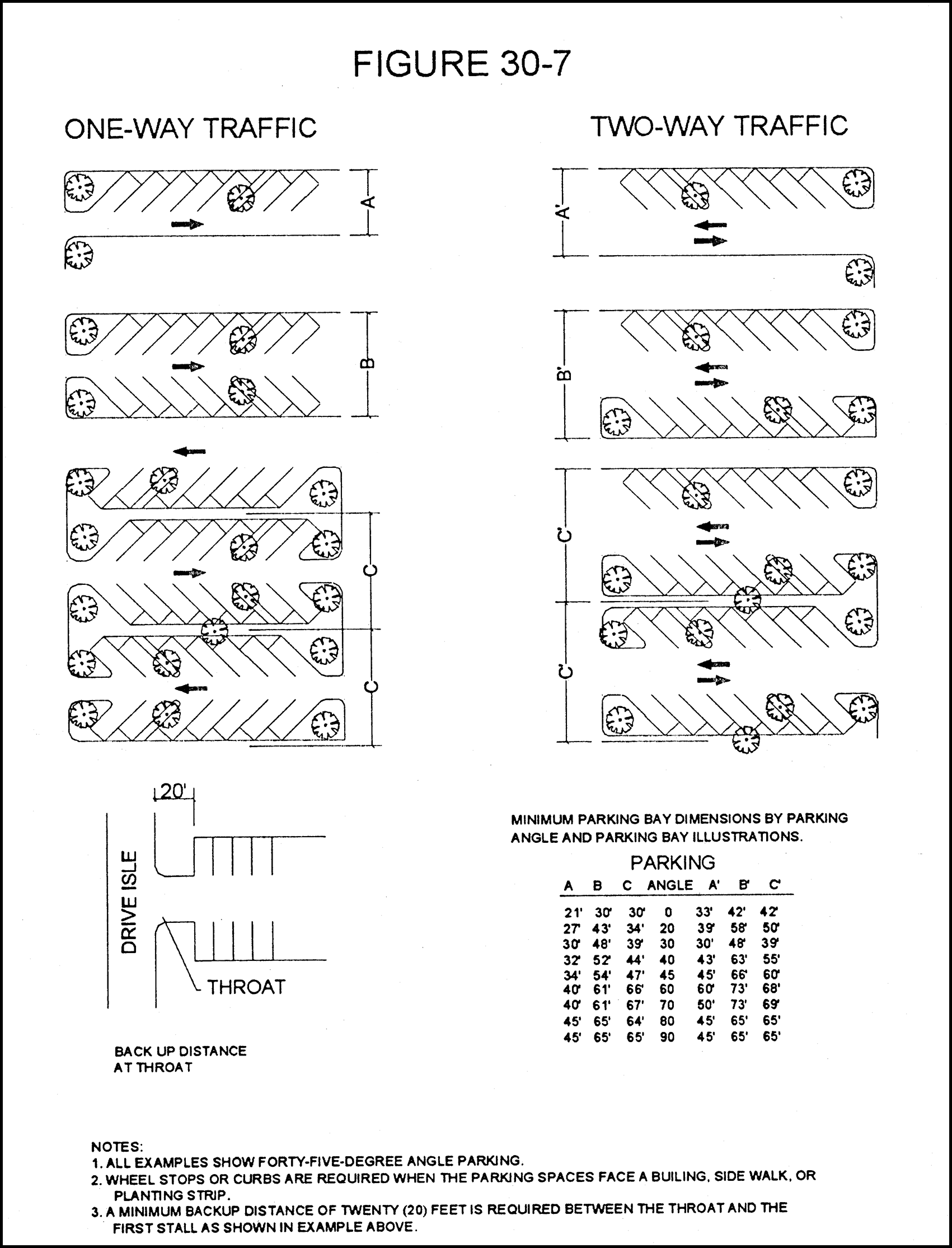
b.
The vehicular use area shall be designed to cause the least amount of adverse effects on adjoining or neighborhood properties.
(8)
Safety. Pedestrian circulation facilities, roadways, driveways, and off-street parking and loading areas shall be designed to be safe and convenient.
(9)
Overall design. Parking and loading areas, aisles, pedestrian walks, landscaping, and open space shall be designed as integral elements of an overall site plan, and shall be properly related to existing and proposed buildings and pedestrian walks.
(10)
Pedestrian-oriented design. Buildings, parking and loading areas, landscaping and open spaces shall be designed so that pedestrians moving from parking areas to buildings and between buildings are not unreasonably exposed to vehicular traffic.
a.
Pedestrian walks shall be provided along areas of anticipated heavy pedestrian utilization, particularly from building entrances to streets, parking areas, and adjacent buildings.
b.
Pedestrian walks should be designed to discourage pedestrian encroachment into landscaped areas except at designated crossings.
c.
Pedestrian walks located adjacent to parking stalls shall be a minimum of four (4) feet in width.
(11)
Separation of pedestrian use areas. To the extent possible, separation of pedestrian use areas from vehicular use areas within a parking lot shall be accomplished through the use of landscaped areas.
(12)
Landscaping. Off-street parking areas shall be landscaped as required by chapter 28 of this Code.
(13)
On-site vehicular access. Each parking space, excluding single-family dwellings, shall have appropriate access to a public street or alley right-of-way. Each parking space shall have appropriate maneuvering and access aisle area sufficient to permit vehicles to enter and exit the site in a forward direction.
(14)
Aisles and driveways. Excluding single-family and duplex dwelling units, aisles and driveways shall not be used for loading or unloading or parking vehicles.
(15)
Design. Vehicular use areas shall be designed in a professional acceptable manner, to facilitate pedestrian safety, parking, loading, and the circulation of vehicles. A physical separation or barrier, such as landscaping, may be required to separate parking spaces from travel lanes.
(16)
Individual access. Each parking space and loading space shall be directly accessible without driving over or through any other parking or loading space.
(17)
Traffic-control devices. Traffic-control signs and other pavement markings shall be used as necessary to ensure safe and efficient traffic operation of parking and vehicular use areas. Signs and markings of parking lots shall be subject to the approval of the building official.
(18)
Construction of parking facilities. All off-street parking spaces, loading areas, and vehicular use areas shall be constructed and surfaced with approved materials.
(19)
Location of parking facilities. Unless otherwise provided herein, required off-street parking and loading facilities shall be located on the same lot they are intended to serve.
(20)
Off-premises parking. As a special exception, the town commission may authorize required off-street parking and loading facilities to be located on a separate parcel. In addition to the criteria applicable to a special exception provided in section 30-35, an off-premises parking facility also shall be subject to the criteria listed below:
a.
The off-premises parcel shall be located within four hundred (400) feet of the principal use.
b.
The off-premises parcel is located in the same zoning district as is the principal use or is located in a less restrictive zoning district.
c.
Practical difficulties prevent the placing of the facilities on the same lot as the premises they are designed to serve.
d.
Execution of an agreement, in a form acceptable to the town attorney, that will:
1.
Bind the property owner and successors in title, in a manner acceptable to the town as long as the facilities are required for the use;
2.
To discontinue such use unless such facilities are maintained in a manner acceptable to the town;
3.
Identify the property to be use for off-premises parking, the number of spaces to be provided, and means of access;
4.
Provide a site plan clearly indicating design, landscaping, and lighting;
5.
Describe hours of operation and use; and
6.
Provide a survey indicating the proposed facilities are within four hundred (400) feet of the principal use.
(21)
Combined off-street parking. Two (2) or more owners, tenants, or operators of buildings or uses requiring off-street parking may make collective provision for such facilities. The total of parking spaces when combined or used together shall not be less than the sum of the requirement calculated separately.
(d)
Off-street loading space requirements Off-street loading spaces shall be provided as required by this section.
(1)
Minimum required. Each restaurant, clubhouse, place of assembly, or similar use with an aggregate floor area of more than five hundred (500) feet but less than ten thousand (10,000) square feet shall provide one space. For larger areas, one space shall be added for each additional ten thousand (10,000) square feet or major fraction thereof.
(2)
Location and access. Each off-street loading space shall be directly accessible from a street without crossing or entering any other required off-street loading space. Loading spaces shall be accessible from the interior of the building served. Loading spaces shall be arranged to provide convenient and safe ingress and egress all trucks, semi-trucks and trailers, or other types of service vehicle.
(3)
Combined off-street loading. Two (2) or more owners, tenants, or operators of buildings or uses requiring off-street loading spaces may make collective provision for such facilities. The total of loading spaces when combined or used together shall not be less than the sum of the requirement calculated separately.
(4)
Nonconformities. Nonconforming uses and structures shall comply with the requirements listed below:
a.
When the use of a structure or land or any part thereof is changed to a use requiring one or more off-street loading space, required off-street loading space shall be provided and maintained.
b.
Any building or use that is expanded in floor area shall provide and maintain off-street loading facilities required for the expansion.
(Ord. No. 684, Art. IV, § 9, 7-25-00; Ord. No. 2021-001, § 2, 1-5-21; Ord. No. 2021-007, § 2, 6-1-21)
Sec. 30-70. - Portable storage units.
(a)
Definitions. For the purpose of this section the following definitions shall apply:
Portable storage unit. Any container designed for the storage of personal property and/or overflow merchandise which is typically rented to owners or occupants of property for their temporary use and which may be delivered and removed by vehicle.
Site. A piece, parcel, tract, or plot of land occupied, or that may be occupied, by one or more buildings or uses and their accessory buildings and uses and which is generally considered to be one unified parcel.
(b)
Number, duration and removal.
(1)
On-site storage. There shall be no more than one portable storage unit located on any site at any given time. No portable storage unit shall be larger than one hundred thirty (130) square feet in total area and shall not exceed the height of the roofline of the principal structure on site. A site permit, as required in this section for a portable storage unit to remain at a site shall be valid for a maximum of ten (10) consecutive days.
(2)
Cumulative time restriction. No portable storage unit shall be placed at any one site in excess of thirty (30) days within any 12-month period. All sites are limited to the maximum number of three (3) site permits within any 12-month period. If more than one unit in succession is to be used at a site, the time regulations detailed herein shall begin to accrue from the date of which the first unit was placed at the location.
(3)
Notwithstanding the time limitations as stated above. All portable storage units shall be removed from the town immediately upon the issuance of a tropical storm or hurricane warning by a recognized governmental agency covering any portion of the town. The removal of a portable storage unit during a tropical storm or hurricane warning is the responsibility of the owner/operator of the portable storage unit. In the event removal is not possible, the portable storage unit shall be secured against windloads of one hundred and fifty (150) miles per hour.
(4)
On-site storage prohibited. No on-site storage units shall be allowed on vacant, unimproved properties unless associated with a commensurate building permit for that site.
(c)
Site permit required prior to placing a portable storage unit on any site.
(1)
The site owner/occupier or the owner/operator of the portable storage unit must apply for site permit. Application for the site permit shall be made to the building department, on a form provided by the town.
(2)
The application shall include the signature of the site occupant in order to ensure that the occupant has full knowledge of and consents to placement of the portable storage unit on his or her site and the provisions of this section. If the applicant is a tenant, then the applicant must also provide written consent from the property owner to make such application. A site permit fee, established by resolution of the town commission, shall accompany the application. The issuance of a site permit shall allow the applicant to place a portable storage unit on the site in conformance with the requirements of this section. The exterior of the portable storage unit shall have a weatherproof clear pouch, which must display the site permit at all times. However, no site permit shall be issued if it is determined that the storage unit provider or site owner is in violation of any provision of this section.
(d)
Maintenance and prohibition of hazardous materials. The owner/operator of a portable storage unit and/or the owner/occupant of the site shall be responsible to ensure that the portable storage unit is in good condition, free from evidence of deterioration, weathering, discoloration, rust, ripping, tearing or other holes or breaks. When not in use, the portable storage unit shall be kept locked. The site owner/occupier of the property on which a portable storage unit is placed shall also be responsible that no hazardous substances are stored or kept within the portable storage unit.
(e)
A portable storage unit shall only be placed in a driveway or other paved surface, unless the rear of the site is readily available, and must be set back a minimum of five (5) feet from side property lines, and three (3) feet from the front property lines. A portable storage unit shall not be placed within any utility or drainage easement. In the event that the building official, or his/her designee, determines that there is no driveway, or other paved surface, and the rear of the site is not accessible for placement of a portable storage unit, the building official, or his/her designee, may approve placement of a portable storage unit in the front yard providing that the placement of such portable storage unit does not obstruct the free, convenient, and normal use of the public right-of-way or access to any dwellings thereon.
(f)
Portable storage units shall be for storage purposes only. No other activity such as utilizing the unit for work or living space shall be allowed. The portable storage unit shall not contain any signage other than the name, address and telephone number of the owner/operator of the portable storage unit.
(h)
Violations.
(1)
It shall be unlawful for any person to place or permit the placement of a portable storage unit on a site which he or she owns, rents, occupies, or controls without first obtaining a site permit from the building department.
(2)
It shall be unlawful for a portable storage unit to remain at a site in excess of the time periods permitted under this section. Each day that any such portable storage unit remains at the site in violation of the permitted time periods shall constitute a violation against any person who owns, rents, occupies, or otherwise controls the site.
(3)
Any violation of this section shall be subject to section 1-9 or may be deemed a public nuisance and as such, would be subject to the provisions for removal and abatement of said nuisance.

