
Hogansville City Zoning Code
ARTICLE IV
ZONING PROVISIONS FOR ALL DISTRICTS
Sec. 102-B-4-1.- Dimensional standards of zoning districts.
The following space dimensions table states the space dimensions required for each lot in a zoning district:
Space Dimensions Table
(1)
TN-MX density. Non-residential uses shall be further limited to a maximum square footage of 6,000 square feet per each individual use within buildings in this district.
(2)
Context-sensitive dimensions. Designated dimensional requirements shall not apply to a property where the average space dimension located within 200 feet of the subject property does not comply with the corresponding dimensional requirement of the space dimensions table. In such case, the zoning administrator may adjust the dimensional requirement to a dimension that is no greater than the greatest and no less than the least dimension that is located within 200 feet of the subject property. Properties that are part of a major subdivision are prohibited from utilizing context sensitive adjustments. Context sensitive adjustments shall not be permitted to be utilized to change the requirements of any zoning condition or development agreement that has been approved by the city council.
(3)
TN-R cottage court building typologies. Cottage court building typologies in TN-R zoning districts shall have the following minimum lot requirements:
(a)
Cottage court developments shall provide a minimum lot area of 10,000 square feet.
(b)
Individual Cottage Court lots within such developments shall provide a minimum lot area of 1,600 square feet.
(4)
Maximum building heights. See also transitional height plane provisions in section 102-B-5-4.
(5)
Townhouses. Townhouses shall be permitted to have zero-lot-line setbacks for individual units. Listed side yard dimensions shall apply to the yards provided adjacent to the entire row of townhouses and shall not be applied to individual townhouse units within the row of townhouses.
(6)
DT-MX building heights. Maximum building heights within the DT-MX district and the Downtown Hogansville Historic District may be further reduced through requirements for building stepbacks or additional overall height reductions imposed through the obtaining of a certificate of appropriateness from the historic preservation commission.
(7)
R district accessory structure rear yard setbacks. Accessory structures in R districts shall be permitted to be located within five feet of a property line.
(8)
For lots defined as through lots, the minimum and maximum setback requirements for front yards shall apply to both street frontages.
(9)
Special use permit building heights. Special use permits may be granted in the designated zoning districts and with the following additional regulations:
(a)
Uses designated in the permittee uses table as public/institutional uses may be erected to a maximum height of 100 feet.
(b)
Uses designated in the permittee uses table as places of worship may be erected to a maximum height of 75 feet.
(c)
All other uses may be erected to a maximum height of 60 feet.
(d)
Building height increases shall also require that side yard and rear yard minimum setback requirements be increased by the total dimension of increased building height that is requested and approved. Variances to decrease the increased yard dimension requirement of this subsection shall be prohibited.
(10)
Residential uses in the CR-MX district. Single-family attached dwellings, single-family detached dwellings, and two-family dwellings buildings within CR-MX districts shall be required to be built in accordance with the space dimension standards and all other UDO regulations applicable to the ES-R, SU-R, or TN-R zoning district. Such uses are permitted to choose from the ES-R, SU-R, or TN-R zoning districts for purposes of meeting this regulation.
(11)
Properties with a residential attached or detached front-facing garage shall have a minimum lot frontage of 50 feet. This increased lot frontage requirement shall not apply to properties with garages that are rear or side facing, or with front-facing garage doors located 20 feet or greater behind the primary building façade.
(12)
Properties that are developed as single-family rental homes and that do not have separate individual parcels for each dwelling, shall established developable lot areas for the sole purpose of facilitating the application of ES-R, SU-R, or TN-R dimensional standards to all buildings, structures, and developable lot areas within the development.
(13)
When front loaded garages are provided for residential dwelling uses, the minimum front yard setback requirements shall also become the maximum front yard setback requirement.
Items noted as "None" or "N/A" for designated zoning districts within the chart have no such corresponding regulation.
(Ord. No. 23-0605, § 1(Exh. A), 6-5-2023; Ord. No. 25-0505, § 3, 5-5-2025; Ord. No. 26-0601, § 1, 6-1-2026)
Sec. 102-B-4-2. - Access to public and private streets.
(1)
Every building erected or moved shall be on a lot adjacent to an approved public or private street or alley, and all structures shall have safe and convenient access for servicing, fire protection, and required off-street parking.
(2)
In the event a land-locked lot exists that has been legally subdivided through the applicable subdivision process as of the effective date of this zoning ordinance, the property owner shall be entitled to building permits, provided:
(a)
All other zoning and development standards are met, or appropriate variances are approved to allow the lot to be developed or altered as proposed; and
(b)
The property owner has acquired an access easement to an approved public or private street or alley in compliance with the standards established in subchapter 102-C. Said easement shall be duly recorded and made part of the property deed.
(Ord. No. 23-0605, § 1(Exh. A), 6-5-2023)
Sec. 102-B-4-3. - Encroachments into required yards.
(1)
The following setback encroachments are permitted:
(a)
Architectural features, such as: Cornices, eaves, chimneys, canopies, landings, bay windows, energy generation devices, affixed or stand-alone air conditioners, fencing, retaining walls or other similar features may encroach into the required front, side, and rear yard setbacks, provided such encroachments do not exceed three feet, and provided such features are no closer than three feet to the side or rear yard property line.
(b)
Unenclosed decks, inclusive of staircases, may encroach into required rear and side yard setbacks provided such features are no closer than three feet to the side or rear yard property line.
(c)
Patios, driveways, walkways, unenclosed staircases and similar surfaces may encroach into all setbacks.
(d)
Unenclosed porches and stoops, inclusive of staircases, may encroach into required front yard up to 12 feet. For townhomes, such features may encroach up to the property line or the edge of an access easement in the case of a private street.
(Ord. No. 23-0605, § 1(Exh. A), 6-5-2023)
Sec. 102-B-4-4. - Building height exceptions.
The height limitations of this zoning ordinance shall not apply to unoccupied portions of buildings such as spires, belfries, cupolas, domes, chimneys, fire towers, public monuments, water tanks, water towers, silos, mechanical and electrical equipment and associated screening, smokestacks, derricks, conveyors, flagpoles, or aerials. The maximum height allowed for these elements shall be the maximum height allowed in the designated zoning district plus an additional 15 percent.
(Ord. No. 23-0605, § 1(Exh. A), 6-5-2023)
Sec. 102-B-4-5. - Fences and retaining walls.
(1)
This section regulates fences, walls, and fences and walls in combination.
(2)
General conditions.
(a)
Fences and walls shall be maintained in good repair.
(b)
Fences and walls may step down a slope, however supports shall be vertical and plumb.
(c)
Posts shall be anchored in concrete.
(d)
Supports shall face inward to the property.
(e)
Barbed wire shall be permitted on fences and walls on properties within G-RL, and G-I zoning districts. Fences and walls for all other uses are prohibited from utilizing barbed wire.
(3)
Fences, general.
(a)
Fences in the front yard:
(i)
Maximum height. Fences shall not exceed four feet in height and shall not extend into the public right-of-way. See section 102-B-4-6 for corner lot restrictions. Properties within G-R and G-LI zoning districts are allowed fences up to six feet in height. Fence posts and pillars shall be permitted to be located an additional one foot higher than the maximum height allowed for the remaining fencing elements.
(ii)
Materials. Fences shall not be made of wire, woven metal, or chain link, unless located on property within G-RL and G-LI zoning districts. All other fences shall be ornamental or decorative fences constructed of brick, stone, stucco, split rail, wood, aluminum, or wrought iron. The fence shall be a minimum of 50 percent transparent. Exposed block, tires, junk or other discarded material shall be prohibited fence materials. No barbed wire, razor wire, chain link fence or similar elements shall be visible from any public plaza, ground level or sidewalk level outdoor dining area, street or thoroughfare, or public right-of-way.
(b)
Fences in interior side and rear yards.
(i)
Maximum height. Fences shall not exceed eight feet in height.
(ii)
Materials. If a fence is constructed of chain link or other metal fencing, fence shall be vinyl, powder coated, or galvanized.
(4)
Retaining walls.
(a)
Maximum height. Retaining walls in the front yard are limited to four feet in height. A retaining wall located adjacent to a sidewalk along a public street shall not exceed two feet in height. Retaining walls shall be limited to eight feet in height within interior side and rear yards.
(b)
Materials. Retaining walls shall be constructed of decorative concrete modular block or shall be faced with stone or brick or textured cement masonry.
(5)
Fences and retaining walls combined:
(a)
Fences erected within five feet of the top of a retaining wall shall be regulated by this section.
(b)
Fences and retaining walls combined that are erected within ten feet of a front yard property line:
(i)
Maximum height. Fences and retaining walls combined within ten feet of a front yard property line shall not exceed two feet for the wall and four feet for the fence.
(ii)
Materials. Fences shall not be made of wire, woven metal, or chain link, unless located on property of an agricultural or industrial, use. All other fences shall be ornamental or decorative fences constructed of brick, stone, stucco, split rail, wood, aluminum, or wrought iron. The fence shall be a minimum of 50 percent transparent. Exposed block, tires, junk or other discarded material shall be prohibited fence materials. Retaining walls shall be constructed of decorative concrete modular block or shall be faced with stone or brick or textured cement masonry.
(c)
Fences and retaining walls combined in all other locations on a lot:
(i)
Maximum height. Fences and retaining walls in combination in the rear yard cannot exceed eight feet each, provided their combined height does not exceed 12 feet. Retaining walls and fences in the front yard shall not exceed four feet each, provided their combined height does not exceed six feet.
(ii)
Materials. Chain link and other metal fencing shall be vinyl, powder coated, or galvanized. If fences and retaining walls in combination are located in the front yard, wire, woven metal, or chain link fences are prohibited, unless located on property of an agricultural or industrial use. Retaining walls shall be constructed of decorative concrete modular block or shall be faced with stone or brick or textured cement masonry. Any portion of a combined fence and wall that exceeds ten feet shall be transparent for a minimum of 50 percent of the length of the fence so as to reduce the appearance of an opaque structure.
(6)
Method of measurement. Heights of fences and retaining walls shall be measured from the grade plane.
(7)
Exceptions. Temporary chain link security fences up to six feet in height may be erected to surround the property up to 30 days prior and 30 days following completion of demolition, rehabilitation, or new construction.
(Ord. No. 23-0605, § 1(Exh. A), 6-5-2023; Ord. No. 25-0505, § 4, 5-5-2025)
Sec. 102-B-4-6. - Corner visibility.
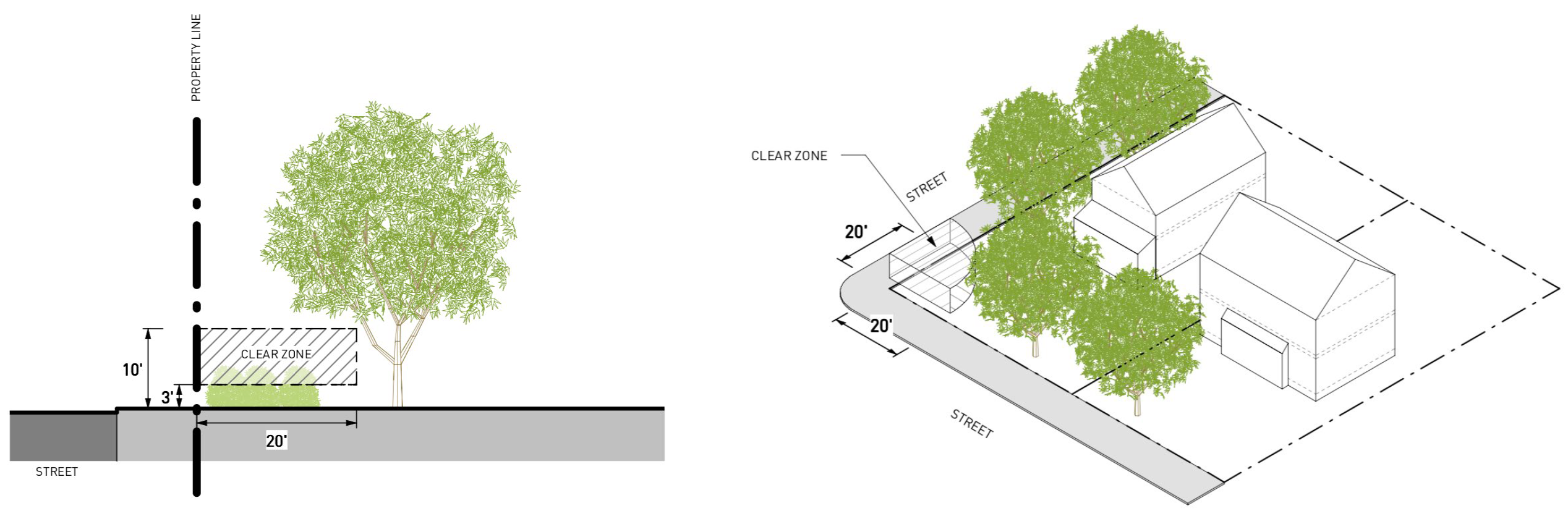
On corner lots within all zoning districts, no fence, shrubbery, sign or other obstruction to traffic line of sight vision shall exceed a height of 30 inches within the triangular area formed by the intersection of right-of-way lines at two points measured 20 feet along the property line from the intersection. Within said triangle, there shall be no sight obscuring wall, fence or foliage higher than 30 inches above grade or in the case of trees, foliage lower than ten feet. Vertical measurement shall be made at the top of the curb on the street or alley adjacent to the nearest side of the triangle or if no curb exists, from the edge of the nearest traveled way.
Corner Visibility Illustrations
(Ord. No. 23-0605, § 1(Exh. A), 6-5-2023)
Sec. 102-B-4-7. - Accessory structures.
(1)
General provisions for accessory structures. All accessory buildings and structures, including accessory dwellings, shall be subject to the following additional requirements:
(a)
An accessory building or structure shall be clearly subordinate to the primary structure in all dimensional aspects.
(b)
An accessory building or structure shall be located behind the front yard façade of the primary structure in the following locations:
(i)
In all ES-R, SU-R, and TN-R districts; and
(ii)
In areas of other zoning districts that have uses and densities predominantly similar to those permitted in the districts listed in subsection (i) above.
(c)
Dimensional standards.
(i)
Dimensional standards for accessory buildings and structures shall be the same as those for principal structures and for zoning districts in sections 102-B-4-1 and 102-B-5-2.
(ii)
For uses other than agricultural and industrial, a maximum of three accessory structures shall be permitted per lot.
(iii)
For uses other than agricultural and industrial, accessory structures containing area meeting the definition of floor area shall be limited to a maximum of 1,500 square feet of such floor area.
(iv)
Accessory structures not containing area meeting the definition of floor area shall be limited to the following maximum lot coverage: no limit for agricultural and industrial uses; and 25 percent for all other uses.
(v)
Whenever a lot abuts upon an approved alley, one-half of the alley width may be considered as a portion of the required yard.
(d)
No accessory structure shall be constructed upon a lot until construction of the principal building has commenced, except when provided for industrial and agricultural uses.
(e)
Accessory dwellings.
(i)
The lot owner is required to reside in either the primary dwelling or the accessory dwelling for at least eight months of the year. An affidavit will be required of the owner confirming residency.
(Ord. No. 23-0605, § 1(Exh. A), 6-5-2023)
Sec. 102-B-4-8. - Yards.
(1)
Yards, general. Required yards shall be provided as an area unoccupied and unobstructed by any structure or portion of a structure from 42 inches above the general ground level of the graded lot upward.
(2)
Front yards, general.
(a)
For residential dwellings, excluding multi-family dwellings:
(i)
The front yard shall be landscaped and sodded with the exception of driveways, terraces, and walkways, which may occupy a maximum of one-half of the front yard.
(ii)
Parking for automobiles, motorized vehicles, and non-motorized vehicles is only permitted in front yards when located on the permitted access driveway on asphalt or gravel surface. For parking regulations for recreational vehicles and boats, see subsection 102-B-7-3(14).
(iii)
A minimum of two trees shall be planted on lots used for all single-family attached, single-family detached, townhome, two-family, and industrialized building residential uses.
(iv)
Driveway curb cuts within front yards shall not exceed a width equal to one-half of the width of the lot frontage.
(v)
Driveways within front yards shall not exceed a width equal to one-half of the width of the front yard.
(vi)
Buildings shall provide a primary pedestrian entrance adjacent to and oriented towards the front yard.
(b)
For multi-family dwellings and all other non-residential uses:
(i)
Buildings shall provide a primary pedestrian entrance adjacent to and oriented towards the front yard.
(ii)
The primary pedestrian entrance required in subsection (i) above shall include a pedestrian walkway that provides a safe and unobstructed connection from parking areas and adjacent public sidewalks to the primary pedestrian entrance.
(iii)
The following elements shall be permitted in front yards when such elements are located on private property: benches, trash receptacles, pet stations, bicycle parking racks, outdoor dining, display of public art, other street furniture, or other similar elements.
(3)
Landscape strips shall be provided along the frontage of all multi-family dwelling uses and nonresidential uses abutting a street right-of-way, except for properties in the TN-MX and DT-MX zoning districts, when the Zoning Administrator determines that building placement prevents the location of said strips.
(a)
Landscape plantings shall be provided in a landscape strip for a minimum depth of ten feet.
(b)
One tree shall be planted for every 40 linear feet of length of street frontage, or portion thereof.
(c)
Ten shrubs shall be planted for every 40 linear feet of length of street frontage, or portion thereof.
(d)
Clumping is permitted provided that adequate spacing is allowed for future growth and there is no gap greater than 50 feet.
(e)
The remaining ground area shall be sodded, seeded, or hydroseeded with grass, and/or planted with groundcover species and/or provided with other landscaping material, or any combination thereof.
(f)
The following alternatives exist to the ten-foot landscape strip requirements:
(i)
An earth berm at least two and one-half feet higher than the finished elevation of the parking lot, with one shade tree and five shrubs for every 40 linear feet of frontage.
(ii)
A six-foot landscaped strip with a minimum three-foot grade drop from the right-of-way to the parking lot. One shade tree and five shrubs for every 40 linear feet.
(4)
No part of any yard, other open space, or off-street parking or loading space required in connection with any building, structure, or use by this article shall be considered to be part of a required yard, open space, off-street parking or loading space for any other building or structure.
(Ord. No. 23-0605, § 1(Exh. A), 6-5-2023)
Sec. 102-B-4-9. - Unified development plans—Properties under common ownership.
(1)
Unified development plans are permitted in all zoning districts except ES-R, SU-R, TN-R, and G-RL.
(2)
Unified development plans are permitted when one or more parcels of land is under common control and either directly adjoining each other or directly across from each other along a public or private thoroughfare.
(3)
Unified development plans shall be used to establish conformance with on-site parking, loading, garbage collection, and open space requirements utilizing the entire area under common control.
(4)
Unified development plans are permitted to include parcels with different zoning district designations, with the exception of parcels listed in subsection (1) of this section that are prohibited from utilizing unified development plans.
(5)
Properties developed pursuant to an initial approved unified development plan may be subdivided into different ownership that can be acknowledged as separate parcels, even if any of the subdivided parcels would not meet all the on-site parking, loading, and open space requirements after the subdivision is completed.
(6)
Any changes from the approved unified development plan shall require a new or amended unified development plan, which shall be based on the same area of land as the initial approval. Where a single property owner no longer owns all parcels, the applicant shall obtain authorization from all property owners prior to permit submittal, with the exception of public streets deeded to the City of Hogansville.
(Ord. No. 23-0605, § 1(Exh. A), 6-5-2023)

