
Holly Hill City Zoning Code
ARTICLE III
- SUPPLEMENTARY DISTRICT REGULATIONS
DIVISION 4. - BUILDINGS AND STRUCTURES[3]
Editor's note— Ord. No. 2804, § 1, adopted June 26, 2007, amended Art. II, Div. 4, in its entirety, in effect deleting Art. II, Div. 4, §§ 114-741—114-744, and enacting a new Art. II, Div. 4, §§ 114-741—114-746, to read as set out herein. Former Art. II, Div. 4, pertained to similar subject matter and derived from Ord. No. 2352, § 2, adopted July 13, 1993.
DIVISION 11. - OUTSIDE DISPLAY AND SALE OF GOODS, MERCHANDISE AND SERVICES[4]
Editor's note— Ord. No. 2660, § 1, adopted Apr. 22, 2003, changed the title of div. 11 from "Outside Display and Sale of Goods" to "Outside Display and Sale of Goods, Merchandise and Services".
Sec. 114-661.- Generally.
The uses or structures listed in this division are permitted as special exceptions only when listed or permitted as special exceptions in article II of this chapter and when meeting the requirements set forth in this division.
(Ord. No. 2352, § 2(5.6.1), 7-13-93)
Sec. 114-662. - Public schools.
Public schools are permitted as special exceptions, provided:
(1)
Structures are located at least 35 feet from side or rear property lines; and
(2)
Off-street parking and loading areas abutting residential property are screened by trees and shrubs of sufficient height and density to visually separate the parking areas from adjoining properties and the public street.
(Ord. No. 2352, § 2(5.6.1.A), 7-13-93)
Sec. 114-663. - Meeting places for civic, fraternal and community service organizations.
Meeting places for civic, fraternal and community service organizations are permitted as special exceptions, provided:
(1)
The buildings and facilities are intended for use by the members of the organization, pursuant to the rules and bylaws of the organization.
(2)
Commercial activities in which all or a portion of the net proceeds or profits inure to the benefit of an individual, private for-profit association, firm, partnership or corporation are prohibited.
(3)
Parking shall be provided at the rate of 5.5 spaces for every 1,000 square feet of net assembly space.
(4)
The minimum lot size shall be one gross acre.
(5)
Setbacks shall be provided as follows:
a.
Front yard: 35 feet.
b.
Side yard: 15 feet.
c.
Side yard abutting a street: 20 feet.
d.
Rear yard: 25 feet.
(6)
Landscaped buffers shall be provided in accordance with chapter 98, article III.
(Ord. No. 2352, § 2(5.6.1.B), 7-13-93)
Sec. 114-664. - Cemeteries.
Cemeteries are permitted as special exceptions, provided:
(1)
The legal entity operating the cemetery is licensed under F.S. § 559.30 et seq.
(2)
The minimum lot size is 30 acres.
(3)
A fence or hedge shall be provided along all property lines abutting residentially zoned or developed property in accordance with chapter 98, article III.
(4)
Identification signs must comply with all provisions of chapter 110, and, in addition, shall not exceed 50 square feet in area or be illuminated.
(Ord. No. 2352, § 2(5.6.1.C), 7-13-93)
Sec. 114-665. - Adult congregate living facilities.
Adult congregate living facilities (ACLFs) are permitted as special exceptions, provided:
(1)
The minimum distance between ACLFs shall be 1,200 feet measured in a direct line between properties.
(2)
In single-family residential zoning districts, the following conditions shall be met:
a.
The external appearance of ACLF structures and building sites shall maintain the general residential character of the district;
b.
Exterior building materials, bulk, landscaping, fences and walls and general design shall be similar to those of surrounding dwellings; and
c.
No ACLF shall occupy more than one principal building.
(3)
ACLFs shall meet all lot and yard dimensional requirements for the zoning district in which they are located.
(4)
State requirements notwithstanding, the maximum occupancy of any ACLF shall not exceed the maximum number of dwelling units permitted on the property multiplied by the following occupancy factor:
a.
Five clients for the first dwelling unit permitted; and
b.
Three clients for the second and each succeeding dwelling unit permitted.
In any multifamily zoning district, the maximum number of dwelling units permitted shall be determined by multiplying the property area (expressed in acres) by the maximum number of dwelling units permitted per acre. All calculations shall be carried to at least two decimal places. A resulting fractional number of clients may be rounded to the nearest whole number. Regardless of the maximum occupancy determined by this method, no ACLF in any R-1, R-2 or R-3 zoning district shall be occupied by more than eight clients.
(5)
Off-street parking shall be provided at the rate of one space for every person on the largest shift, plus one for every five clients (licensed capacity) or any fractional part thereof.
(6)
No signs shall be permitted in any R-1 through R-5 district. In all other districts, signs shall be permitted in accordance with chapter 110.
(7)
In addition to the requirements of this subpart, all ACLFs shall comply with the laws and regulations of the state.
(8)
Notwithstanding the requirements of this subpart, any private deed restrictions which serve to prohibit or place limitations on the use of property for ACLFs shall apply and, in the case of conflicts, supersede the provisions of this subpart. However, in such cases the city shall only be responsible for the enforcement of the requirements of this subpart, and not for the greater restrictions.
(9)
To assist in the administration of this subpart, no ACLF shall be allowed to operate within the city without having first obtained an local business tax receipt in accordance with section 62-26 et seq. The development code administrator shall maintain a registration list and location map of all existing and new ACLFs. This registration shall include the type of facility, and number of clients and staff. The development code administrator shall coordinate with the state to provide notification of all new and discontinued ACLFs.
(Ord. No. 2352, § 2(5.6.1.D), 7-13-93; Ord. No. 2793, § 1, 3-27-07)
Sec. 114-666. - Houses of worship.
Houses of worship are permitted as special exceptions, provided:
(1)
The use of the property for a house of worship shall be consistent with the general purpose, goals, objectives, policies and standards of the city's adopted comprehensive plan, this subpart, and any other plan, program and ordinance of the city.
(2)
The property shall front on an arterial or collector road as designated by the city's adopted comprehensive plan.
(3)
In no event shall the use be permitted if the resulting demands would lower the level of service standard adopted by the city for any public improvements, facilities, utilities or services.
(4)
The approval of a house of worship shall not result in an over-concentration of such uses which would alter the general character of the surrounding area.
(5)
Where the property abuts residentially zoned or residentially developed properties, the minimum building setback shall be 75 feet, and the minimum setback for parking areas and access drives shall be 50 feet. In all other cases, the minimum building setback shall be 25 feet, and the minimum setback for parking areas and access drives shall be ten feet.
(6)
Landscaped buffer areas shall be provided along the entire length of and contiguous to every property line in accordance with chapter 98, article III.
(7)
A site plan, drawn to scale, shall be submitted with an application for approval of a house of worship. The site plan shall show the following:
a.
Project boundaries;
b.
Locations and dimensions of all existing and proposed buildings, off-street parking areas, vehicle access points, walkways and other structural improvements;
c.
Adjoining land uses and zoning;
d.
Locations and descriptions of signs, if permitted;
e.
North arrow and drawing scale;
f.
Statement indicating how the proposed number of parking spaces was calculated; and
g.
Any other information which may be required by the development code administrator to demonstrate compliance with applicable regulations.
(8)
Accessory uses are permitted for the following:
a.
Daycare center.
b.
Classroom.
(Ord. No. 2352, § 2(5.6.1.E), 7-13-93; Ord. No. 2852, § 1, 7-28-09; Ord. No. 2956, § 5, 11-11-14)
Sec. 114-667. - Child day care centers.
Child day care centers are permitted as special exceptions, provided:
(1)
No play equipment shall be located in any front or side yard, except on corner lots, in which play equipment may be located in a side yard.
(2)
The play area shall be enclosed by a fence at least five feet in height.
(3)
Off-street parking shall be provided at the rate of one space for each six children (licensed capacity).
(4)
An occupant identification sign shall be permitted on the building facade. The sign shall not exceed six square feet and shall be attached and nonilluminated.
(5)
The day care center shall be designed and constructed according to the standards adopted pursuant to F.S. § 402.30 et seq. and section 10C-10.20 et seq., Florida Administrative Code.
(6)
The center shall be appropriately licensed by the county health department and the state department of health and rehabilitative services.
(Ord. No. 2352, § 2(5.6.1.F), 7-13-93)
Sec. 114-668. - Adult day care centers.
Adult day care centers are permitted as special exceptions, provided:
(1)
The site area on which the adult day care center is located shall not be less than 15,000 square feet.
(2)
There shall be a minimum distance of 750 feet between the nearest property lines of any two adult day care centers.
(3)
Off-street parking shall be provided at the rate of two spaces, plus one for every six clients.
(4)
One identification sign shall be permitted on the building facade. The sign shall not exceed six square feet and shall not be illuminated.
(5)
The adult day care center shall be located on an arterial or collector road as designated in the comprehensive plan.
(6)
There shall be a minimum of 1,000 square feet of lot area per client.
(7)
There shall be a fence around the property perimeter, constructed in compliance with section 114-721.
(Ord. No. 2352, § 2(5.6.1.G), 7-13-93)
Sec. 114-669. - City-owned and quasipublic service and safety facilities.
City-owned and quasipublic service and safety facilities are permitted as special exceptions, provided:
(1)
Structures are located at least 35 feet from the side or rear property lines.
(2)
Off-street parking and loading areas abutting residential property are screened by trees and shrubs of sufficient height and density to visually separate the parking areas from adjoining properties and the public street.
(Ord. No. 2352, § 2(5.6.1.H), 7-13-93)
Sec. 114-670. - Wholesale nurseries.
Wholesale nurseries are permitted as special exceptions, provided:
(1)
No buildings, temporary or permanent, may be constructed on the premises as long as the use is continued.
(2)
No sales, retail or wholesale, shall be conducted on the premises.
(3)
No advertising of materials for sale shall be permitted; however, an owner identification sign conforming to the provisions of chapter 110 may be permitted.
(4)
Fencing shall not be required; however, should fencing be provided, it shall not exceed six feet in height or approach any property line or right-of-way closer than six inches, or have as part of its construction the use of barbed wire or other dangerous material, and its design and material shall be approved by the city commission in conjunction with the grant of special exception.
(5)
No interior access roadway may be established or constructed around the perimeter of the premises.
(Ord. No. 2352, § 2(5.6.1.I), 7-13-93)
Sec. 114-671. - Rest homes and retirement centers.
Rest homes and retirement centers are permitted as special exceptions, provided:
(1)
Approval shall be granted by the cognizant state agency for all tenants in excess of three.
(2)
Buildings and building construction plans shall be inspected and approved by the building and fire departments of the city.
(3)
Food service shall be inspected and approved by the county health department.
(4)
Off-street parking shall be provided as required in chapter 90, article III, division 6.
(5)
Tenants do not require resident professional medical attention or restraint, and are fully ambulatory.
(6)
A manual fire alarm system shall be installed in all such uses.
(Ord. No. 2352, § 2(5.6.1.J), 7-13-93)
Sec. 114-672. - Residential retirement health care facilities.
Residential retirement health care facilities are permitted as special exceptions, provided:
(1)
The site area on which the facility is located shall not be less than five acres.
(2)
A medical/nursing facility integrated into an approved continuing care facility authorized under F.S. ch. 651 shall be provided.
(3)
Minimum floor areas for each dwelling unit type shall be as follows:
a.
Efficiency units: 550 square feet.
b.
One-bedroom units: 650 square feet.
c.
Units with two or more bedrooms: 750 square feet plus 100 square feet for each additional bedroom after the second.
(4)
There shall be a minimum of 20 feet separation between buildings. Buildings may be connected by covered walkways.
(5)
The maximum number of dwelling units per building shall not exceed 18.
(6)
Off-street parking spaces shall be provided at a rate of one per dwelling unit; in addition, a minimum of one space shall be provided for each four beds at the medical/nursing facility.
(Ord. No. 2352, § 2(5.6.1.K), 7-13-93)
Sec. 114-673. - Marinas.
Marinas are permitted as special exceptions, provided:
(1)
Boats may not be utilized as residences except in emergencies and except those boats transiting the Halifax River.
(2)
Fuel shall be dispensed into boats only from approved dispensing systems.
(Ord. No. 2352, § 2(5.6.1.L), 7-13-93)
Sec. 114-674. - Theaters.
Theaters are permitted as special exceptions, provided:
(1)
Off-street parking requirements of chapter 90, article III, division 6, shall be met.
(2)
There shall be a minimum seating capacity of 300 people.
(Ord. No. 2352, § 2(5.6.1.M), 7-13-93)
Sec. 114-675. - Motor vehicle sales and rentals.
Motor vehicle sales and rentals are permitted as special exceptions, provided:
(1)
The number of motor vehicles displayed for rental purposes located on the premises shall be limited to two, unless more are approved by the city; however, for each additional vehicle after the initial two, there shall be a minimum of 440 square feet of space reserved for the vehicle, excluding driveways, existing required parking and loading space reserved for the first two rental vehicles, or setbacks.
(2)
No rental motor vehicle shall be parked or stored nearer to the property line than the following:
a.
Front lot line: 30 feet.
b.
Rear lot line: 20 feet.
c.
Side lot line: 15 feet.
(3)
On-premises repair of rental motor vehicles shall be limited to the servicing of the motor vehicles, provided such servicing shall be performed in an enclosure. Major repairs, painting and body and fender work on the rental motor vehicles shall be conducted at another location.
(4)
Signs advertising the rental of motor vehicles shall be subject to the provisions of chapter 110, and in addition, shall be subordinate to the advertising of the primary activity.
(Ord. No. 2352, § 2(5.6.1.N), 7-13-93)
Sec. 114-676. - Flea markets and farmers' markets.
Flea markets and farmers' markets are permitted as special exceptions, provided:
(1)
Operation will be conducted only on Fridays, Saturdays, Sundays and legal holidays (other dates may be approved by the city commission) and during daylight hours.
(2)
Adequate refuse containers shall be provided.
(3)
The area will be completely cleared of litter and other refuse after each day of operation.
(4)
Operation will not contain more than 80 rental spaces or structures per acre.
(5)
The minimum project size is one acre with 150 feet of road frontage.
(6)
The project shall contain at least three off-street parking spaces for each rental space or structure. All parking areas shall have a hard stabilized surface, but not necessarily paved.
(7)
Access driveways shall be at least 20 feet wide for one-way traffic and 30 feet wide for two-way traffic.
(8)
No automobiles, motorcycles or boats shall be offered for sale, no personal services shall be offered for sale, and no other items or services shall be offered for sale if otherwise prohibited by local, state or federal law.
(9)
All merchandise offered or displayed for sale shall be removed from the premises at the end of each day.
(10)
Signs shall comply with chapter 110.
(11)
Flea markets and farmers' markets annexed into the city after the effective date of the ordinance from which this section is derived shall have one year to comply.
(Ord. No. 2352, § 2(5.6.1.O), 7-13-93)
Sec. 114-677. - Bulk storage of petroleum products.
Bulk storage of petroleum products is permitted as a special exception, provided:
(1)
Adequate venting for aboveground storage tanks shall be provided.
(2)
Adjoining property shall be protected by installation of protective dikes of sufficient size to contain the greatest amount of liquid that can be released from the largest tank in the diked area.
(3)
Procedures to prevent over-filling shall be reviewed and approved by the fire inspector.
(4)
Other provisions of the National Fire Protection Association codes and Standards of Combustible Liquids (NFPA No. 30 of 1973) shall apply.
(Ord. No. 2352, § 2(5.6.1.P), 7-13-93)
Sec. 114-678. - Automobile dismantling and salvage yards.
Automobile dismantling and salvage yards are permitted as special exceptions, provided:
(1)
The auto dismantling and salvage yard shall be completely enclosed with a fence or wall six feet in height and of solid construction not permitting view of the operation from the abutting street. The fence shall not approach a street intersection any closer than 25 feet from the intersection of the rights-of-way in either direction.
(2)
Dismantled automobiles shall not be stacked on top of each other to a height which will make them visible by pedestrian or vehicular traffic on the abutting street.
(3)
Cars awaiting processing may not be parked on the public right-of-way.
(4)
A clear aisle at least three feet shall be maintained between the perimeter fence and the stored automobiles with cross aisles at least four feet in width each 75 feet of interior dimension exclusive of the three-foot perimeter aisle.
(5)
No open burning shall be permitted during the salvage process. This restriction does not apply to the use of welding and cutting equipment.
(6)
Retail sales of used parts conducted in conjunction with a salvage operation shall be so classified and off-street parking for customers shall be provided.
(7)
Auto dismantling and salvage yards shall not abut a residential district or use. This shall not apply to salvage yards existing on or before July 13, 1993, but shall apply to any expansion of such existing use over a greater lot area than was utilized on the date of adoption of this section.
(8)
Auto dismantling and salvage yards shall be located along streets designated as arterials and collectors only. This shall not apply to salvage yards existing on or before the adoption date of this section, but shall apply to any expansion of such existing use over a greater lot area than was utilized on the date of adoption of this section.
(9)
Site plans shall be submitted to the board of planning and appeals for its review and recommendations prior to approval by the city commission.
(Ord. No. 2352, § 2(5.6.1.Q), 7-13-93)
Sec. 114-679. - Adult bookstores and adult movie theaters.
(a)
Adult bookstores and adult movie theaters are permitted as special exceptions, provided:
(1)
The property so used shall be a minimum of 750 feet from the nearest church or school and the property so used shall be a minimum of 500 feet from the nearest residence or residentially zoned property. These distances shall be measured from property line to property line, without regard to the route of normal traffic.
(2)
The property so used shall be a minimum of 1,000 feet from any other existing adult bookstore or adult theater, measured from property line to property line, without regard to the route of normal traffic.
(3)
Outside advertising shall be limited to one identification sign, not to exceed 20 square feet. Advertisements, displays or other promotional material shall not be shown or exhibited so as to be visible to the public from a pedestrian sidewalk or walkway or from other areas, public or semipublic, and such displays shall be considered signs.
(4)
Buildings shall not be painted in garish colors or such other fashion as will effectuate the same purpose as a sign. All windows, doors and other apertures shall be blacked or otherwise obstructed so as to prevent viewing of the interior of the establishment from without.
(b)
The purpose of this section is to reduce the adverse impact of adult bookstores and adult theaters upon the city's neighborhoods by:
(1)
Avoiding the concentration of uses which cause or intensify physical and social blight.
(2)
Improving the visual appearances of adult bookstores and adult theaters.
(3)
Reducing the negative impacts of adult bookstores and adult theaters upon other business uses, neighborhood property values, residential areas and public and semipublic uses.
(4)
Ensuring that adult bookstores and adult theaters will not impede redevelopment and neighborhood revitalization efforts.
(5)
Avoiding the occurrence of adult uses in heavily used public pedestrian areas.
(Ord. No. 2352, § 2(5.6.1.R), 7-13-93)
Sec. 114-680. - Plumbing retail.
Plumbing retail is permitted as a special exception, provided:
(1)
No fabrication or assembly of plumbing fixtures shall be conducted on the premises.
(2)
No outside storage of plumbing pipes or supplies shall be permitted.
(3)
The number of vehicles for off-site delivery or plumbing installation that may be parked overnight on the premises shall not exceed two, and such vehicles shall be parked in the rear yard only.
(4)
All on-site parking of owners' vehicles will be permitted in the rear yard only.
(5)
Where such use is located adjacent to any residential use or residential zoning district, a buffer strip complying with chapter 98, article III, shall be provided. If a fence or wall is erected, it shall be five feet in height and shall be placed along the perimeter of the site. The top one foot of the masonry wall shall be 50 percent open. A wood fence shall be constructed in such a manner as to provide a 100 percent degree of opacity between the site and adjoining properties. A chainlink fence shall be prohibited.
(6)
A landscaping, sign and fence plan shall be submitted to the board of planning and appeals for review and recommendations prior to approval by the city commission.
(Ord. No. 2352, § 2(5.6.1.S), 7-13-93)
Sec. 114-681. - Transmission repair services.
Transmission repair services are permitted as special exceptions, provided:
(1)
Storage or parking of vehicles in for service is not permitted on public streets, sidewalks or other accessways.
(2)
Vehicles being stored, repaired or handled must be maintained in a condition that allows them to be moved under their own power, except when being worked on within a building.
(3)
All repairs must be done within an enclosed building.
(4)
All parts must be stored within an enclosed building.
(5)
The site must be at least 100 feet in width and 8,000 square feet in area.
(6)
A buffer meeting the requirements of chapter 98, article III, shall be installed along all sides of the site except those abutting a public street right-of-way.
(Ord. No. 2352, § 2(5.6.1.T), 7-13-93)
Sec. 114-682. - Service stations, self-service automobile fuel stations and accessory self-service fuel pumps.
Type A and B service stations, self-service automobile fuel stations and accessory self-service fuel pumps are permitted as special exceptions, provided:
(1)
No operation in connection with type A and B service stations, self-service automobile fuel stations and accessory self-service fuel pumps shall be conducted in a manner which impedes free flow of vehicular or pedestrian traffic using public ways, or restricts vision within the triangular area defined in section 114-768, pertaining to visibility at intersections.
(2)
All motor vehicles being handled, stored or repaired at type A and B service stations or in connection with such operations shall be maintained in such condition that they may be moved under their own power at any time, except such vehicles as may be stored or under repair in garages or other buildings as provided in this section.
(3)
No repair of motor vehicles or parts thereof shall be made at type A and B service stations except within a structure provided for such purpose, and no storage of motor vehicles parts shall be other than in an enclosed building.
(4)
Type A and B service station lots shall be not less than 100 feet in width and 15,000 square feet in area.
(5)
No self-service automobile fuel station or retail trade establishment with accessory self-service fuel pumps shall be permitted on any lot less than 100 feet in width and 15,000 square feet in area.
(6)
Fuel pumps shall be located not less than 22 feet from any street right-of-way line and not less than ten feet from any property line. Where a gas fuel pump is located within 25 feet of the street right-of-way line, there shall be an installed curb of not less than six inches high along the street right-of-way line between entrance drives.
(7)
No fuel pumps shall be located within 80 feet of any property which is residentially zoned or within 300 feet of a public or private school.
(8)
For all type A and B service stations, self-service automobile fuel stations and retail trade establishments with accessory self-service fuel pumps, a landscaped buffer shall be installed along property lines, without breaks except at approved driveways, and a visual screen shall be installed along all property lines other than the street right-of-way lines. Such buffer and screen shall comply with the requirements of chapter 98, article III.
(9)
Canopies over fuel pump areas shall be located not less than ten feet from any property line, unless the minimum required yard size is less than ten feet, in which case the minimum required yard size shall apply. Canopies shall be open from the ground upward to the canopy except for the essential supporting structure.
(Ord. No. 2352, § 2(5.6.1.U), 7-13-93)
Sec. 114-683. - New and used car sales lots.
New and used car sales lots are permitted as special exceptions, provided:
(1)
The repairs done on the premises shall be limited to the servicing of automobiles prior to sale. Major repairs, painting, and body and fender work shall not be conducted on the premises.
(2)
The minimum lot area shall be 10,000 square feet, and the minimum frontage shall be 100 feet.
(3)
A six-foot fence or shrubbery screen shall be installed along all side and rear property lines abutting residentially zoned or developed property.
(Ord. No. 2352, § 2(5.6.1.V), 7-13-93; Ord. No. 2564, § 1, 6-22-99)
Sec. 114-684. - Fence manufacturing.
Fence manufacturing is permitted as a special exception, provided:
(1)
The manufacturing or assembly shall be done in a completely enclosed building.
(2)
The perimeter of the property involved shall be adequately fenced and screened.
(Ord. No. 2352, § 2(5.6.1.W), 7-13-93)
Sec. 114-685. - Outside display and sale of goods.
Outside display and sale of goods is permitted as a special exception, provided:
(1)
Gazebos, utility storage sheds and other similar items, which because of their size cannot reasonably be contained in a building, may be stored, sold, serviced or displayed outside a building, provided the conditions outlined in subsection (3) of this section are met.
(2)
Goods which are impractical or unsafe to contain in a building due to particular care requirements, combustible or noxious characteristics, etc., may be stored, sold or displayed outside a building, provided the conditions outlined in subsection (3) of this section are met.
(3)
Minimum conditions are as follows:
a.
No such goods shall be placed within 20 feet of a street right-of-way line or within ten feet of any other property line;
b.
No such goods shall be placed within a required parking space;
c.
Regardless of any other requirements of this subpart, a six-foot high screen, wall or hedge shall be provided along the entire length of property lines which abut residentially zoned or developed properties; and
d.
No such goods shall display advertising or any flashing or moving devices intended to attract the attention of passing motorists, except as specifically authorized by chapter 110.
(Ord. No. 2352, § 2(5.6.1.X), 7-13-93)
Sec. 114-686. - Miniwarehouses.
Miniwarehouses are permitted as special exceptions, provided:
(1)
They shall be limited to dead storage use only. No activities such as miscellaneous or garage sales shall be conducted on the premises. The servicing, repair, sale, exchange or distribution of any goods, materials, equipment or vehicles shall not be conducted on the premises. The operation of a miniwarehouse shall in no way be deemed to include a transfer and storage business where the use of a vehicle is part of such business.
(2)
Vehicular access to the premises shall be limited to one entrance and exit per street front.
(3)
Off-site vehicular parking shall be provided at the rate of one parking space for every ten storage cubicles. Such parking shall be distributed equally throughout the premises in order to offer convenient access to every storage cubicle.
(4)
There shall be a minimum of 35 feet between warehouse buildings for driveway parking and fire lanes. Where no parking spaces are provided between the buildings, such areas need only be 15 feet in width.
(Ord. No. 2352, § 2(5.6.1.Y), 7-13-93)
Sec. 114-687. - Commercial radio and television transmitting and receiving towers.
Commercial radio and television transmitting and receiving towers and associated offices and transmitting equipment are permitted as special exceptions, provided:
(1)
Antennas and channels shall be approved by the Federal Communications Commission or other federal agency having cognizance of this equipment.
(2)
The tower location and height shall be approved by the state department of transportation as provided in F.S. ch. 333, if required.
(3)
The tower and its foundation and guys shall be designed by a registered professional engineer qualified to practice in the state and utilizing design criteria ensuring that the tower will withstand hurricane force winds in the magnitude of 125 miles per hour.
(4)
There shall be no interference with television or radio transmission or reception. The applicant shall provide appropriate assurances of compliance with this requirement by a qualified engineer.
(5)
The equipment and office building shall be suitably landscaped to present a harmonious appearance with the surrounding neighborhood.
(6)
Off-street vehicular parking shall be provided in accordance with chapter 90, article III, division 6 (for a retail business and service establishment).
(Ord. No. 2352, § 2(5.6.1.Z), 7-13-93; Ord. No. 2377, § 3, 6-14-94)
Sec. 114-688. - Flag lots.
(a)
Flag lots are prohibited in the city. However, in the event a lot exists that was legally created, or has been in existence for such a period of time it is not reasonably possible to determine whether it was legally created, and said lot does not have any vehicular access to a public road, the city shall allow access to said lot, thereby effectively creating a flag lot, subject to the following provisions:
(1)
An easement or a narrow lot "stem" which is part of the flag lot, measuring no less than 15 feet in width at any point, shall connect the flag lot to the public street.
(2)
In order to ensure privacy for adjoining property owners, a visual screen shall be placed along the side lot line which separates the lot stem or easement from the adjoining property. This screen shall extend, as a minimum, from the front building line of the frontmost lot to the rear building line of the flag lot. This visual barrier shall be a six-foot-high decorative masonry wall, the top two feet of which may be 50 percent open, or a six-foot-high wood fence, or a vegetative hedge. If a vegetative hedge is used, it shall consist of evergreen plants a minimum of three feet high at the time of planting, and capable of reaching a height of six feet within two years of planting. Plants shall be spaced close enough to provide a continuous unbroken barrier within two years of planting.
(3)
The lot stem or easement shall be located such that the separation from residential structures on adjoining properties will be no less than ten feet.
(4)
In order to demonstrate compliance with the conditions in this section, an application shall be accompanied by, in addition to those items set forth in section 82-342:
a.
Evidence of ownership;
b.
A survey of the property and legal description;
c.
A site plan, drawn to scale, showing locations of existing and proposed structures on the subject property and on the adjoining properties; and
d.
Location and description of the required visual screen.
(b)
All flag lots legally created prior to the effective date of this article shall be deemed legal lots and shall not be considered grandfathered nonconforming lots solely because the lot is a flag lot. This includes a flag lot that is under the same ownership as the lot from which it was created and said lot shall not be required to be joined under the nonconforming lot provision solely because the lot is a flag lot.
(Ord. No. 2352, § 2(5.6.1.AA), 7-13-93; Ord. No. 2778, § 1, 7-25-06)
Sec. 114-689. - Bait and tackle shops.
Bait and tackle shops are permitted as special exceptions, provided:
(1)
Customary natural baits, including live, fresh and frozen fish and shrimp, may be sold as bait, but no such items shall be offered or sold for human consumption.
(2)
Outside sales, display or storage of goods, including bait, shall not be permitted.
(Ord. No. 2352, § 2(5.6.1.AB), 7-13-93)
Sec. 114-690. - Restaurants on parcel abutting residential district.
Restaurants, type A and B, when such uses are located on a parcel abutting any R-1 through R-9 zoned property, are permitted as special exceptions, provided:
(1)
For restaurants open for business between 10:00 p.m. and 6:00 a.m., the restaurant building, or portion of a multi-occupancy building occupied by a restaurant, shall be setback a minimum of 50 feet from any R-1 through R-9 zoned property.
(2)
For restaurants open for business between 10:00 p.m. and 6:00 a.m., no parking shall be permitted in the area between the restaurant building and any abutting R-1 through R-9 zoned property.
(3)
For restaurants open for business between 10:00 p.m. and 6:00 a.m., no customer entrance or customer service area, including take-out windows and customer seating areas, shall be permitted on the side of the restaurant building adjacent to any abutting R-1 through R-9 zoned property.
(4)
For restaurants open for business between 10:00 p.m. and 6:00 a.m., a six-foot high concrete block or other solid masonry wall shall be constructed on all property lines abutting any R-1 through R-9 zoned property.
(5)
No outside sound amplification equipment shall be permitted.
(6)
All exterior lighting shall be directed away from any abutting R-1 through R-9 zoned property.
(Ord. No. 2352, § 2(5.6.1.AC), 7-13-93; Ord. No. 2571, § 1, 11-9-99; Ord. No. 2964A, § 1, 8-11-15)
Sec. 114-691. - Bars and nightclubs on parcel abutting residential district.
Bars and nightclubs, when such uses are located on a parcel abutting any R-1 through R-9 zoned property, are permitted as special exceptions, provided:
(1)
The bar, lounge or nightclub building shall be set back a minimum of 50 feet from any R-1 through R-9 zoned property.
(2)
No parking shall be permitted in the area between the bar, lounge or nightclub building and any abutting R-1 through R-9 zoned property.
(3)
No customer entrance or customer service area, including takeout windows and customer seating areas, shall be permitted on the side of the bar, lounge or nightclub building adjacent to any abutting R-1 through R-9 zoned property.
(4)
A six-foot-high concrete block or other solid masonry wall shall be constructed on all property lines abutting any R-1 through R-9 zoned property.
(5)
No outside sound amplification equipment shall be permitted.
(6)
All exterior lighting shall be directed away from any abutting R-1 through R-9 zoned property.
(Ord. No. 2352, § 2(5.6.1.AD), 7-13-93)
Sec. 114-692. - Neighborhood business parks.
Neighborhood business parks are permitted as special exceptions, provided:
(1)
The site on which the neighborhood business park is located shall not be less than two acres.
(2)
Only the following uses shall be allowed: offices for building contractors, subcontractors and other businesses related to building trades (excluding on-site sales, distribution, storage or assembly of building materials and building components), business services, general offices and professional offices, and limited retail sales and services. For purposes of this subsection, limited retail sales and services shall include only the following:
a.
Any permitted or principal use in the B-3 neighborhood commercial district.
b.
Arts and crafts shops, frame shops, bookstores, antique shops, thrift shops, sales and service of electronic equipment and small appliances, sharpening services, shoe repair, tailoring and dressmaking, and other sales and service establishments determined by the development code administrator to be similar in nature and compatible with any expressly permitted use.
c.
Any retail use conducted as an accessory use, clearly incidental, subordinate and related to the permitted principal use.
(3)
The following uses are prohibited: type B restaurants; bars and nightclubs; and motor vehicle sales and services of any kind, including the dispensing of fuel, body work, repair and replacement of engines, transmissions, brakes, exhaust systems, tires and electrical systems, customizing, installation of audio components, and washing and detailing.
(4)
The facilities may be utilized for storage only by persons that maintain office space on the premises. Outside storage or display of goods, products, equipment, construction machinery (including bulldozers, backhoes, earthmovers, front-end loaders, dumptrucks, road graders and similar machinery), supplies or materials is prohibited.
(5)
Fabrication or assembly shall be permitted on the premises only as an accessory use, clearly incidental, subordinate and related to the principal use.
(6)
The ratio of floor area of all buildings to the project area shall not exceed 0.30 (13,068 square feet of building floor area per acre of project area).
(7)
The number of business establishments permitted in the neighborhood business park shall not exceed 15 per acre.
(8)
No individual business establishment located within a neighborhood business park shall have a gross floor area exceeding 4,000 square feet.
(9)
Vehicles rated at more than three-quarters ton capacity shall not be parked on the site overnight.
(10)
Individual buildings and units within buildings shall be planned, organized and grouped in a unified arrangement. Access to such buildings, units and parking areas shall be provided only from internal drives, streets or aisles.
(11)
All buildings shall be aesthetically compatible with the surrounding residential neighborhood. The entire premises, structures and compounds thereupon shall be maintained in a clean, safe and sanitary condition.
(12)
No building shall be located within 35 feet of the project perimeter.
(13)
A landscaped buffer and a type A or B visual screen complying with the minimum requirements of chapter 98, article III, shall be required adjacent to all residential properties. The city commission may impose additional buffer and screening requirements if a greater degree of protection is warranted by particular circumstances.
(14)
The off-street parking requirements of chapter 90, article III, division 6, shall be met.
(Ord. No. 2385, § 2, 10-26-94)
Sec. 114-693. - Off-site parking in different district than principal use.
Required parking for a permitted principal use located in a zoning district which is not the same as the zoning district required for such use is permitted as a special exception, provided:
(1)
The lot on which the required parking is located is contiguous to the property occupied by the principal use, or, if the property is separated by a public easement or right-of-way, the lot may be within a radius of 60 feet of the property occupied by the principal use.
(2)
The land is under the same ownership or longterm lease.
(3)
The principal building was existing prior to the effective date of the ordinance from which this section is derived.
(4)
This section may apply to an increase in the parking requirements for an existing use due to an expansion of floor area or other change which would increase the existing parking requirement.
(5)
Ingress to and egress from parking serving any nonresidential use shall be located so that traffic will not be directed through predominantly residential areas.
(6)
For parking serving any nonresidential use, landscaped buffers and type B visual screens meeting the requirements of chapter 98, article III, shall be provided along all property lines abutting or separated by a public easement or right-of-way from properties zoned R-1 through R-9. For parking serving multifamily residential development, landscaped buffers and type C visual screens meeting the requirements of chapter 98, article III, shall be provided along all property lines abutting properties zoned R-1 through R-4.
(7)
Each application shall include an off-street parking and loading space plan meeting the requirements of section 90-244 and demonstrating that the requirements of this section shall be met.
(Ord. No. 2386, § 2, 10-26-94)
Sec. 114-694. - Bed and breakfast accommodations.
Bed and breakfast accommodations are permitted as special exceptions, provided:
(1)
The owner of record shall be a resident on the premises.
(2)
The number of guest bedrooms shall not exceed one per one-eighth acre (5,445 square feet) of project area and one per 500 square feet of floor area.
(3)
The number of guests occupying the premises over any night shall not exceed three per guest bedroom.
(4)
New structures and modifications to existing structures shall be architecturally compatible with the residential character of the surrounding area. Plans for any and all construction of new structures and modifications to existing structures shall be included with an application for approval of the special exception. Change in the outward appearance of a building or structure that was not shown on the approved plans shall not be permitted without first reapplying for the special exception.
(5)
Food service shall be provided only to overnight guests of the bed and breakfast accommodation. Food service shall not be offered to the general public.
(6)
Cooking facilities shall not be permitted in guestrooms, nor shall food preparation be permitted in guestrooms.
(7)
One off-street parking space shall be provided for each guestroom. Two additional off-street parking spaces shall be provided for the owner and proprietor. Parking areas and driveways need not be paved, however, they shall be stabilized with gravel, crushed shell or other suitable material. Tandem parking (one space behind another) shall be permitted.
(8)
Only one permanent accessory sign shall be permitted. It shall be an identification sign, architecturally compatible with the residential character of the bed and breakfast accommodation, and shall not exceed an area of four square feet. Neon illumination shall not be permitted.
(Ord. No. 2411, § 4, 8-8-95)
Sec. 114-695. - Blood banks.
Blood banks are permitted as a special exception, provided:
(1)
Separation. No blood bank may be located closer than 1,000 feet from any other blood bank and 100 feet from any residential zoned property. All measurements shall be between nearest property lines. The city commission may reduce or waive the requirements for separation.
(2)
Waiting area and recovery area. Every blood bank shall have waiting and recovery areas within the principal building. Such waiting and recovery areas shall be of sufficient size and capacity to fully accommodate the anticipated donor volume.
(3)
[Parking.] A minimum of six parking spaces shall be provided for each doctor, nurse and other licensed medical professional, plus one for each additional employee, on the largest shift.
(4)
Compliance with applicable state and federal requirements. Blood banks shall comply with all applicable state and federal requirements. Copies of all required state and federal licenses, inspection reports and other document shall be submitted to the city with any application for issuance or renewal of a city local business tax receipt.
(Ord. No. 2454, § 1, 3-11-97; Ord. No. 2634, § 4, 4-9-02; Ord. No. 2793, § 1, 3-27-07)
Sec. 114-696. - Tattoo parlors.
Tattoo parlors are permitted as a special exception, provided:
(1)
No tattoo parlor may be permitted within 1,000 feet of any existing school, church, or public park.
(2)
No tattoo parlor may be permitted except in a planned, unified shopping center development with a minimum of 10,000 square feet of gross leasable area.
(3)
Only one tattoo parlor may be permitted in any single shopping center.
(4)
The following requirements shall apply in addition to the requirements for signage set out in chapter 110:
a.
Graphic illustrations of tattoos shall not be permitted as part of any permitted sign display.
b.
Outside display of tattoos by persons, as a form of outdoor advertising, shall not be permitted.
(5)
No tattoo parlor may be permitted to operate on a temporary basis. All tattoo parlors shall be operated on a permanent basis on a property that meets all applicable city requirements.
(6)
All tattooing shall be performed in a fully enclosed building, and shall not be visible from outside the building.
The following conditions apply specifically and solely to tattoo parlors permitted by special exception within in the redevelopment district overlay:
(7)
All conditions stated above for tattoo parlors shall apply to tattoo parlors within the redevelopment district overlay except that conditions one and two above shall not apply.
(8)
Tattoo parlors shall not open before 9:00 a.m. and shall close for business and remain open no later than 11:00 p.m.
(9)
All exterior lighting shall be directed away from any abutting R-1 through R-9 zoned property.
(Ord. No. 2463, § 1, 4-22-97; Ord. No. 2999, § 4, 3-13-18)
Sec. 114-697. - Indoor shooting ranges.
Indoor shooting ranges are permitted as special exceptions, provided gunfire shall not be detectable by a person with average hearing ability, unaided by any mechanical or electronic device, from any point on adjoining properties or, if the property on which the range is located abuts a public roadway, from the farthest edge of the traveled portion of the roadway (the pavement edge).
(Ord. No. 2471, § 2, 6-24-97)
Sec. 114-698. - Schools.
Schools (public, private, parochial or technical) are permitted as special exceptions, provided the following conditions are met:
(1)
The principal access shall be directly from an arterial or collector road.
(2)
Auditoriums, cafeterias, gymnasiums, and all other places of assembly shall be set back a minimum of 75 feet from any property line. Classrooms shall be set back a minimum of 25 feet from any property line and 75 feet from any residential zoned property. Staff offices and other buildings not intended to be occupied by students shall be located a minimum of 15 feet from any side or rear property line and 25 feet from any front property line.
(3)
Off-street parking shall be provided as follows:
a.
Elementary schools and middle schools—The greater of: 1) Three parking spaces for each student classroom, plus one parking space for each employee; or 2) one space for each three seats in an auditorium or other place of assembly.
b.
Senior high schools—The greater of: 1) Five parking space for each student classroom, plus one parking space for each employee, plus one parking space for each five students; or 2) one space for each three seats in an auditorium or other place of assembly, whichever is greater.
c.
Technical, vocational or trade schools, and colleges—The greater of: 1) One parking space for each student classroom, plus one parking space for each employee, plus one parking space for each three students; or 2) one space for each three seats in an auditorium or other place of assembly, whichever is greater.
Additional parking may be required if determined necessary in the special exception approval process.
(4)
A vehicle turn-out area shall be provided for student drop off and pick up, and shall have sufficient capacity to ensure that vehicles will not be backed up onto a public right-of-way during peak arrival and departure periods. If bus transportation is to be available to students, a bus turn-out area shall be provided for student drop off and pickup. It, too, shall have sufficient capacity to ensure that buses will not be backed up onto a public right-of-way.
(5)
No swings, play fields, courts, or other open recreation facilities or areas shall be located less than 75 feet from any property line.
(6)
A dense buffer of shrubs and trees or a six-foot high solid fence or masonry wall shall be provided to screen all off-street parking and loading areas and open play areas from view from any abutting residential properties and from any residential properties separated only by a local street. Where it is likely that noise generated by the school will constitute a nuisance to nearby residents, the commission may require additional noise attenuation measures.
(7)
Sidewalks shall be provided along all abutting streets.
The city commission may vary from any of these requirements when a different approach will accomplish the intended purpose.
(Ord. No. 2561, § 2, 4-11-99)
Sec. 114-[699]. - Neighborhood residential storage facilities.
(1)
Storage facilities shall be used for residential storage only. At least 60 percent by area of the structure or structures utilized for storage purposes shall be 200 square feet or smaller. No business activity may be conducted in any storage unit. No sales, including "garage sales", shall be conducted on the premises. No servicing, repair, sales, exchange, or distribution of any goods, materials, equipment or vehicles shall be conducted on the premises. No stock in trade for any business shall be stored on the premises. The operation of a neighborhood residential storage facility shall in no way be deemed to include a transfer and storage business where the use of a vehicle is part of such business.
(2)
A storage facility shall be located abutting the zoning district boundary where it will serve as a transition between the residential zoning district and a nonresidential zoning district.
(3)
The traffic impact of the storage facility shall be less than the traffic generated if the property is developed at the highest allowable residential zoning density per gross acre.
(4)
All structures shall be designed to be aesthetically compatible with adjacent residential areas. The entire premises shall be maintained in a clean, safe and sanitary condition.
(5)
The project area shall be no greater than three acres.
(6)
The ratio of floor area of all buildings to the project area shall not exceed 0.30 (13,068 square feet of building area per acre of project area).
(7)
Recreational vehicles, including motor homes, and boats, and other vehicles used only for nonbusiness purposes may be parked or stored on the premises, but only within the building area when screened on all sides by buildings and/or an eight foot high or higher screening fence or wall. Any vehicle that would otherwise be permitted in the R-8 zoning districts may be stored on site.
(8)
Vehicular access to the premises shall be limited to one entrance and one exit per street frontage.
(9)
Off-street vehicular parking shall be provided at the rate of one parking space for every ten storage cubicles. Such parking shall be distributed throughout the premises in order to offer convenient access to every storage cubicle.
(10)
There shall be a minimum of 35 feet between warehouse buildings for driveway, parking and fire lanes. Where no parking spaces are provided between buildings and no doorways are provided on opposing walls, a minimum building separation of 15 feet shall be provided.
(11)
No building shall be located within 35 feet of the project perimeter.
(12)
Except as provided herein, the requirements for signs set out in chapter 110, Holly Hill Code of Ordinances shall apply. Only one sign shall be permitted on each street frontage. The sign area of each sign shall not exceed 32 square feet.
(13)
Access to the storage facility shall be limited to the owner and storage unit users and their agents, guests and invitees. The facility shall be designed to discourage the presence of unauthorized persons through the use of site layout facilitating visibility from the street, nonglare lighting, and periodic patrolling/monitoring by the site manager.
(Ord. No. 2585, § 1, 9-12-00)
Sec. 114-700. - Blood plasma centers.
Blood plasma centers are permitted as a special exception, provided:
(1)
Separation. No blood plasma center may be located closer than 1,000 feet from any other blood plasma center or blood bank, and 500 feet from any residential zoned property. All measurements shall be between nearest property lines. The city commission may reduce or waive the requirements for separation.
(2)
Waiting area and recovery area. Every blood plasma center shall have waiting and recovery areas within the principal building. Such waiting and recovery areas shall be of sufficient size and capacity to fully accommodate the anticipated donor volume.
(3)
[Parking.] A minimum of six parking spaces shall be provided for each doctor, nurse and other licensed medical professional, plus one for each additional employee, on the largest shift.
(4)
Compliance with applicable state and federal requirements. Blood plasma centers shall comply with all applicable state and federal requirements. Copies of all required state and federal licenses, inspection reports and other document shall be submitted to the city with the any application for issuance or renewal of a city local business tax receipt.
(Ord. No. 2634, § 5, 4-9-02; Ord. No. 2793, § 1, 3-27-07)
Sec. 114-701. - Amusement centers.
A special exception may be granted for a proposed amusement center that will meet following conditions and requirements:
(1)
The site must be located in a zoning district that amusement centers are allowed as a special exception.
(2)
The site must be located at least 250 feet away from any public or private school (measured from property line to property line).
(3)
When an amusement center abuts any residential zoning district, the following requirements shall apply:
a.
The amusement center building shall be set back a minimum of 50 feet from the residential zoned property.
b.
Parking shall not be permitted in the area between the amusement center building and any abutting residential zoned property.
c.
No customer entrance or customer service area shall be permitted on the side of the amusement center building adjacent to any abutting residential zoned property.
d.
A six-foot high concrete block or other solid masonry wall shall be constructed on all property lines abutting any residential zoned property.
e.
No outside sound amplification equipment shall be permitted.
f.
All exterior lighting shall be directed away from any abutting residential zoned property.
(4)
Off-street parking shall be provided as follows:
a.
One space for every two amusement devices, plus required parking for any other uses present;
b.
Two spaces per pool table or billiard table, plus required parking for other uses present;
c.
Three spaces per bowing alley, plus one per two employees, plus required parking for other uses present;
d.
One space per 200 square feet of skating area, plus required parking for other uses present; and
e.
Three spaces per miniature golf hole, plus required parking for other uses present.
(5)
The maximum number of automatic amusement devices shall be limited to one such device, 50 square feet of premises used for their location and operation; the computation shall exclude any portion of the premises used for the storage or sales of the devices or for any use other than their operation.
(6)
No automatic amusement device may be located closer than ten feet from the doorway entrance of the premises in which it is located.
(7)
Specific hours of operation may be established if the use could impact nearby residential uses.
(8)
The sale, dispensing, or consumption of beer and wine on the premises may be approved as an accessory use if otherwise permitted by the applicable zoning district regulations.
(9)
If amusement device operations are contained within a principal building as an accessory use, they shall not be subject to the preceding special exception requirements. The amusement device operations shall be deemed an accessory use only when such operations are incidental and subordinate to any permitted principal use located in the same principal building, and the number of amusement devices does not exceed one per 1,000 square feet of gross floor area and 50 machines total for the premises.
(Ord. No. 2680, § 3, 1-27-04)
Sec. 114-702. - Carwash design and performance criteria.
All carwash facilities shall comply with the regulation of this section.
(1)
Uses/activities permitted.
(A)
Self-service car washes shall be limited to the following activities:
1.
Self-service washing and drying of automobiles.
2.
Self-service waxing, polishing and vacuuming of automobiles.
3.
No equipment shall be permitted except as necessary to permit self-service car washes or drying directly and solely by the customer.
(B)
Full service car wash facility shall be limited to the following activities:
1.
Fully automated and/or manual washing, waxing, polishing, drying of automobiles by employees.
2.
Fully automated or manual vacuuming and cleaning of the interior of automobiles by employees.
(C)
Automatic exterior drive thru car wash:
1.
Fully automated self service exterior cleaning and/or washing services provided on a drive thru or roll over basis solely by the customer in which power driven or steam cleaning machinery is used to clean and/or wash automobiles and other motor vehicles.
2.
This use may also be allowed as an accessory activity to a gas station/convenience store with gas pumps or automotive dealership.
(2)
General design criteria.
(A)
In no case shall such a use be permitted or have ingress/egress on a roadway classification under major collector.
(B)
The above mentioned entrance and exit shall not face any abutting property zoned for residential uses.
(C)
All of the area of the site to be utilized by the washing, waxing, drying and vacuuming operation including all ingress and egress areas shall be paved with concrete, asphalt or asphalt concrete.
(D)
A six-foot high masonry or vinyl screening wall shall be required where the site abuts a residential zoning district or use.
(3)
Landscaping. (The following landscaping regulation in addition to those required by the city's Code shall be required to be met).
(A)
Landscaping areas shall comprise not less than five percent of the area of the entire site.
(B)
Any required buffer area from a residential zoning district shall not be used to meet the required five percent landscape area.
(4)
Access/circulation/parking.
(A)
Self-service car wash: A minimum off-street stacking space/area to accommodate two waiting automobiles (minimum 40 linear feet of stacking space/area) shall be provided per wash bay.
(B)
Full-service car wash facility: A minimum off-street stacking space/area to accommodate two waiting automobiles (minimum 40 linear feet of stacking space/area) shall be required per wash bay.
(C)
Automatic exterior drive thru car wash: A minimum off-street stacking space/area to accommodate two waiting automobiles (minimum 40 linear feet of stacking space/area) shall be required per wash bay.
(D)
The off-street stacking space/area shall not conflict with or interfere with on site circulation patterns.
(E)
When the service is offered for on-site final manual drying separate from the wash bay, said area shall be capable of accommodating a number of vehicles equaling one-half of the required stacking space/area. Said area shall not conflict with or interfere with on site circulation patterns.
(5)
Sewage/drainage effluent quality.
(A)
All car wash facilities shall have a disposal facility including sludge and grit removal.
(B)
Any wastewater discharge to the City of Holly Hill Sanitary Sewer System.
(Ord. No. 2817, § 3, 10-9-07)
Sec. 114-703. - Gazebos.
Gazebos shall be allowed as a special exception in the waterfront yard of R-1 zoned property pursuant to the following terms and conditions.
(1)
The gazebo must be setback a minimum of 35 feet from the nearest edge of the public right-of-way and ten feet from any side property line.
(2)
The gazebo shall not exceed a maximum diameter of 16 feet measured from the widest points of the structure.
(3)
The gazebo shall not exceed 14 feet in height.
(4)
The property owner shall submit a site plan indicating the location of the gazebo, compliance with the above requirements and photograph(s) or an artist rendition of the proposed gazebo. The photograph(s) or artist rendition shall be attached as a condition of the special exception thereby requiring the structure to be built reasonably consistent with said attachment.
(Ord. No. 2761, § 1, 3-14-06)
Sec. 114-704. - Temporary off-site storage of construction material.
Temporary off-site storage of construction materials and equipment on property zoned for non-residential use, mixed use, or multi-family use will be allowed provided the following conditions are met:
(1)
The applicant shall submit an application for special exception on application forms provided by the city and shall indicate in the application the proposed storage site; plans for managing the storage site to meet the criteria listed herein; and the proposed term of use.
(2)
An opaque screening at least six feet in height shall be provided adjacent to any opened public right-of-way and any single-family zoning classification.
(3)
The site shall be secured by six-foot tall fencing or other acceptable site security.
(4)
All construction related materials shall be kept within the secured area and placed at least five feet from any property line.
(5)
Any loose material such as dirt, lime rock and similar materials shall be covered, watered or otherwise managed so that dust not blow off of the storage site.
(6)
Parking of construction equipment and machinery shall be inside the screened area.
(7)
Upon completion of the storage activity, the site shall be restored to its original condition or better. Undeveloped lots shall be seeded with grass and adequately watered so that the site will have a continuous planted area covering all portions of the site disturbed by construction activity. Any hard surface areas shall be cleaned of debris and dust.
(8)
The applicant shall declare the term for which temporary storage is required. The special exception approval is vacated at the end of this term.
(9)
The city commission may require a bond or other security to guarantee the site restoration.
(Ord. No. 2901, § 1, 9-12-11)
Sec. 114-705. - Automobile, recreational vehicle and boat sales with outdoor sales and display.
Automobile, recreational vehicle and boat sales with outdoor sales and display in the redevelopment district overlay [shall be allowed] provided the following conditions are met:
• A ten-foot landscaped buffer is provided along front and side property lines including one shade tree per 25 linear feet of buffer; one understory tree per 30 linear feet of buffer; and 30 shrubs per 100 linear feet of buffer. A cluster of three palm trees shall equal one shade tree.
• Ground signs shall be monument signs meeting the size requirements of the land development regulations with a minimum ten-foot by ten[-foot] landscaped area.
• Maximum lot coverage shall not exceed 80 percent of the total lot area.
• Building signage shall meet the requirements of section 110-8.
• Building colors shall be consistent with the color palette consistent with the architectural styles specified in section 114-639 in the redevelopment overlay district.
(Ord. No. 2911, § 6, 1-27-12)
Sec. 114-706. - Hotels and motels.
Hotels and motels in the redevelopment district overlay [shall be allowed] provided the following conditions are met:
• The site has a minimum lot area of two acres.
• Maximum building coverage will not exceed 35 percent.
• A ten-foot landscaped buffer is provided along front and side property lines including one shade tree per 25 linear feet of buffer; one understory tree per 30 linear feet of buffer; and 30 shrubs per 100 linear feet of buffer. A cluster of three palm trees shall equal one shade tree.
(Ord. No. 2911, § 7, 1-27-12)
Sec. 114-707. - Outdoor display of merchandise.
Outdoor display of merchandise in the redevelopment district overlay will be permitted provided the following conditions are met:
(a)
The goods and merchandise permitted for outdoor display are: motorized vehicles, trailers, boats, new lawn & garden equipment (not to include supplies or materials such as bags of fertilizer, rocks, etc.), new furniture specifically made and intended for outdoor use, new barbeque grills, new bicycles, plants and landscape related hardscape such as fountains.
(b)
No outdoor display shall be allowed in areas set aside, required, or designated for driving aisles, driveways, maneuvering areas, emergency access ways, off-street parking, or unloading/loading.
(c)
With the exception of areas used for sale of motorized vehicles, trailers and boats, the area used for outdoor sales and display of merchandise shall not exceed ten percent of the gross floor area of the corresponding commercial building. The area for items placed outside but that is completely screened from view by a wall or an opaque fence screen, shall not be counted toward the ten percent area limitation.
(d)
All city fire, building and other codes shall be strictly complied with.
(e)
The display goods and merchandise are not permitted on a sidewalk or any portion of a public right-of-way.
(f)
The display of merchandise must be neat and orderly as determined by the city manager or their designee.
(g)
The merchandise is displayed in an area designated for outdoor display that does not impede visibility or access to and within the site.
(h)
The merchandise is only displayed during hours of operation.
(i)
Outside display and sale of merchandise for approved vendors at temporary special events shall be permitted as a function of the temporary event permit or in accordance with section 114-902.
The display of outdoor merchandise within the redevelopment district overlay that does not meet the requirements of this section and that exist at the time of the passage of this section, may be continued for a period of six months from the date of the adoption of this section. At the expiration of the six month period, any further display of outdoor merchandise not in conformity with the provisions of this section shall be discontinued.
This special exception is a limitation on the outside display, storage or sale of goods, merchandise or services as permitted by section 114-901.
(Ord. No. 2911, § 8, 1-27-12; Ord. No. 3013, § 2, 1-8-19)
Sec. 114-708. - Laboratories.
Laboratories are permitted as a special exception, provided:
(1)
The use does not utilize, store, or produce any hazardous material.
(2)
The purpose is not solely to collect blood or perform drug testing.
(3)
The purpose is not solely to manufacture or sell products, except as incidental to the main purpose of the laboratory.
(Ord. No. 2999, § 5, 3-13-18)
Sec. 114-709. - Warehousing and distribution facilities.
Warehousing and distribution facilities are permitted as a special exception, provided:
(1)
The facility does not produce, store, or utilize items that:
a.
Are of a flammable or explosive nature.
b.
Emit odorous gases.
c.
Emit fumes, vapors and gases of a noxious, toxic or corrosive nature which can cause damage or irritation to person or property.
d.
Would create excessive dust in storage or transfer, such as bulk feed or grain storage.
e.
Are radioactive.
(2)
All parts and supplies such as, but not limited to, automotive parts, pool supplies, electrical, plumbing, building and paint supplies, are kept within a fully enclosed structure. Except that large parts and supplies, as determined by the city manager or code administrator, may be kept outdoors in a neat and orderly fashion if completely screened from view within an enclosed storage area or open structure such as one containing three walls and a roof.
(3)
Warehouses are used as an integral part of a retail commercial operation wherein products and supplies in the warehouse are stored temporarily before being sold to the public. Examples include but are not limited to the following types of businesses: flooring and carpet supply stores, shoe stores and furniture stores where supplies are stored in a warehouse area before being sold to the public. The warehouse and retail establishment must be on the same site with the warehouse component located in the rear.
(4)
Warehouses shall not be used solely for storage.
(Ord. No. 2999, § 5, 3-13-18)
Sec. 114-721.- Maximum height.
(a)
Fences, walls and hedges located within the building area are not restricted in height.
(b)
In all residential zoning districts, fences and walls located within a side or rear yard shall not exceed a height of six feet.
(c)
In all residential zoning districts, fences and walls located within a front yard shall not exceed a height of four feet.
(d)
In all industrial and commercial zoning districts, fences and walls up to eight feet in height may be permitted within a front, side or rear yard, provided such fences comply with subsection (f), below.
(e)
On any property where adjacent uses or adjacent zoning allows differing fence heights along a common property line, either property owner may erect a fence at the maximum height allowed on that property line.
(f)
On lots where fences or walls obstruct clear vision of pedestrian or vehicular traffic, or present a hazard to public safety, the development code administrator is authorized to order remedy for safety purposes. (See also section 114-768.)
(g)
There shall be no limitation to the height of hedges or other natural landscaping growth provided it does not impair clear vision at street intersections or at sidewalk/street intersections or driveway/sidewalk intersections, thereby presenting a potential hazard to pedestrian or vehicular traffic. This determination shall be made by the development code administrator or the police chief.
(Ord. No. 2352, § 2(5.6.2), 7-13-93; Ord. No. 2441, § 1, 10-8-96; Ord. No. 2799, § 1, 6-12-07; Ord. No. 2947, § 1, 12-10-13)
Sec. 114-722. - Fences made of barbed wire or other injurious material.
(a)
No fence made wholly or partly of barbed wire, or any other fence made wholly or partly of material injurious to persons, shall be erected or maintained in any area zoned for residential and business use.
(b)
Any fence made wholly or partly of barbed wire, or any other fence made wholly or partly of material injurious to persons, shall be at least eight feet in height in industrial zoned property and CC-1 zoned property not in the overlay district.
(c)
All fences erected of barbed wire or of any material injurious to persons in violation of this section shall be removed.
(Code 1984, § 7-91; Ord. No. 2799, § 1, 6-12-07)
Sec. 114-723. - Screening fence for outside storage.
In all business, commercial and industrial zones of the city, the owners, operators or managers of such businesses shall erect and maintain a fence to enclose and hide from public view any and all equipment, merchandise or materials not maintained or kept inside the buildings on the premises.
(Code 1984, § 7-92; Ord. No. 2799, § 1, 6-12-07)
Sec. 114-724. - Fence location for corner lots and double front lots.
(a)
Corner lots.
(1)
General: Vision clearance triangle—On a corner lot in any district, no solid fence, wall, hedge, or other planting or structure that will obstruct vision above a height of four feet above the center line grades of the intersecting streets shall be erected, placed, or maintained within a triangular area formed by the street right-of-way lines at such corner and a straight line joining said right-of-way lines, at points which measure 25 feet in distance from the intersection of said right-of-way lines.
(2)
Residential.
a.
Wood, masonry or chain link fences within the principal building front setback for the corner yard in any single family residential district (R-1, R-2, R-3, R-4, R-4A) shall not exceed a height of four feet.
b.
Fences and walls are permitted to a height of six feet in the street side front yard, provided that are located no closer than ten feet from that property line and does not extend beyond the front of the principal building.
c.
Wrought iron fences are permitted to a height of six feet.
(3)
Commercial/multifamily.
a.
Fences and walls in any side corner yard in any district other than the residential districts listed above shall not exceed a height of six feet and shall comply with the following requirements:
i.
Masonry walls shall be located no closer than seven feet to the property line. The area between the wall and the property line shall be adequately landscaped.
ii.
Chain link fencing shall be located no closer than ten feet to the property line. The area between the fence and property line shall be landscaped to achieve an opacity of 75 percent within three years from the time of planting.
iii.
A wrought iron fence may be located at the property line, with the required landscape buffer located inside of the fence.
(b)
Double front lots. Fences or walls that are located at the rear of the principal structure on double front lots are permitted to a height of six feet, provided that they are located no less than ten feet from that property line.
(Ord. No. 2352, § 2(5.6.13), 7-13-93; Ord. No. 2799, § 1, 6-12-07)
Editor's note— Ord. No. 2799, § 1, adopted June 12, 2007, changed the title of section 114-724 from "Temporary subdivision construction or sales offices" to "Fence location for corner lots and double front lots".
Sec. 114-725. - Construction specifications.
(a)
All fences and walls shall be constructed with quality materials and workmanship. Fences and walls shall be built plumb and sturdy enough to withstand normal wind loads and stresses.
(b)
Fences and walls shall be of a design consistent with the architectural theme of the site as developed, and shall be compatible with adjacent properties and the neighborhood. Materials may be wood, masonry, wrought iron, aluminum, concrete, durable plastic or chain link.
(c)
The top of all fences and walls shall be level, and all posts shall be set perpendicular to the top. On sloping sites, the top of the fences or wall shall be stepped with a maximum step height of 24 inches, and the maximum height shall not be exceeded.
(d)
Walls shall be masonry, stone, or brick construction. Masonry walls shall have a stucco finish or a textured manufactured finish such as "fluted" block.
(e)
Wooden fences shall be constructed of pressure treated pine, cedar, or cypress. Plywood, particle board, or similar wood materials are prohibited. The finished side shall face outward, and stringers and posts shall not be visible from the outside. The color of the fence shall be natural wood, white or an earth tone stain or paint.
(f)
In non-residential zoning districts, chain link fences must be vinyl coated, and all parts must be a uniform dark matte color such as black or dark green.
(g)
Colors shall complement the primary color of the development and shall not be so extreme in contrast or intensity that the color competes with the building for attention or acts as a sign in non-residential zoning districts.
(Ord. No. 2799, § 1, 6-12-07)
Sec. 114-726. - Types of fences and wall prohibited.
Barbed wire fences, razor wire fences, electric fences, or other types of fences or walls which could easily harm humans or animals by contact are prohibited on developed residential and non-residential sites, with the exception of uses described in subsection 114-722(b). However, the use of a limited amount of barbed wire may be allowed along the tops of chain link fences or walls at a height of no less than six feet for certain kinds of facilities, such as electric power substations or storage yards, provided that the chief building official and the community development director both agree that such is warranted for safety and/or security reasons and that the installed materials will pose no unusual hazard to humans engaging in normal activities. Temporary security fencing meeting commercial standards may be allowed for construction sites in residential zones.
(Ord. No. 2799, § 1, 6-12-07)
Sec. 114-727. - Maintenance requirements.
(a)
All fences shall be maintained in their original upright condition.
(b)
Fences and walls designed for painting or similar surface finishes shall be maintained in their original condition as designed.
(c)
Missing boards, pickets, or posts shall be replaced in a timely manner with material of the same type and quality.
(Ord. No. 2799, § 1, 6-12-07)
Sec. 114-741.- Location of accessory buildings and structures.
Accessory buildings and structures, including apartment, garages, and utility sheds, shall not be constructed, erected or placed in any required front or side yard. Apartments, garage apartments, detached garages and other accessory structures greater than 300 square feet shall be located only in the buildable area of a lot and not in any required yard setback. Utility sheds or storage buildings that do not exceed 300 square feet may be located up to five feet of any rear lot line.
(Ord. No. 2804, § 1, 6-26-07)
Sec. 114-742. - Principal buildings and accessory structures.
In any residential district, a dwelling shall be deemed to be the principal building on the lot on which it is situated. The construction of accessory structures shall not grant any use in property that is not otherwise permitted.
(1)
Only one principal building shall be located on any single-family or duplex lot.
(2)
On any single-family or duplex lot, accessory structures shall comply with the following requirements:
a.
Accessory structures 300 square feet or less in floor area may be located in the rear and shall be set back at least five feet from the rear lot line yard provided a minimum five-foot separation is maintained from other building.
b.
The maximum height of accessory structures 300 square feet or less shall not exceed 12 feet.
c.
Accessory structures greater than 300 square feet in floor area shall be located within the building area.
d.
Accessory structures greater than 300 square feet in floor area shall be similar in design, materials and colors to the principal structure occupying the site.
e.
The maximum height of a detached accessory over 300 square feet of area shall not exceed the maximum height in that zoning district.
f.
A minimum five-foot separation between accessory structures and the principal building on the site shall be maintained.
g.
Accessory structures shall not cause the building coverage on the lot to exceed the maximum building coverage established for the zoning district.
h.
Any specific accessory use or structures which are not addressed within this chapter shall not be located on any lot.
A.
General. Accessory structures and uses are permitted in conjunction with any principal use, provided that they are recognized as clearly incidental and subordinate to the principal use and do not alter the characteristics of the lot(s). The following regulations shall apply to all accessory uses:
1.
No accessory structure or use shall be permitted on any lot(s) which does not have an existing or permitted principal use or structure.
2.
Unless otherwise specified within this section:
a.
Accessory structures and uses in all zoning districts shall be prohibited in the required front yard or side setback and are to be located behind the principal structure on the lot.
3.
All accessory uses are required to be located on the same lot as the principal structure or on a contiguous lot under the same ownership.
4.
Except as otherwise specifically permitted within this article, accessory structures shall be similar in design, materials and colors to the principal structure occupying the site.
5.
For double frontage lots and corner lots, accessory structures or uses shall not be located within the required yard setback unless screened by a hedge or wall at least six feet in height.
6.
No accessory structure or use shall be permitted in any platted easement, unless otherwise specifically permitted by the easement dedication. Fences may be located within certain easements with the condition that if the fence is required to be removed, the property owner is solely responsible for replacement of the fence.
7.
All accessory structures require the issuance of building permits by the city building department.
8.
Does not involve the conduct of business on the premises of residentially zoned property.
9.
Are not of a nature likely to attract visitors in larger numbers than would normally be expected in a residential neighborhood if located in a residentially zoned area.
10.
No accessory structure shall be used in any manner for a home occupation, except for the storage of customary homeowner tools and equipment, unless otherwise permitted by this code.
B.
Accessory apartments/garage apartments. One accessory apartment or garage apartment is permitted for properties within residential zoning districts. Accessory apartments are to be located on the ground floor. Garage apartments are in association with a garage, with the apartment located above the garage. Accessory apartments/garage apartments are required to comply with the following regulations:
1.
All utilities must be metered through the same meter serving the single-family dwelling unit.
2.
The setbacks of the accessory apartment structure shall be the same as the principal building setbacks of the respective zoning district.
3.
The building materials and color of the accessory apartment structure shall be similar to the principal residential structure.
4.
Secondary kitchens are permitted.
5.
The maximum total square footage permitted for the accessory apartment is 800 square feet or no greater than 50 percent of the total square footage of the principal structure, whichever is less.
6.
All accessory apartments shall be annually registered with the city's building and zoning department.
7.
The accessory apartment may only be occupied by members of the family of the owner of the single-family dwelling unit.
C.
Detached garages are permitted in residential zoning districts under the following conditions:
1.
The detached garage may not exceed 50 percent of the total square footage of the principal structure and shall be required to comply with the following conditions:
a.
The detached garage shall not cause the building coverage on the lot to exceed the maximum building coverage established for the zoning district;
b.
In the event that this code does not establish a maximum building coverage for a zoning district, the maximum building coverage shall be based on the most similar zoning district, as determined by the administrative official;
c.
No detached garage shall be used in any manner for a home occupation, except for the storage of customary homeowner vehicles, tools and equipment, unless otherwise permitted by this code.
2.
The building setbacks of the detached garage shall conform to the principal building setbacks of the zoning district.
3.
Detached garage structures shall be similar in design, materials and colors to the principal structure occupying the site.
4.
Detached garages that provide an accessory apartment shall be required to meet all the requirements for accessory apartments.
D.
Pools, whether public or private, shall comply with Chapter 3, Articles I and II, the Florida Building Code, all applicable regulations of the Florida Department of Health and Rehabilitative Services and other State agencies, and to the following:
1.
Setbacks:
a.
Front yard. Swimming pools or appurtenances thereto shall be prohibited in any required principal front yard building setback.
b.
Corner side yard. Swimming pools or appurtenances thereto shall be prohibited in any required side yard building setback.
c.
Rear yard. The edge of deck for swimming pools shall not be closer than five feet from the rear and side property line.
2.
Location in relationship to the principal structure. No swimming pool shall be constructed closer than five feet from any building; provided, however, that this paragraph shall not apply to swimming pools which are an integral part (footers) of new construction and provided that the plans therefore have been certified as structurally sound by a registered architect or engineer.
E.
Shipping containers aka intermodal container. Shipping containers placed on a parcel for more than 14 days within a calendar year, excluding containers temporarily placed on active construction sites for the duration of active construction only, shall be governed by the following regulations:
1.
Shipping containers shall only be permitted within the CC-1 (Commercial Corridor), I-1 (Wholesale-Light Industrial) and I-2 (Heavy Industrial) zoning districts.
2.
Shipping containers shall be prohibited on properties that abut Ridgewood or LPGA Avenue within the Community Redevelopment Area.
3.
Shipping containers shall only be permitted in conjunction with a principal use, provided that they are recognized as clearly incidental and subordinate to the principal use.
4.
Shipping containers shall be mounted and anchored per standards that meet or exceed the requirements per the Florida Building Code.
5.
The shipping container shall count toward the maximum lot coverage percent.
6.
If visible from any rights-of-way, shipping containers shall require complete screening with a decorative eight-foot block masonry stucco finished enclosure or wall with a rounded top or decorative cap finished with stucco and painted to match the colors of the principal structure. The masonry enclosure or wall shall meet or exceed the minimum requirements per the Florida Building Code. In lieu of the aforementioned enclosure or wall, the container can be "skinned," meaning to cover the outside of the container with material such as stucco, aluminum siding, or wood. Skinning does not mean painting.
7.
Shipping containers shall be located behind the front plane of a principal structure and shall not be located within the principal rear and side yard setbacks of the CC-1 (Commercial Corridor), I-1 (Wholesale-Light Industrial) and I-2 (Heavy Industrial) zoning districts, except that such containers that have a footprint of less than 250 square feet will be allowed to be placed within eight feet of the rear property line.
8.
Shipping containers shall not be located within any easement.
9.
Shipping containers shall be maintained in good condition at all times.
10.
Shipping containers shall not be permitted for any advertising purpose and shall be kept clean of all alpha-numeric signage and writing except where markings, labels and placards may be required in accordance with the United States Department of Transportation Emergency Response Guide.
11.
Shipping containers shall be used for storage purposes only and shall not be permitted or retrofitted as living quarters or office workspace.
12.
No plumbing or air conditioning shall be permitted inside of a shipping container.
13.
Materials stored within shipping containers are subject to review by the chief building official, fire chief or fire marshal.
14.
Shipping containers shall not be rented out or leased.
15.
Shipping containers shall be stand-alone steel units without fabrication including but not limited to roofs, except as otherwise required, overhangs, porches, additional doors or windows and internal partitions.
16.
In the instance where more than one shipping container may be permitted, they shall not be stacked.
17.
Shipping containers shall not occupy required off-street parking spaces, vehicular accesses or drive aisles, pedestrian facilities or landscape areas for a site.
18.
Use and placement of shipping containers for any reason shall require a permit.
19.
Shipping containers placed within the floodplain must meet all floodplain ordinance and FEMA requirements, and may require an approved site plan prior to permitting.
20.
These regulations shall not apply to container developments in City approved planned developments wherein such containers are used to construct unique offices, homes, restaurants, etc. that meet all requirements of the Florida Building Code, as well as all other applicable city, state and federal regulations.
(Ord. No. 2804, § 1, 6-26-07; Ord. No. 3052, § 2, 6-14-22)
Sec. 114-743. - Erection of more than one principal structure on lot.
In any zoning district except single-family residential districts (R-1 through R-4A), more than one structure housing a permitted or permissible principal use may be erected on a single lot, provided the frontage, yard, lot width and other requirements of this chapter shall be met for each structure as though it were on an individual lot.
Customary accessory buildings shall be permitted for all uses in accordance with the nature of the principal use. However, no accessory structure shall be permitted on any lot which does not have an established principal use conforming to the requirements of this Code; further, no accessory structure shall be permitted on any lot which does not have a permitted principal building.
(Ord. No. 2804, § 1, 6-26-07)
Sec. 114-744. - Exceptions to height regulations.
The height limitations contained in section 114-765 shall not apply to spires, belfries, cupolas, antennas, water tanks, ventilators, chimneys or other appurtenances usually required to be placed above the roof level and not intended for human occupancy.
(Ord. No. 2804, § 1, 6-26-07)
Sec. 114-745. - Portable storage units.
(a)
Definition. A portable storage unit is any enclosed structure that does not require a building permit, is not required to be anchored according to the city's adopted building codes and is transported by truck or trailer for placement upon residential property for the purpose of short-term storage as defined herein.
(b)
[Vendors]. Vendors of portable storage units, to include lessors, are required to notify the city in writing, by letter, fax or e-mail, of the placement of a portable storage unit within the city limits. Such notice shall contain the residential address of the placement, the name of the occupant at such residential address and the anticipated duration of the placement.
(c)
Time limitation. A portable storage unit shall be permitted at one residential location for a period not to exceed 30 days in any six consecutive months. Code administrator can extend it for 30 days and anything beyond that has to come before the city commission to grant a 30-day extension upon proof of hardship.
(d)
Size limitation. Any portable storage unit placed on residential property or land zoned for residential use shall not exceed 16 feet in length and eight feet in width.
(e)
Placement. Portable storage units may be placed in any driveway area, but must be a minimum of 20 feet from the edge of any roadway and five from any side lot line.
(Ord. No. 2804, § 1, 6-26-07; Ord. No. 2905, § 1, 12-13-11)
Sec. 114-746. - Specific terms defined.
Accessory use or structure: A use or structure of a nature customarily incidental and subordinate to the principal use or structure and, unless otherwise provided, on the same premises. On the same premises with respect to accessory uses shall be construed as meaning on the same lot or on a contiguous lot having the same zoning district and in the same ownership. Where a building is attached to the principal building, it shall be considered a part thereof and not an accessory building. Outdoor storage of materials and equipment used in an enterprise and outdoor display of merchandise for sale shall be considered accessory uses where the principal business activity or enterprise is conducted in a building.
Garage apartment, An accessory building containing a storage area for one or more motor vehicles and one dwelling unit. Said dwelling unit shall not have more than 800 square feet of living space and shall not be marketed as a rental unit.
Accessory apartment,. Accessory apartments are located on the ground floor and shall not have more than 800 square feet of living space and shall not be marketed as a rental unit.
Building area: the area established by setback requirements.
Shipping container, aka intermodal container is defined as a reusable container that is originally, specifically or formerly designed for or used in the packing, shipping, movement, or transportation of freight, articles, goods, or commodities and is also designed for or capable of being mounted or moved on a rail car, truck trailer, or loaded on a ship for intermodal freight transport. Such a container is not a shed.
(Ord. No. 2804, § 1, 6-26-07; Ord. No. 3052, § 2, 6-14-22)
Sec. 114-761.- Exceptions to minimum yard or lot coverage requirements.
Every part of every yard shall be open and unobstructed from the ground up by any structure, except as follows:
(1)
Breezeways and porte cocheres. Breezeways and porte cocheres are permitted in front and rear yards. No breezeway or porte cochere shall be permitted to extend or project to within 15 feet of any street right-of-way line. A clear space of not less than nine feet shall be provided below all such structures. Breezeways may be designed so that they provide for a covered entrance into any building; provided, however, that such breezeways shall not be designed so as to be considered as, or function as, an outdoor covered patio area. In addition, no porte cochere shall be designed so as to be considered as, or function as, a carport.
(2)
Screened swimming pool enclosures. Any swimming pool enclosure which consists of screening on three or more sides shall be considered as an accessory building for the purposes of this subpart, except that such screened swimming pool enclosure may be attached to an integral part of the principal building itself.
(3)
Outdoor covered patio areas. Outdoor covered patio areas that are attached to the principal building may be located within the rear yards provided such covered patio areas are not enclosed or are enclosed only with screen. Such covered patio areas shall be located not less than 15 feet from a rear property line. Any patio area which is enclosed with any material other than screen, and is attached to the principal building, shall be subject to all the requirements of this subpart for principal buildings.
(4)
Building overhangs.
a.
Sills or belt courses may project up to 12 inches into a required yard.
b.
Movable awnings may project up to three feet into a required yard except that, where such yard is less than six feet in width, such projection shall not exceed one-half the width of the yard.
c.
Building overhangs, chimneys, fireplaces or pilasters may project up to two feet into a required yard.
d.
Fire escapes, stairways and balconies which are not covered or not enclosed may project up to five feet into a required front or rear yard, or up to three feet eight inches into a required side yard.
e.
Hoods, canopies or marquees may project up to three feet into a required yard, but shall not be closer than one foot to any lot line.
(Ord. No. 2352, § 2(5.6.6), 7-13-93; Ord. No. 2361, § 1(IV), 11-9-93)
Sec. 114-762. - Variance to front yard setback.
(a)
If 25 percent or more of contiguous recorded lots, fronting on the same street, have single-family dwellings thereon with a greater front yard setback than is required by the zoning district in which the lots are located, new single-family dwellings built on the remaining undeveloped lots must conform to the front yard setback of the existing single-family dwellings.
(b)
In all residential zoning districts, unless otherwise provided in this subpart, the setback line shall be the established building line or 20 feet distant from the street line, whichever is greater. If there are at least two other buildings on the same block on the same side of the street, the block shall be considered to have an established building line which shall be the average distance of such buildings from the street line or the average distance from the street line of the buildings adjoining, whichever is the greater.
(Ord. No. 2352, § 2(5.6.7), 7-13-93)
Sec. 114-763. - Minimum street frontage.
No building or structure shall hereafter be erected or placed upon a lot which does not front upon and orient to an open street for a minimum distance equal to 90 percent of the minimum lot width, except that the city manager can approve a lessor frontage for unique shaped lots such as lots located on a cul-de-sac. The creation of a flag lot is expressly prohibited. A flag lot is defined as a lot which only fronts on the public street by an access driveway.
(Ord. No. 2352, § 2(5.6.8), 7-13-93; Ord. No. 2778, § 1, 7-25-06)
Sec. 114-764. - Tents.
(a)
Allowed tents. No tent shall be erected within the city limits without a permit issued by the city, except the following:
(1)
Camping tents or other tents used for residential purposes temporarily (not more than 15 consecutive days or 30 total days in a twelve month period) located in the side or rear yard of property zoned or used for residential purposes; or
(2)
Tents temporarily (days of garage sale only) constructed pursuant to a lawfully permitted garage sale.
A tent is defined as any structure that does not require a building permit with at least a cover or top that is supported from the ground or from above by any means.
(b)
Application.Any person or business desiring to erect a tent for any purpose within the city limits shall first submit a request in writing to the code administration department setting forth:
(1)
The purpose for which the tent is to be used;
(2)
A site plan showing location and size of lot along with provisions for off-street parking and restroom facilities subject to review and approval by the police, fire and code administration departments;
(3)
The time requested for use in consecutive days and a designation of hours of use and/or operation;
(4)
Seating or occupancy capacity of the tent; and
(5)
Such other information as may be of value in considering the request.
(c)
Bond. Before any permit is issued on public property applicants shall post a cash bond in the amount of $500.00 to ensure that the tent is removed upon the expiration of the permit and to ensure cleaning of the premises after the tent is removed. Such bond shall be forfeited in the amount of $50.00 per day for each day after the expiration of the permit that the tent shall remain erected or for each day after the expiration of the permit that the premises shall not be cleaned of all debris, garbage, refuse and signs. If it becomes necessary for the city to clean the premises, the cost of cleaning shall be deducted from the bond.
(d)
Approval of permit for tents on private property not licensed for business and/or not established for commercial use. The code administration department may issue a permit upon application for the erection of a tent for a period not to exceed 15 days per calendar year on private property where it is shown that all applicable ordinances of the city will be complied with. The fee for a tent on private property shall be $200.00 per application. Applications for tent permits in excess of 15 days in a calendar year shall first be approved by the board of planning and appeals whose decision may be appealed to the city commission.
(e)
Approval of permit for tents on public property. Permits for the erection of tents on public property shall first be approved by the city commission who shall also set the duration period, permit fees and other conditions as needed.
(f)
Approval of permit for tents to businesses within the city which display a current occupational license and on days not designated as a special event. All businesses within the city which display a current occupational license are entitled to receive permits each year for the purpose of conducting a tent sale. A permit shall authorize one tent sale for up to a maximum of three days every six months per property. Any business which does not maintain a current occupational license shall not be entitled to receive a tent permit. The tent sale must be associated with and incidental to the permitted business use. The permit fee shall be $50.00 for each three-day tent sale. If the tent sale must be cancelled due to inclement weather, the permit may be transferred to another date or dates without additional fee.
(g)
[Proposed location of sale to be provided with application.] Each tent sale shall be conducted in a tent located on the business property. The applicant for the tent sale shall submit a sketch with the application showing the proposed location of the sale so that staff can review the proposed location for site access, parking and emergency access.
(h)
Enforcement.This provision shall be enforced by the code enforcement official, building official, police chief or any of their designees.
(i)
Violations. Any individual or business that violated this provision may be punished pursuant to section 1-15 of this Code.
(Code 1984, § 15-6; Ord. No. 2523, § 1, 2-9-99; Ord. No. 2793, § 1, 3-27-07; Ord. No. 2925, § 1 1-22-13)
Sec. 114-765. - Schedule of dimensional requirements.
Dimensional requirements for tracts and lots are as follows:
dupa = Dwelling units per acre.
1 Thirty-foot rear yard setback abutting a residentially zoned or residentially developed property.
2 Zero-foot setback abutting a railroad spur.
3 Zero-foot building separation when buildings share a common wall.
4 A minimum average floor area of 1,000 square feet is required.
5 Abutting Ridgewood Ave. and LPGA: 25 feet; all other streets 15 feet.
6 Plus three feet for each story over three.
7 Max building height can increase by ten feet for every 10,000 square feet of lot area over 20,000 square feet not to exceed 70 feet.
8 For lots fronting Riverside Drive front yards on secondary streets shall be 35 feet.
(Ord. No. 2352, § 2(table V-1), 7-13-93; Ord. No. 2734, § 1, 8-23-05; Ord. No. 2837, § 1, 8-26-08; Ord. No. 2976, § 8-9-16; Ord. No. 2976, § 1, 8-9-16)
Sec. 114-766. - Storage of building materials and construction equipment on residential property.
Outside storage of building materials and construction equipment shall not be permitted on any premises zoned for residential use except when such outside storage is incidental to a construction operation on the same premises for which a building permit has been issued.
(Ord. No. 2352, § 2(5.6.17), 7-13-93)
Sec. 114-767. - Reserved.
Editor's note— Ord. No. 2549, § 1, adopted Nov. 10, 1998, repealed § 114-767, which pertained to outside display of goods and derived from Ord. No. 2352, § 2(5.6.18), adopted July 13, 1993.
Sec. 114-768. - Visibility at intersections.
On a corner lot in any zoning district, nothing shall be erected, placed, planted or allowed to grow in such a manner as to materially impede vision between a height of 2½ feet and ten feet above the centerline grade of the intersecting streets in the area bounded by the street right-of-way lines of such corner lots on a line joining points along the street lines 25 feet from the point of the intersection. In cases where the building line encroaches into this area, the point of the building closest to the street shall be one point and the other point shall be 25 feet from the point of intersection.
(Ord. No. 2352, § 2(5.6.19), 7-13-93)
Sec. 114-769. - Waterfront yard restrictions—Generally.
(a)
The waterfront yard is hereby defined as that portion of the property lying between Riverside Drive right-of-way and the waterfront yard line. However, parcels of property lying east of Riverside Drive that are separate and distinct buildable lots and not part of any parcel of property lying west of Riverside Drive, including but not limited to publicly owned land, shall be exempt from the provisions of this section as those parcels of property shall be subject to the regulation of a buildable lot for the particular zoning designation.
(b)
Two vehicles may be parked in the waterfront yard at any time. The vehicles must be parked perpendicular to Riverside Drive and must be parked so as not to constitute a hazard. Parking of more than two vehicles in the waterfront yard shall be allowed by permit only. Each parcel of property shall be entitled to four permits per year. Each permit shall expire no later than 48 hours after the effective date as indicated on the permit. The application for a permit shall be on a form approved by the city and shall require a parking plan. No "For Sale" signs shall be allowed on any vehicles that are parked in the waterfront yard.
(c)
Fences shall be allowed in the waterfront yard pursuant to the following conditions:
(1)
Only rail-type fences with no more than two horizontal rails and upright post uniformly separated six to eight feet apart. Below is a diagram of the above described permitted fence.
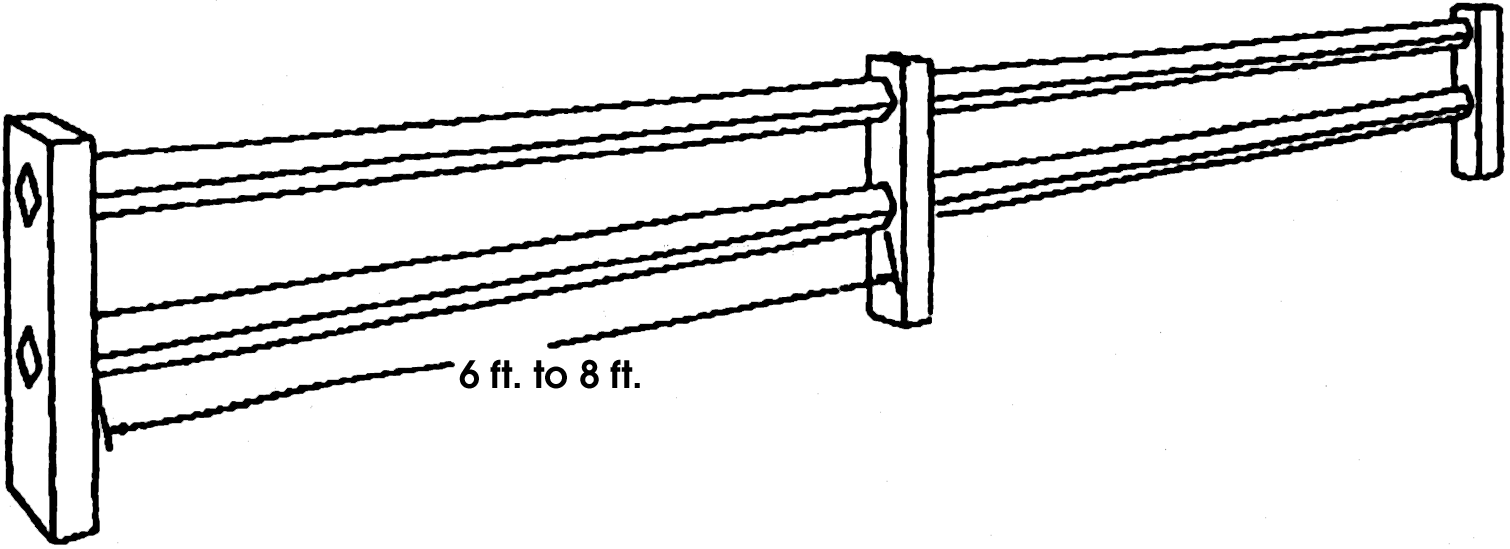
Fence
(2)
Green plastic coated chain link fences are allowed on the side of the waterfront yard that abuts a public park.
(3)
The maximum height of any portion of a fence shall be three feet.
(4)
Fences shall be allowed on that side of the waterfront yard that abuts and runs parallel to Riverside Drive and the property lines that run perpendicular to Riverside Drive.
(5)
Fences must be of a natural wood color, unless a green plastic coated chain link fence is used as permitted above.
(d)
Except as amended above, all regulations for the front yard shall be applicable to the waterfront yard.
(Ord. No. 2550, § 1, 1-26-99)
Sec. 114-770. - Enforcement.
(a)
The city shall notify all property owners that are in violation of this section and shall provide the property owners a reasonable time to comply. Failure to comply shall subject the property owner and/or tenant to code enforcement action.
(b)
Any property owner that has constructed a fence pursuant to a lawfully issued building permit from the city shall be compensated for the value of the fence removed and the compensation shall be based on the value of the project as indicated on the permit application. Upon tendering payment to the property owner, the city is hereby authorized to remove all fences in violation of the regulations set forth above.
(Ord. No. 2550, § 1, 1-26-99)
Sec. 114-771. - Planned unit development regulations.
(a)
Application of regulations. The following regulations apply to all planned unit developments (PUD's) unless the specific type (i.e., APUD, RPUD, MPUD, BPUD, or IPUD) is otherwise referenced.
(b)
Unified ownership. All land within the PUD shall be under the ownership of one person, either by deed, agreement for deed or contract for purchase. PUD applicants shall present either an opinion of title by an attorney licensed in Florida or a certification by an abstractor or a title company, authorized to do business in Florida, that, at the time of initial application, unified ownership of the entire area within the proposed PUD is in the applicant, or contract seller. Unified ownership shall thereafter be maintained until after the recording of the master development plan or final plat.
(c)
Commercial uses in an MPUD. Commercial uses and structures shall be located and designed primarily to serve the needs of the MPUD residents. Commercial areas should normally be located in an area accessible only from streets within the MPUD. When commercial uses or structures are approved as part of a [an] MPUD, the commercial operation shall not begin until certificates of occupancy have been issued for all dwelling units in the total project, unless otherwise provided in the development agreement.
(d)
Utility distribution lines. All utility distribution lines within the PUD shall be located underground; however, those appurtenances requiring above ground installations may be exempted by the city commission.
(e)
Open space requirements. A minimum of 25 percent of an RPUD project or the residential portion of an MPUD containing residential uses shall be open space. Retention ponds must be amenitized in order to count toward the open space requirement. An amenitized pond means a pond that has a fountain or is surrounded by an area such as a walking trail, accessible benches or picnic area. A minimum of 15 percent of the gross site area shall be designated as common open space which shall not be counted toward the open space requirement but is in addition to such requirement. Common open space shall meet the following standards:
(1)
It shall be dedicated to and usable by all residents of the RPUD/MPUD and can include community pools, pool houses, or other recreational facilities such as fitness center, however excludes the office areas of such facilities. Its location, shape, size and character need to be illustrated on the preliminary plan.
(2)
Maintenance guarantees shall be approved by the city commission.
(f)
Procedure for rezoning to PUD.
(1)
Pre-application stage. A pre-application meeting is required before a PUD rezoning application can be accepted. After the pre-application meeting, a sketch plan may be submitted for review and comment prior to filing the application for rezoning.
a.
Pre-application meeting. The pre-application meeting is intended to provide an opportunity for an informational exchange between the applicant and the administrative staff. It will be arranged by the development code administrator. No fee shall be charged. The applicant need not submit any plans or other information; however, the more information, such as sketch plans, proposed land uses, site information, adjacent land uses, and proposed density, that the applicant does submit, the more complete the responsive comment can be. As a minimum, the applicant will be advised of the usual procedures and requirements. Forms, application materials, guidelines, checklists, copies of the comprehensive plan, and of the zoning and subdivision regulation, will be made available at a reasonable cost.
b.
Sketch plan. After the pre-application meeting, a sketch plan may be submitted to the development code administrator. If submitted, written comments on the sketch plan shall be made by the development code administrator and any other interested departments within 30 days. The development code administrator shall coordinate this review. If submitted, a sketch plan shall indicate general land use categories and the approximate height, location, architectural character and density of dwellings, and other structures. The sketch plan shall also show the tentative major street layout, approximate street widths, sites of schools, open space areas and parks, existing structures, waterways, wooded areas, wetlands, floodplain areas (if applicable), total acreage and existing zoning. Finally, it shall include a vicinity map, and any other information deemed appropriate by the applicant.
c.
Written comments. Written comments on the sketch plan are informational only and are subject to change after a more detailed review of the rezoning application.
(2)
APUD application stage. An application for rezoning to APUD, together with a master development plan (MDP) and such application fees as are set at the pre-application meeting, shall be submitted to the development code administrator. If a rezoning applicant desires concurrent review under the land development regulations, he shall so state at the time of application, and shall submit any additional information required by those regulations. The master development plan shall consist of a preliminary plan and a written development agreement. Those documents shall include the following information:
a.
Preliminary plan exhibits. The preliminary plan shall consist of the following:
i.
Name of project and name, address, telephone number of the developer.
ii.
The date the plan was drawn, its scale, and a north arrow.
iii.
Names and location of adjoining streets and names of abutting property owners.
iv.
Legal description of property, boundary survey and the location of all existing streets, buildings, railroads, bulkhead lines, easements, and other important features in or adjoining the property.
v.
The general topography and physical conditions of the site, including natural areas of vegetation and type, general soil types, wetland areas, 100-year floodplain areas, watercourses, water bodies, and natural drainage patterns.
vi.
Conceptual configuration of site including locations of proposed buildings, structures, fixed-location mechanical equipment (e.g., irrigation pumps, compactors, compressors, etc.), access drives and parking areas. The proposed general use of each building and structure shall be stated on the preliminary plan.
vii.
Such additional material maps, studies, or reports subsequently deemed necessary by any reviewing department or agency.
b.
Written development agreement. In addition to a preliminary plan, a written development agreement shall be prepared, following a general format supplied by the development code administrator at the pre-application meeting. The development agreement, along with the preliminary plan, shall govern the development of the APUD and shall regulate the future use of the land. The development agreement shall include any statements or information requested by any reviewing department or agency at the pre-application meeting, such as:
i.
Evidence of unified ownership and control.
ii.
Statement agreeing to:
(a)
Proceed with the proposed development according to all applicable city regulations;
(b)
Carry out all operations in accordance with agriculture best management practices and applicable state and federal laws pertaining to irrigation and water management, storage, use and disposal of fertilizers, pesticides, herbicides, fungicides and other toxic, hazardous and/or noxious substances;
(c)
Provide appropriate performance and maintenance guarantees;
(d)
Follow all other provisions of this chapter to the extent not expressly inconsistent with the written development agreement, and bind the applicant's successors in title to his commitments.
iii.
Maximum building and structure heights.
iv.
Minimum building spacing.
v.
Approximate acreage devoted to the various crops and the approximate time and duration of the harvest for each crop.
vi.
Yard areas and buffer areas, including perimeter buffers.
vii.
Statement regarding the management and/or disposition of agricultural and animal wastes; the irrigation of crops; the recovery and reuse of irrigation water; and the handling and storage of fertilizers, pesticides, herbicides fungicides and other toxic, hazardous and/or noxious substances.
viii.
Statement regarding the types and numbers of animals proposed to be raised and/or kept on the premises. General description of animal management practices, including any practices necessary to control noise, odors and other potential nuisances.
ix.
Description of any recurring special events that may be held on the premises, including the approximate dates, duration, general nature of proposed activities, and estimated attendance.
x.
Any additional information or statements subsequently deemed necessary by any reviewing department or agency.
(3)
RPUD application stage. An application for rezoning to RPUD, together with a master development plan (MDP) and such application fees as are set at the pre-application meeting, shall be submitted to the development code administrator. If a rezoning applicant desires concurrent review under the land development regulations, he shall so state at the time of application, and shall submit any additional information required by those regulations.
a.
The master development plan shall consist of a preliminary plan and a written development agreement. Those documents shall include the following information:
1.
Preliminary plan exhibits. The preliminary plan shall consist of the following:
i.
Name of project and name, address, telephone number of the developer and his professional project engineers, architects and planners.
ii.
The date the plan was drawn, its scale, and a north arrow.
iii.
Names and location of adjoining streets and names of abutting property owners.
iv.
Legal description of property, boundary survey and the location of all existing streets, buildings, railroads, bulkhead lines, easements, and other important features in or adjoining the property.
v.
The general topography and physical conditions of the site, including natural areas of vegetation and type, general soil types, wetland areas, 100-year floodplain areas, watercourses, water bodies, and natural drainage patterns.
vi.
Conceptual configuration of proposed streets, which depict access into and traffic flow within the development, with particular reference to the separation of vehicular traffic from pedestrian or other types of traffic.
vii.
General feasibility plans for potable water, sewage disposal, and stormwater drainage.
viii.
Approximate location and area encompassed for each proposed land use within the development.
ix.
Approximate location and size of common open space.
x.
Such additional material maps, studies, or reports subsequently deemed necessary by any reviewing department or agency.
2.
Written development agreement. In addition to a preliminary plan, a written development agreement shall be prepared, following a general format supplied by the development code administrator at the pre-application meeting. The development agreement, along with the preliminary plan, shall govern the development of the PUD and shall regulate the future use of the land. The development agreement shall include any statements or information requested by any reviewing department or agency at the pre-application meeting, such as:
i.
Evidence of unified ownership and control.
ii.
Statement agreeing to:
(a)
Proceed with the proposed development according to all regulations;
(b)
Provide appropriate performance and maintenance guarantees;
(c)
Follow all other provisions of this chapter to the extent not expressly inconsistent with the written development agreement, and bind the applicant's successors in title to his commitments.
iii.
The acreage and percentage of the total land area devoted to each of the proposed land uses.
iv.
Maximum density for each type of dwelling.
v.
Maximum building heights.
vi.
Minimum building spacing and floor areas.
vii.
Lot sizes, yard areas and buffer areas, including perimeter buffers.
viii.
Statement regarding the disposition of sewage and storm water, and arrangements for potable water.
ix.
When the PUD is planned for phase development, a schedule of the phases.
x.
The proposed language of any covenants, easements or other restrictions.
xi.
Any additional information or statements subsequently deemed necessary by any reviewing department or agency.
(4)
BPUD, IPUD or MPUD application stage. An application for rezoning to BPUD, IPUD or MPUD, together with a master development plan (MDP) and such application fees as are set at the pre-application meeting, shall be submitted to the planning and zoning department. If an applicant for rezoning desires concurrent review under the land development regulations, he shall so state at the time of application and shall submit any additional information required by those regulations. The master development plan shall consist of a preliminary plan and a written development agreement. Those documents shall include the following information:
a.
Preliminary plan exhibits. The preliminary plan shall be drawn to an appropriate engineers scale to include the location and boundary of the site referenced by the legal description and boundary survey; the date the plan was drawn, its scale, and a north arrow; and the name, address and telephone number of the developer and his professional project engineers, architects and planners. In addition, the preliminary plan shall include all of the following, if applicable:
i.
The approximate size and location of all proposed buildings and other structures, the specified use of buildings and structures may be indicated, if known.
ii.
Generalized off-street parking and loading plans, including circulation plans for vehicular movement.
iii.
Driveway and access controls, including number and approximate location of driveways.
iv.
Approximate location, size and description of open spaces, landscaped areas, or buffers.
v.
Approximate location and size of all easements, rights-of-way, or drainage facilities and structures.
vi.
Approximate boundary lines and dimensions of parcels proposed to be subdivided.
vii.
The general topography and physical conditions of the site, including features such as waterbodies, wooded areas, wetland areas, vegetation types, soils, 100-year floodplain areas, and steep grades or depressions on the site.
viii.
General location of signs.
ix.
Any other conditions of development, specifications, limitations, constraints, standards or proposed physical features not specifically included in items a. through h. above.
b.
Written development agreement. In addition to a preliminary plan, a written development agreement shall be prepared, following a general format supplied by the Development Code Administrator at the pre-application meeting. The development agreement, along with the preliminary plan, shall govern the development of the BPUD, MPUD or IPUD and shall regulate the future use of the land. The development agreement shall include the following information:
i.
Evidence of unified ownership and control.
ii.
Statement agreeing to:
iii.
Proceed with the proposed development according to all regulations;
iv.
Provide appropriate performance and maintenance guarantees;
v.
Following all other provisions of this chapter to the extent not expressly inconsistent with the written development agreement, and bind the applicant's successors in title to his commitments.
vi.
A listing of the land uses agreed upon in each component of the BPUD, MPUD or IPUD.
vii.
Maximum building heights.
viii.
Minimum building spacing and floor areas.
ix.
Lot sizes, yard areas, and buffer areas, including perimeter buffers.
x.
Statement regarding ingress/egress controls to the site.
xi.
Statement regarding any road improvements to be made and the thresholds for the traffic impact analysis.
xii.
Statement regarding the disposition of sewage and stormwater, and arrangements for potable water.
xiii.
When the BPUD, MPUD or IPUD is planned for phase development, a schedule of the phases.
xiv.
The proposed language of any covenants, easements or other restrictions.
xv.
Any additional information or statements subsequently deemed necessary by any reviewing department or agency.
(g)
Post-approval stage.
(1)
Recording MDP. After city commission approval of the rezoning application to PUD, the preliminary plan, and the written development agreement, both signed by the mayor and attested by the city manager, shall be recorded in the public records of Volusia County, Florida, at the expense of the applicant.
(2)
Final site plan approval. After the MDP is recorded, a final site plan shall be prepared, submitted, reviewed and approved in the manner required by the land development regulations. If the PUD includes a subdivision required to comply with the land development regulations, preliminary and final plats of the subdivision portion may be submitted in lieu of the final site plan, for review and approval as governed under the land development regulations.
(3)
Construction. During construction, the zoning enforcement official shall enforce compliance with the approved final site plan or the final plat.
(4)
Amendments. Minor amendments to the preliminary plan not violating any terms of the written development agreement and not altering the intent and purpose of the MDP may be approved by the development code administrator after such departmental comment as he deems appropriate.
(Ord. No. 2573, § 2(5.6.21), 1-11-00; Ord. No. 2618, § 2, 9-25-01; Ord. No. 3057, § 1, 9-27-22)
Sec. 114-772. - Traffic impact analysis report.
Purpose. The traffic impact analysis report is designed to identify the traffic impacts and problems which are likely to be generated by a proposed use because of size, density, traffic generation rates, or location. The report will also identify all improvements required to ensure safe ingress and egress from a proposed development, maintenance of adequate street capacity, and elimination of hazardous conditions and improvements necessary for immediately surrounding roadways and intersections as a result of the proposed development.
(a)
Threshold for traffic impact analysis report. A traffic impact analysis report shall be required, unless waived by the city commission, for any use which will generate in excess of 1,000 trips per day according to rates published by the Institute of Transportation Engineers "Trip Generation Manual" (latest edition) or the Florida Department of Transportation, or according to rates documented by study and agreed to prior to use by the city commission.
(b)
Contents of traffic impact analysis report. The traffic impact analysis report shall include the following:
(1)
General site description. A detailed description of the highway network within a radius as determined by the county traffic engineer of the site, a description of the proposed project, the anticipated stages of construction, and the anticipated completion date of the proposed land development. This description, which may be in the form of a map, shall include the following items:
a.
All major intersections;
b.
All proposed and existing ingress and egress locations;
c.
All existing roadway widths and rights-of-way;
d.
All existing traffic signals and regulatory signage;
e.
All existing and proposed public transportation services and facilities within the above-determined radius of the site.
(2)
Description of existing traffic conditions. A 24-hour traffic count shall be conducted for a typical weekday on all roadways which have direct access to a proposed development site. The existing average daily traffic volume, and the highest average peak hour volume for any weekday hour between 3:00 p.m. and 6:00 p.m. shall be recorded. These traffic volumes shall be averaged to determine the average hourly peak traffic volume for a weekday. The methodology used to calculate existing traffic conditions and use of traffic counts and data other than those described above to represent existing traffic conditions shall be subject to the approval of the county traffic engineer.
(3)
Traffic impact of the development. A report shall be made detailing the nature and extent of the trip generation expected to result from the proposed development. Trip generation analysis shall include an estimate of internal/external split, if applicable, and a determination of what characteristics of the development will yield such a split. The source of all trip generation rates shall be according to the Institute of Transportation Engineers Trip Generation Manual, latest edition, rates published by the Florida Department of Transportation, or rates documented by study and agreed to prior to use by the Volusia County Traffic Engineer.
(4)
Determination of roadway service level.
Calculate service volumes: Roadway service volumes shall be calculated at the level of service for the thoroughfare which is specified in the comprehensive plan. Data and procedures contained in the Highway Capacity Manual, Special Report, 209, 1985 published by the transportation research board shall be utilized in deriving tile information required by the traffic impact analysis report.
(5)
Determination of intersection service level.
a.
Data and procedures in the Highway Capacity Manual, Special Report, 209, 1985, published by the Transportation Research Board shall be utilized in determining intersection service levels.
b.
The post-developing level of service for all intersections shall be in accordance with the comprehensive plan.
c.
Determine the existing level of service of all intersections within one-half mile of the proposed development using the critical movement analysis techniques provided in subsection (b)(5)a. above.
(6)
Analysis of traffic impact. An analysis shall be undertaken to determine if roadways and intersections will operate at the level of service specified by the comprehensive plan following completion of the development given the future peak hour traffic that will be generated by the proposed development. This analysis shall consist of a comparison of the total future peak hour roadway traffic demand with the plan's mandated level of service standard and a critical movement analysis for intersections to determine the impact of total future peak hour traffic on intersection level of service. All roadways and intersections that would operate below the required level of service following completion of the development shall be considered deficient.
(7)
Maintenance of levels of service. Whenever level of service is determined to be below the level specified by the comprehensive plan, development is not permitted unless the developer makes the roadway or other improvements necessary to maintain the specified level or service.
(c)
Traffic-control devices. Whenever, as a result of additional traffic generated by a proposed development, the Manual on Uniform Traffic Control Devices determines the need for a traffic signal or regulatory sign, the developer shall be responsible for installing all said devices and signs.
(d)
Large developments. Large developments (over 250 vehicle trips generated per hour during 3:00 p.m. and 6:00 p.m.) shall also include the following:
(1)
The impact report for developments which will generate between 250 and 1,000 trips during the peak hour shall involve an analysis of all arterials and all intersections within one mile of the proposed project.
(2)
Except for developments of regional impact as defined by F.S. § 380.06, the impact report for developments which will generate over 100 trips during the peak hour shall involve an analysis of all arterial and collector roadways and all intersections within 3 miles of the proposed project.
(Ord. No. 2573, § 2(5.6.22), 1-11-00)
Sec. 114-791.- Boats and recreational vehicles and equipment.
(a)
Recreational vehicles and equipment (RVEs) up to and including 18 feet in length may be parked in the front, side and rear yards of any zoning district. RVEs in excess of 18 feet in length may be parked in the front, side and rear yards of an industrial, approved automotive or recreational vehicle sales lot. In residential zoning districts, RVEs in excess of 18 feet in length may only be parked in an enclosed building(with at least a roof and three enclosed sides, whether attached or unattached to the residence), the rear yard or side yard behind a line extending across the front face of an existing building.
(b)
Any RVE in excess of 18 feet in length may be parked in the front yard of residential property for a period not to exceed three consecutive days in any seven-day period, for the purpose of maintenance, loading or unloading.
(c)
For purposes of measuring length, RVEs shall be measured from the most extreme front point to the most extreme rear point, including bumpers, however, excluding hitches, towing devises or other similar equipment.
(d)
Boats of any length may be parked in the front, side or rear yard of any zoned property within the city.
(e)
No boat or RVE of any size shall be parked or stored in the public right-of-way.
(f)
Any boat or RVE parked in a front yard shall be located on or parallel to the driveway. If no driveway exists, then the boat or RVE shall be parked parallel to the side yard. However, in no event shall a boat or RVE be parked within 20 feet of the nearest edge of the paved road or traveled way.
(g)
No more than two items which are either boats or RVEs may be parked outdoors (including within a structure which is not fully enclosed) at any one residential property.
(h)
All boats and RVEs must be properly licensed and in an operable condition.
(i)
All boats parked must be on an operable, properly licensed trailer, secured to a dock, or parked in an enclosed storage facility, except boats which are of the type commonly transported without a trailer, such as canoes and kayaks, which must comply with the other parking requirements of this section.
(j)
No RVE shall be used for living, sleeping or housekeeping purposes when parked on residential premises or in any location not approved for such use.
(k)
The operation of compressors, generators or other noise-generating equipment associated with an RVE when parked on residential premises is prohibited.
(Ord. No. 2352, § 2(5.6.9), 7-13-93; Ord. No. 2401, § 1, 7-11-95; Ord. No. 2671, § 1, 9-9-03)
Sec. 114-792. - Motor vehicles generally.
(a)
It shall be unlawful to park or store a motor vehicle on any public street or on any residentially zoned property within the city if the motor vehicle does not have displayed thereon both a current motor vehicle license plate and an unexpired inspection sticker, if applicable to the motor vehicle. This subsection shall not apply to vehicles stored within an enclosed garage or carport or similar structure.
(b)
It shall be unlawful for motor vehicles displaying a "for sale" sign or other similar signs to be parked within the right-of-way of any street or highway within the city. A reasonable period of time shall be granted to the seller by the chief of police or his designated representative to dispose of such vehicles. This time limit shall be requested in writing by the seller.
(Ord. No. 2352, § 2(5.6.10), 7-13-93)
Sec. 114-793. - Commercial vehicles, trailers and equipment in residentially zoned areas.
The types of vehicles and equipment specified in this section shall be prohibited from being parked or stored in the front, side or rear yard on residentially zoned property. Only two commercial vehicles, which comply with the parking requirements set forth in this section, may be parked on residentially zoned property.
(1)
Prohibited vehicles. The parking or storage of the following vehicles shall be prohibited in residentially zoned areas:
a.
Vehicles or equipment with a size which exceeds:
1.
Ninety-six inches in height, measured from the road surface to the highest top point, excluding any antennas;
2.
Twenty-two feet in length, measured from the most extreme front point to the most extreme rear point, including bumpers, however, excluding hitches, towing devices or other similar equipment; or
3.
Eighty inches in body width, excluding any mirrors, fenders or wheel axle assemblies.
b.
Trailers which exceed the following measurements:
1.
Ninety-six inches in height, measured from the road surface to the highest top point;
2.
Sixteen feet in length, measured from the front of the trailer, excluding the tongue, to the most extreme rear portion of the trailer; or
3.
Eighty inches in body width, excluding any mirrors, fenders or wheel axle assemblies.
c.
Tow trucks and trucks fitted with wrecker equipment.
d.
Truck tractors and semitrailers.
e.
Bulldozers, earthmovers, front-end loaders, backhoes, forklifts, road graders and similar machinery.
f.
Vehicles or equipment containing operating refrigeration devices which are powered by any form of power which emits noise or odor.
g.
Equipment such as air compressors, mortar mixers and other similar equipment. The prohibition on parking does not apply when the equipment is being used. This subsection shall not prohibit the storing of such equipment on a trailer which complies with subsection (1)b of this section.
h.
Buses. Buses which have been converted to a recreational motor vehicle shall comply with the parking requirements of section 114-791.
(2)
Exceptions. Exceptions are as follows:
a.
A vehicle making deliveries to or servicing a residential unit if that vehicle is suited for such a function.
b.
Vehicles actively used in activities conducted in conjunction with a grandfathered nonconforming business use.
(3)
Location of parking. Any commercial vehicle parked in a front yard shall be located on or parallel to the driveway. If no driveway exists, then the commercial vehicle shall be parked parallel to the side yard. However, in no event shall a commercial vehicle be parked within 20 feet of the nearest edge of the paved road or traveled way.
(4)
Permitted vehicles. Only vehicles which are owned by the occupants of the residence or provided by the employer of the occupant and driven by the occupant in his profession shall be permitted to park on the residential property.
(5)
Grandfathered existing uses. The provisions of this section shall not be enforced for a period of one year from the effective date of the ordinance from which this section is derived against individuals who were parking affected vehicles as of such effective date. The reason for the delay in enforcement is to allow the property owners a reasonable time to find an appropriate location to park or store the commercial vehicle or to make other appropriate arrangements. The existence of the vehicle on the property as of the effective date of the ordinance from which this section is derived and the inability to comply with the provisions of this section within reason must be established to the satisfaction of the development code administrator or his designee.
(6)
Variances.
a.
An individual as described in subsection (4) of this section may petition the board of planning and appeals for a variance from this regulation only for those vehicles which are prohibited pursuant to subsections (1)a and b of this section. If the petitioner is not the owner of the property, then the petitioner must have the owner's written consent to submit a request for a variance.
b.
In addition to the variance criteria set forth in section 83-317, the board shall also consider whether the commercial trailer is used by the applicant in a business which is the applicant's primary source of income, whether it is impossible for the applicant to comply with this regulation, and whether there are commercial or multifamily uses surrounding the applicant's residence.
c.
A variance issued pursuant to this subsection shall apply only to the specific vehicle for which the request was submitted. The variance is not transferable to another vehicle, even if the other vehicle is the same size or smaller, nor is the variance transferable to another person, even if the new person owns the same residential property or same vehicle.
(Ord. No. 2352, § 2(5.6.11), 7-13-93; Ord. No. 2402, § 1, 7-11-95; Ord. No. 2793, § 1, 3-27-07)
Sec. 114-811.- Generally.
(a)
No person shall keep, store or allow to remain on any property within the city any dismantled, partially dismantled, nonoperative or discarded machinery, vehicles, boats or parts thereof, scrap metal or junk except as provided in this section.
(b)
No person in charge or control of any property within the city, whether as owner, tenant, lessee or otherwise, shall allow any dismantled, partially dismantled, nonoperative or discarded machinery, vehicles, boats or parts thereof, scrap or junk of any kind to remain on such property for a period exceeding ten days (excluding weekends).
(c)
It shall be unlawful to park or store any type of motor vehicle or trailer when such vehicle is inoperable or abandoned or does not move under its own power, or when such trailer is inoperable or abandoned.
(d)
All motor vehicles with current license plates and valid registrations must be operable and able to move under their own power in a safe manner upon city streets.
(e)
This section shall not apply to such machinery, vehicle parts, scrap metal or junk in a completely enclosed building, or vehicles stored in a carport or completely enclosed building, or the restoration of one vehicle provided the vehicle is completely covered by a commercially manufactured cover and such vehicle is maintained in a safe and sanitary manner, or in an appropriate storage place or depository maintained in a lawful place and manner by the city.
(1)
Any person engaged in the business, in the city, of storing or dealing in used or junked vehicles, tires, parts thereof or any scrap metal or junk shall store and maintain items in a safe and sanitary manner so as to prevent harborage for rodents and the accumulation of water therein, and to prevent harborage for mosquitoes or other insects or furnish a breeding ground for mosquitoes or other insects.
(2)
Any person engaged in the business, in the city, of storing or dealing in used or junked vehicles, scrap and junk shall visually screen such activity with an approved buffer meeting the requirements of chapter 98, article III, and shall construct a decorative wall or fence visually screening items from the street in accordance with section 98-67.
(3)
A business located in a properly zoned district, and holding a current city local business tax receipt to operate a business involved in repair of vehicles, may store inoperable or partially dismantled vehicles while awaiting parts for repair of that vehicle, or while utilizing such a vehicle to supply parts to repair a damaged vehicle (not to exceed 15 working days) or awaiting removal of such vehicles (not to exceed ten working days). At no time shall the number of inoperable vehicles of any type exceed three except as is provided in section (e) above. A vehicle will be considered inoperable when any component necessary for safe operation upon city streets in missing or not functional, the vehicle is obviously immobilized, or does not display a current tag.
(Ord. No. 2352, § 2(5.6.12), 7-13-93; Ord. No. 2615, § 1, 8-28-01; Ord. No. 2793, § 1, 3-27-07)
Sec. 114-812. - Open storage of loose material or objects.
It shall be unlawful to maintain, store or keep loose objects, parts or material in open areas in stacks or piles exceeding 20 feet in height as measured from the centerline of the nearest public street. For the purposes of this section, open areas are those which are not substantially enclosed by four sides and a roof.
(Code 1984, § 15-7)
Sec. 114-813. - Storage in carports prohibited.
The storage of all items in a carport is hereby prohibited except for automobiles, motorcycles and boats, which must also comply with section 114-791. A carport is hereby defined as any portion of a residential structure that is not fully enclosed on all sides, with all entrances into said structure capable of being completely closed with a door.
(Ord. No. 2672, § 1, 9-9-03)
Editor's note— Prior to the reenactment of § 114-813 by Ord. No. 2672, Ord. No. 2452, § 1, adopted Feb. 25, 1997, repealed said section which pertained to enforcement of division and derived from Code 1984, § 18-23.
Sec. 114-814. - Reserved.
Editor's note— Ord. No. 2452, § 1, adopted Feb. 25, 1997, repealed § 114-814 which pertained to hearing on violations and derived from Code 1984, § 18-24.
Sec. 114-831.- Vessels docking or mooring upon city waters.
(a)
Definitions. As used in this section, the following terms shall have the meanings given in this subsection:
Approved marine sanitation device means a device installed upon a vessel, which is designed to receive, retain, treat or discharge sewage and meets all federal and state requirements for the holding and treatment of such sewage.
Live aboard means use as a principal residence, or use for eating and sleeping for continuous periods in excess of 24 hours. Continuous occupancy for periods in excess of 24 hours shall create a presumption of use as a residence.
Vessel is synonymous with boat and includes every description of watercraft, barge and airboat, other than a seaplane on the water, used or capable of being used as a means of transportation on water.
Waters of the city are those portions of the Halifax River, also known as the Florida Intercoastal Waterway, which extend from the center of the channel of the river to its western shore and are bounded on the north by the northerly municipal limits of the city and on the south by the southerly municipal limits of the city.
(b)
Prohibitions. Owners and operators of vessels docked or moored in or upon the waters of the city shall be subject to the following:
(1)
It shall be unlawful for any person to live aboard a vessel which is not moored, docked or tied to private property. Live-aboard mooring or docking at private property shall in no event exceed 72 continuous hours.
(2)
It shall be unlawful for any person to moor, dock or tie a vessel to private property without the express consent of the record owner of the property.
(3)
It shall be unlawful for any person to dump or throw garbage, trash or any other refuse, as defined by the municipal ordinances of the city, into the waters of the city.
(4)
It shall be unlawful for any person to moor or dock a vessel to public lands or facilities for a period of time in excess of three hours.
(c)
Abandoned vessels.
(1)
Abandonment prohibited. It shall be unlawful for the owner or operator of a vessel to abandon the vessel in or upon the waters of the city. For purposes of this subsection, a vessel is presumed to be abandoned if it is not lawfully moored to private property and is left unattended for periods in excess of 48 hours.
(2)
Seizure by police. The police of the city are hereby authorized to seize any vessel, whether stolen, wrecked or otherwise abandoned, which may be found upon the waters of the city. Notice of seizure shall be posted upon the vessel for a period of time not less than 48 hours. Upon the expiration of 48 hours from initial posting, the police may either take possession and store the vessel or leave the vessel in its present location and attempt to notify its owner as provided in this section. The determination of whether to take possession shall be based upon the potential hazard to navigation posed by the vessel and the economic feasibility of possession and storage.
(3)
Notification of owner; redemption by owner. For a period of 30 days from the date of the posting of the seizure notice as provided in this section, the police shall make every effort to notify the owner of any vessel that has been seized and shall, throughout such period of 30 days, permit the owner to regain possession thereof upon proof of ownership and upon payment of the storage charges and costs connected with the seizure and storage of the vessel.
(4)
Sale at public auction. After the expiration of the period of 30 days, the city manager shall sell any such vessel not claimed or reduced to possession by the owner thereof, at public sale, after ten days' notice in writing delivered to the owner, if he can be found, and by advertisement in a newspaper in the city of general circulation.
(5)
Disposition of proceeds of sale. Out of the proceeds of the sale of any such vessel, costs and storage fees shall be first paid, and any balance remaining shall be retained by the city in a special fund in the possession of the city for a period of one year in order to enable the owner of the vessel to prove ownership of the vessel sold, and, when such ownership is proved, such surplus funds shall be paid to the owner.
(6)
Transfer of proceeds of sale to general fund. After the expiration of one year, any sums arising from the sale of such vessel in accordance with the provisions of this section which are unclaimed by the owner shall be transferred to the general revenue fund of the city.
(d)
Penalty. Should any person or his agents, servants or employees violate the terms and provisions of this section, such person shall, upon conviction thereof by a court of competent jurisdiction, be fined in any sum not more than $500.00.
(Code 1984, § 15-9)
Sec. 114-832. - Boathouses.
The following regulations shall apply to boathouses in all zoning districts:
(1)
Height. No boathouse shall be constructed, placed, erected or altered to a height exceeding 18 feet measured from mean high water.
(2)
Setbacks. No boathouse shall be built less than five feet from the established bulkhead line or less than ten feet from any side lot line. If the bulkhead line has not been established, then the mean high-water mark shall be used as the line of measurement.
(3)
Accessory buildings attached to boathouse. No accessory building which is attached to a boathouse or a part thereof shall be constructed, erected or placed less than 20 feet away from the established bulkhead line. If the bulkhead line has not been established, then the mean high-water mark shall be used as the line of measurement.
(4)
Detached accessory buildings. Detached accessory buildings accessory to a boathouse shall not be permitted.
(5)
Dimensions. No boathouse or similar structure shall exceed 20 feet in width measured on a line parallel to the established bulkhead line, or exceed 40 feet in length measured at right angles to the established bulkhead line. If the bulkhead line has not been established, then the mean high-water mark shall be used as the line of measurement or reference.
(Ord. No. 2352, § 2(5.6.14), 7-13-93)
Sec. 114-833. - Boat docks and slips.
Boat docks and slips for mooring pleasure boats, yachts and noncommercial watercraft shall be permitted in any residential district as an accessory use to the residential use.
(Ord. No. 2352, § 2(5.6.15), 7-13-93)
Sec. 114-834. - Use of boat as dwelling unit.
No boat or vessel shall be used or maintained as a dwelling unit unless approved by the city commission, and provided such boat or vessel is sound, seaworthy and equipped with sanitary facilities that are either:
(1)
Connected to a public sewer system; or
(2)
Have a self-contained waste treatment system.
(Ord. No. 2352, § 2(5.6.16), 7-13-93)
Sec. 114-851.- Testing generally.
Tests may be required by the development regulations administrator for the purpose of the abatement of fumes, gases, vapors, dusts, odors, etc., or any other nuisance which may be present and which may come under the jurisdiction of the development regulations administrator. Such tests shall be made by the owner or his authorized agent, and they shall be made in accordance with such procedures as may be accepted by a reputable and recognized authority, such as the American Society of Testing Materials, United States Bureau of Mines, United States Public Health Service, National Board of Fire Underwriters, or others. The choice of such authority shall rest entirely with the development regulations administrator.
(Ord. No. 2408, § 2(5.6.20.RR), 8-8-95)
Sec. 114-852. - Testing by city.
Nothing in this subpart regarding tests conducted by and paid for by the owner or his authorized agents shall be deemed to abridge the authority of the development regulations administrator to conduct tests of these installations in behalf of the city.
(Ord. No. 2408, § 2(5.6.20.SS), 8-8-95)
Sec. 114-853. - Noise.
Every use or activity shall be so operated as to comply with the maximum performance standards governing noise described in this section. Objectionable noises due to intermittence, beat frequency or shrillness shall be muffled or eliminated so as not to become a nuisance to persons in adjacent or surrounding areas. Sound levels shall be measured with a sound level meter and associated octave band filter manufactured according to standards prescribed by the American Standards Association.
*Permissible sound level between 6:00 p.m. and 8:00 a.m. shall be decreased by three decibels in each of the octave bands.
(Ord. No. 2408, § 2(5.6.20.NN), 8-8-95)
Sec. 114-854. - Vibration.
Every use or activity shall be so operated that ground vibration inherently and recurrently generated is not perceptible, without instruments, at any point on the property line of the property on which the use is located.
(Ord. No. 2408, § 2(5.6.20.OO), 8-8-95)
Sec. 114-855. - Smoke.
Every use or activity shall be so operated as to prevent the emission of smoke, from any source whatever, to a density greater than described as number 1 on the Ringelmann Chart; provided, however, that smoke equal to but not in excess of that shade of appearance described as number 2 on the Ringelmann Chart may be emitted for periods totalling four minutes in any 30 minutes. For the purpose of grading the density of smoke, the Ringelmann Chart as published and used by the United States Bureau of Mines and which is hereby made, by reference, a part of this chapter, shall be the standard. All measurements shall be at the point of emission.
(Ord. No. 2408, § 2(5.6.20.PP), 8-8-95)
Sec. 114-856. - Fumes, gases, vapors, dusts and acids.
No person shall cause or allow the escape into the open air of such quantities of fumes, gases, vapors, dusts and acids in such place or manner as to cause injury, detriment or nuisance to the public, or to endanger the peace, comfort, health or safety of the public, or in such manner as to cause or have a tendency to cause injury or damage to business or property.
(Ord. No. 2408, § 2(5.6.20.QQ), 8-8-95)
Sec. 114-857. - Industrial sewage and waste.
Every use or activity shall be so operated as to prevent the discharge into any canal or onto the ground of any waste which shall be dangerous or discomforting to persons or animals or which will damage vegetation beyond the lot lines of the property on which the use or activity is located.
(Ord. No. 2408, § 2(5.6.20.TT), 8-8-95)
Sec. 114-858. - Odors.
The emission into the open air of any fumes, gas, dust, mist, odor, smoke, particulate matter or vapor, or any combination thereof, of a character and in a quantity as to be detectable by a considerable number of persons or the public at any point beyond the property limits of the premises occupied or used by the person responsible for the source thereof so as to interfere with health, repose or safety, or cause severe annoyance or discomfort, or produce irritation of the upper respiratory tract, or produce symptoms of nausea, or which is offensive or objectionable to normal persons due to inherent chemical or physical properties, or is detrimental or harmful to the health, comfort, living conditions, welfare or safety of the inhabitants of the city, shall constitute a nuisance.
(Ord. No. 2408, § 2(5.6.20.UU), 8-8-95)
Sec. 114-859. - Glare.
Every use or activity shall be so operated as to prevent emission of glare of such intensity as to be readily perceptible at any point beyond the limits of the property on which the use or activity is located.
(Ord. No. 2408, § 2(5.6.20.VV), 8-8-95)
Sec. 114-860. - Electrical disturbances and radioactivity.
Each use shall be so operated as to prevent the emission of quantities of radioactive materials in excess of limits established as safe by the United States Bureau of Standards or the emission of electrical disturbance sufficient to adversely affect the operation at any point of any equipment other that of the creator of such disturbance.
(Ord. No. 2408, § 2(5.6.20.WW), 8-8-95)
Sec. 114-881.- Applicability.
No telecommunications towers or antennas shall be permitted within the corporate limits of the city except in compliance with the provisions of this division.
(Ord. No. 2462, § 3, 4-8-97)
Sec. 114-882. - Exceptions.
The provisions of this division shall not apply to the following telecommunications towers and antennas:
(1)
Telecommunications towers and antennas that do not exceed the maximum building height limitations specified for the zoning district in which the tower or antenna is located.
(2)
In any zoning district, temporary mobile telecommunications towers and antennas 70 feet or less in height may be operated on private or public property (but not within a public right-of-way), with the owner's permission, for a period not exceeding seven days. Operation for longer periods may be authorized by the city commission for just cause.
(3)
Direct-to-home satellite antennas or satellite dish antennas which receive video programming services via multi-point distribution services, which are one meter or less in diameter.
(4)
Amateur radio or short-wave antennas owned and operated by a homeowner or in connection with the permitted principal use of the site.
(5)
Customer premises equipment and mobile stations.
(Ord. No. 2462, § 3, 4-8-97)
Sec. 114-883. - Priorities.
(a)
It is recognized that different wireless telecommunications services and providers have distinct geographical areas in which they must locate facilities in order to provide their services; but it is also recognized that there is some flexibility in the type of antenna and type of support structure on which the antenna is to be located. Therefore, all telecommunications antennas and telecommunications towers subject to this division shall be located in the city in accordance with the priorities set out in the following table:
Key to table: Numbers refer to priority. Number "1" is the highest priority, or most preferred; number "5" is the lowest priority, or least preferred. The types of towers and locations referred to by the table key "NP" are not permitted.
(b)
To implement these priorities and to encourage the use of the higher priority sites and types of telecommunications facilities:
(1)
Use of the first priority sites and facilities shall be a permitted use or accessory use. A development order shall not be required prior to issuing a development permit.
(2)
Use of second, third, fourth and fifth priority sites and facilities may be permitted only as special exceptions.
(c)
All new telecommunications towers and telecommunications antennas shall be located in accordance with the above priorities. If a request is made for a site and facility lower than first priority, the applicant shall demonstrate to the reasonable satisfaction of the reviewing authority that no higher priority site within the geographic area required to meet the applicant's technical requirements and/or no type of telecommunications facility is available, suitable, or appropriate. Evidence required by the reviewing authority to demonstrate that no higher priority site or type of facility can satisfy the applicant's needs may include the following:
(1)
Telecommunications towers or alternative support structures located within the geographic area required to meet the applicant's engineering requirements:
a.
Are not of sufficient height to meet the applicant's technical requirements;
b.
Do not have sufficient structural strength to support the applicant's proposed antenna and related equipment, and cannot be modified to do so;
c.
Do not have sufficient space to allow the applicant's antenna and related equipment to function effectively and reasonably in parity with other similar equipment;
d.
Would result in electromagnetic interference with or by the antenna;
e.
Would result in fees, costs, or contractual provisions required by the owner in order to share an existing telecommunications tower or alternative support structure or to adapt an existing telecommunications tower or alternative support structure for sharing that are unreasonable. Costs exceeding new telecommunications tower development are presumed to be unreasonable; or
f.
Have other limiting factors that render the existing telecommunications tower or alternative support structure unsuitable.
(2)
All new higher priority sites or facilities:
a.
Are not of sufficient height to meet the applicant's engineering requirements;
b.
Are unavailable for lease under a reasonable leasing agreement;
c.
Would create a greater visual impact on surrounding properties than would the proposed alternative; or
d.
Have other limiting factors, including adverse economic reasons, that make the higher priority sites or facilities unsuitable.
(Ord. No. 2462, § 3, 4-8-97)
Sec. 114-884. - General requirements.
The following provisions shall apply to all telecommunications towers and antennas:
(1)
[Towers over 35 feet high.] Every telecommunications tower greater than 35 feet high shall be designed and certified by a professional engineer registered by the state. Prior to issuance of a permit to occupy any new telecommunications tower greater than 35 feet high, the tower owner shall submit to the city an inspection report, signed and sealed by a professional engineer registered in the state, certifying that the tower is safe and meets applicable FCC and ANSI specifications and applicable local building codes.
(2)
[Compliance with yard requirements.] Every telecommunications tower and all appurtenances (e.g., guy wires, ancillary equipment buildings, etc.) shall comply with minimum yard requirements for the zoning district in which it is located, except additional height-related yard requirements. In determining whether the installation of a telecommunications tower complies with the district regulations, the dimensions of the entire lot shall control, even though the telecommunications tower may be located on a leased parcel within the lot.
(3)
[Height.] An antenna shall not extend more than 20 feet above the structure on which it is located.
(4)
Aesthetics, lighting.
a.
Telecommunications towers shall either maintain a galvanized steel finish or, subject to any applicable standards of the FAA, be painted a neutral color, so as to reduce visual obtrusiveness.
b.
At a telecommunications tower site, the design of the buildings and related structures shall, to the extent possible, use materials, colors, textures, screening, and landscaping that will blend the tower facilities to the natural setting and built environment.
c.
If an antenna is installed on a structure other than a telecommunications tower, the antenna and supporting electrical and mechanical equipment must be of a neutral color that is identical to, or closely compatible with, the color of the supporting structure so as to make the antenna and related equipment as visually unobtrusive as possible.
d.
Telecommunications towers shall not be artificially lighted, unless required by the FAA or other applicable authority. If lighting is required, the governing authority may review the available lighting alternatives and approve the design that would cause the least disturbance to the surrounding views.
(5)
Federal requirements. All telecommunications towers must meet or exceed current standards and regulations of the FAA, the FCC, and any other agency of the federal government with the authority to regulate telecommunications towers and antennas.
(6)
Signage. No commercial signage or advertising shall be permitted on a telecommunications tower unless otherwise required by law or the signage pertains only to the posting of the property relative to trespassing.
(7)
[Co-location.] A telecommunications tower may be rebuilt or modified to accommodate the co-location of an additional telecommunications antenna provided its height is not increased more than 20 feet or ten percent of its height, whichever is greater. The rebuilt or modified telecommunications tower may be moved on the site to an area located within 50 feet of its existing location and may also be relocated, with the approval of the development code administrator based upon a finding that such approval would be consistent with and further the intent of this division, in the same manner on a site which received a previous special exception, notwithstanding any condition of approval relating to the grant of the special exception. After a telecommunications tower is rebuilt or modified to accommodate co-location, only one telecommunications tower may remain on the site.
(8)
Setbacks and separation. The following setbacks and separation requirements shall apply to all telecommunications towers and antennas for which a special exception is required; provided, however, that the city commission may reduce the standard setback and separation requirements if the goals of this division would be better served thereby.
a.
Every telecommunications tower must be setback a distance equal to or greater than one-third its height from any off-site building.
b.
Every telecommunications tower and all appurtenances (e.g., guy wires, ancillary equipment buildings, etc.) shall comply with minimum yard requirements for the zoning district in which it is located.
c.
Telecommunications towers over 90 feet in height shall not be located within one-quarter mile from any existing telecommunications tower that is over 90 feet in height.
d.
Telecommunications tower separation shall be measured from the base of the telecommunications tower to the closest point of off-site uses and/or designated areas as specified in the table below:
Separation Distances Between Telecommunications Towers
(8)
Security fencing. Telecommunication towers shall be secured by a fence with a lockable gate, and anti-climbing device or other security features sufficient to prevent unauthorized access.
(9)
Landscaping. The visual impacts of a telecommunications tower shall be mitigated from nearby viewers by use of landscaping or other screening materials. The following landscaping and buffering of telecommunications towers and accessory structures is required, except that existing vegetation may be used as a substitute for all or part of the required landscaping.
a.
A row of trees a minimum of eight feet tall and a maximum of 25 feet apart shall be planted around the base of the tower. If a fence surrounds the tower, the trees shall be located outside the fence.
b.
A continuous hedge at least 30 inches high at planting capable of growing to at least 36 inches in height within 18 months shall be planted in front of the tree line referenced above.
c.
All landscaping shall be of the evergreen variety.
d.
All landscaping shall be xeriscape tolerant or irrigated and properly maintained to ensure good health and viability.
e.
Any request to deviate from any of the requirements of this section shall require variance approval from the city commission.
(Ord. No. 2462, § 3, 4-8-97)
Sec. 114-885. - Special exception; approval by city commission.
(a)
Information required. Each applicant requesting a special exception under this division shall submit a scaled site plan and a scaled elevation view and other supporting drawings, calculations, and other documentation, signed and sealed by appropriate licensed professionals, showing the location and dimensions of all improvements, including information concerning topography, telecommunications tower height requirements, setbacks, drives, parking, fencing, landscaping, adjacent uses, and other information deemed by the city commission to be necessary to access compliance with this division.
(b)
Factors considered in granting a special exception. The city commission shall consider the following factors in determining whether to issue a special exception although the city commission may waive or reduce the burden on the applicant of one or more of these criteria if the city commission concludes that the goals of this division are better served thereby:
(1)
Height of the proposed telecommunications tower;
(2)
Proximity of the telecommunications tower to residential structures and residential district boundaries;
(3)
Nature of uses on the site and on adjacent and nearby properties, with preference being given to the use of sites which are already developed with non-single family dwelling uses and which are currently visually impacted by tall structures, utility facilities, light poles or other such structures and uses commonly considered to be unattractive;
(4)
Surrounding topography;
(5)
On-site and surrounding tree coverage and foliage, with preference being given to sites which can provide heavy vegetative screening of the proposed telecommunications antenna;
(6)
Design of the proposed telecommunications tower, with particular reference to design characteristics that have the effect of reducing or eliminating visual obtrusiveness;
(7)
The view of the proposed telecommunications tower from major roads in the city, with preference being given to sites where much of the tower is obscured from the view of drivers on the roads or is located outside of the driving line of vision (such as on the inside of a curve);
(8)
Type of proposed telecommunications antenna, with camouflaged being given preference on alternative support structures;
(9)
Availability of suitable existing telecommunications towers and other structures. No new telecommunications tower shall be permitted unless the applicant demonstrates to the reasonable satisfaction of the city commission that no existing telecommunications tower or structure can accommodate the applicant's proposed antenna. Evidence submitted to demonstrate that no existing telecommunications tower or structure can accommodate the applicant's proposed antenna may consist of any of the following:
a.
No existing telecommunications towers or structures are located within the geographic area required to meet applicant's engineering requirements.
b.
Existing telecommunications towers or structures are not of sufficient height to meet applicant's engineering requirements.
c.
Existing telecommunications towers or structures do not have sufficient structural strength to support applicant's proposed antenna and related equipment.
d.
The applicant's proposed antenna would cause electromagnetic interference with the antenna on the existing telecommunications towers or structures, or the antenna on the existing telecommunications towers or structures would cause interference with the applicant's proposed antenna.
e.
The fees, costs, or contractual provisions required by the owner in order to share an existing telecommunications tower or structure or to adapt an existing telecommunications tower or structure for sharing are unreasonable. Costs exceeding new telecommunications tower development are presumed to be unreasonable.
f.
The applicant demonstrates that there are other limiting factors that render existing telecommunications towers and structures unsuitable.
(Ord. No. 2462, § 3, 4-8-97)
Sec. 114-886. - Pre-existing telecommunications towers and antennas.
All telecommunications towers existing on April 8, 1997, shall be allowed to continue their usage as they presently exist. Routine maintenance shall be permitted on such existing telecommunications towers. New construction other than routine maintenance on an existing telecommunications tower shall comply with the requirements of this division.
(Ord. No. 2462, § 3, 4-8-97)
Sec. 114-887. - Removal of abandoned telecommunications towers and antennas.
In the event the use of any telecommunications tower has been discontinued for the period of 180 consecutive days, the telecommunications tower shall be deemed to be abandoned. Determination of the date of abandonment shall be made by the development code administrator who shall have the right to request documentation and/or affidavits from the telecommunications tower owner regarding the issue of telecommunications tower usage. Upon such abandonment, the owner/operator of the telecommunications tower shall have an additional 180 days within which to reactivate the use of the telecommunications tower or transfer the telecommunications tower to another owner/operator who makes actual use of the telecommunications tower, or dismantle and remove the telecommunications tower. At the earlier of 180 days from the date of abandonment with reactivation or upon completion of dismantling and removal, any variance approval for the telecommunications tower shall automatically expire.
(Ord. No. 2462, § 3, 4-8-97)
Sec. 114-901.- Outside display, storage or sale of goods, merchandise or services not requiring a special use permit.
In the B-2, B-3, B-4, B-5, B-6, I-1, I-2 and CC-1 zoning districts, the outside display, storage or sale of goods or merchandise that are normally sold inside a building occupied by a business holding a current local business tax receipt shall be allowed, unless otherwise prohibited, subject to the following conditions.
(1)
No goods or merchandise shall be displayed, stored or sold on any public right-of-way, public sidewalk or designated parking area.
(2)
The outside display, storage or sale of goods and merchandise on private property or a private sidewalk shall be allowed, however, such goods and merchandise shall not create a hazard to, impede or obstruct pedestrian movement, and shall not violate the minimum fire and safety codes standards or any other regulations of the city.
(Ord. No. 2549, § 1, 11-10-98; Ord. No. 2660, § 1, 4-22-03; Ord. No. 2666, § 1, 7-22-03; Ord. No. 2793, § 1, 3-27-07)
Sec. 114-902. - Outside display, storage or sale of goods, merchandise or services requiring special use permit.
A business holding a current local business tax receipt or property owner upon which the business is located may be permitted to engage in outside display or sales of goods, merchandise or services not normally sold within the licensed establishment and be permitted to allow other businesses or merchants to engage in such activity outside on the same premises subject to the following conditions:
(1)
A special use permit shall be required. Application for a special use permit shall be filed in the building department on a form provided by the city. The application shall be accompanied by a permit fee, the amount of which to be established by resolution of the city commission. The special use application shall include a site plan showing the locations of where the special use activities will be conducted, parking, ingress and egress, traffic control, portable toilets (if required), information necessary to show compliance with subsection (7) below and such other information requested by the city. If the applicant is not the business owner or property owner, the business owner or property owner must sign the application consenting to the issuance of a special use permit.
(2)
Except as may otherwise be authorized here below, special use permits may authorize the regulated activity only during the specific event periods established by the city commission.
(3)
Outside display and sale of goods, merchandise and any other items or services is prohibited on vacant lots, except for sale of Christmas trees and pumpkins by tax-exempt organizations.
(4)
The outside sale of food and beverages, including alcohol, may be permitted on a premises that does not normally sell food and beverages only when located at least 500 feet from the nearest licensed restaurant. The distance shall be measured from nearest edge of the property upon which the restaurant is located to the nearest edge of the property upon which the outside sales is conducted. Applicants desiring to sell alcohol must show proof of necessary state permits prior to the issuance of a special use permit. The sale of food and beverages authorized by this provision shall be for take-out only unless the applicant demonstrates that parking will be available to satisfy the minimum number of spaces required for added seating.
(5)
Outside sales of Christmas trees by tax-exempt organizations may be permitted during the period from Thanksgiving Day through Christmas Day.
(6)
Outside sales of pumpkins by tax-exempt organizations may be permitted during the period from October 1 through Thanksgiving Day.
(7)
No more than 50 percent of the open area shall be used for the outside sales activity. Open area is defined as the designated parking lot, grass and dirt areas (excluding landscaped areas and stormwater retention areas that are not reasonably accessible by pedestrians). The intent is that only 50 percent of the area reasonably accessible by pedestrians would be occupied with outside sales activity. Public rights-of-way, including public sidewalks, shall not be included as part of the open area and no outside sales activity shall be conducted on public rights-of-way and public sidewalks. The remaining 50 percent of the open area shall be used for vehicle parking and pedestrian walking areas. The city shall have the absolute right to designate the open area and to designate the reasonable arrangement of sales activity and designated parking areas so as to protect the welfare and safety of the public.
(8)
The outside sales activity shall begin no earlier than 9:00 a.m. and shall cease by 11:00 p.m.
(9)
Traffic and parking control shall be provided as necessary to prevent obstruction or disruption of the normal flow of traffic at the site location of the outside sales activity.
(10)
A special use permit issued pursuant to this division shall not authorize the display or sale of goods, merchandise or services not otherwise authorized as a permitted use by the applicable zoning district regulations.
(Ord. No. 2549, § 1, 11-10-98; Ord. No. 2660, § 1, 4-22-03; Ord. No. 2666, § 1, 7-22-03; Ord. No. 2793, § 1, 3-27-07; Ord. No. 2845, § 1, 1-13-09)
Sec. 114-903. - Reserved.
Editor's note— Ord. No. 2979, § 2, adopted September 12, 2016, included provisions for § 114-903. At the direction of the city, this section has been deleted. Similar provisions can be found in ch. 58, art. VI.
Sec. 114-904. - Mobile food vehicle and vendor regulations.
(a)
Definitions.
Catering is the business of providing food for a private event, as a professional service, for a fee.
Commissary is a licensed or permitted food service establishment that provides required services to a mobile food vehicle (MFV). A commissary may provide anything from a source for obtaining potable water and disposing of wastewater; storage for food and supplies; or cooking facilities to prepare the food for sale and consumption. A commissary provides the necessary support for the MFV to operate in a safe and sanitary manner.
Hosting site is the property upon which a mobile food vehicle is parked and operating.
Hosting site property owner is the owner of the property upon which the mobile food vehicle is located and operating.
Mobile food vehicle is a truck, or van, including an enclosed food concession trailer, but excluding food carts and kiosk, that are approved to vend food and nonalcoholic beverage products and are classified as follows:
(1)
Class I—Mobile kitchens. In addition to the vending of products allowed for class II and class III mobile food vehicles, these vehicles may cook, prepare and assemble food items in the unit and serve a full menu. Such vehicles may have a relationship with a commissary.
(2)
Class II—Canteen trucks. These vehicles vend fruits, vegetables, hot dogs, pre-cooked foods, pre-packaged foods and pre-packaged drinks. No preparation or assembly of foods or beverages may take place on or in the vehicle, however, the heating of pre-cooked foods is allowed. A cooking apparatus or grill top for the heating of pre-cooked foods is permitted so long as it complies with state regulations.
(3)
Class III—Ice cream trucks. These vehicles vend only pre-packaged frozen dairy or frozen water-based food products, soft serve or hand-dipped frozen dairy products or frozen water-based food products and pre-packaged beverages. These vehicles operate exclusively within public rights-of-way and do not park or stand at one location except when approved to do so as part of a special event.
Mobile food vehicle rally is where two or more mobile vehicles congregate to offer food or beverages for sale to the public, functioning as a single business and may provide restrooms, tables, play areas, a structure for alcohol sales, and other outdoor entertainment open to the customers of all vendors. These events must receive a special event permit, or they can be approved as part of a city sponsored event.
Mobile food vendor is a person who prepares, dispenses, or otherwise sells food from a mobile food vehicle.
(b)
Licensing and permitting requirements.
(1)
Prior to setting up at a location, a class I or II mobile food vendor must provide the following to the city:
a.
A copy of the mobile food dispensing vehicle license from the Florida Division of Hotels and Restaurants.
b.
A completed indemnification statement for city files. To be updated annually.
c.
A copy of the city approved permit from the property owner, or authorized tenant, to operate at the proposed location.
d.
Evidence that the vehicle has passed any safety inspections required by the state, county or city.
(2)
Mobile food vehicles must be inspected by the city's fire marshal or fire chief or their designee, and comply with all city safety regulations.
(3)
The mobile food vendor must permanently display to the public in a clearly visible area, their license from the Florida Division of Hotels and Restaurants.
(4)
The hosting site property owner, or authorized tenant, shall obtain a permit from the city at least five days prior to hosting the mobile food vendor. The permit application shall be on a form issued by the city and contain at a minimum the following information:
a.
Location address
b.
A signed indemnification statement.
c.
A sketch plan showing the subject property and the proposed location of the mobile food vehicle.
d.
Owner contact information.
e.
Vendor contact information.
f.
License from the Florida Division of Hotels and Restaurants.
(5)
The hosting site property owner shall pay a fee as established by the city commission. All permits expire on September 29 of each year and must be renewed.
(6)
The hosting site property owner must have an active business tax receipt.
(c)
Prohibitions and restrictions.
(1)
It is prohibited and unlawful for a mobile food vendor to create a nuisance condition to include, but not be limited to, loud noises, shouting or amplified music or sound. Any noise generated shall comply with the city's standard noise ordinance.
(2)
The mobile food vendor shall not cause or allow any grease or liquid wastes used in the operation to be discharged from the mobile food vehicle.
(3)
The mobile food vendor shall not sell anything other than food and nonalcoholic beverages.
(4)
The hosting site property owner, tenant, and mobile food vendor, must not conduct business in such a manner that would restrict or interfere with proper ingress and egress for vehicles and pedestrians or constitute a traffic hazard.
(5)
Except with permission of the city and as otherwise stated, mobile food vendors may not operate between the hours of 1:00 a.m. and 7:00 a.m.
(6)
Overnight parking of mobile food vehicles on the hosting site or sidewalk is prohibited. Overnight parking and storage of the mobile food vehicle shall follow all applicable laws and regulations.
(7)
A mobile food vehicle may not be located on private property upon which uncorrected code violations exist, or where there exist unpaid fines, fees or citations, or which is under citation for code violations.
(8)
No mobile food vehicle may be located on a vacant lot, provided however this restriction shall not apply to an approved mobile food vehicle rally, also known as food truck courts or truck rallies, approved as a special event.
(9)
Mobile food vehicles are not allowed in residential areas or the residential portion of a mixed-use PUD. This restriction shall not apply when the mobile food vendor is hired to cater a private event in a residential zone.
(10)
The mobile food vehicle, or its seating areas, may not disrupt parking area operation. Mobile food vehicles may not be located in landscaped areas, right-of-way or designated public safety lanes.
(11)
The same address, site or overall property, is prohibited from hosting a mobile food vehicle for more than four days in any calendar week, meaning Sunday through Saturday. Food truck operations approved as part of a city-sponsored special event or under a special event permit will not count against the day limitations of this section. A multiple tenant location is considered one property for purposes of this Code provision.
(12)
A hosting site property owner shall not permit a mobile food vehicle that does not meet all of the requirements of this section, to operate on property they own, nor shall they allow a mobile food vendor to set up on property they own without first having obtained a permit.
(13)
A site may not host a mobile food vehicle for more than four hours on any permitted calendar day except:
a.
When a special event permit has been issued for the site that provides different hours of operations;
b.
If a permitted date is a Saturday or Sunday, on only one of those dates, the hours of operation can be between 8:00 a.m. and 11:00 p.m.;
c.
If a licensed food establishment owns and operates a mobile food vehicle on the same site as the licensed food establishment, the mobile food vendor can be operated during the same hours of operation as the licensed food establishment.
d.
As otherwise provided in the city's regulations.
(d)
Operating requirements.
(1)
Zoning requirements. Except as otherwise stated in the previous section, the property on which the mobile food vehicle and vendor propose to locate, must be business, commercial, or industrially zoned. If the property is zoned as a PUD, the mobile food vehicle shall be located only in the nonresidential portion of the PUD. Churches and civic organizations in residential areas may host a mobile food vendor by obtaining a special event permit.
(2)
Mobile food vending is an accessory use and shall only be allowed on properties that are developed with active permitted uses.
(3)
Mobile food vehicles shall be equipped with a suitable trash container readily accessible to the public, in which the mobile food vendor's customers may deposit any litter, trash or waste. Prior to moving a mobile food vehicle from a sales location, the mobile food vendor shall pick up and remove all litter, trash and waste related to the mobile vendor's sales and within an area encompassing a radius of 50 feet from the sales area.
(4)
Property owners hosting a mobile food vendor for more than one hour must provide readily accessible restroom facilities.
(5)
All mobile food vehicles must park on a hard-stabilized surface such as a paved or asphalt surface.
(6)
Signage on the mobile food vehicle must be mounted flat against the vehicle and cannot project from the vehicle. However, the mobile food vendor shall be permitted to place one sign, not to exceed six square feet on the subject property where the mobile food vendor is conducting business.
(7)
All exterior body work of any mobile food vehicle, shall be maintained in good and clean condition and free of substantial scratches, chips, rust, dents, abrasions, or excessive wear or damage, as determined by the city.
(8)
A mobile food vendor may not locate on any property that abuts a property with an active restaurant except with the written approval of the restaurant owner.
(9)
Mobile food vehicles must be self-contained when operating including all utilities, power, water, and cooking fuel sources. Class I mobile food vendors must be associated with a commissary if available.
(e)
Enforcement. Failure of a hosting site property owner or tenant, to comply with the provisions of this section shall be grounds for denial or revocation of a permit. Violations of these regulations, including operating without a permit, or allowing a mobile food vendor to operate without a mobile food vendor certificate, shall be grounds to bring code enforcement action against the hosting property owner or tenant or both. Upon imposition of a mobile food vendor's third offense, the mobile food vendor will not be permitted to operate within the city for a period of 90 days. The special magistrate will have jurisdiction to enforce these provisions pursuant to F.S. ch. 162, and any person determined to be in violation will be subject to penalties and remedies available as provided by law.
(Ord. No. 2981, § 1, 10-25-16; Ord. No. 3024, § 2, 3-10-20; Ord. No. 3067, § 2, 12-12-23)

