
Holmes Beach City Zoning Code
DIVISION 4
SUPPLEMENTAL DEVELOPMENT STANDARDS
6.8 - Supplemental development standards.
A.
Accessibility by handicapped persons. In addition to meeting the requirements of this ordinance, all new development shall comply with the applicable laws, rules and regulations of the State of Florida enacted to make buildings and facilities accessible to and usable by the physically handicapped.
B.
Reserved.
C.
Building height limitations and exceptions thereto.
1.
Aside from approved exemptions, no building or part thereof shall exceed a height of 36 feet as measured from the crown of the road at the front center of the property to the highest point of any portion of the building.
2.
The following features are exempt from the height limitations set forth in this section and under the individual district regulations, provided they conform to the requirements set forth in subsection 2.b.:
a.
Exempt features.
(1)
Chimneys, house of worship spires and elevator shafts,
(2)
Flagpoles and similar devices,
(3)
Heating and air conditioning, solar collectors, and similar equipment with appropriate screening.
b.
Requirements for exemption.
(1)
Not more than one-third of the total roof area may be consumed by such features.
(2)
The features described in subsection 2.a., above, must be set back from the edge of the roof a minimum distance of one foot for every foot by which such features extend above the roof surface of the principal building to which they are attached.
D.
Commercial vehicles prohibited from overnight parking in residential districts. It shall be unlawful for any person, firm, company or corporation to park or permit to be parked any commercial motor vehicle on any of the public streets, alleys or thoroughfares, or on any privately owned property (except within a completely enclosed garage or other structure), lying within any residential zoning district within the city. This section shall not prohibit the temporary parking of any such commercial vehicle within any such zone when such commercial vehicle is being used in the process of expeditiously loading or unloading goods or merchandise, for service calls, for city government, city vehicles including vehicles of contractors for the city engaged in public works projects for the city, approved special events, for on-call tow truck service, or in the construction or installation of improvements to and/or on the property when parked on the construction site within the residential zone or when otherwise specifically permitted by the city.
1.
For purposes of this section, vehicles of the following types and sizes shall be considered commercial vehicles:
a.
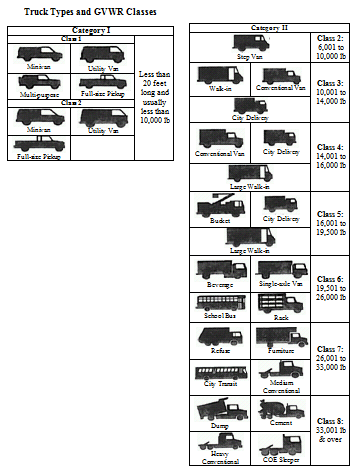
Vehicles listed and depicted under category I on the graphic entitled "Truck Types and GVWR Classes," but only when:
(1)
Such vehicle exceeds 20 feet in overall length, and
(2)
Such vehicle has a rack or racks attached to the body, bed or roof of the vehicle, and the racks have on them materials for sale or used in the conduct of business such as construction materials and tools, plate glass, mirrors, etc. This limitation does not apply to racks for recreational equipment such as skis, kayaks, etc.
b.
All vehicles listed and depicted under category II on the graphic entitled "Truck Types and GVWR Classes" (see graphic under subsection a. above).
c.
Heavy equipment including, but not limited to, farm or industrial equipment, construction or earth moving equipment, buses, wreckers, and tow-trucks.
E.
Corner visibility. On a corner lot or parcel there shall be no structure, fence or planting which materially obstructs traffic visibility within the triangular space bounded by two intersecting right-of-way lines and a straight line connecting two points of the street right-of-way lines 25 feet from the intersection. Structural and planting masses below two feet and above ten feet are not deemed to be obstructions to visibility.
F.
Reserved.
G.
Height of turf or grass, weeds and underbrush on improved property. The height of turf or grass, weeds and/or underbrush on improved property whether publicly or privately owned shall not exceed eight inches in height over more than 30 percent of the vegetated area of the property.
H.
Height of turf or grass, weeds and underbrush on unimproved property. The height of turf or grass, weeds and/or underbrush on unimproved property whether publicly or privately owned shall not exceed 12 inches in height over more than 30 percent of the vegetated area of the property.
I.
Junkyards prohibited. No person may maintain any junkyard for the storage, display, dismantling or sale of wrecked, dismantled, partially dismantled or nonoperating vehicles, appliances, equipment, machinery, or furnishings of any nature in the city, nor shall any person use or maintain any property in the city in such a manner as to give the property the appearance of a junkyard or similar establishment.
J.
Lighting regulations. All outdoor lighting facilities shall be so arranged that the light is reflected away from adjacent properties. Lighting on properties located seaward of the coastal construction control line shall comply with all state lighting regulations.
K.
Lot coverage. Lot coverage by buildings and structures shall be that area of a building or structure contained within the perimeter of the exterior walls or posts, whether vertical or canted, and any attached or detached structure projecting vertically over three feet above ground level, except for lot perimeter fencing.
1.
An open staircase, open deck or open porch, shall not be counted toward lot coverage provided such open staircase, deck or porch is not covered by a roof and is enclosed only by screening and/or covered only by a retractable awning that is supported by no attachment other than to the wall.
2.
A roof overhang shall not be counted towards lot coverage if it does not project into any required yard by more than 36 inches.
3.
Tennis courts, shuffleboard courts and similar private recreational facilities not enclosed by a building shall not be counted towards lot coverage.
4.
A swimming pool shall not be counted toward lot coverage except to the extent that such pool is either located under a conventional roof or is wholly within the perimeter of the building.
L.
Residential lots fronting on more than one street.
1.
Where a residential parcel or lot abuts two streets, a front yard shall be required on each street, and each front yard shall conform to the front yard requirements of the zoning district in which the lot or parcel is located except as otherwise provided in the specific district regulations.
2.
Not more than two front yards shall be required on any platted lot or parcel of record. On a lot or parcel facing on three streets, the owner may choose which street shall be the designated front yard. The yard opposite the designated front yard shall deemed a rear yard for setback purposes.
3.
For lots fronting on four or more streets, the owner may choose which street shall be the designated front yard. The yard opposite the designated front yard shall be deemed a rear yard. One of the remaining yards shall be treated as a side yard for setback purposes and the other shall be the secondary front yard.
4.
Exceptions—Dead-end streets. The minimum setback for buildings or structures located on a lot or parcel which fronts on more than one street, one of which is a dead-end street, shall be as follows:
a.
If the property owner chooses to have the property address on the dead-end street, the yard facing the dead-end street shall be the designated front yard and subject to the minimum front yard requirement. If the property owner chooses not to have the property address on the dead-end street, the setback from the dead-end street shall be the minimum side yard setback required in the district in which the property is located.
b.
Setbacks from street frontages other than the dead-end street, shall be the minimum street yard required in the district in which the property is located. Provided, however, that not more than two front yards shall be required on any platted lot or parcel of record.
M.
Major repair work in residential areas prohibited. No person may perform or conduct in any residential district any major repair work on any vehicle, including, without limitation, body repairing, painting, engine overhaul, transmission or differential disassembly, or brake shoe replacement.
N.
Parking of recreational vehicle type units, boats, personal watercraft, vehicle trailers and boat trailers, utility trailers and temporary storage trailers/units in residential districts. (Refer to sections 62-37 and 62-57 of chapter 62 for additional definitions and regulations.)
1.
Recreational vehicle type units, boats, personal watercraft, boat trailers, vehicle trailers, and utility trailers may be parked in garages, carports and the side and rear yards.
2.
One, but not more than one, recreational vehicle type unit, boat, personal watercraft, boat trailer, vehicle trailer, or utility trailer may be parked in the front yard and must have a current registration and tag and shall be located:
a.
On the driveway;
b.
In the side yard with not more than six feet of the length of the unit extending into the front yard; or
c.
On a stabilized base elsewhere in the front yard and in a manner such that intervening landscaping or shrubbery allows not more than 20 percent of the length of the boat, trailer, etc. to be visible from the street when one is standing on the street at the pavement edge nearest the property line directly in front of the location in which the item is placed.
3.
No utility trailer shall be parked in any waterfront yard.
4.
Except for temporary storage units (aka PODs) on construction sites, which are governed by the provisions of section 6.7Y, one temporary storage unit may be parked in the front yard, provided the following conditions are met:
a.
Said temporary portable storage unit shall not be located on the lot for a period of more than five consecutive days.
b.
The city commission may grant a waiver of the time five-day limitation if the person's property has suffered a natural disaster or other act of God, making compliance with the time limitation an extreme hardship or impossibility. The mayor may grant an initial waiver which shall be subject to confirmation at the next regular meeting of the city commission.
c.
The temporary portable storage unit shall be removed from the property within six hours of the issuance of an official tropical storm warning or hurricane warning.
d.
The temporary portable storage unit shall comply with all sign regulations.
O.
Parking on vacant lots prohibited. Parking of a vehicle on any vacant lot in the city is prohibited.
P.
Post-disaster repair procedure. Subsequent to the occurrence of a natural disaster, a building permit shall not be required for nonstructural minor repairs necessary to return a dwelling unit to a habitable condition, provided:
1.
Such repairs are completed within the two weeks following the natural disaster;
2.
Such repairs shall include, but not be limited to, roofing, windows, doors, plumbing, and electrical connections; and
3.
The building official shall have the discretion to inspect such repairs at a later date.
Q.
Private recreational facilities. Tennis courts, shuffleboard courts and similar uses of a recreational nature not to be enclosed in a building may be constructed within yard areas except on the required front yard, required street side yard, required street rear yard as prescribed by this ordinance; provided, however, that any walls or fences shall conform to the requirements of this ordinance.
1.
Private recreational facilities within a building shall conform to all pertinent yard requirements as set forth herein.
2.
Private recreational facilities shall be located on an abutting parcel or on the same parcel as the principal use to which it is subordinate.
3.
In determining the percentage of building coverage of a parcel or lot, tennis courts, shuffleboard courts and similar uses not enclosed by a building shall not be counted in such computation.
R.
Sanitary and potable water facilities required.
1.
Sanitary facilities.
a.
No dwelling unit shall be built, and no commercial building shall be built that does not contain inside such dwelling or building a flush toilet and lavatory connected to the central sewage disposal system installed and constructed in accordance with the Rules and Regulations of the Manatee County Health Department and the Florida State Board of Health.
b.
Such facilities located in a commercial building where the public is an invitee shall be accessible to the public, including the handicapped.
c.
All new systems must be connected to the central sewage disposal system.
2.
Potable water supply. All dwelling units and all commercial establishments where the public is an invitee shall be connected to the central water system.
S.
Satellite dish antennas.
1.
Satellite dish antennas one meter (39.36 inches) or less in diameter shall comply with the following standards and requirements:
a.
Electrical permit. If equipped with electrical power drive, an electric permit shall be obtained prior to construction, subject to all applicable requirements of the National Electrical Code.
b.
Ground installed satellite dish antennas. Ground installed satellite dish antennas shall be installed in a manner adequate to withstand winds of 110 miles per hour (mph).
c.
Satellite dish antennas mounted to a building.
(1)
Satellite dish antennas that are 24 inches or less in diameter mounted to a building, its fascia or roof, shall be mounted in a manner adequate to withstand winds of up to 110 miles per hour (mph).
(2)
Satellite dish antennas in excess of 24 inches mounted to a building, its fascia or roof, shall be mounted in a manner adequate to withstand winds of up to 150 miles per hour (mph).
2.
Satellite dish antennas greater than one meter (39.36 inches) in diameter shall comply with the following standards and requirements:
a.
Building permit required. A satellite dish antenna is considered a structure under the building code, and a building permit shall be obtained prior to construction, subject to all structural requirements of the building code.
b.
Electrical permit. If equipped with electrical power drive, an electric permit shall be obtained prior to construction, subject to all applicable requirements of the National Electrical Code.
c.
Ground installed satellite dish antennas. Ground installed satellite dish antennas shall comply with the following standards and requirements:
(1)
Certification by a professional engineer, registered in the State of Florida, to withstand winds of 110 miles per hour (mph).
(2)
Placement on reinforced concrete slabs.
(3)
Height or diameter of the dish antenna shall not exceed 15 feet. The height of an antenna shall be measured vertically from the highest point of the antenna when positioned for highest point of operation, or to which it is capable of being raised, to the bottom of the base that supports the antenna.
(4)
Foundations must be placed within required building areas. There shall be no satellite dish antennas located on the street side of property.
(5)
Such antennas shall be screened from view on all sides, utilizing natural vegetation and hedges to form an opaque screen.
d.
Roof-mounted satellite dish antennas. Roof-mounted satellite dish antennas greater than one meter (39.36 inches) in diameter may be located only in nonresidential districts and shall comply with the following standards and requirements:
(1)
The height of a roof-mounted satellite dish antenna may not exceed six feet.
(2)
All roof-mounted satellite dish antennas must have an enclosure screen to screen the view of the satellite dish antenna from the street.
(3)
Roof-mounted satellite dish antennas shall be certified by a professional engineer, registered in the State of Florida, to withstand winds of 150 miles per hour (mph).
(4)
Roof-mounted satellite dish antennas shall also require an engineer's certification for the load imposed on the roof.
T.
Street frontage required. Except as may be permitted by other provisions of this ordinance, no building permit shall be issued for any structure or building unless the site therefore abuts one of the following for at least 25 feet:
1.
A paved public street; or
2.
A private street that abuts a paved public street, which private street is of a minimum width of 25 feet and is paved.
U.
Pools.
1.
Applicability. For the purposes of this section, pools shall mean in-ground and above ground swimming pools and spas, unless otherwise specified. Small, portable, temporary pools without pumps, motors, and/or dedicated cleaning equipment, which are commonly referred to or known as "kiddie pools," are exempt from the provisions of this section. Koi ponds and other similar features are also exempt from the provisions of this section.
2.
Location.
a.
A pool located in a waterfront setback with seawalls is subject to the following conditions and limitations:
(1)
A pool may be constructed within the required setback provided the pool is set back at least six feet from the center of the seawall and the applicant obtains an engineer's signed affidavit stating said pool will not jeopardize the structural integrity of the seawalls.
(2)
A deck or patio associated with a pool is not required to be setback from the seawall.
b.
Except for pools located in waterfront setbacks with seawalls, pools and associated ancillary structures are subject to the following limitations and requirements:
(1)
No pool, or other structure ancillary to a pool may be located in any required setback.
(2)
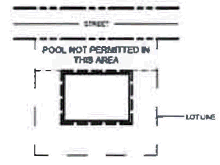
For interior lots, no pool, or other structure ancillary to a pool may be located in the space, extending the full width of the lot, between any building and a lot line fronting on a street (i.e., front lot line) and measured perpendicular to the building.
INTERIOR LOT
(3)
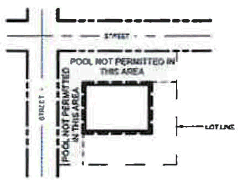
On a corner lot or parcel, no pool, or other structure ancillary to a pool may be located in the space, extending the full width of the lot, between any building and the front lot line of the designated front setback or the secondary front setback.
CORNER LOT
(4)
On a lot or parcel fronting on more than two streets, no pool, or other structure ancillary to a pool may be located in the space, extending the full width of the lot, between any building and the front lot line of the designated front setback or the secondary front setback. On a lot or parcel facing three streets, the owner may choose which street shall be the designated front setback and secondary front setback.
c.
The setback of a pool shall be measured from the coping and concrete edges or the inside edge of the pool to the property line, split line or line established in a condominium plat separating condominium units as recorded in the public records of Manatee County.
d.
Pools and spas shall not be elevated above the first finished floor or 29 inches above crown of road, whichever is less.
3.
[Temporary fences required during construction.] Substantial temporary fences shall be required during the construction of all swimming pools.
a.
[Removal, replacement.] Temporary fences may be removed to necessitate [facilitate] the actual construction but must be replaced when construction is not in progress.
b.
[Installation of permanent fence, cage.] Temporary fences shall remain in place until a permanent fence or cage is installed.
4.
[Pool safety requirements.] All pool and spa installations shall comply with all applicable provisions of the Florida Building Code and State Statutes, especially and including barrier requirements related to pool safety.
5.
[Calculation of impervious surface.] All areas of pools not covered by a roof or other impervious structure shall be included in the computation of impervious surface.
6.
[Nonconforming lots.]
a.
Legally nonconforming single-family lots in existence as of May 1, 2015, located in the R-2 or R-4 district, proposing construction of one pool and/or spa associated with an existing single-family home, may apply to:
(1)
Increase the maximum permissible impervious surface by up to five percent; and/or
(2)
Reduce the required setback of a recreational water feature to as little as five feet, measured in accordance with the provisions of section 6.8U; provided:
i.
A licensed engineer documents that the stormwater retention and treatment system is capable of meeting all city requirements without the need for regular maintenance (e.g., cleaning of swales, etc.).
(3)
These provisions do not apply in the instance where the principal structure is to be demolished and replaced with a new principal structure.
7.
Any slides constructed at pools in residential zoning districts shall not exceed six feet in height.
8.
Number and size of swimming pools and hot tubs/spas per platted lot of record or parcel.
a.
The number of swimming pools and hot tubs/spas on a platted lot of record or parcel shall be limited in the following manner:
(1)
Not more than one pool, with or without an integrated hot tub/spa, may be constructed per dwelling unit as an accessory to said dwelling unit, on a platted lot of record or parcel as described in subsection 10 or 11, below.
(2)
Not more than one hot tub/spa may be constructed per dwelling unit as an accessory to said dwelling unit, on a platted lot of record or parcel as described in subsection 10 or 11, below.
(3)
A pool, which is accessory to a duplex dwelling unit, which dwelling unit is subject to a party wall agreement or is held in the condominium form of ownership, may not exceed 180 square feet in total net surface area as measured from the inside edge of the pool. In no instance may the combination of any swimming pool and hot tub/spa, whether integrated or as separate units, exceed 180 square feet in total net surface area as measured from the inside edge of the pool's edge.
(4)
A pool or spa, or combination of pools and spas features located on one platted duplex lot or parcel, which recreational water feature(s) is/are accessory to duplex dwelling units located in one structure under fee simple ownership, may not exceed 360 square feet in total net surface area as measured from the inside edge of the pool or spa(s) at the water's edge.
9.
Diving boards, springboards, diving platforms, diving decks, grottos, grotto pools, waterfalls, slides and fountains ancillary to any pool are prohibited in the R-2, R-3 and R-4 zoning districts. While waterfalls are prohibited, sheer descents or spa overflows (such as with an infinity pool) are allowed up to 36 inches in drop. For purposes of this section, a slide is any device used to enter a swimming pool by sliding down an inclined plane or through a tube.
10.
Duplex dwelling units subject to a party wall agreement. Before any pool or spa is approved on any duplex lot of record or parcel in the R-2, R-3, or R-4 zoning district, if units in the duplex structure are subject to a party wall agreement, the applicant must submit to the city a copy of the party wall agreement as proof that the units qualify as legally nonconforming uses under the provisions of section 4.2B of this Land Development Code.
11.
Duplex dwelling units under the condominium form of ownership. Before any pool or spa is approved on any duplex lot of record or parcel in the R-2, R-3, or R-4 zoning district, if units in the duplex structure are under the condominium form of ownership, the applicant must submit to the city a certificate from the State of Florida confirming that the condominium association is in good standing with all state requirements.
12.
Lighting of pool areas shall comply with chapter 66, division 2, Lighting Restrictions.
V.
Trash.
1.
Trash receptacles.
a.
Trash receptacles, including, but not limited to, dumpsters in residential districts, may not be permanently located within a required yard or building area unless Type A screen requirements are met.
b.
Trash receptacles should be conveniently located so as to discourage dumping of debris of any kind into drainage ditches and stormwater control structures.
2.
Temporary trash receptacles. Temporary trash receptacles, including dumpsters, may be located in the area referred to above for a consecutive period of no longer than 15 days; however, an extension of time may be granted by the building official.
3.
Dumpsters. The location or relocation of a dumpster shall not require site plan approval. Notwithstanding the above limitations:
a.
Dumpsters must meet setback requirements in all residential areas;
b.
When located in a nonresidential district and abutting a residentially zoned property:
(1)
Dumpsters must be set back from the abutting residential property lines, in the area where such property lines abut, a distance of not less than the setback required in the abutting residential zoning district.
(2)
A dumpster not meeting the setback requirement in subsection (1) shall be considered nonconforming and may remain in said location provided the building official makes a determination that there is no other suitable location that would conform to the required setback.
(3)
A dumpster not meeting the setback requirement in subsection (1) may be relocated only to a new location that conforms to the setback requirement; or, if no conforming location is available, said dumpster may be relocated to a site that is less nonconforming with the approval of the building official.
c.
No site plan shall be required when a dumpster is located or relocated, but the building official may require submission of materials demonstrating that the proposed location provides for adequate access and egress of solid waste collection vehicles and does not interfere with internal pedestrian or vehicular circulation.
4.
Hazardous waste. The storage, disposal or disposition of any substance deemed a hazardous waste shall be prohibited within the city limits. All disposal must be accomplished at a Department of Environmental Regulation [Protection] approved hazardous waste collection facility.
W.
Two-family dwellings (duplexes).
1.
Except as may be otherwise provided in subsection 2., following, all dwelling units in a two-family or duplex dwelling constructed after April 9, 2013 shall be constructed in accordance with the definition of "two-family/duplex dwelling" set forth in section 1.4 of the Land Development Code. Furthermore, where portions of the dwelling units are not joined by a common wall, they must be physically separated by a distance of not less than ten feet.
2.
Existing or previously approved dwelling units grandfathered. Where one dwelling unit of a two-family dwelling has been constructed on a lot prior to April 9, 2013 or a building permit has been issued prior to March 27, 2007, for a two-family dwelling the individual dwelling units of which will be joined only by a common foundation as opposed to a common roof and party wall, each of said dwelling units shall be permitted to be constructed as dwelling units without a common roof and party wall provided the construction meets all applicable standards of the Florida Building Code and the requirements of the Land Development Code.
3.
Special conditions for units permitted to have been joined at the foundation prior to March 27, 2007. When a two-family dwelling is was permitted to be constructed such that the units are joined at the foundation and, from outward appearances would appear to the casual observer to be independent single-family structures, the following requirements shall apply:
a.
The builder or owner shall file with the city and county, at the time of construction, a deed restriction that such structure is and shall always remain a two-family structure;
b.
For two-family dwellings existing prior to March 27, 2007 the owner(s) shall file, with the city and county, within six months of the effective date of this ordinance a deed restriction that such structure is and shall always remain a two-family structure;
c.
At the time the required deed restriction is filed, the builder or owner(s) shall provide the city clerk with a copy of any condominium documents pertaining to the property;
d.
Any and all documents describing such property shall include a statement that the structure is a two-family structure and that city regulations prohibit the reconstruction of such structure as two independent single-family units.
4.
Special maximum lot coverage and impervious surface coverage limitations.
a.
The lot area associated with each individual dwelling unit in a two-family dwelling shall be computed as one-half of the land area of the lot or parcel upon which the two-family dwelling is constructed, except as may be otherwise described in legal documents allocating land area to the owner(s) of the individual dwelling units.
b.
Neither initial construction and improvements, nor subsequent improvements, shall result in lot coverage for the lot area associated with either of the individual dwelling units of the two-family dwelling to exceed 30 percent nor the maximum lot coverage and impervious surface coverage to exceed 40 percent.
X.
Utility poles. To avoid destroying property corner markers, utility poles shall not be set closer than one foot to any property corner.
Y.
Water conservation devices. Plumbing permits shall specify the installation of low volume plumbing fixtures pursuant to F.S. § 553.14, as may be amended from time to time, said statutory reference recognized as the minimum standard for such devices.
Z.
Permitted setback encroachments.
1.
Except for fences as set forth in section 6.8F[8.27], every part of every required setback shall be open and unobstructed from structures 36 inches above the ground upward. Notwithstanding this section, no encroachment may violate the State Building Code or the State Fire Prevention Code.
a.
Utility facilities, lamp posts, mailboxes, horticultural growths, and garden accoutrements including, but not limited to, pergolas, arbors, and trellises greater than 36 inches in height are permitted to encroach in required setbacks so long as they do not create a traffic hazard as determined by the traffic engineer.
b.
Except as otherwise permitted herein, heat pumps, pool pumps, air conditioning units, recreation or fitness equipment, trampolines, and generators are not permitted in required setbacks regardless of their height.
c.
Flag poles, radio and television antennas, wires, lights and mailboxes are not considered encroachments into required setbacks.
2.
Cornices, eaves, gutters, roof overhangs, building overhangs, balconies, platforms, decks, bay windows, wing walls, mechanical panels, and unenclosed exterior stairways may project into a required setback no more than three feet, provided:
a.
The structure of which such items form a part does not otherwise encroach upon a required setback.
b.
The exterior wall of the second story of a two-structure shall not be deemed a building overhang under this section and may not encroach upon a required setback.
c.
Supports for these structures may project into a required setback by not more than three feet provided that such supports are of an open construction like post and beam and there is no enclosure below the structure. No construction is allowed above the top elevation of the structure other than required safety features such as a guardrail on a deck.
d.
All roof and building overhangs, balconies, platforms, and decks shall be constructed such that there is not less than seven-foot vertical clearance.
e.
An overhang which is part of a building may be permitted to encroach into any setback as long as the overhang does not extend more than three feet into the setback and does not permit any balcony, porch, or living space located above the overhang to extend into the setback.
3.
Awnings, canopies, shutters, and all other similar exterior window and door coverings are permitted to encroach three feet into setbacks, as long as their location does not interfere with traffic, ingress and egress, or life safety equipment. Awnings and canopies must be attached to, and entirely supported by, the same wall in which the window or door to which such device serves is located.
4.
No awning or similar exterior covering may extend outward from the supporting wall farther than the vertical measurement from the top to the bottom of the opening to which such covering serves.
5.
LP and propane tanks. All permitted above ground liquified petroleum (LP) and propane tanks may encroach three feet into the side and rear setbacks; however, all gas tanks, regardless of location, must be screened by vegetation equal to or greater than the height of the gas tank. Buried tanks which do not protrude above ground are not subject to the setback limitations of this zoning code.
6.
Stairways or steps, including associated railings and landing areas, which are attached to a building and provide pedestrian/occupant access may be permitted to encroach a maximum of three feet into the required setback.
7.
The replacement for an existing air conditioning unit or pool pump, made nonconforming as a result of the adoption of this provision on August 12, 2014 may be installed in the same location as the pre-existing unit provided all the following are met:
a.
The replacement results in no greater encroachment into any required setback area than the unit it replaces and meets all other requirements of the LDC;
b.
The replacement pool pump is a variable speed unit;
c.
The replacement air conditioning unit is a new, not previously owned, unit that was manufactured not more than two years prior to the date of installation.
8.
Allowable encroachments into the secondary front setback. Restrictions set forth in the preceding subsections (1) through (6), notwithstanding, the following items may encroach up to, but not more than, five feet into a secondary front setback:
a.
Air conditioning unit;
b.
Generator; and
c.
Heat and pool pumps not exceeding 48 inches in height (measured from adjacent grade), provided the unit is screened to a height equal to or greater than the height of the pump by vegetation along all sides of the pump that do not face an exterior wall of the principal structure.
(Ord. No. 09-03, §§ 4—6, 10-13-09; Ord. No. 09-06, § 7, 11-10-09; Ord. No. 10-06, § 16, 10-26-10; Ord. No. 12-07, §§ 9—12, 10-23-12; Ord. No. 13-05, § 11, 4-9-13; Ord. No. 14-16, §§ 3, 4, 8-12-14; Ord. No. 15-10, § 5, 6-23-15; Ord. No. 15-19, §§ 7—9, 11-10-15; Ord. No. 15-20, § 2, 1-12-16; Ord. No. 16-07, §§ 4—6, 5-24-16; Ord. No. 16-13, § 2, 7-12-16; Ord. No. 24-04, § 2, 5-14-24; Ord. No. 24-05, § 3, 4-23-24; Ord. No. 24-06, § 3, 4-23-24; Ord. No. 24-08, § 2, 6-25-24)

