
Huntington Woods City Zoning Code
ARTICLE 4
District Regulations
Section 40-4.01 - Creation of Districts or Zones
For the purpose of this chapter, the city is hereby divided into nine zone districts known as:
(Ord. No. 600, § 1, 1-8-2018)
Section 40-4.02 - Zoning Map
A.
The boundaries of these districts are hereby established as shown on the map on file in the office of the City Clerk and made a part of this chapter by reference, designated as "Zoning Map of the City of Huntington Woods," and said map and all notations, references and other data shown thereon shall be as much a part of this chapter as if fully set forth herein. Unless otherwise shown, the boundaries of the districts or zones created in this chapter are either centerlines of streets or alleys, centerlines of vacated streets or alleys, lot lines, or such lines extended, or the city limit lines. Where uncertainty exists with respect to such boundary lines, the matter of the location of such lines shall be determined by the Zoning Board of Appeals upon petition of any person having an interest in the property affected.
B.
Any territory embraced within any future enlargement of the corporate limits of the city shall be deemed to be subject to the provisions of this chapter applying to the R-1C District until otherwise classified by the City Commission upon recommendation of the Planning Commission, and after publication of notice and public hearing thereon, as provided for in Public Act No. 110 of 2006 (MCL 125.3101 et seq.), as amended, hereinbefore referred to.
(Ord. No. 600, § 1, 1-8-2018)
Section 40-4.03 - R-1A through R-1E: One-Family Districts
A.
Intent. The Master Plan recognizes that single-family residential neighborhoods are vital components of the city, and comprise the majority of the land area within the city. The intent of the R-1A through R-1E Districts is to provide areas for single-family dwellings with the primary distinction being a range of densities and bulk provisions, implemented through varying lot sizes. The R-1A through R-1E Districts are further intended to preserve and improve upon the quality of residential neighborhoods while permitting a limited number of other compatible uses that support residential neighborhoods.
B.
Use Regulations. No premises shall be used, and no building or structure shall hereafter be erected, altered, or used except for one or more uses contained within Section 40-4.08.
C.
Special Land Uses. Special land use procedures shall meet the standards of Article 8. For special land uses in Zones R-1A through R-1E on properties located within an historic district, special land use approval and site plan approval by the Planning Commission, and a certificate of appropriateness later issued by the Historic District Commission, shall be required. The Planning Commission shall consult the Historic District Commission during the Special Land Use and site plan reviews. In the event the Historic District Commission, or a committee thereof, is currently reviewing a property for the purpose of making a recommendation as to whether to establish an historic district or add the property to an established historic district, and the Historic District Committee, or a committee thereof, sends a report to the City Commission showing the presence of historic, architectural, archeological, engineering, or cultural significance of the property, then the City Commission can direct that the review process for the property and/or the proposed historic district follow the procedure contained herein for an established historic district.
D.
Dimensional Requirements. The following dimensional requirements shall apply to the R-1A through R-1E Districts:
E.
Footnotes to Schedule of Regulations.
(1)
If the subject lot is below the minimum lot size, subtract floor area from the number at the same ratio above.
(2)
Includes:
(a)
The ground floor area of the main building;
(b)
All appurtenances if covered by a roof; and
(c)
All accessory buildings or the minimum lot area required to be set aside for accessory buildings, whichever is larger. For lots with less than 6,000 sq. ft. in area, the amount of lot coverage may be increase by 1 sq. ft. for every 6 sq. ft. that the lot is less than 6,000 sq. ft. For lots with less than 7,000 sq. ft. of area, a covered front porch may exceed the maximum lot coverage by up to one percent of lot area.
(3)
Where there are existing residential dwellings on both sides of the subject lot fronting on the same street, the required setback shall be no less than the least of the two adjoining front setbacks; where there is an existing residential dwelling on only one side of the subject lot fronting on the same street, the required setback shall be no less than the setback of the adjacent residential dwelling; and in no case shall the setback be less than listed in the schedule of regulations.
(4)
One additional foot of total side yard is required for every one foot or portion thereof of building height over 26 ft. At least one-half of the additional side yard shall be on the least side.
(5)
Corner side yard. In the case of corner lots where the adjacent house fronts upon the side street, a setback shall be required from the side street lot line, which is at least equal to the front setback of the other adjoining property facing the same side street. In no case shall the side street setback be less than eight (8) ft.
(6)
Maximum Floor Area per Dwelling Unit Bonuses.
(a)
Character Bonus.
1.
Single-family homes are permitted the following floor area square footage bonuses:
2.
The maximum combination of character bonuses shall not exceed a total of six hundred (600) square feet.
3.
New homes or additions to homes within a designated local Historic District automatically qualify for the maximum character bonus of six hundred (600) square feet provided that all other Historic District and applicable zoning regulations are met.
(b)
Lot Size Bonus. Lot size bonus shall be determined by the following formula:
1.
R-1A: 1 sq. ft. for every 14 sq. ft. of lot area over 30,000 sq. ft., up to a maximum of 750 additional sq. ft.
2.
R-1B: 1 sq. ft. for every 9 sq. ft. of lot area over 9,000 sq. ft., up to a maximum of 812 additional sq. ft.
3.
R-1C: 1 sq. ft. for every 9 sq. ft. of lot area over 9,000 sq. ft., up to a maximum of 625 additional sq. ft.
4.
R-1D: 1 sq. ft. for every 12 sq. ft. of lot area over 6,000 sq. ft., up to a maximum of 350 additional sq. ft.
5.
R-1E: 1 sq. ft. for every 12 sq. ft. of lot area over 5,000 sq. ft., up to a maximum of 400 additional sq. ft.
Figure 4.03.1: R-1A District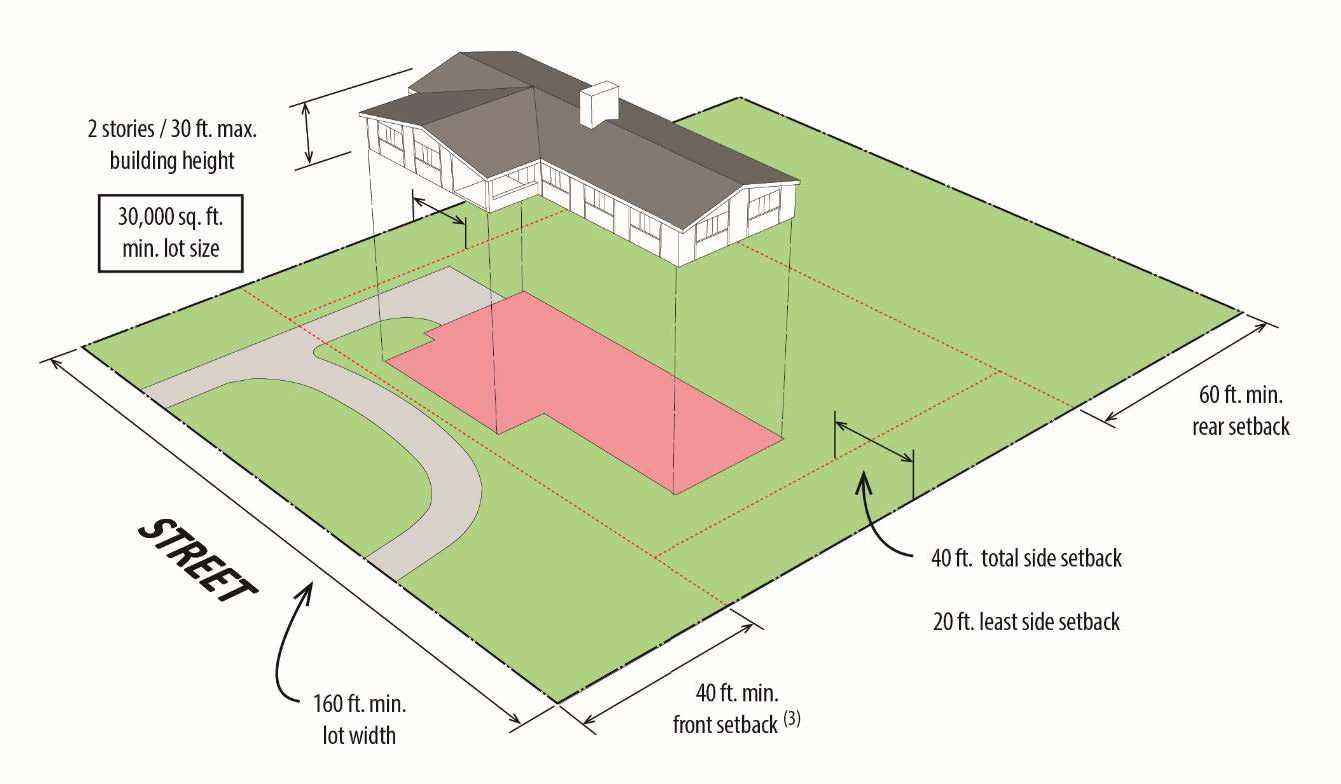
Refer to 4.03.E for footnotes to schedule of regulations.
Figure 4.03.2: R-1B District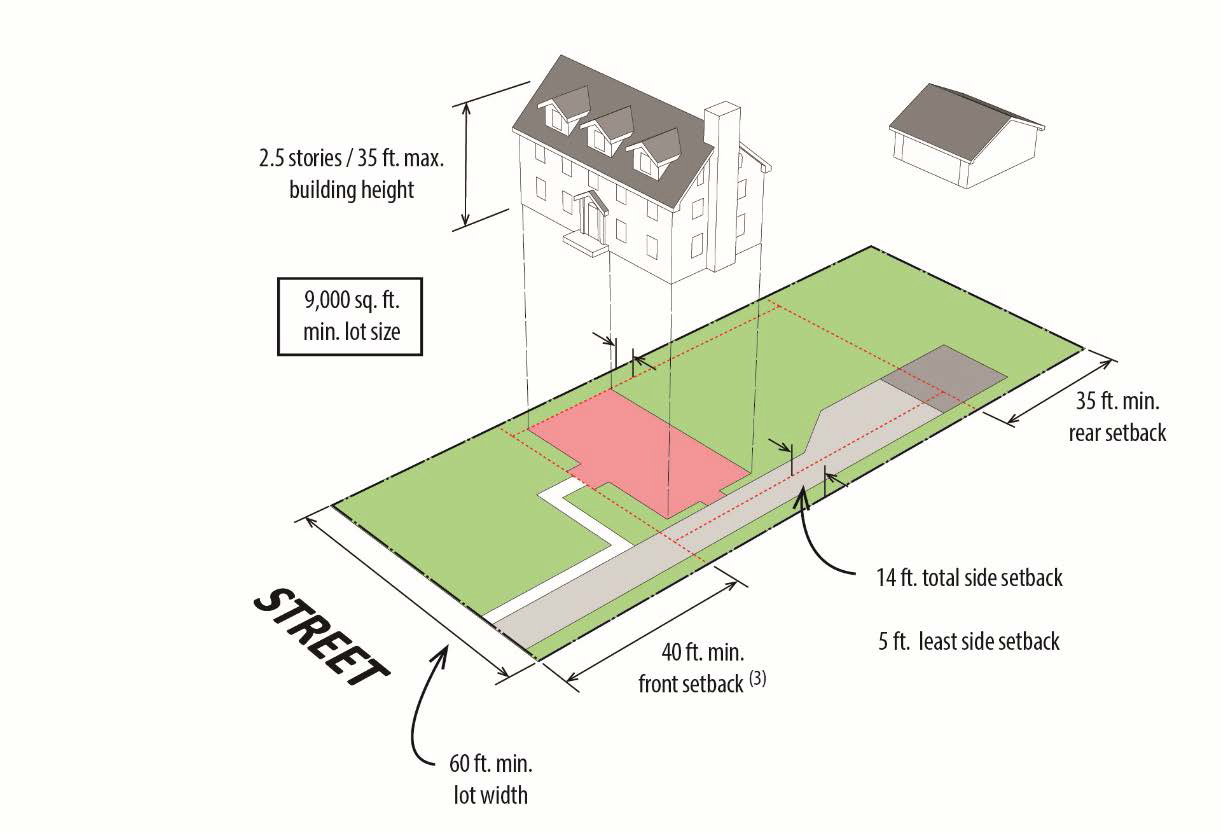
Refer to 4.03.E for footnotes to schedule of regulations.
Figure 4.03.3: R-1C District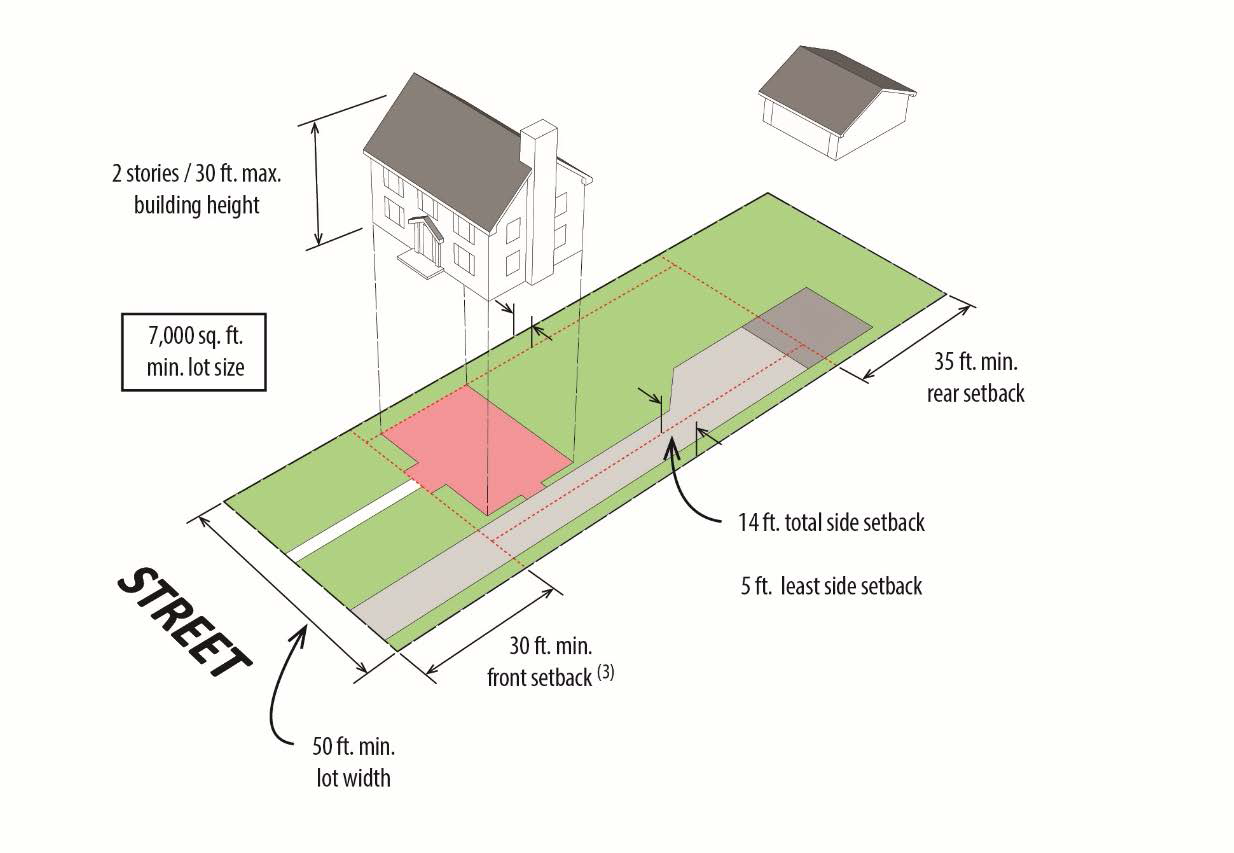
Refer to 4.03.E for footnotes to schedule of regulations.
Figure 4.03.4: R-1D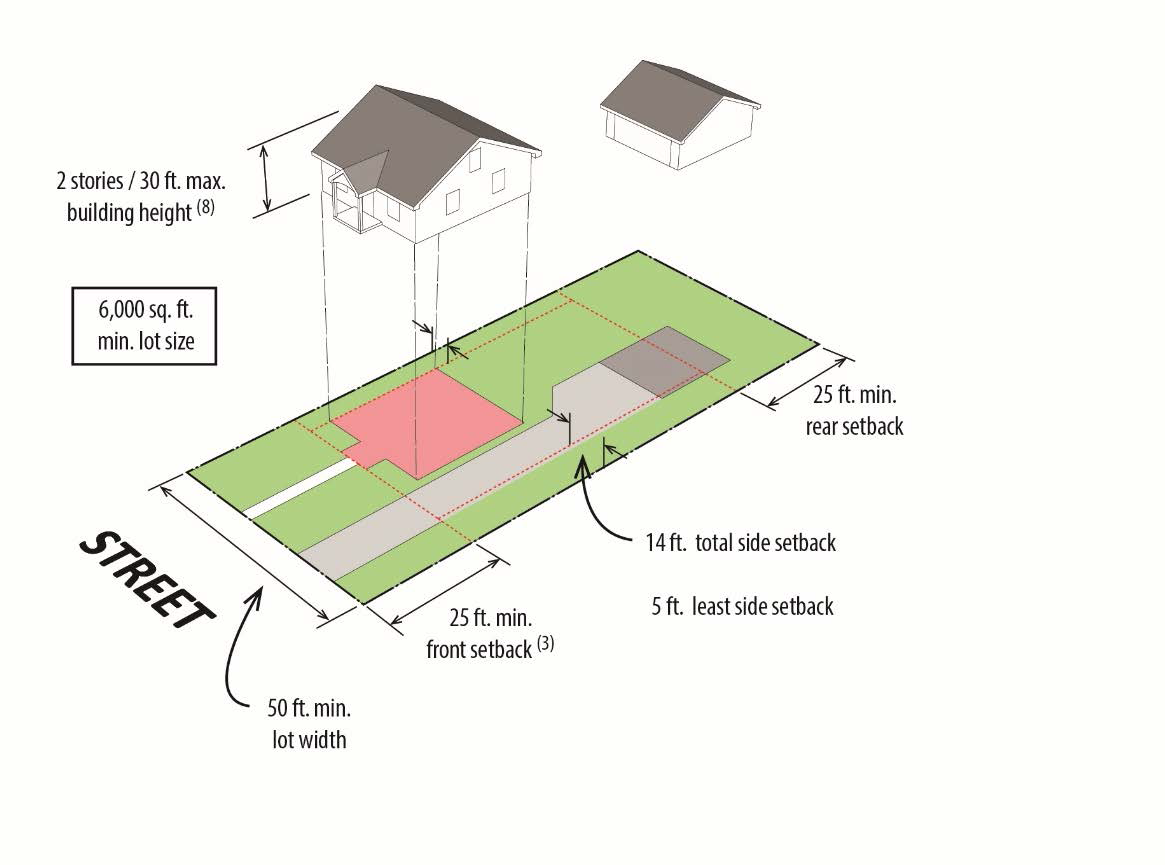
Refer to 4.03.E for footnotes to schedule of regulations.
Figure 4.03.5: R-1E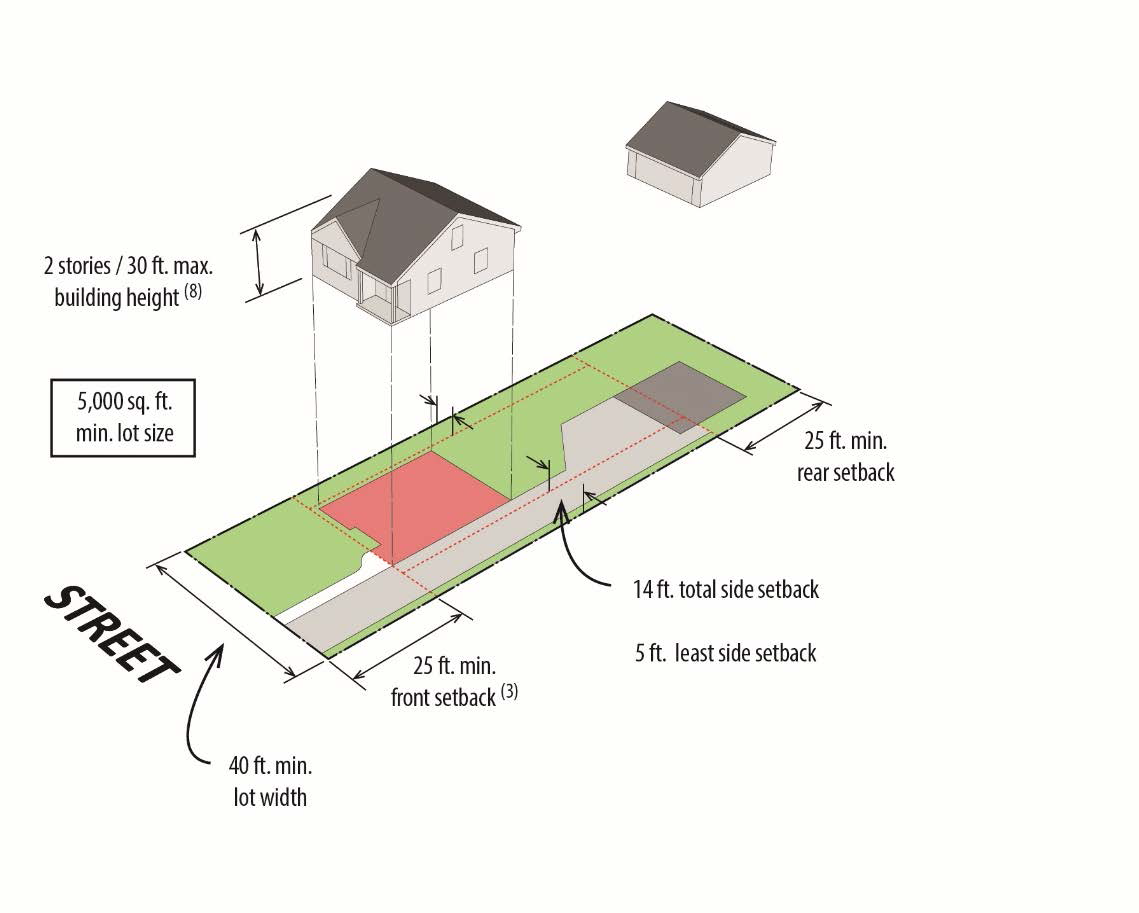
Refer to 4.03.E for footnotes to schedule of regulations.
(Ord. No. 600, § 1, 1-8-2018; Ord. No. 604, § 1, 4-10-2018; Ord. No. 619 , § 1, 8-18-2020)
Section 40-4.04 - RT, One and Two-Family Attached District
A.
Intent. The intent of the RT, One and Two-Family Attached District is to accommodate a mix of residential types, including but not limited to, detached single-family homes and attached multi-family townhomes and duplexes.
B.
Use Regulations. No premises shall be used and no building or structure shall hereafter be erected, altered, or used except for one or more uses contained within Section 40-4.08.
C.
Dimensional Requirements. The following dimensional requirements shall apply to the RT District:
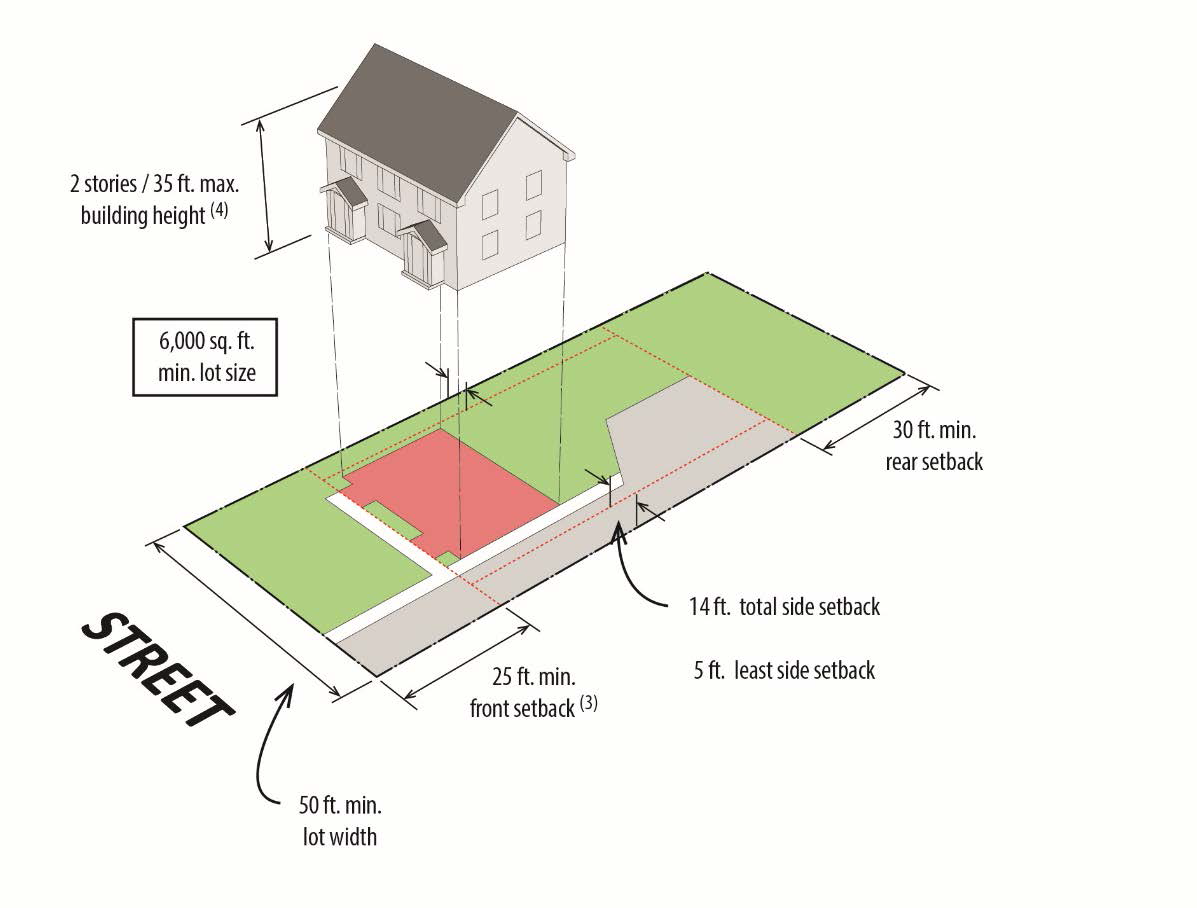
D.
Footnotes to Schedule of Regulations.
(1)
If the subject lot is below the minimum lot size, subtract floor area from the base number at the same ratio above.
(2)
Includes:
(a)
The ground floor area of the main building;
(b)
All appurtenances if covered by a roof; and
(c)
All accessory buildings or the minimum lot area required to be set aside for accessory buildings, whichever is larger. For lots with less than 6,000 sq. ft. in area, the amount of lot coverage may be increased by 1 sq. ft. for every 6 sq. ft. that the lot is less than 6,000 sq. ft. For lots with less than 7,000 sq. ft. of area, a covered front porch may exceed the maximum lot coverage by up to one percent of lot area.
(3)
Where there are existing residential dwellings on both sides of the subject lot fronting on the same street, the required setback shall be no less than the least of the two adjoining front setbacks; where there is an existing residential dwelling on only one side of the subject lot fronting on the same street, the required setback shall be no less than the setback of the adjacent residential dwelling; and in no case shall the setback be less than listed in the schedule of regulations.
(4)
One additional foot of total side yard is required for every one (1) foot or portion thereof of building height over 26 ft. At least one-half of the additional side yard shall be on the least side.
(5)
Not to exceed 3,500 sq. ft.
(6)
Corner side yard. In the case of corner lots where the adjacent house fronts upon the side street, a setback shall be required from the side street lot line, which is at least equal to the front setback of the other adjoining property facing the same side street. In no case shall the side street setback be less than eight (8) ft.
(Ord. No. 600, § 1, 1-8-2018; Ord. No. 619 , § 2, 8-18-2020)
Section 40-4.05 - TD: Transitional District
A.
Intent. The TD, Transitional District, is intended to encourage a mixture of compatible uses, including multiple-family residential dwelling, retail, and office. Though built-out with established development patterns of isolated parcels and single-use development, redevelopment within the Transitional District encourages the development of a mixed-use environment that meets the needs for commercial, residential, and office space and increases transit and non-motorized transportation options while maintaining the existing neighborhood fabric and providing appropriate edge transitions.
Multiple-family residential uses permitted within the Transitional District are intended to complement the city's existing single-family residential housing stock, thereby affording a diversity of housing opportunities in the city. The TD is intended to provide a buffer between adjacent single-family residential zones and major arterial roads. The limited hours of operation for nonresidential uses are intended to minimize potentially adverse effects upon adjoining and nearby residential districts. The regulations of the district are intended to promote high-quality architecture and site design, consistent with the established character of the city.
Consolidation of smaller parcels into large parcels and mixed use development is encouraged and incentivized to meet the vision of the Master Plan and intent of the TD, Transitional District. Incentives as set forth in Section 40-4.05.E include additional height and parking reduction in exchange for a commensurate public benefit.
B.
Use Regulations. No premises shall be used and no building or structure shall hereafter be erected, altered, or used except for one or more uses contained within Section 40-4.08.
C.
Dimensional Requirements. The following dimensional requirements shall apply to the TD, Transitional District:
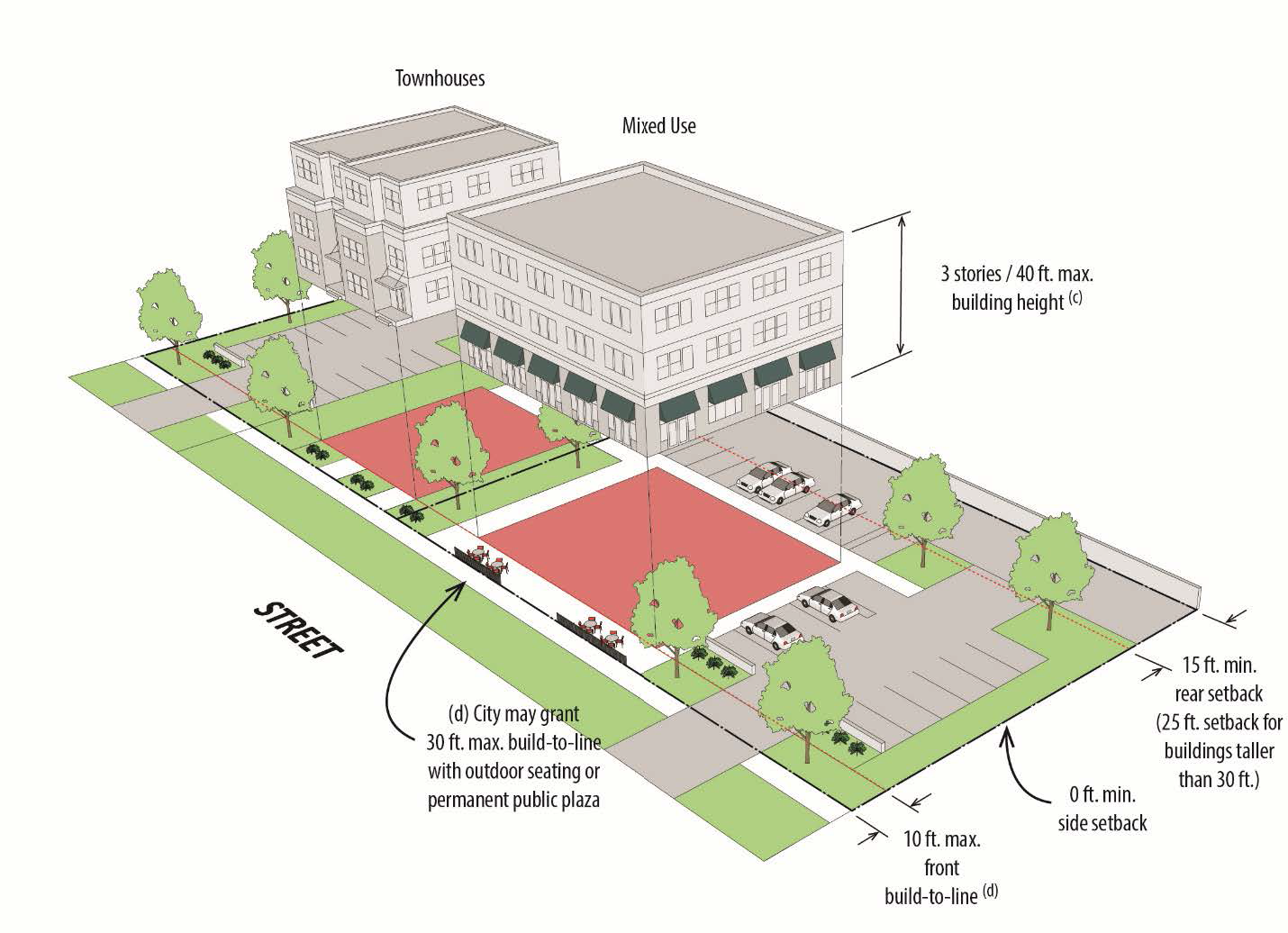
D.
Footnotes to Dimensional Requirements.
(1)
Corner Lot. In the case of a corner lot, any yard extending along the full length of a street line is considered a front yard.
(2)
Side yard shall not be required for an interior lot in the TD, provided that: adequate access to the rear of the property is provided from an alley or driveway; the side in question abuts property in the TD.
(3)
Buildings in the TD may be permitted additional building height per the bonus provisions of Section 40-4.05.E.
(4)
Developments that incorporate outdoor seating or a permanent public plaza in the front of the building may be permitted a maximum front yard build-to-line of 30 ft. at the discretion of the Planning Commission as reviewed during the site plan review process.
E.
Supplemental District Standards.
(1)
Architectural and Site Design Standards.
(a)
No building shall exceed two hundred (200) feet in length without an alley, driveway, or pedestrian pathway providing through access.
(b)
The front facade of any principal building on any lot shall face onto a street.
(c)
A minimum of fifty (50) percent of the first-floor facade area facing a right-of-way shall be clear glass. A minimum of thirty (30) percent of the first-floor façade area facing a side yard or parking area shall be clear glass. First floor façade is measured from grade to eight (8) feet. For multiple tenant buildings the required transparency shall be provided for each tenant space. Visibility through the required transparency must portray the principal use of the operation and shall not portray secondary or "back of house" operation areas including, but not limited to, laundry, cleaning supply, stock, or storage areas.
(d)
Outdoor seating areas may satisfy up to twenty-five (25) percent to transparency requirement.
(e)
Ground floor shall include a depth of at least twenty-five (25) feet from the front façade and shall include an average of at least 14'-0" floor-to-ceiling height.
(f)
Design details, building articulation, and techniques such as variation in wall plane shall be used to reduce the perceived mass of buildings, promote human-scale architecture, and stimulate pedestrian interest. Unadorned blank walls that are visible from a public right-of-way shall be prohibited on all buildings. All buildings should avoid being corporately "branded" so as to allow for their adaptation to future tenants.
(g)
Building construction shall use high-quality exterior building materials such as full brick or modular stone. Use of exterior building materials such as cinder block, vinyl, aluminum, standard (smooth-faced) concrete masonry units (CMUs), or exterior insulation and finish systems (EIFS) shall be prohibited.
(h)
Architectural features, materials, and facade articulation shall be consistent on all sides of buildings.
(i)
Buildings should frame and enhance street corners through the use of architecturally prominent features at the corners or prominent three-dimensional site improvements (fountains, towers, sculpture, art, etc.).
(j)
Flat roofs shall be enclosed by parapets. Parapets may exceed the maximum building height requirements of this chapter by not more than ten (10) percent.
(k)
Building entrances shall be clearly defined by architectural elements. A functional door shall be provided both on the façade facing the right-of-way and the façade facing the parking lot.
(l)
Front entry garages shall be prohibited. Garages shall be placed to the side or behind the main structure so as to effectively screen them from major arterial roads and internal roads. Garages may be attached or detached and accessed by driveways or by use of alleys. Parking may also be provided in underground garages or parking decks located above the ground floor use.
Figure 4.05.E.1. - Façade Transparency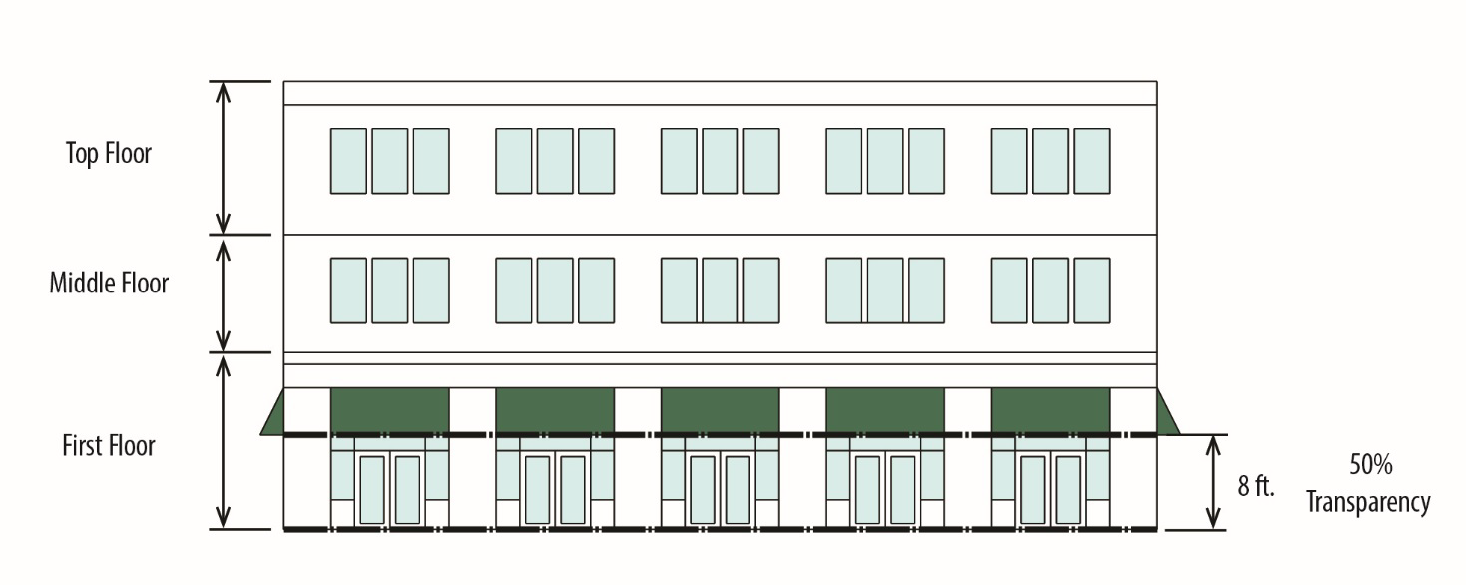
(2)
Parking, Access Management, and Loading.
(a)
Off-street parking is required for all uses and shall comply with the numerical parking requirements pursuant to Section 40-10.06. Certain projects may be eligible for parking reduction per Section 40-4.05.E. Parking shall be not permitted between any building line and right-of-way.
(b)
When located to the side of a building, no more than fifty percent (50%) of the total site's frontage along the required building line shall be occupied by parking. For a corner lot, the cumulative total of both frontages occupied by parking shall be no more than fifty percent (50%) of the total site's frontage along both frontages; the building shall be located at the corner of the lot adjacent to the intersection.
(c)
Parking in excess. It is the intent of this Ordinance to minimize excessive areas of pavement which reduces aesthetic standards and contributes to high rates of stormwater runoff. Exceeding the minimum parking space requirements by more than twenty percent (20%) shall only be allowed with approval by the Planning Commission. In granting such additional space, the Planning Commission shall determine that such parking will be required, based on documented evidence, to accommodate the use on a typical day.
(d)
Cross access may be required by Planning Commission for any non-single-family development going through a site plan review process. Cross access may be required for the purpose of providing a direct connection with an existing cross access point, or to allow a future cross access to abutting non-residential properties when those properties are redeveloped. A site plan without cross access may be approved when it can be demonstrated that there are either physical limitations or functional circumstances that would prevent such access from being installed.
(e)
Loading spaces shall be located in the rear of a building and be so located as to minimize visibility from adjacent streets and uses.
Figure 4.05.E.2. - Shared Parking/Cross Access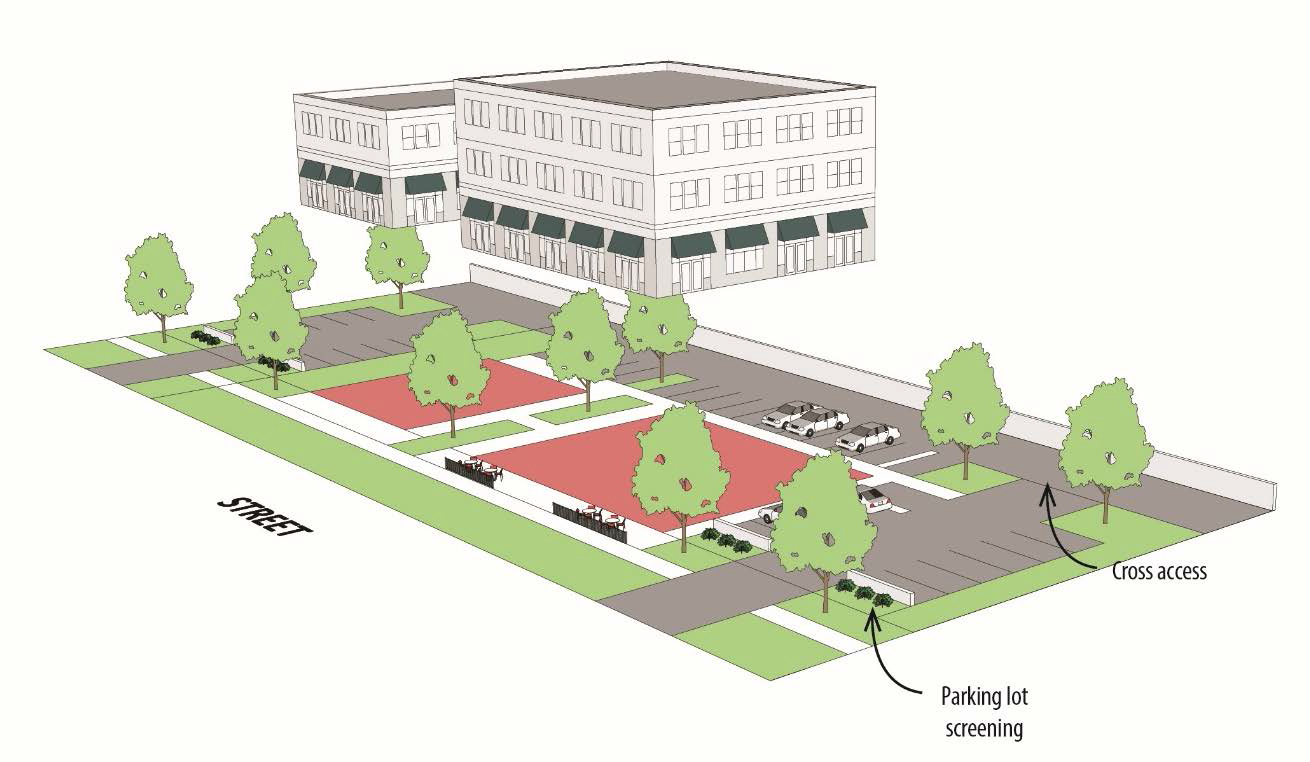
(3)
Landscaping and Screening Requirements.
(a)
Developments within the TD shall meet the landscaping and screening requirements contained within Section 40-10.02.
(b)
Parking that is adjacent to the public roadway shall be screened by a 30-inch tall masonry wall with landscaping. Alternative screening options may be considered by the Planning Commission.
(c)
Screening of trash enclosures and mechanical equipment shall be screened in accordance with Section 40-10.03.
(4)
Wall requirements. Where a lot in the TD District abuts a lot within an R-1 or RT District, the rear or side of each lot so abutting shall be provided with a continuous, unpierced brick masonry or brick patterned poured-in-place concrete wall which complies with the requirements of Section 40-10.10.
(5)
Bonus Provisions. There are instances where it is in the best interests of the private landowner and the City of Huntington Woods to modify standards of this chapter. In such instances, the City's interests in upholding its standards can be offset by the provision of certain exemplary amenities that will benefit the Transitional District as a whole. This system provides regulatory incentives while ensuring that modifications are not made solely and exclusively for the private benefit of the landowner.
Buildings within the Transitional District are eligible for a height bonus where certain eligibility criteria are met.
(a)
Bonus Height Eligibility Criteria:
1.
Buildings within the Transitional District are eligible for a height bonus of up to one (1) additional story and/or fifteen (15) feet where two (2) or more of the following criteria are met.
a.
A mixed-use building that provides residential dwelling units above the first-floor commercial/office use where a minimum of 50% of the building's floor area is residential.
b.
An assemblage of parcels in conjunction with a development as approved by the Planning Commission.
c.
Installation of streetscape furnishings above and beyond what is required within this section, at the discretion of the Planning Commission, including street trees, tree grates, decorative lighting, or street furniture.
d.
Dedication of an improved public plaza or open space area which ties into Woodward's pedestrian circulation system.
2.
Additional stories shall be setback at least 50 feet from the rear property line in order to reduce the appearance of excessive height.
3.
The provision of such bonus shall be the discretion of the Planning Commission, provided that the Planning Commission finds the proposed height bonus is commensurate with benefit being provided by the development.
(b)
Drive-Through. A drive-through is only permitted to be reviewed as a Special Land Use where one (1) or more of the following criteria are met:
1.
A mixed-use building that provides residential dwelling units above the first-floor commercial/office use where a minimum of 50% of the building's floor area is residential.
2.
An assemblage of parcels in conjunction with a development as approved by the Planning Commission.
3.
Installation of streetscape furnishings above and beyond what is required within this section, at the discretion of the Planning Commission, including street trees, tree grates, decorative lighting, or street furniture.
4.
Dedication of an improved public plaza or open space area which ties into Woodward's pedestrian circulation system.
(Ord. No. 600, § 1, 1-8-2018)
Section 40-4.06 - BD Business District
A.
Intent. The BD, Business District is intended to provide a limited range of businesses and services for the local neighborhoods of the city and nearby vicinity. Because of the proximity of the business district to residential zones and the limited land typically available for building setbacks and off-street parking, the regulations of this district are intended to minimize potentially adverse effects upon adjoining and nearby residential districts.
B.
Use Regulations. No premises shall be used and no building or structure shall hereafter be erected, altered, or used except for one or more uses contained within Section 40-4.08.
C.
Dimensional Requirements. The following dimensional requirements shall apply to the BD, Business District:
D.
Footnotes to Dimensional Requirements.
(1)
Corner lot. In the case of a corner lot, any yard extending along the full length of a street line is considered a front yard.
(2)
Where a lot in BD abuts a lot within the R-1 or RT District or a residential use, the abutting side yard setback shall be a minimum of 8 ft.
E.
Supplemental District Standards.
(1)
Wall requirements. Where a lot in the BD District abuts a lot within a R-1 or RT District, the rear or side of each lot so abutting shall be provided with a continuous, unpierced brick masonry or brick patterned poured-in-place concrete wall which complies with the requirements of Section 40-10.10.
(2)
Architectural and Site Design Standards.
(a)
Architectural design requirements.
1.
The front facade of any principal building on any lot shall face onto a street.
2.
A minimum of thirty (30) percent of the first-floor facade area facing a right-of-way shall be clear glass. The minimum transparency for facades facing a side yard, or parking area shall be no less than twenty (20) percent of the façade.
3.
Design details, building articulation, and techniques such as variation in wall plane shall be used to reduce the perceived mass of buildings, promote human-scale architecture, and stimulate pedestrian interest. Unadorned blank walls shall be prohibited on all buildings.
4.
Building construction shall use high quality exterior building materials such as full brick or modular stone. Use of exterior building materials such as cinder block, vinyl, aluminum, standard (smooth-faced) concrete masonry units (CMUs), or exterior insulation and finish systems (EIFS) may be considered but should not be the primary material use.
5.
Architectural features, materials, and facade articulation shall be continued on all sides of buildings that are visible from a public right-of-way.
6.
Flat roofs shall be enclosed by parapets. Parapets may exceed the maximum building height requirements of this chapter by not more than ten (10) percent.
7.
Building entrances shall be clearly defined by architectural elements.
(b)
Parking, Access Management, and Loading.
1.
Off-street parking is required for all uses and shall comply with the numerical parking requirements pursuant to Section 40-10.06.
2.
Shared parking lots and driveways are encouraged within the BD for neighboring uses based upon the fact that certain uses may operate at various times over a 24-hour period, with the greatest demand for parking occurring at separate times. The Planning Commission may approve shared parking provided a signed agreement showing a permanent arrangement for shared parking is provided by the property owners, and the applicant(s), and the applicant can demonstrate that the peak usage will occur at different periods of the day. To demonstrate shared parking compatibility, the applicant shall use a recognized industry standard such as the Urban Land Institute Shared Parking Report.
3.
Parking in excess. It is the intent of this Ordinance to minimize excessive areas of pavement which reduces aesthetic standards and contributes to high rates of stormwater runoff. Exceeding the minimum parking space requirements by more than twenty percent (20%) shall only be allowed with approval by the Planning Commission. In granting such additional space, the Planning Commission shall determine that such parking will be required, based on documented evidence, to accommodate the use on a typical day.
4.
Cross access may be required by Planning Commission as part of a site plan review and shall be located to provide a direct connection with the existing or future access of the abutting non-residential properties. A site plan without cross access may be approved when it can be demonstrated that there are either physical limitations or functional circumstances that would prevent such access from being installed.
5.
Loading spaces shall be located in the rear of a building and be so located as to minimize visibility from adjacent streets and uses.
(c)
Landscaping, and Screening Requirements.
1.
Developments within the BD shall meet the landscaping and screening requirements contained within Section 40-10.02.
2.
Parking that is adjacent to the public roadway shall be screened by a 30-inch tall masonry wall with landscaping. Alternative screening options may be considered by the Planning Commission.
3.
Screening of trash enclosures and mechanical equipment shall be screened in accordance with Section 40-10.03.
(Ord. No. 600, § 1, 1-8-2018)
Section 40-4.07 - PRD: Parks and Recreation District
A.
Intent. Recognizing that a substantial portion of the city's land area is devoted to parkland and recreational uses, the PRD, Parks and Recreation district is intended to retain publicly-owned lands already improved for or intended to be improved for parks, recreational uses, and/or open space. The intent of the district is further described as follows:
(1)
To protect natural resources and wildlife habitat;
(2)
To protect historic and cultural resources;
(3)
To preserve areas significant to community character;
(4)
To protect lands for scenic and visual enjoyment, and to beautify the city;
(5)
To provide current residents of the city and the Detroit Metropolitan Area, as well as future generations, with access to green spaces and recreational opportunities;
(6)
To preserve large outdoor recreation uses that could not easily be provided in the already urbanized portions of the city;
(7)
To contribute to the environmental health of surrounding neighborhoods; and
(8)
To provide a continued economic benefit, and to preserve and enhance property values in the city.
Because of the proximity of the Parks and Recreation district to residential zones, the regulations of this district are also intended to ensure compatibility with adjacent and nearby residential uses.
B.
Use Regulations. No premises shall be used and no building or structure shall hereafter be erected, altered, or used except for one or more uses contained within Section 40-4.08.
C.
Special Land Uses. For special land uses in the PRD District on properties located within an historic district, or within a proposed historic district consistent with Public Act 169 of 1970, as amended, MCL 399.214(3), special land use approval and site plan approval by the Planning Commission, and a certificate of appropriateness from the Historic District Commission, shall be required. Special land use approval and site plan approval shall be granted prior to the certificate of appropriateness. The Planning Commission shall consult the Historic District Commission during the special land use and site plan reviews.
D.
Dimensional Requirements. The following dimensional requirements shall apply to the PRD District:
(Ord. No. 600, § 1, 1-8-2018; Ord. No. 604, § 2, 4-10-2018)
Section 40-4.08 - Schedule of Use Regulations
A.
In all Districts, no building or land shall be used and no building shall be erected except for one (1) or more of the following specified uses, unless otherwise provided in this Article. The following land use matrix shows the uses which are permitted, permitted as a Special Use, permitted as an accessory use, or prohibited in specific districts or zones in the City of Huntington Woods. The land use matrix is intended to serve as a guide for the convenience of the user of this Zoning Ordinance. More detailed standards regarding uses are contained within the individual district standards within Article 5 - Specific Use Provisions.
B.
The Schedule of Use Regulations identifies uses as follows:
1.
P: Permitted Uses - Uses permitted by right in the applicable Zoning District, subject to compliance with all other applicable requirements of this Zoning Ordinance.
2.
S: Special Land Uses - Uses which may be allowed subject to review and approval by the Planning Commission in accordance with Article 8, subject to compliance with all other applicable requirements of this Zoning Ordinance.
3.
A: Accessory Uses - Uses which may be permitted as an accessory use incidental to the principal use of the premise in accordance with Article 6, subject to compliance with all other applicable requirements of this Zoning Ordinance.
4.
NP: Not Permitted - Uses not permitted within the district.
C.
Footnotes to the Use Matrix.
(1)
Home occupations shall be subject to the Specific Use Provisions contained in Section 40-5.03.
(2)
No more than two (2) accessory buildings may be permitted per lot. Accessory buildings and structure shall be subject to the provisions contained in Section 40-6.03.
(3)
Wireless communication facilities (WCFs) in R-1 districts shall be located on the same lot as a publicly owned park, recreational facility, or municipal building and use and shall comply with Section 40-5.13.
(4)
Hours. No premises shall be open to the public between the hours of 11:00 p.m. and 5:00 a.m.
(5)
In TD, district Multiple-family dwellings are permitted either:
(a)
Within a mixed-use building, on upper floors above retail and/or office uses; or
(b)
As townhouses, with a single unit occupying a minimum of two (2) floors; provided, however, that apartment flats or "stacked ranch" units shall be permitted if they provide an exterior façade with the appearance of townhouse-style architecture, as deemed appropriate by the Planning Commission.
(6)
Outdoor seating areas are permitted by right if located towards the front or side of a building and located further than seventy (70) feet from a residentially-zoned or used property. Outdoor seating areas located behind a building or seventy (70) feet or less from a residentially-zoned or used property may be permitted as a special land use subject to the special use standards contained within Article 8.
(7)
Zoo fences shall comply with Section 40-10.10.
(Ord. No. 600, § 1, 1-8-2018)

