
Hurst City Zoning Code
Sec. 27-20
Minimum parking and loading requirements.
(a)
Purpose of section. It is the purpose of this section to establish the guidelines for off-street parking space consistent with the proposed land use to:
(1)
Reduce the occurrence of on-street parking throughout the city;
(2)
Avoid the traffic congestion and public safety hazards caused by a failure to provide such parking space;
(3)
Expedite the movement of traffic on public thoroughfares in a safe manner and thus increasing the carrying capacity of the streets, reducing the amount of land required for streets and the costs to both the property owner and the city;
(4)
Insure that provided parking facilities meet basic requirements.
(b)
Off-street parking spaces required.
(1)
In all districts, for all uses, there shall be provided, at the time any building or structure is erected or enlarged or increased in capacity, or at any time any other use is established, off-street parking spaces for motor vehicles in accordance with the requirements specified in this section.
(2)
The off-street parking or loading facilities required for the uses mentioned in these regulations shall be the same lot as the structures intended to be served, on a lot abutting the lot intended to be served, or on a lot separated from the lot intended to be served only by a street not classified as a collector or an arterial by the city's thoroughfare plan. Such parking spaces shall be in a district permitting the use which they serve; provided, however, that in R-3, LB, GB, O-2, O-C, FP and I zoning districts parking shall be allowed for any adjacent use.
(c)
Parking for existing uses.
(1)
It is the intent of these regulations to preserve and retain existing off-street parking and loading spaces in at least the minimum amounts as would be required if the existing use of the structure had been established or erected in full compliance with these provisions.
(2)
No certificate of occupancy shall be issued, no use shall be established or changed and no structure shall be erected, enlarged or reconstructed unless the off-street parking and loading spaces are provided in the minimum amount and maintained in the manner specified in these regulations; provided, however:
a.
For the enlargement of a structure or for the expansion of a use of structure or land, there shall be required only the number of off-street parking and loading spaces as would be required if such enlargement or expansion were a separate new structure or use; and
b.
For a change in the use of a structure or land, the number of additional off-street parking and loading spaces required shall be equal to the number required for the new use, according to the schedule below, less the number of spaces which would have been required for the previous use if it had been established in conformance with this section. In no case shall the total number of spaces required to be furnished exceed the minimum number required for the new use.
(d)
General requirements.
(1)
Measurements:
a.
When units or measurements result in requirements of a fractional space, any fraction shall require one (1) space.
b.
Loading space shall not be considered to supply required off-street parking space, nor shall required off-street parking spaces supply required off-street loading space.
(2)
Nonparking uses:
a.
Areas designated for off-street parking shall be used for passenger and commercial vehicles.
b.
Areas designated for off-street loading shall be used only for the loading and unloading of passengers, equipment, supplies or merchandise.
c.
In all zoning categories, except R-1 and R-2, parking and loading areas shall not be used for refuse containers; or for the repair, storage, dismantling or servicing of vehicles or equipment; or for the storage of materials or supplies; or for any other use in conflict with the designated parking and loading areas.
(3)
Access and maneuvering: Provision for access in maneuvering, entrances, exits and driveways shall be required as provided in Chapter 20, Article V of the Hurst Code of Ordinances.
(4)
Space standards:
a.
A space ten (10) feet by eighteen (18) feet of floor/lot area with unobstructed access to a public street shall be deemed to be parking space for one (1) vehicle; such space when provided for other than a dwelling unit shall not be required to be greater than nine (9) feet in width.
b.
Table 20-2 is incorporated in and made part of these regulations and shall be used in determining capacity of off-street parking areas.
c.
Unless otherwise specified, a space twelve (12) feet by thirty (30) feet of floor or lot area with a clear height of fourteen (14) feet, and with unobstructed access to a public street or private drive, shall be deemed to be loading space for one (1) vehicle.
(5)
Reserved.
(6)
Alternative landscaping for parking. Nonresidential uses on sites of one (1) acre or more, when specifically requested by the owner, shall be permitted to maintain not more than twenty-five (25) percent of required parking spaces in landscaped open space. Such landscaped open space may be maintained until the property owner desires to increase the number of parking spaces, or until ninety (90) percent of other parking spaces are observed occupied at any three (3) times during any consecutive sixty-day period, at which time the enforcing officer shall require construction of additional parking spaces. Such additional spaces shall be constructed within six (6) months of the date of written notice by the enforcing officer. All open space and required landscaping requirements shall be based on the maximum required number of parking spaces, rather than the reduced amount shown here.
(e)
Development standards. The off-street parking or loading facilities required for the uses mentioned in these regulations shall be on the same lot or parcel of land as the structure they are intended to serve or on a lot or parcel of land abutting the lot they are intended to serve.
(1)
Paving and drainage: All access drives and off-street parking areas shall be paved with not less than five (5) inches of steel reinforced portland concrete or six (6) inches of hot-mixed asphaltic concrete. Either method requires a cement or a lime-treated subbase of six (6) inch minimum depth to adequately provide an all-weather surface as unless otherwise approved by the city engineer. Parking areas shall be graded and drained in such manner that runoff shall be properly channeled into a storm drain watercourse, detention area or other appropriate facility.
(2)
Curbs and islands: Parking areas shall be provided with curbs or raised concrete islands so located that no part of the parked vehicle may extend beyond the property line or touch a building. Such islands shall be required only in lots of thirty (30) or more spaces and shall be constructed of poured concrete at least six (6) inches above the parking lot surface and at least one (1) foot wide. The islands shall be reinforced with two (2) #3 bars six (6) inches apart in the center running the length of the island. The island shall be doweled into the pavement surface. Such islands shall separate each four (4) rows (or two (2) double rows or one (1) double row and two (2) single rows) of parking spaces. As an alternative to raised concrete islands, such separation may be provided by curbed, irrigated landscaped areas. Such islands or landscaped areas shall have openings for required drainage. Plans for parking lot layout showing the location of such islands or landscaped areas shall be submitted to the public works department prior to the beginning of construction. No such construction shall be permitted until the public works department has examined the plans and determined that safety and drainage needs have been met. Wheel stops resting on top of parking lots, whether anchored or not, shall not be used, nor shall rolled asphalt be permitted.
(3)
Lighting: Any light used to illuminate or identify a parking or loading area shall be placed so as to reflect the light away from the adjacent dwellings and so as not to interfere with traffic-control devices.
(4)
Pavement marking and signing: All pavement marking and signing shall be in conformance to the design requirements as set forth in the 1971 Texas Manual on Uniform Traffic-Control Devices.
(5)
Landscaping: If parking and maneuvering space exceeds one (1) acre, at least five (5) percent thereof shall be maintained as landscaped area, with adequate and inconspicuous irrigation systems. It is the intent of this section to require design and construction of parking areas in a manner whereby areas unusable for parking or maneuvering space are landscaped.
(6)
Fences, walls and screens: Where a fence is not otherwise required, parking and loading areas designed for more than six (6) spaces or berths adjacent to residentially zoned property shall be screened by a solid wall not less than four (4) feet in height. Such wall shall be maintained in a neat and orderly condition. Except for necessary driveways, such wall shall screen the vehicle area along those exposures where the vehicle area adjoins or is across a street or alley from property restricted to residential use.
(7)
Maintenance requirements: To insure that all requirements set forth in this section are carried forward, it will be the responsibility of the owner of the parking area to maintain the facility. All off-street parking areas shall be kept free of trash, debris, vehicle repair operation or display and advertising uses. At no time after initial approval of the parking area layout can changes be made in the location and number of provided spaces without approval of the city engineer.
(8)
Visibility triangle and parkway requirements: Parking and loading areas shall be designed and constructed so as to prevent intrusion into or use of the visibility triangle or parkway, as defined in this Code.
_____
(f)
Off-street loading requirements. There shall be provided, in connection with each allowable use, off-street loading facilities in accordance with the following minimum requirements. The following off-street merchandise and passenger loading spaces shall be permanently and clearly marked. Each off-street merchandise loading space shall be no less than twelve (12) feet by thirty (30) feet, and each off-street passenger loading space shall be no less than ten (10) feet by twenty-two (22) feet, with a clear height of twelve (12) feet.
(1)
Passenger and merchandise loading space: The following amounts of marked off-street passenger and merchandise loading spaces shall be required for the following use classes as set forth in Table 20-1:
TABLE 20-1
PASSENGER AND MERCHANDISE LOADING SPACES
A.
Merchandise loading space requirements:
B.
Passenger loading space requirements: Marked off-street passenger loading spaces shall be required for the following enumerated use classes in lieu of the above merchandise loading spaces.
_____
(2)
Loading space for emergency vehicles: There shall be provided within thirty (30) feet of the entrance to every building, according to the criteria set forth below, one (1) permanently marked area not less than thirty (30) feet in length and marked "emergency vehicles only." This requirement shall apply to:
a.
Every building accommodating any one (1) of the loading classes named in section B of Table 20-1;
b.
Every commercial use or industrial use and office use building not named in section b of Table 20-1 and having a gross floor area of nine thousand (9,000) square feet or more in area; or
c.
Every residential occupancy building exceeding two (2) stories in height or nine thousand (9,000) square feet in area.
If visitor or tenant parking is permitted adjacent to the building or along a curb or walkway next to the building, the emergency vehicle zone shall be reserved next to a raised island extending from the building or parking curb for a distance equal to the depth of the adjoining parking stalls, but shall not be required to be more than twenty (20) feet.
(3)
Parking space for disabled.
a.
For every parking lot required and provided for employees or visitors, or both, accessible spaces, complying with e., f. and g., hereof, shall be provided in each such parking area in conformance with the following:
*2 percent of total.
**20 plus 1 for each 100 over 1000.
Note: A minimum of ten (10) percent of required accessible parking spaces must be van accessible.
Exception: The total number of accessible parking spaces may be distributed among parking lots, if greater accessibility is achieved.
Exception: This does not apply to parking provided for official government vehicles owned or leased by the government and used exclusively for government purposes.
b.
Parking spaces for side lift vans are accessible parking spaces and may be used to meet the requirements of this paragraph.
c.
Parking spaces at accessible multifamily housing complying with e. and f. hereof, shall be provided as follows:
1.
Where parking is provided for all residents, one (1) accessible parking space shall be provided for each accessible dwelling unit; and
2.
Where parking is provided for only a portion of the residents, an accessible parking space shall be provided on request of the occupant of an accessible dwelling unit;
3.
Where parking is provided for visitors, two (2) percent of the spaces, or at least one (1) shall be accessible.
d.
Parking spaces at health care facilities complying with e., f., and g. hereof, shall be provided in accordance with the following:
1.
General health care facilities, employee and visitor parking: Comply with (a) hereof;
2.
Outpatient facilities: Ten (10) percent of the total number of parking spaces provided;
3.
Spinal cord injury facilities, employee and visitor parking: Twenty (20) percent of total parking spaces provided.
e.
Location. Parking spaces for disabled people that serve a particular building shall be the spaces located closest to the nearest accessible entrance on an accessible route. In separate parking structures or lots that do not serve a particular building, parking spaces for disabled people shall be located on the shortest possible circulation route to an accessible pedestrian entrance of the parking facility.
f.
Parking spaces. Parking spaces for disabled people shall be at least ninety-six (96) inches (two thousand four hundred forty (2,440) millimeters) wide and shall have an adjacent access aisle sixty (60) inches (one thousand five hundred twenty-five (1,525) millimeters) wide minimum (see Table 20-1.1). Two (2) accessible parking spaces may share a common access aisle. Parked vehicle overhangs shall not reduce the clear width of an accessible circulation route. Parking spaces and access aisles shall be level with surface slopes not exceeding 1:50 in all directions.
Van accessible space. In all cases at least one (1) van accessible space shall be provided. Each shall have an adjacent access aisle at least ninety-six (96) inches (two thousand four hundred forty (2,440) millimeters) wide (See Table 20-1.1); provided, however such spaces may share a common access aisle.
g.
Signage. Accessible parking spaces shall be designated as reserved for the disabled by a sign showing the symbol of accessibility. (See Table 20-1.2.) Such signs shall not be obscured by a vehicle parked in the space. Such signs shall be of such size as is legible from a distance that would be reasonable of the condition. Signs shall be installed with the bottom of the sign a minimum of seven (7) feet above grade. Spaces complying with van accessible standards shall have an additional sign "van accessible" mounted below the symbol of accessibility.
(4)
Fire lanes: Fire lanes, as required by the fire code, shall be provided and clearly marked.
(g)
Minimum parking area and spaces. The minimum required area for each parking space shall be not less than that established by Table 20-2. The minimum number of spaces for each class of use shall be not less than that established by Table 20-3.
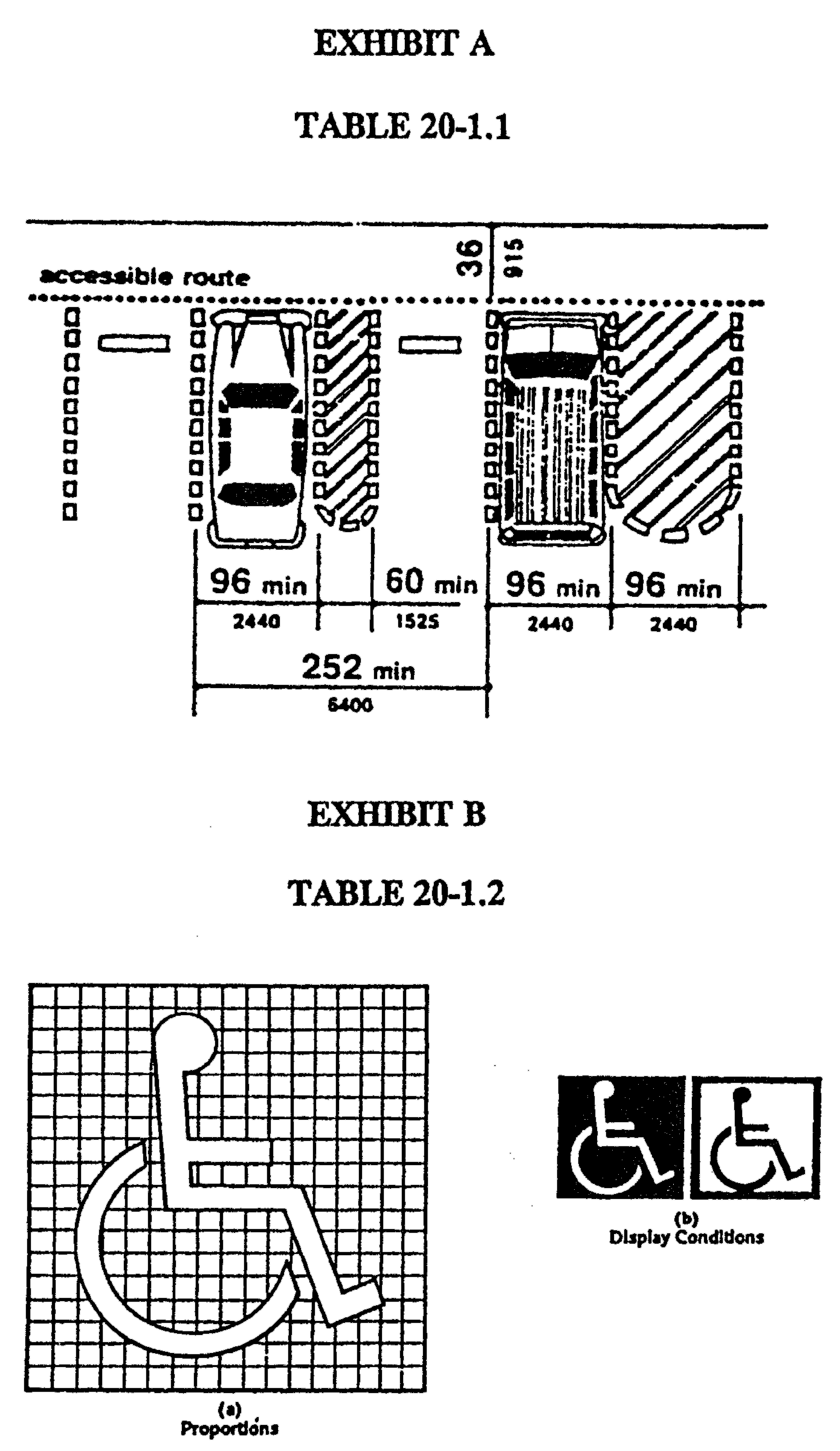
Exhibits A (Table 20-1.1) and B (Table 20-1.2)
TABLE 20-2
MINIMUM PARKING AREA REQUIREMENTS FOR TYPICAL PARKING ANGLES
Note: All parking stalls for angle parking are eighteen (18) feet long. All dimensions are expressed in feet.
a Minimum stall width for residential accessory parking.
b Minimum stall width for parking space provided for other than dwelling units.
c Parking lanes do not overlap for parallel or right angle parking.
TABLE 20-3
SCHEDULE OF OFF-STREET PARKING STANDARDS
* Furniture stores or similar establishments over five thousand (5,000) square feet in size may provide fewer spaces than required providing that they can present sufficient data to convince the administrative official charged with the enforcement of this Code that the minimum number of spaces required is excessive. The minimum number of spaces shall not be fewer than fifty (50) percent of that required by Table 20-3.
(h)
Deviations. For parking areas in shopping centers of more than sixty (60) acres, the city council may allow deviations from the requirements of section 27-20(e)(5) concerning landscaping and parking areas, and section 27-20(g), insofar as it requires adherence to Table 20-2 setting forth minimum size of parking spaces. Such deviations shall be allowed only upon approval of a site plan submitted and processed under the same notice, review and hearing procedures as a proposal for a zoning district change. The city council may require additional information, but such site plans shall contain at least the following:
(1)
A scale drawing, in which not less than one (1) inch equals one hundred (100) feet, showing the location of existing and proposed structure on the site; the general category of use or uses to be contained therein; the location of entrances and exits to the building; the location and width of all curb cuts; the dimensions and locations of all parking spaces, driving lanes, pedestrian lanes, walls, fences, screen planting and landscaping;
(2)
A brief statement setting forth the name of the applicant, a legal description of the property and a general description of how the requested site plan differs from the general requirements from which relief is sought.
(i)
Parking areas for PD complexes.
(1)
Parking areas for PD complexes including a hotel of more than two hundred fifty (250) rooms and an office building of more than one hundred thousand (100,000) square feet may be allowed to deviate from the requirement of Table 20-3 by up to fifteen (15) percent of the number of spaces therein set forth. Fifteen (15) percent of the resulting required parking may be permitted to be reserved on unimproved land with an area calculated at three hundred (300) square feet per parking space until the property owner desires to increase the number of parking spaces or until ninety (90) percent of other parking spaces are observed occupied at any time during any of the three (3) days in any consecutive sixty-day period, at which time the enforcing officer shall require construction of additional parking spaces. Such additional spaces shall be constructed within six (6) months of the date of written notice by the enforcement officer.
(2)
Should any such unimproved reserved parking be provided as set forth in section 27-20(b)(2), the city may require appropriate deed restrictions on the unimproved portion running in favor of both the owner of the property served and the city.
(Code 1965, Ch. 27, §§ 18.1—18.8; Ord. No. 1134, § 2, 7-8-86; Ord. No. 1156, § 1, 11-11-86; Ord. No. 1228, § 3, 4-26-88; Ord. No. 1306, § 2, 11-27-90; Ord. No. 1364, § 1, 6-9-92; Ord. No. 1366, §§ 2, 3, 6-9-92; Ord. No. 1386, §§ 1, 2, 11-10-92; Ord. No. 1415, § 1, 8-10-93; Ord. No. 1485, § 1, 4-11-95; Ord. No. 1765, §§ 1—5, 3-13-01; Ord. No. 1779, § 1, 5-8-01)
Cross reference— Parking lot maintenance standards, § 14-8.

