
Hypoluxo City Zoning Code
ARTICLE II
LAND USE
Sec. 28-31. - Purpose.
The purpose of this article is to describe the specific uses and restrictions that apply to the use districts as described in the land use element of the comprehensive plan. These regulations are intended to allow development and use of property only in compliance with the goals, objectives and policies of the town as expressed in the town comprehensive plan.
(Ord. of 12-12-90, § 3.00.00)
Sec. 28-32. - Land use districts, generally.
(a)
Generally. Land use districts for the town are established in the comprehensive plan, future land use element, including a map series (atlas). The land use districts defined in the future land use element of the town comprehensive plan and delineated on the future land use map atlas shall determine permissible activities on any parcel of property. Refer to the future land use element of the comprehensive plan for the descriptions of each use category.
(b)
Establishment of land use districts. In order to implement the comprehensive plan of the town and to carry out the purpose and provisions of this chapter, the town is hereby divided into the following districts as shown on the official land use district map:
(c)
Regulations of general applicability. The regulations established by this chapter within each land use district shall be the minimum regulations, and shall apply uniformly to each class or type of structure or land, except as hereinafter provided:
(1)
No building, structure or land shall hereafter be used or occupied, and no building, structure, or part thereof shall hereafter be constructed, erected, moved, reconstructed, or structurally altered except in conformity with all of the regulations herein specified for the land use district in which it is located.
(2)
No building or structure shall hereafter be erected or altered:
a.
To exceed the height or bulk;
b.
To accommodate or house a greater number of families;
c.
To occupy a greater percentage of lot area;
d.
To have narrower or smaller front yards, side yards or other open spaces; or
e.
To be used in a manner different than herein required;
or in any other manner contrary to the provisions of this Code.
(3)
No part of a yard, offstreet parking space, loading space or other open space required in connection with any structure or use for the purpose of complying with this code, shall be included as part of a yard, offstreet parking space, loading space or open space similarly required for any other structure or use.
(4)
No yard or lot existing on September 12, 1990, shall be reduced in area or dimensions below the minimum requirements set forth herein. Lots or yards created after September 12, 1990, shall meet the minimum requirements established by this code.
(d)
Vacated areas. Whenever any street, alley or other public way within the town shall have been vacated by action of the Town Council, and when lands within the boundaries thereof attach to and become a part of lands adjoining such street, alley or public way, such lands formerly within such vacated street, alley or public way shall automatically and without further action of the Town Council, thenceforth acquire and be subject to the same regulations as are applicable to lands to which same shall attach, and the same shall be used for the same use as is permitted under this code for such adjoining lands.
(e)
Annexed areas. Any area annexed to the town shall, upon such annexation, retain the county land use classification until an appropriate designation for such area has been adopted by the town council. The planning and zoning board shall recommend an appropriate designation for such area within three months after the matter is referred by the town council.
(f)
Similar uses. A use not specifically listed in Article II, but possessing similar characteristics, including but not limited to size, intensity, density, operating hours, demands for public facilities such as water and sewer, traffic impacts, manufacturing and business practices, may be established upon approval of the town clerk. Such uses shall be subject to all requirements of the uses to which they are similar. Appeals of such determinations shall be made to the board of zoning appeals. The town clerk shall notify the town council and mayor, in writing, of all decisions regarding similar uses.
(Ord. of 12-12-90, § 3.01.00; Ord. No. 108, § 2, 6-10-98; Ord. No. 141, § 3, 12-11-02)
Sec. 28-41. - Residential single-family (RS).
(a)
Intent. To establish and preserve single-family residential neighborhoods free from other uses except those which are both compatible with and convenient to the residents of such a district.
(b)
Permitted uses.
(1)
Single-family dwellings and their customary accessory uses including garages, carports, storage buildings, patios, fireplaces, docks, swimming pools, tennis courts, playground equipment and other recreation items.
(2)
Accessory structures to the above, subject to section 28-122 of this Code, located on the same lot and not involving commercial activities.
(3)
Home occupations as regulated in section 28-123(a) of this Code.
(4)
Group homes:
a.
May not exceed six residents.
b.
May not be located within a 1,000-foot radius of an existing group home.
c.
Must be licensed by the state department of health and rehabilitative services.
(c)
Conditional uses. When, after a review of an application in accordance with the procedures outlined in section 28-210 of this Code, the town council finds that the proposed use is consistent with the comprehensive plan of the town, the following additional uses may be permitted only on lots with direct paved access to a public street. Conditional uses will be designed and operated in order to minimize noise, nuisances and impacts to public safety.
(1)
Private bath, swim, tennis or country clubs and community owned and operated recreation clubs and associations.
(2)
Schools.
(3)
Churches or places of worship.
(d)
Development criteria. The following requirements shall be observed in the RS district except where specifically provided elsewhere in this chapter:
(1)
Minimum required lot area: 7,500 square feet.
(2)
Minimum required lot width: 75 feet, 40 feet on culs-de-sac.
(3)
Minimum required lot depth: 100 feet.
(4)
Minimum required front yard: 20 feet.
(5)
Minimum required side yard: Ten feet each side.
(6)
Minimum required rear yard: 20 feet.
(7)
Minimum required living area: 1,250 square feet.
(8)
Maximum structure height: Two stories but not to exceed a maximum of 25 feet.
(9)
Maximum density: 3.5 dwelling units/acre gross.
(10)
Offstreet parking requirements: See section 28-94.
(e)
Prohibited commercial activities.
(1)
Docks located in the RS district shall be for the exclusive use of the owners or occupants of the lot appurtenant to the dock, including resident or nonresident members of the owner or occupant's family and their guests. Docks shall not be used for any commercial purpose including, but not limited to, providing access to any commercial enterprise, docking a boat for a fee, conducting fishing or diving ventures for a fee, and the sale of marine-related products.
(2)
The owner or occupant of any single family dwelling shall not rent or lease any room or rooms or otherwise allow partial occupancy of such dwelling for commercial gain; provided, however, that such owner or occupant may rent one room for intervals of time in excess of six months.
(f)
Combination of lots. The following requirements shall apply to any single-family dwelling in the RS zoning district constructed on a parcel of property consisting of one or more platted lots or existing parcels where the total area of the parcel exceeds 14,000 square feet. Where these requirements conflict with the development requirements set forth in subsection (d) above, this section shall control:
(1)
Maximum lot coverage: 35 percent.
(2)
Minimum landscaped open space: 40 percent.
(3)
Side yard setbacks:
a.
Minimum side yard setback for single story: 15 feet.
b.
Minimum side yard setback for second story: Five feet greater than the actual setback for the first story or 20 feet, whichever is greater.
c.
All two-story structures shall provide for significant vertical articulation of exterior walls adjacent to the side yard so that no more than 80 percent of the exterior wall face is on the same vertical plane and the remaining wall face(s) vary from such vertical plane by at least 18 inches. A property owner may apply to the board of adjustment for a variance from this requirement. In order to receive a variance, the property owner shall demonstrate to the board that the extensive use of architectural features, including, but not limited to, shutters, decorative arches or banding, provides for significant articulation.
d.
For the purposes of this section, where architectural features protrude into the side yard, the side yard setback of the structure shall be measured from the edge of the most protruding architectural feature. Architectural features shall include, but not be limited to, windowsills, cornices, eaves, balconies, and outside stairways. For the purposes of this section, architectural features shall not include decorative walls or fences utilized for screening provided that such walls or fences do not protrude more than four feet into the side yard setback.
(4)
Lowest level: The lowest floor level for all structures shall be eight feet above the mean high tide.
(5)
Height:
a.
Definitions. For the purposes of this section, the following definitions shall apply:
Height of building means the vertical distance measured from the elevation of the lowest floor level to the bottom of the highest top chord of the roof framing member where it intersects the plane of the outside face of the exterior wall for pitched roofs. For flat roofs, the measurement is from the base flood elevation to the point where the ceiling meets the exterior wall.
Overall height of building means the height of the building plus the vertical distance from the height of building to the highest point of the building's roof system.
b.
Building height. The maximum height for any building shall be two stories, not to exceed 30 feet. The maximum height for any accessory structure shall be 20 feet.
c.
Overall height. The maximum overall height of a pitched roof building, or part of a building covered by a pitched roof, shall be the maximum building height plus ten feet. Maximum overall height of a flat roof building, or part of a building covered by a flat roof, shall be the actual building height of the structure plus five feet.
(Ord. of 12-12-90, § 3.02.01; Ord. No. 112, § 2, 9-16-98; Ord. No. 125, § 1, 7-14-99; Ord. No. 146, § 3, 10-8-03)
Sec. 28-42. - Residential multiple-family (RM).
(a)
Intent. To establish and preserve neighborhoods of two-family and multiple-family dwellings, free from other uses, except those which are both compatible with and convenient to the residents of the district.
(b)
Permitted uses.
(1)
Those uses permitted in the RS district.
(2)
Two-family dwellings.
(3)
Multiple-family dwellings.
(4)
Accessory structures to any of the above, subject to section 28-122 of this Code, located on the same lot and not involving any commercial activities.
(5)
Home occupations as defined in section 28-123(a) of this Code.
(6)
Planned unit developments (PUD) in accordance with section 28-48 of this Code.
(7)
Cluster development per section 28-101 of this Code.
(8)
Townhouses per section 28-102 of this Code.
(9)
Group housing per section 28-103 of this Code:
a.
May not exceed 14 residents.
b.
From seven to 14 residents, see F.S. § 419 for additional requirements.
c.
May not be located within a 1,000-foot radius of an existing group home if six or fewer residents or within a 1,200-foot radius of an existing home if seven to 14 residents.
d.
Must be licensed by the state department of health and rehabilitative services.
(c)
Conditional uses. When, after a review of an application in accordance with the procedures outlined in section 28-210 of this Code, the town council finds that the proposed use is consistent with the comprehensive plan of the town, the following additional uses may be permitted only on lots with direct paved access to a public street. Conditional uses will be designed and operated in order to minimize noise, nuisances and impacts to public safety.
(1)
Those conditional uses permitted in the RS district as prescribed in section 28-41.
(2)
ACLF (adult congregate living facility).*
(3)
Nursing and convalescent homes.*
(4)
Golf courses and their accessory uses.
(5)
Athletic clubs: swimming, tennis.
*See F.S. § 419.09 et seq. for additional requirements.
(d)
Development criteria. The following requirements shall be observed in the RM district except where specifically provided elsewhere in this chapter:
(1)
Minimum required lot area:
a.
Single-family dwellings: 6,500 square feet.
b.
Two-family dwellings: 10,000 square feet.
c.
Multiple-family dwellings:
1.
First three units: 14,000 square feet.
2.
Each additional unit: 4,000 square feet.
(2)
Minimum required lot width: 65 feet for single-family; 100 feet for multiple-family.
(3)
Minimum required lot depth: 100 feet.
(4)
Minimum required front yard: 25 feet.
(5)
Minimum required side yard: 10 feet.
(6)
Minimum required rear yard: 20 feet.
(7)
Minimum required living area: 1,000 square feet per unit.
(8)
Maximum structure height: Two stories but not to exceed a maximum of 25 feet.
(9)
Building separation requirement: 20 feet.
(10)
Maximum density: Six dwelling units/acre gross. The PUD option allows a density bonus of 33 percent giving a bonus maximum density of 8.0 dwelling units/acre.
(11)
Maximum lot coverage: 40 percent.
(12)
Offstreet parking and loading requirements: See section 28-94.
(13)
Dumpster criteria. All dumpster locations shall be screened on three sides. Screening may be live foliage or a concrete block wall with a decorative finish. Gates or doors shall be provided to allow dumpster access.
(14)
Recyclable material collection and storage area criteria. Recyclable material collection and storage areas shall be provided on the site of all multi-family buildings or developments for which an application for development order is filed after Jan. 8, 1997, in accordance with the following standards:
a.
Exemptions. Multi-family developments that receive curbside recyclable materials collection service on at least a weekly basis shall be exempt from the standards of this section.
b.
Location. Recyclable material collection and storage areas shall be located within the building containing the multi-family dwelling units or within or adjacent to the disposable material dumpster area used by residents of the multi-family development.
c.
Screening. All recyclable material collection and storage areas that are located on the exterior of buildings shall be screened by a solid opaque enclosure constructed of brick, concrete, concrete block, or other decorative masonry, or comparable wood or steel, consistent with the architectural character of the development or principal building. The open end of the enclosure shall have an obscure, opaque gate. All exterior sides of such enclosures, except the open end, shall be landscaped with 24-inch-high shrub material spaced 24 inches on center at planting, or an alternative acceptable to the town.
d.
Alternative compliance. Applicants shall be entitled to demonstrate that recyclable material storage space needs can be more effectively met through an alternative recyclable materials collection and storage plan. An alternative recyclable materials collection and storage plan shall be reviewed by the town, and, if approved, shall be substituted for a recyclable materials storage and collection plan meeting the express storage area standards of this section.
e.
Review. Recyclable material storage and collection area plans shall be reviewed by the town. Information necessary to evaluate proposed plans for compliance with the standards of this section shall be shown on the site plan.
(Ord. of 12-12-90, § 3.02.02; Ord. No. 103, § 1, 1-8-97; Ord. No. 112, § 2, 9-16-98)
Sec. 28-43. - Residential multiple-family (RH).
(a)
Intent. To establish and preserve higher density neighborhoods of two-family and multiple-family dwellings free from other uses except those which are both compatible and convenient to the residents of the district.
(b)
Permitted uses.
(1)
Those uses permitted in the RM district.
(2)
Two-family dwellings.
(3)
Multiple-family dwellings.
(4)
Accessory structures to any of the above subject to section 28-122 of this Code, located on the same lot and not involving any commercial activities.
(5)
Home occupations as defined in section 28-123(a) of this Code.
(6)
Planned unit developments (PUD) in accordance with section 28-48 of this Code.
(7)
Cluster development per section 28-101 of this Code.
(8)
Townhouses per section 28-102 of this Code.
(c)
Conditional uses. When, after a review of an application in accordance with the procedures outlined in section 28-210 of this Code, the Town Council finds that the proposed use is consistent with the comprehensive plan of the town, the following additional uses may be permitted only on lots with direct paved access to a public street. Conditional uses will be designed and operated in order to minimize noise, nuisances and impacts to public safety.
(1)
Those conditional uses permitted in any RS and RM districts as prescribed in sections 28-41 and 28-42.
(2)
Mobile home parks per section 28-98 of this Code.
(d)
Development criteria. The following requirements shall be observed in the RH district except where specifically provided elsewhere in this chapter:
(1)
Minimum required lot area:
a.
Two-family dwellings: 10,000 square feet.
b.
Multiple-family dwellings:
1.
First three units: 14,000 square feet.
2.
Each additional unit: 4,000 square feet.
(2)
Minimum required lot width: 100 feet.
(3)
Minimum required lot depth: 100 feet.
(4)
Minimum required front yard:
a.
Two-family dwellings: 25 feet.
b.
Multiple-family dwellings: 30 feet.
(5)
Minimum required rear yard:
a.
Two-family dwellings: 25 feet.
b.
Multiple-family dwellings: 25 feet.
(6)
Minimum required setbacks from any property line:
(7)
Building separation requirements:
(8)
Minimum required living area: 1,000 square feet per unit.
(9)
Maximum structure height: 50 feet.
(10)
Maximum density: 11 dwelling units/acre gross. The PUD option allows a density bonus of 40 percent, giving a bonus maximum density of 15 DU/acre gross.
(11)
Maximum lot coverage: 40 percent.
(12)
Offstreet parking and loading requirements: See section 28-94.
(13)
Dumpster criteria. All dumpster locations shall be screened on three sides. Screening may be live foliage or a concrete block wall with a decorative finish. Gates or doors shall be provided to allow dumpster access.
(14)
Recyclable material collection and storage area criteria. Recyclable material collection and storage areas shall be provided on the site of all multi-family buildings or developments for which an application for development order is filed after Jan. 8, 1997; in accordance with the following standards:
a.
Exemptions. Multi-family developments that receive curbside recyclable materials collection service on at least a weekly basis shall be exempt from the standards of this section.
b.
Location. Recyclable material collection and storage areas shall be located within the building containing the multi-family dwelling units or within or adjacent to the disposable material dumpster area used by residents of the multi-family development.
c.
Screening. All recyclable material collection and storage areas that are located on the exterior of buildings shall be screened by a solid opaque enclosure constructed of brick, concrete, concrete block, or other decorative masonry, or comparable wood or steel, consistent with the architectural character of the development or principal building. The open end of the enclosure shall have an obscure, opaque gate. All exterior sides of such enclosures, except the open end, shall be landscaped with 24-inch-high shrub material spaced 24 inches on center at planting, or an alternative acceptable to the town.
d.
Alternative compliance. Applicants shall be entitled to demonstrate that recyclable material storage space needs can be more effectively met through an alternative recyclable materials collection and storage plan. An alternative recyclable materials collection and storage plan shall be reviewed by the town, and, if approved, shall be substituted for a recyclable materials storage and collection plan meeting the express storage area standards of this section.
e.
Review. Recyclable material storage and collection area plans shall be reviewed by the town. Information necessary to evaluate proposed plans for compliance with the standards of this section shall be shown on the site plan.
(Ord. of 12-12-90, § 3.02.03; Ord. No. 103, § 2, 1-8-97; Ord. No. 112, § 4, 9-16-98; Ord. No. 120, § 3, 1-13-99)
Editor's note— Ord. No. 120 is hereby amended to exempt from its application those properties for which a final development order was issued prior to its effective date. Final development orders issued prior to the effective date of Ord. No. 120 shall not be subject to its provisions and may be modified in accordance with the procedures set forth in section 28-207 of the Town Code of Ordinances.
Sec. 28-44. - Commercial office and institutional (COI).
(a)
Intent. To establish and preserve an area within Hypoluxo which offers professional service and institutional location opportunities to serve the area, and is generally compatible with the goals and policies of the comprehensive plan.
(b)
Permitted uses. Within the COI district the following uses shall be permitted:
(1)
Office, business or professional.
(2)
Office, medical or dental.
(3)
Telephone answering services.
(4)
Wireless communications towers and antennas located on property owned, leased, or otherwise controlled by the town, subject to the additional requirements and prohibitions set forth in article XI of this chapter.
(5)
Beauty salon or barber shop.
(6)
Studio, instructional.
(7)
Massage therapist or acupuncture services.
(c)
Conditional uses. When, after review of an application in accordance with the procedures outlined in section 28-210 of this Code, the Town Council finds that the proposed use is consistent with the comprehensive plan of the town, the following additional uses may be permitted only on lots with direct paved access to a public street. Conditional uses will be designed and operated in order to minimize noise, nuisances and impacts to public safety.
(1)
Banks and financial institutions.
(2)
Governmental facilities.
(3)
Wireless communications towers and antennas located on private property, subject to the additional requirements and prohibitions set forth in article XI of this chapter.
(d)
Development criteria.
(1)
Development plan review. No use shall be permitted in the commercial office and institutional district unless a development plan has been submitted for review by the Planning and Zoning Board and approval by the Town Council in accordance with the procedures established in section 28-203 of this Code.
(2)
Lot criteria.
a.
Site size: No requirement.
b.
Minimum building setback requirements:
1.
Front: 40 feet.
2.
Side: 25 feet (when adjacent to residential, 40 feet).
3.
Rear: 25 feet (when adjacent to a residential district, 40 feet).
c.
Building height: 18 feet maximum.
(3)
Offstreet parking and loading requirements. See section 28-94.
(4)
Landscaping and screening. See article VIII of this Code for parking area landscaping and landscaping requirements.
(5)
Signs. See article VII of this Code for signage requirements.
(e)
Special provisions.
(1)
Access. Where commercially designated property is adjacent to, but separated by a street from single-family property, the commercially designated property shall not use such separating street as access unless no other means of ingress and egress to the commercially zoned property exists.
(2)
Artificial lighting used to illuminate the premises shall be directed toward the project and away from adjacent properties and public rights-of-way.
(3)
All dumpster locations shall be screened on three sides. Screening may be live foliage or a concrete block wall with a decorative finish. Gates or doors shall be provided to allow dumpster access.
(4)
No outside storage or displays shall be permitted.
(5)
No outside sales, including tent sales, shall be permitted.
(6)
Noise generation shall be limited to a level which shall be in keeping with typical street noise ambiance. No external amplification systems are permitted.
(7)
Recyclable material collection and storage areas shall be provided on the site of all commercial buildings or developments for which an application for development order is filed after Jan. 8, 1997, in accordance with the following standards:
a.
Storage area. At a minimum, at least one recyclable material collection and storage area with a ten foot by ten foot pad, shall be designated on each site plan.
b.
Setback. The minimum setback for recyclable material collection and storage areas that are located on the exterior of buildings shall be 25 feet from residential districts or residential properties.
c.
Screening. All recyclable material collection and storage areas that are located on the exterior of buildings shall be screened by a solid opaque enclosure. The open end of the enclosure shall have an opaque gate. All exterior sides of the enclosure, shall be landscaped with 24-inch-high shrub material spaced 24 inches on center at planting, or an alternative acceptable to the town. Recycling enclosures may be connected to or be a section of garbage and trash enclosures.
d.
Alternative compliance. Applicants shall be entitled to demonstrate that recyclable material storage space needs can be more effectively met through an alternative recyclable materials collection and storage plan. An alternative recyclable materials collection and storage plan shall be reviewed by the town, and, if approved, shall be substituted for standards of this section.
e.
Review. Recyclable material storage and collection area plans shall be reviewed by the town. Information necessary to evaluate proposed plans for compliance with the standards of this section shall be shown on the site plan.
(Ord. of 12-12-90, § 3.02.04; Ord. No. 103, § 3, 1-8-97; Ord. No. 112, § 5, 9-16-98; Ord. No. 175, § 2, 9-16-09)
Sec. 28-45. - Commercial/service (CS).
(a)
Intent. To establish and preserve an area within Hypoluxo which offers service commercial opportunities for the area, and is generally compatible with the overall goals and policies of the comprehensive plan.
(b)
Permitted uses. Within the CS district the following uses shall be permitted:
Warehouse and storage uses:
(1)
Warehouses and wholesale and accessory service uses (businesses permitted in this district may operate within warehouse space provided all applicable code requirements are met).
(2)
Self-service storage.
Office uses:
(3)
Office, business or professional.
Wholesale and retail sales uses (including rental and repair where indicated):
(4)
Antiques, consignment and thrift stores.
(5)
Appliance and electronics sales, rental and repair.
(6)
Auto and boat supplies.
(7)
Bakeries.
(8)
Barber or beauty supplies, and equipment.
(9)
Bicycle and skate sales, rental and repair.
(10)
Bookstore (not exceeding 800 square feet).
(11)
Building material, hardware and supply.
(12)
Clothing store (not exceeding 800 square feet).
(13)
Diving and surfing equipment sales, rental and repair.
(14)
Electrical equipment and supply.
(15)
Floral or flower shop.
(16)
Food, storage and wholesale.
(17)
Home furnishing, floor covering, furniture and equipment.
(18)
Landscape, nursery and garden supplies.
(19)
Lawnmower and garden equipment sales, rental and repair.
(20)
Medical and dental supply.
(21)
Photography store (not exceeding 800 square feet).
(22)
Plumbing equipment supply.
(23)
Sporting goods store (not exceeding 800 square feet).
(24)
Toy or hobby shop selling models, toy railroads, rockets, coins, stamps, cards or other memorabilia.
(25)
Watch, clock and jewelry sales and repair.
(26)
Retail establishments manufacturing goods for sale on premises, such as: sail and canvas goods; blind, shutter (including hurricane shutter), shade, window and door fabrication from wood, plastic, fabric, canvas or finished metal pieces; and artist and craftsman shops.
Service uses:
(27)
Alteration and tailoring services.
(28)
Art gallery.
(29)
Auto detailing.
(30)
Alarm and security monitoring.
(31)
Computer and internet hosting.
(32)
Day spa, massage therapist, or acupuncture services, subject to the following additional conditions applicable to this use:
a.
No more than two owners/employees and two customers (for a total of four persons) shall occupy the premises at any one time;
b.
Hours of operation are limited to 7:00 a.m. to 9:00 p.m., Monday through Friday, and 7:00 a.m. to 2:00 p.m. on Saturday.
c.
The facility and all persons performing services at the facility shall hold all required state, county and local licenses and certifications.
(33)
Decorating services.
(34)
Environmental and restoration services.
(35)
Express or parcel delivery distribution center.
(36)
Extermination services.
(37)
Food catering services.
(38)
Housekeeping or janitorial services.
(39)
Instructional studio, subject to the following additional conditions applicable to this use:
a.
No more than two owners/employees and two customers (for a total of four persons) shall occupy the premises at any one time;
b.
Hours of operation are limited to 7:00 a.m. to 9:00 p.m., Monday through Friday, and 7:00 a.m. to 2:00 p.m. on Saturday.
c.
The facility and all persons performing services at the facility shall hold all required state, county and local licenses and certifications.
(40)
Laundry, dry cleaning, linen supply and cleaning services.
(41)
Lawn, garden and tree maintenance service.
(42)
Locksmith.
(43)
Medical and dental laboratories.
(44)
Party supply and equipment rental.
(45)
Pet grooming shop and boarding, with no exterior kennels.
(46)
Pool service and supplies.
(47)
Pressure cleaning services.
(48)
Printing and publishing.
(49)
Studios for music, broadcast, film, radio, television and video production and photography, provided, however, that such production or photography studios shall not, in any manner, involve adult material or the depiction, photographing, filming, videotaping, transmission or broadcast of specified sexual activity or specified anatomical areas as those terms are defined in the adult entertainment code set forth in article II of chapter 6 of the Town Code.
(50)
Shoe repair.
(51)
Sign painting and sign shops.
(52)
Travel agency.
(53)
Upholstering shops.
(54)
Upholstery, floor and carpet cleaning.
(55)
Veterinary office and clinic, with no exterior kennels.
(56)
Window tinting services.
Manufacturing, assembly and repair uses:
(57)
Appliance, jewelry, computer product, electronic equipment and precision instrument assembly and repair.
(58)
Cabinet shop.
(59)
Fence, gate and screen enclosure manufacturing
(60)
Furniture manufacturing, repair and restoration.
(61)
Glass installation and cutting.
(62)
Light machining and welding shops.
(63)
Repair shops for household appliances and small engines.
(64)
Repair, customization, and restoration of automobiles, motorcycles and boats not exceeding 25 feet in length, including, by way of example, glass installation, air conditioning, brake, muffler, transmission, tire, body and paint services, subject to the following conditions additional applicable to this use:
a.
Hours of operation are limited to 7:00 a.m. to 7:00 p.m., Monday through Saturday;
b.
No automobiles, motorcycles or boats may be stored or repaired outside;
c.
No equipment may be stored outside;
d.
No vehicle rental on site, including limousines and taxicabs, and no towing services;
e.
No single use or business may occupy more than 2,000 square feet; and
f.
No gasoline pumps or in-ground gasoline storage on site.
(65)
Screen printing, silk screening and embroidery.
Other:
(66)
Business, trade or vocational school subject to the following additional conditions applicable to this use:
a.
No more than 15 persons shall be on the premises at any given time.
b.
No business, trade or vocational school shall be located within 1,000 feet of any other business, trade or vocational school operating within this zoning district.
(67)
Wireless communications towers and antennas located on property owned, leased, or otherwise controlled by the town, subject to the additional requirements and prohibitions set forth in article XI of this chapter.
(c)
Conditional uses. When, after review of an application in accordance with the procedures outlined in section 28-210 of this Code, the Town Council finds that the proposed use is consistent with the comprehensive plan of the town, the following additional uses may be permitted only on lots with direct paved access to a public street. Conditional uses will be designed and operated in order to minimize noise, nuisances and impacts to public safety.
(1)
Instructional studio not meeting the requirements of subsection (b)(39) above.
(2)
Outside parking storage for operable vehicles such as boats and recreational vehicles.
(3)
Auditorium, public or private.
(4)
Churches or places of worship.
(5)
Business, trade or vocational school not meeting the requirements of subsection (b)(66) above.
(6)
Wireless communications towers and antennas located on private property, subject to the additional requirements and prohibitions set forth in article XI of this chapter.
(7)
Adult entertainment establishments, as defined in article II of chapter 6 of the Town Code and subject to the additional requirements and prohibitions set forth therein.
(8)
Mixed use planned unit developments in accordance with the provisions of section 28-51 of this chapter.
(d)
Development criteria.
(1)
Development plan review. No use shall be permitted in the commercial service district unless a development plan has been submitted for review by the Planning and Zoning Board and approval by the Town Council in accordance with the procedures established in section 28-203 of this Code.
(2)
Lot criteria:
a.
Site size: Minimum 10,000 square feet.
b.
Minimum setback requirements:
1.
Front: 40 feet.
2.
Side: Ten feet (when adjacent to a residential district, 40 feet).
3.
Rear: 15 feet (when adjacent to a residential district, 40 feet).
c.
Building height: 18 feet maximum (15 feet adjacent to residential districts).
(3)
Offstreet parking and loading requirements. See section 28-94 of this Code.
(4)
Landscaping and screening requirements. See article VIII of this Code for parking area landscaping and landscaping requirements.
(e)
Special provisions.
(1)
Access. Where commercially designated property is adjacent to, but separated by a street from single-family property, the commercially designated property shall not use such separating street as access unless no other means of ingress and egress to the commercial property exists.
(2)
Artificial lighting used to illuminate the premises shall be directed toward the project and away from adjacent properties and public rights-of-way.
(3)
All dumpster locations shall be screened on three sides. Screening may be live foliage or a concrete block wall with decorative finish. Gates or doors shall be provided to allow dumpster access.
(4)
No outside storage or displays shall be permitted as a principal use. Such uses may be permitted as conditional uses in accordance with section 28-210 of this Code.
(5)
Tent sales shall be permitted only as a temporary use in accordance with section 28-123(b) of this Code.
(6)
Noise generation shall be limited to a level which shall be in keeping with typical street noise ambiance. No external amplification systems are permitted.
(7)
Recyclable material collection and storage areas shall be provided on the site of all commercial buildings or developments for which an application for development order is filed after Jan. 8, 1997, in accordance with the following standards:
a.
Storage area. At a minimum, at least one recyclable material collection and storage area with a ten foot by ten foot pad, shall be designated on each site plan.
b.
Setback. The minimum setback for recyclable material collection and storage areas that are located on the exterior of buildings shall be 25 feet from residential districts or residential properties.
c.
Screening. All recyclable material collection and storage areas that are located on the exterior of buildings shall be screened by a solid opaque enclosure. The open end of the enclosure shall have an opaque gate. All exterior sides of the enclosure, shall be landscaped with 24-inch-high shrub material spaced 24 inches on center at planting, or an alternative acceptable to the town. Recycling enclosures may be connected to or be a section of garbage and trash enclosures.
d.
Alternative compliance. Applicants shall be entitled to demonstrate that recyclable material storage space needs can be more effectively met through an alternative recyclable materials collection and storage plan. An alternative recyclable materials collection and storage plan shall be reviewed by the town, and, if approved, shall be substituted for standards of this section.
e.
Review. Recyclable material storage and collection area plans shall be reviewed by the town. Information necessary to evaluate proposed plans for compliance with the standards of this section shall be shown on the site plan.
(Ord. of 12-12-90, § 3.02.05; Ord. No. 103, § 4, 1-8-97; Ord. No. 112, § 6, 9-16-98; Ord. No. 123, § 1, 6-9-99; Ord. No. 141, § 4, 12-11-02; Ord. No. 157, § 2, 9-21-05; Ord. No. 172, § 2, 4-15-09; Ord. No. 208, § 3, 2-16-17; Ord. No. 213, § 2, 9-26-17)
Sec. 28-46. - Commercial/marine (CM).
(a)
Intent. To establish and preserve areas within Hypoluxo which offer marina facilities for the area and are generally compatible with the overall goals and policies of the comprehensive plan.
(b)
Permitted uses. Within the CM district, the following uses shall be permitted:
(1)
Boatyard (docking and storage of private boats).
(2)
Marina (dock and/or basin providing moorings, fueling, repairs, maintenance and supplies for private yachts and motor boats).
(3)
Wireless communications towers and antennas located on property owned, leased, or otherwise controlled by the town, subject to the additional requirements and prohibitions set forth in article XI of this chapter.
(c)
Conditional uses. When, after review of an application in accordance with the procedures outlined in section 28-210 of this Code, the Town Council finds that the proposed use is consistent with the comprehensive plan of the town, the following additional uses may be permitted only on lots with direct paved access to a public street. Conditional uses will be designed and operated in order to minimize noise, nuisances and impacts to public safety.
(1)
Fueling facilities for resident and transient craft.
(2)
Boat repair facilities (minor mechanical and minor hull).
(3)
Boat sales (in enclosed building).
(4)
Boat supplies (for resident and transient craft only).
(5)
Any use permitted in the RH district.
(6)
Hotels/motels.
(7)
Planned unit developments (PUD) in accordance with section 28-48 of this Code.
(8)
Snack shops as accessory uses only. Limited to a maximum of 750 square feet of total area.
(9)
Parks and recreation areas.
(10)
Government services.
(11)
Restaurants.
(12)
Wireless communications towers and antennas located on private property, subject to the additional requirements and prohibitions set forth in article XI of this chapter.
(13)
Mixed use planned unit developments in accordance with the provisions of section 28-51 of this chapter.
(d)
Development criteria.
(1)
Development plan review. No use shall be permitted in the commercial marine district unless a development plan has been submitted for review by the Planning and Zoning Board and approval by the Town Council in accordance with the procedures established in section 28-203 of this Code.
(2)
Lot criteria:
a.
Site size: 40,000 square feet minimum:
1.
Minimum lot frontage: 150 feet.
2.
Minimum lot depth: 200 feet.
3.
Minimum lot width: 100 feet.
b.
Minimum setback requirements:
1.
Front: 40 feet.
2.
Side: 15 feet (when adjacent to residential, 25 feet).
3.
Side corner lot: 25 feet.
4.
Rear: 20 feet.
5.
Building coverage: 30 percent maximum.
6.
Building height: 35 feet maximum.
c.
Offstreet parking and loading requirements. See section 28-94 of this Code.
d.
Landscaping and screening. See article VIII of this Code for parking area landscaping and landscaping requirements.
(e)
Special provisions.
(1)
Access. Where commercially designated property is adjacent to, but separated by a street from single-family property, the commercially designated property shall not use such separating street as access unless no other means of ingress and egress to the commercial property exists.
(2)
Artificial lighting used to illuminate the premises shall be directed toward the project and away from adjacent properties and public rights-of-way.
(3)
All dumpster locations shall be screened on three sides. Screening may be live foliage or a concrete block wall with decorative finish. Gates or doors shall be provided to allow dumpster access.
(4)
No outside storage or displays shall be permitted as a principal use. Such uses may be permitted as conditional uses in accordance with section 28-210 of this Code.
(5)
Tent sales shall be permitted only as a temporary use in accordance with section 28-123(b) of this Code.
(6)
Hours of operation shall be limited to 7:00 a.m. to 9:00 p.m.
(7)
Noise generation shall be limited to a level which shall be in keeping with typical street noise ambiance. No external amplification systems are permitted.
(8)
Onsite sewer and water facilities. All marine facilities shall provide at each boat slip a connection to either an approved on-shore sewage treatment plant and water source or to an approved existing sewage system and water source. In lieu of the above, a central dumping station may be provided upon approval of all governmental agencies having jurisdiction.
(9)
Any change to water frontage, including dredging, seawall, docks or any other structures will only be approved by the town after certification from the Corps of Engineers and the state department of environmental regulation where applicable.
(10)
Motels/hotels, calculation of allowable units. Maximum number of hotel/motel units on any given site will be based on the availability of 1,000 square feet of gross land area not being used otherwise, per unit.
(11)
Dock length. No dock, building or other structure shall extend waterward further than 200 feet from the established mean high-water line.
(12)
Recyclable material collection and storage areas shall be provided on the site of all commercial buildings or developments for which an application for development order is filed after Jan. 8, 1997, in accordance with the following standards:
a.
Storage area. At a minimum, at least one recyclable material collection and storage area with a ten foot by ten foot pad, shall be on each site plan.
b.
Setback. The minimum setback for recyclable material collection and storage areas that are located on the exterior of buildings shall be 25 feet from residential districts or residential properties.
c.
Screening. All recyclable material collection and storage areas that are located on the exterior of buildings shall be screened by a solid opaque enclosure. The open end of the enclosure shall have an opaque gate. All exterior sides of the enclosure, shall be landscaped with 24-inch-high shrub material spaced 24 inches on center at planting, or an alternative acceptable to the town. Recycling enclosures may be connected to or be a section of garbage and trash enclosures.
d.
Alternative compliance. Applicants shall be entitled to demonstrate that recyclable material storage space needs can be more effectively met through an alternative recyclable materials collection and storage plan. An alternative recyclable materials collection and storage plan shall be reviewed by the town, and, if approved, shall be substituted for standards of this section.
e.
Review. Recyclable material storage and collection area plans shall be reviewed by the town. Information necessary to evaluate proposed plans for compliance with the standards of this section shall be shown on the site plan.
(Ord. of 12-12-90, § 3.02.06; Ord. No. 103, § 5, 1-8-97; Ord. No. 112, § 7, 9-16-98; Ord. No. 157, § 3, 9-21-05)
Sec. 28-47. - Commercial/General (CG).
(a)
Intent. To establish and preserve an area within Hypoluxo which offers general commercial opportunities to complement the nearby retail service areas and is compatible with the overall goals and policies of the comprehensive plan.
(b)
Permitted uses. Within the CG district the following uses shall be permitted:
(1)
Office, business or professional.
(2)
Printing and publishing.
(3)
Interior design.
(4)
Bicycle sales and repair.
(5)
Upholstering shops.
(6)
Bakeries and catering.
(7)
Shoe repair.
(8)
Appliance and electronic sales and repair.
(9)
Banks and financial institutions.
(10)
Churches.
(11)
Studio, instructional.
(12)
Governmental facilities.
(13)
Barber and beauty shops.
(14)
Dry cleaners, laundries.
(15)
Floral or flower shop.
(16)
Alterations or tailor shop.
(17)
Antique shop.
(18)
Book store
(19)
Clothing and accessory store
(20)
Consignment shop.
(21)
Data processing services
(22)
Drug store or pharmacy.
(23)
Express or parcel delivery office
(24)
Gift and card shop.
(25)
Hardware, paint, glass, wallpaper, floor covering store.
(26)
Health, physical fitness, weight reduction and spa.
(27)
Hobby, fabric and craft shop.
(28)
Jewelry store.
(29)
Locksmith
(30)
Mail and package store.
(31)
Medical and dental supply sales.
(32)
Office, medical or dental.
(33)
Picture framing.
(34)
Pottery shop.
(35)
Pet grooming.
(36)
Veterinary office and clinic.
(37)
Video rental and sales.
(38)
Wireless communications towers and antennas located on property owned, leased, or otherwise controlled by the town, subject to the additional requirements and prohibitions set forth in article XI of this chapter.
(c)
Conditional uses. When, after review of an application in accordance with the procedures outlined in section 28-210 of this Code, the Town Council finds that the proposed use is consistent with the comprehensive plan of the town, the following additional uses may be permitted only on lots with direct paved access to a public street. Conditional uses will be designed and operated in order to minimize noise, nuisances and impacts to public safety.
(1)
Restaurants.
(2)
General retail sales, to the extent not permitted above.
(3)
Auditorium, public or private.
(4)
Auto detailing.
(5)
Banquet facility.
(6)
Convenience store.
(7)
Landscape, nursery and garden supplies.
(8)
Schools, public or private.
(9)
Wireless communications towers and antennas located on private property, subject to the additional requirements and prohibitions set forth in article XI of this chapter.
(10)
Mixed use planned unit developments in accordance with the provisions of section 28-51 of this chapter.
(d)
Development criteria.
(1)
Development plan review. No use shall be permitted in the general commercial district unless a development plan has been submitted for review by the Planning and Zoning Board and approval by the Town Council in accordance with the procedures established in section 28-203 of this Code.
(2)
Lot criteria:
a.
Site size: No requirement.
b.
Minimum building setback requirements:
1.
Front: 40 feet.
2.
Side: 25 feet (when adjacent to a residential district, 40 feet).
3.
Rear: 25 feet (when adjacent to a residential district, 40 feet).
c.
Building height: 25 feet maximum.
(3)
Offstreet parking and loading requirements. See section 28-94.
(4)
Landscaping and screening. See article VIII of this Code for parking area landscaping and landscaping requirements.
(5)
Signs. See article VII of this Code for signage requirements.
(e)
Special provisions.
(1)
Access. Where commercially designated property is adjacent to, but separated by a street from single-family property, the commercially designated property shall not use such separating street as access unless no other means of ingress and egress to the commercial property exists.
(2)
Artificial lighting used to illuminate the premises shall be directed toward the project and away from adjacent properties and public rights-of-way.
(3)
All dumpster locations shall be screened on three sides. Screening may be live foliage or a concrete block wall with a decorative finish. Gates or doors shall be provided to allow dumpster access.
(4)
No outside storage or displays shall be permitted as a principal use. Such uses may be permitted as a conditional use in accordance with section 28-210 of this Code.
(5)
Tent sales shall be permitted only as a temporary use in accordance with section 28-123(b) of this Code.
(6)
Noise generation shall be limited to a level which shall be in keeping with typical street noise ambiance. No external amplification systems are permitted.
(7)
Recyclable material collection and storage areas shall be provided on the site of all commercial buildings or developments for which an application for development order is filed after Jan. 8, 1997, in accordance with the following standards:
a.
Storage area. At a minimum, at least one recyclable material collection and storage area with a ten foot by ten foot pad, shall be designated on each site plan.
b.
Setback. The minimum setback for recyclable material collection and storage areas that are located on the exterior of buildings shall be 25 feet from residential districts or residential properties.
c.
Screening. All recyclable material collection and storage areas that are located on the exterior of buildings shall be screened by a solid opaque enclosure. The open end of the enclosure shall have an opaque gate. All exterior sides of the enclosure, shall be landscaped with 24-inch-high shrub material spaced 24 inches on center at planting, or an alternative acceptable to the town. Recycling enclosures may be connected to or be a section of garbage and trash enclosures.
d.
Alternative compliance. Applicants shall be entitled to demonstrate that recyclable material storage space needs can be more effectively met through an alternative recyclable materials collection and storage plan. An alternative recyclable materials collection and storage plan shall be reviewed by the town, and, if approved, shall be substituted for standards of this section.
e.
Review. Recyclable material storage and collection area plans shall be reviewed by the town. Information necessary to evaluate proposed plans for compliance with the standards of this section shall be shown on the site plan.
(Ord. of 12-12-90, § 3.02.07; Ord. No. 103, § 6, 1-8-97; Ord. No. 112, § 8, 9-16-98; Ord. No. 141, § 5, 12-11-02; Ord. No. 157, § 4, 9-21-05)
Sec. 28-48. - Planned unit development (PUD).
(a)
Intent. The purpose of this district is to promote the public health, safety, comfort, order, appearance, convenience and general welfare of the town; to protect the environment and retain natural vegetation; to answer the growing demand for residential development with greater variety in type, design and layout of buildings than is generally possible under conventional land development regulations; to conserve and efficiently use open space; to provide greater opportunities for housing and recreation; to encourage more efficient use of land and public services; and to conserve land values.
It is further the intent of this district to ensure general design objectives as follows:
(1)
To provide a suitable residential environment by utilizing the potential advantages of the site, including suitable placement of the buildings and facilities in relation to the site and surrounding environment.
(2)
To provide adequate open space related to buildings and other land improvements.
(3)
To conveniently locate adequate storage space within a reasonable distance of the dwelling unit.
(4)
To preserve existing trees and other natural features of the site.
(5)
To enhance the appearance of the buildings and grounds with supplemental plantings to screen objectionable features, and to control noise from areas or activities beyond the control of the PUD.
(6)
To harmoniously and efficiently organize all of the elements of the development plan in relation to topography, the size and shape of the tract, the character of adjoining property and the type and size of the buildings, in order to produce a livable economical land use pattern.
(7)
To arrange buildings in favorable relation to the natural topography, existing trees, views within and beyond the site and exposure to the sun and other buildings on the site.
(8)
To ensure that access to dwellings and circulation between buildings and other important project facilities for vehicular and pedestrian traffic is comfortable, convenient and safe for the residents.
(9)
To ensure that access and circulation for emergency equipment, furniture moving vans, garbage collection, deliveries and large utility vehicles are planned with the appropriate design criteria as determined by current accepted engineering standards.
(b)
Application procedures for PUD approval. The procedure for obtaining approval of a proposed PUD development plan and land use district change by a developer shall be the same as for review and approval of a development plan established in section 28-203 of this Code, together with the procedure for amending this code (the land use district map), established in section 28-206 of this Code.
(c)
Permitted uses and densities.
(1)
Size of tract and land use district application. The provisions of this district shall apply only to a tract of land to be developed of not less than five adjacent and/or contiguous acres within RM, RH and CM land use districts, which tract is under single ownership. Public roads shall not be deemed to divide acreage for this purpose.
(2)
Previously approved PUDs. This article shall not apply to any planned unit development permitted and/or authorized under a previous ordinance. In such cases, the development shall remain subject to the provisions of the preceding ordinance; provided, however, that any developer wishing to change a previously approved PUD shall submit a new application for PUD approval to Town Council, and be subject to all the requirements of this section.
(3)
Permitted uses. Uses permitted in a planned unit development may include all uses permitted in RM, RH and CM land use districts including single-family dwellings, duplexes, townhouses, cluster developments, multifamily dwellings, both separately or in any combination with each other. Residential densities and uses allowed in the proposed PUD may not exceed those allowed by the property's underlying land use district.
(4)
Conditional uses. Any conditional use specified in the underlying use district may be considered to be incorporated into a PUD project.
(5)
Densities. In order to encourage the use of PUD technique in residential developments, a density bonus over and above the stated density of the RM and RH districts may be granted by the Town Council provided that the developer is able to demonstrate that the proposed development offers an enhanced public benefit.
The overall density for any planned unit development, including the density bonus, shall not exceed:
a.
Eight gross dwelling units/acre in RM districts.
b.
15 gross dwelling units/acre in RH districts.
In applying the density bonus authorized by this section, portions of the property not capable of development, including, but not limited to, protected wetlands, mangroves and submerged land, shall not be included in computing the total area or acreage of the property.
(d)
Development standards.
(1)
Minimum standards. Any planned unit development permitted under this chapter shall be in accordance with the following minimum standards:
a.
Setback and height requirements.
1.
Modified building setbacks. Subject to final PUD approval, building setbacks may be modified from the provisions of the underlying land use districts. Modified building setbacks shall be set forth on the preliminary and final PUD plans. Building setbacks may be modified only in accordance with the following criteria:
Privacy: The modified building setback in residential developments shall provide privacy within dwellings.
Light and air: The modified building setback shall provide adequate light and air.
Use: The compatibility of adjacent uses shall be a factor in granting approval of setback modifications.
Building configuration: Building configuration and the relationship between building configuration and privacy, light, air and the compatibility of modified building setback uses shall be considered.
Fire exposure: Fire exposure of proposed PUD buildings, ground floor area of buildings, height of buildings, occupancy usage, type of construction, availability of water for fire flow and spacing of fire hydrants shall be considered.
2.
Required perimeter building setback. No building shall be located closer than 25 feet to any right-of-way or to the perimeter property line of a PUD. There shall be added one foot of perimeter setback for each two feet or fraction thereof of building height over 30 feet (allowed only within the RM, RH and CM use districts). The perimeter building setback shall be landscaped to the standards of, and maintained as required by subsection (b) below and article VIII of this Code. In determining the specific perimeter setback requirements for each PUD, the compatibility of adjacent land uses, building heights and any parking facilities shall be considered; and the required perimeter building setback may be adjusted accordingly.
A minimum building setback for front yard of 40 feet shall be provided along U.S. Highway 1, Hypoluxo Road and any other street or highway which may hereafter be designated as a major thoroughfare.
No residence shall be constructed within 40 feet of any railroad or rail siding. A landscaped buffer strip shall be maintained between any railroad and a residential area and shall include acceptable noise reduction measures.
3.
Height of structure. Maximum building height shall be 50 feet in RH districts and 35 feet in RM districts.
b.
Landscaping and open space requirements.
1.
Landscaping. Landscaping shall mean the planting of lawn, ground cover, flower beds, shrubs, hedges, trees or other types of landscaping.
All required landscaping, as shown on the approved landscaping plan, shall be perpetually maintained in a healthy growing condition, neat and orderly in appearance and kept free of refuse and debris. All planting shall be arranged and maintained so as not to obscure the vision of traffic. Yard landscaping requirements may be satisfied by high-quality natural plant communities or forest areas. There shall be no parking of vehicles in required landscaped yards, except that driveways, walkways and bikepaths may cross required landscaped yards as necessary. Prior to construction of a structure other than a single-family house on a lot, a landscape plan for all required landscaped areas shall be submitted for approval by the building official. Approved landscaping shall not be changed without prior approval by the building official. Any approved landscaping which dies shall be replaced in conformity with the approved landscape plan.
2.
Open space. A PUD shall permanently provide open space for its residents. Common open spaces such as parks, recreation areas, golf courses, playgrounds, water bodies and other natural areas shall comprise at least 40 percent of the gross site acreage. In computing this open space requirement, streets and roads, parking areas and lands generally not available for common use such as water areas below the mean highwater level of Lake Worth and private institutional uses shall not be considered. Large water bodies may only be allowed so as not to exceed 50 percent of the total required open space.
3.
Median beautification. The applicant, a property owners' association or similar entity shall landscape and beautify the U.S. 1 median adjacent to a PUD. In accordance with section 28-162(i) of this Code, the plan for such landscape beautification shall include sufficient detail as to location and dimension of the area involved and the materials and plantings to be utilized. The property owners' association will thereafter be responsible for maintenance of such landscaping.
4.
PUD entrance signs. PUD entrance signs may not be placed in any public right-of-way, but may be erected in common areas subject to town approval and regulated as a subdivision entrance sign (section 28-144(6)). PUD entrance signs shall not interfere with the visual sight line of motorists or pedestrians traveling upon nearby streets or with the orderly flow of traffic and are otherwise subject to the signage regulations (article VII of this Code).
c.
Streets.
1.
The right-of-way and pavement widths for roads, streets and alleys shall be determined by sound planning and engineering standards in conformity with the estimated full development proposed and the traffic to be generated thereby. They shall be adequate and sufficient in size, location and design to accommodate the maximum traffic, parking and loading needs and the access of emergency equipment and shall be certified thereto by an engineer. In any event, internal collector roads shall not be less than 30 feet in width and local access roads not less than 20 feet in width. All PUDs shall have direct access to a major thoroughfare.
2.
Dedicated streets and roads shall be subject to all other town requirements and the laws of the state.
d.
Utilities and drainage. The developer shall assure that the project is to be served by public water and sewer facilities based upon an agreement with the town. The developer shall provide all necessary storm drainage, parking and street lighting facilities taking into account adjacent properties under other ownerships.
1.
Facilities for utilities, including but not limited to power and light, cable television, telephone and telegraph, water, sewer and gas utilities shall be constructed and installed beneath the surface of the ground. This subsection shall not prohibit the erection on the ground or flush with the ground of transformers, pullboxes, service terminals, pedestal-type telephone terminals, telephone splice closures or other similar aboveground utility facilities normally part of underground distribution systems.
2.
Easements shall be provided for utilities where necessary and shall be at least 12 feet wide across lots and, where possible, shall be centered on lot lines. Easements ten feet wide shall be provided for underground utilities across that portion of the lot adjacent to a street.
3.
The developer shall be responsible for assuring underground installation with the appropriate provider.
4.
Storm drainage shall be provided to accommodate a 25-year storm for a 12-hour duration. The disposal of stormwater shall be in accordance with the regulations, policies and procedures of the South Florida Water Management District. Stormwater may not be channeled or permitted to drain onto adjoining properties unless such action is agreed upon by the adjoining property owner and is part of an overall plan for proper stormwater management.
5.
All structures shall have a first floor elevation above the 100-year flood level as determined by the Federal Emergency Management Agency.
(e)
Special requirements.
(1)
Modification of development parameters. The development parameters set forth in this section may be reasonably modified where the conditions and designs are such that modification is necessary in the determination of the Town Council, after receiving a recommendation from the Planning and Zoning Board. Any proposed modification shall require evidence of the necessity for the modification and an assessment of the resulting impact of the modification. Wherever reference is made in this article to standards and criteria established by the town, and when the manner by which such standards, criteria and the like are to be established are not defined by external criteria, then such standards, criteria and the like shall be consistent with good, generally accepted engineering, public works, or planning practices reasonably necessary to effectuate the intent of this article. Any applicant aggrieved by the establishment of any standards or criteria hereunder may appeal such decision to the Town Council.
(2)
Approved PUD plan revisions. No revisions to an approved PUD plan shall be permitted unless in accordance with section 28-207(d) of this Code. No change authorized by this subsection may cause any of the following:
a.
A change in the use or character of the PUD.
b.
An increase in overall coverage of structures.
c.
An increase in the intensity of use, or the density.
d.
A reduction in percentage of approved open space.
e.
A reduction in required pavement widths.
f.
A violation of a specific requirement or condition of this article.
(3)
Homeowners' organization and responsibility. The developer shall provide for and establish an organization for the ownership and maintenance of any common area or facility for the benefit of residents of the development. Such organizations shall not be dissolved and shall not dispose of any common area by sale or otherwise except to an organization conceived and established to own and maintain the open spaces for the benefit of such development, and thereafter such organization shall not be dissolved or dispose of its open space without first offering to dedicate the same to the municipality wherein the land is located.
(4)
Extension of a planned unit development. Any planned unit development originally established under the requirements of this chapter and when fully completed, may be extended within the same district or into adjoining districts which also permit PUD by later additions of contiguous lands in parcels or units of not less than five acres each under the conditions established for development of the original project, provided that this extension shall be subject to the same procedure for approval and in conformity with the standards herein set forth.
(5)
Land dedication requirements. The PUD applicant shall dedicate land or pay a fee in lieu of land dedication, as may be required by the Town Council for community facilities. Community facilities include but are not limited to fire stations, police stations, libraries, community centers, government offices or public utilities. Land dedicated for community facilities shall, whenever possible, be strategically located and consolidated. Land dedicated for community facilities shall not be included as part of the required open space. Land dedication for community facilities may be included in the calculation of gross area for purposes of maximum density. The amount and location of land to be dedicated shall be determined by the Town Council as part of the final PUD plan approval or phasing plan approval. The determination shall be based on the need for community facilities resulting from the size, location and impact of the proposed PUD.
(6)
Required improvements. The PUD applicant shall install and construct the following improvements as applicable to the satisfaction of the town and relevant authorities and in compliance with accepted engineering standards: permanent reference monuments; streets and streetlights; street designation signs; sidewalks; curbs; gutters and drainage; fill; water supply; fire hydrants.
(7)
Letter of credit or cash bond in lieu of immediate construction. The PUD improvements shall be constructed and accepted by the town in accordance with section 28-204(b) of this Code.
(8)
Clubhouse and recreation areas construction timing. When an approved PUD development plan includes a clubhouse and/or a recreation area containing a swimming pool, tennis courts, putting greens or similar recreation facilities, the following provisions shall apply in connection with the timing of construction of the dwelling units and clubhouse and recreation area:
a.
When the dwelling units shown on an approved PUD site plan are contained in a single building, no certificate of occupancy for the dwelling units in the building shall be issued by the town until the clubhouse and/or recreation facilities shown on the site plan have been completed and are usable by the owners of dwelling units.
b.
When the dwelling units shown on an approved site plan are contained in more than one building, and when building permits for 50 percent of the dwelling units have been issued by the town, no further building permits shall be issued, until the clubhouse and swimming pool (if applicable) have been completed and a certificate of occupancy for them has been issued by the town. In addition, at least 50 percent of the remaining recreation facilities, based upon the estimated cost of the same, shall have been completed and usable by the owners of dwelling units. The balance of common recreational facilities shall be completed and usable by the owners of dwelling units before the certificate of occupancy for dwelling units in the final building in the development shall be issued by the town.
(Ord. of 12-12-90, § 3.02.08; Ord. No. 120, § 4, 1-13-99)
Editor's note— Ord. No. 120 is hereby amended to exempt from its application those properties for which a final development order was issued prior to its effective date. Final development orders issued prior to the effective date of Ord. No. 120 shall not be subject to its provisions and may be modified in accordance with the procedures set forth in section 28-207 of the Town Code of Ordinances.
Sec. 28-49. - Utility (U).
(a)
Intent. To establish and preserve an area within Hypoluxo which can be used for the provision of a utility commodity and/or service and government facilities, and which is compatible with the overall goals and policies of the town's comprehensive plan.
(b)
Permitted uses. Within the utility district the following uses shall be permitted:
(1)
Public utilities. (See definition at section 28-14.)
(2)
Private utilities. (See definition at section 28-14.)
(3)
Water storage tank not to exceed 35 feet in height.
(4)
Administrative offices.
(5)
Utility antenna not to exceed 50 feet in height; limit of three allowed.
(c)
Accessory uses. Ancillary utility uses and other uses that are related but subordinate to the principal use shall be allowed in this district including administrative offices and employee residence.
(d)
Conditional uses. When, after a review of an application, in accordance with the procedures outlined section 28-210 of this Code, the Board of Adjustment finds that the proposed use is consistent with the comprehensive plan, the following additional uses may be permitted on lots with direct paved access to a public street. Conditional uses shall be designed and operated in order to minimize noise, nuisances and impacts to public safety.
(1)
Water storage tank exceeding 35 feet in height.
(2)
Utility antenna exceeding 50 feet in height and/or three in number
(3)
Government facilities.
(e)
Development criteria.
(1)
Development plan review: No use shall be permitted in the Utility District unless a development plan has been submitted for review by the Planning and Zoning Board and approval by the Town Council in accordance with the procedures set forth in section 28-203 of this Code.
(2)
Lot criteria.
a.
Site size—One acre minimum.
b.
Minimum setback requirements*
1.
Front—35 feet.
2.
Side—15 feet; When adjacent to residential zoning district—25 feet.
3.
Side corner lot—25 feet.
4.
Rear—15 feet; When adjacent to residential zoning district—25 feet.
*Structures existing as of the date of adoption of this ordinance not meeting these setback requirements shall be considered conforming structures and shall be permitted to be replaced if damaged or destroyed.
c.
Building coverage—.50 maximum.
d.
Building height—35 feet maximum.
e.
Off-street parking and loading requirements—See section 28-94.
f.
Landscaping and screening requirements. See article VIII of this Code for parking area landscaping and landscaping requirements.
(f)
Special provisions.
(1)
Access—No special provision.
(2)
Artificial lighting used to illuminate the premises shall be directed toward the project and away from adjacent properties and public right-of-way.
(3)
All dumpster locations shall be screened on three sides. Screening may be live foliage or a concrete block wall with decorative finish. Gates or doors shall be provided to allow dumpster access.
(4)
No outside storage or displays shall be permitted as a principal use. Such uses may be permitted as conditional uses in accordance with this Code.
(5)
Noise generation shall be limited to a level which shall be in keeping with typical street noise ambiance. No external amplification systems are permitted.
(Ord. No. 108, § 3, 6-10-98)
Sec. 28-50. - Preservation/Conservation (PC).
(a)
Intent. The purpose of this district is to:
(1)
Protect lands designated for the purpose of conserving or protecting natural resources or environmental quality. Lands designated for preservation/conservation purposes provide habitats for endangered flora or fauna, are important habitats for the production of wildlife, or are sites of historical or archaeological significance. This district corresponds to the conservation land use designation in the future land use plan element of the comprehensive plan.
(2)
Establish regulations to preserve and protect unique natural areas, scenic views, and trees or other vegetation within specially designated areas.
(3)
Provide for the protection of areas which are unique in composition and makeup, which exemplify environmental sensitivity or fragile attributes and the destruction of which would create a public harm.
(b)
Permitted uses. Within this district, the following uses shall be permitted:
(1)
Natural nature and foot trails.
(2)
Wildlife management areas and nature preserves, including those designated for native ecosystem enhancement and restoration, botanical conservatories and nature gardens, nature study areas, or similar facilities endorsed and approved by applicable governmental agencies or recognized authority.
(3)
Passive parks and open areas, including such facilities exemplified by the following: picnic areas; boardwalks; hiking trails; and observation decks. Facilities shall be developed in a manner that allows the general public reasonable access and use for observation and appreciation of significant natural resources, without causing harm to such natural resources.
(4)
Public water supply wells.
(c)
Accessory uses. Ancillary utility uses and other uses that are related but subordinate to the principal use shall be allowed in this district including: fencing; roads; parking; informational signs; kiosks; and sanitary facilities.
(d)
Prohibited uses. Within this district, the following uses or activities shall be prohibited:
(1)
Non-government or emergency wheeled or tracked vehicles, except in designated parking areas.
(2)
Any use which has an adverse impact upon the habitat, historical nesting areas, archaeological sites, or endangered or threatened wildlife species causing the deterioration of the habitat, physical alteration of the environment, or prohibiting the propagation or causing the extermination thereof.
(3)
Any alteration of the soils, vegetation or water levels beyond the minimum required to accommodate the uses permitted, as determined by a review by any applicable government agency with jurisdictional authority over the site.
(e)
Development criteria.
(1)
Development plan review. No use shall be permitted in this district unless a development plan has been approved by the Town Council. For the purposes of this section, boardwalks and observation decks for passive use by the general public shall not be considered structures as defined by this chapter and shall be exempt from the development criteria set forth herein, as determined by the Town Council.
(2)
Lot criteria.
a.
Site size: Two acre minimum.
b.
Minimum setback requirements.
1.
Front: 25 feet.
2.
Side: 25 feet.
3.
Rear: 25 feet.
c.
Building height: 20 feet
(3)
Off-street parking and loading requirements—See section 28-94.
(4)
Landscaping and screening requirements. See article VIII for parking area landscaping requirements. However, the provisions of section 28-162(j) shall not apply to this district.
(5)
Signs. See article VII of this Code for sign requirements.
(f)
Special provisions.
(1)
Any artificial lighting used to illuminate the premises shall be directed toward the project and away from adjacent properties and rights-of-way.
(2)
All dumpster locations shall be screened on three sides. Screening may be live foliage or a concrete block wall with decorative finish. Gates or doors shall be provided to allow dumpster access.
(3)
Hours of operation shall be limited to 6:00 a.m. to 9:00 p.m.
(Ord. No. 143, § 2, 3-12-03)
Sec. 28-51. - Mixed-Use Planned Development (MUPD).
(a)
Purpose and intent. The purpose of this district is to allow for infill development and redevelopment opportunities that provide for a mixture of uses on a single parcel in a manner consistent with the desired character of the community, while maximizing the use of available public facilities and services capacities. The district is intended to promote the use of proper planning principles to create a sense of place through the vertical and horizontal integration of complimentary residential and non-residential uses.
It is the further intent of this district to assist in implementing the following objectives:
(1)
To provide housing opportunities with greater variety in type, design and layout of buildings than is generally possible under conventional land development regulations.
(2)
To more fully utilize the physical characteristics of the site through the reduction or waiver of certain development regulations and the planned mixing of uses.
(3)
To provide neighborhood and community serving commercial and employment opportunities.
(4)
To reduce the overall number of vehicular trips utilizing neighboring roadways.
(5)
To establish an overall architectural theme and landscape design.
(6)
To provide or enhance pedestrian and bicycle-oriented amenities.
(7)
To promote the use of mass transit facilities.
(b)
Application procedures for MUPD approval. The procedure for obtaining approval of a proposed MUPD shall be the same as for review and approval of a development plan established in section 28-204 of this Code, together with the procedure for obtaining conditional use approval established in section 28-210 of this Code.
(c)
Effect of existing zoning designation.
(1)
Vertically integrated developments. Unless otherwise provided in this section, all provisions of the underlying commercial zoning district regulations shall control the use and development of all vertically integrated mixed-use developments.
(2)
Vertically and horizontally integrated developments. For projects not completely vertically integrated that include discrete horizontally integrated commercial and residential areas, the proposed development plan shall depict such discrete development components. Unless otherwise provided in this section, all provisions of the underlying commercial zoning district regulations shall control the use and development of the commercially depicted development component, and all provisions of the residential multiple-family (RH) district regulations shall control the use and development of the residentially depicted development component.
(d)
Permitted uses, densities and intensities.
(1)
Size of tract and land use district application. The provisions for mixed-use planned development shall apply only to a development or redevelopment parcel of not less than four adjacent or contiguous acres within the Commercial/General (CG), Commercial/Marine (CM) or Commercial/Service (CS) land use district that is under single ownership. Public roads shall not be deemed to divide acreage for this purpose, with the exception of arterial and collector roads identified in the comprehensive plan.
(2)
Permitted uses. Each mixed use planned development shall contain a residential component, together with at least one non-residential component consisting of non-residential uses authorized in the underlying CG, CM or CS land use districts, as appropriate, including both permitted uses and conditional uses, subject to conditions of approval. The Town Council may, however, impose specific restrictions on the type and size of uses for an approved mixed use planned development within the development order.
(3)
Densities and intensities.
a.
In order to encourage the use of the mixed-use planned development technique, a residential density of up to 12 units per acre and a non-residential floor-area-ratio ranging from 0.05 to 0.15 may be granted by the Town Council, provided that the developer is able to demonstrate that the proposed development can meet the intent of the applicable land development regulations. Density in excess of nine units per acre may only be granted upon demonstration of significant vertical integration of uses involving a minimum of ten percent of the total proposed residential units.
b.
In calculating the maximum density and intensity authorized by this section, portions of the property not capable of development as determined by the Building Official, including, but not limited to, protected wetlands, mangroves and submerged land, shall not be included in computing the total area or acreage of the property.
(e)
Development standards. All mixed-use planned developments permitted under this section shall be in accordance with the following minimum standards:
(1)
Height and setback requirements.
a.
Height of structure. Maximum building height shall not exceed 40 feet.
b.
Building setbacks and perimeter buffer. Setbacks shall conform to the requirements of the underlying land use district, as determined in subsection (c) above, with the following exceptions:
Table 1
Front and Side Corner Setbacks
Notwithstanding the above setback requirements, no building shall be erected in a manner to interfere with the visual sight line of motorists or pedestrians traveling on adjacent roads, or with the orderly flow of traffic.
A perimeter buffer, landscaped to a depth of ten feet from the edge of the right-of-way, shall be maintained along the linear frontage of any arterial or collector road identified in the comprehensive plan.
No building within a mixed-use planned development shall be located closer than 40 feet to any railroad or rail siding right-of-way on the perimeter of a property line. Additionally, the perimeter setback for buildings adjacent to any railroad or rail siding right-of-way shall be increased by one additional foot for each two feet or fraction thereof of any building height within the planned development over 30 feet. The perimeter building setback shall be landscaped to the standards of, and maintained as required by, subsection (b) below and article VIII of this Code.
c.
Waiver of development criteria. After receiving a recommendation from the Planning and Zoning Board, the Town Council may modify the applicable development criteria, as set forth in this section or as set forth in the underlying land use district regulations, as determined in subsection (c) above.
Any proposed modification shall require evidence of the necessity for the modification and an assessment of the resulting impact of the modification. However, modifications shall not be used as a means of evading the ordinances of the town and shall be employed only when there are mutual benefits to both the mixed-use development and the community.
Development criteria shall be set forth on the preliminary and final mixed-use planned development plans. Development criteria may be modified only upon consideration of the following:
1.
Identity. Through integrated site planning, architectural theme and design, and landscaping, the mixed-use development establishes a neighborhood identity and focus.
2.
Privacy. The modified development criteria provide for privacy within dwellings of the residential component of a mixed-use planned development, as well as adjacent land uses.
3.
Use. The proposed development is not a deterrent to the improvement or development of adjacent property in accordance with existing regulations.
4.
Compatibility. The proposed development is compatible and/or consistent with the established or proposed character of the neighborhood or area.
5.
Building configuration and orientation. The building configuration and orientation does not significantly infringe upon privacy, light, air and compatibility rights of adjacent land uses.
6.
Public amenities. To the extent feasible, the proposed development provides public amenities, including but not limited to: gateway features and landscaping; enhanced or innovative architectural techniques; pedestrian facilities; public open spaces; plazas; benches; trash receptacles; bicycle parking; and bus facilities.
7.
Natural systems. The proposed development does not negatively impact adjacent natural systems, or public facilities, such as parks.
The applicant shall submit each waiver request in writing, as part of the mixed-use planned development application, fully explaining the nature of the request, the extent to which it departs from the standard zoning regulation, as determined in subsection (c) above, and the justification for the request, including a discussion of the proposed public benefits provided by the mixed-use development.
(2)
Landscaping and open space requirements.
a.
Landscaping. Mixed-use planned developments are subject to the landscaping regulations per article VIII of this Code. The application of landscaping requirements for horizontally integrated developments shall be governed by the development plan required in subsection (c) above. Further, the residential component of the development plan shall provide a minimum of 40 percent open space in accordance with subsection 28-48(d) of this Code. For purposes of this subsection, open space shall be defined as set forth in section 28-14 of this Code.
Prior to development approval, a landscape plan for all required landscape areas shall be submitted for approval by the Town Council or its designee. The approved landscaping shall not be changed without approval by the Town Council or its designee. Any approved landscaping that dies shall be replaced in conformity with the approved landscape plan as soon as practicable.
b.
Useable open space. A mixed-use planned development shall permanently provide useable open space for its residents and businesses within a vertically integrated development plan or within the commercial component of a horizontally integrated mixed use development plan. Useable open space areas include pervious, vegetated areas, parks and squares as well as impervious "hardscaped" areas which are openly accessible to the public such as plazas, squares, and courtyards. This space can be used for active or passive recreation as well as formal and informal gatherings, and shall comprise ten percent of the commercial and/or vertically integrated mixed-use site acreage, as determined in subsection (c) above.
Credit for the useable open space requirement shall not be given for any of the following: indoor climate-controlled spaces; road rights-of-way; building setback areas; impervious service sports courts (e.g. tennis, basketball and handball courts); swimming pools; parking lots; and any pervious green area not intended for passive or active recreation or gatherings of a formal or informal nature.
c.
Signs. Mixed-use planned developments are subject to the sign regulations per article VII of this Code. Mixed-use planned development entrance signs may not be placed in any public right-of-way, but may be erected in common areas subject to Town Council approval and regulated as a subdivision entrance sign as per subsection 28-144(6) of this Code. Mixed-use planned development entrance signs shall not interfere with the visual sight line of motorists or pedestrians traveling on adjacent roads, or with the orderly flow of traffic.
(3)
Streets.
a.
All mixed-use planned developments shall have access to an arterial or collector road identified in the comprehensive plan. The right-of-way and pavement widths for roads, streets and alleys shall be determined by sound planning and engineering standards in conformity with the estimated full development proposed and the traffic to be generated thereby. They shall be adequate and sufficient in size, location and design to accommodate the maximum traffic, parking and loading needs and the access of emergency equipment and shall be certified thereto by an engineer. In any event, internal collector roads shall not be less than 30 feet in width and local access roads not less than 20 feet in width.
b.
Dedicated streets and roads shall be subject to all other town requirements and the laws of the state.
(4)
Offstreet parking and loading. Offstreet parking and loading shall conform with the requirements of section 28-94 of this Code, with the following exceptions:
a.
Offstreet parking requirements: Offstreet parking shall be provided in accordance with the requirements of subsection 28-94(b) of the Code, with the following exception: General business, commercial or personal service establishments: One space for each 250 square feet of gross floor area.
b.
Shared parking: This section is intended to allow a reduction in the total number of required parking spaces when the property is occupied by two or more uses which typically do not generate peak parking demands at the same time. Shared parking is permissible only within a vertically integrated development or a vertically integrated development component, as determined in subsection (c) above. When any proposed or existing development is used for two or more distinguishable purposes, as listed in Table 2, the minimum total number of required parking spaces shall be determined by the following procedure:
i.
Multiply the minimum parking requirements for each individual use by the appropriate percentage in Table 2 for each of the five designated time periods.
ii.
Add the resulting sum of the five vertical columns on the table.
iii.
The minimum requirement for shared parking is the highest sum among the five columns resulting from the calculation in paragraph ii. above.
Table 2
Percentage Demand for Off-Street Parking By Type of Use and Time of Day for Weekday
and Weekend Time Periods
* Unless a lesser percentage for particular use not listed can be demonstrated to the satisfaction of the Town Council.
(5)
Utilities and drainage. The developer shall assure that the project is to be served by public water and sewer facilities based upon an agreement with the town. The developer shall provide all necessary storm drainage, parking and street lighting facilities, taking into account adjacent properties under other ownerships.
a.
Facilities for utilities, including but not limited to power and light, cable television, telephone and telegraph, water, sewer, and gas utilities shall be constructed and installed beneath the surface of the ground. This subsection shall not prohibit the erection on the ground or flush with the ground of transformers, pullboxes, service terminals, pedestal-type telephone terminals, telephone splice closures or other similar above ground utility facilities normally part of underground distribution systems. Such above ground facilities shall, to the extent feasible, be located away from public rights-of-way and adjacent properties or screened from view by landscaping or other means.
b.
Easements shall be provided for utilities where necessary and shall be at least 12 feet wide across lot and, where possible, shall be centered on lot lines. Easements ten feet wide shall be provided for underground utilities across that portion of the lot adjacent to an arterial or collector road.
c.
The developer shall be responsible for assuring underground installation with the appropriate provider.
d.
Storm drainage shall be provided to accommodate a 25-year storm for a 12-hour duration. The disposal of stormwater shall be in accordance with the regulations, policies and procedures of the South Florida Water Management District. Stormwater may not be channeled or permitted to drain onto adjoining properties unless such action is agreed upon by the adjoining property owner and is part of an overall plan for proper stormwater management.
e.
All structures shall have a first floor elevation above the 100-year flood level as determined by the Federal Emergency Management Agency.
(f)
Special requirements.
(1)
Supplemental submittals required. The following supplemental plans shall be submitted in addition to those required in sections 28-204 and 28-210 of this Code:
a.
A statement of use which includes a description of the architectural theme and a description of how functional integration between the various uses of the project is achieved; and
b.
A description of the amount and location of useable open space; and
c.
A statement of overall design theme, including elevations and graphic representations of signage and architectural style.
d.
An allocation plan which graphically depicts and describes the location of each proposed non-residential use. All non-residential uses for which there are distinctive parking requirements shall be included in the allocation plan.
(2)
Public transportation. The project must demonstrate the availability of public transportation facilities.
(3)
Extension of a mixed-use planned development. Any mixed-use planned development originally established under the requirements of this chapter and when fully completed, may be extended within the same district or into adjoining districts which also permit a mixed-use planned development by later additions of contiguous lands in parcels or units of not less than two acres each under the conditions established for development of the original development, provided that this extension shall be subject to the same procedure for approval and in conformity with the standards herein set forth.
(4)
Property owners' organization. The developer shall provide for and establish an organization for the ownership and maintenance of any common area or facility for the benefit of residents and business owners of the development. Such organizations shall not be dissolved and shall not dispose of any common area by sale or otherwise except to an organization conceived and established to own and maintain the open spaces for the benefit of such development, and thereafter such organization shall not be dissolved or dispose of its open space without first offering to dedicate the same to the municipality wherein the land is located.
(5)
Community facilities and enhancements.
a.
Applicants for mixed use planned developments in excess of ten acres shall be required to dedicate land for community facilities. Community facilities include but are not limited to: fire stations; police stations; libraries; community centers; government offices or public utilities. Land dedicated for community facilities shall, whenever possible, be strategically located and consolidated. Land dedicated for community facilities shall not be included as part of the required useable open space. Land dedicated for community facilities may be included in the calculation of gross acres for the purposes of maximum density and intensity. The amount and location of land to be dedicated shall be determined by the Town Council as part of the final mixed-use planned development plan approval. The determination shall be based on the need for community facilities resulting from the size, location and impact of the proposed mixed-use planned development.
b.
Applicants for mixed use developments with a total area of ten acres or less shall, as determined by the Town Council, be required either to pay a fee for the construction of community facilities, in lieu of land dedication, or to provide enhancements to the surrounding community, including, by way of example only, the landscaping and irrigation of rights-of-way and medians, the construction of pedestrian walkways and crosswalks and the construction of bus shelters.
(6)
Required improvements. The mixed-use planned development applicant shall install and construct the following improvements, as applicable, to the satisfaction of the town and all relevant authorities and in compliance with accepted engineering standards: permanent reference monuments; streets and streetlights; street designation signs; sidewalks; curbs; gutters and drainage facilities; fill; water supply; sewer systems; and fire hydrants.
(Ord. No. 157, § 5, 9-21-05)
Secs. 28-52—28-60. - Reserved.
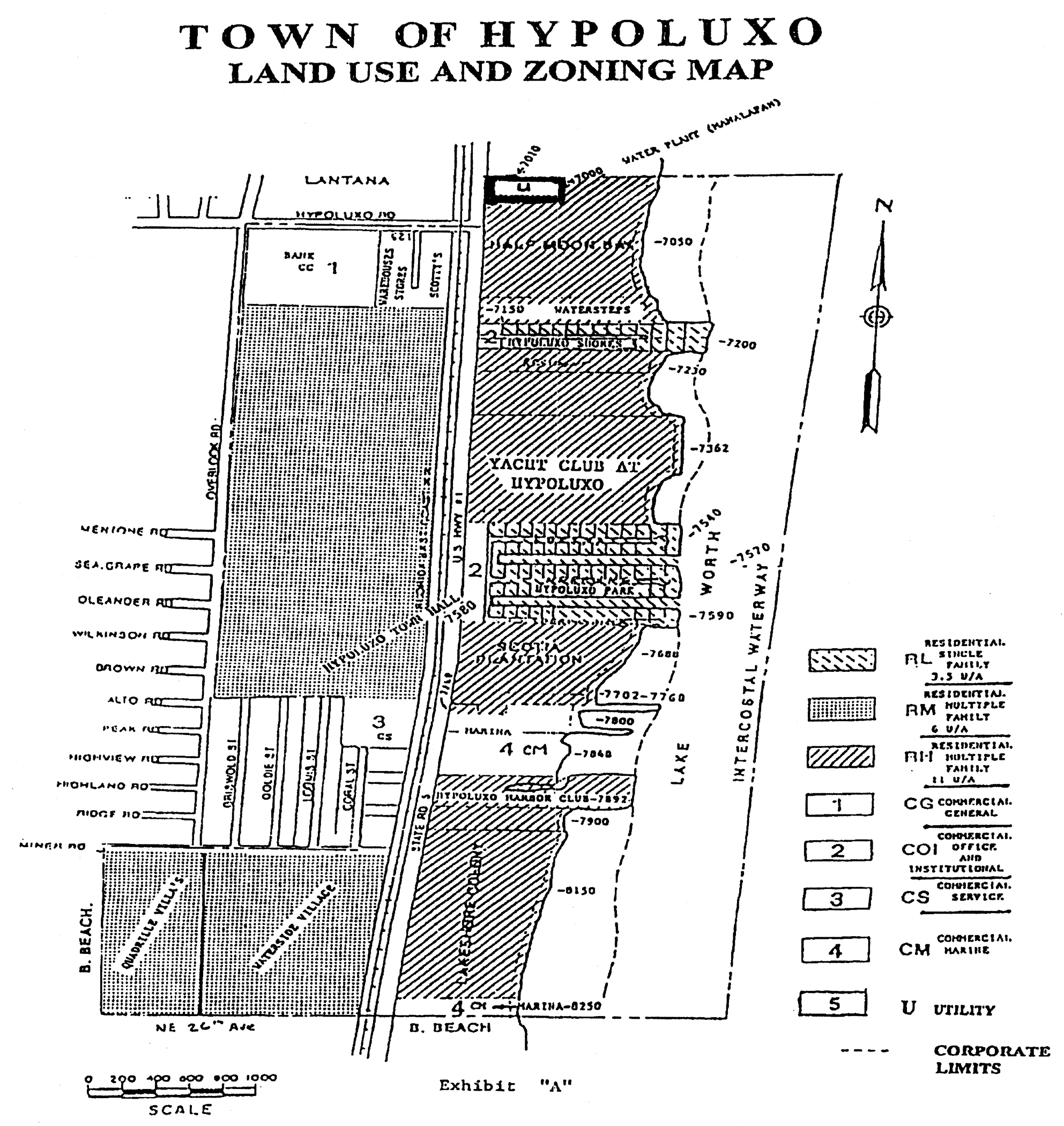
Land Use and Zoning Map
(Ord. of 9-12-90; Ord. No. 107, § 1, 4-14-98)

