
Indialantic City Zoning Code
ARTICLE I
- IN GENERAL
Sec. 113-1.- Short title.
This chapter shall be known as the "Indialantic Zoning Code" and may be so cited.
(Code 1962, § 28-1; Code 1993, § 17-1; Ord. No. 142, 10-3-1972; Ord. No. 11-13, § 1, 7-27-2011)
Sec. 113-2. - Purpose of provisions.
The provisions of this chapter are designed to:
(1)
Lessen congestion in the streets;
(2)
Secure safety from fire, panic and other dangers;
(3)
Promote the public health and general welfare;
(4)
Provide adequate light and air;
(5)
Prevent the overcrowding of land;
(6)
Avoid undue concentration of population;
(7)
Facilitate adequate provisions for transportation, water, electricity, sewerage, schools, parks and other public requirements; and
(8)
Promote and maintain the highest standards of architectural design.
a.
The provisions of this chapter are promulgated with reasonable consideration to the predominantly residential character of the town, with all other uses of land being either incidental and convenient thereto, or if existing as a result of extraneous factors, being secondary thereto.
b.
This chapter shall be construed to:
1.
Preserve and enhance the one-family residential character of the town, making provision for such other uses as will contribute to this end; and
2.
Prohibit such other uses as would be in conflict therewith, and strictly limit the intensity and extent of permitted uses, the intensification and expansion of which would detract from the predominantly one-family residential character of the town, impair property values, or disturb the sense of security of community character that is an inseparable part of the enjoyment of the ownership of property.
(Code 1962, § 28-2; Code 1993, § 17-2; Ord. No. 142, 10-3-1972)
Sec. 113-3. - Interpretation of provisions.
(a)
In interpreting and applying the provisions of this chapter, they shall be construed as the minimum requirements for the promotion of the public health, safety, morals and general welfare of the community. It is not intended by this chapter to interfere with or abrogate or annul any easements, covenants or other agreements between parties, but where this chapter imposes a greater restriction upon the use of buildings or premises or upon the height of buildings, or requires larger open spaces than are imposed or required by other provisions, rules, regulations or by easements, covenants, or agreements, the provisions of this chapter shall control.
(b)
Notwithstanding that the various zoning districts list as a prohibited use any use which is not a permitted use, the town council notes various uses are so similar to existing permitted uses as to be one and the same. Such uses are permitted by reasonable implication. In reviewing the zoning code to determine whether a use is permitted in a particular zoning district by reasonable implication, the code reviewer shall first be guided by the plain meaning of the code and secondarily by the intent of the town council and zoning and planning board in adopting and drafting the zoning code. The list of permitted uses may include those uses permitted by reasonable implication that are substantially similar in nature and character but not more intense or dense by use, not generating greater amounts of motor vehicle traffic or noise, and in the case of commercial uses, not normally operating earlier in the morning or later at night than other similar permitted uses, provided that all other uses not expressly permitted or determined to be permitted by reasonable implication shall be prohibited.
(Code 1962, § 28-3; Code 1993, § 17-3; Ord. No. 142, 10-3-1972; Ord. No. 08-01, § 1, 11-20-2007)
Sec. 113-4. - Definitions.
The following words, terms and phrases, when used in this chapter, shall have the meanings ascribed to them in this section, except where the context clearly indicates a different meaning:
Accessory use, accessory building or accessory structure means a subordinate use or building which is customarily incidental to the principal use, used for non-living purposes such as storage, located on the lot or building site with the main building, which shall not cause any of the following nuisances to be detectable to the normal senses off the lot: Noise, vibrations, glare, fumes, odors, powders, hazardous materials, liquids, electrical interference in any radio or television receivers, or fluctuations in power line voltage. Factors to be considered in determining whether a building, structure or use is "subordinate" and "customarily incidental" include the size of the lot or parcel, the uses of adjacent lots or parcels, and the size, shape, height, and roof type (if any) of the building or structure.
Aquifer means an underground formation, group of formations, or a part of a formation, that is permeable enough to transmit, store, or yield usable quantities of water.
Alley means any public or private right-of-way set aside for public travel less than 30 feet in width.
Alteration means as applied to a building or structure, is a change or rearrangement in the structural parts or in the exit facilities, or an enlargement, whether by extending on a side or by increasing in height, or the moving from one location or position to another.
Apartment means any building containing three or more complete rental living units.
Area, building means the aggregate of the maximum horizontal cross section area of the main building on a lot, excluding cornices, eaves, gutters, or chimneys projecting not more than three feet, steps, one-story open porches, bay windows not extending through more than one story and not projecting more than three feet, balconies and terraces.
Automotive repair facilities means all mechanical and engine overhaul or repair, body work and painting of automotive vehicles.
Automotive vehicles means any self-propelled vehicle or conveyance designed and used to transport or move persons, animals, freight, merchandise or any substance, and including passenger cars, trucks, buses, motorcycles, scooters, but not including tractors, construction equipment or machinery, or any device used for performing a job except as stated above.
Bed and breakfast means a use:
(1)
Consisting of a building designed and used as a single-family detached dwelling;
(2)
Consisting of a single-family dwelling unit together with the rental of one or more, but not to exceed nine dwelling rooms or suites on a short-term basis, usually by the night to tourists, vacationers, or similar transients;
(3)
Where the provision of meals, if provided at all, is limited to the breakfast meal for overnight guests; and
(4)
Where the bed and breakfast operation is conducted by an owner or operator of the bed and breakfast facility who physically resides on the premises.
A bed and breakfast is not a roominghouse or a permanent dwelling except for the owner or operator of the bed and breakfast facility and said individual's family.
Body piercing means for commercial purposes the act of penetrating the skin to make, generally permanent in nature, a hole, mark, or scar. Body piercing does not include the use of a mechanized, presterilized ear-piercing system that penetrates the outer perimeter or lobe of the ear or both.
Building means any structure constructed or used for residence, business, industry, or other public or private purposes or accessory thereto, and including tents, lunch wagons, dining cars, trailers, mobile homes, sheds, garages, accessory buildings, carports, animal kennels, and similar structures whether stationary or movable.
Building line means the line between which and the street line or lot line no building or other structure or portion thereof, except as provided in this code, may be erected above the grade level. The building line is considered a vertical surface intersecting the ground on such line.
Building permit means a written authority to build, issued by the building official.
Building site means any group of one or more lots or parcels of land occupied or intended for development as a unit, whether or not as part of a larger development site.
Club vendor means a private club vending alcoholic beverages and intoxicating liquors without limitation as to alcoholic content, at retail, for consumption upon the premises.
Cocktail lounge means a room having a bar and tables set up at all times and used for serving alcoholic beverages and/or food.
Community residential home means a facility in which the owners or operators are subject to licensing and approval by the state department of health and rehabilitative services, and where said owners or operators provide basic care, personal services, and supervision necessary to meet the physical, emotional and social needs of assigned, unrelated residents. A community residential home shall house no more than 14 assigned residents and shall be categorized by levels, according to the number of assigned residents residing on the premises, the zoning district in which it is permitted, and the requirements contained in article IV of this zoning code. Residents of these homes shall be as defined in F.S. § 419.001(1)(e), as amended from time to time.
Condominium means any multifamily dwelling containing individually owned living units.
Court means an unoccupied open space other than a yard on the same lot with a principal building, and fully enclosed on at least three adjacent sides by the walls of the main building.
Court, inner, means a court enclosed on all sides by exterior walls and lot lines on which walls are allowable.
Court, outer, means a court enclosed on not more than three sides by exterior walls and lot lines on which walls are allowable, with one side or end open to a street, driveway, alley or yard.
Crushed coquina shell rock (also known as cemented coquina rock) means a small marine clam's hard, mineral-like calcareous covering which has been reduced to particles by pounding or grinding and is relatively dust-free when compared to most other types of gravel and is permeable.
Cul-de-sac means a blind alley or street which is open at one end only.
Day means one calendar day and not a business day. When action is required to be taken within a certain number of days and the final day in the time period falls on a weekend, or a town recognized holiday, when the town administration offices are closed for business, the time period shall be extended until the close of business on the next day after the weekend or holiday that the town administrations offices are open for business. When a legal advertisement is to be made a certain number of days prior to a town meeting and the time period ends or begins on a weekend, or a town recognized holiday, when the town administration offices are closed for business, the time period shall not be extended or changed.
Detention or to detain means the collection and temporary storage of stormwater in such a manner as to provide for treatment through physical, chemical, or biological processes with subsequent gradual release of the surface water.
Depth of lot orlot depth means the distance measured in the mean direction of the side lines of the lot from the standpoint of the front lot line to the midpoint of the opposite main rear line of the lot.
Development means the carrying out of any building activity or mining operation, the making of any material change in the use or appearance of any structure or land, or the dividing of land into parcels. The following activities or uses shall be taken for the purposes of the zoning code to involve development:
(1)
A reconstruction, alteration of or material change in the extent or appearance of a structure on land;
(2)
A change in the intensity of use of land, such as an increase in the number of dwelling units in a structure or on land, or an increase in the number of businesses, manufacturing establishments, or offices;
(3)
Alteration of a shore or bank of a pond, including any "coastal construction" as defined in F.S. § 161.021;
(4)
Commencement of drilling, mining, or excavation on a parcel of land, except to obtain soil samples;
(5)
Demolition of a structure;
(6)
Clearing of land as an adjunct of construction; or
(7)
Deposit of refuse, solid or liquid waste, or fill on a parcel of land.
The following operations or uses shall not be construed for the purpose of this chapter to involve the term "development":
(1)
Work by a highway or road agency for the maintenance or improvement of a road, if the work is carried out on land within the boundaries of the right-of-way;
(2)
Work by any utility and other persons engaged in the distribution or transmission of gas, electricity, or water, for the purpose of inspecting, repairing, or renewing on established rights-of-way or corridors, or constructing on established or to be established rights-of-way or corridors, any sewers, mains, pipes, cables, utility tunnels, powerlines, towers, poles, tracks, or the like. This provision conveys no property interest and does not eliminate any applicable notice requirements to affected land owners;
(3)
Work for the maintenance, renewal, or alteration of any structure, if the work affects only the interior or the color of the structure or the decoration of the exterior of the structure;
(4)
The use of any structure or land devoted to dwelling uses for any purposes customarily incidental to enjoyment of the dwelling;
(5)
A change in the ownership or form of ownership of any parcel or structure;
(6)
The creation or termination of rights of access, riparian rights, easements, distribution and transmission corridors, covenants concerning development of land, or other rights in land;
(7)
The use of any land for the purpose of growing plants, crops, trees, and other agriculture or forestry products; and
(8)
A change in use of a structure from a use within a zoning district to another use in the same zoning district.
The term "development" includes all other development customarily associated with it unless otherwise specified. When appropriate to the context, the term "development" refers to the act of development or to the result of development. Reference to any specific operation is not intended to mean that the operation or activity when part of other operations or activities, is not development. Reference to particular operations is not intended to limit the generality of the term "development." See F.S. §§ 163.3164 and 380.04.
Development order means any order, permit, determination, or action granting, denying, or granting with conditions an application for any development permit. See F.S. § 163.3164.
Development permit means and includes any building permit, zoning permit, subdivision approval, rezoning, certification, variance, or any other official action of the town government having the effect of permitting the development of land. See F.S. § 163.3164.
Drive-in restaurant means an establishment serving food and/or drink where provisions are made for customers to drive across the curbs or sidewalk lines and receive service and/or consume food and/or drink in automobiles or other motor vehicles where said vehicle stands or parks in its own separate parking space during the process; and/or establishments where food and/or drink is prepared and/or served outside of an enclosed building, including open-air restaurants, diners, hot dog stands, barbecue stands or similar establishments.
Drive-through restaurant means an establishment serving food and/or drink where provisions are made for customers to drive across the curbs or sidewalk lines and place orders for food and/or drink prepared inside and served through windows of the restaurant to customers seated in their automobiles or other motor vehicles where said customer places an order by two-way speaker or other means and/or progresses in said vehicle via a designated path to the take-out window and then directly leaves the premises or parks without receiving service from a carhop.
Duplex means two complete living units within one principal building.
Dwelling means a house, apartment, or building designed or used primarily for human habitation, but not including boardinghouses or roominghouses, hotels, motels, tourist courts, vacation rentals or other structures for transient residents.
Dwelling house means a detached house designed for, and occupied exclusively as, the residence of not more than two families, each living as an independent housekeeping unit.
Dwelling unit means one or more rooms providing complete living facilities for one family, including equipment for cooking or provisions for the same, and including rooms for living, sleeping and eating.
Dwelling, multifamily, means a dwelling or group of dwellings on one plot containing separate living units for three or more families, but which may have joint services or facilities.
Earth station. See Satellite dish antenna.
Essential service means the erection, construction, alteration, or maintenance by public utilities or municipal departments or commissions, of underground or overhead gas, electrical, steam, or water transmission or distribution systems, collection, communication, supply or disposal systems, including poles, wires, mains, drains, sewers, pipes, conduits, cables, fire alarm boxes, police call boxes, traffic signals, hydrants, and other similar equipment and accessories in connection therewith but not including buildings reasonably necessary for the furnishing of adequate service by such public utilities or municipal departments or commissions or for the public health or safety or general welfare.
Family means one person or a group of two or more persons living together and interrelated by bonds of consanguinity, domestic partnership, marriage or legal adoption, or a group of persons not more than three in number who are not so interrelated, occupying the whole or part of a dwelling as a separate housekeeping unit with a single set of culinary facilities. The persons thus constituting a family may also include gratuitous guests and domestic servants. Any person under 18 years of age whose legal custody has been awarded to the Florida Department of Children and Family Services (DCF) or to a child-placing agency licensed by DCF, or who is otherwise considered to be a foster child under the laws of the state, and who is placed in foster care with a family, shall be deemed to be related to and a member of the family for the purposes of this chapter. Nothing herein shall be construed to include any roomer or boarder as a member of a family.
Floor area, gross, means the sum of the gross horizontal areas of the several floors of the building excluding areas used for accessory garage purposes and such basement and cellar areas as are devoted exclusively to uses accessory to the operation of the building, All horizontal dimensions shall be calculated from the outside exterior faces of walls.
Fresh water means water from lakes, rain or processed water obtained from a water utility system.
Front lot line means that property line which abuts on a public street, or in the event the property abuts on two or more streets it shall mean that property line abutting on a street which has been so designated by the owner at the time of his application for a building permit.
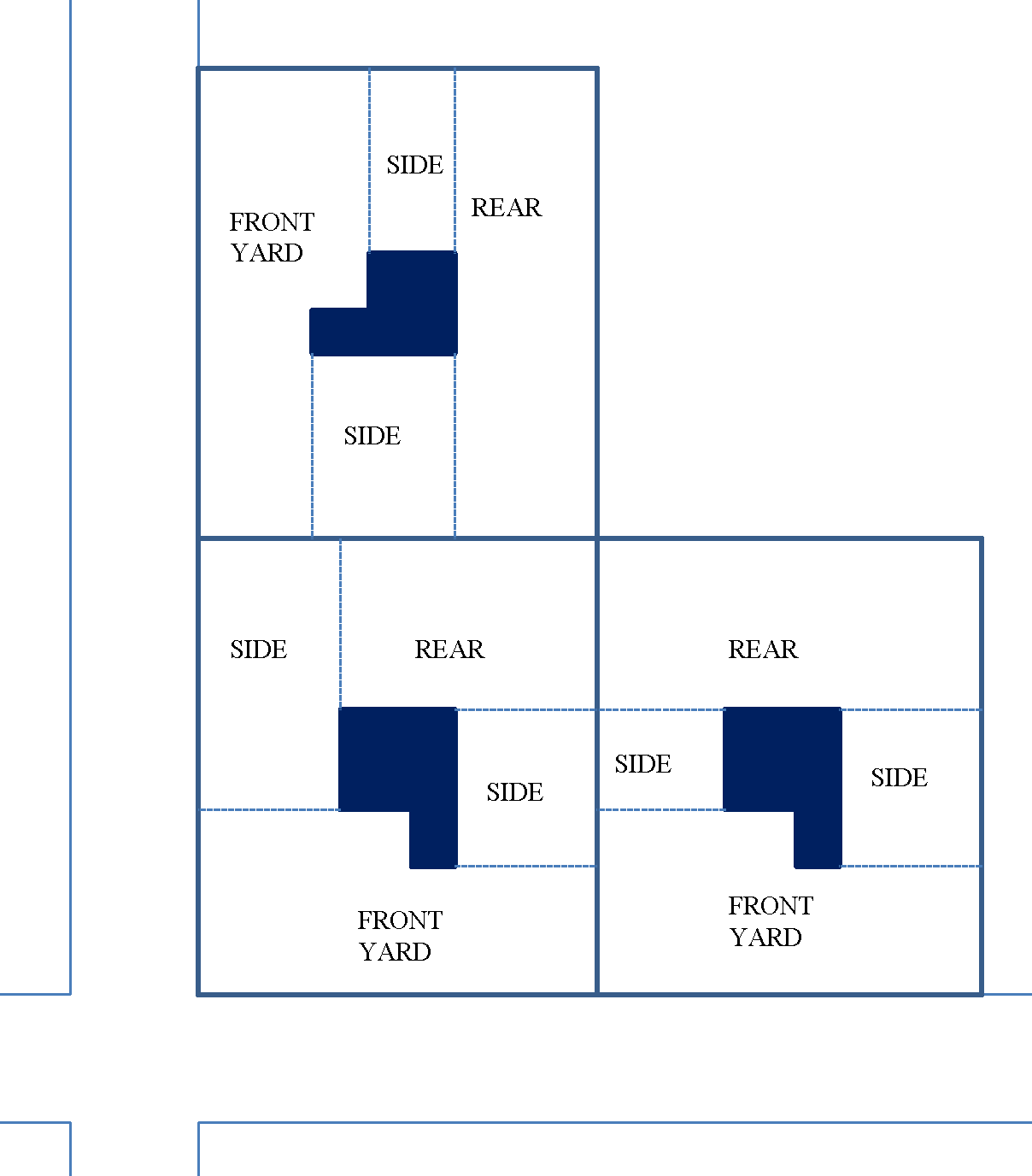
Front yard means an open unoccupied space (except as permitted herein) on the same lot with a principal building and extending across the width of the lot between the front lot line and the front walls or supports of the principal building regardless of its configuration. The location of the front yard is depicted on the drawing on file in the town hall and set forth below. In the event of conflict between this written definition of the term "front yard" and the drawing, on file in the town hall and set forth below, this written definition of the term "front yard" shall prevail.
FRONT YARD
Garage, private, means a building or part thereof accessory to a main building and providing for the storage of automobiles and in which no occupation or business for profit is carried on.
Garage, public or storage, means a building or part thereof other than a private garage for the storage of motor vehicles and in which service station activities may be carried on.
Glare means a harsh uncomfortably bright light.
Groundwater means water below the surface of the ground whether or not flowing through known and defined channels.
Half-story means a story under a sloping roof, the finished floor area of which does not exceed one-half the floor area of the floor immediately below it; or a basement used for human occupancy, the floor area of that part of which thus used, does not exceed 50 percent of the floor area of the floor immediately above.
Height, building, means the height of a structure shall be determined by the vertical dimension measured from the lowest, minimum permitted finished floor elevation, as determined by applying the state building code as adopted in section 103-36 and the provisions of section 113-226 and chapter 107, to the highest point of the roof. Chimneys, air conditioning equipment, ventilators, and elevator shaft extensions shall be excluded in the measurement of building height; however, these exclusions shall not exceed the minimum height established by the state building code.
Home occupation means an occupation carried on by a member of the resident family within the walls of a dwelling unit and not visible or noticeable in any manner or form from outside the walls of the dwelling.
Hotel means a multi-story structure for transient or permanent guests, and which may include rooms without cooking facilities and complete apartment facilities. All units of a hotel shall be confined within one structure except for the necessary accessory buildings.
Impervious surface means a surface which has been compacted or covered with a layer of material so that it will not permit the passage of water downward into the ground.
Junk means any worn-out, cast-off, or discarded article or material which is ready for destruction or has been collected or stored for salvage or conversion to some use. Any article or material which, unaltered or unchanged and without further reconditioning can be used for its original purpose as readily as when new, shall not be considered junk.
Junkyard means the use of more than ten square feet of the area of any lot, whether inside or outside a building, or the use of any portion of that half of any lot that joins any street, for the storage, keeping or abandonment of junk.
Land development code, LDC or land development regulation means ordinances enacted by the town council for the regulation of any aspect of development and includes any town zoning, rezoning, subdivision, building construction, or sign regulations or any other regulations controlling the development of land. In the town code of ordinances, subpart B includes land development regulations and is the land development code.
Levels mean as follows:
(1)
Level I facility - No more than six assigned residents.
(2)
Level II facility - Seven to 14 assigned residents.
Living area means that area of a dwelling unit, enclosed, which is protected from the elements and able to be heated, including interior halls, closets, utility and storage areas in the main building but excluding garages, carports, screened porches, and unenclosed areas. All horizontal dimensions shall be calculated from the outside faces of walls.
Living unit means the rooms comprising the essential elements of a single housekeeping unit. Facilities for the preparation, storage and keeping of food for consumption within the premises shall cause a unit to be construed as a living unit.
Loading space means an off-street space or berth on the same lot with a building, or contiguous to a group of buildings, for the temporary parking of a commercial vehicle while loading or unloading merchandise or materials, and which abuts upon a street, alley or other appropriate means of access.
Lot means a piece, parcel or plot of land of at least sufficient size to meet minimum zoning requirements, occupied or to be occupied by one principal building or use with the appropriate accessory buildings, and including any required open spaces.
Lot of record means a lot whose existence, location and dimensions have been legally recorded or registered in a deed or on a plat prior to the effective date of this chapter.
Lot, corner, means a lot at the point of intersection of and abutting on two or more intersecting streets, the angles of intersection being not more than 135 degrees. It is the land occupied or to be occupied by the corner building and its accessory buildings.
Lot, reversed corner, means a corner lot the rear of which abuts upon the side of another lot whether across an alley or not.
Map means the official zoning map of the town.
Marijuana means all parts of any plant of the genus Cannabis, whether growing or not; the seeds thereof; the resin extracted from any part of the plant; and every compound, manufacture, salt, derivative, mixture, or preparation of the plant or its seeds or resin, including low-THC cannabis, which are dispensed from a medical marijuana treatment center for medical use by a qualified patient.
Medical marijuana treatment center means a medical marijuana treatment center is a location at which cultivation or processing of marijuana may occur as permitted by F.S. § 381.986.
Medical marijuana treatment center dispensing facility means a medical marijuana treatment dispensing facility is a facility at which marijuana is dispensed for medical use and which dispensary is licensed by the state department of health. See F.S. § 381.986. As used in this definition of the term "medical marijuana treatment center dispensing facility," the term "medical use" is defined as set forth in F.S. § 381.986.
Motel means a group of tourist accommodation units and designed primarily for access by automobile.
Newspaper of general circulation means a newspaper published at least on a weekly basis and printed in the language most commonly spoken in the area within which it circulates, but does not include a newspaper intended primarily for members of a particular professional or occupational group, a newspaper whose primary function is to carry legal notices, or a newspaper that is given away primarily to distribute advertising. To be a newspaper of general circulation, as required by F.S. § 50.031, the newspaper shall have been in existence for one year and shall have been entered as periodicals matter at a post office in the county where published, or in a newspaper which is a direct successor of a newspaper which together have been so published.
Nonconforming building means a building which does not conform to the provisions of this chapter for all items other than type of use.
Nonconforming use means a use of a building or land lawful at the time of the enactment of this chapter that does not conform with the provisions of this chapter for the district in which it is located.
Occupied means the use of a building or land for any purpose, and shall include occupancy for residential business, industrial, and public use, as well as for manufacturing and storing facilities.
Outdoor cafe means an outside area which contains tables and chairs for use in connection with a food service establishment.
Park means a noncommercial facility designed to serve the recreation needs of the residents of the community. Such facilities include neighborhood parks, community parks, and beach areas, all as depicted on the recreation and sidewalk/bike trail map (existing), exhibit 13 in the recreation and open space element of the town's comprehensive plan. Such facilities may also include, but shall not be limited to, school and religious institution ball fields, if they meet the above definition of the term "park." Commercial amusement facilities, such as water slides, go-cart tracks and miniature golf courses shall not be considered parks.
Parking space means an area specifically and permanently designed for the parking or storage of motor vehicles and having minimum dimensions of ten feet by 20 feet. When a curb stop or curbing is used as a wheel stop for head-in parking, the 20-foot dimension may be reduced to 18 feet of paving plus a two-foot overhang area. Compact car spaces nine feet by 18 feet may be approved by the zoning and planning board if justified by the configuration of the site plan and a demonstration of control by the owner. Compact car spaces shall not exceed 20 percent of the total number of automobile parking spaces.
Permeable means having the characteristic of permitting the passage of some substances (water) through its interstices or pores.
Pervious means being of a substance that can be penetrated or permeated such as a soil that allows passage to lower levels.
Practical difficulty means in the case of a variance, a practical difficulty is a standard which is similar to but less rigorous than the unnecessary hardship standard. It is a non-self-created characteristic of the property. The standard asks whether a literal enforcement of a zoning regulation will create a practical difficulty in the use of the parcel of land for the purpose or in the manner for which it is zoned. Some of the factors that may be considered in determining whether a practical difficulty exists include:
(1)
How substantial the variance is in relation to the requirement sought to be varied;
(2)
Whether a substantial change will be produced in the character of the neighborhood;
(3)
Whether the difficulty can be obviated by some method feasible for the applicant to pursue other than by a variance; and
(4)
Whether, in view of the manner in which the difficulty arose, the interest of justice will be served by allowing the variance. Finding that factors:
a.
That the variance requested is not substantial;
b.
That a substantial change in the character of the neighborhood will not occur if the variance is granted;
c.
That the difficulty occurring can only be obviated by grant of the variance; and
d.
That the interest of justice will be served by granting of the variance;
are all factors in support of the variance.
Principal building means a building in which is conducted the principal use of the lot on which it is situated. In a residential district any dwelling shall be deemed the principal building on the lot on which the same is situated. An attached carport, shed, garage or any other structure with one or more walls or a part of one wall being a part of the principal building and structurally dependent, totally or in part, on the principal building, and a carport, shed, or garage that meets the wind loading, wind borne debris, wind speed, wind resistance and other wind-related requirements of law, the state building code or the town code shall be deemed part of the principal building. However, a detached and structurally independent carport, garage, covered walkway or other structure shall be deemed an accessory building.
Private club means a club operated for the benefit of members only and not accessible to the general public.
Public use means any use of land or a building owned and operated by a municipality, county, state or federal government or agency thereof, and for a public service or purpose.
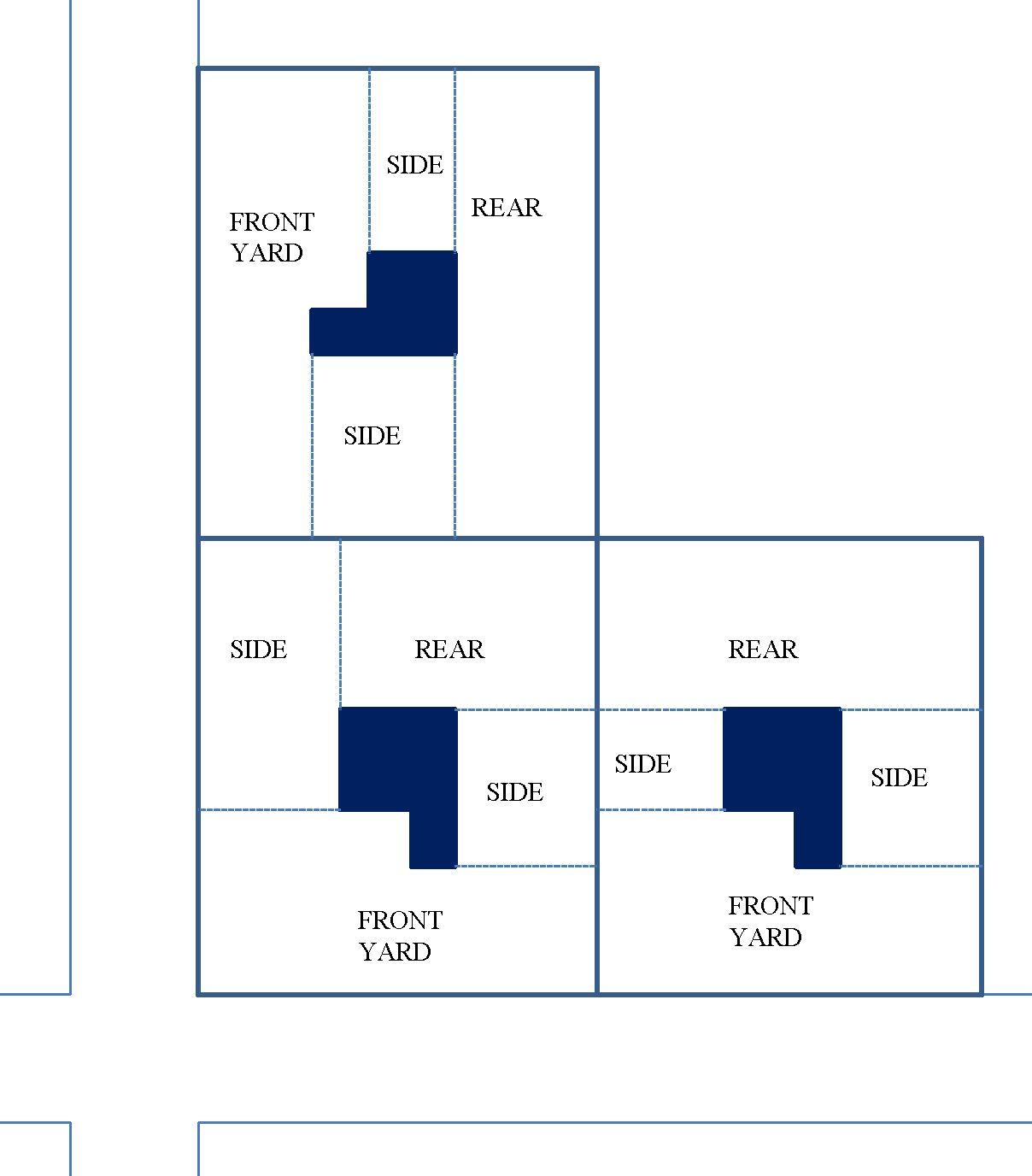
Rear yard means an open unoccupied space (except as permitted herein) on the same lot with the principal building and extending across the width of the lot, except on corner lots, between the rear lot line and the rear walls or supports of the building. The location of the rear yard is depicted on the drawing on file in the town hall and set forth below. In the event of conflict between this written definition of the term "rear yard" and the drawing, on file in the town hall and set forth below, the written definition of the term "rear yard" shall prevail.
REAR YARD
Recreational vehicles means trailers, campers, motorhomes, truck-campers, travel trailers, camper buses, boats, boat trailers, boats mounted on trailers, air boats, air boat trailers, air boats mounted on trailers, and vans over seven feet in height which bear the Recreational Vehicle Association (RVA) seal of approval, all of which are referred to as RVs.
Residential zoning districts shall include the R-1-A, R-1-B, R-2, R-3, and R-P zoning districts.
Restaurant means an enclosed building in which food and beverages are prepared and served to the public at tables in a dining room located therein, and shall not include open-air or drive-in restaurants, diners, hot dog stands, barbecue stands, or similar establishments where food is delivered or served to cars, or on stools, outside the main body of the restaurant. The primary business shall be the service of food.
Rezoning means a change made by the town as noted on the official zoning map for the permitted use or uses allowed for a parcel of real property. A rezoning includes an initial zoning of land when said land is annexed into the town.
RVs. See Recreational vehicles.
Roominghouse means any dwelling in which more than three persons either individually or as families are housed or lodged for hire, with or without meals. A boardinghouse or furnished room shall be deemed a roominghouse.
Satellite dish antenna means an antenna, often paraboloid in form, for receiving communication or other signals from satellites along with associated equipment to receive, magnify, interpret, and transfer such signals.
Semi-public use means any use of land or buildings owned and operated by any person, lodge or club, either as a profit or non-profit activity, for a public service or purpose. The term "semi-public use" shall include privately owned utilities, transportation, recreation, education and cultural activities and services.
Service station means buildings and premises where petroleum products, grease, batteries, tires, or automotive accessories may be supplied, installed, or dispensed at retail for automobiles or other motor vehicles. Convenience stores, including, but not limited to, a 7-11 Store, Hess Mart, Majik Market, Circle K, Super America, and the like, dispensing gasoline, shall be considered automobile service stations. The following general services and sales may also be rendered at service stations:
(1)
Sales and servicing of spark plugs, batteries, and distributors and distributor parts;
(2)
Tire sale or servicing or indoor repair, but not recapping or regrooving;
(3)
Replacement of mufflers and tail pipes, water hose and fan belts, brake fluid, light bulbs, fuses, floor mats, seat covers, windshield wipers and wiper blades, grease retainers, wheel bearings, mirrors, and similar items;
(4)
Radiator cleaning and flushing;
(5)
Lubrication;
(6)
Providing and repairing fuel pumps, oil pumps, and lines;
(7)
Servicing and repair of the carburetor;
(8)
Emergency wiring repairs;
(9)
Adjusting and repairing brakes;
(10)
Air conditioning servicing; and
(11)
The rental of moving trucks or trailers; provided, however, that no more than two such vehicles may be on the service station premises at any one time.
Items listed in subsections (1) through (10) of this definition shall be accomplished indoors only.
Setback building line means a building line back of the street line.
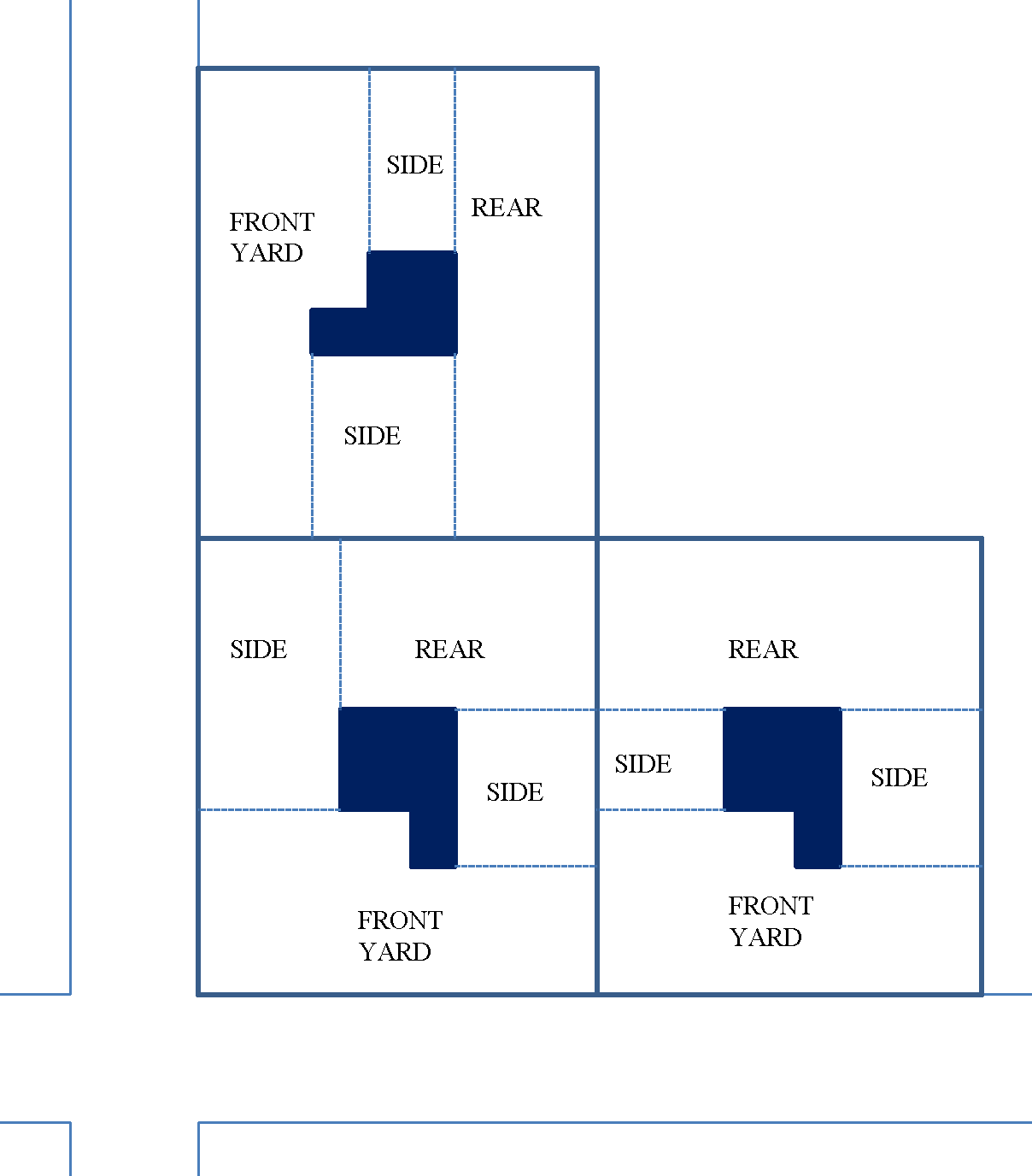
Side yard, corner, means an unoccupied space (except as permitted herein) on the same lot with a principal building and extending from the front yard to the rear lot line on the side abutting the street and lying between the side lot line and the walls or supports of the building. The location of the side yard, corner, is depicted on the drawing on file in the town hall and set forth below. In the event of conflict between this written definition of the term "side yard, corner," and the drawing, on file in the town hall and set forth below, the written definition of the term "side yard, corner," shall prevail.
Side yard, interior, means an unoccupied space (except as permitted herein) on the same lot with a principal building and extending from the front yard to the rear yard between the side lot line and the walls or supports of the building. The location of the side yard, interior, is depicted on the drawing on file in the town hall and set forth below. In the event of conflict between this written definition of the term "side yard, interior," and the drawing, on file in the town hall and set forth below, the written definition of the term "side yard, interior," shall prevail.
SIDE YARD, CORNER AND INTERIOR
Sidewalk sale means a commercial sale or display of goods, products, wares, merchandise, services or material related to services, any one or all of which is sold or displayed on a sidewalk immediately contiguous to the building/commercial premises within which the vendor has for commercial sale or display goods, products, services, or material related to services. The display of goods, products, wares, merchandise, material related to services shall be exempt from this definition of the term "sidewalk sale" when such item is part of an approved sign.
Skateboard means a recreational device consisting of a narrow slat constructed of wood, steel, plastic, fiberglass, or other material, to the underside of which are affixed wheels or rollers similar to those on roller skates.
Skateboard ramp means a curved or slanted ramp-like structure extending upward at an angle sufficient to facilitate the downward and forward motion of a person while mounted on a skateboard. Nothing stated herein shall be interpreted to waive any requirement of obtaining a permit before constructing a skateboard ramp.
Storage unit, temporary portable, means any unit not less than 600 cubic feet in size, including, but not limited to, a trailer, box, or other shipping container, which is leased by a tenant primarily for use as storage space whether the unit is located at a facility owned or operated by the owner or at another location designated by the tenant.
Story means that portion of a building included between the upper surface of any floor and the upper surface of the floor next above; or any portion of a building used for human occupancy between the topmost floor and the roof, but shall not include a basement or cellar not used for human occupancy.
Street means any public or private right-of-way set aside for public travel 30 feet or more in width, including roads, avenues, boulevards, lanes, drives, thoroughfares and highways.
Street centerline means the midpoint of the street right-of-way.
Street right-of-way means the property line which bounds a right-of-way set aside for use as a street. Where sidewalks exist and the exact location of the right-of-way of the street is unknown, the side of the sidewalk furthest from the centerline of the traveled street shall be considered as the right-of-way.
Structure means anything constructed or erected which requires location on the ground or attached to something having location on the ground, including signs and billboards, but not including fences or walls used as fences.
Surface water means the flow of water that results from a rainfall or other event which creates an over-supply of non-salt water that is not instantly permeated through the soil.
Tattoo means any mark or design on or under the skin of a human being by a process of piercing and ingraining a pigment, dye or ink in the skin.
Tattoo establishments means any permanent location, place, area, structure, or business where tattooing is performed. Such establishment shall be licensed under F.S. § 381.00777. All tattoo artists shall be licensed as required by F.S. § 381.0075. For the purposes of this code, a tattoo establishment or a tattoo artist shall not engage in body piercing.
Terrace means an unoccupied open space adjacent to a principal building on one or two sides, prepared with a hard, semi-hard, or improved surface, and uncovered, for the purpose of outdoor living.
Total floor area means the areas of all floors of a building including finished attics, finished basements, and all covered areas, including porches, sheds, carports, and garages.
Tourist and transient living accommodations means any place wherein tourists, transients, travelers or persons desiring temporary residence may be provided with sleeping, sanitary or cooking facilities.
Tourist court. See Motel.
Townhouse or townhouse residential unit means a single-family dwelling unit not exceeding three stories in height (unless further restricted by this Code) constructed in a group of two or more attached units with property lines separating such units in which each unit extends from the foundation to the roof and with a yard or public way on not less than two sides.
Town manager means the town manager or said manager's designee.
Unnecessary hardship means, in the case of a variance, a standard which is similar to but much more rigorous than the practical difficulty standard. The unnecessary hardship standard is a very restrictive standard. It is a non-self-created characteristic of the property in question which renders it virtually impossible to use the land for the purpose or in the manner for which it is zoned. The standard asks whether a literal enforcement of a zoning regulation will create an unnecessary hardship which makes it virtually impossible to use the land for the purpose for which it is zoned.
Use means the purpose of which land or a building is arranged, designed or intended, or for which either land or building is or may be occupied or maintained.
Utility shed means an accessory structure used for storage purposes that is designed without plumbing. The structure is intended to store lawn, garden, pool or other household equipment.
Vacant means a building or parcel of land either not occupied or used or in non-operative status for a period of one year.
Vacation rental means an attached or detached residential structure or dwelling unit that is rented, leased or assigned for tenancies of less than 90 days or three calendar months, whichever time period is less, and for a monetary consideration, or which is advertised or held out to the public as a place periodically rented for a monetary consideration for periods of less than 90 days or three calendar months, whichever time period is less. For the purposes of this chapter, the term "vacation rental" means a commercial use. For the purposes of the term "vacation rental," subleases for less than 90 days are to be considered as separate rental periods. The term "vacation rental" does not include month-to-month hold-over leases from a previous lease longer than 90 days. Vacation rental use does not include hotels and motels, which are specifically addressed in specific zoning districts. A vacation rental unit may also be a bed and breakfast facility. A vacation rental unit may be located in an apartment or condominium building or a single-family residential dwelling unit, but only as a specifically permitted use as is noted in a particular zoning district.
Variance means a variance is a modification of, or deviation from, the regulations of chapter 17, the zoning code, which is authorized and approved by the board of adjustment after the board finds that the literal application of the provisions of the zoning code would cause an unnecessary hardship or a practical difficulty in the use or development of a specific parcel of land or building.
Yard means an open space (except as permitted herein) other than a court, on a lot, unoccupied and unobstructed from the ground upward, except as otherwise provided in this chapter. See also Front yard;Rear yard;Side yard, corner; and Side yard, interior.
(Code 1962, § 28-4; Code 1993, § 17-4; Ord. No. 142, 10-3-1972; Ord. No. 153, § 3, 6-19-1973; Ord. No. 261, §§ 1, 9—11, 19, 7-17-1979; Ord. No. 84-344, § 1, 3-20-1984; Ord. No. 85-21, § 1, 8-20-1985; Ord. No. 86-2, § 1, 3-18-1986; Ord. No. 86-11, § 4, 4-15-1986; Ord. No. 86-13, § 2, 6-17-1986; Ord. No. 86-17, § 2, 8-19-1986; Ord. No. 87-2, § 1, 12-16-1986; Ord. No. 87-3, § 3, 2-17-1987; Ord. No. 87-9, § 2, 8-18-1987; Ord. No. 90-13, §§ 1, 2, 1-15-1991; Ord. No. 92-4, § 1, 2-18-1992; Ord. No. 93-4, §§ 1, 2, 6-15-1993; Ord. No. 94-7, § 2, 1-18-1994; Ord. No. 95-1, § 1, 11-30-1994; Ord. No. 95-9, § 1, 7-18-1995; Ord. No. 95-13, § 1, 10-17-1995; Ord. No. 02-09, § 1, 4-16-2002; Ord. No. 04-07, § 1, 3-16-2004; Ord. No. 08-01, § 2, 11-20-2007; Ord. No. 11-13, § 2, 7-27-2011; Ord. No. 12-02, § 13, 11-21-2011; Ord. No. 12-07, § 1, 4-17-2012; Ord. No. 16-04, § 1, 2-10-2016; Ord. No. 16-08, § 1, 4-13-2016; Ord. No. 17-10, § 1, 5-15-2017; Ord. No. 17-11, § 2, 7-17-2017; Ord. No. 17-14, § 1, 9-13-2017; Ord. No. 2019-11, § 3, 11-13-2019; Ord. No. 2022-05, § 1, 5-11-2022; Ord. No. 2024-03, § 2, 3-13-2024)

