
Indian Shores City Zoning Code
ARTICLE IV
SUPPLEMENTARY DISTRICT REGULATIONS
DIVISION 3. - PERFORMANCE STANDARDS[4]
Cross reference— Animal nuisances, § 14-31.
Sec. 110-301. - Article applicable in all zoning districts.
Unless otherwise provided, the regulations and criteria in this article are applicable in all zoning districts located within the town's corporate limits.
(Code 1979, § 23-22)
Sec. 110-321. - Maximum density.
The maximum allowable density in a zoning district is 18 residential units per buildable acre on any given lot, parcel or building site, all portions of which are contiguous and within the same zoning district unless otherwise noted in the zoning district requirements:
(1)
One residential unit of a building may be used as a temporary combination rental/sales office and model unit until all residential units are sold or rented. However, such temporary use may not exceed six months after the final certificate of occupancy for the project has been issued.
(2)
Any residential unit used as a rental/sales office or temporary combination rental/sales office and model unit, as provided in subsection (1) above, may be used only for the rental or sale of units within the permitted development site.
(3)
A permanent rental office, otherwise allowed as a permitted or accessory use elsewhere in this Code, shall be included as a unit for calculating density. A permanent rental office shall be limited to the rental or units within the permitted development site.
(4)
A permanent rental office may be converted to a residential unit only if it meets requirements of this section and the maximum allowable density provided elsewhere in this Code as of the date of the conversion.
(Code 1979, § 23-22(1); Ord. No. 93-3, § 5, 7-13-93; Ord. No. 94-11, § 1, 6-28-94; Ord. No. 98-1, § 1, 3-11-98; Ord. No. 2008-2, § 10, 3-12-08)
Sec. 110-322. - Building height.
The maximum allowable height for a building in a zoning district is five stories and 50 feet in height, the height shall be measured from the minimum required piling height to the top of the sidewall, except the buildings located in the Indian Shores Town Square Plan area shall be limited to three stories or 35 feet in height, the height shall be measured from the minimum required piling height to the top of the sidewall. Three story buildings in this planning area require additional setbacks (see section 110-327) and architectural review.
(Code 1979, § 23-22(2); Ord. No. 95-6, § 3, 7-11-95; Ord. No. 00-5, § 12, 12-12-00; Ord. No. 03-3, § 2, 6-10-03)
Cross reference— Buildings and building regulations, ch. 18.
Sec. 110-323. - Story.
In addition to the provisions of the definition of story as given in section 110-1, the following information supplements such definition and is applicable when determining any setback distance, the distance between buildings and building height: Any interior intermediate level, including but not limited to mezzanines, lofts and attics, shall be counted as a story.
(Code 1979, § 23-22(3))
Sec. 110-324. - Lots.
Two or more abutting lots or portions of lots under common ownership and located on the same side of Gulf Boulevard or a town street and located in the same zoning district shall be considered as one lot for the purposes of determining the applicable zoning and usage requirements which must be complied with for construction on the lot. Lots and portions of lots under common ownership but located on different sides of Gulf Boulevard or in different zoning districts or having been zoned for different uses, thereby having different zoning categories assigned, shall not be considered as one building lot. This section does not require that undersized lots remain in separate ownership beyond the date of the ordinance.
(Code 1979, § 23-7; Ord. No. 00-5, § 13, 12-12-00)
Sec. 110-325. - Lot coverage.
The maximum allowable total lot coverage for all residential buildings and structures, excluding swimming pools, and maximum allowable intensity for non-residential buildings on a lot is as follows:
(1)
For buildings containing only residential units and accessory storage areas and garages, the maximum lot coverage shall not exceed the future land use plan designation, zoning category, or countywide future land use plan map category, whichever is more restrictive.
(2)
For non-residential buildings a floor area ratio (FAR) not to exceed the future land use plan designation, zoning category, or countywide future land use plan map category, whichever is more restrictive.
(3)
Mixed use. Shall not exceed, in combination, the respective number of units per acre and floor area ratio permitted, when allocated in their respective proportion to the buildable area of the property.
(Code 1979, § 23-22(4); Ord. No. 93-3, § 5, 7-13-93; Ord. No. 00-5, § 14, 12-12-00; Ord. No. 03-3, § 3, 6-10-03; Ord. No. 2008-2, § 11, 3-12-08)
Sec. 110-326. - Lot area and dimensions.
The minimum area and dimensions of a lot on which construction is authorized are:
(1)
Minimum lot area, 3,920 square feet, except lots in the Indian Shores Town Square Planning area the minimum lot area shall be 2,200 square feet.
(2)
Minimum lot width at any building setback line, 44 feet, except lots in the Indian Shores Town Square Planning area the minimum lot width at any building setback line shall be 28 feet.
(Code 1979, § 23-22(5); Ord. No. 04-12, § 2, 8-10-04)
Sec. 110-327. - Setbacks.
The minimum building setback from any lot line is as follows:
(1)
From any lot line bordering any portion of Gulf Boulevard:
a.
Eighteen feet
b.
Ten foot setback for lots bordering on Gulf Boulevard within the Indian Shores Town Square Plan area.
(2)
From any lot line bordering any portion of a street other than Gulf Boulevard, ten feet, except lots lines bordering Whispering Pines Drive, 191 Ave., 192 Ave., 193 Ave. and second street east, in the Indian Shores Town Square Planning area can be reduced to five feet for one and two-story buildings, and for three-story buildings the second and third story must be setback at least ten feet.
(3)
For mixed uses and non-residential uses on lots, located in the Indian Shores Town Square Planning area the internal lot line setback can be reduced to zero when adjoining another mixed or non-residential use.
(4)
From any lot line not bordering any portion of either a street or the coastal construction control line:
Five feet of side setback for the first 20 feet of the height of the sidewall above the minimum required piling height, plus one-half foot increase in side setback for every one foot of increase in sidewall height.
(5)
For any lot bordering any portion of the intercoastal waterway, a minimum setback distance of ten feet measured from the easternmost portion of the lot at which the lot's buildable area has a width, measured in a north-south direction, of 45 feet and a minimum setback distance of ten feet landward from any high-water line.
(6)
For any lot containing or bordering on property containing mangrove growth, a minimum setback distance of six feet for any building, structure, paving or improvement other than a boardwalk leading to an approved dock, measured from the outermost branches of any mangrove tree on or adjacent to the lot.
(7)
If the top story's floor area is less than 20 percent of the floor area of floor immediately below, then the top floor sidewall height will not be included in the formula for setbacks of the building in subsection 110-327(4). The top floors sidewalls shall be setback at least five feet from the sidewalls of the floor immediately below and at least 20 feet from the sidewall of the floor on the street side immediately below. The remaining 80 percent roof area of the floor immediately below may not be permanently or temporarily screened or enclosed, in any fashion or manner, nor may it be used as or constructed to be used as a patio, deck, observation deck, platform, stage, floor or other similar use, except for mechanical equipment. Nothing herein shall be construed to authorize any person to exceed any building height restrictions contained elsewhere in this Code.
(8)
The rear setback for gulf front lots shall be a minimum of 18 feet. The measurement shall be from the rear property line or from the coastal construction control line, whichever is the most eastward. Accessory structures of 100 square feet of floor area or less are exempt.
(Code 1979, § 23-22(6); Ord. No. 93-3, § 5, 7-13-93; Ord. No. 00-5, § 15, 12-12-00; Ord. No. 03-3, § 4, 6-10-03; Ord. No. 03-5, § 1, 10-14-03; Ord. No. 2004-5, § 1, 4-12-04; Ord. No. 04-12, § 2, 8-10-04; Ord. No. 2004-20, § 1, 11-9-04)
Sec. 110-327.1. - Parking lot setbacks.
For any lot bordering Gulf Boulevard (SR 699), the minimum parking lot setback shall be 10′-0″ for the property line bordering Gulf Boulevard, excluding driveway areas, other parking lot requirements shall be as required by section 110-422.
(Ord. No. 98-2, § 1, 5-12-98)
Editor's note— Ord. No. 98-2, § 1, adopted May 12, 1998, added § 110-328. Inasmuch as there already exists provisions so designated, at the discretion of the editor, said provisions of Ord. No. 98-2, § 1, have been included herein as § 110-327.1.
Sec. 110-328. - Building area and dimensions.
The minimum area and dimensions for any building or portion thereof for which construction shall be authorized is as follows:
(1)
Minimum area of any principal building, 900 square feet.
(2)
Minimum area of any residential unit in a tourist lodging facility, other than an interval occupancy facility, 300 square feet.
(3)
Minimum area of any residential unit in an interval occupancy facility, 750 square feet.
(4)
Minimum area of any dwelling unit having only one bedroom or of any apartment, 550 square feet.
(5)
Minimum area of any dwelling unit having two or more bedrooms or of any guest unit, 750 square feet per dwelling unit or guest unit.
(Code 1979, § 23-22(7))
Sec. 110-329. - Swimming pool or swimming pool enclosure.
A swimming pool or swimming pool enclosure, including any mechanical equipment. (Filter, heaters and etc.) and pool accessories (ladders, handrails and etc.) which protrudes above the building grade, shall be a minimum of ten feet from all lot lines.
(Code 1979, § 23-22(8); Ord. No. 03-3, § 5, 6-10-03)
Sec. 110-329.1. - Mechanical equipment setbacks.
Mechanical equipment (A/C and etc.) shall not be allowed in the side setbacks.
(Ord. No. 03-3, § 6, 6-10-03)
Sec. 110-330. - Distance between buildings.
The minimum distance between buildings on the same lot, measured from any building protrusion, i.e., balcony, air conditioning unit, etc., shall be as follows:
(1)
Ten feet of distance between buildings, for the first 20 feet of the height of the sidewall above the minimum required piling height, plus one-half foot increase in side setback for every one foot of increase in sidewall height.
(2)
The minimum distance between two buildings of different heights shall be determined by applying subsection (1) of this section to the height of the taller building.
(Code 1979, § 23-22(9); Ord. No. 94-10, § 1, 6-28-94; Ord. No. 03-3, § 7, 6-10-03)
Sec. 110-331. - Roof overhang.
The maximum allowable distance a roof overhang may protrude or encroach into any required setback is two feet.
(Code 1979, § 23-22(10))
Sec. 110-332. - Open area.
The minimum open area, which shall be provided on each developed lot or parcel, shall be 20 percent of the buildable area of the parcel for buildings up to 30 feet of height, and shall be 25 percent of the buildable area of the parcel for buildings over 30 feet of height and shall be 30 percent of the buildable area of the parcel for buildings over 50 feet in height. Open areas shall be landscaped in accordance with section 110-337 and with plans approved by the town and shall not be surfaced with any material that is not indigenous to the town, including but not limited to asphalt, concrete, limestone, tile, oil, metal and wood.
(Code 1979, §§ 23-7, 23-22(11); Ord. No. 93-3, § 5, 7-13-93; Ord. No. 2004-1, § 1, 3-10-04; Ord. No. 2004-5, § 2, 4-12-04; Ord. No. 2008-9, § 1, 10-14-08)
Sec. 110-333. - Continuance of existing non-conforming uses, structures and lots.
(a)
Non-conformities—Intent. Within districts established by the code, there may exist uses of land or structures which were lawful prior to the adoption of this Code or amendment, but which would be prohibited, regulated, or restricted under the terms established herein. It is the intent of the town council to permit such legal non-conformities to continue until they are removed by economic or other forces, but not to encourage their survival or replacement due to their inconsistency with the provisions established herein. It is further the intent of the town council to eventually require all uses of land or structures to conform to this Code.
(b)
Non-conforming uses. A non-conforming use may not be enlarged or extended so as to occupy additional land on the same or any other lot, parcel or tract. If a non-conforming use is discontinued for 90 consecutive calendar days or longer, it may not thereafter be resumed, and any such subsequent use of the property shall conform to all applicable sections of this Code.
(c)
Non-conforming lots, parcels or tracts. Non-conforming lots, parcels or tracts may not be made or become more non-conforming.
(d)
Non-conforming buildings and structures.
(1)
A non-conforming building or structure may not be extended, enlarged or made more non-conforming, except that minor alterations and additions, as specified in the definition of substantial improvements in section 86-36, shall be permitted when in compliance with all other sections of this Code.
(2)
A non-conforming building is defined as an existing non-conforming building or structure which was constructed under a validly issued building permit, but which is no longer in compliance with the Code and ordinance requirements because of amendments or other changes to the ordinances since the permit was issued and the structure was built. Existing land uses or structures which do not meet the use regulations of this Code or the future land use plan, but which were lawfully in existence prior to February 27, 1990, shall be considered as non-conforming.
(3)
If an act of God or other force beyond the control of the owner occurs which destroys or damages a non-conforming building or any portion of a non-conforming building, such building or portion thereof may be rebuilt as it existed prior to the destruction or damage on the same lot or parcel on which it was constructed subject to the conditions below. Non-conforming structures, excluding the provisions set forth below for non-conforming buildings, which are destroyed must only be rebuilt to conform to the requirements of this Code.
a.
A non-conforming building may not be rebuilt nor substantial improvements be made, as defined in section 86-36, so as to cause any portion or part of the building to protrude west or seaward of the coastal construction control line, except as permitted by the department of environmental protection under the provisions of F.S. Ch. 161. When a non-conforming building is rebuilt or repaired under this section of the Code, the owner shall comply with as many of the requirements for setbacks, open area, maximum lot coverage and parking spaces as is consistent with the right to reconstruct the building as it previously existed.
b.
All applicable provisions of this Code pertaining to floods must be complied with when either rebuilding or making substantial improvements to a non-conforming building. This shall not be construed to reduce the height above pilings of the non-conforming building. For example, a non-conforming building that was 55 feet above pilings can be rebuilt to a maximum of 55 feet above pilings, even though the required piling height above sea level may have either increased or decreased in the interim.
c.
When a non-conforming building is rebuilt or repaired, the maximum lot coverage and the maximum number of residential units and stories must be no greater than that which was contained by the non-conforming building as it existed prior to its destruction or damage by an act of God or other force beyond the control of the owner. Lot coverage and the number of residential units and stories may be less than originally existed, at the option of the owner.
d.
When a grandfathered building is rebuilt or repaired, the zoning usage shall not be changed unless the change in use is approved by the town council and the new use conforms to the land use plan, as amended from time to time.
e.
When a use within a non-conforming building which is incompatible or inconsistent with existing adjoining developments is rebuilt or repaired, buffering shall be provided as required for new work by section 110-445.
(e)
Non-conforming by government action. Existing characteristics of use which become non-conforming or increase in non-conformity as a result of the taking of real property for public use, including but not limited to minimum lot size, setbacks, open space, off-street parking, landscape requirements, drainage and retention, shall not be required to meet Code requirements. Thereafter, the existing characteristics of use shall be deemed legal non-conforming use. Any expansion or enlargement shall be in accordance with all applicable Code requirements.
(Code 1979, § 23-22(12); Ord. No. 99-1, § 3, 2-9-99; Ord. No. 00-5, § 16, 12-12-00)
Sec. 110-334. - Construction trailers.
A building permit shall be required prior to placing any recreational vehicle (RV), as defined in chapter 58, or any type or size of trailer or any other vehicle on any lot for use as a construction office, sales office, storage facility or habitable area for any business or commercial purpose. The nonrefundable fee for the building permit shall be established by the planning, zoning and building committee and shall include a tap-in fee if appropriate. A building permit issued by the town for a vehicle or trailer to be used for any such purpose other than as a sales office shall be valid only until the building permit for the building or project to be constructed, erected or altered expires or a final certificate of occupancy for the building or project is issued, whichever comes first. A building permit for a vehicle or trailer to be used as a sales office shall be valid only until the building permit for the building or project to be constructed, erected or altered expires or until a maximum of six consecutive weeks after the final certificate of occupancy for the building or project is issued, whichever comes first.
(Code 1979, § 23-22(13))
Sec. 110-335. - Special use exception.
Any use for a building, structure or lot which is not listed as a permitted use in any of the town's zoning districts and is not specifically prohibited in the district for which requested may be authorized as a special use exception by the town council.
(Code 1979, § 23-22(15))
Sec. 110-336. - Special uses.
(a)
Use of any property as a site for an open air market or exhibit may be permitted only after first obtaining the express written consent of the town council, and no outside storage, sales or display or materials, merchandise or equipment shall be permitted without such written consent.
(b)
A permit for an unoccupied residential unit in any zoning district may be issued for the unit to be used as a model home or apartment by any person, provided that the permit shall be valid only until the building permit for the building or project containing the residential unit expires or until a maximum of six consecutive months after the final certificate of occupancy is issued for the building or project, whichever comes first. A nonrefundable administrative fee, as established by the planning, zoning and building committee, shall be charged for each such permit.
(Code 1979, § 23-22(16); Ord. No. 93-3, § 5, 7-13-93)
Sec. 110-337. - Elements of design.
(a)
In order to accomplish the goals and objectives of the comprehensive plan to ensure that the residential/family character of the town is maintained and protected and of the Indian Shores Town Square Plan to redevelop a mix of uses which reduce dependency on the automobile and that are compatible architecturally while maximizing the potential for economic benefit resulting from the tourist trade and the enjoyment of natural and manmade resources by citizens and visitors alike and minimizing the threat to health, safety and welfare posed by hazards, nuisances, incompatible land uses and environmental degradation, the following design considerations will be considered by the town when approving or disapproving the applications for all new projects and all substantial improvement, redevelopment and revitalization of existing projects:
(1)
A creative approach to site layout and design that will take advantage of the existing natural assets of the site while promoting harmony with the type and style of existing adjacent developments and community facilities.
(2)
Clustering of other nontraditional building and site layout to better utilize open space, increase efficiency of ancillary facilities and improve onsite and site to site traffic circulation.
(3)
Single-use development of individual land parcels, avoiding mixed or multipurpose uses on the same parcel where applicable, except that within the Indian Shores Town Square Plan area a mix of uses and multipurpose buildings will be encouraged so as to more efficiently utilize the existing infrastructure, minimize dependency on the automobile, and create a pedestrian friendly area.
(4)
Adequate separation and buffering between residential and non-residential uses within the same development when such mixture is unavoidable.
(5)
Group development or clustering of smaller commercial units to make the best use of required off-street parking space, to improve onsite circulation and traffic flow and to minimize points of entry onto Gulf Boulevard.
(6)
Any increase in landscaped open area over and above the minimum requirements of section 110-332 when used to improve the appearance of the project or increase compatibility with existing developments in the area.
(7)
Projects within the Indian Shores Town Square Plan area shall be reviewed by the planning, zoning, and building committee for architectural compatibility and pedestrian and bicycle friendliness. An advisory recommendation will be given to the applicant for consideration in constructing the development or redevelopment.
(b)
The minimum standards listed below shall be incorporated into all new construction projects, additions, and substantial improvements. All projects shall be reviewed by the Town of Indian Shores Planning, Zoning and Building Committee for compliance.
(1)
Sloped roofs: All new roofs shall be sloped. For buildings two stories plus parking and below, the slope shall be between three inches and six inches of rise to 12 inches of run. All other buildings shall be sloped between five inches and six inches of rise to 12 inches of run. Mansard roofs are acceptable provided no portions of the flat roof beyond are visible.
(2)
Location and style of windows/doors: The style of windows/doors on the side of the building shall match that of the front (street side) and back elevations. Side elevations shall have at least one window or glass door every 20 feet maximum per floor. Half light to full glass doors are acceptable glass doors.
(3)
Size of windows: The size of windows including the frame shall be a minimum of nine sq. ft. Bathroom windows are exempt from the nine sq. ft. provided they are on the sides of the building.
(4)
Pedestrian and bicycle friendliness: Placement of parking and drives shall be designed to allow safe passage of pedestrians and bicycles along Gulf Blvd. All sidewalks/walkways shall be separated from the parking lot with a pervious surface of not less than two feet.
(5)
Roof finish: The roof finish shall be either tile or architectural metal (standing seam, etc.) for buildings greater than 30 feet in height. In addition to the tile and architectural metal, asphalt shingles are permitted on buildings less than or equal to 30 feet in height.
(6)
Dumpster locations: The following applies for all new construction. Dumpsters shall be located within a building. The use of a fence is not acceptable. The enclosure may be detached from the building provided the walls and roof have the same finish as the building they are serving and there is no visible evidence of a dumpster.
(7)
Color: The use of multiple colors shall be present. Not less than Four colors shall be used on buildings greater than 30 feet in height or greater. Not less than two colors shall be used on buildings less than or equal to 30 feet in height. The contrast shall be clearly different from each other and shall not clash. Multiple colors may be differentiated by walls, trim, window frames, railings, roofs, etc.
(8)
Front and side elevations: The front and side elevations shall not continue more than 25 feet without an architectural break in the facade both horizontally and vertically. The intent is to eliminate the square/box building form on all sides.
(A)
The following horizontal breaks are acceptable:
a.
Horizontal decorative trim/banding (four inch minimum height × one inch minimum depth). The banding shall be allowed to protrude into the setback six inches maximum provided there is ten feet minimum clearance between any adjacent property building or structure.
b.
Roof overhangs. One foot minimum.
c.
Balconies: Balconies may project into existing front, rear and side setbacks three-foot six-inch maximum provided the balcony is less than or equal to eight feet wide and there is a ten-foot minimum clearance between any adjacent property building or structure. The balcony shall have a decorative guardrail. Solid guardrails/half walls are not permitted.
d.
Bay windows. Bay Windows may project into existing side and front setbacks three foot six inch maximum provided the bay window is less than or equal to eight foot wide and there is ten foot minimum clearance between any adjacent property building or structure. The bay window must have a break at each floor with a roof matching the rest of the building.
(B)
The following vertical breaks are acceptable:
a.
Columns. Columns with the minimum dimension of eight inches: round or square.
b.
Balconies: Balconies may project into existing front, rear and side setbacks three-foot six-inch maximum provided the balcony is less than or equal to eight feet wide and there is a ten-foot minimum clearance between any adjacent property building or structure. The balcony shall have a decorative guardrail. Solid guardrails/half wall are not permitted.
c.
Change/step in wall. The wall change/step shall be deeper than three feet for buildings less than or equal to 30 feet in height and deeper than five feet for buildings greater than 30 feet in height. The minimum change/step in wall shall be ten feet wide. The change/step shall be clearly visible from the street.
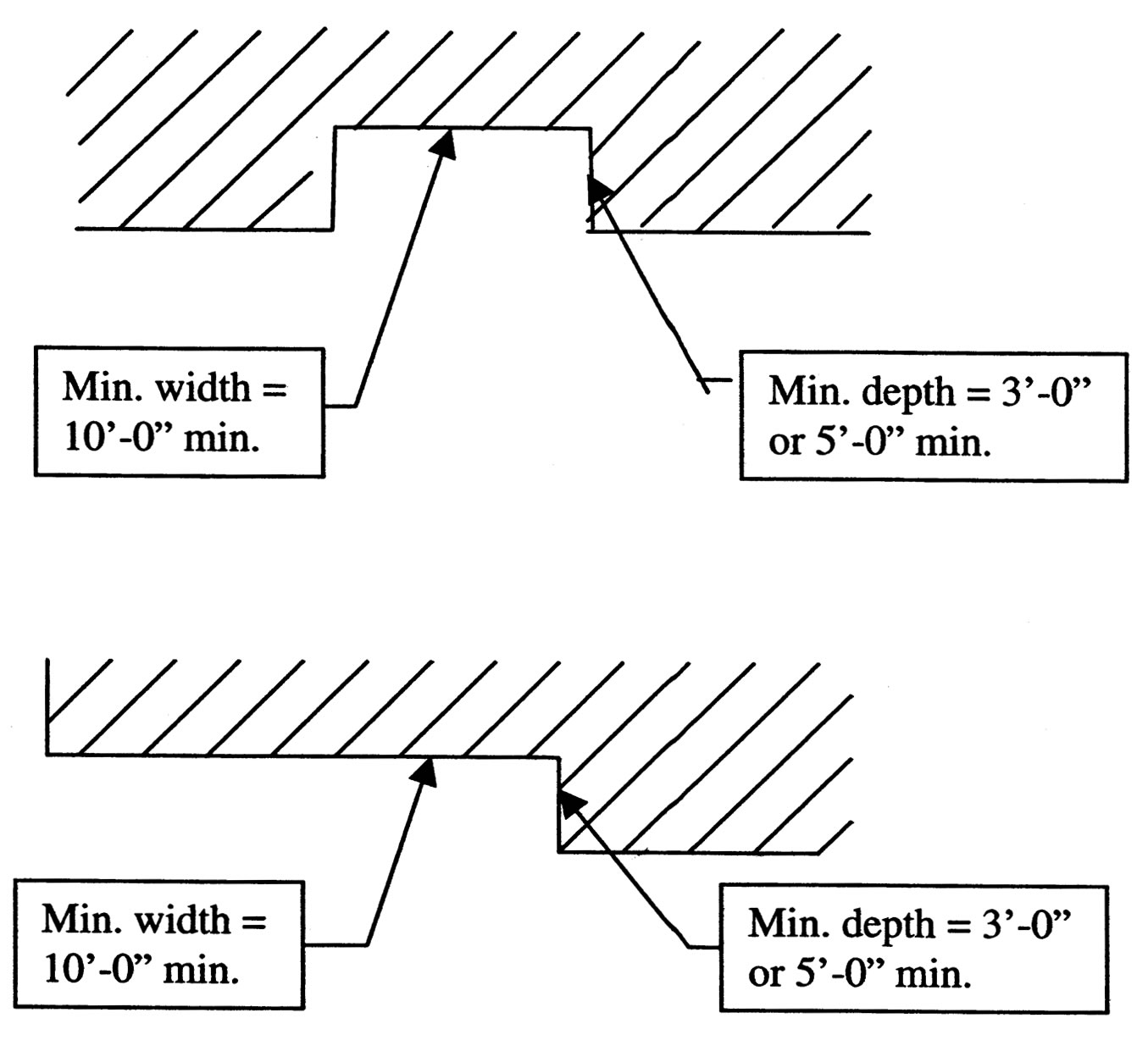
Min. width/Min. depth
(9)
Landscaping: Landscape design needs to be used to soften the architectural forms and incorporate a naturalistic approach, i.e., curvilinear bed lines, plant clusters and/or groupings. Provide two palm trees minimum for every 40 feet of street frontage. The following point system shall be used to determine the landscaping requirements.
a.
The minimum points per acre of buildable area or prorated portion thereof shall be 550. For buildings over 50 feet in height the minimum points per acre of buildable area or prorated portion thereof shall be 650. At least half of the points shall be for trees. When sod is utilized, not more than 25 percent of the points credited shall be for sod.
b.
Of the required points, at least half shall be accumulated with native vegetation.
c.
100 sq. ft. of landscape material shall equal ten points. 100 sq. ft. of sod shall equal five points.
d.
The following point schedules shall be utilized for preserved trees:
e.
The following point schedule shall be utilized for planted trees:
(Code 1979, § 23-22(17); Ord. No. 00-5, § 17, 12-12-00; Ord. No. 2004-5, § 3, 4-12-04; Ord. No. 2004-16, § 1, 10-12-04; Ord. No. 2008-9, § 2, 10-14-08)
Sec. 110-338. - Incentive.
As an incentive to encourage inclusion of the elements of design set forth in section 110-337 into all proposed projects for new construction, substantial improvement or rehabilitation, the following considerations and exceptions may be granted by the town council in approving the site plan for such projects which incorporate all of the elements of design applicable to the project:
(1)
An increase in maximum allowable building height as specified in section 110-322 to a maximum of six stories and 60 feet above the minimum required piling height.
(2)
Up to a 100 percent reduction in accordance with section 110-421(b) in the total minimum off-street parking space requirements specified in section 110-421(a) is authorized when all off-street parking areas, drives, and accesses are designed for joint use by the proposed development and one or more adjacent developments. The following additional conditions must be met:
a.
There must be one or more paved driveway and pedestrian connections between the parking areas of the developments involved. The number, location(s), and design specifications of said driveway(s) must be approved by the planning, zoning, and building committee.
b.
A cross-access and cross-parking agreement, in recordable form acceptable to the town, must be executed by the owners of the developments involved. Said agreement must guarantee the joint use of a specified number of approved parking spaces and one or more driveways providing access to a public right-of-way. Said agreement must run with the land, until such time as each of the developments involved can independently comply fully with the parking space requirements in section 110-421(a). Said agreement shall be recorded by the applicant in the records of the Pinellas County Clerk of the Circuit Court.
(3)
The development of low-income housing by the private sector is also encouraged, and, in addition to the incentives listed in this section, the town council may also reduce or waive permit fees for such development as an added incentive.
(Code 1979, § 23-22(18); Ord. No. 00-5, § 18, 12-12-00; Ord. No. 2008-9, § 3, 10-14-08)
Sec. 110-339. - Coastal construction.
No person shall construct any structure, change or alter any existing structure, excavate or undertake any physical activity likely to have a material physical effect on existing coastal conditions or natural shore and inlet processes seaward of the coastal construction control line as defined in section 110-1.
(Code 1979, § 23-7)
Sec. 110-340. - Shoreline protection.
(a)
Wherever practicable, sand dunes and native vegetation shall be utilized to stabilize shorelines and protect upland areas from flooding hazards. Where seawall construction is necessary or desirable, such seawalls shall be located landward of the coastal construction control line for properties fronting on the Gulf of Mexico, landward of the high-water line for properties fronting on the Intracoastal Waterway, and shall be compatible with seawall construction on adjacent properties in terms of height and setback wherever possible. The planting of native vegetation in front of seawalls to reduce storm wave scour is encouraged.
(b)
If, after beach renourishment, a dune system develops on the beach in the town, a dune preservation zone shall be established to protect primary dunes, which shall address prohibitions on excavations, destruction of native vegetation and activities which affect the natural fluctuation of the dunes.
(Code 1979, § 23-22(19))
Sec. 110-341. - Historical buildings.
The town shall assist property owners in the identification, preservation and protection of historical and architecturally significant buildings and structures and, when possible, assist them in applying for and utilizing available state and federal assistance programs for this purpose.
(Code 1979, § 23-22(20))
Sec. 110-342. - Bicycle and pedestrian facilities.
All projects for the construction or extension of shopping and recreation areas shall contain bicycle parking areas and allow for the safe movement of bicycles and pedestrians on the property. New or substantially improved residential projects exceeding eight residential units shall provide bicycle parking areas for the convenience of tenants and their guests.
(Code 1979, § 23-22(21))
Sec. 110-343. - Recreation projects.
All new recreation projects or uses shall conform to all conservation and preservation requirements of section 90-101. Recreation projects involving the use of public waters shall be coordinated with the county planning council and neighboring communities for conformance to minimum standards of protection of waterways for such uses.
(Ord. No. 93-3, § 5, 7-13-93)
Sec. 110-344. - New residential developments and redevelopments.
New residential developments and redevelopments shall provide for the future recreational needs generated by the developments.
(Code 1979, § 23-22(23))
Sec. 110-345. - Guest units.
(a)
A dwelling unit containing a guest unit will be considered as two separate and distinct residential units for the purpose of determining whether a lot complies with the applicable provisions of the Code concerning the lot's allowable density. The construction of a dwelling unit containing a guest unit will require payment of double the normal tap-in and impact fees that would be paid for a single residential unit. A dwelling unit containing a guest unit will require a minimum of four off-street parking spaces.
(b)
A guest unit is considered a separate and distinct residential unit for the purpose of determining compliance with density, parking, fire separation and other pertinent requirements of this Code.
(Code 1979, § 23-7)
Sec. 110-346. - Use of property for the sale, consumption on premises or distribution of alcoholic beverages.
No property or portion thereof located within the corporate limits of the town shall be used for the sale, consumption on premises or any other activity involving the distribution of any alcoholic beverage without having first obtained all required permits, licenses or approvals for such activity from the town, the county or the state.
(Code 1979, § 23-31)
Sec. 110-347. - Utility and other wires and lines to be placed underground.
On all new or improved structures:
(1)
Overhead or above-ground electrical power supply, telephone lines, cable television and other overhead or above-ground utility and communications services lines, wiring and cables shall not be allowed. Permitting of all new construction or substantial improvement of residential or commercial buildings shall require all wiring to be placed underground.
(2)
Existing overhead and above-ground electrical power supply, telephone lines, cable television lines and other utility and communications services lines, wiring and cables shall be placed underground at the time the provider of the service places its supply and distribution lines underground in the Town of Indian Shores.
(3)
Underground power supply systems shall be installed in accordance with approved engineered drawings as prepared by the electric power utility providing the electrical service, and copy of such drawings to be submitted for approval by the town as a part of permit process.
(4)
"Substantial improvement" as referred to herein shall be as defined in section 110-1 of the Code of Ordinances with the exception that the threshold shall be 25 percent of the fair market value. "Costs" shall be as enumerated in the permit fee schedule as set by resolution of the town council on file in the town clerk's office.
(5)
Property owners electing or required to receive utility or communications services shall provide a location on their property to place underground lines, wiring and cables necessary to service that property and to locate above-ground equipment necessary to service that property. These locations must be acceptable to the companies providing such services and must be accessible for maintenance and repairs. The location of such lines, wiring, cables and equipment will be described in "location drawings" prepared by the companies providing such services. Easements for such lines, wiring, cables and equipment locations may be required.
(6)
When utilities and communications services providers place their distribution lines, wiring, and cables underground, certain modifications to buildings may be required. Property owners electing or required to receive such utility or communications services must allow access to their property and buildings to accommodate the required changes by the utilities and communications services providers or their contractors or provide their own contractors to make required changes that are acceptable to the utilities and communications services providers.
(Ord. No. 94-12, § 1, 6-28-94; Ord. No. 04-8, §§ 1, 2, 5-11-04)
Sec. 110-348. - Special residential developments.
Special residential development allows detached and nondetached dwelling units such as townhouses and single-family cluster developments without adherence to the minimum lot area requirements provided for in the zoning district. The impervious surface ratio and open area of the town Code shall apply to the total subdivision and not to each lot within the subdivision. Open area shall be so distributed as to provide readily available amenities and visual relief to the entire development. A special residential development must meet the following conditions:
(1)
Development shall be on at least 4,840 square feet of contiguous land. The minimum land area for special residential developments may be 4,840 square feet, provided a minimum of 20 percent of the total land area be provided in open area and the maximum lot coverage allowed shall be 50 percent of the buildable area of the lot, minimum lot width at any building setback line, 44 feet.
(2)
Each unit shall have a ground floor entrance.
(3)
The minimum building setback from any lot line shall be as required per section 110-327. Not less than ten feet zero inches shall be required between all structures.
(4)
Such development shall not increase the number of dwelling units, nor, where applicable, the impervious surface ratio allowable in such development by the zoning ordinance.
(5)
No more than two contiguous dwellings shall be built in a row with a common front building line, and the minimum difference in building line setback to provide variation shall be not less than two feet. No contiguous group of townhouse dwellings shall exceed 240 feet in length.
(6)
Each townhouse dwelling structure allowed by this exception shall consist of a building or structure of separate dwelling units designed for or occupied by no more than one household and attached to other similar dwelling units by not more than two party walls extending from the foundation to the roof. Each such dwelling unit shall be provided with cooking, sleeping and sanitary facilities. All single-family cluster houses or townhouse units shall provide at least a full-sized covered or enclosed garage capable of holding two full-sized automobiles, and adequate enclosed space for laundry facilities capable of holding a standard-sized washer and dryer installed side by side, and household storage.
(7)
The development shall provide for concealment of trash containers as provided in section 62-61(c) and (d).
(Ord. No. 94-18, § 1, 9-27-94; Ord. No. 98-1, § 2, 3-11-98)
Sec. 110-349. - Single-family attached dwelling units.
(a)
The side setbacks may be reduced to zero for a dwelling sharing a party wall with another dwelling on the abutting lot.
(b)
A single-family attached dwelling unit shall not be built next to a side yard line without the corresponding single-family attached dwelling being built on the adjacent lot concurrently.
(c)
Windows and doors shall not be permitted in the side of the structure adjacent to the zero lot line except as may be required by building, fire or life safety codes.
(d)
Party wall agreements in the form of restrictive covenants which run with the land to define ownership, use and responsibility for maintenance and use of such party wall must be provided.
(e)
Where party walls are exposed to an abutting lot, a maintenance agreement or a maintenance easement of five feet needs to be recorded.
(f)
Roofs shall not overhang property lines without the recording of maintenance easements of the minimum of five feet. Drainage from the roof overhang shall be directed onto the lot and not discharged into the easement.
(g)
Utility services to each unit shall be separately metered.
(h)
Utilities run on private property crossing lot lines shall be run in a common private utility easement ten feet wide.
(Ord. No. 2004-17, § 1, 10-12-04)
Sec. 110-350. - Pedestrian and vehicle overpasses prohibited.
(a)
The Town Council of the Town of Indian Shores finds that the Town of Indian Shores is located in a coastal high hazard area subject to hurricanes and other wind and water storm events which may necessitate the emergency evacuation of citizens and that structures such as pedestrian and vehicle overpasses built over rights-of-way in the town will increase the possibility of structural damage which could block or impede evacuation efforts and the response of emergency personnel and vehicles. The town council also finds that structures such as pedestrian and vehicle overpasses built over rights-of-way in the town will be detrimental to the appearance and esthetics of the town and have a negative impact upon the property values of nearby properties.
(b)
No person shall construct or permit to be constructed a structure, including pedestrian and vehicle overpasses, over rights-of-way within the Town of Indian Shores. This prohibition does not apply to the State of Florida or to governmentally approved traffic control devices and signage.
(Ord. No. 2006-12, § 1, 9-11-06)
Sec. 110-351. - Medical marijuana treatment center dispensing facilities.
(a)
Prohibition. Medical marijuana treatment center dispensing facilities are prohibited and shall not be located within the boundaries of the town. The town shall not accept, process or approve any request or application for a development order, building permit or other approval associated with a proposed medical marijuana treatment center dispensing facility.
(b)
Definition. For the purposes of this section, the term "medical marijuana treatment center dispensing facility" means any facility where medical marijuana or any product derived therefrom is dispensed at retail.
(c)
Interpretation. This section and the terms used herein shall be interpreted in accordance with F.S. § 381.986 and Chapter 64-4 of the Florida Administrative Code. The intent of this section is to ban medical marijuana treatment center dispensing facilities from being located within the boundaries of the town as authorized by F.S. § 381.986(11).
(Ord. No. 2017-04, § 2, 12-12-17)
Sec. 110-366. - Compliance.
All uses of any property located in any zoning district within the corporate limits of the town shall comply with the standards of performance in this division.
(Code 1979, § 23-26)
Sec. 110-367. - Enforcement.
Where, in the opinion of the planning, zoning and building committee or its authorized representative, there is a probable violation of this division, the committee or its authorized representative may employ a qualified technician to make such tests and take such measurements as may be necessary to determine whether or not there has been or is in fact a violation of this division. Upon confirmation of a violation, the offender, in addition to all other sanctions and penalties as may be otherwise provided by this chapter, shall bear the cost incurred by the town in retaining the qualified technician.
(Code 1979, § 23-26(9))
Sec. 110-368. - Noise.
The creation or dissemination of noise within the corporate limits of the town shall be subject to the requirements and limitations of section 34-81 et seq. pertaining to noise.
(Code 1979, § 23-26(1))
Sec. 110-369. - Smoke.
No smoke from whatever source may be emitted if the smoke is of a density equal to or greater than that density described as no. 2 on the Ringelmann Chart, published by the U.S. Bureau of Mines. (Powers' Micro-Ringelmann Chart, McGraw-Hill Publishing Company, 1954, may be used.)
(Code 1979, § 23-26(2))
Sec. 110-370. - Odors.
No continuous, frequent or repetitive emission of odors or odor-causing substances which would be offensive at or beyond any property line of any industrial use is permitted. An odor emitted for a period of not more than 15 minutes on any one day for not more than two days in any calendar month shall not be deemed as continuous, frequent or repetitive within the meaning of this section. The existence of an odor shall be presumed when the concentration of the odor-causing substance in the air at any point at or beyond the property line of the emitting use exceeds the lowest concentration listed as the odor threshold for such substance or substances in table III (odor thresholds) appearing in chapter 5 of the Manufacturing Chemists Association's Air Pollution Abatement Manual, copyright 1952, as subsequently amended.
(Code 1979, § 23-26(3))
Sec. 110-371. - Toxic and noxious matter.
No emission which would be demonstrably injurious to human health, animals or plant life is permitted. Where a use could produce such emissions as a result of accident or equipment malfunction, adequate safeguards considered standard for safe operation of the use involved shall be taken.
(Code 1979, § 23-26(4))
Sec. 110-372. - Radiation hazards.
The handling of radioactive materials, the discharge of such materials into air and water and the disposal of radioactive wastes shall be in conformance with the applicable regulations of the Nuclear Regulatory Commission.
(Code 1979, § 23-26(5))
Sec. 110-373. - Glare and heat.
Any operation producing intense glare or heat shall be performed within an enclosure so as to completely obscure such operation from view from any point along the property line, except during the period of construction of the facilities to be used and occupied.
(Code 1979, § 23-26(6))
Sec. 110-374. - Fly ash, dust, fumes, vapors, gases, noxious odors and other forms of air pollution.
No emission is permitted which can cause damage to health, animals, vegetation or other forms of property or which can cause any excessive soiling at any point. In no event may any emission from any chimney or other source of any solid or liquid particles in concentrations exceeding 0.3 grains per cubic foot of the conveying gas or air at any time be permitted. Particle concentrations shall be measured at the point of emission.
(Code 1979, § 23-26(7))
Sec. 110-375. - Floodlighting.
All exterior floodlights, spotlights, pole lights, yard lights and parking lot lights shall comply with the requirements and limitations of section 34-112(14).
(Code 1979, § 23-26(8))
Sec. 110-396. - Intent.
The purpose and intent of this division is to establish maximum heights for fences, walls and hedges located within the town, and particularly in the north-south direction to preserve the view of the Gulf beaches and the inland waterway for residents and guests of the community.
(Code 1979, § 23-27(1))
Sec. 110-397. - Permit required.
A building permit must be obtained before any fence or wall may be installed or erected. Before a building permit is issued, the applicant shall submit a sealed drawing or plan showing, as appropriate, the location of the proposed structure in relation to existing or proposed buildings on both the same lot and adjacent lots, the coastal construction control line and Gulf Boulevard. The type or design of the structure and the materials to be used shall also be provided.
(Code 1979, § 23-27(3))
Sec. 110-398. - Measurement.
For the purposes of this division, the height of any fence, wall or hedge shall be measured from the natural contour of the ground on which it is erected or planted.
(Code 1979, § 23-27(2))
Sec. 110-399. - Maximum heights.
(a)
Maximum heights for fences shall be as follows:
(1)
Interior or nonwaterfront lots. The maximum height of any fence, wall or hedge located upon a lot, no side of which borders upon Boca Ciega Bay or the Gulf of Mexico, shall be six feet.
(2)
Gulffront or bay front lots. It being the intent of the town to preserve to the owners of waterfront property the view incident to such ownership, the maximum height of fences, walls and hedges located on such property shall be as follows:
a.
On or near lot lines which border the coastal construction control line or seawall or water line, the maximum height shall be three feet, except that a four-foot chainlink or any other four-foot open style fence may be erected if the topmost one foot thereof is unobstructed by vegetation or other material that obstructs vision.
b.
On or near lot lines running east and west:
1.
The maximum height shall be six feet, except that the portion of the fence, wall or hedge in the vicinity of Gulf Boulevard shall be only three feet if the four-foot height restricts anyone's vision of approaching traffic on Gulf Boulevard. The necessary distance of height reduction shall be determined by the town's chief of police and approved by the planning, zoning and building committee.
2.
On the portion of the fence in the vicinity of the coastal construction control line or seawall or water line, the maximum height shall be four feet except that any portion of the fence, wall or hedge shall be only three feet if it restricts the adjacent property owner's view of the Gulf of Mexico or Boca Ciega Bay. The distance the fence is limited to a height of three feet shall be 18 feet from the coastal construction control line.
(3)
The maximum height of any fence, wall or hedge which borders Gulf Boulevard shall be four feet except that a reduction to three feet shall be required if the fence, wall or hedge restricts anyone's vision of approaching traffic on Gulf Boulevard.
(4)
The restriction reducing height to three feet on or near any lot line shall not apply to chainlink or any other four-foot open style fences if the topmost one foot thereof is unobstructed by vegetation or other material that obstructs vision.
(5)
The maximum height of any fence, wall or hedge at a location or with an orientation, other than as described in this section, shall be six feet, unless there is an obstruction to the adjacent property's view of the water or to anyone's view of approaching traffic on Gulf Boulevard.
(6)
Notwithstanding any sections of this division, where any two fences border any two streets which intersect, the height of each fence shall be reduced from that authorized to whatever is necessary to allow for unobstructed crossvisibility of approaching pedestrian and vehicular traffic.
(7)
A chainlink type fence to enclose an active construction site with an open building permit may be erected to a maximum height of six feet above surrounding grade for a period not to exceed six months when approved by the building official with the further provision that such fence is to be removed prior to the completion of the project or the issuance of a certificate of occupancy. Upon expiration of the permitted time period, the permit may be extended by the building official if in his opinion such extension is necessary or desirable for the protection of the public or the completion of the project. A chainlink type fence to enclose a construction site may be required at the discretion of the building official for the protection of the public.
(8)
A construction site entrance gate shall be set back sufficiently from the property line or roadway to allow a large semi-tractor with a 40-foot trailer to negotiate a turn onto the construction site without having to cross the roadway centerline into on-coming traffic.
(b)
Swimming pool fence:
(1)
Every outdoor swimming pool, outdoor spa and outdoor permanent wading pool shall be completely surrounded by an appropriate fence not less than four feet in height for all pools, commercial and residential. A building, existing wall or screen enclosure may be used as a part of such enclosure.
(2)
All gates or doors opening through such enclosure shall be of self-closing and self-latching construction and shall be designed to permit locking. The releasing device for the latch shall be located no less than 54 inches from the bottom of the gate, the device release mechanism may be located on either side of the gate and so placed that it cannot be reached by a young child over the top or through any opening or gap from the outside.
(3)
These requirements shall apply to both new and existing outdoor swimming pools except the owners of existing outdoor swimming pools shall be given a reasonable period, not to exceed 90 days from the effective date of this section, in which to comply. No person in possession of land within the Town, either as owner, purchaser, lessee, tenant or licensee, upon which is situated a swimming pool shall fail to provide and maintain such fence or wall as here in provided.
(Code 1979, § 23-27; Ord. No. 93-3, § 9, 7-13-93; Ord. No. 94-19, § 1, 12-13-94; Ord. No. 96-1, § 4, 4-9-96; Ord. No. 03-3, § 8, 6-10-03; Ord. No. 2004-16, § 1, 10-12-04; Ord. No. 2004-18, § 1, 11-9-04; Ord. No. 2006-3, § 1, 3-15-06)
Sec. 110-421. - Minimum parking spaces required.
(a)
Off-street parking for motor vehicles shall be provided in accordance with the following table:
TABLE OF MINIMUM PARKING SPACES REQUIRED TABLE INSET:
Footnotes
RESIDENTIAL PARKING SPACES REQUIRED
(1)
One and one-half parking spaces shall be provided for each efficiency unit or a one bedroom apartment.
(2)
Two parking spaces shall be provided for each single family house or a unit with two or more bedrooms or a one bedroom and a den or study. Accessible parking spaces shall be provided as per the Florida Building code, the Fair Housing Code and the American Disabilities Act.
(3)
In addition to the above, multiple-family buildings shall be required to provide guest parking spaces as per the following table. The spaces shall be collectively provided, identified, and centrally located and continuously maintained as guest parking.
(4)
Guest parking spaces:
(b)
The number of parking spaces required for mixed-use developments or redevelopments may be adjusted to reflect the actual peak demands for off-street parking according to accepted time-of-day and day-of-week factors applicable to each separate use as shown in the table below. If a use requested does not appear in the table a developer/owner may submit a parking study, prepared and certified by a licensed traffic engineer, to verify the hourly total parking demands for all uses, both on weekdays and weekends. The maximum hourly total demand shall determine the number of parking spaces required for the development. Any subsequently proposed change in land use categories, or proportions thereof, within the development shall be grounds for the requirement of an updated parking study and proof of sufficient parking prior to issuance of a development permit. In the absence of a parking study as described above, the total parking requirement for a mixed-use development shall be the sum of required parking spaces for each respective use computed separately in accordance with this chapter.
REPRESENTATIVE HOURLY ACCUMULATION BY PERCENTAGE OF PEAK HOUR
(c)
The number of required off-street parking spaces may not be reduced unless the use which the parking spaces serve is changed in accordance with the specifications of this chapter to another use requiring fewer parking spaces or as may be specifically authorized by the town council in approving a project's site plan under the guidelines set forth in section 110-337 and section 110-338.
(d)
The number of parking spaces required for any use not specifically mentioned in the table in this section shall be the number required for the most nearly similar use that is mentioned.
(e)
Parking spaces shall be reserved for the sole use of the occupants and visitors of the building or lot which the parking spaces serve, unless they are subject to a cross-parking agreement pursuant to subsection 110-338(2). Where a non-residential development cannot meet all of its parking requirements on-site or through a joint parking arrangement with an adjacent development, off-premises parking on a noncontiguous non-residential property may be authorized by the planning, zoning, and building committee, subject to subsection 10-421(b) and the following conditions:
(1)
No more than 30 percent of the minimum parking space requirement for any nonresidential development may be satisfied by the use of off-premises noncontiguous non-residential parking areas.
(2)
The availability of the off-premises parking areas must be guaranteed, by virtue of common ownership with the premises served, recorded easements, or other binding agreements acceptable to the town, until such time as the premises served can independently comply fully with the parking space requirements in subsection 110-421(a). Said easements or agreements may not create any conflicts with any other claims upon the use of the off-premises parking areas, all of which shall be fully disclosed to the planning, zoning and building committee during its review.
(3)
The off-premises parking areas must be located within convenient walking distance (no more than 500 feet) of the premises served, said distance to be measured along paved public rights-of-way and/or sidewalks from the entrance driveway into the parking area to the entrance driveway into the premises served.
(4)
The off-premises parking areas shall comply with the design standards of subsection 110-422(d).
(f)
If any computation of parking space requirement as set forth in this division results in a number containing a fraction, that fraction may be dropped if it is less than one-half in value. A fraction of one-half or more in value shall be counted as one parking space.
(g)
Loading space shall be provided for all business or commercial occupancies and shall be of sufficient size to negate the necessity of customer off-street parking spaces being used by delivery vehicles during regular business hours. No loading or unloading operations shall be permitted between the hours of 9:00 p.m. and 7:00 a.m.
(Code 1979, § 23-28(1); Ord. No. 93-2, § 1, 1-12-93; Ord. No. 94-8, §§ 1—3, 3-9-94; Ord. No. 00-5, §§ 19, 20, 12-12-00; Ord. No. 03-4, § 1, 9-10-03; Ord. No. 2006-9, § 1, 6-13-06; Ord. No. 2016-02, § I, 6-14-16)
Sec. 110-422. - Location of parking spaces.
(a)
Parking spaces for all dwellings shall be located on the same lot as the principal building. An adjoining lot, not used for any other purpose, may be utilized for all or any portion of the required parking spaces, provided the property on which the building is located and the property on which the parking spaces are located have all of the following:
(1)
The same owner;
(2)
A jointly shared lot line; and
(3)
Their location on the same side of Gulf Boulevard or any town street.
(b)
Parking spaces serving other than residential uses shall be located on the lot served by the parking spaces or not more than 500 feet along paved public rights-of-way and/or sidewalks from the entrance driveway into the parking area to the entrance driveway into the premises served, and all such parking spaces shall comply with the following:
(1)
The availability of the off-premises parking areas shall be guaranteed as specified in subsection 110-421(e)(2) above.
(2)
The off-premises parking areas must be clearly identified as reserved parking space for the premises served.
(3)
The off-premises parking areas must meet all of the requirements for the location, construction and design of parking spaces as specified in this division.
(c)
No part of any parking space may be located within five feet of any lot line or within five feet of any street, right-of-way or alley, with the exception of those lots with lot lines bordering Gulf Boulevard (SR 699), which may not be located within ten feet of the Gulf Boulevard right-of-way.
(d)
All off-street parking areas shall be designed, constructed, and maintained in accordance with the following:
(1)
Off-street parking spaces shall be so designed and be of such size that all vehicle maneuvers can be accomplished within the parking area, and no vehicle is required to back into a public right-of-way in order to leave the parking area. Drive aisle width shall be determined by the angle of the parking spaces, in accordance with the parking geometrics table following this section.
(2)
Parking area signage and pavement markings shall meet the standards set forth in the Federal Highway Administration Manual on Uniform Traffic Control Devices, as amended. The parking plan must be so arranged that each vehicle may be placed and removed from the property without the necessity of moving any other vehicle to complete the maneuver, except for valet parking, single-family, duplex and enclosed garages.
PARKING GEOMETRICS
Parking geometrics for all other parking angles shall be calculated in proportion to the geometrics shown on the table.
Each parking space shall be a visibly designated and marked stall, adequate for occupancy by one vehicle. The minimum dimensions of parking spaces and drive aisles, and the minimum required number of handicap spaces, shall be shown on the parking area layout diagram, unless a reduction in size (regular spaces only) is specifically authorized by the town council in approving a project's site plan under the guidelines set forth in section 110-337 and section 110-338. In the case of an unpaved parking area, each space shall be provided with a wheel stop or other approved means of restraint (logs, railroad ties, etc.), with each space clearly marked to ensure the full designated parking area capacity and proper parking control. In all cases, handicap parking spaces must be paved and shall meet the design, location, and accessibility requirements of F.S. §§ 553.501—553.513.
(2)
Covered parking lots shall be located behind or to the side of the building. For building lots that have double street frontage the parking areas shall be located away from pedestrian and bicycle oriented streets so that access to the structure can be gained by pedestrians or bicycles without traveling through a parking area. When no other pedestrian access is available to the main building entrance pedestrians must be accommodated by continuous landscaped walkways, where feasible, distinguished from driving surfaces by separate paving materials. Sidewalks crossing driveways must be maintained as continuous, unbroken by driving surfaces such as asphalt extending from parking areas.
(3)
Any off-street parking area providing more than four parking spaces shall be so constructed as to provide a durable, stabilized and dustless surface.
(4)
Any off-street parking area providing parking spaces shall be so designed and graded as to provide for the drainage of surface water in accordance with the requirements of chapter 86 article III of this Code.
(5)
Any off-street parking area shall be beautified and landscaped in accordance with this chapter.
(6)
Any artificial lighting used to illuminate any part of an off-street parking area shall be directed away from any adjoining lots which contain residential units and shall be directed so as not to become a nuisance or a hazard to vehicular traffic on adjacent rights-of-way.
(7)
Nothing in this division shall be interpreted to permit the indiscriminate use of undeveloped or vacant property within the town for the parking or storage of vehicles of any type, and such use is expressly prohibited. However, short-term parking, not exceeding 24 hours, for a special occasion may be approved on a vacant lot upon notification to and approval by the police department.
(Code 1979, § 23-28(2); Ord. No. 98-2, § 2, 5-12-98; Ord. No. 00-5, §§ 21, 22, 12-12-00; Ord. No. 03-4, § 2, 9-10-03; Ord. No. 2016-02, § II, 6-14-16)
Sec. 110-423. - Bicycle parking.
Bicycles are a clean, energy-efficient, alternative means of transportation, especially for those whose access to motorized transportation is limited. The use of bicycles is also a preferred mode of transportation within the Indian Shores Town Square area. Therefore, it is the policy of the town to encourage the use of bicycles within the town square area by requiring that development and redevelopment provide adequate and properly located bicycle parking facilities, in accordance with the following standards:
(1)
Within the Indian Shores Town Square area, each non-residential or multifamily residential development of eight units or more or redevelopment which requires site plan approval shall provide a minimum of 50 square feet of off-street bicycle parking, sufficient to park at least five bicycles, for each freestanding building. The town council shall have the option of increasing this requirement as a condition of site plan approval, based upon the demand characteristics of the specific development under review. This minimum requirement shall also apply to any public parking area constructed and/or operated by the town. Only the following types of development shall be exempt from this requirement:
a.
Residential development of less than eight units.
b.
Freestanding uses which require the presence of motor vehicles, such as automobile or motorcycle repair shops, filling stations, body repair shops, and similar uses, provided, however, that should the occupancy of a building change to a non-exempt use, bicycle parking facilities may be required as a condition of re-occupancy. Shopping centers and other multiple-tenant developments which may contain the above uses are not exempted.
(2)
The following design standards shall apply to all bicycle parking facilities:
a.
Bicycle parking facilities shall be separated from automobile parking, conveniently located near the main entrance of a building without obstructing pedestrian walkways, and sufficiently visible to minimize the potential for theft or vandalism.
b.
Bicycle parking facilities shall be placed over paved or otherwise stabilized surfaces not subject to erosion or rutting.
c.
Each bicycle parking space shall provide sufficient area to store a full-sized bicycle, and a rack or other means to support and lock the bicycle in a stable, upright position without damage to wheels, frame, or components.
(3)
For each five bicycle parking spaces provided in addition to the minimum requirements, and in accordance with the design standards, set forth above, one regular vehicle parking space may be deducted from the minimum number otherwise required.
(Ord. No. 00-5, § 23, 12-12-00; Ord. No. 03-4, § 3, 9-10-03)
Sec. 110-441. - Intent.
The purpose of this division is to preserve, protect and improve the appearance and value of property within the town and to improve the compatibility of adjacent land uses therein.
(Code 1979, § 23-29(1))
Sec. 110-442. - Required.
A landscape plan shall be submitted for approval before an application for a building permit will be considered. All landscape plans will incorporate the planting of flowers, shrubbery and trees, excluding Australian pine, punk and Brazilian pepper trees, along the entire side of each residential and business structure bordering Gulf Boulevard and each town street. The elements of a landscape plan will not cause a safety hazard to other buildings or vehicular traffic, nor will a landscape plan contribute either to erosion of the topsoil layer of a lot or to unauthorized drainage of water from the property.
(Code 1979, § 23-29(2))
Sec. 110-443. - Maintenance of landscaping.
The owner, tenant and their agent, if any, shall be jointly and severally responsible for the continued maintenance of all landscaped areas which shall be maintained in good condition so as to present a healthy, neat and orderly appearance and shall be kept free from refuse and debris. A water supply shall be provided for all landscaping and in no case shall any landscaped area not sprinklered be more than 60 feet from a water supply hose bib.
(Code 1979, § 23-29(3))
Sec. 110-444. - Landscaping property adjacent to street intersections.
Where any two contiguous lot lines of landscaped property lie adjacent to any two streets which intersect, all landscaping on that property shall be no higher than whatever height is necessary to allow for unobstructed cross-visibility.
(Code 1979, § 23-29(4))
Sec. 110-445. - Species used.
Wherever possible, landscaping and planting should utilize native species indigenous to the area, and for waterfront properties salt-tolerant species should be used wherever practicable.
(Code 1979, § 23-29(6))
Sec. 110-446. - Planting parallel to Gulf Boulevard.
Planting parallel to Gulf Boulevard is encouraged to improve the aesthetic appearance of the town and to help offset the effects of automotive emissions; however, the height of such plantings, other than spaced trees, should be maintained at a height no greater than three feet above grade to preserve the view of the Gulf of Mexico from passing vehicles and to prevent interruption of minimum vehicular sight distance for vehicles exiting from driveways onto Gulf Boulevard.
(Code 1979, § 23-29(7))
Sec. 110-451. - Definitions.
As used in this division, sections 110-451 through section 110-465, the following terms shall have the definition indicated:
Antenna means any outdoor apparatus designed for telephonic, radio, or television communications through the sending or receiving of electromagnetic waves (see also WCA).
AGL means above ground level measured from the base of the structure.
BFE means base flood elevation.
Co-locating/co-location means:
(1)
The siting, location or attachment of more then one antenna/WCA or antenna/WCA array to a single tower/WCSF: or
(2)
The siting or location of multiple telecommunication technologies on a single tower/WCSF.
FAA means Federal Aviation Administration.
FCC means Federal Communications Commission.
Height means the distance measured from ground level to the highest point on the tower or other structure, even if the highest point on the tower or structure is an antenna.
Host means an existing structure (i.e., such as a light pole, building, water tower, or other elevating device) or tower physically capable, in accordance with the terms of the Code, of providing a siting for the broadcast or reception equipment of the provider.
PZBC means the town's planning, zoning and building committee.
Provider means any independent entity which is marketing a wireless communications service to any customer, or which is traversing, or emplacing in the town, wireless communication service appurtenances for the commercial offering of such service.
For the purposes of determining the number of providers co-locating, no two providers shall have any common ownership, corporate or affiliate, legally recognized as a business association, or as a contract or subcontract for providing the same service.
Tower means any structure that is designed and constructed primarily for the purpose of supporting one or more antennas, greater than 25 feet AGL in height including the antennas, including self-supporting lattice towers, guy towers, or monopole towers. The term includes radio and television transmission towers, microwave towers, common carrier towers, cellular telephone and PCS towers, alternative tower structures and the like.
Town property means real property owned by the town and zoned institutional.
Wireless communication antenna ("WCA") means an antenna and supporting electrical and mechanical equipment at a fixed location used for the transmission or reception building or cabinet of wireless communication signals.
Wireless communication support facility ("WCSF") means a monopole, guyed, or lattice type tower greater than 25 feet in height including the antenna, designed for the attachment of or as support for wireless communication antennas or other antennas, and the associated control equipment or other housed freestanding control center necessary to operate the WCSF in the area of the WCSF.
(Ord. No. 97-4, § 1, 11-6-97)
Sec. 110-452. - Purpose.
The purpose of this division is to establish general guidelines for the siting of WCAs and WCSFs. The goals of this section are to prohibit the location of WCSFs in residential areas; to limit WCSFs to property zoned institutional or transportation/utility and located east of Gulf Boulevard and to promote the placement of provider WCSFs and WCA thereon; to minimize the total number of towers in the town; to allow the use of existing structures to support provider WCAs as an alternative to new tower construction in appropriate zoning districts; to encourage the joint use of towers through co-location of antennas; and to encourage the design and construction of WCAs and WCSFs which minimize the adverse visual impacts while enhancing the ability of wireless telecommunications services to provide such services within the town quickly, effectively, and efficiently.
(Ord. No. 97-4, § 1, 11-6-97)
Sec. 110-453. - Applicability.
This division shall apply to all telecommunication service provider WCSFs and WCAs utilized to provide commercial telecommunications services. WCAs and WCSFs installed and maintained in accordance with this division are exempt from the height limitations for buildings and structures set forth elsewhere in the Code. The requirements set forth in this division shall govern the height of WCAs and WCSFs. The installation of a WCA on a building which is nonconforming in terms of current height or use limitations (i.e., the building is grandfathered in the current zoning district) shall not be deemed to constitute the expansion of the nonconforming use.
(Ord. No. 97-4, § 1, 11-6-97)
Sec. 110-454. - Personal use WCAs, generally.
Radio antennas operated by a federally licensed amateur radio station operator, town communication uses including those antennas used exclusively for dispatch communications by public emergency agencies, and personal use antennas attached to a dwelling or private business which are designed and used by the occupants and are unrelated to the provision of commercial communications services are exempt from the provisions of this division.
(Ord. No. 97-4, § 1, 11-6-97)
Sec. 110-455. - Provider facilities, generally.
Provider WCSFs shall be prohibited in all areas within the town except upon property zoned either institutional or transportation/utility east of Gulf Boulevard. Provider WCSFs are established as uses requiring development review and approval, and will not be approved unless the specific criteria set forth in sections 18-57 through 18-60, and the requirements of Chapter 110 of the Code, can be demonstrated. Provider WCSF towers are limited to a monopole design, shall not exceed 160 feet AGL in total height, including any WCA placed thereon. The town encourages the use of functional or design types such as stealth "palm tree," "flagpole," "lighting standard" (i.e., a street light) or other such design where appropriate with surrounding uses.
(Ord. No. 97-4, § 1, 11-6-97)
Sec. 110-456. - Application content and review procedures; determination of need.
Pre-application conferences with the town building official are required to determine need and so that the town building official can advise the applicant of the specific location(s) where a WCA or WCSF can be located, given the applicant's intended construction plans and locational needs.
Once the town building official and the applicant have agreed on a specific location for the proposed WCA or WCSF, then the applicant can begin preparing its application. However, all final decisions regarding location will rest with the town's PZBC. As part of the application process to construct a provider WCA or WCSF, the applicant must demonstrate that:
(1)
Existing towers, structures, or sites where a WCA or WCSF could be placed, including those extra-jurisdictional to the town, are not of sufficient height or in the required geographic area to meet applicant's engineering requirements.
(2)
Existing towers or structures, including those extra-jurisdictional to the town, do not have sufficient structural strength or other physical capacity to support the applicant's proposed antenna and related equipment.
(3)
The applicant's proposed antenna would not cause electromagnetic interference with or would be interfered with by other antennas if placed on existing towers or structures including those extra-jurisdictional to the town.
(4)
It is not financially feasible to modify or replace existing towers or utilize existing structures including those extra-jurisdictional to the town to accommodate the proposed antenna because no entity will allow co-location and/or modification under commercially reasonable terms.
(5)
The applicant demonstrates that there are other limiting factors that render existing towers, structures and sites, including those extra-jurisdictional to the town, unsuitable.
(6)
As part of the demonstration, for any tower that would not fall subject to one of the limiting factors presented above, the applicant shall submit an inventory of all towers or suitable sites located within one mile of the town's jurisdictional boundary, and by demonstration of response, whether the owner of any such tower will allow co-location. Thus, the applicant shall have demonstrated the limiting factors, or refusal, for each such tower.
(Ord. No. 97-4, § 1, 11-6-97)
Sec. 110-457. - Construction plans and engineering drawings.
Applications for a WCSF on property zoned institutional or transportation/utility and located east of Gulf Boulevard shall consist of a site plan and other documents as necessary to demonstrate compliance with the following technical criteria:
(1)
No WCSF shall exceed 160 feet AGL in height, including antennas and lightning rods, and all WCSFs shall be designed for co-location of at least three WCA. All WCSFs on town property shall host all requested uses deemed necessary by the town for town purposes that do not interfere, from an engineering or technical standpoint, with the provider's service; within 30 days after the pre-application conference, the town shall advise the applicant of what town uses the applicant is expected to accommodate.
(2)
The site plan shall demonstrate that any proposed tower and its supporting accessory equipment structures shall be a neutral, non-glare color or finish, so as to reduce visual obtrusiveness, as well as a legal description of the leased site, set backs, building foot print, fence, landscaping, tower footprint, height, required utilities, finished floor elevation, flood zone, zoning district, building site, etc.
(3)
Towers and their accessory facilities shall be set back from existing residential uses a distance no less than 50 feet. The distance shall be measured from the base of the tower to the residential property line.
(4)
WCSF towers shall be enclosed by properly grounded security fencing with a locked gate of design deemed appropriate by the town, all not less than eight feet in height, and shall also be equipped with an appropriate anti-climbing device. In addition, to the extent that high voltage or other dangers exist in the area of the WCSF, the fencing shall have signage so indicating. Finally, any such enclosure shall have attached to it in a conspicuous place a sign upon which is indicated the name, address and telephone/telecopy number of whom to contact in an emergency.
(5)
WCSFs and WCAs shall be constructed in compliance with all applicable local, state and federal construction codes.
(6)
WCSF and WCA shall comply with all applicable FAA and FCC requirements.
(7)
If deemed appropriate by the building official, WCSFs may be required to have a landscaped buffer external to the fencing, so that the base of the WCSF and accessory equipment storage area and all other electrical appurtenances shall be screened from any right-of-way, residential use or residential zoning district. Such landscaped buffer shall be placed on the site in a manner which will maximize the aesthetic and environmental benefits while at the same time providing the visual buffer required hereby. Such landscaped buffer shall consist of hedges planted leaf-to-leaf which shall reach a height of not less than eight feet at maturity and shade trees of at least three inches diameter at breast height, planted every 20 feet along the approved buffer if such buffer is deemed necessary by the town. Such buffering and screening, including fence type and design, shall be constructed on the subject property in areas directed by the town of a design deemed appropriate by the town.
(8)
All buffer landscaping shall be of the evergreen variety.
(9)
All landscaping shall be drought tolerant (xeriscape plantings) or irrigated, and properly maintained to ensure good health and viability.
(10)
WCSF construction shall be of monopole design.
(11)
The application shall contain all required engineering drawings of the proposed WCSF or WCA sealed by a professional engineer with appropriate Florida license, stating that the design has the required structural integrity, is properly grounded, and will withstand the wind forces and other forces of nature anticipated at the specific location.
(12)
The applicant shall provide such performance financial assurances in place for the life of the tower as the town may reasonably require which shall ensure the payment of the cost of removal of the WCSF if abandoned, including footings and foundations, unless granted relief by the town. Failure to maintain such financial assurance shall be deemed as having been abandoned and the town shall take such actions as required by section 110-465, of the Code.
(13)
One unmanned communication equipment building or structure not more than 240 square feet may be constructed for each communication service provider that co-locates one or more antennas on a tower site, height not to exceed 12 feet above BFE.
(14)
Communication towers shall not be artificially lighted or illuminated except as required for public safety purposes, or by the FAA.
(15)
No signage shall be allowed on any tower except as required for public safety purposes, by the FCC or as otherwise set forth in this division.
(16)
All applicants shall provide documentation that the proposed facilities do not exceed radiation standards of the FCC.
(17)
All applications shall include a written description and graphic of the geographic service area of each antenna on the tower.
In addition to the application content described in this division, the provisions of sections 18-57 through 18-60 of the Code shall apply. In preparation of the report on the application, the town building official shall be responsible for determining whether any conflicts between the application content set forth in sections 18-57 through 18-60 and those set forth in this division apply. In the case of a conflict, the requirements of this division shall control. Identified conflicts shall be duly noted.
(Ord. No. 97-4, § 1, 11-6-97)
Sec. 110-458. - Mutual agreement including conditions and fees for provider; use of town property for provider WCSFs and WCAs, and co-location responsibility.
All applications for a provider WCA or WCSF on town property shall include the offering of a written agreement between the town and the applicant for the use of the town property, and shall also set forth terms, negotiated or to be negotiated in good faith that:
(1)
Cover construction, access, insurance, compliance with the Code, risk of loss, easements, terms and conditions of future co-location including a good faith commitment to offer and accommodate same upon reasonable terms to the provider and to the town, a lease which includes the term of the agreement, rents and timing of payments, the emergency contact and emergency procedures, remedial procedures if interference results to any broadcast or reception, and removal or dedication.
(2)
The applicant/provider shall be solely responsible for the cost of construction and maintenance of any WCSF, WCA and all supporting facilities and connections built on town property, including the initial placement and installation of any WCAs deemed necessary by and provided to the applicant by the town for governmental use in the provision of governmental services.
(3)
The town shall charge a rental fee to an approved applicant for the use of the applicable town property. The monthly rental fee shall be determined solely within the discretion of the town, but shall be reasonable.
(4)
Providers shall pay any appropriate occupational tax.
(5)
Upon the termination of the agreement or abandonment by the provider, the town shall have the right, but not the obligation, to purchase or accept by dedication the WCSF, exclusive of the provider's electronics, antennas and technology, unless the terms of the lease provide otherwise.
(6)
Any WCA or WCSF, except town-owned WCAs placed thereon, shall be deemed to be the personalty of the provider.
(7)
The applicant will, upon the completion of construction, submit construction as-builts for review by a professional engineer licensed in Florida, who shall certify that the WCA or WCSF was constructed in accordance with the design, and that it meets all applicable engineering and safety standards. The applicant shall be responsible for this cost.
(8)
The applicant shall release the town from, and indemnify the town against, any and all injuries, damages or other claims arising out of the existence of the WCSF or WCA on town property, or the use of town property by the provider for the WCSF or WCA.
(9)
The applicant agrees in good faith to cooperate with any interested person who inquires to the town or to the applicant regarding the joint construction of a WCA or WCSF, and to accommodate any prospective provider who requests co-location on a WCSF, either during the application process, during or subsequent to any approval, or during the period in which the applicant has any financial or contractual interest in the WCA or WCSF proposed in the application, once constructed, where the physical attributes of the WCSA or WCA and the interested co-locator's service are reasonably compatible.
(10)
Such other reasonable lease terms and conditions as may be deemed appropriate by the town.
(11)
Any agreement shall incorporate the terms of this division by reference.
(Ord. No. 97-4, § 1, 11-6-97)
Sec. 110-459. - Application fees.
The application fee for WCSFs and WCAs shall be the same as those for development permits. For WCSFs, the application fee shall also include any amount necessary to cover the cost of review of an application by entities external to the town staff. These costs shall include, but not be limited to, all professional fees and other expenses incurred by the town as part of the application review such as engineering fees, notification costs, title work and like expenses. Since the total review fee may not be known until completion of the application process, the fee shall consist of an origination fee, to be paid by the applicant at the time of application, and a completion fee. During the review process, the applicant shall be invoiced monthly for the completion fees, which shall be paid within 30 days of receipt of an invoice. All town invoices shall contain a copy of the invoice from the entity charging the town for support services.
(Ord. No. 97-4, § 1, 11-6-97)
Sec. 110-460. - Performance surety and insurance.
At the time of application, the applicant shall submit a draft surety agreement as part of the agreement offered pursuant to section 110-458. Also at the time of issuing of construction permit, the applicant will present a certificate of insurance, naming the town as an additional insured, which covers the risks of injuries and losses reasonably foreseeable from the construction and operation of the WCA or WCSF on town property. The amount of such insurance will be negotiated between the town building official and the applicant in the pre-application conference or the application process. The insurance shall be maintained throughout the operating life of the WCA or WCSF until the equipment is either dedicated to the town or removed. The applicant shall provide proof of insurance annually, and shall advise the town 60 days in advance if a lapse in coverage or cancellation is to occur at direction of the provider, or immediately upon receipt from the provider's insurer that a cancellation or lapse is to occur. The provider will agree to obtain alternative insurance to avoid coverage lapses.
(Ord. No. 97-4, § 1, 11-6-97)
Sec. 110-461. - Application review procedures.
Upon receipt of a complete application, the town building official shall review the application to ensure that all information provided is complete and correct. The town building official may also inquire into whether the applicant has the financial, technical and managerial background and resources to competently complete and operate the proposed project. The review procedures for an application hereunder shall be conducted in accordance with this Code as regards developments permits. The determination of need set forth in section 110-456 shall be made first by the building official, before reaching the particulars of the application. No construction shall take place until a provider has applied for, and the town building official has issued a development permit in accordance with reasonably applicable portions of section 110, division 3.
(Ord. No. 97-4, § 1, 11-6-97)
Sec. 110-462. - Variances.
An applicant can apply for height and setback variances for WCSFs and WCAs under the procedures set forth in section 110, division 3. The criteria for any variance shall be that it grant the least amount of deviation necessary to obtain the required result, and shall only be granted if, but for the variance, these regulations would prohibit, or have the effect of prohibiting personal wireless communications or cellular service.
Once a variance is granted, applications shall be processed in accordance with the criteria set forth elsewhere in this division.
(Ord. No. 97-4, § 1, 11-6-97)
Sec. 110-463. - Provider WCA standards for non-institutional and non-transportation/utility zoned property.
(a)
Provider WCAs on non-institutional and non-transportation/utility zoned property are allowed subject to the limitations below, and approval is subject only to the requirements hereof, provided that such provider WCAs are placed upon existing host structures in accordance herewith.
Provider WCAs may be placed upon multi-family residential structures, or on any structure or building that is located on private property and which is legally used for commercial, industrial, utility, or other business purposes and which is not a single-family residence or duplex dwelling unit and where the host structure is 35 or more feet in height.
The antenna and supporting electrical and mechanical equipment must be of neutral color that is identical to or closely compatible with the color of the supporting structure so as to make the antenna and related equipment as visually unobtrusive as possible. No lighting shall be permitted unless required by the FAA. The WCA shall meet all requirements of the zoning district in which it is located which do not directly conflict with this section. The WCA shall be allowed to extend up to 25 feet higher than the highest portion of the host structure. Placement of a WCA in accordance with this section shall not be deemed to constitute the expansion of a non-conformity.
(b)
If a WCA requires an accessory equipment storage area, it shall be no greater than 12 feet in height above BFE and 240 square feet and shall meet all zoning district requirements for an accessory structure.
(c)
All WCAs shall be designed to blend into or meet the aesthetic character of the principle (primary) structure where reasonably practical.
(d)
The applications for the installation of a WCA in any zoning district must be signed by the property owner and reviewed by the building official. The building official shall review all such requests and shall approve such requests that meet the requirements of this division and the land development regulations. Such review by the building official shall be without public notice.
(e)
This section shall not exempt the applicant from such other government review and permitting procedures as may be applicable.
(f)
If the accessory equipment building or cabinet is outside the footprint of the host structure, approval of the PZBC is required per Code section 18-61.
(g)
No signage shall be allowed on any such WCA except as required for public safety purposes or by the FCC.
(Ord. No. 97-4, § 1, 11-6-97)
Sec. 110-464. - Federal requirements and safety standards.
(a)
All towers and antennas must meet or exceed current standards and regulations of applicable building, engineering and electrical codes and those of the FAA, the FCC and any other agency of government with authority to regulate the construction, placement or operation of towers and antennas. If such standards are changed, the owners of the towers and antennas governed by this division shall bring such towers and antennas into compliance with the revised standards and regulations, if such are applicable, within six months of the effective date of such standards and regulations, unless a more stringent compliance schedule is mandated by the controlling federal agency. Failure to bring towers and antennas into compliance with such revised standards and regulations shall constitute grounds for removal of the tower or antenna at the owner's expense.
(b)
Towers and antennas must be constructed, installed and maintained in accordance with the Code. If upon inspection, the town at any time finds that the structural integrity of a tower or antenna constitutes a danger to persons or property, the owner of the tower or antenna shall be given written notice of the condition and shall immediately undertake to make the tower or antenna structurally sound in accordance with the standards set forth in the applicable codes.
(Ord. No. 97-4, § 1, 11-6-97)
Sec. 110-465. - Removal of abandoned antennas and towers.
Any WCSF or WCA located on town property which is not operated by a provider for a period of three consecutive months shall be considered abandoned. Upon written demand by the town after the expiration of the lease or passage of the three month abandonment period, the owner of the abandoned WCSF or WCA shall remove the same within 60 days of receipt of notice. Failure to do so shall constitute a violation of the Code. Upon notification to remove the WCSF or WCA any previously granted development orders, development permits or variances shall terminate. Any lease for the use of town property for a WCA or WCSF shall clearly state that such lease shall terminate on an abandoned WCSF or WCA upon the sixtieth (60th) day post-notification, unless service is reinstated, or the town notified that service will be reinstated within the 60-day period.
(1)
The lease shall also provide that any WCA or WCSF located on town property shall, at the town's option, either be dedicated to the town upon expiration of the lease, removed, or that upon termination of the lease for abandonment, the town shall have the right to take possession of the WCA or WCSF and it shall become owned by the town, or the town can proceed against the lessee to have the WCA or WCSF removed at the expense of the lessee. Abandoned WCA's or WCSF's on non-town property shall be processed in accordance with the procedures and law regarding code enforcement, to the extent that the antennas are resulting in a violation of the Code.
(2)
All ordinances or parts of ordinances in conflict with this division are hereby repealed.
(3)
If any provision of this division be declared invalid, all other provisions hereof shall remain valid and enforceable.
(4)
This division shall become effective immediately upon adoption, and shall repeal Ordinance 97-1.
(5)
The provisions of this division shall be included and incorporated into the Code of Ordinances of the Town of Indian Shores, Florida, as an addition or amendment thereto, and shall be renumbered to conform to the uniform numbering system thereof.
(Ord. No. 97-4, § 1, 11-6-97)

