
Ingleside City Zoning Code
ARTICLE V
- SUPPLEMENTARY DISTRICT REGULATIONS5
Cross reference— Housing code, § 18-271 et seq.; unsafe buildings, § 18-296 et seq.; floodplain management, § 18-346 et seq.; fences, § 18-371 et seq.; oil and gas operations, § 22-136 et seq.; sexually orientated businesses, § 22-196 et seq.; child care and adult care centers, § 22-261 et seq.; junked, wrecked, abandoned motor vehicles, § 30-51 et seq.; weeds, trash, rubbish, debris, stagnant water, § 30-91 et seq.; depositing garbage and trash on public or private property prohibited, § 30-92; procedure for establishing street names, § 50-41 et seq.; subdivisions, ch. 54; vegetation, ch. 70.
Sec. 78-331. - Application of division.
The height and area regulations prescribed in this division shall apply to all districts except as provided in section 78-332. The regulations for area and height are as set forth in section 78-333, table XVII, regarding height and area regulations and the size and width of the lots and yards shall not be less, nor the building heights more, than stipulated for the respective districts.
(Ord. No. 2023-27, § 1, 12-12-23)
Sec. 78-332. - Enumeration.
The regulations set forth in this section qualify or supplement, as the case may be, the district regulations appearing in section 78-333, table XVII, regarding height and area regulations.
(1)
Intensity of use. Any lot of record and separately owned at the time of passage of the ordinance from which this section was derived having less area or width than required in this section may be used only for a single-family dwelling, or any of the nondwelling uses permitted in the district in which the lot is located.
(2)
Front yard. When 30 percent or more of the lots on the same side of the street within the same block and within 200 feet are improved with buildings that have observed a greater or less depth of front yard than specified in section 78-331, then no portion of a new building shall project beyond a straight line drawn between the point closest to the street line of the building upon either side of the proposed building, or if there is a building upon only one side, then beyond the straight line projecting from the front of the two nearest buildings. This regulation shall not be interpreted to require a front yard of more than 100 feet in any rural, single-family, two-family, three- and four-family, residential or multiple-family districts, nor more than 50 feet in any commercial or industrial district. Where the road is curved, a setback line shall be parallel to the curve of the road and not be a straight line. Double frontage lots must have the required front yard on both streets, unless access is denied from one of the abutting streets, in which case the yard requirements contained in section 78-333, table XVII shall apply. A corner lot shall have one front yard, as required by the article, and the other side adjacent to the street of not less than 15 feet except that the buildable width of such lot shall not be reduced to less than 40 feet. When the garage entrance is on the side street or an alley, the building line for the garage face shall be 20 feet minimum distance from the property line. No accessory buildings shall project beyond the required yard line along any street.
(3)
Side yard. A side yard shall be provided on each side of a building in accordance with section 78-333, table XVII, except that the buildable width of a lot of record having less width than required in this section shall not be reduced to less than 40 feet, but in no case shall the side yard be reduced to less than five feet. For any nondwelling use in the commercial or industrial district, a side yard is not required unless the lot abuts on any rural, single-family, two-family residential or multiple-family districts in which case there shall be a side yard of not less than ten feet.
(4)
Rear yard. For any nondwelling use in any commercial or industrial district, a rear yard is not required unless the lot abuts on any rural, single-family, two-family, three- and four-family residential or multiple-family districts, in which case the rear yard shall not be less than 15 feet. When a lot of record at the time of passage of the ordinance from which this section was derived is smaller than required in this section, the rear yard shall either be in accord with section 78-333, table XVII, or shall not be less than 20 percent of the depth of the lot, whichever amount is smaller. An accessory building in P, C-1, C-2, and I districts shall not exceed 20 feet in height, may occupy not more than 25 percent of required yard areas, nor may be located closer than 20 feet to the main building nor closer than five feet to any rear or side lot lines. In residential districts, the rear yard may occupy no more than 25 percent of the required yard area, whether the structure is attached to or detached from the main building, no closer than three feet from any easement and a detached structure shall be a minimum of eight feet from the main structure. Also the side building line shall conform to the setbacks of the main building.
(Ord. No. 2023-27, § 1, 12-12-23)
Sec. 78-333. - Height and area table.
The following table established the height and area regulations:
Table XVII
Height and Area Regulations
A dash (—) indicates no applicable regulations.
An asterisk (*) indicates no applicable regulation, except as contained in this division.
Two asterisks (**) indicates that the applicable regulation is contained in the currently adopted building code.
Height is measured to the highest peak of the roof.
(Ord. No. 2023-27, § 1, 12-12-23)
Sec. 78-334. - Exceptions and variations—Generally.
The district regulations in sections 78-334 through 78-340 qualify or supplement, as the case may be, the district regulations appearing elsewhere in this chapter.
(Ord. No. 2023-27, § 1, 12-12-23)
Sec. 78-335. - Same—Height.
(a)
Public, semipublic or public service buildings, hospitals, institutions or schools, when permitted in a district, may be erected to a height not exceeding 60 feet, and churches may be erected to a height not exceeding 75 feet if the building is set back from each yard line at least one foot for each additional building height above the height limit otherwise provided in the district in which the building is located.
(b)
Chimneys, cooling towers, elevators, bulkheads, fire towers, monuments, stacks, stage towers, tanks, water towers, ornamental towers, spires, church steeples, radio towers, or necessary mechanical apparatus may be erected to any safe height not in conflict with existing or hereafter adopted ordinances of the city.
(Ord. No. 2023-27, § 1, 12-12-23)
Sec. 78-336. - Same—Accessory buildings.
(a)
Attached accessory buildings shall conform to the regulations applicable to the primary building. Attached buildings are defined as any building sharing a common roof with the primary structure or attached to any wall of the primary structure.
(b)
Detached accessory buildings shall be subject to the following regulations. Accessory buildings in an area zoned as an Agriculture District (A) directly associated with a bona fide private agricultural use of the property have differentiating requirements noted separately under various headings below:
(1)
Front yard. Accessory buildings shall not be located closer to the front property line than the primary building or the front yard setback requirement for that zoning district, whichever is greater.
(2)
Rear yard. When the accessory building is a garage or carport with rear access, the rear setback shall be a minimum of 20 feet from the property line. All other accessory buildings shall not be located closer than five feet to the rear property line.
(3)
Side yard. Accessory buildings shall not be located closer than five feet to the side property line when the accessory building is located behind the primary building. When the accessory building is located in the side yard, the setback for the accessory building will be the same as the setback requirement for the primary building.
(4)
Other structures. All accessory buildings shall comply with the fire separation requirements specified in the IRC.
(5)
Easements. No accessory building shall be located within any easement.
(6)
Properties zoned agriculture. Barns and/or stables shall not be located within 50 feet of any property line or dwelling.
(c)
Accessory building construction. Construction must meet the following requirements:
(1)
Roofs. The minimum roof slope for all accessory buildings shall be 3:12, unless the accessory building is prefabricated, pre-finished, and covers less than two percent of the lot or is a carport.
(2)
Exterior walls. Exterior walls of accessory buildings must comply with the following requirements:
a.
Accessory buildings covering must be compatible with primary building materials.
(3)
Building height. Accessory buildings shall be limited to a height of not more than 15 feet to the top of the roof unless for the purposes of a carport or garage in which the height shall not be greater than the height of the primary structure. (This measurement will be taken from grade level at any point surrounding the building.)
(4)
Properties zoned agriculture. Accessory buildings shall be limited to a height of not more than 20 feet to the top of the roof. (This measurement will be taken from grade level at any point surrounding the building.)
(5)
Foundations. The building may be placed on the ground without a foundation provided that the building is anchored to the ground. This must be done to resist wind loads. Foundation requirements and anchoring methods for an accessory building (except barns) are as follows:
a.
Any accessory building with a permanent cast in place concrete foundation shall adhere to current adopted International Building Codes; or
b.
An accessory building less than 200 square feet may be anchored at all corners with approved type tie downs designed to resist a horizontal wind load of at least 70 miles per hour.
(6)
Size limitations. Combined total of accessory buildings shall not exceed 25 percent of the total area of the rear yard, five percent of lot coverage or sixty percent of the primary structure, whichever is less. In no case shall the combined area of the primary structure and the accessory building(s) exceed the maximum percentage of lot coverage allowed for the zoning district on which the structures are placed.
(d)
Miscellaneous requirements:
(1)
No land or building shall be used nor intended for any use other than those uses permitted in the district where the land or building is located.
(2)
No building shall be erected, reconstructed, enlarged, structurally altered, or moved in such a manner as to evade conformity with height, bulk, lot area, use and other regulations for the district where the building is located.
(3)
No yard provided adjacent to a building for the purpose of complying with provisions of the zoning ordinance shall be considered as providing any part of a yard for another building on the same lot or on an adjacent lot.
(4)
No trailers, containers, shipping containers, commercial boxes, vehicles, or similar structures shall be used as occupied dwelling buildings or occupied structures on properties used for residential purposes, regardless of the zoning district.
(5)
It shall be unlawful for any person(s) to construct or assemble any accessory building on any property within the city limits of the City of Ingleside that docs not conform to these guidelines after the effective date of this chapter.
Note: Approval by the City of Ingleside does not constitute approval to violate any deed restriction. The City of Ingleside is unable to enforce deed restrictions; therefore, it is the responsibility of the applicant to verify compliance with all deed restrictions prior to construction.
(Ord. No. 2023-27, § 1, 12-12-23)
Sec. 78-337. - Same—Area and use.
Buildings that are to be used for storage purposes only may exceed the maximum number of stories permitted in the district in which they are located, but such buildings shall not exceed the number of feet of building height permitted in such districts.
(Ord. No. 2023-27, § 1, 12-12-23)
Sec. 78-338. - Same—Temporary uses.
(a)
Construction work. Temporary buildings that are used in conjunction with construction work only may be permitted in any district during the period the work is under way, but such temporary buildings shall be removed upon the completion of the construction work as determined by the administrative officer.
(b)
Emergency temporary occupancy. If, as a result of fire, flood, wind, storm, hurricane, tornado, or similar calamity, a lawfully occupied single-family residence is damaged to such an extent that it is rendered uninhabitable, then, on application to the city, a temporary permit may be issued by the city council to the property owner for the placement of a travel trailer, recreational vehicle, manufactured house, or other structure on the property for use as a residence on the following terms and conditions:
(1)
The purpose of the permit is to allow a use which is not otherwise allowable in the zoning district of the property for such period of time as is necessary to repair the damaged structure to a habitable condition in which it may be lawfully occupied as a single-family residence or to complete the new improvements.
(2)
The permit shall be limited so as to allow for occupancy of the temporary abode by the person who occupied the premises at the time the damage occurred and no other person or by a person providing security for the new improvements to the owner.
(3)
The temporary occupancy permit shall be for a total period of time not exceeding six months from the date of the occurrence in the case of a damaged residence, including the initial term of the permit and all extensions of the permit, which initial term and all extensions shall otherwise be for such period of time as the city council, in its discretion, deems reasonable.
(4)
The permit may be revoked at any time by the city council on ten days' written notice to the owner, mailed to his last known mailing address, if the repairs or construction are not proceeding expeditiously, the property is not being occupied by the person who occupied the property on the date of the occurrence, by the security person, or if any other condition of the permit is not complied with.
(5)
The city council may impose any other conditions which it deems reasonable.
(Ord. No. 2023-27, § 1, 12-12-23)
Sec. 78-339. - Same—More than one building on single lot.
More than one industrial, commercial, multiple-dwelling, or institutional building may be erected upon a single lot or tract, but the yards and open spaces required around the boundaries of the lot or tract shall not be encroached upon by any such buildings, nor shall there be any change in the intensity of use regulations. The minimum distances between multiple building structures shall not be less than ten feet or the applicable regulation is contained in the currently adopted building code.
(Ord. No. 2023-27, § 1, 12-12-23)
Sec. 78-340. - Same—Railroad right-of-way.
On all existing rights-of-way of railroad companies, regardless of the zoning district in which such right-of-way is located, railroad trackage and trackage and accessories to railroad movement may be constructed or maintained.
(Ord. No. 2023-27, § 1, 12-12-23)
Sec. 78-341. - Dwelling minimum square footage.
Primary dwellings constructed in agricultural, R-1F, R-1R, R-1E, R-1, and R-2 zoning districts shall have a minimum square footage of 1,000 square feet of conditioned space in any dwelling unit. Dwellings constructed in R-3 zoning districts shall have a minimum square footage of 800 square feet of conditioned space in any dwelling unit.
(Ord. No. 2023-27, § 1, 12-12-23)
Sec. 78-351. - Parking requirements based on use.
(a)
Required. In all districts there shall be provided at the time a building or structure is erected or structurally altered, enlarged or increased in capacity or the use of a building or structure is changed, except as provided in subsection (b) of this section, and sections 78-352 and 78-354, off-street parking spaces in accordance with the requirements established in the following table XVIII regarding parking requirements based on use:
Table XVIII
Parking Requirements Based on Use
(b)
Rules for computing number of parking spaces. In computing the number of parking spaces required for each of the uses in table XVIII, the following rules shall govern:
(1)
Floor area shall mean the gross floor area of the specific use.
(2)
Where fractional spaces result, the parking spaces required shall be construed to be the nearest whole number.
(3)
The parking space requirement for a use not specifically mentioned in this division shall be the same as required for a use of similar nature.
(4)
Whenever a building or use constructed or established after the effective date of the ordinance from which this section was derived is changed or enlarged in floor area, number of employees, number of dwelling units, seating capacity or otherwise, to create a need for an increase of ten percent or more in the number of existing parking spaces, such spaces shall be provided on the basis of the enlargement or change.
(5)
Whenever a building or use existing prior to the effective date of the ordinance from which this section was derived is enlarged to the extent of 50 percent or more in floor area or in the area used, such building or use shall then, and thereafter, comply with the parking requirements set forth in this division.
(6)
The parking requirements in this section do not limit special requirements which may be imposed in connection with special permits.
(7)
In case of mixed uses, the parking spaces required shall equal the sum of requirements of the various uses computed separately.
(Ord. No. 2023-27, § 1, 12-12-23)
Sec. 78-352. - Location and joint use of parking.
(a)
All parking spaces required in this division shall be located on the same lot with the building or use served, except that where an increase in the number of spaces is required by a change or enlargement of use or where such spaces are provided collectively or used jointly by two or more buildings or establishments, the required spaces may be located and maintained not to exceed 300 feet from the building served.
(b)
Up to 50 percent of the parking spaces required for public auditoriums and up to 100 percent of the parking spaces required for a church auditorium may be provided and used jointly by banks, offices, retail stores, repair shops, service establishments and similar uses not normally open, used or operated during the same hours as public or church auditoriums; provided, however, that written agreement thereby ensuring retention for such purpose shall be properly drawn and executed by the parties concerned, approved as to form by the city attorney, and shall be filed with the application for a building permit.
(Ord. No. 2023-27, § 1, 12-12-23)
Sec. 78-353. - Design standards.
(a)
Parking spaces. An off-street parking space is a paved surface not in a street or alley and having an area of not less than 180 square feet, with a minimum dimension of nine by 20 feet, exclusive of driveways, permanently reserved for the temporary storage of one automobile and connected with a street or alley by paved driveway which affords unobstructed ingress and egress to each space. On properties one acre or larger, all-weather driveways may be unpaved.
(b)
Screening. Screening in the form of a solid fence or landscaping shall be required to protect neighboring residences from all commercial establishments or required parking lots. The area between the property line and the fence must be incorporated into the overall landscaping of the property, including sufficient landscaping screening materials to mitigate the visual impacts.
(c)
Aisle widths. Minimum aisle widths shall be provided in accordance with the angle of parking they serve:
(1)
Thirty-degree parking, 12 feet;
(2)
Forty-five-degree parking, 14 feet;
(3)
Sixty-degree parking, 20 feet; and
(4)
Ninety-degree parking, 24 feet.
(d)
Marking of spaces. All parking spaces shall be legibly marked on the pavement and properly maintained.
(e)
Barriers. A parking lot shall be designed to physically prevent any portion of a vehicle from encroaching into or overhanging any public or private property line by means of a permanently installed curb, wall, or other such physical barrier.
(Ord. No. 2023-27, § 1, 12-12-23)
Sec. 78-354. - Loading space requirements.
Every building or part thereof erected or occupied for retail business service, manufacturing, storage, warehousing, hotel, mortuary, or any other use similarly involving the receipt or distribution by vehicles of materials or merchandise shall provide and maintain on the same premises loading space in accordance with the following requirements:
(1)
In a C-2 general commercial district one loading space shall be allotted for the first 5,000 to 15,000 square feet of floor area in the building and one additional loading space for each additional 15,000 square feet or fraction thereof.
(2)
In an I industrial district one loading space shall be allotted for each 10,000 square feet or fraction thereof, of floor area in the building.
(3)
Each required loading space shall have a minimum size of ten feet by 25 feet.
(Ord. No. 2023-27, § 1, 12-12-23)
Sec. 78-355. - Bicycle parking exchange.
At the city's discretion, a maximum of one required parking space may be exchanged for ten bicycle spaces. Bicycle spaces shall be located on a bike rack furnished by the owner.
(Ord. No. 2023-27, § 1, 12-12-23)
Sec. 78-356 - Drive-through stacking requirements.
(a)
Purpose. These regulations are intended to ensure that an adequate amount of space is allocated for on-site maneuvering and circulation, that vehicles in a queue for service do not impede traffic on abutting streets, and that stacking lanes will not have nuisance impacts on nearby residential uses.
(b)
Applicability.
(1)
The regulations of this section apply to all uses that include drive-through facilities and to all portions of a development that comprise the drive-through facility.
(2)
The regulations apply to new developments, the addition of drive-through facilities to existing developments, and the relocation of existing drive-through facilities.
(3)
Any use in any district that has drive-through lanes and windows must provide sufficient space on site for vehicles to queue while customers are being served, placing an order, or waiting to place an order or to receive service.
(c)
Parts of a drive-through facility. A drive-through facility is composed of two parts:
(1)
The stacking lanes, the space occupied by vehicles queuing for the service to be provided; and
(2)
The service area, where the first point of service occurs. The following activities are considered points of service: menu boards, service windows, gas pumps, air compressors, vacuum cleaner stations.
(d)
Setbacks and landscaping.
(1)
Service points and stacking lanes on lots abutting residential R-1, R-2, R-3, and M-, zoning districts must be set back at least 80 feet.
(2)
Service points and stacking lanes on lots abutting office and mixed-use zoning districts must be set back at least 30 feet.
(3)
If the service points and stacking lanes are within 50 feet of and visible from the roadway, they must be set back at least 20 feet from the right-of-way.
(e)
Exceptions. A stacking lane is not required for accessory facilities where vehicles do not routinely stack up while waiting for the service. Examples are window washing, air compressor, and vacuum cleaning stations.
(f)
Site plan required. The development site plan must show the location and dimensions of the following:
(1)
Driveways;
(2)
Stacking lane, including lane markings;
(3)
Drive aisle between stacking land and on-site parking areas;
(4)
Service points (including menu boards and service windows);
(5)
Associated facilities (including communications systems and access aisles);
(6)
Adjacent residential uses.
(g)
Stacking lane design and layout.
(1)
Stacking lanes must be designed so that they do not interfere with on-site parking and vehicle circulation.
(2)
Stacking spaces must be nine feet wide by 20 feet long.
(3)
All stacking lanes must be clearly identified, through such means as striping, landscaping, pavement design, and signs.
(4)
Stacking starts at the first stopping point.
(5)
Layout must provide for a minimum nine feet wide escape lane allowing motorists to exit the stacking lane before reaching the drive-thru window.
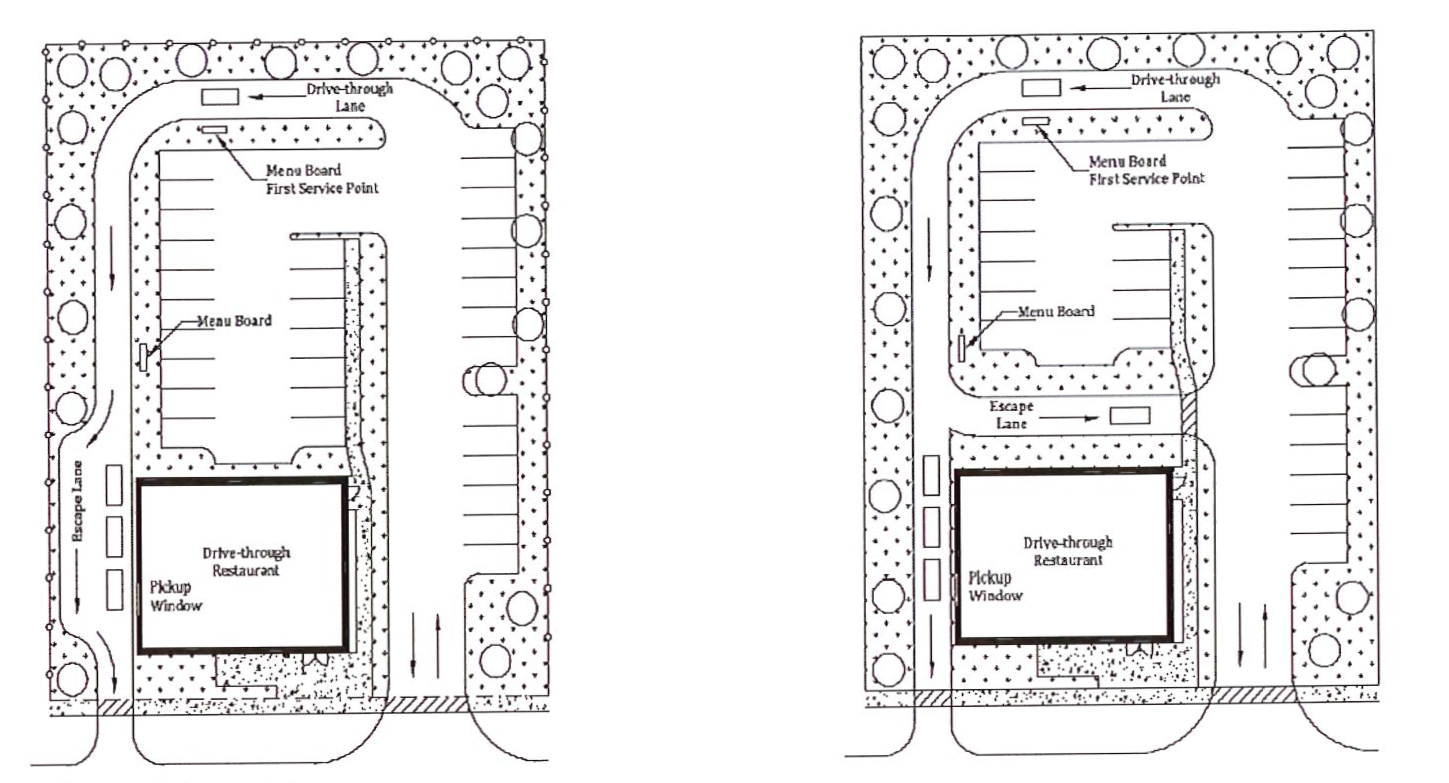
Example Layout
(6)
Stacking spaces necessary for the provisions of drive-through lanes shall be determined using the following table.
(Ord. No. 2023-27, § 1, 12-12-23)
Sec. 78-357. - Required stacking spaces.
(a)
Noise. Speakers associated with drive-through facilities may not be audible from abutting residential zones or any abutting lots occupied by residential uses. Sound attenuation walls, landscaping or other buffering measures may be required to ensure that the facility will not have adverse noise-related impacts on nearby residential uses.
(b)
Interpretation and appeal. If questions of interpretation or the application of the requirements of this division to a particular land use or occupancy of a structure arise, the building official in coordination with the development services director of infrastructure must, based on findings of fact, make a determination of the off-street parking, loading, or access requirements. A property owner if not satisfied with the building officials determination, may appeal such determination to the zoning board of adjustment under the variance procedure.
(Ord. No. 2023-27, § 1, 12-12-23)
Sec. 78-358. - Residential parking provisions.
(a)
Required parking shall be provided on the same lot as the use it is to serve.
(b)
All required parking spaces shall be concrete, asphalt, or other material approved by the building official prior to construction.
(c)
No required parking space shall be used for the storage of any vehicle of one and one-half ton capacity or more, nor a vehicle which has an overall length of more than 22 feet, nor a trailer of more than one and one-half ton capacity, except while engaging in the actual loading or unloading of passengers or property.
(d)
Direct private residential driveway access to arterial streets creates a traffic hazard. No development plan or plat creating lots which require direct residential driveway access to an arterial street (as shown in current master transportation plan) shall be approved.
(e)
When a property abuts a residential and collector/arterial, the driveway shall be located on the residential street.
(Ord. No. 2023-27, § 1, 12-12-23)
Sec. 78-359. - Nonresidential and multi-family parking provisions.
(a)
To prevent nuisance situations, all parking area lighting shall be designed and operated so as not to reflect or shine on adjacent properties.
(b)
All required parking spaces shall be constructed from asphalt, paved concrete, or another similar surface approved by the building official, prior to construction. Parking spaces shall be permanently and clearly identified by stripes, buttons, tiles, curbs, barriers, or other approved methods. Nonpermanent markings, such as paint, shall be regularly maintained to ensure continuous identification.
(c)
All parking and loading spaces and vehicle sales areas on private property shall have a curb or vehicle stopping device for spaces adjacent to required landscaped areas, public right-of-way line, public sidewalk, or other accessible path, to prevent any parked vehicle from overhanging into these areas. Parking shall not be permitted to encroach upon the public right-of-way in any case. All vehicle maneuvering shall take place on site. No public right-of-way shall be used for backing or maneuvering into or out of a parking space.
(d)
Required parking and loading spaces shall be used only for these respective purposes and not for the storage or permanent display of boats, trailers, campers, motor vehicles or other goods, materials, or products for sale.
(e)
Refuse storage facilities placed in a parking lot shall not be located within a designated parking or loading space. Each refuse facility shall be located to facilitate pick up by refuse collection agencies and shall be screened according to the provisions in this title.
(f)
Disabled parking space(s) shall conform to the current ADA standards for accessible design as amended.
(Ord. No. 2023-27, § 1, 12-12-23)
Sec. 78-400. - General regulations governing signs.
No sign which is expressly prohibited, or which is not specifically described and allowed by this chapter (an allowable sign) shall be installed, and no sign shall be installed, except in compliance with this chapter. This division does not regulate signs located inside buildings except where it is expressly and specifically stated otherwise. Allowable signs are of two general categories, signs requiring issuance of a sign permit before installation, permitted signs, and those which may be installed without a sign permit.
(1)
Temporary signs shall comply with the requirements of this Code for maximum height, maximum allowable area, maximum number of signs, minimum spacing and setback requirements, and are subject to time or event restrictions.
(2)
Permanent signs shall comply with the requirements of this Code for maximum height, maximum allowable area, maximum number of signs, and minimum spacing and setback requirements.
(3)
All permanent signs located in the central business district shall comply with the requirements of this code for maximum height, maximum allowable area, maximum number of signs, and minimum spacing and setback requirements.
(4)
Illuminated signs require a licensed electrical contractor and electrical permit to be filed with the development services department. All illuminated signs shall meet the requirements of the Underwriters' Laboratory and the city electrical code.
(5)
No sign shall be erected, relocated, or maintained in a manner that prevents free ingress or egress from any door, window or fire escape.
(6)
No sign shall be attached to a standpipe or fire escape except official signs.
(7)
Any sign erected or maintained within five feet of the public rights-of-way shall be smooth and free of protruding objects, nails, tacks, and wires, etc.
(8)
Gooseneck reflectors and lights are permitted on freestanding and wall signs provided lighting or glare does not extend beyond the property line.
(9)
Permanent signs of eight feet in height or less shall be monument type.
(10)
Attached permanent signs and freestanding signs shall be designed to resist wind load and to receive dead load as required by the city building code. A structural engineer's seal may be required.
(11)
The structural elements of permanent signs shall be constructed of materials that are noncombustible and may be supported by noncombustible materials only and finished in a presentable manner. Wood or unpainted steel supports are prohibited.
(12)
Electronic message board signs are only allowed in the following locations:
a.
As an attached (wall) sign located on the primary structure; provided, however:
i.
Only one electronic message board sign is allowed on each primary structure; and
ii.
Electronic message boards are prohibited on canopies and accessory structures.
b.
On a freestanding sign (pole or monument).
c.
As a window sign.
(Ord. No. 2023-27, § 1, 12-12-23)
Sec. 78-401. - Definitions.
For the purpose of this division, certain abbreviations, terms, phrases, words, and their derivatives, shall be construed as set forth in this chapter or the section to which they are unique.
Words used in the present tense include the future. Words in the masculine gender include the feminine and neuter. The singular number includes the plural, and the plural number includes the singular.
Words not defined herein shall have the meanings stated in the standard building codes. Words not defined in the standard codes shall have the meanings in Webster's Ninth New Collegiate Dictionary, as revised.
Animation means a copy or other images that flash or move.
Base allowable area means the area calculated by measuring the horizontal length of the facade adjacent to a public street of a major building and multiplying by two.
Copy means letters, characters, illustrations, logos, graphics, symbols, writing or any combination thereof, designed to communicate information of any kind, or to advertise, announce or identify a person, entity, business, business product, or to advertise the sale, rental, or lease of premises.
Copy area means the area of the sign containing any copy, including the area between separate lines of text and the area between text and any symbol, sign, logo or graphic.
Facade means any separate face of a building, including parapet walls and omitted wall lines, or any part of a building which encloses or covers usable space. Where separate faces are oriented in the same direction or in directions within 45 degrees of one another, they are to be considered as part of a single facade.
Install, when used in conjunction with the word "sign," means to place, erect or install a sign.
Luminescent gaseous tubing means exposed tubes used in or as signs which contain inert gases, including, but not limited to, neon, argon, and krypton.
Maximum allowable area means the maximum area of any sign permitted under this Code.
Owner means the owner of the sign, land or structure, or person responsible for erecting, altering, replacing, relocating, or repairing the sign or structure.
Shopping area means a building or structure with two or more stores or shops of a business occupancy.
Sign means any medium, including its structure and component parts, including a name, identification, description, display and/or illustration, beacon, light, insignia which is affixed, directly or indirectly to or upon any building, structure, or vehicle, or erected inside a building or vehicle and visible from the exterior of the building or vehicle, or erected or maintained on any lot or tract of land which directs attention to an object, product, service, place, activity, person, institution, organization or business without regard to the message content or lack thereof.
Sign area means the gross surface area of the sign, including a single surface of a sign with messages on both sides, the sum of all surfaces where two or more signs share a single structure, and the copy area of a monument sign. In the case of an irregularly shaped sign, the sign area is calculated by enclosing the extreme limits of the sign by no more than four rectangles. The sum of the area of the rectangles shall be the gross surface area. The maximum allowable area is reduced by ten percent for the second and each subsequent rectangle used in the calculation.
Sign height means the vertical height of a freestanding sign measured from the top of the adjacent curb to the highest point of the sign or its structure.
Sign setback means the horizontal distance between a sign and the front or side property line, as measured from that part of the sign, including its extremities and supports, nearest any point on an imaginary vertical plane projecting vertically from the front or side property line.
Single business means a building or structure with only one business occupancy,
Sign types means signs meeting the following criteria:
Address sign means a sign that displays only the assigned numbers and street name.
Animated sign means any sign which includes action, motion, the optical illusion of action or motion, or color changes of all or any part of the sign or sign facing, through electronic illumination or physical motion, or any sign of which all or any part thereof visibly moves in any fashion whatsoever.
Attached sign means any sign attached to, applied on, or supported by any part of a building enclosing usable space, including walls, roofs, canopies, awnings, or arcades.
Awning sign means a sign that is painted directly on canvas or other material with a framework that creates a sloped shading device for windows and/or entryways.
Banner sign means a single sign or linked grouping of pennants of flexible material (e.g., cloth, paper, vinyl, etc.). Banners will include all flags or pennants that are not national, state, or municipal flags, or the official flag of a public institution.
Beacon (or searchlight) means a source of high-intensity light with one or more beams directed into the atmosphere or any other point; or any light with one or more beams that rotate or move.
Billboard means an off-premises outdoor display panel designed to carry advertising.
Canopy sign means any sign that is an integral part of or is attached above or below a canopy, awning, or other protective cover and include signs hung from the underside of a canopy structure either parallel or perpendicular to the building's facade; signs or letters mounted on the top of the canopy structure; signs on the fascia of canopies such as those used by gasoline stations; and those attached to a roof overhang or porch that is not an integral part of the roof that encloses the interior of a structure.
Changeable copy sign means a freestanding sign, or wall-mounted sign, or part of a larger freestanding sign, usually of secondary importance, describing with manually interchangeable plastic letters and symbols movie listings, lunch specials, welcome greetings, etc. Such a sign type includes bulletin boards and theater marquees. This sign type is distinguished from a message center.
Changeable electronic variable message sign (CEVMS) means a sign which permits light to be turned on or off intermittently or which is operated in a way whereby light is turned on or off intermittently, including an illuminated sign on which such illumination is not kept stationary or constant in intensity and color at all times when such sign is in use, including an LED (light emitting diode) or digital sign, and which varies in intensity or color. A CEVMS sign does not include a sign located within the right-of-way that functions as a traffic control device and that is described and identified in the Manual on Uniform Traffic Control Devices (MUTCD) approved by the Federal Highway Administrator as the National Standard.
Conforming sign means a sign which is lawfully in place on a tract of land which complies with all zoning regulations.
Construction sign means a sign which indicates the names of architects, engineers, landscape architects, contractors, and/or sponsors, etc., having a role or interest with respect to the structure or project.
Directional sign means any sign relating solely to internal pedestrian and vehicular traffic circulation within a complex or project without any form of advertising.
Electronic message board means any sign that uses lights or colors to form a sign message or graphic wherein the message is electronically programmed and can be modified by electronic processes without altering the face or the surface of the sign. These signs shall not be animated, and messages may only be changed once every five minutes.
Flag means fabric containing distinctive colors and patterns that represent an official symbol of a nation, state, school, religious group, or other type of public institution.
Flashing sign means any sign that incorporates the use of a pulsating, blinking, or rotating light source, including a light source that changes or alternates the color of the light in sequence.
Flyer means any advertising circular mounted with glue, nailed, stapled, or otherwise affixed to a pole, fence, wall, or other structure.
For sale, rent, or lease sign means a sign that advertises the availability for sale, rent or lease of a tract of land, a structure, or portions of a structure.
Freestanding sign means any type of sign supported by structures or supports that are placed on or anchored in, the ground; are structurally independent of any building or other structure; and are intended to be permanent, including pole, pylon, and monument signs. Advertising display supported by uprights or braces in or upon the ground; or any forms that are rigidly affixed or attached to the ground, including but not limited to signs placed on benches, gasoline pumps, oil racks, vending machines, etc., are free-standing signs.
Garage sale sign means a temporary sign advertising occasional sale on residential premises.
Highway sign means a freestanding off-premises sign or billboard located within 660 feet of any state or federal highway right-of-way and visible from the main traveled way requiring an outdoor advertising license from the Texas Department of Transportation.
Identification sign means a sign identifying a complex or group of buildings which does not include the names of individual tenants.
Inflatable sign means any hollow sign expanded or enlarged by the use of air or gas.
Illuminated sign means any sign which has characters, letters, figures, designs or outline illuminated directly or indirectly by electric lights, luminous tubes or other means.
Lamppost sign means a hanging sign attached by metal hinges to a cast iron or cast aluminum tapered and fluted post.
Menu board means an on-site display of menu items at a drive-in or drive-thru restaurant.
Message center means a sign that changes messages electronically with either an alternating light board, flip panels, or such devices. An alternating time and temperature display is considered a message center sign.
Mobile sign or portable sign means a sign which is intended to be temporary and portable in nature, capable of being readily relocated from one location to another, and which does not rely on a building or a fixed foundation for its structural support and shall include but not be limited to mobile, movable signs, "A" frame and sandwich board signs.
Mobile portable sign means any sign not permanently attached to the ground or other permanent structure, or a sign designed to be transported by means of wheels, and signs attached to or painted on vehicles parked and visible from the public road allowance, unless said vehicle which is licensed, operable and is used in the normal day-to-day operations of the business.
Model home sign means a sign identifying model homes and model home parks, including sales offices.
Monument sign means a freestanding sign having a low profile, made of stone, concrete, metal, brick, or similar materials designed to complement the architecture of the building or complex, mounted on a solid base.
Multitenant complex sign means a sign with a primary facility name and a list of the individual stores or businesses mounted on one structural element. Such a sign type includes signage describing a mall arrangement, a strip-center development, an industrial park complex, or a multitenant structure or complex of buildings with a unifying name and a listing of businesses contained within the grouping. An identification sign without listing of individual tenants is not a multitenant complex sign. See "identification sign."
Mural means a work of art applied directly to a wall, ceiling, or floor surface where forms and/or figures are the dominant elements and not intended for commercial advertising. Any form of wording or logo shall be of secondary nature to a mural.
Nameplate means a sign showing only the name and address of the owner or occupant of the premises.
Nonconforming sign means a sign which does not conform to the requirements of the current regulations which, when removed, shall be required to conform to adopted standards.
Occupation sign means a sign showing only the name and occupation of the owner or occupant of the premises.
Obsolete/abandoned sign means a sign that advertises a product or service no longer available or a business no longer in operation; a sign which is illegible, nonfunctional, in disrepair, or hazardous as a result of lack of maintenance; a nonconforming sign structure that has lost legal status as a result of abandonment or lack of use.
Official sign means a sign erected by a governmental agency within its territorial jurisdiction for the purpose of carrying out an official duty or responsibility and including, but not limited to, traffic signs and signals, zoning signs, and street signs. Special lighting or banners celebrating seasonal or civic events sponsored and/or endorsed by the city council may be official signs.
Off-premises sign means a sign displaying copy that pertains to a business, person, organization, activity, event, place, service, or product not principally located or primarily manufactured or sold on the premises on which the sign is located.
On-premises sign means a sign which advertises or directs attention to a business, person, organization, activity, event, place, service, or product which is manufactured and/or available on the premises where the sign is located.
Permanent sign means an attached or detached sign placed in a fixed location or affixed to a permanent structure of a maximum height and area described in this code.
Pole sign means a sign mounted on a pole(s).
Political sign means a temporary sign pertaining to a national, state, or local election and erected for the sole purpose of advertising a political candidate, political party, or ballot measure.
Portable sign means a sign not permanently attached or affixed to the ground or other permanent structure, or a sign designed to be transported or moved from place to place, including, but not be limited to, signs designed to be transported by means of wheels; signs converted to A- or T-frames; menu and sandwich boards; balloons or any other inflatable forms; umbrellas used for advertising; statues or figures situated on a trailer; or vehicular signs.
Projecting sign means any sign affixed to a building or wall in such a manner that its leading edge extends more than 12 inches beyond the surface of the building or wall.
Protective sign means a sign intended to safeguard the premises, including, but not limited to, "No Parking," "No Trespassing," "Bad Dog," "No Dumping," "No Solicitors" and the like.
Roof sign means an advertising display that is erected, constructed, or mounted on the roof of a structure which encloses the interior space. Signs mounted on an overhang or covering of an entryway or porch are considered canopy signs.
Seasonal decoration means special lighting or banners celebrating seasonal events or holidays.
Security sign means a sign which identifies emergency telephone numbers, hours, and security information.
Sign barrier means something material that blocks or is intended to block passage.
Special events sign means signs, banners, pennants, or lights as may be authorized for special events.
Subdivision entrance sign means a sign identifying the name of a subdivision without any other information.
Street sign means a sign or signs located at the intersection of a public street.
Temporary sign means a sign which is to be removed within a specified period of time or upon the occurrence of a specified event, meeting the height and area requirements of Table 7.22.
Traffic sign means a sign required to provide for the safety of the traveling public which is placed in accord with the Manual on Uniform Traffic Control Devices (MUTCD),
Vehicular sign means a sign attached to or upon any vehicle where that vehicle is parked within 20 feet of the edge of a parking lot adjacent to the public right-of-way and contains arrows, directional information or promotional advertising relating to a business.
V-shaped sign means a freestanding sign constructed of two panels in the form of a V when seen from above, with a maximum angle between the panels of 45 degrees.
Wall sign means an attached display affixed to a wall or structure that does not project more than 12 inches from the building. See "Attached sign."
Window display sign means a sign that is applied to or attached to the exterior or interior of a transparent window or glass door.
Visibility triangle means the area within a right angle formed by extending the curb lines of intersecting streets from the point of intersection for a distance of 45 feet to the hypotenuse, or for streets intersecting a driveway or alley for a distance of 20 feet to the hypotenuse.
(Ord. No. 2023-27, § 1, 12-12-23)
Sec. 78-402. - Permitted sign types.
The following sign types must be properly permitted by the building official before installation:
(1)
Building sign (A): A sign(s) placed flat against the building, not projecting above the roof line, and referring to a business located within the building to which the sign is attached. The total area of all signs shall not exceed a size larger than an area equal to one square foot for each lineal foot of frontage of the building to which the sign is attached or 50 square feet, whichever is smaller.
(2)
Building sign (B): A sign(s) placed flat against the building and not projecting above the roof line, and referring to a business located within the building to which the sign is attached. The total area of all signs shall not exceed a size larger than an area equal to three square feet for each lineal foot of frontage of the building to which the sign is attached, or 200 square feet, whichever is smaller. In the case of a building occupied by more than one business, each tenant's frontage shall be treated as a separate building.
(3)
Freestanding sign (A): A permanently constructed sign, installed in the ground and located on the same lot as the business establishment to which it refers. The total sign area shall not exceed a size larger than two square feet for each lineal foot of frontage of the lot (platted street frontage) or 225 square feet, whichever is smaller, and not to exceed 25 feet in height. A business with retail gasoline sales, or a single business or a shopping area with 10,000 or more square feet of floor area is permitted to have a second freestanding signs. A single business or a shopping area with over 20,000 square feet of floor area is permitted to have a third freestanding sign. The total sign area of the second and third freestanding signs, shall not exceed a size larger than two square feet for each lineal foot of frontage of the lot (platted street frontage) or 225 square feet, whichever is smaller, and not to exceed 25 feet in height.
(4)
Freestanding sign (B): (Such signs shall be for use only by churches, country clubs, public buildings, philanthropic institutions.) A permanently constructed signs supported by the ground or by supports extending from the ground, not attached to a building and located on the same lot as the establishment to which it refers. The intensity of any direct or indirect lighting whether internal or external, shall not exceed 50 footcandles measured at the face of the sign. External lighting shall be directed specifically at the sign. Total area of the sign shall not exceed one square foot for each three feet of property's street frontage or 32 square feet, whichever is smaller. Maximum height, including base and supports, shall not exceed eight feet, whichever is smaller. Maximum height, including base and supports, shall not exceed eight feet, but a maximum height of six feet is recommended and preferred. Number of signs shall be limited to one per property. Placement of sign shall be a minimum distance of 25 feet from adjacent side property line and shall not negatively affect the vision of traffic at entrance or exit to property.
Sign area means the gross surface area of the sign, including a single surface of a sign with messages on both sides, the sum of all surfaces where two or more signs share a single structure, and the copy area of a monument sign. In the case of an irregularly shaped sign, the sign area is calculated by enclosing the extreme limits of the sign by no more than four rectangles. The sum of the area of the rectangles shall be the gross surface area. The maximum allowable area is reduced by ten percent for the second and each subsequent rectangle used in the calculation.
(5)
Mobile portable sign: A temporary sign with a 30-day time limit with one 30-day extension and a 90-day interval from the expiration of the original or the extended permit to the next application. One sign, which area shall not exceed 15 square feet and must be anchored down so it will, at all times, withstand a wind load of 147 miles per hour in any direction. A newly opened business can have an extra 30 days, free of any additional charge. Mobile portable sign applies also to signs placed on or in motor vehicles or trailers visible from any public right-of-way.
Mobile sign or portable sign means a sign which is intended to be temporary and portable in nature, capable of being readily relocated from one location to another, and which does not rely on a building or a fixed foundation for its structural support and shall include but not be limited to mobile, movable signs, "A" frame and sandwich board signs. Or mobile portable sign means any sign not permanently attached to the ground or other permanent structure, or a sign designed to be transported by means of wheels, and signs attached to or painted on vehicles parked and visible from the public road allowance, unless said vehicle which is licensed, operable and is used in the normal day-to-day operations of the business.
(6)
Portable freestanding sign: A sign not exceeding 15 square feet per side, displayed only during business hours and placed not so as to create a sign barrier.
(7)
Banner signs and streamers, etc.
a.
Banners of lightweight fabric or similar material that are mounted to a pole or building by a tie or physical attachment at one or more edges are allowed with a permit as follows: the total cumulative area in square footage for all banners shall be computed at 20 square feet of area per 50 feet of building frontage to a maximum of 80 square feet per business. Permits for banners shall expire 30 days after date of issuance with one 30-day extension and a 90-day interval from the expiration of the original or the extended permit to the next application.
b.
Streamers, pennants, and similar attention getting devices that are made of lightweight plastic, fabric or other material whether or not containing a message of any kind, suspended from a rope, wire or string, usually in series, accumulatively occupying no more than ten square feet per front foot of the property, that are designed to move in the wind, may be displayed by a business so long as a minimum of 15 feet clearance is provided over driveways and places where vehicular traffic are encountered, and provided that no obstruction of view is encountered by motorists or pedestrians. Separate permits are required for streamers, pennants, etc., and shall expire after 30 days from date of issuance with one 30-day extension and a 90-day interval from the expiration of the original or the extended permit to the next application.
Banners and streamers, etc., for newly opened businesses can have an extra 30 days free of an additional charge and shall be subject to the maintenance provisions of section 78-415, sign maintenance.
(8)
Electronic message boards: Electronic message board signs are allowed in addition to and on the same support structure as a "Freestanding Sign - B" sign. The maximum size shall be no larger than 40 square feet for signs within the Highways 1069, 361, and 2725 corridor, and no larger than 24 square feet for all other allowed areas. Maximum sign heights shall be in accordance with required height regulations applicable to all signs. Electronic messages shall appear and remain for a period of no less than six seconds, whereas such message shall either scroll off the display rapidly or immediately be replaced by another message or symbol. Such electronic message board signs shall not be allowed as a wall sign.
(9)
Reserved.
(10)
Corridor Zone - Businesses located on lots adjoining Highway 1069, or Highway 361, or FM 2725.
Corridor sign A: Businesses located on lots adjoining Highway 1069, or Highway 361, or FM 2725 are in the "Corridor Zone" and may have a corridor sign A in place of a freestanding sign A (but not in addition to a freestanding sign A) as follows:
a.
A permanently constructed sign, installed in the ground and located on the same lot as the business establishment to which it refers. The total sign area shall not exceed a size larger than two square feet for each lineal foot of frontage of the lot (platted street frontage) or 225 square feet, whichever is smaller, and not to exceed 45 feet in height.
b.
A business with retail gasoline sales, or a single business or a shopping area with 10,000 or more square feet of floor area is permitted to have a second corridor (freestanding) sign.
c.
A single business or a shopping area as above described with over 20,000 square feet of floor area is permitted to have a third corridor (freestanding) sign. The total sign area of the second and third corridor (freestanding) signs shall not exceed a size larger than two square feet for each lineal foot of frontage of the lot (platted street frontage) or 225 square feet, whichever is smaller, and not to exceed 30 feet in height.
(11)
Menu boards: Establishments with drive-through service are permitted one menu board sign per lot, limited to 36 square feet in area and six feet in height.
(12)
Gasoline price signs. Gasoline pricing signs are exempt from zoning regulations, provided the total area of all signs does not exceed 12 square feet in area for each service island.
(Ord. No. 2023-27, § 1, 12-12-23)
Sec. 78-403. - Enforcement.
The city building official shall cause all signs for which permits have been issued and regulated by this article to be inspected from time to time for compliance with this article. In case of noncompliance, the city building official shall notify the permit holder to correct the condition within ten days. In the event of failure, or the refusal of the permit holder to comply as ordered, the city building official shall revoke the permit. However, upon a showing of hardship or other circumstances warranting such action, the city building official shall have the authority to grant an extension not to exceed 30 days to make the correction or to finish the sign.
(Ord. No. 2023-27, § 1, 12-12-23)
Sec. 78-404. - Appeals.
Whenever the city building official shall refuse to grant any permit authorized under this article, or shall issue an order requiring compliance with this article, or revoke a permit issued under this article, the person aggrieved shall have the right to appeal to the board of adjustment created pursuant to Charter §§ 10.05 and 10.06, as provided in the zoning regulations, chapter 78 of this Code.
(Ord. No. 2023-27, § 1, 12-12-23)
Sec. 78-405. - Sign permit required.
Except as otherwise provided, it shall be unlawful for any person to erect, alter, or relocate within the city any sign without first obtaining a sign permit from the chief building official. The permit may cover more than one sign but shall apply to only one applicant and one location. Applications for sign permits shall contain or have attached thereto the following information:
(1)
Name, address, and telephone number of owner(s) of the land or structure where the sign is to be constructed, erected, or placed.
(2)
Name, address, and telephone number of the person responsible for erecting, altering, replacing, relocating, or repairing the sign or structure.
(3)
Location of building, structure, or lot to which or upon which the sign is to be constructed, attached erected, or placed.
(4)
Position of the sign in relation to nearby buildings or structures, including other signs.
(5)
Two blueprints or ink drawings of the plans and specifications, including electrical wiring and the method of construction and attachment to the building or in the ground.
(6)
Copy of the stress sheets and calculations showing the structure is designed for dead load and wind pressure.
(7)
The zoning classification of the property on which the sign is to be or is located and the zoning classification of all property within 250 feet.
(8)
Advertising copy for the proposed sign face.
(9)
Highway signs require the submission of a copy of the state permit prior to issuance of the city permit.
(10)
The location of overhead utilities and the acknowledgement of any private utility company concerning vertical and horizontal clearance requirements at the location proposed.
(11)
Such other information as the chief building official may require, including certification by a registered professional engineer if deemed necessary to ensure compliance with the structural requirements.
(Ord. No. 2023-27, § 1, 12-12-23)
Sec. 78-406. - Issuance and term of sign permit.
The building official shall examine all applications for sign permits and examine plans, specifications, other data, and the premises upon which it is proposed to erect or repair any sign and shall issue a sign permit if the sign meets all requirements of the city.
Whenever any work for which a permit is required has commenced without first obtaining a permit, a special investigation shall be made before a permit may be issued. An investigation fee in addition to the permit fee may be collected at such time as a permit is issued. The investigation fee shall be an additional fee equal to the amount of the permit fee.
(Ord. No. 2023-27, § 1, 12-12-23)
Sec. 78-407. - Permitted signs—Design standard.
Permitted signs shall be designed and constructed in accordance with the latest adopted edition of the International Building Code and the National Electrical Code.
(Ord. No. 2023-27, § 1, 12-12-23)
Sec. 78-408. - Sign permit fee.
A permit fee, established by city council resolution and set forth in appendix A, Ingleside City Code, shall be paid when application is made for a sign permit, and no sign permit may be issued until said fee has been paid.
(Ord. No. 693, § 1, 3-25-97; Ord. No. 2023-27, § 1, 12-12-23)
Sec. 78-409. - Permitted sign types allowed in zoning districts.
Permitted sign types are allowed in zoning districts in accordance with the following chart:
(Ord. No. 2023-27, § 1, 12-12-23)
Sec. 78-410. - Exempt sign types.
The following signs are exempt from permit procedures and may be installed and maintained in compliance with all other city ordinances and within the limitations set forth below:
(1)
Public signs: Noncommercial signs erected by or at the direction of a public officer in furtherance of the public interest in the performance of his public duty.
(2)
Land sales sign: Non-illuminated, advertising the sale or development of a piece of property or subdivision containing an area of not less than two and one-quarter acres erected upon the property so developed and advertised for sale, provided the size of such sign is not in excess of 32 square feet in size, and eight feet in height, and not more than one such sign is placed per street frontage.
(3)
Real estate sign: Nonilluminated, not exceeding six square feet in area per face pertaining to the sale or lease of the premises.
(4)
Contractor's sign: Nonilluminated, advertising the development or improvement of a property by a builder, contractor or other person furnishing service, materials or labor to said premises during the period of construction, provided the total aggregate of any such sign is not in excess of 32 square feet and eight feet in height.
(5)
Subdivision signs: Signs advertising any subdivision being developed in the city will be governed by the following:
a.
Signs in the model home area and on the subdivision site shall not exceed a total aggregate of 100 square feet and shall be unlighted.
b.
Permanent on-site subdivision ground signs shall be allowed when approved by the city as part of the subdivision construction plans, provided such signs do not exceed 25 square feet in area, and the exposed surface area of the sign structure does not exceed 50 square feet in area. Lighting of such signs shall be restricted to indirect illumination. Decorative screening walls shall not be construed as exposed surface areas under this section.
(6)
Temporary signs: Temporary signs announcing any public, charitable, educational or religious event or function may be installed for a period of not more than 21 days prior to event and not more than seven days after the event, with a total sign area of not more than 24 square feet to all sign faces.
(7)
Integral signs: Names of buildings, dates of erection, monumental citations and commemorative tablets that are carved into stone, concrete or similar permanent materials and constructed as an integral part of a structure.
(8)
Nameplates: One nonilluminated sign per entrance per business attached to the building and not exceeding two square feet of sign area per face with wording limited to name and occupation. If this sign cannot be viewed from the public right-of-way, the sign may be installed at the entrance to the property that the business is located on.
(9)
Private signs: Signs not visible beyond the boundaries of the lot or series of contiguous lots under the same ownership on which they are located and which are not visible from any public right-of-way.
(10)
Traffic signs: Traffic and other official signs and devices installed by a governmental agency.
(11)
On-site traffic signs: On-site traffic directional signs that do not exceed four square feet of sign area per face, that do not exceed six feet in height above ground level, and that do not carry any commercial message or identification.
(12)
Garage sale signs: One garage sale sign not exceeding six square feet of sign area for all sign faces, not to be placed on any public right-of-way, but may be installed on the lot or series of contiguous lots under the same ownership on which the garage sale is located which is installed not more than seven days prior to the garage sale, and which is removed not more than two days after the garage sale.
(13)
Flags, emblems: An insignia of any governmental body jurisdictions and one flag carrying the emblem of a business firm or other organizations, decorative displays for holidays or public demonstrations that do not contain advertising and are not used as such. Flags shall be flown on permanently mounted flagpoles.
(14)
Political signs: Signs on private real property that refer to a particular issue or candidate relating to a particular public election. Such signs may be a maximum of 36 square feet not including billboards. Such signs may be erected for not more than 90 continuous days immediately preceding the election, may not be illuminated, may not have any moving elements, and must be removed by the property owner, political candidate, or sponsoring political action committee not more than 72 hours after the election for to which they relate.
(15)
Protective signs which may be affixed to walls and fences.
(16)
Window display signs that is applied to or attached to the exterior or interior of a transparent window or glass door.
(Ord. No. 2023-27, § 1, 12-12-23)
Sec. 78-411. - Banners and grand opening signs.
(a)
Banners. Banners for a single address are limited to a maximum of three banner permits per calendar year, not to run consecutively, and with only one banner per occurrence.
(1)
Shall only be attached to buildings or poles driven into the ground and shall not be affixed to cars, trees, utility poles, fences or accessory structures.
(2)
Banners should not extend above the roofline or beyond the edges of the building to which it is attached.
(b)
Grand opening events. A permit for grand opening signage is allowed one time only for new businesses. A permit for grand opening signage may include banners, balloons, pennants, and inflatable signs. Grand opening event permits shall be issued within 90 days of the date of opening and shall be limited to 45 days.
(c)
Securing signs. Banners, balloons, pennants, and inflatable signs shall be securely tethered, fastened or affixed to prevent flapping, fluttering, swinging or moving.
(Ord. No. 2023-27, § 1, 12-12-23)
Sec. 78-412. - Prohibited signs.
All signs (including, but not limited to, signs which are visible from public property and located inside a building) which meet any of the following descriptions are hereby prohibited and may not be installed:
(1)
Signs containing statements, words or pictures of an obscene, indecent or immoral character, such that they will offend public morals or decency.
(2)
Signs that imitate an official traffic sign or signal or that contain the words "stop", "go," "slow," "caution," "danger," "warning," or similar words, in English or any other language.
(3)
Signs that are of a size, location, movement, content, coloring or manner of illumination that may be confused with or construed as a traffic-control device, or that hide from view any traffic or street or signal, or that obstruct the view in any direction at a street or road intersection.
(4)
Signs with flashing, moving parts, that move in any fashion, whether mechanically or wind driven, or any other types of movement, blinking, chasing or other intermittent illumination. Illumination of signs shall be constant with either internal lighting or external reflected illumination. External lighting shall reflect light directly upon said sign and not cause excessive light to distract motorist, pedestrians or residents. Excepted from this list of prohibited signs is any electronic message board which otherwise complies with this chapter.
(5)
No sign can be placed in public rights-of-way or in locations obscuring the view of traffic. No sign can be placed in the 20-foot traffic sign triangle, if the sign or sign post is more than 18 inches wide at a point below eight feet. When calculating the area of a two-sided sign, only one face shall be counted.
(6)
Any sign which is not specifically described and allowed by this chapter.
(7)
Billboards, i.e. a permanently constructed sign, installed in the ground, not located on the same lot as the business establishment to which it refers and exceeding 32 square feet in area or 15 feet in height.
(8)
Off-premises signs, except as specifically allowed by this Code.
(9)
Any sign erected or affixed within or projecting over any public right-of-way except official signs, special events signs authorized by the city council or subdivision entrance signs. No person shall locate, place or attach any sign, paper or other material, to a tree, tower, public utility pole or structure, public building, street light, public fence, public right-of-way, fire hydrant, bridge, park bench, or public structure, or public property, or paint, stencil or write on, or otherwise mark on any sidewalk, curb, gutter, street, tree, tower, public utility pole or structure, public building, street light, public fence, public right-of-way, fire hydrant, bridge, park bench, or public structure, or public property, except such signs as allowed by this chapter, as amended. Any sign placed on public property, or public right-of-way may be removed without prior notice.
(10)
All roof mounted signs.
(11)
Any flyers attached, affixed, stapled, or glued to a pole, fence, wall or other structure.
(12)
Any obsolete/abandoned sign.
(Ord. No. 2023-27, § 1, 12-12-23)
Sec. 78-413. - Attached (wall or canopy) signs.
(a)
Attached signs shall not extend above roof or parapet wall.
(b)
Copy painted, stenciled, affixed, or otherwise applied to any awning shall be included in the calculation maximum allowable copy area.
(c)
Canopy signs in any zoning district shall be installed so that the lowest edge is not less than nine feet above the sidewalk. Canopy signs shall be included in the calculation of maximum allowable copy area.
(Ord. No. 2023-27, § 1, 12-12-23)
Sec. 78-414. - Existing nonconforming signs.
(a)
Signs legally existing at the time of the effective date of this division and in compliance with the then-current ordinance and not in compliance herewith shall be regarded as nonconforming signs, which may continue to exist until structurally altered, removed, destroyed as an act of God, or until the business that they are advertising is no longer in existence. Nonconforming signs that are structurally altered, relocated or replaced shall comply immediately with all provisions of this chapter.
(b)
Any nonconforming sign that has been damaged by fire, wind or other cause in excess of 50 percent of its replacement cost shall not be restored except in conformance with the provisions of this division.
(c)
Notwithstanding other provisions of this section, any sign, or signs for which a permit has been issued by the city shall be permitted to remain at the location or locations authorized by the permit for as long as the permit is valid, and all the requirements of the permit have been met.
(Ord. No. 2023-27, § 1, 12-12-23)
Sec. 78-415. - Sign maintenance.
All signs, including those painted on the walls of buildings, shall be permanently maintained in a safe, presentable condition. All signs shall be kept in good repair and, unless of galvanized or noncorroding metal or plastic, or treated with appropriate wood preservative, shall be thoroughly painted as often as is necessary, consistent with good maintenance. All braces, bolts, clips, supporting frames and fastenings shall be free from deterioration, termite infestation, rot or loosening.
(Ord. No. 2023-27, § 1, 12-12-23)
Sec. 78-416. - Abandoned signs.
(a)
An abandoned sign depicts or refers to a product, business, service, activity, condition or person that has changed in such a fashion that the sign no longer correctly identifies or describes him or it, that no longer exists at the location referred to in the sign or that no longer exists in any way or at any place.
(b)
Abandoned building signs shall be removed or painted out within 90 days of the cessation of such business or sale of such product by the owner, agent or person having the beneficial interest in the building or premises on which such sign is located.
(c)
Abandoned freestanding signs shall be removed in accordance with the following provisions:
(1)
Sign face(s) shall be removed within 90 days of abandonment. The building official may grant one extension of up to 90 days upon a showing of good cause.
(2)
Sign supports shall be removed within 180 days for freestanding sign (A). The building official may grant one extension of up to 90 days upon a showing of a good cause. Freestanding sign (B) shall be removed within 365 days of abandonment. The building official may grant one extension of up to 180 days upon a showing of a good cause.
(Ord. No. 2023-27, § 1, 12-12-23)
Sec. 78-417. - Sign nuisances.
The following signs are deemed a public nuisance and may be removed and impounded without prior notice:
(1)
Any sign erected, constructed, or placed in a manner that constitutes a traffic hazard.
(2)
Any sign erected in or over any public right-of-way.
(3)
Any flyer or advertising circular mounted with glue, nailed, stapled, or otherwise affixed to a pole, fence, wall or other structure within the rights-of-way.
(4)
Any sign placed in public rights-of-way or in locations obscuring the view of traffic.
(Ord. No. 2023-27, § 1, 12-12-23)
Sec. 78-418. - Removal of certain signs.
(a)
The building official shall, without the requirement of notice, order the immediate removal of all signs deemed to be a nuisance under this section.
(b)
Any existing sign that no longer advertises a bona fide business conducted or product sold on the premises shall be removed by and at the expense of the property owner within 30 days.
(c)
The copy on a conforming monument sign that no longer advertises a bona fide business conducted or product sold on the premises shall be removed within 30 days.
(d)
The structure, pole, frame, and copy of a nonconforming sign which no longer advertises a bona fide business conducted or product sold on the premises shall be removed in its entirety or altered to meet the requirements of these regulations within 30 days.
(e)
The building official shall provide a ten-day written notice to the property owner to cure or correct any sign found to be unsafe, insecure, or a menace to the public. If the owner fails to cure or correct, the chief building official shall order the sign removed. The costs of removal shall be assessed against the property and a lien filed in San Patricio County, unless payment is tendered within 30 days.
(f)
The building official shall not process any application nor issue any permit for a sign located on the same premises or for any other premises of an owner in violation of this Code.
(g)
Prohibited signs confiscated by the city will be stored for ten days and may be claimed by owner. Any confiscated sign not claimed within ten days may be destroyed.
(Ord. No. 2023-27, § 1, 12-12-23)
Sec. 78-419. - Notice to remove signs.
Except as otherwise provided, in the event the owner fails to comply with the provisions of this section, the building official shall send written notice directing the abatement of any violation, personally, or by serving the owner by certified mail or by publication two times within ten days in the official newspaper of the city if the owner cannot be served personally, or if the owner's address is unknown. If the owner fails to comply with the notice of abatement within ten working days after notice, the sign shall be deemed a nuisance. The building official shall cause the nuisance to be abated and shall charge all costs and expenses incurred therewith to the owner. The expenses assessed for abatement shall be actual removal expenses, but not less than $25.00, plus an administrative fee of $50.00.
(Ord. No. 2023-27, § 1, 12-12-23)
Sec. 78-420. - Inspection of signs.
The building official shall inspect permitted signs on an annual basis, or as often as necessary to ascertain compliance with the requirements of this section.
(Ord. No. 2023-27, § 1, 12-12-23)
Sec. 78-510. - Lighting and glare standards.
(a)
Lighting limited. Any light fixture shall be operated so as not to produce an obnoxious and intense glare or direct illumination across the bounding property line and shall not be of such intensity as to create a nuisance or detract from the use or enjoyment of adjacent property. All lights projecting light to any exterior area shall be made up of a light source and reflector so selected that acting together, the light beam is controlled and not directed across any bounding property line above a height of three feet.
(b)
Lighting that illuminates any outdoor area shall conform to the definition for "full shielded light fixtures" and be designed, arranged and screened so that the point light source shall not be visible from adjoining lots or streets.
(Ord. No. 2023-27, § 1, 12-12-23)
Sec. 78-511. - Luminaries.
Light sources shall be of a down-light type, indirect, diffused, or shielded type luminaries installed and maintained so as to reduce glare effect and consequent interference with use of adjacent properties and boundary streets.
(Ord. No. 2023-27, § 1, 12-12-23)
Sec. 78-512. - Specific lighting requirements.
(a)
Facade and flagpole lighting must be directed only toward the facade or flag and shall not interfere with the night-visibility on nearby thoroughfares or shine directly at any adjacent residential use.
(b)
All lighting fixtures incorporated into non-enclosed structures (i.e., gas pump canopies, car washes, etc.) shall be fully recessed into the underside of such structures and shall meet section 78-510 of this division.
(Ord. No. 2023-27, § 1, 12-12-23)
Sec. 78-513. - Lighting administration.
(a)
Purpose and intent. The purpose of this section is to:
(1)
Provide adequate lighting in public spaces to ensure safety.
(2)
Reduce the problems created by improperly designed and installed outdoor lighting.
(3)
Eliminate problems of glare on operators of motor vehicles, pedestrians, and land uses.
(4)
Minimize light trespass and light pollution.
(5)
Reduce energy and financial costs of outdoor lighting by establishing regulations that limit the area onto which certain kinds of outdoor lighting fixtures may illuminate.
(6)
Preserve the night sky as a natural resource and people's enjoyment of looking at the sky and stars.
(b)
Enforcement. The building official or their designee is hereby empowered and directed to administer and enforce the provisions of this section relating to outdoor lighting.
(c)
Applicability.
(1)
New uses, buildings and additions. All proposed new land uses or change of uses, developments, buildings, structures, or building additions of 30 percent or more in terms of additional dwelling units, gross floor area, seating capacity, or other expansion, either with a single addition or cumulative additions subsequent to the effective date of this provision, shall meet the requirements of this Code for the entire property. For all building additions of less than 30 percent cumulative, the applicant shall only have to meet the requirements of this Code for any new outdoor lighting provided.
(2)
Nonconforming use change. Whenever a nonconforming use, structure, or lot is abandoned for a period of 180 consecutive days and then changed to a new use according to the requirements of Section 14.03.601, New and Unlisted Uses of the Zoning Ordinance, then any existing outdoor lighting shall be reviewed and brought into compliance as necessary for the entire building, structure, or premises, to the maximum extent possible as determined by the building official.
(3)
Prior to code adoption. Exterior lighting luminaries in existence on the effective date of this section shall be considered "legally nonconforming." Such fixtures may be repaired, maintained and replaced. The nonconforming bulbs within a fixture shall be replaced in conformance with this section. However, exterior lighting luminaries existing on the effective date of this section adoption that are located on private non-residentially used property and are found to direct light or glare to residential properties may be declared a public nuisance if the level of illumination on residential property, which is caused by the luminaries, is greater than one-quarter footcandle. Such fixtures shall be altered or replaced to reduce the level of illumination on the residential property to a one-quarter footcandle within two months of receiving a written notice of the violation from the city.
(4)
Fixture abandonment or damage. In the event that an outdoor lighting fixture is abandoned or is damaged to the point of requiring repairs for safe operation, the repaired or replacement fixture shall comply with all the provisions of this Code.
(Ord. No. 2023-27, § 1, 12-12-23)
Sec. 78-514. - General requirements.
The following standards shall apply to all exterior lighting except public street lighting and other lighting that is specifically exempted by this section.
(a)
Illumination levels.
(1)
Multi-family residential uses should average no more than three footcandles, with a maximum of ten footcandles.
(2)
Non-residential uses, including parking lots, should average no more than six footcandles, with a maximum of 15 footcandles.
(3)
Lighting under canopies (such as service stations) and car dealerships shall not exceed 40 footcandles. The remainder of the property shall comply with non-residential standards, above.
(4)
Each new development shall adequately illuminate all public parking, site entrances, and pedestrian areas, including perimeter sidewalks at all times, even if the primary use is a day-time only use.
(5)
The illumination levels contained in the Illuminating Engineering Society of North America Lighting Handbook, as amended from time to time, shall be used as a guide for providing minimum and safe illumination levels and measurement methods.
(b)
Spill-over. The limit of illumination on neighboring property from one establishment shall be based on the zoning and/or use of the neighboring property. Maximum computed maintained and maximum measured footcandles at the neighboring property line shall not exceed:
(1)
Zero footcandle for single-family residential attached and single-family detached districts.
(2)
Three footcandles for multi-family, commercial, agricultural, and industrial districts, and rights-of-way.
(3)
Exception: Illumination at interior property lines on contiguous lots in a multi-tenant, non-residential development may exceed the above criteria when necessary to provide constant lighting of adjoining parking areas, fire lanes and interior access roadways as determined by the building official.
(4)
When a dispute arises regarding the district/use of an adjoining property and the allowed spill-over, the administrative officer's decision shall be binding.
(c)
Light pole standards.
(1)
Height. Lighting standards (i.e., poles) shall be sized in such a manner that the top of any luminary does not exceed 30 feet above adjacent grade. Lighting standards in industrial zoned districts may be 35 feet in height. However, where any industrial, multi-family, or non-residential district light poles are located within 100 feet of a residential district or use, the maximum allowed height is 20 feet.
(2)
All parking lot poles shall be placed within a landscaped area or other raised bed to distinguish it from the parking spaces and minimize vehicle contact.
(d)
Light sources.
(1)
Light sources or luminaries are prohibited in landscaped buffer areas and within required setback yard areas except on pedestrian walkways, hike and bike trails, and at site entrances.
(2)
Light for outdoor advertising shall be designed to function as full cutoff-type of luminaries. Lighting intended for outdoor advertising shall be directed downward. The temporary use of lasers and spotlights that project light into the sky may be allowed, subject to the restrictions of temporary outdoor lighting in section 78-515, temporary outdoor lighting, below.
(3)
All luminaries located on non-residential properties shall be designed so that the light source (bulb or lamp) is completely shielded from direct view at a point three feet above grade on the lot line abutting a residential property. In all other instances, the light source must be completely shielded from direct view at a point five feet above grade at the lot line.
(4)
All luminaries and light sources subject to this section shall be maintained and kept in good working order.
(5)
Wall lighting may be used to illuminate the pedestrian walkways, entrance areas, and yard areas within 30 feet of the building. No roof lighting shall be used.
(6)
All luminaries mounted on walls or on freestanding poles must be shielded and be directed downward.
(7)
Externally illuminated signs, advertising displays, billboards, building identification, and monument signs shall use top mounted light fixtures that shine light downward and that are fully shielded or upward with pin-pointed light which are fully shielded.
(8)
Outdoor light fixtures used to illuminate flags, statues, or any other objects mounted on a pole, pedestal, or platform shall use a very narrow cone of light for the purpose of confining the light to the object of interest and minimize spill-light and glare.
(9)
Lighting within or around commercial windows meant to draw attention to the business is prohibited.
(10)
Building facades and architectural features of buildings may be floodlighted or otherwise highlighted when the following conditions are met.
(11)
Floodlight fixtures are equipped with shields and are located so as to limit the fixture's direct light distribution to the facade or feature being illuminated.
(12)
The configuration of the floodlight installation shall block all view to the floodlight fixture's lamp from adjacent properties; and the maximum luminance of any floodlighted surface does not exceed the footcandles specified in the Illuminating Engineering Society of North America Lighting Handbook for Floodlighting Surfaces.
(13)
All exterior lighting shall be LED.
(Ord. No. 2023-27, § 1, 12-12-23)
Sec. 78-515. - Temporary outdoor lighting.
Any temporary outdoor lighting that conforms to the requirements of this section shall be allowed. Nonconforming temporary outdoor lighting may be permitted by the building official only as part of a valid special events permit.
(Ord. No. 2023-27, § 1, 12-12-23)
Sec. 78-516. - Photometric plan.
(a)
Exterior lighting plan. A photometric plan illustrating the exterior lighting that is proposed or modified shall be submitted to the development services department. The submission shall contain, but not be limited to the following:
(1)
Plans indicating the location of the exterior lighting on the premises, and the type of illuminating devices, fixtures, lamps, supports, reflectors, and other devices;
(2)
Description of the illuminating devices (including a visual depiction), fixtures, pole heights, lamps, supports, reflectors, and other devices including, but not limited to, catalog cuts by manufacturers and drawings (including sections where required).
(3)
The photometric plan shall include a table which indicates the average footcandle measurement, the maximum footcandle measurement (at any hot spots), and the footcandle measurement at the property line.
(b)
Preparation of the photometric plan. A certified engineer, architect, landscape architect, or lighting engineer/designer shall prepare the plan. The plan shall also contain a certification by the property owner or agent and the preparer of the plan that the exterior lighting depicted on the plan will comply with the requirements of this section after installation. Once the plan is approved by the development services staff, the exterior lighting of the property shall be constructed and installed according to the approved plan.
(c)
Additional submission. The above required plans, descriptions and data shall be sufficiently complete to enable the reviewer to readily determine whether compliance with the requirements of this section will be secured. If such plans, descriptions, and data cannot enable this ready determination, by reason of the nature or configuration or the devices, fixtures, or lamps proposed, the applicant shall additionally submit as evidence of compliance to enable such determination such certified reports of tests as will do so provided that these tests shall have been performed and certified by a recognized testing laboratory.
(Ord. No. 2023-27, § 1, 12-12-23)
Sec. 78-517. - Prohibited lighting.
The following are prohibited within the City of Ingleside:
(a)
Design of lighting.
(1)
"Cobra head" type lighting fixtures that are not shielded and having dished or "drop" lenses or refractors which house light sources other than incandescent light sources.
(2)
Unshielded light sources, including bare bulbs above 15 watts.
(3)
"Acorn" lighting.
(4)
Decorative entrance lights mounted on a wall adjacent to doorways may be allowed in spite of not meeting the design requirements listed herein.
(b)
Moving or flashing lighting.
(1)
Flickering or flashing lights.
(2)
Searchlights.
(c)
Types of lighting.
(1)
Exposed neon lighting, except for open/closed signs hanging inside a building's door or window.
(2)
Mercury vapor luminaires.
(3)
Low-pressure sodium (LPS) and high-pressure sodium (HPS) luminaires.
(4)
Metal halide luminaires.
(Ord. No. 2023-27, § 1, 12-12-23)
Sec. 78-518. - Exempt lighting.
The following are exempt from the standards contained in this section:
(a)
Decorative seasonal lighting. The decorative seasonal lights shall be removed within a reasonable and customary time.
(b)
Lighting for single family detached or single family attached.
(1)
The lamps have a power rating of less than or equal to 75 watts;
(2)
A cutoff component is incorporated in the design of the luminaries;
(3)
The lighting level at the property line shall not exceed the maximum level specified within this section 78-518; and section 78-519.
(4)
The maximum lighting level at the property line may be exceeded in cases where the lamp is turned on and off by a motion sensor and the lamp is not on for a continuous period exceeding ten minutes.
(c)
Residential party lights for social gatherings. Such temporary outdoor lighting includes, but is not limited to, strings of lights and lanterns.
(d)
Translucent signs. Signs of the type constructed of translucent materials and wholly illuminated from within are exempt from the shielding requirement.
(e)
Emergency lighting. Temporary emergency lighting used by police, fire fighters, or other emergency services, as well as all vehicular luminaries. Hazard warning luminaries, which are required by federal and state regulatory agencies.
(f)
Outdoor sports fields. Because of their unique requirement for nighttime visibility and their limited hours of operation, public and commercial ball diamonds, playing fields, and tennis courts are exempt from the general standards of this section. Private ball diamonds, playing fields, and tennis courts on a single-family lot built as an accessory use to the home on that lot are subject to the requirements of this section. Lighting for these public and commercial outdoor recreational uses shall be LED and shielded to minimize light and glare from spilling over onto residential properties.
(g)
Public streetlights are exempt except that all replacement lights for any public streetlight shall be of the "cut-off refractor" lighting type.
(h)
Traffic control lighting is exempt.
(i)
Federal Aviation Administration required lighting for the airport.
(j)
Lighting in swimming pools and other water features governed by Article 680 of the National Electrical Code.
(k)
Exit signs and other illumination required by building codes.
(l)
Lighting for stairs and pedestrian ramps, as required by the building code.
(m)
Signs are regulated by the sign code, but externally lit signs and displays must be shielded so as not to create obtrusive light.
(n)
Low voltage landscape lighting, but such lighting shall be shielded or directed in such a way as to eliminate obtrusive light.
(o)
Low intensity gas lighting in residential areas.
(p)
Low intensity "ambiance" lighting, such as "rope" lighting and frosted globe lighting.
(q)
Exceptions. The building official may vary from these requirements for any municipal project or purpose.
(Ord. No. 2023-27, § 1, 12-12-23)
Sec. 78-519. - Nuisance declared.
The shining of light produced by a luminaire beyond the boundaries of the property on which the luminaire is located and onto another property under circumstances where the lighting element of the luminaire is visible from such other property and in such a manner and with such intensity as to disturb and annoy the reasonable sensibilities of a person living on and using such other property in a reasonable and customary manner as a residence is declared to be a nuisance and is prohibited. Street lights, traffic control lights, and public facility lighting are exempt from this division.
(Ord. No. 2023-27, § 1, 12-12-23)
Sec. 78-520. - Filing of complaint; unlawful noncompliance; fines.
Any person may complain to the city in regards to lighting that does not comply with the standards set forth in this division. The complaint must be filed in writing to the city code enforcement officer, building official, or a peace officer. It shall be unlawful for the owner or tenant within the city to fail to comply with the standards set forth in this section after notice is given, directing that such standards be met. The code compliance office, building official, peace officer or any other individual assigned such duties may, whenever a violation is found, file a complaint with the municipal court and/or issue citations. Any violation of any section subsection or part of this article shall be deemed a misdemeanor, and each violation during all or any portion of any day shall be a separate offense and subject to punishment as described in section 1-19 of this Code.
(Ord. No. 2023-27, § 1, 12-12-23)

