
Iron River City Zoning Code
CHAPTER 151
- ZONING CODE
Sec. 151.001.- Title.
This chapter shall be known and may be cited as the City of Iron River Zoning Ordinance, as amended, and is referred to throughout as the "ordinance."
(Ord. of 3-18-2025, § 1.1)
Sec. 151.002. - Purpose.
In accordance with the authority and intent of the Michigan Zoning Enabling Act, Michigan Public Act 110 of 2006 as amended, the purpose of this chapter is to promote, protect, regulate, restrict and provide for the use of land and buildings within the City of Iron River; to meet the needs of the state's residents for places of residence, recreation, industry, trade, service and other uses of land; to ensure that uses of the land shall be situated in appropriate locations and relationships; to limit the inappropriate overcrowding of land and congestion of population and transportation systems and other public facilities; to facilitate adequate and efficient provision for transportation systems, sewage disposal, water, energy, education, recreation and other public service and facility needs; to encourage a walkable, nonmotorized community, and to promote public health, safety and welfare.
In providing for all these uses, services and infrastructure, the City of Iron River shall promote and approve the development of land and the extension of utilities in a logical and consistent pattern consistent with the continuation of the existing street patterns and the implementation of the traditional town pattern of interconnecting blocks.
The city is divided into zoning districts which include regulations designating land uses or activities that shall be permitted or subjected to special regulations.
It is also the purpose of this chapter to provide the establishment of a Board of Appeals and its powers and duties; to provide for its administration and enforcement, and for penalties for its violation; and to provide for the repeal of any and all ordinances inconsistent with the intent as set forth in this chapter.
(Ord. of 3-18-2025, § 1.2)
Sec. 151.003. - Area of jurisdiction.
The provisions of this chapter shall apply to all development, public and private, throughout the incorporated areas of the City of Iron River, Iron County, Michigan, to the extent permitted by law. The area of jurisdiction is referred to throughout this chapter as the "city."
(Ord. of 3-18-2025, § 1.3)
Sec. 151.004. - Relationship to the master plan.
This chapter is a tool used by the community to effectuate the recommendations of the City of Iron River Master Plan, along with other planning documents, which serve as a guide to the long-term physical development of the city.
(Ord. of 3-18-2025, § 1.4)
Sec. 151.021.- Zoning districts established.
For the purpose of this chapter, the City of Iron River is divided into the following zoning districts:
AG/OS: Agriculture District/Open Space.
R-1A: Low Density Residential District.
R-1B: Medium Density Residential District.
RM: Multiple-Family Residential District.
CBD: Central Business District.
C-1: Local Service District.
C-2: General Commercial District.
I-1: Industrial District.
G: Government District.
(Ord. of 3-18-2025, § 2.1)
Sec. 151.022. - Intent of established zoning districts.
The intent and purpose of each established zoning district is described in the subsections below.
(A)
Agriculture District/Open Space (AG/OS). This district is composed of those areas of the city whose principal use is farming or open space. The regulations of this district are designed to conserve, stabilize, enhance, and develop farming and related activities; to minimize conflicting uses of parcels, lots, buildings, and structures detrimental to or incompatible with these activities; and to prohibit uses of parcels, lots, buildings, and structures which require streets, drainage and other public activities and services of a different type and quantity than those normally required by these activities.
(B)
Low Density Residential District (R-1A). This district is composed of those areas of the city served by a public water supply system and a public sanitary sewer system where the principal use is intended to be single-family dwellings developed at a low density. In addition to the dwellings permitted in the Zoning District, there are certain nonresidential and public uses which may be permitted through conditional approval.
(C)
Medium Density Residential District (R-1B). This district is composed of those areas of the city served by a public water supply system and a public sanitary sewer system where the principal use is intended to be residential dwellings on moderately sized lots in a variety of designs and sizes, including single-family, duplexes, and triplexes. In addition to the dwellings permitted in this Zoning District, there are certain nonresidential and public uses which may be permitted through conditional approval.
(D)
Multiple-Family Residential District (RM). This district is composed in those areas of the city where the principal use is intended to be multiple-family dwellings. The regulations of this district are designed to permit a higher density of population and land use intensity than is allowed in the R-1A, R-1B, and C-2 Districts. Areas zoned RM are served by a public water supply system and a public sanitary sewerage system and abut or adjacent to other uses, buildings, structures, or amenities that support, complement, or serve a multiple-family density. In addition to the dwellings permitted in this Zoning District, certain nonresidential and public uses may be permitted through conditional approval.
(E)
Central Business District (CBD). This district is designed to provide a variety of office, business service, entertainment, retail uses, and multiple-family uses that serve a larger market than the C-1 District, including the city and portions of the surrounding townships. It is the purpose of these regulations to permit the development of the enumerated functions in a manner that is compatible with uses in the surrounding area.
(F)
Local Service District (C-1). This district is designed primarily for the convenience of persons residing in the city by providing office, limited retail, and business service uses that serve and are compatible with the adjacent and surrounding neighborhoods.
(G)
General Commercial District (C-2). This district is designed to accommodate office, business service, and retail uses that serve a larger market than the C-1 District, including the city and portions of the surrounding townships. It is the purpose of these regulations to permit development of the enumerated functions in a manner which is compatible with uses in the surrounding area.
(H)
Industrial District (I-1). This district is designed to provide the location and space for all manner of industrial, wholesale, and industrial storage uses. It is the purpose of these regulations to permit the development of certain functions to protect the surrounding areas from incompatible industrial activities; restrict the intrusion of nonrelated uses such as residential, retail business, and commercial; and to encourage the discontinuance of uses presently existing in the District which are nonconforming by virtue of the type of use.
(I)
Government District (G). This district is intended to provide an appropriate zoning classification for specified government, civic, and recreational facilities where a separate zoning district is deemed appropriate. The G District is also intended to protect public and quasi-public facilities and institutions from the encroachment of certain other uses, and to ensure compatibility with adjoining residential uses. Several of the public facilities addressed in this section are also permitted or conditional uses in one or more of the zoning districts. Governmental agencies which are exempted from zoning by state and federal statute shall be responsible for complying with the standards of this section to the greatest extent possible.
(Ord. of 3-18-2025, § 2.2)
Sec. 151.023. - Zoning map.
The boundaries of the zoning districts established by the ordinance are shown on a map or series of maps designated as the "Official Zoning Map." The Official Zoning Map, including all notations, references, data, and other information shown within, is adopted and made a part of this chapter.
(A)
Location. The Official Zoning Map is filed in the office of the City Clerk.
(B)
Updates. The City Council may adopt amendments to the district boundaries designated on the Official Zoning Map upon review and recommendation by the City Planning Commission.
(1)
Zoning District boundaries. Where uncertainty exists with respect to the boundaries of the various districts, the following rules shall apply:
(a)
The district boundaries are public rights-of-way including streets, roads, places, or alleys unless otherwise shown; where the districts designated on the Official Zoning Map are approximately bounded by street, road, place, or alley lines, the same shall be construed to be the boundary of the district.
(b)
Where the district boundaries are not otherwise indicated and where the property has been or may be divided into blocks and lots in the future, the district boundaries shall be construed to be the lot lines; where districts designated on the Official Zoning Map are approximately bounded by lot lines, the same shall be construed to be the boundary of the districts, unless otherwise indicated on the Official Zoning Map.
(c)
Whenever any street, road, alley, place, or other public way is officially vacated by the City or Iron County, the district adjoining each side of the vacated right-of-way shall be automatically extended to the center of such vacation, and all area included in the vacation shall be subject to all appropriate regulations of the extended districts.
(d)
Where physical or natural features existing on the ground are at variance with those shown on the Official Zoning Map, or in other circumstances not covered by rules (a) through (c) above, the Zoning Administrator shall interpret the boundaries.
(e)
The Zoning Board of Appeals shall hear any dispute over zoning district boundary determinations.
(2)
Properties with multiple zoning designations. When an individual recorded lot, which exists at the time of adoption of this chapter, has more than one zoning classification, the zoning designation which comprises the majority of the lot area shall be applied to the entire lot. Any dispute in the Zoning Administrator's opinion of the zoning district boundaries shall be heard by the Zoning Board of Appeals for a final determination.
(3)
Official Zoning Map. The Official Zoning Map for the City of Iron River is on file with the Office of the City Clerk.
(Ord. of 3-18-2025, § 2.3)
Sec. 151.031.- Zoning districts and uses.
The regulated uses table in this article lists by land use category (i.e. residential, commercial, etc.) where a particular land use is allowed in a respective zoning district.
(A)
Interpreting the regulated uses table.
(1)
Permitted uses. The symbol [P] indicates land uses permitted by right in a zoning district.
(2)
Uses requiring special use permit. The symbol [S] indicates land uses permitted after review and approval as a special use permit in accordance with Article IX of this chapter.
(3)
Uses with supplemental standards. The symbol [*] indicates land uses that have supplemental regulations provided in Article VII.
(4)
Uses requiring land development option approval. The symbol [**] indicates land uses or developments that require approval under a land development option in Article X.
(5)
Uses not allowed. If a land use type is not allowed in a zoning district, it is blank without a [P] or [S].
(6)
Navigating the table. If viewing this table electronically, hyperlinks have been included for easy navigation. The hyperlinks are intended to allow a user to click on text of a use to view its definition in Article XIV. Clicking on the [P] or [S] with an [*] or [**] is intended to navigate you to the supplemental use standards in Article VII or land development options in Article X applicable to that use.
(B)
Determination of use. If a proposed use is not clearly listed or identified in the regulated uses table, the Zoning Administrator shall make a determination as to whether or not the proposed use is similar enough to fit within the definition of an existing listed use and should be accommodated. The determination of the Zoning Administrator regarding unclassified uses may be appealed to the Zoning Board of Appeals for a final determination. If a proposed use is found not be similar enough to an existing listed use to be accommodated, a request to add the proposed use through an amendment may be requested subject to the procedures and standards in Article XIII.
(Ord. of 3-18-2025, § 3.1)
Sec. 151.032. - Regulated uses table.
(Ord. of 3-18-2025, § 3.2)
Sec. 151.033. - Compliance with district regulations.
(A)
No building or structure shall be erected, converted, enlarged, reconstructed, relocated, or structurally altered, nor shall any building or land be used except in compliance with the applicable regulations of this chapter, including, but not limited to conformity with the district regulations specified in this article. Said district regulation shall be applied in the following manner:
(1)
Uses in districts.
(a)
Permitted uses shall be permitted by right only if specifically listed as principal permitted uses in the various zoning districts or are similar to such listed uses.
(b)
Special uses are permitted after review and approval by the Planning Commission only if specifically listed or are similar to such listed uses.
(2)
Application of area and width regulations.
(a)
The area or width of a lot shall not be reduced below the minimum requirements established for the district in which a lot is located.
(b)
Every parcel of land shall meet the minimum lot requirements for the district in which it is located and shall have frontage on and/or direct access to a public street which has been accepted for maintenance by the city.
(c)
Except in the AG/OS, R-1A, and I Districts, access to a single-family dwelling shall be limited to one individual driveway.
(3)
Application of yard regulations.
(a)
No part of a yard required for any building for the purposes of compliance with this chapter shall be included as part of a yard or other open space similarly required for another building.
(b)
All front yard setback lines shall be the minimum perpendicular distance measured from the right-of-way to the nearest point of the principal structure.
(c)
All side and rear yard setback lines shall be the minimum perpendicular distance between the nearest point on the side or rear of the structure and the side or rear lot line to which it is parallel.
(d)
On corner lots, the required front yards shall be provided along both street frontages.
(e)
No building, structure, fence, or other permanent improvement shall be permitted to be erected or located within a public right-of-way except for those improvements authorized by the city.
(4)
Application of height regulations.
(a)
No building shall be erected, converted, enlarged, reconstructed, or structurally altered to exceed the height limit established for the zoning district in which it is located.
(b)
Roof structures for the housing of elevators, stairways, tanks, ventilating fans, or similar equipment required to operated and maintain the building and fire or parapet walls, skylights, towers, steeples and screens, flagpoles, chimneys, smokestacks, water tanks, or similar structures may be erected above the height limits established in this chapter. No such structure shall exceed by more than 15 feet the height limit of the district in which it is located.
(c)
Communication towers shall be subject to the regulations set forth in Article V.
(5)
Location and number of buildings on lot of record.
(a)
Every building or structure hereafter erected or structurally altered shall be located on a lot as defined, and in no case shall there be more than one principal building on one lot, except as provided in parts of this chapter.
(B)
Wherever the requirements of this chapter are at variance with the requirements of any other adopted regulations or ordinances, the most restrictive or those imposing the higher standards shall govern.
(Ord. of 3-18-2025, § 3.3)
Sec. 151.034. - Schedule of dimensional requirements.
The regulations on the following pages of this section specify parcel dimensions, setback requirements, and design standards for parcels in each zoning district.
(A)
AG/OS—Agriculture District/Open Space.
(1)
Dimensional requirements.
(2)
Additional requirements.
(a)
All dwelling units and occupied buildings shall be served with a public water supply system and a public sanitary system except under certain circumstances approved by the city and the Dickinson-Iron County Health Department.
(b)
The minimum distance of any principal building from the ordinary high water mark shall be 50 feet.
(c)
Additional standards for accessory buildings are in Article V.
(d)
Decks and porches are conditionally allowed within the front setback area if they are not supported by a permanent foundation. A land use permit is required with Zoning Administrator approval on a case-by-case basis. Existing nonconforming decks and porches may be replaced without a land use permit provided the replacement is of the same size and in the same location.
(e)
Development along the Iron River shall adhere to the requirements of Section 151.042 Floodplain Overlay District.
(B)
R-1A—Low Density Residential District.
(1)
Dimensional requirements.
(2)
Additional requirements.
(a)
All dwelling units and occupied buildings shall be served with a public water supply system and a public sanitary system except under certain circumstances approved by the city and the Dickinson-Iron County Health Department
(b)
The minimum distance of any principal building from the ordinary high water mark shall be 50 feet.
(c)
Driveways to single-family dwellings shall be located in the greater side yard setback.
(d)
Additional standards for accessory buildings are in Article V.
(e)
Decks and porches are conditionally allowed within the front setback area if they are not supported by a permanent foundation. A land use permit is required with Zoning Administrator approval on a case-by-case basis. Existing nonconforming decks and porches may be replaced without a land use permit provided the replacement is of the same size and in the same location.
(f)
Development along the Iron River shall adhere to the requirements of Section 151.042 Floodplain Overlay District.
(C)
R-1B—Moderate Density Residential District.
(1)
Dimensional requirements.
(2)
Additional requirements.
(a)
All dwelling units and occupied buildings shall be served with a public water supply system and a public sanitary system except under certain circumstances approved by the city and the Dickinson-Iron County Health Department.
(b)
The minimum distance of any principal building from the ordinary high water mark shall be 50 feet.
(c)
Driveways to single-family dwellings shall be located in the greater side yard setback.
(d)
Additional standards for accessory buildings are in Article V.
(e)
Decks and porches are conditionally allowed within the front setback area if they are not supported by a permanent foundation. A land use permit is required with Zoning Administrator approval on a case-by-case basis. Existing nonconforming decks and porches may be replaced without a land use permit provided the replacement is of the same size and in the same location.
(f)
Development along the Iron River shall adhere to the requirements of Section 151.042 Floodplain Overlay District.
(D)
RM—Multiple-Family Residential District.
(1)
Dimensional requirements.
(2)
Additional requirements.
(a)
All dwelling units and occupied buildings shall be served with a public water supply system and a public sanitary system except under certain circumstances approved by the city and the Dickinson-Iron County Health Department.
(b)
The minimum distance of any principal building from the ordinary high water mark shall be 50 feet.
(c)
Driveways to single-family dwellings shall be located in the greater side yard setback.
(d)
Additional standards for accessory buildings are in Article V.
(e)
Decks and porches are conditionally allowed within the front setback area if they are not supported by a permanent foundation. A land use permit is required with Zoning Administrator approval on a case-by-case basis. Existing nonconforming decks and porches may be replaced without a land use permit provided the replacement is of the same size and in the same location.
(f)
Development along the Iron River shall adhere to the requirements of Section 151.042 Floodplain Overlay District.
(g)
Separation between buildings shall be determined by building and fire codes.
(E)
CBD—Central Business District.
(1)
Dimensional requirements.
(2)
Additional Requirements.
(a)
All dwelling units and occupied buildings shall be served with a public water supply system and a public sanitary system except under certain circumstances approved by the city and the Dickinson-Iron County Health Department.
(b)
The minimum distance of any principal building from the ordinary high water mark shall be 50 feet.
(c)
Driveways to single-family dwellings shall be located in the greater side yard setback.
(d)
Any structure located within the CBD that abuts a dwelling located within the C-1, R-1A, R-1B, or R-1C District shall have a minimum setback from the common property line of ten feet.
(e)
Additional standards for accessory buildings are in Article V.
(f)
Decks and porches are conditionally allowed within the front setback area if they are not supported by a permanent foundation. A land use permit is required with Zoning Administrator approval on a case-by-case basis. Existing nonconforming decks and porches may be replaced without a land use permit provided the replacement is of the same size and in the same location.
(g)
Development along the Iron River shall adhere to the requirements of Section 151.042 Floodplain Overlay District.
(F)
C-1—Local Service District.
(1)
Dimensional requirements.
(2)
Additional requirements.
(a)
All dwelling units and occupied buildings shall be served with a public water supply system and a public sanitary system except under certain circumstances approved by the city and the Dickinson-Iron County Health Department.
(b)
The minimum distance of any principal building from the ordinary high water mark shall be 50 feet.
(c)
Driveways to single-family dwellings shall be located in the greater side yard setback.
(d)
Additional standards for accessory buildings are in Article V.
(e)
Decks and porches are conditionally allowed within the front setback area if they are not supported by a permanent foundation. A land use permit is required with Zoning Administrator approval on a case-by-case basis. Existing nonconforming decks and porches may be replaced without a land use permit provided the replacement is of the same size and in the same location.
(f)
Development along the Iron River shall adhere to the requirements of Section 151.042 Floodplain Overlay District.
(G)
C-2—General Commercial District.
(1)
Dimensional requirements.
(2)
Additional requirements.
(a)
All dwelling units and occupied buildings shall be served with a public water supply system and a public sanitary system except under certain circumstances approved by the city and the Dickinson-Iron County Health Department.
(b)
The minimum distance of any principal building from the ordinary high water mark shall be 50 feet.
(c)
Driveways to single-family dwellings shall be located in the greater side yard setback.
(d)
Additional standards for accessory buildings are in Article V.
(e)
Decks and porches are conditionally allowed within the front setback area if they are not supported by a permanent foundation. A land use permit is required with Zoning Administrator approval on a case-by-case basis. Existing nonconforming decks and porches may be replaced without a land use permit provided the replacement is of the same size and in the same location.
(f)
Development along the Iron River shall adhere to the requirements of Section 151.042 Floodplain Overlay District.
(H)
I-1—Industrial District.
(1)
Dimensional requirements.
(2)
Additional requirements.
(a)
All dwelling units and occupied buildings shall be served with a public water supply system and a public sanitary system except under certain circumstances approved by the city and the Dickinson-Iron County Health Department.
(b)
The minimum distance of any principal building from the ordinary high water mark shall be 50 feet.
(c)
Additional standards for accessory buildings are in Article V.
(d)
Development along the Iron River shall adhere to the requirements of Section 151.042 Floodplain Overlay District.
(I)
G—Government District.
(1)
Dimensional requirements.
(2)
Additional requirements.
(a)
All dwelling units and occupied buildings shall be served with a public water supply system and a public sanitary system except under certain circumstances approved by the city and the Dickinson-Iron County Health Department.
(b)
The minimum distance of any principal building from the ordinary high water mark shall be 50 feet.
(c)
Additional standards for accessory buildings are in Article V.
(d)
Decks and porches are conditionally allowed within the front setback area if they are not supported by a permanent foundation. A land use permit is required with Zoning Administrator approval on a case-by-case basis. Existing nonconforming decks and porches may be replaced without a land use permit provided the replacement is of the same size and in the same location.
(e)
Development along the Iron River shall adhere to the requirements of Section 151.042 Floodplain Overlay District.
(Ord. of 3-18-2025, § 3.4)
Sec. 151.041.- Overlay districts.
In addition to the restrictions and requirements of the base zoning district applicable to a particular site, the restrictions of the applicable Overlay District or Districts shall also apply. To the extent there is a conflict between the restrictions or requirements associated with the applicable districts, the restrictions or requirements that most restrictively limit the use of the site shall apply. Overlay districts are tools for dealing with special situations or accomplishing special zoning goals. As the name implies, overlay zoning districts are "overlaid" on base zoning classification to alter some or all the underlying district regulations. Overlay districts are shown on the Official Zoning Map as dashed lines labeled with the overlay map symbol or with the overlay district name.
(Ord. of 3-18-2025, § 4.1)
Sec. 151.042. - Floodplain overlay district.
(A)
Intent and purpose.
(1)
The floodplains of the city are subject to periodic inundation of floodwaters which result in loss of property, health, and safety hazards, disruption of commerce and governmental service, and impairment of tax base.
(2)
It is the purpose of this section to comply with the provisions and requirements of the Federal Insurance and Mitigation Administration, as constituted in accordance with the National Flood Insurance Act of 1968, and subsequent enactments and rules and regulations promulgated in furtherance of this program by the Federal Emergency Management Agency (FEMA), as published in the Federal Register, Vol. 41, No. 207, October 26, 1976, and re-designated at 44FR 31177, May 31, 1979.
(3)
The provisions of this section are intended to:
(a)
Help protect human life, prevent or minimize material losses, and reduce the cost to the public for rescue and relief efforts;
(b)
Restrict or prohibit uses which are dangerous to health, safety, or property in times of flooding or cause excessive increases in flood heights or velocities;
(c)
Require that uses vulnerable to floods, including public facilities which serve such uses, shall be protected against flood damage at the time of initial construction;
(d)
Protect individuals from buying lands which are designated to be unsuited for intended purposes because of flooding;
(e)
Permit reasonable economic use of property located within a designated floodplain area.
(B)
Applicability.
(1)
Designated floodplain areas shall overlay existing zoning districts delineated on the Zoning District Map of the city. The boundaries of the floodplain areas are identified in the report entitled, the Flood Insurance Study, City of Iron River, prepared by FEMA with an effective date of June 15, 1982, as may be revised from time to time. The study and accompanying maps are adopted by reference, appended, and declared to be part of this chapter.
(2)
The standard applied to establishing the floodplain area is the base floodplain delineated by the base flood. In areas associated with ravine flooding, a floodway is designated within the floodplain area.
(3)
Where there are disputes as to the location of a floodplain area boundary, the Zoning Board of Appeals shall resolve the dispute in accordance with Article XI.
(C)
Application of regulations.
(1)
In addition to other requirements of this chapter applicable to development in the underlying zoning district, compliance with the requirements of this section shall be necessary for all development occurring within designated floodplain areas. Conflicts between the requirements of this section and other requirements of this chapter or any other ordinance shall be resolved in favor of this section, except where the conflicting requirement is more stringent and would further the objectives of this section. In such cases, the more stringent requirement shall be applied.
(2)
Upon application for land use permits, the Zoning Administrator shall determine whether said use is located within a designated floodplain area. The issuance of a land use permit within the floodplain area shall comply with the following standards:
(a)
The requirements of this section shall be met;
(b)
The requirements of the underlying districts and all other applicable provisions of this chapter shall be met; and
(c)
All necessary development permits shall have been issued by appropriate local, state, and federal authorities, including a floodplain permit, approval, or letter of authority from the Michigan Department of Environment, Great Lakes, and Energy under authority of Act 245, Public Acts of 1929, as amended by Act 167, Public Acts of 1968. Where a development permit cannot be issued prior to the issuance of a zoning compliance permit, a letter from the issuing agency indicating intent to issue contingent only upon proof of zoning compliance shall be acceptable.
(3)
Floodplain management administrative duties.
(a)
With regard to the Federal Insurance and Mitigation Administration, and the regulation of development within the flood hazard area zone as prescribed in this section, the duties of the Zoning Administrator shall include, but are not limited to:
1.
Notification to adjacent communities and the Michigan Department of Environment, Great Lakes and Energy of the proposed alteration or relocation of any watercourse, and the submission of such notifications to the Federal Insurance Administration;
2.
Verification and recording of the actual elevation in relation to mean sea level of the lowest floor, including basement, of all new or substantially improved structures constructed within the flood hazard area, and in the case of flood proofed structures, the elevation to which the structure was flood proofed; and
3.
Recording of all certificates of flood proofing, and written notification to all applicants to whom variances are granted in flood hazard area zone indicating the terms of the variance. A record of all variance notifications and variance actions shall be maintained together with the justification for each variance.
(b)
All records and maps pertaining to the Federal Insurance and Mitigation Administration shall be maintained in the office of the Zoning Administrator and shall be open for public inspection.
(c)
It shall be the responsibility of the Zoning Administrator to obtain and utilize the best available flood hazard data for purposes of administering the ordinance in the absence of data from FEMA.
(D)
Floodplain standards and requirements.
(1)
The following general standards and requirements shall be applied to all uses proposed to be located within the floodplain area:
(a)
All new construction and substantial improvements within a floodplain, including the placement of prefabricated buildings and mobile homes, shall;
1.
Be designed and anchored to prevent flotation, collapse, or lateral movement of the structure;
2.
Be constructed with materials and utility equipment resistant of flood damage;
3.
Be constructed by methods and practices that minimize flood damage.
(b)
All new and replacement water supply systems shall minimize or eliminate infiltration of flood waters into the systems.
(c)
All new and replacement sanitary sewage systems shall minimize or eliminate infiltration of flood waters into the systems and discharges from systems into flood waters.
(d)
All public utilities and facilities shall be designed, constructed, and located to minimize or eliminate flood damage.
(e)
Adequate drainage shall be provided to reduce exposure to flood hazards.
(f)
The City Engineer or his/her representative shall review development proposals to determine compliance with the standards in this section, and shall transmit his/her determination to the Zoning Administrator.
(g)
Land shall not be divided in a manner creating parcels or lots which cannot be used in conformance with the requirements of this article.
(h)
The flood carrying capacity of any altered or relocated watercourse not subject to state and federal regulations designed to ensure flood carrying capacity shall be maintained.
(i)
Available flood hazard data from federal, state, or other sources, shall be reasonably utilized in meeting the standards of this section. Date furnished by FEMA shall take precedence over data from other sources.
(2)
The following specific standards shall be applied to all uses proposed to be located within the floodplain area but not within the floodway portion of the floodplain area.
(a)
All new construction and substantial improvements of nonresidential structures shall have either;
1.
The lowest floor, including basement, elevated at least one-tenth (0.1) foot above the base flood level;
2.
Be constructed such that below base flood level, together with attendant utility and sanitary facilities, the structure is watertight with walls substantially impermeable to the passage of water and with structural components having the capability of resisting hydrostatic and hydrodynamic loads and effects of buoyancy. A registered professional engineer or architect shall certify that the standards of this subparagraph are satisfied, and that the flood depths, pressures, velocities, impact and uplift forces and other factors associated with base flood in the location of the structure.
(3)
Mobile home standards. The following general standards and requirements shall be applied to mobile homes located within flood plain areas:
(a)
Anchoring must meet HUD specifications, per rule 605.
(b)
An evacuation plan indicating alternate vehicular access and escape routes shall be filed with the city and Iron County Sheriff Department for mobile home parks and mobile home subdivisions.
(c)
Mobile homes within zones A1-30 on the Flood Insurance Rate Map shall be located in accord with the following standards:
1.
All mobile homes shall be placed on stands or lots which are elevated on compacted fill or on pilings so that the lowest floor of the mobile home will be at or above the base flood level.
2.
Adequate surface drainage away from all structures and access for a mobile home hauler shall be provided.
3.
In the instance of elevation on pilings, lots shall be large enough to permit steps, piling foundations shall be placed in stable soil no more than ten feet apart; and reinforcement shall be provided for piers more than six feet above ground level.
4.
In mobile home parks and mobile home subdivisions which exist at the time this subsection is adopted, where repair, reconstruction or improvement of streets, utilities, and pads equals or exceeds 50 percent of the value of the streets, utilities, and pads before the repair, the standards in the subparagraphs above shall be complied with.
(4)
The following standards shall be applied to all uses proposed to be located within the floodway portion of the floodplain area.
(a)
Encroachments, including fill, new construction, substantial improvements, and other development shall be prohibited. Exception to this prohibition shall only be made upon certification by a registered professional engineer or the Michigan Department of Environment, Great Lakes and Energy that the development proposed will not result in any increases in flood levels during a base flood discharge, and compliance with Act 245, Public Acts of 1929, as amended by Act 167, Public Acts of 1968.
(b)
The placement of mobile homes shall be prohibited.
(c)
The uses of land permitted in an underlying zoning district shall not be construed as being permitted within the regulatory floodway, except upon compliance with the provisions of this section.
(E)
Warning and disclaimer of liability.
(1)
The degree of flood protection required by provisions of this section is considered reasonable for regulatory purposes and is based on engineering and scientific methods of study. Larger floods may occur on rare occasions.
(2)
These provisions do not imply that areas outside the floodplain or land uses permitted within such districts will be free from flooding or flood damages nor shall the city or any officer or employee thereof is liable for any flood damages that result from reliance on the provisions of this section or any administrative decision lawfully made there under.
(Ord. of 3-18-2025, § 4.2)
Sec. 151.043. - Outdoor dining.
(A)
Outdoor dining is encouraged in the downtown CBD District and shall abide by the following requirements:
(1)
The outdoor dining area shall not infringe on any public sidewalk or encroach upon required green space or parking areas and shall be physically separated from the above by any combination of railing, fence, deck, planting boxes, or natural vegetation.
(2)
Outdoor service and music shall end no later than 11:00 p.m., and there shall be no amplified music outdoors.
(3)
Only tables, chairs, umbrellas, stations for condiments and silverware, and containers for the disposal or recyclable cans/bottles and garbage shall be permitted within any outdoor dining area.
(4)
Refuse facilities shall be provided. If a refuse facility is within visual sight of an outdoor dining area it shall be screened from view.
(5)
All food preparation shall be in the regular kitchen area of the restaurant, not outside.
(6)
All outdoor dining must maintain pedestrian and traffic safety, including a clear path, based on prevailing ADA guidelines, of travel for pedestrian flow.
(Ord. of 3-18-2025, § 4.3)
Sec. 151.051.- Applicability.
Unless otherwise specifically stated, the provisions of this article shall apply to all lands within the city and within all zoning districts. As an aid to users, this chapter cross-references sections that are or might be applicable to other sections. An incorrect or lack of cross-reference does not relieve a person from complying with all applicable requirements of this chapter. The ordinance must be read and applied "as a whole."
(Ord. of 3-18-2025, § 5.1)
Sec. 151.052. - Vested rights.
Nothing in this article should be interpreted or construed to give rights to permanent vested rights in the continuance of any particular use, district, zoning classification, or any permissible activities therein, and they are hereby declared to be subject to subsequent amendment, change, or modification, as may be necessary to the preservation or protection of public health, safety, and welfare.
(Ord. of 3-18-2025, § 5.2)
Sec. 151.053. - Conflicting regulations.
Wherever any provision of this chapter imposes more stringent requirements, regulations, restrictions, or limitations than are imposed or required by the provisions of any other law or ordinance, then the provisions of this chapter shall govern. Whenever the provisions of any other law or ordinance impose more stringent requirements than are imposed or required by this chapter, then the provisions of such ordinance shall govern.
The graphics, tables and text used throughout this chapter are regulatory. In case of a conflict, text shall control over tables or graphics; tables shall control over graphics. Photographs and illustrations marked "example" or text marked "commentary" is not regulatory and is provided for illustrative purposes only.
(Ord. of 3-18-2025, § 5.3)
Sec. 151.054. - Accessory buildings.
(A)
Requirements applicable to accessory buildings.
(1)
A building or structure not attached to a principal building shall be considered a detached accessory building or structure.
(2)
Where the accessory building is structurally attached to a main building, it shall conform to all setback and height regulations of this chapter and building codes applicable to main buildings.
(3)
No accessory building or structure shall be built upon a residential lot or parcel unless and until a principal structure is erected.
(4)
Accessory buildings and structures shall be included in lot coverage limitations.
(5)
The total floor area of all detached accessory buildings and structures shall not exceed 25 percent of the total rear yard area.
(6)
In no instance shall an accessory building or structure be located within a dedicated easement or right-of-way.
(7)
Accessory structures shall be subject to all applicable building code regulations of the City of Iron River.
(B)
Private swimming pools shall be subject to the following:
(1)
No portion of the swimming pool or associated structures shall be permitted to encroach upon any easement or right-of-way which has been granted for public utility use.
(2)
Front yard and side yard setbacks shall comply with required setbacks specified for the zoning district wherein the pool is located. Rear yard setbacks shall be a minimum of 15 feet.
(3)
All swimming pools shall be enclosed in accordance with applicable building codes.
(Ord. of 3-18-2025, § 5.4)
Sec. 151.055. - Accessory uses.
Each parcel shall contain one primary use unless allowed by this chapter. Accessory uses may be permitted if allowed by the regulated uses table and shall comply with the approval process and requirements as an individual use.
(Ord. of 3-18-2025, § 5.5)
Sec. 151.056. - Barrier-free modification.
Nothing in this chapter shall prevent the unlimited modification of a building only as may be necessary to comply with barrier-free requirements and the Americans with Disabilities Act.
(Ord. of 3-18-2025, § 5.6)
Sec. 151.057. - Chickens, egg-laying and ducks.
(A)
Definitions.
(1)
For purposes of this section, the following definitions apply:
(a)
Adjacent property means all parcels of property that the applicant's property comes into contact with at one or more points but does not include parcels that are legally adjacent to but are, in fact, separated from the applicant's property by a public or private street.
(b)
Backyard means that portion of a lot enclosed by the property's rear lot line and the side lot lines to the points where the side lot lines intersect with an imaginary line established by the rear of the single-family structure and extending to the side lot lines.
(c)
Hen means a female chicken or duck and does not include roosters, drakes, or guinea fowl.
(d)
Private restrictions include but are not limited to deed restrictions, condominium master deed restrictions, neighborhood association by-laws, and covenant deeds.
(e)
Resident means any person living in the City of Iron River.
(B)
In Zoning Districts AG/OS and on lots under one acre and in Zoning Districts R-1A and R-1B, residents may keep hens per the following conditions:
(1)
The maximum of ten hens may be kept per lot.
(2)
Roosters are strictly prohibited.
(3)
Hens may not be slaughtered/butchered on the premises unless it takes place in a totally enclosed structure.
(4)
Hens shall be provided a covered enclosure and must always be kept in a covered enclosure or a fenced area.
(5)
Enclosures/fences shall only be located in the backyard and shall be treated as an accessory structure to the property. For the purposes of this section, "backyard" shall mean that portion of a lot enclosed by the property's rear lot line and the side lot lines to the points where the side lot lines intersect with an imaginary line established by the rear of the single-family structure and extending to the side lot lines.
(6)
Hens may only be kept on properties that currently have a principal structure. Fences and enclosures shall be treated as accessory structures and shall follow all of the rules and regulations as they pertain to accessory structures as set forth in the City Zoning Code. Enclosures and fences shall be located at least 25 feet from any neighboring dwelling.
(7)
Enclosures shall be constructed and maintained to prevent vermin from harboring within the walls or underneath them. They must be kept in good repair at all times.
(8)
Feed and other items associated with keeping hens that may become infested by vermin shall be stored to prevent vermin access. All feed shall be kept in an approved, sealed, and covered container at all times.
(9)
Hens shall only be kept on lots where a single-family home exists and whose principal use is single-family residential.
(10)
Hen waste shall be cleaned up regularly to control for odor created by the accumulation of waste. Collected waste shall be contained and placed in sealed waste bins to control for odor. Hen waste shall be removed regularly and in an approved manner.
(11)
A permit shall be required for the keeping of any and all hens.
(C)
Permits.
(1)
Any resident who keeps hens within the limits of the City of Iron River must obtain a permit from the city prior to the acquisition of hens.
(2)
All permit applications shall also be accompanied by a sketch of the property, showing the dimensions of all buildings—both existing and proposed—as well as the dimensions of the property, showing all property lines, and the setbacks. This sketch must also show, with all applicable dimensions, the proposed site upon the property to house chicken enclosures and fencing.
(3)
Prior to receiving a permit, the applicant will contact all adjacent property owners, notifying them of the permit application. All adjacent landowners must verify in writing that there is no objection to the issuance of the permit. Proof of due diligence and that a reasonable attempt has been made to contact adjacent landowners must be demonstrated and submitted along with the completed application.
(4)
Any person issued a permit shall submit it for examination upon request by the Zoning Administrator, Code Enforcement Officer, a City Police Officer, or a designee of the city.
(5)
Private restrictions on the use of property remain enforceable and take precedence over a permit to keep hens. A permit issued to a person whose property is subject to private restrictions that prohibit the keeping of hens is void. Interpretation and enforcement of private restrictions is the sole responsibility of the private parties involved.
(6)
Individuals renting the property applying for a permit must provide written approval from the owner of the property allowing hens to be kept on the premises. Approval must include the name of the property owner, current mailing address, and current telephone number. Permit applications lacking this approval letter and information will not be considered.
(7)
Failure to comply with any of the provisions listed herein shall be grounds to deny a permit and/or immediately revoke any previously-issued permit.
(8)
The permit fee is $25.00 and may be revised by the City Council as necessary.
(D)
Enforcement.
(1)
Before commencing prosecution under this chapter, the city's Code Enforcement Officer shall give notice to the person charged with violating this chapter. Such notice shall be in writing, and shall be served upon said person or, at the option of the enforcement officer, by posting a copy of the notice on the land or attaching a copy of the notice to the building or structure. In addition, a copy of the notice shall be sent by first-class mail to the owner of the land, building, or structure at the owner's last known address. The notice shall specify that failure to remedy the violation within ten days of the date of personal service or 12 days from the date of mailing shall result in the issuance of a Municipal Civil Infraction Citation.
(2)
Prosecution may be commenced against a violator(s) without prior notice in any instance where a violation notice had previously been sent within the previous 12 months, relating to the same address.
(3)
Each day that a violation under this chapter continues to exist shall be considered a separate violation subject to the penalties hereinafter set forth.
(4)
A second, repeated violation of this chapter shall result in the immediate revocation of the permit.
(E)
Expiration of permit.
(1)
Permits shall expire and become invalid one year after the date of issuance.
(2)
Previously permitted persons who wish to continue keeping hens must obtain a new permit from the city prior to the expiration date of the previous permit.
(3)
Application for a new permit shall be pursuant to the procedures and requirements that are in effect at the time the person applies for a new permit.
(4)
Applicants that have had a permit revoked within the prior year (365 days) shall be disqualified from receiving a permit.
(F)
Violations and penalty.
(1)
Failure to comply with the requirements of this chapter shall constitute a Municipal Civil Infraction which shall be processed in accordance with Section 151.227.
(Ord. of 3-18-2025, § 5.7)
Sec. 151.058. - Clear vision areas.
(A)
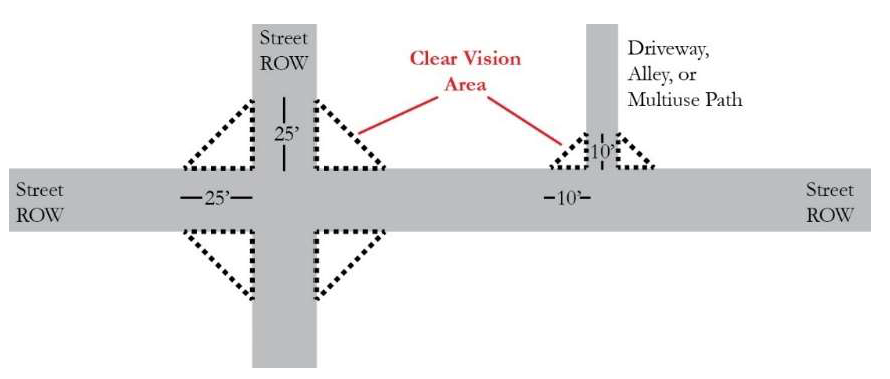
No plantings, signs, or structures shall be established or maintained on any corner lot or along any driveway that will likely result in obstructing the view of a vehicle approaching the intersection, or entering or exiting a driveway.
(B)
The following distances shall be used when establishing a clear vision area:
(1)
Driveways: Ten feet.
(2)
Multi-use paths: Ten feet.
(3)
Street intersections: 25 feet.
(C)
This shall not prohibit the maintaining of landscaping less than 36 inches in height in this area, nor the planting of trees whose lowest branches are higher than ten feet from grade.
(D)
The Zoning Administrator may require a reduction in the height of screening or vegetation where necessary to ensure adequate sight distance and/or corner clearance visibility for drive approaches and public streets in proximity to screening or vegetation. In this case, height shall be reduced only for that portion of the screening or vegetation necessary to provide adequate sight distance and/or corner clearance necessary for traffic safety.
(Ord. of 3-18-2025, § 5.8)
Sec. 151.059. - Corner lots.
Unless otherwise specified in this chapter, corner lots shall have two front setbacks along the roadways and two side yard setbacks.
(Ord. of 3-18-2025, § 5.9)
Sec. 151.060. - Demolition of buildings.
No structure shall be demolished until a demolition permit has been issued by the Zoning Administrator. The demolition shall be completed within such reasonable time period as shall be prescribed by the city and under conditions that may be specified as necessary to protect the public health, safety and welfare. The demolition of structures within the city shall comply with the following:
(A)
An application for a demolition permit shall include the reasons for the demolition and the intended use of the property following demolition. If the intended use is not permitted under the property's current zoning, a demolition permit shall be withheld until such time as approval for the new use is obtained, unless the property is deemed a hazard or attractive nuisance to the general public.
(B)
Following demolition of the structure and the removal of all required debris, any excavation or foundation shall be backfilled with clean fill and the site graded to meet existing grades at the property lines and prevent drainage of surface water onto abutting properties.
(C)
Following grading, all nonpaved areas shall be top dressed with a minimum two inches of topsoil and seeded with an appropriate grass seed.
(D)
An accessory building remaining on a property following the demolition of the principal structure shall be maintained in good condition.
(Ord. of 3-18-2025, § 5.10)
Sec. 151.061. - Emergency temporary buildings.
(A)
When permitted, emergency temporary dwellings may be permitted upon a finding by the city that the principal residential structure has been destroyed in whole or in part by fire, explosion or natural disaster and therefore is uninhabitable and the standards set forth herein have been met.
(B)
Permit application and review.
(1)
An application for a permit for the emergency temporary use and installation of a mobile home, modular, or prefabricated dwelling unit shall be made to the Zoning Administrator. The application shall be accompanied by a plot plan showing the location of the proposed structure.
(2)
The application shall be reviewed by a committee composed of the Zoning Administrator and two Planning Commission members. Approval of the application may be granted by a majority vote of the committee upon a finding that all of the following conditions are met:
(a)
The principal residential structure has been destroyed in whole or in part by fire, explosion, or natural disaster and therefore is uninhabitable.
(b)
The temporary dwelling unit will be connected to public sewer or water.
(c)
The temporary dwelling unit complies with all applicable Zoning District requirements including setback, area, bulk, and other requirements, except minimum house size requirements.
(3)
The granting of a permit for an emergency temporary dwelling unit shall be for a period of up to one year from the date of approval by the committee. Any conditions of approval shall be specified in writing on the permit.
(4)
To guarantee compliance with the provisions of the ordinance and removal of the emergency temporary dwelling upon expiration of the permit, the City Council may require a cash bond to be posted prior to the issuance of a permit.
(Ord. of 3-18-2025, § 5.11)
Sec. 151.062. - Fences.
The following standards shall apply to fences:
(A)
Be no taller than six feet in the side or rear yards in residential districts.
(B)
Can be located in the rear yard (i.e. between the rear building line and the rear lot line).
(C)
Can be located in a side yard (i.e. between a side building line and side lot line, provided the fence extends no farther forward than the midway point between the front and rear building lines or one foot beyond any doors in the adjacent side wall of the principal building.
(D)
New fences shall not be erected in front yards (i.e. between the front building line and the front lot line).
(E)
On corner lots and through lots, fences along the secondary street frontage shall not be constructed closer to the right-of-way line than the closer of the following two lines to the right-of-way line:
(1)
The average front building line for all principal structures on the block the fence is adjacent to;
(2)
The side building line of the principal structure parallel to the secondary frontage.
(F)
Be no closer than three feet to an abutting alley right-of-way.
(G)
Not be constructed in the clear vision area.
(H)
Have the finished side of the fence facing outward out away from the property.
(I)
Be entirely erected on the owner's property and maintained in good repair and safe condition.
(J)
Not be made of or include barbed wire, razor wire, electrified materials, or any other dangerous material in the residential, commercial, or mixed-use districts. Such material may be allowed in the industrial district upon approval by the Zoning Administrator.
(K)
Obtain a building permit.
(Ord. of 3-18-2025, § 5.12)
Sec. 151.063. - Floodplains.
Any structure constructed in a floodplain shall obtain a Part 31 permit from the Michigan Department of Environment, Great Lakes and Energy prior to being issued a zoning permit.
(Ord. of 3-18-2025, § 5.13)
Sec. 151.064. - Fractional measurements.
When using units of measurement to determine requirements of the standards presented in this chapter result in a fractional number, any number up to one-half shall be disregarded, and fractions equal to one-half or more shall be rounded up to the nearest whole number, unless noted otherwise.
(Ord. of 3-18-2025, § 5.14)
Sec. 151.065. - Livestock and wild game.
(A)
No livestock, including, but not limited to cows, calves, bulls, steers, horses, mules, burros, donkeys, goats, hogs, sheep, chickens, roosters, turkeys, guinea hens, ducks, geese or any wild game shall be maintained in any of the zone districts except for domestic farms and farm animals in Districts AG/OS and R-1A.
(B)
Domestic farm animals may be maintained provided there is a minimum lot area of five acres.
(C)
One must provide adequate fencing for maintaining animals in a restricted area, and proper control and disposal of refuse and wastes on the premises to minimize health hazards.
(D)
The feed and other materials for maintaining the animals must be stored appropriately so as not to attract vermin.
(E)
Housing for all animals shall be located no closer than 150 feet from any adjacent lot line.
(F)
Animal units shall not exceed one per acre of land directly devoted to the raising and keeping of the animals. For the purpose of this chapter, the following equivalent animal units (AU) shall be used:
(Ord. of 3-18-2025, § 5.15)
Sec. 151.066. - Nonconformities.
(A)
Intent. It is the intent of this chapter to permit legal nonconforming uses, sites, structures, and lots to continue until they are removed but not to encourage their survival. It is recognized that there exists within districts established by this chapter and subsequent amendments, uses, sites, structures, and lots which were lawful before this chapter was passed or amended which would be prohibited, regulated, or restricted under the terms of this chapter or future amendments.
(B)
General standards.
(1)
Continuation. On or after the effective date of this chapter or any subsequent amendments, a nonconformity that was lawfully operated, established, or commenced in accordance with the provisions of all ordinances, statutes, or regulations in effect at that time may continue subject to this article.
(2)
Change in tenancy or ownership. There may be a change of tenancy, ownership, or management of any existing nonconforming use or structure which does not alter the nonconforming status.
(3)
Special land uses and variances. If a special land use or variance has been approved, the structure or use shall not be considered "nonconforming."
(4)
Issued permit. Any permits issued prior to the effective date of this chapter, or any subsequent amendments, shall be valid in accordance with its terms, even though not conforming to the provisions of this chapter, provided that construction is commenced within 12 months after the date of permit issuance and proceeds meaningfully until completion.
(5)
Exception for repairs pursuant to public order. Nothing in this article shall be deemed to prevent the strengthening or restoration to a safe condition of a building or structure in accordance with an order of a public official who is charged with protecting the public safety and who declares such structure to be unsafe and orders its restoration to a safe condition, provided that such restoration is not otherwise in violation of the various provisions of this chapter prohibiting the repair or restoration of partially damaged or destroyed buildings or structures.
(6)
Loss of nonconformity. A legal nonconformity is lost by changing to conform to the ordinance or through vacancy, lack of operation or otherwise for six or more successive calendar months. If lost, any future use of such premises shall be in conformity, in its entirety, with the provisions of this chapter. Loss of a nonconformity shall terminate the right to continue the nonconformity.
(C)
Nonconforming uses. Nonconforming uses may be continued, enlarged, or expanded in accordance with the following provisions:
(1)
Continuance. A legal nonconforming use of any structure may be continued, although such use does not conform to the provisions of this chapter. Such use may be extended throughout the structure, provided that no structural alterations or additions to the structure are made.
(2)
Enlargement or expansion. A conforming structure in which a nonconforming use is operated shall not be enlarged or expanded except as required by law or to comply with an order of the City Building Official.
(3)
Change of use regulations.
(a)
Changes to conforming uses. Any nonconforming use may be changed to a use conforming with the regulations established for the district in which the nonconforming use is located, provided, however, that a nonconforming use so changed shall not in the future be changed back to the former nonconforming use.
(b)
Changes to other nonconforming uses. A nonconforming use may be changed to another nonconforming use by order of the Zoning Board of Appeals, provided that the new use is determined to be more consistent with the spirit of this chapter, the neighborhood, and the Master Plan than the nonconforming use which is being replaced. The order may be made by the Zoning Board of Appeals only if it makes findings in support of each of the following:
1.
The new use will not be contrary to the public interest;
2.
The new use will not substantially or permanently injure the appropriate use of adjacent conforming property in the same district;
3.
The new use will be in harmony with the spirit and purpose of these regulations and the Master Plan goals, objectives, and policies;
4.
The plight of the applicant for which the new use is sought is due to unique circumstances existing on the property and/or within the surrounding district;
5.
Approval of the new use will not substantially weaken the general purposes of this article or the regulations established in this chapter for the applicable zoning district;
6.
The new use shall not require more off-street parking and loading space than the former nonconforming use unless additional adequate off-street parking and loading space is provided for the increment of the new nonconforming use as if the increment were a separate use;
7.
The new use shall conform to all regulations established in Article VI: Site Development Standards and Article VII: Supplemental Use Standards, of this chapter; and
8.
The new use will not adversely affect the public health, safety, and welfare.
(D)
Nonconforming sites. Nonconforming sites may be continued, enlarged, or expanded in accordance with the following provisions:
(1)
Applicable standards. Various site design standards are established in Article VI: Site Development Standards and Article VII: Supplemental Use Standards of this chapter. Consequently, many development sites do not meet current requirements for such items as parking lot standards, landscaping, exterior lighting, stormwater requirements, and other design specifications. This subsection requires that such nonconforming sites be brought into conformance with all applicable development standards prescribed by this chapter.
(2)
Authority to continue. Any legal nonconforming site may be continued so long as it remains otherwise lawful subject to this subsection.
(3)
Extensions.
(a)
In general. A nonconforming site on which there is a conforming use shall not be expanded or contracted unless the site is brought into conformance with the provisions of this chapter.
(b)
Single-family residential exception. A single-family residential structure that is located on a legally nonconforming site with respect to required yards, areas, or height may be structurally altered or enlarged, providing the portion of the structure that is altered or enlarged conforms with the provisions of this chapter.
(4)
Relocations. No structure shall be relocated within a nonconforming site until the site is brought into conformance with the provisions of this chapter.
(5)
Change in use. A nonconforming site shall be allowed to be occupied by another use allowed by right in the district so long as no exterior structural modifications are to occur. In the event of a new occupant the site shall be brought into compliance with all applicable site and use standards, or the new occupant shall obtain a nonconforming site variance approved by the Zoning Board of Appeals.
(E)
Nonconforming structures. Nonconforming structures may be continued, repaired, replaced, enlarged, or expanded in accordance with the following provisions:
(1)
Continuance of nonconforming structures. Subject to all limitations in this subsection, and the provisions of Section 151.066(A)(5). Exception for repairs pursuant to public order of this section, any nonconforming structure may be occupied, operated, and maintained in a state of good repair, but no nonconforming structure shall be enlarged or extended unless in accordance with Section 151.066(E)(4). Enlargement or expansion item in this subsection provided that such maintenance does not exceed an aggregate cost of 30 percent of the assessed value of the structure.
(2)
Repair and maintenance of nonconforming structures. Nothing in this chapter shall prevent the repair, reinforcement, improvement, or rehabilitation of any nonconforming structure, or any part thereof, which results from wear and tear, deterioration, fire, windstorm, snowstorm, rainstorm, flood, or other casualty damage, nor shall it prevent compliance with the provisions of the State Construction Code Act, relative to the maintenance of buildings or structures. Such repair and maintenance shall not be so extensive as to constitute a replacement of the structure by replacing an exterior wall(s). For the purposes of this subsection, the determination of whether proposed repairs and maintenance constitute replacement shall be made by the Building Official. The determination of the Building Official shall be appealable to the Zoning Board of Appeals.
(3)
Replacement of damaged nonconforming structures. Nothing in this chapter shall prevent the replacement of any nonconforming building or structure damaged or destroyed by fire, windstorm, snowstorm, rainstorm, flood, or other casualty damage beyond the control of the owner, provided such replacement utilizes the original structure footprint and does not increase the original usable floor area or volume of such structure. Such replacement shall commence within 12 months of the damage or destruction.
(4)
Enlargement or expansion. A nonconforming structure in which only permitted uses are operated may be enlarged or expanded provided that the area of nonconformance is not increased and provided further that compliance with all of the provisions of this chapter established for structures in the district in which the nonconforming structure is located. Such enlargement shall also be subject to all other applicable city ordinances.
(F)
Nonconforming lots.
(1)
Any nonconforming lot of record may be used for any purpose authorized by the district in which it is located. This provision shall apply even though such lot fails to meet the requirements for area or width applicable in the district, provided that yard dimensions and other requirements not involving area or width, or both, of the lot shall conform to the regulations for the district in which such lot is located. Any required variances may be requested pursuant to the procedures and standards of this chapter.
(2)
If two or more contiguous lots, or portions of lots, are under the same ownership and do not individually meet the lot width, depth, and/or area requirements of this chapter, then those contiguous lots, or portions of lots, shall be considered an undivided lot for the purposes of this chapter, and no portion of such undivided lot shall be used or divided in a manner that diminishes compliance with the lot width, depth, and/or area requirements established by this chapter or which creates a nonconforming structure.
(Ord. of 3-18-2025, § 5.16)
Sec. 151.067. - Open space preservation.
(A)
Whenever the preservation of open space is required by this chapter, the applicant shall provide a demonstrated means that all open space portions of the development will be maintained in the manner approved. Documents shall be presented that bind all successors and future owners in fee title to commitments made as a part of the proposal. This provision shall not prohibit a transfer of ownership or control, provided notice of such transfer is provided to the city and the land uses continue as approved in the open space community plan. The dedicated open space shall be set aside by the applicant through an irrevocable conveyance that is found acceptable to the City Attorney, such as:
(1)
Recorded deed restrictions.
(2)
Covenants that run perpetually with the land.
(3)
Conservation easements such as those established per the Natural Resources and Environmental Protection Act; Act 451 of 1994, M.C.L.A. § 324.2144.
(B)
Such conveyance shall assure that the open space will be protected from all forms of development, except as shown on an approved site plan, and shall never be changed to another use. Such conveyance shall:
(1)
Indicate the proposed allowable use(s) of the dedicated open space.
(2)
Demonstrate to the satisfaction of the city that dedicated open space shall be maintained.
(3)
Provide standards for scheduled maintenance of the open space.
(4)
Provide for maintenance to be undertaken by the city in the event that the dedicated open space is inadequately maintained, or is determined by the city to be a public nuisance, with the assessment of costs upon property owners within the proposed development.
(Ord. of 3-18-2025, § 5.17)
Sec. 151.068. - Outdoor storage.
No land in any zoning district shall be used for the storage of unused or discarded equipment or materials, or for the storage of unlicensed cars, unlicensed motorcycles, recreational vehicles, salvage, waste or junk outside of properly authorized buildings within said district, except as permitted in connection with a use otherwise authorized in the nonresidential zoning districts.
(Ord. of 3-18-2025, § 5.18)
Sec. 151.069. - Permitted height exceptions.
The following structural appurtenances shall be permitted to exceed the height limitations of the district within which located:
(A)
Ornamental and architectural appurtenances such as spires, steeples, belfries, cupolas, domes, ornamental towers, flagpoles, and monuments not exceeding twice the height of the attached building.
(B)
Mechanical and structural appurtenances such as chimneys, water tanks, ventilators, bulkheads, amateur radio towers, television antennas, satellite dishes, fire and hose towers, and cooling towers but excluding telecommunication towers.
(C)
Structural extensions deemed necessary for appropriate building design such as cornices or parapet walls that may extend to a maximum of five feet above the height limitations for the district and shall have no openings.
(D)
The foregoing permitted height exceptions may be authorized only when all of the following conditions are satisfied:
(1)
No portion of any building or structure, permitted as an exception to a height limitation, shall be used for human occupancy or the conduct of a business.
(2)
Any permitted structural exception to a height limitation shall be erected only to such height as is necessary to accomplish the purpose it is intended to serve, and no higher.
(3)
If the roof area of such structural elements that are allowed to exceed the height limitations exceed cumulatively more than 20 percent of the gross roof area or 400 square feet, they shall be considered to be integral parts of the whole structure and shall not be eligible to exceed the height limitations.
(Ord. of 3-18-2025, § 5.19)
Sec. 151.070. - Permitted yard encroachments.
Architectural features may encroach into required yards as follows:
(A)
Cornices, eaves, sills, fireplaces, flues, ornamental features, and other similar features may extend or project into a required yard a distance of not more than two inches for every one foot of required side yard.
(B)
Uncovered and unenclosed ground story decks, patios, or terraces less than 30 inches above grade may project into a required yard a maximum of 50 percent of the required rear or side yard.
(C)
Covered porches that extend from the ground floor level of a single-family or duplex residence may project into a required front yard setback a maximum of eight feet.
(Ord. of 3-18-2025, § 5.20)
Sec. 151.071. - Public uses: critical, essential, and supporting.
Critical, essential and supporting public uses shall be allowed in any zoning district by right. All applicable laws or other ordinances of the city shall apply. All buildings associated with a public use shall be subject to applicable setbacks for the district in which they are located and shall require site plan approval and a land use permit.
(Ord. of 3-18-2025, § 5.21)
Sec. 151.072. - Recreational vehicles.
The outdoor storage of recreational vehicles shall be subject to the following:
(A)
Be limited to one stored outdoors on any AG/OS, R-1A, or R-1B lot.
(B)
Not be located in any front yard.
(C)
Be registered to the occupant of the property, unless established as an approved storage use.
(D)
Not be parked overnight on any street, alley, highway, or public space.
(Ord. of 3-18-2025, § 5.22)
Sec. 151.073. - Relocation of buildings.
The relocation of a building to a different location in the city shall be the same as erection of a new building, and all applicable provisions, regulations, and required permitting shall be followed and obtained.
(Ord. of 3-18-2025, § 5.23)
Sec. 151.074. - Restoration of unsafe buildings.
Nothing in this chapter shall prevent the strengthening or restoring to a safe condition any part of any building or structure declared unsafe by the Zoning Administrator, Building Inspector, or Public Health Inspector.
(Ord. of 3-18-2025, § 5.24)
Sec. 151.075. - Required water supply and sanitation facilities.
Buildings erected, altered, or moved upon any premises and used in whole or in part as either year-round or seasonal dwellings or for recreational, business, commercial, or industrial purposes, including religious institutions, schools, and other buildings in which personals customarily congregate, shall have adequate water and sanitary facilities as determined by the City of Iron River.
(Ord. of 3-18-2025, § 5.25)
Sec. 151.076. - Single-family, manufactured homes, and prefabricated housing.
No single-family dwelling (site built), manufactured home, modular housing, or prefabricated housing located outside a mobile home park or mobile home subdivision shall be permitted unless said dwelling unit conforms to the following standards:
(A)
Square footage. Each such dwelling unit shall comply with the minimum square footage requirements of this chapter for the zone district in which it is located.
(B)
Dimensions. Each such dwelling unit shall have a minimum width across any front, side, or rear elevation of 20 feet and shall comply in all respects with the building code, including minimum heights for habitable rooms. Where a dwelling is required by law to comply with any federal or state standards or regulations for construction and where such standards or regulations for construction are different than those imposed by the Michigan State Construction Code Commission, then and in that event such federal or state standard or regulation shall apply.
(C)
Foundation. Each such dwelling unit shall be firmly attached to a permanent foundation constructed on the site in accordance with the building code and shall have a wall of such dimensions to adequately support the dwelling. All dwellings shall be securely anchored to the foundation in order to prevent displacement during windstorms.
(D)
Undercarriage. Dwelling units shall not be installed with attached wheels. Additionally, no dwelling shall have any exposed towing mechanism, undercarriage, or chassis.
(E)
Sewage disposal or water supply. Each such dwelling unit shall be connected to public sewer and water.
(F)
Storage area. Each such dwelling unit shall contain a storage capability area either in a basement located under the dwelling, in an attic area, or in a separate or attached structure of standard construction similar to or of better quality than the principal dwelling, which storage area shall be equal to ten percent of the square footage of the dwelling or 100 square feet, which ever shall be less.
(G)
Architecture and compatibility. The compatibility of design and appearance shall be determined in the first instance by the Zoning Administrator. The Zoning Administrator may also refer any determination of compatibility shall be based upon the character, design, and appearance of one or more residential dwellings located outside of mobile home parks within 500 feet of the subject dwelling. All dwellings shall be aesthetically compatible in design and appearance with other residences in the vicinity. No principal building shall be built of steel exterior wall construction. All homes shall have a roof overhang of not less than six inches on all sides or alternatively with window sills or roof drainage systems concentrating roof drainage at collection points along the sides of the dwelling. The dwellings shall not have less than two exterior doors with one door being in either the rear or side of the dwelling. Steps shall also be required for exterior door areas or to porches connected to say door areas where a difference in elevation requires the same. The foregoing shall not be construed to prohibit innovative design concepts involving such matters a solar energy, view, unique land contour, or relief from the common or standard designed home.
(H)
Additions. Each such dwelling unit shall contain no addition or room or other area which is not constructed with similar quality workmanship as the original structure, including permanent attachment to the principal structure and construction of a foundation as required herein.
(I)
Manufactured homes. Manufactured homes may be used as a single-family dwelling in AG/OS and R1-A Zoning Districts. The site must be a minimum of one acre in size. The date of manufacture must be ten years or less in age. The minimum width of the unit permitted is 14 feet. The minimum floor space of the unit may be no less than 1,000 square feet.
(J)
Code compliance. Each such dwelling unit type shall comply with all pertinent building and fire codes. Additionally, all dwellings shall meet or exceed all applicable roof snow load and strength requirements.
(K)
Building permit. All construction required herein shall be commenced only after a building permit has been obtained in accordance with the applicable building code provisions and requirements.
(L)
Exceptions. The foregoing standards shall not apply to a mobile home located in a licensed mobile home park except to the extent required by state or federal law or otherwise specifically required in this chapter and pertaining to such parks. Mobile homes which do not conform to the standards of this section shall not be used for dwelling purposes within the city unless located within a mobile home park or a mobile home subdivision district for such uses.
(Ord. of 3-18-2025, § 5.26)
Sec. 151.077. - Temporary buildings for construction.
Temporary buildings or structures may be utilized during construction for the storage of construction materials and for construction offices during a construction period of an approved project. Temporary buildings shall be removed within 30 days after the completion or abandonment of the work. No temporary building or structure shall be used as a dwelling unit.
(Ord. of 3-18-2025, § 5.27)
Sec. 151.078. - Voting place.
The provisions of this chapter shall not be so construed as to interfere with the temporary use of any property as a voting place in connection with a municipal or other public election.
(Ord. of 3-18-2025, § 5.28)
Sec. 151.091.- Intent and purpose.
The purpose of the regulations contained in this article is to protect the public health, safety, and general welfare; to promote harmonious and orderly development; and to foster civic beauty by improving the appearance, character and economic value of civic, commercial, and industrial development.
(Ord. of 3-18-2025, § 6.1)
Sec. 151.092. - Parking.
(A)
General standards. The following standards shall apply to any required off-street parking areas:
(1)
Use. Off-street parking, loading, or stacking areas shall only be used for their intended purpose. All other uses are prohibited.
(2)
Location. All off-street parking areas shall be on the same lot as the use it serves or within 300 feet, measured from the closest point of the building to the nearest point of the off-street parking area.
(3)
Setbacks. All parking areas shall meet the minimum setback standards by district specified in Article III.
(4)
Screening and landscaping. All off-street parking areas shall meet the buffer requirements specified in this article.
(5)
Pedestrian circulation. All off-street parking areas shall provide safe, efficient pedestrian circulation that allows appropriate access from the off-street parking lot and established use. The Planning Commission shall make the final determination on the adequacy of the pedestrian circulation network as part of site plan review.
(6)
Dimensions. Off-street parking areas shall be designed to the following minimum standards:
(7)
Surfacing. Parking surfaces shall be durable and dustless materials such as asphalt or concrete. Gravel shall not be an allowable material under this standard. Exceptions to the surfacing materials may be permitted in the AG/OS, I-1, and MI Districts by the Planning Commission in order to maintain a rural, agricultural character.
(8)
Drainage. All off-street parking areas shall utilize, where practical, Low Impact Development (LID) water quality technologies to collect and treat stormwater on-site as required for site plan review.
(9)
Curbs and vehicle stops. All off-street parking areas shall include curbs or vehicle stops to prevent vehicles from overhanging into or over public rights-of-way, sidewalks, adjacent areas, or landscape areas.
(10)
Exterior lighting. Except for parcels zoned for single-family and duplex dwelling units, all off-street parking areas with a capacity of ten or more vehicles shall provide adequate lighting throughout the hours when the parking area is in operation. New or redeveloped off-street parking, stacking, and loading areas shall comply with the exterior lighting standards in this article.
(11)
Snow storage. The Planning Commission has the authority to require snow storage areas. When required by the Planning Commission snow storage areas shall be provided on the ratio of 15 square feet per 100 square feet of off-street parking area. Snow storage areas shall be located in such a manner that does not obstruct required clear vision areas.
(12)
Maintenance. All parking areas shall be maintained in good condition and kept free of debris and garbage.
(13)
Completion. All off-street parking, stacking and loading areas indicated on a site plan shall be fully completed before the issuance of certificate of occupancy. In the case of phased developments, only the off-street parking, stacking and loading areas associated with a given phase of development shall be required to be completed.
(14)
Access through yards. Access drives may be placed in the required front or side yards so as to provide access to rear yards or accessory or attached structures. (These drives shall not be considered as structural violations in front or side yards.) Any walk, terrace, or like surface area not in excess of nine inches above the grade upon which placed shall not be considered to be a structure and shall be permitted in any required yard.
(15)
Barrier-free parking. Off-street parking areas shall provide barrier-free spaces in compliance with the state building code and the Americans with Disabilities Act (ADA), as applicable.
(16)
Defined area. Off-street parking areas and loading zones shall include painted lines, vehicle stops, or other delineating features to clearly define parking and loading spaces.
(17)
Parking duration. Except when the land is used as storage space in connection with the business of an automobile and vehicle repair use, there shall be a 24-hour time limit for parking in nonresidential off-street parking areas.
(a)
Vehicles being stored in an off-street parking lot in connection with the business of an automobile and vehicle repair use shall not exceed 28 days in duration.
(b)
No vehicle being stored on a public street right-of-way in connection with the business of an automobile and vehicle repair use shall exceed 24 hours in duration.
(B)
Parking requirements.
(1)
Maximum parking. To minimize excessive areas of pavement which detracts from the aesthetics of the city and contributes to high rates of stormwater runoff, this chapter establishes a maximum number of parking spaces for each use. There are no minimum parking requirements. The Planning Commission may grant an increase of up to 25 percent of the maximum number of parking spaces if:
(a)
The applicant can demonstrate to the Planning Commission's satisfaction the additional parking is necessary based on documented evidence of actual use or anticipated demand.
(b)
The increase in parking will have no undue burden on neighboring property owners and/or natural features.
(c)
In granting a request to exceed the maximum number of parking spaces, the additional spaces shall be constructed of pervious pavement, pavers, or similar pervious material acceptable to the Planning Commission.
(2)
Calculating parking maximums. The following rules shall be applied when calculating the maximum number parking spaces:
(a)
Measurements based on square feet shall be calculated by gross floor area (GFA) as defined in this chapter.
(b)
The number of employees shall be based on the maximum number needed for the largest shift.
(c)
Requirements based on the number of individual seats shall use a measurement of 24 inches of bench or pew space or 25 square feet of floor as one seat.
(d)
Occupancy shall mean legal occupancy as determined by the fire department or other authorized agency.
(e)
Parking spaces incorporated into a garage shall not count towards the maximum number of off-street parking spaces permitted.
(f)
If on-street parking spaces are located adjacent to the use, then the number of on-street parking spaces may be deducted from the total parking required.
(3)
Use not specified. The maximum number of parking spaces for uses not specified shall be determined by the Zoning Administrator based on whether or not the proposed use is similar enough to fit within the definition of an existing listed use. The determination of the Zoning Administrator may by appealed to the Zoning Board of Appeals.
(4)
Maximum parking requirements. The maximum number of off-street parking spaces shall be determined in accordance with the following table:
(5)
Shared parking. Two or more buildings or uses may collectively provide off-street parking, provided the following conditions are met:
(a)
A copy of a shared parking agreement between all parties concerned shall be provided to the City. The agreement shall include provisions which assure continued long-term use and maintenance of the parking facility by each party, and their successors in interest, including owners and occupants of the premises which are served by the parking facility.
(C)
Loading zones.
(1)
In all zoning districts, every building or portion thereof that is occupied by a use requiring the receipt and distribution of materials or merchandise by vehicles shall provide and maintain adequate off-street loading zones.
(2)
Location.
a.
On-site loading zones shall be permitted in the side and rear yard only. In exceptional instances, loading zones may be permitted in an interior side yard, with approval of the Planning Commission, when it can be shown that site conditions necessitate such location.
b.
Loading zones shall not interfere with the normal movement of pedestrians and vehicles in the public street rights-of-way, internal drives, and off-street parking areas.
c.
Loading zones shall be designed for the largest vehicle intended to serve the use, with adequate turning radii, maneuverability, and loading space.
d.
A loading space must be 22 feet long at minimum. Depending on the business and the need for semi-truck deliveries, the space may be larger.
(3)
Loading space requirements. The minimum number of loading zone spaces shall be provided as described below:
(4)
Administrative waiver. The Planning Commission may approve a modification to the loading zone location or space requirements where it has been determined that another measure or location would be more appropriate due to site constraints, or the number or type of deliveries experienced by a particular use.
(D)
Access management.
(1)
All off-street parking, loading, and stacking areas shall be arranged for convenient access and safety of pedestrians, bicyclists, and vehicles.
(2)
Adequate ingress and egress shall be provided by clearly defined driveways. Backing into public street rights-of-way shall be prohibited.
(3)
Access to off-street parking areas for nonresidential uses shall not be permitted across lots that are residential in use or in a residential zoning district.
(4)
Cross access management.
a.
All off-street parking areas not accessed by an alley shall be designed to allow internal vehicle circulation between adjacent lots by providing a location for cross access on the site plan.
b.
A cross access agreement shall be recorded with the Iron County Register of Deeds prior to the issuance of a building certificate of occupancy.
c.
The Planning Commission may waive this requirement if deemed impractical during site plan review due to topography, natural features, or vehicular safety factors if appropriate bicycle and pedestrian connections are provided between adjacent developments and uses.
(Ord. of 3-18-2025, § 6.2)
Sec. 151.093. - Nonmotorized transportation.
Safe, nonmotorized transportation options shall not be removed or altered to interfere with shared pathways provide public access within the City through sidewalks and shared-use pathways.
(A)
The Planning Commission may modify an existing nonmotorized transportation route or the proposed design.
(B)
When required, permits must be obtained from the Michigan Department of Transportation or the Iron County Road Commission.
(C)
Sidewalk and shared-use pathway maintenance, including replacement in the case of inadequate construction, unsafe, defective, or nonconforming design, as determined by the Zoning Administrator, shall be the responsibility of the parcel owner or adjacent parcel owner if constructed in the street right-of-way.
(D)
Depending on site conditions, or project phasing, the Planning Commission may require an easement on the property which would be solely used for the installation of a sidewalk or shared use pathway at a later date. The City Attorney shall review the easement prior to acceptance and recording.
(Ord. of 3-18-2025, § 6.3)
Sec. 151.094. - Landscaping.
(A)
Intent. The intent of this section is to:
(1)
Protect and preserve the appearance, character, and value of the community.
(2)
Minimize noise, air, and visual pollution.
(3)
Improve the overall aesthetics and appearance, divide the expanse of pavement, and define parking areas and vehicular circulation within off-street parking lots and other vehicular use areas.
(4)
Require buffering of residential areas from more intense land uses and public road rights-of-way.
(5)
Prevent soil erosion and soil depletion and promote sub-surface water retention.
(6)
Encourage an appropriate mixture of plant material, such as evergreen and deciduous trees and shrubs, to protect against insect and disease infestation and produce a more aesthetic and cohesive design.
(7)
Encourage the integration of existing woodlands in landscape plans.
(B)
Applicability. These requirements shall apply to all uses for which site plan review is required per Article VIII of this chapter and subdivision plat review as required under the Subdivision Control Ordinance.
(C)
Landscape plan requirements. A separate detailed landscape plan shall be required to be submitted to the city as part of the site plan review or tentative preliminary plat review. The landscape plan shall demonstrate that all requirements of this section are met and shall include, but not necessarily be limited to, the following items:
(1)
Location, spacing, size, root type and descriptions for each plant type.
(2)
Typical straight cross section including slope, height, and width of berms.
(3)
Typical construction details to resolve specific site conditions, such as landscape walls and tree wells used to preserve existing trees or maintain natural grades.
(4)
Details in either text or drawing form to ensure proper installation and establishment of proposed plant materials.
(5)
Identification of existing trees and vegetative cover to be preserved.
(6)
Identification of grass and other ground cover and method of planting.
(7)
Identification of landscape maintenance program including statement that all diseased, damaged, or dead materials shall be replaced in accordance with standards of this chapter.
(8)
Planting counts, identifying compliance with all required landscaping, must be provided.
(D)
Buffer zones.
(1)
A buffer shall be provided between the subject site and all adjacent properties, developed or undeveloped, in accordance with the Table set forth in this section.
(2)
The buffers required in the table set forth in this section shall adhere to the following minimum requirements. Additional landscaping may be required by the Planning Commission if deemed necessary to provide the desired screening.
a.
Type A Buffers shall be a minimum 30 feet wide, along the property line with two trees and four shrubs per 20 linear feet, rounded upward, and may also include a wall, berm or combination of these elements as determined by the Planning Commission.
b.
Type B Buffers shall be a minimum ten feet wide, along the property line with one tree and four shrubs per 20 linear feet, rounded upward.
c.
Type C Buffers shall adhere to the standards for Type B Buffers, except that a reduced width and/or screening wall or fence may be allowed in lieu of some or all of the planting requirements when site conditions or surrounding zoning and uses so allow, as determined by the Planning Commission.
(3)
Screening walls and fences. Where required or allowed, screening walls or fences shall meet the standards in Article V.
(E)
Parking lot landscaping.
(1)
Required landscaping within parking lots. Separate landscape areas shall be provided within parking lots in accordance with the following requirements:
(a)
Where landscape islands are required in this article, there shall be a minimum of one tree for every eight parking spaces planted. Islands shall be required for each 16 continuous spaces. Where landscape islands are not required, the same ratio of trees shall be placed on the site, within ten feet of the parking lot perimeter.
(b)
Landscaped islands shall be curbed and shall not be less than 100 square feet in area.
(c)
A minimum distance of three feet from the backside of the curb and the proposed landscape plantings shall be provided. Where vehicles overhang a landscape island or strip, a minimum distance of five feet from the backside of the curb and the proposed landscape plantings shall be provided.
(d)
The city, at its discretion, may approve alternative landscape plantings at the perimeter of parking lots where landscaping within parking lots would be impractical due to the size of the parking lot or detrimental to safe and efficient traffic flow, or would create an unreasonable burden for maintenance and snowplowing.
(2)
Required landscaping at the perimeter of parking lots. Separate landscape areas shall be provided at the perimeter of parking lots in accordance with the following requirements:
(a)
Where required, parking lots shall meet the buffer requirements set forth in the table in this section.
(b)
Parking lots shall be screened from view with a solid wall at least three feet in height along the perimeter of those sides which are visible from a public road. The city, at its discretion, may approve alternative landscape plantings in lieu of a wall.
(F)
Greenbelts. A greenbelt shall be provided which is an area equal to the depth of the required front yard setback within that zoning district and landscaped in accordance with the following requirements:
(1)
The greenbelt shall be landscaped with a minimum of one deciduous tree for every 30 lineal feet, or one ornamental tree for every 20 lineal feet, or fraction thereof, of frontage abutting a public road right-of-way. Such trees shall meet the minimum size and spacing requirements set forth in this section.
(2)
In addition to the required trees within the greenbelt, the remainder of the greenbelt shall be landscaped in grass, ground cover, shrubs, and other natural landscape materials. Ground cover shall not include gravel or stone which, in the opinion of the Planning Commission, can cause safety concerns and vehicle damage if located too close to a public roadway.
(G)
Site landscaping. In addition to any landscape greenbelt and/or parking lot landscaping required by this section, site area landscaping shall be provided to screen potentially objectionable site features such as, but not limited to, retention/detention ponds, transformer pads, air-conditioning units, and loading areas. Such site area landscaping may include a combination of the preservation of existing tree cover, planting of new trees and plant material, landscape plazas and gardens and building foundation planting beds.
(H)
Subdivision and site condominium landscaping. Landscaping for single-family residential subdivisions and site condominiums shall be provided in accordance with the following requirements:
(1)
Street trees. The frontage of all internal public or private streets shall be landscaped with a minimum of one tree for every 50 lineal feet, or fraction thereof. Such street trees shall meet the minimum size and spacing requirements set forth in this section.
(2)
Buffers between land uses. Where required in the table set forth in this section, a subdivision or site condominium buffer shall be required.
(3)
Screening from public roads. Where a subdivision or site condominium abuts a public road right-of-way located outside of the proposed subdivision or site condominium, the screening requirements set forth in this Section shall be met.
(4)
Other site improvements. A landscape plan for a subdivision or site condominium development shall also include landscaping details of the entrance to the development, storm water retention and/or detention areas, community buildings and other recreational areas, and any other site improvement which would be enhanced through the addition of landscaping.
(I)
Screening of trash containers.
(1)
Outside trash disposal containers two yards or greater in capacity shall be screened on all sides with an opaque fence or wall and gate at least as high as the container, but no less than six feet in height, and shall be constructed of material which is compatible with the architectural materials used in the site development.
(2)
Containers shall be consolidated to minimize the number of collection sites, and located so as to reasonably equalize the distance from the building they serve.
(3)
Containers and enclosures shall be located away from public view insofar as possible.
(4)
Containers and enclosures shall be situated so they do not cause excessive nuisance or offense to occupants of nearby buildings.
(5)
Concrete pads of appropriate size and construction shall be provided for containers or groups of containers having a capacity of six 30-gallon cans or more. Aprons shall be provided for loading of bins with a capacity of one and one-half cubic yards or more.
(6)
The enclosure area and pad size shall be increased to amply accommodate the storage of recyclable materials and their containers.
(7)
Screening and gates shall be of a durable construction.
(J)
Landscape elements. The following minimum standards shall apply:
(1)
Quality. Plant materials shall be of generally acceptable varieties and species, free from insects and diseases, hardy to Iron County, conform to the current minimum standard of the American Association of Nurserymen, and shall have proof of any required governmental regulations and/or inspections.
(2)
Composition. A mixture of plant material, such as evergreen deciduous trees and shrubs, is recommended as a protective measure against insect and disease infestation. A limited mixture of hardy species is recommended rather than a large quantity of different species to produce a more aesthetic, cohesive design and avoid a disorderly appearing arrangement.
(3)
Berms. Berms shall be constructed with slopes not to exceed a 1:3 gradient. Berm slopes shall be protected with sod, seed, or other form of natural ground cover.
(4)
Existing trees. The preservation and incorporation of existing trees is encouraged. Where existing trees are used to satisfy the requirements of this section, the following requirements shall apply:
(a)
Paving, or other site improvements, shall not encroach upon the drip line of the existing tree(s) to be preserved.
(b)
If existing plant material is labeled "To Remain" on site plans by the applicant or required by the city, protective techniques, such as, but not limited to, fencing or barriers placed at the drip line around the perimeter of the plant material shall be installed during construction. No vehicle or other construction equipment shall be parked or stored within the drip line of any plant material intended to be saved. Other protective techniques may be used provided such techniques are approved by the city.
(c)
In the event that healthy trees which are used to meet the minimum requirements of this chapter or those labeled to remain are cut down, destroyed, damaged, or excavated at the drip line, as determined by the city, the contractor shall replace them with trees which meet ordinance requirements.
(5)
Installation, maintenance, and completion.
(a)
All landscaping required by this chapter shall be planted before obtaining a certificate of occupancy or the appropriate financial guarantee, as set forth in Article XII, shall be placed in escrow in the amount of the cost of landscaping to be released only after landscaping is completed.
(b)
All landscaping and landscape elements shall be planted, and earth moving or grading performed, in a sound workmanlike manner, according to accepted planting and grading procedures.
(c)
The owner of property required to be landscaped by this chapter shall maintain such landscaping in a strong and healthy condition, free from refuse, debris and insects. All materials used to satisfy the requirements of the ordinance which become unhealthy or dead shall be replaced within one year of damage or death or the next appropriate planting period, whichever comes first. All landscaped areas shall be provided with a readily available and acceptable water supply.
(Ord. of 3-18-2025, § 6.4)
Sec. 151.095. - Exterior lighting.
(A)
Intent and purpose. The provisions of this section are intended to control the use of outdoor, artificial illuminating devices emitting rays into the night sky by:
(1)
Encourage good lighting practices such that lighting systems are designed to save energy and money.
(2)
Minimize glare.
(3)
Protect the use and enjoyment of surrounding property.
(4)
Increase nighttime safety, utility, security and productivity.
(B)
Exemptions. The following uses and activities shall be exempt from the standards of this section, provided they do not create glare perceptible to persons operating motor vehicles in the public right-of-way:
(1)
New technology and/or location. The Zoning Administrator may gran exceptions to the material, light source, method of installation, or location standards in this section in consideration of any new state-of-the-art technology, so long as the exception still meets all other applicable standards of this section.
(2)
Residential lighting. Low intensity residential decorative lighting, such as porch lights or low-level façade and landscape lighting, provided any such lights are directed toward the residential building or land.
(3)
Holiday decorations. Provided the decorative exterior lighting shall not include searchlights, floodlights, or stroboscopic lights.
(4)
Neon lights. Displayed as part of an approved sign.
(5)
Flag lighting. Luminaires used for the illumination of the flag of the United States of America.
(6)
Temporary lighting. Associated with an approved temporary event permitted by this chapter.
(7)
Fossil fuels. Outdoor light fixtures producing light from the combustion of fossil fuels, such as kerosene lanterns and gas lamps.
(8)
Statutory authority. Circumstances where federal or state laws, rules or regulations take precedence over the provisions of this Section, or where fire, police, emergency, or repair personnel need light for temporary or emergency situations, or lighting that is only activated at the time of power outages.
(C)
Shielding and filtration.
(1)
All nonexempt exterior lighting shall by hooded and/or louvered to provide a glare-free area beyond the property line and beyond any public right-of-way.
(2)
All lighting fixtures shall have 100 percent cut-off shielding that prevents light from being emitted above a horizontal plane the lowest direct light emitting part of the luminaire.
(3)
Light sources shall be located as to minimize the hazards of glare, and all poles or standards used to support outdoor light fixtures shall be coated with a material that minimizes glare for the light source.
(D)
Illumination. Illumination levels within a site shall ensure that a site is adequately, but not excessively lit, in order to provide visibility, safety, and security without unnecessarily contributing to light pollution and negatively impacting neighboring properties.
(1)
Intensity. The maximum intensity of light within any site shall not exceed the following standards, measured in footcandles (fc) at grade:
(a)
Exceptions. Outdoor vehicle dealerships may permit a maximum lighting intensity of 20 footcandles for paved display areas. Fuel station canopy lights may permit a maximum lighting intensity of 20 footcandles under the canopy provided that all light fixtures shall be recessed into the structure. All other site lighting shall be in compliance with this chapter.
(2)
Color temperature. All exterior lighting shall emit light measuring 4,000 K or warmer (between zero K and 4,000 K) on the Kelvin scale.
(3)
Brightness. All exterior lighting sources shall be limited to a maximum brightness of 800 lumens.
(E)
Exterior lighting site standards.
(1)
Hours of operation. All exterior lighting shall be equipped with automatic timing devices and shall be shut off if no customers or staff are present between the hours of 10:00 p.m. and sunrise, except for lighting necessary for security purposes or for uses that continue after 10:00 p.m.
(2)
Pole height. The maximum pole height for exterior lighting shall not exceed 22 feet, or the maximum height of the principal building, whichever is less.
(3)
Wall pack. Wall pack lighting shall be limited to above points of ingress and egress.
(4)
Prohibitions. The following light sources and fixtures shall be prohibited:
(a)
Unshielded luminous tube (neon), fluorescent or LED lighting used as accent lighting on facades.
(b)
Metal halide.
(c)
Mercury vapor.
(d)
High pressure sodium.
(e)
Halogen.
(f)
Animated, flashing or moving lights.
(g)
Laser sources of light.
(h)
Search lights.
(Ord. of 3-18-2025, § 6.5)
Sec. 151.096. - Signs.
(A)
Intent and purpose. The intent of this section is to regulate the location, size, construction, and manner of display of signs and outdoor advertising in order to minimize their harmful effects on the public health, safety, welfare, and traffic safety. While this section recognizes that signs and outdoor advertising are necessary to promote commerce and public information, it also recognizes that the failure to regulate them may lead to poor identification of individual business, deterioration, and blight of the business and residential areas of the city, conflicts between different types of land use, and reduction in traffic safety to pedestrians and motorists. To achieve its intended purpose, this section has the following objectives:
(1)
To prevent the placement of signs in a manner that will conceal or obscure signs of adjacent businesses;
(2)
To keep the number of signs and sign messages at the level reasonably necessary to identify a business and its products;
(3)
To keep signs within a reasonable scale with respect to the buildings they identify;
(4)
To reduce visual distractions and obstructions to motorists traveling along, entering, or leaving streets;
(5)
To promote a quality manner of display which enhances the character of the City;
(6)
To prevent the proliferation of temporary signs which might promote visual blight; and
(7)
To promote economic development by allowing a fair opportunity for each property owner to attractively display their property in a clean and clear way.
(B)
General requirements.
(1)
Permit required. Prior to the erection or structural alteration of sign, a zoning permit shall be secured from the Zoning Administrator. Exceptions to the permit requirements of this subsection shall include:
a.
Signs attached on the sides of buildings that advertise the product or service of the occupant, which do not exceed 100 square feet, extend no more than four inches from the side of the building, and are not illuminated, are not required to obtain a permit for the sign. If the building to which the sign is attached becomes vacant or the occupant changes, the sign shall be removed.
b.
Historical signs designated by the state or federal government, limited to ten square feet per lot.
c.
Government signs erected on behalf or pursuant to the authorization of a government body, including street signs, legal notices, informational signs, and regulatory signs.
(2)
Design and condition. All signs and sign structures shall be properly maintained and kept in a good state of repair.
(3)
Right-of-way. No sign shall be placed in the right-of-way except permitted awning, canopy, and marquee signs with approval by the agency managing the right-of-way. Small temporary signs in the CBD district may be placed on the sidewalk during business hours in accordance with the provisions of this section, and provided the small temporary sign still allows four feet of unobstructed sidewalk clearance.
(4)
Traffic interference. No sign shall be erected or maintained which simulates or imitates in size, color, lettering, or design any traffic sign or signal or other word, phrase, symbol, or character in such manner as to interfere with, mislead, confuse, or create a visual impediment or safety hazard to pedestrian or vehicular traffic.
(5)
The standards in this section shall not be applicable to any sign not visible from a public right-of-way.
(C)
Sign measurements.
(1)
Surface area.
(a)
Signs shall not exceed the maximum allowable area permitted in this section for sign type and district or use. When not limited to one sign of a specific type, the maximum area shall be determined by the cumulative total of all the signs of a specific type.
(b)
The area of a sign shall mean the area of all lettering, wording, and accompanying designs, logos, and symbols. The area of a sign shall not include any supporting framework, bracing or trim which is incidental to the display, provided that it does not contain any lettering, wording, or symbols.
(c)
Where the sign consists of individual letters, designs, or symbols attached to a building, awning, wall, or window, the area shall be that of the smallest rectangle which encompasses all of the letters, designs, and symbols.
(d)
Signs that consist of, or have attached to them, one or more three-dimensional or irregularly shaped objects, shall have a sign area of the sum of two adjacent vertical sign faces of the smallest cube encompassing the sign or object.
(e)
Only one face of a double-sided sign will be used to determine the area of the sign.
(f)
For V-shaped signs, either horizontally or vertically oriented, with interior angles greater than 90°, the sign area is the sum of both sign faces. For V-shaped signs that have interior angles equal to or less than 90°, the area is the same as for double-sided signs.
(2)
Height.
(a)
Sign height shall be measured as the distance from the highest portion of the sign to the mean finished grade at the base of the sign.
(b)
Clearance for projecting, awning, and canopy/marquee signs shall be measured as the smallest vertical distance between finished grade and the lowest point of the sign, including any framework or other structural elements.
(c)
The permitted maximum height for all signs is determined by the sign type and the zoning district or use in which the sign is located.
(D)
Illumination. Internal and external illumination of signs shall be permitted for all signs except where limited or prohibited in this section, subject to the following:
(1)
All illumination shall be concentrated on the area of the sign or landscape feature and directed or shielded to not interfere with the vision of persons on the adjacent streets or adjacent property.
(2)
No sign shall be illuminated by other than electrical means or devices, and wiring shall be installed underground in accordance with the National Electrical Code.
(3)
All illumination shall be limited to 800 lumens and a color temperature measuring 3,500 K or warmer (between zero K and 3,500 K) on the Kelvin scale.
(4)
Internally illuminated signs shall have a dark background and light lettering.
(5)
No sign shall include reflective materials.
(E)
Freestanding signs.
(1)
Definition. A sign supported by structures or supports that are placed on, or anchored in, the ground; and that is independent and detached from any building or other structure.
(2)
Regulations.
(a)
Freestanding ground signs shall be supported and permanently placed by embedding, anchoring, or connecting the sign in such a manner as to incorporate it into the landscape or architectural design scheme.
(b)
No freestanding sign may occupy an area designated for parking, loading, walkways, driveways, fire lane, easement, sidewalk right-of-way, or other areas required to remain unobstructed.
(3)
Freestanding sign standards.
(F)
Wall Signs.
(1)
Definition. A building-mounted sign, which is either attached to, displayed on, or painted on an exterior wall in a manner parallel with the wall surface. A sign installed on a false or mansard roof is also considered a wall sign. Also known as a fascia sign, parallel wall sign, or band sign.
(2)
Regulations.
(a)
No portion of a wall sign shall extend out more than 12 inches from the building wall on which it is affixed.
(3)
Wall sign standards.
(G)
Awning signs.
(1)
Definition. A cloth, plastic, or other nonstructural covering that projects from a wall for the purpose of shielding a doorway or window. An awning is either permanently attached to a building or can be raised or retracted to a position against the building when not in use.
(2)
Regulations.
(a)
An awning without lettering or other advertising shall not be regulated as an awning sign.
(b)
Awning signs shall only be allowed on the first floor.
(c)
Awning signs must be centered within or over architectural elements such as windows or doors.
(d)
Letters or numerals shall be located only on the front and side vertical faces of the awning.
(e)
Logos or emblems are permitted on the top or angled portion of the awning up to a maximum of three square feet. No more than one emblem or logo is permitted on any one awning.
(f)
First floor awning signs shall be a minimum of eight feet above the finished grade.
(g)
Any ground-floor awning projecting into a street right-of-way must be retractable and shall not extend closer than six feet from the curb line.
(h)
Awnings above the ground floor may be fixed, provided they do not project more than four feet from the face of the building.
(3)
Awning sign standards.
(H)
Canopy/marquee signs.
(1)
Definition. A sign on a structure other than an awning made of fabric, metal, or other material that is either supported by columns or posts affixed to the ground and may also be connected to a building, or supported by and projecting from a building, and providing protection from the elements.
(2)
Regulations.
(a)
Signage shall only be allowed on the valance area of a canopy or marquee.
(b)
Signage shall not extend closer than six feet from the curb line. Any canopy or marquee sign projecting into the street right-of-way shall receive approval from the governing right-of-way agency prior to being issued a zoning permit.
(c)
Signage shall be a minimum of eight feet above the finished grade.
(3)
Canopy/marquee sign standards.
(I)
Projecting signs.

(1)
Definition. A building-mounted, double-sided sign with the two faces generally perpendicular to the building wall, not to include signs located on a canopy, awning, or marquee.
(2)
Regulations.
(a)
No portion of a projecting signs shall project more than four feet from the face of the building.
(b)
Projecting signs shall be a minimum of eight feet above the finished grade.
(c)
Illumination is prohibited.
(d)
Projecting signs under an arcade, canopy or covered porch outside of the right-of-way shall not count towards the maximum square footage allowed.
(3)
Projecting sign standards.
(J)
Window signs.
(1)
Definition. Any sign that is applied, painted, or affixed to a window, or placed inside a window, within three feet of the glass, facing the outside of the building, and easily seen from the outside. Customary displays of merchandise or objects and material without lettering behind a store window are not considered signs.
(2)
Regulations.
(a)
Illumination shall be prohibited except for neon signs in nonresidential zoning districts.
(b)
Translucent or semi-transparent window signs shall be counted toward the total area limits.
(3)
Window sign standards.
(K)
Electronic message signs. Electronic message signs are subject to the following regulations in addition to all other requirements established in this section.
(1)
Definition. A sign capable of displaying words, symbols, figures, or images that can be electronically or mechanically changed by remote or automatic means, including animated graphics and video.
(2)
Regulations.
(a)
Sign type. Electronic message signs are permitted in the form of freestanding and wall signs.
(b)
Height. Electronic message signs shall have the same height limits as freestanding or wall signs for a given district or use.
(c)
Area. Electronic message signs shall not exceed 30 percent of the total sign area of a freestanding or wall sign for a given district or use.
(d)
Maximum number. The maximum number of electronic message signs per lot shall be limited to one. Electronic message signs occupying both sides of a freestanding sign shall be counted as one electronic message sign.
(e)
Message display.
1.
Electronic message signs that contain animation, streaming video, or text or images which flash, pulsate, move, or scroll are prohibited. Each complete message must fit on one screen.
2.
The content of an electronic message sign shall transition by changing instantly, with no transition graphics, such as fading in or out.
3.
Each message shall be of the same light intensity.
4.
All messages shall have a dark background with light message content.
5.
The message shall not change at an interval less than 30 seconds.
6.
Electronic message signs shall contain a default design which shall freeze the sign message in one position if a malfunction should occur.
(f)
The addition of an electronic message sign into an existing conforming sign shall require a zoning permit. The addition of an electronic message sign into an existing nonconforming sign shall be prohibited.
(3)
Electronic message sign standards.
(L)
Small temporary signs (sandwich boards).
(1)
Definition. A type of nonpermanent sign that is located on private property that can be displayed for a limited duration of time and is not intended to be a permanent display.
(2)
Regulations.
(a)
Small temporary signs may be permitted in the right-of-way in the Central Business District (CBD) subject to all applicable standards of this chapter but shall be removed at the close of business each day.
(3)
Small temporary sign standards.
(M)
Large temporary signs (banner signs).
(1)
Definition. A type of nonpermanent sign, permitted to be larger than a small temporary sign, that is located on private property that can be displayed for a limited duration of time and is not intended to be a permanent display.
(2)
Regulations.
(a)
Shall be located no closer to the side property line than the principal building.
(b)
Large temporary signs may be displayed up to a maximum of 30 consecutive days, two times per year.
(3)
Large temporary sign standards.
(N)
Flags.
(1)
Definition. Any sign printed or painted on cloth, plastic, canvas, or other like material with distinctive colors, patterns, or symbols attached to a pole or staff and anchored along only one edge or supported or anchored at only two corners.
(2)
Regulations.
(a)
Each flag shall be limited in size between 24 and 60 square feet.
(b)
Maximum flag pole height shall not exceed 30 feet.
(3)
Flag standards.
(O)
Billboards.
(1)
Definition. An outdoor sign whose message directs attention to a specific business, product, service, event or activity, or other commercial or noncommercial activity, or contains a noncommercial message about something that is not sold, produced, manufactured, furnished, or conducted on the premises upon which the sign is located.
(2)
Regulations.
(a)
Location. Billboards shall be permitted only in the I-1 District with direct frontage on a state highway.
(b)
Spacing and setbacks. All billboards shall meet the following spacing and setback requirements:
1.
Not more than three billboards may be located per linear mile of street or highway regardless of the fact that such billboards may be located on different sides of the street or highway. The linear mile measurement shall not be limited to the boundaries of the City of Iron River where the particular street or highway extends beyond such boundaries.
2.
No billboard shall be located within 1,000 feet of another billboard on either side of the same street or highway.
3.
No billboard shall be located within 200 feet of a residential zone and/or existing residence. If the billboard is illuminated, this required distance shall be 300 feet.
4.
No billboard shall be located closer than 75 feet from a property line adjoining a public right-of-way or ten feet from any interior boundary lines of the premises on which the billboard is located.
(c)
Height. The maximum height of a billboard shall be 30 feet.
(d)
Illumination. A billboard may be illuminated, provided such illumination is concentrated on the surface of the sign and is located so as to avoid glare or reflection onto any portion of an adjacent street or highway, the path of on-coming vehicles or any adjacent premises. In no event shall any billboard have flashing or intermittent lights, nor shall the lights be permitted to rotate or oscillate.
(3)
Billboard standards.
(P)
Prohibited signs. The following signs shall be prohibited in the city:
(1)
No sign or banner shall be placed across any public right-of-way except by permission of the city.
(2)
Signs incorporating any manner of flashing, strobe, or moving lights, except for approved electronic message signs.
(3)
Signs on park-type benches, trees, or utility poles.
(4)
Roof signs.
(5)
Portable and vehicle signs parked primarily for the purpose of attracting attention to the message contained within.
(6)
Any sign unlawfully installed, erected, or maintained.
(7)
Signs that completely block the view of other signs.
(8)
Any additional signage for a business that has an existing nonconforming sign.
(Q)
Nonconforming signs. A legal nonconforming sign may be continued and shall be maintained in good condition, including replacement faces, but it shall not be:
(1)
Expanded, altered, or changed from a manual changeable letter sign to electronic changeable copy sign so as to increase the degree of nonconformity of the sign.
(2)
Re-established after its discontinuance for 275 days.
(3)
Continued in use after cessation or change of the business or activity to which the sign pertains.
(4)
Re-established after damage or destruction if the estimated cost of reconstruction exceeds 50 percent of the appraised replacement cost, as determined by the Zoning Administrator.
(R)
Permit application and approval process.
(1)
Application and approval. Application forms for a zoning permit to erect, alter or move a sign shall contain or have attached thereto the following information at a minimum:
(a)
Name, address, and telephone number of the applicant.
(b)
Location of building, structure, or lot to which or upon which the sign or other advertising structure is to be attached or erected.
(c)
If proposed to be attached to a building, its proposed location on the building.
(d)
A sketch or scale drawing with dimensions of the sign, location on the lot, illumination source and method of construction and attachment to the building or placement in the ground.
(e)
Name of person, firm, or corporation erecting the sign.
(f)
Written consent of the owner of the building, structure, or lot to which or upon which the sign is to be erected.
(g)
Other information as the Zoning Administrator shall require to establish compliance with this Section.
(h)
For temporary signs, the specific dates that the sign is to be displayed.
(i)
Applications for a sign permit shall be submitted with an application fee. The City Council will determine the application fee.
(2)
It shall be the duty of the Zoning Administrator, upon the filing of an application for a sign permit, to examine the plans and specifications and other data and the premises upon which it is proposed to erect the sign. If the proposed sign meets all ordinance requirements, the Zoning Administrator shall issue the sign permit within 15 days of receipt of a fully completed application.
(3)
Administrative decisions made by the Zoning Administrator, which relate to signs, may be appealed to the Zoning Board of Appeals in accordance with the procedures of Article XI of this chapter.
(4)
Revocation and extensions of sign permits.
(a)
Any sign or other advertising structure regulated by this chapter, which is unsafe or insecure, or is a menace to the public, or has been unlawfully constructed or erected, or is otherwise not in compliance with this chapter shall be a violation of this chapter.
(b)
If the work associated with a sign authorized under a zoning permit is not completed within one year after the date of issuance, the permit shall become null and void. However, the Zoning Administrator may grant a three month extension without payment of an additional fee if the extension is requested prior to the original sign permit becoming null and void.
(S)
Removal of unsafe, unlawful or abandoned signs.
(1)
Unsafe or unlawful signs.
(a)
Upon written notice by the Zoning Administrator, the owner, person, or firm maintaining a sign shall remove the sign when it becomes unsafe; is in danger of falling; becomes so deteriorated that it no longer serves a useful purpose of communication; is determined by the Zoning Administrator to be a nuisance; is deemed unsafe by Zoning Administrator; or is unlawfully erected in violation of any of the provisions of this chapter. The city may remove or cause to be removed the sign at the expense of the owner and/or lessee in the event of the owner of the person or firm maintaining the sign has not complied with the terms of the notice within 30 days of the date of the notice. In the event of immediate danger, the city may remove the sign immediately upon the issuance of notice to the owner, person, or firm maintaining the sign.
(2)
Abandoned signs.
(a)
It shall be the responsibility of the owner of any property upon which an abandoned sign is located to remove such sign within 180 days of the sign becoming abandoned as defined in this chapter. Removal of an abandoned sign shall include the removal of the entire sign including the sign face, supporting structure, and structural trim.
(b)
Where the owner of the property on which an abandoned sign is located fails to remove such sign in 180 days the city may remove such sign. Any expense directly incurred in the removal of such sign shall be charged to the owner of the property. Where the owner fails to pay, the city may file a lien upon the property for the purpose of recovering all reasonable costs associated with the removal of the sign.
(Ord. of 3-18-2025, § 6.6)
Sec. 151.097. - Stormwater management.
(A)
Stormwater management. All developments and earth changes subject to review under the requirements of this chapter shall be designed, constructed, and maintained to prevent flooding and protect water quality. The particular facilities and measures required on-site shall reflect the natural features, wetlands, and watercourses on the site; the potential for on-site and off-site flooding, water pollution, and erosion; and the size of the site. Stormwater management shall comply with the following standards:
(1)
The design of storm sewers, detention facilities, and other storm water management facilities shall comply with the standards for green site technology.
(2)
Storm water management conveyance, storage and infiltration measures and facilities shall be designed to prevent flood hazards and water pollution related to storm water runoff and soil erosion from the proposed development.
(3)
The use of swales and vegetated buffer strips is encouraged in cases where the Planning Commission deems to be safe and otherwise appropriate as a method of storm water conveyance so as to decrease runoff velocity, allow for natural infiltration, allow suspended sediment particles to settle, and to remove pollutants.
(4)
Alterations to natural drainage patterns shall not create flooding or water pollution for adjacent or downstream property owners.
(5)
Discharge of runoff from any site which may contain oil, grease, toxic chemicals, or other polluting materials is prohibited. If a property owner desires to propose measures to reduce and trap pollutants, the owner must meet the requirements of the Michigan Department of Environment, Great Lakes, and Energy. Based upon professionally accepted principles, such a proposal shall be submitted and reviewed by the City Engineer, with consultation of appropriate experts.
(6)
Drainage systems shall be designed to protect public health and safety and to be visually attractive, taking into consideration viable alternatives.
(B)
On-site stormwater detention. For the purpose of controlling drainage to off-site properties and drainage ways, all properties which are developed under this Zoning Ordinance, whether new or improved shall provide for on-site detention storage of storm water in accordance with the current Michigan Department of Environment, Great Lakes, and Energy standards.
(Ord. of 3-18-2025, § 6.7)
Sec. 151.121.- Intent and purpose.
It is the purpose of this article to provide regulations for miscellaneous and other requirements that may or may not apply in all zoning districts. In addition to the applicable standards elsewhere in this chapter, the following standards apply to specific uses.
(Ord. of 3-18-2025, § 7.1)
Sec. 151.122. - Automobile repair facilities, service stations and car washes.
Automobile repair facilities, service stations, and car washes shall be subject to the following standards:
(1)
Separation shall be made between the pedestrian sidewalk and vehicular parking and maneuvering areas using curbs, wheel stops, greenbelts or traffic islands.
(2)
All activities related to vehicle washing, service, and repair equipment shall be entirely enclosed within a building. No vehicle repairs or service shall be conducted on the street, verge, or sidewalk.
(3)
Driveways shall be designed to accommodate the type and volume of vehicular traffic using the site and located in a manner that is compatible with uses located adjacent to and across from the site.
(4)
Inoperative, wrecked or unlicensed vehicles shall not be stored outside for more than 28 days. Such storage shall not occur in front of the building front line.
(5)
Vehicle sales shall not be permitted on the premises of any automobile repair facilities, service stations, or car washes.
(Ord. of 3-18-2025, § 7.2)
Sec. 151.123. - Bed and breakfast.
(A)
Each premises must be occupied and operated by its owner.
(B)
There shall be no separate cooking facilities used for the bed and breakfast stay.
(C)
The stay of bed and breakfast occupants shall be no more than 14 consecutive days and not more than 30 days in any one calendar year.
(D)
At a minimum, one bathroom for every three sleeping rooms shall be provided. A maximum of six sleeping rooms is allowed. All bed and breakfast establishments shall have a minimum of 3,000 square feet of living area.
(Ord. of 3-18-2025, § 7.3)
Sec. 151.124. - Child care centers.
(A)
An outdoor play area shall be required at a ratio of 100 square feet for every child cared for.
(B)
The outdoor play area shall be fenced in with a fence of at least four feet tall. Furthermore, the outdoor play area shall be screened with either an opaque fence or landscaping at least four feet tall at the time of planting.
(C)
A separate drop-off and pick-up area shall be provided adjacent to the main building entrance, located off of a public street and the parking access lane, and shall be of sufficient size so as to not create congestion on the site or within a public roadway.
(Ord. of 3-18-2025, § 7.4)
Sec. 151.125. - Commercial entertainment, outdoor (carnivals, fairs, amusements).
(A)
A site plan shall clearly define activity areas using fences, buildings, walkways or other suitable barriers.
(B)
All buildings, structures, and parking shall be at least 300 feet from any dwelling unit, excluding any dwelling unit on the site.
(C)
The Planning Commission may require the placement of a temporary six-foot-high fence around all or part of the site.
(D)
Access to the site shall be controlled, with the capability to accommodate at least two lanes of ingress traffic. At least 200 feet of on-site stacking (queuing) area shall be provided before parking fee collection.
(E)
The Planning Commission shall determine the amount of on-site parking using a four-to-one ratio of capacity to automobile.
(F)
The Planning Commission may require the posting of a performance bond or other form of financial guarantee. The bond shall be in an amount determined by the Planning Commission as necessary to cover any potential damage or clean-up on-site or adjacent properties.
(G)
The Planning Commission may establish limits on hours of operation, time limits on the validity of special use permits, or any other measures deemed necessary to minimize negative impacts on nearby uses and traffic operations along public streets.
(H)
Prior to issuance of a conditional use permit, the applicant shall provide evidence of public liability insurance and property damage insurance to cover potential liability for death or injury to persons, or damage to property, which may result from the conduct of the activity.
(Ord. of 3-18-2025, § 7.5)
Sec. 151.126. - Convalescent and nursing home.
(A)
The site shall be so developed as to create a land-to-building ratio on the lot where for each one bed in the convalescent home there shall be provided not less than 1,500 square feet of open space. The 1,500 square feet of land area per bed shall provide for landscaping, setting, off-street parking, service drives, loading space, yard requirements, employee facilities, and any space required for accessory uses. The 1,500 square foot requirement is over and above the building coverage area.
(B)
No building shall be closer than 40 feet from any property line.
(Ord. of 3-18-2025, § 7.6)
Sec. 151.127. - Drive-in or drive-thru services.
(A)
Ingress and egress points shall be located no closer than 60 feet from the intersection of any two streets (measured from the nearest right-of-way line). Driveways shall be limited to one per lot.
(B)
Devices for the transmission of voices shall be so directed or muffled as to prevent sound from being audible beyond the boundaries of the site.
(C)
A drive-thru window shall provide stacking spaces for each drive-thru window.
(Ord. of 3-18-2025, § 7.7)
Sec. 151.128. - Extractive industries.
(A)
Intent and purpose. It is the intent and purpose of this section to promote the underlying spirit and intent of the entire Zoning Ordinance, but at the same time allow for the extraction of minerals in locations where they have been naturally deposited, and to ensure that mineral mining activity shall be compatible with adjacent uses of land, the natural environment, and the capacities of public services and facilities affected by the land use, and, to ensure that mineral mining activities are consistent with the public health, safety and welfare of the city.
(B)
Use restriction. Mineral mining and extractive operations may be considered as a special use in all zoning districts, subject to the requirements of this section. The extraction, removal, and/or processing of sand, gravel, stone, and/or other mineral mining in the city shall be prohibited unless first authorized by the grant of a special use permit in accordance with this section, and Article IX.
(C)
Exemption. Usual and customary land balancing by cutting and filling, in preparation for immediately planned and approved development in accordance with this and all other applicable ordinances and law shall be exempted from the provisions of the section.
(D)
Application. An application shall be filed with the Zoning Administrator and shall include the following:
(1)
Site plan prepared in accordance with Article VIII.
(2)
Vertical aerial photograph, enlarged to a scale of one inch equals 200 feet, from original photograph flown at a negative scale no smaller than one inch equals 660 feet. The date of the aerial photograph shall be certified, and it shall have been flown at such time as the foliage shall be off of on-site trees, provided, if there are changes in the topography from the date of the photograph, an accompanying text shall be provided explaining each change. The vertical photograph shall cover:
(a)
All land anticipated to be mined in the application, together with adjoining land owned by the applicant.
(b)
All contiguous land which is or has been used by the owner or leasehold applicant for mineral extraction and/or processing and/or storage, and all contiguous (land) in which the applicant or any affiliate has a current interest.
(c)
All lands within one-half mile of the proposed mining area.
(d)
All private and public roads from which access to the property may be immediately gained.
(e)
Boundary of the entire planned mining area by courses and distance.
(f)
Site topography and natural features including location of water courses within the planned mining area.
(g)
Means of vehicular access to the proposed operation.
(3)
Duration of proposed operation, and location, timing, and any other relevant details with respect to the phasing and progression of work on the site.
(4)
Land use study/drawing showing the existing land uses with specification of the type of use, e.g., single-family residential, multiple-family residential, retail, office, etc., and density of individual units in areas shown, including:
(a)
Property within a radius of one mile around the site; and
(b)
The property fronting on all vehicular routes within the city contemplated to be utilized by trucks which will enter and leave the site.
(5)
Geological/hydrological/engineering survey prepared by appropriate and qualified experts, indicating:
(a)
All anticipated impact to the qualitative and quantitative aspects of surface water, ground water, and drainage during and subsequent to the operation to the geographical extent reasonably expected to be affected; and
(b)
Opinion whether the exposure of subterranean waters and/or the impoundment of surface waters, where permitted, will establish a suitable water level at the level or levels proposed as part of the operation, and whether the same will not interfere with the existing subterranean water or cause any harm or impairment to the general public.
(6)
Description of the vehicles, machinery and equipment proposed for use on the property, specifying with respect to each, the anticipated noise and vibration levels.
(E)
Review procedure.
(1)
The Zoning Administrator shall forward the original of the application to the City Clerk for the file, and forward copies to the members of the Planning Commission, the City Engineer, the City Planner, and the Road Commission.
(2)
The City Engineer and the City Planner shall each file a report with the Zoning Administrator, together with a recommendation on the need for additional experts. The Zoning Administrator shall retain the original of these reports for the file, and forward copies to the Planning Commission.
(3)
The Zoning Administrator shall request a report from the County Road Commission regarding traffic safety relevant to the application and any road improvements deemed appropriate to protect the public health, safety and welfare for areas located outside of the city.
(4)
After receiving all reports, including any additional reports of experts recommended by the City Engineer and/or Planner, if deemed appropriate, the Planning Commission shall consider the application in accordance with the procedures set forth in Article IX.
(5)
Reasonable conditions may be required with the approval of the application for the special use permit, to ensure that public services and facilities affected by proposed land use or activity will be capable of accommodating increased service and facility loads caused by the land use or activity, to protect the natural environment and conserve natural resources and energy, to ensure compatibility with adjacent uses of land, and to promote the use of land in a socially and economically desirable manner. Conditions imposed shall be reasonable and shall be in compliance with applicable law.
(F)
Requirements and standards. The determination on applications submitted under this section shall be based upon the following requirements and standards, as determined in the discretion of the Planning Commission, and if the application is approved, such standards and requirements shall be maintained as a condition to continued operation and use by the applicant:
(1)
Demonstration by the applicant that the proposed land use shall not result in a probable impairment to, pollution of, unreasonable impact upon and/or destruction of the following:
(a)
The water table and/or private wells of property owners within the reasonably anticipated area of impact during and subsequent to the operation.
(b)
The course, quantity, and quality of surface water, ground water, and/or the watershed anticipated to be impacted by the operation.
(c)
The surrounding property and/or property along haul routes, in terms of noise, dust, air, water, odor, light, and/or vibration, and further, shall not unreasonably impact upon persons perceiving the operation in terms of aesthetics.
(2)
The proposed land use shall not be incompatible with such surrounding uses, based upon an application of generally accepted planning standards and principles.
(3)
The proposed land use shall not unreasonably burden the capacity of public services and facilities.
(4)
The proposed land use shall have immediate and direct access to a paved road having a planned right-of-way not less than 120 feet and having necessary and appropriate load bearing and traffic volume capacity in relation to the proposed intensity of the use.
(5)
All activities conducted in connection with the operation shall occur at least 160 feet from the nearest property line, provided, all processing and stockpiling shall be conducted at least 200 feet from the nearest property line.
(6)
The hours of operation shall not reasonably interfere with usual and customary uses of land within the surrounding area anticipated to be impacted. Maximum hours of operation shall be from 7:00 a.m. to 6:00 p.m., Monday through Saturday, and closed on Sundays.
(7)
The maximum duration of the proposed use, if conducted in or immediately adjacent to a residential zoning district, shall be ten years.
(8)
The site shall be secured with fencing and screened from all adjacent public highways and residentially used parcels.
(9)
The total area being mined which has not been reclaimed shall at no time exceed 40 percent of the entire parcel.
(10)
The proposed transportation route or routes within the city shall be as direct and minimal in detrimental impact as reasonably possible, as determined in the discretion of the city at the time of application, and thereafter.
(G)
Reclamation. Reclamation of the site shall be in accordance with a reclamation plan approved by the city as part of the application review process, which shall provide that:
(1)
There shall be no final slopes having a grade in excess of a minimum ratio of one foot vertical to five feet horizontal;
(2)
For permanent water areas, for a distance of not less than ten feet no more than 50 feet, the submerged slopes shall be graded from the water's edge at a grade not in excess of a minimum ratio of one foot vertical to seven feet horizontal;
(3)
The entire site shall be planted with sufficient vegetation so as to sustain short- and long-term growth, in order to avoid erosion and washout;
(4)
To the extent necessary to achieve this objective, suitable soils shall be placed on the property; and, all structures, machinery, equipment and improvements shall be removed from the site;
(5)
The City Council shall have the right to impose performance bonds or letters of credit to ensure that the reclamation and restoration plans as submitted are implemented.
(Ord. of 3-18-2025, § 7.8)
Sec. 151.129. - Golf facilities.
(A)
Golf courses and country clubs.
(1)
These regulations shall not include stand-alone golf-driving ranges and miniature golf courses.
(2)
The site area shall be a minimum of 50 acres and have its main ingress and egress from a major thoroughfare.
(3)
Accessory buildings, structures and storage areas shall be screened on all sides from adjacent residential areas and public street rights-of-way.
(4)
Development features shall be so located as to minimize any possible adverse effects upon adjacent property. All principal and accessory buildings, structures, and parking areas shall not be less than 75 feet from any property line of abutting residentially zoned land.
(5)
Whenever a swimming pool is to be provided, said pool shall be located at least 100 feet from abutting residentially zoned property lines and shall be enclosed with a protective fence six feet in height, with entry limited by means of a controlled gate.
(B)
Driving ranges and miniature golf courses not part of a golf course.
(1)
All sites shall be located on a major thoroughfare and all ingress and egress to the site shall be from said thoroughfare.
(2)
Whenever any use permitted herein abuts property within any residential district, a transition strip at least 50 feet in width shall be provided between all operations and structures, including fences, and the residential property. Plant materials, grass and structural screens or fences of a type approved by the Planning Commission shall be placed within said transition strip.
(3)
A minimum yard of 75 feet shall separate all uses and operations permitted herein, including fences, from any public street or highway used for access or exit purposes. This yard shall be landscaped in accordance with plans approved by the Planning Commission.
(4)
The Planning Commission may restrict the hours of operation in consideration of the adjacent land uses and zoning.
(5)
All exterior lighting, off-street parking, signs, and landscaping and buffering shall comply with the standards of this chapter.
(Ord. of 3-18-2025, § 7.9)
Sec. 151.130. - Kennels.
The boarding, breeding, raising, grooming, or training of three or more dogs, cats, or other household pets of any age either 1) not owned by the owner or occupant of the premises, or 2) for commercial gain may be permitted through special land use approval, provided the following requirements are met:
(A)
Minimum lot area. Such activity shall be permitted only on a lot of land not less than five acres in area and provided, further, that such lot shall not abut or be adjacent to any lot which is part of a recorded residential subdivision.
(B)
Enclosures. All animals shall be kept in pens or cages designed, constructed, and maintained so as to be harmonious and appropriate in appearance with the character of the general area in which they are located, and such use will not affect the character of the same area in a negative way.
(C)
Enclosure setbacks. All pens or cages shall be located not less than 100 feet from any property line, and all animals shall be kept within those pens or cages or within a building.
(D)
Noise and odor. Such activity shall be conducted so as not to be detrimental to any person, property, or the general welfare by reason of excessive noise or odor.
(E)
Nuisance prohibited. The keeping of the animals described in this subsection shall not constitute a nuisance to persons living in the surrounding area. Upon receipt of a written complaint filed by a neighbor with the city stating the animals constitute a nuisance, the Zoning Board of Appeals shall hold a hearing with notice to all property owners within 300 feet of the property where the animals are kept. The Zoning Board of Appeals shall determine if in fact the animals do constitute a nuisance.
(F)
If the Zoning Board of Appeals determines that the animals have and will likely continue to constitute a nuisance, the animals shall not be kept on the property after the date set by the Zoning Board of Appeals. If, in the opinion of the Zoning Board of Appeals, there is reason to believe that reasonable measures will be taken to alleviate the nuisance associated with the animals, the Zoning Board of Appeals may issue a permit, renewable yearly, for the keeping of such animals with or without restrictions. If a hearing is held and a determination is made, the matter may not be reviewed again on a complaint of a neighbor unless there has been a change of circumstances.
(Ord. of 3-18-2025, § 7.10)
Sec. 151.131. - Outdoor storage, materials, and equipment.
(A)
Any outdoor storage shall be screened from view from a public right-of-way and from adjoining properties by an enclosure consisting of an opaque wall or fence not less than the height of the equipment, vehicles, and all materials to be stored, or eight feet, whichever is less.
(B)
Such masonry wall or wood fence shall be repaired, maintained, and kept in good condition by the owners.
(C)
When screening is required for outdoor storage of refuse or waste, an enclosure constructed of masonry material and sturdy obscuring wood gates shall be provided. The enclosure shall be at least six feet in height or equal to the height of the receptacle or waste material being stored, whichever is greater. If the enclosure is in a conspicuous location or visible from a public road or residential zoning district, the Planning Commission or official approving the site plan may specify the type and/or appearance of masonry material to be used to construct the enclosure.
(Ord. of 3-18-2025, § 7.11)
Sec. 151.132. - Renewable energy systems.
(A)
Intent and purpose. The intent and purpose of this section is to allow residents and business owners to generate renewable energy sources to reduce their reliance on fossil fuel-based energy sources, reduce energy utility costs, and to mitigate any negative effects such systems may have on neighboring properties, citizens of the City of Iron River, economic opportunities, and visitors.
(B)
Personal solar energy conversion systems (SECS). Personal solar energy conversion systems (SECS) with a rated capacity of no more than ten kW shall be permitted as an accessory use to distribute generated energy primarily on site for consumption; however, excess energy output may be delivered to the power grid, subject to the following standards:
(1)
Ground mounted personal SECS.
(a)
Height. Ground mounted personal SECS shall not exceed the height of an allowed accessory structure within the zoning district when oriented at maximum tilt.
(b)
Placement. Ground mounted personal SECS must meet the accessory structure setback and height requirements for the zoning district in which it is installed.
(c)
Coverage. Ground mounted personal SECS may not exceed the area restrictions placed on accessory structures within the subject zoning district.
(d)
Visibility. Ground mounted personal SECS shall be screened from view to the extent possible without reducing their efficiency. Screening may include walls, fences, or landscaping.
(2)
Roof or building mounted personal SECS.
(a)
Height. Roof or building mounted personal SECS shall not exceed the maximum allowed height in any zoning district. For purposes for height measurement, solar systems other than building-integrated solar systems shall be considered mechanical devices and are restricted consistent with other building-mounted mechanical devices.
(b)
Placement.
1.
The collector surface and mounting devices for roof or building mounted personal SECS shall not extend beyond the required setbacks or height requirements for the zoning district in which it is installed.
2.
Building mounted personal SECS shall be prohibited from being located on any front façade.
3.
Building or roof mounted personal SECS shall be allowed on any principal or accessory structure.
(c)
Coverage. Building or roof mounted personal SECS shall be allowed to cover the entire roof or façade where permitted to be installed.
(d)
Visibility. Building or roof mounted personal SECS shall be designed to blend into the architecture of the building or be screened from routine view from public rights-of-way other than alleys or railroad rights-of-way. The color of the solar collector is not required to be consistent with other roofing materials. Building-integrated solar systems shall be allowed regardless of visibility, provided the building component in which the system is integrated meets all required setback, land use, or performance standards for the zoning district in which the building is located.
(C)
Commercial solar energy conversion systems (SECS). Commercial solar energy conversion systems (SECS) with a rated capacity of ten kW or more shall be permitted as an accessory or principal use to distribute generated energy on site or commercially through the power grid system subject to the following standards:
(1)
Ground mounted commercial SECS.
(a)
Height. The maximum height of a ground mounted commercial SECS shall be 16 feet above grade at maximum tilt.
(b)
Placement. Ground mounted commercial SECS shall be setback a minimum of 50 feet from all property lines and public rights-of-way, and 200 feet from any residential zoning district or use.
(c)
Coverage. Ground mounted commercial SECS shall not count towards maximum lot coverage requirements for the zoning district in which they are located.
(d)
Visibility. Ground mounted commercial SECS shall be screened on all sides with a vegetated screen or green belt at a minimum height of eight feet.
(e)
Number. There shall be no limit to the number of ground mounted commercial SECS on a given property.
(2)
Roof or building mounted commercial SECS.
(a)
Height. The maximum height of a roof or building mounted commercial SECS shall not exceed the maximum allowed height in any zoning district. For purposes of height measurement, solar systems other than building-integrated solar systems shall be considered to be mechanical devices and are restricted consistent with other building-mounted mechanical devices.
(b)
Placement. The collector surface and mounting devices for roof or building mounted personal SECS shall not extend beyond the required setbacks or height requirements for the zoning district in which it is installed.
(c)
Coverage. Building or roof mounted personal SECS shall be allowed to cover the entire roof or façade where permitted to be installed.
(d)
Visibility. Building or roof mounted personal SECS shall be designed to blend into the architecture of the building or be screened from routine view from public rights-of-way other than alleys or railroad rights-of-way. The color of the solar collector is not required to be consistent with other roofing materials. Building-integrated solar systems shall be allowed regardless of visibility, provided the building component in which the system is integrated meets all required setback, land use, or performance standards for the zoning district in which the building is located.
(e)
Number. There shall be no limit to the number of ground mounted commercial sECS on a given property.
(D)
Solar energy conversion system approval standards. In addition to all applicable district, site plan review, and special land use approval standards, the following approval standards shall apply to all SECS:
(1)
Safety. Emergency and normal shutdown procedures shall be identified with the application, along with any potential hazards to adjacent properties, public rights-of-way, and to the general public that may be created. A security fence (height and material to be proposed and reviewed/approved through the special land use approval process) shall be placed around the perimeter of ground mounted commercial SECS and electrical equipment. Knox boxes and keys shall be provided at locked entrances for security personnel access.
(2)
Visual impact. SECS shall be located or placed so that concentrated solar glare shall not be directed toward or onto nearby properties or rights-of-way at any time of the day. Support structures shall be of a single, nonreflective matte finish of similar design, size, operation, and appearance throughout the project. No lettering, company insignia, advertising, or graphics shall be on any part of the structure. The applicant shall avoid state or federal scenic areas and significant visual resources listed in the Master Plan or in local, state, or federal historic registers.
(3)
Noise. All SECS shall have a maximum noise production rating of 50 dBA and shall conform to this standard under normal operating conditions as measured at any property line.
(4)
Electromagnetic and telecommunication interference. All SECS shall not interfere with electromagnetic or telecommunication systems.
(5)
Lighting. All SECS shall have no installed or accessory lighting, unless required by federal or state regulations.
(6)
Intent to install. Prior to the installation or erection of a SECS, the operator must provide evidence showing their regular electrical service provider has been informed of the customer's intent to install an interconnected, customer-owned generator. Off-grid systems shall be exempt from this requirement.
(7)
Signs. A commercial SECS operator is required to provide a single posting, not to exceed four square feet, at the entrance of a commercial SECS prohibiting trespassing, warning of high voltage, and providing the emergency contact information for the operator.
(8)
Feeder lines. Any lines accompanying a SECS, other than those contained within the SECS structure or those attached to on-site structures by leads, shall be buried within the interior of the subject lot, unless there are existing lines in the area which the lines accompanying a SECS may be attached.
(9)
Construction codes and interconnection standards. Utility systems shall comply with all applicable state construction and electrical codes and local building permit requirements, Federal Aviation Administration requirements, the Michigan Airport Zoning Act (Public Act 23 of 1950, M.C.L.A. § 259.431 et seq.), the Michigan Tall Structures Act (Public Act 259 of 1959, M.C.L.A. § 259.481 et seq.), applicable utility, Michigan Public Service Commission, and Federal Energy Regulatory Commission interconnection standards. The minimum FAA lighting standards shall not be exceeded. All tower lighting required by the FAA shall be shielded to the extent possible to reduce glare and visibility from the ground.
(E)
Commercial wind energy conversion systems (WECS). Commercial wind energy conversion systems (WECS) with a rated capacity of 100 kW or more shall be permitted as an accessory or principal use to distribute generated energy on site or commercially through the power grid system subject to the following standards:
(1)
Ground mounted commercial WECS.
(a)
Height. Ground mounted commercial WECS shall have a total height, including tower and blade to its highest point of travel, of no more than 125 feet.
(b)
Placement.
1.
Ground mounted commercial WECS shall not be located between a principal structure and a public right-of-way, unless the city determines that such a location would lessen the visibility of the commercial WECS or would lessen the negative impacts of such a WECS on nearby properties.
2.
Ground mounted commercial WECS shall have a minimum setback distance from the base of the monopole of one times the height from any property line, electric substation, transmission line, or other WECS. In addition, the setback distance must be increased by 25 feet from any property that is zoned or planned for residential use.
3.
Ground mounted commercial WECS shall have a minimum setback distance from the base of the monopole of one and one-half times the height from any public right-of-way, occupied structure, or public use area.
4.
Ground mounted commercial WECS shall have a minimum setback distance from the base of the monopole of 600 feet from any property designated as a public park.
(c)
Number. One commercial WECS shall be allowed on a single lot of one to five acre(s). All other larger lots will be limited to one large WECS per five acres of land area.
(2)
Roof mounted commercial WECS.
(a)
Height. Roof mounted commercial WECS shall have a total height of not more than 25 feet, measured from the top of the roof to the blade tip at its highest point of travel.
(b)
Placement. Roof mounted commercial WECS shall be erected above the roof of a building or structure. The mounts associated with the WECS may extend onto the side of the building or structure.
(c)
Number. The maximum number of roof mounted commercial WECS shall be approved through the special land use permit process.
(F)
Wind energy conversion system approval standards. In addition to all applicable district, site plan review, and special land use approval standards, the following approval standards shall apply to all WECS:
(1)
Safety. All WESC shall have an automatic braking, governing, or feathering system to prevent uncontrolled rotation or over speeding. All wind towers shall have lightning protection. If a tower is supported by guy wires, the wires shall be clearly visible to a height of at least six feet above the guy wire ground anchors. The site shall be designed to prevent unauthorized access to electrical and mechanical components and shall have access doors that are kept securely locked at all times when service personnel are not present. All spent lubricants and cooling fluids shall be properly and safely removed in a timely manner from the site of the wind energy system.
(2)
Visual impact. A WESC project shall use tubular towers with all components of the system finished in a single, nonreflective matte finish of similar design, size, operation, and appearance throughout the project. No lettering, company insignia, advertising, or graphics shall be on any part of the tower, hub, or blades. Nacelles may have lettering that exhibits the manufacturer's and/or owner's identification. The applicant shall avoid state or federal scenic areas and significant visual resources listed in the Master Plan or in local, state, or federal historic registers.
(3)
Environmental impact. The applicant shall have a third party, qualified professional conduct an analysis to identify and assess any potential impacts on the natural environment including, but not limited to, wetlands and other fragile ecosystems, historical sites, and birds and wildlife. The applicant shall take appropriate measures to minimize, eliminate or mitigate adverse impacts identified in the analysis. The applicant shall identify and evaluate the significance of any net effects or concerns that shall remain after mitigation efforts. The applicant shall comply with applicable parts of the Michigan Natural Resources and Environmental Protection Act (Act 451 of 1994, M.C.L.A. § 324.101 et seq.).
(4)
Noise. All WESC shall have a maximum noise production rating of 50 dBA and shall conform to this standard under normal operating conditions as measured at any property line.
(5)
Electromagnetic interference.
(a)
No WESC shall be installed in any location where its proximity to existing fixed broadcast, retransmission, or reception antennas for radio, television, wireless phone, or other personal communication systems would produce electromagnetic interference with signal transmission or reception unless the applicant provides a replacement signal to the affected party that shall restore reception to at least the level present before operation of the wind energy system.
(b)
No WESC shall be installed in any location within the line of sight of an existing microwave communications link where operation of the wind energy system is likely to produce electromagnetic interference in the link's operation, unless the interference is insignificant.
(6)
Shadow flicker. The applicant shall conduct an analysis on potential shadow flicker at occupied structures. The analysis shall identify the locations of shadow flicker that may be caused by the project and the expected durations of the flicker at these locations from sunrise to sunset over the course of a year. The analysis shall identify problem areas where shadow flicker may affect the occupants of the structures and describe measures that shall be taken to eliminate or mitigate the effects.
(7)
Lighting. All WECS shall have no installed or accessory lighting, unless required by federal or state regulations.
(8)
Intent to install. Prior to the installation or erection of a WECS, the operator must provide evidence showing their regular electrical service provider has been informed of the customer's intent to install an interconnected, customer-owned generator. Off-grid systems shall be exempt from this requirement.
(9)
Signs. A WECS operator is required to provide a single posting, not to exceed four square feet, at the base of a WECS prohibiting trespassing, warning of high voltage, and providing the emergency contact information for the operator.
(10)
Feeder lines. Any lines accompanying a WECS, other than those contained within the WECS' tower or those attached to on-site structures by leads, shall be buried within the interior of the subject lot, unless there are existing lines in the area which the lines accompanying a WECS may be attached.
(11)
Clearance. Rotor blades or airfoils must maintain at least 20 feet of clearance between their lowest point and the ground.
(12)
Blade design. The blade design and materials must be engineered to ensure safe operation in an urban area.
(13)
Construction codes, towers, and interconnection standards. Utility systems including towers shall comply with all applicable state construction and electrical codes and local building permit requirements, Federal Aviation Administration requirements, the Michigan Airport Zoning Act (Public Act 23 of 1950, M.C.L.A. § 259.431 et seq.), the Michigan Tall Structures Act (Public Act 259 of 1959, M.C.L.A. § 259.481 et seq.), applicable utility, Michigan Public Service Commission, and Federal Energy Regulatory Commission interconnection standards. The minimum FAA lighting standards shall not be exceeded. All tower lighting required by the FAA shall be shielded to the extent possible to reduce glare and visibility from the ground.
(G)
Abandonment.
(1)
All personal SECS or WECS that is allowed to remain in a nonfunctional or inoperative state for a period of 12 consecutive months, and which is not brought in operation within the time specified by the city, shall be presumed abandoned and may be declared a public nuisance subject to removal at the expense of the operator.
(2)
All commercial SECS or WECS shall submit with their special land use application a decommissioning and final reclamation plan after the anticipated useful life or abandonment/termination of the project. This includes supplying evidence of an agreement with the underlying property owner that ensures proper removal of all equipment and restoration of the site within six months of decommissioning or abandonment of the project. To ensure proper removal of the project upon abandonment/termination, a bond, letter of credit or cash surety shall be:
(a)
In an amount approved by the City Council to be no less than the estimated cost of removal and may include a provision for inflationary cost adjustments;
(b)
Based on an estimate prepared by the engineer for the applicant, subject to approval of the City Council;
(c)
Provided to the city prior to the issuance of a zoning permit;
(d)
Used in the event the owner of the project or the underlying property owner fails to remove or repair any defective, abandoned or terminated project. The city, in addition to any other remedy under this chapter, may pursue legal action to abate the violation by seeking to remove the project and recover any and all costs, including attorney fees.
(Ord. of 3-18-2025, § 7.12)
Sec. 151.133. - Self-storage facilities.
(A)
Minimum lot area. The minimum lot area for self-storage shall be five acres.
(B)
No activity other than rental of storage units and the rental of outside storage space for recreational vehicles shall be allowed. No commercial, wholesale, retail, industrial or other business use on, or operated from, the facility shall be allowed.
(C)
The storage of any toxic, explosive, corrosive, flammable or hazardous materials is prohibited. Fuel tanks on any motor vehicle, boat, lawn mower, or similar property will be drained or removed prior to storage. Batteries shall be removed from vehicles before storage.
(D)
Other than the storage of recreational vehicles, all storage shall be contained within a building. All recreational vehicle storage shall be screened from the view of neighboring properties and public roads in accordance with Article VI.
(E)
Self-storage facilities shall provide for storage only and shall not be used as a place of residence or conducting business.
(F)
The exterior of any self-storage facility shall be of finished quality and design, compatible with the design of structures on surrounding property.
(G)
Circulation.
(1)
All one-way driveways shall be designed with one ten-foot-wide loading/unloading lane and 11-foot-wide travel lane.
(2)
All two-way driveways shall be designed with one ten-foot-wide loading/unloading lane and two ten-foot-wide travel lanes.
(3)
The parking lanes may be eliminated if the driveway does not serve storage units. Signs and painted lines shall be used to indicate parking and traffic direction throughout the site.
(Ord. of 3-18-2025, § 7.13)
Sec. 151.134. - Senior living facility.
All senior assisted living facilities shall provide for the following:
(1)
Cottage type dwellings and/or apartment type dwelling units.
(2)
Common services containing, but not limited to, central dining rooms, recreational rooms, central lounge, and/or workshops.
(Ord. of 3-18-2025, § 7.14)
Sec. 151.135. - Sexually oriented businesses.
The purpose and intent of the section of this chapter pertaining to the regulation of sexually oriented businesses is to regulate the location and operation of, but not to exclude, sexually oriented businesses within the city, and to minimize their negative secondary effects. It is recognized that sexually oriented businesses, because of their very nature, have serious objectionable operational characteristics which cause negative secondary effects upon nearby residential, educational, religious, and other similar public and private uses. The regulation of sexually oriented businesses is necessary to ensure that their negative secondary effects will not contribute to the blighting and downgrading of surrounding areas and will not negatively impact the health, safety, and general welfare of city residents. The provisions of this chapter are not intended to offend the guarantees of the First Amendment to the United States Constitution or to deny adults access to sexually oriented businesses and their products, or to deny sexually oriented businesses access to their intended market. Neither is it the intent of this chapter to legitimatize activities which are prohibited by city ordinances, state or federal law. If any portion of this chapter relating to the regulation of sexually oriented businesses or referenced in those sections is found to be invalid or unconstitutional by a court of competent jurisdiction, the city intends said portion to be disregarded, reduced, and/or revised so as to be recognized to the fullest extent possible by law. The city further states that it would have passed and adopted what remains of any portion of this chapter relating to regulation of sexually oriented businesses following the removal, reduction, or revision of any portion so found to be invalid or unconstitutional.
(A)
No sexually oriented business shall be greater than 5,000 square feet.
(B)
No sexually oriented business shall be established on a lot within 500 feet of any residence, public or private school, religious institution, public park, state licensed childcare facility, or residential zoning district.
(C)
No sexually oriented business shall be permitted in a location in which any principal or accessory structure, including signs, is within 1,000 feet of any principal or accessory structure of another sexually oriented business.
(D)
For the purpose of this section, measurements shall be made in a straight line in all directions without regard to intervening structures or objects, from the closest part of any structure, including signs and roof overhangs, used in conjunction with the sexually oriented business to the closest point on a property boundary or right-of-way associated with any of the land use(s) or zoning district identified in subsection (B) above.
(E)
The proposed use shall conform to all specific density and setback regulations of the zoning district in which it is located.
(F)
The proposed use must meet all applicable written and duly promulgated standards of the City of Iron River and other governments or governmental agencies having jurisdiction, and that to the extent required, the approval of these governments and/or governmental agencies has been obtained or is reasonably assured.
(G)
The outdoor storage of garbage and refuse shall be contained, screened from view and located so as not to be visible from neighboring properties or adjacent roadways.
(H)
Any sign or signs proposed for the sexually oriented business must comply with the provisions of this chapter, and shall not otherwise include photographs, silhouettes, drawings, or pictorial representations of any type, or include animated or flashing illumination.
(I)
Entrances to the proposed sexually oriented business must be posted on both the exterior and interior walls in a location clearly visible to those entering and exiting the business, and using lettering no less than two inches in height that: 1) "persons under the age of 18 are not permitted to enter the premises," and 2) "No alcoholic beverages of any type are permitted within the premises unless specifically allowed pursuant to a license duly issued by the Michigan Liquor Control Commission."
(J)
No product or service for sale or gift, or any picture or other representation of any product or service or gift, shall be displayed so as to be visible from the nearest adjoining sidewalk, street, or a neighboring property.
(K)
Hours of operation shall be limited to 12:00 p.m. (noon) to 12:00 a.m. (midnight).
(L)
Any booth, room, or cubicle available in any sexually oriented business, excepting an adult motel, used by patrons for the viewing of any entertainment characterized by the showing of Specified Anatomical Areas or Specified Sexual Activities:
(1)
Shall be handicap accessible to the extent required by the Americans With Disabilities Act;
(2)
Shall be unobstructed by any door, lock, or other entrance and exit control device;
(3)
Shall have at least one side totally open to a public, with a lighted aisle so that there is an unobstructed view at all times from the adjoining aisle of any occupant;
(4)
Shall be illuminated such that a person of normal visual acuity looking into the booth, room or cubicle from its entrance adjoining the public lighted aisle can clearly determine the number of people within.
(5)
Shall have no holes or openings in any interior or exterior walls not relating to utility, ventilation or temperature control services or otherwise required by any governmental building code or authority.
(Ord. of 3-18-2025, § 7.15)
Sec. 151.136. - Veterinary services.
(A)
All activities shall be conducted within a completely enclosed building.
(B)
All buildings shall be set back at least 50 feet from abutting residential zoning districts or uses.
(C)
The commercial boarding of animals is prohibited.
(D)
Treatment shall be limited to domesticated animals considered as pets.
(Ord. of 3-18-2025, § 7.16)
Sec. 151.137. - Wireless communication facilities.
(A)
Intent and purpose. The purpose of this section is to establish guidelines for the siting of towers and antennas for wireless communication uses, with the exception of small cell wireless facilities as defined and regulated in this chapter. The intent of this section is to:
(1)
Encourage the location of towers in nonresidential areas and minimize the total number of towers throughout the city;
(2)
Promote the joint use of new and existing tower sites to minimize adverse visual impact of towers and antennas through careful design, siting, landscaping, and camouflaging techniques; and
(3)
Enhance the ability of the providers of wireless communications services to provide their services to the community quickly, effectively, and efficiently.
(B)
Applicability.
(1)
This section applies to all construction and expansion of wireless communication facilities.
(2)
Amateur radio and receive-only antennas. This section shall not govern any tower, or the installation of any antenna, that is less than 70 feet high, including building height, and is owned and operated by a federally licensed amateur radio station operator or is used exclusively for receive-only antennas.
(C)
Collocated antenna.
(1)
Review and approval. The Zoning Administrator may review and approve the collocation of wireless communication equipment under the following conditions:
(a)
Installing an antenna on an existing structure other than a tower that already has existing antennas (such as a building, sign, light pole, water tower, or other free standing nonresidential structure), provided the addition does not extend above the highest point of the building or structure by more than 30 feet or 50 percent of the height of the existing structure, whichever is less, (except single-family detached dwellings and their accessory structures) in all zoning districts.
(b)
Installing an antenna on an existing structure other than a tower that does not have existing antennas (such as a building, sign, light pole, water tower, or other free standing nonresidential structure), provided the addition does not extend above the highest point of the existing structure by more than 30 feet or 50 percent of the height of the existing building or structure, whichever is less.
(c)
Installing an antenna on an existing tower of any height, including the placement of additional buildings or other supporting equipment used in connection with that antenna, provided the additional height of the antenna adds no more than 20 feet to the height of the existing tower.
(D)
Freestanding/tower. All new freestanding/tower wireless communication facilities in applicable districts as a principal or accessory use shall require special land use approval subject to the following standards:
(1)
Inventory of existing sites.
(a)
An applicant for a tower and/or an antenna shall provide an inventory of existing towers, antennas, or sites approved for towers and antennas that are within the city, or outside of the city serving areas within the city. The inventory shall include latitudinal and longitudinal location coordinates and the coverage area of the proposed tower or antenna, whether within or near the city's jurisdiction, including specific information about the design and height of each tower.
(b)
The city may share this information, provided that the city is not, by sharing that information, in any way representing or warranting that these sites are available or suitable for tower or antenna construction.
(2)
Availability of suitable existing towers or other structures. No new tower shall be permitted unless the applicant demonstrates to the reasonable satisfaction of the Planning Commission that no existing tower or structure can accommodate the applicant's proposed antenna. Evidence may consist of any of the following.
(a)
No existing towers or structures are within the geographic area required to meet the applicant's engineering and coverage requirements.
(b)
Existing towers or structures are not of sufficient height to meet the applicant's engineering requirements.
(c)
Existing towers or structures do not have sufficient structural strength to support the applicant's proposed antenna and related equipment.
(d)
The applicant's proposed antenna would cause electromagnetic interference with the antenna(s) on the existing towers or structures, or the antenna(s) on the existing towers or structures would cause interference with the applicant's proposed antenna.
(e)
The fees, costs, or contractual provisions required by the owner in order to share an existing tower or structure or to adapt an existing tower or structure for sharing are unreasonable, meaning when the costs exceed new tower development.
(f)
The applicant demonstrates that there are other limiting factors that render existing towers and structures unsuitable.
(3)
Measurement. For purposes of measurement, tower and antenna setbacks, and separation distances shall be applied to all facilities whether inside or outside the city's boundaries.
(4)
Setbacks.
(a)
Towers shall be located so that there is a sufficient radius of land around the tower so that its collapse shall be contained on the property where located. Accessory buildings shall follow the minimum setback requirements of the zoning district.
(b)
Antennas installed on building rooftops shall be setback from the edge of the roof at least one foot for each foot of antenna height as measured from the top of the roof (or parapet, if one exists) to the highest point of the antenna.
(5)
Separation.
(a)
Towers shall be set back at least 300 feet from any off-site residential structure.
(b)
Towers over 90 feet in height shall not be within one-quarter of a mile of any existing tower that is over 90 feet high. Tower separation shall be measured by following a straight line from the portion of the base of the proposed tower that is closest to the base of the pre-existing tower.
(6)
Height. Where permitted, monopoles shall not be higher than 195 feet. Any tower and/or antenna placement adjacent to a residential zoning district that requires lighting shall use a continuous red beacon at night.
(7)
Location and design.
(a)
Collocation.
1.
Towers shall be constructed to accommodate at least four antenna platform levels. A statement by the applicant and/or a structural analysis sealed by an engineer affirming that the construction of the wireless communications facility will accommodate collocation of additional antennas for future users shall be provided.
2.
Collocation terms, including rates for compatible providers shall be included in the application. Terms shall be consistent with the market for Southeast Michigan, and applicants shall submit a signed statement agreeing to permit co-location consistent with those rates.
3.
Two equipment shelters shall be allowed per site. Multiple shelters integrated into one shall be considered a single shelter. No single provider shall occupy more than 250 square feet of interior floor space.
(b)
Design.
1.
Where visible from a public right-of-way, the design of equipment shelters and related structures shall use colors, landscaping, materials screening, and textures that have the finish and appearance to blend into the character of the neighborhood and surrounding buildings so as to make the antenna and related equipment as visually unobtrusive as possible.
2.
Visible cabling and wiring, antenna and supporting electrical and mechanical equipment, must be a neutral color that is identical to, or closely compatible with, the color of the supporting structure so as to make the antenna and related equipment as visually unobtrusive as practicable.
3.
Stealth equipment is permitted to be used as a wireless communication tower for areas where special sensitivity to neighboring properties is necessary.
(c)
No advertising or business signs shall be allowed.
(8)
Fencing and landscaping.
(a)
Security fencing or a wall not less than six feet nor more than eight feet high shall enclose towers and related appurtenances.
(b)
Wireless communication facilities and equipment shall be placed on a site where existing vegetation is preserved to the maximum extent possible.
(c)
Landscaping consisting of evergreen vegetation with a minimum planted height of six feet placed densely so as to form a screen, shall be placed completely around the wireless communications facility at ground level, except as required to access the facility. Where appropriate, existing landscaping can be used to satisfy this requirement. Landscaping shall be installed on the outside of any fencing.
(d)
Administrative departure. The Planning Commission may waive or alter the landscape requirements and/or require a different type of screen or wall depending upon the location.
(9)
Review and approval. In addition to the review considerations of this section, Article VIII and Article IX, the Planning Commission shall consider the following factors in recommending approval of applications for towers and antennas and may attach conditions consistent with these factors.
(a)
Tower or antenna height;
(b)
Proximity of the tower or antenna to residential structures and residential zoning district boundaries;
(c)
Nature of uses on adjacent and nearby properties;
(d)
Surrounding topography;
(e)
Surrounding tree coverage and foliage;
(f)
Tower or antenna design, with particular reference to design characteristics that have the effect of reducing or eliminating visual obtrusiveness;
(g)
Proposed ingress and egress; and
(h)
Availability of suitable existing towers, other structures, or alternative technologies not requiring the use of towers or structures.
(E)
Building permits, state, and federal requirements.
(1)
Building permits.
(a)
Structures covered under this section shall require a building permit prior to the erection, expansion, including an increase in height, or relocation. The application for a permit shall include construction drawings showing the proposed method of installation, including details of structural support, footing, foundation, guys, braces, anchors, and other information as required by the city's Zoning Administrator to ensure proper engineering practice.
(b)
A site plan and other illustration drawn to scale shall be provided showing the lot on which the structure is to be erected, all structures on site, all structures within 200 feet of the site, all structural elements, and all other relevant information.
(c)
The permit shall include 24-hour emergency contact information and contact information for the entities with responsibility for the wireless communications facilities described in the application. Contact information for the tower owner, operator, and emergency contact shall be kept current and on file with the city at all times.
(d)
State and federal requirements. Towers and antennas shall meet or exceed current standards and regulations of the Federal Aviation Administration (FAA), the Federal Communications Commission (FCC) and any other federal or state agency with the authority to regulate towers and antennas. If those standards and regulations are changed, then the owners of the towers and antennas shall bring them into compliance within the time mandated by the controlling federal and state agency. Failure to bring towers and antennas into compliance shall constitute grounds for removal of the structure at the owner's expense.
(F)
Removal of facilities.
(1)
Any tower or antenna that is not operated for a continuous period of one year or more shall be considered to be abandoned, and the owner shall remove the same within 90 days of receipt of notice of the determination. Failure to remove an abandoned tower or antenna after this time period shall be grounds to remove the tower or antenna at the owner's expense.
(2)
The owner of a facility shall provide a performance guarantee adequate to secure the cost of removing an antenna, antenna array, or tower that has been abandoned. In the event of a transfer of ownership, the seller shall be responsible for notifying the buyer of this requirement and for notifying the city of the transfer.
(3)
Damaged or destroyed nonconforming facilities.
(a)
Notwithstanding this section, nonconforming wireless communications facilities that are damaged or destroyed by an act of nature may be rebuilt without having to first obtain approvals otherwise required by this section, provided that any other permits applicable to construction or reconstruction must be obtained.
(b)
The type, height, and location of the wireless communications facility shall be the same as the original approved facility and constructed in accordance with currently applicable building codes.
(c)
Permits for construction shall be obtained within 180 days from the date the facility is damaged or destroyed, and reconstruction shall be started within six months from the time of damage and shall be continued until completed.
(d)
If no permit for construction is obtained, or if an issued permit expires, the facility shall be deemed abandoned.
(Ord. of 3-18-2025, § 7.17)
Sec. 151.151.- Intent and purpose.
This article governs the processes and standards for all uses and structures for which site plan approval is required under other provisions of this chapter. Site plans for special uses and planned developments shall receive a recommendation from the Planning Commission and a final decision by the City Council. The Planning Commission shall make the final decision on site plans that are not related to special uses.
(Ord. of 3-18-2025, § 8.1)
Sec. 151.152. - General requirements.
(A)
Site plan required. Site plans are required for the following uses:
(1)
Any development that would, if approved, provide for the establishment of more than one principal use on a parcel, such as, a single-family site condominium or similar project where a single parcel is developed to include two or more sites for detached single-family dwellings, excluding accessory dwelling units.
(2)
Development of nonresidential uses in a residential zoning district.
(3)
The development or construction of any accessory uses or structures, except for uses or structures that are accessory to a residential use in the AG/OS, R-1A, R-1B and R-2 zoning districts.
(4)
Any use or construction for which submission of a site plan is required by any provision of this chapter.
(5)
Establishment, expansion, or enlargement of any regulated use unless expressly exempted in this article.
(B)
Site plan not required. Site plan approval is not required for the following activities, however, payment of any or all applicable bonds is required for issuance of a land use permit.
(1)
Construction, moving, relocating, or structurally altering a principal residential structure in the AG/OS, R-1A, R-1B and R-2 zoning districts, including any customarily incidental accessory structures.
(2)
Excavating, filling, or otherwise removing soil, provided that such activity is normally and customarily incidental to single-family uses described in this subsection for which site plan approval is not required.
(3)
A change in the ownership of land or a structure.
(4)
A change in the use of a structure to a use allowed by right in the zoning district in which it is located, provided that no modification to the site is proposed or required by the standards of this chapter and that the site maintains full and continuing compliance with these regulations.
(5)
Permitted home occupations.
(6)
Additions or expansions of existing, conforming uses that do not increase the amount of additional impervious surface by 1,500 square feet or 30 percent, whichever is less.
(Ord. of 3-18-2025, § 8.2)
Sec. 151.153. - Standards for site plan approval.
The following criteria shall be used as a basis upon which site plans will be reviewed and approved:
(A)
Adequacy of information. The site plan shall include all required information in sufficiently complete and understandable form to provide an accurate description of the proposed uses and structures.
(B)
Site design characteristics. All elements of the site shall be harmoniously and efficiently designed in relation to the topography, size, and type of land, and the character of the adjacent properties and the proposed use. The site shall be developed so as not to impede the reasonable and orderly development or improvement of surrounding properties for uses permitted on such property.
(C)
Site appearance. Landscaping, earth berms, fencing, signs, walls, structures, and other site features shall be designed and located on the site so that the proposed development is aesthetically pleasing and harmonious with nearby existing or future developments.
(D)
Compliance with district requirements. The site plan shall comply with the district requirements for minimum floor space, height of building, lot size, open space, density, and all other requirements set forth in Article III, unless otherwise provided in these regulations.
(E)
Privacy. The site design shall provide reasonable visual and sound privacy. Fences, walls, barriers, and landscaping shall be used, as appropriate, for the protection and enhancement of property and the safety and privacy of occupants and uses.
(F)
Emergency vehicle access. All buildings or groups of buildings shall be so arranged as to permit convenient and direct emergency vehicle access.
(G)
Circulation. Every structure or dwelling unit shall be provided with adequate means of ingress and egress via public streets and walkways. The site plan shall provide a pedestrian circulation system that is insulated as completely as is reasonably possible from the vehicular circulation system. The arrangement of public and common ways for vehicular and pedestrian circulation shall respect the pattern of existing or planned streets or pedestrian ways in the vicinity of the site. The width of streets and drives shall be appropriate for the volume of traffic they will carry.
(H)
Parking. The parking provided for an intended use meets the standards of Article VI of this chapter.
(I)
Drainage. Appropriate measures shall be taken to ensure that the removal or drainage of surface water will not adversely affect adjoining properties or the capacity of the public drainage system. Provisions shall be made for a feasible storm drainage system, the construction of storm water collection, storage and transportation facilities, and the prevention of erosion. Surface water on all paved areas shall be collected at intervals so that it will not obstruct vehicular or pedestrian traffic and will not create nuisance ponding in paved areas. Final grades may be required to conform to existing and future grades of adjacent properties. Grading and drainage plans shall be subject to review by the city's consulting engineer.
(J)
Soil erosion and sedimentation. The proposed development shall include measures to prevent soil erosion and sedimentation during and upon completion of construction, in accordance with current Iron County soil erosion control standards.
(K)
Exterior lighting. Exterior lighting shall be designed so that it is deflected away from adjoining properties, visual glare is minimized, and so that it does not impede vision of drivers along adjacent streets.
(L)
Public services. Adequate services and utilities, including water, sewage disposal, sanitary sewer, and storm water control services, shall be available or provided, and shall be designed with sufficient capacity and durability to properly serve the development.
(M)
Screening. Off-street parking, loading and unloading areas, outside refuse storage areas, and other storage areas that are visible from adjacent homes or from public roads, shall be screened by walls or landscaping of adequate height and density. All walls must be solid and constructed of masonry and shall be subject to the approval of the zoning administrator and cannot be located in required setbacks without written authorization from the zoning administrator.
(N)
Danger from fire and hazards. The level of vulnerability to injury or loss from incidents involving fire and hazardous materials or processes shall not exceed the capability of the city to respond to such incidents so as to prevent injury and loss of life and property. In making such an evaluation, the city shall consider the location, type, characteristics, quantities, and use of materials or processes in relation to the personnel, training, equipment and materials, and emergency response plans and capabilities of the city. Sites that include significant storage of flammable or hazardous materials or waste, fuels, salt, or chemicals shall be designed to prevent spills and discharges of polluting materials to the surface of the ground, groundwater, and public sewer system.
(O)
Health and safety concerns. Any use in any zoning district shall comply with applicable federal, state, county, and local health and pollution laws and regulations with respect to noise; dust, smoke, and other air pollutants; vibration; glare and heat; fire and explosive hazards; gases; electromagnetic radiation; radioactive materials; and toxic and hazardous materials.
(P)
Phases. All development phases shall be designed in logical sequence to ensure that each phase will independently function in a safe, convenient, and efficient manner without being dependent upon subsequent improvements in a later phase or on other sites.
(Ord. of 3-18-2025, § 8.3)
Sec. 151.154. - Site plan application requirements.
An application for site plan review shall be submitted on a form provided by the city with the required items presented in the table below. Required items shall be demonstrated on the site plan drawings, written narrative/submitted documentation, or both as indicated in the table.
(A)
Upon recommendation by the Zoning Administrator, the Planning Commission may waive any of the above required items based upon a finding that it is not applicable.
(B)
The Planning Commission, Zoning Administrator, or other party authorized by the city may request any additional information it deems necessary in the review of submitted site plan.
(C)
Evidence the plan has been submitted for review to all affected jurisdictions, including, but not limited to Iron County Road Commission, Iron River Department of Public Works, Iron Baraga Conservation District, West Iron County Fire Department, Michigan Department of Transportation (MDOT), Michigan Department of Energy, Great Lakes, and Environment (EGLE), and Michigan Department of Natural Resources (MDNR). If an applicable review is not submitted, statement of a date certain for submission or the reason why their review is not applicable must be provided.
(D)
All site plan drawings shall be submitted on three sets of 24-inch by 36-inch sheets, ten sets of 11-inch by 17-inch sets, and in digital PDF format.
(Ord. of 3-18-2025, § 8.4)
Sec. 151.155. - Site plan application review procedures.
(A)
Pre-application conference. An applicant may request a pre-application conference with the Zoning Administrator and/or Planner to discuss in general the substantive requirements for the application prior to submittal.
(B)
Conceptual review. After a pre-application conference, an applicant may submit an application for conceptual review before the Planning Commission prior to formal submittal of a site plan review application. The purpose is to gather feedback on the proposed land use and potential requirements of the Planning Commission. Feedback provided by the Planning Commission under a conceptual review is nonbinding, subject to change, and is not to be construed as a guarantee for approval. A conceptual review does not include a completeness or technical review by the Zoning Administrator.
(C)
Completeness review. All required application materials shall be presented to the Zoning Administrator's office by the property owner or their designated agent at least three weeks prior to the Planning Commission meeting where the site plan will be considered. The Zoning Administrator shall review the application for completeness in order to determine if the application has been properly submitted and the applicant has corrected all deficiencies. Completeness reviews are solely for the purpose of determining whether the preliminary information required for submission of the application is sufficient to allow further processing and shall not constitute a decision as to whether an application complies with the provisions of this chapter. Once deemed complete, the application may proceed to technical review.
(D)
Technical review. An application determined to be complete will undergo a technical review by the Zoning Administrator or city designee to determine compliance with applicable standards. This review may include distributing the plan to other local agencies or departments with jurisdiction for comment on any problems the plans might pose and shall result in a report submitted to the Planning Commission with the site plan review application. Once the technical review is complete, the application will be placed on the next regularly scheduled Planning Commission meeting.
(E)
Administrative Review Committee. The Administrative Review Committee may review and make a decision on a qualifying site plan review application. The Administrative Review Committee shall consist of the Zoning Administrator, Planning Commission Chair, and a Planning Commissioner, and shall perform the duties of the Planning Commission prescribed in this article when conducting an administrative review. No part of this subsection shall prohibit the Zoning Administrator, Administrative Review Committee, or applicant from requesting the site plan be submitted to the Planning Commission for review and approval. A site plan review application qualifying for administrative review shall meet all the following standards:
(1)
The use is permitted by right in the established zoning district;
(2)
Will result in less than 5,000 square feet of new development or construction;
(F)
Planning Commission review. All other uses requiring a site plan review shall be reviewed and decided upon by the Planning Commission.
(Ord. of 3-18-2025, § 8.5)
Sec. 151.156. - Site plan application determinations.
Upon review of a site plan review application, the Planning Commission or Administrative Review Committee shall make a determination to approve the application, require any conditions it may find necessary, or deny the application.
(A)
Approval. The site plan shall be approved upon determination that it is in compliance with the standards of this chapter, other city planning documents, other applicable ordinances, and state and federal statutes.
(B)
Conditional Approval. The Planning Commission or Administrative Review Committee may approve a site plan, subject to any conditions to address necessary modifications, obtain variances, or approvals from other agencies. Conditions imposed shall meet each of the following objectives:
(1)
Be designed to protect natural resources, the health, safety, and welfare, as well as the social and economic well-being, of those who will use the land use or activity under consideration, residents and landowners immediately adjacent to the proposed land use or activity, and the community as a whole;
(2)
Be related to the valid exercise of the police power and purposes which are affected by the proposed use or activity;
(3)
Be necessary to meet the intent and purpose of the zoning requirements, be related to the standards established in the zoning ordinance for the land use or activity under consideration, and be necessary to insure compliance with those standards.
(C)
Denial. If the Planning Commission or Administrative Review Committee determines that a proposed site plan does not meet the standards of this chapter, or otherwise will tend to be injurious to the public health, safety, welfare, or orderly development of the city, it shall deny the application by a written endorsement which clearly sets forth the reason for such denial.
(Ord. of 3-18-2025, § 8.6)
Sec. 151.157. - Record of actions.
The city shall keep a record of decisions on all site plans on file in the Clerk's Office. The record shall include the following information:
(A)
Minutes. All minutes from any meeting where the site plan was considered.
(B)
Finding of fact. The decision on a site plan review shall be incorporated in a finding of fact relative to the land use under consideration and shall specify the basis for the decision and any conditions imposed.
(C)
Final site plans. An electronic pdf version and one full size print set (24 inches by 36 inches) of the final site plans stamped by a licensed architect, landscape architect, or civil engineer.
(1)
Approved site plans shall include any required revisions and the date of the revisions. The print set shall be marked "Approved" and signed and dated by the applicant and Planning Commission Chair if approved by the Planning Commission, or the Zoning Administrator if administratively approved.
(2)
Denied site plans shall be marked "Denied" and signed and dated by Planning Commission Chair if denied by the Planning Commission, or the Zoning Administrator if administratively denied.
(D)
Development agreement. An approved site plan shall include a site plan development agreement outlining the approved use, any applicable conditions, and procedural process. The development agreement shall be signed and notarized by the applicant and Planning Commission Chair if the site plan had Planning Commission review, or the Zoning Administrator if the site plan had administrative review.
(E)
Occupancy. No occupancy or operation of a use and/or structure allowable under an approved site plan review shall be permitted to occur prior to receiving an occupancy permit.
(Ord. of 3-18-2025, § 8.7)
Sec. 151.158. - Expiration, revocation, and reapplication.
(A)
Expiration. A site plan review approved under this article shall be valid for a period of one year from the date of approval. If the applicant fails to submit an application for a land use permit to the city for the approved site plan review in that time period, then the site plan review approval shall automatically expire. The applicant may request an extension of the permit by submitting a written request for consideration to the Planning Commission before the expiration date. The Planning Commission may grant one extension for a period of up to one year.
(B)
Revocation. If a violation of any of the conditions or standards imposed on an approved site plan review is found to exist following inspection, the Zoning Administrator shall notify the owner of the premises, the applicant of the site plan review, and the Planning Commission that such violation exists and that the site plan review approval will be revoked within 15 days of such notification. If said violation is not corrected within 15 days, the Planning Commission may revoke the permit. Furthermore, such a violation is hereby declared a violation of this chapter, subject to all the remedies and penalties provided for within this chapter.
(C)
Reapplication. No application for a site plan review approval which has been denied wholly or in part by the Planning Commission or Administrative Review Committee shall be resubmitted until the expiration of one year or more from the date of such denial, except on the ground of newly discovered evidence or proof of changed conditions.
(Ord. of 3-18-2025, § 8.8)
Sec. 151.159. - Amendments and modifications.
A previously approved site plan may be modified subject to the following procedures:
(A)
Insignificant deviations. The Zoning Administrator may authorize insignificant deviations in an approved site plan if the resulting use will still meet all applicable standards and requirements of this chapter, and any conditions imposed. A deviation is insignificant if the Zoning Administrator determines it will result in no discernible changes to or impact on neighboring properties, the general public, or those intended to occupy or use the proposed development and will not noticeably change or relocate the proposed improvements to the property.
(B)
Minor amendments. The Planning Commission or Administrative Review Committee may permit minor amendments to an approved site plan if the resulting use will still meet all applicable standards and requirements of this chapter, and any conditions imposed unless otherwise requested to be modified, and do not substantially affect the character or intensity of the use, vehicular or pedestrian circulation, drainage patterns, demand for public services, or vulnerability to hazards. The Planning Commission may make a decision on minor amendments upon receipt of an application. Minor amendments are those modifications the Zoning Administrator determines will have no substantial impact on neighboring properties, the general public, or those intended to occupy or use the proposed development, but exceed the extent to which can be approved as an insignificant deviation.
(C)
Major amendments. All other requests for amendments to an approved site plan shall be processed in the same manner as a new application. The Planning Commission or Administrative Review Committee may impose new conditions on the approval of an amendment request if such conditions are warranted as described in this article. The holder of the original site plan approval may reject such additional conditions by withdrawing the request for an amendment and proceeding under the existing site plan approval.
(Ord. of 3-18-2025, § 8.9)
Sec. 151.160. - Fees and guarantees.
Fees and performance guarantees associated with the review and approval of a site plan review application shall be consistent with the requirements in Article XII.
(Ord. of 3-18-2025, § 8.10)
Sec. 151.171.- Intent and purpose.
This article provides the review procedures and standards instituted to provide an opportunity to use a lot or parcel for an activity which, under certain circumstances, might be detrimental to other permitted land uses, or which contain unique features. The procedures and standards apply to those special land uses which are specifically designated as such in this chapter.
(Ord. of 3-18-2025, § 9.1)
Sec. 151.172. - General standards.
Each application shall be reviewed on an individual basis for conformity and compliance with the standards of this chapter, including the specific standards below:
(A)
Will meet all standards for site plan approval in Article VIII.
(B)
Will be in accordance with the general objectives, intent, and purposes of this chapter.
(C)
Will be designed, constructed, operated, maintained, and managed so as to be appropriate in appearance with the existing or intended character of the general vicinity.
(D)
Will be served adequately by essential public facilities and services such as highways, streets, police and fire protection, drainage structures, refuse disposal, or those persons or agencies responsible for the establishment of the proposed use shall be able to provide adequately any such service.
(E)
Will not be hazardous or disturbing to existing or future neighboring uses.
(F)
Will not create excessive additional requirements at public expense for public facilities and services.
(G)
Will be in accordance with all required conditions of the district in which it will be located.
(H)
Will not cause substantial injury to the value of other property in the neighborhood in which it is to be located, and will not be detrimental to existing and/or other permitted land uses in the applicable zoning district.
(Ord. of 3-18-2025, § 9.2)
Sec. 151.173. - Special land use permit application requirements.
An application for special land use permit approval shall include a complete site plan review satisfying all the standards in Article VIII.
(Ord. of 3-18-2025, § 9.3)
Sec. 151.174. - Special land use permit application review procedures.
The procedures for application submittal for a special land use permit shall follow those for site plan review in Article VIII, with the following modifications:
(A)
Planning Commission review. The Planning Commission shall:
(1)
Review the application to determine if it satisfies the standards for special land uses, and all other applicable standards of this chapter. Administrative review shall not be an option for special use permit applications.
(2)
Hold a public hearing to consider the proposed special land use consistent with the procedures for a public hearing in Article XII.
(3)
The Planning Commission shall prepare a finding of fact and make a decision to approve, approve with conditions, or deny the special land use permit.
(Ord. of 3-18-2025, § 9.4)
Sec. 151.175. - Record of actions.
All decisions on a special land use shall be recorded consistent with the requirements of Article VIII with the addition that the development agreement and final site plans for an approved special land use be recorded at the Iron County Register of Deeds Office and evidence of the record by submitted to the City Clerk within 45 days of City Council application determination.
(Ord. of 3-18-2025, § 9.5)
Sec. 151.176. - Expiration, revocation, and reapplication.
The standards and procedures for expiration and revocation of an approved special land use permit, or the reapplication for a special land use that has been denied either wholly or in part shall be the same as those for site plan review in Article VIII.
(Ord. of 3-18-2025, § 9.6)
Sec. 151.177. - Amendments and modifications.
The standards and procedures for amendments or modifications of an approved special land use permit shall be the same as those for site plan review in Article VIII, with the exception that a major amendment to an approved special land use permit will require a new public hearing following the standards and process in Article XII.
(Ord. of 3-18-2025, § 9.7)
Sec. 151.178. - Fees and guarantees.
Fees and performance guarantees associated with the review and approval of a special land use permit application shall be consistent with the requirements in Article XII.
(Ord. of 3-18-2025, § 9.8)
Sec. 151.191.- Intent and purpose.
Development may be pursued in a variety of different ways. This Article sets forth the development options established by the City of Iron River. Depending on the circumstances of particular development scenarios, these options may be used singly or jointly. The purpose of this article is to set forth the regulations regarding the different land development options in order to protect the health, safety, and welfare of the citizens of Iron River. Where necessary, the provisions relating to the different development options contain design standards that supplement or replace particular standards in Article VI and Article VII, and procedures which supplement or replace particular procedures in Article VIII.
(Ord. of 3-18-2025, § 10.1)
Sec. 151.192. - Planned unit development.
(A)
Intent and purpose.
(1)
The Planned Unit Development (PUD) option is intended to allow, with city approval, private or public development which is consistent with the goals and objectives of the City of Iron River Master Plan and Future Land Use Map.
(2)
The development allowed under this section shall be considered as an optional means of development only on terms agreeable to the city.
(3)
Use of the PUD option will allow flexibility in the control of land development by encouraging innovation through an overall, comprehensive development plan to provide variety in design and layout; to achieve economy and efficiency in the use of land, natural resources, energy, and in the provision of public services and utilities; to encourage useful open spaces suited to the needs of the lot in question; to provide proper housing including workforce housing; or to provide employment, service and shopping opportunities suited to the needs of the residents of the city.
(4)
It is further intended the PUD may be used to allow commercial uses in residentially zoned areas; to allow residential uses in commercial zoned areas; to permit densities or lot sizes which are different from the applicable district and to allow the mixing of land uses that would otherwise not be allowed; provided other community objectives are met and the resulting development would promote the public health, safety and welfare, reduce sprawl, and be consistent with the City of Iron River Master Plan and Future Land Use Map.
(5)
It is further intended the development will be laid out so the various land uses and building bulk will relate to one another and to adjoining existing and planned uses in such a way that they will be compatible, with no material adverse impact of one use on another.
(6)
The number of dwelling units for the PUD development shall not exceed the number of dwelling units allowed under the underlying zoning district, unless waived by the Planning Commission.
(B)
Uses permitted.
(1)
A land use plan shall be proposed for the area to be included within the PUD. The land use plan shall be defined primarily by the City of Iron River Zoning Ordinance Districts that are most applicable to the various land use areas of the PUD.
(2)
Uses permitted and uses permitted subject to special land use permit approval in this chapter may be allowed within the districts identified on the PUD plan, except that some uses may be specifically prohibited from districts designated on the PUD plan. Alternatively, the city may allow uses not permitted in the district if specifically noted on the PUD plan. Conditions applicable to uses subject to special land use permit approval shall be used as guidelines for design and layout but may be varied by the Planning Commission provided such conditions are indicated on the PUD plan.
(C)
Height, bulk, density and area standards. The standards for height, bulk, density, and setbacks of each district shall be applicable within each district area designated on the plan, except as specifically modified and noted on the PUD plan.
(D)
Qualifying standards. Planned Unit Development proposals shall meet the following qualifying standards to be considered under the PUD land development option:
(1)
The properties are zoned AG/OS, RM, C-2, I-1, and MI districts.
(2)
The use of this option shall not be for the sole purpose of avoiding the applicable zoning requirements. Problems or constraints presented by applicable zoning provisions shall be identified in the PUD application. Any permission given for any activity, building, dimensional requirement, or use not normally allowed shall result in an improvement to the public health, safety, and welfare in the area affected.
(3)
The PUD option may be effectuated only when the proposed land use will not materially add service and facility loads beyond those considered in the City of Iron River Master Plan, and other public agency plans, unless the proponent can prove to the sole satisfaction of the city that such added loads will be accommodated or mitigated by the proponent as part of the PUD.
(4)
The PUD shall not be allowed solely as a means of increasing density or as a substitute for a variance request; such objectives should be pursued through the normal zoning process by seeking a zoning change or variance.
(5)
The PUD must meet, as a minimum, four of the following eight objectives of the city.
(a)
To permanently preserve open space or natural features because of their exceptional characteristics, or because they can provide a permanent transition or buffer between land uses.
(b)
To permanently establish land use patterns which are compatible, or which will protect existing or planned uses.
(c)
To accept dedication or set aside open space areas for public use in perpetuity through a conservation easement or other means acceptable to the city.
(d)
To provide alternative uses for lots which can provide transition buffers to residential areas.
(e)
To promote the goals and objectives of the City of Iron River Master Plan.
(f)
To foster the aesthetic appearance of the city through quality building design and site development; the provision of trees and landscaping beyond minimum requirements; the preservation of unique and/or historic sites or structures; and the provision of open space or other desirable features of a site beyond minimum requirements.
(g)
To bring about redevelopment of sites where an orderly change of use or requirements is determined to be desirable and transformative to the city.
(h)
To provide a diverse mix of housing options, price points, and opportunities to rent or purchase.
(E)
PUD application requirements. PUD applications shall not be required to go through the zoning map amendment procedures, as outlined in Article XIII. Instead, PUD applications shall meet all the requirements of a site plan review in Article VIII, and may require the following:
(1)
A market study, traffic impact study, and/or environmental impact assessment, if requested by the Planning Commission or City Council.
(2)
A pattern book or design guidelines manual if requested by the Planning Commission or City Council.
(F)
PUD application review procedures. The PUD application review procedures follow four primary steps: 1) pre-application submission and review 2) submission of PUD plan and application materials 3) Planning Commission review and recommended approval or denial of the PUD and 4) City Council final review and approval or denial of the PUD.
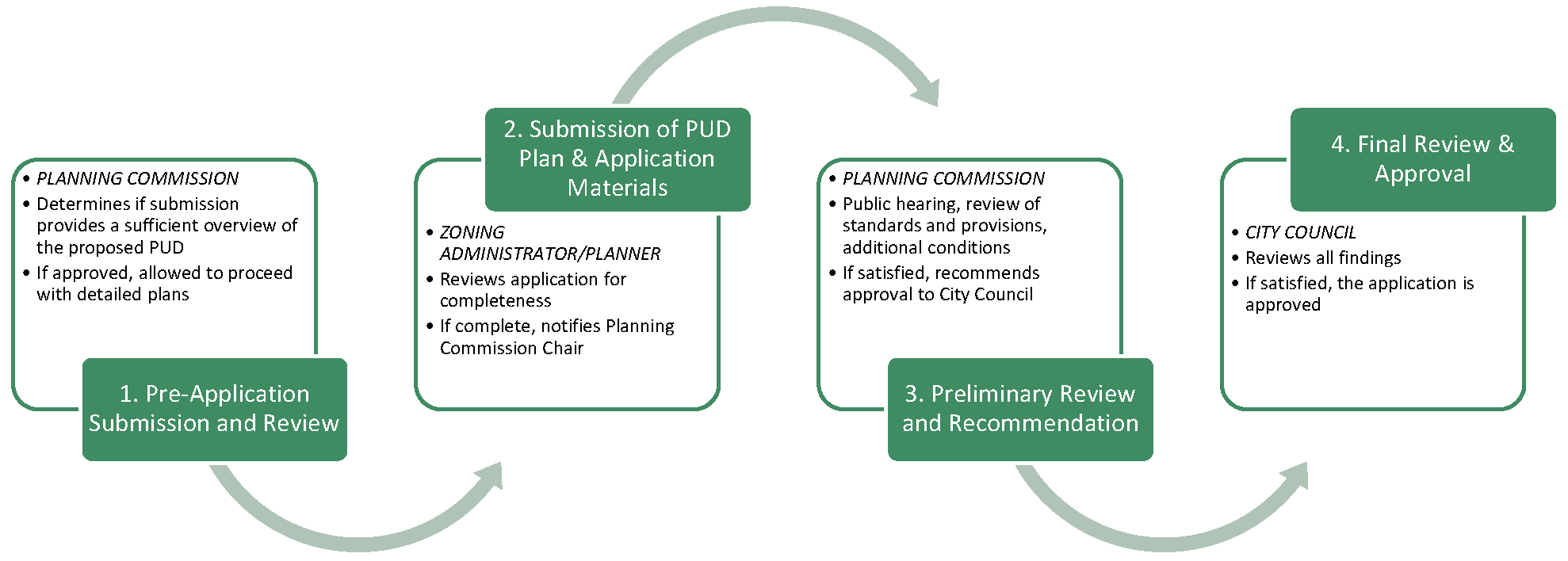
(1)
Completeness review. Upon submission of a PUD application, the Zoning Administrator shall perform a completeness review consistent with Article VIII.
(2)
Technical review. Once an application is determined to be complete, the Zoning Administrator and any other applicable departments and agencies shall perform a technical review consistent with Article VIII.
(G)
Pre-application submission and review.
(1)
Any person owning or controlling land in the city may make an application for consideration of a PUD. Such application shall be made by presenting a request for a preliminary determination to whether a development proposal qualifies for the PUD option.
(2)
The request shall be submitted to the city and the submission shall include the information required below.
(a)
Proof the qualifying standards in this section are or will be met.
(b)
A conceptual land use plan containing enough detail to explain the role of open space; location of land use areas, streets providing access to the site, and pedestrian and vehicular circulation within the site; dwelling unit density and types; and buildings or floor areas contemplated, as applicable.
(c)
A plan to protect natural features or preservation of open space or greenbelts.
(d)
A stormwater management plan that incorporates low impact development (LID) water quality technologies, such as, but not limited to, rain gardens, rooftop gardens, vegetated swales, cisterns, permeable pavers, porous pavement, and filtered storm water structures.
(e)
The Planning Commission shall review the applicant's request for qualification. If approved, the applicant may then continue to prepare a PUD plan on which a final determination will be made.
(f)
Based on the documentation presented, the Planning Commission shall make a preliminary determination about whether a development proposal is consistent with the intent and purpose in this section and qualifies for the PUD option under the qualifying standards in this section. If approved, the applicant may then continue to prepare a PUD plan and application on which a final determination will be made. An approved request for qualification is not a guarantee for final PUD approval.
(H)
PUD application determinations. The review of a PUD application by the Planning Commission shall follow the procedures below:
(1)
Review. Upon notification from the City Zoning Administrator and/or Planner of a complete PUD plan application and technical review, the Planning Commission shall review the proposed PUD plan and make a determination about the proposal's qualification for the PUD option and for adherence to the following objectives and requirements:
(a)
The proposed PUD adheres to the conditions for qualification of the PUD option and promotes the land use goals and objectives of the city.
(b)
All applicable provisions of this article shall be met. If any provision of this article shall be in conflict with the provisions of any other section of this article, the provisions of this section shall apply to the lands embraced within a PUD area.
(c)
There will be at the time of development, an acceptable means of disposing of sanitary sewage and of supplying the development with water and the road network, storm water drainage system, and other public infrastructure and services are satisfactory.
(2)
Public hearing. The Planning Commission shall hold a public hearing on the PUD plan and shall give notice as provided in Article XII.
(3)
Finding of facts. After the review and public hearing, the Planning Commission shall adopt a finding of fact relative to the PUD under consideration as the basis of their recommendation to approve or deny the application, along with any applicable conditions.
(4)
Recommendation. The Planning Commission shall submit its recommendation to the City Council along with the technical review and findings of fact for final determination.
(I)
City Council review and approval.
(1)
Determination. Upon receipt of the technical review, findings of fact, and recommendation of the Planning Commission, the City Council shall review the application and make a determination to approve or deny the application, and any applicable conditions.
(2)
PUD Development Agreement. If the City Council approves the application, it shall direct the City attorney to prepare a PUD Development Agreement setting forth the conditions on which such approval is based. The PUD Development Agreement shall:
(a)
Be signed by the Mayor and the applicant.
(b)
Become effective on execution after its approval.
(c)
Be recorded at the Iron County Register of Deeds' office by the applicant who shall provide a copy of the record to the city within 45 days of City Council review.
(d)
Limit the development and uses that may take place in such area to those expressly permitted under the PUD Development Agreement unless otherwise amended following the procedures in this section.
(J)
Submission of final site plans. Before any zoning permits are issued for the PUD, final site plans for the project area shall be submitted to the city for review and approval by the Planning Commission of the following:
(1)
Review and approval of site plans shall comply with Article VIII, as well as this section except as otherwise modified in the approved plan and PUD Development Agreement.
(2)
Before approving of any final site plans, the Planning Commission shall decide that:
(a)
All portions of the project area shown on the approved plan for the PUD for use by the public or the residents of lands within the PUD have been committed to such uses under the PUD Development Agreement;
(b)
The final site plans are in conformity with the approved development agreement and plan for the PUD;
(c)
Provisions have been made under the PUD Development Agreement to provide for the financing of any improvements shown on the project area plan for open spaces and common areas which are to be provided by the applicant and that maintenance of such improvements is assured under the PUD Development Agreement.
(3)
A copy of the as-built drawings shall be submitted to the City Clerk and a second copy shall be recorded with the Iron County Register of Deeds.
(K)
Termination and expiration. An approved PUD Development Agreement may be terminated or expire in the following ways:
(1)
An applicant or the applicant's successors or assigns may choose to terminate a PUD Development Agreement, before any development within the area involved, by filing with the city and recording at the Iron County Register of Deeds an affidavit so stating. The approval of the plan under the PUD Development Agreement shall terminate on such recording.
(2)
No approved plan under a PUD Development Agreement shall be terminated after development begins except with the approval of the City Council and of all parties with interest in the land.
(3)
Within one year following execution of the PUD Development Agreement by the City Council, final approved site plans for an area embraced within the PUD must be filed with the city. If such plans have not been filed within the one year period, the right to develop the approved plan under the PUD Development Agreement shall be automatically terminated unless an extension is requested in writing by the applicant and authorized by the City Council. The City Council may authorize one extension of up to one year.
(4)
If development of approved final site plans is not substantially completed in three years after approval, further final submittals under the PUD shall stop until the part in question is completed or cause can be shown for not completing same.
(L)
Fees and performance guarantees. Fees and performance guarantees associated with the review and approval of a PUD application shall be consistent with the requirements in Article XII.
(M)
Interpretation of approval. Approval of a PUD under this section shall be considered an optional method of development and improvement of property subject to the mutual agreement of the city and the applicant.
(N)
Amendments to Planned Development Plan. Proposed amendments or changes to an approved PUD plan and/or PUD Development Agreement shall be presented to the Planning Commission and shall decide whether the proposed modification is of minor or major nature based on Article VIII, with the following additions:
(1)
Minor amendment. If determined to be a minor amendment, the Planning Commission may review and approve or deny the request. The PUD Development Agreement shall be modified to reflect any approved minor amendment.
(2)
Major amendment. If determined to be a major amendment, the Planning Commission shall hold a public hearing consistent with the requirements in Article XII as part of its review and make a recommendation to the City Council to approve or deny the request. The City Council shall have the final determination to approve or deny a major amendment request. The PUD Development Agreement shall be modified to reflect any approved major amendment.
(Ord. of 3-18-2025, § 10.2)
Sec. 151.193. - Condominium development.
New condominium projects and conversion condominium projects shall conform to the regulations set forth in the Condominium Act, Public Act 59 of 1978 of the State of Michigan, as amended, as well as to the requirements of this chapter and all other applicable regulations of the city. In addition, the following standards and review procedures shall apply:
(A)
Each condominium project shall be reviewed in a manner consistent with like projects within the underlying zoning district.
(B)
All site plan review provisions and requirements outlined in Article VIII shall apply to condominium projects.
(C)
Subdivision requirements. A site condominium project shall be considered equivalent to a platted subdivision for the purposes of enforcing the site and building standards of the city. The substantive requirements for streets, sidewalks, utilities, storm drainage, and subdivision lot layout and design as set forth in the Subdivision Control/Land Division Act, Public Act 288 of 1967 of the State of Michigan, as amended, and Subdivision Regulations of the city, shall apply to all site condominium projects.
(Ord. of 3-18-2025, § 10.3)
Sec. 151.194. - Manufactured home developments.
All manufactured home developments shall comply with the regulations set forth in the Mobile Home Commission Act, Public Act 96 of 1987, as amended, as well as to the requirements of this chapter and all other applicable regulations of the city. It shall be the duty of the Planning Commission to review a preliminary plan for a manufactured home development for compliance with the design standards for manufactured housing communities contained in the Mobile Home Commission Act. If it is determined that the manufactured housing community complies with the regulations established in the Mobile Home Commission Act, it shall be approved.
(Ord. of 3-18-2025, § 10.4)
Sec. 151.201.- Authority.
There is hereby established a Zoning Board of Appeals (referred to as the "ZBA"), which shall perform its duties and exercise its power as provided for in this chapter and the Michigan Zoning Enabling Act, Public Act 110 of 2006, as amended, in such a way that the objectives of this chapter shall be served, public health, safety and welfare protected, and substantial justice done.
(Ord. of 3-18-2025, § 11.1)
Sec. 151.202. - Membership.
(A)
The Zoning Board of Appeals shall consist of five members and two alternates appointed by the City Council for three-year terms as follows:
(1)
One member shall be a member of the Planning Commission, and one member may be a member of the City Council. An employee or contractor of the City Council may not serve as a member.
(2)
Members shall be selected from the electors of the city and reside within the city.
(3)
The members selected shall be representative of the population distribution and of the various interests present in the city.
(4)
Members of the ZBA may be removed from office for inefficiency, neglect of duty or malfeasance in office, including failure of a member with a conflict of interest to abstain from deliberations or voting on the matter, after written charges have been filed with the City Clerk and a public hearing has been held by City Council.
(5)
Vacancies shall be filled for the remainder of the unexpired term by resolution of the City Council.
(6)
Members shall be appointed not more than one month after the term of the preceding member has expired.
(7)
A member of the ZBA who is also a member of the Planning Commission or City Council shall not participate in a public hearing or vote on the same matter that the member voted on as a member of the Planning Commission or the City Council. However, the member may consider and vote on other unrelated matters involving the same property.
(8)
In the event a ZBA member is elected to City Council and such election increases the number of City Council members serving on the ZBA to more than one, then such member's seat on the ZBA shall be deemed vacant. Such vacancy shall be filled for the remainder of the un-expired term by appointment in the same manner as for regular appointments for full terms.
(B)
Alternates. Alternate members may be called on a rotating basis to sit as members of the ZBA in the absence of regular members. An alternate member may also be called on to serve in the place of a ZBA member, with the same voting rights, for the purpose of reaching a decision on a case in which the member has abstained because of a conflict of interest. The alternate member appointed shall serve in the case involving the conflict of interest until a final decision is made.
(Ord. of 3-18-2025, § 11.2)
Sec. 151.203. - Organization.
The ZBA shall adopt rules of procedure as may be deemed necessary to properly conduct business and organize meetings, in addition to the following:
(A)
The ZBA shall elect a Chair, Vice-Chair, and Secretary from its membership at its organizational meeting in July, or its first regular meeting after the beginning of the city's fiscal year. A member of the City Council and Planning Commission shall not serve as chair of the ZBA.
(B)
All meetings of the ZBA shall be held at the call of the Chair at such times as the ZBA may determine.
(C)
The ZBA shall render decisions upon all matters within a reasonable time.
(D)
The ZBA may distribute the application materials to the Zoning Administrator or other designated city consultants to review the application and provide a report to the ZBA that addresses applicable ordinance issues, whether the issue in question can be resolved by other means defined in this chapter, and how the request may affect the Master Plan and any other city planning documents.
(E)
The ZBA may request that any or all the following information be provided to the ZBA by the Zoning Administrator here available and applicable to the issue in question:
(1)
The history of development on the site in question.
(2)
A summary of past city approvals, orders, and decisions related to the site or issue in question.
(3)
Whether all outstanding infractions related to this chapter or other city ordinances have been resolved, other than the issue to be addressed by the ZBA.
(F)
A concurring vote of a majority of the total ZBA membership shall be necessary to render a decision. The ZBA shall not conduct business unless a majority of its members are present.
(G)
The Secretary shall keep minutes of the proceedings, record the vote of each member upon each question, indicate absences and abstentions, and keep records of hearings and other official action. Such minutes shall also be filed with the City Clerk.
(H)
The ZBA shall have the power to require attendance of witnesses, and compel testimony and the production of documents, files, and other information pertinent to the matters before it.
(Ord. of 3-18-2025, § 11.3)
Sec. 151.204. - Applications.
Applications to the ZBA shall be filed with the city, and a fee established by City Council shall be paid at the time the application is filed. Applications shall be accompanied by the following information, where applicable:
(A)
Applicant's name, postal address, telephone number, and email address.
(B)
The address, location, and tax identification number for each lot involved in the request.
(C)
Zoning classification of the subject lot(s) and all abutting lots.
(D)
A plot plan drawn to scale and with a north arrow, existing lot lines, street rights-of-way, easements, building and structures, setback dimensions, parking areas, driveways, sidewalks, and other site improvements.
(E)
A letter from the applicant summarizing the request and stating the reasons for the request.
(F)
Any additional information deemed necessary by the ZBA to make a determination on the issue in question.
(Ord. of 3-18-2025, § 11.4)
Sec. 151.205. - Appeals of administrative decisions.
The ZBA shall hear and decide appeals where it is alleged there is error of law in any order, requirement, decision, or determination made by the person or body charged with administration or enforcement of the Zoning Ordinance. Such appeals may be taken to the ZBA by the person, firm, or corporation aggrieved, or by an officer, department, board, or bureau of the city affected by the order, requirement, decision, or determination, provided that a notice of appeal application is filed with the city within a reasonable time of the order, requirement, decision, or determination, not to exceed 21 days. An appeal shall stay all administrative or enforcement proceedings associated with the appeal, unless the Zoning Administrator certifies to the ZBA that, by reason of facts stated in the certificate, a stay in the opinion of the Zoning Administrator would cause imminent peril to life or property.
The ZBA shall reverse an administrative decision only after finding that the order, requirement, decision, or determination was arbitrary or capricious, based upon an erroneous finding of a material fact, constituted an abuse of discretion, or based upon an erroneous interpretation of the Zoning Ordinance.
(Ord. of 3-18-2025, § 11.5)
Sec. 151.206. - Interpretations of zoning district boundaries.
Where the actual lines of streets, alleys, or property boundaries vary from the portions indicated on the Zoning Map, or some ambiguity exists as to zoning district boundaries, the ZBA shall have the power to interpret the Zoning Map in such a way as to carry out the intents and purposes of the City of Iron River Zoning Ordinance and Master Plan. Where uncertainty exists as to the boundaries of districts as shown on the Official Zoning Map, the following rules shall apply:
(A)
Boundaries indicated as approximately following the center lines of streets, highways, watercourses, or alleys shall be construed to follow such center lines.
(B)
Boundaries indicated as approximately following platted lot lines shall be construed as following such lot lines.
(C)
Boundaries indicated as approximately following municipal boundaries shall be construed as following such municipal boundaries.
(D)
Boundaries indicated as following railroad lines shall be construed to be midway between the main tracks.
(E)
Boundaries indicated as parallel to or extensions of features indicated in subsections (A) through (D) above shall be so construed. Distances not specifically indicated on the Official Zoning Map shall be determined by the scale of the map.
(F)
Where physical or cultural features existing on the ground are at variance with those shown on the Official Zoning Map, the ZBA shall interpret the district boundaries.
(G)
Where a district boundary line divides a lot which was in single ownership at the time of passage of this chapter, the ZBA may permit, as a special exception, the extension of the regulations for either portion of the lot not to exceed 50 feet beyond the district line into the remaining portion of the lot.
(Ord. of 3-18-2025, § 11.6)
Sec. 151.207. - Interpretation of zoning ordinance provisions.
(A)
Interpretations. The ZBA shall have the power to hear and decide requests for interpretations of Zoning Ordinance provisions in such a way as to preserve and promote the character of the zoning district in question and carry out the intent and purpose of this chapter, the Master Plan, or any other planning documents. This shall not include use determinations as provided for in this chapter, except upon appeal of a determination that has been made.
(B)
Determinations of similar uses. The ZBA shall have the power to hear and decide appeals of the determination of similar use decisions rendered by the Planning Commission. The ZBA shall make its determination based on the standards in Article III.
(Ord. of 3-18-2025, § 11.7)
Sec. 151.208. - Variances.
The ZBA shall have authority in specific cases to authorize one or more variances, including dimensional or "nonuse" variances and use variances, from the strict letter and terms of this chapter by varying or modifying any of its rules or provisions so that the spirit of this chapter is observed, public safety secured, and substantial justice done. A dimensional or nonuse variance allows a deviation from the dimensional (i.e., height, bulk, setback) requirements of the ordinance. A use variance authorizes the establishment of a use of land that is otherwise prohibited in a zoning district. The ZBA is authorized to grant use variances by this chapter. Such authority to make dimensional and use variances shall be exercised in accordance with the following standards:
(A)
Dimensional variances. The ZBA may grant a requested "nonuse" variance only upon a finding that practical difficulties exist. A finding of practical difficulties is when the applicant has demonstrated all the following:
(1)
Strict compliance with restrictions governing area, setback, frontage, height, bulk, density, or other nonuse matters, will unreasonably prevent the owner from using the property for a permitted purpose or will render ordinance conformity unnecessarily burdensome.
(2)
The variance will do substantial justice to the applicant, as well as to other property owners.
(3)
The variance requested is the minimum variance needed to provide substantial relief to the applicant and/or be consistent with justice to other property owners.
(4)
The need for the variance is due to unique circumstances peculiar to the property and not generally applicable in the area or to other properties in the same zoning district, and cannot be solely economic in nature.
(5)
The problem and resulting need for the variance has been created by strict compliance with the Zoning Ordinance, not by the applicant or the applicant's predecessors.
(B)
Use variances. The ZBA may grant a requested "use" variance only upon finding that an unnecessary hardship exists. An unnecessary hardship is when the restrictions of the Zoning Ordinance on the property, when its environment is considered, are so unreasonable as to constitute an arbitrary and capricious interference with basic private property rights. A finding of unnecessary hardship shall require demonstration by the applicant of all the following:
(1)
The property cannot be reasonably used for any purpose permitted in the zoning district without a variance.
(2)
The need for the variance is due to unique circumstances peculiar to the property and not generally applicable in the area or to other properties in the same zoning district.
(3)
The variance will not alter the essential character of the area. In determining whether the effect the variance will have on the character of the area, the established type and pattern of land uses in the area and the natural characteristics of the site and surrounding area will be considered.
(4)
The problem and resulting need for the variance has not been self-created by the applicant.
(Ord. of 3-18-2025, § 11.8)
Sec. 151.209. - Exceptions.
To hear and decide requests for exceptions and other matters upon which this chapter specifically authorizes the ZBA to act. Any exception shall be subject to such conditions as the ZBA may require to reserve and promote the purpose of this chapter, and the character of the zoning district in question.
(Ord. of 3-18-2025, § 11.9)
Sec. 151.210. - Hearings and decisions.
The ZBA shall make no determination on a specific case until after a public hearing conducted in accordance with the requirements in Article XII. Each decision of the ZBA shall include a written record of the ZBA's findings and determinations in the case.
(Ord. of 3-18-2025, § 11.10)
Sec. 151.211. - Fees.
Fees and performance guarantees associated with the review and determination of a request before the ZBA shall be consistent with the requirements in Article XII.
(Ord. of 3-18-2025, § 11.11)
Sec. 151.212. - Limitations of authority.
(A)
No order of the ZBA permitting the erection or alteration of a structure shall be valid for a period longer than one year, unless a building permit for such erection or alteration is obtained within such period, and such erection or alteration is started and completed in accordance with the terms of such permit.
(B)
No order of the ZBA pertaining to the use of a structure or land shall be valid for a period longer than one year unless such use is established within such period, except where such use is dependent upon the erection or alteration of a structure, in which case the one year period shall begin after the certificate of occupancy is issued for the structure.
(C)
The ZBA shall not consider appeals of any decisions by the Planning Commission or City Council regarding requests for approval of amendments, special land uses, or planned unit developments, as defined in this chapter.
(D)
ZBA jurisdiction to consider appeals of site plan determinations shall be limited to cases referred by the Planning Commission, where the Planning Commission has approved a site plan contingent upon approval of one or more variances by the ZBA. In such cases, the Planning Commission Secretary shall provide copies of the site plan, application materials, and Planning Commission meeting minutes to the ZBA, and consideration shall be limited to the specific variances identified as conditions of site plan approval by the Planning Commission.
(E)
The ZBA shall not have the authority to alter this Zoning Ordinance or Zoning Map.
(Ord. of 3-18-2025, § 11.12)
Sec. 151.221.- Zoning administrator.
A Zoning Administrator shall be appointed by and on such terms as shall be determined by the City Council. The duties of the Zoning Administrator may be delegated by the City Council to another employee of the city or a consultant approved by the City Council.
(A)
Duties. It shall be the duty of the Zoning Administrator to:
(1)
Receive applications for land use permits and issue or deny same.
(2)
Inspect buildings or structures in order to determine compliance with the land use permits issued in compliance with this chapter.
(3)
Be in charge of the enforcement of this chapter. The City Council may, in its discretion, instruct the Zoning Administrator to make efforts to obtain voluntary compliance with this chapter. The City Council may instruct the Zoning Administrator in writing, to initiate a criminal complaint or other legal action. Under no circumstances is the Zoning Administrator permitted to make changes in this chapter or to vary its terms in carrying out the Zoning Administrator's duties.
(4)
Perform pre-application conferences, completeness reviews, and technical reviews for all applications that include a site plan review.
(Ord. of 3-18-2025, § 12.1)
Sec. 151.222. - Fees.
The fees for applications, permits and other requests shall be established by the City Council. Fees must be paid before any review of an application is performed or a permit is issued. Certain applications, permits and requests are subject to the City of Harbor Springs Escrow Policy, as defined in that policy.
(Ord. of 3-18-2025, § 12.2)
Sec. 151.223. - Performance guarantees.
To ensure compliance with the ordinance and any conditions imposed, the Planning Commission may require that a cash deposit, irrevocable letter of credit, certified check, or surety bond acceptable to the city covering the estimated cost of improvements be deposited with the City Clerk to ensure faithful completion of the improvements. The performance guarantee shall be deposited at the time of the issuance of the building permit. The city shall not require the deposit of the performance guarantee until it is prepared to issue the zoning permit. If requested by the applicant of the site plan review, the city shall rebate any cash deposits in reasonable proportion to the ratio of work completed on the required improvements as work progresses.
(Ord. of 3-18-2025, § 12.3)
Sec. 151.224. - Taxes.
When the city receives an application for any new or amended land use permit, site plan review, special land use permit, any other application, or any request for a permit or approval required by this Zoning Ordinance, the applicant shall be required to present a signed statement from the City Treasurer that all real and personal property taxes, fees, penalties, fines, assessments, general assessments and other monies owed to the city are current and paid up to date. The City Treasurer's signed statement shall cover the accounts of all named applicants and all properties upon which the application or request is made. The city shall take no action on any application or request until the applicant or requesting party acquires the City Treasurer's signed statement that all of the above monies owed are current and paid up to date. The city shall make no final decision on any application or request if any of the above monies owed become delinquent or remain unpaid during consideration.
(Ord. of 3-18-2025, § 12.4)
Sec. 151.225. - Public hearings.
The body charged with conducting a public hearing required by this chapter shall, upon receipt of a completed application, select a reasonable time and place for such hearing. Such hearings shall be held in accordance with the Michigan Zoning Enabling Act, Public Act 110 of 2006, as amended), and the following:
(A)
Public notice.
(1)
Notice of the public hearing shall be:
(a)
Posted by the City Clerk at the place the hearing will be held.
(b)
Published in a newspaper of general circulation in the city not less than 15 days before the date of the public hearing.
(c)
Sent by mail or personal delivery not less than 15 days before the date of the public hearing to:
1.
The applicant, owner(s) of property for which approval is being considered, all persons to whom real property is assessed within 300 feet of the boundary of the property in question.
2.
All occupants of structures within 300 feet of the boundary of the property in question. If the name of the occupant is not known, the term "occupant" may be used in making notification. Notification need not be given to more than one occupant of a structure, except that one occupant of each unit or spatial area shall receive notice if a structure contains more than one dwelling unit or spatial area owned or leased by different individuals, partnerships, businesses, or organizations. In the case of a single structure containing more than four dwelling units or other distinct spatial areas owned or leased by different individuals, partnerships, businesses or organizations, notice may be given to the manager or owner, who shall post the notice at the primary entrance to the structure.
(2)
The notice shall include all of the following:
(a)
Describe the nature of the request.
(b)
Indicate the property that is the subject of the request. The notice shall include a listing of all existing street addresses within the property. Street addresses do not need to be created and listed if no such addresses currently exist within the property. If there are no street addresses, other means of identification may be used.
(c)
State when and where the request will be considered.
(d)
Indicate when and where written comments will be received concerning the request.
(Ord. of 3-18-2025, § 12.5)
Sec. 151.226. - Zoning permits.
(A)
General. No person shall erect, alter, move, or demolish a structure to the extent of more than 120 square feet of floor area or to establish a new use or change in use for any parcel, without a land use permit. The Zoning Administrator shall issue a land use permit if the proposed structure or use is in compliance with the provisions of this chapter. The applicant shall furnish permits or approvals from the Iron River Department of Public Works, Iron Baraga Conservation District, Iron County Road Commission, the Michigan Department of Transportation, Michigan Department of Natural Resources, and any other applicable agency if required, before the Zoning Administrator may issue a permit. A copy of each land use permit will be retained by the Zoning Administrator as a part of the permanent records of the city. The Zoning Administrator shall promptly inform the applicant of the denial of a land use permit if the proposed structure or use does not comply with the provisions of this chapter. Issuance of a land use permit, or approval of a site plan for a permitted use or special land use permit does not waive the requirements to comply with all applicable local, state, and federal codes and statutes, including, but not limited to state construction code, electrical code, property maintenance code, mechanical code, and fire prevention code.
(B)
Application. Each application for a land use permit shall include the following minimum requirements:
(1)
Plot plan. Drawn to scale illustrating:
(a)
The actual shape, location, and dimensions of the lot.
(b)
The shape, size, and location of all buildings or other structures to be erected, altered, or moved, and if any building or other structure is already on the lot.
(c)
The existing and intended use of the lot and of all such structures upon it, including residential areas and the number of dwelling units that the building is intended to accommodate.
(d)
Such other information concerning the lot or adjoining lots as may be essential to determining that the provisions of this chapter are being observed.
(2)
Property boundaries. In cases where property boundaries are not clearly indicated by corner markers or other means, the Zoning Administrator may require, at the applicant's expense, the property to be located by a registered surveyor. In cases on properties located along the Harbor Springs or Ice Lake, if there is any question of the location of the ordinary high water mark, the Zoning Administrator may also require this level to be set and marked by a registered surveyor.
(3)
Evidence of ownership. All applications for land use permits under the provisions of this chapter shall include the land owner's signature authorizing the application for the permit and be accompanied with proof of ownership of all property affected by the coverage of the permit. Proof of ownership shall be established by one of the following means: current title policy or commitment, abstract or attorney's opinion of title, or such other evidence of ownership as the Zoning Administrator determines acceptable.
(4)
Supporting documentation. In the event the Zoning Administrator feels additional information is required before determining the suitability of an application for a land use permit, the Zoning Administrator may request that the applicant submit such additional information as surveys, deed descriptions, soil suitability tests, surface water disposal surveys, erosion control surveys, excavation disposal plans, easements, and permits from other governmental agencies.
(C)
Voiding permit. Any permit granted under this section shall become null and void after one year from the date of granting such permit unless the development proposed shall have passed its first construction code inspection. The applicant shall have the option of extending the permit by a maximum of six months upon written notice to the Zoning Administrator. Said notice shall be filed no later than five working days following the expiration of the permit. If a land use permit expires, the applicant will have to reapply as a new application.
(D)
Inspection. The developer of the property is solely responsible for meeting the conditions and terms of the land use permit and this chapter.
(Ord. of 3-18-2025, § 12.6)
Sec. 151.227. - Violations and penalties.
(A)
Nuisance per se. Any land, dwellings, buildings, or structures, including tents and trailer coaches, used, erected, altered, razed, or converted in violation of this chapter or in violation of any regulations, conditions, permits or other rights granted, adopted, or issued pursuant to this chapter are hereby declared to be a nuisance per se.
(B)
Municipal civil infraction. Any person, partnership, corporation, or association who creates or maintains a nuisance per se as defined above or who violates or fails to comply with any provision of this chapter or any permit issued pursuant to this chapter shall be responsible for a municipal civil infraction. Every day that such violation continues shall constitute a separate and distinct offense under the provisions of this chapter. Nothing in this section shall exempt the offender from compliance with the provisions of this chapter.
(C)
Notice of violation. Prior to the issuance of a citation for a violation, the Zoning Administrator has the discretion to notify the owner of record and the occupant of the property of the violation in writing. Notice shall be mailed to the appropriate party via certified return receipt requested describing the violation and establishing a date to remedy the violation.
(D)
Penalties. Any person, partnership, corporation, or association who shall violate any provision of this chapter in any particular, or who fails to comply with any of the regulatory measures or conditions of the Zoning Board of Appeals adopted pursuant hereto, shall, upon conviction thereof, be fined not to exceed $200.00, and each day such violation continues shall be deemed a separate offense.
(E)
Zoning Administrator. The Zoning Administrator is hereby designated as the authorized city official to issue municipal civil infraction citations directing alleged violators of this chapter to appear in court.
(F)
Nuisance abatement. In addition to enforcing this chapter as a municipal civil infraction, the city may initiate proceedings in the Circuit Court to abate or eliminate the nuisance per se or any other violation of this chapter.
(Ord. of 3-18-2025, § 12.7)
Sec. 151.231.- Amendments.
The City Council may, after recommendation from the Planning Commission, amend, supplement, or change the provisions of this chapter or Official Zoning Map. Such actions shall be consistent with the Michigan Zoning Enabling Act, P.A. 110 of 2006, as amended, and the following:
(A)
Initiation of amendment. Amendments to the provisions of this chapter may be initiated by the City Council, Planning Commission, Zoning Administrator, or by petition from one or more residents or property owners of the city. An amendment to the Official Zoning Map (rezoning) may be initiated by the City Council, Planning Commission, Zoning Administrator, or by the titleholder for the property subject to the proposed amendment. No fee shall be charged for amendments initiated by the City Council, Planning Commission, or Zoning Administrator.
(B)
Application. An amendment to this chapter (except those initiated by the City Council, Planning Commission, or Zoning Administrator) shall be initiated by submission of a complete and accurate application to the city, along with the required fee established by City Council. In the case of an amendment to the official Zoning Map, the following information shall accompany the application and fee:
(1)
A legal description and street address of the subject property with a location map identifying the subject property in relation to surrounding properties.
(2)
The name and address of the owner of the subject property, and a statement of the applicant's interest in the subject property, if not the owner in fee simple title.
(3)
The existing and proposed zoning district designation of the subject property and surrounding properties.
(4)
A written description of how the requested amendment meets the criteria stated in this section.
(C)
Amendment review procedure. Proposed amendments to this chapter or Official Zoning Map shall be reviewed in accordance with the following:
(1)
Completeness review. Upon receipt of an application to amend this chapter, the Zoning Administrator shall review the application to confirm all required material has been submitted. The Zoning Administrator shall notify the applicant of any outstanding items.
(2)
Technical review. Prior to Planning Commission consideration, the proposed amendment and application materials shall be distributed to appropriate city officials for review and comment. The Zoning Administrator may also submit the application materials to designated city consultants for review.
(3)
Public hearing. The Planning Commission shall hold a public hearing for all proposed amendments in accordance with the procedures in Article XII.
(4)
Planning Commission consideration and recommendation. Subsequent to the hearing, the Planning Commission shall review the proposed amendment, together with any reports and recommendations from staff, consultants, other reviewing agencies, and any public comments. The Planning Commission shall identify and evaluate all relevant factors and shall report its findings and recommendation to the City Council. In considering an amendment to the Official Zoning Map (rezoning) or Ordinance text, the Planning Commission shall consider the following factors in making its findings and recommendations, although not all standards must be met in order to recommend approval of an amendment:
(a)
Consistency with the Master Plan's goals, policies, and future land use map, including planned timing or sequence of development. If conditions have changed since the Master Plan was adopted, the consistency with recent development trends in the area shall be considered.
(b)
Compatibility of all the potential uses allowed in the proposed zoning district(s) with the site's physical, geological, hydrological, and other environmental features.
(c)
Compatibility of all the potential uses allowed in the proposed district(s) with surrounding uses and zoning in terms of suitability, intensity, traffic impacts, aesthetics, infrastructure, and potential influence on property values.
(d)
Capacity of available utilities and public services to accommodate the uses permitted in the district(s) without compromising the health, safety, and welfare of city residents or burdening the city or Iron County with unplanned capital improvement costs or other unplanned public expenses.
(e)
Capability of the road system to safely and efficiently accommodate the expected traffic generated by uses permitted in the zoning district(s).
(f)
The apparent demand for the types of uses permitted in the district(s) in relation to the amount of land currently zoned and available in the city and surrounding communities to accommodate the demand.
(g)
The boundaries of the proposed district(s) in relationship to the surrounding area and the scale of future development on the site.
(h)
The requested rezoning will not create an isolated or incompatible zone in the neighborhood.
(i)
Other factors deemed appropriate by the Planning Commission and City Council.
(5)
City Council action. The City Clerk shall forward a copy of the proposed amendment, findings, and recommendation from the Planning Commission to the City Council for consideration and final action.
(a)
The City Council may adopt or reject the proposed amendment, or may refer the amendment back to the Planning Commission for revision or further consideration. The City Council may modify the proposed amendment as long as the modifications are de minimis. If the City Council requests any substantial revisions to the proposed amendment, the amendment and requested revisions shall be referred back to the Planning Commission for further consideration.
(b)
The City Council may, at its discretion, hold additional public hearings on the proposed amendment. Furthermore, the City Council shall hold a public hearing if requested by an interested property owner. Any public hearing held by the City Council shall follow the procedures in accordance with the Michigan Zoning Enabling Act, Public Act 110 of 2006, as amended.
(D)
Effective date. A notice of adoption of an approved amendment shall be published in a newspaper of general circulation in the city within 15 days of adoption. The amendment shall become effective eight days after being published.
(E)
Re-application. Whenever an application for an amendment to this chapter has been rejected by the City Council, a new application for the same amendment shall not be accepted by the city for a period of one year unless the Zoning Administrator determines that one or more of the following conditions has been met:
(1)
There is a substantial change in circumstances relevant to the issues or facts considered during review of the application.
(2)
New or additional information is available that was not available at the time of the review.
(3)
The new application is materially different from the prior application.
(Ord. of 3-18-2025, § 13.1)
Sec. 151.232. - Conditional rezonings.
An applicant for a rezoning may voluntarily offer a conditional rezoning along with an application for rezoning before or following the public hearing for a proposed rezoning. An election to submit a conditional rezoning shall be pursuant to the Michigan Zoning Enabling Act (Public Act 110 of 2006, as amended), and this section.
(A)
General.
(1)
A conditional rezoning shall be a written agreement executed by the applicant and the city, shall be in recordable form, and shall be recorded with the Iron County Register of Deeds after execution.
(2)
A conditional rezoning may include limitations on the uses permitted on the property in question, specify lower or varying density or less intensity of development and use, or may impose more restrictive measures on the location, size, height, or other measure for buildings, structures, improvements, setbacks, landscaping, buffers, design, architecture, and other features that would otherwise be provided in this chapter.
(3)
A conditional rezoning may not authorize uses or developments of greater intensity or density, or which are not permitted in a proposed zoning district; nor may a conditional rezoning permit variations from height, area, setback, or similar dimensional requirements that are less restrictive than a proposed zoning district.
(4)
A conditional rezoning shall include conditions that bear a reasonable and rational relationship and/or benefit to the property in question. A conditional rezoning may include conditions related to the use and development of the property that are necessary to:
(a)
Serve the intended use of the property such improvements, extension, widening or realignment of streets, utilities or other infrastructure serving the site.
(b)
Minimize the impact of the development on surrounding properties and the city overall.
(c)
Preserve natural features and open space beyond what is normally required.
(B)
Content of agreement. In addition to any limitations or use or development of the property features or preservation of property features or improvements as described above, a conditional rezoning shall also include the following:
(1)
An acknowledgement that the conditional rezoning was proposed voluntarily by the applicant.
(2)
An agreement and understanding that the property shall not be developed or used in any manner that is not consistent with a conditional rezoning.
(3)
An agreement and understanding that the approval of a rezoning and a conditional rezoning shall be binding upon and ensure to the benefit of the property owner and the city, and their respective heirs, successors, assigns, receivers, or transferees.
(4)
An agreement and understanding that, if a rezoning with a conditional rezoning becomes void for any reason including, but not limited to, reasons identified in this section, then no further development shall take place and no permits shall be issued unless and until a new zoning district classification for the property has been established.
(5)
An agreement and understanding that no part of a conditional rezoning shall permit any activity, use, or condition that would otherwise violate any requirement or standard that otherwise applicable in the new zoning district.
(6)
A legal description of the land to which the agreement pertains.
(7)
Any other provisions as are agreed upon by the parties.
(C)
Process. A conditional rezoning shall be reviewed concurrently with a petition for rezoning following the process in this article, and the following:
(1)
A conditional rezoning may be submitted prior to or following the Planning Commission public hearing. If the agreement is submitted following the Planning Commission public hearing, it must be reviewed by the Planning Commission and a second public hearing shall be held prior to the Planning Commission making its recommendation on the rezoning and conditional rezoning to the City Council. A conditional rezoning shall be reviewed by the City Attorney to determine that it conforms with the requirements of this section, this chapter, and the Michigan Zoning Enabling Act (Public Act 110 of 2006), as amended, and that the conditional rezoning is in a form acceptable for recording with the Iron County Register of Deeds.
(2)
Following a public hearing for a proposed zoning amendment, the Planning Commission shall make a recommendation to the City Council based upon the criteria listed in this article. In addition, following a public hearing to consider a conditional rezoning, the Planning Commission shall consider and address in writing, findings whether a proposed conditional rezoning:
(a)
Is consistent with the intent of this article.
(b)
Bears a reasonable and rational connection and/or benefit to the property being proposed for rezoning.
(c)
Is necessary to ensure that the property develops in such a way that protects the surrounding neighborhood.
(d)
Leads to a better development than would have been likely if the property had been rezoned without a conditional rezoning, or if the property were left to develop under the existing zoning classification.
(e)
Is clearly in the public interest.
(3)
If a conditional rezoning has been offered by the applicant and recommended for approval by the Planning Commission, the City Council may approve a conditional rezoning as a condition to the rezoning if it meets all requirements of this section. The conditional rezoning shall be incorporated by attachment or otherwise as an inseparable part of the ordinance adopted by the City Council to accomplish the requested rezoning.
(4)
If a rezoning and conditional rezoning are approved, the zoning classification of the rezoned property shall consist of the district to which the property has been rezoned, plus a reference to the conditional rezoning. The City Clerk shall maintain a listing of all properties subject to Zoning Agreement and shall provide copies of the Agreements upon request.
(5)
All other requirements of this chapter or any other city ordinances shall apply to the property to which a conditional rezoning applies.
(D)
Expiration.
(1)
Unless extended by the City Council for good cause, a rezoning and conditional rezoning shall expire two years after adoption of the rezoning and conditional rezoning, unless substantial construction on the approved development of the property pursuant to building and other required permits issued by the city commences within the two-year period and proceeds diligently to completion.
(2)
In the event that substantial construction on the approved development has not commenced within the aforementioned two years, or if construction and development does not proceed diligently to completion thereafter, a conditional rezoning and rezoning shall be void and of no effect.
(3)
Should a conditional rezoning become void, all development on the subject property shall cease, and no further development shall be permitted. Until action satisfactory to the city is taken to bring the property into compliance with this chapter, the city may withhold or, following notice to the applicant and being given an opportunity to be heard, revoke permits and certificates, in addition to or in lieu of any other lawful action to achieve compliance.
(4)
Notwithstanding the above, if the property owner applies in writing for an extension of a rezoning and a conditional rezoning at least 30 days prior to the expiration date, the City Council may, in its sole discretion, grant an extension of up to one year. Future extensions may be granted, although the number of previous extensions granted to a particular rezoning and conditional rezoning shall be considered by the City Council.
(E)
Reversion of zoning. If a rezoning and conditional rezoning become void as outlined above, then the zoning classification of the property shall revert back to its previous zoning classification. The reversion process shall be initiated by the City Council by requesting that the Planning Commission proceed with consideration of rezoning of the land to its former zoning classification. The procedure for considering and making this reversionary rezoning shall be the same as applies to all other rezoning requests, including the notice and hearing as required by the Michigan Zoning Enabling Act (Public Act 110 of 2006), as amended. No building or other permit shall be issued or valid during the process described in this subsection.
(F)
Continuation. Provided that all development and/or use of the property in question is in compliance with a conditional rezoning, a use or development authorized there under may be continued indefinitely, provided that all terms of a conditional rezoning continue to be adhered to.
(G)
Amendment.
(1)
During an initial two-year period, or during any extension granted by the city as permitted in this article, the city shall not add to or alter a conditional rezoning, even with the landowner's consent.
(2)
A conditional rezoning may be amended after the expiration of an initial two-year period and any extensions, in the same manner as was prescribed for the original rezoning and conditional rezoning.
(H)
Violation of agreement. Failure to comply with a conditional rezoning at any time after approval will constitute a breach of the agreement and also a violation of this chapter and further use of the property may be subject to legal remedies available to the city. Any violation of a conditional rezoning that is not cured within 30 days after written notice of the violation is given shall permit the city council, in its sole discretion, to declare a conditional rezoning void ab initio and of no effect.
(I)
Subsequent rezoning of land. Nothing in a conditional rezoning, nor any statement or other provision, shall prohibit the city from later rezoning all or any portion of the property that is the subject of a conditional rezoning to another zoning classification. Any rezoning shall be conducted in compliance the Michigan Zoning Enabling Act (Public Act 110 of 2006), as amended.
(J)
Failure to offer conditions. The city shall not require an owner to offer conditions as a requirement for rezoning. The lack of an offer of conditions shall not affect the owner's rights under this chapter.
(Ord. of 3-18-2025, § 13.2)
Sec. 151.233. - Severability.
If any article, section, subsection, sentence, clause, phrase, or portion of this chapter is held to be invalid or unconstitutional by any court of competent jurisdiction, the city intends said portion to be disregarded, reduced and/or revised so as to be recognized to the fullest extent possible by law. The city further states that it would have passed and adopted what remains of this chapter following the removal, reduction or revision of any portion so found to be invalid or unconstitutional.
(Ord. of 3-18-2025, § 13.3)
Sec. 151.241.- Rules of construction.
For the purposes of this Zoning Ordinance, certain terms or words used within shall be interpreted as follows:
(A)
The particular shall control the general.
(B)
All words used in the present tense shall include the future.
(C)
All words in the singular number include the plural number and all words in the plural number include the singular number, unless the context clearly indicates the contrary.
(D)
The word "shall" is always mandatory and not discretionary and the word "may" is permissive.
(E)
The masculine gender includes the feminine and neuter.
(F)
All measurements shall be to the nearest integer, unless otherwise specified within this Zoning Ordinance.
(G)
The words "used" or "occupied" includes the words "intended," "designed," "arranged to be used or occupied" and "maintained."
(H)
A "building" or "structure" includes any part thereof. The word "dwelling" includes "residence." The word "build" includes the words "erect" and "construct."
(I)
The word "person" includes "corporation," "co-partnership," "partnership," "association," "incorporated association," "individual," or any similar entity.
(J)
Whenever a word or term defined in this article appears in the text of this Zoning Ordinance, its meaning shall be construed as defined herein. Words or terms not herein defined shall have the meaning customarily assigned to them.
(K)
Unless the context clearly indicates the contrary, where a regulation involves two or more items, conditions, provisions, or events connected by the conjunction "and," "or," or "either/or" the conjunction shall be interpreted as follows:
(1)
"And" indicates that all the connected items, conditions, provisions, or events shall apply.
(2)
"Or" indicates that the connected items, conditions, provisions, or events may apply singly or in any combination.
(3)
"Either/or" indicates that the connected items, conditions, provisions, or events shall apply singly but not in combination.
(L)
Unless the context clearly indicates to the contrary, where an illustration accompanies any item within this Zoning Ordinance, the written text shall have precedence over said illustrations.
(M)
The intent, when spelled out in a section, dictates the meaning of any regulation.
(Ord. of 3-18-2025, § 14.1)
Sec. 151.242. - Terms.
Whenever used in this Zoning Ordinance, the following words and phrases shall have the meaning ascribed to them in this article.
"A" Terms
Abandonment: To cease or discontinue a use or activity without intent to resume, but excluding temporary or short-term interruptions to a use or activity during periods of remodeling, maintaining, or otherwise improving or rearranging a facility, or during normal periods of vacation or seasonal closure.
Abutting: Having a common border with or being separated from such a common border by a right-of-way, alley, or easement.
Accessory building or structure: A building or structure, that is clearly incidental to, customarily found in connection with, subordinate to, and is located on the same zoning lot as the principal building and/or structure to which it is exclusively related.
Accessory dwelling unit: See dwelling unit, accessory.
Accessory use: A use that is clearly incidental to, customarily found in connection with, subordinate to, and is located on the same zoning lot as the principal use to which it is exclusively related.
Adult day care facility: A facility, other than a private residence, receiving at least three but not more than 12 adults to be provided with care for periods of less than 24 hours a day.
Adult day care home: A private residence receiving fewer than six adults or more adults to be provided with care for periods of less than 24 hours a day.
Adult foster care congregate facility: An adult foster care facility with the approved capacity to receive more than 20 adults to be provided with foster care.
Adult foster care facility: Means a home or facility that provides foster care to adults. Subject to the limitations of the Adult Foster Care Facility Licensing Act, Michigan Public Act 218 of 1979, as amended.
Adult foster care family home: A private residence with the approved capacity to receive at least three but not more than six adults to be provided with foster care. The adult foster care family home licensee must be a member of the household and an occupant of the residence.
Adult foster care large group home: An adult foster care facility with the approved capacity to receive at least 13 but not more than 20 adults to be provided with foster care.
Adult foster care small group home: An adult foster care facility with the approved capacity to receive at least three but not more than 12 adults to be provided with foster care.
Air rights: The ownership or control of all land, property, and that area of space at and above a horizontal plane over the ground surface of land used for railroad or freeway purposes. The horizontal plane shall be at a height that is reasonably necessary or legally required for the full and free use of the ground surface.
Alley: Any dedicated public vehicular or pedestrian way affording a secondary means of access between or behind buildings, that affords a secondary means of access to abutting property, and not intended for general traffic circulation.
Alterations: Any change, addition, or modification in construction to a structure or type of occupancy, or in the structural members of a building, such as walls or partitions, columns, beams or girders, the completed act of which may be referred to herein as "altered" or "reconstructed."
Antenna: Any exterior transmitting or receiving device mounted on a tower, building or structure and used in communications that radiate or capture electromagnetic waves, digital signals, analog signals, radio signals or other communications signals.
Apartment: A room or suite of rooms in a multiple-family building, in which each suite is arranged, intended, and designed to be occupied as a residence of a single-family or individual, and which has only one complete kitchen and at least one complete bathroom.
Assembly facility: A meeting place at which the public or membership groups are assembled regularly or occasionally, indoors, or outdoors as a principal or accessory use, including, but not limited to schools, religious institutions, theaters, auditoriums, funeral homes, stadiums, lecture halls, lodge rooms, conference rooms, convention centers, dining halls, and similar places of assembly.
Attached wireless telecommunication facility—Antennae: Any wireless telecommunication facility affixed to an existing structure, such as a building, tower, water tank, utility pole, etc., utilized to receive and transmit federally or state licensed telecommunications services via duly licensed segments of the radio frequency spectrum. This definition shall not include support structures.
Attic: The area located between the ceiling of the highest habitable floor and the roof of the structure.
Automobile: Every vehicle that is self-propelled.
Automobile and vehicle major repair: General repair, rebuilding, or reconditioning of engines, motor vehicles, or trailers; collision service, including body frame or fender straightening or repair; overall painting or paint shop; vehicle steam cleaning and oil change. Automotive major repair also includes an establishment that provides for the removal and temporary storage (less than seven days) of vehicles, but does not include the disposal, permanent disassembly, or salvage, or the accessory storage of motor and/or recreational vehicles.
Automobile and vehicle minor repair: The replacement of any part or repair of any part that does not require removal of the engine head or pan, engine transmission or differential; incidental body and fender work, minor painting, and upholstering service. Above stated is applied to passenger automobiles and trucks not in excess of 7,000 pounds gross weight.
Automobile and vehicle sales and rentals: Storage and display for sale of more than two motor vehicles or any type of trailer provided the trailer is unoccupied, and where repair or body work is incidental to the operation of the new or used vehicle sales. Motor vehicles sales includes motor vehicle retail or wholesale sales.
Automobile service station: Any place where motor vehicle fuel is sold and dispensed as either a principal or incidental activity or where car washing services are sold. Where the sale and dispensing of vehicle fuel is the principal activity, accessory activities may include the retail sale of lubricants, tires, batteries, motor vehicle accessories and supplies, including minor installation services or repairs customarily incidental thereto, and sale of convenience goods, food, and beverages.
"B" Terms
Bakery: See café.
Bar: See drinking establishment.
Basement: That portion of a building below the first or ground-floor level and having less than four feet of clearance from its ceiling to the average finished grade of the building perimeter. A basement shall not be considered a story for the purposes of determining building height. A basement shall not be counted as a story. This definition shall include a cellar that may be below grade with an entrance separate from the principal building.
Bed and breakfast: A use which is subordinate to the principal use of a dwelling unit as a single-family dwelling unit and a use in which transient guests are provided a sleeping room and board in return for payment.
Bedroom: A room designed or used in whole or part for sleeping purposes and has a closet and window.
Berm: An earthen mound designed to provide visual interest on a site, screen undesirable views, reduce noise, or fulfill other such purposes.
Billboard: An outdoor sign that directs attention to a specific business, product, service, event, activity, or other commercial or noncommercial activity, either on or off the premises upon which the sign is located.
Block: The property abutting one side of a street and lying between the two nearest intersecting streets (crossing or terminating), or between the nearest such street and railroad right-of-way, unsubdivided acreage, lake, river, or live stream; or between any of the foregoing and any other barrier to the continuity of dev elopement or corporate boundary lines of the municipality.
Boarding house or rooming house: A building, other than a hotel, where for compensation or by pre-arrangement for definite periods of time, lodging or lodging and meals are provided for three or more persons. A rooming house shall be deemed a boarding house for the purposes of these Zoning Regulations.
Board of Zoning Appeals: See Zoning Board of Appeals.
Brewery: A state-licensed facility or facilities that manufactures beer and is owned or controlled by a state-licensed brewer, as defined and regulated by the Michigan Liquor Control Commission.
Buffer: A strip of land with a definite width and location reserved for the planting of shrubs and/or trees to serve as an obscuring screen in carrying out the requirements of this chapter.
Buildable area: The area of a lot that is defined by the minimum setback requirements within which building construction is permitted by the terms of this chapter.
Building: A structure enclosed within exterior walls, built, erected and framed of a combination of materials, whether portable or fixed, having a roof, to form a structure for the shelter of persons, animals, or property.
Building, accessory: See accessory building, or structure.
Building code: The currently adopted code or codes regulating building construction in the City of Iron River, Iron County, Michigan.
Building height, feet: The vertical distance measured from the average finished grade at the building wall to the highest measurable point on a building based on roof design and definitions in Article III.
Building height, stories: The vertical distance measured as the number of individual floors in a building that can be occupied. Stories does not include basements or unfinished attics as defined in this chapter, permitted rooftop patios, or architectural features such as cupulas, steeples, etc.
Building inspector: The City Official(s) designated by the City Council to administer and enforce the building codes of the city.
Building line: A line parallel to the front lot line at the minimum required front setback line.
Building official: The City Official(s) authorized to administer the building code on a day-to-day basis. Duties include but are not limited to inspecting and reviewing new construction, installations, and alterations of private and public buildings to ensure that all applicable codes, laws, and regulations have been met; reviewing proposed construction plans and documents; issuing notices of code violations requiring corrective action; and testifying at hearings or court cases related to violations of codes, laws, or regulations.
Building, principal (main): A building or, where the context so indicates, a group of buildings that are permanently affixed to the land and that are built, used, designed, or intended for the shelter or enclosure of the principal use of the lot.
Building, temporary: A building that is not of a permanent construction that is not affixed to the property and is permitted to exist for a specific reason for a specific time.
Build-to-line: An alignment established a certain distance from the curb line to a line along which the building shall be built. Front porches and handicap ramps shall be exempt from build-to line requirements, and must occur behind the property line.
Business services: An establishment providing services to business establishments on a fee or contract basis, including, but not limited to advertising services, business equipment and furniture sales or rental, or protective services. This term includes but is not limited to an employment agency, photocopy center, commercial photography studio, or mailing service. This term does not include maintenance, repair and office uses such as accounting, advertising, architectural design, city planning, environmental analysis, insurance, interior design, investment, landscape design, law, management consulting, title research, and real estate.
Bungalow court: Three or more detached one-family or two-family structures with separate ground floor entrances arranged around a common court that opens onto a street.
"C" Terms
Café: See restaurant.
Carport: A partially open structure for sheltering vehicles erected in conformity with the site requirements for garages.
Cellar: See basement.
Cemetery: Land used for the burial of the dead, including a columbarium, crematorium, and/or mausoleum.
Change of occupancy: A discontinuance of an existing use and the substitution therefor of a use of a different kind or class. Change of occupancy is not intended to include a change of tenants or proprietors unless accompanied by a change in the type of use.
Central cleaning facility: A facility where textile materials, including, but not limited to clothing and rugs, are dropped off directly by the customer or gathered at satellite locations for cleaning and future delivery or pick up.
Child care center: A facility, other than a private residence, receiving one or more children under 13 years of age for care for periods of less than 24 hours a day, where the parents or guardians are not immediately available to the child. Child care center incudes a facility that provides care for not less than two consecutive weeks, regardless of the number of hours of care per day. The facility is generally described as a child care center, day care center, day nursery, nursery school, parent cooperative preschool, play group, before- or after-school program, or drop-in center. Child care center does not include those uses excluded under "Child Care Center" in the Child Care Organization Act (1973 PA 116, M.C.L.A. § 722.111(1)(h).
Church: See religious institution.
City: The City of Iron River, Iron County, Michigan.
City council: The City Council of the City of Iron River, Iron County, Michigan.
City Planner: The City Planner is the person or firm designated by the City Council and Planning Commission to advise the City Council, Planning Commission, and city staff on planning, zoning, land use, housing, and other related planning and development issues. The City Planner may be a consultant or an employee of the city.
Clinic, medical or dental: An establishment for examination and treatment of human patients who are treated by a group of physicians, dentists, or similar professionals on the site and the patients are not lodged overnight. A medical clinic may incorporate customary laboratories and pharmacies incidental to or necessary for its operation or the service of its patients, but may not include facilities for overnight patient care or major surgery.
Club, lodge, or fraternal organization: A group of persons organized for the purposes of participating in and/or for the promulgation of sports, arts, sciences, literature, politics, or the like, but not operated for profit or to espouse beliefs or further activity that is not in conformance with the Constitution of the United States or any laws or ordinances. The facilities owned or used by such organization may be referred to as a "club" in this chapter.
Cluster housing: A development design technique that concentrates buildings in specific areas on a site to allow remaining land to be used for recreation, common open space, or the preservation of historically or environmentally sensitive features.
College: A post-secondary educational institution for higher learning that grants associate or bachelor's degrees and may also have research facilities and/or professional schools that grant master and doctoral degrees. This may also include community colleges that grant associate or bachelor's degrees or certificates of completion in business or technical fields.
Collocate: To install, mount, maintain, modify, operate, or replace wireless facilities on or adjacent to a wireless support structure or utility pole. Collocate does not include make-ready work or the installation of a new utility pole or new wireless support structure.
Commercial entertainment, indoors: Predominantly spectator uses conducted within an enclosed building. Typical uses include motion picture theaters and concert or music halls.
Commercial entertainment, outdoors: Predominantly spectator uses conducted in open or partially enclosed or screened facilities. Typical uses include sports arenas, motor vehicle or animal racing facilities, and outdoor amusement parks.
Commercial use: The use of property for retail sales or similar businesses where goods or services are provided directly to the consumer. As used in these regulations, "commercial use" shall not include industrial, manufacturing, or wholesale businesses.
Commercial zoning districts: A zoning district primarily established for commercial land uses. Commercial zoning districts shall include those zoned CBD, C-1, and C-2.
Community center: A place, structure, area or other facility used for and providing religious, fraternal, social and/or recreational programs generally open to the public and designed to accommodate and serve significant segments of the community.
Comprehensive plan: See master plan.
Computer server farm: See data processing facility.
Condominium: A condominium is a system of separate ownership of individual units in multi-unit projects according to Public Act 59 of 1978, as amended. In addition to the interest acquired in a particular unit, each unit owner is also a tenant in common in the underlying fee interest and in the spaces and building parts used in common by all the unit owners. For the purposes of this chapter, condominium terms shall be defined as follows:
(A)
Condominium Act: Shall mean Michigan Public Act Act 59 of 1978, as amended.
(B)
Condominium lot: That portion of the land area of a site condominium project designed and intended to function similar to a platted subdivision lot for purposes of determining minimum yard setback requirements and other requirements set forth in the Schedule of Dimensional Requirements of this chapter.
(C)
Condominium Subdivision Plan: Drawings and information that show the size, location, area, and boundaries of each condominium unit, building locations, the nature, location, and approximate side of common elements, and other information required by Section 66 of the Condominium Act, as amended.
(D)
Condominium unit: That portion of the condominium project designed and intended for separate ownership and use, as described in the master deed for the condominium project.
(E)
Common elements: Portions of the condominium project other than the condominium units.
(F)
Contractible condominium: A condominium project from which any portion of the submitted land or buildings may be withdrawn pursuant to provisions in the condominium documents and in accordance with this chapter and the Condominium Act.
(G)
Conversion condominium: A condominium project containing condominium units some or all of which were occupied before the establishment of the condominium project.
(H)
Convertible area: A unit or a portion of the common elements of the condominium project referred to in the condominium documents within which additional condominium units or general or limited common elements may be created pursuant to provisions in the condominium documents and in accordance with this chapter and the Condominium Act.
(I)
Expandable condominium: A condominium project to which additional land may be added pursuant to express provision in the condominium documents and in accordance with the ordinance and the Condominium Act.
(J)
General common elements: Common elements other than the limited common elements, intended for the common use of all co-owners.
(K)
Limited common elements: Portions of the common elements reserved in the master deed for the exclusive use of less than all co-owners.
(L)
Master deed: The condominium document recording the condominium project to which are attached as exhibits and incorporated by reference the bylaws for the project and the condominium subdivision plan.
(M)
Site condominium project: A condominium project designed to function in a similar manner, or as an alternative to a platted subdivision. A residential site condominium project shall be considered as equivalent to a platted subdivision for purposes of regulation in this chapter.
Conservation easement: An easement granting a right or interest in real property that is appropriate to retaining land or water areas predominantly in their natural, scenic, open or wooded condition, retaining such areas as suitable habitat for fish, plants or wildlife, or maintaining existing land uses.
Contractor establishments: Establishments primarily engaged in retailing new building material, and home and garden equipment and supplies from a fixed point-of-sale location. May include display equipment designed to handle lumber and related products and garden equipment and supplies kept either indoors or outdoors under covered areas. The staff is usually highly knowledgeable in the use of the specific products being retailed in the construction, repair, maintenance, and improvement of the home and associated grounds.
Contractor storage yard: A site on which is stored equipment, tools, vehicles, building materials, and other appurtenances used in or associated with building or construction trades. A contractor's yard may include outdoor or indoor storage, or a combination of both.
Convalescent home: See nursing home.
Cottage court: See bungalow court.
Court: An open, uncovered, unoccupied space, other than a yard, partially or wholly surrounded on at least two sides by building walls. A court having at least one side open to a street, alley, yard, or other permanent open space is an outer court. Any other court is an inner court.
Cultural center: A use providing for display, performance, or enjoyment of heritage, history, or the arts. This use includes but is not limited to museums, arts performance venues, cultural centers, or interpretive sites, but does not include commercially operated theatres.
Curb cut: The entrance to or exit from a property provided for vehicular traffic to or from a public or private thoroughfare.
"D" Terms
Data processing facilitiy: An establishment primarily involved in the compiling, storage, and maintenance of documents, records, and other types of information in digital form utilizing a mainframe computer. This term does not include general business offices, computer-related sales establishments, and business or personal services.
Deck: A platform that is typically attached to a house and used for outdoor leisure activities.
Density: The number of dwelling units allowed per acre of land.
(A)
Gross density: The number of units per acre of total land being developed.
(B)
Net density: The number of units per acre of land devoted to residential use.
Detention basin: A man-made or natural water collector facility designed to collect surface water in order to impede its flow and to release the water gradually at a rate not greater than that prior to the development of the property, onto natural or man-made outlets. Also referred to as a retention basin.
Development: The construction of a new building, the reconstruction of an existing building, the improvement of a structure on a lot, the relocation of an existing building to another lot, or the improvement of open land for a new use.
Distillery: A state-licensed facility or facilities that manufactures spirits and is owned or controlled by a state-licensed distiller, as defined and regulated by the Michigan Liquor Control Commission.
Distribution center: A use that typically involves both warehouse and office/administration functions, where short and/or long-term storage takes place in connection with the distribution operations of a wholesale or retail supply business.
District (Zoning District): A portion of the City of Iron River within which, on a uniform basis, certain uses of land and buildings are permitted and within which certain regulations and requirements apply under the provisions of this chapter.
Drinking establishements: A commercial enterprise whose primary activity is the sale of alcoholic beverages to be consumed on the premises. Drinking establishments include bars, taverns, night clubs, private clubs, bottle clubs, and similar facilities serving alcoholic liquor. Drinking establishments may also include the incidental sale of prepared food and live performances.
Drive-in: A business establishment so developed that its retail or service character is dependent on providing a driveway approach or parking spaces for motor vehicles to serve patrons while in the motor vehicle rather than within a building or structure.
Drive-thru: A business establishment whose method of operation involves the delivery of a product or service directly to a customer inside a motor vehicle, typically through a window or other appurtenance to a building.
Driveway: A passageway of definite width designed primarily for use by motor vehicles over private property, leading from a street or other public way to a garage or parking area. A horseshoe shape drive or a "T" shaped drive located within a front yard is included within this definition.
Duplex: A building designed as a single structure, containing two separate dwelling units, each of which is designed to be occupied as a separate permanent residence for one-family.
Dwelling: Any building, or part thereof: containing sleeping, kitchen and bathroom facilities designed for and occupied by an individual or one-family. In no case shall a travel trailer, motor home, automobile, tent, or other portable building not defined as a recreational vehicle be considered a dwelling. In the case of mixed occupancy where a building is occupied in part as a dwelling unit, the part so occupied shall be deemed a dwelling unit for the purposes of this chapter.
Dwelling unit, accessory: A dwelling unit that is accessory to and typically contained within a conventional single-family dwelling and is occupied either by an individual or family as their permanent residence.
Dwelling, multiple-family: A building designed for and occupied by two or more families living independently in separate dwelling units.
Dwelling, one-family or single-family: An independent, detached residential dwelling designed for and used or held ready for use by one-family only.
Dwelling unit: One or more rooms, along with bathroom and kitchen facilities, designed as a self-contained unit for occupancy by an individual or one-family for living, bathing, cooking, and sleeping purposes.
"E" Terms
Easement: A right-of-way granted, but not dedicated, for limited use of private land for a public or quasi-public purpose and within which the owner of the property shall not erect any permanent structures.
Eatery: See restaurant.
Educational institutions: Use of land or a building or buildings as or for an institution not for profit but for the establishment and maintenance of a public or private college, secondary or elementary school or other educational institution for the academic instruction and cultivation of the mind and/or the inculcation of a clearer sense of moral and spiritual values. This does not include an institution or organization directed primarily to the physical training or development of physical or manipulative skills, or for-profit schools.
Elementary school: A primary educational institution that serves students in grades kindergarten, first, second, third, fourth, fifth, or sixth, and may include a pre-school or pre-kindergarten program.
Energy generation facility: Any energy system, including supply elements, furnaces, burners, tanks, boilers, related controls, and energy distribution components, which uses any source of energy other than solar or windmills. These sources include but are not limited to gas, oil, coal, and nuclear materials.
Engineer, city: The person or firm authorized by the city to advise the City Administrator, City Council, and Planning Commission on drainage, grading, paving, stormwater management and control, utilities, and other related site engineering and civil engineering issues. The City Engineer may be a consultant or an employee of the city.
Enforcement official: The Enforcement Official is the person or persons with the responsibility for enforcing and administering requirements of applicable sections of these Zoning Regulations. The Enforcement Official may be referred to as the Zoning Administrator, Building Official, or other appropriate party so designated by the City Council. Such titles do not refer to a specific individual, but generally to the office, department, or city official(s) most commonly associated with the administration of the regulation being referenced.
Erected: Built, constructed, altered, reconstructed, moved upon, or any physical operations on the premises that are required for construction, excavation, fill, drainage, and the like, shall be considered a part of erection.
Equipment rental establishments: An establishment providing the rental of tools, lawn and garden equipment, construction equipment, party supplies and similar goods and equipment, including storage and incidental maintenance.
Excavation: The removal or movement of soil, sand, stone, gravel, or fill dirt on or from any lot except common household gardening, farming, and general ground care.
Extractive industry: The extraction of minerals, including solids, such as coal and ores; liquids, such as crude petroleum; and gases, such as natural gases. The term also includes quarrying; well operation; milling, such as crushing, screening, washing and flotation; and other preparation customarily done at the extraction site or as a part of the extractive activity.
"F" Terms
Family:
(A)
One or more persons related by blood, marriage, or legal adoption plus up to a total of three additional persons not so related who are either domestic servants or gratuitous guests, occupying a single dwelling unit and living as a single nonprofit housekeeping unit; or
(B)
A collective number of individuals living together in one dwelling unit, under a relationship that is continuing, nontransient, and domestic character, who cook and live as a single, nonprofit housekeeping unit. This definition shall not include any society, club, fraternity, sorority, association, lodge, coterie, organization or group of students or other individuals whose domestic relationship is of a transitory or seasonal nature or for an anticipated limited duration of a school term or terms or other similar determinable period.
Family child care home: A state licensed facility in a dwelling unit in which one but less than seven minor children are received for care and supervision for periods of less than 24 hours a day, unattended by legal guardian, except children related to an adult member of the family by blood, marriage or adoption. Family child care home also includes a home that gives care to an unrelated child for more than four weeks during a calendar year.
Farming operation: Includes the land, plants, buildings, structure, including ponds used for agri- or aqua-cultural activities, machinery, equipment and other appurtenances used in the commercial production of farm products, and in accordance with the Michigan Right to Farm Act, Public Act 93, 1981.
Fence: An artificially constructed barrier of wood, wire, metal, or any other material or combination of materials, used to prevent or control entrance, confine within, mark a boundary, or constitute an obstruction to human passage regardless of the component material.
Fill: The deposit or dumping of any matter onto or into the ground, except for common household gardening, farming, and general ground care.
Financial services: Any trust company, savings bank, industrial bank, savings and loan association, building and loan association, commercial bank, credit union, federal association, investment company, or other business association, which is chartered under federal or state law, solicits, receives, or accepts money or its equivalent on deposit and loans money as a regular business.
Flood: A general and temporary condition of partial or complete inundation of normally dry land areas from overflow of inland or tidal waters or from the unusual and rapid accumulation or runoff of surface waters from any source.
Floodplain: Is deemed to mean that area of land adjoining a natural watercourse within the city that is subject to either periodic flooding as established by the profiles in the most current report of a flood insurance study by the Federal Emergency Management Agency (FEMA) as flood hazard areas (i.e., lands within the 100-year floodplain boundary and therefore have a one percent chance of occurring or being exceeded in any given year). A floodplain shall not necessarily include a drainage district established by the county or city.
Floodway: The channel of a river or stream and area adjacent to the channel that will carry moving water during times of flood. This is a high hazard portion of the floodplain with rapidly moving water during times of flood.
Floodway fringe: The area of very slow-moving water or slack water outside of the floodway during times of flood.
Floor area, gross: The total area of a building measured by taking the outside dimensions of the building at each floor level intended for occupancy or storage and summing the total square footage.
Floor area, ground: The gross area occupied by the first story of a building.
Floor area, usable: The gross horizontal floor areas of all the floors of a building or structure and of all accessory buildings that have the potential to become usable for human habitation measured from the interior face of the exterior walls. Such floor area that is used or intended to be used principally for dedicated storage, mechanical equipment rooms, unfinished attics, enclosed porches, light and ventilation shafts, public corridors, public stairwells, utility rooms or restrooms shall be excluded from the computation of useable floor area.
For-profit schools: A school established to provide for the teaching of industrial, clerical, managerial, or artistic skills. This definition applies to schools that are owned and operated privately for profit and that do not offer a complete educational curriculum.
Foster care: The provision of supervision, personal care, and protection in addition to room and board, for 24 hours a day, five or more days a week, and for two or more consecutive weeks for compensation provided at a single address. Providing room under a landlord and tenant arrangement does not, by itself, exclude a person from the licensure requirement under the Adult Foster Care Facility Licensing Act, Michigan Public Act 218 of 1979, as amended.
Foster family home: A private home in which one but not more than four minor children, who are not related to an adult member of the household by blood or marriage, or who are not placed in a household under the Michigan Adoption Code, chapter X, of the Probate Code of 1939 (1939 PA 288, M.C.L.A. §§ 710.21 to 710.70) are provided care for 24 hours a day, for four or more days a week, for two or more consecutive weeks, unattended by a parent, legal guardian, or legal custodian.
Foster family group home: A private home in which more than four but fewer than seven minor children, who are not related to an adult member of the household by blood or marriage, or who are not placed in a household under the Michigan Adoption Code, chapter X, of the Probate Code of 1939 (1939 PA 288, M.C.L.A. §§ 710.21 to 710.70) are provided care for 24 hours a day, for four or more days a week, for two or more consecutive weeks, unattended by a parent, legal guardian, or legal custodian.
Foster child: A child unrelated to a family by blood or adoption with which he or she lives for the purposes of care and/or education.
Fraternal organization: See club.
Freight terminal: A heavy distribution transfer facility for pick-up and distribution utilizing railroad or trucking modes of transit.
Frontage: The portion of any property that abuts a private or public street or a waterway. A comer lot and a through lot have frontage on both abutting private or public streets or a waterway and a street.
Funeral establishment: An establishment where the dead are prepared for burial or cremation and where wakes or funerals may be held. May also be referred to as a mortuary.
"G" Terms
Garage, private: An accessory building designed or used for the storage or parking of motor driven vehicles, boats, and similar vehicles owned and used by the occupants of the building to which it is accessory. Private garages do not have public repair facilities. A private garage may be either attached to or detached from the principal structures but shall be located on the same lot as the principal structure.
Gasoline service station: See automobile service station.
Golf facility: A facility other than a miniature golf course for the playing of golf at which there may be a clubhouse including rest rooms and locker rooms, maintenance structures, driving range, practice facilities, instruction and training center. A golf facility may provide additional services customarily furnished such as swimming, outdoor recreation, and related retail sales that may include a restaurant and cocktail lounge.
Grade: The ground elevation established for regulating the number of stories and the height of a buildings or structures. The building grade shall be the level of the ground adjacent to the walls of the building if the finished grade is level. If the ground is not entirely level, the grade shall be determined by calculating the mean grade, as defined in this chapter, for each face of the building.
Grade, mean: Mean grade is defined as the arithmetic average of elevations of points on the boundary lines of a site (parcel of land) uniformly spaced and not more than 100 feet apart.
Green belt: A strip of land reserved as a buffering zone, consisting of vegetated ground cover, trees, shrubs, or any combination thereof, as prescribed in Article VI.
Greenhouse: A space, building or structure, or combination thereof, for the storage of live trees, shrubs or plants offered for wholesale and retail sale on the premises including products used for gardening or landscaping. The definition of greenhouse within the meaning of this chapter does not include any space, building or structure used for the sale of fruits, vegetables, or Christmas trees.
Group child care home: A private home in which more than six but not more than 12 minor children are given care and supervision for periods of less than 24 hours a day unattended by a parent or legal guardian, except children related to an adult member of the family by blood, marriage, or adoption. Group day care home includes a home that gives care to an unrelated minor child for more than four weeks during a calendar year.
"H" Terms
Hazardous materials and chemicals: All highly flammable materials or products that may react to cause a fire or explosion hazard; or that because of their toxicity, flammability, or liability for explosion render firefighting abnormally dangerous or difficult. This also includes flammable liquids or gases that are chemically unstable and that may spontaneously form explosive compounds or undergo spontaneous reactions of explosive violence or with sufficient evolution of heat to be a fire hazard. Hazardous materials and chemicals shall include flammable solids, corrosive liquids, radioactive materials, oxidizing materials, potentially explosive chemicals, highly toxic materials, and poisonous gases that have a degree of hazard rating in the health, flammability or reactivity of three or four as ranked by NFPA 704 and as adopted by the city and/or all items that are regulated as hazardous materials under Act 451 of 1994, as amended (M.C.L.A. §§ 324.101 to 324.90106).
Healthcare services: A clinic, business or institution that offers any type of healthcare to the public which requires as a condition precedent to the rendering of such care the obtaining of a license or other legal authorization. By way of example, without limiting the generality of this definition, healthcare services include services rendered by chiropractors, dentists, osteopaths, physicians, dieticians, surgeons, podiatrists, physical therapists, counselors, and psychiatrists. Healthcare services does not include a hospital.
Home occupation: A use incidental and secondary to a property's primary residential use. A home occupation use shall not change the residential character of the property or the neighborhood and shall meet all applicable legal requirements.
Hospital: An institution that is licensed by the State of Michigan to provide in-patient and outpatient medical and surgical services for the sick and injured, and that may include such related facilities as laboratories, medical testing services, training facilities, central service facilities, and staff offices, staff dormitories, or other staff living accommodations, cafeterias, and giftshops.
Hotel: See lodging establishment.
"I" Terms
Impervious surface: Any material which prevents, impedes, or slows infiltration or absorption of storm water directly into the ground at the rate of absorption of vegetation-bearing soils, including building, asphalt, concrete, gravel, and other surfaces.
Indoor recreation center: An establishment that provides indoor exercise facilities and indoor court sports facilities, and that may include spectator seating in conjunction with the sports facilities. For the purposes of this chapter, a bowling establishment shall be considered a type of indoor recreation center.
Industrial park: A tract of land, the control and administration of which are vested in a single body, suitable for industrial use because of location, topography, proper zoning, availability of utilities, and accessibility to transportation. The uses permitted may be regulated by protective minimum restrictions (covenants), including the size of the site, parking, and loading regulations, and building setback lines from front, side, and rear yards that may be more restrictive than this chapter.
Industrial zoning district: A zoning district primarily established for industrial land uses. The industrial zoning district shall include that zoned I-1.
Ingress and egress: As used in this chapter, "ingress and egress" generally is used in reference to a driveway that allows vehicles to enter or leave a lot of property, or to a sidewalk that allows pedestrians to enter or leave a lot of property, a building, or another location.
Institutional zoning districts: A zoning district primarily established for public or institutional land uses. Institutional zoning districts shall include those zoned G and MI.
"J" Terms
Junk: Any motor vehicles, machinery, appliances, products, or merchandise with parts missing, or other scrap materials that are damaged, deteriorated, or are in a condition that prevents their use for the purpose for which the product was manufactured.
Junior high school: A primary educational institution which embraces not more than the first year of high school with not more than the upper two elementary grades.
"K" Terms
Kennel: Any premises, except where accessory to an agricultural use, where four or more domestic animals, such as dogs and cats, are boarded, trained, bred, or sold.
"L" Terms
Library: A public, nonprofit facility in which literary, musical, artistic, or reference materials such as but not limited to books, manuscripts, computers, recordings, or films are kept for use by or loaning to patrons of the facility, but are not normally offered for sale, and may include community gathering space.
Live/work units: A single unit (e.g. studio, loft, one-bedroom) consisting of both a residential and commercial/office component that is occupied by the same resident as their primary residence.
Living quarters: An area in a building designated as an abode distinguished with kitchen facilities that compliment sleeping facilities.
Loading space: A space that is safely and conveniently located on the same lot as the building being served, or group of buildings, for the temporary parking of delivery vehicles while loading and unloading merchandise or materials.
Lodge: See club.
Lodging establishment: A building occupied as a more or less temporary lodging place for individuals with or without meals in rooms consisting of a minimum of one-bedroom and a bath, that are occupied for hire, and typically providing services such as maid service, telephone and secretarial or desk service, the use of furniture, a dining room and general kitchen for a period of less than 30 days.
Lot (or zoning lot): For the purposes of enforcing this chapter, a lot is defined as a piece of land under single ownership or control that is sufficient in size to meet the minimum requirements for use, coverage, area, setbacks, access, and open space as required herein. Single ownership may include ownership by an individual, a corporation, a partnership, an incorporated association, joint tenancy, or any similar entity. A lot shall have frontage on a dedicated road or, if permitted by the regulations set forth herein, on an approved private road. A lot may consist of any of the following:
(A)
Single lot of record.
(B)
Portion of a lot of record
(C)
Combination of lots of record, or portion(s) thereof.
(D)
Condominium lot.
(E)
Parcel or tract of land described by metes and bounds.
Lot area, gross: The net lot area plus one-half of the area of any public right-of-way area or private road easement immediately adjacent to or abutting the lot.
Lot area, net: The total horizontal area within the lot lines of the lot, exclusive of any abutting public street right-of-way or private road easements, or the area of any lake or river. The net lot area shall be used in determining compliance with minimum lot area standards.
Lot, contiguous: Lots adjoining or abutting each other. Lots separated by a right-of-way, road easement or natural or man-made barrier shall not be considered contiguous.
Lot, corner: A lot abutting on and at the intersection of two or more streets. For the purposes of this definition, the "street" lot line shall be the line separating the lot from the street or road right-of-way.
Lot coverage: The part or percentage of the lot that is occupied by all buildings and/or structures. The percentage is determined by dividing the ground floor area of all buildings and structures on a lot by the net lot area.
Lot depth: The horizontal distance between the front street line and rear lot line, measured along the median between the side lot lines.
Lot, interior: Any lot other than a corner lot with only one lot line fronting a street.
Lot lines: The lines bounding a lot as defined herein:
(A)
Front lot line: In the case of an interior lot, is that line separating said lot from the public or private right-of-way. In the case of a comer lot, or double frontage lot, is that line separating said lot from the road that is designated as the front on the plat, or that is designated as the front of the site plan review application or request for a building permit, subject to approval by the Planning Commission or Zoning Administrator. On a flag lot, the front lot line shall be the interior lot line parallel to and nearest the street from which access is obtained.
(B)
Rear lot line: That lot line opposite and most distant from the front lot line. In the case of irregular, triangular, wedge-shaped or a lot pointed at the rear, the rear lot line shall be an imaginary line parallel to the front lot line, not less than ten feet long, lying farthest from the front lot line and wholly within the lot. In cases in which the rear lot line definition cannot be easily applied, the Zoning Administrator shall designate the rear lot line.
(C)
Side lot line: Any lot line other than the front lot line or rear lot line. A side lot line separating a lot from a street is a side street lot line. A side lot line separating a lot from another lot or lots in an interior side lot line. In cases in which the side lot line definition cannot be easily applied, the Zoning Administrator shall designate the side lot line(s).
Lot of record: A parcel of land, the dimensions of which are shown on a plat, document or other formal map on file with the County Register of Deeds or in common use by the City or County Officials, and which actually exists as so shown, or a lot or parcel described by metes and bounds, and accuracy of which is attested to by a land surveyor (registered and licensed in the State of Michigan) and likewise so recorded with the County Register of Deeds. A lot of record may also be identified to a sidwell or tax identification number.
Lot, through lot or double frontage: Any interior lot having frontage on two more or less parallel streets or a waterway and street(s) as distinguished from a corner lot. In the case of a row of double frontage lots, one street shall be designated as the front lot line for all lots in the plat and in the request for a zoning compliance permit. If there are existing buildings in the same block fronting on one or more of the streets or waterway, the required minimum front yard setback shall be observed on the street or waterway where buildings presently front.
Lot width: The straight-line distance between the side lot lines, measured at the two points where the front yard setback line intersects the side lot lines.
Lounge: See drinking establishment.
"M" Terms
Main access drive: Any private street designed to provide access from a public street or road to a manufactured home development, apartment or condominium complex, or other private property development.
Major thoroughfare: See street.
Manufactured home: A factory-built home constructed off-site after June 15, 1976 and transportable in one or more sections. A manufactured home is designed and constructed to the Federal Manufactured Construction and Safety Standards and is so labeled with a Department of Housing and Urban Development (HUD) Certification Label and Data Plate. Manufactured homes include a permanent chassis constructed of metal beams that are structurally part of the dwelling, cannot be removed, and are supported by blocks and/or piers on footers.
Manufactured home development: A lot or tract of land under the control of a person upon which two or more mobile homes are located on a continual nonrecreational basis and that is offered to the public for that purpose regardless of whether a charge is made therefore, together with any building, structure, enclosure, street, equipment, or facility used or intended for use incident to the occupancy of a manufactured home, subject to conditions set forth in the Mobile Home Commission Rules and Michigan Public Act 96 of 1987, as amended.
Manufactured home lot: An area within a mobile home park that is designated for the exclusive use of a specific manufactured home.
Manufacturing, food: Establishments that transform agricultural products into products for intermediate or final consumption, distinguished by the raw materials (generally of animal or vegetable origin) processed into food products. The food products manufactured in these establishments are typically sold to wholesalers or retailers for distribution to consumers.
Manufacturing, heavy: The manufacturing, assembly, fabrication, packaging or compounding of extracted or raw materials. These activities or processes would necessitate the use or storage of large volumes of highly flammable, toxic matter or explosive materials needed for the manufacturing process. These activities may involve outdoor operations as part of their manufacturing process, and have the potential to produce noise, dust, glare, odors or vibrations beyond the property line.
Manufacturing, light: The act of processing, assembling, fabricating, treating and packaging of raw or unfinished materials into a more complete or finished product, and incidental storage sales and distribution of such products, which may be perceived to have a relatively limited to moderate potential for adverse effect on surrounding properties and the environment, including noise, vibration, pollution, odor, and aesthetics.
Marihuana: The term as defined in the Michigan Taxation and Regulation of Marihuana Act, M.C.L.A. § 333.27951 et seq.
Marihuana establishment: A marihuana grower, marihuana safety compliance facility, marihuana processor, marihuana microbusiness, marihuana retailer, marihuana security transporter, or an other type of marihuana-related businesses licensed by the Marihuana Regulatory Agency. The term does not include o apply to "primary caregiver" or "caregiver" as the term is defined in the Michigan Medical Marihuana Act, M.C.L.A. § 333.26421 et seg.
Master Plan: Any plan adopted or amended under this Michigan Planning Enabling Act, Michigan Public Act 33 of 2008, as amended. This includes, but is not limited to, a plan prepared by a Planning Commission authorized by the Act and used to satisfy the requirement of section 203(1) of the Michigan Zoning Enabling Act, 2006 PA 110, M.C.L.A. § 125.3203, regardless of whether it is entitled a master plan, basic plan, county plan, development plan, guide plan, land use plan, municipal plan, city plan, plan, or any other term.
Mezzanine: An intermediate floor or levels between the floor and the ceiling of any story with an aggregate floor area of not more than one-third of the floor area of such story in which the level or levels are located.
Mining impaired: Property that was previously mined for iron ore and other minerals and that due to the subsurface mining activity may cause surface subsidence and surface settlement.
Mobile home: See manufactured home.
Mobile home park: See manufactured home development.
Modular home: A factory-built home constructed off-site after 1971 and transportable in one or more sections. A modular home is designed constructed to the state's building code standards for stick-built homes and is so labeled with a factory built unit certification tag. Modular homes may be towed on-site with or without a chassis that is not structurally a part of the dwelling, and which may or may not remain after installation on a permanent perimeter foundation constructed of block or poured concrete. Individual components, or modules, of a modular home may be placed end-to-end, side-by-side, or stacked. For the purpose of this chapter, modular homes shall be allowed in any residential zoning district, subject to all other applicable standards.
Mosque: See religious institution.
Motel: See lodging establishment.
Motor vehicle: See automobile.
Municipality: The City of Iron River, Iron County, Michigan.
Museum: A building having public significance by reason of its architecture or former use or occupancy or a building serving as a repository for a collection of natural, scientific, or literary curiosities or objects of interest, or works of art, and arranged, intended, and designed to be used by members of the public for viewing, with or without an admission charge, and which may include as an accessory use the sale of goods to the public as gifts or for their own use.
"N" Terms
Natural features: natural features shall include soils, wetlands, floodplains, water bodies and channels, topography, trees and other types of vegetative cover, and geologic formations.
Nonconforming lot: A lot that fails to meet the requirements for area, height, yards, buffer, or other bulk standards and regulations, generally applicable in the district because of a change in the applicable zoning district regulations, annexation, condemnation of a portion of the lot, or other governmental action.
Nonconforming use: A use that was lawfully established but that no longer complies with the use regulations applicable to the zoning district in which the property is located.
Nonconforming site: A lot or development site that was lawfully established but that does not comply with the standards of Article III, or other applicable site standards of this chapter.
Nonconforming structure: A structure that was lawfully erected but that no longer complies with all the regulations applicable to the zoning district in which the structure is located.
Nonresidential zoning district: A zoning district primarily established for land uses other than dwellings. Nonresidential zoning districts shall include those zoned CBD, C-1, C-2, I-1, G, and MI.
Nuisance: Any offensive, annoying, or disturbing practice or object, that prevents the free use of one's property, or that renders its ordinary use or physical occupation uncomfortable. Nuisance commonly involves continuous or recurrent acts that give offense to the senses, violate the laws of decency, obstruct reasonable and comfortable use of property, or endangers life and health.
Nursery: See greenhouse.
Nursing home: A home for the care of the aged, infirm, or those suffering from bodily disorders, wherein two or more persons are housed or lodged and furnished with nursing care. Such facilities are licenses in accordance with Michigan Public Acts 139 of 1956, as amended.
"O" Terms
Obscuring wall: Shall mean a structure of definite height and location to serve as an opaque screen in carrying out the requirements of this chapter.
Occupancy, change of: the term "change of occupancy" shall mean a discontinuance of an existing use and the substitution therefore of a use of a different kind or class.
Occupancy load: the number of persons that a building can hold, as determined by the Fire Marshal or as indicated by the uniform building code.
Occupied: Used in any manner. Includes the meaning of intent, design, or arranged for occupancy.
Off-site parking facility: A public or private off-street parking facility designed or intended to provide peripheral collection and storage of vehicles including accessory structures such as passenger shelters. Off-site parking facilities may be surface lots or parking structures.
Open front store: A business establishment so developed that service to the patron may be extended beyond the walls of the structure, not requiring the patrons to enter said structure.
Open space: That part of a lot, including courts and/or yards, that is open and unobstructed from it lowest level to the sky, and is accessible to all residents upon the zoning lot.
Ordinary high water mark: The line between upland and bottomland which persists through successive changes in water levels, below which the presence and action of the water is so common or recurrent that the character of the land is distinguished from the upland as evidence in the soil, the configuration of the surface of the soil and vegetation.
Outdoor dining: A porch, patio, deck, or other area of land used for seated dining only which is not within the interior building walls of a restaurant or eatery.
Outdoor sales and display: The outdoor standing or placement of immediately usable goods that are available for sale, lease or rental and that are displayed in such manner as to be readily accessible for inspection and removal by the potential customer.
Outdoor storage: The keeping of any goods, junk, material, merchandise, or vehicles in the same place for more than 24 hours in an unroofed area.
"P" Terms
Parcel: A continuous area, tract, or acreage of land that has not been divided or subdivided according to the provisions of the Land Division Control Act (PA 288 of 1967, as amended) or the Condominium Act (PA 59 of 1978, as amended) and has frontage on a public street.
Park: Any public or private improved land available for recreational, educational, cultural or aesthetic use, or scenic purposes.
Parking facility: A principal use of a property intended for the temporary storage vehicles that is conveniently located to numerous off-site destinations, publicly or privately operated with or without a fee for use, and in the form of a surface lot, parking structure, or underground lot.
Parking lot, off-street: An area within a lot that provides vehicular parking spaces along with adequate drives and aisles for maneuvering to provide safe and convenient access for entrance and exit and for parking of more than three vehicles.
Parking space: An area of definite length and width. Said area shall be exclusive of drives, aisles or entrances giving access thereto, and shall be fully accessible for the storage or parking of permitted vehicles.
Performance guarantee: A financial guarantee to ensure that specific improvements, facilities, construction, or activities required or authorized by this chapter will be completed in compliance with the Ordinance, regulations, and/or approved plans and specifications of the development.
Permitted use: A permitted use is a use that may be lawfully established in a particular district or districts provided it conforms with all requirements, regulations, and standards of such district and this chapter.
Person: An individual trustee, executor, fiduciary, corporation, firm, partnership, association, organization, or other legal entity acting as a unit.
Personal services: Enterprises serving individual necessities, such as barber shops, beauty salons and spas, clothing rental, self-service laundromats, dry cleaning drop-off/pick-up establishments, marriage bureaus, massage services by masseurs/masseuses, personal laundry and dry-cleaning establishments, pressing, dyeing, tailoring, shoe repair, photographic studios, tattoo parlors, and travel agencies.
Pervious surface: A surface that permits full or partial absorption of storm water.
Pet: A domesticated dog, cat, bird, gerbil, hamster, guinea pig, turtle, fish, rabbit, or other similar animal that is commonly available and customarily kept for pleasure or companionship.
Planned unit development (PUD): Means a specific lot of land or several contiguous lots of land, for which a comprehensive physical plan meeting the requirements of this chapter, establishing functional use areas, density patterns, a fixed network of streets (where necessary), provisions for public utilities, drainage and other essential services has been approved by the City Council which has been, is being, or will be developed under the approved plan.
Planning Commission: The Planning Commission of the City of Iron River, Iron County, Michigan as designated in the Michigan Planning Enabling Act, Michigan Public Act 33 of 2008.
Plot plan: A plan that is prepared according to requirements stated in this chapter, containing required information required for a plot plan. A plot plan is less detailed than a formal site plan. A plot plan is generally used for discussion or conceptual purposes in advance of a formal site plan submission. A plot plan does not substitute for a formal site plan.
Principal building: A building in which is conducted the principal use of the lot upon which it is situated.
Principal use: The principal use is the main use of land and buildings and the main purpose for which land and buildings exist.
Privacy screen: An artificially constructed barrier of wood, wire, metal or any other material or combination of materials, commonly used in fence construction. A privacy screen is intended to screen a selected use or area in a private residential yard.
Private street or road: See street.
Professional services: A business that offers any type of individual service to the public which requires as a condition precedent to the rendering of such service the obtaining of a license or other legal authorization. By way of example, and without limiting the generality of this definition, professional services include services rendered by certified public accountants, public accountants, engineers, architects, attorneys at law, and life insurance agents. Professional services shall not include healthcare or financial services, or veterinarian clinics.
Property line: The line separating a piece of property from the street right-of-way and the lines separating a lot of property from the lots next to it. See also lot line.
Public Safety Official: The Public Safety Official refers generally to the persons who perform police, fire fighting, and other public safety functions for the city.
Public use: Basic services usually furnished by local government or public utility, but which also may be provided by private enterprise to support the development of the community. Public uses may be categorized as one of the following:
(A)
Critical: such as, but not limited to fire station, ambulance services, police station, etc., and associated facilities.
(B)
Essential: the erection, construction, alteration, or maintenance by public utilities or municipal or governmental agencies of underground or overhead gas, electrical, steam, communications, supply, or disposal systems including poles, wires, mains, drains, sewers, pipes, traffic signals, hydrants, and other similar equipment and accessories in connection therewith, which are necessary for the furnishing of adequate service by such public utilities or municipal or other governmental agencies for the public health, safety or general welfare.
(C)
Supporting: such as, but not limited to, city hall, library, civic center, park, public recreational facility, community center, official government offices, authority office, post office, special events approved by the city, etc., and associated facilities.
Public utility: A person, firm, or corporation, municipal department, board or commission duly authorized to furnish and furnishing under federal, state or municipal regulations to the public: gas, steam, electricity, sewage service or treatment, communication services, cable television services, telephone, transportation, or water.
"Q" Terms
Quadplex: A building designed as a single structure, containing four separate dwelling units, each of which is designed to be occupied as a separate permanent residence for one-family.
"R" Terms
Recreational facility: An entity which receives a fee, whether by membership or daily passes, in return for the provision of some active recreational activity including, but not limited to: gymnastic facilities, indoor soccer, bike and skate parks, racquet clubs, tennis and pickle ball courts, physical fitness facilities, swimming pools, athletic fields, yoga, spinning, martial arts, and other similar activities related to personal or team athletics, exercise, fitness and including their ancillary support services.
Recreational land: Any public or privately owned lot or land that is utilized for recreation activities such as, but not limited to, sports fields, camping, swimming, picnicking, hiking, and nature trails.
Recreational unit: A tent, or vehicular-type structure, primarily designed as temporary living quarters for recreational camping or travel use, which either has its own mode of power or is mounted on or drawn by another vehicle which is self-powered. A tent means a collapsible shelter of canvas or other fabric stretched and sustained by poles and used for camping outdoors. Recreational unit shall include travel trailer, camping trailers, motor home, truck camper, slide-in-camper, and chassis-mount camper, watercrafts, snowmobiles, special terrain vehicles, off-road vehicles, and utility trailers.
Recreational vehicle (RV): A recreational unit as defined in this chapter that is not a tent.
Recycling collection station: An accessory use, structure, or enclosed area that serves as a neighborhood drop-off point for temporary storage of recyclable materials. A recycling collection point may also include a facility for the temporary collection of used clothing and household goods.
Recycling facility: A facility that accepts recyclable materials and may perform some processing activities. The principal function is to separate and store materials that are ready for shipment to end-use markets, such as paper mills, aluminum smelters, or plastic remanufacturing plants. The presence of power-driven processing equipment distinguishes a processing facility from a collection facility. The facility receives and processes only residential and commercial recyclables.
Religious institution: A place of worship or religious assembly with related facilities such as the following in any combination: rectory or convent, private school, meeting hall, offices for administration of the institution, licensed child or adult day care, playground, and cemetery.
Research and development facility: An establishment which conducts research, development, or controlled production of high-technology electronic, industrial, or scientific products or commodities for sale or laboratories conducting educational or medical research or testing. This term includes but is not limited to a biotechnology firm or a manufacturer of nontoxic computer components.
Repairs: The rebuilding or removal of a part of an existing building for the purpose of maintaining its original type and classification.
Residential zoning district: A zoning district primarily established for dwellings as a land use. Residential zoning districts shall include those zoned R-1A, R-1B, R-1C, and RM.
Restaurant: Any establishment where food and drink are prepared, served, and consumed and whose design or principal method of operation is characterized by customers making a selection off a menu and being served their food and drink by a restaurant employee at the same table or counter at which said items are consumed, but may also offer take-out service.
Retail, department: Establishments that have separate departments for general lines of new merchandise, such as apparel, jewelry, home furnishings, and toys, with no one merchandise line predominating, or retail establishments exceeding 8,000 square feet. Department stores may sell perishable groceries, such as fresh fruits, vegetables, and dairy products, but such sales are insignificant. Department stores may have separate checkout areas in each department, central customer checkout areas, or both.
Retail, food and beverage: Establishments that retail food and beverage merchandise from fixed point-of-sale locations and have special equipment (e.g., freezers, refrigerated display cases, refrigerators) for displaying food and beverage goods. They have staff trained in the processing and preparing of food products to guarantee the proper storage and sanitary conditions required by regulatory authority. Includes grocery stores, specialty food stores, and beer, wine and liquor stores.
Retail, general: Establishments primarily engaged in retailing new or used goods in general merchandise stores (except department stores, contractor establishments, and wholesale activities). These establishment retail a general line of new or used merchandise, such as apparel, automotive parts, dry goods, hardware, housewares or home furnishings, and other lines in limited amounts, with none of the lines predominating.
Retail, products produced onsite: Establishments that retail products other than food and beverage produced onsite. The products produced onsite may not be sold onsite exclusively but may also be distributed to other locations for retail.
Right-of-way: The strip of land over which an easement exists to allow facilities such as streets, roads, highways, and power lines to be built.
Road: See street.
Roadside stand: An accessory structure for the seasonal retail sale of nursery stock or other agricultural products that are raised on the premises where the stand is located.
Rowhouse: A series of dwelling units, attached in a row, separated from each other by an unpierced wall extending from basement to roof.
Rubbish: Means the miscellaneous waste materials resulting from housekeeping, mercantile enterprises, trades, manufacturing, and offices, including other waste matter, such as slag, stone, broken concrete, fly ash, ashes, tin cans, glass, scrap metal, rubber, paper, rags, chemicals, or any similar or related combinations thereof.
"S" Terms
Satellite dish antenna: A device incorporating a reflective surface that is solid, open mesh or bar configures and is in the shape of a shallow dish, cone, horn, or cornucopia. Such device shall be used to transmit and/or receive radio or electromagnetic waves between terrestrially and/or orbitally based uses. This definition is meant to include, but not be limited to, what are commonly referred to as satellite earth stations, TVROs (television reception only satellite dish antennas), and satellite microwave antennas.
Screening: The method by which a view of one site from another adjacent site is shielded, concealed, or hidden. Screening techniques include fences, walls, hedges, berms, or other features. Screening may include one or a combination of the following materials of sufficient mass to be opaque of that shall become opaque after 12 months and which shall be maintained in an opaque condition: walls, berms, or plantings.
Self-storage facility: A building or group of buildings divided into separate compartments used to meet the temporary storage needs of small businesses, apartment dwellers, and other residential uses; and may include climate-controlled facilities.
Semi-public use: Uses operated by recognized religious, philanthropic, educational, or other charitable institutions on a nonprofit basis and in which goods, merchandise, and services are not provided for sale on the premises.
Semi-trailer: A trailer, that may be enclosed or not enclosed. having wheels generally only at the rear, and supported in front by a truck tractor, towing vehicle, or dolly.
Senior high school: A secondary educational institution that includes ninth, tenth, eleventh, or twelfth grades.
Senior living facility: Licensed personal care facilities, other than hotels, adult foster care homes, hospitals, nursing homes, or county medical care facilities, that provide supervised personal care to 21 or more individuals who are age 60 or older. Homes that are operated in conjunction with and as a distinct part of a licensed nursing home may serve 20 or fewer adults.
Setback: The horizontal distance between a front, side, or rear lot line and the nearest supporting member of a structure on the lot. The minimum required setback is the minimum distance between a front, side, or rear lot line or setback measurement line and the nearest supporting member of a structure in order to conform to the required yard setback provisions of this chapter (see definition of yard).
Services and trades establishment: An establishment that provides services including, but not limited to includes but is not limited to heating, air conditioning, painting, plumbing, and roofing.
Sexually oriented business: A business or commercial enterprise engaging in any of the following, or other similar uses:
(A)
Adult arcade: Any place to which the public is permitted or invited wherein coin-operated or slug-operated electronically or mechanically controlled still or motion picture machines, projectors, or other image-producing devices are maintained to show images to five or fewer persons per machine at any one time and where the images so displayed are distinguished or characterized by depicting or describing of specified sexual activities or specified anatomical areas.
(B)
Adult bookstore or adult video store: A commercial establishment that, as one of its principal business purposes, offers for sale or rental for any form of consideration one or more of the following:
(1)
Books, magazines, periodicals or other printed matter or photographs, films, motion picture, video cassettes or video reproductions, slides or other visual representations or media which depict or describe specified sexual activities or specified anatomical areas; or
(2)
Instruments, devices, or paraphernalia that are designed for use in connection with specified sexual activities.
A commercial establishment may have other principal business purposes that do not involve the offering for sale or rental of material depicting or describing specified sexual activities or specified anatomical areas and still be categorized as an adult bookstore or adult video store. The sale of such material shall be deemed to constitute a principal business purpose of an establishment if it occupies 25 percent or more of the floor area or visible inventory within the establishment.
(C)
Adult cabaret: A nightclub, bar, restaurant, or similar commercial establishment that regularly features any of the following:
(1)
Persons who appear in a state of nudity;
(2)
Live performances that are characterized by the exposure of specified anatomical areas or by specified sexual activities;
(3)
Films, motion pictures, video cassettes, slides, other photographic reproductions or visual media that are characterized by the depiction or description of specified sexual activities or specified anatomical areas; or
(4)
Persons who engage in lewd, lascivious, or erotic dancing or performances that are intended for the sexual interests or titillation of an audience or customers.
(D)
Adult motel: A hotel, motel or similar commercial establishment that:
(1)
Offers accommodation to the public for any form of consideration and provides patrons with closed-circuit television transmissions, films, motion pictures, video cassettes, slides, other photographic reproductions or visual media that are characterized by the depiction or description of specified sexual activities or specified anatomical areas and has a sign visible from the public right-of-way that advertises the availability of any of the above;
(2)
Offers a sleeping room for rent for a period of time that is less than 12 hours; or
(3)
Allows a tenant or occupant of a sleeping room to sub-rent the room for a period of time that is less than 12 hours.
(E)
Adult motion picture theater: A commercial establishment which for any form of consideration, regularly and primarily shows films, motion pictures, video cassettes, slides, or other photographic reproductions or visual media that are characterized by depiction or description of specified sexual activities or specified anatomical areas.
(F)
Adult theater: A theater, concert hall, auditorium, or similar commercial establishment that regularly features a person or persons who appear in a state of nudity or live performances that are characterized by exposure of specified anatomical areas or by specified sexual activities.
(G)
Nude model studio: Any place where a person who displays specified anatomical areas is provided to be observed, sketched, drawn, painted, sculptured, photographed, or similarly depicted by other persons who pay money or any form of consideration, but does not include an educational institution funded, chartered, or recognized by the State of Michigan.
(H)
Nudity or a state of nudity: Knowingly or intentionally displaying in a public place, or for payment or promise of payment by any person including, but not limited to payment of an admission fee, any individual's genitals or anus with less than a fully opaque covering, or a female individual's breast with less than a fully opaque covering of the nipple and areola. Public nudity does not include any of the following:
(1)
A woman's breastfeeding of a baby whether or not the nipple or areola is exposed during or incidental to the feeding.
(2)
Material as defined in section 2 of Act No. 343 of the Public Acts of 1984, being M.C.L.A. § 752.362.
(3)
Sexually explicit visual material as defined in section 3 of Act No. 33 of Public Acts of 1978, being M.C.L.A. § 722.673.
(I)
Specified anatomical areas: Means and includes any of the following:
(1)
Less than completely and opaquely covered:
(a)
Human genitals;
(b)
Pubic region;
(c)
Buttocks;
(d)
Female breast below a point immediately above the top of the areola.
(2)
Human male genitals in a discernible turgid state even if completely or opaquely covered.
(J)
Specified sexual activities: Means and includes any of the following:
(1)
Human genitals in a state of sexual arousal;
(2)
Acts of or simulated acts of human masturbation, sexual intercourse, sodomy, bestiality, fellatio, or cunnilingus; or
(3)
Fondling or other erotic touching of human genitals, pubic region, buttocks, or female breast.
(4)
Excretory functions as part of or in connection with any of the activities set forth in (A) through (C) above.
Shopping center: More than one commercial establishment, planned, developed, owned and managed as a unit, with off-street parking provided on the property.
Sign: Any device, structure, fixture, painting, emblem, or visual that uses words, graphics, colors, illumination, symbols, numbers, or letters for the purpose of communicating a message. Sign includes the sign faces as well as any sign supporting structure. See Article VI for definitions of individual sign types.
Sign, abandoned: A sign which has not identified or advertised a current business, service, owner, product, or activity for a period of at least 180 days, in the case of billboard signs, or at least 360 days in the case of all other signs.
Site: One or more lots of land included in or proposed to be included as part of a development.
Small cell wireless facility: Means a wireless facility that meets both of the following requirements: Each antenna is located inside an enclosure of not more than six cubic feet in volume or, in the case of an antenna that has exposed elements, the antenna and all of its exposed elements would fit within an imaginary enclosure of not more than six cubic feet. All other wireless equipment associated with the facility is cumulatively not more than 25 cubic feet in volume. The following types of associated ancillary equipment are not included in the calculation of equipment volume: electric meters, concealment elements, telecommunications demarcation boxes, grounding equipment, power transfer switches, cut-off switches, and vertical cable runs for the connection of power and other services.
Solar energy conversion system, personal: A ground- or roof-mounted solar installation used to distribute generated energy primarily on-site for consumption, however, excess energy output may be delivered to the power grid with or without compensation.
Solar energy conversion system, commercial: A ground- or roof-mounted solar installation used to distribute generated energy primarily through the utility grid but may also be utilized to meet on-site energy demand.
Solar installations, ground-mounted: A private system installed on the ground of a lot as a principal or accessory use that converts sunlight into electricity or thermal energy, whether by photovoltaics, concentrating solar thermal devices, or any other various experimental solar technologies. The primary purpose is for consumption of generated energy on site.
Solar installations, roof-mounted: A private system installed on the roof of a building as an accessory use that converts sunlight into electricity or thermal energy, whether by photovoltaics, concentrating solar thermal devices, or any other various experimental solar technologies. The primary purpose is for consumption of generated energy on site.
Solid waste transfer facility: A place or facility where nonhazardous, nonrecyclable solid waste materials are taken from a collection vehicle, temporarily stored or stockpiled, and ultimately placed in a transportation unit for movement to another facility.
Special event: An occurrence or noteworthy happening of seasonal, civic, or religious importance, that is organized and sponsored by a nonprofit community group, congregation, organization, club or society, and that offers a distinctive service to the community, such as public entertainment, community education, civic celebration, or cultural or community enrichment. Special events typically run for a defined short period (less than two weeks) and are unlike the customary or usual activities generally associated with the property where the special event is to be located.
Special land use: Special land uses are uses, either public or private, that possess unique characteristics and therefore cannot be properly classified as a use permitted by right in a particular zoning district or districts. Special land uses include regulated land uses. After due consideration of the impact of each such proposed use upon the neighboring land and of the public need for the particular use at the proposed location, such special land uses may by permitted following review and approval, subject to the terms of this chapter.
Stacked flat: A series of dwelling units stacked vertically. Dwelling units may occupy more than one floor of the building, and more than one dwelling unit may occupy each floor.
Story: That part of a building included between the surface of one floor and the surface of the next floor or the roof next above it. A story shall not include a basement, unhabitable attic or mezzanine as defined herein.
Street: Any public or private thoroughfare or right-of-way, other than a public or private alley, dedicated to or designed for travel and access to any land or lot, whether designated as a road, avenue, highway, boulevard, drive lane, place, court, or any similar designation. Various types of streets are defined as follows:
(A)
Private street: Any street that is to be privately maintained and has not been accepted for maintenance by the City of Iron River, Iron County, the State of Michigan, the federal government, or any other governmental unit, but that meets the requirements of this chapter or has been approved as a private road by the city under any prior ordinance. A new private road must be a minimum of 30 feet in width.
(B)
Public street: Any street or portion of a road that has been dedicated to and accepted for maintenance by the City of Iron River, Iron County, State of Michigan, the federal government or any other governmental unit.
(C)
Arterial street: A street that carries a high volume of traffic and serves as an avenue for circulation of traffic into, out of, or around the city. An arterial road may also be a major thoroughfare.
(D)
Collector street: A street whose principal function is to carry traffic between local streets and arterial streets but may also provide direct access to abutting properties. Also known as a secondary street.
(E)
Cul-de-sac: A street that terminates in a vehicular turnaround.
(F)
Local street: A street whose principal function is to provide access to abutting properties.
(G)
Major thoroughfare: See arterial street.
Street lot line: A dividing line between the street and a lot, also known as the right-of-way line or front property line.
Structural addition: Any alteration that changes the location of an exterior wall of a building or modifies the area of a building.
Structure: Anything constructed or erected, the use of which requires location on the ground or attachment to something having location on the ground and extending at least nine inches above the ground surface. Structures include, but are not limited to, principal and accessory buildings, towers, decks, fences, privacy screens, walls, antennae, swimming pools, and signs.
Subdivision plat: The division of a tract of land for the purpose of sale or building development, in accordance with the Land Division Act, Michigan Public Act 288 of 1967, as amended, and the municipal land division regulations.
Synagogue: See religious institution.
Swimming pool: Any permanent, nonportable structure or container, located wither partially or totally below grade, designed to hold water to a depth of greater than 24 inches, intended for swimming or bathing. A swimming pool shall be considered an accessory structure for the purposes of computing lot coverage.
"T" Terms
Tavern: see drinking establishment.
Temporary event: An event permitted to exist for a limited period under conditions and procedures provided for in this chapter.
Temporary use or building: A use or building permitted to exist for a limited period under conditions and procedures provided for in this chapter.
Theater: An outdoor area, building or part of a building devoted to showing motion pictures, or for dramatic, dance, musical, or other live performances.
Thoroughfare: See street.
Townhouse: See rowhouse.
Training facility: A specialized instructional establishment that provides on-site training.
Triplex: A building designed as a single structure, containing three separate dwelling units, each of which is designed to be occupied as a separate permanent residence for one-family.
Trucking terminal: See freight terminal.
"U" Terms
University: See college.
Use: The principal purpose for which land or a building is arranged, designed or intended, or for which land or a building is or may be occupied.
Usable floor area: See floor area, usable.
Utility pole: Means a pole or similar structure that is or may be used in whole or in part for cable or wireline communications service, electric distribution, lighting, traffic control, signage, or a similar function, or a pole or similar structure that meets the height requirements and is designed to support small cell wireless facilities. Utility pole does not include a sign pole less than 15 feet in height above ground.
Utility room: A utility room is a room used primarily for storage, for housing a heating unit, or for laundry purposes.
Utility trailer: A small trailer that is not self-propelled that is designed to be pulled by an automobile, van, or pick-up truck.
"V" Terms
Variance: A modification of the literal provisions of the Zoning Ordinance granted by the Zoning Board of Appeals when strict enforcement of the Zoning Ordinance would cause practical difficulties or unnecessary hardship owing to circumstances unique to the individual property on which the variance is granted.
Vehicle: See automobile.
Veterinary services: A place where animals or pets are given medical or surgical treatment and are cared for during the time of such treatment. Use as a kennel shall be limited to short-time boarding and shall be only incidental to such hospital use.
"W" Terms
Wall: An upright structure, typically constructed of wood, masonry, or stone materials, that encloses, divides, or protects an area.
Warehousing and distribution: A use engaged in storage, wholesale, and distribution of manufactured products, supplies, and equipment, excluding bulk storage of materials that are inflammable or explosive or that present hazards or conditions commonly recognized as offensive. May include frequent, heavy truck traffic, open storage of materials, or nuisances such as dust, noise and odors, and wholesale activities, but does not include onsite manufacturing.
Wholesale activities: Activities primarily engaged in selling and/or distributing merchandise to retailers; to industrial, commercial, institutional, or professional business users, or to other wholesalers; or acting as agents or brokers and buying merchandise for, or selling merchandise to, such individuals or companies. This is not considered a general commercial use.
Wind energy conversion system, personal: A wind energy conversion system established as an accessory use to distribute generated energy primarily on-site for consumption, however, excess energy output may be delivered to the power grid with or without compensation.
Wind energy conversion system, commercial: A wind energy conversion system established as an accessory or principal use to distribute generated energy primarily through the utility grid, but may also be utilized to meet on-site energy demand.
Wind energy conversion system: Any device or assemblage which converts wind energy into electricity through the use of a wind turbine generator which may include turbines, blades, towers and supporting structures and such directly connected facilities as generators, alternators, inverters, batteries, and associated electrical equipment. This does not include wiring to connect the wind energy system to the grid.
Winery: A state-licensed facility or facilities that manufactures wine and is owned or controlled by a state-licensed wine maker, as defined and regulated by the Michigan Liquor Control Commission.
Wireless communication equipment: The set of equipment and network components used in the provision of wireless communication services, including, but not limited to, antennas, transmitters, receivers, base stations, equipment shelters, cabinets, emergency generators, power supply cables, coaxial and fiber optic cables, but excluding wireless communications support structures.
Wireless support structure: Means a freestanding structure designed to support or capable of supporting small cell wireless facilities. Wireless support structure does not include a utility pole.
Wireless telecommunication facility: All facilities, structural, attached, accessory or otherwise, related to the use of the radio frequency spectrum for the purposes of transmitting or receiving radio signals and may include, but is not limited to: radio and television towers; telephone devices and exchanges; microwave relay towers; telephone transmission equipment buildings; and commercial mobile radio service facilities. Not included within this definition are: citizen band radio facilities; short wave facilities; ham and amateur radio facilities; television reception antennae; satellite dishes; and governmental facilities that are subject to state and federal law or regulations that preempt municipal regulatory authority.
Wireless telecommunication support structure—Tower: Any wireless telecommunication facility erected or modified to support attached wireless telecommunication facilities, or other antennae or facilities, including supporting lines, cables, wires, braces and masts intended primarily for the purpose of mounting an attached wireless telecommunication facility or similar apparatus above grade. This includes, but is not limited to, any ground or roof-mounted pole, monopole, lattice tower, light pole, utility pole, wood pole, guyed wire tower, spire, other similar structure or combination thereof, or other structures that appear to be something other than a mere support structure.
"Y" Terms
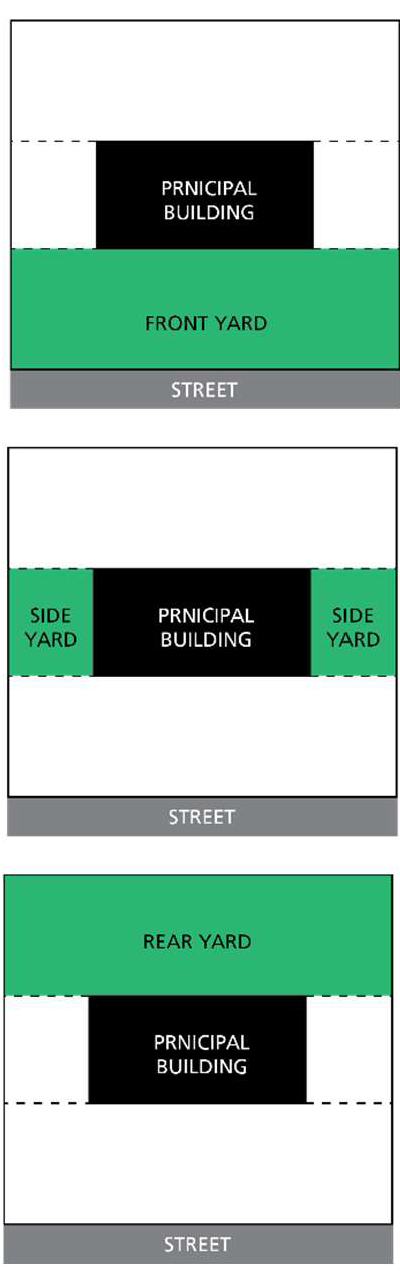
(A)
Front yard: An open space extending the full width of the lot, the depth of which is the minimum horizontal distance between the front lot line and the nearest point of the main building. Unless otherwise specified, each yard with street frontage shall be considered a yard.
(B)
Side yard: An open space between a principal building and the side lot line, extending from the front yard to the rear yard, the width of which is the horizontal distance from the nearest point on the side lot line to the nearest point of the principal building.
(C)
Rear yard: An open space extending the full width of the lot the depth of which is the minimum horizontal distance between the rear lot line and the nearest point of the main building. In the case of a comer lot, the rear yard may be opposite either street frontage, but each lot shall only have one rear yard.
"Z" Terms
Zero lot line: The location of a building on a lot in such a manner that one or more of the building's sides rests directly on a lot line.
Zoning Administrator: The city official(s) authorized to administer the Zoning Ordinance on a day-to-day basis, including, but not limited to processing applications, granting ministerial approvals, maintaining the records of Planning Commission actions, sending notices of public hearing, and similar work.
Zoning Board of Appeals: The body appointed pursuant to the provisions of Michigan Zoning Enabling Act, Public Act 110 of 2006, as amended, to serve as the Zoning Board of Appeals for the City of Iron River, Iron County, Michigan.
Zoning District: A portion of the incorporated area of the city within which on a uniform basis, certain uses of land and buildings are permitted and within which certain yards, open spaces, lot areas, and other requirements are established under the provisions of this chapter.
Zoning permit: A standard form issued by the Zoning Administrator upon application and declaration by the owner or his/her duly authorized agent regarding proposed construction and use of land, thereon, granting approval for the construction or use applied for. A zoning permit is also known as a land use permit.
(Ord. of 3-18-2025, § 14.2)

