
Isle Of Palms City Zoning Code
ARTICLE 1
- GENERAL PROVISIONS
Sec. 5-4-1.- Effect of chapter.
(a)
The provisions of this chapter are adopted and are to be construed pursuant to S.C. Code 1976, § 6-29-310 et seq., as amended. Whenever there is conflict herein with the provisions of any other City ordinance, regulation or resolution, the more restrictive provision shall apply.
(b)
This chapter shall not interfere with or abrogate or annual any easements, covenants or other agreements between parties; provided that where this chapter imposes greater restrictions or limitations upon the property than are imposed or required by such easements, covenants, or agreements, the provisions of this chapter shall control.
(Code 1994, § 5-4-1)
Sec. 5-4-2. - Definitions.
The following words, terms and phrases, when used in this chapter, shall have the meanings ascribed to them in this section, except where the context clearly indicates a different meaning:
(1)
Accessory building or use means a use or building customarily incidental, subordinate to, and detached from the principal use or building and located on the same lot with such principal use or building.
(2)
Adjoining property means any piece, parcel or lot of real property abutting any other real property, including real property located directly across streets, watercourses, drainage easements or other rights-of-way from other real property.
(3)
Adult uses means sexually oriented businesses which are characterized by the exposure, depiction, or description of specified anatomical areas, or specified sexual activities by any method, manner, or device, including but not limited to the following:
(a)
Regularly featuring persons who are nude, whether live, in films, motion pictures, videos, slides, or other photographic reproductions;
(b)
Distribution of any one (1) or more of the following: books, magazines, periodicals, printed matter, photographs, films, motion pictures, videocassettes, video reproductions, slides, or other visual representations; or instruments, devices, or paraphernalia which are designed for use in connection with specified sexual activities, as defined herein; or
(c)
Escort services, baths, saunas, steam baths, hydrotherapy, physical cultures, nude model studios, sexual activities or other similar services.
Specified anatomical areas means the male genitals in a state of sexual arousal and/or the vulva or more intimate parts of the female genitals.
Specified sexual activities means and includes the fondling or other erotic touching of human genitals, pubic area, buttocks, anus, or breasts; sexual acts, normal or perverted, actual or simulated, including intercourse, oral copulation, sodomy, masturbation, actual or simulated; or excretory functions as part of or in connection with any of the foregoing acts.
(4)
Antenna means a device, dish or array utilized by commercial, governmental, or other public or quasi-public users to transmit or receive telecommunications signals.
(5)
Building line or setback means a line which represents the minimum distance, when measured at right angles, which a building or structure must be placed from a lot line or a street right-of-way pursuant to this chapter.
(6)
Charter boat means watercraft for hire where captain or crew is provided.
(7)
Communication tower means a structure of any type which supports communication equipment for signal transmission or reception, and is utilized by commercial, governmental, or other public or quasi-public users, but excluding communication towers used exclusively by amateur radio operators who are duly licensed by the Federal Communications Commission and which are exempt from municipal zoning regulations.
(8)
Conditional use means a use permitted in a zoning district only by complying with additional conditions, restrictions or limitations as set forth in the description of such use.
(9)
Diameter at breast height (DBH) means the diameter of a tree trunk, measured in inches, at four and one-half (4½) feet above the existing grade of the property. If a tree has a multi-trunk split above grade, the DBH is deemed to be the sum of all trunks of the tree measured in inches, at four and one-half (4½) feet above the existing grade of the property.
(10)
Drinking place means a business primarily engaged in the sale of alcoholic beverages, beer or wine, for on-premises consumption.
(11)
Dwelling means a building or portion of a building used, arranged or designed to provide private human residential occupancy, excluding mobile homes and manufactured homes.
a.
Dwelling, single-family means a detached dwelling designed for or occupied exclusively by one (1) family unit, and containing only one (1) kitchen.
b.
Dwelling, two-family means a detached or semi-detached building designed for or occupied exclusively by two (2) family units living independently of each other.
c.
Dwelling, group means a building or portion of a building occupied or intended for occupancy by several family units, but in which separate cooking facilities are not provided. The term "group dwelling" includes roominghouses, fraternity houses and sorority houses, but excludes hotels, motels or tourist homes.
d.
Dwelling, multifamily, apartment house or residential condominium means a dwelling other than a single-family dwelling, two-family dwelling, or group dwelling.
(12)
Eating place, fast food means a business primarily engaged in the sale of ready-to-consume food or beverages for on or off-premises consumption. An eating place or restaurant shall be deemed a fast food eating place if:
(1)
It has a seating capacity of less than twenty (20) persons for service of meals;
(2)
Most food items are already prepared or packaged before the customer places an order; and
(3)
Food and beverages are served primarily with disposable containers and tableware.
The term "fast food eating place" excludes retail grocery stores, convenience stores, delicatessens, or other businesses selling food or beverages as an accessory use or for off-premises preparation and consumption.
(13)
Eating place, restaurant means a business primarily engaged in the preparation and sale of food to customers for on-premises consumption and having seating capacity for at least twenty (20) persons, including, but not limited to, cafes, lunch counters, cafeterias, eating and drinking establishments, or similar businesses, but excludes a fast food eating place or a drinking place. Any carryout service must be clearly subordinate to the principal business of serving prepared foods for on-premises consumption.
(14)
Engineered on-site wastewater disposal system means a specialized on-site wastewater disposal system. See definition for specialized on-site wastewater disposal system.
(15)
Family unit means one (1) person, or two (2) or more persons related by blood or marriage living together; or a group of not more than four (4) persons, not related by blood or marriage but living together.
(16)
Fence means any manmade barrier that impedes or blocks free passage of humans or animals. It may or may not block line-of-sight vision or free flow of wind or water.
(17)
Floor area ratio (FAR) means a percentage calculated by dividing the total livable floor area of a structure on a lot by the total area of contiguous high land of such lot.
(18)
Front yard means an open area between the front of the building and the front lot line.
(19)
Frontage means all of the property fronting on one (1) side of the street between intersecting or intercepting streets, or between a street and a right-of-way, waterway, end of a dead-end street, or political subdivision boundary, measured along the street line.
(20)
Grinder pump system means a wastewater pump station with pump(s), storage capacity and appurtenant piping, valves and other mechanical and electrical equipment which grinds or reduces the particle size of wastewater solids to yield a sewage slurry and which conveys the wastewater from its source to connect with the public gravity sewer system.
(21)
Hazardous tree means any tree that is causing structural damage or poses a clear and imminent threat of structural damage, as determined in writing by a certified arborist, to an enclosed area of a primary building, including porches, or any other permanent accessory structure that would require a building permit, or a septic tank system. The term does not include trees causing structural damage or threatening structural damage to accessory structures that would not require a building permit or to any unenclosed areas of primary buildings.
(22)
Height of a structure means the vertical distance from either the highest elevation of the road centerline immediately adjacent to the lot on which the structure is located, or the lowest area within the building footprint, proposed or existing, of an unaltered/unfilled lot, whichever is higher, to the highest point on the structure. Except for height limitations of communication towers and antennae contained in this chapter, the zoning district height limitations contained in this chapter shall not apply to church spires, chimneys, antennas, communication towers or aerials.
(23)
Historic tree means any live oak tree (Quercus virginiana) having a diameter at breast height (DBH) of sixteen (16) inches or greater or any tree of any other species having a diameter at breast height (DBH) of twenty-four (24) inches or greater.
(24)
Home occupation means a use customarily conducted in a dwelling and which is conducted entirely inside the primary residence of the principal owner of the business, and does not constitute a nuisance or otherwise adversely affect the use and development of other property in the neighborhood.
(25)
Hotel means a building, or portions thereof, which contains multiple units intended to provide sleeping accommodations for transient guests. The term "hotel" also includes motel, tourist home, motor lodge, inn, bed and breakfast, tourist court and auto court. The following criteria shall be used to distinguish between a hotel and a multifamily dwelling:
a.
If any units have individual kitchen facilities, the building is deemed to be a multifamily dwelling.
b.
Temporary habitation by transient guests normally involves durations of less than ninety (90) days. If a majority of the facility's occupants reside for more than ninety (90) consecutive days, the facility is deemed to be a multifamily dwelling.
(26)
Impervious material means any material through which water cannot penetrate. Such material includes, but is not limited to, principal or accessory structures, porches and decks, either covered or of tongue and groove construction, concrete, asphalt, or similar substances, but excludes gravel, shell or crushed stone.
(27)
Isle of Palms Water and Sewer Commission means the Commissioners of Public Works of the City of Isle of Palms. Isle of Palms Water and Sewer Commission is the trade name used by the Commissioners of Public Works of the City of Isle of Palms organized pursuant to S.C. Code 1976, § 5-31-210.
(28)
Junkyards or salvage yards means the use of any property for the storage, keeping, abandonment, sale or resale of junk, salvage, waste or scrap materials; or the dismantling, demolition or abandonment of vehicles, machinery, equipment or any parts thereof.
(29)
Lot means a parcel of land described by metes and bounds at the County RMC Office, and having a County Tax Map System (TMS) number assigned to it.
(30)
Lot coverage means the percentage of contiguous high land on a lot that can be covered with impervious material.
(31)
Lot, double frontage means a lot having a frontage on two (2) streets, other than at their intersection, as distinguished from a corner lot.
(32)
Mobile home means a manufactured home as defined by State law.
(33)
Natural grade means the elevation of the undisturbed natural surface of the property.
(34)
Nonconforming lot, structure, or use means a lot, structure or use which does not comply with the regulations of the zoning district in which it is located.
(35)
OCRM means the State Office of Ocean and Coastal Resource Management, or its successor.
(36)
On-site wastewater disposal system means a traditional septic tank system or other on-site wastewater disposal system. This definition also includes engineered or specialized on-site wastewater disposal systems.
(37)
Public sewer line means a gravity operated sewer line operated and maintained by the Isle of Palms Water and Sewer Commission.
(38)
Public sewer system means the gravity sewer system operated and maintained by the Isle of Palms Water and Sewer Commission for the disposal of wastewater. This definition does not include on-site wastewater disposal systems or grinder pump systems.
(39)
Rear yard means an open area, excluding accessory buildings, between the rear line of the building and the rear lot line.
(40)
Removal of a tree means any intentional or negligent act which:
a.
Cuts down or otherwise destroys or removes a tree;
b.
Causes a tree to decline and die, including, but not limited to:
1.
Damage inflicted upon the root system of a tree by the application of toxic substances, the operation of machinery, the change of natural grade by excavation or filling above the root system or around the tree trunk;
2.
Damage from injury or fire which results in pest infestation;
3.
Damage resulting from the attachment or use of ropes, wires or other similar devices; or
4.
Damage resulting from improper pruning or trimming; or
c.
Subdivides property in such a manner that a tree is at or near the center of a lot or in a location on the lot that requires the removal of the tree for construction of a dwelling unit or other structure.
d.
The term does not include removing palm trees when the palm trees are transplanted or replaced in compliance with section 5-4-66.
(41)
Septic tank system means an on-site wastewater treatment system consisting of an underground tank, distribution box and drain field.
(42)
Significant tree means any live oak tree (Quercus virginiana) having a diameter at breast height (DBH) of eight (8) inches to sixteen (16) inches or any tree of any other species having a diameter at breast height (DBH) of eight (8) inches to twenty-four (24) inches.
(43)
Side yard means an open area between the building and the side lot line. Any lot line which is not a rear lot line or a front lot line shall be deemed to be a side lot line.
(44)
Specialized on-site wastewater disposal system (also known as engineered on-site wastewater disposal system) means an on-site wastewater disposal system that has been designed by a registered professional engineer licensed in the State of South Carolina. Such systems may be utilized in lieu of traditional septic tank systems when the required engineering design and certification have been approved by the South Carolina Department of Health and Environmental Control (SCDHEC).
(45)
Street line means a line separating the street or other right-of-way from a lot.
(46)
Structure means anything constructed or erected which requires a fixed location on the ground, or which is attached to something having a fixed location on the ground, including but not limited to buildings, dwellings, mobile homes, fixtures, towers, signs, billboards, backstops for athletic activities, swimming pools, walls and fences. The term "structure" shall be construed to include any part thereof.
(47)
Trailer means any vehicle or structure capable of moving, or being moved, over streets and highways on its own wheels or on flatbeds or other carriers, which is designed or utilized to:
(i)
Provide temporary or permanent quarters for the conduct of a business, profession, trade or occupation;
(ii)
Serve as a carrier of new or used goods, products or equipment; or
(iii)
Be used as a selling, advertising or display device.
(48)
Travel trailer means a portable vehicular structure designed and primarily intended by its manufacturer as a temporary dwelling for recreational and vacation uses.
(49)
Tree means any woody plant which has a diameter breast height (DBH) of at least eight (8) inches, including palm trees, but excluding pine trees and any tree identified as an invasive pest species in "Invasive Plant Pest Species of South Carolina," published by Clemson Extension.
(50)
Tree protection zone means a circular area surrounding the base of a tree having a diameter equal to one (1) foot for each inch of DBH.
(51)
Wastewater means sewage or a combination of water-carried wastes from residences and business buildings together with such ground, surface and stormwaters as may be present.
(Code 1994, § 5-4-2; Ord. No. 1999-14, § 1, 6-22-1999; Ord. No. 2002-6, § 1, 6-25-2002; Ord. 2002-13, §§ 1—3, 10-22-2002; Ord. No. 2002-17, § 1, 11-26-2002; Ord. No. 2002-19, § 1, 2-28-2003; Ord. No. 2007-12, § 1, 7-24-2007; Ord. No. 2013-08, § 1, 7-23-2013; Ord. No. 2013-10, § 1, 11-19-2013; Ord. No. 2015-06, § 1, 6-23-2015; Ord. No. 2018-13, § 1, 8-28-2018; Ord. No. 2017-09, § 1, 8-27-2019)
Sec. 5-4-3. - Districts designated; zone map; compliance with chapter.
For the purposes of regulating and restricting the location of trades, industries, apartment houses and other uses of property, the number of square feet of lots per family housed, the location and size of yards and height of buildings in the developed portion of the City, the City is hereby divided into zones or districts, as shown on the Official Zoning Map which, together with all explanatory matter thereon, is hereby adopted by reference and incorporated as a part of this chapter. The Official Zoning Map shall be identified by the signature of the Mayor, attested by the City Clerk and bearing the seal of the City under the following words: "This is to certify that this is the Official Zoning Map referred to in section 5-4-3 of the Zoning Ordinance of the City of Isle of Palms, S.C., adopted on (date of adoption)." If, in accordance with the provisions of this chapter, changes are made in district boundaries or other matter portrayed on the Official Zoning Map, such changes shall be made on the Official Zoning Map promptly after the amendment has been approved by City Council, with an entry on the Official Zoning Map as follows: "On (date), by official action of the City Council, the following changes were made (change was made) in the Official Zoning Map; (brief description of change)" which entry shall be signed by the Mayor and shall be attested by the City Clerk. No such change shall become effective until such entry shall have been made on the Official Zoning Map, and signed and attested. Regardless of the existence of purported copies of the Official Zoning Map which may from time to time be made or published, the Official Zoning Map shall be in the custody of the City Administrator and shall be the final authority as to the current zoning status of lands, buildings, and other structures in the City. In the event that the Official Zoning Map becomes damaged, destroyed, lost or difficult to interpret by reason of the nature of number of changes and additions, the City Council may by ordinance adopt a new Official Zoning Map which shall supersede the prior Official Zoning Map. The new Official Zoning Map may correct drafting and other errors or omissions in the prior Zoning Map, but no such correction shall have the effect of amending the original Official Zoning Map as amended. The new Official Zoning Map shall be marked "This is the Official Zoning Map, adopted (date), of the City of Isle of Palms, S.C." which statement shall be signed by the Mayor, attested by the City Clerk, and bear the seal of the City. Unless the prior Official Zoning Map is lost or has been totally destroyed, the map or any significant parts thereof remaining after partial destruction shall be preserved, together with all records of the City regarding its adoption and amendment. No structure or premises shall be erected or used except in conformity with the regulations prescribed in this chapter for use, height and area districts in which such structure or premises is located.
(Code 1994, § 5-4-3)
Sec. 5-4-4. - Interpretation of district boundaries.
When exact distances are not shown on the Official Zoning Map, a district boundary on the map shall be interpreted to run along the centerline of an existing street or alley abutting the district and if the exact location of such boundary is still uncertain, it shall be determined by the Zoning Administrator, with due consideration given to the location as indicated by the scale of the map. Where the streets or alleys on the ground differ from the streets or alleys as shown on the map, the Zoning Administrator may apply the district designations on the map to the streets or alleys on the ground in such manner as to conform to the intent and purpose of this chapter.
(Code 1994, § 5-4-4)
Sec. 5-4-5. - Appeals, variances and special exceptions.
(a)
Appeals.
1.
Pursuant to S.C. Code 1976, § 6-29-780, the City Board of Zoning Appeals is hereby established. Provisions relating to organization, composition and functions of the Board are set forth in title 1, chapter 9, article B. Appeals to the Board of Zoning Appeals may be taken from any order or decision of the Zoning Administrator by any person aggrieved or by any officer, department, or board of the City. Unless otherwise provided by rules of the Board, an appeal must be made by written application setting forth the grounds of appeal and filed with the Zoning Administrator within thirty (30) days from the date of the order or decision appealed from. The Zoning Administrator shall promptly forward to the Board all documents constituting the record upon which the action appealed from was taken. The Board shall fix a reasonable time for the hearing of the appeal or other matter referred to it, and give at least fifteen (15) days' public notice thereof in a newspaper of general circulation in the community and also due notice to the parties in interest, and decide the same within a reasonable period of time. At the hearing, any party may appear in person or by agent or attorney. The Board shall adopt rules of procedure for the conduct of hearings. All final decisions and orders of the Board shall be in writing and permanently filed in the office of the Board as a public record. All findings of fact and conclusions of law must be separately stated in final decisions or orders of the Board, which must be delivered to parties in interest by certified mail.
2.
An appeal stays all legal proceedings in furtherance of the action appealed from, unless the officer from whom the appeal in taken certifies to the Board, after the notice of appeal has been filed with him, that by reason of facts stated in the certificate a stay would, in his opinion, cause imminent peril to life and property. In such case, proceedings may not be stayed other than by a restraining order which may be granted by the Board or by a court of record on application, on notice to the officer from whom the appeal is taken, and on due cause shown.
(b)
Variances. Pursuant to S.C. Code 1976, § 6-29-800, upon written application filed with the Zoning Administrator, the Board may authorize in specific cases a variance from the terms of the ordinances contained in this chapter when strict application of the provisions of the ordinance would result in unnecessary hardship. Filing fees set by resolution of City Council from time to time must be paid by the applicant at the time of filing of an application for a variance. Such application shall contain information addressing each of the statutory requirements for variances stated in S.C. Code 1976, § 6-29-800, as amended, all of which must be met. A variance may be granted in an individual case of unnecessary hardship if the Board makes and explains in writing the following findings:
(1)
There are extraordinary and exceptional conditions pertaining to the particular piece of property;
(2)
Such conditions do not generally apply to other property in the vicinity;
(3)
Because with these conditions, the application of the ordinance or resolution of the particular piece of property would effectively prohibit or unreasonably restrict the utilization of the property;
(4)
The authorization of a variance will not be of substantial detriment to an adjacent property or to the public good, and the character of the district will not be harmed by the granting of the variance.
The Board may not grant a variance which has the effect of allowing the establishment of a use not otherwise permitted in a zoning district, to physically extend a nonconforming use, or to change the zoning district boundaries shown on the official zoning map. The fact that property may be utilized more profitably if a variance were granted shall not be considered as a ground for a variance. A claim of unnecessary hardship cannot be based on conditions created by the applicant. A claim of unnecessary hardship cannot be based on financial hardship of the applicant.
In granting a variance, the Board may attach to it such conditions regarding the location, character, or other features of the proposed building, structure, or use as the Board may consider advisable to protect established property values in the surrounding area, or to promote the public health, safety, or general welfare.
(c)
Special exceptions.
1.
Upon written application filed with the Zoning Administrator, the Board may grant as a special exception any use specified as a special exception in the zoning district regulations. In addition to the conditions generally required by the applicable zoning district regulations, the Board shall apply the following standards in deciding special exception applications:
(1)
Adequate provision shall be made for setbacks, fences, buffer or planting strips to protect adjacent properties from adverse impact of the proposed use, such as noise, vibration, dust, glare, odor, traffic congestion and similar factors.
(2)
Vehicular traffic and pedestrian movement on adjacent roads must not be hindered or endangered.
(3)
Off-street parking and loading areas and the entrances and exits for the use must be adequate in terms of location, number, design and construction to serve the use without adverse impact on adjacent properties.
(4)
The proposed use must not adversely affect the property values, the general character or the general welfare of the surrounding vicinity.
2.
In granting a special exception, the Board may attach to it such conditions regarding the location, size, character, or other features of the proposed use as the Board may consider advisable in order to promote public health, safety, or general welfare. No special exception use may be altered or enlarged without the prior approval of the Board.
(Code 1994, § 5-4-5; Ord. No. 2009-02, § 1, 5-19-2009)
Sec. 5-4-6. - Zoning administrator.
The provisions of this chapter shall be administered and enforced by the City Zoning Administrator. The Zoning Administrator shall be appointed by, and serve at the pleasure of, City Council. The Zoning Administrator shall have the right to enter upon any premises necessary to fully administer the duties of such office. The Zoning Administrator may issue emergency orders in critical areas pursuant to S.C. Code 1976, § 48-39-130, as amended.
(Code 1994, § 5-4-6)
Sec. 5-4-7. - Violations and penalties.
(a)
It is unlawful to construct, reconstruct, alter, demolish, change the use of or occupy any land, building, or other structure without first obtaining the appropriate permit or permit approval. No permit may be issued or approved unless the requirements of this chapter are complied with. It is unlawful for other officials to issue any permit for the use of any land, building, or structure, or the construction, conversion, demolition, enlargement, movement, or structural alteration of a building or structure without the approval of the Zoning Administrator. If a building, structure or land is or is proposed to be used in violation of any provision of this chapter, the Zoning Administrator or other appropriate administrative officer, City Attorney, or other appropriate authority of the City, or an adjacent or neighboring property owner who would be specially damaged by the violation, may, in addition to other remedies, institute injunction, mandamus, or other appropriate action or proceeding to prevent the unlawful erection, construction, reconstruction, alteration, conversion, maintenance, or use, or to correct or abate the violation, or to prevent the occupancy of the building, structure, or land.
(b)
The Zoning Administrator and the Building Official shall withhold building or zoning permits, or both, and shall issue stop orders against any work undertaken by any person not having a proper building or zoning permit, or both.
(c)
In case a structure or land is or is proposed to be used in violation of this chapter, the Zoning Administrator may, in addition to other remedies, issue and serve upon a person pursuing such activity or activities a stop order requiring that such person immediately cease all activities in violation of this chapter.
(d)
Any person violating any of the provisions of this chapter shall be deemed guilty of a misdemeanor and shall for each violation, upon conviction thereof, be punished as provided in section 1-3-66. Each day that a violation continues shall constitute a separate offense.
(Code 1994, § 5-4-7)
Sec. 5-4-9. - Severability.
If any section, clause, provision or portion of this chapter shall be held to be invalid or unconstitutional by any court of competent jurisdiction, such holding shall not affect or impair any other section, clause, provision or portion of this chapter.
(Code 1994, § 5-4-9)
Sec. 5-4-10. - Effective date.
This chapter shall, except as otherwise provided, be in force and take effect upon its adoption by City Council.
(Code 1994, § 5-4-10)
Sec. 5-4-11. - Authority and procedure for amending chapter.
(a)
City Council may, from time to time, on its own motion or on petition, after public notice and hearing, amend any provision of this chapter. Whenever fifty percent (50%) or more of the landowners in any zoning district shall present a petition to City Council duly signed and acknowledged, requesting an amendment of the regulations prescribed for such district, City Council shall vote upon such amendment within ninety (90) days of the filing of the same by the petitioners with the City Clerk. Petitioners shall pay such filing fee as is established from time to time by resolution of City Council. Zoning amendments may also be initiated by the Planning Commission.
(b)
Notice of a public hearing on proposed changes to any provisions of the chapter shall be given by publication of a display advertisement in the Charleston Post and Courier newspaper, or its successor, not less than fifteen (15) days prior to the date of the hearing. The notice shall summarize the proposed change and state the date, time and place of the public hearing. Other notice as required by law shall also be given. When a proposed zoning amendment affects the district classification of property, such notice shall include a general description of the property to be rezoned. In cases involving rezoning, conspicuous notice shall be posted on or adjacent to the property affected, with at least one (1) such notice being visible from each public thoroughfare that abuts the property. The notice shall state that a petition to rezone has been received and the date, time and place of the public hearing to consider the request. The public hearing shall be conducted by the City Council.
(c)
Prior to adoption, all proposed zoning amendments shall be referred to the Planning Commission for review and recommendation. The Planning Commission shall make its written report and recommendation thereon to City Council within thirty (30) days from the date of referral. Failure of the Planning Commission to so report shall be deemed to be its recommendation of approval of the amendment, unless such time period is extended by City Council.
(Code 1994, § 5-4-11; Ord. No. 2015-16, § 1, 2-23-2016)
Sec. 5-4-12. - Additional regulations.
The following additional regulations shall apply to all zoning districts:
(a)
No land or building shall hereafter be used or occupied and no building or part thereof shall be constructed, erected, altered, or moved unless done in compliance with all applicable provisions of this chapter. Any use of land or buildings which is not allowed as a permitted use, conditional use, or special exception in the applicable zoning district is strictly prohibited.
(b)
The height of a building or structure shall not exceed forty feet (40'), unless otherwise provided in this chapter.
(c)
No lot shall be reduced to a size which does not meet the minimum lot area, lot width, yard areas, or other requirements of the applicable zoning district.
(d)
Except as provided in sections 5-4-45 and 5-4-46, no buildings shall be erected, altered or moved to create smaller front yards, side yards, rear yards or other open spaces than are required by the applicable zoning district.
(e)
All new construction or substantial improvements, as those terms are defined in section 5-4-155, shall be connected to the public sewer system if a public sewer line abuts a property or could abut a property with an extension of the sewer line of one hundred fifty (150) feet or less, as determined by the Isle of Palms Water and Sewer Commission. Where a gravity operated public sewer line does not abut a property or would require an extension of the sewer line of more than one hundred fifty (150) feet to reach a property, all new construction or substantial improvements must have an on-site wastewater disposal system or grinder pump system constructed or brought into compliance with current South Carolina Department of Health and Environmental Control (SCDHEC) standards; provided, however, that if the property cannot meet current SCDHEC on-site wastewater disposal system or grinder pump system standards, the building on such property shall not be increased in size and the improvements shall not increase the number of bedrooms or bathrooms.
(f)
Sills, belt course, window air conditioning units, chimneys and cornices may project into a required yard by not more than two feet (2'). Steps may project into a required front yard or rear yard by not more than five feet (5').
(g)
The zoning district front yard setback requirements for dwellings shall not apply to any lot where the average setback of existing buildings located within one hundred feet (100') of each side of the dwelling within the same block and fronting on the same street is less than the required front yard setback. In such case the average setback on such lot shall not be less than the average setback of the existing buildings.
(h)
Where a lot abuts on two (2) streets (either a corner lot or a double frontage lot), the lot's front yard setback requirements must be met on both street sides and the lot's side yard setback requirements must be met on all other sides of the lot.
(i)
Where a lot abuts on two (2) streets or rights-of-way (either a corner lot or a double frontage lot), no accessory building shall be located closer to a street than the lot's front yard setback requirements.
(j)
No fence, wall, shrubbery, or other structure shall obstruct road traffic vision.
(k)
Every building hereinafter erected or moved shall be on a lot abutting a public street, or having legal access to an approved private street. All structures shall be located to allow for safe and convenient access for servicing, fire protection, and off-street parking.
(l)
All lots shall be located on a street having a minimum right-of-way of fifty feet (50'). The required fifty feet (50') shall not include any critical area as defined in section 5-4-15(A).
(m)
Except as allowed in section 5-4-113(g), no access drive shall be permitted which would require a reduction in existing on-street public parking or loading areas.
(n)
Except in residential and GC-2 zoning districts, access drives shall conform to the requirements set forth in the following table and figure 5-4-12-A:
*The distance between abutting one-way access drives, with the inbound drive located upstream of the traffic flow from the outbound drive, can be one-half of the distance listed above.
Figure 5-4-12-A
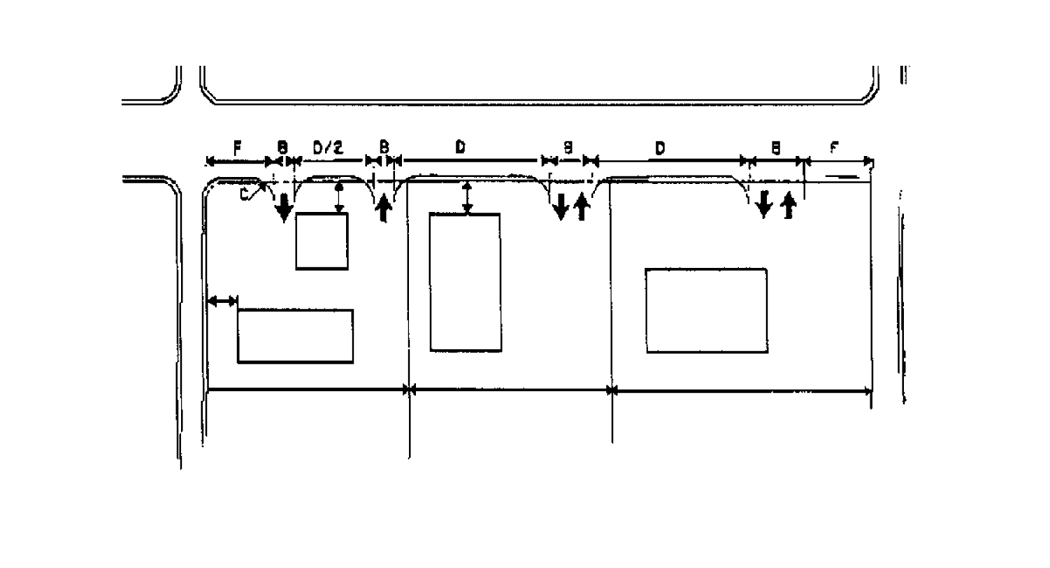
B = Access Drive Width
C = Curb Radius
D = Access Drive Separation
E = Fifty (50) Foot Minimum Spacing From Right-of-Way
(o)
Access drives in the GC-2 zoning district authorized pursuant to section 5-4-113(g) must comply with the following requirements:
1.
There shall be only one (1) access drive per lot.
2.
An access drive shall not exceed twenty-four feet (24') in width.
3.
Prior to constructing an access drive from a State right-of-way, the owner of the property first must obtain an encroachment permit from the South Carolina Department of Transportation (SCDOT). All fees, costs and expenses for obtaining the permit and for construction of the access drive, arrangement for the sight distance requirement, and any other requirements of SCDOT shall be borne by the owner of the property.
4.
Prior to constructing an access drive from a City or County right-of-way, the owner of the property first must obtain an encroachment permit as set forth in title 3, chapter 1, article E. All fees, costs and expenses for construction of the access drive, compliance with the sight distance requirement, and any other requirements shall be borne by the owner of the property.
(p)
Adding fill or importation of materials of any type, or re-contouring of a lot's existing contours, that increases a lot's existing ground elevation more than one (1) foot above existing road and results or may result in elevating an existing or proposed structure is strictly prohibited. Provided however, that this requirement would not limit the elevation of a lot to an elevation lower than seven and four tenths (7.4) foot (using the 1988 NAVD datum).
(q)
No lot shall be improved, altered, graded, or filled in a way that results in (1) additional stormwater running off the site; or (2) stormwater running off the site in an accelerated manner.
(r)
Prior to any improvements, alterations, grading, or filling, a stormwater management plan shall be submitted and approved by the Zoning Administrator.
(s)
The stormwater management plan shall include the following:
(1)
the stamp and signature of a duly licensed and qualified professional;
(2)
all existing and proposed topographical features of the lot, existing and proposed drainage flow patterns, and runoff quantities;
(3)
and a statement by the professional certifying that the improvements are designed such that post-construction runoff will mimic preconstruction hydrology runoff for the site and the improvements will not adversely impact the adjacent properties, drainage systems or rights-of-way;
(t)
The following site changes shall require the submittal of a stormwater management plan:
(1)
Any new building construction, new impervious surface, or replacement of impervious surfaces, which cumulatively exceed six hundred twenty-five (625) square feet in area (all development shall be cumulative over time when considering the square footage threshold for requiring a stormwater management plan).
(2)
Adding fill or re-contouring of twenty percent (20%) or more of the existing lot area in compliance with paragraph (p) of this section.
Additional submittal materials, design specifications and maintenance schedules may be requested at the discretion of the Zoning Administrator to ensure compliance with the Charleston County Stormwater Management Program.
(u)
Prior to the issuance of a Certificate of Occupancy (CO) for construction projects, the Zoning Administrator may require as-built documentation certifying that the project was completed in compliance with the approved stormwater management plan.
(Code 1994, § 5-4-12; Ord. No. 2001-5, §§ 1—3, 5-22-2001; Ord. No. 2002-12, § 1, 10-22-2002; Ord. No. 2003-8, § 1, 6-24-2003; Ord. No. 2003-13, § 1, 2-24-2004; Ord. No. 2006-10, § 1, 8-22-2006; Ord. No. 2015-11, § 1, 9-29-2015; Ord. No. 2018-13, §§ 2, 3, 8-28-2018; Ord. No. 2017-09, § 2, 8-27-2019; Ord. No. 2024-05, § 1, 7-23-2024)
Sec. 5-4-13. - Maximum lot coverage; floor area ratio requirements; stormwater detention; additional setback requirements.
1.
The following regulations shall apply to the SR-1, SR-2 and SR-3 zoning districts:
(a)
For lots connected to the public sewer system, not more than thirty-five percent (35%) of the area of a lot shall be covered by impervious material, provided that this requirement shall not limit lot coverage to less than three thousand two hundred (3,200) square feet nor allow lot coverage to exceed seven thousand (7,000) square feet. For lots with on site wastewater disposal systems, this lot coverage requirement shall be reduced from thirty-five percent (35%) to not more than thirty percent (30%), provided that this requirement shall not limit lot coverage to less than two thousand four hundred (2,400) square feet nor allow lot coverage to exceed five thousand two hundred fifty (5,250) square feet.
(b)
In situations Section 5-4-12(r) requires a stormwater management plan, for every square foot of new or altered impervious surfacing permitted on a lot, 0.3 cubic feet of new stormwater detention must be provided on the lot. The method for stormwater detention must be approved by the Zoning Administrator as part of the stormwater management plan. Detention areas must be located on the same property and above the seasonal high groundwater level. Detention can be achieved with detention vaults, rock wells, open basins, or any approved combination of methods. If materials such as rocks are used to create stormwater storage, only the voids within the system, excluding materials, will count towards meeting the required area.
(c)
All newly installed hard landscaping, including, but not limited to, walkways, driveways, pool surrounds, and ground level patios, shall be constructed using pervious materials.
(d)
A homeowner or his/her designee may make substantial repairs or replace an existing impervious surface within its original footprint, as long as all work is commenced and substantially completed within six (6) months from the date of removal.
(e)
If the work is not substantially completed within the six-month time frame, the surface will be subject to the current regulations.
(f)
The floor area ratio of a lot shall not be greater than forty percent (40%) of the area of a lot, provided that this requirement shall not limit the enclosed living space of a principal structure to less than three thousand two hundred (3,200) square feet not allow such enclosed space to exceed seven thousand (7,000) square feet.
(g)
For lots larger than eight thousand (8,000) square feet, with a lot width at the front building line of seventy (70) feet or greater, the combined minimum side yard setback requirement for any portion of the enclosed building at or above twenty-five (25) feet in height as measured pursuant to section 5-4-2(18) shall be thirty (30) feet, with no side yard less than ten (10) feet.
(h)
For lots larger than eight thousand (8,000) square feet, with a lot width at the front building line of at least sixty (60) feet but less than seventy (70) feet, the combined minimum side yard setback requirement for any portion of the enclosed building at or above twenty-five (25) feet in height as measured pursuant to section 5-4-2(18) shall be twenty-five (25) feet, with no one side yard less than ten (10) feet.
2.
This section does not prohibit a structure on any City-owned lot which is used for municipal purposes from exceeding seven thousand (7,000) square feet so long as the other requirements of this section which are not inconsistent with this subsection are met.
(Code 1994, § 5-4-13; Ord. No. 2002-17, § 2, 11-26-2002; Ord. No. 2003-6, § 1, 6-24-2003; Ord. No. 2015-15, § 2, 2-23-2016; Ord. No. 2018-13, § 4, 8-28-2018; Ord. No. 2019-11, 6-25-2019; Ord. No. 2017-09, § 3, 8-27-2019; Ord. No. 2020-07, 8-25-2020; Ord. No. 2024-05, §§ 2, 3, 7-23-2024)
Sec. 5-4-14. - Accessory uses.
(A)
Accessory uses include but are not limited to the following:
(1)
Residential:
a.
Private garage;
b.
Shed or toolroom for the storage of equipment used on grounds or building maintenance. However, shipping containers, tractor trailer containers, and similar structures are prohibited;
c.
Children's playhouse;
d.
Private swimming pool, deck, bathhouse, cabana, private recreating area, and tennis courts;
e.
Greenhouse;
f.
Parking of personal passenger automobiles, vans and trucks; provided that as otherwise stated below, the open storage or parking of heavy commercial vehicles (defined as vehicles with three (3) or more axles, including, but not limited to, straight truck, straight truck with trailer or portable tanker, straight tanker or tractor semi-trailer tanker, tractor-semi trailer including single and multiple trailers), or any components thereof, or passenger buses, as defined by the State Department of Public Safety, upon any lot, land, street, right-of-way or shoulder thereof in the SR-1, SR-2 or SR-3 districts is prohibited unless such vehicle, trailer or bus is attended and in the process of being loaded or unloaded. Overnight parking or storage of heavy commercial vehicles (including both cab and trailer) or passenger buses in the SR-1, SR-2 or SR-3 districts is prohibited. Notwithstanding the foregoing, the parking of passenger buses is allowed in the SR-1, SR-2 and SR-3 districts on property containing at least one-half (½) acre of land and which is owned and operated by a governmental agency or charitable organization.
g.
In SR-3 only, a guest suite or similar facility without a kitchen; provided that such accessory building may not be rented or leased except as part of the entire premises including the principle building, nor may the principle building be rented or leased except as part of the entire premises including the accessory building.
(2)
Commercial:
a.
Completely enclosed building for storage of supplies. However, shipping containers, tractor-trailer containers, and similar structures are prohibited;
b.
Parking.
(B)
Except for parking, permitted accessory uses or buildings shall not be located in the front yard or the side yard, and such uses or buildings shall not be located within six feet (6') of any side lot line or rear lot line; provided, however, that accessory buildings on comer lots may be located in the side yard in compliance with section 5-4-12(i). Accessory buildings which are not separated from the principal building by at least three feet (3') must meet the minimum yard requirements of the zoning district in which the property is located. A single one- or two-car garage may be located in the front yard or side yard if the minimum yard requirements are met.
(C)
The maximum height of an accessory structure shall not exceed thirty feet (30').
(Code 1994, § 5-4-14; Ord. No. 2002-12, § 2, 10-22-2002; Ord. No. 2005-8, § 1, 3-28-2006; Ord. No. 2007-11, § 1, 6-26-2007; Ord. No. 2015-15, § 3, 2-23-2016)
Sec. 5-4-15. - Beach regulations.
(A)
No land or building situated in whole or in part in a critical area as defined in S.C. Code 1976, § 48-39-10, as amended, shall be used, occupied, constructed, altered or moved without compliance with the State of South Carolina Beachfront Management Act (S.C. Code 1976, § 48-39-10 et seq., as amended).
(B)
No land, building or other manmade structure situated in whole or in part landward of the critical area as defined in S.C. Code 1976, § 48-39-10, as amended, but within a two hundred fifty-foot (250') radius of the mean high-water mark of the Atlantic Ocean, Breach Inlet, or Dewees Inlet, shall be used, occupied, constructed, erected, altered or moved except in compliance with the requirements set forth in this section and all other requirements set forth in this chapter or any other City ordinance.
(1)
Only beach-compatible sand may be used for any erosion control or beach renourishment activities. Sea walls, revetments, bulkheads, groins, rip-rap or any other hard erosion control structures or devices are strictly prohibited. Hard erosion control structures or devices shall include bags with a capacity greater than five (5) gallons per bag. Hard erosion control structures or devices shall not include bags containing beach-compatible sand with a capacity of five (5) gallons or less per bag, subject to the following restrictions:
(i)
No straps, soldier piles, tape, wire, rope, or any other material or device shall be used to hold together or fasten any sand bags in place;
(ii)
No filter cloth, geotextile fabrics, mats or other underlayments shall be placed in conjunction with the use of any sand bags; and
(iii)
All sandbags shall be commercially manufactured for the purpose of holding sand, be tan, off-white or white in color, and manufactured with single layer fabric, with a grab tensile strength not exceeding three hundred (300) pounds or a trapezoidal tear strength not exceeding one hundred (100) pounds.
(2)
Walkways over sand dunes which meet all of the requirements of S.C. Code 1976, § 48-39-130(D), as amended, and all regulations promulgated thereunder, shall be allowed.
(3)
Placement of sand fence and installation of vegetation in accordance with OCRM Critical Area Regulations R.30-13 shall be allowed.
(4)
Other than walkways over dunes, sand fencing and vegetation, no alteration of primary oceanfront sand dunes shall be allowed.
(C)
No person shall obstruct any beach or beach access within the City. Violation of this section shall be a misdemeanor, and punished in accordance with the provisions of section 1-3-66.
(1)
For purposes of this section, the term "beach access" means any public route of ingress to and egress from the beach.
(2)
For purposes of this section, the term "obstruct" or "obstruction" means any act or occurrence that inhibits pedestrian use of the beach access, including but not limited to the placement of vegetation or fencing within the beach access, the erection of any barrier within the beach access, any change in topography in the beach access, or the placement of any material in, on, over, under or touching the beach access that impedes or adversely affects pedestrian use.
(3)
The City shall have the right to remove all obstructions to the beach or beach accesses. In removing such obstructions, the City, its employees, contractors and agents, may enter onto private property in order to remove the obstruction.
(4)
All costs of removal, including costs of personnel and equipment and any reimbursement for damage, shall be borne by the person placing or creating the obstruction.
(5)
The following activities are deemed to be obstructions to beach access, and are punishable in accordance with section 1-3-66:
(a)
It shall be unlawful to drive a vehicle on any public beach or beach access, except as follows:
(1)
Vehicular use of the beach and beach access which is determined by the City Council to be for public health and safety purposes;
(2)
Emergency use of the beach and beach accesses by emergency vehicles; or
(3)
Other vehicular use of the beach or beach accesses approved by City Council.
(b)
It shall be unlawful to park a vehicle in the public right-of-way in such a manner as to block or obstruct use of a beach or beach access.
(Code 1994, § 5-4-15; Ord. No. 1997-10, 8-26-1997; Ord. No. 2006-2, § 1, 2-28-2006; Ord. No. 2007-5, § 1, 3-27-2007)
Sec. 5-4-16. - Temporary uses.
(a)
The Zoning Administrator may issue temporary permits for the following uses:
(1)
Religious meetings in a temporary structure in GC zoning districts for a period not to exceed seven (7) consecutive days;
(2)
Open lot sale of Christmas trees in the GC and LC zoning districts for a period not to exceed forty-five (45) consecutive days;
(3)
Storage and office trailers for use as construction storage and Contractor's office during construction in any district, except in fully or substantially fully developed residential districts, for a period of twelve (12) consecutive months, provided that such office is placed on the property under construction.
(b)
Any person, company or organization to be permitted under this section to place a mobile home, storage or office trailer must agree by written letter delivered to the Zoning Administrator prior to issuance of the permit that in the event a named storm is identified by the national weather service with a projected path that includes the City, that the permittee will cause the temporary structure to be disconnected from all water, sewer and electrical connections and removed from the City limits upon the County Emergency Operations Center declaring the City under OPCON 2.
(Code 1994, § 5-4-16; Ord. No. 2004-14, §§ 1, 2, 10-26-2004; Ord. No. 2016-09, § 1, 10-25-2016)
Sec. 5-4-17. - Sea turtle protection; outdoor lighting regulations.
(a)
Definitions. The following words, terms and phrases, when used in this section, shall have the meanings ascribed to them in this subsection, except where the context clearly indicates a different meaning:
(1)
Artificial light means any source of light emanating from a manmade device, including, but not limited to, incandescent, mercury vapor, metal halide, or sodium lamps, flashlights, spotlights, streetlights, vehicular lights, construction or security lights.
(2)
Floodlight means reflector-type light fixture which is attached directly to a building and which is unshielded.
(3)
Low profile luminary means a light fixture set on a base which raises the source of the light no higher than forty-eight inches (48") off the ground, and designed in such a way that light is directed downward from a hooded light source.
(4)
Development means any existing structure for which a building permit has been duly issued and any new construction or remodeling of existing structures when such remodeling includes alteration of exterior lighting.
(5)
Person means any individual, firm, association, joint venture, partnership, estate, trust, syndicate, fiduciary, corporation, group or unit, or Federal, State, County or municipal government.
(6)
Pole lighting means a light fixture set on a base or pole which raises the source of the light higher than forty-eight inches (48") off the ground.
(b)
Development. No artificial light shall illuminate any area of the beach other than in compliance with this section. Building and electrical plans for construction of single-family or multifamily dwellings, commercial or other structures, including electrical plans associated with parking lots, dune walkovers or other outdoor lighting for real property if lighting associated with such construction or development can be seen from the beach, shall be in compliance with the following:
(1)
Floodlights shall be prohibited. Wall-mounted light fixtures shall be fitted with hoods so that no light illuminates the beach.
(2)
Pole lighting shall be shielded in such a way that the point sources of light will not be visible from the beach. Outdoor lighting shall be held to the minimum necessary for security and convenience.
(3)
Low-profile luminaries shall be used in parking lots and such lighting shall be positioned so that no light illuminates the beach.
(4)
Dune crosswalks shall utilize low-profile shielded luminaries which shall be turned off from sunset to sunrise during the period of May 1 to October 31 of each year.
(5)
Temporary security lights at construction sites shall not be mounted more than fifteen feet (15') above the ground. Illumination from the lights shall not spread beyond the boundary of the property being developed and in no case shall those lights illuminate the beach.
(c)
Use of lighting. It is the policy of the City for both new and existing development to minimize artificial light illuminating any area of the beach. To adhere to this policy, lighting of structures which can be seen from the beach shall be in compliance with the following:
(1)
Lights illuminating buildings or associate grounds for decorative or recreational purposes shall be shielded or screened such that they are not visible from the beach, or turned off from sunset to sunrise during the period of May 1 to October 31 of each year.
(2)
Lights illuminating dune crosswalks of any area oceanward of the primary dune line shall be turned off from sunset to sunrise during the period of May 1 to October 31 of each year.
(3)
Security lights shall be permitted throughout the night so long as low-profile luminaries are used and screened in such a way that those lights do not illuminate the beach.
(d)
Publicly owned lighting. Streetlights and lighting at parks and other publicly owned beach areas shall be subject to the following:
(1)
Streetlights shall be located so that most of their illumination will be directed away from the beach. These lights shall be equipped with low-pressure sodium bulbs and shades or shields that will prevent backlighting and render them not visible from the beach.
(2)
Lights at parks or other public beach access points shall be shielded or shaded or shall not be utilized during the period of May 1 to October 31 of each year.
(e)
Enforcement and penalty. Violation of any provision is hereby declared to be a misdemeanor, punishable and enforceable pursuant to the provisions of section 1-3-66.
(Code 1994, § 5-4-17)
Sec. 5-4-18. - Required marsh setbacks.
(1)
Subject to the provisions of subsections (2) and (3) of this section, the minimum setback for a structure on a lot adjacent to the marsh shall be ten feet (10') from the OCRM critical line or the lot line, whichever distance is greater.
(2)
The minimum setback for a structure on any lot adjacent to the marsh which is subdivided as defined in this chapter shall be twenty feet (20') from the OCRM critical line or the lot line, whichever distance is greater.
(3)
The setback for existing structures shall be twenty feet (20'), provided that any structure situated in whole or in part within twenty feet (20') from the OCRM critical line which is involuntarily damaged or destroyed may be rebuilt in its original footprint or any new configuration so long as no part of the new construction encroaches into the twenty-foot (20') setback to a greater extent than that of the damaged or destroyed structure. No structure situated in whole or in part within twenty feet (20') from the OCRM critical line may be altered or modified so as to extend any part of the structure closer to the OCRM critical line.
(4)
In addition, no impervious driveway, parking pad or other paved surface associated with vehicular use shall be located closer than twenty feet (20') to the critical line.
(5)
The minimum marsh setback requirements established in this section shall apply to all marsh front lots within the City. If the zoning district in which the property is located imposes a greater setback requirement, the greater setback requirement shall apply.
(6)
For purposes of this section, the location of the critical line shall be identified by a State-registered land surveyor and drawn on a site plan of the lot and approved by OCRM. If the OCRM approval is dated more than eighteen (18) months prior to the date of submission of a building permit application, or if the Zoning Administrator has reason to believe that the location of the critical area has materially changed since OCRM approval was issued, the location of the critical line must be reestablished. The location of the critical line shall be marked on the property in accordance with current OCRM requirements, and such markers shall remain in place during the entire time of construction.
(Code 1994, § 5-4-18; Ord. No. 2005-4, §§ 2, 3, 9-28-2005)
Sec. 5-4-19. - Fence regulations.
(a)
Construction regulations for fences in special flood zones. Construction or replacement of a fence in a special flood zone requires a permit from the City Building Official, upon the following conditions:
(1)
Within the V-zone. Within a flood V-zone as determined by the most recent FIRM, fences shall not be constructed which impede the free flow of water. Furthermore, no part of a fence shall be constructed with masonry material or heavy lumber. For the purposes of this section, the term "heavy lumber" means any piece of wood with a nominal cross section dimension greater than four inches by four inches (4" × 4").
(2)
Within the A-zone.
a.
Within the flood A-zone as determined by the most recent FIRM, fences shall not be constructed which impede the free flow of water.
b.
Fences constructed with masonry and/or heavy lumber must incorporate hydrostatic openings below the flood elevation to allow for the unimpeded flow of floodwaters.
c.
Flood elevations shall be determined using the most recent FIRM. Hydrostatic openings shall be a minimum of one (1) square foot in area each with the bottom edge of the opening no more than one foot (1') above grade, and shall not be spaced more than twenty feet (20') apart. Total required area of hydrostatic openings shall equal one (1) square foot for every fifty (50) square feet of fence area (fence area shall be determined by measuring one side of the fence).
(3)
Height limits. No fence in a special flood zone which is also located in a residential zoning district shall have a height greater than six feet (6') except for a fence which faces a nonresidential zoning district.
(4)
Outside V or A flood zones. None of the aforementioned construction regulations of this section shall apply to fences outside of special flood zones as determined using the latest FEMA regulations.
(b)
Exception for nonconforming fences. Any fence lawfully erected as of the adoption of the ordinance from which this section is derived shall be considered a legal, nonconforming structure. Upon any nonconforming fence being physically damaged or destroyed by fifty percent (50%) or more, replacement or repair shall fully comply with all of the terms and conditions of subsection (a) of this section.
(Code 1994, § 5-4-19; Ord. No. 2007-5, § 2, 3-27-2007)
Sec. 5-4-20. - Communication tower and antennae regulations.
Construction or alteration of a communication tower or antenna may be approved by the Zoning Administrator as a conditional use subject to a finding that the tower or antenna satisfies the Zoning Administrator approval conditions listed in subsection (a) of this section. Towers or antennae not meeting the Zoning Administrator approval conditions may be approved by the Zoning Board of Adjustment as a special exception subject to a finding that the tower or antenna satisfies the special exception requirements listed in this section. Towers or antennae which cease to be used for signal communication purposes must be dismantled and removed within one hundred twenty (120) days of the date the tower or antennae ceases such use.
(a)
Zoning administrator approval conditions. The Zoning Administrator may approve construction or alteration of a communication tower or antenna upon a finding that each of the following conditions are met:
(1)
The communication tower and/or antenna is located within the LC (Limited Commercial), GC-1 (General Commercial) or GC-2 use districts;
(2)
The height of the communication tower and/or antenna must not exceed one hundred feet (100') or twenty feet (20') above the highest part of a structure existing at the time of adoption of the ordinance from which this section is derived. However, existing towers and antennae may not be extended above one hundred feet (100');
(3)
The communication tower must be located no closer to noncommercially zoned lots than a distance equal to the height of the tower;
(4)
The communication tower and/or antenna must be located such that adequate setbacks are provided on all sides to prevent the tower's fall zone from encroaching onto adjoining lots (the fall zone shall be determined by an engineer certified in the State in a letter which includes the engineer's signature and seal);
(5)
The communication tower and associated improvements meet applicable landscaping and tree protection requirements;
(6)
The applicant has unsuccessfully attempted in good faith to collocate on existing communication towers, buildings, or other structures and the applicant agrees to allow other users to collocate on the proposed tower in the future subject to engineering capabilities of the structure, frequency considerations, and adequate compensation from the additional user;
(7)
The communication tower and/or antenna is only illuminated as required by the Federal Communications Commission, Federal Aviation Administration, or other regulatory agencies. Nighttime strobe lighting shall not be incorporated unless required by the Federal Communications Commission, Federal Aviation Administration, or other governmental regulatory agency. When lighting is permitted under this subsection (a)(7), it shall be oriented inward so as not to project onto surrounding residential property, subject to such regulatory requirements;
(8)
The color of the communication tower and/or antenna is appropriate to blend in with its surroundings;
(9)
The communication tower and/or antenna, and associated structures, are appropriately secured by means of walls, fences or other devices; and
(10)
The communication tower and/or antenna does not include signage of any nature on any portion of the tower and/or antenna.
(11)
Notwithstanding any provision of this section or any other provision contained in this chapter to the contrary, a communication tower and/or antenna that is modified or constructed for public service uses by any federal, state, county, municipal, or other governmental agencies, including, but not limited to, public safety, firefighting, law enforcement, medical, emergency, and 911 public service uses, and potential use by any designated subsidiary commercial co-locator, shall not exceed two hundred feet (200') in height and shall meet the following additional conditions:
a.
The communication tower and/or antenna shall meet the Zoning Administrator approval conditions listed above in subsections (a) (1), (5), (6), (7), (8), (9), and (10) of this section;
b.
Reasonable efforts shall be made to reduce the fall zone of the communication tower and/or antenna to minimize encroachment onto adjoining lots;
c.
The communication tower and/or antenna shall have capacity to accommodate a minimum of four (4) commercial carriers; and
d.
The communication tower and/or antenna shall meet the wind speed standards of EIA/TIA-222 (Electronic Industry Association/Telecommunications Industry Association), then current revision.
(b)
Board of zoning appeals approval standards. The Board of Zoning Appeals may approve construction or alteration of a communication tower and/or antenna as a special exception subject to the requirements of section 5-4-5(c) and upon a finding that each of the following additional standards are met:
(1)
The communication tower and/or antenna is located within the LC (limited commercial), GC-1 (general commercial) or GC-2 use districts; and
(2)
The height of the communication tower and/or antenna shall not exceed one hundred sixty feet (160') or thirty feet (30') above the highest part of a structure existing at the time of adoption of the ordinance from which this section is derived. However, existing towers and antennae may not be extended above one hundred sixty feet (160'); and
(3)
In addition to satisfying the Zoning Administrator approval criteria listed in this section as subsections (a)(4), (5), (6), (7), (8), (9) and (10), the Board must find that the design, location and height of the communication tower and/or antenna will not substantially adversely impact the appearance of adjacent noncommercially zoned areas. The Board may request a line of site analysis showing the potential visual and aesthetic impacts of the tower and/or antenna on adjacent noncommercially zoned areas.
(c)
Application requirements. Applications for Zoning Administrator or Board approval shall include the following information:
(1)
A scaled site plan showing the location of the tower and/or antenna, guy anchors (if any), buildings and other structures or improvements, parking, driveways, fences, and trees affected by the proposed improvements.
(2)
The height and typical design of the tower and/or antenna, typical materials to be used, color, and lighting shall be shown on elevation drawings.
(3)
Documentation indicating that efforts to collocate on existing towers or structures in the vicinity of the proposed tower were made by the applicant but were unsuccessful, with reasons noted.
(4)
Other information as requested by the Zoning Administrator or the Board to allow adequate review of approval criteria, including photographs with the tower superimposed to assess visual impact.
(5)
Any new or modified towers or antennae must be certified by an engineer certified in the State according to the structural standards for towers and antennae developed by the Telecommunications Industry Association.
(Code 1994, § 5-4-20; Ord. No. 2011-02, § 1, 4-26-2011)

