
Isle Of Wight County Unincorporated
City Zoning Code
City Zoning Code
ARTICLE VIII
Landscaping and Screening Standards.
Sec. 8-1001.- Purpose.
The purpose of this section is to establish minimum design standards and specifications for any site landscaping as may be required by this ordinance and as recommended by the comprehensive plan. These standards and specifications are to promote the appearance, character, and economic value of the built environment; to preserve and enhance the visual aesthetic in rural areas; to reduce and soften the visibility of paved areas and structures from adjacent properties and public rights-of-way; to moderate climatic effects and improve energy efficiency; and to minimize noise and glare. Where extensive natural tree cover and vegetation does not exist, environmentally sensitive landscaping shall be provided to enhance the appearance of the development, aid in erosion control and stormwater management, provide protection from wind and sun, screen streets and parking areas, and enhance the privacy of dwelling units. (7-7-05; 4-21-16; 7-19-18.)
Sec. 8-1002. - Landscape plan.
A.
Landscape plan required.
1.
A landscape plan shall be prepared for any development project required to provide landscaping or any similar site treatment by this ordinance. Such landscaping plans shall be in accordance with the purpose stated in section 8-1001 and integrated into the overall site or development plan for which approval is being sought pursuant to this ordinance.
2.
No new parking areas shall hereafter be constructed or used unless landscaping is provided as required by the provisions of this article.
B.
Contents of landscape plan. .....A landscape plan shall be submitted to the zoning administrator for review and shall include clearly labeled plans, drawings, photographs and/or narratives depicting or presenting the following, unless deemed unnecessary by the zoning administrator such as in the case of a simplified site plan:
1.
Landscape plans shall be prepared and/or certified by a site design professional licensed by the Commonwealth of Virginia.
2.
Location and identification by size and name, of all trees eight (8) inches in diameter or greater or any tree of mature, heritage, or significance as defined in section 2-1002, on the site. In wooded areas, the delineation of the existing vegetation on the site prior to land disturbing activities associated with the development and the proposed limits of clearing of such areas may be shown in lieu of indicating individual trees. However, any eight-inch diameter, mature, heritage, or significant tree within wooded areas to be cleared shall be individually located and identified by size and name, and justification provided as to need for removal.
3.
Location, dimensions and area of all required landscaping zones and elements.
4.
Location of areas proposed to be fenced, walled, or otherwise screened through the use of architectural, or earthen forms, or any other landscaping methods including notes and details to describe fully the methods, dimensions, and materials proposed.
5.
Location, height, width or caliper (whichever is more appropriate at planting time), type and name (common and botanical), of all landscaping materials including materials to be retained on-site and seasonal replacements proposed for installation. All new materials shall be presented in a "planting schedule" providing the aforementioned information and proposed quantities to be installed, along with the landscaping points values associated with each installation, as specified in section 8-1004.
6.
Appropriate details and notes indicating the methods to be utilized to protect trees and plant materials remaining on site from damage, both during and after development of the site.
7.
Notations stating the responsible party for the perpetual maintenance of all landscaping features to be preserved or installed on the site in accordance with the requirements of this article.
8.
A schedule or table of the calculation of the landscaping points and landscaping credits for each landscaping zone, and the landscaping plan in total, based on the values set by this article.
9.
A certified canopy coverage plan illustrating the projected parking area canopy coverage and including calculation of the canopy coverage percentage. (7-7-05; 3-20-14; 4-21-16; 7-19-18.)
Sec. 8-1003. - Landscaping and screening requirements and design guidelines.
A.
Overall site design. .....The following overall site layout and design standards shall apply to all landscaping plans:
1.
Landscaping design and planning are to be integrated within the overall site design.
2.
Natural appearing landscape forms are strongly encouraged. Straight rows of plantings are discouraged and trees, shrubs, flower beds, and other material types shall be interspersed with one another.
3.
Landscape materials and designs are to be appropriate for the specific characteristics of the site.
4.
Native plants, as identified by the Virginia Department of Conservation and Recreation (DCR), and materials indigenous to the region are desirable and are encouraged, particularly because of their adaptation to local climate, disease resistance, soils, hydrology, and adverse weather conditions. As a resource for developing landscaping plans, the zoning administrator shall maintain and make available to the public a list of desirable native trees, shrubs and perennials based on their adaptability to the climate of eastern Virginia.
5.
Invasive species, as identified by the Virginia Department of Conservation and Recreation (DCR), shall be prohibited.
6.
Landscape plantings located within the sight triangle of roadway or driveway intersection hall conform to Virginia Department of Transportation (VDOT) guidelines for height.
7.
Landscaped areas shall require protection from vehicular encroachment by such means as, but not limited to, wheel stops, concrete or bituminous curbs, or decorative walls or fencing.
8.
No more than fifty percent (50%) of the required trees or shrubs in a single landscaping zone shall be of a single species. This subsection shall not apply to existing trees preserved on the site or to single-family residential lots which are regulated by subsection 8-1005.F.
9.
Existing and viable trees and areas of significant vegetation are to be preserved and protected, in accordance with section 8-1009. Existing shrubs and trees which are suitable for use in required landscaping zones shall be preserved and used to the maximum extent practicable. In no case shall any viable, mature, heritage, or significant tree eight (8) inches or more in diameter measured at breast height (four and one-half (4½)) feet from ground level) be removed from any landscaping zone except to accommodate necessary entrances, utility easements, or where such preservation would create or perpetuate demonstrable hazards to public health, safety, or welfare, subject to the approval of such removal by the zoning administrator.
10.
Areas in which trees are preserved shall remain at original grade level and undisturbed wherever possible. Trees and vegetation which are to be preserved shall be clearly marked in the field.
11.
Decorative walls, fences, berms and/or other earthforms may be integrated into any landscaping program subject to setback and sight triangle requirements, and the materials and construction standards in section 8-1009.
12.
Where sidewalks, or other pedestrian, bike, and/or equestrian trails are proposed in the landscaped area, such paths shall be meandering, if necessary, in order to preserve the existing trees.
13.
To the greatest extent possible, stormwater management structures and facilities shall be placed outside of the landscaping zones identified in this article. When placement of stormwater management structures and facilities in a landscaping zone is demonstrated as unavoidable by the applicant, and is not prohibited elsewhere in this ordinance, such structure or facility shall be landscaped in a naturalized pattern utilizing native species and the landscaping point required for the area encompassed by the stormwater management structure or facility shall be disbursed throughout the remaining area of the landscaping zone. The zoning administrator may allow points to be distributed to areas immediately adjacent to the landscaping zone affected in order to allow for a more naturalized appearance and prevent overplanting within the remaining landscaping zone area.
B.
Landscaping points. .....All plants, fences, walls, berms, or other landscaping elements in a development plan are assigned a landscaping points value in table 8-1004. Each applicable landscaping zone, as defined in section 8-1005, on a development plan has a required landscaping points value and required design guidelines which must be met by the landscaping plan.
1.
All landscaping plans are required to have at least twenty-five percent (25%) of the total landscaping points for the site as evergreen species.
2.
All landscaping plans are required to have at least fifty (50) percent of the total landscaping points for the site be native species.
3.
In addition to the points required for each landscaping zone, all multifamily, civic, commercial, industrial, and miscellaneous uses are required to achieve a minimum fifteen percent (15%) landscape surface ratio (LSR) for the total project site.
a.
Plantings within the frontage zone, buffer zone, parking zone, foundation zone, and screening zone may be included as landscape area in the LSR calculation.
b.
Undisturbed, delineated wetlands and riparian buffers may be included as landscape area in the LSR calculation. (7-7-05; Ord. No. 2013-7-C, 5-16-13; 12-18-14; 4-21-16; 7-19-18; 1-21-21.)
Sec. 8-1004. - Landscaping points values table.
* All ornamental grasses will count based on the size of the root ball or container.
** In the case of a conflict between the root ball or container size and the plant height, point values will be determined by the root ball or container size.
(7-7-05; 4-21-16; 7-19-18.)
Sec. 8-1005. - Landscaping zones.
A.
The landscaping zones which may apply to any lot or parcel being developed are the frontage zone, buffer zone, parking zone, foundation zone, and screening zone, except that in the case of single-family residential lot development, the whole site is treated as a single zone and regulated by subsection 8-1005.D.
B.
In the case of overlapping zones, the following hierarchy of application shall apply:
1.
Frontage zone;
2.
Buffer zone;
3.
Parking zone;
4.
Foundation zone;
5.
Screening zone.
C.
In the event that any two (2) zones sit immediately adjacent to each other the adjacent sections may be reduced by fifty percent (50%).
D.
Single-family residential.
1.
Single-family residential lots shall be treated as a single zone meeting the requirements of this section and shall not be required to meet the individual frontage, buffer, parking, foundation, and screening zone regulations unless specifically required by an adopted master plan.
2.
Single-family residential lots shall install, at a minimum, the landscaping points as required by section 8-1006.
3.
Required landscaping points shall be installed before issuance of a certificate of occupancy.
E.
Village centers.
1.
Properties located within a designated village center shall only be required to apply the frontage zone, parking zone, and screening zone, when development or redevelopment occurs.
2.
The frontage zone shall be reduced by thirty percent (30%) within the village center.
F.
Zone requirements.
1.
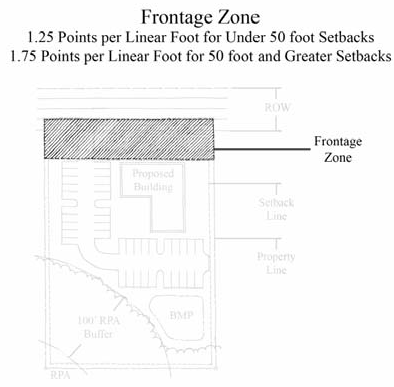
Frontage zone. .....The frontage zone is a landscaping area located along the entire frontage of the parcel with a width equal to the width of the required front setback or visual buffer for the parcel, as defined by the zoning district or appropriate overlay district.
a.
There are two (2) frontage zone classifications.
i.
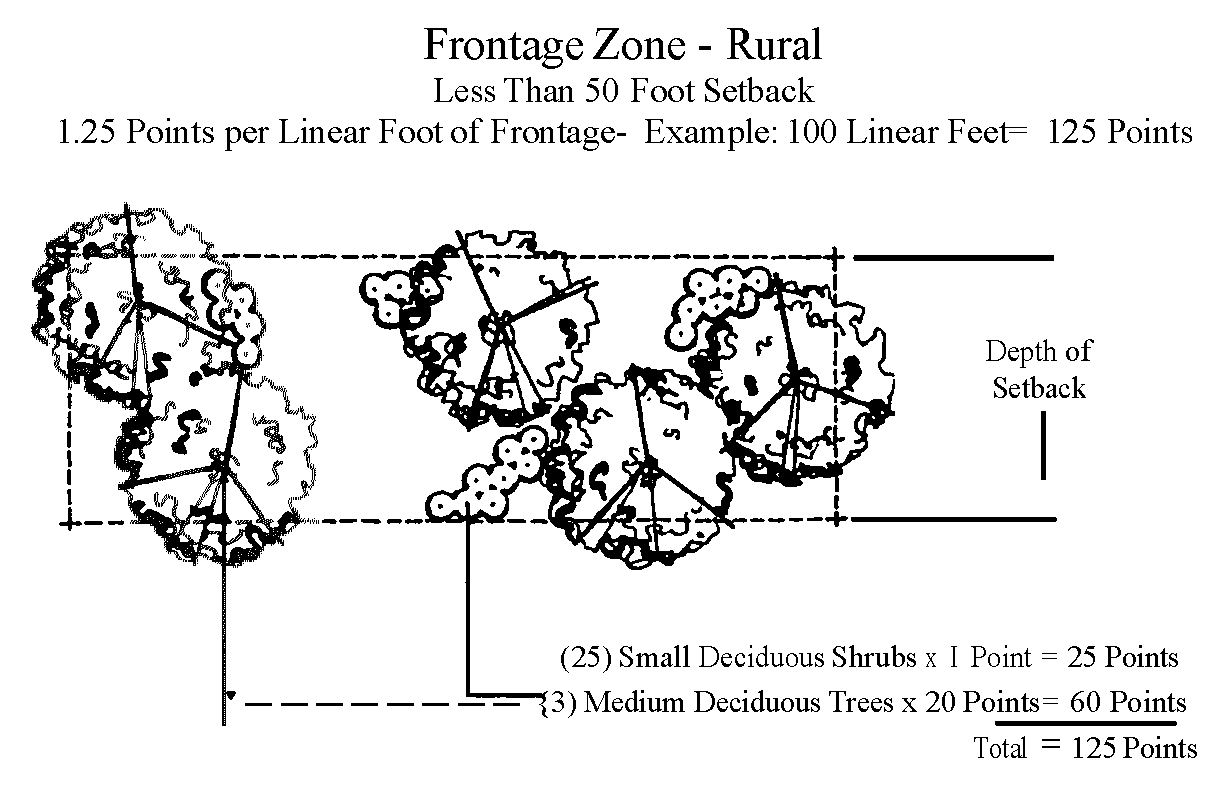
Rural frontage zone applies to all properties which are outside of the designated development service districts and village centers of the county comprehensive plan.
(A)
In the rural frontage zone, properties can, regardless of the required setback, provide one (1) of the following:
(1)
Return the zone to native vegetation and leave the zone untouched. Native vegetation shall be defined as a minimum of one and one-quarter (1.25) points of landscaping per linear foot of lot frontage using species native to southeastern Virginia.
(2)
If the existing vegetation within the zone is deemed adequate to meet the required landscaping points, as determined by the zoning administrator, the existing vegetation may be maintained, leaving the zone area untouched.
(B)
In the rural frontage zone, sixty percent (60%) of landscaping points are required to be non-ornamental species of trees. No more than fifty percent (50%) of trees may be evergreen species.
ii.
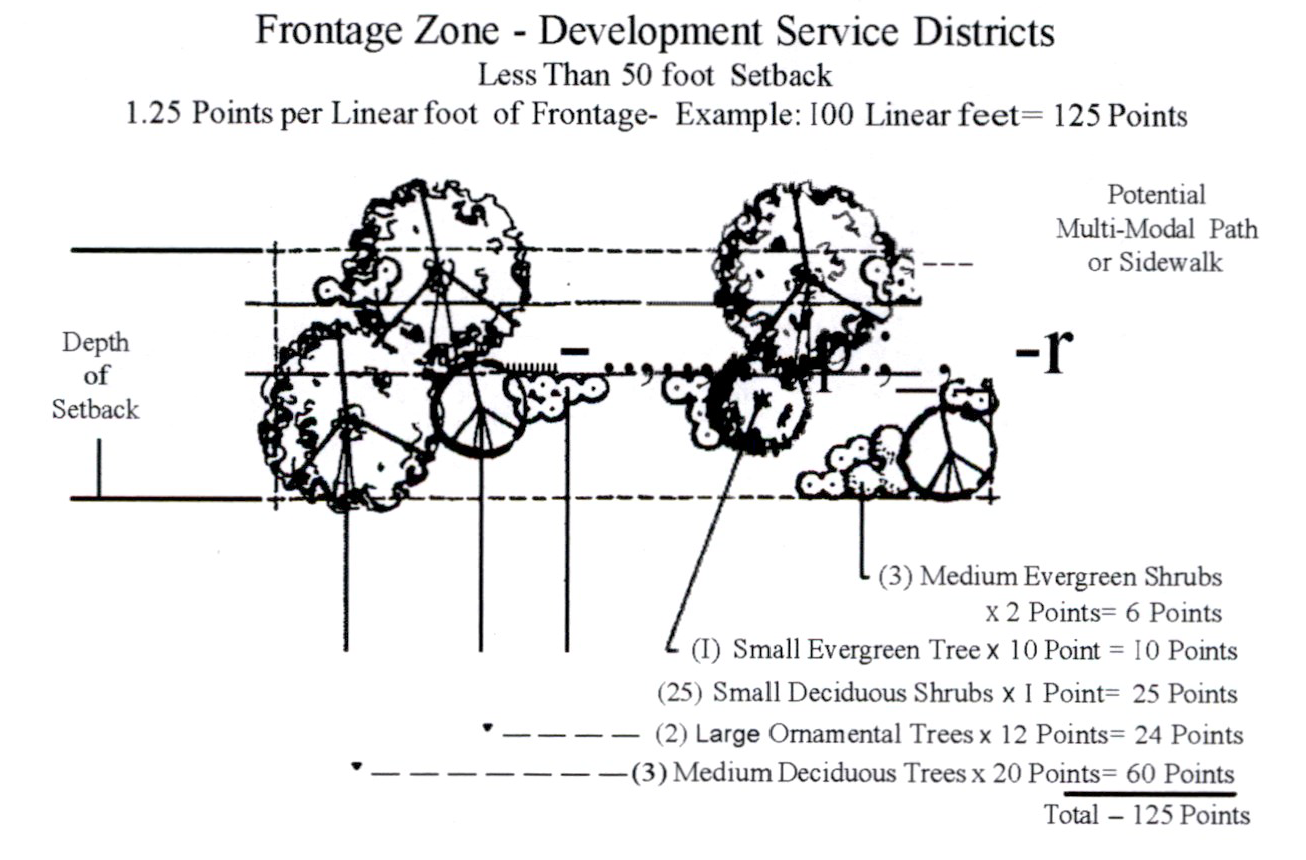
Development frontage zone applies to all properties which are within the designated development service districts of the county comprehensive plan.
(A)
In the development frontage zone, properties are required to install a minimum of one and one-quarter (1.25) points of landscaping per linear foot of lot frontage.
(B)
In the development frontage zone a uniform aesthetic is desired across all developments. If a nearby property has already developed the new development shall use the same plant materials, to the extent possible, to create a uniform look.
2.
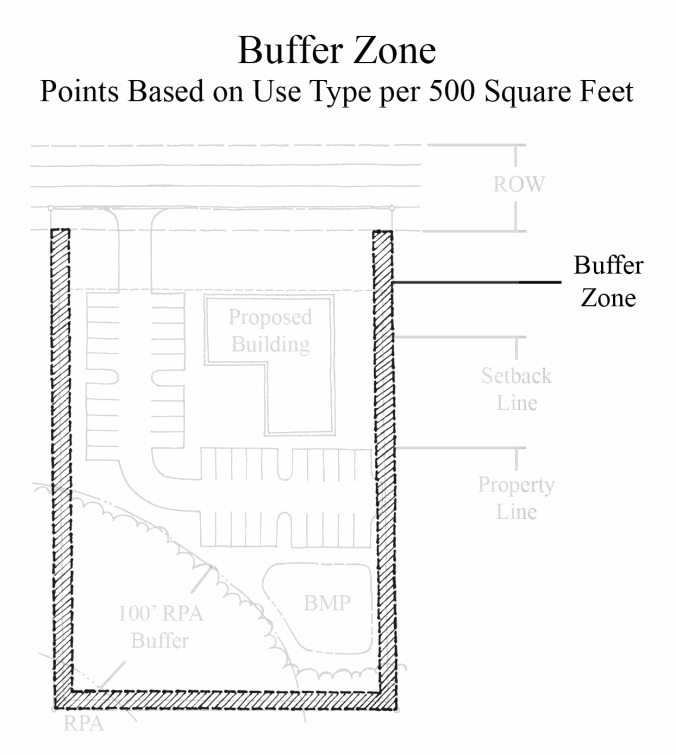
Buffer zone. .....The buffer zone is a continuous landscaping screen, ten (10) feet wide, required along all side and rear yards. Required landscaping points are based on the parcel use type, as identified in article III of this ordinance, as detailed below.
a.
Existing vegetation may be maintained in lieu of creating a buffer zone as defined by this section, if deemed adequate to meet the required landscaping points by the zoning administrator or his designee, to serve the screening purpose.
b.
One (1) pedestrian break of at least six (6) feet in width is required for every fifty (50) linear feet in the buffer zone, except that breaks which are used for placement of a surfaced walkway, pathway, or trail are required to be the width of the trail plus an additional two (2) feet on either side of the walkway, pathway, or trail.
c.
Installation of all required points must be disbursed in a generally even pattern throughout the buffer zone area, except in cases of concentrated nuisance, such as light or noise, which require heavier screening in a particular location.
d.
For development on property zoned Rural Agricultural Conservation (RAC) the buffer zone may be reduced by fifty percent (50%) if the development is not immediately adjacent to an existing residential structure or if deemed appropriate by the zoning administrator or his designee.
e.
Required buffer zone by use type.
i.
Agricultural use types.
(A)
Agricultural use types are not required to install buffer zone landscaping.
ii.
Residential use types.
(A)
Residential use types are not required to install buffer zone landscaping, unless otherwise specified in this ordinance. Single-family residential uses are required to install parcel or lot landscaping in accordance with subsection 8-1005.F.
iii.
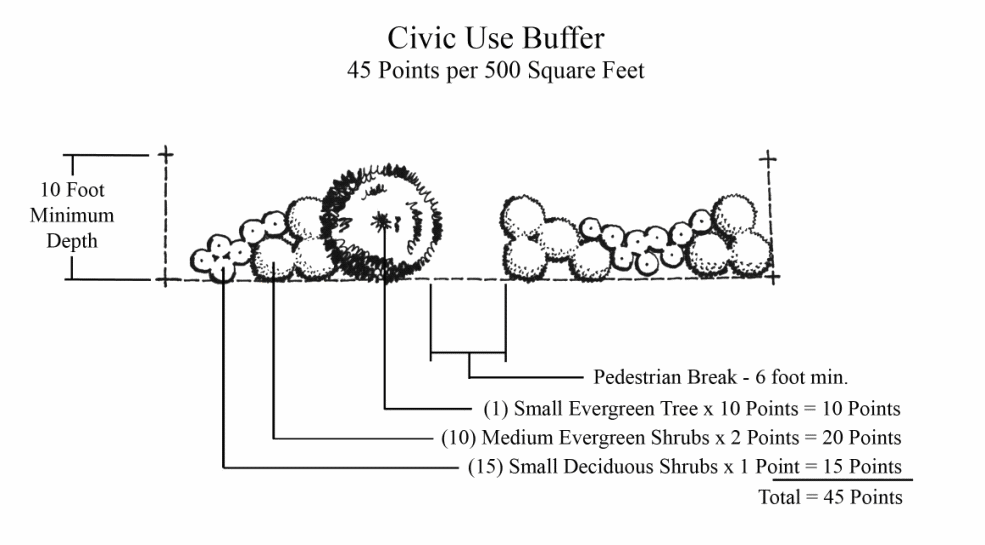
Civic use types.
(A)
Civic use types are required to install a minimum of forty-five (45) points of landscaping per five hundred (500) square feet of buffer zone.
iv.
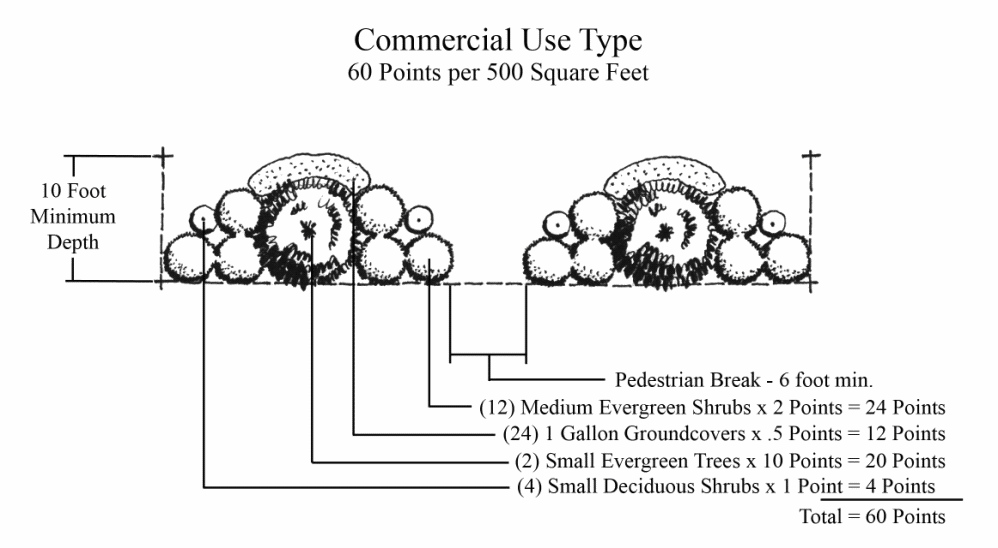
Office and commercial use types.
(A)
Office and commercial use types are required to install a minimum of sixty (60) points of landscaping per five hundred (500) square feet of buffer zone.
(B)
In the case of a master-planned commercial, office park, or mixed-use development the required buffer zone points shall be reduced by fifty percent (50%) for interior lot lines which are platted as part of the overall park/development. No reduction shall be allowed along sections of lot lines which are adjacent to properties not part of the master-planned park or in buffer zones adjacent to the exterior borders of the park, except as noted below.
(1)
In the case of a master-planned commercial or office park which has installed buffer zone landscaping around the park as a whole, in accordance with section 4-17005, the required buffer zone points per lot shall be zero (0) along sections of lot line which contain existing buffer zone landscaping in accordance with section 4-17005.
(C)
In the case of a commercial or office use type which is immediately adjacent to another commercial or office use type, the minimum required buffer zone points per lot shall be reduced by fifty percent (50%) along any shared sections of the lot lines.
v.
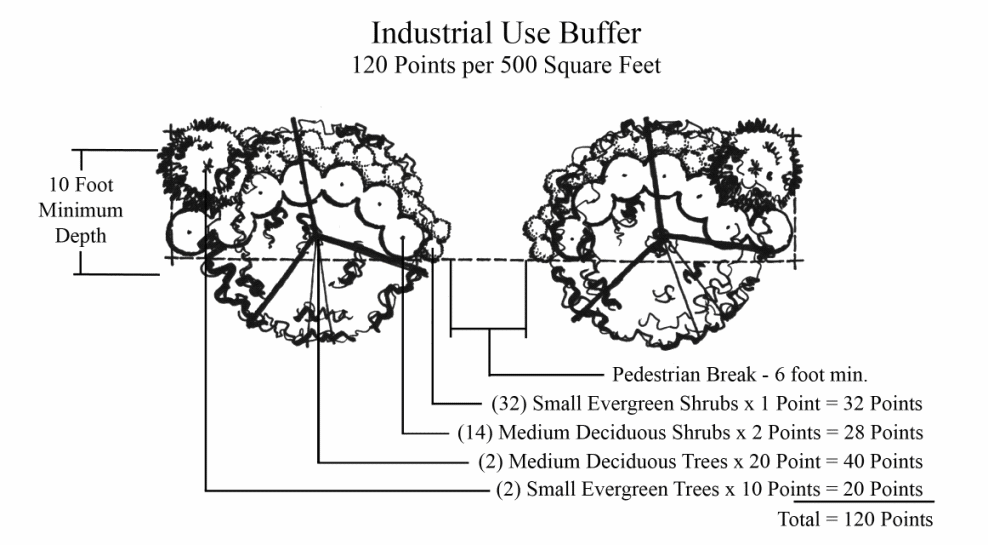
Industrial use types.
(A)
Industrial use types are required to install a minimum of one hundred twenty (120) points of landscaping per five hundred (500) square feet of buffer zone.
(B)
In the case of a master-planned industrial or commerce park, the required buffer zone points per lot shall be reduced by fifty percent (50%) for interior lot lines which are platted as part of the overall park. No reduction shall be allowed along sections of lot lines which are adjacent to properties not part of the master-planned park or in buffer zones adjacent to the exterior borders of the park except as noted below.
(1)
In the case of a master-planned industrial or commerce park which has installed buffer zone landscaping around the park as a whole, in accordance with section 4-19005, the required buffer zone points per lot shall be zero (0) along sections of lot lines which contain existing buffer zone landscaping in accordance with section 4-19005.
vi.
Miscellaneous use types.
(A)
Miscellaneous use types are required to install a minimum of one hundred twenty (120) points of landscaping per five hundred (500) square feet of buffer zone.
(B)
The zoning administrator may administratively waive up to thirty (30) points of landscaping per five hundred (500) square feet for the buffer zone of less intense miscellaneous uses, with a written request, including justification, from the applicant.
(1)
Waiver requests greater than thirty (30) point per five hundred (500) square feet shall be considered by the board of supervisors following a recommendation by the planning commission.
3.
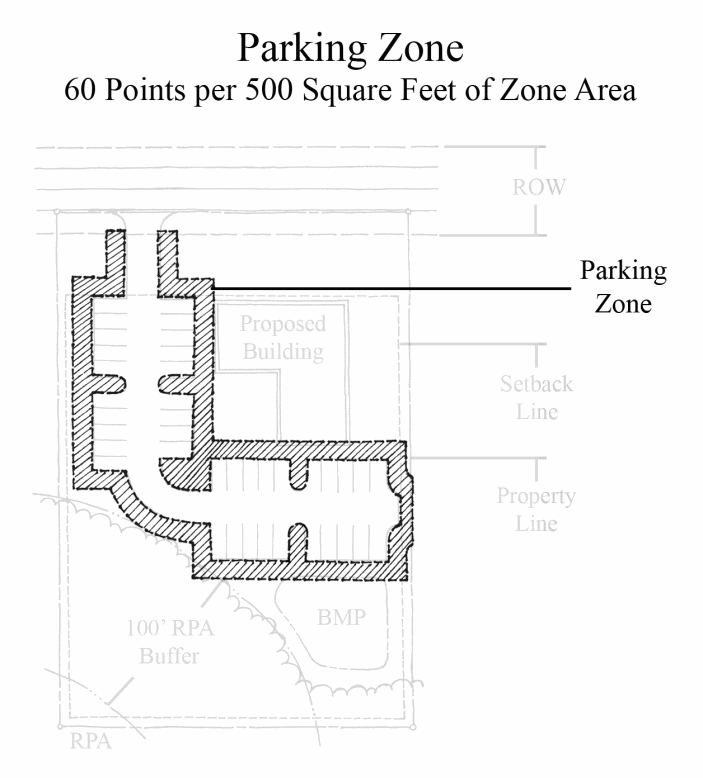
Parking zone. .....The parking zone is a continuous perimeter buffer, ten (10) feet in width, surrounding the entire parking area, which includes parking spaces and any directly adjacent sidewalks, loading zones, drive aisles, and ingress/egress driveways.
a.
Parking zones shall install a minimum of sixty (60) points of landscaping per five hundred (500) square feet of total parking zone area.
i.
All landscaping points must be installed within the boundaries of the parking zone, except that as close to twenty percent (20%) of points as possible shall be distributed on interior landscaping islands and medians, if applicable.
ii.
A minimum of twenty percent (20%) of points shall be shrubs.
iii.
Shrubs shall be a minimum of twenty-four (24) inches in height at the time of installation.
iv.
Parking zone landscaping shall be distributed across the parking area so that the cumulative effect shall be to provide a minimum of thirty percent (30%) canopy coverage or shading of the parking zone within fifteen (15) years.
b.
Included within the total required points for the parking zone shall be one (1) large deciduous tree per two thousand (2,000) square feet of impervious area within the parking zone. The parking zone area calculation shall include parking spaces and any directly adjacent sidewalks, loading zones, drive aisles, and ingress/egress driveways.
c.
Each parking space above the minimum parking space requirements of this ordinance shall require an additional ten (10) landscaping points per space, to be installed in the parking zone.
i.
Each space above the minimum requirements of this ordinance shall be surfaced in permeable materials and shall not be impervious materials as defined in section 2-1002.
ii.
Landscaping credits, as specified in section 8-1007, shall not be applicable to any landscaping points accumulated for parking spaces above the minimum parking space requirement of this ordinance.
d.
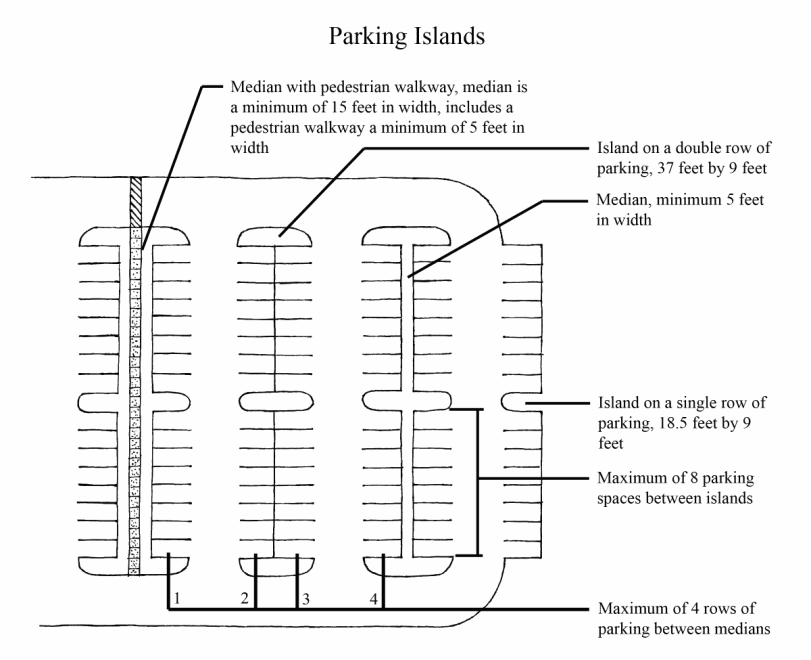
Landscaping islands a minimum of nine (9) feet wide and eighteen and one-half (18.5) feet long are required at the end of each parking row. Islands at the end of a double row of parking are required to be a minimum of nine (9) feet wide by thirty-seven (37) feet long.
i.
Additional landscaping islands, a minimum of nine (9) feet wide by eighteen and one-half (18.5) feet long, are required every eight (8) linear spaces to break up long rows of parking. Islands inserted into a double row of parking are required to be a minimum of nine (9) feet wide by thirty-seven (37) feet long.
e.
Parking lots shall include no more than four (4) consecutive rows of parking (no more than two (2) double rows of parking) without at least one (1) landscaping median, a minimum of five (5) feet wide, connecting landscaping islands to break up large parking areas.
f.
Large parking lots shall be divided into smaller parking fields of no more than one hundred (100) spaces using landscaping medians which are a minimum of fifteen (15) feet wide and including a pedestrian walkway which is at least five (5) feet wide.
g.
Where a parking area is altered or expanded to increase the size to twenty (20) or more vehicle parking spaces and is used regularly for at least five (5) days a week, landscaping for the entire parking area shall be provided, not only for the extent of the alteration or expansion.
4.
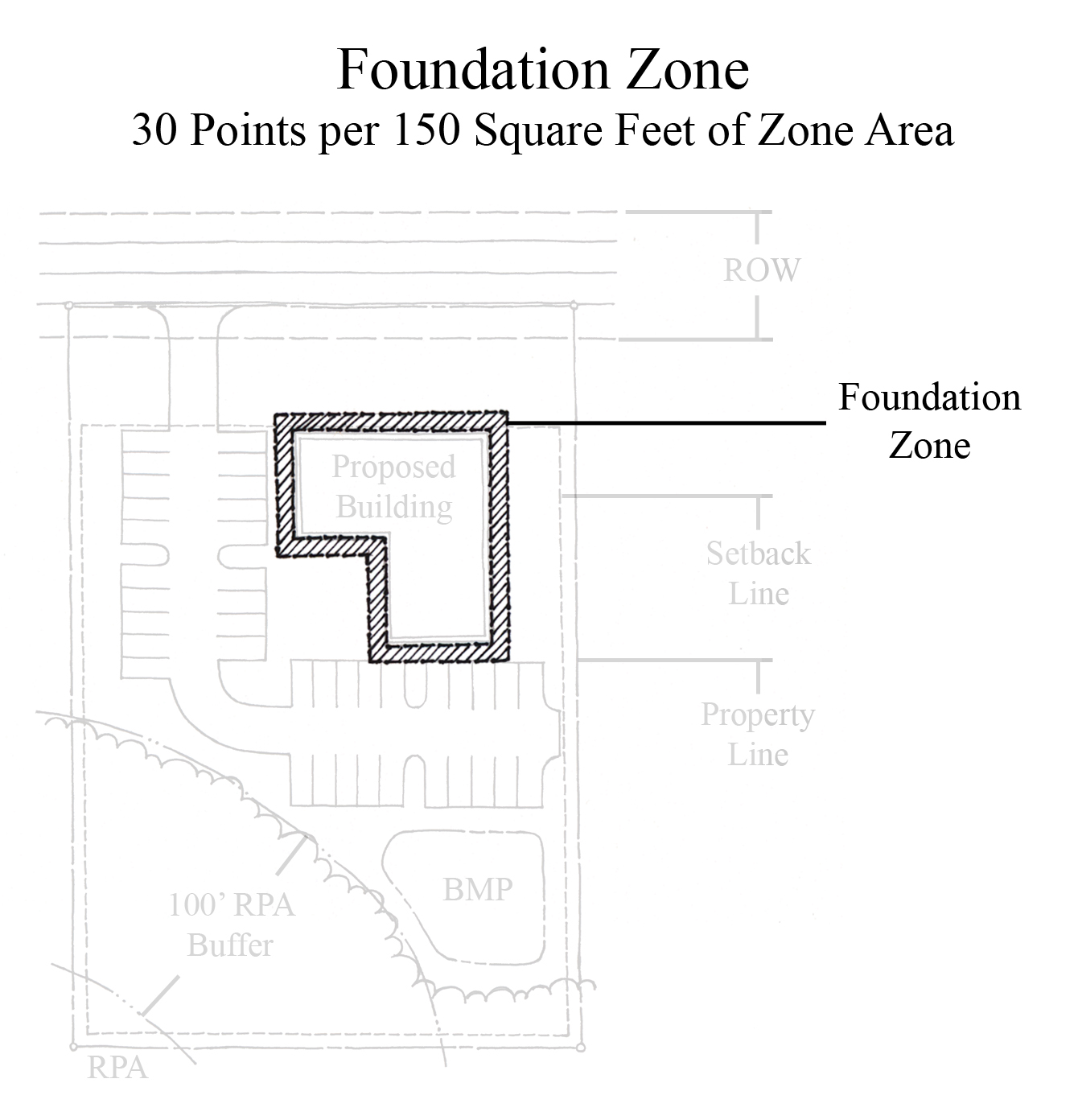
Foundation zone. .....The foundation zone is a continuous area six (6) feet in width around the entire perimeter of the building.
a.
Foundation zones shall install a minimum of thirty (30) points of landscaping per one hundred fifty (150) square feet of total foundation zone area.
b.
Landscaping shall be installed as a continuous bed around all sides of the structure, except that required perpendicular access breaks shall be allowed.
c.
Landscaping points may be reduced by fifty percent (50%) on any side of a structure which is not visible from an existing or proposed public right-of-way.
5.
Screening zone. .....The screening zone is a continuous planting area required around all service structures, equipment, and/or outdoor storage yards for the purpose of reducing the impact of the structure or use visually and acoustically.
a.
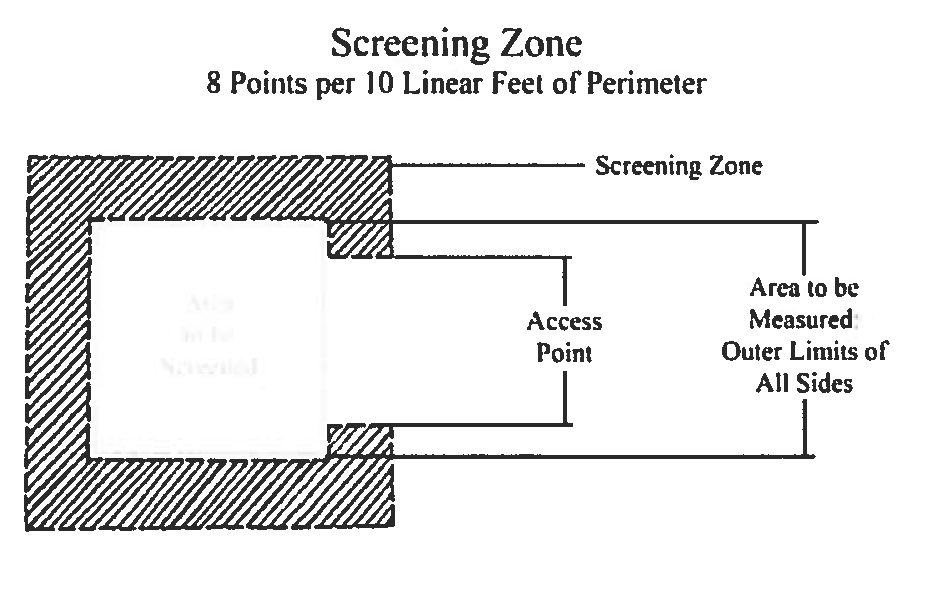
Screening zones shall install a minimum of eight (8) points of landscaping per ten (10) linear feet of perimeter length.
b.
In the screening zone, solid and semisolid perimeter features such as fences, berms, walls, or other nonorganic elements shall not be included in the calculation of landscaping points.
c.
The perimeter area of service structures, equipment, and/or outdoor storage yards shall be determined by measurement of the complete outside perimeter of the structure or equipment, including any fencing, and including the distance across access points or entryways.
d.
Landscaping shall be installed as a continuous screen around all sides of service structures, equipment, and/or outdoor storage yards, except that required access and entry breaks shall be allowed, provided that the points associated with the perimeter area of such breaks are incorporated into the rest of the screening zone.
e.
Plants must be installed no more than ten (10) feet from the base of service structures, equipment, and/or outdoor storage yards. If service structures, equipment, and/or outdoor storage yards are enclosed by a fence, wall, berm, or other perimeter feature, the required screening points shall be installed within ten (10) feet of the base of such perimeter feature.
f.
At the time of installation, plant height shall be a minimum of fifty percent (50%) of the total height of the structure or equipment being screened. (7-7-05; Ord. No. 2011-21-C, 11-17-11; Ord. No. 2013-7-C, 5-16-13; 3-20-14; 12-18-14; 4-21-16; 7-19-18; 1-21-21.)
Sec. 8-1006. - Single-family residential landscaping points table.
(7-19-18.)
Sec. 8-1007. - Landscaping credits.
A.
Landscaping credits are available for the use of certain environmental practices, as outlined in section 8-1008. Additional practices can be considered by the zoning administrator for credits on a case-by-case basis with documentation of the positive environmental impacts associated with the practice.
B.
An individual zone may be reduced by no more than fifty percent (50%) of the zone requirement due to landscaping credits, except that the zoning administrator may approve up to an additional ten percent (10%) reduction (not to exceed sixty percent (60%) in any individual zone) for a design which incorporates outstanding and innovative environmental design above and beyond what is described in this article.
C.
The required points for a single-family residential lot may be reduced by no more than forty percent (40%) of the whole site total points due to landscaping credits, except that the zoning administrator may approve up to an additional ten percent (10%) reduction for a design which incorporates outstanding and innovative environmental design above and beyond what is described in this article. (7-7-05; 4-21-16; 7-19-18.)
Sec. 8-1008. - Landscaping credits table.
(7-7-05; Ord. No. 2011-10-C, 6-16-11; 4-21-16; 7-19-18; 2-21-19.)
Sec. 8-1009. - Material and construction standards.
A.
Plant material standards. .....All plant materials shall be in a living, healthy condition and shall be in conformance with the applicable standards of the most recent edition of the "American Standard for Nursery Stock," published by the American Association of Nurserymen. It is recommended that indigenous plant materials be utilized in all cases except that alternative species may be used, upon certification from a licensed landscape architect that such species have rated hardiness and growth habit appropriate for the intended location on site.
B.
Berms and earthform standards. .....All berms and earthforms required or otherwise proposed for use shall conform to the following standards:
1.
The maximum side slope shall be three (3) horizontal feet to one (1) vertical foot (3:1) and appropriate erosion and sediment controls are to be utilized during construction.
2.
Berms and earthforms shall be designed with physical variations in height and alignment throughout their length.
3.
Plant materials shall be installed on berms or earthforms and shall be arranged in an irregular pattern to accentuate the physical variation and achieve a natural appearance.
4.
Berms and earthforms shall be located and designed to minimize the disturbance and adverse impact to existing trees located on the site or adjacent thereto.
C.
Tree protection standards. .....Development of land for different uses and intensity of uses may necessitate the removal of trees to accommodate roads, parking, buildings, and facilities. It is the express intent of this section that every effort is made through the design, layout, and construction of development projects to incorporate and preserve as many trees as possible.
1.
No person shall cut, destroy, move, or remove any living, disease-free tree of any species having a trunk with a diameter of eight (8) inches or larger, measured four and one-half (4½) feet from the base, in conjunction with any development of land governed by this ordinance unless and until such removal or destruction has been approved under the provisions of this article.
2.
No person shall cut or clear trees for the sole purpose of offering land for sale. Land may be cleared of underbrush ("bushhogged") in preparation for sale or development.
3.
If it is determined that trees of eight (8) inches or larger and/or vegetation has been removed without specific approval for such removal in accordance with this ordinance, the zoning administrator shall require the replacement of said trees or vegetation. At a minimum, replacement trees shall meet the specifications of section 8-1004 for large deciduous or evergreen trees.
4.
All trees which are to be preserved on-site shall be subject to the minimum standards of the most current Virginia Erosion and Sediment Control Handbook. (7-7-05; 4-21-16; 7-19-18.)
Sec. 8-1010. - Landscape plan approval and implementation.
The zoning administrator shall approve all landscape plans meeting the requirements of this article and ordinance, subject to the following:
A.
No site or development plan required by this ordinance shall receive final approval until such time as the landscaping plan has been duly submitted and approved.
B.
No certificate of occupancy may be issued by the superintendent of building inspections unless the following items are satisfactorily completed with regard to the approved landscaping plan:
1.
Such plan has been completely implemented on the site.
2.
Temporary certificate of occupancy.
a.
When landscaping is required, no certificate of occupancy shall be issued until the required landscaping is completed in accordance with the approved landscape plan. When the occupancy of a structure is desired prior to the completion of the required landscaping, a temporary certificate of occupancy may be issued only if the owner or developer provides a form of surety satisfactory to the county attorney in an amount equal to the costs of labor and materials plus ten percent (10%) contingency allowance satisfactory to the zoning administrator.
b.
All required landscaping shall be installed within twelve (12) months following the issuance of a temporary certificate of occupancy or the surety described above may be forfeited to the county. This requirement shall not preclude the phasing of landscaping programs for larger development projects, the timing of which shall be approved by the zoning administrator. (7-7-05; 4-21-16; 7-19-18.)
Sec. 8-1011. - Surety requirements.
Surety in an amount equal to twenty-five percent (25%) of the cost of materials and installation of landscaping, screening and buffering materials, including fences, shall be provided in a form acceptable to the county attorney, prior to the issuance of a certificate of occupancy (CO) or final inspection to ensure the landscaping was installed properly and remains healthy. This surety shall be released at the end of two (2) years from the issuance of a final certificate of occupancy or final inspection date, if an inspection shows the landscaping remains healthy. All required landscaping shall be the responsibility of the property owner(s). All plants damaged by insects, disease, vehicular traffic, acts of God, or vandalism shall be replaced. (7-7-05; 4-21-16; 7-19-18.)
Sec. 8-1012. - Maintenance.
A.
All plant material shall be tended and maintained in a healthy growing condition and free from refuse and debris at all times by the owner or his agent. All unhealthy, dying or dead plant materials shall be replaced within one (1) year. Screening and buffering structures, including fences, shall be maintained in a uniform, presentable and fully functioning condition. Failure to maintain required landscaping, screening and buffering improvements shall be considered a violation of the approved plans and provisions of this ordinance and shall be handled in accordance with subsection 1-1013.L, zoning ordinance violations.
B.
Tree topping and other forms of extreme crown reduction or unnatural shaping and pruning of trees required by this article shall be prohibited. Trees required by this article shall be allowed to grow in a generally natural form. Pruning to remove a safety hazard, to remove dead or diseased materials, or to avoid overhead utility lines or reasonable, seasonal pruning recommended for maintaining growth shall be exempt from this prohibition.
C.
Trees eight (8) inches in diameter or less which are topped or damaged by excessive pruning shall be replaced with a large deciduous or evergreen tree as specified in section 8-1004.
D.
Trees greater than eight (8) inches in diameter which are topped or damaged by excessive pruning shall require a professional arborist to develop and carry out a corrective pruning schedule to be approved by the zoning administrator. (7-19-18.)
Sec. 8-2001. - Requirements for open space.
A.
Open space and recreation shall be as set forth in the underlying zoning district.
B.
Developed open space shall be designed to provide active and passive recreational facilities, which include such complementary improvements as are necessary and appropriate for the use, benefit, and enjoyment of the residents of the development.
C.
Undeveloped open space shall be designed to preserve important site amenities and environmentally sensitive lands.
D.
The owner or developer, and his successors or assigns shall be responsible for maintaining all active or passive open space, common areas, and any improvements or facilities located thereon, required by this ordinance, except those areas, improvements or facilities with respect to which an offer of dedication to the public has been accepted by the appropriate public authority. All such areas shall be properly maintained so that they can be used in the manner intended. Required vegetation and trees used for screening, landscaping, or shading are to be replaced if they die or are destroyed. (7-7-05; 4-21-16; 7-19-18.)

