
Jacksonville City Zoning Code
ARTICLE III
- SUPPLEMENTAL PROVISIONS
Sec. 1. - Special use permit procedures and regulations.
(a)
Special uses. The city council by an affirmative four-fifths vote may, after public hearing and proper notice to all parties affected, and after recommendations from the city planning and zoning commission that the use is in general conformance with the master plan of the city and containing such requirements and safeguards as are necessary to protect adjoining property, authorize the location of certain uses in a special district, provided the application shall be accompanied by a site plan drawn to scale and showing the general arrangement of the project, together with essential requirements such as offstreet parking facilities; size, height, construction materials, and locations of buildings and the uses to be permitted; location and construction of signs; means of ingress and egress to public streets; the type of visual screening such as walls, paintings, and fences; and the relationship of the intended use to all existing properties and land uses in all directions to a minimum distance of two hundred (200) feet.
(b)
Special use permit regulations.
(1)
In recommending that a special use permit for the premises under consideration be granted, the city planning and zoning commission shall determine that such uses are harmonious with and adaptable to building structures and uses of abutting property and other property in the vicinity of the premises under consideration, and shall make recommendations as to requirements for the paving of streets, alleys and sidewalks, means of ingress and egress to public streets, provisions for drainage, adequate offstreet parking, protective screening and open space, heights of structures, and compatibility of building construction.
(2)
Every special use permit granted under these provisions shall be considered as an amendment to the zoning ordinance as applicable to such property under consideration, but shall not be considered as a permanent change in zoning. In the event the building, premises, or land uses under the special use permit is voluntarily vacated or if the ownership is voluntarily transferred, or if such building, premises, or land is more than fifty (50) per cent destroyed by fire or other cause, the use of the same shall thereafter conform to the regulations of the original zoning district of such property unless a new and separate special use permit is granted for continuation of the use.
(3)
In granting a special use permit, the city council may impose conditions which shall be complied with by the owner or grantee before a certificate of occupancy may be issued by the building inspector for use of the building on such property pursuant to such special use permit; and such conditions shall not be construed as conditions precedent to the granting of a special use permit, but shall be construed as conditions precedent to the granting of the certificate of occupancy.
(4)
No special use permit shall be granted unless the applicant, owner and grantee of the special use permit shall be willing to accept and agree to be bound and comply with the written requirements of the special use permit, as attached to the site plan drawing (or drawings) and approved by the planning commission.
(5)
A building permit shall be applied for and secured within six (6) months from the time of granting the special use permit; provided, however, that the city council may authorize an extension of this time upon recommendation by the city planning and zoning commission.
(6)
No building, premises, or land used under a special use permit may be enlarged, modified, structurally altered, or otherwise significantly changed unless a separate special use permit is granted for such enlargement, modification, structural alteration, or change.
(7)
The board of adjustment shall not have jurisdiction to hear, review, reverse, or modify any decision, determination, or ruling with respect to the granting, extension, revocation, modification or any other action taken relating to such special use permit.
(8)
When the city council authorizes granting of a special use permit, the zoning map shall be amended according to its legend to indicate that the affected area has conditional and limited uses, said amendment to indicate the appropriate zoning district for the approved use and suffixed by a "S" designation.
Sec. 2. - Offstreet parking and loading regulations.
(a)
Purpose. To provide safety from fire, panic and other dangers; to lessen congestion in the streets; to facilitate the adequate provisions of transportation to conserve the value of buildings; and to encourage the most appropriate use of land, minimum offstreet parking and loading shall be provided as set forth in the following schedules and provisions.
(b)
General requirements.
(1)
All parking, loading spaces, and vehicle sales areas on private property shall have a vehicle stopping device installed so as to prevent parking of motor vehicles in any required landscaped areas, to prevent any parked vehicle from overhanging a public right-of-way line or public sidewalk. An overwide sidewalk on private property may be permitted to allow encroachment of vehicle overhang while maintaining an unobstructed three-foot minimum sidewalk width. The requirement shall apply only where spaces are adjacent to the walks, right-of-way and landscaping. Parking shall not be permitted to overhang public right-of-way in any case.
(2)
Refuse storage facilities placed in a parking lot shall not be located in a designated parking or loading space. Each refuse facility shall be maintained to comply with all public health and sanitary regulations. Each refuse facility shall be located so as to facilitate pickup by refuse collection agencies.
(3)
Uses not listed in this section shall provide offstreet parking according to the most similar use listed in the schedule, as determined by the city council.
(4)
All required offstreet parking spaces shall be located behind all public right-of-way lines in any district. However, no offstreet parking may be placed within the setback on any side lot that abuts a street right-of-way and no supporting member of any garage, carport or other automobile storage structure may be located within any yard setback.
(5)
No parking shall be allowed except on a paved concrete or asphalt parking surface.
(c)
Offstreet loading space.
(1)
All retail, commercial, and industrial structures having five thousand (5,000) square feet or more of gross floor area shall provide and maintain offstreet parking facilities for the loading and unloading of merchandise and goods at a ratio of at least one (1) space for the first twenty thousand (20,000) square feet of gross floor area and one (1) space for each additional twenty thousand (20,000) square feet of gross floor area or fraction thereof for a building larger than five thousand (5,000) square feet. All drives and approaches shall provide adequate space and clearances to allow for the maneuvering of trucks offstreet.
(2)
Such space shall consist of a minimum area of twelve (12) feet by twenty-five (25) feet.
(d)
Parking access from a public street.
(1)
In all districts (except single-family and multifamily districts), building plans shall provide for entrance/exit drive(s) appropriately designed and located to minimize traffic congestion or conflict within the site and adjoining public streets as approved by the city engineer. Where based upon analysis by the city engineer, projected volume of traffic entering or leaving the proposed development are likely to interfere with the projected peak traffic flow volumes on adjoining streets, additional right-of-way and paving in the form of a deceleration lane or turn lane may be required to be furnished by the developer in order to reduce such interference.
(2)
In the approval of a development plan, consideration shall be given to providing entrance/exit drives which extend into the site to provide adequate maneuvering of vehicles on the site. Such drives shall have curbs or other barriers to prohibit access from parking areas and other drives.
(3)
The radius of all drive approaches shall be constructed so that the curb return does not extend beyond any projection of the property line which the drive does not cross, except by written agreement of both property owners filed for record with the county clerk with proof supplied to the city council.
(4)
Vehicular access to nonresidential uses shall not be permitted from alleys serving residential areas.
(e)
Parking requirements based on use.
(1)
Auto laundry: 1 parking space per 500 square feet of gross floor area.
(2)
Bowling alley: 6 parking spaces for each alley or lane.
(3)
Business or professional office (general): 1 parking space per 300 square feet of gross floor area.
(4)
Church or other place of worship: 1 parking space for each 4 seats in the main auditorium.
(5)
Community center: 10 parking spaces plus 1 additional space for each 300 square feet of floor area in excess of 2,000 square feet. If an auditorium is included as a part of the building, its floor area shall be deducted from the total and additional parking provided on the basis of 1 space for each 4 seats that it contains.
(6)
Commercial amusement: 1 parking space per 3 guests or 1 space per 100 square feet of gross floor area, whichever is greater.
(7)
Dance hall, assembly or exhibition hall without fixed seats: 1 parking space for each 100 square feet of floor area used thereof.
(8)
Day care center: 1 parking space per 10 pupils, plus 1 space per teacher.
(9)
Dwellings, single-family, attached or detached: 2 parking spaces for each dwelling unit.
(10)
Dwellings, multifamily: 2 parking spaces for each dwelling unit.
(11)
Fraternity, sorority, or dormitory: 1 parking space for each two (2) beds.
(12)
Furniture or appliance store, hardware store, wholesale establishments, machinery or equipment sales and service: 2 parking spaces plus 1 additional space for each 300 square feet of floor area over 1,000 feet.
(13)
Gasoline station: Minimum of 6 parking spaces.
(14)
Hotel: 1 parking space for each sleeping room or suite plus 1 space for each 200 square feet of commercial floor area contained therein.
(15)
Library or museum: 10 spaces, plus 1 space for every 300 square feet.
(16)
Lodge or fraternal organization: 1 parking space per 200 square feet.
(17)
Manufacturing or industrial establishment, research or testing laboratory, creamery, bottling plant, warehouse, printing or plumbing shop, or similar establishment: 1 parking space for each 2 employees on the maximum working shift plus space to accommodate all trucks and other vehicles used in connection therewith, or 1 parking space for each 1,000 square feet of floor area, whichever is greater.
(18)
Medical or dental office: 1 parking space per 175 square feet of floor area.
(19)
Mobile home park: 2 parking spaces per mobile home plus additional spaces as required herein for accessory uses.
(20)
Mortuary or funeral home: 1 parking space for each fifty (50) square feet of floor space in slumber rooms, parlors or individual funeral service rooms.
(21)
Motel: 1 parking space for each sleeping room or suite plus 1 space for each 200 square feet of commercial floor area contained therein.
(22)
Motor vehicle salesrooms and used car lots: 1 parking space for each 500 square feet of sales floor for indoor uses, or 1 parking space for each 1,000 square feet of lot area for outdoor uses.
(23)
Nursing home: 1 parking space per 5 beds and 1 space for each day staff.
(24)
Private club, lodge, country club or golf club: 1 parking space for each 150 square feet of floor area or for every 5 members, whichever is greater.
(25)
Retail store or personal service establishment, except as otherwise specified herein: 1 parking space for each 200 square feet of floor area.
(26)
Restaurant, nightclub, cafe or similar recreation or amusement establishment: 1 parking space for each fifty (50) square feet of floor area.
(27)
Rooming or boarding house: 1 parking space for each sleeping room.
(28)
Sanitarium, convalescent home, home for the aged or similar institution: 1 parking space for each 5 beds.
(29)
School, elementary: 1 parking space for each 5 seats in the auditorium or main assembly room, whichever is greater.
(30)
School, secondary, and college: 1 parking space for each 4 seats in the main auditorium, or 8 spaces for each classroom, whichever is greater.
(31)
Theater, auditorium (except school), sports arena, stadium, or gymnasium: 1 parking space for each 3 seats or bench seating spaces.
(32)
Warehouse, wholesale, manufacturing and other industrial-type uses: 1 parking space for [each] 1,000 square feet of gross floor area.
(33)
Golf course: 3 parking spaces per hole.
(f)
Rules for computing number of parking spaces. In computing the number of parking spaces required for each of the above uses the following rules shall govern:
(1)
"Floor area" shall mean the gross floor area of the special use.
(2)
Where fractional spaces result, the parking spaces required shall be constructed to be the nearest whole number.
(3)
The parking space requirement for a use not specifically mentioned herein shall be the same as required for a use of similar nature.
(4)
Whenever a building or use constructed or established after the effective date of this ordinance is changed or enlarged in floor area, number of employees, number of dwelling units, seating capacity or otherwise, to create a need for an increase of ten (10) per cent or more in the number of existing parking spaces, such spaces shall be provided on the basis of the enlargement or change. Whenever a building or use existing prior to the effective date of this ordinance is enlarged to the extent of fifty (50) per cent or more in floor area in the area used, said building or use shall then and thereafter comply with the parking requirements set forth herein.
(5)
In the case of mixed uses, the parking spaces required shall equal the sum of the requirements of the various uses computed separately.
(6)
Variance to parking or loading requirements shall only be considered by the City of Jacksonville board of adjustments. The board's decision is final on all appeals.
(g)
Location of parking spaces. All parking spaces required herein shall be located on the same lot with the building or use served, except as follows:
(1)
Where an increase in the number of spaces is required by a change or enlargement of use or where such spaces are provided collectively or used jointly by two (2) or more buildings or establishments, the required spaces may be located not to exceed three hundred (300) feet from an institutional building served and not to exceed five hundred (500) feet from any other nonresidential building served.
(2)
Not more than fifty (50) per cent of the parking spaces required for: 1) theaters, bowling alleys, dance halls, private clubs, cafes, or similar uses, and not more than eighty (80) per cent of the parking spaces required for a church or school auditorium or similar uses may be provided and used jointly by: 2) similar uses not normally open, used or operated during the same hours as those listed in 1); provided, however, that written agreement thereto is properly executed and filed as specified below.
(3)
In any case where the required parking spaces are not located on the same lot with the building or use served, or where such spaces are collectively or jointly provided and used, a written agreement, thereby assuring their retention for such purposes, shall be properly drawn and executed by the parties concerned, approved as to form by the city attorney and shall be filed with the application for a building permit.
(h)
Minimum dimensions for offstreet parking.
(1)
Ninety degree angle parking. Each parking space shall not be less than eight (8) feet wide nor less than eighteen (18) feet in length. Maneuvering space shall be in addition to parking space and shall not be less than twenty-four (24) feet perpendicular to the building or parking line.
(2)
Sixty degree angle parking. Each parking space shall not be less than eight (8) feet wide perpendicular to the parking angle nor less than seventeen (17) feet in length when measured at right angles to the building or parking line. Maneuvering space shall be in addition to parking space and shall not be less than twenty (20) feet perpendicular to the building or parking line.
(3)
Forty-five degree angle parking. Each parking space shall not be less than eight (8) feet wide perpendicular to the parking angle nor less than sixteen (16) feet in length when measured at right angles to the building or parking line. Maneuvering space shall be in addition to parking space and shall not be less than eighteen (18) feet perpendicular to the building or parking line.
(4)
[Facilities adjacent to public alley.] When offstreet parking facilities are located adjacent to a public alley the width of said alley may be assumed to be a portion of the maneuvering space requirement.
(5)
[All facilities to comply with minimum requirements.] Where offstreet parking facilities are provided in excess of the minimum amount herein specified, or when offstreet parking facilities are provided but not required by this ordinance, said offstreet parking facilities shall comply with the minimum requirements for parking and maneuvering space herein specified.
(6)
Handicapped parking. See Elimination of Architectural Barriers Act, article 7, article 601b, Vernon's Texas Civil Statutes, rules and regulations including standards and specifications.
(i)
Central business district (H zone). Exempt on parking requirements. (Bonner, Wilson, Austin and Rusk Streets).
(Ord. No. 899, § 1, 4-13-93)
Sec. 3. - Sign regulations.
(a)
General.
(1)
Purposes. The purposes of these sign regulations are:
a.
To encourage the effective use of signs as a means of communication within the City of Jacksonville;
b.
To maintain and enhance the aesthetic appearance of the City of Jacksonville;
c.
To preserve the City of Jacksonville as a community that is attractive to residents and businesses;
d.
To improve pedestrian and traffic safety; and
e.
To minimize sign pollution and the potential adverse effects of signs on nearby public and private property.
(2)
Applicability.
a.
In conformance with the requirements of this chapter, signs may be erected, placed or maintained within the corporate limits of the City of Jacksonville;
b.
This section does not apply to incidental graphics such as logos and signs on gas pumps, vending machines or other equipment used in the ordinary sale or delivery of goods or services, unless otherwise regulated by this ordinance.
(b)
Prohibited signs. The following signs are prohibited and shall not be used in Jacksonville:
(1)
Any sign, other than an approved directional sign, that copies or imitates an official sign or purports to have official status;
(2)
Windblown devices other than those allowed under section 3(f)(10) of this article;
(3)
Inflatable signs, balloons, or other devices if located within a multi-family or non-residential district;
(4)
Pennants;
(5)
Portable signs;
(6)
Any sign attached to an accessory structure, except an incidental sign;
(7)
Any attention-attracting device not permitted by this ordinance;
(8)
Signs imitating traffic, regulatory or emergency signs or signals or signs which may mislead, confuse or distract the driver of a motor vehicle;
(9)
Signs painted on or attached to (1) roofs of buildings, (2) trees, (3) fence posts, (4) rocks or other natural features unless otherwise permitted by this ordinance, (5) telephone or utility poles, or (6) any public signs or poles;
(10)
Off premises signs unless otherwise allowed by this ordinance;
(11)
Flashing signs or signs having flashing parts unless permitted as a CEVMS electronic sign;
(12)
Moving or rotating signs or signs having moving parts;
(13)
Any sign held by an individual and displaying such sign to attract attention to a business whether on-premises or off-premises;
(14)
Banners, tarps or similar material used for the purpose of signage unless otherwise allowed in this ordinance;
(15)
Beacons or any other artificial light unless otherwise allowed;
(16)
Bandit signs; and
(17)
Streamers.
(c)
Exempt signs. The following signs shall be exempt from regulation under this chapter:
(1)
Any sign required by federal, state or local law or a public utility company;
(2)
Traffic signs which meet Texas Manual on Uniform Traffic Control Devices or successor standards and contain no commercial message;
(3)
Any sign inside a building, not attached to a window or door;
(4)
Any sign inside the perimeter fencing of an athletic field or other similar outdoor facility space owned or operated by a governmental or non-profit entity including public or private schools;
(5)
Works of art with no commercial message;
(6)
Holiday decorations, approved for the holiday season as defined by this section;
(7)
"No trespassing," "no hunting," "no fishing" or "no loitering" signs or signs announcing employment opportunities which do not exceed six (6) square feet in area;
(8)
Governmental signs;
(9)
Memorial signs or tablets and building markers displayed on public or private buildings and tablets or headstones in cemeteries;
(10)
Unless specified herein, the changing of messages on changeable copy signs designed and intended to be changed on a regular basis;
(11)
Concrete tomatoes as authorized by the city;
(12)
Legal notices.
(d)
Temporary signs. Temporary signs are subject to the following conditions:
(1)
Only temporary signs listed in this section are allowed.
(2)
Unless otherwise provided in this ordinance, temporary signs must have a sign permit issued by the city.
(3)
The following regulations apply to grand opening signage permits:
Eligibility: Upon issuance of a certificate of occupancy and within one (1) year thereafter, a business shall be allowed to receive a gran opening sign permit when one (1) of the following conditions applies:
a.
When a certificate of occupancy has been issued to the new business; or
b.
When a certificate of occupancy has been issued to an existing business which has substantially remodeled and the cost of the renovation exceeds sixty (60) per cent of the current value of the building or business suite, excluding the value of the land, according to the then most recently approved tax roll; or
c.
Change in business ownership.
Allowable signs: All sign types, including otherwise prohibited signs with permission from the city manager or designee and so long as placement does not create a safety concern.
Permit: A permit shall be required for a business to utilize the grand opening signing provisions. No permit fee shall be required for a grand opening sign permit. The use of a grand opening sign permit shall have no effect on the number of subsequent temporary sign permits that may be authorized for a business occupancy.
Duration: A grand opening sign permit shall be valid for a period not to exceed thirty (30) consecutive calendar days. Change of business ownership permits shall not exceed fifteen (15) consecutive calendar days.
(4)
The city manager or designee may allow temporary directional signage in parking lots for facilities with more than one (1) drive through. Location and duration of such signage to be approved by the city manager or designee.
(5)
The city manager or designee may issue a temporary sign permit allowing the applicant to display temporary signage under the conditions listed in the permit. Temporary signs are limited to thirty (30) days per quarter.
(6)
Except as provided in the next sentence, one (1) temporary sign is allowed per lot. If a lot has more than one (1) business suite, then each business may concurrently display a temporary sign at that occupant's business in accordance with this section.
(7)
A temporary sign is allowed only in multi-family and non-residential districts and is subject to all other requirements of that district.
(8)
All allowed temporary signs must be kept in good condition. Temporary signs that are not maintained in good condition must be removed.
(9)
Unless otherwise permitted by this Code, a temporary sign must be placed on the property which it is advertising and not in the public right-of-way. Pole-mounted banners on all street frontages must be setback a minimum of five (5) feet from the property line.
(10)
Temporary signs for offsite community events may be approved by the city manager or designee. The events must be open to the public and for a community event or purpose including, but not limited to, Tomato Fest, Rodeo, NJCAA events, city sponsored community events, etc. The location, duration and number of signs permitted will be determined by the city manager or designee. Signage must be removed within twenty-four (24) hours after of the completion of the event.
(11)
Additional signage may be approved during an unforeseen event, crisis or disaster as may be necessary. Locations and duration of any such signs shall be determined by the city manager or designee.
(e)
Sign permitting process.
(1)
To obtain a sign permit, an applicant must submit a sign application along with the required application fee and comply with the requirements of the building code, if applicable.
(2)
The city manager or designee may issue a sign permit subject to conditions which will be listed on the permit.
(3)
After a sign permit is issued, the applicant shall have ninety (90) days to complete the construction of the sign. If the sign is not completed and passed all inspections within ninety (90) days, the sign permit shall be null and void and any fees paid will be forfeited.
(f)
Sign types, requirements and conditions.
Figure 1 — Sign Types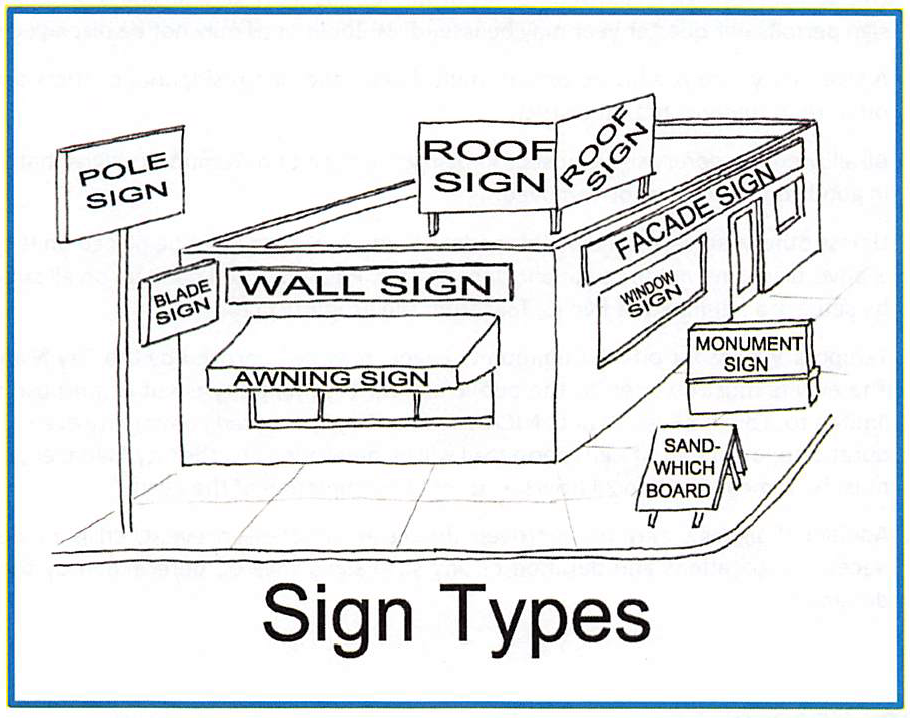
(1)
Awning signs.
a.
On a single-occupant property, one (1) awning sign is permitted over each occupant entrance.
b.
On a multi-occupant property, one (1) awning sign is permitted over each occupant entrance.
c.
The maximum area of signage shall not exceed twenty-five (25) per cent of the total awning face front or side area.
d.
Awning signs may be illuminated only with direct surface lighting and not with any form of backlighting.
e.
The width of the awning itself shall not exceed seventy-five (75) per cent of the façade linear footage.
f.
A sign permit is required.
(2)
Banner signs. Banner signs are temporary signs. Commercial banners and coroplast signs are subject to the requirements set forth in this section. There are three (3) types of commercial banners:
a.
Ground-mounted banners and signs: Ground-mounted banners and signs shall be supported by two (2) posts implanted into the ground.
b.
Pole-mounted banners: Displayed vertically, mounted on two (2) rods that extend perpendicularly to a pole. Such banners may be part of an overall exterior signage package.
c.
Wall mounted banners: Displayed horizontally on an exterior building wall, face, or side. Wall mounted banners typically display information regarding commercial events, such as grand openings, sales, or property leasing information.
d.
Banners are limited to thirty-two (32) square feet in area and five (5) feet in height. Banners must be maintained in good condition at all times.
(3)
Billboard signs. Billboard advertising is only allowed in the "M" industrial district in the city and commercial properties in the extra territorial jurisdiction (ETJ) provided the billboard meets all federal, state, and city requirements, as approved by TxDOT.
a.
General requirements. All billboards located within the city limits must adhere to the following requirements. Billboards in the Extra Territorial Jurisdiction (ETJ) are subject to the regulations of Chapter 394 of the Texas Transportation Code, or successor statutes.
1.
Billboards may be up to thirty-five (35) feet in height, measured from the highest point of the sign to ground level.
2.
Billboards must not be located so as to create a safety hazard, or to obscure or otherwise interfere with the effectiveness of an official traffic sign, signal, or device, or obstruct the driver's view of approaching, merging, or intersecting traffic, or to be likely to cause a driver to be unduly distracted in any way.
3.
Billboards may not be located within two thousand (2,000) feet of any public park, public forest, public playground or scenic area, designated as such by the city or any other governmental agency.
4.
Billboard faces may not contain any flashing, fluttering, undulating, swinging, rotating, or other moving elements or any reflective material such as foil, that may simulate movement or that is intended to distract drivers or passersby.
b.
Allowed area and height.
1.
The sign area of a billboard must be calculated as the area enclosed within the outer edge of the frame (border) of each sign face, multiplied by the number of faces.
2.
The maximum area for any one (1) billboard must not exceed six hundred seventy-two (672) square feet.
3.
Billboard panels may not be stacked, or placed side by side.
4.
Billboards may have an interior angle with a maximum fifteen-foot separation at outer edge.
5.
Billboards greater or equal to four hundred (400) square feet in gross area must observe the following location retirements:
Spacing: The minimum sign separation is three thousand (3,000) feet from any other billboards. Separation between billboards will be measured by the linear distance on the same side of the street.
Setback: A minimum distance of twice the sign height must be observed from any residentially zoned district.
6.
Billboards less than four hundred (400) square feet in gross area must observe the following location requirements:
Spacing: The minimum sign separation will be three thousand (3,000) feet from any other billboards. Separation between billboards will be measured by the linear distance on the same side of the street.
Setback: A minimum distance of twice the sign height from any residentially zoned district.
7.
Any spherical, free-form, sculptural, or other non-planar sign element protruding outward, above, below, or to either side of the billboard will be measured as fifty (50) per cent of the sum of the areas of the four (4) vertical sides of the smallest four-sided polyhedron that will encompass the protruding element. Inclusion of such elements will reduce the overall permitted size of the billboard.
8.
Billboards that are illuminated, may be lighted only by lights that are properly installed, shaded or concealed, and are aimed so that the light will project onto the sign face and will not interfere with the vision of motor vehicle operators, nor shine directly onto nearby residential property located in any residentially zoned district. Illumination of such signs must not be flashing or intermittent.
9.
Billboards will be considered a structure and must observe all setbacks and structure separation requirements of the zoning district in which they are located.
10.
Any non-conforming billboard that is damaged or deteriorated to an extent where restoration costs exceed sixty (60) per cent of the cost of erecting a new sign of the same type at the same location, must be removed.
c.
Billboard cap and reduce. The number of billboards in the city is limited to the number of such signs lawfully in existence or permitted on July 13, 2021. To encourage the reduction of billboards, the owner of a sign that was lawfully erected in compliance with all standards then in effect or lawfully in place at the time it was annexed into the city, or that owner's designee, may be awarded credit for removing such sign.
1.
One (1) credit will be awarded for each face that is removed from a lawfully existing billboard. In order to receive a permit for the erection of a billboard, two (2) credits must be used per each new face.
2.
The city shall issue a permit to any billboard owner or designee holding sufficient credits, for erection of a billboard in a location approved by the City, in its sole discretion according to the requirements set forth in this section. The permit must state the number of faces to be erected and must address all requirements set forth in this section.
3.
Credits are transferable.
4.
Credit is received when a billboard owner or designee removes a sign voluntarily, even if the reason is loss of the lease. No credit may be awarded for the removal of a billboard that was in violation of federal, state, or city laws when erected.
5.
To be awarded a credit under the incentive program, a sign owner or designee must notify the city within sixty (60) days of the removal of a billboard and receive a letter issued by the city awarding a credit. Failure to apply for a credit within sixty (60) days from removal of a sign bars the awarding of credit for that sign. Any unused credits will be held in reserve indefinitely, in order to give incentive for immediate removal of current faces.
d.
Billboard inventory and registration. In accordance with Title 43 of the Texas Administrative Code or successor statute, an inventory of billboards shall be maintained. The purpose of the billboard registration program is to maintain the billboard inventory and aid the city in enforcing the billboard cap and reduce policy. All billboard owners in the city limits are required to register their billboards in order for the city to maintain an accurate count and location database. A complete list of an owner's billboards, and locations must be submitted along with an annual fee to be set by the city. The submittal must be made in the first month of each calendar year to remain in compliance with this section.
(4)
Blade signs. A blade sign attached to and projecting out from a building face or wall, generally at right angles to the building shall be permitted in all non-residential zoning districts.
a.
Blade signs must have a minimum eight (8) foot clearance from the sidewalk or ground surface;
b.
Blade signs shall have a maximum sign face area of forty-eight (48) square feet per face. Double faced signs shall be allowed;
c.
Blade signs shall have a maximum height of fifteen (15) feet;
d.
Blade signs shall have a maximum projection four (4) feet; and
e.
A sign permit is required.
(5)
Building identification signs. Building identification signs are governed by the building code.
(6)
Changeable copy signs. Changeable copy signs are only allowed at service stations, hotels, restaurants, churches or school property provided that:
a.
The total changeable copy signage shall not exceed thirty-two (32) square feet;
b.
Changeable copy signs that change their message electronically shall not change their message more than one time each day;
c.
Changeable copy signs are limited to monument and pole signs and must accompany a permanent sign;
d.
The incidental space between a changeable copy sign and the primary sign along a pole sign shall be excluded from the computation area of each individual sign; and
e.
The area of a changeable copy sign shall be in addition to the total allowable main sign area in lieu of the right to temporary sign permits on the premises.
f.
A sign permit is required.
(7)
Changeable electronic variable message signs (CEVMS). Electronic signs which permit lights to be turned on and off intermittently are only allowed by special use permit. A sign permit is required.
(8)
Construction signs. Construction signs are an on-premises ground sign, placed within private property and are allowed provided that:
a.
For nonresidential and multi-family developments, and residential subdivision developments containing at least five (5) acres:
1.
A Construction sign may only be placed at one (1) construction site which has received development plan approval or for which an active building permit exists;
2.
A Construction sign shall not exceed sixty-four (64) square feet in area and ten (10) feet in height;
3.
Construction signs shall only be displayed during active construction. Construction signs require a sign permit and must be removed no later than the date of issuance of a final certificate of occupancy or completion of the project;
4.
Only one (1) construction sign is allowed per site;
5.
The sign face area may contain up to eight (8) pieces of information, including but not limited to financial institutions, contractors, builders, and so forth. A colored rendition or photograph of the development's site plan shall be allowed to be displayed within the sign face area;
6.
Construction signs shall not be placed in city right-of-way.
7.
A sign permit is required.
b.
For individual residences:
1.
Construction sign shall not exceed thirty-two (32) square feet in area and forty-eight (48) inches in height;
2.
Construction sign shall be limited to one (1) sign per lot;
3.
Construction signs shall not require a City of Jacksonville permit but shall be removed on issuance of a certificate of occupancy and/or completion of project; and
4.
Signs shall not be placed in a city right-of-way.
5.
A sign permit is not required.
(9)
Exterior directory signs.
a.
Directory signs shall be ground signs and shall be allowed where the site includes more than one (1) business occupant, provided that:
1.
Unless otherwise provided in this section, exterior directory signs shall contain no commercial messages or logos other than the name of the business occupant or development;
2.
A directory sign shall not exceed eighteen (18) square feet in area or four (4) feet in height; and
3.
Directory signs shall be located no closer than ten (10) feet from the building's primary or principal entrance unless otherwise determined and upon approval by the city manager.
b.
Physical address of site. All directory signs shall contain the physical address of the site and have a minimum four-inch letter size and made from a visible reflective material. A directory sign may be illuminated.
c.
Centers. Logo/name directory signs in centers may be located near entrances to parking areas, a safe distance from a right-of-way or intersection. Such signs may contain logos or business names with arrows or other directional information but shall not contain any other commercial message.
d.
Multi-family. One detailed directory sign may be located near the principal entrance to a parking area for multi-family projects. Such sign shall be located away from any public right-of-way, so that drivers can conveniently read the directory without impeding traffic on any driveway or entrance serving the development.
e.
Business/office parks. May have one sign to identify the building as a whole, indicating the predominant occupant or occupants. Such signs may contain logos or business names with arrows or other directional information but shall not contain any other commercial message.
f.
A sign permit is required.
(10)
Flags and flagpoles. Flags and flagpoles are allowed as follows:
a.
All residential zoning districts.
1.
Flagpoles shall not exceed twenty-five (25) feet in height.
2.
A sign permit is not required.
b.
All nonresidential zoning districts.
1.
A site shall have no more than three (3) flagpoles with no more than two (2) flags per pole;
2.
In lieu of flag poles, up to three (3) flags on individual poles mounted to the façade of the structure may be allowed.
3.
No commercial messages other than company logos may be displayed on flags;
4.
Flags shall not exceed forty (40) square feet in area; and
5.
Flagpoles shall not exceed thirty-five (35) feet in height.
6.
A special use permit for flags exceeding these regulations may be approved by the city council.
7.
A sign permit is required.
c.
Government institutions and schools are exempt from the flag and flagpole requirements as set forth herein.
d.
All flags displayed in Jacksonville should conform with proper flag etiquette as described in the U.S. Flag Code.
e.
Flags and flagpoles shall be maintained in good condition free of significant corrosion, deterioration, tears and fraying.
(11)
Garage sale signs. Signs for garage or occasional sales are allowed provided that:
a.
Only one (1) garage or occasional sale sign is permitted on the lot where the sale is located. Additional signs are permitted on private property with permission of the property owner;
b.
No garage or occasional sale signs are permitted in the right-of-way;
c.
Garage or occasional sale signs shall not exceed five (5) square feet in area and forty-two (42) inches in height;
d.
Garage or occasional sale signs are allowed for a period of one (1) day prior to the sale, and shall be removed at the conclusion of the sale;
e.
A sign permit is not required.
(12)
Incidental signs. Incidental signs are permitted in nonresidential and multi-family developments, upon the following conditions:
a.
Incidental signs shall contain no commercial message or logo other than the name of the tenant or development;
b.
No incidental sign shall exceed five (5) square feet in area;
c.
The number of incidental signs on a single parcel of property shall not exceed five (5) unless approved by the city manager or designee;
d.
Incidental signs in city rights-of-way are not permitted without the express written permission of the city manager or designee;
e.
Incidental signs are prohibited from being installed on light poles, trees and any traffic or emergency control device; and
f.
A sign permit is not required.
(13)
Marquee signs. In addition to permitted wall signs, marquee signs with changeable copy are allowed at theaters only. A theater with a marquee may display one (1) changeable copy sign on each of the two (2) sides of the marquee. A theater without a marquee may display one (1) changeable copy sign on each wall permitted to have wall signs. Such changeable copy signs may cover no more than one (1) square foot of sign area for each linear foot of theater building frontage. Marquee signs for a multi theatre complex with limited building frontage may be granted additional square footage of sign area by special use permit. A sign permit is required.
(14)
Menu boards. Menu boards are allowed only as an accessory use to a restaurant permitted to have a drive-thru window, provided that:
a.
Menu boards shall not exceed sixty-four (64) square feet in area and ten (10) feet in height;
b.
There shall be no more than two (2) menu boards per approved drive-thru lane;
c.
Menu boards may have a changeable copy;
d.
Menu boards may be internally or directly illuminated; and
e.
A sign permit is required.
(15)
Monument signs. Monument signs are allowed provided the following:
a.
Monument signs shall comply with section (j)(3) sign height and area chart;
b.
Setbacks shall be adequate to protect the "clear sight triangle," in accordance with this Code;
c.
Monument signs shall display information in a uniform type style;
d.
Both sides of the sign face area of a two-sided ground sign shall be identical;
e.
Accessory buildings in shopping centers shall not be allowed any monument signage;
f.
With the exception of the allowable monument signs for centers as set forth in charts 1 and 2, individual businesses, tenants, or occupants located within a center are not allowed individual freestanding monument signs;
g.
A sign permit is required.
(16)
Freestanding pole signs. Freestanding pole signs are permitted in the City of Jacksonville subject to the following regulations.
a.
Freestanding pole signs shall comply with section (j)(3) sign height and area chart;
b.
No accessory structure shall be allowed a pole sign;
c.
Freestanding pole signs shall contain the physical address of the building with a minimum letter size of four (4) inches. The sign shall be illuminated or use other City of Jacksonville approved lighting methods in accordance with all applicable City of Jacksonville's building codes; and
d.
A sign permit is required.
e.
Sign pooling. A freestanding, joint use sign may be permitted to serve two (2) or more tracts, each of which would otherwise be eligible for one (1) freestanding sign. The joint use permit may authorize a larger area of a single sign utilized by all tracts than would be permitted for individual freestanding signs serving each tract. The total square footage of informational area may not exceed eighty (80) per cent of the cumulative area which could be permitted for the individual tracts served by the joint use sign. A joint use sign permit may only be granted in lieu of permits for individual freestanding signs. The total square footage in the informational area for a joint use sign may not exceed three hundred (300) square feet.
f.
Joint use sign permits.
1.
Before authorization of any joint use sign permit, the request therefore will be referred to the city manager or designee for study and recommendation by staff concerning the effect of the proposed use on the character and development of the adjacent land uses. The city manager or designee will decide whether to approve or deny the request.
2.
The following information must accompany all joint use sign permit applications:
A.
A joint use agreement signed and acknowledged by each participating tract owner.
B.
The joint use agreement must specify the rights of each owner to use the joint use sign(s).
C.
The joint use agreement must stipulate that the rights to use the sign through each party to the agreement be set forth and the rights run with the land to the full benefit of the successors of the parties.
D.
A detailed site plan showing location, size, and architectural elevation of all proposed freestanding signs.
E.
A legal description of the area served by the joint use permit and sign and of each individual tract.
(17)
Master signage plans. A master signage plan is an administrative permit which establishes standards (size, design, location, etc.) for all exterior signs associated with a multi-tenant/multi-building development with two (2) or more tenants, whether on a single lot or multiple lots. The sign standards of the Code provide clear regulations for the permitting, design, location, construction, modification, use, maintenance, and removal of signs in the City of Jacksonville.
a.
Applicability. A master signage plan is allowed for all multiple-tenant buildings, planned district developments, and all multi-building or multi-occupant commercial developments.
b.
General requirements.
1.
The lot or lots involved shall be contiguous constitute a single cohesive development;
2.
The sign or signs shall be located on a lot that one of the advertised businesses occupies. Alternately the property owner may secure an easement, and provide written evidence of such, from the owner or entity responsible for an adjacent property where a sign may be placed;
3.
The sign or signs shall be designed in the overall architectural style of the buildings within the development;
4.
The sign or signs may be any sign type that is otherwise allowed by this Code;
5.
Private streets within the boundaries of the development are treated as public rights-of-way for purposes of determining allowable signage;
6.
Individual pad or lease sites, defined in an approved site plan, are treated as separate lots for purposes of determining allowable signage; however, it is intended that a business will not be allowed advertising on both the multiple tenant (shared) sign and another free-standing business identification sign;
7.
In addition to signage that would otherwise be allowed on a lot for business identification purposes, one (1) additional monument sign not exceeding eight (8) feet in height and thirty-two (32) square feet in area may be located at each intersection of public roadways and/or private roadways for purposes of directing traffic to various areas and businesses within the development;
8.
All other provisions of this Code will be applicable to this sign category, including but not limited to, allowed number based on road frontage (multiple lot developments are treated as a single lot for this purpose), allowable size as a function of zoning district, spacing, illumination, materials, etc.; and
9.
A wall sign displaying the name of a shopping center may be allowed for developments with less than two thousand (2,000) square feet in façade area as long as the proposed principal sign and tenants' signs do not exceed the maximum areas which all tenants with direct outdoor entrance or storefront could have individually.
c.
Application submittal requirements.
1.
Master application form.
2.
Filing fee.
3.
The applicant shall provide two (2) paper copies and one (1) digital copy of the proposed site plan consistent with the information from the site development plan check list.
d.
Review process. A master sign plan is an administrative permit issued by the city manager or designee. The processing of a master sign plan will involve the following steps:
1.
Formal application.
2.
Review for completeness of application.
3.
Staff review.
4.
Final action.
e.
Signs subject to the master sign plan. Any sign for which a permit is required and that is part of a development for which a master sign plan has been approved must demonstrate at the time of application that such signs conform to the master sign plan.
f.
Appeal.
1.
An appeal of an administrative decision (such as a master sign plan) may be filed by any person aggrieved by the administrative decision; and any officer, department, board or bureau of the city affected by the decision. The appeal is filed with the city manager or designee and must specifically set forth all grounds for the appeal.
2.
An appeal of an administrative decision must be made within thirty (30) days after the date of the decision. Such decision will become final following expiration of the thirty-day period if no appeal is filed.
3.
The appeal authority for administrative decisions is the zoning board of adjustment.
(18)
Political signs. Political signs are signs advertising political parties or candidates for election or signs that otherwise provide for freedom of expression unrelated to any commercial endeavor. Only one (1) political sign per candidate may be displayed or maintained on private property, provided that they conform to state law, and:
a.
Are no larger than thirty-six (36) square feet;
b.
Are no taller than eight (8) feet;
c.
Are not illuminated;
d.
Have no moving elements;
e.
Are placed with the consent of the property owner;
f.
If located in front of residential property, may be located in the city right-of-way or easement with consent of the property owner; and
g.
If located at a polling place on city owned property one political sign will be allowed, no larger than eighteen (18) inches tall and twenty-four (24) inches wide, placed in the ground, shall be permitted beginning at 5:00 p.m. on the day before Election Day and may remain in place until 7:00 a.m. on the day after Election Day.
h.
A sign permit is not required.
(18)
Vehicular signs. Vehicular signs:
a.
Vehicles shall have current registration (if required by law) and be road worthy for use on public streets;
b.
Vehicles shall be moved at least every five (5) days;
c.
This provision does not restrict the identification signs on vehicles used for bona fide business activity when said vehicle is legally licensed for use in public streets; and
d.
A sign permit is not required.
(19)
Public event signs. Public event signs are temporary ground signs. Public event signs are permitted only for public events sponsored and/or affiliated with the City of Jacksonville or approved by the city manager or designee;
(20)
Real estate signs. On-premises real estate ground signage advertising the sale or lease of such property are permitted as follows:
a.
In single-family residential areas, real estate signs are allowed provided the following:
1.
Real estate signs shall not exceed five (5) square feet in area and forty-two (42) inches in height;
2.
One real estate sign is permitted on the residential lot that is either for sale or lease;
3.
Real estate signs in the front of residential property may be located in the city right-of-way or easement;
4.
In additional to the other signs permitted by this section, one (1) open house sign will be allowed provided it is located on the residential lot that is for sale or lease. The sign shall not exceed two (2) square feet in area and twenty-four (24) inches in height; and
5.
A sign permit is not required;
b.
In multi-family and nonresidential areas, in addition to the real estate signage for single family residential, the following shall be allowed:
1.
Up to four (4) additional pieces of information on the sign;
2.
A separate ground sign for each parcel, limited to thirty-two (32) square feet in area and ten (10) feet in height, and set back a minimum of ten (10) feet from any public or private right-of-way;
3.
On-premises real estate signs are limited to a maximum of one (1) sign per development.
4.
Vertical supports and backs of signage not containing message shall be painted black or the same color as the background for the sign;
5.
A colored rendition or photograph of the development's site plan shall be allowed to be displayed within the sign face area; and
6.
A sign permit is required.
(21)
Residential personal identification signs. Residential signs are considered temporary on-premises ground signs and are allowed, provided:
a.
The signs do not exceed five (5) square feet in area and forty-two (42) inches in height;
b.
Personal identification signs are limited to three (3) on any site containing only a single-dwelling unit. Such signs shall not be posted within or encroach upon any public rights-of-way, public owned property or on any private common area.
c.
Personal identification signs shall not advertise or identify the conduct of a permitted home occupation in a residential district, or contain any other commercial message;
d.
Contractors shall be allowed to place a sign within the residential lot that is having any work performed within such lot. Contractor signs shall be allowed to be displayed only for the duration of work performed for which a building permit has been issued and shall be removed immediately after completion of such work. These signs shall not exceed the required size and height as set forth herein;
e.
One residential sign that advertises a charitable or school event, including the name of the charity/school and the date of the event is permitted for a period of ten (10) days prior to the event;
f.
Each residential lot is permitted to have one (1) sign per child displaying a school, athletic club or group, or other similar activity, not to exceed a total of three (3) signs per lot;
g.
Residential signs do not require a permit.
(22)
Sandwich board. Sandwich board signs are permitted within all non-residential zoning districts and upon the following conditions:
a.
Sandwich board signs shall not exceed six (6) square feet in area and three (3) feet in height;
b.
Signs may contain commercial messages and on-premises advertising;
c.
Signs may be placed on the sidewalk in the right-of-way, but must not obstruct pedestrian traffic;
d.
Signs shall not be illuminated;
e.
Signs shall only be displayed during business hours;
f.
Signs may only be located along the frontage of the business utilizing the sign and are limited to one (1) sign per business; and
g.
No sign permit is required.
(23)
Subdivision identification signs. Monument signs with the name of the residential subdivision are allowed on one (1) or both sides of each principal entrance (or in the median or on a public or private right-of-way with an approved encroachment agreement), provided that:
a.
The subdivision identification sign does not exceed sixty (60) square feet in area;
b.
The subdivision identification sign does not exceed twelve (12) feet in height, when integrated into a wall or column;
c.
The subdivision identification sign contains no commercial message; and
d.
A sign permit is required.
(24)
Suspended/hanging signs. Suspended signs are allowed under canopies, provided that:
a.
Only one (1) suspended sign per building entrance;
b.
The sign shall not exceed four (4) square feet in area;
c.
The sign shall not be internally illuminated; and
d.
Hanging sign must have a minimum seven-foot clearance from the sidewalk or ground surface.
e.
A sign permit is required.
(25)
Wall signs, nonresidential. Wall signs are allowed on nonresidential properties provided that:
a.
No wall sign shall project above the highest point of the building wall on the same side of the building as the sign; this shall include marquee signs and any other signs not affixed directly to such wall;
b.
On a single occupancy building, all signage or message elements, except for poster boxes, marquee signs and wall signs on theaters on any single wall, shall be considered parts of the same sign and shall be measured by a rectangle surrounding all of them;
c.
In addition to other permitted signs, but subject to total sign area limits applicable to all wall signs, a theater may install one or more back-lighted or internally illuminated "poster boxes," provided that:
1.
Such boxes shall not exceed thirty-six (36) inches by fifty-four (54) inches each in area;
2.
The top of such boxes shall not be more than ten (10) feet above ground; and
3.
Such boxes shall be permanently mounted to a wall.
d.
Any individual business/entity or multi-occupant (in-line and non in-line tenant) building with a façade width exceeding fifty (50) linear feet will be allowed two (2) square feet of wall sign for every linear foot of architectural elevation width of ground floor building frontage not to exceed three hundred (300) square feet;
e.
Channel lettering, detached (preferred), is allowed provided that is does not exceed the maximum square footage wall sign requirements;
f.
A theater is allowed additional changeable copy signs on a marquee or on the front wall of the building. The square footage of wall signs associated with theaters (i.e. poster boxes, marquee signs, changeable copy signs, logos and wall signs) shall be counted against the total wall sign area allotment. However, each sign shall be measured separately rather than placed together inside a rectangle;
g.
Poster boxes shall be measured individually without regard for the spaces between the individual boxes;
h.
Roofing elements that are within thirty (30) degrees of vertical (sometimes loosely called a "mansard roof") will be considered a "wall" and may have a sign on them;
i.
All wall signs, except building markers, shall be subject to the maximum area limitation on wall signs;
j.
Logos will be used when calculating total square footage for sign permits;
k.
Each individual business suite may not have more than one (1) wall sign face the fronting street right-of-way not exceeding two (2) wall signs in total per site;
l.
The width of the wall sign may not exceed seventy-five (75) per cent of the width of the wall area to which it is attached. When more than one (1) wall sign is used, the combination of the sign widths, when placed side by side, shall not exceed seventy-five (75) per cent of the width of the wall to which they are attached.
m.
A sign permit is required.
(26)
Window signs. Signs are allowed on the window glass on the first floor of buildings provided they comply with the following:
a.
Window signs on buildings occupied by retail, restaurant, or personal service establishments shall not exceed fifty (50) per cent of the total window area for each façade;
b.
Window signs on buildings occupied by offices or financial institutions shall not exceed twenty-five (25) per cent of the total window area for each façade. Such window signs are limited to business logos, hours of operation, address/contact information, or other information with no commercial message;
c.
Window art containing no commercial messages shall be allowed; and
d.
Window signs shall not be separately illuminated.
e.
A sign permit is not required.
(27)
Feather banner. Feather banners are allowed in non-residential zoning districts subject to the following:
a.
One (1) feather banner per driveway access per property;
b.
If a property has only an undefined driveway approach, it shall be entitled to one (1) feather banner regardless of the number of individual business suites located at the property;
c.
No more than three (3) feather banners per property;
d.
Only permitted during business hours;
e.
A permit is required for the use of feather banners; and
f.
No fee shall be assessed for the issuance of a permit for the use of feather banners.
(g)
Design, construction and maintenance standards.
(1)
Design and construction standards. All signs shall be designed and constructed in accordance with the following standards:
a.
All signs shall comply with the City of Jacksonville's building code(s) and shall also be built in accordance with the approved sign permit, if applicable;
b.
Electric signs that have internal wiring or lighting equipment, and external lighting equipment, shall not be erected or installed until an electrical permit has been obtained from the department of community development. The electrical components shall bear the seal of approval of an electrical testing laboratory that is nationally recognized as having the facilities for testing and requires proper installation in accordance with the National Electrical Code. All wiring shall be installed underground; and
c.
Except for permitted banners, flags, temporary signs and window signs, all signs shall be constructed of permanent materials and shall be directly attached to the ground, a building or another structure.
(2)
Maintenance standards. All signs shall be maintained in good aesthetic and structural condition and must be in compliance with all building and electrical codes. Specifically:
a.
A sign shall have no more than twenty (20) per cent of its surface area covered with disfigured, cracked, ripped or peeling paint, poster paper or other material for a period of more than thirty (30) days;
b.
A sign shall not stand with bent or broken sign facing, with broken supports, with loose appendages or struts, or more than fifteen (15) degrees from vertical for a period of no more than ten (10) days;
c.
A sign shall not have weeds, trees, vines, or other vegetation growing upon it, or obscuring the view of the sign from the public right-of-way, for a period of no more than thirty (30) days;
d.
An internally illuminated sign shall be allowed to stand with only partial illumination for a period of no more than thirty (30) days; and
e.
Flags shall not be faded, tattered or torn.
(h)
Signs not to create traffic hazard.
(1)
Clear sight triangle. No sign shall be erected in the "clear sight triangle." Signs shall be erected so as not to obstruct or impair motor vehicle driver vision at business ingress or egress points and intersections.
(2)
Other hazards. No signs shall be erected, and there shall be no lighting of signs in such a manner or in such location as to obstruct the view of, or be confused with, any authorized or official traffic signal, notice or control device.
(3)
Removal. Any sign in violation of this ordinance shall be removed by the owner. If not removed within ten (10) days after notice of the violation, the city manager or designee may have the sign removed. The cost of removal shall be at the expense of the sign owner and may become a lien against the property on which the sign is located.
(4)
Logos as pieces of information. A logo or trademark shall be considered one "piece of information" on a sign on which the number of pieces of information is limited.
(i)
Lighting.
(1)
Illumination and performance. The following regulations shall apply to signs where lighting is included:
a.
Sign illumination shall be placed and shielded so as not to directly cast light rays into a nearby residence, sleeping accommodations or the eyes of motor vehicle drivers;
b.
Signs incorporating steady, unshielded light bulbs shall utilize bulbs which are not in excess of thirty (30) watts intensity per square foot. It shall be encouraged to incorporate LED, induction, or a similar lighting technology for greater energy efficiency;
c.
Signs will be constructed in accordance with the City of Jacksonville's adopted National Electric Code:
d.
Neon signage and skeleton tubing, internal and external, is permitted as follows:
1.
Number of neon signs per business is limited to two (2);
2.
Neon lighting shall be allowed for primary signage, but such lighting shall be contained in an opaque casing with no visible exposure of any tubing;
3.
Exposed skeleton or neon tubing for primary signage lighting shall be allowed for restaurants; and
4.
Notwithstanding restaurants, exposed skeleton or neon tubing for primary signage shall be allowed for all other nonresidential signage in the following areas only if:
A.
Such lighting may be used only for the outlining of a sign cabinet on a freestanding pole sign;
B.
Such lighting may be displayed in a business window, these neon signs may not exceed twenty-five (25) per cent of each window section or pane and are not separately illuminated; and
C.
All neon signage and exposed tubing shall be governed by the maximum number of colors allowed as set forth in this chapter.
(2)
Uniformity. Lighting on signs shall be consistent throughout a project, and no sign or portion thereof shall be illuminated differently from any other sign, except as allowed otherwise in this chapter.
(j)
Computation methods.
(1)
Computations.
a.
Area computation of individual signs. The area of a wall, pole, or monument sign face shall be computed by means of the smallest rectangle that will encompass the extreme limits of the writing, representation, emblem or other display, together with any material or color forming an integral part of the background of the display or used to differentiate the sign from the backdrop or structure against which it is placed, but not including any supporting framework, base, bracing or decorative fence or wall when such fence or wall otherwise meets the regulations of this chapter and is clearly incidental to the display itself. For a single wall on a single-occupant building, all pieces of information or other graphic representations on that wall shall be measured as though part of one (1) sign, encompassed within one (1) rectangle, which may not exceed the maximum permitted sign area. For a single wall on a multi-occupant building, the area of signs shall be computed based on individual occupant signage, using these principles. Incidental signs square footage will not be calculated or deducted from the maximum sign allowance for a particular side building elevation.
b.
"Single wall" defined. A single wall shall mean the entire wall that shares the same architectural elevation as shown on the approved site plan. Architectural elevations are typically defined as the front, sides and rear of a building (alternatively called north, south, east and west elevations). See definition of "wall area, exterior surface."
c.
Monument and pole signs. Monument and pole signs shall be measured by the structure of the sign frame for square footage itself.
d.
Architectural elevation of sign. Regardless of whether a single wall has wall sections that project, recess or otherwise vary from the predominate wall plane, the rectangle shall include all signs that appear on the same architectural elevation.
e.
Multi-occupant (in-line tenant) buildings. For multi-occupant (in-line tenant) buildings such as a shopping center, or other building with a similar layout, all sign(s) associated with each occupant, tenant or business shall be enclosed within a single rectangle for purposes of calculating allowable sign area. Architectural elevation for these single businesses shall be determined by the building frontage that each occupant or tenant has within that center.
f.
Multi-occupant (non in-line tenant) buildings. For multi-occupant (non in-line tenant) buildings, all sign(s) on a single wall shall be enclosed within a single rectangle for purposes of calculating allowable sign area.
(2)
Area computation of multi-faced signs.
a.
Generally. Where the sign faces of a double-faced sign are parallel or the interior angle formed by the faces is 60 degrees or less, only one (1) display face shall be measured in computing sign area. If the two (2) faces of a double-faced sign are of unequal area, the area of the sign shall be the area of the larger face. In all other cases, the areas of all faces of a multi-faced sign shall be added together to compute the area of the sign. Sign area of multi-faced signs is calculated based on the principle that all sign elements that can be seen at one time or from one vantage point should be considered in measuring that side of the sign.
b.
Sign height computation. The height of a sign shall be computed as the distance from the base of the sign at normal grade to the top of the highest attached component of the sign. Normal grade shall be construed to be the newly established grade after construction, exclusive of any filling, beaming, mounding or excavating solely for the purpose of locating the sign.
(3)
Sign height and area chart.
(k)
Signs within a public right-of-way, easement or publicly owned property. No sign(s) shall be allowed in the public right-of-way, easement, or public-owned property except for the following:
(1)
Public signs erected by or on behalf of a governmental body to identify public property, convey public information and direct or regulate pedestrian or vehicular traffic;
(2)
Bus stop signs erected by a public transit company;
(3)
Informational signs of a public utility regarding its poles, lines, pipes or other facilities;
(4)
Signs appurtenant to a use of public property permitted under a franchise or lease agreement with the City of Jacksonville; and
(5)
Signs posted in association with municipal, county, state or federal authorities for crime prevention and public safety and health.
(6)
Signs specifically allowed in such locations as permitted elsewhere in this ordinance.
(l)
Nonconforming signs.
(1)
Nonconforming signs protected. A sign which was lawfully erected prior to the adoption of this ordinance but which does not conform in one (1) or more respects with the requirements of this ordinance may remain in use, until it falls within the provisions of this section.
(2)
Limitations on nonconforming signs.
a.
Abandonment. Any sign related to a use or business that ceases to exist for a continuous period of fourteen (14) days shall be considered non-conforming and shall not be reused unless and until it is in full conformity with the provisions of this ordinance.
b.
Routine repairs and maintenance. Repair and maintenance of nonconforming signs is permitted but only if the cost of repair or maintenance does not exceed fifty-one (51) per cent of the value of such sign. No structural changes or alterations shall be made to non-conforming signs. Otherwise, the sign must be brought in compliance with this ordinance.
c.
Change of copy. Change of copy shall be permitted (except on a changeable copy sign) without bringing the sign into full compliance with this ordinance, however, no alteration of the structural base or cabinet shall be permitted unless the sign is brought into compliance with the current regulations;
d.
Other sign permits on premises. For single-occupant properties, the issuance of a sign permit for a new or replacement sign shall be subject to the condition that all nonconforming signs on that property shall be removed or brought into compliance with this ordinance. For multi-occupant properties, the issuance of a sign permit for a new or replacement sign for any individual occupant shall be subject to the condition that all nonconforming signs for that occupant shall be removed or brought into compliance with this ordinance. This section shall not apply to the issuance of a permit for a temporary sign.
(m)
Illegal signs. An illegal sign is any sign that was constructed after the adoption of this ordinance without a permit and/or constructed in violation of this ordinance. An "illegal" has no legal right to remain. Illegal signs shall be removed in accordance with this ordinance.
(n)
Sign permits. If a sign requiring a permit under this chapter is to be placed, constructed, erected, or modified, the person seeking to place, construct, erect or modify a sign must obtain a sign permit prior to the construction, placement, erection or modification of the sign.
An application for a sign permit may be filed by the owner of the property, the lessee or the contract purchaser of the property, along with sign contractors. If the applicant is a lessee or contract purchaser, the applicant must obtain the owner's written authorization to file the application.
(1)
An application for a sign permit shall be filed on the form prescribed by the city and accompanied by the fee for the permit.
(2)
The application will not be processed unless it is complete, and the fee paid.
(3)
The city, in its sole discretion, shall determine whether the application is complete. If the department determines that the application is not complete, it shall notify the applicant, in writing, of the deficiencies and shall take no further action to process the application until the application is complete. If the application is not completed within forty-five (45) days, the application shall expire and be void and will be discarded and any fees paid forfeited.
(4)
The city manager, or designee, shall have the right to interpret or define any sign not specifically defined by this ordinance.
(5)
Within thirty (30) calendar days of submission of a complete application for a sign permit, the city manager or designee shall either:
a.
Issue the sign permit; or
b.
Deny the sign permit. If the sign permit is denied, the city manager or designee shall specify, in writing, the reasons for the denial.
(6)
Within ninety (90) days of being issued a sign permit, the sign shall be completed and shall have passed all city inspections. If these events have not occurred within ninety (90) days, the sign permit is null and void and all fees paid are forfeited.
(o)
Procedure to appeal to board of adjustments. Upon being denied a sign permit by the city manager or designee, an applicant may request a variance as set forth in this ordinance.
(p)
Enforcement and penalties.
(1)
Any person is violating this ordinance by doing any one (1) or more of the following:
a.
By installing, erecting or maintaining a sign without a required permit; or
b.
By installing, erecting or maintaining a sign that is inconsistent with an issued permit; or
c.
By failing to remove a sign that is installed, erected or maintained without a required permit; or
d.
By installing, erecting or maintaining a prohibited sign; or
e.
By changing a sign without first obtaining a permit, if required; or
f.
By failing to pass the required inspections prior to expiration of the sign permit; or
g.
By failing to remove an abandoned sign; or
h.
By installing or erecting a sign that does not comply with the requirements of this ordinance, other than displaying a legal non-conforming sign.
(2)
The city may enforce this ordinance against any person violating this ordinance through a civil or criminal proceeding in a court of competent jurisdiction. Depending on the type of proceeding, the city may seek any or all of the following remedies:
a.
A fine of each violation up to the maximum allowed under state law;
b.
An award of attorney fees incurred by the city;
c.
Costs of court;
d.
An order directing the sign be removed;
e.
An order that the city be allowed to remove the sign;
f.
An order that the costs of removing a sign by the city creates a lien on the property; and/or
g.
An injunction prohibiting any continuing violation of this chapter or the displaying of any sign in violation of this chapter.
(Ord. No. 1600, § 1(Exh. A), 7-13-21; Ord. No. 1652, §§ 1, 2, 2-14-23)
Editor's note— Ord. No. 1600, § 1(Exh. A), adopted July 13, 2021, repealed the former Art. III, Sec. 3, and enacted a new Sec. 3 as set out herein. The former Sec. 3 pertained to similar subject matter and derived from Ord. No. 1209, § 1, adopted Aug. 12, 2003.
Cross reference— Electrical code, § 4-37 et seq.; streets and sidewalks, Ch. 16.
Sec. 4. - Nonconforming buildings and uses of land.
(a)
[Nonconforming status.] A nonconforming status shall exist under the following provisions of this ordinance:
(1)
When a building or use which does not conform to the regulations prescribed in the district in which such use or structure is located was in existence and lawfully operating prior to the adoption of the previous zoning ordinance and has been operating since without discontinuance.
(2)
When, on the effective date of this ordinance, the building or use was in existence and lawfully constructed, located and operating in accordance with the provisions of the previous zoning ordinance or which was a nonconforming use thereunder, and which use or structure does not now conform to the regulations herein prescribed for the district in which the use or structure is located.
(b)
Lawful use of a building. The lawful use of a building at the time of the passage of this ordinance may be continued, although such does not conform to the provisions hereof, and such use may be extended throughout the building, provided no structural alterations, except those required by law or ordinance, are made therein. If no structural alterations are made, a nonconforming use of the building may be changed to another nonconforming use of the same or more restricted classification; provided, however, that in the event a nonconforming use of a building is once changed to a use of a higher or more restricted classification, it shall not later revert to the former lower or less restricted classification.
(c)
Discontinuance of nonconforming classification. Whenever a nonconforming use is abandoned for a period of a least six (6) months, all nonconforming rights shall cease and the use of the premises shall thenceforth be in conformity with this ordinance. Abandonment shall involve the intent of the user or owner to discontinue a nonconforming operation and the actual act of discontinuance. Any nonconforming use which, not involving a permanent type of structure, is moved from the premises, shall be considered to have been abandoned.
(d)
Destruction of a nonconforming building. If a building occupied by a nonconforming use is destroyed by fire or the elements it may not be reconstructed or rebuilt except to conform with the provisions of this ordinance; however, nothing in this ordinance shall be taken to prevent restoration of a building destroyed to the extent of not more than sixty (60) per cent of its reasonable value. Reconstruction may be permitted after a hearing and favorable action by the board of adjustment, but the size and function of the nonconforming use shall not be increased in any way.
(e)
Repairs and maintenance of nonconforming building.
(1)
Repairs and normal maintenance may be made to a nonconforming building provided that no structural alterations or extensions shall be made except those required by law or ordinance unless the building is changed to a conforming use.
(2)
Any nonconforming use or structure may be changed to a conforming use, and once such change is made, the use shall not thereafter be changed back to a nonconforming use.
(f)
Residential exemption from nonconforming status. Any residential dwelling or dwelling unit which meets the conditions for nonconforming status as set forth in subsection (a) of this section 4 above shall be exempt from any and all of the restrictions, limitations and conditions contained in subsections (b), (c), (d) and (e) of this section 4 concerning nonconforming uses and/or nonconforming buildings.
Sec. 5. - Classification of new and unlisted uses.
It is recognized that new types of land use will develop and forms of land use not anticipated may seek to locate in the City of Jacksonville. In order to provide for such changes and contingencies, a determination as to the appropriate classification of any new or unlisted form of land use shall be made as follows:
(1)
The building inspector shall refer the question concerning any new or unlisted use to the city planning and zoning commission requesting an interpretation as to the zoning classification into which such use should be placed. The referral of the use interpretation question shall be accompanied by a statement of facts listing the nature of the use and whether it involves dwelling activity, sales, processing, type of product, storage, and amount of noise, odor, fumes, dust, toxic material and vibration likely to be generated.
(2)
The city planning and zoning commission shall consider the nature and described performance of the proposed use and its compatibility with the uses permitted in the various districts and determine the zoning district or district within such use should be permitted.
(3)
The city planning and zoning commission shall transmit its findings and recommendations to the city council as to the classification proposed for any new or unlisted use. The city council shall by resolution approve the recommendations of the city planning and zoning commission or make such determination concerning the classification of such use as is determined appropriate.
Sec. 6. - Newly annexed areas.
(a)
Hereafter, when the boundaries of the City of Jacksonville have been extended so as to include any given area, such area shall be temporarily placed in an O zone or district; and until the city planning and zoning commission has made its recommendation to the city council that all or part of such are be placed in a different zone and this ordinance has been properly amended by the city council, such areas shall be subject to the regulations pertaining to the O district.
(b)
Temporary classification regulations.
(1)
No person shall erect, construct or proceed or continue with the erection or construction of any building or structure or cause the same to be done in any newly annexed territory to the City of Jacksonville without first applying for and obtaining a building permit or certificate of occupancy as may be required herein.
(2)
No permit for the construction of a building or use of land shall be issued by the building inspector other than a permit which will allow the construction of a building permitted in the O district, unless and until such territory has been classified in a zoning district other than the O district by the city council in the manner provided by law.
(3)
An application for a permit for any other use than that specified in subsection (b)(2) of this section shall be made to the building inspector of the City of Jacksonville and by him referred to the city planning and zoning commission. In making its recommendation to the city council concerning any such permit, the commission shall take into consideration the appropriate land use for the area.
(4)
The city council after receiving and reviewing the recommendations of the city planning and zoning commission may, by majority, vote to authorize the issuance of a building permit or certificate of occupancy or may disapprove the application.
Sec. 7. - Home occupations.
"Residential dwelling" as used in this section shall mean a building designed, used and occupied exclusively by members of one (1) family as a residence.
(1)
No person other than members of a family who reside in the residential dwelling shall be engaged in such occupation, profession, domestic craft or economic enterprise.
(2)
Such use shall be and remain incidental and subordinate to the principal use of the residential dwelling as a family residence and the area utilized for such occupation, profession, domestic craft or economic enterprise shall never exceed twenty-five (25) per cent of the total of the floor area of the residential dwelling.
(3)
To prevent increased traffic congestion in residential areas, no advertising of the occupation, profession, domestic craft or enterprise shall be conducted by the use of signs, displays, handbills, or other visible indication thereof displayed inside or outside the residential dwellings.
(4)
The residential dwelling shall maintain its residential character and shall not be altered or remodeled in order to create any type of exterior commercial appeal.
(5)
No exterior storage of material, equipment and/or supplies used in conjunction with such occupation, profession, domestic craft or enterprise shall be placed, permitted or allowed on the premises occupied by the residential dwelling.
(6)
There shall be no offensive noise, vibration, smoke, dust, odors, heat or glare beyond the property lines.
(7)
Such occupation, profession, domestic craft or enterprise shall be wholly within the residential dwelling and no accessory building shall be used in conjunction therewith.
(8)
Only equipment shall be used in such occupation, profession, domestic craft or enterprise that is ordinarily used in a private home in a like amount and kind.
Sec. 8. - Certificate of occupancy and compliance.
(a)
Certificates of occupancy shall be required for any of the following:
(1)
Occupancy and use of a building hereafter erected or structurally altered.
(2)
Change in use of an existing building to a use of a different classification.
(3)
Occupancy and use of vacant land, except agricultural use.
(4)
Change in the use of land to a use of a different classification.
(5)
Any change in the use of a nonconforming use.
(b)
No building hereafter erected or structurally altered shall be used, occupied or changed in use until a certificate of occupancy and compliance shall have been issued by the building inspector stating that the building or proposed use of a building or premises complies with the building laws and the provisions of these regulations.
(c)
Certificates of occupancy and compliance shall be applied for coincident with the application for building permit and shall be issued within ten (10) days after the erection or structural alteration of such building shall have been completed in conformity with the provisions of these regulations. A record of all certificates shall be kept on file in the office of the building inspector and copies shall be furnished on request to any person having a propriety or tenancy interest in the building affected.
(d)
Written application for a certificate of occupancy for the use of vacant land, or for a change in the use of land or a building, or for a change in a nonconforming use, as herein provided, shall be made to the building inspector. If the proposed use is a conforming use, as herein provided, the application shall be made to the building inspector. If the proposed use is in conformity with the provisions of this ordinance, the certificate of occupancy therefor shall be issued within ten (10) days after the application for same has been made.
(e)
Every certificate shall state that the building or the proposed use of a building or land complies with all provisions of the building and fire laws and ordinances. A record of all certificates of occupancy shall be kept on file in the office of the building inspector or his agent and copies shall be furnished on request to any person having proprietary or tenancy interest in the building or land affected.
(f)
Temporary certificate. Pending the issuance of a regular certificate, a temporary certificate of occupancy may be issued by the building inspector not exceeding six (6) months, during the completion of alterations or during partial occupancy of a building pending its completion. Such temporary certificates shall not be construed as in any way altering the respective rights, duties, or obligation of the owners or of the city relating to the use or occupancy of the premises or any other matter covered by this ordinance.
(g)
Certificate for nonconforming uses. A certificate of occupancy shall be required for all lawful nonconforming uses of land or buildings created by adoption of this ordinance. Application for such certificate of occupancy for a nonconforming use shall be filed with the building inspector by the owner or lessee of the building or land occupied by such nonconforming use within one (1) year of the effective date of this ordinance. It shall be the duty of the building inspector to issue a certificate of occupancy for a lawful nonconforming use, but failure to apply for such certificate of occupancy for a nonconforming use shall be evidence that said nonconforming use was either illegal or did not lawfully exist at the effective date of this ordinance.
Sec. 9. - Temporary uses.
(a)
Application for temporary use.
(1)
A request for a temporary use may be initiated by a property owner or his authorized agent by filing an application with the planning and zoning commission secretary upon forms prescribed for the purpose. The application shall be accompanied by a site plan, drawn to scale, showing the location and arrangement of the proposed temporary use. The site plan should also show methods of ingress and egress, location of sanitary facilities and necessary utilities, location of offstreet parking, and a description of all temporary structures to be erected.
(2)
A fee of twenty-five dollars ($25.00) shall accompany the application to cover the cost of advertising and processing.
(3)
Application must be presented at least fifteen (15) calendar days prior to the regularly scheduled planning and zoning commission meeting to allow for notification of all property owners within two hundred (200) feet of proposed temporary location.
(b)
The planning and zoning commission shall review each application for temporary use and shall approve, conditionally approve or disapprove the application. No appeal on the same request shall be filed within a period of one (1) year from the date of any denial of such request.
(c)
Reserved.
(d)
Temporary use regulations. All temporary uses will be required to apply for a temporary permit. These shall include but not be limited to:
(1)
Temporary asphalt batching plant.
(2)
Temporary cement batching plant.
(3)
Carnival.
(4)
Circus.
(5)
Construction office.
(6)
Real estate office (development sales only).
(7)
Skating rink, temporary.
(8)
Temporary church revival, tent services, etc.
(9)
Commercial, recreational or amusement development for temporary or seasonal periods of time.
(e)
Time limitation. All temporary use permits will be issued with specific time limits as approved by the planning and zoning commission and city council.
Ord. No. 799, §§ 1, 2, 10-9-90)
Sec. 10. - Adoption of schedule of heights and areas.
The schedule of heights, yards, lot areas, and lot coverage as given in this ordinance and together with all notations, references, and other information shown thereon, and all amendments thereto, shall be as much a part of this ordinance as any specific requirements or regulations as are fully set forth and described herein, and shall be as binding and carry the full force and effect of this ordinance.
Sec. 11. - Heights and area exceptions and modifications.
(a)
Heights. Single-family dwellings in the thirty-five (35) foot height districts may be increased in height by not more than ten (10) feet when two (2) side yards of not less than fifteen (15) feet each are provided. Such dwellings, however, shall not exceed three (3) stories in height.
(1)
In the thirty-five (35) and forty-five (45) foot height districts public or semipublic buildings, hotels, apartments, hospitals, sanitariums or schools may be erected to a height not exceeding seventy-five (75) feet when the front, side, and rear yards are each increased an additional foot for each foot such buildings exceed thirty-five (35) feet and forty-five (45) feet, respectively, in height.
(2)
The height of buildings in the D and E districts shall not exceed one hundred (100) feet or eight (8) stories, but above the height permitted at said yard line, four (4) feet may be added to the height of the building for each one (1) foot that the building or portion thereof is setback from the required yard lines.
(3)
The height of buildings in the H district shall not exceed one hundred fifty (150) feet, and the height of buildings in the K, J, L, and M districts shall not exceed one hundred twenty-five (125) feet, but above the height permitted at the yard lines, four (4) feet may be added to the height of the building for each one (1) foot that the building or portion thereof is set back from the required yard lines.
(4)
In the H district a tower may be constructed with reference to the above limitations, provided the largest horizontal dimensions of any side of the tower shall not exceed sixty (60) feet and provided the horizontal area shall not exceed twenty-five (25) per cent of the area of the lot, and provided such tower shall be removed at least twenty-five (25) feet from all lot lines and at least fifty (50) feet from any other tower.
(5)
Chimneys, water towers, penthouses, monuments, cupolas, domes, spires, standpipes, false mansards, parapet walls, similar structures and necessary mechanical appurtenances may be erected as to their height in accordance with existing or hereafter adopted ordinances of the city.
(6)
On through lots one hundred fifty (150) feet or less in depth, the height of a building may be measured from the curb level on either street, on through lots more than one hundred fifty (150) feet in depth, the height regulation and basis of height measurement for the street permitting the greater height shall apply to a depth of not more than one hundred fifty (150) feet from that street.
(b)
Front yards. Where the frontage on one side of a street between two (2) intersecting streets is improved with buildings that have observed an average front yard line with a variation in depth of not more than six (6) feet, building may extend, but shall not project beyond the average front yard so established, but this regulation shall not be interpreted to require a front yard of more than twenty-five (25) feet.
(1)
Where thirty (30) per cent or more of the frontage on one side of a street between two (2) intersecting streets is improved with buildings that have observed an average front yard line, with a variation in depth of not more than six (6) feet building may extend, but shall not project beyond the average front yard so established, but this regulation shall not be interpreted to require a front yard of more than twenty-five (25) feet.
(2)
On any lot on which a front yard is required by this ordinance, no wall, fence or other structure shall be erected and no hedge, tree, shrub or other growth or structure of an kind shall be maintained on such location within such required front yard so as to obstruct the view.
(3)
Any fence, wall, hedge, shrubbery, etc., higher than a base line extending from a point two and one-half (2½) feet above walk grade to a point four and one-half (4½) feet above walk grade at the depth of front yard required is hereby declared to be an obstruction to view, except single trees having single trunks which are pruned to a height of seven (7) feet above walk grade.
(4)
On a corner lot a yard along the side street shall not be deemed a front yard. In the event that the owner of a corner lot chooses to reverse the frontage of a corner lot, he will be required to observe the minimum required front yard space on the originally plotted front, unless the property in the block fronting on that street has, by actual buildings, in place on at least thirty (30) per cent of the frontage, established an average building line of less than that required by this ordinance.
(5)
On a fractional lot in the rear of a corner lot the front yard shall conform to the average building line already established by actual building in the remainder of the block, or by the minimum required by this ordinance for such property in the remainder of the block, not counting the original corner lot.
(6)
In the F, G, H, J, K, L, and M districts, if the property is not utilized for dwelling purposes, no front yards are required, unless a lot abuts along the front of a street the opposite side of which is zoned for dwelling purposes, in which case there shall be a front yard not less than ten (10) feet.
Sec. 12. - Nonconforming lots of record.
In any district in which single-family dwellings are permitted, a single-family residence and customary accessory buildings may be erected on any single lot of record which exists as such at the time of adoption of this ordinance. Such a lot must have been in separate ownership and not of continuous frontage with other lots under the same ownership. This provision shall apply even though such lot fails to meet the requirements of the district in which it is located for area, or width, or both, provided, however, that the requirements of the district for minimum yard dimensions shall be met unless a variance to said requirements has been granted by the board of adjustment. The board shall attempt to allow equitable development of any nonconforming lot.
Sec. 13. - Regulation of modular homes/industrialized housing.
(a)
A single-family or duplex industrialized house must comply with all local permits and license requirements that are applicable to other single-family or duplex dwellings.
(b)
Any industrialized housing shall:
(1)
Have a value equal to or greater than the median taxable value for each single-family dwelling located within five hundred (500) feet of the lot on which the industrialized housing is proposed to be located, as determined by the most recent certified tax appraisal roll for the county;
(2)
Comply with all applicable aesthetic standards, building setbacks, side and rear yard offsets, subdivision control, architectural landscaping, building setbacks, square footage, and other site requirements set out in the city's ordinances;
(3)
Have exterior sidings, roofing, roof pitch, foundation fascia, and fenestration that in the opinion of the building official is compatible with the dwellings located within five hundred (500) feet of the lot on which the industrialized housing is proposed to be located; and
(4)
Be securely fixed to a permanent foundation.
(c)
For purposes of subsection (b) above, "value" means the taxable value of the modular home/industrialized housing and lot after installation of the housing.
(d)
Any owner or authorized agent who intends to construct, erect, install, or move any industrialized housing into the city shall first make application to the building official and obtain the required permits. In addition to any other information otherwise required for said permits, the application shall:
(1)
Identify each single-family dwelling located within five hundred (500) feet of the lot on which the industrialized housing is to be located by address, lot and block number and show the taxable value for each such dwelling as determined by the most recent certified tax appraisal for the county;
(2)
Describe and provide front view photographs of the exterior siding, roofing, roof pitch, foundation fascia, and fenestration for each dwelling located within five hundred (500) feet of the lot on which the industrialized housing is to be located;
(3)
Show proof of the value of the improved property by providing:
a.
A copy of the sales receipt, signed by the purchaser, of the industrialized housing unit, including the value of the lot, if the lot is included in the sale; or
b.
A copy of the sales receipt, signed by the purchaser, of the industrialized housing unit, and documentation showing the taxable value of the lot as determined by the most recent certified tax appraisal roll for the county in which the industrialized housing is to be located, if the lot is not included in the sale of the housing unit or if the value of the lot is not include on the sales receipt.
(4)
Describe the permanent foundation and method of attachment proposed for the industrialized housing;
(5)
Indicate the deed restrictions otherwise applicable to the real property on which the industrialized housing is to be located.
(e)
Failure to provide any documentation required will be considered grounds to deny a permit application.
(Ord. No. 1683, § 2, 1-14-25)
Sec. 14. - Location requirements.
(a)
Tobacco/vape/smoke stores as defined by this Code shall be at least 300 feet from public or private school property, city park, child care or day care center, hospital or place of worship, measured in a direct line from the property line of the place of business to the property line of a public or private school property, city park, child care or day care center, hospital or place of worship.
(b)
Tobacco/vape/smoke stores as defined by this Code shall be at least 1,000 feet from another tobacco/vape/smoke store measured in a direct line from the property line of each and every applicable place of business.
(c)
Notwithstanding any provision within the zoning ordinance making permitted uses cumulative, tobacco/vape/smoke stores as defined by this Code shall be further limited to locations within zones F, local retail district and G, commercial district.
(Ord. No. 1697, § 3, 1-13-26)

