
Johns Creek City Zoning Code
ARTICLE XII
A.- JOHNS CREEK TOWN CENTER CODE
Sec. 12A.1.- General Provisions.
12A.1.1. General Purpose. The purpose of this code is to enable and support the implementation of the following policies:
A.
The Town Center is the focal point for high-quality, mixed-use development and redevelopment in the City of Johns Creek as established in the Town Center Vision and Plan and the Comprehensive Plan.
B.
The Town Center should be a live-work-play district featuring a balanced mix of uses that complement the City's overall mix of uses.
C.
The Town Center should serve people of all ages and allow residents to remain in the community as they age.
D.
A range of high-quality and aesthetically compatible housing options should be provided to accommodate different needs in the community.
E.
The quality-of-life in existing neighborhoods should be preserved and protected.
F.
Development and redevelopment should incorporate environmental stewardship and sustainability.
G.
A multi-modal system should be implemented, enhanced and expanded as an amenity.
H.
A range of useable and inter-connected open spaces including parks, squares, courtyards, and preserved environmentally sensitive areas should be distributed throughout the Town Center.
I.
Public buildings, gathering places, and areas for community events should be provided as desirable locations that reinforce community identity.
J.
Buildings and landscaping should contribute to the physical design and sense of place.
K.
Development or redevelopment of large areas of surface parking should accommodate growth and expand the transportation system.
L.
Development should adequately accommodate automobiles while respecting the pedestrian, bicyclist, and the design of public areas.
M.
Interconnected networks of streets should be designed to disperse traffic and reduce the length and number of automobile trips.
N.
Development patterns should make walking and bicycling safer and more pleasant.
O.
Harmonious and orderly development and redevelopment of Town Center should be secured through these regulations.
12A.1.2. Applicability.
12A.1.2.1. Territorial Application. This code applies to all parcels within the City of Johns Creek Town Center area as adopted in the Town Center Vision and Plan, by City Council, subject to the following:
A.
The study area of the City of Johns Creek Town Center Vision and Plan shall be shown on the Official Zoning Map and labeled "Town Center Overlay."
B.
Within the Town Center Overlay, the requirements of Section 12A.3. of this Article apply in addition to the requirements of the zoning district in which a parcel lies.
C.
Within the Town Center Overlay, the requirements of Section 12A.4. of this Article apply when a parcel is rezoned to a Town Center Zoning District.
12A.1.2.2. Conformance Requirements.
A.
All buildings, structures or land, in whole or in part, must be used or occupied, in conformance with this code. All buildings or structures, in whole or in part, must be erected, constructed, moved, enlarged or structurally altered in conformance with this code.
B.
Nothing in this code shall require any change in the plans, construction or intended use of a building or structure for which a lawful permit has been issued or a lawful permit application has been accepted before the effective date of this code, provided that the construction under the terms of such permit is diligently followed until its completion.
12A.1.2.3. Conflict Provisions.
A.
It is not the intent of this code to interfere with or abrogate or annul any easements, covenants or other agreements between parties; provided, however, that where this code imposes a greater restriction upon the use of property or premises or upon the height of buildings, or requires greater open space than is imposed or required by other resolutions, rules or regulations, or by easements, covenants or agreements, the provisions of this code shall govern.
B.
Nothing herein shall be construed as repealing or modifying the conditions of operation or conditions of site development accompanying those zoning approvals, variances or use permits issued prior to the existence of this code; however, modification or repeal of these past conditions of approval may be accomplished through a rezoning or special use permit in accordance with Article XXVIII of the Zoning Ordinance.
12A.1.2.4. Use of Words and Phrases. Terms used throughout this code may be defined in Section 12A.2. Definitions. Those terms not defined in Section 12A.2. shall be referred in Section 3.3. "Definitions" of the Zoning Ordinance. Terms not defined in either sections shall be construed to have the meaning given by The Latest Illustrated Book of Development Definitions, and if not defined therein, by Merriam-Webster Collegiate Dictionary. In the event of conflicts between these definitions, this code shall take precedence.
12A.1.2.5. Text and Graphics. Illustrations and graphics are included in this code to illustrate the intent and requirements of the text. In the case of a conflict between the text of this code and any illustrations or graphics, the text shall govern.
12A.1.3. Administration.
12A.1.3.1. Administration, Interpretation and Enforcement. The regulations in the Town Center Overlay and the Town Center Zoning Districts shall be administered, interpreted, and enforced by the Community Development Director, except that Section 12A.3.3. shall be administered, interpreted, and enforced by the Public Works Director.
12A.1.3.2. Modifications. Modification of the development regulations set forth in the Town Center Overlay may be authorized by the Community Development Director, except that modifications of Section 12A.3.3. shall be authorized by the Public Works Director, in specific cases when, in his/her opinion, undue hardship may result from strict compliance; provided any such determination shall be based fundamentally on the fact that unusual topographical or other exceptional conditions require such modification, or that the granting of the modification will not adversely affect the general public welfare or nullify the intent of these regulations.
Application for any modifications shall be filed in writing on a form provided by the Community Development Department, with necessary supporting documents and explanation of the reasons and facts supporting the application.
Modification decisions by the Community Development Director or Public Works Director shall be made in writing to the applicant and also made a part of the respective Department's records. Any modification decisions by the Community Development Director or Public Works Director shall be appealable pursuant to Section 12A.1.3.3.
12A.1.3.3. Appeals. All appeals shall be filed pursuant to article XXII of the City's Zoning Ordinance.
12A.1.3.4. Judicial Review. Any person aggrieved by a decision or order of the City, after exhausting all administrative remedies, shall have the right to appeal by to the Superior Court of Fulton County. Any appeal of a decision of the City shall be made within 30 calendar days of the date of the decision.
12A.1.4. Town Center Zoning Districts.
12A.1.4.1. Town Center Zoning Districts Established. The following "Town Center Zoning Districts" are established within the area regulated by this code:
A.
Town Center Mixed Use District (TC-X)
B.
Town Center Business District (TC-B)
C.
Town Center Residential District (TC-R)
12A.1.4.2. Relationship between Neighborhoods and Town Center Zoning Districts. The neighborhoods established by the Town Center Vision and Plan may be implemented by the establishment of appropriate zoning districts. Parcels located in the following neighborhoods are recommended to pursue rezoning to corresponding Town Center Zoning Districts:
12A.1.4.3. Zoning Changes. Parcels shall retain their current zoning that existed on the effective date of this ordinance. All zoning changes shall only occur in accordance with Article XXVIII of the Zoning Ordinance.
(Ord. No. 2022-08-20, 8-29-2022)
Sec. 12A.2. - Definitions.
Abutting. Having property lines in common. Separation by a street or alley is not considered abutting.
Access. A way or means of approach to provide physical entrance to a property.
Accessory Structure. A structure detached from a principal building on the same lot and customarily incidental and subordinate to the principal building or use.
Accessory Use. A use customarily incidental and subordinate to the principal use and located on the same lot with such principal use.
Adult Business. Any business or establishment where employees or patrons expose specified anatomical areas or engage in specified sexual activities for the purpose of sexual gratification or any business which offers its patrons goods, services or entertainment characterized by an emphasis on matter depicting, describing, discussing or relating to specified sexual activities or specified anatomical areas. A business or establishment offering goods, articles, publications, books, magazines, movies, videotapes or other reproductions relating to specified sexual activities or specified anatomical areas is not deemed an adult business if the segment or section devoted to the sale of such materials comprises less than 5% of its total space.
Alley. A non-exclusive private easement or publicly dedicated service way providing a secondary means of public access to abutting property and not intended for general traffic circulation.
Alteration of Building. Any change in the supporting members of a building (such as bearing walls, columns or girders); any change in the non-supporting interior walls of a building; any addition or reduction to a building; any change in use; or any relocation of a building from one location or position to another.
Amenity Space. Outdoor areas of at least 100 square feet each (except for balconies) for use by the occupants, invitees and guests of the development and specifically excluding Civic Spaces and required sidewalks. Each amenity area approved must function as an amenity area. Above-ground cisterns design and appearance shall require approval by the Community Development Director. Amenity spaces include but are not limited to the following types:
1.
Rooftop decks;
2.
Balconies;
3.
Patios and porches;
4.
Outdoor dining areas;
5.
Pool areas;
6.
Tennis courts, basketball courts, and similar uses;
7.
Yards, lawns, and gardens;
8.
Hardscape areas improved for pedestrian enjoyment;
9.
Wooded areas; and
10.
Runoff reduction measures such as bioretention areas and cisterns.
Animal Care (Indoor). A facility designed or arranged for the care of animals without any outdoor activity. Indoor animal care includes animal grooming, animal hospital, veterinary clinic, pet clinic, animal boarding, animal shelter, cattery, commercial kennel (11 or more dogs) and doggy day care. All of the activities directly associated with animal care shall occur entirely within a completely enclosed soundproof structure.
Animal Care (Outdoor). A facility designed or arranged for the care of animals that includes outdoor activity. Outdoor animal care includes animal grooming, animal hospital, veterinary clinic, pet clinic, animal boarding, animal shelter, cattery, commercial kennel (11 or more dogs) and doggy day care.
Architectural Block. A building component made from cast concrete with an exterior facing that resembles natural stone.
Art Galleries. An establishment engaged in the sale, loan, or display of art books, paintings, sculpture, or other works of art. This does not include libraries, museums, or non-commercial art galleries, or where such display of art is incidental to the primary use.
Associations (Clubs & Lodges). A facility used for associations or organizations of an educational, fraternal or social character, not operated or maintained for profit.
Bakery. An establishment primarily engaged in the retail sale of baked products for consumption off site. The products may be prepared either on or off site. Such use may include incidental food service.
Bail Bonds. A facility with a bail bond agent, or bondsman, that provides surety and pledges money or property as bail for the appearance of persons accused in court.
Berm. An earthen mound or embankment designed to provide visual interest, screen views, reduce noise or fulfill other such purposes.
Block. A tract of land bounded by streets or a combination of streets and public land, rights-of-way or any other barrier to the community or development.
Boutique Hotel. A facility not exceeding 150 rooms and where overnight accommodation for less than 30 days are provided for compensation. The building shall reflect an exterior architecture and interior design compatible with the area in which the hotel is located. The boutique hotel shall provide guests with high quality services, such as, but not limited to, concierge, on-site restaurant, room service, meeting space, business center, banquet facilities, spas, doormen, valet parking, boutiques and/or other amenities. Guest rooms within the building shall contain no equipment for food preparation other than a mini-fridge and/or microwave. There shall be no self-serve laundry facilities (for guests use) within the building. Access to each guest room shall be through an inside lobby supervised at all hours.
Bulb-out. A curb extension that extends the sidewalk or curb line out into the parking lane to narrow the travel lane and provide additional pedestrian space.
Call Center. A facility used for the purpose of receiving or transmitting a large volume of telephone calls.
Certificate of Occupancy. A document issued by the City's Chief Building Official allowing the occupancy or use of a building or land and certifying that the structure, use, or land has been constructed or erected or will be used in compliance with all applicable codes and ordinances.
City. The City of Johns Creek, Georgia.
City Council. The legally constituted and elected governing body of the City of Johns Creek, Georgia.
Civic Space. The portion of open space for public use defined by the combination of certain physical constants including the relationships among their intended use, their size, their landscaping, and their adjacent buildings. Each civic space approved must be usable for civic purposes. Above-ground cisterns design and appearance shall require approval by the Community Development Director. Civic spaces include, but are not limited to, the following types:
1.
Park. An open space available for structured or unstructured recreation. A park may be independent of surrounding buildings at its edges. Its landscape may consist of paths and trails, meadows and lawns, water bodies, runoff reduction measures such as bioretention areas, swales, cisterns, and woodlands. Recreation fields and courts may also be included. The minimum size for a park is one (1) acre.
2.
Square. An open space available for unstructured recreation and civic purposes. A square is spatially defined by buildings or streets at its edges. Its landscape must consist of paths and trees, and may also include runoff reduction measures such as bioretention areas and cisterns, lawns and non-asphalt paved surfaces. The minimum size for a square is one-half (1/2) acre.
3.
Plaza. An open space, available for civic purposes and commercial activities. A plaza must be spatially defined by buildings or streets at its edges. Its landscape must consist primarily of non-asphalt paved surfaces and trees, and may include runoff reduction measures such as bioretention areas and cisterns. The minimum size for a plaza is one-quarter (¼) acre.
4.
Pocket Park. An open space, available for unstructured recreation. A pocket park may be spatially defined by buildings or streets at its edges. Its landscape must consist of lawn and trees, and may include runoff reduction measures such as bioretention areas and cisterns. There is no minimum size for pockets parks.
5.
Playground. An open space designed and equipped for the recreation of children. A playground must be fenced and may include an open shelter. Playgrounds must be interspersed within residential areas, may be placed within a block, and may be included in parks and greens. There is no minimum size for playgrounds. Playgrounds may include runoff reduction measures such as bioretention and underground detention.
6.
Performance Venues. An open space available for outdoor performance. Performance venues typically include a stage surrounded by formal or informal seating on at least one side. Performance venues may have a combination of landscaped and hardscaped areas. The minimum size for a performance venue is one-half (1/2) acre.
7.
Multi-Use Trails with Potential Connections to Offsite Trails. A linear open space consisting of a conforming multi-use trail that includes a connection to existing or proposed off-site trails. There is no minimum size for this type of open space.
8.
Park Overlooks. An open space primarily intended for the viewing of parks and other open spaces. Park overlooks must include seating. There is no minimum size for park overlooks.
Community Garden. Defined areas of land managed and maintained by a group of individuals to grow and harvest crops and non-food ornamental crops, for personal or group use, consumption, or donation. A community garden is to be primarily used for growing and harvesting food crops and ornamental crops, for consumption or donation or for sale off-site. They may be divided into separate plots for cultivation by one or more individuals or may be farmed collectively by members of the group and may include common areas maintained and used by the group. The following standards shall apply to community gardens:
1.
Detached accessory structures such as storage or utility buildings, gazebos, trellises, or accessory greenhouse structures are permitted, subject to compliance with the requirements of the zoning district and the requirements for accessory structures.
2.
If lighting is installed, only motion-detecting fixtures are permitted. All-night lighting is prohibited.
3.
Community gardens must be managed and maintained in compliance with all applicable standards of this Town Center Code and the City Code, including, but not limited to, those pertaining to: nuisance ordinance, stormwater, site accessibility, signs, soil erosion and sedimentation control, tree conservation and landscaping.
Curb Cut. Any interruption or break in the line of a street curb for the purpose of connecting a driveway to a street, or otherwise to provide vehicular access to abutting property.
Dwelling, Single-Family. One dwelling unit in a single principal structure.
Dwelling, Duplex. Two dwelling units in a single principal structure.
Dwelling, Townhouse. Three or more dwelling units where each unit is separated by a common side wall. Units cannot be vertically mixed.
Dwelling, Multi-Family. Three or more dwelling units in a single principal structure that do not meet the definition of Townhouse above.
Easement. A grant by a property owner of any designated part of a property for the use by another for a specified purpose without transfer of title or right of ownership.
Farmers' Market. The outside temporary display and sale of agricultural products, plants, herbs, or an assortment of juried arts and crafts sold directly by farmers, vendors or local artisans. A farmers' market typically consists of booths, tables or stands where farmers sell fruits, vegetables, meats, and sometimes prepared foods and beverages. The following standards shall apply to farmers' market:
1.
A farmers' market on private property requires an annual permit (special event);
2.
A set of operating rules addressing the governance structure of the market, hours of operation, maintenance, security, and the appointment of a market manager must be prepared;
3.
All temporary structures such as umbrellas, tables, and displays must be removed when not in use and be stored within a screened storage area;
4.
The on-site presence of a market manager during hours of operation is required;
5.
All waste must be removed from the site each day;
6.
Hours of Operation.
a.
The farmer's market may operate between the hours of 7:00 AM and 7:00 PM;
b.
In no event may a market operate more than 2 days per week and for more than 8 hours per day; and
c.
Set-up of market operations may begin no earlier than 6:00 AM and take-down must end no later than 8:00 PM.
7.
Inventory.
a.
At least 75% of the displayed inventory of the products sold in each farmer's market are farm products or value-added farm products;
b.
At least 75% of the booths open during the market's hours of operation are producers, or family members or employees or agents of producers; and
c.
If a booth sells farm products or value-added farm products that are not produced by the vendor, the booth must explicitly disclose the producer's name and location in writing with lettering that is at least 2 inches tall and visible to the consumer.
Fence. A structure made of manufactured materials and used for the purpose of defining a boundary, creating an enclosure, providing security, privacy or screening, or as a means of protection.
Fenestration. The design and detailing of the opening (window and door glass) that must cover a facade.
Fireworks Retail Facility. A permanent or temporary building or structure that is used primarily for the retail display and sale of consumer fireworks to the public. Primarily means that 75% or greater of the Fireworks Retail Facility is used for the retail display and sale of consumer fireworks to the public.
Fuel Pumps/Gas Station. A retail facility that sells fuel for motor vehicles, with or without personnel. The facility may or may not include a convenience or other retail store.
Garden. A plot of ground where herbs, fruits, flowers, or vegetables are cultivated for personal or group use, consumption or donation. This includes a rooftop garden or green roof. The garden may not be located in the primary street or side street yard. This use standard is not intended to restrict flowers planted or grown for aesthetic reasons for household use only.
Golf Driving Range. A facility used primarily practicing long golf shots with rentable clubs and balls.
Gym, Yoga Studio. An establishment which for profit or gain provides as one of its primary purposes, services or facilities which are purported to assist patrons improve their physical condition or appearance. Not included within this definition are facilities operated by nonprofit organizations, facilities wholly owned and operated by a licensed physician at which such physician is engaged in the practice of medicine, or any establishment operated by a health care facility, hospital, intermediate care facility, or skilled nursing care facility.
Height. The vertical distance to the highest point of the roof surface of a flat roof, the deck line of a mansard roof, and to the mean height level between eaves and ridge of a gable, hip or gambrel roof, as measured from the average finished grade across the building frontage.
Light Manufacturing. A facility conducting light manufacturing operations within a fully-enclosed building. Light manufacturing includes but are not limited to the following types:
1.
Clothing, textile or apparel manufacturing;
2.
Facilities engaged in the assembly or manufacturing of scientific measuring instruments, semiconductor and related devices, including but not limited to clocks, integrated circuits, jewelry, medical, musical instruments, photographic or optical instruments or timing instruments;
3.
Pharmaceutical or medical supply manufacturing;
4.
Sheet metal, welding, machine shop, tool repair;
5.
Stone, clay, glass or concrete products; and
6.
Woodworking, cabinet makers or furniture manufacturing.
Live-Work. Non-residential activities conducted wholly within a residential dwelling that allows employees, customers, clients, or patrons to visit. The following standards shall apply to live-work use:
1.
Non-residential activities are only permitted on the first floor of a dwelling unit;
2.
A minimum of one person must occupy the dwelling containing the live-work use as their primary place of residence;
3.
The live-work use may employ no more than two persons not living on the premises at any time;
4.
No business storage or warehousing of material, supplies or equipment is permitted outside of the dwelling containing the live-work use;
5.
The non-residential use of the live-work use is limited to a permitted or special use in the zoning district;
6.
No equipment or process may be used in connection with the live-work use that creates noise, vibration, glare, fumes, odors, or electrical interference detectable to the normal senses, off the premises;
7.
No more than 5 customers are permitted on the premises at any one time; and
8.
A home occupation license shall be obtained from the City to operate the business.
Loading, Off-street. A space used for the loading or unloading of commercial vehicles, trucks or other vehicles.
Medical Office. A facility providing medical or surgical care to patients, without overnight care. Medical office includes but are not limited to the following types:
1.
Ambulatory surgical center;
2.
Blood plasma donation center, medical or dental laboratory;
3.
Hospital, urgent care, emergency medical office;
4.
Medical, dental office or chiropractor, osteopath, physician, medical practitioner; and
5.
Medical clinic.
Micro-Producers. A micro-producer is defined as a micro-brewery, micro-winery or micro-distillery. The following standards shall apply to micro-producer use:
1.
Production facilities are limited to 20,000 square feet. All activities associated with micro-producing facilities must be wholly contained within the 20,000 square foot production facility;
2.
Micro-producers must not be located within 500 feet of another similar facility;
3.
Applicants must comply with Chapter 6 Alcoholic Beverages of the Johns Creek Code of Ordinances; and
4.
Parking requirements shall be determined by the Community Development Director on a case-by-case basis based on conceptual plans and details of the proposed operations provided by the applicant.
Non-commercial Greenhouse. A glass accessory building in which herbs, fruits, flowers, or vegetables that need protection from the weather are cultivated for personal or group use, consumption or donation.
Office. A facility used for activities conducted in an office setting and generally focusing on business, professional or financial services. Office includes, but are not limited to, the following types:
1.
Business services including, but not limited to, advertising, business management consulting, computer or data processing, graphic design, commercial art or employment agency;
2.
Professional services including, but not limited to, lawyer, accountant, auditor, bookkeeper, engineer, architect, sales office, travel agency, interior decorator or security system services;
3.
Financial services including, but not limited to, lender, investment or brokerage house, bank, insurance adjuster, real estate or insurance agent, mortgage agent or collection agency;
4.
Counseling in an office setting;
5.
Radio, TV station, recording studio; and
6.
Trade, vocational, business school.
Opaque. Impenetrable to view, or so obscuring to view that buildings, structures, and uses become visually indistinguishable.
Open Space. The horizontal outdoor area of a site reserved to provide separation, natural resource protection, scenic enjoyment, recreation, or amenity. It includes two types: civic space and amenity space.
Outdoor Dining. A seating area specifically designed for the consumption of food or drink, typically associated with a restaurant. Outdoor dining shall comply with the following standards:
1.
The outdoor dining area must not interfere with the circulation of pedestrian or vehicular traffic. Outdoor dining cannot be located in any required parking space.
2.
The hours of operation for the outdoor dining area may be no greater than that of the principal use.
3.
Parking must be provided at a minimum rate of 1 space per 500 square feet of outdoor dining area.
4.
Outdoor dining facing the water restoration area and/or other public open space cannot be enclosed by an opaque fence over 36 inches. All fence design shall be subject to the approval of the Community Development Director.
Outdoor Display. The outdoor display of products actively available for sale. The outdoor placement of propane gas storage racks, ice storage bins, soft drink or similar vending machines is considered outdoor display. Outdoor display does not include merchandise or material in boxes, in crates, on pallets or other kinds of shipping containers. Outdoor display shall comply with the following standards:
1.
Outdoor display is only allowed with a permitted non-residential use.
2.
Outdoor display must abut the primary facade with the principal customer entrance, and may not extend more than 6 feet from the facade or occupy more than 25% of the horizontal length of the façade.
3.
Outdoor display may not exceed 6 feet in height.
4.
Outdoor display must be removed and placed inside a fully-enclosed building at the end of each business day, except propane gas storage racks, ice storage bins, soft drink or similar vending machines may remain outside overnight.
5.
Outdoor display may not encroach upon any public right-of-way or sidewalk. Outdoor display may not impair the ability of pedestrians to use the sidewalk. There must be a minimum of 6 feet of clear distance of sidewalk at all times.
Overstory Tree. Trees that compose the top layer or canopy of vegetation and will generally reach a mature height greater than 40 feet and typically have a spreading canopy.
Owner. The legal or beneficial owner of a site, including, but not limited to, a mortgagee or vendee in possession, receiver, executor, trustee, lessee or other person in control of the site.
Parapet. That portion of a wall which extends above the roof line.
Pawnshop. An establishment engaged in a business involved in any part of the pledge, pawn, or exchange of any goods, wares, merchandise, or any kind of personal property or title as security for the repayment of money lent.
Performing Art Center. A multi-use performance space that is intended for use by various types of the performing arts, including dance, music and theatre.
Person. Any individual, partnership, firm, association, joint venture, public or private corporation, trust, estate, commission, board, public or private institution, utility, cooperative, City, county or other political subdivision of the State, any interstate body or any other legal entity.
Personal Service. A facility involved in providing personal or repair services to the general public.
Planter. A zone adjacent to the curb intended for planting street trees and the placement of street furniture including light poles, litter receptacles, and similar items.
Place of Worship. A building or structure that by design and construction is primarily intended for conducting organized religious services. Associated accessory uses include, but are not limited to, schools, gymnasiums, meeting halls, indoor and outdoor recreational facilities, clergy house, rectory, day care, counseling, and kitchens. Outdoor display shall comply with the following standards:
1.
No buildings and use areas/structures other than parking and pedestrian walkways may be located within 100 feet of any residential use.
2.
No parking area may be located within 50 feet of any residential use.
3.
Any associated recreational fields or other uses requiring a special use permit shall obtain a separately-approved special use permit for each use.
Principal Building. The building or other structure within which is conducted (or intended to be conducted) the principal use of the lot on which said building is situated.
Principal Use. The primary or predominant use of any lot.
Recreation Facilities, Outdoor. A commercial facility, varying in size, providing daily or regularly scheduled recreation-oriented activities. Activities take place predominately outdoors or within outdoor structures. Outdoor recreation facilities include, but are not limited to, the following types:
1.
Commercial Dog Park.
2.
Drive-in theater.
3.
Extreme sports facility such as BMX, skateboarding or roller blading.
4.
Outdoor amusements such as batting cage, golf driving range, miniature golf facility or pickleball facility.
5.
Outdoor theater.
6.
Outdoor sports field/court.
7.
Riding stable.
8.
Rowing club, boat rental.
9.
Shooting range.
10.
Stadium, arena.
Recreation Facilities, Indoor. A commercial facility, varying in size, providing daily or regularly scheduled recreation-oriented activities in an indoor setting. Indoor recreation facilities include but are not limited to the following types:
1.
Amusement center, game/video arcade.
2.
Assembly hall, auditorium, meeting hall.
3.
Bowling alley.
4.
Extreme sports facility such as BMX, skateboarding or roller blading.
5.
Ice or roller skating rink.
6.
Indoor sports facility.
7.
Miniature golf facility.
8.
Motor track.
9.
Movie theater or other indoor theater.
10.
School for the arts, including dance, singing, music, painting, sculpting, fine arts or martial arts.
11.
Special event facility.
12.
Stadium, arena.
Redevelopment. A land development project on a previously developed site, but excludes ordinary maintenance activities, remodeling of existing buildings, resurfacing of paved areas, and exterior changes or improvements which do not materially increase or concentrate stormwater runoff, or cause additional non-point source pollution.
Research and Development. A facility focused primarily on the research and development of new products. Research and development include, but are not limited to, the following types:
1.
Laboratories, offices and other facilities used for research and development by or for any individual, organization or concern, whether public or private.
2.
Prototype production facilities that manufacture a limited amount of a product in order to fully investigate the merits of such a product.
3.
Pilot plants used to test manufacturing processes planned for use in production elsewhere.
Residential Density. The residential density of a site is expressed in dwelling units per acre of land and is calculated by dividing the total dwelling units on a site by the site's acreage. The ability to achieve the permitted density may be further restricted by site conditions, district regulations, or conditions of rezoning.
Restaurant. A facility that prepares and sells food and drink for on- or off-premises consumption. Restaurant includes the following:
1.
Bakery, cake shop.
2.
Coffee, tea shop.
3.
Juice bar, smoothie shop.
4.
Restaurant.
5.
Yogurt or ice cream shop.
Retaining wall. A wall or similar structure used at a grade change to hold soil on the up-hillside from slumping, sliding or falling.
Riding Stable. A facility used primarily for the care, breeding, boarding, rental, riding or training of horses or for the teaching of equestrian skills.
Roof. The outside top covering of a building.
Rowing Club, Boat Rental. A facility engaged in the storage or rental of rowing shells, canoes or kayaks for use on the water.
Schools, Colleges and Universities. Any educational facility established under the laws of the state, maintained at the public expense by taxation, and usually open to all residents of the City or country without charge; private schools which have students regularly attending classes and which teach subjects commonly taught in these schools of this state; any educational facility operated by a private organization or local county, or state that provides training or education beyond and in addition to that training received in grades kindergarten to twelfth, including but not limited to, trade, business and vocational schools; any institution of higher learning, consisting of an assemblage of colleges united under one corporate organization or government, affording instruction in the arts and sciences and the learned professions, and conferring degrees. School, Colleges and Universities shall comply with the following standards:
1.
No buildings and refuse area may be located within 100 feet of any residential use.
2.
No active outdoor recreation area may be located within 100 feet of any residential use.
3.
No parking area may be located within 50 feet of any residential use.
4.
Student drop-off and vehicular turn-around facilities must be provided on-site so that vehicles may re-enter the street in a forward manner.
5.
Permitted curb cut access must not be from a local street.
School of the Arts. An educational facility not operated by the Fulton County Board of Education that offers or provides instruction to more than 2 students at a time in dance, singing, music, painting, sculpting, fine arts or martial arts.
Shooting Range. A facility with an enclosed firing range with targets for archery, rifle or handgun practice.
Site. Any lot or group of contiguous lots owned or functionally controlled by the same person or entity, assembled for the purpose of development. Lots within a site may be separated by an existing public right-of-way.
Skywalk. An enclosed overhead walkway between buildings, often across a street or connecting to structured parking. Skywalk shall comply with the following standards:
1.
A minimum vertical clearance of 17 feet above all streets and walkway shall be provided.
2.
Ample space for the free flow of pedestrians with a 12-foot minimum walkway width must be provided.
3.
Prior to issuance of a building permit, an Encroachment and Indemnification Agreement must be filed with the City as a condition of approval, if extending above a public street.
Slope. The degree of deviation of a surface from horizontal, measured in a numerical ratio, percent or degrees. Expressed as a ratio or percentage, the first number is the vertical distance (rise) and the second is the horizontal distance (run), as 2:1 or 200 percent (200%).
Smoke Shop. Any business establishment dedicated to the display, sale, distribution, delivery, offering, furnishing, marketing or use of tobacco, tobacco products, or alternative nicotine products/instruments, or any combination thereof, including but not limited to cigarettes, cigars, e-cigarettes, hookahs, vapes. This definition shall not include cigar shops, or any grocery stores, gas stations or similar retail use that only sells conventional cigars, or alternatively sells cigarettes only as an accessory sale (ten percent or less of total sales).
Such businesses shall be located within a retail shopping center and shall not be allowed within 200 yards of any Church, Temple or Place of Worship, Daycare, School, College, University or Government-owned Facilities or Properties, or within 500 yards of another Smoke Shop. Distance shall be measured by a straight line without regard to intervening structures or objects, from the front door of the smoke shop to the closest point on a boundary of any parcels containing a Church, Temple or Place of Worship, School, College, University, Government Facility, or another Smoke Shop.
Special Event Facility. A facility or assembly hall available for lease by private parties or special events, such as weddings.
Splash Pad. An outdoor play area with sprinklers, fountains, nozzles, and other devices or structures that spray water.
Story. The portion of a building compromised between a floor and the floor or roof next above. The first floor of a multi-story building shall be deemed the story that has no floor immediately below it that is designed for living quarters or for human occupancy. Those stories above the first floor shall be numbered consecutively.
Stub-out. A shortened thoroughfare which is intended to provide connectivity at some point in the future.
Title Loans, Check Cashing. A facility engaged in the business of making loans in exchange for possession of the certificate of title to property or a security interest in titled property. The definition also includes check-cashing, which is a business other than a bank or savings and loan or similar financial institution that cashes checks for a fee as a business activity and may or may not also make title loans as part of that business activity.
Vehicle Rental. A facility that rents motor vehicles for short periods of time (generally ranging from a few hours up to two weeks) for a fee.
Vehicle Sales. A facility that sells passenger vehicles, light and medium trucks, and other consumer motor vehicles such as motorcycles, boats and recreational vehicles.
Wall Plate. A horizontal load-bearing member in a wall assembly. The top of the wall plate is the topmost structural piece of the wall.
Wetland. The area that is inundated or saturated by surface or groundwater at a frequency and duration sufficient to support—and that under normal circumstances do support—a prevalence of vegetation typically adapted for life in saturated soil conditions. Wetlands generally include swamps, marshes, bogs and similar areas. The ecological parameters for designating wetlands include hydric soils, hydrophytic vegetation and hydrological conditions that involve a temporary or permanent source of water to cause soil saturation.
(Ord. No. 2022-08-20, 8-29-2022; Ord. No. 2024-08-18, 8-19-2024)
Sec. 12A.3. - Town Center Overlay.
12A.3.1. Applicability.
A.
The requirements of this Article apply to all parcels within the Town Center Overlay unless expressly stated otherwise in this Article.
B.
The requirements of the Zoning Ordinance, Development Regulations, and all other applicable City ordinance also apply in the Town Center Overlay unless expressly stated otherwise in this Article.
C.
This Article does not change the permitted use or density of a property within the Town Center Overlay. Land and structures must be used in accordance with the standards of the underlying zoning district.
D.
This Article does change the permitted form and design of a property subject to the Town Center Overlay. When requirements of this Article conflict with any other requirement of the Zoning Ordinance, the requirements of this Article shall prevail.
E.
When the word "street" is used in this Article it means both public and private streets unless stated otherwise.
12A.3.2. Block and Access.
12A.3.2.1. Block.
A.
Sites greater than 4 acres in size must incorporate existing or new streets or pedestrian corridors (minimum 20 feet wide and 20 feet high) that terminate at other existing or new streets or pedestrian corridors to form an interconnected network at the ground level with a maximum block perimeter length of 2,000 feet.
B.
In addition to the block standards above, blocks containing exclusively single-family dwellings must be wide enough to provide two tiers of lots, except where fronting on arterial streets prevented by topographical conditions or size of the property, in which case, the Community Development Director may require and/or approve a single tier of lots.
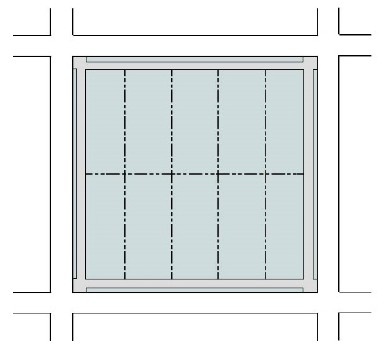
C.
Other than stub-out streets and alleys, dead-end streets are not allowed unless a variance is granted for topographic hardship.
D.
Block Measurement.
1.
A block is bounded by a public or private street (not including an alley).
2.
Block perimeter is measured along the edge of the property abutting the public or private streets, except for the measurement of dead-end streets, which are measured from intersecting centerlines.
3.
The Community Development Director may modify the block perimeter requirements when steep slopes in excess of 25%, pre-existing development, tree protection areas, stream buffers, open space, or easements would make the provision of a complete block infeasible.
4.
Where the block pattern is interrupted by public parkland, including greenways that are open and accessible to the public, pedestrian access points must be provided with a minimum length equal to half of the maximum block perimeter.
E.
No public streets, private streets or alleys within the Town Center Overlay shall be gated, unless it is used for security purposes related to light industrial uses.
12A.3.2.2. Access.
A.
General. When land is subdivided or otherwise developed, parcels and buildings must be arranged and designed so as to allow for the opening of future streets and must provide access to those areas not presently served by streets. No development may be designed to completely eliminate street access to abutting parcels without current street access.
B.
Stub-Out Streets.
1.
Stub-out streets within new development must be installed to meet the block standards of Section 12A.3.2.1.
2.
The stub-out street right-of-way, pavement, and curbing must extend to the boundary of the abutting parcel to the point where the connection to the anticipated street is expected.
3.
Where a stub-out street is provided, a sign noting the future street extension must be posted at the property owner's expense.
4.
Connecting to an existing stub-out street. If a stub-out street exists on an abutting parcel, the street system of any new development must connect to the stub-out street to form a through street.
C.
Exception. The Community Development Director may waive the requirement for a stub-out street or require pedestrian and bicycle-only access when steep slopes in excess of 25%, tree conservation areas, stream buffers, open space or easements would make the provision of a stub-out street infeasible.
12A.3.2.3. Vehicle Cross-Access. All lots must comply with the following standards:
A.
Internal vehicular circulation areas must be designed and installed to allow for cross-access between abutting lots.
B.
Vehicle cross-access shall not be gated.
C.
When an abutting lot is vacant or already developed, a stub for a future cross-access connection must be provided at the point where the connection to the abutting parcel is expected to occur in the future.
D.
If a cross-access driveway stub exists on an abutting parcel, the internal vehicular circulation area must connect to the stub to form a cross-access connection.
E.
When cross-access for vehicles is deemed impractical by the Public Works Director on the basis of topography, the presence of natural features, or vehicular safety factors, the requirement for cross access may be modified or waived. Bicycle and pedestrian connections must be provided between abutting properties when cross-access is waived.
F.
Property owners who establish cross-access easements must:
1.
Allow pedestrian and vehicular access to all properties on the same block face as the property owner establishing the cross-access. Pedestrian and vehicular access is contingent upon the granting of reciprocal vehicular, bicycle, and pedestrian access rights to the granting property;
2.
Record an easement allowing cross-access to and from properties served by the cross-access easement;
3.
Record a joint maintenance agreement requiring each property owner to maintain the vehicular, bicycle, and/or pedestrian access areas on their lot;
4.
Contain a provision prohibiting the erection of fences, walls and other obstructions that prevent the use of vehicular, bicycle, and pedestrian access ways;
5.
Include a statement that the cross-access agreement is conveyed with the land, is binding on all successors, heirs and assigns and that the easement rights are perpetual; and
6.
The cross-access agreement must be signed by all necessary owner(s) of the granting property.
12A.3.3. Streets.
12A.3.3.1. Applicability.
A.
This Section applies to:
1.
New development (new public or private street and existing streets that the parcel fronts);
2.
New public streets or reconstructing an existing public street;
3.
Existing developed sites when more than 25% (cumulatively) of the site area is disturbed;
4.
Existing developed sites when existing buildings are expanded;
5.
Existing developed sites when existing buildings are renovated or repaired, and the cumulative value of said work exceeds 50% of the building's replacement cost.
B.
The Public Works Director may grant a modification to any requirement of this Section for existing developed sites and existing buildings when existing topography, trees, buildings, utilities, retaining walls, or other existing features render this Section infeasible.
C.
Existing streets may continue serving existing development in their current configuration; however, they must not be extended or rebuilt except in conformance with this Section.
D.
Use of multi-functional stormwater best management practices (BMPs) is expressly allowed and encouraged in the right-of-way, including streetscape landscape bioretention areas, planters, curb bulb-outs and medians with bioretention, and vegetated swales. Such stormwater BMPs may qualify for EcoMeasurement points per Section 12A.3.8. for the site if part of an approved stormwater management plan and with a long-term maintenance agreement.
E.
Traffic calming design elements, such as intersection bulb-outs can help moderate vehicle speeds on Town Center streets; multifunctional bulb-outs that include runoff reduction measures for stormwater management are encouraged. Landscaping and traffic calming techniques that are ideal on Town Center streets include, but are not limited to, street trees with grated wells, bioretention areas, planters, curb bulb-outs with bioretention.
12A.3.3.2. Street Types.
A.
All new or extended public or private streets must meet the street standards from Section 12A.3.3.2.B. to 12A.3.3.2.G. unless modified by the Public Works Director for the following public purposes:
1.
To provide on- or off-street bicycle facilities;
2.
To provide wider sidewalks or planters;
3.
To provide a median, left turn lane, or combination therefore;
4.
To provide bulb-outs;
5.
To provide hardscape surface in otherwise landscaped planters in order to provide pedestrian access to adjacent on-street parking;
6.
To increase or decrease the travel lane width;
7.
To provide traffic calming or pedestrian safety measures; or
8.
To provide multi-use vegetated runoff reduction measures in street planters and in street tree areas.
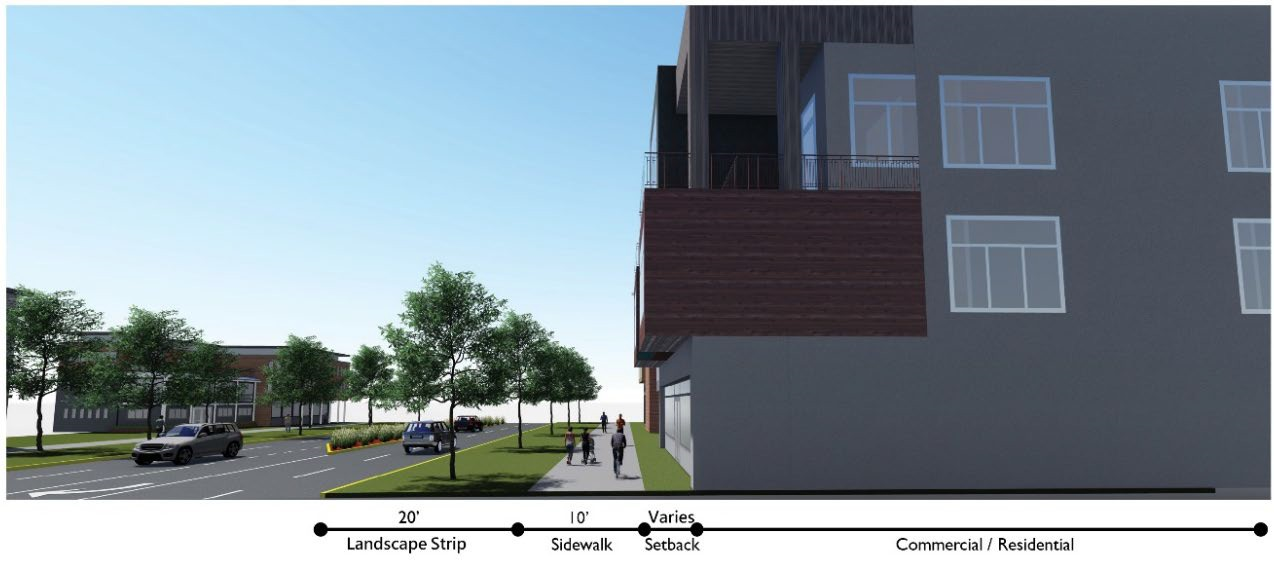
B.
The Edge (McGinnis Ferry Road and Medlock Bridge Road).
C.
Linear Parkway (Johns Creek Parkway).
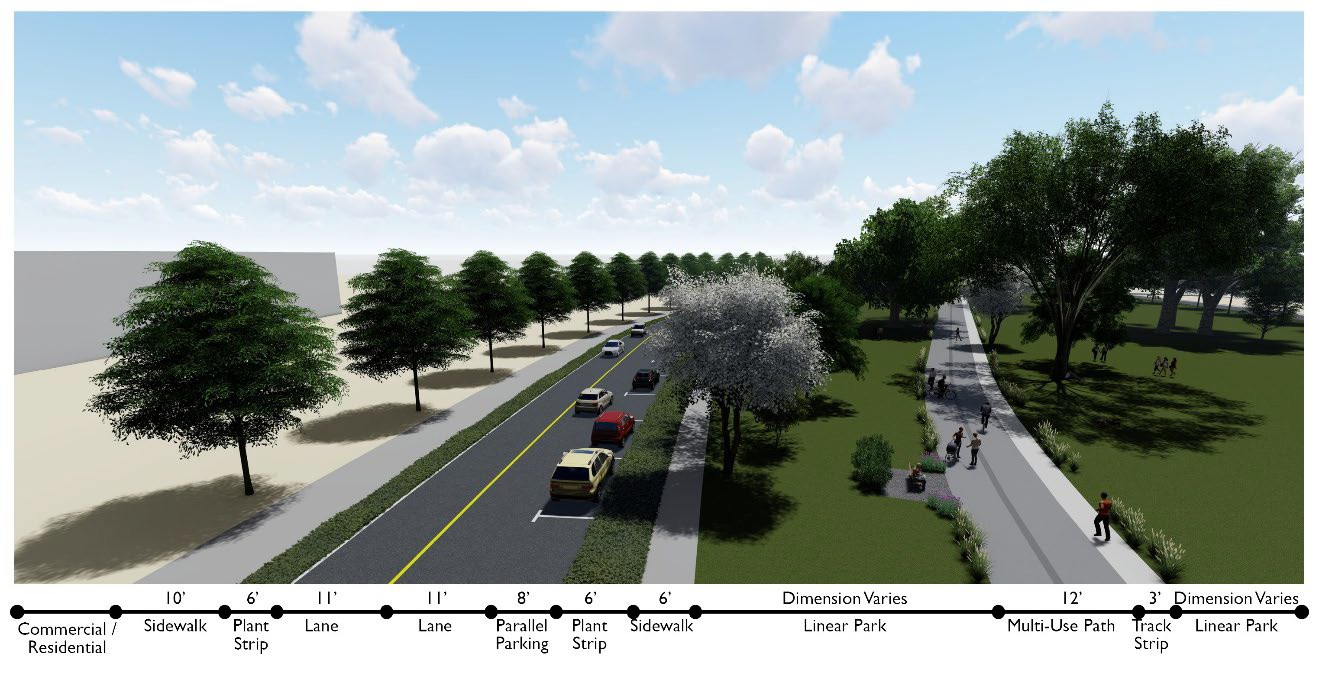
Multi-use path width may be decreased in areas where topography, existing buildings, existing trees, or other existing conditions render this requirement infeasible, subject to the approval of the Public Works Director. The maximum length of this decreased width is 400 feet.
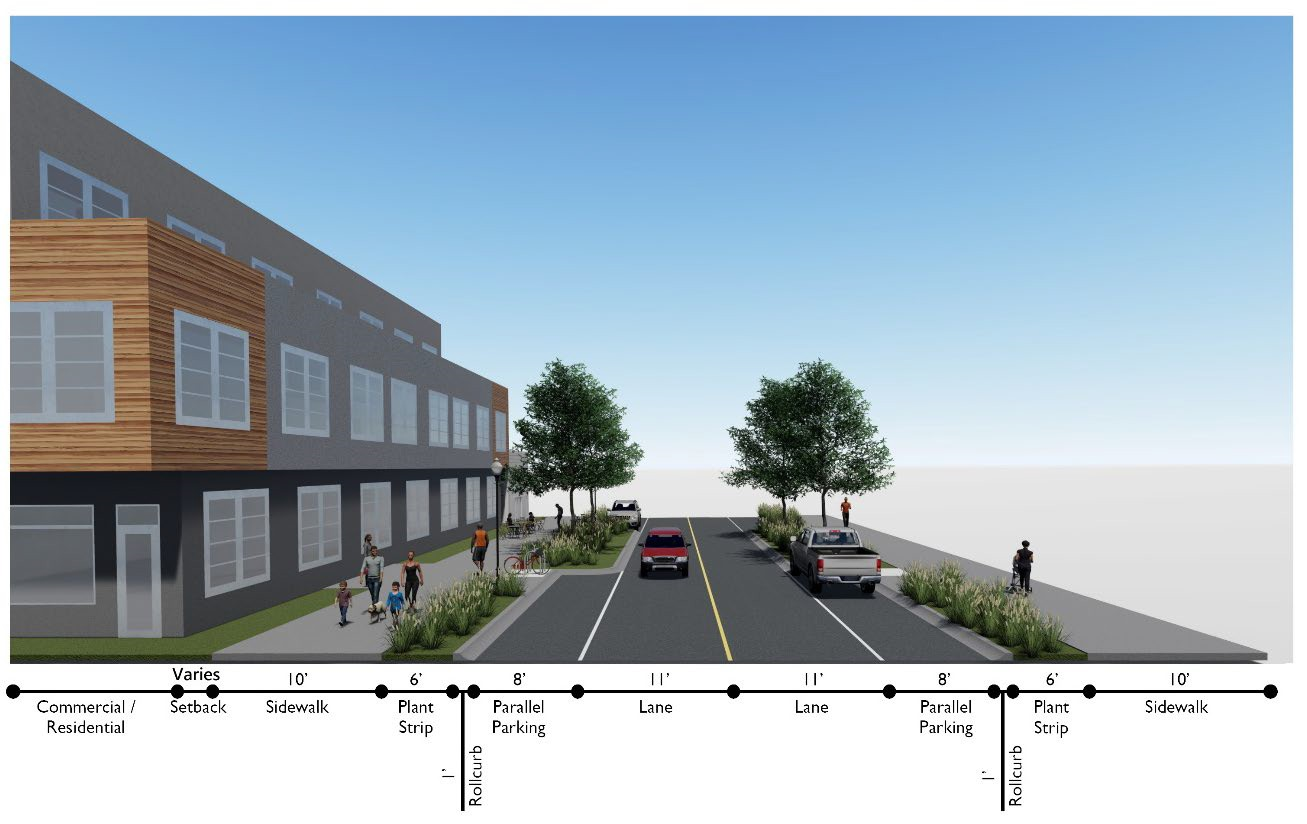
D.
Main Street.
E.
Local Street.
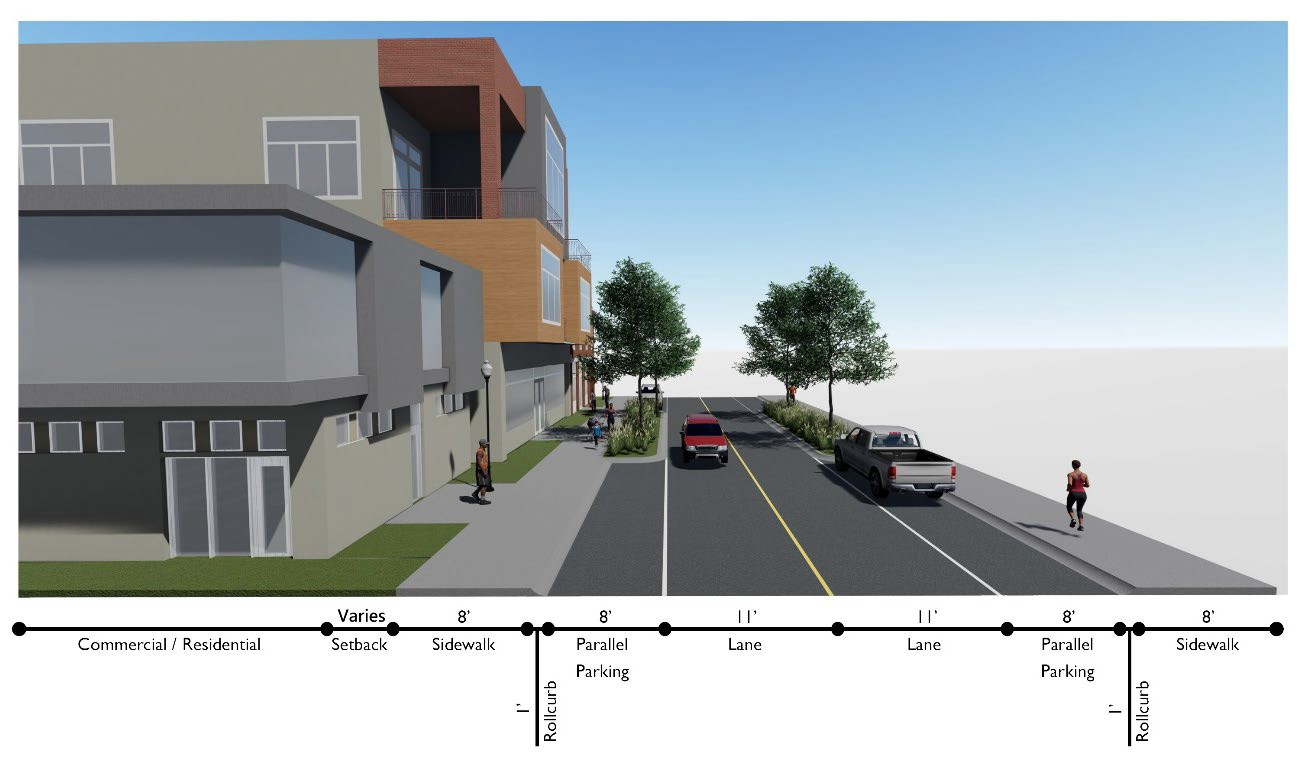
F.
Shared Street.
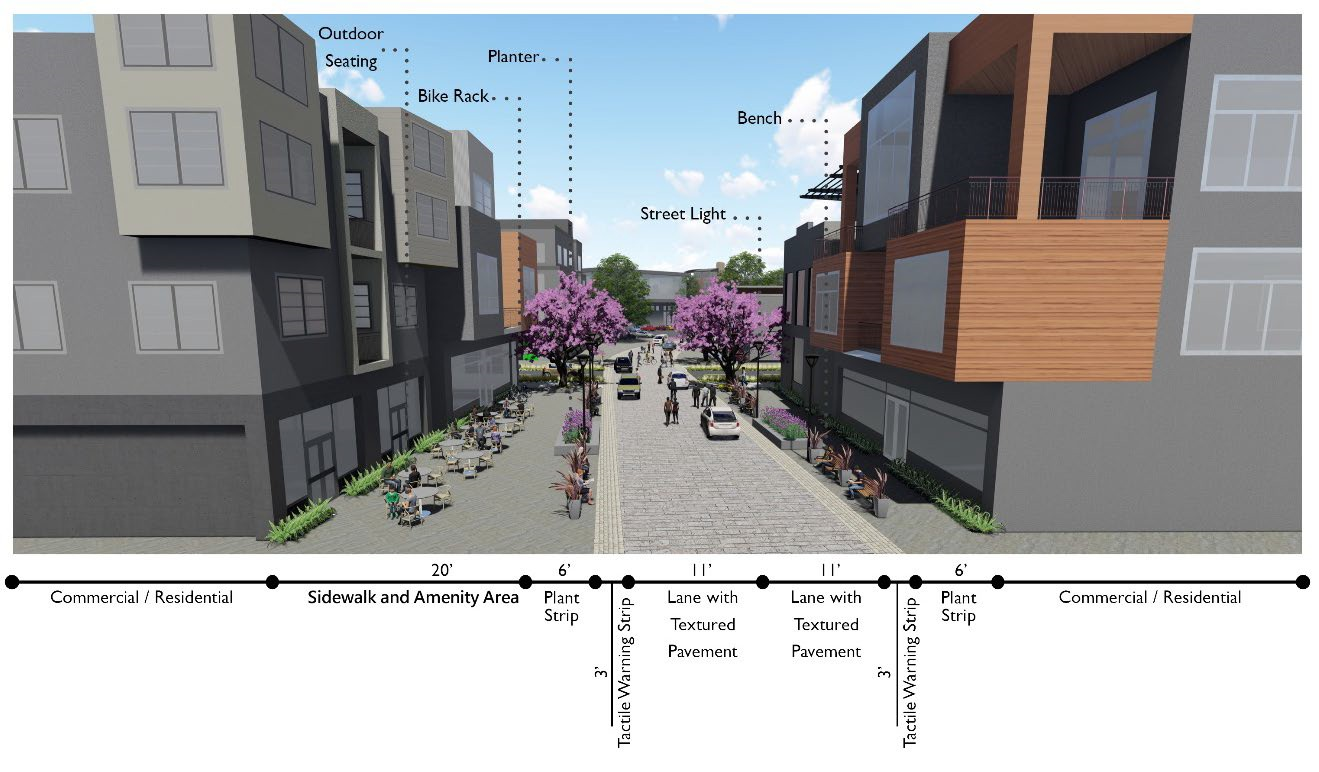
G.
Green Alley.
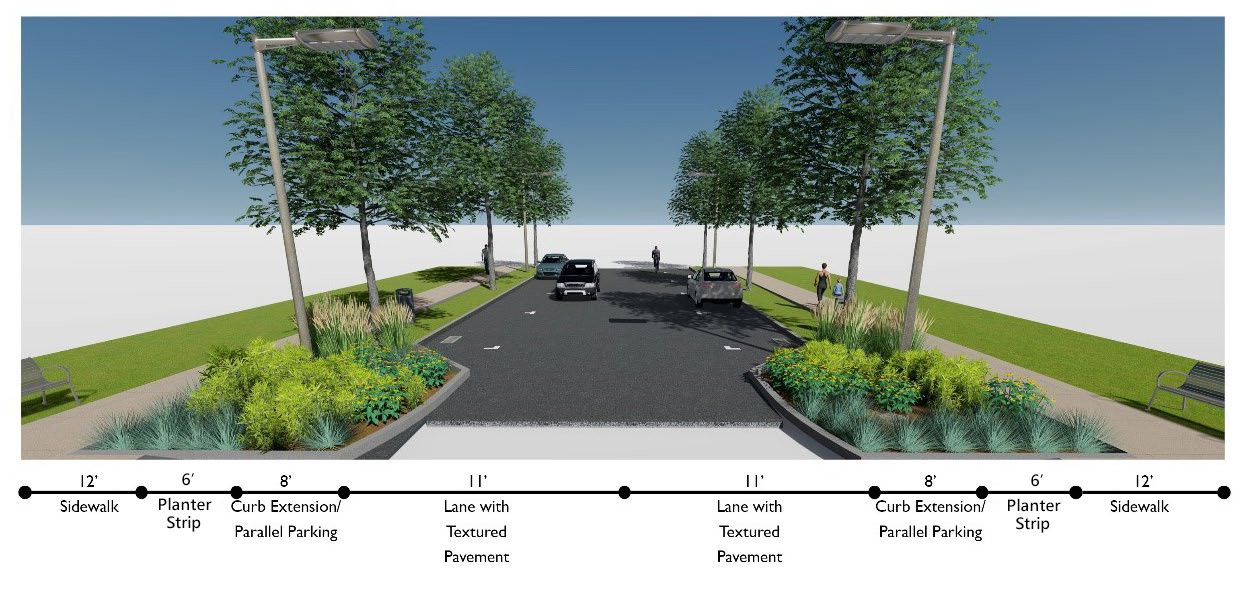
12A.3.3.3. On-street Parking. On-street parking on public or private streets must conform to the following:
A.
Parallel parking space shall have a minimum dimension of 8 feet by 20 feet.
B.
A bulb-out must be provided at the end of every four parallel parking spaces.
C.
Each bulb-out must include at least one overstory tree. Newly planted trees must be a minimum of 3½ inches in caliper and must be limbed up to a minimum of 10 feet.
D.
Trees must have a pervious planting area that is at least 6 feet wide by 10 feet long, 3 feet deep, and 1,800 cubic feet in soil volume. Tree grates are not allowed unless the Community Development Director determines that they will not negatively impact tree health.
12A.3.3.4. Streetscape.
A.
Existing streets that do not meet the street, parallel parking, planter, multi-paths and sidewalk standards of the Town Center Overlay must be brought into compliance with said standards along the site's frontage prior to the completion of a land disturbance permit or an issuance of a Certificate of Occupancy or a Certificate for Completion of a building permit.
B.
Alternative streetscape standards along an existing local street may be approved by the Public Works Director when one of the following conditions is met:
1.
The site has less than 100 feet of frontage along an existing local street;
2.
The site is along a block that is transitioning into more intense uses;
3.
Compliance with this section would result in a streetscape that extends 4 feet or greater beyond the existing right-of-way.
C.
On existing streets where there is insufficient right-of-way for the required streetscape and parking improvements, the right-of-way needed for such improvements shall be dedicated to the City. In lieu of the dedication, a public access easement may be provided to the City to meet the required improvements, subject to the approval of the Public Works Director.
D.
Where an easement is provided to the City and a parcel is zoned a Town Center Zoning District, the back of the minimum required sidewalk (adjacent to the lot) may be considered the lot line for the purpose of establishing yards, and shall not be counted towards the minimum lot size requirements for new lots.
E.
On streetscapes that are or will be within the public right-of-way, root barriers are required between the multi-use paths/sidewalks and any adjacent landscape strips or planters, subject to the approval of the Public Works Director.
F.
The City encourages the use of multi-functional runoff reduction measures in the streetscape, including bioretention areas, stormwater tree box, and planter box. The dimensional standards for planting area, tree spacing, planting type and utility placement may be varied to accommodate runoff reduction measures.
12A.3.3.5. Planter.
A.
Street trees must be planted in the planter as follows:
1.
Overstory trees must be planted in the planter in accordance with the spacing standards established in Section 12A.3.3.2. Newly planted trees shall be a minimum of 3½ inches in caliper, and must be limbed up to a minimum of 10 feet.
2.
Trees must have a pervious planting area that is at least 6 feet wide by 10 feet long, 3 feet deep, and 1,800 cubic feet in soil volume. Tree grates are not allowed unless the Community Development Director determines that they will not negatively impact tree health.
B.
Shrubs and landscaping must be planted in the planter as follows:
1.
Shrubs, groundcover, or mulch must be installed in the planter.
2.
When shrubs are installed in the planter and adjacent on-street parking exists, a hardscaped clear zone of at least 1 feet in width (measured from the face of curb) must be installed adjacent to the on-street parking. Additionally, a hardscape walking area at least 2 feet in width must be installed connecting the parking to the sidewalk.
3.
Shrubs may not exceed 36 inches in height.
C.
Pedestrian Lights. Pedestrian lights installed in the planter strip shall be at least 40 feet apart. Pedestrian light spacing may be increased by the Public Works Director along existing streets when trees, traffic control devices, or other existing conditions prevent the required spacing. The lighting standards and minimum foot-candle on the surface are subject to the approval of the Public Works Director.
12A.3.3.6. Pedestrian and Bicycle Circulation.
A.
Walkways. Walkways provide inter-parcel pedestrian and bicyclist travel between streets, parking areas, parking decks, required open spaces, and building entrances.
1.
Walkways must be provided from the closest public sidewalks or multi-use paths to all required pedestrian entrances.
2.
Walkways must be provided between all parking areas, parking decks, buildings, and open spaces on site.
3.
Required walkways must have a minimum width of 5 feet.
4.
Required walkways must be continuous (except at vehicular crossings) and constructed of concrete, brick, stone, or similar durable paver materials. Asphalt is not allowed.
B.
Water Restoration Area Activation. Development adjacent to the Water Restoration Area as defined in the Johns Creek Town Center Vision and Plan, shall provide:
1.
A minimum 10-foot public access connecting to a trail and/or the water feature.
a.
Public access may be in the form of landscaped walks, esplanades, boardwalks, or piers of suitable design to encourage active use by the public and shall be dedicated as such in the deed to the City.
b.
The location and design of public access are subject to the approval of the Community Development Director. When access along the waterfront would expose the public to hazardous conditions, the Community Development Director may consider alternative forms of access to be provided.
2.
A public entrance on the building façade that faces the water feature.
3.
Public access required in this section may be considered as open space, as referred in Section 12A.3.6.
C.
Other Regulations.
1.
Requirements of sidewalk and/or multi-use path along public right-of-way are listed in Section 12A.3.3.2. Street Types.
2.
Requirements of walkway connection from building entrance to public or private streets are listed in Section 12A.3.9. Building Type.
12A.3.3.7. Street Furniture. Street furniture in the public rights-of-way shall follow the City's Town Center Street Furniture Design Guidelines, subject to the approval of the Public Works Director.
12A.3.4. Parking and Loading.
12A.3.4.1. Vehicle Parking.
A.
Every use must provide and maintain vehicular parking in accordance with the Vehicular Parking Requirement Table below.
B.
Shared Parking. Refer to Section 18.2.2. of the Zoning Ordinance for regulations.
C.
Where on-street parking spaces exist in the public right-of-way, one on-street parking space may be substituted for every required parking space, provided:
1.
The on-street parking space immediately abuts the subject property.
2.
Each on-street parking space may only be counted for one property. Where a space straddles an extension of a property line, the space may only be counted by the owner whose property abuts 50% or more of the on-street parking space.
3.
The Community Development Director, in consultation with the Public Works Director, may determine that to ensure future roadway capacity or other public purposes, the on-street parking credit may not be available.
D.
When a use provides more than 110% of the minimum number of spaces required, any additional spaces in a surface parking lot must be constructed of pervious paving materials, unless a parking structure is provided. For the purpose of conforming to this requirement, any on-street spaces or off-street spaces in parking structures must be counted towards satisfying the minimum requirement.
E.
To encourage efficient land use and shared parking, the impervious area of surface parking stalls shall not exceed the surface area of the building they serve in the TC-X Zoning District.
12A.3.4.2. Vehicle Parking In-Lieu Fee and Special Exception.
A.
The Community Development Director may authorize vehicular parking requirements to be satisfied through payment of parking in-lieu fees according to the following fee schedule:
B.
Applications to use parking in-lieu fees must be made to the Community Development Director. The Director may approve the request, reject the request, or approve a lesser number of in-lieu parking stalls than requested. The Director must consider the following in reviewing an application for parking in-lieu:
1.
The availability of parking in the Town Center Overlay;
2.
The availability of alternative transportation in the Town Center Overlay;
3.
The impact on the public health, safety, and general welfare; and
4.
Other considerations deemed material to the application by the Community Development Director.
C.
Following approval of a parking in-lieu fee application, the fee must be paid in a lump sum either:
1.
Prior to the issuance of a land disturbance permit or building permit;
2.
Prior to the issuance of a business license for the use for which the parking is required, if no land disturbance permit or building permit is required.
D.
When parking in-lieu fees are utilized, the following apply if the use is changed or discontinued:
1.
If a use is enlarged or replaced by a use that requires more parking, the additional parking requirement must be met by paying additional parking in-lieu fees.
2.
If a use is reduced in area, or wholly or partially becomes vacant, or is replaced by a use that requires less parking, no additional parking in-lieu fees are required.
3.
If a use is discontinued, the property owner may count its parking in-lieu fee spaces towards meeting the requirement of new uses built on-site.
4.
A change of ownership or the dividing or merging of lots will not affect parking in-lieu fees or any determination that parking requirements have been met according to fees paid for a particular use, except when the change of ownership results in one of the conditions identified in subsections 1 through 3 immediately above.
E.
Special Exception. Pursuant to Section 22.4. of the Zoning Ordinance, the Community Development Director may grant an administrative variance to reduce up to 10% of required parking, when some or all of the required on-site parking is not provided and said requirement is not otherwise fully or partially satisfied through the payment of parking in-lieu fees. The Board of Zoning Appeals may grant a variance to reduce up to 15% of required parking.
12A.3.4.3. Bicycle Parking.
A.
Facilities that provide or require 25 or more vehicle parking spaces must provide a minimum of one bicycle parking space, plus 1 space for each additional 25 provided vehicle parking spaces, provided that no site may have fewer than 3 spaces nor be required to exceed 20 bicycle spaces.
B.
Bicycle parking facilities must comply with the following provisions.
1.
Each required bicycle parking space must be at least 2 feet by 6 feet. Where a bike can be locked on both sides of a bicycle rack without conflict, each side can be counted as a required space.
2.
Bicycle racks must be securely anchored, be easily usable with both U-locks and cable locks, and support a bicycle at 2 points of contact to prevent damage to the bicycle wheels and frame.
3.
Bicycle parking must be provided in a well-lit area.
4.
Spacing of the bicycle racks must provide clear and maneuverable access.
5.
Bicycle parking may be placed within the public right-of-way, provided the encroachment is approved by the Public Works Director.
6.
Bicycle parking spaces must be as close as or closer than the nearest vehicle parking space (as measured along a pedestrian sidewalk from the door of the use the parking serves).
12A.3.4.4. Electric Vehicle Parking.
A.
All developments requiring 50 or more vehicle parking spaces shall provide electric vehicle charging stations. One electric vehicle charging station for every 50 required vehicle parking spaces shall be provided. Electric vehicle charging station can be counted toward satisfying the parking requirements in Section 12A.3.4.1.
B.
Electric vehicle parking facilities must comply with the following provisions:
1.
Electric vehicle charging stations must be posted with signage indicating that the space is reserved for charging electric vehicles. For purposes of this provision, "charging" means that an electric vehicle is parked at an electric vehicle charging station and is connected to the battery charging station equipment.
2.
Vehicle charging equipment must be designed and located so as not to impede pedestrian, bicycle or wheelchair movement or create safety hazards on sidewalks.
3.
Information must be posted identifying voltage and amperage levels and any type of use, fees, or safety information related to the electric vehicle charging station.
4.
Electric vehicle charging stations must be maintained in all respects, including the functioning of the equipment. A phone number or other contact information must be provided on the equipment for reporting when it is not functioning or other problems are encountered.
5.
Electric vehicle charging stations shall not be provided for on-street parking spaces.
12A.3.4.5. Driveways.
A.
Applicability. The following applies to driveways, including those serving alleys, but not to new streets in conformance with Section 12A.3.3.
B.
Width. Unless approved by the Public Works Director or required by the Georgia Department of Transportation along Medlock Bridge Road, the maximum width of curb cuts, not including flares or returns at the throat of the facility, for entrances, exits, service drives and similar facilities, shall be 24 feet for two-lane entrances and 14 feet for one-lane entrances.
C.
Spacing. Driveways must be spaced as follows:
1.
Along arterial streets, driveways must be at least 400 feet apart.
2.
Along collector streets, driveways must be at least 200 feet apart.
3.
Along local streets, driveway must be at least 150 feet apart.
D.
Number. The maximum number of driveways allowed on a site shall not exceed an amount equal to one driveway for every 300 feet of total street frontage or fraction thereof, as approved by the Public Works Director. All parcels are permitted at least one driveway.
E.
Location. Driveways may not be located on an arterial street when access is available from a collector or local street, unless approved by the Public Works Director.
12A.3.4.6. Design and Location for Surface Parking.
A.
Location. No off-street parking may be located between a building and the closest street unless an intervening approved building type exists.
B.
Design.
1.
Off-street parking shall meet the requirement in Section 18.4. of the Zoning Ordinance.
2.
Parking lots (except for single-family residential) shall provide a minimum 10-foot-wide landscape island at the end of each parking bay and every 8th parking space.
a.
Each landscape island shall be planted with one shade tree. Islands shall be excavated to 3 feet deep or to a depth 6 inches greater than the height of the root ball and backfilled with a minimum of 600 cubic feet of friable soil.
b.
Parking lot trees must have a minimum caliper of 3½ inches and be at least 10 feet tall at time of planting. The remainder of a landscape island shall be planted with shrubs, ornamental grass, and ground cover; and mulch shall be applied. Turf grass will not be accepted. The trees shall be maintained in accordance with best management practices as defined by the International Society of Arboriculture guidelines, and shall not be removed or pruned without permission from the City.
c.
Utilities and lighting shall not be allowed within required parking lot landscape islands.
3.
Landscaped areas within the interior of the parking area may be designed as bioretention areas, using inwardly draining swales without curbs, in lieu of raised planting areas surrounded by curbs, provided that each parking space provides a wheel stop and provided that depressed areas adjacent to driving aisles are surrounded by painted lines or flush curbing to separate landscaping from driving aisles.
4.
Landscape design and material selection may incorporate practices of water conservation. Use of native materials is encouraged. Plant materials should be arranged so that plants that require similar amounts of irrigation are placed together wherever possible.
5.
Alternate landscape configurations may be approved if the Community Development Director determines that the alternate design exceeds the standards above and/or is part of a smart stormwater design for the site that includes multi-functional, vegetated runoff reduction measures. An alternate configuration could also include a stormwater component or the preservation and enhancement of existing trees which are provided above and beyond other tree preservation requirements, which are deemed of community value by the Community Development Director.
C.
Off-street parking for the following must be accessed from alleys:
1.
Townhouses on lots of any width.
2.
All other building types on lots less than 50 feet in width.
D.
Each residential dwelling unit shall have a minimum 18' long and 10' wide paved driveway, as measured from the garage to the back of sidewalk, or back of curb where a sidewalk is not provided. This shall not apply to residential dwelling units in mixed-use buildings or live-work buildings.
12A.3.4.7. Design and Location for Parking Structures.
A.
When the required number of parking spaces is greater than 500, the development shall incorporate parking structure(s).
B.
Where any portions of structured parking are adjacent to or visible from any street, Creekside Pond, water restoration area or linear park, they must be screened so that cars and ramps are not clearly visible from ground level view from the adjacent parcel or adjacent street.
1.
Evergreen trees, vines, and landscaping that is physically attached to the parking structure; or
2.
A façade having the appearance of a horizontal storied building; or
3.
A combination of subsections 1 and 2 immediately above.
C.
Structured parking facades adjacent to or visible from any street must have the appearance of a horizontal storied building.
D.
Structured parking should be designed to minimize the impact at the street level. These structures should be placed behind buildings if possible. Where that is not possible, the structure must be recessed a minimum distance of 20 feet behind the front building façade.
E.
Parking structures cannot be taller than the adjacent primary building(s).
12A.3.4.8. Design and Location for Loading Areas.
A.
On-site loading space is not required.
B.
Loading areas shall be placed in the least visible location from public streets.
C.
Loading areas must not be placed between a building and single-family residential development, Creekside Pond, water restoration area or linear park.
D.
Screening. All loading areas must meet the following:
1.
The entire length of the loading area must be screened.
2.
Screening must consist of either:
a.
An 8-foot high wall compatible with the principal building in terms of texture, quality, material and color; or
b.
Evergreen plant material that can be expected to reach a height of 8 feet with a spread of 4 feet within 3 years of planting. The plant material must be a minimum 5 feet in height at time of planting.
3.
The entrance to the loading area from streets shall be enclosed with a self-closing gate with an architectural finish.
12A.3.5. Landscaping and Screening.
12A.3.5.1. Applicability. This Section applies to:
A.
New development/construction;
B.
Existing developed sites when more than 25% cumulatively of the site area is disturbed; or
C.
Existing buildings that are expanded:
1.
When an existing building is increased in gross floor area by up to 25% cumulatively, landscaping and screening is required for the expansion area only.
2.
When an existing building is increased in gross floor area by more than 25% cumulatively, the entire site must conform to standards in this Section.
12A.3.5.2. Landscape Strip.
A.
A 10-foot landscape strip shall be provided along all public right-of-way and private streets, measured from the right-of-way.
B.
No permanent structures other than signage are permitted within the landscape strip. This includes retaining walls, drainage structures, detention ponds, flumes, curbing, dumpsters, etc., unless approved by the Community Development Director. Retaining walls built with decorative masonry and designed as a landscape feature may be located within the landscape strip subject to approval by the Community Development Director. All required plantings must be installed so as not to interfere with the structural integrity of the wall.
C.
Landscape strips shall be planted in compliance with the City's Tree Preservation and Administrative Guidelines. All species within required landscape strips must be ecologically compatible with the intended growing site.
D.
Required trees shall be planted between mid-October and the end of February. The survival of trees planted outside of that time period shall be guaranteed by a maintenance cash bond with the Community Development Department. Funds may be placed in escrow in lieu of planting pending the desirable planting season. The total amount deposited shall include the purchase, transport and installation of plant materials.
E.
Trees planted to meet the landscape strip standards must be maintained in good health for a minimum of 3 full growing seasons.
F.
Shrubs shall be installed at a minimum size of 3 gallons. Shrubs located in landscape strips may be used to meet the parking lot screening requirement.
12A.3.5.3. Parking Lot Landscaping. All surface parking areas abutting a street, single-family residential development, Creekside Pond or the linear park must be screened using one of the following options:
A.
Landscape Strip with Shrubs. A minimum 10-foot-wide landscape strip planted with a double row of shrubs at least 2 feet tall at time of planting, with a maximum spacing of 3.5 feet on center, and shall provide a minimum height of 2.5 feet within 2 years of planting.
B.
Landscape Strip with a Wall.
1.
A 2.5-foot-high wall in a minimum 4-foot landscape strip.
2.
Walls must be close to the parking lot in order to provide a minimum 2-foot landscaped area facing out.
3.
Walls must be closed and be constructed of one or a combination of the following: decorative blocks; brick; stone; or cast-stone.
C.
Landscape Strip with a Berm.
1.
An earthen berm a minimum of 2.5 feet higher than the finished grade of the parking area, planted with 5 shrubs for every 35 linear feet of street frontage, excluding driveway openings.
2.
The berm must contain a rounded crown suitable for planting, and a stabilized side slope of no greater than 3:1.
12A.3.5.4. Foundation Planting. All building foundations facing a public street must conform to these standards, except as provided for in subsection C immediately below:
A.
Foundations must be screened with continuous evergreen or semi-evergreen shrubs.
B.
At the time of installation, the screening must be at least 1 foot in height and reach a height of 3 feet within 3 years of planting.
C.
Foundation plantings are not required adjacent to ground floor commercial fenestration when said plantings would obstruct views into commercial establishments.
12A.3.5.5. Service Areas.
A.
Trash and recycling collection and other similar service areas must be located to the side or rear of buildings and may not between a building and the street, Creekside Pond, or the linear park.
B.
Service areas must be screened on 3 sides by a wall a minimum 6 feet in height and on the 4th side by a solid gate at a minimum of 6 feet in height.
C.
The wall must be opaque and be constructed of one or a combination of the following: decorative blocks; brick; stone; or cast-stone.
D.
The gate must be self-locking and maintained in good working order.
12A.3.5.6. Roof-Mounted Equipment.
A.
Roof-mounted equipment must be set back at least 10 feet from the edge of the roof and screened from ground level view from abutting parcel or abutting street (not including an alley), single-family residential development, Creekside Pond, or the linear park.
B.
New buildings must provide a parapet wall or other architectural element that is compatible with the principal building in terms of texture, quality, material, and color that fully screens roof-mounted equipment from ground level view.
C.
For buildings with no or low parapet walls, roof mounted equipment must be screened on all sides by an opaque screen compatible with the principal building in terms of texture, quality, material, and color.
12A.3.5.7. Wall-Mounted Equipment.
A.
Wall-mounted equipment located on any surface that is visible from a street (not including an alley), single-family residential development, Creekside Pond, or linear park must be fully screened by landscaping or an opaque wall that is compatible with the principal building in terms of texture, quality, material, and color.
B.
Screening must be of a height equal to or greater than the height of the mechanical equipment being screened.
12A.3.5.8. Ground-Mounted Equipment.
A.
Ground-mounted mechanical equipment that is visible from a street (not including an alley), single-family residential development, Creekside Pond, or the linear park must be fully screened by landscaping or an opaque wall that is compatible with the principal building in terms of texture, quality, material and color. Transformers along the public rights-of-way without adequate clearance per the power company requirement shall be exempted.
B.
Screening must be of a height equal to or greater than the height of the mechanical equipment being screened.
12A.3.5.9. Design and Installation.
A.
Plant Material.
1.
Required trees must meet the standards in the City's Tree Preservation Ordinance and Administrative Guidelines. All overstory trees shall have a trunk of not less than two caliper inches, and all understory trees shall have a trunk not less than one caliper inch.
2.
Required shrubs shall be installed at a minimum size of 3 gallons at time of planting. 70% of the required amount of shrubs must be evergreen.
3.
Plant materials must be hardy to Zone 7b in accordance with the U.S. Department of Agriculture's Plant Hardiness Zone Map.
4.
Plant materials must be able to survive on natural rainfall once established with no loss of health. However, irrigation may be provided as the option of the property owner.
5.
No artificial plants, trees, or other vegetation may be installed as required landscaping and screening.
B.
Fences.
1.
Fencing materials are restricted to brick, stone, iron, decorative wrought iron, black aluminum, and treated wood, and or combinations of the above not resulting in an opaque fence. Barbed wire, razor wire, chain-link fence, and similar elements are prohibited.
2.
Fence height shall not exceed 4 feet in the front yard or along public streets, and 8 feet in the side or rear yard.
12A.3.5.10. Maintenance.
A.
Responsibility. The property owner is responsible for maintaining all required landscaping and screening in good health and condition. Any dead, unhealthy, damaged or missing landscaping and screening must be replaced with landscaping and screening that conforms to this Section within 90 days (or within 180 days where weather concerns would jeopardize the health of plant materials) as approved by the Community Development Director.
B.
Soil Erosion.
1.
All planting areas must be stabilized from soil erosion immediately upon planting and must be maintained for the duration of the use.
2.
Grass areas must be sodded. If grass seed must be used, it must be a variety that may be reasonably expected to produce full coverage of the area.
C.
Pruning and Trimming.
1.
All required landscaping must be allowed to reach its required size and must be maintained at no less than required size.
2.
To prevent long-term harm to the health of required landscaping, all pruning of trees and shrubs must be done in accordance with the International Society of Arboriculture Standards entitled "ANSI A300 Standards."
3.
"Topping," defined as removal of more than one-third of the leaves and branches of a tree, as measured from the lowest branch on the trunk of the tree to the top of the tree, is prohibited, except where necessary to maintain public overhead utilities.
12A.3.6. Open Space.
12A.3.6.1. Minimum Requirement.
A.
New developments shall provide civic space and amenity space in accordance with the table below:
New development with a mix of residential and non-residential uses shall meet the residential requirements.
B.
Open space requirement may be met using existing and/or new open space, subject to approval of the Community Development Director.
C.
Open space may be privately or publicly owned. Private open space is open space that is owned by a corporation, individual, or homeowners association. Public open space is open space owned by a governmental agency.
D.
Portions of open space in non-residential development shall be open to the public.
E.
Wetlands, lakes, streams, flood zones, and stream buffers may be considered open space, subject to the approval of the Community Development Director.
F.
Stormwater management facilities for the site may be used to satisfy open space requirements if they meet this Article's definition of open space. Open space credit may be given at the discretion of the Community Development Director.
G.
No areas used for vehicles, except for incidental service, maintenance, or emergency actions, may be used to satisfy open space requirements.
12A.3.7. Tree Protection. All properties within the Town Center Overlay shall comply with the City's Tree Preservation Ordinance and Administrative Guidelines, as well as the following standards:
A.
No more than 25% of any one genus may be included in any landscaping plan.
B.
A minimum of 40% of the required tree density on a site shall be met through overstory tree planting.
C.
Greater than 50% of the trees shall be natives.
12A.3.8. EcoMeasurement.
12A.3.8.1. Applicability. Eco-friendly and sustainable design measures must be incorporated into all new development in accordance with the following minimum point values based on project magnitude. Measures only count if they are part of the new development application; measures already in place at the time of application do not count.
A.
2 Points Minimum. Any development project that either increases the gross floor area of an existing building footprint by 30% or more; or replaces, renovates, or reconfigures 60% or more of the total site parking area (inclusive of required parking lot landscaping areas), must earn a minimum of 2 points in accordance with this Section.
B.
5 Points Minimum. Any development project that increases an existing building footprint by 60% or more of gross building area must earn a minimum of 5 points in accordance with this Section.
C.
7 points Minimum. Any development project that involves the complete renovation of all existing buildings or the construction of any new buildings must earn a minimum of 7 points in accordance with this Section.
D.
10 points Minimum. Any development project that involves rezoning and/or special use permit must earn a minimum of 10 points in accordance with this Section.
12A.3.8.2. Calculation and Evaluation.
A.
Minimum Points. All point values must be awarded based on meeting the minimum requirements of each EcoMeasurement, as indicated in Section 12A.3.8.3. The sum of all assigned values must meet the minimum point requirement per project. No partial points will be accepted.
B.
Documentation, Review and Approval. Documentation of the measures and total number of points the applicant will achieve must be submitted with the applicable permit application submitted to the City and must be approved by City staff.
12A.3.8.3. Measures and Requirements.
A.
Certified LEED Green Buildings Measure (3 to 5 points).
1.
Minimum Requirement. Certify a new construction building or building undergoing major renovations through a green building rating system, such as the LEED certification system created by the United States Green Building Council (USGBC), requiring review by an independent, third-party certifying body and approved by the Community Development Director. Points shall be awarded as follows:
a.
Silver by a USGBC green program or equivalent: 3 points.
b.
Gold by a USGBC green program or equivalent: 4 points.
c.
Platinum by a USGBC green program or equivalent: 5 points.
The score may include measures otherwise allowed by this section, however, no measure included as part of a certified green building may also be awarded points as a stand-alone measure.
When a green building rating system equivalent to a USGBC green program is utilized, the applicant shall submit third-party documentation demonstrating how the measure is equivalent to the indicated LEED certification level.
2.
Documentation. Required documentation includes registration of the project with the system, payment of all applicable fees for the rating system, and a draft scorecard showing the achieved credits or points.
B.
Green Roof Measure (3 points).
1.
Minimum Requirements. Install a vegetated roof for at least 50% of the total new building roof area.
2.
Documentation. Required documentation includes roof construction plans with drainage and planting details.
C.
Building Energy Efficiency Measure (2 points).
1.
Minimum Requirements.
a.
New Construction Buildings. Newly constructed buildings must demonstrate an average 10% improvement over the 2015 International Energy Conservation Code, in Total Building Performance (§C407), or 20% in Building Thermal Envelope requirements (§C402).
b.
Major Renovation. The building must demonstrate an average 5% improvement over the 2015 International Energy Conservation Code, in Total Building Performance (§C407), or 10% in Building Thermal Envelope requirements (§C402), as amended by the State of Georgia.
2.
Documentation. Required documentation includes an energy model demonstrating that the building(s) will achieve the proposed improvements.
D.
Building Water Efficiency Measure (2 points).
1.
Minimum Requirements. Indoor water use in new buildings and major renovations must be an average 15% less than in baseline buildings. Baseline water usage shall be determined based on eco-friendly plumbing fixtures, rainwater reclamation programs, dual plumbing waste system to irrigate exterior landscapes with greywater and collected rainwater, and alternative programs by the United States Department of Energy or similar methods approved by the Community Development Director.
2.
Documentation. Required documentation includes cut sheets for all water fixtures.
E.
Renewable Energy Sources Measure (3 points).
1.
Minimum Requirements. Incorporate renewable energy generation on-site with a production capacity of at least 5% of the building's annual electric and thermal energy, established through an accepted building energy performance simulation tool.
2.
The following renewable energy generation sources are applicable:
a.
Solar thermal or photovoltaics.
b.
Geothermal.
c.
Wind energy conversion.
d.
Anaerobic digestion.
e.
Other means of generating electricity without using a fuel, such as kinetic, heat exchange, approved by the Community Development Director.
3.
Documentation. Required documentation includes specifications and construction details for the system installation.
F.
Bioretention (2 points).
1.
Minimum Requirement.
a.
Provide landscaped bioretention areas in the interior of the parking lots, in streetscape planters, and on-street parking landscaping that meets the minimum 1" runoff reduction standard;
b.
Incorporate inwardly draining swales without curbs, or with adequate curb cuts, in lieu of raised planting areas surrounded by curbs;
c.
Landscape bioretention areas with species tolerant to frequent inundation;
d.
Provided wheel stops adjacent to parking and flush or permeable curbing adjacent to driving areas.
2.
Documentation. Required documentation includes plans and detail specifications of planting areas and a hydraulic study demonstrating infiltration capacity.
G.
Heat Island Reduction Measure (2 points).
1.
Minimum Requirements. Use any combination of the following strategies for 35% of all on-site, non-roof hardscape areas, including sidewalks, plazas, courtyards, parking lots, parking structures, and driveways.
a.
Tree Canopy Cover. Coverage of the surface at canopy tree maturity in 15 years.
b.
Solar reflective paving and roofing with a SRI (solar reflectance index) of at least 29.
2.
Documentation. Required documentation includes plans and specifications for installation of the strategy.
H.
Pervious Pavement Measure (2 points).
1.
Minimum Requirements. Install an open grid or pervious pavement system that is at least 40% pervious on 80% of all hardscape surface areas, including sidewalks, plazas, courtyards, parking lots, and driveways.
2.
Documentation. Required documentation includes plans and specifications for installation.
I.
Connected Open Space (2 points).
1.
Minimum Requirements. Provision of all of the following:
a.
All required open space within an interconnected network with no width dimension less than 40 feet;
b.
Required open spaces may extend across public and private streets and multi-use trails, but street area may not be counted towards open space;
c.
All required open space provided at ground level;
d.
Minimum size of 2 acres, excluding any consolidated open space in "J" below.
2.
Documentation. Required documentation includes plans showing open spaces.
J.
Consolidated Open Space (3 points).
1.
Minimum Requirements. Provision of all of the following:
a.
All required open space in a one contiguous area with no width dimension of less than 100 feet;
b.
Required open spaces may not extend across public or private streets;
c.
All required open space provided at ground level;
d.
Minimum size of 2 acres.
2.
Documentation. Required documentation includes plans showing open spaces.
K.
Sustainable Landscaping Measure (1 point). Conform to both of the following minimum requirements:
1.
Minimum Requirement 1. Reduce potable water used for landscape irrigation by 50% from a calculated midsummer baseline case by using either one of the following methods:
a.
Utilizing all xeriscape plant materials and providing no permanent irrigation system;
b.
Using only captured rainwater with an irrigation system.
2.
Minimum Requirement 2. Exclusion of any plant species listed on the Georgia Exotic Pest Plant Council Invasive Species List from project planting plans.
3.
Documentation. Required documentation includes a landscape plan, irrigation plan, a list of proposed species, and an affidavit from a certified Landscape Architect that no species identified in subsection 2 immediately above will be planted.
L.
Additional Landscaped Civic Space Measure (1 to 5 points).
1.
Minimum Requirement. Provision of additional landscaped civic space or a multi-use trail over the amount required by this overlay or the underlying district, whichever is greater. Additional civic space must be landscaped with lawns, ground cover, shrubs, or woodlands and may not be paved or otherwise impervious except for paths and trails. One point shall be available for each one additional percent of gross acreage provided as civic space, up to five total points for this measure.
2.
Documentation. Required documentation includes site and/or building plans locating the additional open space.
M.
Transportation Demand Management (2 to 3 points).
1.
Minimum Requirement. Provision of three of the following shall be awarded two points and provision of four or more of the following shall be awarded three points:
a.
Flex-time work schedules by employers to reduce congestion at peak times.
b.
Provision of building or project bicycle rentals for use by any occupant.
c.
Free ride home in case of emergency or sickness for employees using transit.
d.
Provision of transit passes to building occupants for a period of 2 or more years.
e.
Other tools that encourage transit and bicycle use, or reduce personal vehicular traffic may be approved by the Community Development Director.
2.
Documentation. Required documentation includes a written narrative of the tools to be provided and any other documentation required by the Community Development Director.
N.
Enhanced Bicycle Amenities Measure (1 to 2 points).
1.
Minimum Requirements. Provision of two of the following shall be awarded one point and provision of three or more of the following shall be awarded two points:
a.
Lockable enclosed bicycle storage. Provide one secure, enclosed bicycle storage space per 25 employees.
b.
For office or commercial space, employee shower facilities. Provide a minimum of one shower facility plus one additional shower per 150 employees.
c.
Repair Center. Provide a designated bicycle repair center open to the public and consisting of an air pump, water, and tools at a minimum.
d.
Bicycle parking spaces. Provide at least 200% of the bicycle parking requirements of Section 12A.3.4.3.
e.
Bicycle paths.
f.
Bicycle rental stations.
2.
Documentation. Required documentation includes site and/or building plans locating the measures included.
O.
Alternative Transportation Measure (1 point).
1.
Minimum requirement. Provisions of the following:
a.
Ride-Sharing. Provide at least one on- or off-street pickup/drop-off zone per 100 new or added vehicular parking spaces for the exclusive use of passengers arriving by taxi, ridesharing, or shuttle. No project using this measure shall have less than one such space.
b.
Van Pools. Provide at least one van pool space per 200 new or added vehicular parking spaces.
P.
Alternative Measure (1 to 3 points). The applicant may submit an alternative EcoMeasurement for review and recommendation by the Community Development Director.
1.
Minimum Requirements. The measure must be unrelated to any of the other measures defined in this Section. Based upon their review, the Community Development Director must determine for the number of points to be awarded.
2.
Documentation. Required documentation must clearly illustrate that the project will achieve the measure.
12A.3.9. Building Type. Within the Town Center Overlay, building types are used to regulate the design of buildings, and a building's type is determined by the Community Development Director. Within the Town Center Zoning District, building types are subject to the additional requirements of the applicable zoning district. Note that these building types are for zoning purposes only, and not linked to the Building Code. Freestanding parking structures are not considered to be a building type.
12A.3.9.1. Detached House. A building type that accommodates one dwelling unit on an individual lot with yards on all sides. Not intended for non-residential uses.
12A.3.9.2. Cottage Court. A building type designed to accommodate 5 to 10 detached dwelling units organized around a shared internal courtyard. Units cannot be vertically mixed.
12A.3.9.3. Duplex. A building type that accommodates two dwelling units arranged either horizontally or vertically. Not intended for non-residential uses.
12A.3.9.4. Townhouse. A building type that accommodates 3 or more dwelling units where each unit is separated by a common side wall. Units cannot be vertically mixed.
12A.3.9.5. Walk-up Flat. A building type that accommodates 3 to 8 dwelling units vertically and horizontally integrated.
12A.3.9.6. Stacked Flat. A building type that accommodates 9 or more dwelling units vertically and horizontally integrated.
12A.3.9.7. Shopfront. A single-story building type that typically accommodates single-use retail or commercial activity.
12A.3.9.8. Mixed-Use Building. A multi-story building type that typically accommodates ground-story retail, office, or commercial uses with upper-story residential or office uses. Not for ground-story street-facing residential uses along arterial or collector streets.
12A.3.9.9. General Building. A multi-story building type that typically accommodates non-residential uses such as industrial, hotel, or office uses on all stories.
12A.3.9.10. Civic Building. A building type that accommodates civic uses. Not intended for commercial, retail, office, or residential uses.
12A.3.9.11. Live-Work Building. A mixed-use building type that consists of a commercial and residential use.
12A.3.10. Building Design.
12A.3.10.1. Applicability. This Section applies to all new buildings, additions to existing buildings, and any change to a building façade except for maintenance and repairs.
12A.3.10.2. Fenestration.
A.
Fenestration is the minimum percentage of window and door glass that must cover a facade.
B.
Fenestration is measured from the top of the finished floor to the top of the finished floor above. When there is no floor above, fenestration is measured from the top of the finished floor to the top of the wall plate.
C.
Glass used to satisfy fenestration requirements must be unpainted, must have a transparency (visible light transmission) higher than 70%, and must have an external reflectance of less than 15%. Transparency and external light reflectance must be established using the manufacturer's specifications.
D.
No more than 25% of the fenestration can be covered with window signs, tinting, 'back of house' operations, or any use that the Community Development Director determines is substantially similar.
12A.3.10.3. Building Elements The following standards are intended to ensure that certain building elements that when added to a street-facing facade are of sufficient size to be both usable and functional and be architecturally compatible with the building they are attached to.
A.
Front Porch. A raised structure attached to a building, forming a covered pedestrian entrance to a doorway.
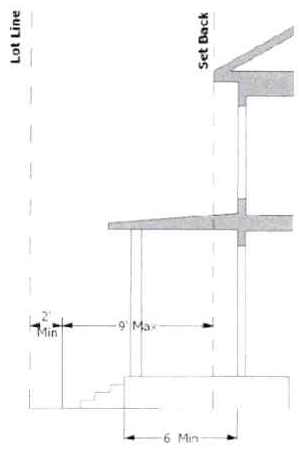
1.
A front porch must be at least 6 feet deep (not including the steps).
2.
A front porch must be contiguous, with a width not less than 33% of the building facade from which it projects.
3.
A front porch must be roofed, but cannot be fully enclosed.
4.
A front porch may extend up to 9 feet, including the steps, into a required front setback, provided that such extension is at least 2 feet from the vertical plane of any lot line.
5.
A front porch must not encroach into the public right-of-way or required sidewalk.
6.
Steps leading to front porches must have enclosed risers.
7.
Front porch columns must be a minimum width of 8 inches.
B.
Stoop. A small raised platform that serves as a pedestrian entrance to a building.
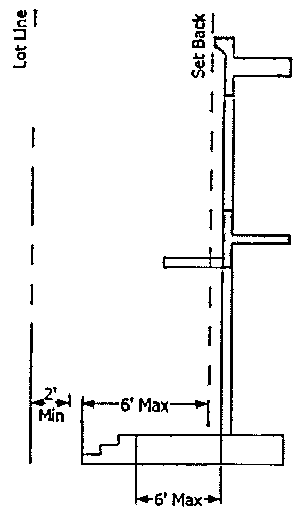
1.
A stoop must be no more than 6 feet deep (not including the steps).
2.
A stoop may be covered, but cannot be fully enclosed.
3.
A stoop may extend up to 6 feet, including the steps, into a required setback, provided that such extension is at least 2 feet from the vertical plane of any lot line.
4.
A stoop must not encroach into the public right-of-way or required sidewalk.
5.
Steps leading to stoops must have enclosed risers.
6.
Stoop columns, where provided, must be a minimum width of 8 inches.
C.
Balcony. A platform projecting from the wall of an upper-story of a building with a railing along its outer edge, often with access from a door or window.
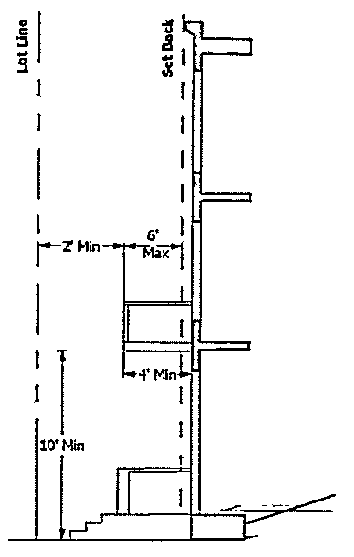
1.
A balcony must be at least 4 feet deep and may extend up to 6 feet into a required setback, provided that such extension is at least 2 feet from the vertical plane of any lot line.
2.
A balcony must have a clear height above the sidewalk of at least 10 feet.
3.
A balcony may be covered, but cannot be fully enclosed.
4.
A balcony may encroach up to 6 feet into the public right-of-way or required sidewalk but must be at least 2 feet inside the curb line or edge of pavement, whichever is greater.
D.
Awning/Canopy. A wall-mounted, cantilevered structure providing shade and cover from the weather for a sidewalk.
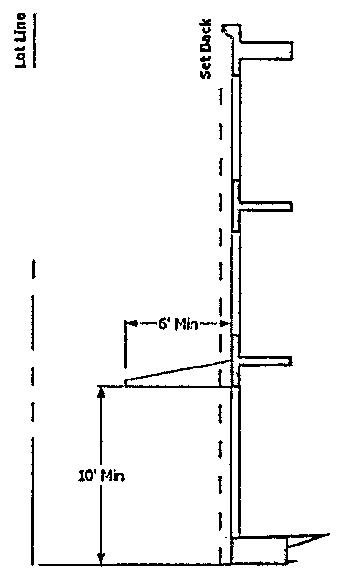
1.
An awning must be a minimum of 10 feet clear height above the sidewalk and must have a minimum depth of 5 feet, and a minimum depth of 3 feet for retail and restaurant uses.
2.
An awning may extend into a required setback.
3.
An awning may encroach up to 9 feet into the public right-of-way or required sidewalk but must be at least 2 feet inside the curb line or edge of pavement, whichever is greater.
4.
Awnings must have open ends called "shed awnings" to allow views into buildings.
5.
Awnings may not be internally lit.
6.
Awnings may not be narrower than nor two feet wider than the door or window opening that they serve. Where multiple doors and windows are less than two feet apart, multiple awnings may be combined into a single awning.
E.
Gallery. A covered passage extending along the outside wall of a building supported by arches or columns that is open on 3 sides.
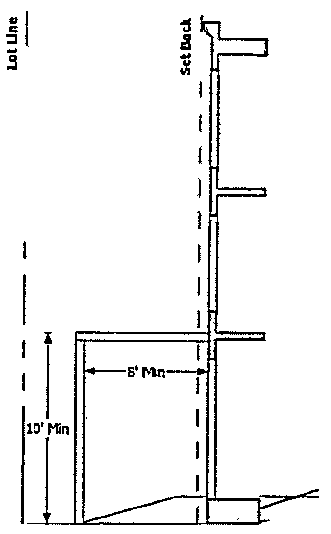
1.
A gallery must have a clear depth from the support columns to the building's facade of at least 8 feet and a clear height above the sidewalk of at least 10 feet.
2.
A gallery must be contiguous and extend over at least 75% of the width of the building facade from which it projects.
3.
A gallery may extend into a required setback.
4.
A gallery may encroach up to 9 feet into the public right-of-way or required sidewalk but must be at least 2 feet inside the curb line or edge of pavement, whichever is greater.
12A.3.10.4. General Architectural Standards.
A.
Applicability.
1.
The following applies to all buildings, except as specifically stated otherwise.
2.
Detached houses, cottage courts, duplexes, townhouses, walk-up flats, and stacked flats must comply with either this Section or Section 12A.3.10.5., at the discretion of the applicant.
B.
Building Material.
1.
Exterior finish materials on walls visible from a street, Creekside Pond, linear park, or a civic space must be limited to brick, manufactured stone, architectural block, natural stone, wood siding, cement-based siding, cement-based panels, and/or hard coat stucco, except that glass and metal curtain wall systems are allowed to be used on all building stories above the second floor.
2.
Hard coat stucco, when used as an exterior wall finish material, is subject to the following additional standards:
a.
Hard coat stucco may not exceed 30% of the total wall area (excluding foundations) visible from a street, Creekside Pond, linear park, or a civic space. For the purpose of calculating conformance with this requirement, windows and doors are not included in the total wall area.
b.
The maximum wall length (excluding foundations) visible from a street, Creekside Pond, linear park, or a civic space that is finished with hard coat stucco is 60 feet. Authorized wall lengths finished in hard coat stucco must be separated by a minimum wall length of 60 feet that contains no hard coat stucco.
3.
Exterior finish materials must be combined in such a way to provide form and visual interest in proportion to the building height and intended use, with the visually heavier below the lighter as shown in the table below. This does not apply to architectural details such as cornices, window sills, and beltlines.
| Visual Weight | |
Visually Lighter
 Visually Heavier
| Hard Coat Stucco |
| Wood/Cement-based Siding or Panel | |
| Brick | |
| Architectural Block | |
| Natural/Manufactured Stone | |
4.
The number of different exterior finish materials, textures, colors, or combinations thereof, used on a single building, should be proportional to the mass and height, and limited to avoid visual clutter, excluding materials used on windows, doors, front porches, balconies, foundations, awnings, or architectural details.
5.
Foundations must be constructed as a distinct building element that is finished in a different material or color than the exterior wall. Exposed above-ground foundations must be coated or faced in cement, brick, manufactured stone, or natural stone to contrast with façade materials.
C.
Building Façade. The following applies to all street-facing facades.
1.
Where used, shutters must match one-half the width and shape of the window opening to which they are adjacent to appear functional.
2.
Facades must provide visual divisions between the ground story and second story through architectural means such as courses, awnings, or a change in materials.
3.
Facades must delineate all stories above the ground story with windows, belt courses, balconies, cornice lines or similar architectural detailing.
4.
Windows must be recessed a minimum of 3 inches and a maximum of 8 inches from the adjacent façade or window trim/casing, whichever is greater.
D.
Building Massing.
1.
The footprint of buildings containing any residential uses shall not exceed 75,000 square feet. The building footprint size limitation shall not include any parking structures provided to serve the principal use(s).
2.
Facades over 40 feet in length must incorporate block breaks, wall projections, or recesses a minimum of 12 inches in depth. The combined length of said recesses and projections must constitute at least 20% of the total facade length.
3.
Variation in the roofline of buildings and offsets in pitched roofs and gables are required. Parapets in individual building facades exceeding 100 continuous linear feet must be varied in height and projection and must use decorative elements such as crown moldings, dentals, brick soldier courses, or similar details.
4.
The roofs of buildings may include cisterns and green roofs if part of an approved stormwater management plan for the site and if designed in accordance with the latest version of the Georgia Stormwater Management Design Manual. Above-ground cisterns require architectural and/or landscape screening that compliments the architecture of the building and is of like or similar materials used in the building's construction. The cisterns and other vertical runoff reduction measures and their screening shall require approval by the Community Development Director.
12A.3.10.5. Residential Building Architectural Standards.
A.
Applicability. This Section applies to detached houses, cottage courts, duplexes, townhouses, walk-up flats, and stacked flats, unless the Applicant elects to comply with Section 12A.3.10.4.
B.
Building Materials.
1.
The exterior finish material on all walls is limited to brick, manufactured stone, natural stone, wood siding, and/or cement-based siding.
2.
Exterior finish materials must be combined in such a way to provide form and visual interest in proportion to the building height and intended use, with the visually heavier below the lighter as shown in the table below. This does not apply to architectural details such as cornices, window sills, and beltlines.
| Visual Weight | |
Visually Lighter
 Visually Heavier
| Wood/Cement-based Siding or Panel |
| Brick | |
| Natural/Manufactured Stone | |
3.
The number of different exterior finish materials, textures, colors, or combinations thereof, used on a single building, should be proportional to the mass and height, and limited to avoid visual clutter, excluding materials used on windows, doors, front porches, balconies, foundations, awnings, or architectural details.
4.
Foundations must be constructed as a distinct building element that is finished in a different material or color than the exterior wall. Exposed above-ground foundations must be coated or faced in cement, brick, manufactured stone, or natural stone to contrast with façade materials.
C.
Building Façade.
1.
The following apply to all street-facing facades.
2.
Windows and Doors.
a.
Where used, shutters must match one-half the width and shape of the window opening to which they are adjacent to appear functional.
b.
Doors and windows that operate as sliders are prohibited.
c.
All windows must be vertically shaped with a height greater than width, except for windows that are part of a door or otherwise appropriate for a required architectural style. The top of said windows must generally be in alignment with the top of the adjacent door frame.
d.
Windows must have true or simulated divided lights or be one-over-one lights. e. Windows must include sills of wood, masonry, stone, cast stone, or terra cotta. f. Window frames must be recessed a minimum of 1.5 inches from the exterior façade.
3.
A stoop or front porch is required.
4.
Awnings are not allowed.
D.
Building Massing.
1.
Pitched roofs, if provided, must be symmetrically sloped no less than 5:12, except that roofs for front porches and attached sheds may be no less than 2:12.
2.
Flat roofs must be enclosed by parapets a minimum of 42 inches high, or as required to conceal mechanical equipment by Section 12A.3.5.
3.
All roofs must have a minimum 25-year roof life and no visible roll roofing.
4.
Chimneys, where provided, must extend to the ground and must be faced in brick or stacked stone.
12A.3.10.6. Pedestrian Access.
A.
All buildings must include a street-facing pedestrian entrance.
B.
A pedestrian entrance and walkway providing both ingress and egress, operable to residents at all times and operable to customers, visitors, and employees during business hours, is required to meet the street-facing pedestrian entrance requirements. Additional entrances off another street, civic space, pedestrian area or internal parking area are permitted, but must have the same or shorter hours of operability as the street-facing entrance.
C.
An angled pedestrian entrance may be provided at either corner of a building along the street to meet the street-facing pedestrian entrance requirements.
D.
Where a building has frontage on Creekside Pond, the linear park, or a civic space instead of a street, these requirements apply to and from the Creekside Pond, linear park or a civic space as well.
E.
Where a building has frontage on a multi-use trail, these requirements apply to and from the trail.
(Ord. No. 2022-08-20, 8-29-2022)
Sec. 12A.4. - Town Center Zoning Districts.
12A.4.1. Applicability. The requirements of this Article apply to all Town Center Zoning Districts. The requirements of the Zoning Ordinance also apply in all Town Center Zoning Districts unless expressly stated otherwise in this Article.
12A.4.2. Building Types Allowed by District. Building types are allowed by Town Center Zoning District as shown below.
12A.4.3. Uses Allowed by District.
12A.4.3.1. Allowed Use Table.
A.
In order to regulate a variety of similar uses, use categories have been established for principal uses. The Community Development Director shall determine the use category for uses not listed. When the Community Development Director cannot determine placement, an application shall be made to the Board of Zoning Appeals for interpretation.
B.
Principal and accessory uses allowed by district are shown in the table below.
C.
Principal Uses Not Listed. A principal use not specifically listed is prohibited unless the Community Development Director shall determine the use to be part of a use category with the following criteria:
1.
The actual or projected characteristics of the proposed use;
2.
The relative amount of site area or floor area and equipment devoted to the proposed use;
3.
Relative amounts of sales;
4.
The customer type;
5.
The relative number of employees;
6.
Hours of operation;
7.
Building and site arrangement;
8.
Types of vehicles used and their parking requirements;
9.
The number of vehicle trips generated;
10.
How the proposed use is advertised;
11.
The likely impact on surrounding properties; and
12.
Whether the activity is likely to be found independent of the other activities on the site.
D.
Accessory Uses Not Listed. An accessory use not specifically listed is prohibited unless the Community Development Director determines the accessory use:
1.
Is clearly incidental to and customarily found in connection with an allowed principal use;
2.
Is subordinate in area to and serving an allowed principal use;
3.
Contributes to the comfort, convenience or needs of occupants, business or industry in the principal use served; and
4.
Is located on the same lot as the principal use served.
12A.4.3.2. Use Table Key.
A.
Permitted Use (P). Indicates a use is permitted in the respective district. The use is also subject to all other applicable requirements of the Zoning Ordinance.
B.
Special Use (S). Indicates a use may be permitted in the respective district only where approved by the City Council in accordance with Section 19.4. of the Zoning Ordinance. Special uses are subject to all other applicable requirements of the Zoning Ordinance, including any applicable use standards, except where the use standards are expressly modified by the City Council as part of the special use permit approval.
C.
Use Not Permitted. An empty cell indicates that a use is not permitted in the respective district.
12A.4.4. Town Center Mixed Use District (TC-X).
12A.4.4.1. Purpose. The intent of the Town Center Mixed Use District is to provide a variety of residential housing, commercial, and civic options while also promoting walkability and shared streets.
12A.4.4.2. Building Types Allowed. The following building types are allowed:
A.
Townhouse
B.
Walk-Up Flat
C.
Stacked Flat
D.
Shopfront
E.
Mixed-Use Building
F.
General Building
G.
Civic Building
H.
Live-Work
12A.4.4.3. Development Standards.
A.
Density Cap. The maximum residential density of any site is 30 units/acre. The City Council shall have the option to increase the residential density in compliance with Section 12A.4.7.
B.
Dimensional Standards.
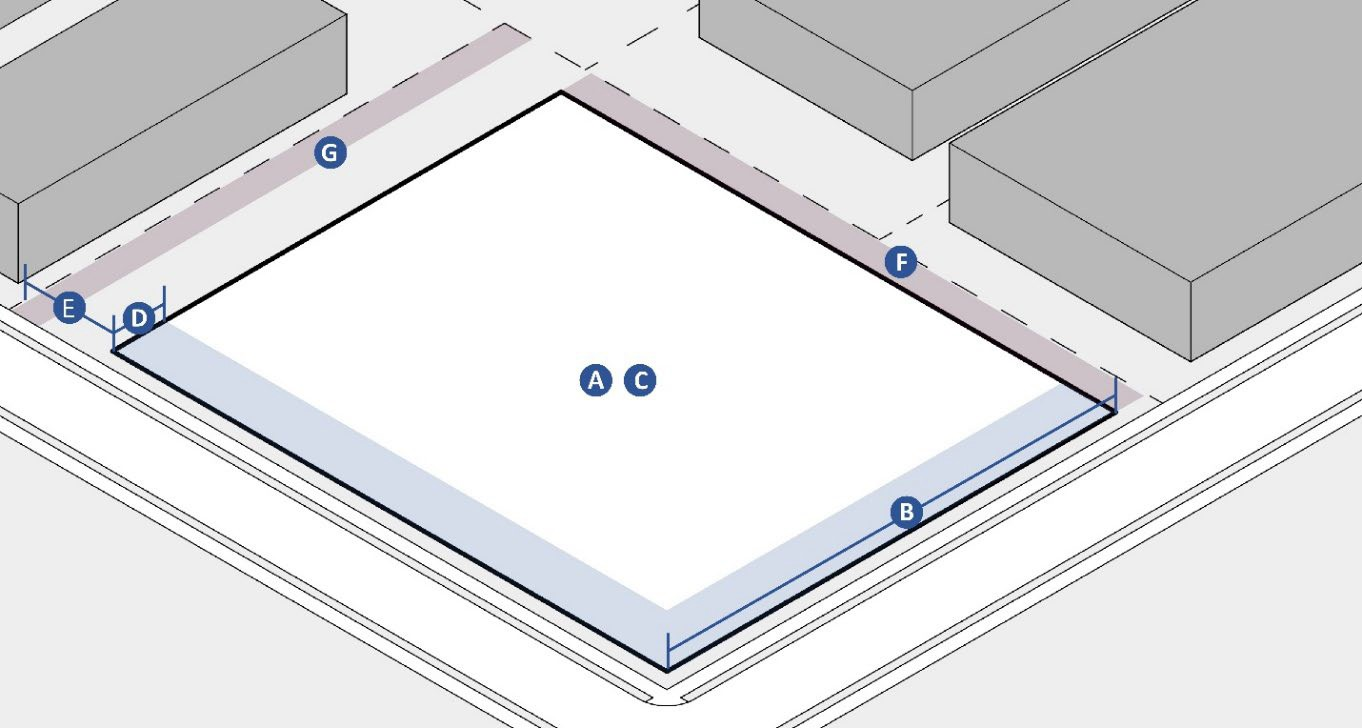
C.
Bulk and Mass.
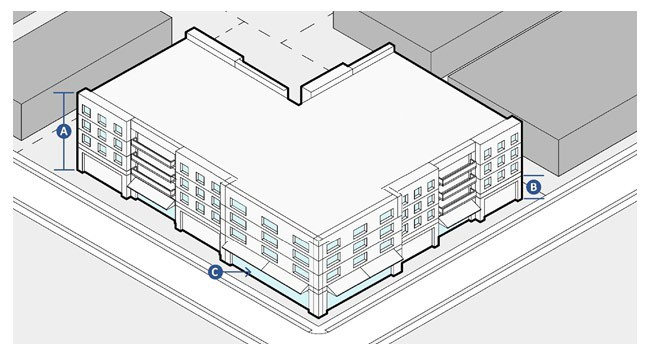
12A.4.4.4. Phasing. Mixed-use construction shall be sequenced in accordance with a project build-out schedule submitted for review as part of the building permit and approved by City Staff. Project proposals shall adhere to the following sequencing requirements:
A.
Building permits for up to 20 percent of the residential square footage as shown on the master plan may be issued prior to commencing any non-residential construction.
B.
Building permits for 21 to 50 percent of the residential square footage as shown on the master plan may only be issued after the issuance of building permits for at least 25 percent of non-residential square footage as shown on the master plan and commencement of said non-residential construction.
C.
Building permits for 51 to 79 percent of the residential square footage as shown on the master plan may only be issued after the issuance of Certificates of Occupancy for at least 25 percent of the non-residential square footage as shown on the master plan.
D.
Building permits for the final 20 percent of residential square footage as shown on the master plan may only be issued after the issuance or the Certificate of Occupancy for at least 80 percent of the non-residential square footage as shown on the master plan.
E.
Any of the above-mentioned requirements may be adjusted or waived by the Community Development Director, as long as the applicant provides a security or other form of binding assurance that the remaining major use types shown in the master plan will be built.
12A.4.4.5. Density Bonus. In reviewing a request to increase the maximum density above the cap in TC-X, City Council shall give consideration to the following criteria:
A.
Conformance with the Comprehensive Plan, the Town Center Vision and Plan, and other City policies, plans, and initiatives;
B.
Open space in an amount greater than required by Section 12A.3.6., of which the civic space portion should be increased above the minimum required by 0.5% for each 1 unit/acre residential increase proposed above the density maximum;
C.
The number of EcoMeasurements incorporated under Section 12A.3.8., provided that development with rezoning and/or special use permit shall incorporate measures totaling a minimum of 12 points;
D.
Requests shall not exceed a total density of 40 units per acre for the site; and
12A.4.5. Town Center Business District (TC-B).
12A.4.5.1. Purpose. The intent of the Town Center Business District is to provide commercial infill development with a wide variety of development typologies and uses.
12A.4.5.2. Building Types Allowed. The following building types are allowed:
A.
Shopfront
B.
General Building
C.
Civic Building
12A.4.5.3. Development Standards.
A.
Dimensional Standards.
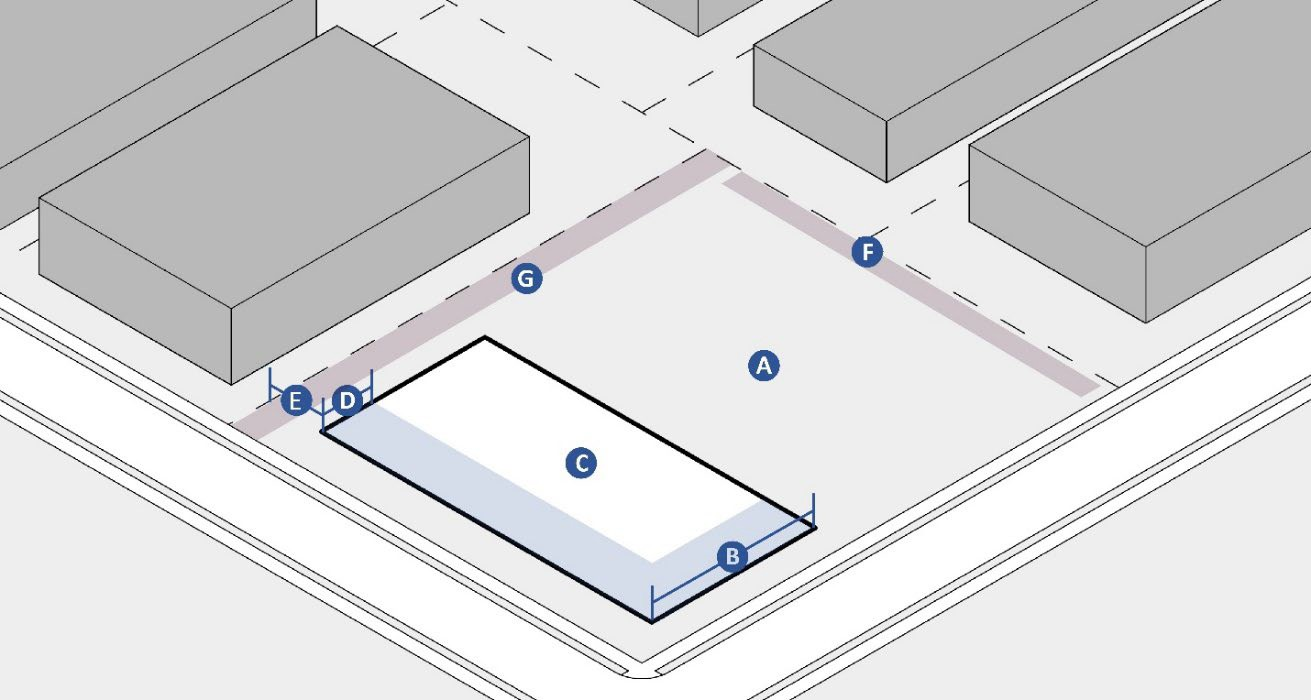
B.
Bulk and Mass.
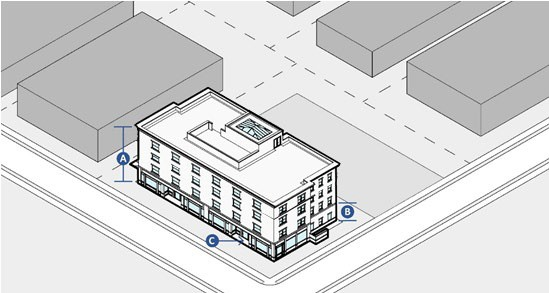
12A.4.6. Town Center Residential District (TC-R).
12A.4.6.1. Purpose. The purpose of the Town Center Residential District is to provide a variety of housing options in a residential setting.
12A.4.6.2. Building Types Allowed. The following building types are allowed:
A.
Detached House
B.
Cottage Court
C.
Duplex
D.
Townhouse
E.
Walk-Up Flat
F.
Stacked Flat
G.
Live-Work
12A.4.6.3. Development Standards.
A.
Density Cap. The maximum residential density of any site is 20 units/acre. The City Council shall have the option to increase the residential density in compliance with Section 12A.3.11.
B.
Dimensional Standards.
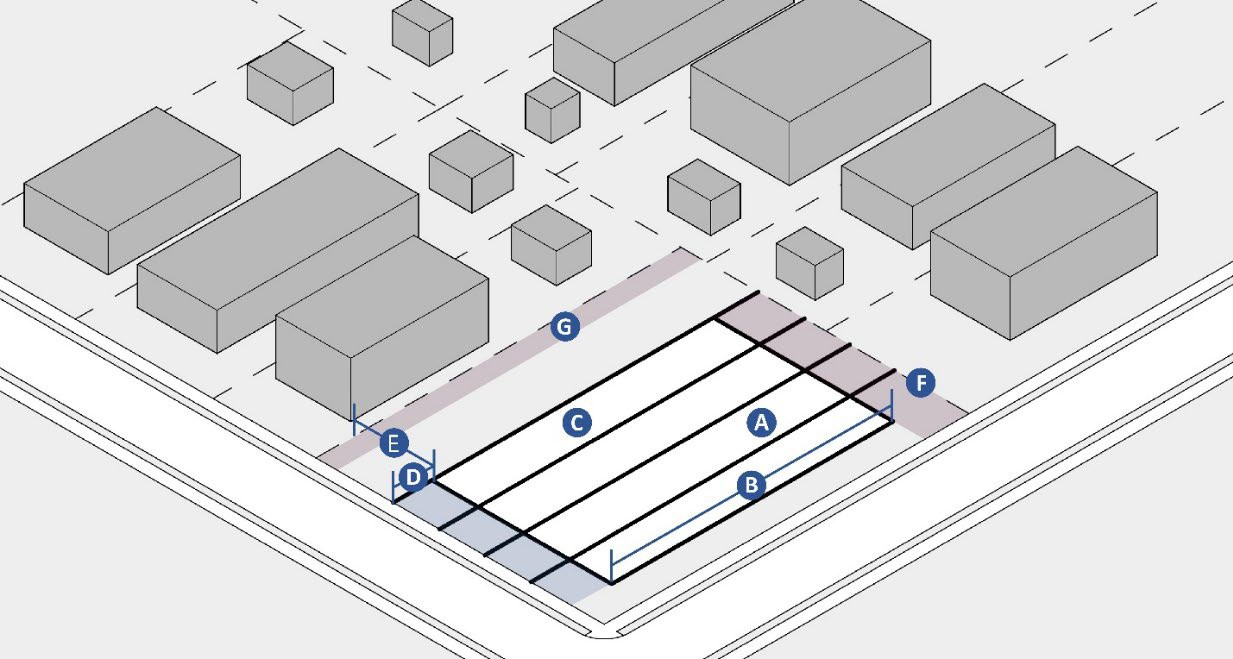
C.
Bulk and Mass.
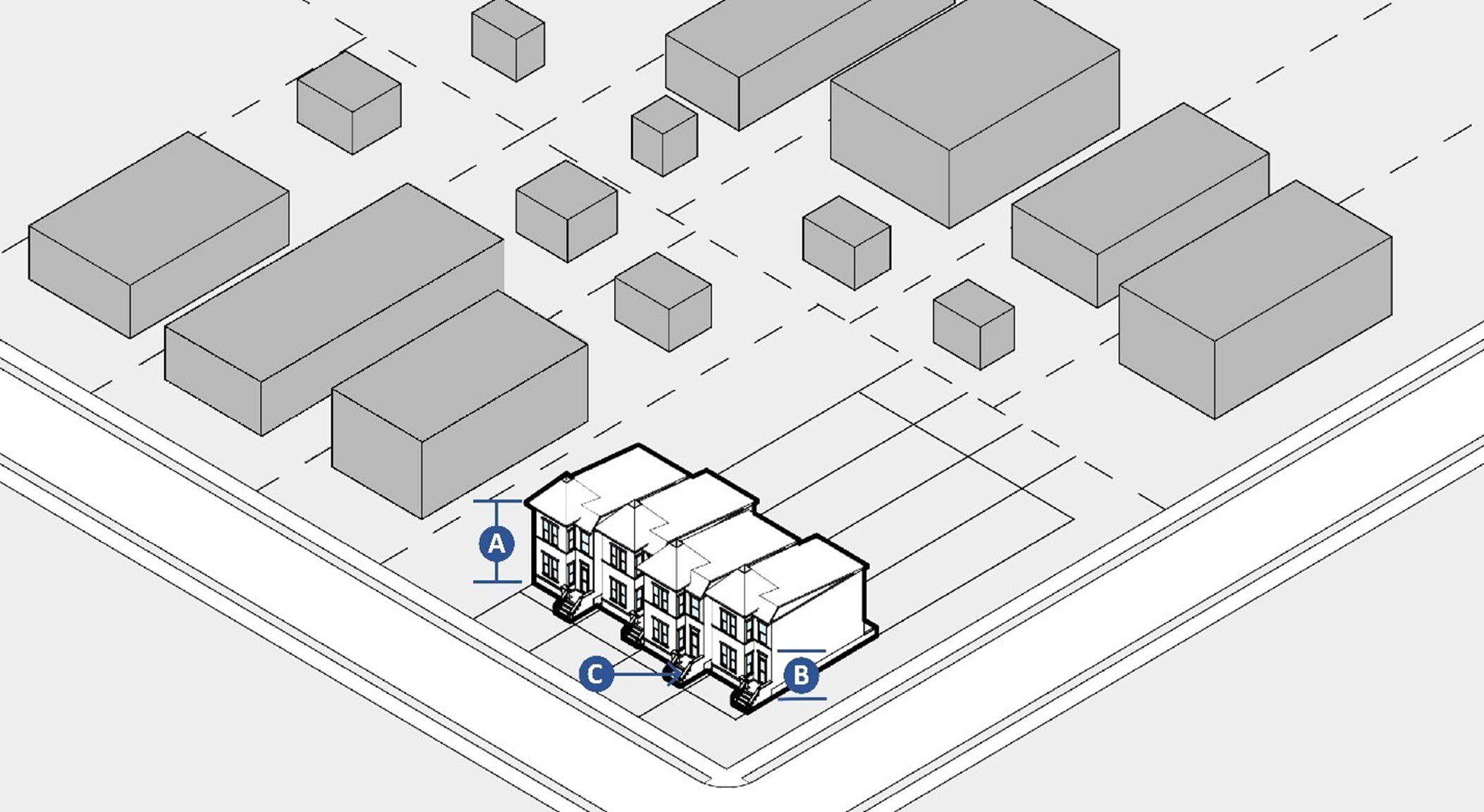
12A.4.7. Height—To Exceed District Maximum. For development that would exceed the maximum height in the Town Center Zoning Districts, a special use permit shall be submitted in accordance with Article XXVIII of the Zoning Ordinance, and reviewed in accordance with Article XIX of the Zoning Ordinance.
(Ord. No. 2022-08-20, 8-29-2022; Ord. No. 2024-08-18, 8-19-2024)

