
Johnson City Zoning Code
Sec. 14.04.09
General standards.
A.
Off-street parking and loading; applicability and purpose.
1.
Off-street parking and loading shall be provided in accordance with the regulations of this section for all new development, and for any existing development that is altered in a way that enlarges or increases capacity by adding or creating dwelling units, guest rooms, floor area or seats. The regulations of this section are intended to reinforce community standards and to promote safe and attractive parking lots for new, redeveloped, and expanded development within the City.
2.
The size, number, design, and location of parking lots and parking areas are regulated in order to:
a.
Provide for the safe and orderly circulation of motor vehicles within parking lots;
b.
Provide safe ingress and egress to parking lots from public and private streets;
c.
Protect adjoining properties from the adverse impacts associated with parking lots such as noise, lighting, appearance, drainage, and effect on property values;
d.
Provide adequate areas for off-street parking and storage of motor vehicles, while at the same time preventing over-supply of parking; and
e.
Enhance the appearance of off-street parking areas in all zoning districts.
B.
Parking lot design standards.
1.
Permits and plan. For parking lots containing five (5) or more spaces, the required corresponding plan submittal(s) shall be required prior to any initiation of work.
2.
Surfacing. Parking lots shall be asphalt, concrete, or other durable-semi permeable surface (as approved by the City Engineer) graded and drained to dispose of surface water into appropriate structures.
3.
Barriers. Parking lots shall be provided with curbs so located that no part of a parked vehicle will extend into or over the sidewalks, property lines, or street right-of-way. Written approval from the City Engineer shall be required for deviation from this requirement.
4.
Striping and marking. Parking lots spaces shall be striped to indicate the location of the individual spaces, directional arrows shall be provided on one-way aisles and entry drives, and accessible spaces shall be marked meeting current Americans with Disabilities Act (ADA) requirements. Such striping and marking shall be in accordance with the Manual on Uniform Traffic Control Devices.
C.
Standards for the number of spaces by use; required parking.
1.
Nonresidential use. There shall be no minimum number of spaces required for nonresidential use. The applicant shall provide a statement or parking analysis indicating how they will provide adequate parking for the proposed nonresidential use to succeed without negatively impacting adjacent properties or creating or compounding a dangerous traffic condition.
2.
Residential. The minimum number of spaces required for residential use shall conform to the parking ratios listed in table 1.
a.
For all parking space requirements resulting in a fraction, the fraction shall be:
• Rounded to the next higher whole number when the fraction is one-half (½) or higher.
• Rounded to the next lower whole number when the fraction is less than one-half (½).
3.
Reductions for residential use. Residential uses may utilize the following reductions to the minimum number required off-street parking ratios listed in table 1 when the following standards are met:
a.
Transit stops. Properties located within a one-quarter (¼) mile radius of a transit stop may further reduce the minimum off-street parking requirements by up to fifteen percent (15%).
b.
Motorcycle and scooter spaces. Up to five percent (5%) of the required automobile parking spaces may be substituted with motorcycle/scooter parking at a rate of one (1) motorcycle/scooter space for one (1) automobile space.
c.
Bike racks. Up to ten percent (10%) of required automobile parking may be substituted with bicycle parking at a rate of one (1) additional bicycle rack (beyond the minimum racks required by this Code) for one (1) automobile space. This reduction shall be allowed in addition to other variances, reductions, and shared parking agreements.
d.
A shared parking agreement approved in conformance with the guidelines of this Code.
e.
Motorcycle and scooter parking. One (1) motorcycle and scooter parking. In parking lots containing twenty-five (25) parking spaces or more, one (1) space for every twenty-five (25) parking spaces of the required number of parking spaces for a use or combination of uses shall be striped as a motorcycle and scooter parking space.
f.
Reductions in excess of the minimum required parking numbers and allowable reductions identified herein shall be allowed only by the Planning Commission as a variance and shall be granted in accordance with the City of Johnson Code.
4.
Accessibility.
a.
ADA reference. Accessibility for persons with disabilities in parking lots and building approaches shall be as required by the current ADA and as may from time to time be amended.
b.
Location and size. When provided for facilities providing service to the public, the location and minimum stall size of accessible parking spaces, passenger loading zones, valet parking facilities, ramps, and other related infrastructure shall meet the standards adopted in the ADA.
c.
Buildings. ADA Accessibility Guidelines (ADAAG) for buildings and facilities, Appendix A to 28 C.F.R. Part 36, or the current Federal standard.
d.
Signage. Accessible parking spaces for persons with disabilities shall be identified with signs in accordance with the current Federal statute of the Americans with Disabilities Act (ADA). Curb ramps shall be provided in accordance with the Americans with Disabilities Act (ADA) wherever an accessible route crosses a curb in the parking lot.
5.
Minimum number of accessible spaces. Table 2 shall be used to determine the minimum number of accessible parking spaces to be provided for persons with disabilities:
TABLE 2
a.
Facilities providing medical care. Facilities providing medical care and other services for persons with mobility impairments shall provide accessible parking spaces as follows:
(1)
Outpatient facilities. Outpatient units and facilities shall provide a minimum of ten percent (10%) of the total number of parking spaces provided serving each such outpatient unit or facility, but in no event shall less than one (1) such parking space be provided.
(2)
Specialized facilities. Units and facilities that specialize in treatment or services for persons with mobility impairments shall provide twenty percent (20%) of the total number of parking spaces provided serving each such unit or facility, but in no event shall less than one (1) such parking space be provided.
b.
Multi-family dwellings. Multi-family dwellings containing four (4) or more dwelling units shall provide accessible parking spaces as follows:
(1)
Fair Housing Act reference. Accessible parking shall be provided which meets the provision in the Final Housing Accessibility Guidelines, 24 C.F.R., Chapter 1, Subchapter A, Appendix II, of the Fair Housing Act of 1968, as amended, or the current Federal standard.
(2)
Visitor parking. Where applicable, accessible visitor parking that provides sufficient access to grade level entrances of multi-family dwellings is required
D.
Access control.
1.
Multi-family and nonresidential uses. The following standards shall apply to all driveways providing access to multi-family development and other nonresidential uses:
a.
General standards.
(1)
Access to property shall be allowed only by way of driveways and no other portion of the lot frontage shall be used for ingress or egress. Continuous curb cuts are prohibited. At least one (1) driveway shall be permitted for any lot; however, shared drives are allowable in lieu of an individual/single-user driveway, and shared driveways shall be recommended for lots that have less than one hundred twenty (120) feet of frontage.
(2)
Individual driveways shall be located a minimum of ten (10) feet from the side property lines. A separation of at least twenty (20) feet is required between the driveways on one (1) lot and the driveways on the adjacent lots. Driveways on the same lot shall be no closer than fifty (50) feet to each other.
(3)
Driveways on corner lots shall be located as far away from the intersection as possible. In no case shall a driveway be installed closer than five (5) feet to the beginning of the curb radius.
(4)
Ingress/egress driveway width. Driveway lanes shall be a minimum of twelve (12) feet in width (one-way) or twenty-four (24) feet (two-way), measured back of curb to back of curb and shall not have more than three (3) lanes in one (1) entrance/exit. Measurements shall be front from curb front to curb front. The width of the driveway throat shall not exceed forty (40) feet in width.
(5)
Driveway design shall be such that minimization of interference with through street traffic is achieved and shall be subject to site plan approval. The types of vehicles that a driveway is intended to serve shall be a prime factor in determining the acceptable radii of driveways.
(6)
Provisions for circulation between adjacent parcels should be provided through a coordinated or joint parking system.
b.
Driveway spacing.
(1)
Arterial streets. Direct access to any arterial street shall be limited to the following restrictions:
(A)
Spacing from signalized intersections. All driveways providing access to arterial streets shall be constructed so that the point of tangency of the curb return radius closest to a signalized or stop sign-controlled intersection is at least one hundred twenty (120) feet from the perpendicular curb face of the intersecting street. In the event that this standard cannot be met because of an unusually narrow or shallow lot size, a reduction in spacing may be approved by the City Engineer as long as the reduction does not result in an unsafe traffic condition.
(B)
Spacing from other (nonsignalized) access points. All driveways providing access to arterial streets shall be constructed so that the point of tangency of the curb return radius closest to any nonsignalized street or driveway intersection, is at least eighty (80) feet from the perpendicular curb face of the intersecting street or driveway. In the event that this standard, cannot be met because of an unusually narrow or shallow lot size, a reduction in spacing may be approved as long as the reduction does not result in an unsafe traffic condition.
(2)
Collector streets. Direct access to collector streets shall be regulated in accordance with the following standards:
(A)
Spacing from signalized intersections. All driveways providing access to collector streets shall be constructed so that the point of tangency of the curb return radius, closest to a signalized or stop sign-controlled intersection, is at least one hundred twenty (120) feet from the perpendicular curb face of an intersecting arterial street and eighty (80) feet from the perpendicular curb face of an intersecting collector or local street. In the event that this standard cannot be met because of an unusually narrow or shallow lot size, a reduction in spacing may be approved as long as the reduction does not result in an unsafe traffic condition.
(B)
Spacing from other (nonsignalized) access points. All driveways providing access to collector streets shall be constructed so that the point of tangency of the curb return radius closest to a nonsignalized street or driveway intersection is at least eighty (80) feet from the perpendicular curb face of the intersecting street or driveway. In the event that this standard cannot be met because of an unusually narrow or shallow lot size, a reduction in spacing may be approved as long as the reduction does not result in an unsafe traffic condition.
E.
Shared parking.
1.
Parking requirements may be shared where it can be determined that the peak parking demand of the existing or proposed occupancy occur at different times (either daily or seasonally). Such arrangements are subject to the approval of the Planning Commission.
a.
Shared parking between developments. Formal arrangements that share parking between intermittent uses with nonconflicting parking demands are encouraged as a means to reduce the amount of parking required.
b.
Shared parking agreements. If a privately owned parking facility is to serve two (2) or more separate properties, then a "shared parking agreement" is to be filed with the City for consideration by the Planning Commission. Shared off-street parking spaces shall be located within a reasonable distance. Once approved, proof of recording of the agreement (as part of the development approval or with the City Clerk) shall be presented prior to issuance of a building permit.
c.
Shared spaces. An acceptable parking study shall be submitted which clearly establishes that uses will make use of the shared spaces at different times of the day, week, month, or year. Individual spaces identified on a site plan for shared users shall not be shared by more than one (1) user at the same time.
F.
On-street parking. Each permitted on-street parking space adjacent to a project's street frontage may count toward the parking requirements for all development. The approval of on-street parking is subject to approval by the Building Official.
G.
Parking lot location standards. The location of all parking lots shall meet the location requirements below. All conditional uses hereunder shall be granted by the Planning Commission in accordance with the City of Johnson Code governing applications of conditional use procedures.
1.
Permitted locations by right.
a.
Parking lots shall be located within the same zoning district as the use they serve. Required parking lots for uses allowed by right within a zoning district are allowed as a use by right in the same zoning district.
2.
Permitted locations as a conditional use.
a.
Parking lots located within residential zones which serve uses in nonresidential zones may be allowed as a conditional use by the Planning Commission.
b.
Parking lots for uses allowed as conditional uses within residential zones must also be approved as a conditional use. A conditional use for a parking lot may be approved at the same time the use is approved or may be approved separately if additional parking lots are developed later. The Planning Commission shall make a finding based upon the size, scale, and location of these activities that the proposed parking lot will not adversely affect adjacent residential uses or the residential character of the neighborhood.
H.
Nonconforming parking lots.
1.
All parking lots and/or parking areas which were in existence prior to the effective date of this chapter may continue in a nonconforming state until such time as the following shall occur:
a.
Rehabilitation. When a building permit is granted to rehabilitate a structure on the property exceeding fifty percent (50%) of the current replacement cost of the structure, at such time, fifty percent (50%) of the existing parking lot use area shall be required to be brought into compliance with the provisions of this chapter. This shall continue on a graduated scale in accordance with the percentage of rehabilitation cost; and/or
b.
Enlargement or reconstruction. When a building permit is granted to enlarge or reconstruct a structure on the property exceeding twenty-five percent (25%) of its existing gross floor area, at such time twenty-five percent (25%) of the existing parking lot and/or parking lot area shall be brought into compliance with the provisions of this section. This shall be on a graduated scale until reaching one hundred percent (100%) of the required landscaping; and/or
c.
Expansion of parking area. When an expansion of an existing, nonconforming parking lot resulting in an increase of fifteen percent (15%) or greater to the existing parking area, at such time, fifteen percent (15%) of the total parking lot and/or parking lot area shall be brought into compliance with the provisions of this section. This may consist of the newly expanded area, the existing area, or a combination thereof. This shall be on a graduated scale until reaching one hundred percent (100%) of the required landscaping. Any expansion of five (5) or more spaces will require a large-scale development approval.
I.
Location and design of off-street parking and loading spaces.
1.
On-site. Except as otherwise specifically provided, required off-street parking and loading spaces shall be located on the same lot as the principal use.
2.
Setbacks.
a.
Required off-street parking shall be located outside of the public right-of-way. In no case shall the parking obstruct sidewalks or site visibility.
b.
Meet any applicable overlay district and/or landscape code requirements.
3.
Maneuvering. Parking lots shall be designated, maintained, and regulated so that no parking or maneuvering incidental to parking will encroach into the areas designated for sidewalks, streets, or required landscaping. Parking lots shall be designed so that parking and un-parking can occur without moving other vehicles, unless a valet service has been approved as part of the development plans. Vehicles shall exit the parking lot in a forward motion.
4.
Pedestrian access. Pedestrian access shall be provided from the street to the entrance of the structure by way of designated pathway or sidewalk.
5.
Build-to zone. In zoning and overlay districts that specify urban form (i.e., a build-to zone), the intent is for drive-thru lanes, parking lot drive aisles, and parking spaces to be located to the side or rear of buildings. In these districts, a drive-thru lane, parking lot drive aisle, or parking spaces are not permitted to be located in the front yard directly between a building and the master street plan right-of-way.
6.
Compact spaces. A maximum of thirty-five percent (35%) of the total spaces may be compact spaces. Compact spaces shall be marked either by marking on the pavement or by separate marker.
7.
Curbing. The perimeter of all off-street parking and loading areas and their access drives shall be curbed with the exception of single-family, duplex, and triplex residences. Landscape islands and other interior features within parking lots shall also be protected by curbs. In addition, the principal building on the lot shall be protected by curbs and/or raised walkways. The area between the curb and the property line, except for the driveway(s) shall be maintained as green space.
8.
Intermittent parking. Uses which generate only intermittent demand for parking, such as churches, may count available on-street parking within six hundred (600) feet of the building as part of required parking, subject to the approval of the Planning Commission.
9.
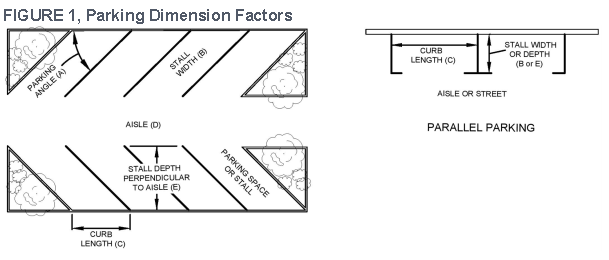
Dimensional requirements. (See tables 3 and 4) Entrances and internal aisle design for parking lots containing five (5) or more parking spaces. The driveway width into parking lots shall meet the following requirements:
a.
Entrances.
(1)
One-way access to parking lots. If the driveway is a one-way in or one-way out, then the driveway width shall be a minimum of twelve (12) feet and a maximum of sixteen (16) feet. Measurements shall be taken from face of curb to face of curb.
(2)
Two-way access to parking lots. For two-way access, the driveway width shall be a minimum twenty-four (24) feet, unless otherwise required by the Fire Department. Measurements shall be taken from face of curb to face of curb.
(3)
Collector and arterial streets. Driveways that enter collector and arterial streets may be required to have two (2) outbound lanes (one (1) for each turning direction) and one (1) inbound lane for a maximum total driveway width of forty (40) feet. Measurements shall be taken from face of curb to face of curb.
(4)
Effective curb radius. All nonresidential effective curb radii shall meet the master street plan commercial driveway standards unless otherwise specified by the City Contract Engineer due to use or traffic-specific needs.
10.
Internal aisle design.
a.
Aisles shall be designed so they intersect at ninety (90) degrees with other aisles and driveways where practical.
(1)
Aisles shall be designed to discourage cut-through traffic by use of landscape islands.
(2)
Aisles shall conform to the dimensional requirements of tables 3 and 4 and Figure 1.
FIGURE 1, Parking dimension factors
11.
Loading space. Off-street loading spaces shall be adequate for the use. Substantiation for provided loading spaces may be required by the Building Official. Loading shall occur solely within the subject property. Loading shall not occur in the right-of-way.
12.
Meet requirements of the applicable landscape code.
13.
Parking lot circulation.
a.
Throat length. The length of driveways or "throat length" shall be designed in accordance with the anticipated storage length for vehicles to prevent them from backing into the flow of traffic on the public street or causing unsafe conflicts with on-site circulation. General standards appear below, but these requirements may vary according to the project volume of the individual driveway. These measures generally are acceptable for the principal access to a property and are not intended for minor driveways. Variation from these standards may be permitted for good cause upon approval of the City Building Official and City Engineer.
Note: The throat lengths in Table 5 are provided to assure adequate stacking space within parking lot driveways for general land use intensities. This helps prevent vehicles from stacking into the thoroughfare as they attempt to enter the parking lot. High traffic generators, such as large shopping plazas, need much greater throat length than smaller developments or those with unsignalized driveways. The guidelines here for larger developments refer to the primary access drive. Reduced throat lengths may be permitted for secondary access drives serving large developments. Approval from the City Engineer for such reduced throat lengths shall be required. Generally throat lengths are a measurement from the ROW to the area where direct access to the parking lot begins; this is most usually defined by a change in curb location from a defined drive area to allow turning movements and maneuvering within the parking lot.
J.
Bicycle parking rack requirements.
1.
Applicability. All new construction or expansions requiring five (5) or more off-street automobile parking spaces shall provide bicycle parking as required by this chapter. Any property owner required to have bicycle parking may elect to establish a shared bicycle parking facility with any other property owner within the same block to meet the combined requirements.
2.
Definition. A bicycle rack is a fixture designed to park bicycles that can be secured with a standard u-shaped bicycle lock. Each bicycle parking rack shall hold two (2) bicycles.
3.
Number of bicycle racks required. The minimum number of bicycle parking racks required is determined by the number of parking spaces required for the type of land use. Alternative rack designs may be approved by the Building Official so long as they have the bicycle capacity storage equivalent to the total number of standard bicycle racks required. The following standards shall determine the number of bicycle racks required based on the number of automobile parking spaces in the development:
a.
Nonresidential development. Nonresidential development shall provide one (1) bicycle parking rack per twenty (20) automobile parking spaces. At a minimum, the development shall provide one (1) bike rack.
b.
Multi-family residential development. No bike racks will be required with duplex development. Residential development of triplexes with no garages and all other multifamily residential developments greater than three (3) units (regardless of the provision of garages) shall provide one (1) bicycle rack per thirty (30) dwelling units. At a minimum, a multifamily development meeting the above criteria shall provide one (1) bike rack.
4.
Bicycle rack site design. Careful consideration should be given to the layout and location of bicycle racks. For optimal functionality, the following standards shall apply in determining the layout and position of bicycle racks:
a.
Requirements:
(1)
Spacing between bicycle racks. Each bicycle parking space shall have thirty-six (36) inches of clear space, paved or unpaved, beside the rack allowing each rack to support two (2) bicycles. The 36-inch dimension may overlap another bicycle parking space such that racks positioned in a parallel row may be thirty-six (36) inches on center. The minimum length dimension required is eight (8) feet free and clear.
(2)
Location of bicycle parking racks. Bicycle racks should be located in areas where they are useful to the bicyclist while not impeding access. The following standards shall apply when determining the location of bicycle racks:
(3)
Bicycle parking racks should be located within fifty (50) feet of a public entry. In locations that have multiple entrances, such as shopping areas, bicycle parking racks should be distributed near all major points of public entry.
(4)
Bicycle parking facilities should have adequate lighting for the operation of combination and key locks at night and to minimize theft.
(5)
Bicycle parking racks should be positioned so that no pedestrian traffic is impeded.
(6)
Bicycle parking racks should not be located within bus stops, loading zones, or other curb space where on-street parking is permitted unless approved by the City Engineer.
(7)
Bicycle parking racks shall have a 6-foot minimum clearance from the edge of fire hydrants.
(8)
Bicycle parking racks should have a four (4) feet zero (0) inches clearance from existing street furniture, including mailboxes and light poles.
(9)
Bicycle parking rack location shall not interfere with ADA standards.
(10)
Bicycle rack specifications. The preferred bike rack is the standard inverted u-shaped bicycle rack. Applicants may request an alternative design with Building Official approval. All bicycle racks shall be designed so that they support a bicycle at two (2) points on the bicycle frame and such that the bicycle may be securely locked with a u-shaped bicycle lock.
(11)
Materials. Racks are to be constructed of one and one-half (½) inch, schedule forty (40) steel pipe (1.90" x 0.145" wall).
(12)
Finishes. Unless the pipe material is stainless steel, the pipe shall have PVC coating, powdercoat finish or hot-dipped galvanized finish applied after the flange has been welded in place (surface mount method) or the anchoring cross bar/supports have been fitted (embedment method).
(13)
Anchoring. Bicycle racks shall be anchored with one (1) of the following methods:
(A)
Embedded in concrete. The rack legs shall extend a minimum of nine (9) inches into a concrete footing with an anchoring crossbar mounted three (3) inches above the base.
(B)
Surface flange mount. A pre-drilled, steel flange, minimum 8-inch square, shall be welded to the bottom of each leg before final finish is applied. The flange shall have a minimum of three (3) bolt holes. Each bolt hole shall accept a one-half (½) inch diameter steel bolt.
(C)
Alternative anchoring methods. Alternative methods of anchoring bicycle racks may be permitted with approval of the City Engineer.
K. Driveway and parking standards within single family residential districts.
1.
Purpose. The purpose of this section is to promote the public health, safety and general welfare, to prevent the adverse impacts associated with excess parking and over-occupancy of homes in single family districts, and to ensure that compatibility of land uses within single family districts remain intact.
2.
Applicability. The following requirements shall apply to properties within single family districts that require four (4) or fewer parking spaces and properties within all zoning districts which are utilized for a single family detached home. The regulations herein do not apply to motor vehicles located completely within or underneath garages or carports, nor to properties zoned agricultural.
3.
Use of off-street parking and loading spaces. Required off-street parking spaces shall be used solely for the parking of motor vehicles in operating condition and shall not be used for the storage of vehicles, boats, motor homes, campers, mobile homes, materials, tractor trailers or other temporary storage unless they are located in a designated staging area and are screened, fenced or otherwise fully shielded from public view.
4.
Outdoor parking/storage of boats, trailers, and recreational vehicles. One (1) boat, trailer and/or recreational vehicle may be parked outdoors on a lot in a residential district provided that:
a.
The boat, trailer or recreational, vehicle is owned and used by property owner or resident.
b.
The boat, trailer or recreational vehicle is not parked in the area between the front of the residence and the street or other area between the structure and the street except for the purpose of loading or unloading, during a period of less than, eight (8) hours.
c.
The boat, trailer and/or recreational vehicle is located in the side or rear yard;
d.
The boat, trailer and/or recreational vehicle is not used for living, sleeping or housekeeping purposes; and
e.
The boat, trailer or recreational vehicle is currently registered and licensed as required by State law.
5.
Off-street parking on city street right-of-way. The off-street parking of any motor vehicle, nonmotorized recreational vehicle, boat or trailer shall be prohibited within the street right-of-way, which includes any sidewalk, greenspace or other area from the edge of the paved street through the width of the dedicated street right-of-way. On-street parking within properly designated areas of the street right-of-way may be permitted, in accordance with current traffic regulations.
6.
Driveway standards.
a.
Surfacing. All required off-street parking and loading spaces, and the driveways serving-off-street parking and loading spaces, shall be paved with asphalt, concrete, or brick or stone pavers, or other solid surface, provided driveways serving single-family dwellings shall only be required to be paved the first fifty (50) feet as measured from the street. The area of a driveway located between the edge of the street and the property line shall also be paved.
(1)
Driveways beyond fifty (50) feet into the property. Driveways extending beyond fifty (50) feet into the property may be paved or unpaved and shall be clearly defined by landscaping or edging.
(2)
Unpaved streets. These requirements are waived where the street to which the driveway connects is not paved.
b.
Driveway approach to property line. The driveway approach shall extend to the property line and/or master street plan right-of-way from the paved street and shall be designed, permitted, and paved with concrete in accordance with the residential drive detail in the adopted master street plan. The driveway shall not exceed twenty-four (24) feet in width at the property line.
c.
To prevent vehicles from parking over the public sidewalk, garages and carports shall be positioned to provide a minimum of twenty (20) feet between the sidewalk or master street plan right-of-way line and the garage or carport.
d.
Duplex dwellings. Duplex dwellings are encouraged to utilize shared driveways with other duplex structures within the development. If shared drives are not utilized, a minimum of ten (10) feet of linear spacing is required between driveways serving adjacent structures.
e.
Loop, circle, and multiple driveways. Loop, circle and multiple driveways on a single property shall be allowed so long as a thirty (30) foot separation between the drives is maintained, as measured from the interior edges of the curb cuts, subject to other restrictions for driveway separations in the Code.
f.
Single family and duplex driveways may be designed to allow backing out onto local streets.
g.
Driveway and parking area maintenance requirements.
(1)
Paved. Driveways and parking areas that are paved shall be maintained to prevent erosion onto adjacent properties and to prevent dirt, rock and other materials from entering the street.
(2)
Unpaved. Driveways and parking areas that are not paved shall be maintained to prevent erosion onto adjacent properties and to prevent dirt, rock and other materials from entering the street. Driveways and parking areas shall be constructed and maintained with adequate gravel, grasses, or other plants and/or landscaping materials to keep the area from becoming rutted, muddy and/or soil from being blown or washed away. If an unpaved driveway is not maintained and is identified as a violation of this provision, such driveway shall be immediately remedied by the property owner.
(3)
Driveway grading and drainage. The driveway shall be graded in such a way to dispose of surface water into appropriate structures and to not increase the stormwater runoff onto the surface of adjoining properties or streets.
L.
Exemptions. The following exemptions to this section shall be permitted:
1.
Construction vehicles. Parking of motor vehicles for new construction and additions shall be allowed on private properties and within the greenspace between the street and sidewalk during the duration of the project, as long as the building permit remains active. Any damage from construction vehicles to City property such as broken curb, sidewalk cracks, ruts in the greenspace, and erosion of unpaved areas shall be repaired by the owner/developer prior to completion of construction.
2.
Temporary parking. Temporary driveways or parking lots approved by the Planning Commission.
3.
Existing driveways. All existing driveways constructed prior to the adoption of this section shall be exempt from meeting the requirements of this section until a curb cut permit or a building permit for the new construction of one thousand (1,000) square feet or larger is granted for the primary structure (additional dwelling units and other outbuildings will not count toward this calculation of one thousand (1,000) square feet).
4.
Special events—Infrequent parking for special events. Excessive parking which occurs more frequently than an average of one (1) day a month may be determined by the Building Official upon complaint by a nearby neighbor to be "frequent" and thus not excepted as "infrequent." The Building Official shall notify an owner/tenant by regular mail or similar notice that the excessive parking has been determined to be "frequent" and in violation of this section prior to taking other enforcement measures.
M.
Timing of construction. All required parking and loading spaces, driving aisles, and access ways shall be constructed prior to the issuance of a certificate of occupancy.
N.
Drive-through facilities. All uses that include a drive-up window or are characterized by patrons remaining in their vehicles to receive service shall meet the following on-site stacking requirements in order to alleviate traffic congestions:
1.
Stack spaces shall be designed so as not to impede pedestrian access to the building on and off-site traffic movements or movements into or out of parking spaces.
2.
Stack space lanes shall be a minimum of eight (8) feet wide and shall be separated from other internal driveways with painted lines or curbing.
3.
Restaurant, fast food: a minimum of four (4) spaces as measured from the drive-thru window.
4.
Vehicular washes: a minimum of two (2) spaces per car wash bay as measured from the bay.
5.
Pharmacies and financial institutions: a minimum of four (4) spaces for one (1) drive-thru window, plus three (3) spaces for each additional drive-thru lane or automated teller machine (ATM), as measured from each drive-thru window.
6.
Dry cleaning and laundry services: a minimum of two (2) spaces as measured from the drive-thru window.
7.
Other uses, thirty (30) feet as measured from the pick-up window.
O.
Landscaping and screening. This section sets out the minimum landscaping and screening requirements for new development and redevelopment in the City. The below landscape requirements of section 14.04.09 shall be superseded by the landscape regulations of the Wilkerson-Main Overlay District, or the more stringent landscape regulations, in the opinion of the zoning official, set forth in other overlay districts or planned unit developments that are set up or approved by the City.
1.
Applicability. The provisions of this section shall apply to the following proposed developments:
a.
Multi-family developments of five (5) units or more,
b.
Preliminary and final plats,
c.
Commercial development,
d.
Existing commercial buildings when the existing building's square footage is being expanded by twenty-five percent (25%) or more,
e.
Parking lots:
(1)
All new parking lots containing two (2) or more spaces.
(2)
Expansion of twenty-five percent (25%) or more of an existing building's square footage.
(3)
Horizontal property regimes.
2.
Exemptions. The following developments shall be exempt from the standards of this section:
a.
Single family residential and agricultural land uses shall be exempt from all standards of this section. Multi-Family developments of five (5) units or more are not exempt.
b.
Existing development changes in use. Improvements or repairs to existing developments that do not result in an increase in floor area or parking in such a way so as to trigger the Landscape and Screening Code, shall be exempt from all standards of this section. Changes in use that do not result in an increase in intensity or a change in use to a nonagricultural or nonresidential land use shall also be exempt from all standards of this section.
3.
Definitions. As used in this chapter, the following terms shall have the following meanings.
Arkansas-native plant means a plant found growing natively in the State of Arkansas according to either the Atlas of the Vascular Plants of Arkansas and/or the Biota of North America Program (BONAP) North American Plant Atlas (NAPA).
Deciduous means a tree or shrub that loses its foliage in the fall/winter and grows new foliage in the spring.
Evergreen means a tree or shrub that keeps its foliage through the fall/winter.
Groundcover means a low-growing, spreading plant used to cover the soil's surface. Groundcovers are used to provide a solid mass of vegetation thereby preventing weeding and possibly soil erosion.
Invasive plant means a species that is 1) nonnative to the ecosystem under consideration and 2) whose introduction causes or is likely to cause economic or environmental harm or harm to human health; a plant reproducing outside its native range and outside cultivation that disrupts naturally occurring native plant communities by altering structure, composition, natural processes, or habitat quality.
Large species tree means a tree growing to a mature height of greater than forty-five (45) feet.
Medium species tree means a tree growing to a mature height of between thirty (30) feet to forty five (45) feet.
Native plant means those species of plants naturally occurring within a specific habitat or biogeographical region prior to European settlement.
Small species tree means a tree growing to a mature height of less than thirty (30) feet.
Turfgrass means continuous plant coverage consisting of a grass species that is mowed to maintain an established height. Also, a grass species commonly used as turfgrass that is neglected and not maintained in a mowed state is considered unmaintained turfgrass.
4.
Landscape Plan requirements. The following general landscaping requirements shall apply to:
a.
Arkansas-Native landscape plants. A minimum of twenty-five percent (25%) Arkansas-native plants is required for developments requiring trees and/or shrubs per City regulations. The use of one hundred percent (100%) Arkansas-native plants is strongly encouraged. If unsure about a plant's Arkansas-native plant status, it can be confirmed with the Atlas of the Vascular Plants of Arkansas and/or the Biota of North America Program (BONAP) North American Plant Atlas (NAPA).
See table 1 "Plants Native to Northwest Arkansas" for a list of native trees allowed as street trees and for shrubs, grasses and vines that are native. If a plant is listed on this list, it will count as an Arkansas-native PLANT. This list is for informative purposes only; other Arkansas-native plants may be chosen as long as City staff approves the proposed choices.
b.
Landscape plans required to meet the requirements of this section shall be prepared and sealed by a registered landscape architect.
c.
Submission of a detailed Landscape Plan prepared and sealed by a Landscape Architect registered in the State of Arkansas is required.
d.
Irrigation. All landscape areas shall be provided with an adequate means of irrigation either through hose bibs or an automatic irrigation system.
e.
Pedestrian light pole tree spacing:
Large species trees shall be planted no closer than fifteen (15) feet from pedestrian light poles. As the tree matures, it tree can be limbed up as it grows to eventually form a canopy over the light.
(1)
Medium tree species' mature widths shall be shown on the submitted landscape plan so that the tree will not grow into light poles.
(2)
Small trees/shrubs of a mature height shorter than the City's fourteen (14) foot-tall pedestrian lights may be planted closer than twelve (12) feet from a pedestrian light pole so long as their location and growth habit do not obstruct foot or vehicular traffic.
f.
Sight triangles. No vegetation shall be planted and no object shall be placed in a location that impedes vehicular and pedestrian sight visibility. In order to prevent driving hazards, a sight triangle shall be shown on development plans at all commercial driveway intersections and at all street intersections. Sight triangles shall be shown meeting the below requirements.
(1)
Commercial driveway intersections. A sight triangle formed by a diagonal line connecting two (2) points of an intersection driveway and street measured from the intersection of two (2) thirty (30) foot lines along the driveway's and street's back of curb (if no curb, edge of driving surface).
(2)
Street intersections. Where two (2) or more streets intersect, sight triangles meeting the latest American Association of State Highway and Transportation Officials (AASHTO) sight distance standards shall be met.
(3)
Sight triangles shall be clear of obstructions between two and one-half (2½) feet and eight (8) feet above elevation of adjoining pavement.
g.
Underground utility lines. All proposed trees shall be located at least five (5) feet from proposed or existing underground utility lines. If the corresponding utility company requires greater separation distances, the greater of the distance shall be required.
h.
Overhead power lines. All trees growing greater than twenty-five (25) feet in height shall be planted so as, when drawn showing their mature width, no part of the tree's canopy will ever hang over an overhead power line. Trees of mature heights of twenty-five (25) feet may be planted beneath power lines if the corresponding utility company approves.
i.
Dumpster screening. Dumpsters located in any district shall be completely screened from view on three (3) sides by a fence or wall with a minimum height of six (6) feet or one (1) foot taller than the dumpster, whichever is greater. The fence or wall shall provide complete visual screening of the dumpster from three (3) sides and shall be compatible in material and color with the principal structure on the lot.
j.
At the request of the developer, the City may exempt specific areas from tree planting requirements where the terrain, utilities, or existing trees make the planting of new trees impracticable. However, every effort to place the required plants elsewhere on the site shall be made. Examples of reasons to exempt specific areas include but are not limited to:
(1)
Where the finish grade slope in the required planting area is in excess of thirty percent (30%) and where bedrock is encountered.
k.
Landscape plans shall provide the following information:
5.
Off-street parking.
a.
Parking islands. At least one (1) parking island with one (1) tree shall be provided for each ten (10) parking spaces and fraction thereof within an off-street parking area. Fractions shall be rounded to the closest whole number.
(1)
Parking islands shall be planted in groundcover or perennials; turfgrass is not allowed.
(2)
Dimensions. Islands shall be a minimum of nine (9) feet wide, as long as the parking spaces it separates, and protected by raised curbs to prevent damage to plantings by vehicles. Dimensions are as measured from front of curb to front of curb.
(3)
Shade trees. All tree planting locations shall attempt to achieve shade for parking lots and vehicles. Large-species trees shall be specified when possible since they provide the most shade.
b.
Narrow tree lawn. A continuous landscape strip between rows of parking may be provided in place of and/or in conjunction with parking lot islands. One (1) tree per ten (10) parking spaces and fraction thereof is required. Fractions shall be rounded to the closest whole number.
(1)
Narrow tree lawn shall be planted in groundcover or other landscape plants; turf grass is not allowed.
(2)
Dimensions. The minimum width shall be eight (8) feet (measured front of curb to front of curb).
(3)
Shade trees. All tree planting locations shall attempt to achieve shade for parking lots and vehicles. Large-species trees shall be specified when possible since they provide the most shade.
c.
Buffering. Off-street parking areas shall be buffered from public rights-of-way and adjacent properties:
Location. Required landscaping shall be reasonably dispersed along the edges of off-street parking areas in order to provide buffering of the parking from street right-of-way and adjacent properties;
(1)
A minimum of a five (5) foot-deep green space between the parking area and the public right-of-way(s) and adjacent properties;
(2)
Shrubs shall be a minimum of three (3) gallons in size. The selection of Arkansas-native plants above the minimum requirement of twenty-five percent (25%) shall allow the use of two (2) gallon pot sizes.
(3)
A minimum of five (5) shrubs or ornamental grasses shall be planted per twenty-five (25) feet of required linear buffering distance (excepting widths of intersecting elements such as driveways that break the area requiring buffering);
(4)
Perennials.
(A)
Each five (5) perennials planted shall count as one (1) shrub.
(B)
Required buffering properties that would be offered by shrubs must still be provided if perennials are used in place of shrubs.
(C)
Minimum size shall be four (4) inch pots.
(D)
Naturalistic plantings. The use of two (2) inch by five (5) inch deep perennial plugs may be requested for certain large, naturalistic plantings. Comparable plug dimensions may be found to be acceptable by the City Building Official. Submit a formal letter to City staff explaining the design intent and reason for plugs. Staff will make a determination based off the merits of the submitted letter and based off the later-submitted landscape plan.
d.
Exemptions. Vehicle and equipment sales lots or areas devoted to drive-thru lanes are exempt from tree planting requirements but are not exempt from buffering requirements. Multi-level parking structure projects are exempt except in instances where there are portions of the development that contain open parking. In those instances, the open parking areas shall be required to meet the requirements of this section. If the property use changes and is no longer exempt from landscape requirements, all normally-required landscaping requirements would apply at that point.
6.
Perimeter landscaping requirements.
a.
Side and rear property lines. One (1) tree is required per thirty (30) feet of linear footage along the side and rear property lines. A mixture of large, medium, and small tree species is allowed in this space. Grouping/clustering of these trees is encouraged instead of lining them up evenly. A minimum of fifty percent (50%) shall be large-species trees.
b.
Front property line. A minimum ten-foot deep landscaped area shall be provided along the front property line exclusive of and adjacent to the master street plan right-of-way. Points of access (entrance drives, exist drives) and sidewalks are allowed to cross this ten-foot landscaped area provided the integrity of the landscaped area is maintained.
7.
Street tree landscaping requirements.
a.
Street tree landscaping shall meet the applicable street tree requirements per the current master street plan designation for all bordering streets.
8.
Landscape material standards. The following standards shall be considered the minimum required planting standards for all trees and landscape material:
a.
Plant quality. Plants installed to satisfy the requirements of these regulations shall conform to or exceed the plant quality standards of the American Standard for Nursery Stock (ANSI). All plants shall be nursery-grown and adapted to the local area.
b.
Artificial plants. No artificial plants or vegetation shall be used to meet any standards of these regulations.
c.
Arkansas-native plants. Table 1 "Plants native to Northwest Arkansas" provides a list of trees, shrubs, vines, and groundcovers native to Northwest Arkansas. This list also provides information on what trees are allowable as street trees in the City of Johnson. The trees, shrubs, grasses, and vines provided in this list are provided for educational purposes and is not all-inclusive. Other Arkansas-native plants may count toward the twenty-five percent (25%) minimum Arkansas-native plant number if shown to staff that the plants are native to Northwest Arkansas.
d.
Prohibited. Table 2 provides a list of plants considered to either be invasive species in Arkansas or in nearby areas. The plants in table 2 shall not be used to satisfy the standards of the landscaping requirements and shall not be planted on land requiring approval through City review.
Due to the large number of invasive species that exist, this list cannot be all-inclusive. This list includes some of the most commonly-purchased and planted species that have become invasive or are showing signs of becoming invasive. Any plant listed by the Invasive Plant Atlas of the United States as being invasive or any non-Arkansas native plant found to be growing invasively in the area will be required to be replaced with a noninvasive plant selection.
e.
Species mix. To aid in the establishment of a genetically stronger urban forest, when more than five (5) trees are required to be planted to meet the standards of this section, a mix of species shall be required. For each five (5) or fractions thereof (rounded to the closest whole number), an additional differing species shall be used.
f.
Use of existing plant material. Trees that exist on a site prior to its development may be used to satisfy the landscaping standards of this section provided they meet the size, variety, and general location requirements of this section. Adequate precautions approved by City staff shall be taken during construction activities to protect existing vegetation used to satisfy this landscaping requirement. Each tree saved will count toward one (1) tree required.
g.
Size.
(1)
Large species deciduous trees. Large deciduous trees planted to satisfy the standards of this section shall have a minimum height of eight (8) feet and a minimum trunk caliper of three (3) inches measured at a point six (6) inches above the root flare. The root flare shall be at or near the top of the ground level.
(2)
Small deciduous or ornamental trees. Small deciduous and ornamental trees planted to satisfy the standards of this section shall have a minimum height of four (4) feet and be balled and burlapped (B&B). If the chosen species can not be located in B&B, a five (5) gallon pot is the minimum pot size allowed.
(3)
Conifers or evergreens. Conifers or upright evergreen trees planted to satisfy the a standard of a required tree shall have a minimum height at planting of five (5) feet.
9.
Installation, maintenance, and replacement:
a.
Installation. All landscaping shall be installed according to sound nursery practices in a manner designed to encourage vigorous growth. All landscape material, both living and nonliving, shall be in place prior to issuance of a final certificate of occupancy.
b.
Damage to trees. It shall be a violation of this chapter to damage, destroy or mutilate any tree in a public right-of-way or other public grounds, or to attach a poster, sign, or any other thing to any such tree.
c.
Topping guarantee statement. It shall be unlawful for any person to top or cutback to stubs the crown of any tree shown on these plans. Proper tree pruning techniques as established by the latest edition of ANSI A300 'Standard for Tree Care' shall be utilized for maintenance purposes.
d.
Pruning guarantee statement. Proper tree pruning techniques as established by the latest edition of ANSI A300 'Standard for Tree Care' shall be utilized for maintenance purposes.
e.
B&B plants. Remove all burlap from the top of the root ball and remove all roping and wrapping from trunk.
f.
Only organic mulch shall be used. If inorganic is desired, approval from the Building Official is required.
g.
Maintenance and replacement. Trees, shrubs, fences, walls and other landscape features (including screening) depicted on plans approved by the City shall be considered as elements of the project in the same manner as parking, building materials, and other details of the plan. The landowner, or successors in interest, or agents, if any, shall be jointly and severally responsible for the following:
(1)
Landscape structures. The repair or replacement of required landscape structures (e.g. fences and walls) to a structurally sound condition.
(2)
Landscaping. The continuous and regular maintenance, repair, or replacement, where necessary, of any landscaping required by this section. Landscaping that dies or is damaged shall be removed and replaced. The owner shall have sixty (60) days from the receipt of written notice issued by the City to remove and replace any required landscaping that dies or is damaged.
(3)
A one (1) year landscape replacement bond shall be posted with the City at time of final certificate of occupancy for one hundred percent (100%) of the replacement value of the required landscaping.
(4)
Street tree maintenance.
(A)
Ensure sufficient passage of light from any public street light to the street and to the public sidewalk;
(B)
Ensure a clear height of eight (8) feet above the surface of the street or sidewalk unobstructed by branches;
(C)
Ensure street signs, parking restriction signs, bus stop signs, and other directional and regulatory signs are not obstructed; and
(D)
Remove dead, decayed, or broken limbs or branches that overhang the public right-of-way.
(E)
Provide deep root watering, fertilization, and pest control as needed.
(F)
Remove fallen leaves, branches, and other debris resulting from trees.
10.
Residential compatibility standards. The compatibility standards of this section are intended to protect low density residential uses and neighbourhoods from the adverse impacts sometimes associated with higher density residential uses and nonresidential developments. The standards are intended to mitigate the effects of uses with operating and structural characteristics that are vastly different than those associated with single-family uses.
a.
Applicability (triggering property). Compatibility standards shall apply to all development in the commercial and industrial zoning districts when such development is adjacent to "triggering property," which shall include all property:
Occupied by a single-family dwelling unit that is a use permitted by-right in the zoning district in which it is located; or zoned in an agricultural or residential-only district.
b.
Exemptions. Notwithstanding the above applicability provisions, compatibility standards shall not be triggered by property that is public right-of-way, roadway, or utility easement;
c.
The following uses and activities shall specifically be exempt from compliance with compatibility standards:
(1)
Construction of a use permitted by-right in an agricultural district or in a district where a residential land use is occurring;
(2)
Structural alteration of an existing building when such alteration does not increase the building's square footage or height; and
(3)
A change in use that does not increase the minimum number of off-street parking spaces required.
(4)
A mixed-use development that combines nonresidential with residential on the same lot.
d.
Setback standards. The following setback standards shall apply to all development subject to compatibility standards: Building setbacks based on building height and zoning. See appendix A and B district standards for building setbacks based on building height and zoning category.
(1)
No swimming pool, tennis court, ball field, or playground area (except those that are accessory to a single-family dwelling unit) shall be permitted within fifty (50) feet of the lot line of triggering property.
(2)
Dumpsters and refuse receptacles shall be located a minimum of five (5) feet from the lot line of triggering residential property.
e.
Exterior lighting. shall be designed and located to minimize light spilling onto surrounding property.
f.
Screening standards. Decorative walls, vegetative screening, fencing, or earthen berms shall be provided to completely screen off-street parking areas, mechanical equipment, storage areas, and refuse collection areas from view of triggering property.
11.
Fences. Except as otherwise specifically provided in other codes and regulations of the City, the following regulations shall apply to the construction of all fences:
a.
Purpose. These regulations are adopted for the following purposes: To regulate the height and placement of fences in residential, commercial and business districts.
(1)
To define the various types of fences.
(2)
To establish standards for construction, erection, and maintenance of fences.
b.
Definitions. As used in this chapter, the following terms shall have the following meanings:
Fence means a structure, including gates, which is a barrier and used as boundary or means of protection or confinement.
Open fence means a fence which has over its entirety at least fifty percent (50%) of the surface area in open space as viewed at right angles from the fence, except that the required open space in louver-type fences may be viewed from any angle.
Solid fence means a fence which conceals from view, from adjoining properties, streets, or alleys activities conducted behind it.
c.
Open fences.
(1)
Residential districts.
(A)
Side and rear yards. Open fences in side and rear yards shall not be more than six (6) feet in height in any residential district.
(B)
Front yards. Only open fences shall be permitted in front yards and shall be a maximum height of thirty-six (36) inches in height except for chain link which may be forty-eight (48) inches in height.
(2)
Business and manufacturing districts.
(A)
Side and rear yards. Open fences in any business or manufacturing district shall not exceed eight (8) feet in height on the side or rear yards. Open fences in industrial districts and around tennis courts and other recreational amenities shall be exempt from this height limit.
(B)
Front yards. Only open fences shall be permitted in front yards and shall be a maximum of thirty-six (36) inches in height.
(C)
Heights of fences shall be measured from the natural average grade.
(D)
Shrubs planted in lieu of a physical fence will not be considered as fences when used as a buffer zone between commercial, industrial, and residential; a solid fence must be constructed where screening is required.
(3)
In some situations, the City's Building Official may choose to allow exemptions to the above requirements. The applicant shall provide a letter stating the reason for the required exemption(s). In no instance shall fences on side and rear yards be greater than eight (8) feet in height.
d.
Solid fences.
(1)
Residential, business, and manufacturing districts.
(A)
Residential and business districts—Side and back yards. Solid fences on side and back yards shall not be more than six (6) feet in height.
i.
In some situations, the City's Building Official may choose to allow exemptions to the above requirements. The applicant shall provide a letter stating the reason for the required exemption(s). In no instance shall fences on side and rear yards be greater than eight (8) feet in height.
(B)
Front yards. Solid fences in front yards are not permitted.
(C)
Manufacturing districts. Solid fences in manufacturing districts shall not be more than eight (8) feet in height.
e.
Private swimming pools, hot tubs and spas, containing water more than twenty-four (24) inches (610 mm) in depth shall be completely surrounded by a fence or barrier at least forty-eight (48) inches (1,219 mm) in height above the finished ground level measured on the side of the barrier away from the pool. Gates and doors in such barriers shall be self-closing and self-latching. Where the self-latching device is less than fifty-four (54) inches (1,372 mm) above the bottom of the gate, the release mechanism shall be located on the pool side of the gate. Self-closing and self-latching gates shall be maintained such that the gate will positively close and latch when released from an open position of sixty (60) inches (152mm) from the gatepost. No existing pool enclosure shall be removed, replaced or changed in a manner that reduces its effectiveness as a safety barrier or as specified in the International Code Compliance (ICC) Code.
f.
In some situations, the City's Building Official may choose to allow exemptions to the above requirements. The applicant shall provide a letter stating the reason for the required exemption(s).
g.
Fencing general requirements—Construction/materials. Fences in all residential areas shall be that all horizontal and vertical supports are inside the fenced area or hidden from view of those outside the fenced area. All exposed steel shall be preserved against rust and corrosion.
h.
Design and maintenance. All fences shall be maintained in their original upright condition. Painted or other surface finishes shall be maintained as designed. Missing boards, pickets, or posts shall be replaced in a timely manner to match.
(1)
No fence shall be constructed within a public way;
(2)
No fence shall be constructed of barbed wire in other than A-1 zoning districts.
(3)
Iron ornamental spikes are allowed only on six (6) feet tall or taller iron ornamental fencing;
(4)
All fence posts shall be decay or corrosion resistant and shall be set in concrete bases.
(5)
Scrap materials such as scrap lumber and scrap metal used for fencing is prohibited unless the City Building Official finds the material to be a design element and determines that said material is permissible.
(6)
Materials not typically used or designated/manufactured for fencing such as metal roofing panels, corrugate or sheet metal, tarps, or plywood are prohibited unless the City Building Official finds the material to be a design element and determines that said material is permissible.
(7)
No fence shall be erected which is connected in any way to any source of electricity.
Exceptions:
(A)
Buried electric fencing otherwise known as "invisible dog fencing" that only affects an animal wearing a collar that reacts to the fence;
(B)
An electric fence that is fully enclosed by a nonelectrical fence or wall that is not less than six (6) feet in height. There shall be at least one (1) foot of spacing between the electric security fence and the perimeter fence or wall.
(8)
Chain link slats are prohibited in residential districts.
(9)
Fences shall comply with the corner visibility standards.
(10)
See fencing exhibits 1 and 2 attached hereto.
Exhibit 1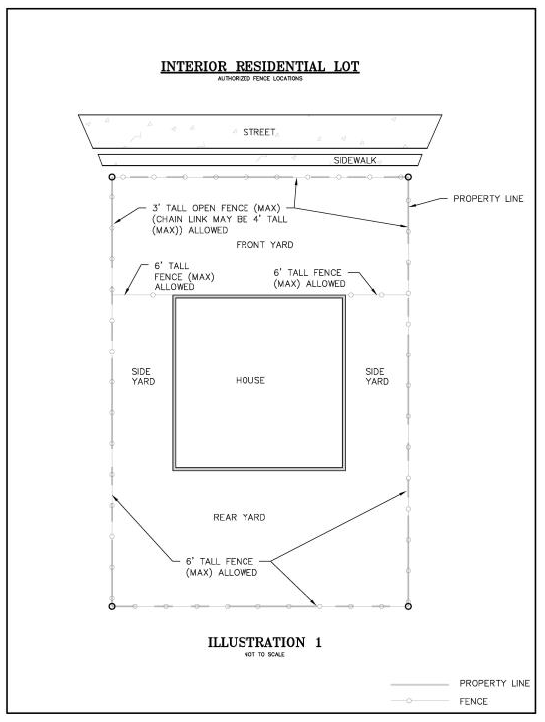
Exhibit 2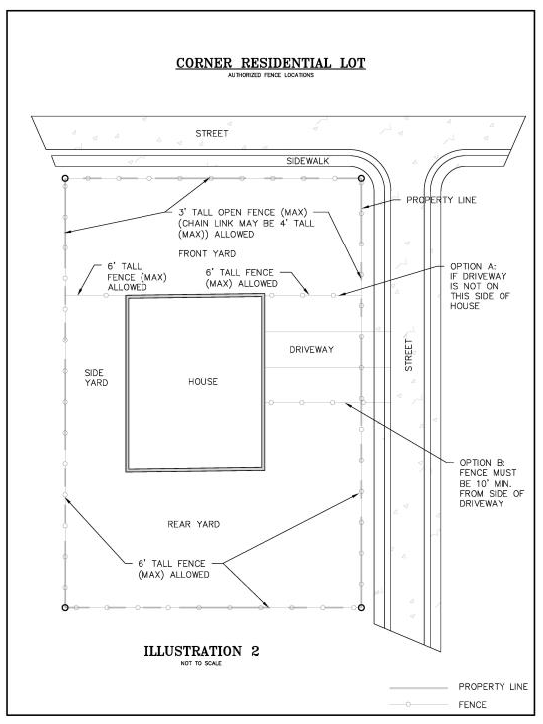
P.
Sidewalks.
1.
Requirements:
a.
Sidewalks shall be constructed according to City standards and specifications in all new developments.
b.
Construction standards. Sidewalks shall be constructed of concrete in accordance with all applicable City standards and specifications, and with all applicable ADA (Americans with Disabilities Act) requirements.
c.
Timing of installation. Required sidewalks shall be installed prior to occupancy of any structure.
Q.
Drainage and stormwater management. Adequate provisions for drainage of surface water and stormwater management shall be made for all development and redevelopment per the City of Johnson ordinance for stormwater runoff. All such plans shall be prepared by a registered professional civil engineer, licensed in Arkansas, and submitted and considered as part of the site plan approval process. Such plans shall contain adequate and properly designed measures to control erosion and sediment discharge from the construction site, and to prevent water pollution that may result from such discharges and runoff in accordance with the City of Johnson ordinance concerning grading, erosion control, and stormwater pollution prevention. The provisions of this section shall also be applicable to all development and redevelopment impacting one half (½) acre or more of property regardless of the type of development or use.
(Ord. No. 2007-13, Sec. 9; Ord. No. 2018-03; Ord. No. 2021-01, 2-9-2021; Ord. No. 2021-02, 2-9-2021; Ord. No. 2022-07, § 1(Exh. A), 4-12-2022; Ord. No. 2024-10, § 1, 9-10-2024)

