
Jupiter Inlet Colony
City Zoning Code
City Zoning Code
ARTICLE I
- GENERAL PROVISIONS
TITLE
An ordinance to be designated as the official Zoning Code of Jupiter Inlet Colony, Florida: Disclosing the intent, authority and purpose; Providing construction of language and definitions; Providing the designation of Jupiter Inlet Colony as a single-family residential community, as designated by the Jupiter Inlet Colony Charter; Providing for interpretation and enforcement of code regulations and provisions; Providing for a Building and Zoning Committee; Providing for penalties and remedies; Providing for application procedure for petition for variances.
Section 1. - Definitions and Rules of Construction.
All words used in the present tense include the future; all words in the singular number include the plural and the plural the singular; the word "building" includes the word "structure"; the word "shall" is mandatory and the word "person" includes a firm or corporation as well as a natural person. The word "commission" shall mean the commission of Jupiter Inlet Colony. Any word or terms not integrated or defined by this section shall be used with a meaning of common or standard utilization.
For definitions not defined but related specifically to the usage in zoning matters, the Palm Beach County Unified Land Development Code definitions and Florida Building Code definitions shall be used.
Access, (legal). A dedicated or recorded road, lane, place, walkway, or easement affording perpetual ingress and egress from a subject property to a public thoroughfare.
Accessory building. A detached, subordinate structure, the use of which is clearly incidental and related to that of the principal structure and which is located on the same lot as the principal structure, e.g. garage and bath house.
Base building line. A line horizontally offset from and running parallel to the centerline of a street from which property development regulations, including landscaping, parking and setbacks are measured as set forth in this Code.
Building. Any structure designed or built for the support, enclosure, shelter or protection of persons, animals, chattels, or property of any kind.
Building code(s). The Florida Building Code as provided for and adopted in F.S. Ch. 553.
Building, height of. The vertical distance from the average finish grade to the highest finished roof surface of a flat roof or to the highest point of the ridge for gable, hip or gambrel roofs.
Building official. The employee or agent retained by the town with building construction regulation responsibilities who is charged with the responsibility for direct regulatory administration or supervision of plan review, enforcement or inspection of building construction, erection, repair, addition, remodeling, demolition or alteration projects that require permitting indicating compliance with building, plumbing, mechanical, electrical, gas, fire prevention, energy, accessibility and other construction codes as required by state law or town ordinance.
Chimney. A vertical structure incorporated into a building and enclosing a flue or flues that carry off smoke to outside air.
Club. Buildings and facilities owned and operated by a corporation or association of persons for social or recreational purposes, but not operated primarily for profit or to render a service that is customarily carried on as a business.
Conformity. In compliance with current codes and ordinances.
Construction cost. The sum of all costs, direct and indirect, inherent in converting a design plan into a finished project, including labor, materials, supervision, administration, tools, equipment and subcontractor costs.
Cupola. A small structure that is built on top of a roof and typically used to provide a lookout or to admit light and air.
Design professional. A person registered in the State of Florida who can practice in one (1) of the following professions per the Florida Statutes: Interior designer, landscape architect, licensed architect, professional engineer, professional geologist, and registered surveyor. Said professionals must be functioning in their area of responsibility as it relates to the construction process.
Dock. An unenclosed accessory structure built on pilings over water, which is designed or used to provide dockage for and access to one (1) or more boats and which may have davits, vertical lifts, gates, water and electrical service, other similar public utility services and additional accessory uses customarily incident to a dock, such as but not limited to storage chests and low-intensity lighting approved by the town and installed in a manner as not to have an adverse effect upon adjacent properties.
Driveway. A private road extending from a public right-of-way to a garage(s) on the abutting property. A driveway shall be constructed to extend to the entrance of each garage on the property.
Dwelling. Any single-family building designed for and used exclusively for residential purposes and occupied by one (1) family. No boat, houseboat, watercraft, or recreational vehicle shall be considered a single-family dwelling. A dwelling shall be only those living facilities that supply permanent provisions for living, sleeping, eating, cooking and sanitation for periods greater than thirty (30) days.
Easement. An area of land established for the purpose of installation, operation, repair, or maintenance of facilities and equipment used to provide utility services and drainage.
Entry feature. A non-habitable, non-enclosed space associated with the front or side street entrance to a building or structure that does not exceed two hundred (200) square feet in area.
Family means one (1) person or a group of two (2) or more persons living together and interrelated by bonds of legal adoption, blood, or a licit marriage, or a group of not more than three (3) people who need not be related by blood or marriage, living together as a single housekeeping unit in a dwelling. Any person under the age of 18 years whose legal custody has been awarded to the state department of children and family services or to a child placing agency licensed by the department, or who is otherwise considered to be a foster child or child in emergency shelter care, and who is placed with a family, shall be deemed to be related to and a member of the family for the purposes of this chapter.
Fence. An artificially constructed barrier of any material or combination of materials erected to enclose or screen an area of land.
Floor area. The sum of all areas on all floors of all buildings including the areas lying within the building perimeter established by the interior side of the exterior wall of all floors of the building. For the purpose of section 10.1(F) of the zoning code, floor area shall mean all space within the building perimeter established by the exterior side of the exterior wall of all floors of the building, including garages, covered patios, open air exterior areas that are under roof, interior second floor areas that are open to below, and balconies that project beyond the exterior walls of the building.
Frontage. (See Figure 1)
(a)
Street frontage. All the property on one (1) side of a street between two (2) intersecting streets (crossing or terminating), or if the street is dead-ended, then all of the property abutting on one (1) side between an intersecting street and the dead end of the street.
(b)
Lot frontage. The distance for which the front boundary line of the lot and the street line are coincident.
Garage, private. An accessory building or a portion of a main building normally used for the parking or storage of automobiles of the occupants of the principal structure.
Grade. The finished surface of the ground (soil) based on NGVD datums of a lot. The grade will be approved by the building official on the basis of conformity with original plat topography, neighboring properties, and as required by state or federal laws.
Grade, average finish. The average (calculated) level of finished surface of the ground adjacent to the exterior walls of the structure. The average is determined by the NGVD along the side of the four (4) primary walls of the structure and averaged on sixteen (16) locations for the structure. The four (4) locations shall be determined as equally spaced along the primary wall of a structure. Grade exterior to a pool deck will be counted as locations for this average. As defined by the following equation:

In event a structure is not present on a lot, then the grade is determined by the adjacent grades located at the boundary of the direct neighboring properties.
Grade, finish. The average level of finished surface of the ground (soil) adjacent to the exterior walls of the structure based on NGVD datums. The finish grade height shall be approved by the building official on the basis of conformity with neighboring properties and as required by state or federal laws.
Ground cover. Pebbles, gravel, stones, and other inorganic or organic material used as a mulch or protective ground cover immediately around the base of landscape material in accordance with typical horticultural practices.
Habitable space. The space or area in or on a structure used or intended to be used for living, sleeping, eating, cooking or recreation.
Handicapped accessible. Handicapped accessible means modifications or improvements to an existing structure that are designed or constructed in such a manner that the structure is readily accessible to and usable by individuals with disabilities.
Home occupation. Any occupation or activity carried on by a member of the family residing on the premises, in connection with which there is no construction, assembly, or activity with no sign or no display that will indicate from the exterior that the building is being utilized in part for any purpose other than that of a dwelling; there is no commodity or service sold upon the premises; no person is employed other than a member of the immediate family residing on the premises; and no mechanical equipment is used except that which is normally used for purely domestic or household purposes including home hobbies.
Impermeable material. A ground cover or material through which water cannot penetrate.
Kitchen unit. A portion of the habitable space used or designed, or arranged to be used for the preparation of food, and including or designed to include a stove.
Landscape material. Lawn, turf, sod, ground cover, flowers, vines, bushes, shrubs, hedges, palms, trees, or other type of organic material typically used in residential landscapes.
Living area. That area within any dwelling made usable for human habitation with the following exceptions:
(a)
Any utility room or storage space that is not accessible from within the principal structure.
(b)
All common corridors, hallways, or exits provided for access or vertical travel between stories.
(c)
That area of a screened porch or screened breezeway over ten (10) percent of the required living area.
Lot. A parcel of land occupied or intended for occupancy by a use permitted in this Code including one (1) main building, together with its accessory buildings, the yard areas and parking spaces required by this Code and having its principal frontage upon a legally constituted access.
Lot coverage by buildings. The percentage of lot area covered or occupied by buildings, including accessory buildings and garages. For purposes of calculation, lot coverage by buildings includes all areas lying within the building perimeter established by the exterior side of the exterior wall of all floors of the building, including garages, covered patios, open air exterior areas that are under roof, and balconies that project beyond the exterior walls. Coverage of lot by building shall not include the area of eaves around the perimeter of a building provided eaves shall be no greater than twenty-four (24) inches in width, but shall include the complete area of a balcony and cantilevered second floor area that projects beyond the exterior wall of a first floor building.
Lot of record. A duly recorded lot as a part of a land subdivision, the map, or metes and bounds of which has been recorded in the Office of the Clerk of the Circuit Court of Palm Beach County, Florida.
Lot line. The lines bounding a lot established by ownership.
Lot, corner. A lot abutting upon two (2) or more streets at their intersection. As shown in Figure 1.
Figure 1. Yard Definitions Corner Lot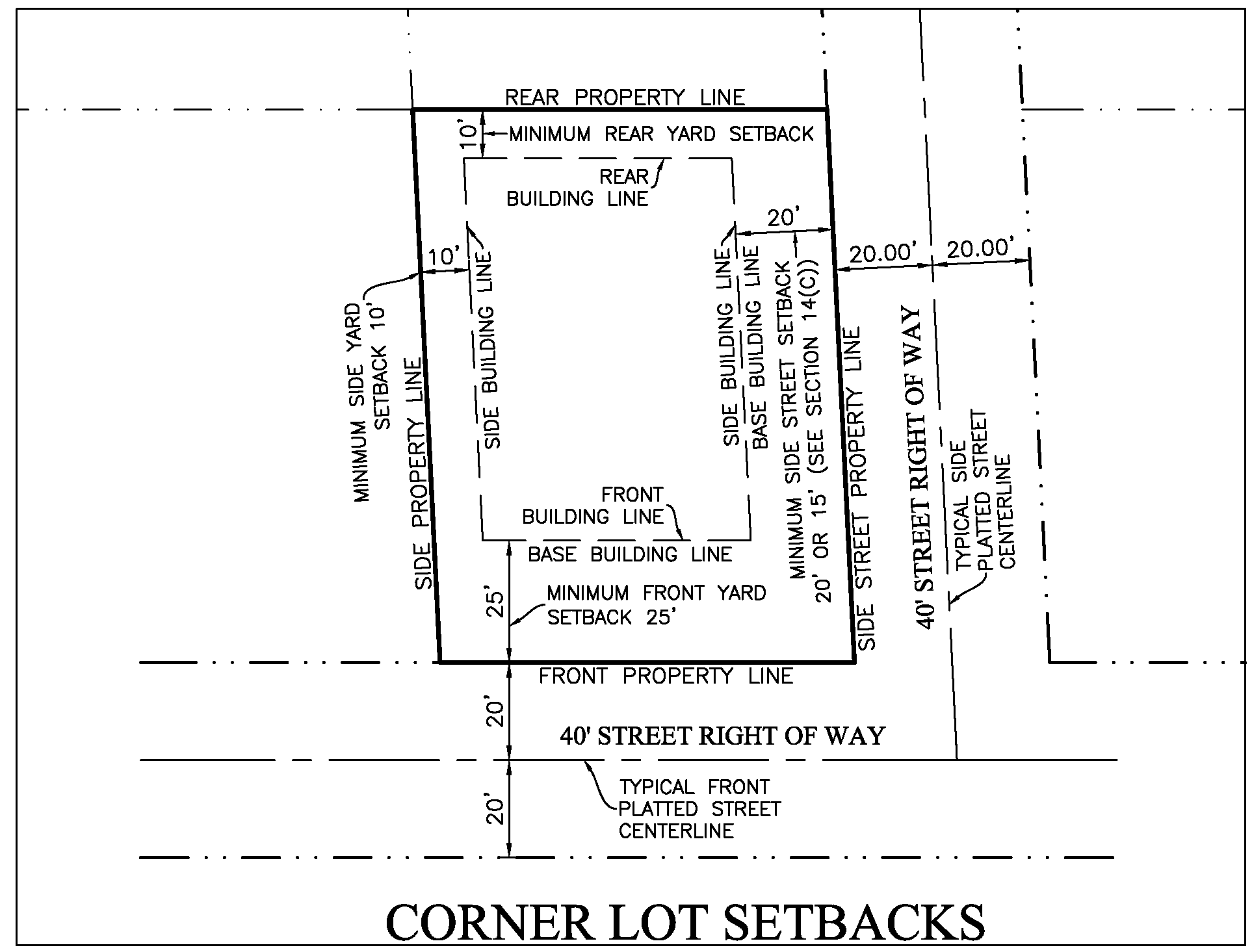
Lot occupancy. Lot Developed Area ÷ Total Lot of Record Area = % of Lot Occupancy.
Lot, double frontage. A lot having a frontage on two (2) nonintersecting streets as distinguished from a corner lot.
Lot, depth. The depth of a lot is the distance measured in a mean direction of the side lines of the lot from the midpoint of the front line to the midpoint of the opposite rear line of the lot.
Manufactured or modular building. A closed structure, building assembly or system of subassemblies, which may include structural, electrical, plumbing, heating, ventilating or other service systems manufactured in manufacturing facilities for installation or erection as a finished building or as part of a finished building. The term includes buildings not intended for human habitation such as lawn storage buildings and storage sheds manufactured and assembled offsite by a manufacturer certified in compliance with F.S. Ch. 553, Pt. I. The term does not apply to mobile homes.
Mobile home. A detached, transportable single family dwelling unit, manufactured on a chassis or undercarriage as an integral part thereof, without independent motive power, designed for long term occupancy as a complete dwelling unit and containing all conveniences and facilities, with plumbing and electrical connections provided for attachment to approved utility systems.
NGVD. National Geodetic Vertical Datum.
Open-space. Open spaces shall be defined for purposes of this Zoning Code as undeveloped areas suitable for passive recreation or conservation uses.
Parking lot or parking area. An area, or plot of ground, used, or intended to be used, for the storage or parking of motor vehicles or to provide an accessory service to a recreational or residential use.
Permeable material. A ground cover or material through which water can penetrate at a rate comparable to that of water through undisturbed soils.
Planning and Zoning Administrator. The Town employee or consultant designated by the Town Commission as the individual charged with the responsibility of the administration and enforcement of the Zoning Code.
Policy and Procedure Memorandum (PPM). An internal procedural memorandum published by the planning and zoning administrator, which is intended to act as a policy guide that aids in the administration and implementation of the zoning code.
Pond. A structure designed or utilized to contain water.
Property line. See definition for "lot line."
Recreational unit. Boat, personal water craft, boat trailer, motor home, travel trailer, camper, truck or bus camper, expandable tent trailer or any vehicle or unit designed and constructed for temporary or intermittent use for vacationing or recreation.
Replacement cost. The current cost of replacing or duplicating an existing structure with the same quality of construction, materials and operational utility, without taking into account the depreciated value of the structure.
Residence. A single-family home, including accessory buildings and garages, on a residential lot or combination of lots.
Residential use means the use of land or structures thereon or portions thereof for residential occupancy of a permanent or semi-permanent nature. This use allows occupancy, by any one (1) individual or family, with or without bona fide nonpaying guests, in any individual dwelling of not less than thirty (30) days. The rental of a single-family residential dwelling for a term of less than thirty (30) days or more frequently than three (3) times in a calendar year shall be considered a commercial use and is prohibited. The term residential use does not include occupancy of a transient nature such as a hotel, motel, timeshare, resort dwelling or bed and breakfast inn use as defined by F.S. Ch. 509. Such transient uses are declared to be incompatible with the residential character of the town and are prohibited.
Right-of-way. Section of land dedicated or deeded to the perpetual use of the public.
Setback. A specified minimum distance that a structure must be located from a lot line.
Side loaded garage. A private garage with the garage door(s) parallel to the adjacent side lot line.
Sight line. An uninterrupted line of vision extending from an observer's eye to a viewed object or area.
Spa. Small structure holding water primarily meant to be used for relaxation with limited body emersion.
Stepping stones. Individual stones or pavers placed directly on the ground for infrequent stepping or walking. Typical uses include walkways and paths that are separate and distinct from patios and decks.
Street. A public, or private, right-of-way which affords the principal means of vehicular access to abutting property.
Street centerline. The line midway between the street right-of-way lines as designated on the plot plan as approved for Jupiter Inlet Colony.
Street right-of-way line. The dividing line between a lot, tract, or parcel of land and a contiguous street.
Structure. Anything constructed or erected, the use of which requires, more or less, permanent location on the ground or attached to something having a permanent location on the ground and shall include antennas, service sheds, docks and piers or other structures and supports used for living purposes. Utility poles, fences, and walls used as fences shall not be considered as structures for setback purposes under the conditions set forth herein.
Structure, principal. A main and foremost structure located on a lot and in which is conducted the main and foremost use of the lot on which the building or structure is situated.
Structural alterations. Any change, except for repair or replacement, in the supporting members of a building, such as bearing walls, columns, beams or girders, floor joists, or roof rafters.
Submerged lands. Land that is under water or partially under water as defined by the State of Florida Department of Environmental Protection.
Swale. The portion of a public road right-of-way located between the paved roadway and extending to the lot line of the abutting privately owned lands.
Swimming pool. A structure below ground level used for bathing or wading purposes and being over eighteen (18) inches deep and with a surface area of more than forty (40) square feet.
Variance. An abatement of the terms of the Zoning Code for a use which will not be contrary to the public interest and where, owing to conditions peculiar to the property and not the result of the actions of the applicant, a literal enforcement of this Code would result in unnecessary and undue hardship.
Waiver. A request to alter a specific Zoning Code provision where alternative solutions to Code requirements are provided, subject to standards, performance criteria or limitations. Waivers are not intended to relieve specific financial hardship nor circumvent the intent of the Zoning Code.
Walkover, dune. A structure built on pilings over the dune, which is designed or used to provide access to the water without causing damage to the ecosystem below.
Walkway/bike path. Strip of land designated for the purpose of walking and or bicycling that may separate two (2) properties or be along a side of a public road.
Water line, mean high. Water height based on maximum tide flow as defined by the State of Florida Department of Environmental Protection.
Water line, mean low. Water height based on minimum tide flow as defined by the State of Florida Department of Environmental Protection.
Yard. An open space at grade between a building and the adjoining lot lines, unoccupied and unobstructed by any portion of a structure from the ground upward, except as otherwise provided herein. In measuring a yard for the purpose of determining the width of a side yard, the depth of a front yard or the depth of a rear yard, the minimum horizontal distance between the lot line and the main building shall be used. As shown in Figures 2.a, 2.b.
Figure 2. Yard Definitions—Interior Lot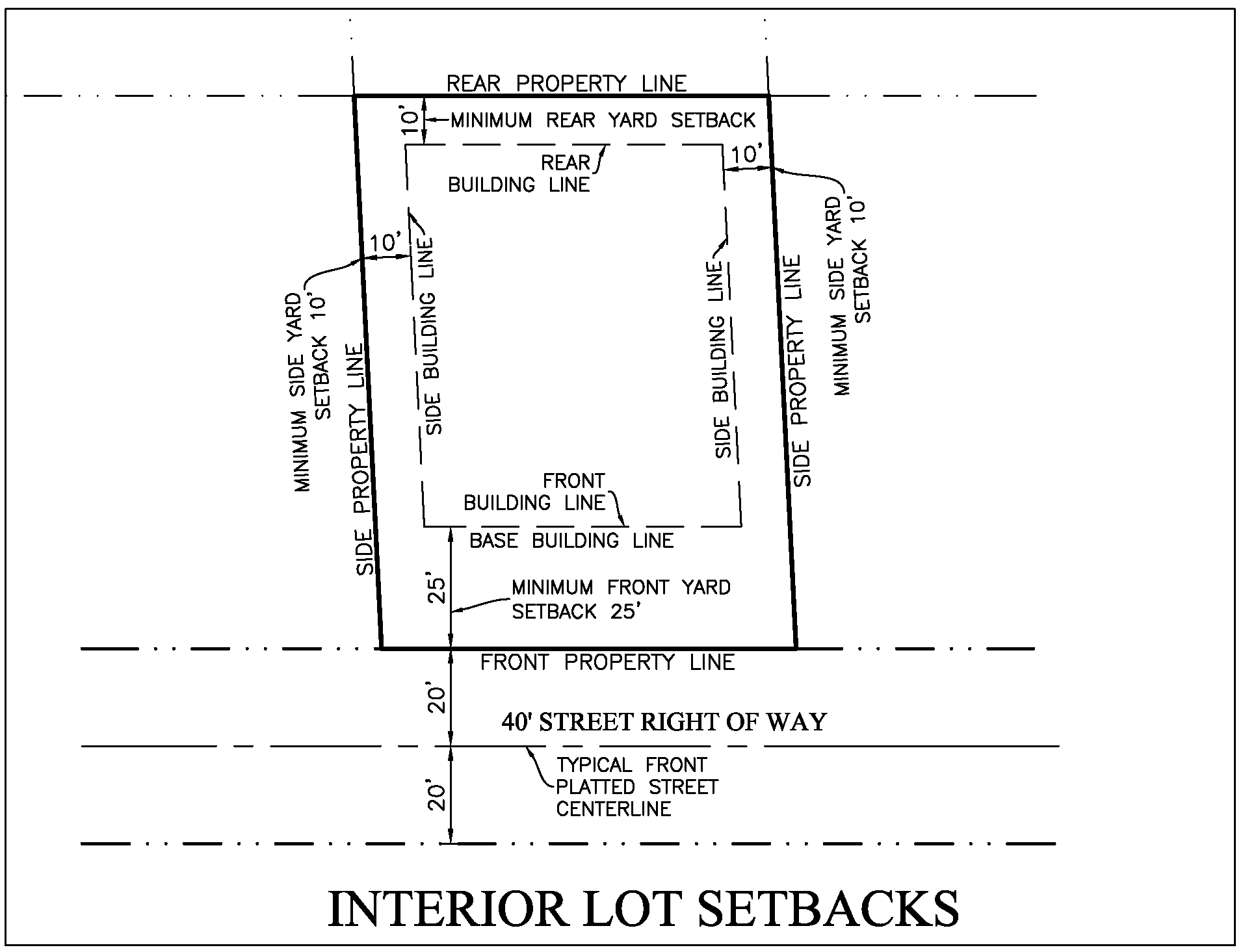
Figure 2.b. Yard Definitions—Double Frontage Lot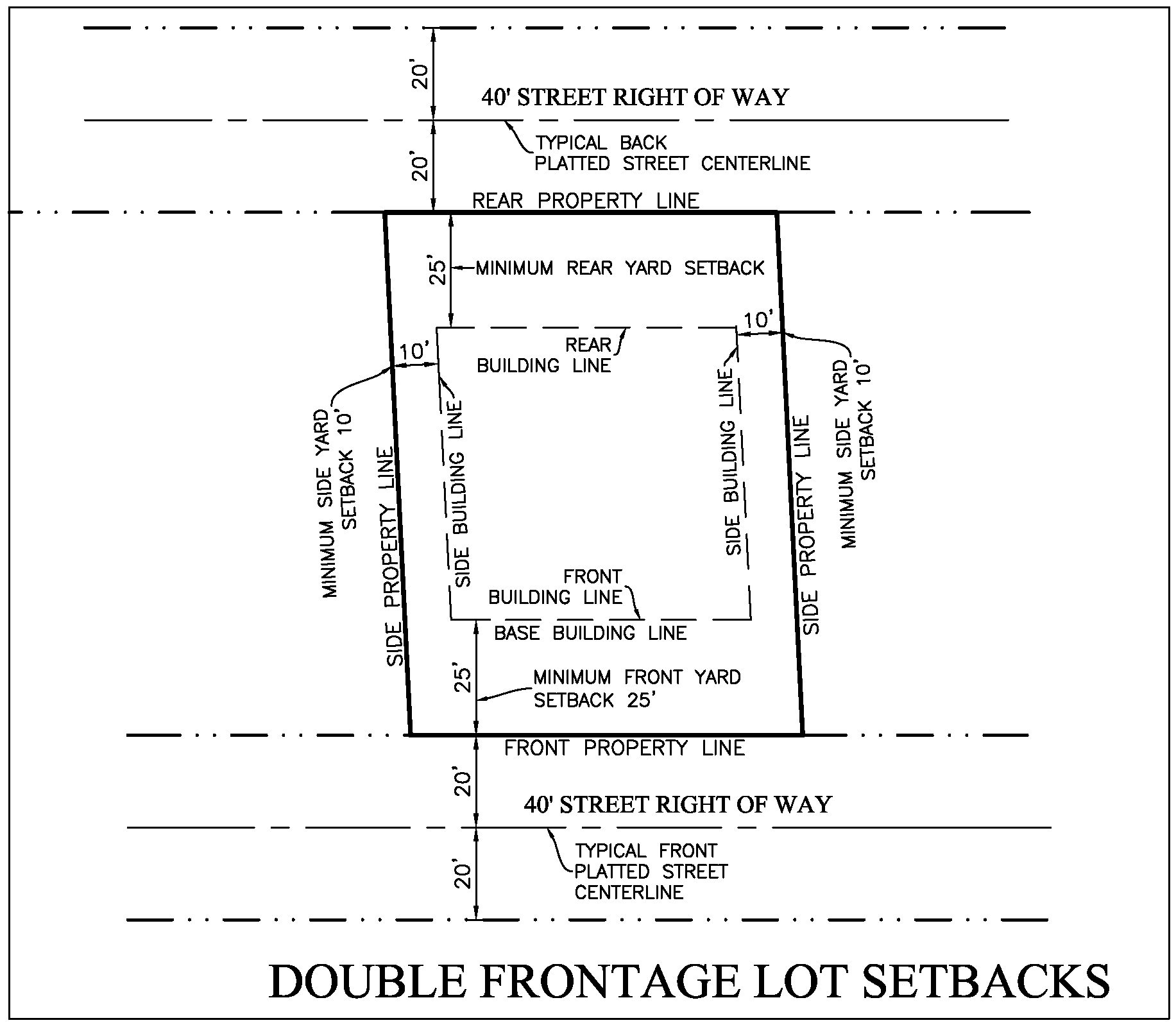
Yard, front. A yard extending across the full width of a lot between the side lot lines, and being the minimum horizontal distance between the front property line or right-of-way line and the building or structure other than the projections of uncovered steps, uncovered balconies, or uncovered porches. On corner lots the front yard shall be considered as parallel to the street upon which the lot has its address location.
Yard, rear. A yard extending across the rear of a lot between the side lot lines and being the minimum horizontal distance between the rear of any building or any projections thereof. On all corner lots, the rear yard shall be at the opposite end of the lot from the front yard and extended from the side lot line to the side street side yard line.
Yard, side. A yard between any building and the side line of the lot, and extending from the front yard line to the rear yard line and being the minimum horizontal distance between a side lot line and the side of any building or any projections therefrom. On corner lots the side yard will extend from front yard line to rear property line on the side street.
Zoning Code. The ordinance(s) duly adopted by the town commission intended to implement and ensure that all development orders approved in the town are consistent with the town's Comprehensive Plan and the regulations and restrictions set forth in said ordinance(s).
(Ord. No. 238-149-104, § 2, 7-13-09; Ord. No. 07-2016, § 1, 1-11-17; Ord. No. 02-2017, § 2, 5-8-17; Ord. No. 05-2017, § 1, 9-11-17; Ord. No. 04-2018, § 1, 3-29-18; Ord. No. 06-2018, § 1, 5-14-18; Ord. No. 07-2018, § 1, 10-9-18; Ord. No. 09-2018, § 1, 11-13-18; Ord. No. 02-2021, § 1, 3-18-21)
Section 2. - Establishment of Zoning Classification.
In order to classify, regulate and restrict the use of land, water, buildings and structures, the areas included within the boundaries of Jupiter Inlet Colony are classified as RS, single-family residential (formerly RIAA).
In accordance with F.S. § 161.56(2), Jupiter Inlet Colony is classified as a "Coastal Barrier Island" and falls totally within the coastal building zone defined by Florida law as being the area five thousand (5,000) feet landward from the coastal construction control line. In the event that the coastal construction control line is rescinded, the coastal building zone will be that area five thousand (5,000) feet inward from the mean high water line. All construction within the coastal building zone shall comply with the Coastal Construction Code.
Section 3. - Authority.
(A)
Planning and Zoning Administrator.
1.
The planning and zoning administrator shall be charged with the administration and enforcement of the provisions of this zoning code as agent of and acting under the direction of the town commission.
2.
The planning and zoning administrator shall review building plans that have an impact on zoning issues such as setbacks, building height or elevation, building mass, sight lines, grade or lot coverage. Except for applications for building permits for work specified in a town policy and procedure memorandum as not requiring zoning review, no building permit shall be issued until the planning and zoning administrator has approved plans submitted for compliance with the zoning code. Applications for building permits for work that is specified in a town policy and procedure memorandum as not requiring zoning review and that have no effect or impact on zoning issues such as setbacks, building height or elevation, building mass, sight lines, grade or lot coverage need only be reviewed by the building official. The signature of the planning and zoning administrator on the application for permit shall be authorization for issuance of the permit by the building official, provided that if the applicant fails to obtain a building permit within six (6) months of approval by the planning and zoning administrator then said approval shall be void and the application process must be recommenced.
3.
The planning and zoning administrator may, upon awareness of evidence of a zoning code violation during construction, issue a stop-work order to suspend any building permit temporarily until the reason for suspension has been eliminated or corrected or until an appeal is reviewed by the town commission.
4.
Any decision of the planning and zoning administrator may be appealed, as of right, to the town commission unless a variance is involved. In which case, the applicable procedure for requesting a variance is to be followed.
(B)
Building and Zoning Committee. The town commission shall appoint building and zoning committee members. Such committee shall consist of no less than three (3) and no more than seven (7) members. The committee shall select a chairperson to preside at its meetings. The responsibilities of the committee shall be to 1) assist the planning and zoning administrator in the interpretation of zoning code regulations, 2) consider, review and recommend potential zoning code amendments, 3) perform an impact review analysis, when applicable; 4) review plans for new construction; exterior renovations, additions and remodels; and significant renovations deemed necessary by the planning and zoning administrator, 5) provide recommendations for action on variance applications, as required by the planning and zoning administrator, and 6) grant, if appropriate, setback waivers for swimming pools and screen enclosures as provided in section 17(F)(8) of the zoning code.
(C)
Impact Review Analysis.
1.
Purpose. The purpose of the impact review analysis process is to ensure that proposed development is designed, located, configured, landscaped and developed to avoid negative impacts on neighboring properties or the town as a whole. In the instances where impact review is applicable, the standards of this section shall be interpreted to operate in concert with the other provisions of the land development regulations in order to achieve the purposes of the zoning code. Consequently, if a proposed building or buildings cannot be designed, located, configured, landscaped and developed in a manner that satisfies the standards of this section, then an applicant:
a.
May not be entitled to develop all of the floor area and/or building height that are otherwise permitted by the other provisions of these land development regulations; and
b.
May not be entitled to provide only the minimum yards that are otherwise required by the underlying zoning district regulations.
2.
Applicability. Impact review is required if:
a.
The total floor area on the lot proposed for development, including existing and proposed floor area, will be greater than eighty (80) percent of the maximum floor area permitted in the underlying zoning district; or
b.
A proposed addition or renovation to an existing structure adds a second-story or if more than one thousand (1000) square feet of floor area is added to an existing structure.
3.
Procedures; Standards for Review. In performing its impact review analysis, the building and zoning committee shall approve an application if the applicant demonstrates that:
a.
The proposed development will not adversely affect the public interest; and
b.
The mass, scale and height of the proposed development is consistent with the surrounding properties and neighborhood character: and
c.
The proposed development will not adversely affect adjoining properties; and
d.
For development on waterfront properties, the proposed development is sensitive to and preserves views from adjoining properties as much as is practicable.
4.
Decisions; Appeals. In performing an impact review analysis, the building and zoning committee shall either approve, approve with conditions or deny an application for development approval. In the event the building and zoning committees finds that an application meets the requirements of this section, then the application shall be approved. In the event the building and zoning committee approves the application with conditions or denies the application, the applicant may either amend its development application in compliance with the decision of the building and zoning committee or may appeal the decision to the town commission. Any such appeal shall be made within thirty (30) days of a decision by the building and zoning committee. In addition to the applicant, only the owners of properties identified in paragraph E may appeal an impact review decision to the town commission.
(D)
Town Commission. The town commission shall serve as the appellate board of the town:
1.
To hear and decide appeals where it is alleged there is an error in any order, requirement, decision or determination made by an administrative official or the building and zoning committee in the enforcement of this chapter [Appendix A-Zoning Code].
2.
To authorize upon application in specific cases a variance from the terms of this chapter [Appendix A-Zoning Code] as will not be contrary to the public interest, where owing to special conditions, a literal enforcement of the provisions of this chapter [Appendix A-Zoning Code] will result in unnecessary hardship. However, the town commission shall not be empowered or authorized to grant a variance to permit a use in a zone or district in which use is not permitted by this chapter [Appendix A-Zoning Code].
3.
In exercising the above-mentioned powers, the town commission may, in conformity with the provisions of this chapter [Appendix A- Zoning Code], reverse or affirm, wholly or partly, or may modify the order, requirement, decision or determination as ought to be made, and to that end shall have all the powers of the officer or committee from whom the appeal is taken. The concurring vote of three (3) commissioners shall be necessary to reverse any order, requirement, decision or determination of any such administrative official or the building and zoning committee or to decide in favor of the applicant on any variance under this chapter [Appendix A- Zoning Code].
(E)
The town clerk shall provide notice by regular mail to owners of property directly abutting a property for which a building or development permit application has been filed and review is required by the building and zoning committee as well as to owners of properties located across the street from and within fifty (50) feet of any portion of the property seeking development approval. Said notice shall be mailed to owner(s) as shown on the records of the property appraiser of Palm Beach County, Florida no less than five (5) days prior to the meeting of the building and zoning committee. The failure of the town clerk to provide the notice as specified herein or the failure of an owner(s) to receive such notice shall in no way invalidate or otherwise affect any action either taken or the issuance of any building permit(s).
(Ord. No. 226-137-92, § 1, 8-7-06; Ord. No. 250-161-116, § 1, 1-9-12; Ord. No. 07-2016, § 2, 1-11-17; Ord. No. 02-2017, § 3, 5-8-17; Ord. No. 04-2018, § 2, 3-29-18; Ord. No. 06-2018, § 2, 5-14-18; Ord. No. 02-2021, § 1, 3-18-21)
Section 4. - Variances; Application Procedures; Notice of Hearing.
The commission shall have the authority, upon appeal in specific cases to grant such variances from the terms of this chapter [Appendix A—Zoning Code] as will not be contrary to the public interest where, owing to special conditions, a literal enforcement of the provisions of this chapter [Appendix A Zoning Code] would result in unnecessary hardship. A variance from the terms of this chapter [Appendix A—Zoning Code] shall not be granted by the commission unless and until:
(A)
A written application for variance on a form authorized by the Town Commission is submitted along with the applicable application fee. Such application shall be filed in triplicate and shall specifically address the criteria set forth in Section 5. Additionally, the application for variance shall, at a minimum, contain the following information:
(1)
A statement of the applicant's interest in the property and:
(a)
If individual and/or joint and several ownership, a written consent to the petition of all owners of record; and
(b)
If an authorized agent, a copy of the agency agreement or written consent of all the principal(s)/owner(s); or
(c)
If a lease, a copy of the lease agreement and written consent of all of the owners; or
(d)
If any share of ownership is held by a corporation or other business entity, the name of the officer or person responsible for the application shall present a corporate resolution that the representative has the delegated authority to represent the corporation or other business entity.
(2)
A certified boundary survey by a surveyor registered in the state. Such survey shall include all pertinent information relative to the variance request and shall include an accurate legal description of the property.
(3)
The location of the subject property on an official municipal map sheet and a listing of the names and addresses of the property owners of record whose properties exist within a radius of three hundred (300) feet of any boundary of the subject property.
(4)
A statement of special reasons or basis for the request, including the intended use and development of the property shown on a site plan. Such site plan shall show the following as applicable:
(a)
All existing and proposed improvements on the site, including construction fill, regrading, landscaping, and the like;
(b)
Access to a dedicated public road;
(c)
Access to or proposed provisions for utilities.
(5)
Such other information that may be essential to the town commission in its consideration of the application.
Before the town clerk may accept an application, it must fully comply with all required information enumerated herein, unless expressly waived by the town commission.
(B)
All properties within a single application must be contiguous and immediately adjacent to one another or be subject to separate applications and filing fees.
(C)
Upon acceptance of a completed application, the town clerk shall inform the building official. The building official, or his/her designated representative, shall examine the application for completeness and may make suggestions to the applicant, if necessary, to present additional factual and evidentiary material to support the application.
(D)
Upon acceptance of a completed application, the town clerk shall publish a notice of public hearing, as hereinafter required, said notice shall be posted on the web site of the Town of Jupiter Inlet Colony and shall be published at least two (2) times in a newspaper of general circulation in the town, the first publication of which shall be at least fifteen (15) days before the public hearing, and the second such publication to be at least five (5) days prior to the public hearing. In addition to the publication, the town clerk, at petitioner's cost, shall mail a notice containing substantially the same information set forth in the published notice, by certified mail, return receipt requested, at least twenty (20) days prior to the hearing, to the addresses of record of the property owners of record whose properties exist within a radius of three hundred (300) feet of any boundary of the described property; provided that failure to receive the receipted returns of such notices shall not affect any action or proceedings taken hereunder, so long as the town clerk certifies at the public hearing that all notices were sent to those property owners as required hereunder.
The notice of public hearing and notice mailed to property owners shall, at a minimum, set forth the following:
(1)
The time, date, and place of the public hearing;
(2)
The name(s) of the owner(s) and applicant(s);
(3)
A short legal description of the subject property along with the street address of the property;
(4)
A description of the variance requested specifying the Section(s) of the Zoning Code from which relief is requested; and
(5)
A statement that the completed application for variance may be inspected in the office of the town clerk.
(E)
Prior to the public hearing before the town commission, the application for variance shall be reviewed by the building and zoning committee. The applicant shall be notified in writing at least five (5) days prior to the meeting of the building and zoning committee and shall be entitled to attend and comment before the committee. In reviewing the application, the building and zoning committee shall consider the criteria set forth in section 5, and upon the conclusion of its meeting, shall transmit its recommendations to the town commission (with or without conditions); such recommendations shall be advisory and shall become part of the hearing file and record and be open for public inspection.
(F)
The applicant may not amend his application after the notice of the public hearing has been transmitted and receipt acknowledged by the newspaper for publication. If the applicant withdraws his application, subject to the provisions of section 7, a new application must be filed as set forth in this section.
(Ord. No. 07-2016, § 3, 1-11-17; Ord. No. 04-2018, § 3, 3-29-18)
Section 5. - Variances; Criteria For Consideration.
(A)
In order to authorize any variance from the terms of this Zoning Ordinance, the town commission must find all of the following:
(1)
That special conditions and circumstances exist which are peculiar to the land, structure, or building involved and which are not applicable to other lands, structures, or buildings in the same zoning district.
(2)
That the special conditions and circumstances do not result from the actions of the applicant.
(3)
That granting the variance requested would not confer on the applicant any special privilege that is denied by this ordinance [Appendix A, Zoning Code] to other lands, buildings, or structures in the same zoning district.
(4)
That literal interpretation of the provisions of this ordinance would deprive the applicant of rights commonly enjoyed by other properties in the same zoning district under the terms of this ordinance and would work unnecessary and undue hardship on the applicant.
(5)
That the variance granted is the minimum variance that will make possible the reasonable use of the land, building, or structure.
(6)
That the grant of the variance will be in harmony with the general intent and purposes of this ordinance and that such variance will not be injurious to the area involved or otherwise detrimental to the public welfare.
(B)
In granting a variance:
(1)
The town commission may prescribe appropriate conditions and safeguards in conformity with this ordinance. Violation of such conditions and safeguards, when made a part of the terms under which the variance is granted, shall be deemed a violation of this ordinance.
(2)
The town commission may prescribe a reasonable time limit within which the action for which the variance is required shall be begun or completed, or both.
(3)
Under no circumstances shall the town commission grant a variance to permit a use not generally permitted in the zoning district involved or any use expressly or by implication prohibited by the terms of this ordinance in the zoning district. No nonconforming use of neighboring lands, structures or buildings in the same zoning district and no permitted use of lands, structures or buildings in another zoning district shall be considered grounds for the authorization of a variance.
(Ord. No. 07-2016, § 4, 1-11-17; Ord. No. 05-2017, § 2, 9-11-17)
Section 6. - Variances; Public Hearings.
At the public hearing required hereunder, any party may appear in person or by duly authorized agent. The applicant shall have the burden of demonstrating compliance with the criteria set forth in Section 5. Members of the public shall be provided opportunity to address the merits of the application. At the conclusion of the public hearing, the town commission shall make findings as to the criteria set forth in Section 5, and shall by motion either grant, grant with conditions, or deny the variance request. The decision of the town commission shall be deemed rendered as of the date of the public hearing.
Section 7. - Variances; Withdrawal or Denial of Application.
(A)
Upon the denial of an application for relief hereunder, in whole or in part, a period of one (1) year must run prior to the filing of a subsequent application affecting the same property or any portion thereof.
(B)
Upon the withdrawal of an application, in whole or in part, a period of six (6) months must run prior to the filing of a subsequent application affecting the same property or any portion thereof, unless, however, the decision of the town commission is without prejudice; and provided that the period of limitation shall be increased to a two (2) year waiting period in the event such an application, in whole or in part, has been twice or more denied or withdrawn.
(C)
An application may be withdrawn without prejudice by the applicant as a matter of right; provided the request for withdrawal is in writing and executed in a manner and on a form prescribed by the town commission and filed with the town commission at least one (1) week prior to any hearing scheduled concerning application; otherwise, all such requests for withdrawal shall be with prejudice. No application may be withdrawn after final action has been taken. When an application is withdrawn without prejudice, the time limitations for reapplication provided herein shall not apply.
Section 8. - Variances; Judicial Review of Decision of Colony Commission.
Any person or persons, jointly or severally, aggrieved by a decision of the town commission may apply to the circuit court in the judicial circuit where the town is located for judicial relief within thirty (30) days after rendition of the decision by the town commission. Such an appeal shall not be by hearing de novo, but shall be limited to appellate review of the record created before the town commission.
Section 9. - Nonconforming Lots, Nonconforming Uses of Land, and Nonconforming Structures.
(A)
Intent. Within the town, there exist lots, structures, uses of land, and structures that were lawful before this Zoning Code was adopted or amended, but which would be prohibited, regulated or restricted under the terms of this chapter [Appendix A, Zoning Code]. It is the intent of this section to permit these nonconformities to continue until they are removed, but not to encourage their survival. Such uses are declared by this chapter [Appendix A, Zoning Code] to be incompatible with permitted uses in the districts involved. It is further the intent of this chapter [Appendix A, Zoning Code] that nonconformities shall not be enlarged upon, expanded or extended, nor be used as grounds for adding other structures or uses prohibited elsewhere in the same district.
(B)
Nonconforming Lots of Record. Notwithstanding limitations imposed by other provisions of this chapter [Appendix A, Zoning Code], a single-family dwelling and customary accessory buildings may be erected on any single lot of record at the effective date of the adoption or amendment of this chapter [Appendix A, Zoning Code]. Such lot must be in separate ownership and not of continuous frontage with other lots in the same ownership. This provision shall apply even though such lot fails to meet the requirements for area or width, or both, that are generally applicable in the town, provided that yard dimensions and other requirements not involving area or width, or both, of the lot shall conform to the regulations for the district, in which such lot is located. Variance of area, width and yard requirements shall be obtained only through action of the town commission.
(C)
Nonconforming Uses of Land. Where, at the effective date of adoption or amendment of this chapter [Appendix A, Zoning Code], a lawful use of land exists that is made no longer permissible under the terms of this chapter [Appendix A, Zoning Code] as enacted and amended, such use may be continued so long as it remains otherwise lawful, subject to the following provisions:
(1)
No such nonconforming use shall be enlarged or increased, nor extended to occupy a greater area of land than was occupied at the effective date of adoption or amendment of this chapter [Appendix A, Zoning Code].
(2)
No such nonconforming use shall be moved in whole or in part to any other portion of the lot or parcel occupied by such use at the effective date of adoption or amendment of this chapter [Appendix A, Zoning Code].
(3)
If any nonconforming use of land ceases for any reason for a period of more than ninety (90) days, any subsequent use of such land shall conform to the regulations specified by this chapter [Appendix A, Zoning Code] for the district in which land is located.
(D)
Nonconforming Structures. When a lawful structure exists at the effective date of adoption or amendment of this chapter [Appendix A, Zoning Code] that could not be built under the terms of this chapter [Appendix A, Zoning Code] by reason of restrictions on area, lot coverage, height, yards or other characteristics of the structure or its location on the lot, such structure may be continued so long as it remains otherwise lawful, subject to the following provisions:
(1)
No such structure may be enlarged or altered in a way that increases its nonconformity.
(2)
Should any nonconforming structure be damaged or destroyed by any means to an extent of one hundred thousand dollars ($100,000.00) or in an amount of more than fifty (50) percent of its replacement cost at the time of damage or destruction, whichever is greater, such structure shall not be constructed or repaired except in conformity with the provisions of this chapter [Appendix A, Zoning Code]. Replacement cost shall be determined by the improvement value as set forth by the Palm Beach County Property Appraiser on its most recent assessment roll.
(3)
Should such structure be moved for any reason for any distance whatsoever, it shall thereafter confirm to the regulations for the district in which it is located after it is moved.
(4)
If, within a three-year period (as calculated from the date of the issuance of the initial building permit within the three-year period), an owner should choose to renovate, remodel, or structurally alter such nonconforming structure to an extent of one hundred thousand dollars ($100.000/00) or in an amount of more than fifty (50) percent of its replacement cost, whichever is greater, said structure shall not be renovated, remodeled, or structurally altered except in conformity with the provisions of this chapter [Appendix A, Zoning Code]. Replacement cost shall be determined by the improvement value as set forth by the Palm Beach County Property appraiser on the assessment roll for the year of the initial building permit. For purposes of this subsection, the terms "renovate," "remodel" and "structurally alter" shall not include the repair or replacement of a roof, the repair or replacement of windows or doors or modifications to a structure to provide handicapped accessibility in a nonconforming structure.
(5)
Notwithstanding the monetary limitations set forth in Subsections (D)(2) and (4) of this Subsection, an owner(s) making repairs or renovations to a) a one-story residence that is nonconforming as to coverage of lot by buildings as of the effective date of this Ordinance shall not be required to comply with the maximum lot coverage provisions set forth in Section 10.1(5) and b) a two-story residence that is nonconforming as to coverage of lot by buildings or maximum floor area (total or second story) as of the effective date of the Ordinance shall not be required to comply with the second story setback provisions set forth in Section 10.1(2) and the lot coverage and maximum floor area provisions as set forth in Section 10.1(6).
(E)
Creation of Nonconformity Prohibited. No owner of real property shall convey or otherwise transfer all or any portion of said real property where the conveyance has the effect of creating or increasing a nonconforming condition(s) on the subject property.
(Ord. No. 03-2014, § 1, 5-12-14; Ord. No. 07-2016, § 5, 1-11-17; Ord. No. 05-2017, § 3, 9-11-17)
Section 10. - Restrictions Upon Lands, Building, and Structures.
(A)
Use. No building, fence, grading, wall, walk, pier, dock, sea wall or other structure, shall be commenced, erected, maintained, moved, altered or added to until the plans and specifications showing the nature of such structure or work to be done, and the grading plan of the lot to be built upon have been submitted to the town clerk, and approved by the building official, or his/her designee, and a permit issued. No land, building structure or premises shall be designed or intended to be used for any purpose or in any manner other than as permitted by this Code or amendments thereto.
(B)
Height. No building or structure shall be erected nor shall any existing building or structure be moved, reconstructed or structurally altered to exceed the height limit established by this Code or amendments thereto. Functional chimneys, faux chimneys, non-habitable cupolas, and flag poles may be erected above the height limits, herein established with the approval of the building official. However, the heights of these structures or appurtenances thereto shall not exceed the height limitations prescribed by the Civil Aeronautics Agency with the flight approach pattern of airports and shall not exceed the height of allowed functional chimney for the respective structure as prescribed by the Florida Building Code.
(C)
Percentage of Lot Occupancy. No building or structure shall be erected, nor shall any existing building or structure be moved, altered, enlarged, or rebuilt, nor shall any open spaces surrounding any building or structure be encroached upon or reduced in any manner, except in conformity with the building site requirements and yard regulations established by this Code or amendments thereto. In order to minimize the effect on natural environment conditions, maximize surface water drainage and run off, and controlling building mass and density, the following development standards shall apply:
(1)
For a one-story residence, a maximum of fifty (50) percent of any lot area may be developed; provided the owner(s) of the real property may develop a maximum of sixty (60) percent of the lot area on the condition that the owner(s) execute and deliver to the town a deed restriction, in recordable form, covenanting that the structure(s) shall not be renovated or improved in any manner so as to add a second story to the structure(s) unless the maximum lot occupancy is reduced to fifty (50) percent or less. Said deed restriction shall run with the land and be binding on the heirs, successors and assigns of the owner(s). An owner(s) of a single story residence existing on the effective date of this appendix may increase the lot occupancy to no more than sixty (60) percent of any lot area provided the owner(s) complies with the provisions in this section.
(2)
For a two-story residence, a maximum of fifty (50) percent of any lot area may be developed.
(3)
Developed, for purposes of this section, shall include pools, patios, porches, ponds, concrete pads, stepping stones, concrete walls, seawalls, walks, walkways, pathways, driveways, parking areas, and similar paved or impervious areas, except as provided herein. Walks, driveways, and parking areas composed of any material, shall be included in the calculation of lot occupancy.
(a)
For the purposes of this section, the following shall not be included in the calculation of lot occupancy:
(i)
Boundary walls with a width of no greater than nine (9) inches and a cap width of no greater than twelve (12) inches;
(ii)
Seawalls with a cap width of no greater than twenty-four (24) inches;
(iii)
Equipment pad(s) up to a maximum of one hundred (100) square feet per lot or property; and
(iv)
A single path of stepping stones or pavers laid in a pattern less than or equal to two (≤ 2) feet in width, and less than or equal to four (≤ 4) square feet in area per stone or paver.
(b)
In the event a wall, seawall, equipment pad(s), or stepping stones exceeds the above-referenced dimension or threshold, then the area in excess of the specified dimension or threshold shall be included in the calculation of lot occupancy.
(4)
No less than thirty (30) percent of the front yard of every residence with a lot area less than or equal to eleven thousand (11,000) square feet shall be planted with landscape material; no less than fifty (50) percent of the front yard of every residence with a lot area greater than eleven thousand (11,000) square feet and less than twenty thousand (20,000) square feet shall be planted with landscape material and no less than seventy (70) percent of the front yard of every residence with a lot area of twenty thousand (20,000) square feet or greater shall be planted with landscape material. Pebbles, gravel, and stones used as ground cover between botanical materials in accordance with section 19-2 of the Code of Ordinances may be included in the calculation of required residential landscaping.
(D)
Open Space Use Limitation. No yard or open space provided about any building or structure for the purpose of complying with the regulations of this resolution [Appendix A, Zoning Code] or amendments thereto shall be considered as providing a yard or open space for any other building or structure.
(E)
Required Lot and Occupancy. Every building or structure hereafter erected shall be located on a lot or parcel of land; and in no case shall there be more than one (1) main building and its accessory buildings on one (1) lot except as hereinafter provided.
(F)
Occupancy Limitations. Every residence shall be used only as a single-family dwelling. (Family as defined in this Code.) Only one (1) kitchen unit is permitted in the habitable space per dwelling and no business activity is permitted except as allowed under the definition of home occupation.
(G)
All residential lots shall develop consistent with the low density classification (0—5.0 dwelling units/acre) established on the future land use map in the future land use element of the adopted Town of Jupiter Inlet Colony's Comprehensive Development Plan. In accordance with the low density classification, no more than one (1) single family residence shall be constructed on a platted lot of record.
(H)
Conservation Uses. The submerged lands within the Intracoastal Waterway shall be in conservation use as depicted on the future land use map in the future land use element of the adopted Town of Jupiter Inlet Colony's Comprehensive Development Plan. Conservation use shall be defined as: "activities within land areas designated for the purpose of conserving or protecting natural resources or environmental quality and includes areas designated for such purposes as flood control, protection of quality or quantity of groundwater or surface water, floodplain management, fisheries management, or protection of vegetative communities or wildlife habitats."
(I)
Off-Street Parking Nonresidential. These regulations apply to parking areas for all nonresidential uses throughout the town:
(1)
For the purpose of this section, the term "off-street parking space" shall consist of parking space having minimum dimensions of ten (10) feet in width by twenty (20) feet in length for the parking of each motor vehicle, exclusive of access drives or aisles thereto. The parking plan shall be so arranged that each motor vehicle may be replaced and removed from the parking spaces assigned thereto and taken to and from the property without the necessity of moving any other motor vehicle to complete the maneuver.
(2)
Required yards and setbacks may not be used for off-street parking. Access drives or aisles and turning spaces shall be located within the lot lines. Except as dedicated or as driveways to parking structures, streets, public rights-of-way, easements or sidewalk areas shall not be used for off-street parking purposes.
(3)
Where a parking space is provided in open areas adjacent to or beneath any building, structure or portion thereof, such parking spaces shall have a solid surface.
(4)
Parking spaces for persons with disabilities shall be provided in all required parking lots pursuant to state and federal laws regulating the same. Such spaces shall not be in addition to, but shall substitute for, required parking.
(5)
There shall be provided at the time of the erection of any main building or structure, or at the time that any main building or structure is enlarged by more than twenty-five (25) percent of the square footage of the existing building or structure, minimum off-street motor vehicle parking space with adequate provisions for ingress and egress by a motor vehicle of standard size, in accordance with the following:
(a)
Public buildings and grounds: One (1) space for each two hundred (200) square feet of gross floor area.
(b)
Private or community owned clubs and associations: One (1) space for each three hundred (300) square feet of gross floor area.
(6)
Miscellaneous provisions.
(a)
Parking spaces for all permitted uses shall be located on the same lot with the main building or structure to be served.
(b)
The plan for off-street parking areas shall be subject to the approval of the town commission.
(c)
The minimum parking space size, aisle width and driveway width shall be based upon the degree of angle of the individual parking space and shall be in accordance with the Minimum Parking Bay Dimensions by Parking Angle and Parking Bay Illustrations, as established within the Palm Beach County, Florida, Unified Land Development Code, and all other provisions of this section.
(d)
Each parking space shall be marked either by painted lines, pre-cast curbs, or in a similar fashion so as to indicate the individual parking spaces.
(e)
Each parking space shall be a solid surface consisting of one (1) of the following materials:
(i)
Asphalt;
(ii)
Concrete;
(iii)
Paver stone;
(iv)
Other permeable materials including gravel;
(v)
Other solid surface approved by the town commission.
(f)
All off-street parking facilities shall be drained so as not to cause any nuisance or detriment to adjacent private or public property through the use of on-site control techniques for stormwater run-off, such as, but not limited to, permeable surfaces, French drains, catch basins, swales, etc. or other accepted methods of stormwater runoff control.
(g)
Loading space, off-street. Off-street loading/delivery space logically and conveniently located for bulk pickups and deliveries, at a size as provided for in this paragraph, and accessible to such vehicles when required off-street parking spaces are filled shall be provided. Required off-street loading spaces of two (2) per principal use are not to be included as off-street parking space in the computation of required off-street parking. The size of a required loading space shall not be less than twelve (12) feet by twenty-five (25) feet with a vertical clearance of not less than fourteen (14) feet.
(h)
Each parking site or lot shall be designed individually with reference to the size, street pattern, adjacent properties, buildings, and other improvements in the general neighborhood, number of motor vehicles to be accommodated, hours, and kinds of use.
(i)
Landscaping for all parking areas shall be provided in accordance with section 4-2 of the Town Code.
(J)
Off-Street Parking Residential. These regulations apply to all residential uses throughout the town:
(1)
Each single-family dwelling shall provide a driveway and no less than two (2) parking spaces per dwelling. Such parking spaces may be located on a driveway.
(2)
All driveway(s) and parking area(s) shall be constructed so as to not encroach on side or rear setbacks; provided, a driveway may encroach one (1) side yard setback on a lot with a lot area of eleven thousand (11,000) square feet or less that conforms to section 10(C)(1) of the Zoning Code.
(a)
The driveway shall be setback a minimum of two (2) feet from the side property line.
(b)
The driveway shall not encroach an easement without a signed release from the easement holder.
(c)
All driveways with a permit issued by the town that are located in a side or rear setback, as of the effective date of this ordinance, shall be considered conforming for the purposes of section 9(D) of the Zoning Code, nonconforming structures.
(3)
All driveways and parking areas shall consist of one (1) or a combination of the following materials:
(a)
Concrete;
(b)
Paver stones or bricks;
(c)
Gravel, crushed rock, crushed shells, shell rock, pea rock, turf, artificial turf, or turf block.
(4)
Turf, artificial turf, or turf block.
(a)
No portion of the outermost border of a driveway or parking area shall consist of turf, artificial turf, or turf block.
(b)
No more than thirty (30) percent of a driveway or parking area shall consist of turf, artificial turf, turf block, or a combination thereof.
(c)
No area of a driveway or parking area consisting of turf, artificial turf, or a combination thereof, shall exceed thirty-six inches (36) in width.
(d)
Artificial turf or turf block utilized in a driveway or parking area shall have a hardscape underlayment suitable to support the weight of a vehicle.
(e)
A driveway or parking area designed to park or store vehicles exclusively on turf is prohibited.
(f)
Driveway(s) and parking areas shall be drained so as to not cause any nuisance or detriment to adjacent private or public property through the use of on-site control techniques for stormwater run-off, such as, but not limited to permeable surfaces, French drains, catch basins, swales or other accepted methods of stormwater run-off control.
(g)
Landscaping adjacent to all parking areas shall be provided in accordance with section 4-2 of the Town Code.
(K)
Coastal Vegetation. Development and redevelopment in the coastal area, as defined in the Town of Jupiter Inlet Colony's Comprehensive Development Plan, that will adversely impact wetland vegetation including sea grasses, mangroves and the dune system, marine and wildlife habitats and coastal resources is prohibited.
(L)
Single-Family Attached Residence. All single family resident structures and accessory buildings will be attached except where otherwise allowed by this Code for detached parking garage and bathhouses.
(Ord. No. 221-132-87, § 1, 3-6-06; Ord. No. 239-150-105, § 1, 7-13-09; Ord. No. 07-2016, § 6, 1-11-17; Ord. No. 02-2017, § 4, 5-8-17; Ord. No. 05-2017, § 4, 9-11-17; Ord. No. 04-2018, § 4, 3-29-18; Ord. No. 06-2018, § 3, 5-14-18)
Section 10.1. - Development standards for single family residences.
(A)
Mass and Volume Distribution. Because lots within the town are limited in size, the massing and volume of any new residential building or addition should be sensitive to the profiles of adjacent buildings and should locate second stories adequately to reduce the apparent overall scale of the building. Second story windows, decks, terraces, and balconies for new construction shall be designed and located to ensure privacy for adjacent properties to the extent possible.
(B)
Setbacks. The first story of all buildings shall adhere to established zoning setbacks. The second story of any two-story residence shall be setback on its front elevation a minimum of thirty two (32) feet from the front property line and on its rear elevation a minimum of fifteen (15) feet from the rear property line.
(C)
Lot Occupancy. Overall lot occupancy shall be governed by the provisions of Section 10(C) of the Zoning Code.
(D)
Building elevations. All building elevations shall provide for a minimum of ten (10) percent wall openings. Wall openings are defined as windows, doors or transitional spaces defined by porches, porticoes or colonnades. New windows shall be placed to avoid direct views into existing neighboring windows. Open air balconies shall be permitted a) only on the front and rear of a second story of a two-story residence on Lots 1-24, 75-107 and 241-243, inclusive and b) on all other lots, only on the front, or the side street side, if a corner lot, of the structure, or in the rear of the structure, provided, the rear most portion of the balcony is a minimum of twenty (20) feet from the rear lot line.
(E)
Lot coverage by buildings and maximum floor area regulations for two-story residence. The maximum percentage of lot coverage by buildings for a two-story residence shall be thirty-two (32) percent.
(1)
The floor area of the second story of a two-story residence shall not exceed sixty (60) percent of the first story floor area.
(2)
The total floor area for the combined first floor and second floor of a two-story residence shall not exceed fifty (50) percent of the total lot area.
(F)
The restrictions in this section pertaining to second story setbacks, wall openings, open air balconies and the maximum floor area of a second story and total combined first and second story floor area shall apply to new construction and to the renovation of or an addition to an existing structure that seeks to add a second story to the same.
(Ord. No. 07-2016, § 7, 1-11-17; Ord. No. 06-2018, § 4, 5-14-18; Ord. No. 07-2019, § 1, 1-13-20)
Section 11. - Uses Permitted.
(A)
"Time sharing use," for purposes of this Code, shall mean the use of any dwelling unit under which the exclusive right of use or occupancy of the dwelling unit circulates among various occupants in accordance with a fixed time schedule or a periodically recurring basis for a period of time established by such schedule. Such use is hereby declared to be inconsistent with single-family use and is not permitted.
(B)
Within the RS Single-Family Residential District, no building, structure, land, or water shall be used, unless otherwise permitted by this Code, except for one (1) or more of the following uses:
(1)
Single-family residential dwellings and accessory uses customarily incident to them. No single-family residential dwelling shall be leased for a term of less than thirty (30) days. Additionally, no single-family residential dwelling shall be leased more frequently than three (3) times in a calendar year. No person or entity shall offer or advertise a single-family dwelling for rent or lease for a term of less than thirty (30) days.
(2)
Parks and recreation areas owned and operated by the municipality.
(3)
Conditional uses as provided in section 12 of this Zoning Code.
(Ord. No. 238-149-104, § 3, 7-13-09; Ord. No. 08-2018, § 1, 10-9-18)
Section 12. - Conditional Uses.
(A)
The following conditional uses may be permitted by the Town Commission:
(1)
Public uses and buildings, including accessory uses customarily incident thereto, that are owned and operated by the municipality. Any such public use(s) or building(s) shall not be subject to lot occupancy, setback, open space, parking and other development restrictions and regulations as set forth in this Zoning Code.
(2)
Private swimming, and tennis clubs, and community owned and operated clubs and associations.
(3)
Noncommercial recreation areas neither owned nor operated by the county.
(B)
An applicant for a conditional use must apply with the town in writing providing, at a minimum, the following information:
(1)
Name and address of the owner and/or applicant for the conditional use; and
(2)
The proposed use of the property; and
(3)
A site plan depicting all improvements to be constructed on the property; and
(4)
Such other information as deemed appropriate by the Planning and Zoning Administrator.
(c)
An application for conditional use shall first be reviewed by the building and zoning committee for consistency with the Zoning Code and whether the granting of the conditional use promotes the general health, safety and welfare of the town. The Building and Zoning Committee shall make a recommendation to the Town Commission concerning the approval, denial or approval with conditions of a proposed conditional use.
(D)
Upon recommendation of the Building and Zoning Committee, the Town Commission shall consider the application for conditional use. The Town Commission shall consider whether the proposed conditional use is consistent with the Zoning Code and whether the granting of the conditional use promotes the general health, safety and welfare of the town. The Town Commission may approve, deny or approve with conditions the conditional use application.
(E)
Any violation of the conditions for which a conditional use permit is granted shall render the permit null and void and the owners thereof subject to penalties that may by law be provided for such cases.
(Ord. No. 07-2016, § 8, 1-11-17; Ord. No. 04-2018, § 5, 3-29-18; Ord. No. 08-2018, § 2, 10-9-18)
Section 13. - Building and Wall Height Regulations.
(A)
Maximum building height. No building or structure shall exceed twenty-five (25) feet in height at the highest point of the roof measured from the average finish grade, as approved by the Building Official. The roof of a one-story residence shall not exceed twenty-three (23) feet in height.
(B)
Maximum exterior wall height for a one-story residence. The exterior walls of a single story building or structure, as established by the foundation plan, shall not exceed fourteen (14) feet in height at the highest point of the wall, measured from the average finished grade as approved by the building official; provided, the exterior walls of non-habitable, non-enclosed entry features and spaces may exceed fourteen (14) feet in height. The maximum height of an entry feature shall not exceed eighteen (18) feet. A wall, other than an exterior wall, may exceed fourteen (14) feet in height if setback on its front elevation a minimum of thirty-two (32) from the front property line and on its rear elevation a minimum of fifteen (15) from the rear property line.
(C)
Maximum exterior wall height for a two-story residence. The exterior walls of a two story building or structure, as established by the foundation plan, shall not exceed the following height at the highest point of the wall, measured from the average finished grade as approved by the building official:
(1)
If the roof is flat, the exterior walls shall not exceed twenty-four (24) feet in height.
(2)
If the roof is sloped at an angle of less than or equal to three (3) feet of height for every twelve (12) feet of length, or is sloped but does not terminate at a peak or ridge, the exterior walls shall not exceed twenty-one (21) feet in height.
(3)
If the roof terminates at a peak or ridge and is sloped at an angle of greater than three (3) feet of height for every twelve (12) feet of roof length, the exterior walls shall not exceed eighteen (18) feet in height.
(D)
Rooftop decks and terraces. Unenclosed roof top decks and terraces on back-to-back lots shall only be permitted in the Town as follows:
(1)
The finished slab or deck on which a person could walk is a minimum ten (10) feet below the maximum height allowed for the structure, measured from the average finished grade; or
(2)
The deck or terrace is below a fully enclosed roof or roof extension of the residence.
(3)
Existing rooftop decks and terraces shall be considering nonconforming and may continue to exist and be maintained in the manner that they were permitted, but shall not be expanded or replaced unless they meet one of the standards above.
(Ord. No. 07-2016, § 9, 1-11-17; Ord. No. 04-2018, § 6, 3-29-18; Ord. No. 06-2018, § 5, 5-14-18; Ord. No. 07-2018, § 2, 10-9-18; Ord. No. 07-2019, § 2, 1-13-20)
Section 14. - Front, Rear, and Side Yard Regulations.
The minimum front, rear and side yard setbacks in Table 1 shall be provided for all buildings and structures, as measured from the lot line to the nearest point of any building or structure.
(A)
The minimum yard setbacks in Table 1 shall only apply to a lot with a lot area of eleven thousand (11,000) square feet or less that conforms to Sec. 10.(C)(1) of the Zoning Code. Otherwise, the Standard District setbacks shall apply.
(B)
A non-elevated walkway no greater than three (3) feet in width may be installed in a side yard area for the purpose of providing pedestrian and maintenance access to the front and rear yards. Under no circumstances shall a walkway in the side yard be designed or intended to extend any part of a patio, deck, or pool deck into a side yard area.
(C)
A non-elevated patio or deck on a lot with a lot area of eleven thousand (11,000) square feet or less that conforms to Sec. 10.(C)(1) of the Zoning Code may extend a maximum of two and one-half (2.5) feet into the side or rear yard areas.
(Ord. No. 07-2016, § 10, 1-11-17; Ord. No. 02-2017, § 5, 5-8-17; Ord. No. 05-2017, § 5, 9-11-17; Ord. No. 06-2018, § 6, 5-14-18)
Section 15. - Minimum Floor Area.
The minimum floor area of a one-family dwelling shall be sixteen hundred (1,600) square feet of habitable space.
(Ord. No. 07-2016, § 11, 1-11-17)
Section 16. - Nonconforming Uses.
The lawful use of any building, structure, or land, existing at the time of the adoption of this Code, may be continued although such use does not conform with the provisions of this ordinance, provided the following conditions are met:
(A)
Unsafe Structures or Buildings. Any structure or building, or portion thereof declared unsafe, may be restored to a safe condition, subject to Section 16, subsection (G).
(B)
Alteration. A nonconforming building may be maintained, repaired, and altered, except that in a building which is nonconforming as to use regulations, no structural alterations shall be made except those required by law. Repairs such as plumbing or the changing of partitions or other interior alterations are permitted.
(C)
Extension. Buildings or structures, or uses of land which are nonconforming shall not be extended or enlarged, except as hereinafter provided.
(D)
Nonconforming Use of Land. When a nonconforming use of land has been discontinued, its future use shall revert to the uses permitted in the area in which said land is located.
(E)
Change to Another Use. A nonconforming use now existing may be changed to another nonconforming use of equal or improved character when approved by the commission after proper application in accordance with the variance procedure as defined in this Code.
(F)
Restoration. A nonconforming building or structure that is hereafter damaged or destroyed to the extent of fifty (50) percent or more of its Palm Beach County Property Appraiser assessed value by flood, fire, explosion, earthquake, war, riot, or Act of God, may not be reconstructed or restored for use except in compliance with the regulations of this resolution [Appendix A Zoning Code].
(G)
Abandonment. A nonconforming use of a building, which has been vacated or abandoned for one hundred eighty (180) days, shall not thereafter be occupied by a nonconforming use.
(Ord. No. 03-2014, § 2, 5-12-14; Ord. No. 07-2016, § 12, 1-11-17)
Section 17. - General Provisions and Exceptions.
(A)
Location of Accessory Building and Uses.
(1)
When an accessory building is attached to a main structure by a breezeway, passage, or otherwise, it shall conform to the setback and height requirements of the principal structure.
(2)
A detached accessory building shall not be closer than four (4) feet to the main building or other accessory building on the same lot.
(3)
No detached accessory building shall be located in the front yard area.
(B)
Yards.
(1)
Every part of a required yard shall be open, from its lowest point to the sky; unobstructed, except for ordinary projections less than ten and one-half (10.5) inches in width protruding from the side of a home or structure, such as impact protection (hurricane shutters, excluding awning type), sills, belt courses, cornices, buttresses, ornamental features, chimneys, flues, dryer vents, electric outlets, meters, water spigots, and the like. If eaves, canopies, or cantilevered roofs project more than twenty-four (24) inches, the minimum yard requirement shall be extended a distance equal to the amount such projection exceeds twenty-four (24) inches.
Except as provided in this section and section 14, front, rear, and side yard regulations, no other structure or improvement of any nature, other than fences, privacy walls, seawalls, landings, walks, walkways, driveways, mailboxes, landscape lighting, light posts, clean-outs, and equipment on equipment pads, shall be constructed or placed in a required yard area. Sufficient side yard area shall be maintained at all times to allow access to the rear yard for maintenance purposes. All other projections, structures, and improvements not specifically permitted by the Zoning Code or required by the Florida Building Code or other governmental entity are prohibited.
(2)
On the double frontage through lots, the required front yard shall be provided on each street except where modified in this ordinance.
(3)
Screened areas shall conform to the setback requirements as pertaining to buildings in this Code.
(C)
General.
(1)
Every single-family dwelling unit within the town shall be required to have a garage of a sufficient size to house at least one (1) standard size automobile.
(2)
There shall be no chain link fence in the front yard, or side yard, if such side yard abuts on a street or roadway.
(3)
No single-family dwelling shall be a mobile home in construction.
(4)
No boat, houseboat, watercraft, or recreational vehicle shall be used as a dwelling or place of abode when located on a lot or dock area within the town limits.
(D)
Location.
(1)
There shall be a distance of not less than twenty (20) feet between any two (2) dwellings. If the projection of eaves on either or both dwellings exceed twenty-four (24) inches, the distance between the two (2) dwellings shall be increased by an amount equal to the projection in excess of twenty-four (24) inches; provided, on lots that allow nine (9) foot side setbacks, the distance between dwellings may be reduced to eighteen (18) or nineteen (19) feet based on the side setback required on the adjacent lot.
(2)
Clear sight triangle. No fence, structure, or plantings (for visual sight lines) shall be maintained within fifteen (15) feet of the intersection of lot lines of corner lots where the streets intersect to a height exceeding three (3) feet. As shown in Figure 3.
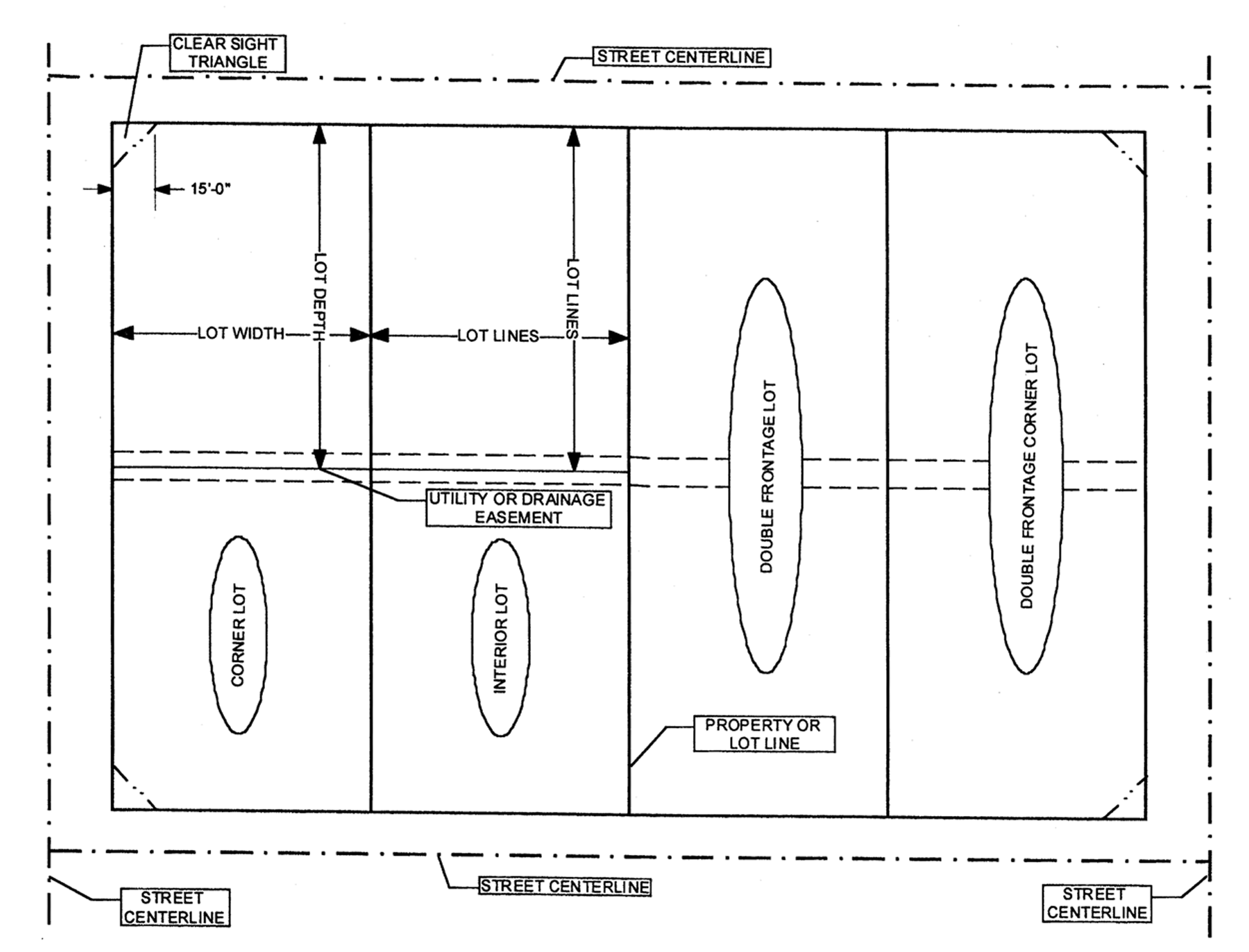
Figure 3. Yard Definitions
(3)
On any corner lot adjoining the rear of another lot which is in a residential district, no part of any structure within twenty-five (25) feet of the common lot line shall be nearer the side street lot line than the least depth of any front yard required for a dwelling on such adjoining lot along such side street.
(E)
Removal of Sand, Rock, etc. The removal, alteration or addition of sand, rock, marl, or other earthy matters, may be permitted provided the applications for such operations have been reviewed and approved by the planning and zoning administrator.
(F)
Pools, Spas, and Screen Enclosures.
(1)
No swimming pool shall protrude more than six (6) inches above the approved or existing finish grade. Nor shall it be of a portable or collapsible in nature and shall not be exposed to open view from any public roadway. Built in spas or platforms may not exceed twenty-four (24) inches off approved deck height.
(2)
The owners, their agents and employees shall install and operate all swimming pools and spas within the Jupiter Inlet Colony in accordance with the rules and regulations of the Florida Building Code, Chapter 4, Section 424.
(3)
The minimum yard setbacks and dimensions in Table 2 shall be provided for all pools, spas, and screen enclosures.
(4)
Enclosed pools where the pool deck width is less then three (3) feet, the back pool wall shall have positive pool handholds permanently mounted to the pool wall where the pool depth is in excess of three (3) feet six (6) inches deep. Handholds shall be located no farther than four (4) feet apart and not more than twelve (12) inches above the waterline. Seat ledges are allowed instead of handholds.
(5)
The areas of the swimming pools, spas, and pool decks shall be included in the percentage of lot occupancy calculation in section 10(C) of the Zoning Code.
(6)
Screen enclosures shall have a screen roof only.
(7)
All other fixed structures, elevated decks, slides, grottos, or similar customary and accessory outdoor appurtenances shall meet the zoning district setback and yard requirements.
(8)
Setback waivers. A twenty (20) percent waiver from the minimum setback to water edge provisions and screen enclosure setbacks in Table 2 may be allowed on lots with an area of eleven thousand (11,000) square feet or less, subject to review and approval by the building and zoning committee. In making a decision to grant a waiver, in full or in-part, the building and zoning committee shall consider the recommendation of the planning and zoning administrator and the following criteria:
(i)
The request for a waiver is under unique circumstances;
(ii)
The waiver is necessary to replace an existing or previously approved nonconforming structure that was no fault of the current property owner; and
(iii)
Granting the waiver will not create any adverse impact on adjacent properties. In granting a waiver, the building and zoning committee may impose conditions, restrictions, or limitations to mitigate any potential impact.
(G)
Utility Poles, Fences, and Walls Used as Fences.
(1)
Utility poles as required by public utility companies shall not be required to meet the setback requirements for structures.
(2)
All property fences and walls used as fences may be erected or maintained along or adjacent to a lot line to a height not exceeding six (6) feet in the required side yard or required rear yard and to a height not exceeding four (4) feet in the required front yard or required side street yard. On lots where the street is not the front street for adjoining lots the provisions for a side yard may apply. The front and side street lines as referred to above shall be the base building lines. Where the main dwelling is set back beyond the twenty-five (25) foot setback line, a six (6) foot high fence on the side yard line may extend to the setback line. All fence heights are to be measured from approved grade and from property owner's side upon which the fence is to be constructed. Walls and fences abutting on adjacent property and the street, must be finished on both sides so as to be aesthetically pleasing.
(3)
Driveway gates are prohibited.
(H)
Clotheslines. All clotheslines shall be installed so as not to be visible from public street or from adjoining properties. Patio or bench railings shall not be used as clotheslines.
(I)
Combination of Lots; United of Title. Whenever an owner(s) seeks to develop or construct improvements on lands that comprise more than one (1) lot of record, a unity of title shall be required from the owner(s) prior to the issuance of a building permit. The percentage of lot occupancy for any such combined lots shall be limited to development (as described in section 10(C) of this Code), of a maximum of fifty (50) percent of the lot area of the larger lot of record. The development limitations set forth in this subsection shall not apply to any property on which a unity of title was provided to the town prior to April 4, 2005. Concerning any property on which a unity of title was provided prior to April 4, 2005, the following development regulations shall apply:
(a)
Existing buildings and improvements on the property may be expanded or enlarged by no more than ten (10) percent of lot occupancy existing prior to April 4, 2005 so long as the total lot occupancy does not exceed fifty (50) percent of the total lot area of the combined lots.
(b)
In the event of the demolition or removal of buildings or improvements exceeding more than twenty-five (25) percent of the pre-April 4, 2005 lot occupancy, the percentage of lot occupancy shall be limited to development of fifty (50) percent of the lot area of the larger lot of record.
(J)
Dune Walkovers. A dune walkover may be constructed at Lots 1—24, inclusive, Lots 241, 242 and 243, and Lot A, Jupiter Inlet Beach Colony; provided all required state, county and town permits are obtained. In addition, all dune walkovers shall comply with the following:
(a)
A dune walkover may extend over and through the rear setback area as provided by section 14(B) of this Code.
(b)
A dune walkover shall be constructed generally perpendicular to the shoreline and shall not encroach into side yard setback areas for the subject property, as extended eastward toward the Atlantic Ocean, as provided by section 14(C) of this Code.
(c)
In the event a dune walkover extends onto town-owned property, the owner(s) of the subject property shall enter into a license agreement with the town upon such terms and conditions as the town may require.
(d)
The walkway section of the dune walkover shall not exceed four (4) feet in width, outside edge to outside edge.
(e)
One (1) sitting platform/observation area may be permitted on each dune walkover. Such area shall not exceed one hundred (100) square feet, shall not exceed ten (10) feet in width, outside edge to outside edge, and shall be constructed on the eastern end of the walkway or within the rear yard area of the subject property.
(f)
No fixed structures such as canopies, walls or other structures shall be permitted on the dune walkover or sitting platform/observation area.
(g)
All dune walkovers shall comply with State of Florida structural requirements for single-family residences except that any portion of a dune walkover that extends onto town property shall comply with State of Florida structural requirements for multifamily or public walkways.
(Ord. No. 191-102-57, § 1, 11-1-99; Ord. No. 206-117-72, § 1, 1-7-02; Ord. No. 215-126-81, § 1, 12-6-04; Ord. No. 218-129-84, § 1, 4-4-05; Ord. No. 227-138-93, § 1, 9-6-06; Ord. No. 07-2016, § 13, 1-11-17; Ord. No. 05-2017, § 6, 9-11-17; Ord. No. 04-2018, § 7, 3-29-18; Ord. No. 06-2018, § 7, 5-14-18; Ord. No. 01-2020, § 1, 2-10-20)
Editor's note— Ord. No. 198-109-64, § 1, adopted Oct. 2, 2000 amended Appendix A, Zoning Code, in its entirety, however, at the direction of the city, the provisions of Ord. No. 191-102-57, § 1, adopted Nov. 1, 1999, have been included herein as subsection (J) of § 17.
Section 18. - Satellite Dish Antennae.
(A)
Except as provided in subsection (B) below, all satellite dish antennae installed in the town shall be ground mounted. No satellite dish antennae shall be installed forward of the front of any building and shall not encroach into side or rear yard setbacks. All satellite dish antennae shall be screened from view from the public street and from adjacent property owners' view. The phrase "screened from view" shall, for purposes of this section, mean as viewed from eye level.
(B)
Satellite dishes twenty (20) inches in diameter or less may be attached to the building and/or roof of a dwelling structure. All such satellite dish antennae shall be non-reflective and colored so as to blend in with the surroundings. Such satellite dish antennae may not have any writing on them and may not be used for display or advertising purposes.
(Ord. No. 07-2016, § 14, 1-11-17)
Section 19. - Docks and Piers.
Only private docks or piers are permitted and must conform to Chapter 21, sections 21-16 through 21-24 of the codified ordinances.
Section 20. - Reasonable Accommodation Procedures.
(A)
This Section implements the policy of the Town for processing requests for reasonable accommodation from the Town's ordinances, rules, policies, practices, and procedures for persons with disabilities as provided by the Federal Fair Housing Amendments Act (42 U.S.C. 3601 et. seq.) ("FHA") and Title II of the Americans with Disabilities Act (42 U.S.C. 12131 et. seq.) ("ADA"), as amended from time to time. For purposes of this Section, a "disabled individual" or a "disabled person" means an individual that qualifies as disabled and/or handicapped under the FHA and/or ADA. Any person who is disabled (or a qualifying entity) may apply for a reasonable accommodation with respect to the Town's zoning or land development code, laws, rules, land use policies, or other relevant practices and/or procedures as provided by the FHA and the ADA by submitting an application for a reasonable accommodation pursuant to the procedures set forth in this section. Applications for a reasonable accommodation must provide proof that a person requires a reasonable accommodation because he/she is disabled and/or handicapped under the FHA and/or ADA.
(B)
A request or application by a disabled person or individual ("Applicant") for a reasonable accommodation under this section shall be in writing and shall be made by completing a form which is available in the Town Clerk's office. The form shall contain questions and requests for information, which are necessary for the Town to process the reasonable accommodation request. At a minimum, the application shall provide the following information:
(1)
Name and contact information of the Applicant;
(2)
Information regarding property at which reasonable accommodation is requested, including the address and legal description of such location as well as ownership of the subject property;
(3)
Describe the accommodation and the specific regulation(s) and/or procedure(s) from which accommodation is sought;
(4)
Reasons the accommodation may be necessary for the Applicant or the individuals with disabilities seeking the specific accommodation, and if relating to housing, why the requested reasonable accommodation is necessary to use and enjoy the housing;
(5)
Describe qualifying disability or handicap;
(6)
Other relevant information pertaining to the disability or property that may be needed by the Town in order for it to be able to evaluate the request for reasonable accommodation;
(7)
All certified recovery residences must provide proof of satisfactory, fire, safety, and health inspections as required by Section 397.487, Fla. Stats., as amended from time to time;
(8)
Signature of Applicant;
(9)
If on-site supervisor or manager, provide the name and contact information (phone and email) for each;
(10)
Date of application;
(11)
Disclosure of ownership interests of property and Owner's consent for application;
(12)
All qualifying entities shall submit proof of the licensable service component the qualifying entity holds pursuant to Chapter 397, Fla. Stat.;
(13)
A listing of the names and mailing addresses (from the Palm Beach County Property appraiser's records) of all property owners within 300 feet radius of the property proposed for a reasonable accommodation;
(14)
Such other information as may be relevant or pertinent to the request for reasonable accommodation.
C)
If the information required to be provided by the Applicant to the Town includes medical information and/or records, including records relating to the medical condition, diagnosis or medical history of the Applicant, the Town shall treat the medical information as confidential information of the Applicant. In such case, the Town shall endeavor to keep the Applicant's medical information confidential to the extent permitted by law. The Town shall advise Applicant, and/or the Applicant's authorized agent, attorney or representative, of any request received by the Town for disclosure of the medical information or documentation provided by Applicant to the Town. Applicant may, in writing, authorize the Town to release the medical records to a third party. The Town will cooperate with the Applicant to the extent allowed by law in actions initiated by persons or entities that challenge or oppose the Town's nondisclosure of medical information or records of the Applicant. However, the Town shall have no obligation to defend or incur legal or other expenses to defend an action seeking to compel the production of medical records claimed to be public records under the Florida Public Records Law.
(D)
When a reasonable accommodation request has been submitted to the Town Clerk, the request shall be referred to the Planning and Zoning Administrator for review and consideration. Within ten (10) days of the receipt of an application, the Town Clerk shall mail a notice to all property owners within a three hundred (300) feet radius of the property proposed for the reasonable accommodation. Such property owners shall, within thirty (30) days of the date of the application, be permitted to make written comments to the Planning and Zoning Administrator concerning the pending application. The Planning and Zoning Administrator may request additional information from the Applicant, specifying in detail what information is required. The Applicant shall have fifteen (15) days to provide the requested information.
(E)
The Planning and Zoning Administrator shall issue a written determination within forty-five (45) days of receipt of the completed application, or, if additional information is requested, within thirty (30) days of receipt of the additional information, and may, in accordance with law:
(1)
Grant the reasonable accommodation request in full, with or without the imposition of conditions; or
(2)
Grant a portion of the reasonable accommodation request and deny a portion of the reasonable accommodation request, and may impose conditions upon the portion of the reasonable accommodation request that was granted; or
(3)
Deny the reasonable accommodation request.
(F)
In determining whether a reasonable accommodation request should be granted or denied, the Applicant, or, if applicable, the qualifying entity, must establish that the Applicant is protected under the provisions of the FHA and/or ADA by demonstrating that the Applicant is handicapped or disabled, as defined in the FHA and/or ADA. Although the definition of disability is subject to judicial interpretation, for purposes of this section, the disabled individual who is the subject of the request for a reasonable accommodation must show:
(1)
A physical or mental impairment which substantially limits one or more major life activities; and
(2)
A record of having such impairment; and
(3)
That the disabled individual is regarded as having such impairment. After satisfying the foregoing three criteria, the Applicant must demonstrate that the proposed accommodations being sought are reasonable and necessary to afford him/her an equal opportunity to use and enjoy housing.
(G)
In determining whether a reasonable accommodation request should be granted or denied, the following factors or criteria shall be considered, as appropriate:
(1)
Impact of proposed use on the character of the neighborhood; and
(2)
Parking and traffic impacts of the proposed use; and
(3)
Estimated length of stay of occupants at the proposed use; and
(4)
Size and character of the property considering the estimated number of occupants and available kitchen, bedroom, bathroom and other typical residential facilities; and
(5)
Such other factors and considerations as deemed appropriate.
(H)
The decision of the Planning and Zoning Administrator may be appealed to the Town Commission within thirty (30) calendar days after the date the written decision of the Planning and Zoning Administrator is rendered. The Town Commission shall schedule a public hearing to consider the appeal within forty-five (45) days of the filing of the notice of appeal and shall issue a written determination.
(I)
An Applicant may seek review of the Town Commission decision, by writ of certiorari to the Fifteenth Judicial Circuit, within thirty (30) days after the date on which the written decision is rendered.
(J)
No fee shall be imposed by the Town Clerk's office in connection with a request for reasonable accommodation under this Section, or for an appeal of a decision of the Planning and Zoning Administrator. The Town shall have no liability for or legal obligation to pay an Applicant's attorney's fees or costs, including the attorney's fees and costs incurred in any appeal at any appellate level.
(K)
During the time when an application for reasonable accommodation is pending, the Town shall not enforce the land development code, ordinance, rules, policies, and procedures which are the subject of the request for a reasonable accommodation against the Applicant.
(L)
The following general provisions shall be applicable:
(1)
The Town shall display a notice in the Town's public notice bulletin board (and shall maintain copies available for review in the Town Clerk's office), advising the public that disabled individuals (and qualifying entities, if applicable) may request a reasonable accommodation as provided in this Section.
(2)
A disabled individual, or if applicable a qualifying entity who has applied for a reasonable accommodation, may be represented at all stages of the reasonable accommodation process by a person designated by the disabled individual as their authorized agent, attorney, or representative.
(3)
The Town shall provide assistance and accommodation as is required pursuant to the FHA and ADA in connection with a disabled person's request for reasonable accommodation, including without limitation, assistance with interpreting the reasonable accommodation application form and responding to the questions contained therein, assistance with completing the form, assistance with filing an appeal, and assistance in appearing at hearings to ensure the process is accessible.
(M)
Approvals of requests for reasonable accommodation shall expire within one hundred eighty (180) days if not implemented.
(Ord. No. 09-2018, § 2, 11-13-18)
Section 21. - Interpretation, Purpose and Conflict.
In interpreting and applying the provisions of this Code, they shall be held to be the minimum requirements for the promotion of the public health, safety, and general welfare of the community. It is not intended by this Code to interfere with, abrogate or annul any lawful easements, covenants or other agreements between parties; provided, however, that where this ordinance [Appendix A, Zoning Code] imposes a greater restriction upon the use of building or premises or upon the height of buildings, or requires larger open spaces than are imposed or required by other resolutions, rules, regulations, or by lawful easements, covenants or agreements, the provisions of this ordinance [Appendix A, Zoning Code] shall control.
(Ord. No. 07-2016, § 16, 1-11-17)
Section 22. - Administration.
The Town Commissioners shall be charged with the administration and enforcement of the provisions of this Zoning Code.
The planning and zoning administrator, appointed by the Town Commissioners, shall be the administrative official, as agent of and acting under the direction of said Commission.
(Ord. No. 07-2016, § 17, 1-11-17)
Section 23. - Validity.
Should any section, paragraph, clause, sentence, item, phrase, or provision of this Code be declared by a court of competent jurisdiction to be invalid, such decision shall not affect the validity of this Code as a whole or any part thereof, other than the part so declared to be invalid.
(Ord. No. 07-2016, § 18, 1-11-17)
Section 24. - Penalties.
Any person, firm, partnership, or corporation, violating any of the provisions of this Code, or who shall fail to abide by and obey all or any of the orders and regulations promulgated as herein provided, shall be deemed guilty of a misdemeanor. Each day of continuing violation shall be considered a separate offense.
(Ord. No. 07-2016, § 18, 1-11-17)
Section 25. - Regulations and Map.
(A)
This set of regulations together with official zoning map with explanatory matter thereon, shall be known, used, and may be cited as the "Official Zoning Regulations of the Town of Jupiter Inlet Colony, Florida."
(B)
Official Zoning Map.
(1)
Adoption. The district boundaries set forth herein and delineated on the official zoning map, including all explanatory matter thereon, is hereby adopted. The official zoning map shall be identified by the signature of the mayor, attested by the town clerk, dated and having the seal of the town, certifying it as part of the official regulations.
(2)
Replacement. If the official zoning map needs to be replaced, the town commission may by resolution adopt a new official zoning map which supersedes the prior official zoning map.
(Ord. No. 07-2016, § 19, 1-11-17)
Section 26. - Effective date.
These regulations and any amendments hereto shall be effective upon their adoption and approval by the Town Commission of Jupiter Inlet Colony.
(Ord. No. 07-2016, 1-11-17)

